

Die Herzgesundheits-App, die endlich die richtige Frage stellt
Es gibt heute Hunderte von Apps für die Herzgesundheit auf dem Markt. Die meisten von ihnen tun dasselbe: Sie überwachen Ihr Herzfrequenz, Ihre Schritte verfolgen, Ihren Schlaf messen und Ihnen sagen, dass Sie mehr Gemüse essen sollen. Einige der ausgefeilteren Geräte lassen sich mit Wearables verbinden und geben Ihnen eine Echtzeit-Messung Ihres Pulses. Einige wenige markieren sogar einen unregelmäßigen Herzschlag.
Das sind nützliche Werkzeuge. Aber sie beantworten alle eine andere Frage.
Herzfrequenzmesser zeigen Ihnen, was Ihr Herz genau in diesem Moment tut. Was sie Ihnen nicht sagen können – was kein Wearable an Ihrem Handgelenk Ihnen sagen kann –, ist, was Ihr Herz in zehn, zwanzig oder dreißig Jahren tun wird, basierend auf dem genetischen Bauplan, den Sie von Ihrer Familie geerbt haben. Diese Frage erfordert eine völlig andere Art von Werkzeug. Und bis jetzt wurde keine App entwickelt, um sie angemessen zu beantworten.
Das ändert sich heute.
Wir präsentieren den Herz-Risiko-Rechner
Das Herz Risikorechner ist jetzt auf Google Play verfügbar und stellt etwas wirklich Neues im Bereich der Herzgesundheits-Apps dar. Es ist kein Herzfrequenzmesser. Es ist kein Schrittzähler. Es ist kein Meditations-Timer oder ein Blutdruck Log. Unserem Wissen nach ist es eine der ersten Verbraucher-Apps, die speziell entwickelt wurde, um das vererbte kardiovaskuläre Risiko mithilfe eines gewichteten Familienanamnese-Rahmens zu quantifizieren – die Vererbter Gefahrenkoeffizient — abgeleitet von Prinzipien, die in begutachteter Fachliteratur veröffentlicht wurden, die in Zirkulation, JAMA, der European Heart Journal, und das Lanzette. [1],[2],[3],[4]
Die Kernerkenntnis hinter dieser App ist einfach, aber tiefgreifend: dein Familiengeschichte ist keine Ja-oder-Nein-Frage.
Standard-Herzrisikorechner – einschließlich des weit verbreiteten Framingham-Risikoskore Fragen, ob es in Ihrer Familie eine Vorgeschichte von Herzerkrankungen gibt. [1] Ja oder nein. Das ist alles. Ein Großelternteil, das stirbt an einem Herzinfarkt mit 82 und einem Geschwisterteil, das zusammenbricht vor plötzlicher Herztod Bei 39 erhalten beide dasselbe Häkchen. Sie sind nicht dasselbe. Nicht einmal annähernd. Und die Forschung ist sich diesbezüglich völlig einig. [3],[5]
Was diese App unterscheidet
Es fragt wer, nicht nur ob
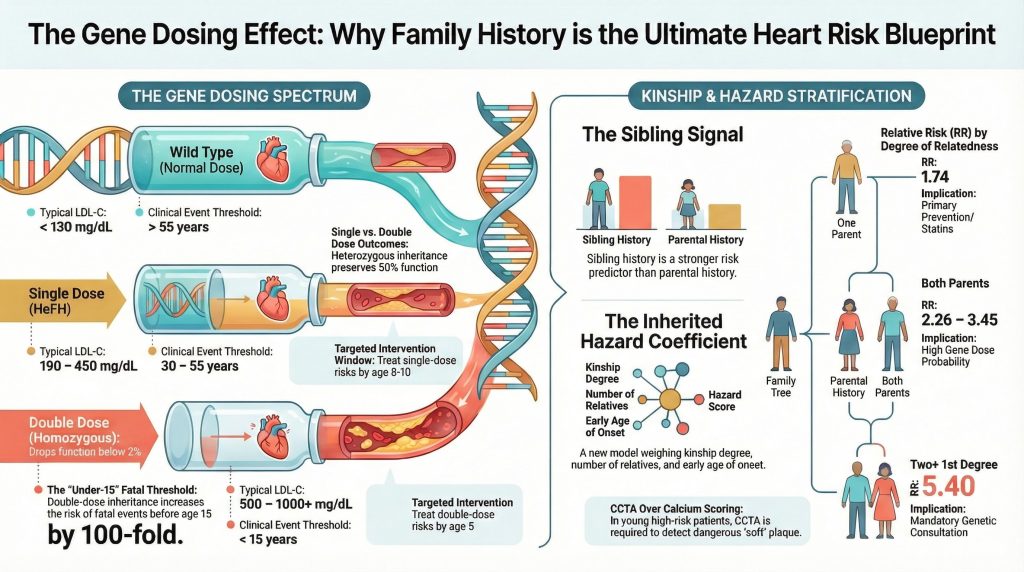
Der Herzrisikorechner ordnet die Herzerkrankungen Ihrer Familie nach Verwandtschaftsgrad, Alter beim Auftreten des Ereignisses und Schweregrad des Ausgangs. Ein tödliches Ereignis bei einem Verwandter ersten Grades Ein Ereignis im Alter von 40 Jahren ist mit einem grundlegend anderen genetischen Signal verbunden als ein nicht tödlicher Vorfall bei einem Großelternteil im Alter von 75 Jahren. Die App erfasst diesen Unterschied mathematisch mithilfe eines evidenzbasierten Gewichtungsrahmens, der von Peter Megdal, PhD auf der Grundlage veröffentlichter epidemiologischer Beobachtungen entwickelt wurde:
H = Σ (R × W) / A
Wobei R das Beziehungskoeffizient (0,5 für Eltern und Geschwister, 0,25 für Großeltern sowie Tanten und Onkel), W ist das Schweregradgewichtung des kardiovaskulären Ereignisses, und A ist das Alter, in dem das Ereignis auftrat. Bei der Gleichung handelt es sich um einen evidenzbasierten Bildungsrahmen, der etablierte epidemiologische Risikoprinzipien zu einem strukturierten Score zusammenführt – und so eine strukturierte Schätzung des vererbten familiären Herzk-Risikos liefert, die kein herkömmliches Ankreuzfeld erfassen kann.
Es offenbart das Imaging-Trap
Einer der wichtigsten – und alarmierendsten – Befunde in der jüngeren kardiovaskulären Forschung ist das, was Klinikärzte als die Bildgebungsfalle (Imaging Trap) bezeichnen. Ein standardmäßiger Koronار Arterie Ein Kalzium-Scan, eines der am häufigsten verwendeten Screening-Instrumente in der Kardiologie, kann selbst dann einen Wert von null ergeben, wenn gefährlicher weicher, nicht verkalkte Plaque bildet sich aktiv in Ihren Arterien. [6] Für Menschen mit einem signifikanten vererbten kardialen Risiko, ein Null-Kalzium-Score kann bei ausgewählten Patienten eine falsche Sicherheit vortäuschen.
Die randomisierte CAUGHT-CAD-Studie aus dem Jahr 2025 bestätigte, dass bei Patienten mit einer Familienanamnese von vorzeitige koronare Herzkrankheit, Koronare CT-Angiographie kann nicht verkalkte identifizieren Plaque wird durch den Calcium-Score nicht erfasst und kann bei ausgewählten Patienten das therapeutische Vorgehen beeinflussen. [7] Der Herz-Risiko-Rechner basiert auf dieser Forschung. Er hilft Ihnen zu verstehen, ob Ihr familiäres Muster Sie zu den Menschen gehören lassen könnte, für die ein zusätzliches Gespräch mit einem Arzt über bildgebende Verfahren sinnvoll sein könnte.
Es erfasst, was Wearables völlig übersehen
Deine Apple Watch kennt deinen Ruhepuls. Sie weiß nicht, dass dein Bruder mit 42 Jahren einen tödlichen Herzinfarkt hatte. Dein Fitbit zeichnet deine Schlafqualität auf. Es kann dir nicht sagen, dass ein Geschwisterteil mit vorzeitiger Herzerkrankung eine Odds Ratio von 2,46 für dein eigenes kardiales Risiko mit sich bringt – eine Zahl, die in von Experten begutachteter Forschung dokumentiert ist, veröffentlicht in JAMA. [5] Ihr Garmin misst Ihr VO2 max. Es gibt keine Möglichkeit, die additive vererbte Belastung zu berücksichtigen – was Forscher als Gen-Dosierung bezeichnen –, die auftritt, wenn mehrere enge Verwandte frühzeitig erkranken. Herz-Kreislauf-Erkrankung, was die Wahrscheinlichkeit einer vererbten genetischen Anfälligkeit erheblich erhöht. [3],[8]
Wearables messen, was in diesem Moment in Ihrem Körper passiert. Der Herzrisikorechner modelliert das vererbte familiäre Signal, das sich in Ihrer Familienanamnese widerspiegelt, und was dies über Ihre kardiale Entwicklung im Laufe des Lebens aussagt. Wearables und Tools zur Familienanamnese liefern komplementäre, aber unterschiedliche Informationen – doch nur eines davon hilft dabei, Personen zu identifizieren, die von einer intensiveren Untersuchung als dem Standardscreening profitieren könnten.
Das gibt Ihnen etwas, das Sie zu Ihrem Arzt mitnehmen können
Jedes Ergebnis des Herzrisikorechners ist als Gesprächsauftakt formuliert, nicht als Schlussfolgerung. Die App erstellt eine diskussionsbereite Zusammenfassung der Familienanamnese und eine Reihe spezifischer, klinisch fundierter Fragen, die Sie zu Ihrem nächsten Termin mitbringen können. Fragen wie: Könnte ich angesichts meiner familiären Vorbelastung weiche Plaque die ein standardmäßiger Kalzium-Scan übersehen würde? Sollte ich an einen Präventivkardiologe anstatt in der Primärversorgung behandelt zu werden? Verändert meine Familienanamnese, wie Standard-Risikotools in meinem Fall interpretiert werden sollten? [9]
Das sind die Fragen, die den Verlauf einer klinischen Untersuchung wirklich verändern können. Es sind die Fragen, die eine routinemäßige jährliche Untersuchung in ein bedeutsames kardiovaskuläres Gespräch verwandeln. Und es sind die Fragen, von denen die meisten Menschen gar nicht wissen, dass sie sie stellen können – weil noch nie jemand ihre Familienanamnese so aufbereitet hat, dass diese Fragen sichtbar werden.
Es basiert auf echter Wissenschaft
Der Herz-Risiko-Rechner ist keine Wellness-App, die auf allgemeinen Ratschlägen basiert. Die in sein Framework integrierten Konzepte stützen sich auf mehr als 40 begutachtete Fachpublikationen, die vererbtes kardiales Risiko und vorzeitige Erkrankungen umfassen Koronare Herzkrankheit, Familienanamnese Epidemiologie, und das Genetik der kardiovaskulären Anfälligkeit. Das der vererblichen Gefährdungskonstanten zugrundeliegende Gen-Dosing-Modell stützt sich auf die Grundlagenforschung zu vererblichen kardiovaskulären Erkrankungen, die veröffentlicht wurde in Nature Reviews Cardiology, der Lanzette, und das European Heart Journal. [4],[8] Die Daten zum Eltern- und Geschwisterrisiko stammen aus wegweisenden Studien in JAMA und Zirkulation. [3],[5] Die klinische Bedeutung der frühen kardiale Ereignisse bei engen Verwandten — und die Unzulänglichkeit standardisierter Instrumente bei der Erfassung dieser Bedeutung — ist über Jahrzehnte der kardiovaskulären Epidemiologie hinweg dokumentiert. [9]
Das ist kein Algorithmus, den jemand an einem Wochenende entwickelt hat. Es handelt sich um ein evidenzbasiertes pädagogisches Rahmenkonzept, das von Peter Megdal, PhD als pädagogisches Instrument entwickelt wurde und etablierte epidemiologische Prinzipien auf ein Problem anwendet, für dessen Lösung herkömmliche Instrumente nie konzipiert wurden.
Warum das gerade jetzt von Bedeutung ist
Herzerkrankungen bleiben die Todesursache Nummer eins in den Vereinigten Staaten. [10] Etwa die Hälfte aller US-Amerikaner hat eine familiäre Vorbelastung für Herz-Kreislauf-Erkrankungen. [11] Und dennoch bleiben die Werkzeuge, die den meisten Menschen zur Verfügung stehen, um ihr vererbtes Risiko zu verstehen, remarkably primitiv — ein Kreuzchen auf einem Anmeldeformular, ein Framingham-Score, der nie dafür entwickelt wurde, die genetische Belastung zu erfassen, [1] und einen Kalzium-Scan, der bei jüngeren, genetisch vorbelasteten Personen die gefährlichste Plaque möglicherweise völlig übersieht. [6],[9]
Für einen 20-Jährigen, dessen Geschwisterkind mit 38 Jahren an einem plötzlichen Herztod gestorben ist, ergibt der Framingham-Risiko-Score häufig ein Zehnjahresrisiko von unter einem Prozent – da die Formel vom chronologischen Alter und nicht von der vererbten Biologie angetrieben wird. [1] Das ererbte Risikoprofil dieser Person rechtfertigt möglicherweise eine wesentlich eingehendere Untersuchung, als von herkömmlichen Rechnern vorgeschlagen wird. Und ohne ein Tool, das das vererbte Familiensignal in ihrer Familienanamnese abbildet, werden sie nie wissen, welche Fragen sie zum richtigen Zeitpunkt stellen müssen, bis es zu spät ist.
Die Heart Risk App existiert für diese Person. Sie existiert für jeden, der in einem Sprechzimmer saß und gesagt hat “Ja, Herzerkrankungen kommen in meiner Familie vor” und dabei zugesehen hat, wie diese Information in einem Ankreuzkästchen verschwand, das nichts an seiner Behandlung ändert.
Laden Sie es noch heute herunter
Die App „Herzrisikorechner“ ist ab sofort bei Google Play für $4,99 erhältlich. Es handelt sich um ein Aufklärungsinstrument, nicht um ein Medizinprodukt, und es ersetzt keine klinische Untersuchung. Aber es könnten die wichtigsten fünf Dollar sein, die Sie für Ihre Herzgesundheit ausgeben – nicht, weil die App Ihren Puls misst, sondern weil sie endlich die Frage stellt, für deren Beantwortung Wearables und herkömmliche Rechner nie konzipiert wurden.
Ihre Familiengeschichte ist ein Datenbestand. Es ist Zeit, ihn zu nutzen.
Dieses Tool dient ausschließlich zu Bildungszwecken und stellt keine medizinische Beratung dar. Der Wert wurde nicht prospektiv zur Vorhersage individueller kardiovaskulärer Ereignisse validiert und sollte nicht zur Diagnose von Krankheiten herangezogen werden. Konsultieren Sie stets eine qualifizierte medizinische Fachkraft, bevor Sie Entscheidungen bezüglich Ihrer Gesundheit treffen. Forschung von Peter Megdal, PhD — CuringHeartDisease.com
Referenzen
- D’Agostino RB Sr, Vasan RS, Pencina MJ, et al. General cardiovascular risk profile for use in primary care: the Framingham Heart Study. Circulation. 2008;117(6):743-753. doi:10.1161/CIRCULATIONAHA.107.699579.
- Virani SS, Alonso A, Aparicio HJ, et al. Heart Disease and Stroke Statistics-2021 Update: A Report From the American Heart Association. Circulation. 2021;143(8):e254-e743. doi:10.1161/CIR.0000000000000950
- Lloyd-Jones DM, Nam BH, D’Agostino RB Sr, et al. Parental cardiovascular disease as a risk factor for cardiovascular disease in middle-aged adults: a prospective study of parents and offspring. JAMA. 2004;291(18):2204-2211. doi:10.1001/jama.291.18.2204
- Ference BA, Ginsberg HN, Graham I, et al. Low-density lipoproteins cause atherosclerotic cardiovascular disease. 1. Evidence from genetic, epidemiologic, and clinical studies. A consensus statement from the European Atherosclerosis Society Consensus Panel. Eur Heart J. 2017;38(32):2459-2472. doi:10.1093/eurheartj/ehx144
- Murabito JM, Pencina MJ, Nam BH, et al. Sibling cardiovascular disease as a risk factor for cardiovascular disease in middle-aged adults. JAMA. 2005;294(24):3117-3123. doi:10.1001/jama.294.24.3117
- Villines TC, Hulten EA, Shaw LJ, et al. Prevalence and severity of coronary artery disease and adverse events among symptomatic patients with coronary artery calcification scores of zero undergoing coronary computed tomography angiography: results from the CONFIRM (Coronary CT Angiography Evaluation for Clinical Outcomes: An International Multicenter) registry. J Am Coll Cardiol. 2011;58(24):2533-2540. doi:10.1016/j.jacc.2011.10.851
- Nerlekar N, Vasanthakumar SA, Whitmore K, et al. Effects of Combining Coronary Calcium Score With Treatment on Plaque Progression in Familial Coronary Artery Disease: A Randomized Clinical Trial. JAMA. 2025;333(16):1403-1412. doi:10.1001/jama.2025.0584
- Bachmann JM, Willis BL, Ayers CR, Khera A, Berry JD. Association between family history and coronary heart disease death across long-term follow-up in men: the Cooper Center Longitudinal Study. Circulation. 2012;125(25):3092-3098. doi:10.1161/CIRCULATIONAHA.111.065490
- Arnett DK, Blumenthal RS, Albert MA, et al. 2019 ACC/AHA Guideline on the Primary Prevention of Cardiovascular Disease: A Report of the American College of Cardiology/American Heart Association Task Force on Clinical Practice Guidelines. Circulation. 2019;140(11):e596-e646. doi:10.1161/CIR.0000000000000678
- Martin SS, Aday AW, Allen NB, et al. 2025 Heart Disease and Stroke Statistics: A Report of US and Global Data From the American Heart Association. Circulation. 2025;151(8):e41-e660. doi:10.1161/CIR.0000000000001303
- Moonesinghe R, Yang Q, Zhang Z, Khoury MJ. Prevalence and Cardiovascular Health Impact of Family History of Premature Heart Disease in the United States: Analysis of the National Health and Nutrition Examination Survey, 2007-2014. J Am Heart Assoc. 2019;8(14):e012364. doi:10.1161/JAHA.119.012364
Nachtrag
Evidenzbasierte Grundlage für den Algorithmus des vererbten Gefahrenkoeffizienten
Begleitdokument zu: “Die Herzgesundheits-App, die endlich die richtige Frage stellt”
Übersicht
Der vererbte Gefahrenkoeffizient (IHC) wird mit folgender Formel berechnet:
H = Σ (R × W) / A
Wo R ist der Verwandtschaftskoeffizient (0,5 für Verwandte ersten Grades: Eltern und Geschwister; 0,25 für Verwandte zweiten Grades: Großeltern, Tanten und Onkel), W ist die Schweregewichtung des kardialen Ereignisses, A ist das Alter, in dem das Ereignis stattfand, und Σ stellt die Summation über alle betroffenen Verwandten in der Familienanamnese dar.
Jedes strukturelle Element dieser Formel – der Beziehungskoeffizient R, die Schweregradgewichtung W, der Altersnenner A und die Summierungslogik – basiert auf einem spezifischen Korpus begutachteter kardiovaskulärer Epidemiologie. Dieser Addendum identifiziert die Primärliteratur, die jede Komponente unterstützt, und unterscheidet diese Evidenz von den Designentscheidungen, die die eigene evidenzbasierte Synthese des Autors darstellen.
Der R-Wert: Korrelationskoeffizient
Der R-Wert gibt den Grad der biologischen Verwandtschaft zwischen dem Patienten und dem betroffenen Familienmitglied an. Verwandte ersten Grades (Eltern, Geschwister) erhalten einen Koeffizienten von 0,5, was dem gemeinsamen Genomanteil von 50% entspricht. Verwandte zweiten Grades (Großeltern, Tanten, Onkel) erhalten einen Koeffizienten von 0,25, was einem gemeinsamen Genomanteil von 25% entspricht. Die unterschiedliche Gewichtung von Verwandten ersten und zweiten Grades wird durch zwei wegweisende Studien aus Framingham gestützt.
Lloyd-Jones et al., JAMA 2004
[1] Diese prospektive Framingham-Offspring-Analyse gehörte zu den ersten, die elterliche Herz-Kreislauf-Erkrankungen streng als unabhängiger Prädiktor für kardiovaskuläre Erkrankungen der Nachkommenschaft nach vollständiger Bereinigung um konventionelle Risikofaktoren. Kritischerweise zeigte die Studie, dass sich das Risiko verstärkte, wenn beide Eltern waren betroffen — das konzeptionelle Fundament für die Summationsstruktur des IHC. Das Papier stützt direkt die Zuweisung des Koeffizienten von 0,5 zu Eltern und die differenzielle Gewichtung von Verwandten ersten Grades im Vergleich zu Verwandten zweiten Grades.
Murabito et al., JAMA 2005
[2] Diese begleitende Framingham-Geschwisteranalyse dokumentierte eine unadjustierte Odds Ratio von 2,46 für Herz-Kreislauf-Erkrankungen bei Personen mit einem betroffenen Geschwisterteil – ein Ausmaß, das in bestimmten Untergruppen mit der elterlichen Anamnese vergleichbar ist oder diese übertrifft. Dieser Befund ist die primäre Rechtfertigung dafür, Geschwistern denselben R-Koeffizienten von 0,5 wie Eltern zuzuweisen anstelle eines niedrigeren Wertes. Er bekräftigte zudem das Kernprinzip, dass Verwandte ersten Grades eine kategorisch andere Risikogruppe darstellen als Verwandte zweiten Grades.
Der A-Term: Alter zum Zeitpunkt des Ereignisses im Nenner
Der A-Term platziert das Alter, in dem das Familienmitglied sein kardiales Ereignis erlebte, in den Nenner der Formel, sodass jüngere Ereignisse einen höheren IHC-Beitrag erzeugen. Dies ist das klinisch folgenschwerste strukturelle Merkmal des Algorithmus und wird durch konsistente Befunde aus mehreren Datenquellen gestützt.
Lloyd-Jones et al., JAMA 2004 und Murabito et al., JAMA 2005
[1],[2] Beide Framingham-Analysen stratifizierten ihre Ergebnisse nach dem Alter beim familiären Ereignis und zeigten ein wesentlich erhöhtes Risiko, wenn das kardiale Ereignis frühzeitig auftrat – definiert als ein Auftreten vor dem 55. Lebensjahr bei männlichen Verwandten und vor dem 65. Lebensjahr bei weiblichen Verwandten. Ein familiäres Ereignis im Alter von 40 Jahren birgt ein fundamental anderes vererbtes Signal als dasselbe Ereignis im Alter von 78 Jahren. Der Terminus A im Nenner ist eine direkte mathematische Kodierung dieses gut etablierten epidemiologischen Prinzips.
D’Agostino et al., Circulation 2008 — Framingham-Risiko-Score
[3] Im Hauptartikel als das primäre Beispiel für einen Risikorechner zitiert, der nicht Berücksichtigen Sie das Alter beim Familienereignis. Der Framingham-Score verwendet das eigene chronologische Alter des Patienten als treibenden Hauptfaktor für das 10-Jahres-Risiko, berücksichtigt jedoch keine Variable für das Alter, in dem Familienmitglieder kardiale Ereignisse erlitten. Der Nenner A in der IHC-Formel ist speziell darauf ausgelegt, diese Lücke zu korrigieren – er erfasst, was der Framingham-Score systematisch auslässt.
Der W-Term: Schweregradgewicht
Der W-Term weist kardialen Ereignissen basierend auf ihrer Schwere unterschiedliche Gewichtungen zu – wobei tödliche Ereignisse, plötzlicher Herztod und frühe Revaskularisation die höhere Gewichtungen erhalten als medizinisch behandelte, nicht tödliche Ereignisse. Dies spiegelt den gut dokumentierten Zusammenhang zwischen der Schwere des Ereignisses und der zugrundeliegenden atherosklerotischen Last wider.
Villines et al., JACC 2011 — CONFIRM-Register
[4] Dieses große multizentrische CCTA-Register zeigte, dass selbst bei Patienten mit einem CAC-Score von Null – die konventionell als Niedrigrisikopatienten gelten – ein signifikanter Anteil nicht verkalkte, potenziell obstruktive Plaques aufwies. Die Studie lieferte starke Beweise dafür, dass die Ereignisschwere und die Plaque-Eigenschaften bei Patienten mit nominell ähnlichen Risikoprofilen nicht einheitlich sind. Tödliche Ereignisse bei Verwandten ersten Grades deuten auf eine höhere Vererbbarkeit hin Plaquebelastung und einen aggressiveren Krankheitsverlauf als nicht tödliche, medizinisch behandelte Ereignisse aufweisen – die epidemiologische Begründung für die W-Schweregradgewichtung.
Nerlekar et al., JAMA 2025 – CAUGHT-CAD-Studie
[5] Diese randomisierte Studie aus dem Jahr 2025 bei Patienten mit einer Familienanamnese von vorzeitiger koronarer Herzkrankheit (KHK) zeigte, dass die Last an nicht verkalkten Plaques selbst bei Personen innerhalb derselben groben Kategorie der Familienanamnese erheblich variierte. Die Studie nutzte die Koronar-CT-Angiographie (CCTA) zur Quantifizierung der Plaque-Progression als primären Endpunkt und bestätigte, dass die SchweregradDifferenzierung innerhalb des vererbten Risikospektrums eine messbare klinische Bedeutung hat – und weder durch eine binäre Klassifikation der Familienanamnese noch durch den Kalkscore allein erfasst wird.
Der Σ-Term: Summation über Verwandte
Der Summenoperator spiegelt das Prinzip wider, dass sich das vererbte kardiale Risiko mit jedem weiteren betroffenen Verwandten kumuliert. Ein Patient mit zwei betroffenen Verwandten ersten Grades trägt ein deutlich anderes vererbtes Signal als ein Patient mit einem. Die Σ-Struktur kodiert dies. Dosis-Wirkungs-Beziehung mathematisch.
Bachmann et al., Circulation 2012 — Cooper Center Longitudinal Study
[6] Diese große prospektive Studie an Männern, die über Jahrzehnte hinweg begleitet wurden, zeigte, dass eine familiäre Vorbelastung von koronare Herzkrankheit Tod war mit einer signifikant erhöhten langfristigen kardiovaskulären Mortalität verbunden, und das Risiko summierte sich über den Nachbeobachtungszeitraum in einer Weise, die mit einem zugrunde liegenden Dosis-Wirkungs-Beziehung Die Studie unterstützt die Logik, Beiträge über betroffene Verwandte hinweg zu summieren, anstatt die Familienanamnese als ein einziges binäres Flag zu behandeln.
Ference et al., European Heart Journal 2017
[7] Dieses Mendelsche Randomisierung Die Analyse zeigte, dass die atherogene Wirkung von LDL-Cholesterin — der Haupttreiber für vererbtes lipidbedingtes Herzkoriko-Risiko — ist kumulativ und zeitabhängig. Die lebenslange Exposition gegenüber erhöhten LDL erzeugt eine Atherosklerose-Last, die proportional zum Integral der Exposition über die Zeit ist und nicht einfach zu einer einzelnen Messung. Dieser biologische Rahmen unterstützt die IHC-Summenstruktur: Das vererbte kardiovaskuläre Risiko ist keine Punktschätzung, sondern ein kumulatives Signal, das über alle betroffenen Verwandten aggregiert und nach Schweregrad und Zeitpunkt ihrer Ereignisse gewichtet werden sollte.
Was die Literatur bestätigt – und was nicht
Was wird validiert
Die oben zitierte begutachtete Fachliteratur belegt mit hoher Zuverlässigkeit Folgendes:
- Verwandte ersten Grades stellen ein höheres vererbtes kardiales Risiko dar als Verwandte zweiten Grades.
- Geschwister bergen ein Risiko, das mit dem von Eltern vergleichbar ist, und liegt nicht zwischen dem von Eltern und Großeltern.
- Das Alter, in dem ein Familienmitglied ein kardiales Ereignis erlitt, ist eine entscheidende Variable: Frühe Ereignisse vermitteln ein dramatisch größeres vererbtes Signal als Ereignisse im späten Leben.
- Mehrere betroffene Verwandte erhöhen das vererbte Risiko dosisabhängig.
- Die Schwere des Ereignisses korreliert mit der zugrundeliegenden atherosklerotischen Last und ist nicht einheitlich über Berichte zur Familienanamnese hinweg.
- Standard-Risikorechner nutzen diese Informationen systematisch unzureichend, insbesondere bei jüngeren Patienten mit starker Familienanamnese.
Was nicht validiert ist
Die vorhandene Literatur nicht validieren
- Die spezifischen Koeffizientenwerte, die für R ausgewählt wurden (0,5 und 0,25).
- Die W zugewiesenen spezifischen Schweregrad-Gewichtswerte.
- Die mathematische Form der Division durch A anstelle der Anwendung eines kategorischen Alters-bei-Ereignis-Modifikators.
- Die Formel H = Σ(R×W)/A als klinisch kalibrierter Vorhersagewert für das individuelle Risiko kardiovaskulärer Ereignisse.
- Der IHC gegen jeden prospektiven Quelldatensatz.
Die IHC-Formel ist eine evidenzbasierter Bildungsrahmen das etablierte epidemiologische Prinzipien in eine strukturierte, quantitative Schätzung des vererbten familiären kardialen Risikos übersetzt. Die Eingabedaten basieren auf wegweisender begutachteter Fachliteratur (Peer-Review-Literatur). Die spezifische mathematische Implementierung – die Koeffizientenwerte, das Gewichtungsschema und die Formelstruktur – stellt die Synthese dieser Prinzipien durch den Autor dar und wurde nicht unabhängig validiert. Die ACC/AHA Primärprävention Leitlinie [8] erkennt die Familienanamnese explizit als risikosteigernden Faktor an, der die klinische Entscheidungsfindung beeinflussen sollte, geht jedoch nicht so weit, eine quantitative Formel dafür anzugeben. Genau diese Lücke soll durch die IHC geschlossen werden.
Referenzen
- Lloyd-Jones DM, Nam BH, D’Agostino RB Sr, et al. Parental cardiovascular disease as a risk factor for cardiovascular disease in middle-aged adults: a prospective study of parents and offspring. JAMA. 2004;291(18):2204-2211. doi:10.1001/jama.291.18.2204
- Murabito JM, Pencina MJ, Nam BH, et al. Sibling cardiovascular disease as a risk factor for cardiovascular disease in middle-aged adults. JAMA. 2005;294(24):3117-3123. doi:10.1001/jama.294.24.3117
- D’Agostino RB Sr, Vasan RS, Pencina MJ, et al. General cardiovascular risk profile for use in primary care: the Framingham Heart Study. Circulation. 2008;117(6):743-753. doi:10.1161/CIRCULATIONAHA.107.699579
- Villines TC, Hulten EA, Shaw LJ, et al. Prevalence and severity of coronary artery disease and adverse events among symptomatic patients with coronary artery calcification scores of zero undergoing coronary computed tomography angiography: results from the CONFIRM (Coronary CT Angiography Evaluation for Clinical Outcomes: An International Multicenter) registry. J Am Coll Cardiol. 2011;58(24):2533-2540. doi:10.1016/j.jacc.2011.10.851
- Nerlekar N, Vasanthakumar SA, Whitmore K, et al. Effects of Combining Coronary Calcium Score With Treatment on Plaque Progression in Familial Coronary Artery Disease: A Randomized Clinical Trial. JAMA. 2025;333(16):1403-1412. doi:10.1001/jama.2025.0584
- Bachmann JM, Willis BL, Ayers CR, Khera A, Berry JD. Association between family history and coronary heart disease death across long-term follow-up in men: the Cooper Center Longitudinal Study. Circulation. 2012;125(25):3092-3098. doi:10.1161/CIRCULATIONAHA.111.065490
- Ference BA, Ginsberg HN, Graham I, et al. Low-density lipoproteins cause atherosclerotic cardiovascular disease. 1. Evidence from genetic, epidemiologic, and clinical studies. A consensus statement from the European Atherosclerosis Society Consensus Panel. Eur Heart J. 2017;38(32):2459-2472. doi:10.1093/eurheartj/ehx144
- Arnett DK, Blumenthal RS, Albert MA, et al. 2019 ACC/AHA Guideline on the Primary Prevention of Cardiovascular Disease: A Report of the American College of Cardiology/American Heart Association Task Force on Clinical Practice Guidelines. Circulation. 2019;140(11):e596-e646. doi:10.1161/CIR.0000000000000678