
Does a Negative Family History of Coronary Disease Modify Risk in Individuals With High LDL-C and ApoB?
Separating Causal Exposure, Inherited Susceptibility, and Expressed Disease
Einleitung
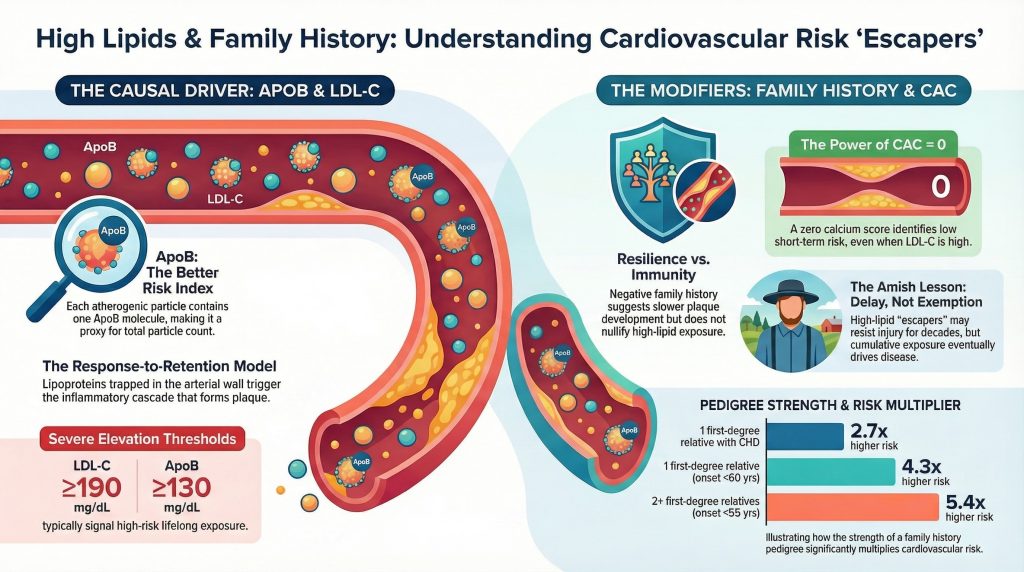
The contemporary model of atherosclerotic Herz-Kreislauf-Erkrankung (ASCVD) holds that circulating Apolipoprotein BApoB)-haltig Lipoproteine are causal in Atherogenese, and that risk is a function of both the magnitude and the duration of exposure.1,2 Within this framework, low-density lipoprotein Cholesterin (LDL-C) remains the primary clinical target, while ApoB is often the more mechanistically informative measure, because each atherogenic particle carries a single ApoB molecule and ApoB therefore serves as a direct index of atherogenic particle number.3
These are, however, two different kinds of statement, and the distinction matters for everything that follows. The causal role of cumulative ApoB exposure is a mechanistic and genetic claim supported by concordant evidence from Mendelsche Randomisierung, randomized trials, and observational cohorts.1,3 The thresholds used to act on that claim are guideline conventions. The 2026 ACC/AHA/Multisociety Dyslipidemia Guideline, which retires and replaces the 2018 guideline, defines severe hypercholesterolemia as LDL-C ≥190 mg/dL, non–HDL-C >220 mg/dL, and/or ApoB >140 mg/dL, and treats it as a distinct management group in which secondary causes should be excluded and maximally tolerated statin therapy is recommended (Class 1).2 Adults meeting this definition are also appropriately evaluated for familial hypercholesterolemia (FH), particularly in the presence of tendon xanthomas, a suggestive pedigree, or documented elevation from early life.2,4
Against this background, clinical practice repeatedly encounters a subgroup that appears to contradict the model: individuals with markedly elevated LDL-C or ApoB who reach midlife or beyond without Myokardinfarkt, clinically manifest coronary disease, or detectable coronary Verkalkung. This raises a specific question for preventive cardiology: does a strongly negative Familiengeschichte of coronary disease — particularly one spanning multiple generations without premature events — meaningfully offset the hazard associated with high ApoB exposure?
The answer defensible from current evidence is narrower than the question. A negative pedigree is best understood as a marker of lower observed familial susceptibility. It is not a demonstrated protective mechanism, and the magnitude of any advantage it confers within the severe hypercholesterolemia population has not been directly quantified. High ApoB remains causally upstream; family history describes something about the context in which that exposure is expressed.1,3
The clinically useful reformulation is therefore not whether a negative pedigree proves that high LDL-C is harmless, but whether it helps identify a phenotype in which coronary Plaque develops more slowly — and, if so, whether that phenotype can be confirmed by direct measurement of disease rather than inferred from family structure alone. That question can be addressed, because Koronarer Kalzium-Score provides a direct readout of verkalkte Plaque burden accumulated to date.2,5
Three evidentiary levels are used throughout this review and should not be collapsed into one another:
| Level | What it measures | Strength of inference |
| Cumulative ApoB exposure | Lifetime causal driver | Strong; causal |
| Family history and other inherited susceptibility markers | Correlates of expressed risk in relatives | Indirect; heterogeneous; poorly quantified in the inverse direction |
| CAC | Calcified coronary disease manifested to date | Strong for calcified disease expressed to date; does not measure future exposure or noncalcified plaque |
The Mechanistic Primacy of ApoB in Atherogenesis
Atherogenesis is best described by the Antwort-Retentions-Modell.6 ApoB-containing lipoproteins cross the endothelial barrier, enter the arterial Intima, and are retained through interaction with arterial-wall proteoglycans. Retained particles undergo oxidative and enzymatic modification, which promotes endothelial activation, monocyte recruitment, macrophage infiltration, foam-cell formation, smooth-muscle migration, necrotic core development, and eventual plaque progression and calcification.6 Plasma cholesterol concentration matters in this sequence chiefly as a proxy for the quantity of particles capable of entering and becoming trapped in the vessel wall.
This is why ApoB and LDL-C can diverge in clinically meaningful ways. A patient may carry numerous but cholesterol-poor LDL particles, producing a higher atherogenic particle burden than LDL-C alone suggests; another may carry fewer, cholesterol-richer particles. ApoB accordingly improves risk discrimination in Metabolisches Syndrom, hypertriglyceridemia, insulin resistance, und Diabetes, where LDL-C tends to understate true exposure.3 The 2026 guideline reflects this, endorsing selective ApoB measurement to assess residual risk and refine treatment decisions, while retaining LDL-C as the principal target because guideline goals and the large majority of outcome trials are anchored to it.2,3
If lifelong elevation of ApoB is the core driver of atherogenesis, then any apparent protection must operate downstream of exposure rather than negate it. Several mechanisms could in principle account for slower disease expression at a given particle burden: reduced endothelial permeability to lipoprotein entry, lower intimal proteoglycan retention, attenuated monocyte adhesion or inflammatory amplification, more favorable plaque composition, or reduced thrombotic response to plaque disruption.
These are hypotheses, not demonstrated explanations for negative family history. No study has established that individuals with unremarkable pedigrees and high ApoB possess any of these properties. They are offered here as candidate mechanisms that would be consistent with the observed phenotype and that define testable questions, not as an account of what is happening in such patients.1,6
Genetic Evidence for Modification of ASCVD Risk
Human Genetik establishes that inherited variation can substantially alter cardiovascular risk. The clearest example is PCSK9. PCSK9 promotes degradation of hepatic LDL receptors; loss-of-function variants preserve receptor recycling and lower LDL-C across the lifespan. In the study by Cohen et al., Black carriers of nonsense variants had approximately 28% lower LDL-C and an 88% lower risk of koronare Herzkrankheit, while White carriers of the R46L variant had approximately 15% lower LDL-C and a 47% lower risk.7
An important distinction must be drawn here, because this evidence is frequently misapplied. PCSK9 variants do not demonstrate protection despite high ApoB. They lower the causal exposure itself, and they do so from birth. The disproportionate risk reduction relative to the modest LDL-C difference is powerful evidence for the importance of duration of exposure — it is an argument for the primacy of cumulative ApoB, not an argument that inherited biology can neutralize it.1,7
Other loci suggest that risk can also be modified through pathways that are not purely a function of LDL-C concentration. A Mendelian Randomisierung analysis of the interleukin-6 receptor (IL6R) pathway found that the Asp358Ala variant, which alters IL-6 signaling, was associated with a modest reduction in coronary heart disease risk, supporting a causal contribution of inflammatory signaling to plaque progression independent of lipid level.8 Variants in APOC3 und ANGPTL3, by contrast, are frequently grouped with IL6R in this context but should not be: their principal effect is to reduce triglyceride-rich remnant particles and therefore total atherogenic particle exposure.3 They are further examples of exposure reduction, not of resilience at fixed exposure. The IL6R evidence therefore provides a clearer example of risk modification operating downstream of particle burden.
What these observations collectively support is a weaker but still meaningful claim: two individuals with identical LDL-C can follow different clinical trajectories, because inherited liabilities involving Lp(a), remnant metabolism, inflammatory signaling, endothelial function, und thrombosis vary independently of LDL-C. A comparatively resilient vascular phenotype remains a reasonable organizing hypothesis for this heterogeneity, but it has not been demonstrated as a discrete, measurable entity and no clinical test identifies it. A negative family history is, at most, a crude and indirect signal that a patient may sit at the favorable end of this distribution — it cannot identify which pathway is involved, nor establish whether any advantage is durable or merely delays expression.1,8
A Founder-Population Example: APOB R3500Q in the Old Order Amish
The Pennsylvania Amish founder variant in APOB provides an instructive natural experiment, though its generalizability is limited and should be stated plainly at the outset. Familial defective ApoB-100 due to the R3500Q (p.Arg3527Gln) variant produces lifelong LDL elevation in a population with an unusually homogeneous genetic background, a shared and physically active lifestyle, and a carrier frequency of approximately 12% — versus 0.1% to 0.4% in white European populations.9
Cross-sectional imaging in Amish children and young adults with this variant has shown elevated LDL-C and increased LDL particle number without detectable Atherosklerose by carotid intima-media thickness or pulse-wave velocity.10 This finding is often cited as evidence of vascular tolerance. Its weight should be calibrated to the study design: the cohort comprised 13 heterozygotes, 3 homozygotes, and 9 age-matched unaffected siblings, and the imaging endpoints were surrogate measures in children. Absence of detectable subclinical disease in a cohort of this size and age is consistent with vascular resilience, but it is equally consistent with the simple fact that atherosclerosis takes decades to become measurable by these modalities.10
Data from adult carriers are considerably more informative and point in the opposite direction. In a genome-wide association study with replication comprising 1,504 Amish participants, of whom 1,018 underwent CAC scanning, R3500Q carriers had LDL-C levels averaging 58 mg/dL higher than noncarriers, a 4.41-fold higher odds of detectable CAC (95% CI, 2.69–7.21), and a 9.28-fold higher odds of extensive CAC.9 The variant accounted for 26% of the variance in LDL-C and 7% of the variance in CAC.9
Two conclusions follow, and a third caution. First, in a population with favorable lifestyle and homogeneous background genetics, lifelong LDL elevation still produced a large excess of subclinical coronary disease by middle age. Whatever tolerance the pediatric imaging data suggested did not persist. Second, this pattern is consistent with delay rather than exemption: the vessel wall may resist measurable injury for decades, but the exposure is continuous. Third, and importantly, a published correspondence noted that the proportion of carriers and noncarriers reporting a history of clinical cardiovascular events was similar in this cohort11 — the calcification signal was strong, while the hard-event signal in this relatively young, cross-sectionally assessed population was not. This limits how far the Amish data can be pushed toward statements about clinical outcomes.
The relevance of this example to negative family history is real but bounded. It shows that a favorable inherited and environmental background can coexist with substantial subclinical disease accumulation. Extrapolation from a founder population with a specific ApoB variant to the general population of patients with severe hypercholesterolemia is hypothesis-generating rather than confirmatory.9,10
What Family History Contributes to Risk Assessment
Family history is a compressed clinical signal capturing shared genetics, shared behaviors, and shared environment simultaneously. A positive family history of coronary disease, particularly premature disease, is a well-established risk enhancer, and its predictive strength scales with the stringency of the pedigree definition. In the Newcastle Family History Study II, the estimated odds ratio for an acute coronary event rose from approximately 2.7 for at least one Verwandter ersten Grades with coronary heart disease at any age, to 4.3 for at least one first-degree relative affected before age 60 years, to 5.4 for two or more first-degree relatives affected before age 55 years.12 Analyses in the Framingham Offspring cohort similarly showed that parental cardiovascular disease predicted offspring events after adjustment for conventional Risikofaktoren.13
These estimates quantify the excess risk associated with a positive family history. They do not provide the inverse estimate — the protection conferred by a negative pedigree among patients with LDL-C ≥190 mg/dL. That inverse quantity has not been directly measured in the severe hypercholesterolemia population, and it cannot be derived by inverting an odds ratio estimated in a general-population case-control design. This is the single most important limitation of the protective-family-history argument, and it applies to every clinical inference drawn below.
Family history also correlates with subclinical disease, not only with events. In the Multi-Ethnic Study of Atherosclerosis, a family history of premature coronary heart disease was associated with greater prevalence and extent of coronary Arterie calcification after adjustment for traditional risk factors.14 This strengthens the interpretation of family history as a marker of susceptibility that manifests early in the disease process, and it is part of why the absence of such a history in a patient with high ApoB and no calcium is internally coherent rather than paradoxical.
The reasonable clinical reading is therefore modest: in a patient with markedly elevated LDL-C or ApoB, a strongly negative pedigree indicates the absence of an additional recognized risk enhancer; family history of premature ASCVD is among the factors the 2026 guideline directs clinicians to weigh beyond the calculated risk estimate.2 It does not establish lower inherited susceptibility, because susceptibility is not directly observed — only its expression in relatives is.
Several failure modes of pedigree interpretation deserve explicit attention at this point rather than as a closing caveat, because they bear on whether the signal means anything in a given patient:
- Treatment masking. Relatives effectively treated with statins, antihypertensives, oder revascularization before an event may render a genuinely high-risk pedigree superficially negative.
- Small family size. A pedigree with few first-degree relatives has limited power to display familial risk even when it exists.
- Competing mortality. Death from other causes can censor coronary expression in earlier generations.
- Environmental verwirrend. Shared favorable behaviors can masquerade as inherited protection, and shared adverse behaviors as inherited risk.
- Recall and documentation quality. Self-reported family history is imperfect, and premature-event ascertainment in particular is often unreliable.
Family History and Polygenic Risk: What Can and Cannot Be Inferred
It is tempting to interpret a negative family history as evidence of low aggregate polygenic burden. That inference is not supported. Family history and polygenic risk scores are correlated but distinct: family history captures observed disease clustering, including its environmental and behavioral determinants, whereas polygenic scores estimate inherited burden from directly measured variants. Each contributes information the other does not, and a negative pedigree cannot be assumed to represent a low polygenic score in any individual patient.13,15
What the polygenic literature does support is that common small-effect variants meaningfully shape both the age at onset and the likelihood of coronary disease, and that this burden is modifiable by lifestyle.15 It is therefore biologically plausible that a patient with high LDL-C and low aggregate inherited susceptibility remains event-free substantially longer than a patient with the same LDL-C and high polygenic burden. Demonstrating this in a given patient requires measuring the polygenic score, not inferring it from the pedigree.
It is also worth separating, in the list of factors that modify how a given ApoB burden is expressed, the established from the conjectural:
- Established, measurable, and independently associated with events: Lp(a), Blutdruck, glycemic status, Rauchen, triglyceride-rich remnant burden, hs-CRP, and — as a measure of accumulated disease rather than of susceptibility — CAC.
- Biologically plausible but not routinely measurable or validated as individual-level modifiers: endothelial permeability, intimal retention capacity, inflammatory set-point, plaque composition, and thrombotic responsiveness.
Both sets are real; only the first can currently inform the care of an individual patient. This asymmetry is the principal argument for prioritizing direct measurement of disease over inference from inherited background.
CAC: Direct Measurement of Calcified Coronary Plaque
When the question is whether a specific patient with high LDL-C is currently expressing coronary atherosclerosis, CAC scoring answers it more directly than any pedigree can. This matters particularly in severe hypercholesterolemia, where lipid-based estimation may overstate short-term risk in some patients while remaining correct about lifetime hazard.
The most directly relevant data come from the MESA analysis by Sandesara et al.5 Among 246 MESA participants without clinical cardiovascular disease and with baseline LDL-C ≥190 mg/dL (mean age 63 ± 9.4 years; mean LDL-C 215 ± 27 mg/dL), 37% had CAC = 0. Younger age, female sex, and absence of diabetes were associated with CAC = 0. Over a median follow-up of 13.2 years, those with CAC = 0 had a cardiovascular event rate of 4.7 per 1,000 person-years (10-year risk 3.7%) compared with 26.4 per 1,000 person-years (10-year risk 20%) among those with CAC >0, corresponding to an adjusted Hazard-Ratio of 0.25 (95% CI, 0.10–0.66).5
The adjusted hazard ratio, rather than the crude incidence-rate ratio, is the appropriate adjusted effect estimate. The implication is not that severe LDL elevation becomes benign in the absence of calcium. It is that CAC = 0 identifies a subgroup with substantially lower observed near-term event rates despite severe LDL elevation. This is precisely the setting in which a negative family history becomes clinically coherent: the two findings are concordant markers of a more favorable observed phenotype despite severe hypercholesterolemia.
Three limitations bound this inference, and the third is frequently overlooked:
- CAC identifies calcified plaque, not all plaque. Patients with CAC = 0 may harbor noncalcified or mixed plaque, and events do occur in this group — at approximately 0.4% per year in the population described above,5 which is low but not zero.
- The MESA cohort was middle-aged to older. A CAC of 0 at age 63 after decades of exposure is a substantially more reassuring finding than a CAC of 0 at age 40, where insufficient time may simply have elapsed for calcification to develop. Age at scanning materially changes the meaning of the result.
- The CAC-based deferral pathway and the severe hypercholesterolemia pathway are not interchangeable. In the 2026 guideline, selective CAC scoring to reclassify risk and potentially defer lipid-lowering therapy is situated within primary prevention for adults at borderline or intermediate 10-year PREVENT-ASCVD risk, with repeat scanning recommended in 3 to 7 years if therapy is deferred.2 Severe hypercholesterolemia with LDL-C ≥190 mg/dL is handled as a separate management group in which maximally tolerated statin therapy carries a Class 1 recommendation and general-population risk equations are explicitly not relied upon.2 A CAC of 0 refines the estimate of current disease in such a patient; it does not transfer them into the deferral pathway.
CAC and family history can therefore help characterize near-term risk and inform partizipative Entscheidungsfindung about treatment implementation and additional risk assessment; they should not be used to establish low lifetime risk or to provide an evidence-based rationale for withholding therapy.2,5
Lp(a), hs-CRP, and Metabolic Context
The case for a lower observed risk profile is strongest when a negative family history is accompanied by favorable measured Biomarker.
Lp(a) is the most important of these, because it confers atherogenic and prothrombotic risk independently of LDL-C and is largely genetically determined. The National Lipid Association’s focused update recommends measuring Lp(a) at least once in every adult, with values below 75 nmol/L (or <30 mg/dL) considered low risk and values ≥125 nmol/L (or ≥50 mg/dL) treated as risk-enhancing.16 The 2026 ACC/AHA guideline likewise recommends universal once-in-a-lifetime Lp(a) measurement and treats levels of 125 nmol/L (50 mg/dL) or above as risk-enhancing, associated with roughly a 1.4-fold increase in ASCVD risk, with about a 2-fold increase at 250 nmol/L (100 mg/dL) or above.2 A patient with high LDL-C but low Lp(a) lacks one major inherited accelerator of plaque progression and thrombosis — and, notably, one that is directly measurable rather than inferred.
High-sensitivity C-reactive protein (hs-CRP) provides a coarse index of systemic inflammatory activation and is recognized among the risk-enhancing factors in the 2026 guideline;2 the ≥2.0 mg/L threshold in common use derives from the prior guideline convention.4 A persistently low hs-CRP is directionally favorable but does not demonstrate absence of arterial Entzündung, and it should not be interpreted as evidence of vascular resilience. Where a negative family history coexists with low Lp(a), low hs-CRP, normal blood pressure, normal glycemia, low Triglyceride, and CAC = 0, the accurate statement is that the patient’s overall measured risk profile is more favorable than the LDL-C value alone conveys — not that a slower atherosclerotic trajectory has been established.
Metabolic context contributes in a related way. In insulin resistance and hypertriglyceridemia, ApoB frequently reveals particle excess that LDL-C conceals. Conversely, a patient with isolated LDL elevation, low triglycerides, and otherwise favorable cardiometabolic parameters may carry a lower observed short-term risk profile than a patient with the same LDL-C embedded in broader metabolic dysfunction. The distinction throughout is between tempo and causality: favorable metabolic context may be associated with slower expression of disease without rendering lifelong ApoB elevation innocuous.2,3
Clinical Interpretation and the Limits of the Protection Argument
The strongest defensible synthesis is this: a negative family history may identify patients at lower risk relative to otherwise similar patients with a positive premature-ASCVD pedigree, but the magnitude of that difference within the severe hypercholesterolemia population is poorly quantified and has not been directly estimated. It justifies a less alarmist framing of near-term risk. It does not justify a claim that severe hypercholesterolemia is safe when untreated across the life course.2,5,12
Observed risk. In the closest available cohort data, asymptomatic adults with LDL-C ≥190 mg/dL and CAC = 0 had an observed cardiovascular event rate of approximately 0.4% per year.5 The available data do not establish a separate event rate for the more selected phenotype of CAC = 0 combined with negative family history, low Lp(a), and favorable metabolic health. Lifetime risk nonetheless remains elevated because cumulative ApoB exposure continues to accrue.
Treatment. The guideline recommendation for this patient is unchanged by the above: secondary causes should be excluded, and maximally tolerated statin therapy is recommended (Class 1), with LDL-C goals set according to the presence of FH, subclinical atherosclerosis, or additional risk factors.2 No trial has evaluated a strategy of serial monitoring in place of lipid-lowering therapy in patients with LDL-C ≥190 mg/dL and CAC = 0. Absent such evidence, favorable markers may reasonably inform shared-decision framing, additional risk assessment, and consideration of an interval for repeat imaging — but they do not constitute an evidence-based basis for withholding guideline-recommended lipid-lowering therapy. Presenting them as such would exceed what the data support.
Conclusion
A strongly negative family history of coronary disease may identify individuals in whom the clinical expression of lipid-associated risk is delayed or less pronounced. It should be interpreted as a marker of lower observed familial susceptibility rather than as a demonstrated protective mechanism, and it does not neutralize lifelong ApoB exposure.
The candidate mechanisms outlined earlier remain hypotheses. None has been shown to account for the pedigrees observed in clinical practice, and none is currently measurable in an individual patient.1,8,16
The practical conclusion is a division of labor among three distinct sources of information:
Cumulative ApoB exposure describes lifetime causal risk. CAC describes how much calcified coronary disease has actually manifested to date. Family history supplies additional but indirect information about susceptibility, and cannot establish protection.
Patients with severe hypercholesterolemia and CAC = 0 can nevertheless have low observed short-term event rates.5 A negative family history and favorable measured biomarkers provide additional risk information, but their incremental effect within this CAC = 0 subgroup has not been directly quantified. The causal exposure nevertheless continues to operate in the background, which is why guideline-based care continues to treat LDL-C ≥190 mg/dL as a distinct, treatment-warranting management category independent of calculated 10-year risk.2 A negative family history can attend a delayed and attenuated manifestation of high-lipid risk; it does not abolish the biology that makes long-term ApoB exposure dangerous.
Referenzen
- Ference BA, Ginsberg HN, Graham I, et al. Low-density lipoproteins cause atherosclerotic cardiovascular disease. 1. Evidence from genetic, epidemiologic, and clinical studies. A consensus statement from the European Atherosclerosis Society Consensus Panel. Eur Heart J. 2017;38(32):2459-2472. doi:10.1093/eurheartj/ehx144
- Writing Committee. 2026 ACC/AHA/AACVPR/ABC/ACPM/ADA/AGS/APhA/ASPC/NLA/PCNA Guideline on the Management of Dyslipidemia: A Report of the American College of Cardiology/American Heart Association Joint Committee on Clinical Practice Guidelines. Circulation. 2026. doi:10.1161/CIR.0000000000001423. (Simultaneous publication: J Am Coll Cardiol. doi:10.1016/j.jacc.2025.11.016)
- Soffer DE, Marston NA, Maki KC, et al. Role of apolipoprotein B in the clinical management of cardiovascular risk in adults: An Expert Clinical Consensus from the National Lipid Association. J Clin Lipidol. 2024;18(5):e647-e663. doi:10.1016/j.jacl.2024.08.013
- Grundy SM, Stone NJ, Bailey AL, et al. 2018 AHA/ACC/AACVPR/AAPA/ABC/ACPM/ADA/AGS/APhA/ASPC/NLA/PCNA Guideline on the Management of Blood Cholesterol. Circulation. 2019;139(25):e1082-e1143. doi:10.1161/CIR.0000000000000625. [Retired and replaced by reference 2; retained here for historical reference only.]
- Sandesara PB, Mehta A, O’Neal WT, et al. Clinical significance of zero coronary artery calcium in individuals with LDL cholesterol ≥190 mg/dL: The Multi-Ethnic Study of Atherosclerosis. Atherosclerosis. 2020;292:224-229. doi:10.1016/j.atherosclerosis.2019.09.014
- Williams KJ, Tabas I. The response-to-retention hypothesis of early atherogenesis. Arterioscler Thromb Vasc Biol. 1995;15(5):551-561. doi:10.1161/01.atv.15.5.551
- Cohen JC, Boerwinkle E, Mosley TH Jr, Hobbs HH. Sequence variations in PCSK9, low LDL, and protection against coronary heart disease. N Engl J Med. 2006;354(12):1264-1272. doi:10.1056/NEJMoa054013
- Interleukin-6 Receptor Mendelian Randomisation Analysis (IL6R MR) Consortium, Swerdlow DI, Holmes MV, et al. The interleukin-6 receptor as a target for prevention of coronary heart disease: a mendelian randomisation analysis. Lancet. 2012;379(9822):1214-1224. doi:10.1016/S0140-6736(12)60110-X
- Shen H, Damcott CM, Rampersaud E, et al. Familial defective apolipoprotein B-100 and increased low-density lipoprotein cholesterol and coronary artery calcification in the Old Order Amish. Arch Intern Med. 2010;170(20):1850-1855. doi:10.1001/archinternmed.2010.384
- Williams KB, Horst M, Young M, et al. Clinical characterization of familial hypercholesterolemia due to an Amish founder mutation in apolipoprotein B. BMC Cardiovasc Disord. 2022;22(1):109. doi:10.1186/s12872-022-02539-3
- Ahmad Z, Garg A. Lack of cardiovascular disease among Old Order Amish with familial defective apolipoprotein B. Arch Intern Med. 2011;171(11):1039-1040. doi:10.1001/archinternmed.2011.238
- Silberberg JS, Wlodarczyk J, Fryer J, Robertson R, Hensley MJ. Risk associated with various definitions of family history of coronary heart disease. The Newcastle Family History Study II. Am J Epidemiol. 1998;147(12):1133-1139. doi:10.1093/oxfordjournals.aje.a009411
- Lloyd-Jones DM, Nam BH, D’Agostino RB Sr, et al. Parental cardiovascular disease as a risk factor for cardiovascular disease in middle-aged adults: a prospective study of parents and offspring. JAMA. 2004;291(18):2204-2211. doi:10.1001/jama.291.18.2204
- Nasir K, Budoff MJ, Wong ND, et al. Family history of premature coronary heart disease and coronary artery calcification: Multi-Ethnic Study of Atherosclerosis (MESA). Circulation. 2007;116(6):619-626. doi:10.1161/CIRCULATIONAHA.107.688739
- Khera AV, Emdin CA, Drake I, et al. Genetic risk, adherence to a healthy lifestyle, and coronary disease. N Engl J Med. 2016;375(24):2349-2358. doi:10.1056/NEJMoa1605086
- Koschinsky ML, Bajaj A, Boffa MB, et al. A focused update to the 2019 NLA scientific statement on use of lipoprotein(a) in clinical practice. J Clin Lipidol. 2024;18(3):e308-e319. doi:10.1016/j.jacl.2024.03.001