
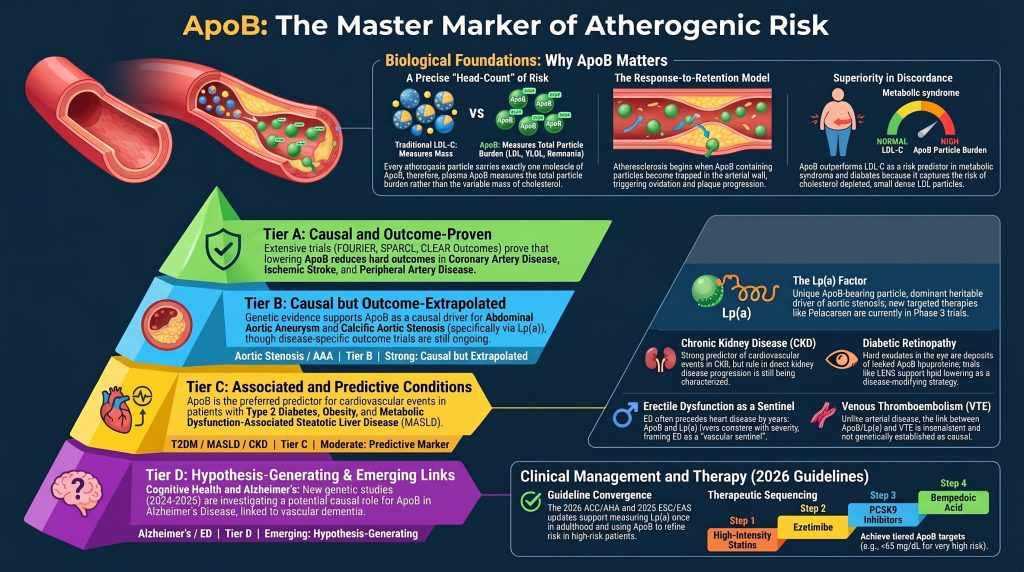
冠動脈を超えて
上昇の臨床的意義 アポリポ蛋白 B 血管、代謝、肝、腎、神経疾患の全域にわたって
抄録
アポリポ蛋白Bの高値(アポリポ蛋白B) は、もっとも有益な単一の血中マーカーである 動脈硬化惹起性粒子 負荷であり、アスケロスクレロティックの統一的な原因ドライバーである 心血管疾患 (ASCVD)。その臨床的価値は、ApoBおよび低密度 リポタンパク質 コレステロール (LDL-C)が不一致を示す—それは最も多くの場合、コレステロールが枯乏した特徴を持つインスリン抵抗性表現型においてである 小型Sd LDL およびトリグリセリド豊富レムナント。古典的なASCVDにとどまらず、アポB高値と疾患との関係は、因果関係と転帰が証明されているもの(虚血性脳卒中, 末梢動脈疾患)、因果関係はあるが結果が外挿された(腹部 大動脈瘤, 石灰化の 大動脈弁狭窄症 経由 リポ蛋白(a))、代謝異常関連脂肪性肝疾患(関連および予測的指標として、, 慢性腎臓病, 糖尿病網膜症)、仮説生成(アルツハイマー病、勃起不全、静脈血栓塞栓症、がんの転帰)に至るまで、本レビューでは、エビデンスの信頼度が背後にあるデータの強さと一致するように、エビデンスを透明性の高い梯子状に体系化し、現在および今後の治療法を転帰の状況別に要約し、推奨事項を2026年 ACC/AHA に適合させている 脂質異常症 ガイドライン、2025年ESC/EASフォーカスアップデート、2021年カナダ心血管学会(CCS)ガイドライン、および最近の全米脂質協会(NLA)コンセンサス。.
ApoBと疾患のエビデンス・ラダー
過度な一般化を防ぐため、本レビューにおけるすべての病態は4段階のエビデンス階梯によって評価されている。そのラベル付けが、続くセクションにおける推奨の強さを決定づけている。.
- Tier A — 因果関係が証明され、成果が実証されたもの: メンデルランダム化 (MR)は因果関係を支持し、 ランダム化比較試験 下げる(ランダム化比較試験[RCT]) アポB含有リポ蛋白 事前に規定された、またはロバストなサブグループ解析を用いて、この疾患における重篤な転帰を減少させる.
- Tier B — 因果関係はあるが結果が外挿されたもの: MRまたは強力な遺伝的エビデンスが因果関係を支持しているが、アウトカム減少データは疾患特異的なRCTではなく、関連するASCVDのエンドポイントから外挿されたものである。.
- ティアC — 関連および予測的: アポBと疾患を結びつける強力な観察データおよびメカニズムデータが存在し、アポBはイベントを予測するが、メンデルランダム化(MR)によって因果関係が確立されているわけではなく、治療のエビデンスも混在している。.
- ティアD — 仮説生成: 機序の妥当性と限られた観察シグナルがあり、説得力のある因果関係や介入のエビデンスはない。.
疾患がサブタイプ間で不均一なエビデンスを持つ場合(例:血管性認知症対アルツハイマー病;虚血性対. 脳出血; ;CKDイベント対進行など)、各サブタイプは平均化されるのではなく、個別に段階評価されます。エビデンスが不十分であるために疾患が2つの段階の間に位置する場合、たとえば高血圧性血管疾患(相乗作用がある場合など) 動脈硬化 しかし、疾患特異的なRCTデータが限られている場合)—「B/C」のような二重の指定が使用され、該当するセクションで説明されます。その意図は疑似的な精密スコアリングではなく、記述の透明性にあります。.
第1部 — 生物学的基礎
アポBは動脈硬化を引き起こす粒子を数える
それぞれ LDL, 、中等比重リポタンパク(IDL)、超低密度リポ蛋白(VLDL), カイロミクロン レムナントおよびリポ蛋白(a) [Lp(a)] 粒子は、アポリポ蛋白B分子を正確に1個含んでいます。 アポB-100 肝臓で分泌される粒子において、, アポB-48 腸管分泌性のものにおいて1, 2したがって、血漿アポBはアトゲン性(動脈硬化惹起性)粒子の個数を示すものであるのに対し、LDL-Cは粒子あたりのコレステロールの化学量論比が変動する質量測定値である3, 4]。インスリン抵抗性状態におけるコレステロールが枯渇した小型LDLのように、粒子あたりの平均コレステロール負荷量が低下すると、血漿中のコレステロール質量が同じであっても、より多くの粒子数に相当することになり、ApoBはLDL-Cと不釣り合いに上昇する。これが臨床的に意味のあるApoB / LDL-Cの由来である 不一致 そして、ApoBがLDL-Cを上回る主要な理由は、 メタボリックシンドローム, 、2型 糖尿病, 、MASLD、および 肥満 [5, 6, 7].
動脈壁における生体反応性定着機構
アテローム性動脈硬化は、ApoB含有粒子が通過することから始まります。 内皮 内皮下層に閉じ込められ 細胞外マトリックス ApoB-100上の正に帯電した残基と負に帯電した残基との間のイオン結合を介して グリコサミノグリカン オン ビグリカン デコリンと8, 9]。捕捉された粒子は酸化され、駆動 マクロファージ 泡状細胞形成を活性化する NLRP3インフラマソーム, 、および伝播する 歯垢 進行10]. この 応答保持モデル 動脈アテローム性硬化症の特性であり、冠動脈、頸動脈、脳動脈、末梢動脈、腎動脈、大動脈に適用される。同じメカニズムを非動脈性の血管床(肝血 筋、糸球体メサンギウム、網膜毛細血管、海綿体微小血管)に拡張することは生物学的に妥当であるが、エビデンスとしてはより弱く、続く疾患別のセクションではそのように扱われている。.
メンデルランダム化:相関関係から因果関係へ
遺伝的なアポB値の低下は、生涯にわたる防御効果をもたらす 冠動脈疾患 さらに複数の冠動脈外アウトカムも含まれている。Richardsonら(PLoS Medicine, 2020年)およびMarstonら(JAMA Cardiology, 2022年)による多変量MR解析では、ApoBを一定に保った場合、LDL-Cの残余関連性と 中性脂肪 ~と一緒に 心筋梗塞 大幅に減弱させ、ApoB含有(リポ蛋白)という解釈を支持する 粒子負荷 ASCVDの主要な因果的脂質シグナルであり、コレステロールとトリグリセリドの含有量は独立したものではなく、むしろカーゴとして機能している 危険因子 [11, 12]. ApoBは必要であるが、必ずしも十分ではない: レムナントコレステロール, 、Lp(a)、酸化リン脂質、内皮生物学、および全身性 炎症 貢献する 残留リスク ApoB粒子数を超えて。これらの留意点を念頭に置いた上で、メンデルランダム化(MR)、累積曝露量モデリング、および、作用機序の異なるApoB低下薬が無条件ではないものの1 mg/dLあたりの同等のベネフィットをもたらしたランダム化試験の収束は、MRのよく知られた仮定(多面発現、運河化、生涯にわたる遺伝的曝露と薬理学的曝露の同等性)を限界として認めつつも、因果関係の強力な(ただし絶対的ではない)証拠を構成している13].
パート II — ティア A:因果関係および結果が証明された疾患
冠動脈疾患と心筋梗塞(ApoB対LDL-Cの識別因子)
質問は、動脈硬化性冠動脈疾患がApoBによって引き起こされるかどうか(そうである)ではなく、ApoBがLDL-Cや非HDL-Cに何を付加するかなので、ここでは判別分析として扱われる。2011年のスナイダーマン メタ分析 (n = 233,455) が標準化された数値を報告した 相対リスク ApoBは1.43、non-HDL-Cは1.34、LDL-Cは1.2514]。一致している集団において、ApoBとnon-HDL-Cの差は臨床的にはわずかであり、どちらの指標も現在のガイドラインで支持されている妥当な二次目標であり続けている。2022年のマーストン(Marston) UKバイオバンク 分析(n = 389,529)により、ApoBはLDL-Cおよびトリグリセリドに関連するリスクを実質的に軽減することが示され、ApoBがモデルに含まれると、LDL-Cおよびトリグリセリドが追加の情報を寄与することはほとんどなかった [12]. Behbodikhahら(2021)およびGlavinovicら(2022)は、アポBを唯一ではないものの主要な共通の因果粒子として形式化した [4, 5ApoBとLDL-Cの数値が一致しない場合、よりリスクの高い方に基づいて治療を行う方が安全であり、一致している場合は、どちらの指標を用いても臨床的に妥当である。.
虚血性脳卒中(大血管疾患および小血管疾患)
MEGASTROKE(Hindyら、2018)やAllaraらによるワイドアングルMR(2019)などのMR研究は、遺伝的に上昇したLDL-CおよびApoBが、大動脈アテローム性動脈硬化性虚血性のリスクを因果的に増加させることを示している。 脳卒中 および小血管脳梗塞;心原性脳塞栓症に対する効果はない15, 16]. SPARCLは、高強度が アトルバスタチン 脳卒中またはTIA後の再発性脳卒中を減らす17]. フーリエ (エボロクマブ) および オデッセイ 成果 (アリロクマブ) は、LDL-Cが30 mg/dL未満という低値においても、出血性脳卒中を増加させることなく、ApoBの低下に比例して虚血性脳卒中を減少させた。18, 19].
脳出血に関する文献はより多面的であり、LDL-CおよびApoBの最適な下限閾値については依然として議論が続いている。Sunらは、中国人成人において、非常に低いLDL-Cと脳内出血との間に緩やかな正の相関がみられたと報告している[20]. LDL-C値が40 mg/dL未満における絶対的イベント発生率は小さく、FOURIER試験およびODYSSEY試験では出血性脳卒中のシグナルは示されなかった。全体として、臨床試験のエビデンスは高リスクASCVD集団におけるLDL-C低下の脳血管に対する総合的なベネフィットを支持しているが、血圧コントロール不良例、一部の東アジア人コホート、および絶対的なベネフィット・リスク比が十分に解明されていない非常に低い達成LDL-C値においては、引き続き慎重さが求められる。.
2025年 VESALIUS-CV試験 心筋梗塞や脳卒中の既往がない心血管高リスク患者において、最適化された脂質治療にエボロクマブを追加することで動脈硬化性イベントが減少したことを示し、このエビデンスを拡張して、より早期の病期においても「低ければ低いほど良い(lower-for-longer)」というパラダイムを支持した21].
末梢動脈疾患
Klarinらは(Nature Medicine, 2019)を用いた ミリオン・ベテラン・プログラム LDL-C上昇座と重複する末梢動脈疾患(PAD)の遺伝的決定要因を特定し、それを複製することで、アポB含有リポ蛋白の因果関係を裏付けること22]. FOURIER PADサブグループ(Bonaca ら、2018)では、達成された最低のLDL-C値において、主要な四肢有害事象が42%減少したことが示された [23]. CLEAR Outcomes (Nissenら、2023)は示した ベムペド酸 スタチン不耐容患者において四肢関連イベントを含む複合心血管エンドポイントを減少させる24アポBは、主に小型・中密度LDLおよびレムナント表現型のために、糖尿病性末梢動脈疾患(PAD)においてLDL-Cよりも優れた予測能を示す6].
パートIII — Tier B: 因果関係はあるが転帰が外挿された疾患
腹部大動脈瘤
Harrisonら(JAMA Cardiology, 2018年)およびAllaraら(2019年)は、メンデルランダム化解析を用いて、LDLコレステロール(LDL-C)およびアポBを上昇させる遺伝子変異が腹部大動脈瘤(AAA)のリスクを因果的に上昇させることを示した [16, 25]. スタチン メタアナリシス示唆は動脈瘤成長の遅延を示唆しているが、ハードエンドポイントを検証する疾患特異的RCTは限られており、FOURIERなどの試験における大動脈イベントの減少はその因果関係を裏付ける18, 25].
石灰化大動脈弁狭窄症(特にLp(a))
大動脈弁石灰化 狭窄 Lp(a)というApoB含有粒子によって最も特異的に引き起こされる疾患である。Thanassoulisら(NEJM, 2013)はLPAバリアント(rs10455872)を用いたメンデルランダム化解析(MR)により、Lp(a)がLDL-Cとは独立してCAVSのリスクを因果的に高めることを実証した26続いてカムストップ(Kamstrup)、ノルデストゴー(Nordestgaard)、ツィミカス(Tsimikas)らによる研究により、Lp(a)がCAVSの主要な遺伝的駆動因子であることが確認され、関連する病態生理学的メカニズムには、Lp(a)に含まれる酸化リン脂質が弁の炎症を引き起こすことが関与している。 石灰化 [27, 28スタチンはCAVSの進行を遅らせない(ASTRONOMER、SEAS、SALTIRE) — これはLp(a)が主要な標的であるという事実と一致しており、現在、Lp(a)低下療法が後期開発段階にある。.
Lp(a)標的療法 — 現状
過度な期待を防ぐため、各エージェントの開発状況は正確に明記する必要があります:
- ペラカルセン (TQJ230): アンチセンスオリゴヌクレオチド。Tsimikasらが2020年に『NEJM』に発表した論文は、第2相用量設定試験であり、最大80%のLp(a)減少が示された [29]. リポ蛋白(a)の心血管アウトカムに関する第3相試験であるLp(a)HORIZON試験が進行中であり、完了は2026~2027年と予想されている [30].
- オルパシラン小干渉RNA。2022年のNEJMによるOCEAN(a)-DOSE論文は第2相用量設定試験であり、第3相転帰試験であるOCEAN(a)-Outcomesが進行中です[31, 32].
- レポディシラン:開発後期のsiRNA;第3相転帰試験であるACCLAIM-Lp(a)が現在参加者を募集中です33].
- ムバプラピンファースト・イン・クラスの経口小分子Lp(a)会合阻害薬、フェーズ3アウトカム開発を発表34].
Lp(a)特異的治療法に関する、完了した第3相臨床転帰試験はまだ報告されていない。したがって、転帰抑制の主張は、粒子あたりのApoB生物学、メンデルランダム化(MR)、およびLp(a)の確立された血管毒性から外挿されたものである。.
第4部 — ティアC:関連および予測される病態
2型糖尿病
2型糖尿病(T2DM)においてアポリポ蛋白B(ApoB)は一貫して高値を示し、LDL-Cとの乖離は糖尿病性脂質異常症の決定的な特徴である(高トリグリセリド血症、低HDL-C血症、正常から軽度高値のLDL-C、高非HDL-C血症および高ApoB血症)6, 35]. ApoBは2型糖尿病患者における心血管イベントの予測因子としてLDL-Cよりも優れており、2021年のカナダ心血管学会ガイドラインでは、糖尿病および高トリグリセリド血症においてApoBまたはnon-HDL-Cを優先的に推奨している [36]。2026年ACC/AHAガイドラインは、心代謝腎連関症候群(CMKS)、2型糖尿病、高トリグリセリド血症、および既存のCVDにおける残余リスクの精査を目的とした、アポBの選択的使用を支持している [37]. ApoB自体が糖尿病の発症の原因となるかについては、依然として議論が続いている。多変量メンデル ランダム化 リチャードソン(Richardson)らによる解析(Lancet Healthy Longevity, 2021年)では、ApoBが単変量モデルと多変量モデルで異なる挙動を示し、多変量モデルでのシグナルは2型糖尿病(T2DM)リスクの増加を示していることが明らかになった。これは、ベータ細胞のコレステロール曝露(仲介される)という機序的提案と一致している。 ABCA1を損なう インスリン 分泌38, 39] — ただし、スタチン療法に伴う2型糖尿病(T2DM)発症率のよく知られた緩やかな上昇により、その因果の方向性は複雑なものとなっている。したがって、T2DMにおける主要な臨床的メッセージは、発症の因果関係というよりも、予測および治療をターゲットとしたものである。CARDS、HPS-DIABETES、およびREDUCE-ITの糖尿病サブグループ(イコサペント酸エチル スタチン治療中でトリグリセライドが高値の患者における4g/日)は、意義のあるイベント減少を示している40, 41].
インスリン抵抗性とメタボリックシンドローム
イン インスリン抵抗性, 、肝臓からのVLDL分泌が増加し、ApoB含有粒子の中性脂肪やコレステロールなどの血漿中滞留時間が長くなり、CETPを介した脂質交換が肝リパーゼによるトリミングと組み合わさることで、小型LDL(スモール・デンスLDL)が生成される。その結果として生じるのが、標準的な不一致、すなわち、1粒子あたりのコレステロール量が少ない粒子が多数存在するという状態である。Cromwellら(フラミンガム子孫研究)およびMora(女性健康研究)は、この集団において、LDL粒子数(LDL-P)がLDLコレステロール(LDL-C)よりも心血管イベントと密接に関連していることを示した。42, 43]. ライフスタイル介入、, GLP-1受容体作動薬, 、および SGLT2阻害薬 体重、トリグリセリド、レムナントの影響を介してアポBをわずかに低下させるすべて44].
代謝機能障害関連脂肪性肝疾患(MASLD/MASH)
MASLDは上流のドライバーを共有している 動脈硬化性脂質異常症肝臓の 新規脂肪合成 およびVLDLの過剰産生。MASLDの患者は通常、アポBの上昇、レムナント・コレステロールの上昇、および小型・低密度LDLを示し、多くの場合、LDL-C値は一見正常である。45, 46心血管系の影響は臨床的に重要である。心血管疾患はMASLDにおける主要な死因であり、この集団においてApoBはリスク識別子としてLDL-Cを上回るパフォーマンスを示す。46]。AASLDおよびEASLのガイドラインによると、スタチンは安全であり、MASLD/MASHにおいて推奨される[47]。甲状腺ホルモン受容体-β作動薬であるレスメチロムは、MAESTRO-NASH試験に基づき、中等度から進行した線維症を伴う非肝硬変性MASHに対して2024年3月にFDAにより承認された。心血管アウトカムのデータはまだ得られていないものの、組織学を改善しながらApoBおよびLDL-Cを低下させる[48].
因果関係について:PNPLA3(I148M)およびTM6SF2(E167K)変異は、肝臓のVLDL分泌を減少させアポBを低下させる一方で、逆説的に肝内脂質蓄積とMASLDの進展を促進する。これは、肝臓によるアポBを介した脂質排泄が肝内の脂質負荷に対して部分的な防御として働く一方で、循環血液中の動脈硬化性負荷を増加させることを示している。49, 50したがって、アポBとMASLDの関係性は、アポBが動脈硬化を引き起こすのと同じ意味でMASLDを引き起こすというよりも、双方向的で代謝的に密接に絡み合っていると表現するのが最も適切である。.
慢性腎臓病
CKDは、レムナントクリアランスの障害とアポ(a)の蓄積により、高トリグリセリド血症、HDL-C低下、多くの場合低〜正常なLDL-C、ならびに高ApoBおよびLp(a)を特徴とする尿毒症性脂質異常症を引き起こす51]. シャープ (シンバスタチン/エゼチミブ (CKD患者において)主要なアテローム性動脈硬化性イベントを17%減少させたが、透析患者ではその効果は弱まった(4D、AURORA試験では有意差なし)。これは、末期疾患において、心血管死の原因がアテローム性動脈硬化性から非アテローム性へと移行していることを反映している[52, 53]. アポBは、これらの試験のポストホック解析において、CKD患者の心血管イベントをLDL-Cよりも良好に予測する。Lanktreeらによる2018年のAmerican Journal of 腎臓病 MR解析によりHDL-C、LDL-C、トリグリセリドとCKDリスクの関係が検証され、相反するシグナルが示された。これは、CKDの進行そのものに対する脂質の影響は、CKDに伴う心血管イベントに対する影響よりも小さいことを支持している。54]. 糸球体メサンギウムに関するメカニズムの文献 泡沫細胞 形成と脂質による腎毒性は生物学的には一貫しているが、CKD進行の因果関係の閾値にはまだ達していない。.
高血圧性血管疾患
アポリポ蛋白Bと 高血圧 動脈硬化に対して独立して、かつ相乗的に作用する。高血圧は内皮透過性を高め、一方ApoBは(脂質)蓄積の基質を提供する。両者が動脈の硬化を進展させる。, 左室肥大, 、および標的臓器障害。SCORE2および プールコホート方程式 血圧と脂質の両方の測定値を統合し、SCORE2においてアポBが非HDL-Cを超える予感的識別能を付加するかどうかが正式に評価された。Wong、Takeuchi、Thao、Nicholls、Chew、Peterによる欧州予防心臓病学誌(European Journal of Preventive Cardiology)の2025年の分析では、SCORE2にアポBを追加しても、識別能、較正、および正味の改善は実質的にもたらされなかったことが判明した。 再分類, もっとも、ApoBのカットオフ値をSCORE2の閾値と組み合わせることで、境界域における分類が精緻化されたが、55したがって、現在のエビデンスでは、標準的なSCORE2の入力項目をApoBに置き換えることは支持されていません。ApoBは、補完的な残余リスクの指標として使用するのが最適です。.
肥満および肥満外科手術・薬物療法による減量
内臓脂肪の蓄積は肝臓でのVLDL過剰産生を促進し、ApoBを上昇させる。減量介入はApoBを減少させる:メタアナリシスにおける減量手術、およびGLP-1受容体作動薬( トライアルを選択 心血管イベントの減少を実証する セマグルチド 糖尿病のない肥満患者において、(意義深いApoBおよび脂質への効果に加え)、また程度は低いもののSGLT2阻害薬も同様に、すべて肥満度の減少と並行してApoBを大幅に低下させる56]. 肥満患者は一見正常なLDL-Cと著しく高値のApoBを示すことがよくある。Welshら(Circulation, 2021)は、UKバイオバンクにおいて、ApoBがBMI層全体にわたって予測因子としてLDL-Cを上回ることを示した [57]。除脂肪体重過剰反応表現型 — 瘦せ型でインスリン感受性の高い個体が ケトジェニックダイエット 非常に高いLDL-CおよびApoBを発症する人 — は、観察的な議論を引き起こしている(ケトCTA)、しかし発表されたコーホートは一様にアポBが高値であり、低アポBの対照群を欠いているため、推論が制限される。アポBの因果関係に関するメンデルランダム化(MR)およびランダム化比較試験(RCT)の主要なエビデンスの大部分は、単一の 観察研究 限定されたApoBの範囲で.
家族性高コレステロール血症
ヘテロ接合型 家族性高コレステロール血症 (ヘテロ接合性家族性高コレステロール血症;有病率約250人に1人)およびホモ接合性家族性高コレステロール血症(HoFH;約30万人に1人)は、単一遺伝子疾患である LDL受容体, 、APOB(家族性アポリポ蛋白B-100異常症)、または PCSK9 機能獲得 —— アポBを直接上昇させる。アポBへの生涯にわたる曝露は早期動脈硬化性心血管疾患(ASCVD)のメカニズムであり、ホモ接合型家族性高コレステロール血症(HoFH)患者は10代または20代で心筋梗塞を発症することがある。治療はアポBを標的とする: 高強度スタチン, 、エゼチミブ、HeFHおよびHoFH(残存LDLR機能を有する)に対するPCSK9モノクローナル抗体(アリロクマブ、エボロクマブ)、, エビナクマブ (ANGPTL3 モノクローナル; ELIPSE-HoFH, NEJM 2020), ロミタピド, 、および LDLアフェレーシス 必要に応じて58, 59家族性高コレステロール血症(FH)は、ApoBの因果関係を支持する最も強力な自然実験の一つである。.
高中性脂肪血症、混合型脂質異常症、レムナント・コレステロール
アポBは、VLDL、IDL、レムナント粒子のそれぞれをカウントするため、他のどの単一の検査よりも高トリグリセリド血症における動脈硬化性負荷をより正確にとらえます。バルボ(Varbo)、ノルデストゴール(Nordestgaard)らのメンデルランダム化解析によれば、レムナントコレステロール(計算値または実測値)は因果関係として動脈硬化を引き起こします [60, 61]. REDUCE-IT試験では、トリグリセリド値が135~499 mg/dLのスタチン治療を受けている患者において、イコサペントエチル4 g/日を投与することで、イベント発生率が25%減少することが示された [40], ただし、比較対照(ミネラルオイル)に関する未解決の疑問から、最近の専門家のコンセンサスでは推奨の強さが和らげられている。PROMINENT試験では、ペマフィブラートがApoBを低下させることなくトリグリセリドおよびレムナントコレステロールを低下させ、心血管イベントを減少させないことが示され(実際にはApoBがわずかに増加した)、トリグリセリド自体の低下ではなく、ApoB粒子数の減少こそが治療目的であるという原則を支持する強力な自然実験を提供した [62]. 治験薬のオレザルセンおよびプロザシラン(APOC3標的)とゾダシラン(ANGPTL3 siRNA)は、アポB含有粒子数とトリグリセリドを低下させ;心血管系イベントアウトカム試験が進行中である。オレザルセンは、膵炎リスクを軽減するため、家族性カイロミクロン血症症候群を対象として2024年12月にFDA承認を取得した。これは希少な表現型特異的適応であり、実証されたASCVDイベント抑制と混同すべきではない [63, 64]. 統一された結論として、レムナントが豊富でアポBを含む粒子は動脈硬化性であり、真の残余リスクの標的となるが、すべての混合型脂質異常症の表現型に対してアポB低下を目的とした専用のエンドポイント臨床試験がまだ行われているわけではない。.
糖尿病網膜症
血糖および血圧の管理に加え、脂質異常症、特にアポBを含むレムナントリポタンパク質は、糖尿病網膜症の重症度、糖尿病黄斑浮腫、およびその進行を予測する。65]. FIELD試験(フェノフィブラート、2007年) およびACCORD-Eye試験のフェノフィブラート+シムバスタチン併用サブスタディでは、DRの進行が約40%減少したことが示された。これは血糖降下作用とは実質的に無関係であり、残留リポタンパク質の低下および網膜内皮におけるPPAR-αの直接的な抗炎症作用に起因すると考えられている [66, 67]. 2024年 LENS試験 早期網膜症における最新の無作為化エビデンスを提供し、この微小血管合併症に対する疾患修飾療法としてのフェノフィブラートを支持する68]. 糖尿病網膜症(DR)における硬性白斑は、組織学的には、血液網膜関門の障害を介して血管外に漏出したアポB含有リポ蛋白の沈着物である。69メカニスティックおよび臨床的エビデンスは強固であり、ApoB自体が因果関係にあるのか、あるいはレムナント負荷のマーカーに過ぎないのかについては議論が続いており、フェノフィブラートのベネフィットは多面的な経路を介して作用している可能性がある。.
妊娠関連合併症
妊娠は生理的な高脂血症状態である。妊娠前および妊娠初期のアポリポ蛋白B(ApoB)の上昇は、後の 子癇前症, 妊娠糖尿病, 、コホート研究における早産[70]。メカニズム的なつながりには、 内皮機能障害 (子癇前症)と既存のインスリン抵抗性(妊娠糖尿病)。FDAは2021年に妊娠中のスタチン使用に対する一律の最も強力な警告を解除したが、これは一般的な推奨ではなく、現在のエビデンスは プラバスタチン StAmPやINOVASIAなどの臨床試験を含む子癇前症予防に関する結果は賛否両論であり、メタアナリシスにおいても不確実性が残っています71, 72]. スタチンは、治験環境外または個別化された母体胎児医学の相談後を除き、妊娠中にルーチンに開始すべきではない。.
血管性認知障害
血管性認知機能障害(VCI)は、脳卒中と同様の病態生理学的特徴を示し、 細小血管疾患; ApoBに起因する脳動脈硬化および脂肪ヒアルイノシスは、血管性認知機能低下として現れる白質高信号域の累積負荷、ラクナ、および微小出血を引き起こす [73, 74アポBの血管性認知症に関するエビデンスも同様に強力であり、虚血性脳卒中や小血管病からの因果関係の証拠を引き継いでいる。.
アルツハイマー病(新興)
アルツハイマー病(AD)に関しては、状況はより不確かで、より錯綜している。. アポリポ蛋白E ε4は主要な遺伝的リスク因子であり、リポ蛋白代謝に関与するが、ApoBとは異なる。Pham、Mulugeta、Lumsden、Hyppönenによる2026年の多変数メンデルランダム化研究(GeroScience、2026年4月)では、モデルの仕様に対してシグナルが敏感であるものの、多変数MRにおいてApoBが全因性認知症リスクの増加と関連していることが報告された [75]. アダムズ、マーティンらによる2024年のCommunications Biologyの解析では、遺伝的に予測されたApoB(LDL-Cではない)がアルツハイマー病のリスクと個別に結び付けられており、Tier Dの仮説生成的な役割を裏付けるものとなった [90岩上ら(Lancet Healthy Longevity, 2021)は、180万人を対象とした研究で、中年期の高血圧が 総コレステロール 老年期認知症に関連する76]. スタチンのメタ分析は中年期の使用による認知症発症率の低下を示唆しているが、臨床試験のエビデンス(PROSPER、HPS)は混在しており、検出力不足である [77]。最近の観察データはまた、高Lp(a)を脳梗塞および認知症に関連づけている[78したがって、アルツハイマー病におけるApoBの関与は依然として発展途上の段階にあり、メカニズムの妥当性や小規模で混在したMR(メンデル無作為化)の根拠に支えられているものの、血管性認知障害の論拠ほどの確固たる強さはありません。.
第V部 — ティアD:仮説生成条件
勃起不全
勃起不全は海綿体が冠動脈疾患に3~5年先立つことが多いのは 動脈 小さく(1〜2 mm)、早期に内皮機能障害を示す79横断研究において、ApoBおよびLp(a)はEDの重症度と相関し、メタ分析ではスタチン療法が内皮機能の回復を介して、妥当な機序により勃起機能をわずかに改善させる。80文献の多くは観察研究に基づくものであり、EDは、アポBが個別に関与する疾患としてではなく、血管の警報シグナルとして捉えるのが最も妥当である。.
網膜中心静脈閉塞症
網膜静脈 閉塞 観察研究においてアポリポ蛋白B(ApoB)およびリポ蛋白(a)[Lp(a)]の高値との関連が示されており、機序的には動脈血管疾患と動脈血栓性特徴を共有している [81因果関係は確立されていません。.
静脈血栓塞栓症
歴史的に動脈硬化のリスクとは区別されてきた。Lp(a)とVTEの関係は生物学的に妥当である。なぜなら、Lp(a)はアポ(a)と プラスミノーゲン)で、酸化リン脂質を運搬しますが、発表されたエビデンスには一貫性がありません。最近のヨーロピアン・ハート・ジャーナル(European Heart Journal)の解析では、強力な動脈および弁のシグナルとは対照的に、Lp(a)とVTEの関係は遺伝的には確立されていないと記述されており、あるメンデルランダム化(MR)研究では、アポB、LDL-C、HDL-C、トリグリセリド、またはアポA1の深部静脈血栓症(DVT)に対する統計学的に有意な因果効果は認められませんでした[82, 83]. 最近の研究では、一般的な因果関係というよりも、性別およびホルモンに依存する不均一性も示唆されている。. 木星 事後解析は、以下の点でささやかなVTEベネフィットを示唆している ロスバスタチン [84最も妥当な結論は、その関係性は一貫性がなく、シグナルが存在するとしてもわずかなものにすぎないということである。.
がん治療成績
エビデンスは多様であり、その大部分は相関関係にとどまっています。メンデルランダム化(MR)研究の一部では、低LDL-C/ApoBが特定のがんのリスク上昇と関連していることが示唆されていますが、これは主に 逆因果関係 前臨床の悪性腫瘍における循環コレステロール低下 — 一方で、観察コホートデータは高ApoBと肥満関連がんを結びつけている。因果関係は確立されておらず、低ApoBをがん予防戦略と解釈すべきではない85].
パートVI — アポB低下療法、エビデンスステータス別
アポB低下薬をひとまとめにすると、新しい薬剤の効果の確実性が過大評価される。以下の3段階の分類は、疾患に対して使用されるエビデンスのはしごを反映している。.
動脈硬化性心疾患(ASCVD)のリスク低減における有効性が実証済み
- スタチン (ロスバスタチン、アトルバスタチン、その他)—一次予防および 二次予防.
- エゼチミブ — IMPROVE-IT スタチン療法に上乗せした臨床的有用性を示した.
- PCSK9阻害薬 (アリロクマブ、エボロクマブ) — FOURIER、ODYSSEY OUTCOMES、および2024~2025年 VESALIUS-CV 心筋梗塞や脳卒中の既往がない高リスク患者に給付を拡大する試験 [18, 19, 21].
- ベムペド酸 — CLEAR Outcomes (2023年) スタチン不耐症患者における24].
特定表現型における転帰ベネフィット
- イコサペント酸エチル — REDUCE-IT(持続性高トリグリセリド血症を伴うスタチン治療中の患者、主に心血管イベントを対象)[40]。なお、最近の専門家のコンセンサスでは、以下の点に関して未解決の疑問があるため、一部のガイドラインにおいて推奨の強度が引き下げられていることに留意されたい。 プラセボ (ミネラルオイル).
- フェノフィブラート — FIELD、ACCORD-Eye、および LENS は糖尿病網膜症の進行に対するものであり、ASCVD イベントの抑制には一般的に適応されない66, 67, 68].
治験中またはニッチな治療法
- インクリシラン — siRNAベースの PCSK9阻害薬; 劇的かつ持続的なLDL-C/ApoB低下。心血管イベントアウトカム試験であるORION-4が進行中であり、2026年のACC/AHAガイドラインでは、アウトカムデータが依然として保留中であることが指摘されている [37, 86それにもかかわらず、年2回の投与により、インクリシランは服薬遵守が困難な患者にとって意義深いニッチな役割を占めるようになっており、2025年のESC/EASの焦点化されたアップデートでは、リスク分類に応じてより強いクラスI/IIaの推奨がなされている87].
- Lp(a)標的療法人 (ペラカルセン、オルパシラン、レポディシラン、ムバラプリン)—第3相アウトカム試験であるLp(a)HORIZON、OCEAN(a)-Outcomes、ACCLAIM-Lp(a)が進行中である30, 32, 33].
- APOC3標的薬 (オレザルセン、プロザシラン) — オレザルセンは家族性カイロミクロン血症症候群(膵炎予防)の適応でFDA承認されています;ASCVD(動脈硬化性心疾患)の転帰はまだ確立されていません63, 64].
- ANGPTL3標的薬 (エビナクマブがHoFHに対して承認済み、ゾダシランは開発中)— FH以外のASCVDに対する転帰はまだ確立されていない58].
第7部 — 現代のガイドラインの状況
2025年から2026年にかけて、主要なガイドラインは大きく進化しました。 2018年 ACC/AHAコレステロールガイドライン フレームワーク
- 2026年 ACC/AHA脂質異常症ガイドライン (2018年のコレステロールガイドラインに代わるものとして)LDL-Cおよび非HDL-Cの治療目標値を再導入し、成人期に少なくとも1回のLp(a)測定を推奨し、特に心血管代謝腎症、2型糖尿病、高トリグリセリド血症、既知のCVDにおける残余リスク評価のための選択的なApoB検査を支持している37].
- 2025年ESC/EAS 焦点アップデート 2019年版の動脈硬化性疾患予防ガイドラインは、2025年3月までに発表されたエビデンスを取り入れており、高リスクおよび超高リスク患者におけるApoBの目標値を引き続き支持している87].
- 2021年カナダ心血管学会ガイドライン トリグリセリドが1.5 mmol/Lを超える場合や心血管代謝疾患を有する場合には特に、ApoBまたはnon-HDL-Cを優先的に推奨する36].
- 全米脂質協会(NLA)の最近のコンセンサスステートメント 残余リスク評価におけるアポB検査の実践的役割を広げる88].
総合すると、ApoBが臨床的に有用であること、特に残余リスクやLDL-CとApoBの表現型が一致しない場合に価値があることについては社会的な見解の一致が見られるものの、現時点ではどの主要学会も、すべて成人のための普遍的な第一選択の脂質スクリーニング検査としてApoBを推奨してはいない。.
第VIII部 — ガイドラインからの実践的な推奨事項
アポーB選択的検査
2型糖尿病、メタボリックシンドローム、MASLD、肥満(BMI 30以上)、ステージ3以上のCKD、空腹時中性脂肪150 mg/dL以上、既知または疑われる家族性高コレステロール血症のいずれかを有する成人において、アポB(ApoB)を少なくとも生涯に1回は測定する 高コレステロール血症, 家族の歴史 若年性ASCVD、または治療強度ハ確実ではない70~190 mg/dLの範囲のLDL-C。これはESC/EAS、CCS、および2026年ACC/AHAが支持する選択的使用と一致している。全成人に対する普遍的なApoBスクリーニングは、現在、ガイドラインで推奨されている診療ではない。.
Lp(a)測定の推奨がますます高まっている
ガイドラインに沿った診療が可能である限り、すべての成人に対して少なくとも1回はLp(a)を測定すること。 この推奨事項は、2025年版ESC/EASフォーカスド・アップデート、2026年版ACC/AHAガイドライン、およびそれ以前の2019年版ESC/EASガイダンスによって支持されており、医療システム全体で、まだ普遍的とは言えないものの、実施が拡大しつつある。 Lp(a)は、石灰化大動脈弁狭窄症の評価、早期心筋梗塞、および早期ASCVDの家族歴がある場合において極めて重要であり、一次予防および二次予防の両方において予後予測価値を有している。.
治療目標
2026年版ACC/AHAガイドラインに準じて、LDL-Cを主要な治療目標とし、ApoBを補完的な残存リスク指標として用いること。特に、LDL-CとApoBの値に不一致が見られる場合はそうする。 ESC/EASに準拠した診療では、ApoBの目標値を直接適用することがある:極めて高リスク群<65 mg/dL、高リスク群<80 mg/dL、中リスク群<100 mg/dL。2つの指標に不一致がある場合は、よりリスクの高い数値に基づいて治療を行う。.
治療の順序付け
- 第一選択薬:高用量のスタチン(ロスバスタチン 20~40 mg またはアトルバスタチン 40~80 mg)。.
- ApoBのさらなる低下と転帰の改善を図るため、エゼチミブ10 mgを追加投与する。.
- 目標値に達していない極めて高リスクの患者には、PCSK9モノクローナル抗体(アリロクマブまたはエボロクマブ)を追加投与する。.
- CLEAR Outcomesの指針に従い、スタチン不耐性の患者にはベンペド酸を投与する。.
- REDUCE-IT試験の結果に基づき、スタチン治療を受けているにもかかわらず高トリグリセリド血症が持続し、かつASCVDを有する患者に対して、イコサペントエチルを使用する。その際、最近のガイドラインで示されている重要な注意点に留意すること。.
- Lp(a)が関与する疾患については、「Lp(a)HORIZON」、「OCEAN(a)-Outcomes」、「ACCLAIM-Lp(a)」または関連するプログラムへの試験参加をご検討ください。.
- インクリシランは、スタチン療法の適応があり、LDL-CおよびApoBのさらなる低下が必要な特定の患者に対して妥当な選択肢である。ORION-4試験の転帰データは現在公表待ちである。.
残存する炎症リスク
ApoB値が低く(例:治療中で60 mg/dL未満)、hsCRPが2 mg/Lを超え続け、かつイベントが再発している二次予防患者については、以下のことを検討する コルヒチン ApoBのさらなる低下を図るのではなく、LoDoCo2 1錠あたり1日0.5 mg(2023年にASCVDリスク低減を目的としてFDA承認)を投与する [89].
注意事項および制限事項
メンデルランダム化は、多因子性、カナル化、および生涯にわたる遺伝的曝露と薬剤曝露の同等性といった、不完全な仮定に基づいている。MRと、異なるメカニズムを通じてApoBを標的とする複数の薬剤クラス(スタチン、エゼチミブ、 PCSK9モノクローナル抗体、ベンペド酸)を対象とした複数の薬剤クラスのRCTとの収束は、成人集団における因果関係を示す、実用上得られうる最も強力な証拠ではあるが、生涯にわたる無作為化試験と同等ではなく、論理的に反駁不能なものとして提示されるべきではない。.
LDL-C/ApoB値が極めて低い状態における出血性脳卒中:データには一貫性が見られない;; 絶対リスク LDL-Cが40 mg/dL未満の場合、その効果は小さいものの、臨床試験における脳血管への正味の効果は依然として良好である。ただし、高血圧の管理が不十分な患者や、一部の東アジアのコホートについては、依然として注意が必要である。.
「除脂肪体重ハイパーレスポンダー」/「KETO-CTA」に関する議論は観察研究に基づくものであり、低ApoB対照群を欠き、ApoB値が均一に極端なコホートにおける範囲の制限によって制約を受けている。 ApoBの因果関係に関するMRおよびRCTによる主要な証拠は、ApoB値が限定された範囲にある100名を対象とした観察研究によって覆されるものではない。.
がんとApoBとの関連性は、おそらく逆相関を反映している 因果関係 そして 交絡.
妊娠に関するデータは主に観察研究によるものであるため、臨床試験の場や専門医の診察以外では、妊娠中にスタチンの投与をルーチンとして開始すべきではない。.
測定法の標準化:ApoBの測定は現在、WHO/IFCC SP3-07参照標準物質に基づいて校正された免疫濁度法または免疫ネフェロメトリー法を用いて、十分に標準化されている。以前の測定法はばらつきがあったため、過去のデータとの比較は、その点を踏まえて解釈すべきである。.
概要表:疾患状態ごとのApoB
| 疾患状態 | 証拠のレベル | 因果関係と相関関係 | メカニズム | ApoBを低下させるとリスクは低下するのか? |
| CAD/MI(判別因子としてのLDL-Cとの比較) | A | 因果的な | 内皮下での粒子の滞留;泡沫細胞の形成 | はい――広範なRCTによるエビデンス |
| 虚血性脳卒中(大動脈性、細血管性) | A | 因果的な | 脳動脈のアテローム性動脈硬化症;CADと同様 | はい — SPARCL、FOURIER、ODYSSEY |
| 末梢動脈疾患 | A | 因果的な | 下肢の動脈性動脈硬化症 | はい — FOURIER 肢のサブグループ、CLEAR |
| 出血性脳卒中 | C | 曖昧/逆の関係である可能性あり | 一部の集団における、極めて低いLDL-C値での血管の脆弱性 | 脳血管に対する正味の有益性は、薬物減量に有利である |
| 腹部大動脈瘤 | B | 因果関係(MR) | アテローム性動脈硬化を伴う内側変性 | 可能性が高い — 外挿された/限定的なRCT |
| 石灰化大動脈弁狭窄症(Lp(a)に起因する) | B | 原因(Lp(a)-MR) | Lp(a)/OxPLに起因する弁の炎症および石灰化 | Lp(a)を標的とした第3相臨床試験が進行中 |
| 2型糖尿病(心血管リスクの判別) | C | 予測的 | 小型高密度LDL、レムナントの蓄積 | CVイベントについては「はい」;スタチン系薬剤/PCSK9阻害薬、REDUCE-IT |
| 2型糖尿病(発症率) | C | 一因となっている可能性がある | β細胞へのコレステロール曝露(議論の余地あり) | 不明確。臨床上の主なメッセージではない。 |
| インスリン抵抗性/メタボリックシンドローム | C | 予測的/寄与的 | VLDLの過剰産生、レムナント、sdLDL | はい――ライフスタイル、GLP-1、スタチン系薬剤 |
| MASLD/MASH | C | 双方向/寄与型 | 肝臓におけるVLDLの過剰産生;心血管系の併存疾患 | 間接的;スタチンの安全性;レスメチロムの承認 |
| CKD(心血管イベント) | C | 予測的 | 尿毒症性脂質異常症;レメンツ/Lp(a) | はい――透析を必要としない慢性腎臓病(CKD)に対するSHARP |
| CKD(進行) | D | 仮説生成 | メサンギウムの泡沫細胞の形成 | 一貫性のない証拠 |
| 高血圧性血管疾患 | B/C | 相乗効果をもたらす貢献者 | 透過性の増加 + ApoB基質 | はい — 試験中の添加剤 |
| 肥満に関連する心代謝性疾患 | C | 拠出型 | 内臓脂肪 → 肝臓からのアポB放出量 | はい――肥満治療、GLP-1 |
| 家族性高コレステロール血症 | A | 原因性(単一遺伝子性) | 生涯にわたるApoBへの高濃度の曝露 | はい――HoFHにおけるスタチン、PCSK9阻害薬、エヴィナクマブ |
| 高トリグリセリド血症/混合型脂質異常症(レムナント型) | A/B | 因果的(残留粒子) | 残留保持;sdLDL;PROMINENT研究では、アポBを低下させずにTGを低下させることは無効であることが示された | ApoB低下群(スタチン、エゼチミブ、PCSK9阻害薬)については「はい」;イコサペントエチルについては留意点あり |
| 重度のHTG/家族性カイロミクロン血症 | B/C | 寄与要因(膵炎) | カイロミクロンに起因する;アポB-48負荷 | オレザルセン、FCSの治療薬としてFDAの承認を取得 |
| 糖尿病性網膜症/糖尿病性黄斑浮腫(DME) | C | 拠出型 | 硬性滲出物の沈着;PPAR-αの影響 | はい — フェノフィブラート(FIELD、ACCORD-Eye、LENS) |
| 血管性認知症/認知機能障害 | B/C | 因果関係が考えられる(血管性) | 脳動脈硬化症;小血管疾患 | 可能性が高い;中年期のスタチン使用との関連 |
| アルツハイマー病 | D | 台頭しつつある | BBB トランスサイトーシス; アミロイド除去との関連の可能性 | 不明確;試験の証拠には統計的検出力がない |
| 勃起不全 | D | 予測的(血管センチネル) | 海綿体内皮機能障害 | Modest — スタチンのメタ解析 |
| 網膜静脈閉塞症 | D | 関連 | アテローム血栓症のメカニズム | 要因の一つと考えられる |
| 妊娠(子癇前症、妊娠糖尿病) | C/D | 予測的/寄与的 | 内皮機能障害;既往のインスリン抵抗性 | 結果がまちまち(プラバスタチンの臨床試験では結論が出なかった) |
| 静脈血栓塞栓症 | D | 一貫性がない;遺伝的に確立されていない | 抗線溶作用;酸化リン脂質(Lp(a)) | せいぜい控えめな結果;スタチンのメタ解析では結果にばらつきが見られる |
| がんの転帰 | D | 結論が出ない | 多面性;逆因果関係の可能性 | がん予防策ではない |
分類の凡例:A — 因果関係があり、結果が実証されている;B — 因果関係はあるが、結果は外挿されたもの;C — 関連性があり、予測可能;D — 仮説生成型。.
参考文献
参考文献はIEEE数値表記スタイルに従って記載されています。すべての文献は、査読済みの一次文献、学会のガイドライン、またはPubMed/CrossRefで確認可能な権威あるコンセンサス声明を引用しています。.
- Ference BA, Ginsberg HN, Graham I, et al. Low-density lipoproteins cause atherosclerotic cardiovascular disease. 1. Evidence from genetic, epidemiologic, and clinical studies. A consensus statement from the European Atherosclerosis Society Consensus Panel. Eur Heart J. 2017;38(32):2459-2472. doi:10.1093/eurheartj/ehx144
- Borén J, Chapman MJ, Krauss RM, et al. Low-density lipoproteins cause atherosclerotic cardiovascular disease: pathophysiological, genetic, and therapeutic insights: a consensus statement from the European Atherosclerosis Society Consensus Panel. Eur Heart J. 2020;41(24):2313-2330. doi:10.1093/eurheartj/ehz962
- Sniderman AD, Thanassoulis G, Glavinovic T, et al. Apolipoprotein B Particles and Cardiovascular Disease: A Narrative Review. JAMA Cardiol. 2019;4(12):1287-1295. doi:10.1001/jamacardio.2019.3780
- Behbodikhah J, Ahmed S, Elyasi A, et al. Apolipoprotein B and Cardiovascular Disease: Biomarker and Potential Therapeutic Target. Metabolites. 2021;11(10):690. Published 2021 Oct 8. doi:10.3390/metabo11100690
- Glavinovic T, Thanassoulis G, de Graaf J, Couture P, Hegele RA, Sniderman AD. Physiological Bases for the Superiority of Apolipoprotein B Over Low-Density Lipoprotein Cholesterol and Non-High-Density Lipoprotein Cholesterol as a Marker of Cardiovascular Risk. J Am Heart Assoc. 2022;11(20):e025858. doi:10.1161/JAHA.122.025858
- Pearson GJ, Thanassoulis G, Anderson TJ, et al. 2021 Canadian Cardiovascular Society Guidelines for the Management of Dyslipidemia for the Prevention of Cardiovascular Disease in Adults. Can J Cardiol. 2021;37(8):1129-1150. doi:10.1016/j.cjca.2021.03.016
- Mora S, Otvos JD, Rifai N, Rosenson RS, Buring JE, Ridker PM. Lipoprotein particle profiles by nuclear magnetic resonance compared with standard lipids and apolipoproteins in predicting incident cardiovascular disease in women. Circulation. 2009;119(7):931-939. doi:10.1161/CIRCULATIONAHA.108.816181
- Williams KJ, Tabas I. The response-to-retention hypothesis of early atherogenesis. Arterioscler Thromb Vasc Biol. 1995;15(5):551-561. doi:10.1161/01.atv.15.5.551
- Tabas I, Williams KJ, Borén J. Subendothelial lipoprotein retention as the initiating process in atherosclerosis: update and therapeutic implications. Circulation. 2007;116(16):1832-1844. doi:10.1161/CIRCULATIONAHA.106.676890
- Borén J, Williams KJ. The central role of arterial retention of cholesterol-rich apolipoprotein-B-containing lipoproteins in the pathogenesis of atherosclerosis: a triumph of simplicity. Curr Opin Lipidol. 2016;27(5):473-483. doi:10.1097/MOL.0000000000000330
- Richardson TG, Sanderson E, Palmer TM, et al. Evaluating the relationship between circulating lipoprotein lipids and apolipoproteins with risk of coronary heart disease: A multivariable Mendelian randomisation analysis. PLoS Med. 2020;17(3):e1003062. Published 2020 Mar 23. doi:10.1371/journal.pmed.1003062
- Marston NA, Giugliano RP, Melloni GEM, et al. Association of Apolipoprotein B-Containing Lipoproteins and Risk of Myocardial Infarction in Individuals With and Without Atherosclerosis: Distinguishing Between Particle Concentration, Type, and Content. JAMA Cardiol. 2022;7(3):250-256. doi:10.1001/jamacardio.2021.5083
- Ference BA, Holmes MV, Smith GD. Using Mendelian Randomization to Improve the Design of Randomized Trials. Cold Spring Harb Perspect Med. 2021;11(7):a040980. Published 2021 Jul 1. doi:10.1101/cshperspect.a040980
- Sniderman AD, Williams K, Contois JH, et al. A meta-analysis of low-density lipoprotein cholesterol, non-high-density lipoprotein cholesterol, and apolipoprotein B as markers of cardiovascular risk. Circ Cardiovasc Qual Outcomes. 2011;4(3):337-345. doi:10.1161/CIRCOUTCOMES.110.959247
- Hindy G, Engström G, Larsson SC, et al. Role of Blood Lipids in the Development of Ischemic Stroke and its Subtypes: A Mendelian Randomization Study. Stroke. 2018;49(4):820-827. doi:10.1161/STROKEAHA.117.019653
- Allara E, Morani G, Carter P, et al. Genetic Determinants of Lipids and Cardiovascular Disease Outcomes: A Wide-Angled Mendelian Randomization Investigation. Circ Genom Precis Med. 2019;12(12):e002711. doi:10.1161/CIRCGEN.119.002711
- Amarenco P, Bogousslavsky J, Callahan A 3rd, et al. High-dose atorvastatin after stroke or transient ischemic attack. N Engl J Med. 2006;355(6):549-559. doi:10.1056/NEJMoa061894
- Sabatine MS, Giugliano RP, Keech AC, et al. Evolocumab and Clinical Outcomes in Patients with Cardiovascular Disease. N Engl J Med. 2017;376(18):1713-1722. doi:10.1056/NEJMoa1615664
- Schwartz GG, Steg PG, Szarek M, et al. Alirocumab and Cardiovascular Outcomes after Acute Coronary Syndrome. N Engl J Med. 2018;379(22):2097-2107. doi:10.1056/NEJMoa1801174
- Sun L, Clarke R, Bennett D, et al. Causal associations of blood lipids with risk of ischemic stroke and intracerebral hemorrhage in Chinese adults. Nat Med. 2019;25(4):569-574. doi:10.1038/s41591-019-0366-x
- Bohula EA, Marston NA, Ruzza A, et al. Rationale and design of the effect of evolocumab in patients at high cardiovascular risk without prior myocardial infarction or stroke (VESALIUS-CV) trial. Am Heart J. 2024;269:179-190. doi:10.1016/j.ahj.2023.12.004
- Klarin D, Lynch J, Aragam K, et al. Genome-wide association study of peripheral artery disease in the Million Veteran Program. Nat Med. 2019;25(8):1274-1279. doi:10.1038/s41591-019-0492-5
- Bonaca MP, Nault P, Giugliano RP, et al. Low-Density Lipoprotein Cholesterol Lowering With Evolocumab and Outcomes in Patients With Peripheral Artery Disease: Insights From the FOURIER Trial (Further Cardiovascular Outcomes Research With PCSK9 Inhibition in Subjects With Elevated Risk). Circulation. 2018;137(4):338-350. doi:10.1161/CIRCULATIONAHA.117.032235
- Nissen SE, Lincoff AM, Brennan D, et al. Bempedoic Acid and Cardiovascular Outcomes in Statin-Intolerant Patients. N Engl J Med. 2023;388(15):1353-1364. doi:10.1056/NEJMoa2215024
- Harrison SC, Holmes MV, Burgess S, et al. Genetic Association of Lipids and Lipid Drug Targets With Abdominal Aortic Aneurysm: A Meta-analysis. JAMA Cardiol. 2018;3(1):26-33. doi:10.1001/jamacardio.2017.4293
- Thanassoulis G, Campbell CY, Owens DS, et al. Genetic associations with valvular calcification and aortic stenosis. N Engl J Med. 2013;368(6):503-512. doi:10.1056/NEJMoa1109034
- Kamstrup PR, Tybjærg-Hansen A, Nordestgaard BG. Elevated lipoprotein(a) and risk of aortic valve stenosis in the general population. J Am Coll Cardiol. 2014;63(5):470-477. doi:10.1016/j.jacc.2013.09.038
- Tsimikas S. A Test in Context: Lipoprotein(a): Diagnosis, Prognosis, Controversies, and Emerging Therapies. J Am Coll Cardiol. 2017;69(6):692-711. doi:10.1016/j.jacc.2016.11.042
- Tsimikas S, Karwatowska-Prokopczuk E, Gouni-Berthold I, et al. Lipoprotein(a) Reduction in Persons with Cardiovascular Disease. N Engl J Med. 2020;382(3):244-255. doi:10.1056/NEJMoa1905239
- Malick WA, Goonewardena SN, Koenig W, Rosenson RS. Clinical Trial Design for Lipoprotein(a)-Lowering Therapies: JACC Focus Seminar 2/3. J Am Coll Cardiol. 2023;81(16):1633-1645. doi:10.1016/j.jacc.2023.02.033
- O’Donoghue ML, Rosenson RS, Gencer B, et al. Small Interfering RNA to Reduce Lipoprotein(a) in Cardiovascular Disease. N Engl J Med. 2022;387(20):1855-1864. doi:10.1056/NEJMoa2211023
- Passey S, Jha J, Chanda A, Pillai A, Frishman WH, Aronow WS. Advances in RNA-Based Therapies Targeted at Lipoprotein(a): Olpasiran in the Management of Atherosclerotic Cardiovascular Disease. Cardiol Rev. Published online August 7, 2025. doi:10.1097/CRD.0000000000001017
- Doherty S, Hernandez S, Rikhi R, et al. Lipoprotein(a) as a Causal Risk Factor for Cardiovascular Disease. Curr Cardiovasc Risk Rep. 2025;19(1):8. doi:10.1007/s12170-025-00760-1
- Nicholls SJ, Nissen SE, Fleming C, et al. Muvalaplin, an Oral Small Molecule Inhibitor of Lipoprotein(a) Formation: A Randomized Clinical Trial. JAMA. 2023;330(11):1042-1053. doi:10.1001/jama.2023.16503
- Nordestgaard BG. Triglyceride-Rich Lipoproteins and Atherosclerotic Cardiovascular Disease: New Insights From Epidemiology, Genetics, and Biology. Circ Res. 2016;118(4):547-563. doi:10.1161/CIRCRESAHA.115.306249
- Pearson GJ, Thanassoulis G, Anderson TJ, et al. 2021 Canadian Cardiovascular Society Guidelines for the Management of Dyslipidemia for the Prevention of Cardiovascular Disease in Adults. Can J Cardiol. 2021;37(8):1129-1150. doi:10.1016/j.cjca.2021.03.016
- Blumenthal RS, Morris PB, Gaudino M, et al. 2026 ACC/AHA/AACVPR/ABC/ACPM/ADA/AGS/APhA/ASPC/NLA/PCNA Guideline on the Management of Dyslipidemia: A Report of the American College of Cardiology/American Heart Association Joint Committee on Clinical Practice Guidelines. J Am Coll Cardiol. Published online March 13, 2026. doi:10.1016/j.jacc.2025.11.016
- Richardson TG, Wang Q, Sanderson E, et al. Effects of apolipoprotein B on lifespan and risks of major diseases including type 2 diabetes: a mendelian randomisation analysis using outcomes in first-degree relatives. Lancet Healthy Longev. 2021;2(6):e317-e326. doi:10.1016/S2666-7568(21)00086-6
- Brunham LR, Kruit JK, Pape TD, et al. Beta-cell ABCA1 influences insulin secretion, glucose homeostasis and response to thiazolidinedione treatment. Nat Med. 2007;13(3):340-347. doi:10.1038/nm1546
- Bhatt DL, Steg PG, Miller M, et al. Cardiovascular Risk Reduction with Icosapent Ethyl for Hypertriglyceridemia. N Engl J Med. 2019;380(1):11-22. doi:10.1056/NEJMoa1812792
- Colhoun HM, Betteridge DJ, Durrington PN, et al. Primary prevention of cardiovascular disease with atorvastatin in type 2 diabetes in the Collaborative Atorvastatin Diabetes Study (CARDS): multicentre randomised placebo-controlled trial. Lancet. 2004;364(9435):685-696. doi:10.1016/S0140-6736(04)16895-5
- Cromwell WC, Otvos JD, Keyes MJ, et al. LDL Particle Number and Risk of Future Cardiovascular Disease in the Framingham Offspring Study – Implications for LDL Management. J Clin Lipidol. 2007;1(6):583-592. doi:10.1016/j.jacl.2007.10.001
- Harada PHN, Demler OV, Dugani SB, et al. Lipoprotein insulin resistance score and risk of incident diabetes during extended follow-up of 20 years: The Women’s Health Study. J Clin Lipidol. 2017;11(5):1257-1267.e2. doi:10.1016/j.jacl.2017.06.008
- Lincoff AM, Brown-Frandsen K, Colhoun HM, et al. Semaglutide and Cardiovascular Outcomes in Obesity without Diabetes. N Engl J Med. 2023;389(24):2221-2232. doi:10.1056/NEJMoa2307563
- Bril F, Sninsky JJ, Baca AM, et al. Hepatic Steatosis and Insulin Resistance, But Not Steatohepatitis, Promote Atherogenic Dyslipidemia in NAFLD. J Clin Endocrinol Metab. 2016;101(2):644-652. doi:10.1210/jc.2015-3111
- Stefan N, Häring HU, Cusi K. Non-alcoholic fatty liver disease: causes, diagnosis, cardiometabolic consequences, and treatment strategies. Lancet Diabetes Endocrinol. 2019;7(4):313-324. doi:10.1016/S2213-8587(18)30154-2
- European Association for the Study of the Liver (EASL); European Association for the Study of Diabetes (EASD); European Association for the Study of Obesity (EASO). EASL-EASD-EASO Clinical Practice Guidelines for the management of non-alcoholic fatty liver disease. J Hepatol. 2016;64(6):1388-1402. doi:10.1016/j.jhep.2015.11.004
- Harrison SA, Bedossa P, Guy CD, et al. A Phase 3, Randomized, Controlled Trial of Resmetirom in NASH with Liver Fibrosis. N Engl J Med. 2024;390(6):497-509. doi:10.1056/NEJMoa2309000
- Romeo S, Kozlitina J, Xing C, et al. Genetic variation in PNPLA3 confers susceptibility to nonalcoholic fatty liver disease. Nat Genet. 2008;40(12):1461-1465. doi:10.1038/ng.257
- Kozlitina J, Smagris E, Stender S, et al. Exome-wide association study identifies a TM6SF2 variant that confers susceptibility to nonalcoholic fatty liver disease. Nat Genet. 2014;46(4):352-356. doi:10.1038/ng.2901
- Mikolasevic I, Žutelija M, Mavrinac V, Orlic L. Dyslipidemia in patients with chronic kidney disease: etiology and management. Int J Nephrol Renovasc Dis. 2017;10:35-45. Published 2017 Feb 7. doi:10.2147/IJNRD.S101808
- Baigent C, Landray MJ, Reith C, et al. The effects of lowering LDL cholesterol with simvastatin plus ezetimibe in patients with chronic kidney disease (Study of Heart and Renal Protection): a randomised placebo-controlled trial. Lancet. 2011;377(9784):2181-2192. doi:10.1016/S0140-6736(11)60739-3
- Fellström BC, Jardine AG, Schmieder RE, et al. Rosuvastatin and cardiovascular events in patients undergoing hemodialysis. N Engl J Med. 2009;360(14):1395-1407. doi:10.1056/NEJMoa0810177
- Lanktree MB, Thériault S, Walsh M, Paré G. HDL Cholesterol, LDL Cholesterol, and Triglycerides as Risk Factors for CKD: A Mendelian Randomization Study. Am J Kidney Dis. 2018;71(2):166-172. doi:10.1053/j.ajkd.2017.06.011
- Xie R, Sha S, Peng L, Holleczek B, Brenner H, Schöttker B. Metabolomics data improve 10-year cardiovascular risk prediction with the SCORE2 algorithm for the general population without cardiovascular disease or diabetes. Eur J Prev Cardiol. Published online April 24, 2025. doi:10.1093/eurjpc/zwaf254
- Lincoff AM, Brown-Frandsen K, Colhoun HM, et al. Semaglutide and Cardiovascular Outcomes in Obesity without Diabetes. N Engl J Med. 2023;389(24):2221-2232. doi:10.1056/NEJMoa2307563
- Welsh C, Celis-Morales CA, Brown R, et al. Comparison of Conventional Lipoprotein Tests and Apolipoproteins in the Prediction of Cardiovascular Disease. Circulation. 2019;140(7):542-552. doi:10.1161/CIRCULATIONAHA.119.041149
- Raal FJ, Rosenson RS, Reeskamp LF, et al. Evinacumab for Homozygous Familial Hypercholesterolemia. N Engl J Med. 2020;383(8):711-720. doi:10.1056/NEJMoa2004215
- Cuchel M, Raal FJ, Hegele RA, et al. 2023 Update on European Atherosclerosis Society Consensus Statement on Homozygous Familial Hypercholesterolaemia: new treatments and clinical guidance. Eur Heart J. 2023;44(25):2277-2291. doi:10.1093/eurheartj/ehad197
- Varbo A, Benn M, Tybjærg-Hansen A, Jørgensen AB, Frikke-Schmidt R, Nordestgaard BG. Remnant cholesterol as a causal risk factor for ischemic heart disease. J Am Coll Cardiol. 2013;61(4):427-436. doi:10.1016/j.jacc.2012.08.1026
- Ginsberg HN, Packard CJ, Chapman MJ, et al. Triglyceride-rich lipoproteins and their remnants: metabolic insights, role in atherosclerotic cardiovascular disease, and emerging therapeutic strategies-a consensus statement from the European Atherosclerosis Society. Eur Heart J. 2021;42(47):4791-4806. doi:10.1093/eurheartj/ehab551
- Das Pradhan A, Glynn RJ, Fruchart JC, et al. Triglyceride Lowering with Pemafibrate to Reduce Cardiovascular Risk. N Engl J Med. 2022;387(21):1923-1934. doi:10.1056/NEJMoa2210645
- Marston NA, Bergmark BA, Alexander VJ, et al. Olezarsen for Managing Severe Hypertriglyceridemia and Pancreatitis Risk. N Engl J Med. 2026;394(5):429-441. doi:10.1056/NEJMoa2512761
- Syed YY. Olezarsen: First Approval. Drugs. 2025;85(4):571-576. doi:10.1007/s40265-025-02166-0
- Wong TY, Cheung CM, Larsen M, Sharma S, Simó R. Diabetic retinopathy. Nat Rev Dis Primers. 2016;2:16012. Published 2016 Mar 17. doi:10.1038/nrdp.2016.12
- Keech AC, Mitchell P, Summanen PA, et al. Effect of fenofibrate on the need for laser treatment for diabetic retinopathy (FIELD study): a randomised controlled trial. Lancet. 2007;370(9600):1687-1697. doi:10.1016/S0140-6736(07)61607-9
- ACCORD Study Group; ACCORD Eye Study Group, Chew EY, et al. Effects of medical therapies on retinopathy progression in type 2 diabetes. N Engl J Med. 2010;363(3):233-244. doi:10.1056/NEJMoa1001288
- Preiss D, Logue J, Sammons E, et al. Effect of Fenofibrate on Progression of Diabetic Retinopathy. NEJM Evid. 2024;3(8):EVIDoa2400179. doi:10.1056/EVIDoa2400179
- Lim LS, Wong TY. Lipids and diabetic retinopathy. Expert Opin Biol Ther. 2012;12(1):93-105. doi:10.1517/14712598.2012.641531
- Mendola P, Ghassabian A, Mills JL, et al. Retinol-Binding Protein 4 and Lipids Prospectively Measured During Early to Mid-Pregnancy in Relation to Preeclampsia and Preterm Birth Risk. Am J Hypertens. 2017;30(6):569-576. doi:10.1093/ajh/hpx020
- Costantine MM, Cleary K, Hebert MF, et al. Safety and pharmacokinetics of pravastatin used for the prevention of preeclampsia in high-risk pregnant women: a pilot randomized controlled trial. Am J Obstet Gynecol. 2016;214(6):720.e1-720.e17. doi:10.1016/j.ajog.2015.12.038
- Akbar MIA, Azis MA, Riu DS, et al. INOVASIA Study: A Multicenter Randomized Clinical Trial of Pravastatin to Prevent Preeclampsia in High-Risk Patients. Am J Perinatol. 2024;41(9):1203-1211. doi:10.1055/a-1798-1925
- Pantoni L. Cerebral small vessel disease: from pathogenesis and clinical characteristics to therapeutic challenges. Lancet Neurol. 2010;9(7):689-701. doi:10.1016/S1474-4422(10)70104-6
- Dichgans M, Leys D. Vascular Cognitive Impairment. Circ Res. 2017;120(3):573-591. doi:10.1161/CIRCRESAHA.116.308426
- Huang SY, Yang YX, Zhang YR, et al. Investigating Causal Relations Between Circulating Metabolites and Alzheimer’s Disease: A Mendelian Randomization Study. J Alzheimers Dis. 2022;87(1):463-477. doi:10.3233/JAD-220050
- Iwagami M, Qizilbash N, Gregson J, et al. Blood cholesterol and risk of dementia in more than 1·8 million people over two decades: a retrospective cohort study. Lancet Healthy Longev. 2021;2(8):e498-e506. doi:10.1016/S2666-7568(21)00150-1
- Westphal Filho FL, Moss Lopes PR, Menegaz de Almeida A, et al. Statin use and dementia risk: A systematic review and updated meta-analysis. Alzheimers Dement (N Y). 2025;11(1):e70039. Published 2025 Jan 16. doi:10.1002/trc2.70039
- Emanuele E, Peros E, Tomaino C, et al. Relation of apolipoprotein(a) size to alzheimer’s disease and vascular dementia. Dement Geriatr Cogn Disord. 2004;18(2):189-196. doi:10.1159/000079200
- Shamloul R, Ghanem H. Erectile dysfunction. Lancet. 2013;381(9861):153-165. doi:10.1016/S0140-6736(12)60520-0
- Cai X, Tian Y, Wu T, Cao CX, Bu SY, Wang KJ. The role of statins in erectile dysfunction: a systematic review and meta-analysis. Asian J Androl. 2014;16(3):461-466. doi:10.4103/1008-682X.123678
- Sofi F, Marcucci R, Fedi S, et al. High lipoprotein (a) levels are associated with an increased risk of retinal vein occlusion. Atherosclerosis. 2010;210(1):278-281. doi:10.1016/j.atherosclerosis.2009.11.006
- Kamstrup PR, Tybjærg-Hansen A, Nordestgaard BG. Genetic evidence that lipoprotein(a) associates with atherosclerotic stenosis rather than venous thrombosis. Arterioscler Thromb Vasc Biol. 2012;32(7):1732-1741. doi:10.1161/ATVBAHA.112.248765
- Poredoš P, Mukherjee D, Blinc A. Statins and Venous Thromboembolic Disease – Where are we Now?. Curr Vasc Pharmacol. 2024;22(4):297-300. doi:10.2174/0115701611308323240229050237
- Glynn RJ, Danielson E, Fonseca FA, et al. A randomized trial of rosuvastatin in the prevention of venous thromboembolism. N Engl J Med. 2009;360(18):1851-1861. doi:10.1056/NEJMoa0900241
- Yarmolinsky J, Wade KH, Richmond RC, et al. Causal Inference in Cancer Epidemiology: What Is the Role of Mendelian Randomization?. Cancer Epidemiol Biomarkers Prev. 2018;27(9):995-1010. doi:10.1158/1055-9965.EPI-17-1177
- Ray KK, Wright RS, Kallend D, et al. Two Phase 3 Trials of Inclisiran in Patients with Elevated LDL Cholesterol. N Engl J Med. 2020;382(16):1507-1519. doi:10.1056/NEJMoa1912387
- Mach F, Koskinas KC, Roeters van Lennep JE, et al. 2025 Focused Update of the 2019 ESC/EAS Guidelines for the management of dyslipidaemias. Eur Heart J. 2025;46(42):4359-4378. doi:10.1093/eurheartj/ehaf190
- Soffer DE, Marston NA, Maki KC, et al. Role of apolipoprotein B in the clinical management of cardiovascular risk in adults: An Expert Clinical Consensus from the National Lipid Association. J Clin Lipidol. 2024;18(5):e647-e663. doi:10.1016/j.jacl.2024.08.013
- Nidorf SM, Fiolet ATL, Mosterd A, et al. Colchicine in Patients with Chronic Coronary Disease. N Engl J Med. 2020;383(19):1838-1847. doi:10.1056/NEJMoa2021372
- Williams DM, Finan C, Schmidt AF, Burgess S, Hingorani AD. Lipid lowering and Alzheimer disease risk: A mendelian randomization study. Ann Neurol. 2020;87(1):30-39. doi:10.1002/ana.25642
著者からの注記。. 本原稿は、curingheartdisease.com における教育目的で使用されるものであり、個別の臨床的アドバイスの代わりとなるものではありません。著者は博士課程の研究者であり、有資格の臨床医ではありません。参考文献の表記は IEEE 数値スタイルに準拠しており、PubMed や CrossRef で確認できるようになっています。読者の皆様には、原著論文を直接参照されることをお勧めします。.