
Voorbij de Kransslagader
De klinische betekenis van verhoogde Apolipoproteïne B Over het gehele spectrum van vasculaire, metabole, hepatische, renale en neurologische aandoeningen
Abstract
Verhoogd apolipoproteïne B (ApoB) is de meest informatieve enkele circulerende merker van atherogeen deeltje last en is de verenigende causale motor van atherosclerotische hart- en vaatziekten (ASCVD). De klinische waarde ervan is het grootst waar ApoB en lage-dichtheid lipoproteïne cholesterol (LDL-C) discordant zijn — het meest in insulineresistente fenotypes gekenmerkt door cholesterol-verarmde kleine dense LDL en triglyceride-rijke remnanten. Naast klassieke ASCVD varieert de relatie tussen een verhoogd ApoB en ziekte van causaal en door uitkomst bewezen (ischemisch cerebrovasculair accident, perifeer arteriaal vaatlijden), tot causaal-maar-uitkomst-geëxtrapoleerd (abdominaal aneurysma aortae, verkalkt aortaklepstenose via lipoproteïne(a)), naar geassocieerde en voorspellende (metabole dysfunctie-geassocieerde steatotische leverziekte, chronische nierziekte, diabetische retinopathie), tot hypothese-genererend (de ziekte van Alzheimer, erectiestoornissen, veneuze trombo-embolie, kankeruitkomsten). Dit overzicht structureert het bewijs in een transparante ladder zodat de sterkte van de inferentie overeenkomt met de sterkte van de onderliggende gegevens, vat hedendaagse en toekomstige therapieën samen op basis van de uitkomststatus, en stemt aanbevelingen af op de ACC/AHA van 2026 dyslipidemie richtlijn, de gerichte update van de ESC/EAS van 2025, de richtlijn van de Canadian Cardiovascular Society van 2021 en de recente consensus van de National Lipid Association.
Een bewijsladder voor ApoB en ziekte
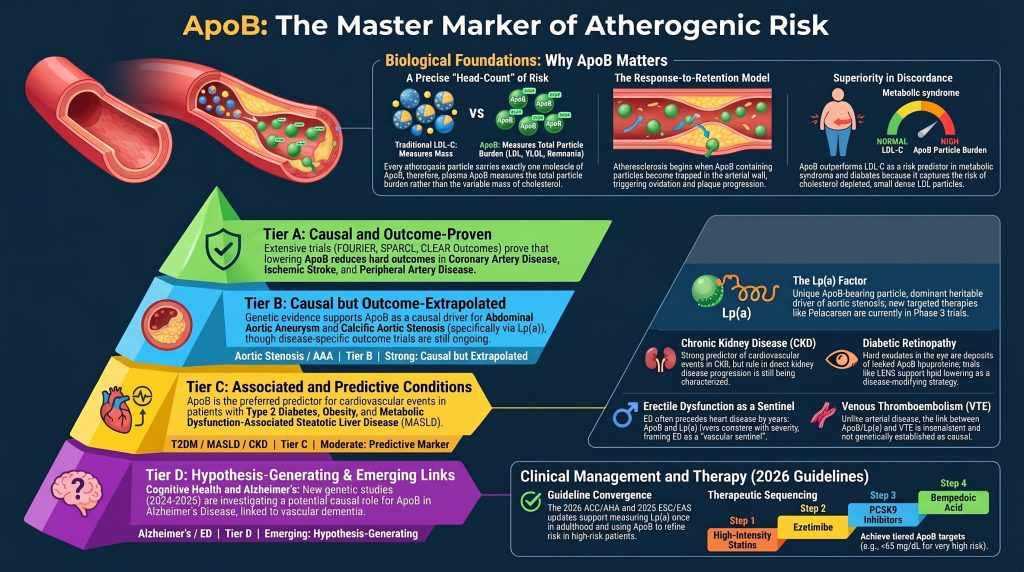
Om overgeneralisatie te voorkomen, wordt elke ziektetoestand in dit overzicht beoordeeld aan de hand van een bewijsladder met vier treden. Dit label bepaalt de kracht van de aanbeveling in de sectie die volgt.
- Categorie A — Causaal en bewezen effect: Mendeliana randomisatie (MR) ondersteunt causaliteit EN gerandomiseerde gecontroleerde onderzoeken (RCT's) die verlagen ApoB-bevattende deeltjes harde uitkomsten bij deze ziekte verminderen, met vooraf gespecificeerde of robuuste subgroepanalyses.
- Categorie B — Causaal maar met geëxtrapoleerd resultaat: MR of sterk genetisch bewijs ondersteunt de causaliteit, MAAR uitkomstverlagende gegevens worden geëxtrapoleerd van gerelateerde ASCVD-eindpunten in plaats van ziektespecifieke RCT's.
- Categorie C — Geassocieerd en voorspellend: Robuuste observationele en mechanistische gegevens koppelen ApoB aan de ziekte en ApoB voorspelt events, MAAR causaliteit is niet vastgesteld door MR of behandelingsbewijs is wisselend.
- Categorie D — Hypothesegenererend: Mechanistische plausibiliteit plus beperkte observationele signalen; geen overtuigend causaal of interventioneel bewijs.
Waar een aandoening heterogeen bewijs vertoont over subtypen (bijv. vasculaire cognitieve stoornis versus de ziekte van Alzheimer; ischemisch versus. hersentumor; CKD-gebeurtenissen versus progressie), elk subtype wordt afzonderlijk beoordeeld in plaats van gemiddeld. Waar een ziekte tussen twee categorieën in zit omdat het bewijs gedeeltelijk is — bijvoorbeeld hypertensieve vasculaire ziekte (synergetisch met aderverkalking maar beperkte ziektespecifieke RCT-gegevens) — een dubbele aanduiding zoals “B/C” wordt gebruikt en toegelicht in de betreffende sectie. De opzet is beschrijvende transparantie, geen pseudo-precise scoring.
Deel I — Biologische Grondslagen
ApoB telt atherogene deeltjes
Elk LDL, intermediate-density lipoproteïne (IDL), very-low-densiteitslipoproteïne (VLDL), chylomicron remnant en lipoproteïne(a) [Lp(a)] deeltje draagt precies één molecuul apolipoproteïne B — apoB-100 op hepatisch afgescheiden deeltjes, apoB-48 op darmsecretoiry1, 2Plasma ApoB is daarom een telling van atherogene deeltjes, terwijl LDL-C een massameting is die afhangt van een variabele stoichiometrie van cholesterol per deeltje3, 4Wanneer de gemiddelde cholesterolvracht per deeltje afneemt — zoals gebeurt in insulineresistente toestanden met cholesterol-arme kleine, d S-LDL (kleine dense LDL) — correspondeert dezelfde plasmacolesterolmassa met een groter aantal deeltjes, en stijgt ApoB onevenredig ten opzichte van LDL-C. Dit is de bron van klinisch zinvolle ApoB / LDL-C discordantie en de belangrijkste reden waarom ApoB beter presteert dan LDL-C bij metabool syndroom, type 2 diabetes, MASLD en obesitas [5, 6, 7].
Het respons-tot-retIiemechanisme in de vaatwand
Atherosclerose begint wanneer ApoB-bevattende deeltjes door de endotheel en verstrikt raken in het subendotheel extracellulaire matrix door ionische binding tussen positief geladen residuen op apoB-100 en negatief geladen glycosaminoglycanen aan biglycaan en decorine8, 9]. Achtergebleven deeltjes worden geoxideerd, drijven macrofaag schuimcelvorming, activeer de NLRP3-inflammasoom, en verspreiden tandplak voortgang10]. Dit respons-retentiemodel is een eigenschap van arteriële atherosclerose en is van toepassing op coronaire, carotiden-, cerebrale, perifeer, renale en aortalike arteriën. Uitbreiding van hetzelfde mechanisme naar niet-arteriële vaatbedden — hepatische sinusoïden, glomerulaire mesangium, retinale capillairen, caverneuze microvaten — is biologisch plausibel maar bewijstechnisch zwakker, en wordt als zodanig behandeld in de ziekte-voor-ziekte secties die volgen.
Mendel-randomisering: van associatie naar causaliteit
Genetisch lagere ApoB biedt levenslange bescherming tegen kransslagaderziekte en verschillende extra-coronaire uitkomsten. Multivariabele MR-analyses door Richardson en collega's (PLoS Medicine, 2020) en Marston en collega's (JAMA Cardiology, 2022) tonen aan dat wanneer ApoB constant wordt gehouden, de residu-associaties van LDL-C en triglyceriden met myocardinfarct aanzienlijk verzwakken — ter ondersteuning van de interpretatie dat ApoB-bevattende deeltjesbelasting is het dominante causale lipidesignaal voor ASCVD, waarbij het gehalte aan cholesterol en triglyceriden fungeert als vracht in plaats van onafhankelijk risicofactoren [11, 12]. ApoB is noodzakelijk maar niet altijd voldoende: restcholesterol, Lp(a), geoxideerde fosfolipiden, endotheelbiologie en systemisch ontsteking bijdragen restrisico voorbij de ApoB-deeltjesaantallen. Met deze voorbehouden in gedachten vormt de convergentie van MR, cumulatieve-blootstellingsmodellering en gerandomiseerde onderzoeken naar mechanistisch verschillende ApoB-verlagende geneesmiddelen die een vergelijkbaar voordeel per mg/dL bereiken sterk — hoewel niet absoluut — bewijs van causaliteit, waarbij de bekende MR-aannames (pleiotropie, canalisatie, equivalentie van levenslange genetische blootstelling aan farmacologische blootstelling) worden erkend als beperkingen [13].
Deel II — Categorie A: Causale en bewezen ziekten
Coronaire hartziekte en myocardinfarct (de ApoB vs LDL-C discriminator)
Hier behandeld als een discriminantanalyse, aangezien de vraag is wat ApoB toevoegt boven LDL-C en niet-HDL-C, en niet of atherosclerotisch CAD door ApoB wordt aangedreven (dat is zo). De Sniderman uit 2011 meta-analyse (n = 233.455) gerapporteerd gestandaardiseerd relatieve risico's van 1,43 voor ApoB, 1,34 voor niet-HDL-C en 1,25 voor LDL-C [14]. De verschillen tussen ApoB en non-HDL-C zijn klinisch bescheiden in concordante populaties, en beide maatstaven blijven redelijke secundaire streefdoelen die worden onderschreven door de huidige richtlijnen. De 2022 Marston UK Biobank analyse (n = 389.529) aantoogde dat ApoB het risico dat samenhing met LDL-C en triglyceriden aanzienlijk verminderde; zodra ApoB in het model was opgenomen, droegen LDL-C en triglyceriden weinig extra informatie bij [12Behbodikhah en collega's (2021) en Glavinovic en collega's (2022) formaliseerden ApoB als het dominante — hoewel niet exclusieve — verenigende causale deeltje4, 5Wanneer ApoB en LDL-C van elkaar verschillen, is behandelen op basis van de waarde met het hoogste risico de veiligere koers; wanneer ze met elkaar overeenstemmen, is beide metriek klinisch te verantwoorden.
Ischemische beroerte (grote-slagader- en kleine-vat-ziekte)
MR-onderzoeken, waaronder MEGASTROKE (Hindy en collega's, 2018) en de bredere MR van Allara en collega's (2019), tonen aan dat genetisch verhoogde LDL-C en ApoB het risico op ischemische beroertes door atherosclerose van grote vaten causaal verhogen beroerte en een beroerte door kleine vaten; effecten op cardio-embolische beroerte zijn nul15, 16SPARCL toonde aan dat hoge intensiteit atorvastatine verminderd een recidief beroerte na een beroerte of TIA17]. Fourier (evolocumab) en Odyssee UITKOMSTEN (alirocumab) verminderde het ischemisch CVA evenredig met de ApoB-verlaging, zonder toename van een hemorragisch CVA bij LDL-C tot wel <30 mg/dL [18, 19].
De literatuur over hersenbloedingen is nuanceerder en over de optimale ondergrens voor LDL-C en ApoB wordt nog gediscussieerd. Sun en collega's rapporteerden een bescheiden positief verband tussen zeer laag LDL-C en een hersenbloeding bij Chinese volwassenen [20]. Absolute event rates at LDL-C <40 mg/dL are small, and FOURIER and ODYSSEY did not show a hemorrhagic-stroke signal. On balance the trial evidence supports a net cerebrovascular benefit of lowering in high-risk ASCVD populations, but caution remains warranted in poorly controlled hypertensives, in some East Asian cohorts, and at very low achieved LDL-C values where the absolute benefit-to-harm ratio is less well characterized.
De 2025 VESALIUS-CV-studie breidde dit bewijs uit door aan te tonen dat het toevoegen van evolocumab aan een geoptimaliseerde lipidentherapie bij patiënten met een hoog cardiovasculair risico zonder eerdere myocardinfarct of beroerte atherosclerotische events verminderde, wat het 'lager-voor-langer'-paradigma in vroegere ziektestadia ondersteunt21].
Perifeer vaatlijden
Klarin en collega's (Nature Medicine, 2019) gebruikten de Million Veteran Program om genetische determinanten van perifeer arterieel vaatlijden (PAD) te identificeren en te repliceren die overlappen met LDL-C-verhogende loci, ter ondersteuning van de causaliteit van ApoB-bevattende deeltjes22]. De FOURIER PAD-subgroep (Bonaca e.a., 2018) liet een afname van 42% zien in het aantal ernstige ongewenste voorvallen aan de ledematen bij het laagst bereikte LDL-C-gehalte [23]. CLEAR Outcomes (Nissen en collega's, 2023) toonden aan bempedoïnezuur vermindert een samengesteld cardiovasculair eindpunt inclusief ledemaatgerelateerde gebeurtenissen bij statine-intolerante patiënten24]. ApoB presteert beter dan LDL-C bij diabetisch PAD specifiek vanwege het klein-dicht-LDL- en remnant-fenotype [6].
Deel III — Categorie B: Causale maar op uitkomsten geëxtrapoleerde ziekte
Abdominale aorta-aneurysma
Harrison en collega's (JAMA Cardiology, 2018) en Allara en collega's (2019) toonden met MR aan dat varianten die LDL-C en ApoB verhogen, causaal het risico op AAA verhogen [16, 25]. Statine meta-analyses suggereren een vertraagde aneurysmagroei, maar ziektespecifieke RCT's die voldoende power hebben voor harde uitkomstmaten zijn beperkt; de reductie van aortagebeurtenissen in trials zoals FOURIER versterkt de causale richting18, 25].
Verkalkende aortaklepstenose (in het bijzonder Lp(a))
Verkalkte aorta stenose is de ziekte het meest uniek aangedreven door Lp(a) — een ApoB-dragend deeltje. Thanassoulis en collega'.s (NEJM, 2013) toonden met MR en LPA-varianten (rs10455872) aan dat Lp(a) het risico op CAVS causaal verhoogt, onafhankelijk van LDL-C [26Vervolgonderzoek door Kamstrup, Nordestgaard en Tsimikas bevestigde Lp(a) als een dominante erfelijke aanjager van CAVS, waarbij de relevante pathobiologie betrekking heeft op door Lp(a) gedragen geoxideerde fosfolipiden die valvulaire ontsteking initiëren en verkalking [27, 28Statines vertragen de progressie van CAVS niet (ASTRONOMER, SEAS, SALTIRE) — in overeenstemming met het feit dat Lp(a) het dominante doelwit is — en therapieën om Lp(a) te verlagen bevinden zich nu in een vergevorderd stadium van ontwikkeling.
Lp(a)-Gerichte therapieën — Huidige status
Om overspannen verwachtingen te voorkomen, moet de ontwikkelingsstatus van elke agent nauwkeurig worden vermeld:
- Pelacarsen (TQJ230): antisense-oligonucleotide. Het artikel van Tsimikas en collega’s uit 2020 in het NEJM betrof een fase 2-onderzoek naar de optimale dosering, waaruit een verlaging van het Lp(a)-gehalte tot 80% bleek [29]. De fase 3-cardiovasculaire-uitkomstenstudie Lp(a)HORIZON is gaande, met een verwachte afronding in 2026–2027 [30].
- Olpasiransmall-interfering RNA. Het OCEAN(a)-DOSE-artikel in de NEJM van 2022 was een fase 2-dosisbereikstudie; de fase 3-uitkomstenstudie OCEAN(a)-Outcomes loopt nog [31, 32].
- LepodisiransiRNA in vergevorderde ontwikkeling; de fase 3-resultatentrial ACCLAIM-Lp(a) wordt nu ingeschreven33].
- Muvalaplineerste in zijn klasse orale kleinschalige remmer van Lp(a)-assemblage met aangekondigde fase 3-resultatenontwikkeling34].
Er is tot op heden nog geen voltooide fase 3-uitkomstenstudie van een Lp(a)-specifieke therapie gerapporteerd. Claims over vermindering van het risico op uitkomsten worden daarom geëxtrapoleerd uit de per-deeltje ApoB-biologie, Mendeliaanse randomisatie en de vastgestelde vasculaire toxiciteit van Lp(a).
Deel IV — Categorie C: Geassocieerde en Voorspellende Aandoeningen
Type 2-diabetes mellitus
ApoB is consequent verhoogd bij T2DM, en discordantie met LDL-C is een bepalend kenmerk van diabetische dyslipidemie (hoge triglyceriden, lage HDL-C, normaal tot matig verhoogde LDL-C, verhoogde non-HDL-C en ApoB) [6, 35]. ApoB presteert beter dan LDL-C als voorspeller van cardiovasculaire events bij T2DM, en de Canadese richtlijn voor cardiovasculaire aandoeningen van 2021 beveelt bij voorkeur ApoB of niet-HDL-C aan bij diabetes en hypertriglyceridemie [36]. De ACC/AHA-richtlijn van 2026 ondersteunt het selectieve gebruik van ApoB om het residuële risico te verfijnen bij cardiometabool-niersyndroom, T2DM, hypertriglyceridemie en vastgestelde hart- en vaatziekten [37]. Of ApoB zelf causaal is voor incident T2DM blijft onderwerp van debat. Een multivariabele Mendeliaanse randomisatie analyse door Richardson en collega's (Lancet Healthy Longevity, 2021) wees uit dat ApoB zich anders gedroeg in univariabele versus multivariabele modellen en dat het multivariabele signaal wees in de richting van een verhoogd risico op T2DM — consistent met de mechanistische veronderstelling dat bèta-cel-cholesterolexpositie (gemedieerd door ABCA1schaadt insuline afscheiding38, 39] — maar de richting wordt gecompliceerd door de welbekende bescheiden toename van de incidentie van T2DM bij statinetherapie. De dominante klinische boodschap bij T2DM is daarom voorspellend en behandelingsgericht in plaats van incidentie-causaal. CARDS, HPS-DIABETES en de diabetessubgroep van REDUCE-IT (icosapent-ethyl 4 g/dag bij statinebehandelde patiënten met verhoogde triglyceriden) tonen een zinvolle vermindering van het aantal aandoeningen [40, 41].
Insulineresistentie en metabool syndroom
In insulineresistentie, neemt de hepatische VLDL-secretie toe, wordt de plasmadeeltjestijd van ApoB-bevattende deeltjes verlengd, en genereert CETP-gemiddelde lipideneutruswisseling gecombineerd met hepatische-lipase-trimming kleine, dichte LDL. Het nettoresultaat is de canonieke discordantie: meer deeltjes die elk minder cholesterol dragen. Cromwell en collega's (Framingham Offspring) en Mora (Women's Health Study) toonden aan dat het aantal LDL-deeltjes in deze populatie beter overeenkomt met cardiovasculaire events dan LDL-C [42, 43]. Leefstijlinterventies, GLP-1-receptor-agonisten, en SGLT2-remmers verlagen ApoB matig via effecten op gewicht, triglyceriden en remnants44].
Metabole dysfunctie-geassocieerde steatotische leverziekte (MASLD/MASH)
MASLD deelt een upstream driver met atherogene dyslipidemielever- de novo lipogenese en VLDL-overproductie. Patiënten met MASLD hebben typisch een verhoogd ApoB, verhoogd remnisch cholesterol en klein-dichte LDL — vaak met een ogenschijnlijk normaal LDL-C [45, 46De cardiovasculaire implicaties zijn klinisch van belang: hart- en vaatziekten zijn de belangrijkste doodsoorzaak bij MASLD, en ApoB presteert beter dan LDL-C als risicodiscriminator in deze populatie46]. Statines zijn veilig en worden aanbevolen bij MASLD/MASH volgens de richtlijnen van de AASLD en EASL [47Resmetirom, een schildklierhormoonreceptor-β-agonist, werd in maart 2024 door de FDA goedgekeurd voor niet-cirrhotische MASH met matige tot gevorderde fibrose op basis van de MAESTRO-NASH-studie; het verlaagt ApoB en LDL-C terwijl het de histologie verbetert, hoewel gegevens over cardiovasculaire uitkomsten nog niet beschikbaar zijn48].
Over causaliteit: PNPLA3 (I148M) en TM6SF2 (E167K) varianten verminderen de hepatische VLDL-secretie en verlagen ApoB, terwijl ze paradoxaal genoeg de intrahepatische lipidenaccumulatie en MASLD-progressie verhogen — wat illustreert dat hepatische ApoB-export deels beschermend is tegen de intrahepatische lipidenbelasting, maar de circulerende atherogene belasting vergroot49, 50De relatie tussen ApoB en MASLD kan daarom het best worden omschreven als bidirectioneel en metabolisch verweven, in plaats van dat ApoB MASLD veroorzaakt in dezelfde zin waarin ApoB atherosclerose veroorzaakt.
Chronische Nierziekte
CKD produceert een uremische dyslipidemie gekenmerkt door verhoogde triglyceriden, verlaagd HDL-C, vaak laag-tot-normaal LDL-C, en verhoogde ApoB en Lp(a) als gevolg van verminderde klaring van remnanten en apo(a)-accumulatie [51]. SHARP (simvastatine/ezetimib bij CKD) verminderde het aantal ernstige atherosclerotische voorvallen met 17%; het voordeel was minder uitgesproken bij dialysepatiënten (4D, AURORA leverde geen resultaten op), wat wijst op de verschuiving van atherosclerotische naar niet-atherosclerotische cardiovasculaire sterfte in het eindstadium van de ziekte [52, 53]. ApoB voorspelt cardiovasculaire events bij CKD beter dan LDL-C in post-hoc analyses van deze trials. De Lanktree en collega's 2018 American Journal of Nierziekten MR-analyse onderzocht het verband tussen HDL-C, LDL-C, triglyceriden en het risico op CKD en vond gemengde signalen, wat bevestigt dat lipiden-effecten op de progressie van CKD zelf kleiner zijn dan de effecten op CKD-geassocieerde cardiovasculaire events [54]. De mechanistische literatuur over glomerulaire mesangiale schuimcel vorming en lipidennefrotoxiciteit is biologisch coherent, maar voldoet nog niet aan een causaal drempelwaardecriterium voor de progressie van CKD.
Hypertensieve vaatziekte
ApoB en hypertensie handelen onafhankelijk en synergistisch bij atherosclerose. Hypertensie verhoogt de endotheliale permeabiliteit, terwijl ApoB het substraat voor retentie levert. Beide dragen bij aan arteriële versteening, linkerventrikelhypertrofie, en doelorgaanschade. SCORE2 en de Pooled Cohort Equations integreer zowel bloeddruk- als lipidemetingen; of ApoB prognostische discriminatie toevoegt boven non-HDL-C in SCORE2 is formeel geëvalueerd. Een analyse uit 2025 door Wong, Takeuchi, Thao, Nicholls, Chew en Peter in het European Journal of Preventive Cardiology toonde aan dat het toevoegen van ApoB aan SCORE2 de discriminatie, kalibratie of netto-effect niet substantieel verbeterde herclassificatie, hoewel ApoB-afkappunten in combinatie met SCORE2-drempels de classificatie aan de marges verfijnden [55Huidig bewijs ondersteunt daarom niet het vervangen van standaard SCORE2-variabelen door ApoB; ApoB kan het best worden gebruikt als een complementaire maatstaf voor risicoreductie.
Obesitas en bariatrische/farmacologische gewichtsreductie
Viscerale adipositas stimuleert overmatige productie van hepatische VLDL en verhoogt ApoB. Interventies voor gewichtsverlies verlagen ApoB: bariatrische chirurgie in meta-analyses, GLP-1-receptoragonisten (met de SELECTeer proefversie het aantonen van de vermindering van cardiovasculaire events semaglutide bij obesitas zonder diabetes, naast significante ApoB- en lipiden-effecten), en in mindere mate SGLT2-remmers, verlagen deze allemaal ApoB aanzienlijk parallel aan de vermindering van de adipositas [56Obese patiënten hebben doorgaans een ogenschijnlijk normaal LDL-C met aanzienlijk verhoogde ApoB; Welsh en collega's (Circulation, 2021) toonden aan in de UK Biobank dat ApoB presteert beter dan LDL-C als voorspeller over BMI-strata heen57]. Het 'lean-mass-hyper-responder'-fenotype — slanke, insulinegevoelige individuen op ketogeen dieet die zeer hoge LDL-C en ApoB ontwikkelen — heeft geleid tot observationeel debat (KETO-CTA), maar het gepubliceerd cohort bevindt zich uniform op een extreem ApoB-niveau en mist een controle met een laag ApoB-gehalte, wat de inferentie beperkt. Het dominante corpus van Mendeliaanse randomisatie- en RCT-bewijs over de causaliteit van ApoB wordt niet weerlegd door een enkele observationeel onderzoek bij een beperkt ApoB-bereik.
Familiaire hypercholesterolemie
Heterozygoot familiaire hypercholesterolemie (HeFH; prevalentie ~1 op 250) en homozygote FH (HoFH; ~1 op 300.000) zijn monogenetische aandoeningen van LDLR, APOB (familieël defectieve ApoB), of PCSK9 gain-of-function — verhoogt direct ApoB. Levenslange ApoB-blootstelling is het mechanisme van premature ASCVD; patiënten met HoFH kunnen zich in het eerste of tweede decennium presenteren met een myocardinfarct. De therapie is gericht op ApoB: krachtige statines, ezetimibe, PCSK9-monoklonale antilichamen (alirocumab, evolocumab) voor HeFH en HoFH (residuele LDLR-functie), evinacumab (ANGPTL3 monoklonaal; ELIPSE-HoFH, NEJM 2020), lomitapide, en LDL-aferese waar nodig58, 59FH behoort tot de sterkste natuurlijke experimenten die de causaliteit van ApoB ondersteunen.
Hypertriglyceridemie, gemengde dyslipidemie en remnante cholesterol
ApoB vangt de atherogene belasting bij hypertriglyceridemie beter op dan welke andere enkele test dan ook, omdat het elk VLDL-, IDL- en remnantdeeltje telt. Restantcholesterol — berekend of gemeten — is causaal atherogeen volgens MR-analyses door Varbo, Nordestgaard en collega's [60, 61]. Uit het REDUCE-IT-onderzoek bleek dat 4 g icosapentethyl per dag het aantal voorvallen met 25% vermindert bij met statines behandelde patiënten met triglyceridenwaarden van 135–499 mg/dL [40], hoewel een recente consensus van experts de kracht van de aanbeveling heeft afgezwakt vanwege onopgeloste vragen over de vergelijkingsstof (minerale olie). PROMINENT toonde aan dat pemafibraat triglyceriden en remnant-cholesterol verlaagde zonder ApoB te verlagen en cardiovasculaire events niet verminderde — sterker nog, het verhoogde ApoB enigszins — wat een krachtig natuurlijk experiment oplevert ter ondersteuning van het principe dat vermindering van ApoB-deeltjes, en niet vermindering van triglyceriden op zich, het therapeutische doel is [62]. Onderzoekspreparaten olezarsen en plozasiran (APOC3-gericht) en zodasiran (ANGPTL3 siRNA) verlagen het aantal ApoB-houdende deeltjes en triglyceriden; cardiovasculaire eindpuntstudies lopen nog. Olezarsen kreeg in december 2024 FDA-goedkeuring voor familiair chylomicronemiesyndroom om het risico op pancreatitis te verlagen — een zeldzame fenotypespecifieke indicatie die niet moet worden verward met bewezen reductie van ASCVD-events [63, 64]. De verenigende conclusie: remnant-rijke, ApoB-bevattende partikels zijn atherogeen en vormen een reëel doelwit voor residu-risico, maar niet elk gemengd-dyslipidemiefenotype heeft al specifieke ApoB-verlagende uitkomststudies.
Diabetische retinopathie
Naast de glycemische en bloeddrukregulatie voorspelt dyslipidemie — en in het bijzonder ApoB-bevattende remnante lipoproteïnen — de ernst van diabetische retinopathie, diabetisch macula-oedeem en de progressie ervan65]. De FIELD-studie (fenofibraat, 2007) en de ACCORD-Eye-substudie naar fenofibraat plus simvastatine toonden een afname van de progressie van diabetische retinopathie (DR) aan — grotendeels onafhankelijk van het effect op de bloedsuikerspiegel — die werd toegeschreven aan de verlaging van de restlipoproteïnen en de directe ontstekingsremmende effecten van PPAR-α in het endotheel van het netvlies [66, 67]. De 2024 LENS-studie biedt bijgewerkt gerandomiseerd bewijs bij vroege DR, dat fenofibrate ondersteunt als een ziekteveranderende therapie bij deze microvasculaire complicatie68]. Harde exsudaten bij DR zijn histologisch afzettingen van ApoB-bevattende lipoproteïnen die zijn geëxtravaseerd door een beschadigde bloed-retinale barrière [69]. Het mechanistische en klinische bewijs is sterk; of ApoB zelf causaal is versus een merker van de last aan remnant-lipoproteïnen blijft onderwerp van debat, en het voordeel van fenofibraat werkt mogelijk via pleiotrope routes.
Zwangerschapsgerelateerde complicaties
Zwangerschap is een fysiologisch dyslipidemische toestand. Verhogingen van ApoB voor en in de vroege zwangerschap worden geassocieerd met latere zwangerschapsvergiftiging, zwangerschapsdiabetes, en vroeggeboorte in cohortstudies [70]. De mechanistische verbanden omvatten endotheeldisfunctie (preeclampsie) en reeds bestaande insulineresistentie (zwangerschapsdiabetes). De FDA heeft in 2021 de algemene zwaarste waarschuwing tegen het gebruik van statines tijdens de zwangerschap ingetrokken, maar dit is geen algemene goedkeuring; het huidige bewijs over pravastatine voor de preventie van pre-eclampsie uit onderzoeken waaronder StAmP en INOVASIA is wisselend, met meta-analytische onzekerheid [71, 72Statines mogen niet routinematig worden gestart tijdens de zwangerschap, behalve binnen studieverband of na een geïndividualiseerd consult over maternale en foetale geneeskunde.
Vasculaire cognitieve stoornis
Vasculaire cognitieve stoornis (VCI) heeft dezelfde pathofysiologie als een beroerte en ziekte van de kleine bloedvaten; Door ApoB veroorzaakte cerebrale atherosclerose en lipohyalinose leiden tot de cumulatieve last van hyperintensiteiten in de witte stof, lacunes en microbloedingen die zich uiten als vasculaire cognitieve achteruitgang [73, 74De zaak van vasculaire dementie voor ApoB is eveneens sterk: deze erft het causale bewijs van ischemische beroerte en kleivaatziekte.
De ziekte van Alzheimer (in opkomst)
Voor de ziekte van Alzheimer (ZS) is het beeld onzekerder en complexer. APOE ε4 is de dominante genetische risicofactor en is betrokken bij het lipoproteïnemetabolisme, maar verschilt van ApoB. Een multivariabele Mendeliaanse randomisatiestudie uit 2026 door Pham, Mulugeta, Lumsden en Hyppönen (GeroScience, april 2026) rapporteerde dat ApoB geassocieerd was met een hoger risico op dementie door alle oorzaken in multivariabele MR, hoewel het signaal gevoelig was voor de modelspecificatie [75]. Een analyse uit 2024 in Communications Biology door Adams, Martin en collega's legde een apart verband tussen genetisch voorspeld ApoB (maar niet LDL-C) en het risico op de ziekte van Alzheimer, wat steun verleent aan een hypothesevormende rol van categorie D [90Iwagami en collega's (Lancet Healthy Longevity, 2021) toonden aan bij 1,8 miljoen mensen dat een verhoogde waarde op middelbare leeftijd totaal cholesterol associeert met dementie op latere leeftijd76]. Statine-meta-analyses suggereren een verminderde incidentie van dementie bij gebruik op middelbare leeftijd, maar het bewijs uit trials (PROSPER, HPS) is wisselend en heeft te weinig onderscheidend vermogen [77]. Recente observationele gegevens koppelen een verhoogd Lp(a) ook aan herseninfarcten en dementie [78]. Het bewijs voor ApoB bij de ziekte van Alzheimer blijft derhalve in ontwikkeling — ondersteund door mechanistische plausibiliteit en een kleine, gemengde MR-basis, maar niet met dezelfde overtuigingskracht als het argument voor vasculaire cognitieve stoornissen.
Deel V — Tier D: Hypothesevormende omstandigheden
Erectiestoornis
Erectiele dysfunctie gaat coronaire hartziekte vaak 3–5 jaar vooraf omdat de caverneuze slagader is klein (1-2 mm) en vertoont eerder endotheeldisfunctie [79]. ApoB en Lp(a) correleren met de ernst van ED in cross-sectionele studies, en statinetherapie verbetert de erectiele functie matig in meta-analyses, aannemelijk via endotheliaal herstel [80De literatuur is grotendeels observationeel; erectiestoornissen kunnen het best worden gezien als een vasculaire waarschuwing, en niet als een op zichzelf staande ziekte die door ApoB wordt veroorzaakt.
Netvliesveenafsluiting
Netvliesader occlusie is in observationele studies in verband gebracht met een verhoogde ApoB en Lp(a); mechanistisch deelt het atherothrombotische kenmerken met arteriële vaatziekte [81Causaliteit is niet vastgesteld.
Veneuze trombo-embolie
Historisch gezien beschouwd als verschillend van atherogeen risico. De Lp(a)-VTE-relatie is biologisch plausibel — Lp(a) is antifibrinolytisch (via apo(a)-homologie met plasminogeen) en draagt geoxideerde fosfolipiden — maar het gepubliceerd bewijs is inconsistent. Recente analyses in de European Heart Journal beschrijven het Lp(a)-VTE-verband als niet genetisch vastgesteld, in tegenstelling tot de sterke arteriële en valvulaire signalen; één MR-studie vond geen statistisch significant causaal effect van ApoB, LDL-C, HDL-C, triglyceriden of apoA1 op DVT [82, 83]. Recent werk suggereert bovendien sekse- en hormoonafhankelijke heterogeniteit in plaats van een generaliseerbaar causaal effect. Jupiter post-hoc-analyses suggereren een bescheiden VTE-voordeel met rosuvastatine [84De meest verdedigbare conclusie is dat de relatie inconsistent is en het signaal, indien reëel, bescheiden is.
Kankerresultaten
Bewijs is heterogeen en grotendeels associatief. Sommige MR-onderzoeken suggereren dat een laag LDL-C/ApoB geassocieerd is met een hoger risico op bepaalde kankers — wat hoogstwaarschijnlijk een weerspiegeling is van omgekeerde causaliteit van preklinische maligniteit die circulerend cholesterol verlaagt — terwijl observationele cohortgegevens een verhoogd ApoB koppelen aan gerelateerde kankers door obesitas. Causaliteit is niet aangetoond en een laag ApoB mag niet worden opgevat als een kankerpreventiestrategie [85].
Deel VI — ApoB-verlagingstherapieën, naar bewijsstatus
Het op één hoop gooien van alle ApoB-verlagende middelen overdrijft de zekerheid van het nut van nieuwere middelen. De volgende indeling in drie categorieën weerspiegelt de bewijsladder die voor ziekten wordt gebruikt.
Bewezen resultaten voor ASCVD-risicoreductie
- Statines (rosuvastatine, atorvastatine, andere) — grote hoeveelheid RCT-bewijs over primaire en secundaire preventie.
- Ezetimib — IMPROVE-IT aangetoond toegevoegd voordeel bovenop statinetherapie.
- PCSK9-monoklonale antilichamen (alirocumab, evolocumab) — FOURIER, ODYSSEY OUTCOMES en de periode 2024–2025 VESALIUS-CV proef waarbij de uitkering wordt uitgebreid naar patiënten met een hoog risico die nog geen hartinfarct of beroerte hebben gehad [18, 19, 21].
- Bempedoïnezuur — CLEAR Outcomes (2023) bij statine-intolerante patiënten24].
Uitkomstvoordeel bij specifieke fenotypes
- Icosapent-ethyl — REDUCE-IT (patiënten die met statines worden behandeld en een aanhoudende hypertriglyceridemie hebben, voornamelijk voor cardiovasculaire events) [40]. Merk op dat recente consensus onder experts de aanbevelingskracht in sommige richtlijnen heeft verlaagd vanwege onopgeloste vragen over de placebo (minerale olie).
- Fenofibraat — FIELD, ACCORD-Eye en LENS voor progressie van diabetische retinopathie; niet algemeen geïndiceerd voor reductie van ASCVD-events [66, 67, 68].
Onderzoekstypen of Nichetherapieën
- Inclisiran — op siRNA gebaseerde PCSK9-remmer; dramatische en duurzame LDL-C/ApoB-verlaging. De cardiovasculaire-uitkomstenstudie ORION-4 loopt nog en de ACC/AHA-richtlijn van 2026 vermeldt dat uitkomstgegevens nog ontbreken [37, 86Desondanks heeft tweemaal per jaar doseren inclisiran een betekenisvolle nichefunctie opgeleverd voor patiënten die moeite hebben met de trouw aan de behandeling, en de gerichte update van de ESC/EAS van 2025 geeft een sterkere Klasse I/IIa-aanbeveling, afhankelijk van de risicocategorie.87].
- Op Lp(a) gerichte therapieën (pelacarsen, olpasiran, lepodisiran, muvalaplin) — fase 3-uitkomstenstudies Lp(a)HORIZON, OCEAN(a)-Outcomes en ACCLAIM-Lp(a) lopen nog [30, 32, 33].
- tegen APOC3 gerichte middelen (olezarsen, plozasiran) — olezarsen is door de FDA goedgekeurd voor familiair chylomicronemiesyndroom (preventie van pancreatitis); ASCVD-resultaten zijn nog niet vastgesteld [63, 64].
- ANGPTL3-gerichte middelen (evinacumab goedgekeurd voor HoFH; zodasiran in ontwikkeling) — uitkomsten voor niet-FH ASCVD zijn nog niet vastgesteld58].
Deel VII — Het Hedendaagse Richtlijnenlandschap
Vanaf 2025–2026 zijn de belangrijkste richtlijnen aanzienlijk geëvolueerd ten opzichte van de 2018 ACC/AHA-cholesterolrichtlijn raamwerk
- De ACC/AHA-richtlijn voor dyslipidemie uit 2026 (als vervanging van de cholesterolrichtlijn van 2018) herintroduceert behandeldoelen voor LDL-C en niet-HDL-C, beveelt aan om Lp(a) minstens één keer in de volwassen leeftijd te meten, en ondersteunt selectieve ApoB-tests om het residuële risico te beoordelen — met name bij cardiometabool-niersyndroom, T2DM, hypertriglyceridemie en bekende hart- en vaatziekten [37].
- De gerichte ESC/EAS-update van 2025 tot de dyslipidemierichtlijn van 2019 bewijs omvat dat is gepubliceerd tot en met maart 2025 en blijft ApoB-streefwaarden ondersteunen bij patiënten met een hoog en zeer hoog risico87].
- De richtlijn van de Canadian Cardiovascular Society uit 2021 bij voorkeur ApoB of non-HDL-C aanbevolen, met name wanneer triglyceriden groter zijn dan 1,5 mmol/L of bij cardiometabole aandoeningen36].
- Recente consensusverklaringen van de National Lipid Association breid de praktische rol van ApoB-testen bij de beoordeling van het residuële risico uit88].
De synthese: er is over alle maatschappijen heen een convergentie dat ApoB klinisch waardevol is, met name voor restricico en voor discordante LDL-C/ApoB-fenotypes, maar geen enkele grote maatschappij beveelt ApoB momenteel aan als universele eerstelijns lipidenscreening voor elke volwassene.
Deel VIII — Praktische aanbevelingen uit de richtlijnen
Selectieve ApoB-test
Meet ApoB ten minste eenmaal bij elke volwassene met type 2-diabetes, metabool syndroom, MASLD, obesitas (BMI ≥30), CKD-stadia 3 en hoger, nuchtere triglyceriden ≥150 mg/dL, bekende of vermoede familiaire hypercholesterolemie, familiegeschiedenis van premature ASCVD, of LDL-C in het bereik van 70–190 mg/dL waarbij de behandelingsintensiteit onzeker is. Dit sluit aan bij ESC/EAS, CCS en het selectieve gebruik dat wordt onderschreven door de ACC/AHA van 2026. Universele ApoB-screening van alle volwassenen wordt momenteel niet door richtlijnen ondersteund.
Steeds vaker aanbevolen Lp(a)-bepaling
Meet Lp(a) ten minste éénmaal bij elke volwassene waar richtlijnconform handelen dit toestaat. De aanbeveling wordt ondersteund door de gerichte update van de ESC/EAS uit 2025, de ACC/AHA-richtlijn uit 2026 en eerdere richtsnoeren van de ESC/EAS uit 2019, en wordt in toenemende mate – hoewel nog niet universeel – geïmplementeerd binnen zorgsystemen. Lp(a) is cruciaal bij de beoordeling van verkalkende aortastenose, bij een vroegtijdig hartinfarct en bij een familieanamnese van vroegtijdige ASCVD; het heeft prognostische waarde bij zowel primaire als secundaire preventie.
Behandeldoelen
Gebruik LDL-C als het primaire behandeldoel in overeenstemming met de ACC/AHA-richtlijnen van 2026, met ApoB als een complementaire restrisicometrica — in het bijzonder wanneer LDL-C en ApoB discordant zijn. Een op ESC/EAS afgestemde praktijk kan ApoB-doelwitten direct gebruiken: zeer hoog risico <65 mg/dL, hoog risico <80 mg/dL, matig risico <100 mg/dL. Wanneer de twee meetwaarden niet met elkaar overeenkomen, behandel dan op basis van de waarde die het hoogste risico aangeeft.
Therapiesequentiëring
- Eerstelijnstherapie: hoog-intensieve statine (rosuvastatine 20–40 mg of atorvastatine 40–80 mg).
- Voeg ezetimibe 10 mg toe voor extra ApoB-verlaging en voordeel voor de uitkomst.
- Voeg een PCSK9-monoklonaal antilichaam (alirocumab of evolocumab) toe bij patiënten met een zeer hoog risico die hun streefwaarde niet bereiken.
- Gebruik bempedoïnezuur bij statine-intolerante patiënten volgens CLEAR Outcomes.
- Gebruik icosapentethyl bij patiënten die met statines worden behandeld met aanhoudende hypertriglyceridemie en ASCVD volgens REDUCE-IT, met inachtneming van recente richtlijn-gebaseerde voorbehouden.
- Overweeg voor Lp(a)-gedreven aandoeningen deelname aan klinische studies zoals Lp(a)HORIZON, OCEAN(a)-Outcomes, ACCLAIM-Lp(a) of gerelateerde programma's.
- Inclisiran is redelijk voor geselecteerde, voor statines in aanmerking komende patiënten die een verdere verlaging van LDL-C/ApoB nodig hebben; uitkomstgegevens van ORION-4 worden nog verwacht.
Residueel inflammatoir risico
Bij patiënten voor secundaire preventie met een laag ApoB (bijv. 2 mg/L en terugkerende gebeurtenissen, overweeg colchicine 0,5 mg daags per LoDoCo2 (goedgekeurd door de FDA in 2023 voor risicoreductie van ASCVD), in plaats van verdere verlaging van ApoB89].
Voorbehouden en beperkingen
Mendeliaanse randomisatie berust op aannames — pleiotropie, canalisatie en de equivalentie van levenslange genetische blootstelling aan blootstelling aan geneesmiddelen — die niet volmaakt zijn. De convergentie van MR met gerandomiseerde onderzoeken met controlegroep (RCT's) naar meerdere geneesmiddelklassen (statines, ezetimibe, PCSK9-monoklonale antilichamen, bempedoïnezuur) die ApoB via verschillende mechanismen targeten, is het sterkste praktisch haalbare bewijs voor causaliteit bij volwassen populaties, maar het staat niet gelijk aan een levenslang gerandomiseerd onderzoek en moet niet worden gepresenteerd als logisch onweerlegbaar.
Hemorragische beroerte bij een zeer lage LDL-C/ApoB: de gegevens zijn wisselend; absoluut risico bij een LDL-C <40 mg/dL is klein, en het netto cerebrovasculaire voordeel in studies blijft gunstig, maar voorzichtigheid blijft geboden bij slecht gereguleerde hypertensie en in sommige Oost-Aziatische cohorten.
De discussie over de lean-mass-hyper-responder / KETO-CTA is observationeel en wordt beperkt door bereikbeperking in een uniform extreme ApoB-cohort dat controles met een laag ApoB ontbeert. Het dominante geheel aan bewijs uit mendeliaanse randomisatie en gerandomiseerde gecontroleerde onderzoeken voor de causaliteit van ApoB wordt niet omvergeworpen door een observationele studie van 100 personen met een beperkt ApoB-bereik.
Kanker-ApoB-associaties weerspiegelen zeer waarschijnlijk omgekeerd causaliteit en verwarrend.
Zwangerschapsgegevens zijn grotendeels observationeel; statines mogen niet routinematig worden gestart tijdens de zwangerschap buiten studieverband of specialistisch overleg.
Assay-standaardisatie: ApoB-meting is nu goed gestandaardiseerd met behulp van immunoturbidimetrische of immunonefelometrische methoden die zijn gekalibreerd op de WHO/IFCC SP3-07-referentiestandaard. Oudere bepalingen verschilden en historische vergelijkingen moeten dienaangaande worden geïnterpreteerd.
Samenvattingstabel: ApoB over ziektestatussen
| Ziektestatus | Bewijsniveau | Causaal versus associatief | Mechanisme | Het verlagen van ApoB vermindert het risico? |
| CAD / MI (vs. LDL-C als discriminator) | A | Causaal | Subendotheliale deeltjesretentie; schuimcelvorming | Ja — uitgebreid RCT-bewijs |
| Ischemisch cerebrovasculair accident (grote slagader, kleine vaten) | A | Causaal | Cerebrale arteriële atherosclerose; hetzelfde als CAD | Ja — SPARCL, FOURIER, ODYSSEY |
| Perifeer arterieel vaatlijden | A | Causaal | Arteriële atherosclerose van de onderste extremiteiten | Ja — FOURIER-lidmaatsubgroep, HELDER |
| Hemorragische beroerte | C | Dubieus/mogelijk omgekeerd | Vaatkwetsbaarheid bij een zeer lage LDL-C in sommige populaties | Netto cerebrovasculair voordeel is in het voordeel van het verlagen |
| Buikaorta-aneurysma | B | Causaal (MR) | Mediale degeneratie met atherosclerose | Waarschijnlijk — geëxtrapoleerd/beperkt RCT |
| Verkalkende aortaklepstenose (gedreven door Lp(a)) | B | Causaal (Lp(a)-MR) | Lp(a)/OxPL-gedreven valvulaire ontsteking en calcificatie | Lopende fase 3-onderzoeken gericht op Lp(a) |
| T2DM (onderscheiding van cardiovasculair risico) | C | Voorspellend | Kleine, dense LDL, accumulatie van remnants | Ja, voor CV-gebeurtenissen; statines/PCSK9-remmers, REDUCE-IT |
| T2DM (incidentie) | C | Mogelijk bijdragend | Cholesterolblootstelling van β-cellen (omstreden) | Onduidelijk; niet de dominante klinische boodschap |
| Insulineresistentie / metabool syndroom | C | Voorspellend/bijdragend | VLDL-overproductie, remnannten, sdLDL | Ja — levensstijl, GLP-1, statines |
| MASLD / MASH | C | Bidirectioneel / bijdragend | Overproductie van lever-VLDL; cardiovasculaire co-morbiditeit | Indirect; statines veilig; resmetirom goedgekeurd |
| CKD (CV-antecedenten) | C | Voorspellend | Uremische dyslipidemie; remnanten/Lp(a) | Ja — SHARP voor niet-dialyse CKD |
| CKD (progressie) | D | Hypothese-genererend | vorming van mesangiale schuimcellen | Gemengde bevindingen |
| Hypertensieve vaatziekte | B/C | Synergetische bijdrager | Verhoogde permeabiliteit + ApoB-substraat | Ja — additief in onderzoeken |
| Obesitas-gerelateerde cardiometabole aandoening | C | Bijdragend | Viscerale adipositas → hepatische ApoB-afgifte | Ja — bariatrisch, GLP-1 |
| Familiaire hypercholesterolemie | A | Causaal (monogeen) | Langdurige verhoogde ApoB-blootstelling | Ja — statines, PCSK9i, evinacumab bij HoFH |
| Hypertriglyceridemie / gemengde dyslipidemie (remnant-gedreven) | A/B | Causaal (resterende deeltjes) | Restantenretentie; sdLDL; PROMINENT toont aan dat TG-verlaging zonder ApoB-verlaging inerte is | Ja voor ApoB-verlaging (statines, ezetimibe, PCSK9i); icosapentethyl met voorbehouden |
| Ernstige HTG / familiaire chylomicronemiesyndroom | B/C | Bijdraagend (pancreatitis) | chylomicron-gedreven; apoB-48-belasting | Olezarsen goedgekeurd door FDA voor FCS |
| Diabetische retinopathie / DME | C | Bijdragend | Afzetting van harde excudaten; PPAR-α-effecten | Ja — fenofibraat (FIELD, ACCORD-Eye, LENS) |
| Vasculaire dementie / cognitieve stoornis | B/C | Vermoedelijk causaal (vasculair) | Cerebrale atherosclerose; kleinvatziekte | Waarschijnlijk; verbanden met statines in de middelbare leeftijd |
| Alzheimer | D | Opkomend | BBB transcytose; mogelijke link met amyloïd-klaring | Onvoldoende duidelijk; bewijs uit klinische studies heeft te weinig onderscheidend vermogen |
| Erectiestoornis | D | Voorspellend (vasculaire schildwacht) | caverneuze endotheeldisfunctie | Bescheiden — statine-meta-analyses |
| Netvliesadersluiting | D | Geassocieerd | atherotrombotische mechanismen | Waarschijnlijk bijdragend |
| Zwangerschap (preeclampsie, GDM) | C/D | Voorspellend/bijdragend | Endotheeldisfunctie; voorafbestaande IR | Gemengd (pravastatatietrials onconclusief) |
| Veneuze trombo-embolie | D | Consistent; niet genetisch vastgesteld | Antifibrinolyse; geoxideerde fosfolipiden (Lp(a)) | Op zijn best bescheiden; meta-analyses over statines zijn wisselend |
| Kankerbehandelingsresultaten | D | Onbeslist | Pleiotroop; mogelijke omgekeerde causaliteit | Geen kankerpreventiestrategie |
Niveauniveau: A — Causaal en resultaat-bewezen; B — Causaal maar resultaat-geëxtrapoleerd; C — Geassocieerd en voorspellend; D — Hypothese-genererend.
Referenties
Referenties zijn opgemaakt in de IEEE-numerieke stijl. Alle vermeldingen verwijzen naar door vakgenoten getoetste primaire literatuur, maatschappelijke richtlijnen of gezaghebbende consensusverklaringen die verifieerbaar zijn in PubMed/CrossRef.
- Ference BA, Ginsberg HN, Graham I, et al. Low-density lipoproteins cause atherosclerotic cardiovascular disease. 1. Evidence from genetic, epidemiologic, and clinical studies. A consensus statement from the European Atherosclerosis Society Consensus Panel. Eur Heart J. 2017;38(32):2459-2472. doi:10.1093/eurheartj/ehx144
- Borén J, Chapman MJ, Krauss RM, et al. Low-density lipoproteins cause atherosclerotic cardiovascular disease: pathophysiological, genetic, and therapeutic insights: a consensus statement from the European Atherosclerosis Society Consensus Panel. Eur Heart J. 2020;41(24):2313-2330. doi:10.1093/eurheartj/ehz962
- Sniderman AD, Thanassoulis G, Glavinovic T, et al. Apolipoprotein B Particles and Cardiovascular Disease: A Narrative Review. JAMA Cardiol. 2019;4(12):1287-1295. doi:10.1001/jamacardio.2019.3780
- Behbodikhah J, Ahmed S, Elyasi A, et al. Apolipoprotein B and Cardiovascular Disease: Biomarker and Potential Therapeutic Target. Metabolites. 2021;11(10):690. Published 2021 Oct 8. doi:10.3390/metabo11100690
- Glavinovic T, Thanassoulis G, de Graaf J, Couture P, Hegele RA, Sniderman AD. Physiological Bases for the Superiority of Apolipoprotein B Over Low-Density Lipoprotein Cholesterol and Non-High-Density Lipoprotein Cholesterol as a Marker of Cardiovascular Risk. J Am Heart Assoc. 2022;11(20):e025858. doi:10.1161/JAHA.122.025858
- Pearson GJ, Thanassoulis G, Anderson TJ, et al. 2021 Canadian Cardiovascular Society Guidelines for the Management of Dyslipidemia for the Prevention of Cardiovascular Disease in Adults. Can J Cardiol. 2021;37(8):1129-1150. doi:10.1016/j.cjca.2021.03.016
- Mora S, Otvos JD, Rifai N, Rosenson RS, Buring JE, Ridker PM. Lipoprotein particle profiles by nuclear magnetic resonance compared with standard lipids and apolipoproteins in predicting incident cardiovascular disease in women. Circulation. 2009;119(7):931-939. doi:10.1161/CIRCULATIONAHA.108.816181
- Williams KJ, Tabas I. The response-to-retention hypothesis of early atherogenesis. Arterioscler Thromb Vasc Biol. 1995;15(5):551-561. doi:10.1161/01.atv.15.5.551
- Tabas I, Williams KJ, Borén J. Subendothelial lipoprotein retention as the initiating process in atherosclerosis: update and therapeutic implications. Circulation. 2007;116(16):1832-1844. doi:10.1161/CIRCULATIONAHA.106.676890
- Borén J, Williams KJ. The central role of arterial retention of cholesterol-rich apolipoprotein-B-containing lipoproteins in the pathogenesis of atherosclerosis: a triumph of simplicity. Curr Opin Lipidol. 2016;27(5):473-483. doi:10.1097/MOL.0000000000000330
- Richardson TG, Sanderson E, Palmer TM, et al. Evaluating the relationship between circulating lipoprotein lipids and apolipoproteins with risk of coronary heart disease: A multivariable Mendelian randomisation analysis. PLoS Med. 2020;17(3):e1003062. Published 2020 Mar 23. doi:10.1371/journal.pmed.1003062
- Marston NA, Giugliano RP, Melloni GEM, et al. Association of Apolipoprotein B-Containing Lipoproteins and Risk of Myocardial Infarction in Individuals With and Without Atherosclerosis: Distinguishing Between Particle Concentration, Type, and Content. JAMA Cardiol. 2022;7(3):250-256. doi:10.1001/jamacardio.2021.5083
- Ference BA, Holmes MV, Smith GD. Using Mendelian Randomization to Improve the Design of Randomized Trials. Cold Spring Harb Perspect Med. 2021;11(7):a040980. Published 2021 Jul 1. doi:10.1101/cshperspect.a040980
- Sniderman AD, Williams K, Contois JH, et al. A meta-analysis of low-density lipoprotein cholesterol, non-high-density lipoprotein cholesterol, and apolipoprotein B as markers of cardiovascular risk. Circ Cardiovasc Qual Outcomes. 2011;4(3):337-345. doi:10.1161/CIRCOUTCOMES.110.959247
- Hindy G, Engström G, Larsson SC, et al. Role of Blood Lipids in the Development of Ischemic Stroke and its Subtypes: A Mendelian Randomization Study. Stroke. 2018;49(4):820-827. doi:10.1161/STROKEAHA.117.019653
- Allara E, Morani G, Carter P, et al. Genetic Determinants of Lipids and Cardiovascular Disease Outcomes: A Wide-Angled Mendelian Randomization Investigation. Circ Genom Precis Med. 2019;12(12):e002711. doi:10.1161/CIRCGEN.119.002711
- Amarenco P, Bogousslavsky J, Callahan A 3rd, et al. High-dose atorvastatin after stroke or transient ischemic attack. N Engl J Med. 2006;355(6):549-559. doi:10.1056/NEJMoa061894
- Sabatine MS, Giugliano RP, Keech AC, et al. Evolocumab and Clinical Outcomes in Patients with Cardiovascular Disease. N Engl J Med. 2017;376(18):1713-1722. doi:10.1056/NEJMoa1615664
- Schwartz GG, Steg PG, Szarek M, et al. Alirocumab and Cardiovascular Outcomes after Acute Coronary Syndrome. N Engl J Med. 2018;379(22):2097-2107. doi:10.1056/NEJMoa1801174
- Sun L, Clarke R, Bennett D, et al. Causal associations of blood lipids with risk of ischemic stroke and intracerebral hemorrhage in Chinese adults. Nat Med. 2019;25(4):569-574. doi:10.1038/s41591-019-0366-x
- Bohula EA, Marston NA, Ruzza A, et al. Rationale and design of the effect of evolocumab in patients at high cardiovascular risk without prior myocardial infarction or stroke (VESALIUS-CV) trial. Am Heart J. 2024;269:179-190. doi:10.1016/j.ahj.2023.12.004
- Klarin D, Lynch J, Aragam K, et al. Genome-wide association study of peripheral artery disease in the Million Veteran Program. Nat Med. 2019;25(8):1274-1279. doi:10.1038/s41591-019-0492-5
- Bonaca MP, Nault P, Giugliano RP, et al. Low-Density Lipoprotein Cholesterol Lowering With Evolocumab and Outcomes in Patients With Peripheral Artery Disease: Insights From the FOURIER Trial (Further Cardiovascular Outcomes Research With PCSK9 Inhibition in Subjects With Elevated Risk). Circulation. 2018;137(4):338-350. doi:10.1161/CIRCULATIONAHA.117.032235
- Nissen SE, Lincoff AM, Brennan D, et al. Bempedoic Acid and Cardiovascular Outcomes in Statin-Intolerant Patients. N Engl J Med. 2023;388(15):1353-1364. doi:10.1056/NEJMoa2215024
- Harrison SC, Holmes MV, Burgess S, et al. Genetic Association of Lipids and Lipid Drug Targets With Abdominal Aortic Aneurysm: A Meta-analysis. JAMA Cardiol. 2018;3(1):26-33. doi:10.1001/jamacardio.2017.4293
- Thanassoulis G, Campbell CY, Owens DS, et al. Genetic associations with valvular calcification and aortic stenosis. N Engl J Med. 2013;368(6):503-512. doi:10.1056/NEJMoa1109034
- Kamstrup PR, Tybjærg-Hansen A, Nordestgaard BG. Elevated lipoprotein(a) and risk of aortic valve stenosis in the general population. J Am Coll Cardiol. 2014;63(5):470-477. doi:10.1016/j.jacc.2013.09.038
- Tsimikas S. A Test in Context: Lipoprotein(a): Diagnosis, Prognosis, Controversies, and Emerging Therapies. J Am Coll Cardiol. 2017;69(6):692-711. doi:10.1016/j.jacc.2016.11.042
- Tsimikas S, Karwatowska-Prokopczuk E, Gouni-Berthold I, et al. Lipoprotein(a) Reduction in Persons with Cardiovascular Disease. N Engl J Med. 2020;382(3):244-255. doi:10.1056/NEJMoa1905239
- Malick WA, Goonewardena SN, Koenig W, Rosenson RS. Clinical Trial Design for Lipoprotein(a)-Lowering Therapies: JACC Focus Seminar 2/3. J Am Coll Cardiol. 2023;81(16):1633-1645. doi:10.1016/j.jacc.2023.02.033
- O’Donoghue ML, Rosenson RS, Gencer B, et al. Small Interfering RNA to Reduce Lipoprotein(a) in Cardiovascular Disease. N Engl J Med. 2022;387(20):1855-1864. doi:10.1056/NEJMoa2211023
- Passey S, Jha J, Chanda A, Pillai A, Frishman WH, Aronow WS. Advances in RNA-Based Therapies Targeted at Lipoprotein(a): Olpasiran in the Management of Atherosclerotic Cardiovascular Disease. Cardiol Rev. Published online August 7, 2025. doi:10.1097/CRD.0000000000001017
- Doherty S, Hernandez S, Rikhi R, et al. Lipoprotein(a) as a Causal Risk Factor for Cardiovascular Disease. Curr Cardiovasc Risk Rep. 2025;19(1):8. doi:10.1007/s12170-025-00760-1
- Nicholls SJ, Nissen SE, Fleming C, et al. Muvalaplin, an Oral Small Molecule Inhibitor of Lipoprotein(a) Formation: A Randomized Clinical Trial. JAMA. 2023;330(11):1042-1053. doi:10.1001/jama.2023.16503
- Nordestgaard BG. Triglyceride-Rich Lipoproteins and Atherosclerotic Cardiovascular Disease: New Insights From Epidemiology, Genetics, and Biology. Circ Res. 2016;118(4):547-563. doi:10.1161/CIRCRESAHA.115.306249
- Pearson GJ, Thanassoulis G, Anderson TJ, et al. 2021 Canadian Cardiovascular Society Guidelines for the Management of Dyslipidemia for the Prevention of Cardiovascular Disease in Adults. Can J Cardiol. 2021;37(8):1129-1150. doi:10.1016/j.cjca.2021.03.016
- Blumenthal RS, Morris PB, Gaudino M, et al. 2026 ACC/AHA/AACVPR/ABC/ACPM/ADA/AGS/APhA/ASPC/NLA/PCNA Guideline on the Management of Dyslipidemia: A Report of the American College of Cardiology/American Heart Association Joint Committee on Clinical Practice Guidelines. J Am Coll Cardiol. Published online March 13, 2026. doi:10.1016/j.jacc.2025.11.016
- Richardson TG, Wang Q, Sanderson E, et al. Effects of apolipoprotein B on lifespan and risks of major diseases including type 2 diabetes: a mendelian randomisation analysis using outcomes in first-degree relatives. Lancet Healthy Longev. 2021;2(6):e317-e326. doi:10.1016/S2666-7568(21)00086-6
- Brunham LR, Kruit JK, Pape TD, et al. Beta-cell ABCA1 influences insulin secretion, glucose homeostasis and response to thiazolidinedione treatment. Nat Med. 2007;13(3):340-347. doi:10.1038/nm1546
- Bhatt DL, Steg PG, Miller M, et al. Cardiovascular Risk Reduction with Icosapent Ethyl for Hypertriglyceridemia. N Engl J Med. 2019;380(1):11-22. doi:10.1056/NEJMoa1812792
- Colhoun HM, Betteridge DJ, Durrington PN, et al. Primary prevention of cardiovascular disease with atorvastatin in type 2 diabetes in the Collaborative Atorvastatin Diabetes Study (CARDS): multicentre randomised placebo-controlled trial. Lancet. 2004;364(9435):685-696. doi:10.1016/S0140-6736(04)16895-5
- Cromwell WC, Otvos JD, Keyes MJ, et al. LDL Particle Number and Risk of Future Cardiovascular Disease in the Framingham Offspring Study – Implications for LDL Management. J Clin Lipidol. 2007;1(6):583-592. doi:10.1016/j.jacl.2007.10.001
- Harada PHN, Demler OV, Dugani SB, et al. Lipoprotein insulin resistance score and risk of incident diabetes during extended follow-up of 20 years: The Women’s Health Study. J Clin Lipidol. 2017;11(5):1257-1267.e2. doi:10.1016/j.jacl.2017.06.008
- Lincoff AM, Brown-Frandsen K, Colhoun HM, et al. Semaglutide and Cardiovascular Outcomes in Obesity without Diabetes. N Engl J Med. 2023;389(24):2221-2232. doi:10.1056/NEJMoa2307563
- Bril F, Sninsky JJ, Baca AM, et al. Hepatic Steatosis and Insulin Resistance, But Not Steatohepatitis, Promote Atherogenic Dyslipidemia in NAFLD. J Clin Endocrinol Metab. 2016;101(2):644-652. doi:10.1210/jc.2015-3111
- Stefan N, Häring HU, Cusi K. Non-alcoholic fatty liver disease: causes, diagnosis, cardiometabolic consequences, and treatment strategies. Lancet Diabetes Endocrinol. 2019;7(4):313-324. doi:10.1016/S2213-8587(18)30154-2
- European Association for the Study of the Liver (EASL); European Association for the Study of Diabetes (EASD); European Association for the Study of Obesity (EASO). EASL-EASD-EASO Clinical Practice Guidelines for the management of non-alcoholic fatty liver disease. J Hepatol. 2016;64(6):1388-1402. doi:10.1016/j.jhep.2015.11.004
- Harrison SA, Bedossa P, Guy CD, et al. A Phase 3, Randomized, Controlled Trial of Resmetirom in NASH with Liver Fibrosis. N Engl J Med. 2024;390(6):497-509. doi:10.1056/NEJMoa2309000
- Romeo S, Kozlitina J, Xing C, et al. Genetic variation in PNPLA3 confers susceptibility to nonalcoholic fatty liver disease. Nat Genet. 2008;40(12):1461-1465. doi:10.1038/ng.257
- Kozlitina J, Smagris E, Stender S, et al. Exome-wide association study identifies a TM6SF2 variant that confers susceptibility to nonalcoholic fatty liver disease. Nat Genet. 2014;46(4):352-356. doi:10.1038/ng.2901
- Mikolasevic I, Žutelija M, Mavrinac V, Orlic L. Dyslipidemia in patients with chronic kidney disease: etiology and management. Int J Nephrol Renovasc Dis. 2017;10:35-45. Published 2017 Feb 7. doi:10.2147/IJNRD.S101808
- Baigent C, Landray MJ, Reith C, et al. The effects of lowering LDL cholesterol with simvastatin plus ezetimibe in patients with chronic kidney disease (Study of Heart and Renal Protection): a randomised placebo-controlled trial. Lancet. 2011;377(9784):2181-2192. doi:10.1016/S0140-6736(11)60739-3
- Fellström BC, Jardine AG, Schmieder RE, et al. Rosuvastatin and cardiovascular events in patients undergoing hemodialysis. N Engl J Med. 2009;360(14):1395-1407. doi:10.1056/NEJMoa0810177
- Lanktree MB, Thériault S, Walsh M, Paré G. HDL Cholesterol, LDL Cholesterol, and Triglycerides as Risk Factors for CKD: A Mendelian Randomization Study. Am J Kidney Dis. 2018;71(2):166-172. doi:10.1053/j.ajkd.2017.06.011
- Xie R, Sha S, Peng L, Holleczek B, Brenner H, Schöttker B. Metabolomics data improve 10-year cardiovascular risk prediction with the SCORE2 algorithm for the general population without cardiovascular disease or diabetes. Eur J Prev Cardiol. Published online April 24, 2025. doi:10.1093/eurjpc/zwaf254
- Lincoff AM, Brown-Frandsen K, Colhoun HM, et al. Semaglutide and Cardiovascular Outcomes in Obesity without Diabetes. N Engl J Med. 2023;389(24):2221-2232. doi:10.1056/NEJMoa2307563
- Welsh C, Celis-Morales CA, Brown R, et al. Comparison of Conventional Lipoprotein Tests and Apolipoproteins in the Prediction of Cardiovascular Disease. Circulation. 2019;140(7):542-552. doi:10.1161/CIRCULATIONAHA.119.041149
- Raal FJ, Rosenson RS, Reeskamp LF, et al. Evinacumab for Homozygous Familial Hypercholesterolemia. N Engl J Med. 2020;383(8):711-720. doi:10.1056/NEJMoa2004215
- Cuchel M, Raal FJ, Hegele RA, et al. 2023 Update on European Atherosclerosis Society Consensus Statement on Homozygous Familial Hypercholesterolaemia: new treatments and clinical guidance. Eur Heart J. 2023;44(25):2277-2291. doi:10.1093/eurheartj/ehad197
- Varbo A, Benn M, Tybjærg-Hansen A, Jørgensen AB, Frikke-Schmidt R, Nordestgaard BG. Remnant cholesterol as a causal risk factor for ischemic heart disease. J Am Coll Cardiol. 2013;61(4):427-436. doi:10.1016/j.jacc.2012.08.1026
- Ginsberg HN, Packard CJ, Chapman MJ, et al. Triglyceride-rich lipoproteins and their remnants: metabolic insights, role in atherosclerotic cardiovascular disease, and emerging therapeutic strategies-a consensus statement from the European Atherosclerosis Society. Eur Heart J. 2021;42(47):4791-4806. doi:10.1093/eurheartj/ehab551
- Das Pradhan A, Glynn RJ, Fruchart JC, et al. Triglyceride Lowering with Pemafibrate to Reduce Cardiovascular Risk. N Engl J Med. 2022;387(21):1923-1934. doi:10.1056/NEJMoa2210645
- Marston NA, Bergmark BA, Alexander VJ, et al. Olezarsen for Managing Severe Hypertriglyceridemia and Pancreatitis Risk. N Engl J Med. 2026;394(5):429-441. doi:10.1056/NEJMoa2512761
- Syed YY. Olezarsen: First Approval. Drugs. 2025;85(4):571-576. doi:10.1007/s40265-025-02166-0
- Wong TY, Cheung CM, Larsen M, Sharma S, Simó R. Diabetic retinopathy. Nat Rev Dis Primers. 2016;2:16012. Published 2016 Mar 17. doi:10.1038/nrdp.2016.12
- Keech AC, Mitchell P, Summanen PA, et al. Effect of fenofibrate on the need for laser treatment for diabetic retinopathy (FIELD study): a randomised controlled trial. Lancet. 2007;370(9600):1687-1697. doi:10.1016/S0140-6736(07)61607-9
- ACCORD Study Group; ACCORD Eye Study Group, Chew EY, et al. Effects of medical therapies on retinopathy progression in type 2 diabetes. N Engl J Med. 2010;363(3):233-244. doi:10.1056/NEJMoa1001288
- Preiss D, Logue J, Sammons E, et al. Effect of Fenofibrate on Progression of Diabetic Retinopathy. NEJM Evid. 2024;3(8):EVIDoa2400179. doi:10.1056/EVIDoa2400179
- Lim LS, Wong TY. Lipids and diabetic retinopathy. Expert Opin Biol Ther. 2012;12(1):93-105. doi:10.1517/14712598.2012.641531
- Mendola P, Ghassabian A, Mills JL, et al. Retinol-Binding Protein 4 and Lipids Prospectively Measured During Early to Mid-Pregnancy in Relation to Preeclampsia and Preterm Birth Risk. Am J Hypertens. 2017;30(6):569-576. doi:10.1093/ajh/hpx020
- Costantine MM, Cleary K, Hebert MF, et al. Safety and pharmacokinetics of pravastatin used for the prevention of preeclampsia in high-risk pregnant women: a pilot randomized controlled trial. Am J Obstet Gynecol. 2016;214(6):720.e1-720.e17. doi:10.1016/j.ajog.2015.12.038
- Akbar MIA, Azis MA, Riu DS, et al. INOVASIA Study: A Multicenter Randomized Clinical Trial of Pravastatin to Prevent Preeclampsia in High-Risk Patients. Am J Perinatol. 2024;41(9):1203-1211. doi:10.1055/a-1798-1925
- Pantoni L. Cerebral small vessel disease: from pathogenesis and clinical characteristics to therapeutic challenges. Lancet Neurol. 2010;9(7):689-701. doi:10.1016/S1474-4422(10)70104-6
- Dichgans M, Leys D. Vascular Cognitive Impairment. Circ Res. 2017;120(3):573-591. doi:10.1161/CIRCRESAHA.116.308426
- Huang SY, Yang YX, Zhang YR, et al. Investigating Causal Relations Between Circulating Metabolites and Alzheimer’s Disease: A Mendelian Randomization Study. J Alzheimers Dis. 2022;87(1):463-477. doi:10.3233/JAD-220050
- Iwagami M, Qizilbash N, Gregson J, et al. Blood cholesterol and risk of dementia in more than 1·8 million people over two decades: a retrospective cohort study. Lancet Healthy Longev. 2021;2(8):e498-e506. doi:10.1016/S2666-7568(21)00150-1
- Westphal Filho FL, Moss Lopes PR, Menegaz de Almeida A, et al. Statin use and dementia risk: A systematic review and updated meta-analysis. Alzheimers Dement (N Y). 2025;11(1):e70039. Published 2025 Jan 16. doi:10.1002/trc2.70039
- Emanuele E, Peros E, Tomaino C, et al. Relation of apolipoprotein(a) size to alzheimer’s disease and vascular dementia. Dement Geriatr Cogn Disord. 2004;18(2):189-196. doi:10.1159/000079200
- Shamloul R, Ghanem H. Erectile dysfunction. Lancet. 2013;381(9861):153-165. doi:10.1016/S0140-6736(12)60520-0
- Cai X, Tian Y, Wu T, Cao CX, Bu SY, Wang KJ. The role of statins in erectile dysfunction: a systematic review and meta-analysis. Asian J Androl. 2014;16(3):461-466. doi:10.4103/1008-682X.123678
- Sofi F, Marcucci R, Fedi S, et al. High lipoprotein (a) levels are associated with an increased risk of retinal vein occlusion. Atherosclerosis. 2010;210(1):278-281. doi:10.1016/j.atherosclerosis.2009.11.006
- Kamstrup PR, Tybjærg-Hansen A, Nordestgaard BG. Genetic evidence that lipoprotein(a) associates with atherosclerotic stenosis rather than venous thrombosis. Arterioscler Thromb Vasc Biol. 2012;32(7):1732-1741. doi:10.1161/ATVBAHA.112.248765
- Poredoš P, Mukherjee D, Blinc A. Statins and Venous Thromboembolic Disease – Where are we Now?. Curr Vasc Pharmacol. 2024;22(4):297-300. doi:10.2174/0115701611308323240229050237
- Glynn RJ, Danielson E, Fonseca FA, et al. A randomized trial of rosuvastatin in the prevention of venous thromboembolism. N Engl J Med. 2009;360(18):1851-1861. doi:10.1056/NEJMoa0900241
- Yarmolinsky J, Wade KH, Richmond RC, et al. Causal Inference in Cancer Epidemiology: What Is the Role of Mendelian Randomization?. Cancer Epidemiol Biomarkers Prev. 2018;27(9):995-1010. doi:10.1158/1055-9965.EPI-17-1177
- Ray KK, Wright RS, Kallend D, et al. Two Phase 3 Trials of Inclisiran in Patients with Elevated LDL Cholesterol. N Engl J Med. 2020;382(16):1507-1519. doi:10.1056/NEJMoa1912387
- Mach F, Koskinas KC, Roeters van Lennep JE, et al. 2025 Focused Update of the 2019 ESC/EAS Guidelines for the management of dyslipidaemias. Eur Heart J. 2025;46(42):4359-4378. doi:10.1093/eurheartj/ehaf190
- Soffer DE, Marston NA, Maki KC, et al. Role of apolipoprotein B in the clinical management of cardiovascular risk in adults: An Expert Clinical Consensus from the National Lipid Association. J Clin Lipidol. 2024;18(5):e647-e663. doi:10.1016/j.jacl.2024.08.013
- Nidorf SM, Fiolet ATL, Mosterd A, et al. Colchicine in Patients with Chronic Coronary Disease. N Engl J Med. 2020;383(19):1838-1847. doi:10.1056/NEJMoa2021372
- Williams DM, Finan C, Schmidt AF, Burgess S, Hingorani AD. Lipid lowering and Alzheimer disease risk: A mendelian randomization study. Ann Neurol. 2020;87(1):30-39. doi:10.1002/ana.25642
Auteursmededeling. Dit manuscript is bedoeld voor educatief gebruik op curingheartdisease.com en is geen vervanging voor een gendividualiseerd klinisch advies. De auteur is een PhD-onderzoeker en geen BIG-geregistreerd clinicus. Verwijzingen zijn opgemaakt in IEEE-nummerstijl en zijn bedoeld om verifieerbaar te zijn in PubMed/CrossRef; lezers worden aangemoedigd om de primaire literatuur direct te raadplegen.