
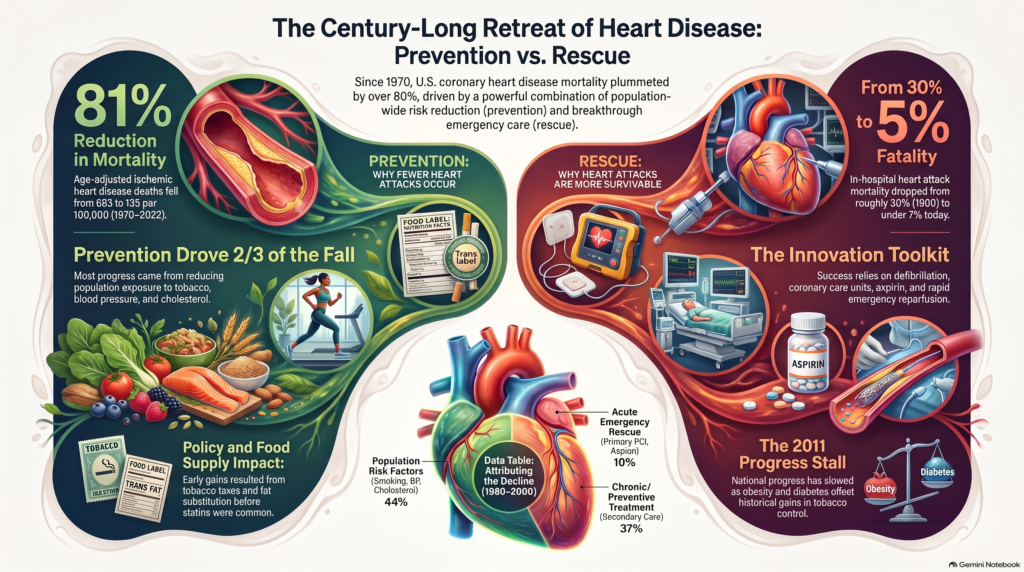
De Honderdjarige Terugtocht van Coronaire Hartziekte
Wat er werkelijk is gebeurd, hoeveel de moderne cardiologie heeft bijgedragen en wat er nu moet gebeuren
Een verhalend en systematisch literatuuronderzoek, ca. 1925–2026
Peter Megdal, PhD 24 augustus 2026
Inhoudsopgave
De Honderdjarige Terugtocht van Coronaire Hartziekte. 3
Samenvatting in begrijpelijke taal. 3
Het antwoord in één paragraaf.. 4
Centrale kwantitatieve conclusies. 5
Deel I. Het verhaal: hoe een ziekte opkwam en ten onder ging 7
Een epidemie die eerst ontdekt moest worden voordat ze kon worden geteld (ca. 1900–1949). 7
Het hoogtepunt en de ommekeer (1950–1969). 7
De steile afdaling (1970–1989). 8
De farmacologische consolidatie (1990–2009). 9
Tabel 1 — De honderdjarige tijdlijn. 10
Figuur 1 — Voor leeftijd gecorrigeerd sterftecijfer door coronaire hartziekten in de VS. 11
Figuur 2 — Toen de gereedschappen arriveerden. 12
Deel II. De achteruitgang correct meten. 13
Wat de bewakingsbeelden daadwerkelijk laten zien. 14
Deel III. Waarom het gebeurde: de attributieliteratuur. 15
Hoe de modellen werken, en wat ze u wel en niet kunnen vertellen.. 15
Het probleem van dubbeltelling en hoe hiermee wordt omgegaan. 16
Biologische vertragingstijden: waarom attributievensters ertoe doen. 16
Tabel 2 — Belangrijke attributiestudies. 17
Figuur 3 — Een concrete decompositie (VS, 1980–2000). 20
Welke risicofactoren waren het belangrijkst?. 20
Tabel 3 — Bijdrage van individuele risicofactoren. 20
Deel IV. Preventie: wat het gerandomiseerde bewijs daadwerkelijk aantoont. 23
LDL- en apolipoproteïne B-verlaging. 23
Plaatjesremmertherapie en het pakket voor secundaire preventie. 24
Tabel 4 — Belangrijke medische doorbraken. 25
Deel V. Redding: hoe een hartinfarct ophield een doodvonnis te zijn. 29
De vergelijking die preventie van redding scheidt. 29
Tabel 5 — Overleving bij een acuut myocardinfarct over verschillende tijdperken. 30
De interventies, in causaal perspectief. 31
Japan: het doorslaggevende tegenvoorbeeld. 32
Deel VI: Revascularisatie: drie verschillende operaties met één naam. 32
Tabel 6 — Preventie versus redding. 33
Deel VII. Contrafactualen en geredde levens. 35
Wat als een moderne bevolking oude medische zorg had — of oude risicofactoren?. 35
Hoeveel levens zijn er gered?. 36
Deel VIII. Internationale natuurlijke experimenten. 36
Polen: een per ongeluk nationale experiment in de voedselvoorziening. 38
Rusland en de post-sojettendens: het experiment in omgekeerde volgorde. 38
Tabel 7 — Natuurlijke experimenten in de cardiovasculaire epidemiologie. 39
Deel IX. De stal, and wie er achter is gelaten. 40
Deel X. Wat volgt: het beter doen dan vandaag. 41
- Behandel cumulatieve blootstelling gedurende het hele leven, geen middelbare-leeftijdsdrempels. 41
- Eindelijk lipoproteïne(a) behandelen. 42
- Breid de cholesterolverlagende gereedschapskist uit en los therapietrouw op. 42
- Behandel de cardiometabole motor direct. 42
- Adreseer resterend inflammatoir risico. 43
- Vind de risicopersonen vóór het evenement. 43
- Bevolkingsbeleid behoudt een uitzonderlijk grote invloed. 43
En bovenal: dicht de implementatiekloof. 44
Tabel 8 — De toekomstige agenda. 44
Bewijshiërarchie en het bewijsgrootboek. 45
Gestructureerde samenvattingen waarbij bewijs op abstractniveau is gebruikt. 50
Kennishiaten en resterende onzekerheid. 51
Betrouwbaarheidsscores voor de hoofdconclusies. 52
Samenvatting in begrijpelijke taal
Voor het grootste deel van de medische geschiedenis werd niemand gediagnosticeerd als stervende aan een hartinfarct — niet omdat myocardinfarct niet plaatsvond, maar omdat het nog niet als klinisch syndroom was herkend. Coronaire trombose werd pas in 1912 beschreven als een klinisch syndroom bij de levende patiënt.1Binnen vier decennia was het de belangrijkste doodsoorzaak geworden in de geïndustrialiseerde wereld. Binnen nog eens vier decennia was het in snelle terugtocht. Dit is een van de meest buitengewone omkeringen in de geschiedenis van de geneeskunde, en het wordt steevast slecht uitgelegd.
De populaire versie — die de cardiologie heeft bedacht statines en stents en daarmee hart- en vaatziekten overwon — is op grond van de chronologie alleen al onjuist. De coronaire sterfte in de Verenigde Staten bereikte rond 1968 een piek en was al met ongeveer een derde gedaald voordat de eerste statine werd goedgekeurd, voordat ACE-remmers, vóór de primaire verkiezingen dotterbehandeling, en voordat iemand een gerandomiseerd onderzoek had uitgevoerd naar aspirine bij een acuut myocard infarct. De omgekeerde versie — dat de daling puur te maken had met mensen roken minder eten en beter eten, met medicijnen als steuntje in de rug — is evenzeer onjuist. Moderne therapieën zijn verantwoordelijk voor een zeer grote minderheid, en in sommige landen en tijdperken voor bijna de helft, van de daling.
De juiste weergave is dat er tegelijkertijd twee verschillende dingen gebeurden, die nooit met elkaar mogen worden verward:
Eerst kregen minder mensen hartinfarcten. Populaties hebben hun levenslange blootstelling aan drie van de dominante beïnvloedbare drijfveren van verminderd aderverkalkingtabaksrook, verhoogd bloeddruk, en atherogeen cholesterol. Dit zijn niet de enige causale factoren — diabetes, ook adipositas en metabole disfunctie spelen een rol, en hun trends zijn de verkeerde kant op gegaan. Een deel daarvan kwam door individueel gedrag, veel daarvan kwam door beleid en de voedselvoorziening, en een steeds groter deel na verloop van tijd kwam door medicijnen — bloeddrukverlagende middelen uit de jaren 1970, statines vanaf medio jaren 1990.
Ten tweede hielden de mensen die wel een hartaanval kregen op eraan te sterven. In 1960 had iemand die met een acuut myocardinfarct in het ziekenhuis werd opgenomen, een kans van ongeveer één op drie tot één op vijf om het ziekenhuis niet meer te verlaten. Tegenwoordig ligt de ziekenhuissterfte na een ST-elevatie-infarct in systemen met een hoog inkomen vaak rond de 4–7%, hoewel dit cijfer aanzienlijk varieert naargelang de casemix en geen universele waarde is voor alle AMI's. Coronaire zorgafdelingen, defibrillatie, cardiopulmonale reanimatie, medische noodhulpdiensten, aspirine, trombolyse, en primaire percutane coronaire interventie deed dit. Deze acute reddingsinterventies verbeteren voornamelijk de overleving na een voorval in plaats van het voorkomen van eerste myocardinfarcten.
Beide prestaties verlagen het sterftecijfer door kransvatziekten, en het sterftecijfer alleen kan je niet vertellen welke hiervan verantwoordelijk is. De beste internationale gegevens suggereren dat tijdens de klassieke dalingdecennia ongeveer twee derden van de daling in coronaire mortaliteit te wijten was aan minder coronaire voorvallen en ongeveer een derde aan het overleven ervan.
Dan is er het deel van het verhaal dat nog niet in de leerboeken is geschreven. De daling is gestagneerd. In de Verenigde Staten en het Verenigd Koninkrijk vertraagde de vooruitgang na ongeveer 2011 scherp, en onder volwassenen jonger dan 55 zijn sommige acute uitkomsten de verkeerde kant op gegaan. Obesitas en type 2-diabetes trekken al dertig jaar af van het grootboek; de nationale bloeddrukbeheersing is verslechterd; en de makkelijke overwinningen op het gebied van tabaksontmoediging zijn grotendeels binnen. De komende honderd jaar van vooruitgang zullen niet voortkomen uit het herhalen van de afgelopen honderd. Deze zal vermoedelijk in toenemende mate afhangen van het behandelen van cumulatieve levenslange atherogene blootstelling in plaats van risicodrempels op middelbare leeftijd, van lipoproteïne(a) als uitkomststudies voordeel bevestigen, over de cardiometabole revolutie die momenteel gaande is met incretine therapieën, aan resterend inflammatoir risico, en boven alles bij het dichten van de enorme implementatiekloof tussen wat we weten dat werkt en wat patiënten daadwerkelijk krijgen.
Het antwoord in één paragraaf
Coronaire hartziekte steeg in de eerste helft van de twintigste eeuw, bereikte in de meeste landen met een hoog inkomen een piek in de jaren zestig en onderging vervolgens een van de grootste aanhoudende sterftedalingen die ooit zijn gedocumenteerd voor een belangrijke doodsoorzaak. In de Verenigde Staten was de voor leeftijd gecorrigeerde ischemische hartziekte sterfte daalde van 693 tot 135 sterfgevallen per 100.000 tussen 1970 en 2022 — een daling van 81% — terwijl de sterfte die specifiek als acuut myocardinfarct werd gecodeerd, daalde van van 354 naar 40 per 100.000, een daling van 89% [2]. De best beschikbare attributiemodellen ondersteunen niet om die prestatie toe te schrijven aan “geneeskunde” alleen of aan “levensstijl” alleen. In de Verenigde Staten en verschillende Europese landen tijdens de belangrijkste periodes van achteruitgang, ongeveer 44–73% van de daling werd toegeschreven aan gunstige veranderingen in de risicofactoren van de bevolking, terwijl ongeveer 23–47% werd toegeschreven aan medische en chirurgische behandeling; de acute coronaire behandeling zelf was meestal goed voor slechts ongeveer 4–12% van de totale daling van het sterftecijfer in modellen van het IMPACT-type [3,4,5,6,7,8Tegelijkertijd geven gegevens van de WHO MONICA aan dat growweg twee derde van de daling van de coronaire sterfte in de jaren tachtig en negentig was afkomstig van minder coronaire events en een derde van een betere overleving na een event, met aanzienlijke variatie tussen populaties [9].
De praktische conclusie: een groot deel van de historische daling in de incidentie van coronaire voorvallen lijkt het gevolg te zijn van veranderingen in de onderliggende blootstelling van de bevolking aan atherosclerotische risicofactoren — met name roken, bloeddruk en cholesterol — terwijl de moderne cardiologie een zeer grote aanvullende bijdrage heeft geleverd door diezelfde risico’s medisch te verlagen, herhaling van voorvallen te voorkomen en een hartaanval te transformeren van een gebeurtenis met een kortetermijnsterfte van ongeveer 20–30% naar een gebeurtenis die, in de hedendaagse gezondheidszorgstelsels van landen met een hoog inkomen, veel vaker overleefbaar is.
Centrale kwantitatieve conclusies
| Vraag | Beste verdedigbare synthese | Zelfvertrouwen |
| Hoeveel is de mortaliteit door kransslagaderziekte in de VS gedaald? | Voor leeftijd gecorrigeerde sterfte aan ischemische hartziekten is gedaald 81% van 1970 tot 2022; de als acuut infarct gecodeerde mortaliteit daalde 89%. Over het best gedocumenteerde enkele interval daalde de voor leeftijd gecorrigeerde coronaire hartziektesterfte grofschootse 50% tussen 1980 en 2000. Eerdere historische reeksen tonen aan dat de sterfte door hart- en vaatziekten steeg tot een piek halverwege de eeuw, voorafgaand aan de aanhoudende daling. | Hoog |
| Hoeveel is de incidentie van een hartinfarct gedaald? | Er bestaat geen geldig universeel cijfer van een eeuw lang. Het door het Framingham-ecg gedefinieerde eerste myocardinfarct viel ongeveer 50% van 1960 tot 1999; De IJslandse incidentie van hartinfarcten is gedaald 66% van 1981 tot en met 2006; ARIC lating de jaarlijkse dalingen van ongeveer 3–4% in de meeste sekses/rasgroepen gedurende 1987–2008. Japan toont aan dat de incidentie helemaal niet hoeft te dalen: Miyagi steeg van 7,4 tot 27,0 per 100.000 tussen 1979 en 2008. | Gematigd |
| Hoeveel is de mortaliteit door een hartinfarct gedaald? | De naar leeftijd en geslacht gecorrigeerde case-fatality na 30 dagen, 1 jaar en 5 jaar volgens Framingham daalden elk met ongeveer 60% van 1960 tot 1999; De sterfte in het ziekenhuis in Miyagi is gedaald van 20,01 TP9T tot 7,81 TP9T over de periode 1979–2008. De ziekenhuissterfte vóór de oprichting van de coronairycare-afdeling van ongeveer 30% vergeleken met een hedendaagse ziekenhuissterfte bij een STEMI van ongeveer 4–7%. | Hoog voor richting; Gematigd voor kruis-tijdperk magnitude |
| Bijdrage van risicofactoren in de populatie | Over het algemeen ~45–70%, met individuele IMPACT-schattingen variërend van 44% (VS) naar 73% (IJsland). | Gematigd |
| Bijdrage medische/chirurgische behandeling | Over het algemeen ~25–45%, variërend van ongeveer 23–47% in grote IMPACT-analyses. | Gematigd |
| Bijdrage acute/spoedeisende behandeling | Meestal ~5–10% van de totale daling van de sterfte aan hart- en vaatziekten in attributiemodellen (ongeveer 4–12% in verschillende landen). Maar de daling van het sterftecijfer — waaraan verbeteringen in de acute zorg aanzienlijk hebben bijgedragen — is goed voor ongeveer een derde van de daling in coronaire sterfte in een MONICA-type decompositie. | Gematigd |
| Overige/diagnostische/gezondheidssysteem-bijdrage | Niet onafhankelijk identificeerbaar. IMPACT-residuen zijn doorgaans ~5–10%, maar dit residu moet niet gelijkgesteld worden aan de ambulancezorg, de diagnose of de verbetering van het zorgsysteem, omdat veel van dergelijke effecten al verwerkt zijn in de schattingen van de behandeling. | Laag |
| Is de vooruitgang doorgegaan? | Nee. De afname vertraagde aanzienlijk na ca. 2011 in de VS en het VK en is gestagneerd bij jongvolwassenen, met recent bewijs van een verslechtering van de sterfte in het ziekenhuis na een eerste STEMI bij volwassenen van 18–54 jaar. Obesitas, diabetes en hypertensie controle blijft belangrijke contragewichten op populatieniveau. | Matig tot hoog |
Een cruciaal terminologiepunt bepaalt alles wat volgt: De categorie “risicofactor” is geen synoniem voor een persoonlijke levensstijlkeuze. Dalende rookprevalentie weerspiegelt belastingheffing, rookvrije wetgeving, reclamebeperkingen, doktersadvies en individuele beslissingen. Dalend populatiecholesterol weerspiegelt de herformulering van de voedselvoorraden, dieetveranderingen en statines. Dalende bloeddruk weerspiegelt zowel seculaire populatieverschuivingen als het voorschrijven van bloeddrukverlagers. De sterkste analyses scheiden deze trajecten expliciet in plaats van ze te dubbeltellen. In het Zweedse IMPACT-werk werd bijvoorbeeld een daling van het populatiecholesterol met 0,64 mmol/l opgesplitst in ongeveer 5.210 sterfgevallen voorkomen of uitgesteld door een verandering in het voedingspatroon en 810 door statines, terwijl een daling van de systolische bloeddruk van 2,6 mmHg ruwweg werd verdeeld in 900 sterfgevallen door seculiere verandering en 575 door antihypertensieve behandeling [10].
Deel I. Het verhaal: hoe een ziekte opkwam en ten onder ging
Een epidemie die eerst ontdekt moest worden voordat ze kon worden geteld (ca. 1900–1949)
De eerste moeilijkheid bij het schrijven van een honderdjarige geschiedenis van het hartinfarct is dat de diagnose gedurende het eerste kwart daarvan nauwelijks bestond. De beschrijving van de kransslagaders door James Herrick in 1912 trombose bij de levende patiënt — die tien jaar lang grotendeels werd genegeerd — werd vastgesteld dat een geblokkeerde kransslagader slagader overleefbaar was en daarom kon worden gediagnosticeerd in plaats van simpelweg een post-mortem bevinding.1De elektrocardiograaf maakte het herkenbaar aan het bed. Pas toen kon iemand beginnen met tellen.
Wat we met zekerheid kunnen zeggen is dat hart- en vaatziekten de belangrijkste doodsoorzaak in de Verenigde Staten werd in 1921, en dat de coronaire sterfte bleef stijgen in de jaren dertig, veertig en vijftig van de twintigste eeuw. Wat we niet kunnen zeggen is hoeveel van die schijnbare stijging een echte toename was van atherosclerotische events en hoeveel het gevolg was van betere herkenning, betere doodsoorzakenregistratie en het simpele feit dat populaties lang genoeg bleven leven — voorbij infectieziekten, voorbij tuberculose, voorbij de bevalling — om überhaupt coronaire hartziekte te ontwikkelen. Vrijwel zeker ging het om een combinatie van beide, waarbij de massale acceptatie van sigaretten, ongunstige bloeddruktrends en een veranderend voedselaanbod hier waarschijnlijk aanzienlijk toe bijdroegen — hoewel de causale verdeling voor deze vroege periode intrinsiek onzeker is.
Effectieve, op bewijs gebaseerde coronaire therapie was uiterst beperkt. De standaardbehandeling voor een acuut infarct bestond uit zes weken strenge bedrust, gebaseerd op de theorie dat het beschadigde myocardium er moest werk worden bespaard. Er was geen monitoring, geen manier om de aritmie te behandelen die een aanzienlijk deel van de patiënten in de eerste uren doodde, geen manier om de slagader weer te openen en geen gevalideerd modern risicofactorenkader voor coronaire preventie — dieet, beweging, tabak en bloeddruk waren allemaal besproken, maar prospectieve risicofactorwetenschap bestond nog niet. Een patiënt die het ziekenhuis levend bereikte, had misschien twee op de drie tot vier op de vijf kans om het te verlaten.
Het hoogtepunt en de ommekeer (1950–1969)
Twee dingen moesten gebeuren voordat de epidemie kon worden gekeerd, en beide gebeurden in dit tijdperk.
De risicofactoren werden ontdekt. De Framingham-hartonderzoek, begonnen in 1948, gaf de wereld het allere的概念 van een “risicofactor” en identificeerde bloeddruk, cholesterol en roken als de belangrijkste beïnvloedbare factoren. De Zeven Landen-studie van Ancel Keys koppelde voedingspatronen van de bevolking aan serumcholesterol en het aantal kransslagaderaandoeningen.11Het rapport van de Amerikaanse Surgeon General uit 1964 maakte de causale rol van tabak officieel beleid in plaats van een academische mening. Niets hiervan behandelde een enkele patiënt. Dit alles maakte alles wat erop volgde mogelijk.
Redding is uitgevonden. De coronaircure-afdeling — het voorstel van Desmond Julian, begin jaren zestig gerealiseerd op afdelingen in Kansas City, Toronto, Philadelphia en Sydney — was een van de meest ingrijpende innovaties in de acute behandeling van een myocardinfarct, en er kwam helemaal geen medicijn aan te pas. Het inzicht was eenvoudig: een groot deel van de vroege sterfgevallen door een hartinfarct werd veroorzaakt door ventrikelfibrilleren, ventriculair fibrilleren is direct omkeerbaar als je daar staat met een defibrillator, en daarom moeten patiënten continu worden geobserveerd door mensen die zijn opgeleid om te defibrilleren. Hartmassage in gesloten borstkas werd beschreven in 1960; externe defibrillatie was aangetoond in het voorgaande decennium. Historische reeksen suggereren dat de ziekenhuissterfte door acuut myocardinfarct daalde van ruwweg 30% naar 15% met de komst van de hartbewaking.12]
Het bewijsmateriaal hiervoor is zwakker dan het belang ervan doet vermoeden — het meeste bestaat uit observationeel voor-en-na-onderzoek, en een bekende reeks Brits onderzoek beargumenteerde dat thuiszorg niet slechter was voor geselecteerde patiënten. Een prospectieve gerandomiseerde vergelijking van opname op de hartbewaking (CCU) versus een algemene afdeling vond een algehele mortaliteit van 15,31 TP9T (17/111) tegenover 29,31 TP9T (27/92), met het risico op overlijden op de verpleegafdeling ten opzichte van de afdeling 2,3 (95% CI 1,1–4,8), en plotselinge sterfgevallen vaker voor op de verpleegafdeling.13] Die studie is klein, monocentrisch en afkomstig uit een zorgcontext die verschilt van die van vandaag, en de bredere bewijsbasis is grotendeels observationeel;[14] maar het tijdsignaal over vele instellingen heen is consistent en groot.
Ondertussen arriveerde effectieve antihypertensieve therapie. De Veterans Administration Cooperative Studies (1967, 1970) toonden aan dat het behandelen van ernstige en vervolgens matige hypertensie voorkwam beroertes, hartfalen, en sterfte — baanbrekend gerandomiseerd bewijs dat het farmacologisch modificeren van een cardiovasculair risicofactor de klinische uitkomsten veranderde.[15]
De coronaire sterfte in de VS bereikte een piek rond 1968 en begon te vallen.
De steile afdaling (1970–1989)
Dit is het tijdperk dat het verhaal dat “de moderne cardiologie het heeft gedaan” het meest overtuigend weerspreekt, omdat de moderne cardiologie het grootste deel van die tijd nog niet bestond. Er waren geen statines tot 1987 en geen statine-uitkomstenstudie tot 1994. Er was geen ACE-remmerstudie bij hartfalen tot 1987 of na een infarct tot 1992. Ballonangioplastiek werd voor het eerst uitgevoerd in 1977 en bleef een decennium lang een niche-ingreep. Pas in 1988 werd de werkzaamheid van aspirine bij een acuut infarct bewezen.
De achteruitgang werd opgemerkt voordat deze werd verklaard. De Bethesda-conferentie van 1978, bijeengeroepen door het National Heart, Lung, and Blood Institute, werd specifiek uitgeschreven om een onverwachte daling van de sterfte aan kransvat- en beroertes in de VS te documenteren en te verklaren die niemand had voorspeld en die door niemand nog kon worden toegeschreven. Die conferentie is het uitgangspunt van de volledige toeschrijvingsliteratuur die hieronder wordt besproken.[16]
En toch is de voor leeftijd gecorrigeerde sterfte aanischemische hartziekten in de Verenigde Staten, 693 per 100.000 in 1970, daalde gedurende de hele periode steil en continu. Wat in plaats daarvan veranderde, was de blootstelling. De prevalentie van roken onder mannen daalde aanzienlijk in de wake van het rapport van de Surgeon General en de daaropvolgende reclamebeperkingen. Het serumbリエステル daalde doordat het voedselaanbod veranderde. (Note: serumcholesterol) Het National High Blood Pressure Education Program (1972) zorgde ervoor dat de opsporing en behandeling van hypertensie deel gingen uitmaken van de routinematige eerstelijnszorg. En in Noord-Karelië, Finland — dat toen tot de hoogste sterftecijfers aan kransslagaderziekte ter wereld noteerde, met name onder mannen in de arbeidsem leeftijd — begon in 1972 een expliciet op de gemeenschap gericht preventieprogramma dat aantoonde dat het risicofactorprofiel van een bevolking doelbewust kon worden veranderd.
Tegen het einde van het tijdperk arriveerde eindelijk de therapeutische revolutie, en die arriveerde op de spoedeisende hulp. GISSI (1986)17] en dan ISIS-2 (1988)[18] toonde aan dat streptokinase en aspirine elk op onafhankelijke wijze de sterfte bij een acuut myocardinfarct verminderden en dat ze samen de sterfte drastisch reduceerden. De gerandomiseerde onderzoeken naar een aortacoronary bypass-operatie die tussen 1972 en 1984 werden uitgevoerd, toonden aan dat het overlevingsvoordeel geconcentreerd was bij een hoofdstamstenose en uitgebreid meervoudig thet vaatlijden, met weinig aantoonbaar overlevingsvoordeel bij minder uitgebreid vaatlijden — hoewel het voordeel ook varieerde met de linkerventrikelfunctie en -anatomie.[19]
De farmacologische consolidatie (1990–2009)
Als de jaren zeventig en tachtig toebehoorden aan bevolkingspreventie en acute redding, dan behoorde dit tijdperk toe aan chronische farmacotherapie en zorgsystemen.
De 4S-studie (1994) toonde aan dat simvastatine de sterfte verminderde bij patiënten met aandoeningen aan de kransslagaders, en binnen een decennium behoorden statines tot de meest voorgeschreven geneesmiddelen ter wereld.20] ACE-remmers zijn verschoven van hartfalen naar post-infarctzorg. Bètablokkers, aspirine en lipidenverlagend geconsolideerd tot een standaard pakket voor secundaire preventie. Coronaire stents verminderden acute terugvering en abrupte sluiting en verminderden restenose aanzienlijk in vergelijking met ballonangioplastiek — hoewel restenose werd verminderd, niet geëlimineerd, en geneesmiddelafgevende stents dit later verder verminderden. Dubbele plaatjesremmers aanzienlijk verminderde trombotische complicaties en hielpen routinematige stenting praktisch te maken. Primaire PCI verdrukte geleidelijk trombolyse bij ST-elevatie-infarcten21], en georganiseerde STEMI-netwerken — prehospitalistisch ecg, activatie van het katheterisatielaboratorium vanuit de ambulance, gemeten deur-tot-ballontijden — maakten tijdige reperfusie in toenemende mate tot een systeem- en logistiek uitdaging die zorgsystemen konden optimaliseren.
Zowel de incidentie als de sterfte aan de hand van het aantal gevallen daalden in deze periode aanzienlijk, en dit is het tijdperk waarin de kwantitatieve toeschrijving het sterkst is, omdat de opname van behandelingen werd gedocumenteerd, de werkzaamheid van de studies bekend was en de surveillance van risicofactoren systematisch was. Het is tevens het tijdperk waarin de tegenwichten zichtbaar werden: obesitas en type 2-diabetes begonnen de balans te belasten, en veel grote toeschrijvingsmodellen uit deze periode noteerden ze als negatieve bijdragen.
De stagnatie (2010–2026)
Sterfte blijft ver onder haar historische piek — de sterfte door ischemische hartziekten in de VS bereikte 135 per 100.000 in 2022 — maar het traject heeft een ander karakter gekregen. In de Verenigde Staten en het Verenigd Koninkrijk vertraagde het tempo van de afname aanzienlijk na ongeveer 2011. Bij volwassenen jonger dan 55 jaar, en met name vrouwen, is de langetermijndaling vertraagd of gestagneerd, waarbij sommige studies ongunstige trends melden voor specifieke coronaire uitkomsten.22] De absolute last blijft enorm: de Verenigde Staten registreerden 915.973 cardiovasculaire sterfgevallen in 2023, een voor leeftijd gecorrigeerd sterftecijfer door CVRZ van 218,3 per 100.000[23], en wereldwijd schatte GBD 2023 19,2 miljoen cardiovasculaire sterfgevallen[24], omdat bevolkingsgroei en vergrijzing het absolute aantal sterfgevallen kunnen laten stijgen, zelfs wanneer het individuele voor leeftijd gecorrigeerde risico daalt.
De mogelijke verklaringen voor de stagnatie zijn ongunstig en grotendeels niet-technologisch: obesitas en diabetes op niveaus waarmee geen eerdere generatie te maken heeft gehad; de uitputting van de gemakkelijke winst van het terugdringen van tabak in bevolkingsgroepen waar roken al ongebruikelijk is; en, in de Verenigde Staten, een gedocumenteerde verslechtering van de beheersing van hypertensie door 53,81 TP9T (2013–2014) tot 43,71 TP9T (2017–2018)[25De COVID-19-pandemie bracht vervolgens een abrupte omkeer teweeg — het voor leeftijd gecorrigeerde sterftecijfer door hart- en vaatziekten in de VS was 330,8 in 2019, 346,0 in 2020 en 359,6 in 2021 per 100.000 volwassenen van 25 jaar en ouder — waarmee de vooruitgang van meerdere jaren in twee jaar teniet werd gedaan. Deze reeks heeft betrekking op volwassenen van 25 jaar en ouder en is niet direct vergelijkbaar met het hierboven vermelde, anders gestandaardiseerde percentage van 218,3 per 100.000 voor alle volwassenen; de beide cijfers mogen niet als één enkele trend worden gelezen.
Tabel 1 — De honderdjarige tijdlijn
| Tijdperk | HVZ/MI epidemiologie | Ontwikkelingen in bevolking en risicofactoren | Medische en noodgevallen ontwikkelingen | Bewijstechnische interpretatie |
| 1925–1949 | CHD stijgt; vergelijkbare surveillance van de incidentie van MI in de bevolking is grotendeels niet beschikbaar. Hartziekte werd tegen 1921 de belangrijkste doodsoorzaak in de VS. | Het tabaksverbruik en andere schadelijke coronaire blootstellingen namen sterk toe; de risicofactortheorie bestond nog niet. | ECG wordt klinisch steeds vaker gebruikt; de behandeling van een hartinfarct bestond uit bedrust en ondersteunende zorg. | Niveau 3/5. Sterftegegevens zijn over het algemeen betrouwbaar; de causale toeschrijving is veel zwakker dan na 1950. |
| 1950–1969 | Sterfte als gevolg van coronair hartlijden bleef hoog en bereikte rond 1968 haar piek in de Verenigde Staten. | Framingham en Seven Countries identificeerden roken, bloeddruk en cholesterol als beïnvloedbare risico's; het rapport van de Surgeon General uit 1964. | Externe defibrillatie, reanimatie, coronaire zorgafdelingen, effectieve behandeling van hypertensie, eerste CABG. Op coronaire zorgafdelingen daalde de ziekenhuissterfte door een hartinfarct van ~30% naar ~15%. | Niveau 2-5. De vroege overlevingsveranderingen zijn overtuigend, maar grotendeels observationeel. |
| 1970–1989 | Aanhoudende sterke daling begint; de voor leeftijd gecorrigeerde sterfte aan ischaemische hartziekten (IHD) in de VS was 693/100.000 in 1970. | Roken daalt aanzienlijk; bloeddruk en cholesterol van de bevolking verbeteren; Noord-Karelië lanceert intensieve preventie in de gemeenschap. | Wijdverbreide antihypertensieve behandeling, CABG, PTCA (1977), bètablokkers, aspirine, hartrevalidatie, trombolyse; vroege statines laat in het tijdperk. ISIS-2 stelt aspirine en streptokinase vast. | Tier 1–4. Bevolkingseventie en evidence-based cardiologie beginnen gelijktijdig bij te dragen. |
| 1990–2009 | Grote dalingen in zowel de incidentie als de case-fatality van een hartinfarct worden meetbaar in ARIC en Framingham. | Verdere verbetering van roken, cholesterol en bloeddruk, steeds sterker tenietgedaan door obesitas en diabetes. | Statines, ACE-remmers, stents, dubbele plaatjesremming, moderne ambulancezorg, primaire PCI regulier. Primaire PCI presteert beter dan trombolyse in gerandomiseerde synthese. | Tier 1–4. Het sterkste tijdperk voor kwantitatieve attributie. |
| 2010–2026 | Sterfte ver onder piek maar daling stokt; stagnatie bij jongvolwassenen, met een recente verslechtering van de mortaliteit door een eerste STEMI in het ziekenhuis op 18–54-jarige leeftijd. Amerikaanse sterfte aan ischemische hartziekten 135/100.000 in 2022. | Tabak blijft dalen in landen met een hoog inkomen; obesitas, diabetes en metabolisch risico wegen niet op tegen de winst; de bloeddrukbeheersing in de VS verslechtert. | Intensieve statines, ezetimib, PCSK9 remming, geoptimaliseerde ACS-systemen, radiale PCI, ultrasensitief troponine, GLP-1-receptor-agonisten, colchicine. | Niveau 1–3. Sterk bewijs voor de werkzaamheid van individuele behandeling; veel zwakker bewijs voor onderverdeling recent nationale trends. |
Figuur 1 — Voor leeftijd gecorrigeerd sterftecijfer door coronaire hartziekten in de VS
Geobserveerde nationale sterftecijfers. Historische en moderne reeksen zijn bewust niet numeriek aan elkaar gekoppeld, omdat leeftijdsstandaarden en ziektecodering zijn veranderd.
Paneel A — Belangrijke waargenomen datapunten
| Serie | Jaar | Voor leeftijd gecorrigeerd sterftecijfer per 100.000 (of: Voor leeftijd gecorrigeerd cijfer per 100.000) | Wijzigen |
| Ziekten van het hart (standaard 1940) | 1950 | 307.4 | — |
| Ziekten van het hart (standaard 1940) | 1996 | 134.6 | −56% |
| Ischemische hartziekte (moderne serie) | 1970 | 693 | — |
| Ischemische hartziekte (moderne serie) | 2022 | 135 | −81% |
| Acuut myocardinfarct | 1970 | 354 | — |
| Acuut myocardinfarct | 2022 | 40 | −89% |
| Alle hart- en vaatziekten, volwassenen 25+ | 2019 | 330.8 | — |
| Alle hart- en vaatziekten, volwassenen 25+ | 2020 | 346.0 | +4.6% |
| Alle hart- en vaatziekten, volwassenen 25+ | 2021 | 359.6 | +8,71 TP9T ten opzichte van 2019 |
Paneel B — Vorm van het traject
Hartaandoeningen worden de belangrijkste doodsoorzaak in de VS ………. 1921
Sterfte stijgt door ……………………………. jaren 30-jaren 60
PEAK (coronair hartlijden) ………………………. ~1968
Steile aanhoudende daling ……………………………. 1968-2010
De daling vertraagt/stagneert bij jongvolwassenen;
geselecteerde acute uitkomsten verslechteren …………………….. vanaf ongeveer 2011
Onderbreking door pandemie ……………………………… 2020-2021
Ischemische hartziekte, voor leeftijd gecorrigeerd, per 100.000:
1970 693 ####################################
2022 135 #######
Acuut myocardinfarct, leeftijd gecorrigeerd, per 100.000:
1970 354 ##################
2022 40 ##
Bronnen: historische Amerikaanse nationale sterfte-analyses (CDC/NCHS)26]; King et al. 2025[2] voor de IHD- en AMI-reeks van 1970–2022.
Figuur 2 — Toen de gereedschappen arriveerden
Geschatte tijdlijn voor klinische toepassing. Data duiden op het ontstaan of het verschijnen van belangrijk bewijsmateriaal, niet op één universele startdatum.
| Punt | Preventie en chronische therapie | Acute redding en systemen |
| jaren 1950 | Effectieve bloeddrukverlagende medicijnen in opkomst | Externe defibrillatie |
| Vroeg jaren 60 | Risicofactorconcept vastgesteld (Framingham) | reanimatie; hartbewakingsafdelingen en continue ritmebewaking |
| Eind jaren 1960 | Rapport van de Surgeon General over roken uit 1964 | CABG doet zijn intrede in de klinische praktijk |
| Jaren 1970 | Bètablokkers; National High Blood Pressure Education Program; Noord-Karelië | Ballon-coronair angioplastiek (1977); georganiseerde ambulancezorg breidt zich uit |
| jaren 1980 | Statines geïntroduceerd (1987); hartrevalidatie geformaliseerd | Aspirine en trombolyse vastgesteld bij acuut myocardinfarct (GISSI 1986, ISIS-2 1988) |
| jaren negentig | Statine-eindpuntstudies (4S 1994); ACE-remmer-gebaseerd secundaire preventie | Coronaire stents; primaire PCI vervangt in toenemende mate trombolyse |
| jaren 2000 | Intensieve statinetherapie; polypilconcept | Programma's voor AED's met openbare toegang; moderne STEMI-netwerken; prehospitaal ECG |
| jaren 2010 | Ezetimibe resultaten (2015); PCSK9-remmers (2017–18); SGLT2-remmers | Gevoelige troponine-bepaling op grote schaal toegepast; transradiale benadering standaard |
| Jaren 2020 | Secundaire preventie bij zeer lage LDL; colchicine; GLP-1-receptoragonisten (SELECT 2023); inclisiran; bempedoïnezuur | Volwassen geïntegreerde ACS/EMS-systemen; Lp(a)-verlagende middelen in uitkomstonderzoeken |
Deel II. De achteruitgang correct meten
Bijna elke populaire misvatting over dit onderwerp komt voort uit het verwarren van vier verschillende grootheden. Ze zijn gerelateerd, maar ze bewegen onafhankelijk van elkaar en om verschillende redenen.
Incidentie van coronaire events is hoe vaak mensen hartinfarcten krijgen. Casiërssterfte is het aandeel dat sterft zodra ze er één hebben. sterfte aan hart- en vaatziekten is ongeveer het product van de twee, plus recidiverende gebeurtenissen en plotselinge dood buiten het ziekenhuis. Totale cardiovasculaire mortaliteit omvat bovendien een beroerte, hartfalen en andere vasculaire sterfte en is daarom een breder en minder specifieke maatstaf. Een therapie die de sterfte aan een aandoening halveert en een beleid dat de incidentie halveert, kunnen identieke dalingen in coronaire hartzieftesterfte opleveren terwijl ze volkomen verschillende prestaties vertegenwoordigen.
Hierbij gelden vier methodologische waarschuwingen.
Age standardization is mandatory. Crude death rates in an aging population can rise while individual risk falls steeply. Every trend statement in this review is age-adjusted or age-specific unless explicitly stated otherwise. It is also why absolute global cardiovascular deaths continue to increase while age-standardized rates fall.
Diagnostic criteria changed repeatedly, and this is not a minor artifact. Myocardial infarction has passed through successive biomarker eras: AST, LDH and total CK in the 1970s; CK-MB mass and activity assays in the 1980s and 1990s; conventional cardiac troponin I and T in the early 2000s; and high-sensitivity troponin assays from the 2010s — layered on top of the successive Universal Definitions of MI (2000, 2007, 2012, 2018).[27] As the analytical limit of detection fell from micrograms to sub-nanograms per litre, troponin elevations became detectable in patients who previously met no biomarker criterion. These categories must be kept distinct. Myocardial injury — any troponin elevation above the 99th percentile — is not itself myocardial infarction; it becomes infarction only when accompanied by clinical evidence of acute myocardial ischemie. Type 1 MI reflects atherothrombosis; type 2 MI requires an acute rise and/or fall in troponin plus clinical evidence of ischemia arising from supply–demand mismatch; and non-ischemic myocardial injury (sepsis, myocarditis, renal disease, heart failure) remains injury and is not MI at all. What the assay transition did was enlarge the population in whom troponin is measurable and abnormal, increasing recorded NSTEMI diagnoses while also increasing recognition of injury that is not infarction. This is sometimes called troponin-induced diagnostic herclassificatie, and it has two opposing effects: it artifactually verhoogt recorded NSTEMI incidence in administrative databases, and it lowers apparent aggregate case fatality by enlarging the denominator with lower-risk patients. When standardized historical algorithms are applied longitudinally — strict Q-wave ECG criteria and constant biomarker thresholds, as in MONICA — the decline in standardized ECG-defined infarction appears steeper than raw administrative coding suggests. Framingham demonstrated the magnitude directly: between 1960 and 1999, ECG-defined MI incidence fell roughly 50% while infarctions detected predominantly through increasingly sensitive biomarkers approximately doubled.[28] Surveillance that standardizes on ECG criteria or explicitly adjusts for biomarker era — Framingham, ARIC, MONICA — therefore deserves far more weight than unadjusted hospital discharge coding.
Competing risks matter. As cancer, stroke, and other causes of death shift, the population at risk of a coronary death changes. Falling coronary mortality partly redistributes deaths to other causes and to later ages rather than eliminating them; “deaths prevented or postponed” is the scientifically honest phrase.
A century-long MI incidence series does not exist and should not be manufactured. The honest statement is that reliable national incidence surveillance begins in the 1960s–1980s depending on the country, and that everything before that is mortality data plus inference.
Wat de bewakingsbeelden daadwerkelijk laten zien
United States, mortality. Age-adjusted ischemic heart disease mortality fell from 693 to 135 per 100,000 between 1970 and 2022 (−81%), and AMI-coded mortality from 354 to 40 (−89%) [2]. Within that span, the best-documented single interval is 1980–2000, over which age-adjusted CHD death rates fell from 542.9 to 266.8 per 100,000 in men and from 263.3 to 134.4 in women [3]. Using the older 1940 age standard, “diseases of the heart” mortality fell from 307.4 per 100,000 in 1950 to 134.6 in 1996; these values must not be numerically spliced onto modern 2000-standard series.[26]
United States, incidence and case fatality. Framingham, following 9,824 participants over 212,539 person-years, found ECG-defined first-MI incidence fell approximately 50% van 1960 tot 1999, while crude 30-day case fatality moved from 20% to 14%, one-year from 24% to 21%, and five-year from 45% to 41%; after age and sex adjustment, case fatality at all three horizons fell by about 60% [28]. ARIC, surveilling four U.S. communities from 1987–2008 with explicit biomarker adjustment for the enzyme-to-troponin transition, found incident hospitalized MI declining annually by about 4.3% in White men, 3.8% in White women, 3.4% in Black women — but only 1.5% in Black men, with 28-day case fatality declining approximately 2.6–3.6% per year by group [29]. ARIC also documented that infarctions themselves became smaller and less severe over time.[30]
Contemporary burden. Despite the decline, the United States recorded 915.973 cardiovasculaire sterfgevallen in 2023, with an age-adjusted CVD death rate of 218,3 per 100.000 versus 224.3 in 2022.[23] Globally, GBD estimated approximately 9.0 million ischemic heart disease deaths in 2021 with an age-standardized IHD mortality rate of about 108.7 per 100,000, representing a roughly 32% decline in age-standardized rate since 1990 — and 19.2 million total cardiovascular deaths in 2023.[24] Age-standardized risk is falling; absolute burden is not.
Deel III. Waarom het gebeurde: de attributieliteratuur
Hoe de modellen werken, en wat ze u wel en niet kunnen vertellen
The strongest direct answer to “how much was medicine and how much was prevention” comes from IMPACT-type models, developed by Capewell and colleagues from 1996 and applied in more than twenty countries[3,4]. The method takes observed changes in population risk factors, observed treatment uptake, trial-derived efficacy estimates, patient numbers, and case fatality, and asks how many “deaths prevented or postponed” relative to a baseline year can be assigned to each component. The models have been shown to account for most of the observed mortality change in England, Scotland, Ireland, New Zealand, Finland, Sweden, and the United States, in the sense that the sum of modeled components typically reproduces 85–100% of the observed change. This is calibration and internal accounting, not independent validation of the causal attribution itself: a model can reproduce an aggregate total while misallocating it among components.
These are Tier 4 attribution models incorporating externally estimated causal effect sizes, not randomized experiments, and the percentages they produce are model-dependent. Their value is that the same broad finding recurs in populations with very different histories: risk-factor change usually explains somewhat more of the mortality decline than treatment does, but both are large.
Het probleem van dubbeltelling en hoe hiermee wordt omgegaan
This is the single most important methodological issue in the field, and it is where most casual analyses fail. A fall in population mean blood pressure is partly caused by antihypertensive drugs[10], partly by diet and sodium intake, partly by body weight, and partly by other secular influences. A fall in population cholesterol is partly statins, partly dietary change, partly trans-fat removal from the food supply. If you credit “medicine” with the drug effect and separately credit “lifestyle” with the entire observed risk-factor change, you have counted the same biological improvement twice.
Well-implemented IMPACT models handle this in three ways. First, in well-specified implementations such as the Swedish analysis, individuals receiving a relevant treatment are removed from the population risk-factor calculation, so a statin-treated patient’s cholesterol fall is credited to statins, not to “diet.” This handling is implementation-specific and is not applied identically across all IMPACT models. Second, benefits from concurrent therapies are combined multiplicatively rather than added, using the Mant–Hicks approach, so that a patient on aspirin plus a beta-blocker plus a statin is not credited with the arithmetic sum of three relatief risico reductions. Third, overlapping treatment populations are explicitly enumerated and adjusted.
The Swedish analysis is the most transparent worked example. Between 1986 and 2002, totaal cholesterol fell 0.64 mmol/L in the Swedish population. The model attributed approximately 5,210 deaths prevented or postponed to dietary change and 810 to statins. Smoking reduction accounted for about 1,195 deaths. A 2.6 mmHg fall in systolic pressure was divided into roughly 900 sterfgevallen door seculiere verandering en 575 door antihypertensieve behandeling. About three-quarters of the mortality reduction attributed to the three major risk factors occurred among people without diagnosed coronary disease — that is, in primaire preventie.[10]
Models also apply compliance discounts to reflect real-world persistence rather than trial naleving — conventionally assuming 100% compliance during acute hospitalization, approximately 70% in symptomatic outpatients, and approximately 50% in asymptomatic primary-prevention populations. This matters: applying trial efficacy to prescription data without discounting systematically overstates the treatment share.
Residual double-counting remains possible even in good implementations, and this is a stated limitation rather than a solved problem.
Biologische vertragingstijden: waarom attributievensters ertoe doen
A further complication rarely handled explicitly is that different interventions act on different timescales, so the same calendar window can flatter or penalize a given intervention depending on when it was adopted.
Weeks to months. Smoking cessation and antiplatelet therapy reduce coronary risk rapidly — before major anatomical tandplak change would be expected.
One to two years. Pharmacological lipid lowering produces separating event curves in randomized trials within roughly 12–18 months[31], which is earlier than large changes in luminal geometry would be expected — the mechanism is generally attributed to plaquestabilisatie rather than anatomical regression, though the trial evidence establishes the outcome effect rather than the mechanism.
Decades. Cumulatief ApoB exposure[32] and long-term blood-pressure burden operate over decades to influence atherosclerotic development and vascular injury. This is the timescale on which the population-level cholesterol decline of the 1970s and 1980s was operating — and it is why a model comparing 1980 with 2000 may capture the mortality consequence of dietary change that began two decades earlier, while assigning it to the wrong window.
Tabel 2 — Belangrijke attributiestudies
| Study / population | Punt | Observed CHD mortality decline | Risk-factor contribution | Treatment contribution | Other / unexplained | Access, tier, identifier |
| Ford et al., United States | 1980–2000 | Men 542.9→266.8/100k; women 263.3→134.4; 341,745 fewer deaths in 2000 | 44% | 47% | ~9% | Full text reviewed; Tier 4. NEJM 2007; DOI 10.1056/NEJMsa053935; PMID 17554120[3] |
| Unal et al., England & Wales | 1981–2000 | −62% men, −45% women; 68,230 fewer deaths | 58% | 42% | Model approximately complete after adverse trends | Abstract reviewed; Tier 4. Circulatie 2004; PMID 14993137[4] |
| Laatikainen et al., Finland | 1982–1997 | −63% | 53–72% | 23% | Remainder/model uncertainty | Abstract reviewed; Tier 4. Am J Epidemiol 2005; DOI 10.1093/aje/kwi274; PMID 16150890[5] |
| Björck et al., Sweden | 1986–2002 | −53.4% men, −52.0% women; 13,180 fewer deaths | 55% | 36% | ~9% | Abstract + open follow-up full text; Tier 4. DOI 10.1093/eurheartj/ehn554; PMID 19141562[6] |
| Aspelund et al., Iceland | 1981–2006 | −80%; MI incidence −66% | 73% (sensitivity 54–93%) | 25% (8–40%) | ~2% | Abstract/results reviewed, open full text; Tier 4. DOI 10.1371/journal.pone.0013957; PMID 21103050[7] |
| Ireland IMPACT | 1985–2000 | −47% | 48.1% | 43.6% | ~8.3% | Abstract reviewed; Tier 4. PMID 16537349[8] |
| Bandosz et al., Poland | 1991–2005 | −54%; 26,200 fewer deaths in 2005 | 54% (cholesterol/dietary fat 39%, physical activity 10%, smoking in men 15%) | 37% | Remainder | Abstract reviewed; Tier 4. BMJ 2012 |
| Koopman et al., Netherlands | 1997–2007 | −48% (269→141/100,000); ~11,200 fewer deaths | ~36% (SBP 30%, cholesterol 10%, smoking 5%) | ~37% | ~27% (model explained ~72%) | Abstract reviewed; Tier 4. PLoS One 2016 |
| North Karelia (within-community) | 1972–1986 | Substantial early IHD incidence decline | Observed changes in the three major risk factors predicted the great majority of the early incidence decline, far exceeding the reference area (exact percentage attribution requires primary-source verification) | Not separately assigned | — | Tier 2/4 natural experiment. Int J Epidemiol 1989; DOI 10.1093/ije/18.3.595[35] |
These percentages must not be averaged into a universal constant. They differ because baseline smoking, cholesterol, and hypertension prevalence differed; because treatment uptake differed; because countries were studied during different phases of technological diffusion; because age ranges differed; and because the models include somewhat different components. England and Wales looks smoking-dominated because the British smoking epidemic was unusually severe and its reversal unusually rapid. The United States shows the largest treatment share partly because it was studied during precisely the decades in which American treatment uptake expanded fastest.
Een verdedigbare synthese
For high-income countries during the principal 1970s–2000s decline:
- Population risk-factor change: approximately 45–70%
- Preventive and chronic treatment (including secondary prevention, heart failure care, hypertension and lipid treatment, revascularisatie for chronic angina): roughly 15–40%
- Direct acute MI/ACS treatment: roughly 5–10%, occasionally up to ~12%
- Explicit model residual: a few percent to ~10%
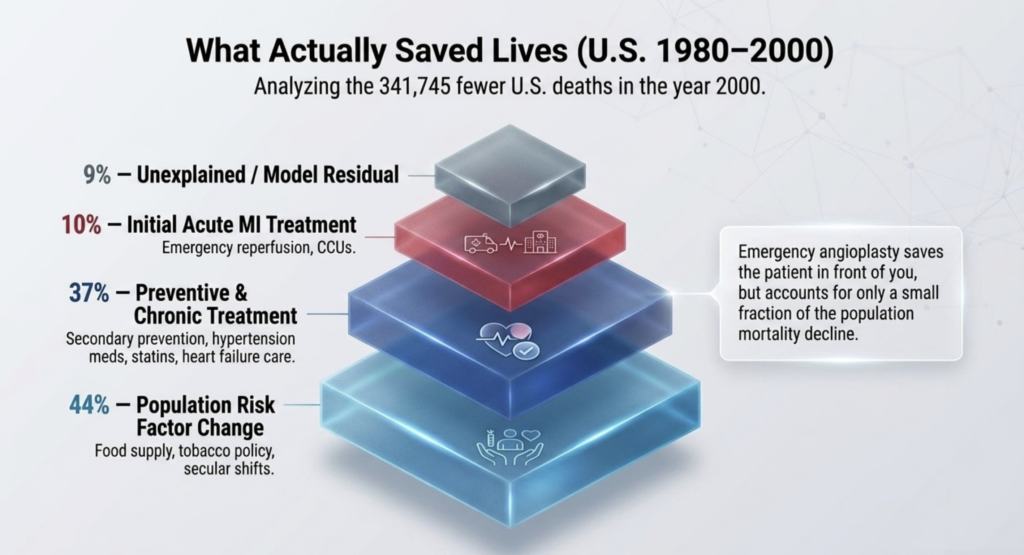
The A-versus-total-treatment comparison is far more robust than the B/C subdivision, which is not standardized across studies. For the United States specifically, the published 47% total treatment share included 10% for the initial treatment of AMI and instabiele angina, permitting a U.S.-specific — not universal — reclassification of approximately 44% A, 37% B, 10% C, 9% D. The 37% figure is an author reclassification derived by subtraction from Ford et al., not a published category from that paper.
Figuur 3 — Een concrete decompositie (VS, 1980–2000)
Model estimate, not a randomized decomposition, and not a universal hundred-year pie chart.
A Population risk-factor change 44% ######################
B Preventive / chronic treatment* 37% ###################
C Initial acute MI / unstable angina 10% #####
D Unexplained / model residual 9% ####
* AUTHOR RECLASSIFICATION, not a published category.
B = published 47% total treatment minus the published 10%
acute-MI / unstable-angina component. It therefore includes
secondary prevention, heart-failure care, hypertension
treatment, and chronic-angina revascularization — not only
drugs that prevent a first MI.
Within the acute category, Ford and colleagues separately calculated that initial AMI treatments alone accounted for about 21,570 deaths prevented or postponed, or 6.3% of the total decline, with sensitivity bounds of 2.6–11.0%.[3] This is the single most useful corrective to the intuition that emergency angioplasty explains the population-level fall in coronary mortality. At the population level, it plainly does not — however dramatic its effect on the individual patient in front of you.
Welke risicofactoren waren het belangrijkst?
The same three exposures recur — cholesterol, smoking, blood pressure — but their ranking varies dramatically with local history. In the U.S. 1980–2000 model, lower total cholesterol accounted for 24% of the decline, lower systolische bloeddruk 20%, lower smoking prevalence 12%, and reduced physical inactivity 5%; rising BMI and diabetes offset gains equivalent to 8% and 10% respectively. In Iceland, cholesterol, smoking, and blood pressure contributed 32%, 22%, and 22%. In England and Wales, smoking alone accounted for 48%.[4]
Tabel 3 — Bijdrage van individuele risicofactoren
| Risk factor | Approximate population mean shift (see note) | Approximate share of observed CHD mortality decline across major IMPACT analyses | Interpretatie | Zelfvertrouwen |
| Population total-cholesterol reduction (reflecting, in part, lower atherogenic-lipoprotein exposure) | Substantial secular decline across U.S. and other high-income series | Over 10–45%: U.S. 24%, Iceland 32%, Ireland 30.2%, Poland 39%; dominant in Sweden | One of the largest cumulative contributors, though the ranking varies by country. The share due to food environment versus medication changes markedly by era — predominantly non-statin and likely substantially related to dietary and food-supply change before the mid-1990s, increasingly pharmacological thereafter. | Matig tot hoog |
| Smoking reduction | U.S. adult prevalence fell from roughly 42% in 1965 to roughly 12% in recent years | Roughly 9–48%: U.S. 12%, Iceland 22%, Ireland 25.6%, England/Wales 48% | Enormous heterogeneity reflecting different starting epidemics and pace of tobacco control. Causally the most secure of all the risk factors. | Hoog for causality; Gematigd for exact attribution |
| Blood-pressure reduction | Mean systolic pressure declined materially in many high-income populations | Approximately 6–22%: U.S. 20%, Iceland 22%, England/Wales 9.5%, Ireland 6% | Includes secular population decline unless drug effects have been separately partitioned, as in Sweden. | Hoog for causality; Gematigd for historical share |
| Physical activity / inactivity | Modest reported decline in inactivity prevalence | Typically 1–10% where modeled; U.S. 5%, Poland 10% | Self-report and secular surveillance are substantially weaker than for smoking, BP, or cholesterol. | Low–Moderate |
| Diet independent of cholesterol and BP | Not separately quantified | Not safely additive to the cholesterol and BP contributions | The Swedish decomposition assigned most of the cholesterol-mediated benefit to diet. Counting “diet” plus the cholesterol decline it caused double-counts one biological pathway. | Gematigd |
| Obesitas | Mean BMI rose substantially; U.S. adult obesity exceeded 42% by 2020 | Negative: −1.5% to −8% across models; U.S. rising BMI added burden equivalent to 8% of the decline that would otherwise have occurred | Obesity blunted the decline; it did not produce it. | Gematigd |
| Diabetes | U.S. diagnosed prevalence rose several-fold, exceeding 11% | Negative: −2% to −10% across models; U.S. offset equivalent to 10% | Rising diabetes prevented coronary mortality from falling considerably further. | Matig tot hoog |
Note on the second column: these are order-of-magnitude summaries of secular change drawn from differing national series, age ranges, and periods (predominantly US and other high-income data). They are intended to convey direction and approximate scale, not to serve as pooled measurements from a single sourced dataset, and they should not be quoted as precise population values.
One observation deserves emphasis because it is decisive for the whole argument: substantial population cholesterol lowering predated widespread statin use — statins reached the market only in 1987 and were not widely used in primary prevention until the late 1990s. An important contributor appears to have been changing dietary fat composition and the food supply — the substitution of polyunsaturated and enkelvoudig onverzadigde vetten for saturated animal fats, and later the regulatory elimination of industrial transvetten, beginning with Denmark in 2003 and followed by EU regulation and the U.S. FDA’s revocation of GRAS status[36]. In IMPACT models, population cholesterol reductions accounted for roughly 24–39% of the total decline across several countries; where explicitly decomposed, much of the pre-statin contribution was attributed to non-pharmacological change, while statins contributed only a few percent of the population cholesterol change up to 2000.
Similarly, a substantial share of the population-wide fall in blood pressure occurred in people not taking antihypertensive drugs. The mechanisms behind that non-pharmacological component are not securely partitioned in the literature and should not be attributed confidently to any single dietary or environmental cause.
The distinction the brief insists upon is worth restating: these are population exposures, not moral categories. Tobacco taxation, smoke-free legislation, industrial trans-fat elimination, sodium reformulation in processed food, and broader changes in food availability and composition are not “lifestyle choices.” They are policy and supply-chain interventions that changed the distribution of risk in entire populations, and they belong in the risk-factor column alongside individual behavior change.
Deel IV. Preventie: wat het gerandomiseerde bewijs daadwerkelijk aantoont
Historical attribution asks what deed happen in a population. Randomized trials answer the complementary question of what a treatment kunnen cause in the patients who receive it. These are different questions and must never be conflated. A drug can be enormously effective for the individual patient and still explain almost none of a historical mortality decline, simply because it was not yet available when the decline occurred.
Bloeddrukverlagend
The Blood Pressure Lowering Treatment Trialists’ Collaboration pooled individual participant data from 344,716 participants in 48 randomized trials. For every 5 mmHg reduction in systolic pressure, major cardiovascular events fell by about 10%: hazardratio 0.91 (95% CI 0.89–0.94) in participants without prior hart- en vaatziekten en 0.89 (0.86–0.92) in those with previous disease. Benefit was present across baseline blood-pressure strata, including in people whose pressure was not conventionally “hypertensive” [37] (Tier 1). Component estimates from this and related BPLTTC work indicate reductions of roughly 13% for stroke, 7% for ischemic heart disease, 14% for heart failure, and 5% for cardiovascular death per 5 mmHg.
This gives causal interpretation to the historical association. Some of the mortality gain assigned to “blood-pressure change” in attribution models genuinely was medicine; some was secular population shift. Sweden is valuable precisely because it attempted to separate the two.
LDL- en apolipoproteïne B-verlaging
The Scandinavian Simvastatin Survival Study (4S, 1994) opened the era, reducing sterfte door alle oorzaken door 30% and coronary mortality by 42% in patients with established coronary disease[20] — a landmark demonstration that statin-mediated cholesterol lowering prolonged life rather than merely altering a laboratory value.
The Cholesterol Treatment Trialists’ Collaboration then made the relationship quantitative. Across 26 trials and approximately 170,000 participants, each 1.0 mmol/L (38.7 mg/dL) reduction in LDL-C produced a 22% reduction in major vascular events (RR 0.78, 95% CI 0.76–0.80), een 20% reduction in coronary mortality (RR 0.80, 99% CI 0.74–0.87), and a 10% reduction in all-cause mortality (RR 0.90, 95% CI 0.87–0.93) — the last driven entirely by vascular deaths, with no excess of cancer or non-vascular mortality.[31] In the individual-participant meta-analyse of 27 randomized trials focused on lower-risk participants, the rate ratio for major vascular events was 0.79 (95% CI 0.77–0.81) per 1.0 mmol/L; among participants without previous vascular disease, vascular mortality fell with RR 0.85 (0.77–0.95) and all-cause mortality with RR 0.91 (0.85–0.97) per 1 mmol/L [38] (Tier 1). Proportional benefit is remarkably consistent across baseline risk, age, and sex, and no lower threshold for benefit has been demonstrated within the ranges tested in randomized trials.
Non-statin trials confirm that the benefit tracks the magnitude of LDL lowering rather than representing an idiosyncratic statin property. In IMPROVE-IT, adding ezetimibe after acuut coronair syndroom lowered the seven-year composite event rate from 34.7% to 32.7%, HR 0.936 (95% CI 0.89–0.99) [39]. In Fourier, evolocumab lowered the primary composite from 11.3% to 9.8%, HR 0.85 (0.79–0.92), and cardiovascular death/MI/stroke from 7.4% to 5.9%, HR 0.80 (0.73–0.88) [40]. In Odyssee OUTCOMES, alirocumab after ACS reduced ernstige ongewenste cardiovasculaire gebeurtenissen from 11.1% to 9.5%, HR 0.85 (0.78–0.93) [41]. All are Tier 1.
This is where the chronology matters most. These therapies are among the most important tools in contemporary practice, and they cannot retrospectively receive credit for a decline that began decades before they existed. The Icelandic model, covering 1981–2006, assigned only 0.5% of the historical mortality decline to statin treatment while assigning 32% to falling cholesterol overall[7] — because during most of that window the population cholesterol decline was largely non-pharmacological and plausibly substantially related to dietary and food-supply change. The correct reading is not that statins are unimportant; it is that statins are important nu, and were largely absent then. Any analysis that credits statins with the twentieth-century decline has the arrow of time pointing the wrong way.
Plaatjesremmertherapie en het pakket voor secundaire preventie
ISIS-2 remains one of the cleanest results in cardiovascular medicine. Among 17,187 patients with suspected acute MI, streptokinase alone reduced five-week vascular mortality from 12.0% to 9.2%; aspirin alone from 11.8% to 9.4%; and the combination from approximately 13.2% to 8.0%, an odds reduction of about 42% [18] (Tier 1). That a drug costing pennies produced a mortality benefit of that magnitude remains a useful check on therapeutic enthusiasm for expensive alternatives.
For chronic use, the Antithrombotic Trialists’ Collaboration drew the decisive distinction between prevention settings. In secundaire preventie, aspirin reduced serious vascular events by 19% (6.7% versus 8.2% per year), with absolute benefit substantially exceeding bleeding risk. In primaire preventie, the reduction was only 12% in major vascular events (0.51% versus 0.57% per year), driven entirely by non-fatal MI, with no significant effect on vascular mortality and offset by roughly a 42% increase in major gastrointestinal and extracranial bleeding[42]. This is why contemporary guidelines have retreated from routine primary-prevention aspirin — a rare example of the evidence base narrowing rather than expanding an indication.
Combined guideline-directed secondary prevention — antiplatelet agent, statin, ACE inhibitor or ARB, and beta-blocker — is estimated in attribution models to produce a substantial cumulative relative risk reduction when components are combined multiplicatively rather than additively. Published composite figures should be treated as modeled estimates that pool heterogeneous endpoints and trial eras rather than as a measured quantity. Real-world adherence to multi-drug regimens declines materially over the years after discharge, which is the rationale for the polypill.
At the population level, the secondary-prevention bundle made a substantial contribution. In the United States, therapies given after MI or revascularization accounted for approximately 11% of the entire 1980–2000 fall in CHD deaths — more than initial acute-MI treatment alone. Modern trials of fixed-dose combination therapy confirm the bundle’s value and demonstrate the importance of adherence as a major modifiable constraint: the SECURE trial of a post-MI polypill (aspirin, ramipril, atorvastatine) reduced the primary composite by 24% (HR 0.76, 95% CI 0.60–0.96) and cardiovascular death by 33% (HR 0.67, 0.47–0.97) [43]
Tabel 4 — Belangrijke medische doorbraken
| Interventie | Adoption / evidence era | Effect on MI incidence | Effect on MI mortality | Evidence and identifier |
| Antihypertensive therapy | Effective from 1960s; widespread from 1970s | Strong prevention: ~9–11% lower major CV-event risk per 5 mmHg SBP reduction | Reduces fatal and non-fatal vascular events; substantial historical population contribution | Tier 1 RCT meta-analysis. DOI 10.1016/S0140-6736(21)00590-0; PMID 33933205[37] |
| Statines | Introduced 1987; outcome evidence 1994; mass adoption late 1990s–2000s | Strong prevention: RR 0.79 (0.77–0.81) major vascular events per 1 mmol/L LDL reduction; ~22% per mmol/L across the full programme | Vascular and all-cause mortality benefit in appropriate populations | Tier 1 IPD meta-analysis. DOI 10.1016/S0140-6736(12)60367-5; PMID 22607822[38] |
| Ezetimib | Outcome evidence 2015 | Incremental prevention after ACS: 34.7%→32.7% composite at 7 years | Composite benefit; not primarily a mortality result | Tier 1. DOI 10.1056/NEJMoa1410489; PMID 26039521[39] |
| PCSK9 inhibition | Outcome evidence 2017–2018 | FOURIER HR 0.85; ODYSSEY HR 0.85 after ACS | Strong event prevention; mortality effect depends on population and follow-up duration | Tier 1. PMID 28304224; DOI 10.1056/NEJMoa1801174[40] |
| Aspirin (acute and secondary prevention) | Definitive 1988 | Reduces recurrent ischemic events; broad primary prevention limited by bleeding | ISIS-2: aspirin reduced acute vascular death odds ~23%; with streptokinase ~42% | Tier 1. PMID 2899772[18] |
| Aspirin (primary prevention) | Reassessed 2009–2019 | Only 12% reduction in major vascular events, driven by non-fatal MI | No significant vascular mortality effect; offset by ~42% more major bleeds | Tier 1, Antithrombotic Trialists’ Collaboration, Lancet 2009[42] |
| Beta-blockers, ACE inhibitors / ARBs | 1980s / 1990s | Modest effect on incidence | Historical post-MI and HFrEF mortality benefit established in randomized trials and meta-analysis; contemporary long-term post-MI indications depend on LV function and other indications | Tier 1[44,45,46] |
| Trombolyse | 1986–1990s | None — reopens an artery after the event has begun | ~30 fewer deaths per 1,000 treated within 0–6 h; ~20 per 1,000 at 7–12 h in eligible ST-elevation/BBB patients | Tier 1, Fibrinolytic Therapy Trialists; PMID 7905143[47] |
| Primary PCI for STEMI | 1990s onward | None on first events; reduces reinfarction versus lysis | 23-trial synthesis: short-term death 7% vs 9%; reinfarction 3% vs 7%; stroke 1% vs 2% | Tier 1. DOI 10.1016/S0140-6736(03)12113-7; PMID 12517460[21] |
| CCU / telemetry / defibrillation | Early 1960s onward | None | Historical hospital mortality 30%→15%; one randomized comparison 15.3% vs 29.3% (RR for general ward 2.3, 95% CI 1.1–4.8)[13] | Tier 2 (single small RCT)[13] plus Tier 5 historical series[14] |
| Public-access AED | 1990s–2000s | None | PAD trial: 30 survivors of 128 definite arrests with CPR+AED versus 15 of 107 with CPR alone | Tier 1. DOI 10.1056/NEJMoa040566[48] |
| CABG | 1968 onward; trials 1972–1984 | Reduces spontaneous MI in selected anatomy | Survival benefit concentrated in left main and three-vessel disease; little or none in one- to two-vessel disease | Tier 1, Yusuf et al.[19] Lancet 1994[19] |
| PCI for stable coronary disease | 1980s onward | No general population preventive role | Ischemie: no reduction in ischemic events or all-cause death over median 3.2 years; death HR 1.05 (0.83–1.32) | Tier 1. DOI 10.1056/NEJMoa1915922; PMID 32227755[49] |
| GLP-1-receptor-agonisten | Outcome evidence 2016–2023 | Prevention in obesity zonder diabetes (SELECT): MACE 6.5% vs 8.0%, HR 0.80 (0.72–0.90); separate CV outcome evidence exists in type 2 diabetes | Reduces MACE; SELECT did niet establish a statistically significant reduction in cardiovascular death alone (2.5% vs 3.0%, HR 0.85, 95% CI 0.71–1.01) | Tier 1. NEJM 2023; DOI 10.1056/NEJMoa2307563[50] |
| Colchicine | Outcome evidence 2019–2020 | Reduces recurrent events in established disease | COLCOT reduced its primary composite by ~23% (HR 0.77, 95% CI 0.61–0.96)[51]; LoDoCo2 by ~31% (HR 0.69)[52] | Tier 1, but CLEAR SYNERGY/OASIS-9 was neutral (HR 0.99, 95% CI 0.85–1.16)[53] |
Deel V. Redding: hoe een hartinfarct ophield een doodvonnis te zijn
De vergelijking die preventie van redding scheidt
At population level:
CHD mortality ≈ coronary-event incidence × case fatality
with additional contributions from recurrent events, out-of-hospital sudden death, competing risks, and coding. This is the equation that makes the central question answerable. If mortality falls and incidence is flat, the gain came from rescue. If mortality falls and case fatality is flat, the gain came from prevention. Usually both moved.
De WHO MONICA Project exploited exactly this across 37 populations in 21 countries over approximately 1983–1993, with standardized coronary-event ascertainment — an extraordinary logistical achievement that has never been repeated at that scale. The central finding was that, in populations where mortality declined, approximately two-thirds of the fall was attributable to declining coronary-event rates and about one-third to improving case fatality, with substantial variation by country and sex [9] (Tier 3). A companion analysis linked improvements in coronary care and secondary prevention directly to falling case fatality: for a common 20-point change in treatment score, case fatality fell about 19% in men and 16% in women, event rates about 25% and 23%, and coronary mortality about 42% and 34%.[54]
Because the MONICA age range was principally 25–64, these proportions should not be projected mechanically onto contemporary older populations, in whom the balance may differ.
Tabel 5 — Overleving bij een acuut myocardinfarct over verschillende tijdperken
ILLUSTRATIVE HISTORICAL RANGES — NOT DIRECTLY COMPARABLE. This table is a schematic historical synthesis, not a single sourced dataset. The bands are assembled from heterogeneous cohorts, diagnostic criteria, and populations across seven decades, and the era values are therefore indicative rather than directly comparable measurements. Cross-era comparison must be interpreted cautiously, because modern high-sensitivity troponin captures smaller infarctions that earlier eras would never have counted — which by itself lowers measured case fatality. The individually sourced cohorts in the panel below carry the evidentiary weight; the era bands orient the reader.
| Tijdperk | In-hospital case fatality | 28/30-day case fatality | Major mode(s) of early death | Therapeutic environment |
| Pre-CCU, 1950–1961 | ~30% | ~40% | Sudden primary ventricular fibrillation | Strict bed rest, morphine, oxygen |
| Early CCU, 1962–1975 | ~15% | ~25% | Cardiogenic shock; progressive pump failure | Continuous telemetry, DC defibrillation, lidocaine |
| Early reperfusion, 1976–1989 | ~10% | ~15–20% | Cardiogenic shock; free-wall rupture | IV thrombolysis, acute oral aspirin, beta-blockade |
| Primary PCI and stents, 1990–2009 | ~5–7% | ~10% | Cardiogenic shock; multiorgan failure | Primary PCI (<90 min door-to-balloon), DAPT, ACE inhibition |
| Contemporary networks, 2010–2026 | ~4–6% | ~7–9% | Non-cardiac comorbidity; refractory shock | Radial-first PPCI, selective mechanical circulatory support, potent P2Y12 inhibitors, guideline-directed secondary prevention |
Corroborating community and cohort data
| Bron | Bevinding |
| Worcester Heart Attack Study, 1975–2005 | Hospital survival after an initial AMI improved from 81% (1975) to 91% (2005) — i.e. in-hospital death fell from roughly 19% to 9% — community-wide, not selected centers[55]. Age-adjusted in-hospital case fatality had already fallen from 22.2% (1975) to 15.1% (1984) in the same community[56] |
| Framingham, 1960s→1990s | Crude 30-day 20%→14%; age- and sex-adjusted case fatality at 30 days, 1 year, and 5 years each ~60% lower |
| ARIC, 1987–2008 | 28-day case fatality fell ~2.6–3.6% per year depending on sex/race group |
| MIYAGI, Japan, 1979→2008 | Age-adjusted in-hospital mortality 20.0%→7.8% — while incidence roos |
| Randomized CCU comparison[13] | 15.3% (17/111, CCU) vs 29.3% (27/92, general ward); RR for death on general ward 2.3 (95% CI 1.1–4.8) |
A further discrete gain came with the SHOCK trial,[57] which showed a longer-term survival benefit from early revascularization compared with initial medical stabilization, although its primary 30-day mortality comparison did not reach statistical significance. It addressed the failure mode that had replaced ventricular fibrillation as the leading cause of in-hospital death once the coronary care unit had largely solved the arrhythmia problem.
De interventies, in causaal perspectief
The coronary care unit attacked the failure mode that killed people in the first hours: ventricular fibrillation. It required no drug, only continuous observation and a defibrillator in the room. Its evidence base is weaker than its plausibility, but the temporal signal is large and consistent.
CPR and public-access defibrillation attack the same failure mode outside hospital, where most sudden cardiac deaths occur. The randomized Public Access Defibrillation Trial found 30 hospital survivors among 128 definite cardiac arrests in communities assigned CPR plus AED training, versus 15 among 107 in CPR-only communities [48] (Tier 1). This is a category of benefit invisible to hospital statistics, because the patients concerned would previously have died before reaching hospital at all — and it lowers coronary mortality without reducing the incidence of the underlying atherosclerotic event.
Fibrinolysis was a genuine mortality breakthrough. The Fibrinolytic Therapy Trialists’ overview of roughly 58,600 randomized patients found an absolute benefit on the order of 30 fewer deaths per 1,000 when treatment began within six hours and about 20 per 1,000 at 7–12 hours, in patients with ST elevation or bundle branch block — with no benefit, and possible harm, in those without [47] The proportional reduction in 35-day mortality was approximately 18%.
Primary PCI then improved on fibrinolysis. Keeley and colleagues’ meta-analysis of 23 trials and 7,739 patients found short-term mortality of 7% with primary angioplasty versus 9% with thrombolysis, reinfarction 3% versus 7%, stroke 1% versus 2%, and the composite of death, reinfarction, or stroke 8% versus 14% [21]
Emergency medical systems, prehospital ECG, and STEMI networks are not treatments but the delivery mechanism that determines whether the treatments arrive in time. Their contribution is real and largely invisible to attribution models, because it is embedded in the observed case-fatality improvement rather than appearing as a separate line item.
Japan: het doorslaggevende tegenvoorbeeld
Any claim that falling coronary mortality necessarily means fewer heart attacks is refuted by Japan. In the MIYAGI-AMI registry of 22,551 patients, age-adjusted acute MI incidence rose from 7.4 to 27.0 per 100,000 between 1979 and 2008, while age-adjusted in-hospital mortality fell from 20.0% to 7.8% as ambulance use and primary PCI expanded [58]. The registry also reported markedly higher 2008 mortality in women than men — 12.2% versus 6.3% — a sex disparity also reported in other populations, including contemporary U.S. data in young adults.[59]
The Akita–Osaka study[60] similarly found heterogeneous long-term Japanese trends, with age-adjusted MI incidence in urban men rising from 45 per 100,000 in 1964–1971 to 90 per 100,000 in 1996–2003, alongside worsening cholesterol and BMI but declining smoking. Western trajectories are not universal, and a country can achieve dramatic survival gains while losing ground on prevention.
Deel VI: Revascularisatie: drie verschillende operaties met één naam
“Revascularization” is not a single causal category, and treating it as one is among the most common analytic errors in this literature.
Primary PCI for ST-elevation infarction is emergency reperfusion of an occluded artery in a patient who is currently infarcting. It saves lives, as above.
CABG in selected anatomy prolongs life. Two distinct evidence bases should not be merged. On coronary anatomy, CASS and the Veterans Administration Cooperative Study supported survival benefit in left main stenose and three-vessel disease with proximal LAD involvement. On ischemic cardiomyopathie with severe left ventricular dysfunction — a different population defined by ventricular function rather than anatomy — STICH and its extended follow-up demonstrated a long-term survival benefit from surgical revascularization added to medical therapy.[61] FREEDOM subsequently showed that in diabetic multivessel disease, CABG reduced death and MI compared with stenting.[62] Yusuf’s meta-analysis of seven randomized trials and 2,649 patients from 1972–1984 found the survival benefit concentrated in left main disease (five-year odds ratio 0.32) en three-vessel disease (OR 0.58), with little or no benefit in one- to two-vessel disease, and an overall absolute survival advantage of roughly 4% at ten years.[19]
Elective PCI for stable coronary disease is predominantly a symptom-relief procedure. COURAGE (2007) found no reduction in death or MI versus optimal medical therapy.[63] ORBITA, using a sham-controlled design, found a far smaller symptomatic effect than expected.[64] Ischemie — the largest and most definitive trial — randomized patients with moderate or severe ischemia and found five-year primary-outcome estimates of 16.4% versus 18.2% for invasive versus conservative strategies, a difference of −1.8 percentage points (95% CI −4.7 to 1.0), with all-cause death HR 1.05 (0.83–1.32) [49] ISCHEMIA-EXTEND, at a median 5.7 years, showed no all-cause mortality difference, with a modest reduction in cardiovascular death offset by an increase in non-cardiovascular death.[65]
Across IMPACT models, CABG in chronic and post-MI cohorts accounted for roughly 3–5% of the total CHD mortality decline, while elective PCI in stable disease contributed on the order of 1–2%.
This explains an otherwise puzzling finding: despite an enormous growth in procedure volume, revascularization for chronic angina accounted for only about 5% of the U.S. 1980–2000 CHD mortality decline in the IMPACT model. Much of the growth in procedure volume occurred in settings where a population survival benefit was not established.
Tabel 6 — Preventie versus redding
| Interventie | Prevents first MI? | Prevents recurrent MI? | Reduces death during/after MI? | Primary historical role |
| Tobacco control and smoking cessation | Ja | Ja | Indirectly | Population prevention |
| Lower population LDL/ApoB via food supply and diet | Ja | Ja | Indirectly | Population prevention |
| Salt reduction / salt substitution | Ja (via BP) | Ja | Indirectly | Population prevention |
| Statins and intensive LDL lowering | Ja in appropriate primary prevention | Yes, strongly | Yes, via fewer events | Preventive / chronic medicine |
| Antihypertensive therapy | Ja | Ja | Yes, via fewer vascular events | Preventive / chronic medicine |
| GLP-1-receptor-agonisten | Reduces MACE in selected high-risk obesity/T2D populations | Ja | Indirectly | Preventive / cardiometabolic |
| Aspirine | Limited by bleeding; not universally indicated | Ja | Yes in acute MI | Secondary prevention plus acute therapy |
| Cardiac rehabilitation and comprehensive secondary prevention | No effect on an event already occurring | Ja | Improves subsequent prognosis | Secundaire preventie |
| CCU and telemetry | Nee | Not directly | Ja | Acute rescue |
| CPR, AED, defibrillation | Nee | Nee | Yes, dramatically in shockable arrest | Emergency rescue |
| EMS, prehospital ECG, STEMI networks | Nee | Not directly | Yes, by reducing treatment delay | Health system / acute rescue |
| Trombolyse | Nee | Reduces acute reinfarction consequences | Ja | Reperfusion rescue |
| Primary PCI for STEMI | Nee | Reduces reinfarction versus lysis | Ja | Acute reperfusion |
| Elective PCI for stable CHD | No demonstrated population role | Not a substitute for intensive medical prevention | No clear survival advantage over good medical therapy | Symptom relief; selected anatomy |
| CABG | Not population first-MI prevention | Improves prognosis in selected high-risk anatomy | Yes in selected disease; also symptom relief | Chronic disease revascularization |
| Troponin and improved diagnosis | No biological prevention | Enables treatment targeting | May improve care indirectly | Diagnosis; also changes measured incidence and case fatality |
Deel VII. Contrafactualen en geredde levens
Wat als een moderne bevolking oude medische zorg had — of oude risicofactoren?
Neither question has ever been randomized, and neither can be answered precisely. The closest defensible calculations come from the U.S. IMPACT model, which uniquely reports absolute numbers. What follows is an arithmetic counterfactual derived from that attribution model — adding modeled deaths-prevented-or-postponed back onto observed deaths. It is an illustrative reconstruction, not a validated simulation of what would happen if an intervention were withdrawn.
Modern risk factors, 1980-vintage treatment. Observed CHD deaths in the modeled age range in 2000 were approximately 337,658. Removing the estimated benefit of treatment improvements since 1980 would add roughly 159,330 deaths, yielding approximately 496,988 — about 47% more than observed, while retaining the modeled risk-factor improvements.
Modern treatment, 1980-vintage risk factors. Retaining 2000 treatment but reversing the modeled 1980–2000 risk-factor improvement adds about 149,635 deaths, yielding roughly 487,293 — about 44% more than observed.
Two cautions are essential. First, these are 1980-care and 1980-risk counterfactuals, not 1950s ones. Mid-century care lacked coronary care units, modern defibrillation systems, thrombolysis, PCI, statins, and essentially all evidence-based secondary prevention, so a true 1950s counterfactual would be considerably worse — but no validated model supports a specific number, and extrapolating backward would be invention. Likewise, restoring actual 1950s smoking, cholesterol, and blood-pressure distributions would produce a larger effect than reversing the 1980–2000 changes alone.
Second, and more interestingly, the two counterfactuals are nearly symmetrical. In the United States between 1980 and 2000, removing either modern treatment gains or favorable risk-factor gains would have erased a comparably enormous fraction of the progress. This symmetry provides a strong argument against the entire “medicine versus lifestyle” framing: both made comparably large contributions, and presenting the history as either medicine of risk-factor change is misleading. It does not establish that either pathway alone would have failed — each alone would still have produced substantial mortality reduction.
Hoeveel levens zijn er gered?
The scientifically defensible term is deaths prevented or postponed, because no model can establish that a person who avoided a coronary death in a given year gained a specific number of life-years.
Three U.S. point-counterfactuals convey the scale:
- Had 1980 age-specific CHD death rates persisted into the year 2000 population, there would have been an additional 341,745 CHD deaths in that single year. Of these, approximately 159,330 were attributed to treatment and 149,635 to risk-factor change; the model explained about 90% of the observed difference.
- Had the 1963S. peak CHD mortality rate persisted, there would have been roughly 1.076 million CHD deaths in 1994 rather than about 482,000 — approximately 594,000 deaths avoided or postponed in that year alone.
- CDC’s historical analysis similarly estimated approximately 621,000 fewer CHD deaths in 1996 than if the 1963 peak rate had persisted.
The decline in cardiovascular mortality also contributed materially to gains in adult longevity: cardiovascular disease was the dominant cause of adult death, and its retreat is among the largest contributors to twentieth-century adult survival gains in high-income countries. This review does not estimate a global cumulative number of deaths prevented, nor a specific number of life-years gained, because it cites no dedicated demographic decomposition capable of supporting such a figure. The aggregate global “deaths prevented” figure is far softer, depends entirely on the counterfactual baseline chosen, and should not be quoted as a precise number without independent verification.
These figures must not simply be summed across years to produce a cumulative count of unique people saved. The same individual can have death postponed across many counterfactual years; the population’s age structure changes; competing non-coronary mortality changes; and the baseline rate is itself a counterfactual. A rigorous century-long cumulative “lives saved” total is therefore unspecified rather than falsely precise. What can be said is that single-year estimates against the 1963 peak-rate counterfactual are of the order of half a million to six hundred thousand deaths prevented or postponed in the mid-1990s — a scale of benefit with few parallels in the history of medicine. No verified continuous annual series exists across the following three decades, and none is asserted here.
Deel VIII. Internationale natuurlijke experimenten
Attribution models are inference. Natural experiments — where a population’s risk factors changed sharply and mortality followed — provide stronger triangulating evidence, although they remain non-randomized and potentially confounded by concurrent secular change.
Finland en Noord-Carelië
The Finnish experience is one of the most informative population-level natural experiments in the field, because the risk-factor changes were deliberately engineered, documented prospectively, and preceded the mortality change.
In the early 1970s, North Karelia recorded among the highest coronary mortality rates then documented anywhere, particularly among middle-aged working-age men in eastern Finland. A community-based program launched in 1972 — working through village organizations, schools, food producers, dairy cooperatives, and eventually national legislation — systematically reduced smoking, verzadigd vet intake, and blood pressure. Working-age male coronary mortality in eastern Finland fell from 643 to 118 per 100,000 between the early 1970s and 2012 (−82%), and female mortality from 114 to 17 (−84%).[66]
The within-community analyses estimated that observed reductions in the three classical risk factors predicted the great majority of the first-period decline in ischemic heart disease incidence in North Karelia — far more than in the reference area[35] — evidence about incidence, not merely mortality, and therefore evidence about prevention rather than rescue.[67] Even in the later decades of follow-up, the three classical risk factors continued to explain a substantial share of the ongoing decline. The national Finnish IMPACT analysis nevertheless assigned treatment a meaningful 23% share for 1982–1997[5], demonstrating once again that this is not an either/or.
IJsland
Iceland offers the cleanest quantitative demonstration that fewer events, not merely better survival, drove the mortality fall: coronary mortality fell 80% and MI incidence fell 66% between 1981 and 2006. The model attributed 73% of the mortality decline to risk-factor change and 25% to treatment, with cholesterol contributing 32%, smoking 22%, and systolic blood pressure 22%.[7] Within the treatment share: secondary prevention 8%, heart-failure treatment 6%, acute coronary syndrome treatment 5%, revascularization 3%, hypertension treatment 2%, and statins 0.5%.
Zweden
Coronary mortality fell approximately 53% in men and 52% in women from 1986–2002, with 55% attributed to risk-factor reduction and 36% to treatment.[6] The detailed follow-up analysis provides the field’s best worked example of separating diet from pharmacology within a single risk factor, and established that roughly three-quarters of the risk-factor-attributable benefit occurred in people zonder diagnosed coronary disease.
Engeland en Wales
The 1981–2000 decline was 62% in men and 45% in women aged 25–84, with treatment explaining 42% and risk-factor change 58%.[4] The distinguishing feature is that smoking reduction alone accounted for 48% of the modeled decline — a reminder that where a population’s dominant exposure is unusually severe, its reversal dominates everything else. Acute MI treatment contributed about 8%.
Verenigde Staten
The most complete accounting, and the one with absolute numbers, as described above: 44% risk factors, 47% treatment, ~9% unexplained, 341,745 deaths prevented or postponed in the year 2000 alone.
Polen: een per ongeluk nationale experiment in de voedselvoorziening
Poland provides a particularly informative natural experiment bearing on the dietary hypothesis, because the change was economic rather than medical and was not primarily initiated as a cardiovascular health-service intervention. It was emphatically not a controlled test: the post-communist transition changed incomes, employment, healthcare, and much else simultaneously. After the 1991 economic transition, consumer subsidies on butter and lard were removed while trade liberalization made imported rapeseed and soybean oils cheap and available. Within roughly three years, animal fat consumption fell about 20%, vegetable oil consumption doubled, and fruit and vegetable intake rose.
Between 1991 and 2005, age-adjusted coronary mortality in Poland fell 54%, corresponding to approximately 26,200 deaths avoided in 2005. The Polish IMPACT model attributed roughly 54% of the decline to dietary fat substitution and increased physical activity, and 37% to medical therapy [33] Poland matters because the change in exposure was abrupt, externally imposed, not designed as a health-service intervention, and followed by a mortality change of the predicted direction and magnitude.
Rusland en de post-sojettendens: het experiment in omgekeerde volgorde
The dissolution of the Soviet Union produced the mirror image. Economic collapse, social disruption, hazardous binge consumption of high-proof spirits, and the breakdown of routine chronic disease care were followed by a very large increase in cardiovascular mortality during the 1990s in the Russian Federation, with reported increases of roughly 35–45%.[68] Comparable directional deterioration occurred in several neighboring post-Soviet states, though the precise magnitude there requires country-specific sources.
This provides especially compelling evidence that the century’s gains are not automatic, irreversible, or purely technological. A population with essentially unchanged medical knowledge lost decades of cardiovascular progress in under ten years because its social and behavioral conditions deteriorated. Any account that treats the coronary decline as a ratchet driven by accumulating medical capability cannot explain Russia.
Nederland
Coronary mortality fell 48% between 1997 and 2007 (269 to 141 per 100,000), with approximately 37% attributed to treatment and 36% to risk-factor change — notable for systolic blood pressure dominating the risk-factor share at about 30%. The model explained roughly 72% of the observed decline, leaving an unusually large residual.[34]
Japan
Discussed above: rising incidence, sharply falling case fatality. Japan also illustrates the limits of extrapolating Western attribution percentages to populations with different baseline diets, lipid distributions, and stroke-versus-coronary disease balance.
Wereldwijde divergentie
The high-income experience is not the world’s experience. While high-income countries recorded large declines in age-standardized cardiovascular mortality in recent decades, the picture elsewhere is heterogeneous by GBD region rather than a simple high-income/low-income binary. Many countries have seen rising absolute cardiovascular burden from population growth and aging while their age-standardized rates fell; in some regions age-standardized rates have also stagnated or risen, driven by urbanization, tobacco, the penetration of processed foods, and limited access to both prevention and acute care.[24] The global coronary epidemic is not uniformly ending; in much of the world it is still ascending in absolute terms.
Tabel 7 — Natuurlijke experimenten in de cardiovasculaire epidemiologie
| Region / context | Window | Structural driver | Mortality trend | Principal factors identified |
| North Karelia and Finland | 1972–2012 | Designed community intervention; dairy fat replaced with plant oils; salt reduction | >80% decline in working-age CHD mortality | Cholesterol reduction dominant; smoking cessation; BP control |
| Poland | 1991–2005 | Removal of animal-fat subsidies; imported vegetable oils | −54% | Saturated fat replaced by PUFA; increased physical activity |
| IJsland | 1981–2006 | Modernization, universal healthcare, tobacco and diet policy | −80%; incidence −66% | Cholesterol −32%, smoking −22%, SBP −22%; treatment 25% |
| Russian Federation | 1990–1998 | Socioeconomic collapse; disruption of chronic care | +35% to +45% increase | Hazardous alcohol use; socioeconomic disruption; health-system deterioration |
| Japan (Miyagi) | 1979–2008 | Westernizing risk profile with rapidly modernizing acute care | Incidence +265%; in-hospital mortality −61% | Rescue improved while prevention deteriorated |
| Global regional divergence | 1990–2026 | Divergent risk transition and health-system capacity | Large age-standardized declines in high-income regions; heterogeneous elsewhere, with absolute burden rising in most regions | Prevention and guideline-directed therapy uptake versus urbanization, tobacco, processed foods; see GBD region-specific estimates[24] |
Deel IX. De stal, and wie er achter is gelaten
Three uncomfortable observations belong in any honest account.
Progress has slowed and, in places, reversed. The rate of decline in U.S. and U.K. coronary mortality attenuated markedly after roughly 2011. Adults under 55 — particularly women — show flattening or reversal. Wilmot and colleagues documented stagnation in young adults through 2011,[22] and a 2026 analysis of 945,977 first acute myocardial infarction hospitalizations in U.S. adults aged 18–54 found that adjusted in-hospital mortality after a first STEMI roos by 1.2 percentage points in absolute terms between 2011 and 2022, while first-NSTEMI mortality was essentially unchanged.[59] Young women fared worse than young men (STEMI 3.1% vs 2.6%; NSTEMI 1.0% vs 0.8%), and non-traditional risk factors — low income, nierziekte, non-tobacco drug use — were more strongly associated with death than traditional ones. Note that this measures case fatality among those hospitalized, not a population death rate. The causes of this worsening in-hospital STEMI mortality are not established; the study itself found non-traditional factors more strongly associated with death than traditional ones. At the population level, obesity and type 2 diabetes remain major counterweights to long-term coronary progress, and many major attribution models have flagged them as negative contributions since the 1990s — but they should not be assumed to explain the specific rise in young-adult in-hospital STEMI mortality.
Hypertension control has deteriorated in the United States. Using the traditional <140/90 mmHg threshold, control among U.S. adults with hypertension peaked around 2013–2014 at approximately 53.8% and fell to 43.7% by 2017–2018.[25] Under the stricter 2017 ACC/AHA definition (<130/80 mmHg), only 20.7% of U.S. adults with hypertension were controlled during August 2021–August 2023, with no significant change from 2017–March 2020.[69] The threshold and denominator must always be specified, because these figures are not interchangeable — a reversal of decades of improvement in one of the largest population-attributable cardiovascular risks globally.[24] This is substantially an implementation and health-system failure rather than a lack of effective therapy — and it is reversible, though socioeconomic, measurement, and biological factors also contribute.
The gains have not been shared equally. ARIC found incident MI declining at only 1.5% per year in Black men versus 3.4–4.3% in other groups over 1987–2008.[29] The Miyagi registry found in-hospital mortality of 12.2% in women versus 6.3% in men in 2008.[58] Socioeconomic and geographic gradients in coronary mortality persist and in several countries have widened, even as national averages improved. A national average that improves while a subgroup stagnates is a partial success being reported as a complete one.
Globally, GBD identifies high systolic blood pressure, dietary risk, high LDL-cholesterol, and air pollution among the largest contributors to cardiovascular burden, while high BMI and hyperglykemie have worsened.[24] In much of the world, the coronary epidemic is not in retreat at all — it is in its ascending phase, in countries with far less capacity to deploy either prevention or rescue.
Deel X. Wat volgt: het beter doen dan vandaag
The last hundred years were won with tobacco control, the food supply, blood pressure, cholesterol, and the emergency reperfusion of occluded arteries. Future progress cannot rely solely on repeating those strategies — though substantial gains remain available from implementing them better, particularly outside high-income countries.
One structural fact should govern planning. The marginal population gains available from further reducing already-low in-hospital STEMI mortality are likely smaller than those available from prevention. With in-hospital STEMI case fatality compressed to roughly 4–7%, even halving it again would move population coronary mortality only modestly. This does not mean acute care is finished: substantial opportunity remains in out-of-hospital cardiac arrest survival, cardiogenic shock, reperfusion delay, systems of care, and the disparities documented above — and the 2026 young-adult data show acute outcomes can deteriorate. But a larger share of future gains will probably need to come from preventing events rather than surviving them.
Seven directions have the strongest claim.
1. Treat cumulative lifetime exposure, not middle-aged thresholds
This is an important conceptual shift, and it requires no new drug. Mendeliana randomisatie studies indicate that genetically mediated lifelong lower LDL confers a risk reduction several-fold greater per unit of LDL than the same reduction achieved for five years in a middle-aged trial population — the difference between roughly 22% per mmol/L over a trial[31] and a far larger effect over a lifetime.[32] Atherosclerotic risk depends strongly on cumulative atherogenic-particle exposure over time — along with blood pressure, smoking, glycemia, ontsteking, and genetic factors — rather than on a cholesterol value measured on a given morning at age 55.
The practical implications are substantial: consider apolipoproteïne B in addition to LDL-C — particularly where LDL-C and ApoB are discordant, or in metabolically high-risk patients — since ApoB counts atherogene deeltjes directly;[32] initiate treatment earlier in people with clearly elevated lifetime exposure rather than relying solely on a ten-year risk threshold that is strongly age-dependent and can understate lifetime risk in younger patients; and use short-term risk scores alongside an assessment of cumulative lifetime exposure, rather than allowing the score alone to determine treatment.
2. Finally treat lipoprotein(a)
Roughly one in five people carries an elevated Lp(a) depending on the threshold used, it is almost entirely genetically determined, it is causally associated with atherosclerotic disease and aortaklepstenose, and neither statins nor ezetimibe lower it meaningfully. It is a major common causal risk factor for which outcome-proven targeted therapy remains unavailable, and it remains substantially undermeasured in routine practice — despite requiring, in most people, only a single lifetime test.
RNA-targeted therapeutics now lower it dramatically: pelacarsen (antisense) by roughly 80%, olpasiran and lepodisiran (siRNA) by approximately 90–94%, with oral small-molecule approaches such as muvalaplin in earlier development.[70,71,72,73,74] Phase 3 cardiovascular outcome trials are ongoing; as of August 2026, definitive cardiovascular outcome results have not been reported, and the field should not pre-commit to a result. One-time measurement in adulthood is already endorsed by major contemporary society and consensus statements;[75] the outcome trials are needed principally to establish whether targeted treatment improves outcomes. Positive results would strongly reinforce systematic one-time measurement and could make Lp(a) lowering a major addition to preventive cardiology.
3. Extend the lipid-lowering toolkit and solve adherence
Inclisiran offers siRNA-based LDL lowering with twice-yearly maintenance dosing after initial and three-month doses, converting adherence from a daily behavioral problem into a scheduled clinical event; a direct cardiovascular outcome benefit has not yet been established, with ORION-4 ongoing. Bempedoic acid provides a non-statin option with demonstrated outcome benefit for the statin-intolerant.[76] Obicetrapib and other agents remain investigational, with cardiovascular outcome data still pending.
Fixed-dose combination therapy addresses the same problem from the other direction. SECURE (post-MI polypill) reduced the primary composite by 24%;[43] PolyIran reduced major cardiovascular events with HR 0.66 in a primary-prevention population;[77] TIPS-3 showed HR 0.69 for polypill plus aspirin.[78] The consistent finding is that adherence is one of the major limiting factors in secondary prevention — alongside restrisico, undertreatment, clinical inertia, and access.
4. Treat the cardiometabolic driver directly
Obesity and diabetes have been major counterweights to progress for thirty years, and until recently there was no pharmacotherapy producing gewichtverlies of this magnitude while also improving cardiometabolic risk and cardiovascular outcomes. SELECT changed that: in 17,604 patients with obesity and cardiovascular disease but without diabetes, semaglutide reduced major adverse cardiovascular events from 8.0% to 6.5%, HR 0.80 (95% CI 0.72–0.90).[50] Cardiovascular death alone was not significantly reduced (2.5% vs 3.0%; HR 0.85, 95% CI 0.71–1.01), so the benefit is established for the composite rather than for cardiovascular mortality specifically. SGLT2 inhibitors reduce heart failure events and cardiovascular death in heart-failure and chronische nierziekte populations, including people without diabetes; they are not established as generic primary prevention in all non-diabetic adults. Dual and triple incretin agonists are in outcome trials.
If these agents can be deployed at population scale — which is at present a pricing, supply, and health-system question far more than a scientific one — they address the specific factor that has been subtracting from the ledger since 1990. That is one plausible route to helping restart the stalled decline.
5. Address residual inflammatory risk
Zangen provided randomized evidence supporting the inflammatory hypothesis: canakinumab reduced recurrent events by roughly 15% with no lipid change, though without an all-cause mortality benefit and without ever being approved for this indication.[79] Colchicine at 0.5 mg daily reduced the primary composite by about 23% in COLCOT (HR 0.77, 95% CI 0.61–0.96)[51] and about 31% in LoDoCo2 (HR 0.69)[52]. The subsequent CLEAR SYNERGY (OASIS-9) trial in 7,062 patients after acute MI was neutral (9.1% vs 9.3%; HR 0.99, 95% CI 0.85–1.16),[53] introducing genuine uncertainty about which patients benefit. Ziltivekimab, targeting interleukin-6, is in outcome trials. Residual inflammatory risk is real; the optimal agent and the right patient are not yet settled.
6. Find the people at risk before the event
Coronary artery calcium scoring can refine risk classification when conventional ten-year estimates leave treatment decisions uncertain, and a score of zero is a powerful negative predictor.[80] Polygenic risk scores add independent information, particularly in the young, though their clinical utility across ancestries remains uneven.
More consequentially: familiaire hypercholesterolemie affects roughly one in 250 people, causes premature coronary death, is readily screenable with a lipid panel, is highly treatable, and remains largely undiagnosed.[81] Diagnosis requires clinical, family, and often genetic context plus exclusion of secondary causes, but screening itself is simple. Universal lipid screening in childhood with cascade screening of families is recommended by several professional societies, though guideline consensus and implementation both remain incomplete.
7. Population policy retains exceptionally large leverage
Population policies shift exposure across entire distributions rather than acting only on the motivated minority who attend clinics, and therefore carry unusually large potential leverage. The evidence base is not uniform across them: industrial trans-fat elimination, sodium reduction, and tobacco control have the strongest support for hard cardiovascular outcomes, whereas sugar taxation and some dietary reformulation policies currently rest on more indirect evidence.
De SSaSS trial demonstrated this with randomized evidence: in 20,995 participants followed a mean 4.74 years, replacing salt with a 75% sodium chloride / 25% potassium chloride substitute reduced stroke (rate ratio 0.86, 95% CI 0.77–0.96, P=0.006), major cardiovascular events by 13%, and all-cause death by 12%.[82] In this high-risk rural population, a low-cost dietary substitution produced clinically important outcome benefits; generalizability to lower-risk settings is less certain.
En bovenal: dicht de implementatiekloof
One of the largest potentially available gains today is not a new molecule. It is the distance between what the evidence supports and what patients actually receive. Fewer than half of American adults with hypertension are controlled to conventional targets.[25] European registry surveillance of coronary patients has repeatedly documented large shortfalls in risk-factor control and low uptake of cardiac rehabilitation after an acute event.[83] Many high-risk patients leave hospital after an infarction without guideline-recommended intensive lipid lowering; Lp(a) remains undermeasured in routine practice; and familial hypercholesterolemie commonly goes undiagnosed for decades.[81]
The awareness–treatment–control cascade for hypertension and lipids leaks at every stage, and many of these gaps are amenable to established policy and delivery interventions. Closing those gaps with drugs that came off octrooi years ago would plausibly yield a very large mortality benefit. No model is cited here comparing that benefit against the expected yield of the next decade of pharmaceutical innovation, and the comparison should be read as an unquantified judgment rather than an estimate.
Tabel 8 — De toekomstige agenda
| Lever | Mechanisme | Current evidence status | Plausible scale of benefit |
| Lifetime ApoB/LDL exposure reduction, earlier initiation | Reduces cumulative atherogenic particle-years | Mendeliaans randomisatie plus trial extrapolation; no long-horizon RCT | Potentially very large; hardest to prove |
| Lp(a) lowering | Targets a major common causal lipid risk not addressed by conventional LDL-lowering therapy | Potent lowering proven; phase 3 outcome trials ongoing, definitive results not reported as of August 2026 | Large if positive; unknown until then |
| GLP-1 and incretin therapies | Addresses the obesity/diabetes counterweight | Tier 1 (SELECT); more trials reading out | Large; constrained by cost and access |
| Polypill and adherence engineering | Converts proven efficacy into realized benefit | Tier 1 (SECURE, PolyIran, TIPS-3) | Moderate–large, especially in secondary prevention |
| Anti-inflammatory therapy | Addresses residual inflammatory risk | Tier 1 but heterogeneous; patient selection unresolved | Gematigd |
| Salt substitution and sodium policy | Population-wide BP reduction | Tier 1 (SSaSS) | Large at population scale, very low cost |
| Tobacco endgame policy | Reduces residual smoking burden | Strong policy evidence | Moderate in high-income, very large globally |
| CAC, polygenic scores, FH cascade screening | Finds high-risk individuals before events | Good evidence; poor implementation | Moderate; concentrated in the young |
| Closing the control cascade | Delivers existing therapy to existing patients | Strong; implementation is a major limiting factor | Potentially very large near-term gain |
Bewijshiërarchie en het bewijsgrootboek
Tier 1 — randomized trials and meta-analyses establish that lowering LDL, lowering blood pressure, giving aspirin and reperfusion in acute MI, and providing primary PCI promptly rather than fibrinolysis in appropriate STEMI patients, causally reduce events or death. They do niet tell us how much of a country’s forty-year mortality decline came from each intervention, because that additionally requires population uptake data.
Tier 2 — cohorts and natural experiments (Framingham, North Karelia) reveal long-term changes in incidence, risk factors, and survival, and strengthen causal interpretation of population prevention.
Tier 3 — surveillance (CDC/NCHS, ARIC, MONICA, national registries) provides the strongest evidence that population event and mortality rates actually changed.
Tier 4 — IMPACT attribution models, which incorporate externally estimated causal effect sizes rather than independently identifying causal effects, are the only practical way to partition an observed national decline among dozens of treatments and risk factors simultaneously. Their percentages are model-dependent and must never be presented as though they came from randomized experiments.
Tier 5 — historical inference is unavoidable for the early CCU era and for 1925–1950, when modern event definitions and surveillance did not exist.
Bewijzenregister
| Studie | Main quantitative finding used here | Access status | Tier | Identifier |
| Ford et al., NEJM 2007 | U.S. 1980–2000: 47% treatment, 44% risk factors; 341,745 fewer deaths | Full text reviewed | 4 | DOI 10.1056/NEJMsa053935; PMID 17554120 |
| Unal et al., Circulatie 2004 | England/Wales: 42% treatment, 58% risk factors; smoking 48% | Abstract reviewed | 4 | PMID 14993137 |
| Laatikainen et al., Am J Epidemiol 2005 | Finland: treatment 23%, risk factors 53–72% | Abstract reviewed | 4 | DOI 10.1093/aje/kwi274; PMID 16150890 |
| Björck et al., Eur Heart J 2009 | Sweden: 36% treatment, 55% risk factors | Abstract reviewed | 4 | DOI 10.1093/eurheartj/ehn554; PMID 19141562[6] |
| Björck et al., PLoS One 2015 | Swedish diet/statin/BP partition; double-counting method | Full text reviewed | 4 | DOI 10.1371/journal.pone.0124769; PMID 25942424[10] |
| Aspelund et al., PLoS One 2010 | Iceland: mortality −80%, incidence −66%; risk factors 73%, treatment 25%, statins 0.5% | Full text openly available | 4 | DOI 10.1371/journal.pone.0013957; PMID 21103050[7] |
| Tunstall-Pedoe et al., Lancet 1999 | MONICA: ~two-thirds event rates, ~one-third case fatality | Abstract/reference record reviewed | 3 | DOI 10.1016/S0140-6736(99)04021-0; PMID 10334252 |
| Parikh et al., Circulatie 2009 | Framingham: ECG-MI incidence −50%; adjusted case fatality −60% | Full PMC text reviewed | 2 | DOI 10.1161/CIRCULATIONAHA.108.825364; PMID 19237656[28] |
| Rosamond et al., Circulatie 2012 | ARIC incidence and 28-day case-fatality declines; Black men 1.5%/yr | Open full text | 3 | DOI 10.1161/CIRCULATIONAHA.111.047480; PMID 22420957[29] |
| King et al., J Am Heart Assoc 2025 | U.S. 1970–2022: IHD −81%, AMI mortality −89% | Full/open article record reviewed | 3 | DOI 10.1161/JAHA.124.038644; PMID 40557798[2] |
| BPLTTC, Lancet 2021 | ~10% MACE reduction per 5 mmHg SBP; 344,716 participants | Detailed record; free PMCID | 1 | DOI 10.1016/S0140-6736(21)00590-0; PMID 33933205[37] |
| CTT Collaboration, Lancet 2012 | MVE RR 0.79 per 1 mmol/L LDL reduction | Abstract/full-text metadata reviewed | 1 | DOI 10.1016/S0140-6736(12)60367-5; PMID 22607822[38] |
| ISIS-2, Lancet 1988 | Aspirin and streptokinase acute-MI mortality effects | Abstract/results reviewed | 1 | PMID 2899772 |
| Fibrinolytic Therapy Trialists, Lancet 1994 | ~30 fewer deaths/1,000 treated within 6 h | Abstract reviewed | 1 | PMID 7905143 |
| Keeley et al., Lancet 2003 | Primary PCI vs thrombolysis: death 7% vs 9% | Complete abstract reviewed | 1 | DOI 10.1016/S0140-6736(03)12113-7; PMID 12517460[21] |
| PAD Trial, NEJM 2004 | CPR+AED roughly doubled survivor count vs CPR-only | Publisher abstract/methods reviewed | 1 | DOI 10.1056/NEJMoa040566 |
| Maron et al. (ISCHEMIA), NEJM 2020 | No death/ischemic-event advantage from routine invasive strategy | Full text reviewed | 1 | DOI 10.1056/NEJMoa1915922; PMID 32227755[49] |
| Yusuf et al., Lancet 1994 | CABG survival benefit in left main and three-vessel disease | Abstract reviewed | 1 | CABG Trialists Collaboration |
| Cannon et al. (IMPROVE-IT), NEJM 2015 | Ezetimibe + statin 32.7% vs 34.7% at 7 years | Complete abstract reviewed | 1 | DOI 10.1056/NEJMoa1410489; PMID 26039521[39] |
| Sabatine et al. (FOURIER), NEJM 2017 | Evolocumab HR 0.85 primary endpoint | Complete abstract reviewed | 1 | PMID 28304224 |
| Schwartz et al. (ODYSSEY OUTCOMES), NEJM 2018 | Alirocumab HR 0.85 MACE after ACS | Complete abstract reviewed | 1 | DOI 10.1056/NEJMoa1801174; PMID 30403574 |
| Lincoff et al. (SELECT), NEJM 2023 | Semaglutide MACE 6.5% vs 8.0%, HR 0.80 | Complete abstract reviewed | 1 | DOI 10.1056/NEJMoa2307563[50] |
| Neal et al. (SSaSS), NEJM 2021 | Salt substitute: stroke RR 0.86; all-cause death −12% | Complete abstract reviewed | 1 | DOI 10.1056/NEJMoa2105675[82] |
| Castellano et al. (SECURE), NEJM 2022 | Polypill post-MI: composite HR 0.76; CV death HR 0.67 | Complete abstract reviewed | 1 | DOI 10.1056/NEJMoa2208275[43] |
| Takii et al. (MIYAGI-AMI), Circ J 2010 | Incidence 7.4→27.0/100k; hospital death 20.0→7.8% | Complete abstract reviewed | 3 | DOI 10.1253/circj.CJ-09-0619; PMID 19942783[58] |
| Antithrombotic Trialists’ Collaboration, Lancet 2009[42] | Aspirin: secondary 19% event reduction; primary 12%, offset by bleeding | Abstract reviewed | 1 | ATT Collaboration |
| Bandosz et al., BMJ 2012 | [33] Poland 1991–2005: −54%; 54% risk factors, 37% treatment | Abstract reviewed | 4 | BMJ 2012;344:d8136 |
| Worcester Heart Attack Study | Hospital survival after initial AMI 81% (1975) → 91% (2005); age-adjusted in-hospital case fatality 22.2% (1975) → 15.1% (1984) | Abstract level | 3 | Floyd et al.[55]; Goldberg et al.[56] |
| Leon et al., Lancet 1997 and GBD | Post-Soviet CVD mortality surge of ~35–45% in the 1990s | Secondary/abstract level | 3 | PMID 9269215 |
| GBD 2023 CVD Collaborators, JACC 2025 | 19.2 million CVD deaths in 2023; risk-factor burden | Publisher record reviewed | 3 | DOI 10.1016/j.jacc.2025.08.015[24] |
Gestructureerde samenvattingen waarbij bewijs op abstractniveau is gebruikt
England and Wales IMPACT — Unal, Critchley & Capewell. The IMPACT mortality model was applied to national treatment uptake, clinical effectiveness data, and population risk-factor trends from 1981–2000. CHD mortality declined 62% in men and 45% in women aged 25–84, corresponding to 68,230 fewer deaths in 2000. Treatment was assigned 42% and population risk-factor reduction 58%; smoking alone contributed 48%, with blood pressure and cholesterol about 9.5% each, and obesity, diabetes, and inactivity offsetting some gains. Abstract-level evidence; no numerical detail beyond the reported abstract was inferred.
Finland IMPACT — Laatikainen et al. Finnish national death, hospital, and social-insurance records were combined with random-sample risk-factor surveys and IMPACT treatment-effect estimates for 1982–1997. CHD mortality declined 63%. Treatment explained approximately 23%; risk-factor changes approximately 53–72%. Abstract-level evidence.
MONICA — Tunstall-Pedoe et al. The project standardized coronary-event ascertainment across 37 populations and assessed how changes in event rates and survival related to falling CHD mortality over approximately a decade. The central result, as summarized in the subsequent peer-reviewed literature, is that roughly two-thirds of the mortality decline arose through reduced coronary-event rates and one-third through improved case fatality, with substantial population and sex heterogeneity. Bibliographic/abstract record plus later peer-reviewed summary; no unsupported subgroup extraction was made.
MIYAGI-AMI Registry. Among 22,551 acute MI patients registered from 1979–2008, age-adjusted incidence increased from 7.4 to 27.0 per 100,000 while age-adjusted hospital mortality declined from 20.0% to 7.8%; ambulance use and primary PCI increased over the period. The abstract also reports 2008 mortality of 12.2% in women versus 6.3% in men. Complete abstract reviewed.
Kennishiaten en resterende onzekerheid
No valid single decomposition exists for the entire period 1925–2026. IMPACT analyses typically compare two years 15–25 years apart and are concentrated in high-income countries after 1980. Extrapolating their percentages backward through the pre-CCU era, or forward into the PCSK9 and high-sensitivity troponin era, is unjustified.
Diagnostic drift is a first-order problem, not a footnote. A modern high-sensitivity troponin assay detects infarctions that would have gone entirely unrecognized decades ago, simultaneously inflating apparent incidence and deflating apparent case fatality. Framingham demonstrated the effect directly. Biomarker-adjusted or ECG-standardized surveillance therefore deserves substantially greater weight than unadjusted hospital discharge coding.
The boundaries between categories are causally porous. A statin lowers a population cholesterol measurement; antihypertensive prescribing lowers population mean blood pressure; physician counseling changes smoking; EMS enables earlier aspirin and PCI; troponin changes both diagnosis and treatment eligibility. Good IMPACT implementations adjust known overlaps, but residual double-counting remains possible.
The “unexplained” residual is not the health-system contribution. Better ambulance networks, catheterization laboratory availability, nursing, time-to-treatment, prevention clinics, and diagnostic recognition are partly embedded in observed treatment uptake and case-fatality change. The honest statement for that category is “not separately quantifiable from the current attribution literature.”
Averages conceal disparities. Slower decline in Black men; higher case fatality in women; persistent and in places widening socioeconomic and geographic gradients.
Sex-specific evidence is weaker than it should be. Women were under-represented in the foundational trials of the 1980s and 1990s; the proportional benefits of lipid and blood-pressure lowering appear consistent by sex, but data on presentation, diagnosis, and acute management in women remain less complete, and the outcome gap has not closed.
The epidemic is not over. Rising obesity and diabetes repeatedly subtract from the benefits of reduced smoking, cholesterol, and blood pressure in many major attribution models. Globally, cardiovascular disease is still ascending in much of the world.
Figures deliberately removed or constrained in this version. An unverifiable pooled cross-cohort attribution estimate has been deleted rather than retained with a caveat. The global cumulative “deaths prevented” figure is stated non-numerically. The claim of rising heart-attack mortality in adults under 55 has been replaced with the specific 2026 in-hospital STEMI finding.[59] Two quantities remain flagged: the population mean risk-factor shifts in Table 3 are order-of-magnitude summaries across differing populations and periods rather than values from a single sourced series, and the era bands in Table 5 are a schematic synthesis rather than a single dataset.
Key quantities that remain genuinely unknown: the effect size of very early, lifelong lipid lowering; whether Lp(a) lowering translates into event reduction; which patients benefit from anti-inflammatory therapy; and whether incretin therapies can be deployed at sufficient scale to substantially reduce the cardiometabolic counterweight.
Betrouwbaarheidsscores voor de hoofdconclusies
High confidence. Coronary and acute-MI mortality have fallen extraordinarily — roughly 80–90% from late-twentieth-century U.S. reference levels — and beide lower event incidence and lower case fatality contributed.
High confidence. Lowering LDL/ApoB, lowering blood pressure, stopping smoking, antiplatelet therapy in appropriate acute and secondary settings, and timely reperfusion causally reduce coronary events and/or death.
Moderate confidence. In the high-income populations best studied during the main 1970s–2000s decline, roughly one-half to two-thirds of the coronary mortality improvement arose from population risk-factor change and roughly one-quarter to two-fifths from treatment, with substantial country-specific departures.
Moderate confidence. Acute treatment itself typically explains only ~5–10% of the total historical CHD mortality decline in attribution models, even though acute care is responsible for a far larger share of improved survival among patients who actually have an infarction.
Moderate–high confidence. The direction of the international evidence is stable across the country-specific IMPACT analyses: risk factors somewhat ahead of treatment, with both large. No verified pooled point estimate is relied upon here.
Moderate–high confidence. Natural experiments in both directions — North Karelia and Poland downward, post-Soviet Russia upward — support a causal rather than merely associational reading of the population risk-factor contribution.
Moderate–high confidence. Progress has stalled since approximately 2011 in the U.S. and U.K., with stagnation in younger adults and recent evidence of worsening in-hospital mortality after first STEMI among adults aged 18–54,[59] and deteriorating hypertension control is a plausible contributor.
Low confidence. Any precise 1925–2026 partition into risk factors versus treatment; any exact cumulative century-long or global “lives saved” figure; any specific mortality estimate for a hypothetical modern population treated with literal 1950s medicine.
Centrale synthese
- How much has CHD mortality declined? U.S. age-adjusted ischemic heart disease mortality fell 81% between 1970 and 2022, and AMI-coded mortality 89%; age-adjusted CHD mortality fell roughly 50% tussen 1980 en 2000 alone. Comparable declines of 47–84% are documented across high-income countries. Globally, age-standardized IHD mortality fell approximately 32% between 1990 and 2021 while absolute deaths rose.
- How much has MI incidence declined? Substantially, but with no valid universal figure and with major measurement caveats. Framingham ECG-defined first MI fell ~50% (1960–1999); Icelandic incidence fell 66% (1981–2006); ARIC found ~3–4% annual declines in most groups (1987–2008). Japan is the counterexample where incidence rose. Falling incidence was nonetheless the larger contributor during the classic MONICA era, averaging roughly two-thirds of the mortality decline.
- How much has MI case fatality declined? Dramatically. Pre-CCU hospital mortality of roughly 30% compares with contemporary in-hospital figures of ~3–7%. Framingham found age- and sex-adjusted case fatality at 30 days, one year, and five years each about 60% lower across 1960–1999.
- Of the fall in CHD mortality, what fraction is explained by each source? Approximately 45–70% population risk-factor improvement; approximately 15–40% preventive and chronic medical treatment; approximately 5–10% (up to ~12%) direct acute and emergency cardiac care; and a few percent to ~10% unexplained residual, which should not be interpreted as the health-system contribution. For the United States 1980–2000 specifically: 44% / 37% / 10% / 9%.
- Within risk-factor improvement, what were the contributions? Population total cholesterol approximately 10–45% (U.S. 24%) — historical models measured serum total cholesterol rather than ApoB; smoking approximately 9–48% (U.S. 12%, England/Wales 48%); blood pressure approximately 6–22% (U.S. 20%); physical activity and diet approximately 5–10% where separately modeled and not double-counted against cholesterol and blood pressure. Obesity and diabetes contributed negatively, offsetting the equivalent of roughly 8% and 10% of the U.S. decline respectively.
- The five advances that have probably prevented or postponed the most coronary (CHD) deaths. Note that the underlying attribution literature concerns coronary mortality specifically, not all cardiovascular mortality. This is inference from repeated attribution studies rather than a measured league table, and the ranking is order-of-magnitude rather than precise.
| Ranglijst | Advance | Basis | Zelfvertrouwen |
| 1 | Reduced serum cholesterol exposure — food supply and diet first, lipid-lowering pharmacotherapy later | 24% of the U.S. decline, 32% Iceland, ~30% Ireland, dominant in Sweden; randomized LDL lowering causally reduces major vascular events ~20% per mmol/L | Hoog |
| 2 | Smoking reduction and tobacco control | 12% (U.S.) to 48% (England/Wales); acts directly on first-event incidence | Hoog |
| 3 | Blood-pressure reduction, from both population change and medication | 6–22% across models; ~10% fewer major CV events per 5 mmHg in randomized evidence | Hoog |
| 4 | Comprehensive secondary prevention — antiplatelet therapy, lipid lowering, BP treatment, ACE inhibition, rehabilitation | 8–11% of entire national mortality declines despite applying only to those with established disease | Matig tot hoog |
| 5 | The acute coronary rescue system — CCU and defibrillation, aspirin and reperfusion, EMS and primary PCI | Smaller effect on incidence, transformative effect on case fatality; ~5–10% of total mortality decline, but a major reason short-term MI survival improved dramatically | Matig tot hoog |
Ranks 1 and 2 could reasonably be reversed in a population such as England and Wales where smoking dominated. The acute rescue system would rank first if the outcome of interest were survival after a heart attack rather than population coronary mortality.
Waar het op neerkomt
People today are dramatically less likely to die of coronary heart disease than their grandparents for two fundamentally different reasons, and the failure to distinguish them is the source of nearly every misconception about this history.
First, they became less likely to have a heart attack at all. Smoking fell. Average blood pressure fell. Atherogenic cholesterol exposure fell. Food environments changed, tobacco policy changed, and, increasingly from the 1970s and 1990s, antihypertensive and lipid-lowering medicines pushed those biological risks lower still. In the international attribution literature, these changes generally explain more of the historical decline than acute cardiology does.
Second, when a heart attack does occur, medicine is vastly better at preventing it from being fatal. Coronary care units and defibrillation attacked malignant arrhythmia. Aspirin and antithrombotic therapy limited thrombosis. Thrombolysis and then primary PCI restored coronary flow. Emergency medical systems shortened delay. Secondary prevention lowered the probability of the next event.
The proposed summary — that the decline arose from fewer cardiovascular insults across the population, plus increasingly effective preventive medications, plus dramatic improvements in survival when heart attacks occurred — is therefore supported by the evidence, with three amendments:
- Het is not a timeless 50/50 law. The balance shifts by country and, decisively, by era. Risk-factor change probably accounted for a larger share before 1980, because most modern therapy did not yet exist — but coronary care units, hypertension treatment, and CABG were already contributing, and a precise partition for that period is unavailable.
- Acute rescue deserves both more and less credit than it usually receives — more, because it is a major reason heart attacks are now far more survivable; less, because it explains only around 5–10% of the population-level mortality decline.
- The story does not end in triumph, and it is not a ratchet. The decline has stalled, and in adults under 55 in-hospital mortality after a first STEMI rose between 2011 and 2022.[59] Post-Soviet Russia demonstrated that a population can lose decades of cardiovascular progress in under ten years without losing any medical knowledge at all. Progress is contingent on social and behavioral conditions, not guaranteed by accumulated technology.
The fairest quantitative summary is this:
During the best-studied decades of the coronary mortality decline, favorable population risk-factor changes commonly explain about 45–70% of the fall, while medical and surgical treatment explains about 25–45%. Within the treatment contribution, direct acute-MI rescue commonly represents only around 5–10% of the total population mortality decline; the remainder comes largely from chronic treatment, secondary prevention, and management of established cardiovascular disease. Approximately two-thirds of the decline in coronary mortality during the classic MONICA era reflected fewer coronary events, and about one-third better survival after them.
In other words: modern cardiology has prevented an enormous number of deaths, but the century’s cardiovascular achievement is broader than cardiology alone. Population prevention reduced how often the coronary catastrophe happened; modern medicine transformed what happened next.
And the corollary matters more than the history. A large share of the twentieth century’s gains came from reducing population exposure to smoking, elevated blood pressure, and atherogenic cholesterol — alongside the transformation of acute care. Future gains are likely to depend increasingly on treating cumulative lifetime exposure rather than middle-aged thresholds, on addressing lipoproteïne(a) and residual inflammatory risk, on countering the obesity and diabetes counterweight that has been eroding progress for thirty years — and, most of all, on the unglamorous work of actually delivering to patients the therapies that were proven to work decades ago.
Referenties
Numbered in order of first appearance in the text.
- Herrick JB. Clinical features of sudden obstruction of the coronary arteries. 1912;59:2015–2020.
- King SJ, Wangdak Yuthok TY, Bacong AM, Khandelwal A, Kazi DS, Mussolino ME, Wong SS, Martin SS, Lewis EF, Rodriguez F, Palaniappan LP. Heart disease mortality in the United States, 1970 to 2022. J Am Heart Assoc. 2025;14(13):e038644. DOI 10.1161/JAHA.124.038644. PMID 40557798. (Adults aged 25 and older; National Vital Statistics System/CDC WONDER.)
- Ford ES, Ajani UA, Croft JB, et al. Explaining the decrease in U.S. deaths from coronary disease, 1980–2000. N Engl J Med. 2007;356:2388–2398. DOI 10.1056/NEJMsa053935. PMID 17554120.
- Unal B, Critchley JA, Capewell S. Explaining the decline in coronary heart disease mortality in England and Wales between 1981 and 2000. 2004;109:1101–1107. PMID 14993137.
- Laatikainen T, Critchley J, Vartiainen E, Salomaa V, Ketonen M, Capewell S. Explaining the decline in coronary heart disease mortality in Finland between 1982 and 1997. Am J Epidemiol. 2005;162:764–773. DOI 10.1093/aje/kwi274. PMID 16150890.
- Björck L, Rosengren A, Bennett K, Lappas G, Capewell S. Modelling the decreasing coronary heart disease mortality in Sweden between 1986 and 2002. Eur Heart J. 2009;30:1046–1056. DOI 10.1093/eurheartj/ehn554. PMID 19141562.
- Aspelund T, Gudnason V, Magnusdottir BT, et al. Analysing the large decline in coronary heart disease mortality in the Icelandic population aged 25–74 between 1981 and 2006. PLoS One. 2010;5:e13957. DOI 10.1371/journal.pone.0013957. PMID 21103050.
- Bennett K, Kabir Z, Unal B, et al. Explaining the recent decrease in coronary heart disease mortality rates in Ireland, 1985–2000. J Epidemiol Community Health. 2006;60:322–327. PMID 16537349.
- Tunstall-Pedoe H, Kuulasmaa K, Mähönen M, Tolonen H, Ruokokoski E, Amouyel P. Contribution of trends in survival and coronary-event rates to changes in coronary heart disease mortality: 10-year results from 37 WHO MONICA Project populations. 1999;353:1547–1557. DOI 10.1016/S0140-6736(99)04021-0. PMID 10334252.
- Björck L, Capewell S, O’Flaherty M, et al. Decline in coronary mortality in Sweden between 1986 and 2002: comparing contributions from primary and secondary prevention. PLoS One. 2015;10:e0124769. DOI 10.1371/journal.pone.0124769. PMID 25942424.
- Dawber TR, Meadors GF, Moore FE. Epidemiological approaches to heart disease: the Framingham Study. Am J Public Health. 1951;41:279–281. Keys A. Seven Countries: A Multivariate Analysis of Death and Coronary Heart Disease. Cambridge, MA: Harvard University Press; 1980.
- Julian DG. The history of coronary care units. Br Heart J. 1987;57:497–502; and Kouwenhoven WB, Jude JR, Knickerbocker GG. Closed-chest cardiac massage. 1960;173:1064–1067.
- Hu JS. The impact of coronary care unit on mortality from acute myocardial infarction in Hong Kong. A prospective randomized controlled study. Chin Med J (Engl). 1990;103(2):101–106. PMID 2118025.
- Killip T, Kimball JT. Treatment of myocardial infarction in a coronary care unit: a two year experience with 250 patients. Am J Cardiol. 1967;20:457–464. Mather HG, Pearson NG, Read KL, et al. Acute myocardial infarction: home and hospital treatment. Br Med J. 1971;3:334–338. Hill JD, Hampton JR, Mitchell JR. A randomised trial of home-versus-hospital management for patients with suspected myocardial infarction. 1978;1:837–841.
- Veterans Administration Cooperative Study Group on Antihypertensive Agents. Effects of treatment on morbidity in hypertension. 1967;202:1028–1034; and 1970;213:1143–1152.
- Havlik RJ, Feinleib M, eds. Proceedings of the Conference on the Decline in Coronary Heart Disease Mortality. NIH Publication No. 79-1610. Bethesda, MD: National Heart, Lung, and Blood Institute; 1979.
- Gruppo Italiano per lo Studio della Streptochinasi nell’Infarto Miocardico (GISSI). Effectiveness of intravenous thrombolytic treatment in acute myocardial infarction. 1986;1:397–402.
- ISIS-2 (Second International Study of Infarct Survival) Collaborative Group. Randomised trial of intravenous streptokinase, oral aspirin, both, or neither among 17,187 cases of suspected acute myocardial infarction. 1988;2:349–360. PMID 2899772.
- Yusuf S, Zucker D, Peduzzi P, et al. Effect of coronary artery bypass graft surgery on survival: overview of 10-year results from randomised trials by the Coronary Artery Bypass Graft Surgery Trialists Collaboration. 1994;344:563–570.
- Scandinavian Simvastatin Survival Study Group. Randomised trial of cholesterol lowering in 4444 patients with coronary heart disease (4S). 1994;344:1383–1389.
- Keeley EC, Boura JA, Grines CL. Primary angioplasty versus intravenous thrombolytic therapy for acute myocardial infarction: a quantitative review of 23 randomised trials. 2003;361:13–20. DOI 10.1016/S0140-6736(03)12113-7. PMID 12517460.
- Wilmot KA, O’Flaherty M, Capewell S, Ford ES, Vaccarino V. Coronary heart disease mortality declines in the United States from 1979 through 2011: evidence for stagnation in young adults, especially women. 2015;132:997–1002. PMID 26302759.
- American Heart Association. Heart Disease and Stroke Statistics — 2025 Update: A Report from the American Heart Association. 2025.
- GBD 2023 Cardiovascular Diseases Collaborators. Global, regional, and national burden of cardiovascular diseases and risk factors, 1990–2023. J Am Coll Cardiol. DOI 10.1016/j.jacc.2025.08.015.
- Muntner P, Hardy ST, Fine LJ, et al. Trends in blood pressure control among US adults with hypertension, 1999–2000 to 2017–2018. 2020;324:1190–1200.
- National Center for Health Statistics / Centers for Disease Control and Prevention. Decline in deaths from heart disease and stroke — United States, 1900–1999. MMWR Morb Mortal Wkly Rep. 1999;48:649–656.
- Thygesen K, Alpert JS, Jaffe AS, et al. Fourth Universal Definition of Myocardial Infarction (2018). 2018;138:e618–e651.
- Parikh NI, Gona P, Larson MG, et al. Long-term trends in myocardial infarction incidence and case fatality in the National Heart, Lung, and Blood Institute’s Framingham Heart Study. 2009;119:1203–1210. DOI 10.1161/CIRCULATIONAHA.108.825364. PMID 19237656.
- Rosamond WD, Chambless LE, Heiss G, et al. Twenty-two-year trends in incidence of myocardial infarction, coronary heart disease mortality, and case fatality in four US communities, 1987–2008. 2012;125:1848–1857. DOI 10.1161/CIRCULATIONAHA.111.047480. PMID 22420957.
- Myerson M, Coady S, Taylor H, Rosamond WD, Goff DC. Declining severity of myocardial infarction from 1987 to 2002: the Atherosclerosis Risk in Communities (ARIC) study. 2009;119:503–514.
- Cholesterol Treatment Trialists’ (CTT) Collaboration. Efficacy and safety of more intensive lowering of LDL cholesterol: a meta-analysis of data from 170,000 participants in 26 randomised trials. 2010;376:1670–1681.
- Ference BA, Ginsberg HN, Graham I, et al. Low-density lipoproteins cause atherosclerotic cardiovascular disease: evidence from genetic, epidemiologic, and clinical studies. A consensus statement from the European Atherosclerosis Society Consensus Panel. Eur Heart J. 2017;38:2459–2472.
- Bandosz P, O’Flaherty M, Drygas W, et al. Decline in mortality from coronary heart disease in Poland after socioeconomic transformation: modelling study. 2012;344:d8136. PMID 22279114.
- Koopman C, Vaartjes I, van Dis I, et al. Explaining the decline in coronary heart disease mortality in the Netherlands between 1997 and 2007. PLoS One. 2016;11:e0166139.
- Salonen JT, Puska P, Kottke TE, Tuomilehto J, Nissinen A. Decline in mortality from coronary heart disease in Finland from 1969 to 1979. Int J Epidemiol. 1989;18:595–601. DOI 10.1093/ije/18.3.595.
- Restrepo BJ, Rieger M. Denmark’s policy on artificial trans fat and cardiovascular disease. Am J Prev Med. 2016;50:69–76.
- Blood Pressure Lowering Treatment Trialists’ Collaboration. Pharmacological blood pressure lowering for primary and secondary prevention of cardiovascular disease across different levels of blood pressure: an individual participant-level data meta-analysis. 2021;397:1625–1636. DOI 10.1016/S0140-6736(21)00590-0. PMID 33933205.
- Cholesterol Treatment Trialists’ (CTT) Collaborators. The effects of lowering LDL cholesterol with statin therapy in people at low risk of vascular disease: meta-analysis of individual data from 27 randomised trials. 2012;380:581–590. DOI 10.1016/S0140-6736(12)60367-5. PMID 22607822.
- Cannon CP, Blazing MA, Giugliano RP, et al. Ezetimibe added to statin therapy after acute coronary syndromes (IMPROVE-IT). N Engl J Med. 2015;372:2387–2397. DOI 10.1056/NEJMoa1410489. PMID 26039521.
- Sabatine MS, Giugliano RP, Keech AC, et al. Evolocumab and clinical outcomes in patients with cardiovascular disease (FOURIER). N Engl J Med. 2017;376:1713–1722. PMID 28304224.
- Schwartz GG, Steg PG, Szarek M, et al. Alirocumab and cardiovascular outcomes after acute coronary syndrome (ODYSSEY OUTCOMES). N Engl J Med. 2018;379:2097–2107. DOI 10.1056/NEJMoa1801174. PMID 30403574.
- Antithrombotic Trialists’ (ATT) Collaboration. Aspirin in the primary and secondary prevention of vascular disease: collaborative meta-analysis of individual participant data from randomised trials. 2009;373:1849–1860.
- Castellano JM, Pocock SJ, Bhatt DL, et al. Polypill strategy in secondary cardiovascular prevention (SECURE). N Engl J Med. 2022;387:967–977. DOI 10.1056/NEJMoa2208275.
- Freemantle N, Cleland J, Young P, Mason J, Harrison J. Beta blockade after myocardial infarction: systematic review and meta regression analysis. 1999;318:1730–1737.
- Pfeffer MA, Braunwald E, Moyé LA, et al. Effect of captopril on mortality and morbidity in patients with left ventricular dysfunction after myocardial infarction (SAVE). N Engl J Med. 1992;327:669–677.
- SOLVD Investigators. Effect of enalapril on survival in patients with reduced left ventricular ejection fractions and congestive heart failure. N Engl J Med. 1991;325:293–302.
- Fibrinolytic Therapy Trialists’ (FTT) Collaborative Group. Indications for fibrinolytic therapy in suspected acute myocardial infarction: collaborative overview of early mortality and major morbidity results from all randomised trials of more than 1000 patients. 1994;343:311–322. PMID 7905143.
- Hallstrom AP, Ornato JP, Weisfeldt M, et al. Public-access defibrillation and survival after out-of-hospital cardiac arrest (PAD Trial). N Engl J Med. 2004;351:637–646. DOI 10.1056/NEJMoa040566.
- Maron DJ, Hochman JS, Reynolds HR, et al. Initial invasive or conservative strategy for stable coronary disease (ISCHEMIA). N Engl J Med. 2020;382:1395–1407. DOI 10.1056/NEJMoa1915922. PMID 32227755.
- Lincoff AM, Brown-Frandsen K, Colhoun HM, et al. Semaglutide and cardiovascular outcomes in obesity without diabetes (SELECT). N Engl J Med. 2023;389:2221–2232. DOI 10.1056/NEJMoa2307563.
- Tardif JC, Kouz S, Waters DD, et al. Efficacy and safety of low-dose colchicine after myocardial infarction (COLCOT). N Engl J Med. 2019;381:2497–2505.
- Nidorf SM, Fiolet ATL, Mosterd A, et al. Colchicine in patients with chronic coronary disease (LoDoCo2). N Engl J Med. 2020;383:1838–1847.
- Jolly SS, d’Entremont MA, Lee SF, et al. Colchicine in acute myocardial infarction (CLEAR SYNERGY / OASIS-9). N Engl J Med. 2025;392:633–642. DOI 10.1056/NEJMoa2405922.
- Tunstall-Pedoe H, Vanuzzo D, Hobbs M, et al. Estimation of contribution of changes in coronary care to improving survival, event rates, and coronary heart disease mortality across the WHO MONICA Project populations. 2000;355:688–700. PMID 10703800.
- Floyd KC, Yarzebski J, Spencer FA, Lessard D, Dalen JE, Alpert JS, Gore JM, Goldberg RJ. A 30-year perspective (1975–2005) into the changing landscape of patients hospitalized with initial acute myocardial infarction: Worcester Heart Attack Study. Circ Cardiovasc Qual Outcomes. 2009;2:88–95. DOI 10.1161/CIRCOUTCOMES.108.811828. PMID 20031820.
- Goldberg RJ, Gore JM, Alpert JS, Dalen JE. Incidence and case fatality rates of acute myocardial infarction (1975–1984): the Worcester Heart Attack Study. Am Heart J. 1988;115:761–767.
- Hochman JS, Sleeper LA, Webb JG, et al. Early revascularization in acute myocardial infarction complicated by cardiogenic shock (SHOCK). N Engl J Med. 1999;341:625–634.
- Takii T, Yasuda S, Takahashi J, et al. Trends in acute myocardial infarction incidence and mortality over 30 years in Japan: report from the MIYAGI-AMI Registry Study. Circ J. 2010;74:93–100. DOI 10.1253/circj.CJ-09-0619. PMID 19942783.
- Satish M, Walters RW, Wenzl FA, Safford M, Kini V. Sex differences in outcomes of young adults hospitalized with first myocardial infarction from 2011 to 2022. J Am Heart Assoc. 2026;15(5):e046517. DOI 10.1161/JAHA.125.046517. PMID 41744115. (National Inpatient Sample; 945,977 weighted first-AMI hospitalizations, ages 18–54.)
- Kitamura A, Sato S, Kiyama M, et al. Trends in the incidence of coronary heart disease and stroke in Japan: the Akita–Osaka study. J Am Coll Cardiol. 2008;52:71–79.
- Velazquez EJ, Lee KL, Jones RH, et al. Coronary-artery bypass surgery in patients with ischemic cardiomyopathy (STICH Extension Study). N Engl J Med. 2016;374:1511–1520.
- Farkouh ME, Domanski M, Sleeper LA, et al. Strategies for multivessel revascularization in patients with diabetes (FREEDOM). N Engl J Med. 2012;367:2375–2384.
- Boden WE, O’Rourke RA, Teo KK, et al. Optimal medical therapy with or without PCI for stable coronary disease (COURAGE). N Engl J Med. 2007;356:1503–1516.
- Al-Lamee R, Thompson D, Dehbi HM, et al. Percutaneous coronary intervention in stable angina (ORBITA): a double-blind, randomised controlled trial. 2018;391:31–40.
- Hochman JS, Anthopolos R, Reynolds HR, et al. Survival after invasive or conservative management of stable coronary disease (ISCHEMIA-EXTEND). 2023;147:8–19.
- Vartiainen E. The North Karelia Project: cardiovascular disease prevention in Finland. Glob Cardiol Sci Pract. 2018;2018(2):13. Vartiainen E, Laatikainen T, Peltonen M, et al. Thirty-five-year trends in cardiovascular risk factors in Finland. Int J Epidemiol. 2010;39:504–518.
- Salonen JT, Puska P, Mustaniemi H. Changes in morbidity and mortality during a comprehensive community programme to control cardiovascular diseases during 1972–77 in North Karelia. Br Med J. 1979;2:1178–1183. DOI 10.1136/bmj.2.6199.1178.
- Leon DA, Chenet L, Shkolnikov VM, et al. Huge variation in Russian mortality rates 1984–94: artefact, alcohol, or what? 1997;350:383–388. PMID 9269215.
- Fryar CD, Kit B, Carroll MD, Afful J. Hypertension prevalence, awareness, treatment, and control among adults age 18 and older: United States, August 2021–August 2023. NCHS Data Brief511. Hyattsville, MD: National Center for Health Statistics; October 2024.
- Tsimikas S, Karwatowska-Prokopczuk E, Gouni-Berthold I, et al. Lipoprotein(a) reduction in persons with cardiovascular disease (pelacarsen, phase 2). N Engl J Med. 2020;382:244–255.
- O’Donoghue ML, Rosenson RS, Gencer B, et al. Small interfering RNA to reduce lipoprotein(a) in cardiovascular disease (OCEAN[a]-DOSE, olpasiran). N Engl J Med. 2022;387:1855–1864.
- Nissen SE, Linnebjerg H, Shen X, et al. Lepodisiran, an extended-duration short interfering RNA targeting lipoprotein(a). 2023;330:2075–2083.
- Nicholls SJ, Nissen SE, Fleming C, et al. Muvalaplin, an oral small molecule inhibitor of lipoprotein(a) formation. 2023;330:1042–1053.
- Phase 3 cardiovascular outcome trials of Lp(a)-lowering therapy — Lp(a)HORIZON (NCT04023552), OCEAN(a)-Outcomes (NCT05581303), and ACCLAIM-Lp(a) (NCT06292013) — were registered as ongoing without reported outcome results as of August 2026.
- Kronenberg F, Mora S, Stroes ESG, et al. Lipoprotein(a) in atherosclerotic cardiovascular disease and aortic stenosis: a European Atherosclerosis Society consensus statement. Eur Heart J. 2022;43(39):3925–3946.
- Nissen SE, Lincoff AM, Brennan D, et al. Bempedoic acid and cardiovascular outcomes in statin-intolerant patients (CLEAR Outcomes). N Engl J Med. 2023;388:1353–1364.
- Roshandel G, Khoshnia M, Poustchi H, et al. Effectiveness of polypill for primary prevention of cardiovascular diseases (PolyIran): a pragmatic cluster-randomised trial. 2019;394:672–683.
- Yusuf S, Joseph P, Dans A, et al. Polypill with or without aspirin in persons without cardiovascular disease (TIPS-3). N Engl J Med. 2021;384:216–228.
- Ridker PM, Everett BM, Thuren T, et al. Antiinflammatory therapy with canakinumab for atherosclerotic disease (CANTOS). N Engl J Med. 2017;377:1119–1131.
- Greenland P, Blaha MJ, Budoff MJ, Erbel R, Watson KE. Coronary calcium score and cardiovascular risk. J Am Coll Cardiol. 2018;72:434–447.
- Nordestgaard BG, Chapman MJ, Humphries SE, et al. Familial hypercholesterolaemia is underdiagnosed and undertreated in the general population: consensus statement of the European Atherosclerosis Society. Eur Heart J. 2013;34:3478–3490.
- Neal B, Wu Y, Feng X, et al. Effect of salt substitution on cardiovascular events and death (SSaSS). N Engl J Med. 2021;385:1067–1077. DOI 10.1056/NEJMoa2105675.
- Kotseva K, De Backer G, De Bacquer D, et al. Lifestyle and impact on cardiovascular risk factor control in coronary patients across 27 countries: results from the European Society of Cardiology ESC-EORP EUROASPIRE V registry. Eur J Prev Cardiol. 2019;26(8):824–835.