Wat is het verschil tussen het mediterrane dieet en het whole-food plantaardige dieet voor hartaandoeningen?
Voedingspatronen voor kransslagaderziekte AderverkalkingBewijs scheiden voor Plaqueregressie uit Bewijs voor Cardiovasculaire Gebeurtenisreductie
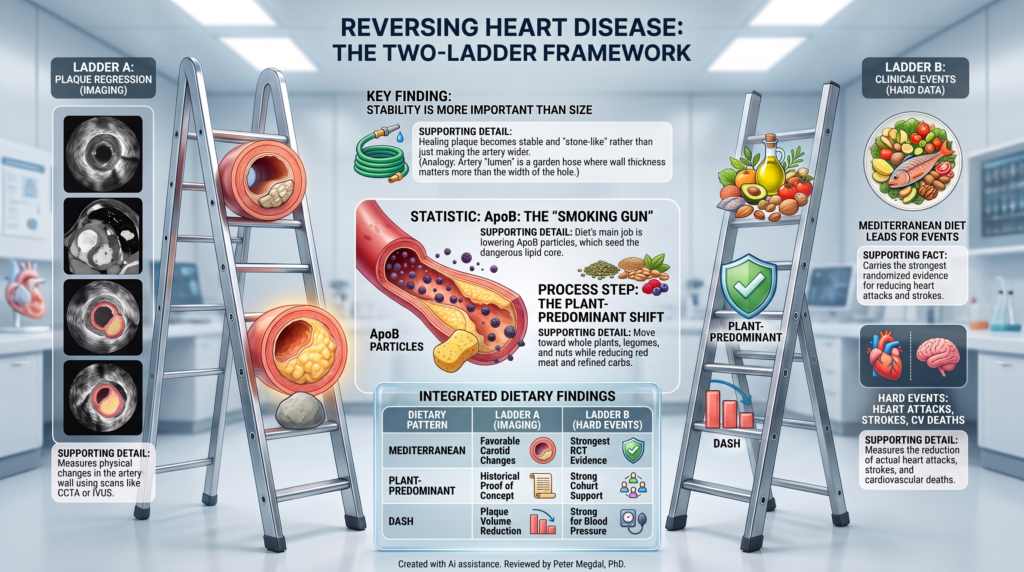
Een Tweeladder, Bewijs-Gewaardeerd Verhalend overzicht van de overwegend plantaardige, mediterrane, portfolio- en DASH-voedingspatronen
Kernboodschap
Coronaire atherosclerose wordt voornamelijk veroorzaakt door cumulatieve blootstelling naar ApoB-bevattende lipoproteïnen, en voeding is een belangrijke beïnvloedbare, levenslange determinant van die blootstelling in de meeste populaties. Migranten- en cohortstudies tonen aan dat de incidentie van coronaire hartziekte de voedingsomgevingen volgt die geassocieerd worden met een hogere levenslange ApoB blootstelling; dat bewijs toont aan dat voeding een belangrijke bijdrage levert, maar rangschikt voeding op zichzelf niet ten opzichte van elke andere determinant van levenslange ApoB-blootstelling. Het lipiderijke, rupturgevoelige compartiment behoort tot de meest dynamisch wijzigbare componenten van gevorderde tandplakin gecontroleerde experimenten met niet-menselijke primaten put het normaliseren van de belasting door atherogene lipoproteïnen via dieetmaatregelen precies dat compartiment uit en stabiliseerd het, en humane farmacologische onderzoeken reproduceren deze compositionele verandering. Een gelijkwaardige humane aantoning uitsluitend via dieet bestaat nog niet. Dieet en ApoB-verlagende medicijnen convergeren naar een belangrijke gedeelde route — de belasting door atherogene lipoproteïnen, die het dieet gedurende de gehele levensloop continu beïnvloedt en medicijnen vanaf de middelbare leeftijd krachtig verlagen — terwijl het dieet het cardiovasculaire risico ook beïnvloedt via aanvullende routes; het zijn complementaire hefbomen in plaats van concurrenten. De praktische conclusie is om over te stappen op een overwegend plantaardig, minimaal bewerkt voedingspatroon.
Abstract
Coronaire atherosclerose wordt voornamelijk aangedreven door cumulatieve blootstelling aan apolipoproteïne B-houdende lipoproteïnen, waarvan het dieet bij de meeste populaties een belangrijke beïnvloedbare levenslange determinant is; deze verhalende overzichtsartikelen vragen wat dat causale kader wel en niet impliceert voor het omkeren van gevestigde ziekten. Met behulp van een tweeladderraamwerk dat bewijs voor gunstige verandering op arteriële beeldvorming scheidt van bewijs voor het verminderen van harde cardiovasculaire events, en elk bewijsmateriaal beoordeelt op zekerheid, synthetiseren we data van migranten-, cohort-, primaten-, beeldvormings-, farmacologische en dieetonderzoeken. Bevolkingsbewijs ondersteunt voeding als een belangrijke beïnvloedbare determinant van levenslange ApoB-blootstelling, zonder de rangorde ervan ten opzichte van alle andere determinanten vast te stellen, terwijl menselijk genetisch bewijs onafhankelijk het causale belang van de cumulatieve ApoB-blootstelling zelf ondersteunt. Gecontroleerd primatenwerk toont aan dat het normaliseren van de atherogene-lipoproteïnelading de voor scheuren vatbare, lipiderijke necrotische kern terwijl dichte fibrocalcific weefsel aanhoudt; het overeenkomstige menselijke compositionele bewijs is afkomstig van farmacologische, niet van dieet-, onderzoeken. Omdat naar buiten en constrictieve remodeling maken lumen en stenose onbetrouwbare eindpunten, de gebeurtenis-relevante verandering is compositioneel in plaats van luminaal. Patronen in mediterrane stijl dragen het sterkste gerandomiseerde harde-gebeurtenisbewijs onder de benoemde diëten, terwijl lipidenverlagende farmacotherapie de meest reproduceerbare gegevens over beeldvormingsregressie behoudt; lichaamsbeweging is een extra, over het algemeen bescheiden bijdrager aan de verlaging van ApoB en de vermindering van het cardiovasculaire risico. Dieet en ApoB-verlagende medicijnen zijn complementair in plaats van concurrerend. De robuuste, weinig controversiële conclusie is om over te stappen op een overwegend plantaardig, minimaal bewerkt voedingspatroon, waarbij voedselkwaliteit belangrijker is dan het etiket 'plantaardig versus dierlijk' op zich.
Methoden. We hebben een gestructureerd verhalend overzicht uitgevoerd van gerandomiseerde gecontroleerde onderzoeken (RCT's), prospectieve cohorten, meta-analyses, gecontroleerde experimenten met niet-menselijke primaten en richtlijnen voor de samenleving. We scheiden het bewijs voor voeding causaliteit op basis van het bewijs voor regressie van gevestigde plaque, rangschik voedingspatronen op twee onafhankelijke bewijsladders (beeldvorming en harde gebeurtenissen) onder een expliciet op GRADE gebaseerd schema (Tabel 1), en analyseer plaque-samenstelling, lumen en arteriële remodellering als afzonderlijke verschijnselen.
Trefwoorden coronaire atherosclerose; apolipoproteïne B; plaque-regressie; arteriële remodellering; voedingspatronen; plantaardig dieet; mediterraan dieet; cardiovasculaire preventie.
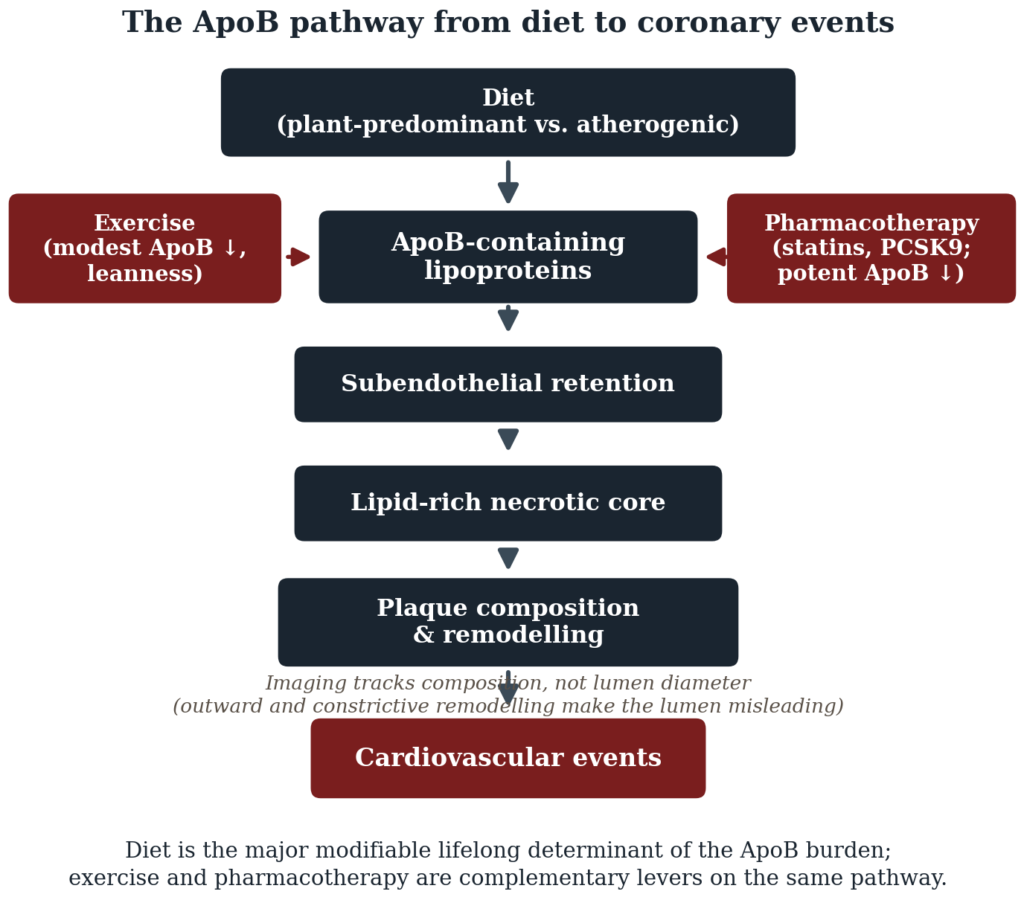
Figuur 1. De ApoB-route van dieet tot coronaire events. Dieet is een belangrijke beïnvloedbare, levenslange invloed op de belasting door ApoB-bevattende lipoproteïnen (bewijs en de beperkingen ervan: §3, §7.1; ref. 3, 41, 42, 108, 109), waarbij lichaamsbeweging en lipideme A-verlagende farmacotherapie fungeren als complementaire hefbomen op dezelfde knooppunt. De pijlen geven de richting van het effect aan, niet een aangetoonde kwantitatieve rangschikking van determinanten. Vaste ApoB-deeltjes zaaien een lipiderijke necrotische kern; de gebeurtenis-relevante verandering bevindt zich in de plaque-samenstelling en hermodellering, wat beeldvorming — en niet de lumen-diameter — vastlegt. Deze figuur dient tevens als het grafische abstract.
1. Inleiding
Gezien een groot deel van de twintigste eeuw was het klinisch beleid van de gevestigde kransslagaderziekte (CAD) benadrukte symptoomverlichting en behandeling van acute gebeurtenissen, waarbij regressie van plaque onwaarschijnlijk werd geacht. Dat perspectief is omvergeworpen. Atherosclerose begint met de retentie van ApoB-bevattende lipoproteïnen in de arteriële intima. Achtergebleven deeltjes ondergaan meerdere modificaties, lokken ontstekings- en immuunresponsen uit en dragen bij aan macrofaag schuimcelvorming en, in een gevorderd laesies, de ontwikkeling van een lipiderijke necrotische kern.¹,⁶⁵,⁶⁶,⁶⁷ Omdat het proces dynamisch is, is het in principe te beïnvloeden: lipidenverlaging kan de progressie stoppen en bescheiden gemiddelde reducties bewerkstelligen in coronaire atheroom volume, terwijl ontstekingsremmende therapie cardiovasculaire events kan verminderen zonder noodzakelijkerwijs LDL-C te verlagen.⁴,⁶⁸
Deze biologie heeft een blijvende vraag opgeroepen die zowel patiënten als artsen stellen: welk dieet is het beste om plaque te verminderen en te voorkomen hartaanvallenDe literatuur biedt geen gebrek aan zelfverzekerde antwoorden. Voorstanders van een vetarm, onbewerkt, plantaardig (WFPB) dieet wijzen op angiografische “omkering”; voorstanders van het mediterrane patroon wijzen op grote gerandomiseerde onderzoeken met minder sterfgevallen. Verschillende tradities op het gebied van bewijsmateriaal hebben daarom verschillende voedingspatronen naar voren geschoven, vaak op basis van verschillende eindpunten.
Wij beweren dat veel van de schijntbare onenigheid een methodologisch probleem weerspiegelt: het verwarren van beeldvormende eindpunten van plaque met harde klinische eindpunten, en het verwarren van de grootte van een gerapporteerd effect met de kwaliteit van het bewijs daaraan ten grondslag. Een dieet dat een surrogaatmerker in een kleine, niet-geblindeerde studie daarmee nog niet is bewezen de dood te voorkomen; een dieet dat de dood voorkomt is daarmee nog niet aangetoond een kransslagaderaandoening te verkleinen. We bouwen daarom twee onafhankelijke bewijsladders — één voor plaque-regressie, één voor harde eindpunten — cijfer zekerheid afzonderlijk met een expliciet schema, en pas daarna integreren. Onze specifieke vraag is bewust en nauwer dan “wat is de gezonde levensstijl”: het is welke voedingspatronen, voor zover het bewijs dat toelaat geïsoleerd van fysieke activiteit en van lipidennverlagende medicijnen, het sterkste bewijs hebben voor gunstige veranderingen in coronaire beeldvorming en bij cardiovasculaire incidenten — waarbij wordt erkend dat het beste patroon dat is dat beweging en farmacotherapie aanvult in plaats de plaats ervan inneemt (§6). Het beoogde lezerspubliek bestaat zowel uit het onderbouwde publiek als de praktiserend clinicus.
2. Methoden en interpretatief kader
2.1 Bewijsbronnen en zoeken
MEDLINE/PubMed, de Cochrane Library en de belangrijkste richtlijnendatabases werden doorzocht tot de datum van manuscriptvoorbereiding met behulp van combinaties van termen voor coronair atherosclerose, plaque-regressie, coronairangiografie, intravasculaire echografie, coronaire CT-angiografie, Mediterrane dieet, vegetarisch en veganistisch dieet, Portfoliodieet, DASH, vetarm dieet, ketogeen dieet, en cardiovasculaire events. Referentielijsten van geïncludeerde overzichten en trials werden met de hand doorzocht. Studieselectie en zekerheidsbeoordelingen werden uitgevoerd door een enkele auteur; dit is een gestructureerde maar niet-systematische narratieve beoordeling en kritische evaluatie, geen geregistreerde systematische literatuurstudie, en het is niet tweemaal berecht.
We gaven prioriteit, in aflopende volgorde: RCT's met klinische of gevalideerde eindpunten op basis van beeldvorming; systematische overzichten en meta-analyses van RCT's; grote prospectieve cohorten; en consensusrichtlijnen van de American Heart Association (AHA), American College of Cardiology (ACC), European Society of Cardiology (ESC) en de Cochrane Collaboration. Mechanistische en dierlijke gegevens werden gebruikt om het klinische effect te verklaren, nooit om dit vast te stellen. Databases werden doorzocht vanaf het begin tot de datum van voorbereiding van het manuscript (medio 2026), waarbij de richtlijnzoekopdracht werd bijgewerkt om documenten van verenigingen die in de eerste helft van 2026 waren gepubliceerd op te nemen. De zoektermen waren Engelstalig; geen enkele vermelding werd op basis van taal uitgesloten bij de screening, maar er werd geen systematische meertalige opvraging geprobeerd. In overeenstemming met de opzet van een narratief overzicht werd de screening uitgevoerd door de enkele auteur zonder dubbele controle uitspraak, er werd geen formele PRISMA-stroom of kwantitatieve pooling ondernomen, en het risico op vertekening werd narratief beoordeeld op studieniveau (randomisatie, blindering, eindpuntdirectheid, interventie-isolatie en precisie) in plaats van met een formeel instrument. Deze kenmerken worden helder vermeld omdat zij de kracht van elke daaropvolgende inferentie begrenzen en zelf een beperking vormen (§12).
2.2 Waarom twee ladders, niet één score
Zes eindpuntfamilies komen in dit veld steeds terug: ApoB / LDL deeltjesconcentratie; endotheelfunctie (door de stroming gemedieerde vasodilatatie); systemisch ontsteking (hoge gevoeligheid C-reactieve proteïne, hs-CRP); carotiden intima-mediadikte (IMT) en carotisplaque; coronair plaquebelasting en compositie (door kwantitatieve coronaire angiografie [QCA], intravasculaire echografie [IVUS] of coronaire computertomografie angiografie [CCTA]); en harde eindpunten (myocardinfarct [MI], beroerte, cardiovasculaire [CV] sterfte, sterfte door alle oorzaken). Deze zijn gecorreleerd maar niet vergelijkbaar. Het verlagen bloeddruk of hs-CRP is niet hetzelfde als het terugdringen van een coronairletsel, en het veranderen van de carotisdikte is niet hetzelfde als het voorkomen van een infarct. Het samenvouwen hiervan tot één enkele rangorde is het centrale probleem dat dit overzicht vermijdt. Ladder A rangschikt patronen op basis van bewijs dat ze plaque verminderen op beeldvorming (kransslagader en halslagader gescheiden gehouden); Ladder B rangschikt patronen op basis van bewijs dat ze harde gebeurtenissen verminderen. Binnen elke ladder volgt de volgorde de kwaliteit van het bewijs, niet de ruwe effectgrootte.
2.3 Zekerheidsgradering
We pasteerden een op GRADE gebaseerd oordeel afzonderlijk op elke ladder, met gebruik van de expliciete definities in Tabel 1. Deze beoordelingen vertegenwoordigen een door de auteurs afgeleid, op GRADE gebaseerd raamwerk in plaats van een formele GRADE-beoordeling; randomisatie, directheid van het eindpunt, steekproefgrootte, precisie, risico op bias, interventie-isolatie, consistentie en replicatie werden samen beschouwd, en geen enkele beperking bepaalt automatisch de uiteindelijke beoordeling.
Een uitgewerkt voorbeeld maakt de logica reproduceerbaar: DISCO-CT en de Ornish-studie zijn beide gerandomiseerd, beide multicentrisch en beide maken ze gebruik van surrogaat-beeldvormingseindpunten, toch wordt DISCO-CT als laag beoordeeld terwijl het effect van het alleen-diept-dieet in Ornish als zeer laag wordt beoordeeld — omdat DISCO-CT groter en eigentijds is en gebruikmaakt van directe plaque-samenstelling beeldvorming (gemeten met CCTA) niet-verkalkte plaque) met een vergelijking tussen groepen, terwijl het Ornish-signaal een klein, ouder, op lumen gebaseerd (QCA) eindpunt is waarin dieet nog minder te scheiden is van de co-interventies. Dezelfde regel degradeert elke niet-gecontroleerde reeks (bijv. Esselstyn) tot zeer laag, ongeacht de effectgrootte, omdat een naleving vergelijking kan geen behandelingseffect schatten. Het consistent toepassen van deze criteria, in plaats van één enkele automatische diskwalificatie, is wat overal een lage van een zeer lage beoordeling onderscheidt. Voor leefstijlinterventies met meerdere componenten graderen we twee verschillende vragen apart: de zekerheid dat het complete gebundelde programma de beeldvormende verandering heeft veroorzaakt, en de zekerheid dat het dieet zelf dit heeft veroorzaakt (zie Tabel 2). Een vollediger behandeling zou een risico-van-bias-tabel op studieniveau opleveren in plaats van één globaal label per categorie. Binnen het Veld tekenen zich drie niveaus af: het bewijs voor plaque-regressie door dieet is over het algemeen van zeer lage tot lage zekerheid (klein, niet-geblindeerd, multicomponent, surrogaat); het bewijs voor harde uitkomsten bij het Mediterrane dieet is van lage tot matige zekerheid; en het bewijs voor lipidelagerende geneesmiddelen is van hoge zekerheid voor uitkomsten en van matige tot hoge zekerheid voor beeldvorming. Deze asymmetrie wordt vooraf vermeld zodat geen enkele dieetclaim wordt verward met bewijs op het niveau van medicijnen. De structuur met twee ladders en deze beoordelingen vormen een door de auteur afgeleid interpretatief kader, geen objectief scoringssysteem of een formele GRADE-beoordeling.
Tabel 1. Zekerheidscategorieën toegepast op beide bewijsladders: door de auteur gedefinieerde categorieën gebaseerd op GRADE-principes, geen formele GRADE-beoordeling.
| Zekerheid | Definitie gebruikt in deze beoordeling |
| Hoog | Meerdere consistente, adequaat gepowerde gerandomiseerde onderzoeken met gevalideerde eindpunten, of een grote meta-analyse van dergelijke onderzoeken. |
| Gematigd | Gerandomiseerd bewijs met significante beperkingen (onnauwkeurigheid, indirectheid, enkelvoudige studie of ontbrekende blinding). |
| Laag | Kleine gerandomiseerde onderzoeken, of sterk en consistent observationeel bewijs. |
| Zeer laag | Casereeksen, niet-gecontroleerde onderzoeken, multicomponent-interventies waarin de blootstelling van belang niet kan worden geïsoleerd, een hoog risico op bias of aanzienlijke imprecisie. |
3. Dieet als een belangrijke beïnvloedbare determinant van coronair atherosclerose
Voordat we voedingspatronen als behandelingen gaan vergelijken, is it de moeite waard om vast te stellen wat de ziekte is. Een groot en intern consistent aantal aan menselijk populatiebewijs geeft aan dat coronaire atherosclerose geen onvermijdelijk gevolg is van veroudering, maar een ziekte waarvan de levenslange incidentie samenhangt met voedingsomgevingen die geassocieerd worden met een hogere levenslange ApoB-blootstelling. Dit onderscheid is van belang voor al het volgende: coronaire atherosclerose wordt primair gedreven door cumulatieve blootstelling aan ApoB-bevattende lipoproteïnen, en voeding is een belangrijke beïnvloedbare levenslange determinante van die blootstelling in de meeste populaties, terwijl farmacotherapie een krachtig middel is om een last te verlagen die wordt gevormd door voeding samen met genetica, metabolisme, adipositas en andere blootstellingen. Twee stellingen moeten hier uit elkaar worden gehouden en worden in dit overzicht verschillend beoordeeld: dat cumulatieve blootstelling aan ApoB coronaire atherosclerose veroorzaakt (hoge zekerheid, §7.1), en dat het dieet boven alle andere beïnvloedbare factoren van die blootstelling staat (een interpretatief oordeel ondersteund door convergent maar niet-experimenteel bewijs). Monogene en niet-dieetgerelateerde factoren (familiaire hypercholesterolemie, PCSK9 gain-of-function, LDLR en APOB-varianten, lipoproteïne(a), chronische nierziekte, ontstekingsziekten, diabetes, en roken) kunnen elk ApoB verhogen of de ziekte onafhankelijk van het dieet versnellen, wat de reden is waarom dieet hier wordt omschreven als een belangrijke beïnvloedbare determinant in plaats van de enige oorzaak of de gekwantificeerde grootste oorzaak.
3.1 Migrantencohorten scheiden genen van omgeving
Bijzonder informatief bevolkingsbewijs is afkomstig van migratiestudies, omdat deze de genetische achtergrond ongeveer constant houden terwijl het dieet en de omgeving veranderen. Ni-Hon-San-studie onderzocht ongeveer 11.900 mannen van Japanse afkomst in Japan, Hawaï en Californië met behulp van gedeelde methoden. Leeftijdangepaste prevalentie van definitieve CHD door elektrocardiogram was respectievelijk 5,3, 5,2 en 10,8 per 1.000 in Japan, Hawaï en Californië,¹³⁵ waarbij het risico op CHD in de Amerikaanse cohorten ongeveer twee- tot driemaal zo hoog was, parallel lopend aan een stijging van het serumgehalte van Japan naar Californië cholesterol en in totaal in de voeding en verzadigd vet. De gradiënt weerspiegelt brede verwestering in plaats van voeding in afzondering — fysieke activiteit, lichaamsgewicht, roken, bloeddruk en de sociale omgeving veranderden allemaal gelijktijdig — dus deze kan het best worden gelezen als sterke ondersteuning voor een voeding-en-lipoproteïneroute in plaats van bewijs van een puur dieetgerelateerde oorzaak; de dieetspecifieke conclusie berust op de convergentie ervan met het individuele en genetische bewijs hieronder.¹⁰⁵,¹⁰⁶ Omdat de migrerende groepen een in grote lijnen vergelijkbare afkomst deelden, is de gradiënt moeilijk toe te schrijven aan genetische verschillen en ondersteunt deze een omgevingsfactor die deels via serumlipiden werkt. Het isoleert de voeding niet experimenteel van de andere blootstellingen die met migratie veranderden. Dit is desondanks een van de sterkste natuurlijke experimenten die beschikbaar zijn binnen de menselijke voeding epidemiologie.
3.2 Interculturele en cohortgradiënten convergeren
De Zeven Landen Studie mat het serumcholesterol en het dieet in 16 cohorten en volgde de sterfte aan kransslagaderziekte gedurende tientallen jaren. De absolute sterftecijfers aan kransslagaderziekte verschilden ongeveer tweemaal tot achtmaal tussen de cohorten, het laagst in de mediterrane en Japanse cohorten en het hoogst in Noord-Europa en de Verenigde Staten, in overeenstemming met de gemiddelde inname van verzadigd vet en het serumcholesterol; na 25 jaar was het verband op cohortniveau tussen het gemiddelde cholesterol en de sterfte aan kransslagaderziekte sterk.¹⁰⁷,¹⁰⁸ De China-Cornell-Oxford-project, een ecologisch onderzoek van 65 landelijke Chinese provincies, gepubliceerd als monografie, documenteerde een lage sterfte aan kransslagaderziekte in provincies met een lage inname van dierlijk voedsel en een laag plasmacholesterol;¹⁰⁹ als een vergelijking op provinciaal niveau is dit het zwakste ontwerp in dit convergentieargument en wordt het alleen aangehaald als een van de onderdelen ervan. In de Adventist Health Study-2 vertoonden plantaardig georiënteerde groepen, in het bijzonder pesco-vegetariërs, behoorde tot de laagste voor leeftijd gecorrigeerde schattingen van sterfte door alle oorzaken en cardiovasculaire sterfte binnen één enkele, goed gekarakteriseerde populatie.²⁶
Ecologische en cohortvergelijkingen vormen op zich een beperkte mate van causaal bewijs: verwarrend, meetfouten en de ecologische denkfout spelen allemaal een rol, en naïeve correlaties tussen cholesterol en CHD over verschillende populaties heen worden zwakker wanneer veranderingen in de loop van de tijd en concurrerende risico’s in het model worden meegenomen.¹⁰⁷ Het causale gewicht berust hier niet op één enkele correlatie. Het berust op convergentie: het migrantendesign corrigeert voor genetische factoren; de associaties op individueel niveau binnen cohorten lopen in dezelfde richting als de gradienten tussen cohorten; en bewijs uit de menselijke genetica (Mendeliaanse randomisatie) toont onafhankelijk aan dat een levenslange lagere blootstelling aan ApoB-bevattende lipoproteïnen leidt tot een lager coronair risico (§7.1). Overeenstemming tussen methoden met verschillende bronnen van vertekening versterkt de causale inferentie, hoewel deze niet resterende verstorende factoren; de gezamenlijke argumenten voor een bijdrage via de voeding zijn daarom sterker dan elk afzonderlijk bewijs.
3.3 Wat het causaale argument wel en niet aantoont
Samen genomen ondersteunen deze bewijslijnen een causale bijdrage van het dieet en een aanzienlijke vermijdbaarheid: populaties die gekenmerkt worden door minder atherogene voedingspatronen, en dienovereenkomstig een lagere levenslange ApoB-blootstelling, kennen zeer lage percentages klinische coronaire hartziekten. Dit ondersteunt preventie door middel van levenslange aanpassing van het dieet en gerelateerde cardiometabole blootstellingen. Het zegt minder direct iets over de afzonderlijke vraag in hoeverre een reeds gevestigde laesie bij een volwassene van middelbare leeftijd kan worden teruggedraaid door middel van voeding — een andere klok, die in §5 wordt behandeld. Het is essentieel om deze twee vragen gescheiden te houden: bewijs dat voeding bijdraagt aan het voorkomen van een levenslang ziektebeeld is niet hetzelfde als bewijs dat het een decennia oude plaque omkeert, en het door elkaar halen hiervan is een terugkerende fout geweest in zowel belangenbehartiging als kritiek.
4. Ladder A — Bewijs voor gunstige verandering in atherosclerotische beeldvorming
Deze ladder rangschikt voedingspatronen op basis van de kwaliteit van het bewijs dat ze een gunstige verandering teweegbrengen in gevalideerde arteriële beeldvorming. Er loopt een waarschuwing doorheen: de modaliteiten meten niet hetzelfde. Kwantitatieve coronairangiografie (QCA) meet het vaatlumen, en niet direct de plaque, dus een verandering in luminale stenose kan voortkomen uit hermodellering, vasomotorische tonus, of meetvariabiliteit evenals van plaqueverandering; intravasculaire echografie (IVUS) en coronaire computertomografie-angiografie (CCTA) meten atheroomvolume en -samenstelling; en carotis intima-media-dikte (IMT) is een distincte surrogaatmarker. Om te voorkomen dat lezers deze eindpunten aan elkaar gelijkstellen, organiseren we het bewijs per modaliteit: coronair stenose (QCA), coronaire plaquebelasting (IVUS), coronaire plaquesamenstelling (CCTA), carotis-IMT en -plaque, en de farmacologische benchmark.
4.1 Wat elke beeldvormende modaliteit meet — en waarom dit belangrijk is voor het lumen
Ladder A maakt gebruik van verschillende beeldvormingsmodaliteiten die routinematig door elkaar worden gehaald, maar fundamenteel verschillende dingen meten; het onderscheiden ervan is essentieel voor het interpreteren van elke regressiebewering, en in het bijzonder elke uitspraak over het lumen.
- Coronaire angiografie / kwantitatieve coronair angiografie (QCA). Een tweedimensionale silhouet van uitsluitend het met contrast gevulde lumen; het brengt de vaatwand of de plaque niet in beeld. Het rapporteert minimale lumendiameter en de stenose in procenten van de diameter (%DS), en omdat deze techniek het lumen in beeld brengt in plaats van de vaatwand, kan de omvang van de plaque op de vaatwand aanzienlijk worden onderschat en biedt deze geen inzicht in externe remodeling.
- Intravasculaire echografie (IVUS). Een kathetergebaseerde doorsnede van de volledige vaatwand; het kwantificeert het atheroomvolume (procentueel en totaal atheroomvolume, PAV/TAV) en het externe elastische membraan, en meet daarmee de remodellering direct. Virtuele-histologie-IVUS biedt op een algoritme gebaseerde weefselkarakterisering (fibreuus, necrotische kern, calcium) in plaats van directe histologie.
- Optische coherentietomografie (OCT). Nabij-histologische resolutie (~10 µm); een intracoronaire modaliteit met hoge resolutie die wordt gebruikt om de dikte van het fibreuze kapje en de microstructurele kenmerken die geassocieerd zijn met een ruptuur te beoordelen. Intensief lipidenverlagend verdikt het kapje op seriële OCT.¹²⁶
- Nir-infraroodspectroscopie. Kwantificeert de lipidenkernbelasting (de lipid-core burden index, LCBI), meestal gecombineerd met IVUS op een hybride katheter.
- Coronaire CT-angiografie (CCTA). Niet-invasief; brengt zowel lumen als vaatwand in beeld en karakteriseert de samenstelling, inclusief plaque met lage attenuatie (lipiderijk), die kan regrediëren met intensieve therapie onafhankelijk van calcium.¹²⁵ De gerelateerde coronaire-arterie-calciumscore (CAC/Agatston-score) kwantificeert alleen de verkalkte component. Twee feiten over calcium moeten samen worden gehouden: op het niveau van een individuele laesie is dichte verkalking wordt geassocieerd met een grotere stabiliteit, terwijl op patiëntniveau een hogere totale CAC-last een van de sterkste voorspellers van events blijft en als zodanig wordt gebruikt in de huidige richtlijnen.¹³³ CAC is daarom een maat voor opgebouwde ziekte, geen maat voor plaqueveiligheid.
- MRI-scan. Een onderzoeksmodaliteit voor de samenstelling en ontsteking van de carotiden en kransslagaders.
Het praktische gevolg, uitgewerkt in §8.2, is dat voor het beoordelen van plaque-samenstelling en -regressie, op het lumen gebaseerde modaliteiten (angiografie en QCA) en uitsluitend op calcium gebaseerde metingen (CAC) beperkte meetresultaten opleveren: een grote plaquebelasting kan zich achter een bijna normaal lumen verbergen door uitwaartse (positieve) remodellering, en een genezende, van lipiden ontdane plaque kan een onveranderd of zelfs kleiner lumen vertonen door omgekeerde (constrictieve) remodellering. Op de vaatwand en samenstelling gebaseerde modaliteiten (IVUS, OCT, NIRS, CCTA) volgen de gebeurtenis-relevante verandering — lipidedepletie en stabilisatie van de vezelige kap — die een lumensilhouet mist. Dit is de reden waarom we gedurende Ladder A de modaliteit aan elk resultaat gekoppeld houden in plaats van algemeen over “beeldvorming” te spreken: een claim over coronaire regressie is moeilijk te interpreteren zonder de beeldvormingsmodaliteit en het eindpunt dat deze heeft gemeten te specificeren.
4.2 Coronaire stenose — kwantitatieve coronairangiografie (QCA)
Sterkst historische regressiesignaal: de Lifestyle Heart Trial (Ornish)
In de voor dit overzicht geïdentificeerde literatuur, de Lifestyle Heart Trial blijft het enige gerandomiseerde levensstijlonderzoek waarin met behulp van invasieve QCA een afname van coronaire stenose is aangetoond. 48 patiënten met matige tot ernstige CAD werden gerandomiseerd naar een intensief, uit meerdere componenten bestaand programma dat was gericht op een dieet met ongeveer 10% vet vegetarisch dieet (waarbij eiwitten en beperkte magere zuivelprodukte waren toegestaan), gecombineerd met aërobe oefening, stressbeheersing, stoppen met roken en psychosociale groepsondersteuning, of de gebruikelijke zorg.⁷ Na één jaar daalde de gemiddelde stenose in procenten van de diameter in de experimentele groep van 40,0% naar 37,8%, terwijl deze in de controlegroep toenam van 42,7% naar 46,1%; bij ernstigere laesies was het verschil groter, en bij de meeste behandelde laesies was er sprake van verbetering in de gemeten stenose. In de studie werd verbetering gerapporteerd in de angiografisch gemeten coronaire stenose, niet in de directe kwantificering van plaquevolume. Na vijf jaar zette de regressie zich voort in de experimentele groep terwijl de controlegroep verder verslechterde, en de controlegroep onderging aanzienlijk meer recidieven cardiaque voorvallen dan de interventiegroep over de follow-up periode, zoals gerapporteerd in de oorspronkelijke trial.⁸
Interpretatie. Dit is een historisch belangrijk resultaat, maar de interventie is onherleidbaar uit meerdere componenten samengesteld: voeding kan niet worden gescheiden van lichaamsbeweging, stressreductie en rookstop. Het kan het best worden omschreven als een intensief leefstijlprogramma met meerdere componenten, gecentreerd rond een zeer vetarm vegetarisch of overwegend plantwaardig dieet, en het moet niet worden gelezen als direct bewijs voor een strikt veganistisch, olievrij volwaardig plantaardig dieet. Met 48 patiënten, een niet-geblindeerd ontwerp en een surrogaat (QCA-)eindpunt is de zekerheid dat voeding specifiek de angiografische verbetering teweegbracht erg laag, ook al is de divergentie tussen de groepen numeriek opmerkelijk.
Esselstyn-serie over onbewerkte plantaardige voeding
Esselstyns werk wordt vaak aangehaald als “omkering” van plaque, maar het rapport uit 2014 is een ongecontroleerde casusreeks van 198 zelfverwezen patiënten die werden geadviseerd om een olievrij WFPB-dieet te volgen als aanvulling op de gebruikelijke zorg (inclusief statines). Bij de 177 (89%) therapietrouwe patiënten werd gedurende een gemiddelde periode van 3,7 jaar slechts één recidief gemeld (0,6%), tegenover bijwerkingen bij 13 van de 21 (62%) niet-therapietrouwe patiënten. De therapietrouwe en niet-therapietrouwe groepen kunnen niet worden geïnterpreteerd als behandelings- en controlegroepen, en het contrast tussen 0,61 TP9T en 621 TP9T mag niet worden beschouwd als een schatting van de effectiviteit van het dieet: therapietrouw zelf wordt beïnvloed door ziekte, gezondheidsgeletterdheid, prognose, sociaaleconomische omstandigheden, therapietrouw bij medicatie en het vermogen om de follow-up vol te houden, en de getelde eindpunten kunnen onder meer omvatten revascularisaties gedreven door klinische besluitvorming en surveillance in plaats van spontane gebeurtenissen alleen.⁹ Dit zijn uitkomstgegevens, geen systematische beeldvormingsgegevens, en een vergelijking van therapietrouwe versus niet-therapietrouwe patiënten kan geen behandelingseffect schatten: deze wordt verstoord door ernstige zelfselectie en therapietrouwebias. Deze reeks biedt geen systematisch beeldvormingseindpunt; elke conclusie daaruit over plaque-regressie is van zeer lage zekerheid.
4.3 Coronaire plaquebelasting — intravasculair echografisch onderzoek (IVUS)
We hebben geen voedingsonderzoek geïdentificeerd met behulp van seriële IVUS om coronaire plaque-regressie aan te tonen. De IVUS-onderzoeksbasis is farmacologisch en wordt besproken als de maatstaf in §4.6. Deze leemte is op zich informatief: volgens de zoekopdracht van deze review is de modaliteit die het coronaire atheroomvolume het meest nauwkeurig kwantificeert, niet ingezet in een dieetstudie met voldoende statistische power.
4.4 Samenstelling van coronaire plaque — coronaire CT-angiografie (CCTA)
Meest rigoureuze contemporaine gerandomiseerde beeldvormingsstudie: DISCO-CT
Van de hedendaagse leefstijlinbeeldingsonderzoeken die in dit overzicht zijn geïdentificeerd, is DISCO-CT het meest methodologisch rigoureuze dat een DASH-dieetinterventie omvat. Tweeënnegentig patiënten met niet-obstructieve CAD werden gerandomiseerd naar een DASH-dieet plus verhoogde fysieke activiteit plus optimale medische therapie, of uitsluitend OMT, waarbij CCTA na ongeveer 16 maanden werd herhaald.¹³ Het volume van niet-verkalkte plaque nam in beide armen af, en de afname was significant groter in de interventiegroep (−51,3 ± 79,5 mm³ versus −21,3 ± 57,7 mm³; P=0,045 voor het verschil tussen de groepen) — waarbij het verschil tussen de groepen, en niet de verandering binnen de groepen, de causale schatting van belang is. De andere volumetrische eindpunten van de studie leverden geen significante resultaten op, en dit moet worden vermeld naast het positieve resultaat: atheroompercentage op basis van volume nam significant toe in de controlegroep (+1,1 ± 3,41 TP9T; P = 0,033) en veranderde niet significant in de interventiegroep (+1,0 ± 4,21 TP9T; P = 0,127), maar de vergelijking tussen de groepen wat betreft het percentage atheromavolume was niet significant (P = 0,851) en het totale atheromavolume verschilde niet tussen de groepen. Het verschil in niet-verkalkte plaque bleef bestaan na correctie voor lichaamsgewicht, cholesterol en calciumscore.¹³
Interpretatie. Statistische correctie kan geen causaliteit aantonen, en de gebundelde interventie (dieet plus lichaamsbeweging), de setting met één enkel centrum en de bescheiden steekproefgrootte verhinderen toeschrijving specifiek aan dieet; niet-verkalkte plaque is zelf een heterogene weefselcategorie in plaats van één enkel fenotype met een hoog risico. Desondanks is dit een gerandomiseerd coronair CCTA-signaal voor een overwegend plantaardig, natijdbewust patroon. Zekerheid: laag — het hoogste aan de dieetzijde van deze ladder, en daarom wordt DISCO-CT gepresenteerd als de meest rigoureuze beeldvormingsstudie die hier is geïdentificeerd, ook al draagt de Ornish-studie het grotere historische signaal.
4.5 Ketogene diëten en aanzienlijke ApoB-verhoging
Niet-gecontroleerd klinische studie heeft coronaire plaque-regressie aangetoond met een ketogeen voedingspatroon. De belangstelling is gericht op slanke, metabolisch gezonde mensen bij wie het LDL-C aanzienlijk stijgt (vaak ≥190 mg/dL) bij koolhydraat beperking — “lean-mass hyper-responders.” De KETO-CTA studie rapporteerde coronaire CT-angiografie na één jaar bij dergelijke individuen; het gepubliceerde artikel benadrukte het percentage atheroomvolume, en de auteurs behandelden vervolgens het vooraf geregistreerde eindpunt van niet-verkalkte plaque, waarbij ze een toename met aanzienlijke heterogeniteit rapporteerden.¹⁴,¹⁵ Dat artikel werd in 2026 ingetrokken op verzoek van de auteurs en de redactie, na zorgen over de methodologie die de betrouwbaarheid van de gegevens aantastten en waarvan de auteurs en redactie vonden dat deze te groot waren om te corrigeren via een erratum.¹³¹ De gerapporteerde bevindingen zijn daarom afkomstig van een later ingetrokken rapport en zijn geen betrouwbaar bewijs. Er wordt nergens in dit overzicht een numerieke plaque-schatting uit dat rapport overgenomen of gebruikt, en de studie wordt niet gebruikt om ketogene diëten te rangschikken of om progressie of voordeel te ondersteunen. Belangrijker dan de publicatiegeschiedenis is het ontwerp: het cohort was niet-gecontroleerd en zelf-geselecteerd, waardoor het geen uitsluitsel geeft over de onafhankelijke effecten van voeding, ApoB-concentratie, blootstellingsduur of patiëntselectie, en de vergelijkingen met andere cohorten waren beschrijvend. Deze rapporten moeten daarom worden beschouwd als hypothesevormend in plaats de bewijzen dat een ketogeen dieet de progressie van kransslagaderplaque veroorzaakt of voorkomt. Het klinisch belangrijke punt blijft ongewijzigd: bij patiënten met vastgestelde kransslagaderziekte is een uitgesproken en aanhoudende verhoging van ApoB-bevattende lipoproteïnen in strijd met de huidige op bewijs gebaseerde principes van lipidenbeheer.
4.6 Farmacologische referentiewaarde voor coronaire plaqueregressie
Geen enkel dieetexperiment heeft een regressie van de coronair plaque opgeleverd die even groot en rigoureus is als intensieve lipidenverlagende therapie. In Glagov (een gerandomiseerde, placebo-gecontroleerde, geblindeerde studie; n=968), het toevoegen van de PCSK9-remmer evolocumab Behandeling met een statine leidde tot een tijdgewogen LDL-C-waarde van 36,6 mg/dL (tegenover 93,0 mg/dL) en een verandering in het percentage atheromavolume (PAV) van −0,95% tegenover +0,05% bij uitsluitend statinebehandeling (een verschil tussen de groepen van ongeveer −1,0 procentpunt, P < 0,001, zoals gerapporteerd in de tabel met primaire eindpunten van de studie), met plaque-regressie bij 64,3% versus 47,3% van de patiënten.⁴ Saturnus (gerandomiseerd, met actieve vergelijkingsgroep; n ≈ 1.039) liet een PAV-regressie zien van −1,221 TP9T bij een hoge dosis rosuvastatine,⁵ ASTEROÏDE (open-label, één-armig onderzoek) liet een PAV-regressie van −0,981 TP9T zien met een mediane TAV-afname van ~6,81 TP9T,⁶ en REVERSAL liet zien krachtig statine therapie de progressie stopt in vergelijking met matige therapie.⁶⁹ Gezamenlijk leveren deze multicentrische intravasculaire echografie (IVUS)-studies — waarvan de opzet varieerde van gerandomiseerde actieve-comparator- of placebogecontroleerde trials tot een open-label studie met één enkele arm — consistent bewijs dat intensieve LDL-verlaging de progressie kan stoppen en bescheiden gemiddelde afnames in coronair atheroomvolume kan bewerkstelligen, hoewel een deel van de beeldvormingsverandering weerspiegelt plaquestabilisatie en kalkvorming in plaats van alleen volumeverlies.⁷⁰ Beweringen over plaque compositie, in tegenstelling tot het volume, worden ondersteund door de in paragraaf 6.2 aangehaalde onderzoeken naar specifieke samenstellingen, en niet door deze volumetrische IVUS-onderzoeken.¹²⁵,¹²⁶ De zekerheid voor een bescheiden regressie van coronaire atheromen is matig tot hoog; het bewijs dat intensieve lipidenverlaging de progressie vertraagt en een bescheiden regressie teweegbrengt, is aanzienlijk sterker en beter reproduceerbaar dan het overeenkomstige bewijs op basis van voedingsinterventies. Dit vormt de sterkste vergelijkende maatstaf voor coronaire plaque-regressie; het hier besproken bewijs voor regressie door middel van een dieet bereikt niet hetzelfde niveau van nauwkeurigheid of reproduceerbaarheid.
4.7 Carotis-eindpunten (surrogaat; gescheiden gehouden van coronair)
In de CORDIOPREV carotis-substudie: het mediterrane dieet verminderde de intima-mediadikte (IMT) van de A. carotis communis na vijf jaar (−0,027 mm; P<0,001) en zeven jaar (−0,031 mm; P<0,001) en verminderde de maximale hoogte van de carotis-plaque, terwijl een vetarm dieet geen verandering teweegbracht.¹⁶ A PREDIMED substudie toonde een gunstige verandering in de intima-mediadikte (IMT) van de A. carotis interna bij een mediterraan dieet verrijkt met noten.¹⁷ Dit vertegenwoordigt gunstige veranderingen in de carotis-IMT en geselecteerde plaque-metingen in plaats van een aangetoonde regressie van coronaire plaque: de carotis-IMT kan ook mediale hypertrofie weerspiegelen in plaats van focale atherosclerotische plaque — steeds vaker de geprefereerde interpretatie — en het carotisgebied is hoe dan ook een surrogaat voor, en geen meting van, coronairlijden.
Tabel 2. Ladder A — bewijs voor gunstige verandering in atherosclerotische beeldvorming, georganiseerd per modaliteit. Voor leefstijlinterventies met meerdere componenten wordt de zekerheid afzonderlijk beoordeeld voor het complete gebundelde programma (“Gebundeld”) en voor het onafhankelijke effect van dieet (“Alleen dieet”). De Esselstyn-reeks is bewust uitgesloten van deze tabel: deze rapporteert klinische gebeurtenissen, geen systematische beeldvorming, en wordt besproken als aanvullend bewijs in §4.2 en §8.4.
| Interventie | Eindpunt / modaliteit | Resultaatgebied | Gebundeld | Alleen dieet |
| Referentiewaarde: high-intensity statine ± PCSK9-remmer | Coronaire PAV/TAV (seriële IVUS) | Bescheiden afname van de PAV; regressie bij een meerderheid van de behandelde deelnemers (GLAGOV placebogecontroleerd; SATURN actief-vergelijker; ASTEROID enkelvoudige arm) | MATIG–HOOG | n.v.t. (medicijn) |
| Intensieve, samengestelde leefstijl, vetarm vegetarisch of plantaagoverwegend dieet (Ornish) | Coronaire %-stenose (invasieve QCA — lumen, geen plaque) | Verbeterde angiografische stenose vs progressie in controles; enige gerandomiseerde leefstijl QCA-studie | LAAG | ZEER LAAG |
| DASH + beweging + OMT (DISCO-CT) — meest rigoureuze hedendaagse beeldvormings-RCT | Niet-verkalkte coronaire plaque (CCTA) | Volume van niet-verkalkte plaque is in het voordeel van de interventie (tussen-groepen P=0,045); vergelijkingen tussen groepen voor procentueel en totaal atheroomvolume niet significant; één enkel centrum; n=92 | LAAG | ZEER LAAG |
| Ketogeen dieet bij hyper-responders (KETO-CTA) | Niet-verkalkte coronaire plaque (CCTA) | Niet-gecontroleerde cohorte; artikel ingetrokken; geen betrouwbare plaque-schatting; geen bewijs voor of tegen progressie | N.v.t. | N.v.t. |
| Carotis-surrogaat: Mediterraan dieet (CORDIOPREV, PREDIMED) | Halsslagader IMT / plaq妇女hoogte -> Carotis IMT / plaq hoogte | IMT −0,027 tot −0,031 mm; carotide ≠ coronair | LAAG–MATIG | LAAG–MATIG |
5. Ladder B — Bewijs voor het verminderen van harde cardiale events
Deze ladder rangschikt voedingspatronen op basis van de sterkte van het bewijs dat ze myocardinfarcten, beroertes, cardiovasculaire sterfte en sterfte door alle oorzaken verminderen. Hier wordt de volgorde gedomineerd door grote gerandomiseerde onderzoeken en lange prospectieve cohorten. Waar mogelijk rapporteren we het aantal gebeurtenissen, absolute en relatieve effecten en de duur van de follow-up, omdat relatief risico verlagingen worden routinematig overschat wanneer absolute effecten worden weggelaten.
5.1 Mediterraanse diëten — het sterkste gerandomiseerde bewijs onder benoemde voedingspatronen
Het Mediterrane patroon — rijk aan extra verg olijfolie, groenten, peulvruchten, noten, vis en volkorenproducten — heeft een samenhangend lichaam van bewijs uit trials, cohortstudies en mechanistisch onderzoek dat het verbindt met een lager cardiovasculair risico via effecten op lipiden, bloeddruk, endotheliale functie en ontstekingen.⁷⁸,⁹³ CORDIOPREV is een belangrijke hedendaagse secundaire-preventievoedingstrial. Duizend en twee patiënten met gevestigd CAD werden gerandomiseerd naar een mediterraan of een vetarm dieet gedurende zeven jaar bovenop OMT. ernstige cardiovasculaire bijwerkingen deed zich voor tegen een ruwe frequentie van 28,1 versus 37,7 per 1.000 persoonsjaren (87 versus 111 eerste gebeurtenissen; log-rank P=0,039). Multidimensionaal gecorrigeerd risicoverhoudingen variëerde in de modellen van het onderzoek van 0,719 (95%-betrouwbaarheidsinterval 0,541–0,957) tot 0,753 (0,568–0,998), wat neerkomt op een relatieve afname van 25–28%. De schatting was groter bij mannen (67 van de 414 versus 94 van de 413; multivariabel gecorrigeerde HR 0,669, 95% CI 0,489–0,915) dan bij de 175 vrouwen, bij wie geen verschil tussen de groepen werd gevonden; dit zijn schattingen per subgroep, geen aangetoonde statistische interactie naar geslacht.¹⁰
PREDIMED is het grootste onderzoek naar primaire preventie via voeding. Bij 7.447 volwassenen met een hoog risico die willekeurig waren ingedeeld in een groep met een mediterraan dieet aangevuld met extra vierge olijfolie of noten versus een vetarme controlegroep, daalde het samengestelde risico op een hartinfarct, beroerte of cardiovasculair overlijden met ongeveer 28–31% over een mediane periode van 4,8 jaar. Alle cijfers hier zijn ontleend aan de in 2018 opnieuw gepubliceerde analyse, niet aan het ingetrokken rapport uit 2013: in de intention-to-treat-analyse, gecorrigeerd voor basiskenmerken en neigingsscores, bedroeg de hazardratio 0,69 (95% BI 0,53–0,91) voor de olijfoliegroep en 0,72 (95% BI 0,54–0,95) voor de notengroep. Het absolute verschil was klein, zoals te verwachten was in primaire preventie: 96 primaire voorvallen (3,8%) in de olijfoliegroep en 83 (3,4%) in de notengroep, tegenover 109 (4,4%) in de controlegroep.¹¹ Een vooraf gespecificeerde analyse toonde ook een afname van het aantal nieuwe diabetesgevallen aan, en een gerandomiseerde substudie naar risicofactoren en meta-analyses van cohorten met betrekking tot therapietrouw komen qua richting overeen.⁷²,⁷³,⁷⁴ Deze secundaire analyses zijn afkomstig uit hetzelfde onderzoek en vertonen daarom dezelfde onregelmatigheid in de randomisatie die hieronder wordt beschreven.
Een noodzakelijke openbaarmaking. Het oorspronkelijke PREDIMED-rapport uit 2013⁷¹ werd in 2018 ingetrokken nadat uit een screening van de verdeling van de uitgangswaarden bleek dat er onregelmatigheden in de randomisatie waren die ongeveer 21% van de deelnemers betroffen (huisgenoten werden als eenheden toegewezen; op één locatie werden klinieken in plaats van individuen gerandomiseerd). De studie werd opnieuw geanalyseerd en gepubliceerd, en de effectschattingen bleven in wezen ongewijzigd.¹¹,¹⁸ Referentie 71 wordt in dit overzicht uitsluitend vermeld om het ingetrokken artikel in die geschiedenis te identificeren; er zijn geen numerieke resultaten in dit manuscript ontleend aan dat artikel. Deze onregelmatigheden verminderen het vertrouwen in de oorspronkelijke randomisatie, terwijl de heranalyse vergelijkbare effectschattingen opleverde. De Lyon Diet Heart-studie, rapporteerde een eerdere secundaire-preventiestudie naar een mediterraan patroon verrijkt met alfa-linoleenzuur een grote afname in cardiale sterfte en niet-fatale myocardinfarcten (14 versus 44 gebeurtenissen; gecorrigeerde risico ratio's 0,28–0,53), zij het met kleine aantallen gebeurtenissen en een oudere methodologie.¹²
Systematisch-literatuuroverzicht context. De Cochrane-review van het mediterrane dieet uit 2019 beoordeelde de zekerheid van het bewijs voor klinische eindpunten als laag tot matig, en concludeerde dat er zinvolle onzekerheid blijft bestaan.¹⁹ Dit is de essentiële correctie op overdreven claims: het bewijs voor mediterrane gebeurtenissen is het best beschikbare onder de genoemde voedingspatronen, maar het is geen bewijs op medicijnniveau. De voorrang hiervan weerspiegelt dat er gerandomiseerde uitkomstonderzoeken zijn uitgevoerd voor het mediterrane patroon en niet, op vergelijkbare schaal, voor onbewerkt plantaardig eten; de afwezigheid van dergelijke onderzoeken voor WFPB is geen bewijs dat het biologisch inferieur is, alleen dat het niet tot hetzelfde eindpunt is getest.
5.2 Vervanging van verzadigd vet door onverzadigd vet
In het advies van de voorzitter van de AHA uit 2017 over voedingsvetten, dat was gebaseerd op oudere, samengevoegde vervangingsonderzoeken, werd een afname van coronaire voorvallen geschat in de orde van grootte van 25–30% bij langdurige vervanging van verzadigd vet door meervoudig onverzadigde plantaardige olie.²⁰ Dat cijfer is afkomstig uit die oudere, samengevoegde onderzoeken; latere systematische reviews, waaronder die van Cochrane, constateerden over het algemeen een bescheidenere afname van gecombineerde cardiovasculaire voorvallen en een grotere onzekerheid met betrekking tot cardiovasculaire en totale mortaliteit.⁷⁵,⁷⁶ De ondersteunende voedingsonderzoeken zijn ouder en aanzienlijk minder uniform dan moderne farmacologische uitkomstonderzoeken. Het vervangen van verzadigd vet door geraffineerde koolhydraten leverde geen voordeel op; vervanging door volkorenproducten verlaagde het risico in bescheiden mate.²¹ Deze vervanging vormt één van de mechanistische verbanden tussen verschillende patronen die beter onderbouwd zijn (§5). Ook de kwaliteit van koolhydraten is van belang — volkorenproducten en bronnen met een lage glycemische index gedragen zich heel anders dan geraffineerd zetmeel en suiker — en de specifieke voedingsbron van een bepaald vet beïnvloedt het cardiovasculaire risico nog verder, zoals blijkt uit grote prospectieve cohortstudies naar de inname van macronutriënten.⁷⁷,⁸²,⁸⁸
5.3 Gezonde plantaardige, Portefeuille- en vegetarische voedingspatronen (cohorten)
De kwaliteit van het voedsel is belangrijk bij een plantaardig eetpatroon. Uit samengevoegde analyses van meer dan 200.000 Amerikaanse gezondheidswerkers blijkt dat een index voor een gezond plantaardig dieet ging gepaard met een lagere kransslagaderziekte (HR 0,75; 95% CI 0,68–0,83), terwijl een ongezonde plantaardige index (geraffineerde granen, suikerhoudende dranken, zoetigheden) geassocieerd werd met een hoger risico (HR 1,32; 95% CI 1,20–1,46).²² “Plantaardig” biedt niet automatisch bescherming. In overeenstemming hiermee vertonen alle afzonderlijke voedingsgroepen dezelfde trend in dosis-effectrelatie meta-analyses: hogere consumptie van noten,⁷⁹,⁸⁰ hogere voedingswaarde vezel inname,⁸¹,⁸³ en een hogere inname van groenten en fruit⁸⁴,⁸⁵ worden geassocieerd met een lager cardiovasculair risico, terwijl een hogere inname van rood en bewerkt vlees wordt geassocieerd met een hoger risico.⁸⁶,⁸⁷ Het Portfoliodieet — viskeuze vezels, plantaardige eiwit, noten, en fytosterolen — kan LDL-C en ApoB verlagen,²,³²⁴ en een hogere trouw aan de behandeling werd geassocieerd met een lager risico op hart- en vaatziekten in drie cohorten (HR ~0,86).²⁵
In de Adventist Health Study-2 (n = 73.308) vertoonden pesco-vegetariërs de laagste geschatte sterfte (HR 0,81; 95% CI 0,69–0,94), terwijl veganisten (HR 0,85; 95%-betrouwbaarheidsinterval 0,73–1,01) en lacto-ovo-vegetariërs (HR 0,91; 95% CI 0,82–1,00) over het algemeen numeriek lagere risico’s vertoonden, hoewel het veganistische interval de eenheid overschreed voor sterfte door alle oorzaken en de subgroepanalyses varieerden naar geslacht, waarbij de verbanden sterker waren bij mannen.²⁶,²⁷ In hetzelfde cohort was het verband met sterfte door ischemische hartziekte sterker bij mannen (vegetarische mannen, HR 0,71; 95% BI 0,51–1,00) dan in het cohort als geheel (HR 0,81; 95% CI 0,64–1,02), hoewel beide intervallen de eenheid bereiken of overschrijden.²⁶ Het mechanisme komt overeen met de ApoB-route: in een klinische substudie onder 650 niet-Spaanstalige blanke AHS-2-deelnemers vertoonden alle drie de vegetarische patronen lagere gecorrigeerde prevalentieverhoudingen voor hypertensie, hoog totaal cholesterol, hoog LDL-cholesterol, obesitas, en abdominale adipositas dan niet-vegetariërs, waarbij veganisten de laagste gemiddelde BMI vertonen en tailomtrek; niet elke veganistische schatting bereikte statistische significantie in die kleine substudie.¹²⁷ Dit blijven observationele associaties die onderhevig zijn aan het 'gezonde-gebruikerseffect', maar hun richting en lipidengerelateerde risicofactorprofiel zijn consistent met de ApoB-route die in §3 wordt beschreven. Gerandomiseerde en observationele syntheses tonen consistent aan dat vegetarische en plant-based voedingspatronen LDL-C en ApoB verlagen, wat een plausibele lipidenroute biedt voor deze associaties.⁸⁹,⁹⁰,⁹¹,⁹²
Een belangrijke observatie. EPIC-Oxford volgt 48.188 mensen gedurende 18 jaar. Vegetariërs hadden 22% minder ischemische hartziekte (HR 0,78; 95% BI 0,70–0,87), maar een 20% hoger totaal aantal beroertes (HR 1,20; 95% BI 1,02–1,40), veroorzaakt door hersentumor.Het hoger waargenomen percentage hemorragische beroertes verdient aandacht voor de toereikendheid van voedingsstoffen en beroertesubtypen, maar als observationele bevinding brengt het geen oorzakelijk verband aan het licht en toont het niet aan dat het opnemen van vis een hemorragische beroerte voorkomt. Alle cohortschattingen zijn observationeel en mogelijk onderhevig aan gezond-gebruiker-bias en residuele confounding.
5.4 DASH — sterkste gerandomiseerde bewijs voor bloeddruk
Uit de DASH-voedingsstudie bleek dat de bloeddruk in het algemeen met ongeveer 5,5/3,0 mmHg werd verlaagd en bij deelnemers met hypertensie met 11,4/5,5 mmHg, zonder gewichtverlies;²⁹ natriumreductie is additief.³⁰ Het bewijs voor harde eindpunten van DASH is grotendeels indirect, gemedieerd via de bloeddruk, wat de reden is dat het wordt geclassificeerd als een goed onderbouwd risicofactorenpatroon in plaats van een bewezen harde-eindpuntpatroon; observationele cohorten associëren DASH-adherentie wel met minder cardiovasculaire gebeurtenissen.³¹
5.5 Patronen zonder aangetoond voordeel, en wat onbewezen blijft
Een algemeen advies om vetarm te eten leidde niet tot minder voorvallen: in de Women’s Health Initiative Dietary Modification Trial (n = 48.835 postmenopauzale vrouwen, ~8 jaar) zorgde de interventie op het gebied van voedingsaanpassing niet voor een significante afname van coronaire hartziekte (HR 0,94; 95%-betrouwbaarheidsinterval 0,86–1,02), beroerte of het totale aantal hart- en vaatziekten, hoewel de therapietrouw en de bereikte dieetscheiding bescheiden waren en het één specifiek programma testte in plaats van elk vetarm dieet.³² Cruciaal is dat de deelnemers niet werd gevraagd om verzadigd vet te vervangen door onverzadigd vet — in overeenstemming met de nadruk van het AHA-advies op substitutie in plaats van op eenvoudige vetreductie. De gestructureerde zoekopdracht beschreven in §2.1 identificeerde geen gerandomiseerde studie naar tijdgebonden eten met coronaire plaque of een hard cardiovasculair eindpunt; het gerandomiseerde bewijs voor dit patroon is beperkt tot gewicht en metabole parameters.³³ Op basis van de zoekopdracht van de auteurs kan tijdgebonden eten momenteel dan ook niet worden aanbevolen voor plaqueregressie of gebeurtenisreductie — een uitspraak over de afwezigheid van kwalificerende studies in deze zoekopdracht, niet een aangetoonde afwezigheid van effect.
Tabel 3. Ladder B — dieetbewijs voor het verminderen van ernstige cardiale aandoeningen, gegradeerd naar bewijskwaliteit.
| Patroon | Beste bewijs | Belangrijkste effect | Zekerheid |
| Mediterraan / pesco-Mediterraan | RCT's (CORDIOPREV, PREDIMED, Lyon) | ~25–31% MACE-reductie, primair & secundaire preventie | LAAG–MATIG |
| Vervanging van verzadigd vet door meervoudig onverzadigde vetzuren | Gezamenlijke RCT's (AHA-advies) | ~25–30% CVD-afname bij langdurige vervanging; oudere, minder uniforme onderzoeken | LAAG–MATIG |
| Gezond plantaardig / Portfolio / vegetarisch | Grote cohorten (Satija, Glenn, AHS-2) | CHD HR 0,75; CVD HR ~0,86; laagste mortaliteitsschatting bij pescovegetariërs | LAAG |
| DASH | Voedingsproeven; cohorten | BP −5,5/3,0 (−11,4/5,5 bij hypertensiepatiënten); gebeurtenissen indirect | LAAG–MATIG (BP) |
| Generiek mager | RCT (WHI) | Geen significant CHD/beroerte/CVD-voordeel in WHI | MOD |
| Tijdgebonden eten | Geen geschikte plaque-/MACE-RCT's geïdentificeerd | Geen gerandomiseerd bewijs voor plaque-regressie of gebeurtenisreductie | ONVOLDOENDE |
5.6 De farmacologische maatstaf voor gebeurtenissen
Net als bij de plaque-ladder moet het bewijs uit voedingsonderzoeken worden afgewogen tegen de farmacologische standaard, waarvoor een hoge mate van zekerheid geldt. Uit de meta-analyses van de Cholesterol Treatment Trialists (meer dan 170.000 deelnemers) blijkt dat elke verlaging van het LDL-C met 1,0 mmol/L (~39 mg/dL) het aantal ernstige vasculaire voorvallen met ongeveer 21–22% vermindert; over de gehele bandbreedte van LDL-C-waarden en follow-up-perioden die in gerandomiseerde studies vertegenwoordigd zijn, volgt de proportionele afname van voorvallen over het algemeen de absolute afname van LDL-C, zonder dat er binnen die onderzochte bereiken een duidelijke drempelwaarde voor de werkzaamheid is vastgesteld — een duidelijk onderscheid ten opzichte van het bewijs van identiek incrementeel voordeel of van veiligheid bij elke haalbare concentratie.³⁴,³⁵ IMPROVE-IT (n=18.144) toonde aan dat het toevoegen van ezetimib de toevoeging van een statine leidde tot een verdere afname van het aantal voorvallen (32,71 TP9T tegenover 34,71 TP9T; HR 0,936; P = 0,016), wat het voordeel van LDL-verlaging zonder statines bevestigt.³⁶ De uitkomststudies met PCSK9-remmers Fourier (evolocumab, n = 27.564; HR 0,85, 95%-betrouwbaarheidsinterval 0,79–0,92)³⁷ en Odyssee Resultatenalirocumab, n = 18.924; primaire samengestelde HR 0,85, 95%-betrouwbaarheidsinterval 0,78–0,93; er werd ook een nominale afname van de sterfte door alle oorzaken waargenomen, HR 0,85, 95%-betrouwbaarheidsinterval 0,73–0,98, wat gezien de aard van het onderzoek met de nodige voorzichtigheid moet worden geïnterpreteerd hiërarchisch testen plan)³⁸ de causale keten uitbreiden tot de laagst bereikte LDL-C-waarden. Er is dus bewijs met een hoge mate van zekerheid voor een vermindering van cardiovasculaire voorvallen door lipidenverlagende behandeling, terwijl IVUS/CCTA-onderzoeken een matige tot hoge mate van zekerheid bieden voor een bescheiden regressie van coronaire plaque — een onderscheid dat de literatuur over voedingspatroon op geen van beide vlakken nog kan evenaren.
6. Lichaamsbeweging en vasculaire remodellering
Fysieke activiteit is geen onbelangrijke voetnoot in de levensstijl bij kransslagaderziekte. Het is een belangrijke cardiovasculaire blootstelling, die zowel geassocieerd is met een zeer lage ziektelast in de meest actieve menselijke populaties als met een duidelijke plaque-fenotypes bij duursporters cohorten die elke op het lumen gebaseerde meting compliceren. Deze sectie behandelt inspanning als een afzonderlijke hefboom — parallel aan dieet en aan farmacotherapie — en is openhartig over het feit dat de relatie met coronaire plaque complex is: het verlaagt de atherogene-lipoproteïnelast bescheiden, en het wordt in sommige cohorten geassocieerd met een groter aandeel van verkalkte plaque, hoewel de bevindingen wisselend zijn en de causaliteit niet is bewezen; in de meest extreme vormen is het geassocieerd met meer kransslagaderkalk, niet minder.
6.1 Lichaamsbeweging als een ApoB- en metabole hefboom
De populaties met de laagst geregistreerde coronaire atherosclerose zijn ook het meest fysiek actief. Te midden van de Tsimane in het Boliviaanse Amazonegebied — een bevolkingsgroep die van zelfvoorziening leeft en waarin een hoge mate van lichaamsbeweging samengaat met een onbewerkt dieet met weinig verzadigde vetten — hadden 85% van de volwassenen van 40 jaar of ouder geen coronaire slagader calcium en het gemiddelde LDL-C bevonden zich in het bereik van 70–90 mg/dL — wat de onderzoeksleiders beschreven als de laagste gerapporteerde niveaus van kransslagaderziekte van elke tot op heden geregistreerde populatie; de onderzoeksleiders schreven dit toe aan een lage LDL-waarde gedurende het hele leven, een lage bloeddruk, een lage glucose, een normaal lichaamsgewicht, niet-roken en overvloedige lichaamsbeweging die samenwerken, en expliciet opmerkte dat de relatieve bijdrage van elk onbepaald blijft.¹²⁰ Aerobische training op zich verlaagt bescheiden de ApoB-bevattende lipoproteïnen en verbetert de ApoB/ApoA-I-verhouding, met grotere en consistentere effecten op triglyceriden, HDL subfracties, bloeddruk, insulinegevoeligheid, visceraal adipositas, en cardiorespiratoire conditie.Het ApoB-verlagingseffect van aërobe training is over het algemeen bescheiden in vergelijking met lipidenverlagende farmacotherapie; beweging verbetert ook de adipositeit en insuline gevoeligheid, die het lipoproteïnemetabolisme kan beïnvloeden, en deze convergeert met plantaardige diëten wat betreft de biologische beschikbaarheid van stikstofoxide.⁴⁸,⁴⁹ Op de ApoB-as is lichaamsbeweging dan ook een echte mede-hefboom in plaats van een toeschouwer.
6.2 De atleet-paradox: meer kransslagaderkalk en verschillen in plaque-samenstelling
De farmacologische beeldvormingstudies hebben de biologische blauwdruk al vastgesteld: intensieve lipidenverlaging put het lipidenrijke compartiment uit en verdikt de fibreuze kap terwijl het lumen weinig veranderd bleef — regressie van het percentage atheroomvolume in GLAGOV,⁴ regressie van plaque met lage demping (rijk aan lipiden) in EVAPORATE,¹²⁵ en cap-verdikking met kleinere lipidenkernen in PACMAN-AMI¹²⁶ — dus compositionele stabilisatie zonder luminale toename is de verwachte signatuur van een genezend slagader onder farmacologische therapie, geen anomalie. Atletiekcohorten werpen een verwante maar observationele vraag op over plaquesamenstelling.
Hier moet het tweesnijdende karakter duidelijk worden benadrukt, omdat het haaks staat op de naïeve bewering dat “sporten plaque vermindert”. Levenslange, intensieve duurtraining gaat niet gepaard met minder coronaire plaque, maar – paradoxaal genoeg – met meer calcium in de kransslagaders dan bij vergelijkbare, minder actieve controlegroepen. Merghani en collega’s vonden coronaire plaque bij 44% mannelijke mastersatleten tegenover 22% in de controlegroep,¹²² en Aengevaeren en collega’s beschreven een U-vormig verband waarbij de hoogste trainingsvolumes gedurende het hele leven gepaard gingen met de hoogste calciumscores.¹²³ De doorslaggevende factor is de samenstelling: de plaques van de atleten waren overwegend verkalkt (ongeveer driekwart in het Merghani-cohort) in plaats van lipiderijk — een morfologie die over het algemeen wordt geassocieerd met grotere stabiliteit op het niveau van de laesie, en die Baggish en Levine ’harten van steen“ noemden.¹²⁴ De meer recente Master@Heart-studie compliceert zelfs deze geruststellende lezing: duursporters gedurende hun hele leven hadden meer plaque van in wezen elk type — verkalkt, niet-verkalkt en gemengd — niet alleen stabiele verkalkte plaque, dus de interpretatie van het “kenmerk van stabiliteit” moet voorlopig worden gehanteerd.¹³⁰ Deze cohorten waren ontworpen om het plaque-fenotype te karakteriseren en waren noch ontworpen noch voldoende groot voor klinische eindpunten, dus ze kunnen het aantal gebeurtenissen niet vaststellen in masters sporters; prospectieve uitkomstgegevens in vergelijkbare populaties blijven beperkt, en hier wordt geen bewering gedaan over het aantal 'events'. De eerlijke interpretatie is daarom niet dat beweging plaque doet slinken — gemeten calcium kan toenemen — maar dat sommige atleetcohorten een grotere verhouding van gecalcificeerde, scheurresistente plaque naast een grotere absolute last, in een setting waarin aërobe training ook bescheiden de ApoB verlaagt. Master@Heart, dat meer plaque van vrijwel elk type vond, blijft behouden als direct conflicterend bewijs, en het observationele ontwerp van al deze cohorten betekent dat geen enkele kan aantonen dat lichaamsbeweging veroorzaakt een verschuiving naar stabiliteit. Dat is een beperktere en beter te verdedigen bewering dan “beweging keert plaque om”, en deze hangt volledig af van het onderscheiden van de hoeveelheid van de samenstelling (§4.1). Een stijgende calciumscore bij een atleet kan op zichzelf geen onderscheid maken tussen progressie en een verandering in plaquesamenstelling; CAC moet daarom worden geïnterpreteerd als een maat voor de totale verkalkte belasting in plaats van als een directe maat voor plaque-instabiliteit.
6.3 Waarom lichaamsbeweging het lumen compliceert — en waarom dat de methode van dit overzicht versterkt
Lichamelijke inspanning heeft directe betrekking op de lumenvraag waar dit overzicht steeds op terugkomt. Een atleet wil intuïtief een breder lumen voor de doorstroom, en in het geïdealiseerde geval van stabiele laminaire stroming door een stijve buis, maakt de wet van Poiseuille de stroming evenredig met de vierde macht van de straal — een illustratie van hoe steil de straalterm schaalt, en geen model van coronaire doorstroming, die ook wordt beheerst door compliantie, pulsatiliteit, microvasculaire weerstand en autoregulatie. Maar de kaliber van het lumen wordt beheerst door hermodellering, en niet alleen door de plaquebelasting (§8.2): naar buiten gerichte (positieve) Glagov-hermodellering kan het lumen behouden of zelfs vergroten terwijl plaque zich ophoopt,¹¹⁸ en omgekeerde (constrictieve) hermodellering kan het lumen verkleinen naarmate een plaque geneest. Het geruststellende lumen van een atleet kan daarom samengaan met een aanzienlijke — zo niet stabiele — belasting, en een genezende plaque kan een ongewijzigd of kleiner lumen vertonen. Coronaire flowreserve — het vermogen om de doorstroming tijdens inspanning te vergroten — is hoe dan ook een aparte overweging ten opzichte van het anatomische kaliber in rust, en wordt niet weergegeven door een lumenmeting in rust. De les is dezelfde als die waarop Ladder A is gebouwd: het vaatvoordeel van lichaamsbeweging wordt weergegeven door samenstelling en stromingsreserve, niet door het lumensilhouet.
6.4 Lichaamsbeweging als een mede-hefboom, niet de geïsoleerde variabele van deze review
Dit is ook de reden waarom de sterkste humane dieet-beeldvormingssignalen niet alleen aan het dieet kunnen worden toegeschreven. Het Ornish-programma bundelde een zeer vetarme, grotendeels plant-gebaseerde voeding met aërobe aërobe lichaamsbeweging, stressbeheersing en rookstop; DISCO-CT bundelde een DASH-dieet met verhoogde fysieke activiteit (§4). In beide is lichaamsbeweging een onderdeel van de interventie, geen gecontroleerde covariaat — wat de reden is waarom Ladder A een gebundelde zekerheid en een dieet-alleen zekerheid apart beoordeelt (Tabel 2), het middel waarmee fysieke activiteit, en waar aanwezig farmacotherapie, analytisch los worden gehouden van het dieet. Geen datagestuurde toewijzing van het aandeel van dieet versus beweging versus medicijn in de waargenomen effecten is beschikbaar uit deze gebundelde trials; elke numerieke splitsing zou op aannames berusten. Het doel van dit overzicht blijft daarom de geïsoleerde dieetbijdrage — welk voedingspatroon, op zichzelf beschouwd, plaque en events het meest gunstig verandert — met lichaamsbeweging en farmacotherapie als complementaire co-hefboompjes. Op dat criterium is de plant-georiënteerde, mediterrane kern die overal wordt geïdentificeerd ook verenigbaar met een actief, slank fenotype: het kan verenigbaar zijn met het behoud van een gezond lichaamsgewicht en vormt geen belemmering voor de fysieke activiteit die onafhankelijk ApoB verlaagt. Geen enkele vergelijkende trial heeft getest welk voedingspatroon activiteit en slankheid het best in stand houdt, dus een dergelijke rangorde wordt hier niet geclaimd. Het beschikbare bewijs ondersteunt het combineren van een gezond voedingspatroon met aanhoudende fysieke activiteit en met richtlijngetrouwe lipidenverlagende therapie indien geïndiceerd, in plaats van ze als alternatieven te beschouwen.
7. Mechanistische basis — bewezen versus overdreven
7.1 De gevestigde hefboom: ApoB-bevattende lipoproteïnen
De initiële stap in atherogenese is de retentie van ApoB-bevattende lipoproteïnen in de arteriële intima.³,⁶⁵ Elk circulerend LDL, IDL, VLDL, en het lipoproteïne(a)-deeltje bevat één ApoB-100 molecuul, terwijl in de darm resterende deeltjes één bevatten ApoB-48 molecuul; plasma ApoB benadert daarom de concentratie van circulerende atherogene lipoproteïnen en wordt in toenemende mate beschouwd als superieur aan LDL-C in discordantie analyses.³⁹,⁴⁰ Menselijke genetica (Mendeliana randomisatie) bewijs ApoB-bevattende lipoproteïnen aanwijst als een causale drijfveer van coronariaziekte, en recente grote analyses blijven het aantal ApoB-deeltjes identificeren als een belangrijke lipide-gerelateerde determinant van coronair risico.⁴¹,⁴²,¹²⁸ De ESC/EAS-dyslipidemierichtlijnen van 2019 bevelen dienovereenkomstig ApoB-meting aan voor risicobeoordeling, met name bij personen met hoge triglyceriden, diabetes, obesitas of zeer lage LDL-C, waar het kan schatten atherogeen deeltje de aandoening nauwkeuriger weergeven dan LDL-C;¹³⁴ de gerichte update van de ESC/EAS uit 2025 en de Richtlijn voor dyslipidemie van de ACC/AHA uit 2026, opgesteld door meerdere beroepsverenigingen die stelling verder uitwerken.¹³²,¹³³ ApoB is niettemin slechts één van de vele oorzakelijke factoren: in hedendaagse preventiekaders worden de belasting door atherogene lipoproteïnen, bloeddruk, roken, diabetes, adipositas en ontstekingen als samenwerkende factoren beschouwd, en de nadruk op ApoB weerspiegelt hier veeleer de centrale rol ervan in de relatie tussen voeding en plaquevorming dan dat het de enige oorzaak van het coronaire risico zou zijn. Het farmacologisch verlagen van ApoB-bevattende lipoproteïnen vermindert cardiovasculaire voorvallen en kan leiden tot een bescheiden gemiddelde regressie van coronaire atheromen;⁴,³⁴ voedingspatronen die ApoB verlagen, sluiten biologisch aan bij dit causale mechanisme, hoewel er beperkt direct bewijs is dat een door voeding geïnduceerde verlaging van ApoB op zichzelf leidt tot regressie van coronaire plaque bij mensen.
7.2 Dieetmechanismen zijn meervoudig, niet uitsluitend upregulatie van de LDL-receptor
Afhankelijk van de samenstelling, de energiebalans, gewichtsverandering en de metabole baseline-status kunnen deze voedingspatronen ApoB en het cardiovasculaire risico beïnvloeden via verschillende elkaar overlappende trajecten, die lang niet allemaal uniform worden aangetoond voor elk patroon of zijn vastgesteld op het niveau van coronaire eindpunten bij de mens. Het vervangen van verzadigd door onverzadigd vet kan ApoB verlagen, deels door het up-reguleren van hepatische LDL-receptorexpressie,²⁰,⁴³ maar dit is niet de enige voorgestelde route. Succesvolle voedingspatronen kunnen ook werken via een verminderde hepatische cholesterolsynthese; verminderde darmcholesterolabsorptie, versterkt door planten sterolen en stanol;⁴⁷ verhoogde uitscheiding van fecale galzuren via viskeuze vezels, wat de hepatische cholesterolpool kan uitputten en de LDL-receptor secundair;²³,⁴⁴ een verminderde hepatische VLDL-productie; korte-keten-vetzuren uit vezelfermentatie waarvan wordt verondersteld dat ze de hepatische lipidenstofwisseling moduleren;⁴⁵ en verbeteringen in de insulinegevoeligheid, de adipositas en het levervet die de secretie van atherogene lipoproteïnen kunnen verlagen. Verschillende van deze routes worden verondersteld in plaats van aangetoond op het niveau van humane coronaire eindpunten, en worden hier als zodanig gelabeld.⁴⁶ Deze gewichts- en metabole as is op zich al gebeurtenisrelevant, hoewel het ondersteunende bewijs uit trials farmacologisch is in plaats van dieetgerelateerd (in SELECT, een uitkomsttrial naar obesitas-farmacotherapie, semaglutide het aantal ernstige cardiovasculaire voorvallen met ongeveer 20% verminderde; de onderliggende mechanismen werden in dat onderzoek niet vastgesteld).¹²⁹ De endotheelfunctie kan mogelijk ook verbeteren door een plantaardig dieet dat rijk is aan polyfenolen en nitraten, dankzij een verhoogde biologische beschikbaarheid van stikstofmonoxide.⁴⁸,⁴⁹
7.3 Mechanismen met een onzekere klinische relevantie
Verschillende mechanismen die zijn voorgesteld om nadelige effecten van sommige dierlijke voedingsmiddelen te verklaren, zijn biologisch interessant, maar zijn niet vastgesteld als veroorzakers van coronaire plaque bij de mens, en ze zouden geen grondslag mogen vormen voor voedingsaanbevelingen:
- Trimethylamine-N-oxide (TMAO). TMAO wordt in verband gebracht met cardiovasculaire en renale uitkomsten, maar een causaal verband blijft onzeker omdat de nierfunctie, het dieet, de samenstelling van het microbioom, metabole ziekten en omgekeerde causaliteit kunnen allemaal de circulerende concentraties beïnvloeden. Beschikbaar menselijk genetisch en interventiebewijs heeft niet vastgesteld dat het verlagen van circulerend TMAO op zich coronaire incidenten vermindert; het kan niettemin een nuttig risico blijven biomarker zelfs als het geen causaal verband blijkt te zijn.⁵⁰,⁵¹
- Neu5Gc / xenosialitis. Overtuigend in humane-muismodellen, maar niet vastgesteld als een mechanisme voor humane coronairplaque; de afwezigheid van vastgesteld bewijs sluit mogelijke humane relevantie niet uit.⁵²,⁵³
- Dieet-gerelateerde geavanceerde glycatie-eindproducten en heemijzer. Hypothese-genererend; menselijk klinisch plaque- en eventbewijs is zwak.⁵⁴,⁵⁵
Het presenteren hiervan als vaststaande causale trajecten gaat verder dan het bewijsmateriaal toelaat. Huidige voedingsaanbevelingen worden beter ondersteund door bewijs over ApoB, bloeddruk, het algehele voedingspatroon en de voedselkwaliteit dan door deze minder gevestigde trajecten.
7.4 ApoB-intreding, endothele permeabiliteit en subendotheliale retentie
De bovenstaande mechanismen werken voornamelijk in op de circulerende concentratie van ApoB. Een complementaire determinant van atherogenese is de retentie van deze deeltjes in de vaatwand, wat het bepalende initiërende proces is. Atherosclerose begint wanneer ApoB-bevattende lipoproteïnen worden vastgehouden in de subendotheliale intima door elektrostatische binding tussen basische arginine en lysineresiduen op ApoB en negatief geladen glycosaminoglycaan kettingen aan arteriële proteoglycanen — het welbekende “respons-op-retentie”-model.¹,⁶⁵,⁹⁷ De hoeveelheid die wordt vastgehouden hangt af van hoeveel ApoB-partikels circuleren, van hun verblijftijd en gevoeligheid voor proteoglycaanbinding, en over hoe gemakkelijk ze de intima binnendringen via het endotheel transcytose en junctioneel transport.
De endotheliale glycocalyx — een luminale matrix van proteoglycanen, glycosaminoglycanen en glycoproteïnen — draagt bij aan deze barrière. In experimentele modellen is een intacte glycocalyx beperkt de endotheliale permeabiliteit voor LDL-grote deeltjes, en verminderde barrière-eigenschappen verhogen de intimale LDL-accumulatie op voor atherosclerose vatbare locaties zoals bifurcaties.⁹⁸,⁹⁹,¹⁰⁴ Verstoring onder verstoorde (lage of oscillerende) afschuiving kan verder bijdragen aan focale permeabiliteit bij bochten en takpunten.¹⁰⁰,¹⁰³ Het behouden van de integriteit van de glycocalyx zou daarom de ApoB-toetreding kunnen verminderen, een cholesterol-onafhankelijke route die in principe een aanvulling zou kunnen vormen op het verlagen van circulerend ApoB.
Deze route is een mechanistische hypothese en geen aangetoonde route naar plaque-regressie, en de kloof tussen beide is groot. Bewijs dat plantaardige voedingsstoffen de menselijke glycocalyx beschermen is grotendeels preklinisch of beperkt tot intermediaire eindpunten; de literatuur over sulforafaan betreft bijvoorbeeld bescherming tegen toxische stoffen in plaats van coronaire of glycocalyx-eindpunten.¹⁰¹ De gerandomiseerde humane glycocalyx-onderzoeken die er zijn, maakten gebruik van uit zeewier afgeleide supplementen en sublinguale microvasculaire surrogaten bij herstellende of comorbide populaties, en niet van volwaardige diëten of coronaire Beeldvorming.¹⁰² Er is geen enkele dieetinterventie voor de glycocalyx aangetoond die een klinisch of coronaire-beeldvormingseindpunt verandert. Het behoud van de glycocalyx kan daarom het best worden gepresenteerd als een hypothese die kan helpen bij het verklaren van de voordelen van plantaardige diëten naast het verlagen van ApoB — naast aannemelijke verlagingen van atherogene remnants, bloeddruk en endotheliale activatie — en zou geen richtsnoer moeten vormen voor de huidige aanbevelingen.
8. Plaque-samenstelling, lumen en arteriële remodellering
Het debat over de vraag of voeding plaque “omkeert” is meestal verwarrend omdat er vier verschillende dingen worden besproken alsof het er één zijn: de samenstelling van de plaque (rijk aan lipiden versus fibreuze versus gecalcificeerde plaque), het totale volume van de plaque, de grootte van het lumen en de richting van de arteriële hermodellering. Deze bewegen zich op verschillende tijdschalen, reageren verschillend op het verlagen van ApoB en worden gemeten met verschillende hulpmiddelen. Het scheiden hiervan maakt zowel duidelijk wat regressie realistisch gezien betekent als waarom de klinisch meest belangrijke verandering niet degene is waar de oudere literatuur de nadruk op legde.
8.1 Twee compartimenten: de regressieve lipidekern en het hardnekkige fibrocalcifiche skelet
Een atherosclerotische laesie is niet één substantie. Het lipidenrijke, cellulaire, inflammatoire compartiment — schuimcellen, extracellulair lipide en de necrotische kern — is metabolisch actief en verhoudingsgewijs dynamischer veranderbaar. De fibreuze (collageen) en verkalkte compartimenten zijn structureel en remodelleren veel langzamer, waarvan dichte verkalking het allerlangzaamst. Dit onderscheid is doorslaggevend omdat de twee compartimenten een heel ander klinisch risico met zich meebrengen: de lipiderijke, dunne-kaplaagde, ontstoken plaque is degene die geneigd is te scheuren en een hartinfarct te veroorzaken, terwijl dicht verkalkte plaque verhoudingsgewijs stabiel is. Het laten regrediëren van het lipidecompartiment en het verdikken van de fibreuze kap is daarom geen geringer doel dan het inkrimpen van een verkalkte stenose; compositionele stabilisatie is mogelijk de klinisch relevantere verandering.
De gecontroleerde primatenliteratuur demonstreert precies dit compartimentspecifieke gedrag, dat moeilijk te verkrijgen is bij mensen omdat het seriële histologie vereist. Wanneer ernstige door voeding geïnduceerde hypercholesterolemie werd omgekeerd, het lipidencompartiment klaarde het eerst en het meest volledig: cholesterylesters en schuimcelvet was binnen enkele maanden verdwenen, necrotische-kernresten losten op, en laesies werden vlakker, fibrotisch en vetarm.¹¹⁰,¹¹¹,¹¹²,¹¹³ Small en collega's waarnamen zelfs een voorbijgaande kristallijne vrij-cholesterolfase tijdens vroege regressie — direct fysicochemisch bewijs dat vet actief uit de wand mobiliseerde.¹¹⁵ De fibreuze en verkalkte componenten bleven daarentegen bestaan; gevorderde, jarenlange laesies vereisten jaren van aanhoudende verlaging van het vetgehalte voordat de plaque-omvang meetbaar afnam. In het langetermijnrhesusprogramma, waarin atherosclerose gedurende 38 maanden werd geïnduceerd en de dieren vervolgens werden gehouden op een plasmacolesterol van ongeveer 200 mg/dL, regresserde coronaire atherosclerose bij de meerderheid van de dieren na vier jaar regressie, maar niet na twee; dichte verkalking bleef gedurende de hele periode grotendeels onveranderd.¹¹⁴,¹¹⁷
Deze apen werden gedurende vele maanden gedreven tot serumcholesterolwaarden van ongeveer 400–700 mg/dL en ontwikkelden gevorderde, mensachtige kransslagaderplaques met necrotische kernen, fibreuze kappen en verkalking — niet enkel vetstrepen. De bevinding is daarom niet dat vroege laesies regrediëren (dat doen ze), maar de sterkere en more relevante bevinding dat het lipidencompartiment van gevorderde laesies mobiliseerbaar is zodra de atherogene lipoproteïnelast is genormaliseerd. Cruciaal is dat regressie niet alleen optrad bij extreme lipidenverlagingen, maar bij een plasma-totaalcholesterolbovengrens van rond de 200 mg/dL — een totaalcholesterolconcentratie die bereikbaar is bij mensen, hoewel het evenaren van een concentratie op zich geen soortoverschrijdende equivalentie impliceert — waarmee direct wordt ingegaan tegen het bezwaar dat regressie bij primaten niet-fysiologische cholesterolschommelingen vereiste. Deze experimenten tonen een biologisch vermogen tot regressie aan; ze kwantificeren niet het dieeteffect dat bij mensen kan worden verwacht. Twee nuances horen bij die bevinding en gaan gemakkelijk verloren. Bij een gehandhaafde concentratie van rond de 300 mg/dL splitsten de dieren zich op, waarbij ongeveer de helft progressie en de helft regressie vertoonde, met genetische hyperresponsiviteit op voedingscholesterol en ze ondanks equivalente plasmalipiden tijdens de regressiefase van elkaar te onderscheiden. En in datzelfde programma werd geen regressie waargenomen in de arteria carotis communis of bij de carotisbifurcaties — een resultaat om in gedachten te houden wanneer eindpunten van de halsslagader worden gelezen als proxy's voor aandoeningen aan de kransslagaders (§4.7).¹¹³,¹¹⁴
8.3 Waarom het lumen een onbetrouwbare uitlezing is: naar buiten gerichte en constrictieve remodellering
Slagaders zijn geen stijve buizen rond een plaque; ze remodelleren. Glagovs baanbrekende autopsiestudie van 136 menselijke linker-hoofdkransslagaders kransslagaders bleek dat naarmate de plaque zich ophoopt, het bloedvat zich aanvankelijk naar buiten toe verwijdt, zodat de dwarsdoorsnede van het lumen ongeveer behouden blijft totdat de laesie ongeveer 40% van het gebied binnen de interne elastische lamina in beslag neemt.¹¹⁸ Deze naar buiten gerichte (positieve) hermodellering betekent dat een grote plaquebelasting kan samengaan met een nagenoeg normaal lumen en een bijna normale angiogram — wat precies de reden is waarom op lumen gebaseerde beeldvorming de ziekte onderschat, en waarom een dieet of medicijn dat plaque verbetert zonder het lumen te openen toch iets waardevols heeft gedaan. Het omgekeerde proces, constrictieve (negatieve) remodeling, treedt eveneens op: de vaatwand zelf trekt samen, waardoor het lumen meer vernauwt dan op basis van het plaquevolume alleen te verwachten zou zijn.¹¹⁹
Remodellering maakt de lumengrootte een onbetrouwbare indicator voor plaquegezondheid, en dat werkt twee kanten op. In de studies naar regressie bij primaten kon cholesterollaging het coronaire lumen en de dwarsdoorsnede van de slagader ruwweg verdubbelen via gunstige buitenwaartse remodellering en herstelde vasomotore functie —zelfs toen de dwarsdoorsnede van de plaque zelf niet kromp.¹¹⁶ Het vet verdween, de kap stabiliseerde, de endotheel herstelde zijn vermogen om te verwijden, en het bruikbare lumen werd breder — wat allemaal klinisch voordelig is — zonder dat de plaque in volumineuze zin “slonk”. Omgekeerd kan een plaque in volume afnemen terwijl de doorsnede van het lumen nauwelijks verandert doordat de vaatwand tegelijkertijd naar binnen toe remodelleert. De les is dat lumendiameter en stenose onvolledige indicatoren zijn voor de hoeveelheid en samenstelling van plaque; samenstelling en stabiliteit bepalen het risico. Dit is ook waarom het vakgebied is overgestapt van angiografische stenose naar intravasculaire echografie en CT-metingen van plaquevolume en -samenstelling.
8.3 Drie verschillende betekenissen van “regressie”
Samenstellingsregressie — afbraak van de lipide/necrotische kern en verdikking van de fibreuze kap — is een klinisch belangrijke vorm van regressie, en de vorm die het nauwst verband houdt met het risico op voorvallen. Bij mensen is dit duidelijk aangetoond voor intensieve lipidenverlagende farmacotherapie (§4.6, §6.2); voor een dieet is het biologisch aannemelijk en wordt het ondersteund door gecontroleerde experimenten met primaten, waarbij de regressiestimulus zelf in het dieet lag (§8.1), maar het is niet aangetoond in een coronair beeldvormingsonderzoek bij mensen met uitsluitend een dieet, omdat een dergelijk onderzoek niet is uitgevoerd. Volumetrische regressie — waarbij de gehele laesie kleiner wordt — is reëel, maar bescheiden en traag bij elke aanpak, inclusief intensieve medicamenteuze therapie, waarbij procentuele afnames van het atheromavolume in de orde van grootte van 1% gebruikelijk zijn (§4.6). Luminale verandering — het openen van de angiografische stenose — is het minst betrouwbaar, omdat deze afhangt van de manier waarop de slagader zich hermodelleert. Veel verwarring op dit gebied verdwijnt zodra deze drie aspecten van elkaar worden onderscheiden: voor ApoB-verlaging door middel van een dieet is het biologisch aannemelijke effect stabilisatie van de samenstelling, met variabele veranderingen in het lumen en waarbij de omvang van eventuele volumetrische veranderingen bij mensen onbekend is, aangezien deze niet zijn gemeten in een onderzoek met uitsluitend een dieet — en geen dramatische omkering van de stenose.
8.4 De menselijke brug: Ornish en Esselstyn in dit licht gelezen
De twee meest genoemde menselijk-dieet-gecentreerde programma's passen precies binnen dit kader, en hun onvolkomenheden kunnen het best helder worden verwoord. Het Ornish Lifestyle Heart Trial levert het kwantitatieve menselijke lumensignaal: met behulp van QCA in een gerandomiseerd opzet, verbeterde het gemiddelde percentage diameterstenose in de interventiegroep en verslechterde het bij de controles na één en vijf jaar, met minder kardiale events, bereikt door een intensief leefstijlprogramma dat niet verplichtte tot lipidenverlagende medicijnen.⁸ Dat het programma niet verplichtte tot lipidenverlagende medicijnen is wat Ornish de betere bron maakt voor de bewering dat een intensieve leefstijlinterventie zonder verplichte farmacotherapie het coronair lumen kan verbeteren. “Geen verplichte medicijnen” is niet hetzelfde als “alleen dieet”: de interventie combineerde dieet met beweging, stressmanagement en rookstop. De beperkingen ervan zijn even duidelijk en werden eerder vastgesteld: het is een klein, multicentrisch programma (dieet plus beweging, stressmanagement en rookstop), waardoor het het dieet niet kan isoleren; en het eindpunt is angiografisch, met precies de remodeling-gerelateerde onbetrouwbaarheid beschreven in §8.2. De lumenbevinding moet daarom worden gelezen als een bevestiging van de richting van het voordeel, niet als bewijs dat stenodereversie het mechanisme is.
De Esselstyn-serie levert het andere eindpunt — klinische gebeurtenissen. Onder therapietrouwe patiënten was het gerapporteerde aantal recidieven laag (één enkel voorval bij 177 therapietrouwe patiënten gedurende een gemiddelde periode van 3,7 jaar), en het verslag bevat illustratieve individuele angiogrammen die lumenverbreding laten zien.⁹ Twee eerlijke kanttekeningen zijn essentieel. Ten eerste gebruikte de meerderheid van de patiënten van Esselstyn ook lipidennerlagende medicatie, dus dit is een programma van dieet plus statine, en niet alleen dieet; de opvallende regressiebeelden mogen niet uitsluitend aan het dieet worden toegeschreven. Ten tweede betreft het een ongecontroleerde therapietrouwserie waarin therapietrouwe en niet-therapietrouwe patiënten geen behandel- en controlegroep vormen, waardoor het contrast in gebeurtenissen de werkzaamheid overschat. De waarde ervan ligt niet in een gecontroleerd onderzoek, maar als humane observatie van een klinisch belangrijk eindpunt. Aantallen gebeurtenissen zijn klinisch van belang, maar kunnen in een ongecontroleerde serie niet causaal worden geïnterpreteerd: wat kan worden vastgesteld is de waargenomen frequentie van gebeurtenissen in elke groep, er kan geen causaal behandelingseffect uit worden afgeleid, en de omvang van het contrast tussen de groepen is evenzeer een gevolg van het selectieproces als van het dieet.
8.5 Het samenlezen van het bewijsmateriaal
Geen enkel onderzoek is hier doorslaggevend, en elk is op een andere manier imperfect. Maar deze bewijsstromen hebben verschillende opzetten en gedeeltelijk verschillende bronnen van vertekening, dus hun overeenstemming versterkt – zonder te bewijzen – de geïntegreerde conclusie. De gecontroleerde primatenexperimenten tonen, met seriële histologie die bij mensen onbereikbaar is, aan dat het normaliseren van de belasting met ApoB-bevattende lipoproteïnen het lipidencompartiment van gevorderde coronair plaque doet afnemen en stabiliseren – bij cholesterolniveaus die mensen kunnen bereiken. Menselijke genetica (§7.1) toont aan dat hetzelfde lipoproteïnemechanisme causaal werkt bij mensen. De migranten- en cohort-epidemiologie (§3) verbindt atherogene voedingsomgevingen met het optreden van coronairlijden en ondersteunt een causale bijdrage van voeding. De lipidenverlagende beeldvormingsonderzoeken (§4.6) tonen aan dat het verlagen van ApoB bij mensen de plaque meetbaar ontvet en stabiliseert. En de mensgerichte voedingsprogramma's – Ornish voor het lumen (een angiografisch, op het lumen gebaseerd eindpunt, geen directe meting van plaque) en cardiovasculaire events zonder verplichte medicijnen, Esselstyn voor events – tonen het voorspelde klinische signaal, onvolmaakt gemeten maar concordant.
Als geheel ondersteunen deze onafhankelijke bewijzen een coherente mechanistische conclusie over de richting: het verminderen van de ApoB-deeltjesbelasting put het ryk aan lipiden, voor scheuren vatbare compartiment van de kransslagaderplaque uit en stabiliseert dit — een proces dat direct is aangetoond bij dieetnormalisatie bij gecontroleerde primaten en bij farmacologische ApoB-verlaging bij mensen, hoewel de omvang van een dieetspecifiek effect in menselijke kransslagaderplaque onzeker blijft — en het verlagen van die belasting is een plausibele gedeelde route, in het bijzonder goed aangetoond voor lipidennederlagende medicijnen. Voordelen van dieetgerelateerde gebeurtenissen weerspiegelen waarschijnlijk verschillende routes naast ApoB-verlaging, waaronder bloeddruk, glycemie, ontsteking en voedselvervanging. Drie niveaus van bewijs ondersteunen die stelling and mogen niet worden samengevoegd. Uitputting van het lipidencompartiment door dieet- normalisering van de lipoproteïnebelaasting wordt direct aangetoond in gecontroleerde primaten met seriële histologie. Samenstellingsverandering van farmacologisch Het verlagen van ApoB is direct aangetoond bij mensen. De bewering dat een voedingsinterventie onafhankelijk dezelfde compositionele verandering in humane kransslagaders teweegbrengt, wordt afgeleid uit die twee aantoonbare feiten plus de menselijke genetica, en is niet direct getoond. Het bewijs ondersteunt slechts een matige conclusie over de omvang bij vastgestelde menselijke ziekten, en over hoeveel er haalbaar is door voeding alleen versus voeding gecombineerd met farmacotherapie, omdat de gegevens over regressie door uitsluitend voeding bij de mens beperkt, multicomponent en grotendeels niet-gecontroleerd blijven. Met die asymmetrie gesteld — zelfverzekerd over de bredere ApoB-gerelateerde richting en het mechanisme, terwijl er expliciet een slag om arm wordt gehouden wat betreft voeding-specifieke toeschrijving en omvang — bevindt de geïntegreerde interpretatie zich op verdedigbaar terrein: voeding werkt continu gedurende een mensenleven in op de lipidenlast, medicijnen verlagen dezelfde last krachtig vanaf de middelbare leeftijd.
9. Integratie — het bewijsmateriaal samenlezen
De ladders beantwoorden verschillende vragen en hun leiders verschillen. Intensieve leefstijlprogramma's gericht op een overwegend plantwaardig dieet leiden de historische plaque-ladder onder de diëten; de mediterrane eetwijze leidt de gebeurtenissenladder. Twee observaties maken een geïntegreerd advies mogelijk.
Ten eerste biedt, van de momenteel onderzochte voedingspatronen, een mediterraan, plantaardig dieet de meest uitgebreide combinatie van bewijs uit gerandomiseerde klinische studies, gunstige effecten op risicofactoren en ondersteunende beeldvormingsgegevens van de bloedvaten. Het vermindert ernstige voorvallen in gerandomiseerde klinische onderzoeken (Ladder B) en leidt tot gunstige veranderingen in de IMT van de halsslagader en bepaalde plaque-maatstaven (Ladder A); het bewijs uit coronaire beeldvorming blijft echter beperkt, dus het mag niet worden beschreven als een aanpak die coronaire plaqueregressie tot stand brengt. Het kan qua voedingswaarde volledig zijn en voor veel patiënten aanvaardbaar zijn. Ten tweede komen alle beter onderbouwde voedingspatronen uit op dezelfde kern: meer groenten, peulvruchten, volkoren granen, noten, fruit en onverzadigde vetten; minder rood en bewerkt vlees, geraffineerde koolhydraten en een teveel aan natrium. “”Stel het dieet om naar een overwegend plantaardig, minimaal bewerkt voedingspatroon” is de weinig controversiële, laagrisicoboodschap die alle voorbehouden in dit overzicht doorstaat. Dit is niet in tegenspraak met de bevinding dat de mediterrane eetstijl het sterkste bewijs voor harde uitkomsten heeft: het zijn grotendeels dezelfde aanbevelingen, bekeken vanuit verschillende eindpunten. Mediterrane voedingspatronen scoren het hoogst op Ladder B omdat ze zijn getest in grote gerandomiseerde uitkomststudies, terwijl vergelijkbare uitkomststudies met een op onbewerkte plantaardige voeding gebaseerd patroon niet zijn uitgevoerd – niet omdat het beschikbare bewijs aantoont dat het ene mechanistisch superieur is — zowel het mediterrane als het op onbewerkte plantaardige voeding gebaseerde patroon kan de ApoB-belasting verlagen, wat een van de verschillende aannemelijke mechanismen is — bloeddruk, glykemie, ontsteking, endotheelfunctie en voedingsvervanging zijn andere — en het zwakkere signaal van beeldvorming en regressie is specifiek afkomstig van uit meerdere componenten bestaande, vetarmere, overwegend plantaardige programma’s (Ornish) en van DASH-plus-activiteit (DISCO-CT), in plaats van uit een aangetoonde dosis-responsrelatie over verschillende niveaus van voedingsvet. Formeel bemiddelingsanalyse Er is geen verdeling van de voordelen over deze verschillende benaderingen uitgevoerd, dus er wordt geen rangorde tussen deze benaderingen vastgesteld. Wij bevelen daarom de gemeenschappelijke, door plantaardige voeding gedomineerde kern aan in plaats van één specifiek patroon, en merken op dat een arts dit redelijkerwijs kan toepassen als een mediterraan dieet of als een op onbewerkte plantaardige voeding gebaseerd dieet, afhankelijk van het risicoprofiel, de therapietrouw en de voorkeur van de patiënt.
Twee voedingsroutes kunnen deze kern implementeren en ze moeten niet worden verward. Intensieve, meervoudige leefstijlprogramma's die gericht zijn op zeer vetarme, voornamelijk op planten gebaseerde diëten leveren het meest prominente historische angiografische signaal op; of een volledig plantaardig dieet dit effect alleen al reproduceert is onbekend, omdat het historische signaal afkomstig was van een meervoudige interventie met een vegetarisch – niet noodzakelijk volledig veganistisch – dieet. Een volledig plantaardige (WFPB) benadering met de juiste supplementen (met name vitamine B₁₂, en aandacht voor de status van vitamine D, jodium, zink en langketen omega-3-vetzuren) is een legitieme optie voor gemotiveerde patiënten wanneer deze nutritioneel adequaat is.⁵⁸,⁵⁹ Voedingsinterventies in mediterrane stijl leveren het sterkste gerandomiseerde evenementenbewijs op onder de genoemde besproken voedingspatronen. Deze interventies waren overwegend plantrijk en moedigden vis doorgaans aan terwijl rood en bewerkt vlees werd beperkt, maar de onderzoeken isoleerden vis of enig ander enkel voedingsmiddel niet als de bron van het voordeel; een dieet dat vis omvat is per definitie niet volledig plantaardig (whole-food plant-based), en het onderscheiden van deze routes vermijdt een veelvoorkomende categoriefout.
Tabel 4. Geïntegreerde positionering van de belangrijkste voedingspatronen over beide ladders, met zekerheid en praktijkrol.
| Patroon | Pluimlijst (A) | Evenementenladder (B) | Praktische rol |
| Mediterraanse, plantrijke stijl | Gunstige verandering van de halsslagader-IMT; coronaire beeldvorming beperkt | Sterkste RCT-bewijs (laag tot matig) | Breedste bewijsbasis over evenementen en tussentijdse uitkomsten heen |
| Intensieve, samengestelde leefstijl, vetarm vegetarisch of plantaagoverwegend dieet (Ornish) | Meest prominente historische angiografische signaal (zeer laag voor uitsluitend dieet) | Suggestief; klein/verbijsterd | Historisch proof-of-concept; dieet niet isoleerbaar |
| Volledig plantaardig / WFPB (aangevuld) | Geen directe trial; niet vastgesteld om het Ornish-signaal alleen te reproduceren | Alleen ondersteuning op cohortniveau | Redelijke optie indien nutritioneel adequaat; direct bewijs voor plaque en harde eindpunten is beperkt |
| Portfolio | Weinig directe plaquegegevens | Cohort-gebeurtenisvoordeel; grote ApoB-daling | G gericht LDL-/ApoB-verlaging als aanvullende therapie |
| DASH | Coronaire niet-verkalkte plaque ↓ (DISCO-CT, laag) | Sterk voor BP; gebeurtenissen indirect | Bloeddrukgerichte bouwsteen |
| Generiek mager | Zwak | Geen significant voordeel bij WHI | Niet aanbevolen als zelfstandig product |
| Ketogeen (hoog-ApoB) | Geen betrouwbaar gecontroleerd plaquebewijs (§4.5) | Geen kwalificerend hard-event bewijs geïdentificeerd | Niet geïndiceerd voor plaque-reductie bij coronair aardsclerotisch hartlijden |
10. Speciale overwegingen
10.1 Eiwit en spieren bij ouderen
Een klinisch punt van zorg bij restrictieve plantaardige diëten bij ouderen is het behoud van spiermassa. Huidig bewijs toont niet aan dat dierlijk eiwit vereist is voor het behoud van spieren bij ouderen: adequaat gedoseerde plantaardige eiwitten – in het bijzonder soja of complementaire eiwitblenden – kunnen spierbehoud ondersteunen in combinatie met een voldoende totale eiwitinname en krachttraining.⁵⁶,⁵⁷ Een systematische review uit 2025 toonde geen statistisch significant voordeel in spiermassa aan voor dierlijk eiwit in de subgroep van 60 jaar en ouder; omdat de analyse niet was opgezet als een equivalentie- of non-inferioriteitsvergelijking, en gezien de beperkte subgroepsterkte en heterogeniteit, mag deze afwezigheid van een significant verschil niet worden opgevat als bewijs dat alle plantaardige en dierlijke eiwitten onder alle omstandigheden gelijkwaardig zijn. Dezelfde analyse toonde aan dat soja vergelijkbaar presteerde met zuivel en wei, terwijl sommige geisoleerde niet-soja plantaardige eiwitten minder opleverden leucine of een lagere verteerbaarheid per gram, en geen voordeel vertaald naar verschillen in kracht of fysieke prestaties.⁵⁶ Atleten, ouderen in een energietekort en mensen die herstellen van een ziekte kunnen een individuele eiwitbehoefte hebben. Volgens de eiwitkwaliteitsscores (PDCAAS, DIAAS) scoort soja dicht bij zuivel, terwijl sommige niet-soja plantaardige eiwitten per gram lager scoren, een kloof die wordt gecompenseerd door een adequate totale inname en combinaties. Een praktische planning moet aandacht besteden aan de totale eiwitinname en de verdeling daarvan over de maaltijden, afgestemd op lichaamsgrootte, nierfunctie en trainingsstatus, en aan kritische nutriënten bij restrictieve plantaardige diëten, waaronder vitamine B₁₂, vitamine D, calcium, jodium, zink en de omega-3-status.⁵⁸,⁵⁹
10.2 Dieet is een aanvulling, geen vervanging
Voor gevestigd coronairlijden komt het sterkste bewijs voor coronair plaque-regressie en event-reductie voort uit intensieve lipidenverlagende therapie — hooggedoseerde statine, met ezetimibe of een PCSK9-remmer indien nodig om ApoB/ te bereikenLDL-streefwaarden.⁴,³⁴,³⁶,³⁷,³⁸ De richtlijnen op dit gebied zijn tijdens de voorbereiding van dit overzicht gewijzigd: de multisociety-richtlijn van de ACC/AHA uit 2026 dyslipidemie Deze richtlijn treedt in de plaats van de richtlijn inzake bloedcholesterol uit 2018 en herstelt de op risico gebaseerde LDL-C-streefwaarden, terwijl de gerichte update van de ESC/EAS uit 2025 de Europese aanbevelingen uit 2019 herziet; beide vervangen de eerdere documenten die hier worden aangehaald.⁶⁰,¹³²,¹³³ Het mediterrane voordeel in CORDIOPREV werd bereikt als aanvulling op OMT, niet in plaats daarvan.¹⁰ De huidige preventierichtlijnen van de AHA/ACC en de ESC beschouwen een gezond voedingspatroon en de in de richtlijnen aanbevolen lipidenverlagende therapie dan ook als complementaire, niet als alternatieve strategieën.⁹⁴,⁹⁵,⁹⁶ De richtlijnen ondersteunen de combinatie van een hartgezond voedingspatroon met geïndiceerde lipidenverlagende farmacotherapie, in plaats van deze als alternatieven te behandelen.
11. Vooroordelen en belangenconflicten
Twee vormen van vertekening doortrekken dit vakgebied. Gezonde-gebruikervertekening en restconfounding kunnen de observationele schattingen voor vegetarische, Portfolio- en plantaardige cohorten vertekenen of anderszins verstoren; mensen die voor deze diëten kiezen, roken ook minder, sporten meer en hebben een hogere sociaaleconomische status.⁶¹ Dit is de reden waarom zelfs grote cohorten met smalle betrouwbaarheidsintervallen niet verder komen dan een “lage” zekerheid op Ladder B. Industriefinanciering vooringenomenheid is gedocumenteerd in plaats van slechts beweerd: gerelateerde financiering door de industrie en gunstige conclusies voor sponsors zijn gedocumenteerd in voedingsonderzoek, waaronder studies naar suiker en suikerhoudende dranken, waarbij door sponsors gefinancierde studies vele malen vaker tot voor de sponsor gunstige conclusies komen dan onafhankelijke studies.⁶²,⁶³,⁶⁴ Gedocumenteerde belangenconflicten moeten worden bekendgemaakt en afgewogen, maar worden onderscheiden van onbewezen aantijgingen van opzet, die niet thuis horen in een wetenschappelijke beoordeling.
Toegepast op de specifieke onderzoeken die hier worden afgewogen, snijdt deze overweging aan beide kanten en wordt openlijk vermeld. PREDIMED werd gefinancierd door een onafhankelijke overheidsinstantie — het Spaanse Instituto de Salud Carlos III — in plaats van door een commerciële sponsor; de interventievoeding werd echter geschonken door de olijfolie- en notenindustrie (extra olijfolie van eerste persing van Hojiblanca en Patrimonio Comunal Olivarero; walnoten van de California Walnut Commission; amandelen en hazelnoten van Borges en La Morella Nuts), en verschillende hoofdonderzoekers rapporteerden afzonderlijk over onderzoeksbeurzen van de industrie en onbetaalde adviesrollen, hoewel de auteurs vermelden dat de voedingssponsors geen aandeel hadden in het proefontwerp, de analyse of de rapportage. Deze details zijn afkomstig uit de financierings- en verklaringsverklaringen van het onderzoeksrapport zelf.¹¹ De farmacologische beeldvormings- en uitkomststudies die de geneesmiddelenvergelijking verankeren — waaronder GLAGOV, FOURIER, ODYSSEY OUTCOMES en SELECT — werden op hun beurt ontworpen en gefinancierd door de fabrikanten van de getest middelen (Amgen; Sanofi en Regeneron; Novo Nordisk), zoals vermeld in de financieringsverklaring van elke studie.⁴,³⁷,³⁸,¹²⁹ Noch de dieet-, noch de farmacologische bewijsbasis is vrij van commercieel belang, en beide moeten met dat in gedachten worden afgewogen (§5). Commerciële sponsoren zijn een potentiële bron van vertekening die moet worden bekendgemaakt en overwogen; het is op zichzelf geen bewijs dat een bepaald onderzoeksresultaat is vertekend.
12. Beperkingen
- Geen enkele directe RCT vergelijkt de WFPB-, de mediterrane en het Portfoliodieetpatroon met betrekking tot coronaire plaque of harde eindpunten; de geïntegreerde positionering is een beredeneerd oordeel op basis van niet-vergelijkbare onderzoeken, geen bewezen volgorde.
- De sterkste beeldvormingsonderzoeken (Ornish, DISCO-CT) bestaan uit meerdere componenten, waardoor het onafhankelijke dieeteffect niet kan worden geïsoleerd; statistische aanpassing bewijst geen causaliteit.
- PREDIMED's intrekkingherpublicatie en de voorzichtige beoordeling door Cochrane betekenen dat het bewijs voor het mediterrane evenement, hoewel het beste in zijn klasse onder de diëten, niet definitief is.
- Cohortdata kan geen oorzakelijk verband aantonen; de grootte van het effect is niet hetzelfde als de bewijskracht.
- Getrokken publicaties worden in dit overzicht alleen geciteerd om de geschiedenis van de intrekking te documenteren (referenties 71, 131) en zijn uitgesloten van alle bevestigende bewisondersteuning; er wordt hier geen enkel gerapporteerd numeriek resultaat ontleend aan een ingetrokken artikel.
- Als gestructureerd narratief overzicht volgde dit werk geen geregistreerd systematic-reviewprotocol of PRISMA-stroomdiagram, paste het geen formeel instrument toe voor risico op vertekening en voerde het geen kwantitatieve samenvoeging uit; de selectie van studies, hoewel geleid door een expliciete bronhiërarchie, werd niet in duplo beoordeeld.
- Individualisering is belangrijk: nieraandoening, diabetes, hypertensie, sarcopenie risico en de therapietrouwcapaciteit moeten het specifieke gekozen patroon moduleren.
13. Conclusies
Twee conclusies van verschillende sterkte moeten uit elkaar worden gehouden. Ten eerste is de conclusie met een hoge mate van zekerheid dat cumulatieve blootstelling aan ApoB-bevattende lipoproteïnen kransslagaderatherosclerose veroorzaakt, gebaseerd op menselijk genetisch bewijs, farmacologische onderzoeken naar de dosis-responsrelatie en mechanistische pathologie. Ten tweede wordt de stelling dat voeding een belangrijke, beïnvloedbare levenslange determinant is van die blootstelling goed onderbouwd door de migrantengradiënt van de Ni-Hon-San-studie, interculturele en cohortgegevens, en gecontroleerde voedingsonderzoeken naar de lipoproteïnerespons — maar de verdere bewering dat voeding belangrijker is dan elke andere beïnvloedbare determinant van levenslange ApoB-blootstelling over populaties heen is een interpretatief oordeel dat met minder zekerheid wordt gedragen, omdat geen enkel onderzoeksontwerp in deze literatuur die determinanten rechtstreeks met elkaar vergelijkt. De preventieboodschap hangt niet af van het winnen van die rangordediscussie, en beide conclusies moeten worden onderscheiden van de afzonderlijke, moeilijkere vraag in hoeverre een gevestigde laesie kan worden omgekeerd.
Bij omkering moet de herkomst vóór de gevolgtrekking worden vermeld. Gecontroleerde primatenexperimenten tonen aan dat dieetmatige normalisatie van de atherogene lipoproteïnelast het lipidenrijke compartiment van gevorderde coronairplaque uitput en stabiliseert, terwijl dichte fibrocalcificerende componenten aanwezig blijven; humane farmacologische trials tonen de overeenkomstige compositionele verandering bij mensen. De gedeelde biologische gevolgtrekking uit deze lijnen, samen met de onvolmaakte maar concordante gegevens van Ornish en Esselstyn, is dat het lipidenrijke, scheurgevoelige compartiment verhoudingsgewijs wijzigbaar is en dat het verlagen van de ApoB-deeltjeslast dit uitput en stabiliseert. De herkomst van elk element van die bewering moet uit het bewijsmateriaal worden afgelezen, niet worden vervaagd: uitputting van het lipidencompartiment na dieet- normalisering van de lipoproteïnebelasting wordt aangetoond in gecontroleerde primaten; compositionele stabilisatie na farmacologisch Het verlagen van ApoB is aangetoond bij mensen; hetzelfde effect van uitsluitend voeding in menselijke kransslagaders blijft een aanname, en geen enkele studie heeft dit onderzocht. Omdat slagaders naar buiten en naar binnen hermodelleren, zijn het lumen en de stenose onbetrouwbare eindpunten; de voor gebeurtenissen relevante verandering is compositionele stabilisatie, en niet een omkering van het lumen. Dit ondersteunt een zekere conclusie over de bredere ApoB-gerelateerde richting en het mechanisme, terwijl de omvang en de specifiek aan voeding toe te schrijven bijdrage bij gevestigde menselijke ziekten bewust onzeker blijven.
Dieet en ApoB-verlagende farmacotherapie kunnen daarom het best worden begrepen als geen concurrenten, maar als complementaire hefbomen die beide de blootstelling aan atherogene lipoproteïnen beïnvloeden: dieet werkt in op die blootstelling via aanpasbare voedingsinname gedurende de levensloop, terwijl statines en verwante middelen dezelfde last vanaf de middelbare leeftijd krachtig verlagen en de meest reproduceerbare humane coronair-beeldvormingsgegevens opleveren. Dieet beïnvloedt ook de bloeddruk, de bloedsuikerspiegel, adipositas en andere trajecten, dus de twee zijn niet te herleiden tot één enkel gedeeld mechanisme. Bij vastgestelde ziekte worden dieet en richtlijnconforme farmacotherapie terecht samen gebruikt. Lichamelijke activiteit is een derde hefboom op dezelfde ApoB- en metabole as, en het hier aanbevolen op planten gerichte patroon is verenigbaar met het actieve, slanke fenotype in plaats van aangetoond het beste patroon te zijn om dit in stand te houden (§6); het doel is doorgaans geweest om de bijdrage van de voeding te isoleren, en niet te suggereren dat voeding een vervuiling is voor lichaamsbeweging of voor richtlijnconforme farmacotherapie. Voor het grote publiek is de boodschap die door elke kanttekening heen overleeft eenvoudig, veilig en op bewijs gebaseerd: verschuif het dieet naar hele planten — meer groenten, peulvruchten, volle granen, noten en onverzadigde vetten; minder rood en bewerkt vlees en geraffineerde koolhydraten — als een belangrijk levenslang middel om het cardiovasculaire risico te verlagen en, bij vastgestelde ziekte, als onderdeel van een richtlijnconforme behandeling.
14. Verklaringen
Financiering. Dit overzicht ontving geen externe financiering.
Belangenconflicten. De auteur is eigenaar van Curing Heart Disease, LLC, een educatief platform over cardiovasculaire preventie. Dit werk werd niet ondersteund door financiering vanuit de industrie.
Disclaimer. Dit artikel is voor educatieve doeleinden en vormt geen individueel medisch advies. Dieet- en farmacologische beslissingen moeten worden genomen in overleg met een gekwalificeerde arts.
Verklaring van de ethische commissie. Niet van toepassing. Dit narratieve overzichtsartikel betrof geen nieuwe studies met menselijke of dierlijke proefpersonen.
Verklaring van geïnformeerde toestemming. Niet van toepassing.
Gegevensbeschikbaarheid verklaring. Er zijn in deze studie geen nieuwe gegevens gegenereerd of geanalyseerd. Het delen van gegevens is niet van toepassing.
Auteursbijdragen. P.M. bedacht de literatuurstudie, voerde de literatuurzoektocht en bewijswaardering uit, en schreef en reviseerde het manuscript. De auteur heeft de gepubliceerde versie van het manuscript gelezen en hiermee ingestemd.
Gebruik van AI-tools. AI-gest-assisteerde hulpmiddelen werden gebruikt om te helpen bij het opstellen en formatteren van het manuscript; de auteur heeft alle inhoud gereviewd, geverifieerd en neemt de volledige verantwoordelijkheid hiervoor, inclusief voor de juistheid van elke citatie.
Aanvullende bijlage: motivatie voor de beoordeling op studieniveau
Dit aanhangsel legt de mate van zekerheid vast die aan elk belangrijk bewijsmateriaal is toegekend en de specifieke redenen daarvoor, zodat de beoordelingen in Tabellen 2 en 3 reproduceerbaar zijn in plaats van ondoorzichtig. Beoordelingen volgen het schema in Tabel 1: een studie of patroon wordt verlaagd vanwege een niet-gerandomiseerd ontwerp, indirect of surrogatenormen, onnauwkeurigheid, onvermogen om de blootstelling van belang te isoleren, en het risico op vertekening, en geen enkele kenmerk is automatisch doorslaggevend.
| Bewijsmateriaal | Beoordeling | Onderbouwing van de beoordeling |
| Lipidverlagende medicijnen — harde eindpunten (CTT, IMPROVE-IT, FOURIER, ODYSSEY) | HOOG | Meerdere grote, geblindeerde, voldoende ondersch A-gestuurde RCT's met harde klinische eindpunten en een consistente dosis-responsmeta-analyse; geen enkele belangrijke beperking die voldoende wordt geacht om de zekerheid in dit kader te verlagen. |
| Lipidverlagende geneesmiddelen — coronair beeldvorming (GLAGOV, SATURN, ASTEROID, REVERSAL) | MATIG–HOOG | Gerandomiseerde of actieve-comparator seriële IVUS-onderzoeken met een direct plaque-eindpunt; afgewaardeerd voor indirectheid, omdat atheroomvolume een surrogaat is voor klinische gebeurtenissen, en vanwege het open-label opzet met één arm van één bijdragend onderzoek. Hoeveel van de gemeten verandering stabilisatie of verkalking vertegenwoordigt in plaats van volumeverlies is een kwestie van klinische interpretatie, besproken in §4.6, en wordt hier niet behandeld als een zekerheid of beperking wat betreft het risico op vertekening. |
| Mediterrane dieet — harde eindpunten (CORDIOPREV, PREDIMED, Lyon) | LAAG–MATIG | Gerandomiseerde, harde eindpunten; gedegradeerd vanwege het ontbreken van verblinding, de PREDIMED-randomisatie-onregelmatigheid en -herpublicatie, en de voorzichtige beoordeling door Cochrane. |
| Vervanging van verzadigd vet door meervoudig onverzadigd vet — gebeurtenissen | LAAG–MATIG | Gerandomiseerde substitutietrials, maar ouder, heterogener en minder uniform dan moderne uitkomsttrials; onnauwkeurigheid voor mortaliteit. |
| Plantaardig / Portfolio / vegetarisch — evenementen | LAAG | Consistent grote cohorten met een aannemelijk ApoB-mechanisme, maar observationeel en onderhevig aan gezond-gebruikersbias; geen RCT met harde eindpunten. |
| DASH — evenementen | LAAG–MATIG (BP) | Sterk gerandomiseerd effect op de bloeddruk (een surrogaat); hard-events-bewijs uitsluitend indirect via cohorten. |
| DISCO-CT (DASH + activiteit) — coronaire beeldvorming | LAAG | Gerandomiseerde CCTA-studie met een signaal voor niet-verkalkte plaque tussen de groepen; afgewaardeerd vanwege de enkele-centra-opzet, n=92, multicomponent-ontwerp en nulresultaten tussen de groepen voor het percentage en het totale atheroomvolume. Het hoogst aan de dieetkant van Ladder A. |
| Ornish (vetarme levensstijl) — coronaire beeldvorming | LAAG gebundeld / ZEER LAAG uitsluitend dieet | Alleen gerandomiseerde leefstijl QCA-studie (gebundeld = laag), maar n=48, niet-gebllindeerd, op lumen gebaseerd surrogaat, en dieet onafscheidelijk van verandering in beweging/stress/roken (alleen-dieet = zeer laag). |
| Esselstyn WFPB-serie — evenementen | ZEER LAAG | Ongecontroleerde therapietrouwserie; een vergelijking tussen trouwe en niet-trouwe patiënten kan geen behandelingseffect schatten (verwijzing, overleving, therapietrouwbias); de meeste patiënten gebruiken ook statines. |
| KETO-CTA (hyper-responders) — coronaire beeldvorming | N.v.t. (hypothesevormend) | Ongecontroleerd, zelf-geselecteerd cohort; kan dieet, ApoB of blootstellingsduur niet isoleren; het artikel werd ingetrokken vanwege methodologische fouten die de betrouwbaarheid van de gegevens aantasten. Niet te beoordelen als bewijs voor of tegen progressie, en er wordt geen numeriek resultaat uit gebruikt in deze beoordeling. |
| Halsslagader-surrogaat (CORDIOPREV, PREDIMED substudies) | LAAG–MATIG | Gerandomiseerd, maar halsslagader-IMT/plaque is een surrogaat voor, en geen maatstaf van, coronaire aandoeningen en kan mediale hypertrofie weerspiegelen. |
Eén categoriseringspunt moet expliciet zijn: de Esselstyn-serie wordt hier beoordeeld als aanvullend klinisch voorval bewijs en is volledig weggelaten uit Tabel 2, omdat het geen systematische beeldvormingsgegevens bijdraagt en de beeldvormingsladder niet mag worden gelezen als een reeks gebeurtenissen.
De terugkerende logica is zichtbaar in de hele tabel: randomisatie en een direct, hard eindpunt verhogen de zekerheid; surrogaateindpunten, kleine steekproeven of steekproeven uit één enkel centrum, multicomponentbundeling, observationeel opzet en gedocumenteerde onregelmatigheden verlagen deze. De twee laagste niveaus (zeer laag en niet-gradeerbaar) zijn gereserveerd voor opzetten die geen betrouwbare causale schatting van het effect van belang kunnen opleveren, ongeacht hoe groot het gerapporteerde effect lijkt.
Referenties
- Libby P. The changing landscape of atherosclerosis. Nature. 2021;592(7855):524-533. doi:10.1038/s41586-021-03392-8
- Bornfeldt KE, Tabas I. Insulin resistance, hyperglycemia, and atherosclerosis. Cell Metab. 2011;14(5):575-585. doi:10.1016/j.cmet.2011.07.015
- Borén J, Chapman MJ, Krauss RM, et al. Low-density lipoproteins cause atherosclerotic cardiovascular disease: pathophysiological, genetic, and therapeutic insights: a consensus statement from the European Atherosclerosis Society Consensus Panel. Eur Heart J. 2020;41(24):2313-2330. doi:10.1093/eurheartj/ehz962
- Nicholls SJ, Puri R, Anderson T, et al. Effect of Evolocumab on Progression of Coronary Disease in Statin-Treated Patients: The GLAGOV Randomized Clinical Trial. JAMA. 2016;316(22):2373-2384. doi:10.1001/jama.2016.16951
- Nicholls SJ, Ballantyne CM, Barter PJ, et al. Effect of two intensive statin regimens on progression of coronary disease. N Engl J Med. 2011;365(22):2078-2085. doi:10.1056/NEJMoa1110874
- Nissen SE, Nicholls SJ, Sipahi I, et al. Effect of very high-intensity statin therapy on regression of coronary atherosclerosis: the ASTEROID trial. JAMA. 2006;295(13):1556-1565. doi:10.1001/jama.295.13.jpc60002
- Ornish D, Brown SE, Scherwitz LW, et al. Can lifestyle changes reverse coronary heart disease? The Lifestyle Heart Trial. Lancet. 1990;336(8708):129-133. doi:10.1016/0140-6736(90)91656-u
- Ornish D, Scherwitz LW, Billings JH, et al. Intensive lifestyle changes for reversal of coronary heart disease. JAMA. 1998;280(23):2001-2007. doi:10.1001/jama.280.23.2001
- Esselstyn CB Jr, Gendy G, Doyle J, Golubic M, Roizen MF. A way to reverse CAD? J Fam Pract. 2014;63(7):356-364b.
- Delgado-Lista J, Alcala-Diaz JF, Torres-Peña JD, et al. Long-term secondary prevention of cardiovascular disease with a Mediterranean diet and a low-fat diet (CORDIOPREV): a randomised controlled trial. Lancet. 2022;399(10338):1876-1885. doi:10.1016/S0140-6736(22)00122-2
- Estruch R, Ros E, Salas-Salvadó J, et al. Primary Prevention of Cardiovascular Disease with a Mediterranean Diet Supplemented with Extra-Virgin Olive Oil or Nuts. N Engl J Med. 2018;378(25):e34. doi:10.1056/NEJMoa1800389
- de Lorgeril M, Salen P, Martin JL, Monjaud I, Delaye J, Mamelle N. Mediterranean diet, traditional risk factors, and the rate of cardiovascular complications after myocardial infarction: final report of the Lyon Diet Heart Study. Circulation. 1999;99(6):779-785. doi:10.1161/01.cir.99.6.779
- Henzel J, Kępka C, Kruk M, et al. High-Risk Coronary Plaque Regression After Intensive Lifestyle Intervention in Nonobstructive Coronary Disease: A Randomized Study. JACC Cardiovasc Imaging. 2021;14(6):1192-1202. doi:10.1016/j.jcmg.2020.10.019
- Soto-Mota A, Norwitz NG, Manubolu VS, et al. Longitudinal Data From the KETO-CTA Study: Plaque Predicts Plaque, ApoB Does Not. JACC Adv. 2025;4(7):101686. doi:10.1016/j.jacadv.2025.101686. Retracted; see ref. 131.
- Soto-Mota A, Norwitz NG, Manubolu VS, et al. Reply: The Keto CTA Study. JACC Adv. 2025;4(7):101862. doi:10.1016/j.jacadv.2025.101862
- Jimenez-Torres J, Alcalá-Diaz JF, Torres-Peña JD, et al. Mediterranean Diet Reduces Atherosclerosis Progression in Coronary Heart Disease: An Analysis of the CORDIOPREV Randomized Controlled Trial. Stroke. 2021;52(11):3440-3449. doi:10.1161/STROKEAHA.120.033214
- Sala-Vila A, Romero-Mamani ES, Gilabert R, et al. Changes in ultrasound-assessed carotid intima-media thickness and plaque with a Mediterranean diet: a substudy of the PREDIMED trial. Arterioscler Thromb Vasc Biol. 2014;34(2):439-445. doi:10.1161/ATVBAHA.113.302327
- Estruch R, Ros E, Salas-Salvadó J, et al. Retraction and Republication: Primary Prevention of Cardiovascular Disease with a Mediterranean Diet. N Engl J Med 2013;368:1279-90 [retraction of: N Engl J Med. 2013 Apr 4;368(14):1279-90. doi:10.1056/NEJMoa1200303.]. N Engl J Med. 2018;378(25):2441-2442. doi:10.1056/NEJMc1806491
- Rees K, Takeda A, Martin N, et al. Mediterranean-style diet for the primary and secondary prevention of cardiovascular disease. Cochrane Database Syst Rev. 2019;3(3):CD009825. Published 2019 Mar 13. doi:10.1002/14651858.CD009825.pub3
- Sacks FM, Lichtenstein AH, Wu JHY, et al. Dietary Fats and Cardiovascular Disease: A Presidential Advisory From the American Heart Association. Circulation. 2017;136(3):e1-e23. doi:10.1161/CIR.0000000000000510
- Li Y, Hruby A, Bernstein AM, et al. Saturated Fats Compared With Unsaturated Fats and Sources of Carbohydrates in Relation to Risk of Coronary Heart Disease: A Prospective Cohort Study. J Am Coll Cardiol. 2015;66(14):1538-1548. doi:10.1016/j.jacc.2015.07.055
- Satija A, Bhupathiraju SN, Spiegelman D, et al. Healthful and Unhealthful Plant-Based Diets and the Risk of Coronary Heart Disease in U.S. Adults. J Am Coll Cardiol. 2017;70(4):411-422. doi:10.1016/j.jacc.2017.05.047
- Jenkins DJ, Kendall CW, Marchie A, et al. Effects of a dietary portfolio of cholesterol-lowering foods vs lovastatin on serum lipids and C-reactive protein. JAMA. 2003;290(4):502-510. doi:10.1001/jama.290.4.502
- Chiavaroli L, Nishi SK, Khan TA, et al. Portfolio Dietary Pattern and Cardiovascular Disease: A Systematic Review and Meta-analysis of Controlled Trials. Prog Cardiovasc Dis. 2018;61(1):43-53. doi:10.1016/j.pcad.2018.05.004
- Glenn AJ, Guasch-Ferré M, Malik VS, et al. Portfolio Diet Score and Risk of Cardiovascular Disease: Findings From 3 Prospective Cohort Studies. Circulation. 2023;148(22):1750-1763. doi:10.1161/CIRCULATIONAHA.123.065551
- Orlich MJ, Singh PN, Sabaté J, et al. Vegetarian dietary patterns and mortality in Adventist Health Study 2. JAMA Intern Med. 2013;173(13):1230-1238. doi:10.1001/jamainternmed.2013.6473
- Kwok CS, Umar S, Myint PK, Mamas MA, Loke YK. Vegetarian diet, Seventh Day Adventists and risk of cardiovascular mortality: a systematic review and meta-analysis. Int J Cardiol. 2014;176(3):680-686. doi:10.1016/j.ijcard.2014.07.080
- Tong TYN, Appleby PN, Bradbury KE, et al. Risks of ischaemic heart disease and stroke in meat eaters, fish eaters, and vegetarians over 18 years of follow-up: results from the prospective EPIC-Oxford study. BMJ. 2019;366:l4897. Published 2019 Sep 4. doi:10.1136/bmj.l4897
- Appel LJ, Moore TJ, Obarzanek E, et al. A clinical trial of the effects of dietary patterns on blood pressure. DASH Collaborative Research Group. N Engl J Med. 1997;336(16):1117-1124. doi:10.1056/NEJM199704173361601
- Sacks FM, Svetkey LP, Vollmer WM, et al. Effects on blood pressure of reduced dietary sodium and the Dietary Approaches to Stop Hypertension (DASH) diet. DASH-Sodium Collaborative Research Group. N Engl J Med. 2001;344(1):3-10. doi:10.1056/NEJM200101043440101
- Salehi-Abargouei A, Maghsoudi Z, Shirani F, Azadbakht L. Effects of Dietary Approaches to Stop Hypertension (DASH)-style diet on fatal or nonfatal cardiovascular diseases–incidence: a systematic review and meta-analysis on observational prospective studies. Nutrition. 2013;29(4):611-618. doi:10.1016/j.nut.2012.12.018
- Howard BV, Van Horn L, Hsia J, et al. Low-fat dietary pattern and risk of cardiovascular disease: the Women’s Health Initiative Randomized Controlled Dietary Modification Trial. JAMA. 2006;295(6):655-666. doi:10.1001/jama.295.6.655
- Lowe DA, Wu N, Rohdin-Bibby L, et al. Effects of Time-Restricted Eating on Weight Loss and Other Metabolic Parameters in Women and Men With Overweight and Obesity: The TREAT Randomized Clinical Trial. JAMA Intern Med. 2020;180(11):1491-1499. doi:10.1001/jamainternmed.2020.4153
- Cholesterol Treatment Trialists’ (CTT) Collaboration, Baigent C, Blackwell L, et al. Efficacy and safety of more intensive lowering of LDL cholesterol: a meta-analysis of data from 170,000 participants in 26 randomised trials. Lancet. 2010;376(9753):1670-1681. doi:10.1016/S0140-6736(10)61350-5
- Silverman MG, Ference BA, Im K, et al. Association Between Lowering LDL-C and Cardiovascular Risk Reduction Among Different Therapeutic Interventions: A Systematic Review and Meta-analysis. JAMA. 2016;316(12):1289-1297. doi:10.1001/jama.2016.13985
- Cannon CP, Blazing MA, Giugliano RP, et al. Ezetimibe Added to Statin Therapy after Acute Coronary Syndromes. N Engl J Med. 2015;372(25):2387-2397. doi:10.1056/NEJMoa1410489
- Sabatine MS, Giugliano RP, Keech AC, et al. Evolocumab and Clinical Outcomes in Patients with Cardiovascular Disease. N Engl J Med. 2017;376(18):1713-1722. doi:10.1056/NEJMoa1615664
- Schwartz GG, Steg PG, Szarek M, et al. Alirocumab and Cardiovascular Outcomes after Acute Coronary Syndrome. N Engl J Med. 2018;379(22):2097-2107. doi:10.1056/NEJMoa1801174
- Sniderman AD, Thanassoulis G, Glavinovic T, et al. Apolipoprotein B Particles and Cardiovascular Disease: A Narrative Review. JAMA Cardiol. 2019;4(12):1287-1295. doi:10.1001/jamacardio.2019.3780
- Marston NA, Giugliano RP, Melloni GEM, et al. Association of Apolipoprotein B-Containing Lipoproteins and Risk of Myocardial Infarction in Individuals With and Without Atherosclerosis: Distinguishing Between Particle Concentration, Type, and Content. JAMA Cardiol. 2022;7(3):250-256. doi:10.1001/jamacardio.2021.5083
- Ference BA, Ginsberg HN, Graham I, et al. Low-density lipoproteins cause atherosclerotic cardiovascular disease. 1. Evidence from genetic, epidemiologic, and clinical studies. A consensus statement from the European Atherosclerosis Society Consensus Panel. Eur Heart J. 2017;38(32):2459-2472. doi:10.1093/eurheartj/ehx144
- Ference BA, Kastelein JJP, Ray KK, et al. Association of Triglyceride-Lowering LPL Variants and LDL-C-Lowering LDLR Variants With Risk of Coronary Heart Disease. JAMA. 2019;321(4):364-373. doi:10.1001/jama.2018.20045
- Fernandez ML, West KL. Mechanisms by which dietary fatty acids modulate plasma lipids. J Nutr. 2005;135(9):2075-2078. doi:10.1093/jn/135.9.2075
- Brown L, Rosner B, Willett WW, Sacks FM. Cholesterol-lowering effects of dietary fiber: a meta-analysis. Am J Clin Nutr. 1999;69(1):30-42. doi:10.1093/ajcn/69.1.30
- Chambers ES, Preston T, Frost G, Morrison DJ. Role of Gut Microbiota-Generated Short-Chain Fatty Acids in Metabolic and Cardiovascular Health. Curr Nutr Rep. 2018;7(4):198-206. doi:10.1007/s13668-018-0248-8
- Rosenzweig JL, Bakris GL, Berglund LF, et al. Primary Prevention of ASCVD and T2DM in Patients at Metabolic Risk: An Endocrine Society Clinical Practice Guideline. J Clin Endocrinol Metab. 2019;104(9):3939-3985. doi:10.1210/jc.2019-01338
- Barkas F, Bathrellou E, Nomikos T, Panagiotakos D, Liberopoulos E, Kontogianni MD. Plant Sterols and Plant Stanols in Cholesterol Management and Cardiovascular Prevention. Nutrients. 2023;15(13):2845. Published 2023 Jun 22. doi:10.3390/nu15132845
- Lidder S, Webb AJ. Vascular effects of dietary nitrate (as found in green leafy vegetables and beetroot) via the nitrate-nitrite-nitric oxide pathway. Br J Clin Pharmacol. 2013;75(3):677-696. doi:10.1111/j.1365-2125.2012.04420.x
- Storniolo CE, Casillas R, Bulló M, et al. A Mediterranean diet supplemented with extra virgin olive oil or nuts improves endothelial markers involved in blood pressure control in hypertensive women. Eur J Nutr. 2017;56(1):89-97. doi:10.1007/s00394-015-1060-5
- Zhu W, Wang Z, Tang WHW, Hazen SL. Gut Microbe-Generated Trimethylamine N-Oxide From Dietary Choline Is Prothrombotic in Subjects. Circulation. 2017;135(17):1671-1673. doi:10.1161/CIRCULATIONAHA.116.025338
- Jia J, Dou P, Gao M, et al. Assessment of Causal Direction Between Gut Microbiota-Dependent Metabolites and Cardiometabolic Health: A Bidirectional Mendelian Randomization Analysis. Diabetes. 2019;68(9):1747-1755. doi:10.2337/db19-0153
- Samraj AN, Pearce OM, Läubli H, et al. A red meat-derived glycan promotes inflammation and cancer progression. Proc Natl Acad Sci U S A. 2015;112(2):542-547. doi:10.1073/pnas.1417508112
- Alisson-Silva F, Kawanishi K, Varki A. Human risk of diseases associated with red meat intake: Analysis of current theories and proposed role for metabolic incorporation of a non-human sialic acid. Mol Aspects Med. 2016;51:16-30. doi:10.1016/j.mam.2016.07.002
- Uribarri J, Woodruff S, Goodman S, et al. Advanced glycation end products in foods and a practical guide to their reduction in the diet. J Am Diet Assoc. 2010;110(6):911-16.e12. doi:10.1016/j.jada.2010.03.018
- Hunnicutt J, He K, Xun P. Dietary iron intake and body iron stores are associated with risk of coronary heart disease in a meta-analysis of prospective cohort studies. J Nutr. 2014;144(3):359-366. doi:10.3945/jn.113.185124
- Reid-McCann RJ, Brennan SF, Ward NA, Logan D, McKinley MC, McEvoy CT. Effect of Plant Versus Animal Protein on Muscle Mass, Strength, Physical Performance, and Sarcopenia: A Systematic Review and Meta-analysis of Randomized Controlled Trials. Nutr Rev. 2025;83(7):e1581-e1603. doi:10.1093/nutrit/nuae200
- Bauer J, Biolo G, Cederholm T, et al. Evidence-based recommendations for optimal dietary protein intake in older people: a position paper from the PROT-AGE Study Group. J Am Med Dir Assoc. 2013;14(8):542-559. doi:10.1016/j.jamda.2013.05.021
- Pawlak R, Parrott SJ, Raj S, Cullum-Dugan D, Lucus D. How prevalent is vitamin B(12) deficiency among vegetarians? Nutr Rev. 2013;71(2):110-117. doi:10.1111/nure.12001
- Bakaloudi DR, Halloran A, Rippin HL, et al. Intake and adequacy of the vegan diet. A systematic review of the evidence. Clin Nutr. 2021;40(5):3503-3521. doi:10.1016/j.clnu.2020.11.035
- Grundy SM, Stone NJ, Bailey AL, et al. 2018 AHA/ACC/AACVPR/AAPA/ABC/ACPM/ADA/AGS/APhA/ASPC/NLA/PCNA Guideline on the Management of Blood Cholesterol: A Report of the American College of Cardiology/American Heart Association Task Force on Clinical Practice Guidelines. Circulation. 2019;139(25):e1082-e1143. doi:10.1161/CIR.0000000000000625
- Zeraatkar D, Cheung K, Milio K, et al. Methods for the Selection of Covariates in Nutritional Epidemiology Studies: A Meta-Epidemiological Review. Curr Dev Nutr. 2019;3(10):nzz104. Published 2019 Sep 17. doi:10.1093/cdn/nzz104
- Lesser LI, Ebbeling CB, Goozner M, Wypij D, Ludwig DS. Relationship between funding source and conclusion among nutrition-related scientific articles. PLoS Med. 2007;4(1):e5. doi:10.1371/journal.pmed.0040005
- Kearns CE, Schmidt LA, Glantz SA. Sugar Industry and Coronary Heart Disease Research: A Historical Analysis of Internal Industry Documents. JAMA Intern Med. 2016;176(11):1680-1685. doi:10.1001/jamainternmed.2016.5394
- Bes-Rastrollo M, Schulze MB, Ruiz-Canela M, Martinez-Gonzalez MA. Financial conflicts of interest and reporting bias regarding the association between sugar-sweetened beverages and weight gain: a systematic review of systematic reviews. PLoS Med. 2013;10(12):e1001578. doi:10.1371/journal.pmed.1001578
- Tabas I, Williams KJ, Borén J. Subendothelial lipoprotein retention as the initiating process in atherosclerosis: update and therapeutic implications. Circulation. 2007;116(16):1832-1844. doi:10.1161/CIRCULATIONAHA.106.676890
- Ross R. Atherosclerosis–an inflammatory disease. N Engl J Med. 1999;340(2):115-126. doi:10.1056/NEJM199901143400207
- Hansson GK. Inflammation, atherosclerosis, and coronary artery disease. N Engl J Med. 2005;352(16):1685-1695. doi:10.1056/NEJMra043430
- Ridker PM, Everett BM, Thuren T, et al. Antiinflammatory Therapy with Canakinumab for Atherosclerotic Disease. N Engl J Med. 2017;377(12):1119-1131. doi:10.1056/NEJMoa1707914
- Nissen SE, Tuzcu EM, Schoenhagen P, et al. Effect of intensive compared with moderate lipid-lowering therapy on progression of coronary atherosclerosis: a randomized controlled trial. JAMA. 2004;291(9):1071-1080. doi:10.1001/jama.291.9.1071
- Puri R, Nicholls SJ, Shao M, et al. Impact of statins on serial coronary calcification during atheroma progression and regression. J Am Coll Cardiol. 2015;65(13):1273-1282. doi:10.1016/j.jacc.2015.01.036
- Estruch R, Ros E, Salas-Salvadó J, et al. Primary prevention of cardiovascular disease with a Mediterranean diet [retracted in: N Engl J Med. 2018 Jun 21;378(25):2441-2442. doi:10.1056/NEJMc1806491.]. N Engl J Med. 2013;368(14):1279-1290. doi:10.1056/NEJMoa1200303. Retracted; cited only to identify the retracted report (§5.1). See ref. 18 for the retraction/republication notice and ref. 11 for the republished analysis.
- Salas-Salvadó J, Bulló M, Estruch R, et al. Prevention of diabetes with Mediterranean diets: a subgroup analysis of a randomized trial. Ann Intern Med. 2014;160(1):1-10. doi:10.7326/M13-1725
- Estruch R, Martínez-González MA, Corella D, et al. Effects of a Mediterranean-style diet on cardiovascular risk factors: a randomized trial. Ann Intern Med. 2006;145(1):1-11. doi:10.7326/0003-4819-145-1-200607040-00004
- Sofi F, Abbate R, Gensini GF, Casini A. Accruing evidence on benefits of adherence to the Mediterranean diet on health: an updated systematic review and meta-analysis. Am J Clin Nutr. 2010;92(5):1189-1196. doi:10.3945/ajcn.2010.29673
- Mozaffarian D, Micha R, Wallace S. Effects on coronary heart disease of increasing polyunsaturated fat in place of saturated fat: a systematic review and meta-analysis of randomized controlled trials. PLoS Med. 2010;7(3):e1000252. Published 2010 Mar 23. doi:10.1371/journal.pmed.1000252
- Hooper L, Martin N, Jimoh OF, Kirk C, Foster E, Abdelhamid AS. Reduction in saturated fat intake for cardiovascular disease. Cochrane Database Syst Rev. 2020;8(8):CD011737. Published 2020 Aug 21. doi:10.1002/14651858.CD011737.pub3
- Dehghan M, Mente A, Zhang X, et al. Associations of fats and carbohydrate intake with cardiovascular disease and mortality in 18 countries from five continents (PURE): a prospective cohort study. Lancet. 2017;390(10107):2050-2062. doi:10.1016/S0140-6736(17)32252-3
- Estruch R, Camafort M. The Mediterranean diet and plasma lipid profile. Rev Esp Cardiol (Engl Ed). 2015;68(4):279-281. doi:10.1016/j.rec.2014.11.021
- Kris-Etherton PM, Hu FB, Ros E, Sabaté J. The role of tree nuts and peanuts in the prevention of coronary heart disease: multiple potential mechanisms. J Nutr. 2008;138(9):1746S-1751S. doi:10.1093/jn/138.9.1746S
- Aune D, Keum N, Giovannucci E, et al. Nut consumption and risk of cardiovascular disease, total cancer, all-cause and cause-specific mortality: a systematic review and dose-response meta-analysis of prospective studies. BMC Med. 2016;14(1):207. Published 2016 Dec 5. doi:10.1186/s12916-016-0730-3
- Threapleton DE, Greenwood DC, Evans CE, et al. Dietary fibre intake and risk of cardiovascular disease: systematic review and meta-analysis. BMJ. 2013;347:f6879. Published 2013 Dec 19. doi:10.1136/bmj.f6879
- Reynolds A, Mann J, Cummings J, Winter N, Mete E, Te Morenga L. Carbohydrate quality and human health: a series of systematic reviews and meta-analyses. Lancet. 2019;393(10170):434-445. doi:10.1016/S0140-6736(18)31809-9
- Anderson JW, Baird P, Davis RH Jr, et al. Health benefits of dietary fiber. Nutr Rev. 2009;67(4):188-205. doi:10.1111/j.1753-4887.2009.00189.x
- Wang X, Ouyang Y, Liu J, et al. Fruit and vegetable consumption and mortality from all causes, cardiovascular disease, and cancer: systematic review and dose-response meta-analysis of prospective cohort studies. BMJ. 2014;349:g4490. Published 2014 Jul 29. doi:10.1136/bmj.g4490
- Aune D, Giovannucci E, Boffetta P, et al. Fruit and vegetable intake and the risk of cardiovascular disease, total cancer and all-cause mortality-a systematic review and dose-response meta-analysis of prospective studies. Int J Epidemiol. 2017;46(3):1029-1056. doi:10.1093/ije/dyw319
- Micha R, Wallace SK, Mozaffarian D. Red and processed meat consumption and risk of incident coronary heart disease, stroke, and diabetes mellitus: a systematic review and meta-analysis. Circulation. 2010;121(21):2271-2283. doi:10.1161/CIRCULATIONAHA.109.924977
- Zhong VW, Van Horn L, Greenland P, et al. Associations of Processed Meat, Unprocessed Red Meat, Poultry, or Fish Intake With Incident Cardiovascular Disease and All-Cause Mortality. JAMA Intern Med. 2020;180(4):503-512. doi:10.1001/jamainternmed.2019.6969
- Wang DD, Li Y, Chiuve SE, et al. Association of Specific Dietary Fats With Total and Cause-Specific Mortality. JAMA Intern Med. 2016;176(8):1134-1145. doi:10.1001/jamainternmed.2016.2417
- Yokoyama Y, Levin SM, Barnard ND. Association between plant-based diets and plasma lipids: a systematic review and meta-analysis. Nutr Rev. 2017;75(9):683-698. doi:10.1093/nutrit/nux030
- Wang F, Zheng J, Yang B, Jiang J, Fu Y, Li D. Effects of Vegetarian Diets on Blood Lipids: A Systematic Review and Meta-Analysis of Randomized Controlled Trials. J Am Heart Assoc. 2015;4(10):e002408. Published 2015 Oct 27. doi:10.1161/JAHA.115.002408
- Dinu M, Abbate R, Gensini GF, Casini A, Sofi F. Vegetarian, vegan diets and multiple health outcomes: A systematic review with meta-analysis of observational studies. Crit Rev Food Sci Nutr. 2017;57(17):3640-3649. doi:10.1080/10408398.2016.1138447
- Mensink RP, Zock PL, Kester AD, Katan MB. Effects of dietary fatty acids and carbohydrates on the ratio of serum total to HDL cholesterol and on serum lipids and apolipoproteins: a meta-analysis of 60 controlled trials. Am J Clin Nutr. 2003;77(5):1146-1155. doi:10.1093/ajcn/77.5.1146
- Guasch-Ferré M, Willett WC. The Mediterranean diet and health: a comprehensive overview. J Intern Med. 2021;290(3):549-566. doi:10.1111/joim.13333
- Visseren FLJ, Mach F, Smulders YM, et al. 2021 ESC Guidelines on cardiovascular disease prevention in clinical practice. Eur Heart J. 2021;42(34):3227-3337. doi:10.1093/eurheartj/ehab484
- Arnett DK, Blumenthal RS, Albert MA, et al. 2019 ACC/AHA Guideline on the Primary Prevention of Cardiovascular Disease: A Report of the American College of Cardiology/American Heart Association Task Force on Clinical Practice Guidelines. Circulation. 2019;140(11):e596-e646. doi:10.1161/CIR.0000000000000678
- Writing Committee, Lloyd-Jones DM, Morris PB, et al. 2022 ACC Expert Consensus Decision Pathway on the Role of Nonstatin Therapies for LDL-Cholesterol Lowering in the Management of Atherosclerotic Cardiovascular Disease Risk: A Report of the American College of Cardiology Solution Set Oversight Committee. J Am Coll Cardiol. 2022;80(14):1366-1418. doi:10.1016/j.jacc.2022.07.006
- Williams KJ, Tabas I. The response-to-retention hypothesis of early atherogenesis. Arterioscler Thromb Vasc Biol. 1995;15(5):551-561. doi:10.1161/01.atv.15.5.551
- Mundi S, Massaro M, Scoditti E, et al. Endothelial permeability, LDL deposition, and cardiovascular risk factors-a review. Cardiovasc Res. 2018;114(1):35-52. doi:10.1093/cvr/cvx226
- Reitsma S, Slaaf DW, Vink H, van Zandvoort MA, oude Egbrink MG. The endothelial glycocalyx: composition, functions, and visualization. Pflugers Arch. 2007;454(3):345-359. doi:10.1007/s00424-007-0212-8
- Chen L, Qu H, Liu B, et al. Low or oscillatory shear stress and endothelial permeability in atherosclerosis. Front Physiol. 2024;15:1432719. Published 2024 Sep 9. doi:10.3389/fphys.2024.1432719
- Cascajosa-Lira A, Prieto AI, Pichardo S, Jos A, Cameán AM. Protective effects of sulforaphane against toxic substances and contaminants: A systematic review. Phytomedicine. 2024;130:155731. doi:10.1016/j.phymed.2024.155731
- Pavlidis G, Kountouri A, Katogiannis K, et al. Effects of 4-month treatment with glycocalyx dietary supplement on endothelial glycocalyx and vascular function after COVID-19 infection. Eur J Clin Invest. 2025;55(7):e70058. doi:10.1111/eci.70058
- Cosgun ZC, Fels B, Kusche-Vihrog K. Nanomechanics of the Endothelial Glycocalyx: From Structure to Function. Am J Pathol. 2020;190(4):732-741. doi:10.1016/j.ajpath.2019.07.021
- van den Berg BM, Spaan JA, Vink H. Impaired glycocalyx barrier properties contribute to enhanced intimal low-density lipoprotein accumulation at the carotid artery bifurcation in mice. Pflugers Arch. 2009;457(6):1199-1206. doi:10.1007/s00424-008-0590-6
- Robertson TL, Kato H, Rhoads GG, et al. Epidemiologic studies of coronary heart disease and stroke in Japanese men living in Japan, Hawaii and California. Incidence of myocardial infarction and death from coronary heart disease. Am J Cardiol. 1977;39(2):239-243. doi:10.1016/s0002-9149(77)80197-5
- Kagan A, Harris BR, Winkelstein W Jr, et al. Epidemiologic studies of coronary heart disease and stroke in Japanese men living in Japan, Hawaii and California: demographic, physical, dietary and biochemical characteristics. J Chronic Dis. 1974;27(7-8):345-364. doi:10.1016/0021-9681(74)90014-9
- Keys A, Menotti A, Karvonen MJ, et al. The diet and 15-year death rate in the seven countries study. Am J Epidemiol. 1986;124(6):903-915. doi:10.1093/oxfordjournals.aje.a114480
- Verschuren WM, Jacobs DR, Bloemberg BP, et al. Serum total cholesterol and long-term coronary heart disease mortality in different cultures. Twenty-five-year follow-up of the seven countries study. JAMA. 1995;274(2):131-136.
- Chen J, Campbell TC, Li J, Peto R. Diet, Life-Style and Mortality in China: A Study of the Characteristics of 65 Chinese Counties. Oxford, UK: Oxford University Press; Ithaca, NY: Cornell University Press; Beijing: People’s Medical Publishing House; 1990. ISBN 0-19-261843-1.
- Armstrong ML, Warner ED, Connor WE. Regression of coronary atheromatosis in rhesus monkeys. Circ Res. 1970;27(1):59-67. doi:10.1161/01.res.27.1.59
- Armstrong ML, Megan MB. Lipid depletion in atheromatous coronary arteries in rhesus monkeys after regression diets. Circ Res. 1972;30(6):675-680. doi:10.1161/01.res.30.6.675
- Vesselinovitch D, Getz GS, Hughes RH, Wissler RW. Atherosclerosis in the rhesus monkey fed three food fats. Atherosclerosis. 1974;20(2):303-321. doi:10.1016/0021-9150(74)90015-x
- Wagner WD, St Clair RW, Clarkson TB, Connor JR. A study of atherosclerosis regression in Macaca mulatta: III. Chemical changes in arteries from animals with atherosclerosis induced for 19 months and regressed for 48 months at plasma cholesterol concentrations of 300 or 200 mg/dl. Am J Pathol. 1980;100(3):633-650. PMID: 7416234.
- Clarkson TB, Bond MG, Bullock BC, McLaughlin KJ, Sawyer JK. A study of atherosclerosis regression in Macaca mulatta. V. Changes in abdominal aorta and carotid and coronary arteries from animals with atherosclerosis induced for 38 months and then regressed for 24 or 48 months at plasma cholesterol concentrations of 300 or 200 mg/dl. Exp Mol Pathol. 1984;41(1):96-118. doi:10.1016/0014-4800(84)90011-x
- Small DM, Bond MG, Waugh D, Prack M, Sawyer JK. Physicochemical and histological changes in the arterial wall of nonhuman primates during progression and regression of atherosclerosis. J Clin Invest. 1984;73(6):1590-1605. doi:10.1172/JCI111366
- Williams JK, Anthony MS, Honoré EK, et al. Regression of atherosclerosis in female monkeys. Arterioscler Thromb Vasc Biol. 1995;15(7):827-836. doi:10.1161/01.atv.15.7.827
- Strong JP, Bhattacharyya AK, Eggen DA, Malcom GT, Newman WP 3rd, Restrepo C. Long-term induction and regression of diet-induced atherosclerotic lesions in rhesus monkeys. I. Morphological and chemical evidence for regression of lesions in the aorta and carotid and peripheral arteries. Arterioscler Thromb. 1994;14(6):958-965. doi:10.1161/01.atv.14.6.958
- Glagov S, Weisenberg E, Zarins CK, Stankunavicius R, Kolettis GJ. Compensatory enlargement of human atherosclerotic coronary arteries. N Engl J Med. 1987;316(22):1371-1375. doi:10.1056/NEJM198705283162204
- Pasterkamp G, Wensing PJ, Post MJ, Hillen B, Mali WP, Borst C. Paradoxical arterial wall shrinkage may contribute to luminal narrowing of human atherosclerotic femoral arteries. Circulation. 1995;91(5):1444-1449. doi:10.1161/01.cir.91.5.1444
- Kaplan H, Thompson RC, Trumble BC, et al. Coronary atherosclerosis in indigenous South American Tsimane: a cross-sectional cohort study. Lancet. 2017;389(10080):1730-1739. doi:10.1016/S0140-6736(17)30752-3
- Wood G, Taylor E, Ng V, et al. Estimating the Effect of Aerobic Exercise Training on Novel Lipid Biomarkers: A Systematic Review and Multivariate Meta-Analysis of Randomized Controlled Trials. Sports Med. 2023;53(4):871-886. doi:10.1007/s40279-023-01817-0
- Merghani A, Maestrini V, Rosmini S, et al. Prevalence of Subclinical Coronary Artery Disease in Masters Endurance Athletes With a Low Atherosclerotic Risk Profile. Circulation. 2017;136(2):126-137. doi:10.1161/CIRCULATIONAHA.116.026964
- Aengevaeren VL, Mosterd A, Braber TL, et al. Relationship Between Lifelong Exercise Volume and Coronary Atherosclerosis in Athletes. Circulation. 2017;136(2):138-148. doi:10.1161/CIRCULATIONAHA.117.027834
- Baggish AL, Levine BD. Coronary Artery Calcification Among Endurance Athletes: “Hearts of Stone”. Circulation. 2017;136(2):149-151. doi:10.1161/CIRCULATIONAHA.117.028750
- Budoff MJ, Bhatt DL, Kinninger A, et al. Effect of icosapent ethyl on progression of coronary atherosclerosis in patients with elevated triglycerides on statin therapy: final results of the EVAPORATE trial. Eur Heart J. 2020;41(40):3925-3932. doi:10.1093/eurheartj/ehaa652
- Räber L, Ueki Y, Otsuka T, et al. Effect of Alirocumab Added to High-Intensity Statin Therapy on Coronary Atherosclerosis in Patients With Acute Myocardial Infarction: The PACMAN-AMI Randomized Clinical Trial. JAMA. 2022;327(18):1771-1781. doi:10.1001/jama.2022.5218
- Matsumoto S, Beeson WL, Shavlik DJ, et al. Association between vegetarian diets and cardiovascular risk factors in non-Hispanic white participants of the Adventist Health Study-2. J Nutr Sci. 2019;8:e6. Published 2019 Feb 21. doi:10.1017/jns.2019.1
- Morze J, Melloni GEM, Wittenbecher C, et al. ApoB-containing lipoproteins: count, type, size, and risk of coronary artery disease. Eur Heart J. 2025;46(27):2691-2701. doi:10.1093/eurheartj/ehaf207
- Lincoff AM, Brown-Frandsen K, Colhoun HM, et al. Semaglutide and Cardiovascular Outcomes in Obesity without Diabetes. N Engl J Med. 2023;389(24):2221-2232. doi:10.1056/NEJMoa2307563
- De Bosscher R, Dausin C, Claus P, et al. Lifelong endurance exercise and its relation with coronary atherosclerosis. Eur Heart J. 2023;44(26):2388-2399. doi:10.1093/eurheartj/ehad152
- Retraction notice: Longitudinal Data From the KETO-CTA Study: Plaque Predicts Plaque, ApoB Does Not [JACC Adv. 2025;4(7):101686]. JACC Adv. 2026;5(5):102824. doi:10.1016/j.jacadv.2026.102824
- Blumenthal RS, Morris PB, Gaudino M, et al. 2026 ACC/AHA/AACVPR/ABC/ACPM/ADA/AGS/APhA/ASPC/NLA/PCNA Guideline on the Management of Dyslipidemia: A Report of the American College of Cardiology/American Heart Association Joint Committee on Clinical Practice Guidelines. J Am Coll Cardiol. 2026;87(19):2624-2757. doi:10.1016/j.jacc.2025.11.016 (copublished in Circulation, doi:10.1161/CIR.0000000000001423)
- Mach F, Koskinas KC, Roeters van Lennep JE, et al. 2025 Focused Update of the 2019 ESC/EAS Guidelines for the management of dyslipidaemias. Eur Heart J. 2025;46(42):4359-4378. doi:10.1093/eurheartj/ehaf190
- Mach F, Baigent C, Catapano AL, et al. 2019 ESC/EAS Guidelines for the management of dyslipidaemias: lipid modification to reduce cardiovascular risk. Eur Heart J. 2020;41(1):111-188. doi:10.1093/eurheartj/ehz455
- Marmot MG, Syme SL, Kagan A, Kato H, Cohen JB, Belsky J. Epidemiologic studies of coronary heart disease and stroke in Japanese men living in Japan, Hawaii and California: prevalence of coronary and hypertensive heart disease and associated risk factors. Am J Epidemiol. 1975;102(6):514-525. doi:10.1093/oxfordjournals.aje.a112189