
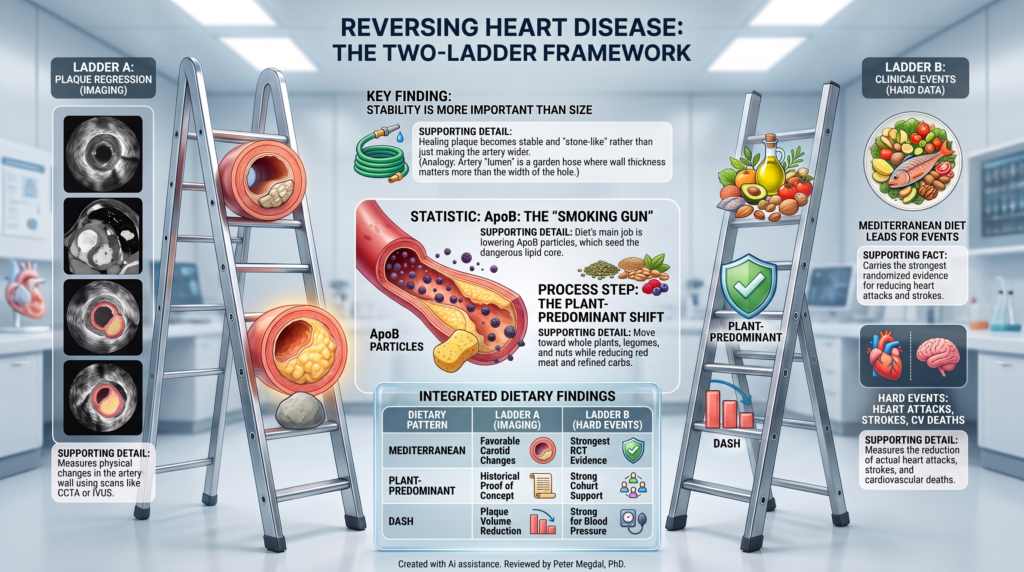
Qual è la differenza tra la dieta mediterranea e la dieta a base vegetale di cibi integrali per le malattie cardiache?
Modelli alimentari per le coronarie Aterosclerosi: Separazione delle prove per Regressione della placca da Evidence for Cardiovascular Event Reduction
A due scale, con evidenza graduata Recensione narrativa dei modelli dietetici a predominanza vegetale, mediterraneo, Portfolio e DASH
Messaggio chiave
L'aterosclerosi coronarica è guidata principalmente da esposizione cumulativa contenente ApoB lipoproteine, e la dieta è un importante determinante modificabile per tutta la vita di tale esposizione nella maggior parte delle popolazioni. Studi sui migranti e sulle coorti dimostrano che l'incidenza delle malattie coronariche segue gli ambienti alimentari associati a una maggiore esposizione per tutto il corso della vita ApoB esposizione; tale evidenza stabilisce che la dieta è un importante fattore contributivo ma non classifica, di per sé, la dieta rispetto a ogni altro determinante dell'esposizione a lungo termine all'ApoB. Il compartimento ricco di lipidi e incline alla rottura è tra le componenti più dinamicamente modificabili dell'avanzata placcaNeGLI esperimenti controllati su primati non umani, la normalizzazione del carico di lipoproteine aterogene per via dietetica depleta e stabilizza esattamente quel compartimento, e gli studi farmacologici umani riproducono il cambiamento di composizione. Una dimostrazione equivalente basata sulla sola dieta umana non esiste ancora. La dieta e i farmaci che riducono l'ApoB convergono su un'importante via condivisa — il carico di lipoproteine aterogene, che la dieta influenza continuamente nel corso della vita e i farmaci abbassano potentemente dalla mezza età — mentre la dieta influenza anche il rischio cardiovascolare attraverso ulteriori vie; sono leve complementari piuttosto che concorrenti. La conclusione pratica è quella di orientarsi verso un regime alimentare a predominanza vegetale e minimamente lavorato.
Astratto
L'aterosclerosi coronarica è guidata principalmente dall'esposizione cumulativa a apolipoproteina lipoproteine contenenti apoB, di cui la dieta è un importante determinante modificabile per tutta la vita nella maggior parte delle popolazioni; questa rassegna narrativa si chiede cosa tale inquadramento causale implichi e non implichi per l'inversione della malattia conclamata. Utilizzando una quadro a due scale che separa le prove di un cambiamento favorevole nell'imaging arterioso dalle prove di una riduzione degli eventi cardiovascolari maggiori, e valutando ciascun corpo di prove per certezza, sintetizziamo i dati provenienti da studi su migranti, di coorte, su primati, di imaging, farmacologici e dietetici. Le prove sulla popolazione supportano la dieta come un importante determinante modificabile dell'esposizione all'ApoB per tutta la vita, senza stabilirne il rango rispetto a tutti gli altri determinanti, mentre le prove genetiche umane supportano indipendentemente l'importanza causale dell'esposizione cumulativa all'ApoB stessa. Il lavoro controllato sui primati mostra che la normalizzazione del carico di lipoproteine aterogene depleta e stabilizza la placca incline alla rottura, nucleo necrotico ricco di lipidi mentre persiste un denso tessuto fibrocalcifico; la corrispondente evidenza compositiva umana deriva da studi farmacologici, non dietetici. Poiché verso l'esterno e rimodellamento costrittivo fare lumen e stenosi endpoint inaffidabili, il cambiamento rilevante per gli eventi è di tipo composizionale piuttosto che luminale. I modelli di stile mediterraneo offrono le prove randomizzate più forti per gli eventi duri tra le diete denominate, mentre la farmacoterapia ipolipidemica conserva i dati di regressione dell'imaging più riproducibili; l'esercizio fisico è un ulteriore contributore, generalmente modesto, alla riduzione dell'ApoB e del rischio cardiovascolare. La dieta e i farmaci ipolipidemici sono complementari anziché in competizione. La conclusione robusta e poco controversa è quella di orientarsi verso un modello dietetico prevalentemente vegetale e minimamente lavorato, in cui la qualità del cibo conta più della sola etichetta vegetale o animale.
Metodi. Abbiamo condotto una revisione narrativa strutturata di studi clinici randomizzati controllati (RCT), coorti prospettiche, meta-analisi, esperimenti controllati su primati non umani e linee guida della società. Separiamo le prove per la dieta causalità dalle prove della regressione della placca stabilita, classificare i modelli alimentari su due scale di prove indipendenti (imaging ed eventi cardine) secondo uno schema esplicito basato sul metodo GRADE (Tabella 1) e analizzare la composizione della placca, il lume e rimodellamento arterioso come fenomeni distinti.
Parole chiave aterosclerosi coronarica; apolipoproteina B; regressione della placca; rimodellamento arterioso; modelli alimentari; dieta a base vegetale; dieta mediterranea; prevenzione cardiovascolare.
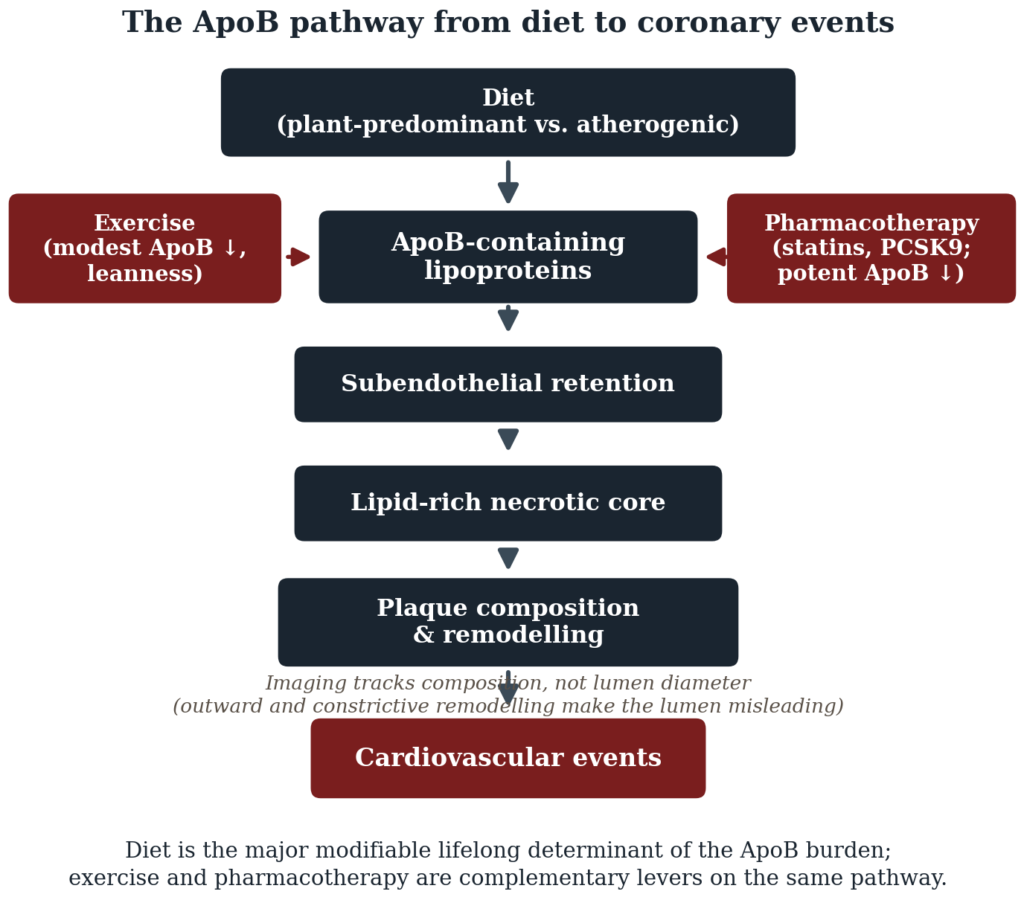
Figura 1. Il percorso dell'ApoB dalla dieta agli eventi coronarici. La dieta rappresenta un'importante influenza modificabile per tutta la vita sul carico di lipoproteine contenenti ApoB (prove e relativi limiti: §3, §7.1; rif. 3, 41, 42, 108, 109), mentre l'esercizio fisico e la farmacoterapia ipolipemizzante agiscono come leve complementari sullo stesso nodo. Le frecce indicano la direzione dell'effetto, non una graduatoria quantitativa dimostrata dei determinanti. Le particelle di ApoB ritenute innescano un processo ricco di lipidi centro necrotico; il cambiamento rilevante per l'evento consiste nella composizione della placca e nel rimodellamento, che l'imaging — e non il diametro del lume — rileva. Questa figura funge anche da sommario grafico.
1. Introduzione
Per gran parte del XX secolo, la gestione clinica della malattia conclamata malattia coronarica (CAD) ha enfatizzato il sollievo dai sintomi e il trattamento degli eventi acuti, considerando improbabile la regressione della placca. Questa prospettiva è stata ribaltata. L'aterosclerosi inizia con la ritenzione di lipoproteine contenenti ApoB nell'arteria intima. Le particelle trattenute subiscono molteplici modifiche, provocano reazioni infiammatorie e immunitarie e contribuiscono a macrofago formazione di cellule di schiuma e, in fase avanzata lesioni, lo sviluppo di un nucleo necrotico ricco di lipidi.¹,⁶⁵,⁶⁶,⁶⁷ Poiché il processo è dinamico, è in linea di principio modificabile: la terapia ipolipemizzante può arrestare la progressione e produrre modeste riduzioni medie delle coronarie ateroma volume, mentre la terapia antinfiammatoria può ridurre gli eventi cardiovascolari senza necessariamente abbassare il c-LDL.⁴,⁶⁸
Questa biologia ha generato una domanda persistente che sia i pazienti che i medici si pongono: quale dieta è la migliore per invertire la placca e prevenire infarti? La letteratura non manca certo di risposte categoriche. I sostenitori di un’alimentazione a base di cibi integrali di origine vegetale (WFPB) a bassissimo contenuto di grassi sottolineano i risultati angiografici “inversione”; i sostenitori della dieta mediterranea fanno riferimento a ampi studi randomizzati che riportano un minor numero di decessi. Tradizioni di evidenza diverse hanno quindi valorizzato modelli alimentari diversi, spesso sulla base di endpoint diversi.
Riteniamo che gran parte dell’apparente disaccordo rifletta un problema metodologico: la confusione tra gli endpoint relativi all’imaging della placca e gli endpoint clinici oggettivi, nonché la confusione tra l’entità di un effetto riportato e la qualità delle prove su cui si basa. Una dieta che riduce un marcatore surrogato in un piccolo studio in aperto non è con ciò dimostrato che prevenga la morte; una dieta che prevenga la morte non è con ciò dimostrata restringere una lesione coronarica. Costruiamo quindi due scale di evidenza indipendenti — una per la regressione della placca, una per gli eventi maggiori — voto determinare separatamente la certezza con uno schema esplicito, e solo successivamente integrare i risultati. La nostra domanda specifica è volutamente più circoscritta rispetto a “qual è lo stile di vita più salutare”: si tratta infatti di stabilire quali modelli alimentari, isolati – per quanto le prove lo consentano – dall’attività fisica e dai farmaci ipolipemizzanti, presentino le prove più solide a sostegno di cambiamenti favorevoli in imaging coronarico e negli eventi cardiovascolari — riconoscendo che l’approccio migliore sarà quello che integri, anziché sostituire, l’esercizio fisico e la farmacoterapia (§6). Il libro è rivolto sia al pubblico informato che ai medici praticanti.
2. Metodi e quadro interpretativo
2.1 Fonti di prova e ricerca
Sono state effettuate ricerche su MEDLINE/PubMed, sulla Cochrane Library e sui principali archivi di linee guida fino alla data di redazione del manoscritto, utilizzando combinazioni di termini relativi all’aterosclerosi coronarica, alla regressione della placca, all’angiografia coronarica, ecografia intravascolare, angio-TAC coronarica, dieta mediterranea, dieta vegetariana e vegana, Dieta personalizzata, DASH, dieta povera di grassi, dieta chetogenica, ed eventi cardiovascolari. Gli elenchi di riferimento delle revisioni e degli studi inclusi sono stati cercati manualmente. La selezione degli studi e i giudizi di certezza sono stati eseguiti da un singolo autore; questa è una revisione narrativa strutturata ma non sistematica e una valutazione critica, non registrata revisione sistematica, e non è stato giudicato due volte.
Abbiamo stabilito le priorità, in ordine decrescente: studi randomizzati controllati (RCT) con endpoint clinici o di imaging convalidati; revisioni sistematiche e meta-analisi di RCT; ampie coorti prospettiche; e le linee guida di consenso dell’American Heart Association (AHA), dell’American College of Cardiology (ACC), della European Society of Cardiology (ESC) e della Cochrane Collaboration. I dati meccanicistici e quelli sugli animali sono stati utilizzati per spiegare, mai per stabilire, l’effetto clinico. Le banche dati sono state consultate dal loro avvio fino alla data di preparazione del manoscritto (metà del 2026), con l’aggiornamento della ricerca sulle linee guida per includere i documenti delle società pubblicati nella prima metà del 2026. I termini di ricerca erano in lingua inglese; nessun record è stato escluso in base alla lingua durante lo screening, ma non è stato effettuato alcun recupero sistematico multilingue. In linea con il disegno di una revisione narrativa, lo screening è stato eseguito da un unico autore senza duplicazioni aggiudicazione, non è stato effettuato alcun diagramma di flusso PRISMA formale né alcun pooling quantitativo, e il rischio di bias è stato valutato in modo narrativo a livello di singolo studio (randomizzazione, accecamento, directness dell'endpoint, isolamento dell'intervento e precisione) anziché con uno strumento formale. Queste caratteristiche sono dichiarate apertamente perché delimitano la forza di ogni inferenza successiva e costituiscono esse stesse una limitazione (§12).
2.2 Perché due scale e non un unico punteggio?
Sei famiglie di endpoint ritornano in questo campo: ApoB / LDL concentrazione di particelle; funzione endoteliale dilatazione mediata dal flusso; sistemico infiammazione (alta sensibilità Proteina C-reattiva, hs-CRP); carotide spessore intima-media (IMT) e placca carotidea; coronarica carico di placca e composizione (di angiografia coronarica quantitativa [QCA], ecografia intravascolare [IVUS] o coronarica tomografia computerizzata angiografia [CCTA]); ed eventi gravi (infarto miocardico [MI], ictus, morte cardiovascolare [CV], mortalità per tutte le cause). Si tratta di due grandezze correlate ma non commensurabili. Riducendo pressione sanguigna o la PCR-hs non è la stessa cosa che far regredire una lesione coronarica, e modificare lo spessore carotideo non equivale a prevenire l'infarto. Comprimerle in un'unica classifica è il problema centrale che questa rassegna evita. La Scala A classifica i pattern in base alle prove che fanno regredire la placca all'imaging (coronarica e carotidea tenute separate); la Scala B classifica i pattern in base alle prove che riducono gli eventi maggiori. All'interno di ciascuna scala, l'ordinamento segue la qualità delle prove, non la dimensione dell'effetto grezzo.
2.3 Classificazione della certezza
Abbiamo applicato una valutazione informata dal metodo GRADE separatamente su ciascuna scala, utilizzando le definizioni esplicite nella Tabella 1. Tali punteggi rappresentano un quadro metodologico derivato dagli autori e informato dal metodo GRADE anziché una valutazione GRADE formale; la randomizzazione, la pertinenza dell'endpoint, la dimensione del campione, la precisione, il rischio di bias, l'isolamento dell'intervento, la coerenza e la replicazione sono stati considerati congiuntamente, e nessuna singola limitazione ha determinato automaticamente il punteggio finale.
Un esempio pratico rende la logica riproducibile: TC-DISCO e lo studio Ornish sono entrambi randomizzati, entrambi multicomponenti e utilizzano entrambi endpoint di imaging surrogati, eppure DISCO-CT è valutato come basso mentre l'effetto della sola dieta in Ornish è valutato come molto basso, poiché DISCO-CT è più ampio, contemporaneo e utilizza un imaging diretto della composizione della placca (misurato tramite CCTA placca non calcifica) con un confronto tra gruppi, mentre il segnale di Ornish è un endpoint piccolo, più vecchio, basato sul lume (QCA) in cui la dieta è ancora meno separabile dai co-interventi. La stessa regola declassa qualsiasi serie non controllata (ad es. Esselstyn) a molto bassa indipendentemente dalla dimensione dell'effetto, poiché un adesione il confronto non è in grado di stimare un effetto del trattamento. Applicare questi criteri in modo coerente, anziché un qualsiasi singolo fattore di squalifica automatico, è ciò che distingue una valutazione bassa da una bassissima in tutto il testo. Per gli interventi sullo stile di vita multicomponente valutiamo separatamente due diverse questioni: la certezza che il programma combinato completo abbia causato la modifica dell'imaging e la certezza che la dieta in sé l'abbia causata (si veda la Tabella 2). Una trattazione più completa fornirebbe una tabella del rischio di bias a livello di studio anziché un'unica etichetta globale per categoria. Nell'ambito della ricerca, emergono tre livelli: le prove della regressione della placca tramite la dieta sono generalmente di certezza da bassissima a bassa (piccole, in cieco non specificato, multicomponente, surrogate); le prove della dieta mediterranea sugli eventi clinici maggiori sono di certezza da bassa a moderata; e le prove dei farmaci ipolipemizzanti sono di certezza alta per gli eventi e da moderata ad alta per l'imaging. Questa asimmetria viene dichiarata fin dall'inizio affinché nessuna affermazione sulla dieta venga scambiata per una prova del livello dei farmaci. La struttura a due scale e queste valutazioni costituiscono un quadro interpretativo derivato dagli autori, non un sistema di punteggio oggettivo o una valutazione GRADE formale.
Tabella 1. Categorie di certezza applicate a entrambe le scale di evidenza: categorie definite dagli autori ispirate ai principi GRADE, non a una valutazione GRADE formale.
| Certezza | Definizione usata in questa recensione |
| Alto | Numerosi studi randomizzati coerenti e adeguatamente potenti con endpoint convalidati, o un ampio studio meta-analisi di tali processi. |
| Moderato | Evidenza randomizzata con limitazioni significative (imprecisione, indirettezza, singolo studio o mancanza di cecità). |
| Basso | Piccoli studi randomizzati, o prove osservazionali forti e coerenti. |
| Molto basso | Serie di casi, studi non controllati, interventi multicomponenti in cui l'esposizione di interesse non può essere isolata, grave rischio di bias o sostanziale imprecisione. |
3. La dieta come importante determinante modificabile dell'aterosclerosi coronarica
Prima di confrontare i modelli dietetici come trattamenti, vale la pena stabilire cosa sia la malattia. Una vasta e internamente coerente serie di prove sulla popolazione umana indica che l'aterosclerosi coronarica non è una conseguenza inevitabile dell'invecchiamento, ma una malattia la cui incidenza nel corso della vita segue ambienti alimentari associati a una maggiore esposizione all'ApoB per tutta la vita. Questa distinzione è importante per tutto ciò che segue: l'aterosclerosi coronarica è guidata principalmente dall'esposizione cumulativa alle lipoproteine contenenti ApoB, e la dieta è un importante determinante modificabile di tale esposizione nel corso della vita nella maggior parte delle popolazioni, mentre la farmacoterapia è un mezzo potente per ridurre un carico che è plasmato dalla dieta insieme a genetica, metabolismo, adiposità e altre esposizioni. Due proposizioni devono essere tenute distinte qui, e sono valutate diversamente in tutta questa rassegna: che l'esposizione cumulativa all'ApoB causa l'aterosclerosi coronarica (alta certezza, §7.1), e che la dieta supera tutte le altre influenze modificabili su tale esposizione (un giudizio interpretativo supportato da prove convergenti ma non sperimentali). Fattori monogenici e non dietetici (ipercolesterolemia familiare, PCSK9 guadagno di funzione, LDLR e varianti di APOB, lipoproteina(a), malattia renale cronica, disturbi infiammatori, diabete, e fumo) possono ciascuno aumentare l'ApoB o accelerare la malattia indipendentemente dalla dieta, motivo per cui la dieta viene qui inquadrata come un importante determinante modificabile piuttosto che come l'unica causa o la causa principale quantificata.
3.1 Le coorti di migranti separano i geni dall'ambiente
Prove sulla popolazione particolarmente informative provengono dagli studi sui migranti, poiché mantengono il background genetico approssimativamente costante mentre la dieta e l'ambiente cambiano. Studio Ni-Hon-San esaminati circa 11.900 uomini di discendenza giapponese in Giappone, alle Hawaii e in California utilizzando metodi condivisi. Prevalenza aggiustata per età della cardiopatia coronarica (CHD) definita mediante elettrocardiogramma era 5,3, 5,2 e 10,8 per 1.000 rispettivamente in Giappone, alle Hawaii e in California,¹³⁵ con un rischio di cardiopatia coronarica (CHD) da circa due a tre volte superiore nelle coorti statunitensi, che riflette un parallelismo nell'aumento dei livelli sierici da Giappone a California colesterolo e nel totale della dieta e grassi saturi. Il gradiente riflette una vasta occidentalizzazione piuttosto che la dieta isolata — attività fisica, peso corporeo, fumo, pressione sanguigna e ambiente sociale sono cambiati tutti in parallelo — quindi è preferibile interpretarlo come un forte sostegno a un percorso basato su dieta e lipoproteine piuttosto che come la prova di una causa puramente dietetica; l'inferenza specifica sulla dieta si fonda sulla sua convergenza con le prove a livello individuale e genetico riportate di seguito.¹⁰⁵,¹⁰⁶ Poiché i gruppi migranti condividevano un'ascendenza sostanzialmente simile, il gradiente è difficilmente attribuibile a differenze genetiche e depone a favore di una causa ambientale operante in parte attraverso i lipidi sierici. Esso non isola sperimentalmente la dieta dalle altre esposizioni mutate con la migrazione. Si tratta ciononostante di uno dei più forti esperimenti naturali disponibili nella nutrizione umana epidemiologia.
I gradienti interculturali e di coorte convergono
Lo Studio dei Sette Paesi ha misurato il colesterolo sierico e la dieta in 16 coorti e ha monitorato la mortalità per cardiopatia coronarica (CHD) per decenni. I tassi assoluti di morte per CHD variavano all'incirca da due a otto volte tra le coorti, risultando più bassi nelle coorti mediterranee e giapponesi e più alti in Europa settentrionale e negli Stati Uniti, seguendo l'apporto medio di grassi saturi e il colesterolo sierico; a 25 anni la relazione a livello di coorte tra il colesterolo medio e la mortalità per CHD era forte.¹⁰⁷,¹⁰⁸ Il Progetto Cina-Cornell-Oxford, un'indagine ecologica su 65 contee rurali cinesi pubblicata come monografia, ha documentato una bassa mortalità per cardiopatia coronarica (CHD) nelle contee con un basso consumo di alimenti di origine animale e un basso livello di colesterolo plasmatico;¹⁰⁹ in quanto confronto a livello di contea è il disegno più debole in questo argomento di convergenza ed è citato solo come uno dei suoi filoni. Nell'Adventist Health Study-2, i gruppi a prevalenza vegetale, in particolare pesco-vegetariani, presentava tra le stime più basse di mortalità per tutte le cause e cardiovascolare aggiustate all'interno di una singola popolazione ben caratterizzata.²⁶
I confronti ecologici e di coorte sono, di per sé, un grado limitato di evidenza causale: confondente, l'errore di misurazione e la fallacia ecologica si applicano tutti, e le correlazioni naif tra colesterolo e CHD tra diverse popolazioni si indeboliscono quando vengono modellati il cambiamento nel tempo e i rischi competitivi.¹⁰⁷ Il peso causale qui non si basa su una singola correlazione. Si fonda sulla convergenza: lo studio dei migranti controlla per la genetica; le associazioni a livello individuale all'interno delle coorti vanno nella stessa direzione dei gradienti tra coorti; e le prove genetiche umane (la randomizzazione mendeliana) stabiliscono indipendentemente che un'esposizione per tutta la vita a livelli inferiori di lipoproteine contenenti ApoB causa un minor rischio coronarico (§7.1). La concordanza tra metodi con diverse fonti di bias rafforza l'inferenza causale, sebbene non elimini il confondimento residuo; il caso combinato a favore di un contributo dietetico è quindi più forte di qualsiasi singola linea di prova isolata.
3.3 Cosa stabilisce e cosa non stabilisce l'argomento causale
Presse insieme, queste linee di evidenza supportano un contributo causale della dieta e una sostanziale prevenzione: le popolazioni caratterizzate da modelli dietetici meno aterogeni, e di conseguenza da una minore esposizione a lungo termine all'ApoB, hanno registrato tassi bassissimi di cardiopatia coronarica clinica. Ciò supporta la prevenzione attraverso la modifica per tutta la vita dell'alimentazione e dei relativi fattori di rischio cardiometabolico. Il testo affronta meno direttamente la questione distinta di quanto una lesione già stabilizzata in un adulto di mezza età possa essere invertita attraverso la dieta — una tempistica diversa, trattata al §5. Mantenere distinte queste due questioni è essenziale: la prova che la dieta contribuisce a prevenire una vita di malattia non coincide con la prova che essa possa invertire una placca vecchia di decenni, e confonderle è stato un errore ricorrente sia nell'attivismo che nella critica.
4. Scala A — Prove di variazioni favorevoli nell'imaging aterosclerotico
Questa scala classifica i modelli alimentari in base alla qualità delle prove che producono un cambiamento favorevole sull'imaging arterioso convalidato. Un avvertimento la attraversa: le modalità non misurano la stessa cosa. L'angiografia coronarica quantitativa (QCA) misura il lume del vaso, non direttamente la placca, quindi un cambiamento nella stenosi luminale può derivare dal rimodellamento, tono vasomotorio, o dalla variabilità della misurazione così come dai cambiamenti della placca; l'ecografia intravascolare (IVUS) e l'angiografia coronarica con tomografia computerizzata (CCTA) misurano il volume e la composizione dell'ateroma; e lo spessore miointimale carotideo (IMT) è un surrogato distinto. Per evitare che i lettori equiparino questi endpoint, organizziamo le prove in base alla modalità: stenosi coronarica (QCA), carico di placca coronarica (IVUS), composizione della placca coronarica (CCTA), IMT e placca carotidea, e il punto di riferimento farmacologico.
4.1 Cosa misura ciascuna modalità di imaging e perché è importante per il lume
Ladder A si basa su diverse modalità di imaging che vengono abitualmente confuse ma che misurano cose fondamentalmente diverse; distinguerle è essenziale per interpretare ogni affermazione di regressione, e in particolare qualsiasi dichiarazione sul lume.
- Angiografia coronarica / angiografia coronarica quantitativa (QCA). Una sagoma bidimensionale del solo lume riempito di mezzo di contrasto; non visualizza la parete del vaso o la placca. Riferisce diametro luminale minimo (MLD) e la stenosi in percentuale del diametro (%DS); inoltre, poiché riproduce il lume anziché la parete vascolare, può sottostimare in modo significativo il carico di placca murale e non rileva rimodellamento esterno.
- Ecografia intravascolare (IVUS). A catheter-based cross-section of the full vessel wall; it quantifies atheroma volume (percent and total atheroma volume, PAV/TAV) and the external elastic membrane, so it measures remodeling directly. Virtual-histology IVUS provides algorithm-based tissue characterization (fibrous, necrotic core, calcium) rather than direct histology.
- Optical coherence tomography (OCT). Near-histologic resolution (~10 µm); a high-resolution intracoronary modality used to assess fibrous-cap thickness and the microstructural features associated with rupture. Intensive ipolipemizzante thickens the cap on serial OCT.¹²⁶
- Near-infrared spectroscopy (NIRS). Quantifies lipid-core burden (the lipid-core burden index, LCBI), usually combined with IVUS on a hybrid catheter.
- Coronary CT angiography (CCTA). Non-invasive; images both lumen and wall and characterizes composition, including low-attenuation (lipid-rich) plaque, which can regress with intensive therapy independently of calcium.¹²⁵ The related coronary-artery-calcium (CAC/Agatston) score quantifies only the calcified component. Two facts about calcium must be held together: at the level of an individual lesion, dense calcificazione is associated with greater stability, whereas at the level of the patient a higher total CAC burden remains one of the strongest predictors of events and is used as such in current guidelines.¹³³ CAC is therefore a measure of accumulated disease, not a measure of plaque safety.
- Magnetic resonance imaging (MRI). A research modality for carotid and coronary composition and inflammation.
The practical consequence, developed in §8.2, is that for assessing plaque composition and regression, lumen-based modalities (angiography and QCA) and calcium-only measures (CAC) are limited readouts: a large plaque burden can hide behind a near-normal lumen through outward (positive) remodeling, and a healing, de-lipidated plaque can show an unchanged or even smaller lumen through reverse (constrictive) remodeling. Wall- and composition-based modalities (IVUS, OCT, NIRS, CCTA) track the event-relevant change — lipid depletion and fibrous-cap stabilization — that a lumen silhouette misses. This is why, throughout Ladder A, we keep the modality attached to every result rather than speaking of “imaging” generically: a coronary regression claim is difficult to interpret without specifying the imaging modality and the endpoint it measured.
4.2 Coronary stenosis — quantitative coronary angiography (QCA)
Strongest historical regression signal: the Lifestyle Heart Trial (Ornish)
In the literature identified for this review, the Lifestyle Heart Trial remains the only randomized lifestyle trial demonstrating regression of coronary stenosis using invasive QCA. Forty-eight patients with moderate-to-severe CAD were randomized to an intensive multicomponent program centered on a roughly 10%-fat dieta vegetariana (which permitted egg whites and limited nonfat dairy), combined with esercizio aerobico, stress management, smoking cessation, and group psychosocial support, or to usual care.⁷ At one year, average percent-diameter stenosis in the experimental group fell from 40.0% to 37.8%, while controls progressed from 42.7% to 46.1%; among more severe lesions the divergence was larger, and most treated lesions showed improvement in measured stenosis. The trial reported improvement in angiographically measured coronary stenosis, not direct quantification of volume della placca. At five years, regression continued in the experimental group while controls worsened further, and the control group experienced substantially more recurrent eventi cardiaci than the intervention group over the follow-up period, as reported in the original trial.⁸
Interpretazione. This is a historically important result, but the intervention is irreducibly multicomponent: diet cannot be separated from exercise, stress reduction, and smoking cessation. It is best described as an intensive multicomponent lifestyle program centered on a very-low-fat vegetarian or plant-predominant diet, and it should not be read as direct evidence for a strictly vegan, oil-free whole-food plant-based diet. With 48 patients, an unblinded design, and a surrogate (QCA) endpoint, certainty that diet specifically produced the angiographic improvement is very low, even though the between-group divergence is numerically notable.
Esselstyn whole-food plant-based series
Esselstyn’s work is frequently cited as plaque “reversal,” but the 2014 report is an uncontrolled case series of 198 self-referred patients counselled to an oil-free WFPB diet as an adjunct to usual care (including statine). Among the 177 (89%) adherent patients over a mean 3.7 years, a single recurrent event was reported (0.6%), versus adverse events in 13 of 21 (62%) non-adherent patients. The adherent and non-adherent groups cannot be interpreted as treatment and control groups, and the 0.6% versus 62% contrast should not be treated as an estimate of dietary efficacy: adherence itself is influenced by illness, health literacy, prognosis, socioeconomic circumstances, medication adherence, and ability to remain in follow-up, and the counted endpoints may include revascularizations driven by clinical decision-making and surveillance rather than spontaneous events alone.⁹ These are outcome data, not systematic imaging data, and a comparison of adherent versus non-adherent patients cannot estimate a treatment effect: it is confounded by severe self-selection and adherer bias. This series provides no systematic imaging endpoint; any inference from it about plaque regression is of very low certainty.
4.3 Coronary plaque burden — intravascular ultrasound (IVUS)
We identified no dietary trial using IVUS seriale to demonstrate coronary plaque regression. The IVUS evidence base is pharmacologic and is discussed as the benchmark in §4.6. This gap is itself informative: on this review’s search, the modality that most precisely quantifies coronary atheroma volume has not been deployed in an adequately powered diet trial.
4.4 Coronary plaque composition — coronary CT angiography (CCTA)
Most rigorous contemporary randomized imaging study: DISCO-CT
Among the contemporary lifestyle-imaging trials identified in this review, the most methodologically rigorous incorporating a DASH dietary intervention is DISCO-CT. Ninety-two patients with nonobstructive CAD were randomized to a DASH diet plus increased physical activity plus terapia medica ottimale, or OMT alone, with CCTA repeated after roughly 16 months.¹³ Noncalcified plaque volume fell in both arms, and the reduction was significantly greater in the intervention group (−51.3 ± 79.5 mm³ versus −21.3 ± 57.7 mm³; between-group P=0.045) — the between-group difference, not the within-group change, being the causal estimate of interest. The trial’s other volumetric endpoints were null, and this must be stated alongside the positive one: volume percentuale di ateroma rose significantly in the control arm (+1.1 ± 3.4%; P=0.033) and did not change significantly in the intervention arm (+1.0 ± 4.2%; P=0.127), but the between-group comparison for percent atheroma volume was not significant (P=0.851), and total atheroma volume did not differ between arms. The noncalcified-plaque difference persisted after adjustment for body mass, cholesterol, and punteggio di calcio.¹³
Interpretazione. Statistical adjustment cannot establish causality, and the bundled intervention (diet plus exercise), single-center setting, and modest sample size prevent attribution specifically to diet; noncalcified plaque is itself a heterogeneous tissue category rather than a single high-risk phenotype. Nonetheless this is a randomized coronary CCTA signal for a plant-predominant, sodium-conscious pattern. Certainty: low — the highest on the dietary side of this ladder, which is why DISCO-CT is presented as the most rigorous imaging study identified here even though the Ornish trial carries the larger historical signal.
4.5 Ketogenic diets and marked ApoB elevation
No controlled studio clinico has demonstrated coronary plaque regression with a ketogenic dietary pattern. Interest has centered on lean, metabolically healthy people whose LDL-C rises markedly (often ≥190 mg/dL) on carboidrato restriction — “lean-mass hyper-responders.” The KETO-CTA study reported one-year coronary CT angiography in such individuals; its published paper emphasized percent atheroma volume, and the authors subsequently addressed the pre-registered noncalcified-plaque endpoint, reporting an increase with marked heterogeneity.¹⁴,¹⁵ That article was retracted in 2026 at the request of the authors and the editors, after concerns about the methodology that affected the reliability of the data and that the authors and editors agreed were too great to correct by corrigendum.¹³¹ The reported findings therefore come from a subsequently retracted report and are not reliable evidence. No numerical plaque estimate from that report is reproduced or used anywhere in this review, and the study is not used to rank ketogenic diets or to support either progression or benefit. More important than the publication history is the design: the cohort was uncontrolled and self-selected, so it does not establish the independent effects of diet, ApoB concentration, exposure duration, or participant selection, and its comparisons with other cohorts were descriptive. These reports should therefore be regarded as hypothesis-generating rather than as evidence that ketogenic diets either cause or prevent coronary plaque progression. The clinically important point is unaffected: in patients with established coronary disease, marked and sustained elevation of ApoB-containing lipoproteins is inconsistent with current evidence-based lipid-management principles.
4.6 Pharmacologic benchmark for coronary plaque regression
No dietary trial has produced coronary plaque regression matching the magnitude and rigor of high-intensity lipid-lowering therapy. In GLAGOV (a randomized, placebo-controlled, blinded trial; n=968), adding the Inibitore di PCSK9 evolocumab to a statin drove time-weighted LDL-C to 36.6 mg/dL (versus 93.0 mg/dL) and changed percent atheroma volume (PAV) by −0.95% versus +0.05% on statin alone (a between-group difference of approximately −1.0 percentage point, P<0.001, as reported in the trial’s primary-endpoint table), with plaque regression in 64.3% versus 47.3% of patients.⁴ SATURN (randomized, active-comparator; n≈1,039) showed PAV regression of −1.22% on high-dose rosuvastatina,⁵ ASTEROID (open-label, single-arm) showed −0.98% PAV regression with a median TAV reduction of ~6.8%,⁶ and REVERSAL showed high-intensity statin therapy halts progression relative to moderate therapy.⁶⁹ Collectively, these multicenter intravascular-ultrasound (IVUS) studies — whose designs ranged from randomized active-comparator or placebo-controlled trials to an open-label single-arm study — provide consistent evidence that intensive LDL lowering can halt progression and produce modest average reductions in coronary atheroma volume, although a portion of the imaging change reflects stabilizzazione della placca and calcification rather than volume loss alone.⁷⁰ Claims about plaque composition, as opposed to volume, are supported by the composition-specific trials cited in §6.2 rather than by these volumetric IVUS studies.¹²⁵,¹²⁶ Certainty for modest coronary atheroma regression is moderate-to-high; the evidence that intensive lipid lowering slows progression and produces modest regression is substantially stronger and more reproducible than the corresponding dietary evidence. This provides the strongest comparative benchmark for coronary plaque regression; the dietary regression evidence reviewed here does not reach the same level of rigor or reproducibility.
4.7 Carotid endpoints (surrogate; kept separate from coronary)
Nel CORDIOPREV carotid substudy, the Mediterranean diet reduced common-carotid IMT at five years (−0.027 mm; P<0.001) and seven years (−0.031 mm; P<0.001) and reduced carotid plaque maximum height, whereas a low-fat diet produced no change.¹⁶ A PREDIMED substudy showed favorable change in internal-carotid IMT with a Mediterranean diet enriched with nuts.¹⁷ These represent favorable changes in carotid IMT and selected plaque measurements rather than demonstrated coronary plaque regression: carotid IMT may also reflect medial hypertrophy rather than focal atherosclerotic plaque — increasingly the preferred interpretation — and the carotid bed is in any case a surrogate for, not a measurement of, coronary disease.
Tabella 2. Ladder A — evidence for favorable change in atherosclerotic imaging, organized by modality. For multicomponent lifestyle interventions, certainty is graded separately for the complete bundled program (“Bundled”) and for the independent effect of diet (“Diet alone”). The Esselstyn series is deliberately excluded from this table: it reports clinical events, not systematic imaging, and is discussed as ancillary evidence in §4.2 and §8.4.
| Intervention | Endpoint / modality | Key result | Bundled | Diet alone |
| Benchmark: high-intensity statin ± PCSK9 inhibitor | Coronary PAV/TAV (serial IVUS) | Modest mean PAV reduction; regression in a majority of treated participants (GLAGOV placebo-controlled; SATURN active-comparator; ASTEROID single-arm) | MOD–HIGH | n/a (drug) |
| Intensive multicomponent lifestyle, very-low-fat vegetarian or plant-predominant diet (Ornish) | Coronary % stenosis (invasive QCA — lumen, not plaque) | Improved angiographic stenosis vs progression in controls; only randomized lifestyle QCA trial | LOW | VERY LOW |
| DASH + exercise + OMT (DISCO-CT) — most rigorous contemporary imaging RCT | Coronary noncalcified plaque (CCTA) | Noncalcified plaque volume favors intervention (between-group P=0.045); percent and total atheroma volume between-group comparisons null; single-center; n=92 | LOW | VERY LOW |
| Ketogenic diet in hyper-responders (KETO-CTA) | Coronary noncalcified plaque (CCTA) | Uncontrolled cohort; article retracted; no reliable plaque estimate; not evidence for or against progression | N/A | N/A |
| Carotid surrogate: Mediterranean diet (CORDIOPREV, PREDIMED) | Carotid IMT / plaque height | IMT −0.027 to −0.031 mm; carotid ≠ coronary | LOW–MOD | LOW–MOD |
5. Ladder B — Evidence for reducing hard cardiac events
This ladder ranks dietary patterns by the strength of evidence that they reduce MI, stroke, CV mortality, and all-cause mortality. Here the ordering is dominated by large randomized trials and long prospective cohorts. Where possible we report event counts, absolute and relative effects, and follow-up duration, because rischio relativo reductions are routinely overestimated when absolute effects are omitted.
5.1 Mediterranean-style diets — strongest randomized evidence among named dietary patterns
The Mediterranean pattern — rich in extra-virgin olio d'oliva, vegetables, legumes, nuts, fish, and whole grains — has a coherent body of trial, cohort, and mechanistic evidence linking it to lower cardiovascular risk through effects on lipids, blood pressure, endothelial function, and inflammation.⁷⁸,⁹³ CORDIOPREV is a major contemporary secondary-prevention diet trial. One thousand and two patients with established CAD were randomized to a Mediterranean or a low-fat diet for seven years on top of OMT. Major adverse cardiovascular events occurred at a crude rate of 28.1 versus 37.7 per 1,000 person-years (87 versus 111 first events; log-rank P=0.039). Multivariable-adjusted hazard ratios ranged across the trial’s models from 0.719 (95% CI 0.541–0.957) to 0.753 (0.568–0.998), a 25–28% relative reduction. The estimate was larger in men (67 of 414 versus 94 of 413; multivariable-adjusted HR 0.669, 95% CI 0.489–0.915) than among the 175 women, in whom no between-group difference was found; these are subgroup estimates, not a demonstrated statistical interaction by sex.¹⁰
PREDIMED is the largest primary-prevention diet trial. Among 7,447 high-risk adults randomized to a Mediterranean diet supplemented with extra-virgin olive oil or nuts versus a low-fat control, the composite of MI, stroke, or CV death was reduced by approximately 28–31% over a median 4.8 years. All figures here are taken from the 2018 republished analysis, not the retracted 2013 report: in the intention-to-treat analysis adjusting for baseline characteristics and propensity scores, the hazard ratio was 0.69 (95% CI 0.53–0.91) for the olive-oil arm and 0.72 (95% CI 0.54–0.95) for the nut arm. The absolute separation was small, as expected in prevenzione primaria: 96 primary events (3.8%) in the olive-oil arm and 83 (3.4%) in the nut arm versus 109 (4.4%) in the control arm.¹¹ A prespecified analysis also showed reduced incident diabetes, and a randomized risk-factor substudy and meta-analyses of adherence cohorts are directionally concordant.⁷²,⁷³,⁷⁴ These secondary analyses are drawn from the same trial and therefore inherit the randomization irregularity described below.
A necessary disclosure. The original 2013 PREDIMED report⁷¹ was retracted in 2018 after baseline-distribution screening revealed randomization irregularities affecting about 21% of participants (household members assigned as units; one site randomizing clinics rather than individuals). The trial was reanalyzed and republished, and the effect estimates were essentially unchanged.¹¹,¹⁸ Reference 71 appears in this review solely to identify the retracted article in that history; no numerical result in this manuscript is drawn from it. These irregularities lower confidence in the original randomization, while the reanalysis yielded similar effect estimates. The Studio di Lione sulla dieta cardioprotettiva, an earlier secondary-prevention trial of a Mediterranean pattern enriched with alpha-linolenic acid, reported a large reduction in cardiac death and non-fatal MI (14 versus 44 events; adjusted risk ratios 0.28–0.53), though with small event numbers and older methodology.¹²
Systematic-review context. The 2019 Cochrane review of Mediterranean-style diets rated the certainty of evidence for clinical endpoints as low to moderate, concluding that meaningful uncertainty remains.¹⁹ This is the essential corrective to over-claiming: the Mediterranean event evidence is the best available among named dietary patterns, but it is not drug-level proof. Its primacy here reflects that randomized outcome trials have been performed for the Mediterranean pattern and not, at comparable scale, for whole-food plant-based diets; the absence of such trials for WFPB is not evidence that it is biologically inferior, only that it has not been tested to the same endpoint.
5.2 Replacing saturated fat with unsaturated fat
The 2017 AHA Presidential Advisory on Dietary Fats, drawing on older pooled substitution trials, estimated a reduction in coronary events on the order of 25–30% under sustained replacement of saturated fat with polyunsaturated vegetable oil.²⁰ That figure belongs to those pooled older trials; later systematic reviews, including Cochrane, generally found a more modest reduction in combined cardiovascular events and greater uncertainty for cardiovascular and total mortality.⁷⁵,⁷⁶ The supporting dietary trials are older and considerably less uniform than modern pharmacologic outcome trials. Replacing saturated fat with refined carbohydrate produced no benefit; replacement with whole grains modestly lowered risk.²¹ This substitution is one mechanistic bridge among several shared by the better-supported patterns (§5). Carbohydrate quality is also important — whole-grain and low-glycemic sources behave very differently from refined starch and sugar — and the specific food source of a given fat further modifies cardiovascular risk, as large prospective cohorts of macronutrient intake illustrate.⁷⁷,⁸²,⁸⁸
5.3 Healthful plant-based, Portfolio, and vegetarian patterns (cohorts)
Food quality within plant-based eating is important. In pooled analyses of more than 200,000 US health professionals, a healthful plant-based diet index was associated with lower malattia coronarica (HR 0.75; 95% CI 0.68–0.83), whereas an unhealthful plant-based index (refined grains, sugary drinks, sweets) was associated with higher risk (HR 1.32; 95% CI 1.20–1.46).²² “Plant-based” is not automatically protective. Consistent with this, each of the component food groups shows the same direction in dose-risposta meta-analyses: higher nut intake,⁷⁹,⁸⁰ higher dietary fibra intake,⁸¹,⁸³ and higher fruit and vegetable intake⁸⁴,⁸⁵ are associated with lower cardiovascular risk, while higher red and processed meat intake is associated with higher risk.⁸⁶,⁸⁷ The Portfolio diet — viscous fiber, plant proteina, nuts, and phytosterols — can lower LDL-C and ApoB,²³,²⁴ and higher adherence was associated with lower CV disease across three cohorts (HR ~0.86).²⁵
In the Adventist Health Study-2 (n=73,308), pesco-vegetarians demonstrated the lowest mortality estimate (HR 0.81; 95% CI 0.69–0.94), while vegan (HR 0.85; 95% CI 0.73–1.01) and lacto-ovo vegetarian (HR 0.91; 95% CI 0.82–1.00) groups generally showed numerically lower risks, although the vegan interval crossed unity for all-cause mortality and subgroup analyses varied by sex, with the associations more robust in men.²⁶,²⁷ In the same cohort, the association with ischemic-heart-disease mortality was stronger in men (vegetarian men, HR 0.71; 95% CI 0.51–1.00) than in the cohort overall (HR 0.81; 95% CI 0.64–1.02), although both intervals reach or cross unity.²⁶ The mechanism is consistent with the ApoB pathway: in a clinical substudy of 650 non-Hispanic white AHS-2 participants, all three vegetarian patterns had lower adjusted prevalence ratios for ipertensione, alto colesterolo totale, high LDL-cholesterol, obesità, and abdominal adiposity than non-vegetarians, with vegans showing the lowest mean BMI and waist circumference; not every vegan estimate reached statistical significance in that small substudy.¹²⁷ These remain observational associations subject to healthy-user bias, but their direction and lipid-related risk-factor profile are consistent with the ApoB pathway described in §3. Randomized and observational syntheses consistently show that vegetarian and plant-based patterns lower LDL-C and ApoB, providing a plausible lipid pathway for these associations.⁸⁹,⁹⁰,⁹¹,⁹²
An important observation. EPIC-Oxford followed 48,188 people for 18 years. Vegetarians had 22% lower cardiopatia ischemica (HR 0.78; 95% CI 0.70–0.87) but 20% higher total stroke (HR 1.20; 95% CI 1.02–1.40), driven by ictus emorragico.²⁸ The higher observed hemorrhagic-stroke rate warrants attention to nutrient adequacy and stroke subtypes, but as an observational finding it does not establish causation or demonstrate that including fish prevents hemorrhagic stroke. All cohort estimates are observational and potentially subject to healthy-user bias and residual confounding.
5.4 DASH — strongest randomized evidence for blood pressure
The DASH feeding trial lowered blood pressure by about 5.5/3.0 mmHg overall and 11.4/5.5 mmHg in hypertensive participants, without perdita di peso;²⁹ sodium reduction is additive.³⁰ DASH’s hard-event evidence is largely indirect, mediated through blood pressure, which is why it ranks as a well-supported risk-factor pattern rather than a proven hard-endpoint one; observational cohorts do associate DASH adherence with lower CV events.³¹
5.5 Patterns without demonstrated benefit, and what remains unproven
A generic low-fat prescription did not reduce events: in the Women’s Health Initiative Dietary Modification Trial (n=48,835 postmenopausal women, ~8 years), the dietary-modification intervention did not significantly reduce coronary heart disease (HR 0.94; 95% CI 0.86–1.02), stroke, or total malattia cardiovascolare, though adherence and achieved dietary separation were modest and it tested one specific program rather than every lower-fat diet.³² Critically, participants were not asked to replace saturated with grasso insaturo — consistent with the AHA advisory’s emphasis on substitution rather than mere fat reduction. The structured search described in §2.1 identified no randomized trial of time-restricted eating with a coronary plaque or hard cardiovascular endpoint; the randomized evidence for this pattern is confined to weight and metabolic parameters.³³ On the authors’ search, therefore, time-restricted eating cannot presently be recommended for plaque regression or event reduction — a statement about the absence of qualifying trials in this search, not a demonstrated absence of effect.
Tabella 3. Ladder B — dietary evidence for reducing hard cardiac events, graded by evidence quality.
| Pattern | Best evidence | Key effect | Certezza |
| Mediterranean / pesco-Mediterranean | RCTs (CORDIOPREV, PREDIMED, Lyon) | ~25–31% MACE reduction, primary & prevenzione secondaria | LOW–MOD |
| Saturated-fat-for-PUFA replacement | Pooled RCTs (AHA advisory) | ~25–30% CVD reduction under sustained substitution; older, less uniform trials | LOW–MOD |
| Healthful plant-based / Portfolio / vegetarian | Large cohorts (Satija, Glenn, AHS-2) | CHD HR 0.75; CVD HR ~0.86; lowest mortality estimate in pesco-vegetarians | LOW |
| DASH | Feeding trials; cohorts | BP −5.5/3.0 (−11.4/5.5 in hypertensives); events indirect | LOW–MOD (BP) |
| Generic low-fat | RCT (WHI) | No significant CHD/stroke/CVD benefit in WHI | MOD |
| Time-restricted eating | No qualifying plaque/MACE RCTs identified | No randomized evidence for plaque regression or event reduction | INSUFFICIENT |
5.6 The pharmacologic benchmark for events
As on the plaque ladder, dietary event evidence must be read against the pharmacologic standard, for which certainty is high. The Cholesterol Treatment Trialists’ meta-analyses (>170,000 participants) show that each 1.0 mmol/L (~39 mg/dL) reduction in LDL-C lowers major vascular events by about 21–22%; across the LDL-C ranges and follow-up periods represented in randomized trials, proportional event reduction has generally tracked the absolute reduction in LDL-C, without identification of a clear efficacy threshold within those studied ranges — a distinct proposition from proof of identical incremental benefit or of safety at every achievable concentration.³⁴,³⁵ IMPROVE-IT (n=18,144) showed that adding ezetimibe to a statin further reduced events (32.7% versus 34.7%; HR 0.936; P=0.016), confirming benefit from non-statin LDL lowering.³⁶ The PCSK9-inhibitor outcome trials Fourier (evolocumab, n=27,564; HR 0.85, 95% CI 0.79–0.92)³⁷ and Odissea Outcomes (alirocumab, n=18,924; primary composite HR 0.85, 95% CI 0.78–0.93; a nominal reduction in all-cause mortality was also observed, HR 0.85, 95% CI 0.73–0.98, interpreted cautiously given the trial’s hierarchical testing plan)³⁸ extend the causal chain to the lowest achieved LDL-C levels. High-certainty evidence therefore exists for CV event reduction with lipid lowering, while IVUS/CCTA studies provide moderate-to-high certainty for modest coronary plaque regression — a distinction the dietary literature cannot yet match on either axis.
6. Exercise and vascular remodeling
Physical activity is not a minor lifestyle footnote in coronary disease. It is an important cardiovascular exposure, associated both with very low disease burden in the most active human populations and with distinct plaque phenotypes in endurance-athlete cohorts that complicate every lumen-based reading. This section treats exercise as a distinct lever — parallel to diet and to pharmacotherapy — and is candid that its relationship to coronary plaque is complex: it modestly lowers the atherogenic-lipoprotein burden, and it is associated in some cohorts with a greater proportion of placca calcifica, although findings are mixed and causality is unproven; in its most extreme forms it is associated with more coronary calcium, not less.
6.1 Exercise as an ApoB and metabolic co-lever
The populations with the lowest recorded coronary atherosclerosis are also the most physically active. Among the Tsimane of the Bolivian Amazon — a subsistence population combining habitual high physical activity with an unprocessed, low-saturated-fat diet — 85% of adults aged 40 or older had no coronary arteria calcium and mean LDL-C sat in the 70–90 mg/dL range — which the investigators described as the lowest reported levels of coronary artery disease of any population recorded to date; the investigators attributed this to low lifetime LDL, low blood pressure, low glucosio, normal body weight, non-smoking, and abundant activity acting together, and explicitly noted that the relative contribution of each remains undetermined.¹²⁰ Aerobic training itself modestly lowers ApoB-containing lipoproteins and improves the ApoB/ApoA-I ratio, with larger and more consistent effects on trigliceridi, HDL sub-fractions, blood pressure, sensibilità all'insulina, visceral adiposity, and efficienza cardiorespiratoria.¹²¹ The ApoB-lowering effect of aerobic training is generally modest relative to lipid-lowering pharmacotherapy; exercise also improves adiposity and insulina sensitivity, which can influence lipoprotein metabolism, and it converges with plant-rich diets on nitric-oxide bioavailability.⁴⁸,⁴⁹ On the ApoB axis, then, exercise is a genuine co-lever rather than a bystander.
6.2 The athlete paradox: more coronary calcium and differences in plaque composition
The pharmacologic imaging trials already establish the biological template: intensive lipid lowering depletes the lipid-rich compartment and thickens the cappuccio fibroso while leaving the lumen little changed — percent-atheroma-volume regression in GLAGOV,⁴ low-attenuation (lipid-rich) plaque regression in EVAPORATE,¹²⁵ and cap thickening with smaller lipid cores in PACMAN-AMI¹²⁶ — so compositional stabilization without luminal gain is the expected signature of a healing artery under pharmacologic therapy, not an anomaly. Athlete cohorts raise a related but observational question about plaque composition.
Here the double edge must be stated plainly, because it cuts against a naive “exercise reduces plaque” claim. Lifelong high-volume endurance training is associated not with less coronary plaque but, paradoxically, with more coronary-artery calcium than in matched, less-active controls. Merghani and colleagues found coronary plaque in 44% of masters male athletes versus 22% of controls,¹²² and Aengevaeren and colleagues described a U-shaped relationship in which the highest lifetime exercise volumes carried the highest calcium scores.¹²³ The decisive qualifier is compositional: the athletes’ plaques were predominantly calcified (roughly three-quarters in the Merghani cohort) rather than lipid-rich — a morphology generally associated with greater stability at the lesion level, and one that Baggish and Levine termed “hearts of stone.”¹²⁴ The more recent Studio Master@Heart complicates even this reassuring reading: lifelong endurance athletes had more plaque of essentially every type — calcified, non-calcified, and mixed — not only stable calcified plaque, so the “hallmark of stability” interpretation should be held tentatively.¹³⁰ These cohorts were designed to characterize plaque phenotype and were neither designed nor powered for clinical endpoints, so they cannot establish the event rate in atleti master; prospective outcome data in comparable populations remain limited, and no event-rate claim is made here. The honest reading is therefore not that exercise shrinks plaque — measured calcium may rise — but that some athlete cohorts report a greater proportion of calcified, rupture-resistant plaque alongside a greater absolute burden, in a setting where aerobic training also modestly lowers ApoB. Master@Heart, which found more plaque of essentially every type, is retained as directly conflicting evidence, and the observational design of all of these cohorts means none of them can show that exercise caused a shift toward stability. That is a narrower and more defensible claim than “exercise reverses plaque,” and it depends entirely on distinguishing burden from composition (§4.1). A rising calcium score in an athlete cannot by itself distinguish progression from a change in plaque composition; CAC should therefore be interpreted as a measure of total calcified burden rather than as a direct measure of plaque instability.
6.3 Why exercise complicates the lumen — and why that reinforces this review’s method
Exercise bears directly on the lumen question this review keeps returning to. An athlete intuitively wants a wider lumen for flow, and in the idealized case of steady laminar flow through a rigid tube, Poiseuille’s law makes flow proportional to the fourth power of radius — an illustration of how steeply the radius term scales, not a model of coronary flow, which is also governed by compliance, pulsatility, microvascular resistance, and autoregulation. But luminal caliber is governed by remodeling, not by plaque burden alone (§8.2): outward (positive) Glagov remodeling can preserve or even enlarge the lumen while plaque accumulates,¹¹⁸ and reverse (constrictive) remodeling can shrink the lumen as a plaque heals. An athlete’s reassuring lumen may therefore coexist with substantial — if stable — burden, and a healing plaque may show an unchanged or smaller lumen. Coronary flow reserve — the capacity to increase flow during exertion — is in any case a separate consideration from resting anatomic caliber, and is not captured by a lumen measurement at rest. The lesson is the one that structures Ladder A: exercise’s vascular benefit is captured by composition and flow reserve, not by lumen silhouette.
6.4 Exercise as a co-lever, not the isolated variable of this review
This is also why the strongest human diet-imaging signals cannot be attributed to diet alone. The Programma Ornish bundled a very-low-fat, plant-predominant diet with aerobic exercise, stress management, and smoking cessation; DISCO-CT bundled a DASH diet with increased physical activity (§4). In both, exercise is a component of the intervention, not a controlled-for covariate — which is why Ladder A grades a bundled certainty and a diet-alone certainty separately (Table 2), the device by which physical activity, and where present pharmacotherapy, are held analytically apart from diet. No data-driven apportionment of the diet-versus-exercise-versus-drug share of the observed effects is available from these bundled trials; any numerical split would be assumption-driven. The aim of this review therefore remains the isolated dietary contribution — which dietary pattern, considered on its own, most favorably changes plaque and events — with exercise and pharmacotherapy as complementary co-levers. On that criterion the plant-forward, Mediterranean-style core identified throughout is also compatible with an active, lean phenotype: it can be compatible with maintenance of a healthy body weight and imposes no barrier to the physical activity that independently lowers ApoB. No comparative trial has tested which dietary pattern best sustains activity and leanness, so no such ranking is asserted here. The available evidence supports combining a healthful dietary pattern with habitual physical activity and with guideline-directed lipid-lowering therapy when indicated, rather than treating them as alternatives.
7. Mechanistic basis — established versus overstated
7.1 The established lever: ApoB-containing lipoproteins
The initiating step in aterogenesi is retention of ApoB-containing lipoproteins in the arterial intima.³,⁶⁵ Each circulating LDL, IDL, VLDL, and lipoprotein(a) particle contains one ApoB-100 molecule, while intestinal remnant particles contain one ApoB-48 molecule; plasma ApoB therefore approximates the concentration of circulating atherogenic lipoproteins and is increasingly regarded as superior to LDL-C in discordanza analyses.³⁹,⁴⁰ Human genetic (Randomizzazione mendeliana) evidence establishes ApoB-containing lipoproteins as a causal driver of coronary disease, and recent large analyses continue to identify ApoB particle number as a key lipid-related determinant of coronary risk.⁴¹,⁴²,¹²⁸ The 2019 ESC/EAS dyslipidaemia guidelines accordingly recommended ApoB measurement for risk assessment, particularly in people with high triglycerides, diabetes, obesity, or very low LDL-C, where it may estimate particella aterogenica burden more accurately than LDL-C;¹³⁴ the 2025 ESC/EAS focused update and the 2026 ACC/AHA multisociety dislipidemia guideline carry that position forward.¹³²,¹³³ ApoB is nonetheless one causal factor among several: contemporary prevention frameworks treat atherogenic-lipoprotein burden, blood pressure, smoking, diabetes, adiposity, and inflammation as acting together, and the emphasis on ApoB here reflects its centrality to the diet-plaque question rather than a claim that it is the sole driver of coronary risk. Lowering ApoB-containing lipoproteins pharmacologically reduces cardiovascular events and can produce modest average coronary atheroma regression;⁴,³⁴ dietary patterns that lower ApoB are biologically aligned with this causal pathway, although direct evidence that diet-induced ApoB reduction independently produces coronary plaque regression in humans is limited.
7.2 Dietary mechanisms are multiple, not solely LDL-receptor upregulation
Depending on composition, energy balance, weight change, and baseline metabolic status, these dietary patterns may influence ApoB and cardiovascular risk through several overlapping pathways, not all of which are demonstrated uniformly for every pattern or established at the level of human coronary endpoints. Replacing saturated with unsaturated fat can lower ApoB partly by up-regulating hepatic LDL-receptor expression,²⁰,⁴³ but this is not the only proposed route. Successful dietary patterns may also act through reduced hepatic sintesi del colesterolo; reduced intestinal cholesterol absorption, augmented by plant steroli and stanols;⁴⁷ increased fecal bile-acid excretion via viscous fiber, which can deplete the hepatic cholesterol pool and up-regulate the Recettore delle LDL secondarily;²³,⁴⁴ reduced hepatic VLDL production; short-chain fatty acids from fiber fermentation that are proposed to modulate hepatic lipid handling;⁴⁵ and improvements in insulin sensitivity, adiposity, and hepatic fat that may lower atherogenic lipoprotein secretion. Several of these routes are proposed rather than demonstrated at the level of human coronary endpoints, and are labelled as such here.⁴⁶ This weight-and-metabolic axis is itself event-relevant, though the supporting trial evidence is pharmacologic rather than dietary (in SELECT, an obesity-pharmacotherapy outcome trial, semaglutide reduced major cardiovascular events by about 20%; the mediating pathways were not established by that trial).¹²⁹ Endothelial function may also improve with plant-rich, polyphenol- and nitrate-containing diets through enhanced nitric-oxide bioavailability.⁴⁸,⁴⁹
7.3 Mechanisms with uncertain clinical relevance
Several mechanisms proposed to explain adverse effects of some animal-derived foods are biologically interesting but are not established as human coronary plaque drivers, and they should not anchor dietary recommendations:
- Trimethylamine-N-oxide (TMAO). TMAO is associated with cardiovascular and renal outcomes, but causal interpretation remains uncertain because kidney function, diet, microbiome composition, metabolic disease, and causalità inversa can all influence circulating concentrations. Available human genetic and intervention evidence has not established that lowering circulating TMAO itself reduces coronary events; it may nonetheless remain a useful risk biomarcatore even if it proves not to be causal.⁵⁰,⁵¹
- Neu5Gc / xenosialite. Compelling in humanized-mouse models, but not established as a human coronary plaque mechanism; absence of established proof does not exclude possible human relevance.⁵²,⁵³
- Dietary advanced glycation end-products and ferro eme. Hypothesis-generating; human clinical plaque and event evidence is weak.⁵⁴,⁵⁵
Presenting these as settled causal pathways outruns the evidence. Current dietary recommendations are better supported by evidence on ApoB, blood pressure, overall dietary pattern, and food quality than by these less-established pathways.
7.4 ApoB entry, endothelial permeability, and subendothelial retention
The mechanisms above act mainly on the circulating concentration of ApoB. A complementary determinant of atherogenesis is the retention of those particles in the arterial wall, which is the defining initiating process. Atherosclerosis initiates when ApoB-containing lipoproteins are retained in the subendothelial intima through electrostatic binding between basic arginina and lysine residues on ApoB and negatively charged glycosaminoglycan chains on arterial proteoglycans — the well-established “response-to-retention” model.¹,⁶⁵,⁹⁷ The amount retained depends on how many ApoB particles circulate, on their residence time and susceptibility to proteoglycan binding, and on how readily they enter the intima through endothelial transcitosi and junctional transport.
Il glicocalice endoteliale — a luminal mesh of proteoglycans, glycosaminoglycans, and glycoproteins — contributes to this barrier. In experimental models, an intact glicocalice limits endothelial permeability to LDL-sized particles, and impaired barrier properties increase intimal LDL accumulation at atherosclerosis-prone sites such as bifurcations.⁹⁸,⁹⁹,¹⁰⁴ Disruption under disturbed (low or oscillatory) shear may further contribute to focal permeability at bends and branch points.¹⁰⁰,¹⁰³ Preserving glycocalyx integrity might therefore reduce ApoB entry, a cholesterol-independent route that could in principle complement lowering circulating ApoB.
This pathway is a mechanistic hypothesis, not a demonstrated route to plaque regression, and the gap between the two is wide. Evidence that dietary plant nutrients protect the human glycocalyx is largely preclinical or confined to intermediate endpoints; the sulforaphane literature, for instance, concerns protection against toxicants rather than coronary or glycocalyx endpoints.¹⁰¹ The randomized human glycocalyx trials that exist used seaweed-derived supplements and sublingual microvascular surrogates in convalescent or comorbid populations, not whole-food diets or coronary imaging.¹⁰² No dietary glycocalyx intervention has been shown to change a clinical or coronary-imaging endpoint. Glycocalyx preservation is therefore best presented as a hypothesis that might help explain benefits of plant-rich diets beyond ApoB lowering — alongside plausible reductions in atherogenic remnants, blood pressure, and endothelial activation — and should not inform current recommendations.
8. Plaque composition, lumen, and arterial remodeling
The debate over whether diet “reverses” plaque is usually confused because four different things are discussed as if they were one: the composition of the plaque (lipid-rich versus fibrous versus calcified), the total volume of the plaque, the size of the lumen, and the direction of arterial remodeling. These move on different timescales, respond differently to lowering ApoB, and are measured by different tools. Separating them clarifies both what regression realistically means and why the most clinically important change is not the one the older literature emphasized.
8.1 Two compartments: the regressible lipid core and the stubborn fibrocalcific scaffold
An atherosclerotic lesion is not one substance. Its lipid-rich, cellular, inflammatory compartment — cellule schiumose, extracellular lipid, and the necrotic core — is metabolically active and comparatively more dynamically modifiable. Its fibrous (collagen) and calcified compartments are structural and remodel far more slowly, dense calcification most slowly of all. This distinction is decisive because the two compartments carry very different clinical risk: the lipid-rich, thin-capped, inflamed plaque is the one prone to rupture and to causing myocardial infarction, whereas densely calcified plaque is comparatively stable. Regressing the lipid compartment and thickening the fibrous cap is therefore not a lesser goal than shrinking a calcified stenosis; compositional stabilization may be the more clinically relevant change.
The controlled primate literature demonstrates exactly this compartment-specific behavior, which is difficult to obtain in humans because it requires serial histology. When severe diet-induced ipercolesterolemia was reversed, the lipid compartment cleared first and most completely: cholesteryl esters and foam-cell lipid were depleted within months, necrotic-core debris resolved, and lesions became flatter, fibrotic, and lipid-poor.¹¹⁰,¹¹¹,¹¹²,¹¹³ Small and colleagues even observed a transient crystalline free-cholesterol phase during early regression — direct physicochemical evidence of lipid actively mobilizing out of the wall.¹¹⁵ The fibrous and calcified components, by contrast, persisted; advanced, years-old lesions required years of sustained lipid lowering before plaque extent fell measurably. In the long-term rhesus program, in which atherosclerosis was induced for 38 months and animals were then held at a plasma cholesterol of about 200 mg/dL, coronary atherosclerosis regressed in the majority of animals after four years of regression but not after two; dense calcification remained largely unchanged throughout.¹¹⁴,¹¹⁷
These monkeys were driven to serum cholesterols of roughly 400–700 mg/dL for many months and developed advanced, human-like coronary plaques with necrotic cores, fibrous caps, and calcification — not merely strie lipidiche. The finding is therefore not that early lesions regress (they do), but the stronger and more relevant one that the lipid compartment of advanced lesions is mobilizable once the atherogenic lipoprotein burden is normalized. Crucially, regression occurred not only at extreme lipid reductions but at a plasma total-cholesterol ceiling near 200 mg/dL — a total cholesterol concentration attainable in humans, though matching a concentration does not by itself imply cross-species equivalence — which directly addresses the objection that primate regression required non-physiological cholesterol swings. These experiments establish a biological capacity for regression; they do not quantify the dietary effect to be expected in humans. Two qualifications belong with that finding and are easy to lose. At a maintained concentration near 300 mg/dL the animals split, roughly half progressing and half regressing, with genetic hyper-responsiveness to colesterolo alimentare distinguishing them despite equivalent plasma lipids during the regression phase. And in that same program no regression was observed in the common carotid arteries or at the carotid bifurcations — a result worth holding in mind when carotid endpoints are read as proxies for coronary disease (§4.7).¹¹³,¹¹⁴
8.2 Why the lumen is an unreliable readout: outward and constrictive remodeling
Arteries are not rigid tubes around a plaque; they remodel. Glagov’s landmark autopsy study of 136 human left-main arterie coronarie showed that as plaque accumulates, the vessel initially enlarges outward, so that lumen cross-sectional area is approximately preserved until the lesion occupies roughly 40% of the area within the internal elastic lamina.¹¹⁸ This outward (positive) remodeling means a large plaque burden can coexist with a near-normal lumen and an almost normal angiografia — which is precisely why lumen-based imaging understates disease, and why a diet or drug that improves plaque without opening the lumen has still done something valuable. The opposite process, constrictive (negative) remodeling, also occurs: the arterial wall itself contracts, so the lumen narrows more than plaque volume alone would predict.¹¹⁹
Remodeling makes lumen change an unreliable proxy for plaque health, and it cuts in both directions. In the primate regression studies, lipid lowering could roughly double coronary lumen and artery cross-sectional area via favorable outward remodeling and restored funzione vasomotoria — even when the plaque’s own cross-sectional area did not shrink.¹¹⁶ The lipid left, the cap stabilized, the endotelio recovered its capacity to dilate, and the usable channel widened — all clinically beneficial — without “shrinking the plaque” in the volumetric sense. Conversely, a plaque can regress in volume while the lumen barely changes because the wall remodels inward at the same time. The lesson is that lumen diameter and stenosis are incomplete proxies for plaque burden and composition; composition and stability are what track risk. This is also why the field moved from angiographic stenosis to intravascular ultrasound and CT measures of plaque volume and composition.
8.3 Three distinct meanings of “regression”
Compositional regression — depletion of the lipid/necrotic core and thickening of the fibrous cap — is a clinically important form of regression, and the one most closely tied to event risk. In humans it is well demonstrated for intensive lipid-lowering pharmacotherapy (§4.6, §6.2); for diet it is biologically plausible and supported by controlled primate experiments in which the regression stimulus was itself dietary (§8.1), but it has not been demonstrated in a human diet-only coronary imaging trial, because no such trial has been performed. Volumetric regression — the whole lesion getting smaller — is real but modest and slow by every route, including high-intensity drug therapy, where percent-atheroma-volume reductions on the order of 1% are typical (§4.6). Luminal change — the angiographic stenosis opening — is the least reliable, because it depends on which way the artery remodels. Much confusion in this field dissolves once these three are kept apart: for diet-centered ApoB lowering, the biologically plausible effect is compositional stabilization, with variable luminal change and with the magnitude of any volumetric change in humans unknown, since it has not been measured in a diet-only trial — not dramatic stenosis reversal.
8.4 The human bridge: Ornish and Esselstyn read in this light
The two most commonly cited human diet-centered programs fit this framework precisely, and their imperfections are best stated plainly. The Ornish Lifestyle Heart Trial provides the quantitative human lumen signal: using QCA in a randomized design, average percent-diameter stenosis improved in the intervention group and worsened in controls at one and five years, with fewer cardiac events, achieved through an intensive lifestyle program that did not mandate lipid-lowering drugs.⁸ That the program did not mandate lipid-lowering drugs is what makes Ornish the better source for the claim that an intensive lifestyle intervention without mandated pharmacotherapy can improve the coronary lumen. “No mandated drugs” is not the same as “diet alone”: the intervention bundled diet with exercise, stress management, and smoking cessation. Its limitations are equally clear and were established earlier: it is a small, multicomponent program (diet plus exercise, stress management, and smoking cessation), so it cannot isolate diet; and its endpoint is angiographic, carrying exactly the remodeling-related unreliability described in §8.2. Its lumen finding should therefore be read as corroborating the direction of benefit, not as proof that stenosis reversal is the mechanism.
The Esselstyn series contributes the other endpoint — clinical events. Among adherent patients, the reported recurrent-event rate was low (a single event among 177 adherent patients over a mean 3.7 years), and the report includes illustrative individual angiograms showing lumen widening.⁹ Two honest qualifications are essential. First, most of Esselstyn’s patients were also taking lipid-lowering medication, so this is a diet-plus-statin program, not diet alone; the striking regression images should not be attributed to diet in isolation. Second, it is an uncontrolled adherence series in which adherent and non-adherent patients are not a treatment and a control group, so the event contrast overstates efficacy. Its value is not as a controlled trial but as a human observation on a clinically important endpoint. Event counts matter clinically, but they are not causally interpretable in an uncontrolled series: what can be stated is the observed event frequency in each group, no causal treatment effect can be estimated from it, and the size of the between-group contrast is a function of the selection process as much as of the diet.
8.5 Reading the evidence together
No single study here is decisive, and each is imperfect in a different way. But these evidence streams have different designs and partially distinct sources of bias, so their concordance strengthens — without proving — the integrated inference. The controlled primate experiments establish, with serial histology unobtainable in humans, that normalizing the ApoB-containing-lipoprotein burden regresses the lipid compartment of advanced coronary plaque and stabilizes it — at cholesterol levels humans can reach. Human genetics (§7.1) shows the same lipoprotein mechanism operates causally in people. The migrant and cohort epidemiology (§3) links atherogenic dietary environments with coronary disease occurrence and supports a causal dietary contribution. The lipid-lowering imaging trials (§4.6) show that reducing ApoB in humans measurably de-lipidates and stabilizes plaque. And the human diet-centered programs — Ornish for lumen (an angiographic, lumen-based endpoint, not a direct measure of plaque) and events without mandated drugs, Esselstyn for events — show the predicted clinical signal, imperfectly measured but concordant.
Taken as a whole, these independent lines of evidence support a coherent mechanistic inference about direction: lowering the ApoB-particle burden depletes and stabilizes the lipid-rich, rupture-prone compartment of coronary plaque — a process directly demonstrated with dietary normalization in controlled primates and with pharmacologic ApoB lowering in humans, while the magnitude of any diet-specific effect in human coronary plaque remains uncertain — and lowering that burden is a plausible shared pathway, particularly well demonstrated for lipid-lowering drugs. Dietary event benefits likely reflect several pathways in addition to ApoB lowering, including blood pressure, glycemia, inflammation, and food substitution. Three levels of evidence support that statement and should not be merged. Depletion of the lipid compartment by dietary normalization of the lipoprotein burden is directly demonstrated in controlled primates with serial histology. Compositional change from pharmacologic ApoB lowering is directly demonstrated in humans. The proposition that a dietary intervention independently produces the same compositional change in human coronary arteries is inferred from those two demonstrations plus human genetics, and has not been directly tested. The evidence supports only a moderate conclusion about magnitude in established human disease, and about how much is achievable by diet alone versus diet combined with pharmacotherapy, because the human diet-only regression data remain limited, multicomponent, and largely uncontrolled. Stated with that asymmetry — confident on the broader ApoB-related direction and mechanism, while explicitly hedged on diet-specific attribution and magnitude — the integrated interpretation is on defensible ground: diet acts on the lipid burden continuously across a lifetime, drugs lower the same burden potently from mid-life onward.
9. Integration — reading the evidence together
The ladders answer different questions, and their leaders differ. Intensive lifestyle programs centered on a plant-predominant diet lead the historical plaque ladder among diets; Mediterranean-style eating leads the events ladder. Two observations make an integrated recommendation possible.
First, among currently studied dietary patterns, a Mediterranean-style, plant-rich approach has the broadest combination of randomized clinical outcome evidence, favorable risk-factor effects, and supportive vascular imaging data. It reduces hard events in RCTs (Ladder B) and produces favorable changes in carotid IMT and selected plaque measures (Ladder A); its coronary imaging evidence, however, remains limited, so it should not be described as establishing coronary plaque regression. It can be nutritionally complete and acceptable to many patients. Second, every better-supported pattern converges on the same core — more vegetables, legumes, whole grains, nuts, fruit, and unsaturated fats; less red and processed meat, refined carbohydrate, and sodium excess. “Shift the diet toward a plant-predominant, minimally processed pattern” is the low-controversy, low-risk message that survives every caveat in this review. This is not in tension with the finding that Mediterranean-style eating has the strongest hard-outcome evidence: the two are largely the same recommendation viewed from different endpoints. Mediterranean patterns rank highest on Ladder B because they have been tested in large randomized outcome trials, whereas comparable whole-food plant-based outcome trials have not been performed, not because the available evidence establishes one as mechanistically superior — both the Mediterranean and whole-food plant-based patterns can lower the ApoB burden, which is one of several plausible pathways — blood pressure, glycemia, inflammation, endothelial function, and food substitution being others — and the weaker imaging-regression signal comes specifically from multicomponent lower-fat, plant-predominant programs (Ornish) and from DASH-plus-activity (DISCO-CT), rather than from a demonstrated dose-response across dietary fat levels. Formal mediation analysis apportioning benefit among these pathways has not been performed, so no ranking among them is asserted. We therefore recommend the shared plant-predominant core rather than a single branded pattern, and note that a clinician may reasonably implement it as either a Mediterranean or a whole-food plant-based diet depending on the patient’s risk profile, adherence, and preference.
Two dietary routes can implement this core, and they should not be conflated. Intensive multicomponent lifestyle programs centered on very-low-fat, plant-predominant diets provide the most prominent historical angiographic signal; whether a fully plant-based diet alone reproduces that effect is unknown, because the historical signal came from a multicomponent intervention using a vegetarian — not necessarily fully vegan — diet. A fully plant-based (WFPB) approach with appropriate supplementation (notably vitamin B₁₂, and attention to vitamin D, iodine, zinc, and long-chain omega-3 status) is a legitimate option for motivated patients when nutritionally adequate.⁵⁸,⁵⁹ Mediterranean-style dietary interventions provide the strongest randomized event evidence among the named dietary patterns reviewed. These interventions were predominantly plant-rich and commonly encouraged fish while limiting red and processed meat, but the trials did not isolate fish or any other single food as the source of benefit; a diet that includes fish is, by definition, not whole-food plant-based, and distinguishing these routes avoids a common category error.
Table 4. Integrated positioning of major dietary patterns across both ladders, with certainty and practical role.
| Pattern | Plaque ladder (A) | Event ladder (B) | Practical role |
| Mediterranean-style, plant-rich pattern | Favorable carotid IMT change; coronary imaging limited | Strongest RCT evidence (low–mod) | Broadest evidence base across events and intermediate outcomes |
| Intensive multicomponent lifestyle, very-low-fat vegetarian or plant-predominant diet (Ornish) | Most prominent historical angiographic signal (very low for diet alone) | Suggestive; small/confounded | Historical proof-of-concept; diet not isolable |
| Fully plant-based / WFPB (supplemented) | No direct trial; not established to reproduce the Ornish signal alone | Cohort-level support only | Reasonable option when nutritionally adequate; direct plaque and hard-event evidence limited |
| Portfolio | Little direct plaque data | Cohort event benefit; large ApoB drop | Targeted LDL/ApoB-lowering add-on |
| DASH | Coronary noncalcified plaque ↓ (DISCO-CT, low) | Strong for BP; events indirect | Blood-pressure-focused building block |
| Generic low-fat | Weak | No significant benefit in WHI | Not recommended as a standalone |
| Ketogenic (high-ApoB) | No reliable controlled plaque evidence (§4.5) | No qualifying hard-event evidence identified | Not indicated for plaque reduction in CAD |
10. Special considerations
10.1 Protein and muscle in older adults
A clinical concern with restrictive plant-forward diets in older adults is maintenance of muscle mass. Current evidence does not demonstrate that animal protein is required for preservation of muscle in older adults: adequately dosed plant proteins — particularly soy or complementary protein blends — can support muscle maintenance when combined with sufficient total protein intake and resistance exercise.⁵⁶,⁵⁷ A 2025 systematic review did not detect a statistically significant muscle-mass advantage for animal protein in the subgroup aged 60 years or older; because the analysis was not designed as an equivalence or non-inferiority comparison, and given limited subgroup power and heterogeneity, this absence of a significant difference should not be read as proof that all plant and animal proteins are equivalent under all conditions. The same analysis found soy performed comparably to dairy and whey, whereas some isolated non-soy plant proteins provided less leucina or lower digestibility per gram, and no advantage translated into strength or physical-performance differences.⁵⁶ Athletes, older adults in energy deficit, and people recovering from illness may require individualized protein targets. By protein-quality scores (PDCAAS, DIAAS), soy scores close to dairy while some non-soy plant proteins score lower per gram, a gap offset by adequate total intake and blends. Practical planning should attend to total protein and its distribution across meals, individualized by body size, renal function, and training status, and to nutrients of concern on restrictive plant-based diets, including vitamin B₁₂, vitamin D, calcium, iodine, zinc, and omega-3 status.⁵⁸,⁵⁹
10.2 Diet is an adjunct, not a replacement
For established CAD, the strongest evidence for coronary plaque regression and event reduction comes from intensive lipid-lowering therapy — high-intensity statin, with ezetimibe or a PCSK9 inhibitor as needed to reach ApoB/Obiettivi di LDL.⁴,³⁴,³⁶,³⁷,³⁸ Guidance in this area changed during the preparation of this review: the 2026 ACC/AHA multisociety dyslipidemia guideline retires and replaces the 2018 blood-cholesterol guideline and restores risk-based LDL-C goals, and the 2025 ESC/EAS focused update revises the 2019 European recommendations; both supersede the earlier documents cited here.⁶⁰,¹³²,¹³³ The Mediterranean event benefit in CORDIOPREV was achieved on top of OMT, not instead of it.¹⁰ Current AHA/ACC and ESC prevention guidelines correspondingly position a healthy dietary pattern and guideline lipid-lowering therapy as complementary, not alternative, strategies.⁹⁴,⁹⁵,⁹⁶ Guidelines support combining a heart-healthy dietary pattern with indicated lipid-lowering pharmacotherapy rather than treating them as alternatives.
11. Bias and conflicts of interest
Two forms of bias pervade this field. Healthy-user bias and residual confounding may inflate or otherwise distort the observational estimates for vegetarian, Portfolio, and plant-based cohorts; people who choose these diets also smoke less, exercise more, and are of higher socioeconomic status.⁶¹ This is why even large, tight-CI cohorts cap at “low” certainty on Ladder B. Industry funding bias is documented rather than merely alleged: industry-related funding and sponsor-favorable conclusions have been documented in nutrition research, including studies involving sugar and sugar-sweetened beverages, with sponsored studies reaching sponsor-favorable conclusions several-fold more often than independent ones.⁶²,⁶³,⁶⁴ Documented conflicts should be disclosed and weighed, but distinguished from unproven allegations of intent, which have no place in a scientific review.
Applied to the specific trials weighed here, this consideration cuts in both directions and is stated openly. PREDIMED was funded by an independent public agency — the Spanish Instituto de Salud Carlos III — rather than by a commercial sponsor; however, the intervention foods were donated by the olive-oil and nut industries (extra-virgin olive oil from Hojiblanca and Patrimonio Comunal Olivarero; walnuts from the California Walnut Commission; almonds and hazelnuts from Borges and La Morella Nuts), and several lead investigators separately reported industry research grants and unpaid advisory roles, although the authors state the food sponsors had no part in trial design, analysis, or reporting. These details are taken from the funding and disclosure statements of the trial report itself.¹¹ The pharmacologic imaging and outcome trials that anchor the drug comparison — among them GLAGOV, FOURIER, ODYSSEY OUTCOMES, and SELECT — were in turn designed and funded by the manufacturers of the agents tested (Amgen; Sanofi and Regeneron; Novo Nordisk), as recorded in each trial’s own funding statement.⁴,³⁷,³⁸,¹²⁹ Neither the dietary nor the pharmacologic evidence base is free of commercial interest, and both should be weighed with that in view (§5). Commercial sponsorship is a potential source of bias to be disclosed and considered; it is not by itself evidence that any particular trial result is biased.
12. Limitations
- No head-to-head RCT compares WFPB, Mediterranean, and Portfolio patterns on either coronary plaque or hard events; the integrated positioning is a reasoned judgment across non-comparable trials, not a proven ordering.
- The strongest imaging trials (Ornish, DISCO-CT) are multicomponent, so the independent dietary effect cannot be isolated; statistical adjustment does not establish causation.
- PREDIMED’s ritrattazione/republication and Cochrane’s cautious grading mean the Mediterranean event evidence, while best-in-class among diets, is not definitive.
- Cohort data cannot establish causation; effect magnitude is not the same as evidence strength.
- Retracted publications are cited in this review only to document retraction history (refs 71, 131) and are excluded from all affirmative evidentiary support; no numerical result reported here is drawn from a retracted paper.
- As a structured narrative review, this work did not follow a registered systematic-review protocol or a PRISMA flow, did not apply a formal risk-of-bias instrument, and did not undertake quantitative pooling; selection of studies, while guided by an explicit source hierarchy, was not adjudicated in duplicate.
- Individualization matters: renal disease, diabetes, hypertension, sarcopenia risk, and adherence capacity should modulate the specific pattern chosen.
13. Conclusions
Two conclusions of different strength must be kept apart. First, that cumulative exposure to ApoB-containing lipoproteins causes coronary atherosclerosis is a high-confidence conclusion, resting on human genetic evidence, dose-response pharmacologic trials, and mechanistic pathology. Second, that diet is an important modifiable lifelong determinant of that exposure is well supported by the Ni-Hon-San migrant gradient, cross-cultural and cohort data, and controlled feeding studies of lipoprotein response — but the further claim that diet outranks every other modifiable determinant of lifelong ApoB exposure across populations is an interpretive judgment held with lower confidence, because no study design in this literature compares those determinants head to head. The prevention message does not depend on winning that ranking argument, and both conclusions should be distinguished from the separate, harder question of how far an established lesion can be reversed.
On reversal, provenance should be stated before inference. Controlled primate experiments show that dietary normalization of the atherogenic-lipoprotein burden depletes and stabilizes the lipid-rich compartment of advanced coronary plaque, while dense fibrocalcific components persist; human pharmacologic trials show the corresponding compositional change in people. The shared biological inference across these lines, together with the imperfect but concordant Ornish and Esselstyn data, is that the lipid-rich, rupture-prone compartment is comparatively modifiable and that lowering the ApoB-particle burden depletes and stabilizes it. The provenance of each element of that statement should be read off the evidence, not blurred: depletion of the lipid compartment after dietary normalization of the lipoprotein burden is demonstrated in controlled primates; compositional stabilization after pharmacologic ApoB lowering is demonstrated in humans; the same effect from diet alone in human coronary arteries remains inferred, and no trial has tested it. Because arteries remodel outward and inward, lumen and stenosis are unreliable endpoints; the event-relevant change is compositional stabilization, not luminal reversal. This supports a confident conclusion about the broader ApoB-related direction and mechanism, while the magnitude and the diet-specific attribution in established human disease remain deliberately uncertain.
Diet and ApoB-lowering pharmacotherapy are therefore best understood not as competitors but as complementary levers that both influence atherogenic-lipoprotein exposure: diet acts on that exposure through modifiable dietary intake across the life course, while statins and related agents lower the same burden potently from mid-life onward and carry the most reproducible human coronary-imaging data. Diet also affects blood pressure, glycemia, adiposity, and other pathways, so the two are not reducible to a single shared mechanism. In established disease, diet and guideline-directed pharmacotherapy are appropriately used together. Physical activity is a third lever on the same ApoB-and-metabolic axis, and the plant-forward pattern recommended here is compatible with the active, lean phenotype rather than demonstrated to be the best pattern for sustaining it (§6); the aim throughout has been to isolate the dietary contribution, not to imply that diet substitutes for exercise or for guideline-directed pharmacotherapy. For the general public, the message that survives every caveat is simple, safe, and evidence-based: shift the diet toward whole plants — more vegetables, legumes, whole grains, nuts, and unsaturated fats; less red and processed meat and refined carbohydrate — as an important lifelong means of lowering cardiovascular risk and, in established disease, as part of guideline-directed treatment.
14. Declarations
Funding. This review received no external funding.
Conflicts of interest. The author operates Curing Heart Disease, LLC, an educational platform on cardiovascular prevention. No industry funding supported this work.
Disclaimer. This article is for educational purposes and does not constitute individualized medical advice. Dietary and pharmacologic decisions should be made with a qualified clinician.
Institutional review board statement. Not applicable. This narrative review did not involve new studies of human or animal subjects.
Informed consent statement. Not applicable.
Data availability statement. No new data were created or analyzed in this study. Data sharing is not applicable.
Author contributions. P.M. conceived the review, performed the literature search and evidence grading, and wrote and revised the manuscript. The author has read and agreed to the published version of the manuscript.
Use of AI tools. AI-assisted tools were used to help draft and format the manuscript; the author reviewed, verified, and takes full responsibility for all content, including the accuracy of every citation.
Supplementary appendix: study-level grading rationale
This appendix records the certainty rating assigned to each principal body of evidence and the specific reasons for it, so that the judgments in Tables 2 and 3 are reproducible rather than opaque. Ratings follow the scheme in Table 1: a study or pattern is downgraded for non-randomized design, indirect or surrogate endpoints, imprecision, inability to isolate the exposure of interest, and risk of bias, and no single feature is automatically decisive.
| Evidence body | Rating | Rationale for the rating |
| Lipid-lowering drugs — hard events (CTT, IMPROVE-IT, FOURIER, ODYSSEY) | HIGH | Multiple large, blinded, adequately powered RCTs with hard clinical endpoints and a consistent dose-response meta-analysis; no major limitation judged sufficient to downgrade certainty in this framework. |
| Lipid-lowering drugs — coronary imaging (GLAGOV, SATURN, ASTEROID, REVERSAL) | MOD–HIGH | Randomized or active-comparator serial-IVUS trials with a direct plaque endpoint; downgraded for indirectness, because atheroma volume is a surrogate for clinical events, and for the open-label single-arm design of one contributing trial. How much of the measured change represents stabilization or calcification rather than volume loss is a question of clinical interpretation, discussed in §4.6, and is not treated here as a certainty or risk-of-bias limitation. |
| Mediterranean diet — hard events (CORDIOPREV, PREDIMED, Lyon) | LOW–MOD | Randomized, hard endpoints; downgraded for unblinding, the PREDIMED randomization irregularity and republication, and Cochrane’s cautious grading. |
| SFA-for-PUFA replacement — events | LOW–MOD | Randomized substitution trials, but older, heterogeneous, and less uniform than modern outcome trials; imprecision for mortality. |
| Plant-based / Portfolio / vegetarian — events | LOW | Consistent large cohorts with a plausible ApoB mechanism, but observational and subject to healthy-user bias; no hard-endpoint RCT. |
| DASH — events | LOW–MOD (BP) | Strong randomized effect on blood pressure (a surrogate); hard-event evidence only indirect via cohorts. |
| DISCO-CT (DASH + activity) — coronary imaging | LOW | Randomized CCTA trial with a between-group noncalcified-plaque signal; downgraded for single-center setting, n=92, multicomponent design, and null between-group results for percent and total atheroma volume. Highest on the dietary side of Ladder A. |
| Ornish (very-low-fat lifestyle) — coronary imaging | LOW bundled / VERY LOW diet-alone | Only randomized lifestyle QCA trial (bundled = low), but n=48, unblinded, lumen-based surrogate, and diet inseparable from exercise/stress/smoking change (diet-alone = very low). |
| Esselstyn WFPB series — events | VERY LOW | Uncontrolled adherence series; an adherent-vs-non-adherent comparison cannot estimate a treatment effect (referral, survivorship, adherer bias); most patients also on statins. |
| KETO-CTA (hyper-responders) — coronary imaging | N/A (hypothesis-generating) | Uncontrolled, self-selected cohort; cannot isolate diet, ApoB, or exposure duration; the article was retracted for methodological errors affecting data reliability. Not gradeable as evidence for or against progression, and no numerical result from it is used in this review. |
| Carotid surrogate (CORDIOPREV, PREDIMED substudies) | LOW–MOD | Randomized, but carotid IMT/plaque is a surrogate for, not a measure of, coronary disease and may reflect medial hypertrophy. |
One categorization point should be explicit: the Esselstyn series is graded here as ancillary clinical-event evidence and is excluded from Table 2 altogether, because it contributes no systematic imaging data and the imaging ladder should not be read as containing an event series.
The recurring logic is visible across the table: randomization and a direct, hard endpoint raise certainty; surrogate endpoints, small or single-center samples, multicomponent bundling, observational design, and documented irregularities lower it. The two lowest tiers (very low, and not-gradable) are reserved for designs that cannot provide a reliable causal estimate of the effect of interest, independent of how large the reported effect appears.
Riferimenti
- Libby P. The changing landscape of atherosclerosis. Nature. 2021;592(7855):524-533. doi:10.1038/s41586-021-03392-8
- Bornfeldt KE, Tabas I. Insulin resistance, hyperglycemia, and atherosclerosis. Cell Metab. 2011;14(5):575-585. doi:10.1016/j.cmet.2011.07.015
- Borén J, Chapman MJ, Krauss RM, et al. Low-density lipoproteins cause atherosclerotic cardiovascular disease: pathophysiological, genetic, and therapeutic insights: a consensus statement from the European Atherosclerosis Society Consensus Panel. Eur Heart J. 2020;41(24):2313-2330. doi:10.1093/eurheartj/ehz962
- Nicholls SJ, Puri R, Anderson T, et al. Effect of Evolocumab on Progression of Coronary Disease in Statin-Treated Patients: The GLAGOV Randomized Clinical Trial. JAMA. 2016;316(22):2373-2384. doi:10.1001/jama.2016.16951
- Nicholls SJ, Ballantyne CM, Barter PJ, et al. Effect of two intensive statin regimens on progression of coronary disease. N Engl J Med. 2011;365(22):2078-2085. doi:10.1056/NEJMoa1110874
- Nissen SE, Nicholls SJ, Sipahi I, et al. Effect of very high-intensity statin therapy on regression of coronary atherosclerosis: the ASTEROID trial. JAMA. 2006;295(13):1556-1565. doi:10.1001/jama.295.13.jpc60002
- Ornish D, Brown SE, Scherwitz LW, et al. Can lifestyle changes reverse coronary heart disease? The Lifestyle Heart Trial. Lancet. 1990;336(8708):129-133. doi:10.1016/0140-6736(90)91656-u
- Ornish D, Scherwitz LW, Billings JH, et al. Intensive lifestyle changes for reversal of coronary heart disease. JAMA. 1998;280(23):2001-2007. doi:10.1001/jama.280.23.2001
- Esselstyn CB Jr, Gendy G, Doyle J, Golubic M, Roizen MF. A way to reverse CAD? J Fam Pract. 2014;63(7):356-364b.
- Delgado-Lista J, Alcala-Diaz JF, Torres-Peña JD, et al. Long-term secondary prevention of cardiovascular disease with a Mediterranean diet and a low-fat diet (CORDIOPREV): a randomised controlled trial. Lancet. 2022;399(10338):1876-1885. doi:10.1016/S0140-6736(22)00122-2
- Estruch R, Ros E, Salas-Salvadó J, et al. Primary Prevention of Cardiovascular Disease with a Mediterranean Diet Supplemented with Extra-Virgin Olive Oil or Nuts. N Engl J Med. 2018;378(25):e34. doi:10.1056/NEJMoa1800389
- de Lorgeril M, Salen P, Martin JL, Monjaud I, Delaye J, Mamelle N. Mediterranean diet, traditional risk factors, and the rate of cardiovascular complications after myocardial infarction: final report of the Lyon Diet Heart Study. Circulation. 1999;99(6):779-785. doi:10.1161/01.cir.99.6.779
- Henzel J, Kępka C, Kruk M, et al. High-Risk Coronary Plaque Regression After Intensive Lifestyle Intervention in Nonobstructive Coronary Disease: A Randomized Study. JACC Cardiovasc Imaging. 2021;14(6):1192-1202. doi:10.1016/j.jcmg.2020.10.019
- Soto-Mota A, Norwitz NG, Manubolu VS, et al. Longitudinal Data From the KETO-CTA Study: Plaque Predicts Plaque, ApoB Does Not. JACC Adv. 2025;4(7):101686. doi:10.1016/j.jacadv.2025.101686. Retracted; see ref. 131.
- Soto-Mota A, Norwitz NG, Manubolu VS, et al. Reply: The Keto CTA Study. JACC Adv. 2025;4(7):101862. doi:10.1016/j.jacadv.2025.101862
- Jimenez-Torres J, Alcalá-Diaz JF, Torres-Peña JD, et al. Mediterranean Diet Reduces Atherosclerosis Progression in Coronary Heart Disease: An Analysis of the CORDIOPREV Randomized Controlled Trial. Stroke. 2021;52(11):3440-3449. doi:10.1161/STROKEAHA.120.033214
- Sala-Vila A, Romero-Mamani ES, Gilabert R, et al. Changes in ultrasound-assessed carotid intima-media thickness and plaque with a Mediterranean diet: a substudy of the PREDIMED trial. Arterioscler Thromb Vasc Biol. 2014;34(2):439-445. doi:10.1161/ATVBAHA.113.302327
- Estruch R, Ros E, Salas-Salvadó J, et al. Retraction and Republication: Primary Prevention of Cardiovascular Disease with a Mediterranean Diet. N Engl J Med 2013;368:1279-90 [retraction of: N Engl J Med. 2013 Apr 4;368(14):1279-90. doi:10.1056/NEJMoa1200303.]. N Engl J Med. 2018;378(25):2441-2442. doi:10.1056/NEJMc1806491
- Rees K, Takeda A, Martin N, et al. Mediterranean-style diet for the primary and secondary prevention of cardiovascular disease. Cochrane Database Syst Rev. 2019;3(3):CD009825. Published 2019 Mar 13. doi:10.1002/14651858.CD009825.pub3
- Sacks FM, Lichtenstein AH, Wu JHY, et al. Dietary Fats and Cardiovascular Disease: A Presidential Advisory From the American Heart Association. Circulation. 2017;136(3):e1-e23. doi:10.1161/CIR.0000000000000510
- Li Y, Hruby A, Bernstein AM, et al. Saturated Fats Compared With Unsaturated Fats and Sources of Carbohydrates in Relation to Risk of Coronary Heart Disease: A Prospective Cohort Study. J Am Coll Cardiol. 2015;66(14):1538-1548. doi:10.1016/j.jacc.2015.07.055
- Satija A, Bhupathiraju SN, Spiegelman D, et al. Healthful and Unhealthful Plant-Based Diets and the Risk of Coronary Heart Disease in U.S. Adults. J Am Coll Cardiol. 2017;70(4):411-422. doi:10.1016/j.jacc.2017.05.047
- Jenkins DJ, Kendall CW, Marchie A, et al. Effects of a dietary portfolio of cholesterol-lowering foods vs lovastatin on serum lipids and C-reactive protein. JAMA. 2003;290(4):502-510. doi:10.1001/jama.290.4.502
- Chiavaroli L, Nishi SK, Khan TA, et al. Portfolio Dietary Pattern and Cardiovascular Disease: A Systematic Review and Meta-analysis of Controlled Trials. Prog Cardiovasc Dis. 2018;61(1):43-53. doi:10.1016/j.pcad.2018.05.004
- Glenn AJ, Guasch-Ferré M, Malik VS, et al. Portfolio Diet Score and Risk of Cardiovascular Disease: Findings From 3 Prospective Cohort Studies. Circulation. 2023;148(22):1750-1763. doi:10.1161/CIRCULATIONAHA.123.065551
- Orlich MJ, Singh PN, Sabaté J, et al. Vegetarian dietary patterns and mortality in Adventist Health Study 2. JAMA Intern Med. 2013;173(13):1230-1238. doi:10.1001/jamainternmed.2013.6473
- Kwok CS, Umar S, Myint PK, Mamas MA, Loke YK. Vegetarian diet, Seventh Day Adventists and risk of cardiovascular mortality: a systematic review and meta-analysis. Int J Cardiol. 2014;176(3):680-686. doi:10.1016/j.ijcard.2014.07.080
- Tong TYN, Appleby PN, Bradbury KE, et al. Risks of ischaemic heart disease and stroke in meat eaters, fish eaters, and vegetarians over 18 years of follow-up: results from the prospective EPIC-Oxford study. BMJ. 2019;366:l4897. Published 2019 Sep 4. doi:10.1136/bmj.l4897
- Appel LJ, Moore TJ, Obarzanek E, et al. A clinical trial of the effects of dietary patterns on blood pressure. DASH Collaborative Research Group. N Engl J Med. 1997;336(16):1117-1124. doi:10.1056/NEJM199704173361601
- Sacks FM, Svetkey LP, Vollmer WM, et al. Effects on blood pressure of reduced dietary sodium and the Dietary Approaches to Stop Hypertension (DASH) diet. DASH-Sodium Collaborative Research Group. N Engl J Med. 2001;344(1):3-10. doi:10.1056/NEJM200101043440101
- Salehi-Abargouei A, Maghsoudi Z, Shirani F, Azadbakht L. Effects of Dietary Approaches to Stop Hypertension (DASH)-style diet on fatal or nonfatal cardiovascular diseases–incidence: a systematic review and meta-analysis on observational prospective studies. Nutrition. 2013;29(4):611-618. doi:10.1016/j.nut.2012.12.018
- Howard BV, Van Horn L, Hsia J, et al. Low-fat dietary pattern and risk of cardiovascular disease: the Women’s Health Initiative Randomized Controlled Dietary Modification Trial. JAMA. 2006;295(6):655-666. doi:10.1001/jama.295.6.655
- Lowe DA, Wu N, Rohdin-Bibby L, et al. Effects of Time-Restricted Eating on Weight Loss and Other Metabolic Parameters in Women and Men With Overweight and Obesity: The TREAT Randomized Clinical Trial. JAMA Intern Med. 2020;180(11):1491-1499. doi:10.1001/jamainternmed.2020.4153
- Cholesterol Treatment Trialists’ (CTT) Collaboration, Baigent C, Blackwell L, et al. Efficacy and safety of more intensive lowering of LDL cholesterol: a meta-analysis of data from 170,000 participants in 26 randomised trials. Lancet. 2010;376(9753):1670-1681. doi:10.1016/S0140-6736(10)61350-5
- Silverman MG, Ference BA, Im K, et al. Association Between Lowering LDL-C and Cardiovascular Risk Reduction Among Different Therapeutic Interventions: A Systematic Review and Meta-analysis. JAMA. 2016;316(12):1289-1297. doi:10.1001/jama.2016.13985
- Cannon CP, Blazing MA, Giugliano RP, et al. Ezetimibe Added to Statin Therapy after Acute Coronary Syndromes. N Engl J Med. 2015;372(25):2387-2397. doi:10.1056/NEJMoa1410489
- Sabatine MS, Giugliano RP, Keech AC, et al. Evolocumab and Clinical Outcomes in Patients with Cardiovascular Disease. N Engl J Med. 2017;376(18):1713-1722. doi:10.1056/NEJMoa1615664
- Schwartz GG, Steg PG, Szarek M, et al. Alirocumab and Cardiovascular Outcomes after Acute Coronary Syndrome. N Engl J Med. 2018;379(22):2097-2107. doi:10.1056/NEJMoa1801174
- Sniderman AD, Thanassoulis G, Glavinovic T, et al. Apolipoprotein B Particles and Cardiovascular Disease: A Narrative Review. JAMA Cardiol. 2019;4(12):1287-1295. doi:10.1001/jamacardio.2019.3780
- Marston NA, Giugliano RP, Melloni GEM, et al. Association of Apolipoprotein B-Containing Lipoproteins and Risk of Myocardial Infarction in Individuals With and Without Atherosclerosis: Distinguishing Between Particle Concentration, Type, and Content. JAMA Cardiol. 2022;7(3):250-256. doi:10.1001/jamacardio.2021.5083
- Ference BA, Ginsberg HN, Graham I, et al. Low-density lipoproteins cause atherosclerotic cardiovascular disease. 1. Evidence from genetic, epidemiologic, and clinical studies. A consensus statement from the European Atherosclerosis Society Consensus Panel. Eur Heart J. 2017;38(32):2459-2472. doi:10.1093/eurheartj/ehx144
- Ference BA, Kastelein JJP, Ray KK, et al. Association of Triglyceride-Lowering LPL Variants and LDL-C-Lowering LDLR Variants With Risk of Coronary Heart Disease. JAMA. 2019;321(4):364-373. doi:10.1001/jama.2018.20045
- Fernandez ML, West KL. Mechanisms by which dietary fatty acids modulate plasma lipids. J Nutr. 2005;135(9):2075-2078. doi:10.1093/jn/135.9.2075
- Brown L, Rosner B, Willett WW, Sacks FM. Cholesterol-lowering effects of dietary fiber: a meta-analysis. Am J Clin Nutr. 1999;69(1):30-42. doi:10.1093/ajcn/69.1.30
- Chambers ES, Preston T, Frost G, Morrison DJ. Role of Gut Microbiota-Generated Short-Chain Fatty Acids in Metabolic and Cardiovascular Health. Curr Nutr Rep. 2018;7(4):198-206. doi:10.1007/s13668-018-0248-8
- Rosenzweig JL, Bakris GL, Berglund LF, et al. Primary Prevention of ASCVD and T2DM in Patients at Metabolic Risk: An Endocrine Society Clinical Practice Guideline. J Clin Endocrinol Metab. 2019;104(9):3939-3985. doi:10.1210/jc.2019-01338
- Barkas F, Bathrellou E, Nomikos T, Panagiotakos D, Liberopoulos E, Kontogianni MD. Plant Sterols and Plant Stanols in Cholesterol Management and Cardiovascular Prevention. Nutrients. 2023;15(13):2845. Published 2023 Jun 22. doi:10.3390/nu15132845
- Lidder S, Webb AJ. Vascular effects of dietary nitrate (as found in green leafy vegetables and beetroot) via the nitrate-nitrite-nitric oxide pathway. Br J Clin Pharmacol. 2013;75(3):677-696. doi:10.1111/j.1365-2125.2012.04420.x
- Storniolo CE, Casillas R, Bulló M, et al. A Mediterranean diet supplemented with extra virgin olive oil or nuts improves endothelial markers involved in blood pressure control in hypertensive women. Eur J Nutr. 2017;56(1):89-97. doi:10.1007/s00394-015-1060-5
- Zhu W, Wang Z, Tang WHW, Hazen SL. Gut Microbe-Generated Trimethylamine N-Oxide From Dietary Choline Is Prothrombotic in Subjects. Circulation. 2017;135(17):1671-1673. doi:10.1161/CIRCULATIONAHA.116.025338
- Jia J, Dou P, Gao M, et al. Assessment of Causal Direction Between Gut Microbiota-Dependent Metabolites and Cardiometabolic Health: A Bidirectional Mendelian Randomization Analysis. Diabetes. 2019;68(9):1747-1755. doi:10.2337/db19-0153
- Samraj AN, Pearce OM, Läubli H, et al. A red meat-derived glycan promotes inflammation and cancer progression. Proc Natl Acad Sci U S A. 2015;112(2):542-547. doi:10.1073/pnas.1417508112
- Alisson-Silva F, Kawanishi K, Varki A. Human risk of diseases associated with red meat intake: Analysis of current theories and proposed role for metabolic incorporation of a non-human sialic acid. Mol Aspects Med. 2016;51:16-30. doi:10.1016/j.mam.2016.07.002
- Uribarri J, Woodruff S, Goodman S, et al. Advanced glycation end products in foods and a practical guide to their reduction in the diet. J Am Diet Assoc. 2010;110(6):911-16.e12. doi:10.1016/j.jada.2010.03.018
- Hunnicutt J, He K, Xun P. Dietary iron intake and body iron stores are associated with risk of coronary heart disease in a meta-analysis of prospective cohort studies. J Nutr. 2014;144(3):359-366. doi:10.3945/jn.113.185124
- Reid-McCann RJ, Brennan SF, Ward NA, Logan D, McKinley MC, McEvoy CT. Effect of Plant Versus Animal Protein on Muscle Mass, Strength, Physical Performance, and Sarcopenia: A Systematic Review and Meta-analysis of Randomized Controlled Trials. Nutr Rev. 2025;83(7):e1581-e1603. doi:10.1093/nutrit/nuae200
- Bauer J, Biolo G, Cederholm T, et al. Evidence-based recommendations for optimal dietary protein intake in older people: a position paper from the PROT-AGE Study Group. J Am Med Dir Assoc. 2013;14(8):542-559. doi:10.1016/j.jamda.2013.05.021
- Pawlak R, Parrott SJ, Raj S, Cullum-Dugan D, Lucus D. How prevalent is vitamin B(12) deficiency among vegetarians? Nutr Rev. 2013;71(2):110-117. doi:10.1111/nure.12001
- Bakaloudi DR, Halloran A, Rippin HL, et al. Intake and adequacy of the vegan diet. A systematic review of the evidence. Clin Nutr. 2021;40(5):3503-3521. doi:10.1016/j.clnu.2020.11.035
- Grundy SM, Stone NJ, Bailey AL, et al. 2018 AHA/ACC/AACVPR/AAPA/ABC/ACPM/ADA/AGS/APhA/ASPC/NLA/PCNA Guideline on the Management of Blood Cholesterol: A Report of the American College of Cardiology/American Heart Association Task Force on Clinical Practice Guidelines. Circulation. 2019;139(25):e1082-e1143. doi:10.1161/CIR.0000000000000625
- Zeraatkar D, Cheung K, Milio K, et al. Methods for the Selection of Covariates in Nutritional Epidemiology Studies: A Meta-Epidemiological Review. Curr Dev Nutr. 2019;3(10):nzz104. Published 2019 Sep 17. doi:10.1093/cdn/nzz104
- Lesser LI, Ebbeling CB, Goozner M, Wypij D, Ludwig DS. Relationship between funding source and conclusion among nutrition-related scientific articles. PLoS Med. 2007;4(1):e5. doi:10.1371/journal.pmed.0040005
- Kearns CE, Schmidt LA, Glantz SA. Sugar Industry and Coronary Heart Disease Research: A Historical Analysis of Internal Industry Documents. JAMA Intern Med. 2016;176(11):1680-1685. doi:10.1001/jamainternmed.2016.5394
- Bes-Rastrollo M, Schulze MB, Ruiz-Canela M, Martinez-Gonzalez MA. Financial conflicts of interest and reporting bias regarding the association between sugar-sweetened beverages and weight gain: a systematic review of systematic reviews. PLoS Med. 2013;10(12):e1001578. doi:10.1371/journal.pmed.1001578
- Tabas I, Williams KJ, Borén J. Subendothelial lipoprotein retention as the initiating process in atherosclerosis: update and therapeutic implications. Circulation. 2007;116(16):1832-1844. doi:10.1161/CIRCULATIONAHA.106.676890
- Ross R. Atherosclerosis–an inflammatory disease. N Engl J Med. 1999;340(2):115-126. doi:10.1056/NEJM199901143400207
- Hansson GK. Inflammation, atherosclerosis, and coronary artery disease. N Engl J Med. 2005;352(16):1685-1695. doi:10.1056/NEJMra043430
- Ridker PM, Everett BM, Thuren T, et al. Antiinflammatory Therapy with Canakinumab for Atherosclerotic Disease. N Engl J Med. 2017;377(12):1119-1131. doi:10.1056/NEJMoa1707914
- Nissen SE, Tuzcu EM, Schoenhagen P, et al. Effect of intensive compared with moderate lipid-lowering therapy on progression of coronary atherosclerosis: a randomized controlled trial. JAMA. 2004;291(9):1071-1080. doi:10.1001/jama.291.9.1071
- Puri R, Nicholls SJ, Shao M, et al. Impact of statins on serial coronary calcification during atheroma progression and regression. J Am Coll Cardiol. 2015;65(13):1273-1282. doi:10.1016/j.jacc.2015.01.036
- Estruch R, Ros E, Salas-Salvadó J, et al. Primary prevention of cardiovascular disease with a Mediterranean diet [retracted in: N Engl J Med. 2018 Jun 21;378(25):2441-2442. doi:10.1056/NEJMc1806491.]. N Engl J Med. 2013;368(14):1279-1290. doi:10.1056/NEJMoa1200303. Retracted; cited only to identify the retracted report (§5.1). See ref. 18 for the retraction/republication notice and ref. 11 for the republished analysis.
- Salas-Salvadó J, Bulló M, Estruch R, et al. Prevention of diabetes with Mediterranean diets: a subgroup analysis of a randomized trial. Ann Intern Med. 2014;160(1):1-10. doi:10.7326/M13-1725
- Estruch R, Martínez-González MA, Corella D, et al. Effects of a Mediterranean-style diet on cardiovascular risk factors: a randomized trial. Ann Intern Med. 2006;145(1):1-11. doi:10.7326/0003-4819-145-1-200607040-00004
- Sofi F, Abbate R, Gensini GF, Casini A. Accruing evidence on benefits of adherence to the Mediterranean diet on health: an updated systematic review and meta-analysis. Am J Clin Nutr. 2010;92(5):1189-1196. doi:10.3945/ajcn.2010.29673
- Mozaffarian D, Micha R, Wallace S. Effects on coronary heart disease of increasing polyunsaturated fat in place of saturated fat: a systematic review and meta-analysis of randomized controlled trials. PLoS Med. 2010;7(3):e1000252. Published 2010 Mar 23. doi:10.1371/journal.pmed.1000252
- Hooper L, Martin N, Jimoh OF, Kirk C, Foster E, Abdelhamid AS. Reduction in saturated fat intake for cardiovascular disease. Cochrane Database Syst Rev. 2020;8(8):CD011737. Published 2020 Aug 21. doi:10.1002/14651858.CD011737.pub3
- Dehghan M, Mente A, Zhang X, et al. Associations of fats and carbohydrate intake with cardiovascular disease and mortality in 18 countries from five continents (PURE): a prospective cohort study. Lancet. 2017;390(10107):2050-2062. doi:10.1016/S0140-6736(17)32252-3
- Estruch R, Camafort M. The Mediterranean diet and plasma lipid profile. Rev Esp Cardiol (Engl Ed). 2015;68(4):279-281. doi:10.1016/j.rec.2014.11.021
- Kris-Etherton PM, Hu FB, Ros E, Sabaté J. The role of tree nuts and peanuts in the prevention of coronary heart disease: multiple potential mechanisms. J Nutr. 2008;138(9):1746S-1751S. doi:10.1093/jn/138.9.1746S
- Aune D, Keum N, Giovannucci E, et al. Nut consumption and risk of cardiovascular disease, total cancer, all-cause and cause-specific mortality: a systematic review and dose-response meta-analysis of prospective studies. BMC Med. 2016;14(1):207. Published 2016 Dec 5. doi:10.1186/s12916-016-0730-3
- Threapleton DE, Greenwood DC, Evans CE, et al. Dietary fibre intake and risk of cardiovascular disease: systematic review and meta-analysis. BMJ. 2013;347:f6879. Published 2013 Dec 19. doi:10.1136/bmj.f6879
- Reynolds A, Mann J, Cummings J, Winter N, Mete E, Te Morenga L. Carbohydrate quality and human health: a series of systematic reviews and meta-analyses. Lancet. 2019;393(10170):434-445. doi:10.1016/S0140-6736(18)31809-9
- Anderson JW, Baird P, Davis RH Jr, et al. Health benefits of dietary fiber. Nutr Rev. 2009;67(4):188-205. doi:10.1111/j.1753-4887.2009.00189.x
- Wang X, Ouyang Y, Liu J, et al. Fruit and vegetable consumption and mortality from all causes, cardiovascular disease, and cancer: systematic review and dose-response meta-analysis of prospective cohort studies. BMJ. 2014;349:g4490. Published 2014 Jul 29. doi:10.1136/bmj.g4490
- Aune D, Giovannucci E, Boffetta P, et al. Fruit and vegetable intake and the risk of cardiovascular disease, total cancer and all-cause mortality-a systematic review and dose-response meta-analysis of prospective studies. Int J Epidemiol. 2017;46(3):1029-1056. doi:10.1093/ije/dyw319
- Micha R, Wallace SK, Mozaffarian D. Red and processed meat consumption and risk of incident coronary heart disease, stroke, and diabetes mellitus: a systematic review and meta-analysis. Circulation. 2010;121(21):2271-2283. doi:10.1161/CIRCULATIONAHA.109.924977
- Zhong VW, Van Horn L, Greenland P, et al. Associations of Processed Meat, Unprocessed Red Meat, Poultry, or Fish Intake With Incident Cardiovascular Disease and All-Cause Mortality. JAMA Intern Med. 2020;180(4):503-512. doi:10.1001/jamainternmed.2019.6969
- Wang DD, Li Y, Chiuve SE, et al. Association of Specific Dietary Fats With Total and Cause-Specific Mortality. JAMA Intern Med. 2016;176(8):1134-1145. doi:10.1001/jamainternmed.2016.2417
- Yokoyama Y, Levin SM, Barnard ND. Association between plant-based diets and plasma lipids: a systematic review and meta-analysis. Nutr Rev. 2017;75(9):683-698. doi:10.1093/nutrit/nux030
- Wang F, Zheng J, Yang B, Jiang J, Fu Y, Li D. Effects of Vegetarian Diets on Blood Lipids: A Systematic Review and Meta-Analysis of Randomized Controlled Trials. J Am Heart Assoc. 2015;4(10):e002408. Published 2015 Oct 27. doi:10.1161/JAHA.115.002408
- Dinu M, Abbate R, Gensini GF, Casini A, Sofi F. Vegetarian, vegan diets and multiple health outcomes: A systematic review with meta-analysis of observational studies. Crit Rev Food Sci Nutr. 2017;57(17):3640-3649. doi:10.1080/10408398.2016.1138447
- Mensink RP, Zock PL, Kester AD, Katan MB. Effects of dietary fatty acids and carbohydrates on the ratio of serum total to HDL cholesterol and on serum lipids and apolipoproteins: a meta-analysis of 60 controlled trials. Am J Clin Nutr. 2003;77(5):1146-1155. doi:10.1093/ajcn/77.5.1146
- Guasch-Ferré M, Willett WC. The Mediterranean diet and health: a comprehensive overview. J Intern Med. 2021;290(3):549-566. doi:10.1111/joim.13333
- Visseren FLJ, Mach F, Smulders YM, et al. 2021 ESC Guidelines on cardiovascular disease prevention in clinical practice. Eur Heart J. 2021;42(34):3227-3337. doi:10.1093/eurheartj/ehab484
- Arnett DK, Blumenthal RS, Albert MA, et al. 2019 ACC/AHA Guideline on the Primary Prevention of Cardiovascular Disease: A Report of the American College of Cardiology/American Heart Association Task Force on Clinical Practice Guidelines. Circulation. 2019;140(11):e596-e646. doi:10.1161/CIR.0000000000000678
- Writing Committee, Lloyd-Jones DM, Morris PB, et al. 2022 ACC Expert Consensus Decision Pathway on the Role of Nonstatin Therapies for LDL-Cholesterol Lowering in the Management of Atherosclerotic Cardiovascular Disease Risk: A Report of the American College of Cardiology Solution Set Oversight Committee. J Am Coll Cardiol. 2022;80(14):1366-1418. doi:10.1016/j.jacc.2022.07.006
- Williams KJ, Tabas I. The response-to-retention hypothesis of early atherogenesis. Arterioscler Thromb Vasc Biol. 1995;15(5):551-561. doi:10.1161/01.atv.15.5.551
- Mundi S, Massaro M, Scoditti E, et al. Endothelial permeability, LDL deposition, and cardiovascular risk factors-a review. Cardiovasc Res. 2018;114(1):35-52. doi:10.1093/cvr/cvx226
- Reitsma S, Slaaf DW, Vink H, van Zandvoort MA, oude Egbrink MG. The endothelial glycocalyx: composition, functions, and visualization. Pflugers Arch. 2007;454(3):345-359. doi:10.1007/s00424-007-0212-8
- Chen L, Qu H, Liu B, et al. Low or oscillatory shear stress and endothelial permeability in atherosclerosis. Front Physiol. 2024;15:1432719. Published 2024 Sep 9. doi:10.3389/fphys.2024.1432719
- Cascajosa-Lira A, Prieto AI, Pichardo S, Jos A, Cameán AM. Protective effects of sulforaphane against toxic substances and contaminants: A systematic review. Phytomedicine. 2024;130:155731. doi:10.1016/j.phymed.2024.155731
- Pavlidis G, Kountouri A, Katogiannis K, et al. Effects of 4-month treatment with glycocalyx dietary supplement on endothelial glycocalyx and vascular function after COVID-19 infection. Eur J Clin Invest. 2025;55(7):e70058. doi:10.1111/eci.70058
- Cosgun ZC, Fels B, Kusche-Vihrog K. Nanomechanics of the Endothelial Glycocalyx: From Structure to Function. Am J Pathol. 2020;190(4):732-741. doi:10.1016/j.ajpath.2019.07.021
- van den Berg BM, Spaan JA, Vink H. Impaired glycocalyx barrier properties contribute to enhanced intimal low-density lipoprotein accumulation at the carotid artery bifurcation in mice. Pflugers Arch. 2009;457(6):1199-1206. doi:10.1007/s00424-008-0590-6
- Robertson TL, Kato H, Rhoads GG, et al. Epidemiologic studies of coronary heart disease and stroke in Japanese men living in Japan, Hawaii and California. Incidence of myocardial infarction and death from coronary heart disease. Am J Cardiol. 1977;39(2):239-243. doi:10.1016/s0002-9149(77)80197-5
- Kagan A, Harris BR, Winkelstein W Jr, et al. Epidemiologic studies of coronary heart disease and stroke in Japanese men living in Japan, Hawaii and California: demographic, physical, dietary and biochemical characteristics. J Chronic Dis. 1974;27(7-8):345-364. doi:10.1016/0021-9681(74)90014-9
- Keys A, Menotti A, Karvonen MJ, et al. The diet and 15-year death rate in the seven countries study. Am J Epidemiol. 1986;124(6):903-915. doi:10.1093/oxfordjournals.aje.a114480
- Verschuren WM, Jacobs DR, Bloemberg BP, et al. Serum total cholesterol and long-term coronary heart disease mortality in different cultures. Twenty-five-year follow-up of the seven countries study. JAMA. 1995;274(2):131-136.
- Chen J, Campbell TC, Li J, Peto R. Diet, Life-Style and Mortality in China: A Study of the Characteristics of 65 Chinese Counties. Oxford, UK: Oxford University Press; Ithaca, NY: Cornell University Press; Beijing: People’s Medical Publishing House; 1990. ISBN 0-19-261843-1.
- Armstrong ML, Warner ED, Connor WE. Regression of coronary atheromatosis in rhesus monkeys. Circ Res. 1970;27(1):59-67. doi:10.1161/01.res.27.1.59
- Armstrong ML, Megan MB. Lipid depletion in atheromatous coronary arteries in rhesus monkeys after regression diets. Circ Res. 1972;30(6):675-680. doi:10.1161/01.res.30.6.675
- Vesselinovitch D, Getz GS, Hughes RH, Wissler RW. Atherosclerosis in the rhesus monkey fed three food fats. Atherosclerosis. 1974;20(2):303-321. doi:10.1016/0021-9150(74)90015-x
- Wagner WD, St Clair RW, Clarkson TB, Connor JR. A study of atherosclerosis regression in Macaca mulatta: III. Chemical changes in arteries from animals with atherosclerosis induced for 19 months and regressed for 48 months at plasma cholesterol concentrations of 300 or 200 mg/dl. Am J Pathol. 1980;100(3):633-650. PMID: 7416234.
- Clarkson TB, Bond MG, Bullock BC, McLaughlin KJ, Sawyer JK. A study of atherosclerosis regression in Macaca mulatta. V. Changes in abdominal aorta and carotid and coronary arteries from animals with atherosclerosis induced for 38 months and then regressed for 24 or 48 months at plasma cholesterol concentrations of 300 or 200 mg/dl. Exp Mol Pathol. 1984;41(1):96-118. doi:10.1016/0014-4800(84)90011-x
- Small DM, Bond MG, Waugh D, Prack M, Sawyer JK. Physicochemical and histological changes in the arterial wall of nonhuman primates during progression and regression of atherosclerosis. J Clin Invest. 1984;73(6):1590-1605. doi:10.1172/JCI111366
- Williams JK, Anthony MS, Honoré EK, et al. Regression of atherosclerosis in female monkeys. Arterioscler Thromb Vasc Biol. 1995;15(7):827-836. doi:10.1161/01.atv.15.7.827
- Strong JP, Bhattacharyya AK, Eggen DA, Malcom GT, Newman WP 3rd, Restrepo C. Long-term induction and regression of diet-induced atherosclerotic lesions in rhesus monkeys. I. Morphological and chemical evidence for regression of lesions in the aorta and carotid and peripheral arteries. Arterioscler Thromb. 1994;14(6):958-965. doi:10.1161/01.atv.14.6.958
- Glagov S, Weisenberg E, Zarins CK, Stankunavicius R, Kolettis GJ. Compensatory enlargement of human atherosclerotic coronary arteries. N Engl J Med. 1987;316(22):1371-1375. doi:10.1056/NEJM198705283162204
- Pasterkamp G, Wensing PJ, Post MJ, Hillen B, Mali WP, Borst C. Paradoxical arterial wall shrinkage may contribute to luminal narrowing of human atherosclerotic femoral arteries. Circulation. 1995;91(5):1444-1449. doi:10.1161/01.cir.91.5.1444
- Kaplan H, Thompson RC, Trumble BC, et al. Coronary atherosclerosis in indigenous South American Tsimane: a cross-sectional cohort study. Lancet. 2017;389(10080):1730-1739. doi:10.1016/S0140-6736(17)30752-3
- Wood G, Taylor E, Ng V, et al. Estimating the Effect of Aerobic Exercise Training on Novel Lipid Biomarkers: A Systematic Review and Multivariate Meta-Analysis of Randomized Controlled Trials. Sports Med. 2023;53(4):871-886. doi:10.1007/s40279-023-01817-0
- Merghani A, Maestrini V, Rosmini S, et al. Prevalence of Subclinical Coronary Artery Disease in Masters Endurance Athletes With a Low Atherosclerotic Risk Profile. Circulation. 2017;136(2):126-137. doi:10.1161/CIRCULATIONAHA.116.026964
- Aengevaeren VL, Mosterd A, Braber TL, et al. Relationship Between Lifelong Exercise Volume and Coronary Atherosclerosis in Athletes. Circulation. 2017;136(2):138-148. doi:10.1161/CIRCULATIONAHA.117.027834
- Baggish AL, Levine BD. Coronary Artery Calcification Among Endurance Athletes: “Hearts of Stone”. Circulation. 2017;136(2):149-151. doi:10.1161/CIRCULATIONAHA.117.028750
- Budoff MJ, Bhatt DL, Kinninger A, et al. Effect of icosapent ethyl on progression of coronary atherosclerosis in patients with elevated triglycerides on statin therapy: final results of the EVAPORATE trial. Eur Heart J. 2020;41(40):3925-3932. doi:10.1093/eurheartj/ehaa652
- Räber L, Ueki Y, Otsuka T, et al. Effect of Alirocumab Added to High-Intensity Statin Therapy on Coronary Atherosclerosis in Patients With Acute Myocardial Infarction: The PACMAN-AMI Randomized Clinical Trial. JAMA. 2022;327(18):1771-1781. doi:10.1001/jama.2022.5218
- Matsumoto S, Beeson WL, Shavlik DJ, et al. Association between vegetarian diets and cardiovascular risk factors in non-Hispanic white participants of the Adventist Health Study-2. J Nutr Sci. 2019;8:e6. Published 2019 Feb 21. doi:10.1017/jns.2019.1
- Morze J, Melloni GEM, Wittenbecher C, et al. ApoB-containing lipoproteins: count, type, size, and risk of coronary artery disease. Eur Heart J. 2025;46(27):2691-2701. doi:10.1093/eurheartj/ehaf207
- Lincoff AM, Brown-Frandsen K, Colhoun HM, et al. Semaglutide and Cardiovascular Outcomes in Obesity without Diabetes. N Engl J Med. 2023;389(24):2221-2232. doi:10.1056/NEJMoa2307563
- De Bosscher R, Dausin C, Claus P, et al. Lifelong endurance exercise and its relation with coronary atherosclerosis. Eur Heart J. 2023;44(26):2388-2399. doi:10.1093/eurheartj/ehad152
- Retraction notice: Longitudinal Data From the KETO-CTA Study: Plaque Predicts Plaque, ApoB Does Not [JACC Adv. 2025;4(7):101686]. JACC Adv. 2026;5(5):102824. doi:10.1016/j.jacadv.2026.102824
- Blumenthal RS, Morris PB, Gaudino M, et al. 2026 ACC/AHA/AACVPR/ABC/ACPM/ADA/AGS/APhA/ASPC/NLA/PCNA Guideline on the Management of Dyslipidemia: A Report of the American College of Cardiology/American Heart Association Joint Committee on Clinical Practice Guidelines. J Am Coll Cardiol. 2026;87(19):2624-2757. doi:10.1016/j.jacc.2025.11.016 (copublished in Circulation, doi:10.1161/CIR.0000000000001423)
- Mach F, Koskinas KC, Roeters van Lennep JE, et al. 2025 Focused Update of the 2019 ESC/EAS Guidelines for the management of dyslipidaemias. Eur Heart J. 2025;46(42):4359-4378. doi:10.1093/eurheartj/ehaf190
- Mach F, Baigent C, Catapano AL, et al. 2019 ESC/EAS Guidelines for the management of dyslipidaemias: lipid modification to reduce cardiovascular risk. Eur Heart J. 2020;41(1):111-188. doi:10.1093/eurheartj/ehz455
- Marmot MG, Syme SL, Kagan A, Kato H, Cohen JB, Belsky J. Epidemiologic studies of coronary heart disease and stroke in Japanese men living in Japan, Hawaii and California: prevalence of coronary and hypertensive heart disease and associated risk factors. Am J Epidemiol. 1975;102(6):514-525. doi:10.1093/oxfordjournals.aje.a112189

