L'olio d'oliva è indipendentemente cardioprotettivo?
Una valutazione critica di natura epidemiologica, Postprandiale, e Prove Cliniche
Una revisione basata sull'evidenza con una valutazione esplicita dell'indipendenza dei finanziamenti
Astratto
Contesto. Extravergine olio d'oliva (EVOO) è ampiamente promosso come alimento autonomamente cardioprotettivo. Questa revisione valuta se l'olio d'oliva isolato possieda proprietà cardioprotettive intrinseche, indipendentemente dai modelli alimentari in cui viene consumato e dal finanziamento industriale che domina la sua base di prove.
Metodi e ambito. Fonti primarie revisionate dai pari (coorti prospettiche, studi clinici randomizzati controllati [RCT], Randomizzazione mendeliana [MR] e studi postprandiali controllati) sono stati valutati per le stime degli effetti riportate, evidenza voto, e l'indipendenza dei finanziamenti. Poiché il commercio dell'olio d'oliva sponsorizza gran parte della letteratura sull'efficacia dell'EVOO, ogni studio sull'olio d'oliva è esplicitamente classificato come indipendente o influenzato dall'industria, e l'incertezza residua viene dichiarata nel testo anziché essere smussata.
Risultati. Le associazioni epidemiologiche tra olio d'oliva e minore mortalità cardiovascolare sono reali ma vengono riprodotte integralmente da altri oli vegetali e svaniscono quando l'olio d'oliva viene confrontato con altri oli vegetali anziché con i grassi animali. La randomizzazione mendeliana (MR) non rileva alcun beneficio cardiovascolare causale della circolazione acidi grassi monoinsaturi (AGMI), il principale lipide dell'olio d'oliva; le tracce del segnale causale apolipoproteina B (ApoB) numero di particelle invece. L'EVOO isolato compromette acutamente funzione endoteliale postprandialmente, un effetto non osservato quando i grassi vengono consumati all'interno di una matrice di cibo integrale. Solo i modelli rigorosi, a basso contenuto di grassi e basati su cibi integrali di origine vegetale (WFPB), che escludono tutti gli oli aggiunti, hanno dimostrato di arrestare e invertire parzialmente la coronaropatia angiografica. I due principali RCT sull'olio extravergine di oliva (EVOO)PREDIMED, CORDIOPREVsono entrambi finanziati dall'ente di categoria dell'olio d'oliva Patrimonio Comunal Olivarero, e PREDIMED è stato ritirato e ripubblicato dopo il suo randomizzazione è stato trovato compromesso.
Conclusione. Le attuali evidenze indipendenti non dimostrano un effetto cardioprotettivo clinicamente significativo dell'olio d'oliva al di là della sostituzione di grassi saturi e grassi trans; è meglio inteso come un sostituto relativamente benigno del grasso animale piuttosto che come un alimento con un'attività intrinseca unica dimostrata. Questa è un'affermazione sull'assenza di prove convincenti, non la prova dell'assenza di effetti. Non esiste alcun grande studio clinico randomizzato (RCT) su hard-outcome, pienamente indipendente, sull'olio extravergine d'oliva isolato; questa lacuna probatoria è di per sé un risultato centrale.
Una nota sulla base di prove e sul relativo finanziamento
Una difficoltà ricorrente in questo settore è che quasi ogni RCT che pretende di dimostrare l'efficacia dell'olio extravergine d'oliva sugli endpoint cardiovascolari è stato finanziato, in denaro o in beni, dal commercio dell'olio d'oliva. PREDIMED e CORDIOPREV hanno ricevuto entrambi il loro olio per l'intervento da Patrimonio Comunal Olivarero, un'organizzazione il cui scopo esplicito è promuovere le esportazioni di olio d'oliva spagnolo.73,76] Il finanziamento industriale di per sé non invalida un risultato, ma il sistematico l'intreccio di tutta la letteratura sui RCT relativi all'efficacia dell'olio extravergine d'oliva con un'unica parte interessata costituisce una base legittima di cautela.67,69Laddove esista una fonte indipendente a supporto dello stesso punto, questa viene citata in via preferenziale. Laddove non ne esista alcuna – come spesso accade per l'olio extravergine d'oliva – lo studio finanziato dall'industria viene mantenuto ma segnalato sul posto, e la conseguente incertezza viene trasferita nell'interpretazione. Il lettore dovrebbe considerare ogni stima di efficacia dell'olio extravergine d'oliva riportata di seguito come provvisoria in tale misura.
Quantificazione epidemiologica dell'efficacia cardioprotettiva indipendente dell'olio d'oliva
Per valutare se l'olio d'oliva isolato possieda proprietà cardioprotettive indipendenti, epidemiologia nutrizionale deve essere interpretato attraverso la lente di dinamiche di sostituzione e il contesto alimentare. I dati prospettici più completi nelle coorti non mediterranee provengono dal Nurses’ Health Study (NHS) e dall'Health Professionals Follow-Up Study (HPFS), che insieme hanno seguito 92.383 uomini e donne statunitensi liberi da malattia cardiovascolare e cancro al momento dell'arruolamento per un massimo di 28 anni. [1]
Le analisi aggiustate per variabili multiple mostrano che gli individui appartenenti alla categoria con il consumo più elevato di olio d’oliva, definita come più di mezzo cucchiaio al giorno (>7 g/giorno), presentavano una riduzione della mortalità cardiovascolare pari a 19% (hazard ratio [HR] 0,81; 95% intervallo di confidenza [CI] 0,75–0,87) e una riduzione di 19% in mortalità per tutte le cause (HR 0,81; IC 95% 0,78–0,84) rispetto ai non consumatori. [1] Un maggiore consumo è risultato inoltre associato a un rischio inferiore del 18% di malattia coronarica (HR 0,82; IC 95% 0,73–0,91), senza alcuna associazione significativa per ictus. [2]
I dati hanno inoltre evidenziato un rischio inferiore di mortalità per cancro (HR 0,83; IC 95% 0,78–0,89), un rischio inferiore di mortalità per malattie neurodegenerative (HR 0,71; IC 95% 0,64–0,78) e un rischio inferiore del 18% di mortalità per malattie respiratorie (HR 0,82; IC 95% 0,72–0,93). [1] Una bozza precedente indicava l'IC neurodegenerativo come 0,78–0,89, il che è impossibile per una stima puntuale di 0,71 e appartiene invece alla stima del cancro; l'intervallo corretto è 0,64–0,78.
Separato dose-risposta meta-analisi Su 13 coorti prospettiche, è emerso che ogni 5 g/giorno in più di olio d’oliva erano associati a una riduzione modesta ma significativa del rischio di malattie cardiovascolari (RR 0,96; IC 95% 0,93–0,99) e di mortalità per tutte le cause (RR 0,96; IC 95% 0,95–0,96). [3] Questa cifra per incremento deriva da Xia et al., non dalle coorti di Harvard, ed è attribuita di conseguenza.
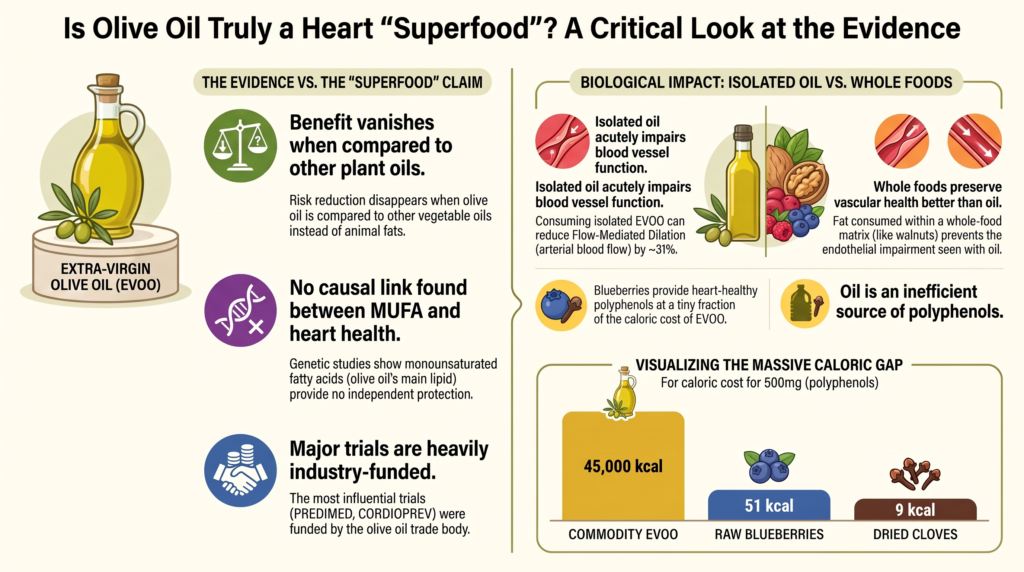
Il test epidemiologico decisivo è il confronto diretto con altri oli vegetali. All’interno delle stesse coorti, la sostituzione di 10 g/giorno di grassi animali ad alto contenuto di grassi saturi (margarina, burro, maionese, grassi lattiero-caseari) con olio d’oliva è risultata associata a una riduzione del rischio di mortalità totale e per cause specifiche compresa tra 8% e 34%. [1Ma confrontato direttamente con altri oli vegetali combinati, l'olio d'oliva ha mostrato nessuna differenza statisticamente significativa per malattie cardiovascolari totali, cardiopatia coronarica o ictus. [1,2] Sulla base di questi dati, il beneficio apparente riflette lo spostamento del grasso animale aterogenico piuttosto che una qualsiasi proprietà intrinseca dello scheletro lipidico dell'olio d'oliva.
Fattori di confondimento residui composto questo. Quelli con il più alto consumo di olio d'oliva avevano stili di vita complessivamente più sani (più attività fisica, meno fumo, più frutta e verdura), e gli autori hanno riconosciuto che un alto consumo di olio d'oliva potrebbe semplicemente indicare uno status socioeconomico più elevato e una migliore qualità complessiva della dieta.1]
1.1 Il quadro di prevenzione primaria PREDIMED
Lo studio PREDIMED ha randomizzato 7.447 adulti spagnoli ad alto rischio a un dieta mediterranea più olio extravergine di oliva (EVOO) gratuito, una dieta mediterranea con aggiunta di noci o una dieta di controllo (consigli a basso contenuto di grassi), con un follow-up mediano di 4,8 anni. Il braccio trattato con EVOO ha mostrato un tasso composito inferiore di infarto miocardico, ictus e morte cardiovascolare (HR 0,69; IC 95% 0,53–0,91) rispetto al gruppo di controllo, con una riduzione relativa di circa il 30%. [4]
Due avvertenze attenuano questo aspetto: in primo luogo, nelle analisi secondarie l'associazione inversa tra l'assunzione basale di EVOO e gli eventi maggiori si è mantenuta solo all'interno dei gruppi randomizzati alla dieta mediterranea ed è stata annullata nel gruppo di controllo a basso contenuto di grassi; pertanto, il valore dell'olio d'oliva sembra dipendere dal modello circostante piuttosto che essere intrinseco.4]
Secondo, e cosa ben più grave, il PREDIMED è stato ritirato. Una rianalisi del 2017 condotta da Carlisle ha rilevato distribuzioni di base statisticamente incompatibili con l'allocazione casuale.6] La verifica ha rilevato che la randomizzazione non era stata effettuata correttamente per circa 1.588 dei 7.447 partecipanti (circa 21%): in un centro i membri dello stesso nucleo familiare erano stati assegnati in blocco; in un secondo centro la tabella di randomizzazione non era stata utilizzata correttamente; in un terzo centro l’intera clinica era stata randomizzata come un’unica unità. Nel giugno 2018 il NEJM ha ritirato l’articolo del 2013 e ha ripubblicato una rianalisi corretta per il raggruppamento. [4,5Poiché non è più rigorosamente randomizzato a livello individuale, PREDIMED è da considerarsi preferibilmente come un intervento quasi-randomizzato; il NICE lo aveva già giudicato a serio rischio di bias per i singoli esiti cardiovascolari.71]
1.2 Prevenzione Secondaria: CORDIOPREV
Lo studio CORDIOPREV ha assegnato in modo casuale 1.002 pazienti spagnoli affetti da malattia coronarica a una dieta mediterranea ricca di olio extravergine di oliva (~35% di grassi, ~22% di acidi grassi monoinsaturi) rispetto a una dieta a basso contenuto di grassi per un periodo di 7 anni. L’incidenza di eventi cardiovascolari maggiori ricorrenti (MACE) è stata di 28,1 per 1.000 anni-persona (dieta mediterranea) contro 37,7 per 1.000 anni-persona (dieta a basso contenuto di grassi); gli hazard ratio aggiustati per variabili multiple nei diversi modelli variavano da 0,719 (IC 95% 0,541–0,957) a 0,753 (IC 95% 0,568–0,998) a favore della dieta mediterranea, con una riduzione relativa di circa il 25–28% (p del test del log-rank = 0,039). [8] 28.1 è il tasso di incidenza per braccio mediterraneo per 1.000 anni-persona, non la percentuale di riduzione del rischio; l'IC 0,62–0,89 in una bozza precedente non compare nella fonte ed è stato sostituito con l'intervallo del modello riportato.
Il comparatore non era una vera e propria dieta a basso contenuto di grassi. Il gruppo di controllo ha ridotto l'apporto calorico totale derivante dai grassi solo a circa 32%, un valore inferiore alla soglia clinica <30% e ben lontano dal <10–15% indicato da Ornish ed Esselstyn inversione prove. Grassi saturi era pressoché identico tra i due gruppi (~7,91 TP9T contro ~7,11 TP9T), mentre il gruppo di controllo ne ha consumati circa 101 TP9T in più proteina, principalmente di origine animale, con meno legumi, verdure e frutta. Il beneficio potrebbe riflettere il pessimo comparatore piuttosto che un'azione unica dell'EVO.8]
Una sotto-analisi genetica lo conferma: i portatori dell'allele di rischio ZPR1 rs964184 sottoposti alla dieta mediterranea hanno mantenuto livelli elevati a digiuno e postprandiali trigliceridi, mentre quelli con la dieta a basso contenuto di grassi li hanno normalizzati, quindi per determinati genotipi il modello ricco di EVOO è risultato inferiore per la clearance dei trigliceridi.9]
1.3 Randomizzazione Mendeliana: Nessun segnale causale per gli AGMI
Se l'acido oleico, il principale MUFA dell'olio d'oliva, fosse direttamente cardioprotettivo, livelli circolanti geneticamente più alti di MUFA dovrebbero ridurre il rischio. Le analisi con variabili strumentali non trovano prove convincenti di un effetto protettivo causale dei MUFA circolanti sulla cardiopatia coronarica, sull'infarto miocardico o ictus ischemico. [10] Si tratta di una mancata rilevazione di un effetto piuttosto che di una prova positiva della sua assenza, ma rimuove un pilastro fondamentale dall'affermazione del beneficio intrinseco. La RM multivariabile dà costantemente priorità all'ApoB e numero di particelle LDL come fattori lipidici causali, senza alcun segnale indipendente di AGMU.11,12Questi dati geneticamente ancorati e indipendenti dall'industria sono tra le prove più forti del fatto che le associazioni di coorte attribuite all'olio d'oliva siano sostanzialmente confuse dallo stile di vita e dalla dieta dei consumatori.
Tabella 1. Principali studi sull'olio d'oliva e sugli esiti cardiovascolari
| Studio / Coorte | Popolazione & Design | Esposizione / Intervento | Stima dell’effetto (intervallo di confidenza 95%) | Avvertenze principali |
| Mortalità NHS e HPFS1] | 92.383 adulti statunitensi; coorte prospettica di 28 anni | Maggiore assunzione (>7 g/giorno) rispetto ai non consumatori | Per tutte le cause: HR 0,81 (0,78–0,84) RCV: HR 0,81 (0,75–0,87) |
Beneficio pienamente riprodotto da altri oli vegetali; guidato dalla sostituzione del grasso animale |
| Incidente di CVD in NHS & HPFS2] | 92.978 adulti statunitensi; coorte prospettica di 24 anni | Consumo massimo vs non consumatori | CVD totale: HR 0,86 (0,79–0,94) Cardiopatia ischemica: HR 0,82 (0,73–0,91) |
Nessuna associazione con l'ictus; nessuna differenza rispetto ad altri oli vegetali |
| PREDIMED prevenzione primaria [4] | 7.447 adulti spagnoli ad alto rischio; quasi-RCT di 4,8 anni | Dieta Mediterranea + OEVO vs consigli a basso contenuto di grassi | MACE composito: HR 0,69 (0,53–0,91) | RITIRATO / ripubblicato; ~21% randomizzato in modo errato; olio extravergine di oliva fornito dall'associazione di categoria del settore oleario |
| CORDIOPREV prevenzione secondaria [8] | 1.002 pazienti coronarici spagnoli; RCT di 7 anni | Dieta mediterranea + OEVO vs dieta povera di grassi | MACE ricorrenti: HR 0,719–0,753 (ad es., 0,541–0,957) | “A basso contenuto di grassi”: contiene solo circa 32% di grassi; finanziato dall’associazione di categoria del settore dell’olio d’oliva |
| Randomizzazione mendeliana10–12] | UK Biobank e meta-analisi GWAS | MUFA circolanti geneticamente determinati (acido oleico) | CHD / MI / stroke: nessuna associazione causale | MUFA non protettivi in senso causale; l'ApoB è il tratto causale |
La sfumatura verde = evidenza indipendente a sostegno della tesi scettica. La sfumatura rossa = RCT sull'efficacia dell'olio extravergine d'oliva finanziati dall'industria (mantenuti con riserva; vedi testo).
1.4 L'argomento più forte a favore dell'olio d'oliva
L'onestà intellettuale richiede di esporre la tesi affermativa nella sua forma più forte prima di spiegare perché non sia sufficiente a stabilirne l'efficacia indipendente. Diversi risultati autentici e riproducibili supportano l'olio d'oliva come componente di uno stile alimentare salutare per il cuore.
Sostituzione dei grassi saturi e LDL. La sostituzione dell'olio d'oliva al burro, allo strutto o ad altri grassi saturi riduce Colesterolo LDL e le analisi di sostituzione dell'NHS/HPFS mostrano una mortalità significativamente inferiore quando l'olio d'oliva sostituisce i grassi animali.1,65] Poiché le LDL/ApoB sono il fattore causale determinante della aterosclerosi, questo effetto di sostituzione è reale e clinicamente utile.
Pressione sanguigna e marcatori endoteliali. Gli oli d’oliva con un contenuto fenolico più elevato sono stati associati a una lieve riduzione della pressione arteriosa e a miglioramenti in alcuni marcatori endoteliali e infiammatori; inoltre, i dati relativi alla combinazione di oli fenolici e vino rosso indicano che tale combinazione può persino determinare un miglioramento acuto della FMD. [16,65] L'affermazione fenolica riconosciuta dall'EFSA, qualunque sia il suo costo calorico pratico, si basa su un genuino in vitro e ex vivo antiossidante segnale.22]
Il segnale in stile mediterraneo. Nell'ambito di un modello mediterraneo complessivo, le diete integrate con olio extravergine di oliva hanno ridotto gli eventi maggiori sia nello studio PREDIMED che nel CORDIOPREV, e hanno ridotto la carotide placca progressione in CORDIOPREV.4,8] Si tratta di risultati a livello di RCT, non meramente osservazionali, e non dovrebbero essere scartati.
Perché questo non stabilisce un'efficacia indipendente. Ciascuno di questi benefici è spiegabile senza invocare una proprietà unica del lipide dell'olio d'oliva. Gli effetti su LDL e mortalità sono effetti di sostituzione riprodotti da altri oli vegetali; gli effetti sulla pressione sanguigna e sui biomarcatori sono condivisi da molti cibi integrali ricchi di polifenoli forniti a un costo calorico di gran lunga inferiore; il segnale antiossidante fenolico non si è tradotto in un effetto specifico per i fenoli in vivo vantaggio nel test controllato più pulito24]; e i benefici degli RCT sono stati misurati rispetto a comparatori deboli o ricchi di proteine animali, all'interno di modelli multicomponente e in studi finanziati dal settore dell'olio d'oliva. La tesi a favore stabilisce che l'olio d'oliva è un buon sostituto dei grassi animali e una parte ragionevole di una dieta ricca di vegetali. Non stabilisce che l'olio d'oliva, isolatamente, sia autonomamente cardioprotettivo, che è la specifica affermazione esaminata da questa revisione.
Dinamica vascolare postprandiale: oli isolati rispetto ai grassi di alimenti interi
L'impatto vascolare acuto dell'assunzione di grassi si manifesta nello stato postprandiale — transitorio disfunzione endoteliale, stress ossidativo, e la segnalazione infiammatoria. L'indice standard è dilatazione mediata dal flusso del brachiale arteria, una risposta dipendente dall’ossido nitrico. Il consumo di oli alimentari isolati, compreso l’olio extravergine di oliva, determina sistematicamente una riduzione acuta e significativa della FMD. [13]
In uno studio crossover di riferimento, un singolo pasto da 900 kcal contenente 50 g di grassi provenienti da olio d’oliva isolato ha ridotto l’FMD di circa 31% a 3 ore, da un valore basale di 14,3 ± 4,2% a 9,9 ± 4,5% (p = 0,008); tale diminuzione era inversamente correlata all’aumento postprandiale dei trigliceridi (r = −0,47, p < 0,05). [13] In una versione precedente si affermava che l’FMD scendesse “a ~4,5%”; 4,5% è la deviazione standard, non la media. Il valore postprandiale corretto è 9,9%, e lo studio di riferimento è quello di Vogel et al. del 2000.
Studi comparativi evidenziano divergenze in base a matrice alimentare: una farina di noci mantiene o migliora l’FMD, mentre una farina a base di olio d’oliva con lo stesso contenuto di grassi lo peggiora. [14] Avvertenza: il confronto tra noci e olio [14] è stato finanziato dalla California Walnut Commission e uno degli autori faceva parte del suo Comitato consultivo scientifico. Non è stato individuato alcun studio clinico postprandiale completamente indipendente che mettesse a confronto direttamente le noci con l’olio; pertanto, questo risultato va interpretato come indicativo in senso positivo, ma influenzato dall’industria.
A tutta questa sezione si applica un’importante avvertenza. È stato dimostrato direttamente solo il primo anello della catena ipotizzata, ovvero che l’olio isolato riduce in modo acuto l’FMD. Non è stato invece dimostrato se queste alterazioni endoteliali transitorie postprandiali si traducano in un’aterosclerosi accelerata e, in ultima analisi, in eventi cardiovascolari clinici. Tale progressione è biologicamente plausibile e coerente con il modello «risposta alla ritenzione», ma rimane un’ipotesi piuttosto che una sequenza causale dimostrata nell’uomo. I dati postprandiali dovrebbero quindi essere interpretati come un segnale meccanicistico, non come prova di un danno a lungo termine causato dall’olio d’oliva.
2.1 Meccanismo: i residui dei chilomicroni e il modello “risposta alla ritenzione”
La compromissione acuta è legata a lipemia postprandiale e il modello risposta-ritenzione di aterogenesi. [29,33] Il rapido assorbimento dei triacilgliceroli emulsionati provenienti dall'olio isolato provoca un picco di chilomicroni; l'idrolisi operata dalla lipoproteina-lipasi produce quindi residui più piccoli e aterogenici (<70 nm) che attraversano l'arteria endotelio tramite Active transcitosi mediata dal recettore scavenger di classe B di tipo 1 (SR-BI) e dalla chinasi 1 simile al recettore dell’activina (ALK1). [30] Dati meccanicistici (su cellule, animali e biomarcatori umani), non di livello RCT.
Nei capillari, questa idrolisi è stabilizzata dalla GPIHBP1, che fissa la LPL alla superficie luminale; nelle arterie più grandi la GPIHBP1 è assente, pertanto i residui intatti interagiscono direttamente con la parete arteriosa. [31,32] I residui contenenti ApoB che rimangono nell'endotelio si legano ai proteoglicani subendoteliali, vengono ossidati in aldeidi reattive come il 4-idrossinonenale (4-HNE) e attivano l'NF-κB nell'endotelio e macrofagi, provocando VCAM-1, ICAM-1, e l’E-selectina; i monociti quindi aderiscono, trasmigrano e diventano cellule schiumose. [33,37,39] Ogni singola fase di questa sequenza è supportata da prove sperimentali, ma l’intero processo, che va dall’ingestione di un bolo di olio alimentare alla formazione dei residui, alla transcitosi, alla generazione delle cellule schiumose e alla formazione della placca, viene dedotto mettendo insieme tali fasi. Questo percorso integrato rimane di natura meccanicistica, piuttosto che essere stato dimostrato sperimentalmente come sequenza continua nell’uomo.
2.2 Ossido nitrico, ADMA e disaccoppiamento dell’eNOS
La compromissione postprandiale è in gran parte mediata dalla ridotta biodisponibilità dell’ossido nitrico. La sintasi endoteliale dell’ossido nitrico (eNOS) produce NO a partire dall’L-arginina; la dimetilarginina asimmetrica (ADMA) inibisce in modo competitivo l’eNOS e viene normalmente eliminata dalla dimetilarginina dimetilaminoidrolasi (DDAH). [40,43] Durante la lipemia, i ROS e l’aldeide lipidica 4-HNE inibiscono la DDAH, l’ADMA si accumula e l’eNOS si disaccoppia producendo superossido e perossinitrito, causando una disfunzione endoteliale acuta. [40,41] Si tratta di un modello supportato da dati meccanicistici; i dettagli relativi alla causalità alimentare non sono stati stabiliti da studi randomizzati controllati (RCT).
2.3 La matrice alimentare integrale previene il calo postprandiale
In diversi studi controllati, le fonti di grassi presenti negli alimenti integrali (avocado fresco, noci crude) sembrano attenuare o prevenire il danno endoteliale osservato in seguito al consumo di oli isolati, piuttosto che eliminarlo in modo affidabile. [14,15] In uno studio randomizzato crossover, la sostituzione dell'avocado Hass fresco al posto di quello raffinato carboidrato miglioramento della FMD postprandiale e riduzione dei livelli di trigliceridi lipoproteine rispetto a un gruppo di controllo con lo stesso contenuto di grassi. [15] Avvertenza: le ricerche postprandiali sull’avocado sono spesso finanziate dall’Hass Avocado Board; è opportuno verificare la dichiarazione specifica relativa al finanziamento e interpretare i risultati come legati al settore. L'intatto fibra e la matrice cellulare rallentano lo svuotamento gastrico e l'accesso delle lipasi, appianando la curva dei trigliceridi, mentre gli antiossidanti assorbiti contemporaneamente neutralizzano i ROS, preservano la DDAH e mantengono l'accoppiamento dell'eNOS. [44,47]
Il profilo postprandiale sfavorevole è inoltre modificabile dagli antiossidanti assunti contemporaneamente. Nello studio di Vogel, l’aggiunta di vitamine C ed E, oppure di un’insalata condita con aceto balsamico, al pasto a base di olio d’oliva ha impedito completamente la riduzione della FMD. [13] Uno studio incrociato separato ha riportato che la combinazione di 50 g di olio d’oliva verde ad alto contenuto fenolico con 250 mL di vino rosso ha prodotto un miglioramento sinergico della FMD postprandiale che si è mantenuto fino a due ore (p = 0,002). [16] Dichiarazione di finanziamento per [16] non reperibile; da considerare come non verificato ai fini dell’indipendenza. Si noti che questo risultato avvalora l’ipotesi secondo cui “il contesto fenolico e quello alimentare complessivo sono rilevanti”, non quella relativa ai benefici dell’olio isolato. La conclusione è che il danno endoteliale causato dal consumo di olio da solo dipende dal contesto e non è immutabile, ma il modo più sicuro per evitarlo è assumere i grassi sotto forma di alimenti integrali.
Tabella 2. Cascata aterogena postprandiale dopo l’ingestione di olio isolato (modello meccanicistico)
| Palcoscenico | Mediatori chiave | Meccanismo | Effetto sull'eNOS / Permeabilità |
| 1. Lipemia e generazione di residui | Triacilgliceroli, chilomicroni, LPL | Rapido assorbimento dei lipidi isolati → picco dei chilomicroni; idrolisi da parte della LPL → residui piccoli e densi (<70 nm) | Livelli elevati di trigliceridi compromettono la reattività vascolare sistemica |
| 2. Transcitosi e ritenzione | Resti, SR-BI, ALK1, proteoglicani | I residui attraversano l'endotelio tramite SR-BI/ALK1 e si accumulano nel intima | Aumento della permeabilità; le particelle di ApoB si legano ai proteoglicani |
| 3. Modifiche ossidative | ROS, 4-HNE, residui ossidati | Le particelle trattenute vengono ossidate in aldeidi citotossiche | Il 4-HNE inibisce la DDAH; l’eNOS si disaccoppia producendo superossido |
| 4. Attivazione endoteliale | NF-κB, VCAM-1, ICAM-1, E-selectina | I lipidi ossidati attivano l'NF-κB → espressione delle molecole di adesione | Il rivestimento vascolare diventa adesivo nei confronti dei leucociti |
| 5. Reclutamento dei monociti e cellule schiumose | Monociti, macrofagi, recettori scavenger, IL-6, TNF-α | I monociti aderenti migrano, si differenziano e formano cellule schiumose | Sostenuto infiammazione; perdita del tono vasodilatatore |
Questa cascata rappresenta una sintesi meccanicistica degli studi condotti su cellule, animali e biomarcatori umani [29–43]; tale nesso causale non è stato dimostrato negli esseri umani con uno studio randomizzato controllato (RCT).
3. Meccanismi di inversione delle diete a base di alimenti vegetali integrali
Mentre le diete standard a basso contenuto di grassi e quelle di tipo mediterraneo rallentano in genere la progressione della malattia, gli interventi basati su una dieta rigorosamente a basso contenuto di grassi e a base vegetale (WFPB) sono gli unici programmi alimentari che hanno dimostrato regressione angiografica della malattia coronarica negli studi di intervento pubblicati. Tale base di evidenze è limitata, altamente selettiva, comporta diversi cambiamenti simultanei nello stile di vita e non è stata replicata in modo indipendente sulla stessa scala; essa viene qui descritta tenendo esplicitamente conto di tali limiti, anziché come una superiorità accertata. [54]
Di Ornish Lifestyle Heart Trial (un piccolo studio randomizzato controllato, n = 48) ha combinato un regime alimentare con circa 10% di grassi dieta vegetariana senza oli aggiunti, attività fisica, gestione dello stress e sostegno del gruppo. Angiografia coronarica quantitativa ha mostrato una regressione della percentuale media del diametro stenosi (da 40,01 TP9T a 37,81 TP9T nel gruppo di intervento rispetto a una progressione da 42,71 TP9T a 46,11 TP9T nel gruppo di controllo) a 1 anno, con un’ulteriore divergenza a 5 anni. [17,18] LDL colesterolo è sceso di circa 371 TP9T senza l'uso di farmaci ipolipemizzanti, angina la frequenza è diminuita notevolmente, mentre i pazienti del gruppo di controllo ne avevano circa il doppio eventi cardiaci entro il quinto anno. [18] Si tratta di uno studio di tipo RCT, ma di piccole dimensioni, e l'intervento è multicomponente, quindi non è possibile isolare la dieta.
La serie di casi di Esselstyn ha seguito 198 pazienti con CVD accertata a cui era stata raccomandata una dieta WFPB rigorosa, che escludeva tutti gli oli aggiunti; 177 su 198 (89%) hanno aderito alla dieta. Tra i pazienti aderenti alla dieta, si è verificato un evento ricorrente (0,6%), contro 13 su 21 (62%) tra i non aderenti, in un periodo medio di 3,7 anni. [19] Indipendente (l'autore dichiara l'assenza di conflitti di interesse) ma non controllato, basato su un campione autoselezionato e di tipo osservazionale — non di livello RCT. L'affermazione relativa alla “inversione” si basa su un piccolo RCT [17,18] oltre a questa coorte non controllata; i lettori dovrebbero tenerne conto di conseguenza.
3.1 Eliminazione diretta dell'ApoB circolante
Una dieta WFPB rigorosa elimina quasi completamente colesterolo alimentare e grassi saturi/trans, fornendo al contempo fibre solubili e fitosteroli, esaurendo le riserve epatiche di colesterolo, attivando sterolo proteine che legano elementi regolatori e che ne aumentano l'espressione Recettori delle LDL. [48] I livelli ematici di ApoB e LDL-C diminuiscono, spesso scendendo al di sotto dei 70 mg/dL, riducendo così il gradiente che determina l’ingresso delle lipoproteine nell’intima e attenuando la fase iniziale della cascata di risposta alla ritenzione. [33,35,36] Che l'ApoB sia il fattore causale è ormai ben dimostrato dai dati genetici e clinici. [35,36]
3.2 Ripristino dell'attività dell'eNOS e della biodisponibilità dell'NO
L'eliminazione degli oli aggiunti e dei grassi trasformati riduce i trigliceridi e previene l'ADMA-mediata Disaccoppiamento dell'eNOS; le verdure a foglia verde forniscono nitrati inorganici che vengono ridotti a nitriti e quindi a NO bioattivo; e abbondanti polifenoli proteggere la tetraidrobiopterina (BH4), mantenendo l'eNOS accoppiata. [43,50] Si tratta di percorsi supportati dal punto di vista meccanicistico piuttosto che di endpoint clinici oggettivi.
3.3 La via metabolica del TMAO
Trimetilammina-N-ossido (TMAO), un metabolita delle sostanze alimentari che dipende dal microbiota intestinale carnitina e colina, è associato a un’aterosclerosi accelerata attraverso effetti sui recettori scavenger dei macrofagi e trasporto inverso del colesterolo. [52,53] Il passaggio a una dieta a base di alimenti vegetali (WFPB) favorisce la proliferazione dei taxa che fermentano le fibre e riduce la presenza delle specie che producono TMA, riducendo notevolmente Produzione di TMAO. [53] Una bozza precedente affermava che la dieta WFPB “elimina completamente” il TMAO; si tratta di un’affermazione esagerata. I vegani producono una quantità di TMAO nettamente inferiore dopo un test di carico con carnitina, ma il metabolismo endogeno della colina e l’attività microbica residua fanno sì che il TMAO venga ridotto, non eliminato. L’affermazione è stata corretta in “riduce notevolmente”.”
3.4 Attenuazione dell’infiammazione sistemica
La fermentazione delle fibre produce acidi grassi a catena corta che riducono l'infiammazione sistemica; le diete WFPB riducono i livelli di alta sensibilità Proteina C-reattiva e ridurrebbero l'espressione delle molecole di adesione regolate da NF-κB, facendo passare la parete arteriosa da una fase di reclutamento attivo a una di risoluzione. [54,62] Le dimensioni dell’effetto variano da uno studio all’altro, soprattutto in quelli di piccole dimensioni, e non dovrebbero essere sopravvalutate.
Tabella 3. Effetti comparativi di tre modelli alimentari
| Parametro | Controllo a basso contenuto di grassi (30–35% di grassi) | Mediterraneo + olio extravergine di oliva | Dieta WFPB rigorosamente senza oli aggiunti |
| LDL-C / ApoB | Riduzioni da minime a modeste; spesso non riesce a riportare l’ApoB entro i valori fisiologici | Riduzioni modeste; il colesterolo LDL rimane in genere tra 80 e 100 mg/dL, lasciando un rischio residuo legato alle particelle | Riduzioni significative; spesso LDL-C <70 mg/dL, con conseguente riduzione al minimo della penetrazione nell’intima |
| FMD postprandiale / NO | Deterioramento temporaneo causato dai carboidrati raffinati o dai grassi saturi | Riduzione acuta della FMD (~31% in [13]) a meno che non siano abbinati ad antiossidanti | FMD postprandiale preservata; senza aggiunta di olio, elevata biodisponibilità di NO |
| Infiammazione sistemica (hs-CRP) | Riduzione minima | È stata segnalata una riduzione significativa (studi condotti in collaborazione con l'industria; con alcune riserve) | Riduzione sostanziale; downregolazione di NF-κB |
| Progressione della placca | Continua progressione anche con statine | Progressione ritardata; lieve regressione dell’IMT; gli eventi ricorrenti persistono | Arresto angiografico documentato e regressione parziale (studi su scala ridotta) |
| TMAO di origine microbica | Elevato; conversione continua di carnitina/colina | Variabile; persiste nel pesce, nel pollame e nei latticini | Notevolmente ridotto (ma non completamente abolito) |
Le stime relative alle colonne “Mediterraneo” e “WFPB” derivano da studi di dimensioni diverse e con diversi livelli di indipendenza finanziaria; per ulteriori precisazioni, si vedano il testo e la Sezione 4.
4. Analisi critica delle sponsorizzazioni da parte dell’industria e delle indicazioni nutrizionali
4.1 I casi di ritiro e di mancata randomizzazione nello studio PREDIMED
Lo studio PREDIMED, pubblicato sul NEJM nel 2013, è stato lo studio clinico più influente a sostegno della dieta mediterranea e dell’olio extravergine di oliva. [68] La rianalisi condotta da Carlisle nel 2017 ha rilevato distribuzioni di base incompatibili con la randomizzazione (p < 0,0001). [6] L'audit interno ha rilevato violazioni sistematiche della randomizzazione che hanno interessato circa 1.588 partecipanti (circa il 21% della coorte): assegnazione in blocco per nucleo familiare in un centro, uso improprio della tabella di randomizzazione in un altro e assegnazione a livello di clinica (anziché individuale) in un terzo. [4,5] Nel giugno 2018 il NEJM ha ritirato l’articolo del 2013 e ne ha ripubblicato una rianalisi; poiché non era più strettamente randomizzata, il suo livello di evidenza è sceso a quello di un intervento di tipo coortale quasi randomizzato. Il NICE l’aveva valutata come soggetta a un grave rischio di bias, con dati di qualità da bassa a molto bassa per i singoli esiti. [71]
4.2 CORDIOPREV: un comparatore debole
CORDIOPREV è considerato il principale studio sulla prevenzione secondaria che favorisce una dieta mediterranea rispetto a una dieta a basso contenuto di grassi, ma il suo braccio di controllo non ha raggiunto un vero e proprio obiettivo a basso contenuto di grassi (~32% di calorie provenienti dai grassi, contro la definizione clinica <30% e il <10–15% di Ornish ed Esselstyn). [8] L’apporto di grassi saturi era pressoché identico nei due gruppi, mentre il gruppo di controllo assumeva circa 10% di proteine in più — per lo più di origine animale — consumando al contempo una quantità minore di alimenti vegetali integrali. La riduzione di circa 26% degli eventi cardiovascolari maggiori (MACE) potrebbe essere attribuibile alla dieta scorretta del gruppo di controllo piuttosto che a un meccanismo specifico dell’olio extravergine di oliva. [8]
4.3 Fonti di finanziamento e conflitti di interesse
I due principali risultato concreto Gli studi clinici randomizzati (RCT) sull’olio extravergine di oliva (EVOO) qui discussi sono PREDIMED e CORDIOPREV; numerosi studi clinici randomizzati di minore entità sull’olio d’oliva in merito a marcatori surrogati esistono anche altri studi, ma nessuno di essi valuta gli esiti cardiovascolari gravi indipendentemente dal settore dell’olio d’oliva. Lo studio PREDIMED, sebbene finanziato principalmente dal governo, ha ricevuto in donazione olio extravergine di oliva da Hojiblanca e Patrimonio Comunal Olivarero, oltre a frutta secca donata dalla California Walnut Commission e da altri soggetti. [73] Tra i conflitti di interesse dichiarati dai membri del comitato direttivo figurano quelli di Emilio Ros (sovvenzioni di ricerca ricevute dalla California Walnut Commission e appartenenza al Comitato consultivo scientifico della stessa) e di Jordi Salas-Salvadó (sovvenzioni ricevute dall’International Nut and Dried Fruit Council e appartenenza a titolo onorario al comitato consultivo della stessa organizzazione). [74] Una bozza precedente attribuiva il finanziamento da parte dell’International Nut Council a M. Á. Martínez-González; tale attribuzione non trova riscontro nelle informazioni rese pubbliche ed è stata rimossa. Il legame accertato con l’industria delle noci riguarda Salas-Salvadó.
Il progetto CORDIOPREV è stato sostenuto dal Fondazione Patrimonio Comunitario Olivicolo, un'organizzazione dedicata alla promozione delle esportazioni di olio d'oliva spagnolo; già la sua stessa sigla rivela l'interesse del promotore. [76] Questi legami sistematici tra un singolo interesse commerciale e l’intera letteratura sugli studi clinici randomizzati controllati (RCT) sull’efficacia dell’olio extravergine di oliva giustificano un approccio cauto nei confronti della concezione dell“”olio d’oliva come superfood”. [67,69]
4.4 Lo studio Lyon Diet Heart: olio di colza, non olio d’oliva
Il Studio di Lione sulla dieta cardioprotettiva viene spesso citato nel contesto della prevenzione secondaria nell’area mediterranea, riportando una riduzione della mortalità per tutte le cause pari a circa 70% (rapporto di rischio aggiustato 0,30; IC al 95% 0,11–0,82). [27,28] Tuttavia, il grasso aggiunto non era olio d’oliva: il gruppo sperimentale ha ricevuto una margarina personalizzata a base di olio di colza, studiata per riprodurre il profilo cretese, ricca di acido alfa-linolenico (ALA), con un basso rapporto omega-6/omega-3 (~2,8). [27,79] Gli autori della revisione hanno attribuito il beneficio in termini di mortalità principalmente agli effetti antiaritmici e antitrombotici dell’ALA piuttosto che all’olio d’oliva. [78] La scelta della colza rifletteva, in parte, la storia della “sindrome da olio tossico” in Spagna, che aveva reso le sperimentazioni sull’olio di colza socialmente delicate in quel Paese; si tratta di un contesto storico, non di un’affermazione relativa alla cardioprotezione.
4.5 L“”alone di salute” dei polifenoli e il divario di efficienza calorica
Uno dei principali argomenti di marketing è il contenuto di biofenoli dell’olio extravergine di oliva (idrossitirosolo, oleuropeina, oleocantale, oleaceina). Nel 2011 l’Autorità europea per la sicurezza alimentare ha approvato un’indicazione secondo cui i polifenoli dell’olio d’oliva proteggono i lipidi nel sangue dallo stress ossidativo, a condizione che siano presenti ≥5 mg di idrossitirosolo e suoi derivati per 20 g di olio, con un consumo di 20 g al giorno. [22,23]
Tuttavia, l’olio d’oliva è un veicolo di polifenoli ad alto contenuto calorico. Si tratta di un lipide (~100%) (~900 kcal/100 g, ~120 kcal per cucchiaio) con un contenuto trascurabile di fibre, proteine o micronutrienti idrosolubili. [47] L’olio extravergine di oliva di uso comune spesso si attesta al di sotto della soglia stabilita dall’EFSA, e anche gli oli premium ad alto contenuto fenolico richiedono un elevato apporto di lipidi per fornire una dose significativa di polifenoli, mentre gli alimenti a base di piante intere forniscono una quantità di polifenoli di gran lunga superiore per caloria. [21,85] I valori dei polifenoli per alimento riportati di seguito provengono dal database Phenol-Explorer e variano a seconda del metodo di analisi e di estrazione; i valori in grammi per caloria che ne derivano sono calcoli indicativi, non risultati misurati in studi clinici.
Tabella 4. Fabbisogno calorico necessario per assumere 500 mg di polifenoli in base alla fonte alimentare
| Fonte di cibo | Polifenoli (mg/100 g) | Energia (kcal/100 g) | Massa per 500 mg (g) | Valore calorico (kcal) |
| Olio extravergine di oliva di base | ~10 | 900 | 5,000 | 45,000 |
| Olio extravergine di oliva di alta qualità ad alto contenuto fenolico | ~50 | 900 | 1,000 | 9,000 |
| Mirtilli freschi | 560 | 57 | 89 | 51 |
| Aronia nera | 1,022 | 47 | 49 | 23 |
| Cioccolato fondente (≥70%) | 1,664 | 598 | 30 | 180 |
| Chiodi di garofano essiccati | 15,188 | 274 | 3.3 | 9 |
Concentrazioni di polifenoli secondo Phenol-Explorer [21,85]; valori energetici forniti dall’USDA. Rosso = fonti di polifenoli ad alto contenuto calorico; verde = fonti efficienti presenti negli alimenti integrali. I valori devono essere verificati per ogni cella prima della pubblicazione, poiché i risultati del test di Folin variano a seconda del metodo utilizzato.
4.6 I composti fenolici sono efficaci in vivo?
Uno studio crossover controllato ha rilevato che l'olio d'oliva arricchito con composti fenolici polari o non polari ha aumentato il tempo di ritardo dell'ossidazione delle LDL di circa 8 minuti, ma lo stesso aumento si è verificato anche con l'olio privo di polifenoli placebo olio, il che suggerisce un effetto non specifico legato al pasto o all’ora piuttosto che un beneficio specifico derivante dai composti fenolici. [24] Un singolo studio non può ribaltare l’intero quadro della ricerca, e altri lavori riportano effetti specifici del fenolo; tuttavia, questo studio relativamente indipendente (condotto da Wageningen) solleva importanti interrogativi sull’entità del meccanismo antiossidante proposto e invita alla cautela nel considerarlo come un dato di fatto. [24] Le analisi correlate sull’ossidazione delle LDL condotte dallo stesso gruppo erano legate a Unilever o finanziati dal Consiglio Internazionale dell’Olio d’Oliva [89]; l’articolo del 2001 pubblicato su *Free Radical Research* specificatamente citato [24] è la fonte più attendibile ed è quella utilizzata in questa sede.
Alcuni studi clinici condotti in collaborazione con l’industria (ad esempio, gli studi EUROLIVE e quelli sulla funzione delle HDL) riportano effettivamente benefici legati ai composti fenolici. [49,86] Queste fonti sono citate per completezza, ma sono soggette a riserve in materia di finanziamento e non devono essere interpretate come una conferma indipendente. [61,63]
L'azione farmacologica dell'oleocantale è reale, ma distinta dalla cardioprotezione clinica: inibisce la COX-1 e la COX-2 in modo dose-dipendente, come l'ibuprofene, [25] mentre la sensazione di bruciore alla gola, simile a quella provocata dal pepe, causata dall’olio ad alto contenuto fenolico è mediata dai canali TRPA1 presenti esclusivamente nella parte posteriore dell’orofaringe — un fenomeno sensoriale che non ha alcuna influenza accertata sugli esiti cardiovascolari. [26]
5. Conclusioni
Una sintesi critica indica che le attuali evidenze indipendenti non dimostrano un effetto cardioprotettivo clinicamente significativo dell’olio d’oliva isolato al di là della sostituzione dei grassi saturi e trans. Si tratta di una conclusione sull’assenza di prove convincenti a sostegno di un beneficio specifico, non di una prova certa che tale beneficio non esista. Le associazioni epidemiologiche sono reali, ma si riscontrano anche con altri oli vegetali e sono coerenti con la sostituzione dei grassi di origine animale; l’analisi di meta-regressione (MR) non trova prove convincenti di un effetto causale dei grassi monoinsaturi (MUFA) e punta invece l’attenzione sull’ApoB. [1,2,10,11]
Dal punto di vista fisiologico, l’olio extravergine di oliva (EVOO) assunto da solo compromette in modo acuto la funzione endoteliale postprandiale accelerando la generazione e la ritenzione dei residui di chilomicroni — un effetto che le fonti di grassi presenti negli alimenti integrali sembrano attenuare. Non è stato dimostrato se questa compromissione postprandiale transitoria si traduca in aterosclerosi a lungo termine ed eventi clinici; si tratta di un nesso meccanicistico plausibile, non ancora accertato, e come tale dovrebbe essere presentato. [13,14,15]
Sebbene le diete integrate con olio extravergine di oliva (EVOO) possano rallentare la progressione della malattia rispetto a gruppi di controllo con regimi alimentari meno efficaci, solo i modelli alimentari rigorosamente a basso contenuto di grassi e basati su alimenti di origine vegetale (WFPB), che escludono gli oli aggiunti, hanno dimostrato di arrestare e invertire parzialmente la malattia coronarica angiografica — sebbene tali evidenze si basino su un unico piccolo studio randomizzato controllato (RCT) e su una coorte non controllata e debbano essere descritte con la dovuta cautela. [17,18,19]
Infine, la letteratura sull’efficacia dell’olio extravergine di oliva (EVOO) è sistematicamente intrecciata con il commercio dell’olio d’oliva, e lo studio più influente in materia è stato ritirato a causa di un errore nella randomizzazione. Le prove più solide emerse da questa revisione — il confronto nullo con altri oli vegetali, il rapporto di rischio (MR) nullo per gli acidi grassi monoinsaturi (MUFA) e lo studio nullo sull’ossidazione delle LDL da parte dei composti fenolici — provengono da ricerche indipendenti o finanziate dal governo. [1,10,24]
La lacuna probatoria principale: Non esistono studi clinici randomizzati controllati (RCT) su larga scala e completamente indipendenti che valutino l’effetto dell’olio extravergine di oliva (EVOO) da solo su endpoint cardiovascolari oggettivi. Finché non ne verrà condotto uno, le affermazioni relative alle proprietà cardioprotettive uniche dell’olio d’oliva dovrebbero essere considerate non comprovate, e il lettore ha il diritto di nutrire quel dubbio residuo che la presente revisione ha cercato di rendere esplicito nel corso dell’intero testo.
Riferimenti
I riferimenti bibliografici seguono lo stile IEEE e sono numerati in ordine di prima apparizione. In tutto il testo vengono utilizzate fonti primarie sottoposte a revisione paritaria (PubMed/PMC); le voci contrassegnate come “meccanistiche” indicano evidenze a livello preclinico o relative ai biomarcatori, piuttosto che esiti clinici di livello RCT. Nel testo vengono segnalate le avvertenze relative ai finanziamenti per le fonti relative all’olio d’oliva legate all’industria.
-
- Guasch-Ferré M, Li Y, Willett WC, et al. Consumption of Olive Oil and Risk of Total and Cause-Specific Mortality Among U.S. Adults. J Am Coll Cardiol. 2022;79(2):101-112. doi:10.1016/j.jacc.2021.10.041
- Guasch-Ferré M, Liu G, Li Y, et al. Olive Oil Consumption and Cardiovascular Risk in U.S. Adults. J Am Coll Cardiol. 2020;75(15):1729-1739. doi:10.1016/j.jacc.2020.02.036
- Xia M, Zhong Y, Peng Y, Qian C. Olive oil consumption and risk of cardiovascular disease and all-cause mortality: A meta-analysis of prospective cohort studies. Front Nutr. 2022;9:1041203. Published 2022 Oct 18. doi:10.3389/fnut.2022.1041203
- Estruch R, Ros E, Salas-Salvadó J, et al. Primary Prevention of Cardiovascular Disease with a Mediterranean Diet Supplemented with Extra-Virgin Olive Oil or Nuts. N Engl J Med. 2018;378(25):e34. doi:10.1056/NEJMoa1800389
- Estruch R, Ros E, Salas-Salvadó J, et al. Retraction and Republication: Primary Prevention of Cardiovascular Disease with a Mediterranean Diet. N Engl J Med 2013;368:1279-90 [retraction of: N Engl J Med. 2013 Apr 4;368(14):1279-90. doi: 10.1056/NEJMoa1200303.]. N Engl J Med. 2018;378(25):2441-2442. doi:10.1056/NEJMc1806491
- Carlisle JB. Data fabrication and other reasons for non-random sampling in 5087 randomised, controlled trials in anaesthetic and general medical journals. Anaesthesia. 2017;72(8):944-952. doi:10.1111/anae.13938
- Martínez-González MÁ, Toledo E, Arós F, et al. Extravirgin olive oil consumption reduces risk of atrial fibrillation: the PREDIMED (Prevención con Dieta Mediterránea) trial. Circulation. 2014;130(1):18-26. doi:10.1161/CIRCULATIONAHA.113.006921
- Delgado-Lista J, Alcala-Diaz JF, Torres-Peña JD, et al. Long-term secondary prevention of cardiovascular disease with a Mediterranean diet and a low-fat diet (CORDIOPREV): a randomised controlled trial. Lancet. 2022;399(10338):1876-1885. doi:10.1016/S0140-6736(22)00122-2
- Alcala-Diaz JF, Arenas-de Larriva AP, Torres-Peña JD, et al. A Gene Variation at the ZPR1 Locus (rs964184) Interacts With the Type of Diet to Modulate Postprandial Triglycerides in Patients With Coronary Artery Disease: From the Coronary Diet Intervention With Olive Oil and Cardiovascular Prevention Study. Front Nutr. 2022;9:885256. Published 2022 Jun 17. doi:10.3389/fnut.2022.885256
- Mazidi M, Katsiki N, Shekoohi N, Banach M. Monounsaturated Fatty Acid Levels May Not Affect Cardiovascular Events: Results From a Mendelian Randomization Analysis. Front Nutr. 2020;7:123. Published 2020 Sep 2. doi:10.3389/fnut.2020.00123
- Zagkos L, Dib MJ, Pinto R, et al. Associations of genetically predicted fatty acid levels across the phenome: A mendelian randomisation study. PLoS Med. 2022;19(12):e1004141. Published 2022 Dec 29. doi:10.1371/journal.pmed.1004141
- Richardson TG, Sanderson E, Palmer TM, et al. Evaluating the relationship between circulating lipoprotein lipids and apolipoproteins with risk of coronary heart disease: A multivariable Mendelian randomisation analysis. PLoS Med. 2020;17(3):e1003062. Published 2020 Mar 23. doi:10.1371/journal.pmed.1003062
- Vogel RA, Corretti MC, Plotnick GD. The postprandial effect of components of the Mediterranean diet on endothelial function. J Am Coll Cardiol. 2000;36(5):1455-1460. doi:10.1016/s0735-1097(00)00896-2
- Cortés B, Núñez I, Cofán M, et al. Acute effects of high-fat meals enriched with walnuts or olive oil on postprandial endothelial function. J Am Coll Cardiol. 2006;48(8):1666-1671. doi:10.1016/j.jacc.2006.06.057
- Wang L, Bordi PL, Fleming JA, Hill AM, Kris-Etherton PM. Effect of a moderate fat diet with and without avocados on lipoprotein particle number, size and subclasses in overweight and obese adults: a randomized, controlled trial. J Am Heart Assoc. 2015;4(1):e001355. Published 2015 Jan 7. doi:10.1161/JAHA.114.001355
- Karatzi K, Papamichael C, Karatzis E, et al. Postprandial improvement of endothelial function by red wine and olive oil antioxidants: a synergistic effect of components of the Mediterranean diet. J Am Coll Nutr. 2008;27(4):448-453. doi:10.1080/07315724.2008.10719724
- Ornish D, Brown SE, Scherwitz LW, et al. Can lifestyle changes reverse coronary heart disease? The Lifestyle Heart Trial. Lancet. 1990;336(8708):129-133. doi:10.1016/0140-6736(90)91656-u
- Ornish D, Scherwitz LW, Billings JH, et al. Intensive lifestyle changes for reversal of coronary heart disease. JAMA. 1998;280(23):2001-2007. doi:10.1001/jama.280.23.2001
- Esselstyn CB Jr, Gendy G, Doyle J, Golubic M, Roizen MF. A way to reverse CAD?. J Fam Pract. 2014;63(7):356-364b.
- Esselstyn CB Jr. Updating a 12-year experience with arrest and reversal therapy for coronary heart disease (an overdue requiem for palliative cardiology). Am J Cardiol. 1999;84(3):339-A8. doi:10.1016/s0002-9149(99)00290-8
- Pérez-Jiménez J, Neveu V, Vos F, Scalbert A. Identification of the 100 richest dietary sources of polyphenols: an application of the Phenol-Explorer database. Eur J Clin Nutr. 2010;64 Suppl 3:S112-S120. doi:10.1038/ejcn.2010.221
- EFSA Panel on Dietetic Products, Nutrition and Allergies (NDA). Scientific Opinion on the substantiation of health claims related to polyphenols in olive and protection of LDL particles from oxidative damage (ID 1333, 1638, 1639, 1696, 2865), maintenance of normal blood HDL cholesterol concentrations (ID 1639), maintenance of normal blood pressure (ID 3781), “anti-inflammatory properties” (ID 1882), “contributes to the upper respiratory tract health” (ID 3468), “can help to maintain a normal function of gastrointestinal tract” (3779), and “contributes to body defences against external agents” (ID 3467) pursuant to Article 13(1) of Regulation (EC) No 1924/2006. EFSA J. 2011;9(4):2033. Published 2011 Apr 8. doi:10.2903/j.efsa.2011.2033
- Commission Regulation (EU) No 432/2012 of 16 May 2012 establishing a list of permitted health claims made on foods, Off. J. Eur. Union, L 136, pp. 1–40, May 2012.
- Vissers MN, Zock PL, Leenen R, Roodenburg AJ, van Putte KP, Katan MB. Effect of consumption of phenols from olives and extra virgin olive oil on LDL oxidizability in healthy humans. Free Radic Res. 2001;35(5):619-629. doi:10.1080/10715760100301621
- Beauchamp GK, Keast RS, Morel D, et al. Phytochemistry: ibuprofen-like activity in extra-virgin olive oil. Nature. 2005;437(7055):45-46. doi:10.1038/437045a
- Peyrot des Gachons C, Uchida K, Bryant B, et al. Unusual pungency from extra-virgin olive oil is attributable to restricted spatial expression of the receptor of oleocanthal. J Neurosci. 2011;31(3):999-1009. doi:10.1523/JNEUROSCI.1374-10.2011
- de Lorgeril M, Renaud S, Mamelle N, et al. Mediterranean alpha-linolenic acid-rich diet in secondary prevention of coronary heart disease. Lancet. 1994;343(8911):1454-1459. doi:10.1016/s0140-6736(94)92580-1
- de Lorgeril M, Salen P, Martin JL, Monjaud I, Delaye J, Mamelle N. Mediterranean diet, traditional risk factors, and the rate of cardiovascular complications after myocardial infarction: final report of the Lyon Diet Heart Study. Circulation. 1999;99(6):779-785. doi:10.1161/01.cir.99.6.779
- Williams KJ, Tabas I. The response-to-retention hypothesis of early atherogenesis. Arterioscler Thromb Vasc Biol. 1995;15(5):551-561. doi:10.1161/01.atv.15.5.551
- Bolanle IO, de Liedekerke Beaufort GC, Weinberg PD. Transcytosis of LDL Across Arterial Endothelium: Mechanisms and Therapeutic Targets. Arterioscler Thromb Vasc Biol. 2025;45(4):468-480. doi:10.1161/ATVBAHA.124.321549
- Beigneux AP. GPIHBP1 and the processing of triglyceride-rich lipoproteins. Clin Lipidol. 2010;5(4):575-582. doi:10.2217/clp.10.43
- Goldberg IJ, Bornfeldt KE. Lipids and the endothelium: bidirectional interactions. Curr Atheroscler Rep. 2013;15(11):365. doi:10.1007/s11883-013-0365-1
- Tabas I, Williams KJ, Borén J. Subendothelial lipoprotein retention as the initiating process in atherosclerosis: update and therapeutic implications. Circulation. 2007;116(16):1832-1844. doi:10.1161/CIRCULATIONAHA.106.676890
- Badimon L, Vilahur G. LDL-cholesterol versus HDL-cholesterol in the atherosclerotic plaque: inflammatory resolution versus thrombotic chaos. Ann N Y Acad Sci. 2012;1254:18-32. doi:10.1111/j.1749-6632.2012.06480.x
- Borén J, Chapman MJ, Krauss RM, et al. Low-density lipoproteins cause atherosclerotic cardiovascular disease: pathophysiological, genetic, and therapeutic insights: a consensus statement from the European Atherosclerosis Society Consensus Panel. Eur Heart J. 2020;41(24):2313-2330. doi:10.1093/eurheartj/ehz962
- Ference BA, Ginsberg HN, Graham I, et al. Low-density lipoproteins cause atherosclerotic cardiovascular disease. 1. Evidence from genetic, epidemiologic, and clinical studies. A consensus statement from the European Atherosclerosis Society Consensus Panel. Eur Heart J. 2017;38(32):2459-2472. doi:10.1093/eurheartj/ehx144
- Libby P. The changing landscape of atherosclerosis. Nature. 2021;592(7855):524-533. doi:10.1038/s41586-021-03392-8
- van Oostrom AJ, Rabelink TJ, Verseyden C, et al. Activation of leukocytes by postprandial lipemia in healthy volunteers. Atherosclerosis. 2004;177(1):175-182. doi:10.1016/j.atherosclerosis.2004.07.004
- Tsimikas S, Witztum JL. Oxidized phospholipids in cardiovascular disease. Nat Rev Cardiol. 2024;21(3):170-191. doi:10.1038/s41569-023-00937-4
- Böger RH. The emerging role of asymmetric dimethylarginine as a novel cardiovascular risk factor. Cardiovasc Res. 2003;59(4):824-833. doi:10.1016/s0008-6363(03)00500-5
- Böger RH. Asymmetric dimethylarginine (ADMA): a novel risk marker in cardiovascular medicine and beyond. Ann Med. 2006;38(2):126-136. doi:10.1080/07853890500472151
- Zhao G, Etherton TD, Martin KR, Gillies PJ, West SG, Kris-Etherton PM. Dietary alpha-linolenic acid inhibits proinflammatory cytokine production by peripheral blood mononuclear cells in hypercholesterolemic subjects. Am J Clin Nutr. 2007;85(2):385-391. doi:10.1093/ajcn/85.2.385
- Förstermann U, Sessa WC. Nitric oxide synthases: regulation and function. Eur Heart J. 2012;33(7):829-837d. doi:10.1093/eurheartj/ehr304
- Kris-Etherton PM, Hecker KD, Bonanome A, et al. Bioactive compounds in foods: their role in the prevention of cardiovascular disease and cancer. Am J Med. 2002;113 Suppl 9B:71S-88S. doi:10.1016/s0002-9343(01)00995-0
- Ornish D. Avoiding revascularization with lifestyle changes: The Multicenter Lifestyle Demonstration Project. Am J Cardiol. 1998;82(10B):72T-76T. doi:10.1016/s0002-9149(98)00744-9
- Dreher ML, Davenport AJ. Hass avocado composition and potential health effects. Crit Rev Food Sci Nutr. 2013;53(7):738-750. doi:10.1080/10408398.2011.556759
- Rajaram S. The effect of vegetarian diet, plant foods, and phytochemicals on hemostasis and thrombosis. Am J Clin Nutr. 2003;78(3 Suppl):552S-558S. doi:10.1093/ajcn/78.3.552S
- Jenkins DJ, Kendall CW, Marchie A, et al. Effects of a dietary portfolio of cholesterol-lowering foods vs lovastatin on serum lipids and C-reactive protein. JAMA. 2003;290(4):502-510. doi:10.1001/jama.290.4.502
- Covas MI, Nyyssönen K, Poulsen HE, et al. The effect of polyphenols in olive oil on heart disease risk factors: a randomized trial. Ann Intern Med. 2006;145(5):333-341. doi:10.7326/0003-4819-145-5-200609050-00006
- Kapil V, Khambata RS, Robertson A, Caulfield MJ, Ahluwalia A. Dietary nitrate provides sustained blood pressure lowering in hypertensive patients: a randomized, phase 2, double-blind, placebo-controlled study. Hypertension. 2015;65(2):320-327. doi:10.1161/HYPERTENSIONAHA.114.04675
- Karatzi K, Papamichael C, Karatzis E, et al. Postprandial improvement of endothelial function by red wine and olive oil antioxidants: a synergistic effect of components of the Mediterranean diet. J Am Coll Nutr. 2008;27(4):448-453. doi:10.1080/07315724.2008.10719724
- Tang WH, Wang Z, Levison BS, et al. Intestinal microbial metabolism of phosphatidylcholine and cardiovascular risk. N Engl J Med. 2013;368(17):1575-1584. doi:10.1056/NEJMoa1109400
- Koeth RA, Wang Z, Levison BS, et al. Intestinal microbiota metabolism of L-carnitine, a nutrient in red meat, promotes atherosclerosis. Nat Med. 2013;19(5):576-585. doi:10.1038/nm.3145
- Tuso P, Stoll SR, Li WW. A plant-based diet, atherogenesis, and coronary artery disease prevention. Perm J. 2015;19(1):62-67. doi:10.7812/TPP/14-036
- Esselstyn CB. A plant-based diet and coronary artery disease: a mandate for effective therapy. J Geriatr Cardiol. 2017;14(5):317-320. doi:10.11909/j.issn.1671-5411.2017.05.004
- Esselstyn CB Jr, Ellis SG, Medendorp SV, Crowe TD. A strategy to arrest and reverse coronary artery disease: a 5-year longitudinal study of a single physician’s practice. J Fam Pract. 1995;41(6):560-568.
- Fernández-Rodríguez R, Bizzozero-Peroni B, Díaz-Goñi V, et al. Plant-based meat alternatives and cardiometabolic health: a systematic review and meta-analysis. Am J Clin Nutr. 2025;121(2):274-283. doi:10.1016/j.ajcnut.2024.12.002
- Campbell TC. A plant-based diet and animal protein: questioning dietary fat and considering animal protein as the main cause of heart disease. J Geriatr Cardiol. 2017;14(5):331-337. doi:10.11909/j.issn.1671-5411.2017.05.011
- Dinu M, Abbate R, Gensini GF, Casini A, Sofi F. Vegetarian, vegan diets and multiple health outcomes: A systematic review with meta-analysis of observational studies. Crit Rev Food Sci Nutr. 2017;57(17):3640-3649. doi:10.1080/10408398.2016.1138447
- Weech M, Altowaijri H, Mayneris-Perxachs J, et al. Replacement of dietary saturated fat with unsaturated fats increases numbers of circulating endothelial progenitor cells and decreases numbers of microparticles: findings from the randomized, controlled Dietary Intervention and VAScular function (DIVAS) study. Am J Clin Nutr. 2018;107(6):876-882. doi:10.1093/ajcn/nqy018
- M.-I. Covas et al., “Minor components of olive oil: Evidence to date of health benefits in humans,” Nutr. Rev., vol. 64, no. 10 pt 2, pp. S20–S30, 2006 (industry-linked review; funding caveat in text).
- Kahleova H, Levin S, Barnard N. Cardio-Metabolic Benefits of Plant-Based Diets. Nutrients. 2017;9(8):848. Published 2017 Aug 9. doi:10.3390/nu9080848
- Estruch R. Anti-inflammatory effects of the Mediterranean diet: the experience of the PREDIMED study. Proc Nutr Soc. 2010;69(3):333-340. doi:10.1017/S0029665110001539
- Nishi SK, Paz-Graniel I, Ni J, et al. Effect of nut consumption on blood lipids: An updated systematic review and meta-analysis of randomized controlled trials. Nutr Metab Cardiovasc Dis. 2025;35(5):103771. doi:10.1016/j.numecd.2024.10.009
- Schwingshackl L, Hoffmann G. Monounsaturated fatty acids, olive oil and health status: a systematic review and meta-analysis of cohort studies. Lipids Health Dis. 2014;13:154. Published 2014 Oct 1. doi:10.1186/1476-511X-13-154
- Ros E, Martínez-González MA, Estruch R, et al. Mediterranean diet and cardiovascular health: Teachings of the PREDIMED study. Adv Nutr. 2014;5(3):330S-6S. Published 2014 May 14. doi:10.3945/an.113.005389
- Nestle M. Food Industry Funding of Nutrition Research: The Relevance of History for Current Debates. JAMA Intern Med. 2016;176(11):1685-1686. doi:10.1001/jamainternmed.2016.5400
- Estruch R, Ros E, Salas-Salvadó J, et al. Retraction and Republication: Primary Prevention of Cardiovascular Disease with a Mediterranean Diet. N Engl J Med 2013;368:1279-90 [retraction of: N Engl J Med. 2013 Apr 4;368(14):1279-90. doi: 10.1056/NEJMoa1200303.]. N Engl J Med. 2018;378(25):2441-2442. doi:10.1056/NEJMc1806491
- Bero L. Industry sponsorship and research outcome: a Cochrane review. JAMA Intern Med. 2013;173(7):580-581. doi:10.1001/jamainternmed.2013.4190
- A.-M. Chang et al., commentary on PREDIMED randomization irregularities, republished analysis context, N. Engl. J. Med., 2018 (see [4], [5]).
- Evidence review for dietary cholesterol strategies: Cardiovascular disease: risk assessment and reduction, including lipid modification. London: National Institute for Health and Care Excellence (NICE); May 2023.
- Alcala-Diaz JF, Arenas-de Larriva AP, Torres-Peña JD, et al. A Gene Variation at the ZPR1 Locus (rs964184) Interacts With the Type of Diet to Modulate Postprandial Triglycerides in Patients With Coronary Artery Disease: From the Coronary Diet Intervention With Olive Oil and Cardiovascular Prevention Study. Front Nutr. 2022;9:885256. Published 2022 Jun 17. doi:10.3389/fnut.2022.885256
- PREDIMED Study Investigators, “Funding and food-industry donations disclosure,” in [4] supplementary appendix, N. Engl. J. Med., 2018.
- Conflict-of-interest disclosures, PREDIMED steering committee, in [4] supplementary appendix (E. Ros: California Walnut Commission; J. Salas-Salvadó: International Nut and Dried Fruit Council), N. Engl. J. Med., 2018.
- Estruch R, Ros E, Salas-Salvadó J, et al. Primary Prevention of Cardiovascular Disease with a Mediterranean Diet Supplemented with Extra-Virgin Olive Oil or Nuts. N Engl J Med. 2018;378(25):e34. doi:10.1056/NEJMoa1800389
- Fundación Patrimonio Comunal Olivarero, funding acknowledgment, in CORDIOPREV [8], Lancet, 2022.
- de Lorgeril M, Salen P. The Mediterranean diet in secondary prevention of coronary heart disease. Clin Invest Med. 2006;29(3):154-158.
- Visioli F, Galli C. Alpha-linolenic acid and cardiovascular disease. Am J Clin Nutr. 2002;75(6):1121-1122. doi:10.1093/ajcn/75.6.1121
- de Lorgeril M, Salen P. Modified Cretan Mediterranean diet in the prevention of coronary heart disease and cancer. World Rev Nutr Diet. 2000;87:1-23.
- Hu FB. The Mediterranean diet and mortality–olive oil and beyond. N Engl J Med. 2003;348(26):2595-2596. doi:10.1056/NEJMp030069
- EFSA Panel on Nutrition, Novel Foods and Food allergens (NDA), Turck D, Bohn T, et al. Olive oil polyphenols and the maintenance of normal HDL-cholesterol concentrations: Evaluation of a health claim pursuant to Article 13(5) of Regulation (EC) No 1924/2006. EFSA J. 2025;23(5):e9372. Published 2025 May 2. doi:10.2903/j.efsa.2025.9372
- Fabiani R. Anti-cancer properties of olive oil secoiridoid phenols: a systematic review of in vivo studies. Food Funct. 2016;7(10):4145-4159. doi:10.1039/c6fo00958a
- Owen RW, Giacosa A, Hull WE, et al. Olive-oil consumption and health: the possible role of antioxidants. Lancet Oncol. 2000;1:107-112. doi:10.1016/s1470-2045(00)00015-2
- Crespo MC, Tomé-Carneiro J, Dávalos A, Visioli F. Pharma-Nutritional Properties of Olive Oil Phenols. Transfer of New Findings to Human Nutrition. Foods. 2018;7(6):90. Published 2018 Jun 11. doi:10.3390/foods7060090
- Neveu V, Perez-Jiménez J, Vos F, et al. Phenol-Explorer: an online comprehensive database on polyphenol contents in foods. Database (Oxford). 2010;2010:bap024. doi:10.1093/database/bap024
- Hernáez Á, Fernández-Castillejo S, Farràs M, et al. Olive oil polyphenols enhance high-density lipoprotein function in humans: a randomized controlled trial. Arterioscler Thromb Vasc Biol. 2014;34(9):2115-2119. doi:10.1161/ATVBAHA.114.303374
- Key TJ, Fraser GE, Thorogood M, et al. Mortality in vegetarians and nonvegetarians: detailed findings from a collaborative analysis of 5 prospective studies. Am J Clin Nutr. 1999;70(3 Suppl):516S-524S. doi:10.1093/ajcn/70.3.516s
- Yeung AWK. Food Composition Databases (FCDBs): A Bibliometric Analysis. Nutrients. 2023;15(16):3548. Published 2023 Aug 11. doi:10.3390/nu15163548
- Castañer O, Covas MI, Khymenets O, et al. Protection of LDL from oxidation by olive oil polyphenols is associated with a downregulation of CD40-ligand expression and its downstream products in vivo in humans. Am J Clin Nutr. 2012;95(5):1238-1244. doi:10.3945/ajcn.111.029207