オリーブオイルは単独で心臓保護作用があるのか?
疫学的、, 食後, 、および臨床的エビデンス
明確な資金独立性の評価を伴うエビデンスに基づくレビュー
抄録
背景. エキストラバージン オリーブオイル (EVOO)は、それが摂取される食習慣や、 業界資金 それが証拠基盤を圧倒している。.
手法と範囲. 一次査読済み資料(前向きコホート, ランダム化比較試験 [RCT], メンデルランダム化 [MR]、および管理された食後研究)について、報告された効果推定値とエビデンスが評価された 等級, 、および資金提供の独立性である。オリーブ油貿易がEVOOの有効性に関する文献の多くをスポンサーしているため、各オリーブ油の研究は独立しているか業界の影響を受けているかが明確に分類されており、残存する不確実性はごまかされることなく本文中で明記されている。.
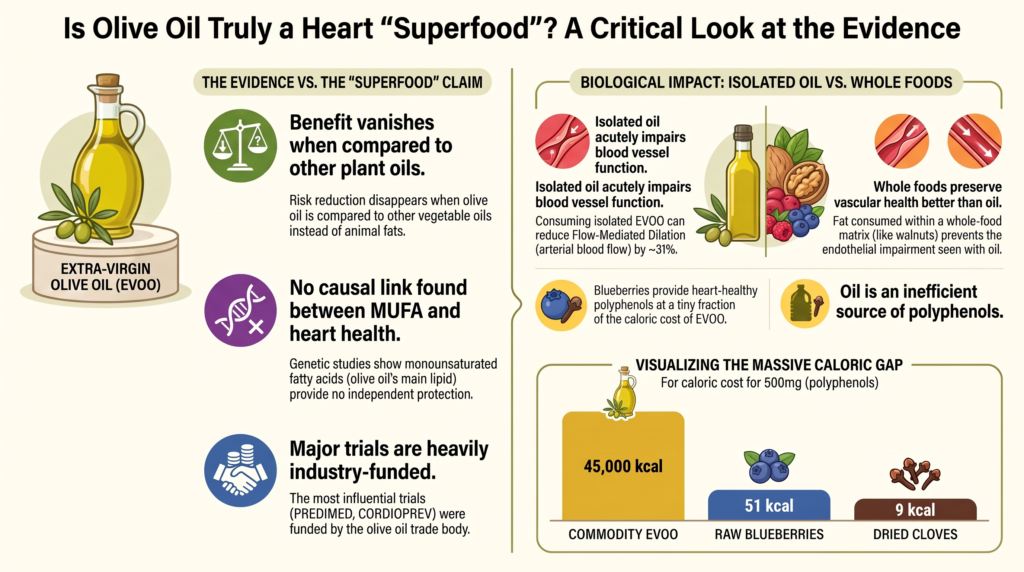
調査結果. オリーブ油と心血管疾患死亡率低下との間の疫学的関連は実在するが、他の植物油でも完全に再現され、動物脂肪ではなく他の植物油と比較された場合にはオリーブ油の効果は消失する。メンデルランダム化(MR)解析では、循環血中の 一価不飽和脂肪酸, オリーブ油の主要な脂質である、因果シグナルは追跡する アポリポ蛋白 Bアポリポ蛋白B) 粒子数の代わりに、孤立したEVOOは急性的に障害する 血管内皮機能 食後に、脂肪がホールフードのマトリックス内で摂取された際には見られない効果が現れます。すべての添加油を除外した、厳格な低脂肪のホールフード植物性(WFPB)食パターンのみが、冠動脈造影上の疾患を停止させ、部分的に逆転させることが示されています。2つの主要なEVOO(エキストラバージンオリーブオイル)のRCT(無作為化比較試験)は(PREDIMED, コディオプレブ)はいずれもオリーブ油貿易機関から資金提供を受けている パトリモニオ・コムナル・オリバレロ, 、そしてPREDIMEDはその論文が撤回され、その後再掲載された。 ランダム化 侵害されていることが判明しました。.
結論。. 現在の独立したエビデンスは、飽和脂肪酸の置き換えを超えた、オリーブ油の臨床的に意味のある心保護効果を示していない トランス脂肪酸; それは、独自の固有の生理活性が証明された食品というよりも、動物性脂肪の比較的良質な代替品として理解するのが最も適切である。これは説得力のある証拠がないことを述べたものであり、効果がないことの証明ではない。エキストラバージンオリーブオイル単体を対象とした、大規模で完全に独立した、ハードエンドポイントを検証したランダム化比較試験(RCT)は存在せず、このエビデンスの空白自体が中心的な発見である。.
エビデンスの基盤とその資金提供に関する注記
この分野における繰り返し生じる困難は、心血管のエンドポイントに対するEVOOの効果を実証すると称するほぼすべてのランダム化比較試験(RCT)が、現金または現物支給の形でオリーブオイル業界から資金提供を受けていることである。PREDIMEDとCORDIOPREVはいずれも、介入用のオイルを パトリモニオ・コムナル・オリバレロ, スペイン産オリーブオイルの輸出促進を明示的な目的とする組織73,76] 産業界からの資金提供自体が無効にするわけではないが、 体系的 EVOOの有効性に関するRCT文献全体が単一の利害関係者と絡み合っていることは、警戒すべき正当な理由となる。67,69同じ点を裏付ける独立した情報源が存在する場合そちらが優先して引用される。EVOO(エキストラバージンオリーブオイル)の場合はしばしばそうであるように、そのような情報源が存在しない場合には、業界資金による研究がそのまま維持されるがその旨が注記され、結果として生じる不確実性が解釈へと持ち越される。読者は、以下のすべてのEVOOの効能の推定値を、その度合いに応じて暫定的なものとして扱うべきである。.
1. オリーブ油の独立した心血管保護効果の疫学的定量化
オリーブオイル単体に独立した心臓保護作用があるかどうかを評価するため、, 栄養疫学 の観点から解釈されなければならない 置換ダイナミクス 食事学的背景も考慮する。地中海以外のコホートにおける最も包括的な前向きデータは、看護師健康研究(NHS)および医療従事者追跡調査(HPFS)によるものであり、両者を合わせて、発症時の既往歴がない米国人男女92,383人が追跡調査された。 心血管疾患 そしてベースライン時の癌について最大28年間[1]
多変量調整解析によると、オリーブオイルの摂取量が最も多いカテゴリー(1日あたり大さじ半分以上(>7 g/日)と定義される)に属する人々は、心血管疾患による死亡率が19%低下したことが示された(ハザード比 [HR] 0.81; 95% 信頼区間 [CI] 0.75–0.87)および19%の減少が 全因死亡率 (HR 0.81;95%信頼区間 0.78–0.84)対 非摂取者。[1] また、摂取量が多いほど、[18%]のリスクが低下することとも関連していた。 冠動脈疾患 (HR 0.82; 95%信頼区間 0.73–0.91)、一方で、以下の項目については有意な関連は認められなかった。 脳卒中. [2]
さらに、このデータからは、がんによる死亡リスクが17%低下していること(HR 0.83;95% CI 0.78–0.89)、神経変性疾患による死亡リスクが29%低下していること(HR 0.71; 95% CI 0.64–0.78)、および呼吸器疾患による死亡リスクが18%低下した(HR 0.82;95% CI 0.72–0.93)。[1] 事前のドラフトでは神経変性の信頼区間が0.78〜0.89と記載されていましたが、これは点推定値の0.71としてはあり得ず、実際にはがんの推定値のものであるため、修正された区間は0.64〜0.78です。.
別の 用量反応 メタ分析 13件の前向きコホート研究の分析によると、オリーブオイルの摂取量が1日あたり5 g増えるごとに、心血管疾患(CVD)のリスク(RR 0.96;95% CI 0.93–0.99)および全死因死亡率(RR 0.96; 95%信頼区間 0.95–0.96)のリスクがわずかながら有意に低下することが示された。[3この増加量あたりの数値はハーバードのコホートではなくXiaらによるものであり、それに従って出典が明記されています。.
決定的となる疫学的試験は、他の植物油との直接比較である。. 同じコホートにおいて、飽和脂肪酸を多く含む動物性脂質(マーガリン、バター、マヨネーズ、乳脂肪)を1日あたり10 g分、オリーブオイルに置き換えた場合、全死因および特定死因による死亡リスクが8%から34%低下することが示された。[1しかし、他の植物油をすべて合わせたものと直接比較すると、オリーブ油は 統計学的な有意差はない 総心血管疾患、冠動脈疾患、または脳卒中について [1,2これらのデータにおいて、見かけ上の効果はオリーブ油の脂質骨格固有の性質というよりも、動脈硬化性の動物性脂肪の置き換えに起因している。.
残差 交絡 これをさらに悪化させている。オリーブオイルの摂取量が最も多かった人たちは、全体的に健康的なライフスタイルを送っており(より多くの身体活動、より少ない 喫煙, 、果物や野菜の摂取量が多いことなど)、また著者らは、オリーブオイルの高摂取が単に高い社会経済的地位や全体的な食事の質の高さを示しているに過ぎない可能性を認めている。1]
1.1 PREDIMED 一次予防フレームワーク
PREDIMED試験は、心血管疾患リスクの高い7,447人のスペイン人を無作為に割り付け、 地中海式ダイエット さらにエキストラバージンオリーブオイル(EVOO)を追加した地中海式食事、ナッツを追加した地中海式食事、または対照食(低脂肪食の指導)のいずれかに割り付けられ、中央値4.8年の追跡が行われた。EVOO群は、以下の複合発現率の低下を示した 心筋梗塞, 、脳卒中、および心血管死(HR 0.69;95% CI 0.53–0.91)が対照群と比較して、約30%の相対的減少が見られた。[4]
これには、結果を弱める2つの留保事項がある。第一に、二次解析において、ベースラインのエキストラバージンオリーブオイル(EVOO)摂取量と重篤なイベントとの間の逆相関は、地中海食にランダム化されたグループ内でのみ維持され、低脂肪対照グループでは消失した。したがって、オリーブオイルの価値は、その固有のものであるというよりは、それをとりまく食事パターンに依存しているように思われる。4]
第二に、そしてより重大なこととして、PREDIMED論文は撤回されました。. Carlisleによる2017年の再解析では、ベースラインの分布がランダム割り付けと統計的に不適合であることが判明した。6] 監査の結果、7,447人の参加者のうち約1,588人(約21%)について無作為化が適切に行われていなかったことが判明した。具体的には、ある施設では世帯員が一括して割り当てられていたこと、別の施設では無作為化表が適切に使用されていなかったこと、さらに別の施設では診療所単位で無作為化が行われていたことなどが挙げられた。 NEJMは2018年6月に2013年の論文を取り下げ、クラスタリングを調整した再解析結果を再掲載した。[4,5PREDIMEDは、もはや厳密に個別にランダム化されたものではないため、準ランダム化介入として解釈するのが最も適切であり、NICEはすでに個々のCVDアウトカムに関して深刻なバイアスリスクがあると判断していた。71]
1.2 二次予防:CORDIOPREV
CORDIOPREV試験では、スペインの冠動脈疾患患者1,002名を、EVOOを豊富に含む地中海式食事(脂質約35%、一価不飽和脂肪酸(MUFA)約22%)群と低脂肪食群に無作為に割り付け、7年間にわたって追跡調査を行った。 再発性MACEの発生率は、地中海式食事群で1,000人年あたり28.1件、低脂肪食群で1,000人年あたり37.7件であり、各モデルにおける多変量調整ハザード比の範囲は0.719 (95% 信頼区間 0.541–0.957) から 0.753 (95%信頼区間 0.568–0.998)の範囲にあり、地中海式食事法に有利な結果を示し、相対リスクは約25~28%の低減であった(ログランク検定 p = 0.039)。[8] 28.1はパーセントのリスク減少率ではなく、1,000人年あたりの地中海型食生活のハザード(発症)率です。また、初期の草案にあったCI 0.62–0.89は情報源に見当たらないため、報告されているモデルの範囲に置き換えられています。.
比較対照群の食事は、真の低脂肪食ではありませんでした。. 対照群では、総脂肪摂取量を約32%カロリーまでしか減らすことができず、臨床的な閾値である30%未満には達しておらず、オーニッシュやエッセルスティンが提唱する10~15%未満とは程遠い結果となった。 反転 試練. 飽和脂肪酸 両群間でほぼ同等であった(約7.9% 対 約7.1%)、一方、対照群は約10%多く摂取した タンパク質, 主として動物由来のものであり、豆類、野菜、果物はより少なかった。この有益性は、エキストラバージンオリーブオイル(EVOO)固有の作用というよりも、比較対象の質が低かったことを反映している可能性がある。8]
遺伝学的サブ解析によってこれがさらに裏付けられた:地中海式食事を摂取している場合でも、ZPR1 rs964184リスクアレル保有者は、空腹時および食後の血糖値の上昇が持続した 中性脂肪, 一方、低脂肪食を摂取したグループではそれらが正常化した。したがって、特定の遺伝子型においては、EVOO(エキストラバージンオリーブオイル)を豊富に含む食事パターンはトリグリセリドのクリアランス(代謝・排出)に関して劣っていた。9]
1.3 メンデルランダム化:一価不飽和脂肪酸(MUFA)に関する因果関係のシグナルなし
オリーブ油における主要な一価不飽和脂肪酸(MUFA)であるオレイン酸に直接的な心血管保護作用があるならば、遺伝的に血中MUFA濃度が高い人はリスクが低くなるはずである。しかし、機器変数分析では、血中MUFAが冠動脈疾患(CHD)、心筋梗塞(MI)、または 虚血性脳卒中. [10これは効果の不検出であって、その非存在の積極的な証明ではないが、固有の利益という主張から重要な論拠を取り除くものである。多変量MRは一貫してApoBと LDL粒子数 因果脂質因子として、独立したMUFAシグナルはない。11,12これらの遺伝的に固定された、業界から独立したデータは、オリーブ油に起因するとされるコホート研究での関連性が、消費者のライフスタイルや食生活によって大幅に交絡されていることを示す最も強力な証拠の一つである。.
表1.オリーブオイルと心血管アウトカムに関する主要研究
| 研究 / コホート | 人口とデザイン | 曝露 / 介入 | 効果推定値(95% 信頼区間) | 主要な注意点 |
| NHS & HPFSの死亡率1] | 米国の成人92,383人;28年間の前向きコホート研究 | 最高摂取量(>7 g/day)対 非摂取者 | 全死因:HR 0.81 (0.78–0.84) CVD:HR 0.81(0.75–0.87) |
他の植物油によって完全に再現可能な効果であり、動物性脂肪の代替によって推進されています。 |
| NHS & HPFS incident CVD [2] | 92,978 US adults; 24-yr prospective cohort | Highest intake vs non-consumers | Total CVD: HR 0.86 (0.79–0.94) CHD: HR 0.82 (0.73–0.91) |
No stroke association; no difference vs other plant oils |
| PREDIMED 一次予防 [4] | 7,447 high-risk Spanish adults; 4.8-yr quasi-RCT | MedDiet + EVOO vs low-fat advice | Composite MACE: HR 0.69 (0.53–0.91) | RETRACTED / republished; ~21% mis-randomized; EVOO from olive-oil trade body |
| コディオプレブ secondary prevention [8] | 1,002 Spanish coronary patients; 7-yr RCT | MedDiet + EVOO vs low-fat diet | Recurrent MACE: HR 0.719–0.753 (e.g., 0.541–0.957) | “Low-fat” control only ~32% fat; funded by olive-oil trade body |
| Mendelian randomization [10–12] | UKバイオバンク & GWAS meta-analyses | Genetically determined circulating MUFA (oleic acid) | CHD / MI / stroke: no causal association | MUFA not causally protective; ApoB is the causal trait |
Green shading = independent evidence supporting the skeptical thesis. Red shading = industry-funded EVOO efficacy RCTs (retained with caveat; see text).
1.4 The Strongest Case in Favor of Olive Oil
Intellectual honesty requires stating the affirmative case at its strongest before explaining why it falls short of establishing independent efficacy. Several genuine, reproducible findings support olive oil as a component of a heart-healthy pattern.
Saturated-fat replacement and LDL. Substituting olive oil for butter, lard, or other saturated fats lowers LDLコレステロール and ApoB, and the NHS/HPFS substitution analyses show meaningfully lower mortality when olive oil displaces animal fats. [1,65] Because LDL/ApoB is the causal driver of 動脈硬化, this replacement effect is real and clinically useful.
Blood pressure and endothelial markers. Higher-phenolic olive oils have been associated with modest reductions in blood pressure and improvements in some endothelial and inflammatory markers, and the combined phenolic-oil-plus-red-wine data show that context can even produce acute FMD improvement. [16,65] The EFSA-recognized phenolic claim, whatever its practical caloric cost, rests on a genuine in vitro そして ex vivo antioxidant signal. [22]
The Mediterranean-pattern signal. Within a whole Mediterranean pattern, EVOO-supplemented diets reduced hard events in both PREDIMED and CORDIOPREV, and reduced carotid 歯垢 progression in CORDIOPREV. [4,8] These are RCT-level outcomes, not merely observational, and they should not be dismissed.
Why this does not establish independent efficacy. Each of these benefits is explicable without invoking a unique property of the olive-oil lipid. The LDL and mortality effects are replacement effects reproduced by other plant oils; the blood-pressure and marker effects are shared by many polyphenol-rich whole foods delivered at far lower caloric cost; the phenolic antioxidant signal has not translated into a phenol-specific in vivo benefit in the cleanest controlled test [24]; and the RCT benefits were measured against weak or animal-protein-rich comparators, within multicomponent patterns, and in trials funded by the olive-oil trade. The affirmative case establishes that olive oil is a good substitute for animal fat and a reasonable part of a plant-rich diet. It does not establish that olive oil, in isolation, is independently cardioprotective—which is the specific claim this review examines.
2. Postprandial Vascular Dynamics: Isolated Oils versus Whole-Food Fats
The acute vascular impact of fat ingestion is seen in the postprandial state—transient 内皮機能障害, 酸化ストレス, and inflammatory signaling. The standard index is flow-mediated dilation (FMD) of the brachial 動脈, a nitric-oxide-dependent response. Consuming isolated dietary oils, including EVOO, consistently produces an acute, significant reduction in FMD. [13]
In a landmark crossover trial, a single 900-kcal meal containing 50 g of fat from isolated olive oil reduced FMD by ~31% at 3 hours, from a baseline of 14.3 ± 4.2% to 9.9 ± 4.5% (p = 0.008); the decline correlated inversely with the postprandial triglyceride rise (r = −0.47, p < 0.05). [13] An earlier draft stated FMD fell “to ~4.5%”; 4.5% is the standard deviation, not the mean. The correct postprandial value is 9.9%, and the trial is Vogel et al. 2000.
Comparative studies show divergence by 食品マトリックス: a walnut meal preserves or improves FMD while a fat-matched olive-oil meal worsens it. [14] Caveat: the walnut–oil comparison [14] was funded by the California Walnut Commission and one author served on its Scientific Advisory Board. No fully independent head-to-head walnut-versus-oil postprandial trial was identified, so this result should be read as directionally supportive but industry-influenced.
An essential caveat applies to this entire section. Only the first step of the postulated chain—that isolated oil acutely reduces FMD—has been directly demonstrated. Whether these transient postprandial endothelial impairments translate into accelerated atherosclerosis and, ultimately, into clinical cardiovascular events has not been shown. That progression is biologically plausible and consistent with the response-to-retention framework, but it remains an inference rather than a demonstrated causal sequence in humans. The postprandial data should therefore be read as a mechanistic signal, not as proof of long-term harm from olive oil.
2.1 Mechanism: Chylomicron Remnants and the Response-to-Retention Model
The acute impairment is linked to postprandial lipemia そして、その 応答保持モデル の アテローム発生. [29,33] Rapid absorption of emulsified triacylglycerols from isolated oil produces a surge of カイロミクロン; lipoprotein-lipase hydrolysis then yields smaller, atherogenic remnants (<70 nm) that traverse the arterial 内皮 via active トランスサイトーシス mediated by scavenger receptor class B type 1 (SR-BI) and activin receptor-like kinase 1 (ALK1). [30] Mechanistic (cell/animal and human-biomarker data), not RCT-grade.
In capillaries, this hydrolysis is stabilized by GPIHBP1, which anchors LPL to the luminal surface; larger arteries lack GPIHBP1, so intact remnants interact directly with the arterial wall. [31,32] Retained ApoB-containing remnants bind subendothelial proteoglycans, are oxidized to reactive aldehydes such as 4-hydroxynonenal (4-HNE), and activate NF-κB in endothelium and マクロファージ, inducing VCAM-1, ICAM-1, and E-selectin; monocytes then adhere, transmigrate, and become 泡沫細胞. [33,37,39] Each individual step in this sequence is experimentally supported, but the complete progression from a dietary oil bolus through remnant formation, transcytosis, foam-cell generation, and plaque is inferred by assembling those steps. This integrated pathway remains mechanistic rather than experimentally demonstrated as a continuous sequence in humans.
2.2 Nitric Oxide, ADMA, and eNOS Uncoupling
Postprandial impairment is largely mediated by reduced nitric-oxide bioavailability. Endothelial NO synthase (eNOS) makes NO from L-arginine; asymmetric dimethylarginine (ADMA) competitively inhibits eNOS and is normally cleared by dimethylarginine dimethylaminohydrolase (DDAH). [40,43] During lipemia, ROS and the lipid aldehyde 4-HNE inhibit DDAH, ADMA accumulates, and eNOS uncouples toward superoxide and peroxynitrite, causing acute endothelial dysfunction. [40,41] This is a mechanistically supported model; the dietary-causal specifics are not established by RCT.
2.3 The Whole-Food Matrix Prevents Postprandial Decline
In several controlled studies, whole-food fat sources (fresh avocado, raw walnuts) appear to attenuate or prevent the endothelial impairment seen after isolated oils, rather than reliably eliminating it. [14,15] In a randomized crossover study, substituting fresh Hass avocado for refined 炭水化物 improved postprandial FMD and lowered triglyceride-rich リポタンパク質 versus a fat-matched control. [15] Caveat: avocado postprandial research is frequently funded by the Hass Avocado Board; the specific funding statement should be verified and the result read as industry-adjacent. The intact ファイバー and cell matrix slow gastric emptying and lipase access, smoothing the triglyceride curve, while co-absorbed antioxidants neutralize ROS, preserve DDAH, and maintain eNOS coupling. [44,47]
The adverse postprandial signature is also modifiable by co-ingested antioxidants. In the Vogel trial, adding vitamins C and E, or a salad with balsamic vinegar, to the olive-oil meal fully prevented the FMD reduction. [13] A separate crossover study reported that combining 50 g of high-phenolic green olive oil with 250 mL of red wine produced a synergistic postprandial FMD improvement sustained for up to two hours (p = 0.002). [16] Funding statement for [16] not retrievable; treat as unverified for independence. Note this result cuts toward “phenolic and whole-food context matters,” not toward isolated-oil benefit. The takeaway is that the endothelial injury of isolated oil is context-dependent, not fixed—but the cleanest way to avoid it is to eat fats in whole-food form.
Table 2. Postprandial Atherogenic Cascade After Isolated-Oil Ingestion (Mechanistic Model)
| Stage | Key Mediators | Mechanism | Effect on eNOS / Permeability |
| 1. Lipemia & remnant generation | Triacylglycerols, chylomicrons, LPL | Rapid absorption of isolated lipid → chylomicron surge; LPL hydrolysis → small dense remnants (<70 nm) | High triglycerides impair systemic vascular reactivity |
| 2. Transcytosis & retention | Remnants, SR-BI, ALK1, proteoglycans | Remnants cross the endothelium via SR-BI/ALK1 and accumulate in the 内膜 | Increased permeability; ApoB particles bind proteoglycans |
| 3. Oxidative modification | ROS, 4-HNE, oxidized remnants | Retained particles are oxidized to cytotoxic aldehydes | 4-HNE inhibits DDAH; eNOS uncouples toward superoxide |
| 4. Endothelial activation | NF-κB, VCAM-1, ICAM-1, E-selectin | Oxidized lipids activate NF-κB → adhesion-molecule expression | Vascular lining becomes adhesive to leukocytes |
| 5. Monocyte recruitment & foam cells | Monocytes, macrophages, scavenger receptors, IL-6, TNF-α | Adhered monocytes transmigrate, differentiate, and form foam cells | Sustained 炎症; loss of vasodilator tone |
This cascade is a mechanistic synthesis of cell, animal, and human-biomarker studies [29–43]; it is not established as an RCT-grade causal chain in humans.
3. Reversal Mechanisms of Whole-Food Plant-Based Diets
Where standard low-fat and Mediterranean patterns generally slow progression, strict low-fat WFPB interventions are the only dietary programs that have demonstrated 血管造影上の退縮 of coronary disease in published intervention studies. That evidence base is small, highly selected, involves several simultaneous lifestyle changes, and has not been independently replicated at the same scale, and it is described here with those limitations explicit rather than as settled superiority. [54]
Ornish’s ライフスタイル心臓トライアル (a small RCT, n = 48) combined a ~10%-fat ベジタリアン食 with no added oils, exercise, stress management, and group support. Quantitative coronary angiography showed regression of average percent-diameter 狭窄 (40.0% → 37.8% in the intervention group versus progression 42.7% → 46.1% in controls) at 1 year, with further divergence at 5 years. [17,18] LDL コレステロール fell ~37% without lipid-lowering drugs, 狭心症 frequency fell markedly, and control patients had roughly twice as many 心臓発作 by year 5. [18] RCT-grade but small, and the intervention is multi-component, so diet cannot be isolated.
Esselstyn’s case series followed 198 patients with established CVD counseled to a strict WFPB diet excluding all added oils; 177/198 (89%) were adherent. Among adherent patients, one recurrent event occurred (0.6%), versus 13/21 (62%) among the non-adherent, over a mean 3.7 years. [19] Independent (author-declared no conflicts) but uncontrolled, self-selected, and observational—not RCT-grade. The “reversal” claim rests on a small RCT [17,18] plus this uncontrolled cohort; readers should weight it accordingly.
3.1 Direct Clearance of Circulating ApoB
A strict WFPB diet nearly eliminates dietary cholesterol and saturated/trans fat while supplying soluble fiber and 植物ステロール, depleting hepatic cholesterol pools, activating ステロール regulatory element-binding proteins, and upregulating LDL受容体. [48] Circulating ApoB and LDL-C fall, often below 70 mg/dL, reducing the gradient that drives lipoprotein entry into the intima and blunting the initiating step of the response-to-retention cascade. [33,35,36] That ApoB is the causal driver is well established from genetic and clinical data. [35,36]
3.2 Restoration of eNOS Activity and NO Bioavailability
Eliminating added oils and processed fats lowers triglycerides and prevents ADMA-mediated eNOS uncoupling; leafy greens supply inorganic nitrate reduced to nitrite and then bioactive NO; and abundant ポリフェノール protect tetrahydrobiopterin (BH4), keeping eNOS coupled. [43,50] These are mechanistically supported pathways rather than hard clinical endpoints.
3.3 The TMAO Pathway
Trimethylamine-N-oxide (TMAO), a gut-microbiota-dependent metabolite of dietary カルニチン そして コリン, is associated with accelerated atherosclerosis via effects on macrophage scavenger receptors and コレステロール引き抜き転送. [52,53] A WFPB shift enriches fiber-fermenting taxa and depletes TMA-producing species, markedly reducing TMAO production. [53] An earlier draft said WFPB “entirely abolishes” TMAO; this overreaches. Vegans produce far less TMAO after a carnitine challenge, but endogenous choline metabolism and residual microbial activity mean TMAO is reduced, not eliminated. The claim is corrected to “markedly reduces.”
3.4 Attenuation of Systemic Inflammation
Fiber fermentation yields short-chain fatty acids that lower systemic inflammation; WFPB patterns reduce high-sensitivity C反応性タンパク質 and downregulate NF-κB-driven adhesion-molecule expression, shifting the arterial wall from active recruitment toward resolution. [54,62] Effect sizes vary across small trials and should not be over-stated.
Table 3. Comparative Effects of Three Dietary Patterns
| パラメータ | Low-Fat Control (30–35% fat) | Mediterranean + EVOO | Strict No-Added-Oil WFPB |
| LDL-C / ApoB | Minimal-to-modest reductions; often fails to lower ApoB to physiological range | Modest reductions; LDL-C typically remains 80–100 mg/dL, leaving residual particle risk | Profound reductions; frequently LDL-C <70 mg/dL, minimizing intimal entry |
| Postprandial FMD / NO | Transient impairment from refined carbohydrate or saturated fat | Acute FMD reduction (~31% in [13]) unless paired with antioxidants | Postprandial FMD preserved; no added oil, high NO bioavailability |
| Systemic inflammation (hs-CRP) | Minimal reduction | Significant reduction reported (industry-linked trials; caveat applies) | Substantial reduction; NF-κB downregulated |
| Plaque progression | Continued progression even with スタチン | Delayed progression; slight IMT regression; recurrent events persist | Documented angiographic arrest and partial regression (small studies) |
| Microbial TMAO | High; ongoing conversion of carnitine/choline | Variable; persists with fish, poultry, dairy | Markedly reduced (not fully abolished) |
Estimates for the Mediterranean and WFPB columns derive from trials of differing size and funding independence; see text and Section 4 for caveats.
4. Deconstruction of Industry Sponsorship and Nutritional Claims
4.1 The PREDIMED Retraction and Randomization Failures
PREDIMED, published in NEJM in 2013, was the most influential trial supporting the Mediterranean diet and EVOO. [68] Carlisle’s 2017 reanalysis found baseline distributions incompatible with randomization (p < 0.0001). [6] The internal audit found systemic departures from randomization affecting ~1,588 participants (~21% of the cohort): en-masse household assignment at one site, improper use of the randomization table at another, and clinic-level (rather than individual) assignment at a third. [4,5] NEJM retracted the 2013 paper in June 2018 and republished a reanalysis; because it was no longer strictly randomized, its evidence grade fell to that of a quasi-randomized cohort-style intervention. NICE had assessed it at serious risk of bias with low-to-very-low-quality data for individual outcomes. [71]
4.2 CORDIOPREV: A Weak Comparator
CORDIOPREV is cited as the premier secondary-prevention trial favoring a Mediterranean over a low-fat diet, but its control arm did not reach a genuine low-fat target (~32% of calories from fat, versus the <30% clinical definition and the <10–15% of Ornish and Esselstyn). [8] Saturated fat was near-identical between arms, and the control consumed ~10% more protein—mostly animal-source—while eating fewer whole plant foods. The ~26% MACE reduction may reflect the poor control diet rather than any unique EVOO mechanism. [8]
4.3 Funding Sources and Conflicts of Interest
The two major hard-outcome EVOO RCTs discussed here are PREDIMED and CORDIOPREV; numerous smaller RCTs of olive oil on surrogate markers also exist, but none tests hard cardiovascular endpoints independently of the olive-oil trade. PREDIMED, though primarily government-funded, received donated EVOO from Hojiblanca and パトリモニオ・コムナル・オリバレロ, and donated nuts from the California Walnut Commission and others. [73] Disclosed steering-committee conflicts include Emilio Ros (research grants from and Scientific Advisory Committee membership of the California Walnut Commission) and Jordi Salas-Salvadó (grants from and unpaid advisory membership of the International Nut and Dried Fruit Council). [74] An earlier draft attributed International Nut Council funding to M. Á. Martínez-González; that attribution is not supported by the disclosures and has been removed. The verified nut-industry tie belongs to Salas-Salvadó.
CORDIOPREV was supported by the Fundación Patrimonio Comunal Olivarero, an organization dedicated to promoting Spanish olive-oil exports; its very acronym encodes the sponsor’s interest. [76] These systematic ties between a single trade interest and the entire EVOO-efficacy RCT literature justify treating “olive oil as superfood” framing with caution. [67,69]
4.4 The Lyon Diet Heart Study: Canola, Not Olive Oil
その リヨン地中海食心臓研究 is often invoked for Mediterranean secondary prevention, reporting roughly a 70% lower all-cause mortality (adjusted risk ratio 0.30; 95% CI 0.11–0.82). [27,28] But its supplemental fat was not olive oil: the experimental group received a custom canola-oil-based margarine designed to mimic a Cretan profile, high in alpha-linolenic acid (ALA), with a low omega-6:omega-3 ratio (~2.8). [27,79] Reviewers attributed the mortality benefit substantially to ALA’s anti-arrhythmic and anti-thrombotic effects rather than to olive oil. [78] The choice of canola reflected, in part, Spain’s Toxic Oil Syndrome history, which had made rapeseed-oil trials socially fraught there; this is historical context, not a cardioprotection claim.
4.5 The Polyphenol “Health Halo” and the Caloric-Efficiency Gap
A central marketing claim is EVOO’s biophenol content (hydroxytyrosol, oleuropein, オレオカンタール, oleacein). In 2011 the European Food Safety Authority approved a claim that olive-oil polyphenols protect blood lipids from oxidative stress, conditional on ≥5 mg of hydroxytyrosol and its derivatives per 20 g of oil, at 20 g/day. [22,23]
But olive oil is a calorically expensive polyphenol vehicle. It is ~100% lipid (~900 kcal/100 g, ~120 kcal per tablespoon) with negligible fiber, protein, or water-soluble micronutrients. [47] Commodity EVOO often falls below the EFSA threshold, and even premium high-phenolic oils require large lipid loads to deliver a meaningful polyphenol dose, whereas whole plant foods deliver far more polyphenol per calorie. [21,85] The per-food polyphenol values below trace to the Phenol-Explorer database and vary with assay and extraction; the derived gram/calorie figures are illustrative arithmetic, not measured trial outcomes.
Table 4. Caloric Cost of Obtaining 500 mg of Polyphenols by Food Source
| 食料源 | Polyphenols (mg/100 g) | Energy (kcal/100 g) | Mass for 500 mg (g) | Caloric cost (kcal) |
| Commodity EVOO | ~10 | 900 | 5,000 | 45,000 |
| Premium high-phenolic EVOO | ~50 | 900 | 1,000 | 9,000 |
| Raw blueberries | 560 | 57 | 89 | 51 |
| Black chokeberries | 1,022 | 47 | 49 | 23 |
| Dark chocolate (≥70%) | 1,664 | 598 | 30 | 180 |
| Dried cloves | 15,188 | 274 | 3.3 | 9 |
Polyphenol concentrations from Phenol-Explorer [21,85]; energy values from USDA. Red = calorically expensive polyphenol vehicles; green = efficient whole-food sources. Values should be verified per cell before publication, as Folin assay results vary by method.
4.6 Do the Phenolics Deliver In Vivo?
A controlled crossover trial found that olive oil fortified with polar or non-polar phenolics increased LDL-oxidation lag time by ~8 minutes—but the same increase occurred with the polyphenol-free プラセボ oil, suggesting a non-specific meal or time effect rather than a unique phenolic benefit. [24] A single trial cannot overturn a field, and other work reports phenol-specific effects; but this relatively independent (Wageningen-led) study raises important questions about the magnitude of the proposed antioxidant mechanism and cautions against treating it as established. [24] Related LDL-oxidation analyses by the same group had Unilever affiliation or International Olive Oil Council funding [89]; the specifically cited 2001 Free Radical Research paper [24] is the cleaner source and is used here.
Some industry-linked trials (e.g., EUROLIVE and HDL-function studies) do report phenolic benefits. [49,86] These are cited for completeness but carry funding caveats and should not be read as independent confirmation. [61,63]
The pharmacology of oleocanthal is real but distinct from clinical cardioprotection: it inhibits COX-1 and COX-2 dose-dependently, like ibuprofen, [25] while the peppery throat sting of high-phenolic oil is mediated by TRPA1 channels restricted to the posterior oropharynx—a sensory phenomenon with no established bearing on cardiovascular outcomes. [26]
5. Conclusions
A critical synthesis indicates that current independent evidence does not demonstrate a clinically meaningful cardioprotective effect of isolated olive oil beyond the replacement of saturated and trans fats. This is a conclusion about the absence of convincing evidence for unique benefit, not positive proof that no such benefit exists. Epidemiological associations are real but are reproduced by other plant oils and are consistent with the displacement of animal fat; MR finds no convincing evidence of a causal MUFA effect and points instead to ApoB. [1,2,10,11]
Physiologically, isolated EVOO acutely impairs postprandial endothelial function by accelerating chylomicron-remnant generation and retention—an effect that whole-food fat sources appear to attenuate. Whether this transient postprandial impairment translates into long-term atherosclerosis and clinical events has not been demonstrated; it is a plausible mechanistic link, not an established one, and should be presented as such. [13,14,15]
While EVOO-supplemented diets can slow progression relative to weak comparators, only strict low-fat WFPB patterns excluding added oils have been shown to arrest and partially reverse angiographic coronary disease—though that evidence rests on one small RCT and an uncontrolled cohort and should be described with appropriate humility. [17,18,19]
Finally, the EVOO efficacy literature is systematically entangled with the olive-oil trade, and its most influential trial was retracted for randomization failure. The strongest evidence in this review—the null comparison against other plant oils, the null MUFA MR, and the null phenolic LDL-oxidation trial—comes from independent or government-funded work. [1,10,24]
The central evidentiary gap: no large, fully independent RCT of isolated EVOO on hard cardiovascular endpoints exists. Until one does, claims of unique olive-oil cardioprotection should be regarded as unproven, and the reader is entitled to the residual doubt that this review has tried to make explicit throughout.
参考文献
Citations follow IEEE style and are numbered in order of first appearance. Primary peer-reviewed sources (PubMed/PMC) are used throughout; entries marked “mechanistic” denote preclinical or biomarker-level evidence rather than RCT-grade clinical outcomes. Funding caveats for industry-linked olive-oil sources are noted in the text.
-
- Guasch-Ferré M, Li Y, Willett WC, et al. Consumption of Olive Oil and Risk of Total and Cause-Specific Mortality Among U.S. Adults. J Am Coll Cardiol. 2022;79(2):101-112. doi:10.1016/j.jacc.2021.10.041
- Guasch-Ferré M, Liu G, Li Y, et al. Olive Oil Consumption and Cardiovascular Risk in U.S. Adults. J Am Coll Cardiol. 2020;75(15):1729-1739. doi:10.1016/j.jacc.2020.02.036
- Xia M, Zhong Y, Peng Y, Qian C. Olive oil consumption and risk of cardiovascular disease and all-cause mortality: A meta-analysis of prospective cohort studies. Front Nutr. 2022;9:1041203. Published 2022 Oct 18. doi:10.3389/fnut.2022.1041203
- Estruch R, Ros E, Salas-Salvadó J, et al. Primary Prevention of Cardiovascular Disease with a Mediterranean Diet Supplemented with Extra-Virgin Olive Oil or Nuts. N Engl J Med. 2018;378(25):e34. doi:10.1056/NEJMoa1800389
- Estruch R, Ros E, Salas-Salvadó J, et al. Retraction and Republication: Primary Prevention of Cardiovascular Disease with a Mediterranean Diet. N Engl J Med 2013;368:1279-90 [retraction of: N Engl J Med. 2013 Apr 4;368(14):1279-90. doi: 10.1056/NEJMoa1200303.]. N Engl J Med. 2018;378(25):2441-2442. doi:10.1056/NEJMc1806491
- Carlisle JB. Data fabrication and other reasons for non-random sampling in 5087 randomised, controlled trials in anaesthetic and general medical journals. Anaesthesia. 2017;72(8):944-952. doi:10.1111/anae.13938
- Martínez-González MÁ, Toledo E, Arós F, et al. Extravirgin olive oil consumption reduces risk of atrial fibrillation: the PREDIMED (Prevención con Dieta Mediterránea) trial. Circulation. 2014;130(1):18-26. doi:10.1161/CIRCULATIONAHA.113.006921
- Delgado-Lista J, Alcala-Diaz JF, Torres-Peña JD, et al. Long-term secondary prevention of cardiovascular disease with a Mediterranean diet and a low-fat diet (CORDIOPREV): a randomised controlled trial. Lancet. 2022;399(10338):1876-1885. doi:10.1016/S0140-6736(22)00122-2
- Alcala-Diaz JF, Arenas-de Larriva AP, Torres-Peña JD, et al. A Gene Variation at the ZPR1 Locus (rs964184) Interacts With the Type of Diet to Modulate Postprandial Triglycerides in Patients With Coronary Artery Disease: From the Coronary Diet Intervention With Olive Oil and Cardiovascular Prevention Study. Front Nutr. 2022;9:885256. Published 2022 Jun 17. doi:10.3389/fnut.2022.885256
- Mazidi M, Katsiki N, Shekoohi N, Banach M. Monounsaturated Fatty Acid Levels May Not Affect Cardiovascular Events: Results From a Mendelian Randomization Analysis. Front Nutr. 2020;7:123. Published 2020 Sep 2. doi:10.3389/fnut.2020.00123
- Zagkos L, Dib MJ, Pinto R, et al. Associations of genetically predicted fatty acid levels across the phenome: A mendelian randomisation study. PLoS Med. 2022;19(12):e1004141. Published 2022 Dec 29. doi:10.1371/journal.pmed.1004141
- Richardson TG, Sanderson E, Palmer TM, et al. Evaluating the relationship between circulating lipoprotein lipids and apolipoproteins with risk of coronary heart disease: A multivariable Mendelian randomisation analysis. PLoS Med. 2020;17(3):e1003062. Published 2020 Mar 23. doi:10.1371/journal.pmed.1003062
- Vogel RA, Corretti MC, Plotnick GD. The postprandial effect of components of the Mediterranean diet on endothelial function. J Am Coll Cardiol. 2000;36(5):1455-1460. doi:10.1016/s0735-1097(00)00896-2
- Cortés B, Núñez I, Cofán M, et al. Acute effects of high-fat meals enriched with walnuts or olive oil on postprandial endothelial function. J Am Coll Cardiol. 2006;48(8):1666-1671. doi:10.1016/j.jacc.2006.06.057
- Wang L, Bordi PL, Fleming JA, Hill AM, Kris-Etherton PM. Effect of a moderate fat diet with and without avocados on lipoprotein particle number, size and subclasses in overweight and obese adults: a randomized, controlled trial. J Am Heart Assoc. 2015;4(1):e001355. Published 2015 Jan 7. doi:10.1161/JAHA.114.001355
- Karatzi K, Papamichael C, Karatzis E, et al. Postprandial improvement of endothelial function by red wine and olive oil antioxidants: a synergistic effect of components of the Mediterranean diet. J Am Coll Nutr. 2008;27(4):448-453. doi:10.1080/07315724.2008.10719724
- Ornish D, Brown SE, Scherwitz LW, et al. Can lifestyle changes reverse coronary heart disease? The Lifestyle Heart Trial. Lancet. 1990;336(8708):129-133. doi:10.1016/0140-6736(90)91656-u
- Ornish D, Scherwitz LW, Billings JH, et al. Intensive lifestyle changes for reversal of coronary heart disease. JAMA. 1998;280(23):2001-2007. doi:10.1001/jama.280.23.2001
- Esselstyn CB Jr, Gendy G, Doyle J, Golubic M, Roizen MF. A way to reverse CAD?. J Fam Pract. 2014;63(7):356-364b.
- Esselstyn CB Jr. Updating a 12-year experience with arrest and reversal therapy for coronary heart disease (an overdue requiem for palliative cardiology). Am J Cardiol. 1999;84(3):339-A8. doi:10.1016/s0002-9149(99)00290-8
- Pérez-Jiménez J, Neveu V, Vos F, Scalbert A. Identification of the 100 richest dietary sources of polyphenols: an application of the Phenol-Explorer database. Eur J Clin Nutr. 2010;64 Suppl 3:S112-S120. doi:10.1038/ejcn.2010.221
- EFSA Panel on Dietetic Products, Nutrition and Allergies (NDA). Scientific Opinion on the substantiation of health claims related to polyphenols in olive and protection of LDL particles from oxidative damage (ID 1333, 1638, 1639, 1696, 2865), maintenance of normal blood HDL cholesterol concentrations (ID 1639), maintenance of normal blood pressure (ID 3781), “anti-inflammatory properties” (ID 1882), “contributes to the upper respiratory tract health” (ID 3468), “can help to maintain a normal function of gastrointestinal tract” (3779), and “contributes to body defences against external agents” (ID 3467) pursuant to Article 13(1) of Regulation (EC) No 1924/2006. EFSA J. 2011;9(4):2033. Published 2011 Apr 8. doi:10.2903/j.efsa.2011.2033
- Commission Regulation (EU) No 432/2012 of 16 May 2012 establishing a list of permitted health claims made on foods, Off. J. Eur. Union, L 136, pp. 1–40, May 2012.
- Vissers MN, Zock PL, Leenen R, Roodenburg AJ, van Putte KP, Katan MB. Effect of consumption of phenols from olives and extra virgin olive oil on LDL oxidizability in healthy humans. Free Radic Res. 2001;35(5):619-629. doi:10.1080/10715760100301621
- Beauchamp GK, Keast RS, Morel D, et al. Phytochemistry: ibuprofen-like activity in extra-virgin olive oil. Nature. 2005;437(7055):45-46. doi:10.1038/437045a
- Peyrot des Gachons C, Uchida K, Bryant B, et al. Unusual pungency from extra-virgin olive oil is attributable to restricted spatial expression of the receptor of oleocanthal. J Neurosci. 2011;31(3):999-1009. doi:10.1523/JNEUROSCI.1374-10.2011
- de Lorgeril M, Renaud S, Mamelle N, et al. Mediterranean alpha-linolenic acid-rich diet in secondary prevention of coronary heart disease. Lancet. 1994;343(8911):1454-1459. doi:10.1016/s0140-6736(94)92580-1
- de Lorgeril M, Salen P, Martin JL, Monjaud I, Delaye J, Mamelle N. Mediterranean diet, traditional risk factors, and the rate of cardiovascular complications after myocardial infarction: final report of the Lyon Diet Heart Study. Circulation. 1999;99(6):779-785. doi:10.1161/01.cir.99.6.779
- Williams KJ, Tabas I. The response-to-retention hypothesis of early atherogenesis. Arterioscler Thromb Vasc Biol. 1995;15(5):551-561. doi:10.1161/01.atv.15.5.551
- Bolanle IO, de Liedekerke Beaufort GC, Weinberg PD. Transcytosis of LDL Across Arterial Endothelium: Mechanisms and Therapeutic Targets. Arterioscler Thromb Vasc Biol. 2025;45(4):468-480. doi:10.1161/ATVBAHA.124.321549
- Beigneux AP. GPIHBP1 and the processing of triglyceride-rich lipoproteins. Clin Lipidol. 2010;5(4):575-582. doi:10.2217/clp.10.43
- Goldberg IJ, Bornfeldt KE. Lipids and the endothelium: bidirectional interactions. Curr Atheroscler Rep. 2013;15(11):365. doi:10.1007/s11883-013-0365-1
- Tabas I, Williams KJ, Borén J. Subendothelial lipoprotein retention as the initiating process in atherosclerosis: update and therapeutic implications. Circulation. 2007;116(16):1832-1844. doi:10.1161/CIRCULATIONAHA.106.676890
- Badimon L, Vilahur G. LDL-cholesterol versus HDL-cholesterol in the atherosclerotic plaque: inflammatory resolution versus thrombotic chaos. Ann N Y Acad Sci. 2012;1254:18-32. doi:10.1111/j.1749-6632.2012.06480.x
- Borén J, Chapman MJ, Krauss RM, et al. Low-density lipoproteins cause atherosclerotic cardiovascular disease: pathophysiological, genetic, and therapeutic insights: a consensus statement from the European Atherosclerosis Society Consensus Panel. Eur Heart J. 2020;41(24):2313-2330. doi:10.1093/eurheartj/ehz962
- Ference BA, Ginsberg HN, Graham I, et al. Low-density lipoproteins cause atherosclerotic cardiovascular disease. 1. Evidence from genetic, epidemiologic, and clinical studies. A consensus statement from the European Atherosclerosis Society Consensus Panel. Eur Heart J. 2017;38(32):2459-2472. doi:10.1093/eurheartj/ehx144
- Libby P. The changing landscape of atherosclerosis. Nature. 2021;592(7855):524-533. doi:10.1038/s41586-021-03392-8
- van Oostrom AJ, Rabelink TJ, Verseyden C, et al. Activation of leukocytes by postprandial lipemia in healthy volunteers. Atherosclerosis. 2004;177(1):175-182. doi:10.1016/j.atherosclerosis.2004.07.004
- Tsimikas S, Witztum JL. Oxidized phospholipids in cardiovascular disease. Nat Rev Cardiol. 2024;21(3):170-191. doi:10.1038/s41569-023-00937-4
- Böger RH. The emerging role of asymmetric dimethylarginine as a novel cardiovascular risk factor. Cardiovasc Res. 2003;59(4):824-833. doi:10.1016/s0008-6363(03)00500-5
- Böger RH. Asymmetric dimethylarginine (ADMA): a novel risk marker in cardiovascular medicine and beyond. Ann Med. 2006;38(2):126-136. doi:10.1080/07853890500472151
- Zhao G, Etherton TD, Martin KR, Gillies PJ, West SG, Kris-Etherton PM. Dietary alpha-linolenic acid inhibits proinflammatory cytokine production by peripheral blood mononuclear cells in hypercholesterolemic subjects. Am J Clin Nutr. 2007;85(2):385-391. doi:10.1093/ajcn/85.2.385
- Förstermann U, Sessa WC. Nitric oxide synthases: regulation and function. Eur Heart J. 2012;33(7):829-837d. doi:10.1093/eurheartj/ehr304
- Kris-Etherton PM, Hecker KD, Bonanome A, et al. Bioactive compounds in foods: their role in the prevention of cardiovascular disease and cancer. Am J Med. 2002;113 Suppl 9B:71S-88S. doi:10.1016/s0002-9343(01)00995-0
- Ornish D. Avoiding revascularization with lifestyle changes: The Multicenter Lifestyle Demonstration Project. Am J Cardiol. 1998;82(10B):72T-76T. doi:10.1016/s0002-9149(98)00744-9
- Dreher ML, Davenport AJ. Hass avocado composition and potential health effects. Crit Rev Food Sci Nutr. 2013;53(7):738-750. doi:10.1080/10408398.2011.556759
- Rajaram S. The effect of vegetarian diet, plant foods, and phytochemicals on hemostasis and thrombosis. Am J Clin Nutr. 2003;78(3 Suppl):552S-558S. doi:10.1093/ajcn/78.3.552S
- Jenkins DJ, Kendall CW, Marchie A, et al. Effects of a dietary portfolio of cholesterol-lowering foods vs lovastatin on serum lipids and C-reactive protein. JAMA. 2003;290(4):502-510. doi:10.1001/jama.290.4.502
- Covas MI, Nyyssönen K, Poulsen HE, et al. The effect of polyphenols in olive oil on heart disease risk factors: a randomized trial. Ann Intern Med. 2006;145(5):333-341. doi:10.7326/0003-4819-145-5-200609050-00006
- Kapil V, Khambata RS, Robertson A, Caulfield MJ, Ahluwalia A. Dietary nitrate provides sustained blood pressure lowering in hypertensive patients: a randomized, phase 2, double-blind, placebo-controlled study. Hypertension. 2015;65(2):320-327. doi:10.1161/HYPERTENSIONAHA.114.04675
- Karatzi K, Papamichael C, Karatzis E, et al. Postprandial improvement of endothelial function by red wine and olive oil antioxidants: a synergistic effect of components of the Mediterranean diet. J Am Coll Nutr. 2008;27(4):448-453. doi:10.1080/07315724.2008.10719724
- Tang WH, Wang Z, Levison BS, et al. Intestinal microbial metabolism of phosphatidylcholine and cardiovascular risk. N Engl J Med. 2013;368(17):1575-1584. doi:10.1056/NEJMoa1109400
- Koeth RA, Wang Z, Levison BS, et al. Intestinal microbiota metabolism of L-carnitine, a nutrient in red meat, promotes atherosclerosis. Nat Med. 2013;19(5):576-585. doi:10.1038/nm.3145
- Tuso P, Stoll SR, Li WW. A plant-based diet, atherogenesis, and coronary artery disease prevention. Perm J. 2015;19(1):62-67. doi:10.7812/TPP/14-036
- Esselstyn CB. A plant-based diet and coronary artery disease: a mandate for effective therapy. J Geriatr Cardiol. 2017;14(5):317-320. doi:10.11909/j.issn.1671-5411.2017.05.004
- Esselstyn CB Jr, Ellis SG, Medendorp SV, Crowe TD. A strategy to arrest and reverse coronary artery disease: a 5-year longitudinal study of a single physician’s practice. J Fam Pract. 1995;41(6):560-568.
- Fernández-Rodríguez R, Bizzozero-Peroni B, Díaz-Goñi V, et al. Plant-based meat alternatives and cardiometabolic health: a systematic review and meta-analysis. Am J Clin Nutr. 2025;121(2):274-283. doi:10.1016/j.ajcnut.2024.12.002
- Campbell TC. A plant-based diet and animal protein: questioning dietary fat and considering animal protein as the main cause of heart disease. J Geriatr Cardiol. 2017;14(5):331-337. doi:10.11909/j.issn.1671-5411.2017.05.011
- Dinu M, Abbate R, Gensini GF, Casini A, Sofi F. Vegetarian, vegan diets and multiple health outcomes: A systematic review with meta-analysis of observational studies. Crit Rev Food Sci Nutr. 2017;57(17):3640-3649. doi:10.1080/10408398.2016.1138447
- Weech M, Altowaijri H, Mayneris-Perxachs J, et al. Replacement of dietary saturated fat with unsaturated fats increases numbers of circulating endothelial progenitor cells and decreases numbers of microparticles: findings from the randomized, controlled Dietary Intervention and VAScular function (DIVAS) study. Am J Clin Nutr. 2018;107(6):876-882. doi:10.1093/ajcn/nqy018
- M.-I. Covas et al., “Minor components of olive oil: Evidence to date of health benefits in humans,” Nutr. Rev., vol. 64, no. 10 pt 2, pp. S20–S30, 2006 (industry-linked review; funding caveat in text).
- Kahleova H, Levin S, Barnard N. Cardio-Metabolic Benefits of Plant-Based Diets. Nutrients. 2017;9(8):848. Published 2017 Aug 9. doi:10.3390/nu9080848
- Estruch R. Anti-inflammatory effects of the Mediterranean diet: the experience of the PREDIMED study. Proc Nutr Soc. 2010;69(3):333-340. doi:10.1017/S0029665110001539
- Nishi SK, Paz-Graniel I, Ni J, et al. Effect of nut consumption on blood lipids: An updated systematic review and meta-analysis of randomized controlled trials. Nutr Metab Cardiovasc Dis. 2025;35(5):103771. doi:10.1016/j.numecd.2024.10.009
- Schwingshackl L, Hoffmann G. Monounsaturated fatty acids, olive oil and health status: a systematic review and meta-analysis of cohort studies. Lipids Health Dis. 2014;13:154. Published 2014 Oct 1. doi:10.1186/1476-511X-13-154
- Ros E, Martínez-González MA, Estruch R, et al. Mediterranean diet and cardiovascular health: Teachings of the PREDIMED study. Adv Nutr. 2014;5(3):330S-6S. Published 2014 May 14. doi:10.3945/an.113.005389
- Nestle M. Food Industry Funding of Nutrition Research: The Relevance of History for Current Debates. JAMA Intern Med. 2016;176(11):1685-1686. doi:10.1001/jamainternmed.2016.5400
- Estruch R, Ros E, Salas-Salvadó J, et al. Retraction and Republication: Primary Prevention of Cardiovascular Disease with a Mediterranean Diet. N Engl J Med 2013;368:1279-90 [retraction of: N Engl J Med. 2013 Apr 4;368(14):1279-90. doi: 10.1056/NEJMoa1200303.]. N Engl J Med. 2018;378(25):2441-2442. doi:10.1056/NEJMc1806491
- Bero L. Industry sponsorship and research outcome: a Cochrane review. JAMA Intern Med. 2013;173(7):580-581. doi:10.1001/jamainternmed.2013.4190
- A.-M. Chang et al., commentary on PREDIMED randomization irregularities, republished analysis context, N. Engl. J. Med., 2018 (see [4], [5]).
- Evidence review for dietary cholesterol strategies: Cardiovascular disease: risk assessment and reduction, including lipid modification. London: National Institute for Health and Care Excellence (NICE); May 2023.
- Alcala-Diaz JF, Arenas-de Larriva AP, Torres-Peña JD, et al. A Gene Variation at the ZPR1 Locus (rs964184) Interacts With the Type of Diet to Modulate Postprandial Triglycerides in Patients With Coronary Artery Disease: From the Coronary Diet Intervention With Olive Oil and Cardiovascular Prevention Study. Front Nutr. 2022;9:885256. Published 2022 Jun 17. doi:10.3389/fnut.2022.885256
- PREDIMED Study Investigators, “Funding and food-industry donations disclosure,” in [4] supplementary appendix, N. Engl. J. Med., 2018.
- Conflict-of-interest disclosures, PREDIMED steering committee, in [4] supplementary appendix (E. Ros: California Walnut Commission; J. Salas-Salvadó: International Nut and Dried Fruit Council), N. Engl. J. Med., 2018.
- Estruch R, Ros E, Salas-Salvadó J, et al. Primary Prevention of Cardiovascular Disease with a Mediterranean Diet Supplemented with Extra-Virgin Olive Oil or Nuts. N Engl J Med. 2018;378(25):e34. doi:10.1056/NEJMoa1800389
- Fundación Patrimonio Comunal Olivarero, funding acknowledgment, in CORDIOPREV [8], Lancet, 2022.
- de Lorgeril M, Salen P. The Mediterranean diet in secondary prevention of coronary heart disease. Clin Invest Med. 2006;29(3):154-158.
- Visioli F, Galli C. Alpha-linolenic acid and cardiovascular disease. Am J Clin Nutr. 2002;75(6):1121-1122. doi:10.1093/ajcn/75.6.1121
- de Lorgeril M, Salen P. Modified Cretan Mediterranean diet in the prevention of coronary heart disease and cancer. World Rev Nutr Diet. 2000;87:1-23.
- Hu FB. The Mediterranean diet and mortality–olive oil and beyond. N Engl J Med. 2003;348(26):2595-2596. doi:10.1056/NEJMp030069
- EFSA Panel on Nutrition, Novel Foods and Food allergens (NDA), Turck D, Bohn T, et al. Olive oil polyphenols and the maintenance of normal HDL-cholesterol concentrations: Evaluation of a health claim pursuant to Article 13(5) of Regulation (EC) No 1924/2006. EFSA J. 2025;23(5):e9372. Published 2025 May 2. doi:10.2903/j.efsa.2025.9372
- Fabiani R. Anti-cancer properties of olive oil secoiridoid phenols: a systematic review of in vivo studies. Food Funct. 2016;7(10):4145-4159. doi:10.1039/c6fo00958a
- Owen RW, Giacosa A, Hull WE, et al. Olive-oil consumption and health: the possible role of antioxidants. Lancet Oncol. 2000;1:107-112. doi:10.1016/s1470-2045(00)00015-2
- Crespo MC, Tomé-Carneiro J, Dávalos A, Visioli F. Pharma-Nutritional Properties of Olive Oil Phenols. Transfer of New Findings to Human Nutrition. Foods. 2018;7(6):90. Published 2018 Jun 11. doi:10.3390/foods7060090
- Neveu V, Perez-Jiménez J, Vos F, et al. Phenol-Explorer: an online comprehensive database on polyphenol contents in foods. Database (Oxford). 2010;2010:bap024. doi:10.1093/database/bap024
- Hernáez Á, Fernández-Castillejo S, Farràs M, et al. Olive oil polyphenols enhance high-density lipoprotein function in humans: a randomized controlled trial. Arterioscler Thromb Vasc Biol. 2014;34(9):2115-2119. doi:10.1161/ATVBAHA.114.303374
- Key TJ, Fraser GE, Thorogood M, et al. Mortality in vegetarians and nonvegetarians: detailed findings from a collaborative analysis of 5 prospective studies. Am J Clin Nutr. 1999;70(3 Suppl):516S-524S. doi:10.1093/ajcn/70.3.516s
- Yeung AWK. Food Composition Databases (FCDBs): A Bibliometric Analysis. Nutrients. 2023;15(16):3548. Published 2023 Aug 11. doi:10.3390/nu15163548
- Castañer O, Covas MI, Khymenets O, et al. Protection of LDL from oxidation by olive oil polyphenols is associated with a downregulation of CD40-ligand expression and its downstream products in vivo in humans. Am J Clin Nutr. 2012;95(5):1238-1244. doi:10.3945/ajcn.111.029207