
食事対薬、またはアウトカム対回帰のどちらがより重要ですか?
植物中心の食事パターンは冠状動脈に影響を与えるか ルーメン 幾何学と プラーク表現型 ファスティングのその先へ アポリポ蛋白B キャプチャ?仮説生成 narrative review の日本語訳: ナラティブレビュー
キーワード: 動脈硬化 回帰; アポリポ蛋白 B; プラントベースの食事; 地中海式ダイエット; 動脈リモデリング; 血管内皮機能; 血管内超音波検査; 食後高脂血症.
略語: ApoB、アポリポ蛋白B;AUC、曲線下面積;CAD、, 冠動脈疾患; カントス, カナキヌマブ 抗炎症 血栓症 アウトカム研究;CCTA、冠動脈 コンピュータ断層撮影 血管造影;CRP, C反応性タンパク質; CTT, コレステロール Treatment Trialists; EEM, 外弾性板; FCT, 線維性被膜 厚さ; FMD、血流依存性血管拡張反応; HeFH、ヘテロ接合性 家族性高コレステロール血症; IMT, 中内膜厚; IVUS、血管内超音波;LDL-C、低密度 リポタンパク質 コレステロール; MACE, 主要心血管イベント; MLD、最小血管内腔径; Neu5Gc, 、N-グリコリルノイラミン酸;NIRS、近赤外分光法;NO、, 一酸化窒素; ;10月、, 光干渉断層計; OMT、最適薬物療法; PAV、, プラーク体積百分率; QCA, 冠動脈定量解析法; TMAO, 、トリメチルアミン N-オキシド;VSMC、血管 平滑筋細胞; WFPB、ホールフード・プラントベース。.
| 主な結論
• 累積曝露 アポリポ蛋白B(ApoB)含有リポ蛋白は、冠動脈アテローム硬化症の主要かつ確立された因果的駆動因子である。. • 食事パターンはApoBをわずかに低下させ、確立されている他のいくつかのリスク経路にも作用する — 血圧, 、体重、血糖値、, 食後の 露出, 炎症 および内皮機能. • 地中海式食生活の試験は、検証された比較対照群と比較して心血管イベントを減少させた。. 食事により総冠動脈疾患が減少することを示すヒトのエビデンス プラーク負荷 現在不足しています。. • 過去の食事による血管造影試験では、主に内腔径の保持が示され、説得力のある平均的な拡大は示されていない。. • 食事による血管への影響が、縦断的なApoB曝露量を実験的に一致させた後も持続するかどうかを検証した試験は存在しない。. • 食事療法と適応のある脂質低下療法は、競合するものではなく、補完的なものとして考慮されるべきである。. |
概要
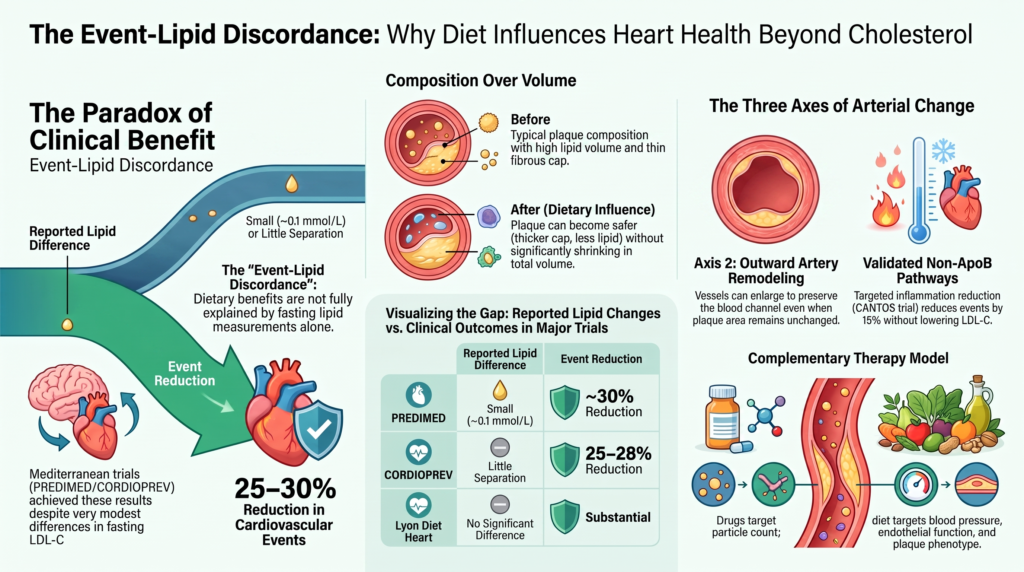
背景. アポ蛋白B(ApoB)含有リポ蛋白への累積曝露量を低下させることは、冠動脈アスケロスローシス(動脈硬化)の進行を緩やかにし、平均して中等度の退縮をもたらすための、最も確立された因果関係に基づく治療経路であり、平均して、十分に強力な低下により、一連の画像検査における軌跡が進行から安定化あるいは中等度の退縮へと変化する。ベジタリアンおよびヴィーガンの介入は、一般的にApoBの平均的な中等度の低下をもたらす、,11,64 間 分ける 地中海式食事パターンを対象とした臨床試験では、対照群と比較して心血管イベントの発生率が約25~30%減少したことが報告されている。これらの地中海式食事パターンに関する臨床試験におけるアウトカムへの影響が、報告されている群間の空腹時脂質値のわずかな差によって完全に説明できるかどうかは、依然として解明されていない。.1–3 食事が薬物療法よりも優れているという主張ではなく、その不一致こそが、本レビューの主題である。.
目的. 植物中心の食事パターンと地中海式食事パターンが、冠動脈の内腔形状、動脈リモデリング、または 歯垢 単一の空腹時ApoB測定では十分に捉えきれないメカニズムを介した表現型であり、累積ApoB曝露からの独立性を証明するために何が必要かを明確にすることである。この区別は、因果関係の重要性というよりも測定に関するものである。生涯におよび経時的なApoB曝露は冠動脈リスクの主要な因果決定要因であり、本稿のいかなる記述もそれを否定するものではない。.
方法. 一次研究は、非ヒト霊長類退行実験、初期ヒト定量冠動脈造影(QCA)試験、現代の血管内およびコンピュータ断層撮影イメージング試験、地中海型イベントおよび機序試験、植物優勢の血管インターベンション研究、およびApoBを基準とした比較対象として残された薬理学的プラーク退行試験の6つの領域にわたって評価された。正式なバイアスリスク評価ツールや メタ分析 適用され、エビデンスは明示的な記述的記述子を用いて記述されている(強い, 示唆に富む, 限定, 仮説生成の, 、および 効果が不十分/効果が認められない) よりもむしろ 等級 確信度の評価、および各主張は個別に評価されます 総合効果 そして ApoB曝露からの独立.
結果 —— 結果のシグナル。. PREDIMED そして コディオプレブ 報告された複合心血管エンドポイントのハザードの相対的減少率——調整済み解析では、それぞれ約30%および25–28%—— — これらは、報告された群間の空腹時LDL-Cの差に対して、コレステロール治療試験者グループ(Cholesterol Treatment Trialists)のLDL-C関係式を試験間で単純に適用しただけでは、容易に説明できないものである;;2,3 これ 記述的イベント – 断食脂質不一致 アポB曝露とは無関係の、ベネフィットの推定値ではなく、仮説生成的なものである。 リヨン地中海食心臓研究 両群間で脂質の値に実質的な差がないにもかかわらず、再発イベントを大幅に減少させた。.4 これらの試験では、累積アポB曝露量や、脂質、血圧、体重、血糖、炎症を介する媒介効果の正式な分割は測定されなかった 固守.
結果 — 霊長類モデル. 外科的閉経後 カニクイザル 30ヶ月の血漿投与を受けて 脂質低下, 、冠状動脈の 動脈 および管腔断面積は約 2回 ベースライン・剖検比較群のものと同様であった一方、プラーク面積には有意な差は認められず、アセチルコリンによる血管拡張は22 ± 4%改善した。.5 霊長類において 腸骨動脈 モデル — 非冠動脈床 — 内皮依存性弛緩は正常に復したが、内膜面積は大幅に減少したものの正常値を大きく上回ったままだった。.6,7 冠動脈の実験は、統計的に検出可能なプラーク面積の差がない状態でも、血管と内腔のジオメトリが大幅に異なり得ることを示しており、腸骨動脈の実験は、内皮機能が正常化し得る一方で、それと並行して 内膜肥厚 大幅に減少するが、依然として通常値を大きく上回っている。両方の実験が実施された の間 時間的一致した未治療群が存在しない状態での脂質低下療法であるため、治療自体の寄与を切り分けることはできない。.
結果:ヒトの血管造影、およびなぜエンドポイントとしての脂質が誤解を招くのか。. の ライフスタイル心臓トライアル, 最小管腔径は実質的に変化せず(+0.001 mm)、対照群では狭小化した(-0.34 mm);参照セグメントも介入群で狭小化し、ペアデータが得られた患者はわずか35人であった 血管造影, そして、5年間の解析に残っていた15人の対照参加者のうち9人が、脂質低下薬の服用を開始した。.8 ApoBの軌跡は曝露の問題を示している。このアブ的ractの他の場所で使用されている単位に換算すると、介入群は ベースライン時の100 mg/dLから1年後には77 mg/dLになり、5年後には再び101 mg/dLに戻った, 、一方、コントロールは 102から109から99 mg/dL. したがって、両群はほぼ同じApoBで終了したが、そこに至る経路は正反対であった。食事介入群は初期に大きな減少が見られたがその後薄れ、対照群は投薬が開始されるにつれて上昇した後に低下した。類似した終点値が、動脈硬化の進行に関連する主要なリポタンパク質曝露である、類似した累積曝露を表しているとは考えにくかった。.8 エッセルスタインのコホートでは、平均内腔径が1.3 mmから1.4 mmに増加し、その変化は 統計的に有意ではない.9
結果:現代の画像診断と食事性脂質効果の規模。. イン ディスコCT, 、DASH食を中心とした食事およびライフスタイルプログラムを最適な薬物療法に追加することで、 プラーク総量の差はない (% 粉瘤 (取引高:+1.0% 対 +1.1%、P = 0.851)が認められたが、広義に定義された指標ではより大きな減少が見られた 非石灰化プラーク コンポーネント(−51.3 対 −21.3 mm³、公称 P = .045)。.10 統合されたランダム化比較試験において、図7の薬理学的クラスの予測と比較して、ベジタリアンおよびヴィーガン食はLDL-Cを約 12 mg/dL(およそ 10%) そしてアポBを約 13 mg/dL — これは、集中的な指導付きプログラムや薬物併用療法で達成できる効果よりもはるかに低い。集中的な脂質低下療法の併用により、LDL-Cを50%以上低下させることができ、ApoBの低下率はそれに比べてやや小さくなる。.11
結論. 3つの観察結果から、さらなる試験を実施する動機が共同で得られる。ランダム化地中海式食事パターンの臨床試験では、記述的イベントと空腹時脂質の乖離を構成するイベント数の減少が報告されている。.2,3 少なくとも1つ 下流の炎症経路 測定されたLDL-Cの同時低下を伴わずにイベントを減少させるよう治療的に修飾可能であり—食事に関する証拠ではなく、一般的な因果経路の証拠である:あらかじめ規定された150 mgの用量において、インターロイキン-1β阻害は非致死性のハザードを減少させた 心筋梗塞, 、非致死性の 脳卒中 あるいは、LDL-Cを低下させることなく、15%による心血管死を減少させる。.12 そして高リスクの構成要素、特に 低吸収プラーク 予後情報にさらなる負担、...を超える予後情報を付加する 狭窄 重症度と冠動脈カルシウム.13 植物性中心の食習慣は、リポタンパク質、血圧、体重など、いくつかの確立されたリスク経路に同時に影響を与えます。, 血糖コントロール そして食後高血糖(および食後曝露)があり——それぞれの経路の寄与は分離されていないものの、食事療法は薬物療法を補完する可能性を秘めている。いくつかの食事介入は、LDL-CおよびApoBの緩やかな平均減少をもたらし、選択された集中的または管理された給食プログラムでは、より大きな効果がみられる。.11,64 地中海式食事パターンの試験でも心血管イベントの減少が示されている一方、記載された検索条件に基づき2026年7月31日までに特定された、植物中心の集中的介入に関する十分な検出力を持つ適格な完了済み心血管アウトカム試験は存在しない。最適化された脂質低下療法単独に対する上乗せ効果は、十分な検出力を持つ心血管アウトカム試験において分離されていない。未解決のまま残されているのは、その内訳、すなわち、イベント抑制効果のうちどれほどが試験前の累積曝露量と試験中のApoBによって説明されるのかという点である。 濃度時間曝露, ランダム化食事試験において、試験中のApoB濃度・時間曝露量が繰り返し測定され適切にモデル化された上で、どれほどの量がApoB相互作用性かつ潜在的に濃度非依存性の経路を介して流れるのか、そして食事パターンがプラークや動脈幾何学を変化させるのかどうか。プラークや幾何学に関するエビデンスは依然として限られており、イベントに関するエビデンスと混同されるべきではない。.10,57 2つの研究により、この疑問は大きく前進するだろう。1つは植物中心の食事パターンに関する無作為化アウトカム試験であり、2026年7月31日時点で、適格で、十分な検出力を持ち、完了したものは見つかっていない。もう1つは、アポBの反復測定と標準化された薬剤アルゴリズムを用い、プラーク負荷、性状、血管および内腔面積、内皮機能、血流 perfusion を測定する冠動脈イメージング試験である。.
1. はじめに
アテローム性動脈硬化におけるApoB含有リポタンパク質の因果的役割 心血管疾患 異常に安全である。遺伝学的研究は、, メンデルランダム化, 見込みのある、将来の 流行病学, そして、ランダム化試験により、ApoB粒子は単なるマーカーではなく疾患の原因であり、その影響は動脈への累積的な曝露量に依存するという結論に収束している。.14,15 の 応答保持モデル, 、これらの粒子は 内皮, 、内皮下プロテオグリカンと結合し、修飾を受け、アテローマを構成する単球の動員と泡沫細胞への形質転換を引き起こす。.16 連続画像診断試験によりその関係が明確になった。すなわち、達成されたLDL-Cが低下するにつれて、平均アテローム容積率(PAV)は進行から退縮へと移行する。.17–20
しかし、栄養学の文献には、単一の空腹時脂質測定では容易に説明できない観察結果が含まれている。食事の変化は、内皮の一酸化窒素シグナル伝達、接着分子の発現、全身性の炎症のトーン、腸内細菌代謝物の産生、食後高脂血症の曝露、および血圧を変化させる。.6,21–24,64,89 いくつかの有益な退行実験においても、プラークサイズの統計的に有意な縮小なしに、動脈の機能および幾何学的構造の改善が報告されている。.5,6
ルーメンの口径は単なる逆関数ではないため、これが重要である。 プラーク体積. グラゴフ と共同研究者らは、人間が 冠動脈 プラークが蓄積するにつれて外側に向かって拡大し、プラークが内弾性板に囲まれた領域の約40%を占めるようになるまで、管腔面積を維持する。.25 したがって、動脈幾何学は部分的に分離可能な表現型軸である。もし食事が影響を与えるならば 血管運動神経緊張, 、マトリックス構成、炎症の活性化、あるいは中膜および外膜の生物学的特性などを介して、アテローマの測定可能な吸収が起こる前、あるいは吸収なしに、機能的な内径や血流を妥当性をもって変化させる可能性がある。.
1.1 混同してはならない4つの命題
この分野における論争の多くは、4つの異なる主張を1つに混同することから生じている。それらを別々に述べることが、必要な第一歩である。
- 食生活の改善は血管の評価項目を改善する。. いくつかのモデルの複数のエンドポイントでサポートされています。.
- その改善は、単回の絶食時LDL-CまたはApoBの測定では十分に捉えきれない。. 妥当性があり、いくつかの間接的な観察結果によって裏付けられている。しかし、ApoBの縦断的測定データが乏しく、正式な 媒介分析.
- 血漿ApoB濃度-時間曝露量が実験的に一致させられた場合、その改善は持続するだろう。.
- 食事療法は薬物療法に比べ、アポB低下量あたりの管腔径、安定性、あるいは灌流をより多くもたらす。. 未対応:指定された検索条件に基づき、2026年7月31日までに、当該比較を実施した適格な完了済み試験は確認されませんでした。.
本レビューは、命題1および2を裏付ける証拠を評価し、命題3を最大の未解決の問いとして扱い、命題4については明示的に除外する。読者は、その基準に照らして、導き出された主張を一貫して評価されたい。 絶食時アポBでは十分に捉えきれない は大幅に劣る アポBとは無関係に, 、そして前者のみが現在支持できる。.
| ApoBは包括的な心血管リスクではなく、因果関係のある曝露マーカーである。 バイオマーカー. したがって、ここでの疑問は、空腹時のアポBが血圧、炎症、または血栓症をコードすべきかどうかではなく、機序的解釈が少数の空腹時脂質測定値に主に基づいている場合、血管の転帰に対する食事の影響が過小評価されているかどうかである。本レビュー全体を通じて検証された仮説は
単回の絶食時アポB測定では十分に捉えられないメカニズムを通じて、食事パターンが血管生物学に影響を与えている可能性があり、一方で、累積的なアポB因果性と概ね矛盾しないままである。. この表現は意図的かつ一貫して使用されています。これはよりも弱いです アポBとは無関係に, 、それは証拠によって確立されておらず、報告された絶食時LDL-Cの差を超える効果は存在しないという主張よりも強いものであるが、アウトカムに関する文献はその主張を維持することを困難にしている。レビューがそこから逸脱している箇所――例えば、セクション7に見られるように、証拠が 臨床イベント 証拠が支持するよりも断定的な主張を裏付ける プラーク形状 —その逸脱は明言されている。. |
| 4つの異なる曝露構成概念
生涯の累積ApoB曝露量 —アポB粒子濃度の数年から数十年にわたる積分値。これは、遺伝的およびメンデルの ランダム化 文学。それは試験で測ることはできない。. 治験中のApoB曝露(一連のAUC) —臨床試験の追跡期間全体にわたる、繰り返し測定されたApoB値の積分値。これは§6.1の臨床試験が算出する指標であり、生涯曝露量のうち臨床試験期間というスライスのみを近似するものである。. 食後およびレムナント曝露 アポB含有 粒子負荷 食後状態(非絶食状態)において、以下を含む アポB-48 遺残物と遅延クリアランス アポB-100 絶食時血液サンプルでは特徴づけられず、かつ、一連の絶食時AUCでも捕捉されない残余。. エンドポイントまたはベースラインの空腹時ApoB —1時点における単一の濃度。これがほとんどの治験で報告されているものであり、上記の3つの構成概念の代理指標としてのその不十分さが、本レビューが検証する測定上の問題である。. このレビューで曝露が「匹敵するものがない(unmatched)」または「測定されていない(not measured)」と言われている場合、それは最初の構成概念ではなく、2番目と3番目の構成概念を指しており、最初の構成概念にはいかなる人間の試験も匹敵し得ない。. |
1.2 食事の血管への影響に関する3階層の分類
二者択一の「ApoB対非ApoB」よりも有用な枠組みは、食事の影響を粒子負荷との関係によって分類することである:
| このレビュー全体で使用されている分類
アポBを介した. 断食の軽減を介して作用する効果 または食後の アポB粒子数、滞留時間、または動脈フラックス。決定的に、これにはアポB-48含有粒子の減少が含まれる カイロミクロン そして残余リスク—したがって「空腹時LDL-Cを超えて」とは「ApoBを超えて」という意味ではありません。“ ApoB相互作用. 残留粒子負荷がもたらすダメージの度合いを変化させる作用:内皮透過性と保持、酸化および酵素的修飾、炎症の増幅、マトリックス応答、ならびにリポ蛋白組成のアテローム生成性。これらは 粒子ごとの 粒子の数よりもその結果。. 測定された血漿ApoBの同時変化を伴わない。. 本カテゴリーは、アポB起因性アテローム性動脈硬化からの長期的な生物学的独立性を意味するものではない。測定された血漿アポB濃度の変化を必要としない効果には、アポB起因性のプラーク生物学的機序と依然として相互作用している可能性があるものとして、急性の血管運動トーン、血圧、血小板反応性および血栓症、ならびに微生物代謝産物経路が含まれる。これらは、プラーク量を変えることなく臨床的リスクや測定された内腔径を変化させる可能性がある――ただし、独立性を実証するためには、縦断的アポB曝露の詳細な特徴付けと、食事への割り付けを薬理学的曝露およびアポB相互作用メカニズムから分離することが可能なデザインが必要となる。. |
従来「ApoBを超えた」と分類される食事メカニズムのほとんどは、中間の階層に属する。それは独立性という主張よりも弱いものの、科学的に意味のある主張であり、異なる予測や異なる試験デザインを生み出す。これらのカテゴリーは メカニズムの永続的な特性ではなく、経路および時間スケール特異的なもの血圧、内皮機能、および炎症は、それぞれ異なる期間にわたって、ApoBを介した疾患に影響を与える可能性があり、また影響を受ける可能性もある。.
2. 方法
2.1 範囲と研究の選定
これはナラティブレビューであり、 システマティックレビュー. 非ヒト霊長類の誘導および退行実験、早期のヒト冠動脈造影および灌流試験、現代の血管内およびコンピュータ断層撮影画像研究、地中海型食生活のイベントおよびメカニズム試験、植物中心の血管介入試験、ならびにApoBアンカー型比較対照として維持された画期的な薬理学的プラーク退行試験という6つの領域において、二次的統合よりも一次的な原著研究が優先された。.
食事または食事を中心とした介入を評価し、プラーク負荷または体積、パーセントを含む少なくとも1つの血管アウトカムを報告している研究が適格とした。 直径狭窄症, 管腔の直径または面積、リモデリング指数、内皮機能、灌流、またはプラークの性状。マカクやアフリカミドリザルの冠動脈病変、リポ蛋白代謝、リモデリングの挙動がヒトの疾患により近いため、げっ歯類モデルよりも非ヒト霊長類の研究が好ましい。.26–28 観察的な食事の質に関するコホートは文脈的なものとして扱われた。画像検査を伴わない主要イベント試験は、外部の臨床的妥当性を裏付けるものとして維持された。.2,3
2.2 検索戦略
MEDLINE/PubMed、Scopus、ClinicalTrials.gov(登録プロトコルについてはANZCTRを含む)を用いた標的型ナラティブサーチが更新されたのは、 2026年7月31日. 検索概念:食習慣用語の組み合わせ(植物由来、ベジタリアン、ヴィーガン、地中海式、DASH、低脂肪、ホールフード) (血管アウトカム用語付き)冠動脈造影、定量的人口冠動脈造影、血管内超音波、光干渉断層法、近赤外分光法、冠動脈CTアンギオグラフィー、内中膜複合体厚、アテローマ体積、内腔、リモデリング、退縮、内皮機能, 心筋血流)、および霊長類の用語とは別に(カニクイザル、アカゲザル、アフリカミドリザル、ベルベットモンキーさらに、検索された報告書や先行レビューの参照文献リストを手作業で検索した。主要な薬理学的逐次画像化試験が選択された。 アプリーオリ(予来的)な参照比較対照として、積極的なApoB低下が達成できる事象を示すもの 食事の適格基準を満たさず、適格な介入コーパスには含まれません。スクリーニングと抽出は単一の著者によって行われました。完全な検索式の付録が補足データ S1 として、研究選定記録が補足データ S4 として提供されています。.
試験が存在しないという旨の記述は、本検索の範囲内に限定され、それに従って全体的に表現されている。 記載された条件に基づき、2026年7月31日までに、対象となる完了済みのフルレポートの試験は特定されなかった。. 主要な結果が未完了の登録プロトコルは、アウトカムの証拠としてではなく、研究活動の証拠として引用されます。.
2.3 透明性の制限事項
本研究は依然としてナラティブレビューであり、PRISMAではなく、ナラティブレビューの質に関するSANRAドメインを参照して評価されている。.29 プロトコルの事前登録は行われず、スクリーニング対象となった症例は集計に含まれず、バイアスリスク(RoB)は2、, ROBINS-I また、動物を対象としたバイアスリスク評価ツールは適用されず、 出版バイアス 評価されていません。したがって、このレビューにはそれを裏付けるために必要なプロトコル化された選択およびバイアスリスクの手順が欠けているため、GRADEの確実性評価を提示することは不適切です。そのため、エビデンスは明示的な記述的表現を用いて記述されています — 強い, 示唆に富む, 限定, 仮説生成の, 、および 効果が不十分/効果が認められない — §5で定義されている通り。本レビューをPRISMA準拠の報告、重複スクリーニング、および形式的なバイアスリスク評価を伴うシステマティック・レビューまたはスコーピング・レビューへと発展させることは、依然として価値のある今後のステップであり、本研究の主要な方法的限界である。.
2.4 データの抽出と評価
各研究について、報告されている場合には以下の項目を抽出した:対象集団またはモデル、介入と対照、追跡期間、LDL-CまたはApoBの変化量および達成値、プラークのエンドポイント、内腔のエンドポイント、ならびにメカニズムに関する所見。アポBのルーチン測定が普及する前の試験では、アポBが報告されていないことが頻度が高く、 総コレステロール またはLDL-Cが利用可能であった場合、中世紀の脂質パネルからApoBを補外することは本レビューが検証しようとしている比較可能性を人工的に作り出すことになってしまうため、その限界は補外されることなくそのまま維持された。.
主要請求は2回評価されます。1回目は 総合効果 食習慣の、そして一度は アポB曝露からの独立性の証拠. これらは日常的に乖離する。つまり、ある食事法がイベントを減らすというかなり強力な証拠を提供する一方で、メカニズムについては本質的に何の証拠も提供しないということが起こり得るのだ。この二つを混同することはこの分野の文献において繰り返される誤りであり、筆者の判断では、この分野の議論が定着していない主たる理由である。.
2.5 用語に関する注記
このレビューでは、「」という用語を避けています。 “ポジティブリモデリング”, 、なぜならそれはここで意図されたものとはほぼ反対の意味を持つようになってしまったからである。現代の冠動脈CTレポートにおいて、ポジティブ・リモデリングとは、従来は外弾性膜の断面積から算出されるリモデリング指数が約1.1以上であるものを指し、その 病変 基準セグメントに対する—は、そのうちの 高リスクプラークの特徴 低減衰や斑状といった、イベントを引き起こす可能性の高い病変の目印として使用される 石灰化 そして、その ナプキンリング徴候.30
2つの設定における幾何学は同一ですが、生物学は異なります。CCTAでは、外向きの拡大は次のようなプラークを示します 成長 生物学的に活性であり、それに対応して動脈が太くなるため、リスクを予測することができるのです。.13,30 ここでレビューした回帰実験では、脂質低下療法によりプラーク負担が安定または減少する一方で、動脈は拡大する。幾何学的変化の方向は同じであるが、疾患の経過は正反対である。1つの用語で誤解を招くことなく両方の意味を伝えることはできないため、本書全体で使用される用語は 動脈の外側への拡張 または 血流路を保った動脈拡大, そして、付随するプラークの軌跡は、ジオメトリが記述されている場所であればどこでも記載されている。.
3. 結果
3.1 何が証拠となるか
この節の残りの部分をどのように読むべきかを決定する前提となる要点が2つあります。実際にとりうる結果は何であるか、そしてその中で臨床的に重要なのはどれであるか、ということです。.
3.1.1 管腔径とプラーク量は半独立的に変動する
この文献のレビューでは、「退行」があたかも単一のものであるかのように決まって語られるが、そうではない。動脈壁と血流チャネルは別々の測定値であり、これらはともに動くことも、互いに逆方向に動くことも、あるいは一方が他方を伴わずに動くこともあり、すべての組み合わせ(9通り)が論理的に可能である(図1)。ただし、これらは同等に実証された生物学的所見というよりも、概念上の状態である。.

図1. 内腔口径とプラーク負荷は部分的に分離可能であり、方向の9つの組み合わせすべてが可能である。一方の軸のみの測定ではこれらの状況を区別できないため、試験のエンドポイントの選択によって観察されるものが大きく決定されるのである。.
これらは日常的に混同されているため、そのうちの3つは特に強調する値打ちがあります。. プラークの負荷と構成は、内腔径のわずかな変化のみでも改善し得る。. イン PACMAN-AMI, 、集中的な アリロクマブ 治療がもたらした プラーク退縮, 脂質核の縮小と線維性被膜の肥厚、そして 最小内腔断面積のわずかな増加 (+0.15 mm² 対 −0.07 mm²、比較対象: プラセボ; 群間差 0.21 mm²、P = .04); ホイヘンス 大きな幾何学的効果というよりも、むしろ定着した配合と負荷の改善.31,32 プラーク面積には統計的に検出可能な差が認められない一方で、内腔面積は実質的により大きい可能性がある 閉経後のカニクイザルで見られたパターン。すなわち、プラーク面積に有意な差がないまま、動脈と内腔の面積がほぼ倍増している。.5 そして プラークが増大する一方で内腔は拡大することがある, グラゴフの 代償性肥大 そして、初期の冠動脈疾患が血管造影検査で発見できない理由。.25
このフレームワークは中心的な因果モデルに異議を唱えるものではなく、それを明確にするものです。アポB曝露の低下は、図1における平均的な病変の軌跡を左方向へ、つまり安定化または退縮の方向へとシフトさせ、そのための証拠は強力かつ定量的です。.14,20,31 このレビューが検証する疑問はさらに限定的であり、質の高い食パターンが病変をも縮小させるかどうかという点である。 上方へ —長期間のApoB曝露を調整した上で——内腔の拡大または維持、およびプラークの性状の改善。.
3.1.2 部分的に分離可能な3つの軸と、どの軸が最も結果を追跡できるか
図1における9つの組み合わせは、プラーク容積と内腔口径が半独立的に変化することを示している。3つの軸を第2図に模式的に示す。第3の軸— プラークの組成 —これらは両者とは部分的に独立して変動し、内腔狭窄やプラーク総量を超えた重要な予後情報を提供する。病変は、体積も内腔もほとんど変化させることなく、脂質を放出し、線維性皮膜を厚くし、石灰化することができる。.

図2. 動脈変化の、部分的に分離可能な3つの軸。模式的な冠動脈横断面で示す。. 軸1プラークの輪が厚くなったり薄くなったりする一方で、血管のサイズは一定に保たれる。. 軸2血管とチャネルの両方が変化し、プラーク面積は同一のままである可能性がある。. 第3軸容積と口径は変化しない一方で、組織の特性は脂質優位から線維性および石灰化へと変化します。エビデンスボックスには 著者が割り当てた定性的要約 予後に関するエビデンスに基づいておらず、共通の定量スケールから導き出されたものでもないため、軸は完全には独立していません。従来の血管造影法は軸2内の特定の管腔寸法を測定しますが、外側の血管サイズやリモデリングを直接測定するものではありません。あくまでも模式図であり、縮尺通りではありません。.
直接的な前向きエビデンスにより、ハイリスクなプラーク成分の特徴が、狭窄の重症度や冠動脈石灰化を超えた予後情報をもたらすことが示されている。中央値4.7年間の追跡調査が行われた1,769人のSCOT-HEART参加者の事後解析において、, その解析において、低吸収プラーク負荷量は、致死性または非致死性心筋梗塞に関して調査されたCCTA由来のプラーク指標の中で最も強力であった 調整済み ハザード比 1.60(倍増あたり、95%、信頼区間 1.10–2.34)、また、負担が 4% を超える参加者は、梗塞を発症するリスクが約 5 倍高かった(HR 4.65、 95% CI 2.06–10.5)であった。.13 決定的なことに、これが持ちこたえた 心血管リスクスコアに関わらず、冠動脈 カルシウムスコア, 、または 冠動脈狭窄 重度 —著者らは、この知見が狭窄を含む従来の予測因子の優位性に対する認識に異を唱えるものであると結び付けた。.13 PROSPECTは、その後のイベントを引き起こす病変がベースラインではしばしば非閉塞性である一方、 薄い線維性被膜を伴う粥腫 形態と大きなプラーク負荷。.33
したがって、これら3つの軸は、普遍的な階層というよりも傾向として捉えられるべきではあるものの、それぞれ異なるモダリティ依存性の予後情報をもたらす。SCOT-HEART試験におけるCCTA由来の指標のうち、低吸収プラーク負荷は、狭窄の重症度や冠動脈石灰化を超えた追加の予後情報をもたらした。.13 多くの研究において、総プラーク負荷と高リスク性状の双方がリスクに寄与しており、これら2つは相関しています。低減衰プラーク負荷自体が、性状サブタイプの容積的指標の一側面であるためです。自信を持って言えることは、より限定的です: 内腔の狭窄だけではリスクの評価としては不十分である, 、そして構成的特徴は、口径もかさ密度も捉えられない情報を付加する。.
これには、このレビューの残りの部分を読む際の基準となる結果が伴います。. プラーク体積を減少させたり内腔を拡大させたりすることなく好ましい構成成分の変化をもたらす介入は、ボリュームおよび血管造影のエンドポイントでは失敗と判定される一方で、リスクを低減させ続ける可能性がある。. そのパターンは、地中海食のアウトカムに関する文献において最も顕著である。すなわち、著しいイベントの減少、現代の冠動脈容积評価のエビデンスの乏しさ、そして限定的なプラーク性状データである。植物中心の集中的なプログラムからのエビデンスは依然として規模がはるかに小さく、決定力に欠ける。それはまた、薬理学的プラーク性状試験が直接的に示していることでもある。PACMAN-AMIおよびHUYGENS試験では、線維性被膜が厚くなり、 脂質コア プラーク体積の絶対的変化はわずか1〜2パーセントポイントにとどまる一方で、.31,32 冒頭で述べておかなければならないが、ここで特定された、冠動脈内腔の測定値を報告した唯一の妥当な現代のランダム化食事試験は、それを発見した 絞り込み 食事介入群では、非石灰化プラークが減少した一方で、(血管の)拡張は見られなかった(§3.4.2)。.10 アテローマ総容積はいずれの群においても有意に変化しなかったため、 不一致 報告されたデータから単一のメカニズムに帰属させることはできないが、それにもかかわらず、単一の軸をもって結果の全体像とみなすことができない理由を示す、現在得られている最も明らかな実例である。また、それは本仮説の幾何学的側面に反する証拠でもあり、全体を通してそのように扱われている。.
表1. 3つの軸の比較:何を測定するか、何がそれを動かすか、イベントをどれほど強く追跡するか、そしてどの手法でそれが確認できるか.
| 特徴 | 軸1 — プラーク体積 | 軸 2 — ルーメンの口径 | 軸3 — プラークの性状 |
| 考えられる方向性 | 増加 / 安定 / 減少 | 膨張 / 安定 / 収縮 | 脂質コアが消失し、被膜が肥厚し、安定化の過程で緻密な石灰化が増加する可能性がある一方、斑状または微小石灰化パターンは依然としてリスク要因であり続ける可能性がある |
| 典型的な対策 | アテローマ容積率;総プラーク容積 | 最小管腔径;管腔狭窄率;管腔断面積 | 低減衰プラーク体積;脂質コア負荷指数;最小線維性被膜厚。低減衰プラーク負荷は減衰定義および体積的であるため、軸1と3は独立していない |
| 事象との関連性の強さ | 中等度。試験レベルのメタ回帰では、PAVの低下とイベントオッズの低下に関連がみられるが、異質性が高く、検証されたサロゲートではない34,35 | 自発性梗塞リスクの予測においては単独では一般的に情報量が少ない。プラークの性状は、狭窄の程度に関わらず梗塞を予測した。13 | 選定された高リスクの構成的特徴は、強い予後関連性を示し、狭窄や冠動脈カルシウム量以上の情報を補完する。その関連性の強さは、特徴や検査法によって異なる。低減衰性プラーク負荷が4%を超える場合、リスクは約4.7倍となった。13 |
| それを動かすもの ─ 薬理学的 | アポBの強力な低下:絶対的なPAV減少率1〜2パーセントポイント18–20,31 | 容量とリモデリングに追随し、通常は治験のエンドポイントではない | ApoBの強力な低下は皮膜を厚くし、脂質核を枯渇させる31,32 |
| それを動かすもの —— 食事 | 本レビューで特定された適格な対照冠動脈試験において、食事療法に起因する総プラーク負荷の群間での有意な減少を示したものはなかった。10 | いくつかの歴史的血管造影試験において比較的保存されている;選択された病変レベルまたは機能的測定における控えめな改善8,36,37 | 1つの試験において非石灰化プラークのより大きな減少がみられたが、それ以外では概して測定されていない10 |
| 血管造影(QCA)で描出可能ですか? | いいえ | 一部的 — この軸内の選択された内腔寸法を測定するが、外側の血管サイズやリモデリングは測定しない | いいえ |
| IVUSで確認可能ですか? | はい | はい | 一部(NIRS同時計測併用) |
| CCTAに表示されますか? | はい | はい | 部分的に、これは減衰定義によるカテゴリーを推定するものであり、閾値は撮像条件やソフトウェアに依存し、直接的な組織学的評価ではない |
| OCTで確認可能ですか? | 浸透度による制限 | はい | はい。キャップの厚さ、, マクロファージ 索引 |
| リフォームにお困りですか? | ルーメンの測定ほど直接的ではないが、測定方法に依存する | はい、両方向において同様です。外向きの拡大は進行中も内径を維持することができます。; 収縮性リモデリング 退縮期に内腔が狭小化する可能性がある25 | 直接的ではありませんが、測定値は方法とセグメンテーションに強く依存します。 |
CCTA、冠動脈CT血管造影;IVUS、血管内超音波;NIRS、近赤外分光法;OCT、光干渉断層法;PAV、アテローマ容積比;QCA、定量冠動脈造影。.
3つの軸がもたらす現実的な結果は、試験が実際に何を測定したか(図3)に現れており、その傾向は顕著である: 大規模な食事介入試験には通常、現代的な冠動脈プラークイメージングが組み込まれていなかったのに対し、現代の 冠動脈画像診断 治験は、ハードな臨床アウトカムに対して統計的検出力が十分に設計されていなかった. 例外は部分的なものにとどまる。Lifestyle Heart Trialは48人の患者において血管造影と臨床的イベントの両方を報告し、PREDIMEDおよびCORDIOPREVはイベント解析と並行して頸動脈のサブ研究を実施したが、いずれも十分な統計的検出力を持つアウトカムと最新の冠動脈プラークイメージングを組み合わせたものはなかった。過去の血管造影試験は軸2内の選択された内腔寸法を測定したものの、外側の血管幾何学形態、プラーク負荷、またはその組成を測定しなかった。.

図3. 主要なレビュー対象試験における3つの軸の網羅性。PREDIMEDおよびCORDIOPREVにおける頸動脈イメージングのサブスタディは、図が冠動脈の測定に関するものであるため示されていない。緑色のセルは主要評価項目または事前に指定された評価項目を示し、オレンジ色のセルは直接測定された副次評価項目または探索的評価項目を示し、灰色のセルは測定されなかった評価項目を示す。この図は、本レビューで引用された主要な試験報告書(文献2、3、8、10、17〜20、31、32、36、53、56、58)に基づいて著者によって作成されたものであり、新しいデータは提示されていない。.
3.1.3 なぜ従来の血管造影法ではこれらを解明できないのか
§3.5で検討されている古い文献は、ほぼ全面的に定量的冠動脈造影に依存しており、それが 内腔の形状は直接測定するが、壁の負荷や組成は測定しない. 造影剤が内腔を満たし、血管造影画像には内腔の輪郭が描出される。壁厚、プラーク容積、脂質含有量、被膜の厚さと 壊死核 すべて見えません。.38
その グラゴフ現象 これは単に限定的であるというだけでなく、状況をさらに悪化させている。なぜなら、それが口径のシグナルを生み出すからである。 方向が曖昧な. プラークが蓄積するにつれて、血管は外側へ拡張し、病変が内弾性板内の面積のおよそ40%を占めるようになるまで、管腔面積は維持される。.25 内腔の変化していない動脈は、何の変化も起きていない動脈であるか、あるいは代償性の血管壁の背後でプラークが着実に成長している動脈である可能性がある。収縮性リモデリングも同様の曖昧さをもたらす。すなわち、内腔の狭小化は、成長するプラークを反映している場合もあれば、安定したまたは退縮しつつある病変の周囲で血管が収縮していることを反映している場合もある。.
そのため、ある血管造影の所見には、相反する生物学的解釈が存在することになる。. 口径保持 病勢が静止しているか、あるいは代償機転が保たれつつ病状が進行していることを意味する可能性がある。. 口径の拡大 プラークが縮小したか、あるいは血管がプラークの蓄積よりも速く外側に拡大したことを意味している可能性があり、これは軸1上では進行にあたる。. 口径の狭小化 プラークの増大、あるいは変化のない病変周囲の血管収縮を意味している可能性がある。血管造影では測定できない血管壁を測定しなければ、これらのいずれも区別することはできない。.25,38
これが、歴史的な血管造影試験が、いかに慎重に行われたものであろうとも、プラークの体積やプラークの組成の退縮に関する疑問を直接的に解決できない理由であり、また、食事に関する文献がそれらに依存してきたことが、この分野において本来その疑問に答えることのできなかった測定値を巡る論争を生じさせてきた理由である。.38 それはまた、一見すると矛盾しているように見えるパターン、すなわち、血管造影上の改善がなくても介入によってイベントが改善することや、プラークに何の変化もなくても血管造影上の改善が見られることについても説明している。.25
3.1.4 臨床的シグナル:記述的イベントと空腹時脂質の乖離
プラーク体積、内腔径、およびプラーク体積比はサロゲートマーカーである。患者にとって重要なのは、 心臓発作, 、脳卒中、 血行再建術, 、あるいは死だ。地中海食パターン介入については、ハードアウトカムの証拠のほうが最新の冠動脈画像検査の証拠よりも強力であり、集中的な植物中心のプログラムについては、どちらの文献も限られたままである。.
26件のランダム化試験に関するコレステロール治療試行者(CTT)メタ分析 スタチン 臨床試験からは、有用な概算の指標が得られている。すなわち、LDL-Cが1.0 mmol/L持続的に低下するごとに、主要な血管イベントが約22%減少することが示された。.1 その関係性を食事介入試験に当てはめることは、介入、曝露の経過、期間、および競合するリスク因子の変化が異なるため、発見的(ヒューリスティック)なものに過ぎない。それは食事の効果における脂質が介在する割合を推算するものでも、残余のベネフィットを定量化するものでもない。.
表2. クロス試験間の残余ベネフィットが算出できない理由。各行には、試験が報告した内容と使用した推定量がリストされています。これらの量は同等ではないため、観察された推定値とコレステロール・トリートメント・トライアライツ(CTT)の関係から導出された値との差は 残余リスクまたはLDL非依存性の便益の推定値ではない.
| トライアル | 報告されたLDL-C分離 | 事象因果推定量 | 期間/設定 | 報告された効果 | なぜ比較できないのか |
| 治験 | |||||
| 4S39 | ~1.8 mmol/L | 初回イベントハザード比 | 5.4歳;; 二次予防 | −34% | プラセボ対照、食事介入なし |
| WOSCOPS40 | 約1.0 mmol/L | 初回イベントハザード比 | 4.9歳; 一次予防 | −31% | プラセボ対照群 |
| ケア41 | 〜0.98 mmol/L | 初回イベントハザード比 | 5.0年;心筋梗塞後 | −24% | プラセボ対照群 |
| 脂質42 | 約1.0 mmol/L | 初回イベントハザード比 | 6.1歳; 心筋梗塞後 または 不安定狭心症 | −24% | プラセボ対照群 |
| HPS43 | 約1.0 mmol/L | 初回イベントハザード比 | 5.0歳;高リスク | −24% | プラセボ対照群 |
| IMPROVE-IT44 | ~0.4 mmol/L | 初回イベントハザード比 | 6.0歳;冠動脈疾患(ACS)既往 | −6% | スタチンに追加、無治療ではなく |
| ダイエットの試み | |||||
| PREDIMED、EVOO群2 | 小; ~0.1 mmol/L | 初回イベントハザード比 | 4.8歳;一次予防 | −31% (9–47) | 割り付けの不規則性;対照群のカウンセリングの強度が異なっていた |
| PREDIMED、ナッツ類2 | 小; ~0.1 mmol/L | 初回イベントハザード比 | 4.8歳;一次予防 | −28% (4–46) | 上記のとおり、2つの効果推定量は共通の対照群を共有しており、独立したものとして扱うべきではない。 |
| コディオプレブ3 | わずかな分離が報告されました | 初回イベントハザード比、調整済み | 7歳、先天性心疾患の既往 | −28% (4–46) | 両群に食事介入が行われた |
| リヨン式ダイエット心臓病食4 | 有意な差はありません | 定期的なイベント | 心筋梗塞後約4年 | 大幅な削減 | 反復イベントの対比、初回イベントのハザード比ではない |
| ライフスタイルハート8 | 群内の大きな変化 | 再発イベント発生率比 | 5年; n = 48 | 発生率比 2.47 (1.48–4.20) | n = 48;再発性イベント;バンドル型多成分プログラム |
| 星々36 | 総コレステロール −14%(食事療法) | 心血管イベントの総数 | 3.25年; n = 90人 | 27分の3 対 28分の10 | イベント数であり、ハザード比ではない。群間比較を行うには数が少なすぎる |
コレステロール治療試験者グループ(CTT)が報告した、「LDL-Cが1.0 mmol/L低下するごとに、主要な血管イベントが約22%件減少する」という関係性は、プラセボを対照群とし、初回イベントをエンドポイントとしたスタチンの無作為化試験から導き出されたものである。.1 食事関連ブロックの行にこれを適用するには、推定値、比較対象、期間、アドヒアランス、および曝露の軌跡の同等性を仮定する必要があります。それらの仮定は成り立たないため、この比較はプロットではなく表として示されています: 図が、データが裏付けることのできない垂直距離をコード化してしまうことになります。.
表2の薬理学的試験は対照薬として選択されたものであり、較正セットとして提示されるものではない。CTT関係からの距離は、これらの試験に対しても、いかなる食事療法試験に対しても計算されない(4S、WOSCOPS、CARE、LIPID、HPS、IMPROVE-ITはこれに対して相対的に配置されていない)。.39–44 いくつかの食事療法に関する試験では、報告された空腹時LDL-Cの差に対してCTTの関係を試験間で単純に適用しただけでは容易に説明がつかないイベント推算値が報告されている(記述的なイベントと空腹時脂質乖離)。これは生態学的な試験間比較であるため、この乖離が累積的または食後アポB曝露、アポB相互作用経路または潜在的に濃度非依存的な経路、アドヒアランス、比較対照の効果、あるいはその他の設計上の違いを反映しているかどうかを決定することはできない。PREDIMEDは主要心血管イベントを約 30% そしてCORDIOPREVは約 25–28% 低脂肪の対照群と比較した7年間にわたる調整済み解析において、いずれの場合も両群間のLDL-Cの差はわずかであり、その空腹時LDL-Cの差をCTTの関係に基づいて単独で考慮した場合、イベント発生数の差はそれよりも大幅に小さくなることに相当する。.1–3 リヨン・ダイエット・ハート・スタディはこの一連の試験の中で最大の矛盾を示している。地中海式の食事パターンが、実質的に、再発イベントを劇的に減少させたのである。 血清脂質に差はない グループ間.4 STARSでは、総計 心臓発作 通常ケアの28人中10人から、食事療法のみの27人中3人に減少した。.36 ライフスタイル心臓トライアル(血管造影と臨床的エンドポイントの両方を持ち、介入プロトコルに脂質低下薬が含まれていない唯一の集中的な植物中心プログラムの無作為化試験)においては、25例の 再発性複合心血管イベント 介入群28例対対照群20例中45例(これは初発の重大イベントまでの時間解析ではなく、イベント数の対比であり、報告されたイベント発生率比は) 2.47 (95% CI 1.48–4.20; P < 0.001)。.8
この記述的な試験レベルの不一致が本レビューの動機であり、慎重に述べられるべきである。これは、異なる集団、比較対照、追跡期間を持つ別個の試験から集められたものであり、試験内推定値ではない。また、食事介入は血圧の低下、体重と脂肪の減少、血糖コントロールの改善、食後代謝の変化ももたらしており、これらのいずれもが利益の一部をもたらしている可能性があり、さらにそれらの変化のいくつかはそれ自体が部分的にApoBに関連している。CTTの傾きはスタチン試験から得られたものであり、正確にそのまま適用できるとは限らない。この比較は形式的な媒介分析というよりも仮説生成的なものであり、研究間での試験レベルの平均を比較しているものであり、媒介効果を推定することはできない。それが示しているのは これらの食事療法によって達成されたイベント発症率の低下は、報告された空腹時LDL-Cの差だけでは容易に説明がつかない。; それが確立していないのは、どれほど多くの量が、あるいはどの経路を通ってかという点である。.
3.1.5 为什么斑块成分将两者联系起来
代用マーカーと結果の間の関連性は、単に仮定されているわけではない。急性 冠動脈血栓症 の破裂後に最も一般的に続く 脂質富化プラーク 薄く炎症を起こした線維性被膜を伴うが、以下からも生じ得る プラーク侵食 無傷の表面上で, 通常、脂質コアがほとんどまたは全くなく、より線維性で、プロテオグリカンと平滑筋細胞が豊富な病変部において。. 責任病変 多くの場合、事前の狭窄の程度はそれほど重度ではなく、内腔の狭窄度単独では不十分なリスク評価指標となる理由の一端がこれで説明される。プラークの脆弱性に関連する特徴(低吸収、薄い線維性皮膜構造、脂質負荷の大きな中心核、炎症活性)は、そのエビデンスの基盤や測定方法が異なるものの、予後予測やメカニズムの観点から重要性を示している。.30,32 したがって、プラークを縮小させることなく安定化させたり、形状を変えずに血管内皮機能や灌流を改善させたりする食事療法であれば、プラーク体積の測定値に変化をもたらさない一方で、イベントの発生率を低下させることができる。.
本節の残りの部分は以下のように構成されています。 エビデンスの強さ 年代順ではなく、確立された知見がもっともらしい知見と混同されて読まれないように、§3.2では画像診断法について述べる。§3.3では、薬理学的なApoB低下試験を ティア1 リファレンススタンダード §3.4–3.7 評価 ティア2 ヒトの食事に関するエビデンスとクロス試験比較の限界。§3.8では次を検証する ティア3 動物および実験的エビデンス。第4節では、ApoB曝露との関係によって分類された候補メカニズムを評価する。.
3.2 プラークと内腔の測定方法
最新の血管内イメージングおよびコンピュー断層撮影イメージングは、治験のエンドポイントを2次元の内腔直径から、断面的アテローマ定量化、組織性状評価、および微細構造へと移行させました。.45 それらの機器が何を解像するかという点が十分に異なるため、試験間における見かけ上の不一致は、多くの場合、機械間の不一致であることが判明する。この点は、古い食事療法に関する試験と現代の薬物療法に関する試験を比較する際に直接的に重要となる。なぜなら、これら2つの文献群は大部分において異なるものを捉えていたからである。.
表3. 現代の冠動脈画像診断法と、それぞれの解像度(描出可能・不可能)の限界.
| モダリティ | 主要指標 | 能力 | 制限 |
| IVUS45 | プラーク容量割合(PAV)、総プラーク容量、外弾性板容量 | 通常、横断プラークおよび外弾性膜の測定が可能であり、石灰化や信号減衰によって完全な境界描出が妨げられる場合があるものの、プラーク負荷とリモデリングの双方の評価を可能にする。退縮試験におけるリファレンススタンダードである。 | 典型的なおおよその軸方向分解能は約100〜150 µmであり、薄い線維性被膜(<65 µm)や微小な壊死コアを分解するには粗すぎる |
| 冠動脈CTアンギオグラフィー10,30 | 全プラーク容積、非石灰化プラーク、低吸収プラーク(30 HU未満)、線維性および石灰化プラーク容積、リモデリング指数 | 大規模展開が可能な、経時的組成追跡を伴う非侵襲的体積定量化 | 一般的なおおよその分解能〜300〜400 µm;カルシウムブルーミング;組成の閾値は研究間により異なり、これが直接的な試験間比較性を制限している |
| OCT32 | 最小線維性被膜厚、マクロファージ指数、脂質アーク、, 新生血管形成 | 典型的な分解能は約10〜15 µmであり、被膜の肥厚や破裂リスクの形態を直接測定するのに十分な細かさです。 | 浸透深度はわずか1〜2mm;血液のクリアランスが必要;太い血管の外弾性膜には到達できない |
| NIRS31 | 脂質コア負荷指数;4 mmにおける最大脂質コア負荷 | 形態ではなく化学的に内膜脂質プールを同定する | 構造情報や深度情報は得られず、解釈にはIVUSとのコアジストレーション(位置合わせ)が必須である |
| 頸動脈超音波検査46–49 | 内膜・中膜の厚さ、プラークの高さ、血管壁の体積 | 安価で再現性が高い――これは、食事介入試験に必要な規模では、往々にして唯一の選択肢となる。プラークに焦点を当てた測定法は、びまん性の総頸動脈IMTよりも、アテローム性動脈硬化症に特化した予後情報をより多く提供し得る。 | 冠動脈の変化を確実に反映しない別の動脈床;IMTはこれらを組み合わせたものである 内膜 媒体を伴うため、薄化はアテロームの消失というよりは、血圧の低下や内膜平滑筋の退行を反映している可能性がある;施術者によるばらつきがある |
CCTA:冠動脈CTアンギオグラフィー;HU:ハウンズフィールド単位;IVUS:血管内超音波検査;NIRS:近赤外分光法;OCT:光干渉断層法。.
3.3 ティア1 — 確立された知見:薬物療法によるApoB低減がもたらす効果
最も明確な連続画像検査による証拠は、薬理学的LDL-CおよびApoB低下療法から得られている。従来の画像検査試験ではApoBが一律に測定されていたわけではないため、ApoBの低下はしばしばLDL-Cから推測されるものであり、これらはあらゆる食事療法の主張を評価する際の基準となっている。 リバーサル, プラバスタチン LDL-Cを110 mg/dLに達成した場合には、アテローム体積率の進行が認められた一方で、 アトルバスタチン 79 mg/dLに達しても、有意な進行は認められなかった。.17 小惑星 LDL-C値を130.4 mg/dLから60.8 mg/dLまで低下させ、PAVの平均回帰量は−0.98%となった。.18 土星 PAVの変化量が−0.99%および−1.22%となった際、値はそれぞれ70.2および62.6 mg/dLに達した。.19 GLAGOVが追加しました エボロクマブ スタチン療法の開始により、平均LDL-C値は36.6 mg/dLまで低下し、スタチン単独療法ではPAVが+0.05%であったのに対し、本療法では−0.95%となった。.20 心筋梗塞後にアリロクマブを追加投与したPACMAN-AMI試験では、プラセボ併用群のLDL-C値が74.4 mg/dLであったのに対し、本試験群では23.6 mg/dLを達成した。 高強度スタチン 52週時点で、PAV(−2.13% 対 −0.92%)および脂質コアの負荷を低減させるとともに、線維性キャップの最小厚さを増加させた。.31 HUYGENSでは、LDL-Cが 28.1 対 87.2 mg/dL, キャップの最小厚みを +42.7 対 +21.5 µm また、脂質プロファイル、マクロファージ指数、PAVも改善した。.32
3.3.1 どの程度の回帰が可能か、またイベントを追跡できるか?
以下で述べるすべての内容は、次の2つの問いを軸としています。すなわち、現時点で最善の治療法によってプラークの退縮がどの程度もたらされるか、そしてその退縮が臨床転帰と相関しているかどうか、という2点です。.
観測された範囲。. ここで検討した主要なシリアルIVUS試験全体を通じて、アテローム体積の平均絶対減少率は、概ね1~2パーセントポイント程度であった。 ASTEROID試験では−0.98%、GLAGOV試験では−0.95%、SATURN試験では−0.99%および2つの治療群で−1.22%が報告され、PACMAN-AMI試験では、高強度治療にアリロクマブを追加した群で ロスバスタチン 心筋梗塞後、LDL-Cを23.6 mg/dLに達成した――これは、この分野で最大規模の研究の一つとして報告されている。 −2.13%.18–20,31 したがって、ここで要約した画期的なIVUS試験において、集中的な薬物療法による脂質低下が行われた場合でも、プラークの退行は確かに認められるものの、その程度は数値的にはわずかである(図4)。これらは、ここで要約した画期的な試験の中で最も高い値である。すべてのIVUS研究を対象とした体系的な調査は行われておらず、この文献には生物学的限界を立証するものは何もない。.

図4。. 異質な連続IVUS試験の概要図。各クラスターは1つの連続IVUS研究を表しており、ASTEROIDを除くすべてがランダム化比較試験であった。この 括弧内には、その研究の各群が記載されている そして、意図的にそれらを傾斜線として結びつけていません。水平位置は分類上の区別であり、定量的な意味合いは持ちません。ASTEROIDは単一群の試験であり、四角形で示されています。PACMAN-AMIは急性心筋梗塞後の患者を対象としており、別の色で表示されています。達成されたLDL-C値は、各群の属性として示されており、, 共通の用量軸上の位置としてではない — 各試験は、対象集団、背景治療、試験期間、および画像検査プロトコルが異なっており、各クラスター間で用量反応関係を推測すべきではない。.
イベントを追跡するかどうか。. 臨床試験の平均値のレベルでは、その通りです。ニコルズらは、6つの連続したIVUS試験に参加した4,137人の患者のデータを統合し、ベースライン時のアテローム体積率およびその変化の双方が、新規に発生した主要な心血管有害事象と関連していることを明らかにしました。.50 この複合エンドポイントは、死亡(0.9%)や心筋梗塞(1.8%)よりも冠動脈再灌流術(18.9%)が大部分を占めており、プラーク体積のわずかな変化が直接的に自然発生的な重篤なイベントにつながるという証拠としてこの結果を解釈するには限界がある。 その後行われた2つのメタ回帰分析では、その傾きが概ね 14–25%:平均アテローム体積の割合が1パーセントポイント低下するごとに、重篤な有害事象の発生リスクが低下する, 、モデルや調整方法によって異なりますが、2023年の群間解析ではその上限値が示されています。この関連性は試験レベルの解析から導き出されたものであり、検証済みの換算値ではないため、個々の試験や患者に適用すべきではありません。.34,35 両著者グループとも、かなりの不均一性が認められると述べており、いずれのグループもアテローム体積率を検証済みの指標として確立してはいない。 代用エンドポイント.
これらの数値は状況に応じた基準となるものであり、それがどのような基準であるかを明確にすることが重要です。それらは 脂質低下療法に関する研究間の試験レベルでの関連性、,34,35 これは、特定の事象の減少を説明するために、特定の介入がどの程度のプラーク退縮をもたらさなければならないかを推測できるような換算式ではない。試験レベルでの関連性は個人レベルの媒介効果とは異なる場合があり、メタ回帰分析では、食事介入試験よりも短い間隔で測定された薬理学的試験のデータが用いられており、また、MACEの定義も対象研究によって異なっている。 このベンチマークは一貫性の確認には有用であるが、メカニズムを算出するツールとしては機能しない。.
3.3.2 60~70 mg/dL という閾値は存在しない
これらの臨床試験については、LDL-Cがおよそ60~70 mg/dLを下回ると、病状の逆転が「始まる」ことを示していると要約されることが一般的である。しかし、これらの試験が裏付けているのは閾値ではなく段階的な関係であり、その勾配は研究間で一貫して単調なものでもない。 SATURN試験ではPAV −1.22%で62.6 mg/dLに達し、GLAGOV試験ではPAV −0.95%で36.6 mg/dLに達した。.19,20 したがって、LDL-Cの低下幅が小さかった試験では、平均回帰量がより大きかったという結果は報告されなかった。これは、試験間の比較には交絡要因が存在することを改めて示唆している。.
その理由は、これらが単一の実験における異なる投与量ではなく、別々の試験であるためです。対象集団、ベースライン時のプラーク負荷、背景治療、急性期と安定期の病態、および画像診断プロトコルがすべて異なります。 別々の試験で得られたLDL-C値を1本の曲線上にプロットすることは、異なるコースや天候下で走られたマラソンのタイムを比較し、その結果を「体力ランキング」と呼ぶようなものです。根底にある関係性は確かに存在しますが、その関係を測定するための条件が比較において一定に保たれていないのです。 GLAGOV試験の2つの群のような、同一試験内での比較のみが妥当である。正当な結論としては、 多くの臨床試験において、平均PAV退縮により、LDL-Cがおよそ70 mg/dL以下に達したことが示されている, 、その範囲のどこにも明確な不連続性は見られない。.
3.3.3 薬剤療法は腫瘍減量術に限定されない
直感的な役割分担として、脂質低下薬はプラークの体積を縮小させるのに優れている一方、食事療法はプラークの組成、安定性、機能の改善において比較的優れていると考えられている。しかし、この主張の前半部分は、上記の臨床試験の結果と矛盾している。 HUYGENSおよびPACMAN-AMI試験では、ApoBの集中的な低下により、線維性被膜の肥厚、脂質アーチの縮小、マクロファージ指数の低下、および脂質コアの負荷の減少が認められ、わずかな体積の退縮に加え、組成面での好ましい変化が示されている。.31,32 どのような食事療法がどのような効果をもたらそうとも、薬物療法によって生じたプラーク組成上の欠落を埋めることはできない。.
図5。. 栄養学および薬理学の文献で一般的に測定される領域 — 優越性を比較する対象ではない. 記載内容は、報告された効果と通常は測定されない領域とを区別するものであり、比較的な優位性を立証するものではない。灰色で斜体で表記されている項目は、その文献において当該領域が測定されなかったことを示すものであり、効果が存在しないことを示すものではない。 各列は直接的な比較ではありません。標準化された背景治療下で、共通の血管領域内におけるそれぞれの相対的な寄与度を推定するのに十分な頻度でApoBを繰り返し測定し、食事療法と薬物療法を比較した試験は存在しないからです。.

図5は、この非対称性を明らかにしている。食事に関する文献では、管腔の寸法、灌流、内皮機能、血圧、食後曝露量が測定されており、薬理学に関する文献では、アテローム体積、キャップの厚さ、脂質コアが測定されている。空欄となっているセルは、主に各分野がどのような項目を調査対象としたかを示している。.
残っているのは、生物学に関するものではなく、証拠に関する観察結果である。過去の食事介入試験では、主に血流が測定され、, 血管運動機能, 、およびルーメンの寸法;;8,36,58 近年の薬物臨床試験では、主にプラークの体積と組成が測定されてきた。.31,32 それぞれの文献は、もう一方が触れていない点において最も説得力があり、一方のみが検討された分野では、両者の比較を行うことはできない。正確な表現は次の通りである。 集中的な薬物療法によるApoBの低下は、プラークの体積と組成の両方を改善するが、食事療法はさらに、血管運動機能、血圧、食後代謝、およびその他の全身的な経路に影響を与える可能性がある。ただし、いずれの画像診断領域においても、薬物療法が食事療法よりも優れているという証拠は確立されていない。. 「食事療法によって、ApoBが1 mg/dL低下するごとに、ルーメン、安定性、または灌流がさらに向上する」という主張については、2026年7月31日時点で、記載された検索基準に基づいて特定されなかった臨床試験が必要であり、本稿ではそのような主張は行っていない。.
表4. 薬理学的連続画像比較対象。各試験間で、達成されたLDL-C値は互換性がない。.
| 試験群 | 達成されたLDL-C値 | 画像結果 | 注記 |
| REVERSAL — プラバスタチン 40 mg17 | 110 mg/dL | PAVの進行 | 軽度から中等度の低下では、進行を食い止めることはできなかった |
| REVERSAL — アトルバスタチン 80 mg17 | 79 mg/dL | 著しい進行は見られない | 強度が軌道を変えた |
| ASTEROID — ロスバスタチン 40 mg18 | 60.8 mg/dL | PAV −0.98パーセントポイント | 単群試験;無作為化対照群なし |
| SATURN — アトルバスタチン 80 mg19 | 70.2 mg/dL | PAV −0.99パーセントポイント | 冠動脈疾患の安定群 |
| SATURN — ロスバスタチン 40 mg19 | 62.6 mg/dL | PAV −1.22パーセントポイント | LDL-C値が高い場合、GLAGOVよりも進行が著しい――なぜ試験横断的な曲線が誤解を招くのか |
| GLAGOV — プラセボ+スタチン20 | 93.0 mg/dL | PAV +0.05パーセントポイント | 背景として、スタチン単独療法ではほとんど変化が見られなかった |
| GLAGOV — エボロクマブ+スタチン20 | 36.6 mg/dL | PAV −0.95パーセントポイント | 試験内比較こそが妥当な比較である |
| PACMAN-AMI — アリロクマブ+ロスバスタチン31 | 23.6 対 74.4 mg/dL(52週目) | PAV −2.13 対 −0.92 パーセントポイント;脂質コアの減少;キャップ厚のわずかな増加 | 心筋梗塞(MI)後の患者群;薬剤投与により、その構成および負担が改善された。. |
| HUYGENS — エボロクマブ+スタチン32 | 28.1 対 87.2 mg/dL | 海氷の最小厚さは+42.7対+21.5 µm;脂質アーク、マクロファージ指数、PAVはいずれも改善した | 集中的な薬物療法により、良好な組成の変化が認められる |
MI:心筋梗塞;PAV:アテローム体積率。.
3.4 ティア2 — ヒトの食事に関するエビデンス:事象および画像所見
PREDIMEDの解釈にあたっては、文書化されている割付プロトコルからの逸脱およびそれに続く再分析を明確に考慮する必要がある。2013年の当初の報告書は、 撤回された 2018年、独立した統計的検証の結果、調査担当者らが、割り当てプロトコルからの既知または疑われる逸脱を特定し、それが影響を及ぼしていることが判明したため、 参加者7,447人のうち1,588人(21%) — ある施設では個人ではなく世帯を無作為に割り当て、別の施設では無作為ではない割り当て表を用いた。.2 再発表された分析では、全コホートをそのまま維持し、同様の効果推定値を報告した一方で、適切な個人単位の無作為化からの既知または疑われる逸脱に対処するため、修正された統計的手法と感度分析が用いられた。 本試験は早期に中止され、対照群では介入群よりも多くの参加者が脱落した。こうした留意点を踏まえた上で、再発表された分析では、エクストラバージンオリーブオイルを補った地中海式食事法において、主要な心血管イベントの発生率が低いことが示された。 オリーブオイル あるいはナッツ。.2 そのPREDIMED-Navarra頸動脈サブスタディは、内膜中膜複合体厚の減少に関してしばしば引用されるが、1年時点での群間比較の全体的な結果は null.46 その代わりに、ベースライン時の厚さとの間に有意な相互作用が認められた。すなわち、IMTが0.9 mm以上の参加者では、地中海式食事群の腕の厚さが −0.079 mm (オリーブオイル)と −0.072 mm (ナッツ)。.46
そのサブグループが事前に指定されていたものか、あるいは探索的なものかについては、それを引用する際には必ず明記すべきである。.46 この傾向は生物学的に理にかなっている――肥厚がほとんど見られない動脈には、失うものがほとんどないからだ――が、理にかなっていることと実証されていることは別物である。サブグループ間の相互作用が見られるものの、全体としては有意差が認められなかった試験結果は、次にどこを調べるべきかという仮説を示すものであり、肯定的な結果ではない。.
PREDIMEDの2つ目の、より長期にわたる頸動脈サブスタディでは、部位ごとに異なる結果が得られており、この研究と併せて検討すべきものである。 Sala-Vilaらは164名の参加者を平均2.4年間追跡し、内頸動脈のIMTおよびプラークの高さを測定した。研究者らはこれらを、将来の心血管イベントを最もよく予測する超音波所見であると説明しており、その測定対象となったセグメントはNavarraが調査したものとは異なっていた。.47 対照群では病状が進行した。オリーブオイル群では病状に変化が見られなかった。ナッツを摂取した群では、内頸動脈のIMTが有意に減少するとともに、プラークの高さも減少した。.47 これは無作為化食事介入試験における肯定的な画像所見であり、ナバラの研究との相違点は矛盾というよりはむしろ示唆に富むものである。すなわち、頸動脈の測定部位が異なり、観察期間が長く、また、期間が短かった以前の研究では検出できなかった2つのサプリメント間の差異が存在するからである。 これら2つのサブスタディを総合して考えると、頸動脈に対するいかなる有益な効果も、その現れ方が緩やかで、部位に依存し、おそらくナッツ群に集中しているという仮説と整合する。.
CORDIOPREVは、現代における二次予防に関して特に重要なエビデンスを提供している。.3 この研究では、確定した冠動脈疾患を有する1,002人の患者を対象に、地中海式食事療法を、通常のケアではなく対照食と比較して検証した。これは、通常のケアを対照とした食事療法試験よりも厳格な比較有効性試験デザインである。1,002人以上の ベースライン時点で、参加者の85%がスタチンを服用していた, そこでCORDIOPREV試験では、積極的な薬物療法を背景として、2つの食事療法を比較した。7年間にわたり、主要評価項目が発生したのは198名の参加者であった(地中海式食事群87名、低脂肪食群111名)。各モデルにおける多変量調整ハザード比は、0.719 (95%信頼区間 0.541–0.957)から0.753(0.568–0.998)の範囲であった。.3
その後の服薬遵守率の分析では、服薬遵守率が高いほどイベント発生率が著しく低いことが判明した。 割り当てられた両方の食事群において: 服薬遵守のカテゴリー別にみると、地中海食群ではMACEの発生率が44.4%から10.8%に、低脂肪食群では37.0%から9.1%に減少した。.51 続いて2つの解釈が提示されるが、それらは相反する方向を指し示している。.
建設的な解釈としては、 割り当てられた両方の食事パターンにおいて、遵守度の強い勾配が見られた. 低脂肪食群および地中海式食群のいずれにおいても、服薬遵守度のカテゴリーごとに、イベントの発生率に大きな差が見られた。.51 この傾向は、特定の単一の栄養素や、ある傾向に特徴的な成分を特に示唆するものではなく、いずれの食事介入においても、順守度が高いことに関連する有益性と整合性がある。しかし、順守度は無作為化されていなかったため、この比較からは、順守度そのものがイベント発生率の低下をもたらしたとは断定できない。.
この注意喚起は、まさにそれらの数値の大きさに関するものである。44.4%から10.8%への低下は、本試験自体で得られた群間の無作為化による差をはるかに上回るものであり、,51 また、無作為割付後の影響を非常に受けやすく 交絡. 服薬遵守状況は無作為化後に測定され、それ自体が無作為化されるわけではないため、健康な服薬遵守者バイアス、疾患負担の差異、服薬遵守状況、, 喫煙, 、運動、社会経済的地位、および 逆因果関係 — 体調を崩した患者は治療への順守度が低下する — これらすべてが、その一因となっていると考えられる。. 勾配の大きさは、自信を持つ理由というよりは、むしろ注意を要する理由である。. この分析は、実際に生じた食事からの曝露がどのようなものかを明らかにするものであり、無作為化された意図治療比較に代わるものではなく、効果推定値として引用すべきではない。.
対象集団は男性が大部分を占めており――参加者1,002人のうち827人(82.5%)――その明らかな効果は男性においてより顕著であった: 地中海式食事群の男性414人のうち67人(16.2%)で主要評価項目が発生したのに対し、低脂肪食群の男性413人のうち94人(22.8%)で発生し、多変量調整後のハザード比(HR)は0.669 (95% 信頼区間 0.489–0.915)、ログランク検定のP値 = 0.013。.3 規模がはるかに小さい女性サブグループ(n = 175)では、群間の有意な差は認められなかった。ただし、正式な「性別×治療」の交互作用検定で有意な結果が得られなかった限り(報告にはなかったが)、これを治療効果の異質性と解釈すべきではない。.3
頸動脈の分析結果によると、低脂肪食群と比較して、同群内における内膜・中膜厚の変化は良好であり、プラークの高さも低かった。ただし、当該論文については訂正が公表されており、この頸動脈分析の結果を数値的に利用する場合は、訂正後の版に従う必要がある。. 本レビューにおける結論のいずれも、その頸動脈分析に依存するものではない.48,52 群内変化は、群間比較に比べて主要な研究課題としては重要度が低いため、その旨を明記すべきである。.
また、「CORDIOPREV」と「PREDIMED」は、オリーブオイルやナッツ関連の団体からも支援を受けた。.2,3 これは、彼らの無作為化試験の結果の有効性を損なうものではありませんが、利益相反の評価に関連する事項であるため、医薬品臨床試験に適用されるのと同じ基準に従って、ここに報告しています。.
比較対象の組成は重要な制約要因である。「低脂肪」群では、およそ 脂肪由来のエネルギー 32% 地中海式食事療法の37%と比較すると、わずかな減少にとどまります。これは従来の低脂肪臨床食ですが、ここで重要なのは、オルニッシュやエッセルスティンのプロトコルで採用されている「極低脂肪食」(エネルギー摂取量約10%)ではないという点だけです。.9,53 この批判は、PREDIMED研究に対してさらに強く当てはまる。同研究では、対照群には当初、それほど徹底的ではない低脂肪食介入が割り当てられ、追跡調査の過程でカウンセリングの頻度が引き上げられた。その結果生じた介入接触の不均衡は、重要な限界点である。.2
両群間でLDL-C値が類似していることを、脂質代謝経路の外で何かが作用している証拠と解釈したくなるかもしれない。しかし、本研究ではそのような推論は成り立たない。 また、2つの食事療法は、血圧反応、血糖反応、脂肪酸プロファイル、ポリフェノール含有量、順守状況、そしておそらく食後リポタンパク質曝露においても差異が見られた。多くの変数が同時に変動しているにもかかわらず、それらを分離して測定するための設計はなされていなかった。 媒介分析や、ApoBのマッチングされた縦断的データがないため、CORDIOPREV研究は、地中海式食事介入が、試験対象となった低脂肪食介入と比較して、主要な心血管複合エンドポイントを減少させたことを立証しているに過ぎず、どの構成要素や媒介因子がこの結果をもたらしたかを立証するものではない。.
DIRECT-Carotid研究では、2年間の食事療法後の頸動脈血管壁体積を測定した。 体重減少 その結果、全体として−58.1 mm³の退縮が認められ、これはおよそ5%に相当し―― 低脂肪食群、地中海式食群、低炭水化物食群の間に有意な差は認められなかった, 、そして血圧の低下はその変化と相関関係にある。.49 食事法間の比較において「無差別の結果」が示された場合、通常、その重要性に比べて十分な注目が払われていない。3つのまったく異なる食事療法の理念が、同じ結果に到達したことは、これらに共通する減量効果や血行動態への寄与と一致している――もっとも、食事法間の差異が不十分であったこと、測定誤差、順守状況、および統計的検出力の限界といった要因も、依然として代替的な説明として考えられる。血圧との関連性は相関関係に過ぎず、この研究デザインからは媒介効果を示す証拠は得られていない。.
構造的な隔たりについては、地中海における臨床試験が何を示していると解釈できるかという点に影響を与えるため、率直に指摘しておく価値がある。. CORDIOPREV自体は、地中海式食事法と低脂肪食を比較した無作為化アウトカム試験でした。これまで行われていないのは、 極低脂肪・植物性食品を主体とした集中的な介入 オーニッシュやエッセルスティンのプログラムに匹敵するものである。これらの臨床試験で比較対象とされたのは、追跡調査期間中にカウンセリングの強度を高めた、それほど厳格ではない低脂肪介入(PREDIMED)と、エネルギーの32%を脂肪から摂取する食事療法(CORDIOPREV)であった。.2,3 いずれの対照群も、オーニッシュやエッセルスティンのプロトコルで用いられている意味での「低脂肪食」ではなく、また、より徹底した植物性中心の介入によって、アポBの低下がさらに大きくなるか、あるいは臨床転帰が改善されるかを検証する比較試験でもありません。.53,54
そこから2つの結論が導き出されるが、それらは相反する方向を指し示している。CORDIOPREVは、同試験で検証された特定の低脂肪介入と比較して、地中海式介入の優位性を支持している。しかし、オーニッシュやエッセルスティンのプロトコルに匹敵する、極めて低脂肪で植物性食品を主体とした集中プログラムに対する優位性は立証されていない。というのも、そのような比較は行われていないからである。 しかし、この事実こそが、本レビューの中心的な知見を裏付けている。すなわち、地中海式食事群では、有効性が確認された他の食事療法と比較して脂質値の差がほとんど見られないにもかかわらず、心血管イベントを大幅に減少させたという事実であり、これは報告された空腹時LDL-C値の差だけでは容易に説明できない。 これらの疑問の両方を解決するであろう試験――確固たるアウトカムを指標とした、植物中心の食事パターンと地中海式食事パターンの比較――は、第2節で述べた検索基準の下では実施されていない。ただし、ある短期のクロスオーバー試験では、低脂肪のビーガン食フェーズの方が、2つの食事法のうちLDL-Cの低下幅がより大きいという結果が得られている。.54
3.4.1 薬物療法と併せて行う食事療法:併用試験から示されたこと
臨床上の疑問が食事に関するものであることはめったにないため ~の代わりに 薬物療法だけでなく、それに併せて食事療法も行う場合、その両方を組み合わせた臨床試験については、併せて読む価値がある。関連する試験は5件あり、それぞれの試験デザインには違いがあり、それが各試験がどのような結論を裏付けることができるかを決定づけている。.
STARSでは、3群の無作為化比較試験を実施している 通常治療、食事療法のみ、および食事療法とコレスチラミンの併用。冠動脈セグメントの平均幅の変化は−0.201 mmであり、, +0.003 mm, 、および +0.103 mm それぞれ、最小幅および狭窄度の測定値は同じ順序で並べられています。.36 臨床事象の発生件数も同様の数値順(10、3、1)を示したが、2つの活性群を合わせてわずか4件しか発生しておらず、両群間の信頼性の高い比較を行うにはサンプル数がはるかに少なすぎる。 この順序付けられた結果は、食事療法にコレスチラミンを追加した場合の増分効果と整合している。コレスチラミン単独群が存在しなかったため、本試験では加算効果や相互作用を正式に検証したり、2つの構成要素を分離したりすることはできない。.
DISCO-CT試験では、基礎療法への追加療法として食事療法が検討された。. 両群とも薬物療法を受けた(ベースライン時点でスタチンを服用していたのは67%名で、追跡調査時点では79%名に増加し、高用量投与を受けていたのは16%名から20%名に増加した)ほか、介入群ではDASHを中心とした食事・生活習慣プログラムが追加された。 プラーク総負荷量に差は認められなかったが、広義に定義された非石灰化成分は食事療法によりさらに減少した。.10 CORDIOPREVは、しばしば誤って説明される独自のアーキテクチャを採用しています: 1,002人の患者のうち、85%人以上がベースライン時点でスタチンを服用していたが、 両方 ある群では食事療法が実施された。この研究では、薬物療法を背景として、地中海式食事パターンと低脂肪食を比較したものであり(食事療法と非食事療法の比較ではない)、したがって、薬物療法に加えて食事療法がもたらす総追加効果を明らかにすることはできない。.3 CLASについては、ここでは言及しておく価値がある。というのも、この試験は通常、薬剤試験として登録されているが、実際には「食事療法と薬剤の併用」を比較する試験だからである。. 両群とも食事介入を受けた。コレスティポール・ナイアシン群には、1日あたりのコレステロール摂取量を125 mg未満に制限し、エネルギー摂取量の22%を脂肪、そのうち4%を飽和脂肪酸とする食事療法が処方された。一方、プラセボ群には、1日あたりのコレステロール摂取量を250 mg未満に制限し、脂肪26%のうち飽和脂肪酸5%を含む、中程度の脂肪含有量の コレステロール制限食を摂取した。.55 回帰(冠動脈の状態全体に明らかな改善が見られた)が認められたのは、 薬剤群の16.2%に対し、食事療法+プラセボ群は2.4%であった (P = 0.002)。.55 したがって、この比較は「薬物療法とより厳格な食事療法の併用」と「食事療法のみ」との比較であり、著者らは次のように指摘している。 食事療法とプラセボを併用した被験者のうち、39%では冠動脈の状態が安定していたか、あるいは改善が見られた その治療法で。.55 この数値は対照群のないデータであり、食事療法の効果として解釈することはできませんが、2.4%という退行率とともに記録に残すべきものです。なぜなら、この2つは異なる事象を表しているからです。すなわち、かなりの少数派では進行が抑制され、ごく一部では進行が逆転しているということです。.
クリーブランド・クリニックのコホート 極低脂肪の植物性食事療法と脂質低下薬を併用したが、血糖コントロールが不十分であった。.9 SCRIP 薬物療法を多因子的なライフスタイル・プログラムに組み込んでおり、同様に食事の要素だけを切り離して考えることはできない。.56
これらを総合して見ると、本レビューの他の部分にも通底する同じ断層線に沿って分かれているが、比較の対象が性質的に異なるという点には留意が必要である。.
イベントに関しては、その兆候は顕著である。. CORDIOPREV試験では、主にスタチンを投与され、各群間のLDL-C値の差がほとんど見られなかった患者において、低脂肪食群と比較して、7年間にわたりリスクが約25~28%低下することに相当する調整ハザード比が報告された。.3 両群とも相当な量の基礎的な薬物療法を受けていたが、投薬強度、服薬遵守率、7年間にわたる変化、およびApoBの累積曝露量は実験的に一致させていなかったため、これは食事療法が薬物療法にどのような付加価値をもたらすかを測定したものではなく、あくまで食事療法の戦略間の比較である。.
プラーク量に関しては、いかなる併用試験においても追加の効果は確認されていない。. DISCO-CT試験では、アテローム体積率に関して有意な差は認められず、薬物療法を背景とした状態で、食事成分に起因する総プラーク体積の純減退を示した対照試験は存在しない。.10
当然の反論として、薬物療法に食事療法を加えると、共通の脂質代謝経路において収益逓減が見られるはずであり、実際その通りである。集中的な薬物療法によってすでにApoBが大幅に低下している場合、食事療法によるさらなる10~15%の低下は、割合としてはより小さな増加にとどまる。,11,64 また、食事療法の順守は時間の経過とともに緩む可能性があり――服薬順守も同様である――『ライフスタイル・ハート』誌は LDL 143.8 → 86.6 → 115.4 mg/dL という推移から、その減少傾向がうかがえる。.8 その推論は、プラーク体積のデータとよく一致している。.
これがイベントの知見も説明できるかどうかは、未解決の問題である。 第3.3.1節で説明したメタ回帰の関係は、その対照を浮き彫りにしてはいるものの、それを解決してはいません。脂質低下試験全体では、アテローム体積率とイベントの間に相関が見られますが、DISCO-CTではアテローム体積率に差が認められなかった一方で、食事療法によるアウトカム試験ではイベントの大幅な減少が報告されています。この対照は メカニズムを決定づけるというよりは、仮説を生み出すものである. 試験レベルでの関連性だけでは、特定の食事関連アウトカムを媒介するために必要なプラークの退縮量を算出することはできない。また、各試験は対象集団、対照群、試験期間、エンドポイントの定義が異なっており、アテローム体積の割合は依然として検証されていない代替指標であり、統合解析におけるその複合指標は、再血管化が支配的な要因となっていた。.34,35,50 この対比によって、プラークの総体積では捉えきれないメカニズム――第4節で検討した炎症性、血行動態的、および食後の経路――に注目が集まることになる。.
3.4.2 DISCO-CT、正確な記述
DISCO-CTは、食事介入に関する現代の無作為化CCTA試験の中で最も関連性の高いものである――ただし、この試験では 最適な薬物療法に加え、DASHに基づく食事・生活習慣プログラムを導入, ……であり、植物性食品を主とする食事やホールフード・プラントベースの食事パターンに関するものではない。これは多要素からなる生活習慣介入に関する証拠であり、本総説が主に扱っている食事法に関するものではない。通常、この研究は単に「プラークの退行を示している」と説明されることが多い。 しかし、原著論文を詳しく検討すると、事実は異なることがわかります。非閉塞性冠動脈疾患の患者において、最適な薬物療法に加え、集中的な食事・生活習慣改善プログラムを実施した結果、 プラーク総量の差はない: 89名の参加者において、アテローム体積の増加率は、介入群で+1.0%、対照群で+1.1%となり、P = 0.851であった。.10 両群とも、PAVの平均変化量は同様の正の値を示し、群間の治療効果を示す証拠は認められなかった。.
唯一異なっていたのは、ある要素だけだった。介入群では、非石灰化プラークの体積がさらに減少した。, −51.3 ± 79.5 対 −21.3 ± 57.7 mm³、名目上のP値 = 0.045, 、線維性プラークや高密度カルシウム沈着については、群間の差は認められなかった。.10 観察された群間の差異は検討に値するが、これはプラーク総量の減少を示すものではなく、さらなる検証が必要である。.
この構成的知見を和らげる要因として、さらに3つの特徴が挙げられる。非石灰化プラークは減少した。 両方 腕のことなので、これは薬では効果が得られなかったのに対し、食事療法が成功したというよりは、程度の違いに過ぎない。.10 ばらつきが効果を上回っており(平均値 −51.3 を中心として ±79.5 mm³)、被験者間の変動が著しいことを示唆しているが、要約統計量だけでは、何人の被験者が進行したかは分からない。 0.045という名目P値は、複数の画像解析変数を測定した小規模な試験で得られたものであり、これらのエンドポイントに対する多重性調整された階層分析は報告されていない。したがって、この知見は探索的なものと解釈すべきであり、再現研究が必要である。.
DISCO-CTでは管腔径も直接測定されたが、その結果については注意が必要である。. 食事療法群では、管腔は広がらず、むしろ狭まった。最大管腔径は低下した 介入群では−3.1 ± 7.2%(P = 0.007) 一方、対照群では有意な変化は認められなかった(+2.4 ± 8.4%、P = 0.072)が、群間の差はP = 0.025であった。.10 本レビューで特定された、冠動脈内腔の測定値を報告している唯一の適格な現代の無作為化食事介入試験であり、これは内腔所見として好ましくない結果として報告されるべきである。.
この不一致が何を意味するかは、報告された測定値からは判断できない。介入群では、最大管腔径の減少と並行して、広義に定義された非石灰化プラークの減少がより顕著に見られたが――しかし いずれの群においても、アテロームの総体積に有意な変化は見られなかった。 (群間比較 P = 0.458)であったため、本試験では全体として病変の縮小は認められなかった。.10 拘束性リモデリングを診断するには、一連の外部血管データまたはリモデリング指数データが必要となるが、本試験ではこれらがアウトカムとして報告されていない。したがって、この不一致は、血管リモデリング、血管運動性または獲得性の差異、測定のばらつき、最大径を示すセグメントの変化、あるいは 再分類 組織の純除去ではなく、減衰カテゴリー間の違いにある。本論文は、これらについて特定の立場をとっていない。.
また、この画像所見は、低吸収度プラークの予後予測上の重要性を引き継いでいるわけでもない。DISCO-CTにおける有意な所見は、−30~150 HUという幅広い範囲の領域に関するものであり、この領域には線維脂肪性および線維性物質に加え、低吸収度の組織も含まれている。SCOT-HEARTにおける予後との関連性は、以下の点について確立された。 30 HU未満の低減衰プラーク, 、そしてその効果の推定値は、より広い帯域には適用できない。.10,13 全体的な組成の観点から見ると、本試験では介入群に有利な結果が得られたが、その特定の成分変化の臨床的意義については依然として不明確である。.
最大内腔径が約3%減少したことによる生物学的意義は不明であり、本試験ではこのエンドポイントに関する再現性の推定値は報告されていない。しかし、群間の差はP = 0.025に達しているため、単なる技術的な要因として片付けるべきではない。妥当な結論は限定的である: 総プラーク負荷量に差は認められなかった。ある広範な構成成分については、食事療法によりさらに減少が見られたが、そのP値は境界値であった。また、報告された最大管腔径というエンドポイントについては、対照群とは統計的に異なる方向への変化が認められたが、その特定の指標について確立された予後的意義はなかった。. これらの中でどれが臨床的に最も重要であるかは、本試験では解明されておらず、3つの軸すべてについてあらかじめ設定されたエンドポイントを用いた再現性試験によって初めて決着がつくことになる。.
さらに2つの知見は、メカニズムの面では示唆的ではあるものの、媒介関係を立証するものではない。介入群では、高感度CRPの減少幅がより大きく(P = 0.040)、非石灰化領域の広範囲にわたる減少幅もより大きかった一方で、 従来の空腹時脂質検査における群間の差は有意ではなかった (総コレステロール P = 0.268;LDL-C P = 0.127)。.10 報告された、広義の非石灰化プラークの測定値における介入群間の差は、報告された体重、BMI、従来型脂質値の変化を調整した後も依然として認められた。, ホモシステイン およびカルシウムスコア。これらの所見は、測定された従来型脂質では表されない経路と整合するが、ApoB、粒子への経時的な曝露、食後リポタンパク質、および投薬の推移については十分に特徴づけられていなかった。CRPおよびプラークにおける群間差は、炎症性変化がプラークの変化と相関していたこと、ましてやその変化を媒介していたことを立証するものではない。.
ここでは、両方のP値を次のように記載しています。 名目: 主要論文では、構成的エンドポイントおよび幾何学的エンドポイントにわたる事前の多重性制御について記述されていないため、これらは多重性制御が施されているものとして解釈すべきではない。.10 定義も重要です。ここでいう「非石灰化」とは、 −30~150 ハウンズフィールド単位, 、これは比較的反応性の低い線維脂肪組織と壊死性中心部の両方を含むほど幅の広い帯域である。これは、30 HU未満の低減衰プラークとは異なり、後者こそが最も明確な予後上の脅威をもたらす構成要素である。この広い帯域の動きを報告しつつ、狭い帯域を暗示してしまうと、数値は正確であっても推論は誤ったものになってしまう。.
「この所見は血清脂質の変化からは予測できなかった」という研究者らの指摘は、考察の段階で提示された解釈であり、媒介分析の結果ではない。.10 この試験は、ApoBに依存しない効果を推定することを目的としておらず、そのデータからはそのような独立性を立証することはできない。.
DISCO-CTが真に提供しているのは、その効果の大きさというよりは、そのアーキテクチャの方である。. 両腕ともに、基礎的な薬物療法が行われた。, これにより、本研究は、記載された検索基準(補足データ S1)に基づき、2026年7月31日時点で特定された、通常のケアとの比較ではなく、薬物療法を背景として食事および生活習慣介入を検証した、唯一の適格な完了済み現代の冠動脈イメージング試験となっている。 ここで「最適な薬物療法」という表現には注意して読む必要がある。ベースライン時点で約67%の参加者がスタチンを服用しており、追跡調査時点では79%に増加していたため、背景は実在していたものの均一ではなく、比較対象は「食事療法+通常の薬物療法」対「通常の薬物療法のみ」となっている。 この構造は、§6.1で提案されたデザインに最も近い既存の近似であり、その構成は試験デザインにとって有益な情報を提供するものの、エンドポイントの推定値は依然として不正確である。 ApoBの反復測定、標準化された投薬アルゴリズム、十分な検出力、および30 HU未満の低減衰プラークを事前に規定されたエンドポイントとする再現研究が、今後の重要な研究となるだろう。.
3.4.3 植物が優勢な冠動脈イメージングの現状
特に植物性食品を主とする食事に関する現代の冠動脈画像診断は、極めて限られている。30年前にさかのぼるオーニッシュおよびエッセルスティンの血管造影データセットは、この種の食事パターンに関する最良の冠動脈に関するエビデンスであり続けている。.8,9,53 2026年7月31日時点で、第2項の検索基準に基づき、十分に特徴づけられた植物性食品を主とする食事パターンに関する、適格かつ完了済みの完全報告書が提出された無作為化IVUS、OCT、NIRS、またはCCTA試験は確認されなかった。. DISCO-CTは、DASHを中心とした多要素プログラムでした。関連するプロトコルは1件存在します。LIVEPLUS(ACTRN12620001151921)は、150名の参加者を対象とした5:2の無作為化試験について記述しています。 ペスコ・ベジタリアン 食事療法、運動、マインドフルネスを組み合わせた介入研究で、CCTAによる低減衰プラーク体積およびストレスCMRによる心筋血流を共同主要評価項目としたが、主要な画像検査結果が報告されたものは確認されなかった。.57 したがって、このギャップは研究活動が行われていないということではなく、証拠が不完全であることを示すものであり、これが第5節における関連する主張の評価が 限定.
3.5 ティア2(続き)――初期の人体血管造影が測定したものと見逃したものと
1980年代後半から1990年代後半にかけて、いくつかの研究グループが、徹底的な食事療法や生活習慣の改善によって、すでに発症した冠動脈疾患を逆転させることができるかどうかを検証した。いずれの研究も、定量的冠動脈造影(QCA)を用いて、狭窄率や最小管腔径を測定していた。.8,9,36,53,56,58 これらの試験は小規模で不完全ではあるが、食事介入下で冠動脈の寸法が実際に測定された唯一の人体データであるため、安易に引用するのではなく、注意深く読み込む価値がある。.
3.5.1 ライフスタイル・ハート・トライアル:脂質、動脈、および心血管イベント
この臨床試験は、注意深く読まれるよりも引用されることのほうが多いが、その知見は通常、断片的に報告されている。全文が提示されると、その展開は異例なほど明快であり、また、再発性の臨床事象についても報告されている。.
デザイン。. Ornishらは、中等度から重度の冠動脈疾患を有する48名の患者を、通常治療群と集中プログラム群に無作為に割り付けた。この集中プログラムでは、脂肪含有量がおよそ10%の自然食品を ベジタリアン食, 有酸素運動, 、ストレス管理、禁煙、グループ支援――介入プロトコルに基づき 脂質低下薬を除く, 、それこそがこの裁判の特異な点なのです。.8,53 本研究では、無作為化招待型デザインを採用し、対象となる患者は同意を求める招待を受ける前に無作為に割り付けられた。そのうち35名が5年間の対比血管造影検査を完了した。これらの特徴はいずれも一般化可能性を制限するものであり、本試験を引用する際にはその旨を明記すべきである。.
脂質はどうなったのでしょうか。. 介入群のLDL-Cは、初年度に37.2%低下し(143.8 mg/dLから86.6 mg/dLへ)、その後、服薬遵守が緩んだことで5年目には115.4 mg/dLまで再び上昇した。 対照群では、LDL-Cが6%低下した。.8,53 ApoBも同様の推移を示した。介入群では、ベースライン時、1年後、5年後の値がそれぞれ100 → 77 → 101 mg/dLであったのに対し、対照群では102 → 109 → 99 mg/dLであった。.8 したがって、その武器は 互いに2 mg/dL以内の差で終了した, 、その経路は正反対であった――介入群は急激に低下した後、反発的に上昇したのに対し、対照群は上昇した後、5年間の分析対象として残った15人の対照群参加者のうち9人が脂質低下薬の投与を開始してから初めて低下した。 測定データが乏しいことから、ApoBの経時的推移に違いがあったことが強く示唆されるが、3回の測定値からは信頼性の高い濃度-時間積分値を再構築することはできない。これは、本総説において、エンドポイントの脂質値がなぜ誤解を招くのかを最も明確に示している例である。.
動脈には何が起きたのでしょうか。. 介入群では、1年時点で平均狭窄率(直径比)が改善し、5年時点でもさらに改善が見られたのに対し、対照群では1年時点で2.3ポイント、5年時点で11.8ポイント悪化しました(群間比較でP = 0.001)。.8 介入群では最小内腔径は実質的に維持された(+0.001 mm)のに対し、対照群では狭窄が見られた(−0.34 mm)。ここで注意すべき点がある。径の狭窄率は 比率 隣接する参照セグメントと比較して測定したところ、その参照セグメントも介入群において約0.13 mm狭窄していたため、見かけ上の狭窄の改善の一部は、血管そのものではなく分母の影響によるものである。.
より詳細な幾何学的解析によって明らかになったこと。. Gould、Ornish、Kirkeeideらは、同じ血管造影画像を再分析し、各狭窄部の寸法を測定してそれらを統合し、 モデル化された狭窄時の血流予備能, 、観測された解剖学的構造がどの程度の血流を許容するかを、幾何学的に導き出した推定値――この測定値には基準セグメントを必要としない。.37 40名の患者および192箇所の狭窄において、近位部および遠位部の直径は、 両方 各群において、前述のびまん性狭窄が確認された。 しかし、最小径は治療群で+0.007 mmと横ばいだったのに対し、対照群では−0.12 mmとなり(P = 0.008)、モデル化された狭窄部血流予備能も、対照群で悪化(−0.11;P = 0.01)したのに対し、治療群では改善(+0.13)した。 ベースライン時点で重度の病変において、治療群の最小径は 増加した 0.96 mmのベースラインから0.17 mmの低下(P = 0.002)が見られ、フローリザーブは45%上昇した。.37 グールドはこのパターンを リモデリング: 全体として細くなっているが、局所的な狭窄が少なく、血流容量が改善されている動脈。 血流は半径に応じて変化するため、絶対値のわずかな変化でもモデル上の血流容量には大きな変化が生じる。これは、単純な4乗の関係式が、狭窄性冠動脈血流の完全なモデルというよりは近似に過ぎないためである。そのため、この指標は、狭窄率ではほとんど区別がつかなかった群を明確に区別できた一方で、狭窄率そのものがミリメートル未満の測定値に基づいている理由でもある。.
患者たちに何が起きたのか。. この結果は、しばしば過小評価されがちです。5年間で、 介入群の参加者28名中25件、対照群の参加者20名中45件の再発性心血管イベントが認められた。参加者1人あたりのイベント数は0.89件対2.25件であり、報告された対照群と介入群のイベント発生率比は2.47(95%信頼区間 1.48–4.20; P < 0.001).8 発生した事象には心筋梗塞などが含まれ、, 経皮的冠動脈形成術, バイパス手術, 、心臓疾患による入院および心臓死。1年後の時点で、介入群では狭心症の発作頻度が91%減少したのに対し、対照群では165%増加した。.
これがどれほどの重みを持つのか。. この試験は小規模で、非盲検であり、食事療法に運動、ストレス管理、グループ支援を組み合わせているため、食事療法の要素だけを単独で評価することはできない。.8,53 対照群での薬剤投与開始により、群間の脂質値の遅発的な乖離が軽減され、曝露および転帰の両方について解釈が困難となっている。イベント数はそれほど多くなく、 信頼区間 広範囲にわたる。しかし、植物性食品を主体とする集中的なライフスタイルプログラムと通常のケアを比較検証した唯一のランダム化比較試験であり、 血管造影上のエンドポイントと臨床上のエンドポイントの両方、および脂質低下薬を含めない介入プロトコル, 、そしてどちらの研究でも介入群を支持する結果となった。再発事象解析は臨床的に重要であり、しばしばその重要性が過小評価されがちであるが、サンプル数が少なく、非盲検デザインであり、複合エンドポイントが広範であることに加え、裁量的な入院や血行再建術の転帰が含まれていることから、その解釈には限界がある。.
3.5.2 ライデン介入試験:食事療法のみ、および媒介効果に関するエビデンス
ライデン試験は、この分野の文献において、食事療法のみによる血管造影介入の事例としては最も明確なもののひとつであり、その試験デザインに比べ、引用数が少ない。安定型冠動脈疾患を有する39名の患者が 狭心症 また、少なくとも1つの50%閉塞を有する患者に対し、多価不飽和脂肪酸と飽和脂肪酸の比率が2以上、1日あたりのコレステロール摂取量が100 mg未満となる2年間のベジタリアン食が処方され、脂質値が低下した 食事のみによって, 、薬物投与群は設けられていない。.59 血管造影画像は、盲検化された視覚的評価とコンピュータ支援による画像解析の両方によって評価され、両者の結果は一致した。39人の患者のうち21人で病変の進行が認められ、18人では病変の増大は認められなかった。.
調停に関する分析は、とりわけ示唆に富むものである。冠動脈病変の進行は、以下の要因と相関していた。 合計/HDL コレステロール比(r = 0.50、P = 0.001) そして――明確に―― 血圧や喫煙の有無とは関係なく、, アルコール 受診状況、体重、または薬物治療.59 試験固有の中央値である6.9を下回る比率を試験期間を通じて維持した患者では病変の増大は見られず、それを上回った患者では病変が進行した。また、当初は中央値を上回っていたものの、食事療法のみによってその値を下回った患者でも、病変の進行は回避された。 本試験において、病変の増大は総コレステロール/HDLコレステロール比と統計的に関連していたが、測定された非脂質変数との間には有意な関連は認められなかった。これは脂質に関連する要素が相当程度関与していることを裏付けているが、相関分析は厳密な媒介モデルではなく、この脂質比が結果を完全に説明していることを立証するものではない。.
ライデン研究とSTARS研究の結果は一致しており、どちらも同じ方向性を示している。媒介効果に関連する内部分析を行った3つの食事介入試験のうち、2つでは脂質経路を介した有益性が確認されたが、3つ目のハイデルベルク研究では、コレステロールによって病状の進行群と非進行群を区別できなかった。.36,59,60 特に注目すべきは、ライデンの研究結果が、第4.6節で示された血圧経路説とも矛盾している点である。血圧を測定したところ、食事療法によって有意に低下したにもかかわらず、病変の増大とは依然として関連性が認められなかった。.
3.5.3 クリーブランド・クリニックのコホート
エッセルスティンらは、血清総コレステロール値を150 mg/dL未満に抑えることを目標に、極低脂肪(総カロリーの10%未満)の植物性食事療法と脂質低下薬の併用を行う、小規模な単一診療所グループを観察した。.9,61 血管造影による追跡調査が行われた、長期にわたり治療を遵守し治療を完遂した11名の患者のうち、平均狭窄率は 53.4% から 46.2% へ, 、また、平均ルーメン径は1.3 mmから1.4 mmに増加した。.9
この内腔の変化については広く引用されていますが、その統計データとともに引用されるべきであり、それらのデータはすべて原著論文に記載されています。全体にわたる最小内腔径の平均値は 11人の患者における25の解析可能な病変 — 病変レベルのクラスタリングは正式にはモデル化されていないが — は、 1.3 ± 0.6 mm ~ 1.4 ± 0.6 mm, 、推定増加幅は 0.08 mm(95% CI −0.06~0.22、P = NS) 混合効果モデルによると、6つの病変は縮小し、14は安定し、5は進行した。.9 また、この論文では測定精度についても述べられており、3回の直径測定値の平均標準偏差は ベースライン時で0.14 mm、追跡調査時で0.15 mm, 、したがって、0.08 mmという平均変化量は 報告されているセッション内測定の標準偏差よりも小さい, 、この推定値の不正確さを裏付けるものである。.9
この同じコホートは、単一のデータセット内における「比率対絶対値」の問題を如実に示している。これは次のように測定される。 狭窄率, 、この変化は有意なレベルに達した:53.4 ± 14.8% から 46.2 ± 16.8% へと、推定減少量は 7%(95% CI 3.3~10.7、P < 0.05).9 測定方法: 最小内径, 、同じ患者における同じ病変には有意な変化は見られなかった。狭窄率は隣接する参照セグメントを基準に算出されるため、そのセグメントも狭窄している場合、血管が拡張していなくても比率は改善する。したがって、臨床試験でどのエンドポイントを報告するかによって、結果が陽性に見えるかどうかが決まることになる――そして、このコホート研究では両方のエンドポイントが報告されている。.
「治療を遵守した患者では病状の進行が食い止められた」という主張は頻繁に繰り返されていますが、これには特に注意が必要です。なぜなら、厳しいプログラムを最後まで続けた人と途中で脱落した人を比較することは、臨床研究において「健康な遵守者バイアス」や「脱落バイアス」の影響を最も受けやすい比較の一つだからです。 治療を遵守した患者群は、動機付け、ベースライン時の健康状態、社会的支援、およびフォローアップの徹底度において体系的に差異があり、たとえ介入効果が小さくても、あるいは存在しなくても、これらの差異だけで一見した効果が生じ得る。この指摘は、本試験に限定された批判というよりは、無作為化後の比較に関する一般的な問題であり、同様のバイアスは薬剤試験における遵守率の分析にも影響を及ぼす。.
3.5.4 単体の食事、およびより大きなパッケージに含まれる食事
STARSは、食事要因を別の群で単独に検討した点で、極めて貴重な研究である。.36 高コレステロール血症の男性90名を、通常治療群、低脂肪・高水溶性食物繊維食群、およびその食事療法にコレステラミンを併用する群に無作為に割り付けた。冠動脈セグメントの平均絶対幅の変化は −0.201 mm 通常の治療下では、, +0.003 mm 食事療法のみでは、そして +0.103 mm 食事療法と薬物療法を併用して。.36
「食事療法のみ」の数値については、少し立ち止まって考えてみる価値がある。+0.003 mmというのは、拡大しているわけではなく、現状維持の状態である。.36 対照群の0.201 mmの減少と比較すると、これは相対的に大幅な維持を示しており、有意な平均的な拡大ではない――しかし、この試験の目的は減少の予防であり、回復ではない。.
患者ごとの結果は、ミリメートルの小数点以下の数値よりも解釈しやすい。全体として進行が認められたのは 対照群:46%、食事療法のみ:15%、食事療法と薬物療法の併用:12%, 一方、次のような特徴を示すと分類された割合は 増加 内径は 対照群の4%に対し、食事療法のみの群では38%、食事療法と薬物療法を併用した群では33%となった.36 その分類の閾値や測定の再現性との関係については明記されていないため、これらの割合は慎重に解釈すべきである。しかし、これらの数値からは、ゲイナーとロザーが相殺し合うため、グループ平均値である+0.003 mmでは全く見過ごされてしまう分布が明らかになっている。.
STARSでは、媒介効果に関連する内部分析も実施した。セグメント幅の変化は、試行内の平均値と相関していた。 LDLコレステロール (r = −0.40) および LDL/HDL 比 (r = −0.42、いずれも P < 0.001) と、 治療群の係数は、治療期間中の平均LDL-C値またはLDL/HDL比を調整した後、大幅に低下した。, 、脂質による媒介を支持する(ただし証明するものではない)ものである。.36 これは、事前に規定された因果媒介モデルではなく、無作為化後の観察的解析であったため、完全な媒介関係は推論できないが、本レビューにおいて、食事による管腔寸法への大きな追加的影響を否定する最も直接的に関連性の高い証拠の一つであることに変わりはない。.
同じ分析の結果のうち、ある一点は逆の傾向を示しており、その両方を記録に残しておくべきである。幅の変化について最も適合度の高いモデルは、 平均動脈血圧およびLDL/HDL比, 、血圧は幅の変化と独立して関連していた(r = 0.24、P = 0.04)。.36 完全な多変量方程式は補足データS3に再掲されている。その血圧項については、試験における変化変数のコーディングを確認しない限り、方向性を特定して解釈することはできず、ここでは解釈を行わない。脂質項と血行動態項はいずれも有意な変数として残った。STARSの研究者らはまた、実験的に 高コレステロール血症 内皮依存性血管拡張を阻害するが、これは低脂肪食によって部分的に回復し、血管運動機能の回復が、見かけ上の管腔拡大の一因となっている――本総説の§3.8.3で論じられているハリソンの実験を引用している。.6,36
SCRIP試験では、300人の男女を対象に、通常ケア群と、食事、運動、減量、禁煙、薬物療法を含む集中的な多因子リスク低減介入群に無作為に割り付けた。.56 LDL-CとApoBはそれぞれ低下した 22%, 、および病変のある部分が狭窄していた 47% 以下 通常のケアの場合よりも(−0.024 ± 0.066 対 −0.045 ± 0.073 mm/年)。.56 介入に薬剤が組み込まれていたため、SCRIPは多因子的なリスク低減について言及しているものの、同等の粒子曝露量における食事については何も述べていない。.
ハイデルベルクのプログラムでは、低脂肪食と指導者の監督下での集中的な運動を組み合わせたもので、このプログラムに関する2つの報告書はしばしば混同されている。規模の小さい方の 『アメリカ心臓病学会誌』 論文が見つかった 血管造影上の退縮 中 18件中7件 介入群の患者に対し、 1/12 症状のコントロールに加え、心筋灌流の改善も認められる。.58 より大きな 循環 この無作為化試験では、56人の介入群患者と57人の対照群患者が割り当てられ、以下の項目において改善が報告された。 13対9 の進行に伴い 9 対 25.60 長期にわたる追跡調査の結果、進行の鈍化が持続していることが示された。.62 この大規模な臨床試験では、さらに——病変 患者ごとの数値では見えにくい分析結果:介入群では何の変化も認められなかった (相対的な直径の減少は65 ± 24%から64 ± 23%へ、最小直径は0.92 ± 0.72 mmから0.91 ± 0.67 mmへ)であったのに対し、対照群の病変では、両指標において有意な進行が認められた。.60 調査チーム自身のまとめによると、この介入により 進行の兆候は認められない, 、回帰ではなく――これは、患者ごとの割合から推測されるよりも保守的な解釈である。 興味深いのは灌流所見である――目に見える狭窄から予測される以上に血流が改善している――が、運動そのものが、心外膜プラークに一切触れることなく、心筋の酸素需要、微小血管機能、側副血流、および運動効率を改善し得るため、この複合的な試験デザインでは、灌流の改善を食事療法に帰属させることはできない。.
ハイデルベルク・データセットから得られたさらに2つの知見は、本総説の論点に直接関連している。ストレスによる 虚血 でした 病変が退縮した患者に限定されない — 変化が見られなかった患者や、病状が進行した一部の患者でも同様の所見が認められた — このことから、研究者らは、血管造影上の退縮が認められた患者に限らない灌流の改善が報告された。.58,60 また、この試験において、コレステロール値は改善が見られた患者とそうでない患者を区別する要因とはなりませんでした。病変の退行が認められた患者の治療後のコレステロール値は217 mg/dLであったのに対し、変化が見られなかった患者では221 mg/dL、病変が進行した患者では231 mg/dLであり、これらの差は有意にはほど遠いものでした(P = 0.36)。 また、運動強度も冠動脈の形態と有意な相関を示さなかった。.60 この試験は小規模であり、限られたデータセット内での対照群なしの比較であった。解析では、治療後のコレステロール値と血管造影分類との間に相関は認められなかったが、サンプル数が限られていること、累積脂質曝露量ではなくエンドポイントを用いたこと、および観察研究に基づくサブグループ分けが行われたことから、脂質が媒介因子であるという説を否定する証拠としては説得力に欠ける。.
また、研究者たちは、他のほとんど誰も行わなかったあることを測定した: 血液のレオロジー. 介入群では赤血球凝集率が18%低下した(0.34から0.28 Pa、P < 0.002)が、これは対照群よりも有意に大きかった。.60 彼らは、血流の流動性を改善することと、側副路の動員を、灌流を改善するための代替経路として提案した。いずれも血漿リポタンパク質濃度の即時の変化を必要とせず、プラークの質量よりも主に血流に作用するものである。.
表5。. 食事療法を中心とした介入に関する初期の人間の冠動脈造影試験。.
| トライアル | 設計と介入 | 脂質の変化 | 狭窄の転帰 | ルーメン/灌流の結果と留意点 |
| ライフスタイル・ハート・トライアル、1990年 53 | RCT、n = 48;約10%-低脂肪ベジタリアン食+運動+ストレス管理+禁煙;薬物の投与は義務付けられていない | LDL-C −37.2% | %DS 40.0 → 37.8;対照群 42.7 → 46.1 | 全体的には好ましい傾向が見られるが、統合的な設計のため、食事の影響を特定することはできない |
| ライフスタイル・ハート・トライアル、5年間8 | 同じプログラム;35組の血管造影画像;治療プロトコルには脂質低下薬は含まれていなかった | LDL-C 143.8 → 86.6 mg/dL(1年後)、115.4(5年後);ApoB 100 → 77 → 101 対 対照群の 102 → 109 → 99 mg/dL | Δ%DS −3.07 対 +11.77 ポイント(P = 0.001) | MLD:+0.001 対 −0.34 mm;基準径も約0.13 mm減少した;残りの対照群15人のうち9人が脂質低下薬の投与を開始した。 心血管イベントは、介入群の患者28名中25名に対し、対照群の20名中45名で発生した。対照群と介入群の再発イベント率の比は2.47(95%信頼区間 1.48–4.20)、P < 0.001であった。 |
| ライフスタイル・ハート・ジオメトリの再解析37 | 患者40名、狭窄192か所;すべての狭窄の寸法およびモデル化された狭窄部血流予備能;15 ± 3か月 | 前述の通り | %DS −2.1(P = 0.03)対対照群の +1.75 | 近位径および遠位径は、 両方 群間比較:治療群の最小径は+0.007であったのに対し、対照群では−0.12であった(P = 0.008); モデル化された狭窄部の血流予備能は+0.13対−0.11(P = .01);重度の病変では最小径が0.17 mm増加した(P = .002) |
| クリーブランド・クリニックのコホート、1995年および1999年 9,61 | 非対照コホート;<10%-高脂肪の植物性食事療法+脂質低下薬;血管造影検査を完了した11例 | 総コレステロール 246 → <150 mg/dL | %DSの平均値 53.4 → 46.2 | 平均内腔径は+0.08 mm(95% 信頼区間 −0.06~0.22、P = NS)であり、報告されている同一セッション内の測定値の標準偏差(0.14~0.15 mm)よりも小さかった。 縦断的再現性は確立されていない;狭窄率は7%低下した(95% 信頼区間 3.3–10.7、P < 0.05);治療継続群と脱落群におけるイベントの比較は、研究デザイン上の要因により交絡している |
| 『STARS』、1992年 36 | RCT、対象:男性90名;通常ケア対低脂肪・高食物繊維食対食事療法+コレスチラミン;36ヶ月 | 総コレステロール −14%(食事療法)、−25%(食事療法+薬物療法) | 46%(対照群)、15%(食事療法群)、12%(食事療法+薬物療法群)における進行状況 | セグメント幅の平均絶対値 −0.201(対照群)、+0.003(食事療法のみ — 横ばい状態)、+0.103 mm(食事療法+薬物療法);管腔 増加した 4%/38%/33%において、治療中のLDLの幅の変化を追跡した |
| SCRIP、1994年 56 | RCT、n = 300;薬物療法を含む多因子的なリスク低減 | LDL-C −22%; ApoB −22% | 血管造影上の進行速度の低下 | MLDの狭窄は47%を減少させた(−0.024 対 −0.045 mm/年);食事療法のみの比較ではない |
| ハイデルベルク — JACCの報告58 | 低脂肪食+指導付き集中運動 | 脂質プロファイルの改善が報告された | 回帰分析:7/18の介入群対1/12の対照群 | 病変の目に見える変化以上に灌流が改善した;運動のみでも、これに対する妥当な代替説明となり得る |
| ハイデルベルク — 循環 試用60,62 | n = 56(介入群)対 57(対照群);1年、6年間の追跡調査 | 脂質プロファイルの改善が報告された | 患者別:寛解 13 例対 9 例、進行 9 例対 25 例。病変別:介入群では変化なし、対照群では有意な進行が認められた。 | コレステロール値は、病状が後退した患者と進行した患者を区別する要因とはなりませんでした(217 対 231 mg/dL、P = 0.36)。赤血球凝集は 18% 低下しました。 |
%DS:狭窄径の割合;MLD:最小管腔径;RCT:, 無作為化比較試験.
図6では、これらの試験を以下の基準に従って並べ替えています。 タイプ 各報告における測定値について。どの行を見ても、その傾向は一貫している。絶対的な水準を示す測定値は、拡大ではなく維持を示しているのに対し、同じ試験における比率に基づく測定値は改善を示している。.
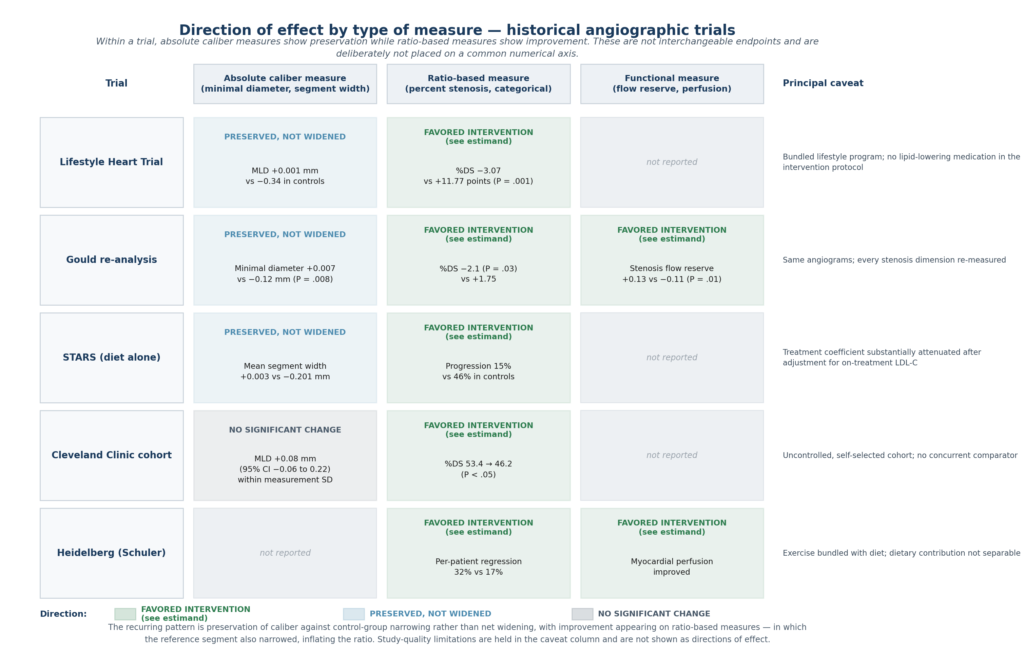
図6。. 効果の方向は 措置の種類 過去の血管造影試験全体を通じて。各列は、測定対象に応じてエンドポイントを「絶対径」、「比率に基づくもの」、「機能的」の3つに分類している。各行に沿って繰り返されるパターンが見て取れる――絶対径の測定値は 拡幅ではなく、現状維持, 一方、同じ試験における比率に基づく指標では、次のような結果が示されている 改善, 、その一因として、少なくとも一部のデータセットでは参照セグメントも狭まっていたことが考えられるが、局所病変の変化も寄与している可能性がある。研究の質に関する制限事項は別の「留意事項」欄に記載されており、意図的に効果の方向性として示されていない。 これらのエンドポイントは相互に変換可能ではなく、共通の数値軸上に配置されていません。行レベルの分類は、直上に表形式で示された主要な試験報告(参考文献8、9、36、37、53、56、58、および60~62)に基づき、著者によって導出されたものです。.
3.5.5 血管造影では確認できないもの
トポルとニッセンによる「冠動脈ルミノロジー」への批判は、この一連の文献全体にまさに当てはまる。.38 血管造影では、動脈そのものではなく、その管腔に充満する造影剤が映し出されます。つまり、トンネル内部の空間が写し出されるだけで、トンネルの壁の状態については何も教えてくれません。これには4つの結果が伴い、それらは双方向に影響を及ぼします。.
その病気は目に見えない。. 動脈壁のプラーク負荷、壁厚、組織構成は、いずれも目に見えない。かなりのアテロームを抱えた動脈でも、X線写真上では全く正常に見えることがある。.38
どちらの段階においても、対外的な成長が見られない。. 初期および中期のプラークは、外側へ膨らむ血管壁の内部に蓄積するため、代償能力が尽きるまで、病気は目に見えないまま進行していく。.25,38 この論理を逆の視点から考えてみると、リモデリングによって生じた食事に関連する血管径の拡大は、たとえプラークが吸収されなかったとしても、退行として記録されることになる。これはまさに、マカクザルのデータが示唆するパターンそのものである。.5
細径の変化は、組織の変化ではなく血管の緊張の変化によるものである可能性があります。血管造影では造影剤が充填された血管腔を測定するものであり、血管の緊張の変化と血管壁の変化を区別することはできません。.38 したがって、最小内腔径のわずかな変化は解釈が分かれる。従来の解釈では、それらはノイズとみなされるが、検証中の仮説においては、メカニズムの候補となる。また、これが、血管壁や組成に関する情報を含まない状態で測定された内腔面積が、プラークの変化を評価する単独の主要評価項目としては信頼性が低い理由でもあり、この点については第6.1節で論じられている。.
これらの介入は「プログラム」であり、「食事療法」ではなかった。. オーニッシュ、ハイデルベルク、SCRIPの各プログラムは、いずれも食事療法に加え、運動、ストレス管理、禁煙、および状況に応じた薬物療法を組み合わせていた。.53,56,58 どの分析手法を用いても、食事成分を抽出することはできず、また、これらの試験はいずれもその目的で設計されたものではなかった。.
3.6 なぜヒトの歯垢の証拠ではこの問題を解決できないのか
まずここで、ある解剖学的な点を指摘しておきたい。というのも、この点が裁判記録に見られる矛盾の多くを説明してくれるからだ。動脈は 両方 所見。グラゴフの剖検研究により、プラークが蓄積するにつれて血管が拡張し、病変が内弾性板内の面積の約40%を占めるようになるまで、管腔面積がほぼ維持される「外向性拡大」が確認された。.25 これとは逆の過程、, 収縮性リモデリング, 、血管を内側に収縮させる。その結果は最初のケースと類似している。すなわち、プラークの体積は減少する一方で、血管内腔はほとんど変化しないか、あるいは狭まることさえある。これは、プラークを取り囲む血管壁が同時に収縮しているためである。.
したがって、ルーメン測定は、プラークの状態を評価する指標としては、どちらの方向においても信頼性に欠ける。すなわち、脂質を除去せずに管腔を拡大させた食事療法を過大評価してしまう可能性があり、一方で、脂質は除去されたものの血管が収縮してしまった場合、その事実を隠蔽してしまう可能性がある。.25 これは、後述するエンドポイントの異質性に加え、血管造影試験を統合できないもう一つの理由である。.
何が欠けているかについて触れる前に、なぜ既存の臨床試験を単に集めて比較を行うだけでは不十分なのかを述べておく価値がある。 本レビューでは、介入の種類、達成された脂質変化、および血管造影所見についてコード化された食事療法および薬物療法の試験をまとめたデータを用い、公表済みの連続血管造影研究について、試験レベルでの探索的比較を試みた(補足データ S1~S4)。しかし、その結果は解釈不能であることが判明した。その理由は十分に示唆に富むため、記録しておく価値がある。.
血管造影上の「退行」は、単一のエンドポイントではない。原著論文を参照すると、その定義は以下のように多岐にわたる。 しきい値がまったくない — オーニッシュは、病変の変化が改善方向に向かっている場合、その変化の程度をすべてカウントした。具体的には、ヨガ試験では絶対パーセンテージポイントで10以上、MARS試験では狭窄径のパーセンテージで12%以上、最小内腔の拡大量が0.4 mm以上となる場合である。 他の部位には進行が見られない CCAITおよびLCASにおいて。.36,53,63 これらは名称こそ同じだが異なる測定方法であり、定義の許容範囲は介入の種類と相関している。すなわち、生活習慣介入試験では最も緩やかな基準が用いられ、薬剤介入試験では最も厳格な基準が用いられた。したがって、試験間の比較には、食事療法の優位性を人為的に作り出すような方向で、まさに交絡が生じている。.
感度チェックとは、同じアプローチを用いて 存在することがわかっている関係を復元できない. 薬理学的試験において、達成されたLDLの低下幅と報告された退行率は、試験間で相関関係が見られない。一方で、単一試験内におけるLDLとプラークの用量反応関係は、循環器学において最も再現性の高い知見の一つである。.17–20 試験レベルの回帰率は、明らかに、各研究の閾値と治療効果の両方によって決定されている。 既知のシグナルを検出できないアプローチは、仮説上のシグナルを検出する上でも妥当ではない。データの集計、コーディングの決定、原著論文との照合、および探索的解析は補足資料として提供されており、ここでは独自の定量的知見というよりは、方法論的な議論として報告されている。.
これにより、試験横断的な集計結果に関する考察は終了する。食事療法の追加効果は、公表されている要約レベルの試験記録からは信頼性をもって推定できない。決定的な検証を行うには、§6.1に示されているような無作為化デザインが必要である。.
そのまとめに含まれるある臨床試験は、欧米のレビューではめったに引用されていないため、それ自体として特筆する価値がある。マンチャンダらは、血管造影により冠動脈疾患が確認された男性42名を、ヨガ・食事・運動プログラム群と、米国心臓協会(AHA)のステップI食事療法による危険因子管理群に無作為に割り付けた。1年後に、より多くの病変が退縮した(20TP9T 対 2%) であり、進行した症例は少なかった(5% 対 37%, P < 0.001)、再血管化が必要となった患者数は1名に対し8名であった(P = 0.01)。.63 この介入は極めて包括的なものであり、試験規模も小さいため、食事の影響を単独で特定することはできないが、無作為化血管造影ライフスタイル試験の包括的な検討においては、この研究も重要な位置を占める。.
表6. エンドポイントの種類別に分類した、現代の食事パターンに関する臨床試験。これら3つの区分は互換性がない。すなわち、イベント結果、画像検査結果、脂質検査結果はそれぞれ異なる問いに答えるものであり、直接比較することはできない。.
| トライアル | 比較 | 対象集団/追跡調査 | 一次結果 | 主な制限事項 |
| 臨床事象 | ||||
| PREDIMED、2018年2 | 地中海式食事+エキストラバージンオリーブオイルまたはナッツ vs 低脂肪食介入 | 高リスク群に対する一次予防;約4.8年 | 地中海式食事群の両群において、重大な心血管イベントの発生数が減少した | 割り当ての不備;カウンセリングの頻度は当初異なっていた |
| CORDIOPREV、2022年3 | 地中海式 vs アクティブ・低脂肪 | CHDと診断されてから7年 | 原発性イベント数:87件対111件;調整後ハザード比 0.719~0.753 | 両群とも食事療法を受けた;被験者の大半は男性であった |
| 血管イメージング | ||||
| DISCO-CT、2021年10 | 集中的な食事・生活習慣療法+OMT 対 OMT単独 | 非閉塞性冠動脈疾患;約67週 | PAV +1.0 対 +1.1 パーセントポイント(P = 0.851)— 総負担量については有意差なし | 広範囲の非石灰化帯は、食事療法によりさらに減少した(名目上のP値=0.045)。最大管腔径は減少した。 |
| CORDIOPREV 頸動脈48 | 地中海式 vs 低脂肪 | CHD参加者939名;5歳および7歳 | 各群内でIMTの良好な変化とプラーク高の低下が報告された | 群内変化;解釈は公表されている補正に従うべきであるため、本レビューでは数値推定値は使用していない |
| PREDIMED-ナバラ46 | 地中海式食事群と対照群の比較 | 参加者187名、1年 | IMTの総合比較:なし | ベースラインIMTサブグループに限定した回帰分析 |
| DIRECT-Carotid、2010年49 | 低脂肪食 vs 地中海式食事法 vs 低炭水化物食 | 過体重・肥満の成人;2年 | 壁の体積:全体で−58.1 mm³(≈5%);各食事群間で差は認められなかった | 血圧の低下は、病変の退縮と相関していた |
| 脂質と リスク要因 | ||||
| HeFHにおけるWFPBによる食事管理、2026年64 | WFPBと標準的なアメリカ式食事の比較:クロスオーバー試験 | 遺伝学的に確認された家族性高トリグリセリド血症(HeFH)の成人患者50名。プロトコルに従って脂質低下薬を中止した後、それぞれ4週間 | LDL-C −17.9%(95% 信頼区間 −21.7~−14.3);ApoB >14%(正確な相対リスク推定値は報告されていない) | 4週間;CRPには影響なし;個人による反応には大きなばらつきが見られた |
| ベジタリアン/ヴィーガンに関するメタ分析、2023年11 | ベジタリアンやヴィーガン対雑食 | 30件のRCT、参加者約2,400名 | LDL-C −0.30 mmol/L(≈ −11.6 mg/dL);ApoB −12.92 mg/dL | わずか6件の試験からのApoBデータ、高い異質性 |
| ポートフォリオ・ダイエット, 200365 | 食品群 vs ロバスタチン vs 対照群 | 高脂血症の成人;1か月 | スタチン投与と同等のLDL-CおよびCRPの低下が認められた | 1か月;階乗ではない |
CAD:冠動脈疾患;CHD:, 冠動脈疾患; CRP、C反応性 タンパク質; EVOO:エクストラバージンオリーブオイル; HeFH:ヘテロ接合型家族性高コレステロール血症; IMT:内膜中膜複合体厚; OMT:最適薬物療法; PAV:アテローム体積率。.
3.7 「植物由来」の意味と、実際にApoBをどの程度低下させるか
ここで2つの訂正を述べておく必要があるが、そのいずれもが、この文献の残りの部分をどのように読むべきかという点に影響を与えるものである。.
このラベルは、複数の食事療法を対象としています。. 地中海式食事法との違いよりも、互いに大きく異なる介入策に対して、ある単一の用語が常套的に用いられている。2026年に実施された家族性高コレステロール血症を対象とした食事介入試験では、その介入策を「ホールフード・プラントベース」と表現していた。これは、ヴィーガンや無油食というよりは、植物性食品を主とする食事であり、 脂質由来のエネルギー 35%, 料理に キャノーラ油, 、含む 赤身肉 週に1回, 、そして……がある 完全に肉を使わない日が2日.64 その説明には一理ある――この用語は、必ずしも「ビーガン」や「オイルフリー」と定義されているわけではない――が、より厳格な用法とは置き換えられない。オイルフリーのエッセルスティン式プロトコルと、その食事療法は同じ介入法ではなく、一方の結果を他方に転用することはできない。 表7では6つのパターンを区別している。研究における実際の介入が、その研究で使用されたラベルと異なる場合、本レビューではその介入内容について記述している。.
脂質による影響は、一般に言われているほど大きくはありません。. 30件の無作為化ベジタリアンおよびヴィーガン試験を統合した結果、LDL-Cは0.30 mmol/L(約11.6 mg/dL、およそ10%)低下し —、ApoBは12.92 mg/dL低下した(95% CI −22.63~−3.20)。なお、ApoBの数値はわずか6件の試験に基づいており、著しい異質性が認められる。.11 この完全に管理された食事介入デザインにより、プロトコルに従って脂質低下薬の服用を中止した後、ヘテロ接合型家族性高コレステロール血症の成人を対象に実施された、植物性食品を主とする特定の食事療法について、高い有効性の推定値が得られた。 ただし、現在の併用脂質低下療法を継続している高齢で高リスクの患者における増分効果は推定されておらず、より厳格な治療パターンで達成可能な最大効果についても定義されていない。この介入により、LDL-Cは 1.28 mmol/L(95% 信頼区間 −1.55 ~ −1.02;P < 0.0001), 相対的な減少率は 17.9%(95% CI −21.7% ~ −14.3%), 、総コレステロール、非HDL-Cおよび ApoBはいずれも14%以上下落した; 研究者らは、ApoBの減少について次のように説明している。 15% その議論の中では触れられているものの、この論文では、LDL-Cについて用いられたのと同じ形式で、信頼区間を伴う正確なApoBの相対的効果については報告されていない。.64 トリグリセリド 10%近く低下したが、Lp(a)には影響が見られなかった。これらに加えて、以下の2つの結果も挙げられる: HDL-CとApoA1も、それぞれ8.5%および7.4%低下した。, 、および推定 10年間の心血管疾患リスク でした 11.9%の低下(95%の信頼区間:−19.4%~−3.6%;P = 0.007).64
直接比較を行う無作為化比較試験により、この2つの点がより鮮明になる。. バーナードらは、62名の過体重成人を対象に、PREDIMEDプロトコルに基づく低脂肪ビーガン食または地中海式食事療法のいずれかに無作為に割り付け、クロスオーバー法によりそれぞれ16週間ずつ実施した。.54 服薬に変更のなかった参加者では、総コレステロールおよびLDLコレステロールが低下した ビーガン食では18.7および15.3 mg/dLであり、地中海式食事法では有意な変化は見られなかった (LDL-Cに対する治療効果 −14.8 mg/dL、95% 信頼区間 −23.5~−6.2;P = 0.001)。体重、体脂肪量、, 内臓脂肪 そして インスリン感受性 また、ビーガン食ではさらに改善が見られた。血圧については逆の傾向が見られ、地中海式食事法では収縮期血圧が9.3 mmHg低下したのに対し、ビーガン食では3.4 mmHgの低下にとどまった(治療効果 +5.9 mmHg;P = 0.02)。.54
この16週間のクロスオーバー試験では、低脂肪ビーガン食の期間の方がLDL-Cの低下幅が大きく、一方、地中海式食の期間の方が収縮期血圧の低下幅が大きかった。.54 ApoBは測定されず、心血管イベントも評価されなかった。これらの違いは、2つの介入群における食事および栄養素の組成の違いを反映している可能性があるが、本試験は原因となる成分を特定するようには設計されていなかった。.
また、このことは、本レビューの核心となる問いに関わるものであるため、率直に指摘しておく価値のある緊張関係を生み出している。. ハードエンドポイントに関するエビデンスの優先順位は、この短期クロスオーバー試験で観察されたLDL-Cの影響を反映したものではない。. 地中海式食事法については、主要な心血管イベントの減少が確認された無作為化試験であるPREDIMED、CORDIOPREV、およびLyon試験が存在する一方で、所定の検索基準に基づき2026年7月31日時点で、十分に特徴づけられた植物性食品を主とする食事パターンに関する、適格かつ十分な検出力を持つ完了済みの心血管アウトカム試験は確認されなかった。 この不一致を生物学的優劣の順位と解釈することはできない。なぜなら、これら2つの食事パターンは、十分な検出力を持つ心血管アウトカム試験において比較されたことがないからである。このようなエビデンスの欠如は、適格な完了済み試験が存在しないことを反映しているものであり、アウトカムの劣性を示す証拠ではない。 この不一致は、研究投資の配分、試験デザイン、遵守状況、対照群の選択、あるいは食事パターン間の真の生物学的差異を反映している可能性がある。既存のデータでは、これらの説明の優先順位をつけることはできない。 これについては、しばしば2つの解釈が提示される。1つは、アウトカムに関する文献が生物学的な要因ではなく研究投資を反映しているという解釈であり、その場合は、適切な検出力を持つ植物性食品を主体とするアウトカム試験が欠落していることになる。もう1つは、報告されている空腹時LDL-Cの差では表されていない経路――前述の5.9 mmHgの差や第4.6節の無作為化試験の証拠から考えて、血圧などがその一例である――が、地中海式食事法試験で達成されたイベント減少に実質的に寄与しているという解釈である。バーナード試験は、経路による効果の違いを示すもっともらしい例を提供している――ある介入ではLDL-Cの低下がより大きく、別の介入では収縮期血圧の低下がより大きい――が、地中海式食事法試験が達成したイベント減少に実質的に寄与したかどうかは特定していない。 ——が、地中海式食事試験で達成されたイベント減少に実質的に寄与しているというものである。バーナード試験は、異なる経路による効果(ある介入ではLDL-Cの低下がより大きく、別の介入では収縮期血圧の低下がより大きい)の妥当な例を示しているが、地中海式食事のアウトカム試験における有益性を説明するメカニズムを特定しているわけではない。.
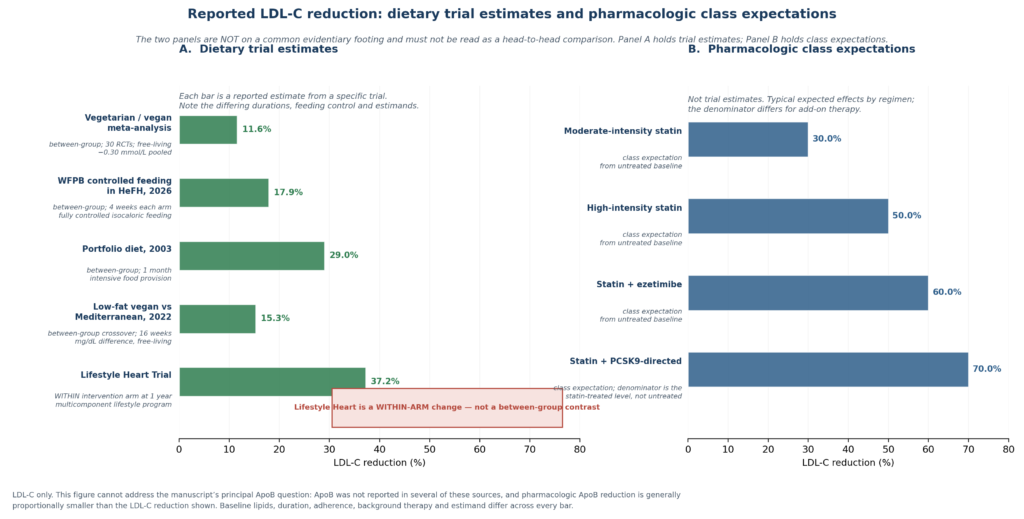
図7。. エビデンスの種類別に分類した、報告されているLDL-Cの低下値。. パネルA 特定の食事介入試験による推定値を収録しており、各データには推定対象、試験期間、および食事管理の程度が明記されている。Lifestyle Heartのバーは、 同一群内 多要素からなるライフスタイル・プログラムによる変化であり、そのようにマークされています。. パネルB 薬理学的効果を持つ 授業での期待事項, 、臨床試験の推定値ではなく、追加療法については分母が明記されている。これら2つのパネルは、証拠の根拠が共通しておらず、直接的な比較として解釈してはならない。図は以下を示している。 LDL-Cのみ また、本総説の主要なApoBに関する論点には言及できない。薬理学的ApoB低減効果は、一般的に、示されているLDL-Cの低減効果に比べて相対的に小さい。.
植物性食品を主とする食事療法によりLDL-Cが20~35%低下し、通常、患者のLDL-C値が70~90 mg/dLになるという主張は、ベジタリアンやヴィーガンの食事療法による典型的な効果として提示されるべきではない。ただし、集中的な指導プログラムやベースライン値が高いサブグループでは、この数値に達する場合もある。 パーセンテージは変動するが、絶対値は変わらない。150 mg/dLから15%低下すると約128になるが、250から同じ15%低下すると213になる――反応は比例するため、開始時の値が最終的な数値を大きく左右する。 これに個人差が重なる。食事管理試験では、5名の参加者がLDL-Cを30%以上低下させた一方で、5名は 上昇する 植物性食生活を実践している人の中で、その5人のうちApoB値が高かったのは2人だけだった。.64 また、, 試験期間中、2名の被験者が脂質に影響を及ぼす可能性のある薬物療法を開始した — 1例ではイソトレチノイン、もう1例ではメチルフェニデート — であり、これら2例はいずれもプロトコル遵守データセットから除外された(主要解析:n = 50、プロトコル遵守:n = 48)。.64
3.7.1 生涯にわたる曝露と成人期における介入の比較
こうした控えめな介入効果は、集団データと照らし合わせると整合性が取れず、集団に関する最も有力な証拠は生態学的ではない。. 移民集団では、食事や環境が変化しても、遺伝的背景はほぼ一定に保たれている, 、これにより遺伝的交絡因子は軽減されるものの、移住に伴う選別や生後早期の曝露、あるいは移住に伴う多くの同時的な環境変化は排除されない。この にほんさんスタディ 日本、ハワイ、カリフォルニア州に居住する45~69歳の日系男性11,900人を対象に、同等の手法を用いて調査を行った。年齢調整後の有病率は 心電図により確定された冠動脈性心疾患 でした 1,000人あたり5.3、5.2、10.8 それぞれ、確定症例および疑い症例については、25.4、34.7、44.6である。.66 この傾向は、日本とカリフォルニアで血清コレステロール値および食事中の 飽和脂肪酸. 。広く共有される祖先、大きく異なる環境や食生活、そして約2~3倍の疾患の勾配。.
生態学的データも、推論の確度は低いものの、同様の傾向を示している。中国・コーネル・オックスフォードの65郡を対象とした調査では、血清総コレステロールの平均値は127 mg/dLであったのに対し、米国の成人では203 mg/dLであり、冠動脈疾患による死亡率は米国の方が著しく高かった。.67,68 郡レベルでの相関関係からは、コレステロール値が低い個人が冠動脈疾患による死亡を回避できたとは示せない。また、1983年から1984年にかけての中国農村部における死亡診断書の記載方法は、同時期の米国の慣行とは異なっている。 集団内データの方が説得力が高い。1984年から1999年までの北京のデータをモデル化したところ、食生活が西洋化するにつれて、年齢調整後の冠動脈疾患による死亡率は男性で約50%、女性で27%上昇し、その大部分は総コレステロール値の上昇に起因することが判明した。.69
これらすべてが浮き彫りにしているのは、 曝露の概念, 、そしてこれが、一般集団のデータと臨床試験のデータに食い違いが見られる理由です。一般集団の平均値である127 mg/dLは、小児期から数十年にわたる低レベルの曝露を反映したものです。一方、前述の10~18%の減少幅は、すでにプラークを有する中年成人を対象とした数週間から数ヶ月間の介入によるものです。 これらは同等の量ではなく、以下に述べる説明は、測定による分解というよりは概念的な統合である。これらを混同することで、食事によって達成可能であると集団データが示唆する結果と、食事介入試験がもたらす結果との間の不一致の多くが説明され、また、ヴェルベット猿の研究結果——すなわち、予防は逆転よりも実現しやすい——とも一致する。70 そして、ApoBそのものの因果関係を裏付ける根拠となっているのが、累積曝露の論理である。.14
表7. 「植物由来」というラベルの下で、しばしば混同されがちな6つの異なるパターン。.
| パターン | 特徴 | 代表的な証拠 |
| 植物性食品を主とした健康的な食事 | 植物性食品を重視し、動物性食品は減らすものの完全に排除はせず、脂質は多くの場合、エネルギーの30~35%を占め、油脂類は許可される | 2026年のHeFH食事介入試験(LDL-C −17.9%、ApoB >14%)64 |
| 地中海 | エクストラバージンオリーブオイル、ナッツ類、種子類、全粒穀物、豆類、野菜、果物を多く摂取し、魚や鶏肉は適量にとる。脂肪からのエネルギー摂取量は通常35~45%である。 | PREDIMEDおよびCORDIOPREVのハードエンドポイント試験(頸動脈画像診断に関するサブスタディを含む)2,3,48 |
| ラクト・オボ・ベジタリアン | 肉や魚は除外され、乳製品や卵は含まれているため、飽和脂肪酸や食事性コレステロールの摂取量は、食品の選択によって左右される。 | 30件の試験を対象とした統合解析に含まれる11,71 |
| ヴィーガン | 動物由来の食品はすべて除外された。油の使用量および総脂肪含有量は、介入方法によって大きく異なる。 | 統合解析およびクロスオーバー試験に含まれる11,54 |
| 極低脂肪のベジタリアン食(オーニッシュ式) | ベジタリアン;脂質由来のエネルギーは約10%。無脂肪乳製品と卵白は限定的に許可されている — 完全に動物性食品を排除しているわけではない | ライフスタイル心臓トライアル8,53 |
| オイルフリーの植物性食(エッセルスティン法) | 厳格な定義では、動物性食品および添加油は除外される;脂質由来のエネルギーが10%未満 | クリーブランド・クリニックのコホート研究、脂質低下薬との併用9,61 |
3.8 ティア3 — 幾何学的仮説を裏付ける動物および実験的証拠
アームストロング、ワーナー、コナーは1970年、アカゲザルに誘発された冠動脈アテローム性動脈硬化症が、アテローム誘発食の投与を中止すると退行することを示した。.26 これは、確立された冠動脈疾患が一方通行の進行ではなく動的な状態であることを初めて実証したものであり、その後の研究では、退行過程においてどのような変化が生じるかが解明された。すなわち、動脈内の脂質が排出され、壊死核が縮小し、残存するコラーゲンと エラスチン 壁が肥厚したままであっても、より硬く、静かな病変へと凝縮する。.72–74
これらの初期のモデルでは、食事によるメカニズムを個別に区別することができないが、その理由を明確にしておく価値がある。回帰食はコレステロールを含まないものであり、血清コレステロール値は高コレステロール血症時のピーク値から基礎値へと急激に低下した。.26,72 検証対象の曝露量がそこまで低下すると、その下流にあるすべての要素も同様に低下してしまうため、実験内の比較だけでは、改善のどの部分がどのメカニズムによるものなのかを特定することはできません。こうした研究が提供してくれるのは、血管壁がどのような働きをするのかという知見です その後 脂質がなくなると――そこで、その光景は実に驚くべきものとなる。.
3.8.1 2つのコンパートメント、およびなぜそのうちの1つだけがクリアされるのか
病変は単一の物質ではなく、霊長類を用いた研究は、人間の画像診断では不可能な方法でその区別を具体的に示している。脂質が豊富な領域―― 泡沫細胞, 、細胞外脂質、壊死性コア――は代謝的に活性であり、比較的速やかに除去される。線維性および石灰化部位は構造的なものであり、リモデリングには時間がかかり、特に高密度の石灰化の場合は、その大部分が固定化されている。.72–75
霊長類において、食事に起因する重度の高コレステロール血症が改善された際、これら2つのコンパートメントは異なる挙動を示した。. コレステロールエステル また、泡沫細胞の脂質が減少して、壊死核を含む残骸が消失し、病変は平坦化して脂質含有量が低下した一方で、線維性および石灰化成分は残存していた。.72,74
最も詳細な物理化学的解析によると、この状況は予想以上に複雑であることが示されており、これを曖昧に済ませるのではなく、明確に指摘しておく価値がある。Smallらは、30か月にわたる誘発期間および12か月にわたる退行期間を通じて、カニクイザルの病変を追跡調査した。.75 退行の最初の6か月間を通じて、泡沫細胞の数とコレステロールエステルの含有量は予想通り減少したが、壊死は残った、と 親戚 遊離コレステロールの割合が上昇し、大量のコレステロール一水和物の結晶が形成された。著者ら自身の見解は慎重なものであり、血清コレステロールの急激かつ大幅な低下は、以下を引き起こす可能性がある。 コレステロール結晶 そして、 一見した限りでの悪化 短期的には病変の外観に変化は見られなかった。より長期にわたる退縮が進んで初めて、脂質組成が正常に近づき、結晶が部分的に消失し、最終的に内膜の状態は改善したように見えたが、瘢痕は残った。.75
ここから2つの示唆が導かれる。回帰分析には 経時変化, 、また、経過が良好な方向に向かっているにもかかわらず、初期の検査時点の組織所見は、開始時点の所見よりも悪く見えることがある――これは、短期間の画像診断試験を行う際には注意すべき点である。.75 そして、その最終的な結果は回復ではない。内膜には瘢痕が残っており、これはまさに「2コンパートメントモデル」が予測する通り、線維石灰化コンパートメントが持続している状態である。.
これらの実験には、本総説がそうでなければ未解決のままにせざるを得なかった反論に答える2つの特徴がある。第一に、実験動物の血清コレステロール値は数ヶ月にわたりおよそ400~700 mg/dLまで上昇させられ、ヒトのアテローム性動脈硬化症と重要な組織学的特徴(壊死性コア、線維性被膜、石灰化など)を共有する、真に進行した病変を発症した。 脂肪線条. 。したがって、この知見は「初期病変は退行する」という弱い結論ではなく、「 進行した病変の脂質コンパートメントは動員可能である 粒子負荷が正常化すると。第二に、回帰は極端な低減時だけでなく、コレステロールがヒトにおいて数値的に達成可能な範囲(200 mg/dL付近)まで低下した後も生じた。ただし、同等の総コレステロール値であっても、種間で同等のApoB粒子曝露が確立されるわけではない。これは、霊長類における回帰には非生理的な脂質低下が必要であったという反論に反論するものである。.26,72
これにより、「成功」の定義も再構築されることになる。脂質コンパートメントの除去やキャップの肥厚は、線維石灰化性スキャフォールドが残存しているため、必ずしもプラークの総体積を減少させることなく、より安定した病変表現型への移行と一致している。体積のみを測定する試験では、これを「失敗」として記録することになるだろう。これは、内腔の測定における問題と同じものであり、ただ1層深いレベルでの問題に過ぎない。.
3.8.2 プラークが縮小したのではなく、動脈が肥大化した
本総説にとって最も関連性の高い実験は、ウィリアムズ、アンソニー、オノレ、クラークソンらによるもので、彼らは外科的に閉経させた88頭のカニクイザルを調査した。.5 すべての動物は、24か月間、アテローム生成食を与えられました。その後、一部の動物は直ちに剖検を行い、ベースラインを確立しました。残りの動物は、ホルモン療法の有無にかかわらず、30か月間、血漿脂質低下療法を受けました。.
設計については、その結果がどのようなものを支えられるかを決定づけるものであるため、詳細に規定しておく必要がある。アテローム性食餌を24か月間与えた後、88匹の動物は以下のグループに割り当てられた。 4つのグループ:グループ1(n = 20)は直ちにベースライン時の剖検を行った;グループ2(n = 25)は脂質低下食のみを投与された;グループ3(n = 22)は脂質低下食に加え、共役馬 エストロゲン; また、グループ4(n = 21)には、脂質低下療法に加え、結合型馬エストロゲンおよび酢酸メドロキシプロゲステロンが投与された。治療期間は30ヶ月であった。.5 脂質低減食により、脂肪由来のカロリーは44.2%から31.0%へ、飽和脂肪酸は19.5%から7.6%へ、コレステロールは0.44から0.05 mg/calへと減少した。 血漿総コレステロール値は、およそ16~17 mmol/Lから約4 mmol/Lへと低下した。.5
プラーク面積の平均値に、統計的に有意な差は認められなかった ベースライン時・剖検群と脂質低下療法後に検査を行った各群との間では(群1の冠動脈プラーク面積の平均値は0.317 ± 0.042 mm²、対して群2~4では0.252 ± 0.039、 0.318 ± 0.040 および 0.314 ± 0.041 mm²;P = 0.55)。.5 群間でプラーク面積に統計的に有意な差が認められなかったことを踏まえ、, 脂質低下期間後の血管および管腔の断面積は、ベースライン時と剖検時を個別に比較した群に比べて著しく大きく、断面積の比較では約2倍であった(P < 0.05)。, 、また、アセチルコリンを介した血管拡張は、以下のことで改善された。 22 ± 4%(P = 0.01) 一方、ニトログリセリンに対する反応には変化が見られなかった(P = 0.23)――このことから、変化は平滑筋の機能ではなく、内皮機能に起因するものであることが示唆された。.5
解釈において極めて重要なのは、, ホルモン療法は、いずれの効果も増強しなかった. 。この拡大は脂質低下群全体で認められ、ホルモン療法によって増強されることはなかった。これは、この現象が脂質低下介入に伴うものであるという研究者らの解釈を裏付けるものであり、ホルモン補充療法は、試験対象となったアゴニストに対する血管反応性にさらなる影響を及ぼさなかった(P > 0.4)。.5 ホルモンに特異的な所見は、これとは逆の結果を示した。すなわち、酢酸メドロキシプロゲステロンを追加すると、結合型エストロゲンが及ぼす有益な効果が 冠血流予備能 (P = 0.03)。同研究室による以前の実験では、エストロゲン単独でも、アテローム性動脈硬化をきたした冠動脈におけるアセチルコリン反応を調節できることが示されていたが、,76 したがって、その懸念は妥当なものだった――しかし、この研究では、脂質低下期に幾何学的および血管運動性の差異が認められたものの、ホルモン療法によってそれらが増強されることはなかった。.
回帰現象を直感的にイメージすると、プラークが溶けてなくなり、その背後で血管が再び開通する様子が思い浮かぶ。しかし、ここで起こったことはむしろその逆に近いものであった。すなわち、プラークの面積は群間で有意な差が見られなかった一方で、動脈の断面積は著しく大きくなっていた。 道路の1車線が駐車車両によって塞がれている場合、車をレッカー移動させるのではなく、交通が再び流れるようになるまで車道を拡幅するのです。通路のみを測定した臨床医は明らかな改善を記録したでしょうが、病変のみを測定した病理医は改善を認めなかったでしょう。どちらの報告も正確だったのです。.
この実験は、本総説の中で他のどの実験よりも論証の重みを占めているため、これを解釈するにあたって留意すべき4つの制約について、明確に述べておく必要がある。.
この変化は、脂質低下療法の最中に生じたものであり、その代わりに生じたものではない。. 研究者ら自身の見解によれば、脂質低下は 許可されている 動脈のリモデリングを引き起こした。別の食事療法において、対照群で同等のリポタンパク質曝露を受けたグループは存在しなかったため、この拡大は、粒子曝露の減少、食物組成、あるいはその他の代謝的影響に起因するものではなく、介入全体にのみ起因するものと考えられる。.5
“「それほど小さくはない」というのは、「同じ」ということとは異なります。” この比較は、同等性検定として設計されたものではなく、同等性マージンも設定されていなかった。差異を検出できなかったことと、差異がないことを実証したことは異なる結論であり、確立されたのは前者のみである。検出限界以下の範囲で、一部のプラークが吸収されていた可能性は十分にある。.
この比較は群間で行われたものであり、動脈内での比較ではなく、また、未治療群は対象に含まれていなかった。. ある群の動物はベースライン時点で検査され、別の群は30か月後に検査された。重要な点として、その期間を通じて同時期の対照群は維持されなかった。 なし 脂質低下のため、治療、経過時間、加齢を区別することはできない。 この実験は、脂質低下期間を通じて、プラーク面積、血管面積、管腔面積、および血管運動機能の間に乖離があることを示しているが、その拡大のうちどれほどが治療によるものかを定量化してはいない。これは、冠動脈病変がヒトのそれと非常に類似している種においては依然として有力な研究デザインであるが、回帰期間を通じて個々の冠動脈病変を連続的に測定したわけではない。.
“「サイズ」とは、直径ではなく断面積を指します。. ほぼ円形の容器の面積を2倍にすると、直径は約41%増加することになり、100%ではありません。面積は半径の2乗に比例するからです。この結果を「内腔が2倍になる」と報告することは 直径, 、二次的な統計ではよくあることですが、その数値を2倍以上も過大評価しています。.
正確に言えば、30か月にわたる血漿脂質低下療法の後、冠動脈および管腔の断面積はベースライン群の約2倍となったが、プラーク面積には有意な差は認められなかった。これは、脂質低下療法期間後に血管および管腔の面積が大幅に拡大した一方で、プラーク面積には統計的に有意な差が見られなかったという結果と一致している。これは、 動脈の形状とプラークの大きさは、互いに一致しない変化を示すことがある — これは今後の研究に活かすべき知見である — しかし、この拡大がApoBへの曝露の減少によるものか、食物組成によるものか、あるいはその両方によるものかについては、何ら結論が出ていない。.
3.8.3 構造が部分的にしか退行しない場合の機能の正常化 — 非冠動脈性病床において
ハリソン、アームストロング、フライマン、ハイスタッドらは、霊長類のアテローム性動脈硬化症に対する食事療法により、内膜は依然として著しく肥厚したままであったものの、内皮依存性弛緩が実質的に正常な状態まで回復したことを明らかにした。.6 これらの数値は重要である。なぜなら、「構造は持続する」という表現は事実を誇張してしまうからである。3つのオマキザル群が調査対象となった:通常飼料群(n = 11)、 0.7%のコレステロールと40%の脂肪を含む食事を18ヶ月間摂取した群(n = 10)、およびそのアテロゲン性食餌の後に18~20ヶ月間標準飼料に戻した群(n = 9)の3群である。 血漿コレステロール値は、それぞれ96 ± 6、564 ± 26、そして回帰群では599 ± 39から119 ± 7 mg/dLへと低下した。.6
構造は大幅に改善されたが、単に正規化されなかっただけである。. 正常な血管では内膜面積は0.1 mm²未満であったが、アテローム性食餌投与後は1.8 ± 0.3 mm²となり、 食事による回帰後の値:0.7 ± 0.2 mm² — 約60%の減少が見られるが、依然として正常値の数倍のレベルであり、泡沫細胞や炎症細胞は認められず、コラーゲンが顕著に認められる。.6 その部分的に退行した病変に対して、アセチルコリンによる最大弛緩度は、正常な血管では72 ± 8%であったのに対し、アテローム性動脈硬化をきたした血管では35 ± 10%となり、その後再び 77 ± 9% 回帰分析の結果、ニトログリセリンに対する反応は3群すべてで同一であった(99、99、97%)ことから、欠陥とその修復は平滑筋ではなく内皮に起因するものと判断された。.6 研究者らは、この用語を用いて “「機能的回帰」” — 検証済みのエンドポイントではなく、彼ら自身が定めた記述的なラベル:内膜の厚さや病変の肉眼的な外観がわずかに減少しただけであっても、血管壁の機能的改善が生じている状態。.
したがって、正確な表現は「構造が変わらなかった」ということではなく、「 関数は正常に戻ったが、構造体は正常に戻らなかった. ここでは血管床が重要ですが、二次引用ではこの点が常に見落とされてしまいます。これは 腸骨動脈輪の臓器室内研究, 、同グループが以前、アテローム性動脈硬化症がカニクイザルの腸骨動脈におけるアセチルコリンおよびトロンビンによる弛緩を阻害することを実証したことに続き、。.7 これは冠動脈に関する実験ではありません。.
したがって、妥当な解釈は、通常考えられているよりも狭い範囲のものとなる: 霊長類の回帰モデルにおいて、導管動脈の内皮機能は正常化しても、内膜肥厚は大幅に減少したものの、依然として正常値を大幅に上回っている.6,7 冠循環への波及はあり得るが間接的なものであり、本総説ではこの知見を、冠循環への直接的な裏付けというよりは、血管生物学を支持する証拠として扱っている。より強めの解釈――すなわち、機能が確実に回復するという見解―― まず, 、固定された2段階の順序で——これを行うには、退行過程の複数の時点で連続的な測定が必要となるが、これらの実験ではそのような測定は行われていなかった。 また、すべてを従来のモデルの枠内に収める別の説明も存在する。すなわち、内皮からの脂質負荷を取り除くことで、病変が溶解するよりも早く機能が回復するだけかもしれない。その場合、この観察結果は、別の経路の証拠というよりは、ApoBを介した効果における時間スケールの違いによるものということになる。.
3.8.4 栄養素ごとの実験、およびそこに潜む交絡要因
アンソニー、クラークソン、ブロック、およびワグナーは、若いオスのカニクイザルに、タンパク質源を以下の3つのうちいずれかから得た、中程度の動脈硬化誘発性のある食事を与えた: カゼイン およびラクトアルブミン、天然のイソフラボンを含む未加工の大豆タンパク質分離物(Soy+)、あるいはアルコールでイソフラボンを抽出済みの大豆タンパク質(Soy−)。.77 無処理の大豆を与えられた動物は、おおむね次のように成長した。 90% 以下 カゼイン群に比べて冠動脈アテローム性動脈硬化症の発生率が約 50% 以下 イソフラボンを除去した群よりも。.77 冠動脈の組織学的比較は、給餌コホート全体ではなく、各群11匹の動物からなる剖検サブセットに基づいて行われた。.
「大豆+」と「大豆−」の比較は、一見するとイソフラボンの明確な分離のように見えます。つまり、タンパク質骨格は同じで、ある成分が除去された結果、保護効果が半分に減少した、というものです。しかし、脂質データを検討すると、この解釈は成り立ちません。未処理の大豆を与えられた動物群でも、総コレステロールおよびLDL+の値が有意に低かったのです。VLDL コレステロール値およびHDLコレステロール値が、他の群よりも高かった。.77 群間で変化したのは1つではなく、2つの点であった。アミノ酸プロファイルが共通しているからといって、粒子への曝露量が等しいとは限らない。また、候補メカニズムと従来のメカニズムの両方が同時に作用する場合、いずれのメカニズムも原因とはみなせない。併行して実施されたクロスオーバー実験は、この問題を解決するどころか、むしろその論点をより鮮明にしている。思春期前後の27名の アカゲザル サルには、同じ2種類の大豆食(イソフラボンがそのまま含まれているものと、アルコール抽出されたもの)が、それぞれ6か月間与えられた。これらは、ある種の化合物が除去された以外は、タンパク質主成分が同一であった。.78 LDL+VLDLコレステロールは 30–40% 下部 イソフラボンを含む通常の食事群では(オス:P = 0.006、メス:P = 0.003)、しかし アポリポタンパク質Bの差は有意なレベルには達しなかった (男性:P = 0.09、女性:P = 0.07)である一方、粒子径の代用指標であるLDLの分子量は、女性において有意に低下した(P = 0.03)。.78 したがって、粒子1個あたりのコレステロール含有量は、粒子数そのものよりも大きく変化したように見受けられる。これは、アポBへの曝露が単純に減少したことによるものではなく、第4.4節で検討されたような組成上の影響によるものである。これに関しては2つの注意点がある。すなわち、本研究はアポBについて十分な検出力を持っていなかったこと、また、クロスオーバーデザインを採用していたため、研究者らは冠動脈アテローム性動脈硬化症の進行度を明確に評価することができなかったことである。.78
最も妥当な解釈としては、未処理大豆の介入群では、処理済み大豆の介入群に比べて冠動脈アテローム性動脈硬化の程度が軽度であったことが挙げられる。ただし、リポタンパク質に同時的な差異が見られたため、これをイソフラボンや血管壁への直接的な作用に帰することはできず、リポタンパク質を介した作用と直接的な血管作用の区別は依然として不明確である。 大豆による血管反応性の維持については、関連研究が頻繁に引用されているが、その引用は精査すると成立しない。動脈硬化を呈する卵巣摘出サルを用いた研究では、 大豆タンパク質単独では、冠動脈の反応性に何の影響も及ぼさなかった, 、また、アセチルコリン反応の改善は、エストラジオールとの相互作用を通じてのみ認められた。.79
脂肪の質に関する実験も同様の傾向を示している。最も有益な対比は 多価不飽和脂肪酸と 一価不飽和脂肪酸, 、この群間ではLDL-C値の差が最も小さかったが、すべての脂肪群でLDL-C値が同等であったと一概に言うのは正確ではない。 アフリカグリーンモンキーにおいて、多価不飽和脂肪を摂取した場合、冠動脈の内膜面積は飽和脂肪を摂取した場合よりも著しく小さく、一価不飽和脂肪の摂取による保護効果は同等ではなかった。この違いは、粒子数ではなく、リポタンパク質コアにおけるコレステリルオレエートの増加および肝臓からのコレステリルエステル分泌に起因すると考えられている。.27,28 外見上同じように見えるコレステロール値の背後には、性質の異なる粒子が隠れている可能性があるという指摘がある。しかし、同等のLDL-C値は同等のApoB値とは言い換えられない。なぜなら、それは粒子数、レムナントへの曝露、累積曝露、滞留時間、あるいは滞留状態については何も示していないからである。もし脂肪酸が特定の粒子の有害性を変化させるのであれば、それは ApoBと相互作用する カテゴリー — 実質的かつ検証可能な主張であり、独立性とは異なるものである。.
このセクションの締めくくりとして、興味深い対照実験が紹介されている。西洋型の食事から節度ある食事へと切り替えたヴェルベットザルでは、進行した病変の退行はごくわずかであった。.70 このモデルでは、食事の変更は、すでに生じている病変を回復させるよりも、病変の発生を防ぐ方面でより効果的であった。.
表8. 非ヒト霊長類に関する証拠――観察された事実と推測できることを区別する。.
| 勉強 | モデルとデザイン | 介入 | 主な所見 | これによって立証されないこと |
| アームストロング、ワーナー、コナー 1970年;アームストロング&ミーガン 1972年 26,72 | 男性 アカゲザル; 連続組織病理学 | アテローム性食事、その後、コレステロールを含まない植物性回帰食 | 冠動脈アテローム性動脈硬化の退行;内膜の脂質減少;残存線維性マトリックスの凝縮 | メカニズムの分離が行われていない――血清コレステロール値が急激に低下したため、粒子への曝露量が一定に保たれていなかった |
| ハリソン、アームストロング、フライマン、ハイスタッド、1987年 6,7 | 霊長類の回帰モデル;臓器チャンバー内の腸骨動脈リング — 冠動脈ではない | リグレッション・ダイエット | アセチルコリンによる最大弛緩度 35 ± 10% → 77 ± 9%(正常値 72 ± 8%); 内膜面積は約60%減少した(1.8 ± 0.3 → 0.7 ± 0.2 mm²)が、依然として正常値の数倍の大きさであった | 冠動脈の確認 — ベッドは冠動脈ではない。また、回帰区間をまたぐ連続測定も行われていない。 |
| ウィリアムズ、アンソニー、オノレ、クラークソンほか、1995年 5 | 88例(外科的閉経後) M. fascicularis; ベースライン・剖検群 対 治療群 | 24ヶ月間のアテローム生成食、その後30ヶ月間の血漿脂質低下療法(ホルモン療法の有無にかかわらず) | 動脈および管腔の断面積は、ベースラインと剖検結果を個別に比較した対照群の約2倍であった。プラーク面積には有意な差は認められなかった(オムニバスP = 0.55)。アセチルコリンによる拡張は+22 ± 4%であった。 | ApoB非依存性 — 拡大が認められた の間 脂質低下;また、プラーク相当値ではなく、動脈内測定値でもなく、直径の2倍でもない |
| Anthony, Clarkson, Bullock & Wagner, 1997 77 | 若い男性 M. fascicularis | 14ヶ月間のカゼイン/ラクトアルブミン vs 未処理大豆(Soy+) vs イソフラボン抽出済み大豆(Soy−) | Soy+は、カゼインに比べて冠動脈アテローム性動脈硬化を約90%、Soy−に比べて約50%減少させた。 | 血管壁への直接的な影響――Soy+群では、総コレステロールおよびLDL+VLDLコレステロールが低く、HDLが高かったため、2つの変数が連動して変化した |
| ウィリアムズ、アンソニー&ヘリントン、2001年 79 | アテローム性動脈硬化を伴う卵巣摘出術後 M. fascicularis | 大豆タンパク質 ± エストラジオール | 大豆単独では冠動脈の反応性に何の影響も認められなかったが、エストラジオールとの相互作用においてのみ効果が認められた。 | 大豆由来の植物性エストロゲンが冠動脈の血管反応性に及ぼす独立した影響 |
| Wolfe ら 1994; Rudel、Parks、Sawyer 1995 27,28 | アフリカグリーンモンキー | 多価不飽和脂肪酸、一価不飽和脂肪酸、および飽和脂肪酸の動脈硬化誘発性比較 | 冠動脈の内膜面積は、以下において著しく小さい 多価不飽和脂肪酸 おおむね同等のLDL-C値において――これは、ApoB粒子数や曝露量が一致していることとは同義ではない | ApoB非依存性 — LDL-C値が同じであっても、粒子数、レムナントへの曝露、滞留時間は同じではない。これらは相互作用する効果として解釈するのが最も適切である。 |
| Fincham ら、1987年 70 | メスのヴェルヴェットモンキー | “「西洋式」の食事に続いて、「節度ある」人間らしい食事 | 進行病変の軽微な退縮 | その回帰分析の結果が、進行した既発症例にも一般化できること |
VLDL:超低密度リポタンパク質;VSMC:血管平滑筋細胞。数値は原著論文に記載された通りである。.
| 第3条で定められたこと――そして定められなかったこと
✔ 無作為化試験による二次予防および一次予防の試験において、地中海式食事パターンは主要な心血管イベントを減少させた。. ✔ 薬物療法によるApoBの集中的な低下は、プラークの蓄積量とプラークの組成の両方を改善する。これら2つは、薬物療法と食事療法によって区別されるものではない。. ✔ 過去の食事介入による血管造影試験では、対照群における狭窄と比較して管腔径が相対的に維持されていることが示されているが、平均的な拡大が認められたという確かな証拠はない。. ✔ 本稿で特定された唯一の現代的な無作為化食事介入による冠動脈画像検査試験では、プラーク総負荷量は変化が見られなかったものの、最大管腔径というエンドポイントについては好ましくない方向への変化が認められた。. ✘ 食事療法や薬物療法のいずれにおいても、ApoBへの曝露量を統一した試験はこれまで行われていないため、ApoB単位あたりの有益性を比較するデータは得られていない。. ✘ イベント減少率と報告された空腹時脂質値の差との間の試験レベルでの不一致は、個別に分析されておらず、ApoBに依存しない有益性の推定値ではない。. |
4. アポB曝露との関係別に分類されたメカニズム
このセクションでは、食事パターンがセクション3で述べたような影響をどのように引き起こし得るのかについて考察する。9つの候補となる経路を検討し、それぞれをアポB曝露との関係に基づいて3つの階層のいずれかに分類する。その目的は、粒子負荷を介して作用するメカニズムと、それに対する動脈の反応を修飾するメカニズムとを区別すること、そしてその大半が中間の階層に属することを明確にすることである。.
候補メカニズムに§1.2の分類法を適用することで、どのメカニズムが粒子曝露とは独立している可能性が高く、どのメカニズムが単に空腹時脂質プロファイルの測定範囲外で作用しているのかが明らかになる。その多くは中間の層に分類される。図8には、4つの主要な候補経路と、それぞれに対する確実性が示されている。.
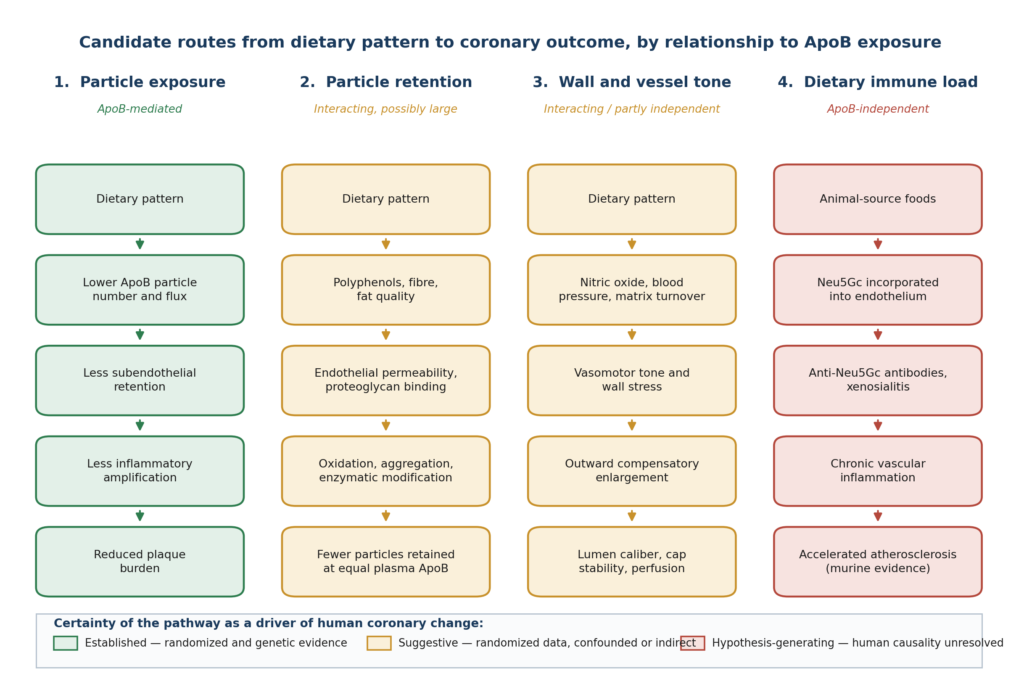
図8。. 食事パターンから冠動脈の転帰に至る4つの候補経路:(1)空腹時および食後のApoB曝露量の減少;(2)粒子滞留の変化および粒子ごとの動脈への影響;(3)血行動態、内皮、および炎症の経路;(4)Neu5Gcなどの食品特有の実験的経路(動物モデルでのみ実証されている)。 これらの経路は、ApoB曝露との関係によって分類され、確実性に応じて色分けされている。ヒトの冠動脈の変化の要因として確立されているのは、最初の経路のみである。経路2は、疾患が以下によって引き起こされるため、概念的に重要である。 保持された 循環している粒子そのものではなく、血漿中ApoBは食事によって変化しうる指標である。経路4は、血漿中ApoB以外の候補経路に対する最も直接的な食事介入法であるが、その効果は動物モデルでのみ実証されている。.
4.1 食後のトリグリセリド豊富な粒子の放出はアポBを介して起こる一方、食後の血管反応はより広範囲に及ぶ
この点が最初に挙げられるのは、これが最も頻繁に誤って分類される項目だからです。高脂肪の食事を1回摂るだけで、一過性の 内皮機能障害, 上昇した 遊離脂肪酸, 内皮細胞の増加 活性酸素種, 、そして血流依存性拡張を顕著に抑制した。.80 空腹時脂質プロファイルではこうした要素は一切捉えられないため、その影響は「ApoB以外の要因」として分類されてしまう。これは分類上の誤りだが、その区別には、通常は省略されがちな詳細な説明が必要となる。. 大きな無損傷のカイロミクロンは、一般的に、無損傷の動脈内皮を効率的に透過することはない。. それらの直径は数百ナノメートルに達するが、実験で研究された範囲のアポB含有リポタンパク質は最大で約70 nmであり、これらは無傷の内皮をより容易に通過する。また、粒子が小さいほど通過しやすく、これは固定された閾値というよりはサイズ勾配によるものである。 脂肪分解後、より小さなApoB-48を含むレメンツは、動脈内へ侵入可能なサイズ範囲に入る。.81 そこに入ってくるのは、 カイロミクロン残渣, 1回制作された リポ蛋白リパーゼ トリグリセリドを除去し、粒子を縮小させる――ヒト血漿から単離されたレメンタンスの水分含有直径は平均約31 nmであり、これは透過可能な範囲に十分収まっており、それぞれがアポB-48を1コピーずつ保有している。.82 ある構造上の詳細については、つい見過ごしてしまいがちなので、特筆すべきです。アポB-48はアポB-100のアミノ末端側48%であり、残基2152付近で終わっているため、それは サイトBを含まない — アポB-100の3359~3369番目の残基に位置する主要なプロテオグリカン結合領域。したがって、レマンツは、別のアポB-48の結合部位を介して、また apoE, 、LDLを保持するメカニズムを介してではなく。.83,84
このサイズの閾値は、単に理論上のものというわけではありません。臨床的観察結果がこれを裏付けています。家族性 リポタンパク質リパーゼ欠乏症 これはしばしば「自然実験」として引用される。すなわち、極端なカイロミクロン血症が存在するにもかかわらず、早期のアテローム性動脈硬化が顕著な特徴とはなっていない。これは、無傷のカイロミクロンが大きすぎて動脈内皮を効率的に通過できないという説と一致している。 この観察結果は、一次臨床研究ではなく、メカニズムに関する総説から引用されたものであり、粒子径やレムナント形成の重要性を裏付けるものであるが、それ自体ではそれを証明するものではない。.81 粒子径は、血漿中濃度、滞留時間、内皮透過性、および動脈内滞留と並んで、侵入の主要な決定要因である。この議論において、2つの帰結が重要となる。侵入した残留物は、再び排出される可能性がある より少ない LDLよりも排出されにくい。これは、そのサイズが大きく、内膜成分に捕捉されることで排出が妨げられるためである。また、各レムナントは、LDL粒子1個よりも多くのコレステロールを運ぶ。.81 したがって、残留数、その滞留時間、あるいは動脈血流を減少させる食事療法は効果を発揮している ~内 ApoBの枠組み――これは、空腹時の測定では単に観察できないものである。 ただし、この急性食事実験の結果を過大評価すべきではない。これらの実験は、特定の食事摂取後に血流依存性血管拡張が損なわれることを示しているに過ぎず、アポB-48への曝露を測定したわけでも、それを媒介因子として検証したわけでもない。食後の残存アポBへの曝露は、アポBを介した経路の候補の一つに過ぎず、実証されたものではない。.
2つの点に留意すれば、このことを適切に捉えることができる。カイロミクロンとその残骸は、 循環しているApoB粒子のごく一部, and a fat load shifts that proportion far less than intuition suggests. Steady-state pool sizes in healthy men are approximately 17 mg of triglyceride-rich apoB-48 against 273 mg of VLDL apoB-100 and 3,325 mg of LDL apoB-100; correcting for the smaller mass of apoB-48, intestinal particles account for on the order of 1% of total ApoB particle number. These pool-size estimates do not measure cumulative particle flux or arterial entry, and the relative contribution may differ substantially in インスリン抵抗性, 糖尿病 and hypertriglyceridemia.85 Even at the postprandial peak, apoB-48 particles did not exceed 20% of ApoB particles within the triglyceride-rich fraction, which is itself a small share of the total.86 The arithmetic is governed by the denominator: the LDL pool is large and turns over slowly (fractional catabolic rate ≈0.27 pools/day), so a transient rise in a small, rapidly cycling intestinal pool barely moves the ratio.85
This carries a consequence that runs opposite to the obvious expectation. By particle number — and in many studies by triglyceride-rich lipoprotein mass — the postprandial remnant pool is dominated by hepatic apoB-100 particles rather than intestinal apoB-48 particles. Their relative contributions to arterial cholesterol delivery are less directly established. Chylomicrons compete with hepatic VLDL for the same lipoprotein-lipase capacity, so a fat load delays VLDL hydrolysis and causes VLDL apoB-100 remnants to accumulate, with the bulk of the postprandial triglyceride rise residing in VLDL-sized remnants rather than chylomicron remnants.86,87 The liver also increases VLDL production in response to feeding and to chylomicron-remnant influx, compounding the effect.87 In the studies cited here, a fat load raised remnant exposure largely by backing up the hepatic pathway, not by flooding the circulation with intestinal particles.
It would be a mistake, however, to read this as an indictment of dietary fat percentage as such, because some low-fat, high-carbohydrate feeding conditions can also increase triglyceride-rich lipoprotein exposure through impaired clearance. In a controlled crossover study, a low-fat high-carbohydrate diet raised triglycerides 60% and reduced VLDL-triglyceride clearance by 37%, with no significant change in VLDL-apoB or VLDL-triglyceride secretion rates — the elevation came from impaired clearance, not particle overproduction.88 The investigators attributed the reduced clearance to the same competition between VLDL and chylomicron remnants for lipolytic capacity, and fasting apoB-48 concentrations were elevated on the low-fat arm in hypertriglyceridemic participants.88 The mechanism that a fat load engages acutely can therefore be engaged chronically by its apparent opposite.
Two details of that study matter more than its headline. The diet was whole-food and high-fiber, and it reduced clearance rather than increasing production — whereas earlier low-fat high-carbohydrate research diets, given in liquid form or high in mono- and disaccharides, increased triglyceride production instead.88 The findings suggest that 炭水化物 form and 食品マトリックス may materially modify the response, rather than carbohydrate percentage alone determining it; this is a cross-study inference, not a tested mediation. This is the postprandial expression of a theme running through §3.7: macronutrient percentages are a poor description of a dietary pattern, and food quality within a macronutrient band can matter more than the band itself. A diet is not rendered atherogenic or protective by its fat fraction alone. Postprandial exposure modifies rather than replaces the standard cholesterol explanation, and the particles doing most of the modifying still carry apoB-100. And the acute-meal literature supports transient impairment after a particular high-fat meal, not a demonstrated chain from repeated postprandial dips to chronic coronary remodeling.80 A fasting panel samples blood at the quietest metabolic hour of the day, while someone eating three substantial meals may spend a substantial portion of the day in a postprandial state that a fasting sample does not characterize. “Beyond fasting LDL-C” and “beyond ApoB” are therefore different statements — an argument for measuring postprandial and cumulative ApoB, not for abandoning the framework.
The acute-meal literature should also be labeled as mechanistic plausibility rather than established chronic mediation. Vogel and colleagues’ study supports transient impairment after a particular high-fat meal.80 It does not by itself establish that saturated fat alone caused the response, that three such meals produce continuous all-day endothelial dysfunction, that plant 不飽和脂肪酸 or complex carbohydrate invariably abolishes it, or that the acute FMD response predicts chronic coronary remodeling.
4.2 Endothelial nitric oxide and vasomotor tone: partly independent
Endothelial dysfunction is an early functional manifestation of vascular disease and the mechanism most directly capable of altering measured lumen caliber without altering plaque mass.6 Plant-predominant patterns supply several constituents proposed to influence nitric-oxide availability, though the trials reviewed here did not isolate which compounds mediate the effect. Randomized feeding studies have reported improved flow-mediated dilation with selected foods and Mediterranean-style interventions.21 Walnut-enriched feeding improved endothelial function in hypercholesterolemic subjects, and Mediterranean-pattern intervention improved endothelial and inflammatory measures.21,89
Acute vasomotor tone is the strongest candidate for an acute influence on measured lumen caliber that does not require a concurrent change in plasma ApoB concentration, because it can change caliber within minutes without requiring an immediate change in plasma lipoprotein concentration. Its magnitude should not be overstated, however. Vasodilation shifts caliber modestly and transiently; it cannot by itself account for large or sustained angiographic differences of the kind seen across years of follow-up. Where durable geometric change occurs, tone is best understood as acting alongside matrix remodeling and smooth-muscle phenotype rather than as a substitute for them, and the chronic component — endothelial function recovering as lipid-driven stress lifts — is better classified as ApoB-mediated on a different timescale. The practical corollary, taken up in §6.1, is that tone contaminates lumen area as a trial endpoint.
4.3 Inflammation: a downstream pathway with randomized outcome evidence independent of LDL-C lowering
This section previously classified inflammation as predominantly ApoB-interacting on the reasoning that most atherosclerotic inflammation is initiated by retained particles. That reasoning is sound as far as it goes, but it understates the pathway, because inflammation is the clearest candidate mechanism in this review with randomized human evidence that modifying it reduces events without materially lowering measured LDL-C.
CANTOS randomized 10,061 post-infarction patients with hsCRP ≥2 mg/L, more than 93% of whom were receiving lipid-lowering therapy at baseline, to canakinumab, a monoclonal antibody against interleukin-1β, or placebo.12 The 150 mg dose reduced hsCRP by 37% and cut nonfatal myocardial infarction, nonfatal stroke or cardiovascular death by 15% (P = .021), 、および no reduction in LDL-C or HDL-C whatsoever.12 A secondary analysis showed the event reduction tracked the magnitude of achieved hsCRP reduction: patients whose hsCRP fell furthest gained most, and those with little CRP response gained little.90 Because achieved hsCRP is a post-randomization variable, this association supports target engagement but is not itself a randomized mediation estimate. Two subsequent コルヒチン trials — COLCOT after myocardial infarction and LoDoCo2 in chronic coronary disease — provided additional evidence that anti-inflammatory therapy can reduce cardiovascular events without intended lipid lowering.91,92
The significance for this review is specific. Inflammation is therefore an interventionally validated cardiovascular pathway, although whether dietary modulation of inflammatory biomarkers mediates clinical benefit remains unproven; it is a pathway in which targeted downstream modulation can reduce cardiovascular events without materially lowering LDL-C. That does not make it ApoB-independent in origin — retained particles remain a principal upstream trigger, and CANTOS treated patients whose residual inflammation persisted にもかかわらず statin therapy. What it establishes is that the downstream inflammatory response is separately modifiable, and that modifying it changes outcomes.
Dietary patterns can alter circulating inflammatory biomarkers and immune-cell activation, though less consistently than is often claimed. Mediterranean intervention reduced circulating immune-cell activation, lowering monocyte CD49d and CD40 expression alongside interleukin-6, soluble adhesion molecules and C-reactive protein.22,89 The intracellular signaling pathways responsible for these changes were not established in these human studies. The dietary portfolio approach achieved reductions in both LDL-C and C-reactive protein approaching those of lovastatin.65
The counterexample matters and should not be buried. In the fully controlled HeFH feeding trial — 50 adults with genetically confirmed heterozygous familial hypercholesterolemia studied after protocol-directed withdrawal of lipid-lowering medication — only 8% were untreated beforehand; 22% had been on statin monotherapy, 46% on statin plus エゼチミブ and 24% on PCSK9-directed therapy, randomized to four weeks each of a whole-food plant-based diet and a standard American diet under isocaloric fully controlled feeding with a two-to-four-week washout (NCT05181553) — the plant-based diet produced no effect on C-reactive protein relative to the standard American diet despite a 17.9% LDL-C reduction — plausibly because baseline CRP was normal and the intervention lasted four weeks, but a reminder that inflammatory benefit is neither automatic nor uniform.64 The literature suggests that some dietary interventions can reduce inflammatory biomarkers, with effects varying by baseline inflammatory burden, intervention duration, and which foods are displaced.
This gives the paper’s central question a sharper form. If targeted downstream inflammatory modulation can reduce events without lowering LDL-C, as CANTOS showed, and dietary patterns lower inflammatory markers (Mediterranean and portfolio trials), then the descriptive trial-level discrepancy identified in §3.1.4 has inflammation as a biologically credible candidate explanation: targeted downstream inflammatory inhibition reduces events, and some dietary interventions alter inflammatory biomarkers. The causal bridge between diet-induced biomarker change and event reduction has not been demonstrated. That is a considerably stronger position than the geometry argument, and it does not depend on any imaging endpoint. What remains untested is the mediation itself: no trial has shown that a diet-induced reduction in hsCRP or IL-6 produces a corresponding reduction in events.
One correction on the oxidative limb. A widely repeated claim holds that a retained ApoB particle must be oxidatively modified before it can drive foam-cell formation. Retained lipoproteins undergo several modifications — oxidation, aggregation and enzymatic remodeling — that amplify inflammatory signaling and cellular uptake, and macropinocytosis of native LDL may also contribute.15 Oxidation is an important amplifier, not an obligatory gate. Plant-derived 抗酸化物質 and polyphenolic compounds can influence oxidative signaling in experimental systems and may reduce LDL oxidation or endothelial activation. Whether these effects materially mediate human coronary outcomes is unestablished.22
4.4 Lipoprotein composition and how much damage each particle does
The African green monkey experiments linked coronary disease to cholesteryl oleate enrichment and hepatic cholesteryl ester secretion patterns, with monounsaturated enrichment not equivalently protective to polyunsaturated at broadly comparable LDL-C.27,28 If two individuals with identical ApoB carry particles of differing atherogenicity, that is a genuine and clinically relevant phenomenon — and it is squarely ApoBと相互作用する, not ApoB-independent. The distinction is not pedantic: an interacting effect predicts that diet and lipid-lowering therapy should be complementary, whereas an independent effect predicts that diet should retain its full benefit at any achieved ApoB.
4.5 The gut microbiome–TMAO axis: a marker whose causal status is unresolved — exploratory: no demonstrated human coronary mediation
Dietary precursors of microbial trimethylamine production include L-カルニチン, コリン and phosphatidylcholine, whose abundance and principal food sources differ: red meat is particularly rich in L-carnitine, eggs in phosphatidylcholine, and both animal and plant foods provide choline, while fish can additionally supply preformed TMAO. Gut microbiota expressing TMA-lyase complexes cleave these compounds to trimethylamine, which is oxidized hepatically to trimethylamine N-oxide (TMAO).23,24 In experimental systems TMAO upregulates macrophage scavenger receptors, impairs コレステロール引き抜き転送, and enhances platelet hyperreactivity and thrombosis.23,24,93 Plasma TMAO is associated with major adverse cardiovascular events, and vegans challenged with カルニチン produce markedly less TMAO than omnivores, indicating that the microbial community itself is diet-influenced.24,94
Two claims must be separated. The pathway is not necessarily mediated by plasma ApoB concentration — there is no lipoprotein intermediate in the TMA-to-TMAO conversion itself. “Structurally independent” would nonetheless overstate it, because TMAO has reported effects on bile-acid and cholesterol metabolism, renal handling, endothelial signaling, inflammation and thrombosis, and these networks interact. But human causality remains unsettled: renal function is central rather than incidental, since TMAO is substantially renally cleared and adjustment for kidney function often attenuates associations; fish and seafood supply preformed TMAO, which complicates interpretation given that fish-rich patterns generally associate with lower risk; Mendelian randomization has been inconsistent; and an analysis of five Dutch 前向きコホート including 7,834 participants found plasma choline associated with cardiovascular disease (HR 1.17, 95% CI 1.07–1.28) but not TMAO, with Mendelian randomization likewise unsupportive.95–97 That analysis also identified fish intake as the major dietary driver of circulating TMAO.97 No eligible trial identified through 31 July 2026 under the stated search criteria has tested whether selectively lowering TMAO reduces coronary plaque or events, and that absence is not evidence of an absent effect. The appropriate position is therefore 示唆に富む that diet alters the TMA/TMAO pathway and 限定 that TMAO reduction mediates clinical benefit in humans. On present evidence, circulating TMAO is best described as a risk-associated metabolite influenced by diet, microbiome composition and renal handling, whose independent causal contribution remains unresolved, and it should not carry the same weight as pathways with interventional support. §4.8 describes a dietary immune mechanism with direct controlled support in an animal model.
4.6 Matrix remodeling, blood pressure, and vascular geometry
When particle influx falls and inflammation subsides, the wall reorganizes: matrix turnover shifts toward collagen deposition and a thicker fibrous cap, although the molecular steps are inferred from regression pathology rather than measured in these experiments.26,74 One possible geometric response is preservation or enlargement of vessel area, although minimal or constrictive remodeling may also occur, which can preserve or restore flow caliber while a stabilized plaque remains in the wall.5,25 DIRECT-Carotid’s association between blood pressure reduction and vessel-wall regression points toward hemodynamic and matrix biology rather than lipid arithmetic, though association is not mediation.49
Randomized human evidence consistent with a blood-pressure pathway — drawn from a retrospective minimal-lesion subgroup with post-randomization adjustment and no ApoB measurement — comes from an unexpected source: a trial of the calcium-channel blocker nicardipine in 383 patients with coronary disease.98 The drug had no effect on established lesions. But among the 217 patients with minimal lesions (≤20% stenosis) at baseline, progression occurred in 12% of treated patients versus 24% of controls (P = .035) and in 7.3% versus 14.2% of lesions (P = .039) under the more conservative minimum-diameter criterion (decrease ≥0.4 mm; Table 8 of the primary report); under the alternative ≥10% percent-stenosis criterion the figures were 15% versus 27% of patients (P = .046) and 9.0% versus 16.3% of lesions (P = .038). Total cholesterol did not change significantly in either group. On stepwise logistic regression, baseline systolic pressure (P = .04) and its change over the first six months (P = .002) predicted progression — and once these were entered, the nicardipine effect itself lost significance (P = .188), leading the investigators to conclude that blood pressure reduction may account for the benefit.98 Because systolic-pressure change is a post-randomization variable, attenuation of the treatment coefficient supports but does not establish mediation.
This is a non-lipid intervention altering coronary lesion behavior, in a randomized design, with an internal analysis pointing at a specific hemodynamic mediator. Because LDL-C and ApoB exposure were not matched and the minimal-lesion subgroup analysis was retrospective, it supports — but does not establish — a hemodynamic pathway not mediated by changes in plasma ApoB concentration. It is also not a dietary trial, and the effect was confined to early lesions. But if diet lowers blood pressure — and the controlled feeding trial in familial hypercholesterolemia found roughly 2 mmHg64 — then this provides unusual randomized human evidence linking a hemodynamic intervention to angiographic lesion behavior,98 although it remains subgroup-based and indirect. It also suggests where a dietary effect would be easiest to detect: early lesions, not established ones, matching the vervet finding that prevention outperforms reversal.70
A comparison sometimes drawn — between statin-associated increases in プラークの石灰化99 and dietary reduction of lipid-rich plaque — does not hold, because it juxtaposes unrelated trials with different populations, imaging modalities, and compositional definitions, and DISCO-CT reported no between-group difference in dense calcium and did not isolate low-attenuation plaque below 30 HU.10
4.7 Retention, modification, and the limits of a concentration measurement
A conceptual point underlies much of this section and deserves stating directly, because it determines how much room exists for dietary effects at all. Atherosclerosis is driven by ApoB particles retained and modified in the arterial wall, not by particles circulating in plasma.15,16 Plasma ApoB indexes the circulating particle burden that drives retention — an excellent index, which is why it predicts disease so reliably — but it is not a direct measure of retained particles. Two people with identical plasma ApoB do not necessarily have identical retention.
A structural point clarifies what is actually being retained. The protein moiety performs the binding: positively charged アルギニン and lysine residues in apoB-100’s site B interact ionically with the negatively charged グリコサミノグリカン chains of intimal proteoglycans, and substituting neutral residues there abolishes プロテオグリカン結合.84 その cholesterol is the cargo — the material that accumulates, is taken up by macrophages, and drives foam-cell formation. Both retention competence and atherogenic lipid cargo are central to the classical response-to-retention pathway: particles that cannot be retained are far less likely to initiate intimal accumulation, while retention of particles carrying atherogenic lipid promotes foam-cell formation.
The decisive experiment separates the two functions. Transgenic mice expressing recombinant human LDL with a point mutation that preserves LDL-receptor binding while crippling proteoglycan binding showed delayed initiation of atherosclerosis on an atherogenic diet.84,100 The result is more instructive than a clean prevention would have been: over 40 weeks those mice eventually reached the same lesion burden as controls, indicating that direct apoB–proteoglycan binding is the initiating step rather than the whole mechanism, with indirect bridging by lipoprotein lipase and other matrix interactions taking over later. Direct apoB–proteoglycan interaction is a major initiating mechanism in this model, while alternative matrix interactions can partly compensate over time.
Experimental evidence suggests that endothelial state, extracellular-matrix composition, lipoprotein composition, aggregation and proteoglycan interactions can modify arterial retention at a given plasma ApoB concentration.15,100 Whether a dietary pattern meaningfully alters this process in living humans has not been measured. If diet alters how many circulating particles become retained particles, then matching plasma ApoB does not match arterial exposure, and the effect is invisible to the measurement that defines the comparison.
Under the taxonomy of §1.2 these are ApoB-interacting effects, and it is worth being explicit that this is not a demotion. Hypothetically, a substantial reduction in arterial retention at fixed plasma ApoB could reduce effective arterial particle exposure, although its magnitude, linearity and equivalence to lowering circulating particle concentration are unknown. Calling such an effect “not independent of ApoB” is accurate about mechanism and potentially misleading about magnitude. The reason the manuscript still classifies them this way is evidential rather than conceptual: direct arterial retention is not currently measurable in routine living-human intervention studies, so the claim cannot currently be tested, only reasoned about.
4.8 Neu5Gc and dietary xenosialitis: a non-plasma-ApoB modifier shown in mice — exploratory: animal evidence only
One animal-food-specific mechanism has direct controlled support in a humanized murine model — animal evidence only, with no human interventional data — and is rarely discussed in cardiovascular reviews. Humans lost the ability to synthesize the sialic acid N-グリコリルノラミン酸 (Neu5Gc) ~を通じて 擬原化 の CMAH gene two to three million years ago, while retaining the ability to absorb it from diet — red meat being by far the richest source.101,102 Dietary Neu5Gc can be metabolically incorporated into human 糖複合体, where it may be recognized by circulating anti-Neu5Gc antibodies, creating the proposed 異物唾液腺炎 pathway.101
The experimental test is unusually well matched to the question this review asks. Kawanishi and colleagues bred Cmah-deficient mice — genetically human-like in this respect — onto an LDLR-knockout background and fed them high-fat diets designed primarily to differ in sialic-acid composition.102 Mice with human-like Cmah deficiency on a sialic-acid-free high-fat diet developed roughly 1.9-fold more atherosclerosis than Cmah wild-type controls, and Cmah-deficient mice immunized to generate human-like anti-Neu5Gc antibodies developed roughly 2.4-fold more atherosclerosis on a Neu5Gc-rich diet than on a Neu5Ac-rich or sialic-acid-free diet.
The design is the point. The diets were intended to keep fat load, caloric intake and genetic hyperlipidemia similar while primarily varying sialic-acid composition. A follow-up study found that a Neu5Gc-free high-fat diet, or a five-fold excess of Neu5Ac, attenuated or prevented the accelerated phenotype.103 This dietary manipulation attenuated or prevented accelerated アテローム発生 in the murine model without the effect being explained by measured plasma-lipoprotein differences. It is not demonstrated regression of established plaque.
The pathway is best described as a non-plasma-ApoB dietary modifier demonstrated in mice, not as an established ApoB-independent mechanism in humans. The experiments did not require a change in measured lipoproteins, but atherosclerosis was generated on a profoundly hyperlipidemic LDLR-knockout background — so what has been shown is an accelerator operating in the presence of high ApoB exposure. All the atherosclerosis data are murine, humans vary widely in anti-Neu5Gc antibody titer and specificity, and no human study has tested whether reducing Neu5Gc intake alters plaque.
It nonetheless bears on the trial design of §6.1: if part of red meat’s vascular effect runs through xenosialitis, a study matching ApoB between a meat-containing and a plant-predominant arm would still not compare like with like, and anti-Neu5Gc antibody titer is a measurable covariate such a trial could collect.
4.9 Multi-component dietary efficacy
Whole dietary patterns combine viscous ファイバー, 植物 ステロール, plant protein, nuts, ポリフェノール, and reduced グリセミック負荷, and the Portfolio trial showed that assembling them approaches pharmacologic magnitude for LDL-C and C-reactive protein.65 This is properly described as multi-component dietary efficacy or a combined food-portfolio effect. It should not be described as food-matrix synergy: the trial did not use a factorial design capable of distinguishing synergistic from simply additive component effects. Mechanistic support for the direction of effect is reasonable — the HeFH feeding trial found the plant-based diet produced a sterol-biomarker pattern consistent with reduced fractional cholesterol absorption and compensatory synthesis, with the lathosterol-to-cholestanol ratio rising 15.8% — a physiological response that overlaps with, but does not establish identity to, the effect of ezetimibe.64
Table 9. Candidate mechanisms classified by relationship to ApoB exposure.
| メカニズム | 分類 | Basis and principal caveat |
| Reduced fasting ApoB particle number | ApoB-mediated | Strong; magnitude smaller than often claimed (≈10–18%)11,64 |
| Altered postprandial triglyceride-rich ApoB-particle exposure | ApoB-mediated | ApoB-48-containing particles; missed by fasting panels but not outside the ApoB framework80 |
| Reduced oxidative and enzymatic modification of retained particles | ApoBと相互作用する | Alters per-particle consequence; oxidation is an amplifier, not an obligatory gate15 |
| Suppressed inflammatory signaling (IL-1β / IL-6 / CRP axis) | ApoB-interacting upstream; independently modifiable downstream | The strongest randomized proof that targeted downstream pathway modification can reduce events without lowering LDL-C. CANTOS cut events 15% via IL-1β blockade with no LDL-C change; benefit tracked achieved hsCRP (an achieved-biomarker analysis supporting target engagement, not a randomized mediation estimate); colchicine trials provided additional supporting evidence. Dietary effects on CRP and related biomarkers have been reported but are heterogeneous, and were null in the controlled HeFH feeding trial12,22,64,90–92 |
| Lipoprotein compositional atherogenicity (fatty-acid driven) | ApoBと相互作用する | Primate evidence at comparable LDL-C; particle number and residence time were not matched27,28 |
| Matrix remodeling and changes in vessel geometry | Largely ApoB-mediated, with interacting modifiers | Outward enlargement was observed in one primate experiment during lipid lowering, but it is not the obligatory geometric consequence of matrix stabilization; preservation, constrictive remodeling and regional heterogeneity are also possible. Remodeling follows reduced particle retention and was demonstrated only の間 lipid lowering, so mediation is the default reading; blood pressure, matrix turnover, and smooth-muscle phenotype plausibly modify its extent5,25 |
| Acute vasomotor tone and endothelial NO signaling | Potentially not mediated by plasma ApoB concentration | Can change measured caliber within minutes without a lipoprotein intermediate — and correspondingly contaminates lumen endpoints6,21 |
| Blood pressure reduction | Potentially not mediated by plasma ApoB concentration | Randomized human evidence consistent with a hemodynamic contribution, but indirect, subgroup-based and not a formal mediation test: in a randomized calcium-blocker trial with no change in cholesterol, progression of minimal coronary lesions fell (12% vs 24% of patients) and the treatment effect lost significance after adjustment for systolic pressure98; STARS retained a blood-pressure term alongside LDL/HDL36; correlated with carotid wall regression in DIRECT49. May still partly mark overall dietary quality |
| Gut microbial TMA/TMAO pathway | Not necessarily mediated by plasma ApoB; causal status unresolved | Renal clearance confounds associations; fish supplies preformed TMAO; inconsistent Mendelian randomization; a five-cohort analysis found plasma choline (HR 1.17, 95% CI 1.07–1.28) but not TMAO associated with CVD across five Dutch cohorts; fish is the major dietary driver of TMAO; no interventional trial23,24,95–97 |
| Reduced retention or modification of particles at constant plasma concentration | ApoB-interacting (but potentially large) | Disease is driven by 保持された particles; plasma ApoB is a proxy for retention. Direct arterial retention is not currently measurable in routine living-human intervention studies; the proposed dietary effect is reasoned rather than directly tested15,16 |
| Neu5Gc xenosialitis (red-meat sialic acid) | Non-plasma-ApoB modifier; murine only | Diets designed primarily to differ in sialic-acid composition produced ~2.4-fold differences in atherosclerosis in Cmah-deficient LDLR-knockout mice; Neu5Ac substitution attenuated the phenotype. An accelerator on a hyperlipidemic background; no human plaque data102,103 |
| What section 4 established — and what it did not
✔ Dietary patterns act on several pathways at once: fasting and postprandial ApoB, blood pressure, weight, glycemia, inflammation, endothelial function and arterial matrix biology. ✔ Postprandial exposure is real and a fasting sample does not characterize it — though the dominant postprandial remnant burden is apoB-100, not apoB-48. ✔ Targeted modification of at least one downstream inflammatory pathway can reduce events without lowering measured LDL-C, establishing that cardiovascular risk can be altered through a therapeutic target other than concurrent lipid lowering. ✘ Most mechanisms placed in the middle tier are ApoB-interacting rather than ApoB-independent; interaction is a weaker claim than independence. ✘ No mechanism reviewed here has been shown to carry a measured share of any dietary event effect. Biomarker change is not demonstrated mediation. |
||
5. Evidence appraisal
This section grades every principal claim twice: once for the total effect of the dietary pattern, and once for evidence of independence from ApoB exposure. Those two grades routinely diverge, and the divergence is the point. The descriptors are author-assigned narrative characterizations, not formal certainty ratings.
Descriptors used below: 強い — multiple randomized studies with direct endpoints and consistent direction; 示唆に富む — randomized or well-controlled evidence with important confounding, indirectness, or imprecision; 限定 — few, small, old, or uncontrolled studies, or surrogate endpoints only; 仮説生成の — mechanistic plausibility or single findings without confirmatory design; and 効果が不十分/効果が認められない — no eligible study identified, or a null result for the relevant endpoint in the only eligible study that measured it. Each claim is graded separately for total effect and for independence from ApoB exposure. A 強い rating indicates confidence in the direction of an average effect, not that every intervention within that category produces a clinically large response; direction can be consistent while magnitude and intervention definition remain heterogeneous.
Table 10. Author-assigned narrative characterization — not GRADE — separating total effect from mechanistic independence. These are the author’s structured judgments applied by a single reviewer, not GRADE ratings and not a validated rubric. Operational definitions are in Supplementary Data S1.
| 主張 | Narrative evidence characterization — total effect | ApoB-independence conclusion | 基礎 |
| ApoB exposure reduction is a principal driver of arrest and regression | 強い | 該当なし | Genetic, Mendelian randomization, and multiple serial-imaging trials14,15,20 |
| Plant-predominant diets lower LDL-C | 強い | 該当なし | Pooled randomized data and controlled feeding; effect size ≈10–18%11,64 |
| Plant-predominant diets lower ApoB | Suggestive | 該当なし | Fewer trials measured ApoB — six in the pooled analysis — with substantial heterogeneity, so the more conservative category is assigned11,64 |
| Intensive multicomponent lifestyle programs attenuate angiographic progression | 数量限定 | Not demonstrated | Small, old, bundled, QCA-based trials with drug co-administration8,9,36,53 |
| Diet alone attenuates angiographic coronary progression | 数量限定 | Not demonstrated | Small non-randomized intervention evidence from Leiden and randomized evidence from the diet-only STARS arm; historical QCA endpoints, incomplete ApoB characterization and limited replication36,59 |
| Targeted downstream inflammatory modulation reduces events without lowering LDL-C | 強い | Not demonstrated — upstream ApoB retention not excluded | CANTOS, COLCOT and LoDoCo2 reduced events without lipid lowering12,91,92 |
| Diet alters inflammatory biomarkers | Suggestive | 該当なし | Randomized dietary trials report biomarker changes; null in controlled HeFH feeding22,64 |
| Diet-induced inflammatory reduction mediates event reduction | 仮説生成 | Untested | Diets lower CRP/IL-6 inconsistently; no mediation analysis links the two22,64 |
| Diet improves endothelial function | Suggestive | Not demonstrated | Randomized mechanistic studies, short and surrogate-based21,80,89 |
| Modern randomized CCTA evidence for coronary lumen widening | Insufficient / no demonstrated effect | 該当なし | DISCO-CT maximum lumen diameter fell in the intervention arm (−3.1% vs +2.4%, between-group nominal P = .025); total plaque burden unchanged; remodeling mechanism not measured10 |
| Historical QCA evidence for relative lumen preservation | 数量限定 | Not demonstrated | Lifestyle Heart, STARS and SCRIP showed preservation against control narrowing rather than net widening8,36,56 |
| Lumen geometry can improve without significant plaque-area reduction | Suggestive | Untested | Suggestive in primates and not demonstrated in humans: cross-sectional primate histomorphometry during lipid lowering, with no matched-exposure comparison5 |
| Endothelial function can normalize before arterial structure normalizes | Suggestive | Untested | Demonstrated in a primate iliac model — intimal area fell about 60% but remained well above normal — and not confirmed in human coronary arteries6,7 |
| Mediterranean patterns reduce cardiovascular events relative to the comparators tested | 強い | Not demonstrated | Randomized outcome evidence from PREDIMED and CORDIOPREV, with important allocation, comparator and mediation limitations2,3 |
| Mediterranean patterns slow carotid imaging progression | Suggestive | Not demonstrated | Grade rests primarily on PREDIMED evidence: PREDIMED-Navarra was overall null with favorable subgroup findings, and a longer PREDIMED substudy reported segment-specific benefit. The CORDIOPREV carotid analysis is not used quantitatively here because interpretation should follow its published correction. Carotid change does not transfer directly to coronary change46–48,52 |
| Mediterranean patterns improve coronary plaque imaging | Insufficient / no demonstrated effect | 該当なし | No eligible coronary imaging trial identified10 |
| Intensive diet/lifestyle reduces total coronary plaque burden added to optimal medical therapy | Insufficient / no demonstrated effect | Not demonstrated | DISCO-CT percent atheroma volume was null (+1.0 vs +1.1 percentage points, P = .851)10 |
| Intensive diet/lifestyle alters selected plaque components added to optimal medical therapy | 仮説生成 | Not demonstrated | One borderline non-calcified plaque result in a multi-endpoint trial10 |
| TMAO suppression mediates human clinical benefit | 仮説生成 | Untested — not reducible to plasma ApoB; causal status unresolved | Substantial mechanistic and animal evidence, but unresolved human causal evidence, but renal clearance confounds associations, fish supplies preformed TMAO, Mendelian randomization is inconsistent, and a five-cohort analysis found plasma choline (HR 1.17, 95% CI 1.07–1.28) but not TMAO associated with CVD across five Dutch cohorts23,24,95,97 |
| Plant-predominant diets enlarge coronary lumens beyond ApoB lowering | Insufficient / no demonstrated effect | Untested | No modern coronary imaging trial of a well-characterized plant-predominant diet was identified8,9 |
| Diet delivers more vessel-wall benefit per unit ApoB lowered than pharmacotherapy | Insufficient / no demonstrated effect | Not demonstrated | Existing trials use non-comparable regression definitions and cannot support a valid cross-trial estimate (§3.6) |
5.1 Recurrent confounders
Five 交絡因子 recur and jointly cap the certainty available. Lifestyle bundling: exercise, weight loss, stress management, and smoking cessation accompanied dietary change in Ornish, Heidelberg, and SCRIP.53,56,58 Pharmacologic contamination in both directions: the Esselstyn cohort received lipid-lowering drugs, and controls in later trials increasingly received statins, biasing toward the null.8,9 Absent ApoB reporting in trials predating routine apolipoprotein measurement, which forecloses the central comparison.9,36 Lesion-level rather than patient-level analysis in several angiographic trials, which treats multiple correlated lesions within a patient as independent observations. Endpoint heterogeneity: percent diameter stenosis, minimal lumen diameter, mean absolute segment width, percent atheroma volume, non-calcified plaque volume, and carotid intima-media thickness are not interconvertible, and pooling them would create false precision.
6. Discussion
This section asks what follows from the preceding evidence, and specifies the trials that would resolve what it cannot. It states the working model, sets out two distinct trial designs with two distinct estimands, and identifies the analytic requirements without which neither would answer the question.

Figure 9A. Pharmacologic evidence chain. Randomized evidence supports each link shown: intensive ApoB lowering reduces plaque burden and improves plaque composition, and separately reduces major adverse cardiovascular events.1,17–20,31,32 Line style encodes the strength of evidence for each link, not effect size. The diagram makes no claim that the measured plaque changes mediate the event reduction; percent atheroma volume is not a validated surrogate endpoint.34,35
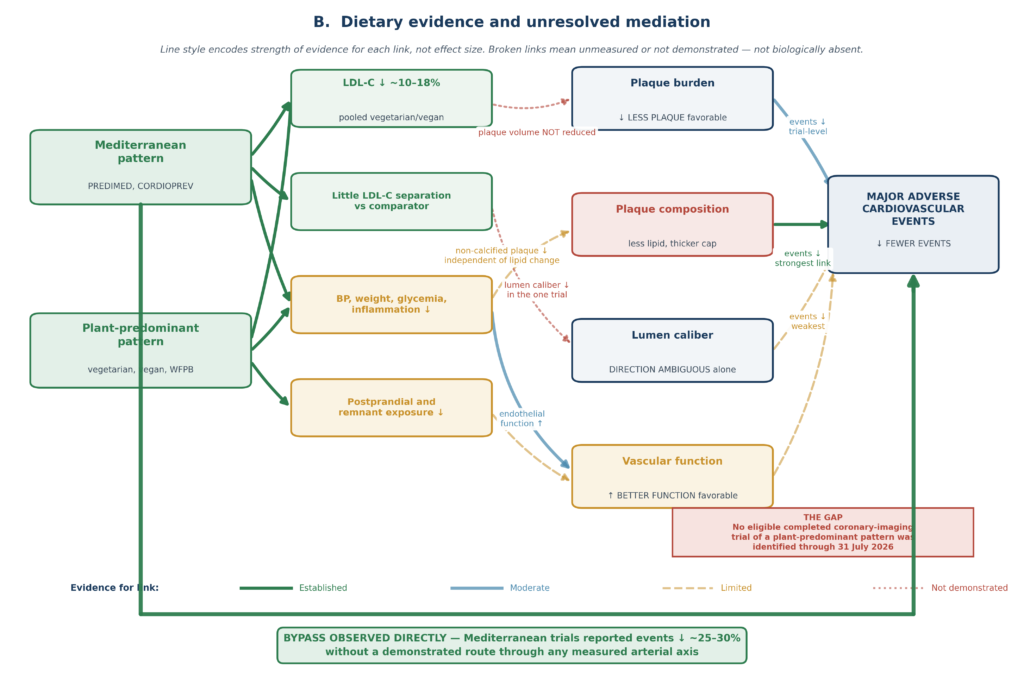
Figure 9B. Dietary evidence and unresolved mediation. Each link is labelled with the direction of the reported change and styled by the strength of evidence for that link, not by effect size. Each arterial box states which direction is favorable; lumen caliber is marked as directionally ambiguous on its own, because it can widen through 外向きの再構築 while plaque grows, or narrow through constrictive remodeling while plaque regresses. The link from dietary lipid lowering to plaque burden is marked not demonstrated, 、および no eligible completed coronary-imaging trial of a plant-predominant pattern was identified through 31 July 2026 under the stated criteria. The heavy line running beneath the diagram denotes clinical outcome established, mediation unmeasured: Mediterranean trials reported fewer events, and no measured arterial axis has been shown to carry that effect. Broken links mean unmeasured or not demonstrated, not absent. The links shown are supported by the references cited for them in the body: refs 2–4 (dietary event reduction), 11 and 64 (dietary LDL-C and ApoB lowering), 8, 9, 36, 53, 56 and 58–60 (historical angiographic endpoints), 10 and 57 (modern coronary imaging), 12 and 90–92 (inflammatory pathway), 21 and 89 (endothelial function), and 49 and 98 (blood pressure). This diagram is not a causal graph and not a validated mediation model; it summarizes which links have been examined and with what strength of evidence, and makes no formal identifying assumptions.
The most defensible reading of this literature is a layered working model in which dietary patterns reduce fasting and postprandial ApoB exposure and may also modify the vascular response to the particle burden that remains. What the evidence does not currently support is the stronger and more frequently asserted claim that diet acts on the vessel wall independently of ApoB, or that it purchases more remodeling, stability, or perfusion per unit of ApoB lowered than pharmacotherapy does.
Plaque burden remains the most established quantitative serial-imaging measure of atherosclerotic disease modification for this purpose, although percent atheroma volume has not been validated as a surrogate for hard clinical outcomes;34,35 the geometric observations reviewed here are hypothesis-generating and may represent complementary vascular biology rather than an alternative therapeutic target. With that stated, the findings that make this worth pursuing cluster around vascular geometry and function in addition to plaque burden: arterial and luminal cross-sectional areas approximately twice those of a separate baseline-necropsy group, without a statistically significant difference in plaque area in macaques, endothelial relaxation normalized while intimal area decreased by approximately 60% but remained well above normal, minimal lumen diameter preserved where controls narrowed, and perfusion improving beyond visible lesion-level change.5,6,8,58 Each is compatible with a dietary effect on geometry, tone, or plaque phenotype that measures of plaque volume are poorly designed to detect.
But each also admits an ApoB-mediated explanation, and the pattern as a whole is partly an artifact of measurement history: dietary trials preferentially measured function, perfusion, and lumen dimensions; drug trials preferentially measured volume and composition. A domain that only one literature measured cannot support a claim about which intervention is better in it. The geometric and functional observations are provocative enough to warrant direct testing but do not constitute a coherent replicated effect, and they have never been examined in a randomized dietary comparison with repeated ApoB measurements and standardized background therapy.
An exploratory trial-level feasibility exercise was attempted but proved incapable of testing the hypothesis reliably. Definitions of angiographic regression, populations, imaging methods and treatment eras differed systematically, and the same approach failed to recover the well-established within-trial LDL–plaque relationship. The exercise therefore demonstrates why existing studies cannot estimate an additional effect of diet; it neither confirms nor refutes such an effect, and reinforces the need for a randomized trial with standardized background therapy, repeated ApoB measurement and prespecified mechanistic analyses (§6.1).
One further structural weakness deserves stating rather than burying: the geometry hypothesis rests disproportionately on a single primate experiment.5 It is well conducted, in a species whose coronary pathology closely resembles ours, and it remains the clearest available demonstration that arterial caliber and plaque area can change discordantly and are not obligatorily coupled. It is also one 横断研究, unreplicated, performed during lipid lowering, in surgically postmenopausal animals. It should be read as the cornerstone of a hypothesis rather than the proof of a conclusion. Replication of this experiment — with serial within-artery measurement, matched particle exposure across dietary arms, and modern compositional imaging equivalent to IVUS or OCT — would immediately become one of the highest priorities in this field, and would advance the question further than any reanalysis of the human trials reviewed here.
Table 11. Direct answers to the questions motivating this review.
| 質問 | Answer supported by current evidence |
| Can established primate atherosclerosis regress after withdrawal of an atherogenic diet? | Yes. Multiple primate models show regression after withdrawal or modification of the atherogenic diet accompanied by major plasma-lipid reduction; these studies do not separate food composition from reduced lipoprotein exposure.5,26,72 |
| Can lumen geometry improve when plaque area does not significantly decrease? | A cross-sectional primate comparison found vessel and lumen areas approximately twice those of a separate baseline group after lipid lowering, without a statistically significant plaque-area difference; serial confirmation is lacking.5 |
| Was that effect independent of lipid lowering? | Unknown. It occurred の間 plasma lipid lowering, with no matched-exposure comparator.5 |
| Can endothelial function normalize before arterial structure returns to normal? | In a primate iliac model, endothelial relaxation returned to normal while intimal area decreased by roughly 60% but remained well above normal; serial timing was not established.6 |
| Do nutrient-specific primate experiments isolate direct vessel-wall effects? | No. In the soy experiments, lipoproteins also differed between arms; in the fat-quality experiments, ApoB was never matched.27,28,77 |
| Do early human trials show coronary benefit from diet-centered intervention? | Several small historical trials reported attenuated angiographic progression or preservation of lumen measures, although interventions were heterogeneous, frequently bundled, and often affected by medication use.8,36,53,56 |
| Did any of them show lumen enlargement? | Not convincingly. Ornish preserved MLD (+0.001 mm); STARS diet-alone was stasis (+0.003 mm); Esselstyn’s +0.08 mm was not significant.8,9,36 |
| Does DISCO-CT show incremental plaque regression? | Not for total burden — PAV was null (P = .851) and maximum lumen diameter fell in the diet arm (between-group P = .025). It showed a greater reduction in broadly defined non-calcified plaque (P = .045).10 |
| Is Mediterranean evidence stronger than modern plant-predominant coronary-imaging evidence? | Yes, substantially. Whether this reflects biological differences or the distribution of research investment is unknown.2,3,48 |
| Does diet outperform intensive pharmacologic ApoB lowering on any imaging domain? | Not demonstrated; HUYGENS and PACMAN-AMI show drugs improve composition as well as volume31,32 |
| Can the question be settled by comparing existing trials? | No. Regression definitions, imaging methods, populations and treatment eras are too heterogeneous for valid trial-level comparison (§3.6). |
| What is the largest evidence gap? | The absence of a randomized coronary-imaging trial directly comparing well-characterized dietary patterns under standardized background therapy, with repeated ApoB measurements, modern plaque-composition imaging, and prespecified mediation analyses. |
| What is the defensible practical conclusion? | Diet is an established ApoB-lowering therapy and a plausible modifier of vascular function and plaque phenotype whose additional effects remain to be quantified; it complements rather than competes with pharmacologic lowering, and its additional contribution — if present — may involve vascular function, blood pressure, postprandial metabolism, inflammatory signaling, plaque phenotype and arterial geometry, whose relative importance remains unknown. |
6.1 The trials needed to test the hypothesis
The central claim is testable and has not been tested. Two distinct causal questions require separate designs, and they should not be merged into one protocol.
A total dietary-pattern-effect trial would randomize well-characterized dietary patterns under an identical medication-management algorithm. Achieved ApoB would be permitted to differ and would be repeatedly measured as a potential mediator. This estimates the total effect of dietary assignment under comparable pharmacologic management, and it is the cleaner of the two.
A food-composition-at-similar-ApoB trial would instead titrate medication individually to reach a prespecified ApoB range in every dietary group. This estimates dietary differences conditional on similar plasma ApoB concentration-time exposure, but differential drug dose and class across arms would be unavoidable and would have to be measured and modeled. A protocol generally cannot guarantee both identical medication exposure and identical achieved ApoB across dietary groups, because participants respond differently to therapy. It must therefore prespecify which estimand takes priority and how differential medication exposure will be handled.

Figure 10. The two candidate trial designs, the distinct question each answers, and the requirements shared by both. A protocol generally cannot guarantee both identical medication exposure and identical achieved ApoB across dietary groups; it must therefore prespecify which estimand takes priority and how differential medication exposure will be handled.
Either design (Figure 10) should include careful characterization of lipoprotein exposure — design features recommended here rather than requirements established by the evidence reviewed: repeated ApoB measurement with computation of ApoB area under the curve, prespecifying early post-randomization sampling, regular long-term intervals, handling of medication changes, missing-data methods, and whether trapezoidal or model-derived AUC is used; measurement of apoB-48/remnant exposure and postprandial lipemia; and characterization of Lp(a), non-HDL-C, triglyceride-rich particles and LDL composition. Exploratory mechanistic measurements could additionally include anti-Neu5Gc antibody profiles, although these are not part of exposure characterization. Plasma ApoB area under the curve remains a concentration integral, not arterial flux or retention. Non-lipid co-interventions should be standardized or repeatedly measured: exercise, blood pressure, 心拍数, hydration, nitrate administration and imaging acquisition conditions. Weight requires an explicit decision rather than a measurement plan: the protocol should prespecify whether diet-induced weight change forms part of the total treatment effect, or whether food composition is being studied under weight stability. Those are different estimands requiring different feeding and analytic strategies.
Dietary adherence should be measured objectively, not by self-report alone. Depending on the assigned patterns, candidate objective measures include plasma fatty-acid profiles, urinary electrolyte and nitrogen excretion, and food-provision or purchasing records; the validation characteristics of whichever measures are chosen should be specified in the protocol. Self-reported adherence alone is inadequate for a trial whose central question is the effect of achieved dietary exposure.
Lumen area is an inviting primary endpoint, since it is where the hypothesis predicts surplus benefit. It would be a poor one: the same vasomotor sensitivity that makes lumen caliber an interesting outcome makes it unsuitable as a sole primary endpoint, because a change in caliber cannot by itself be attributed to a change in plaque. A hierarchically tested set is preferable — and outward enlargement should ではない lead it. Expansive remodeling preserves lumen in some contexts and is a recognized high-risk plaque feature in others,30 so it is a mechanistic outcome rather than an inherently favorable one:
- Primary — one endpoint, one platform. A CCTA-centered trial should select either low-attenuation plaque volume or total non-calcified plaque volume as its single primary endpoint on the basis of prespecified reproducibility and power data, with the other tested hierarchically as a key secondary endpoint; an IVUS-centered trial should prespecify percent atheroma volume instead. These are not interchangeable, the platform must be fixed at design, and the success criterion and any multiplicity correction stated in advance.
- Key secondary: standardized lumen area under controlled acquisition conditions — nitrate, heart rate, blood pressure, hydration, caffeine and meal status all fixed.
- Mechanistic: vessel/EEM area and remodeling index, interpreted alongside composition rather than as favorable in isolation.
- Mechanistic: minimal fibrous cap thickness by OCT in a nested substudy. We suggest limiting invasive OCT or IVUS to participants already undergoing clinically indicated coronary angiography, unless research-only catheterization receives separate ethical and risk justification under the governing local framework. That restriction creates a selected, higher-risk subgroup, so invasive findings should be interpreted as mechanistic rather than as representative population estimates.
- Functional: endothelial function and myocardial perfusion.
The analytic approach recommended here is mixed-effects lesion-level modeling nested within patients, with blinded central image analysis; the specific models and identifying assumptions would need to be fixed against contemporary multilevel-imaging and causal-mediation guidance at protocol stage. Exploratory causal-mediation analysis partitioning the total effect into paths mediated through measured ApoB exposure and paths not mediated through that measured exposure may be informative but will not by itself establish causality. Ordinary regression adjustment for post-randomization ApoB will not isolate an independent dietary effect: ApoB is affected by treatment, adherence and intercurrent medication changes, so the analysis plan must prespecify handling of time-varying confounding, treatment–mediator interaction, adherence as both mediator and confounder, and sensitivity analyses for unmeasured mediator–outcome confounding; its identifying assumptions and sensitivity analyses must be prespecified.
A parallel primate factorial regression study could match ApoB across diets while varying food matrix and fatty-acid profile, adding transcriptomics, matrix biomarkers, and vessel geometry to the histomorphometric endpoints the 1995 experiment established.5
6.2 Limitations
This is a narrative synthesis without prespecified protocol, formal risk-of-bias instruments, or meta-analysis; endpoint heterogeneity would in any case preclude pooling. Study selection emphasized work bearing on the lumen and remodeling hypothesis and may therefore over-represent findings consistent with it. Several key human trials predate routine ApoB measurement, high-intensity statins, and modern imaging, and their control groups received care now considered inadequate. Extrapolation from macaque coronary biology to human disease is well founded but not guaranteed. Finally, the single finding that most supports the hypothesis — enlarged arterial and luminal cross-sectional area without significant plaque-area reduction — rests on one cross-sectional primate experiment and requires independent replication with serial measurement.
6.3 Diet and pharmacotherapy: evidence for complementarity
The clinical question this review ultimately serves is not diet versus pharmacotherapy but what the two may achieve together. Existing studies support complementarity as a plausible direction of effect, but they do not permit a reliable numerical estimate of the incremental or combined benefit.
Statin therapy alone reduces major vascular events by approximately one fifth for each sustained 1.0 mmol/L reduction in LDL-C, with absolute benefit depending on baseline risk and treatment duration.1,39,43 In CORDIOPREV, where more than 85% of participants were using statins at baseline, the Mediterranean intervention produced a 25–28% lower adjusted hazard than the low-fat dietary intervention.3 This establishes a difference between dietary strategies on a background of medical treatment, not the incremental effect of adding diet to otherwise identical optimized pharmacotherapy. STARS, though far too small for reliable estimation, ordered its arms the same way: 10 events under usual care, 3 on diet alone, 1 on diet plus cholestyramine.36
The evidence combines effects measured in different populations, against different comparators, and over different durations, and no trial has randomized patients to diet plus drug versus drug alone with adequate power for hard outcomes. The arithmetic of combining 相対リスク assumes independence that has not been demonstrated, and the dietary comparators in these trials were themselves active. What can be said with more confidence is directional. Available studies are compatible with dietary and pharmacologic strategies being used together, but direct randomized evidence on their incremental or interactive effects is limited: no adequately powered randomized trial has isolated the incremental effect of adding a specified dietary pattern to optimized lipid-lowering therapy. DISCO-CT was null for total plaque burden and produced one exploratory compositional signal.10
The practical reading follows. Lipid-lowering therapy and dietary change are not competing strategies to be ranked but partly complementary ones acting through overlapping and potentially distinct routes — lipid-lowering pharmacotherapy more powerfully on particle number, the diet additionally on blood pressure, weight, glycemia and postprandial exposure. The evidence does not support treating dietary improvement and lipid-lowering pharmacotherapy as mutually exclusive alternatives.
| What section 6 established — and what it did not
✔ Two distinct trial designs would answer two distinct questions, and one protocol generally cannot optimize both. ✔ A definitive test requires randomization, standardized background therapy, repeated ApoB measurement with prespecified AUC handling, and objective adherence biomarkers. ✘ Ordinary regression adjustment for post-randomization ApoB will not isolate an independent dietary effect. ✘ Until such a trial exists, the partition between ApoB-mediated and other pathways remains unmeasured rather than absent. |
7. Conclusions
7.1 What is established
How the two intervention families differ. Plant-forward dietary patterns simultaneously influence several established cardiovascular risk pathways — lipoproteins, blood pressure, body weight, glycemic control and overall dietary quality.11,64,89 That breadth makes diet a potentially complementary intervention rather than a weaker version of pharmacotherapy, though the contribution of each pathway has not been separated. Lipid-lowering therapy produces the larger and more predictable reduction in particle burden, and intensive regimens also improve plaque composition rather than plaque volume alone.1,20,31,32
The practical position. Dietary interventions reduce LDL-C and ApoB by modest average amounts, with larger effects under intensive supervision or controlled feeding.11,64 Mediterranean dietary-pattern trials have also demonstrated cardiovascular-event reduction, whereas adequately powered event evidence for intensive plant-predominant interventions is absent.2,3 Diet complements pharmacologic lipid lowering rather than competing with it; the two are likely to affect partly overlapping and partly distinct pathways, but the relative contribution of those pathways has not been quantified. What remains to be established is how much of the observed event benefit is captured by cumulative fasting and postprandial ApoB exposure, how much is mediated through blood pressure, inflammation, glycemia, weight and thrombosis, and whether dietary pattern affects plaque or arterial geometry after on-trial ApoB exposure is repeatedly measured and appropriately modeled within a randomized dietary trial. Two studies would substantially advance the question. まず, an adequately powered randomized cardiovascular-outcome trial should test a well-characterized plant-predominant pattern; no eligible completed trial was identified through 31 July 2026 under the stated search criteria, despite reproducible LDL-C and ApoB lowering by such patterns. 第二, the coronary-imaging trial specified in §6.1, using repeated ApoB measurement and the prespecified medication strategy appropriate to the chosen estimand, in either a direct dietary comparison or a factorial design.
7.2 What is suggestive
Three observations jointly motivate further testing.
First, randomized Mediterranean dietary-pattern trials have reported cardiovascular-event reductions that constitute the descriptive event–fasting-lipid discrepancy defined in §3.1.4. PREDIMED reported approximately 30% and CORDIOPREV approximately 25–28% in adjusted analyses over seven years, in both cases with little LDL-C separation between arms.2,3 Similar fasting LDL-C does not establish similar ApoB particle exposure, cholesterol content per particle, remnant exposure or longitudinal medication exposure. The Lyon Diet Heart Study reduced recurrent events substantially with essentially no lipid difference at all.4 This is hypothesis-generating rather than a quantitative mediation estimate, because cumulative ApoB exposure, medication use, adherence, blood pressure, weight, glycemia, inflammation and other simultaneous changes were not experimentally matched.
Second, at least one downstream pathway can be therapeutically modified to reduce events without lowering LDL-C. CANTOS randomized 10,061 post-infarction patients, more than 93% on lipid-lowering therapy at baseline, to an antibody against interleukin-1β. It reduced the composite primary endpoint of nonfatal myocardial infarction, nonfatal stroke or cardiovascular death by 15% at the prespecified 150 mg dose, without lowering LDL-C and with an excess of fatal infection, and the benefit tracked how far each patient’s CRP fell.12,90 Because achieved hsCRP is a post-randomization variable, that association supports target engagement but is not itself a randomized mediation estimate. Two colchicine trials support anti-inflammatory event reduction without intended lipid lowering, though they target different inflammatory mechanisms and differ in endpoint pattern and safety profile.91,92 Inflammation is therefore not a speculative mechanism — CANTOS establishes that targeted downstream inflammatory modulation can reduce cardiovascular events without materially lowering LDL-C. Blood-pressure lowering has extensive randomized cardiovascular-outcome evidence generally, but much weaker direct evidence for modifying coronary plaque progression or geometry independently of lipid exposure.98 Dietary patterns can influence blood pressure and inflammatory biomarkers, although the extent to which these changes mediate clinical benefit remains unquantified.
Third, in one 16-week randomized crossover trial, the low-fat vegan intervention lowered LDL-C by 15.3 mg/dL while the Mediterranean intervention produced no significant LDL-C change; the Mediterranean intervention lowered 収縮期血圧 by approximately 5.9 mmHg more.54 This does not establish a general biological ranking, and the vegan intervention has not been tested in an adequately powered cardiovascular-outcome trial. It does show that the present hierarchy of outcome evidence does not mirror the lipid effects observed in this short trial.
What follows from this. Across the Mediterranean dietary-outcome literature,2–4 reported event estimates constitute the descriptive event–fasting-lipid discrepancy defined in §3.1.4. This does not establish a biological residual after all ApoB-mediated pathways are considered. Unmeasured cumulative or postprandial ApoB exposure, ApoB-interacting mechanisms, pathways not mediated by changes in plasma ApoB concentration, adherence, comparator effects and other trial-design differences remain viable explanations. Resolving them requires a randomized dietary trial with repeated ApoB measurement, a prespecified medication strategy and appropriately qualified exploratory mediation analyses.
The limited internal analyses available from the early diet trials generally favor a substantial lipid-mediated component: Leiden and STARS both found lesion change associated with on-treatment lipid measures,36,59 while Heidelberg did not detect such a relationship.60 That is the most important evidence against an expansive reading of this review’s hypothesis, and it belongs in the final synthesis rather than only in the results.
7.3 What remains unproven
What does not follow. The apparent trial-level discrepancy has not been mechanistically partitioned. Dietary interventions change blood pressure, weight, インスリン sensitivity, inflammatory markers and postprandial metabolism simultaneously, and no trial has held particle exposure constant while varying diet, so the individual contributions remain unquantified. Nor does the outcome evidence transfer to plaque: the case that diet regresses atheroma or widens arteries beyond what its ApoB lowering predicts remains unproven, resting on one cross-sectional primate experiment and human trials measuring endpoints too heterogeneous to compare.5 Those are different claims, and they are not equally supported.
7.4 What should be done
In summary. Current evidence strongly supports reduction of cumulative ApoB exposure as the dominant mechanism of atherosclerotic arrest and regression, and nothing in this review disputes that.1,14,15 Nevertheless, several converging observations — from Mediterranean outcome trials, historical angiography, primate regression experiments, randomized anti-inflammatory intervention, and modern plaque biology — indicate that dietary patterns may influence vascular biology through mechanisms not fully represented by a single fasting ApoB measurement.2,3,11,64 Resolving that question will require randomized trials that measure ApoB exposure repeatedly and image the artery with contemporary methods. Until then, the defensible clinical position is that high-quality dietary patterns and lipid-lowering pharmacotherapy are complementary rather than competing, and that the evidence provides no basis for treating high-quality dietary intervention and indicated lipid-lowering pharmacotherapy as mutually exclusive strategies.
宣言
資金調達. No external funding was received for this review. Methodological status. The author selected, interpreted and wrote this review without independent duplicate screening or external 判決. Readers should therefore distinguish the review’s source-derived findings from the author’s narrative synthesis and evidence classifications. Conflict of interest. The author is the founder and operator of Curing Heart Disease, LLC, a cardiovascular health-education platform that discusses plant-predominant dietary approaches to atherosclerosis. This constitutes a potential intellectual and commercial conflict of interest. データの可用性. All extracted study-level observations were obtained from the cited publications. The material supporting the methodological discussion in §3.6 is provided as Supplementary Data S1 (search strategy and eligibility), S2 (derived trial-level dataset), S3 (source verification and sensitivity analyses) and S4 (coding dictionary and study-selection record). 著者貢献度. Sole authorship: conception, evidence appraisal, drafting, and revision.
参考文献
- Cholesterol Treatment Trialists’ (CTT) Collaboration. Efficacy and safety of more intensive lowering of LDL cholesterol: a meta-analysis of data from 170,000 participants in 26 randomised trials. Lancet. 2010;376(9753):1670–1681.
- Estruch R, Ros E, Salas-Salvadó J, et al. Primary prevention of cardiovascular disease with a Mediterranean diet supplemented with extra-virgin olive oil or nuts. N Engl J Med. 2018;378(25):e34.
- Delgado-Lista J, Alcala-Diaz JF, Torres-Peña JD, et al. Long-term secondary prevention of cardiovascular disease with a Mediterranean diet and a low-fat diet (CORDIOPREV): a randomised controlled trial. Lancet. 2022;399(10338):1876–1885.
- de Lorgeril M, Salen P, Martin JL, Monjaud I, Delaye J, Mamelle N. Mediterranean diet, traditional risk factors, and the rate of cardiovascular complications after myocardial infarction: final report of the Lyon Diet Heart Study. Circulation. 1999;99(6):779–785.
- Williams JK, Anthony MS, Honoré EK, et al. Regression of atherosclerosis in female monkeys. Arterioscler Thromb Vasc Biol. 1995;15(7):827–836.
- Harrison DG, Armstrong ML, Freiman PC, Heistad DD. Restoration of endothelium-dependent relaxation by dietary treatment of atherosclerosis. J Clin Invest. 1987;80(6):1808–1811.
- Freiman PC, Mitchell GG, Heistad DD, Armstrong ML, Harrison DG. Atherosclerosis impairs endothelium-dependent vascular relaxation to acetylcholine and thrombin in primates. Circ Res. 1986;58(6):783–789.
- Ornish D, Scherwitz LW, Billings JH, et al. Intensive lifestyle changes for reversal of coronary heart disease. JAMA. 1998;280(23):2001–2007.
- Esselstyn CB Jr, Ellis SG, Medendorp SV, Crowe TD. A strategy to arrest and reverse coronary artery disease: a 5-year longitudinal study of a single physician’s practice. J Fam Pract. 1995;41(6):560–568.
- Henzel J, Kępka C, Kruk M, et al. High-risk coronary plaque regression after intensive lifestyle intervention in nonobstructive coronary disease: a randomized study. JACC Cardiovasc Imaging. 2021;14(6):1192–1202.
- Koch CA, Kjeldsen EW, Frikke-Schmidt R. Vegetarian or vegan diets and blood lipids: a meta-analysis of randomized trials. Eur Heart J. 2023;44(28):2609–2622.
- Ridker PM, Everett BM, Thuren T, et al. Antiinflammatory therapy with canakinumab for atherosclerotic disease. N Engl J Med. 2017;377(12):1119–1131.
- Williams MC, Kwiecinski J, Doris M, et al. Low-attenuation noncalcified plaque on coronary computed tomography angiography predicts myocardial infarction: results from the multicenter SCOT-HEART trial. Circulation. 2020;141(18):1452–1462.
- Ference BA, Ginsberg HN, Graham I, et al. Low-density lipoproteins cause atherosclerotic cardiovascular disease. 1. Evidence from genetic, epidemiologic, and clinical studies. A consensus statement from the European Atherosclerosis Society Consensus Panel. Eur Heart J. 2017;38(32):2459–2472.
- Borén J, Chapman MJ, Krauss RM, et al. Low-density lipoproteins cause atherosclerotic cardiovascular disease: pathophysiological, genetic, and therapeutic insights. A consensus statement from the European Atherosclerosis Society Consensus Panel. Eur Heart J. 2020;41(24):2313–2330.
- Williams KJ, Tabas I. The response-to-retention hypothesis of early atherogenesis. Arterioscler Thromb Vasc Biol. 1995;15(5):551–561.
- Nissen SE, Tuzcu EM, Schoenhagen P, et al. Effect of intensive compared with moderate lipid-lowering therapy on progression of coronary atherosclerosis: a randomized controlled trial (REVERSAL). JAMA. 2004;291(9):1071–1080.
- Nissen SE, Nicholls SJ, Sipahi I, et al. Effect of very high-intensity statin therapy on regression of coronary atherosclerosis: the ASTEROID trial. JAMA. 2006;295(13):1556–1565.
- Nicholls SJ, Ballantyne CM, Barter PJ, et al. Effect of two intensive statin regimens on progression of coronary disease (SATURN). N Engl J Med. 2011;365(22):2078–2087.
- Nicholls SJ, Puri R, Anderson T, et al. Effect of evolocumab on progression of coronary disease in statin-treated patients: the GLAGOV randomized clinical trial. JAMA. 2016;316(22):2373–2384.
- Ros E, Núñez I, Pérez-Heras A, et al. A walnut diet improves endothelial function in hypercholesterolemic subjects: a randomized crossover trial. Circulation. 2004;109(13):1609–1614.
- Mena MP, Sacanella E, Vazquez-Agell M, et al. Inhibition of circulating immune cell activation: a molecular antiinflammatory effect of the Mediterranean diet. Am J Clin Nutr. 2009;89(1):248–256.
- Wang Z, Klipfell E, Bennett BJ, et al. Gut flora metabolism of phosphatidylcholine promotes cardiovascular disease. Nature. 2011;472(7341):57–63.
- Koeth RA, Wang Z, Levison BS, et al. Intestinal microbiota metabolism of L-carnitine, a nutrient in red meat, promotes atherosclerosis. Nat Med. 2013;19(5):576–585.
- Glagov S, Weisenberg E, Zarins CK, Stankunavicius R, Kolettis GJ. Compensatory enlargement of human atherosclerotic coronary arteries. N Engl J Med. 1987;316(22):1371–1375.
- Armstrong ML, Warner ED, Connor WE. Regression of coronary atheromatosis in rhesus monkeys. Circ Res. 1970;27(1):59–67.
- Wolfe MS, Sawyer JK, Morgan TM, Bullock BC, Rudel LL. Dietary polyunsaturated fat decreases coronary artery atherosclerosis in a pediatric-aged population of African green monkeys. Arterioscler Thromb. 1994;14(4):587–597.
- Rudel LL, Parks JS, Sawyer JK. Compared with dietary monounsaturated and saturated fat, polyunsaturated fat protects African green monkeys from coronary artery atherosclerosis. Arterioscler Thromb Vasc Biol. 1995;15(12):2101–2110.
- Baethge C, Goldbeck-Wood S, Mertens S. SANRA — a scale for the quality assessment of narrative review articles. Res Integr Peer Rev. 2019;4:5.
- Cury RC, Leipsic J, Abbara S, et al. CAD-RADS™ 2.0 – 2022 Coronary Artery Disease Reporting and Data System: an expert consensus document of the SCCT, ACC, ACR, and NASCI. Radiol Cardiothorac Imaging. 2022;4(5):e220183.
- Räber L, Ueki Y, Otsuka T, et al. Effect of alirocumab added to high-intensity statin therapy on coronary atherosclerosis in patients with acute myocardial infarction: the PACMAN-AMI randomized clinical trial. JAMA. 2022;327(18):1771–1781.
- Nicholls SJ, Kataoka Y, Nissen SE, et al. Effect of evolocumab on coronary plaque phenotype and burden in statin-treated patients following myocardial infarction (HUYGENS). JACC Cardiovasc Imaging. 2022;15(7):1308–1321.
- Stone GW, Maehara A, Lansky AJ, et al. A prospective natural-history study of coronary atherosclerosis (PROSPECT). N Engl J Med. 2011;364(3):226–235.
- Bhindi R, Guan M, Zhao Y, Humphries KH, Mancini GBJ. Coronary atheroma regression and adverse cardiac events: a systematic review and meta-regression analysis. Atherosclerosis. 2019;284:194–201.
- Mancini GBJ, Guan M, Zhao Y, Humphries KH, Bhindi R. Atherosclerotic coronary plaque regression and risk of adverse cardiovascular events: a systematic review and updated meta-regression analysis. JAMA Cardiol. 2023;8(11):1030–1040.
- Watts GF, Lewis B, Brunt JNH, et al. Effects on coronary artery disease of lipid-lowering diet, or diet plus cholestyramine, in the St Thomas’ Atherosclerosis Regression Study (STARS). Lancet. 1992;339(8793):563–569.
- Gould KL, Ornish D, Kirkeeide R, et al. Improved stenosis geometry by quantitative coronary arteriography after vigorous risk factor modification. Am J Cardiol. 1992;69(10):845–853.
- Topol EJ, Nissen SE. Our preoccupation with coronary luminology: the dissociation between clinical and angiographic findings in ischemic heart disease. Circulation. 1995;92(8):2333–2342.
- Scandinavian Simvastatin Survival Study Group. Randomised trial of cholesterol lowering in 4444 patients with coronary heart disease: the Scandinavian Simvastatin Survival Study (4S). Lancet. 1994;344(8934):1383–1389.
- Shepherd J, Cobbe SM, Ford I, et al. Prevention of coronary heart disease with pravastatin in men with hypercholesterolemia. N Engl J Med. 1995;333(20):1301–1307.
- Sacks FM, Pfeffer MA, Moye LA, et al. The effect of pravastatin on coronary events after myocardial infarction in patients with average cholesterol levels. N Engl J Med. 1996;335(14):1001–1009.
- The Long-Term Intervention with Pravastatin in Ischaemic Disease (LIPID) Study Group. Prevention of cardiovascular events and death with pravastatin in patients with coronary heart disease and a broad range of initial cholesterol levels. N Engl J Med. 1998;339(19):1349–1357.
- Heart Protection Study Collaborative Group. MRC/BHF Heart Protection Study of cholesterol lowering with simvastatin in 20,536 high-risk individuals: a randomised placebo-controlled trial. Lancet. 2002;360(9326):7–22.
- Cannon CP, Blazing MA, Giugliano RP, et al. Ezetimibe added to statin therapy after acute coronary syndromes. N Engl J Med. 2015;372(25):2387–2397.
- Mintz GS, Nissen SE, Anderson WD, et al. American College of Cardiology clinical expert consensus document on standards for acquisition, measurement and reporting of intravascular ultrasound studies (IVUS). J Am Coll Cardiol. 2001;37(5):1478–1492.
- Murie-Fernandez M, Irimia P, Toledo E, et al. Carotid intima-media thickness changes with Mediterranean diet: a randomised trial (PREDIMED-Navarra). Atherosclerosis. 2011;219(1):158–162.
- Sala-Vila A, Romero-Mamani ES, Gilabert R, et al. Changes in ultrasound-assessed carotid intima-media thickness and plaque with a Mediterranean diet: a substudy of the PREDIMED trial. Arterioscler Thromb Vasc Biol. 2014;34(2):439–445.
- Jimenez-Torres J, Alcalá-Diaz JF, Torres-Peña JD, et al. Mediterranean diet reduces atherosclerosis progression in coronary heart disease: an analysis of the CORDIOPREV randomized controlled trial. Stroke. 2021;52(11):3440–3449.
- Shai I, Spence JD, Schwarzfuchs D, et al. Dietary intervention to reverse carotid atherosclerosis. Circulation. 2010;121(10):1200–1208.
- Nicholls SJ, Hsu A, Wolski K, et al. Intravascular ultrasound-derived measures of coronary atherosclerotic plaque burden and clinical outcome. J Am Coll Cardiol. 2010;55(21):2399–2407.
- Delgado-Lista J, Alcala-Diaz JF, Torres-Peña JD, et al; CORDIOPREV Investigators. Incidence of major adverse cardiovascular events decreases with greater adherence to both Mediterranean and low-fat dietary patterns in secondary prevention patients: a randomized controlled trial. Eur J Intern Med. 2026;147:106733.
- Correction to: Mediterranean diet reduces atherosclerosis progression in coronary heart disease. Stroke. 2021;52(11):e754.
- Ornish D, Brown SE, Scherwitz LW, et al. Can lifestyle changes reverse coronary heart disease? The Lifestyle Heart Trial. Lancet. 1990;336(8708):129–133.
- Barnard ND, Alwarith J, Rembert E, et al. A Mediterranean diet and low-fat vegan diet to improve body weight and cardiometabolic risk factors: a randomized, cross-over trial. J Am Nutr Assoc. 2022;41(2):127–139.
- Blankenhorn DH, Nessim SA, Johnson RL, Sanmarco ME, Azen SP, Cashin-Hemphill L. Beneficial effects of combined colestipol-niacin therapy on coronary atherosclerosis and coronary venous bypass grafts. JAMA. 1987;257(23):3233–3240.
- Haskell WL, Alderman EL, Fair JM, et al. Effects of intensive multiple risk factor reduction on coronary atherosclerosis and clinical cardiac events in men and women with coronary artery disease: the Stanford Coronary Risk Intervention Project (SCRIP). Circulation. 1994;89(3):975–990.
- Cassidy S, Kroeger CM, Wang T, et al. Impact of an intensive lifestyle program on low attenuation plaque and myocardial perfusion in coronary heart disease: a randomised clinical trial protocol. Nutr Healthy Aging. 2022;7(1–2):9–22. Trial registration ACTRN12620001151921.
- Schuler G, Hambrecht R, Schlierf G, et al. Myocardial perfusion and regression of coronary artery disease in patients on a regimen of intensive physical exercise and low fat diet. J Am Coll Cardiol. 1992;19(1):34–42.
- Arntzenius AC, Kromhout D, Barth JD, et al. Diet, lipoproteins, and the progression of coronary atherosclerosis: the Leiden Intervention Trial. N Engl J Med. 1985;312(13):805–811.
- Schuler G, Hambrecht R, Schlierf G, et al. Regular physical exercise and low-fat diet: effects on progression of coronary artery disease. Circulation. 1992;86(1):1–11.
- Esselstyn CB Jr. Updating a 12-year experience with arrest and reversal therapy for coronary heart disease. Am J Cardiol. 1999;84(3):339–341.
- Niebauer J, Hambrecht R, Velich T, et al. Attenuated progression of coronary artery disease after 6 years of multifactorial risk intervention: role of physical exercise. Circulation. 1997;96(8):2534–2541.
- Manchanda SC, Narang R, Reddy KS, et al. Retardation of coronary atherosclerosis with yoga lifestyle intervention. J Assoc Physicians India. 2000;48(7):687–694.
- Lessard-Lord J, Guay V, Rancourt-Bouchard M, et al. Impact of a whole food, plant-based diet on LDL-cholesterol and cardiovascular risk factors in adults with heterozygous familial hypercholesterolemia: a randomized, two-period, two-treatment, crossover, fully controlled feeding trial. Nat Commun. 2026;17:6632.
- Jenkins DJA, Kendall CWC, Marchie A, et al. Effects of a dietary portfolio of cholesterol-lowering foods vs lovastatin on serum lipids and C-reactive protein: a randomized trial. JAMA. 2003;290(4):502–510.
- Marmot MG, Syme SL, Kagan A, Kato H, Cohen JB, Belsky J. Epidemiologic studies of coronary heart disease and stroke in Japanese men living in Japan, Hawaii and California: prevalence of coronary and hypertensive heart disease and associated risk factors. Am J Epidemiol. 1975;102(6):514–525.
- Chen J, Campbell TC, Li J, Peto R, eds. Diet, Life-style and Mortality in China: A Study of the Characteristics of 65 Chinese Counties. Oxford: Oxford University Press; Ithaca, NY: Cornell University Press; Beijing: People’s Medical Publishing House; 1990.
- Campbell TC, Parpia B, Chen J. Diet, lifestyle, and the etiology of coronary artery disease: the Cornell China Study. Am J Cardiol. 1998;82(10B):18T–21T.
- Critchley J, Liu J, Zhao D, Wei W, Capewell S. Explaining the increase in coronary heart disease mortality in Beijing between 1984 and 1999. Circulation. 2004;110(10):1236–1244.
- Fincham JE, Woodroof CW, van Wyk MJ, et al. Promotion and regression of atherosclerosis in vervet monkeys by diets realistic for westernized people. Atherosclerosis. 1987;66(3):205–213.
- Yokoyama Y, Levin SM, Barnard ND. Association between plant-based diets and plasma lipids: a systematic review and meta-analysis. Nutr Rev. 2017;75(9):683–698.
- Armstrong ML, Megan MB. Lipid depletion in atheromatous coronary arteries in rhesus monkeys after regression diets. Circ Res. 1972;30(6):675–680.
- Armstrong ML. Evidence of regression of atherosclerosis in primates and man. Postgrad Med J. 1976;52(609):456–461.
- Wissler RW, Vesselinovitch D. Studies of regression of advanced atherosclerosis in experimental animals and man. Ann N Y Acad Sci. 1976;275:363–378.
- Small DM, Bond MG, Waugh D, Prack M, Sawyer JK. Physicochemical and histological changes in the arterial wall of nonhuman primates during progression and regression of atherosclerosis. J Clin Invest. 1984;73(6):1590–1605.
- Williams JK, Adams MR, Klopfenstein HS. Estrogen modulates responses of atherosclerotic coronary arteries. Circulation. 1990;81(5):1680–1687.
- Anthony MS, Clarkson TB, Bullock BC, Wagner JD. Soy protein versus soy phytoestrogens in the prevention of diet-induced coronary artery atherosclerosis of male cynomolgus monkeys. Arterioscler Thromb Vasc Biol. 1997;17(11):2524–2531.
- Anthony MS, Clarkson TB, Hughes CL Jr, Morgan TM, Burke GL. Soybean isoflavones improve cardiovascular risk factors without affecting the reproductive system of peripubertal rhesus monkeys. J Nutr. 1996;126(1):43–50.
- Williams JK, Anthony MS, Herrington DM. Interactive effects of soy protein and estradiol on coronary artery reactivity in atherosclerotic, ovariectomized monkeys. Menopause. 2001;8(5):307–313.
- Vogel RA, Corretti MC, Plotnick GD. Effect of a single high-fat meal on endothelial function in healthy subjects. Am J Cardiol. 1997;79(3):350–354.
- Borén J, Williams KJ. The central role of arterial retention of cholesterol-rich apolipoprotein-B-containing lipoproteins in the pathogenesis of atherosclerosis: a triumph of simplicity. Curr Opin Lipidol. 2016;27(5):473–483.
- Phillips ML, Pullinger C, Kroes I, et al. A single copy of apolipoprotein B-48 is present on the human chylomicron remnant. J Lipid Res. 1997;38(6):1170–1177.
- Flood C, Gustafsson M, Richardson PE, Harvey SC, Segrest JP, Borén J. Identification of the proteoglycan binding site in apolipoprotein B48. J Biol Chem. 2002;277(35):32228–32233.
- Borén J, Olin K, Lee I, Chait A, Wight TN, Innerarity TL. Identification of the principal proteoglycan-binding site in LDL: a single-point mutation in apo-B100 severely affects proteoglycan interaction without affecting LDL receptor binding. J Clin Invest. 1998;101(12):2658–2664.
- Welty FK, Lichtenstein AH, Barrett PH, Dolnikowski GG, Schaefer EJ. Human apolipoprotein (apo) B-48 and apoB-100 kinetics with stable isotopes. Arterioscler Thromb Vasc Biol. 1999;19(12):2966–2974.
- Karpe F, Bell M, Björkegren J, Hamsten A. Quantification of postprandial triglyceride-rich lipoproteins in healthy men by retinyl ester labeling and simultaneous measurement of apolipoproteins B-48 and B-100. Arterioscler Thromb Vasc Biol. 1995;15(2):199–207.
- Nakajima K, Nakano T, Tokita Y, et al. Postprandial lipoprotein metabolism: VLDL vs chylomicrons. Clin Chim Acta. 2011;412(15–16):1306–1318.
- Parks EJ, Krauss RM, Christiansen MP, Neese RA, Hellerstein MK. Effects of a low-fat, high-carbohydrate diet on VLDL-triglyceride assembly, production, and clearance. J Clin Invest. 1999;104(8):1087–1096.
- Estruch R, Martínez-González MA, Corella D, et al. Effects of a Mediterranean-style diet on cardiovascular risk factors: a randomized trial. Ann Intern Med. 2006;145(1):1–11.
- Ridker PM, MacFadyen JG, Everett BM, Libby P, Thuren T, Glynn RJ. Relationship of C-reactive protein reduction to cardiovascular event reduction following treatment with canakinumab: a secondary analysis from the CANTOS randomised controlled trial. Lancet. 2018;391(10118):319–328.
- Tardif JC, Kouz S, Waters DD, et al. Efficacy and safety of low-dose colchicine after myocardial infarction. N Engl J Med. 2019;381(26):2497–2505.
- Nidorf SM, Fiolet ATL, Mosterd A, et al. Colchicine in patients with chronic coronary disease. N Engl J Med. 2020;383(19):1838–1847.
- Zhu W, Gregory JC, Org E, et al. Gut microbial metabolite TMAO enhances platelet hyperreactivity and thrombosis risk. Cell. 2016;165(1):111–124.
- Tang WH, Wang Z, Levison BS, et al. Intestinal microbial metabolism of phosphatidylcholine and cardiovascular risk. N Engl J Med. 2013;368(17):1575–1584.
- Jia J, Dou P, Gao M, et al. Assessment of causal direction between gut microbiota-dependent metabolites and cardiometabolic health: a bidirectional Mendelian randomization analysis. Diabetes. 2019;68(9):1747–1755.
- Canyelles M, Tondo M, Cedano J, Escolà-Gil JC, Blanco-Vaca F. Gut microbiota-derived TMAO: a causal factor promoting atherosclerotic cardiovascular disease? Int J Mol Sci. 2023;24(3):1940.
- Andreu-Sánchez S, Ahmad S, Kurilshikov A, et al. Unraveling interindividual variation of trimethylamine N-oxide and its precursors at the population level. iMeta. 2024;3(3):e183.
- Waters D, Lespérance J, Francetich M, et al. A controlled clinical trial to assess the effect of a calcium channel blocker on the progression of coronary atherosclerosis. Circulation. 1990;82(6):1940–1953.
- Puri R, Nicholls SJ, Shao M, et al. Impact of statins on serial coronary calcification during atheroma progression and regression. J Am Coll Cardiol. 2015;65(13):1273–1282.
- Skålen K, Gustafsson M, Rydberg EK, et al. Subendothelial retention of atherogenic lipoproteins in early atherosclerosis. Nature. 2002;417(6890):750–754.
- Alisson-Silva F, Kawanishi K, Varki A. Human risk of diseases associated with red meat intake: analysis of current theories and proposed role for metabolic incorporation of a non-human sialic acid. Mol Aspects Med. 2016;51:16–30.
- Kawanishi K, Dhar C, Do R, Varki N, Gordts PLSM, Varki A. Human species-specific loss of CMP-N-acetylneuraminic acid hydroxylase enhances atherosclerosis via intrinsic and extrinsic mechanisms. Proc Natl Acad Sci U S A. 2019;116(32):16036–16045.
- Kawanishi K, Coker JK, Grunddal KV, et al. Dietary Neu5Ac intervention protects against atherosclerosis associated with human-like Neu5Gc loss — brief report. Arterioscler Thromb Vasc Biol. 2021;41(11):2730–2739.
Supplementary Material
The four supplements below support the methodological discussion in §2.2 and §3.6. They are included here rather than as separate files so that the search strategy, the derived dataset, its verification, and the coding decisions can be read alongside the arguments that depend on them.
Supplementary Data S1 — Search strategy and eligibility
S1.1 Databases and platforms
MEDLINE/PubMed, Scopus and ClinicalTrials.gov were searched, with ANZCTR consulted for registered protocols. Reference lists of retrieved reports and prior reviews were hand-searched. The search was updated through 2026年7月31日. Screening and extraction were performed by the single author; no duplicate screening was undertaken.
S1.2 Representative search strings
Search concepts combined dietary-pattern terms with vascular outcome terms, and separately with primate terms. Six representative strings:
- (plant-based OR vegetarian OR vegan OR “whole food”) AND (coronary angiography OR “quantitative coronary angiography” OR atheroma OR regression)
- (Mediterranean diet OR DASH) AND (intravascular ultrasound OR “optical coherence tomography” OR “computed tomography angiography”) AND (plaque OR atheroma)
- (diet OR dietary pattern) AND (“intima-media thickness” OR “vessel wall volume” OR “plaque height”) AND randomized
- (low-fat diet OR “very low fat”) AND (“minimal lumen diameter” OR “percent diameter stenosis” OR remodeling)
- (Macaca OR cynomolgus OR rhesus OR “African green monkey” OR vervet) AND (atherosclerosis) AND (regression OR “diet withdrawal”)
- (apolipoprotein B OR ApoB) AND (diet OR dietary pattern) AND (random*) AND (lipoprotein OR particle number)
S1.3 Eligibility criteria
Included if the study evaluated a dietary or diet-centered intervention and reported at least one vascular outcome: plaque burden or volume, percent diameter stenosis, lumen diameter or area, remodeling indices, endothelial function, perfusion, or plaque composition. Nonhuman primate studies were preferred over rodent models. Major event trials without imaging were retained where they anchor external clinical relevance.
Excluded: observational diet-quality cohorts without a vascular or imaging endpoint (retained as context only); ecological studies (context only, §3.7.1); rodent models where a primate equivalent existed; registered protocols without completed primary results (cited as research activity, not outcome evidence); and one publication identified during preparation as retracted.
Pharmacologic serial-imaging trials were selected a priori as reference comparators illustrating what intensive ApoB lowering can achieve. They do not satisfy the dietary eligibility criteria and are not part of the eligible intervention corpus.
S1.4 Evidence descriptors — operational definitions
Table S1. Narrative evidence descriptors used throughout §5, with operational definitions.
| Descriptor | Operational definition |
| 強い | Multiple randomized studies with direct endpoints and consistent direction of effect |
| Suggestive | Randomized or well-controlled evidence with important confounding, indirectness, or imprecision |
| 数量限定 | Few, small, old, or uncontrolled studies, or surrogate endpoints only |
| 仮説生成 | Mechanistic plausibility, or single findings without confirmatory design |
| Insufficient / no demonstrated effect | No eligible study identified, or the relevant endpoint was null in the only trial that measured it |
Each claim in Table 10 is graded 2回: once for the total effect of the dietary pattern, and once for evidence of independence from ApoB exposure. These routinely diverge.
S1.5 Boundaries on absence statements
試験が存在しないという旨の記述は、本検索の範囲内に限定され、それに従って全体的に表現されている。 記載された条件に基づき、2026年7月31日までに、対象となる完了済みのフルレポートの試験は特定されなかった。. Single-reviewer screening means a relevant study could have been missed.
S1.6 Limitations of this search
No protocol was preregistered. Records screened were not counted. RoB 2, ROBINS-I and animal risk-of-bias instruments were not applied. Publication bias was not assessed. The review is appraised with reference to SANRA domains rather than PRISMA, and GRADE certainty ratings are deliberately not presented.
Supplementary Data S2 — Derived trial-level dataset
The compilation below was assembled for the exploratory trial-level comparison described in §3.6, which proved uninterpretable. It is reproduced so the methodological argument can be checked, ではない as a quantitative finding. Coding definitions are in §S4.1 and verification status in §S4.2.
Table S2. Derived trial-level dataset: 42 serial angiographic trials, 1975–2016. Coding definitions are in §S4.1; verification status in §S4.2.
| 著者 | 年 | クラス | 介入 | ΔLDL % | ΔTC % | Regression % | Verification |
| Cohn, k | 1975 | Drug | clofibrate | — | 3.3 | 0.0 | — |
| Rafflenbuel, w | 1979 | Diet/Lifestyle | low fat diet (unkown quantity) and non -lipid | — | — | 20.0 | — |
| Kuo, PT | 1979 | Drug | Cholestipol low fat 40%<Fat; 300mg<cholestero | 35.0 | 35.0 | 0.0 | — |
| Nash D.T. | 1982 | Drug | cereal based low fat, low choleserol diet and | — | 21.0 | 0.0 | — |
| Levey, RI | 1984 | Drug | low fat (2:1 unsaturated:saturated), low (3 | — | — | 0.0 | — |
| Brensike, JF | 1984 | Drug | low fat (2:1 unsaturated:saturated), low (3 | 31.0 | 23.0 | 6.8 | — |
| Nikkila, EA | 1984 | Drug | diet ( 30%<Fat; 300<cholesterol;)clofibrate, | 19.0 | 18.0 | 0.0 | — |
| Arnteznius, AC | 1985 | Diet/Lifestyle | diet low saturated fat and 100mg<cholesterol | — | 10.0 | 33.0 | — |
| Blankenhorn, DH | 1987 | Drug | Cholestipol and ナイアシン low fat (125 mg <chole | 43.0 | 26.0 | 16.0 | VERIFIED MARS 23% vs 12%; threshold >=12% dDS |
| Lichtlen | 1990 | Drug | nifedipine | 12.0 | 2.0 | 12.0 | — |
| Waters, D | 1990 | Drug | Nicardipine | — | — | 16.0 | VERIFIED CCAIT LDL -29%, TC -21% |
| ornish, D | 1990 | Diet/Lifestyle | Lifestyle vegetarian <10% fat <5mg chol.(skim | 37.0 | 24.0 | 82.0 | VERIFIED 18/22=82%; definition = ANY change in regressing direction, NO threshold |
| Cashin-Hemphill, Linda | 1990 | Drug | Cholestipol and Niacin low fat (125mg <choles | 40.0 | 25.0 | 18.0 | VERIFIED 18% vs 6%; per-patient |
| Kane, JP | 1990 | Drug | Cholestipol, Niacin, Lovostatin (not all subj | 40.0 | 30.0 | 33.0 | — |
| Brown, G | 1990 | Drug | Cholestipol-lovostatin; cholistopol- niacin; | — | — | 11.0 | — |
| Watts, GF | 1992 | Drug | (16 g of cholestyramine + Low fat diet: 27 | 16.0 | 14.0 | 38.0 | VERIFIED STARS mean & minimum width both confirmed |
| Gould, LK | 1992 | Diet/Lifestyle | lifestyle: stress management; exercise;vegeta | — | — | 40.0 | — |
| Schuler, G | 1992 | Diet/Lifestyle | exercise daily 30min @ 75% predicted max hear | — | — | 39.0 | — |
| Schuler, G | 1992 | Diet/Lifestyle | exercise, diet (low fat AHA phase 3) 20%<fat; | 9.0 | 9.0 | 32.0 | — |
| Hambrecht, R | 1993 | Diet/Lifestyle | exercise; low fat vegetarian diet 20%< fat ; | 8.0 | 10.0 | 28.0 | VERIFIED 8 pts (28%); control 6%; per-patient |
| Blankenhorn, DH | 1993 | Drug | Lovostatin 80 mg; diet 270 < mg cholesterol; | 38.0 | 32.0 | 23.0 | VERIFIED MARS 23% vs 12%; threshold >=12% dDS |
| Sacks | 1994 | Drug | niacin, cholestyramine, gemfibrozil, and diet | 39.0 | 26.0 | 0.0 | — |
| Oliver, MF | 1994 | Drug | 20mg lovostatin | 31.0 | 22.0 | 19.0 | — |
| Haskell, LW | 1994 | Drug | lovostatin, niacin, glemfibrozil, or cholesti | 23.0 | 16.0 | 20.0 | — |
| Waters, D | 1994 | Drug | lovostatin; 30%<fat, 300mg< chol. | 29.0 | 21.0 | 10.0 | VERIFIED CCAIT LDL -29%, TC -21% |
| Schlrief, G | 1995 | Diet/Lifestyle | — | — | — | — | — |
| Pitt, B | 1995 | Drug | 40mg Pravastatin 30% fat diet | 28.0 | 19.0 | 21.0 | — |
| Jukema, JW | 1995 | Drug | Pravastatin, cholestyramine (some subjects if | 25.0 | 19.0 | 12.0 | — |
| Esselstyn,C | 1995 | Drug | Diet 10%<total fat vegan; lipid drug; choles | — | 46.0 | 73.0 | — |
| Ericsson | 1996 | Drug | Benzafibrate | 4.0 | 14.0 | 21.0 | — |
| Hug, k | 1996 | Diet/Lifestyle | Diet 10%<, 50mg<chol,low calorie, high polyun | 20.0 | 18.0 | — | — |
| Bestethorn, HP | 1997 | Drug | 40mg simvistatin + lipid lowering diet 300mg | 35.0 | 29.0 | 19.0 | — |
| Herd, AJ | 1997 | Drug | 40mg fluvostatin; 12g cholestyramine; diet (3 | 24.0 | 15.0 | 15.0 | — |
| Niebaeur, j | 1997 | Diet/Lifestyle | exercise; low fat vegetarian diet 20%< fat ; | 7.0 | 6.0 | 18.0 | LIKELY ERROR: 18e/0c matches CLINICAL EVENTS table, not regression; unrepairable |
| ornish, D | 1998 | Diet/Lifestyle | Lifestyle vegetarian <10% fat <5mg chol.(skim | 20.0 | 16.0 | — | VERIFIED 18/22=82%; definition = ANY change in regressing direction, NO threshold |
| Brown, G | 2001 | Drug | Simviatin+niacin+antioxidents | 43.0 | 30.0 | — | — |
| Manchanda, SC | 2000 | Diet/Lifestyle | Lifestyle Yoga 90 min meditation, stretching, | 26.0 | 20.0 | 20.0 | UNIT ERROR: 20% is per-LESION (12/61); drug trials per-PATIENT; unrepairable |
| Yogendra, j | 2004 | Diet/Lifestyle | Yoga lifestyle (mediation; diet (low 10%> tot | 26.0 | 25.0 | 72.0 | ERROR: per-patient 70.4% not 72; control 28% NOT 56% |
| Whitney, EJ | 2005 | Drug | Gemfibrozil,niacin, cholestyramine; 30%<fat; | 0.001 | 0.001 | 33.0 | — |
| Gupta SK 2011 | 2011 | Diet/Lifestyle | Lifestyle vegetarianism <15% fat; <50mg chol. | 10.0 | 6.0 | — | — |
| Watts, GF | 2016 | Drug | (16 g of cholestyramine + Low fat diet: 27 | 35.0 | 26.0 | 25.0 | VERIFIED STARS mean & minimum width both confirmed |
| Iijima, R | 2016 | Drug | moderate intensity statin | 16.0 | 9.0 | 18.0 | — |
Values as reported in the primary publications. “Regression %” is not comparable across trials — each study used a different definition, tabulated in §S4.1. No verification cells are blank; every row carries an explicit status (§S4.2).
Supplementary Data S3 — Source verification and sensitivity analyses
S3.1 Verdict
All 42 entries were located and examined against their primary publications, and every row now carries exactly one mutually exclusive verification status (§S4.2). The distribution is: 15 VERIFIED_CORRECT, 3 VERIFIED_WITH_ANNOTATION, 5 ERROR_UNUSABLE, 2 CODING_AMBIGUOUS, 11 PARTIAL_SOURCE そして 6 NOT_LOCATED_IN_SOURCE — totalling 42. Examination means the primary publication was obtained and searched for each coded value; it does not mean every value could be confirmed, and the last two categories record where confirmation was not possible.
Among the 25 entries where a determination was possible, seven were wrong or unusable — roughly one in four — and the errors are systematic rather than random: progression rates coded as regression, thresholds coded as outcomes, control-arm values in treatment fields, relative increases conflated with absolute rates, P values in percentage fields, and per-lesion figures mixed with per-patient ones. This shows severe unreliability in this particular assembled dataset and substantial incompatibility among the extracted endpoints, which is the basis for the qualitative treatment in §3.6. A column assembled this way cannot be pooled, and the exploratory analysis built on it is reported as uninterpretable for exactly these reasons.
S3.2 Entries verified correct
- ライフスタイル心臓トライアル — 82% regression as coded, using the trial’s own no-threshold definition (any average lesion change in the regressing direction)
- Heidelberg (Hambrecht) — 28% regression / 6% progression confirmed
- CLAS-I (1987) — LDL −43%, total cholesterol −26%, and regression in 16.2% of the drug arm vs 2.4% of the diet-plus-placebo arm (P = .002) all confirmed against the primary report; note that both arms received dietary intervention, so CLAS is a diet-plus-drug versus diet-alone comparison rather than a drug-versus-nothing trial
- CLAS-II (1990) — 18% / 6% per-patient confirmed
- MARS — 23% / 12% confirmed against the ≥12% percent-diameter-stenosis criterion
- CCAIT — LDL −29%, total cholesterol −21% confirmed
- 星々 — segment-width values and progression proportions confirmed
S3.3 Entries found in error
Table S3. Entries for which source verification produced a finding. Not all are errors: the table also records annotations, corrections and unresolved coding intent. Only five carry the `ERROR_UNUSABLE` status in §S4.2 (Lichtlen, Rafflenbeul, Whitney, Gould and one of the earlier entries); the remainder are distributed across the other status codes.
| Entry | Error | Disposition |
| Manchanda 2000 | Coded 20% regression at patient level; the primary report gives 20% per lesion, not per patient | Unit mismatch — unrepairable without lesion-level denominators; entry not used |
| Niebauer 1997 | Coded “18” as a regression figure; in the source this is a clinical events table, not an angiographic outcome | Unrepairable miscoding; entry not used |
| Yogendra 2004 | Control regression coded 56%; primary report gives 28% | Corrected |
| Lichtlen 1990 (INTACT) | Coded 12.0% regression; that value corresponds to the reported progression rate (11.8%, nifedipine, minimal-diameter criterion). Source regression rates are 4.8% nifedipine and 6.1% placebo, per lesion | Progression coded as regression, and per-lesion rather than per-patient; entry not usable |
| Rafflenbeul 1979 | Coded 20.0% regression; “20 percent” is the trial’s threshold (>20% area obstruction), not a proportion of patients or lesions | Threshold coded as outcome; no comparable per-patient rate reported |
| Whitney 2005 | LDL reduction field contains 0.001 — a P value, not a percentage | Field-type error; LDL value not usable |
| Sacks 1994 | Coded 0.0% regression; source reports regression in 13% of lesions in both groups | Coding intent unclear — 0.0 may encode “no between-group difference” rather than a rate |
| Blankenhorn 1987 (CLAS-I) | Verification annotation from the MARS entry had been copied onto this row | Annotation corrected; underlying data confirmed accurate |
| Brown 1990 (FATS) | Coded 11.0% regression; that figure corresponds to the conventional-therapy (control) arm. Treatment arms reported roughly 32% and 39% | Control-arm value in a treatment field, or coding intent undocumented |
| Gould 1992 | Coded 40.0% regression. This paper is the geometric re-analysis of the Lifestyle Heart angiograms (stenosis flow reserve), not a regression-rate trial; the 16% vs 2% figures in its introduction describe a different study | Coded value does not appear in this publication; entry not usable as a regression rate |
| Herd 1997 (LCAS) | Coded 15.0%. Source reports fluvastatin increased the proportion with definite regression by 76% (all randomized) and 84% (monotherapy) — relative increases, not absolute rates | Relative and absolute measures may have been conflated |
| Nikkila 1984 | Coded 0.0% regression. Source reports the angiographic state remained completely unchanged in 9 (32%) of patients vs 1 (8%) of controls — an unchanged rate, not a regression rate | Consistent with no reported regression, but the source gives no comparable regression percentage |
S3.4 The structural problem: “regression” is not one endpoint
Retrieved from source publications, the definitions of angiographic regression differ so widely that the column cannot be pooled:
Table S4. Trial-specific definitions of angiographic regression.
| トライアル | Threshold for “regression” |
| ライフスタイル心臓トライアル | No threshold — any average lesion change in the regressing direction |
| Manchanda 2000; Yogendra 2004 | ≥10 absolute percentage points of diameter stenosis |
| MARS 1993 | ≥12% change in percent diameter stenosis (twice measurement SD) |
| CCAIT 1994 | ≥0.4 mm gain in ≥1 lesion and no progression elsewhere |
| LCAS 1997 | ≥0.4 mm gain, no lesion losing ≥0.4 mm, no new total 閉塞 |
| STARS 1992 | 0.17 mm on mean absolute segment width |
The permissiveness of the definition correlates with intervention type: the lifestyle trials used the loosest criteria and the drug trials the strictest. Any contrast drawn across these trials therefore carries a bias in the direction that would favour the dietary arms.
S3.5 A sensitivity check
The same approach fails to recover a relationship known to exist. Among the pharmacologic trials, achieved LDL reduction and reported regression rate show no cross-trial relationship (r = −0.23, P = .31), even though the within-trial LDL–plaque dose–response is among the most reproducible findings in cardiology. Trial-level regression rates are evidently set as much by each study’s threshold as by its treatment effect.
That check cannot be displayed as a scatter plot without reproducing the problem it diagnoses. Any figure built on this column would inherit the five entries classified `ERROR_UNUSABLE` and the six classified `NOT_LOCATED_IN_SOURCE` (§S4.2), and would invite the very cross-trial reading the analysis shows to be invalid. No figure derived from this dataset is published, and no conclusion in this review relies quantitatively on the derived regression-rate column. The definitional heterogeneity that drives the result is tabulated instead in §S3.4, where it can be inspected trial by trial.
S3.6 Conclusion
An approach that cannot detect a known signal is not valid for detecting a hypothesized one. No additional dietary effect can be estimated from this compilation; the question requires the randomized design specified in §6.1. This is the basis for the qualitative treatment of §3.6 in the main text.
Supplementary Data S4 — Coding dictionary and study-selection record
S4.1 Coding dictionary for the S2 dataset
Table S5. Field definitions for the derived trial-level dataset.
| Field | 定義 | Values / units |
| `author` | First author of the primary report, as printed | — |
| `year` | Year of the primary publication used for extraction | 1975–2016 |
| `intervention_class` | Whether the active arm was pharmacologic or dietary/lifestyle | `Drug` (n = 28); `Diet/Lifestyle` (n = 14) |
| `intervention` | Verbatim description of the active intervention | — |
| `LDL_reduction_pct` | Percentage reduction in LDL-C in the active arm, as reported | % (absent where not reported separately) |
| `TC_reduction_pct` | Percentage reduction in total cholesterol in the active arm | % |
| `regression_pct_reported` | Proportion meeting that trial’s own regression definition | % — not comparable across trials |
| `verification` | Result of checking the entry against the primary publication | See §S4.2 |
Units caution. `LDL_reduction_pct` and `TC_reduction_pct` are percentage reductions, not absolute mg/dL or mmol/L changes. One entry was removed from a derived figure during preparation because its published effect is an absolute difference in mg/dL and cannot be plotted on a percentage axis.
S4.2 Verification status codes
Table S6. Verification status codes. Every one of the 42 dataset rows carries exactly one status; the counts sum to 42.
| ステータス | 意味 | n |
| `VERIFIED_CORRECT` | Coded value confirmed against the primary report | 15 |
| `VERIFIED_WITH_ANNOTATION` | Coded value consistent with the source, but the source does not report it in directly comparable form | 3 |
| `ERROR_UNUSABLE` | Coded value contradicts the source, or encodes a different quantity (progression, threshold, control arm, relative change, P value) | 5 |
| `CODING_AMBIGUOUS` | Source located and read, but the coding intent of the dataset value cannot be determined | 2 |
| `PARTIAL_SOURCE` | Some coded fields confirmed; the regression figure requires lesion-level tables not present in the retrieved publication | 11 |
| `NOT_LOCATED_IN_SOURCE` | The coded value does not appear in the primary publication | 6 |
| 合計 | 42 |
All 42 entries carry exactly one verification status and the counts sum to 42. Seventeen entries (11 PARTIAL_SOURCE plus 6 NOT_LOCATED_IN_SOURCE) could not have their regression figure confirmed against the primary report, and are labelled accordingly rather than left blank. The exploratory analysis in §3.6 is reported as uninterpretable partly for this reason, and no substantive conclusion in the manuscript depends on the unverified entries.
S4.3 STARS multivariable model
Referenced from §3.5.4. The best-fitting model for change in mean absolute segment width, as published, was:
| STARS multivariable model (as published)
ΔMAWS = 0.015 × ΔMBP − 0.145 × LDL/HDL + 0.47 (r = 0.50, P < .001) Blood pressure was independently associated with width change (r = 0.24, P = .04). The positive sign on the blood-pressure term cannot be interpreted directionally without confirmation of the trial’s sign convention for ΔMBP, which the primary report does not state. The equation is reproduced as published and is not interpreted directionally in the main text. |
S4.4 Study-selection record
This is a narrative review; no PRISMA flow diagram was produced and records screened were not counted. The following documents how studies entered the review, by domain.
Table S7. Study-selection record by evidence domain.
| ドメイン | Basis for inclusion | Studies carried into tables |
| Nonhuman primate regression | Coronary or conduit-artery histomorphometry or vasoreactivity after lipid lowering | Williams 1995; Harrison 1987; Freiman 1986; Armstrong 1970/1972/1976; Wissler; Small 1984; Anthony 1997; Wolfe 1994; Rudel 1995; Fincham 1987 |
| Early human angiography | Serial quantitative or computer-assisted coronary angiography with a diet-centered intervention | Lifestyle Heart 1990/1998; Gould 1992 re-analysis; Leiden 1985; Cleveland Clinic 1995/1999; STARS 1992; SCRIP 1994; Heidelberg (JACC 1992, Circulation 1992, Niebauer 1997); Manchanda 2000 |
| Contemporary coronary imaging | Serial IVUS, OCT, NIRS or CCTA with a prespecified plaque endpoint | REVERSAL; ASTEROID; SATURN; GLAGOV; PACMAN-AMI; HUYGENS; DISCO-CT; SCOT-HEART (prognostic) |
| Mediterranean-pattern trials | Randomized dietary-pattern trials with hard clinical endpoints or vascular imaging | PREDIMED; CORDIOPREV (+ carotid substudy, correction, 2026 adherence analysis); Lyon Diet Heart; PREDIMED-Navarra; Sala-Vila 2014; DIRECT-Carotid |
| Plant-predominant lipid evidence | Randomized or controlled-feeding trials reporting LDL-C and/or ApoB | Koch 2023 meta-analysis; Lessard-Lord 2026 (HeFH); Barnard 2022 crossover; Jenkins 2003 portfolio |
| Pharmacologic calibration set | Selected a priori as reference comparators; not eligible as dietary interventions | CTT 2010; 4S; WOSCOPS; CARE; LIPID; HPS; IMPROVE-IT |
| Mechanistic | Human or animal studies bearing on a named candidate pathway | CANTOS; COLCOT; LoDoCo2; Waters 1990; TMAO series; Neu5Gc series; retention and endothelial-function studies |
Bounded absence statements. Statements that no trial exists are bounded throughout as: no eligible completed full-report trial was identified through 31 July 2026 under the criteria in §2. Single-reviewer screening means a relevant study could have been missed.