
What’s more important, diet vs drugs, or outcome vs regression?
Can Plant-Predominant Dietary Patterns Influence Coronary Lumen Geometry and Plaque Phenotype Beyond What Fasting ApoB Captures? A Hypothesis-Generating Narrative Review
Key words: atherosclerosis regression; apolipoprotein B; plant-based diet; Mediterranean diet; arterial remodeling; endothelial function; intravascular ultrasound; postprandial lipemia.
Abbreviations: ApoB, apolipoprotein B; AUC, area under the curve; CAD, coronary artery disease; CANTOS, Canakinumab Anti-inflammatory Thrombosis Outcomes Study; CCTA, coronary computed tomography angiography; CRP, C-reactive protein; CTT, Cholesterol Treatment Trialists; EEM, external elastic membrane; FCT, fibrous cap thickness; FMD, flow-mediated dilation; HeFH, heterozygous familial hypercholesterolemia; IMT, intima-media thickness; IVUS, intravascular ultrasound; LDL-C, low-density lipoprotein cholesterol; MACE, major adverse cardiovascular events; MLD, minimal lumen diameter; Neu5Gc, N-glycolylneuraminic acid; NIRS, near-infrared spectroscopy; NO, nitric oxide; OCT, optical coherence tomography; OMT, optimal medical therapy; PAV, percent atheroma volume; QCA, quantitative coronary angiography; TMAO, trimethylamine N-oxide; VSMC, vascular smooth muscle cell; WFPB, whole-food plant-based.
| Main conclusions
• Cumulative exposure to ApoB-containing lipoproteins is a principal, well-established causal driver of coronary atherosclerosis. • Dietary patterns lower ApoB modestly and act on several other established risk pathways — blood pressure, weight, glycemia, postprandial exposure, inflammation and endothelial function. • Mediterranean dietary trials reduced cardiovascular events relative to the comparators tested. • Human evidence that diet reduces total coronary plaque burden is currently insufficient. • Historical dietary angiographic trials mainly show preservation of lumen caliber, not convincing average widening. • No trial has tested whether dietary vascular effects persist after longitudinal ApoB exposure is experimentally matched. • Diet and indicated lipid-lowering therapy should be considered complementary, not competing. |
Summary
Background. Lowering cumulative exposure to apolipoprotein B (ApoB)-containing lipoproteins is the best-established causal therapeutic pathway for slowing progression and producing modest average regression of coronary atherosclerosis, and on average, sufficiently intensive lowering shifts serial-imaging trajectories from progression toward stabilization or modest regression. Vegetarian and vegan interventions generally produce modest average reductions in ApoB,11,64 while separate Mediterranean dietary-pattern trials have reported cardiovascular-event reductions of approximately 25–30% relative to their comparators. Whether the outcome effects in those Mediterranean trials are fully captured by their modest reported between-group fasting lipid differences remains unresolved.1–3 That discrepancy, rather than any claim that diet outperforms pharmacotherapy, is the subject of this review.
Objective. To evaluate whether plant-predominant and Mediterranean dietary patterns influence coronary lumen geometry, arterial remodeling, or plaque phenotype through mechanisms not fully captured by a single fasting ApoB measurement, and to specify what would be required to establish independence from cumulative ApoB exposure. The distinction is one of measurement rather than of causal importance: lifetime and longitudinal ApoB exposure are major causal determinants of coronary risk, and nothing here disputes that.
Methods. Primary studies were assessed across six domains: nonhuman primate regression experiments; early human quantitative coronary angiography (QCA) trials; contemporary intravascular and computed tomographic imaging trials; Mediterranean-pattern event and mechanistic trials; plant-predominant vascular intervention studies; and pharmacologic plaque-regression trials retained as ApoB-anchored comparators. Because no formal risk-of-bias instruments or meta-analysis were applied, evidence is described using explicit narrative descriptors (strong, suggestive, limited, hypothesis-generating, and insufficient / no demonstrated effect) rather than GRADE certainty ratings, and each claim is assessed separately for total effect and for independence from ApoB exposure.
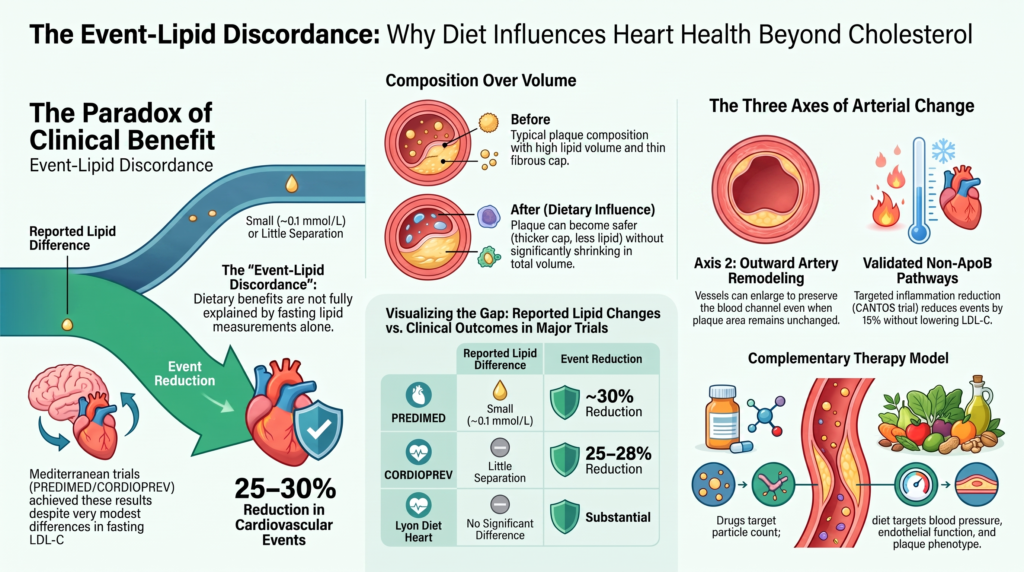
Results — the outcome signal. PREDIMED and CORDIOPREV reported relative reductions in the hazard of their composite cardiovascular endpoints — approximately 30% and 25–28% in adjusted analyses, respectively — that are not readily accounted for by a simple cross-trial application of the Cholesterol Treatment Trialists’ LDL-C relationship to their reported between-group fasting LDL-C differences;2,3 this descriptive event–fasting-lipid discrepancy is hypothesis-generating rather than an estimate of benefit independent of ApoB exposure. The Lyon Diet Heart Study reduced recurrent events substantially with essentially no lipid difference between arms.4 These trials did not measure cumulative ApoB exposure or formally partition mediation through lipids, blood pressure, weight, glycemia, inflammation and adherence.
Results — primate models. In surgically postmenopausal cynomolgus macaques given 30 months of plasma lipid lowering, coronary artery and lumen cross-sectional area were approximately twice those of a baseline-necropsy comparison group, while plaque area was not significantly different and acetylcholine-mediated dilation improved by 22 ± 4%.5 In a primate iliac-artery model — a non-coronary bed — endothelium-dependent relaxation returned to normal while intimal area decreased substantially but remained well above normal.6,7 The coronary experiment shows that vessel and lumen geometry can differ substantially without a statistically detectable plaque-area difference; the iliac experiment provides complementary evidence that endothelial function can normalize while intimal thickening decreases substantially but remains well above normal. Both experiments were conducted during lipid lowering with no time-matched untreated group, so the contribution of the treatment itself cannot be isolated.
Results — human angiography, and why endpoint lipids mislead. In the Lifestyle Heart Trial, minimal lumen diameter was essentially unchanged (+0.001 mm) while controls narrowed (−0.34 mm); the reference segment also narrowed in the intervention arm, only 35 patients had paired angiograms, and nine of the 15 control participants remaining in the five-year analysis began lipid-lowering medication.8 The ApoB trajectories illustrate the exposure problem. Converting to the units used elsewhere in this abstract, the intervention arm went from 100 mg/dL at baseline to 77 mg/dL at one year and back to 101 mg/dL at five years, while controls went from 102 to 109 to 99 mg/dL. The two arms therefore finished at almost the same ApoB, but reached it by opposite routes: the diet group had a large early reduction that faded, the control group a rise that later fell as medications were started. Similar endpoint values were unlikely to represent similar cumulative exposure — the principal lipoprotein exposure relevant to atherosclerotic progression.8 In the Esselstyn cohort, mean lumen diameter rose from 1.3 to 1.4 mm, a change that was not statistically significant.9
Results — contemporary imaging and the size of the dietary lipid effect. In DISCO-CT, a DASH-centered diet and lifestyle program added to optimal medical therapy produced no difference in total plaque burden (percent atheroma volume +1.0% vs +1.1%, P = .851) but a greater reduction in a broadly defined non-calcified plaque component (−51.3 vs −21.3 mm³, nominal P = .045).10 Across pooled randomized trials, and set against pharmacologic class expectations in Figure 7, vegetarian and vegan diets lower LDL-C by about 12 mg/dL (roughly 10%) and ApoB by about 13 mg/dL — far less than intensive supervised programs or combination pharmacologic therapy can achieve; intensive combination lipid-lowering therapy can reduce LDL-C by more than 50%, with a somewhat smaller proportional reduction in ApoB.11
Conclusions. Three observations jointly motivate further testing. Randomized Mediterranean dietary-pattern trials have reported event reductions that constitute the descriptive event–fasting-lipid discrepancy.2,3 At least one downstream inflammatory pathway can be therapeutically modified to reduce events without a concurrent reduction in measured LDL-C — evidence of a general causal pathway, not dietary evidence: at the prespecified 150 mg dose, interleukin-1β inhibition reduced the hazard of nonfatal myocardial infarction, nonfatal stroke or cardiovascular death by 15% without lowering LDL-C.12 And high-risk compositional features, particularly low-attenuation plaque burden, add prognostic information beyond stenosis severity and coronary calcium.13 Plant-forward dietary patterns influence several established risk pathways simultaneously — lipoproteins, blood pressure, body weight, glycemic control and postprandial exposure — which makes diet potentially complementary to pharmacotherapy, though the contribution of each pathway has not been separated. Several dietary interventions produce modest average reductions in LDL-C and ApoB, with larger effects in selected intensive or controlled-feeding programs.11,64 Mediterranean dietary-pattern trials have also demonstrated cardiovascular-event reduction, while no eligible adequately powered completed cardiovascular-outcome trial of an intensive plant-predominant intervention was identified through 31 July 2026 under the stated search criteria. Their incremental effect over optimized lipid-lowering therapy alone has not been isolated in an adequately powered cardiovascular-outcome trial. What remains unresolved is the partition — how much of the event benefit is captured by pretrial cumulative exposure and on-trial ApoB concentration-time exposure, how much runs through ApoB-interacting and potentially concentration-independent pathways, and whether dietary pattern alters plaque or arterial geometry after on-trial ApoB concentration-time exposure is repeatedly measured and appropriately modeled within a randomized dietary trial. Evidence on plaque and geometry remains limited and should not be conflated with the event evidence.10,57 Two studies would substantially advance the question: a randomized outcome trial of a plant-predominant pattern — none eligible, adequately powered and completed was identified through 31 July 2026; and a coronary-imaging trial with repeated ApoB measurement and a standardized medication algorithm, measuring plaque burden, composition, vessel and lumen area, endothelial function and perfusion.
1. Introduction
The causal role of ApoB-containing lipoproteins in atherosclerotic cardiovascular disease is unusually secure. Genetic studies, Mendelian randomization, prospective epidemiology, and randomized trials converge on the conclusion that ApoB particles cause the disease rather than merely marking it, and that the effect is a function of cumulative arterial exposure.14,15 In the response-to-retention model, these particles cross the endothelium, bind subendothelial proteoglycans, undergo modification, and initiate the monocyte recruitment and foam-cell transformation that constitute the atheroma.16 Serial imaging trials have made the relationship explicit: as achieved LDL-C falls, mean percent atheroma volume (PAV) moves from progression toward regression.17–20
Yet the nutrition literature contains observations not readily explained by a single fasting lipid measurement. Dietary change alters endothelial nitric oxide signaling, adhesion-molecule expression, systemic inflammatory tone, gut microbial metabolite production, postprandial lipemic exposure, and blood pressure.6,21–24,64,89 Several informative regression experiments also report improvement in arterial function and geometry without a statistically significant reduction in plaque size.5,6
This matters because lumen caliber is not a simple inverse function of plaque volume. Glagov and colleagues showed that human coronary arteries enlarge outwardly as plaque accumulates, preserving lumen area until plaque occupies roughly 40% of the area bounded by the internal elastic lamina.25 Arterial geometry is therefore a partially separable phenotypic axis. If diet influences vasomotor tone, matrix composition, inflammatory activation, or medial and adventitial biology, it could plausibly alter functional caliber and perfusion before — or without — measurable atheroma resorption.
1.1 Four propositions that must not be conflated
Much of the controversy in this area arises from collapsing four distinct claims into one. Stating them separately is the necessary first step:
- Diet improves a vascular endpoint. Supported for several endpoints, in several models.
- The improvement is not fully captured by a single fasting LDL-C or ApoB measurement. Plausible and supported by several indirect observations; stronger inference is limited by sparse longitudinal ApoB measurement and the absence of formal mediation analysis.
- The improvement would persist if plasma ApoB concentration-time exposure were experimentally matched.
- Diet delivers more lumen, stability, or perfusion per unit of ApoB reduction than pharmacotherapy. Unsupported: no eligible completed trial making that comparison was identified through 31 July 2026 under the stated search criteria.
This review evaluates the evidence bearing on propositions 1 and 2, treats proposition 3 as the central open question, and explicitly declines proposition 4. Readers should hold the resulting claim to that standard throughout: not fully captured by fasting ApoB is materially weaker than independent of ApoB, and only the former is currently defensible.
| ApoB is a causal exposure marker, not a comprehensive cardiovascular-risk biomarker. The question here is therefore not whether fasting ApoB ought to encode blood pressure, inflammation or thrombosis, but whether dietary effects on vascular outcomes are underestimated when mechanistic interpretation rests predominantly on a small number of fasting lipid measurements. The hypothesis evaluated throughout this review
Dietary patterns may influence vascular biology through mechanisms not fully captured by a single fasting ApoB measurement, while remaining largely compatible with cumulative ApoB causality. This wording is used deliberately and consistently. It is weaker than independent of ApoB, which no evidence establishes, and stronger than the claim that no effect exists beyond the reported fasting LDL-C difference, which the outcome literature makes difficult to sustain. Where the review departs from it — as in §7, where the evidence for clinical events supports a firmer statement than the evidence for plaque geometry — that departure is stated explicitly. |
| Four exposure constructs, distinguished
Lifetime cumulative ApoB exposure — the integral of ApoB-particle concentration over years to decades. This is the causal exposure in the genetic and Mendelian randomization literature. It is not measurable in a trial. On-trial ApoB exposure (serial AUC) — the integral of repeated ApoB measurements across a trial’s follow-up. This is the metric the trial in §6.1 would compute, and it approximates only the trial-duration slice of lifetime exposure. Postprandial and remnant exposure — ApoB-containing particle burden in the non-fasting state, including apoB-48 remnants and delayed-clearance apoB-100 remnants. Not characterized by a fasting sample and not captured by serial fasting AUC. Endpoint or baseline fasting ApoB — a single concentration at one time point. This is what most trials report, and its inadequacy as a proxy for the three constructs above is the measurement problem this review examines. Where this review says exposure is “unmatched” or “not measured,” it means the second and third constructs, not the first, which no human trial can match. |
1.2 A three-tier classification of dietary vascular effects
A more useful framework than the binary “ApoB versus non-ApoB” divides dietary effects by their relationship to particle exposure:
| Classification used throughout this review
ApoB-mediated. Effects operating through reduced fasting or postprandial ApoB particle number, residence time, or arterial flux. Critically, this includes reductions in apoB-48-containing chylomicrons and remnants — so “beyond fasting LDL-C” does not mean “beyond ApoB.” ApoB-interacting. Effects that alter how much damage a given burden of retained particles produces: endothelial permeability and retention, oxidative and enzymatic modification, inflammatory amplification, matrix response, and lipoprotein compositional atherogenicity. These modify the per-particle consequence rather than the particle count. Not contingent on a concurrent change in measured plasma ApoB. This category does not imply long-term biological independence from ApoB-driven atherosclerosis. Effects with no requirement for a change in measured plasma ApoB concentration, while potentially still interacting with ApoB-driven plaque biology: acute vasomotor tone, blood pressure, platelet reactivity and thrombosis, and microbial metabolite pathways. These could alter clinical risk or measured lumen dimensions without changing plaque mass — though demonstrating independence would require careful characterization of longitudinal ApoB exposure and a design capable of separating dietary assignment from pharmacologic exposure and ApoB-interacting mechanisms. |
Most dietary mechanisms conventionally labeled “beyond ApoB” fall into the middle tier. That is a weaker claim than independence but a scientifically substantive one, and it generates different predictions and different trial designs. These categories are pathway- and time-scale-specific rather than permanent properties of a mechanism: blood pressure, endothelial function and inflammation can each influence, and be influenced by, ApoB-mediated disease over different intervals.
2. Methods
2.1 Scope and study selection
This is a narrative review, not a systematic review. It prioritized primary original studies over secondary syntheses across six domains: nonhuman primate induction and regression experiments; early human coronary angiographic and perfusion trials; contemporary intravascular and computed tomographic imaging studies; Mediterranean-pattern event and mechanistic trials; plant-predominant vascular intervention studies; and landmark pharmacologic plaque-regression trials retained as ApoB-anchored comparators.
Studies were eligible if they evaluated a dietary or diet-centered intervention and reported at least one vascular outcome: plaque burden or volume, percent diameter stenosis, lumen diameter or area, remodeling indices, endothelial function, perfusion, or plaque composition. Nonhuman primate studies were preferred over rodent models because macaque and African green monkey coronary pathology, lipoprotein handling, and remodeling behavior are closer to human disease.26–28 Observational diet-quality cohorts were treated as contextual. Major event trials without imaging were retained where they anchor external clinical relevance.2,3
2.2 Search strategy
A targeted narrative search of MEDLINE/PubMed, Scopus and ClinicalTrials.gov (with ANZCTR for registered protocols) was updated through 31 July 2026. Search concepts combined dietary-pattern terms (plant-based, vegetarian, vegan, Mediterranean, DASH, low-fat, whole-food) with vascular outcome terms (coronary angiography, quantitative coronary angiography, intravascular ultrasound, optical coherence tomography, near-infrared spectroscopy, computed tomography angiography, intima-media thickness, atheroma volume, lumen, remodeling, regression, endothelial function, myocardial perfusion), and separately with primate terms (Macaca, cynomolgus, rhesus, African green monkey, vervet). Reference lists of retrieved reports and prior reviews were hand-searched. Landmark pharmacologic serial-imaging trials were selected a priori as reference comparators illustrating what intensive ApoB lowering can achieve and do not satisfy the dietary eligibility criteria; they are not part of the eligible intervention corpus. Screening and extraction were performed by the single author. A complete search-string appendix is provided as Supplementary Data S1, and a study-selection record as Supplementary Data S4.
Statements that no trial exists are bounded by this search and are phrased accordingly throughout: no eligible completed full-report trial was identified through 31 July 2026 under the stated criteria. Registered protocols without completed primary results are cited as evidence of research activity, not as outcome evidence.
2.3 Transparency limitations
This remains a narrative review and is assessed with reference to the SANRA domains for narrative-review quality rather than PRISMA.29 No protocol was preregistered, records screened were not counted, RoB 2, ROBINS-I and animal risk-of-bias instruments were not applied, and publication bias was not assessed. It would therefore be inappropriate to present GRADE certainty ratings, because this review lacks the protocolized selection and risk-of-bias procedures needed to support them. Evidence is therefore described with explicit narrative descriptors — strong, suggestive, limited, hypothesis-generating, and insufficient / no demonstrated effect — defined in §5. Converting this review into a systematic or scoping review with PRISMA-style reporting, duplicate screening, and formal risk-of-bias assessment remains a worthwhile subsequent step and is the principal methodological limitation of the present work.
2.4 Data extraction and appraisal
For each study the following were extracted where reported: population or model, intervention and comparator, follow-up, change in and achieved LDL-C or ApoB, plaque endpoints, lumen endpoints, and mechanistic observations. ApoB was frequently unreported in trials predating routine apolipoprotein measurement; where only total cholesterol or LDL-C was available, that limitation was preserved rather than imputed, since imputing ApoB from mid-century lipid panels would manufacture the comparability this review exists to test.
Principal claims are assessed twice: once for the total effect of the dietary pattern, and once for evidence of independence from ApoB exposure. These routinely diverge — a trial can provide reasonably strong evidence that a diet reduces events while providing essentially no evidence about mechanism. Conflating the two is a recurrent error in this literature and, in the author’s judgment, the principal reason the field has not settled.
2.5 A note on terminology
This review avoids the term “positive remodeling”, because it now carries a meaning close to the opposite of the one intended here. In contemporary coronary CT reporting, positive remodeling — conventionally a remodeling index at or above about 1.1, computed from external elastic membrane cross-sectional area at the lesion relative to a reference segment — is one of the high-risk plaque features used to flag lesions likely to cause events, alongside low attenuation, spotty calcification and the napkin-ring sign.30
The geometry in the two settings is identical; the biology is not. On CCTA, outward expansion marks plaque that is growing and biologically active, with the artery enlarging to accommodate it — which is why it predicts risk.13,30 In the regression experiments reviewed here, the artery enlarges while plaque burden is stable or falling under lipid lowering. Same direction of geometric change, opposite disease trajectory. Because one term cannot carry both readings without misleading the reader, the terms used throughout are outward enlargement of the artery or artery enlargement that preserves the channel, and the accompanying plaque trajectory is stated wherever the geometry is described.
3. Results
3.1 What would count as evidence
Two preliminary points determine how the rest of this section should be read: what the possible outcomes actually are, and which of them matters clinically.
3.1.1 Lumen caliber and plaque burden move semi-independently
Reviews of this literature routinely speak of “regression” as though it were one thing. It is not. The arterial wall and the blood channel are separate measurements that can move together, in opposite directions, or one without the other, and all nine combinations are logically possible (Figure 1), though they are conceptual states rather than equally documented biological findings.

Figure 1. Lumen caliber and plaque burden are partially separable: all nine combinations of direction are possible. Measuring only one axis cannot distinguish these situations, which is why the choice of trial endpoint largely determines what is observed.
Three of these deserve emphasis because they are routinely conflated. Plaque burden and composition can improve with only modest change in lumen caliber. In PACMAN-AMI, intensive alirocumab treatment produced plaque regression, lipid-core depletion and fibrous-cap thickening alongside a modest increase in minimum lumen area (+0.15 mm² versus −0.07 mm² with placebo; between-group difference 0.21 mm², P = .04); HUYGENS established compositional and burden improvement rather than a large geometric effect.31,32 Plaque area may show no statistically detectable difference while lumen area is substantially larger — the pattern in the postmenopausal macaques, where artery and lumen area roughly doubled with no significant plaque-area difference.5 And plaque can grow while the lumen widens, which is Glagov’s compensatory enlargement and the reason early coronary disease is invisible on angiography.25
This framework does not challenge the central causal model; it clarifies it. Lowering ApoB exposure shifts the average lesion trajectory leftward on Figure 1, toward stabilization or regression, and the evidence for that is strong and quantitative.14,20,31 The question this review examines is narrower: whether high-quality dietary patterns also move lesions upward — widening or preserving caliber, and improving plaque character — after accounting for longitudinal ApoB exposure.
3.1.2 Three partially separable axes, and which tracks outcomes best
The nine combinations in Figure 1 already show that plaque volume and lumen caliber move semi-independently. The three axes are shown schematically in Figure 2. A third axis — plaque composition — varies partly separately from both and provides important prognostic information beyond lumen stenosis and bulk plaque measures. A lesion can shed lipid, thicken its fibrous cap, and calcify without changing appreciably in volume, and without the lumen changing at all.

Figure 2. Three partially separable axes of arterial change, shown as schematic coronary cross-sections. Axis 1: vessel size fixed while the plaque annulus thickens or thins. Axis 2: vessel and channel both change, with plaque area able to remain identical. Axis 3: volume and caliber unchanged while tissue character shifts from lipid-rich to fibrous and calcified. The evidence boxes provide an author-assigned qualitative summary of prognostic evidence and are not derived from a common quantitative scale; the axes are not fully independent. Conventional angiography measures selected lumen dimensions within Axis 2 but does not directly measure external vessel size or remodeling. Schematic only and not to scale.
Direct prospective evidence shows that high-risk compositional features add prognostic information beyond stenosis severity and coronary calcium. In a post hoc analysis of 1,769 SCOT-HEART participants followed a median 4.7 years, low-attenuation plaque burden was the strongest CCTA-derived plaque measure examined in that analysis for fatal or non-fatal myocardial infarction (adjusted hazard ratio 1.60 per doubling, 95% CI 1.10–2.34), and participants with a burden above 4% were nearly five times as likely to sustain an infarction (HR 4.65, 95% CI 2.06–10.5).13 Critically, this held irrespective of cardiovascular risk score, coronary calcium score, or coronary artery stenosis severity — the authors concluded that the findings challenge the perceived supremacy of classical predictors including stenosis.13 PROSPECT had earlier shown that lesions causing later events were frequently non-obstructive at baseline but carried thin-cap fibroatheroma morphology and large plaque burden.33
The three axes therefore carry different and modality-dependent prognostic information, though the ordering should be read as a tendency rather than a universal hierarchy. Among CCTA-derived measures in SCOT-HEART, low-attenuation plaque burden added prognostic information beyond stenosis severity and coronary calcium.13 Across studies both total burden and high-risk composition contribute to risk, and the two are correlated — low-attenuation plaque burden is itself partly a volumetric measure of a compositional subtype. What can be said with confidence is narrower: lumen stenosis alone is an incomplete measure of risk, and compositional features add information that neither caliber nor bulk volume captures.
This has a consequence that governs how the rest of this review should be read. An intervention that produces favorable compositional change without reducing plaque volume or widening the lumen would register as a failure on volumetric and angiographic endpoints while still reducing risk. That pattern is most apparent in the Mediterranean outcome literature: substantial event reduction, little modern coronary volumetric evidence, and limited compositional data. Evidence from intensive plant-predominant programs remains much smaller and less definitive. It is also what the pharmacologic compositional trials demonstrate directly: PACMAN-AMI and HUYGENS thickened fibrous caps and depleted lipid cores alongside only 1–2 percentage points of absolute change in plaque volume.31,32 It should be said at the outset that the only eligible modern randomized dietary trial identified here that reported a coronary lumen measure found it narrowing in the diet arm rather than widening, while non-calcified plaque fell (§3.4.2).10 Total atheroma volume did not change significantly in either arm, so that discordance cannot be attributed to any single mechanism from the reported data; it is nonetheless the clearest available demonstration of why a single axis cannot be read as the whole result. It is also evidence against the geometric limb of the hypothesis, and is treated as such throughout.
Table 1. The three axes compared: what each measures, what moves it, how strongly it tracks events, and which methods can see it.
| Feature | Axis 1 — Plaque volume | Axis 2 — Lumen caliber | Axis 3 — Plaque composition |
| Possible directions | Increases / stable / decreases | Expands / stable / constricts | Lipid core depletes; cap thickens; dense calcification may increase during stabilization, whereas spotty or microcalcific patterns may remain adverse |
| Typical measures | Percent atheroma volume; total plaque volume | Minimal lumen diameter; percent diameter stenosis; lumen area | Low-attenuation plaque volume; lipid core burden index; minimal fibrous cap thickness. Low-attenuation plaque burden is both attenuation-defined and volumetric, so Axes 1 and 3 are not independent |
| Strength of association with events | Moderate. Trial-level meta-regression associates lower PAV with lower event odds, but heterogeneous and not a validated surrogate34,35 | Generally less informative alone for spontaneous infarction risk; composition predicted infarction irrespective of stenosis severity13 | Selected high-risk compositional features show strong prognostic associations and add information beyond stenosis and coronary calcium; strength varies by feature and modality. Low-attenuation plaque burden >4% carried ~4.7-fold risk13 |
| What moves it — pharmacologic | Intensive ApoB lowering: 1–2 percentage points of absolute PAV reduction18–20,31 | Follows volume and remodeling; not usually a drug-trial endpoint | Intensive ApoB lowering thickens caps and depletes lipid core31,32 |
| What moves it — dietary | No eligible controlled coronary trial identified in this review showed a significant between-group reduction in total plaque burden attributable to diet10 | Relatively preserved in several historical angiographic trials; modest improvement in selected lesion-level or functional measures8,36,37 | Greater reduction in non-calcified plaque in one trial; otherwise largely unmeasured10 |
| Visible to angiography (QCA)? | No | Partly — measures selected lumen dimensions within this axis, but not external vessel size or remodeling | No |
| Visible to IVUS? | Yes | Yes | Partially (with NIRS co-registration) |
| Visible to CCTA? | Yes | Yes | Partially — estimates attenuation-defined categories; thresholds are acquisition- and software-dependent and are not direct histology |
| Visible to OCT? | Limited by penetration | Yes | Yes — cap thickness, macrophage index |
| Confounded by remodeling? | Less directly than lumen measures, but method-dependent | Yes, in both directions — outward enlargement can preserve caliber during progression; constrictive remodeling can narrow caliber during regression25 | Not directly, but measurement is strongly method- and segmentation-dependent |
CCTA, coronary computed tomography angiography; IVUS, intravascular ultrasound; NIRS, near-infrared spectroscopy; OCT, optical coherence tomography; PAV, percent atheroma volume; QCA, quantitative coronary angiography.
The practical consequence of the three axes is visible in what the trials actually measured (Figure 3), and the pattern is striking: large dietary outcome trials generally did not incorporate modern coronary plaque imaging, whereas modern coronary imaging trials were not powered for hard clinical outcomes. The exceptions are partial — the Lifestyle Heart Trial reported both angiography and clinical events in 48 patients, and PREDIMED and CORDIOPREV carried carotid substudies alongside their event analyses — but none combined adequately powered outcomes with modern coronary plaque imaging. The historical angiographic trials measured selected lumen dimensions within Axis 2 but did not measure external vessel geometry, plaque burden, or composition.

Figure 3. Coverage of the three axes across the principal trials reviewed. Carotid imaging substudies in PREDIMED and CORDIOPREV are not shown, as the figure concerns coronary measurement. Green cells denote a principal or prespecified endpoint, amber cells a directly measured secondary or exploratory endpoint, and gray cells an endpoint not measured. The figure is author-derived from the primary trial reports cited in this review (refs 2, 3, 8, 10, 17–20, 31, 32, 36, 53, 56 and 58); it presents no new data.
3.1.3 Why conventional angiography cannot resolve any of this
The older literature reviewed in §3.5 relies almost entirely on quantitative coronary angiography, which directly measures lumen geometry but not wall burden or composition. Contrast fills the lumen; the angiographic image records the lumen silhouette. Wall thickness, plaque volume, lipid content, cap thickness and necrotic core are all invisible.38
The Glagov phenomenon makes this worse rather than merely limited, because it renders the caliber signal ambiguous in direction. As plaque accumulates, the vessel enlarges outward and lumen area is preserved until the lesion occupies roughly 40% of the area within the internal elastic lamina.25 An artery whose lumen looks unchanged may be one in which nothing is happening, or one in which plaque is growing steadily behind a compensating wall. Constrictive remodeling produces the mirror ambiguity: a lumen that narrows may reflect growing plaque, or a shrinking vessel around a stable or regressing lesion.
So a given angiographic finding admits opposite biological readings. Preserved caliber may mean disease is quiescent, or that it is advancing while compensation holds. Widened caliber may mean plaque has regressed, or that the vessel has enlarged outward faster than plaque accumulated — which on Axis 1 is progression. Narrowed caliber may mean plaque growth, or vessel constriction around an unchanged lesion. None of these can be distinguished without measuring the vessel wall, which angiography does not do.25,38
This is why the historical angiographic trials, however carefully conducted, cannot directly settle questions about plaque-volume or plaque-composition regression — and why the dietary literature’s reliance on them has left the field arguing about a measurement that was never capable of answering the question.38 It also explains a pattern that would otherwise look contradictory: interventions can improve events without improving angiography, and can improve angiography without anything having happened to the plaque.25
3.1.4 The clinical signal: the descriptive event–fasting-lipid discrepancy
Plaque volume, lumen diameter and percent atheroma volume are surrogates. What matters to patients is whether they have a heart attack, a stroke, a revascularization, or die. For Mediterranean dietary-pattern interventions, hard-outcome evidence is stronger than modern coronary-imaging evidence; for intensive plant-predominant programs, both literatures remain limited.
The Cholesterol Treatment Trialists’ meta-analysis of 26 randomized statin trials provides a useful approximate benchmark: each sustained 1.0 mmol/L reduction in LDL-C was associated with approximately 22% fewer major vascular events.1 Applying that relationship to dietary trials is heuristic, because interventions, exposure trajectories, durations and concurrent risk-factor changes differ. It does not estimate the lipid-mediated portion of a dietary effect or quantify a residual benefit.
Table 2. Why no cross-trial residual benefit can be calculated. Each row lists what the trial reported and the estimand it used. The quantities are not equivalent, so the difference between an observed estimate and any value derived from the Cholesterol Treatment Trialists’ relationship is not an estimate of residual or LDL-independent benefit.
| Trial | Reported LDL-C separation | Event estimand | Duration / setting | Reported effect | Why it is not comparable |
| DRUG TRIALS | |||||
| 4S39 | ~1.8 mmol/L | First-event hazard ratio | 5.4 y; secondary prevention | −34% | Placebo comparator; no dietary co-intervention |
| WOSCOPS40 | ~1.0 mmol/L | First-event hazard ratio | 4.9 y; primary prevention | −31% | Placebo comparator |
| CARE41 | ~0.98 mmol/L | First-event hazard ratio | 5.0 y; post-MI | −24% | Placebo comparator |
| LIPID42 | ~1.0 mmol/L | First-event hazard ratio | 6.1 y; post-MI or unstable angina | −24% | Placebo comparator |
| HPS43 | ~1.0 mmol/L | First-event hazard ratio | 5.0 y; high-risk | −24% | Placebo comparator |
| IMPROVE-IT44 | ~0.4 mmol/L | First-event hazard ratio | 6.0 y; post-ACS | −6% | Added to statin, not to nothing |
| DIET TRIALS | |||||
| PREDIMED, EVOO arm2 | Small; ~0.1 mmol/L | First-event hazard ratio | 4.8 y; primary prevention | −31% (9–47) | Allocation irregularities; comparator counseling intensity differed |
| PREDIMED, nut arm2 | Small; ~0.1 mmol/L | First-event hazard ratio | 4.8 y; primary prevention | −28% (4–46) | As above; the two effect estimates share a common control group and should not be treated as independent |
| CORDIOPREV3 | Little separation reported | First-event hazard ratio, adjusted | 7 y; established CHD | −28% (4–46) | Both arms received dietary intervention |
| Lyon Diet Heart4 | No significant difference | Recurrent events | ~4 y; post-MI | Substantial reduction | Recurrent-event contrast; not a first-event hazard ratio |
| Lifestyle Heart8 | Large within-arm change | Recurrent-event rate ratio | 5 y; n = 48 | Rate ratio 2.47 (1.48–4.20) | n = 48; recurrent events; bundled multicomponent program |
| STARS36 | Total cholesterol −14% (diet) | Total cardiac event counts | 3.25 y; n = 90 men | 3 of 27 vs 10 of 28 | Event counts, not a hazard ratio; numbers too small for arm-to-arm inference |
The Cholesterol Treatment Trialists’ relationship of approximately 22% fewer major vascular events per 1.0 mmol/L of LDL-C reduction was derived from randomized statin trials with placebo comparators and first-event endpoints.1 Applying it to rows in the dietary block requires assuming equivalence of estimand, comparator, duration, adherence and exposure trajectory. Those assumptions do not hold, which is why this comparison is presented as a table rather than as a plot: a figure would encode a vertical distance that the data cannot support.
The pharmacologic trials in Table 2 were selected as reference comparators and are not presented as a calibration set; no distance from the CTT relationship is computed for them or for any dietary trial — 4S, WOSCOPS, CARE, LIPID, HPS and IMPROVE-IT are not positioned relative to it.39–44 Several dietary trials report event estimates that are not readily accounted for by a simple cross-trial application of the CTT relationship to their reported fasting LDL-C differences — the descriptive event–fasting-lipid discrepancy. Because this is an ecological cross-trial comparison, it cannot determine whether the discrepancy reflects cumulative or postprandial ApoB exposure, ApoB-interacting or potentially concentration-independent pathways, adherence, comparator effects, or other design differences. PREDIMED reduced major cardiovascular events by roughly 30% and CORDIOPREV by roughly 25–28% in adjusted analyses over seven years against its lower-fat comparator, in both cases with only modest LDL-C separation between arms — fasting LDL-C differences that, if considered in isolation under the CTT relationship, would correspond to substantially smaller event differences.1–3 The Lyon Diet Heart Study is the largest discrepancy in this set of trials: a Mediterranean pattern reduced recurrent events dramatically with essentially no difference in serum lipids between groups.4 In STARS, total cardiac events fell from 10 of 28 patients under usual care to 3 of 27 on diet alone.36 In the Lifestyle Heart Trial — the only randomized trial of an intensive plant-predominant program with both angiographic and clinical endpoints in which the intervention protocol did not include lipid-lowering medication — there were 25 recurrent composite cardiac events among 28 intervention participants against 45 among 20 controls — an event-count contrast, not a time-to-first-hard-event analysis, a reported event-rate ratio of 2.47 (95% CI 1.48–4.20; P < .001).8
This descriptive trial-level discrepancy motivates the review, and it should be stated carefully. It is assembled from separate trials with different populations, comparators and follow-up, so it is not a within-trial estimate. The dietary interventions also lowered blood pressure, reduced weight and adiposity, improved glycemic control and altered postprandial metabolism, any of which may carry part of the benefit — and several of those changes are themselves partly ApoB-related. The CTT slope was derived from statin trials and may not transfer exactly. This comparison is hypothesis-generating rather than a formal mediation analysis: it compares trial-level averages across studies and cannot estimate a mediated effect. What it indicates is that the event reduction achieved by these diets is not readily accounted for by the reported fasting LDL-C differences alone; what it does not establish is how much, or through which pathway.
3.1.5 Why plaque composition connects the two
The link between the surrogate and the outcome is not merely assumed. Acute coronary thrombosis most commonly follows rupture of a lipid-rich plaque with a thin, inflamed fibrous cap, but it can also arise from plaque erosion over an intact surface, typically in a more fibrous, proteoglycan-rich and smooth-muscle-cell-rich lesion with little or no lipid core. Culprit lesions are frequently not severely obstructive beforehand, which helps explain why lumen stenosis alone is an incomplete risk measure. Features associated with plaque vulnerability — low attenuation, thin-cap morphology, lipid-rich core and inflammatory activity — have shown prognostic or mechanistic relevance, although their evidence bases and measurement methods differ.30,32 A diet that stabilized plaque without shrinking it, or that improved endothelial function and perfusion without altering geometry, could therefore reduce events while leaving measures of plaque volume unmoved.
The remainder of this section is organized by strength of evidence rather than chronology, so that established findings are not read alongside plausible ones. §3.2 describes the imaging methods. §3.3 presents pharmacologic ApoB-lowering trials as the Tier 1 reference standard. §3.4–3.7 evaluate Tier 2 human dietary evidence and the limits of cross-trial comparison. §3.8 examines Tier 3 animal and experimental evidence. §4 evaluates candidate mechanisms, classified by their relationship to ApoB exposure.
3.2 How plaque and lumen are measured
Modern intravascular and computed tomographic imaging moved trial endpoints away from two-dimensional lumen diameter toward cross-sectional atheroma quantification, tissue characterization, and microstructure.45 The instruments differ enough in what they resolve that apparent disagreements between trials often turn out to be disagreements between machines — a point that matters directly when comparing older dietary trials against modern drug trials, since the two literatures were largely looking at different things.
Table 3. Contemporary coronary imaging modalities and what each can and cannot resolve.
| Modality | Principal metrics | Capability | Limitation |
| IVUS45 | Percent atheroma volume (PAV), total atheroma volume, external elastic membrane volume | Usually permits cross-sectional plaque and external elastic membrane measurement, allowing burden and remodeling to be assessed together, though calcium and signal attenuation may prevent complete boundary visualization; the reference standard for regression trials | Typical approximate axial resolution ~100–150 µm — too coarse to resolve thin fibrous caps (<65 µm) or microscopic necrotic cores |
| CCTA10,30 | Total plaque volume, non-calcified plaque, low-attenuation plaque (<30 HU), fibrous and calcified volume, remodeling index | Non-invasive volumetric quantification with longitudinal compositional tracking, feasible at scale | Typical approximate resolution ~300–400 µm; calcium blooming; compositional thresholds vary between studies, which limits direct cross-trial comparability |
| OCT32 | Minimal fibrous cap thickness, macrophage index, lipid arc, neovascularization | Typical approximate resolution ~10–15 µm — fine enough to measure cap thickening and rupture-risk morphology directly | Penetrates only 1–2 mm; requires blood clearance; cannot reach the external elastic membrane in large vessels |
| NIRS31 | Lipid core burden index; maximum lipid core burden in 4 mm | Identifies intimal lipid pools chemically rather than by appearance | Returns no structural or depth information; must be co-registered with IVUS to be interpretable |
| Carotid ultrasound46–49 | Intima-media thickness, plaque height, vessel wall volume | Inexpensive and repeatable — often the only option at the scale dietary trials require; plaque-focused measures may provide more atherosclerosis-specific prognostic information than diffuse common-carotid IMT | A different arterial bed that does not reliably track coronary change; IMT combines intima with media, so thinning may reflect reduced blood pressure and medial smooth-muscle regression rather than loss of atheroma; operator-dependent |
CCTA, coronary computed tomography angiography; HU, Hounsfield units; IVUS, intravascular ultrasound; NIRS, near-infrared spectroscopy; OCT, optical coherence tomography.
3.3 Tier 1 — established: what pharmacologic ApoB lowering achieves
The cleanest serial-imaging evidence comes from pharmacologic LDL-C and ApoB-lowering strategies; ApoB was not uniformly measured in the classic imaging trials, so ApoB lowering is often inferred from LDL-C, and they set the standard any dietary claim has to be measured against. In REVERSAL, pravastatin achieving an LDL-C of 110 mg/dL was accompanied by progression in percent atheroma volume, while atorvastatin reaching 79 mg/dL produced no significant progression.17 ASTEROID drove LDL-C from 130.4 to 60.8 mg/dL with mean PAV regression of −0.98%.18 SATURN reached 70.2 and 62.6 mg/dL with PAV changes of −0.99% and −1.22%.19 GLAGOV added evolocumab to statin therapy, pushed mean LDL-C to 36.6 mg/dL, and saw PAV −0.95% against +0.05% on statin alone.20 PACMAN-AMI, adding alirocumab after myocardial infarction, reached an achieved LDL-C of 23.6 mg/dL against 74.4 mg/dL on placebo plus high-intensity statin at week 52, and reduced PAV (−2.13% vs −0.92%) and lipid core burden while increasing minimal fibrous cap thickness.31 HUYGENS, at achieved LDL-C of 28.1 versus 87.2 mg/dL, increased minimal cap thickness by +42.7 versus +21.5 µm and improved lipid arc, macrophage index, and PAV as well.32
3.3.1 How much regression is achievable, and does it track events?
Two questions frame everything that follows: how much plaque regression the best available therapy produces, and whether regression tracks clinical outcomes.
The observed range. Across the major serial-IVUS trials reviewed here, mean absolute reduction in percent atheroma volume has generally been approximately 1–2 percentage points. ASTEROID reported −0.98%, GLAGOV −0.95%, SATURN −0.99% and −1.22% on its two arms, and PACMAN-AMI — alirocumab added to high-intensity rosuvastatin after myocardial infarction, achieved LDL-C 23.6 mg/dL — reported one of the largest at −2.13%.18–20,31 Plaque regression is therefore real but numerically modest even under intensive pharmacologic lipid lowering in the landmark IVUS trials summarized here (Figure 4). These are the largest values among the landmark trials summarized here; no systematic survey of all IVUS studies was performed, and nothing in this literature establishes a biological limit.

Figure 4. Descriptive map of heterogeneous serial-IVUS trials. Each cluster represents one serial-IVUS study; all except ASTEROID were randomized comparisons. The bracket encloses that study’s own arms and deliberately does not connect them as a slope; horizontal position is categorical and carries no quantitative meaning. ASTEROID is single-arm and marked with a square; PACMAN-AMI enrolled patients after acute myocardial infarction and is colored separately. Achieved LDL-C is shown as an attribute of each arm, not as a position on a common dose axis — the trials differ in population, background therapy, duration and imaging protocol, and no dose–response relationship should be inferred between clusters.
Whether it tracks events. It does, at the level of trial averages. Nicholls and colleagues pooled 4,137 patients across six serial-IVUS trials and found both baseline and change in percent atheroma volume associated with incident major adverse cardiovascular events.50 The composite was dominated by coronary revascularization (18.9%) rather than death (0.9%) or myocardial infarction (1.8%), which limits its interpretation as evidence that small changes in plaque volume translate directly into spontaneous hard events. Two meta-regressions since have estimated the slope: roughly 14–25% lower odds of a major adverse event per 1-percentage-point lower mean percent atheroma volume, depending on the model and adjustment, with the 2023 between-group analysis at the upper end. That association is derived from trial-level analyses; it is not a validated conversion and should not be applied to an individual trial or patient.34,35 Both author groups describe substantial heterogeneity, and neither establishes percent atheroma volume as a validated surrogate endpoint.
These figures provide a contextual benchmark, and it is important to be clear about what kind. They are trial-level associations across lipid-lowering studies,34,35 not a conversion formula permitting one to infer how much plaque regression a particular intervention must produce to explain a particular event reduction. Trial-level associations can differ from individual-level mediation, the meta-regressions draw on pharmacologic trials measured over shorter intervals than dietary outcome trials, and MACE definitions differ across the included studies. The benchmark is useful as a consistency check and cannot serve as a mechanistic calculator.
3.3.2 There is no 60–70 mg/dL threshold
It is common to summarize these trials as showing that regression “begins” once LDL-C drops below roughly 60–70 mg/dL. The trials support a graded relationship, not a threshold, and the gradient is not even cleanly monotonic across studies. SATURN reached 62.6 mg/dL with PAV −1.22%; GLAGOV reached 36.6 mg/dL with PAV −0.95%.19,20 Thus the trial with the lower achieved LDL-C did not report the greater mean regression — a reminder that cross-trial comparisons are confounded.
The explanation is that these are different trials, not different doses of one experiment. Populations, baseline plaque burden, background therapy, acute versus stable presentation, and imaging protocols all differ. Plotting achieved LDL-C from separate trials on a single curve is like comparing marathon times run on different courses in different weather and calling the result a fitness ranking — the underlying relationship is real, but the comparison does not hold constant the things that would let you measure it. Only within-trial comparisons, such as GLAGOV’s two arms, are safe. The defensible summary is that many trials showing mean PAV regression achieved LDL-C at or below roughly 70 mg/dL, with no established discontinuity anywhere along the range.
3.3.3 Drugs are not confined to debulking
An intuitive division of labor holds that lipid-lowering drugs are good at shrinking plaque volume while diet is comparatively better at improving plaque composition, stability, and function. The first half of that claim is contradicted by the trials above. HUYGENS and PACMAN-AMI show intensive ApoB lowering thickening fibrous caps, shrinking lipid arcs, reducing macrophage index, and cutting lipid core burden — demonstrating favorable compositional change in addition to modest bulk regression.31,32 Whatever diet may add, it is not filling a gap that drugs leave open in plaque composition.
Figure 5. Domains commonly measured in the dietary and pharmacologic literatures — not comparative domains of superiority. Entries distinguish reported effects from domains not usually measured; they do not establish comparative superiority. Gray italic entries indicate that the domain was not measured in that literature, not that the effect is absent. The columns are not a head-to-head comparison: no trial has compared dietary and pharmacologic strategies under standardized background therapy with repeated ApoB measurement sufficient to estimate their relative contributions within shared vascular domains.

Figure 5 makes the asymmetry visible. The dietary literature has measured lumen dimensions, perfusion, endothelial function, blood pressure, and postprandial exposure; the pharmacologic literature has measured atheroma volume, cap thickness, and lipid core. The empty cells are largely a record of what each field chose to look at.
What does survive is an observation about the evidence rather than about biology. Historical dietary trials mostly measured perfusion, vasomotor function, and lumen dimensions;8,36,58 modern drug trials mostly measured plaque volume and composition.31,32 Each literature is strongest where the other is silent, and a domain only one side measured cannot support a comparison between them. The accurate statement is that intensive pharmacologic ApoB lowering improves both plaque volume and plaque composition, while dietary interventions may additionally influence vasomotor function, blood pressure, postprandial metabolism, and other systemic pathways — with comparative superiority in any imaging domain unestablished. Any claim that diet buys more lumen, stability, or perfusion per mg/dL of ApoB lowered requires a trial that was not identified through 31 July 2026 under the stated search criteria, and is not made here.
Table 4. Pharmacologic serial-imaging comparators. Achieved LDL-C values are not interchangeable across trials.
| Trial arm | Achieved LDL-C | Imaging result | Note |
| REVERSAL — pravastatin 40 mg17 | 110 mg/dL | PAV progression | Moderate lowering did not halt progression |
| REVERSAL — atorvastatin 80 mg17 | 79 mg/dL | No significant progression | Intensity changed the trajectory |
| ASTEROID — rosuvastatin 40 mg18 | 60.8 mg/dL | PAV −0.98 percentage points | Single-arm; no randomized comparator |
| SATURN — atorvastatin 80 mg19 | 70.2 mg/dL | PAV −0.99 percentage points | Stable coronary population |
| SATURN — rosuvastatin 40 mg19 | 62.6 mg/dL | PAV −1.22 percentage points | More regression than GLAGOV at higher LDL-C — why cross-trial curves mislead |
| GLAGOV — placebo + statin20 | 93.0 mg/dL | PAV +0.05 percentage points | Background statin alone changed little |
| GLAGOV — evolocumab + statin20 | 36.6 mg/dL | PAV −0.95 percentage points | The within-trial comparison is the valid one |
| PACMAN-AMI — alirocumab + rosuvastatin31 | 23.6 vs 74.4 mg/dL (wk 52) | PAV −2.13 vs −0.92 percentage points; lipid core down; minimal cap thickness up | Post-MI population; drugs improved composition as well as burden. |
| HUYGENS — evolocumab + statin32 | 28.1 vs 87.2 mg/dL | Minimal cap thickness +42.7 vs +21.5 µm; lipid arc, macrophage index, and PAV all improved | Demonstrates favorable compositional change with intensive pharmacologic therapy |
MI, myocardial infarction; PAV, percent atheroma volume.
3.4 Tier 2 — human dietary evidence: events and imaging
Interpretation of PREDIMED requires explicit consideration of its documented allocation-protocol departures and subsequent reanalysis. The original 2013 report was retracted in 2018 after independent statistical scrutiny found that investigators identified known or suspected departures from the allocation protocol affecting 1,588 of 7,447 participants (21%) — one site randomized households rather than individuals, another used a non-random allocation table.2 The republished analysis retained the full cohort and reported similar effect estimates, while using revised statistical approaches and sensitivity analyses to address known or suspected departures from proper individual randomization. The trial was stopped early, and more participants dropped out of the control group than the intervention groups. With those caveats stated, the republished analysis found fewer major cardiovascular events on a Mediterranean diet supplemented with extra-virgin olive oil or nuts.2 Its PREDIMED-Navarra carotid substudy is often cited for intima-media thickness regression, but the overall between-group comparison at one year was null.46 What emerged instead was a significant interaction with baseline thickness: among participants starting at IMT ≥0.9 mm, the Mediterranean arms regressed by −0.079 mm (olive oil) and −0.072 mm (nuts).46
Whether that subgroup was prespecified or exploratory should accompany any citation of it.46 The pattern is biologically sensible — an artery with little thickening has little to lose — but sensible is not the same as demonstrated. An overall null trial with a subgroup interaction is a hypothesis about where to look next, not a positive result.
A second, longer PREDIMED carotid substudy provides a different, segment-specific result and belongs alongside it. Sala-Vila and colleagues followed 164 participants for a mean of 2.4 years, measuring internal carotid IMT and plaque height, which the investigators describe as the ultrasound features that best predict future cardiovascular events, and different segments from those Navarra examined.47 The control group progressed. The olive oil arm held steady. The nut-supplemented arm showed significant regression of internal carotid IMT together with reduced plaque height.47 This is a positive imaging result in a randomized dietary trial, and the divergence from Navarra is instructive rather than contradictory: different carotid segments, a longer interval, and a difference between the two supplements that the shorter study was not positioned to detect. Read together, the two substudies are compatible with any carotid benefit being slow, segment-specific, and possibly concentrated in the nut arm.
CORDIOPREV provides particularly important contemporary secondary-prevention evidence.3 It tested a Mediterranean diet in 1,002 patients with established coronary disease against a comparator diet rather than against usual care — a more stringent comparative-efficacy design than usual-care-controlled dietary trials. More than 85% of participants were on statins at baseline, so CORDIOPREV compared two dietary strategies on a background of substantial pharmacologic therapy. Over seven years the primary endpoint occurred in 198 participants — 87 on the Mediterranean diet against 111 on the low-fat diet — with multivariable-adjusted hazard ratios across models ranging from 0.719 (95% CI 0.541–0.957) to 0.753 (0.568–0.998).3
A subsequent adherence analysis found markedly lower event rates with greater adherence within both assigned dietary groups: across adherence categories, MACE incidence fell from 44.4% to 10.8% in the Mediterranean arm and from 37.0% to 9.1% in the low-fat arm.51 Two readings follow, and they pull in different directions.
The constructive reading is that both assigned dietary patterns showed a strong adherence gradient. A large difference in event incidence appeared across adherence categories within the low-fat arm as well as the Mediterranean arm.51 This pattern does not specifically implicate a single nutrient target or one pattern’s signature components and is compatible with benefit associated with greater adherence to either dietary intervention. Because adherence was not randomized, however, the comparison cannot establish that adherence itself caused the lower event rate.
The cautionary reading concerns those same magnitudes. A fall from 44.4% to 10.8% is far larger than the randomized between-group difference the trial itself produced,51 and highly vulnerable to post-randomization confounding. Adherence is measured after randomization and is not itself randomized, so healthy-adherer bias, differential illness burden, medication adherence, smoking, exercise, socioeconomic position and reverse causation — patients who become unwell adhere less — all plausibly contribute. The size of the gradient is a reason for caution rather than confidence. The analysis informs what achieved dietary exposure looks like; it does not replace the randomized intention-to-treat comparison, and it should not be cited as an effect estimate.
The population was predominantly male — 827 of 1,002 participants (82.5%) — and the apparent benefit was more evident in men: the primary endpoint occurred in 67 of 414 men (16.2%) on the Mediterranean diet against 94 of 413 (22.8%) on the low-fat diet, multivariable-adjusted HR 0.669 (95% CI 0.489–0.915), log-rank P = .013.3 The much smaller female subgroup (n = 175) did not show a significant between-group difference; this should not be read as treatment-effect heterogeneity unless a formal sex-by-treatment interaction test was significant, which was not reported.3
A carotid analysis reported favorable within-arm intima-media thickness changes and lower plaque height than the low-fat arm; a published correction to that paper exists, and any numerical use of this carotid analysis should follow the corrected version. No conclusion in this review depends on that carotid analysis.48,52 Within-arm change is a weaker primary question than a between-group contrast and should be labelled as such.
CORDIOPREV and PREDIMED also received support from olive-oil and nut-related organizations.2,3 This does not invalidate their randomized findings, but it is relevant to conflict-of-interest appraisal and is reported here under the same standard applied to pharmaceutical trials.
The comparator composition is an important limitation. The “low-fat” arm realized roughly 32% of energy from fat against the Mediterranean arm’s 37% — a modest reduction. It is a conventional reduced-fat clinical diet; the point here is only that it is not the very-low-fat intervention (approximately 10% of energy) used in the Ornish and Esselstyn protocols.9,53 The same criticism applies with greater force to PREDIMED, whose control group was initially assigned a less intensive reduced-fat intervention, with counseling intensity increased during follow-up; the resulting imbalance in intervention contact is an important limitation.2
It is tempting to read the similar LDL-C between arms as evidence of something operating outside the lipid pathway. That inference is not available here. The two diets also differed in blood pressure response, glycemic response, fatty-acid profile, polyphenol content, adherence, and plausibly postprandial lipoprotein exposure — many variables moving at once, with no measurement designed to separate them. Absent mediation analysis or matched longitudinal ApoB, CORDIOPREV establishes that its Mediterranean intervention reduced the primary cardiovascular composite relative to the low-fat intervention tested; it does not establish which components or mediators produced the result.
DIRECT-Carotid measured carotid vessel-wall volume after two years of dietary weight loss and found overall regression of −58.1 mm³, roughly 5% — with no significant difference between the low-fat, Mediterranean, and low-carbohydrate arms, and with blood pressure reduction correlating with the change.49 That null between-diet comparison usually gets less attention than it deserves. Three quite different dietary philosophies arrived at the same destination, consistent with a shared weight-loss or hemodynamic contribution — though insufficient separation between the diets, measurement error, adherence and limited power remain alternative explanations. The blood-pressure association is a correlate; nothing in the design demonstrates mediation.
A structural gap is worth stating directly, because it changes what the Mediterranean trials can be said to show. CORDIOPREV was itself a randomized outcome trial of Mediterranean versus low-fat dietary intervention. What has not been done is a comparison against a very-low-fat, intensive plant-predominant intervention comparable to the Ornish or Esselstyn programs. What the trials compared it against was: a less intensive reduced-fat intervention whose counseling intensity was increased during follow-up (PREDIMED); and a diet realizing 32% of energy from fat (CORDIOPREV).2,3 Neither comparator is a low-fat diet in the sense the Ornish and Esselstyn protocols use the term, and neither comparison tests whether a more intensive plant-predominant intervention would produce greater ApoB lowering or better clinical outcomes.53,54
Two conclusions follow, and they pull in opposite directions. CORDIOPREV supports superiority of its Mediterranean intervention over the specific low-fat intervention it tested. What it does not establish is superiority over a very-low-fat intensive plant-predominant program comparable to the Ornish or Esselstyn protocols, because that comparison has not been performed. But the same fact strengthens the review’s central observation: the Mediterranean arms reduced events substantially while achieving little lipid separation from active dietary comparators, which is less readily explained by the reported fasting LDL-C separation alone. The trial that would settle both questions — a plant-predominant pattern against a Mediterranean pattern with hard outcomes — has not been performed under the search criteria stated in §2, despite one short crossover trial finding the low-fat vegan phase produced the larger LDL-C reduction of the two.54
3.4.1 Diet alongside drug therapy: what the combined trials show
Because the clinical question is rarely diet instead of pharmacotherapy but diet alongside it, the trials combining both deserve reading together. Five are relevant, and their designs differ in ways that determine what each can support.
STARS provides a three-arm randomized comparison of usual care, diet alone, and diet plus cholestyramine. Mean coronary segment width changed by −0.201 mm, +0.003 mm, and +0.103 mm respectively, with minimum-width and stenosis measures ordered the same way.36 Clinical-event counts followed the same numerical ordering — 10, 3 and 1 — but with only four events across the two active arms, the numbers are far too small to support reliable comparison between them. The ordered results are compatible with an incremental benefit when cholestyramine is added to diet; because there was no cholestyramine-only arm, the trial cannot formally test additivity, interaction, or separate the two components.
DISCO-CT tested diet as an addition to background therapy. Both arms received medical therapy — 67% on statins at baseline rising to 79% at follow-up, with high-intensity dosing in 16% rising to 20% — and the intervention arm added a DASH-centered dietary and lifestyle program. Total plaque burden did not differ, though a broadly defined non-calcified component fell further with diet.10 CORDIOPREV has a different architecture that is frequently misdescribed: more than 85% of its 1,002 patients were on statins at baseline, but both arms received dietary intervention. It compared the Mediterranean pattern against a lower-fat comparator on a background of medical therapy — not diet against no diet — and therefore cannot establish the total added effect of diet over pharmacotherapy.3 CLAS deserves mention here because it is routinely filed as a drug trial and is in fact a diet-plus-drug comparison. Both arms received dietary intervention: the colestipol-niacin group was prescribed under 125 mg cholesterol daily with 22% of energy as fat and 4% saturated, while the placebo group received a moderate-fat, cholesterol-restricted diet under 250 mg daily with 26% fat and 5% saturated.55 Regression — perceptible improvement in global coronary status — occurred in 16.2% of the drug arm versus 2.4% of the diet-plus-placebo arm (P = .002).55 The comparison is therefore drug-plus-stricter-diet against diet alone, and the authors noted that 39% of the diet-plus-placebo subjects had stable or improved coronary status on that regimen.55 That figure is uncontrolled and cannot be read as a dietary treatment effect, but it belongs in the record alongside the 2.4% regression rate, because the two describe different things: arrest in a substantial minority, reversal in very few.
The Cleveland Clinic cohort combined a very-low-fat plant-based diet with lipid-lowering drugs but was uncontrolled.9 SCRIP built medications into a multifactorial lifestyle program and likewise cannot isolate the dietary component.56
Read together, these separate along the same fault line that runs through the rest of this review, with the important qualification that the comparisons differ in kind.
On events, the signal is substantial. CORDIOPREV reported adjusted hazard ratios corresponding to approximately 25–28% lower hazard over seven years relative to the lower-fat comparator, in patients largely receiving statins and with little LDL-C separation between arms.3 Both groups received substantial background medical therapy, although medication intensity, adherence, changes over seven years and cumulative ApoB exposure were not experimentally matched, so this is a comparison between dietary strategies rather than a measure of what diet adds to drugs.
On plaque volume, no combined trial has demonstrated an added effect. DISCO-CT was null on percent atheroma volume, and no controlled trial has shown net regression of total plaque volume attributable to a dietary component on a pharmacologic background.10
The natural objection is that adding diet to drugs should show diminishing returns on the shared lipid pathway, and it should. If intensive pharmacologic therapy has already substantially lowered ApoB, a further 10–15% from diet is a smaller proportional increment,11,64 and dietary adherence may weaken over time — as may medication adherence — the Lifestyle Heart LDL trajectory of 143.8 → 86.6 → 115.4 mg/dL illustrates the erosion.8 That reasoning fits the plaque-volume data closely.
Whether it also accounts for the event findings is the open question. The meta-regression relationship described in §3.3.1 makes the contrast visible without resolving it: percent atheroma volume and events are associated across lipid-lowering trials, yet DISCO-CT found no difference in percent atheroma volume while dietary outcome trials report substantial event reductions. That contrast is hypothesis-generating rather than mechanistically dispositive. Trial-level associations do not permit calculating the plaque regression required to mediate a specific dietary outcome, the trials differ in population, comparator, duration and endpoint definition, and percent atheroma volume remains an unvalidated surrogate whose composite in the pooled analysis was dominated by revascularization.34,35,50 What the contrast does is direct attention to mechanisms not captured by bulk plaque volume — the inflammatory, hemodynamic and postprandial routes examined in §4.
3.4.2 DISCO-CT, stated accurately
DISCO-CT is the most relevant contemporary randomized CCTA trial of a dietary intervention — with the important qualification that it tested a DASH-centered diet and lifestyle program added to optimal medical therapy, not a plant-predominant or whole-food plant-based pattern. It is evidence about multicomponent lifestyle intervention, not about the diets this review is chiefly concerned with. It is routinely described simply as showing plaque regression. Closer inspection of the primary publication shows otherwise. In patients with non-obstructive coronary disease, an intensive dietary and lifestyle program added to optimal medical therapy produced no difference in total plaque burden: across 89 participants, percent atheroma volume rose +1.0% in the intervention arm and +1.1% in controls, P = .851.10 Both groups had similar positive mean PAV changes, with no evidence of a between-group treatment effect.
What did differ was one component. Non-calcified plaque volume fell further in the intervention arm, −51.3 ± 79.5 versus −21.3 ± 57.7 mm³, nominal P = .045, with no between-group difference in fibrous plaque or dense calcium.10 The observed between-group difference is worth investigating, but it does not represent a reduction in total plaque burden and requires replication.
Three further features temper the compositional finding. Non-calcified plaque declined in both arms, so this is a difference of degree rather than diet succeeding where drugs failed.10 The scatter exceeds the effect — ±79.5 mm³ around a mean of −51.3 — indicating marked interindividual variability, though summary statistics alone cannot show how many participants progressed. The nominal P value of .045 arose in a modest trial that measured multiple imaging variables, and no multiplicity-protected hierarchy for these endpoints was reported. The finding should therefore be interpreted as exploratory and requires replication.
DISCO-CT also measured lumen caliber directly, and the result requires care. In the diet arm the lumen did not widen — it narrowed. Maximum lumen diameter fell −3.1 ± 7.2% in the intervention group (P = .007) while controls showed no significant change (+2.4 ± 8.4%, P = .072), with a between-group difference of P = .025.10 This is the only eligible modern randomized dietary trial identified in this review that reported a coronary lumen measure, and it should be reported as an unfavorable lumen finding.
What that discordance means cannot be settled from the reported measurements. The intervention arm showed a greater reduction in broadly defined non-calcified plaque alongside a decrease in maximum lumen diameter — but total atheroma volume did not change significantly in either arm (intergroup P = .458), so the trial did not demonstrate overall lesion shrinkage.10 Diagnosing constrictive remodeling would require serial external-vessel or remodeling-index data, which the trial did not report as an outcome. The discordance is therefore compatible with vessel remodeling, with vasomotor or acquisition differences, with measurement variability, with a change in which segment carried the maximum diameter, or with reclassification between attenuation categories rather than net removal of tissue. The manuscript takes no position among these.
Nor does the compositional result inherit the prognostic weight of low-attenuation plaque. DISCO-CT’s significant finding concerned the broad −30-to-150 HU compartment, which contains fibrofatty and fibrous material as well as lower-attenuation tissue. SCOT-HEART’s prognostic association was established for low-attenuation plaque below 30 HU, and that effect estimate cannot be transferred to a wider band.10,13 On a broad compositional measure the trial favored the intervention arm; the clinical significance of that particular component change remains uncertain.
The biological meaning of an approximately 3% decline in maximum lumen diameter is uncertain, and the trial reported no reproducibility estimate for this endpoint — but the between-group difference reached P = .025, so it should not be dismissed as probably technical. The defensible summary is narrow: total plaque burden did not differ; one broad compositional component fell further with diet at a borderline P value; and the reported maximum-lumen-diameter endpoint moved in a statistically different direction from the control arm, without established prognostic meaning for that specific measure. Which of these carries most clinical weight is not resolved by this trial, and replication with prespecified endpoints on all three axes is what would settle it.
Two further findings are mechanistically suggestive but do not establish mediation. The intervention arm showed a larger reduction in high-sensitivity CRP (P = .040) and a larger reduction in the broad non-calcified compartment, while between-group differences in conventional fasting lipids were not significant (total cholesterol P = .268; LDL-C P = .127).10 The reported intervention-group difference in the broad non-calcified plaque measure remained after adjustment for the reported changes in body mass, BMI, conventional lipids, homocysteine and calcium score. These observations are compatible with a pathway not represented by the measured conventional lipids, but ApoB, longitudinal particle exposure, postprandial lipoproteins and medication trajectories were not adequately characterized. Parallel group differences in CRP and plaque do not establish that inflammatory change correlated with, still less mediated, plaque change.
Both P values are reported here as nominal: the primary report does not describe prespecified multiplicity control across the compositional and geometric endpoints, so they should not be read as multiplicity-protected.10 The definition matters too. “Non-calcified” here spans −30 to 150 Hounsfield units, a band wide enough to contain both relatively inert fibrofatty tissue and necrotic core. It is not the same as low-attenuation plaque below 30 HU, which is the component carrying the clearest prognostic threat. Reporting movement in the wide band while implying the narrow one makes the number accurate and the inference wrong.
The investigators’ remark that the finding was not predictable from serum lipid changes is an interpretation offered in discussion, not a mediation analysis.10 The trial was not designed to estimate an ApoB-independent effect, and its data cannot establish such independence.
What DISCO-CT genuinely contributes is less its effect size than its architecture. Both arms received background medical therapy, which makes it the only eligible completed modern coronary-imaging trial identified through 31 July 2026 under the stated search criteria (Supplementary Data S1) to test a diet and lifestyle intervention on a background of medical therapy rather than against usual care. The phrase “optimal medical therapy” should be read with care here — roughly 67% of participants were on statins at baseline and 79% by follow-up, so the background was real but not uniform, and the comparison is diet-plus-usual-pharmacotherapy against usual pharmacotherapy alone. That structure is the closest existing approximation to the design proposed in §6.1, and its architecture is informative for trial design, although its endpoint estimates remain imprecise. A replication using repeated ApoB measurements, a standardized medication algorithm, adequate power, and low-attenuation plaque below 30 HU as a prespecified endpoint would be an important next study.
3.4.3 The state of plant-predominant coronary imaging
Modern coronary imaging of plant-predominant diets specifically is extremely limited. The Ornish and Esselstyn angiographic datasets, now three decades old, remain the best coronary evidence for that family of patterns.8,9,53 No eligible completed full-report randomized IVUS, OCT, NIRS, or CCTA trial of a well-characterized plant-predominant dietary pattern was identified through 31 July 2026 under the search criteria in §2. DISCO-CT was a DASH-centered multicomponent program. One relevant protocol exists: LIVEPLUS (ACTRN12620001151921) describes a 150-participant randomized trial of a 5:2 pesco-vegetarian diet with exercise and mindfulness, with CCTA low-attenuation plaque volume and stress-CMR myocardial blood flow as co-primary outcomes; no completed primary imaging results were identified.57 The gap is therefore incomplete evidence rather than absent research activity, and it is the largest reason the corresponding claims in §5 are graded limited.
3.5 Tier 2 continued — what early human angiography measured and missed
Between the late 1980s and late 1990s, several groups asked whether intensive dietary and lifestyle change could reverse established coronary disease in people. All relied on quantitative coronary angiography (QCA), measuring percent diameter stenosis and minimal lumen diameter.8,9,36,53,56,58 These trials are small and imperfect, but they remain the only human data in which coronary dimensions were actually measured under dietary intervention, so they are worth reading closely rather than citing casually.
3.5.1 The Lifestyle Heart Trial: lipids, arteries, and events
This trial is cited more often than it is read carefully, and its findings are usually reported piecemeal. Presented in full, it has an unusually clear arc — and it also reported recurrent clinical events.
The design. Ornish and colleagues randomized 48 patients with moderate-to-severe coronary disease to usual care or to an intensive program: a roughly 10%-fat whole-food vegetarian diet, aerobic exercise, stress management, smoking cessation and group support — with the intervention protocol not including lipid-lowering medication, which is what makes the trial unique.8,53 It used a randomized invitational design, in which eligible patients were randomized before being invited to consent; 35 completed five-year paired angiography. Both features limit generalizability and should be stated whenever the trial is cited.
What happened to lipids. Intervention LDL-C fell 37.2% in the first year — from 143.8 to 86.6 mg/dL — then drifted back to 115.4 mg/dL by year five as adherence loosened. Controls reduced LDL-C by 6%.8,53 ApoB followed the same shape: intervention 100 → 77 → 101 mg/dL at baseline, one year and five years, against 102 → 109 → 99 mg/dL in controls.8 The arms therefore finished within 2 mg/dL of each other, having arrived by opposite routes — the intervention group falling steeply then rebounding, the controls rising then falling only after nine of the 15 control participants remaining in the five-year analysis began lipid-lowering medication. The sparse measurements strongly suggest different longitudinal ApoB trajectories, although a reliable concentration-time integral cannot be reconstructed from three observations — which is the clearest illustration in this review of why endpoint lipid values mislead.
What happened to the arteries. Average percent diameter stenosis improved in the intervention arm at one year and further at five, while controls worsened by 2.3 points at one year and 11.8 points at five (P = .001 between groups).8 Minimal lumen diameter was essentially held in the intervention arm (+0.001 mm) while controls narrowed (−0.34 mm). One caution belongs here: percent diameter stenosis is a ratio measured against an adjacent reference segment, and that reference segment also narrowed by roughly 0.13 mm in the intervention arm — so part of the apparent stenosis improvement reflects the denominator rather than the channel itself.
What a fuller geometric analysis showed. Gould, Ornish, Kirkeeide and colleagues re-analyzed the same angiograms measuring every stenosis dimension and combining them into modeled stenosis flow reserve, a geometry-derived estimate of how much flow the observed anatomy permits — a measure that needs no reference segment.37 Across 40 patients and 192 stenoses, proximal and distal diameters fell significantly in both groups, confirming the diffuse narrowing noted above. But minimal diameter held in the treated group (+0.007 mm) against −0.12 mm in controls (P = .008), and modeled stenosis flow reserve improved (+0.13) where controls deteriorated (−0.11; P = .01). Among lesions severe at baseline, treated minimal diameter increased 0.17 mm from a 0.96 mm baseline (P = .002) with flow reserve rising 45%.37 Gould termed the pattern remolding: a diffusely narrower artery with less segmental narrowing and improved flow capacity. Because flow varies with the radius, small absolute changes produce large modeled flow-capacity changes — the simple fourth-power relationship being an approximation rather than a complete model of stenotic coronary flow — which is why this measure separated the groups where percent stenosis barely did, but also why the percentages rest on sub-millimeter measurements.
What happened to patients. This result is frequently underemphasized. Over five years there were 25 recurrent cardiac events among 28 intervention participants and 45 among 20 controls — 0.89 versus 2.25 events per participant, a reported control-to-intervention event-rate ratio of 2.47 (95% CI 1.48–4.20; P < .001).8 Events included myocardial infarction, angioplasty, bypass surgery, cardiac hospitalization and cardiac death. Anginal frequency fell 91% in the intervention group at one year while rising 165% in controls.
How much weight this carries. The trial is small, unblinded, and bundles diet with exercise, stress management and group support, so no dietary component can be isolated.8,53 Control-group drug initiation reduced late between-group lipid separation and complicates interpretation of both exposure and outcomes. The event count is modest and the confidence interval wide. But it remains the only randomized trial to test an intensive plant-predominant lifestyle program against usual care with both angiographic and clinical endpoints and an intervention protocol that did not include lipid-lowering medication, and on both it favored the intervention. The recurrent-event analysis is clinically important and frequently underemphasized, but its interpretation is limited by the small sample, unblinded design, broad composite, and inclusion of discretionary hospitalization and revascularization outcomes.
3.5.2 The Leiden Intervention Trial: diet alone, and evidence relevant to mediation
The Leiden trial is one of the clearest diet-only angiographic interventions in this literature and is under-cited relative to its design. Thirty-nine patients with stable angina and at least one 50% obstruction were placed on a two-year vegetarian diet with a polyunsaturated-to-saturated ratio of at least 2 and under 100 mg of cholesterol daily — lipids were lowered solely by dietary means, with no drug arm.59 Angiograms were assessed both visually with blinding and by computer-assisted image analysis, and the two methods agreed: 21 of 39 patients progressed, 18 showed no lesion growth.
The analysis relevant to mediation is particularly informative. Coronary lesion growth correlated with the total/HDL cholesterol ratio (r = 0.50, P = .001) and — explicitly — not with blood pressure, smoking status, alcohol intake, weight, or drug treatment.59 Patients holding a ratio below the study-specific median of 6.9 throughout showed no lesion growth; those above it progressed; and those who started above and were brought below by diet alone also avoided progression. Within this trial, lesion growth was statistically associated with the total/HDL ratio, whereas no significant association was detected with the measured non-lipid variables. That supports a substantial lipid-related component, but a correlation analysis is not a formal mediation model and does not establish that the lipid ratio fully accounted for the result.
Leiden and STARS are concordant, and both point the same way. Of the three diet trials that performed internal analyses relevant to mediation, two found the benefit running through the lipid pathway; the third — Heidelberg — found cholesterol failing to distinguish regressors from progressors.36,59,60 Notably, the Leiden result also cuts against the blood-pressure pathway developed in §4.6: pressure was measured, fell significantly on the diet, and still showed no relationship to lesion growth.
3.5.3 The Cleveland Clinic cohort
Esselstyn and colleagues followed a small single-practice group on a very-low-fat (<10% of calories) plant-based diet combined with lipid-lowering medication, aiming for total serum cholesterol below 150 mg/dL.9,61 Among the eleven long-term adherent completers with angiographic follow-up, mean percent diameter stenosis fell from 53.4% to 46.2%, and mean lumen diameter rose from 1.3 mm to 1.4 mm.9
That lumen change is widely quoted, and it should be quoted with its statistics — all of which the primary publication reports. Mean minimal lumen diameter across 25 analyzable lesions in 11 patients — with lesion-level clustering not formally modeled — rose from 1.3 ± 0.6 mm to 1.4 ± 0.6 mm, an estimated increase of 0.08 mm (95% CI −0.06 to 0.22, P = NS) from a mixed-effects model; six lesions regressed, 14 remained stable and five progressed.9 The paper also states its measurement precision: the average standard deviation of the three diameter measurements was 0.14 mm at baseline and 0.15 mm at follow-up, so the 0.08 mm mean change was smaller than the reported within-session measurement standard deviations, reinforcing the imprecision of the estimate.9
The same cohort illustrates the ratio-versus-absolute problem within a single dataset. Measured as percent stenosis, the change reached significance: 53.4 ± 14.8% to 46.2 ± 16.8%, an estimated reduction of 7% (95% CI 3.3 to 10.7, P < .05).9 Measured as minimal lumen diameter, the same lesions in the same patients showed no significant change. Percent stenosis is computed against an adjacent reference segment, so if that segment narrows too, the ratio improves without the channel widening. Which endpoint a trial reports can therefore determine whether it appears positive — and this cohort reports both.
The frequently repeated claim that events were arrested in adherent patients deserves particular caution, because comparing people who stuck with a demanding program against those who dropped out is one of the comparisons most susceptible to healthy-adherer and attrition bias in clinical research. Adherers differ systematically — in motivation, baseline health, social support, and how closely they are followed — and those differences alone can generate an apparent effect even if the intervention effect is smaller or absent. The point is a general one about post-randomization comparisons rather than a criticism specific to this trial; the same bias affects adherence analyses in drug trials.
3.5.4 Diet alone, and diet inside a larger package
STARS is unusually valuable because it isolated diet in its own arm.36 Ninety hypercholesterolemic men were randomized to usual care, a low-fat high-soluble-fiber diet, or that diet plus cholestyramine. Mean absolute coronary segment width changed by −0.201 mm under usual care, +0.003 mm on diet alone, and +0.103 mm on diet plus drug.36
The diet-only figure is worth pausing on: +0.003 mm is not widening, it is a holding pattern.36 Against the control-group loss of 0.201 mm, this represents substantial relative preservation, not meaningful average widening — but the trial’s signal is prevention of loss, not reversal.
Patient-level results are easier to interpret than fractions of a millimeter. Overall progression occurred in 46% of controls, 15% on diet alone, and 12% on diet plus drug, while the proportion classified as showing an increase in luminal diameter rose from 4% of controls to 38% on diet alone and 33% on diet plus drug.36 The threshold for that classification and its relation to measurement reproducibility are not stated, so the proportions should be read cautiously — but they reveal a distribution the group mean of +0.003 mm conceals entirely, because gainers and losers cancel.
STARS also performed internal analyses relevant to mediation. Change in segment width correlated with mean in-trial LDL cholesterol (r = −0.40) and with the LDL/HDL ratio (r = −0.42, both P < .001), and the treatment-group coefficient was substantially attenuated after adjustment for mean on-treatment LDL-C or LDL/HDL, supporting — but not proving — lipid mediation.36 Because this was a post-randomization observational analysis rather than a prespecified causal-mediation model, complete mediation cannot be inferred — but it remains one of the most directly relevant pieces of evidence in this review against a large additional effect of diet on lumen dimensions.
One detail of the same analysis points the other way, and both belong in the record. The best-fitting model for width change retained mean arterial blood pressure alongside the LDL/HDL ratio, with blood pressure independently associated with width change (r = 0.24, P = .04).36 The full multivariable equation is reproduced in Supplementary Data S3; its blood-pressure term cannot be interpreted directionally without confirmation of the trial’s change-variable coding, and is not interpreted here. A lipid term and a hemodynamic term both survived. The STARS investigators also noted that experimental hypercholesterolemia impairs endothelium-mediated vasodilation and that this is partly restored by a low-fat diet, raising vasomotor recovery as a contributor to apparent luminal widening — citing the Harrison experiments, which are discussed in §3.8.3 of this review.6,36
SCRIP randomized 300 men and women to usual care or to intensive multifactorial risk reduction that included diet, exercise, weight loss, smoking cessation, and medications.56 LDL-C and ApoB each fell 22%, and diseased segments narrowed 47% less than under usual care (−0.024 ± 0.066 vs −0.045 ± 0.073 mm/y).56 Because drugs were built into the intervention, SCRIP speaks to multifactorial risk reduction and says nothing about diet at matched particle exposure.
The Heidelberg program paired a low-fat diet with intensive supervised exercise, and its two reports are frequently conflated. The smaller Journal of the American College of Cardiology paper found angiographic regression in 7 of 18 intervention patients against 1 of 12 controls, alongside improved myocardial perfusion.58 The larger Circulation trial randomized 56 intervention and 57 control patients and reported regression in 13 versus 9 with progression in 9 versus 25.60 Extended follow-up showed the attenuated progression held.62 The larger trial also reported a per-lesion analysis that the per-patient figures obscure: in the intervention group nothing changed (relative diameter reduction 65 ± 24% to 64 ± 23%; minimal diameter 0.92 ± 0.72 mm to 0.91 ± 0.67 mm), while control lesions progressed significantly on both measures.60 The investigators’ own summary is that the intervention produced no detectable progression, not regression — a more conservative reading than the per-patient percentages invite. The perfusion finding is the interesting one — flow improving more than the visible narrowing would predict — but exercise by itself can improve myocardial oxygen demand, microvascular function, collateral flow, and exercise efficiency without touching a single epicardial plaque, so the bundled design does not permit attribution of the perfusion improvement to diet.
Two further findings from the Heidelberg dataset bear directly on this review’s question. Reduction in stress-induced ischemia was not confined to patients whose lesions regressed — it also occurred in patients with no change and in some with progression — leading the investigators to report perfusion improvement that was not confined to patients showing angiographic regression.58,60 And within the trial, cholesterol did not distinguish who improved: patients with regression had post-treatment cholesterol of 217 mg/dL against 221 mg/dL in those with no change and 231 mg/dL in those who progressed, differences nowhere near significance (P = .36); exercise intensity showed no significant correlation with coronary morphology either.60 The trial was small, and this was a null comparison within a modest dataset. The analysis did not detect a relationship between post-treatment cholesterol and angiographic category, but its limited sample, use of endpoint rather than cumulative lipid exposure, and observational subgrouping make it weak evidence against lipid mediation.
The investigators also measured something almost nobody else did: blood rheology. Erythrocyte aggregation rate fell 18% in the intervention group (0.34 to 0.28 Pa, P < .002), significantly more than in controls.60 They proposed improved blood fluidity and recruitment of collateral channels as alternative routes to better perfusion. Neither requires an immediate change in plasma lipoprotein concentration, and both would act primarily on flow rather than on plaque mass.
Table 5. Early human coronary angiographic trials of diet-centered intervention.
| Trial | Design and intervention | Lipid change | Stenosis outcome | Lumen / perfusion outcome and caveats |
| Lifestyle Heart Trial, 1990 53 | RCT, n = 48; ~10%-fat vegetarian diet + exercise + stress management + smoking cessation; no mandated drugs | LDL-C −37.2% | %DS 40.0 → 37.8; controls 42.7 → 46.1 | Favorable overall course; bundled design prevents attribution to diet |
| Lifestyle Heart Trial, 5 years8 | Same program; 35 paired angiograms; intervention protocol did not include lipid-lowering medication | LDL-C 143.8 → 86.6 mg/dL (1 y), 115.4 (5 y); ApoB 100 → 77 → 101 vs 102 → 109 → 99 mg/dL in controls | Δ%DS −3.07 vs +11.77 points (P = .001) | MLD +0.001 vs −0.34 mm; reference diameter also fell ~0.13 mm; 9 of the 15 remaining controls began lipid drugs. Cardiac events 25 in 28 intervention patients vs 45 in 20 controls — control-to-intervention recurrent-event rate ratio 2.47 (95% CI 1.48–4.20), P < .001 |
| Lifestyle Heart geometry re-analysis37 | 40 patients, 192 stenoses; all stenosis dimensions plus modeled stenosis flow reserve; 15 ± 3 months | As above | %DS −2.1 (P = .03) vs +1.75 in controls | Proximal and distal diameters fell in both groups; minimal diameter held in treated (+0.007) vs −0.12 in controls (P = .008); modeled stenosis flow reserve +0.13 vs −0.11 (P = .01); severe lesions gained 0.17 mm minimal diameter (P = .002) |
| Cleveland Clinic cohort, 1995 and 1999 9,61 | Uncontrolled cohort; <10%-fat plant-based diet plus lipid-lowering drugs; 11 completers with angiography | Total cholesterol 246 → <150 mg/dL | Mean %DS 53.4 → 46.2 | Mean lumen diameter +0.08 mm (95% CI −0.06 to 0.22, P = NS), smaller than the reported within-session measurement SDs (0.14–0.15 mm); longitudinal reproducibility not established; percent stenosis fell 7% (95% CI 3.3–10.7, P < .05); adherer-versus-dropout event comparison is confounded by design |
| STARS, 1992 36 | RCT, n = 90 men; usual care vs low-fat high-fiber diet vs diet + cholestyramine; 36 months | Total cholesterol −14% (diet), −25% (diet + drug) | Progression in 46% (control), 15% (diet), 12% (diet + drug) | Mean absolute segment width −0.201 (control), +0.003 (diet alone — a holding pattern), +0.103 mm (diet + drug); lumen increased in 4% / 38% / 33%; width change tracked on-treatment LDL |
| SCRIP, 1994 56 | RCT, n = 300; multifactorial risk reduction including medications | LDL-C −22%; ApoB −22% | Slower angiographic progression | MLD narrowing reduced 47% (−0.024 vs −0.045 mm/y); not a diet-alone comparison |
| Heidelberg — JACC report58 | Low-fat diet + intensive supervised exercise | Lipid improvement reported | Regression 7/18 intervention vs 1/12 control | Perfusion improved beyond visible lesion change; exercise alone provides a plausible alternative explanation |
| Heidelberg — Circulation trial60,62 | n = 56 intervention vs 57 control; 1 year, 6-year extension | Lipid improvement reported | Per patient: regression 13 vs 9, progression 9 vs 25. Per lesion: no change in intervention arm; significant progression in controls | Cholesterol did not distinguish regressors from progressors (217 vs 231 mg/dL, P = .36); erythrocyte aggregation fell 18% |
%DS, percent diameter stenosis; MLD, minimal lumen diameter; RCT, randomized controlled trial.
Figure 6 arranges these trials by the type of measure each reported. Read across any row, the pattern is consistent: absolute caliber measures show preservation rather than widening, while ratio-based measures in the same trial show improvement.
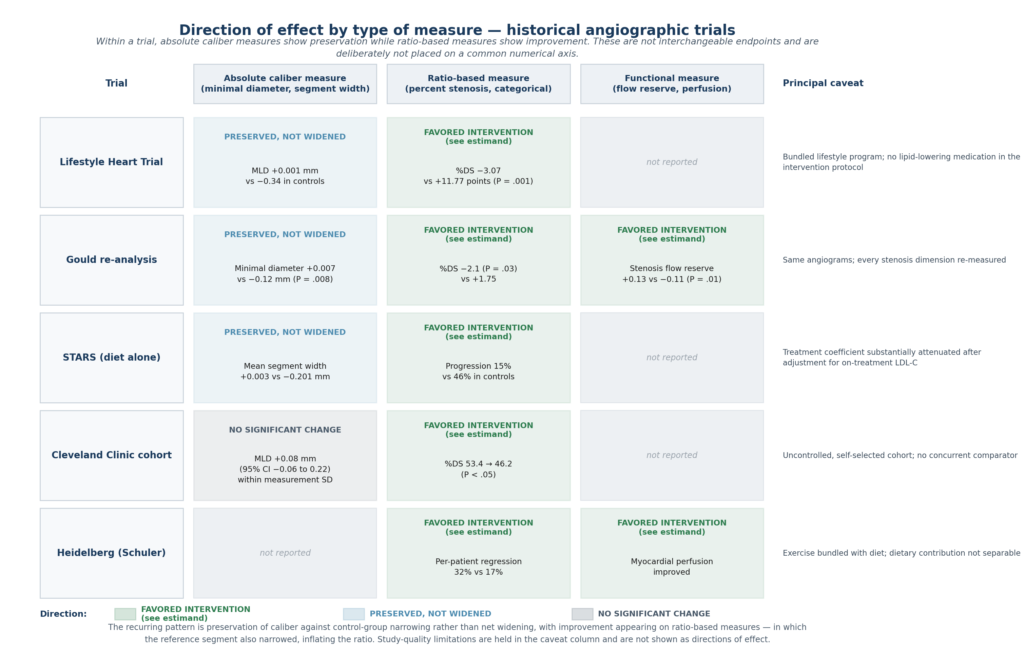
Figure 6. Direction of effect by type of measure across the historical angiographic trials. Columns group endpoints by what they measure: absolute caliber, ratio-based, and functional. The recurring pattern is visible along each row — absolute caliber measures show preservation rather than widening, while ratio-based measures in the same trials show improvement, potentially in part because reference segments also narrowed in at least some of these datasets, although focal lesion change may also contribute. Study-quality limitations are held in a separate caveat column and are deliberately not represented as directions of effect. These endpoints are not interconvertible and are not placed on a common numerical axis. Row-level classifications are author-derived from the primary trial reports tabulated immediately above (refs 8, 9, 36, 37, 53, 56, 58 and 60–62).
3.5.5 What angiography cannot see
Topol and Nissen’s critique of “coronary luminology” applies squarely to this whole literature.38 Angiography images the dye filling the channel, not the artery itself — it photographs the space inside the tunnel and tells you nothing about the condition of the tunnel wall. Four consequences follow, and they run in both directions.
It cannot see the disease. Mural plaque burden, wall thickness, and tissue composition are all invisible. An artery carrying substantial atheroma can look entirely normal on film.38
It misses outward growth in both phases. Because early and intermediate plaque accumulates inside a wall that expands outward, disease progresses unseen until the compensatory capacity runs out.25,38 Running the same logic in reverse: a diet-associated gain in caliber achieved by remodeling registers as regression even if no plaque was resorbed — precisely the pattern the macaque data suggest.5
Small diameter changes may be tone, not tissue. Angiography measures the contrast-filled channel and cannot separate a change in vessel tone from a change in the wall.38 Small shifts in minimal lumen diameter are therefore ambiguous: for the conventional reading they are noise; for the hypothesis under examination they are a candidate mechanism. It is also why lumen area, measured without vessel-wall and compositional information, is a weak stand-alone primary endpoint for plaque modification, a point taken up in §6.1.
The interventions were packages, not diets. Ornish, Heidelberg, and SCRIP all combined dietary change with exercise, stress management, smoking cessation, and variable pharmacotherapy.53,56,58 No analysis can extract the dietary component, and none of these trials was designed to.
3.6 Why the human plaque evidence cannot settle the question
One anatomical point belongs here first, because it explains much of the inconsistency in the trial record. Arteries remodel in both directions. Glagov’s autopsy work established outward enlargement, in which the vessel expands as plaque accumulates and lumen area is roughly preserved until the lesion occupies about 40% of the area within the internal elastic lamina.25 The opposite process, constrictive remodeling, contracts the vessel inward. Its consequence is the mirror of the first: a plaque can regress in volume while the lumen barely changes, or even narrows, because the wall is shrinking around it at the same time.
Lumen measurement is therefore unreliable as a readout of plaque health in both directions — it can flatter a diet that has widened the channel without clearing lipid, and it can conceal one that has cleared lipid while the vessel contracted.25 This is a further reason, beyond the endpoint heterogeneity described below, why the angiographic trials cannot be pooled.
Before turning to what is missing, it is worth stating why the comparison cannot simply be assembled from the trials that already exist. An exploratory trial-level comparison of published serial angiographic studies was attempted for this review, using a compilation of diet and drug trials coded for intervention type, achieved lipid change and angiographic outcome (Supplementary Data S1–S4). It proved uninterpretable, and the reason is instructive enough to record.
Angiographic “regression” is not one endpoint. Retrieved from the source publications, the definitions range from no threshold at all — Ornish counted any average lesion change in the regressing direction — through ≥10 absolute percentage points in the yoga trials, ≥12% of percent diameter stenosis in MARS, to ≥0.4 mm of minimal-lumen gain with no progression at any other site in CCAIT and LCAS.36,53,63 These are different measurements sharing a name, and the permissiveness of the definition correlates with intervention type: the lifestyle trials used the loosest criteria and the drug trials the strictest. Any cross-trial contrast is therefore confounded in precisely the direction that would manufacture a dietary advantage.
A sensitivity check is that the same approach fails to recover a relationship known to exist. Among the pharmacologic trials, achieved LDL reduction and reported regression rate show no cross-trial relationship, even though the within-trial LDL–plaque dose–response is among the most reproducible findings in cardiology.17–20 Trial-level regression rates are evidently set as much by each study’s threshold as by its treatment effect. An approach that cannot detect a known signal is not valid for detecting a hypothesized one. The compilation, coding decisions, verification against source publications, and exploratory analyses are provided as supplementary material; they are reported here as a methodological argument rather than as original quantitative findings.
This closes the aggregate cross-trial shortcut. The additional effect of diet cannot be estimated reliably from the published summary-level trial record; a definitive test requires a randomized design such as that set out in §6.1.
One trial from that compilation is worth recording on its own account, because it is rarely cited in Western reviews. Manchanda and colleagues randomized 42 men with angiographically proven coronary disease to a yoga, diet and exercise program or to risk-factor control with an American Heart Association step I diet; at one year more lesions regressed (20% vs 2%) and fewer progressed (5% vs 37%, P < .001), with revascularization required in one versus eight patients (P = .01).63 The intervention is bundled to an extreme degree and the trial is small, so it cannot isolate diet — but it belongs in a complete accounting of randomized angiographic lifestyle trials.
Table 6. Contemporary dietary-pattern trials, grouped by endpoint class. The three blocks are not interchangeable: an event result, an imaging result and a lipid result answer different questions and are not directly comparable.
| Trial | Comparison | Population / follow-up | Primary result | Key limitation |
| CLINICAL EVENTS | ||||
| PREDIMED, 20182 | Mediterranean + EVOO or nuts vs a reduced-fat intervention | High-risk primary prevention; ~4.8 y | Fewer major cardiovascular events in both Mediterranean arms | Allocation irregularities; counseling intensity initially differed |
| CORDIOPREV, 20223 | Mediterranean vs active low-fat | Established CHD; 7 y | 87 vs 111 primary events; adjusted HR 0.719–0.753 | Both arms received diet; predominantly male |
| VASCULAR IMAGING | ||||
| DISCO-CT, 202110 | Intensive diet/lifestyle + OMT vs OMT alone | Non-obstructive CAD; ~67 weeks | PAV +1.0 vs +1.1 percentage points (P = .851) — null on total burden | Broad non-calcified band fell more with diet (nominal P = .045); maximum lumen diameter fell |
| CORDIOPREV carotid48 | Mediterranean vs low-fat | 939 CHD participants; 5 and 7 y | Reported favorable within-arm IMT changes and lower plaque height | Within-arm change; interpretation should follow the published correction, so numerical estimates are not used in this review |
| PREDIMED-Navarra46 | Mediterranean vs control | 187 participants; 1 y | Overall IMT comparison null | Regression confined to a baseline-IMT subgroup |
| DIRECT-Carotid, 201049 | Low-fat vs Mediterranean vs low-carbohydrate | Overweight/obese adults; 2 y | Wall volume −58.1 mm³ (≈5%) overall; no difference between diets | Blood-pressure reduction correlated with regression |
| LIPIDS AND RISK FACTORS | ||||
| WFPB controlled feeding in HeFH, 202664 | WFPB vs standard American diet, crossover | 50 adults with genetically confirmed HeFH, after protocol-directed withdrawal of lipid-lowering medication; 4 weeks each | LDL-C −17.9% (95% CI −21.7 to −14.3); ApoB >14% (exact relative estimate not reported) | Four weeks; no effect on CRP; individual responses varied widely |
| Vegetarian/vegan meta-analysis, 202311 | Vegetarian or vegan vs omnivorous | 30 RCTs, ~2,400 participants | LDL-C −0.30 mmol/L (≈ −11.6 mg/dL); ApoB −12.92 mg/dL | ApoB from only six trials, high heterogeneity |
| Portfolio diet, 200365 | Food portfolio vs lovastatin vs control | Hyperlipidemic adults; 1 month | Approached statin-level LDL-C and CRP reduction | One month; not factorial |
CAD, coronary artery disease; CHD, coronary heart disease; CRP, C-reactive protein; EVOO, extra-virgin olive oil; HeFH, heterozygous familial hypercholesterolemia; IMT, intima-media thickness; OMT, optimal medical therapy; PAV, percent atheroma volume.
3.7 What “plant-based” means, and how much it actually lowers ApoB
Two corrections belong here, and both change how the rest of this literature should be read.
The label covers more than one diet. A single term is routinely applied to interventions that differ from each other more than some of them differ from a Mediterranean diet. The 2026 controlled feeding trial in familial hypercholesterolemia described its intervention as whole-food plant-based; it was plant-predominant rather than vegan or oil-free, drawing 35% of energy from fat, cooking with canola oil, including red meat once a week, and having two fully meatless days.64 That description is defensible — the term is not universally defined as vegan or oil-free — but it is not interchangeable with stricter usage. An oil-free Esselstyn-style protocol and that diet are not the same intervention, and results from one cannot be transferred to the other. Table 7 separates six patterns; where a study’s actual intervention diverges from the label it used, this review describes the intervention.
The lipid effect is smaller than commonly stated. Pooling 30 randomized vegetarian and vegan trials gives LDL-C lower by 0.30 mmol/L — about 11.6 mg/dL, or roughly 10% — and ApoB lower by 12.92 mg/dL (95% CI −22.63 to −3.20), the ApoB figure resting on just six trials with substantial heterogeneity.11 The fully controlled feeding design provides a strong efficacy estimate for that particular plant-predominant prescription in adults with heterozygous familial hypercholesterolemia studied after protocol-directed withdrawal of lipid-lowering medication. It does not estimate the incremental effect among older, higher-risk patients continuing contemporary combination lipid-lowering therapy, nor does it define the maximal effect attainable with stricter patterns. The intervention reduced LDL-C by 1.28 mmol/L (95% CI −1.55 to −1.02; P < .0001), a relative reduction of 17.9% (95% CI −21.7% to −14.3%), with total cholesterol, non-HDL-C and ApoB each falling by more than 14%; the investigators describe the ApoB reduction as 15% in their discussion, but the publication does not report an exact relative ApoB effect with a confidence interval in the same format used for LDL-C.64 Triglycerides fell by nearly 10%, and Lp(a) was unaffected. Two results belong alongside these: HDL-C and ApoA1 also fell, by 8.5% and 7.4%, and the estimated 10-year cardiovascular risk was 11.9% lower (95% CI −19.4% to −3.6%; P = .007).64
A head-to-head randomized comparison sharpens both points. Barnard and colleagues randomized 62 overweight adults to a low-fat vegan diet or a Mediterranean diet following the PREDIMED protocol for 16 weeks each in crossover.54 Among participants with no medication changes, total and LDL cholesterol fell 18.7 and 15.3 mg/dL on the vegan diet, with no significant change on the Mediterranean diet (treatment effect for LDL-C −14.8 mg/dL, 95% CI −23.5 to −6.2; P = .001). Body weight, fat mass, visceral fat and insulin sensitivity also improved more on the vegan diet. Blood pressure moved the other way: systolic pressure fell 9.3 mmHg on the Mediterranean diet against 3.4 mmHg on the vegan diet (treatment effect +5.9 mmHg; P = .02).54
In this 16-week crossover trial the low-fat vegan phase produced the larger LDL-C reduction, while the Mediterranean phase produced the larger systolic blood-pressure reduction.54 ApoB was not measured and cardiovascular events were not assessed. These differences may reflect the distinct food and nutrient compositions of the two interventions, but the trial was not designed to isolate the responsible components.
It also produces a tension worth stating directly, because it bears on this review’s central question. The hierarchy of hard-outcome evidence does not mirror the LDL-C effects observed in this short crossover trial. Mediterranean diets carry PREDIMED, CORDIOPREV and Lyon — randomized trials with major event reduction — while no eligible adequately powered completed cardiovascular-outcome trial of a well-characterized plant-predominant pattern was identified through 31 July 2026 under the stated search criteria. This discordance cannot be read as a biological ranking, because the two patterns have never been compared in an adequately powered cardiovascular-outcome trial — the absence of such evidence reflects the lack of an eligible completed trial, not evidence of inferior outcomes. The mismatch may reflect the distribution of research investment, trial design, adherence, comparator selection, or genuine biological differences among dietary patterns; existing data cannot rank these explanations. Two readings are often offered: either the outcome literature reflects research investment rather than biology, in which case a properly powered plant-predominant outcome trial is the missing study; or pathways not represented by the reported fasting LDL-C difference — blood pressure among them, given the 5.9 mmHg separation above and the randomized evidence in §4.6 — contribute materially to the event reduction Mediterranean trials achieved. The Barnard trial supplies a plausible example of differential pathway effects — greater LDL-C lowering with one intervention, greater systolic blood-pressure lowering with the other — but it does not identify the mechanism responsible for the Mediterranean outcome-trial benefits.
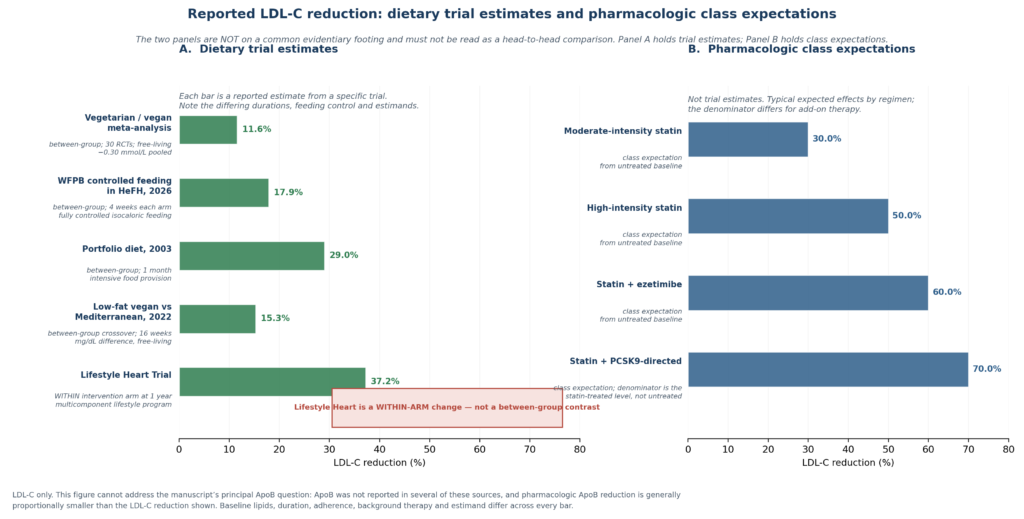
Figure 7. Reported LDL-C reduction, split by evidence type. Panel A holds estimates from specific dietary trials, each labelled with its estimand, duration and degree of feeding control; the Lifestyle Heart bar is a within-arm change from a multicomponent lifestyle program and is flagged as such. Panel B holds pharmacologic class expectations, not trial estimates, with the denominator noted for add-on therapy. The two panels are not on a common evidentiary footing and must not be read as a head-to-head comparison. The figure shows LDL-C only and cannot address this review’s principal ApoB question; pharmacologic ApoB reduction is generally proportionally smaller than the LDL-C reduction shown.
The claim that plant-predominant diets lower LDL-C by 20–35% and typically land patients at 70–90 mg/dL should not be presented as the typical effect of vegetarian or vegan interventions, although intensive supervised programs and high-baseline subgroups can reach it. Percentages travel; absolute destinations do not. A 15% reduction from 150 mg/dL arrives at about 128, while the same 15% from 250 arrives at 213 — the response is proportional, so where someone starts largely determines where they finish. Individual variation compounds this: in the controlled-feeding trial, five participants dropped their LDL-C by 30% or more, while five saw it rise on the plant-based diet, and only two of those five also had higher ApoB.64 Separately, two participants began medications with potential lipid effects during the trial — isotretinoin in one and methylphenidate in the other — and both were excluded from the per-protocol dataset (primary analysis n = 50; per-protocol n = 48).64
3.7.1 Lifetime exposure versus adult intervention
These modest intervention effects sit awkwardly beside population data, and the strongest population evidence is not ecological. Migrant cohorts hold genetic background approximately constant while diet and environment change, which reduces genetic confounding, though it does not remove migrant selection, early-life exposure or the many concurrent environmental changes that accompany migration. The Ni-Hon-San study examined 11,900 men of Japanese ancestry aged 45–69 living in Japan, Hawaii and California using comparable methods. Age-adjusted prevalence of definite coronary heart disease determined by ECG was 5.3, 5.2 and 10.8 per 1,000 respectively; for definite plus possible disease, 25.4, 34.7 and 44.6.66 The gradient tracked a parallel Japan-to-California rise in serum cholesterol and in dietary saturated fat. Broadly shared ancestry, substantially different environments and diets, and an approximately two- to three-fold disease gradient.
Ecological data point the same way with weaker inference. In the China–Cornell–Oxford survey of 65 counties, mean serum total cholesterol was 127 mg/dL against 203 mg/dL in US adults, with coronary mortality substantially higher in the United States.67,68 County-level correlation cannot show that the individuals with low cholesterol were the ones who avoided coronary death, and death certification in rural China in 1983–84 differs from contemporaneous US practice. Within-population data are stronger: modeling of Beijing between 1984 and 1999 found age-adjusted coronary mortality rose roughly 50% in men and 27% in women as the diet Westernized, much of it attributed to rising total cholesterol.69
What all of this illuminates is the exposure construct, and it is the reason population and trial data appear to disagree. A population mean of 127 mg/dL reflects decades of low exposure beginning in childhood; the 10–18% reductions described above reflect weeks or months of intervention in middle-aged adults who already have plaque. These are not the same quantity, and the account that follows is a conceptual synthesis rather than a measured decomposition. Conflating them explains much of the discrepancy between what population data suggest diet can achieve and what dietary trials deliver, and it converges with the vervet finding that prevention is more tractable than reversal70 and with the cumulative-exposure logic underpinning the causal case for ApoB itself.14
Table 7. Six distinct patterns commonly conflated under plant-based labels.
| Pattern | Defining features | Representative evidence |
| Healthful plant-predominant | Whole plant foods emphasized; animal foods reduced but not excluded; fat often 30–35% of energy; oils permitted | The 2026 HeFH controlled-feeding trial (LDL-C −17.9%, ApoB >14%)64 |
| Mediterranean | High intake of extra-virgin olive oil, nuts, seeds, whole grains, legumes, vegetables and fruit; moderate fish and poultry; typically 35–45% of energy from fat | PREDIMED and CORDIOPREV hard-endpoint trials with carotid imaging substudies2,3,48 |
| Lacto-ovo vegetarian | Meat and fish excluded; dairy and eggs retained, so saturated-fat and dietary-cholesterol intake depend on food selection | Included within the 30-trial pooled analysis11,71 |
| Vegan | All animal-derived foods excluded; oil use and total-fat content vary substantially by intervention | Included within pooled analyses and cross-over trials11,54 |
| Very-low-fat vegetarian (Ornish) | Vegetarian; ~10% of energy from fat. Permitted limited nonfat dairy and egg whites — not fully animal-product-free | Lifestyle Heart Trial8,53 |
| Oil-free plant-based (Esselstyn) | Excludes animal foods and added oils in its strict form; <10% of energy from fat | Cleveland Clinic cohort, combined with lipid-lowering drugs9,61 |
3.8 Tier 3 — animal and experimental evidence for the geometry hypothesis
Armstrong, Warner, and Connor showed in 1970 that coronary atheromatosis induced in rhesus monkeys regressed once the atherogenic diet was withdrawn.26 This was the first demonstration that established coronary disease is a dynamic state rather than a one-way slide, and later work traced what changes during regression: arterial lipid drains away, necrotic cores shrink, and the residual collagen and elastin condense into a firmer, quieter lesion — even where the wall stays thickened.72–74
These early models cannot separate one dietary mechanism from another, and it is worth being clear why. The regression diets were cholesterol-free, and serum cholesterol collapsed from hypercholesterolemic peaks to basal levels.26,72 When the exposure being tested falls that far, everything downstream of it falls too, and no comparison inside the experiment can tell you which part of the improvement belonged to which mechanism. What these studies do offer is a look at what the vessel wall does after the lipid is gone — and there the picture becomes genuinely surprising.
3.8.1 Two compartments, and why only one of them clears
A lesion is not one substance, and the primate work makes the distinction concrete in a way human imaging cannot. The lipid-rich compartment — foam cells, extracellular lipid, necrotic core — is metabolically active and comparatively rapidly clearable. The fibrous and calcified compartments are structural, slow to remodel, and in the case of dense calcification largely fixed.72–75
When severe diet-induced hypercholesterolemia was reversed in primates, the two compartments behaved differently. Cholesteryl esters and foam-cell lipid depleted, necrotic-core debris resolved, and lesions became flatter and lipid-poor, while fibrous and calcified components persisted.72,74
The most detailed physicochemical account complicates this picture in a way that is worth stating rather than smoothing over. Small and colleagues tracked cynomolgus lesions through 30 months of induction and 12 months of regression.75 Through the first six months of regression, foam-cell number and cholesteryl ester content fell as expected — but necrosis remained, the relative proportion of free cholesterol rose, and large numbers of cholesterol monohydrate crystals formed. The authors’ own reading is cautionary: rapid, large reductions in serum cholesterol may precipitate cholesterol crystals and produce an apparent worsening of lesion appearance in the short term. Only with more prolonged regression did lipid composition return toward normal, crystals partially resolve, and the intima ultimately appeared improved but remained scarred.75
Two implications follow. Regression has a time course, and an early interval may look worse on histology than the starting point even while the process is going in the right direction — a caution for any short-duration imaging trial.75 And the endpoint is not restoration: the intima remains scarred, which is the fibrocalcific compartment persisting exactly as the two-compartment model predicts.
Two features of these experiments answer objections this review would otherwise have to leave open. First, the animals were driven to serum cholesterol of roughly 400–700 mg/dL for months and developed genuinely advanced lesions sharing important histologic features with human atherosclerosis — necrotic cores, fibrous caps and calcification — not fatty streaks. The finding is therefore not the weak one that early lesions regress, but the stronger one that the lipid compartment of advanced lesions is mobilizable once particle burden normalizes. Second, regression occurred not only at extreme reductions but after cholesterol was lowered into a range numerically attainable in humans — near 200 mg/dL, though equivalent total cholesterol does not establish equivalent ApoB particle exposure across species — which meets the objection that primate regression required non-physiologic lipid lowering.26,72
This also reframes what counts as success. Clearing the lipid compartment and thickening the cap is consistent with a shift toward a more stable lesion phenotype without necessarily reducing total plaque volume, because the fibrocalcific scaffold remains. A trial measuring only volume would record that as failure. It is the same measurement problem as the lumen, one layer deeper.
3.8.2 An artery that grew rather than a plaque that shrank
The single most relevant experiment to this review comes from Williams, Anthony, Honoré, Clarkson, and colleagues, who studied 88 surgically postmenopausal cynomolgus macaques.5 All animals spent 24 months on an atherogenic diet. Some then went directly to necropsy, establishing the baseline; the rest spent 30 months on plasma lipid lowering, with or without hormone treatment.
The design merits full specification, because it determines what the result can support. After 24 months on the atherogenic diet the 88 animals were allocated to four groups: group 1 (n = 20) went straight to baseline necropsy; group 2 (n = 25) received the lipid-lowering diet alone; group 3 (n = 22) received lipid lowering plus conjugated equine estrogens; and group 4 (n = 21) received lipid lowering plus conjugated equine estrogens and medroxyprogesterone acetate. Treatment lasted 30 months.5 The lipid-lowering diet cut fat from 44.2% to 31.0% of calories, saturated fat from 19.5% to 7.6%, and cholesterol from 0.44 to 0.05 mg/cal; total plasma cholesterol fell from roughly 16–17 mmol/L to about 4 mmol/L.5
No statistically significant difference in mean plaque area was detected between the baseline-necropsy group and the groups examined after lipid lowering (mean coronary plaque area 0.317 ± 0.042 mm² in group 1 versus 0.252 ± 0.039, 0.318 ± 0.040 and 0.314 ± 0.041 mm² in groups 2–4; P = .55).5 Against the absence of a statistically significant between-group plaque-area difference, substantially larger vessel and lumen cross-sectional areas were observed after the lipid-lowering period than in the separate baseline-necropsy group — approximately double, in cross-sectional comparison (P < .05), and acetylcholine-mediated dilation improved by 22 ± 4% (P = .01) while nitroglycerin responses did not change (P = .23) — locating the change in endothelial function rather than in smooth-muscle capacity.5
Critically for the interpretation, hormone treatment did not augment either effect. The enlargement was observed across the lipid-lowering groups and was not augmented by hormone treatment, supporting the investigators’ interpretation that it accompanied the lipid-lowering intervention, and hormone replacement did not further affect vascular reactivity to the agonists tested (P > .4).5 The one hormone-specific finding ran the other way: adding medroxyprogesterone acetate diminished the beneficial effect of conjugated estrogens on coronary flow reserve (P = .03). An earlier experiment from the same laboratory had shown that estrogen alone can modulate acetylcholine responses in atherosclerotic coronary arteries,76 so the concern was reasonable — but in this study the geometric and vasomotor differences were observed during the lipid-lowering phase and were not augmented by hormone treatment.
The intuitive picture of regression is a plaque melting away and the channel reopening behind it. What happened here was closer to the reverse: plaque area did not differ significantly between groups, while the artery was substantially larger. If a lane of road is obstructed by parked cars, this is not towing the cars away — it is widening the roadway until traffic moves again. A clinician measuring only the channel would have recorded clear improvement; a pathologist measuring only the lesion would have recorded none. Both would have been reporting accurately.
Because this one experiment carries more of the argument than any other in this review, four constraints on reading it deserve stating plainly.
The remodeling happened during lipid lowering, not instead of it. The investigators’ own framing is that lipid lowering permitted the artery to remodel. No parallel group received matched lipoprotein exposure on a different diet, so the enlargement cannot be assigned to reduced particle exposure, to food composition, or to some other metabolic consequence — only to the intervention as a whole.5
“Not significantly smaller” is not the same as “the same.” The comparison was never designed as an equivalence test and carried no equivalence margin. Failing to detect a difference and demonstrating its absence are different findings, and only the first was established. Some plaque may well have been resorbed beneath the threshold of detection.
The comparison was between groups, not within arteries, and no untreated group was carried forward. One set of animals was examined at baseline and a different set 30 months later. Critically, no contemporaneous group was maintained across that interval without lipid lowering, so treatment, elapsed time, and aging cannot be separated. The experiment demonstrates a dissociation among plaque area, vessel area, lumen area, and vasomotor function across a lipid-lowering period; it does not quantify how much of the enlargement the treatment caused. This remains a powerful design in a species whose coronary pathology closely resembles ours, but no individual coronary lesion was measured serially through the regression interval.
“Size” means cross-sectional area, not diameter. Doubling the area of an approximately circular vessel corresponds to about a 41% increase in diameter, not 100% — area scales with the square of the radius. Reporting this result as a doubling of lumen diameter, as secondary accounts sometimes do, overstates it by more than a factor of two.
Stated properly: after 30 months of plasma lipid lowering, coronary artery and lumen cross-sectional area were approximately twice those of the baseline group, while plaque area was not significantly different. That is consistent with substantially larger vessel and lumen areas after the lipid-lowering period, without a statistically significant difference in plaque area. It shows that arterial geometry and plaque size can change discordantly — which is the finding worth taking forward — and it settles nothing about whether the enlargement was driven by reduced ApoB exposure, by food composition, or by both.
3.8.3 Function normalizing while structure only partly regresses — in a non-coronary bed
Harrison, Armstrong, Freiman and Heistad found that dietary treatment of primate atherosclerosis restored endothelium-dependent relaxation to essentially normal while the intima remained substantially thickened.6 The figures matter, because “structure persists” would overstate the case. Three groups of cynomolgus monkeys were studied: normal chow (n = 11), 18 months of a 0.7%-cholesterol 40%-fat diet (n = 10), and that atherogenic diet followed by 18–20 months back on standard chow (n = 9). Plasma cholesterol went 96 ± 6, 564 ± 26, and — in the regression group — from 599 ± 39 down to 119 ± 7 mg/dL.6
Structure improved substantially; it simply did not normalize. Intimal area was under 0.1 mm² in normal vessels, 1.8 ± 0.3 mm² after the atherogenic diet, and 0.7 ± 0.2 mm² after dietary regression — a reduction of roughly 60%, but still many times normal, with foam cells and inflammatory cells absent and collagen prominent.6 Against that partially regressed lesion, peak acetylcholine relaxation went from 72 ± 8% in normal vessels to 35 ± 10% in atherosclerotic ones and back to 77 ± 9% after regression, while nitroglycerin responses were identical across all three groups (99, 99, 97%) — locating the defect and its repair in the endothelium rather than the smooth muscle.6 The investigators used the term “functional regression” — their own descriptive label rather than a validated endpoint: functional improvement of the vessel wall occurring despite only a modest decrease in intimal thickness or gross lesion appearance.
So the accurate statement is not that structure was unchanged, but that function returned to normal while structure did not. The vascular bed matters here and is routinely lost in secondary citation: this was an organ-chamber study of iliac artery rings, following the same group’s earlier demonstration that atherosclerosis impairs acetylcholine- and thrombin-mediated relaxation in cynomolgus iliac arteries.7 It is not a coronary experiment.
The defensible reading is therefore narrower than it is usually rendered: conduit-artery endothelial function can normalize while intimal thickening, though substantially reduced, remains well above normal in a primate regression model.6,7 Extension to the coronary circulation is plausible but indirect, and this review treats the finding as supportive vascular biology rather than coronary confirmation. A stronger reading — that function reliably recovers first, in a fixed two-stage sequence — would require serial measurement at several points during regression, which these experiments did not perform. And there is a competing explanation that keeps everything inside the conventional model: lifting the lipid burden from the endothelium may simply restore function faster than it dissolves a lesion. That would make the observation a matter of differing timescales within an ApoB-mediated effect rather than evidence of a separate pathway.
3.8.4 Nutrient-specific experiments, and the confound inside them
Anthony, Clarkson, Bullock, and Wagner fed young male cynomolgus macaques a moderately atherogenic diet whose protein came from one of three sources: casein and lactalbumin, intact soy protein isolate with its native isoflavones (Soy+), or soy protein from which the isoflavones had been extracted with alcohol (Soy−).77 The animals on intact soy developed roughly 90% less coronary atherosclerosis than the casein group and about 50% less than the isoflavone-stripped group.77 The coronary histology comparison rested on a necropsy subset of 11 animals per group, not the full feeding cohort.
The Soy+ versus Soy− comparison looks, at first glance, like a clean isolation of the isoflavones: same protein backbone, one ingredient removed, half the protection lost. That reading does not survive a look at the lipid data. The intact-soy animals also had significantly lower total and LDL+VLDL cholesterol and higher HDL cholesterol than the other groups.77 Two things changed between arms, not one. A shared amino-acid profile does not guarantee equal particle exposure, and when both the candidate mechanism and the conventional one move together, neither can be credited. A companion crossover experiment sharpens the point rather than resolving it. Twenty-seven peripubertal rhesus monkeys received the same two soy diets — isoflavones intact or alcohol-extracted — for six months each, an identical protein backbone with one class of compounds removed.78 LDL+VLDL cholesterol was 30–40% lower on the isoflavone-intact diet (P = .006 males, P = .003 females), yet apolipoprotein B differences did not reach significance (P = .09 males, P = .07 females), while LDL molecular weight — a proxy for particle size — fell significantly in females (P = .03).78 Cholesterol carried per particle therefore appears to have changed more than particle number did, which is a compositional effect of the kind examined in §4.4 rather than a straightforward reduction in ApoB exposure. Two cautions belong with it: the study was not powered for apoB, and its crossover design meant the investigators explicitly could not assess coronary atherosclerosis extent.78
The most defensible reading is that the intact-soy intervention was associated with less coronary atherosclerosis than stripped soy, although concurrent lipoprotein differences prevent attribution to isoflavones or a direct vessel-wall effect, with the split between lipoprotein-mediated and direct vascular effects unresolved. A related study is frequently cited for preserved vasoreactivity with soy, and that citation does not hold on inspection: in atherosclerotic ovariectomized monkeys soy protein alone had no effect on coronary artery reactivity, and improved acetylcholine responses appeared only through an interaction with estradiol.79
The fat-quality experiments have the same shape. The most informative contrast is polyunsaturated versus monounsaturated fat, where LDL-C was closest between arms; a blanket statement that all fat groups had comparable LDL-C would not be accurate. In African green monkeys, coronary intimal area was markedly lower on polyunsaturated than saturated fat, and monounsaturated enrichment did not protect equivalently — a difference attributed to cholesteryl oleate enrichment of lipoprotein cores and to hepatic cholesteryl ester secretion rather than to particle count.27,28 The suggestion is that identical-looking cholesterol numbers can conceal particles of different character. But comparable LDL-C is not comparable ApoB: it says nothing about particle number, remnant exposure, cumulative exposure, residence time, or retention. If fatty acids change how damaging a given particle is, that belongs in the ApoB-interacting category — a substantive and testable claim, and a different one from independence.
A useful counterweight closes this section. Vervet monkeys moved from a Western-type diet to a prudent one showed minimal regression of advanced lesions.70 In this model, dietary change was more effective at preventing lesions than at reversing established ones.
Table 8. Nonhuman primate evidence, separating what was observed from what can be inferred.
| Study | Model and design | Intervention | Principal observation | What it does NOT establish |
| Armstrong, Warner & Connor 1970; Armstrong & Megan, 1972 26,72 | Male Macaca mulatta; serial histopathology | Atherogenic diet, then cholesterol-free plant-based regression diet | Regression of coronary atheromatosis; intimal lipid depletion; condensation of residual fibrous matrix | Any separation of mechanisms — serum cholesterol fell steeply, so particle exposure was not held constant |
| Harrison, Armstrong, Freiman & Heistad, 1987 6,7 | Primate regression model; iliac artery rings in organ chambers — not coronary | Regression diet | Peak acetylcholine relaxation 35 ± 10% → 77 ± 9% (normal 72 ± 8%); intimal area fell ~60% (1.8 ± 0.3 → 0.7 ± 0.2 mm²) but remained many times normal | Coronary confirmation — the bed is non-coronary; also no serial measurement across regression intervals |
| Williams, Anthony, Honoré, Clarkson et al., 1995 5 | 88 surgically postmenopausal M. fascicularis; baseline-necropsy group vs treated group | 24-month atherogenic diet, then 30 months plasma lipid lowering ± hormones | Artery and lumen cross-sectional areas approximately twice those of the separate baseline-necropsy comparison group; plaque area not significantly different (omnibus P = .55); acetylcholine dilation +22 ± 4% | ApoB independence — enlargement occurred during lipid lowering; also not plaque equivalence, not within-artery measurement, and not doubled diameter |
| Anthony, Clarkson, Bullock & Wagner, 1997 77 | Young male M. fascicularis | 14 months casein/lactalbumin vs intact soy (Soy+) vs isoflavone-extracted soy (Soy−) | Soy+ produced ~90% less coronary atherosclerosis than casein and ~50% less than Soy− | A direct vessel-wall effect — Soy+ also had lower total and LDL+VLDL cholesterol and higher HDL, so two variables moved together |
| Williams, Anthony & Herrington, 2001 79 | Atherosclerotic ovariectomized M. fascicularis | Soy protein ± estradiol | Soy alone had no effect on coronary artery reactivity; benefit appeared only in interaction with estradiol | Any independent effect of soy phytoestrogens on coronary vasoreactivity |
| Wolfe et al. 1994; Rudel, Parks & Sawyer, 1995 27,28 | African green monkeys | Polyunsaturated vs monounsaturated vs saturated atherogenic fat | Coronary intimal area markedly lower on polyunsaturated fat at broadly comparable LDL-C — which is not equivalent to matched ApoB particle number or exposure | ApoB independence — equal LDL-C is not equal particle number, remnant exposure, or residence time; best read as an interacting effect |
| Fincham et al., 1987 70 | Female vervet monkeys | “Western” diet followed by “prudent” human-realistic diet | Minimal regression of advanced lesions | That regression findings generalize to advanced established disease |
VLDL, very-low-density lipoprotein; VSMC, vascular smooth muscle cell. Values as reported in the primary publications.
| What section 3 established — and what it did not
✔ Mediterranean dietary patterns reduced major cardiovascular events in randomized secondary- and primary-prevention trials. ✔ Intensive pharmacologic ApoB lowering improves both plaque burden and plaque composition; the two are not divided between drugs and diet. ✔ Historical dietary angiographic trials show relative preservation of lumen caliber against control-group narrowing, not convincing average widening. ✔ In the one modern randomized dietary coronary-imaging trial identified here, total plaque burden was unchanged and the maximum-lumen-diameter endpoint moved unfavorably. ✘ No trial has matched ApoB exposure across dietary and pharmacologic strategies, so no comparison of benefit per unit ApoB is available. ✘ The trial-level discrepancy between event reduction and reported fasting lipid differences has not been partitioned, and is not an estimate of ApoB-independent benefit. |
4. Mechanisms, classified by relationship to ApoB exposure
This section asks how dietary patterns could produce the effects section 3 described. Nine candidate pathways are examined and each is placed in one of three tiers by its relationship to ApoB exposure. The purpose is to separate mechanisms that operate through particle burden from those that modify the arterial response to it — and to be explicit that most fall in the middle.
Applying the §1.2 taxonomy to the candidate mechanisms clarifies which are plausibly independent of particle exposure and which merely operate outside the reach of a fasting lipid panel. Most fall into the middle tier. Figure 8 sets out the four principal candidate routes with the certainty attaching to each.
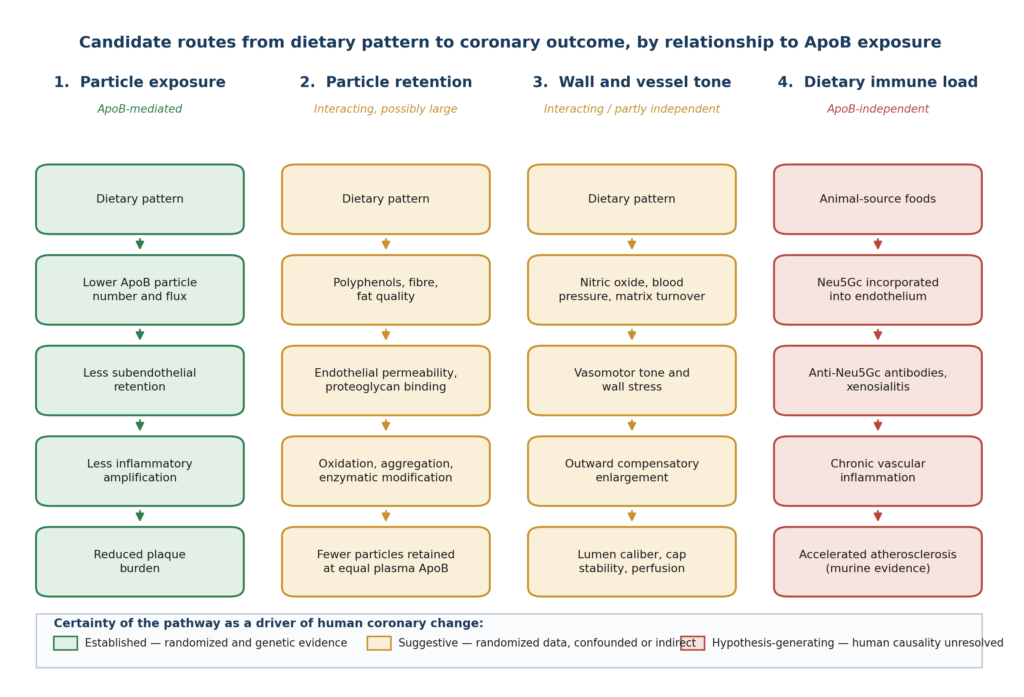
Figure 8. Four candidate routes from dietary pattern to coronary outcome: (1) reduced fasting and postprandial ApoB exposure; (2) altered particle retention and per-particle arterial effects; (3) hemodynamic, endothelial and inflammatory pathways; and (4) food-specific experimental pathways such as Neu5Gc, demonstrated only in animal models. Routes are classified by relationship to ApoB exposure and shaded by certainty. Only the first pathway is established as a driver of human coronary change. Pathway 2 is conceptually important because disease is driven by retained rather than circulating particles, so plasma ApoB is a proxy that diet may shift; pathway 4 is the most direct controlled dietary manipulation of a candidate non-plasma-ApoB pathway, but has been demonstrated only in an animal model.
4.1 Postprandial triglyceride-rich particle exposure is ApoB-mediated, while postprandial vascular responses are broader
This point comes first because it is the one most often misfiled. A single high-fat meal induces transient endothelial dysfunction, with elevated free fatty acids, increased endothelial reactive oxygen species, and measurably reduced flow-mediated dilation.80 Since a fasting lipid panel captures none of this, the effect gets filed under “beyond ApoB.” That is a classification error, though it requires a distinction the shorthand usually omits. Large intact chylomicrons generally do not penetrate an intact arterial endothelium efficiently. They reach several hundred nanometres in diameter, whereas ApoB-containing lipoproteins in the experimentally studied range up to roughly 70 nm cross an intact endothelium more readily, with smaller particles passing more easily than larger ones — a size gradient rather than a fixed cutoff; after lipolysis, smaller apoB-48-containing remnants fall within the size range capable of arterial entry.81 What enters is the chylomicron remnant, produced once lipoprotein lipase strips triglyceride and shrinks the particle — remnants isolated from human plasma have averaged about 31 nm hydrated diameter, well within the permeable range, and each carries a single copy of apoB-48.82 One structural detail deserves noting because it is easy to assume away: apoB-48 is the amino-terminal 48% of apoB-100 and ends near residue 2152, so it does not contain site B — the principal proteoglycan-binding region of apoB-100 at residues 3359–3369. Remnants therefore bind arterial proteoglycans through a different apoB-48 site and through apoE, not through the mechanism that retains LDL.83,84
The size threshold is not purely theoretical; a clinical observation bears on it. Familial lipoprotein-lipase deficiency is often cited as a natural experiment: despite extreme chylomicronemia, premature atherosclerosis is not a dominant feature, consistent with intact chylomicrons being too large to cross the arterial endothelium efficiently. That observation is taken here from a mechanistic review rather than from primary clinical series, and it supports, but does not by itself prove, the importance of particle size and remnant formation.81 Particle size is a major determinant of entry, alongside plasma concentration, residence time, endothelial permeability and arterial retention. Two corollaries matter for the argument here. Remnants that do enter may leave less readily than LDL, because their larger size and entrapment by intimal components hinder egress; and each remnant delivers more cholesterol than an LDL particle does.81 A diet that reduces remnant number, their residence time, or their arterial flux is therefore working within the ApoB framework — one that fasting measurement simply fails to observe. The acute meal experiments should not be over-read, however: they demonstrate impaired flow-mediated dilation after a particular meal, and did not measure apoB-48 exposure or test it as the mediator. Postprandial remnant exposure is a candidate ApoB-mediated pathway, not a demonstrated one.
Two qualifications keep this in proportion. Chylomicrons and their remnants are a small minority of circulating ApoB particles, and a fat load shifts that proportion far less than intuition suggests. Steady-state pool sizes in healthy men are approximately 17 mg of triglyceride-rich apoB-48 against 273 mg of VLDL apoB-100 and 3,325 mg of LDL apoB-100; correcting for the smaller mass of apoB-48, intestinal particles account for on the order of 1% of total ApoB particle number. These pool-size estimates do not measure cumulative particle flux or arterial entry, and the relative contribution may differ substantially in insulin resistance, diabetes and hypertriglyceridemia.85 Even at the postprandial peak, apoB-48 particles did not exceed 20% of ApoB particles within the triglyceride-rich fraction, which is itself a small share of the total.86 The arithmetic is governed by the denominator: the LDL pool is large and turns over slowly (fractional catabolic rate ≈0.27 pools/day), so a transient rise in a small, rapidly cycling intestinal pool barely moves the ratio.85
This carries a consequence that runs opposite to the obvious expectation. By particle number — and in many studies by triglyceride-rich lipoprotein mass — the postprandial remnant pool is dominated by hepatic apoB-100 particles rather than intestinal apoB-48 particles. Their relative contributions to arterial cholesterol delivery are less directly established. Chylomicrons compete with hepatic VLDL for the same lipoprotein-lipase capacity, so a fat load delays VLDL hydrolysis and causes VLDL apoB-100 remnants to accumulate, with the bulk of the postprandial triglyceride rise residing in VLDL-sized remnants rather than chylomicron remnants.86,87 The liver also increases VLDL production in response to feeding and to chylomicron-remnant influx, compounding the effect.87 In the studies cited here, a fat load raised remnant exposure largely by backing up the hepatic pathway, not by flooding the circulation with intestinal particles.
It would be a mistake, however, to read this as an indictment of dietary fat percentage as such, because some low-fat, high-carbohydrate feeding conditions can also increase triglyceride-rich lipoprotein exposure through impaired clearance. In a controlled crossover study, a low-fat high-carbohydrate diet raised triglycerides 60% and reduced VLDL-triglyceride clearance by 37%, with no significant change in VLDL-apoB or VLDL-triglyceride secretion rates — the elevation came from impaired clearance, not particle overproduction.88 The investigators attributed the reduced clearance to the same competition between VLDL and chylomicron remnants for lipolytic capacity, and fasting apoB-48 concentrations were elevated on the low-fat arm in hypertriglyceridemic participants.88 The mechanism that a fat load engages acutely can therefore be engaged chronically by its apparent opposite.
Two details of that study matter more than its headline. The diet was whole-food and high-fiber, and it reduced clearance rather than increasing production — whereas earlier low-fat high-carbohydrate research diets, given in liquid form or high in mono- and disaccharides, increased triglyceride production instead.88 The findings suggest that carbohydrate form and food matrix may materially modify the response, rather than carbohydrate percentage alone determining it; this is a cross-study inference, not a tested mediation. This is the postprandial expression of a theme running through §3.7: macronutrient percentages are a poor description of a dietary pattern, and food quality within a macronutrient band can matter more than the band itself. A diet is not rendered atherogenic or protective by its fat fraction alone. Postprandial exposure modifies rather than replaces the standard cholesterol explanation, and the particles doing most of the modifying still carry apoB-100. And the acute-meal literature supports transient impairment after a particular high-fat meal, not a demonstrated chain from repeated postprandial dips to chronic coronary remodeling.80 A fasting panel samples blood at the quietest metabolic hour of the day, while someone eating three substantial meals may spend a substantial portion of the day in a postprandial state that a fasting sample does not characterize. “Beyond fasting LDL-C” and “beyond ApoB” are therefore different statements — an argument for measuring postprandial and cumulative ApoB, not for abandoning the framework.
The acute-meal literature should also be labeled as mechanistic plausibility rather than established chronic mediation. Vogel and colleagues’ study supports transient impairment after a particular high-fat meal.80 It does not by itself establish that saturated fat alone caused the response, that three such meals produce continuous all-day endothelial dysfunction, that plant unsaturated fat or complex carbohydrate invariably abolishes it, or that the acute FMD response predicts chronic coronary remodeling.
4.2 Endothelial nitric oxide and vasomotor tone: partly independent
Endothelial dysfunction is an early functional manifestation of vascular disease and the mechanism most directly capable of altering measured lumen caliber without altering plaque mass.6 Plant-predominant patterns supply several constituents proposed to influence nitric-oxide availability, though the trials reviewed here did not isolate which compounds mediate the effect. Randomized feeding studies have reported improved flow-mediated dilation with selected foods and Mediterranean-style interventions.21 Walnut-enriched feeding improved endothelial function in hypercholesterolemic subjects, and Mediterranean-pattern intervention improved endothelial and inflammatory measures.21,89
Acute vasomotor tone is the strongest candidate for an acute influence on measured lumen caliber that does not require a concurrent change in plasma ApoB concentration, because it can change caliber within minutes without requiring an immediate change in plasma lipoprotein concentration. Its magnitude should not be overstated, however. Vasodilation shifts caliber modestly and transiently; it cannot by itself account for large or sustained angiographic differences of the kind seen across years of follow-up. Where durable geometric change occurs, tone is best understood as acting alongside matrix remodeling and smooth-muscle phenotype rather than as a substitute for them, and the chronic component — endothelial function recovering as lipid-driven stress lifts — is better classified as ApoB-mediated on a different timescale. The practical corollary, taken up in §6.1, is that tone contaminates lumen area as a trial endpoint.
4.3 Inflammation: a downstream pathway with randomized outcome evidence independent of LDL-C lowering
This section previously classified inflammation as predominantly ApoB-interacting on the reasoning that most atherosclerotic inflammation is initiated by retained particles. That reasoning is sound as far as it goes, but it understates the pathway, because inflammation is the clearest candidate mechanism in this review with randomized human evidence that modifying it reduces events without materially lowering measured LDL-C.
CANTOS randomized 10,061 post-infarction patients with hsCRP ≥2 mg/L, more than 93% of whom were receiving lipid-lowering therapy at baseline, to canakinumab, a monoclonal antibody against interleukin-1β, or placebo.12 The 150 mg dose reduced hsCRP by 37% and cut nonfatal myocardial infarction, nonfatal stroke or cardiovascular death by 15% (P = .021), with no reduction in LDL-C or HDL-C whatsoever.12 A secondary analysis showed the event reduction tracked the magnitude of achieved hsCRP reduction: patients whose hsCRP fell furthest gained most, and those with little CRP response gained little.90 Because achieved hsCRP is a post-randomization variable, this association supports target engagement but is not itself a randomized mediation estimate. Two subsequent colchicine trials — COLCOT after myocardial infarction and LoDoCo2 in chronic coronary disease — provided additional evidence that anti-inflammatory therapy can reduce cardiovascular events without intended lipid lowering.91,92
The significance for this review is specific. Inflammation is therefore an interventionally validated cardiovascular pathway, although whether dietary modulation of inflammatory biomarkers mediates clinical benefit remains unproven; it is a pathway in which targeted downstream modulation can reduce cardiovascular events without materially lowering LDL-C. That does not make it ApoB-independent in origin — retained particles remain a principal upstream trigger, and CANTOS treated patients whose residual inflammation persisted despite statin therapy. What it establishes is that the downstream inflammatory response is separately modifiable, and that modifying it changes outcomes.
Dietary patterns can alter circulating inflammatory biomarkers and immune-cell activation, though less consistently than is often claimed. Mediterranean intervention reduced circulating immune-cell activation, lowering monocyte CD49d and CD40 expression alongside interleukin-6, soluble adhesion molecules and C-reactive protein.22,89 The intracellular signaling pathways responsible for these changes were not established in these human studies. The dietary portfolio approach achieved reductions in both LDL-C and C-reactive protein approaching those of lovastatin.65
The counterexample matters and should not be buried. In the fully controlled HeFH feeding trial — 50 adults with genetically confirmed heterozygous familial hypercholesterolemia studied after protocol-directed withdrawal of lipid-lowering medication — only 8% were untreated beforehand; 22% had been on statin monotherapy, 46% on statin plus ezetimibe and 24% on PCSK9-directed therapy, randomized to four weeks each of a whole-food plant-based diet and a standard American diet under isocaloric fully controlled feeding with a two-to-four-week washout (NCT05181553) — the plant-based diet produced no effect on C-reactive protein relative to the standard American diet despite a 17.9% LDL-C reduction — plausibly because baseline CRP was normal and the intervention lasted four weeks, but a reminder that inflammatory benefit is neither automatic nor uniform.64 The literature suggests that some dietary interventions can reduce inflammatory biomarkers, with effects varying by baseline inflammatory burden, intervention duration, and which foods are displaced.
This gives the paper’s central question a sharper form. If targeted downstream inflammatory modulation can reduce events without lowering LDL-C, as CANTOS showed, and dietary patterns lower inflammatory markers (Mediterranean and portfolio trials), then the descriptive trial-level discrepancy identified in §3.1.4 has inflammation as a biologically credible candidate explanation: targeted downstream inflammatory inhibition reduces events, and some dietary interventions alter inflammatory biomarkers. The causal bridge between diet-induced biomarker change and event reduction has not been demonstrated. That is a considerably stronger position than the geometry argument, and it does not depend on any imaging endpoint. What remains untested is the mediation itself: no trial has shown that a diet-induced reduction in hsCRP or IL-6 produces a corresponding reduction in events.
One correction on the oxidative limb. A widely repeated claim holds that a retained ApoB particle must be oxidatively modified before it can drive foam-cell formation. Retained lipoproteins undergo several modifications — oxidation, aggregation and enzymatic remodeling — that amplify inflammatory signaling and cellular uptake, and macropinocytosis of native LDL may also contribute.15 Oxidation is an important amplifier, not an obligatory gate. Plant-derived antioxidant and polyphenolic compounds can influence oxidative signaling in experimental systems and may reduce LDL oxidation or endothelial activation. Whether these effects materially mediate human coronary outcomes is unestablished.22
4.4 Lipoprotein composition and how much damage each particle does
The African green monkey experiments linked coronary disease to cholesteryl oleate enrichment and hepatic cholesteryl ester secretion patterns, with monounsaturated enrichment not equivalently protective to polyunsaturated at broadly comparable LDL-C.27,28 If two individuals with identical ApoB carry particles of differing atherogenicity, that is a genuine and clinically relevant phenomenon — and it is squarely ApoB-interacting, not ApoB-independent. The distinction is not pedantic: an interacting effect predicts that diet and lipid-lowering therapy should be complementary, whereas an independent effect predicts that diet should retain its full benefit at any achieved ApoB.
4.5 The gut microbiome–TMAO axis: a marker whose causal status is unresolved — exploratory: no demonstrated human coronary mediation
Dietary precursors of microbial trimethylamine production include L-carnitine, choline and phosphatidylcholine, whose abundance and principal food sources differ: red meat is particularly rich in L-carnitine, eggs in phosphatidylcholine, and both animal and plant foods provide choline, while fish can additionally supply preformed TMAO. Gut microbiota expressing TMA-lyase complexes cleave these compounds to trimethylamine, which is oxidized hepatically to trimethylamine N-oxide (TMAO).23,24 In experimental systems TMAO upregulates macrophage scavenger receptors, impairs reverse cholesterol transport, and enhances platelet hyperreactivity and thrombosis.23,24,93 Plasma TMAO is associated with major adverse cardiovascular events, and vegans challenged with carnitine produce markedly less TMAO than omnivores, indicating that the microbial community itself is diet-influenced.24,94
Two claims must be separated. The pathway is not necessarily mediated by plasma ApoB concentration — there is no lipoprotein intermediate in the TMA-to-TMAO conversion itself. “Structurally independent” would nonetheless overstate it, because TMAO has reported effects on bile-acid and cholesterol metabolism, renal handling, endothelial signaling, inflammation and thrombosis, and these networks interact. But human causality remains unsettled: renal function is central rather than incidental, since TMAO is substantially renally cleared and adjustment for kidney function often attenuates associations; fish and seafood supply preformed TMAO, which complicates interpretation given that fish-rich patterns generally associate with lower risk; Mendelian randomization has been inconsistent; and an analysis of five Dutch prospective cohorts including 7,834 participants found plasma choline associated with cardiovascular disease (HR 1.17, 95% CI 1.07–1.28) but not TMAO, with Mendelian randomization likewise unsupportive.95–97 That analysis also identified fish intake as the major dietary driver of circulating TMAO.97 No eligible trial identified through 31 July 2026 under the stated search criteria has tested whether selectively lowering TMAO reduces coronary plaque or events, and that absence is not evidence of an absent effect. The appropriate position is therefore suggestive that diet alters the TMA/TMAO pathway and limited that TMAO reduction mediates clinical benefit in humans. On present evidence, circulating TMAO is best described as a risk-associated metabolite influenced by diet, microbiome composition and renal handling, whose independent causal contribution remains unresolved, and it should not carry the same weight as pathways with interventional support. §4.8 describes a dietary immune mechanism with direct controlled support in an animal model.
4.6 Matrix remodeling, blood pressure, and vascular geometry
When particle influx falls and inflammation subsides, the wall reorganizes: matrix turnover shifts toward collagen deposition and a thicker fibrous cap, although the molecular steps are inferred from regression pathology rather than measured in these experiments.26,74 One possible geometric response is preservation or enlargement of vessel area, although minimal or constrictive remodeling may also occur, which can preserve or restore flow caliber while a stabilized plaque remains in the wall.5,25 DIRECT-Carotid’s association between blood pressure reduction and vessel-wall regression points toward hemodynamic and matrix biology rather than lipid arithmetic, though association is not mediation.49
Randomized human evidence consistent with a blood-pressure pathway — drawn from a retrospective minimal-lesion subgroup with post-randomization adjustment and no ApoB measurement — comes from an unexpected source: a trial of the calcium-channel blocker nicardipine in 383 patients with coronary disease.98 The drug had no effect on established lesions. But among the 217 patients with minimal lesions (≤20% stenosis) at baseline, progression occurred in 12% of treated patients versus 24% of controls (P = .035) and in 7.3% versus 14.2% of lesions (P = .039) under the more conservative minimum-diameter criterion (decrease ≥0.4 mm; Table 8 of the primary report); under the alternative ≥10% percent-stenosis criterion the figures were 15% versus 27% of patients (P = .046) and 9.0% versus 16.3% of lesions (P = .038). Total cholesterol did not change significantly in either group. On stepwise logistic regression, baseline systolic pressure (P = .04) and its change over the first six months (P = .002) predicted progression — and once these were entered, the nicardipine effect itself lost significance (P = .188), leading the investigators to conclude that blood pressure reduction may account for the benefit.98 Because systolic-pressure change is a post-randomization variable, attenuation of the treatment coefficient supports but does not establish mediation.
This is a non-lipid intervention altering coronary lesion behavior, in a randomized design, with an internal analysis pointing at a specific hemodynamic mediator. Because LDL-C and ApoB exposure were not matched and the minimal-lesion subgroup analysis was retrospective, it supports — but does not establish — a hemodynamic pathway not mediated by changes in plasma ApoB concentration. It is also not a dietary trial, and the effect was confined to early lesions. But if diet lowers blood pressure — and the controlled feeding trial in familial hypercholesterolemia found roughly 2 mmHg64 — then this provides unusual randomized human evidence linking a hemodynamic intervention to angiographic lesion behavior,98 although it remains subgroup-based and indirect. It also suggests where a dietary effect would be easiest to detect: early lesions, not established ones, matching the vervet finding that prevention outperforms reversal.70
A comparison sometimes drawn — between statin-associated increases in plaque calcification99 and dietary reduction of lipid-rich plaque — does not hold, because it juxtaposes unrelated trials with different populations, imaging modalities, and compositional definitions, and DISCO-CT reported no between-group difference in dense calcium and did not isolate low-attenuation plaque below 30 HU.10
4.7 Retention, modification, and the limits of a concentration measurement
A conceptual point underlies much of this section and deserves stating directly, because it determines how much room exists for dietary effects at all. Atherosclerosis is driven by ApoB particles retained and modified in the arterial wall, not by particles circulating in plasma.15,16 Plasma ApoB indexes the circulating particle burden that drives retention — an excellent index, which is why it predicts disease so reliably — but it is not a direct measure of retained particles. Two people with identical plasma ApoB do not necessarily have identical retention.
A structural point clarifies what is actually being retained. The protein moiety performs the binding: positively charged arginine and lysine residues in apoB-100’s site B interact ionically with the negatively charged glycosaminoglycan chains of intimal proteoglycans, and substituting neutral residues there abolishes proteoglycan binding.84 The cholesterol is the cargo — the material that accumulates, is taken up by macrophages, and drives foam-cell formation. Both retention competence and atherogenic lipid cargo are central to the classical response-to-retention pathway: particles that cannot be retained are far less likely to initiate intimal accumulation, while retention of particles carrying atherogenic lipid promotes foam-cell formation.
The decisive experiment separates the two functions. Transgenic mice expressing recombinant human LDL with a point mutation that preserves LDL-receptor binding while crippling proteoglycan binding showed delayed initiation of atherosclerosis on an atherogenic diet.84,100 The result is more instructive than a clean prevention would have been: over 40 weeks those mice eventually reached the same lesion burden as controls, indicating that direct apoB–proteoglycan binding is the initiating step rather than the whole mechanism, with indirect bridging by lipoprotein lipase and other matrix interactions taking over later. Direct apoB–proteoglycan interaction is a major initiating mechanism in this model, while alternative matrix interactions can partly compensate over time.
Experimental evidence suggests that endothelial state, extracellular-matrix composition, lipoprotein composition, aggregation and proteoglycan interactions can modify arterial retention at a given plasma ApoB concentration.15,100 Whether a dietary pattern meaningfully alters this process in living humans has not been measured. If diet alters how many circulating particles become retained particles, then matching plasma ApoB does not match arterial exposure, and the effect is invisible to the measurement that defines the comparison.
Under the taxonomy of §1.2 these are ApoB-interacting effects, and it is worth being explicit that this is not a demotion. Hypothetically, a substantial reduction in arterial retention at fixed plasma ApoB could reduce effective arterial particle exposure, although its magnitude, linearity and equivalence to lowering circulating particle concentration are unknown. Calling such an effect “not independent of ApoB” is accurate about mechanism and potentially misleading about magnitude. The reason the manuscript still classifies them this way is evidential rather than conceptual: direct arterial retention is not currently measurable in routine living-human intervention studies, so the claim cannot currently be tested, only reasoned about.
4.8 Neu5Gc and dietary xenosialitis: a non-plasma-ApoB modifier shown in mice — exploratory: animal evidence only
One animal-food-specific mechanism has direct controlled support in a humanized murine model — animal evidence only, with no human interventional data — and is rarely discussed in cardiovascular reviews. Humans lost the ability to synthesize the sialic acid N-glycolylneuraminic acid (Neu5Gc) through pseudogenization of the CMAH gene two to three million years ago, while retaining the ability to absorb it from diet — red meat being by far the richest source.101,102 Dietary Neu5Gc can be metabolically incorporated into human glycoconjugates, where it may be recognized by circulating anti-Neu5Gc antibodies, creating the proposed xenosialitis pathway.101
The experimental test is unusually well matched to the question this review asks. Kawanishi and colleagues bred Cmah-deficient mice — genetically human-like in this respect — onto an Ldlr-knockout background and fed them high-fat diets designed primarily to differ in sialic-acid composition.102 Mice with human-like Cmah deficiency on a sialic-acid-free high-fat diet developed roughly 1.9-fold more atherosclerosis than Cmah wild-type controls, and Cmah-deficient mice immunized to generate human-like anti-Neu5Gc antibodies developed roughly 2.4-fold more atherosclerosis on a Neu5Gc-rich diet than on a Neu5Ac-rich or sialic-acid-free diet.
The design is the point. The diets were intended to keep fat load, caloric intake and genetic hyperlipidemia similar while primarily varying sialic-acid composition. A follow-up study found that a Neu5Gc-free high-fat diet, or a five-fold excess of Neu5Ac, attenuated or prevented the accelerated phenotype.103 This dietary manipulation attenuated or prevented accelerated atherogenesis in the murine model without the effect being explained by measured plasma-lipoprotein differences. It is not demonstrated regression of established plaque.
The pathway is best described as a non-plasma-ApoB dietary modifier demonstrated in mice, not as an established ApoB-independent mechanism in humans. The experiments did not require a change in measured lipoproteins, but atherosclerosis was generated on a profoundly hyperlipidemic Ldlr-knockout background — so what has been shown is an accelerator operating in the presence of high ApoB exposure. All the atherosclerosis data are murine, humans vary widely in anti-Neu5Gc antibody titer and specificity, and no human study has tested whether reducing Neu5Gc intake alters plaque.
It nonetheless bears on the trial design of §6.1: if part of red meat’s vascular effect runs through xenosialitis, a study matching ApoB between a meat-containing and a plant-predominant arm would still not compare like with like, and anti-Neu5Gc antibody titer is a measurable covariate such a trial could collect.
4.9 Multi-component dietary efficacy
Whole dietary patterns combine viscous fiber, plant sterols, plant protein, nuts, polyphenols, and reduced glycemic load, and the Portfolio trial showed that assembling them approaches pharmacologic magnitude for LDL-C and C-reactive protein.65 This is properly described as multi-component dietary efficacy or a combined food-portfolio effect. It should not be described as food-matrix synergy: the trial did not use a factorial design capable of distinguishing synergistic from simply additive component effects. Mechanistic support for the direction of effect is reasonable — the HeFH feeding trial found the plant-based diet produced a sterol-biomarker pattern consistent with reduced fractional cholesterol absorption and compensatory synthesis, with the lathosterol-to-cholestanol ratio rising 15.8% — a physiological response that overlaps with, but does not establish identity to, the effect of ezetimibe.64
Table 9. Candidate mechanisms classified by relationship to ApoB exposure.
| Mechanism | Classification | Basis and principal caveat |
| Reduced fasting ApoB particle number | ApoB-mediated | Strong; magnitude smaller than often claimed (≈10–18%)11,64 |
| Altered postprandial triglyceride-rich ApoB-particle exposure | ApoB-mediated | ApoB-48-containing particles; missed by fasting panels but not outside the ApoB framework80 |
| Reduced oxidative and enzymatic modification of retained particles | ApoB-interacting | Alters per-particle consequence; oxidation is an amplifier, not an obligatory gate15 |
| Suppressed inflammatory signaling (IL-1β / IL-6 / CRP axis) | ApoB-interacting upstream; independently modifiable downstream | The strongest randomized proof that targeted downstream pathway modification can reduce events without lowering LDL-C. CANTOS cut events 15% via IL-1β blockade with no LDL-C change; benefit tracked achieved hsCRP (an achieved-biomarker analysis supporting target engagement, not a randomized mediation estimate); colchicine trials provided additional supporting evidence. Dietary effects on CRP and related biomarkers have been reported but are heterogeneous, and were null in the controlled HeFH feeding trial12,22,64,90–92 |
| Lipoprotein compositional atherogenicity (fatty-acid driven) | ApoB-interacting | Primate evidence at comparable LDL-C; particle number and residence time were not matched27,28 |
| Matrix remodeling and changes in vessel geometry | Largely ApoB-mediated, with interacting modifiers | Outward enlargement was observed in one primate experiment during lipid lowering, but it is not the obligatory geometric consequence of matrix stabilization; preservation, constrictive remodeling and regional heterogeneity are also possible. Remodeling follows reduced particle retention and was demonstrated only during lipid lowering, so mediation is the default reading; blood pressure, matrix turnover, and smooth-muscle phenotype plausibly modify its extent5,25 |
| Acute vasomotor tone and endothelial NO signaling | Potentially not mediated by plasma ApoB concentration | Can change measured caliber within minutes without a lipoprotein intermediate — and correspondingly contaminates lumen endpoints6,21 |
| Blood pressure reduction | Potentially not mediated by plasma ApoB concentration | Randomized human evidence consistent with a hemodynamic contribution, but indirect, subgroup-based and not a formal mediation test: in a randomized calcium-blocker trial with no change in cholesterol, progression of minimal coronary lesions fell (12% vs 24% of patients) and the treatment effect lost significance after adjustment for systolic pressure98; STARS retained a blood-pressure term alongside LDL/HDL36; correlated with carotid wall regression in DIRECT49. May still partly mark overall dietary quality |
| Gut microbial TMA/TMAO pathway | Not necessarily mediated by plasma ApoB; causal status unresolved | Renal clearance confounds associations; fish supplies preformed TMAO; inconsistent Mendelian randomization; a five-cohort analysis found plasma choline (HR 1.17, 95% CI 1.07–1.28) but not TMAO associated with CVD across five Dutch cohorts; fish is the major dietary driver of TMAO; no interventional trial23,24,95–97 |
| Reduced retention or modification of particles at constant plasma concentration | ApoB-interacting (but potentially large) | Disease is driven by retained particles; plasma ApoB is a proxy for retention. Direct arterial retention is not currently measurable in routine living-human intervention studies; the proposed dietary effect is reasoned rather than directly tested15,16 |
| Neu5Gc xenosialitis (red-meat sialic acid) | Non-plasma-ApoB modifier; murine only | Diets designed primarily to differ in sialic-acid composition produced ~2.4-fold differences in atherosclerosis in Cmah-deficient Ldlr-knockout mice; Neu5Ac substitution attenuated the phenotype. An accelerator on a hyperlipidemic background; no human plaque data102,103 |
| What section 4 established — and what it did not
✔ Dietary patterns act on several pathways at once: fasting and postprandial ApoB, blood pressure, weight, glycemia, inflammation, endothelial function and arterial matrix biology. ✔ Postprandial exposure is real and a fasting sample does not characterize it — though the dominant postprandial remnant burden is apoB-100, not apoB-48. ✔ Targeted modification of at least one downstream inflammatory pathway can reduce events without lowering measured LDL-C, establishing that cardiovascular risk can be altered through a therapeutic target other than concurrent lipid lowering. ✘ Most mechanisms placed in the middle tier are ApoB-interacting rather than ApoB-independent; interaction is a weaker claim than independence. ✘ No mechanism reviewed here has been shown to carry a measured share of any dietary event effect. Biomarker change is not demonstrated mediation. |
||
5. Evidence appraisal
This section grades every principal claim twice: once for the total effect of the dietary pattern, and once for evidence of independence from ApoB exposure. Those two grades routinely diverge, and the divergence is the point. The descriptors are author-assigned narrative characterizations, not formal certainty ratings.
Descriptors used below: strong — multiple randomized studies with direct endpoints and consistent direction; suggestive — randomized or well-controlled evidence with important confounding, indirectness, or imprecision; limited — few, small, old, or uncontrolled studies, or surrogate endpoints only; hypothesis-generating — mechanistic plausibility or single findings without confirmatory design; and insufficient / no demonstrated effect — no eligible study identified, or a null result for the relevant endpoint in the only eligible study that measured it. Each claim is graded separately for total effect and for independence from ApoB exposure. A strong rating indicates confidence in the direction of an average effect, not that every intervention within that category produces a clinically large response; direction can be consistent while magnitude and intervention definition remain heterogeneous.
Table 10. Author-assigned narrative characterization — not GRADE — separating total effect from mechanistic independence. These are the author’s structured judgments applied by a single reviewer, not GRADE ratings and not a validated rubric. Operational definitions are in Supplementary Data S1.
| Claim | Narrative evidence characterization — total effect | ApoB-independence conclusion | Basis |
| ApoB exposure reduction is a principal driver of arrest and regression | Strong | Not applicable | Genetic, Mendelian randomization, and multiple serial-imaging trials14,15,20 |
| Plant-predominant diets lower LDL-C | Strong | Not applicable | Pooled randomized data and controlled feeding; effect size ≈10–18%11,64 |
| Plant-predominant diets lower ApoB | Suggestive | Not applicable | Fewer trials measured ApoB — six in the pooled analysis — with substantial heterogeneity, so the more conservative category is assigned11,64 |
| Intensive multicomponent lifestyle programs attenuate angiographic progression | Limited | Not demonstrated | Small, old, bundled, QCA-based trials with drug co-administration8,9,36,53 |
| Diet alone attenuates angiographic coronary progression | Limited | Not demonstrated | Small non-randomized intervention evidence from Leiden and randomized evidence from the diet-only STARS arm; historical QCA endpoints, incomplete ApoB characterization and limited replication36,59 |
| Targeted downstream inflammatory modulation reduces events without lowering LDL-C | Strong | Not demonstrated — upstream ApoB retention not excluded | CANTOS, COLCOT and LoDoCo2 reduced events without lipid lowering12,91,92 |
| Diet alters inflammatory biomarkers | Suggestive | Not applicable | Randomized dietary trials report biomarker changes; null in controlled HeFH feeding22,64 |
| Diet-induced inflammatory reduction mediates event reduction | Hypothesis-generating | Untested | Diets lower CRP/IL-6 inconsistently; no mediation analysis links the two22,64 |
| Diet improves endothelial function | Suggestive | Not demonstrated | Randomized mechanistic studies, short and surrogate-based21,80,89 |
| Modern randomized CCTA evidence for coronary lumen widening | Insufficient / no demonstrated effect | Not applicable | DISCO-CT maximum lumen diameter fell in the intervention arm (−3.1% vs +2.4%, between-group nominal P = .025); total plaque burden unchanged; remodeling mechanism not measured10 |
| Historical QCA evidence for relative lumen preservation | Limited | Not demonstrated | Lifestyle Heart, STARS and SCRIP showed preservation against control narrowing rather than net widening8,36,56 |
| Lumen geometry can improve without significant plaque-area reduction | Suggestive | Untested | Suggestive in primates and not demonstrated in humans: cross-sectional primate histomorphometry during lipid lowering, with no matched-exposure comparison5 |
| Endothelial function can normalize before arterial structure normalizes | Suggestive | Untested | Demonstrated in a primate iliac model — intimal area fell about 60% but remained well above normal — and not confirmed in human coronary arteries6,7 |
| Mediterranean patterns reduce cardiovascular events relative to the comparators tested | Strong | Not demonstrated | Randomized outcome evidence from PREDIMED and CORDIOPREV, with important allocation, comparator and mediation limitations2,3 |
| Mediterranean patterns slow carotid imaging progression | Suggestive | Not demonstrated | Grade rests primarily on PREDIMED evidence: PREDIMED-Navarra was overall null with favorable subgroup findings, and a longer PREDIMED substudy reported segment-specific benefit. The CORDIOPREV carotid analysis is not used quantitatively here because interpretation should follow its published correction. Carotid change does not transfer directly to coronary change46–48,52 |
| Mediterranean patterns improve coronary plaque imaging | Insufficient / no demonstrated effect | Not applicable | No eligible coronary imaging trial identified10 |
| Intensive diet/lifestyle reduces total coronary plaque burden added to optimal medical therapy | Insufficient / no demonstrated effect | Not demonstrated | DISCO-CT percent atheroma volume was null (+1.0 vs +1.1 percentage points, P = .851)10 |
| Intensive diet/lifestyle alters selected plaque components added to optimal medical therapy | Hypothesis-generating | Not demonstrated | One borderline non-calcified plaque result in a multi-endpoint trial10 |
| TMAO suppression mediates human clinical benefit | Hypothesis-generating | Untested — not reducible to plasma ApoB; causal status unresolved | Substantial mechanistic and animal evidence, but unresolved human causal evidence, but renal clearance confounds associations, fish supplies preformed TMAO, Mendelian randomization is inconsistent, and a five-cohort analysis found plasma choline (HR 1.17, 95% CI 1.07–1.28) but not TMAO associated with CVD across five Dutch cohorts23,24,95,97 |
| Plant-predominant diets enlarge coronary lumens beyond ApoB lowering | Insufficient / no demonstrated effect | Untested | No modern coronary imaging trial of a well-characterized plant-predominant diet was identified8,9 |
| Diet delivers more vessel-wall benefit per unit ApoB lowered than pharmacotherapy | Insufficient / no demonstrated effect | Not demonstrated | Existing trials use non-comparable regression definitions and cannot support a valid cross-trial estimate (§3.6) |
5.1 Recurrent confounders
Five confounders recur and jointly cap the certainty available. Lifestyle bundling: exercise, weight loss, stress management, and smoking cessation accompanied dietary change in Ornish, Heidelberg, and SCRIP.53,56,58 Pharmacologic contamination in both directions: the Esselstyn cohort received lipid-lowering drugs, and controls in later trials increasingly received statins, biasing toward the null.8,9 Absent ApoB reporting in trials predating routine apolipoprotein measurement, which forecloses the central comparison.9,36 Lesion-level rather than patient-level analysis in several angiographic trials, which treats multiple correlated lesions within a patient as independent observations. Endpoint heterogeneity: percent diameter stenosis, minimal lumen diameter, mean absolute segment width, percent atheroma volume, non-calcified plaque volume, and carotid intima-media thickness are not interconvertible, and pooling them would create false precision.
6. Discussion
This section asks what follows from the preceding evidence, and specifies the trials that would resolve what it cannot. It states the working model, sets out two distinct trial designs with two distinct estimands, and identifies the analytic requirements without which neither would answer the question.

Figure 9A. Pharmacologic evidence chain. Randomized evidence supports each link shown: intensive ApoB lowering reduces plaque burden and improves plaque composition, and separately reduces major adverse cardiovascular events.1,17–20,31,32 Line style encodes the strength of evidence for each link, not effect size. The diagram makes no claim that the measured plaque changes mediate the event reduction; percent atheroma volume is not a validated surrogate endpoint.34,35
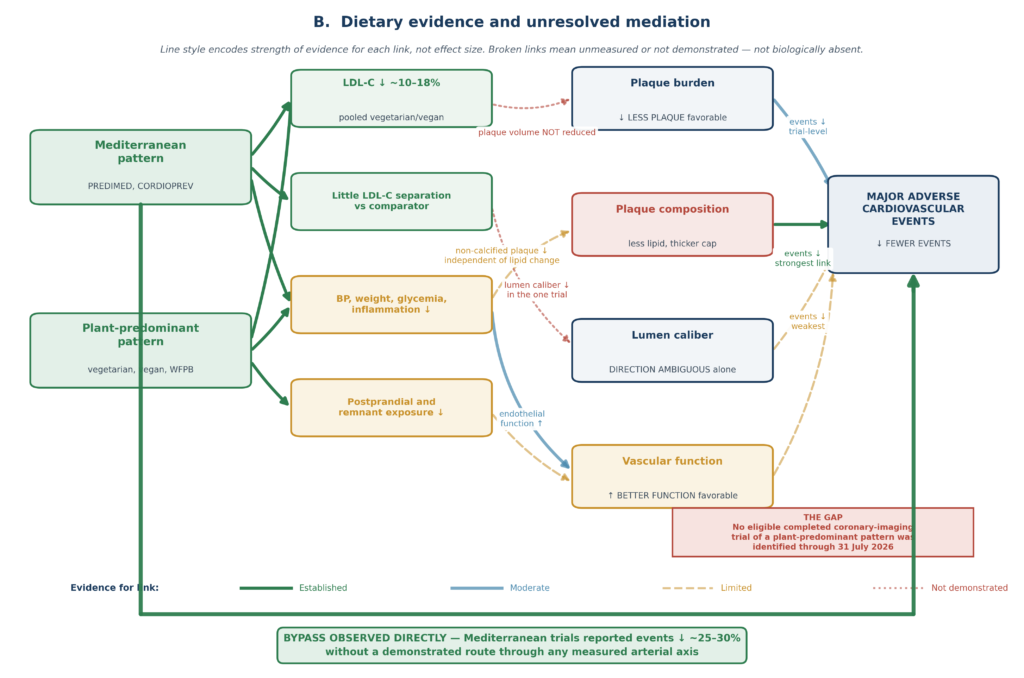
Figure 9B. Dietary evidence and unresolved mediation. Each link is labelled with the direction of the reported change and styled by the strength of evidence for that link, not by effect size. Each arterial box states which direction is favorable; lumen caliber is marked as directionally ambiguous on its own, because it can widen through outward remodeling while plaque grows, or narrow through constrictive remodeling while plaque regresses. The link from dietary lipid lowering to plaque burden is marked not demonstrated, and no eligible completed coronary-imaging trial of a plant-predominant pattern was identified through 31 July 2026 under the stated criteria. The heavy line running beneath the diagram denotes clinical outcome established, mediation unmeasured: Mediterranean trials reported fewer events, and no measured arterial axis has been shown to carry that effect. Broken links mean unmeasured or not demonstrated, not absent. The links shown are supported by the references cited for them in the body: refs 2–4 (dietary event reduction), 11 and 64 (dietary LDL-C and ApoB lowering), 8, 9, 36, 53, 56 and 58–60 (historical angiographic endpoints), 10 and 57 (modern coronary imaging), 12 and 90–92 (inflammatory pathway), 21 and 89 (endothelial function), and 49 and 98 (blood pressure). This diagram is not a causal graph and not a validated mediation model; it summarizes which links have been examined and with what strength of evidence, and makes no formal identifying assumptions.
The most defensible reading of this literature is a layered working model in which dietary patterns reduce fasting and postprandial ApoB exposure and may also modify the vascular response to the particle burden that remains. What the evidence does not currently support is the stronger and more frequently asserted claim that diet acts on the vessel wall independently of ApoB, or that it purchases more remodeling, stability, or perfusion per unit of ApoB lowered than pharmacotherapy does.
Plaque burden remains the most established quantitative serial-imaging measure of atherosclerotic disease modification for this purpose, although percent atheroma volume has not been validated as a surrogate for hard clinical outcomes;34,35 the geometric observations reviewed here are hypothesis-generating and may represent complementary vascular biology rather than an alternative therapeutic target. With that stated, the findings that make this worth pursuing cluster around vascular geometry and function in addition to plaque burden: arterial and luminal cross-sectional areas approximately twice those of a separate baseline-necropsy group, without a statistically significant difference in plaque area in macaques, endothelial relaxation normalized while intimal area decreased by approximately 60% but remained well above normal, minimal lumen diameter preserved where controls narrowed, and perfusion improving beyond visible lesion-level change.5,6,8,58 Each is compatible with a dietary effect on geometry, tone, or plaque phenotype that measures of plaque volume are poorly designed to detect.
But each also admits an ApoB-mediated explanation, and the pattern as a whole is partly an artifact of measurement history: dietary trials preferentially measured function, perfusion, and lumen dimensions; drug trials preferentially measured volume and composition. A domain that only one literature measured cannot support a claim about which intervention is better in it. The geometric and functional observations are provocative enough to warrant direct testing but do not constitute a coherent replicated effect, and they have never been examined in a randomized dietary comparison with repeated ApoB measurements and standardized background therapy.
An exploratory trial-level feasibility exercise was attempted but proved incapable of testing the hypothesis reliably. Definitions of angiographic regression, populations, imaging methods and treatment eras differed systematically, and the same approach failed to recover the well-established within-trial LDL–plaque relationship. The exercise therefore demonstrates why existing studies cannot estimate an additional effect of diet; it neither confirms nor refutes such an effect, and reinforces the need for a randomized trial with standardized background therapy, repeated ApoB measurement and prespecified mechanistic analyses (§6.1).
One further structural weakness deserves stating rather than burying: the geometry hypothesis rests disproportionately on a single primate experiment.5 It is well conducted, in a species whose coronary pathology closely resembles ours, and it remains the clearest available demonstration that arterial caliber and plaque area can change discordantly and are not obligatorily coupled. It is also one cross-sectional study, unreplicated, performed during lipid lowering, in surgically postmenopausal animals. It should be read as the cornerstone of a hypothesis rather than the proof of a conclusion. Replication of this experiment — with serial within-artery measurement, matched particle exposure across dietary arms, and modern compositional imaging equivalent to IVUS or OCT — would immediately become one of the highest priorities in this field, and would advance the question further than any reanalysis of the human trials reviewed here.
Table 11. Direct answers to the questions motivating this review.
| Question | Answer supported by current evidence |
| Can established primate atherosclerosis regress after withdrawal of an atherogenic diet? | Yes. Multiple primate models show regression after withdrawal or modification of the atherogenic diet accompanied by major plasma-lipid reduction; these studies do not separate food composition from reduced lipoprotein exposure.5,26,72 |
| Can lumen geometry improve when plaque area does not significantly decrease? | A cross-sectional primate comparison found vessel and lumen areas approximately twice those of a separate baseline group after lipid lowering, without a statistically significant plaque-area difference; serial confirmation is lacking.5 |
| Was that effect independent of lipid lowering? | Unknown. It occurred during plasma lipid lowering, with no matched-exposure comparator.5 |
| Can endothelial function normalize before arterial structure returns to normal? | In a primate iliac model, endothelial relaxation returned to normal while intimal area decreased by roughly 60% but remained well above normal; serial timing was not established.6 |
| Do nutrient-specific primate experiments isolate direct vessel-wall effects? | No. In the soy experiments, lipoproteins also differed between arms; in the fat-quality experiments, ApoB was never matched.27,28,77 |
| Do early human trials show coronary benefit from diet-centered intervention? | Several small historical trials reported attenuated angiographic progression or preservation of lumen measures, although interventions were heterogeneous, frequently bundled, and often affected by medication use.8,36,53,56 |
| Did any of them show lumen enlargement? | Not convincingly. Ornish preserved MLD (+0.001 mm); STARS diet-alone was stasis (+0.003 mm); Esselstyn’s +0.08 mm was not significant.8,9,36 |
| Does DISCO-CT show incremental plaque regression? | Not for total burden — PAV was null (P = .851) and maximum lumen diameter fell in the diet arm (between-group P = .025). It showed a greater reduction in broadly defined non-calcified plaque (P = .045).10 |
| Is Mediterranean evidence stronger than modern plant-predominant coronary-imaging evidence? | Yes, substantially. Whether this reflects biological differences or the distribution of research investment is unknown.2,3,48 |
| Does diet outperform intensive pharmacologic ApoB lowering on any imaging domain? | Not demonstrated; HUYGENS and PACMAN-AMI show drugs improve composition as well as volume31,32 |
| Can the question be settled by comparing existing trials? | No. Regression definitions, imaging methods, populations and treatment eras are too heterogeneous for valid trial-level comparison (§3.6). |
| What is the largest evidence gap? | The absence of a randomized coronary-imaging trial directly comparing well-characterized dietary patterns under standardized background therapy, with repeated ApoB measurements, modern plaque-composition imaging, and prespecified mediation analyses. |
| What is the defensible practical conclusion? | Diet is an established ApoB-lowering therapy and a plausible modifier of vascular function and plaque phenotype whose additional effects remain to be quantified; it complements rather than competes with pharmacologic lowering, and its additional contribution — if present — may involve vascular function, blood pressure, postprandial metabolism, inflammatory signaling, plaque phenotype and arterial geometry, whose relative importance remains unknown. |
6.1 The trials needed to test the hypothesis
The central claim is testable and has not been tested. Two distinct causal questions require separate designs, and they should not be merged into one protocol.
A total dietary-pattern-effect trial would randomize well-characterized dietary patterns under an identical medication-management algorithm. Achieved ApoB would be permitted to differ and would be repeatedly measured as a potential mediator. This estimates the total effect of dietary assignment under comparable pharmacologic management, and it is the cleaner of the two.
A food-composition-at-similar-ApoB trial would instead titrate medication individually to reach a prespecified ApoB range in every dietary group. This estimates dietary differences conditional on similar plasma ApoB concentration-time exposure, but differential drug dose and class across arms would be unavoidable and would have to be measured and modeled. A protocol generally cannot guarantee both identical medication exposure and identical achieved ApoB across dietary groups, because participants respond differently to therapy. It must therefore prespecify which estimand takes priority and how differential medication exposure will be handled.

Figure 10. The two candidate trial designs, the distinct question each answers, and the requirements shared by both. A protocol generally cannot guarantee both identical medication exposure and identical achieved ApoB across dietary groups; it must therefore prespecify which estimand takes priority and how differential medication exposure will be handled.
Either design (Figure 10) should include careful characterization of lipoprotein exposure — design features recommended here rather than requirements established by the evidence reviewed: repeated ApoB measurement with computation of ApoB area under the curve, prespecifying early post-randomization sampling, regular long-term intervals, handling of medication changes, missing-data methods, and whether trapezoidal or model-derived AUC is used; measurement of apoB-48/remnant exposure and postprandial lipemia; and characterization of Lp(a), non-HDL-C, triglyceride-rich particles and LDL composition. Exploratory mechanistic measurements could additionally include anti-Neu5Gc antibody profiles, although these are not part of exposure characterization. Plasma ApoB area under the curve remains a concentration integral, not arterial flux or retention. Non-lipid co-interventions should be standardized or repeatedly measured: exercise, blood pressure, heart rate, hydration, nitrate administration and imaging acquisition conditions. Weight requires an explicit decision rather than a measurement plan: the protocol should prespecify whether diet-induced weight change forms part of the total treatment effect, or whether food composition is being studied under weight stability. Those are different estimands requiring different feeding and analytic strategies.
Dietary adherence should be measured objectively, not by self-report alone. Depending on the assigned patterns, candidate objective measures include plasma fatty-acid profiles, urinary electrolyte and nitrogen excretion, and food-provision or purchasing records; the validation characteristics of whichever measures are chosen should be specified in the protocol. Self-reported adherence alone is inadequate for a trial whose central question is the effect of achieved dietary exposure.
Lumen area is an inviting primary endpoint, since it is where the hypothesis predicts surplus benefit. It would be a poor one: the same vasomotor sensitivity that makes lumen caliber an interesting outcome makes it unsuitable as a sole primary endpoint, because a change in caliber cannot by itself be attributed to a change in plaque. A hierarchically tested set is preferable — and outward enlargement should not lead it. Expansive remodeling preserves lumen in some contexts and is a recognized high-risk plaque feature in others,30 so it is a mechanistic outcome rather than an inherently favorable one:
- Primary — one endpoint, one platform. A CCTA-centered trial should select either low-attenuation plaque volume or total non-calcified plaque volume as its single primary endpoint on the basis of prespecified reproducibility and power data, with the other tested hierarchically as a key secondary endpoint; an IVUS-centered trial should prespecify percent atheroma volume instead. These are not interchangeable, the platform must be fixed at design, and the success criterion and any multiplicity correction stated in advance.
- Key secondary: standardized lumen area under controlled acquisition conditions — nitrate, heart rate, blood pressure, hydration, caffeine and meal status all fixed.
- Mechanistic: vessel/EEM area and remodeling index, interpreted alongside composition rather than as favorable in isolation.
- Mechanistic: minimal fibrous cap thickness by OCT in a nested substudy. We suggest limiting invasive OCT or IVUS to participants already undergoing clinically indicated coronary angiography, unless research-only catheterization receives separate ethical and risk justification under the governing local framework. That restriction creates a selected, higher-risk subgroup, so invasive findings should be interpreted as mechanistic rather than as representative population estimates.
- Functional: endothelial function and myocardial perfusion.
The analytic approach recommended here is mixed-effects lesion-level modeling nested within patients, with blinded central image analysis; the specific models and identifying assumptions would need to be fixed against contemporary multilevel-imaging and causal-mediation guidance at protocol stage. Exploratory causal-mediation analysis partitioning the total effect into paths mediated through measured ApoB exposure and paths not mediated through that measured exposure may be informative but will not by itself establish causality. Ordinary regression adjustment for post-randomization ApoB will not isolate an independent dietary effect: ApoB is affected by treatment, adherence and intercurrent medication changes, so the analysis plan must prespecify handling of time-varying confounding, treatment–mediator interaction, adherence as both mediator and confounder, and sensitivity analyses for unmeasured mediator–outcome confounding; its identifying assumptions and sensitivity analyses must be prespecified.
A parallel primate factorial regression study could match ApoB across diets while varying food matrix and fatty-acid profile, adding transcriptomics, matrix biomarkers, and vessel geometry to the histomorphometric endpoints the 1995 experiment established.5
6.2 Limitations
This is a narrative synthesis without prespecified protocol, formal risk-of-bias instruments, or meta-analysis; endpoint heterogeneity would in any case preclude pooling. Study selection emphasized work bearing on the lumen and remodeling hypothesis and may therefore over-represent findings consistent with it. Several key human trials predate routine ApoB measurement, high-intensity statins, and modern imaging, and their control groups received care now considered inadequate. Extrapolation from macaque coronary biology to human disease is well founded but not guaranteed. Finally, the single finding that most supports the hypothesis — enlarged arterial and luminal cross-sectional area without significant plaque-area reduction — rests on one cross-sectional primate experiment and requires independent replication with serial measurement.
6.3 Diet and pharmacotherapy: evidence for complementarity
The clinical question this review ultimately serves is not diet versus pharmacotherapy but what the two may achieve together. Existing studies support complementarity as a plausible direction of effect, but they do not permit a reliable numerical estimate of the incremental or combined benefit.
Statin therapy alone reduces major vascular events by approximately one fifth for each sustained 1.0 mmol/L reduction in LDL-C, with absolute benefit depending on baseline risk and treatment duration.1,39,43 In CORDIOPREV, where more than 85% of participants were using statins at baseline, the Mediterranean intervention produced a 25–28% lower adjusted hazard than the low-fat dietary intervention.3 This establishes a difference between dietary strategies on a background of medical treatment, not the incremental effect of adding diet to otherwise identical optimized pharmacotherapy. STARS, though far too small for reliable estimation, ordered its arms the same way: 10 events under usual care, 3 on diet alone, 1 on diet plus cholestyramine.36
The evidence combines effects measured in different populations, against different comparators, and over different durations, and no trial has randomized patients to diet plus drug versus drug alone with adequate power for hard outcomes. The arithmetic of combining relative risks assumes independence that has not been demonstrated, and the dietary comparators in these trials were themselves active. What can be said with more confidence is directional. Available studies are compatible with dietary and pharmacologic strategies being used together, but direct randomized evidence on their incremental or interactive effects is limited: no adequately powered randomized trial has isolated the incremental effect of adding a specified dietary pattern to optimized lipid-lowering therapy. DISCO-CT was null for total plaque burden and produced one exploratory compositional signal.10
The practical reading follows. Lipid-lowering therapy and dietary change are not competing strategies to be ranked but partly complementary ones acting through overlapping and potentially distinct routes — lipid-lowering pharmacotherapy more powerfully on particle number, the diet additionally on blood pressure, weight, glycemia and postprandial exposure. The evidence does not support treating dietary improvement and lipid-lowering pharmacotherapy as mutually exclusive alternatives.
| What section 6 established — and what it did not
✔ Two distinct trial designs would answer two distinct questions, and one protocol generally cannot optimize both. ✔ A definitive test requires randomization, standardized background therapy, repeated ApoB measurement with prespecified AUC handling, and objective adherence biomarkers. ✘ Ordinary regression adjustment for post-randomization ApoB will not isolate an independent dietary effect. ✘ Until such a trial exists, the partition between ApoB-mediated and other pathways remains unmeasured rather than absent. |
7. Conclusions
7.1 What is established
How the two intervention families differ. Plant-forward dietary patterns simultaneously influence several established cardiovascular risk pathways — lipoproteins, blood pressure, body weight, glycemic control and overall dietary quality.11,64,89 That breadth makes diet a potentially complementary intervention rather than a weaker version of pharmacotherapy, though the contribution of each pathway has not been separated. Lipid-lowering therapy produces the larger and more predictable reduction in particle burden, and intensive regimens also improve plaque composition rather than plaque volume alone.1,20,31,32
The practical position. Dietary interventions reduce LDL-C and ApoB by modest average amounts, with larger effects under intensive supervision or controlled feeding.11,64 Mediterranean dietary-pattern trials have also demonstrated cardiovascular-event reduction, whereas adequately powered event evidence for intensive plant-predominant interventions is absent.2,3 Diet complements pharmacologic lipid lowering rather than competing with it; the two are likely to affect partly overlapping and partly distinct pathways, but the relative contribution of those pathways has not been quantified. What remains to be established is how much of the observed event benefit is captured by cumulative fasting and postprandial ApoB exposure, how much is mediated through blood pressure, inflammation, glycemia, weight and thrombosis, and whether dietary pattern affects plaque or arterial geometry after on-trial ApoB exposure is repeatedly measured and appropriately modeled within a randomized dietary trial. Two studies would substantially advance the question. First, an adequately powered randomized cardiovascular-outcome trial should test a well-characterized plant-predominant pattern; no eligible completed trial was identified through 31 July 2026 under the stated search criteria, despite reproducible LDL-C and ApoB lowering by such patterns. Second, the coronary-imaging trial specified in §6.1, using repeated ApoB measurement and the prespecified medication strategy appropriate to the chosen estimand, in either a direct dietary comparison or a factorial design.
7.2 What is suggestive
Three observations jointly motivate further testing.
First, randomized Mediterranean dietary-pattern trials have reported cardiovascular-event reductions that constitute the descriptive event–fasting-lipid discrepancy defined in §3.1.4. PREDIMED reported approximately 30% and CORDIOPREV approximately 25–28% in adjusted analyses over seven years, in both cases with little LDL-C separation between arms.2,3 Similar fasting LDL-C does not establish similar ApoB particle exposure, cholesterol content per particle, remnant exposure or longitudinal medication exposure. The Lyon Diet Heart Study reduced recurrent events substantially with essentially no lipid difference at all.4 This is hypothesis-generating rather than a quantitative mediation estimate, because cumulative ApoB exposure, medication use, adherence, blood pressure, weight, glycemia, inflammation and other simultaneous changes were not experimentally matched.
Second, at least one downstream pathway can be therapeutically modified to reduce events without lowering LDL-C. CANTOS randomized 10,061 post-infarction patients, more than 93% on lipid-lowering therapy at baseline, to an antibody against interleukin-1β. It reduced the composite primary endpoint of nonfatal myocardial infarction, nonfatal stroke or cardiovascular death by 15% at the prespecified 150 mg dose, without lowering LDL-C and with an excess of fatal infection, and the benefit tracked how far each patient’s CRP fell.12,90 Because achieved hsCRP is a post-randomization variable, that association supports target engagement but is not itself a randomized mediation estimate. Two colchicine trials support anti-inflammatory event reduction without intended lipid lowering, though they target different inflammatory mechanisms and differ in endpoint pattern and safety profile.91,92 Inflammation is therefore not a speculative mechanism — CANTOS establishes that targeted downstream inflammatory modulation can reduce cardiovascular events without materially lowering LDL-C. Blood-pressure lowering has extensive randomized cardiovascular-outcome evidence generally, but much weaker direct evidence for modifying coronary plaque progression or geometry independently of lipid exposure.98 Dietary patterns can influence blood pressure and inflammatory biomarkers, although the extent to which these changes mediate clinical benefit remains unquantified.
Third, in one 16-week randomized crossover trial, the low-fat vegan intervention lowered LDL-C by 15.3 mg/dL while the Mediterranean intervention produced no significant LDL-C change; the Mediterranean intervention lowered systolic blood pressure by approximately 5.9 mmHg more.54 This does not establish a general biological ranking, and the vegan intervention has not been tested in an adequately powered cardiovascular-outcome trial. It does show that the present hierarchy of outcome evidence does not mirror the lipid effects observed in this short trial.
What follows from this. Across the Mediterranean dietary-outcome literature,2–4 reported event estimates constitute the descriptive event–fasting-lipid discrepancy defined in §3.1.4. This does not establish a biological residual after all ApoB-mediated pathways are considered. Unmeasured cumulative or postprandial ApoB exposure, ApoB-interacting mechanisms, pathways not mediated by changes in plasma ApoB concentration, adherence, comparator effects and other trial-design differences remain viable explanations. Resolving them requires a randomized dietary trial with repeated ApoB measurement, a prespecified medication strategy and appropriately qualified exploratory mediation analyses.
The limited internal analyses available from the early diet trials generally favor a substantial lipid-mediated component: Leiden and STARS both found lesion change associated with on-treatment lipid measures,36,59 while Heidelberg did not detect such a relationship.60 That is the most important evidence against an expansive reading of this review’s hypothesis, and it belongs in the final synthesis rather than only in the results.
7.3 What remains unproven
What does not follow. The apparent trial-level discrepancy has not been mechanistically partitioned. Dietary interventions change blood pressure, weight, insulin sensitivity, inflammatory markers and postprandial metabolism simultaneously, and no trial has held particle exposure constant while varying diet, so the individual contributions remain unquantified. Nor does the outcome evidence transfer to plaque: the case that diet regresses atheroma or widens arteries beyond what its ApoB lowering predicts remains unproven, resting on one cross-sectional primate experiment and human trials measuring endpoints too heterogeneous to compare.5 Those are different claims, and they are not equally supported.
7.4 What should be done
In summary. Current evidence strongly supports reduction of cumulative ApoB exposure as the dominant mechanism of atherosclerotic arrest and regression, and nothing in this review disputes that.1,14,15 Nevertheless, several converging observations — from Mediterranean outcome trials, historical angiography, primate regression experiments, randomized anti-inflammatory intervention, and modern plaque biology — indicate that dietary patterns may influence vascular biology through mechanisms not fully represented by a single fasting ApoB measurement.2,3,11,64 Resolving that question will require randomized trials that measure ApoB exposure repeatedly and image the artery with contemporary methods. Until then, the defensible clinical position is that high-quality dietary patterns and lipid-lowering pharmacotherapy are complementary rather than competing, and that the evidence provides no basis for treating high-quality dietary intervention and indicated lipid-lowering pharmacotherapy as mutually exclusive strategies.
Declarations
Funding. No external funding was received for this review. Methodological status. The author selected, interpreted and wrote this review without independent duplicate screening or external adjudication. Readers should therefore distinguish the review’s source-derived findings from the author’s narrative synthesis and evidence classifications. Conflict of interest. The author is the founder and operator of Curing Heart Disease, LLC, a cardiovascular health-education platform that discusses plant-predominant dietary approaches to atherosclerosis. This constitutes a potential intellectual and commercial conflict of interest. Data availability. All extracted study-level observations were obtained from the cited publications. The material supporting the methodological discussion in §3.6 is provided as Supplementary Data S1 (search strategy and eligibility), S2 (derived trial-level dataset), S3 (source verification and sensitivity analyses) and S4 (coding dictionary and study-selection record). Author contributions. Sole authorship: conception, evidence appraisal, drafting, and revision.
References
- Cholesterol Treatment Trialists’ (CTT) Collaboration. Efficacy and safety of more intensive lowering of LDL cholesterol: a meta-analysis of data from 170,000 participants in 26 randomised trials. Lancet. 2010;376(9753):1670–1681.
- Estruch R, Ros E, Salas-Salvadó J, et al. Primary prevention of cardiovascular disease with a Mediterranean diet supplemented with extra-virgin olive oil or nuts. N Engl J Med. 2018;378(25):e34.
- Delgado-Lista J, Alcala-Diaz JF, Torres-Peña JD, et al. Long-term secondary prevention of cardiovascular disease with a Mediterranean diet and a low-fat diet (CORDIOPREV): a randomised controlled trial. Lancet. 2022;399(10338):1876–1885.
- de Lorgeril M, Salen P, Martin JL, Monjaud I, Delaye J, Mamelle N. Mediterranean diet, traditional risk factors, and the rate of cardiovascular complications after myocardial infarction: final report of the Lyon Diet Heart Study. Circulation. 1999;99(6):779–785.
- Williams JK, Anthony MS, Honoré EK, et al. Regression of atherosclerosis in female monkeys. Arterioscler Thromb Vasc Biol. 1995;15(7):827–836.
- Harrison DG, Armstrong ML, Freiman PC, Heistad DD. Restoration of endothelium-dependent relaxation by dietary treatment of atherosclerosis. J Clin Invest. 1987;80(6):1808–1811.
- Freiman PC, Mitchell GG, Heistad DD, Armstrong ML, Harrison DG. Atherosclerosis impairs endothelium-dependent vascular relaxation to acetylcholine and thrombin in primates. Circ Res. 1986;58(6):783–789.
- Ornish D, Scherwitz LW, Billings JH, et al. Intensive lifestyle changes for reversal of coronary heart disease. JAMA. 1998;280(23):2001–2007.
- Esselstyn CB Jr, Ellis SG, Medendorp SV, Crowe TD. A strategy to arrest and reverse coronary artery disease: a 5-year longitudinal study of a single physician’s practice. J Fam Pract. 1995;41(6):560–568.
- Henzel J, Kępka C, Kruk M, et al. High-risk coronary plaque regression after intensive lifestyle intervention in nonobstructive coronary disease: a randomized study. JACC Cardiovasc Imaging. 2021;14(6):1192–1202.
- Koch CA, Kjeldsen EW, Frikke-Schmidt R. Vegetarian or vegan diets and blood lipids: a meta-analysis of randomized trials. Eur Heart J. 2023;44(28):2609–2622.
- Ridker PM, Everett BM, Thuren T, et al. Antiinflammatory therapy with canakinumab for atherosclerotic disease. N Engl J Med. 2017;377(12):1119–1131.
- Williams MC, Kwiecinski J, Doris M, et al. Low-attenuation noncalcified plaque on coronary computed tomography angiography predicts myocardial infarction: results from the multicenter SCOT-HEART trial. Circulation. 2020;141(18):1452–1462.
- Ference BA, Ginsberg HN, Graham I, et al. Low-density lipoproteins cause atherosclerotic cardiovascular disease. 1. Evidence from genetic, epidemiologic, and clinical studies. A consensus statement from the European Atherosclerosis Society Consensus Panel. Eur Heart J. 2017;38(32):2459–2472.
- Borén J, Chapman MJ, Krauss RM, et al. Low-density lipoproteins cause atherosclerotic cardiovascular disease: pathophysiological, genetic, and therapeutic insights. A consensus statement from the European Atherosclerosis Society Consensus Panel. Eur Heart J. 2020;41(24):2313–2330.
- Williams KJ, Tabas I. The response-to-retention hypothesis of early atherogenesis. Arterioscler Thromb Vasc Biol. 1995;15(5):551–561.
- Nissen SE, Tuzcu EM, Schoenhagen P, et al. Effect of intensive compared with moderate lipid-lowering therapy on progression of coronary atherosclerosis: a randomized controlled trial (REVERSAL). JAMA. 2004;291(9):1071–1080.
- Nissen SE, Nicholls SJ, Sipahi I, et al. Effect of very high-intensity statin therapy on regression of coronary atherosclerosis: the ASTEROID trial. JAMA. 2006;295(13):1556–1565.
- Nicholls SJ, Ballantyne CM, Barter PJ, et al. Effect of two intensive statin regimens on progression of coronary disease (SATURN). N Engl J Med. 2011;365(22):2078–2087.
- Nicholls SJ, Puri R, Anderson T, et al. Effect of evolocumab on progression of coronary disease in statin-treated patients: the GLAGOV randomized clinical trial. JAMA. 2016;316(22):2373–2384.
- Ros E, Núñez I, Pérez-Heras A, et al. A walnut diet improves endothelial function in hypercholesterolemic subjects: a randomized crossover trial. Circulation. 2004;109(13):1609–1614.
- Mena MP, Sacanella E, Vazquez-Agell M, et al. Inhibition of circulating immune cell activation: a molecular antiinflammatory effect of the Mediterranean diet. Am J Clin Nutr. 2009;89(1):248–256.
- Wang Z, Klipfell E, Bennett BJ, et al. Gut flora metabolism of phosphatidylcholine promotes cardiovascular disease. Nature. 2011;472(7341):57–63.
- Koeth RA, Wang Z, Levison BS, et al. Intestinal microbiota metabolism of L-carnitine, a nutrient in red meat, promotes atherosclerosis. Nat Med. 2013;19(5):576–585.
- Glagov S, Weisenberg E, Zarins CK, Stankunavicius R, Kolettis GJ. Compensatory enlargement of human atherosclerotic coronary arteries. N Engl J Med. 1987;316(22):1371–1375.
- Armstrong ML, Warner ED, Connor WE. Regression of coronary atheromatosis in rhesus monkeys. Circ Res. 1970;27(1):59–67.
- Wolfe MS, Sawyer JK, Morgan TM, Bullock BC, Rudel LL. Dietary polyunsaturated fat decreases coronary artery atherosclerosis in a pediatric-aged population of African green monkeys. Arterioscler Thromb. 1994;14(4):587–597.
- Rudel LL, Parks JS, Sawyer JK. Compared with dietary monounsaturated and saturated fat, polyunsaturated fat protects African green monkeys from coronary artery atherosclerosis. Arterioscler Thromb Vasc Biol. 1995;15(12):2101–2110.
- Baethge C, Goldbeck-Wood S, Mertens S. SANRA — a scale for the quality assessment of narrative review articles. Res Integr Peer Rev. 2019;4:5.
- Cury RC, Leipsic J, Abbara S, et al. CAD-RADS™ 2.0 – 2022 Coronary Artery Disease Reporting and Data System: an expert consensus document of the SCCT, ACC, ACR, and NASCI. Radiol Cardiothorac Imaging. 2022;4(5):e220183.
- Räber L, Ueki Y, Otsuka T, et al. Effect of alirocumab added to high-intensity statin therapy on coronary atherosclerosis in patients with acute myocardial infarction: the PACMAN-AMI randomized clinical trial. JAMA. 2022;327(18):1771–1781.
- Nicholls SJ, Kataoka Y, Nissen SE, et al. Effect of evolocumab on coronary plaque phenotype and burden in statin-treated patients following myocardial infarction (HUYGENS). JACC Cardiovasc Imaging. 2022;15(7):1308–1321.
- Stone GW, Maehara A, Lansky AJ, et al. A prospective natural-history study of coronary atherosclerosis (PROSPECT). N Engl J Med. 2011;364(3):226–235.
- Bhindi R, Guan M, Zhao Y, Humphries KH, Mancini GBJ. Coronary atheroma regression and adverse cardiac events: a systematic review and meta-regression analysis. Atherosclerosis. 2019;284:194–201.
- Mancini GBJ, Guan M, Zhao Y, Humphries KH, Bhindi R. Atherosclerotic coronary plaque regression and risk of adverse cardiovascular events: a systematic review and updated meta-regression analysis. JAMA Cardiol. 2023;8(11):1030–1040.
- Watts GF, Lewis B, Brunt JNH, et al. Effects on coronary artery disease of lipid-lowering diet, or diet plus cholestyramine, in the St Thomas’ Atherosclerosis Regression Study (STARS). Lancet. 1992;339(8793):563–569.
- Gould KL, Ornish D, Kirkeeide R, et al. Improved stenosis geometry by quantitative coronary arteriography after vigorous risk factor modification. Am J Cardiol. 1992;69(10):845–853.
- Topol EJ, Nissen SE. Our preoccupation with coronary luminology: the dissociation between clinical and angiographic findings in ischemic heart disease. Circulation. 1995;92(8):2333–2342.
- Scandinavian Simvastatin Survival Study Group. Randomised trial of cholesterol lowering in 4444 patients with coronary heart disease: the Scandinavian Simvastatin Survival Study (4S). Lancet. 1994;344(8934):1383–1389.
- Shepherd J, Cobbe SM, Ford I, et al. Prevention of coronary heart disease with pravastatin in men with hypercholesterolemia. N Engl J Med. 1995;333(20):1301–1307.
- Sacks FM, Pfeffer MA, Moye LA, et al. The effect of pravastatin on coronary events after myocardial infarction in patients with average cholesterol levels. N Engl J Med. 1996;335(14):1001–1009.
- The Long-Term Intervention with Pravastatin in Ischaemic Disease (LIPID) Study Group. Prevention of cardiovascular events and death with pravastatin in patients with coronary heart disease and a broad range of initial cholesterol levels. N Engl J Med. 1998;339(19):1349–1357.
- Heart Protection Study Collaborative Group. MRC/BHF Heart Protection Study of cholesterol lowering with simvastatin in 20,536 high-risk individuals: a randomised placebo-controlled trial. Lancet. 2002;360(9326):7–22.
- Cannon CP, Blazing MA, Giugliano RP, et al. Ezetimibe added to statin therapy after acute coronary syndromes. N Engl J Med. 2015;372(25):2387–2397.
- Mintz GS, Nissen SE, Anderson WD, et al. American College of Cardiology clinical expert consensus document on standards for acquisition, measurement and reporting of intravascular ultrasound studies (IVUS). J Am Coll Cardiol. 2001;37(5):1478–1492.
- Murie-Fernandez M, Irimia P, Toledo E, et al. Carotid intima-media thickness changes with Mediterranean diet: a randomised trial (PREDIMED-Navarra). Atherosclerosis. 2011;219(1):158–162.
- Sala-Vila A, Romero-Mamani ES, Gilabert R, et al. Changes in ultrasound-assessed carotid intima-media thickness and plaque with a Mediterranean diet: a substudy of the PREDIMED trial. Arterioscler Thromb Vasc Biol. 2014;34(2):439–445.
- Jimenez-Torres J, Alcalá-Diaz JF, Torres-Peña JD, et al. Mediterranean diet reduces atherosclerosis progression in coronary heart disease: an analysis of the CORDIOPREV randomized controlled trial. Stroke. 2021;52(11):3440–3449.
- Shai I, Spence JD, Schwarzfuchs D, et al. Dietary intervention to reverse carotid atherosclerosis. Circulation. 2010;121(10):1200–1208.
- Nicholls SJ, Hsu A, Wolski K, et al. Intravascular ultrasound-derived measures of coronary atherosclerotic plaque burden and clinical outcome. J Am Coll Cardiol. 2010;55(21):2399–2407.
- Delgado-Lista J, Alcala-Diaz JF, Torres-Peña JD, et al; CORDIOPREV Investigators. Incidence of major adverse cardiovascular events decreases with greater adherence to both Mediterranean and low-fat dietary patterns in secondary prevention patients: a randomized controlled trial. Eur J Intern Med. 2026;147:106733.
- Correction to: Mediterranean diet reduces atherosclerosis progression in coronary heart disease. Stroke. 2021;52(11):e754.
- Ornish D, Brown SE, Scherwitz LW, et al. Can lifestyle changes reverse coronary heart disease? The Lifestyle Heart Trial. Lancet. 1990;336(8708):129–133.
- Barnard ND, Alwarith J, Rembert E, et al. A Mediterranean diet and low-fat vegan diet to improve body weight and cardiometabolic risk factors: a randomized, cross-over trial. J Am Nutr Assoc. 2022;41(2):127–139.
- Blankenhorn DH, Nessim SA, Johnson RL, Sanmarco ME, Azen SP, Cashin-Hemphill L. Beneficial effects of combined colestipol-niacin therapy on coronary atherosclerosis and coronary venous bypass grafts. JAMA. 1987;257(23):3233–3240.
- Haskell WL, Alderman EL, Fair JM, et al. Effects of intensive multiple risk factor reduction on coronary atherosclerosis and clinical cardiac events in men and women with coronary artery disease: the Stanford Coronary Risk Intervention Project (SCRIP). Circulation. 1994;89(3):975–990.
- Cassidy S, Kroeger CM, Wang T, et al. Impact of an intensive lifestyle program on low attenuation plaque and myocardial perfusion in coronary heart disease: a randomised clinical trial protocol. Nutr Healthy Aging. 2022;7(1–2):9–22. Trial registration ACTRN12620001151921.
- Schuler G, Hambrecht R, Schlierf G, et al. Myocardial perfusion and regression of coronary artery disease in patients on a regimen of intensive physical exercise and low fat diet. J Am Coll Cardiol. 1992;19(1):34–42.
- Arntzenius AC, Kromhout D, Barth JD, et al. Diet, lipoproteins, and the progression of coronary atherosclerosis: the Leiden Intervention Trial. N Engl J Med. 1985;312(13):805–811.
- Schuler G, Hambrecht R, Schlierf G, et al. Regular physical exercise and low-fat diet: effects on progression of coronary artery disease. Circulation. 1992;86(1):1–11.
- Esselstyn CB Jr. Updating a 12-year experience with arrest and reversal therapy for coronary heart disease. Am J Cardiol. 1999;84(3):339–341.
- Niebauer J, Hambrecht R, Velich T, et al. Attenuated progression of coronary artery disease after 6 years of multifactorial risk intervention: role of physical exercise. Circulation. 1997;96(8):2534–2541.
- Manchanda SC, Narang R, Reddy KS, et al. Retardation of coronary atherosclerosis with yoga lifestyle intervention. J Assoc Physicians India. 2000;48(7):687–694.
- Lessard-Lord J, Guay V, Rancourt-Bouchard M, et al. Impact of a whole food, plant-based diet on LDL-cholesterol and cardiovascular risk factors in adults with heterozygous familial hypercholesterolemia: a randomized, two-period, two-treatment, crossover, fully controlled feeding trial. Nat Commun. 2026;17:6632.
- Jenkins DJA, Kendall CWC, Marchie A, et al. Effects of a dietary portfolio of cholesterol-lowering foods vs lovastatin on serum lipids and C-reactive protein: a randomized trial. JAMA. 2003;290(4):502–510.
- Marmot MG, Syme SL, Kagan A, Kato H, Cohen JB, Belsky J. Epidemiologic studies of coronary heart disease and stroke in Japanese men living in Japan, Hawaii and California: prevalence of coronary and hypertensive heart disease and associated risk factors. Am J Epidemiol. 1975;102(6):514–525.
- Chen J, Campbell TC, Li J, Peto R, eds. Diet, Life-style and Mortality in China: A Study of the Characteristics of 65 Chinese Counties. Oxford: Oxford University Press; Ithaca, NY: Cornell University Press; Beijing: People’s Medical Publishing House; 1990.
- Campbell TC, Parpia B, Chen J. Diet, lifestyle, and the etiology of coronary artery disease: the Cornell China Study. Am J Cardiol. 1998;82(10B):18T–21T.
- Critchley J, Liu J, Zhao D, Wei W, Capewell S. Explaining the increase in coronary heart disease mortality in Beijing between 1984 and 1999. Circulation. 2004;110(10):1236–1244.
- Fincham JE, Woodroof CW, van Wyk MJ, et al. Promotion and regression of atherosclerosis in vervet monkeys by diets realistic for westernized people. Atherosclerosis. 1987;66(3):205–213.
- Yokoyama Y, Levin SM, Barnard ND. Association between plant-based diets and plasma lipids: a systematic review and meta-analysis. Nutr Rev. 2017;75(9):683–698.
- Armstrong ML, Megan MB. Lipid depletion in atheromatous coronary arteries in rhesus monkeys after regression diets. Circ Res. 1972;30(6):675–680.
- Armstrong ML. Evidence of regression of atherosclerosis in primates and man. Postgrad Med J. 1976;52(609):456–461.
- Wissler RW, Vesselinovitch D. Studies of regression of advanced atherosclerosis in experimental animals and man. Ann N Y Acad Sci. 1976;275:363–378.
- Small DM, Bond MG, Waugh D, Prack M, Sawyer JK. Physicochemical and histological changes in the arterial wall of nonhuman primates during progression and regression of atherosclerosis. J Clin Invest. 1984;73(6):1590–1605.
- Williams JK, Adams MR, Klopfenstein HS. Estrogen modulates responses of atherosclerotic coronary arteries. Circulation. 1990;81(5):1680–1687.
- Anthony MS, Clarkson TB, Bullock BC, Wagner JD. Soy protein versus soy phytoestrogens in the prevention of diet-induced coronary artery atherosclerosis of male cynomolgus monkeys. Arterioscler Thromb Vasc Biol. 1997;17(11):2524–2531.
- Anthony MS, Clarkson TB, Hughes CL Jr, Morgan TM, Burke GL. Soybean isoflavones improve cardiovascular risk factors without affecting the reproductive system of peripubertal rhesus monkeys. J Nutr. 1996;126(1):43–50.
- Williams JK, Anthony MS, Herrington DM. Interactive effects of soy protein and estradiol on coronary artery reactivity in atherosclerotic, ovariectomized monkeys. Menopause. 2001;8(5):307–313.
- Vogel RA, Corretti MC, Plotnick GD. Effect of a single high-fat meal on endothelial function in healthy subjects. Am J Cardiol. 1997;79(3):350–354.
- Borén J, Williams KJ. The central role of arterial retention of cholesterol-rich apolipoprotein-B-containing lipoproteins in the pathogenesis of atherosclerosis: a triumph of simplicity. Curr Opin Lipidol. 2016;27(5):473–483.
- Phillips ML, Pullinger C, Kroes I, et al. A single copy of apolipoprotein B-48 is present on the human chylomicron remnant. J Lipid Res. 1997;38(6):1170–1177.
- Flood C, Gustafsson M, Richardson PE, Harvey SC, Segrest JP, Borén J. Identification of the proteoglycan binding site in apolipoprotein B48. J Biol Chem. 2002;277(35):32228–32233.
- Borén J, Olin K, Lee I, Chait A, Wight TN, Innerarity TL. Identification of the principal proteoglycan-binding site in LDL: a single-point mutation in apo-B100 severely affects proteoglycan interaction without affecting LDL receptor binding. J Clin Invest. 1998;101(12):2658–2664.
- Welty FK, Lichtenstein AH, Barrett PH, Dolnikowski GG, Schaefer EJ. Human apolipoprotein (apo) B-48 and apoB-100 kinetics with stable isotopes. Arterioscler Thromb Vasc Biol. 1999;19(12):2966–2974.
- Karpe F, Bell M, Björkegren J, Hamsten A. Quantification of postprandial triglyceride-rich lipoproteins in healthy men by retinyl ester labeling and simultaneous measurement of apolipoproteins B-48 and B-100. Arterioscler Thromb Vasc Biol. 1995;15(2):199–207.
- Nakajima K, Nakano T, Tokita Y, et al. Postprandial lipoprotein metabolism: VLDL vs chylomicrons. Clin Chim Acta. 2011;412(15–16):1306–1318.
- Parks EJ, Krauss RM, Christiansen MP, Neese RA, Hellerstein MK. Effects of a low-fat, high-carbohydrate diet on VLDL-triglyceride assembly, production, and clearance. J Clin Invest. 1999;104(8):1087–1096.
- Estruch R, Martínez-González MA, Corella D, et al. Effects of a Mediterranean-style diet on cardiovascular risk factors: a randomized trial. Ann Intern Med. 2006;145(1):1–11.
- Ridker PM, MacFadyen JG, Everett BM, Libby P, Thuren T, Glynn RJ. Relationship of C-reactive protein reduction to cardiovascular event reduction following treatment with canakinumab: a secondary analysis from the CANTOS randomised controlled trial. Lancet. 2018;391(10118):319–328.
- Tardif JC, Kouz S, Waters DD, et al. Efficacy and safety of low-dose colchicine after myocardial infarction. N Engl J Med. 2019;381(26):2497–2505.
- Nidorf SM, Fiolet ATL, Mosterd A, et al. Colchicine in patients with chronic coronary disease. N Engl J Med. 2020;383(19):1838–1847.
- Zhu W, Gregory JC, Org E, et al. Gut microbial metabolite TMAO enhances platelet hyperreactivity and thrombosis risk. Cell. 2016;165(1):111–124.
- Tang WH, Wang Z, Levison BS, et al. Intestinal microbial metabolism of phosphatidylcholine and cardiovascular risk. N Engl J Med. 2013;368(17):1575–1584.
- Jia J, Dou P, Gao M, et al. Assessment of causal direction between gut microbiota-dependent metabolites and cardiometabolic health: a bidirectional Mendelian randomization analysis. Diabetes. 2019;68(9):1747–1755.
- Canyelles M, Tondo M, Cedano J, Escolà-Gil JC, Blanco-Vaca F. Gut microbiota-derived TMAO: a causal factor promoting atherosclerotic cardiovascular disease? Int J Mol Sci. 2023;24(3):1940.
- Andreu-Sánchez S, Ahmad S, Kurilshikov A, et al. Unraveling interindividual variation of trimethylamine N-oxide and its precursors at the population level. iMeta. 2024;3(3):e183.
- Waters D, Lespérance J, Francetich M, et al. A controlled clinical trial to assess the effect of a calcium channel blocker on the progression of coronary atherosclerosis. Circulation. 1990;82(6):1940–1953.
- Puri R, Nicholls SJ, Shao M, et al. Impact of statins on serial coronary calcification during atheroma progression and regression. J Am Coll Cardiol. 2015;65(13):1273–1282.
- Skålen K, Gustafsson M, Rydberg EK, et al. Subendothelial retention of atherogenic lipoproteins in early atherosclerosis. Nature. 2002;417(6890):750–754.
- Alisson-Silva F, Kawanishi K, Varki A. Human risk of diseases associated with red meat intake: analysis of current theories and proposed role for metabolic incorporation of a non-human sialic acid. Mol Aspects Med. 2016;51:16–30.
- Kawanishi K, Dhar C, Do R, Varki N, Gordts PLSM, Varki A. Human species-specific loss of CMP-N-acetylneuraminic acid hydroxylase enhances atherosclerosis via intrinsic and extrinsic mechanisms. Proc Natl Acad Sci U S A. 2019;116(32):16036–16045.
- Kawanishi K, Coker JK, Grunddal KV, et al. Dietary Neu5Ac intervention protects against atherosclerosis associated with human-like Neu5Gc loss — brief report. Arterioscler Thromb Vasc Biol. 2021;41(11):2730–2739.
Supplementary Material
The four supplements below support the methodological discussion in §2.2 and §3.6. They are included here rather than as separate files so that the search strategy, the derived dataset, its verification, and the coding decisions can be read alongside the arguments that depend on them.
Supplementary Data S1 — Search strategy and eligibility
S1.1 Databases and platforms
MEDLINE/PubMed, Scopus and ClinicalTrials.gov were searched, with ANZCTR consulted for registered protocols. Reference lists of retrieved reports and prior reviews were hand-searched. The search was updated through 31 July 2026. Screening and extraction were performed by the single author; no duplicate screening was undertaken.
S1.2 Representative search strings
Search concepts combined dietary-pattern terms with vascular outcome terms, and separately with primate terms. Six representative strings:
- (plant-based OR vegetarian OR vegan OR “whole food”) AND (coronary angiography OR “quantitative coronary angiography” OR atheroma OR regression)
- (Mediterranean diet OR DASH) AND (intravascular ultrasound OR “optical coherence tomography” OR “computed tomography angiography”) AND (plaque OR atheroma)
- (diet OR dietary pattern) AND (“intima-media thickness” OR “vessel wall volume” OR “plaque height”) AND randomized
- (low-fat diet OR “very low fat”) AND (“minimal lumen diameter” OR “percent diameter stenosis” OR remodeling)
- (Macaca OR cynomolgus OR rhesus OR “African green monkey” OR vervet) AND (atherosclerosis) AND (regression OR “diet withdrawal”)
- (apolipoprotein B OR ApoB) AND (diet OR dietary pattern) AND (random*) AND (lipoprotein OR particle number)
S1.3 Eligibility criteria
Included if the study evaluated a dietary or diet-centered intervention and reported at least one vascular outcome: plaque burden or volume, percent diameter stenosis, lumen diameter or area, remodeling indices, endothelial function, perfusion, or plaque composition. Nonhuman primate studies were preferred over rodent models. Major event trials without imaging were retained where they anchor external clinical relevance.
Excluded: observational diet-quality cohorts without a vascular or imaging endpoint (retained as context only); ecological studies (context only, §3.7.1); rodent models where a primate equivalent existed; registered protocols without completed primary results (cited as research activity, not outcome evidence); and one publication identified during preparation as retracted.
Pharmacologic serial-imaging trials were selected a priori as reference comparators illustrating what intensive ApoB lowering can achieve. They do not satisfy the dietary eligibility criteria and are not part of the eligible intervention corpus.
S1.4 Evidence descriptors — operational definitions
Table S1. Narrative evidence descriptors used throughout §5, with operational definitions.
| Descriptor | Operational definition |
| Strong | Multiple randomized studies with direct endpoints and consistent direction of effect |
| Suggestive | Randomized or well-controlled evidence with important confounding, indirectness, or imprecision |
| Limited | Few, small, old, or uncontrolled studies, or surrogate endpoints only |
| Hypothesis-generating | Mechanistic plausibility, or single findings without confirmatory design |
| Insufficient / no demonstrated effect | No eligible study identified, or the relevant endpoint was null in the only trial that measured it |
Each claim in Table 10 is graded twice: once for the total effect of the dietary pattern, and once for evidence of independence from ApoB exposure. These routinely diverge.
S1.5 Boundaries on absence statements
Statements that no trial exists are bounded by this search and are phrased accordingly throughout: no eligible completed full-report trial was identified through 31 July 2026 under the stated criteria. Single-reviewer screening means a relevant study could have been missed.
S1.6 Limitations of this search
No protocol was preregistered. Records screened were not counted. RoB 2, ROBINS-I and animal risk-of-bias instruments were not applied. Publication bias was not assessed. The review is appraised with reference to SANRA domains rather than PRISMA, and GRADE certainty ratings are deliberately not presented.
Supplementary Data S2 — Derived trial-level dataset
The compilation below was assembled for the exploratory trial-level comparison described in §3.6, which proved uninterpretable. It is reproduced so the methodological argument can be checked, not as a quantitative finding. Coding definitions are in §S4.1 and verification status in §S4.2.
Table S2. Derived trial-level dataset: 42 serial angiographic trials, 1975–2016. Coding definitions are in §S4.1; verification status in §S4.2.
| Author | Year | Class | Intervention | ΔLDL % | ΔTC % | Regression % | Verification |
| Cohn, k | 1975 | Drug | clofibrate | — | 3.3 | 0.0 | — |
| Rafflenbuel, w | 1979 | Diet/Lifestyle | low fat diet (unkown quantity) and non -lipid | — | — | 20.0 | — |
| Kuo, PT | 1979 | Drug | Cholestipol low fat 40%<Fat; 300mg<cholestero | 35.0 | 35.0 | 0.0 | — |
| Nash D.T. | 1982 | Drug | cereal based low fat, low choleserol diet and | — | 21.0 | 0.0 | — |
| Levey, RI | 1984 | Drug | low fat (2:1 unsaturated:saturated), low (3 | — | — | 0.0 | — |
| Brensike, JF | 1984 | Drug | low fat (2:1 unsaturated:saturated), low (3 | 31.0 | 23.0 | 6.8 | — |
| Nikkila, EA | 1984 | Drug | diet ( 30%<Fat; 300<cholesterol;)clofibrate, | 19.0 | 18.0 | 0.0 | — |
| Arnteznius, AC | 1985 | Diet/Lifestyle | diet low saturated fat and 100mg<cholesterol | — | 10.0 | 33.0 | — |
| Blankenhorn, DH | 1987 | Drug | Cholestipol and Niacin low fat (125 mg <chole | 43.0 | 26.0 | 16.0 | VERIFIED MARS 23% vs 12%; threshold >=12% dDS |
| Lichtlen | 1990 | Drug | nifedipine | 12.0 | 2.0 | 12.0 | — |
| Waters, D | 1990 | Drug | Nicardipine | — | — | 16.0 | VERIFIED CCAIT LDL -29%, TC -21% |
| ornish, D | 1990 | Diet/Lifestyle | Lifestyle vegetarian <10% fat <5mg chol.(skim | 37.0 | 24.0 | 82.0 | VERIFIED 18/22=82%; definition = ANY change in regressing direction, NO threshold |
| Cashin-Hemphill, Linda | 1990 | Drug | Cholestipol and Niacin low fat (125mg <choles | 40.0 | 25.0 | 18.0 | VERIFIED 18% vs 6%; per-patient |
| Kane, JP | 1990 | Drug | Cholestipol, Niacin, Lovostatin (not all subj | 40.0 | 30.0 | 33.0 | — |
| Brown, G | 1990 | Drug | Cholestipol-lovostatin; cholistopol- niacin; | — | — | 11.0 | — |
| Watts, GF | 1992 | Drug | (16 g of cholestyramine + Low fat diet: 27 | 16.0 | 14.0 | 38.0 | VERIFIED STARS mean & minimum width both confirmed |
| Gould, LK | 1992 | Diet/Lifestyle | lifestyle: stress management; exercise;vegeta | — | — | 40.0 | — |
| Schuler, G | 1992 | Diet/Lifestyle | exercise daily 30min @ 75% predicted max hear | — | — | 39.0 | — |
| Schuler, G | 1992 | Diet/Lifestyle | exercise, diet (low fat AHA phase 3) 20%<fat; | 9.0 | 9.0 | 32.0 | — |
| Hambrecht, R | 1993 | Diet/Lifestyle | exercise; low fat vegetarian diet 20%< fat ; | 8.0 | 10.0 | 28.0 | VERIFIED 8 pts (28%); control 6%; per-patient |
| Blankenhorn, DH | 1993 | Drug | Lovostatin 80 mg; diet 270 < mg cholesterol; | 38.0 | 32.0 | 23.0 | VERIFIED MARS 23% vs 12%; threshold >=12% dDS |
| Sacks | 1994 | Drug | niacin, cholestyramine, gemfibrozil, and diet | 39.0 | 26.0 | 0.0 | — |
| Oliver, MF | 1994 | Drug | 20mg lovostatin | 31.0 | 22.0 | 19.0 | — |
| Haskell, LW | 1994 | Drug | lovostatin, niacin, glemfibrozil, or cholesti | 23.0 | 16.0 | 20.0 | — |
| Waters, D | 1994 | Drug | lovostatin; 30%<fat, 300mg< chol. | 29.0 | 21.0 | 10.0 | VERIFIED CCAIT LDL -29%, TC -21% |
| Schlrief, G | 1995 | Diet/Lifestyle | — | — | — | — | — |
| Pitt, B | 1995 | Drug | 40mg Pravastatin 30% fat diet | 28.0 | 19.0 | 21.0 | — |
| Jukema, JW | 1995 | Drug | Pravastatin, cholestyramine (some subjects if | 25.0 | 19.0 | 12.0 | — |
| Esselstyn,C | 1995 | Drug | Diet 10%<total fat vegan; lipid drug; choles | — | 46.0 | 73.0 | — |
| Ericsson | 1996 | Drug | Benzafibrate | 4.0 | 14.0 | 21.0 | — |
| Hug, k | 1996 | Diet/Lifestyle | Diet 10%<, 50mg<chol,low calorie, high polyun | 20.0 | 18.0 | — | — |
| Bestethorn, HP | 1997 | Drug | 40mg simvistatin + lipid lowering diet 300mg | 35.0 | 29.0 | 19.0 | — |
| Herd, AJ | 1997 | Drug | 40mg fluvostatin; 12g cholestyramine; diet (3 | 24.0 | 15.0 | 15.0 | — |
| Niebaeur, j | 1997 | Diet/Lifestyle | exercise; low fat vegetarian diet 20%< fat ; | 7.0 | 6.0 | 18.0 | LIKELY ERROR: 18e/0c matches CLINICAL EVENTS table, not regression; unrepairable |
| ornish, D | 1998 | Diet/Lifestyle | Lifestyle vegetarian <10% fat <5mg chol.(skim | 20.0 | 16.0 | — | VERIFIED 18/22=82%; definition = ANY change in regressing direction, NO threshold |
| Brown, G | 2001 | Drug | Simviatin+niacin+antioxidents | 43.0 | 30.0 | — | — |
| Manchanda, SC | 2000 | Diet/Lifestyle | Lifestyle Yoga 90 min meditation, stretching, | 26.0 | 20.0 | 20.0 | UNIT ERROR: 20% is per-LESION (12/61); drug trials per-PATIENT; unrepairable |
| Yogendra, j | 2004 | Diet/Lifestyle | Yoga lifestyle (mediation; diet (low 10%> tot | 26.0 | 25.0 | 72.0 | ERROR: per-patient 70.4% not 72; control 28% NOT 56% |
| Whitney, EJ | 2005 | Drug | Gemfibrozil,niacin, cholestyramine; 30%<fat; | 0.001 | 0.001 | 33.0 | — |
| Gupta SK 2011 | 2011 | Diet/Lifestyle | Lifestyle vegetarianism <15% fat; <50mg chol. | 10.0 | 6.0 | — | — |
| Watts, GF | 2016 | Drug | (16 g of cholestyramine + Low fat diet: 27 | 35.0 | 26.0 | 25.0 | VERIFIED STARS mean & minimum width both confirmed |
| Iijima, R | 2016 | Drug | moderate intensity statin | 16.0 | 9.0 | 18.0 | — |
Values as reported in the primary publications. “Regression %” is not comparable across trials — each study used a different definition, tabulated in §S4.1. No verification cells are blank; every row carries an explicit status (§S4.2).
Supplementary Data S3 — Source verification and sensitivity analyses
S3.1 Verdict
All 42 entries were located and examined against their primary publications, and every row now carries exactly one mutually exclusive verification status (§S4.2). The distribution is: 15 VERIFIED_CORRECT, 3 VERIFIED_WITH_ANNOTATION, 5 ERROR_UNUSABLE, 2 CODING_AMBIGUOUS, 11 PARTIAL_SOURCE and 6 NOT_LOCATED_IN_SOURCE — totalling 42. Examination means the primary publication was obtained and searched for each coded value; it does not mean every value could be confirmed, and the last two categories record where confirmation was not possible.
Among the 25 entries where a determination was possible, seven were wrong or unusable — roughly one in four — and the errors are systematic rather than random: progression rates coded as regression, thresholds coded as outcomes, control-arm values in treatment fields, relative increases conflated with absolute rates, P values in percentage fields, and per-lesion figures mixed with per-patient ones. This shows severe unreliability in this particular assembled dataset and substantial incompatibility among the extracted endpoints, which is the basis for the qualitative treatment in §3.6. A column assembled this way cannot be pooled, and the exploratory analysis built on it is reported as uninterpretable for exactly these reasons.
S3.2 Entries verified correct
- Lifestyle Heart Trial — 82% regression as coded, using the trial’s own no-threshold definition (any average lesion change in the regressing direction)
- Heidelberg (Hambrecht) — 28% regression / 6% progression confirmed
- CLAS-I (1987) — LDL −43%, total cholesterol −26%, and regression in 16.2% of the drug arm vs 2.4% of the diet-plus-placebo arm (P = .002) all confirmed against the primary report; note that both arms received dietary intervention, so CLAS is a diet-plus-drug versus diet-alone comparison rather than a drug-versus-nothing trial
- CLAS-II (1990) — 18% / 6% per-patient confirmed
- MARS — 23% / 12% confirmed against the ≥12% percent-diameter-stenosis criterion
- CCAIT — LDL −29%, total cholesterol −21% confirmed
- STARS — segment-width values and progression proportions confirmed
S3.3 Entries found in error
Table S3. Entries for which source verification produced a finding. Not all are errors: the table also records annotations, corrections and unresolved coding intent. Only five carry the `ERROR_UNUSABLE` status in §S4.2 (Lichtlen, Rafflenbeul, Whitney, Gould and one of the earlier entries); the remainder are distributed across the other status codes.
| Entry | Error | Disposition |
| Manchanda 2000 | Coded 20% regression at patient level; the primary report gives 20% per lesion, not per patient | Unit mismatch — unrepairable without lesion-level denominators; entry not used |
| Niebauer 1997 | Coded “18” as a regression figure; in the source this is a clinical events table, not an angiographic outcome | Unrepairable miscoding; entry not used |
| Yogendra 2004 | Control regression coded 56%; primary report gives 28% | Corrected |
| Lichtlen 1990 (INTACT) | Coded 12.0% regression; that value corresponds to the reported progression rate (11.8%, nifedipine, minimal-diameter criterion). Source regression rates are 4.8% nifedipine and 6.1% placebo, per lesion | Progression coded as regression, and per-lesion rather than per-patient; entry not usable |
| Rafflenbeul 1979 | Coded 20.0% regression; “20 percent” is the trial’s threshold (>20% area obstruction), not a proportion of patients or lesions | Threshold coded as outcome; no comparable per-patient rate reported |
| Whitney 2005 | LDL reduction field contains 0.001 — a P value, not a percentage | Field-type error; LDL value not usable |
| Sacks 1994 | Coded 0.0% regression; source reports regression in 13% of lesions in both groups | Coding intent unclear — 0.0 may encode “no between-group difference” rather than a rate |
| Blankenhorn 1987 (CLAS-I) | Verification annotation from the MARS entry had been copied onto this row | Annotation corrected; underlying data confirmed accurate |
| Brown 1990 (FATS) | Coded 11.0% regression; that figure corresponds to the conventional-therapy (control) arm. Treatment arms reported roughly 32% and 39% | Control-arm value in a treatment field, or coding intent undocumented |
| Gould 1992 | Coded 40.0% regression. This paper is the geometric re-analysis of the Lifestyle Heart angiograms (stenosis flow reserve), not a regression-rate trial; the 16% vs 2% figures in its introduction describe a different study | Coded value does not appear in this publication; entry not usable as a regression rate |
| Herd 1997 (LCAS) | Coded 15.0%. Source reports fluvastatin increased the proportion with definite regression by 76% (all randomized) and 84% (monotherapy) — relative increases, not absolute rates | Relative and absolute measures may have been conflated |
| Nikkila 1984 | Coded 0.0% regression. Source reports the angiographic state remained completely unchanged in 9 (32%) of patients vs 1 (8%) of controls — an unchanged rate, not a regression rate | Consistent with no reported regression, but the source gives no comparable regression percentage |
S3.4 The structural problem: “regression” is not one endpoint
Retrieved from source publications, the definitions of angiographic regression differ so widely that the column cannot be pooled:
Table S4. Trial-specific definitions of angiographic regression.
| Trial | Threshold for “regression” |
| Lifestyle Heart Trial | No threshold — any average lesion change in the regressing direction |
| Manchanda 2000; Yogendra 2004 | ≥10 absolute percentage points of diameter stenosis |
| MARS 1993 | ≥12% change in percent diameter stenosis (twice measurement SD) |
| CCAIT 1994 | ≥0.4 mm gain in ≥1 lesion and no progression elsewhere |
| LCAS 1997 | ≥0.4 mm gain, no lesion losing ≥0.4 mm, no new total occlusion |
| STARS 1992 | 0.17 mm on mean absolute segment width |
The permissiveness of the definition correlates with intervention type: the lifestyle trials used the loosest criteria and the drug trials the strictest. Any contrast drawn across these trials therefore carries a bias in the direction that would favour the dietary arms.
S3.5 A sensitivity check
The same approach fails to recover a relationship known to exist. Among the pharmacologic trials, achieved LDL reduction and reported regression rate show no cross-trial relationship (r = −0.23, P = .31), even though the within-trial LDL–plaque dose–response is among the most reproducible findings in cardiology. Trial-level regression rates are evidently set as much by each study’s threshold as by its treatment effect.
That check cannot be displayed as a scatter plot without reproducing the problem it diagnoses. Any figure built on this column would inherit the five entries classified `ERROR_UNUSABLE` and the six classified `NOT_LOCATED_IN_SOURCE` (§S4.2), and would invite the very cross-trial reading the analysis shows to be invalid. No figure derived from this dataset is published, and no conclusion in this review relies quantitatively on the derived regression-rate column. The definitional heterogeneity that drives the result is tabulated instead in §S3.4, where it can be inspected trial by trial.
S3.6 Conclusion
An approach that cannot detect a known signal is not valid for detecting a hypothesized one. No additional dietary effect can be estimated from this compilation; the question requires the randomized design specified in §6.1. This is the basis for the qualitative treatment of §3.6 in the main text.
Supplementary Data S4 — Coding dictionary and study-selection record
S4.1 Coding dictionary for the S2 dataset
Table S5. Field definitions for the derived trial-level dataset.
| Field | Definition | Values / units |
| `author` | First author of the primary report, as printed | — |
| `year` | Year of the primary publication used for extraction | 1975–2016 |
| `intervention_class` | Whether the active arm was pharmacologic or dietary/lifestyle | `Drug` (n = 28); `Diet/Lifestyle` (n = 14) |
| `intervention` | Verbatim description of the active intervention | — |
| `LDL_reduction_pct` | Percentage reduction in LDL-C in the active arm, as reported | % (absent where not reported separately) |
| `TC_reduction_pct` | Percentage reduction in total cholesterol in the active arm | % |
| `regression_pct_reported` | Proportion meeting that trial’s own regression definition | % — not comparable across trials |
| `verification` | Result of checking the entry against the primary publication | See §S4.2 |
Units caution. `LDL_reduction_pct` and `TC_reduction_pct` are percentage reductions, not absolute mg/dL or mmol/L changes. One entry was removed from a derived figure during preparation because its published effect is an absolute difference in mg/dL and cannot be plotted on a percentage axis.
S4.2 Verification status codes
Table S6. Verification status codes. Every one of the 42 dataset rows carries exactly one status; the counts sum to 42.
| Status | Meaning | n |
| `VERIFIED_CORRECT` | Coded value confirmed against the primary report | 15 |
| `VERIFIED_WITH_ANNOTATION` | Coded value consistent with the source, but the source does not report it in directly comparable form | 3 |
| `ERROR_UNUSABLE` | Coded value contradicts the source, or encodes a different quantity (progression, threshold, control arm, relative change, P value) | 5 |
| `CODING_AMBIGUOUS` | Source located and read, but the coding intent of the dataset value cannot be determined | 2 |
| `PARTIAL_SOURCE` | Some coded fields confirmed; the regression figure requires lesion-level tables not present in the retrieved publication | 11 |
| `NOT_LOCATED_IN_SOURCE` | The coded value does not appear in the primary publication | 6 |
| Total | 42 |
All 42 entries carry exactly one verification status and the counts sum to 42. Seventeen entries (11 PARTIAL_SOURCE plus 6 NOT_LOCATED_IN_SOURCE) could not have their regression figure confirmed against the primary report, and are labelled accordingly rather than left blank. The exploratory analysis in §3.6 is reported as uninterpretable partly for this reason, and no substantive conclusion in the manuscript depends on the unverified entries.
S4.3 STARS multivariable model
Referenced from §3.5.4. The best-fitting model for change in mean absolute segment width, as published, was:
| STARS multivariable model (as published)
ΔMAWS = 0.015 × ΔMBP − 0.145 × LDL/HDL + 0.47 (r = 0.50, P < .001) Blood pressure was independently associated with width change (r = 0.24, P = .04). The positive sign on the blood-pressure term cannot be interpreted directionally without confirmation of the trial’s sign convention for ΔMBP, which the primary report does not state. The equation is reproduced as published and is not interpreted directionally in the main text. |
S4.4 Study-selection record
This is a narrative review; no PRISMA flow diagram was produced and records screened were not counted. The following documents how studies entered the review, by domain.
Table S7. Study-selection record by evidence domain.
| Domain | Basis for inclusion | Studies carried into tables |
| Nonhuman primate regression | Coronary or conduit-artery histomorphometry or vasoreactivity after lipid lowering | Williams 1995; Harrison 1987; Freiman 1986; Armstrong 1970/1972/1976; Wissler; Small 1984; Anthony 1997; Wolfe 1994; Rudel 1995; Fincham 1987 |
| Early human angiography | Serial quantitative or computer-assisted coronary angiography with a diet-centered intervention | Lifestyle Heart 1990/1998; Gould 1992 re-analysis; Leiden 1985; Cleveland Clinic 1995/1999; STARS 1992; SCRIP 1994; Heidelberg (JACC 1992, Circulation 1992, Niebauer 1997); Manchanda 2000 |
| Contemporary coronary imaging | Serial IVUS, OCT, NIRS or CCTA with a prespecified plaque endpoint | REVERSAL; ASTEROID; SATURN; GLAGOV; PACMAN-AMI; HUYGENS; DISCO-CT; SCOT-HEART (prognostic) |
| Mediterranean-pattern trials | Randomized dietary-pattern trials with hard clinical endpoints or vascular imaging | PREDIMED; CORDIOPREV (+ carotid substudy, correction, 2026 adherence analysis); Lyon Diet Heart; PREDIMED-Navarra; Sala-Vila 2014; DIRECT-Carotid |
| Plant-predominant lipid evidence | Randomized or controlled-feeding trials reporting LDL-C and/or ApoB | Koch 2023 meta-analysis; Lessard-Lord 2026 (HeFH); Barnard 2022 crossover; Jenkins 2003 portfolio |
| Pharmacologic calibration set | Selected a priori as reference comparators; not eligible as dietary interventions | CTT 2010; 4S; WOSCOPS; CARE; LIPID; HPS; IMPROVE-IT |
| Mechanistic | Human or animal studies bearing on a named candidate pathway | CANTOS; COLCOT; LoDoCo2; Waters 1990; TMAO series; Neu5Gc series; retention and endothelial-function studies |
Bounded absence statements. Statements that no trial exists are bounded throughout as: no eligible completed full-report trial was identified through 31 July 2026 under the criteria in §2. Single-reviewer screening means a relevant study could have been missed.