Abstract
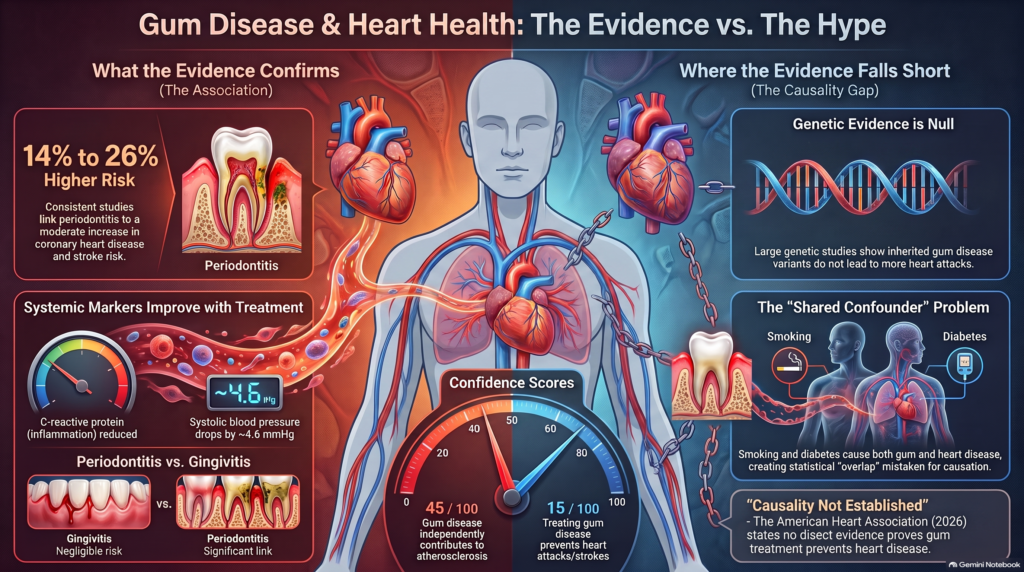
Periodontitis is consistently associated with atherosclerotic cardiovascular disease (ASCVD) across large prospective cohorts, with pooled relative risks converging on 1.14 to 1.26 for coronary heart disease, myocardial infarction, and stroke across independent meta-analyses. The association survives multivariable adjustment, shows dose-response with disease severity and tooth loss, and is supported by coherent mechanisms: transient bacteremia, systemic inflammatory signalling, endothelial dysfunction, and immune cross-reactivity. Randomised trials demonstrate that periodontal therapy reduces C-reactive protein and, in two independent trials at 12 and 24 months, slows carotid intima-media thickening by effects of the same order, approximately 0.02–0.03 mm.
None of this establishes causation. Mendelian randomisation using genetic instruments for periodontitis finds no effect on coronary artery disease, stroke, or subclinical atherosclerosis. The observational literature carries high heterogeneity, predominantly critical risk of bias, and demonstrable publication bias. The detection of periodontal pathogen DNA in atheroma is contradicted by well-conducted negative studies. One randomised trial with cardiovascular endpoints — PREMIERS, in 280 post-stroke patients — produced a hazard ratio of 0.65 (95% CI 0.30–1.38): directionally favourable, statistically inconclusive, and prespecified as non-superior.
This review separates what is known from what is assumed, places periodontal inflammation within the apoB-centred model of atherogenesis, and assigns explicit confidence scores to the two propositions that matter.
1. Defining the oral diseases
Precision here is not pedantry. Most of the confusion in the popular literature comes from treating “gum disease” as a single entity.
Dental plaque is a structured microbial biofilm on the tooth surface. It is not food debris and it is not removed by rinsing. Left undisturbed, it matures and shifts toward a dysbiotic, anaerobe-rich community.
Calculus (tartar) is plaque mineralised by salivary calcium and phosphate. It cannot be removed by brushing and provides a retentive surface for further biofilm accumulation. Calculus is a plaque-retentive factor, not itself the microbial cause of gingival inflammation — a distinction worth preserving.
Gingivitis is reversible inflammation confined to the marginal gingiva, initiated by dental biofilm. Clinical signs are erythema, oedema, and bleeding on probing. No connective tissue attachment has been lost and no bone has been resorbed. In the current classification framework, bleeding on probing at ≥10% of sites defines gingivitis on an intact periodontium, with 10–30% localised and >30% generalised [60]. Gingivitis resolves with adequate biofilm control and is highly prevalent. It does not create new periodontitis-related attachment or bone loss, and it can occur either on an intact periodontium or on one previously reduced but stable after treatment.
The causal relationship between biofilm and gingivitis was established experimentally rather than inferred. Löe, Theilade and Jensen withdrew oral hygiene in healthy volunteers, observed plaque accumulation and gingival inflammation develop, then reinstituted hygiene and observed resolution [33]. This within-subject withdrawal-and-reinstitution design is as close to an experimental demonstration of causation as oral disease research offers, and it is the reason biofilm is described as a cause rather than an association. Note precisely what it establishes: plaque causes gingivitis. It does not by itself establish that plaque causes periodontitis, which requires host susceptibility and time in addition to biofilm.
Periodontitis is a destructive inflammatory disease that can develop in susceptible individuals. The inflammatory infiltrate extends apically, the junctional epithelium migrates, and connective tissue attachment and alveolar bone are lost. The 2018 classification defines a case by interdental clinical attachment loss at two or more non-adjacent teeth, or alternatively by buccal/oral attachment loss of ≥3 mm with pocketing >3 mm at two or more teeth, in each case after excluding non-periodontal causes such as recession, caries, and root fracture. It stages periodontitis by severity and complexity (I–IV) and grades it by rate of progression and risk factors (A–C), with smoking and glycaemic control explicitly incorporated as grade modifiers [59].
Periodontal pockets are the pathologically deepened sulci created by attachment loss. They are the anatomical feature of greatest systemic interest: inflamed, frequently ulcerated pocket epithelium overlies a richly vascularised connective tissue bed, an interface across which bacteria and bacterial products can enter the circulation.
Clinical attachment loss (CAL) is the reference measure of cumulative destruction. Alveolar bone loss is its radiographic correlate.
Bleeding on probing (BOP) indicates active inflammation. It is the standard clinical sign of gingival inflammation, and repeated absence of bleeding at a site is generally reassuring. An important exception: smoking suppresses gingival bleeding through vasoconstriction and altered immune response, so absence of visible bleeding in a smoker does not indicate periodontal health.
Tooth loss is a downstream marker of advanced disease, but a contaminated one. Teeth are lost to caries, trauma, and access-driven extraction decisions as well as to periodontitis. Cohorts that use tooth count as a periodontitis proxy are measuring something broader than periodontal destruction, and this weakens a substantial fraction of the epidemiological literature.
Why periodontitis dominates the cardiovascular literature. Three reasons. Gingivitis is highly prevalent, which limits its discriminative value in a cohort study. Gingivitis produces a small ulcerated surface area, so the plausible systemic inflammatory load is low. And gingivitis is transient and fluctuating, so it does not represent the sustained decades-long exposure that atherogenesis would require. Not everyone with gingivitis progresses; progression requires the interaction of dysbiotic biofilm, host susceptibility, dysregulated immune response, environmental exposure, and time.
2. Causes and risk factors for periodontal disease
Distinguishing causes from associations is essential, because the confounding structure of the cardiovascular question depends entirely on it.
| Factor | Role | Strength and interpretation |
| Dysbiotic dental biofilm | Initiating cause of plaque-induced gingivitis; necessary component of periodontitis pathogenesis | Causal. Experimental withdrawal/reinstitution evidence [33]; necessary but not sufficient |
| Inadequate plaque control | Increases biofilm accumulation and maturation | Causal exposure. Directly modifiable; improvement reverses gingivitis |
| Smoking | Strong risk and progression modifier; impairs neutrophil function, reduces gingival blood flow, worsens treatment response, masks bleeding | Causal. Dose-related; incorporated into periodontal grading. Also a strong independent cause of ASCVD — the central confounder |
| Diabetes / glycaemic control | Strong susceptibility and progression modifier; bidirectional | Causal. Explicit grading modifier. Cochrane finds moderate-certainty evidence that periodontal therapy improves HbA1c |
| Host inflammatory response | Tissue destruction is predominantly host-mediated (MMPs, RANKL-driven osteoclast activation) | Causal mechanism. Hyper-responsive phenotypes progress faster |
| Age | Strong risk indicator | Mostly not an independent biological cause. Reflects cumulative exposure, immunosenescence, comorbidity, and lifetime opportunity for attachment loss |
| Genetics | Modifies susceptibility | Partial. Periodontitis has a heritable component, but estimates vary widely by design and known variants explain only a minority of susceptibility. GWAS loci individually explain little variance — a limitation that becomes decisive in Section 4.6 |
| Obesity / metabolic dysfunction | Associated inflammatory-metabolic modifier | Probable contributor. Observational evidence substantial; some Mendelian randomisation supports causal effects of adiposity traits |
| Medications | Gingival enlargement (phenytoin, ciclosporin, some calcium channel blockers); xerostomia from many drug classes | Indirect. Complicates plaque control rather than causing periodontitis |
| Dry mouth / hyposalivation | Removes a major protective mechanism | Indirect modifier. From medication, radiotherapy, Sjögren disease, diabetes |
| Diet and nutrition | Refined carbohydrate supports dysbiotic biofilm; severe vitamin C deficiency directly impairs gingival collagen | Weak relative to biofilm, smoking, and glycaemic control |
| Socioeconomic status and healthcare access | Powerful determinant of exposure and treatment | Mostly not a biological cause — a determinant of biofilm control, professional care, smoking, diet. Independently associated with ASCVD. Difficult to capture fully with conventional variables such as income and education |
The confounding structure
Smoking, diabetes, obesity, age, socioeconomic position, and healthcare access each cause or strongly predict both periodontitis and ASCVD. This is not incidental overlap; it is the dominant feature of the data. Any observed periodontitis–ASCVD association of the magnitude actually reported must be interpreted against a confounding structure fully capable of generating it.
3. Association with cardiovascular disease
Pooled estimates
Three independent meta-analyses using different study sets and methods converge on a narrow band of effect:
| Source | Studies / participants | Outcome | Pooled estimate (95% CI) |
| Larvin 2021 [34] | 32 cohorts (30 pooled) | All CVD | RR 1.20 (1.14–1.26) |
| CHD | RR 1.14 (1.08–1.21) | ||
| Stroke | RR 1.24 (1.12–1.38) | ||
| MI | RR 1.12 (0.96–1.30) — not significant | ||
| Severe periodontal disease | RR 1.25 (1.15–1.35) | ||
| Guo 2023 [5] | 39 cohorts / 4,389,263 | MACE | RR 1.24 (1.15–1.34) |
| CHD | RR 1.20 (1.12–1.29) | ||
| MI | RR 1.14 (1.06–1.22) | ||
| Stroke | RR 1.26 (1.15–1.37) | ||
| Cardiac death | RR 1.42 (1.10–1.84) | ||
| All-cause mortality | RR 1.31 (1.07–1.61) | ||
| Janket 2003 [27] | 9 cohorts | Future CVD | RR 1.19 (1.08–1.32); 1.44 (1.20–1.73) if aged ≤65 |
The convergence across independent analyses is genuine evidence against a purely random association. It is not evidence against shared systematic bias: these syntheses draw on overlapping primary studies, and a bias common to that literature would propagate into all of them alike.
Three qualifications that are routinely omitted and should not be. First, Larvin’s heterogeneity was I² = 97.3% — the pooled point estimate summarises studies that do not agree with one another. Second, of 32 included studies, 21 were rated at critical risk of bias by ROBINS-I and the remaining 11 at serious risk; not one was rated low or moderate. Third, formal testing found significant publication bias (Egger’s β = 2.91, P = .004). A literature with critical risk of bias throughout and demonstrable publication bias, producing a pooled effect of 1.20, is not a literature from which causation can be read off.
Fourth, and separately: Larvin found no difference in CVD risk between clinically diagnosed and self-reported periodontal disease (RR 0.97, 0.87–1.07). The finding is that diagnosis method did not detectably modify the association. One reading is reassuring for the self-report cohorts. Another is less so: if a crude self-reported exposure yields the same estimate as a calibrated clinical examination, the association may be tracking something broader than periodontal destruction — general health literacy, healthcare engagement, or socioeconomic position. The meta-regression cannot distinguish these readings, and neither should be presented as established.
A 2024 umbrella review of systematic reviews concluded that the association is consistently observed but that methodological heterogeneity across primary studies precludes any causal determination [6]. A 2026 meta-analysis of 30 cohort studies reported HR 1.31 (95% CI 1.13–1.48) [58]; its main pooled exposure deliberately spans a broader periodontal and oral-health category rather than exclusively clinically diagnosed periodontitis, and heterogeneity was substantial, so it should be read alongside Guo and Larvin rather than pooled with them.
Individual cohorts of note
PAROKRANK is a carefully phenotyped case-control study with prospective follow-up [7]. It recruited 805 patients under 75 with a first myocardial infarction and 805 controls matched for age, sex, and geographic area, all examined with standardised dental assessment including panoramic radiography, with approximately 100 candidate confounders collected. Periodontitis was independently associated with first MI. The pre-planned long-term follow-up of 1,587 participants [8] recorded the composite of all-cause mortality, non-fatal MI, non-fatal stroke, and heart failure hospitalisation in 187 of 985 periodontally healthy participants (19%) versus 174 of 602 with periodontitis (29%; P<0.0001). The adjusted hazard ratio was 1.26 (95% CI 1.01–1.57; P=0.038). Two features temper this: the confidence interval’s lower bound touches unity, and adjustment covered only age, smoking, and diabetes — a narrower set than the roughly 100 variables collected at baseline, which leaves more room for residual confounding than the study’s design would have permitted.
SCAPIS (2026) is the most recent large-scale imaging cohort [9]. Among 29,056 Swedish participants, severe periodontitis was present in 6% (n=1,809) and was associated with severe coronary artery calcium score (CACS ≥301, OR 1.69, 95% CI 1.39–2.06) and severe segment involvement score (>4 segments, OR 1.40, 1.17–1.67), with the strongest associations among individuals without concomitant dental caries. Periodontitis was also associated with lower epicardial adipose tissue attenuation on cardiac CT (β = −0.27 HU, −0.48 to −0.05), a radiographic signature of perivascular inflammation, and with a 42% higher risk of incident coronary heart disease (HR 1.42, 1.03–1.97), partially mediated by coronary atherosclerosis.
This is a particularly informative observational design because it integrates dental phenotype, coronary imaging, an inflammatory imaging marker, and incident CHD in one cohort, and the caries-stratified finding argues modestly against pure “poor oral health equals poor general health” confounding. The investigators themselves frame severe periodontitis as a marker of increased coronary risk; the design does not establish that periodontitis caused the imaging abnormalities or the events. The accompanying editorial reaches the same position, treating the mechanistic and causal questions as unresolved [53].
ARIC examined ischaemic stroke by subtype in a clinically examined cohort [35]. Periodontal disease classes were associated with cardioembolic stroke (HR ≈ 2.6, 1.2–5.6) and thrombotic stroke (HR ≈ 2.2, 1.3–3.8) after adjustment for age, sex, race and study centre, BMI, hypertension, diabetes, LDL, smoking status and pack-years, and education. Regular dental care use was associated with lower ischaemic stroke risk (HR ≈ 0.77, 0.63–0.94) — an observational association particularly vulnerable to healthy-user and healthcare-access confounding.
Established cardiovascular disease. A cohort of 1,002 patients with angiographically documented CVD followed 10 years found severe periodontitis associated with recurrent MI, stroke/TIA, or cardiovascular death, adjusted HR 1.26 (1.00–1.58) — a confidence interval whose lower bound touches unity. Brushing more than once daily (HR 0.74, 0.57–0.97) and interdental cleaning (HR 0.71, 0.52–0.99) were associated with fewer recurrences, findings vulnerable to the same healthy-user confounding [36].
Peripheral artery disease has a thinner literature. A nationwide matched Korean cohort reported PAD incidence of 2.40 versus 2.08 per 1,000 person-years in periodontitis versus controls, HR ≈ 1.15 (1.07–1.23) — a small absolute difference.
Mortality. Romandini and colleagues pooled 57 studies covering 48 cohorts and 5.71 million participants, reporting all-cause mortality RR 1.46 (95% CI 1.15–1.85) and cardiovascular mortality RR 1.47 (1.14–1.90) for periodontitis [37]. It is cited in the 2026 AHA statement as a principal mortality reference. Guo’s pooled estimates give cardiac death RR 1.42 (1.10–1.84) and all-cause mortality RR 1.31 (1.07–1.61) [5].
Gingivitis alone
The largest relevant dataset is a Korean national cohort of 3,779,490 individuals free of cardiovascular disease at baseline, followed a median of 10.4 years, in which 17,942 incident cardiovascular events occurred [18]:
- Tooth loss alone: stroke aHR 1.09 (1.04–1.15)
- Gingivitis plus tooth loss: stroke aHR 1.12 (1.04–1.20); CVD aHR 1.08 (1.03–1.14)
- Gingivitis alone: stroke aHR 1.05 (1.01–1.10), and only among those aged ≥50
An aHR of 1.05 restricted to one outcome in one age stratum, from claims-based exposure definition, is at the threshold of detectability and well within residual confounding. Using “gingivitis” and “periodontitis” interchangeably in cardiovascular discussion is not a simplification; it is an error.
How much could be confounding?
The pooled effect is roughly a 20% relative increase. In a population with 10% baseline ten-year ASCVD risk, that is about 2 absolute percentage points — approximately 20 excess events per 1,000 people over ten years, if the association were entirely causal.
The exposed group is enriched for current smoking, poor glycaemic control, obesity, lower income, lower educational attainment, and reduced healthcare contact. Multivariable adjustment addresses the measured portion of each. It does not address:
- Measurement error in confounders. Smoking is typically coded never/former/current. Pack-years, intensity, and time since quitting are usually unavailable. Given how imperfectly lifetime smoking exposure is captured, residual confounding by smoking could materially account for an association of this magnitude.
- Unmeasured dimensions of socioeconomic position. Neighbourhood deprivation, food environment, occupational exposure, chronic psychosocial stress, healthcare continuity.
- Reverse causation and shared frailty. Systemic illness impairs oral hygiene capacity; declining health precedes both tooth loss and cardiac events.
- Healthy-user bias. People who attend dental appointments also take medications as prescribed and attend cardiology follow-up.
Janket’s meta-regression estimated that residual confounding inflated the pooled estimate by approximately 12.9%, while use of periodontal proxies deflated it by 29.7% [27]. These are model-dependent estimates from a 2003 analysis, illustrative of direction rather than definitive.
A more revealing observation comes from FINRISK. In a prospective analysis, elevated antibody response to periodontal pathogens predicted incident CVD (reported HR 1.87, 1.13–3.08), but most associations attenuated to non-significance when serum lipids entered the model; only the endotoxin/HDL ratio remained independently predictive [38]. Periodontal inflammatory exposure and lipid biology are statistically entangled to a degree that should caution anyone treating them as separable risk channels.
Honest summary: an effect of this size is within the range that the known confounding structure could plausibly produce. That does not mean it is confounding. It means the observational studies conducted to date cannot distinguish the two possibilities. Better observational work — negative-control outcomes, repeated exposure measurement, quantitative bias analysis, triangulation across designs — could meaningfully strengthen or weaken the inference, but no observational design can settle it on its own.
4. Could periodontal disease actually worsen atherosclerosis?
4.1 The hypothesised pathway
Dental biofilm
↓
Gingivitis → [susceptible host + persistent exposure] → Periodontitis
↓
Ulcerated periodontal pocket epithelium
↓ ↓
Transient bacteremia IL-6, TNF-α, CRP
↓ ↓
Innate immune and endothelial activation
↓
Oxidative stress · impaired NO · leukocyte adhesion
↓
ApoB lipoproteins retained in artery wall → PLAQUE → inflammation, progression
↓
Plaque disruption / thrombosis
↓
MI · ischaemic stroke · PAD
Human studies support several components of this pathway, though the individual arrows differ considerably in evidentiary strength. The arrow into the plaque box — the quantitative contribution of periodontal inflammation to human atherogenesis relative to apoB retention — is hypothesised, not measured [1]. That is the whole of the disagreement in this field.
4.2 Systemic inflammation
Periodontitis is associated with modest elevations in CRP, IL-6, and TNF-α. The 2026 AHA statement identifies chronic low-grade systemic inflammation, with elevated CRP, IL-6, and TNF-α and reduced anti-inflammatory mediators such as adiponectin, as the principal indirect mechanism [1].
The interventional evidence quantifies the magnitude, and three independent syntheses agree closely:
| Synthesis | Design | CRP effect |
| Luthra 2023 [14] | Meta-analysis, 19 RCTs at 6 months (26 trials, n=2,579 total) | −0.69 mg/L (−0.97 to −0.40), I²=66% |
| BMC Oral Health 2024 [39] | Meta-analysis, 21 RCTs | −0.63 mg/L (−1.02 to −0.24), I²=66%; GRADE low certainty |
| Umbrella review 2025 [40] | Recalculated random-effects across reviews | −0.58 mg/L (−0.91 to −0.25) |
Convergence on roughly −0.6 mg/L at six months is one of the more reliable quantitative findings in this field. Two caveats matter more than the point estimate. Reductions were greatest in participants with baseline CRP above 3 mg/L. And in the four trials assessing CRP at twelve months or beyond, no pooled treatment effect could be detected [14] — an absence of demonstrated durability in a very small subset, which is not the same as a demonstrated return to baseline.
Is this enough to matter? Two observations argue for caution. First, a reduction of this size is modest in absolute terms, and the relationship between CRP lowering and event reduction is not straightforward: statin outcome benefit tracks closely with apoB and LDL-C reduction, and the independent contribution of the accompanying anti-inflammatory effect remains contested rather than settled. Second, the effect does not persist beyond six months. Atherogenesis operates over decades. This is an inference rather than a demonstrated result, but a biomarker change undetectable at twelve months is a poor candidate for a mechanism that must accumulate over forty years.
The Tonetti trial makes the same point from another angle: between-group CRP differences failed to reach significance at both two months (1.4 mg/L; −1.0 to 1.8) and six months (1.4 mg/L; −1.0 to 2.0), even while vascular function clearly improved [12]. Whatever produced the vascular benefit, it was not detectably CRP.
IL-6 findings generally run in the same direction; TNF-α is more variable. The BMC 2024 meta-analysis found moderate-certainty evidence for IL-6 reduction; no statistically significant pooled reduction was detected for IL-1β or TNF-α, with low certainty for those outcomes [39].
4.3 Bacteremia
Transient bacteremia from the oral cavity is real and well documented. It occurs during dental procedures but far more frequently during ordinary activities — chewing, toothbrushing, flossing — because these happen multiple times daily. In periodontitis, the ulcerated pocket epithelium provides a large, chronically inflamed portal of entry.
Forner and colleagues quantified this directly in humans: bacteremia following scaling was significantly more frequent and of greater magnitude in participants with periodontitis than in those with gingivitis or periodontal health, and the magnitude correlated with gingival inflammation, plaque scores, and bleeding on probing [41].
The 2026 AHA statement describes this as the principal direct mechanism: systemic dissemination of oral pathogens including Porphyromonas gingivalis and Aggregatibacter actinomycetemcomitans, together with virulence factors such as lipopolysaccharide and gingipains, capable of triggering endothelial dysfunction and vascular inflammation [1].
The correct inference is not that brushing is dangerous. It is the reverse: a chronically inflamed, bleeding periodontal surface presents more opportunity for bacterial entry, and maintaining periodontal health reduces that interface. This is also precisely why endocarditis guidance emphasises daily oral health over procedural antibiotics [19].
The counter-argument remains important: transient oral bacteremia occurs in people without periodontitis too — its frequency and magnitude vary by activity and periodontal status — and the great majority of episodes are cleared without consequence.
4.4 Bacteria in atherosclerotic plaque — a genuinely contradictory literature
This is where the field is least honest with itself, and where the two source drafts for this document differed most usefully.
Positive findings. Kozarov and colleagues demonstrated that P. gingivalis and A. actinomycetemcomitans recovered from a carotid plaque homogenate could invade host cells in vitro, indicating viability, although direct culture failed [22]. Haraszthy and colleagues reported periodontal pathogen identification in atheromatous plaques [23].
Negative findings, from studies designed to find it. Aimetti and colleagues examined subgingival plaque and carotid atheromas from patients with advanced chronic periodontitis. All subgingival samples were positive for at least one target organism, with T. forsythia 69.7%, P. gingivalis 63.6%, T. denticola 54.5%, P. intermedia 45.4%, A. actinomycetemcomitans 33.3%. Bacterial DNA was detected in 31 of 33 endarterectomy specimens. None tested positive for periodontal pathogen DNA [42]. That result is not a failure of sensitivity — the assay found abundant bacterial DNA in the same specimens. It found the wrong bacteria.
Cairo and colleagues ran a controlled design with 26 dentate and 26 edentulous patients undergoing carotid endarterectomy. Subgingival samples from dentate test patients showed T. forsythensis 79%, F. nucleatum 63%, P. intermedia 53%, P. gingivalis 37%. No periodontal bacterial DNA was detected in any carotid sample in either group [43].
Fiehn and colleagues set out specifically to determine whether viable oral bacteria could be recovered from atherosclerotic lesions. Culture for the target periodontal organisms was negative, while bacterial DNA was detectable by PCR in the specimens tested [44]. Detection and viability are not the same finding, and this study separates them directly.
Why this does not establish causation. Five reasons, each independently sufficient:
- The literature contradicts itself, and the negative studies are not obviously weaker than the positive ones.
- Detection is not attribution. Bacterial DNA in plaque establishes presence, not aetiological role.
- Reverse colonisation. One alternative interpretation is that detection reflects secondary deposition or colonisation of pre-existing diseased tissue rather than initiation of atherosclerosis: inflamed, neovascularised plaque with disrupted endothelium is a favourable niche.
- Non-specificity and contamination. Bacterial signatures recovered from vascular specimens are not specific to oral organisms, and low-biomass sequencing is critically vulnerable to reagent and laboratory contamination [61]. Contamination controls in this literature vary, and older studies generally predate the methods now considered standard.
- The Chlamydia pneumoniae C. pneumoniae was found in plaque, showed strong seroepidemiological associations, worked in animal models, and generated an entire research programme. Large randomised antibiotic programmes in cardiovascular patients then failed to demonstrate cardiovascular benefit. It is an instructive precedent demonstrating that microbial detection, observational association, and mechanistic plausibility together do not guarantee that targeting the organism yields cardiovascular benefit.
Finding P. gingivalis DNA in an atheroma proves exposure at most. It does not establish colonisation, viability, biological activity, direction of travel, or causal acceleration of atherosclerosis.
4.5 Endothelial dysfunction and vascular structure
Tonetti et al., NEJM 2007 randomised 120 patients with severe periodontitis to intensive periodontal treatment or community-based care [12]. The findings were biphasic and instructive:
- At 24 hours, flow-mediated dilatation was lower in the intensive group (absolute difference 1.4%; 0.5–2.3; P=0.002), with higher CRP, IL-6, soluble E-selectin, and von Willebrand factor. Intensive periodontal treatment causes an acute systemic inflammatory insult and acute endothelial impairment.
- At 60 days, FMD was greater in the intensive group (0.9%; 0.1–1.7; P=0.02).
- At 180 days, the difference was 2.0% (1.2–2.8; P<0.001), correlating with periodontal improvement (r=0.29, P=0.003).
Czesnikiewicz-Guzik et al., EHJ 2019 found FMD improved by approximately 1.7 percentage points at two months in hypertensive patients [11].
Kapellas et al., Hypertension 2014 randomised 273 Aboriginal Australians with periodontitis to full-mouth scaling in a single visit versus no treatment, with 12-month carotid intima-media thickness and 3- and 12-month pulse wave velocity as prespecified primary endpoints [45]. At 12 months, cIMT fell by −0.023 mm (−0.038 to −0.008) in the treatment arm and rose by +0.002 mm (−0.017 to +0.022) in controls; the reported between-group difference was −0.026 mm (−0.048 to −0.003; P=0.03). Pulse wave velocity did not differ. Attrition was substantial — endpoints could be calculated for 169 participants at 3 months and 168 at 12 months out of 273 randomised, i.e. roughly 38% loss.
Orlandi et al., EHJ 2025 randomised 135 participants with periodontitis and no major systemic comorbidity (68 intensive, 67 control) to intensive versus control periodontal treatment, with cIMT at 24 months as the primary outcome [13]. cIMT was lower in the intensive group by 0.023 mm at 24 months (P<0.0001). The between-group difference in change from baseline at 24 months was −0.022 mm (95% CI −0.027 to −0.018), and a post hoc analysis stratifying by median baseline cIMT found a consistent −0.02 mm (−0.03 to −0.02; P<0.0001) in both strata. The between-group FMD difference at 24 months was 2.66 percentage points (2.24–3.09). FMD improved within two months and remained higher throughout. Glycoprotein acetyls, an integrated inflammation marker, were reduced. No between-group differences in blood pressure, pulse wave velocity, anthropometrics, or metabolomic markers.
The convergence is the interesting part. Two independent randomised trials, eleven years apart, in radically different populations (remote Indigenous Australians with high comorbidity burden; healthy urban Londoners), using different treatment protocols and follow-up durations, produced effects of the same order: −0.026 mm at 12 months and approximately −0.02 mm at 24 months. That is either a real and reproducible effect or a coincidence of two small trials. It deserves to be taken seriously.
It also deserves proportionate interpretation. The absolute difference is 23 micrometres. cIMT is an imperfect surrogate with a mixed record in drug development, and cIMT regression has not consistently predicted event reduction. Both trials were open-label with substantial or moderate attrition.
Pooled FMD evidence is weaker than individual trials suggest. The BMC Oral Health 2024 meta-analysis of 21 RCTs found the pooled FMD treatment effect not statistically significant: 1.70% (−1.63 to 5.03, P=0.32, I²=53%), graded low certainty [39]. Lyu’s 14-trial meta-analysis (491 participants) found a strong short-term effect (≤3 months, WMD −3.78, 95% CI −5.49 to −2.07, P<0.0001, in the authors’ sign convention) but a non-significant six-month estimate (WMD −0.96, −2.06 to 0.14, P=0.09) [30]. Orlandi’s individual trial sustained an FMD difference to 24 months [13].
These are reconcilable rather than contradictory, and the reconciliation is informative: the acute-to-subacute FMD response to periodontal therapy is well established; its persistence is not. Individual well-conducted trials with sustained periodontal maintenance show durable improvement; pooled estimates across a heterogeneous literature, in which maintenance and control-arm handling vary widely, do not.
4.6 Immune mechanisms
Several pathways are biologically coherent and partly demonstrated:
- Molecular mimicry. Antibodies against bacterial heat shock protein 60 cross-react with human HSP60 on stressed endothelium. Identified as a plausible mechanism in the 2026 AHA statement [1].
- Innate immune activation. LPS from Gram-negative periodontal pathogens signals through TLR4 on endothelial cells and monocytes.
- Monocyte and macrophage activation, including trained immunity and monocyte priming.
- T cell phenotypes. Reductions in activated CD38+ and immunosenescent CD57+CD28null CD8+ subsets after periodontal therapy [11] — though the investigators themselves noted the changes were modest and did not establish a causal role.
- P. gingivalis proteases degrade complement components and modulate host signalling.
Animal models are frequently deployed as though they settle the question. They do not. P. gingivalis oral inoculation accelerates aortic lesions in hyperlipidaemic ApoE-null mice — a genetically hyperlipidaemic animal, a supraphysiological inoculum, an artificial exposure route, and a lesion morphology that differs from human plaque. This establishes that the pathway is possible. It says nothing quantitative about whether it operates materially in humans.
5. The Mendelian randomisation evidence
This section is separated out because it is decisive, because it is routinely omitted from reviews in this area, and because its omission is the single largest driver of the difference between confident and cautious readings of this literature.
Mendelian randomisation exploits the random assortment of alleles at conception. Genetic variants associated with an exposure are not sorted by income, smoking, diet, or healthcare access — the confounders that dominate the observational periodontal literature. If periodontitis causes ASCVD, genetic liability to periodontitis should associate with ASCVD.
Bell and colleagues conducted a two-sample MR analysis [10]:
- Instruments: five SNPs previously associated with periodontitis in GWAS.
- Outcomes: MEGASTROKE plus de novo UK Biobank analysis for stroke and subtypes (up to 44,221 cases, 739,957 controls); CARDIoGRAMplusC4D plus UK Biobank for coronary artery disease (122,733 cases, 424,528 controls); UK Biobank carotid IMT (n=22,179).
- Results: any stroke OR 99 (0.97–1.02); ischaemic stroke OR 1.00 (0.97–1.03); major stroke subtypes all P>0.4; coronary artery disease OR 1.01 (0.99–1.03); carotid IMT β −0.002 (−0.004 to 0.001).
- Weighted median and MR-Egger sensitivity analyses were concordant.
- The authors concluded that the results do not support treatment of periodontitis to reduce atherosclerotic disease.
Limitations that cut the other way
MR is not infallible here, and an honest reading must state the counter-arguments:
- Weak instruments. The available periodontitis GWAS loci individually explain little phenotypic variance. Weak instruments bias toward the null and widen effective uncertainty beyond the nominal confidence intervals.
- Phenotypic heterogeneity. Periodontitis is environmentally dominated. Genetic liability may capture only a narrow slice of the clinically relevant exposure.
- Lifetime liability versus manifest severe disease. MR estimates the effect of genetic predisposition, not of established stage III–IV periodontitis with a large ulcerated pocket surface.
- The method is not uniformly null in this domain. A separate MR analysis using four periodontitis-linked loci (SIGLEC5, DEFA1A3, MTND1P5, LOC107984137) against ~750,000 UK Biobank and ICBP participants found nominally significant causal associations with systolic blood pressure and pulse pressure [11]. If the instruments were purely uninformative, that signal should not appear either.
How much weight should it carry?
The wider MR literature is not uniformly null
Bell is the largest and best-powered broad-outcome analysis, but it is not the only one, and treating it as the whole of the genetic evidence would be a second kind of overstatement.
- Czesnikiewicz-Guzik 2019 used four periodontitis-linked loci against roughly 750,000 UK Biobank and ICBP participants and found nominally significant causal associations with systolic blood pressure and pulse pressure [11].
- Ma 2023 analysed chronic and aggressive periodontitis against ischaemic stroke and its subtypes using MEGASTROKE data, and reported a causal inference for chronic periodontitis on the cardioembolic subtype specifically, while finding no evidence for aggressive periodontitis or for ischaemic stroke overall [52].
Subtype-specific signals of this kind are common in MR and are frequently not robust: they arise from smaller case counts, they multiply the number of tests performed, and they often fail to replicate across estimators. None of them has been replicated at the scale of the Bell null. But their existence means the accurate summary is “MR is predominantly null for broad ASCVD outcomes, with weaker subtype- and blood-pressure-specific signals that are not consistently robust” — not “genetics says no.”
How much weight should it carry, honestly
An MR with very large outcome datasets returning point estimates of 1.01 and 0.99 with tight intervals is a substantive negative finding for a large, broad causal effect. The precision comes from the outcome side; causal power was constrained by having only five periodontal instruments, which is why small effects remain hard to exclude. It should reduce confidence in the causal hypothesis.
But MR is one causal-inference design among several, not the arbiter. Weak instruments limit how confidently small effects can be excluded, and the non-null subtype findings mean the genetic arm of the evidence is best described as unsupportive rather than refutatory. The reasonable position: MR does not refute a causal contribution; it removes the strongest argument that observational epidemiology alone could ever have provided for one.
6. Placing periodontitis within the apoB framework
The causal core of atherosclerosis
Atherosclerosis is initiated and driven by the retention of apolipoprotein B-containing lipoproteins within the arterial intima. Each atherogenic particle — LDL, VLDL remnants, IDL, Lp(a) — carries exactly one apoB molecule (apoB100 in the hepatic particles that dominate human atherogenesis; apoB48 marks intestinally derived chylomicron remnants), making apoB a direct count of atherogenic particles. The causal evidence is as strong as anything in medicine: consistent observational epidemiology, Mendelian randomisation across dozens of independent lipid-lowering loci with effects proportional to magnitude and duration of exposure, and randomised outcome trials across mechanistically distinct drug classes — statins, ezetimibe, PCSK9 inhibitors, bempedoic acid — delivering event reduction proportional to absolute apoB or LDL-C reduction. Current guidance treats LDL and other apoB-containing lipoproteins as direct causes of ASCVD and makes lipoprotein lowering a central prevention target; the 2026 ACC/AHA multisociety dyslipidemia guideline sets present-day US treatment priorities [62], with European guidance in [46].
Inflammation is a genuine modifier of this process. CANTOS demonstrated that IL-1β inhibition reduces cardiovascular events without altering lipids, establishing that residual inflammatory risk is real and modifiable. But the ordering matters: retention of apoB-containing lipoproteins in the arterial wall is the necessary central process in conventional human atherogenesis, while inflammatory pathways modify lesion initiation, progression, and complication.
Which of the four framings applies?
(1) An independent causal risk factor. Not supported by the available evidence. The principal evidence against is the null MR result (Section 5). Established causal risk factors — LDL-C, Lp(a), blood pressure — generally show clear MR signals; periodontitis does not. This comparison should be read with the caveat developed in Section 5: MR signal strength depends on instrument quality, and the periodontitis instruments are weak. MR is a causal-inference tool, not a binary causal detector.
(2) A risk modifier amplifying apoB-driven disease. Plausible and not excluded. This is the framing most consistent with the totality of the evidence: periodontitis contributes to a chronic inflammatory milieu that could accelerate an apoB-initiated process without being able to initiate it. Two independent cIMT trials, the SCAPIS epicardial adipose findings, and the durable FMD effects in Orlandi all fit this model. The effect size, if real, is likely small.
(3) Primarily a marker of other risk factors. Strongly supported by the confounding structure, by the null MR, by the publication bias in the observational literature, and by the striking finding that self-reported and clinically diagnosed periodontal disease produce identical effect estimates.
(4) Some combination. This is the most defensible reading. Current evidence is most consistent with periodontitis being a marker of shared cardiovascular risk and possibly a modest risk modifier in severe disease; the relative contribution of these two explanations has not been measured, and framings that assign proportions to them go beyond the data. What the evidence does not support is periodontitis as an independent causal factor of consequential magnitude.
The FINRISK observation — that periodontal-pathogen associations with CVD largely dissolved on lipid adjustment [38] — is a warning against treating periodontal inflammation as a competing explanation for lipid-mediated atherosclerosis.
Magnitude comparison
| Risk factor | Approximate effect on ASCVD risk | Evidence grade |
| ApoB / LDL-C (lifetime exposure) | Several-fold across the exposure range; ~20–25% relative risk reduction per 1 mmol/L LDL-C lowering over ~5 years | RCT + MR, causal |
| Current smoking | ~2–3× | Cohort + cessation trials, causal |
| Hypertension | ~25–30% event reduction per 10 mmHg SBP | RCT, causal |
| Diabetes | ~2× | Cohort + MR, causal |
| Age | Dominant single determinant | Universal |
| Periodontitis | ~1.14–1.26 relative risk | Cohort only (high bias, publication bias); MR null; one inconclusive event RCT |
The metrics in this table are not measured on a common scale — lifetime exposure ratios, trial-derived relative risk reductions, and observational disease associations are not directly comparable, and the table is illustrative rather than a ranking. What it does show is that the observed periodontal association is substantially smaller than those of the established major risk factors, and that its causal standing is considerably less secure.
What follows for practice
Periodontal treatment is not a substitute for lipid lowering, blood pressure control, smoking cessation, glycaemic management, or physical activity. Improving periodontal health should not be treated as a substitute for managing a substantially elevated atherogenic lipoprotein burden.
7. Does treating periodontal disease improve cardiovascular biology?
Yes, for several intermediate measures — with more disagreement between syntheses than is usually acknowledged.
| Outcome | Best evidence | Effect | Comment |
| CRP | Three independent meta-analyses [14,39,40] | −0.58 to −0.69 mg/L at 6 months | No effect at ≥12 months [14]. GRADE certainty low to moderate |
| IL-6 | Meta-analysis, 21 RCTs [39] | Significant reduction, moderate certainty | Most robust cytokine finding |
| IL-1β, TNF-α | Meta-analysis, 21 RCTs [39] | No significant pooled reduction; low certainty | Absence of a detected effect, not evidence of no effect |
| Flow-mediated dilatation | RCTs [12,13]; meta-analyses [30,39] | +2.0% at 180 days [12]; sustained to 24 months [13]; Lyu short-term significant, six-month WMD −0.96 (−2.06 to 0.14), NS [30]; pooled 1.70% (−1.63 to 5.03), NS [39] | Acute-to-subacute effect established; persistence not |
| Blood pressure | Gandhi 2026 meta, 12 RCTs [54]; also [11,39,47,13] | SBP −4.64 mmHg (−5.99 to −3.30); DBP −1.84 (−2.65 to −1.02) [54]. Earlier: −11.1 mmHg [11]; pooled −7.85 (−12.77 to −2.94) [39]; pooled −4.3 (−9.10 to 0.48) NS [47]; null [13] | Probable modest reduction, moderate-to-low certainty; magnitude uncertain |
| Glycaemic control | Cochrane | Moderate-certainty HbA1c improvement in diabetes | Best-supported systemic effect |
| Lipids | Meta-analysis [39]; umbrella [40] | No effect on LDL, HDL, TC, TG (moderate certainty) [39]; LDL −0.10 mmol/L, HDL +0.03 [40] | Clinically trivial; not a lipid therapy |
| Arterial stiffness (PWV) | RCTs [13,45] | No difference in either trial | Consistently null |
| Carotid IMT | Two RCTs [45,13] | −0.026 mm at 12 months; −0.023 mm at 24 months | Reproducible across independent trials |
| Aortic vascular inflammation (FDG-PET) | RCT in PAD, n=90 [48] | No effect, P=0.75 | Important negative mechanistic trial |
| Cardiovascular events | PREMIERS [15]; Cochrane [16] | HR 0.65 (0.30–1.38), NS | See Section 8 |
Blood pressure: the picture changed in 2026
Gandhi and colleagues pooled 12 randomised trials and found periodontal therapy reduced systolic blood pressure by 4.64 mmHg (95% CI −5.99 to −3.30) and diastolic by 1.84 mmHg (−2.65 to −1.02), with CRP −0.58 mg/L (−0.83 to −0.33) [54]. The authors graded certainty as moderate to low and called for trials powered specifically for blood-pressure endpoints.
This is the best available pooled randomised estimate and it changes the assessment: the BP evidence is better described as a probable modest reduction of uncertain magnitude than as unresolved. It remains a surrogate. Nothing about it speaks to events.
The individual trial estimates still deserve scrutiny
The 11.1 mmHg ambulatory systolic difference reported by Czesnikiewicz-Guzik and colleagues [11] is, on its face, larger than most single antihypertensive agents. Caveats:
- 101 patients, single centre, two-month follow-up.
- The between-group difference arose partly from a rise in the control arm, which the investigators could not fully explain.
- The intensive arm had numerically higher baseline 24h BP, creating regression-to-the-mean potential.
- The authors framed the study as proof of concept requiring confirmation.
- Orlandi 2025, with 24-month follow-up, found no between-group blood pressure difference [13].
- Pooled RCT estimates conflict: −7.85 mmHg and significant in one meta-analysis [39]; −4.3 mmHg and non-significant in another [47]. Diastolic pressure was non-significant in both.
Muñoz Aguilera and colleagues found periodontitis associated with hypertension (moderate–severe OR 1.22, 1.10–1.35; severe OR 1.49, 1.09–2.05) and with higher mean blood pressure in cross-sectional comparison (SBP +4.49 mmHg, 2.88–6.11; DBP +2.03 mmHg, 1.25–2.81), with I² of 96–98% [29]. Those two figures describe people with versus without periodontitis in observational data. They are not a treatment effect, and they are easily and frequently mistaken for one.
Surrogate outcomes: the standing caution
Every entry in the table above except the last row is a surrogate. Cardiology’s history with surrogates is poor: CAST (suppressed ventricular ectopy, excess mortality), torcetrapib (raised HDL-C, excess mortality), niacin (favourable lipid panel, no benefit), hormone therapy (favourable lipid panel, excess events), and the anti-Chlamydia antibiotic trials (strong mechanistic case, complete null). A surrogate is a hypothesis about a mechanism, not evidence about an outcome.
The negative FDG-PET trial [48] is worth dwelling on for exactly this reason. Ninety patients with advanced PAD and severe periodontitis were randomised to periodontal therapy plus antibiotics, periodontal therapy alone, or no treatment. Periodontal status improved markedly. Aortic vascular inflammation on ¹⁸F-FDG PET/CT — arguably a more direct measure of the hypothesised mechanism than CRP or cIMT — did not change (target-to-background ratios approximately 1.00, 1.00, and 1.1; P=0.75). Carotid and lower-extremity uptake and systemic biomarkers were likewise unmoved.
8. Does periodontal treatment prevent heart attacks or strokes?
One randomised trial has tested this with clinical endpoints. It did not demonstrate benefit, and it was not large enough to exclude one.
PREMIERS
PREMIERS (Periodontal Treatment to Eliminate Minority Inequality and Rural disparities in Stroke) was a multicentre, open-label, masked-endpoint, adaptive-randomisation phase II trial [15]:
- Population: patients with recent ischaemic stroke or high-risk TIA and moderately severe periodontal disease, enrolled within 90 days of the index event. Eligibility required ≥5 natural teeth, ≥2 interproximal sites with ≥4 mm clinical attachment loss, and ≥2 sites with ≥5 mm probing depth.
- Screening and randomisation: 1,209 stroke/TIA patients screened; 481 met periodontal eligibility; 280 randomised, 140 intensive and 140 standard.
- Primary outcome: composite of death, myocardial infarction, and recurrent stroke at 12 months.
- Result: 11 events (8%) intensive versus 17 (12%) standard. HR 0.65 (95% CI 0.30–1.38). Prespecified conclusion: intensive treatment was non-superior.
- Safety: sepsis 2.1% versus 0.7%; dental bleeding 1.4% versus 0%; infective endocarditis 0.7% versus 0%.
How to read this. A confidence interval from 0.30 to 1.38 is compatible with a 70% risk reduction, no effect, and a 38% increase in risk. The point estimate is encouraging and the trial is the best clinical-endpoint evidence in existence, which says more about the state of the field than about periodontal therapy. A 28-event trial cannot resolve a hypothesised effect of this size; several hundred events would be needed.
The adverse-event profile is worth noting rather than dismissing. One case of infective endocarditis occurred in the intensive arm and none in the standard arm (0.7% versus 0%). A single event cannot establish that treatment caused it or that the procedure carries excess risk, but it is a reminder that intensive periodontal instrumentation is not risk-free — consistent with the acute inflammatory and endothelial insult documented at 24 hours by Tonetti [12].
The Cochrane position
Cochrane has maintained this review since 2014, with updates in 2017, 2019, and 2022. The 2022 update searched to March 2022 — before PREMIERS published — and identified only two eligible trials [16].
For secondary prevention, the sole trial was the PAVE pilot, which randomised 303 participants with established cardiovascular disease — 151 to protocol periodontal therapy and 152 to community care. Events were measured over 6 to 25 months, and only 37 participants had at least one year of follow-up. Cochrane judged the data insufficiently robust for inclusion; all-cause and cardiovascular death were not assessed. High risk of bias with severe attrition. A separate limitation of PAVE deserves emphasis: by six months, 48% of community-care participants had received some preventive or periodontal treatment outside the protocol, contaminating the comparison and biasing toward the null [49].
For primary prevention, the single trial (Lopez 2012) enrolled participants with periodontitis and metabolic syndrome, comparing scaling and root planing plus antibiotics against supragingival scaling. Very low-certainty, inconclusive.
Cochrane’s conclusion: no reliable evidence regarding secondary prevention; very low-certainty inconclusive evidence for primary prevention; further trials needed.
PREMIERS does not overturn this. It adds one underpowered trial in a specific post-stroke population. A future Cochrane update including it will almost certainly reach the same conclusion with slightly narrower uncertainty.
A note on how to count these trials. Three randomised studies have collected cardiovascular events in this literature — PAVE, Lopez 2012, and PREMIERS — and the 2026 AHA statement discusses all three [1]. It is therefore wrong to say the trial has never been attempted. PREMIERS is the only one of the three with a prespecified, adjudicated cardiovascular composite that produced analysable outcome data; PAVE’s was compromised by attrition and control-arm contamination, and Lopez was a primary-prevention trial graded very low certainty. The accurate statement is that no adequately powered cardiovascular-outcome trial has demonstrated benefit — not that none has been attempted.
The AHA position
The 2026 American Heart Association scientific statement, updating the 2012 statement, concluded that despite growing evidence, causality has not been established, and that well-designed longitudinal studies and randomised controlled trials are needed to determine whether periodontal treatment can improve ASCVD outcomes [1]. The AHA’s own summary states plainly that there is no direct evidence of causality or that periodontal therapy will help prevent cardiovascular disease.
The 2012 statement’s language remains accurate: observational studies support an association independent of known confounders but do not support a causative relationship, and although periodontal interventions reduce systemic inflammation and endothelial dysfunction in short-term studies, there is no evidence that they prevent ASCVD or modify its outcomes [2].
The EFP/World Heart Federation consensus [3] and the EFP/WONCA Europe consensus [4] are somewhat more receptive to a contributory biological role and recommend that patients with periodontitis be informed of elevated cardiovascular risk, while likewise acknowledging the gap between mechanistic evidence and outcome trials.
The required statement
Periodontal disease is associated with cardiovascular disease, and treating periodontitis improves periodontal health and several inflammatory, endothelial, and structural vascular surrogates. The single randomised trial with clinical endpoints was directionally favourable but statistically inconclusive. This does not establish that periodontal treatment prevents heart attacks, strokes, or cardiovascular death.
What trial would be required?
- Population: Adults with stage III–IV periodontitis and elevated ASCVD risk. A secondary-prevention population maximises event rate and shortens the trial, at some cost to generalisability.
- Intervention: Protocolised step 1–3 periodontal therapy with structured maintenance, targeting and verifying a defined periodontal endpoint (e.g. no pockets ≥5 mm with bleeding), with documented separation between arms maintained across follow-up.
- Comparator: Not “no treatment” — unethical given proven oral-health benefit. Realistically delayed or minimal therapy, which attenuates the contrast and inflates required sample size. PAVE’s contamination problem must be actively managed, not merely reported.
- Primary endpoint: Blinded adjudicated MACE — cardiovascular death, non-fatal MI, non-fatal stroke.
- Sample size: With a control event rate of roughly 3% per year and a hypothesised 15% relative risk reduction, approximately 800–1,000 events are required, implying on the order of 10,000–15,000 participants over 4–5 years. PREMIERS accrued 28 events. (Order-of-magnitude estimate, not a published power analysis.)
- Duration: Minimum 4–5 years, with the caveat that if the mechanism operates over decades, even 5 years may be too short.
- Prespecified secondaries: cIMT, FMD, inflammatory biomarkers, microbiology, and — critically — apoB, blood pressure, HbA1c, smoking status, and medication adherence, so that changes in established risk factors cannot masquerade as a periodontal treatment effect.
Feasibility problems: participant and operator blinding is impossible; adherence to periodontal maintenance decays; ethical constraints limit achievable contrast; and funding is difficult, because the intervention is a generic dental procedure without an obvious commercial sponsor.
9. Gingivitis versus periodontitis
The two are not interchangeable and should never be used as synonyms.
Periodontitis carries the association. Every major cohort, case-control study, and consensus statement discussed above concerns periodontitis, usually moderate-to-severe or stage III–IV, defined by attachment loss, pocket depth, or radiographic bone loss.
Gingivitis has thin and weak supporting data. In the 3.78-million-person Korean cohort [18], gingivitis alone in those aged ≥50 was associated with angina (aHR 1.05, 1.01–1.10), stroke (1.05, 1.01–1.10), and composite CVD (1.05, 1.02–1.09) — three outcomes all at the same trivial magnitude, in one age stratum, from a binary claims-based exposure that could not capture severity. The myocardial infarction association was non-significant except above age 50. Subgroup analyses in that cohort reported stronger associations among smokers; whether never-smokers showed any elevated risk should be read from the primary subgroup table before being asserted. Some cross-sectional work reports associations between gingival inflammation indices and ASCVD, occasionally with large odds ratios; cross-sectional designs cannot establish temporality and are particularly vulnerable to reverse causation and detection bias. These should not be weighted alongside prospective data.
There is also a biological argument, not merely a statistical one. Gingivitis lacks the deep pathological pocket burden characteristic of established periodontitis, which is the hypothesised portal of entry, and Forner’s data show bacteremia after instrumentation is substantially lower in gingivitis than in periodontitis [41]. If the mechanism is bacteremia and sustained inflammatory burden, gingivitis should not produce the effect — and it appears not to.
Dose-response
Dose-response is present:
- PAROKRANK stratified by remaining alveolar bone height (healthy ≥80%, mild/moderate 79–66%, severe <66%) and found a graded increase in cardiovascular risk [7,8].
- Larvin found severe periodontal disease (RR 1.25) exceeded overall periodontal disease (RR 1.20) [34].
- SCAPIS found severe periodontitis associated with subclinical coronary atherosclerosis, most evident without concomitant caries [9].
- Tooth count shows graded associations with CHD across multiple cohorts.
- Janket found a stronger association in those aged ≤65 (RR 1.44) than overall (RR 1.19) [27].
- The Korean cohort found gingivitis alone < gingivitis plus tooth loss [18].
Interpretive caution: dose-response is also exactly what confounding by a graded confounder produces. Periodontitis severity correlates with smoking intensity and duration, with duration of poor glycaemic control, and with depth of socioeconomic disadvantage — each with its own dose-response relationship to ASCVD. Gradient is consistent with causation; it is not diagnostic of it.
10. Infective endocarditis is a different question
This section exists because the two issues are routinely conflated, and conflating them produces bad advice in both directions.
Atherosclerotic cardiovascular disease is a lipid-driven inflammatory arterial wall disease initiated by apoB retention. Bacteria are, at most, a modifying influence — and, as this review argues, probably a minor one.
Infective endocarditis is a genuine bacterial infection of endocardial surfaces, most often a native or prosthetic valve. Viridans group streptococci from the oral cavity are classic causative organisms in a subset of cases; infective endocarditis also has many non-oral bacterial causes, staphylococci prominent among them. Where oral streptococci are the organism, they are the direct and proven cause. The two are etiologically and clinically distinct problems with different causal frameworks and different prevention strategies, and they should not be conflated.
Current guidance
The 2021 AHA scientific statement reviewed evidence since 2007 and concluded no changes to the 2007 recommendations were warranted [19]:
- Antibiotic prophylaxis before dental procedures may prevent an extremely small number of viridans group streptococcal endocarditis cases.
- Prophylaxis is suggested only for the four highest-risk categories: prosthetic cardiac valves or prosthetic material used for valve repair; previous infective endocarditis; specified unrepaired or residually abnormal congenital heart disease; and cardiac transplant recipients with valvulopathy.
- It applies to dental procedures involving manipulation of gingival tissue or the periapical region, or perforation of oral mucosa.
- It is not recommended for ordinary coronary artery disease, prior MI, coronary stents, hypertension, or the general population.
- Endocarditis is more likely to arise from routine chewing and toothbrushing than from dental procedures.
- Maintaining good oral health and regular dental care are more important for prevention than antibiotic prophylaxis. Regular professional dental follow-up is advised, with frequency set by the patient’s risk category under the applicable guideline rather than a single universal interval.
- Clindamycin was removed as the preferred penicillin-allergy alternative because of its adverse-reaction profile.
- If a patient requiring prophylaxis is already on an antibiotic, an agent from a different class should be selected.
- Shared decision-making is recommended where clinician and patient disagree.
International guidance differs in emphasis rather than in principle. NICE states that antibiotic prophylaxis against infective endocarditis is not recommended routinely for people undergoing dental procedures [63], while the 2023 ESC guidelines recommend it for patients at highest risk undergoing at-risk dental procedures [64]. Readers outside the United States should follow local guidance.
Routine antibiotic prophylaxis is not appropriate for the general population. It does not prevent atherosclerosis, carries risks of anaphylaxis, C. difficile infection, and resistance selection, and has no rationale outside the defined high-risk cardiac categories.
11. Practical oral health recommendations
Interventions below are graded on two separate axes: evidence for oral health and evidence for cardiovascular outcomes. These are not the same axis, and conflating them is the central error this article exists to correct.
Core measures
Brushing. Twice daily, two minutes, fluoride toothpaste, soft-bristled brush. For manual brushing, angling the bristles toward the gum margin at roughly 45 degrees with short strokes is the conventional technique; powered brushes have their own manufacturer-specified technique and this rule does not transfer to them. In either case, do not scrub hard — excessive force and traumatic technique contribute to gingival recession and cervical tooth-surface loss without improving plaque removal. Oral health: strong. Cardiovascular outcomes: not established.
Interdental cleaning. Daily. A toothbrush cleans interproximal surfaces incompletely, and those sites are important plaque-retentive locations and common sites of periodontal breakdown. Oral health: low-certainty positive. Cardiovascular outcomes: not established.
Professional examination and cleaning. Risk-based recall rather than a uniform interval. Higher-risk patients (smokers, diabetes, periodontitis history) need more frequent recall; low-risk patients may safely need less. Oral health: standard of care. Cardiovascular outcomes: observational association only.
Recognising bleeding gums. Bleeding on brushing or interdental cleaning is not normal and is not a sign of cleaning too vigorously. It is a sign of gingival inflammation. Transient bleeding on resuming interdental cleaning after a lapse typically settles within one to two weeks of consistent technique. Bleeding that persists or recurs despite effective plaque control, or that occurs spontaneously, warrants dental evaluation (the commonly quoted one-to-two-week settling period is practical guidance rather than a validated threshold) — as do recession, tooth mobility, persistent halitosis, or a change in bite. Anticoagulated patients should not assume bleeding is simply their medication. Smokers should not take absent bleeding as reassurance: tobacco blunts the gingival inflammatory response and can mask substantial disease.
Periodontal evaluation is appropriate for persistent bleeding, visible recession, pockets identified at screening, tooth mobility, unexplained tooth loss, or a diagnosis of diabetes. It is also reasonable before major cardiac surgery, especially valve surgery, on endocarditis grounds.
Smoking cessation. One of the highest-value interventions available for both periodontal and cardiovascular outcomes, and the only item on this list that scores at the top of both axes.
Diabetes control. Bidirectional benefit. Cochrane found moderate-certainty evidence that periodontal therapy lowers HbA1c by approximately 0.43 percentage points at 3–4 months and 0.30 points at 6 months in people with diabetes; glycaemic control in turn improves periodontal outcomes.
Devices and adjuncts
Powered versus manual toothbrushes. Cochrane found moderate-quality evidence that powered brushes reduce plaque more than manual in the short term (SMD −0.50; −0.70 to −0.31) and gingivitis in both the short term (SMD −0.43; −0.60 to −0.25; 44 trials, n=3,345) and long term (SMD −0.21; −0.31 to −0.12) [20]. Rotation-oscillation designs have the largest evidence base. Heterogeneity was high (I² 83–86%) and Cochrane explicitly noted the clinical importance remains unclear. Earlier summaries quantified the rotating-oscillating advantage as roughly 7% for plaque and 17% for gingivitis. Verdict: modestly better; optional, not mandatory. An oral-hygiene benefit, not a cardiovascular one.
Interdental brushes versus floss. The 2019 Cochrane review of 35 RCTs (n=3,929) concluded that floss or interdental brushes added to toothbrushing may reduce gingivitis or plaque more than brushing alone, and that interdental brushes may be more effective than floss [21]. Low-certainty evidence suggested interdental brushes reduce gingivitis more than floss at one and three months, with no difference in probing pocket depth. Flossing added to brushing reduced gingival index at one month (SMD −0.58; −1.12 to −0.04). Cochrane’s caveats matter: most participants had low baseline gingival inflammation, outcomes were short-term, no trial assessed interproximal caries, most did not assess periodontitis, and the observed effect sizes may not be clinically important. Verdict: interdental brushes where the embrasure accommodates them; floss where it does not. The best device is the one the person will actually use correctly.
Water flossers (oral irrigators). Cochrane found low- to very low-certainty and inconsistent evidence [21]. Reasonable for patients with fixed appliances, implants, bridgework, or dexterity limitations. Verdict: not proven superior; reasonable where conventional methods are difficult.
Antiseptic mouthwash and chlorhexidine. Chlorhexidine is effective for short-term plaque and gingivitis control. A systematic review of chlorhexidine mouthrinse in gingivitis patients reported roughly a third less plaque and about a quarter less gingivitis versus control, with significantly increased tooth, tongue, and restoration staining [56]; Cochrane reaches the same qualitative conclusion [50]. In the United States it is prescription therapy. Guidelines support short-term, indication-specific adjunctive use.
There is a specific cardiovascular caveat. The enterosalivary nitrate–nitrite–nitric oxide pathway depends on nitrate-reducing bacteria on the dorsal tongue. Dietary nitrate is concentrated in saliva, reduced to nitrite by these commensals, and subsequently to nitric oxide — a physiologically meaningful contributor to vascular tone. Antiseptic mouthwash disrupts this:
- In 19 healthy volunteers, one week of twice-daily antibacterial mouthwash reduced oral nitrite production by roughly 90% and plasma nitrite by about 25%, with a blood pressure rise on the order of 2–3.5 mmHg [24].
- In a 15-participant crossover study, three days of twice-daily antibacterial mouthrinse in treated hypertensive adults blunted oral nitrate reduction and raised systolic blood pressure by approximately 2.3 mmHg [25].
- In a longitudinal cohort of overweight adults (540 analysed), twice-daily over-the-counter mouthwash use at baseline was associated with increased incident hypertension risk over three years [26].
- One week of twice-daily chlorhexidine in healthy normotensive oral health professionals was associated with a significant rise in resting systolic blood pressure, with recovery on discontinuation accompanied by re-enrichment of nitrate-reducing tongue bacteria.
These are small studies with short follow-up, one observational cohort, and no hard-outcome data. The direction is consistent and the mechanism is specific, but the evidence does not support a clinical claim of harm. The long-term cardiovascular effects of routine antiseptic mouthwash remain uncertain; chronic use should have a dental indication rather than being assumed either beneficial or inconsequential.
Oral probiotics. A meta-analysis of 24 RCTs found small short-term adjunctive gains — clinical attachment gain of 0.20 mm (95% CI 0.09–0.31) and pocket-depth reduction of 0.31 mm (0.10–0.52) at three months, with no significant advantage at six months [57]. Results are strain- and protocol-specific and remain heterogeneous, and further randomised trials have continued to appear; a blanket dismissal is not warranted. What is warranted: probiotics should not replace mechanical plaque control or professional therapy, durable periodontal benefit is not established, and no randomised evidence demonstrates cardiovascular benefit.
The honest summary of Section 11
Every intervention above with credible supporting evidence has that evidence for oral health outcomes. No dental intervention on this list has demonstrated cardiovascular event reduction. Smoking cessation and evidence-based diabetes management are exceptions only in the sense that they are established cardiovascular interventions in their own right, quite apart from anything they do for the gums. Recommend them for teeth and gums. That is a sufficient reason.
12. Evidence hierarchy applied
| Tier | Evidence type | What exists here |
| 1 | RCTs with cardiovascular clinical outcomes | One underpowered trial. PREMIERS: HR 0.65 (0.30–1.38), non-superior [15]. PAVE unusable [16,49] |
| 2 | RCTs of vascular or inflammatory surrogates | Substantial, mostly positive, internally inconsistent: CRP [14,39,40], FMD [12,13,30 vs 39], cIMT [45,13], BP [11,39 vs 47,13], FDG-PET null [48] |
| 3 | Mendelian randomisation | Null for CAD, stroke, carotid IMT [10]; weak unreplicated signals for blood pressure [11] and cardioembolic stroke subtype [52] |
| 4 | Prospective cohorts | Large, consistent, positive — but critical risk of bias throughout [7,8,9,16,34,35] |
| 5 | Systematic reviews of observational studies | Convergent RR 1.14–1.26 [5,27,34]; I² up to 97%; significant publication bias [34] |
| 6 | Mechanistic human studies | Bacteremia demonstrated [41]; plaque bacterial DNA contradictory [22,23 vs 42,43,44] |
| 7 | Animal studies | P. gingivalis accelerates lesions in ApoE-null mice |
| 8 | Cell and in vitro | Endothelial invasion, TLR signalling, gingipain activity |
Two observations about this table.
First, causal triangulation across tiers is discordant rather than convergent. For exposures that turned out to be genuinely causal — LDL-C, blood pressure, smoking — genetic and randomised evidence converged with and reinforced the observational signal. Here the tiers do not agree: the observational signal is positive, the surrogate trials are largely positive but internally inconsistent, the genetic evidence is null (with weak instruments), and clinical-outcome evidence is absent rather than negative. The correct summary is insufficient and discordant triangulation, not a refuted hypothesis.
Second, the field’s most-cited findings sit at tiers 6–8, and the tier-6 evidence is internally contradictory. Animal and in vitro findings are frequently deployed as though they settle the question. They establish that the pathway is possible. They say nothing quantitative about human cardiovascular events.
13. Final evidence table
| Claim | Best evidence | Study type | Effect size | Confidence | Causation established? |
| Periodontitis is associated with coronary disease | Larvin [34]; Guo [5]; PAROKRANK [7,8]; SCAPIS [9] | Meta-analyses of cohorts | CHD RR 1.14 (1.08–1.21) and 1.20 (1.12–1.29) | Moderate–high for association; downgraded for critical risk of bias and publication bias | No |
| Periodontitis is associated with myocardial infarction | Larvin [34]; Guo [5] | Meta-analyses | RR 1.12 (0.96–1.30), NS [34]; RR 1.14 (1.06–1.22) [5] | Moderate — syntheses disagree on significance | No |
| Periodontitis is associated with stroke | Larvin [34]; Guo [5]; ARIC [35] | Meta-analyses + cohort | RR 1.24 (1.12–1.38); 1.26 (1.15–1.37); ARIC subtype HRs ~2.2–2.6 | Moderate–high for association | No |
| Periodontitis is associated with peripheral artery disease | Nationwide matched cohort | Observational | HR ~1.15 (1.07–1.23) | Low–moderate | No |
| Periodontitis is associated with cardiovascular and all-cause mortality | Guo [5]; Romandini [37] | Meta-analyses | Cardiac death RR 1.42 (1.10–1.84); all-cause 1.31 (1.07–1.61) | Moderate | No |
| Gingivitis alone is associated with cardiovascular disease | Lee 2024 [18] | Cohort, n=3.78M, median 10.4y | Stroke aHR 1.05 (1.01–1.10), age ≥50 only | Low | No |
| Genetic liability to periodontitis causes CAD or stroke | Bell 2020 [10]; Ma 2023 [52]; Czesnikiewicz-Guzik 2019 [11] | Two-sample MR | CAD OR 1.01 (0.99–1.03); stroke 0.99 (0.97–1.02); cIMT β −0.002 [10]. Subtype signal for cardioembolic stroke [52] and for BP [11], neither replicated at scale | Moderate evidence against a large broad effect; small effects not excluded | Unsupportive, not refutatory |
| Periodontitis contributes to transient bacteremia | Forner 2006 [41] | Mechanistic human | Bacteremia frequency and magnitude after scaling significantly greater in periodontitis than gingivitis or health | High | Yes, for bacteremia |
| Periodontal pathogens consistently inhabit atherosclerotic plaque | [22,23] vs [42,43,44] | Mechanistic human | Positive and complete-negative studies coexist; negatives detected abundant non-periodontal bacterial DNA in the same specimens | Low / inconsistent | No |
| Periodontitis increases systemic inflammatory markers | [1,14,39] | RCT meta-analyses + prospective | Treatment lowers CRP ~0.6 mg/L; IL-6 moderate certainty | Moderate | Yes, for the biomarker relationship |
| Periodontal treatment lowers CRP | [14,39,40] | Three meta-analyses | −0.58 to −0.69 mg/L at 6 months | Moderate | Yes at 6 months; null at ≥12 months |
| Periodontal treatment improves endothelial function | [12,13,30,39] | RCTs + two meta-analyses | +2.0% at 180 days [12]; sustained to 24 months [13]; Lyu six-month WMD −0.96 (−2.06 to 0.14) NS [30]; pooled 1.70% (−1.63 to 5.03) NS [39] | Moderate short-term; low for persistence | Short-term surrogate effect yes; durability not established |
| Periodontal treatment lowers blood pressure | Gandhi 2026 [54]; [11,39,47,13] | RCT meta-analysis + individual RCTs | SBP −4.64 (−5.99 to −3.30); DBP −1.84 (−2.65 to −1.02) [54]; earlier estimates conflicting | Moderate–low (authors’ own grading) | Probable for a modest surrogate BP effect; not an event effect |
| Periodontal treatment improves lipids | [39,40] | Meta-analyses | No effect (moderate certainty) [39]; LDL −0.10 mmol/L [40] | Moderate evidence of no clinically meaningful effect | No |
| Periodontal treatment slows carotid IMT progression | Kapellas [45]; Orlandi [13] | Two independent RCTs | −0.026 mm at 12 months; −0.023 mm at 24 months | Moderate — reproducible, small magnitude, open-label, attrition | Suggestive for a vascular surrogate |
| Periodontal treatment reduces arterial inflammation on PET | PAD RCT, n=90 [48] | Randomised | No aortic effect, P=0.75 | Moderate | No demonstrated effect |
| Periodontal treatment prevents myocardial infarction | PREMIERS [15]; Cochrane [16] | Randomised | Composite HR 0.65 (0.30–1.38), NS | Insufficient | No |
| Periodontal treatment prevents stroke or recurrent stroke | PREMIERS [15] | Randomised phase II | Composite HR 0.65 (0.30–1.38), NS | Insufficient | No |
| Periodontal treatment reduces cardiovascular mortality | [15,16] | Randomised | No adequately powered result | Insufficient | No |
| Better oral hygiene reduces cardiovascular events | Park [55]; Liu [17]; Reichert [36] | Observational | Park n=247,696, median 9.5y: each additional daily brushing ~9% lower risk, annual professional cleaning ~14% lower [55]; highest vs lowest brushing RR 0.85 (0.80–0.90) [17]; brushing HR 0.74 in established CVD [36] | Low — healthy-user confounding | No |
| Periodontal therapy can substitute for lipid, BP, or diabetes management | ESC/EAS [46] vs periodontal RCTs | Guidelines vs trials | Established therapies have event evidence; periodontal therapy does not | High confidence that it cannot | No |
| Oral bacteria cause infective endocarditis in susceptible patients | AHA 2021 [19] | Established microbiology and guidelines | — | High | Yes — different disease |
14. Conclusions
Does gum disease cause heart disease?
For gingivitis: not on any convincing evidence. No adequate evidence indicates that uncomplicated, reversible gingivitis independently causes ASCVD. Its cardiovascular associations are weak, restricted, and inconsistent, and the hypothesised mechanism — ulcerated pocket epithelium and sustained bacteremia — is largely absent in gingivitis.
For periodontitis: causality is not established, and the higher-tier evidence is unsupportive rather than confirmatory. Note the precise claim: the evidence does not establish that periodontitis independently causes ASCVD. That is not the same as showing it does not. The association is real, consistent across independent meta-analyses, graded by severity, and mechanistically coherent. Two independent randomised trials show a small, reproducible structural vascular effect. Against this — and “two independent randomised trials reported similarly sized cIMT effects” is the accurate phrasing, not that the effect is established as reproducible — Mendelian randomisation returns null estimates for coronary disease, stroke, and carotid IMT, with only weak and unreplicated subtype signals pointing the other way; the observational literature carries critical risk of bias and demonstrable publication bias; the plaque-microbiology evidence contradicts itself; the inflammatory effect of treatment has not been shown to persist past six months; and the one direct mechanistic imaging trial was null. The 2026 AHA statement concludes causality has not been established [1].
Can periodontal disease make existing coronary disease worse?
Possibly, by a small amount, in severe disease. This is the most defensible version of the hypothesis. Severe periodontitis predicted recurrent events in patients with angiographically documented disease (HR ~1.26, 1.00–1.58) [36], inflammation is an established modifier of risk in patients with existing plaque (CANTOS), and PREMIERS pointed in the right direction. But the magnitude is unquantified, durable CRP benefit has not been demonstrated, and no trial has demonstrated event reduction. Treat this as a reasonable hypothesis, not a finding. The correct clinical label is potential cardiovascular risk modifier, not proven cause of heart attacks.
How strong is the evidence for causality versus association?
Association: strong, with important quality caveats. Causality: not established, and the triangulation across evidence types is mixed rather than consistently confirmatory. The Chlamydia pneumoniae experience is a cautionary precedent: microbial detection, mechanistic plausibility, and consistent observational association did not translate into demonstrated cardiovascular benefit when the organism was targeted in randomised trials.
Does periodontal treatment reduce cardiovascular events?
Not demonstrated. PREMIERS produced HR 0.65 (0.30–1.38) — an interval spanning large benefit, no benefit, and modest harm. Cochrane, across its original review and three updates, found no reliable evidence [16]. Evidence that a treatment lowers CRP, improves FMD, or changes cIMT establishes effects on those variables. It does not establish a reduction in MI, stroke, or death.
What should a person with established coronary artery disease actually do differently?
Very little, and nothing that displaces anything else.
- Do not change any cardiovascular therapy on the basis of this evidence. ApoB lowering, blood pressure control, smoking cessation, glycaemic management, and exercise remain the interventions with outcome trials behind them. Do not de-escalate anything because oral health improved.
- Have your periodontal status assessed if it has not been. Periodontitis is common, frequently asymptomatic until advanced, and worth treating for its own sake. Tooth loss impairs oral function.
- Treat periodontitis if you have it. The justification is oral health and, in people with diabetes, glycaemic control. For patients at endocarditis risk, guidelines emphasise maintaining excellent oral health — which is not the same as evidence that periodontal therapy itself has been shown to prevent endocarditis events. Not atherosclerosis prevention.
- Know your endocarditis status. Prosthetic valve, previous endocarditis, specified congenital lesions, or transplant with valvulopathy: prophylaxis before invasive dental procedures applies. Otherwise it does not [19].
- Do not use daily antiseptic mouthwash indefinitely without a dental indication, given the nitrate–nitrite–nitric oxide data [24,25,26].
- Coordinate timing around cardiac procedures. Intensive periodontal therapy causes a transient acute inflammatory and endothelial insult at 24 hours [12], and PREMIERS recorded one case of infective endocarditis among 140 intensively treated patients [15]. PAVE found no excess cardiovascular events with periodontal therapy in established CVD, and the overall safety record is good — but extensive treatment immediately before valve surgery warrants coordination between dental and cardiac teams rather than independent scheduling.
Evidence gaps
Inconsistent disease definitions across studies; historic cohorts using partial-mouth examination or self-report; highly variable smoking and diabetes adjustment; tooth loss contaminated by caries, trauma, and access; small and short treatment trials; control-arm contamination; surrogate endpoints frequently exploratory rather than prespecified; and near-total absence of adequately powered clinical-event data.
Evidence-confidence scores
Proposition A: “Periodontal disease independently contributes to the development or progression of atherosclerotic cardiovascular disease.”
45 / 100
What this score means. It is a qualitative evidence-confidence judgement — confidence that a clinically meaningful independent causal contribution has been established — not a statistically estimated probability. It should not be read as “there is a 45% chance periodontitis causes heart disease.”
Upward pressure: consistent independent associations converging across three meta-analyses; severity dose-response including radiographically graded exposure; demonstrated bacteremia mechanism with severity gradient; two independent randomised trials converging on the same small cIMT effect eleven years apart in dissimilar populations; internal specificity in SCAPIS; sustained FMD improvement at 24 months.
Downward pressure: null Mendelian randomisation for CAD, stroke, and cIMT with tight intervals; critical risk of bias in 21 of 32 pooled cohorts with significant publication bias; identical effect estimates from self-reported and clinically diagnosed exposure; MI association non-significant in the highest-quality meta-analysis; contradictory plaque microbiology with well-conducted negative studies; non-persistence of the inflammatory effect beyond six months; null aortic FDG-PET trial; and a strong historical base rate of failure for infection-and-atherosclerosis hypotheses.
Why 45. Below 50 because the observational associations remain vulnerable to residual confounding, because the available Mendelian randomisation evidence does not support a causal effect, because the pooled cohort literature carries critical risk of bias and demonstrable publication bias, because the plaque-microbiology evidence contradicts itself, and because no adequately powered randomised clinical-outcome evidence exists. Not lower, because two independent randomised trials reported similarly sized structural vascular effects and the mechanistic chain up to the arterial wall is demonstrated in humans.
What would move it up: stronger-instrument MR finding a positive effect; a periodontal treatment trial showing reduced plaque progression on coronary imaging; demonstration of durable multi-year inflammatory reduction. What would move it down: replication of the null MR with better instruments; failure to replicate the cIMT finding in a blinded-endpoint trial.
Proposition B: “Treating periodontal disease reduces myocardial infarction, stroke, or cardiovascular mortality.”
15 / 100
What this score means. It is confidence that the proposition has been established, not the probability that a true benefit of some size exists. Those are different quantities, and the evidence here is best described as insufficient rather than weakly positive.
Reasoning. Three randomised trials collected cardiovascular events; PREMIERS is the only one that produced an analysable prespecified composite, and it is the only meaningful direct test available. Its point estimate favours treatment; its confidence interval excludes nothing of interest.
The score is not zero, because a directionally favourable randomised result — even from 28 events — is not nothing, and because a modest true benefit would be undetectable in a trial that size. It is not higher because the proposition is conditional on Proposition A; because durable inflammatory benefit is unproven; because the surrogates have a documented history of failing to predict outcomes; because the one direct mechanistic imaging trial was null; and, decisively, because 28 events cannot establish anything about clinical efficacy. Given that this score measures whether the proposition is established, PREMIERS moves it very little.
These scores reflect the strength of the evidence, not the appeal of the hypothesis. The biology is interesting. The definitive trial has not been done.
The practical synthesis
Periodontal health belongs in good preventive healthcare, and severe periodontitis is a credible additional inflammatory burden in a patient who already has atherosclerotic disease. As of August 2026, treating gum disease should be recommended to preserve periodontal and general health — not marketed as a proven treatment for preventing heart attacks or strokes.
15. References
- Tran AH, Zaidi AH, Bolger AF, Del Brutto OH, Hegde R, Patton LL, Rausch J, Zachariah JP; American Heart Association. Periodontal disease and atherosclerotic cardiovascular disease: a scientific statement from the American Heart Association. Circulation. 2026;153(6):e73–e88. Published online 16 December 2025; print issue 10 February 2026. doi:10.1161/CIR.0000000000001390. PMID: 41399933.
- Lockhart PB, Bolger AF, Papapanou PN, Osinbowale O, Trevisan M, Levison ME, Taubert KA, Newburger JW, Gornik HL, Gewitz MH, Wilson WR, Smith SC Jr, Baddour LM; American Heart Association. Periodontal disease and atherosclerotic vascular disease: does the evidence support an independent association? A scientific statement from the American Heart Association. Circulation. 2012;125(20):2520–2544. doi:10.1161/CIR.0b013e31825719f3. PMID: 22514251.
- Sanz M, Marco del Castillo A, Jepsen S, Gonzalez-Juanatey JR, D’Aiuto F, Bouchard P, Chapple I, Dietrich T, Gotsman I, Graziani F, Herrera D, Loos B, Madianos P, Michel JB, Perel P, Pieske B, Shapira L, Shechter M, Tonetti M, Vlachopoulos C, Wimmer G. Periodontitis and cardiovascular diseases: consensus report. J Clin Periodontol. 2020;47(3):268–288. doi:10.1111/jcpe.13189. PMID: 32011025.
- Herrera D, Sanz M, Shapira L, Brotons C, Chapple I, Frese T, Graziani F, Hobbs FDR, Huck O, Hummers E, Jepsen S, Kravtchenko O, Madianos P, Molina A, Ungan M, Vilaseca J, Windak A, Vinker S. Association between periodontal diseases and cardiovascular diseases, diabetes and respiratory diseases: consensus report of the Joint Workshop by the European Federation of Periodontology and WONCA Europe. J Clin Periodontol. 2023. doi:10.1111/jcpe.13807. Summary version: Eur J Gen Pract. 2024;30(1):2320120. PMID: 38511739.
- Guo X, Li X, Liao C, Feng X, He T. Periodontal disease and subsequent risk of cardiovascular outcome and all-cause mortality: a meta-analysis of prospective studies. PLoS One. 2023;18(9):e0290545. doi:10.1371/journal.pone.0290545. PMID: 37682950.
- Arbildo-Vega HI, Cruzado-Oliva FH, Coronel-Zubiate FT, et al. Periodontal disease and cardiovascular disease: umbrella review. BMC Oral Health. 2024;24(1):1308. doi:10.1186/s12903-024-04907-1.
- Rydén L, Buhlin K, Ekstrand E, de Faire U, Gustafsson A, Holmer J, Kjellström B, Lindahl B, Norhammar A, Nygren Å, Näsman P, Rathnayake N, Svenungsson E, Klinge B. Periodontitis increases the risk of a first myocardial infarction: a report from the PAROKRANK study. Circulation. 2016;133(6):576–583. doi:10.1161/CIRCULATIONAHA.115.020324.
- Norhammar A, Kjellström B, Klinge B, Rydén L, et al. Does periodontitis increase the risk for future cardiovascular events? Long-term follow-up of the PAROKRANK study. J Clin Periodontol. 2025. doi:10.1111/jcpe.14064. PMID: 39261983.
- Teleka S, Persson P, Vähäsarja N, Molnar D, Klinge B, Gustafsson A, Sayardoust S, Hagström E, Kvist T, Johansson I, Orho-Melander M, Bergström G, Malinovschi A, Naimi-Akbar A, Engström G, Jönsson D. Periodontitis, epicardial adipose tissue and coronary events: the Swedish Cardiopulmonary Bioimage Study. Eur Heart J. 2026. doi:10.1093/eurheartj/ehag569.
- Bell S, Gibson JT, Harshfield EL, Markus HS. Is periodontitis a risk factor for ischaemic stroke, coronary artery disease and subclinical atherosclerosis? A Mendelian randomization study. Atherosclerosis. 2020;313:111–117. doi:10.1016/j.atherosclerosis.2020.09.029. PMID: 33038664.
- Czesnikiewicz-Guzik M, Osmenda G, Siedlinski M, Nosalski R, Pelka P, Nowakowski D, Wilk G, Mikolajczyk TP, Schramm-Luc A, Furtak A, Matusik P, Koziol J, Drozdz M, Munoz-Aguilera E, Tomaszewski M, Evangelou E, Caulfield M, Grodzicki T, D’Aiuto F, Guzik TJ. Causal association between periodontitis and hypertension: evidence from Mendelian randomization and a randomized controlled trial of non-surgical periodontal therapy. Eur Heart J. 2019;40(42):3459–3470. doi:10.1093/eurheartj/ehz646. PMID: 31504461.
- Tonetti MS, D’Aiuto F, Nibali L, Donald A, Storry C, Parkar M, Suvan J, Hingorani AD, Vallance P, Deanfield J. Treatment of periodontitis and endothelial function. N Engl J Med. 2007;356(9):911–920. doi:10.1056/NEJMoa063186. PMID: 17329698.
- Orlandi M, Masi S, Lucenteforte E, Bhowruth D, Malanima MA, Darbar U, Patel K, Lim C, Curra C, Shiehfung T, Suvan J, Chiesa ST, Deanfield J, D’Aiuto F. Periodontitis treatment and progression of carotid intima-media thickness: a randomized trial. Eur Heart J. 2025;ehaf555. doi:10.1093/eurheartj/ehaf555. PMID: 40827724.
- Luthra S, Orlandi M, Hussain SB, Leira Y, Botelho J, Machado V, Mendes JJ, Marletta D, Harden S, D’Aiuto F. Treatment of periodontitis and C-reactive protein: a systematic review and meta-analysis of randomized clinical trials. J Clin Periodontol. 2023;50(1):45–60. doi:10.1111/jcpe.13709. PMID: 35946825.
- Sen S, Curtis J, Hicklin D, Nichols C, Glover S, Merchant AT, Hardin JW, Logue M, Meyer J, Mason E, Huang DY, Susin C, Moss K, Beck J. Periodontal disease treatment after stroke or transient ischemic attack: the PREMIERS study, a randomized clinical trial. Stroke. 2023;54(9):2214–2222. doi:10.1161/STROKEAHA.122.042047. PMID: 37548008.
- Ye Z, Cao Y, Miao C, Liu W, Dong L, Lv Z, Iheozor-Ejiofor Z, Li C. Periodontal therapy for primary or secondary prevention of cardiovascular disease in people with periodontitis. Cochrane Database Syst Rev. 2022;10(10):CD009197. doi:10.1002/14651858.CD009197.pub5. PMID: 36194420.
- Liu Y, Wang C, Zhang P, Fu W, Zhang J, Zhang Z, Mao J, Yang Y, Zou L. Association between the frequency of tooth brushing and the risk of cardiovascular disease: a systematic review and meta-analysis. Angiology. 2025. doi:10.1177/00033197231219836.
- Lee SY. Association between gingivitis, tooth loss and cardiovascular risk: insights from a 10-year nationwide cohort study of 3.7 million Koreans. PLoS One. 2024;19(8):e0308250. doi:10.1371/journal.pone.0308250. PMID: 39093905.
- Wilson WR, Gewitz M, Lockhart PB, Bolger AF, DeSimone DC, Kazi DS, Couper DJ, Beaton A, Kilmartin C, Miro JM, Sable C, Jackson MA, Baddour LM; American Heart Association. Prevention of viridans group streptococcal infective endocarditis: a scientific statement from the American Heart Association. Circulation. 2021;143(20):e963–e978. doi:10.1161/CIR.0000000000000969. PMID: 33853363.
- Yaacob M, Worthington HV, Deacon SA, Deery C, Walmsley AD, Robinson PG, Glenny AM. Powered versus manual toothbrushing for oral health. Cochrane Database Syst Rev. 2014;(6):CD002281. doi:10.1002/14651858.CD002281.pub3.
- Worthington HV, MacDonald L, Poklepovic Pericic T, Sambunjak D, Johnson TM, Imai P, Clarkson JE. Home use of interdental cleaning devices, in addition to toothbrushing, for preventing and controlling periodontal diseases and dental caries. Cochrane Database Syst Rev. 2019;4(4):CD012018. doi:10.1002/14651858.CD012018.pub2. PMID: 30968949.
- Kozarov EV, Dorn BR, Shelburne CE, Dunn WA Jr, Progulske-Fox A. Human atherosclerotic plaque contains viable invasive Actinobacillus actinomycetemcomitans and Porphyromonas gingivalis. Arterioscler Thromb Vasc Biol. 2005;25(3):e17–e18. doi:10.1161/01.ATV.0000155018.67835.1a.
- Haraszthy VI, Zambon JJ, Trevisan M, Zeid M, Genco RJ. Identification of periodontal pathogens in atheromatous plaques. J Periodontol. 2000;71(10):1554–1560.
- Kapil V, Haydar SMA, Pearl V, Lundberg JO, Weitzberg E, Ahluwalia A. Physiological role for nitrate-reducing oral bacteria in blood pressure control. Free Radic Biol Med. 2013;55:93–100. doi:10.1016/j.freeradbiomed.2012.11.013. PMID: 23183324.
- Bondonno CP, Liu AH, Croft KD, Considine MJ, Puddey IB, Woodman RJ, Hodgson JM. Antibacterial mouthwash blunts oral nitrate reduction and increases blood pressure in treated hypertensive men and women. Am J Hypertens. 2015;28(5):572–575.
- Joshipura K, Muñoz-Torres F, Fernández-Santiago J, Patel RP, Lopez-Candales A. Over-the-counter mouthwash use, nitric oxide and hypertension risk. Blood Press. 2020;29(2):103–112. doi:10.1080/08037051.2019.1680270.
- Janket SJ, Baird AE, Chuang SK, Jones JA. Meta-analysis of periodontal disease and risk of coronary heart disease and stroke. Oral Surg Oral Med Oral Pathol Oral Radiol Endod. 2003;95(5):559–569.
- Khader YS, Albashaireh ZS, Alomari MA. Periodontal diseases and the risk of coronary heart and cerebrovascular diseases: a meta-analysis. J Periodontol. 2004;75(8):1046–1053.
- Muñoz Aguilera E, Suvan J, Buti J, Czesnikiewicz-Guzik M, Barbosa Ribeiro A, Orlandi M, Guzik TJ, Hingorani AD, Nart J, D’Aiuto F. Periodontitis is associated with hypertension: a systematic review and meta-analysis. Cardiovasc Res. 2020;116(1):28–39. doi:10.1093/cvr/cvz201. PMID: 31549149.
- Lyu J, Zhang Y, Zhou R, Ding C, Ye H, Fang Q, Jiang C, Chen X, Zhong L. The effect of periodontal treatments on endothelial function in degrees of periodontitis patients: a systematic review and meta-analysis. PLoS One. 2024;19(9):e0308793. doi:10.1371/journal.pone.0308793. PMID: 39298393.
- Molina A, Ambrosio N, Molina M, Montero E, Virto L, Herrera D, Figuero E, Sanz M. Effect of periodontal therapy on endothelial function and serum biomarkers in patients with periodontitis and established cardiovascular disease: a pilot study. Front Oral Health. 2025;6:1488941. doi:10.3389/froh.2025.1488941.
- Sanz M, Herrera D, Kebschull M, Chapple I, Jepsen S, Berglundh T, Sculean A, Tonetti MS; EFP Workshop Participants. Treatment of stage I–III periodontitis: the EFP S3 level clinical practice guideline. J Clin Periodontol. 2020;47(Suppl 22):4–60. doi:10.1111/jcpe.13290.
- Löe H, Theilade E, Jensen SB. Experimental gingivitis in man. J Periodontol. 1965;36(3):177–187. doi:10.1902/jop.1965.36.3.177. PMID: 14296927.
- Larvin H, Kang J, Aggarwal VR, Pavitt S, Wu J. Risk of incident cardiovascular disease in people with periodontal disease: a systematic review and meta-analysis. Clin Exp Dent Res. 2021;7(1):109–122. doi:10.1002/cre2.336. PMID: 33124761.
- Sen S, Giamberardino LD, Moss K, Morelli T, Rosamond WD, Gottesman RF, Beck J, Offenbacher S. Periodontal disease, regular dental care use, and incident ischemic stroke. Stroke. 2018;49(2):355–362. doi:10.1161/STROKEAHA.117.018990. PMID: 29335336.
- Reichert S, Schulz S, Friebe L, Kohnert J, Grollmitz J, Schaller HG, Hofmann B. Severe periodontitis is associated with recurrent cardiovascular events — a 10-year longitudinal cohort study. J Periodontal Res. 2025;60(12):1201–1211. doi:10.1111/jre.13365. PMID: 39578376.
- Romandini M, Baima G, Antonoglou G, Bueno J, Figuero E, Sanz M. Periodontitis, edentulism, and risk of mortality: a systematic review with meta-analyses. J Dent Res. 2021;100(1):37–49. doi:10.1177/0022034520952401. PMID: 32866427.
- Pussinen PJ, Tuomisto K, Jousilahti P, Havulinna AS, Sundvall J, Salomaa V. Endotoxemia, immune response to periodontal pathogens, and systemic inflammation associate with incident cardiovascular disease events. Arterioscler Thromb Vasc Biol. 2007;27(6):1433–1439. doi:10.1161/ATVBAHA.106.138743. PMID: 17363692.
- Meng R, Xu J, Fan C, Liao H, Wu Z, Zeng Q. Effect of non-surgical periodontal therapy on risk markers of cardiovascular disease: a systematic review and meta-analysis. BMC Oral Health. 2024;24:692. doi:10.1186/s12903-024-04433-0. PMID: 38877442.
- Shi R, Jamieson L, Nath S. Does non-surgical periodontal therapy improve biomarkers associated with cardiovascular disease? An umbrella review. Clin Oral Investig. 2025;30(1):10. doi:10.1007/s00784-025-06697-4. PMID: 41372459.
- Forner L, Larsen T, Kilian M, Holmstrup P. Incidence of bacteremia after chewing, tooth brushing and scaling in individuals with periodontal inflammation. J Clin Periodontol. 2006;33(6):401–407. doi:10.1111/j.1600-051X.2006.00924.x. PMID: 16677328.
- Aimetti M, Romano F, Nessi F. Microbiologic analysis of periodontal pockets and carotid atheromatous plaques in advanced chronic periodontitis patients. J Periodontol. 2007;78(9):1718–1723. PMID: 17760541.
- Cairo F, Gaeta C, Dorigo W, Oggioni MR, Pratesi C, Pini Prato GP, Pozzi G. Periodontal pathogens in atheromatous plaques. A controlled clinical and laboratory trial. J Periodontal Res. 2004;39(6):442–446. PMID: 15491349.
- Fiehn NE, Larsen T, Christiansen N, Holmstrup P, Schroeder TV. Identification of periodontal pathogens in atherosclerotic vessels. J Periodontol. 2005;76(5):731–736. doi:10.1902/jop.2005.76.5.731. PMID: 15898933.
- Kapellas K, Maple-Brown LJ, Jamieson LM, Do LG, O’Dea K, Brown A, Cai TY, Anstey NM, Sullivan DR, Wang H, Celermajer DS, Slade GD, Skilton MR. Effect of periodontal therapy on arterial structure and function among Aboriginal Australians: a randomized, controlled trial. Hypertension. 2014;64(4):702–708. doi:10.1161/HYPERTENSIONAHA.114.03359. PMID: 24958498.
- Mach F, Baigent C, Catapano AL, et al.; ESC/EAS. 2019 ESC/EAS Guidelines for the management of dyslipidaemias: lipid modification to reduce cardiovascular risk. Eur Heart J. 2020;41(1):111–188. doi:10.1093/eurheartj/ehz455.
- Sharma S, Sridhar S, McIntosh A, Messow CM, Muñoz Aguilera E, Del Pinto R, Pietropaoli D, Gorska R, Siedlinski M, Maffia P, Tomaszewski M, Guzik TJ, D’Aiuto F, Czesnikiewicz-Guzik M. Periodontal therapy and treatment of hypertension — alternative to the pharmacological approach: a systematic review and meta-analysis. Pharmacol Res. 2021;166:105511. doi:10.1016/j.phrs.2021.105511. PMID: 33617973.
- Seinost G, Horina A, Arefnia B, Kulnik R, Kerschbaumer S, Quehenberger F, Muster V, Gütl K, Zelzer S, Gasser R, Mangge H, Aigner R, Brodmann M, Wimmer G. Periodontal treatment and vascular inflammation in patients with advanced peripheral arterial disease: a randomized controlled trial. Atherosclerosis. 2020;313:60–69. doi:10.1016/j.atherosclerosis.2020.09.019. PMID: 33032234.
- Offenbacher S, Beck JD, Moss K, Mendoza L, Paquette DW, Barrow DA, et al. Results from the Periodontitis and Vascular Events (PAVE) study: a pilot multicentered, randomized, controlled trial to study effects of periodontal therapy in a secondary prevention model of cardiovascular disease. J Periodontol. 2009;80(2):190–201. doi:10.1902/jop.2009.080007. PMID: 19186958.
- James P, Worthington HV, Parnell C, Harding M, Lamont T, Cheung A, Whelton H, Riley P. Chlorhexidine mouthrinse as an adjunctive treatment for gingival health. Cochrane Database Syst Rev. 2017;3(3):CD008676. doi:10.1002/14651858.CD008676.pub2.
- Ho SN, Acharya A, Sidharthan S, Li KY, Leung WK, McGrath C, Pelekos G. A systematic review and meta-analysis of clinical, immunological, and microbiological shift in periodontitis after nonsurgical periodontal therapy with adjunctive use of probiotics. J Evid Based Dent Pract. 2020;20(1):101397.
- Ma C, Wu M, Gao J, Liu C, Xie Y, Lv Q, Zhang X. Periodontitis and stroke: a Mendelian randomization study. Brain Behav. 2023;13(2):e2888. doi:10.1002/brb3.2888. PMID: 36621868.
- McCarthy CP, et al. Periodontitis and coronary heart disease: inflamed gums, diseased arteries? Eur Heart J. 2026;ehag634. doi:10.1093/eurheartj/ehag634. Editorial accompanying reference [9].
- Gandhi KK, Batra C, Affendi HJP. Cardiovascular and anti-inflammatory effects of periodontal therapy: a systematic review and meta-analysis of randomized trials. J Periodontol. 2026 Jul 4. Online ahead of print. doi:10.1002/JPER.70162. PMID: 42400461.
- Park SY, Kim SH, Kang SH, Yoon CH, Lee HJ, Yun PY, Youn TJ, Chae IH. Improved oral hygiene care attenuates the cardiovascular risk of oral health disease: a population-based study from Korea. Eur Heart J. 2019;40(14):1138–1145. doi:10.1093/eurheartj/ehy836. PMID: 30561631.
- Van Strydonck DAC, Slot DE, Van der Velden U, Van der Weijden F. Effect of a chlorhexidine mouthrinse on plaque, gingival inflammation and staining in gingivitis patients: a systematic review. J Clin Periodontol. 2012;39(11):1042–1055. doi:10.1111/j.1600-051X.2012.01883.x. PMID: 22957711.
- Clinical efficacy of probiotics as an adjunctive therapy to scaling and root planing in the management of periodontitis: a systematic review and meta-analysis of randomized controlled trials. PMID: 34391565.
- Alam MK, Hajeer MY, Abutayyem H, Al Shayeb M, Odeh R, Elsahn NA, Alqahtani HM, Alsaeed S. Periodontitis as an independent risk factor for cardiovascular disease: a systematic review and meta-analysis. BMC Oral Health. 2026. doi:10.1186/s12903-026-08890-7. PMID: 42393662.
- Tonetti MS, Greenwell H, Kornman KS. Staging and grading of periodontitis: framework and proposal of a new classification and case definition. J Clin Periodontol. 2018;45(Suppl 20):S149–S161. doi:10.1111/jcpe.12945. PMID: 29926495.
- Trombelli L, Farina R, Silva CO, Tatakis DN. Plaque-induced gingivitis: case definition and diagnostic considerations. J Clin Periodontol. 2018;45(Suppl 20):S44–S67. PMID: 29926492.
- Salter SJ, Cox MJ, Turek EM, Calus ST, Cookson WO, Moffatt MF, Turner P, Parkhill J, Loman NJ, Walker AW. Reagent and laboratory contamination can critically impact sequence-based microbiome analyses. BMC Biol. 2014;12:87. doi:10.1186/s12915-014-0087-z. PMID: 25387460.
- 2026 ACC/AHA/AACVPR/ABC/ACPM/ADA/AGS/APhA/ASPC/NLA/PCNA guideline on the management of dyslipidemia: a report of the American College of Cardiology/American Heart Association Joint Committee on Clinical Practice Guidelines. J Am Coll Cardiol. 2026;87(19):2624–2757. doi:10.1016/j.jacc.2025.11.016. PMID: 41824590.
- National Institute for Health and Care Excellence. Prophylaxis against infective endocarditis: antimicrobial prophylaxis against infective endocarditis in adults and children undergoing interventional procedures. Clinical guideline CG64.
- Delgado V, Ajmone Marsan N, de Waha S, et al.; ESC Scientific Document Group. 2023 ESC guidelines for the management of endocarditis.