
A Practical, Evidence-Based Q&A Inspired by the Ornish Debate
Introduction: Why This Question Won’t Go Away
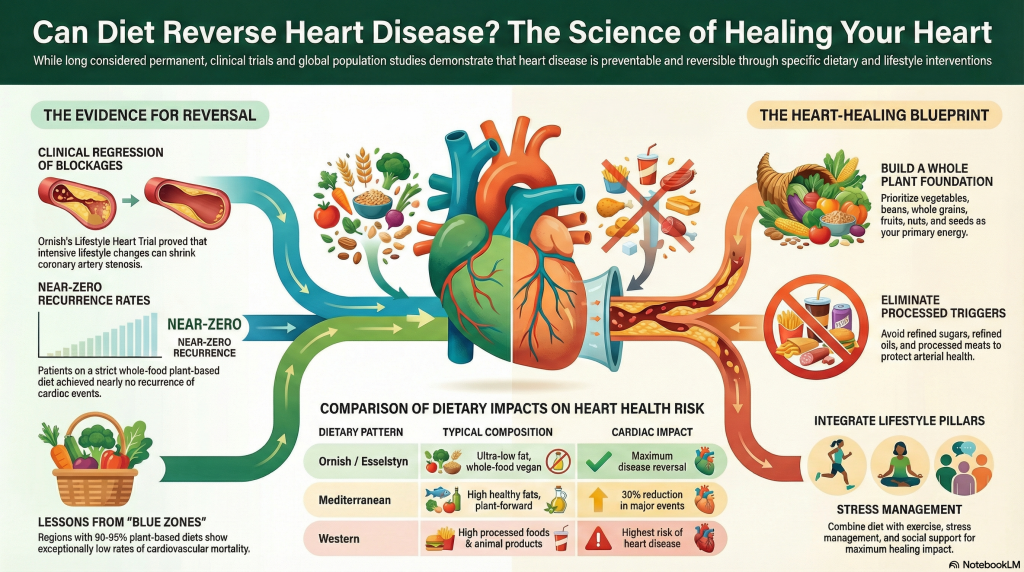
 Dean Ornish has claimed for decades that intensive lifestyle change—especially an almost-vegan, very low-fat diet—can not only prevent but actually reverse heart disease.
Yet at the same time:
- Clinical programs by Ornish, Esselstyn, and Pritikin have demonstrated measurable improvements in blocked coronary arteries.
- Populations in Blue Zones, rural China, and the Adventist Health Studies display extremely low cardiovascular mortality while consuming mostly plant-based diets.
- Large randomized controlled trials such as PREDIMED reveal that a Mediterranean diet reduces cardiovascular events by 30%.
This Q&A brings these findings together for a balanced view.
Q&A
Q1. Can heart disease actually be reversed through diet and lifestyle?
Yes — in many cases, measurable reversal has been documented.
Evidence:
- In the Lifestyle Heart Trial, participants on Ornish’s intensive lifestyle program demonstrated regression of coronary artery stenosis, while the control group worsened over time.
- Five-year follow-up showed continued benefits and fewer cardiac events.
- Esselstyn’s cohort of patients with advanced heart disease achieved near-zero recurrence when maintaining a whole-food, plant-based diet.
- The Pritikin Program has demonstrated improvements in blood flow, lipid profiles, and cardiac symptoms.
Illustration of Risk Reduction
Below is the chart illustrating the relative risk of major cardiovascular events in the Ornish and PREDIMED groups:
Bottom Line:
Diet-centered lifestyle programs can produce partial reversal of heart disease, with the Ornish Program demonstrating a clear reduction in relative risk compared to its control group.
Q2. Is reversal due only to diet, or the full lifestyle package?
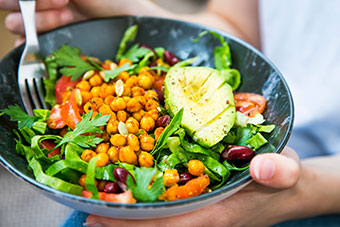 The Ornish program is comprehensive and includes:
- Diet
- Stress management
- Exercise
- Smoking cessation
- Social support
However:
- Esselstyn’s research—primarily focused on a very strict diet alone—still produced profound results.
Conclusion:
The evidence suggests diet is a major independent factor, though the full lifestyle package significantly enhances outcomes.
Q3. Do real-world populations support plant-based eating for heart disease prevention?
Yes. Several major population studies converge:
- A. Blue Zones⁵: Regions such as Okinawa, Sardinia, and Loma Linda share diets that are 90-95% plant-based, and they share exceptionally low heart disease rates.
- B. The China Study (China–Cornell–Oxford Project)⁶⁻⁷: Counties consuming primarily plant foods displayed very low heart disease and cancer rates.
- C. Adventist Health Studies⁸⁻⁹: Among Seventh-day Adventists in California, vegetarians live longer, and the risk of ischemic heart disease is dramatically reduced.
Conclusion:
Across the globe, more whole plant foods in the diet correlate strongly with less chronic disease.
Q4. How does this evidence fit with criticisms of Ornish’s claims?
- The core observation that plant-predominant, minimally processed diets protect the heart remains strongly supported across multiple lines of clinical and population evidence.
- The debate is not whether plant-based diets are protective, but rather how strict one must be (e.g., <10% fat vs. Mediterranean-style).
Q5. Are ultra-low-fat vegan diets uniquely effective?
Effective? Yes.
The graphic below illustrates the approximate differences in composition between the major dietary patterns discussed:
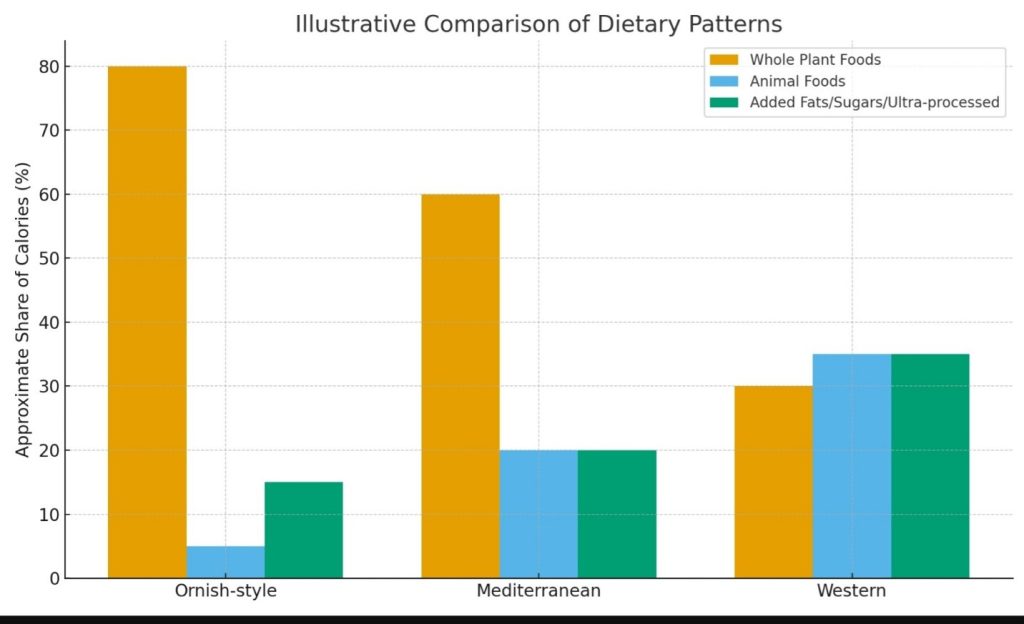
Figure 1. Illustrative comparison of approximate dietary patterns based on the percentage of calories from Whole Plant Foods, Animal Foods, and Added Fats/Sugars/Ultra-processed components.
Interpretation:
- Ornish/Esselstyn show that very low-fat, whole-food, plant-based diets can reverse disease aggressively.
- Mediterranean diets, though significantly higher in fat, still reduce heart attacks and strokes by 30\%.
- The Western diet is dominated by processed components and is linked to the highest risk.
Conclusion:
Multiple plant-predominant patterns are effective; ultra-low-fat vegan diets are not the only path, though they may be the most powerful for reversing advanced disease.
Q6. What does the evidence say is the most heart-protective diet?
 Across clinical trials and populations, the most protective eating pattern has five key traits:
- A Foundation in Whole Plant Foods: Vegetables, beans, whole grains, fruits, nuts, and seeds are the primary energy source.
- Minimal Processed Foods: Avoidance of refined sugars, refined oils, and processed meats.
- Limited Animal Products: If included, small amounts of fish and fermented dairy appear least harmful.
- Healthy Fats, Not “No Fats”: Emphasis on monounsaturated fats (Mediterranean-style) or whole-food fats (Ornish-style).
- Lifestyle Support: Movement, stress reduction, community, and sleep—all essential for total cardiovascular health.
Conclusion
The total body of evidence supports this principle: Heart disease is largely preventable—and often reversible—through a plant-predominant, minimally processed diet supported by healthy lifestyle practices.
Whether one chooses the very low-fat Ornish diet, the Esselstyn diet, or the higher-fat Mediterranean diet, the essential dietary pattern is the same: More whole plants. Fewer processed foods. Limited animal products.
This is where heart healing begins.
References
- Ornish D, Brown SE, Scherwitz LW, et al. Can lifestyle changes reverse coronary heart disease? The Lifestyle Heart Trial. Lancet. 1990;336(8708):129-133. doi:10.1016/0140-6736(90)91656-u
- Ornish D, Scherwitz LW, Billings JH, et al. Intensive lifestyle changes for reversal of coronary heart disease. JAMA. 1998;280(23):2001-2007. doi:10.1001/jama.280.23.2001
- Esselstyn CB Jr, Ellis SG, Medendorp SV, Crowe TD. A strategy to arrest and reverse coronary artery disease: a 5-year longitudinal study of a single physician’s practice. J Fam Pract. 1995;41(6):560-568.
- Racette SB, Park LK, Rashdi ST, et al. Benefits of the First Pritikin Outpatient Intensive Cardiac Rehabilitation Program. J Cardiopulm Rehabil Prev. 2022;42(6):449-455. doi:10.1097/HCR.0000000000000700
- Buettner D, Skemp S. Blue Zones: Lessons From the World’s Longest Lived. Am J Lifestyle Med. 2016;10(5):318-321. Published 2016 Jul 7. doi:10.1177/1559827616637066
- China–Cornell–Oxford Project. Large rural Chinese nutritional epidemiology study. https://nutritionstudies.org/the-china-study/
- Campbell TC, Campbell TM. The China Study. BenBella Books, 2005. https://benbellabooks.com/shop/china-study-revised-expanded-edition/?srsltid=AfmBOor6rY48Lt_qBV4o-pg_ZRUZH3PewNUGR3XRpTav2T7ipJl2vcmh
- I diet and chronic disease. Am J Clin Nutr. 1999;70(3 Suppl):623S-5S. doi:10.1093/ajcn/70.3.623s
- Orlich MJ, Singh PN, Sabaté J, et al. Vegetarian dietary patterns and mortality in Adventist Health Study 2. JAMA Intern Med. 2013;173(13):1230-1238. doi:10.1001/jamainternmed.2013.6473
- Estruch R, Ros E, Salas-Salvadó J, et al. Primary prevention of cardiovascular disease with a Mediterranean diet [retracted in: N Engl J Med. 2018 Jun 21;378(25):2441-2442. doi: 10.1056/NEJMc1806491.]. N Engl J Med. 2013;368(14):1279-1290. doi:10.1056/NEJMoa1200303