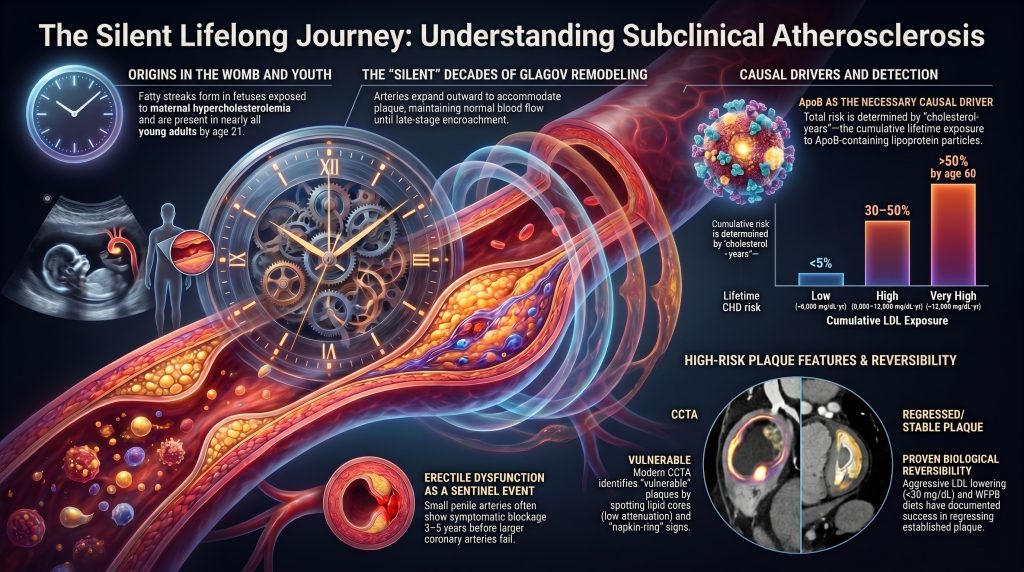
無症候性動脈硬化症の病態生理学的進行と全身の機能への影響
青年期から中年期に至るライフコース分析
抄録
アテローム性動脈硬化の 心血管疾患心血管疾患とは、心臓発作、脳卒中、下肢の動脈閉塞など、心臓や血管に関する問題の総称です。. (ASCVD)は依然として世界的な主要な死因であり、その臨床症状は、数十年前に――多くの場合胎児期に、遅くとも20代までには――始まる生物学的経過の最終段階として現れるものである。本総説では、構造的血管生物学、血行動態、脂質との因果関係などを統合して考察する。, 炎症炎症は、怪我や侵入物とみなしたものに対する免疫システムの反応です。これにより腫れや熱、そして浄化細胞がもたらされます。., 、性差による表現型、神経変性、および生活習慣による可逆性を、理解のための統一的な枠組みに統合する 無症候性動脈硬化症Subclinical atherosclerosis means plaque is present but has not yet caused any symptoms or events. 活動性があり、進行性で、治療によって経過が変化しうる疾患として。我々は、動脈壁の構造における局所的な不均一性と、その役割について検討する。 ヴァサ・ヴァソラムThe vasa vasorum are tiny blood vessels that supply the wall of a larger artery. The name means "vessels of the vessels.", 大動脈の分岐、 動脈硬化動脈硬化は、ほとんど的心筋梗塞と多くの脳卒中の背景にある病気です。コレステロールの粒子が動脈の壁に入り込み、体がそれを掃除するために免疫細胞を送り込み、何年もかけてその堆積物が硬化してプラークになります。. 脳小血管疾患による、その血行動態的決定要因は 歯垢プラークとは、動脈の壁の内側にコレステロール、免疫細胞、瘢痕組織、カルシウムが蓄積したものです。. ローカライゼーション、および以下の研究による縦断的エビデンス PDAYPDAY(Pathobiological Determinants of Atherosclerosis in Youthの略)は、他の原因で死亡した15歳から34歳までの若者の動脈を調査した。., ボガルーサ、, CARDIACARDIA has followed young adults from their twenties into later life, tracking fitness, cholesterol, blood pressure, and what eventually happened to them., MESAMESA, the Multi-Ethnic Study of Atherosclerosis, followed thousands of adults with no known heart disease, scanning their arteries and tracking outcomes., 、および生後早期における疾患発症の基盤を明らかにするFELIC胎児シリーズ。我々は、以下のことを立証するメンデルランダム化、集団遺伝学、および介入試験の知見を統合し、 アポリポ蛋白アポリポ蛋白とは、血液中の脂肪を運ぶ粒子に結合しているタンパク質です。脂肪と水は混ざらないため、これらのタンパク質は脂肪が血流の中を安全に移動できるようにする包みのような役割を果たします。. Bを含む リポタンパク質リポタンパク質とは、脂肪とコレステロールを血流に乗せて運ぶ小さなカプセルのことです。脂肪は水に溶けないため、移動するにはタンパク質の包みが必要です。. の必要な因果的推進要因として アテローム発生アテローム性動脈硬化形成は、プラークが形成される段階的なプロセスです。., 、そしてLp(a)、炎症、クローン性造血を位置づけ、, 内皮機能障害血管内皮機能障害とは、その薄い内側の裏打ちが十分に機能しなくなる状態です。血管が適切に拡張せず、バリア機能がより漏れやすくなります。., 、この枠組みにおける微小血管の希薄化および動脈硬化について論じる。最後に、画像診断と バイオマーカーバイオマーカーとは、健康や病気の状態について教えてくれる、体内で測定可能なもののことであり、例えば、検査値、スキャン画像の結果、血圧の数値などが挙げられます。. 長期にわたる前臨床段階での検出を可能にするツール、これまで十分に認識されてこなかった性差のある表現型、そして臨床試験の知見――中でも特に ライフスタイル心臓トライアルディーン・オーニッシュが率いたライフスタイル・ハート・トライアルは、連続冠動脈造影を用いて、超低脂肪の植物ベースの食生活、運動、ストレス管理、グループサポートという集中的なライフスタイル介入を検証した小規模な無作為化試験である。介入群では測定された動脈狭窄がわずかに改善した一方で、対照群では悪化したが、造影法の技術的限界や、参照セグメントの狭小…, 、エッセルスティン症例シリーズ、STARS、およびIVUSで確認された スタチンスタチンは、肝臓がコレステロールを作るのに使う酵素の働きを遅らせます。肝臓は血液中からより多くのコレステロールを取り除くことでこれに反応し、そこに真の利益があります。. PCSK9阻害薬のプラーク退縮試験(リバーサルREVERSAL compared moderate and intensive statin therapy, using intravascular ultrasound to measure what happened to coronary plaque., 小惑星ASTEROID試験は、患者に最高用量のロスバスタチンを投与し、血管内超音波を用いて治療前後の冠動脈プラークを撮影した臨床試験である。., 土星SATURN compared the two strongest statins head to head at maximum dose, measuring coronary plaque with intravascular ultrasound., グラゴフGLAGOV added a PCSK9 inhibitor to statin therapy and measured coronary plaque with intravascular ultrasound before and after., PACMAN-AMIPACMAN-AMI gave a PCSK9 inhibitor to patients immediately after a heart attack and imaged their non-culprit arteries with three different catheter techniques., ホイヘンスHUYGENS used optical coherence tomography — a very high-resolution imaging catheter — to see whether a PCSK9 inhibitor changed plaque structure after a heart attack.)—無症候性動 atherosclerosis(アテローム性動脈硬化)は、早期かつ積極的に対処すれば可逆的な疾患であることを裏付けるものである。.
キーワード
不顕性アテローム性動脈硬化症;アポリポ蛋白B;; リポ蛋白(a)リポタンパク(a)(Lp(a)と表記され、「L-P-リトル-a」と発音される)は、余分な粘着性のあるタンパク質が付着したLDL様粒子です。.; 内皮機能障害; 栄養血管; 脳小血管病; 冠状動脈 動脈動脈は、心臓から全身へ血液を送り出す血管です。. カルシウム; 脈波伝播速度Pulse wave velocity measures how fast the pressure wave from each heartbeat travels along your arteries. Stiffer arteries carry it faster.; プラーク退縮プラークの退縮とは、プラークが単に成長が遅くなるだけでなく、既存のプラークが実際に小さくなることを意味します。.; ホールフード プラントベースの食事プラントベース(植物性中心)の食事は、動物性食品を控えるか一切摂らず、野菜、果物、豆類、全粒穀物、ナッツ、種子類を中心に構成されます。..

1. はじめに
臨床的ASCVDの出現は、しばしば人生の2つ目の10年間(10代)に始まり、母親に曝露された胎児の場合には、何十年もの間静かに進行してきた生物学的軌跡の帰結である 高コレステロール血症Hypercholesterolemia is an abnormally elevated level of cholesterol-carrying particles in the blood, typically caused in primate experiments by feeding a diet high in dietary cholesterol and saturated fat, and associated with accelerated plaque formation in artery walls., 、誕生すらないうちに。潜在性動脈硬化症とは、動脈壁の構造的変化の存在を指す。その変化には以下が含まれる。 内膜肥厚内膜肥厚は、動脈の内層(内膜)の厚さにおける初期の適応的または病的な増加であり、正常な発達的変化、あるいは明白なプラーク形成に先行する平滑筋細胞、脂質、炎症性細胞の蓄積のいずれかを反映しうる。これは、頸動脈内膜中膜複合体厚の超音波検査によって非侵襲的に測定可能である。., 、リポ蛋白の係留、泡沫細胞の蓄積、および初期のプラーク形成(これらは、次のような明白な症状が現れる前に先行する) 狭心症狭心症は、心筋に十分な酸素が供給されていないときに起こる胸の不快感です。圧迫感、締めつけ感、絞られるような感じ、または灼熱感と表現され、腕、首、または顎に広がることがあります。., 心筋梗塞詳しい項目については心臓発作をご覧ください。., 虚血性脳卒中虚血性脳卒中は、脳の一部への血流が遮断され、脳組織が壊死し始めることで起こります。., 、末梢性間欠性跛行、あるいは血管性認知症を引き起こす。この静穏な進行は、血行動態、動脈壁の構造的変化、リポタンパク質の流入、免疫活性化、および代謝ストレスの密接に結びついた相互作用によって支配されている。.
従来は加齢による疾患として捉えられてきたが、縦断的コホート研究と剖検データの蓄積により、焦点は青年期や若年層へと根本的に移行し、認知処理速度の低下から腎機能および勃起予備能の障害に至るまで、微細な日常的機能障害が、従来の臨床的診断基準を満たすはるか以前に出現していることが明らかになっている。このライフコース概念の最も厳密な定式化は、累積曝露または「“コレステロール年数Cholesterol-years is a cumulative-exposure metric that multiplies a person's average LDL-C level (in mg/dL) by the number of years they have carried that level, analogous to pack-years for tobacco. The concept holds that it is the total lifetime burden of apoB-containing lipoproteins, not any single reading, that determines when and how severely atherosclerosis develops.”血漿アポBリポ蛋白濃度の時間積分値が臨床イベントの時期と重症度の両方を予測するモデル7], [9].
本レビューでは、ヒト動脈系全体における不顕性血管疾患の病態生理、解剖学的分布、および機能的結果について包括的な統合的考察を提供する。特に以下の点に注目する。(i) 大動脈アテローム性動脈硬化症と脳小血管病の異なる生物学的特性、(ii)アポB含有リポ蛋白の因果関係における中心性、ならびにLp(a)、炎症、クローン性造血の寄与、(iii)性差に基づく表現型、(iv)新たな検出モダリティ、(v)早期かつ積極的な介入により不顕性疾患が可逆的であることを示す臨床試験ベースのエビデンス。.
2. アポリポ蛋白B含有リポ蛋白:必須の因果的ドライバー
2.1 メンデルランダム化の統合
メンデルランダム化Mendelian randomization is a clever research method that uses the genes people were born with as a natural experiment. (MR)は、実験室以外で利用可能な最も厳密な因果推論の形式の1つを提供します ランダム化比較試験ランダム化比較試験では、人々を完全な偶然によって治療群または比較群に割り付け、その後両群を追跡調査します。.. 受胎時の対立遺伝子のランダムな割当てを利用することにより、MR研究は、以下の影響を受けない、遺伝的に決定された曝露が生涯に及ぼす効果を推計する。 逆因果関係Reverse causation is when the arrow points the other way — the illness caused the exposure rather than the exposure causing the illness., 、生活習慣の共変因子、または測定誤差。フェレンス(Ference)らの研究グループは、312,321人の参加者を対象に9つのLDL関連遺伝子にわたる50の多型を解析し、遺伝的にLDL-Cが1 mmol/L(約38.7 mg/dL)低くなるごとに、 相対リスク相対リスクは2つのグループを比較するもので、このグループの心臓発作の発生率は、あのグループよりも30パーセント低かった。. 約54.5パーセントの削減 冠動脈疾患冠状動脈疾患は、アスケロスクレロティック・プラーク(動脈硬化性プラーク)の蓄積によって心筋に血液を供給する動脈が狭窄または閉塞する疾患であり、世界中で心筋梗塞および心臓死の主要な原因となっています。. 単位あたり約3倍の効果 LDLLDL(低密度リポ蛋白)は、コレステロールを血液中に運ぶ主要な粒子であり、動脈壁に詰まる主原因となるものです。. 中高年で開始されたスタチンよりも1].
その 用量反応関係A dose-response relationship describes how the magnitude of a biological effect changes as the amount of an exposure (such as weekly exercise minutes) increases; in this article, resistance training shows a non-linear dose-response for mortality, with benefits plateauing around 120 minutes per week and a J-shaped curve emerging at very high volumes in older women. 検出可能な閾値なしに対数線形であり、累積曝露モデルを支持している。多型を用いた2つ目のMR研究では PCSK9PCSK9 is a protein made by your liver that destroys the docking ports your liver uses to pull cholesterol out of your blood., HMGCRHMGCR is the gene for HMG-CoA reductase, the enzyme that performs the rate-limiting step in making cholesterol. It is the exact target of every statin., 、および NPC1L1NPC1L1 is the transporter in your intestine that absorbs cholesterol from food and bile. Ezetimibe blocks it. リスク低下がLDL-C低下の程度と期間に密接に追随することを示しており、apoB含有リポ蛋白への統合的な生涯にわたる曝露が動脈硬化形成の中心的な決定要因である一方、LDL-Cが低下する特定の分子経路はアテローム性動脈硬化性心血管疾患(ASCVD)のリスク低下にとってあまり重要ではないという結論を支持している3]。2017年の欧州動脈硬化学会(EAS)のコンセンサスステートメントでは、200件以上の遺伝学的、前向き疫学的、および無作為化介入研究が検討され、LDLが ブラッドフォード・ヒル基準The Bradford Hill criteria are a set of nine principles—including strength of association, consistency, biological plausibility, and dose-response—used to evaluate whether an observed statistical association between an exposure and a disease is likely to be causal. ASCVDにおける因果関係において4]、そして2020年のEASのアップデートはこの結論をアポB含有リポ蛋白全般に拡張した[19].
2.2 統合的な粒子としてのApoB
動脈硬化を引き起こす主要なリポ蛋白粒子はそれぞれ、 VLDLVLDL(超低密度リポ蛋白)は、肝臓が中性脂肪を体内の他の部位へと送り出すために作り出す粒子です。., IDLIDL(中等密度リポ蛋白)は、トリセリドを多く運ぶ大型の粒子が収縮してLDL粒子へと変化する過程の中間で形成される粒子です。., 、LDL、Lp(a)、および カイロミクロンカイロミクロンは、食事由来の脂肪を小腸から血流へと運ぶ非常に大きな粒子です。. レムナント — 単一のアポリポ蛋白B分子を保持する: アポB-100ApoB-100 is the full-length form of apolipoprotein B found on LDL, VLDL, IDL, and remnant lipoproteins; its positively charged amino-acid domains bind ionically to negatively charged proteoglycan side chains in the arterial wall, physically trapping the particle in the intima and initiating plaque formation. 肝由来の粒子および アポB-48ApoB-48 is a truncated isoform of apolipoprotein B produced in the intestine and found exclusively on chylomicrons and their remnants; unlike ApoB-100, it is not measured by standard clinical ApoB assays in the fasting state, meaning routine ApoB tests reflect atherogenic particle burden from liver-derived lipoproteins rather than dietary fat absorption. 腸の遺残組織に対して. アポリポ蛋白BアポBは、動脈の壁に詰まってプラークを引き起こす可能性のあるコレステロール粒子のすべての外側に存在するタンパク質です。それらの粒子はそれぞれ、正確に1個のアポBを運んでいます。. したがって、カウントされます 動脈硬化惹起性粒子動脈硬化惹起性粒子とは、LDL、IDL、VLDL、リポ蛋白(a)といったアポB含有リポ蛋白のことであり、動脈壁に侵入・停滞してプラークの成長を開始・持続させます。本論文では、プラークの退縮を達成するために大幅かつ持続的に低下させなければならない対象を指す言葉としてこの用語を使用しています。., 一方、LDL-Cは、代謝状態によってキャリアに対する比率が変化する物質(カーゴ)を測定するものである。 UKバイオバンクUK Biobank holds detailed genetic, lifestyle, and health data on half a million British volunteers, linked to their medical records. 389,529人の参加者を対象とした解析において、アポBが心筋梗塞の主要な予測因子であり、LDL-Cおよび非HDL-CはアポBで調整した後に統計学的有意性を失った5]. の状態では 不一致詳細についてはアポB不適合(ApoB Discordance)の項目をご覧ください。. —LDL-Cは正常であるが、粒子数が多い場合(例えば メタボリックシンドロームMetabolic syndrome is a cluster of five problems that tend to travel together: a large waist, high triglycerides, low HDL, high blood pressure, and high blood sugar. Having three or more counts. そして インスリン抵抗性インスリン抵抗性とは、細胞がインスリンに対して十分に応答しなくなる状態のことであり、そのため膵臓は同じ働きをするためにますます多くのインスリンを分泌し続けなければならなくなります。. — apoBは、LDL-C単独の戦略では見落とされてしまう重大な動脈硬化リスクを明らかにする6].
2.3 累積曝露と「コレステロール年」の概念
アテローム性動脈硬化性心疾患(ASCVD)のリスクを、血漿LDL-C濃度の時間に対する積分の関数として扱う累積曝露モデルは、「“パック・イヤーPack-years is a standardized measure of cumulative tobacco exposure calculated by multiplying the number of packs smoked per day by the number of years of smoking; the article uses it as the conceptual model for thinking about cumulative apoB exposure, noting that both metrics are imperfect summaries of lifetime exposure that carry more prognostic weight than a single current measurement.”タバコと同様である。いくつかの解析が、LDL-C曝露量とASCVD(動脈硬化性心疾患)イベントとの間の用量-時間関係を支持している。男性における臨床的に明らかな疾患に対する「閾値」は、いくつかの解析において約5,000 mg/dL・年(例えば、LDL 125 mg/dL×40年であり、現代の西洋集団における約50歳に相当する)と記述されているが、臨床疾患が出現する正確なLDL-年値はモデル依存であり、普遍的な生物学的カットオフというよりはむしろ例示的なものとして提示されるべきである。7], [9].
「LDL プラークイヤーズPlaque-years is a measure of cumulative lifetime exposure to LDL cholesterol, calculated as the integral of LDL-C concentration over time (approximated as LDL-C × age), used to quantify the total atherogenic burden an artery wall has experienced. Research has identified heuristic thresholds—around 5,000 for low risk and above 14,000 for very high risk—that correspond to progressively greater prob…”フレームワークは、予防を累積負担の観点から定量的に再定義する。例えば、生涯のLDLが70 mg/dL × 80年は約5,600 mg/dL·年をもたらし、LDL 130 mg/dL × 50年は約6,500 mg/dL·年をもたらし、そして未治療のヘテロ接合体 家族性高コレステロール血症家族性高コレステロール血症(FH)は、肝臓が血液中からコレステロールを適切に除去できない遺伝性疾患です。出生時からコレステロール値が非常に高くなります。. LDLコレステロール値が250 mg/dLの患者は、30代前半までに一般的な説明用の閾値を超過する。これらの計算値は、用量・時間生物学を伝え、未治療のヘテロ接合体家族性高コレステロール血症(FH)が生涯にわたる冠動脈性心疾患(CHD)の高リスクを伴う理由を説明するのに有用であるが、妥当性が確認された個別のリスク閾値として提示されるべきではない7], [8], [9].
| カテゴリー | LDL蓄積曝露 | 近似軌道 | 生涯の冠動脈性心疾患リスクの例示 |
| 低い | 5,000 mg/dL·yr | LDL 70 × 70歳 | <5% |
| 中級 | 5,000~8,000 mg/dL·yr | LDL 100 × 60歳 | 10–20% |
| 高 | 8,000〜12,000 mg/dL·yr | LDL 130 × 65歳 | 30–50% |
| 非常に高い | 12,000 mg/dL·年 | LDL 190 × 65歳(家族性高コレステロール血症) | >60歳までに50% |
表1. イラストによる累積LDLコレステロール曝露カテゴリと概算生涯冠動脈性心疾患リスク。FerenceらおよびDomanskiらの文献に基づく [7], [8], [9]。これらのカテゴリは説明用のコミュニケーション補助であり、ガイドラインで検証された個別リスクの閾値ではありません。.
2.4 チマネ族とハザ族:生涯にわたる低LDLコレステロールという自然実験
カプラン(Kaplan)らの研究グループは、705人におけるCACスコアを調査した チマネThe Tsimane are an indigenous forager-horticulturalist population of the Bolivian Amazon whose traditional lifestyle—characterized by high physical activity and low average LDL cholesterol of around 91 mg/dL—is associated with markedly low rates of coronary calcification, with 85 percent of adults over 40 showing no detectable coronary calcium. ボリビアのアマゾン地域に居住する40歳から94歳の狩猟採集・園耕民。平均LDL-C(低密度リポ蛋白コレステロール)は91 mg/dLであり、40歳以上の成人の85%でCAC(冠動脈石灰化スコア)がゼロであった。これに対し、MESA研究における同年代の米国成人では約50%であった。75歳以上の高齢者でも65%がCACゼロであり、これはこれまでどの集団においても測定された中で最低レベルの冠動脈アテローム性動脈硬化であった。また、CACが100以上の者はわずか8%にとどまったが、同年代の米国集団では50%を超えていた。10].
この自然実験は、生涯を通じて比較的低いLDL-Cを維持し、それに高身体活動量と最小限の 喫煙喫煙は血管の内壁を傷つけ、血圧を上げ、血液を凝固しやすくし、プラークの成長を早めます。., 、冠動脈の有病率が極めて低いことに関連している。 石灰化石灰化とは、カルシウムがプラークに沈着し、その一部が硬く骨状になることです。.. LDL-Cが90 mg/dL以下であれば冠動脈アテローム硬化が事実上消失することを証明していると捉えるべきではない。なぜなら、チマネ族の表現型は単独のLDL-Cではなく、生涯にわたる複数の曝露を反映しているからである。タンザニアのハダザ族は、利用可能な研究において、良好な心血管代謝特性を持つ身体活動的な狩猟採集民集団として記述されているが、この集団において直接的なCAC(冠動脈カルシウム)画像検査は実施されていない。したがって、ハダザ族における臨床的冠動脈疾患の欠如についての結論は、直接的なものではなく推論に基づくものである。11].
2.5 遺伝的終生低LDL:PCSK9およびANGPTL3
コーエンとその共同研究者らは、生涯にわたりLDLを15〜40%低下させるPCSK9の自然発生的な機能喪失型変異(R46L、Y142X、C679X)を特定した。特定の変異の保因者は冠動脈性心疾患(CHD)イベントの大幅な減少を示し、一部の変異で88%に迫る減少を含む最も顕著な推定値は、変異や祖先集団によって異なる効果の大きさを反映している。12]。このような効果量は、中年期に開始いかなる薬物学的介入が達成できるものをもはるかに超えている。同様に、ホモ接合性の機能喪失型バリアントは ANGPTL3ANGPTL3は、血液中のトリグリセリドを豊富に含む微粒子の分解を遅らせるタンパク質です。. 非常に低いLDLとともに低ベータリポタンパク血症を引き起こす 中性脂肪トリグリセリド(中性脂肪)は、血液中および体内の蓄積脂肪の主要な形態です。.; 流行病学シリーズは、ASCVDリスクの著しい低下と好ましい 脂質プロファイル総コレステロール、LDLコレステロール、HDLコレステロール、中性脂肪を測定する血液検査のパネルで、心血管リスクの評価や食事療法・薬物治療の効果のモニタリングに使用される。. このようなキャリアにおいて、ランダム化コホートでのイベント発生率は定量化されていないものの、13].
これらの遺伝学的実験は、有用な限界条件を確立する。すなわち、生涯にわたるアポB粒子負荷が生理学的に低い場合、薬理学的介入がなくてもア动脉硬化は著しく抑制されているように見えるのである。PCSK9モノクローナル抗体、siRNA製剤、およびANGPTL3阻害薬を通じたこれらの表現型の薬理学的模倣は、スタチン療法に上乗せしたイベント抑制効果を示している。の分析 フーリエFOURIER tested evolocumab, a PCSK9 inhibitor, in patients who already had cardiovascular disease and were on statins. FOURIERの非盲検延長試験では、LDL <20 mg/dLを含む非常に低いLDLを達成した患者において、利用可能な追跡期間を通じて安全性の懸念の増加を伴うことなく、イベント発症率の段階的な低下が支持された18].
2.6 持続的な超低LDLが動脈硬化形成を著しく抑制する理由
内皮の トランスサイトーシストランスサイトーシスとは、細胞が片側で物質を取り込み、反対側へと運び、そして反対側で放出しするプロセスのことである。. LDLの 内膜内膜は動脈壁の一番内側の層であり、平滑な内壁のすぐ下に位置しています。. 濃度依存性であり、タバス(Tabas)、ウィリアムズ(Williams)、ボレン(Borén)の「応答・保持(レスポンス・トゥ・リテンション)パラダイム」であるプロテオグリカンを介した保持は、アポB粒子フラックスが低下するにつれて、その可能性が低くなる83新生児のLDL-Cは約30 mg/dLであり、動脈硬化性の 病変循環器学において、病変とは冠動脈を狭窄させるアテローム性動脈硬化プラークの不連続な領域を指し、通常はそれが引き起こす内腔閉塞のパーセンテージによって記述される。この記事では、最も重要な病変が治療された後、血管径が小さすぎてステントを受け入れることができない4つの遺残病変について述べている。. この段階では通常検出されない。これは、アテローム性動脈硬化が単一のLDL-C値において生物学的に不可能であるという主張ではなく、生涯にわたる非常に低いLDL-Cが母集団レベルでアテローム性動脈硬化の初期段階と両立しないという証拠として解釈されるべきである。生涯にわたるLDLが70 mg/dL未満のコホート(PCSK9機能喪失型変異、ANGPTL3機能喪失型変異、治療を受けた家族性高コレステロール血症)は、REVERSAL、ASTEROID、SATURN、GLAGOVの各試験において、治療中のLDLが60 mg/dL未満のときにIVUS(血管内超音波法)で確認されたプラークの退縮を伴い、イベント発生率の顕著な低下を示している。14], [15], [16], [17].
フーリエールThe open-label extension of the FOURIER trial, which tracked patients treated with evolocumab for seven or more years and found sustained cognitive stability even among those maintaining LDL-C below 20 mg/dL. 拡張 エボロクマブEvolocumab is an injectable cholesterol medicine in the PCSK9 inhibitor family, usually given every two to four weeks. 中央値で約5年間の追跡が行われ、治療中のLDLコレステロール値が20 mg/dL未満の場合において、利用可能な追跡期間を通じて追加の安全性シグナルを伴うことなく、継続的なイベント抑制効果が認められたことが報告された18]。の正式な実証 用量反応A dose-response relationship means more of something produces more of an effect, in a consistent gradient. これら非常に低いLDL値におけるプラトーの欠如は確固たるものとは確立されていないが、利用可能なデータは、これまでに治験集団で達成された最も低いLDL値に至るまで、継続的なベネフィットと相殺する毒性がないことと矛盾しない。.
2.7 LDL懐疑派の立場の承認と反論
ラヴンスコフ、ダイアモンド、ケンドリックをはじめとする少数の著者らは、LDLが非因果的であると主張し、高齢者集団においてLDLが予測因子にならないように見える観察研究を引用している(いわゆる「“脂質パラドックスThe lipid paradox refers to the observation in people in their 80s and 90s that the usual positive association between LDL cholesterol and heart disease weakens or even reverses, an apparent anomaly explained by reverse causation from illness lowering cholesterol, survivorship selection, and competing causes of death rather than any change in LDL's underlying biology.”)。一般的な反論は十分に確立されている。第一に、高齢期には逆因果関係が支配的である。すなわち、慢性疾患、吸収不良、および虚弱がLDLを低下させ、横断的解析におけるLDLと死亡率の関連性にバイアスを生じさせる。第二に、, 生存者バイアスSurvivor bias in the elderly paradox refers to the statistical artifact whereby people who reach old age with high LDL may represent a genetically hardy subset who were never vulnerable to LDL-driven atherosclerosis, making high LDL appear safe in that age group when the susceptible individuals already died younger. 高LDLのまま80歳に達した人々の中から遺伝的防御保持者を選別する。第3に、年齢に伴う相対リスクの減弱は、以下を示唆するものではない。 絶対リスク絶対リスクとは、何かが自分に起こる実際の確率であり、パーセンテージで表されます。今後10年間の心臓発作の絶対リスクが12パーセントである場合、それはあなたと似た人100人のうち約12人が発作を起こすことを意味します。.; 年齢とともに絶対的なイベント発生率は劇的に増加します。第四に、遺伝学的および薬理学的証拠は約20の独立した研究ライン全体で相互に裏付けられており、因果関係のトライアンギュレーション基準を満たしています。4], [6], [19]. 懐疑論者の立場は、収斂する遺伝学的証拠やランダム化試験の証拠を無視する一方で、ほぼ完全に観察データに基づいている。.
3. 構造的決定因子とアテローム性動脈硬化形成における栄養血管(ヴァーサ・ヴァソーラム)の役割
3.1 限界深さとラメラ単位
大口径の全身動脈では、厚い壁の代謝要求が、以下のものからの単純な酸素拡散の能力を超えている。 ルーメン内腔とは、血液が実際に流れる血管の内側の開いた通路のことです。.. 「臨界深度」は、Geiringerによって約0.5 mm(約500 μm)、すなわち中膜壁のおよそ29〜30層のラメラ単位と規定された、管腔側血流からの酸素および栄養素の拡散に関する生理学的限界として定義される、78], [79]。各層板単位は、弾性板と、それに伴う平滑筋細胞の層から構成され、 細胞外マトリックスThe extracellular matrix is the scaffolding of collagen and other fibers that holds tissue together and gives an artery wall its strength., 、厚さ約15μm。この閾値を超える壁セグメントは、外側中膜の生存を維持するために固有の微小血管網、すなわち栄養血管(vasa vasorum)を必要とし、 外膜外膜は動脈の最も外側の頑丈な層であり、主に結合組織、神経、および血管壁に栄養を供給する微小血管で構成されている。..
栄養血管は、動脈の内腔から直接分岐する内栄養血管と、遠位の枝から起きて外膜に侵入する外栄養血管に分類される。ガイリンガー(Geiringer)の研究により、栄養血管は外膜と中膜の外側3分の1に豊富に存在する一方で、血管壁の内側約0.5 mm(約30層板単位)は無血管であり、もっぱら内腔からの拡散によって栄養されていることが明らかにされた。79]。アテローム性動脈硬化プラークや高血圧性過形成によって血管壁が肥厚すると、拡散距離が増大し、深層に低酸素環境が作り出される。低酸素はHIF-1α依存性の血管新生シグナル伝達を引き起こし、血管外膜血管の増殖をもたらす。これらの血管は内弾性板を貫通してプラーク自体に侵入し、そこで炎症細胞の通り道として、また脆弱な プラーク内出血Intraplaque hemorrhage is bleeding inside a plaque, from the fragile little vessels that grew into it..
3.2 頭蓋外と頭蓋内の血管支配
頭蓋内血管系は、体循環と比較して独特の構造的プロファイルを示します。健常な頭蓋内動脈は、より薄い中膜、比較的少ない外膜、および弾性線維の相対的な乏しさを特徴としています。 繊維食物繊維は、体内で消化できない植物性食品の部分です。豆類、オーツ麦、野菜、果物、全粒穀物に含まれています。.; 多くのものは明確な外弾性板を欠いている。主要な特徴は、頭蓋内血管が栄養に富む脳脊髄液に浸されていることであり、これが外側からの拡散を介して代謝をサポートし、生後早期における栄養血管(vasa vasorum)の相対的な欠如を部分的に補っている。.
脳内に栄養血管(vasa vasorum)が存在しないという従来の歴史的見解は、近年の剖検および画像研究によって修正されている。50例を対象としたある剖検研究では、患者の72%で栄養血管が確認され、主に外膜に局所的に存在していた。その分布は著しく不均一であり、栄養血管はより中枢側のセグメント、すなわち椎骨動脈、脳底動脈、および内頸動脈の頭蓋内部分により高頻度で見出される。 頸動脈The carotid arteries run up either side of your neck and supply blood to your brain. —中大脳動脈や前大脳動脈などの遠位セグメントにおける場合よりも。アテローム性動脈硬化は栄養血管(vasa vasorum)が存在しなくても発生し得るが、その発達は頭蓋内疾患の進行と強く関連している:頭蓋内椎骨動脈においては、外膜栄養血管の存在は、より大きなプラーク負荷、より密度の高いプラーク内石灰化、およびより重度な内腔狭窄と相関している 狭窄狭窄とは閉塞のことであり、通常は70%の閉塞といったようにパーセンテージで表されます。..
| 船の種類 | 壁の厚さ | 血管栄養血管(初期) | 栄養源 |
| 大動脈The aorta is the biggest artery in your body. It carries blood out of the heart and down through the chest and belly, sending branches everywhere. 大規模な全身性 | 1.0 mm(多くの場合 1.5~2.0 mm) | 外膜および外側中膜に豊富 | 管腔内拡散+VV |
| 頭蓋外内頸動脈 | ≈0.6–1.0 mm | アドベンチシア(外膜)に存在します | 管腔内拡散+VV |
| 頭蓋内 ICA / VA | ≈0.2~0.3 mm | まばら、主に近位セグメント | 管腔内拡散+脳脊髄液 |
| 遠位中大脳動脈/前大脳動脈 | 0.2 mm未満;EELなし | 不在または稀 | 管腔内拡散+脳脊髄液 |
| 穿通枝動脈 | 直径40〜200μm | 不在 | 管腔拡散+間質液 |
表2. 体循環系と脳循環系における動脈壁の厚さ、栄養血管(vv)密度、および栄養源の比較解剖学的構造。EEL、外弾性板;ICA、内頸動脈;VA、椎骨動脈;MCA、中大脳動脈;ACA、前大脳動脈;VV、栄養血管;CSF、脳脊髄液。.
4. 血行力学的力とプラークの局在
4.1 層流せん断応力と乱れを伴うせん断応力
動脈硬化の限局的な性質は、血流と動脈の幾何学的形状との相互作用によって決定される。 内皮内皮は、すべての血管の内側にある極めて薄く滑らかな裏地であり、厚さはわずか1細胞分です。. 一次線毛、インテグリン、グリコカリックスを介して物理的ストレスを生物学的シグナルへと変換する機械受容器として機能する 機械受容シグナル伝達メカノトランスダクション(機械的刺激受容伝達)は、細胞が伸展、圧力、ずり応力などの機械的刺激を、細胞の挙動や遺伝子発現を変化させる生化学的シグナルへと変換する生物学的プロセスです。., 、およびイオンチャネル(特に ピエゾ1Piezo1 is a mechanosensitive ion channel protein found in arterial endothelial and smooth muscle cells that converts physical forces such as pressure and wall stretch into intracellular chemical signals, a process called mechanotransduction. およびTRPV4)。直状の動脈セグメントでは、血流は層流であり、高く、一方向性の 壁面せん断応力Wall shear stress is the frictional force exerted by flowing blood on the inner surface of an artery; low, oscillatory, or multidirectional shear stress at arterial bends and bifurcations promotes endothelial dysfunction and plaque initiation, whereas high, uniform shear stress in straight segments is generally protective. (通常1〜7 Pa、または10〜70 dyn/cm²)。この環境は、以下の持続的活性化を特徴とする抗動脈硬化性の内皮表現型を維持する。 内皮型一酸化窒素合成酵素(eNOS)Endothelial nitric oxide synthase is the enzyme in artery-lining cells responsible for producing nitric oxide, which relaxes blood vessels and suppresses clot formation; in insulin resistance, impaired insulin-receptor signaling downregulates eNOS, reducing nitric oxide availability and promoting an adhesive, pro-inflammatory arterial surface., KLF2およびKLF4転写因子のリン酸化、およびNF-κBシグナル伝達の抑制が起こり、その結果として 一酸化窒素一酸化窒素は、血管の内壁が血管に弛緩して広がるよう伝えるために産生するガスです。. 生産量が多い, 白血球接着The process by which white blood cells attach to the endothelial surface of blood vessels, a key early step in atherogenesis; nitric oxide and an intact glycocalyx normally suppress this adhesion. is suppressed, and intimal permeability remains low [85].
In contrast, at branch points, bifurcations, and areas of high curvature, flow becomes “disturbed.” These atheroprone zones experience low time-averaged wall shear stress (often <0.4 Pa) and high oscillatory shear index, with the direction of frictional force reversing during the cardiac cycle. In disturbed-flow regions, the endothelium undergoes a phenotypic switch: tight junctions loosen, allowing increased transcytosis of LDL into the intima; expression of VCAM-1VCAM-1 is a sticky molecule that appears on an inflamed vessel lining and grabs passing white blood cells so they can burrow into the wall., ICAM-1ICAM-1 is a molecule that appears on the surface of the blood vessel lining and acts like Velcro, catching passing immune cells., E-selectin, and MCP-1 captures circulating monocytes and T-cells; 活性酸素種Reactive oxygen species are unstable oxygen-containing molecules produced as a by-product of normal metabolism. generation rises through NADPH oxidase activation; and the protective KLF2/eNOS axis is suppressed.
The seminal computational fluid dynamic study by Ku and colleagues at the human carotid bifurcation demonstrated tight spatial concordance between low-shear regions and intimal thickening — the founding empirical study of the hemodynamic theory of atherogenesis [71]. This pattern recurs at every branching point of the arterial tree: the proximal segments of the LAD and LCx, the carotid bulb, the abdominal aortic bifurcation, and the renal artery ostia all exhibit this geometry-dependent vulnerability.
4.2 Cellular Behavior in the Plaque Microenvironment
Once retained in the intima, LDL undergoes oxidative modification by myeloperoxidase, lipoxygenase, and reactive oxygen species. 酸化LDL酸化LDLは、動脈壁に付着した後に化学的損傷を受けたLDL粒子です。. is recognized by scavenger receptors (CD36, SR-A) on resident and newly recruited マクロファージマクロファージは、ゴミや侵入者を飲み込む大きなどん欲な免疫細胞です。その名前は文字通り「大食い」を意味します。", which internalize it and become 泡沫細胞A foam cell is an immune cell that has eaten so much trapped cholesterol that it swells up and looks foamy under a microscope.. In early subclinical lesions, foam-cell death is balanced by 食細胞貪食死細胞Efferocytosis is the housekeeping process by which immune cells clear away other cells that have died. — the clearance of apoptotic cells by neighboring macrophages — but as the microenvironment becomes increasingly toxic, efferocytosis fails, apoptotic and necrotic debris accumulates, and a 壊死核壊死性コアは、捕捉されたコレステロールを食べてその場で死亡した免疫細胞から形成された、進行したプラークの死滅したドロドロとした中心部である。. forms. Vascular smooth-muscle cells (VSMCs) simultaneously switch from a contractile to a synthetic phenotype, migrating from the media into the intima where they secrete a collagen-rich 線維性被膜The fibrous cap is the tough layer of tissue covering a plaque, separating its greasy core from the bloodstream. that initially stabilizes the lesion. The balance between cap-thickening repair and core-expanding inflammation defines whether a plaque remains stable or progresses to vulnerability [82], [83], [84].
5. Endothelial Dysfunction as the Earliest Detectable Lesion
Endothelial dysfunction precedes any structural lesion detectable by carotid intima-media thickness (CIMT)Carotid intima-media thickness is an ultrasound measurement of the combined thickness of the inner two layers of the carotid artery wall in the neck; a faster rate of thickening indicates accelerating atherosclerosis, and it is used as a surrogate marker for cardiovascular risk in trials such as ELITE., coronary artery calcium scoring, or angiography. It is functional, dynamic, and partially reversible — and therefore represents the earliest practical window for primordial intervention.
5.1 Flow-Mediated Dilation
Brachial flow-mediated dilation (FMD)血流依存性血管拡張反応(FMD)は、血流増加に対する導管動脈(通常は上腕動脈)の拡張の程度を非侵襲的な超音波検査で測定したものであり、内皮由来の一酸化窒素シグナル伝達および血管内皮機能のマーカーとして機能する。., measured by ultrasound after a 5-minute forearm cuff 閉塞Occlusion is the partial or complete blockage of a blood vessel, preventing normal blood flow; a coronary occlusion reduces or cuts off oxygen delivery to the heart muscle supplied by that artery., quantifies endothelium-dependent (largely nitric-oxide-mediated) vasodilation. Lower FMD is associated with increased cardiovascular risk, but FMD is protocol-dependent and no single universal cutoff applies across laboratories; values below approximately 5–7 percent are commonly treated as abnormal in research contexts. In the Multi-Ethnic Study of Atherosclerosis, FMD added independent prognostic information beyond Framingham risk and CIMT [33]. FMD is impaired in subjects with even mildly elevated LDL, インスリンInsulin is a hormone made by your pancreas. Its main job is letting sugar move out of your blood and into your cells for fuel. resistance, untreated 高血圧Hypertension is the medical term for high blood pressure., or chronic exposure to particulate air pollution.
5.2 Reactive Hyperemia Index
The reactive hyperemia index (RHI), measured non-invasively by digital plethysmography (EndoPAT), reflects microvascular 血管内皮機能血管の内側を覆う内膜が血管の緊張、炎症、血液凝固を調節する能力。健康な内視細胞は一酸化窒素を放出し、動脈をリラックスさせ、プラーク形成に対する抵抗力を保ちます。. in the fingertip after reactive hyperemia. An RHI threshold around 1.67 has been used to identify coronary endothelial dysfunction or early coronary atherosclerosis in selected cohorts; sensitivity and specificity depend on the population and the reference standard [34]. RHI is operator-independent, has good reproducibility, and has been used as an outcome in lifestyle and pharmacologic intervention trials.
5.3 Glycocalyx Degradation
その 内皮グリコカリックスThe endothelial glycocalyx is a thin, gel-like layer of glycoproteins and proteoglycans lining the inner surface of blood vessels; it acts as a selective barrier that limits direct contact between circulating lipoproteins and the arterial wall, and is vulnerable to disruption by disturbed or high-velocity blood flow. is a 0.5–3 μm gel-like surface layer composed of proteoglycans (ヘパラン硫酸Heparan sulfate is a negatively charged glycosaminoglycan, similar to chondroitin sulfate, found on proteoglycans in the arterial extracellular matrix; alongside chondroitin sulfate, it participates in the electrostatic binding of ApoB-100–containing lipoproteins that initiates plaque formation., コンドロイチン硫酸Chondroitin sulfate is a negatively charged glycosaminoglycan chain attached to arterial proteoglycans such as biglycan and versican; it binds ionically to the positively charged ApoB-100 protein on LDL particles, anchoring them in the subendothelial space and initiating the atherosclerotic process.), glycoproteins (syndecan-1), and adsorbed plasma タンパク質タンパク質は、体内の筋肉や組織の構築と修復に使用される栄養素です。.. It modulates LDL transcytosis, leukocyte rolling, and shear-stress mechanotransduction. GlycocalyxThe glycocalyx is a delicate sugar-rich coating on the inner surface of blood vessels, a kind of gel layer between the blood and the cells. degradation — driven by oxidized LDL, 高血糖Abnormally elevated blood glucose concentration; included as one of the modifiable risk factors in the PDAY scoring system because it accelerates arterial lesion progression in adolescents and young adults., TNF-α, and reactive oxygen species — exposes adhesion molecules and increases intimal lipoprotein flux. Glycocalyx thinning, detectable by sublingual sidestream dark-field imaging and by elevated plasma syndecan-1 and hyaluronan, occurs before measurable FMD impairment and is among the earliest detectable abnormalities in subclinical disease [35], [36].
5.4 Microvascular Dysfunction Preceding Macrovascular Disease
Coronary flow reserveCoronary flow reserve compares blood flow through the heart's arteries at rest with flow when the heart is working hard. (CFR) below 2.0 by positron emission tomography陽電子放出断層撮影(PET)は、わずかに放射性のあるトレーサーを使用して、どの組織が代謝的に活発であるかを示します。., below 2.5 by transthoracic Doppler, or below 2.0 by cardiac magnetic resonance is independently predictive of cardiovascular events even in the absence of obstructive epicardial disease. Microvascular endothelial dysfunction can occur with normal coronary 血管造影血管造影検査とは、医師が細い管を動脈に通して造影剤を注入し、X線撮影によって動脈の内側が映し出されるようにする検査です。., providing the substrate for the syndrome of 虚血虚血とは、組織が要求される働きに対して十分な血液と酸素を得られていない状態のことです。. with non-obstructive 冠動脈冠動脈とは、心臓の外側を囲むように走っている細い血管で、心筋そのものに血液を供給するものです。. (INOCA), discussed in Section 8 [37].
6. Anatomical Mapping of Subclinical Vascular Disease
Atherosclerosis is a systemic but non-uniform disease, favoring specific anatomical sites characterized by complex geometry and disturbed flow. Precise mapping across vascular beds reveals the predictable, geometry-dependent pattern of plaque localization.
6.1 Cerebrovascular and Cervical Beds
In the neck, the carotid bifurcation and the proximal internal carotid artery are the primary sites for early plaque development, owing to flow separation, recirculation, and low oscillatory shear at the carotid bulb. Within the cranium, disease is most frequently observed in the intracranial ICA (carotid siphon) and the proximal segments of the major branches of the circle of Willis. Autopsy series indicate that intracranial atherosclerosis lags extracranial disease by approximately 15 to 20 years; stable lesions are more common in the ICA, while more dynamic, progressive lesions are found in the MCA, ACA, and posterior cerebral arteries.
Importantly, 頭蓋内動脈硬化症Intracranial atherosclerotic disease is the buildup of atherosclerotic plaque within the arteries inside the skull, narrowing vessels that supply brain tissue and contributing to stroke, chronic hypoperfusion, and cognitive impairment. accounts for approximately 9 percent of 脳卒中脳卒中は、脳の一部への血流が詰まりまたは出血によって止まるときに起こります。. in white populations but 30 to 50 percent of strokes in East Asian, Black, and Hispanic populations [73], [74]. This racial disparity persists after adjustment for traditional 危険因子危険因子とは、高コレステロール粒子、高血圧、喫煙、糖尿病、家族歴など、病気にかかる可能性を高めるものです。., suggesting underlying genetic and structural contributions. The SAMMPRIS trial established medical management as superior to stenting for symptomatic ICAD with ≥70 percent stenosis [73].
6.2 Coronary Vasculature and Aorta
Coronary atherosclerosis typically initiates in the proximal segments of the epicardial arteries, with the proximal LAD showing the highest plaque prevalence — particularly within the first 40 mm — owing to its acute take-off angle and the high flow disturbance generated at the bifurcations of diagonal and septal branches. Bifurcations of the LAD with diagonals, the LCx with obtuse marginals, and the RCA with the posterior descending artery all show predilection at the lateral, low-shear walls of the side branches.
The Pathobiological Determinants of Atherosclerosis in Youth (PDAY) study confirmed that 脂肪線条脂肪条斑はアテローム性動脈硬化の最も初期の目に見える段階であり、動脈の内壁のすぐ下にある、コレステロールを含んだ免疫細胞の平らな黄色いしみである。. and raised lesions are present in the coronaries of individuals as young as 15–34 years. In the aorta, a clear gradient of susceptibility exists: the abdominal aorta is more severely affected than the thoracic aorta, with the highest concentration of plaques occurring in the distal abdominal aorta and at the aortic bifurcation.
6.3 Renal and Mesenteric Arteries
Atherosclerotic renal artery stenosis (ARAS) accounts for approximately 90 percent of renal artery stenosis cases and primarily involves the renal artery ostia and the proximal 2 cm of the main renal artery. By contrast, fibromuscular dysplasia, which accounts for the remaining ≈10 percent, typically affects the middle and distal segments or intrarenal branches. Mesenteric artery disease — involving the celiac trunk and the superior and inferior mesenteric arteries — also occurs most often at the aortic origins, where flow turbulence is greatest.
6.4 Lower Extremity and Pelvic Arteries
Peripheral arterial disease follows a predictable progression from elastic to muscular arteries. Atherosclerosis typically appears first in the suprainguinal elastic arteries (aorta and iliacs) before progressing to the infrainguinal muscular arteries (femoral, popliteal, and tibial). Pelvic vascular disease frequently involves the internal pudendal artery (IPA), where significant stenosis or occlusion has been documented in approximately 54 percent of men screened for 冠動脈疾患冠状動脈疾患は、心筋に栄養を送る動脈にプラークが蓄積する病気です。. — an extraordinary prevalence reflecting the small caliber and shared risk-factor exposure of these vessels. The distal branches of the IPA, including the cavernosal arteries, are uniquely susceptible because of their small diameter (0.5–1 mm), as discussed in Section 9.
7. Differentiation of Large-Artery Atherosclerosis and Cerebral Small Vessel Disease
The distinction between classic atherosclerosis and cerebral small vessel disease (cSVD)Cerebral small vessel disease refers to a spectrum of pathological changes affecting the small arteries, arterioles, capillaries, and venules of the brain, distinct from large-artery atherosclerosis in its drivers and manifestations. It produces white-matter lesions, lacunar infarcts, and contributes to cognitive decline and vascular dementia. is fundamental to understanding the divergent mechanisms of vascular injury across the human body.
7.1 Why Penetrating Arterioles Do Not Develop Classic Atherosclerosis
The penetrating arterioles (40–200 μm in diameter) that supply the deep brain — basal ganglia, thalamus, internal capsule, and periventricular white matter — do not exhibit the eccentric, 脂質豊富なプラーク中心がカルシウムや線維組織ではなくコレステロールエステルや炎症性脂質を主体とするアテローム性動脈硬化性病変。この記事では、このようなプラークは集中的な治療に対して非常に反応性が高く、対角枝分岐部における65パーセントポイントという劇的な退縮は脂質が豊富な病変の改善と一致していると指摘している。. typical of large-vessel atherosclerosis. Three structural and biological factors explain this divergence:
First, structural simplicity: these vessels lack the multi-layered lamellar structure and the well-defined internal and external elastic laminae that support classic plaque architecture. Second, 血液脳関門The blood–brain barrier is a highly selective cellular interface lining the brain's blood vessels that blocks lipoprotein particles from entering the central nervous system, meaning the brain must synthesize all of its own cholesterol locally. specialization: the 内皮細胞すべての血管の内面を覆う薄い細胞層であり、血管緊張の調節、血液凝固の防止、および動脈壁への物質の通過の制御を行います。また、その機能障害はアテローム性動脈硬化における初期の極めて重要な段階です。. of these vessels are specialized components of the neurovascular unit, with tight junctions formed by claudin-5, occludin, and ZO-1, supported by pericytes, astrocyte end-feet, and a unique metabolic environment that differs fundamentally from systemic vessels. Third, the absence of vasa vasorum: these vessels rely entirely on luminal and external diffusion and do not possess the intrinsic microvascular network that can be co-opted for plaque nourishment in larger arteries.
7.2 The Spectrum of Small Vessel Pathology
Instead of classic atherosclerosis, penetrating arterioles develop a distinct set of pathologies collectively termed cerebral small vessel disease. Lipohyalinosis, originally characterized by C. Miller Fisher as “segmental arteriolar wall disorganization,” involves accumulation of waxy, glassy lipid and protein aggregates within the vessel wall, fibrinoid necrosis of medial smooth-muscle cells, and luminal narrowing. It is driven primarily by chronic hypertension and is the principal substrate of lacunar infarcts in the lenticulostriate, thalamoperforating, and pontine penetrating arterioles.
Hyperplastic arteriolosclerosis involves concentric “onion-skin” thickening of the wall due to smooth-muscle proliferation and basement-membrane duplication and is more characteristic of malignant or accelerated hypertension. Microatheroma refers to occlusive lesions in larger penetrating vessels (200–800 μm); these share some features with atherosclerosis (foam cells, lipid retention) but typically occur at the proximal origin of the perforator and reflect the spillover of large-artery disease into branches.
Cerebral amyloid angiopathy (CAA)Cerebral amyloid angiopathy is a condition in which amyloid-beta protein deposits accumulate in the walls of small blood vessels in the brain, weakening them and predisposing to microbleeds and impaired blood flow. involves progressive deposition of β-amyloid (Aβ) — predominantly Aβ40 and to a lesser extent Aβ42 — in the media and adventitia of cortical and leptomeningeal arterioles (typically <2 mm in caliber). CAA is independent of hypertension and is a major contributor to lobar microbleeds, superficial siderosis, and convexity subarachnoid hemorrhage [23], [24]. Pathologically advanced cSVD frequently shows a transition from endothelial dysfunction to BBB disruption: failure of the BBB allows toxic serum components — fibrinogen, IgG, complement — to extravasate into the brain, triggering perivascular inflammation, “forced dilatation,” and connective-tissue accumulation that leaves downstream vessels vulnerable to high-pressure damage.
8. Early-Life Evidence and Longitudinal Risk Trajectories
8.1 Napoli/FELIC: Fetal Fatty Streaks
The earliest documented atherosclerotic lesion in humans is fetal. Napoli and colleagues, in the FELIC (Fate of Early Lesions in Children) study, demonstrated that fatty streaks form in the aortic intima of fetuses, with intimal accumulation of LDL and its oxidation preceding monocyte recruitment. Fetal fatty-streak formation was greatly enhanced by maternal hypercholesterolemia during pregnancy, suggesting that the maternal lipid environment programs offspring vascular vulnerability decades before clinical disease [52].
These observations transformed the conception of atherosclerosis from a disease of mid-life to a life-course disease initiated in utero, with the prenatal environment establishing the trajectory of subsequent intimal LDL accumulation.
8.2 PDAY and the Bogalusa Heart Study
その PDAYの勉強The Pathobiological Determinants of Atherosclerosis in Youth (PDAY) study was a pathological study that examined the coronary arteries and aortas of young people aged 15–34 who died from unrelated causes such as accidents; it demonstrated that early atherosclerotic lesions — fatty streaks and more advanced plaques — were already present in most adolescents and young adults, decades before any cli… performed standardized autopsies on more than 3,000 individuals aged 15–34 who died of trauma, cataloguing the prevalence and extent of fatty streaks and raised lesions in the coronary arteries and aorta. Fatty streaks were present in essentially all aortas and in the coronaries of a majority by the late twenties; raised lesions appeared in approximately 20 percent of men aged 30–34. The study developed the PDAY risk score, which demonstrated that smoking, 非HDLコレステロールNon-HDL cholesterol is a simple calculation: your total cholesterol minus your HDL. What's left is the cholesterol riding in all the particles that can harm your arteries., and hypertension in youth are strong predictors of advanced calcification decades later.
その ボガルサ心臓研究ボガルサ・ハート・スタディは、ルイジアナ州の町で事故により死亡した子どもや若年成人の動脈を調査した。. extended these observations to a longitudinal community-based cohort, demonstrating that risk factors measured at ages 5–17 predict subclinical morbidity in adulthood. Berenson and colleagues, in autopsy data from 204 youths aged 2–39 who died of trauma, documented aortic fatty streaks in approximately half of children aged 2–15, rising to nearly 100 percent by age 21; coronary fatty streaks in 8 percent of children aged 2–15 and 69 percent of those aged 26–39; and coronary raised lesions in 3 percent of those aged 6–15 and 30 percent of those aged 26–39. The number of cardiovascular risk factors directly correlated with the extent of both fatty streaks and fibrous plaques [53].
8.3 The CARDIA Study
The Coronary Artery Risk Development in Young Adults (CARDIA) study followed 5,115 participants from ages 18–30 across more than 35 years of follow-up. Several findings have shaped contemporary preventive cardiology. First, sustained exposure to even modestly elevated LDL-C and 血圧血圧とは、血液が動脈の壁を押す力ののことです。120/80のように2つの数字で表されます。上の数字は心臓が収縮するときの圧力で、下の数字は弛緩するときの圧力です。. during the twenties and thirties contributes to ASCVD risk independently of risk levels later in life. Second, by Year 25 (mean age 50), approximately 27.7 percent of participants had detectable coronary artery calcium and approximately 53 percent had abdominal aortic calcium. Third, participants who adopted healthy habits — diet, exercise, smoking cessation, weight maintenance — during young adulthood had significantly less subclinical disease in middle age, with absolute reductions in event risk substantially larger than what mid-life intervention can achieve.
8.4 Pediatric and Adolescent Atherosclerosis: Familial Hypercholesterolemia
Heterozygous familial hypercholesterolemia (HeFH; prevalence ≈1:250) presents with LDL-C of 190–400 mg/dL from birth, the result of pathogenic variantsA pathogenic variant is a gene mutation that has been demonstrated to cause or substantially increase the risk of a specific disease; in the context of inherited cardiac risk, it refers to mutations in genes such as those underlying Familial Hypercholesterolemia that markedly elevate lifetime heart disease probability. 中 LDL受容体LDLR is the gene that builds the LDL receptor, the docking port your liver uses to pull cholesterol particles out of circulation., APOB, or rarely PCSK9. Untreated, HeFH carries an approximately 50 percent CHD risk by age 50 in men. CIMT is significantly elevated in HeFH children by age 8–10. The landmark trial by Wiegman and colleagues demonstrated that statin initiation between ages 8 and 18 normalized CIMT progression compared with peers [54]. The 20-year follow-up of that cohort (Luirink and colleagues) showed that early statin treatment reduced MI risk by approximately 75 percent compared with untreated parents — among the strongest demonstrations in any field of medicine that early, sustained intervention can fundamentally alter a genetically determined disease trajectory [55].
9. Functional Impact of Subclinical Vascular Disease in Young and Middle-Aged Adults
Subclinical atherosclerosis is often described as “silent,” yet rigorous research demonstrates measurable functional deficits well before traditional clinical thresholds are reached.
9.1 Cognitive Function and Neurovascular Decay
In the CARDIA cohort, higher levels of CAC and abdominal aortic calcium at ages 43–55 were significantly associated with worse scores on tests of psychomotor speed (Digit Symbol Substitution Test), sustained attention, and verbal memory. This relationship persists after adjustment for age, sex, education, and traditional risk factors, suggesting that advanced calcified lesions in mid-life reflect a lifetime of vascular stress that also affects the brain microvasculature and white-matter integrity. Intelligence at age 19 has been found to inversely correlate with carotid plaque status at age 60, an association likely mediated by the long-term influence of cognitive ability on socioeconomic status, healthcare access, and 固守服薬遵守とは、処方されたとおりに日々、実際に薬を服用することを意味します。. to healthy lifestyles.
9.2 Aerobic Capacity and Exercise Tolerance
The relationship between physical activity and subclinical disease is bidirectional. High 心肺持久力Cardiorespiratory fitness is how well your heart, lungs, and muscles work together to use oxygen during hard exercise. It is often measured as VO2 max. in young adulthood protects against the development of CAC and increased CIMT 15 to 25 years later. Conversely, the presence of subclinical atherosclerosis subtly impairs exercise tolerance: subclinical disease reduces vascular reserve — the ability of arteries to dilate and increase flow during peak exertion — contributing to earlier fatigue and reduced V̇O₂ peak. Individuals with low cardiorespiratory fitness are two to three times more likely to die prematurely from ASCVD even when matched for traditional risk factors.
9.3 Sleep, Fatigue, and Mood
Extreme sleep durations (<6 or >8 hours) and poor subjective sleep quality are associated with increased CAC prevalence and higher pulse-wave velocity. Sleep-duration irregularity — variation greater than 120 minutes across a week — is linked to a 33 percent higher prevalence of high CAC burden. Circadian misalignment drives chronic low-grade inflammation and sympathetic nervous system activation, predisposing individuals to subclinical atherosclerosis. Although direct causal links to mood disorders are still emerging, the combination of vascular-driven fatigue, impaired sleep, and chronic inflammation contributes to reduced quality of life.
9.4 Erectile Dysfunction as a Sentinel Event: The Artery-Size Hypothesis
Erectile dysfunction (ED) is often the first clinical manifestation of systemic vascular disease. The internal pudendal artery (1–2 mm) and its cavernosal branches (0.5–1 mm) are markedly smaller than the proximal coronary arteries (3–4 mm), the internal carotid (5–7 mm), or the femoral artery (6–8 mm). According to the artery-size hypothesis articulated by Montorsi and colleagues, equivalent atherosclerotic プラーク負荷プラーク負荷とは、単に最も状態の悪い一箇所だけでなく、動脈全体に存在するプラークの総量のことです。. produces hemodynamically significant stenosisA degree of coronary artery narrowing sufficient to reduce blood flow and cause downstream ischemia during stress, conventionally defined as 70% or greater luminal diameter reduction; below this threshold, standard stress tests typically read as normal even if dangerous soft plaque is present. in small vessels first, so the cavernosal circulation reaches the threshold for symptomatic compromise years before the coronary circulation does [80].
Men with vascular ED have a markedly higher prevalence of subclinical CAD; the COBRA trial reported that vasculogenic ED preceded the symptomatic onset of CAD by a mean of approximately 3 years (range 2 to 5 years) [80]. This temporal relationship makes ED a clinically actionable sentinel: every man presenting with vasculogenic ED warrants formal cardiovascular risk assessment, often including CAC scoring, lipid profiling with apoB and Lp(a), and consideration of antiplatelet and lipid-lowering therapy.
9.5 Renal Function and Renal Reserve
In young, non-hypertensive adults, renal function (estimated 糸球体ろ過Glomerular filtration is the process by which the kidney's glomeruli — tiny capillary networks — filter waste products and small molecules, including TMAO, from the bloodstream into the urine; adequate glomerular filtration clears fish-derived TMAO within roughly 24 hours, whereas chronic kidney disease reduces this clearance and allows TMAO to accumulate. rate, eGFR) is independently associated with arterial stiffnessArterial stiffness is a measure of how much an artery's wall resists expansion with each pulse of blood; it increases with age as elastin is lost and collagen accumulates, and manifests clinically as a rising systolic blood pressure alongside a falling or stable diastolic blood pressure after about age 60. measured by brachial-ankle pulse wave velocity (baPWV). Mediation analysis indicates that eGFR mediates the relationship between both systolic and diastolic blood pressureDiastolic blood pressure is the bottom number in a blood pressure reading. It is the pressure in your arteries while the heart is relaxing between beats. and subclinical atherosclerosis, particularly in males, suggesting that elevated blood pressure influences cardiovascular health partly through early reduction in renal reserve, with secondary endocrine and oxidative changes that accelerate atherosclerotic progression.
10. Sex-Specific Differences in Subclinical Atherosclerosis
Cardiovascular disease has historically been studied in male-predominant cohorts, and the recognition of distinct female phenotypes has lagged the corresponding biology by decades. Several mechanisms produce sex-specific differences in subclinical disease.
10.1 Coronary Microvascular Dysfunction
Women are disproportionately affected by 冠微小血管障害Coronary microvascular dysfunction is impaired function of the tiny arterioles and capillaries supplying the heart muscle, resulting in reduced blood flow and exercise intolerance even when the major coronary arteries appear normal on angiography., which is the dominant mechanism of ischemia in 50–60 percent of women with angina and non-obstructive coronary arteries. The Women’s Ischemia Syndrome Evaluation (WISE) study established CMD as a major sex-specific subclinical phenotype with prognostic implications equivalent to obstructive CAD [38].
10.2 INOCA and MINOCA
Ischemia with non-obstructive coronary arteries (INOCA) refers to symptomatic ischemia in the presence of <50 percent coronary stenosis; approximately 70 percent of patients are women. MI with non-obstructive coronary arteries (MINOCA) refers to MI with <50 percent stenosis, accounts for 5–15 percent of all MIs, and is two to three times more common in women than men. Mechanisms include 微小血管機能障害Microvascular dysfunction is disease in the smallest blood vessels of the heart, too small to see on any angiogram., プラーク侵食Plaque erosion is when the lining over a plaque simply wears away and a clot forms, without the cap tearing open. (rather than rupture), epicardial vasospasm, and spontaneous coronary artery dissection. Diagnosis requires invasive coronary functional testing — acetylcholine provocation, adenosine-induced flow reserve, and intravascular imaging — modalities still inconsistently available outside specialized centers [39].
10.3 Pregnancy as a Vascular Stress Test
Adverse pregnancy outcomes — 子癇前症Preeclampsia is dangerously high blood pressure developing during pregnancy, often with protein in the urine., gestational hypertension, 妊娠糖尿病Gestational diabetes is high blood sugar that appears during pregnancy and usually resolves after delivery., preterm delivery — confer a 2- to 4-fold lifetime increase in cardiovascular events. Pregnancy is now recognized as a “physiological ストレステストA stress test watches your heart while you exercise on a treadmill or bike, sometimes with imaging added.” that exposes latent vascular and metabolic dysfunction; preeclampsia in particular is associated with elevated CIMT, increased PWV, and altered endothelial function years to decades after the index pregnancy [40]. A 2020 American Heart Association scientific statement recommends incorporating pregnancy history into routine cardiovascular risk assessment for women.
10.4 Menopause Transition and Accelerated Subclinical Progression
The Study of Women’s Health Across the Nation (SWAN) demonstrated accelerated CIMT progression and arterial stiffening across the late perimenopause and early postmenopause, with median CIMT progression approximately doubling in the year before to year after the final menstrual period. エストロゲンEstrogen is a hormone, present at much higher levels in women before menopause, that affects blood vessels, cholesterol, and bone. withdrawal removes its tonic effects on lipid metabolism, endothelial function, and vascular smooth-muscle phenotype. The SWAN findings have driven the recognition that the 更年期Menopause is when a woman's periods stop permanently, usually around age 51, as estrogen levels fall. transition is a vulnerable window for 一次予防一次予防とは、これまでに心臓発作や脳卒中を起こしたことのない人に対して治療を行い、最初の発作を防ぐことです。. rather than a static post-event endpoint [41].
10.5 Spontaneous Coronary Artery Dissection
Spontaneous coronary artery dissection (SCAD)A non-atherosclerotic tearing of the inner wall of a coronary artery that creates a false channel compressing the true lumen, particularly affecting younger and middle-aged women; angiographic appearances can be subtle and may require intracoronary imaging to confirm. is responsible for a disproportionate share of 急性冠症候群急性冠症候群(ACS)は、プラークの突然の破綻やびらんによって引き起こされる、不安定狭心症から完全な心筋梗塞に至るまで、心臓への血流が急激に低下する状態全般を指す包括的な用語です。. in young women: more than 90 percent of SCAD cases occur in women, particularly in the peripartum period and in those aged 40–55. Approximately half of SCAD patients have coexisting fibromuscular dysplasia. SCAD is non-atherosclerotic, but its identification has reshaped the differential diagnosis of MI in young women [42].
| Phenotype | Female-predominant? | メカニズム | Detection |
| INOCA | Yes (~70%) | Microvascular dysfunction; vasospasm | Acetylcholine provocation; CFR |
| MINOCA | Yes (2–3×) | Plaque erosion; SCAD; vasospasm | OCT; IVUS |
| SCAD | Yes (>90%) | Intramural hematoma in coronary wall | Coronary angio + OCT |
| Preeclampsia legacy | Female-only | Endothelial sensitization; HTN risk | Lifetime BP; CIMT |
| Menopause-accelerated CIMT | はい | Estrogen withdrawal | Serial CIMT; PWV |
表3. Female-predominant subclinical and clinical phenotypes of cardiovascular disease. CFR, coronary flow reserve; OCT, 光干渉断層計Optical coherence tomography, or OCT, threads a light-based probe into a coronary artery. It sees roughly ten times finer detail than ultrasound.; IVUS, 血管内超音波検査血管内超音波(IVUS)は、冠動脈の内部に通した極小の超音波プローブを使用し、内側から血管壁を撮影する検査です。.; SCAD, spontaneous coronary artery dissection; CIMT, carotid 中内膜厚Intima-media thickness, or IMT, is a measurement of how thick the inner layers of an artery have become, usually taken in the neck with ultrasound.; PWV, pulse wave velocity.
11. The Vascular–Neurodegenerative Interface: Atherosclerosis and Alzheimer’s Disease
The historical binary distinction between vascular dementia and Alzheimer’s disease (AD) is increasingly untenable. Vascular factors — both large-vessel atherosclerosis and small vessel disease — are now recognized as central contributors to the development and trajectory of AD pathology, and a substantial fraction of clinically diagnosed AD has mixed vascular and neurodegenerative pathology at autopsy.
11.1 Oligemia and Amyloid Clearance
Severe atherosclerosis of the circle of Willis is significantly more prevalent in AD brains than in age-matched controls. Reduced cerebral perfusion — “oligemia” rather than frank ischemia — facilitates accumulation of β-amyloid (Aβ) by both increasing its production and impairing its clearance through perivascular and glymphatic pathways. Aβ itself is vasoactive, producing constriction of cerebral arteries and further aggravating the oligemic state in a self-reinforcing cycle of neurovascular decay.
11.2 Blood–Brain Barrier and Hippocampal Damage
Recent work has documented that systemic atherosclerosis is associated with amyloid and tau pathology mediated by BBB dysfunction in the hippocampus [23]. Vascular damage produces endothelial and smooth-muscle apoptosis, exacerbating cerebral amyloid angiopathy and promoting perivascular tau accumulation. Macrophages within atherosclerotic plaques can process platelet-derived amyloid precursor protein into Aβ40 and Aβ42, providing a direct biological link between systemic ApoB-driven atherosclerosis and neurodegenerative disease.
12. Inflammation in Subclinical Atherogenesis
12.1 hs-CRP and Residual Inflammatory Risk
高感度C反応性蛋白(hs-CRP)標準的な測定法よりも高い精度でCRPを測定することにより、軽度の全身性炎症(通常0.5〜10 mg/L)を検出する血液検査であり、3.0 mg/Lを超える数値は心血管疾患のリスクが高いことを示し、約28,000人の女性を対象とした30年間の研究では、LDLコレステロールよりも強く心疾患イベントを予測することが判明した。. integrates upstream interleukin-6 signaling and has been validated as an 独立した予測因子多変量解析によって、年齢、BMI、コレステロールなどの他の既知の危険因子を調整した後でも、死亡率などの転帰を統計的に予測する変数。. of vascular events in 木星JUPITER tested a statin in people whose cholesterol was normal but whose CRP was elevated, suggesting hidden inflammation. and multiple subsequent trials [28]. In statin-treated patients, “残存炎症リスクResidual inflammatory risk refers to the persistent elevation of cardiovascular event rates in patients who have already achieved guideline-recommended LDL-C targets but continue to have elevated inflammatory markers such as hsCRP; it represents a second, parallel pathway of atherogenesis that lipid-lowering alone does not address.” — defined as hs-CRP ≥2 mg/L despite LDL <70 mg/dL — remains a powerful predictor of recurrent events; in many secondary-prevention cohorts, residual inflammatory risk now exceeds residual コレステロールコレステロールは、体が必要とするロウ状の物質です。細胞壁、ホルモン、ビタミンD、そして食べ物を消化する胆汁の材料となります。コレステロールがなければ私たちは生きていけません。. risk in magnitude [29].
12.2 The IL-1β / IL-6 Axis: CANTOS
その カナキヌマブCanakinumab is a monoclonal antibody that targets interleukin-1β (IL-1β), a key inflammatory signaling protein; it was the active drug in the CANTOS trial, where it reduced cardiovascular events without affecting LDL cholesterol. Anti-Inflammatory 血栓症血栓症とは、血管内で血液が固まって血栓ができることです。. Outcome Study (カントスCANTOS (Canakinumab Anti-inflammatory Thrombosis Outcomes Study) was a large randomized trial that tested canakinumab, a drug blocking the inflammatory signal IL-1β, against placebo; at its prespecified 150 mg dose it reduced major cardiovascular events by roughly 15% without lowering LDL cholesterol, providing direct human evidence that inflammation drives heart attacks through a pathway indepen…) provided randomized evidence that targeting inflammation in the absence of any LDL-lowering effect can reduce cardiovascular events. Canakinumab — a monoclonal antibody against IL-1β — reduced the primary 主要心血管イベント主要心血管イベント、またはMACEとは、心血管死、心筋梗塞、脳卒中など、研究においてまとめて集計される有害な転帰のグループのことである。. (MACE) endpoint by approximately 15 percent at the 150 mg dose without lowering LDL-C, with the greatest benefit in those with the largest reduction in IL-6Interleukin-6, or IL-6, is a signaling molecule the immune system uses to spread an inflammatory message through the body. [30]. The trial supports the conclusion that inflammatory signaling contributes to recurrent events through mechanisms not fully captured by LDL-C reduction alone, and it identifies the NLRP3インフラマソームThe NLRP3 inflammasome is an intracellular protein complex in immune cells that, when activated by cholesterol crystals, oxidized lipids, or other danger signals within an atherosclerotic plaque, triggers the release of the inflammatory cytokines interleukin-1β and interleukin-6, accelerating plaque growth and instability. → IL-1β → IL-6 → CRP axis as a clinically tractable therapeutic target. Atherosclerosis is now best framed as a disease driven by parallel and partially independent processes — apoB-particle retention and innate immune activation — both of which can be addressed for optimal event reduction.
12.3 Clonal Hematopoiesis of Indeterminate Potential
Clonal hematopoiesis of indeterminate potential (CHIP) refers to the presence of acquired somatic mutations in hematopoietic stem cells — most commonly in DNMT3A, TET2, ASXL1, and JAK2 — without overt hematologic malignancy. CHIP is detectable in fewer than 1 percent of young adults but in approximately 10 percent of individuals over age 70. Jaiswal and colleagues demonstrated that CHIP carriers have approximately 2-fold increased risk of coronary heart disease and earlier MI (by 5–10 years) [31]. Mechanistically, mutant myeloid cells secrete excess IL-1β and IL-6, accelerating vascular inflammation; consistent with this, several studies have reported greater subclinical atherosclerotic burden or progression in CHIP carriers, although effect sizes vary by mutation, cohort, and imaging endpoint. CHIP represents a major emerging axis of cardiovascular risk that is not detected by traditional risk-factor measurement.
12.4 Neutrophil-to-Lymphocyte Ratio
The neutrophil-to-lymphocyte ratio (NLR), readily computable from any complete blood count, is an inexpensive marker of systemic inflammation. Reviews and meta-analyses associate higher NLR with increased cardiovascular risk and accelerated subclinical atherosclerosis, but cutoffs vary by population and clinical setting; the commonly cited NLR threshold of >3.0 is best presented as a research-context cutoff rather than as a guideline-endorsed diagnostic threshold [32].
13. Lipoprotein(a) as an Independent Causal Risk Factor
13.1 Genetic and Mendelian Evidence
Lipoprotein(a) [Lp(a)] is predominantly genetically determined by variation at the LPA locus on chromosome 6q26-q27. The コペンハーゲン一般人口研究A very large Danish study that measured lipids, including Lp(a) and remnant cholesterol, in tens of thousands of people and followed their health for years. demonstrated a stepwise dose-response relationship between LPA kringle IV-2 copy-number variation and myocardial infarction risk; Mendelian-randomization studies have confirmed causality with effect sizes greater per unit than those of LDL-C [20], [21], [27].
13.2 Mechanisms of Pathogenicity
Lp(a) consists of an LDL-like particle (one apoB-100 molecule, cholesterol, phospholipids) covalently linked via a single disulfide bond between Cys4326 of apoB and Cys4057 of apolipoprotein(a) [apo(a)]. Apo(a) is structurally homologous to プラスミノーゲン血栓を溶解する酵素であるプラスミンへと変換される血清タンパク質。Lp(a)中のアポ(a)はプラスミン原と強い構造的相同性を共有しており、これによりLp(a)は血栓の分解を競合的に阻害する。., possessing 10 kringle IV repeats and a single kringle V domain, but lacks proteolytic activity. Multiple mechanisms of pathogenicity converge:
First, Lp(a) is the principal carrier of oxidized phospholipids on apoB lipoproteins; approximately 85 percent of plasma OxPL associated with apoB are bound to Lp(a). OxPL activate endothelial cells, monocytes, and 血小板Platelets are small, anucleate cell fragments in the blood whose primary role is to clump together at sites of vascular injury to form a clot and stop bleeding; because they cannot synthesize new protein, aspirin's irreversible inhibition of their clotting enzyme lasts for the platelet's entire 7–10 day lifespan. [22]. Second, the kringle IV-10 lysine-binding site of apo(a) competes with plasminogen for fibrin, impairing 線溶The physiological process by which the body dissolves blood clots through the enzyme plasmin; Lp(a) impairs this process by competing with plasminogen for fibrin-binding sites, reducing clot clearance and increasing the risk of an occlusive cardiac event. and rendering Lp(a) prothrombotic [23]. Third, Lp(a) induces IL-6, IL-8, and MCP-1 expression in vascular cells, contributing to the pro-inflammatory phenotype. Fourth, Lp(a) is associated with calcific 大動脈弁The aortic valve is the one-way gate between the heart's main pumping chamber and the aorta. stenosis, with Mendelian-randomization data establishing a causal link [24].
13.3 Prevalence and Clinical Implications
Approximately 20 percent of the global population has Lp(a) >50 mg/dL (>125 nmol/L), the threshold above which cardiovascular risk is materially elevated; approximately 1 in 5 individuals with premature MI have elevated Lp(a) [25], [26]. Distribution differs by ancestry: highest in West Africans, intermediate in Europeans, and lowest in East Asians.
Elevated Lp(a) should be treated as an independent causal risk factor that can coexist with absent, mild, or advanced coronary artery calcium. In MESA and the Dallas Heart Study, elevated Lp(a) and CAC were each independently associated with ASCVD risk, and participants with both elevated Lp(a) and CAC ≥100 had the highest observed risk [87]. Once-in-a-lifetime Lp(a) measurement is now supported by contemporary EAS/ESC guidance and by the 2024 National Lipid Association focused update on Lp(a) in clinical practice [25], [86]. Subclinical disease evaluation should include consideration of Lp(a)-driven phenotypes when CAC, plaque burden, aortic valve calcification, or events occur out of proportion to traditional risk factors. Emerging therapeutics — antisense oligonucleotides (pelacarsenPelacarsen is an RNA-targeted therapy (an antisense oligonucleotide) designed to lower lipoprotein(a) by reducing its production in the liver; it is given by intravenous or subcutaneous injection every few weeks and is currently in late-stage trials to determine whether Lp(a) reduction translates into fewer cardiovascular events.) and siRNA agents targeting LPA mRNA — can lower Lp(a) by 80–98 percent and are currently in phase 3 cardiovascular outcome trials.
14. Microvascular Contributions and Capillary Rarefaction
14.1 Capillary Density Loss in Hypertension
Capillary rarefactionCapillary rarefaction is the age-related loss of capillary density within skeletal muscle, which increases the distance oxygen must travel from blood to muscle fibers and reduces the efficiency of oxygen extraction during exercise. — a reduction in the number of perfused capillaries per unit tissue volume — is a hallmark of essential hypertension and precedes the development of fixed BP elevation. Antonios and colleagues demonstrated approximately 14 percent reduction in dorsal-finger 毛細血管密度毛細血管密度とは、筋肉組織の単位面積あたりの微小血管の数指し、定期的な持久力運動は毛細血管密度を増加させ、活動中の筋肉への酸素と栄養の供給を改善します。これは薬物では生み出すことのできない適応です。. in hypertensives versus normotensives [56]. Rarefaction increases peripheral vascular resistance and contributes to organ dysfunction across the kidneys, retina, and heart.
14.2 Coronary Microvascular Dysfunction
Coronary microvascular dysfunction (CMD) affects approximately half of women with chest pain and a quarter of men. Diagnosis is based on PET-derived coronary flow reserve <2.0 or invasively measured index of microcirculatory resistance (IMR) >25. The long-term prognosis is sobering: even in the absence of obstructive epicardial disease, CMD doubles the risk of MACE. The ISCHEMIA試験安定冠動脈疾患および中等度から重度の虚血を有する5,179例の患者を、初期侵襲的治療戦略または薬物療法単独に無作為に割り付けた国際比較健康効果医学的・侵襲的アプローチ研究(ISCHEMIA試験)では、主要複合心血管エンドポイントに有意差は認められなかった。. substudy and the WISE-CVD continuation studies have established CMD as a clinically important entity [37], [38].
14.3 Retinal Microvasculature as a Window
Retinal arteriolar narrowing — quantified by lower arteriole-to-venule ratio on fundoscopy or by optical coherence tomography angiography — predicts cardiovascular events independently of traditional risk factors. The retina is the only vascular bed directly visualizable in vivo and provides a non-invasive read-out of systemic microvascular health [57].
15. Mechanisms of Asymptomatic Progression: Glagov Remodeling and Vulnerable Plaque
15.1 Outward Remodeling and the Glagov Phenomenon
Glagov and colleagues, in 1987, demonstrated that human coronary arteries undergo a two-stage remodeling process in response to plaque accumulation. In the compensatory phase, while plaque area remains less than approximately 40 percent of the area bounded by the internal elastic lamina, the total vessel area increases such that the lumen area remains approximately constant or even slightly increases [77]. この 外向きの再構築Outward remodeling (also called compensatory or positive remodeling) is the process by which an artery expands its outer diameter to accommodate growing plaque, preserving the inner lumen even as the artery wall becomes more diseased; because of this, standard tests that measure only the lumen opening can miss substantial atherosclerosis. allows substantial plaque burden to coexist with no restriction of resting blood flow — and thus no symptoms and no abnormality on standard luminography. Only in the encroachment phase, when plaque area exceeds ≈40 percent of the IEL area, does the vessel become unable to expand further, and the lumen begins to narrow rapidly. This biology explains why coronary angiography systematically underestimates plaque burden and why a single negative coronary angiogram does not exclude clinically meaningful subclinical disease.
15.2 Flow Reserve and Collateralization
The cardiovascular system possesses substantial functional reserve. In the coronary and renal beds, resting blood flow is typically maintained until stenosis exceeds 60–70 percent of luminal diameter; in skeletal-muscle beds, flow reserves are even higher. Slow progression of subclinical disease often allows the development of collateral circulation側副血行路とは、閉塞した動脈の周りに発達する細い予備の血管網であり、通行止めの道路の迂回路のようなものです。. — alternative vascular pathways that bypass obstructive lesions — further masking the primary disease and contributing to the asymptomatic course.
15.3 The Vulnerable Plaque Concept
Not all plaques are equally dangerous. The Virmani–Stary classification defined the “薄い線維性被膜を伴う粥腫A thin-cap fibroatheroma is an advanced atherosclerotic lesion in which inflammatory proteolysis has reduced the fibrous cap thickness to below 65 micrometers over a necrotic core, making it the plaque phenotype most associated with rupture and acute coronary thrombosis.” (TCFA) as a plaque with a fibrous cap thinner than 65 μm overlying a large 脂質核脂質に富む壊死コアは、進行したアテローム性動脈硬化プラークの軟らかい、脂肪と炎症細胞が蓄積した内部であり、破裂しやすく、脂質低下療法に対して最も反応しやすい部位である。周囲の石灰化組織が残存している場合でも、脂質低下療法によりこのコアを縮小させ、安定化させることができる。. (>10 percent of プラーク体積プラーク体積とは、動脈の一区間におけるプラークの総物理量であり、立方ミリメートル単位で測定されます。.), with macrophage infiltration of the cap, intraplaque hemorrhage, and positive (outward) remodeling [81], [82]. The PROSPECT trial used three-vessel intravascular ultrasound with virtual histology to characterize 697 patients with acute coronary syndromes and showed that 責任病変The specific site within a coronary artery identified as the originating source of the acute ischemic event, which in MINOCA may represent plaque disruption, erosion, thrombus, or dissection detectable by intracoronary imaging even when angiography appears unobstructed. of subsequent events were predominantly TCFAs with plaque burden ≥70 percent and minimum lumen area ≤4.0 mm² [72].
| 特徴 | Threshold | ハザード比ハザード比は、2つのグループでイベントが起こる速さを比較するものです。比率が0.75の場合、治療群でのイベント発生率が4分の一減少し、対照群の4分の3であったことを意味します。. for MACE |
| Fibrous cap thickness | <65 μm (TCFA) | ≈5–7× |
| Necrotic core volume | >10% of plaque volume | ≈2–3× |
| Plaque burden | ≥70% cross-section | ≈5× (PROSPECT) |
| Minimum lumen area (IVUS) | ≤4.0 mm² | ≈3× |
| Positive remodelingAn outward expansion of the arterial wall that accommodates growing atherosclerotic plaque while preserving the inner lumen diameter; the artery appears unobstructed on tests that only assess lumen narrowing, masking a structurally vulnerable plaque. 索引 | ≥1.10 | ≈2.5× |
| 低吸収プラーク低減衰プラークは、CTスキャンで最も黒く、脂肪分の多いプラークであり、X線が容易に透過するほど柔らかいものです。. (CCTA) | <30 HU | ≈2.5–3× |
| Napkin-ring signThe napkin-ring sign is a distinctive pattern on a CT scan: a dark, fatty plaque core surrounded by a bright rim, so the cross-section resembles a ring. (CCTA) | Qualitative | ≈5× |
Table 4. Vulnerable-plaque features and approximate hazard ratios for major adverse cardiovascular events. Ranges synthesized from PROSPECT, ICONIC, SCOT-HEART, and CRISP-CT data [63], [64], [65], [67], [72].
16. Pulse Wave Velocity, Arterial Stiffness, and Vascular Calcification
16.1 Two Distinct Calcification Phenotypes
Vascular calcification is not monolithic. Two distinct phenotypes coexist with different mechanisms, prognoses, and therapeutic implications. Intimal calcification occurs within lipid-rich atherosclerotic plaques and is the substrate quantified by the Agatston-method 冠動脈石灰化スコア冠動脈カルシウムスコア、またはCACスコアは、心臓の動脈にどれだけの硬化したプラークがあるかを測定する迅速なCTスキャンから得られます。造影剤も注射針も使わず、約10分で終わります。.; it is apoB-driven and predicts events. Medial calcification, classically described by Mönckeberg, occurs within the tunica media independently of lipids and is driven by osteogenic transdifferentiation of vascular smooth-muscle cells; it is most prominent in 慢性腎臓病Chronic kidney disease is a lasting reduction in the kidneys' ability to filter waste from the blood., 、2型 糖尿病糖尿病は、体が十分なインスリンを作らないか、あるいは作られたインスリンに反応しなくなることで、血糖値が常に高すぎる状態になる疾患です。., and aging [58].
16.2 Elastin Fragmentation
Aortic エラスチンElastin is a structural protein in the arterial wall that allows blood vessels to stretch and recoil with each heartbeat; with age it degrades and is replaced by stiffer collagen, contributing to arterial stiffening and rising systolic blood pressure. has a half-life of approximately 70 years and is essentially non-renewable in the adult vasculature. Cyclic mechanical stress, MMP-2/MMP-9 activity, and elastolytic enzymes such as cathepsins S and K cause elastin fragmentation that directly increases pulse wave velocity. Loss of elastin recoil shifts mechanical load to collagen — a fiber 100 to 1000 times stiffer than elastin — producing the progressive aortic stiffening characteristic of 血管老化The progressive structural and functional deterioration of arteries over time, characterized by loss of elasticity, increased stiffness, and accumulation of microscopic damage that makes arterial walls more susceptible to lipid deposition and chronic inflammation..
16.3 Calcium-Phosphate Crystallization
In CKD, hyperphosphatemia drives VSMC apoptosis and matrix-vesicle release, which nucleate hydroxyapatite crystals. Pyrophosphate, fetuin-A, and matrix Gla protein are physiological inhibitors that decline with age and CKD. Klotho — a transmembrane and circulating protein expressed in kidney that serves as co-receptor for FGF23 — declines with age, and klotho deficiency directly accelerates vascular calcification. FGF23 itself is independently associated with 左室肥大Pathological thickening of the muscular wall of the left ventricle, most commonly caused by sustained high blood pressure forcing the heart to work harder; even after blood pressure is normalized, some degree of structural hypertrophy may persist., vascular calcification, and cardiovascular mortality [58], [59].
16.4 Pulse Wave Velocity Cutoffs
Pulse wave velocity, the gold-standard non-invasive measure of arterial stiffness, has well-established prognostic thresholds. Carotid–femoral PWV (cfPWV) is the gold standard; the European Society of Hypertension/European Society of Cardiology consensus document established >10 m/s as the threshold for elevated cardiovascular risk after correction for the actual travel path of the pulse wave [60]. Brachial–ankle PWV (baPWV), used predominantly in East Asian populations, has a commonly applied threshold of >14 m/s for elevated risk and >18 m/s for severe arterial stiffening [61].
16.5 Augmentation Index and CAVI
Augmentation index (AIx@75), derived from pulse wave analysis, reflects wave reflection from the periphery and is elevated in arterial stiffening; thresholds >25 percent are associated with elevated risk [60]. The cardio-ankle vascular index (CAVI) is a BP-independent measure of arterial stiffness, with values >9 indicating elevated risk [62].
17. Detection Modalities for Subclinical Vascular Disease
17.1 Coronary Artery Calcium Scoring
Non-contrast CT scanning of the heart with computation of the アガトンスコアアガトストンスコアとは、カルシウムCTスキャンを単一の数値に変換するために使用される具体的な計算式であり、それぞれのカルシウム沈着物の密度と大きさに応じて重み付けを行います。. remains the most widely validated single test for subclinical coronary disease. CAC of zero in asymptomatic adults confers a very low 10-year MACE risk, and CAC is incorporated as a risk-decision tool in the 2018 AHA/ACC cholesterol guidelines and the 2019 ESC/EAS 脂質異常症Dyslipidemia is the medical word for an unhealthy pattern of fats in the blood. It can mean high LDL, high triglycerides, low HDL, or some combination. guidelines. The radiation dose is approximately 1 mSv, comparable to natural background exposure for several months.
17.2 Coronary CT Angiography and High-Risk Plaque Features
冠動脈CT検査冠動脈CTアンギオグラフィー(CCTA)は、静脈に造影剤を入れて行うCT検査であり、心臓の動脈の詳細な画像を作成します。. (CCTA) provides whole-vessel morphology and the ability to identify high-risk plaque features that are not captured by Agatston scoring alone. These features include low-attenuation plaque (<30 HU within plaque, indicating lipid-rich necrotic core; HR for MACE ≈2.5–3.0); positive remodeling (remodeling index ≥1.10); spotty calcification; and the napkin-ring sign (central low attenuation surrounded by a rim of higher attenuation; HR ≈5) [63], [64].
The five-year SCOT-HEART analysis demonstrated that CCTA-guided management reduced fatal and non-fatal MI by 41 percent compared with standard care in symptomatic patients [65]. The PROMISE and CONFIRM2 registries have provided further prognostic validation.
17.3 Pericoronary Fat Attenuation Index
Pericoronary fat attenuation index (FAI), introduced by Antonopoulos and colleagues, quantifies CT attenuation of pericoronary adipose tissue within a defined radial zone. Inflamed coronary segments shift the local adipose attenuation toward less negative HU values (less lipid, more aqueous), reflecting paracrine inflammatory signaling between coronary plaque and surrounding fat [66]. The CRISP-CT study demonstrated that elevated perivascular FAI predicts cardiac mortality independently of plaque burden, with the strongest signal observed for high FAI around the proximal right coronary artery [67]. FAI-derived metrics are now incorporated into commercial post-processing platforms; U.S. FDA clearance has been reported for some products in this family (e.g., CaRi-Plaque), while CaRi-Heart/FAI-Score has regulatory clearance in selected non-U.S. markets and remains in evolving regulatory status in the United States, so specific labeling claims should be verified by product and date.
17.4 AI-Quantitative CCTA
AI-enhanced and deep-learning quantitative coronary CT angiography (AI-QCT) — exemplified by the Cleerly and HeartFlow Plaque Analysis platforms — automates segmentation of total plaque volume; calcified, non-calcified, and low-attenuation components; remodeling indices; and pericoronary fat attenuation. A 2022 international multicenter study by Lin and colleagues validated a deep-learning CCTA pipeline against expert readers and demonstrated favorable reproducibility and prognostic performance for plaque, stenosis, and リスク予測循環器医学におけるリスク予測とは、年齢、血圧、コレステロール値、喫煙の有無といった臨床的変数、あるいは画像診断などの直接的な測定値を用いて、一定期間内に個人が心筋梗塞や脳卒中を発症する確率を推定することを指す。. [88]. AI-QCT methods are increasingly used clinically, but specific platform claims should be matched to platform-specific validation data.
17.5 Vessel Wall MRI
High-resolution 3-Tesla vessel-wall MRI with black-blood sequences (DANTE-prepared T1, SPACE, MERGE) directly images the arterial wall, allowing differentiation of intracranial atherosclerosis (eccentric, peripheral enhancement) from vasculitis (concentric enhancement) and dissection (intramural hematoma). VW-MRI detects plaque before luminal narrowing and is particularly valuable in evaluating intracranial atherosclerotic disease [69].
17.6 Optical Coherence Tomography
Intravascular optical coherence tomography (OCT) provides 10-μm-resolution cross-sectional imaging of coronary plaques, capable of measuring fibrous cap thickness directly and identifying microcalcificationsMicroscopic calcium deposits within atherosclerotic plaque that fall below the resolution threshold of conventional CT; unlike dense macrocalcification, microcalcifications can generate mechanical stress within the fibrous cap and increase plaque rupture susceptibility., plaque erosion, and intracoronary thrombus. OCT is the imaging modality of choice when characterizing plaque morphology in MINOCA and SCAD.
17.7 Ultrasound Microvascular Imaging
Contrast-enhanced ultrasound and super-resolution ultrasound localization microscopy (ULM) image vasa vasorum 新生血管形成Neovascularization is the growth of new blood vessels. Inside a plaque, they sprout from the vessels feeding the artery's own wall. within carotid plaques and detect microvascular rarefaction at micron-scale resolution, providing a functional read-out of plaque inflammation and tissue microcirculation [70].
17.8 Carotid Intima-Media Thickness, Ankle-Brachial Index, and Renal Doppler
Carotid intima-media thickness >0.9 mm (and focal IMT >1.5 mm defining plaque) on high-resolution B-mode ultrasound predicts cardiovascular events and is widely used in pediatric and FH research. Ankle-brachial index <0.9 indicates significant peripheral arterial disease and confers elevated cardiovascular risk irrespective of symptoms. Renal Doppler with peak systolic velocity >180–200 cm/s at the renal ostium and renal-aortic ratio >3.5 is the screening test of choice for renal artery stenosis.
| 血管床 | Preferred modality | Key parameter / threshold |
| 冠状動脈 | Non-contrast CT (Agatston) | CAC score >0 indicates subclinical disease |
| 冠状動脈 | 冠動脈CTアンギオグラフィー | LAP, NRS, PR; FAI; AI-QCT plaque volumes |
| Carotid | Ultrasound | CIMT >0.9 mm; plaque defined as focal IMT >1.5 mm |
| Lower limb | Ankle-brachial index | ABI <0.9 indicates significant PAD |
| Brain (large) | Vessel-wall MRI | Eccentric wall thickening; contrast enhancement |
| Systemic | Pulse wave velocity | cfPWV >10 m/s; baPWV >14 m/s |
| Renal | Duplex ultrasound / MRA | PSV >180–200 cm/s; renoaortic ratio >3.5 |
| 内皮の | Brachial FMD; EndoPAT RHI | FMD <7%; RHI <1.67 |
Table 5. Preferred imaging and physiological modalities for detection of subclinical vascular disease across the arterial tree. CAC, coronary artery calcium; CCTA, coronary CT angiography; LAP, low-attenuation plaque; NRS, napkin-ring sign; PR, positive remodeling; FAI, pericoronary fat attenuation index; AI-QCT, AI-quantitative coronary CT; CIMT, carotid intima-media thickness; PWV, pulse wave velocity; FMD, flow-mediated dilation; RHI, reactive hyperemia index.
18. Genetic Factors and Polygenic Risk
18.1 The 9p21 Locus
The chromosome 9p21.3 locus was identified by genome-wide association in 2007 as the first robustly replicated CHD susceptibility region. Each risk allele confers approximately 25 percent increased CHD risk, independent of all known traditional risk factors. The locus contains the long non-coding RNA ANRIL and lies adjacent to the CDKN2A/CDKN2B tumor-suppressor genes; the proposed mechanism involves dysregulation of vascular smooth-muscle proliferation and senescence [75].
18.2 LDLR, APOB, and PCSK9 Variants
Familial hypercholesterolemia is caused by pathogenic variants in LDLR (>2,000 mutations described), APOB (R3500Q the canonical variant of familial defective apoB), or, rarely, gain-of-function variants in PCSK9. The prevalence of heterozygous FH is approximately 1 in 250 in most populations; homozygous FH is roughly 1 in 300,000. Loss-of-function variants in PCSK9 (R46L, Y142X, C679X) reduce LDL across the life course and confer 30–88 percent reductions in CHD [12].
18.3 Polygenic Risk Scores
Khera and colleagues constructed a polygenic risk scoreA polygenic risk score adds up the effects of many small genetic variants to estimate your inherited risk of a disease. comprising 6.6 million variants and demonstrated that the top 8 percent of the population have a 3-fold increased CHD risk — an effect equivalent in magnitude to monogenic FH. Polygenic scores add incremental prognostic information beyond traditional risk factors and Mendelian variants and are increasingly being incorporated into multi-layered risk-stratification models [76].
19. Lifestyle Reversibility and Plaque Regression: The Trial Evidence
A central question for the practicing clinician is whether subclinical atherosclerosis can be reversed once established. The available imaging-based randomized and case-series evidence supports the conclusion that, with sufficient reduction in apoB-particle exposure and inflammation, both functional and structural plaque regression is achievable.
19.1 The Lifestyle Heart Trial (Ornish)
The Lifestyle Heart Trial randomized 48 patients with angiographically documented CAD to a comprehensive lifestyle intervention or usual care. The intervention combined a whole-food plant-based (WFPB) diet (≈10 percent of calories from fat), 有酸素運動有酸素運動は、早歩き、サイクリング、水泳、ジョギングのように、しばらくの間呼吸が激しくなるような持続的な運動のことです。., stress management with yoga and meditation, group support, and smoking cessation. 冠動脈形態定量解析冠動脈形態定量解析は、血管造影画像の狭窄を、目視ではなく正確に測定する方法です。. at 1 year showed mean percent 直径狭窄症直径狭窄率は、冠動脈の内腔がプラークによってどの程度狭められたかを血管元の直径に対するパーセンテージで表した血管造影上の測定値であり、臨床試験においてプラークの進行または退縮の客観的指標として使用される。. decreased from 40.0 percent to 37.8 percent in the experimental group versus an increase from 42.7 percent to 46.1 percent in controls (between-group p<0.001) [43]. At 5-year follow-up, the experimental group showed continued regression to 37.3 percent versus control progression to 51.9 percent, with approximately 2.5-fold fewer 心臓発作心血管系を対象とした臨床試験において、心筋梗塞、不安定狭心症、心臓死などの臨床的に重要な心血管関連事象を評価項目として使用する。. in the intervention group [44]. The Lifestyle Heart Trial is among the best-known randomized lifestyle interventions to demonstrate 血管造影上の退縮冠動脈造影上の退縮とは、冠動脈のX線撮影で見られる、冠動脈の閉塞サイズの測定可能な縮小を指し、この記事は、厳格な植物性食生活と生活習慣の改善がこの効果をもたらす可能性があることをライフスタイル・ハート試験が実証したと引用しています。. of coronary atherosclerosis.
19.2 The Esselstyn Case Series
Esselstyn and colleagues prospectively followed 198 consecutive self-selected patients with established CAD who adopted an oil-free WFPB diet. Of these, 177 (89.4 percent) were adherent over a mean 3.7 years of follow-up. Adherent patients experienced a 0.6 percent recurrent event rate, while non-adherent patients experienced a 62 percent event rate, and several patients showed angiographically documented coronary regression. The principal limitations are well recognized: the absence of a concurrent control group, self-selected participants, adherence-related selection effects, and reliance on chart-based outcome ascertainment. The findings are best presented as supportive and hypothesis-generating, consistent with the intensive lifestyle-trial evidence above, rather than as proof that WFPB intervention is uniquely effective [45].
19.3 STARS and the Heidelberg Trial
The St Thomas’ Atherosclerosis Regression Study (STARS) randomized 90 men with CAD to usual care, a lipid-lowering diet, or diet plus cholestyramine. Quantitative angiography at 39 months showed regression in 38 percent of the diet group, 33 percent of the diet + drug group, and only 4 percent of usual-care patients, with progression in 15 percent, 12 percent, and 46 percent respectively [46]. The Heidelberg Trial (Schuler and colleagues) demonstrated, with a multifactorial intervention combining a low-fat diet and structured exercise, reduced angiographic progression and modest regression at 1 year [47].
19.4 IVUS-Documented Statin and PCSK9-Inhibitor Regression Trials
Beginning with REVERSAL in 2004, intravascular ultrasound has provided high-resolution quantification of changes in プラーク体積百分率Percent atheroma volume, or PAV, is the share of an artery segment taken up by plaque rather than open channel. (PAV) および 総アテローマ容積Total atheroma volume is an IVUS-derived absolute measure of the total three-dimensional volume of plaque within an imaged coronary segment, reported in cubic millimeters. Unlike PAV, TAV is not normalized to vessel size, so it captures the raw amount of disease removed or added over time. in response to lipid-lowering therapy. The cumulative dataset establishes a clear dose–response: progressively lower on-treatment LDL produces progressively greater plaque regression.
| トライアル | Year | セラピー | LDL achieved | 成果 |
| ライフスタイルハート | 1990, 1998 | WFPB + multimodal lifestyle | ≈95 mg/dL | Stenosis −7.9% (relative); ~2.5× fewer events |
| Esselstyn series | 1999, 2014 | Oil-free WFPB diet | Variable; intensive LDL lowering | 0.6% recurrent events in adherents over mean 3.7 yr; uncontrolled, self-selected |
| 星々 | 1992 | Diet ± cholestyramine | ≈125 mg/dL | 38% regression vs. 4% usual care |
| リバーサル | 2004 | AtorvastatinAtorvastatin, sold as Lipitor, is one of the two strongest statins and among the most prescribed medicines in the world. 80 mg | 79 mg/dL | PAV stable (Δ −0.4%) |
| 小惑星 | 2006 | RosuvastatinRosuvastatin, sold as Crestor, is the most potent statin available and stays largely in the liver rather than spreading through the body. 40 mg | 60.8 mg/dL | PAV −0.98%, TAV −6.8% |
| 土星 | 2011 | Rosuva 40 vs. atorva 80 | 62 / 70 mg/dL | PAV −1.22% / −0.99% |
| グラゴフ | 2016 | Evolocumab + statin | 36.6 mg/dL | PAV −0.95% vs. +0.05% |
| PACMAN-AMI | 2022 | アリロクマブプラルエントとして販売されているアリロクマブは、PCSK9を阻害する注射用抗体であり、2〜4週間ごとに投与される。. + statin | 23.5 mg/dL | PAV −2.13%; ↑ fibrous cap thickness |
| ホイヘンス | 2022 | Evolocumab + statin | 28.1 mg/dL | Fibrous cap thickness +42.7 μm |
Table 6. Imaging-verified plaque regression trials, organized by intervention intensity and on-treatment LDL-C. PAV, percent 粉瘤Atheroma is another word for the fatty deposit inside an artery wall — essentially a synonym for plaque, used more often in research writing. volume; TAV, total atheroma volume; WFPB, whole-food plant-based [14], [15], [16], [17], [43], [44], [45], [46], [48], [49].
REVERSAL demonstrated essentially halted progression at LDL ≈79 mg/dL with high-dose statin therapy [14]. ASTEROID was the first trial to demonstrate clear regression — PAV reduced by 0.98 percent and TAV reduced by 6.8 percent — at on-treatment LDL of 60.8 mg/dL with rosuvastatin 40 mg [15]. SATURN extended the comparison to include atorvastatin 80 mg [16]. GLAGOV randomized 968 patients on optimized statin therapy to evolocumab or プラセボプラセボとは、本物の薬が実際にどのような効果をもたらすかを研究者が知るために投与される、偽の治療法(砂糖の錠剤や生理食塩水の注射など)である。. and demonstrated PAV regression of 0.95 percent in the evolocumab arm at on-treatment LDL of 36.6 mg/dL [17]. PACMAN-AMI, in patients post-acute MI, demonstrated PAV reduction of 2.13 percent and concurrent stabilization of plaque morphology — increased fibrous cap thickness, decreased lipid pool — at on-treatment LDL of 23.5 mg/dL with alirocumab on top of 高強度スタチン高強度のスタチンとは、LDLコレステロールを50%以上減少させることが期待される投与量であり、実際にはアトルバスタチンやロスバスタチンの高用量がこれに該当する。. [48]. HUYGENS, using OCT to measure fibrous-cap thickness directly, demonstrated an increase of 42.7 μm at on-treatment LDL of 28.1 mg/dL — converting many plaques from the TCFA to the thick-cap 線維粥腫A fibroatheroma is an intermediate-to-advanced atherosclerotic lesion defined by the presence of a true necrotic core beneath a fibrous cap; it represents progression beyond the fatty streak and pathologic intimal thickening stages toward the plaque architecture associated with clinical events. classification [49].
The combined message of these trials is that plaque regression and stabilization have been repeatedly observed with intensive LDL-C lowering, especially when achieved LDL-C is well below 70 mg/dL; the magnitude of regression varies by baseline plaque burden, imaging modality, achieved apoB/LDL-C, and background therapy.
19.5 The Subclinical Phase as the Optimal Intervention Window
Once a 不安定プラーク破裂するリスクが高いプラークが脆弱性プラークであり、その特徴は、薄い線維性皮膜、大きな脂質コア、活発な炎症、そしてしばしば動脈の外側への突出です。. has formed — with its necrotic core, thin fibrous cap, and positive remodeling — even aggressive therapy can reduce and stabilize risk but does not eliminate all residual events, even at very low achieved LDL-C [18]. Conversely, 一次予防Primordial prevention is a strategy aimed at stopping the development of cardiovascular risk factors in the first place—rather than treating risk factors or existing disease—by keeping atherogenic exposures near zero from birth or early life. It is distinguished from primary prevention, which targets people who already have risk factors but no clinical disease. — preventing the first transcytosis–retention event by maintaining low apoB exposure across the life course — more closely approximates the large lifetime benefit observed in genetically lower-LDL states. The operational implication is direct: start early, lower sufficiently, and sustain risk-factor control indefinitely.
19.6 The CAC Paradox
Statin therapy has been observed to increase the volume of coronary calcium even while reducing event rates. This does not necessarily indicate harmful progression: statins can increase plaque calcium density (a marker associated with healing and stabilization) while reducing the lipid-rich, vulnerable component of plaque. Because the Agatston score weights calcium density (assigning higher scores to denser calcium), a stabilizing lesion may yield a higher Agatston score even as event risk falls. The CAC density and volume score, developed by Criqui and colleagues, addresses this paradox by demonstrating that, at any given total Agatston score, higher CAC density predicts fewer events [50], [51]. The clinical implication is that serial CAC scoring during statin therapy must be interpreted with reference to density and morphology, not the Agatston number alone.
20. Synthesis and Implications for Practice
Subclinical atherosclerosis is not a passive state of aging but an active, progressive biological syndrome with measurable consequences in early adulthood — and, increasingly, in childhood and even in utero. The body of evidence reviewed here supports several integrated conclusions.
First, atherogenesis is causally driven by apoB-containing lipoproteins. The convergence of Mendelian-randomization, familial-genetic, and randomized-trial evidence across approximately twenty independent lines of investigation establishes apoB causality with rigor unmatched in most areas of medicine. Risk is proportional to the integral of apoB-particle exposure over time. The corollary is that primordial prevention — maintaining low apoB across the life course — yields the largest possible event reduction.
Second, parallel non-lipid pathways amplify or modulate apoB-driven atherogenesis. Lp(a), inflammation (NLRP3NLRP3 is an alarm system inside immune cells. When it detects something it treats as a threat, it triggers a burst of inflammatory signaling. → IL-1β → IL-6 → CRP), clonal hematopoiesis, hypertension, glycemic dysregulation, and arterial stiffening each contribute mechanistically distinct components of risk. Comprehensive prevention addresses all of these axes, not LDL alone.
Third, the divergence between large-artery atherosclerosis and cerebral small vessel disease reflects a fundamental structural and hemodynamic threshold. Vessel-wall complexity and the presence of vasa vasorum permit lipid-core plaque formation; the simpler architecture of penetrating arterioles favors lipohyalinosis, microatheroma, and amyloid angiopathy instead. Each pathology has its own risk-factor profile and optimal therapeutic approach.
Fourth, the “clinical silence” of subclinical disease is maintained by adaptive remodeling — the グラゴフ現象グラゴフ現象(代償性または外向きリモデリングとも呼ばれる)とは、動脈硬化プラークが蓄積するにつれて動脈壁が外側に拡大する傾向であり、これによりプラークの負荷が非常に大きくなるまで内腔の直径が維持される。この代償期には内腔サイズが正常に保たれるため、かなりの… — and by physiological reserve in flow capacity. This silence is regularly punctured by subtle functional decays in cognitive processing speed, sleep regularity, exercise tolerance, and erectile function. These functional signals, properly recognized, provide a clinically actionable window for intervention years before the first overt event.
Fifth, sex-specific phenotypes — INOCA, MINOCA, SCAD, preeclampsia legacy effects, menopause-accelerated CIMT progression — have historically been under-diagnosed and require dedicated clinical pathways.
Sixth, the trial evidence — from the Lifestyle Heart Trial through the modern IVUS regression trials with PCSK9阻害薬A PCSK9 inhibitor is a medicine that blocks that cholesterol-destroying protein, leaving more docking ports available to clear particles from the blood. — supports the conclusion that subclinical atherosclerosis is, when addressed early and aggressively, partially reversible. Plaque can be stabilized, fibrous caps thickened, and event rates reduced. Whole-food plant-based dietary patterns and pharmacologic LDL-lowering both produce regression in their respective trial contexts; comprehensive lifestyle intervention complements rather than replaces appropriate pharmacologic therapy.
The life-course perspective provided by Napoli/FELIC, Bogalusa, PDAY, CARDIA, MESA, and the Tsimane natural experiment carries one practical message: the vascular integrity of late life is built on the risk exposures of youth. Early detection through CAC scoring, pulse wave velocity, vessel-wall MRI, FAI, and emerging AI-augmented imaging, combined with aggressive risk-factor management addressing apoB, Lp(a), inflammation, blood pressure, glycemia, sleep, fitness, and tobacco exposure, offers the realistic possibility of compressing cardiovascular morbidity to the very end of life. The goal of preventive cardiology is no longer the deferral of the first event by a decade; it is the elimination of clinical atherosclerotic disease as a routine cause of human suffering.
参考文献
- Ference BA, Yoo W, Alesh I, et al. Effect of long-term exposure to lower low-density lipoprotein cholesterol beginning early in life on the risk of coronary heart disease: a Mendelian randomization analysis. J Am Coll Cardiol. 2012;60(25):2631-2639. doi:10.1016/j.jacc.2012.09.017
- Ference BA, Kastelein JJP, Catapano AL. Lipids and Lipoproteins in 2020. JAMA. 2020;324(6):595-596. doi:10.1001/jama.2020.5685
- Ference BA, Robinson JG, Brook RD, et al. Variation in PCSK9 and HMGCR and Risk of Cardiovascular Disease and Diabetes. N Engl J Med. 2016;375(22):2144-2153. doi:10.1056/NEJMoa1604304
- Ference BA, Ginsberg HN, Graham I, et al. Low-density lipoproteins cause atherosclerotic cardiovascular disease. 1. Evidence from genetic, epidemiologic, and clinical studies. A consensus statement from the European Atherosclerosis Society Consensus Panel. Eur Heart J. 2017;38(32):2459-2472. doi:10.1093/eurheartj/ehx144
- Marston NA, Giugliano RP, Melloni GEM, et al. Association of Apolipoprotein B-Containing Lipoproteins and Risk of Myocardial Infarction in Individuals With and Without Atherosclerosis: Distinguishing Between Particle Concentration, Type, and Content. JAMA Cardiol. 2022;7(3):250-256. doi:10.1001/jamacardio.2021.5083
- Sniderman AD, Thanassoulis G, Glavinovic T, et al. Apolipoprotein B Particles and Cardiovascular Disease: A Narrative Review. JAMA Cardiol. 2019;4(12):1287-1295. doi:10.1001/jamacardio.2019.3780
- Ference BA, Bhatt DL, Catapano AL, et al. Association of Genetic Variants Related to Combined Exposure to Lower Low-Density Lipoproteins and Lower Systolic Blood Pressure With Lifetime Risk of Cardiovascular Disease. JAMA. 2019;322(14):1381-1391. doi:10.1001/jama.2019.14120
- Vogel RA. The new cholesterol guidelines: finally more light than heat. J Am Coll Cardiol. 2014;64(9):920-921. doi:10.1016/j.jacc.2014.06.1168
- Domanski MJ, Tian X, Wu CO, et al. Time Course of LDL Cholesterol Exposure and Cardiovascular Disease Event Risk. J Am Coll Cardiol. 2020;76(13):1507-1516. doi:10.1016/j.jacc.2020.07.059
- Kaplan H, Thompson RC, Trumble BC, et al. Coronary atherosclerosis in indigenous South American Tsimane: a cross-sectional cohort study. Lancet. 2017;389(10080):1730-1739. doi:10.1016/S0140-6736(17)30752-3
- Pontzer H, Wood BM, Raichlen DA. Hunter-gatherers as models in public health. Obes Rev. 2018;19 Suppl 1:24-35. doi:10.1111/obr.12785
- Cohen JC, Boerwinkle E, Mosley TH Jr, Hobbs HH. Sequence variations in PCSK9, low LDL, and protection against coronary heart disease. N Engl J Med. 2006;354(12):1264-1272. doi:10.1056/NEJMoa054013
- Stitziel NO, Khera AV, Wang X, et al. ANGPTL3 Deficiency and Protection Against Coronary Artery Disease. J Am Coll Cardiol. 2017;69(16):2054-2063. doi:10.1016/j.jacc.2017.02.030
- Nissen SE, Tuzcu EM, Schoenhagen P, et al. Effect of intensive compared with moderate lipid-lowering therapy on progression of coronary atherosclerosis: a randomized controlled trial. JAMA. 2004;291(9):1071-1080. doi:10.1001/jama.291.9.1071
- Nissen SE, Nicholls SJ, Sipahi I, et al. Effect of very high-intensity statin therapy on regression of coronary atherosclerosis: the ASTEROID trial. JAMA. 2006;295(13):1556-1565. doi:10.1001/jama.295.13.jpc60002
- Nicholls SJ, Ballantyne CM, Barter PJ, et al. Effect of two intensive statin regimens on progression of coronary disease. N Engl J Med. 2011;365(22):2078-2087. doi:10.1056/NEJMoa1110874
- Nicholls SJ, Puri R, Anderson T, et al. Effect of Evolocumab on Progression of Coronary Disease in Statin-Treated Patients: The GLAGOV Randomized Clinical Trial. JAMA. 2016;316(22):2373-2384. doi:10.1001/jama.2016.16951
- Gaba P, O’Donoghue ML, Park JG, et al. Association Between Achieved Low-Density Lipoprotein Cholesterol Levels and Long-Term Cardiovascular and Safety Outcomes: An Analysis of FOURIER-OLE. Circulation. 2023;147(16):1192-1203. doi:10.1161/CIRCULATIONAHA.122.063399
- Borén J, Chapman MJ, Krauss RM, et al. Low-density lipoproteins cause atherosclerotic cardiovascular disease: pathophysiological, genetic, and therapeutic insights: a consensus statement from the European Atherosclerosis Society Consensus Panel. Eur Heart J. 2020;41(24):2313-2330. doi:10.1093/eurheartj/ehz962
- Kamstrup PR, Tybjaerg-Hansen A, Steffensen R, Nordestgaard BG. Genetically elevated lipoprotein(a) and increased risk of myocardial infarction. JAMA. 2009;301(22):2331-2339. doi:10.1001/jama.2009.801
- Clarke R, Peden JF, Hopewell JC, et al. Genetic variants associated with Lp(a) lipoprotein level and coronary disease. N Engl J Med. 2009;361(26):2518-2528. doi:10.1056/NEJMoa0902604
- Tsimikas S. A Test in Context: Lipoprotein(a): Diagnosis, Prognosis, Controversies, and Emerging Therapies. J Am Coll Cardiol. 2017;69(6):692-711. doi:10.1016/j.jacc.2016.11.042
- Koschinsky ML, Marcovina SM. Structure-function relationships in apolipoprotein(a): insights into lipoprotein(a) assembly and pathogenicity. Curr Opin Lipidol. 2004;15(2):167-174. doi:10.1097/00041433-200404000-00009
- Thanassoulis G, Campbell CY, Owens DS, et al. Genetic associations with valvular calcification and aortic stenosis. N Engl J Med. 2013;368(6):503-512. doi:10.1056/NEJMoa1109034
- Kronenberg F, Mora S, Stroes ESG, et al. Lipoprotein(a) in atherosclerotic cardiovascular disease and aortic stenosis: a European Atherosclerosis Society consensus statement. Eur Heart J. 2022;43(39):3925-3946. doi:10.1093/eurheartj/ehac361
- Nordestgaard BG, Chapman MJ, Ray K, et al. Lipoprotein(a) as a cardiovascular risk factor: current status. Eur Heart J. 2010;31(23):2844-2853. doi:10.1093/eurheartj/ehq386
- Kamstrup PR, Benn M, Tybjaerg-Hansen A, Nordestgaard BG. Extreme lipoprotein(a) levels and risk of myocardial infarction in the general population: the Copenhagen City Heart Study. Circulation. 2008;117(2):176-184. doi:10.1161/CIRCULATIONAHA.107.715698
- Ridker PM, Danielson E, Fonseca FA, et al. Rosuvastatin to prevent vascular events in men and women with elevated C-reactive protein. N Engl J Med. 2008;359(21):2195-2207. doi:10.1056/NEJMoa0807646
- Ridker PM. How Common Is Residual Inflammatory Risk?. Circ Res. 2017;120(4):617-619. doi:10.1161/CIRCRESAHA.116.310527
- Ridker PM, Everett BM, Thuren T, et al. Antiinflammatory Therapy with Canakinumab for Atherosclerotic Disease. N Engl J Med. 2017;377(12):1119-1131. doi:10.1056/NEJMoa1707914
- Jaiswal S, Natarajan P, Silver AJ, et al. Clonal Hematopoiesis and Risk of Atherosclerotic Cardiovascular Disease. N Engl J Med. 2017;377(2):111-121. doi:10.1056/NEJMoa1701719
- Bhat T, Teli S, Rijal J, et al. Neutrophil to lymphocyte ratio and cardiovascular diseases: a review. Expert Rev Cardiovasc Ther. 2013;11(1):55-59. doi:10.1586/erc.12.159
- Yeboah J, Folsom AR, Burke GL, et al. Predictive value of brachial flow-mediated dilation for incident cardiovascular events in a population-based study: the multi-ethnic study of atherosclerosis. Circulation. 2009;120(6):502-509. doi:10.1161/CIRCULATIONAHA.109.864801
- Bonetti PO, Pumper GM, Higano ST, Holmes DR Jr, Kuvin JT, Lerman A. Noninvasive identification of patients with early coronary atherosclerosis by assessment of digital reactive hyperemia. J Am Coll Cardiol. 2004;44(11):2137-2141. doi:10.1016/j.jacc.2004.08.062
- van den Berg BM, Spaan JA, Rolf TM, Vink H. Atherogenic region and diet diminish glycocalyx dimension and increase intima-to-media ratios at murine carotid artery bifurcation. Am J Physiol Heart Circ Physiol. 2006;290(2):H915-H920. doi:10.1152/ajpheart.00051.2005
- Becker BF, Chappell D, Bruegger D, Annecke T, Jacob M. Therapeutic strategies targeting the endothelial glycocalyx: acute deficits, but great potential. Cardiovasc Res. 2010;87(2):300-310. doi:10.1093/cvr/cvq137
- Taqueti VR, Di Carli MF. Coronary Microvascular Disease Pathogenic Mechanisms and Therapeutic Options: JACC State-of-the-Art Review. J Am Coll Cardiol. 2018;72(21):2625-2641. doi:10.1016/j.jacc.2018.09.042
- Shaw LJ, Bairey Merz CN, Pepine CJ, et al. Insights from the NHLBI-Sponsored Women’s Ischemia Syndrome Evaluation (WISE) Study: Part I: gender differences in traditional and novel risk factors, symptom evaluation, and gender-optimized diagnostic strategies. J Am Coll Cardiol. 2006;47(3 Suppl):S4-S20. doi:10.1016/j.jacc.2005.01.072
- Tamis-Holland JE, Jneid H, Reynolds HR, et al. Contemporary Diagnosis and Management of Patients With Myocardial Infarction in the Absence of Obstructive Coronary Artery Disease: A Scientific Statement From the American Heart Association. Circulation. 2019;139(18):e891-e908. doi:10.1161/CIR.0000000000000670
- Bellamy L, Casas JP, Hingorani AD, Williams DJ. Pre-eclampsia and risk of cardiovascular disease and cancer in later life: systematic review and meta-analysis. BMJ. 2007;335(7627):974. doi:10.1136/bmj.39335.385301.BE
- El Khoudary SR, Aggarwal B, Beckie TM, et al. Menopause Transition and Cardiovascular Disease Risk: Implications for Timing of Early Prevention: A Scientific Statement From the American Heart Association. Circulation. 2020;142(25):e506-e532. doi:10.1161/CIR.0000000000000912
- Hayes SN, Kim ESH, Saw J, et al. Spontaneous Coronary Artery Dissection: Current State of the Science: A Scientific Statement From the American Heart Association. Circulation. 2018;137(19):e523-e557. doi:10.1161/CIR.0000000000000564
- Ornish D, Brown SE, Scherwitz LW, et al. Can lifestyle changes reverse coronary heart disease? The Lifestyle Heart Trial. Lancet. 1990;336(8708):129-133. doi:10.1016/0140-6736(90)91656-u
- Ornish D, Scherwitz LW, Billings JH, et al. Intensive lifestyle changes for reversal of coronary heart disease. JAMA. 1998;280(23):2001-2007. doi:10.1001/jama.280.23.2001
- Esselstyn CB Jr, Gendy G, Doyle J, Golubic M, Roizen MF. A way to reverse CAD?. J Fam Pract. 2014;63(7):356-364b.
- Watts GF, Lewis B, Brunt JN, et al. Effects on coronary artery disease of lipid-lowering diet, or diet plus cholestyramine, in the St Thomas’ Atherosclerosis Regression Study (STARS). Lancet. 1992;339(8793):563-569. doi:10.1016/0140-6736(92)90863-x
- Schuler G, Hambrecht R, Schlierf G, et al. Regular physical exercise and low-fat diet. Effects on progression of coronary artery disease. Circulation. 1992;86(1):1-11. doi:10.1161/01.cir.86.1.1
- Räber L, Ueki Y, Otsuka T, et al. Effect of Alirocumab Added to High-Intensity Statin Therapy on Coronary Atherosclerosis in Patients With Acute Myocardial Infarction: The PACMAN-AMI Randomized Clinical Trial. JAMA. 2022;327(18):1771-1781. doi:10.1001/jama.2022.5218
- Nicholls SJ, Kataoka Y, Nissen SE, et al. Effect of Evolocumab on Coronary Plaque Phenotype and Burden in Statin-Treated Patients Following Myocardial Infarction. JACC Cardiovasc Imaging. 2022;15(7):1308-1321. doi:10.1016/j.jcmg.2022.03.002
- Criqui MH, Denenberg JO, Ix JH, et al. Calcium density of coronary artery plaque and risk of incident cardiovascular events. JAMA. 2014;311(3):271-278. doi:10.1001/jama.2013.282535
- Henein M, Granåsen G, Wiklund U, et al. High dose and long-term statin therapy accelerate coronary artery calcification. Int J Cardiol. 2015;184:581-586. doi:10.1016/j.ijcard.2015.02.072
- Napoli C, D’Armiento FP, Mancini FP, et al. Fatty streak formation occurs in human fetal aortas and is greatly enhanced by maternal hypercholesterolemia. Intimal accumulation of low density lipoprotein and its oxidation precede monocyte recruitment into early atherosclerotic lesions. J Clin Invest. 1997;100(11):2680-2690. doi:10.1172/JCI119813
- Berenson GS, Srinivasan SR, Bao W, Newman WP 3rd, Tracy RE, Wattigney WA. Association between multiple cardiovascular risk factors and atherosclerosis in children and young adults. The Bogalusa Heart Study. N Engl J Med. 1998;338(23):1650-1656. doi:10.1056/NEJM199806043382302
- Wiegman A, Hutten BA, de Groot E, et al. Efficacy and safety of statin therapy in children with familial hypercholesterolemia: a randomized controlled trial. JAMA. 2004;292(3):331-337. doi:10.1001/jama.292.3.331
- Luirink IK, Wiegman A, Kusters DM, et al. 20-Year Follow-up of Statins in Children with Familial Hypercholesterolemia. N Engl J Med. 2019;381(16):1547-1556. doi:10.1056/NEJMoa1816454
- Antonios TF, Singer DR, Markandu ND, Mortimer PS, MacGregor GA. Rarefaction of skin capillaries in borderline essential hypertension suggests an early structural abnormality. Hypertension. 1999;34(4 Pt 1):655-658. doi:10.1161/01.hyp.34.4.655
- Wong TY, Klein R, Sharrett AR, et al. Retinal arteriolar narrowing and risk of coronary heart disease in men and women. The Atherosclerosis Risk in Communities Study. JAMA. 2002;287(9):1153-1159. doi:10.1001/jama.287.9.1153
- Demer LL, Tintut Y. Vascular calcification: pathobiology of a multifaceted disease. Circulation. 2008;117(22):2938-2948. doi:10.1161/CIRCULATIONAHA.107.743161
- Gutiérrez OM, Mannstadt M, Isakova T, et al. Fibroblast growth factor 23 and mortality among patients undergoing hemodialysis. N Engl J Med. 2008;359(6):584-592. doi:10.1056/NEJMoa0706130
- Van Bortel LM, Laurent S, Boutouyrie P, et al. Expert consensus document on the measurement of aortic stiffness in daily practice using carotid-femoral pulse wave velocity. J Hypertens. 2012;30(3):445-448. doi:10.1097/HJH.0b013e32834fa8b0
- Munakata M. Brachial-Ankle Pulse Wave Velocity: Background, Method, and Clinical Evidence. Pulse (Basel). 2016;3(3-4):195-204. doi:10.1159/000443740
- Shirai K, Utino J, Otsuka K, Takata M. A novel blood pressure-independent arterial wall stiffness parameter; cardio-ankle vascular index (CAVI). J Atheroscler Thromb. 2006;13(2):101-107. doi:10.5551/jat.13.101
- Motoyama S, Ito H, Sarai M, et al. Plaque Characterization by Coronary Computed Tomography Angiography and the Likelihood of Acute Coronary Events in Mid-Term Follow-Up. J Am Coll Cardiol. 2015;66(4):337-346. doi:10.1016/j.jacc.2015.05.069
- Maurovich-Horvat P, Ferencik M, Voros S, Merkely B, Hoffmann U. Comprehensive plaque assessment by coronary CT angiography. Nat Rev Cardiol. 2014;11(7):390-402. doi:10.1038/nrcardio.2014.60
- SCOT-HEART Investigators, Newby DE, Adamson PD, et al. Coronary CT Angiography and 5-Year Risk of Myocardial Infarction. N Engl J Med. 2018;379(10):924-933. doi:10.1056/NEJMoa1805971
- Antonopoulos AS, Sanna F, Sabharwal N, et al. Detecting human coronary inflammation by imaging perivascular fat. Sci Transl Med. 2017;9(398):eaal2658. doi:10.1126/scitranslmed.aal2658
- Oikonomou EK, Marwan M, Desai MY, et al. Non-invasive detection of coronary inflammation using computed tomography and prediction of residual cardiovascular risk (the CRISP CT study): a post-hoc analysis of prospective outcome data. Lancet. 2018;392(10151):929-939. doi:10.1016/S0140-6736(18)31114-0
- Min JK, Leipsic J, Pencina MJ, et al. Diagnostic accuracy of fractional flow reserve from anatomic CT angiography. JAMA. 2012;308(12):1237-1245. doi:10.1001/2012.jama.11274
- Kang N, Qiao Y, Wasserman BA. Essentials for Interpreting Intracranial Vessel Wall MRI Results: State of the Art. Radiology. 2021;300(3):492-505. doi:10.1148/radiol.2021204096
- Christensen-Jeffries K, Couture O, Dayton PA, et al. Super-resolution Ultrasound Imaging. Ultrasound Med Biol. 2020;46(4):865-891. doi:10.1016/j.ultrasmedbio.2019.11.013
- Ku DN, Giddens DP, Zarins CK, Glagov S. Pulsatile flow and atherosclerosis in the human carotid bifurcation. Positive correlation between plaque location and low oscillating shear stress. Arteriosclerosis. 1985;5(3):293-302. doi:10.1161/01.atv.5.3.293
- Stone GW, Maehara A, Lansky AJ, et al. A prospective natural-history study of coronary atherosclerosis. N Engl J Med. 2011;364(3):226-235. doi:10.1056/NEJMoa1002358
- Chimowitz MI, Lynn MJ, Derdeyn CP, et al. Stenting versus aggressive medical therapy for intracranial arterial stenosis. N Engl J Med. 2011;365(11):993-1003. doi:10.1056/NEJMoa1105335
- Wang Y, Meng R, Liu G, et al. Intracranial atherosclerotic disease. Neurobiol Dis. 2019;124:118-132. doi:10.1016/j.nbd.2018.11.008
- Helgadottir A, Thorleifsson G, Manolescu A, et al. A common variant on chromosome 9p21 affects the risk of myocardial infarction. Science. 2007;316(5830):1491-1493. doi:10.1126/science.1142842
- Khera AV, Chaffin M, Aragam KG, et al. Genome-wide polygenic scores for common diseases identify individuals with risk equivalent to monogenic mutations. Nat Genet. 2018;50(9):1219-1224. doi:10.1038/s41588-018-0183-z
- Glagov S, Weisenberg E, Zarins CK, Stankunavicius R, Kolettis GJ. Compensatory enlargement of human atherosclerotic coronary arteries. N Engl J Med. 1987;316(22):1371-1375. doi:10.1056/NEJM198705283162204
- Wolinsky H, Glagov S. A lamellar unit of aortic medial structure and function in mammals. Circ Res. 1967;20(1):99-111. doi:10.1161/01.res.20.1.99
- Okita Y. An intimal cylinder in the descending aorta. J Thorac Cardiovasc Surg. 2015;150(3):e35-e36. doi:10.1016/j.jtcvs.2015.06.043
- Montorsi P, Ravagnani PM, Galli S, et al. Association between erectile dysfunction and coronary artery disease. Role of coronary clinical presentation and extent of coronary vessels involvement: the COBRA trial. Eur Heart J. 2006;27(22):2632-2639. doi:10.1093/eurheartj/ehl142
- Fuster V, Moreno PR, Fayad ZA, Corti R, Badimon JJ. Atherothrombosis and high-risk plaque: part I: evolving concepts. J Am Coll Cardiol. 2005;46(6):937-954. doi:10.1016/j.jacc.2005.03.074
- Virmani R, Burke AP, Farb A, Kolodgie FD. Pathology of the vulnerable plaque. J Am Coll Cardiol. 2006;47(8 Suppl):C13-C18. doi:10.1016/j.jacc.2005.10.065
- Tabas I, Williams KJ, Borén J. Subendothelial lipoprotein retention as the initiating process in atherosclerosis: update and therapeutic implications. Circulation. 2007;116(16):1832-1844. doi:10.1161/CIRCULATIONAHA.106.676890
- Hansson GK. Inflammation, atherosclerosis, and coronary artery disease. N Engl J Med. 2005;352(16):1685-1695. doi:10.1056/NEJMra043430
- Gimbrone MA Jr, García-Cardeña G. Endothelial Cell Dysfunction and the Pathobiology of Atherosclerosis. Circ Res. 2016;118(4):620-636. doi:10.1161/CIRCRESAHA.115.306301
- Koschinsky ML, Bajaj A, Boffa MB, et al. A focused update to the 2019 NLA scientific statement on use of lipoprotein(a) in clinical practice. J Clin Lipidol. 2024;18(3):e308-e319. doi:10.1016/j.jacl.2024.03.001
- Mehta A, Vasquez N, Ayers CR, et al. Independent Association of Lipoprotein(a) and Coronary Artery Calcification With Atherosclerotic Cardiovascular Risk. J Am Coll Cardiol. 2022;79(8):757-768. doi:10.1016/j.jacc.2021.11.058
- Lin A, Manral N, McElhinney P, et al. Deep learning-enabled coronary CT angiography for plaque and stenosis quantification and cardiac risk prediction: an international multicentre study. Lancet Digit Health. 2022;4(4):e256-e265. doi:10.1016/S2589-7500(22)00022-X