


ついに正しい質問をする心臓健康アプリ
現在、市場には何百もの心臓健康アプリが存在します。そのほとんどが同じ機能を持っています。つまり、 心拍数, 、歩数を追跡し、睡眠を計測し、もっと野菜を食べるように促してくれます。さらに高度なものの中には、ウェアラブル端末と接続して脈拍をリアルタイムで表示するものもあります。不整脈に気づいて知らせてくれるものさえあります。.
これらは便利なツールです。しかし、どれも異なる質問に答えています。.
心拍数モニターは、あなたの心臓が「今まさに」どう動いているかを教えてくれます。しかし、手首に装着するいかなるウェアラブル端末であっても教えてくれないこと、すなわち、あなたが家族から受け継いだ遺伝的設計図に基づき、あなたの心臓が10年後、20年後、あるいは30年後にどうなる可能性が高いのかについては分かりません。その問いには、全く異なる種類のツールが必要です。そしてこれまで、それに適切に答えるために作られたアプリはありませんでした。.
それは今日で変わります。.
心疾患リスク計算ツールのご紹介
心臓 リスク計算機 Google Playで配信が開始されました。これは心臓健康アプリの分野において、真に新しい何かを体現するものです。心拍数モニターではありません。歩数計ではありません。瞑想タイマーでも、 血圧 記録します。私たちの知る限り、これは加重された家族歴の枠組みを用いて遺伝性心血管疾患のリスクを定量化するために特別に設計された、最初のコンシューマー向けアプリの一つです— 遺伝的有害性係数 —査読済み文献で確立された原則に基づく 循環, JAMA, 、 欧州心臓病学会誌, 、そして ランセット. [1],[2],[3],[4]
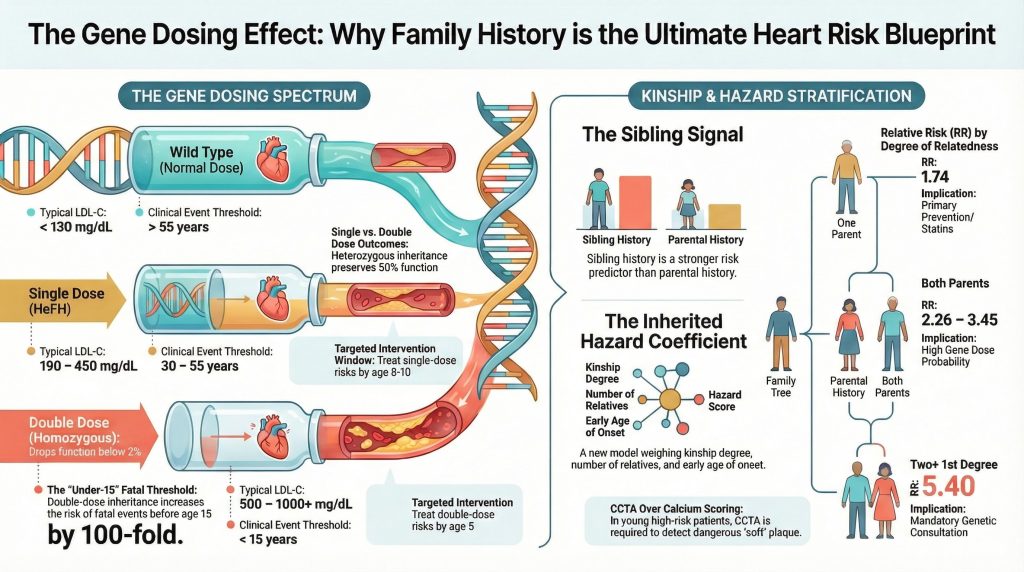
このアプリの核となる洞察はシンプルでありながら深遠です: あなたの 家族の歴史 それははいかいいえかで答えられる質問ではありません。.
広く使用されているものも含め、標準的な心疾患リスク計算ツール フラミンガム・リスクスコア 心疾患の家族歴があるか尋ねる. [1] はい、またはいいえ。それだけです。祖父母が亡くなる 心臓発作 82歳で、兄弟姉妹が〜から倒れ 心臓突然死 39歳では、どちらも同じチェックボックスになります。それらは同じものではありません。似ても似つきません。そして、その研究結果はこのことについて明白に示しています。. [3],[5]
このアプリの特徴は何ですか
「どうか」だけでなく「誰か」を問う
心臓病リスク計算ツールは、家族の心臓疾患の病歴を、関係性、発症年齢、および結果の重症度別に整理します。致命的なイベントは、 一親等血族 40歳での発症は、75歳の祖父母における非致死的な事象とは、遺伝的なシグナルが根本的に異なります。このアプリは、Peter Megdal, PhDが公表された疫学的観察結果に基づいて開発した、エビデンスに基づく重み付けフレームワークを用いて、その違いを数学的に捉えています:
H = Σ (R × W) / A
Rが 相関係数 (両親と兄弟姉妹は0.5、祖父母、叔父、叔母は0.25)で、Wは 重み付け重要度 心血管イベントが発生した年齢であり、この方程式は、確立された疫学的リスク原則を構造化されたスコアに統合した、エビデンスに基づく教育的枠組みであり、標準的なチェックボックスでは捉えられない、遺伝的・家族性の心臓リスクの構造化された推定量を提供する。.
それは明らかにする イメージングトラップ
近年の心血管系研究における最も重要であり、かつ最も警鐘を鳴らす発見の一つが、臨床医が「イメージング・トラップ(画像診断の罠)」と呼ぶものである。標準的な冠動脈 動脈 カルシウム・スキャンは、心臓病学で最も一般的に使用されるスクリーニングツールの1つであるが、危険な軟らかいプラークが存在していても、スコアがゼロを示すことがある。, 非石灰化プラーク あなたの動脈の中で着実に蓄積されています。. [6] 遺伝性の心疾患リスクが高い人にとって、 カルシウムスコアゼロ 特定の患者に対して偽りの安心感を与える可能性がある。.
2025年のCAUGHT-CADランダム化比較試験により、家族歴を有する患者において 若年性冠動脈疾患, 冠動脈CT検査 石灰化していないものを特定できる場合がある 歯垢 カルシウムスコアリングで検出されず、特定の患者において治療方針に影響を与える可能性がある。. [7] 心血管疾患リスク計算ツールはこの研究に基づいて構築されています。ご家族の病歴パターンから、画像検査の選択肢について医師とさらに相談することが適切であると考えられるグループに属するかどうかを理解するのに役立ちます。.
それはウェアラブル端末が完全に捉えきれないものを捉える
あなたのApple Watchは安静時心拍数を知っています。しかし、あなたの兄弟が42歳で致命的な心筋梗塞を起こしたことは知りません。あなたのFitbitは睡眠の質を追跡します。しかし、若年性心疾患を持つきょうだいがいることが、あなた自身の心臓病リスクについて2.46のオッズ比をもたらすことをあなたに伝えることはできません――その数値は、査読付き研究論文に記録されているものです JAMA. [5] あなたのガーミンは VO2 max. それは、複数の近親者が若年発症した場合に生じる、遺伝的負担の蓄積(研究者が遺伝子用量と呼ぶもの)を説明する方法を持っていません。 心血管疾患, これにより、遺伝的素因を受け継ぐ確率が大幅に高まります。. [3],[8]
ウェアラブル端末は、あなたの体内で「今」起きていることを測定します。心疾患リスク計算ツールは、家族歴に反映されている遺伝的な家系のシグナルと、それが一生涯の心臓の軌跡について示唆するものをモデル化します。ウェアラブル端末と家族歴ツールは、補完的でありながら異なる情報を提供しますが、標準的なスクリーニングよりも詳細な評価から恩恵を受ける可能性のある人々を特定するのに役立つのは、そのうちの1つだけです。.
医師に相談する材料になる
心疾患リスクカリキュレーターの出力はすべて、結論としてではなく、会話のきっかけとして構成されています。このアプリは、次回の診察時に持参できる、すぐに話し合い可能な家族歴の要約と、臨床的根拠に基づいた具体的な質問のセットを作成します。例えば次のような質問です:私の家族の傾向から考えると、私は プラークの軟化 通常のカルシウムスキャンでは見落とされてしまうようなものですか?紹介してもらうべきでしょうか 予防循環器専門医 プライマリケアで管理するのではなく? 私の家族歴によって、私のケースにおける標準的なリスク評価ツールの解釈はどのように変わるのでしょうか? [9]
これらは、臨床の場の方向性を文字通り変える力を持った質問です。ありふれた年次健康診断を、意味のある心血管系の対話へと変える質問です。そして、ほとんどの人が尋ね方すら知らない質問でもあります。なぜなら、誰も自分たちの家族歴を、そうした質問が自然と浮かび上がるような形で整理してくれたことがないからです。.
それは本物の科学に基づいて作られています
ハート・リスク・カリキュレーターは、一般的なアドバイスに基づいて作られたウェルネスアプリではありません。その枠組みに組み込まれた概念は、遺伝性心疾患リスクや早期の 冠動脈疾患, 、家族歴 流行病学, 、そして 遺伝学 心血管疾患に対する感受性の。遺伝性ハザード係数の根底にある遺伝子用量モデルは、遺伝性心血管疾患に関して発表された基礎研究を利用している。 Nature Reviews Cardiology, 、 ランセット, 、そして 欧州心臓病学会誌. [4],[8] 親および同胞の発症リスクデータは、以下の重要な研究から得られたものである: JAMA そして 循環. [3],[5] 早期の臨床的意義 心臓発作 近親者におけるその重要性と、従来のツールではその重要性を捉えきれないという不十分さは、数十年にわたる心血管疫学において実証されている。. [9]
これは、誰かが週末にさっと作ったようなアルゴリズムではありません。これは、Peter Megdal, PhDが教育ツールとして開発した、エビデンスに基づいた教育フレームワークであり、従来のツールでは解決するよう設計されていなかった問題に対して、確立された疫学の原則を適用したものです。.
これが今重要である理由
心疾患は依然として米国における死因の第1位である。. [10] アメリカ人の約半数に心疾患の家族歴があります。. [11] それでも、ほとんどの人が自分の遺伝的リスクを理解するために利用できるツールは、驚くほど原始的なままである——問診票のチェックボックス、遺伝的負荷をとらえるようには作られていないフラミンガム・スコアなどである。, [1] そして、遺伝的リスク要因を持つ若年者において、最も危険なプラークを完全に見逃してしまう可能性のあるカルシウムスキャンがあります。. [6],[9]
38歳で突然心停止により亡くなったきょうだいる20歳の人にとって、フラミンガム・リスク・スコアは、10年間のリスクを1パーセント未満と算出することがよくあります。これは、その数式が遺伝的要因ではなく実年齢に基づいているためです。. [1] その人物の遺伝的リスクプロファイルは、従来の計算機が示唆するものよりも大幅に多くの評価を正当化する可能性がある。そして、家族歴における遺伝的家族のシグナルをモデル化するツールがなければ、手遅れになるまで適切な質問をすべきことに気づくことは決してないだろう。.
Heart Riskアプリは、まさにその人のために存在します。それは、医師の診察室で「はい、家族に心疾患の既往歴があります」と答えながら、その情報がチェックボックスに消え去り、治療内容には何の変化ももたらさないのを目撃してきたすべての人々のために存在します。.
今すぐダウンロード
「Heart Risk Calculator」アプリが、Google Playにて$4.99で配信開始されました。 これは教育ツールであり、医療機器ではありません。また、臨床評価の代わりになるものでもありません。しかし、心臓の健康のために使う5ドルとしては、これが最も価値のある出費になるかもしれません。それは、このアプリが脈拍をモニタリングするからではなく、ウェアラブルデバイスや従来の計算機では決して答えられないような問いを、ついに投げかけてくれるからです。.
あなたの家族の歴史はデータです。それを活用する時が来ました。.
このツールは教育目的のみを意図したものであり、医学的アドバイスを構成するものではありません。このスコアは、個々の心血管イベントを予測する上で前向き検証されておらず、疾患の診断に使用すべきではありません。健康に関する判断を行う際は、必ず資格を持つ医療専門家に相談してください。Peter Megdal, PhDによる調査 — CuringHeartDisease.com
参考文献
- D’Agostino RB Sr, Vasan RS, Pencina MJ, et al. General cardiovascular risk profile for use in primary care: the Framingham Heart Study. Circulation. 2008;117(6):743-753. doi:10.1161/CIRCULATIONAHA.107.699579.
- Virani SS, Alonso A, Aparicio HJ, et al. Heart Disease and Stroke Statistics-2021 Update: A Report From the American Heart Association. Circulation. 2021;143(8):e254-e743. doi:10.1161/CIR.0000000000000950
- Lloyd-Jones DM, Nam BH, D’Agostino RB Sr, et al. Parental cardiovascular disease as a risk factor for cardiovascular disease in middle-aged adults: a prospective study of parents and offspring. JAMA. 2004;291(18):2204-2211. doi:10.1001/jama.291.18.2204
- Ference BA, Ginsberg HN, Graham I, et al. Low-density lipoproteins cause atherosclerotic cardiovascular disease. 1. Evidence from genetic, epidemiologic, and clinical studies. A consensus statement from the European Atherosclerosis Society Consensus Panel. Eur Heart J. 2017;38(32):2459-2472. doi:10.1093/eurheartj/ehx144
- Murabito JM, Pencina MJ, Nam BH, et al. Sibling cardiovascular disease as a risk factor for cardiovascular disease in middle-aged adults. JAMA. 2005;294(24):3117-3123. doi:10.1001/jama.294.24.3117
- Villines TC, Hulten EA, Shaw LJ, et al. Prevalence and severity of coronary artery disease and adverse events among symptomatic patients with coronary artery calcification scores of zero undergoing coronary computed tomography angiography: results from the CONFIRM (Coronary CT Angiography Evaluation for Clinical Outcomes: An International Multicenter) registry. J Am Coll Cardiol. 2011;58(24):2533-2540. doi:10.1016/j.jacc.2011.10.851
- Nerlekar N, Vasanthakumar SA, Whitmore K, et al. Effects of Combining Coronary Calcium Score With Treatment on Plaque Progression in Familial Coronary Artery Disease: A Randomized Clinical Trial. JAMA. 2025;333(16):1403-1412. doi:10.1001/jama.2025.0584
- Bachmann JM, Willis BL, Ayers CR, Khera A, Berry JD. Association between family history and coronary heart disease death across long-term follow-up in men: the Cooper Center Longitudinal Study. Circulation. 2012;125(25):3092-3098. doi:10.1161/CIRCULATIONAHA.111.065490
- Arnett DK, Blumenthal RS, Albert MA, et al. 2019 ACC/AHA Guideline on the Primary Prevention of Cardiovascular Disease: A Report of the American College of Cardiology/American Heart Association Task Force on Clinical Practice Guidelines. Circulation. 2019;140(11):e596-e646. doi:10.1161/CIR.0000000000000678
- Martin SS, Aday AW, Allen NB, et al. 2025 Heart Disease and Stroke Statistics: A Report of US and Global Data From the American Heart Association. Circulation. 2025;151(8):e41-e660. doi:10.1161/CIR.0000000000001303
- Moonesinghe R, Yang Q, Zhang Z, Khoury MJ. Prevalence and Cardiovascular Health Impact of Family History of Premature Heart Disease in the United States: Analysis of the National Health and Nutrition Examination Survey, 2007-2014. J Am Heart Assoc. 2019;8(14):e012364. doi:10.1161/JAHA.119.012364
追補
継承ハザード係数アルゴリズムの証拠的基礎
「ようやく正しい問いを投げかける心臓健康アプリ」の補足資料“
概要
継承ハザード係数(IHC)は、次の式を使用して計算されます:
H = Σ (R × W) / A
どこ R 関係係数(一次血縁者:両親および兄弟姉妹の場合は0.5、二次血縁者:祖父母、叔父、叔母の場合は0.25), W 心血管イベントの重み付けは、, A その出来事が発生した年齢であり、 Σ 家族歴における影響を受けたすべての親族にわたる総和を表す。.
この式の各構成要素(関係係数R、重症度ウェイトW、年齢分母A、および総和のロジック)は、査読済みの心血管疫学に関する特定の専門的知見に基づいています。この付録では、各コンポーネントを裏付ける主要な文献を特定し、そのエビデンスと、著者が独自のエビデンスに基づく統合を表す設計上の選択とを区別しています。.
Rの用語:相関係数
R項は、患者と罹患した家族との間の生物学的近縁度の程度を表します。一親等親族(両親、兄弟姉妹)には、50%の共有ゲノムを反映して、係数0.5が割り当てられます。 2親等親族(祖父母、叔母、叔父)には0.25の係数が割り当てられ、これは25%の共有ゲノムを反映しています。1親等親族と2親等親族の重み付けの違いは、フラミンガム研究に基づく2つの画期的な研究によって裏付けられています。.
ロイド=ジョーンズら、JAMA 2004
[1] This prospective Framingham offspring analysis was among the first to rigorously confirm parental cardiovascular disease as an independent predictor of offspring CVD after full adjustment for conventional risk factors. Critically, the study demonstrated that risk compounded when both parents were affected — the conceptual foundation for the summation structure of the IHC. The paper directly supports the assignment of the 0.5 coefficient to parents and the differential weighting of first-degree versus second-degree relatives.
Murabito et al., JAMA 2005
[2] This companion Framingham sibling analysis documented an unadjusted odds ratio of 2.46 for cardiovascular disease in individuals with an affected sibling — a magnitude comparable to or exceeding that of parental history in certain subgroups. This finding is the primary justification for assigning siblings the same R coefficient of 0.5 as parents, rather than a lower value. It also reinforced the core principle that first-degree relatives constitute a categorically different risk tier from second-degree relatives.
The A Term: Age at Event in the Denominator
The A term places the age at which the family member experienced their cardiac event in the denominator of the formula, so that younger events produce a higher IHC contribution. This is the most clinically consequential structural feature of the algorithm and is supported by consistent findings across multiple data sources.
Lloyd-Jones et al., JAMA 2004 and Murabito et al., JAMA 2005
[1],[2] Both Framingham analyses stratified their findings by age at the family event and demonstrated substantially elevated risk when the cardiac event was premature — defined as occurring before age 55 in male relatives and before age 65 in female relatives. A family event at age 40 carries a fundamentally different inherited signal than the same event at age 78. The A term in the denominator is a direct mathematical encoding of this well-established epidemiologic principle.
D’Agostino et al., Circulation 2008 — Framingham Risk Score
[3] Cited in the main article as the primary example of a risk calculator that does not account for age at the family event. The Framingham score uses the patient’s own chronological age as its dominant driver of 10-year risk, but incorporates no variable for the age at which family members experienced cardiac events. The A denominator in the IHC formula is specifically designed to correct for this gap — capturing what the Framingham score systematically omits.
The W Term: Severity Weight
The W term assigns differential weights to cardiac events based on their severity — with fatal events, sudden cardiac death, and early revascularization receiving higher weights than medically managed non-fatal events. This reflects the well-documented relationship between event severity and underlying atherosclerotic burden.
Villines et al., JACC 2011 — CONFIRM Registry
[4] This large multicenter CCTA registry demonstrated that even among patients with a CAC score of zero — conventionally considered low risk — a meaningful proportion harbored non-calcified, potentially obstructive plaque. The study provided strong evidence that event severity and plaque characteristics are not uniform across patients with nominally similar risk profiles. Fatal events in first-degree relatives imply a higher inherited plaque burden and more aggressive disease trajectory than non-fatal, medically managed events — the epidemiologic rationale for the W severity weighting.
Nerlekar et al., JAMA 2025 — CAUGHT-CAD Trial
[5] This 2025 randomized trial in patients with a family history of premature CAD demonstrated that non-calcified plaque burden varied substantially even among individuals within the same broad family history category. The trial used CCTA to quantify plaque progression as its primary endpoint, confirming that severity differentiation within the inherited risk spectrum has measurable clinical significance — and is not captured by binary family history classification or calcium scoring alone.
The Σ Term: Summation Across Relatives
The summation operator reflects the principle that inherited cardiac risk compounds with each additional affected relative. A patient with two affected first-degree relatives carries a meaningfully different inherited signal than a patient with one. The Σ structure encodes this dose-response relationship mathematically.
Bachmann et al., Circulation 2012 — Cooper Center Longitudinal Study
[6] This large prospective study of men followed over decades demonstrated that family history of coronary heart disease death was associated with significantly elevated long-term cardiovascular mortality, and that the risk accumulated across the follow-up period in a manner consistent with an underlying dose-response relationship. The study supports the logic of summing contributions across affected relatives rather than treating family history as a single binary flag.
Ference et al., European Heart Journal 2017
[7] This Mendelian randomization analysis demonstrated that the atherogenic effect of LDLコレステロール — the primary driver of inherited lipid-related cardiac risk — is cumulative and time-dependent. Lifetime exposure to elevated LDL produces atherosclerotic burden that is proportional to the integral of exposure over time, not simply to any single measurement. This biological framework supports the IHC summation structure: inherited cardiovascular risk is not a point estimate but a cumulative signal that should be aggregated across all affected relatives and weighted by the severity and timing of their events.
What the Literature Validates — and What It Does Not
What is validated
The peer-reviewed literature cited above establishes the following with high confidence:
- First-degree relatives confer greater inherited cardiac risk than second-degree relatives.
- Siblings carry risk comparable to parents, not intermediate between parents and grandparents.
- The age at which a family member experienced a cardiac event is a critical variable: premature events confer dramatically greater inherited signal than late-life events.
- Multiple affected relatives compound inherited risk in a dose-response fashion.
- Event severity correlates with underlying atherosclerotic burden and is not uniform across family history reports.
- Standard risk calculators systematically underutilize this information, particularly in younger patients with strong family histories.
What is not validated
The existing literature does not validate:
- The specific coefficient values chosen for R (0.5 and 0.25).
- The specific severity weight values assigned to W.
- The mathematical form of dividing by A rather than applying a categorical age-at-event modifier.
- The formula H = Σ(R×W)/A as a clinically calibrated predictive score for individual cardiovascular event risk.
- The IHC against any prospective outcome dataset.
The IHC formula is an evidence-informed educational framework that translates established epidemiologic principles into a structured, quantitative estimate of inherited familial cardiac risk. The inputs are grounded in landmark peer-reviewed literature. The specific mathematical implementation — the coefficient values, the weighting scheme, and the formula structure — represents the author’s synthesis of those principles and has not been independently validated. The ACC/AHA Primary Prevention Guideline [8] explicitly recognizes family history as a risk-enhancing factor that should modify clinical decision-making, but stops short of providing a quantitative formula for doing so. The IHC is designed to fill precisely that gap.
参考文献
- Lloyd-Jones DM, Nam BH, D’Agostino RB Sr, et al. Parental cardiovascular disease as a risk factor for cardiovascular disease in middle-aged adults: a prospective study of parents and offspring. JAMA. 2004;291(18):2204-2211. doi:10.1001/jama.291.18.2204
- Murabito JM, Pencina MJ, Nam BH, et al. Sibling cardiovascular disease as a risk factor for cardiovascular disease in middle-aged adults. JAMA. 2005;294(24):3117-3123. doi:10.1001/jama.294.24.3117
- D’Agostino RB Sr, Vasan RS, Pencina MJ, et al. General cardiovascular risk profile for use in primary care: the Framingham Heart Study. Circulation. 2008;117(6):743-753. doi:10.1161/CIRCULATIONAHA.107.699579
- Villines TC, Hulten EA, Shaw LJ, et al. Prevalence and severity of coronary artery disease and adverse events among symptomatic patients with coronary artery calcification scores of zero undergoing coronary computed tomography angiography: results from the CONFIRM (Coronary CT Angiography Evaluation for Clinical Outcomes: An International Multicenter) registry. J Am Coll Cardiol. 2011;58(24):2533-2540. doi:10.1016/j.jacc.2011.10.851
- Nerlekar N, Vasanthakumar SA, Whitmore K, et al. Effects of Combining Coronary Calcium Score With Treatment on Plaque Progression in Familial Coronary Artery Disease: A Randomized Clinical Trial. JAMA. 2025;333(16):1403-1412. doi:10.1001/jama.2025.0584
- Bachmann JM, Willis BL, Ayers CR, Khera A, Berry JD. Association between family history and coronary heart disease death across long-term follow-up in men: the Cooper Center Longitudinal Study. Circulation. 2012;125(25):3092-3098. doi:10.1161/CIRCULATIONAHA.111.065490
- Ference BA, Ginsberg HN, Graham I, et al. Low-density lipoproteins cause atherosclerotic cardiovascular disease. 1. Evidence from genetic, epidemiologic, and clinical studies. A consensus statement from the European Atherosclerosis Society Consensus Panel. Eur Heart J. 2017;38(32):2459-2472. doi:10.1093/eurheartj/ehx144
- Arnett DK, Blumenthal RS, Albert MA, et al. 2019 ACC/AHA Guideline on the Primary Prevention of Cardiovascular Disease: A Report of the American College of Cardiology/American Heart Association Task Force on Clinical Practice Guidelines. Circulation. 2019;140(11):e596-e646. doi:10.1161/CIR.0000000000000678