(في الأعلى): بيتر ميغدال من ديدهم يشارك في سباق ضد الزمن لمسافة 60 دقيقة للرجال للفئة العمرية 60-64 عاماً في المكسيك في شهر أكتوبر.
تظهر المقالة التالية في صحيفة ذا ديدهام تايمز.

حامل الرقم القياسي الوطني ثلاث مرات يوضح نهجه لتحسين الصحة
بقلم سكوت هيلد / صحيفة ديدهام تايمز / 13 يناير 2023
يقول مثل روماني تقليدي: “السفينة العظيمة تحتاج إلى مياه عميقة.”
لعلّ أي شخص يشرع في أمر شاق بموضوعية، ولا يخشى السعي وراء الفرص التي قد لا تكون واضحة للعيان، هو نوع الشخص الذي يلمح إليه المثل.
يندرج بيتر ميغدال من ديدهم في هذه الفئة بعدة طرق. فخلال مسيرته المهنية، حقق نجاحاً أكاديمياً ومهنياً ملحوظاً، حيث حصل على إحدى أعلى الدرجات العلمية وبنى لاحقاً عملًا تجارياً مزدهراً.
لقد آتى نفس العزم اللازم للحصول على درجة الدكتوراه، ومخالفة الحكمة التقليدية لإطلاق شركة ناجحة، ثاره في مجال الرياضة أيضاً. فمن خلال قوة الإرادة والتفاني في رياضة ما، أصبحت ميغدال تحطيم الأرقام القياسية عدة مرات مع إظهار أن عقبة جسدية مدى الحياة لا يواجهها سوى عدد قليل جداً من الناس، وحالة مرضية في القلب في منتصف العمر يواجهها الكثير من الناس، لا يجب أن تكون قيوداً دائمة على مستقبل المرء، بل يمكن بدلاً من ذلك أن تكون جزءاً من الطريق نحو إنجازات رائعة.
فيما يلي الرواية المكتوبة لميجدال عن تحقيقه الأخير لرقم قياسي أمريكي جديد في رياضة الدراجات الهوائية للرجال الذين يُعتبرون مواجهين لتحدٍ جسدي في فئته العمرية.
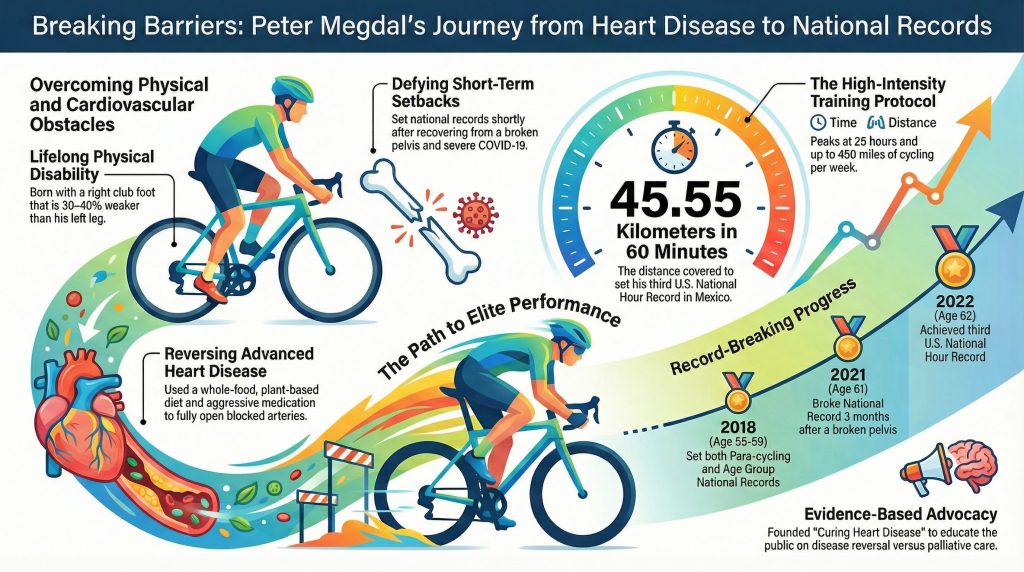
في شهر أكتوبر/تشرين الأول الماضي في المكسيك، سجل رقماً قياسياً أمريكياً جديداً في سباق ضد الساعة لمدة ساعة واحدة الحدث للمرة الثالثة، قاطعاً مسافة 45 كيلومتراً و550 متراً في 60 دقيقة.
كسر مجدال الرقم القياسي الوطني لأول مرة في عام 2018، في فئة العمر 55-59 عامًا، عندما سجل الرقم القياسي لذوي الإحتياجات الخاصة وفئته العمرية من خلال نفس الجهد.
الـ ركوب الدراجات لذوي الاحتياجات الخاصة تتراوح الفئات من C1 إلى C5، حيث تضم الفئة C5 أقل الإعاقات حدة. وتتنافس ميجدال في الفئة C5.
يُنصح في حسابه:
لدى الجميع أهداف. بالنسبة لبعض الناس، هو مجرد النهوض من السرير في الصباح؛ قد يرغب آخرون في أن يصبحوا رواد فضاء ويطيروا بصواريخ إلى المريخ. لقد أمضيت سنوات في محاولة تحطيم رقم قياسي عالمي في ركوب الدراجات. لسوء الحظ، ألقَت السنوات الأربع الماضية في وجهي عراقيل مثل أمراض القلب، وكسر في الورك العام الماضي، وفيروس كورونا هذا العام!
في 27 سبتمبر 2022، تنافست في العالم مسار دراجات بطولات في كارسون، كاليفورنيا، لخوض سباق بطولة العالم لمسافة 2 كيلومتر. لسوء الحظ، قدمت سباقاً سيئاً وأصبت بفيروس كوفيد أثناء ذلك. ربما كنت مصاباً أثناء السباق، وهو ما قد يفسر أدائي الضعيف. ومما زاد الطين بلة، كنت أخطط أيضاً محاولة تحطيم رقم قياسي عالمي في سباق الزمن لمدة ساعة في أغواس كالينتيس، المكسيك في 17 أكتوبر، أي بعد ثلاثة أسابيع فقط. كيف يمكنني فعل ذلك بعد مثل هذا الأداء الضعيف قبل ثلاثة أسابيع فقط؟
كنت أنا وزوجتي ننظم الفعالية في المكسيك، لذلك شعرنا بأننا ملزمون بالذهاب رغم أنني كنت مريضًا جدًا بكورونا. لقد تمكنت من البدء في باكسلوفيد, ، وهو الدواء المضاد للفيروسات الذي يعمل ضد الفيروس. لسوء الحظ، كنت أعاني من حمى شديدة ولم أتمكن من ركوب دراجتي في الوقت الذي كنت فيه التقليل التدريجي للوصول إلى ذروة أدرائي لمحاولة تحطيم الرقم القياسي العالمي.
كان هذا العام أشبه بحالة ديجافو، فمثلما حدث في العام الماضي، 2021، عندما كسرت وركي قبل ثلاثة أشهر من محاولتي تحطيم الرقم القياسي العالمي ومع ذلك تمكنت من تحطيم الرقم القياسي الوطني. لم أكن أرغب في تمرير ذلك مرة أخرى، لذلك قررت عدم الذهاب... ومع ذلك، كانت لزوجتي أفكار أخرى وشجعتني على الذهاب، وفعلنا ذلك.
رقم القيادة الزمني لساعة واحدة يُعتبر السباق الزمني الأكثر هيبة في رياضة الدراجات، ولسبب وجيه. إنه تحدٍ؛ إذ يجب على المرء بذل أقصى ما بوسعه لمدة ساعة كاملة. بغض النظر عن مدى سرعتك أو الجهد الذي تبذله، يظل الحدث مستمراً لمدة 60 دقيقة كاملة. بغض النظر عما إذا كنت أسرع، فإن الحدث لا ينتهي بشكل أسرع. إنها المسافة هي التي تهم! هذا على عكس أي سباق آخر.
تنظيم السرعة أمر بالغ الأهمية لعدم وجود مكافأة لتجاوز خط النهاية قبل مرور ساعة؛ بل عليك الاستمرار فقط، وهذا يتطلب الكثير من التدريب. النصف الأول يبدو دائماً وكأنك لا تتحرك بالسرعة الكافية، لكن ذلك سرعان ما يزول، وبحلول الدقائق العشر الأخيرة، تشعر وكأنك لن تنجح؛ هذا بالطبع إن كنت قد نظمت سرعتك بشكل صحيح. الأمر شاق دائماً... ولا يُسمح لك بالأكل أو الشرب أثناء الركوب. بالإضافة إلى ذلك، لا يمكنك النظر إلى معدل ضربات القلب, ، أو خرج الطاقة، أو أي شيء من ذلك – كل ما يمكنك الاعتماد عليه للحصول على المعلومات هو أن يصرخ شخص ما بأوقات لفاتك إليك.
الـ حدث لمدة ساعة تقام دائماً على مضمار خشبى مائل يسمى فيلودروم (مضمار الدراجات). ويعتبر أسرع مضمار فى العالم موجود فى أغوااسكاليينتس بالمكسيك، على ارتفاع 6000 قدم. الميل فى هذا المضمار الداخلى
يقع مضمار السباق الذي يبلغ طوله 250 متراً بالقرب من 40%، لذا فإنك، خلال نصف الوقت تقريباً الذي تقضيه في القيادة على المضمار، تتعرض لقوة تساوي ضعف وزن جسمك تقريباً في المنعطفات، حيث تدفعك قوة الطرد المركزي إلى الأسفل.
هذه القوة تجعل وزنك أثقل وتضع ضغطاً على جسمك كله، لا سيما على السرج في منطقة عظام الجلوس. هذا أمر مزعج للغاية، بغض النظر عن مدى تمرين مؤخرتك. بصراحة، أكبر مخاوفى كانت أنني قد لا أستطيع تحمل ألم الركوب في نفس الوضعية طوال الساعة بكامل القوة.
عند وصولي إلى المكسيك، كان لدي يوم واحد فقط للاستعداد للحدث. في يوم الأحد، ذهبت إلى المضمار وقمت باختبار لمعرفة مستوى لياقتي البدنية الذي بقي لدي بعد الإصابة بكوفيد، وما هي السرعة التي يمكنني الحفاظ عليها من حيث أوقات اللفات. قررت في تلك اللحظة أنني لن أكون قادرًا على السعي وراء الرقم القياسي العالمي، ولكن ربما يمكنني السعي وراء أحد رقمي القياسي الوطنيين.
أحمل حالياً الرقم القياسي الوطني لسباق الدراجات لذوي الاحتياجات الخاصة لهذه الساعة بسرعة 46.250 كيلومتراً / 28.9 ميلاً، وحقق رقم القياس لفئة فوق 60 عاماً للماسترز بواقع 44.935 كيلومتراً / 27.8 ميلاً في الساعة.
يوم السباق: بعد الاستقرار ومعرفة ما ستكون عليه درجة حرارة المسار (درجات الحرارة الأدفأ تكون أسرع ولكنها تفرض أيضاً ضغوطاً فسيولوجية أكبر على الجسم، لذا فإن هذه عملية موازنة للحصول على درجة الحرارة المناسبة) وما ستكون عليه سروتي، حان الوقت لارتداء الزي والتوجه إلى خط Start.
في بداية السباقات الزمنية، يتم تثبيتك في جهاز احتجاز يمسك بالدراجة ولن يفحرر حتى يكتمل العد التنازلي للمؤقت إلى الصفر. لذا، مع انطلاق الجرس، لم يكن لدي أدنى شك في أنه كان علي الحفاظ على سرعة ثابتة وبذل أقصى جهد ممكن ضمن المعقول، مع الحفاظ على سرعة أقل قليلاً من تلك المتوقعة لكسر الرقم القياسي الوطني - وكانت هذه السرعة حوالي 19.8 ثانية لكل لفة. وأيضاً، كان عليّ التحكم في الألم عندما أجلس على السرج عن طريق الارتفاع برفق لتخفيف الوزن عن نفسي مرة أو مرتين في كل لفة لضمان امتلاك القدرة على التحمل حتى النهاية.
لقد قממت بهذه المحاولة في المرات الأربع الماضية، وكان الألم مبرحاً للغاية عندما تم دفعي إلى سرج الدراجة. في كل مرة كنت أسعى فيها لتحقيق رقم قياسي، كان يتوجب علي التراجع في النهاية لعدم تحملي ألم الجلوس. لم أكن أريد أن يتكرر ذلك مرة أخرى.
من الناحية الغذائية، قمتُ أيضاً بأمور بشكل مختلف: هذه المرة، تناولت ثلاثة غرامات من الصوديوم والعديد من عبوات الجل التي تحتوي على 100 سعرة حرارية والمملوءة بـ الكربوهيدرات قبلมนตลก. قبيل البداية لضمان وجود كمية كافية من الوقود على متن المركب. بعد البداية، يُمنع تناول أي طعام أو شراب! لقد ساعدني الملح في الاحتفاظ بالماء الذي شربته لأطول فترة ممكنة ومنحني ما يكفي من الصوديوم لتؤدي عضلاتي عملها بشكل جيد... وكما اتضح أنني أعاني من التعرق الشديد وأحتوي أيضاً على نسبة عالية من الصوديوم في عراقي ويمكنني إفراز ما يصل إلى غرامين من الملح في الساعة، لذلك كان عليّ أن أحرص على التأكد من الحفاظ على مستويات الملح والسوائل لدي قبل أن أبدأ الفعالية. كانت زوجتي هي المسؤولة عن عد اللفات، وكان مدربي، تود سشيسكي، يزودني بأوقات اللفات.
كانت الدقائق العشر الأولى أو نحو ذلك رائعة. لقد بقيت ضمن النطاق الذي أردته، وكل شيء بدا جيداً وشعرت بحالة جيدة. ولكن مع تقدمي، بدأ التعب يتسلل. عند الدقيقة الثلاثين، لاحظت أنني بدأت أعرّض لبعض الألم أثناء الجلوس، وأتنفس بشكل أقرب إلى الصعوبة، وأزداد إرهاقاً. لذا بدأت الأسئلة الآن: هل كانت لياقتي البدنية كافية بعد ثلاثة أسابيع من التوقف بسبب إصابة سيئة بكوفيد؛ هل تعافيت بما فيه الكفاية؛ هل أستطيع تحمل قوى الجاذبية في المنعطفات؟... لم أكن أعرف، لذلك أبطأت قليلاً. كنت أود التقاط أنفاسي لأنني لم أكن متأكداً من قدرتي على إكمال السباق، وفي هذه اللحظة، كنت متقدماً قليلاً على الرقم القياسي الوطني الذي سجلته العام الماضي وكنت أعلم أن بإمكاني تحمل بعض الراحة.
تساءلت عما إذا كان بإمكاني الحفاظ على هذا الإيقاع مع مرور الوقت، لذا خففت من سرعي قليلاً. ارتفعت أوقات لفاتي من 19.5 ثانية لكل لفة إلى حوالي 20 ثانية لكل لفة. وأصبحت سرعتي الآن تزيد عن 28 ميلاً في الساعة. كان متوسط سرعتي الإجمالية قريبًا من 28.3 ميلًا في الساعة. كانت سرعتي لا تزال ثابتة إلى حد كبير، وأصبحت أكثر ثقةً مع مرور الوقت. كانت زوجتي تصرخ لي بأنني على وشك تحطيم رقمي القياسي في رياضة الدراجات للمعاقين، لذا بذلت جهدًا كبيرًا قبل حوالي 15 دقيقة من نهاية السباق، لكنني دفعت ثمن ذلك بإصابتي بنقص الأكسجين (وهو أمر غير جيد في سباق يعتمد على التمارين الهوائية بنسبة 100%) قبل انتهاء الساعة.
ثم جاءت الدقائق الخمس الأخيرة، وكانت مؤلمة للغاية! لم أكن متأكداً من أنني استطيع التحمل وكنت أود الاستسلام – فالعقل يلعِب ألعاباً مجنونة في مثل هذه الجهود. قال فيليبو غانا، الذي حطّم للتو الرقم القياسي الاحترافي لساعة الدراجات، إنه كان يريد أن يتعرض لحادث أو لانفجار في الإطار لكي يتوقف، وهو الأفضل في العالم!
مع مرور الوقت وتناقص عدد لفاتي، لم أستطيع تصديق شعوري بالبهجة عندما توقفت عن التبديل. لقد كان شعوراً بالارتياح أكثر من كونها سعادة. وبعد ذلك بقليل، حصلت على تأكيد رسمي بأنني حطمت رقمي القياسي الوطني بأكثر من لفتين، أي أكثر من نصف كيلومتر، مما وضعني في سجلات الأرقام القياسية للمرة الثالثة. وكان الرقم القياسي السابق صامداً كرقيم قياسي عالمي لمدة ثماني سنوات حتى حطم نيوزيلندي الرقم القياسي العالمي الجديد.
لم أتمكن من إخفاء خيبة أملي لأنني كنت أطمح لتحقيق رقم قياسي عالمي وواجهت هذه المشكلة الاستثنائية المتمثلة في الإصابة بكوفيد قبل حدثي مباشرة. ولكن مع ذلك، لم أستطيع أن أنكر أنني حطمت رقماً قياسياً كنت أعتقد أنه لا يُنال، بالنظر إلى أنني كنت مريضاً جداً قبل ذلك بأسبوعين فقط.
مؤخراً، تحدث ميغدال مع صحيفة "ذا ديدهام تايمز" عن هذه التجربة.
تتبع مقتطفات رئيسية من المحادثة.
تودهام تايمز من الذي سجل الرقم القياسي الوطني السابق لفئة الرجال فوق 60 عاماً؟
بيتر ميغدال لقد سجلت رقماً قياسياً في فئة M60 في عام 2021 ضد شخص كان يحتفظ بالرقمين القياسيين الوطني والعالمي حتى قبل عامين، عندما تم تحطيم جزء الرقم القياسي العالمي من قبل نيوزيلندي. الرقم القياسي العالمي الجديد والحالي لفئة M60 هو 47.3 كيلومتراً في الساعة (29.4 ميلاً في الساعة).
قبل ذلك، عندما كنت في الثاهرة والخمسين من عمري، حاولت تحطيم الرقم القياسي العالمي لفئة 55 إلى 59 عاماً (M55). وعلى الرغم من أنني لم أصل إلى الرقم القياسي العالمي لفئة M55، إلا أنني حققت رقماً قياسياً وطنياً بارالمبياً، لأني رياضياً من ذوي الإعاقة أيضاً. لم يكن هناك رقم قياسي وطني سابق للفئة المعوقة، والتي لا يتم تجميعها حسب العمر بل حسب نوع الإعاقة.
في عام 2021، عن عمر يناهز 61 عاماً، حاولت تحطيم رقمي القياسي لذوي الاحتياجات الخاصة والرقم القياسي العالمي للفئة العمرية التالية، فئة الرجال فوق 60 عاماً. لم أتمكن من تحطيم الرقم القياسي العالمي أو رقمي القياسي لذوي الاحتياجات الخاصة، لكني حطمت الرقم القياسي الوطني الساري أنذاك. وفي سن 62، حطمت رقمي القياسي الوطني بينما كنت أتتنافس على الرقم القياسي العالمي المراوغ.
الطريقة التي تعمل بها هي أنهم يحسبون لك الوقت لمدة ساعة، وهي المسافة التي تقطعها في ساعة. هذا العام قطعت 28.3 ميلاً (45.55 كيلومتراً)، لذا فقد قطعت مسافة أسرع بحوالي 4/10 من الميل في الساعة أو أبعد بحوالي 700 متر مما قطعت العام الماضي.
Last year I broke my pelvis three months before. I was on crutches for a full month. So I only had a few months to get back into it. This year I got COVID two weeks before. I actually got really sick. I wasn’t even going to go.
We had organized the event. This is something you do as a one-off deal. You have to rent the track, you have to pay for officials, you have to pay for timers and travel to do it. We go down to Mexico, at an altitude where the air is thinner. We had seven athletes of different age groups and nationalities to disperse the cost, because it’s somewhere around $25,000 to do all that. So we divide that up, and it makes it a little bit easier. We had organized it, so we felt obligated to go.
My wife said, ‘Just go and see what you can do. You can collect data.’ It’s so technical to do these events, that it’s a good idea to get data. I’d just gotten well. I think we left on a Saturday. I just got feeling better on Wednesday, right before we left. With COVID, you just never know how your lungs are going to do. I was unable to train for two weeks. So I said, ‘I have to really pace it well and I have to be really careful.’ I paced it perfectly and was able to add on distance to my previous record.
تي دال What does a typical day or week of training involve?
PM: It varies throughout the year. I’m going for hopefully my last attempt for a while in 2023. I want to try to do it while I’m healthy. I haven’t had a good run of it, because I have not been healthy. I took some time off in November, but now I’m training probably somewhere around five to seven hours a week, which is not a lot. In terms of mileage, it’s somewhere in the neighborhood of 100 miles a week, maybe 150 miles a week. I’m doing indoor training. When I say hours, I probably should include weightlifting and swimming. It’s probably a total of around ten hours a week.
As the season progresses – I usually do these events in September and October – you really have to start training about eight to ten months ahead specifically for that event. You don’t have anybody else on the track. You’re not racing against anybody, per se, head to head. You’re just going for a distance – not even for a time, because the time is set – it’s an hour. It’s on a specialized bike, it’s on a specialized track. These are indoor velodromes, 250 meters, made out of wood. So it’s a very, very specific type of event.
In the beginning of a season, like now, I’m riding my road bike, I’m riding my mountain bike. As I progress through the season, I start to do more specific training. By July, I’m riding my bike between 300 and 450 miles a week, which gets me up to 25 hours of pure bike-riding. Remember, I’m 62. That’s kind of a tough nut to crack at my age. But most of that mileage is what we call base mileage. So I’m not riding really hard.
I would do 100, 120 mile rides where I’m averaging somewhere around 18 miles an hour, which is relatively easy for me. Last year in preparation I did a 110 mile ride at almost 21 miles an hour, which was a lot harder. That was actually in Massachusetts, with a lot of traffic lights. So I had to stop. You have to shut off your computer until you get back going again.
On an open road like up in New Hampshire, that would have been maybe 21 or 22 miles an hour for over 100 miles. In a typical week in peak season, I’m averaging probably 17 hours, which would translate into 300 miles, going all the way up to 450 miles in a week.
تي دال When did you first begin cycling?
PM: I first started riding my bike in a competitive aspect, not racing but just trying to get really fit, when I was 17. At that point I was taking competitive karate, and I was riding my bike to the gym for training for karate, and I just really enjoyed it, and I got more into it.
By the way, my new coach is a former semi-pro cyclist. When we were there (in Mexico), he was training and coaching the current world record holder for the junior category, 18 years old and under. I saw him there, he was really good, so I hired him. He’s coached several world record holders.
تي دال What is the physical challenge that allows you to compete in cycling as a para?
PM: My disability is a right club foot that I’ve had six surgeries on, including a complete fusion. My right leg is 30 to 40% weaker than my left leg. This was from birth. My doctors have been asking that I do another foot operation because of deteriorating health of my right foot and leg. But I’ve been declining to do so because of the pain involved and there’s no guarantee that my foot will get better. Two of my four doctors recommended amputation of my right foot.
تي دال What do you do for a living?
PM: I got my PhD in biomedical engineering when I was 49 years old. It was focused on nutrition. I published in some nutrition and medical journals when I was in graduate school. I did a study on farmed versus wild salmon and how to identify it – we developed a technique in the lab to do that – because there’s a lot of counterfeiting going on. People sell farmed salmon and they call it wild. I also did a study on الأنسولين و سكر الدم, which I published when I was in grad school, because I was interested in all this sort of stuff.
Then when I graduated I went into the pharmaceutical industry and worked there for a few years. I didn’t like it. Then I got diagnosed with heart disease. I suspected something was wrong because I was going slower. I saw a cardiologist. They did an تصوير الأوعية الدموية on me and found out that I had a bunch of blocked arteries.
So like anybody else I said, ‘Just fix it. I want to get back to my old level of riding my bike.’ It turns out that if you stick a دعامة in somebody who’s already relatively healthy to open up their arteries, it may or may not do anything for them. For me it didn’t do anything, so I continued to get worse.
Having this PhD in biomedical – I dealt a lot with human physiology and so forth – I decided to really study this, because both my parents and my grandfather and my uncle all died from heart disease. My younger brother had a نوبة قلبية about that time and died from it. My older brother had heart disease. I could kind of see the writing on the wall. I did not want to die, so I literally quit my job in the pharmaceutical industry.
I was working on Crohn’s disease and arthritis and stuff like that. I quit my job and put all my focus on finding a cure. Over a couple of years of studying this, I put myself on a program. I was going to Mass. General Hospital for treatment, and I was working with my cardiologist. He knew I was educated.
I said, ‘Let me see what I can do to reverse this, because I want to go back to being a better cyclist.’ At that point I was really going downhill. I was not doing well in races, I wasn’t feeling good in races. I was not symptomatic. So I spent two or three years amassing all the technical data that I could in terms of drugs and diet and what worked to turn back the clock, reversing the لوحة in the arteries, because I didn’t want any more stents put in.
The long story-short of it is, after being successful at this – because my power got better on the bike, I was feeling better – I asked the doctor to do another angiogram, which is when they look at the heart arteries, to see if they’re opened up. Sure enough, when he did a second angiogram, about four years after I had my first one done, all my arteries had opened up.
I actually have pictures of that that I posted on my website. I started a company where I do education and consulting for physicians and the general public. I teach doctors different ways of treating heart disease, to get cardiologists to understand that you can reverse this. And I’m a poster child, of course, because most people with heart disease don’t turn around and get better to the point where they’re setting national records and going for world records.
Generally you see people who have heart disease getting what I call palliative care. Doctors gave me a stent in my heart and said, ‘Go home and live a good life’ without any real concern about where I am going to be ten years or twenty years down the road.
The vast majority of people who are treated with cardiology the way it is today generally get worse. If they’re treated really well they get worse slowly, or they might stay stable. But the target for cardiology is not to have people reverse their disease.
In 2018 or 2019 I started my company called Curing Heart Disease, LLC. I have a website, which is www.curingheartdisease.com. Go figure that URL was available, which just goes to show you that nobody even thought about curing heart disease.
I call myself cured because now my heart is getting better with time. I removed the things that cause heart disease. Of course, stress is a factor, but the main thing that causes it is really the food that we eat.
I’m not the first one to discover this. Dean Ornish and others have found a diet to work. There are studies published in the New England Journal of Medicine that show this, but to get the cardiologists to turn around and look at this is a different story.
Even my cardiologist at Mass. General Hospital did not prescribe to me this diet. He didn’t even talk to me about it. I had the notion in my head at the time that you could reverse it, because I had read something. He basically said, ‘Theoretically you can reverse it.’
Fast-forward to today, I work with individuals, corporations, hospitals, or anybody that’s interested in getting educated. I have an educational website (curingheartdisease. com), which has some educational videos. There are some blogs on there, it has a white paper of the treatment I put myself through. So somebody could emulate that.
I work with individuals that either want to prevent heart disease, or that have heart disease and want to have better care. I’ll work with them and their physicians, and particularly I work with my physician at Mass. General directly with my clients now, because he sees what I’ve done.
I’ll bring clients in and I’ll sit with a client and him, and we’ll discuss a treatment plan. Of course, he’s a physician so he makes the ultimate decision. I just do advocacy for the patient to help them understand, because doctors don’t have the time to really explain everything.
I actually do a lot of pro bono work – I work for free for a lot of patients. I work on a sliding scale if patients can’t afford my fees. I do speaking engagements – I have several lectures on my website, which I think are quite exciting because people ask me questions.
I’m writing a book now, trying to formulate a road map to tell my story, but also from my story to have born out of that the motivation that somebody might have. Not everybody can set a national record that’s had a heart attack or heart disease. That’s not my point.
My point is, say you’re 75 years old and you’ve had a heart attack. Generally the way doctors will treat you, they have algorithms, they have treatment programs that they follow.
Generally what that is is to get their الكوليسترول الضار below 70. They may or may not go through a cardiac rehab. The doctor might tell them to maybe quit eating hamburgers. But they don’t go through a really detailed list. Basically you’ve got to go vegan – a whole-food, plant-based diet.
I did a press release last year. There were some magazines and periodicals that picked it up. But it hasn’t gained the traction that it needs to get. Having been a patient and being treated in a manner that wasn’t complete, or at least I wasn’t presented the options. Almost nobody is being treated the way that I treated myself, in terms of the aggressive treatment with diet and with medicines.
I’m not anti-medicine. I was on the most powerful anti-cholesterol drugs you can get on. I’m trying to get the word out, just for people that are interested. And I’ve got a plethora of clients now who went through the program and really can see that cardiology itself is not out there to cure you. That’s not the way they do it.
My ultimate goal is to help people. All my lectures are free. They’re accessible on my website for free. The idea is for me to be the poster child to say, ‘Hey, look: If you’re 50 and had a heart attack, you’re 60, you’re 30, whatever, you don’t have to worry necessarily about getting worse. Some people will maybe get worse. But from the research I’ve done, following the program of taking the medicine and doing the diet, almost everybody gets better.
تي دال That is fascinating. I’m sure there are so many Americans, I am among them, who can say, ‘Somebody in my extended family or my close family has had heart disease.’
Editor’s note: To learn more about Peter Megdal and his efforts to help others who are confronting heart disease, please visit www.curingheartdisease.com.