
الإجهاد النفسي المزمن، واختلال تنظيم محور الغدة النخامية-الغدة الكظرية (HPA)، وأمراض القلب والأوعية الدموية التصلبية: الآليات، وحجم التأثير، والأدلة الداعمة للتدخلات القائمة على التأمل
نقد منظم مراجعة سردية من الأدلة البشرية والتطبيقية
المحتويات
- ملخص
- النطاق والمصادر وإطار تصنيف الأدلة
- الاستنتاجات الرئيسية
- ما هو المؤكد، وما هو المحتمل، وما هو غير المعروف
- فسيولوجيا الإجهاد: بنية الاستجابة
- قياس الكورتيزول: المصفوفات، والحركيات، ومصائد التفسير
- الأدلة الوبائية البشرية: التعرض للعوامل المسببة للتوتر وأمراض القلب والأوعية الدموية (ASCVD)
- الكورتيزول وأمراض القلب والأوعية الدموية: سبب أم عامل وسيط أم مؤشر؟
- الآلية الأولى: الجهاز العصبي اللاإرادي والديناميكا الدموية
- الآلية الثانية: التهاب والمناعة
- الآلية الثالثة: البطانة والأوعية الدموية
- الآلية الرابعة: التمثيل الغذائي
- الآلية الخامسة: خثار و«التحفيز الحاد»
- الآلية السادسة: الوساطة السلوكية
- مصفوفة الأدلة الآلية
- سؤال التدخل: التصنيف وسلسلة الادعاءات
- توليف المعايير المرجعية
- الادعاء أ: الإجهاد المتصور
- الادعاء ب: الكورتيزول وعلم وظائف الجهاز المحوري-الغدد الكظرية-المخيخي (HPA)
- الادعاء (ج): ثبتت صحته عوامل الخطر
- الادعاء (د): تصلب الشرايين
- الادعاء (هـ): الأحداث السريرية الخطيرة
- جودة الأدلة، والتحيز، والآثار السلبية
- نموذج متكامل مع ترجيح الأدلة لكل رابط
- الآثار السريرية والوقائية
- الحدود التي من شأنها تغيير هذه الاستنتاجات
- الأسئلة البحثية الرئيسية التي لم يتم الإجابة عليها بعد
- الاستنتاجات: إجابات مباشرة على الأسئلة الأساسية
- حدود هذه المراجعة
- المراجع
1. ملخص
خلفية. يُقال على نطاق واسع إن الإجهاد النفسي المزمن يتسبب في أمراض القلب، كما يُقال على نطاق واسع إن التأمل يقي منها. وغالبًا ما يتم تكرار هذين الادعاءين دون أن يخضعا للفحص الدقيق. والغرض من هذه المراجعة هو تحديد ما تدعمه الأدلة التي خضعت لمراجعة الأقران بدقة، وما هو معقول من الناحية البيولوجية ولكنه لم يثبت بعد في البشر، وأين لا تزال هناك شكوك حقيقية.
الطرق. مراجعة سردية نقدية منظمة للأدبيات التي خضعت لمراجعة الأقران، والتي تم تحديدها من خلال قواعد البيانات MEDLINE/PubMed وScopus وEmbase ومكتبة كوكرين (CENTRAL وCDSR)، حيث شمل البحث الفترة حتى 20 أغسطس 2026، مع تتبع المراجع وسلسلة الاستشهادات. ويتم تتبع الادعاءات الكمية إلى مصدر أولي أو مصدر محدد مراجعة منهجية كلما أمكن ذلك، مع استخدام أسلوب IEEE في ترقيم المراجع في جميع أجزاء النص. وهذا هو ليس مراجعة منهجية: لم يتم تسجيل أي بروتوكول، ولم يتم الاحتفاظ بأعداد السجلات بعد إزالة التكرارات، ولم يتم تطبيق أدوات رسمية لتقييم مخاطر التحيز على مستوى الدراسة. يُصنف الدليل إلى فئات ثقة سردية يقيّمها المؤلف — قوية، معتدلة، محدودة، أو غير حاسمة — وفقًا لمعايير صريحة، لكل منها أساس محدد لخفض التصنيف، ويتم تمييز خمس ادعاءات منفصلة حول التأمل في جميع أجزاء الدراسة: (أ) يقلل من الإجهاد المتصور؛ (ب) يغير مستويات الكورتيزول أو وظائف الجهاز المحوري-الكلثوي (HPA)؛ (ج) يحسّن عوامل الخطر المعروفة؛ (د) يبطئ تصلب الشرايين القابل للقياس؛ (هـ) يقلل من الأحداث السريرية الخطيرة.
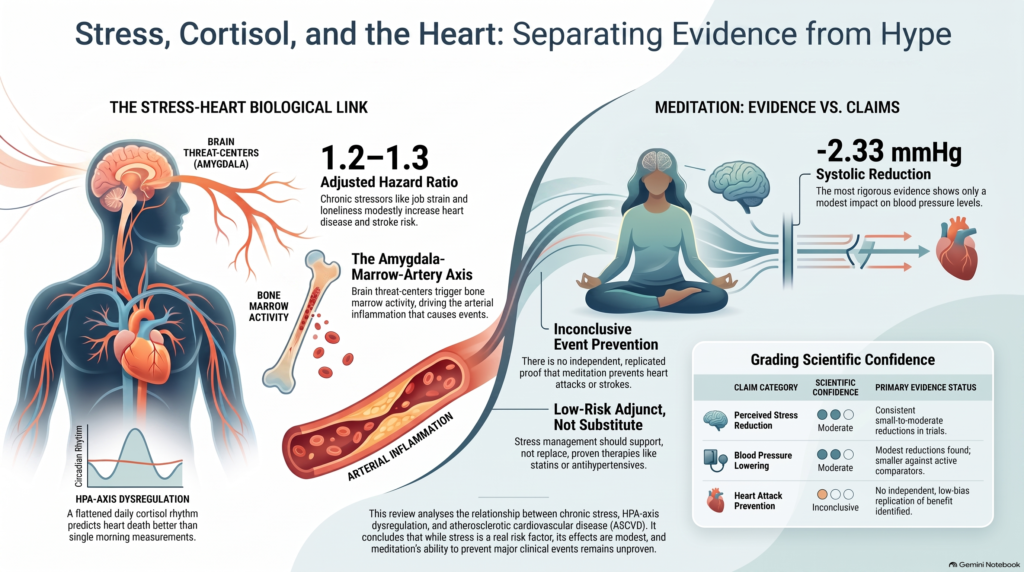
النتائج. بالنسبة لعدد من مفاهيم الإجهاد النفسي والاجتماعي التي خضعت لدراسات مستقبلية، فإن الارتباطات النسبية المعدلة مع حالات الإصابة مرض الشريان التاجي وإقفاري سكتة دماغية تتراوح عادةً بين 1.2 و1.3، على الرغم من أن التقديرات تختلف باختلاف تعريف التعرض والنتيجة. وهذه ارتباطات متواضعة، لكنها مع ذلك ليست تافهة على نطاق السكان. وهي لا يمكن قياسها مباشرةً بالتأثيرات النسبية المُبلغ عنها بالنسبة لـ تدخين, ضغط الدم أو التراكمي أبروليپوبروتين بأبو ب-١٠٠) التعرض، والتي تُقاس وفقًا لمقاييس تعرض مختلفة وتُحدد من خلال تصميمات مختلفة؛ ويتطلب ترتيبها نسبيًّا مقارنةً بالمخاطر المطلقة المعايرة، وهو ما لا تسعى هذه المراجعة إلى القيام به. وتكون تقديرات دراسات الحالات والشواهد أكبر بكثير (INTERHEART: نسبة الأرجحية 2.17 بالنسبة للإجهاد العام الدائم، مع الخطر المنسوب إلى السكان (حوالي 32.5% بالنسبة للعامل النفسي-الاجتماعي المركب)، وتقديرات دراسة التقاطع بين الحالات التي كانت أكبر من ذلك (نسبة الاحتمالات 2.44 لـ احشاء عضلة القلب (خلال ساعة واحدة من نوبة الغضب الحادة)، لكن هذه الدراسات تقيس عوامل مختلفة ولا يمكن اعتبارها بديلاً عن تقييم المخاطر المستقبلية. وتعتبر الأدلة السببية معتدلة: فهي تستند إلى التسلسل الزمني، والمعقولية البيولوجية، ونتائج التجارب القابلة للتكرار في مجال فسيولوجيا الإنسان، ودراسة أتباعية بارزة في مجال تصوير الدماغ — ولكنها لا تستند إلى عشوائية, ، و التشويش المتبقي ولا يمكن استبعاد وجود علاقة بين الوضع الاجتماعي-الاقتصادي والسلوك. لا ينبغي إدراج الأجهزة الجينية في هذه القائمة. المتوفرة الوراثة العشوائية المندلية قياسات الكورتيزول في البلازما الصباحية، وهو مؤشر لاحق المؤشر الحيوي, ، وليس الإجهاد النفسي؛ وقد نوقش هذا الأمر في إطار «السببية المتعلقة بالكورتيزول» في القسم 8.4، ولا يؤثر بأي شكل من الأشكال على الوضع السببي للإجهاد نفسه.
من الأفضل فهم الكورتيزول باعتباره مؤشراً حيوياً غير محدد لنظام الغدة النخامية-المهاد-الكظرية (HPA) وفسيولوجيا الجلوكوكورتيكويدات، ووسيطاً معقولاً من الناحية البيولوجية. وتتوافق البيانات الاستباقية والوراثية مع وجود مساهمة سببية طفيفة في مخاطر الإصابة بأمراض القلب والأوعية الدموية، لكن العلاقة السببية ضمن النطاق الفسيولوجي المعتاد تظل غير مؤكدة، كما أن الكورتيزول ليس بالتأكيد الناقل الوحيد للإجهاد النفسي. أ إطار عمل اضطراب التنظيم وهو نموذج يمكن الدفاع عنه أكثر من نموذج ارتفاع الكورتيزول في الدم بشكل مستمر. انخفاض المنحنى اليومي، وارتفاع الكورتيزول في المساء، وتغير الاستجابة،, مقاومة مستقبلات الجلوكوكورتيكويد, ، وقد ارتبط كل من ذلك والتغيرات في استقلاب الجلوكوكورتيكويدات في الأنسجة بظواهر سلبية، على الرغم من عدم وجود ظاهرة محددة واحدة في محور الغدة النخامية-المستقبلات (HPA) تُعتبر الشذوذ القلبي الوعائي المميز — وهو تحليل تلوي أظهرت 80 دراسة أن المنحدرات الأكثر انبساطًا ترتبط بحالة صحية أسوأ بشكل عام (r = 0.147)، في حين أن المجموعة الفرعية المتعلقة بأمراض القلب والأوعية الدموية، التي تم تحليلها باستخدام نموذج التأثيرات العشوائية، لم تكن ذات دلالة إحصائية [78]. في دراسة «وايتهول II»، كان الانحدار اليومي الأقل حدة مؤشراً على الوفيات الناجمة عن أمراض القلب والأوعية الدموية (نسبة الخطر 1.87، 95% CI 1.32–2.64) في حين أن مستوى الكورتيزول الصباحي و استجابة الكورتيزول عند الاستيقاظ لم يحدث ذلك. ففي دراسة LURIC، تم إبطال الارتباط الأولي بين مستوى الكورتيزول في مصل الدم الصباحي ومعدل الوفيات القلبية الوعائية (نسبة الخطر 1.32) بعد تعديل النتائج لمراعاة عوامل الخطر التقليدية (0.97).
يُثبت التأمل فعاليته في تقليل الإجهاد المُحسوس وخفض ضغط الدم بدرجة متواضعة. ولا توجد أدلة مقنعة ومستقلة وعشوائية على قدرته على الوقاية من احتشاء عضلة القلب أو السكتة الدماغية أو الوفاة الناجمة عن أمراض القلب والأوعية الدموية. وقد وجدت مراجعة كوكرين لعام 2024 (81 تجربة عشوائية، 6,971 مشاركًا، تم البحث حتى نوفمبر 2021) أن مقارنتين فقط قدمتا بيانات عن الأحداث السريرية القلبية الوعائية: التدخلات القائمة على اليقظة الذهنية مقابل مجموعة مقارنة غير نشطة (تجربة واحدة، 110 مشاركًا؛ نسبة المخاطر 0.94، نطاق الثقة 95٪ 0.37–2.42؛ درجة يقين منخفضة جدًّا) و التأمل التجاوزي مقارنةً بمعيار مقارنة نشط (تجربة واحدة، 201 مشاركًا؛ نسبة المخاطر 0.91، نطاق الثقة 95٪ 0.56–1.49؛ درجة يقين منخفضة). ولم يُظهر أي منهما تأثيرًا ملحوظًا. كما أن تقديرها الوحيد لضغط الدم الانقباضي ذي اليقين المعتدل — التأمل التجاوزي مقابل مقارنة نشطة — هو أيضًا الأصغر: −2.33 ملم زئبق للضغط الانقباضي.
التفسير. تعد إدارة الإجهاد، بما في ذلك التأمل، وسيلة مساعدة معقولة ومنخفضة المخاطر تُستخدم إلى جانب إجراءات الوقاية من أمراض القلب والأوعية الدموية التي تستند إلى المبادئ التوجيهية، ولا سيما فيما يتعلق بضغط الدم والرفاه النفسي والتنظيم الذاتي للسلوك. وهي لا تُعد بديلاً عن خافض للدهون, ، وعلاج ضغط الدم، والإقلاع عن التدخين، والتحكم في مستوى السكر في الدم، أو ممارسة النشاط البدني. الادعاءات بأن التأمل “يمنع النوبات القلبية,،” أو “يعكس تصلب الشرايين”، أو “يعيد مستويات الكورتيزول إلى مستوياتها الطبيعية للوقاية من أمراض القلب والأوعية الدموية”تتجاوز الأدلة.".
2. النطاق والمصادر وإطار تصنيف الأدلة
2.1 الأسئلة التي تم تناولها
تتناول هذه المراجعة ثمانية أسئلة:
- هل يزيد الإجهاد النفسي المزمن من خطر الإصابة بأمراض القلب والأوعية الدموية التصلبية (ASCVD)، وإلى أي مدى؟
- ما مدى قوة الأدلة التي تشير إلى أن العلاقة هي علاقة سببية وليست مجرد علاقة متداخلة؟
- ما هي الآليات البيولوجية التي تتمتع بأقوى تأثير؟ بشري الأدلة، بخلاف أقوى الأدلة المستمدة من التجارب على الحيوانات أو التجارب المختبرية؟
- ما هو الدور المحدد الذي يلعبه الكورتيزول — هل هو سبب، أم وسيط، أم مؤشر، أم مزيج من هذه العوامل؟
- هل ارتفاع مستوى الكورتيزول بحد ذاته مسبب للأمراض، أم أن خلل تنظيم محور الغدة النخامية-المهاد-الكظرية هو النموذج الأكثر دقة؟
- إلى أي مدى يُعتبر ضغط الدم والالتهاب عاملاً وسيطاً في العلاقة بين الإجهاد وأمراض القلب والأوعية الدموية (ASCVD)،, مقاومة الإنسولين, ، والسمنة، والنوم، والسلوك؟
- هل يؤثر التأمل على أي من هذه العوامل — وعلى أي مستوى من مستويات التسلسل الهرمي للأدلة؟
- ما الذي يمكن القول إنه مبرر علميًا اليوم، وما الذي يُعتبر تجاوزًا للحدود؟
2.2 استراتيجية البحث والمصادر ومعايير الأهلية
التصميم. هذا هو مراجعة سردية نقدية منظمة, ، وليست مراجعة منهجية. وقد تم توضيح هذا الفرق بوضوح لأنه يحد من ما يمكن أن تدعيه المراجعة: فقد تقوم بتقييم،, درجة, ، وتفسير الأدلة التي حددتها، لكن لا يجوز لها أن تدعي أن المراجع قد تم سردها بشكل شامل.
قواعد البيانات والتاريخ. تم إجراء بحث في قواعد البيانات التالية: MEDLINE/PubMed، وScopus، وEmbase، ومكتبة كوكرين (CENTRAL وقاعدة بيانات كوكرين للمراجعات المنهجية)، حتى التاريخ النهائي المتمثل في 20 أغسطس 2026. وقد استُخدم موقع «بيمد سنترال» للحصول على النص الكامل، وهو ليس تم التعامل معها كقاعدة بيانات ببليوغرافية مستقلة. واستُخدمت قوائم المراجع وسلسلة الاستشهادات الأمامية (Google Scholar) لتحديد دراسات إضافية خضعت لمراجعة الأقران، لا سيما بالنسبة لتجارب التأمل التي أُجريت بعد عام 2021 والتي لم تشملها عملية البحث التي أجرتها شبكة كوكرين، والتي انتهت في 14 نوفمبر 2021.
الجدول 1. مجالات البحث، وسلاسل المفاهيم، ومعايير الأهلية.
| سؤال المراجعة | سلسلة المفهوم الأساسي (مُعدَّلة وفقًا لقواعد صياغة قاعدة البيانات) | التصاميم المؤهلة | الاستثناءات الرئيسية |
| الإجهاد → النتائج المرتبطة بأمراض القلب والأوعية الدموية الأوعية الدموية (ASCVD) | (“الضغط النفسي” أو “ضغوط العمل”أو “ضغوط العمل” أو “الضغوط المتصورة” أو الشعور بالوحدة أو “العزلة الاجتماعية” أو “عبء رعاية المرضى”) و (احتشاء عضلة القلب أو “مرض القلب التاجي” أو السكتة الدماغية أو “الوفيات القلبية الوعائية” أو تصلب الشرايين) | دراسة الأتراب المستقبلية, ، التحليل التلوي لبيانات المرضى الفردية (IPD)، دراسة الحالات والشواهد، دراسة الحالات المتقاطعة، المراجعة المنهجية | تصاميم الدراسات التي تقتصر على المقاطع العرضية فقط (التعرض - النتيجة)؛ الدراسات التي تُجرى على الحيوانات فقط |
| الكورتيزول / محور الغدة النخامية-المهاد-الكظرية (HPA) → النتائج المتعلقة بأمراض القلب والأوعية الدموية (ASCVD) | (الكورتيزول أو “المحور المهاد-الغدة النخامية-الغدة الكظرية” أو الجلوكوكورتيكويد أو “استجابة الكورتيزول عند الاستيقاظ” أو “المنحنى اليومي” أو “الكورتيزول في الشعر”) و (القلب والأوعية الدموية أو الشريان التاجي أو السكتة الدماغية أو معدل الوفيات أو “الشريان التاجي» شريان (الكالسيوم”) | دراسة الأتراب المستقبلية، التوزيع العشوائي المندلي، المراجعة المنهجية، التجربة الطبيعية (كوشينغ) | تقارير الحالات السريرية؛ علم الأدوية الخاص بالستيرويدات الخارجية |
| المسارات الآلية | (الإجهاد أو الكورتيزول أو الكاتيكولامين) و (الالتهاب أو “التوسع بوساطة التدفق” أو البطانة أو تكوين الدم أو NLRP3 أو التخثر أو “الأنسولين (المقاومة”) | تجارب بشرية، دراسة أتباعية آلية مستقبلية، دراسات انتقالية تتضمن عنصرًا بشريًّا | الدراسات التي أجريت على الحيوانات حصراً، باستثناء تلك التي تم الإشارة إليها صراحةً على هذا النحو |
| التأمل → النتائج | (التأمل أو اليقظة الذهنية أو MBSR أو “التأمل التجاوزي” أو “تخفيف التوتر”) و (“ضغط الدم” أو الكورتيزول أو “تقلب معدل ضربات القلب”أو التهاب أو “الطبقة الداخلية-الوسطى” أو “الأحداث القلبية الوعائية”) | التجارب العشوائية المضبوطة; ؛ المراجعات المنهجية والتحليلات التلوية للتجارب العشوائية المضبوطة | دراسات غير خاضعة للرقابة/ذات ذراع واحد؛ مواد لم تخضع لمراجعة الأقران |
شروط الأهلية. الدراسات البشرية التي خضعت لمراجعة الأقران، أياً كانت لغتها أو موقعها الجغرافي أو تاريخها. ويتم الاستشهاد بالبيانات العلمية الصادرة عن الجمعيات العلمية باعتبارها مواقف إجماعية، مع الإشارة إليها صراحةً، ولا تُعتبر أبداً أدلة أولية. أما المواد غير الخاضعة لمراجعة الأقران — مثل البيانات الصحفية المؤسسية، والتغطية الصحفية في المجلات، والتعليقات الصادرة عن المنظمات — فقد تم استبعادها من قاعدة الأدلة. وفي الحالات التي كانت فيها النصوص الكاملة محجوبة خلف حاجز الدفع، تم أخذ القيم الكمية من الملخصات المنشورة ومقارنتها مع مصادر الفهرسة؛ وقد تم الإشارة إلى هذه الحالات في القسم 29.
ما لا يتضمنه هذا الاستعراض. لم يتم تسجيل أي بروتوكول مسبقًا. وقد أجرى الفحص مراجع واحد دون إجراء فحص مستقل مكرر. لم يتم الاحتفاظ بأعداد السجلات بعد إزالة التكرارات ولا بمخطط تدفق اختيار الدراسات، ولذلك لم يتم الإبلاغ عنها هنا بدلاً من إعادة بنائها بأثر رجعي. الصكوك الرسمية (RoB 2،, روبينز-I, ، AMSTAR-2) لم تُطبق على مستوى الدراسة؛ ويتم تقييم خطر التحيز وصفياً مقارنةً بالمجالات المحددة. وتُعد هذه قيوداً جوهرية، ويوضح القسم 2.5 كيف تحد هذه القيود من الادعاءات المسموح بها في المراجعة.
2.3 فئات الثقة السردية التي يقيّمها المؤلف
يتم استخدام أربع فئات، تُطبق على الادعاءات الفردية وليس على المراجع بأكملها. هذه فئات الثقة السردية التي يقيّمها المؤلفون، وليست تصنيفات GRADE, ، وهي لا يمكن استبدالها بمستويات اليقين الخاصة بتصنيف GRADE حتى في الحالات التي تتطابق فيها المصطلحات.
| فئة | المعايير |
| قوي | نتائج متسقة عبر تصميمات متعددة، بما في ذلك البيانات التجريبية المستمدة من البشر أو الدراسات الاستباقية التي تشمل مجموعات كبيرة جدًا؛ واتجاه التأثير ثابت بعد إجراء التعديلات؛ وتم إثبات آلية معقولة في البشر |
| معتدل | ارتباط مستقبلي ثابت أو نتائج قابلة للتكرار في مجال الفسيولوجيا التجريبية البشرية، ولكنها مقيدة بوجود بقايا ربط مربك, ، وقلة الأحداث، والاعتماد على دراسة واحدة، أو الاعتماد على المؤشرات البديلة |
| محدود | دراسات بشرية صغيرة الحجم أو غير متجانسة أو متضاربة؛ آلية تم إثباتها بشكل أساسي في الحيوانات أو الأنظمة الخلوية؛ تأثير موجود فقط في مجموعات فرعية |
| غير حاسمة | لا توجد دراسة ذات قوة إحصائية كافية وانحياز منخفض تتناول هذه المسألة؛ والبيانات المتوفرة تتوافق مع مجموعة من الاستنتاجات، بما في ذلك عدم وجود تأثير |
ولكي تكون هذه التقييمات قابلة للتدقيق بدلاً من أن تكون قائمة على الانطباعات، فإن كل ادعاء تم تقييمه في الجدول 9 يتضمن بياناً صريحاً أسباب خفض التصنيف, ، مستمدة من ستة نطاقات محددة: خطر التحيز، وعدم المباشرة، وعدم الدقة، وعدم الاتساق، وعوامل التداخل،, و التحيز في النشر.
2.4 تمييزان يشكلان هيكل المراجعة بأكملها
أولاً: مستوى «التعرض – النتيجة». الأدلة التي تربط الإجهاد المتصور إلى المؤشرات الحيوية ليس دليلاً يربط المؤشرات الحيوية بـ عوامل الخطر, ، وهو ما لا يُعد دليلاً يربط عوامل الخطر بـ تصلب الشرايين, ، وهو ما لا يُعد دليلاً يربط تصلب الشرايين بـ النتائج الملموسة. يجب إنشاء كل رابط على حدة. وعادةً ما تستمد الأدبيات مصداقيتها من هذه المستويات المختلفة.
ثانياً: الإطار الزمني. يُعدُّ التعرض المزمن الذي يستمر على مدى عقود، والمحفزات الحادة التي تستمر لبضع دقائق، ظاهرتين متميزتين لهما قواعد أدلة متميزة (الشكل 4). ونسبة الاحتمالات البالغة 2.44 للإصابة باحتشاء عضلة القلب خلال الساعة التي تلي نوبة غضب حادة هي بيان بشأن لوحة عصيدية عرضة للخطر تجاوز عتبة سريرية؛ وهذا ليس تصريحًا حول كيفية لوحة تتشكل. والخلط بينهما يؤدي إلى تضخيم التأثير التصلبي الظاهري للإجهاد عدة أضعاف.
2.5 ما يمكن لهذا الاستعراض أن يدعيه وما لا يمكنه ادعاءه
ونظرًا لأن عملية البحث منظمة ولكنها ليست منهجية، فإن هذه المراجعة تعتمد القيود التالية التي فرضتها على نفسها، وقد كُتبت الأقسام من 22 إلى 28 بما يتوافق معها:
- لا توجد مطالبات غياب غير مبررة. يتم صياغة العبارات التي تشير إلى عدم وجود تجربة أو دراسة على النحو التالي: “لم نحدد أي...”، مع ذكر تاريخ البحث.
- لا يُدعى إلى شمولية هذه المعلومات. الكلمة شامل لا يُستخدم لوصف عملية البحث.
- تناظر الشك. يُطبق معيار الإثبات المستخدم في ادعاءات التأمل بنفس القدر على ادعاءات العلاقة السببية بين الإجهاد والكورتيزول. فإذا رفضت المراجعة استنتاج انخفاض معدل حدوث الأحداث من تغير في المؤشر الحيوي في تجربة تدخلية، فإنها ترفض بالمثل استنتاج تطور اللويحات من تغير في المؤشر الحيوي في دراسة الأتراب القائمة على الملاحظة.
- الدرجات هي تقييمات من جانب المؤلف. يتم تقديمها في شكل تحليل منطقي منظم، مع توضيح أسباب خفض التصنيف، وليس كتصنيفات رسمية تدل على اليقين.
3. الاستنتاجات الرئيسية
- الارتباط المحتمل حقيقي ولكنه متواضع. غالبًا ما تقع التقديرات المستقبلية المعدلة لعدد من المفاهيم النفسية والاجتماعية التي تُدرس بشكل شائع — مثل ضغوط العمل، والإجهاد المتصور، والشعور بالوحدة، والعزلة الاجتماعية — في نطاق تقريبي يبلغ 2–1.3 نطاق تقديرات الإصابة بأمراض القلب التاجية والسكتة الدماغية الإقفارية، على الرغم من أن التقديرات الفردية تقع خارج هذا النطاق في كلا الاتجاهين. وتعد التقديرات التي تتراوح بين 1.4 و1.6 أكثر شيوعًا في التوليفات التي تقتصر على الدراسات المنشورة، والتحليلات التي لم تخضع لتعديلات كاملة، والدراسات التي تعتمد على نموذج الحالات والشواهد، ولا ينبغي تقديمها على أنها التقدير المستقبلي.
- تكون تقديرات دراسات الحالات والشواهد ودراسات الحالات المتقاطعة أكبر، كما أن معناها يختلف. أفادت دراسة «إنترهارت» أن نسبة الاحتمالات تبلغ 17 (99% CI 1.84–2.55) بالنسبة للإجهاد العام المزمن ومخاطر الإصابة المنسوبة إلى السكان التي تبلغ حوالي 32.5% بسبب العامل النفسي والاجتماعي في مجمله — وليس بسبب الإجهاد الدائم وحده [1]; وقد أشار تحليل «إنترهارت» (INTERHEART) المتقاطع بين الحالات إلى أو 2.44 (99%، نطاق الثقة 2.06–2.89) لحدوث احتشاء عضلة القلب في غضون ساعة واحدة من الشعور بالغضب أو الاضطراب العاطفي [9]. وكلاهما يقدمان معلومات مفيدة؛ لكن لا يُعد أي منهما تقديرًا مستقبليًّا لمعدل الإصابة.
- التحيز في النشر أمر موثق، وليس مجرد افتراض. في اتحاد IPD-Work، بلغت نسبة الخطر المرتبطة بضغوط العمل 43 (1.15–1.77) في المجموعات التي نُشرت مقارنةً بـ 1.16 (1.02–1.32) في الدراسات غير المنشورة — دليل مباشر بشكل غير معتاد على أن حالة النشر كانت مرتبطة بتأثيرات أكبر تم الإبلاغ عنها، وسبب يدعو إلى إعطاء وزن أكبر للرقم الأقل [3].
- الكورتيزول ليس كل القصة، وقد لا يكون العنصر الرئيسي فيها. ترتبط مستويات الكورتيزول في الدم بنتائج أمراض القلب والأوعية الدموية بشكل متفاوت عبر الدراسات المختلفة، ويتبع نمط النتائج نافذة القياس بشكل أوثق مما يتماشى مع الجوانب البيولوجية (الشكلان 2 و5).
- يُعد اضطراب تنظيم محور الغدة الكظرية-المحور السري إطارًا أكثر قابلية للتبرير مقارنة بفرط الكورتيزول الدموي المستمر — لكن “اختلال التنظيم” لا ينبغي اختزاله في نمط ظاهري واحد محدد. فقد تم الإبلاغ عن كل من انخفاض المنحنى اليومي للكورتيزول، وارتفاع مستويات الكورتيزول في أواخر الليل، وتغير الاستجابة، ومقاومة مستقبلات الجلوكوكورتيكويد في سياقات سلبية، لكن دلالتها التنبؤية على صحة القلب والأوعية الدموية ليست موحدة، وتعتمد على مجموعات بحثية شهدت عددًا قليلاً من الأحداث القلبية الوعائية. ما لا تدعمه الأدلة هو نموذج عام يفترض أن الإجهاد النفسي المزمن يؤدي بشكل موثوق إلى ارتفاع مستمر في مستويات الكورتيزول في الدم.
- تُعد الإشارات الالتهابية والدموية من بين المسارات الآلية الأكثر تماسكًا في جسم الإنسان — بل إنها أكثر تماسكًا من الكورتيزول. يُعد مسار «اللوزة الدماغية → نخاع العظم → التهاب الشرايين → الأحداث»، الذي تم توضيحه في دراسة جماعية واحدة للتصوير الطبي شملت 22 حدثًا، في رأي هذه المراجعة، أحد أكثر قواعد البيانات البشرية تكاملاً المتاحة التي تربط بين الدماغ والشرايين — حيث يتوسط نشاط نخاع العظم 46% من العلاقة بين التهاب اللوزة الدماغية–التهاب الشرايين، بينما يتوسط التهاب الشرايين 39% من العلاقة بين اللوزة الدماغية والأحداث [11].
- السلوك جزء من النظام السببي، وليس متغيرًا مزعجًا. نظرًا لأن الضغط النفسي المزمن يمكن أن يسهم في التدخين، وقلة النشاط البدني، وسوء النوم، وعدم الالتزام بالعلاج، فإن تعديل هذه العوامل إحصائيًا قد يؤدي إلى التقليل من التأثير الإجمالي للضغط النفسي — على الرغم من أن ذلك لا يؤدي إلى عزل التأثير البيولوجي المباشر، وهو ما يتطلب إجراءً رسميًّا تحليل الوساطة.
- تتضاءل قوة الأدلة الداعمة للتأمل بشكل حاد من الادعاء «أ» إلى الادعاء «هـ» (الشكل 8). الإجهاد المتصور: معتدل. الكورتيزول: محدود إلى معتدل، ويقتصر إلى حد كبير على العينات المعرضة للخطر. ضغط الدم: معتدل، وأقل مما يُذكر عادةً عند استخدام عوامل مقارنة نشطة. تصلب الشرايين: محدود وغير حاسم — فقد شهدت تجربة مبكرة إيجابية لـ cIMT نسبة تسرب كبيرة، ولم تثبت تجربة عشوائية لاحقة أجريت على مجموعة سكانية مختلفة وجود فائدة لـ cIMT بين المجموعات. الأحداث الخطيرة: غير حاسمة.
- يؤثر اختيار المُقارن تأثيرًا جوهريًّا على النتيجة. في التوليف الذي أجرته شبكة كوكرين، يترافق كل تقدير كبير لضغط الدم إما بقيمة I² ≥ 87% أو بعدد مشاركين أقل من 150 مشاركًا؛ أما التقدير الوحيد للضغط الانقباضي ذو اليقين المعتدل فهو −2.33 ملم زئبق (الشكل 7).
- يُعد انتماء الباحثين مصدرًا مهمًا ومحتملًا للتحيز في هذه الدراسات, ، لا سيما في مجال أبحاث التأمل التجاوزي، حيث تنبع التجارب الوحيدة التي أبلغت عن فوائد ملموسة من شبكة واحدة من الباحثين التابعين لمؤسسة معينة. وهذا سبب يدعو إلى إجراء تكرار مستقل لهذه التجارب، ولكنه لا يُعد في حد ذاته دليلاً على أن الانتماء المؤسسي هو الذي أدى إلى الآثار المبلغ عنها.
4. ما هو المؤكد، وما هو المحتمل، وما هو غير المعروف
ثبت (دليل قوي). ترتبط العديد من مفاهيم الإجهاد النفسي-الاجتماعي بالأحداث القلبية الوعائية في الدراسات الاستباقية ودراسات الحالات والشواهد، في حين توفر دراسات التصوير البشري والدراسات الآلية أدلة داعمة لمسارات وسيطة محددة. ويؤدي الإجهاد النفسي الحاد إلى ضعف قابل للتكرار وعابر في الوظيفة البطانية سواء لدى البالغين الأصحاء أو لدى مرضى أمراض الشريان التاجي. يمكن أن يؤدي الإجهاد العاطفي الحاد إلى أحداث قلبية عند الأشخاص المصابين بالمرض بالفعل. يؤدي فرط الكورتيزول المرضي — متلازمة كوشينغ — إلى ارتفاع ضغط الدم, ، واضطراب سكر الدم، والسمنة الحشوية، واضطراب شحوم الدم، والوفاة المبكرة الناجمة عن أمراض القلب والأوعية الدموية. ويقلل التأمل من الإجهاد المُحسوس ويخفض ضغط الدم بدرجة متواضعة. ويرتبط الإجهاد المزمن بتغيرات في وظائف الكريات البيضاء لدى البشر.
محتمل (أدلة معتدلة). الدور السببي للإجهاد المزمن العادي في زيادة مخاطر الإصابة بأمراض القلب والأوعية الدموية. (دليل مباشر على وجود لويحات ناتجة عن الإجهاد لدى البشر) البدء أو التقدم وهي أدلة أضعف بكثير من تلك المتعلقة بالأحداث السريرية، ومسارات ضغط الدم، واستجابات البطانة، والمحفزات الحادة، وتصنف على أنها «محدودة–متوسطة».) محور اللوزة الدماغية–النخاع–الشريان. الالتهاب كوسيط. اختلال تنظيم الكورتيزول النهاري كمؤشر تنبؤي للوفيات القلبية الوعائية. الكورتيزول كـ ممكن عامل سببي — تتوافق الأدلة الجينية مع وجود تأثير طفيف، لكنها غير حاسمة من الناحية الإحصائية. ومن المرجح أن يكون للوساطة السلوكية دور مهم، لكن نسبة الارتباط الإجمالي التي تُعزى إلى المسارات السلوكية لم تُحدد بعد.
محدودة أو غير مؤكدة. ما إذا كان التأمل يُحدث تغييرًا ملموسًا في مستويات الكورتيزول خارج الفئات السكانية المعرضة للخطر. ما إذا كان التأمل يبطئ من تصلب الشرايين. القيمة السريرية المستقلة لأي قياس لمستويات الكورتيزول في الدم في تصنيف مخاطر أمراض القلب والأوعية الدموية. ما إذا كان محور NLRP3/IL-1β المحدد يتوسط تأثيرات الإجهاد النفسي لدى البشر، بخلاف دوره في التوسط في تصلب الشرايين بشكل عام. المساهمة النسبية للضرر العصبي-الهرموني المباشر مقابل المسارات السلوكية غير المباشرة.
غير حاسمة. سواء أي تساهم التدخلات الرامية إلى الحد من التوتر في تقليل الأحداث القلبية الوعائية الخطيرة. ولم نتمكن، خلال بحثنا الذي استمر حتى 20 أغسطس 2026، من العثور على أي تجربة سريرية تتمتع بقوة إحصائية كافية، وتتميز بانخفاض التحيز، وتُجرى بشكل مستقل. وهذه هي الثغرة الرئيسية في هذا المجال.
5. فسيولوجيا الإجهاد: بنية الاستجابة
5.1 التقييم المركزي
لا يعتمد الضغط النفسي فقط على مدخلات خارجية، بل على تقييم الدماغ للتهديد، والمتطلبات، وقابلية التنبؤ، وموارد التكيف. تُعالج إشارات التهديد في دوائر قشرية-ليمبية موزعة — القشرة الأمامية الجبهية، اللوزة الدماغية، الحصين، الجزيرة — حيث تعمل الشبكات الأمامية الجبهية، الليمبية، والجزيرية، والمهادية — التي تنظم تقييم التهديد والاستجابة له بشكل مشترك، حيث يمكن للتنظيم القشري الأمامي تعديل إخراج اللوزة الدماغية والمساهمة في إنهاء الاستجابة بمجرد زوال التهديد. ترتبط المحن النفسية المزمنة بتحول في هذا التوازن نحو نشاط مستمر للوزة الدماغية مقارنة بالتنظيم القشري الأمامي [11,37]. ينطلق ذراعا تأثيران من اللوزة الدماغية والنواة المجاورة للبطينات في منطقة ما تحت المهاد.
5.2 المسار الودي-الكظري-النخاعي
يستجيب محور SAM في غضون ثوانٍ. ويؤدي التدفق العصبي الودي والإفراز من النخاع الكظري إلى ارتفاع مستويات الإيبينفرين والنورإيبينفرين في الدورة الدموية، مما يؤدي إلى زيادة معدل ضربات القلب, ، والانقباض، ومقاومة الأوعية الدموية الطرفية، في حين ينخفض النشاط الودي (المبهمي). وغالبًا ما ينعكس ذلك في التغيرات التي تطرأ على تقلب معدل ضربات القلب الذي يتوسطه العصب المبهم، على الرغم من أن تقلب معدل ضربات القلب يتأثر أيضًا بالتنفس، ووضعية الجسم، وظروف التسجيل، ولا يُعد قراءة مباشرة لـ التوتر المبهمي. وبالإضافة إلى الديناميكا الدموية، تؤثر إشارات الكاتيكولامين بشكل مباشر على الجهاز المناعي والجهاز المكون للدم — وهي نقطة تم تناولها بالتفصيل في القسم 10.
5.3 المحور المهاد-الغدة النخامية-الغدة الكظرية
يعمل محور الغدة النخامية-المهاد (HPA) على مدى دقائق إلى ساعات. تفرز الخلايا العصبية المجاورة للبطينات هرمون إفراز الكورتيكوتروبين و أرجينين الفازوبريسين إلى الدورة الدموية البوابية للغدة النخامية؛ ويحفز هرمون CRH الخلايا الكورتيكوتروبية في الغدة النخامية على إفراز الهرمون المنبه لقشرة الكظر؛ ويرتبط هرمون ACTH بمستقبلات الميلانوكورتين-2 في المنطقة الحزمية للغدة الكظرية، مما يحفز تحويل كوليسترول إلى الكورتيزول. ثم يُحدث الكورتيزول تأثيرًا سلبيًّا على مستويي المهاد والغدة النخامية.
من الناحية الحادة، يُعد هذا الأمر تكيُفيًّا. فالكورتيزول يحفز تحرير مصادر الطاقة، ويعزز استجابة الأوعية الدموية للكاتيكولامينات، ويكبح الاستجابة المناعية. والسؤال المرضي لا يتعلق أبدًا بما إذا كانت هذه الأنظمة تنشط — فهي لا بد أن تنشط — بل بما إذا كان التنشيط المتكرر، أو الفشل في التعافي، أو تغير التوقيت اليومي، أو تغير استجابة المستقبلات، يولد عبئًا ألوستاتيكيًّا مستمرًّا.
5.4 بيولوجيا المستقبلات: مستقبلان، وليس واحدًا
يرتبط الكورتيزول بمستقبلين نوويين داخل الخلية بدرجات تقارب مختلفة بشكل ملحوظ:
- الـ مستقبلات المينيرالوكورتيكويد (MR، النوع الأول) يتميز بارتباط قوي ويكون مشغولاً إلى حد كبير عند مستويات الكورتيزول القاعدية.
- الـ مستقبلات الجلوكوكورتيكويد (GR، النوع الثاني) يتميز بانخفاض الترابط، ويُفعَّل بشكل أساسي خلال فترات الذروة الناتجة عن الإجهاد والارتفاع الصباحي.
تكتسب بنية المستقبلين هذه أهمية سريرية. ففي ظل فرط مستمر في الجلوكوكورتيكويدات، يُقترح أن احتلال الكورتيزول لمستقبلات MR الكلوية — الذي يقتصر عادةً على عملية التمثيل الغذائي قبل المستقبل، كما هو موضح أدناه — يساهم في احتباس الصوديوم، وزيادة حجم السوائل، وارتفاع ضغط الدم [30]. وهذه إحدى الطرق الموصوفة التي قد يؤدي من خلالها فرط الجلوكوكورتيكويد إلى مشكلة في الدورة الدموية.
5.5 التمثيل الغذائي قبل المستقبلات: عامل التضخيم على مستوى الأنسجة
يُعد الكورتيزول المتداول في الدم مؤشراً ضعيفاً لمستوى الكورتيزول الذي يتعرض له نسيج معين فعليًّا، لأن هناك إنزيمين ينظمان التعرض المحلي للكورتيزول بشكل مستقل عن تركيزه في البلازما:
- 11β-HSD1, ، وهو مادة وفيرة في الكبد والأنسجة الدهنية الحشوية، يعمل على إعادة تكوين الكورتيزول النشط من الكورتيزون غير النشط. كما أنه يعزز إشارات الجلوكوكورتيكويدات داخل الخلايا، وتكوين الجلوكوز، و الدهون الحشوية الإفادة حتى عندما تكون مستويات الكورتيزول في البلازما ضمن المعدل الطبيعي [30].
- 11β-HSD2, ، الذي يُفرز في الجزء البعيد من النيفرون الحساس للألدوستيرون، يعمل على تحويل الكورتيزول إلى كورتيزون، مما يحمي مستقبلات المينسترال (MR) الكلوية من ارتباط الكورتيزول بها [30].
ويتمثل التأثير العملي في أن وجود مستويات طبيعية من الكورتيزول في مصل الدم لا يستبعد وجود فائض من الجلوكوكورتيكويدات على مستوى الأنسجة. وهذا يمثل قيدًا حقيقيًّا على أي استراتيجية سريرية تُبنى على قياس الكورتيزول المتداول في الدم.
5.6 البنية اليومية
في ظل ظروف عدم التعرض للضغط، يتبع الكورتيزول إيقاعًا يوميًا واضحًا تتحكم فيه النواة فوق الصياصية: حيث يحدث ارتفاع حاد يصل إلى ذروته بعد حوالي 30–45 دقيقة من الاستيقاظ (الـ استجابة الكورتيزول عند الاستيقاظ, ، جمهورية أفريقيا الوسطى)، وانخفاض حاد على مدار اليوم، ووصول إلى أدنى مستوى قرب منتصف الليل (الشكل 1أ). ويحمل هذا الإيقاع — من حيث سعته، ومنحدره، وتوقيت وصوله إلى أدنى مستوى — معلومات لا يمكن لقيمة واحدة أن تعبر عنها.
5.7 لماذا يعتبر القول بأن “الإجهاد المزمن يؤدي إلى ارتفاع مستوى الكورتيزول” خطأً
هذا هو التصحيح الأهم على الإطلاق في هذه المراجعة. الإجهاد المزمن لا ليس تؤدي بشكل موثوق إلى ارتفاع مستمر في مستوى الكورتيزول. واعتمادًا على مدى استمرار الحالة، وتوقيتها، وتاريخ تطورها، وحساسية المستقبلات، يمكن أن تؤدي إلى فرط الكورتيزول، أو نقص الكورتيزول، أو تبلد استجابة مستقبلات الكورتيزول (CAR)، أو مبالغة في استجابة مستقبلات الكورتيزول (CAR)، أو منحدر نهاري أكثر انحدارًا مع ارتفاع مستويات الكورتيزول في أواخر اليوم أو عند أدنى مستوياتها — وهي أنماط ظاهرية مرتبطة بنتائج صحية سلبية في العديد من الدراسات الأترابية، ولكن دون وجود ارتباط ثابت ومتسق مع أمراض القلب والأوعية الدموية في التحليل التلوي [78].
وهناك ثلاث ملاحظات أخرى تكمل الصورة:
إن انخفاض مستوى الاستجابة لا يعني بالضرورة المرونة. توصل تحليل تلوي للتجارب السلبية في مرحلة الطفولة إلى ما يلي: مُبلَّد بدلاً من ارتفاع مستويات الكورتيزول والاستجابة المفرطة للإجهاد القلبي الوعائي [40]. وتُعدّ التفاعلية المنخفضة في هذا السياق انعكاسًا لاختلال التنظيم، وليس دليلًا على المتانة. في ميسا, ، وتنبأت ضعف استجابة ضغط الدم الانبساطي للإجهاد الحاد بحدوث الوفيات لجميع الأسباب [42]. وبالتالي، فإن انخفاض الاستجابة لا يُعد دليلاً على المرونة؛ لكن الآثار التنبؤية تختلف باختلاف المقاييس الفسيولوجية والمجموعات السكانية، ولا تثبت هذه البيانات وجود قاعدة عامة على شكل حرف U تشمل استجابات محور الغدة النخامية-الغدة الكظرية (HPA) والقلب والأوعية الدموية.
تؤدي مقاومة مستقبلات الجلوكوكورتيكويد إلى فصل الكورتيزول عن تأثيره. في حالة مقدمي الرعاية الذين يعانون من الإجهاد المزمن، قد تشبه أنماط الكورتيزول في اللعاب تلك الموجودة لدى المجموعة الضابطة، في حين تُظهر الخلايا الأحادية انخفاضًا في النسخ الجيني المستجيب للجلوكوكورتيكويدات، وزيادة في النسخ الجيني المرتبط بـ NF-κB، وارتفاعًا في مؤشرات الالتهاب [14,15]. وقد طُرحت آليات جزيئية متعددة لتغيير حساسية مستقبلات الجلوكوكورتيكويد (GR)، بما في ذلك التغيرات في التعبير الجيني للمستقبلات، واضطراب ارتباط الليجاند وانتقاله إلى النواة، وتنظيم «المرافقات المشتركة» لمعدل تجدد المستقبلات، والتعديلات اللاجينية في مواقع مثل FKBP5. تستمد العديد من هذه التفاصيل معلوماتها في المقام الأول من الأبحاث الميكانيكية والتطبيقية، وليس من التجارب المباشرة التي تُجرى على الجهاز القلبي الوعائي البشري [30]، وقد أُدرجت هنا باعتبارها آليات محتملة وليس كخطوات مثبتة في مسار كيميائي لدى الإنسان.
وهذا يحل المفارقة الأساسية. الكورتيزول مادة مضادة للالتهاب، في حين أن الإجهاد المزمن يسبب الالتهاب. وإحدى الآليات التي قد تفسر هذا التناقض جزئيًا هي انخفاض حساسية الجلوكوكورتيكويدات في مجموعات محددة من الخلايا المناعية — حيث تصبح الأنسجة المستهدفة أقل استجابة. وهذا هو a إنه حل محتمل، وليس خاصية عالمية مثبتة للإجهاد المزمن. وبناءً على ذلك، فإن الالتهاب لا يستمر «على الرغم من وجود مستويات كافية من الكورتيزول»، بل «لأن هذه المستويات لا تُحوَّل بفعالية كافية» — في حين أن تكوين الدم المُحفِّز للالتهاب، المدفوع بالكاتيكولامينات والجهاز العصبي الودي، يدفع في الاتجاه نفسه. ومع ذلك، فإن الالتهاب المزمن لدى المجموعات السكانية المعرضة للإجهاد هو ظاهرة متعددة العوامل: فالنوم، والسمنة، والحالة الأيضية، والعدوى، والسلوك، كلها عوامل مساهمة، ومقاومة الجلوكوكورتيكويدات هي أحد العوامل المساهمة من بين عدة عوامل أخرى.
وبالتالي، فإن الصيغة الصحيحة هي الإجهاد → خلل في تنظيم محور الغدة النخامية-الغدة الكظرية (HPA), ، وليس التوتر → ارتفاع مستوى الكورتيزول.
الشكل 1. قد يكون النمط اليومي لمستوى الكورتيزول أكثر دلالة من قياس مستوى واحد في الصباح فيما يتعلق بالتنبؤ بمستقبل أمراض القلب والأوعية الدموية. اللوحة (أ) عبارة عن رسم تخطيطي للأنماط الظاهرية المميزة، وليست بيانات مقاسة. أما اللوحة (ب) فتعرض نسب المخاطر الملاحظة؛ ففي دراسة «وايتهول II»، لم يكن مستوى الكورتيزول الصباحي واستجابة الكورتيزول عند الاستيقاظ مؤشراً تنبؤياً للوفيات.
6. قياس الكورتيزول: المصفوفات، والحركية، ومصائد التفسير
يعود جزء من التناقض الظاهر في الأدبيات المتعلقة بالكورتيزول وأمراض القلب والأوعية الدموية الأوعية الدموية (ASCVD) إلى الاختلافات في فترة أخذ العينات والمصفوفة، وليس إلى تباين بيولوجي — على الرغم من أن العوامل المربكة، وحالة المرض، والأدوية، وتباين المجموعات السكانية، والخيارات التحليلية تسهم أيضًا في ذلك [41] (الشكل 2).
الشكل 2. تقيس المؤشرات الحيوية للكورتيزول عوامل مختلفة عبر نطاقات زمنية متنوعة. فقياس مستوى الكورتيزول في مصل الدم مرة واحدة في الصباح يلتقط نقطة زمنية واحدة في نظام يتميز بإيقاع يومي واضح؛ ويعزى جزء من التباين الموجود في هذه الدراسات إلى هذا التباين الزمني، إلى جانب التباين البيولوجي الحقيقي.
الجدول 2. مصفوفات قياس الكورتيزول.
| ماتريكس | تم التقاط صورة النافذة | ما يقيسه | أهم نقاط القوة | القيود الرئيسية |
| المصل / البلازما, ، سحب واحد | نقطة زمنية واحدة | الكورتيزول الكلي (المرتبط + الحر) | متوفرة على نطاق واسع؛ اختبارات موحدة | حساسية شديدة تجاه الإجهاد الناتج عن البزل الوريدي ووقت أخذ العينة؛ يتأثر بالجلوبيولين المرتبط بالكورتيكوستيرويدات؛ مؤشر ضعيف للتعرض المزمن |
| اللعابي, ، متعدد العينات | ساعات في اليوم | Free, biologically active cortisol | Non-invasive; enables CAR and diurnal slope; repeatable | Adherence-dependent; sensitive to waking-time accuracy, food, and smoking |
| 24-hour urinary free cortisol | 1 day | Integrated daily free-cortisol output | Integrates across the day; unaffected by single-timepoint noise | Collection errors common; affected by renal function; one day may not represent chronic state |
| Hair cortisol / cortisone | Weeks to months (conventionally ≈1 cm of proximal scalp hair ≈ 1 month, with substantial biological and assay variability) | Cumulative systemic exposure | A useful longer-term integrated glucocorticoid biomarker, although standardization and clinical interpretation remain incomplete | Affected by hair biology, colour, washing and cosmetic treatment; assay heterogeneity; clinical scaling not established |
Three interpretive consequences follow.
First, a single morning serum cortisol is a weak marker of chronic stress [41], and studies using it should not be treated as testing the same hypothesis as studies using diurnal salivary profiles or hair glucocorticoids. One well-conducted دراسة مستعرضة found no association between circulating plasma cortisol and coronary or peripheral arterial disease [29] — a finding that constrains the clinical utility of spot cortisol rather than refuting the broader stress hypothesis.
Second, the shape of the reported effect tracks the matrix. In Figure 5, the largest point estimates come from integrated-exposure measures in small cohorts with few events; the most precise estimates come from pooled single-timepoint measures with modest effects. This pattern is compatible with measurement differences and small-study imprecision, including potential small-study inflation or winner’s-curse effects, but does not by itself identify the true causal effect size.
ثالثاً،, cortisone may outperform cortisol in hair. In the Lifelines cohort, hair cortisone — but not hair cortisol — was independently associated with incident cardiovascular disease, most strongly in participants under 60 (odds ratio 4.21, 95% CI 1.91–9.07 per log₁₀ unit) [20]. The finding is biologically interesting and requires replication before any clinical inference.
7. Human Epidemiologic Evidence: Stress Exposures and ASCVD
Figure 3 displays the principal estimates. This section explains what each contributes and where each is weak.
Figure 3. Psychosocial exposures and atherosclerotic cardiovascular outcomes. Study design determines interpretation. Many adjusted prospective estimates for CHD and ischaemic-stroke outcomes fall in the approximate 1.2–1.4 range, although individual prospective estimates lie outside that interval. INTERHEART and INTERSTROKE intervals are 99% CI as reported.
7.1 Case-control evidence: INTERHEART and INTERSTROKE
INTERHEART enrolled 11,119 cases of first myocardial infarction and 13,648 controls across 52 countries. Permanent general stress carried an odds ratio of 2.17 (99% CI 1.84–2.55); several periods of stress, 1.45; financial stress, 1.33; stressful life events, 1.48; depression, 1.55. A high internal locus of control was protective (0.68). Separately, the combined psychosocial factor — not permanent general stress alone — carried a population-attributable risk of approximately 32.5% for myocardial infarction, and the pattern was consistent across regions, sexes, and ethnic groups. The association persisted after adjustment for income and education [1].
INTERSTROKE, using the same architecture for acute stroke, found psychosocial stress at odds ratio 1.30 (99% CI 1.06–1.60) and depression at 1.35 (99% CI 1.10–1.66) [2]. Note that both studies report 99% rather than 95% فترات الثقة by design; the intervals are therefore wider than they would otherwise appear.
The limitation is structural and unavoidable. في دراسة الحالات والشواهد of myocardial infarction, stress exposure is ascertained بعد the event, from people who have just had a heart attack and are searching for an explanation. Post-event ascertainment creates potential for differential recall that could inflate associations, although its direction and magnitude cannot simply be assumed. INTERHEART’s consistency across 52 countries strengthens generalizability, but cross-regional consistency does not eliminate differential recall. A well-designed case-control study can validly estimate an exposure odds ratio, and with incidence-density sampling that odds ratio estimates an incidence-rate ratio. What the design does not do is directly measure population incidence, and it remains vulnerable to differential retrospective exposure ascertainment. This is why the 2.17 figure, though frequently quoted, should not anchor the reader’s sense of magnitude.
7.2 Occupational strain
الـ IPD-Work consortium pooled individual participant data from 13 European cohorts: 197,473 initially disease-free workers, 2,358 incident coronary events, mean 7.5 years of follow-up. Job strain — high psychological demand combined with low decision latitude — carried a hazard ratio of 1.23 (95% CI 1.10–1.37), with a population-attributable risk of roughly 3.4% [3].
Two features of this analysis are more instructive than the headline number.
First, a point of precision usually lost in secondary citation: the headline hazard ratio of 1.23 is adjusted for sex and age only. The consortium reported separately that the association was also present after adjustment for socioeconomic status and for lifestyle and conventional risk factors, and in analyses excluding events occurring in the first three years (HR 1.31, 1.15–1.48) and five years (HR 1.30, 1.13–1.50) of follow-up to address السببية العكسية. The effect is robust across specifications, but the widely quoted 1.23 should not be described as fully risk-factor-adjusted.
Second, and more valuable, the consortium compared previously published with previously unpublished cohorts. The hazard ratio in previously published cohorts was 1.43 (1.15–1.77); in previously unpublished cohorts it was 1.16 (1.02–1.32). This provides unusually direct evidence that publication status was associated with effect-size differences within a single consortium — though the contrast may also reflect factors correlated with publication status rather than publication bias alone. It is also specific to the job-strain corpus and should not be assumed to hold at the same magnitude in other stress literatures. It may nonetheless help explain part of the discrepancy between reviews reporting 1.2–1.4 and those reporting 1.4–1.6 — the latter are, in substantial part, reading the published literature at face value.
The opposite criticism has also been made, and should be recorded. Published correspondence argued that the constituent cohorts carry unacknowledged biases toward the null — single-occasion exposure measurement, healthy-worker selection, and loss of exposure contrast across follow-up — such that both 1.23 and the 3.4% population-attributable risk may themselves be underestimates [71,72]. The consortium replied defending its estimates [73]. This review does not adjudicate between the two critiques. It notes that the point estimate is bracketed by credible arguments in both directions, which is a further reason to treat 1.2–1.4 as a range rather than a measurement.
For stroke, the meta-analytic estimate was RR 1.22 (1.01–1.47) overall and 1.58 (1.12–2.23) for ischaemic stroke, while the more conservative individual-participant analysis gave HR 1.09 (0.94–1.26) for total stroke and 1.24 (1.05–1.47) for ischaemic stroke [4,5]. The ischaemic-specific signal is the more consistent of the two.
7.3 Perceived stress
Pooling six prospective cohorts and 118,696 participants, high perceived stress carried a risk ratio of 1.27 (95% CI 1.12–1.45) for incident coronary heart disease [6]. The exposure instruments varied across studies, which limits precision but also means the finding is not an artefact of one questionnaire.
7.4 Loneliness and social isolation
Across 16 longitudinal datasets and more than 181,000 adults, loneliness and social isolation carried RR 1.29 (1.04–1.59) for coronary heart disease and RR 1.32 (1.04–1.68) for stroke [7]. These estimates sit within the same band as job strain and perceived stress despite measuring a conceptually distinct exposure. That supports a broader psychosocial-risk association, but similarity between distinct constructs does not by itself constitute causal replication or imply a shared mechanism.
7.5 Caregiver strain
In the Caregiver Health Effects Study, 392 spousal caregivers aged 66–96 were followed alongside 420 non-caregiving controls. Caregivers reporting mental or physical strain had a 63% higher four-year all-cause mortality (RR 1.63, 95% CI 1.00–2.65) after adjustment for age, sex, health status, and subclinical disease [8]. The lower confidence bound touches 1.00, and the outcome is all-cause rather than cardiovascular mortality; the study is best read as corroborating rather than as independently establishing.
7.6 Acute triggering
الـ INTERHEART case-crossover analysis of 12,461 first myocardial infarctions found that anger or emotional upset in the preceding hour was associated with أو 2.44 (99%، نطاق الثقة 2.06–2.89), with a population-attributable risk of 8.5% [9]. The within-person design controls for time-invariant متغيرات مربكة — علم الوراثة, socioeconomic position, chronic behaviour — which is a substantial methodological advantage over cohort designs. It does not control time-varying confounders, nor differential recall of what occurred during the hazard period.
But it answers a different question. The comparison is between one hour and another hour in the same person, whose coronary anatomy is identical in both. It establishes that a transient physiological state can precipitate an event in existing disease. It says nothing about تكون العصيد الشرياني. Related evidence — takotsubo اعتلال عضلة القلب, population spikes in cardiac events after earthquakes and during emotionally charged sporting events, case-crossover data on anger and heavy exertion — belongs to this same category (Figure 4).
Figure 4. Two distinct timescales that are routinely conflated. Acute triggering is evidence that a transient physiological state can push pre-existing disease across the clinical threshold; it is not evidence that stress builds plaque.
7.7 Synthesis
Table 3. Human epidemiologic evidence linking stress exposures to ASCVD outcomes.
| دراسة | Design / N | Exposure | Outcome / follow-up | Effect (95% CI unless noted) | Key limitation | الصف |
| INTERHEART, 2004 | Case-control; 24,767; 52 countries | Self-reported permanent stress, financial stress, life events | Acute MI | OR 2.17 (99% CI 1.84–2.55) permanent stress; combined psychosocial PAR ≈32.5% | Recall bias inherent to design | معتدل |
| INTERSTROKE, 2010 | Case-control; 22 countries | Psychosocial stress; depression | Acute stroke | OR 1.30 (99% CI 1.06–1.60); depression 1.35 (1.10–1.66) | Same design limitation | معتدل |
| IPD-Work, 2012 | IPD meta-analysis, 13 cohorts; 197,473; 2,358 events | Job strain (demand–control) | Incident CHD; mean 7.5 y | HR 1.23 (1.10–1.37); PAR ≈3.4% | Published cohorts 1.43 vs unpublished 1.16 | معتدل |
| Huang et al., 2015 | Meta-analysis, 6 cohorts; 138,782 | Job strain | Incident stroke | RR 1.22 (1.01–1.47) total; 1.58 (1.12–2.23) ischaemic | Fewer cohorts; heterogeneous ascertainment | معتدل |
| Fransson et al., 2015 | IPD meta-analysis | Job strain | Incident stroke | HR 1.09 (0.94–1.26) total; 1.24 (1.05–1.47) ischaemic | Null for total stroke | معتدل |
| Richardson et al., 2012 | Meta-analysis, 6 cohorts; 118,696 | Perceived stress scales | Incident CHD | RR 1.27 (1.12–1.45) | Instrument heterogeneity | معتدل |
| Valtorta et al., 2016 | Meta-analysis, 16 datasets; >181,000 | Loneliness / social isolation | CHD and stroke | RR 1.29 (1.04–1.59) CHD; 1.32 (1.04–1.68) stroke | Exposure definition varies | معتدل |
| Schulz & Beach, 1999 | Prospective cohort; 812 | Caregiver strain | 4-y all-cause mortality | RR 1.63 (1.00–2.65) | All-cause outcome; CI touches null; no biomarkers | معتدل |
| INTERHEART trigger, 2016 | Case-crossover; 12,461 MI cases | Anger / upset in prior hour | MI onset | OR 2.44 (99% CI 2.06–2.89); PAR 8.5% | Post-MI recall; triggering ≠ atherogenesis | Moderate–Strong for triggering |
The synthesis is straightforward, with its scope stated. For several prospectively studied psychosocial constructs and CHD or ischaemic-stroke outcomes, adjusted estimates commonly fall in the approximate 1.2–1.4 range. That statement does not extend to every prospective entry in Table 3 — total stroke in the IPD analysis was 1.09, and the caregiver estimate of 1.63 is for all-cause mortality. They are directionally robust, replicated across exposures and populations, and consistent enough that sampling variation alone is unlikely to explain the pattern. They are also modest, vulnerable to residual confounding by socioeconomic position and behaviour, and, in the occupational literature, published cohorts produced materially larger estimates than unpublished cohorts.
A caution on calibration: it is tempting to rank this magnitude against smoking, established hypertension, or cumulative apoB exposure, but relative effects estimated on different exposure scales, over different induction periods, and by different designs are not directly commensurable. What can be said is that job strain’s population-attributable risk in IPD-Work was approximately 3.4%, which the investigators themselves described as substantially smaller than that of standard risk factors [3] — a comparison made within a single analysis rather than across literatures.
8. Cortisol and ASCVD: Cause, Mediator, or Marker?
Figure 5 arrays the principal estimates. What follows is the case for each interpretation and the resolution.
Figure 5. Cortisol measures and cardiovascular outcomes. Because exposure scales, cortisol matrices and outcomes differ, point estimates should not be compared quantitatively across rows. Estimates in grey cross the null. The largest point estimates come from the studies with the fewest events and the widest confidence intervals.
8.1 Diurnal rhythm
Whitehall II followed 4,047 civil servants for a mean of 6.1 years (139 deaths, 32 cardiovascular). A flatter diurnal cortisol slope predicted all-cause mortality (HR 1.30 per 1 SD reduction in slope steepness, 95% CI 1.09–1.55) and, more strongly, cardiovascular death (HR 1.87, 95% CI 1.32–2.64), independent of covariates. Morning cortisol and the CAR did ليس predict mortality [16]. This is an influential prospective observation: within a single well-characterized cohort, the rhythm predicted and the level did not. It rests on 32 cardiovascular deaths and requires replication.
KORA-F3 followed 1,090 participants for approximately 11 years (31 cardiovascular deaths) and found the same pattern from the other direction. A more pronounced CAR was associated with أقل cardiovascular mortality (HR 0.59, 95% CI 0.36–0.96), as was a greater peak-to-bedtime ratio (HR 0.50, 0.34–0.73), while high late-night cortisol was associated with أعلى cardiovascular mortality (HR 1.49, 1.13–1.97). Preserved diurnal variability appeared protective [17].
في coronary artery bypass patients, a steeper pre-surgical diurnal slope was protective for MACE and death (HR 0.73, 95% CI 0.56–0.96 per unit steeper) [18].
A broader synthesis provides an important qualification. A 2017 systematic review and meta-analysis of 179 associations from 80 studies found flatter diurnal cortisol slopes associated with poorer health overall (average r = 0.147), with significant associations in 10 of 12 outcome subtypes — including mortality, and largest for immune and inflammatory outcomes (r = 0.288). The cardiovascular-disease symptoms and diagnoses subgroup was not statistically significant in the random-effects model (r = 0.098, 95% CI −0.034 to 0.226) [78]. The cardiovascular-specific evidence is therefore suggestive rather than uniformly consistent, and this qualifies — rather than contradicts — the positive cardiovascular-mortality findings above.
Across the three cohorts, more preserved diurnal organization was generally associated with better outcomes, whereas amplitude at any single point was not. The measures and estimands nonetheless differ between studies, and the caveat is shared and serious: all three had few cardiovascular deaths — 32, 31, and a modest event count respectively — with correspondingly wide confidence intervals. Taken together, these data favour studying diurnal organization rather than relying on a single morning value, but they do not establish one prognostically validated cardiovascular HPA phenotype.
8.2 Integrated output
في InCHIANTI, 861 adults aged 65 and over were followed for a mean 5.7 years. Twenty-four-hour urinary cortisol in the highest tertile carried HR 5.00 (95% CI 2.02–12.37) for cardiovascular mortality — but on only 41 cardiovascular deaths, with a confidence interval spanning a sixfold range, in an elderly cohort, from a single baseline collection [19]. Two features argue against the most obvious alternative explanations: the association was specific to cardiovascular rather than non-cardiovascular mortality, and it was consistent in participants with and without cardiovascular disease at baseline (p for interaction = 0.78), which constrains reverse السببية [19]. The imprecision nonetheless remains severe, and the point estimate should never be quoted without its interval.
في Lifelines cohort (6,341 hair samples; cortisone in 4,701), hair cortisone independently predicted incident cardiovascular disease, with the association concentrated in participants under 60 (OR 4.21, 95% CI 1.91–9.07 per log₁₀ unit). The scaling is difficult to translate clinically, and elevated hair glucocorticoids are not proof that psychological stress produced them [20].
Against this, a cross-sectional path analysis found that path coefficients through standard modifiable risk factors — hypertension, dyslipidaemia, مرض السكري — accounted for much of the statistical association between hair cortisol and مرض الشريان التاجي [21]. Temporal mediation cannot be inferred from a cross-sectional design: exposure, putative mediator and outcome were measured at a single time point, so the ordering that the word mediation implies is assumed rather than observed. The result is consistent with cortisol acting through conventional risk factors, but it is equally consistent with reverse ordering or with shared upstream determinants.
8.3 Reactivity and subclinical atherosclerosis
Whitehall II also tested whether acute cortisol reactivity to standardized laboratory stressors predicted structural disease. Among 466 civil servants without known coronary disease, coronary artery تکلس progression (Agatston increase >10) occurred in 38.2% over three years, and heightened cortisol stress reactivity independently predicted it (OR 1.27, 95% CI 1.02–1.60 per SD) after adjustment for age, sex, baseline CAC, employment grade, smoking, blood pressure, BMI, fibrinogen, and ستاتين use [22]. This is one of the few studies in the field connecting a stress-physiology measure to a structural endpoint with adequate adjustment, and it is graded accordingly.
الـ MESA Stress Study produced a more mixed picture. Among 464 participants in the coronary calcium analysis and 610 in the ankle-brachial index analysis, salivary diurnal cortisol parameters showed weak or inconsistent associations with both, and the investigators described their own findings as providing only weak support for a link between cortisol and تصلب الشرايين تحت السريري. In a later MESA analysis of 918 participants, 12-hour urinary cortisol was not associated with cardiovascular events overall. Higher cortisol was associated with greater coronary calcium progression in women but not men, and event associations varied by waist-to-hip ratio, with significant effect modification in women [23,24]. The inconsistency across matrices within a single cohort is itself informative and reinforces Section 6.
8.4 Genetic evidence
Two-sample Mendelian randomization using single-nucleotide polymorphisms at the SERPINA6/SERPINA1 locus on chromosome 14 — which govern corticosteroid-binding globulin and thereby morning plasma cortisol — provides an additional genetic causal-inference test.
The observational meta-analysis in the same investigation gave OR 1.18 (1.06–1.31) per SD of morning plasma cortisol for incident cardiovascular disease. The MR estimate across 122,737 coronary heart disease cases and 547,261 controls gave OR 1.06 (95% CI 0.98–1.15) per SD [25].
How to read this honestly. The genetic point estimate is directionally concordant with the observational estimate, but its confidence interval includes no effect and therefore does not distinguish a small causal effect from the null. Related work at the same locus, examining hepatic CBG expression and tissue gene expression, provides additional support for a causal contribution to ischaemic heart disease [26]. Two caveats are decisive. First, the instruments explain only about 0.5% of morning cortisol variance, which limits القوة الإحصائية and the precision of the causal estimate; this is a matter of power rather than of instrument strength statistics, and the analysis should be described that way rather than as a “weak-instrument” result per se. Second, instrument validity is complicated by the biology of the SERPINA6/SERPINA1 locus itself: variants governing corticosteroid-binding globulin have been associated with other cardiometabolic traits, raising the possibility of horizontal pleiotropy [26]. The correct conclusion is that genetic data are compatible with a small causal contribution, and equally compatible with none.
8.5 The experiment of nature
Endogenous Cushing’s syndrome provides strong natural-experiment evidence for the cardiovascular toxicity of sustained pathological glucocorticoid excess: central السمنة, diabetes, hypertension, dyslipidaemia, and premature death, with a standardized mortality ratio of 3.0 (95% CI 2.3–3.9; I² = 80.5%) and atherosclerotic disease with thromboembolism the leading cause of death (43.4%), ahead of infection (12.7%) and malignancy (10.6%). Notably, excess risk persists after biochemical remission — the standardized mortality ratio is 5.7 in active Cushing disease but remains elevated at 2.3 in remission — implicating cumulative prior exposure rather than concurrent hormone level — an idea structurally analogous to cumulative apoB exposure [28].
The generalization must be resisted. Cushing’s syndrome involves cortisol concentrations far outside the range produced by chronic psychological stress. It establishes that the hormone يمكن cause cardiovascular disease at sufficient dose. It does not establish that ordinary chronic stress reaches that dose, and the evidence in Sections 5.7 and 8.1 suggests it usually does not.
8.6 The null and attenuated studies
Any honest account must weight the negative results equally.
LURIC followed 3,052 patients undergoing coronary angiography for a median 9.9 years. Baseline morning serum cortisol in the highest versus lowest الربيع initially predicted cardiovascular mortality (HR 1.32, 95% CI 1.04–1.67). After multivariable adjustment for age, sex, BMI, smoking, hypertension, diabetes, lipids, and coronary disease severity, the association was completely abolished (HR 0.97, 95% CI 0.76–1.25) [27].
This result admits two readings, and they are not equivalent. The mediation reading holds that cortisol acts من خلال those risk factors, so adjusting for them is over-adjustment that removes real effect. The confounding reading holds that the crude association was never independent. LURIC alone cannot distinguish them. But the practical clinical implication is similar under either reading: morning serum cortisol was not independently associated with cardiovascular mortality after multivariable adjustment in established coronary disease. Note that the study did not perform formal incremental discrimination or إعادة تصنيف analyses, so “adds no predictive value” is a stronger statement than the data support; what they support is the absence of an independent association.
Separately, a cross-sectional study found no association between circulating plasma cortisol and coronary or peripheral arterial disease [29], reinforcing that a single-timepoint measure is a weak marker.
8.7 Verdict
Table 4. Cortisol and cardiovascular outcomes.
| دراسة | Design / N | Cortisol measure | نتيجة | التأثير (95% CI) | الصف |
| Whitehall II, 2011 | Prospective; 4,047; 32 CV deaths | Multi-sample salivary diurnal slope | CV mortality; 6.1 y | HR 1.87 (1.32–2.64) per SD flatter; morning cortisol and CAR null | معتدل |
| KORA-F3, 2022 | Prospective; 1,090; 31 CV deaths | Salivary CAR, peak:bedtime, late-night | CV mortality; ≈11 y | CAR 0.59 (0.36–0.96); peak:bedtime 0.50 (0.34–0.73); late-night 1.49 (1.13–1.97) | معتدل |
| Ronaldson et al., 2015 | Prospective, CABG patients | Pre-surgical diurnal slope | MACE and death | HR 0.73 (0.56–0.96) per unit steeper | معتدل |
| InCHIANTI, 2010 | Prospective; 861; 41 CV deaths | 24-h urinary cortisol | CV mortality; 5.7 y | Highest tertile HR 5.00 (2.02–12.37) | Moderate, imprecise |
| Lifelines, 2024 | Prospective; 6,341 hair samples | Hair cortisol / cortisone | Incident CVD; 5–7 y | Age <60: OR 4.21 (1.91–9.07) per log₁₀ cortisone | معتدل |
| Stomby et al., 2022 | Cross-sectional path model | Hair cortisol | مرض الشريان التاجي | Path coefficients through standard risk factors account for much of the association; temporal ordering not observed | محدود for mediation |
| Hamer et al. (Whitehall II), 2012 | Prospective; 466 | Salivary cortisol reactivity to lab stress | CAC progression; 3 y | OR 1.27 (1.02–1.60) per SD | Moderate–Strong |
| Hajat et al., 2013 (MESA) | Prospective; 464 (CAC), 610 (ABI) | Salivary diurnal cortisol | CAC, ABI | Weak and inconsistent associations | معتدل |
| Flynn et al., 2023 (MESA) | Prospective; 918 | 12-h overnight urinary cortisol | CVD events; CAC progression | No overall CVD-event association; greater CAC progression in women; waist-to-hip-ratio interaction for events | معتدل |
| Crawford et al., 2019 | Nested cohorts + meta-analysis | Morning plasma cortisol | Incident CVD | Pooled OR 1.18 (1.06–1.31) per SD | معتدل |
| Crawford et al., MR | Two-sample MR; 122,737 cases | Genetically predicted morning cortisol | CHD | OR 1.06 (0.98–1.15) per SD | Limited–Moderate; low variance explained (≈0.5%), imprecise estimate, potential locus pleiotropy |
| LURIC, 2021 | Prospective; 3,052; median 9.9 y | Morning serum cortisol, quartiles | CV mortality | Crude HR 1.32 (1.04–1.67); adjusted 0.97 (0.76–1.25) | معتدل |
| Limumpornpetch et al., 2022 | Meta-analysis of cohorts | Endogenous Cushing’s syndrome | معدل الوفيات من جميع الأسباب | SMR 3.0 (2.3–3.9), I² = 80.5%; atherosclerotic disease and thromboembolism 43.4% of deaths; SMR 2.3 in remission vs 5.7 active | Strong for extreme exposure; not generalizable |
| Reynolds et al., 2009 | Cross-sectional | Circulating plasma cortisol | CAD, PVD | No association | Moderate (null) |
The resolution. Cortisol is a biomarker and a plausible mediator; a small causal contribution remains possible but unproven. Its role differs by exposure, population, and measure. It is a biomarker of HPA and glucocorticoid physiology — albeit a nonspecific one, influenced by circadian phase, binding بروتينات, illness, medication, sleep, assay and matrix, and therefore not specific to psychological stress. It is plausibly a mediator, though the supporting path analysis is cross-sectional and cannot establish temporal ordering [21]. A small causal contribution remains possible on genetic evidence that is directionally concordant but statistically inconclusive, and on the Cushing’s literature, which establishes causality only at an exposure range that ordinary chronic stress does not reach.
What cortisol is ليس is the unique causal transmitter of psychological stress to the artery. The simultaneous activation of sympathetic and immune systems, the decoupling introduced by glucocorticoid receptor resistance, the tissue-level amplification by 11β-HSD1, and prospective evidence suggesting that diurnal pattern may be more informative than isolated levels together make a cortisol-centric model untenable.
Clinically, this has one clear implication, developed in Section 25: do not order cortisol testing for cardiovascular risk stratification. It remains a research tool outside of suspected Cushing’s syndrome.
9. Mechanism I: Autonomic and Haemodynamic
Chronic sympathetic overactivity with reduced vagal tone raises resting heart rate, exaggerates blood-pressure reactivity, and promotes hypertension, vasoconstriction, and صلابة الشرايين. Each of these is an established atherogenic input, and hypertension in particular is a proven causal risk factor with an unambiguous randomized-trial evidence base of its own.
This is the pathway with the best combination of plausibility and human support, for a reason that is easy to overlook: the terminal step is already proven. One does not need to demonstrate that hypertension causes atherosclerosis; that is known. What remains to be demonstrated is that stress meaningfully contributes to blood-pressure burden. Prospective work linking cortisol responses to mental stress with incident hypertension supports the first half of that chain [74]. The argument is not complete on those terms alone: establishing a stress → hypertension → ASCVD causal pathway additionally requires evidence that stress alters sustained blood-pressure burden and that this pathway mediates a specifiable share of subsequent disease. Neither has been quantified.
Repeated pressor and flow changes also increase mechanical loading of the arterial wall and may alter local haemodynamic stresses at atherosclerosis-prone sites such as bifurcations, where local shear patterns are determined substantially by arterial geometry. Higher circulating norepinephrine and epinephrine concentrations are associated with higher cardiovascular risk in pooled observational data (norepinephrine RR 1.68, 1.37–2.06; epinephrine RR 1.58, 1.10–2.26), though circulating catecholamine concentration is an imperfect proxy for regional sympathetic nerve activity [10].
Grade: Moderate–Strong.
10. Mechanism II: Inflammation and Immunity
This is the mechanistically richest pathway in the human literature, and the one where translational evidence is strongest.
10.1 Acute stress produces measurable immune signalling
In a systematic review and meta-analysis of laboratory psychological stress, acute stressors increased IL-1β (d ≈ 0.66), إنترلوكين-6 (d ≈ 0.35), IL-10 (d ≈ 0.69), and TNF-α (d ≈ 0.28), with IL-6 responses growing larger at later sampling points consistent with the known kinetics of cytokine production [13].
This matters more than its effect sizes suggest. Controlled laboratory paradigms use within-person pre–post contrasts, which removes many stable between-person confounders and shows that acute psychological stress can induce measurable inflammatory change in humans [13]. It therefore argues against explaining stress–inflammation associations entirely by lifestyle differences between people — though it does not abolish confounding, since baseline characteristics can still modify both the resting state and the magnitude of response, and the included studies are not uniformly randomized.
10.2 Glucocorticoid receptor resistance
As developed in Section 5.7, chronically stressed humans can show reduced glucocorticoid-responsive transcription and enhanced NF-κB-related transcription in monocytes without any obvious excess of daily cortisol secretion. This provides one plausible human mechanistic explanation for the anti-inflammatory-hormone paradox [14,15].
Grade: Moderate for the mechanism; Limited for its quantified contribution to ASCVD outcomes. No study has shown how much plaque is attributable to glucocorticoid resistance.
10.3 The amygdala–marrow–artery axis
A particularly influential integrative human study imaged 293 patients with ¹⁸F-FDG PET/CT and followed them for a median of 3.7 years, during which 22 had a cardiovascular event.
Resting amygdalar metabolic activity was associated with bone-marrow activity (r = 0.47, p < 0.0001), arterial inflammation (r = 0.49, p < 0.0001), and cardiovascular events (standardized HR 1.59, 95% CI 1.27–1.98, p < 0.0001), and remained significant after multivariable adjustment. Serial mediation analysis was consistent with an amygdala → bone marrow → arterial inflammation → event pathway: bone-marrow activity accounted for a reported 46% of the amygdala–arterial inflammation relationship and arterial inflammation for 39% of the amygdala–event relationship. These are observational mediation estimates derived from 22 events and should be read as hypothesis-generating rather than as a precise causal decomposition.
A separate cross-sectional psychometric substudy found perceived stress associated with amygdalar activity (r = 0.56, p = 0.049), arterial inflammation (r = 0.59, p = 0.035), and CRP (r = 0.83, p = 0.021) [11].
Three caveats are essential, and they are frequently omitted. First, the psychometric substudy had n = 13; correlations of 0.83 in a sample of thirteen are not stable estimates. Second, the longitudinal cohort had 22 events — enough for a hazard ratio, not enough for confident mediation decomposition. Third, the study is observational; stress was never manipulated. It is a single, well-conducted, blinded-adjudication study establishing an important mechanistic association, and it requires replication.
The translational complement comes from work showing monocytosis and neutrophilia in chronically stressed medical residents, coupled with murine experiments in which chronic stress activated β3-adrenergic signalling in the bone-marrow niche, reduced CXCL12, stimulated haematopoietic progenitor proliferation, and accelerated inflammatory plaque features. The detailed β3/CXCL12 causal chain is animal evidence. The human contribution is the upstream observation of stress-related leukocytosis. These should not be reported as a single seamless finding [12].
Grade: Moderate.
10.4 The NLRP3 qualification
NLRP3/IL-1β biology is clearly relevant to atherosclerosis, and higher NLRP3 expression in subcutaneous adipose tissue correlates with angiographic coronary atherosclerosis severity in humans, in a study that did not assess psychological stress [44]. However, the specific chain psychological stress → NLRP3 activation → human coronary events has not been demonstrated with anything like the strength of stress → IL-6/CRP or stress → اختلال وظيفة بطانة الأوعية الدموية. Direct stress–NLRP3 experiments remain disproportionately animal or cellular.
Calling NLRP3 an established human mediator of stress-induced ASCVD would exceed the evidence. Grade: Limited for stress-specific mediation.
10.5 Is inflammation itself a modifiable causal node?
This question can be answered with randomized evidence, which is unusual in this review. A 2025 systematic review and meta-analysis pooling 37,056 individuals across 32 randomized trials found that anti-inflammatory therapies targeting the NLRP3/IL-1β/IL-6/CRP pathway reduced myocardial infarction (RR 0.85, 95% CI 0.78–0.93) and coronary إعادة التروية (RR 0.80, 0.74–0.86), but did ليس significantly reduce overall الأحداث القلبية الوعائية السلبية الكبرى, stroke, or mortality [43].
The interpretation is precise: these randomized data support selected inflammatory pathways as modifiable causal contributors to some coronary outcomes. Pharmacologic interruption of this pathway reduces some outcomes and not others, which supports the causal relevance of inflammation to selected coronary endpoints. It does ليس, however, quantify how much stress-related risk is mediated by inflammation, and it should not be read as a ceiling on what an upstream behavioural intervention could achieve: such an intervention could act simultaneously through blood pressure, autonomic regulation, sleep, behaviour, metabolism and endothelial function, and differs from a targeted drug in specificity, التزام and off-target profile.
11. Mechanism III: Endothelial and Vascular
11.1 Acute mental stress impairs endothelial function
In landmark human experimental work, acute mental stress tasks — competitive mental arithmetic, public speaking — induced transient endothelial dysfunction in healthy individuals, with brachial artery flow-mediated dilation falling significantly from baseline at 30 and 90 minutes post-stress and requiring up to four hours to recover [31]. This has been demonstrated experimentally in more than one human laboratory, using different stressors and vascular beds [31,76], and constitutes strong experimental human physiology.
11.2 It has prognostic value
The more important finding is that this response predicts outcomes. In 569 patients with coronary artery disease, mean FMD fell from 4.8% before a public-speaking stress task to 3.9% afterward; 63.3% developed stress-induced endothelial dysfunction. Over a median 3.0 years, 74 major adverse cardiovascular events occurred, and stress-induced endothelial dysfunction was associated with subdistribution HR 1.78 (95% CI 1.15–2.76). Each one-percentage-point stress-related decrease in FMD carried sHR 1.15 (1.03–1.27) [32].
A separate ischaemic heart disease cohort found that each SD worse stress-induced endothelial response predicted MACE with HR 1.35 (1.07–1.71), with impaired microvascular stress responses appearing especially prognostic in women — suggesting the cardiovascular consequences of stress may differ by sex and vascular compartment [33].
Grade: Moderate–Strong. This is a reproducible human experimental effect with demonstrated prognostic value in the population of clinical interest.
11.3 Molecular mechanism: what is human and what is not
A largely translational molecular model proposes the following: sympathetic activation stimulates the renin–angiotensin–aldosterone system and upregulates angiotensin II type 1 receptor (AT₁R) signalling in الخلايا البطانية; AT₁R activation stimulates NADPH oxidase, generating superoxide; superoxide reacts with أكسيد النيتريك لتشكيل بيروكسينيتريت; peroxynitrite oxidizes the eNOS cofactor tetrahydrobiopterin, causing فصل إنزيم eNOS, whereupon the enzyme produces superoxide rather than nitric oxide in a self-sustaining cycle. Reduced NO bioavailability then permits NF-κB-driven expression of جزيء التصاق الخلايا الوعائية-1, الكاكام-1, and E-selectin, which capture circulating monocytes for transmigration into the الحيز تحت البطانة.
Downstream of this, a further set of mechanisms — disruption of endothelial tight-junction proteins (ZO-1, claudin-5, occludin), MMP-9 upregulation with TIMP-1 suppression, VEGF- and angiogenin-driven intra-plaque تكوّن الأوعية الدموية الجديدة, and TNF-α-mediated impairment of الخلايا السلفية البطانية — has been proposed. Each of these steps derives from animal or cell-system work rather than from human plaque, and none is individually sourced to a human study here. They are listed as candidate mechanisms, not as findings.
A necessary demarcation, and it matters more than it may appear. Two components of this account do have direct human experimental support. Selective endothelin-A receptor antagonism with intra-arterial BQ-123 prevented the prolonged endothelial dysfunction that followed a mental stress task in healthy subjects, implicating endothelin-A signalling causally in the human response [76]. And in a three-way randomized crossover study of 15 overweight or obese men, AT₁R blockade with olmesartan and ascorbic acid infusion each altered the stress-induced fall in flow-mediated dilation and the accompanying redox profile, implicating AT₁R-mediated redox imbalance [77]. Both are small studies, and the second is confined to one sex and body-composition stratum.
The remainder of the cascade — the NADPH-oxidase/peroxynitrite/tetrahydrobiopterin/eNOS-uncoupling sequence and the downstream adhesion-molecule and plaque steps — remains substantially translational. It should not be cited to the demonstration that endothelial glucocorticoid receptor signalling suppresses atherogenesis, which is an ApoE-deficient mouse experiment [45] and speaks to endothelial GR biology rather than to this pathway. The tight-junction, MMP-9/TIMP-1, VEGF/angiogenin, and endothelial progenitor components derive predominantly from animal models, cell systems, and mechanistic reviews. They are biologically coherent and worth stating — but they are hypotheses about human plaque, not observations of it, and this review declines to present them at the same evidentiary level as the FMD data in Section 11.2. Related work showing that acute mental stress rapidly redistributes leukocytes in humans, with locally derived norepinephrine increasing endothelial adhesion signalling and plaque leukocyte recruitment in mice, illustrates the same split precisely [34].
Grade: Moderate for stress-induced endothelial dysfunction in humans; Limited for the detailed downstream molecular cascade in human plaque.
12. Mechanism IV: Metabolic
Glucocorticoids increase hepatic جلوكوز production, antagonize peripheral insulin action, and contribute to visceral adiposity through tissue-specific glucocorticoid signalling [30]. These are established features of glucocorticoid physiology; none has been demonstrated to mediate a quantified share of stress-related ASCVD.
In community populations, altered diurnal cortisol — flatter slopes, higher bedtime cortisol — is associated with type 2 diabetes, and long-term hair glucocorticoid measures correlate with cardiometabolic traits [38].
12.1 The lipid pathway requires particular caution
It is sometimes asserted that stress raises الكوليسترول الضار and thereby causes atherosclerosis. This is too simple, and the evidence does not support it.
ApoB-containing البروتينات الدهنية remain the substrate that atherosclerotic plaque formation requires, a position supported by convergent genetic, epidemiologic and interventional evidence [75]. Psychological stress may alter diet, adiposity, حساسية الأنسولين, and hepatic metabolism, and hypercortisolaemia with elevated free fatty acid flux can plausibly increase hepatic بروتين دهني منخفض الكثافة جداً and apoB secretion while lowering HDL cholesterol. But studies of job strain have not consistently found large adverse changes in الكوليسترول الكلي, البروتين الدهني منخفض الكثافة cholesterol, or fibrinogen [39].
The defensible model is that stress interacts with pre-existing lipoprotein exposure rather than creating it. A person with low lifetime apoB exposure and high chronic stress is in a materially different position from a person with high lifetime apoB exposure and high chronic stress, and the literature gives no reason to think stress substitutes for the lipoprotein term.
12.2 Separating hormone from behaviour
The deeper problem with the metabolic literature is that in everyday chronic stress, behavioural pathways — diet, inactivity, كحول, and sleep loss — may contribute importantly to the metabolic effects observed. Distinguishing direct glucocorticoid effects from behavioural ones in observational human data is extremely difficult, and few studies have attempted it rigorously.
Grade: Moderate overall; Limited for a stress → cortisol → dyslipidaemia → atherosclerosis pathway specifically.
13. Mechanism V: Thrombosis and Acute Triggering
These mechanisms are distinct from long-term atherogenesis and should be reported separately (Figure 4).
Acute psychological stress produces measurable haemostatic change. A systematic review found relatively consistent stress-related alterations in coagulation, تحلل الفيبرين, haemorheology, and platelet measures, though with considerable methodological weakness. Controlled norepinephrine infusion increases factor VIII activity, fibrinogen, and D-dimer, providing direct evidence that adrenergic signalling alters coagulation [35].
The proposed components are: epinephrine binding platelet α₂-adrenergic receptors, lowering cyclic AMP and the aggregation threshold, with P-selectin and activated glycoprotein IIb/IIIa rising within minutes; elevated factor VIII, von Willebrand factor, and fibrinogen; increased tissue factor expression; and elevated بلازمينوجين activator inhibitor-1 impairing endogenous fibrinolysis [35].
An important nuance is usually lost. In healthy subjects, coagulation and fibrinolysis often rise together, preserving haemostatic balance. It is in people with vascular disease or other vulnerabilities that a relative prothrombotic imbalance becomes consequential. The acute-stress prothrombotic state is therefore best understood as a modifier of existing risk, not a universal hazard.
Mental stress-induced myocardial ischaemia (MSIMI) roughly doubles the risk of adverse cardiac events and mortality in patients with coronary artery disease. The supporting meta-analysis rested on only five small studies with fewer than 50 events each — a thin base for a widely cited conclusion [36]. Mechanistically, in diseased الشرايين التاجية with endothelial dysfunction, catecholamine release fails to produce normal flow-mediated vasodilation; direct α-adrenergic stimulation of vascular smooth muscle instead produces paradoxical vasoconstriction.
Grade: Moderate–Strong for acute triggering; Moderate for the specific haemostatic mechanisms.
14. Mechanism VI: Behavioural Mediation
Multiple behavioural pathways plausibly contribute to the stress–ASCVD relationship: smoking, alcohol, diet quality, physical inactivity, sleep disruption, medication non-adherence, obesity, and co-occurring depression or anxiety. The share attributable to them is not established.
The standard analytic response is to adjust for these. Many prospective studies do so and find attenuated but still significant associations. This is often described as showing a “partly independent” effect, but the accurate statement is narrower: associations persist after adjustment for measured covariates. Statistical adjustment does not establish biological independence.
But adjustment cuts both ways, and this is under-appreciated. Chronic distress can contribute to smoking, inactivity, sleep disturbance and non-adherence, while these factors can also share upstream determinants with distress and can feed back on it. Depending on the causal structure, a given behaviour may act as a mediator, a confounder, a consequence of a common cause, or some combination. So:
- A minimally adjusted estimate retains pathways operating through behaviour, but also retains more confounding.
- A covariate-adjusted estimate conditions on measured variables and attenuates behaviourally mediated pathways — but conditioning on post-exposure variables can also induce collider bias, and it does ليس by itself identify a controlled or natural direct effect.
- Neither is “the” answer, and reporting only one is misleading.
This is a point of formal causal inference, not a stylistic preference. Estimating how much of the stress–ASCVD relationship is transmitted biologically rather than behaviourally requires a specified causal estimand and mediation analysis under explicit identification assumptions — no-unmeasured-confounding of exposure–outcome, mediator–outcome, and exposure–mediator relationships, and correct measurement and temporal ordering. Ordinary multivariable covariate adjustment alone does not establish these identification assumptions and does not by itself identify a controlled or natural direct effect.
This resolves an apparent conflict in the literature. The cross-sectional path analysis showing that standard risk factors mediate most of the hair-cortisol–CAD association and the INTERHEART finding that the psychosocial–MI association persists after adjustment for income and education are not contradictory. They are estimating different quantities.
There is no defensible single percentage for how much of stress-related ASCVD is behavioural versus direct. The answer varies by stressor, population, life stage, baseline disease, and mediator definition. Any review that supplies a specific figure is over-claiming.
The 2025 AHA scientific statement on post-myocardial-infarction psychological distress explicitly identifies these behavioural routes as credible pathways by which distress worsens prognosis [48] — which is also, usefully, where the clinical leverage lies (Section 21).
Grade: Moderate–Strong.
15. Mechanistic Evidence Matrix
Table 5. Mechanisms linking psychological stress to ASCVD, graded by human evidence.
| الآلية | Proposed pathway | Human evidence | الاتساق | الصف |
| HPA-axis dysregulation | Threat circuitry → CRH/ACTH → altered cortisol level, timing, recovery | Prospective links to diurnal slope, late-night cortisol, urinary and hair glucocorticoids | Direction depends on metric; several cohorts associate flatter or less differentiated rhythms with adverse outcomes, but cardiovascular findings are not uniformly consistent in meta-analysis | معتدل |
| Glucocorticoid receptor resistance | Repeated stress → reduced immune-cell GR signalling → failure to suppress NF-κB | Human monocyte transcriptional data in chronically stressed caregivers | Biologically coherent; few outcome-linked studies | معتدل mechanism; محدود outcome mediation |
| SAM / catecholamine activation | Stress → sympathetic output → heart rate, blood pressure, vasoconstriction, immune effects | Strong acute physiology; hormone–CVD meta-analysis; controlled norepinephrine infusion | Generally consistent | Moderate–Strong |
| Hypertension / haemodynamic load | Recurrent pressor and flow changes → mechanical wall stress and sustained BP burden; possible alteration of local haemodynamic forces | Cortisol responses to mental stress predict incident hypertension [74]; terminal step independently proven causal | Consistent in direction | Moderate–Strong |
| Cytokine inflammation | Stress → adrenergic/HPA/immune signalling → IL-6, IL-1β, TNF-α, CRP | Experimental acute-stress meta-analysis; chronic-stress genomic studies | Strongest for IL-6; magnitude varies | قوي for acute activation; معتدل for ASCVD mediation |
| Amygdala–marrow–artery axis | Central threat response → sympathetic marrow signalling → leukopoiesis → arterial inflammation | One PET/CT cohort (n = 293, 22 events) with serial mediation; animal β3/CXCL12 chain | Highly coherent translationally; single human study | معتدل |
| NLRP3 / IL-1β | Stress → inflammasome → IL-1β, IL-18 | NLRP3 linked to human atherosclerosis; stress-specific chain mostly animal/cellular | Stress-specific human evidence sparse | محدود for stress-specific mediation |
| اختلال وظيفة الخلايا البطانية | Stress → neurohumoral and redox signalling → impaired endothelial NO-dependent function / FMD | Reproducible experimental FMD impairment; prognostic for MACE in CAD | Reproduced clinically | Moderate–Strong |
| Downstream endothelial molecular cascade | Tight-junction loss, MMP-9/TIMP-1 imbalance, VEGF/angiogenin neovascularization, EPC suppression | Predominantly animal and cell-system; mechanistic reviews | Coherent but unverified in human plaque | محدود |
| Insulin resistance / visceral adiposity | Cortisol + behaviour + sleep loss → insulin resistance, central adiposity, diabetes | Strong endocrine plausibility; diurnal cortisol–type 2 diabetes association | Relation plausible; mediator-specific estimates lacking | معتدل |
| ApoB / lipoprotein pathway | Stress-related metabolic change → altered atherogenic lipoproteins | Inconsistent direct stress–lipid association in occupational cohorts | Not consistently adverse | محدود |
| Coagulation / صفائح دمويّة | Acute stress → factor VIII, fibrinogen, vWF, platelet activity, impaired fibrinolysis | Laboratory studies and systematic review; NE infusion experiments | Broadly procoagulant but heterogeneous | معتدل |
| Acute event triggering | Stress surge → demand, vasoconstriction, endothelial and thrombotic shift → ischaemia | Large international case-crossover data; MSIMI cohorts | Strong temporal signal | Moderate–Strong |
| Behavioural mediation | Stress → smoking, diet, inactivity, sleep, alcohol, non-adherence → CVD | Large observational base; consensus statements | Repeatedly observed | Moderate–Strong |
Figure 6 renders this matrix as a pathway diagram with per-link weighting. The shape of the evidence is worth noting explicitly: the chain is strongest at its two ends and weakest in the middle. That stress acutely activates these systems is well established in human laboratory physiology; that stress predicts events is well established epidemiologically. The quantitative contribution of each intermediate step to عبء اللويحات in humans is not.
Figure 6. Integrated pathway from psychological stress to atherosclerotic events, with per-link human evidence weight. Labels grade the strength of human evidence for each arrow, not the size of the effect.
16. The Intervention Question: Taxonomy and the Claim Ladder
16.1 Meditation is not one treatment
Analysing “meditation” as a single intervention treats a clinically and methodologically heterogeneous class as though it were one treatment.
- Mindfulness-based interventions (MBIs), including MBSR, combine attentional training, acceptance and non-reactivity, body awareness, and frequently movement, yoga, and explicit behavioural instruction. MBSR is conventionally an eight-week instructor-led programme with substantial home practice.
- Mindfulness-based cognitive therapy (MBCT) adds cognitive-behavioural technique.
- Transcendental Meditation (TM) is a standardized mantra-based practice, typically 15–20 minutes twice daily, taught through an organized certification structure.
- Focused-attention and paced-breathing practices concentrate on a physiological anchor, such as breathing at approximately six breaths per minute.
The heterogeneity is not cosmetic. The Mindfulness-Based Blood Pressure Reduction (MB-BP) programme explicitly teaches DASH-pattern diet, physical activity, medication adherence, and alcohol reduction alongside meditation. A trial of MB-BP is a trial of a multicomponent behavioural intervention, and attributing its results to meditation specifically is unwarranted [60].
Focused-attention meditation deserves separate mention: cardiovascular trials generally bundle attentional practices into broader mindfulness programmes rather than testing a standardized focused-attention intervention in isolation. There is therefore insufficient evidence to rank focused-attention meditation against MBSR or TM for ASCVD endpoints.
16.2 The comparator problem
An inactive control — waitlist, no treatment, usual care — does not isolate meditation. It bundles instructor attention, expectancy, social contact, time spent sitting quietly, repeated measurement, and the structure of a programme. A waitlist-controlled trial therefore does not isolate the practice-specific effect; it estimates the effect of the whole package and its expectancy context, and inactive comparators tend to yield larger estimates in this literature.
Figure 7 shows what this does to the numbers. Comparator choice materially influences the estimated effect — though intervention type, trial size, adherence, population, background therapy, measurement method and heterogeneity all contribute as well.
Figure 7. In meditation trials, the choice of comparator materially influences the answer. The only moderate-certainty systolic blood-pressure estimate in the Cochrane review — Transcendental Meditation against an active comparator — is also the smallest.
16.3 Five separable claims
Because these are routinely conflated, they are separated throughout (Figure 8):
- Claim A: meditation reduces perceived stress.
- Claim B: meditation changes stress physiology (cortisol, HPA function).
- Claim C: meditation improves established risk factors (blood pressure, HRV, inflammation, metabolic markers).
- الادعاء (د): meditation slows measurable atherosclerosis.
- Claim E: meditation reduces hard events — myocardial infarction, stroke, cardiovascular death.
Evidence weakens sharply from A to E, and E cannot be inferred from A through D.
Figure 8. Five separable claims about meditation, and the evidence for each. An intervention can reliably reduce how stressed a person feels, modestly lower their blood pressure, and still have no demonstrated effect on whether they have a heart attack.
17. The Benchmark Synthesis
الـ 2024 Cochrane review is the reference standard for this question. It included 81 randomized trials and 6,971 participants, requiring interventions of at least 12 weeks in adults at high cardiovascular risk or with established cardiovascular disease, and examined four prespecified comparisons. Most trials were at unclear risk of bias, many were small, and heterogeneity was substantial across most outcomes.
Table 6. Cochrane 2024 — findings by comparison.
| مقارنة | ضغط الدم | Psychological outcomes | Clinical events | اليقين |
| MBIs vs active comparators (29 RCTs, 2,883 participants) | SBP MD −6.08 mmHg (−12.79 to 0.63), I² = 88%; DBP −5.18 (−10.65 to 0.29), I² = 91%; 6 trials, 388 participants | Perceived stress SMD −0.24 (−0.45 to −0.03), I² = 0%, 6 trials, 357 participants; anxiety SMD −0.06 (−0.25 to 0.13), I² = 0%; depression ≈ null; wellbeing little or no effect | None reported. Smoking cessation RR 1.45 (0.78–2.68), I² = 79% | Low for BP; moderate for perceived stress, anxiety, depression |
| MBIs vs non-active comparators (38 RCTs, 2,905 participants) | SBP MD −6.62 mmHg (−13.15 to −0.10), I² = 87%; DBP −3.35 (−5.86 to −0.85), I² = 61%; 9 trials, 379 participants | Larger effects than against active controls | One trial (110 participants): RR 0.94 (0.37–2.42) | Low for BP; very low for events |
| TM vs active comparators (8 RCTs, 830 participants; SBP analysis 8 RCTs, 774 participants) | SBP MD −2.33 mmHg (−3.99 to −0.68), I² = 2% — TM probably reduces SBP; DBP less certain | — | One trial (201 participants): RR 0.91 (0.56–1.49) | Moderate for SBP; منخفض for events |
| TM vs non-active comparators (2 RCTs, 186 participants) | SBP MD −6.34 mmHg (−9.86 to −2.81), I² = 0%; DBP −5.13 (−9.07 to −1.19), I² = 18%; 2 trials, 139 participants | One trial (112 participants): anxiety SMD −0.71 (−1.09 to −0.32); depression −0.48 (−0.86 to −0.11) | None reported. No adverse events or smoking data | Low for SBP; very low for DBP |
Two observations dominate. First, of 81 randomized trials, exactly two contributed cardiovascular clinical-event data — one at very low certainty (MBIs vs inactive, RR 0.94, 0.37–2.42) and one at low certainty (TM vs active, RR 0.91, 0.56–1.49) — and neither showed a detectable effect. Because the Cochrane search closed in November 2021, this characterises the trials it included rather than the entire literature to the present day. Second, the only moderate-certainty blood-pressure estimate in the entire review is also the smallest: −2.33 mmHg for TM against an active comparator, with essentially no heterogeneity (I² = 2%) and the largest participant total — 774 of the 830 participants in that comparison contributed systolic data. Every estimate near −6 mmHg carries either I² ≥ 87% or fewer than 150 participants.
The Cochrane authors’ own summary is that they found very little information on clinical endpoints, limited information on blood pressure and psychological outcomes, substantial between-study heterogeneity, and a body of evidence generally of low certainty [50].
A note on a common citation error. The −2.33 mmHg figure is frequently attributed to mindfulness-based interventions, or to a non-active comparison. It belongs to TM versus active comparators. The distinction matters: the figure is often deployed to argue that mindfulness produces meaningful blood-pressure reduction, when it in fact represents the most rigorously controlled — and smallest — estimate in the review.
18. Claim A: Perceived Stress
Mindfulness-based interventions probably produce a small reduction in perceived stress against active comparators, in the cardiovascular-risk populations Cochrane included. Against active comparators, the Cochrane pooled estimate was SMD −0.24 (−0.45 to −0.03; I² = 0%; 6 trials, 357 participants; moderate certainty) — a small effect with no detected statistical heterogeneity (I² = 0%), across six trials. Against inactive comparators, effects are larger.
Two qualifications. First, pooled effects on anxiety and depression against active comparators were approximately null (anxiety SMD −0.06, I² = 0%, moderate certainty). Reducing perceived stress is not the same as treating an anxiety or depressive disorder, and this literature does not support the latter claim in cardiovascular populations [50]. Second, the difference between active-controlled and waitlist-controlled effects is itself the finding: the smaller effect against active comparators suggests that non-specific intervention and context effects contribute meaningfully to estimates obtained in uncontrolled or waitlist designs.
Grade: Moderate.
19. Claim B: Cortisol and HPA Physiology
The strongest aggregate evidence comes from a systematic review and meta-analysis of 58 randomized trials with 3,508 participants (Figure 9A). Across blood, salivary, and hair matrices, psychological stress-management interventions changed cortisol with a pooled Hedges’ g of 0.282. That pooled figure covers stress-management interventions generally, not meditation specifically; the mindfulness/meditation subgroup estimate was g = 0.345. Effects were larger for CAR measures (g = 0.644) than diurnal cortisol measures (g = 0.255). By modality, mindfulness and meditation (g = 0.345) and relaxation (g = 0.347) were most effective, while mind–body (g = 0.129) and talking therapies (g = 0.107) were non-significant [51].
Figure 9. Meditation alters stress biology modestly and inconsistently. ‘Modulation’ is a more accurate description than ‘cortisol lowering’; no study has shown that a meditation-induced cortisol change mediates a reduction in cardiovascular events.
Complementary evidence: across 10 randomized trials using blood sampling, meditation had a medium effect on cortisol (g = 0.62, 95% CI 0.22–1.02, p = 0.003) — but only in at-risk or somatically ill samples, not in healthy participants without risk factors [52]. A meta-analysis of MBIs on salivary cortisol in healthy adults (5 RCTs, n = 190) found smaller and less consistent effects [53].
Three interpretive points.
First, “modulation” is safer than either “lowering” or “normalisation.” Depending on baseline phenotype, a favourable change could mean a stronger CAR, a steeper diurnal decline, lower evening cortisol, or altered reactivity — potentially in opposite directions in different people. Reporting a pooled standardized effect as “meditation lowers cortisol” misdescribes what was measured; but neither do these pooled effects demonstrate movement toward a validated healthy physiological reference, which is what “normalisation” would assert.
Second, the observation that active-controlled trials in that meta-analysis did ليس show weaker cortisol effects than passive-controlled trials argues against explaining the entire effect by no-treatment expectancy. It does not identify a meditation-specific mechanism, since active controls differ widely in credibility and intensity.
Third, and decisively: no study has demonstrated that a meditation-induced cortisol change mediates any cardiovascular benefit. Observing a cortisol decrease and a blood-pressure decrease in the same trial does not establish that the former caused the latter, let alone that either prevented atherosclerosis.
Grade: Limited–Moderate. Some evidence suggests larger effects in at-risk or somatically ill samples, with the clearest signal in pooled blood-cortisol studies and weaker salivary findings.
20. Claim C: Established Risk Factors
20.1 Blood pressure — the best-supported surrogate
The Cochrane estimates are in Table 6. Older TM-specific meta-analyses estimated larger reductions of approximately −4.7/−3.2 mmHg, and a separate TM meta-analysis of 12 studies and 996 participants reported −4.26 mmHg systolic and −2.33 mmHg diastolic [62,63]. The AHA statement on alternative approaches to blood-pressure lowering rated TM only Class IIb, Level of Evidence B, explicitly citing study-quality concerns [49], and the same statement noted that effect estimates in this literature vary with study quality.
Individual trials illustrate why pooling is contentious:
- MBSR versus progressive muscle relaxation in 56 adults with prehypertension: clinic SBP fell 4.8 mmHg versus 0.7 mmHg (p = 0.016) and DBP fell 1.9 mmHg versus a 1.2 mmHg rise (p = 0.008) — but ambulatory blood pressure did not differ. [58]
- HARMONY: 101 adults with untreated stage-1 hypertension showed essentially no between-group difference in 24-hour ambulatory blood pressure at 12 weeks (+0.4/0.0 versus +0.4/−0.4 mmHg) [59].
- MB-BP, a mindfulness-based multicomponent blood-pressure programme rather than a meditation-only trial: 201 participants with elevated office blood pressure showed a prespecified between-group difference in office systolic pressure of −4.5 mmHg (95% CI −9.0 to −0.1) at six months versus enhanced usual care. But the intervention also targeted diet, physical activity, medication adherence, alcohol, and stress; sedentary time fell by 350.8 minutes per week. Improved health behaviour is one plausible contributor, but the multicomponent design prevents attributing the blood-pressure effect to meditation alone, and co-occurrence of behavioural and blood-pressure change does not by itself establish mediation. A 2026 secondary analysis found a small improvement in composite cardiovascular health (SMD 0.144, 0.023–0.266) while individual component confidence intervals generally crossed the null. The lead investigator disclosed ownership of a company providing mindfulness training, with preregistration, restricted data access, and independent statistical analysis as declared safeguards [60,61].
In several of these trials, clinic blood pressure moved while ambulatory blood pressure did not. This discrepancy warrants caution, though it is drawn from a small number of trials and should not be generalized to the whole literature. Ambulatory measurement is less susceptible to office and white-coat effects and is generally more prognostically informative.
Grade: Moderate. A realistic expectation differs by modality and comparator rather than resolving to one number: approximately −2.3 mmHg systolic for TM against an active comparator (moderate certainty); larger but imprecise and highly heterogeneous estimates for MBIs (low certainty, confidence intervals crossing or near the null against active comparators); and approximately −4.5 mmHg office systolic for the multicomponent MB-BP programme, which cannot be attributed to meditation alone.
20.2 Heart-rate variability
Popular accounts assert that meditation “restores vagal tone.” The randomized evidence does not support this as a consistent chronic effect. A meta-analysis of 19 RCTs وُجِدَ Hedges’ g 0.38 (95% CI −0.014 to 0.77; I² = 89.1%) for resting vagally mediated HRV — not statistically convincing, and extraordinarily heterogeneous. Removing a single extreme outlier reduced the estimate to 0.19 (−0.02 to 0.39) [57].
Grade: Inconclusive.
20.3 Inflammation
The picture is mixed and, importantly, level-dependent (Figure 9B).
Pooled across 48 randomized trials with 4,683 participants, MBIs produced small reductions in CRP at post-treatment (standardized mean change difference −0.14, −0.26 to −0.01) and IL-6 (−0.35, −0.67 to −0.03). At follow-up, CRP remained reduced (−0.39, −0.68 to −0.10) while the IL-6 interval included no effect (−0.13, −0.29 to 0.03) [54].
But a relatively large, matched-active-control randomized trial complicates this. In 190 lonely older adults, MBSR versus an active health-enhancement programme reduced pro-inflammatory NF-κB-related gene expression (d = 0.17, p = 0.028) but did ليس reduce circulating IL-6 or CRP, nor alter CREB, IRF, or glucocorticoid-receptor transcriptional activity. An earlier positive gene-expression trial had only n = 40 [55,56].
The lesson is specific and generalizable: transcriptional signalling and systemic protein biomarkers do not necessarily move together. Demonstrating a change at one level of the inflammatory cascade is not evidence of change at another, and neither is evidence of change in plaque.
Grade: Limited–Moderate.
20.4 Metabolic outcomes
Small improvements in glucose, lipids, and metabolic-syndrome components appear in some trials but are underpowered and inconsistent. A meta-analysis in diabetes found psychological benefits from MBSR but no detectable pooled HbA1c improvement at post-intervention or follow-up [64]. Cochrane found no significant lipid or glycaemic changes for MBIs against active controls.
Behavioural change driven by these programmes may still be cardiovascularly useful — but that is a behavioural mechanism, not a demonstration of a cortisol → insulin-sensitivity pathway.
Grade: Limited.
21. Claim D: Atherosclerosis
Direct randomized evidence is sparse and inconsistent.
The most-cited trial randomized 138 hypertensive African American adults to TM versus health education. Only about 60 of the 138 randomized participants contributed paired carotid سُمك البطانة الوسطانية data (roughly 43.5% retention), and among those completers cIMT regressed in the TM group (−0.098 mm) while progressing in controls (+0.054 mm; p = 0.038) [65]. Attrition of this magnitude creates a high risk of attrition bias, and the finding is best regarded as preliminary.
A randomized trial conducted from 2000 to 2014 and published in 2025, in a different population and with a different follow-up structure, did not demonstrate a between-group cIMT benefit. Of 197 randomized participants, 136 completed post-test cIMT. After one year, cIMT changed by −0.0004 mm in the TM group and −0.0003 mm in health education — no significant difference. There were also no differences in lipids or blood pressure at one year. The authors noted that both groups progressed less than historical non-randomized controls, but that comparison is not randomized and cannot support a causal inference about either arm [67].
Beyond these, small mind-body studies have evaluated flow-mediated dilation or endothelial biomarkers, but none establishes that meditation changes coronary حجم اللويحة, carotid plaque, coronary artery calcium progression, or plaque composition.
The hierarchy matters here more than anywhere. Improving FMD is not slowing plaque. Slowing a surrogate is not preventing myocardial infarction.
Grade: Limited / Inconclusive — with the later trial’s failure to demonstrate a between-group cIMT benefit carrying substantial weight. Because populations, designs and follow-up differ, this is a failure to demonstrate benefit in a related trial rather than a strict replication attempt.
22. Claim E: Hard Clinical Events
Two small randomized trials, both from the same TM-affiliated research group at institutions linked to the organization that teaches and licenses the technique, report hard-endpoint benefit.
- 201 Black patients with coronary heart disease randomized to TM versus health education. Over a mean 5.4 years, TM was associated with a 48% reduction in the composite primary endpoint of all-cause mortality, myocardial infarction, and stroke: HR 0.52 (95% CI 0.29–0.92; p = 0.025), alongside a systolic blood-pressure reduction of approximately 4.9 mmHg [66].
- The trial published in 2025 had a null primary endpoint. This trial was conducted from 2000 to 2014 and published in 2025 after delayed analysis; it is not a newly recruited contemporary trial, and its registration (NCT05642936) post-dates data collection by many years. Its primary endpoint, carotid intima-media thickness, showed no between-group difference. The secondary event analysis reported a 65% relative MACE reduction at five years (HR 0.346, 95% CI 0.134–0.893; p = 0.017), with the 14-year analysis null (HR 0.68, 0.35–1.31) [67].
- Three features require explicit flagging. First, events were analysed across multiple maximum-follow-up windows (1, 5, 10 and 14 years) without a stated multiplicity adjustment; the five-year window is best treated as the main secondary analysis and the others as exploratory. Second, event counts are small throughout. Third, the reported ten-year result is internally inconsistent as published: the paper gives HR 0.485 with a 95% confidence interval of 0.226–1.044 alongside p = 0.0435. An interval that includes 1.0 cannot accompany a قيمة p below 0.05. Until that discrepancy is resolved by the authors, the ten-year result should not be described as statistically significant, and this review does not do so.
These findings must be weighed carefully rather than dismissed or accepted.
In their favour: both are randomized, both used an active comparator (health education rather than waitlist), and the direction is consistent.
Against them: both are small; both come from a single research group; the confidence intervals are wide (the 2025 upper bound of 0.893 sits close to unity); the 2025 trial’s own primary endpoint — cIMT — was null, so the event finding is a secondary outcome in a trial that failed its primary; multiple maximum-follow-up windows were analysed and significance was lost at 14 years; trial registration post-dated the original data collection; and both carry researcher-allegiance and institutional-affiliation concerns of a degree that would attract close scrutiny in any pharmaceutical context. The distinction matters and this review observes it: the 2025 trial explicitly declared no commercial or financial conflict of interest, while several authors hold institutional affiliations with organizations involved in teaching and researching the intervention. That is an allegiance concern, not a documented undeclared financial conflict, and should be described as such. A 2025 commentary in a major cardiology review journal advocating TM within cardiovascular prevention frameworks originates from the same investigator group and should be read with the same awareness [69].
A separate 2025 multicentre trial of meditation and health education for cardiometabolic disease prevention in 201 Black women reported no between-group difference in carotid intima-media thickness, with some metabolic signals on secondary outcomes [68]. It is a separate trial but arises from the same investigator network, and therefore does not constitute independent replication.
The Cochrane review, applying prespecified methods to trials published to November 2021, found very sparse clinical-event evidence — two comparisons, one low and one very low certainty, neither showing a detectable effect [50]. Because its search closed in 2021, Cochrane cannot by itself adjudicate the 2025 and 2026 publications discussed above; our own structured search to 20 August 2026 identified no independent replication among them.
The correct statement is therefore precise, and scoped to what we searched: in the literature identified through our search to 20 August 2026, we found no independent, replicated, low-bias randomized evidence that meditation prevents cardiovascular events or death. This is not the same as evidence of no effect. It is the absence of the evidence that would be required to make the claim — and, given a structured rather than systematic search, it is a review finding rather than a proof of non-existence.
Grade: Inconclusive.
Table 7. Meditation and stress-reduction trials and syntheses.
| دراسة | Intervention vs comparator | N / duration | Principal outcomes | التأثير | Principal methodological concerns |
| Cochrane review, 2024 | MBI or TM vs active or non-active | 81 RCTs; 6,971 | BP, psychological outcomes, lipids; CVD events sought | See Table 6; only 2 trials reported events | Mostly unclear; low to moderate certainty |
| Rogerson et al., 2024 | Stress-management vs pooled controls | 58 RCTs; 3,508 | Cortisol (CAR, diurnal, single-sample) | g = 0.282 overall; CAR 0.644; meditation 0.345 | Moderate; heterogeneous comparators |
| Koncz et al., 2021 | Meditation vs control | 10 RCTs (blood samples) | Blood cortisol | g = 0.62 (0.22–1.02); at-risk samples only | Moderate; small trials |
| Sanada et al., 2016 | MBI vs control, healthy adults | 5 RCTs; 190 | Salivary cortisol | Smaller, inconsistent | معتدل |
| Dunn & Dimolareva, 2022 | MBI vs randomized controls | 48 RCTs; 4,683 | CRP, IL-6 | CRP −0.14 (−0.26 to −0.01); IL-6 −0.35 (−0.67 to −0.03) | Population and dose heterogeneity |
| MBSR gene-expression RCT, 2023 | MBSR vs active health-enhancement, older adults | 190; 8 weeks | NF-κB gene expression; IL-6; CRP | Gene expression d = 0.17 (p = 0.028); IL-6 and CRP unchanged | Low–moderate; best-designed inflammation trial |
| Brown et al., 2021 | Mindfulness / meditation vs control | 19 RCTs | Vagally mediated HRV | g = 0.38 (−0.014 to 0.77), I² = 89%; 0.19 without outlier | Extreme heterogeneity |
| Hughes et al., 2013 | MBSR vs progressive muscle relaxation | 56; 8 weeks | Clinic and ambulatory BP | Clinic SBP −4.8 vs −0.7 mmHg (p = 0.016); ambulatory null | Small, short |
| Blom et al. (HARMONY), 2014 | MBSR vs waitlist | 101; 12 weeks | 24-h ambulatory BP | +0.4/0.0 vs +0.4/−0.4 mmHg — no effect | Pilot; waitlist |
| Loucks et al. (MB-BP), 2023 | 8-wk adapted mindfulness + CV behaviour education vs enhanced usual care | 201; 6-mo follow-up | Office SBP; behaviour | SBP −4.5 mmHg (−9.0 to −0.1); sedentary time −350.8 min/wk | 17.4% loss to follow-up; multicomponent; investigator commercial interest |
| MB-BP secondary analysis, 2026 | Same programme | 201; 6 mo | Composite CV health | SMD 0.144 (0.023–0.266); component CIs cross null | Secondary analysis |
| Anderson et al., 2008 | TM vs control | التحليل التلوي | SBP, DBP | −4.7 mmHg SBP; −3.2 DBP | Older meta-analysis; study-quality and investigator-allegiance concerns; AHA rated TM Class IIb, LOE B |
| Castillo-Richmond et al., 2000 | TM vs health education | 138 randomized; ≈60 paired cIMT (43.5% retention) | سمك الطبقة الوسطى للشريان السباتي | −0.098 vs +0.054 mm (p = 0.038) | Severe attrition; small analysed sample; preliminary |
| Schneider et al., 2012 | TM vs health education, CHD patients | 201; mean 5.4 y | Composite mortality, MI, stroke | HR 0.52 (0.29–0.92), p = 0.025 | Small trial; single investigator network; allegiance concern |
| Norris et al., 2025 | TM vs health education | 197 randomized; 136 cIMT | cIMT at 12 months (primary); MACE to 14 y | cIMT null (−0.0004 vs −0.0003 mm); MACE HR 0.346 (0.134–0.893) at 5 y, null at 14 y | Primary endpoint null; secondary events across multiple windows; retrospective registration; allegiance concern |
23. Evidence Quality, Bias, and Adverse Effects
Table 8. Author-assessed narrative confidence by claim, with explicit basis for downgrade.
Downgrade domains: RoB = risk of bias · IND = indirectness · IMP = imprecision · INC = inconsistency · CONF = confounding · PB = publication bias.
| الادعاء | الثقة | Downgrade domains | الأساس |
| Stress → ASCVD association (several psychosocial constructs, CHD/CVD) | قوي | CONF | Consistent associations across case-control and prospective cohort studies for several psychosocial constructs; imaging and mechanistic studies provide supporting evidence for selected intermediate pathways; residual socioeconomic and behavioural confounding remains |
| Stress → ASCVD causation (clinical events) | معتدل | CONF, IND | Temporality and experimental physiology support it; no randomized test; residual confounding cannot be excluded |
| Stress → plaque initiation / progression | Limited–Moderate | IND, IMP | Direct human serial-imaging evidence is sparse; most support inferred from event and surrogate endpoints |
| Amygdala–marrow–artery pathway | معتدل | IMP, RoB | One longitudinal imaging study; 22 events; observational mediation; psychometric substudy n = 13 |
| Cortisol diurnal dysregulation → CV mortality | معتدل | IMP, INC | Several prospective cohorts report adverse associations with flatter or less differentiated rhythms, but cardiovascular event counts are small (31–32 deaths), measures differ, and a broader meta-analysis found no significant random-effects association for the cardiovascular-disease subgroup [78] |
| Cortisol Mendelian randomization → CHD | Limited–Moderate | IMP, IND | CI includes null; instruments explain ≈0.5% of variance, limiting power; SERPINA6/SERPINA1 pleiotropy unresolved; instruments cortisol, not stress |
| Spot cortisol → CV outcomes | محدود | CONF, INC | Attenuated to null on adjustment (LURIC); null cross-sectional study; matrix mismatch with chronic exposure |
| Hypertension / autonomic pathway | Moderate–Strong | IND | Terminal step independently proven causal; exposure–mediator link and mediated fraction unquantified |
| Inflammation — acute stress-induced activation | قوي | — | Experimental human meta-analysis with consistent direction |
| Inflammation — mediation of stress-related ASCVD risk | معتدل | IND | Anti-inflammatory RCTs establish causal relevance of inflammation to selected coronary outcomes, not the mediated fraction of stress risk |
| Endothelial dysfunction — acute human response | Moderate–Strong | IMP | Reproducible experimental effect; prognostic in CAD; small experimental samples |
| Endothelial molecular cascade (downstream steps) | محدود | IND | Predominantly animal and cell-system evidence; endothelin-A and AT₁R components have small human support |
| Metabolic pathway | معتدل | IND | Endocrine plausibility strong; stress-specific mediated fraction unquantified |
| Lipid / apoB pathway | محدود | INC | Occupational-cohort stress–lipid associations inconsistent |
| Thrombotic and acute-triggering pathways | Moderate–Strong | RoB | Large case-crossover data; mechanism studies methodologically heterogeneous |
| Behavioural mediation | Moderate–Strong | IND | Repeatedly observed; no defensible single quantification of mediated fraction |
| A. Meditation → reduced perceived stress | معتدل | IMP | SMD −0.24 against active comparators, I² = 0%; small effect, modest sample |
| ب. Meditation → cortisol / HPA change | Limited–Moderate | INC, IND | Effects mainly in at-risk samples; heterogeneous matrices; pooled estimate not meditation-specific; mediation unproven |
| C. Meditation → blood pressure | معتدل | INC, IMP | Only moderate-certainty systolic estimate is −2.33 mmHg (TM vs active); MBI estimates heterogeneous (I² ≥ 87%) |
| C. Meditation → HRV | غير حاسمة | INC, IMP | Pooled effect crosses null; I² = 89%; outlier-sensitive |
| C. Meditation → inflammation | Limited–Moderate | INC, IND | Small pooled biomarker effects; best-controlled trial found gene-expression change without CRP or IL-6 change |
| D. Meditation → reduced atherosclerosis | Limited / Inconclusive | RoB, IMP | Original cIMT finding had 43.5% retention; later trial showed no between-group difference |
| E. Meditation → reduced hard events | غير حاسمة | RoB, IMP, PB | Two small allegiance-linked trials; sparse low-/very-low-certainty Cochrane event data; no independent replication identified |
23.1 Systematic problems
Comparator selection. Waitlist and no-treatment controls tend to yield larger estimated effects than active comparators in this literature. Cochrane found consistently larger effects against inactive comparators.
Publication bias and related reporting concerns. Publication status was directly associated with effect size in the occupational-stress literature (1.43 published versus 1.16 unpublished). In the TM literature, small samples, selective-reporting possibilities, retrospective registration in some studies, and researcher allegiance create related but separately defined concerns, without an equivalent empirical quantification of publication bias.
Researcher allegiance and institutional affiliation. Particularly pronounced in TM research, where the trials reporting hard-endpoint benefit originate from investigators institutionally affiliated with organizations that teach and research the technique. Where financial interests are separately disclosed — as in the MB-BP programme and the 2026 commentary — this review says so explicitly; where trials declare no financial conflict, the concern is allegiance and affiliation rather than undeclared financial interest. The AHA statement explicitly called for adequately powered randomized trials with under 20% dropout conducted by investigators without inherent bias in outcome. That call has not been answered [46].
Underpowering and attrition. Studies are frequently underpowered per arm; attrition ranges from 17% to more than 50% among the key trials reviewed here.
Surrogate reliance and short follow-up. Trial durations in the Cochrane corpus were required to be at least 12 weeks, and most were short relative to what would be needed to assess structural plaque remodelling or event rates.
Reverse causality in cortisol cohorts. In cohorts with existing cardiovascular disease, hormone measurements may reflect disease severity, medications, acute illness, sleep, or renal function rather than psychological stress.
23.2 Adverse effects
Mind-body interventions are generally safe but not free of adverse effects. A 2020 systematic review pooling heterogeneous designs estimated an overall adverse-event prevalence of approximately 8% among people practising mindfulness or meditation — chiefly heightened anxiety, panic, depressive symptoms, or depersonalization — broadly comparable to rates reported for standard psychological therapies, though estimates varied widely by study design and reporting was substantially incomplete [70]. Notably, the Cochrane review found that most included trials did not report adverse events at all, which is itself a reporting failure [50].
24. Integrated Model with Per-Link Evidence Weight
Disease pathway (Figure 6). Grades below apply to each individual link and distinguish acute physiological certainty from chronic disease mediation. Chronic stress → cortico-limbic threat circuitry [Moderate–Strong] → acute HPA and sympathetic activation [Strong for acute physiology; chronic phenotype variable] → catecholamine response [Strong for acute physiology; Moderate for chronic CVD association], cortisol dysregulation [Moderate], reduced chronic vagal tone [Limited–Moderate], glucocorticoid receptor resistance [Moderate as mechanism; Limited as ASCVD mediator] → inflammation via marrow haematopoiesis, IL-6/CRP, NF-κB [Moderate–Strong in humans], endothelial dysfunction [Moderate–Strong], stress → sustained blood-pressure burden [Moderate]; blood pressure → ASCVD [Strong], insulin resistance and visceral adiposity [Moderate, partly behavioural], platelet and coagulation activation [Moderate, mainly acute] → atherosclerosis initiation and progression [Limited–Moderate: direct human serial-imaging evidence is sparse] → plaque instability and thrombosis [Moderate] → myocardial infarction, stroke, cardiovascular death [association Strong; mechanism-specific causal weight Moderate].
Intervention pathway. Meditation → reduced perceived stress [Moderate] → possible improvement in HPA and autonomic regulation [Limited–Moderate] → reduced blood pressure [Moderate], some reduction in inflammatory gene expression [Limited], small metabolic change [Limited] → possible reduction in atherosclerosis [Inconclusive; early positive cIMT trial followed by a later related null trial] → possible reduction in events [Inconclusive].
24.1 The two competing narratives, stated precisely
The strongest available interpretation of the mechanistic evidence is ليس:
stress → continuously elevated cortisol → plaque.
A model more consistent with the available evidence — offered as a conceptual scheme, not a demonstrated serial mediation chain — is:
repeated psychological threat → altered central threat processing → repeated and dysregulated HPA and sympathetic activity → abnormal cortisol timing and reactivity, sometimes with glucocorticoid resistance and tissue-level amplification, together with catecholamine and haemodynamic activation → inflammatory, vascular, metabolic and behavioural change → increased susceptibility to atherosclerosis, and, in people who already have disease, increased vulnerability to acute triggering.
The second model accommodates what the first cannot: that some chronically stressed populations show high cortisol, others blunted reactivity, and others relatively normal circulating profiles with impaired glucocorticoid signalling.
24.2 Where stress sits relative to apoB
A point of framing that this review considers important. Atherosclerosis requires the retention of apoB-containing lipoproteins in the arterial بطانة and a chronic inflammatory response to them. Psychological stress does not replace that process; current atherosclerosis biology provides no basis for treating psychological stress as an alternative to apoB-containing lipoprotein retention in plaque initiation [75].
Stress is more plausibly a modifier of atherogenic lipoprotein exposure and its vascular consequences than an alternative to apoB-driven plaque biology. What it can plausibly do is modify the rate at which that process runs, and modify the probability that established plaque converts to a clinical event. The magnitude of that modification will depend heavily on baseline apoB burden, smoking, blood pressure, diabetes, sleep, age, genetics, existing plaque burden, and behaviour. This is why the same الخطر النسبي means very different absolute things in different people — and why stress management is properly framed as a modifier of risk, not as a foundation of prevention.
25. Clinical and Prevention Implications
Stress management, including meditation, is a reasonable, low-risk adjunct for interested patients — particularly for blood pressure, psychological wellbeing, and behavioural self-regulation. It should ليس replace statins or other apoB-lowering therapy, أدوية خافضة لضغط الدم, smoking cessation, diabetes treatment, physical activity, إعادة التأهيل القلبي, or any other guideline-directed intervention. This is also the position of the American Heart Association, which concluded that meditation “may be considered as an adjunct” while noting that benefits remain to be better established [46,47].
Staged, actionable recommendations:
- Assess psychosocial stressors, depression, anxiety, and social isolation as risk markers — particularly in patients with unexplained risk, poor control, or after myocardial infarction. The value of screening lies in identifying people who need behavioural support, not in generating a risk score.
- Address established behavioural risk factors and psychosocial barriers alongside guideline-directed prevention. Smoking, physical activity, sleep, alcohol use and medication adherence are clinically important behavioural factors that can accompany psychological distress and should be addressed according to established prevention guidance. This is where the practical leverage is likely to lie, though the ordering is a clinical judgment rather than a directly tested comparison.
- Optimize guideline-directed prevention regardless of stress status — blood pressure, LDL cholesterol and apoB, glucose, smoking. Stress status does not change these targets.
- Offer meditation or structured stress reduction to patients who want it, framing the expected benefit honestly: modest blood-pressure and perceived-stress reduction, unproven event reduction. Where stress contributes to hypertension, poor sleep, inactivity, unhealthy eating, or difficulty adhering to treatment, the case for intervention is stronger — although the relative contribution of behavioural versus direct physiological mediation is not established.
- Do not order cortisol testing for cardiovascular risk stratification. It remains a research tool except where Cushing’s syndrome is clinically suspected. In LURIC, morning serum cortisol showed no independent association with cardiovascular mortality after adjustment for conventional risk factors [27], and no cortisol measure has been shown in a formal incremental-prediction analysis to improve risk estimation or to identify treatment responders.
- Do not present meditation as an alternative to pharmacotherapy. The most consequential harm in this area is not the intervention — it is the substitution.
- Counsel patients with established coronary disease about acute triggering where clinically appropriate. This is a distinct and better-supported phenomenon than chronic atherogenesis. Note, however, that evidence establishing acute triggering does not establish that counselling about it prevents events; no trial has tested that.
26. Thresholds That Would Change These Conclusions
Stating in advance what evidence would change one’s mind is a discipline this literature would benefit from.
- و independently conducted, actively controlled, event-driven randomized trial, powered a priori for a clinically plausible MACE reduction given the expected baseline event rate, follow-up duration, non-adherence and competing risk, showing that meditation reduces MACE would justify elevating it from adjunct to recommended therapy. Independent replication by investigators without intervention-specific allegiance would materially increase confidence.
- Replication of the amygdala–marrow–artery finding in a larger cohort with adequate event numbers would move that pathway from Moderate to Strong.
- Demonstration that experimentally modifying an adverse diurnal cortisol pattern in a prespecified direction reduces events — not merely correlates with them — would justify cortisol-rhythm monitoring and would establish cortisol as a modifiable target rather than a readout.
- مسلسل تصوير الشريان التاجي in a randomized stress-reduction trial showing changed plaque burden or phenotype would fill the Claim D gap directly.
- Stronger genetic instruments for cortisol, explaining substantially more than 0.5% of variance, would sharpen the causal estimate in either direction.
We identified none of these in our search to 20 August 2026.
27. Major Unanswered Research Questions
- Does reducing stress, by any means, reduce hard cardiovascular events in an adequately powered, low-bias, independent randomized trial?
- Does stress reduction alter serial coronary plaque burden or inflammatory نمط ظاهري للويحة?
- Is modification of an adverse diurnal cortisol pattern itself cardioprotective, or is the pattern merely a marker of underlying health?
- Which meditation type, dose, frequency, and duration — if any — is most effective, via which mechanism, against an active control?
- How much of the stress–ASCVD link is genuinely causal versus confounded by socioeconomic position and behaviour?
- Can hair cortisol or cortisone add incremental predictive value over standard risk factors?
- Do baseline neuroimaging or cortisol phenotypes identify subgroups deriving disproportionate benefit from mind-body intervention?
- Do effects differ by sex, race, socioeconomic stress burden, PTSD or depression status, or baseline HPA phenotype?
- Do stress-reduction practices reproducibly modify immune gene expression, and if so, through what epigenetic mechanisms — including FKBP5-related regulation and GR signalling?
The field needs better mediation designs: an ideal study would randomize a standardized intervention, repeatedly measure perceived stress, sleep, behaviour, ambulatory blood pressure, catecholamines, multi-timepoint salivary cortisol, hair glucocorticoids, inflammatory signalling, endothelial function, and validated arterial imaging, then follow adjudicated cardiovascular events. Without that temporal mediator structure, an observed cortisol decrease and an observed blood-pressure decrease cannot establish that the former caused the latter.
28. Conclusions: Direct Answers to the Core Questions
Table 9. Summary answers.
| سؤال | Answer | الصف |
| Do chronic psychosocial stressors increase ASCVD risk? | Several distinct constructs — job strain, perceived stress, loneliness and social isolation — are each associated with modestly higher risk. Adjusted prospective estimates commonly ~1.2–1.3 for several psychosocial constructs; case-control and trigger estimates larger and answering different questions | جمعية قوي |
| How strong is the causal evidence? | Moderate. Supported by temporality, consistency and human experimental physiology, but materially weaker than the causal evidence for apoB exposure, smoking and blood pressure; residual confounding remains possible | معتدل |
| Which mechanisms have the strongest human evidence? | Autonomic and haemodynamic activation; inflammation; endothelial dysfunction; behavioural mediation; acute triggering. Brain–marrow–artery signalling is compelling but rests on one study | Moderate–Strong |
| What role does cortisol play? | A nonspecific biomarker of HPA/glucocorticoid physiology and a plausible mediator; a small causal contribution is possible but unproven. Not the unique transmitter of stress | Limited–Moderate for causation |
| Is elevated cortisol pathogenic, or is dysregulation the better model? | Dysregulation is the better framework, without one mandatory phenotype. Frank hypercortisolism is unequivocally pathogenic but is not the usual chronic-stress state | قوي evidence against the simple model; معتدل for any specific dysregulated phenotype |
| How much is mediated by BP, inflammation, insulin resistance, adiposity, sleep, and behaviour? | Unknown, and probably heterogeneous across populations and stressors. No single percentage is defensible; minimally adjusted and covariate-adjusted estimates answer different questions, and neither identifies a direct biological effect | — |
| Does meditation reduce perceived stress? | Yes, modestly; effect shrinks against credible active controls | معتدل |
| Does meditation alter cortisol or HPA physiology? | Small-to-moderate pooled effects, mainly in at-risk samples. “Modulation” is more accurate than either blanket “lowering” or “normalisation”; favourable direction depends on baseline HPA phenotype and cortisol metric. Mediation of benefit unproven | Limited–Moderate |
| Does meditation improve established risk factors? | Blood pressure modestly — approximately −2.3 mmHg systolic for TM versus active comparators in the moderate-certainty Cochrane estimate, with larger but less certain estimates in other comparisons; HRV not convincingly; inflammation inconsistently; metabolic markers not reliably | معتدل for BP |
| Does meditation slow atherosclerosis? | Not demonstrated consistently. An early small trial reported cIMT benefit with substantial attrition; a later randomized trial in a different population did not demonstrate a between-group benefit | Limited / Inconclusive |
| Does meditation prevent MI, stroke, or CV death? | Not established. Two small allegiance-linked trials suggest benefit; no independent replication; Cochrane found sparse low-/very-low-certainty event evidence | غير حاسمة |
28.1 What is justified, and what is overreach
Justified. Several forms of chronic psychosocial stress and distress are prospectively associated with modestly higher ASCVD risk after adjustment for measured covariates, and probably contribute causally to some degree. HPA-axis dysregulation — not simple hypercortisolism — is a more defensible physiological framework, though no single dysregulated phenotype is established. Acute emotional stress can trigger events in people with existing disease. Meditation lowers perceived stress, modestly lowers blood pressure, is generally low risk, and is a reasonable adjunct within a complete prevention strategy — though adverse psychological experiences do occur and cardiovascular trials have reported harms incompletely.
Overreach. That stress is a major independent driver of atherosclerosis comparable to lipids or smoking. That cortisol testing is clinically useful for cardiovascular risk. That meditation “prevents heart attacks or strokes.” That meditation “reverses atherosclerosis.” That meditation “normalizes cortisol to prevent cardiovascular disease.” That any of this justifies deferring or substituting for guideline-directed therapy.
The gap between these two lists is where most public communication on this topic goes wrong — and, because cumulative apoB exposure drives atherosclerotic risk over time [75], the substitution error is not a harmless one.
29. Limitations of This Review
This is a narrative evidence review, not a systematic review with a registered protocol, prespecified search strategy, or formal risk-of-bias instrument applied to each included study. Study selection reflects the judgement of the author, informed by four independently prepared source syntheses, and may not be exhaustive.
The grading scheme in Section 2.3 is explicit but is not GRADE, and the grades are the author’s assessments rather than formal consensus ratings. Where full texts were paywalled, quantitative values were taken from published abstracts. Effect estimates drawn from meta-analyses inherit the limitations of those analyses, including heterogeneity and the publication bias documented in Section 7.2.
The review is weighted toward literature published in English and toward cohorts in high-income countries, with the notable exceptions of INTERHEART and INTERSTROKE. Finally, this is a rapidly moving area — the Cochrane authors themselves noted a large number of ongoing eligible studies — and conclusions about Claims D and E in particular should be expected to change.
30. References
- Rosengren A, Hawken S, Ôunpuu S, Sliwa K, Zubaid M, Almahmeed WA, et al. Association of psychosocial risk factors with risk of acute myocardial infarction in 11 119 cases and 13 648 controls from 52 countries (the INTERHEART study): case-control study. Lancet. 2004;364(9438):953–62. doi:10.1016/S0140-6736(04)17019-0. PMID: 15364186.
- O’Donnell MJ, Xavier D, Liu L, Zhang H, Chin SL, Rao-Melacini P, et al. Risk factors for ischaemic and intracerebral haemorrhagic stroke in 22 countries (the INTERSTROKE study): a case-control study. Lancet. 2010;376(9735):112–23. doi:10.1016/S0140-6736(10)60834-3. PMID: 20561675.
- Kivimäki M, Nyberg ST, Batty GD, Fransson EI, Heikkilä K, Alfredsson L, et al. Job strain as a risk factor for coronary heart disease: a collaborative meta-analysis of individual participant data. Lancet. 2012;380(9852):1491–7. doi:10.1016/S0140-6736(12)60994-5. PMID: 22981903.
- Huang Y, Xu S, Hua J, Zhu D, Liu C, Hu Y, et al. Association between job strain and risk of incident stroke: a meta-analysis. Neurology. 2015;85(19):1648–54. doi:10.1212/WNL.0000000000002098. PMID: 26468409.
- Fransson EI, Nyberg ST, Heikkilä K, Alfredsson L, Bjorner JB, Borritz M, et al. Job strain and the risk of stroke: an individual-participant data meta-analysis. Stroke. 2015;46(2):557–9. doi:10.1161/STROKEAHA.114.008019. PMID: 25563644.
- Richardson S, Shaffer JA, Falzon L, Krupka D, Davidson KW, Edmondson D. Meta-analysis of perceived stress and its association with incident coronary heart disease. Am J Cardiol. 2012;110(12):1711–6. doi:10.1016/j.amjcard.2012.08.004. PMID: 22975465.
- Valtorta NK, Kanaan M, Gilbody S, Ronzi S, Hanratty B. Loneliness and social isolation as risk factors for coronary heart disease and stroke: systematic review and meta-analysis of longitudinal observational studies. Heart. 2016;102(13):1009–16. doi:10.1136/heartjnl-2015-308790. PMID: 27091846. PMCID: PMC4941172.
- Schulz R, Beach SR. Caregiving as a risk factor for mortality: the Caregiver Health Effects Study. JAMA. 1999;282(23):2215–9. doi:10.1001/jama.282.23.2215. PMID: 10605972.
- Smyth A, O’Donnell M, Lamelas P, Teo K, Rangarajan S, Yusuf S; INTERHEART Investigators. Physical activity and anger or emotional upset as triggers of acute myocardial infarction: the INTERHEART study. Circulation. 2016;134(15):1059–67. doi:10.1161/CIRCULATIONAHA.116.023142. PMID: 27753614.
- Tsai S-Y, Chi N-F, Wang Y-C, et al. Association of stress hormones and the risk of cardiovascular diseases: a systematic review and meta-analysis. Int J Cardiol Cardiovasc Risk Prev. 2024;23:200305. doi:10.1016/j.ijcrp.2024.200305. PMID: 39319239. PMCID: PMC11420448. Outcome is broad cardiovascular disease, not ASCVD specifically.
- Tawakol A, Ishai A, Takx RAP, Figueroa AL, Ali A, Kaiser Y, et al. Relation between resting amygdalar activity and cardiovascular events: a longitudinal and cohort study. Lancet. 2017;389(10071):834–45. doi:10.1016/S0140-6736(16)31714-7. PMID: 28088338.
- Heidt T, Sager HB, Courties G, Dutta P, Iwamoto Y, Zaltsman A, et al. Chronic variable stress activates hematopoietic stem cells. Nat Med. 2014;20(7):754–8. doi:10.1038/nm.3589. PMID: 24952646.
- Marsland AL, Walsh C, Lockwood K, John-Henderson NA. The effects of acute psychological stress on circulating and stimulated inflammatory markers: a systematic review and meta-analysis. Brain Behav Immun. 2017;64:208–19. doi:10.1016/j.bbi.2017.01.011. PMID: 28089638.
- Miller GE, Chen E, Sze J, Marin T, Arevalo JMG, Doll R, et al. A functional genomic fingerprint of chronic stress in humans: blunted glucocorticoid and increased NF-κB signaling. Biol Psychiatry. 2008;64(4):266–72. doi:10.1016/j.biopsych.2008.03.017. PMID: 18440494.
- Cohen S, Janicki-Deverts D, Doyle WJ, Miller GE, Frank E, Rabin BS, et al. Chronic stress, glucocorticoid receptor resistance, inflammation, and disease risk. Proc Natl Acad Sci U S A. 2012;109(16):5995–9. doi:10.1073/pnas.1118355109. PMID: 22474371.
- Kumari M, Shipley M, Stafford M, Kivimäki M. Association of diurnal patterns in salivary cortisol with all-cause and cardiovascular mortality: findings from the Whitehall II study. J Clin Endocrinol Metab. 2011;96(5):1478–85. doi:10.1210/jc.2010-2137. PMID: 21346074.
- Karl S, Johar H, Ladwig KH, Peters A, Lederbogen F. Dysregulated diurnal cortisol patterns are associated with cardiovascular mortality: findings from the KORA-F3 study. Psychoneuroendocrinology. 2022;141:105753. doi:10.1016/j.psyneuen.2022.105753. PMID: 35395560.
- Ronaldson A, Kidd T, Poole L, Leigh E, Jahangiri M, Steptoe A. Diurnal cortisol rhythm is associated with adverse cardiac events and mortality in coronary artery bypass patients. J Clin Endocrinol Metab. 2015;100(10):3676–82. doi:10.1210/jc.2015-2617. PMID: 26305622. PMCID: PMC4889728.
- Vogelzangs N, Beekman ATF, Milaneschi Y, Bandinelli S, Ferrucci L, Penninx BWJH. Urinary cortisol and six-year risk of all-cause and cardiovascular mortality. J Clin Endocrinol Metab. 2010;95(11):4959–64. doi:10.1210/jc.2010-0192. PMID: 20739384.
- van der Valk ES, Mohseni M, Iyer AM, et al. Long-term glucocorticoid exposure and incident cardiovascular diseases — the Lifelines cohort. J Clin Endocrinol Metab. 2024;109(10):2520–9. doi:10.1210/clinem/dgae081. PMID: 38500477. PMCID: PMC11403319. Outcome is broad CVD.
- Stomby A, Strömberg S, Theodorsson E, Faresjö ÅO, Jones M, Faresjö T. Standard modifiable cardiovascular risk factors mediate the association between elevated hair cortisol concentrations and coronary artery disease. Front Cardiovasc Med. 2022;8:765000. doi:10.3389/fcvm.2021.765000. PMID: 35146006. PMCID: PMC8821522. Cross-sectional mediation analysis; not a SCAPIS analysis.
- Hamer M, Endrighi R, Venuraju SM, Lahiri A, Steptoe A. Cortisol responses to mental stress and the progression of coronary artery calcification in healthy men and women. PLoS One. 2012;7(2):e31356. doi:10.1371/journal.pone.0031356. PMID: 22328931. PMCID: PMC3273460.
- Hajat A, Diez-Roux AV, Sanchez BN, Holvoet P, Bild D, Seeman T, et al. Examining the association between salivary cortisol levels and subclinical measures of atherosclerosis: the Multi-Ethnic Study of Atherosclerosis. Psychoneuroendocrinology. 2013;38(7):1036–46. doi:10.1016/j.psyneuen.2012.10.007. PMID: 23146655. PMCID: PMC4020284.
- Flynn S, Srikanthan P, Ravellette K, Inoue K, Watson K, Horwich T. Urinary cortisol and cardiovascular events in women vs. men: the Multi-Ethnic Study of Atherosclerosis. Am Heart J Plus. 2023;36:100344. doi:10.1016/j.ahjo.2023.100344. PMID: 37982128. PMCID: PMC10655947.
- Crawford AA, Soderberg S, Kirschbaum C, Murphy L, Eliasson M, Ebrahim S, et al. Morning plasma cortisol as a cardiovascular risk factor: findings from prospective cohort and Mendelian randomization studies. Eur J Endocrinol. 2019;181(4):429–38. doi:10.1530/EJE-19-0161. PMID: 31325907. PMCID: PMC6733337.
- Crawford AA, Bankier S, Altmaier E, Barnes CLK, Clark DW, Ermel R, et al. Variation in the SERPINA6/SERPINA1 locus alters morning plasma cortisol, hepatic corticosteroid binding globulin expression, gene expression in peripheral tissues, and risk of cardiovascular disease. J Hum Genet. 2021;66(6):625–36. doi:10.1038/s10038-020-00895-6. PMID: 33469137.
- Pilz S, Theiler-Schwetz V, Trummer C, et al. Associations of serum cortisol with cardiovascular risk and mortality in patients referred to coronary angiography (LURIC). J Endocr Soc. 2021;5(5):bvab017. doi:10.1210/jendso/bvab017. PMID: 33869979. PMCID: PMC8041336.
- Limumpornpetch P, Morgan AW, Tiganescu A, Baxter PD, Nyawira Nyaga V, Pujades-Rodriguez M, et al. The effect of endogenous Cushing syndrome on all-cause and cause-specific mortality. J Clin Endocrinol Metab. 2022;107(8):2377–88. doi:10.1210/clinem/dgac265. PMID: 35486378. PMCID: PMC9282270.
- Reynolds RM, Ilyas B, Price JF, Fowkes FGR, Newby DE, Webb DJ, Walker BR. Circulating plasma cortisol concentrations are not associated with coronary artery disease or peripheral vascular disease. QJM. 2009;102(7):469–75. doi:10.1093/qjmed/hcp057. PMID: 19458201.
- Ortiz R, Kluwe B, Lazarus S, Teruel MN, Joseph JJ. Cortisol and cardiometabolic disease: a target for advancing health equity. Trends Endocrinol Metab. 2022;33(11):786–97. doi:10.1016/j.tem.2022.08.002. PMID: 36266164. PMCID: PMC9676046. Narrative review; cited as a secondary synthesis for glucocorticoid receptor, pre-receptor metabolism and cardiometabolic framework, not as primary evidence for any individual molecular step.
- Ghiadoni L, Donald AE, Cropley M, et al. Mental stress induces transient endothelial dysfunction in humans. Circulation. 2000;102(20):2473–8. doi:10.1161/01.CIR.102.20.2473. PMID: 11076819. Small experimental sample.
- Lima BB, Hammadah M, Kim JH, et al. Association of transient endothelial dysfunction induced by mental stress with major adverse cardiovascular events in men and women with coronary artery disease. JAMA Cardiol. 2019;4(10):988–96. doi:10.1001/jamacardio.2019.3252. PMID: 31509180. PMCID: PMC6739728.
- Sullivan S, Young A, Garcia M, et al. Sex differences in vascular response to mental stress and adverse cardiovascular events among patients with ischemic heart disease. Arterioscler Thromb Vasc Biol. 2023;43(5):e112–e120. doi:10.1161/ATVBAHA.122.318576. PMID: 36857628. PMCID: PMC10164352.
- Hinterdobler J, Schott S, Jin H, et al. Acute mental stress drives vascular inflammation and promotes plaque destabilization in mouse atherosclerosis. Eur Heart J. 2021;42(39):4077–88. doi:10.1093/eurheartj/ehab371. PMID: 34279021. PMCID: PMC8516477. Human data concern leukocyte redistribution; plaque destabilization is mouse evidence.
- Thrall G, Lane D, Carroll D, Lip GYH. A systematic review of the effects of acute psychological stress and physical activity on haemorheology, coagulation, fibrinolysis and platelet reactivity: implications for the pathogenesis of acute coronary syndromes. Thromb Res. 2007;120(6):819–47. doi:10.1016/j.thromres.2007.01.004. PMID: 17321571.
- Wei J, Rooks C, Ramadan R, Shah AJ, Bremner JD, Quyyumi AA, et al. Meta-analysis of mental stress-induced myocardial ischemia and subsequent cardiac events in patients with coronary artery disease. Am J Cardiol. 2014;114(2):187–92. doi:10.1016/j.amjcard.2014.04.022. PMID: 24856319.
- Kivimäki M, Steptoe A. Effects of stress on the development and progression of cardiovascular disease. Nat Rev Cardiol. 2018;15(4):215–29. doi:10.1038/nrcardio.2017.189. PMID: 29213140.
- Hackett RA, Steptoe A, Kumari M. Association of diurnal patterns in salivary cortisol with type 2 diabetes in the Whitehall II study. J Clin Endocrinol Metab. 2014;99(12):4625–31. doi:10.1210/jc.2014-2459. PMID: 25215558.
- Alfredsson L, Hammar N, Fransson E, et al. Job strain and major risk factors for coronary heart disease among employed males and females in a Swedish study on work, lipids and fibrinogen. Scand J Work Environ Health. 2002;28(4):238–48. doi:10.5271/sjweh.671. PMID: 12199425.
- Brindle RC, Pearson A, Ginty AT. Adverse childhood experiences (ACEs) relate to blunted cardiovascular and cortisol reactivity to acute laboratory stress: a systematic review and meta-analysis. Neurosci Biobehav Rev. 2022;134:104530. doi:10.1016/j.neubiorev.2022.104530. PMID: 35031343.
- Salomon RE, Tan KR, Vaughan A, Adynski H, Muscatell KA. Minimally-invasive methods for examining biological changes in response to chronic stress: a scoping review. Int J Nurs Stud. 2020;103:103419. doi:10.1016/j.ijnurstu.2019.103419. PMID: 31945603. PMCID: PMC7067628.
- Chauntry AJ, Diaz KM, Sloan RP, et al. Psychobiological reactivity to acute psychological stress as a predictor of cardiovascular disease and mortality: the Multi-Ethnic Study of Atherosclerosis. Psychoneuroendocrinology. 2026;183:107657. doi:10.1016/j.psyneuen.2025.107657. PMID: 41135261.
- Pan Y, Fan F, Jiang J, Zhang Y. Clinical outcomes of anti-inflammatory therapies inhibiting the NLRP3/IL-1β/IL-6/CRP pathway in coronary artery disease patients: a systematic review and meta-analysis. Inflamm Res. 2025;74:99. doi:10.1007/s00011-025-02058-9. PMID: 40583093. PMCID: PMC12206679.
- Bando S, Fukuda D, Soeki T, et al. Expression of NLRP3 in subcutaneous adipose tissue is associated with coronary atherosclerosis. Atherosclerosis. 2015;242(2):407–14. doi:10.1016/j.atherosclerosis.2015.07.043. PMID: 26282945. NLRP3 measured in subcutaneous adipose tissue; psychological stress not assessed.
- Goodwin JE, Feng Y, Velazquez H, Zhou H, Sessa WC. Endothelial glucocorticoid receptor suppresses atherogenesis — brief report. Arterioscler Thromb Vasc Biol. 2015;35(4):779–82. doi:10.1161/ATVBAHA.114.304525. PMID: 25810297. PMCID: PMC4375730. ApoE-deficient mouse model; not human evidence.
- Levine GN, Lange RA, Bairey-Merz CN, Davidson RJ, Jamerson K, Mehta PK, et al. Meditation and cardiovascular risk reduction: a scientific statement from the American Heart Association. J Am Heart Assoc. 2017;6(10):e002218. doi:10.1161/JAHA.117.002218. PMID: 28963100.
- Levine GN, Cohen BE, Commodore-Mensah Y, Fleury J, Huffman JC, Khalid U, et al. Psychological health, well-being, and the mind-heart-body connection: a scientific statement from the American Heart Association. Circulation. 2021;143(10):e763–83. doi:10.1161/CIR.0000000000000947. PMID: 33486973.
- Levine GN, Carney RM, Cohen BE, et al. Post-myocardial infarction psychological distress: a scientific statement from the American Heart Association. Circulation. 2025;152:e298–e310. doi:10.1161/CIR.0000000000001381. PMID: 40977387. PMCID: PMC12919889.
- Brook RD, Appel LJ, Rubenfire M, Ogedegbe G, Bisognano JD, Elliott WJ, et al. Beyond medications and diet: alternative approaches to lowering blood pressure — a scientific statement from the American Heart Association. Hypertension. 2013;61(6):1360–83. doi:10.1161/HYP.0b013e318293645f. PMID: 23608661.
- Rees K, Takeda A, Court R, Kudrna L, Hartley L, Ernst E. Meditation for the primary and secondary prevention of cardiovascular disease. Cochrane Database Syst Rev. 2024;2(2):CD013358. doi:10.1002/14651858.CD013358.pub2. PMID: 38358047. PMCID: PMC10867897.
- Rogerson O, Wilding S, Prudenzi A, O’Connor DB. Effectiveness of stress management interventions to change cortisol levels: a systematic review and meta-analysis. Psychoneuroendocrinology. 2024;159:106415. doi:10.1016/j.psyneuen.2023.106415. PMID: 37879237.
- Koncz A, Demetrovics Z, Takacs ZK. Meditation interventions efficiently reduce cortisol levels of at-risk samples: a meta-analysis. Health Psychol Rev. 2021;15(1):56–84. doi:10.1080/17437199.2020.1760727. PMID: 32635830.
- Sanada K, Montero-Marin J, Alda Díez M, Salas-Valero M, Pérez-Yus MC, Morillo H, et al. Effects of mindfulness-based interventions on salivary cortisol in healthy adults: a meta-analytical review. Front Physiol. 2016;7:471. doi:10.3389/fphys.2016.00471. PMID: 27807420. PMCID: PMC5069287.
- Dunn TJ, Dimolareva M. The effect of mindfulness-based interventions on immunity-related biomarkers: a comprehensive meta-analysis of randomised controlled trials. Clin Psychol Rev. 2022;92:102124. doi:10.1016/j.cpr.2022.102124. PMID: 35078038.
- Lindsay EK, Marsland AL, Cole SW, et al. Mindfulness-based stress reduction reduces proinflammatory gene regulation but not systemic inflammation among older adults: a randomized controlled trial. Psychosom Med. 2024;86(5):463–72. doi:10.1097/PSY.0000000000001264. PMID: 37982547. PMCID: PMC11098967. Published online 2023.
- Creswell JD, Irwin MR, Burklund LJ, Lieberman MD, Arevalo JMG, Ma J, Breen EC, Cole SW. Mindfulness-Based Stress Reduction training reduces loneliness and pro-inflammatory gene expression in older adults: a small randomized controlled trial. Brain Behav Immun. 2012;26(7):1095–101. doi:10.1016/j.bbi.2012.07.006. PMID: 22820409. PMCID: PMC3635809.
- Brown L, Rando AA, Eichel K, Van Dam NT, Celano CM, Huffman JC, et al. The effects of mindfulness and meditation on vagally mediated heart rate variability: a meta-analysis. Psychosom Med. 2021;83(6):631–40. doi:10.1097/PSY.0000000000000900. PMID: 33395216.
- Hughes JW, Fresco DM, Myerscough R, van Dulmen MHM, Carlson LE, Josephson R. Randomized controlled trial of mindfulness-based stress reduction for prehypertension. Psychosom Med. 2013;75(8):721–8. doi:10.1097/PSY.0b013e3182a3e4e5. PMID: 24127622.
- Blom K, Baker B, How M, Dai M, Irvine J, Abbey S, et al. Hypertension analysis of stress reduction using mindfulness meditation and yoga: results from the HARMONY randomized controlled trial. Am J Hypertens. 2014;27(1):122–9. doi:10.1093/ajh/hpt134. PMID: 24038797.
- Loucks EB, Schuman-Olivier Z, Saadeh FB, et al. Effect of adapted mindfulness training in participants with elevated office blood pressure: the MB-BP study — a randomized clinical trial. J Am Heart Assoc. 2023;12(11):e028712. doi:10.1161/JAHA.122.028712. PMID: 37218591. PMCID: PMC10381983. Multicomponent intervention; investigator commercial interest disclosed.
- Wu F, Brewer LC, Neves VV, Scarpaci MM, Saadeh FB, Proulx JA, Loucks EB. Impact of the mindfulness-based blood pressure reduction (MB-BP) program on cardiovascular health: a randomized clinical trial. Am J Prev Cardiol. 2026;27:101584. doi:10.1016/j.ajpc.2026.101584. PMID: 42291030. PMCID: PMC13261222.
- Anderson JW, Liu C, Kryscio RJ. Blood pressure response to Transcendental Meditation: a meta-analysis. Am J Hypertens. 2008;21(3):310–6. doi:10.1038/ajh.2007.65. PMID: 18311126.
- Bai Z, Chang J, Chen C, Li P, Yang K, Chi I. Investigating the effect of transcendental meditation on blood pressure: a systematic review and meta-analysis. J Hum Hypertens. 2015;29(11):653–62. doi:10.1038/jhh.2015.6. PMID: 25673114.
- Fisher V, Li WW, Malabu U. The effectiveness of mindfulness-based stress reduction (MBSR) on the mental health, HbA1c, and mindfulness of diabetes patients: a systematic review and meta-analysis of randomised controlled trials. Appl Psychol Health Well Being. 2023;15(4):1733–49. doi:10.1111/aphw.12441. PMID: 36855248.
- Castillo-Richmond A, Schneider RH, Alexander CN, Cook R, Myers H, Nidich S, et al. Effects of stress reduction on carotid atherosclerosis in hypertensive African Americans. Stroke. 2000;31(3):568–73. doi:10.1161/01.STR.31.3.568. PMID: 10700487.
- Schneider RH, Grim CE, Rainforth MV, Kotchen T, Nidich SI, Gaylord-King C, et al. Stress reduction in the secondary prevention of cardiovascular disease: randomized, controlled trial of Transcendental Meditation and health education in Blacks. Circ Cardiovasc Qual Outcomes. 2012;5(6):750–8. doi:10.1161/CIRCOUTCOMES.112.967406. PMID: 23149426.
- Norris KC, Salerno J, Bairey Merz CN, Kaushik V, Gelleta S, Castillo A, Nidich S, Gaylord-King C, Schneider RH. A randomized controlled trial of meditation and health education on carotid intima-media thickness and major adverse cardiovascular events in Black men and women. Front Med (Lausanne). 2025;12:1513699. doi:10.3389/fmed.2025.1513699. PMID: 40177279. PMCID: PMC11962031. Trial conducted 2000–2014; registered retrospectively (NCT05642936). Declares no commercial or financial conflict of interest; author institutional affiliations constitute an allegiance concern.
- Gaylord-King C, Harris CL, Xu S, Salerno JW, Walton KG, Bairey-Merz CN, Nidich S, Schneider RH. A multicenter randomized controlled trial of meditation and health education in the prevention of cardiometabolic disease in Black women. J Womens Health. 2025;34(10):1247–56. doi:10.1177/15409996251364663. PMID: 40759176.
- Schneider RH, Norris KC, Brook RD. Transcendental Meditation to combat psychosocial stress, hypertension and cardiovascular disease. Nat Rev Cardiol. 2026;23(1):4–5. doi:10.1038/s41569-025-01235-x. PMID: 41266880. Commentary, not primary outcome evidence; cited to document investigator allegiance. Disclosed conflicts include an author commercial interest.
- Farias M, Maraldi E, Wallenkampf KC, Lucchetti G. Adverse events in meditation practices and meditation-based therapies: a systematic review. Acta Psychiatr Scand. 2020;142(5):374–93. doi:10.1111/acps.13225. PMID: 32820538.
- Landsbergis P, Schnall P. Job strain and coronary heart disease [correspondence]. Lancet. 2013;381(9865):448. doi:10.1016/S0140-6736(13)60242-1. PMID: 23399068.
- Choi B, Schnall P, Ko S, Dobson M, Baker D. Job strain and coronary heart disease [correspondence]. Lancet. 2013;381(9865):448. doi:10.1016/S0140-6736(13)60243-3. PMID: 23399069.
- Kivimäki M, Singh-Manoux A, Nyberg S, Batty GD. Job strain and coronary heart disease — authors’ reply. Lancet. 2013;381(9865):448–9. doi:10.1016/S0140-6736(13)60244-5. PMID: 23399067.
- Hamer M, Steptoe A. Cortisol responses to mental stress and incident hypertension in healthy men and women. J Clin Endocrinol Metab. 2012;97(1):E29–34. doi:10.1210/jc.2011-2132. PMID: 22031509.
- Borén J, Chapman MJ, Krauss RM, et al. Low-density lipoproteins cause atherosclerotic cardiovascular disease: pathophysiological, genetic, and therapeutic insights — a consensus statement from the European Atherosclerosis Society Consensus Panel. Eur Heart J. 2020;41(24):2313–30. doi:10.1093/eurheartj/ehz962. PMID: 32052833. PMCID: PMC7308544.
- Spieker LE, Hürlimann D, Ruschitzka F, Corti R, Enseleit F, Shaw S, Hayoz D, Deanfield JE, Lüscher TF, Noll G. Mental stress induces prolonged endothelial dysfunction via endothelin-A receptors. Circulation. 2002;105(24):2817–20. doi:10.1161/01.CIR.0000021598.15895.34. PMID: 12070106.
- Rocha HNM, Batista GMS, Storch AS, Garcia VP, Teixeira GF, Mentzinger J, Gomes EAC, Campos MO, Nóbrega ACL, Rocha NG. Mental stress induces endothelial dysfunction by AT1R-mediated redox imbalance in overweight/obese men. Braz J Med Biol Res. 2023;56:e12547. doi:10.1590/1414-431X2023e12547. PMID: 36995873. PMCID: PMC10041671. Three-way randomized crossover, n = 15; single sex and body-composition stratum.
- Adam EK, Quinn ME, Tavernier R, McQuillan MT, Dahlke KA, Gilbert KE. Diurnal cortisol slopes and mental and physical health outcomes: a systematic review and meta-analysis. Psychoneuroendocrinology. 2017;83:25–41. doi:10.1016/j.psyneuen.2017.05.018. PMID: 28578301. PMCID: PMC5568897. 179 associations from 80 studies to January 2015; overall r = 0.147; cardiovascular-disease subgroup not significant in random-effects analysis.
Verification Note
Quantitative estimates were cross-checked against the primary publication or the cited systematic review wherever available. INTERHEART and INTERSTROKE figures are reported with 99% confidence intervals per the original study designs; all other intervals are 95% unless stated.
Three points of interpretation are flagged for the reader. First, the Tawakol psychometric substudy comprised n = 13 participants, and correlations from that substudy should be treated as exploratory. Second, the trial published in 2025 reports a ten-year hazard ratio of 0.485 with a 95% confidence interval of 0.226–1.044 alongside p = 0.0435; these are internally inconsistent as published, and this review therefore does not describe that result as statistically significant. Third, the Transcendental Meditation hard-endpoint literature (references 65–69) should be read with explicit awareness of researcher allegiance and institutional affiliation; where a financial interest is separately disclosed — as for the MB-BP programme (reference 60) and the 2026 commentary (reference 69) — this is stated, and where trials declare no financial conflict the concern is allegiance rather than undeclared financial interest.
Figures 1A and 6 are schematic representations, not plots of measured data. All other figures plot values reported in the cited primary sources.