Lipoprotein(a): How Much Worse Does It Make Heart Disease?
1. What Lipoprotein(a) Is
بروتين دهني (أ), abbreviated Lp(a), is a low-density بروتين دهني (البروتين الدهني منخفض الكثافة)–like particle containing one molecule of أبروليپوبروتين B-100 (أبوبروتين ب) covalently linked to a second بروتين, apolipoprotein(a), or apo(a). Apo(a) is encoded by the LPA gene and contains repeated kringle-IV domains; variation in the number and sequence of those repeats is a principal reason plasma concentrations differ by orders of magnitude between individuals.
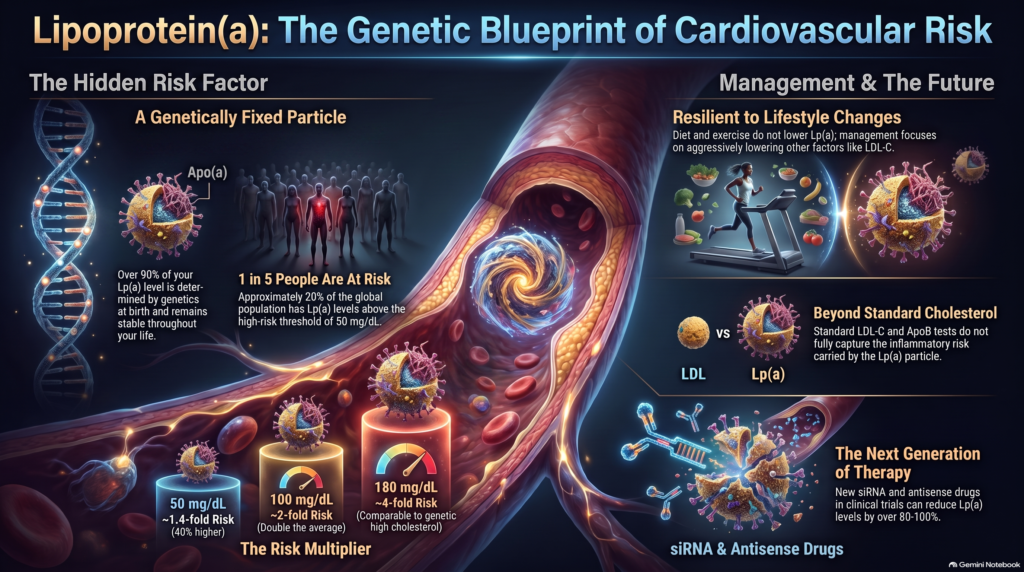
Lp(a) concentration is predominantly genetically determined. The 2022 European تصلب الشرايين Society (EAS) consensus statement attributes more than 90% of interindividual variation to genetic variability at the LPA locus [1]. Concentrations are generally stable enough that a single adult measurement is sufficient for risk assessment, although kidney, liver and thyroid disease, pregnancy, the سن اليأس transition, and certain medications can alter measured levels [1,2].
غالبًا ما يكون مستوى Lp(a) أعلى إلى حد ما لدى النساء بعد انقطاع الطمث، على الرغم من أن درجة هذا الارتفاع تختلف باختلاف المجموعات السكانية والدراسات [1,2]. كما تختلف التركيزات المتوسطة بين مجموعات الأصول، مع وجود توزيعات واسعة داخل كل مجموعة — وقد تمت معالجة ذلك كمياً في القسم 6.
لا ينبغي اعتبار Lp(a) مجرد قياس آخر لـ LDL-C. فكل جسيم من جسيمات Lp(a) يحتوي على بروتين ApoB ويمكنه اختراق جدار الشريان، في حين أن بروتين apo(a) المرتبط به يجعل Lp(a) ناقلًا مهمًا للفوسفوليبيدات المؤكسدة التي قد تسهم في حدوث العمليات الالتهابية والتكلس [1]. ولذلك، فإن القياسات التقليدية لكل من الكوليسترول الضار (LDL-C) وبروتين ApoB لا تعكس بشكل كامل المخاطر القلبية الوعائية المرتبطة بـ Lp(a).
الوحدات: ملغ/ديسيلتر مقابل نانومول/لتر
يُعبَّر عن Lp(a) إما بالكتلة (مغ/ديسيلتر) أو بتركيز الجسيمات (نانومول/لتر). ونظرًا لاختلاف أشكال apo(a) بشكل كبير في الكتلة الجزيئية، فإن الجسيم الذي يحمل شكلًا كبيرًا يزن أكثر من الجسيم الذي يحمل شكلًا صغيرًا. وبالتالي، لا يوجد معامل تحويل ثابت صالح عالميًّا. التعبيرات المزدوجة مثل “50 ملغ/ديسيلتر ≈ 125 نانومول/لتر” هي تقديرات تقريبية وبائية تُستخدم في توعية الجمهور بالمخاطر — بما في ذلك في المبادئ التوجيهية لعام 2026 نفسها — وليست تحويلات معملية. يجب الحفاظ على الوحدات التي أوردها المختبر وعدم تطبيق أي تحويل ثابت من الكتلة إلى المولار.
2. هل يُعد Lp(a) عاملاً مسبّباً؟
إن الأدلة التي تشير إلى أن ارتفاع مستوى Lp(a) يمثل عاملاً مسبباً وليس مجرد مؤشر خطر هي أدلة قوية بشكل غير معتاد بالنسبة لـ المؤشر الحيوي, ، مستندة إلى ثلاثة خطوط متقاربة: مستقبلية علم الوبائيات, ، بشري علم الوراثة بما في ذلك الوراثة العشوائية المندلية, ، وعلاقة ثابتة بين الجرعة والاستجابة.
في Emerging Risk Factors Collaboration, ، شارك 126,634 شخصًا من 36 دراسة استباقية في ما يقارب 1.3 مليون سنة-شخص من المتابعة، تم خلالها تسجيل 22,076 حالة أولية من النتائج الوعائية أو غير الوعائية الخطيرة، بما في ذلك 9,336 مرض الشريان التاجي (CHD) والنتائج و1,903 السكتات الدماغية الإقفارية. وبلغت نسبة خطر الإصابة بأمراض القلب التاجية بعد تعديلها 1.13 (نطاق الثقة 95% 1.09–1.18) لكل زيادة بمقدار 3.5 أضعاف في مستوى Lp(a) المعتاد [3].
تعزز الدراسات الجينية الاستدلال السببي لأن الأليلات LPA تُحدد عند الحمل ولا تخضع لـ السببية العكسية. في ثلاث دراسات أُجريت في كوبنهاغن شملت ما مجموعه 40,486 مشاركًا، أيدت التحليلات الجينية وجود علاقة سببية؛ وفي «دراسة قلب مدينة كوبنهاغن»، أظهرت المتغيرات الوسيطة نسبة الخطر كان 1.22 (نطاق الثقة 95%: 1.09–1.37) لكل مضاعفة متوقعة وراثياً لمستوى Lp(a) [4]. في PROCARDIS, ، وحملت متغيرات LPA rs10455872 و rs3798220 نسب احتمالات الإصابة بأمراض القلب التاجية لكل أليل تبلغ 1.70 (نطاق الثقة 95٪ 1.49–1.95) و1.92 (نطاق الثقة 95٪ 1.48–2.49) [5].
التمييز ذو الأهمية السريرية: تدعم هذه المجموعة من الأدلة بقوة فكرة أن ارتفاع مستوى Lp(a) يُعد عاملاً مسبباً لأمراض القلب والأوعية الدموية الأوعية الشريانية (ASCVD). إلا أنها لا تثبت أن خفض مستوى Lp(a) باستخدام دواء، بدءًا من منتصف العمر، يؤدي إلى عكس هذا الخطر بدرجة كافية لمنع حدوث الأحداث. ويتم تناول هذه المسألة في الأقسام من 12 إلى 14.
3. إلى أي مدى يزيد Lp(a) من مخاطر الإصابة بأمراض القلب والأوعية الدموية؟
أوضح ملخص معاصر على مستوى السكان هو الجدول 4 من 2026 ACC/AHA Multisociety Dyslipidemia Guideline [2]. وبالنظر إلى القيمة الوسيطة السكانية التي تبلغ حوالي 20 نانومول/لتر (حوالي 7 ملغ/ديسيلتر)، تقدر المبادئ التوجيهية مخاطر الإصابة بأمراض القلب والأوعية الدموية الأثرية (ASCVD) على النحو التالي.
| مستوى Lp(a) | النسبة المئوية التقريبية | الخطر النسبي المُقدَّر للإصابة بأمراض القلب والأوعية الدموية (ASCVD) | Interpretation |
| <30 مجم/ديسيلتر (<75 نانومول/لتر) | لم يُذكر ذلك تحديدًا في جدول الإرشادات | مرجع | نطاق مخاطر أقل مرتبط بمستوى Lp(a)؛ وليس “مخاطر صفرية” |
| 30–49 ملغ/ديسيلتر (75–124 نانومول/لتر) | لم يتم تحديده بدقة | ~1.2 ضعف | زيادة متواضعة في المخاطر النسبية |
| 50 ملغ/ديسيلتر (125 نانومول/لتر) | ~الثمانين | ~1.4 ضعف | يُقدَّر أن خطر الإصابة بأمراض القلب والأوعية الدموية (ASCVD) النسبي أعلى بنحو 40% مقارنة بالمتوسط المرجعي |
| 100 ملغ/ديسيلتر (250 نانومول/لتر) | ~المرتبة 95 | ~مرتين | ما يقارب ضعف المخاطر المقدرة للإصابة بأمراض القلب والأوعية الدموية (ASCVD) |
| 150 ملغ/ديسيلتر (350 نانومول/لتر) | لم يُحدد ذلك بشكل محدد؛ ويقع بين نقطتي مرجعية في المبادئ التوجيهية هما حوالي المئوية 95 (100 ملغ/ديسيلتر) وحوالي المئوية 99 (180 ملغ/ديسيلتر) | ~3 أضعاف | تقدير مخاطر مرتفع جدًّا على مستوى السكان |
| 180 ملغ/ديسيلتر (430 نانومول/لتر) | ~المرتبة 99 | ~4 أضعاف | مخاطر تقديرية مماثلة لتلك الخاصة بالحالة غير المتماثلة فرط كوليستيرول الدم العائلي |
الجدول 1. تقدير المخاطر النسبية للإصابة بأمراض القلب والأوعية الدموية (ASCVD) وفقًا لتوجيهات الجمعية الأمريكية لأمراض القلب (ACC) والجمعية الأمريكية للقلب (AHA) لعام 2026، حسب تركيز Lp(a).
التحذيرات الأساسية الواردة في الدليل نفسه: هذه القيم مستمدة من البنك الحيوي البريطاني, ، وهي تهدف إلى أن تكون دليلاً عامًا، وقد تختلف باختلاف المجموعات السكانية الأخرى، ولا تستخدم سوى معادلة تقريبية بين ملغ/ديسيلتر ونانومول/لتر [2]. وهي تقديرات على مستوى السكان، وليست خاصة بكل مريض على حدة حاسبة المخاطر.
هذه التقديرات هي متوسطات سكانية، وليست حتمية. فهي تصف كيف تختلف معدلات حدوث الأحداث بين مجموعات من الأشخاص تختلف تركيزات Lp(a) لديهم؛ ولا تتنبأ بما سيحدث لأي شخص بعينه.
يتصرف Lp(a) كمتغير مستمر عامل خطر. لا يوجد «منحدر بيولوجي» بين مستويات 49 و51 ملغ/ديسيلتر؛ فالخطر يرتفع بشكل مستمر بدلاً من أن يبدأ فجأة عند عتبة معينة. ويثبت مشروع «بنك البيانات الحيوية البريطاني» (UK Biobank) ذلك بشكل مباشر: فمن بين 460,506 مشاركًا تمت متابعتهم لمدة متوسطة بلغت 11.2 سنة، وقعت 22,401 حالة جديدة من أمراض القلب والأوعية الدموية (ASCVD)، وكان متوسط مستوى Lp(a) 19.6 نانومول/لتر، وزاد الخطر بشكل خطي تقريبًا بمعدل خطر قدره 1.11 (95٪ CI 1.10–1.12) لكل زيادة قدرها 50 نانومول/لتر [6].
من ناحية أخرى، وبناءً على معيار مختلف، أفاد «بنك البيانات الحيوية البريطاني» (UK Biobank) أنه من بين المشاركين الذين لم يسبق لهم الإصابة بأمراض القلب والأوعية الدموية الأنفارتيكية (ASCVD)، كان لدى 12.2% مستوى Lp(a) ≥150 نانومول/لتر، مع نسبة خطر معدلة تبلغ 1.50 (95% CI 1.44–1.56)؛ بين أولئك الذين يعانون من ASCVD موجودة مسبقًا، بلغت نسبة الانتشار 20.3% ونسبة الخطر 1.16 (95% CI 1.05–1.27) [6]. يجب عدم الخلط بين هذا الرقم الذي يبلغ 150 نانومول/لتر أو أكثر، وبين التعرض لمستوى 150 ملغ/ديسيلتر (350 نانومول/لتر)، أو استخدامه لتأكيد هذا التعرض — فهما تركيزان مختلفان تمامًا.
لماذا تشير بعض الدراسات إلى أن الخطر يتراوح بين ثلاثة أضعاف وأربعة أضعاف
يبدو أن التباين في التقديرات يمكن تفسيره في كثير من الأحيان، إلى حد كبير، بالاختلافات في النقطة النهائية، والمعيار المقارن، وعتبة Lp(a)، والمجموعة السكانية، والنموذج الإحصائي، وليس بالتناقض المباشر.
في «دراسة قلب مدينة كوبنهاغن»، تمت متابعة 9,330 مشاركًا لمدة 10 سنوات، وأصيب 498 منهم بـ احشاء عضلة القلب (الاحتشاء القلبي). مقارنةً بمستويات Lp(a) الأقل من 5 مجم/ديسيلتر، بلغت نسب خطر الإصابة بالاحتشاء القلبي المعدلة لدى النساء 1.1 (95٪ CI 0.6–1.9) عند مستويات 5–29 مجم/ديسيلتر، و1.7 (1.0–3.1) عند مستويات 30–84 ملغ/ديسيلتر، و2.6 (1.2–5.9) عند مستويات 85–119 ملغ/ديسيلتر، و3.6 (1.7–7.7) عند 120 ملغ/ديسيلتر أو أكثر. أما بالنسبة للرجال، فقد كانت الأرقام المقابلة هي 1.5 (0.9–2.3)، و1.6 (1.0–2.6)، و2.6 (1.2–5.5)، و3.7 (1.7–8.0) [7].
لذلك، من الصحيح القول إن مستويات Lp(a) المتطرفة ارتبطت بارتفاع خطر الإصابة بالنوبة القلبية بنحو ثلاثة إلى أربعة أضعاف في تلك المجموعة. وليس من الصحيح مساواة ذلك بالتقدير الوارد في المبادئ التوجيهية الذي يشير إلى ارتفاع بمقدار ضعفين تقريبًا عند مستوى 100 ملغ/ديسيلتر: فقد كانت الفئة المتطرفة في دراسة كوبنهاغن هي 120 ملغ/ديسيلتر أو أكثر مقابل معيار مقارنة منخفض جدًّا يقل عن 5 ملغ/ديسيلتر، مع نقطة نهاية محددة هي الإصابة بالنوبة القلبية، في حين أن تقدير المبادئ التوجيهية يتعلق بأمراض الشرايين التاجية والأوعية الدموية (ASCVD) بشكل عام عند مستوى 100 ملغ/ديسيلتر مقابل مرجع متوسط السكان في النمذجة المستمدة من بنك البيانات الحيوي البريطاني (UK Biobank).
4. تحويل المخاطر النسبية إلى قيم مطلقة
يشير معامل الخطر البالغ 1.4 إلى ارتفاع تقديري في خطر الحدث اللحظي يبلغ 40% تقريبًا وفقًا لنموذج المخاطر النسبية. ولا يعني ذلك احتمال حدوث الحدث بنسبة 40%، كما أنه لا يعادل رياضيًا ضرب احتمال حدوث الحدث للفرد على مدى 10 سنوات في 1.4.
الجدول التالي هو مجرد توضيح حسابي، على افتراض أن المضاعف المذكور يعمل كنسبة مخاطر بسيطة تُطبق مباشرةً على احتمال أساسي.
| المخاطر الافتراضية الأساسية على مدى 10 سنوات | RR 1.2 | RR 1.4 | RR 1.7 | RR 2.0 |
| 5% | 6% | 7% | 8.5% | 10% |
| 10% | 12% | 14% | 17% | 20% |
| 20% | 24% | 28% | 34% | 40% |
| 30% | 36% | 42% | 51% | 60% |
الجدول 2. توضيح حسابي بحت يفترض أن نسبة المخاطر تؤثر بشكل مضاعف على الاحتمال الأساسي. هذه القيم ليست قيمًا فردية معدلة وفقًا لمستوى Lp(a) توقعات المخاطر.
هذه أمثلة حسابية تفترض أن المضاعف المذكور يعمل كنسبة مخاطر تُطبق مباشرةً على الاحتمال الأساسي. وهي ليست تنبؤات فردية، ولا ينبغي تقدير مخاطر الفرد بضرب ناتج حاسبة المخاطر السريرية في نسبة الخطر أو نسبة الاحتمالات المذكورة في إحدى الدراسات. قيم Lp(a) الواردة في المبادئ التوجيهية لعام 2026 ليست معاملات مضاعفة مُثبتة الصلاحية لتقدير درجة المخاطر السريرية للفرد.
ومع ذلك، فإن النقطة السريرية التي يوضحها الجدول مهمة: فالمعامل نفسه يضيف أكثر بكثير الخطر المطلق لشخص يبلغ مستوىه الأساسي مرتفعًا بالفعل. تقدم دراسة كوبنهاغن أرقامًا مطلقة حقيقية ومحددة لكل دراسة. ومن بين تدخين, ، والمشاركون المصابون بارتفاع ضغط الدم الذين تزيد أعمارهم عن 60 عامًا، بلغ خطر الإصابة بنوبة قلبية خلال 10 سنوات حوالي 20% لدى النساء و35% لدى الرجال الذين تبلغ مستويات Lp(a) لديهم 120 ملغ/ديسيلتر أو أكثر، مقارنةً بحوالي 10% و19% على التوالي عند مستويات أقل من 5 ملغ/ديسيلتر [7]. وحتى في تلك المجموعة الفرعية عالية الخطورة، أدى ارتفاع مستوى Lp(a) إلى تغيير احتمالية الإصابة بنوبة قلبية بدلاً من جعلها أمراً حتمياً.
5. ما مدى شيوع ارتفاع مستوى Lp(a)؟
يعاني شخص واحد تقريبًا من كل خمسة أشخاص من ارتفاع مستوى Lp(a) عند أو فوق عتبات المخاطر العالية الشائعة الاستخدام، والتي تبلغ حوالي 50 ملغ/ديسيلتر أو 125 نانومول/لتر، اعتمادًا على الفحص ووحدات القياس المستخدمة، مما يجعل ارتفاع مستوى Lp(a) أمرًا شائعًا جدًّا في جميع أنحاء العالم [1]. يعتمد العبء العالمي الدقيق على عتبة القياس، وطريقة الفحص، والتوزيع الديموغرافي قيد الدراسة؛ لذا ينبغي توخي الحذر عند التعامل مع أي إحصاء دقيق منفرد. تضع المبادئ التوجيهية لعام 2026 مستوى 50 ملغ/ديسيلتر بالقرب من الشريحة المئوية 80، و100 ملغ/ديسيلتر بالقرب من الشريحة المئوية 95، و180 ملغ/ديسيلتر بالقرب من الشريحة المئوية 99 [2].
6. النسب
تختلف توزيعات Lp(a) باختلاف الأصل العرقي. في مشروع «بنك البيانات الحيوية للمملكة المتحدة» (UK Biobank)، بلغ متوسط التركيزات حوالي 19 نانومول/لتر لدى المشاركين من ذوي البشرة البيضاء، و31 نانومول/لتر لدى المشاركين من جنوب آسيا، و75 نانومول/لتر لدى المشاركين من ذوي البشرة السوداء، و16 نانومول/لتر لدى المشاركين الصينيين. كانت العلاقة بين ارتفاع Lp(a) وأمراض القلب والأوعية الدموية (ASCVD) متشابهة من حيث الاتجاه عبر المجموعات الرئيسية التي شملتها الدراسة، حيث بلغت نسب المخاطر لكل 50 نانومول/لتر حوالي 1.11 و1.10 و1.07 لدى المشاركين من ذوي البشرة البيضاء ومن جنوب آسيا ومن ذوي البشرة السوداء على التوالي؛ وتكون تقديرات المجموعات الفرعية خارج المجموعة البيضاء أقل دقة بسبب صغر حجم العينات [6].
وتشير المبادئ التوجيهية لعام 2026 أيضًا إلى أن التركيزات تميل إلى أن تكون أعلى بين الأشخاص من أصل أفريقي وجنوب آسيوي، في حين تظل العلاقة بين المخاطر النسبية متشابهة بشكل عام عبر المجموعات العرقية [2].
هذه توزيعات سكانية تتسم بتباين واسع داخل كل مجموعة. وهي لا تبرر استنتاج تركيز Lp(a) لدى الفرد أو مخاطر الإصابة بأمراض القلب والأوعية الدموية بناءً على الأصل العرقي وحده. والطريقة الوحيدة لمعرفة مستوى Lp(a) لدى الشخص هي قياسه.
7. مستوى Lp(a) لدى الأشخاص المصابين بالفعل بأمراض القلب والأوعية الدموية
في دراسة أتباعية للوقاية الثانوية أُجريت في كوبنهاغن وشملت 2,527 شخصًا سبق أن أصيبوا بـ أمراض القلب والأوعية الدموية بعد متابعة لمدة متوسطة قدرها خمس سنوات، عانى 493 شخصًا من حدث قلبي وعائي سلبي كبير (MACE). وبلغت معدلات حدوث الأحداث 29 و35 و42 و54 لكل 1000 شخص-سنة عند مستويات Lp(a) أقل من 10، و10–49، و50–99، و100 ملغ/ديسيلتر أو أكثر على التوالي. وبالمقارنة مع مستويات أقل من 10 ميليغرام/ديسيلتر، بلغت نسب معدلات الإصابة المعدلة 1.28 (95% CI 1.03–1.58)، 1.44 (95% CI 1.12–1.85)، و2.14 (95% CI 1.57–2.92) [8].
في مشروع «بنك البيانات الحيوي البريطاني» (UK Biobank)، كانت الارتباطية النسبية عند مستوى Lp(a) ≥150 نانومول/لتر أقل لدى المشاركين المصابين بمرض القلب والأوعية الدموية الشريانية (ASCVD) المؤكد (نسبة المخاطر 1.16، 95% CI 1.05–1.27) مقارنةً بالمشاركين الذين لم يسبق لهم الإصابة بمرض ASCVD (HR 1.50، 95% CI 1.44–1.56)، على الرغم من أن الخطر المطلق لحدوث الحدث كان أعلى في الوقاية الثانوية [6].
الأدلة المستمدة من تجارب مثبطات بروتين PCSK9
في فورييه, ، تم قياس مستوى Lp(a) لدى 25,096 مريضًا مصابًا بأمراض القلب والأوعية الدموية الشريانية (ASCVD) مؤكدة، وتم متابعتهم لمدة متوسطة بلغت 2.2 سنة. ومن بين المشاركين الذين تلقوا العلاج بالغفل، كان أعلى مستوى لـ Lp(a) الربيع وقد بلغت نسبة الخطر المعدلة 1.22 (نطاق الثقة 95٪ 1.01–1.48) بالنسبة للوفاة بسبب أمراض الشريان التاجي أو احتشاء عضلة القلب أو الحالات الطارئة إعادة التروية مقارنةً بالربع الأدنى، بغض النظر عن مستوى الكوليسترول الضار (LDL-C). إيفولوكوماب أدى ذلك إلى انخفاض مستوى Lp(a) بمقدار متوسط قدره 26.9% [9].
في التحليلات الثانوية لتلك التجربة، بدا أن المرضى الذين سجلوا مستويات أعلى من Lp(a) عند خط الأساس استفادوا بشكل أكبر من الناحية التاجية: حيث بلغ معدل الخطر 0.77 (95% CI 0.67–0.88) فوق متوسط مستوى Lp(a) عند خط الأساس مقابل 0.93 (95% CI 0.80–1.08) أقل منه، مع انخفاض مطلق في المخاطر على مدى ثلاث سنوات قدره 2.49% مقابل 0.95%، وعدد المرضى المطلوب علاجهم (NNT) قدره 40 مقابل 105. وكانت قيمة P للتفاعل 0.07، وبالتالي لم تصل إلى الدرجة المعتادة من الدلالة الإحصائية. وهذه نتيجة خاصة بمجموعة فرعية ضمن تجربة عشوائية، وليست المقارنة العشوائية الأساسية [9].
في أوديسي النتائج: 18,924 مريضًا بعد متلازمة الشريان التاجي الحادة وقد تمت متابعتهم لمدة متوسطة قدرها 2.8 سنة في إطار رعاية مكثفة ستاتين العلاج. كان مستوى Lp(a) الأساسي مؤشراً مستقلاً للتنبؤ بحدوث أحداث متكررة. وفي التحليلات اللاحقة، ارتبط انخفاض مستوى Lp(a) الناتج عن استخدام أليروكوماب ارتباطاً مستقلاً بانخفاض عدد الأحداث القلبية الوعائية؛ ومع ذلك، لا يمكن لهذه التحليلات إثبات أن انخفاض مستوى Lp(a) بحد ذاته هو الذي تسبب في انخفاض عدد الأحداث، لأن أليروكوماب يؤدي في الوقت نفسه إلى انخفاض كبير في مستويات الكوليسترول LDL وبروتين ApoB [10,11].
وبالتالي، فإن الدراستين تدعمان فكرة أن ارتفاع مستوى Lp(a) يُعد مؤشراً على المخاطر المتبقية في المرضى الذين خضعوا للعلاج، وكلاهما يتوافق مع — ولكنه لا يثبت — وجود فائدة تُعزى إلى خفض مستوى Lp(a) بحد ذاته.
8. هل يؤدي انخفاض مستوى الكوليسترول الضار (LDL-C) إلى القضاء على الخطر؟
Lowering LDL-C substantially reduces cardiovascular risk, but it does not appear to eliminate Lp(a)-associated residual risk. A 2025 participant-level analysis of 27,658 people in six placebo-controlled statin trials found that even in the lowest achieved-LDL-C quartile — 3.1 to 77.0 mg/dL — Lp(a) above 50 mg/dL was associated with an ASCVD hazard ratio of 1.38 (95% CI 1.06–1.79) compared with 50 mg/dL or below. The highest joint category of elevated Lp(a) and highest achieved LDL-C carried a hazard ratio of 1.90 (95% CI 1.46–2.48) [12].
Because that lowest quartile spans 3.1 to 77.0 mg/dL, the analysis demonstrates persistence of risk at relatively low achieved LDL-C but does not supply a dedicated estimate at LDL-C below 55 mg/dL. A specific residual-risk figure at that threshold should not be claimed from these data.
The defensible formulation: intensive LDL-C and ApoB lowering reduces overall absolute ASCVD risk, but available data do not establish an LDL-C concentration at which the association with elevated Lp(a) disappears.
9. Lp(a) and ApoB: Overlapping, Not Interchangeable
Plasma ApoB concentration is a practical proxy for the number of circulating ApoB-containing atherogenic lipoprotein particles, including LDL, بروتين دهني منخفض الكثافة جداً بقايا, لغة IDL, and Lp(a). Because every Lp(a) particle itself contains one أبو بروتين-100 molecule, Lp(a) and ApoB are not separate biological pathways; they overlap.
What distinguishes Lp(a) is the additional apo(a)- and oxidized-phospholipid-related biology. Adjustment and mediation analyses suggest that conventional lipid and inflammatory markers — including LDL-C, non-HDL-C, ApoB, and hsCRP — explain only a minority of the association between Lp(a) and ASCVD [13].
A 2024 genetic analysis estimated that the CHD association per 50 nmol/L genetically proxied increase in Lp(a)-ApoB was substantially greater than the association for the same increment in LDL-ApoB, with an estimated per-particle ratio of approximately 6.6 (95% CI 5.1–8.8) [14]. This is a Mendelian-randomization effect-size estimate carrying methodological assumptions. It is not proof that any individual Lp(a) particle is literally 6.6 times as biologically harmful as an LDL particle.
The two findings reconcile: Lp(a) contributes to total ApoB while also carrying risk that is not adequately represented by conventional ApoB concentration alone.
10. Lp(a) and Calcific Aortic-Valve Stenosis
In 77,680 Copenhagen participants followed for as long as 20 years, 454 developed تضيق الأبهر. Relative to Lp(a) under 5 mg/dL, adjusted hazard ratios rose to 1.6 (95% CI 1.1–2.4) at 20–64 mg/dL, 2.0 (95% CI 1.2–3.4) at 65–90 mg/dL, and 2.9 (95% CI 1.8–4.9) above 90 mg/dL. Genetic instrumental-variable analysis yielded a الخطر النسبي of 1.6 (95% CI 1.2–2.1) per 10-fold higher Lp(a), supporting a causal contribution [15].
In a separate Copenhagen analysis, each 10-fold higher Lp(a) was associated with an odds ratio of 1.62 (95% CI 1.48–1.77) for aortic-valve تکلس and a hazard ratio of 1.54 (95% CI 1.38–1.71) for aortic-valve تضيق, with approximately 31% of the effect mediated through calcification [16].
Among patients who already had aortic stenosis, a prospective study of 145 patients found that higher Lp(a) and oxidized-phospholipid measures were associated with greater valve-calcification activity and faster CT-calcium and hemodynamic progression. Participants in the top Lp(a) tertile, compared with the lower two tertiles, had a higher risk of aortic-valve replacement or death (hazard ratio 1.87, 95% CI 1.13–3.08); related oxidized-phospholipid measures showed similar associations. Accompanying in-vitro experiments supported a procalcific mechanism [17]. These observational and mechanistic findings support the biological rationale but do not prove that pharmacologically lowering Lp(a) will slow established aortic stenosis. No randomized trial has yet shown that lowering Lp(a) prevents progression of aortic stenosis or reduces valve replacement.
Lp(a) is also linked to atherothrombosis and aortic-valve stenosis independent of التهاب. In 68,090 Copenhagen participants followed for a median of 8.1 years, Lp(a) of 70 mg/dL or above versus 6 mg/dL or below was associated with an ASCVD hazard ratio of 1.61 (95% CI 1.43–1.81) among those with البروتين التفاعلي C under 2 mg/L and 1.57 (95% CI 1.36–1.82) among those with CRP of 2 mg/L or above, interaction P = 0.87 [18].
11. Does High Lp(a) Mean You Will Have a Heart Attack?
No. Lp(a) changes probability; it does not determine outcome. Even in the Copenhagen high-risk subgroup — smokers with ارتفاع ضغط الدم over age 60 and Lp(a) of 120 mg/dL or above — 10-year MI risk was approximately 20% in women and 35% in men, not 100% [7]. Other baseline-risk profiles differ substantially.
A person with high Lp(a) but excellent ضغط الدم, no مرض السكري, no smoking, low ApoB and LDL-C, and favorable imaging may have a much lower absolute risk than someone with the same Lp(a) plus multiple major risk factors. Age, smoking, blood pressure, diabetes, مرض الكلى, cumulative ApoB and LDL exposure, التاريخ العائلي, and existing atherosclerosis jointly determine absolute cardiovascular risk alongside Lp(a) [2].
12. Currently Available Treatments
The treatment section must distinguish three separate questions: does the treatment change Lp(a); does it reduce cardiovascular events overall; and has any event benefit been proven to result specifically from lowering Lp(a)? These are not interchangeable.
| Therapy | Effect on Lp(a) | Approximate LDL-C effect [2] | Evidence and safety | Cardiovascular outcome status |
| الستاتينات | On average a modest increase; pooled statin-to-placebo ratio of geometric means 1.11 (95% CI 1.07–1.14); statin-arm mean changes about +8.5% to +19.6% | Moderate-intensity ~30% to <50%; high-intensity ≥50% | Participant-level تحليل تلوي, n = 5,256. Whether the modest rise independently affects outcomes is uncertain. | Substantial ASCVD benefit via LDL/ApoB lowering. Not a reason to withhold indicated statin therapy. |
| إزيتيميب | Small and inconsistent. A seven-trial meta-analysis of ezetimibe monotherapy reported −7.06% (95% CI −11.95 to −2.18) [19]; a broader analysis including combination therapy found no statistically significant reduction (−2.59%, 95% CI −8.26 to 3.08) [20] | Approximately 15–20% additional lowering when added to a statin | Estimates differ substantially between syntheses. | Its clinical role is LDL-C lowering, not targeted Lp(a) reduction; no Lp(a)-specific outcome evidence. |
| PCSK9 monoclonal antibodies | Mean approximately −27% (95% CI −29.8 to −24.1); evolocumab −29.35%, alirocumab −24.50% | Approximately 50–60% | Meta-analysis of 47 randomized trials, 67,057 participants [21]. | Overall event reduction proven; the incremental causal contribution of Lp(a) lowering is unproven. |
| إِنْكِلِيزِيرَان | Modest — approximately 18–22% in pooled trial analyses [22,23] | Approximately 50%; pooled ORION-9/10/11 analysis (n = 3,660) placebo-corrected reduction −50.7% [23] | Injection-site adverse events 5.0% versus 0.7% with دواء موهم in the pooled ORION analysis [23]. | No dedicated proof that its modest Lp(a) reduction causes event reduction. |
| النياسين | Approximately −21% in the AIM-HIGH Lp(a) analysis [24] | Modest | HPS2-THRIVE: major vascular events 13.2% vs 13.7%, rate ratio 0.96 (95% CI 0.90–1.03), P = 0.29, with excess serious adverse events [25]. | No added benefit on contemporary therapy. Should not be prescribed solely to lower Lp(a). |
| Lipoprotein apheresis | Approximately −60% to −70% acutely; 68.1% mean single-treatment reduction in Pro(a)LiFe [26,27] | Large acute reduction per session, with rebound between sessions | Levels rebound between sessions, so the time-averaged reduction is smaller than the immediate post-procedure reduction. | Uncontrolled before-after cohorts report large event-rate reductions [26,27]; ربط مربك, selection, and regression to the mean prevent causal claims. |
Table 3. Effects of currently available therapies on Lp(a) and on cardiovascular outcomes.
On statins specifically: the pooled participant-level meta-analysis confirms a modest average increase in Lp(a) [28]. Whether that increase independently affects outcomes is uncertain, and it is not a reason to stop indicated statin therapy, because the LDL and ApoB lowering statins achieve has established cardiovascular benefit.
13. Investigational Lp(a)-Targeted Therapies
A new class of agents lowers Lp(a) far more dramatically than any conventional lipid therapy. These trials establish pharmacodynamic proof, not clinical-outcome proof.
The key distinction is that lowering a laboratory value is not the same as proving fewer النوبات القلبية أو السكتات الدماغية.
A biomarker reduction of 90% must not be translated into an assumed 90% reduction in events.
| Agent (class) | Trial and size | Lp(a) reduction | Safety findings |
| بيلاكارسين (antisense oligonucleotide) | Phase 2, n = 286 [29] | Up to 80% mean reduction at the highest regimen | Injection-site reactions most common; no major platelet, liver, or renal imbalance in phase 2 |
| أولباسيران (siRNA) | OCEAN(a)-DOSE, n = 281 [30] | Placebo-adjusted −70.5%, −97.4%, −101.1%, and −100.5% by regimen at week 36 | Overall adverse events similar to placebo; injection-site reactions most common |
| Lepodisiran (siRNA) | ALPACA, n = 320 [31] | Pooled 400 mg: placebo-adjusted time-averaged −93.9% (95% CI −95.1 to −92.5), days 60–180 | 35 serious adverse events, none deemed treatment-related; generally mild injection-site reactions in up to 12% |
| Zerlasiran (siRNA) | ALPACAR-360, n = 178 [32] | Time-averaged −85.6%, −82.8%, and −81.3% by regimen (all >80%) | Mild injection-site pain in approximately 2.3–7.1%; 20 serious adverse events in 17 patients, none considered drug-related |
| Muvalaplin (oral small molecule) | KRAKEN, n = 233 [33] | Up to −85.8% using the intact-Lp(a) assay; approximately −70% by apo(a) assay | No major safety or tolerability concern reported over the trial period |
Table 4. Phase 2 biomarker results for Lp(a)-targeted agents.
Placebo-adjusted values slightly beyond 100% reflect the statistical adjustment calculation, not physically negative Lp(a) concentrations.
14. The Dedicated Outcomes Trials
These trials are the decisive tests of whether lowering Lp(a) prevents cardiovascular events. Lp(a)HORIZON’s registered primary endpoint is time to first expanded major adverse cardiovascular event in patients with established cardiovascular disease and Lp(a) ≥70 mg/dL, with a second primary analysis in those ≥90 mg/dL. Registry status is fast-moving content and must be re-verified immediately before publication.
| Trial (agent) | Registry ID | Status | Enrollment | Estimated primary completion |
| Lp(a)HORIZON (pelacarsen) | NCT04023552 | Active, not recruiting; no results posted; record last updated 6 May 2026 and last verified May 2026; sponsor Novartis | 8,323 (actual) | 30 June 2026 (estimated) |
| OCEAN(a)-Outcomes (olpasiran) | NCT05581303 | Active, not recruiting; no results posted; record updated 27 February 2026. Established ASCVD with Lp(a) ≥200 nmol/L; eligible ASCVD includes prior MI or PCI with stenting plus an additional risk factor; anticipated follow-up approximately four years | 7,297 (actual) | 31 March 2028 |
| ACCLAIM-Lp(a) (lepodisiran) | NCT06292013 | Active, not recruiting; no results posted; record updated 18 June 2026. Lp(a) ≥175 nmol/L; addendum adds approximately 1,700 participants | 17,300 (estimated) | March 2029 |
| MOVE-Lp(a) (muvalaplin) | NCT07157774 | Recruiting; no results posted; record updated 7 July 2026 | 10,450 (estimated); actual start 2 September 2025 | March 2031 |
Table 5. Dedicated Lp(a)-lowering cardiovascular-outcomes programs, per ClinicalTrials.gov as cited in the August 2026 audit.
A further pelacarsen study, ADD-VANTAGE (NCT06813911), is a recruiting phase 3 study of pelacarsen on a background of inclisiran in patients with elevated Lp(a) and established ASCVD. As checked on 28 August 2026, ClinicalTrials.gov listed the record as last updated 17 June 2026, with no results posted, estimated enrollment of 340, and estimated primary completion 3 February 2028. Its primary endpoint is change in Lp(a) rather than cardiovascular events, so it is a biomarker study and should not be grouped with the dedicated cardiovascular-outcomes trials in Table 5 [38].
As of 28 August 2026, the primary ClinicalTrials.gov records for the major dedicated Lp(a)-lowering cardiovascular-outcomes programs show no posted results. Selective pharmacologic Lp(a) lowering has therefore not yet been demonstrated in a dedicated randomized outcomes trial to reduce cardiovascular events.
Lp(a)HORIZON remains listed as active, not recruiting, despite a 30 June 2026 estimated primary-completion date; OCEAN(a)-Outcomes and ACCLAIM-Lp(a) remain active but not recruiting, and MOVE-Lp(a) is recruiting. A passed estimated date is not evidence that a trial should be described as completed or that any result exists.
15. How Much Would Lp(a) Need to Fall?
Two Mendelian-randomization analyses have estimated the lifelong genetically proxied Lp(a) difference associated with a CHD-risk difference comparable to that associated with 1 mmol/L (38.67 mg/dL) lower LDL-C. Burgess and colleagues estimated 101.5 mg/dL (95% CI 71.0–137.0), reporting an odds ratio of 0.942 per 10 mg/dL lower genetically predicted Lp(a) [39]. Lamina and Kronenberg estimated 65.7 mg/dL (95% CI 46.3–88.3) [40].
The estimates differ in important part because of differences in Lp(a) distributions, assay calibration, and analytical design across the underlying datasets. Both analyses used predominantly European-ancestry datasets and assay-dependent Lp(a) mass measurements.
Both imply that substantial absolute differences in lifelong Lp(a) exposure correspond to clinically meaningful differences in CHD risk. Neither establishes what reduction a drug must achieve over a finite treatment period, and neither should be presented as a validated pharmacologic target. Lifelong genetic exposure beginning at conception is not equivalent to years of drug therapy begun after لوحة has accumulated.
A separate observational modeling projection from the Copenhagen secondary-prevention cohort estimated that lowering Lp(a) by approximately 50 mg/dL (105 nmol/L) over five years might correspond to 20% lower MACE, and approximately 99 mg/dL (212 nmol/L) to 40% lower MACE [8]. These are modeled projections from observational data, not trial-proven treatment effects.
16. Who Should Be Tested
The 2026 ACC/AHA Multisociety Dyslipidemia Guideline recommends measuring Lp(a) at least once in adulthood, and the EAS consensus supports the same approach [2,1]. Measurement is particularly informative in premature ASCVD, a strong family history of premature cardiovascular disease, familial فرط كوليстеロール الدم, recurrent events despite well-controlled LDL-C, and calcific aortic stenosis.
Cascade Lp(a) testing of first-degree relatives is reasonable when markedly elevated Lp(a) is identified. In ordinary practice this means measuring the Lp(a) concentration in relatives, not genotyping them.
Repeat measurement is generally unnecessary, because Lp(a) is predominantly genetically determined and generally stable over time. Repeat testing may nevertheless be appropriate when disease, pregnancy or menopause-related changes, medications, assay uncertainty, or Lp(a)-directed therapy could materially alter the measured concentration.
17. What This Means for You
Lp(a) is an inherited, cholesterol-containing lipoprotein particle that can substantially increase the risk of heart attack, stroke, and aortic-valve disease. At around 50 mg/dL, average relative ASCVD risk is roughly 40% higher than at the guideline’s reference median; at very high levels around 180 mg/dL, average relative risk may be about four times higher [2]. That does not mean a heart attack is inevitable.
Because lifestyle change does not lower Lp(a) appreciably [1,2], healthy behavior should not be judged by whether the Lp(a) number falls. Exercise, avoiding tobacco, maintaining healthy body composition, controlling blood pressure and diabetes, and following a heart-healthy dietary pattern act on the other components of absolute risk. Lowering LDL-C and ApoB is a central evidence-based strategy, because these are modifiable causal exposures that add to the inherited Lp(a)-associated risk.
LDL-C goals should be individualized by risk category rather than applied uniformly. The 2026 guideline recommends LDL-C below 55 mg/dL for very-high-risk ASCVD and below 70 mg/dL for ASCVD not meeting very-high-risk criteria. In الوقاية الأولية مع تصلب الشرايين تحت السريري, progressively higher كالسيوم الشريان التاجي burden supports progressively more intensive LDL-C lowering: CAC of 100–299 or at or above the 75th percentile supports LDL-C below 70 mg/dL; CAC of 300–999 supports below 70 mg/dL with at least a 50% reduction, and intensification toward below 55 mg/dL is reasonable in selected patients; CAC of 1000 or above supports below 55 mg/dL with at least a 50% reduction [2].
CAC scoring can be useful selectively — in selected primary-prevention adults for whom the treatment decision remains uncertain after conventional risk assessment and consideration of risk enhancers such as elevated Lp(a). Elevated Lp(a) by itself does not create a universal indication for a calcium scan [2].
Where CAC is obtained, it strongly modifies absolute risk in people with elevated Lp(a). In ميسا, elevated Lp(a) with a CAC score of zero was not significantly associated with higher ASCVD risk than low Lp(a) with CAC of zero (hazard ratio 1.31, 95% CI 0.73–2.35), whereas elevated Lp(a) together with CAC of 100 or above identified markedly higher risk (hazard ratio 4.71, 95% CI 3.01–7.40) [41]. A 2026 multicohort study of 11,319 participants followed for a mean of 14.8 years found that elevated Lp(a) above 50 mg/dL was associated with higher ASCVD risk even among people with a CAC score of zero (hazard ratio 1.28, 95% CI 1.01–1.60), although absolute event rates in that group remained low at 4.9 versus 3.8 per 1,000 person-years [42]. A CAC score of zero should therefore be read as low observed absolute plaque-related risk over the period studied, not as evidence that lifelong Lp(a)-associated risk has disappeared. CAC measures disease already present; Lp(a) measures a lifelong causal exposure [1,2].
Until dedicated outcome trials of Lp(a)-specific drugs report, the most evidence-based strategy is intensive, guideline-directed management of every modifiable cardiovascular risk factor, particularly LDL-C and ApoB.
18. Evidence Hierarchy
- Strong evidence: Lp(a) is a causal, continuously graded risk factor for ASCVD, supported by أفعال مستقبلية, LPA genetics, Mendelian عشوائية, and dose–response. Lp(a) makes a causal contribution to calcific aortic-valve disease.
- Moderate-to-strong evidence: elevated Lp(a) remains associated with residual ASCVD risk in statin-treated and aggressively LDL-lowered populations. Conventional ApoB does not fully capture Lp(a)-associated risk. Elevated Lp(a) predicts recurrent events in established ASCVD.
- Moderate evidence: the genetically estimated per-particle atherogenicity of Lp(a) relative to LDL. Post-hoc PCSK9-inhibitor analyses suggesting greater absolute benefit at higher baseline Lp(a).
- Emerging evidence: whether pharmacologic Lp(a) lowering reduces cardiovascular events. Biomarker efficacy of the investigational agents is established; cardiovascular-outcome efficacy remains unproven in the audited primary data.
So, How Much Worse Does Lp(a) Make Heart Disease?
- Elevated Lp(a) is common: approximately one in five people has a concentration at or above commonly used high-risk thresholds of roughly 50 mg/dL or 125 nmol/L.
- Risk rises continuously rather than switching on at a threshold. The 2026 guideline estimates approximately 1.2-fold ASCVD risk at 30–49 mg/dL, 1.4-fold at 50 mg/dL, 2-fold at 100 mg/dL, 3-fold at 150 mg/dL, and 4-fold at 180 mg/dL, compared with a population median of about 7 mg/dL (20 nmol/L). These are UK Biobank-derived general-guide estimates.
- Extreme concentrations have been associated with roughly threefold to fourfold higher MI risk in some cohorts — in Copenhagen, at 120 mg/dL or above versus under 5 mg/dL, with an MI-specific endpoint. That is a different question from the guideline’s broad-ASCVD estimate at 100 mg/dL.
- In people who already have cardiovascular disease, higher Lp(a) predicts more recurrent events, with adjusted incidence-rate ratios rising to 2.14 at 100 mg/dL or above versus under 10 mg/dL.
- Low LDL-C does not eliminate the risk. Lp(a)-associated risk persisted in the lowest achieved-LDL-C quartile of pooled statin trials, and it is incompletely represented by conventional ApoB measurement — even though each Lp(a) particle itself contributes one ApoB-100 molecule.
- Very high Lp(a) is associated with roughly threefold higher incident aortic-stenosis risk in Copenhagen data, and genetic evidence supports a causal contribution to calcific aortic-valve disease.
- What patients can do now: measure Lp(a) once; if elevated, intensify guideline-directed control of every modifiable risk factor, with LDL-C goals set by risk category; consider CAC selectively when a primary-prevention treatment decision remains uncertain; and arrange cascade testing of first-degree relatives.
- What remains unknown: whether profoundly lowering Lp(a) prevents cardiovascular events. As of 28 August 2026, no dedicated phase 3 Lp(a)-lowering outcomes result had been posted. Lp(a)HORIZON, OCEAN(a)-Outcomes, ACCLAIM-Lp(a), and MOVE-Lp(a) are designed to answer that question, with estimated primary completions from 2026 through 2031.
المراجع
- Kronenberg F, Mora S, Stroes ESG, et al. Lipoprotein(a) in atherosclerotic cardiovascular disease and aortic stenosis: a European Atherosclerosis Society consensus statement. Eur Heart J. 2022;43(39):3925–3946. DOI: 10.1093/eurheartj/ehac361. PMID: 36036785.
- 2026 ACC/AHA/AACVPR/ABC/ACPM/ADA/AGS/APhA/ASPC/NLA/PCNA Guideline on the Management of Dyslipidemia. Circulation. 2026. DOI: 10.1161/CIR.0000000000001423. PMID: 41824590.
- Erqou S, Kaptoge S, Perry PL, et al; Emerging Risk Factors Collaboration. Lipoprotein(a) concentration and the risk of coronary heart disease, stroke, and nonvascular mortality. JAMA. 2009;302(4):412–423. DOI: 10.1001/jama.2009.1063. PMID: 19622820.
- Kamstrup PR, Tybjærg-Hansen A, Steffensen R, Nordestgaard BG. Genetically elevated lipoprotein(a) and increased risk of myocardial infarction. JAMA. 2009;301(22):2331–2339. DOI: 10.1001/jama.2009.801. PMID: 19509380.
- Clarke R, Peden JF, Hopewell JC, et al; PROCARDIS Consortium. Genetic variants associated with Lp(a) lipoprotein level and coronary disease. N Engl J Med. 2009;361(26):2518–2528. DOI: 10.1056/NEJMoa0902604. PMID: 20032323.
- Patel AP, Wang M, Pirruccello JP, et al. Lp(a) concentrations and incident atherosclerotic cardiovascular disease: new insights from a large national biobank. Arterioscler Thromb Vasc Biol. 2021;41(1):465–474. DOI: 10.1161/ATVBAHA.120.315291. PMID: 33115266.
- Kamstrup PR, Benn M, Tybjærg-Hansen A, Nordestgaard BG. Extreme lipoprotein(a) levels and risk of myocardial infarction in the general population: the Copenhagen City Heart Study. Circulation. 2008;117(2):176–184. DOI: 10.1161/CIRCULATIONAHA.107.715698. PMID: 18086931.
- Madsen CM, Kamstrup PR, Langsted A, Varbo A, Nordestgaard BG. Lipoprotein(a)-lowering by 50 mg/dL (105 nmol/L) may be needed to reduce cardiovascular disease 20% in secondary prevention. Arterioscler Thromb Vasc Biol. 2020;40(1):255–266. DOI: 10.1161/ATVBAHA.119.312951. PMID: 31578080.
- O’Donoghue ML, Fazio S, Giugliano RP, et al. Lipoprotein(a), PCSK9 inhibition, and cardiovascular risk: insights from the FOURIER trial. Circulation. 2019;139(12):1483–1492. DOI: 10.1161/CIRCULATIONAHA.118.037184. PMID: 30586750.
- Bittner VA, Szarek M, Aylward PE, et al; ODYSSEY OUTCOMES Committees and Investigators. Effect of alirocumab on lipoprotein(a) and cardiovascular risk after acute coronary syndrome. J Am Coll Cardiol. 2020;75(2):133–144. DOI: 10.1016/j.jacc.2019.10.057. PMID: 31948641.
- Szarek M, Bittner VA, Aylward P, et al; ODYSSEY OUTCOMES Investigators. Lipoprotein(a) lowering by alirocumab reduces the total burden of cardiovascular events independent of low-density lipoprotein cholesterol lowering. Eur Heart J. 2020;41(44):4245–4255. DOI: 10.1093/eurheartj/ehaa649. PMID: 33051646.
- Bhatia HS, Wandel S, Willeit P, et al. Independence of lipoprotein(a) and LDL cholesterol-mediated cardiovascular risk: a participant-level meta-analysis. Circulation. 2025;151(4):312–321. DOI: 10.1161/CIRCULATIONAHA.124.069556. PMID: 39492722.
- Thomas PE, Vedel-Krogh S, Kamstrup PR, Nordestgaard BG. Lipoprotein(a) cardiovascular risk explained by LDL cholesterol, non-HDL cholesterol, apoB, or hsCRP is minimal. J Am Coll Cardiol. 2025;85(21):2046–2051. DOI: 10.1016/j.jacc.2025.02.024. PMID: 40266171.
- Björnson E, Adiels M, Taskinen MR, et al. Lipoprotein(a) is markedly more atherogenic than LDL: an apolipoprotein B-based genetic analysis. J Am Coll Cardiol. 2024;83(3):385–395. DOI: 10.1016/j.jacc.2023.10.039. PMID: 38233012.
- Kamstrup PR, Tybjærg-Hansen A, Nordestgaard BG. Elevated lipoprotein(a) and risk of aortic valve stenosis in the general population. J Am Coll Cardiol. 2014;63(5):470–477. DOI: 10.1016/j.jacc.2013.09.038. PMID: 24161338.
- Kaltoft M, Langsted A, Nordestgaard BG. Elevated lipoprotein(a) in mitral and aortic valve calcification and disease: the Copenhagen General Population Study. Atherosclerosis. 2022;349:166–174. DOI: 10.1016/j.atherosclerosis.2021.11.029. PMID: 34903381.
- Zheng KH, Tsimikas S, Pawade T, et al. Lipoprotein(a) and oxidized phospholipids promote valve calcification in patients with aortic stenosis. J Am Coll Cardiol. 2019;73(17):2150–2162. DOI: 10.1016/j.jacc.2019.01.070. PMID: 31047003.
- Thomas PE, Vedel-Krogh S, Kamstrup PR, Nordestgaard BG. Lipoprotein(a) is linked to atherothrombosis and aortic valve stenosis independent of C-reactive protein. Eur Heart J. 2023;44(16):1449–1460. DOI: 10.1093/eurheartj/ehad055. PMID: 36805188.
- Awad K, Mikhailidis DP, Katsiki N, Muntner P, Banach M; Lipid and Blood Pressure Meta-Analysis Collaboration (LBPMC) Group. Effect of ezetimibe monotherapy on plasma lipoprotein(a) concentrations in patients with primary hypercholesterolemia: a systematic review and meta-analysis of randomized controlled trials. Drugs. 2018;78(4):453–462. DOI: 10.1007/s40265-018-0870-1. PMID: 29396832.
- Sahebkar A, Simental-Mendía LE, Pirro M, Banach M, Watts GF, Sirtori C, Al-Rasadi K, Atkin SL. Impact of ezetimibe on plasma lipoprotein(a) concentrations as monotherapy or in combination with statins: a systematic review and meta-analysis of randomized controlled trials. Sci Rep. 2018;8(1):17887. DOI: 10.1038/s41598-018-36204-7. PMID: 30552391.
- Rivera FB, Cha SW, Louisse CL, et al. Impact of proprotein convertase subtilisin/kexin type 9 inhibitors on lipoprotein(a): a meta-analysis and meta-regression of randomized controlled trials. JACC Adv. 2025;4(2):101549. DOI: 10.1016/j.jacadv.2024.101549. PMID: 39877671.
- Ray KK, Wright RS, Kallend D, et al; ORION-10 and ORION-11 Investigators. Two phase 3 trials of inclisiran in patients with elevated LDL cholesterol. N Engl J Med. 2020;382(16):1507–1519. DOI: 10.1056/NEJMoa1912387. PMID: 32187462.
- Wright RS, Ray KK, Raal FJ, et al. Pooled patient-level analysis of inclisiran trials in patients with familial hypercholesterolemia or atherosclerosis. J Am Coll Cardiol. 2021;77(9):1182–1193. DOI: 10.1016/j.jacc.2020.12.058. PMID: 33663735.
- Albers JJ, Slee A, O’Brien KD, et al. Relationship of apolipoproteins A-1 and B, and lipoprotein(a) to cardiovascular outcomes: the AIM-HIGH trial. J Am Coll Cardiol. 2013;62(17):1575–1579. DOI: 10.1016/j.jacc.2013.06.051. PMID: 23973688.
- HPS2-THRIVE Collaborative Group. Effects of extended-release niacin with laropiprant in high-risk patients. N Engl J Med. 2014;371(3):203–212. DOI: 10.1056/NEJMoa1300955. PMID: 25014686.
- Leebmann J, Roeseler E, Julius U, et al. Lipoprotein apheresis in patients with maximally tolerated lipid-lowering therapy, lipoprotein(a)-hyperlipoproteinemia, and progressive cardiovascular disease. Circulation. 2013;128(24):2567–2576. DOI: 10.1161/CIRCULATIONAHA.113.002432. PMID: 24056686.
- Roeseler E, Julius U, Heigl F, et al; Pro(a)LiFe-Study Group. Lipoprotein apheresis for lipoprotein(a)-associated cardiovascular disease: prospective 5-year results. Arterioscler Thromb Vasc Biol. 2016;36(9):2019–2027. DOI: 10.1161/ATVBAHA.116.307983. PMID: 27417585.
- Tsimikas S, Gordts PLSM, Nora C, Yeang C, Witztum JL. Statin therapy increases lipoprotein(a) levels. Eur Heart J. 2020;41(24):2275–2284. DOI: 10.1093/eurheartj/ehz310. PMID: 31111151.
- Tsimikas S, Karwatowska-Prokopczuk E, Gouni-Berthold I, et al. Lipoprotein(a) reduction in persons with cardiovascular disease. N Engl J Med. 2020;382(3):244–255. DOI: 10.1056/NEJMoa1905239. PMID: 31893580.
- O’Donoghue ML, Rosenson RS, Gencer B, et al. Small interfering RNA to reduce lipoprotein(a) in cardiovascular disease. N Engl J Med. 2022;387(20):1855–1864. DOI: 10.1056/NEJMoa2211023. PMID: 36342163.
- Nissen SE, Ni W, Shen X, et al; ALPACA Trial Investigators. Lepodisiran — a long-duration small interfering RNA targeting lipoprotein(a). N Engl J Med. 2025;392(17):1673–1683. DOI: 10.1056/NEJMoa2415818. PMID: 40162643.
- Nissen SE, Wang Q, Nicholls SJ, et al. Zerlasiran — a small-interfering RNA targeting lipoprotein(a): a phase 2 randomized clinical trial (ALPACAR-360). JAMA. 2024;332(23):1992–2002. DOI: 10.1001/jama.2024.21957. PMID: 39556769.
- Nicholls SJ, Ni W, Rhodes GM, et al. Oral muvalaplin for lowering of lipoprotein(a): a randomized clinical trial (KRAKEN). JAMA. 2025;333(3):222–231. DOI: 10.1001/jama.2024.24017. PMID: 39556768.
- Lp(a)HORIZON (pelacarsen). ClinicalTrials.gov identifier NCT04023552. https://clinicaltrials.gov/study/NCT04023552
- OCEAN(a)-Outcomes (olpasiran). ClinicalTrials.gov identifier NCT05581303. https://clinicaltrials.gov/study/NCT05581303
- ACCLAIM-Lp(a) (lepodisiran). ClinicalTrials.gov identifier NCT06292013. https://clinicaltrials.gov/study/NCT06292013
- MOVE-Lp(a) (muvalaplin). ClinicalTrials.gov identifier NCT07157774. https://clinicaltrials.gov/study/NCT07157774
- ADD-VANTAGE (pelacarsen on a background of inclisiran). ClinicalTrials.gov identifier NCT06813911. https://clinicaltrials.gov/study/NCT06813911
- Burgess S, Ference BA, Staley JR, et al. Association of LPA variants with risk of coronary disease and the implications for lipoprotein(a)-lowering therapies: a Mendelian randomization analysis. JAMA Cardiol. 2018;3(7):619–627. DOI: 10.1001/jamacardio.2018.1470. PMID: 29926099.
- Lamina C, Kronenberg F; Lp(a)-GWAS-Consortium. Estimation of the required lipoprotein(a)-lowering therapeutic effect size for reduction in coronary heart disease outcomes: a Mendelian randomization analysis. JAMA Cardiol. 2019;4(6):575–579. DOI: 10.1001/jamacardio.2019.1041. PMID: 31017618.
- Mehta A, Vasquez N, Ayers CR, Patel J, et al. Independent association of lipoprotein(a) and coronary artery calcification with atherosclerotic cardiovascular risk. J Am Coll Cardiol. 2022;79(8):757–768. DOI: 10.1016/j.jacc.2021.11.058. PMID: 35210030.
- Bhatia HS, Fan Y, Dharmavaram G, Zou H, et al. Use of coronary artery calcium scoring in individuals with elevated lipoprotein(a): a multicohort study. J Am Coll Cardiol. 2026;87(20):2864–2872. DOI: 10.1016/j.jacc.2026.02.5067. PMID: 41837904. PMCID: PMC13221166.