Lipoprotein(a): How Much Worse Does It Make Heart Disease?
1. What Lipoprotein(a) Is
Lipoprotein(a), abbreviated Lp(a), is a low-density Lipoprotein (LDL)–like particle containing one molecule of Apolipoprotein B-100 (ApoB) covalently linked to a second Protein, apolipoprotein(a), or apo(a). Apo(a) is encoded by the LPA gene and contains repeated kringle-IV domains; variation in the number and sequence of those repeats is a principal reason plasma concentrations differ by orders of magnitude between individuals.
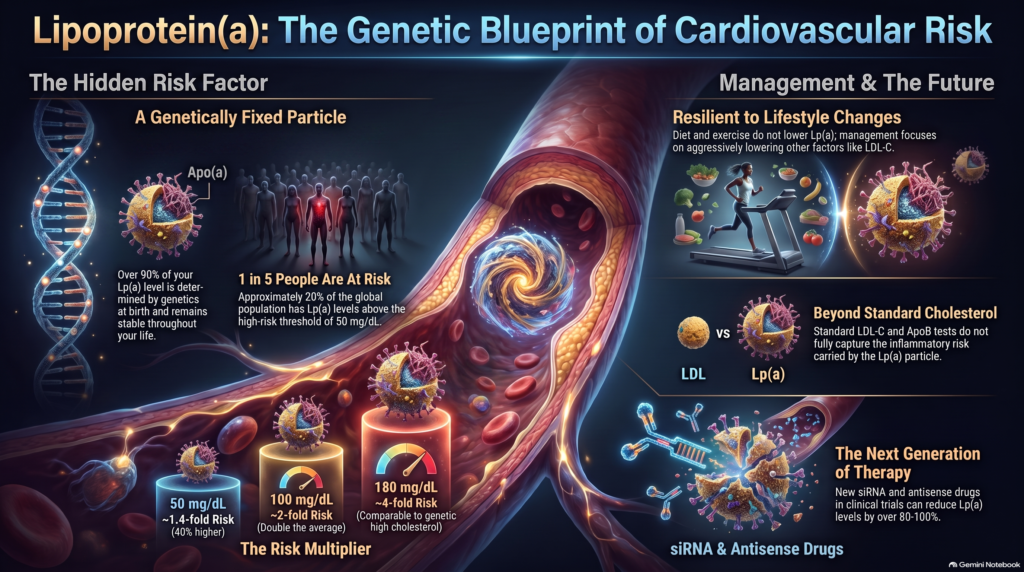
Lp(a) concentration is predominantly genetically determined. The 2022 European Arteriosklerose Society (EAS) consensus statement attributes more than 90% of interindividual variation to genetic variability at the LPA locus [1]. Concentrations are generally stable enough that a single adult measurement is sufficient for risk assessment, although kidney, liver and thyroid disease, pregnancy, the Menopause transition, and certain medications can alter measured levels [1,2].
Der Lp(a)-Wert ist bei Frauen nach der Menopause oft etwas höher, wobei das Ausmaß je nach Population und Studie variiert [1,2]. Auch die Mediankonzentrationen unterscheiden sich zwischen den verschiedenen ethnischen Gruppen, wobei innerhalb der Gruppen große Schwankungen zu verzeichnen sind – dies wird in Abschnitt 6 quantitativ behandelt.
Lp(a) sollte nicht einfach als eine weitere LDL-C-Messung betrachtet werden. Jedes Lp(a)-Partikel enthält ApoB und kann in die Arterienwand eindringen, während das daran gebundene Apo(a) Lp(a) zu einem wichtigen Träger oxidierter Phospholipide macht, die Entzündungs- und Verkalkungsprozesse begünstigen können [1]. Herkömmliche LDL-C- und ApoB-Messungen erfassen daher das mit Lp(a) verbundene kardiovaskuläre Risiko nicht vollständig.
Einheiten: mg/dL im Vergleich zu nmol/L
Lp(a) wird entweder als Masse (mg/dL) oder als Partikelkonzentration (nmol/L) angegeben. Da sich die Apo(a)-Isoformen in ihrer Molekülmasse erheblich unterscheiden, wiegt ein Partikel, das eine große Isoform trägt, mehr als eines, das eine kleine Isoform trägt. Folglich gibt es keinen allgemein gültigen festen Umrechnungsfaktor. Ausdrücke wie “50 mg/dL ≈ 125 nmol/L” sind epidemiologische Näherungswerte, die zur Risikokommunikation verwendet werden – auch in der Leitlinie von 2026 selbst – und stellen keine labortechnischen Umrechnungen dar. Behalten Sie die vom Labor angegebenen Einheiten bei und wenden Sie keine feste Umrechnung von Masse in molare Konzentration an.
2. Ist Lp(a) ursächlich?
Die Belege dafür, dass ein erhöhter Lp(a)-Spiegel eine ursächliche Rolle spielt und nicht nur ein Risikomarker ist, sind für einen Biomarker, das auf drei zusammenlaufenden Linien ruht: prospektiv Epidemiologie, Mensch Genetik einschließlich Mendelsche Randomisierung, sowie eine konsistente Dosis-Wirkungs-Beziehung.
Im Emerging Risk Factors Collaboration, 126.634 Teilnehmer aus 36 prospektiven Studien lieferten Daten aus einer Nachbeobachtungszeit von insgesamt etwa 1,3 Millionen Personenjahren, in deren Verlauf 22.076 erstmalige schwerwiegende vaskuläre oder nichtvaskuläre Ereignisse erfasst wurden, darunter 9.336 koronare Herzkrankheit (CHD) und 1.903 ischämische Schlaganfälle. Das bereinigte CHD-Risiko-Verhältnis betrug 1,13 (95,1 %-Konfidenzintervall 1,09–1,18) pro 3,5-fach erhöhtem üblichen Lp(a)-Wert [3].
Genetische Studien untermauern den Kausalzusammenhang, da die LPA-Allele bereits bei der Empfängnis festgelegt werden und nicht den Einflüssen umgekehrte Kausalität. In drei Kopenhagener Studien mit insgesamt 40.486 Teilnehmern untermauerten genetische Analysen den Kausalzusammenhang; in der Copenhagen City Heart Study wurde die Instrumentvariable Hazard-Ratio betrug 1,22 (95%-Konfidenzintervall 1,09–1,37) pro genetisch vorhergesagter Verdopplung des Lp(a)-Werts [4]. In PROCARDIS, wiesen die LPA-Varianten rs10455872 und rs3798220 pro Allel Odds Ratios für eine KHK von 1,70 (95%-KI 1,49–1,95) bzw. 1,92 (95%-KI 1,48–2,49) [5].
Die klinisch relevante Unterscheidung: Diese Evidenzlage untermauert nachdrücklich, dass ein erhöhter Lp(a)-Spiegel ursächlich zur ASCVD beiträgt. Sie belegt jedoch nicht, dass eine im mittleren Alter begonnene medikamentöse Senkung des Lp(a)-Spiegels dieses Risiko so weit umkehrt, dass Ereignisse verhindert werden können. Diese Frage wird in den Abschnitten 12 bis 14 behandelt.
3. Inwieweit erhöht Lp(a) das kardiovaskuläre Risiko?
Die übersichtlichste aktuelle Zusammenfassung auf Bevölkerungsebene findet sich in Tabelle 4 der 2026 ACC/AHA Multisociety Dyslipidemia Guideline [2]. Bezogen auf einen Medianwert der Bevölkerung von etwa 20 nmol/l (etwa 7 mg/dl) wird das ASCVD-Risiko in der Leitlinie wie folgt eingeschätzt.
| Lp(a)-Spiegel | Ungefähres Perzentil | Geschätztes relatives ASCVD-Risiko | Interpretation |
| <30 mg/dl (<75 nmol/l) | In der Richtlinientabelle nicht ausdrücklich angegeben | Referenz | Geringerer Risikobereich im Zusammenhang mit Lp(a); kein “Nullrisiko” |
| 30–49 mg/dl (75–124 nmol/l) | Nicht genau angegeben | ~1,2-fach | Geringer Anstieg des relativen Risikos |
| 50 mg/dl (125 nmol/l) | ~80. | ~1,4-fach | Das geschätzte relative ASCVD-Risiko liegt bei 40% über dem Referenzmedian |
| 100 mg/dl (250 nmol/l) | ~95. | ~2-fach | Etwa doppelt so hoch wie das geschätzte ASCVD-Risiko |
| 150 mg/dL (350 nmol/L) | Not specifically stated; lies between the guideline’s ~95th-percentile (100 mg/dL) and ~99th-percentile (180 mg/dL) anchors | ~3-fold | Very high population-level risk estimate |
| 180 mg/dL (430 nmol/L) | ~99th | ~4-fold | Estimated risk comparable to heterozygous familiäre Hypercholesterinämie |
Table 1. 2026 ACC/AHA guideline estimated relative ASCVD risk by Lp(a) concentration.
Essential caveats stated by the guideline itself: these values are derived from UK Biobank, are intended as a general guide, may differ among other populations, and use only approximate equivalence between mg/dL and nmol/L [2]. They are population-level estimates, not a patient-specific risk calculator.
These estimates are population averages, not destiny. They describe how event rates differ between groups of people at different Lp(a) concentrations; they do not forecast what will happen to any one person.
Lp(a) behaves as a continuous Risikofaktor. There is no biological cliff between 49 and 51 mg/dL; risk rises continuously rather than switching on at a single threshold. UK Biobank demonstrates this directly: among 460,506 participants followed for a median of 11.2 years, 22,401 incident ASCVD events occurred, median Lp(a) was 19.6 nmol/L, and risk increased approximately linearly at a hazard ratio of 1.11 (95% CI 1.10–1.12) per 50-nmol/L increment [6].
Separately, and at a different threshold, UK Biobank reported that among participants without previous ASCVD, 12.2% had Lp(a) ≥150 nmol/L, with an adjusted hazard ratio of 1.50 (95% CI 1.44–1.56); among those with preexisting ASCVD, prevalence was 20.3% and the hazard ratio 1.16 (95% CI 1.05–1.27) [6]. This ≥150 nmol/L figure must not be confused with, or used to corroborate, a 150 mg/dL (350 nmol/L) exposure — they are very different concentrations.
Why some studies report threefold to fourfold risk
Apparently divergent estimates can often be explained in substantial part by differences in endpoint, comparator, Lp(a) threshold, population, and statistical model rather than by direct contradiction.
In the Copenhagen City Heart Study, 9,330 participants were followed for 10 years and 498 developed Myokardinfarkt (MI). Compared with Lp(a) below 5 mg/dL, adjusted MI hazard ratios in women were 1.1 (95% CI 0.6–1.9) at 5–29 mg/dL, 1.7 (1.0–3.1) at 30–84 mg/dL, 2.6 (1.2–5.9) at 85–119 mg/dL, and 3.6 (1.7–7.7) at 120 mg/dL or above. In men the corresponding figures were 1.5 (0.9–2.3), 1.6 (1.0–2.6), 2.6 (1.2–5.5), and 3.7 (1.7–8.0) [7].
It is therefore correct to say that extreme Lp(a) was associated with approximately threefold to fourfold higher MI risk in that cohort. It is not correct to equate that with the guideline’s approximately twofold estimate at 100 mg/dL: the Copenhagen extreme category was 120 mg/dL or above versus a very low comparator of under 5 mg/dL, with an MI-specific endpoint, whereas the guideline estimate is broad ASCVD at 100 mg/dL versus a population-median reference in UK Biobank-derived modeling.
4. Translating Relative Risk Into Absolute Terms
A hazard ratio of 1.4 denotes approximately 40% higher estimated instantaneous event hazard under the proportional-hazards model. It does not mean a 40% probability of having an event, and it is not mathematically identical to multiplying an individual’s 10-year event probability by 1.4.
The following table is an arithmetic illustration only, assuming the stated multiplier behaves as a simple risk ratio applied directly to a baseline probability.
| Hypothetical baseline 10-year risk | RR 1.2 | RR 1.4 | RR 1.7 | RR 2.0 |
| 5% | 6% | 7% | 8.5% | 10% |
| 10% | 12% | 14% | 17% | 20% |
| 20% | 24% | 28% | 34% | 40% |
| 30% | 36% | 42% | 51% | 60% |
Table 2. Pure arithmetic illustration assuming a risk ratio acts multiplicatively on baseline probability. These values are not individualized Lp(a)-adjusted risk predictions.
Es handelt sich hierbei um rechnerische Veranschaulichungen, bei denen davon ausgegangen wird, dass sich der angegebene Multiplikator wie ein Risikoverhältnis verhält, das direkt auf die Basiswahrscheinlichkeit angewendet wird. Es handelt sich nicht um individuelle Prognosen, und das Risiko einer einzelnen Person sollte nicht durch Multiplikation des Ergebnisses eines klinischen Risikorechners mit einem in einer Studie angegebenen Hazard Ratio oder Odds Ratio geschätzt werden. Die Lp(a)-Werte der Leitlinie von 2026 sind keine validierten Multiplikatoren für einen individuellen klinischen Risikoscore.
Der klinische Aspekt, den die Tabelle verdeutlicht, ist dennoch wichtig: Derselbe Multiplikator bewirkt weitaus mehr absolutes Risiko bei einer Person, deren Ausgangswert bereits hoch ist. Kopenhagen liefert konkrete, studienspezifische absolute Zahlen. Unter Rauchen, Teilnehmer mit Bluthochdruck, die älter als 60 Jahre waren, das 10-Jahres-MI-Risiko bei Frauen mit einem Lp(a)-Wert von 120 mg/dL oder höher bei etwa 20% und bei Männern bei etwa 35% lag, verglichen mit etwa 10% bzw. 19% bei Werten unter 5 mg/dL [7]. Selbst in dieser Hochrisikogruppe führte ein erhöhter Lp(a)-Spiegel lediglich zu einer veränderten Wahrscheinlichkeit, machte einen Herzinfarkt jedoch nicht unvermeidlich.
5. Wie häufig kommt ein erhöhter Lp(a)-Wert vor?
Etwa jeder Fünfte weist einen Lp(a)-Wert auf, der bei oder über den üblicherweise verwendeten Hochrisikoschwellenwerten von etwa 50 mg/dl oder 125 nmol/l liegt – je nach Testverfahren und Angabe der Einheiten –, wodurch erhöhte Lp(a)-Werte weltweit sehr häufig vorkommen [1]. Die genaue globale Belastung hängt vom Schwellenwert, dem verwendeten Testverfahren und der untersuchten demografischen Verteilung ab, weshalb eine einzelne präzise Zählung mit Vorsicht zu betrachten ist. Die Leitlinie von 2026 ordnet 50 mg/dL in die Nähe des 80. Perzentils, 100 mg/dL in die Nähe des 95. Perzentils und 180 mg/dL in die Nähe des 99. Perzentils ein [2].
6. Abstammung
Die Lp(a)-Verteilungen unterscheiden sich je nach ethnischer Herkunft. In der UK Biobank lagen die Mediankonzentrationen bei weißen Teilnehmern bei etwa 19 nmol/L, bei südasiatischen bei 31 nmol/L, bei schwarzen bei 75 nmol/L und bei chinesischen bei 16 nmol/L. Der Zusammenhang zwischen steigenden Lp(a)-Werten und ASCVD war in den untersuchten Hauptgruppen in der Richtung ähnlich, mit Hazard-Ratios pro 50 nmol/L von etwa 1,11, 1,10 bzw. 1,07 bei weißen, südasiatischen und schwarzen Teilnehmern; die Schätzungen für die Untergruppen außerhalb der Gruppe der Weißen sind aufgrund kleinerer Stichprobengrößen weniger präzise [6].
In den Leitlinien von 2026 wird ebenfalls festgestellt, dass die Konzentrationen bei Menschen afrikanischer und südasiatischer Herkunft tendenziell am höchsten sind, während der Zusammenhang mit dem relativen Risiko über alle ethnischen Gruppen hinweg weitgehend ähnlich bleibt [2].
Es handelt sich hierbei um Bevölkerungsverteilungen mit großen Schwankungen innerhalb der einzelnen Gruppen. Sie rechtfertigen es nicht, die Lp(a)-Konzentration oder das kardiovaskuläre Risiko einer Person allein anhand ihrer Abstammung abzuleiten. Der einzige Weg, den Lp(a)-Wert einer Person zu ermitteln, ist eine Messung.
7. Lp(a) bei Menschen, die bereits an einer Herz-Kreislauf-Erkrankung leiden
In einer Kopenhagener Sekundärpräventionskohorte mit 2.527 Personen mit vorangegangener Herz-Kreislauf-Erkrankung Bei den 493 Patienten, die über einen Median von fünf Jahren nachbeobachtet wurden, trat eine schweres unerwünschtes kardiovaskuläres Ereignis (MACE). Die Ereignisraten betrugen 29, 35, 42 bzw. 54 pro 1.000 Personenjahre bei Lp(a)-Werten unter 10, 10–49, 50–99 und 100 mg/dl oder darüber. Im Vergleich zu Werten unter 10 mg/dl betrugen die adjustierten Inzidenzratenverhältnisse 1,28 (95%-KI 1,03–1,58), 1,44 (95 %-KI 1,12–1,85) und 2,14 (95 %-KI 1,57–2,92) [8].
In der UK Biobank war der relative Zusammenhang bei Lp(a) ≥ 150 nmol/L bei Teilnehmern mit nachgewiesener ASCVD geringer (HR 1,16, 95%-Konfidenzintervall 1,05–1,27) geringer als bei Teilnehmern ohne vorangegangene ASCVD (HR 1,50, 95%-Konfidenzintervall 1,44–1,56), obwohl das absolute Ereignisrisiko bei Sekundärprävention [6].
Ergebnisse aus den Studien zu PCSK9-Hemmern
In FOURIER, Bei 25.096 Patienten mit nachgewiesener ASCVD wurde der Lp(a)-Wert bestimmt und sie wurden über einen Median von 2,2 Jahren nachbeobachtet. Bei den mit Placebo behandelten Teilnehmern lag der höchste Lp(a)-Wert Quartil wies ein bereinigtes Hazard Ratio von 1,22 (95 %-Konfidenzintervall 1,01–1,48) für den Tod durch koronare Herzkrankheit, einen Myokardinfarkt oder eine Notfallbehandlung auf Revaskularisation im Vergleich zum untersten Quartil, unabhängig vom LDL-C. Evolocumab senkte den Lp(a)-Wert um einen Medianwert von 26,91 TP9T [9].
In secondary analyses of that trial, patients with higher baseline Lp(a) appeared to derive greater coronary benefit: the hazard ratio was 0.77 (95% CI 0.67–0.88) above the median baseline Lp(a) versus 0.93 (95% CI 0.80–1.08) below it, with a three-year absolute risk reduction of 2.49% versus 0.95% and numbers needed to treat of 40 versus 105. The interaction P value was 0.07 and therefore did not reach conventional statistical significance. This is a subgroup finding within a randomized trial, not the primary randomized comparison [9].
In ODYSSEY OUTCOMES, 18,924 patients following an akutes Koronarsyndrom were followed for a median of 2.8 years on intensive Statin therapy. Baseline Lp(a) independently predicted recurrent events. In post-hoc analyses, alirocumab-associated reductions in Lp(a) were independently associated with fewer cardiovascular events; however, these analyses cannot establish that the Lp(a) reduction itself caused the event reduction, because Alirocumab simultaneously produces large reductions in LDL-C and ApoB [10,11].
Both trials therefore support elevated Lp(a) as a marker of Restrisiko in treated patients, and both are consistent with — but do not prove — a benefit attributable to Lp(a) lowering itself.
8. Does Very Low LDL-C Eliminate the Risk?
Lowering LDL-C substantially reduces cardiovascular risk, but it does not appear to eliminate Lp(a)-associated residual risk. A 2025 participant-level analysis of 27,658 people in six placebo-controlled statin trials found that even in the lowest achieved-LDL-C quartile — 3.1 to 77.0 mg/dL — Lp(a) above 50 mg/dL was associated with an ASCVD hazard ratio of 1.38 (95% CI 1.06–1.79) compared with 50 mg/dL or below. The highest joint category of elevated Lp(a) and highest achieved LDL-C carried a hazard ratio of 1.90 (95% CI 1.46–2.48) [12].
Because that lowest quartile spans 3.1 to 77.0 mg/dL, the analysis demonstrates persistence of risk at relatively low achieved LDL-C but does not supply a dedicated estimate at LDL-C below 55 mg/dL. A specific residual-risk figure at that threshold should not be claimed from these data.
The defensible formulation: intensive LDL-C and ApoB lowering reduces overall absolute ASCVD risk, but available data do not establish an LDL-C concentration at which the association with elevated Lp(a) disappears.
9. Lp(a) and ApoB: Overlapping, Not Interchangeable
Plasma ApoB concentration is a practical proxy for the number of circulating ApoB-containing atherogenic lipoprotein particles, including LDL, VLDL Überreste, IDL, and Lp(a). Because every Lp(a) particle itself contains one ApoB-100 molecule, Lp(a) and ApoB are not separate biological pathways; they overlap.
What distinguishes Lp(a) is the additional apo(a)- and oxidized-phospholipid-related biology. Adjustment and mediation analyses suggest that conventional lipid and inflammatory markers — including LDL-C, non-HDL-C, ApoB, and hsCRP — explain only a minority of the association between Lp(a) and ASCVD [13].
A 2024 genetic analysis estimated that the CHD association per 50 nmol/L genetically proxied increase in Lp(a)-ApoB was substantially greater than the association for the same increment in LDL-ApoB, with an estimated per-particle ratio of approximately 6.6 (95% CI 5.1–8.8) [14]. This is a Mendelian-randomization effect-size estimate carrying methodological assumptions. It is not proof that any individual Lp(a) particle is literally 6.6 times as biologically harmful as an LDL particle.
The two findings reconcile: Lp(a) contributes to total ApoB while also carrying risk that is not adequately represented by conventional ApoB concentration alone.
10. Lp(a) and Calcific Aortic-Valve Stenosis
In 77,680 Copenhagen participants followed for as long as 20 years, 454 developed Aortenklappenstenose. Relative to Lp(a) under 5 mg/dL, adjusted hazard ratios rose to 1.6 (95% CI 1.1–2.4) at 20–64 mg/dL, 2.0 (95% CI 1.2–3.4) at 65–90 mg/dL, and 2.9 (95% CI 1.8–4.9) above 90 mg/dL. Genetic instrumental-variable analysis yielded a relatives Risiko von 1,6 (95%, KI 1,2–2,1) pro 10-facher Erhöhung des Lp(a)-Werts, was einen kausalen Beitrag nahelegt [15].
In einer separaten Kopenhagener Analyse war jeder 10-fache Anstieg des Lp(a)-Wertes mit einem Odds Ratio von 1,62 (95%-Konfidenzintervall 1,48–1,77) für eine Aortenklappe verbunden Verkalkung und ein Hazard Ratio von 1,54 (95 %-Konfidenzintervall 1,38–1,71) für die Aortenklappe Stenose, wobei etwa 31% des Effekts durch Verkalkung vermittelt wird [16].
Among patients who already had aortic stenosis, a prospective study of 145 patients found that higher Lp(a) and oxidized-phospholipid measures were associated with greater valve-calcification activity and faster CT-calcium and hemodynamic progression. Participants in the top Lp(a) tertile, compared with the lower two tertiles, had a higher risk of aortic-valve replacement or death (hazard ratio 1.87, 95% CI 1.13–3.08); related oxidized-phospholipid measures showed similar associations. Accompanying in-vitro experiments supported a procalcific mechanism [17]. These observational and mechanistic findings support the biological rationale but do not prove that pharmacologically lowering Lp(a) will slow established aortic stenosis. No randomized trial has yet shown that lowering Lp(a) prevents progression of aortic stenosis or reduces valve replacement.
Lp(a) is also linked to atherothrombosis and aortic-valve stenosis independent of Entzündung. In 68,090 Copenhagen participants followed for a median of 8.1 years, Lp(a) of 70 mg/dL or above versus 6 mg/dL or below was associated with an ASCVD hazard ratio of 1.61 (95% CI 1.43–1.81) among those with C-reaktives Protein under 2 mg/L and 1.57 (95% CI 1.36–1.82) among those with CRP of 2 mg/L or above, interaction P = 0.87 [18].
11. Does High Lp(a) Mean You Will Have a Heart Attack?
No. Lp(a) changes probability; it does not determine outcome. Even in the Copenhagen high-risk subgroup — smokers with Bluthochdruck over age 60 and Lp(a) of 120 mg/dL or above — 10-year MI risk was approximately 20% in women and 35% in men, not 100% [7]. Other baseline-risk profiles differ substantially.
A person with high Lp(a) but excellent Blutdruck, no Diabetes, no smoking, low ApoB and LDL-C, and favorable imaging may have a much lower absolute risk than someone with the same Lp(a) plus multiple major risk factors. Age, smoking, blood pressure, diabetes, Nierenerkrankung, cumulative ApoB and LDL exposure, Familiengeschichte, and existing atherosclerosis jointly determine absolute cardiovascular risk alongside Lp(a) [2].
12. Currently Available Treatments
The treatment section must distinguish three separate questions: does the treatment change Lp(a); does it reduce cardiovascular events overall; and has any event benefit been proven to result specifically from lowering Lp(a)? These are not interchangeable.
| Therapie | Effect on Lp(a) | Approximate LDL-C effect [2] | Evidence and safety | Cardiovascular outcome status |
| Statine | On average a modest increase; pooled statin-to-placebo ratio of geometric means 1.11 (95% CI 1.07–1.14); statin-arm mean changes about +8.5% to +19.6% | Moderate-intensity ~30% to <50%; high-intensity ≥50% | Participant-level Meta-Analyse, n = 5,256. Whether the modest rise independently affects outcomes is uncertain. | Substantial ASCVD benefit via LDL/ApoB lowering. Not a reason to withhold indicated statin therapy. |
| Ezetimib | Small and inconsistent. A seven-trial meta-analysis of ezetimibe monotherapy reported −7.06% (95% CI −11.95 to −2.18) [19]; a broader analysis including combination therapy found no statistically significant reduction (−2.59%, 95% CI −8.26 to 3.08) [20] | Approximately 15–20% additional lowering when added to a statin | Estimates differ substantially between syntheses. | Its clinical role is LDL-C lowering, not targeted Lp(a) reduction; no Lp(a)-specific outcome evidence. |
| PCSK9 monoclonal antibodies | Mean approximately −27% (95% CI −29.8 to −24.1); evolocumab −29.35%, alirocumab −24.50% | Approximately 50–60% | Meta-analysis of 47 randomized trials, 67,057 participants [21]. | Overall event reduction proven; the incremental causal contribution of Lp(a) lowering is unproven. |
| Inclisiran | Modest — approximately 18–22% in pooled trial analyses [22,23] | Approximately 50%; pooled ORION-9/10/11 analysis (n = 3,660) placebo-corrected reduction −50.7% [23] | Injection-site adverse events 5.0% versus 0.7% with Placebo in the pooled Orion analysis [23]. | No dedicated proof that its modest Lp(a) reduction causes event reduction. |
| Niacin | Approximately −21% in the AIM-HIGH Lp(a) analysis [24] | Modest | HPS2-THRIVE: major vascular events 13.2% vs 13.7%, rate ratio 0.96 (95% CI 0.90–1.03), P = 0.29, with excess serious adverse events [25]. | No added benefit on contemporary therapy. Should not be prescribed solely to lower Lp(a). |
| Lipoprotein apheresis | Approximately −60% to −70% acutely; 68.1% mean single-treatment reduction in Pro(a)LiFe [26,27] | Large acute reduction per session, with rebound between sessions | Levels rebound between sessions, so the time-averaged reduction is smaller than the immediate post-procedure reduction. | Uncontrolled before-after cohorts report large event-rate reductions [26,27]; verwirrend, selection, and regression to the mean prevent causal claims. |
Table 3. Effects of currently available therapies on Lp(a) and on cardiovascular outcomes.
On statins specifically: the pooled participant-level meta-analysis confirms a modest average increase in Lp(a) [28]. Whether that increase independently affects outcomes is uncertain, and it is not a reason to stop indicated statin therapy, because the LDL and ApoB lowering statins achieve has established cardiovascular benefit.
13. Investigational Lp(a)-Targeted Therapies
A new class of agents lowers Lp(a) far more dramatically than any conventional lipid therapy. These trials establish pharmacodynamic proof, not clinical-outcome proof.
The key distinction is that lowering a laboratory value is not the same as proving fewer Herzanfälle oder Schlaganfälle.
A biomarker reduction of 90% must not be translated into an assumed 90% reduction in events.
| Agent (class) | Trial and size | Lp(a) reduction | Safety findings |
| Pelacarsen (antisense oligonucleotide) | Phase 2, n = 286 [29] | Up to 80% mean reduction at the highest regimen | Injection-site reactions most common; no major platelet, liver, or renal imbalance in phase 2 |
| Olpasiran (siRNA) | OCEAN(a)-DOSE, n = 281 [30] | Placebo-adjusted −70.5%, −97.4%, −101.1%, and −100.5% by regimen at week 36 | Overall adverse events similar to placebo; injection-site reactions most common |
| Lepodisiran (siRNA) | ALPACA, n = 320 [31] | Pooled 400 mg: placebo-adjusted time-averaged −93.9% (95% CI −95.1 to −92.5), days 60–180 | 35 serious adverse events, none deemed treatment-related; generally mild injection-site reactions in up to 12% |
| Zerlasiran (siRNA) | ALPACAR-360, n = 178 [32] | Time-averaged −85.6%, −82.8%, and −81.3% by regimen (all >80%) | Mild injection-site pain in approximately 2.3–7.1%; 20 serious adverse events in 17 patients, none considered drug-related |
| Muvalaplin (oral small molecule) | KRAKEN, n = 233 [33] | Up to −85.8% using the intact-Lp(a) assay; approximately −70% by apo(a) assay | No major safety or tolerability concern reported over the trial period |
Table 4. Phase 2 biomarker results for Lp(a)-targeted agents.
Placebo-adjusted values slightly beyond 100% reflect the statistical adjustment calculation, not physically negative Lp(a) concentrations.
14. The Dedicated Outcomes Trials
These trials are the decisive tests of whether lowering Lp(a) prevents cardiovascular events. Lp(a)HORIZON’s registered primary endpoint is time to first expanded major adverse cardiovascular event in patients with established cardiovascular disease and Lp(a) ≥70 mg/dL, with a second primary analysis in those ≥90 mg/dL. Registry status is fast-moving content and must be re-verified immediately before publication.
| Trial (agent) | Registry ID | Status | Enrollment | Estimated primary completion |
| Lp(a)HORIZON (pelacarsen) | NCT04023552 | Active, not recruiting; no results posted; record last updated 6 May 2026 and last verified May 2026; sponsor Novartis | 8,323 (actual) | 30 June 2026 (estimated) |
| OCEAN(a)-Outcomes (olpasiran) | NCT05581303 | Active, not recruiting; no results posted; record updated 27 February 2026. Established ASCVD with Lp(a) ≥200 nmol/L; eligible ASCVD includes prior MI or PCI with stenting plus an additional risk factor; anticipated follow-up approximately four years | 7,297 (actual) | 31 March 2028 |
| ACCLAIM-Lp(a) (lepodisiran) | NCT06292013 | Aktiv, keine Teilnehmerrekrutierung; keine Ergebnisse veröffentlicht; Datenstand: 18. Juni 2026. Lp(a) ≥ 175 nmol/L; durch einen Nachtrag wurden etwa 1.700 Teilnehmer hinzugefügt | 17.300 (geschätzt) | März 2029 |
| MOVE-Lp(a) (Muvalaplin) | NCT07157774 | Personalbeschaffung; keine Ergebnisse veröffentlicht; Eintrag aktualisiert am 7. Juli 2026 | 10.450 (geschätzt); tatsächlicher Start: 2. September 2025 | März 2031 |
Tabelle 5. Spezielle Programme zur Senkung des Lp(a)-Spiegels mit Blick auf kardiovaskuläre Endpunkte, gemäß ClinicalTrials.gov, wie im Prüfbericht vom August 2026 zitiert.
Eine weitere Pelacarsen-Studie, ADD-VANTAGE (NCT06813911), ist eine Phase-3-Studie zur Rekrutierung von Patienten, in der Pelacarsen vor dem Hintergrund einer Behandlung mit Inclisiran bei Patienten mit erhöhtem Lp(a)-Spiegel und etablierter ASCVD untersucht wird. Nach Stand vom 28. August 2026 war der Eintrag auf ClinicalTrials.gov zuletzt am 17. Juni 2026 aktualisiert worden; es lagen noch keine Ergebnisse vor, die geschätzte Teilnehmerzahl betrug 340 und der voraussichtliche Abschluss der Primärphase war für den 3. Februar 2028 vorgesehen. Da der primäre Endpunkt die Veränderung des Lp(a)-Wertes und nicht kardiovaskuläre Ereignisse ist, handelt es sich um eine Biomarker-Studie, die nicht mit den in Tabelle 5 aufgeführten Studien zu kardiovaskulären Endpunkten zusammengefasst werden sollte [38].
Stand 28. August 2026 weisen die primären Datensätze auf ClinicalTrials.gov für die wichtigsten spezifischen Studienprogramme zur Senkung des Lp(a)-Spiegels mit Fokus auf kardiovaskuläre Endpunkte keine veröffentlichten Ergebnisse auf. Es wurde daher bislang noch nicht in einer spezifischen randomisierten Endpunktstudie nachgewiesen, dass eine selektive medikamentöse Senkung des Lp(a)-Spiegels zu einer Verringerung kardiovaskulärer Ereignisse führt.
Lp(a)HORIZON ist weiterhin als aktiv, jedoch ohne Teilnehmerrekrutierung gelistet, obwohl das voraussichtliche Datum für den Abschluss der Primärphase der 30. Juni 2026 ist; OCEAN(a)-Outcomes und ACCLAIM-Lp(a) sind weiterhin aktiv, rekrutieren jedoch keine Teilnehmer, während MOVE-Lp(a) Teilnehmer rekrutiert. Ein bereits überschrittenes voraussichtliches Datum ist kein Hinweis darauf, dass eine Studie als abgeschlossen bezeichnet werden sollte oder dass Ergebnisse vorliegen.
15. Um wie viel müsste der Lp(a)-Wert sinken?
Zwei Mendel’sche Randomisierungsanalysen haben den lebenslangen, genetisch abgeleiteten Lp(a)-Unterschied geschätzt, der mit einem Unterschied im KHK-Risiko verbunden ist, der mit demjenigen vergleichbar ist, der bei einem um 1 mmol/l (38,67 mg/dl) niedrigeren LDL-C-Wert auftritt. Burgess und Kollegen schätzten diesen Wert auf 101,5 mg/dl (95 %-Konfidenzintervall 71,0–137,0) und berichteten von einer Odds Ratio von 0,942 pro 10 mg/dl niedrigerem, genetisch vorhergesagtem Lp(a)-Wert [39]. Lamina und Kronenberg schätzten den Wert auf 65,7 mg/dl (95% KI 46,3–88,3) [40].
Die Schätzungen weichen vor allem aufgrund von Unterschieden bei der Lp(a)-Verteilung, der Kalibrierung der Assays und dem analytischen Design der zugrunde liegenden Datensätze voneinander ab. Bei beiden Analysen wurden überwiegend Datensätze mit europäischer Abstammung sowie assayabhängige Lp(a)-Massenmessungen herangezogen.
Beide legen nahe, dass erhebliche absolute Unterschiede bei der lebenslangen Lp(a)-Exposition mit klinisch bedeutsamen Unterschieden im Risiko für eine koronare Herzkrankheit einhergehen. Keiner der beiden Ansätze legt fest, welche Senkung ein Medikament über einen begrenzten Behandlungszeitraum erzielen muss, und keiner sollte als validiertes pharmakologisches Ziel dargestellt werden. Eine lebenslange genetische Exposition, die bereits bei der Empfängnis beginnt, ist nicht gleichbedeutend mit einer jahrelangen medikamentösen Therapie, die erst nach Plaque hat sich angesammelt.
Eine separate Modellprojektion auf Basis der Kopenhagener Sekundärpräventionskohorte schätzte, dass eine Senkung des Lp(a)-Werts um etwa 50 mg/dl (105 nmol/l) über einen Zeitraum von fünf Jahren einer Verringerung der MACE um 20% entsprechen könnte, und eine Senkung um etwa 99 mg/dl (212 nmol/L) mit 40% weniger MACE [8]. Hierbei handelt es sich um modellbasierte Hochrechnungen auf der Grundlage von Beobachtungsdaten und nicht um in Studien nachgewiesene Behandlungseffekte.
16. Wer sollte sich testen lassen?
Die ACC/AHA-Multisociety-Leitlinien 2026 Dyslipidämie Die Leitlinie empfiehlt, Lp(a) im Erwachsenenalter mindestens einmal zu messen, und der EAS-Konsens unterstützt denselben Ansatz [2,1]. Die Messung ist besonders aussagekräftig bei vorzeitiger ASCVD, einer ausgeprägten familiären Vorbelastung mit vorzeitigen Herz-Kreislauf-Erkrankungen, familiärer Hypercholesterinämie, wiederkehrende Ereignisse trotz gut eingestellter LDL-C-Werte und kalzifizierte Aortenstenose.
Cascade-Lp(a)-Test bei first-degree relatives ist sinnvoll, wenn ein deutlich erhöhter Lp(a)-Wert festgestellt wird. In der täglichen Praxis bedeutet dies, die Lp(a)-Konzentration bei Verwandten zu messen und nicht deren Genotyp zu bestimmen.
Repeat measurement is generally unnecessary, because Lp(a) is predominantly genetically determined and generally stable over time. Repeat testing may nevertheless be appropriate when disease, pregnancy or menopause-related changes, medications, assay uncertainty, or Lp(a)-directed therapy could materially alter the measured concentration.
17. What This Means for You
Lp(a) is an inherited, cholesterol-containing lipoprotein particle that can substantially increase the risk of heart attack, stroke, and aortic-valve disease. At around 50 mg/dL, average relative ASCVD risk is roughly 40% higher than at the guideline’s reference median; at very high levels around 180 mg/dL, average relative risk may be about four times higher [2]. That does not mean a heart attack is inevitable.
Because lifestyle change does not lower Lp(a) appreciably [1,2], healthy behavior should not be judged by whether the Lp(a) number falls. Exercise, avoiding tobacco, maintaining healthy body composition, controlling blood pressure and diabetes, and following a heart-healthy dietary pattern act on the other components of absolute risk. Lowering LDL-C and ApoB is a central evidence-based strategy, because these are modifiable causal exposures that add to the inherited Lp(a)-associated risk.
LDL-C goals should be individualized by risk category rather than applied uniformly. The 2026 guideline recommends LDL-C below 55 mg/dL for very-high-risk ASCVD and below 70 mg/dL for ASCVD not meeting very-high-risk criteria. In Primärprävention mit subklinische Atherosklerose, progressively higher Koronarer Kalzium-Score burden supports progressively more intensive LDL-C lowering: CAC of 100–299 or at or above the 75th percentile supports LDL-C below 70 mg/dL; CAC of 300–999 supports below 70 mg/dL with at least a 50% reduction, and intensification toward below 55 mg/dL is reasonable in selected patients; CAC of 1000 or above supports below 55 mg/dL with at least a 50% reduction [2].
CAC scoring can be useful selectively — in selected primary-prevention adults for whom the treatment decision remains uncertain after conventional risk assessment and consideration of risk enhancers such as elevated Lp(a). Elevated Lp(a) by itself does not create a universal indication for a calcium scan [2].
Where CAC is obtained, it strongly modifies absolute risk in people with elevated Lp(a). In MESA, elevated Lp(a) with a CAC score of zero was not significantly associated with higher ASCVD risk than low Lp(a) with CAC of zero (hazard ratio 1.31, 95% CI 0.73–2.35), whereas elevated Lp(a) together with CAC of 100 or above identified markedly higher risk (hazard ratio 4.71, 95% CI 3.01–7.40) [41]. A 2026 multicohort study of 11,319 participants followed for a mean of 14.8 years found that elevated Lp(a) above 50 mg/dL was associated with higher ASCVD risk even among people with a CAC score of zero (hazard ratio 1.28, 95% CI 1.01–1.60), although absolute event rates in that group remained low at 4.9 versus 3.8 per 1,000 person-years [42]. A CAC score of zero should therefore be read as low observed absolute plaque-related risk over the period studied, not as evidence that lifelong Lp(a)-associated risk has disappeared. CAC measures disease already present; Lp(a) measures a lifelong causal exposure [1,2].
Until dedicated outcome trials of Lp(a)-specific drugs report, the most evidence-based strategy is intensive, guideline-directed management of every modifiable cardiovascular risk factor, particularly LDL-C and ApoB.
18. Evidence Hierarchy
- Strong evidence: Lp(a) is a causal, continuously graded risk factor for ASCVD, supported by prospektive Kohorten, LPA genetics, Mendelian Randomisierung, and dose–response. Lp(a) makes a causal contribution to calcific aortic-valve disease.
- Moderate-to-strong evidence: elevated Lp(a) remains associated with residual ASCVD risk in statin-treated and aggressively LDL-lowered populations. Conventional ApoB does not fully capture Lp(a)-associated risk. Elevated Lp(a) predicts recurrent events in established ASCVD.
- Moderate evidence: the genetically estimated per-particle atherogenicity of Lp(a) relative to LDL. Post-hoc PCSK9-inhibitor analyses suggesting greater absolute benefit at higher baseline Lp(a).
- Emerging evidence: whether pharmacologic Lp(a) lowering reduces cardiovascular events. Biomarker efficacy of the investigational agents is established; cardiovascular-outcome efficacy remains unproven in the audited primary data.
So, How Much Worse Does Lp(a) Make Heart Disease?
- Elevated Lp(a) is common: approximately one in five people has a concentration at or above commonly used high-risk thresholds of roughly 50 mg/dL or 125 nmol/L.
- Risk rises continuously rather than switching on at a threshold. The 2026 guideline estimates approximately 1.2-fold ASCVD risk at 30–49 mg/dL, 1.4-fold at 50 mg/dL, 2-fold at 100 mg/dL, 3-fold at 150 mg/dL, and 4-fold at 180 mg/dL, compared with a population median of about 7 mg/dL (20 nmol/L). These are UK Biobank-derived general-guide estimates.
- Extreme concentrations have been associated with roughly threefold to fourfold higher MI risk in some cohorts — in Copenhagen, at 120 mg/dL or above versus under 5 mg/dL, with an MI-specific endpoint. That is a different question from the guideline’s broad-ASCVD estimate at 100 mg/dL.
- In people who already have cardiovascular disease, higher Lp(a) predicts more recurrent events, with adjusted incidence-rate ratios rising to 2.14 at 100 mg/dL or above versus under 10 mg/dL.
- Low LDL-C does not eliminate the risk. Lp(a)-associated risk persisted in the lowest achieved-LDL-C quartile of pooled statin trials, and it is incompletely represented by conventional ApoB measurement — even though each Lp(a) particle itself contributes one ApoB-100 molecule.
- Very high Lp(a) is associated with roughly threefold higher incident aortic-stenosis risk in Copenhagen data, and genetic evidence supports a causal contribution to calcific aortic-valve disease.
- What patients can do now: measure Lp(a) once; if elevated, intensify guideline-directed control of every modifiable risk factor, with LDL-C goals set by risk category; consider CAC selectively when a primary-prevention treatment decision remains uncertain; and arrange cascade testing of first-degree relatives.
- What remains unknown: whether profoundly lowering Lp(a) prevents cardiovascular events. As of 28 August 2026, no dedicated phase 3 Lp(a)-lowering outcomes result had been posted. Lp(a)HORIZON, OCEAN(a)-Outcomes, ACCLAIM-Lp(a), and MOVE-Lp(a) are designed to answer that question, with estimated primary completions from 2026 through 2031.
Referenzen
- Kronenberg F, Mora S, Stroes ESG, et al. Lipoprotein(a) in atherosclerotic cardiovascular disease and aortic stenosis: a European Atherosclerosis Society consensus statement. Eur Heart J. 2022;43(39):3925–3946. DOI: 10.1093/eurheartj/ehac361. PMID: 36036785.
- 2026 ACC/AHA/AACVPR/ABC/ACPM/ADA/AGS/APhA/ASPC/NLA/PCNA Guideline on the Management of Dyslipidemia. Circulation. 2026. DOI: 10.1161/CIR.0000000000001423. PMID: 41824590.
- Erqou S, Kaptoge S, Perry PL, et al; Emerging Risk Factors Collaboration. Lipoprotein(a) concentration and the risk of coronary heart disease, stroke, and nonvascular mortality. JAMA. 2009;302(4):412–423. DOI: 10.1001/jama.2009.1063. PMID: 19622820.
- Kamstrup PR, Tybjærg-Hansen A, Steffensen R, Nordestgaard BG. Genetically elevated lipoprotein(a) and increased risk of myocardial infarction. JAMA. 2009;301(22):2331–2339. DOI: 10.1001/jama.2009.801. PMID: 19509380.
- Clarke R, Peden JF, Hopewell JC, et al; PROCARDIS Consortium. Genetic variants associated with Lp(a) lipoprotein level and coronary disease. N Engl J Med. 2009;361(26):2518–2528. DOI: 10.1056/NEJMoa0902604. PMID: 20032323.
- Patel AP, Wang M, Pirruccello JP, et al. Lp(a) concentrations and incident atherosclerotic cardiovascular disease: new insights from a large national biobank. Arterioscler Thromb Vasc Biol. 2021;41(1):465–474. DOI: 10.1161/ATVBAHA.120.315291. PMID: 33115266.
- Kamstrup PR, Benn M, Tybjærg-Hansen A, Nordestgaard BG. Extreme lipoprotein(a) levels and risk of myocardial infarction in the general population: the Copenhagen City Heart Study. Circulation. 2008;117(2):176–184. DOI: 10.1161/CIRCULATIONAHA.107.715698. PMID: 18086931.
- Madsen CM, Kamstrup PR, Langsted A, Varbo A, Nordestgaard BG. Lipoprotein(a)-lowering by 50 mg/dL (105 nmol/L) may be needed to reduce cardiovascular disease 20% in secondary prevention. Arterioscler Thromb Vasc Biol. 2020;40(1):255–266. DOI: 10.1161/ATVBAHA.119.312951. PMID: 31578080.
- O’Donoghue ML, Fazio S, Giugliano RP, et al. Lipoprotein(a), PCSK9 inhibition, and cardiovascular risk: insights from the FOURIER trial. Circulation. 2019;139(12):1483–1492. DOI: 10.1161/CIRCULATIONAHA.118.037184. PMID: 30586750.
- Bittner VA, Szarek M, Aylward PE, et al; ODYSSEY OUTCOMES Committees and Investigators. Effect of alirocumab on lipoprotein(a) and cardiovascular risk after acute coronary syndrome. J Am Coll Cardiol. 2020;75(2):133–144. DOI: 10.1016/j.jacc.2019.10.057. PMID: 31948641.
- Szarek M, Bittner VA, Aylward P, et al; ODYSSEY OUTCOMES Investigators. Lipoprotein(a) lowering by alirocumab reduces the total burden of cardiovascular events independent of low-density lipoprotein cholesterol lowering. Eur Heart J. 2020;41(44):4245–4255. DOI: 10.1093/eurheartj/ehaa649. PMID: 33051646.
- Bhatia HS, Wandel S, Willeit P, et al. Independence of lipoprotein(a) and LDL cholesterol-mediated cardiovascular risk: a participant-level meta-analysis. Circulation. 2025;151(4):312–321. DOI: 10.1161/CIRCULATIONAHA.124.069556. PMID: 39492722.
- Thomas PE, Vedel-Krogh S, Kamstrup PR, Nordestgaard BG. Lipoprotein(a) cardiovascular risk explained by LDL cholesterol, non-HDL cholesterol, apoB, or hsCRP is minimal. J Am Coll Cardiol. 2025;85(21):2046–2051. DOI: 10.1016/j.jacc.2025.02.024. PMID: 40266171.
- Björnson E, Adiels M, Taskinen MR, et al. Lipoprotein(a) is markedly more atherogenic than LDL: an apolipoprotein B-based genetic analysis. J Am Coll Cardiol. 2024;83(3):385–395. DOI: 10.1016/j.jacc.2023.10.039. PMID: 38233012.
- Kamstrup PR, Tybjærg-Hansen A, Nordestgaard BG. Elevated lipoprotein(a) and risk of aortic valve stenosis in the general population. J Am Coll Cardiol. 2014;63(5):470–477. DOI: 10.1016/j.jacc.2013.09.038. PMID: 24161338.
- Kaltoft M, Langsted A, Nordestgaard BG. Elevated lipoprotein(a) in mitral and aortic valve calcification and disease: the Copenhagen General Population Study. Atherosclerosis. 2022;349:166–174. DOI: 10.1016/j.atherosclerosis.2021.11.029. PMID: 34903381.
- Zheng KH, Tsimikas S, Pawade T, et al. Lipoprotein(a) and oxidized phospholipids promote valve calcification in patients with aortic stenosis. J Am Coll Cardiol. 2019;73(17):2150–2162. DOI: 10.1016/j.jacc.2019.01.070. PMID: 31047003.
- Thomas PE, Vedel-Krogh S, Kamstrup PR, Nordestgaard BG. Lipoprotein(a) is linked to atherothrombosis and aortic valve stenosis independent of C-reactive protein. Eur Heart J. 2023;44(16):1449–1460. DOI: 10.1093/eurheartj/ehad055. PMID: 36805188.
- Awad K, Mikhailidis DP, Katsiki N, Muntner P, Banach M; Lipid and Blood Pressure Meta-Analysis Collaboration (LBPMC) Group. Effect of ezetimibe monotherapy on plasma lipoprotein(a) concentrations in patients with primary hypercholesterolemia: a systematic review and meta-analysis of randomized controlled trials. Drugs. 2018;78(4):453–462. DOI: 10.1007/s40265-018-0870-1. PMID: 29396832.
- Sahebkar A, Simental-Mendía LE, Pirro M, Banach M, Watts GF, Sirtori C, Al-Rasadi K, Atkin SL. Impact of ezetimibe on plasma lipoprotein(a) concentrations as monotherapy or in combination with statins: a systematic review and meta-analysis of randomized controlled trials. Sci Rep. 2018;8(1):17887. DOI: 10.1038/s41598-018-36204-7. PMID: 30552391.
- Rivera FB, Cha SW, Louisse CL, et al. Impact of proprotein convertase subtilisin/kexin type 9 inhibitors on lipoprotein(a): a meta-analysis and meta-regression of randomized controlled trials. JACC Adv. 2025;4(2):101549. DOI: 10.1016/j.jacadv.2024.101549. PMID: 39877671.
- Ray KK, Wright RS, Kallend D, et al; ORION-10 and ORION-11 Investigators. Two phase 3 trials of inclisiran in patients with elevated LDL cholesterol. N Engl J Med. 2020;382(16):1507–1519. DOI: 10.1056/NEJMoa1912387. PMID: 32187462.
- Wright RS, Ray KK, Raal FJ, et al. Pooled patient-level analysis of inclisiran trials in patients with familial hypercholesterolemia or atherosclerosis. J Am Coll Cardiol. 2021;77(9):1182–1193. DOI: 10.1016/j.jacc.2020.12.058. PMID: 33663735.
- Albers JJ, Slee A, O’Brien KD, et al. Relationship of apolipoproteins A-1 and B, and lipoprotein(a) to cardiovascular outcomes: the AIM-HIGH trial. J Am Coll Cardiol. 2013;62(17):1575–1579. DOI: 10.1016/j.jacc.2013.06.051. PMID: 23973688.
- HPS2-THRIVE Collaborative Group. Effects of extended-release niacin with laropiprant in high-risk patients. N Engl J Med. 2014;371(3):203–212. DOI: 10.1056/NEJMoa1300955. PMID: 25014686.
- Leebmann J, Roeseler E, Julius U, et al. Lipoprotein apheresis in patients with maximally tolerated lipid-lowering therapy, lipoprotein(a)-hyperlipoproteinemia, and progressive cardiovascular disease. Circulation. 2013;128(24):2567–2576. DOI: 10.1161/CIRCULATIONAHA.113.002432. PMID: 24056686.
- Roeseler E, Julius U, Heigl F, et al; Pro(a)LiFe-Study Group. Lipoprotein apheresis for lipoprotein(a)-associated cardiovascular disease: prospective 5-year results. Arterioscler Thromb Vasc Biol. 2016;36(9):2019–2027. DOI: 10.1161/ATVBAHA.116.307983. PMID: 27417585.
- Tsimikas S, Gordts PLSM, Nora C, Yeang C, Witztum JL. Statin therapy increases lipoprotein(a) levels. Eur Heart J. 2020;41(24):2275–2284. DOI: 10.1093/eurheartj/ehz310. PMID: 31111151.
- Tsimikas S, Karwatowska-Prokopczuk E, Gouni-Berthold I, et al. Lipoprotein(a) reduction in persons with cardiovascular disease. N Engl J Med. 2020;382(3):244–255. DOI: 10.1056/NEJMoa1905239. PMID: 31893580.
- O’Donoghue ML, Rosenson RS, Gencer B, et al. Small interfering RNA to reduce lipoprotein(a) in cardiovascular disease. N Engl J Med. 2022;387(20):1855–1864. DOI: 10.1056/NEJMoa2211023. PMID: 36342163.
- Nissen SE, Ni W, Shen X, et al; ALPACA Trial Investigators. Lepodisiran — a long-duration small interfering RNA targeting lipoprotein(a). N Engl J Med. 2025;392(17):1673–1683. DOI: 10.1056/NEJMoa2415818. PMID: 40162643.
- Nissen SE, Wang Q, Nicholls SJ, et al. Zerlasiran — a small-interfering RNA targeting lipoprotein(a): a phase 2 randomized clinical trial (ALPACAR-360). JAMA. 2024;332(23):1992–2002. DOI: 10.1001/jama.2024.21957. PMID: 39556769.
- Nicholls SJ, Ni W, Rhodes GM, et al. Oral muvalaplin for lowering of lipoprotein(a): a randomized clinical trial (KRAKEN). JAMA. 2025;333(3):222–231. DOI: 10.1001/jama.2024.24017. PMID: 39556768.
- Lp(a)HORIZON (pelacarsen). ClinicalTrials.gov identifier NCT04023552. https://clinicaltrials.gov/study/NCT04023552
- OCEAN(a)-Outcomes (olpasiran). ClinicalTrials.gov identifier NCT05581303. https://clinicaltrials.gov/study/NCT05581303
- ACCLAIM-Lp(a) (lepodisiran). ClinicalTrials.gov identifier NCT06292013. https://clinicaltrials.gov/study/NCT06292013
- MOVE-Lp(a) (muvalaplin). ClinicalTrials.gov identifier NCT07157774. https://clinicaltrials.gov/study/NCT07157774
- ADD-VANTAGE (pelacarsen on a background of inclisiran). ClinicalTrials.gov identifier NCT06813911. https://clinicaltrials.gov/study/NCT06813911
- Burgess S, Ference BA, Staley JR, et al. Association of LPA variants with risk of coronary disease and the implications for lipoprotein(a)-lowering therapies: a Mendelian randomization analysis. JAMA Cardiol. 2018;3(7):619–627. DOI: 10.1001/jamacardio.2018.1470. PMID: 29926099.
- Lamina C, Kronenberg F; Lp(a)-GWAS-Consortium. Estimation of the required lipoprotein(a)-lowering therapeutic effect size for reduction in coronary heart disease outcomes: a Mendelian randomization analysis. JAMA Cardiol. 2019;4(6):575–579. DOI: 10.1001/jamacardio.2019.1041. PMID: 31017618.
- Mehta A, Vasquez N, Ayers CR, Patel J, et al. Independent association of lipoprotein(a) and coronary artery calcification with atherosclerotic cardiovascular risk. J Am Coll Cardiol. 2022;79(8):757–768. DOI: 10.1016/j.jacc.2021.11.058. PMID: 35210030.
- Bhatia HS, Fan Y, Dharmavaram G, Zou H, et al. Use of coronary artery calcium scoring in individuals with elevated lipoprotein(a): a multicohort study. J Am Coll Cardiol. 2026;87(20):2864–2872. DOI: 10.1016/j.jacc.2026.02.5067. PMID: 41837904. PMCID: PMC13221166.