
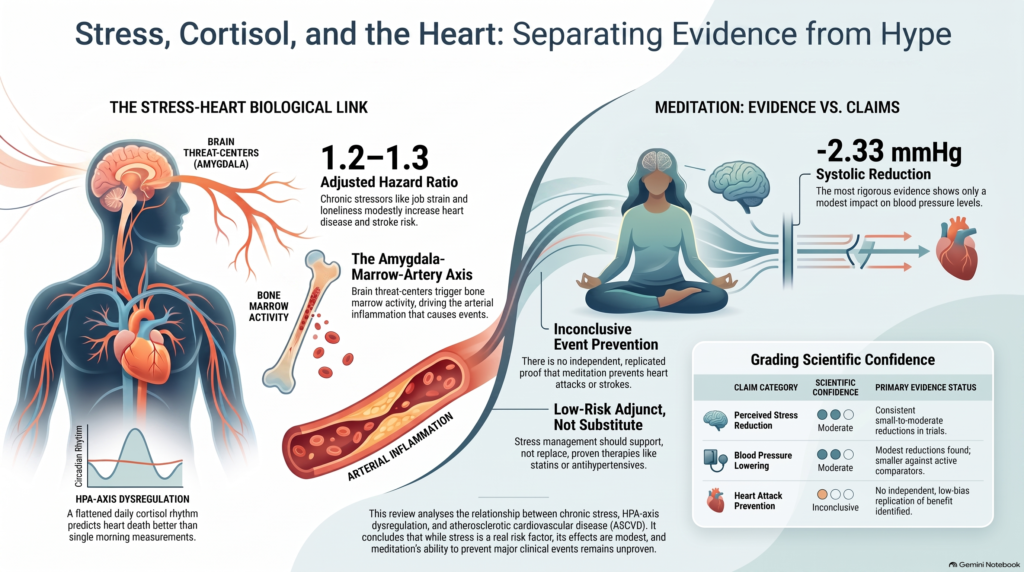
Estrés psicológico crónico, desregulación del eje HPA y enfermedad cardiovascular aterosclerótica: mecanismos, magnitud del efecto y evidencia de la intervención basada en la meditación
Una crítica estructurada revisión narrativa de evidencia humana y traslacional
Contenido
- Resumen
- Marco de alcance, fuentes y calificación de la evidencia
- Conclusiones clave
- Lo que está establecido, lo que es probable y lo que no se sabe
- Fisiología del estrés: La arquitectura de la respuesta
- Medición del cortisol: matrices, cinética y trampas interpretativas
- Evidencia epidemiológica humana: exposiciones al estrés y ASCVD
- Cortisol y ASCVD: ¿Causa, mediador o marcador?
- Mecanismo I: Autonómico y Hemodinámico
- Mecanismo II: Inflamación y la inmunidad
- Mecanismo III: Endotelial y Vascular
- Mecanismo IV: Metabólico
- Mecanismo V: Trombosis y Desencadenamiento Agudo
- Mecanismo VI: Mediación conductual
- Matriz de evidencia mecanisista
- La pregunta de intervención: Taxonomía y la escalera de afirmaciones
- La síntesis de referencia
- Afirmación A: Estrés percibido
- Afirmación B: Fisiología del cortisol y del HPA
- Afirmación C: Establecida Factores de riesgo
- Reclamación D: Ateroesclerosis
- Afirmación E: Eventos Clínicos Graves
- Calidad de la evidencia, sesgo y efectos adversos
- Modelo integrado con ponderación de evidencia por enlace
- Implicaciones clínicas y de prevención
- Umbrales que cambiarían estas conclusiones
- Principales preguntas de investigación sin responder
- Conclusiones: Respuestas directas a las preguntas centrales
- Limitaciones de esta revisión
- Referencias
1. Resumen
Antecedentes. Se afirma ampliamente que el estrés psicológico crónico causa enfermedades cardíacas, y se afirma ampliamente que la meditación las previene. Ambas afirmaciones se repiten más de lo que se examinan. El propósito de esta revisión es establecer con precisión qué es lo que respalda la evidencia revisada por pares, qué es biológicamente plausible pero no está demostrado en humanos, y dónde persiste una incertidumbre genuina.
Métodos. Revisión narrativa crítica estructurada de la literatura revisada por pares identificada a través de MEDLINE/PubMed, Scopus, Embase y la Biblioteca Cochrane (CENTRAL y CDSR), con búsquedas hasta el 20 de agosto de 2026, mediante encadenamiento de referencias y citas. Las afirmaciones cuantitativas se rastrean hasta una fuente primaria o un nominado revisión sistemática siempre que sea posible, con citas numeradas al estilo IEEE en todo el texto. Esto es no una revisión sistemática: no se registró ningún protocolo, no se conservaron los recuentos de registros desduplicados y no se aplicaron instrumentos formales de riesgo de sesgo a nivel de estudio. A la evidencia se le asignan categorías de confianza narrativa evaluadas por los autores —fuerte, moderada, limitada o no concluyente— frente a criterios explícitos, cada uno con una base declarada para la reducción de categoría, y se distinguen cinco afirmaciones separables sobre la meditación en todo el documento: (A) reduce el estrés percibido; (B) altera el cortisol o la fisiología del Eje HHA; (C) mejora los factores de riesgo establecidos; (D) desacelera la aterosclerosis medible; (E) reduce los eventos clínicos mayores.
Hallazgos. Para varios constructos de estrés psicosocial estudiados prospectivamente, las asociaciones relativas ajustadas con la incidencia enfermedad coronaria e isquémica derrame cerebral comúnmente se ubican en el rango de 1.2 a 1.3, aunque las estimaciones varían según la definición de exposición y el resultado. Estas son asociaciones modestas que, sin embargo, no son triviales a escala poblacional. No son directamente conmensurables con los efectos relativos informados para fumar, presión arterial o acumulativo apolipoproteína B (apoB) exposición, que se miden en diferentes escalas de exposición y se establecen mediante diferentes diseños; clasificarlas entre sí requiere una comparación de riesgo absoluto calibrada que esta revisión no intenta. Las estimaciones de casos y controles son sustancialmente mayores (INTERHEART: razón de posibilidades de 2.17 para el estrés general permanente, con un riesgo atribuible poblacional de ≈32,5% para el factor psicosocial combinado), y las estimaciones del estudio cruzado de casos son aún mayores (razón de probabilidades de 2,44 para infarto de miocardio dentro de una hora de ira aguda), pero estos diseños miden cosas diferentes y no son intercambiables con el riesgo prospectivo. La evidencia causal es moderada: se basa en la temporalidad, la plausibilidad biológica, la fisiología humana experimental reproducible y una cohorte emblemática de neuroimagen, pero no en aleatorización, y confundimiento residual no se pueden excluir debido a la posición socioeconómica y el comportamiento. La instrumentación genética no pertenece a esta lista. Lo disponible Aleatorización mendeliana instrumentos de cortisol plasmático matutino, un derivado biomarcador, no estrés psicológico; se analiza bajo la causalidad del cortisol en la Sección 8.4 y no tiene peso para el estatus causal del estrés en sí.
El cortisol se comprende mejor como un biomarcador inespecífico de la fisiología del Eje HPA y de los glucocorticoides, y como un mediador biológicamente plausible. Los datos prospectivos y genéticos son compatibles con una pequeña contribución causal al riesgo cardiovascular, pero la causalidad dentro del rango fisiológico habitual sigue siendo incierta, y el cortisol ciertamente no es el único transmisor del estrés psicológico. marco de desregulación es más sostenible que un modelo de cortisol circulante persistentemente elevado. Pendiente diurna aplanada, cortisol vespertino elevado, reactividad alterada, resistencia a los receptores de glucocorticoides, y el metabolismo tisular alterado de los glucocorticoides se han asociado cada vez con fenotipos adversos, aunque no se ha establecido un fenotipo único del Eje Hipotálamo-Hipofisario-Adrenal como la anormalidad cardiovascular definitoria —a metaanálisis de 80 estudios encontraron pendientes más planas asociadas con una peor salud en general (r = 0.147), mientras que el subgrupo cardiovascular de efectos aleatorios no fue estadísticamente significativo [78]. En Whitehall II, una pendiente diurna más plana predijo la mortalidad cardiovascular (cociente de riesgos instantáneos 1,87; 95%; IC: 1,32–2,64), mientras que el cortisol matutino y el respuesta de despertar de cortisol No. En LURIC, una asociación burda entre el cortisol sérico matutino y la mortalidad cardiovascular (cociente de riesgos instantáneos de 1.32) se anuló tras el ajuste por factores de riesgo convencionales (0.97).
La meditación reduce de manera confiable el estrés percibido y disminuye ligeramente la presión arterial. No cuenta con evidencia convincente, independiente y aleatorizada que demuestre que prevenga el infarto de miocardio, el accidente cerebrovascular o la muerte cardiovascular. La revisión Cochrane de 2024 (81 ensayos aleatorios, 6,971 participantes, búsqueda actualizada hasta noviembre de 2021) encontró que solo dos comparaciones aportaron datos sobre eventos clínicos cardiovasculares: intervenciones basadas en la atención plena frente a un comparador inactivo (un ensayo, 110 participantes; RR 0,94, IC 95 % 0,37–2,42; certeza muy baja) y Meditación Transcendental frente a un comparador activo (un ensayo, 201 participantes; RR 0,91; IC 95 %: 0,56–1,49; certeza baja). Ninguno mostró un efecto detectable. Su única estimación de la presión arterial sistólica con certeza moderada —la Meditación Trascendental frente a un comparador activo— es también la más pequeña: −2,33 mmHg sistólica.
Interpretación. El manejo del estrés, incluida la meditación, es un complemento razonable y de bajo riesgo para la prevención cardiovascular guiada por directrices, principalmente para la presión arterial, el bienestar psicológico y la autorregulación conductual. No sustituye a hipolipemiante, tratamiento de la presión arterial, abandono del hábito de fumar, control glucémico o actividad física. Las afirmaciones de que la meditación “previene infartos cardíacos, ”revierte la aterosclerosis“ o ”normaliza el cortisol para prevenir enfermedad cardiovascular” exceden la evidencia.
2. Alcance, Fuentes y Marco de Evaluación de la Evidencia
2.1 Preguntas abordadas
Esta revisión aborda ocho preguntas:
- ¿Aumenta el estrés psicológico crónico el riesgo de enfermedad cardiovascular aterosclerótica (ECVA) y en qué medida?
- ¿Qué tan sólida es la evidencia de que la relación es causal en lugar de estar confundida?
- ¿Qué mecanismos biológicos tienen los más fuertes humano evidencia, a diferencia de la evidencia animal más sólida o in vitro?
- ¿Qué papel específico desempeña el cortisol: causa, mediador, marcador o alguna combinación?
- ¿Es el cortisol elevado en sí mismo patogénico, o la desregulación del eje HPA es el modelo más preciso?
- Qué porcentaje de la asociación entre el estrés y la enfermedad cardiovascular aterosclerótica está mediado por la presión arterial y la inflamación, resistencia a la insulina, adiposidad, sueño y comportamiento?
- ¿Modifica la meditación alguno de estos y en qué nivel de la jerarquía de evidencia?
- ¿Qué está científicamente justificado decir hoy, y qué constituye una exageración?
2.2 Estrategia de búsqueda, fuentes y elegibilidad
Diseño. Este es un revisión narrativa crítica estructurada, no una revisión sistemática. La distinción se establece claramente porque limita lo que la revisión puede afirmar: puede sopesar, calificación, e interpretar la evidencia que identificó, pero no puede afirmar que se haya enumerado la literatura de manera exhaustiva.
Bases de datos y fecha. Se realizaron búsquedas en MEDLINE/PubMed, Scopus, Embase y Cochrane Library (CENTRAL y la Base de Datos Cochrane de Revision Sistemáticas) hasta una fecha final de 20 de agosto de 2026. Se utilizó PubMed Central para obtener el texto completo y no tratado como una base de datos bibliográfica independiente. Se utilizaron listas de referencias y el encadenamiento de citas prospectivas (Google Scholar) para identificar estudios adicionales revisados por pares, en particular para los ensayos sobre meditación posteriores a 2021 no cubiertos por la búsqueda de Cochrane, que finalizó el 14 de noviembre de 2021.
Tabla 1. Dominios de búsqueda, cadenas de conceptos y elegibilidad.
| Pregunta de revisión | Cadena de concepto central (adaptada según la sintaxis de la base de datos) | Diseños elegibles | Principales exclusiones |
| Estrés → Resultados de enfermedad cardiovascular aterosclerótica | (“estrés psicológico” OR “tensión laboral” O “estrés laboral” O “estrés percibido” O soledad O “aislamiento social” O “carga del cuidador”) Y (infarto de miocardio O “enfermedad coronaria” O accidente cerebrovascular O “mortalidad cardiovascular” O aterosclerosis) | Cohorte prospectiva, metaanálisis de datos de pacientes individuales (IPD), casos y controles, casos cruzados, revisión sistemática | Diseños de exposición-resultado exclusivamente transversales; exclusivamente en animales |
| Cortisol / HPA → Resultados de ASCVD | (cortisol O “hypothalamic-pituitary-adrenal” O glucocorticoide O “cortisol awakening response” O “diurnal slope” O “hair cortisol”) Y (cardiovascular O coronary O stroke O mortalidad O “coronary arteria calcio | Cohorte prospectiva, aleatorización mendeliana, revisión sistemática, experimento natural (Cushing) | Informes de casos; farmacología de los esteroides exógenos |
| Vías mecanísticas | (estrés OR cortisol OR catecolamina) AND (inflamación OR “dilatación mediada por flujo” OR endotelial OR hematopoyesis OR NLRP3 O coagulación O “insulina resistencia | Estudios traslacionales de cohorte mecanicistas prospectivos y experimentales en humanos con componente humano | Estudios exclusivamente en animales, excepto cuando se indique explícitamente como tales |
| Meditación → resultados | (meditación OR mindfulness OR MBSR OR “meditación trascendental” OR “reducción del estrés”) AND (“presión arterial” OR cortisol OR “variabilidad de la frecuencia cardíaca” O inflamación O “íntima-media” O “eventos cardiovasculares”) | Ensayos controlados aleatorizados; revisiones sistemáticas y metaanálisis de ECA | Estudios no controlados o de un solo brazo; material no revisado por pares |
Elegibilidad. Estudios en humanos revisados por pares en cualquier idioma, cualquier geografía, cualquier fecha. Las declaraciones científicas de sociedades se citan como posiciones de consenso, etiquetadas explícitamente y nunca como evidencia primaria. El material no revisado por pares —comunicados de prensa institucionales, cobertura de revistas y comentarios organizacionales— fue excluido de la base de evidencia. Cuando los textos completos tenían muro de pago, los valores cuantitativos se obtuvieron de resúmenes publicados y se cotejaron en fuentes de indexación; tales casos se señalan en la Sección 29.
Lo que a esta reseña le falta. No se registró ningún protocolo de manera prospectiva. La selección se realizó por un único revisor sin una selección independiente por duplicado. No se conservaron los recuentos de registros desduplicados ni el diagrama de flujo de selección de estudios, por lo que no se informan aquí en lugar de reconstruirlos retrospectivamente. Instrumentos formales (RoB 2, ROBINS-I, AMSTAR-2) no se aplicaron a nivel del estudio; el riesgo de sesgo se evalúa de manera narrativa en relación con los dominios especificados. Se trata de limitaciones sustanciales, y en la sección 2.5 se explica cómo estas limitan las conclusiones que puede presentar la revisión.
2.3 Categorías de confianza narrativa evaluadas por el autor
Se utilizan cuatro categorías, aplicadas a afirmaciones individuales en lugar de a literaturas enteras. Estas son categorías de confianza narrativa evaluadas por los autores, no calificaciones GRADE, y no son intercambiables con los niveles de certeza GRADE, incluso cuando las palabras coinciden.
| Categoría | Criterios |
| Fuerte | Hallazgos consistentes en múltiples diseños, incluidos datos experimentales en humanos o cohortes prospectivas muy grandes; dirección del efecto estable tras el ajuste; mecanismo plausible demostrado en humanos |
| Moderado | Asociación prospectiva consistente o fisiología experimental en humanos reproducible, pero limitada por residuos confusor, pocos eventos, dependencia de un solo estudio o el uso de criterios de valoración subrogados |
| Limitado | Estudios en humanos pequeños, heterogéneos o contradictorios; mecanismo establecido principalmente en animales o sistemas celulares; efecto presente solo en subgrupos |
| No concluyente | Ningún estudio con potencia adecuada y bajo sesgo aborda la pregunta; los datos existentes son compatibles con una variedad de conclusiones, incluida la ausencia de efecto |
Para que estas evaluaciones sean auditables en lugar de impresionistas, cada afirmación calificada en la Tabla 9 lleva una explícita motivo de la baja, extraídos de seis dominios nombrados: riesgo de sesgo, indirectitud, imprecisión, inconsistencia, confusión, y sesgo de publicación.
2.4 Dos distinciones que estructuran toda la reseña
Primero: el nivel de exposición-resultado. Evidencia que conecta estrés percibido a biomarcadores no es evidencia que conecte los biomarcadores con factores de riesgo, lo cual no es evidencia que conecte los factores de riesgo con ateroesclerosis, lo cual no es evidencia que conecte la aterosclerosis con resultados concretos. Cada enlace debe establecerse por separado. La literatura toma prestada credibilidad de manera rutinaria entre estos niveles.
Segundo: la escala de tiempo. La exposición crónica que opera a lo largo de décadas y el desencadenamiento agudo que opera a lo largo de minutos son fenómenos distintos con bases de evidencia distintas (Figura 4). Una razón de momios de 2.44 de infarto de miocardio en la hora posterior a la ira aguda es una afirmación sobre placa vulnerable cruzar un umbral clínico; no es una afirmación sobre cómo el placa formado. Confundirlos influye varias veces en el aparente efecto aterogénico del estrés.
2.5 Lo que esta revisión puede y no puede afirmar
Debido a que la búsqueda es estructurada pero no sistemática, esta revisión adopta las siguientes restricciones autoimpuestas, y las secciones 22 a 28 están redactadas para cumplirlas:
- No hay reclamos de ausencia no calificados. Las declaraciones de que no existen ensayos o estudios se formulan como “no identificamos...” junto con la fecha de búsqueda.
- No se pretende lograr una cobertura exhaustiva. La palabra integral no se usa para describir la búsqueda.
- La simetría del escepticismo. El estándar probatorio aplicado a las afirmaciones sobre la meditación se aplica por igual a las afirmaciones sobre la causalidad del estrés y la causalidad del cortisol. Cuando la revisión se niega a inferir una reducción de eventos a partir de un cambio en un biomarcador en un ensayo de intervención, asimismo se niega a inferir la progresión de la placa a partir de un cambio en un biomarcador en una cohorte observacional.
- Las calificaciones son juicios de autor. Se ofrecen como razonamiento estructurado, con las razones de reducción indicadas, no como calificaciones formales de certeza.
3. Conclusiones clave
- La asociación prospectiva es real pero modesta. Las estimaciones prospectivas ajustadas para varios constructos psicosociales comúnmente estudiados —tensión laboral, estrés percibido, soledad, aislamiento social— suelen caer aproximadamente en el 2–1.3 rango para la cardiopatía coronaria incidente y el accidente cerebrovascular isquémico, aunque las estimaciones individuales se encuentran fuera de este intervalo en ambas direcciones. Las estimaciones de alrededor de 1.4 a 1.6 son más comunes en síntesis basadas únicamente en publicaciones, análisis menos ajustados y literatura de casos y controles, y no deben presentarse como la estimación prospectiva.
- Las estimaciones de casos y controles y de casos cruzados son mayores y significan algo diferente. INTERHEART informó un *odds ratio* de 17 (99% IC 1,84–2,55) para el estrés general crónico y un riesgo atribuible a la población de aproximadamente 32.5% por el factor psicosocial en su conjunto —no solo por el estrés permanente [1]; el análisis de casos cruzados de INTERHEART informó que OR 2,44 (99%, IC 2,06–2,89) por infarto de miocardio en el plazo de una hora tras un episodio de enojo o agitación emocional [9]. Ambos son datos informativos; ninguno de ellos es una estimación prospectiva de la incidencia.
- El sesgo de publicación es un hecho comprobado, no una hipótesis. En el consorcio IPD-Work, el estrés laboral se asoció con una razón de riesgo de 43 (1.15–1.77) en cohortes publicadas frente a 1.16 (1.02–1.32) en los no publicados —una evidencia inusualmente directa de que el estado de publicación se asociaba con efectos reportados más grandes, y una razón para dar mayor peso a la cifra más baja [3].
- El cortisol no lo explica todo y tal vez ni siquiera sea lo más importante. La relación entre el cortisol circulante y los resultados cardiovasculares varía de un estudio a otro, y el patrón de los resultados sigue la ventana de medición más de cerca de lo que refleja la biología (figuras 2 y 5).
- La desregulación del eje HPA es un marco más justificable que la hipercortisolemia persistente — pero la “desregulación” no debe reducirse a un único fenotipo obligatorio. Se han descrito, en contextos adversos, una pendiente diurna aplanada, niveles elevados de cortisol a altas horas de la noche, reactividad alterada y resistencia al receptor de glucocorticoides; sin embargo, su significado pronóstico cardiovascular no es uniforme y se basa en cohortes con pocos eventos cardiovasculares. Lo que la evidencia no respalda es un modelo general en el que el estrés psicológico crónico produzca de manera confiable niveles continuamente elevados de cortisol circulante.
- Las vías de señalización inflamatorias y hematopoyéticas se encuentran entre las vías mecánicas más coherentes del ser humano, incluso más que el cortisol. La vía «amígdala → médula ósea → inflamación arterial → eventos», demostrada en una única cohorte de imágenes con 22 eventos, es, a juicio de esta revisión, uno de los conjuntos de datos humanos más integrados disponibles que abarcan desde el cerebro hasta las arterias —en la que la actividad de la médula ósea media el 46% de la relación amígdala– y la inflamación arterial que media el 39% de la relación entre la amígdala y los eventos [11].
- El comportamiento forma parte del sistema causal, no es una variable de interferencia. Dado que el estrés crónico puede contribuir al tabaquismo, la inactividad física, la falta de sueño y el incumplimiento terapéutico, el hecho de ajustar estadísticamente estos factores puede subestimar el efecto total del estrés —aunque ello no aísla por sí solo un efecto biológico directo, lo cual requiere un análisis formal análisis de mediación.
- La evidencia sobre la meditación se debilita considerablemente desde la afirmación A hasta la afirmación E (Figura 8). Estrés percibido: moderado. Cortisol: de limitado a moderado, y limitado en gran medida a las muestras de riesgo. Presión arterial: moderada, y menor de lo que se suele reportar una vez que se utilizan comparadores activos. Aterosclerosis: evidencia limitada y no concluyente — un ensayo inicial positivo sobre el grosor intimal-temporal (cIMT) presentó una tasa de deserción considerable, y un ensayo aleatorizado posterior en una población diferente no demostró un beneficio en el cIMT entre los grupos. Eventos graves: evidencia no concluyente.
- La elección del comparador influye de manera significativa en la respuesta. En la síntesis de Cochrane, todas las estimaciones importantes sobre la presión arterial presentan un I² ≥ 87% o cuentan con menos de 150 participantes; la única estimación sistólica de certeza moderada es de −2,33 mmHg (Figura 7).
- La afiliación de los investigadores es una importante fuente potencial de sesgo en esta literatura, especialmente en la investigación sobre la Meditación Trascendental, donde los únicos ensayos que reportan beneficios medidos por criterios de evaluación objetivos provienen de una sola red de investigadores afiliados a una institución. Esto es motivo para exigir una replicación independiente, pero no constituye en sí mismo evidencia de que la afiliación haya producido los efectos reportados.
4. Lo que está comprobado, lo que es probable y lo que se desconoce
Demostrado (evidencia sólida). Varios constructos de estrés psicosocial se asocian con eventos cardiovasculares en estudios prospectivos y de casos y controles, mientras que los estudios de imágenes en humanos y los estudios mecanísticos aportan evidencia que respalda ciertas vías intermedias. El estrés mental agudo produce un deterioro reproducible y transitorio de función endotelial tanto en adultos sanos como en pacientes con enfermedad coronaria. El estrés emocional agudo puede desencadenar eventos cardíacos en personas que ya padecen una enfermedad. El hipercortisolismo patológico —el síndrome de Cushing— provoca hipertensión, la disglucemia, la adiposidad visceral, la dislipidemia y la muerte cardiovascular prematura. La meditación reduce el estrés percibido y disminuye ligeramente la presión arterial. El estrés crónico se asocia con alteraciones en la biología de los leucocitos en los seres humanos.
Probable (evidencia moderada). Una contribución causal del estrés crónico común al riesgo cardiovascular. (Evidencia directa en humanos de la formación de placa inducida por el estrés inicio o avance es considerablemente más débil que la evidencia relativa a los eventos clínicos, las vías de la presión arterial, las respuestas endoteliales y la activación aguda, y se califica como «Limitada-Moderada»). El eje amígdala-médula-arteria. La inflamación como mediador. La desregulación diurna del cortisol como predictor de mortalidad cardiovascular. El cortisol como un posible factor causal — la evidencia genética es compatible con un efecto pequeño, pero no es estadísticamente concluyente. Es probable que la mediación conductual sea importante, pero no se ha establecido qué fracción de la asociación total se puede atribuir a las vías conductuales.
Limitado o incierto. Si la meditación modifica de manera significativa los niveles de cortisol fuera de las poblaciones en riesgo. Si la meditación frena la aterosclerosis. El valor clínico independiente de cualquier medida de cortisol circulante para la estratificación del riesgo cardiovascular. Si el eje específico NLRP3/IL-1β media los efectos del estrés psicológico en los seres humanos, a diferencia de lo que ocurre con la aterosclerosis en general. La contribución proporcional de la lesión neuroendocrina directa frente a las vías conductuales indirectas.
No concluyente. Ya sea que cualquiera Las intervenciones para reducir el estrés disminuyen los eventos cardiovasculares graves. En nuestra búsqueda, que se extendió hasta el 20 de agosto de 2026, no identificamos ningún ensayo con la potencia estadística adecuada, de bajo sesgo y realizado de manera independiente. Esta es la principal laguna en este campo.
5. Fisiología del estrés: la arquitectura de la respuesta
5.1 Evaluación centralizada
El estrés psicológico no depende simplemente de un estímulo externo, sino de la evaluación que hace el cerebro de la amenaza, la exigencia, la previsibilidad y los recursos para enfrentarla. Las señales de amenaza se procesan en circuitos corticolímbicos distribuidos —corteza prefrontal, amígdala, hipocampo, ínsula— en los que las redes prefrontales, límbicas, insulares e hipotalámicas regulan conjuntamente la evaluación de la amenaza y la respuesta, y la regulación prefrontal es capaz de modular la actividad de la amígdala y contribuir a poner fin a la respuesta una vez que la amenaza se resuelve. La adversidad psicológica crónica se asocia con un cambio en este equilibrio hacia una actividad sostenida de la amígdala en relación con la regulación prefrontal [11,37]. Desde la amígdala y el núcleo paraventricular del hipotálamo descienden dos ramas efectoras.
5.2 La vía simpático-suprarrenal-medular
El eje SAM responde en cuestión de segundos. El flujo simpático y la secreción de la médula suprarrenal elevan los niveles de epinefrina y norepinefrina en circulación, lo que aumenta frecuencia cardíaca, la contractilidad y la resistencia vascular periférica, mientras que el tono parasimpático (vagal) se reduce. Esto suele reflejarse en cambios en la variabilidad de la frecuencia cardíaca mediada por el nervio vago, aunque la VFC también se ve influenciada por la respiración, la postura y las condiciones de registro, y no es un indicador directo de tono vagal. Más allá de la hemodinámica, la señalización de las catecolaminas actúa directamente sobre los compartimentos inmunológico y hematopoyético —un punto que se analiza en la sección 10—.
5.3 El eje hipotálamo-hipófisis-suprarrenal
El eje HPA actúa en un lapso de minutos a horas. Las neuronas paraventriculares liberan la hormona liberadora de corticotropina y arginina la vasopresina en la circulación portal hipofisaria; la CRH estimula a las células corticotrópicas de la hipófisis para que secreten la hormona adrenocorticotrópica; la ACTH se une a los receptores de melanocortina-2 en la zona fasciculada de las glándulas suprarrenales, lo que impulsa la conversión de colesterol al cortisol. A su vez, el cortisol ejerce una retroalimentación negativa tanto a nivel hipotalámico como hipofisario.
En el corto plazo, esto es un mecanismo de adaptación. El cortisol moviliza sustratos energéticos, aumenta la reactividad vascular a las catecolaminas y modera la respuesta inmunitaria. La cuestión patológica nunca es si estos sistemas se activan —deben hacerlo—, sino si la activación repetida, la recuperación deficiente, la alteración del ritmo circadiano o la alteración de la capacidad de respuesta de los receptores generan una carga alostática sostenida.
5.4 Biología de los receptores: dos receptores, no uno
El cortisol se une a dos receptores nucleares intracelulares con afinidades notablemente diferentes:
- El receptor de mineralocorticoides (MR, tipo I) tiene una alta afinidad y se encuentra prácticamente ocupado a concentraciones basales de cortisol.
- El receptor de glucocorticoides (GR, tipo II) tiene menor afinidad y se activa principalmente durante los picos inducidos por el estrés y el aumento matutino.
Esta arquitectura de dos receptores tiene importancia clínica. Se ha propuesto que, en condiciones de exceso sostenido de glucocorticoides, la ocupación del MR renal por el cortisol —que normalmente está limitada por el metabolismo prerreceptor, como se explica a continuación— favorece la retención de sodio, la expansión del volumen y la hipertensión [30]. Esta es una de las vías descritas por las que el exceso de glucocorticoides puede convertirse en un problema hemodinámico.
5.5 Metabolismo prerreceptor: el amplificador a nivel tisular
El cortisol circulante no es un buen indicador del nivel de cortisol al que está realmente expuesto un tejido determinado, ya que dos enzimas modulan la exposición local independientemente de la concentración plasmática:
- 11β-HSD1, que se encuentra en abundancia en el hígado y en el tejido adiposo visceral, regenera el cortisol activo a partir de la cortisona inactiva. Potencia la señalización intracelular de los glucocorticoides, la gluconeogénesis y grasa visceral declaración incluso cuando los niveles de cortisol en plasma son normales [30].
- 11β-HSD2, que se expresa en el nefrón distal sensible a la aldosterona, inactiva el cortisol y lo convierte en cortisona, lo que protege al receptor de mineralocorticoides (MR) renal de la ocupación por parte del cortisol [30].
La implicación práctica es que un nivel normal de cortisol sérico no descarta un exceso de glucocorticoides a nivel tisular. Esto representa una limitación real para cualquier estrategia clínica basada en la medición del cortisol circulante.
5.6 La arquitectura circadiana
En condiciones de ausencia de estrés, el cortisol sigue un ritmo circadiano pronunciado regulado por el núcleo supraquiasmático: un aumento brusco que alcanza su punto máximo aproximadamente entre 30 y 45 minutos después de despertarse (el respuesta de despertar de cortisol, CAR), una caída pronunciada a lo largo del día y un punto mínimo cerca de la medianoche (Figura 1A). El ritmo —su amplitud, su pendiente y el momento en que alcanza su punto mínimo— contiene información que un solo valor no puede transmitir.
5.7 Por qué es errónea la afirmación de que “el estrés crónico produce altos niveles de cortisol”
Esta es la corrección más importante de esta reseña. El estrés crónico sí no produce de manera confiable niveles persistentemente elevados de cortisol. Dependiendo de la cronicidad, el momento en que se presente, los antecedentes de desarrollo y la sensibilidad de los receptores, puede provocar hipercortisolismo, hipocortisolismo, una respuesta atenuada del receptor de cortisol (CAR), una respuesta exagerada del CAR o una pendiente diurna más suave con niveles elevados de cortisol al final del día o en el nadir —fenotipos asociados con resultados adversos para la salud en varias cohortes, pero sin asociaciones cardiovasculares uniformemente consistentes en el metaanálisis [78].
Tres observaciones más completan el panorama:
Una reactividad atenuada no es necesariamente resiliencia. Un metaanálisis sobre las experiencias adversas en la infancia revela que sin filo en lugar de una reactividad exagerada al estrés cardiovascular y al cortisol [40]. Una baja reactividad en ese contexto refleja una desregulación, no una solidez. En MESA, la disminución de la reactividad de la presión arterial diastólica ante el estrés agudo predijo la muerte prematura mortalidad por todas las causas [42]. Por lo tanto, la reactividad atenuada no es indicio de resiliencia; sin embargo, las implicaciones pronósticas varían según la medida fisiológica y la población, y estos datos no establecen una regla general en forma de U para las respuestas del eje hipotálamo-hipófisis-suprarrenal (HPA) y cardiovasculares.
La resistencia al receptor de glucocorticoides desvincula al cortisol de su efecto. En los cuidadores con estrés crónico, los perfiles de cortisol salival pueden parecerse a los de los grupos de control, mientras que los monocitos muestran una disminución en la transcripción sensible a los glucocorticoides, un aumento en la transcripción relacionada con NF-κB y niveles más altos de marcadores inflamatorios [14,15]. Se han propuesto múltiples mecanismos moleculares que alteran la sensibilidad al GR, entre ellos cambios en la expresión del receptor, alteraciones en la unión del ligando y en la translocación nuclear, la regulación del recambio del receptor por parte de las co-chaperonas y modificaciones epigenéticas en loci tales como FKBP5. Varios de estos detalles provienen principalmente de estudios mecanísticos y traslacionales, más que de experimentos cardiovasculares directos en humanos [30], y se enumeran aquí como mecanismos posibles, más que como pasos comprobados en una vía biológica humana.
Esto resuelve la paradoja central. El cortisol es antiinflamatorio, pero el estrés crónico es proinflamatorio. Un mecanismo que podría explicar en parte esta contradicción es la disminución de la sensibilidad a los glucocorticoides en ciertas poblaciones de células inmunitarias: el tejido diana responde con menor eficacia. Es a una posible explicación, no una propiedad universal comprobada del estrés crónico. Según esta explicación, la inflamación no se produce a pesar de unos niveles adecuados de cortisol, sino porque estos niveles se transmiten de manera menos eficaz, mientras que la hematopoyesis proinflamatoria impulsada por las catecolaminas y el sistema simpático contribuye a este mismo efecto. Sin embargo, la inflamación crónica en poblaciones estresadas es multifactorial: el sueño, la adiposidad, el estado metabólico, las infecciones y el comportamiento contribuyen a ella, y la resistencia a los glucocorticoides es uno de los factores que intervienen, entre otros.
Por lo tanto, la formulación correcta es estrés → desregulación del eje HPA, no el estrés → niveles altos de cortisol.
Figura 1. El patrón diurno del cortisol podría ser más revelador que un solo nivel matutino para el pronóstico cardiovascular. El panel A es un esquema de fenotipos característicos, no datos medidos. El panel B presenta las razones de riesgo observadas; en el estudio Whitehall II, el cortisol matutino y la respuesta de despertar del cortisol no predijeron la mortalidad.
6. Medición del cortisol: matrices, cinética y errores de interpretación
Parte de la aparente inconsistencia en la literatura sobre el cortisol y la ASCVD se debe a diferencias en el intervalo de muestreo y la matriz, más que a discrepancias biológicas, aunque también contribuyen factores de confusión, el estado de la enfermedad, la medicación, la heterogeneidad de la población y las decisiones analíticas [41] (Figura 2).
Figura 2. Los biomarcadores del cortisol miden diferentes aspectos en distintas escalas de tiempo. Una sola medición matutina del cortisol sérico captura un momento específico en un sistema con un ritmo circadiano pronunciado; parte de la inconsistencia en esta literatura se debe a ese desajuste, además de a una verdadera heterogeneidad biológica.
Tabla 2. Matrices de medición del cortisol.
| Matriz | Ventana capturada | Lo que mide | Principales fortalezas | Limitaciones principales |
| Suero / plasma, un solo sorteo | Momento único | Cortisol total (ligado + libre) | Ampliamente disponibles; ensayos estandarizados | Es muy sensible al estrés de la venopunción y al tiempo de toma de muestras; se ve influido por la globulina fijadora de corticosteroides; es un indicador poco fiable de la exposición crónica |
| Salival, multimuestra | Horas por día | Cortisol libre y biológicamente activo | No invasivo; permite el cálculo de CAR y la pendiente diurna; repetible | Depende del cumplimiento; sensible a la precisión en la hora de despertarse, la alimentación y el tabaquismo |
| Cortisol libre en orina de 24 horas | 1 día | Producción diaria integrada de cortisol libre | Se integra a lo largo del día; no se ve afectado por el ruido de un solo momento | Los errores en la recolección son comunes; dependen de la función renal; un solo día puede no ser representativo del estado crónico |
| Cortisol / cortisona en el cabello | De semanas a meses (por lo general, ≈1 cm de cabello de la parte proximal del cuero cabelludo equivale a ≈1 mes, con una variabilidad biológica y analítica considerable) | Exposición sistémica acumulada | Un biomarcador integrado de glucocorticoides útil a largo plazo, aunque su estandarización y su interpretación clínica aún no están completas | Depende de la biología del cabello, el color, el lavado y los tratamientos cosméticos; heterogeneidad del ensayo; escala clínica no establecida |
De ello se derivan tres consecuencias interpretativas.
En primer lugar, Un solo nivel de cortisol sérico matutino es un marcador poco fiable del estrés crónico [41], y los estudios que lo utilizan no deben considerarse como si estuvieran evaluando la misma hipótesis que los estudios que utilizan perfiles salivales diurnos o glucocorticoides capilares. Un estudio bien realizado estudio transversal no encontraron ninguna asociación entre el cortisol plasmático circulante y la enfermedad coronaria o la enfermedad arterial periférica [29] — un hallazgo que limita la utilidad clínica de la medición puntual del cortisol, en lugar de refutar la hipótesis más amplia sobre el estrés.
En segundo lugar, la forma del efecto observado sigue la matriz. En la Figura 5, las estimaciones puntuales más grandes provienen de medidas de exposición integradas en cohortes pequeñas con pocos eventos; las estimaciones más precisas provienen de medidas agrupadas de un solo punto temporal con efectos modestos. Este patrón es compatible con diferencias de medición y la imprecisión de los estudios pequeños, incluidos los posibles efectos de inflación de los estudios pequeños o de la «maldición del ganador», pero por sí solo no identifica el verdadero tamaño del efecto causal.
Tercero, La cortisona podría tener un efecto más marcado que el cortisol en el cabello. En la cohorte Lifelines, la cortisona capilar —pero no el cortisol capilar— se asoció de manera independiente con la aparición de enfermedades cardiovasculares, con mayor intensidad en los participantes menores de 60 años (razón de probabilidades 4,21; IC 95 %: 1,91–9,07 por unidad log₁₀) [20]. Este hallazgo es interesante desde el punto de vista biológico y requiere ser replicado antes de poder extraer cualquier conclusión clínica.
7. Evidencia epidemiológica en humanos: exposición al estrés y ASCVD
La figura 3 muestra las principales estimaciones. En esta sección se explica cuál es la contribución de cada una y cuáles son sus puntos débiles.
Figura 3. Exposiciones psicosociales y resultados cardiovasculares ateroscleróticos. El diseño del estudio determina la interpretación. Muchas estimaciones prospectivas ajustadas para los resultados de cardiopatía coronaria (CC) y accidente cerebrovascular isquémico se encuentran en el rango aproximado de 1,2 a 1,4, aunque las estimaciones prospectivas individuales se sitúan fuera de ese intervalo. Los intervalos de INTERHEART e INTERSTROKE son el IC 99%, tal como se reportó.
7.1 Evidencia de estudios de casos y controles: INTERHEART e INTERSTROKE
INTERHEART Se incluyeron 11 119 casos de primer infarto de miocardio y 13 648 controles de 52 países. El estrés general permanente se asoció con una razón de probabilidades de 2,17 (99% IC 1,84–2,55); varios períodos de estrés, 1,45; estrés financiero, 1,33; eventos estresantes de la vida, 1,48; depresión, 1,55. Un alto locus de control interno actuó como factor protector (0,68). Por otra parte, el factor psicosocial combinado —no solo el estrés general permanente— conllevaba un riesgo atribuible a la población de aproximadamente 32.5% en el caso del infarto de miocardio, y el patrón se mantuvo constante en todas las regiones, sexos y grupos étnicos. La asociación se mantuvo tras ajustar los datos por ingresos y nivel educativo [1].
INTERSTROKE, utilizando la misma metodología para el accidente cerebrovascular agudo, encontró que el estrés psicosocial tenía una razón de probabilidades de 1,30 (99% IC 1,06–1,60) y la depresión, con un valor de 1,35 (IC 99%: 1,10–1,66) [2]. Cabe señalar que ambos estudios reportan 99% en lugar de 95% intervalos de confianza por diseño; por lo tanto, los intervalos son más amplios de lo que parecerían de otra manera.
La limitación es estructural e inevitable. En un estudio de casos y controles En el caso del infarto de miocardio, se determina la exposición al estrés después el evento, por parte de personas que acaban de sufrir un ataque cardíaco y buscan una explicación. La determinación posterior al evento genera la posibilidad de un recuerdo diferencial que podría exagerar las asociaciones, aunque no se puede dar por sentado simplemente su dirección y magnitud. La consistencia de INTERHEART en 52 países refuerza la generalizabilidad, pero la consistencia interregional no elimina el recuerdo diferencial. Un estudio de casos y controles bien diseñado puede estimar de manera válida una razón de probabilidades de exposición, y con un muestreo de densidad de incidencia, esa razón de probabilidades estima una razón de tasas de incidencia. Lo que el diseño no hace es medir directamente la incidencia poblacional, y sigue siendo vulnerable a la determinación retrospectiva diferencial de la exposición. Es por eso que la cifra de 2,17, aunque se cita con frecuencia, no debería ser el punto de referencia para que el lector evalúe la magnitud.
7.2 Estrés laboral
El Consorcio IPD-Work Datos individuales agrupados de participantes de 13 cohortes europeas: 197 473 trabajadores inicialmente libres de enfermedad, 2 358 eventos coronarios incidentes, un seguimiento promedio de 7,5 años. La tensión laboral —una alta exigencia psicológica combinada con un bajo margen de decisión— se asoció con un cociente de riesgo de 1,23 (95% IC 1,10–1,37), con un riesgo atribuible a la población de aproximadamente 3,4% [3].
Hay dos aspectos de este análisis que resultan más reveladores que la cifra principal.
En primer lugar, un matiz que suele perderse en las citas secundarias: la razón de riesgo de 1,23 que aparece en el titular está ajustada por solo sexo y edad. El consorcio informó por separado que la asociación también se observó tras ajustar por el nivel socioeconómico, el estilo de vida y los factores de riesgo convencionales, así como en los análisis que excluyeron los eventos ocurridos en los primeros tres años (HR 1,31, 1,15–1,48) y cinco años (HR 1,30; 1,13–1,50) de seguimiento para abordar causalidad inversa. El efecto se mantiene sólido en todas las especificaciones, pero el valor de 1,23, tan ampliamente citado, no debería describirse como totalmente ajustado por factores de riesgo.
En segundo lugar, y lo que es más valioso, el consorcio comparando cohortes publicadas anteriormente con cohortes no publicadas anteriormente. La razón de riesgo en estudios anteriores publicado las cohortes eran 1.43 (1.15–1.77); en el anterior inédito cohortes, eso fue 1.16 (1.02–1.32). Esto proporciona evidencia inusualmente directa de que el estatus de publicación se asoció con diferencias en el tamaño del efecto dentro de un mismo consorcio —aunque el contraste también podría reflejar factores correlacionados con el estatus de publicación, más que solo el sesgo de publicación—. Además, este hallazgo es específico del corpus sobre tensión laboral y no debe darse por sentado que se mantenga con la misma magnitud en otras publicaciones sobre estrés. No obstante, podría ayudar a explicar parte de la discrepancia entre las revisiones que reportan valores de 1,2 a 1,4 y aquellas que reportan valores de 1,4 a 1,6; estas últimas, en gran medida, interpretan la literatura publicada tal como está.
También se ha planteado la crítica contraria, y conviene dejarla constancia. En la correspondencia publicada se argumentaba que las cohortes que componen el estudio presentan sesgos no reconocidos hacia la hipótesis nula —medición de exposición en una sola ocasión, selección de trabajadores sanos y pérdida del contraste de exposición a lo largo del seguimiento—, de tal manera que tanto el valor de 1,23 como el riesgo atribuible a la población de 3,4% podrían ser, en sí mismos, estimaciones a la baja [71,72]. El consorcio respondió defendiendo sus estimaciones [73]. Esta revisión no se pronuncia sobre cuál de las dos críticas es la correcta. Señala que la estimación puntual está rodeada de argumentos creíbles en ambos sentidos, lo cual constituye una razón más para considerar el intervalo de 1,2 a 1,4 como un rango en lugar de un valor exacto.
En el caso del accidente cerebrovascular, la estimación del metaanálisis fue RR 1,22 (1,01–1,47) en general y 1,58 (1,12–2,23) para el accidente cerebrovascular isquémico, mientras que el análisis más conservador por participante individual arrojó un HR de 1,09 (0,94–1,26) para el accidente cerebrovascular total y de 1,24 (1,05–1,47) para el accidente cerebrovascular isquémico [4,5]. La señal específica de la isquemia es la más consistente de las dos.
7.3 Estrés percibido
Tras analizar conjuntamente seis cohortes prospectivas y 118 696 participantes, un alto nivel de estrés percibido se asoció con un cociente de riesgo de 1,27 (95% IC 1,12–1,45) para la enfermedad coronaria de nueva aparición [6]. Los instrumentos de medición de la exposición variaron de un estudio a otro, lo que limita la precisión, pero también significa que el hallazgo no es un artefacto de un solo cuestionario.
7.4 Soledad y aislamiento social
En 16 conjuntos de datos longitudinales y con más de 181 000 adultos, la soledad y el aislamiento social se asociaron con RR 1,29 (1,04–1,59) para la enfermedad cardíaca coronaria y RR 1,32 (1,04–1,68) para el accidente cerebrovascular [7]. Estas estimaciones se sitúan dentro del mismo rango que la tensión laboral y el estrés percibido, a pesar de que miden una exposición conceptualmente distinta. Esto respalda una asociación más amplia con el riesgo psicosocial; sin embargo, la similitud entre constructos distintos no constituye por sí misma una replicación causal ni implica un mecanismo compartido.
7.5 Estrés del cuidador
En el Estudio sobre los Efectos en la Salud de los Cuidadores, se realizó un seguimiento de 392 cónyuges cuidadores de entre 66 y 96 años, junto con 420 personas del grupo de control que no prestaban cuidados. Los cuidadores que informaron sentir estrés mental o físico tenían un 63%: mayor mortalidad por todas las causas a cuatro años (RR 1,63; IC 95 %: 1,00–2,65) tras ajustar por edad, sexo, estado de salud y enfermedad subclínica [8]. El límite inferior de confianza se aproxima a 1,00, y el resultado se refiere a la mortalidad por todas las causas y no a la mortalidad cardiovascular; es mejor interpretar este estudio como una corroboración y no como una constatación independiente.
7.6 Desencadenantes agudos
El Análisis de casos-cruces de INTERHEART En un estudio de 12 461 primeros infartos de miocardio, se observó que la ira o la agitación emocional en la hora previa se asociaban con OR 2,44 (99%, IC 2,06–2,89), con un riesgo atribuible a la población de 8,5% [9]. El diseño intraindividual controla las variables invariables en el tiempo factores de confusión — genética, la situación socioeconómica y los comportamientos crónicos —lo cual constituye una ventaja metodológica sustancial con respecto a los diseños de cohorte—. No controla los factores de confusión que varían con el tiempo, ni los sesgos de recuerdo diferenciales respecto a lo ocurrido durante el período de riesgo.
Pero responde a una pregunta diferente. La comparación se realiza entre un momento y otro en la misma persona, cuya anatomía coronaria es idéntica en ambos casos. Esto demuestra que un estado fisiológico transitorio puede desencadenar un episodio en una enfermedad ya existente. No dice nada sobre aterogénesis. Evidencia relacionada — takotsubo miocardiopatía, los picos en la incidencia de eventos cardíacos después de los terremotos y durante eventos deportivos de gran intensidad emocional, así como los datos de estudios de casos cruzados sobre la ira y el esfuerzo físico intenso, pertenecen a esta misma categoría (Figura 4).
Figura 4. Dos escalas temporales distintas que se suelen confundir. El desencadenante agudo es evidencia de que un estado fisiológico transitorio puede hacer que una enfermedad preexistente supere el umbral clínico; no es evidencia de que el estrés genere placa.
7.7 Síntesis
Tabla 3. Evidencia epidemiológica en humanos que relaciona la exposición al estrés con los resultados de la ASCVD.
| Estudio | Diseño / N | Exposición | Resultado / seguimiento | Efecto (95% CI, salvo que se indique lo contrario) | Limitación clave | Grado |
| INTERHEART, 2004 | Estudio de casos y controles; 24 767; 52 países | Estrés permanente, estrés financiero y acontecimientos de la vida, según lo reportado por los propios encuestados | Infarto agudo de miocardio | OR 2,17 (99% IC 1,84–2,55) estrés permanente; PAR psicosocial combinado ≈32,5% | Sesgo de recuerdo inherente al diseño | Moderado |
| INTERSTROKE, 2010 | Estudio de casos y controles; 22 países | Estrés psicosocial; depresión | Accidente cerebrovascular agudo | OR 1,30 (99% IC 1,06–1,60); depresión 1,35 (1,10–1,66) | La misma limitación de diseño | Moderado |
| IPD-Work, 2012 | Metaanálisis de datos individuales (IPD), 13 cohortes; 197 473 participantes; 2 358 eventos | Estrés laboral (exigencia-control) | Incidencia de cardiopatía congénita; promedio de 7,5 años | HR 1,23 (1,10–1,37); PAR ≈3,4% | Cohortes publicadas: 1,43 frente a no publicadas: 1,16 | Moderado |
| Huang et al., 2015 | Metaanálisis, 6 cohortes; 138 782 | Estrés laboral | Accidente cerebrovascular | RR 1,22 (1,01–1,47) en total; 1,58 (1,12–2,23) isquémico | Menos cohortes; identificación heterogénea | Moderado |
| Fransson y otros, 2015 | Metaanálisis de datos individuales de pacientes (IPD) | Estrés laboral | Accidente cerebrovascular | HR 1,09 (0,94–1,26) total; 1,24 (1,05–1,47) isquémico (es-419) | Nulo para la carrera total | Moderado |
| Richardson et al., 2012 | Metaanálisis, 6 cohortes; 118 696 | Escalas de estrés percibido | Incidente CHD | RR 1,27 (1,12–1,45) | Heterogeneidad de los instrumentos | Moderado |
| Valtorta y otros, 2016 | Metaanálisis, 16 conjuntos de datos; más de 181 000 | Soledad / aislamiento social | Enfermedad cardíaca coronaria y accidente cerebrovascular | RR 1,29 (1,04–1,59) cardiopatía coronaria; 1,32 (1,04–1,68) accidente cerebrovascular | La definición de «exposición» varía | Moderado |
| Schulz y Beach, 1999 | Cohorte prospectiva; 812 | Estrés del cuidador | Mortalidad por todas las causas a los 4 años | RR 1,63 (1,00–2,65) | Resultado por todas las causas; el intervalo de confianza se aproxima al valor nulo; no hay biomarcadores | Moderado |
| Estudio INTERHEART, 2016 | Estudio de casos cruzados; 12 461 casos de infarto de miocardio | Enojo / malestar en la última hora | Inicio de la IM | OR 2,44 (99%, IC 2,06–2,89); PAR 8,5% | Recuerdo posterior a un infarto de miocardio; activación ≠ aterogénesis | De moderado a fuerte para la activación |
La síntesis es sencilla y deja claro su alcance. Para varios constructos psicosociales estudiados de manera prospectiva y los resultados de cardiopatía coronaria (CHD) o accidente cerebrovascular isquémico, las estimaciones ajustadas suelen situarse en el rango aproximado de 1.2–1.4 rango. Esa afirmación no se aplica a todas las entradas potenciales de la Tabla 3: el total de accidentes cerebrovasculares en el análisis de datos individuales (IPD) fue de 1,09, y la estimación de los cuidadores de 1,63 corresponde a la mortalidad por todas las causas. Son robustas en cuanto a la dirección, se replican en diversas exposiciones y poblaciones, y son lo suficientemente consistentes como para que sea poco probable que la variación muestral por sí sola explique el patrón. También son modestas, vulnerables a la confusión residual por la posición socioeconómica y el comportamiento, y, en la literatura sobre salud ocupacional, las cohortes publicadas produjeron estimaciones sustancialmente mayores que las cohortes no publicadas.
Una advertencia sobre la calibración: resulta tentador comparar esta magnitud con el tabaquismo, la hipertensión establecida o la exposición acumulada a la apoB; sin embargo, los efectos relativos estimados en diferentes escalas de exposición, durante distintos períodos de inducción y mediante diferentes diseños no son directamente comparables. Lo que sí se puede afirmar es que el riesgo atribuible a la población por el estrés laboral en el estudio IPD-Work fue de aproximadamente 3,4%, lo cual los propios investigadores describieron como sustancialmente menor que el de los factores de riesgo estándar [3] — una comparación realizada dentro de un mismo análisis, en lugar de entre diferentes estudios.
8. El cortisol y la ASCVD: ¿causa, mediador o marcador?
La figura 5 presenta las estimaciones principales. A continuación se muestra el caso para cada interpretación y la resolución.
Figura 5. Mediciones de cortisol y resultados cardiovasculares. Dado que las escalas de exposición, las matrices de cortisol y los resultados difieren, las estimaciones puntuales no deben compararse cuantitativamente entre las distintas filas. Las estimaciones en gris cruzan la línea de la hipótesis nula. Las estimaciones puntuales más elevadas provienen de los estudios con el menor número de eventos y los intervalos de confianza más amplios.
8.1 Ritmo diurno
Whitehall II Se realizó un seguimiento de 4.047 funcionarios públicos durante un promedio de 6,1 años (139 muertes, 32 por causas cardiovasculares). Una curva más plana pendiente diurna del cortisol la mortalidad por todas las causas prevista (HR 1,30 por cada reducción de 1 DE en la pendiente, IC 95 % 1,09–1,55) y, de manera más marcada, muerte cardiovascular (HR 1,87; IC 95 %: 1,32–2,64), independientemente de las covariables. El cortisol matutino y el CAR sí no predecir la mortalidad [16]. Se trata de un estudio prospectivo influyente: en una sola cohorte bien caracterizada, el ritmo sí se predijo, pero no así el nivel. Se basa en 32 muertes cardiovasculares y requiere ser replicado.
KORA-F3 Se realizó un seguimiento de 1.090 participantes durante aproximadamente 11 años (31 muertes cardiovasculares) y se observó el mismo patrón, pero a la inversa. Un CAR más pronunciado se asoció con bajar la mortalidad cardiovascular (HR 0,59; IC 95 %: 0,36–0,96), al igual que una mayor relación entre el nivel máximo y el nivel al acostarse (HR 0,50; 0,34–0,73), mientras que los niveles elevados de cortisol a altas horas de la noche se asociaron con más alto mortalidad cardiovascular (HR 1,49; 1,13–1,97). La variabilidad diurna conservada pareció tener un efecto protector [17].
En pacientes sometidos a un bypass coronario, una mayor pendiente diurna prequirúrgica se asoció con un efecto protector frente a los eventos cardiovasculares mayores (MACE) y la muerte (HR 0,73; IC 95 % 0,56–0,96 por unidad de aumento en la pendiente) [18].
Una síntesis más amplia aporta una salvedad importante. Una revisión sistemática y un metaanálisis de 2017, que analizó 179 asociaciones de 80 estudios, reveló que las curvas diurnas de cortisol más planas se asociaban con un peor estado de salud general (r promedio = 0,147), con asociaciones significativas en 10 de los 12 subtipos de resultados —incluida la mortalidad—, y las más marcadas en los resultados inmunitarios e inflamatorios (r = 0,288). El El subgrupo de síntomas y diagnósticos de enfermedades cardiovasculares no fue estadísticamente significativo en el modelo de efectos aleatorios (r = 0,098, IC 95 % de −0,034 a 0,226) [78]. Por lo tanto, la evidencia específica sobre el sistema cardiovascular es más bien indicativa que uniformemente consistente, lo cual matiza —en lugar de contradecir— los hallazgos positivos sobre la mortalidad cardiovascular mencionados anteriormente.
En las tres cohortes, una organización diurna más conservada se asoció, en general, con mejores resultados, mientras que la amplitud en cualquier punto específico no lo hizo. No obstante, las medidas y los estimandos difieren entre los estudios, y la salvedad es común y grave: los tres tuvieron pocas muertes cardiovasculares —32, 31 y un recuento modesto de eventos, respectivamente— con intervalos de confianza correspondientemente amplios. En conjunto, estos datos favorecen el estudio de la organización diurna en lugar de basarse en un solo valor matutino, pero no establecen un fenotipo cardiovascular del eje HPA validado desde el punto de vista pronóstico.
8.2 Resultados integrados
En En CHIANTI, se realizó un seguimiento de 861 adultos de 65 años o más durante un promedio de 5,7 años. El nivel de cortisol urinario de 24 horas en el tercil más alto se asoció con HR 5.00 (95% CI 2.02–12.37) en cuanto a la mortalidad cardiovascular — pero solo en 41 muertes por causas cardiovasculares, con un intervalo de confianza que abarca un rango de seis veces el valor, en una cohorte de personas mayores, a partir de una única muestra inicial [19]. Hay dos características que contradicen las explicaciones alternativas más obvias: la asociación se limitaba a la mortalidad cardiovascular y no a la no cardiovascular, y se mantuvo constante tanto en los participantes con enfermedad cardiovascular como en los que no la tenían al inicio del estudio (p de interacción = 0,78), lo que descarta la hipótesis inversa causalidad [19]. No obstante, la imprecisión sigue siendo considerable, y la estimación puntual nunca debe citarse sin su intervalo.
En el Líneas de vida cohorte (6.341 muestras de cabello; cortisona en 4.701), la cortisona en el cabello predijo de manera independiente la aparición de enfermedades cardiovasculares, y la asociación se concentró en los participantes menores de 60 años (OR 4,21; 95%; IC 1,91–9,07 por unidad de log₁₀). Esta escala es difícil de aplicar en el ámbito clínico, y los niveles elevados de glucocorticoides en el cabello no son prueba de que hayan sido causados por estrés psicológico [20].
En contraposición a esto, un análisis transversal de trayectoria descubrió que los coeficientes de ruta a través de los factores de riesgo modificables estándar —hipertensión, dislipidemia, diabetes — explicó gran parte de la asociación estadística entre el cortisol capilar y enfermedad de las arterias coronarias [21]. La mediación temporal no se puede inferir a partir de un diseño transversal: la exposición, el mediador putativo y el resultado se midieron en un único momento, por lo que el orden en que la palabra mediación se da por sentado en lugar de observarse. El resultado es consistente con que el cortisol actúe a través de factores de riesgo convencionales, pero es igualmente consistente con un orden inverso o con determinantes comunes en etapas anteriores.
8.3 Reactividad y aterosclerosis subclínica
Whitehall II También se evaluó si la reactividad aguda del cortisol ante factores estresantes de laboratorio estandarizados predecía la presencia de enfermedad estructural. Entre 466 funcionarios públicos sin enfermedad coronaria conocida, las arterias coronarias calcificación La progresión (aumento según Agatston >10) se presentó en 38,21 TP9T a lo largo de tres años, y la mayor reactividad al estrés por cortisol la predijo de manera independiente (OR 1,27; 95%; IC 1,02–1,60 por DE) tras ajustar por edad, sexo, CAC basal, categoría laboral, tabaquismo, presión arterial, IMC, fibrinógeno y estatinas usa [22]. Este es uno de los pocos estudios en este campo que relaciona una medida de la fisiología del estrés con un estructural punto final con el ajuste adecuado, y se califica en consecuencia.
El Estudio MESA sobre el estrés mostró un panorama más variado. Entre los 464 participantes en el análisis de calcio coronario y los 610 en el análisis del índice tobillo-brazo, los parámetros de cortisol diurno en la saliva mostraron asociaciones débiles o inconsistentes con ambos, y los investigadores describieron sus propios hallazgos como un respaldo débil a la existencia de una relación entre el cortisol y ateroesclerosis subclínica. En un análisis posterior del estudio MESA, en el que participaron 918 personas, el cortisol urinario de 12 horas fue no se asoció con eventos cardiovasculares en general. Se observó que los niveles más altos de cortisol se asociaban con una mayor progresión del calcio coronario en las mujeres, pero no en los hombres, y las asociaciones con los eventos variaban según la relación cintura-cadera, con una modificación significativa del efecto en las mujeres [23,24]. La inconsistencia entre las matrices dentro de una misma cohorte es en sí misma reveladora y refuerza lo expuesto en la sección 6.
8.4 Evidencia genética
Aleatorización mendeliana de dos muestras utilizando polimorfismos de un solo nucleótido en el SERPINA6/SERPINA1 El locus en el cromosoma 14 —que regula la globulina fijadora de corticosteroides y, por lo tanto, el cortisol plasmático matutino— ofrece una prueba adicional de inferencia causal genética.
El metaanálisis observacional realizado en el marco de la misma investigación arrojó OR 1,18 (1,06–1,31) por desviación estándar del cortisol plasmático matutino para la enfermedad cardiovascular incidente. La estimación de la razón de riesgo (MR) en una muestra de 122 737 casos de enfermedad coronaria y 547 261 controles arrojó OR 1,06 (IC 95 %: 0,98–1,15) según SD [25].
Cómo leer esto con honestidad. La estimación puntual genética concuerda en cuanto a la dirección con la estimación observacional, pero su intervalo de confianza incluye la ausencia de efecto y, por lo tanto, no permite distinguir un efecto causal pequeño de la hipótesis nula. Trabajos relacionados en el mismo locus, que analizan la expresión hepática de CBG y la expresión génica tisular, brindan respaldo adicional a una contribución causal a la cardiopatía isquémica [26]. Hay dos salvedades decisivas. En primer lugar, los instrumentos explican solo alrededor de 0,51 TP9T de la varianza del cortisol matutino, lo que limita potencia estadística y la precisión de la estimación causal; se trata de una cuestión de poder estadístico más que de la solidez del instrumento, y el análisis debería describirse de esa manera y no como un resultado de “instrumento débil” per se. En segundo lugar, la validez del instrumento se ve complicada por la biología del propio locus SERPINA6/SERPINA1: las variantes que regulan la globulina de unión a corticosteroides se han asociado con otros rasgos cardiometabólicos, lo que plantea la posibilidad de una pleiotropía horizontal [26]. La conclusión correcta es que los datos genéticos son compatible con una pequeña contribución causal, y igualmente compatible con la ausencia de contribución.
8.5 El experimento de la naturaleza
Endógeno Síndrome de Cushing ofrece pruebas sólidas, basadas en un experimento natural, de la toxicidad cardiovascular del exceso patológico prolongado de glucocorticoides: central obesidad, diabetes, hipertensión, dislipidemia y muerte prematura, con un índice de mortalidad estandarizado de 3,0 (95%, intervalo de confianza 2,3–3,9; I² = 80,5%) y la enfermedad aterosclerótica con tromboembolia como la principal causa de muerte (43,4%), por delante de las infecciones (12,7%) y los tumores malignos (10,6%). Cabe destacar que el riesgo excesivo persiste después de la remisión bioquímica — el índice de mortalidad estandarizado es de 5,7 en la enfermedad de Cushing activa, pero se mantiene elevado, en 2,3, durante la remisión — lo que sugiere que influye la exposición acumulada previa más que el nivel hormonal actual — una idea estructuralmente análoga a la exposición acumulada a la apoB [28].
Hay que oponerse a la generalización. El síndrome de Cushing se caracteriza por concentraciones de cortisol muy por encima del rango que produce el estrés psicológico crónico. Se ha demostrado que la hormona lata provoca enfermedades cardiovasculares en dosis suficientes. No se ha demostrado que el estrés crónico común alcance esa dosis, y la evidencia presentada en las secciones 5.7 y 8.1 sugiere que, por lo general, no es así.
8.6 Los estudios nulos y atenuados
Cualquier análisis honesto debe dar la misma importancia a los resultados negativos.
LURIC Se realizó un seguimiento de 3.052 pacientes sometidos a una angiografía coronaria durante una mediana de 9,9 años. Los niveles basales de cortisol sérico matutino en el grupo con los valores más altos, en comparación con el grupo con los valores más bajos cuartil mortalidad cardiovascular prevista inicialmente (HR 1,32; 95%; IC 1,04–1,67). Tras el ajuste multivariable por edad, sexo, IMC, tabaquismo, hipertensión, diabetes, lípidos y gravedad de la enfermedad coronaria, la asociación fue se eliminó por completo (HR 0,97; IC 95 % 0,76–1,25) [27].
Este resultado admite dos interpretaciones, y no son equivalentes. La interpretación de la mediación sostiene que el cortisol actúa a través de esos factores de riesgo, por lo que ajustarlos constituye un sobreajuste que elimina el efecto real. La interpretación de la confusión sostiene que la asociación bruta nunca fue independiente. El LURIC por sí solo no puede distinguirlos. Sin embargo, la implicación clínica práctica es similar en cualquiera de las dos interpretaciones: El cortisol sérico matutino no se asoció de manera independiente con la mortalidad cardiovascular tras el ajuste multivariable en la enfermedad coronaria establecida. Cabe señalar que el estudio no realizó un análisis formal de discriminación incremental ni reclasificación análisis, por lo que decir que “no aporta ningún valor predictivo” es una afirmación más contundente de lo que respaldan los datos; lo que estos respaldan es la ausencia de una asociación independiente.
Por otra parte, un estudio transversal reveló que No se observó ninguna asociación entre el cortisol plasmático circulante y la enfermedad coronaria o la enfermedad arterial periférica [29], lo que refuerza la idea de que una medición en un solo momento es un marcador poco confiable.
8.7 Veredicto
Tabla 4. El cortisol y los resultados cardiovasculares.
| Estudio | Diseño / N | Medición del cortisol | Resultado | Efecto (95% CI) | Grado |
| Whitehall II, 2011 | Estudio prospectivo; 4.047; 32 muertes por insuficiencia cardíaca | Pendiente diurna de la saliva en muestras múltiples | Mortalidad cardiovascular; 6,1 años | HR 1,87 (1,32–2,64) por cada desviación estándar de nivel más bajo; cortisol matutino y CAR: nulos | Moderado |
| KORA-F3, 2022 | Estudio prospectivo; 1.090; 31 muertes cardiovasculares | CAR salival, pico: a la hora de acostarse, a altas horas de la noche | Mortalidad cardiovascular; ≈11 años | CAR 0,59 (0,36–0,96); pico: a la hora de acostarse 0,50 (0,34–0,73); a altas horas de la noche 1,49 (1,13–1,97) | Moderado |
| Ronaldson y otros, 2015 | Pacientes prospectivos que se someterán a una cirugía de bypass coronario | Pendiente diurna prequirúrgica | MACE y la muerte | HR 0,73 (0,56–0,96) por unidad de mayor pendiente | Moderado |
| InCHIANTI, 2010 | Estudio prospectivo; 861; 41 muertes cardiovasculares | Cortisol urinario de 24 horas | Mortalidad cardiovascular; 5,7 años | HR del tercil más alto: 5,00 (2,02–12,37) | Moderado, impreciso |
| Lifelines, 2024 | Estudio prospectivo; 6,341 muestras de cabello | Cortisol / cortisona en el cabello | Incidente cardiovascular; 5–7 años | Edad <60: OR 4,21 (1,91–9,07) por log₁₀ de cortisona | Moderado |
| Stomby y col., 2022 | Modelo de trayectoria transversal | Cortisol en el cabello | Enfermedad de las arterias coronarias | Los coeficientes de ruta a través de los factores de riesgo estándar explican gran parte de la asociación; no se observa un orden temporal. | Limitado para la mediación |
| Hamer y col. (Whitehall II), 2012 | Prospectivo; 466 | Reactividad del cortisol salival ante el estrés de laboratorio | Progresión del CAC; 3 años | OR 1,27 (1,02–1,60) por desviación estándar | De moderada a fuerte |
| Hajat y otros, 2013 (MESA) | Prospectivo; 464 (CAC), 610 (ABI) | Cortisol diurno en la saliva | CAC, ABI | Asociaciones débiles e inconsistentes | Moderado |
| Flynn et al., 2023 (MESA) | Prospectivo; 918 | Cortisol urinario de 12 horas durante la noche | Episodios cardiovasculares; progresión de la calcificación de la arteria coronaria | No se observó una asociación general con los eventos cardiovasculares; mayor progresión del CAC en las mujeres; interacción entre la relación cintura-cadera y los eventos | Moderado |
| Crawford et al., 2019 | Cohortes anidadas + metaanálisis | Cortisol plasmático matutino | Incidente cardiovascular (CVD) | OR combinado de 1,18 (1,06–1,31) por desviación estándar | Moderado |
| Crawford y col., MR | MR de dos muestras; 122 737 casos | Niveles de cortisol matutinos predichos genéticamente | CHD | OR 1,06 (0,98–1,15) por DE | Limitada–Moderada; baja varianza explicada (≈0,5%), estimación imprecisa, posible pleiotropía del locus |
| LURIC, 2021 | Estudio prospectivo; 3.052; mediana de 9,9 años | Cortisol sérico matutino, cuartiles | Mortalidad cardiovascular | HR bruto: 1,32 (1,04–1,67); ajustado: 0,97 (0,76–1,25) | Moderado |
| Limumpornpetch y otros, 2022 | Metaanálisis de cohortes | Síndrome de Cushing endógeno | Mortalidad por todas las causas | SMR 3,0 (2,3–3,9), I² = 80,51 TP9T; enfermedad aterosclerótica y tromboembolia en el 43,41 % de las muertes; SMR de 2,3 en remisión frente a 5,7 en fase activa | Válido para situaciones extremas; no se puede generalizar |
| Reynolds et al., 2009 | Transversal | Cortisol plasmático circulante | CAD, PVD | No hay relación | Moderado (nulo) |
La resolución. El cortisol es un biomarcador y un mediador plausible; sigue siendo posible una pequeña contribución causal, aunque no se ha demostrado. Su papel varía según la exposición, la población y la medida. Es un biomarcador de la fisiología del eje HPA y de los glucocorticoides —aunque no específico— y está influenciado por la fase circadiana y la unión proteínas, enfermedad, medicación, sueño, análisis y matriz, y por lo tanto no es específico del estrés psicológico. Es plausible que sea un mediador, aunque el análisis de trayectoria que respalda esta conclusión es transversal y no permite establecer un orden temporal [21]. Sigue siendo posible una pequeña contribución causal basada en la evidencia genética, que es concordante en cuanto a la dirección pero no concluyente desde el punto de vista estadístico, y en la literatura sobre el síndrome de Cushing, que establece la causalidad únicamente en un rango de exposición que el estrés crónico común no alcanza.
¿Qué es el cortisol? no es el único transmisor causal del estrés psicológico a la arteria. La activación simultánea de los sistemas simpático e inmunológico, el desacoplamiento provocado por la resistencia al receptor de glucocorticoides, la amplificación a nivel tisular por la 11β-HSD1 y la evidencia prospectiva que sugiere que el patrón diurno podría ser más revelador que los niveles aislados, hacen que un modelo centrado en el cortisol sea insostenible.
Desde el punto de vista clínico, esto tiene una implicación clara, que se desarrolla en la sección 25: No soliciten pruebas de cortisol para la estratificación del riesgo cardiovascular. Sigue siendo una herramienta de investigación fuera de los casos en los que se sospecha de síndrome de Cushing.
9. Mecanismo I: Autonómico y hemodinámico
La hiperactividad simpática crónica, junto con un tono vagal reducido, eleva la frecuencia cardíaca en reposo, exagera la reactividad de la presión arterial y favorece la hipertensión, la vasoconstricción y rigidez arterial. Cada uno de estos es un factor aterogénico reconocido y, en particular, la hipertensión es un factor de riesgo causal comprobado, con una base de evidencia propia, clara e inequívoca, derivada de ensayos aleatorios.
Esta es la vía que ofrece la mejor combinación de verosimilitud y apoyo humano, por una razón que es fácil pasar por alto: El paso final ya está comprobado. No es necesario demostrar que la hipertensión causa aterosclerosis; eso ya se sabe. Lo que queda por demostrar es que el estrés contribuye de manera significativa a la carga de la presión arterial. Los estudios prospectivos que relacionan las respuestas del cortisol al estrés mental con la hipertensión incidente respaldan la primera parte de esa cadena [74]. El argumento no es completo si se considera únicamente desde esos términos: para establecer una relación causal entre el estrés → la hipertensión → la ASCVD se requiere, además, evidencia de que el estrés altera sostenido la carga de la presión arterial y que esta vía media una proporción específica de las enfermedades posteriores. Ninguna de las dos cosas se ha cuantificado.
Los cambios repetidos en la presión y el flujo también aumentan la carga mecánica sobre la pared arterial y pueden alterar las tensiones hemodinámicas locales en zonas propensas a la aterosclerosis, como las bifurcaciones, donde los patrones de cizallamiento locales están determinados en gran medida por la geometría arterial. Las concentraciones más elevadas de norepinefrina y epinefrina circulantes se asocian con un mayor riesgo cardiovascular en datos observacionales combinados (norepinefrina: RR 1,68; 1,37–2,06; epinefrina RR 1,58; 1,10–2,26), aunque la concentración circulante de catecolaminas es un indicador imperfecto de la actividad nerviosa simpática regional [10].
Nivel: Moderado a intenso.
10. Mecanismo II: Inflamación e inmunidad
Esta es la vía con mayor complejidad mecánica descrita en la literatura científica sobre el ser humano, y aquella en la que la evidencia traslacional es más sólida.
10.1 El estrés agudo produce señales inmunitarias medibles
En una revisión sistemática y un metaanálisis sobre el estrés psicológico en laboratorio, los factores estresantes agudos aumentaron los niveles de IL-1β (d ≈ 0,66), IL-6 (d ≈ 0,35), IL-10 (d ≈ 0,69) y TNF-α (d ≈ 0,28), y las respuestas de IL-6 se hicieron más marcadas en los puntos de muestreo posteriores, lo cual concuerda con la cinética conocida de la producción de citocinas [13].
Esto es más importante de lo que sugieren los tamaños del efecto. Los paradigmas controlados de laboratorio utilizan contrastes intraindividuales (antes y después), lo que elimina muchos factores de confusión estables entre individuos y demuestra que el estrés psicológico agudo puede provocar cambios inflamatorios medibles en los seres humanos [13]. Por lo tanto, esto contradice la idea de explicar las asociaciones entre el estrés y la inflamación únicamente por las diferencias en el estilo de vida entre las personas —aunque no descarta la presencia de factores de confusión, ya que las características iniciales aún pueden modificar tanto el estado de reposo como la magnitud de la respuesta, y los estudios incluidos no están aleatorizados de manera uniforme—.
10.2 Resistencia al receptor de glucocorticoides
Tal como se explica en la sección 5.7, las personas que sufren estrés crónico pueden presentar una reducción en la transcripción dependiente de los glucocorticoides y un aumento en la transcripción relacionada con el NF-κB en los monocitos, sin que se observe un exceso evidente en la secreción diaria de cortisol. Esto ofrece una explicación mecánica plausible en humanos para la paradoja de las hormonas antiinflamatorias [14,15].
Grado: Moderado en cuanto al mecanismo; limitado en cuanto a su contribución cuantificada a los resultados de la ASCVD. Ningún estudio ha demostrado en qué medida la placa se debe a la resistencia a los glucocorticoides.
10.3 El eje amígdala-médula-arteria
Un estudio integrativo en humanos particularmente influyente utilizó técnicas de imagen para 293 pacientes mediante PET/TC con ¹⁸F-FDG y los siguió durante una mediana de 3,7 años, durante los cuales 22 sufrió un episodio cardiovascular.
La actividad metabólica de la amígdala en reposo se asoció con la actividad de la médula ósea (r = 0,47, p < 0,0001), la inflamación arterial (r = 0,49, p < 0,0001) y los eventos cardiovasculares (HR estandarizado 1,59; IC 95 % 1,27–1,98; p < 0,0001), y siguió siendo significativa tras el ajuste multivariable. El análisis de mediación en serie fue consistente con una vía de amígdala → médula ósea → inflamación arterial → evento: la actividad de la médula ósea explicaba un 46% de la relación entre la amígdala y la inflamación arterial, y la inflamación arterial en 39% de la relación entre la amígdala y los eventos. Se trata de estimaciones de mediación observacionales derivadas de 22 eventos y deben interpretarse como generadoras de hipótesis, más que como una descomposición causal precisa.
Un subestudio psicométrico transversal independiente encontró que el estrés percibido se asociaba con la actividad de la amígdala (r = 0,56, p = 0,049), la inflamación arterial (r = 0,59, p = 0,035), y la PCR (r = 0,83, p = 0,021) [11].
Hay tres salvedades que son esenciales y que, con frecuencia, se omiten. En primer lugar, el subestudio psicométrico contó con n = 13; las correlaciones de 0,83 en una muestra de trece no son estimaciones estables. En segundo lugar, la cohorte longitudinal tenía 22 eventos — suficiente para calcular un razón de riesgo, pero no lo suficiente para realizar una descomposición de mediación con fiabilidad. En tercer lugar, el estudio es observacional; el estrés nunca se manipuló. Se trata de un estudio único, bien realizado y con evaluación ciega, que establece una importante asociación mecánica, y requiere ser replicado.
Los datos traslacionales provienen de estudios que muestran monocitosis y neutrofilia en residentes de medicina sometidos a estrés crónico, junto con experimentos en ratones en los que el estrés crónico activó la señalización β3-adrenérgica en el nicho de la médula ósea, redujo los niveles de CXCL12, estimuló la proliferación de progenitores hematopoyéticos y aceleró las características de las placas inflamatorias. La cadena causal detallada de β3/CXCL12 se basa en evidencia obtenida en animales. La contribución humana consiste en la observación previa de la leucocitosis relacionada con el estrés. Estos hallazgos no deben reportarse como un solo hallazgo sin distinciones [12].
Nivel de dificultad: moderado.
10.4 La calificación NLRP3
La biología de NLRP3/IL-1β es claramente relevante para la aterosclerosis, y una mayor expresión de NLRP3 en tejido adiposo subcutáneo se correlaciona con la gravedad de la aterosclerosis coronaria angiográfica en humanos, en un estudio que no evaluó el estrés psicológico [44]. Sin embargo, la cadena específica estrés psicológico → activación de NLRP3 → eventos coronarios en humanos no se ha demostrado con una intensidad ni remotamente parecida a la de estrés → IL-6/CRP o estrés → disfunción endotelial. Los experimentos sobre estrés directo y NLRP3 siguen realizándose, en su mayoría, con animales o a nivel celular.
Afirmar que el NLRP3 es un mediador humano reconocido de la ASCVD inducida por el estrés iría más allá de lo que indican las pruebas. Calificación: Limitada en cuanto a la mediación específica del estrés.
10.5 ¿Es la inflamación en sí misma un nodo causal modificable?
Esta pregunta puede responderse con evidencia de ensayos aleatorios, lo cual es poco común en esta revisión. Una revisión sistemática y un metaanálisis de 2025 que agruparon 37 056 personas en 32 ensayos aleatorios se descubrió que las terapias antiinflamatorias dirigidas a la vía NLRP3/IL-1β/IL-6/CRP redujeron el infarto de miocardio (RR 0,85; IC 95 % 0,78–0,93) y coronaria revascularización (RR 0,80; 0,74–0,86), pero sí no reducir significativamente el total eventos cardiovasculares adversos mayores, accidente cerebrovascular o mortalidad [43].
La interpretación es precisa: estos datos aleatorios respaldan vías inflamatorias seleccionadas como factores causales modificables de algunos resultados coronarios. La interrupción farmacológica de esta vía reduce algunos resultados y otros no, lo que respalda la relevancia causal de la inflamación en determinados resultados coronarios. Esto sí no, sin embargo, cuantifican en qué medida el riesgo relacionado con el estrés está mediado por la inflamación, y no debe interpretarse como un límite máximo de lo que podría lograr una intervención conductual en las etapas iniciales: dicha intervención podría actuar simultáneamente a través de la presión arterial, la regulación autonómica, el sueño, la conducta, el metabolismo y la función endotelial, y se diferencia de un fármaco específico en cuanto a su especificidad, adherencia y perfil fuera del objetivo.
11. Mecanismo III: Endotelial y vascular
11.1 El estrés mental agudo afecta negativamente la función endotelial
En un estudio experimental en humanos de gran relevancia, las pruebas de estrés mental agudo —como el cálculo mental competitivo y hablar en público— provocaron una disfunción endotelial transitoria en personas sanas, con una disminución significativa de la dilatación mediada por el flujo de la arteria braquial respecto al valor basal a los 30 y 90 minutos después del estrés, lo que requirió hasta cuatro horas para recuperar [31]. Esto se ha demostrado experimentalmente en más de un laboratorio con sujetos humanos, utilizando diferentes factores estresantes y lechos vasculares [31,76], y constituye una sólida base experimental en fisiología humana.
11.2 Tiene valor pronóstico
El hallazgo más importante es que esta respuesta predice los resultados. En 569 pacientes En los pacientes con enfermedad arterial coronaria, la FMD promedio disminuyó de 4,81 TP9T antes de una prueba de estrés que consistía en hablar en público a 3,91 TP9T después; 63.3% desarrollaron disfunción endotelial inducida por el estrés. Durante una mediana de 3,0 años, se produjeron 74 eventos cardiovasculares adversos graves, y la disfunción endotelial inducida por el estrés se asoció con subdistribución HR 1,78 (IC 95 % 1,15–2,76). Cada disminución de un punto porcentual en el FMD relacionada con el estrés se asoció con un sHR de 1,15 (1,03–1,27) [32].
En otra cohorte de pacientes con cardiopatía isquémica se observó que cada desviación estándar de deterioro en la respuesta endotelial inducida por estrés predecía eventos cardiovasculares graves (MACE) con HR 1,35 (1,07–1,71), y se ha observado que las alteraciones en las respuestas microvasculares al estrés tienen un impacto especialmente significativo en el pronóstico de las mujeres, lo que sugiere que las consecuencias cardiovasculares del estrés pueden variar según el sexo y el compartimento vascular [33].
Nivel: Moderado a intenso. Se trata de un efecto experimental en humanos reproducible con valor pronóstico demostrado en la población de interés clínico.
11.3 Mecanismo molecular: ¿qué es humano y qué no lo es?
Un modelo molecular de carácter principalmente traslacional propone lo siguiente: la activación del sistema simpático estimula el sistema renina-angiotensina-aldosterona y aumenta la señalización del receptor de angiotensina II tipo 1 (AT₁R) en células endoteliales; La activación del receptor AT₁R estimula la NADPH oxidasa, lo que genera superóxido; el superóxido reacciona con óxido nítrico formar peroxinitrito; el peroxinitrito oxida la tetrahidrobiopterina, cofactor de la eNOS, lo que provoca desacoplamiento de la eNOS, tras lo cual la enzima produce superóxido en lugar de óxido nítrico en un ciclo autosostenido. La menor biodisponibilidad del NO permite entonces la expresión, regulada por NF-κB, de VCAM-1, ICAM-1, y la E-selectina, que capturan los monocitos circulantes para su transmigración hacia el espacio subendotelial.
A continuación, se produce otra serie de mecanismos: alteración de las proteínas de las uniones estrechas endoteliales (ZO-1, claudina-5, ocludina), aumento de la expresión de la MMP-9 junto con la supresión de la TIMP-1, y procesos intraplaca impulsados por el VEGF y la angiogenina neovascularización, y la alteración mediada por el TNF-α de células progenitoras endoteliales — se ha propuesto. Cada uno de estos pasos se deriva de estudios en animales o en sistemas celulares, y no de la placa dental humana, y ninguno de ellos se basa específicamente en un estudio en humanos aquí mencionado. Se enumeran como mecanismos posibles, no como conclusiones.
Una distinción necesaria, y que tiene más importancia de lo que podría parecer. Hay dos componentes de esta hipótesis que cuentan con respaldo experimental directo en estudios con seres humanos. El antagonismo selectivo del receptor de la endotelina-A con BQ-123 administrado por vía intraarterial impedido la disfunción endotelial prolongada que se produjo tras una prueba de estrés mental en sujetos sanos, lo que implica que la señalización de la endotelina-A tiene un papel causal en la respuesta humana [76]. Y en un estudio cruzado aleatorizado de tres grupos con 15 hombres con sobrepeso u obesidad, el bloqueo del receptor AT₁ con olmesartán y la infusión de ácido ascórbico alteraron, por separado, la disminución inducida por el estrés en la dilatación mediada por el flujo y el perfil redox asociado, lo que sugiere un desequilibrio redox mediado por el receptor AT₁ [77]. Ambos son estudios de pequeña escala, y el segundo se limita a un solo sexo y a un solo estrato de composición corporal.
El resto de la cascada —la secuencia de desacoplamiento NADPH-oxidasa/peroxinitrito/tetrahidrobiopterina/eNOS y las etapas posteriores relacionadas con las moléculas de adhesión y la placa— sigue siendo sustancialmente traslacional. No debe citarse para demostrar que la señalización del receptor de glucocorticoides endotelial suprime la aterogénesis, que es una deficiencia de ApoE ratón experimento [45] y se refiere a la biología del GR endotelial más que a esta vía. Los componentes relacionados con las uniones estrechas, la MMP-9/TIMP-1, el VEGF/angiogenina y los progenitores endoteliales provienen principalmente de modelos animales, sistemas celulares y revisiones mecanicistas. Son biológicamente coherentes y vale la pena mencionarlos, pero son hipótesis sobre la placa en los seres humanos, no observaciones de la misma, y este análisis se abstiene de presentarlos al mismo nivel probatorio que los datos sobre la fiebre aftosa que figuran en la sección 11.2. Trabajos relacionados que demuestran que el estrés mental agudo redistribuye rápidamente los leucocitos en los seres humanos, y que la norepinefrina generada localmente aumenta la señalización de adhesión endotelial y el reclutamiento de leucocitos en la placa en ratones, ilustra precisamente esa división [34].
Grado: Moderado en cuanto a la disfunción endotelial inducida por el estrés en humanos; limitado en cuanto a la cascada molecular detallada que se produce a continuación en la placa humana.
12. Mecanismo IV: Metabólico
Los glucocorticoides aumentan la función hepática glucosa producen, contrarrestan la acción periférica de la insulina y contribuyen a la adiposidad visceral a través de la señalización de los glucocorticoides específica de cada tejido [30]. Estas son características bien establecidas de la fisiología de los glucocorticoides; no se ha demostrado que ninguna de ellas medie una proporción cuantificada de la ASCVD relacionada con el estrés.
En las poblaciones generales, las alteraciones en los niveles diurnos de cortisol —pendientes más planas, niveles más altos de cortisol a la hora de acostarse— se asocian con la diabetes tipo 2, y las mediciones a largo plazo de glucocorticoides en el cabello se correlacionan con rasgos cardiometabólicos [38].
12.1 La vía metabólica de los lípidos requiere especial precaución
A veces se afirma que el estrés aumenta colesterol LDL y, por lo tanto, provoca aterosclerosis. Esto es demasiado simplista, y la evidencia no lo respalda.
Que contenga ApoB lipoproteínas siguen siendo el sustrato necesario para la formación de la placa aterosclerótica, una postura respaldada por evidencia convergente de origen genético, epidemiológico e intervencionista [75]. El estrés psicológico puede alterar la alimentación, la adiposidad, sensibilidad a la insulina, y el metabolismo hepático, y la hipercortisolemia, junto con un flujo elevado de ácidos grasos libres, podría aumentar la función hepática VLDL y la secreción de apoB, al tiempo que reduce HDL colesterol. Pero Los estudios sobre el estrés laboral no han encontrado de manera consistente cambios adversos significativos en colesterol total, LDL colesterol o fibrinógeno [39].
El modelo que se puede defender es que el estrés interactúa con la exposición preexistente a las lipoproteínas, en lugar de crearla. Una persona con baja exposición a la apoB a lo largo de su vida y alto estrés crónico se encuentra en una situación sustancialmente diferente a la de una persona con alta exposición a la apoB a lo largo de su vida y alto estrés crónico, y la literatura no ofrece ninguna razón para pensar que el estrés sustituya al término «lipoproteínas».
12.2 Distinción entre las hormonas y el comportamiento
El problema más profundo de la literatura sobre el metabolismo es que, en el estrés crónico cotidiano, las vías conductuales —la dieta, la inactividad, alcohol, y la falta de sueño — pueden contribuir de manera importante a los efectos metabólicos observados. Distinguir los efectos directos de los glucocorticoides de los efectos conductuales en datos observacionales en humanos es extremadamente difícil, y pocos estudios lo han intentado de manera rigurosa.
Grado: Moderado en general; limitado específicamente para la vía estrés → cortisol → dislipidemia → aterosclerosis.
13. Mecanismo V: Trombosis y activación aguda
Estos mecanismos son distintos de la aterogénesis a largo plazo y deben reportarse por separado (Figura 4).
El estrés psicológico agudo produce cambios hemostáticos medibles. Una revisión sistemática encontró alteraciones relativamente consistentes en la coagulación relacionadas con el estrés, fibrinolisis, la hemorreología y los parámetros plaquetarios, aunque con considerables deficiencias metodológicas. La infusión controlada de norepinefrina aumenta la actividad del factor VIII, el fibrinógeno y los dímeros D, lo que proporciona evidencia directa de que la señalización adrenérgica altera la coagulación [35].
Los mecanismos propuestos son: la epinefrina se une a los receptores α₂-adrenérgicos de las plaquetas, lo que reduce los niveles de AMP cíclico y el umbral de agregación, con un aumento de la P-selectina y de la glicoproteína IIb/IIIa activada en cuestión de minutos; niveles elevados de factor VIII, factor de von Willebrand y fibrinógeno; mayor expresión del factor tisular; y niveles elevados de plasminógeno el inhibidor del activador-1, que interfiere con la fibrinólisis endógena [35].
Por lo general, se pasa por alto un matiz importante. En personas sanas, los niveles de coagulación y fibrinólisis suelen aumentar juntos, lo que permite mantener el equilibrio hemostático. Es en las personas con enfermedades vasculares u otras vulnerabilidades donde un desequilibrio protrombótico relativo llega a tener consecuencias importantes. Por lo tanto, el estado protrombótico por estrés agudo se entiende mejor como un factor que modifica el riesgo existente, no como un peligro universal.
Isquemia miocárdica inducida por estrés mental (MSIMI) duplica aproximadamente el riesgo de eventos cardíacos adversos y mortalidad en pacientes con enfermedad arterial coronaria. El metaanálisis en el que se basó esta conclusión se apoyó únicamente en cinco estudios pequeños, con menos de 50 eventos cada uno —una base muy débil para una conclusión tan ampliamente citada [36]. Desde el punto de vista mecánico, en los casos de enfermedad arterias coronarias En la disfunción endotelial, la liberación de catecolaminas no logra producir la vasodilatación normal mediada por el flujo; en cambio, la estimulación α-adrenérgica directa del músculo liso vascular produce una vasoconstricción paradójica.
Grado: Moderado a alto para la activación aguda; moderado para los mecanismos hemostáticos específicos.
14. Mecanismo VI: Mediación conductual
Es plausible que existan múltiples factores conductuales que contribuyan a la relación entre el estrés y la ASCVD: el tabaquismo, el consumo de alcohol, la calidad de la alimentación, la inactividad física, los trastornos del sueño, la falta de adherencia a la medicación, la obesidad y la depresión o la ansiedad concomitantes. No se ha establecido qué proporción de la ASCVD se les puede atribuir.
La respuesta analítica estándar consiste en ajustar estos factores. Muchos estudios prospectivos lo hacen y encuentran asociaciones atenuadas, pero aún significativas. A menudo se describe esto como un efecto “parcialmente independiente”, pero la afirmación precisa es más limitada: las asociaciones persisten después de ajustar por medido covariables. El ajuste estadístico no establece la independencia biológica.
Pero la adaptación tiene sus pros y sus contras, y esto no se valora lo suficiente. El estrés crónico puede contribuir al tabaquismo, la inactividad física, los trastornos del sueño y el incumplimiento terapéutico, mientras que estos factores también pueden compartir determinantes previos con el estrés y, a su vez, influir en él. Dependiendo de la estructura causal, un comportamiento determinado puede actuar como mediador, factor de confusión, consecuencia de una causa común o una combinación de estos. Por lo tanto:
- A ajustado mínimamente Esta estimación conserva las vías que operan a través del comportamiento, pero también conserva más factores de confusión.
- A ajustado por covariables estima las condiciones de las variables medidas y atenúa las vías mediadas por el comportamiento; sin embargo, el condicionamiento en función de variables posteriores a la exposición también puede provocar un sesgo de colisión, y de hecho lo hace no por sí solo identifica un efecto directo, ya sea controlado o natural.
- Ninguna de las dos es “la” respuesta, y mencionar solo una puede llevar a confusión.
Se trata de una cuestión de inferencia causal formal, no de una preferencia estilística. Para estimar qué parte de la relación entre el estrés y la ASCVD se transmite biológicamente en lugar de conductualmente, se requiere un estimando causal específico y un análisis de mediación bajo supuestos explícitos de identificación: ausencia de factores de confusión no medidos en las relaciones entre exposición y resultado, mediador y resultado, y exposición y mediador, así como una medición correcta y un orden temporal adecuado. El ajuste multivariable ordinario de covariables por sí solo no establece estos supuestos de identificación y no identifica, por sí mismo, un efecto directo controlado o natural.
Esto resuelve un aparente conflicto en la literatura. El análisis de trayectoria transversal que muestra que los factores de riesgo estándar median la mayor parte de la asociación entre el cortisol capilar y la enfermedad coronaria, y el hallazgo del estudio INTERHEART de que la asociación entre los factores psicosociales y el infarto de miocardio persiste después de ajustar por ingresos y nivel educativo son no contradictorio. Están calculando cantidades diferentes.
No hay un porcentaje único que se pueda justificar en cuanto a qué proporción de la ASCVD relacionada con el estrés se debe a factores conductuales y qué proporción a factores directos. La respuesta varía según el factor estresante, la población, la etapa de la vida, la enfermedad de base y la definición de mediador. Cualquier revisión que ofrezca una cifra específica está exagerando.
La declaración científica de la AHA de 2025 sobre el malestar psicológico posterior al infarto de miocardio identifica explícitamente estas vías conductuales como mecanismos creíbles a través de los cuales el malestar empeora el pronóstico [48] — que es también, y esto resulta útil, donde radica la influencia clínica (Sección 21).
Nivel: Moderado a intenso.
15. Matriz de evidencia mecanicista
Tabla 5. Mecanismos que relacionan el estrés psicológico con la ASCVD, clasificados según el nivel de evidencia en humanos.
| Mecanismo | Vía propuesta | Evidencia en humanos | Consistencia | Grado |
| Desregulación del eje HPA | Circuito de respuesta ante amenazas → CRH/ACTH → alteración en el nivel, el momento de liberación y la recuperación del cortisol | Posibles relaciones entre la pendiente diurna, el cortisol a altas horas de la noche y los glucocorticoides en la orina y el cabello | La tendencia depende de la métrica; varias cohortes asocian los ritmos más planos o menos diferenciados con resultados adversos, pero los hallazgos cardiovasculares no son uniformemente consistentes en el metaanálisis | Moderado |
| Resistencia al receptor de glucocorticoides | Estrés repetido → disminución de la señalización del GR en las células inmunitarias → incapacidad para suprimir el NF-κB | Datos transcripcionales de monocitos humanos en cuidadores sometidos a estrés crónico | Biológicamente coherente; pocos estudios relacionados con los resultados | Moderado mecanismo; Limitado mediación de resultados |
| SAM / activación de las catecolaminas | Estrés → activación del sistema simpático → frecuencia cardíaca, presión arterial, vasoconstricción, efectos inmunitarios | Fisiología aguda grave; metaanálisis sobre hormonas y enfermedades cardiovasculares; infusión controlada de norepinefrina | En general, coherente | De moderada a fuerte |
| Hipertensión / carga hemodinámica | Cambios recurrentes en la presión y el flujo → estrés mecánico en la pared y carga sostenida sobre la presión arterial; posible alteración de las fuerzas hemodinámicas locales | Las respuestas del cortisol al estrés mental predicen la hipertensión de inicio reciente [74]; etapa terminal cuya causalidad se ha demostrado de manera independiente | Con una dirección coherente | De moderada a fuerte |
| Inflamación mediada por citocinas | Estrés → señalización adrenérgica/eje HPA/inmunológica → IL-6, IL-1β, TNF-α, CRP | Metaanálisis experimental sobre el estrés agudo; estudios genómicos sobre el estrés crónico | Más fuerte para la IL-6; la magnitud varía | Fuerte para la activación aguda; Moderado para la mediación de la ASCVD |
| Eje amígdala-médula-arteria | Respuesta central ante una amenaza → señalización simpática de la médula ósea → leucopoyesis → inflamación arterial | Una cohorte de PET/CT (n = 293, 22 eventos) con mediación en serie; cadena β3/CXCL12 de origen animal | Alta coherencia traslacional; un solo estudio en humanos | Moderado |
| NLRP3 / IL-1β | Estrés → inflamasoma → IL-1β, IL-18 | El NLRP3 está relacionado con la aterosclerosis humana; la cadena específica del estrés se encuentra principalmente en animales y células | La evidencia en humanos específica sobre el estrés es escasa | Limitado para la mediación específica del estrés |
| Disfunción endotelial | Estrés → señalización neurohumoral y redox → alteración de la función endotelial dependiente del NO / FMD | Deterioro reproducible de la FMD en ensayos experimentales; factor pronóstico de eventos cardiovasculares mayores (MACE) en la enfermedad coronaria (CAD) | Reproducido clínicamente | De moderada a fuerte |
| Cascada molecular endotelial en la fase descendente | Pérdida de uniones estrechas, desequilibrio entre MMP-9 y TIMP-1, neovascularización por VEGF y angiogenina, supresión de las células progenitoras endoteliales (EPC) | Predominantemente sobre animales y sistemas celulares; reseñas mecanicistas | Coherente, pero no verificado en la placa humana | Limitado |
| Resistencia a la insulina / adiposidad visceral | Cortisol + comportamiento + falta de sueño → resistencia a la insulina, adiposidad central, diabetes | Fuerte plausibilidad endocrina; asociación entre el cortisol diurno y la diabetes tipo 2 | Relación plausible; faltan estimaciones específicas del mediador | Moderado |
| Vía de la ApoB / lipoproteínas | Cambio metabólico relacionado con el estrés → alteración de las lipoproteínas aterogénicas | Asociación inconsistente entre el estrés directo y los lípidos en cohortes ocupacionales | No siempre adverso | Limitado |
| Coagulación / plaquetas | Estrés agudo → factor VIII, fibrinógeno, factor V de von Willebrand (vWF), actividad plaquetaria, alteración de la fibrinólisis | Estudios de laboratorio y revisión sistemática; experimentos de infusión de NE | En general, procoagulante, pero heterogéneo | Moderado |
| Desencadenante de un evento agudo | Aumento repentino de la presión → aumento de la demanda, vasoconstricción, alteración endotelial y trombótica → isquemia | Datos internacionales a gran escala de estudios de casos-cruces; cohortes del MSIMI | Señal temporal intensa | De moderada a fuerte |
| Mediación conductual | Estrés → tabaquismo, alimentación, sedentarismo, sueño, alcohol, incumplimiento terapéutico → ECV | Amplia base observacional; declaraciones de consenso | Observado en repetidas ocasiones | De moderada a fuerte |
La figura 6 representa esta matriz como un diagrama de rutas con ponderación por enlace. Vale la pena destacar explícitamente la forma que toma la evidencia: La cadena es más fuerte en sus dos extremos y más débil en el centro. Está ampliamente demostrado en estudios de fisiología humana de laboratorio que el estrés activa de manera aguda estos sistemas; y está ampliamente demostrado desde el punto de vista epidemiológico que el estrés predice ciertos eventos. La contribución cuantitativa de cada paso intermedio a carga de placa en los seres humanos no lo es.
Figura 6. Vía integrada desde el estrés psicológico hasta los eventos ateroscleróticos, con la ponderación de la evidencia en humanos por cada eslabón. Las etiquetas indican la solidez de la evidencia en humanos para cada flecha, no la magnitud del efecto.
16. La pregunta de intervención: taxonomía y la escala de afirmaciones
16.1 La meditación no es un tratamiento
Analizar la “meditación” como una única intervención equivale a tratar a un grupo clínicamente y metodológicamente heterogéneo como si se tratara de un solo tratamiento.
- Intervenciones basadas en la atención plena (MBI), entre ellas la MBSR, combinan el entrenamiento de la atención, la aceptación y la no reactividad, la conciencia corporal y, con frecuencia, el movimiento, el yoga y la instrucción conductual explícita. La MBSR suele ser un programa de ocho semanas impartido por un instructor que incluye una práctica considerable en casa.
- Terapia cognitiva basada en la atención plena (MBCT) incorpora técnicas cognitivo-conductuales.
- Meditación Trascendental (MT) es una práctica estandarizada basada en mantras, que suele durar entre 15 y 20 minutos dos veces al día, y que se enseña a través de una estructura de certificación organizada.
- Prácticas de atención focalizada y respiración rítmica Concéntrate en un punto de referencia fisiológico, como respirar a un ritmo de aproximadamente seis respiraciones por minuto.
La heterogeneidad no es meramente superficial. El programa de reducción de la presión arterial basado en la atención plena (MB-BP) enseña explícitamente una dieta basada en el patrón DASH, la actividad física, el cumplimiento terapéutico y la reducción del consumo de alcohol, además de la meditación. Un ensayo del MB-BP es un ensayo de un intervención conductual multicomponente, y atribuir sus resultados específicamente a la meditación no tiene fundamento [60].
La meditación de atención enfocada merece una mención aparte: los ensayos cardiovasculares suelen agrupar las prácticas de atención dentro de programas más amplios de atención plena, en lugar de evaluar de manera aislada una intervención estandarizada de atención enfocada. Por lo tanto, existe No hay evidencia suficiente para comparar la meditación de atención focalizada con la MBSR o la MT. para los criterios de evaluación de la ASCVD.
16.2 El problema del comparador
Un grupo de control inactivo —lista de espera, ausencia de tratamiento, atención habitual— no aísla la meditación. Este grupo agrupa la atención del instructor, las expectativas, el contacto social, el tiempo dedicado a sentarse en silencio, las mediciones repetidas y la estructura de un programa. Por lo tanto, un ensayo controlado con lista de espera no aísla el efecto específico de la práctica; estima el efecto de el paquete completo y su contexto de expectativas, y los comparadores inactivos suelen arrojar estimaciones más elevadas en esta literatura.
La figura 7 muestra cómo afecta esto a los resultados. La elección del comparador influye de manera significativa en el efecto estimado, aunque el tipo de intervención, el tamaño del ensayo, la adherencia al tratamiento, la población, la terapia de fondo, el método de medición y la heterogeneidad también contribuyen a ello.
Figura 7. En los ensayos sobre meditación, la elección del comparador influye de manera significativa en el resultado. La única estimación de la presión arterial sistólica con certeza moderada en la revisión Cochrane —la Meditación Trascendental frente a un comparador activo— es también la de menor magnitud.
16.3 Cinco reclamaciones separables
Dado que estos conceptos suelen confundirse, se han separado a lo largo de todo el texto (Figura 8):
- Afirmación A: La meditación reduce el estrés percibido.
- Afirmación B: La meditación modifica la fisiología del estrés (cortisol, función del eje HPA).
- Afirmación C: La meditación mejora los factores de riesgo conocidos (presión arterial, variabilidad de la frecuencia cardíaca, inflamación y marcadores metabólicos).
- Reclamación D: La meditación frena la aterosclerosis de manera cuantificable.
- Afirmación E: La meditación reduce la incidencia de eventos graves —infarto de miocardio, accidente cerebrovascular, muerte cardiovascular—.
La evidencia se debilita considerablemente de A a E, y No se puede deducir E a partir de A, B, C y D.
Figura 8. Cinco afirmaciones independientes sobre la meditación y la evidencia que respalda cada una de ellas. Una intervención puede reducir de manera confiable el nivel de estrés que siente una persona, disminuir ligeramente su presión arterial y, aun así, no tener ningún efecto demostrado sobre la probabilidad de que sufra un ataque al corazón.
17. La síntesis comparativa
El Revisión Cochrane de 2024 es el estándar de referencia para esta pregunta. Incluía 81 ensayos aleatorios y 6.971 participantes, en los que se exigían intervenciones de al menos 12 semanas en adultos con alto riesgo cardiovascular o con enfermedad cardiovascular confirmada, y se analizaron cuatro comparaciones preestablecidas. La mayoría de los ensayos presentaban un riesgo de sesgo poco claro, muchos eran de pequeño tamaño y la heterogeneidad fue considerable en la mayoría de los resultados.
Tabla 6. Cochrane 2024: resultados por comparación.
| Comparación | Presión arterial | Resultados psicológicos | Eventos clínicos | Certeza |
| Los MBI frente a los comparadores activos (29 ensayos controlados aleatorios, 2.883 participantes) | PDA −6,08 mmHg (−12,79 a 0,63), I² = 88%; PDA −5,18 (−10,65 a 0,29), I² = 91%; 6 ensayos, 388 participantes | Estrés percibido: SMD −0,24 (−0,45 a −0,03), I² = 0%, 6 estudios, 357 participantes; ansiedad: SMD −0,06 (−0,25 a 0,13), I² = 0%; depresión: ≈ nulo; bienestar: efecto mínimo o nulo | No se reportaron. Dejar de fumar: RR 1,45 (0,78–2,68), I² = 79% | Bajo en cuanto a la presión arterial; moderado en cuanto al estrés percibido, la ansiedad y la depresión |
| MBIs frente a comparadores inactivos (38 ensayos controlados aleatorios, 2 905 participantes) | PDA −6,62 mmHg (−13,15 a −0,10), I² = 87%; PA diastólica −3,35 (−5,86 a −0,85), I² = 61%; 9 ensayos, 379 participantes | Efectos más marcados que los observados con los controles activos | Un ensayo (110 participantes): RR 0,94 (0,37–2,42) | Valor bajo para la presión arterial; muy bajo para eventos |
| TM frente a comparadores activos (8 ECA, 830 participantes; análisis de la presión arterial sistólica: 8 ECA, 774 participantes) | Director General de SBP −2,33 mmHg (de −3,99 a −0,68), I² = 2% — TM probablemente reduce la presión arterial sistólica; el efecto sobre la presión arterial diastólica es menos claro | — | Un ensayo (201 participantes): RR 0,91 (0,56–1,49) | Moderado para la presión arterial sistólica; bajo para eventos |
| TM frente a comparadores no activos (2 ensayos controlados aleatorios, 186 participantes) | Presión arterial sistólica (PAS) −6,34 mmHg (−9,86 a −2,81), I² = 0%; presión arterial diastólica (PAD) −5,13 (−9,07 a −1,19), I² = 18%; 2 ensayos, 139 participantes | Un ensayo (112 participantes): ansiedad, SMD −0,71 (de −1,09 a −0,32); depresión, −0,48 (de −0,86 a −0,11) | No se reportaron. No se reportaron eventos adversos ni datos sobre el tabaquismo | Bajo para la presión arterial sistólica; muy bajo para la presión arterial diastólica |
Hay dos observaciones que destacan. En primer lugar, de los 81 ensayos aleatorios, exactamente dos aportaron datos sobre eventos clínicos cardiovasculares — uno con certeza muy baja (MBI frente a inactividad, RR 0,94; 0,37–2,42) y otro con certeza baja (TM frente a actividad, RR 0,91; 0,56–1,49) — y ninguno mostró un efecto detectable. Dado que la búsqueda de Cochrane concluyó en noviembre de 2021, esto caracteriza a los ensayos que incluyó, más que a toda la literatura hasta la fecha. En segundo lugar, el La única estimación de la presión arterial con certeza moderada en toda la revisión es también la más baja: −2,33 mmHg para el TM frente a un comparador activo, sin heterogeneidad significativa (I² = 2%) y con el mayor número total de participantes: 774 de los 830 participantes en esa comparación aportaron datos sistólicos. Todas las estimaciones cercanas a −6 mmHg presentan un I² ≥ 87% o cuentan con menos de 150 participantes.
El resumen de los propios autores de la revisión Cochrane es que encontraron muy poca información sobre los criterios de evaluación clínicos, información limitada sobre la presión arterial y los resultados psicológicos, una heterogeneidad considerable entre los estudios y un conjunto de evidencia que, en general, presenta un bajo nivel de certeza [50].
Una nota sobre un error común en las citas. La cifra de −2,33 mmHg se atribuye con frecuencia a intervenciones basadas en la atención plena o a un grupo de comparación inactivo. Pertenece a TM frente a comparadores activos. La distinción es importante: esa cifra se suele utilizar para argumentar que la atención plena produce una reducción significativa de la presión arterial, cuando en realidad representa la estimación más rigurosamente controlada —y la más baja— de la revisión.
18. Afirmación A: Estrés percibido
Es probable que las intervenciones basadas en la atención plena produzcan una pequeña reducción del estrés percibido en comparación con los comparadores activos, en las poblaciones con riesgo cardiovascular incluidas en la revisión Cochrane. En comparación con los comparadores activos, la estimación combinada de la revisión Cochrane fue SMD −0,24 (de −0,45 a −0,03; I² = 0%; 6 ensayos, 357 participantes; certeza moderada) — un efecto pequeño sin heterogeneidad estadística detectada (I² = 0%), en seis ensayos. Frente a comparadores inactivos, los efectos son mayores.
Dos aclaraciones. Primero, los efectos combinados sobre los resultados en cuanto a la ansiedad y la depresión frente a los comparadores activos fueron prácticamente nulos (SMD de ansiedad −0,06, I² = 0%, certeza moderada). Reducir el estrés percibido no es lo mismo que tratar un trastorno de ansiedad o depresión, y la literatura no respalda esta última afirmación en poblaciones con enfermedades cardiovasculares [50]. En segundo lugar, la diferencia entre los efectos observados en los ensayos controlados con tratamiento activo y los controlados con lista de espera constituye en sí misma el hallazgo: el menor efecto observado frente a los comparadores activos sugiere que los efectos no específicos de la intervención y del contexto contribuyen de manera significativa a las estimaciones obtenidas en diseños no controlados o con lista de espera.
Nivel de dificultad: moderado.
19. Afirmación B: El cortisol y la fisiología del eje HPA
La evidencia más sólida en conjunto proviene de una revisión sistemática y un metaanálisis de 58 ensayos aleatorios con 3.508 participantes (Figura 9A). En las muestras de sangre, saliva y cabello, las intervenciones para el manejo del estrés psicológico modificaron los niveles de cortisol con un análisis combinado El valor g de Hedges es de 0,282. Esa cifra global abarca las intervenciones para el manejo del estrés en general, no la meditación específicamente; la estimación del subgrupo de atención plena/meditación fue g = 0,345. Los efectos fueron mayores para las medidas CAR (g = 0,644) que las mediciones diurnas de cortisol (g = 0,255). Por modalidad, la atención plena y la meditación (g = 0,345) y la relajación (g = 0,347) fueron las más efectivas, mientras que las terapias mente-cuerpo (g = 0,129) y las terapias conversacionales (g = 0,107) no resultaron significativas [51].
Figura 9. La meditación altera la biología del estrés de manera moderada e inconsistente. El término ‘modulación’ es una descripción más precisa que ‘reducción del cortisol’; ningún estudio ha demostrado que un cambio en el cortisol inducido por la meditación medie una reducción en los eventos cardiovasculares.
Evidencia complementaria: en 10 ensayos aleatorios en los que se utilizaron muestras de sangre, la meditación tuvo un efecto moderado sobre el cortisol (g = 0,62, IC 95 % 0,22–1,02, p = 0,003) — pero solo en muestras de personas en riesgo o con enfermedades somáticas, pero no en participantes sanos sin factores de riesgo [52]. Un metaanálisis de los programas de intervención basados en la mente (MBI) sobre el cortisol salival en adultos sanos (5 ECA, n = 190) encontró efectos más pequeños y menos consistentes [53].
Tres puntos interpretativos.
En primer lugar, “modulación” es más seguro que “reducción” o “normalización”.” Dependiendo del fenotipo inicial, un cambio favorable podría significar un CAR más fuerte, una disminución diurna más pronunciada, niveles más bajos de cortisol por la noche o una reactividad alterada —potencialmente en direcciones opuestas en diferentes personas—. Informar sobre un efecto estandarizado combinado como “la meditación reduce el cortisol” describe erróneamente lo que se midió; pero estos efectos combinados tampoco demuestran un avance hacia una referencia fisiológica saludable y validada, que es lo que afirmaría la “normalización”.
En segundo lugar, la observación de que los ensayos controlados con tratamiento activo incluidos en ese metaanálisis sí no El hecho de que muestren efectos más débiles del cortisol que los ensayos con controles pasivos contradice la hipótesis de que todo el efecto se deba a la expectativa de no recibir tratamiento. No identifica un mecanismo específico de la meditación, ya que los controles activos varían ampliamente en cuanto a credibilidad e intensidad.
En tercer lugar, y lo más importante: Ningún estudio ha demostrado que un cambio en los niveles de cortisol provocado por la meditación medie algún beneficio cardiovascular. El hecho de observar una disminución del cortisol y una disminución de la presión arterial en el mismo estudio no demuestra que lo primero haya causado lo segundo, y mucho menos que cualquiera de los dos haya prevenido la aterosclerosis.
Grado: Limitado-Moderado. Hay datos que sugieren que los efectos son mayores en muestras de personas en riesgo o con enfermedades somáticas, siendo la señal más clara la que se observa en los estudios combinados de cortisol en sangre, mientras que los hallazgos en saliva son más débiles.
20. Afirmación C: Factores de riesgo establecidos
20.1 Presión arterial: el indicador sustitutivo con mayor evidencia científica
Las estimaciones de Cochrane se presentan en la Tabla 6. Metaanálisis más antiguos específicos sobre la MT estimaron reducciones mayores, de aproximadamente −4,7/−3,2 mmHg, y un metaanálisis independiente sobre la MT, que incluyó 12 estudios y 996 participantes, reportó una reducción de −4,26 mmHg en la presión sistólica y de −2,33 mmHg en la diastólica [62,63]. La declaración de la AHA sobre enfoques alternativos para reducir la presión arterial solo calificó la MT Clase IIb, nivel de evidencia B, citando explícitamente preocupaciones sobre la calidad del estudio [49], y en esa misma afirmación se señalaba que las estimaciones del efecto en esta bibliografía varían según la calidad de los estudios.
Algunos casos concretos ilustran por qué la agrupación de datos es un tema polémico:
- MBSR frente a la relajación muscular progresiva En 56 adultos con prehipertensión: la presión arterial sistólica (PAS) clínica disminuyó 4,8 mmHg frente a 0,7 mmHg (p = 0,016) y la presión arterial diastólica (PAD) disminuyó 1,9 mmHg frente a un aumento de 1,2 mmHg (p = 0,008), pero La presión arterial ambulatoria no presentó diferencias. [58]
- ARMONÍA: 101 adultos con hipertensión en etapa 1 no tratada no mostraron prácticamente ninguna diferencia entre los grupos en cuanto a la presión arterial ambulatoria de 24 horas a las 12 semanas (+0,4/0,0 frente a +0,4/−0,4 mmHg) [59].
- MB-BP, un programa basado en la atención plena multicomponente programa para controlar la presión arterial, en lugar de un ensayo dedicado exclusivamente a la meditación: 201 participantes con presión arterial elevada medida en el consultorio mostraron una diferencia entre grupos preestablecida en oficina presión sistólica de −4,5 mmHg (IC 95 %: −9,0 a −0,1) a los seis meses en comparación con la atención habitual mejorada. Sin embargo, la intervención también se centró en la alimentación, la actividad física, la adherencia a la medicación, el consumo de alcohol y el estrés; el tiempo de sedentarismo se redujo en 350,8 minutos por semana. La mejora en los hábitos de salud es un factor que podría contribuir a este resultado, pero el diseño multicomponente impide atribuir el efecto sobre la presión arterial únicamente a la meditación, y la coincidencia entre los cambios en el comportamiento y en la presión arterial no establece por sí sola una mediación. Un análisis secundario de 2026 encontró una pequeña mejoría en la salud cardiovascular compuesta (SMD 0,144; 0,023–0,266), mientras que los intervalos de confianza de los componentes individuales, en general, cruzaron la línea nula. El investigador principal reveló ser propietario de una empresa que ofrece capacitación en atención plena, con preinscripción, acceso restringido a los datos y análisis estadístico independiente como medidas de seguridad declaradas [60,61].
En varios de estos ensayos, La presión arterial medida en la clínica varió, mientras que la presión arterial ambulatoria no varió.. Esta discrepancia invita a la cautela, aunque se basa en un número reducido de ensayos y no debe generalizarse a toda la literatura científica. La medición ambulatoria es menos susceptible a los efectos de la consulta y de la «bata blanca», y por lo general ofrece más información pronóstica.
Nivel de dificultad: moderado. Una expectativa realista varía según la modalidad y el comparador, en lugar de reducirse a una sola cifra: aproximadamente −2,3 mmHg sistólica para la TM frente a un comparador activo (certeza moderada); estimaciones más elevadas, pero imprecisas y muy heterogéneas, para los MBI (certeza baja, con intervalos de confianza que se cruzan o se acercan al valor nulo frente a comparadores activos); y aproximadamente −4,5 mmHg presión sistólica en consultorio para el programa MB-BP de múltiples componentes, lo cual no puede atribuirse únicamente a la meditación.
20.2 Variabilidad de la frecuencia cardíaca
Según algunas opiniones populares, la meditación “restablece el tono vagal”. La evidencia de estudios aleatorios no respalda que esto sea un efecto crónico consistente. Un metaanálisis de 19 ensayos controlados aleatorios encontrado g de Hedges: 0,38 (IC 95%: −0,014 a 0,77; I² = 89,1%) para la variabilidad de la frecuencia cardíaca (VFC) mediada por el nervio vago en reposo: no es estadísticamente convincente y es extraordinariamente heterogénea. Al eliminar un solo valor atípico extremo, la estimación se redujo a 0,19 (de −0,02 a 0,39) [57].
Calificación: No concluyente.
20.3 Inflamación
El panorama es mixto y, lo que es más importante, dependiente del nivel (Figura 9B).
En conjunto, en toda 48 ensayos aleatorios con 4.683 participantes, las MBI produjeron pequeñas reducciones en la PCR al finalizar el tratamiento (diferencia en el cambio medio estandarizado −0,14, de −0,26 a −0,01) e IL-6 (−0,35, de −0,67 a −0,03). En el seguimiento, la PCR se mantuvo reducida (−0,39; de −0,68 a −0,10), mientras que el intervalo de la IL-6 no mostró ningún efecto (−0,13; de −0,29 a 0,03) [54].
Sin embargo, un ensayo aleatorizado con un grupo de control activo emparejado y de tamaño relativamente grande complica esta situación. En 190 adultos mayores que se sienten solos, MBSR frente a un programa activo de promoción de la salud una reducción en la expresión génica proinflamatoria relacionada con NF-κB (d = 0,17, p = 0,028) pero ¿lo hizo? no ni reducen los niveles circulantes de IL-6 o CRP, ni alteran la actividad transcripcional de CREB, IRF o el receptor de glucocorticoides. Un ensayo anterior con resultados positivos sobre la expresión génica contó con solo n = 40 [55,56].
La lección es específica y generalizable: La señalización transcripcional y los biomarcadores proteicos sistémicos no siempre varían de manera paralela. El hecho de demostrar un cambio en un nivel de la cascada inflamatoria no constituye evidencia de un cambio en otro nivel, ni tampoco es evidencia de un cambio en la placa.
Grado: Limitado-Moderado.
20.4 Resultados metabólicos
En algunos ensayos se observan pequeñas mejoras en los niveles de glucosa, lípidos y componentes del síndrome metabólico, pero estos resultados carecen de suficiente poder estadístico y son inconsistentes. Un metaanálisis sobre la diabetes reveló beneficios psicológicos derivados de la MBSR, pero no se observó una mejora combinada detectable en los niveles de HbA1c al finalizar la intervención o en el seguimiento [64]. Cochrane no encontró cambios significativos en los niveles lipídicos ni glucémicos con las intervenciones basadas en la mente (MBI) en comparación con los controles activos.
El cambio de comportamiento impulsado por estos programas podría seguir siendo beneficioso para la salud cardiovascular, pero se trata de un mecanismo conductual, no de una demostración de una vía en la que el cortisol influye en la sensibilidad a la insulina.
Calidad: Limitada.
21. Afirmación D: Aterosclerosis
La evidencia directa de estudios aleatorizados es escasa e inconsistente.
El ensayo más citado fue un estudio aleatorizado 138 adultos afroamericanos hipertensos la MT frente a la educación para la salud. Solo alrededor de 60 de los 138 participantes asignados al azar aportaron muestras pareadas de la carótida grosor íntima-media datos (retención de aproximadamente 43,51 TP9T), y entre quienes completaron el estudio, el cIMT se redujo en el grupo TM (−0,098 mm), mientras que aumentó en el grupo de control (+0,054 mm; p = 0,038) [65]. Una deserción de esta magnitud genera un alto riesgo de sesgo por deserción, por lo que es mejor considerar este hallazgo como preliminar.
Un ensayo aleatorio realizado entre 2000 y 2014 y publicado en 2025, en una población diferente y con una estructura de seguimiento distinta, no demostró un beneficio en el cIMT entre los grupos. De los 197 participantes aleatorizados, 136 completaron la medición del cIMT posterior a la prueba. Al cabo de un año, el cIMT varió en −0,0004 mm en el grupo de TM y −0,0003 mm en el de educación para la salud: no hubo diferencias significativas. Tampoco se observaron diferencias en los niveles de lípidos ni en la presión arterial al cabo de un año. Los autores señalaron que ambos grupos presentaron una progresión menor que los controles históricos no aleatorizados; sin embargo, esa comparación no es aleatoria y no puede respaldar una inferencia causal sobre ninguno de los dos grupos [67].
Además de estos, algunos estudios a pequeña escala sobre la relación entre la mente y el cuerpo han evaluado la dilatación mediada por el flujo o los biomarcadores endoteliales, pero ninguno demuestra que la meditación altere las arterias coronarias volumen de placa, placa carotídea, progresión del calcio en las arterias coronarias o composición de la placa.
Aquí la jerarquía es más importante que en cualquier otro lugar. Mejorar el FMD no significa frenar la formación de placa. Frenar un marcador sustitutivo no significa prevenir el infarto de miocardio.
Calificación: Limitada / No concluyente — y el hecho de que el ensayo posterior no haya podido demostrar un beneficio en el cIMT entre los grupos tiene un peso considerable. Dado que las poblaciones, los diseños y el seguimiento difieren, se trata de una incapacidad para demostrar el beneficio en un ensayo relacionado, más que de un intento de réplica estricta.
22. Afirmación E: Eventos clínicos graves
Dos pequeños ensayos aleatorios, ambos realizados por el mismo grupo de investigación afiliado a la MT en instituciones vinculadas a la organización que imparte y certifica la técnica, reportan beneficios en términos de criterios de evaluación objetivos.
- 201 pacientes afroamericanos con enfermedad coronaria asignados al azar a recibir MT o educación para la salud. Durante un período promedio de 5,4 años, la MT se asoció con una reducción de 48% en el criterio de evaluación primario compuesto por mortalidad por todas las causas, infarto de miocardio y accidente cerebrovascular: HR 0,52 (IC 95 %: 0,29–0,92; p = 0,025), junto con una reducción de la presión arterial sistólica de aproximadamente 4,9 mmHg [66].
- El ensayo publicado en 2025 no alcanzó el criterio de evaluación principal. Este ensayo fue realizado entre 2000 y 2014 y se publicó en 2025 tras un análisis retrasado; no se trata de un ensayo contemporáneo con participantes recién reclutados, y su registro (NCT05642936) es posterior en muchos años a la recolección de datos. Su criterio de evaluación principal, el grosor íntima-media carotídeo, no mostró diferencias entre los grupos. El análisis de eventos secundarios reportó una reducción relativa de MACE de 65% a los cinco años (HR 0,346, 95% IC 0,134–0,893; p = 0,017), mientras que el análisis de 14 años no mostró resultados significativos (HR 0,68; 0,35–1,31) [67].
- Hay tres aspectos que requieren una mención explícita. En primer lugar, los eventos se analizaron a lo largo de varias ventanas de seguimiento máximo (1, 5, 10 y 14 años) sin un ajuste de multiplicidad especificado; es mejor considerar el período de cinco años como el análisis secundario principal y los demás como exploratorios. En segundo lugar, el número de eventos es reducido en todos los casos. En tercer lugar, El resultado a diez años que se reporta presenta inconsistencias internas tal como se publicó.: el artículo presenta un HR de 0,485 con un intervalo de confianza 95% de 0,226–1,044 y un valor de p = 0,0435. Un intervalo que incluye 1,0 no puede ir acompañado de un valor p por debajo de 0,05. Hasta que los autores resuelvan esa discrepancia, el resultado a diez años no debería describirse como estadísticamente significativo, y esta revisión no lo hace.
Estos hallazgos deben sopesarse cuidadosamente, en lugar de descartarse o aceptarse sin más.
A su favor: ambos son estudios aleatorizados, ambos utilizaron un activo comparador (educación para la salud en lugar de lista de espera), y la tendencia es consistente.
En su contra: ambos son pequeños; ambos provienen de un mismo grupo de investigación; los intervalos de confianza son amplios (el límite superior de 0,893 del estudio de 2025 se encuentra cerca de la unidad); el criterio de evaluación principal del estudio de 2025 —el cIMT— fue null, por lo que la detección de eventos es un resultado secundario en un ensayo que no alcanzó su objetivo principal; se analizaron múltiples ventanas de seguimiento máximo y la significación estadística se perdió a los 14 años; el registro del ensayo fue posterior a la recopilación original de datos; y ambos presentan preocupaciones relacionadas con la lealtad de los investigadores y la afiliación institucional en un grado tal que llamaría la atención en cualquier contexto farmacéutico. La distinción es importante y esta revisión la toma en cuenta: el ensayo de 2025 declaró explícitamente que no existía ningún conflicto de intereses comercial o financiero, mientras que varios autores tienen afiliaciones institucionales con organizaciones involucradas en la enseñanza y la investigación de la intervención. Se trata de una cuestión de lealtad, no de un conflicto financiero no declarado y documentado, y debe describirse como tal. Un comentario de 2025 publicado en una importante revista de revisión en cardiología, en el que se aboga por la MT dentro de los marcos de prevención cardiovascular, proviene del mismo grupo de investigadores y debe leerse con la misma conciencia [69].
Un ensayo multicéntrico independiente realizado en 2025 sobre la meditación y la educación en salud para la prevención de enfermedades cardiometabólicas en 201 mujeres afroamericanas informó que No se observaron diferencias entre los grupos en cuanto al grosor íntima-media carotídeo, con algunas señales metabólicas en los resultados secundarios [68]. Se trata de un ensayo independiente, pero surge de la misma red de investigadores y, por lo tanto, no constituye una réplica independiente.
La revisión Cochrane, que aplicó métodos preestablecidos a los ensayos publicados hasta noviembre de 2021, concluyó que evidencia muy escasa sobre eventos clínicos — dos comparaciones, una con certeza baja y otra con certeza muy baja, ninguna de las cuales mostró un efecto detectable [50]. Dado que su búsqueda concluyó en 2021, Cochrane no puede, por sí sola, evaluar las publicaciones de 2025 y 2026 mencionadas anteriormente; nuestra propia búsqueda estructurada, que se extendió hasta el 20 de agosto de 2026, no identificó ninguna réplica independiente entre ellas.
Por lo tanto, la afirmación correcta es precisa y se limita a lo que buscamos: en la literatura identificada a través de nuestra búsqueda hasta el 20 de agosto de 2026, no encontramos evidencia aleatoria independiente, replicada y con bajo sesgo de que la meditación prevenga eventos cardiovasculares o la muerte. Esto no es lo mismo que una evidencia de la ausencia de efecto. Se trata de la ausencia de la evidencia que se requeriría para respaldar esa afirmación —y, dado que se trata de una búsqueda estructurada y no sistemática, es más bien una conclusión de la revisión que una prueba de inexistencia.
Calificación: No concluyente.
Tabla 7. Estudios y síntesis sobre meditación y reducción del estrés.
| Estudio | Intervención frente a grupo de comparación | N / duración | Resultados principales | Efecto | Principales cuestiones metodológicas |
| Revisión Cochrane, 2024 | MBI o TM frente a activo o inactivo | 81 ensayos controlados aleatorios; 6.971 | Presión arterial, resultados psicológicos, lípidos; seguimiento de eventos cardiovasculares | Véase la Tabla 6; solo en 2 ensayos se reportaron eventos | En su mayor parte, no está claro; certeza baja a moderada |
| Rogerson y otros, 2024 | Manejo del estrés frente a controles agrupados | 58 ensayos controlados aleatorios; 3.508 | Cortisol (CAR, diurno, muestra única) | g = 0,282 en general; CAR 0,644; meditación 0,345 | Moderada; comparadores heterogéneos |
| Koncz et al., 2021 | Meditación frente a control | 10 ensayos controlados aleatorios (muestras de sangre) | Cortisol en sangre | g = 0,62 (0,22–1,02); solo muestras en riesgo | Moderada; ensayos pequeños |
| Sanada y otros, 2016 | MBI frente al grupo de control, adultos sanos | 5 ensayos controlados aleatorios; 190 | Cortisol salival | Más pequeño, inconsistente | Moderado |
| Dunn y Dimolareva, 2022 | MBI frente a controles aleatorizados | 48 ensayos controlados aleatorios; 4.683 | PCR, IL-6 | PCR −0,14 (de −0,26 a −0,01); IL-6 −0,35 (de −0,67 a −0,03) | Heterogeneidad poblacional y de dosis |
| Ensayo clínico aleatorizado (ECA) sobre la expresión génica en MBSR, 2023 | MBSR frente a la promoción activa de la salud en adultos mayores | 190; 8 semanas | Expresión génica de NF-κB; IL-6; CRP | Expresión génica: d = 0,17 (p = 0,028); la IL-6 y la CRP no mostraron cambios | Bajo-moderado; ensayo sobre inflamación con el mejor diseño |
| Brown et al., 2021 | Mindfulness / meditación frente al control | 19 ensayos controlados aleatorios | Variabilidad de la frecuencia cardíaca mediada por el nervio vago | g = 0,38 (de −0,014 a 0,77), I² = 89%; 0,19 sin el valor atípico | Heterogeneidad extrema |
| Hughes et al., 2013 | MBSR frente a la relajación muscular progresiva | 56; 8 semanas | Presión arterial en la clínica y en el ámbito ambulatorio | Presión arterial sistólica en la consulta: −4,8 frente a −0,7 mmHg (p = 0,016); en la monitorización ambulatoria, sin diferencias significativas | Pequeño, bajito |
| Blom y cols. (HARMONY), 2014 | MBSR frente a la lista de espera | 101; 12 semanas | Presión arterial ambulatoria de 24 horas | +0,4/0,0 frente a +0,4/−0,4 mmHg — sin efecto | Piloto; lista de espera |
| Loucks et al. (MB-BP), 2023 | Programa adaptado de atención plena de 8 semanas + educación sobre comportamientos cardiovasculares frente a la atención habitual mejorada | 201; seguimiento de 6 meses | Oficina SBP; comportamiento | Presión arterial sistólica: −4,5 mmHg (de −9,0 a −0,1); tiempo de inactividad física: −350,8 min/semana | 17.4%: pérdida de seguimiento; multicomponente; interés comercial del investigador |
| Análisis secundario de MB-BP, 2026 | Same programme | 201; 6 mo | Composite CV health | SMD 0.144 (0.023–0.266); component CIs cross null | Secondary analysis |
| Anderson et al., 2008 | TM vs control | Metanálisis | SBP, DBP | −4.7 mmHg SBP; −3.2 DBP | Older meta-analysis; study-quality and investigator-allegiance concerns; AHA rated TM Class IIb, LOE B |
| Castillo-Richmond et al., 2000 | TM vs health education | 138 randomized; ≈60 paired cIMT (43.5% retention) | IMT carotídeo | −0.098 vs +0.054 mm (p = 0.038) | Severe attrition; small analysed sample; preliminary |
| Schneider et al., 2012 | TM vs health education, CHD patients | 201; mean 5.4 y | Composite mortality, MI, stroke | HR 0.52 (0.29–0.92), p = 0.025 | Small trial; single investigator network; allegiance concern |
| Norris et al., 2025 | TM vs health education | 197 randomized; 136 cIMT | cIMT at 12 months (primary); MACE to 14 y | cIMT null (−0.0004 vs −0.0003 mm); MACE HR 0.346 (0.134–0.893) at 5 y, null at 14 y | Primary endpoint null; secondary events across multiple windows; retrospective registration; allegiance concern |
23. Evidence Quality, Bias, and Adverse Effects
Table 8. Author-assessed narrative confidence by claim, with explicit basis for downgrade.
Downgrade domains: RoB = risk of bias · IND = indirectness · IMP = imprecision · INC = inconsistency · CONF = confounding · PB = publication bias.
| Afirmación | Confianza | Downgrade domains | Fundamentos |
| Stress → ASCVD association (several psychosocial constructs, CHD/CVD) | Fuerte | CONF | Consistent associations across case-control and prospective cohort studies for several psychosocial constructs; imaging and mechanistic studies provide supporting evidence for selected intermediate pathways; residual socioeconomic and behavioural confounding remains |
| Stress → ASCVD causation (clinical events) | Moderado | CONF, IND | Temporality and experimental physiology support it; no randomized test; residual confounding cannot be excluded |
| Stress → plaque initiation / progression | Limitada–Moderada | IND, IMP | Direct human serial-imaging evidence is sparse; most support inferred from event and surrogate endpoints |
| Amygdala–marrow–artery pathway | Moderado | IMP, RoB | One longitudinal imaging study; 22 events; observational mediation; psychometric substudy n = 13 |
| Cortisol diurnal dysregulation → CV mortality | Moderado | IMP, INC | Several prospective cohorts report adverse associations with flatter or less differentiated rhythms, but cardiovascular event counts are small (31–32 deaths), measures differ, and a broader meta-analysis found no significant random-effects association for the cardiovascular-disease subgroup [78] |
| Cortisol Mendelian randomization → CHD | Limitada–Moderada | IMP, IND | CI includes null; instruments explain ≈0.5% of variance, limiting power; SERPINA6/SERPINA1 pleiotropy unresolved; instruments cortisol, not stress |
| Spot cortisol → CV outcomes | Limitado | CONF, INC | Attenuated to null on adjustment (LURIC); null cross-sectional study; matrix mismatch with chronic exposure |
| Hypertension / autonomic pathway | De moderada a fuerte | IND | Terminal step independently proven causal; exposure–mediator link and mediated fraction unquantified |
| Inflammation — acute stress-induced activation | Fuerte | — | Experimental human meta-analysis with consistent direction |
| Inflammation — mediation of stress-related ASCVD risk | Moderado | IND | Anti-inflammatory RCTs establish causal relevance of inflammation to selected coronary outcomes, not the mediated fraction of stress risk |
| Endothelial dysfunction — acute human response | De moderada a fuerte | IMP | Reproducible experimental effect; prognostic in CAD; small experimental samples |
| Endothelial molecular cascade (downstream steps) | Limitado | IND | Predominantly animal and cell-system evidence; endothelin-A and AT₁R components have small human support |
| Metabolic pathway | Moderado | IND | Endocrine plausibility strong; stress-specific mediated fraction unquantified |
| Lipid / apoB pathway | Limitado | INC | Occupational-cohort stress–lipid associations inconsistent |
| Thrombotic and acute-triggering pathways | De moderada a fuerte | RoB | Large case-crossover data; mechanism studies methodologically heterogeneous |
| Mediación conductual | De moderada a fuerte | IND | Repeatedly observed; no defensible single quantification of mediated fraction |
| A. Meditation → reduced perceived stress | Moderado | IMP | SMD −0.24 against active comparators, I² = 0%; small effect, modest sample |
| B. Meditation → cortisol / HPA change | Limitada–Moderada | INC, IND | Effects mainly in at-risk samples; heterogeneous matrices; pooled estimate not meditation-specific; mediation unproven |
| C. Meditation → blood pressure | Moderado | INC, IMP | Only moderate-certainty systolic estimate is −2.33 mmHg (TM vs active); MBI estimates heterogeneous (I² ≥ 87%) |
| C. Meditation → HRV | No concluyente | INC, IMP | Pooled effect crosses null; I² = 89%; outlier-sensitive |
| C. Meditation → inflammation | Limitada–Moderada | INC, IND | Small pooled biomarker effects; best-controlled trial found gene-expression change without CRP or IL-6 change |
| D. Meditation → reduced atherosclerosis | Limited / Inconclusive | RoB, IMP | Original cIMT finding had 43.5% retention; later trial showed no between-group difference |
| E. Meditation → reduced hard events | No concluyente | RoB, IMP, PB | Two small allegiance-linked trials; sparse low-/very-low-certainty Cochrane event data; no independent replication identified |
23.1 Systematic problems
Comparator selection. Waitlist and no-treatment controls tend to yield larger estimated effects than active comparators in this literature. Cochrane found consistently larger effects against inactive comparators.
Publication bias and related reporting concerns. Publication status was directly associated with effect size in the occupational-stress literature (1.43 published versus 1.16 unpublished). In the TM literature, small samples, selective-reporting possibilities, retrospective registration in some studies, and researcher allegiance create related but separately defined concerns, without an equivalent empirical quantification of publication bias.
Researcher allegiance and institutional affiliation. Particularly pronounced in TM research, where the trials reporting hard-endpoint benefit originate from investigators institutionally affiliated with organizations that teach and research the technique. Where financial interests are separately disclosed — as in the MB-BP programme and the 2026 commentary — this review says so explicitly; where trials declare no financial conflict, the concern is allegiance and affiliation rather than undeclared financial interest. The AHA statement explicitly called for adequately powered randomized trials with under 20% dropout conducted by investigators without inherent bias in outcome. That call has not been answered [46].
Underpowering and attrition. Studies are frequently underpowered per arm; attrition ranges from 17% to more than 50% among the key trials reviewed here.
Surrogate reliance and short follow-up. Trial durations in the Cochrane corpus were required to be at least 12 weeks, and most were short relative to what would be needed to assess structural plaque remodelling or event rates.
Reverse causality in cortisol cohorts. In cohorts with existing cardiovascular disease, hormone measurements may reflect disease severity, medications, acute illness, sleep, or renal function rather than psychological stress.
23.2 Adverse effects
Mind-body interventions are generally safe but not free of adverse effects. A 2020 systematic review pooling heterogeneous designs estimated an overall adverse-event prevalence of approximately 8% among people practising mindfulness or meditation — chiefly heightened anxiety, panic, depressive symptoms, or depersonalization — broadly comparable to rates reported for standard psychological therapies, though estimates varied widely by study design and reporting was substantially incomplete [70]. Notably, the Cochrane review found that most included trials did not report adverse events at all, which is itself a reporting failure [50].
24. Integrated Model with Per-Link Evidence Weight
Disease pathway (Figure 6). Grades below apply to each individual link and distinguish acute physiological certainty from chronic disease mediation. Chronic stress → cortico-limbic threat circuitry [Moderate–Strong] → acute HPA and sympathetic activation [Strong for acute physiology; chronic phenotype variable] → catecholamine response [Strong for acute physiology; Moderate for chronic CVD association], cortisol dysregulation [Moderate], reduced chronic vagal tone [Limited–Moderate], glucocorticoid receptor resistance [Moderate as mechanism; Limited as ASCVD mediator] → inflammation via marrow haematopoiesis, IL-6/CRP, NF-κB [Moderate–Strong in humans], endothelial dysfunction [Moderate–Strong], stress → sustained blood-pressure burden [Moderate]; blood pressure → ASCVD [Strong], insulin resistance and visceral adiposity [Moderate, partly behavioural], platelet and coagulation activation [Moderate, mainly acute] → atherosclerosis initiation and progression [Limited–Moderate: direct human serial-imaging evidence is sparse] → plaque instability and thrombosis [Moderate] → myocardial infarction, stroke, cardiovascular death [association Strong; mechanism-specific causal weight Moderate].
Intervention pathway. Meditation → reduced perceived stress [Moderate] → possible improvement in HPA and autonomic regulation [Limited–Moderate] → reduced blood pressure [Moderate], some reduction in inflammatory gene expression [Limited], small metabolic change [Limited] → possible reduction in atherosclerosis [Inconclusive; early positive cIMT trial followed by a later related null trial] → possible reduction in events [Inconclusive].
24.1 The two competing narratives, stated precisely
The strongest available interpretation of the mechanistic evidence is no:
stress → continuously elevated cortisol → plaque.
A model more consistent with the available evidence — offered as a conceptual scheme, not a demonstrated serial mediation chain — is:
repeated psychological threat → altered central threat processing → repeated and dysregulated HPA and sympathetic activity → abnormal cortisol timing and reactivity, sometimes with glucocorticoid resistance and tissue-level amplification, together with catecholamine and haemodynamic activation → inflammatory, vascular, metabolic and behavioural change → increased susceptibility to atherosclerosis, and, in people who already have disease, increased vulnerability to acute triggering.
The second model accommodates what the first cannot: that some chronically stressed populations show high cortisol, others blunted reactivity, and others relatively normal circulating profiles with impaired glucocorticoid signalling.
24.2 Where stress sits relative to apoB
A point of framing that this review considers important. Atherosclerosis requires the retention of apoB-containing lipoproteins in the arterial íntima and a chronic inflammatory response to them. Psychological stress does not replace that process; current atherosclerosis biology provides no basis for treating psychological stress as an alternative to apoB-containing lipoprotein retention in plaque initiation [75].
Stress is more plausibly a modifier of atherogenic lipoprotein exposure and its vascular consequences than an alternative to apoB-driven plaque biology. What it can plausibly do is modify the rate at which that process runs, and modify the probability that established plaque converts to a clinical event. The magnitude of that modification will depend heavily on baseline apoB burden, smoking, blood pressure, diabetes, sleep, age, genetics, existing plaque burden, and behaviour. This is why the same riesgo relativo means very different absolute things in different people — and why stress management is properly framed as a modifier of risk, not as a foundation of prevention.
25. Clinical and Prevention Implications
Stress management, including meditation, is a reasonable, low-risk adjunct for interested patients — particularly for blood pressure, psychological wellbeing, and behavioural self-regulation. It should no replace statins or other apoB-lowering therapy, antihipertensivos, smoking cessation, diabetes treatment, physical activity, rehabilitación cardíaca, or any other guideline-directed intervention. This is also the position of the American Heart Association, which concluded that meditation “may be considered as an adjunct” while noting that benefits remain to be better established [46,47].
Staged, actionable recommendations:
- Assess psychosocial stressors, depression, anxiety, and social isolation as risk markers — particularly in patients with unexplained risk, poor control, or after myocardial infarction. The value of screening lies in identifying people who need behavioural support, not in generating a risk score.
- Address established behavioural risk factors and psychosocial barriers alongside guideline-directed prevention. Smoking, physical activity, sleep, alcohol use and medication adherence are clinically important behavioural factors that can accompany psychological distress and should be addressed according to established prevention guidance. This is where the practical leverage is likely to lie, though the ordering is a clinical judgment rather than a directly tested comparison.
- Optimize guideline-directed prevention regardless of stress status — blood pressure, LDL cholesterol and apoB, glucose, smoking. Stress status does not change these targets.
- Offer meditation or structured stress reduction to patients who want it, framing the expected benefit honestly: modest blood-pressure and perceived-stress reduction, unproven event reduction. Where stress contributes to hypertension, poor sleep, inactivity, unhealthy eating, or difficulty adhering to treatment, the case for intervention is stronger — although the relative contribution of behavioural versus direct physiological mediation is not established.
- Do not order cortisol testing for cardiovascular risk stratification. It remains a research tool except where Cushing’s syndrome is clinically suspected. In LURIC, morning serum cortisol showed no independent association with cardiovascular mortality after adjustment for conventional risk factors [27], and no cortisol measure has been shown in a formal incremental-prediction analysis to improve risk estimation or to identify treatment responders.
- Do not present meditation as an alternative to pharmacotherapy. The most consequential harm in this area is not the intervention — it is the substitution.
- Counsel patients with established coronary disease about acute triggering where clinically appropriate. This is a distinct and better-supported phenomenon than chronic atherogenesis. Note, however, that evidence establishing acute triggering does not establish that counselling about it prevents events; no trial has tested that.
26. Thresholds That Would Change These Conclusions
Stating in advance what evidence would change one’s mind is a discipline this literature would benefit from.
- Un independently conducted, actively controlled, event-driven randomized trial, powered a priori for a clinically plausible MACE reduction given the expected baseline event rate, follow-up duration, non-adherence and competing risk, showing that meditation reduces MACE would justify elevating it from adjunct to recommended therapy. Independent replication by investigators without intervention-specific allegiance would materially increase confidence.
- Replication of the amygdala–marrow–artery finding in a larger cohort with adequate event numbers would move that pathway from Moderate to Strong.
- Demonstration that experimentally modifying an adverse diurnal cortisol pattern in a prespecified direction reduces events — not merely correlates with them — would justify cortisol-rhythm monitoring and would establish cortisol as a modifiable target rather than a readout.
- De serie imágenes coronarias in a randomized stress-reduction trial showing changed plaque burden or phenotype would fill the Claim D gap directly.
- Stronger genetic instruments for cortisol, explaining substantially more than 0.5% of variance, would sharpen the causal estimate in either direction.
We identified none of these in our search to 20 August 2026.
27. Major Unanswered Research Questions
- Does reducing stress, by any means, reduce hard cardiovascular events in an adequately powered, low-bias, independent randomized trial?
- Does stress reduction alter serial coronary plaque burden or inflammatory fenotipo de placa?
- Is modification of an adverse diurnal cortisol pattern itself cardioprotective, or is the pattern merely a marker of underlying health?
- Which meditation type, dose, frequency, and duration — if any — is most effective, via which mechanism, against an activo control?
- How much of the stress–ASCVD link is genuinely causal versus confounded by socioeconomic position and behaviour?
- Can hair cortisol or cortisone add incremental predictive value over standard risk factors?
- Do baseline neuroimaging or cortisol phenotypes identify subgroups deriving disproportionate benefit from mind-body intervention?
- Do effects differ by sex, race, socioeconomic stress burden, PTSD or depression status, or baseline HPA phenotype?
- Do stress-reduction practices reproducibly modify immune gene expression, and if so, through what epigenetic mechanisms — including FKBP5-related regulation and GR signalling?
The field needs better mediation designs: an ideal study would randomize a standardized intervention, repeatedly measure perceived stress, sleep, behaviour, ambulatory blood pressure, catecholamines, multi-timepoint salivary cortisol, hair glucocorticoids, inflammatory signalling, endothelial function, and validated arterial imaging, then follow adjudicated cardiovascular events. Without that temporal mediator structure, an observed cortisol decrease and an observed blood-pressure decrease cannot establish that the former caused the latter.
28. Conclusions: Direct Answers to the Core Questions
Table 9. Summary answers.
| Pregunta | Answer | Grado |
| Do chronic psychosocial stressors increase ASCVD risk? | Several distinct constructs — job strain, perceived stress, loneliness and social isolation — are each associated with modestly higher risk. Adjusted prospective estimates commonly ~1.2–1.3 for several psychosocial constructs; case-control and trigger estimates larger and answering different questions | Asociación Fuerte |
| How strong is the causal evidence? | Moderate. Supported by temporality, consistency and human experimental physiology, but materially weaker than the causal evidence for apoB exposure, smoking and blood pressure; residual confounding remains possible | Moderado |
| Which mechanisms have the strongest human evidence? | Autonomic and haemodynamic activation; inflammation; endothelial dysfunction; behavioural mediation; acute triggering. Brain–marrow–artery signalling is compelling but rests on one study | De moderada a fuerte |
| What role does cortisol play? | A nonspecific biomarker of HPA/glucocorticoid physiology and a plausible mediator; a small causal contribution is possible but unproven. Not the unique transmitter of stress | Limitada–Moderada for causation |
| Is elevated cortisol pathogenic, or is dysregulation the better model? | Dysregulation is the better framework, without one mandatory phenotype. Frank hypercortisolism is unequivocally pathogenic but is not the usual chronic-stress state | Fuerte evidence against the simple model; Moderado for any specific dysregulated phenotype |
| How much is mediated by BP, inflammation, insulin resistance, adiposity, sleep, and behaviour? | Unknown, and probably heterogeneous across populations and stressors. No single percentage is defensible; minimally adjusted and covariate-adjusted estimates answer different questions, and neither identifies a direct biological effect | — |
| Does meditation reduce perceived stress? | Yes, modestly; effect shrinks against credible active controls | Moderado |
| Does meditation alter cortisol or HPA physiology? | Small-to-moderate pooled effects, mainly in at-risk samples. “Modulation” is more accurate than either blanket “lowering” or “normalisation”; favourable direction depends on baseline HPA phenotype and cortisol metric. Mediation of benefit unproven | Limitada–Moderada |
| Does meditation improve established risk factors? | Blood pressure modestly — approximately −2.3 mmHg systolic for TM versus active comparators in the moderate-certainty Cochrane estimate, with larger but less certain estimates in other comparisons; HRV not convincingly; inflammation inconsistently; metabolic markers not reliably | Moderado for BP |
| Does meditation slow atherosclerosis? | Not demonstrated consistently. An early small trial reported cIMT benefit with substantial attrition; a later randomized trial in a different population did not demonstrate a between-group benefit | Limited / Inconclusive |
| Does meditation prevent MI, stroke, or CV death? | Not established. Two small allegiance-linked trials suggest benefit; no independent replication; Cochrane found sparse low-/very-low-certainty event evidence | No concluyente |
28.1 What is justified, and what is overreach
Justified. Several forms of chronic psychosocial stress and distress are prospectively associated with modestly higher ASCVD risk after adjustment for measured covariates, and probably contribute causally to some degree. HPA-axis dysregulation — not simple hypercortisolism — is a more defensible physiological framework, though no single dysregulated phenotype is established. Acute emotional stress can trigger events in people with existing disease. Meditation lowers perceived stress, modestly lowers blood pressure, is generally low risk, and is a reasonable adjunct within a complete prevention strategy — though adverse psychological experiences do occur and cardiovascular trials have reported harms incompletely.
Overreach. That stress is a major independent driver of atherosclerosis comparable to lipids or smoking. That cortisol testing is clinically useful for cardiovascular risk. That meditation “prevents heart attacks or strokes.” That meditation “reverses atherosclerosis.” That meditation “normalizes cortisol to prevent cardiovascular disease.” That any of this justifies deferring or substituting for guideline-directed therapy.
The gap between these two lists is where most public communication on this topic goes wrong — and, because cumulative apoB exposure drives atherosclerotic risk over time [75], the substitution error is not a harmless one.
29. Limitations of This Review
This is a narrative evidence review, not a systematic review with a registered protocol, prespecified search strategy, or formal risk-of-bias instrument applied to each included study. Study selection reflects the judgement of the author, informed by four independently prepared source syntheses, and may not be exhaustive.
The grading scheme in Section 2.3 is explicit but is not GRADE, and the grades are the author’s assessments rather than formal consensus ratings. Where full texts were paywalled, quantitative values were taken from published abstracts. Effect estimates drawn from meta-analyses inherit the limitations of those analyses, including heterogeneity and the publication bias documented in Section 7.2.
The review is weighted toward literature published in English and toward cohorts in high-income countries, with the notable exceptions of INTERHEART and INTERSTROKE. Finally, this is a rapidly moving area — the Cochrane authors themselves noted a large number of ongoing eligible studies — and conclusions about Claims D and E in particular should be expected to change.
30. References
- Rosengren A, Hawken S, Ôunpuu S, Sliwa K, Zubaid M, Almahmeed WA, et al. Association of psychosocial risk factors with risk of acute myocardial infarction in 11 119 cases and 13 648 controls from 52 countries (the INTERHEART study): case-control study. Lancet. 2004;364(9438):953–62. doi:10.1016/S0140-6736(04)17019-0. PMID: 15364186.
- O’Donnell MJ, Xavier D, Liu L, Zhang H, Chin SL, Rao-Melacini P, et al. Risk factors for ischaemic and intracerebral haemorrhagic stroke in 22 countries (the INTERSTROKE study): a case-control study. Lancet. 2010;376(9735):112–23. doi:10.1016/S0140-6736(10)60834-3. PMID: 20561675.
- Kivimäki M, Nyberg ST, Batty GD, Fransson EI, Heikkilä K, Alfredsson L, et al. Job strain as a risk factor for coronary heart disease: a collaborative meta-analysis of individual participant data. Lancet. 2012;380(9852):1491–7. doi:10.1016/S0140-6736(12)60994-5. PMID: 22981903.
- Huang Y, Xu S, Hua J, Zhu D, Liu C, Hu Y, et al. Association between job strain and risk of incident stroke: a meta-analysis. Neurology. 2015;85(19):1648–54. doi:10.1212/WNL.0000000000002098. PMID: 26468409.
- Fransson EI, Nyberg ST, Heikkilä K, Alfredsson L, Bjorner JB, Borritz M, et al. Job strain and the risk of stroke: an individual-participant data meta-analysis. Stroke. 2015;46(2):557–9. doi:10.1161/STROKEAHA.114.008019. PMID: 25563644.
- Richardson S, Shaffer JA, Falzon L, Krupka D, Davidson KW, Edmondson D. Meta-analysis of perceived stress and its association with incident coronary heart disease. Am J Cardiol. 2012;110(12):1711–6. doi:10.1016/j.amjcard.2012.08.004. PMID: 22975465.
- Valtorta NK, Kanaan M, Gilbody S, Ronzi S, Hanratty B. Loneliness and social isolation as risk factors for coronary heart disease and stroke: systematic review and meta-analysis of longitudinal observational studies. Heart. 2016;102(13):1009–16. doi:10.1136/heartjnl-2015-308790. PMID: 27091846. PMCID: PMC4941172.
- Schulz R, Beach SR. Caregiving as a risk factor for mortality: the Caregiver Health Effects Study. JAMA. 1999;282(23):2215–9. doi:10.1001/jama.282.23.2215. PMID: 10605972.
- Smyth A, O’Donnell M, Lamelas P, Teo K, Rangarajan S, Yusuf S; INTERHEART Investigators. Physical activity and anger or emotional upset as triggers of acute myocardial infarction: the INTERHEART study. Circulation. 2016;134(15):1059–67. doi:10.1161/CIRCULATIONAHA.116.023142. PMID: 27753614.
- Tsai S-Y, Chi N-F, Wang Y-C, et al. Association of stress hormones and the risk of cardiovascular diseases: a systematic review and meta-analysis. Int J Cardiol Cardiovasc Risk Prev. 2024;23:200305. doi:10.1016/j.ijcrp.2024.200305. PMID: 39319239. PMCID: PMC11420448. Outcome is broad cardiovascular disease, not ASCVD specifically.
- Tawakol A, Ishai A, Takx RAP, Figueroa AL, Ali A, Kaiser Y, et al. Relation between resting amygdalar activity and cardiovascular events: a longitudinal and cohort study. Lancet. 2017;389(10071):834–45. doi:10.1016/S0140-6736(16)31714-7. PMID: 28088338.
- Heidt T, Sager HB, Courties G, Dutta P, Iwamoto Y, Zaltsman A, et al. Chronic variable stress activates hematopoietic stem cells. Nat Med. 2014;20(7):754–8. doi:10.1038/nm.3589. PMID: 24952646.
- Marsland AL, Walsh C, Lockwood K, John-Henderson NA. The effects of acute psychological stress on circulating and stimulated inflammatory markers: a systematic review and meta-analysis. Brain Behav Immun. 2017;64:208–19. doi:10.1016/j.bbi.2017.01.011. PMID: 28089638.
- Miller GE, Chen E, Sze J, Marin T, Arevalo JMG, Doll R, et al. A functional genomic fingerprint of chronic stress in humans: blunted glucocorticoid and increased NF-κB signaling. Biol Psychiatry. 2008;64(4):266–72. doi:10.1016/j.biopsych.2008.03.017. PMID: 18440494.
- Cohen S, Janicki-Deverts D, Doyle WJ, Miller GE, Frank E, Rabin BS, et al. Chronic stress, glucocorticoid receptor resistance, inflammation, and disease risk. Proc Natl Acad Sci U S A. 2012;109(16):5995–9. doi:10.1073/pnas.1118355109. PMID: 22474371.
- Kumari M, Shipley M, Stafford M, Kivimäki M. Association of diurnal patterns in salivary cortisol with all-cause and cardiovascular mortality: findings from the Whitehall II study. J Clin Endocrinol Metab. 2011;96(5):1478–85. doi:10.1210/jc.2010-2137. PMID: 21346074.
- Karl S, Johar H, Ladwig KH, Peters A, Lederbogen F. Dysregulated diurnal cortisol patterns are associated with cardiovascular mortality: findings from the KORA-F3 study. Psychoneuroendocrinology. 2022;141:105753. doi:10.1016/j.psyneuen.2022.105753. PMID: 35395560.
- Ronaldson A, Kidd T, Poole L, Leigh E, Jahangiri M, Steptoe A. Diurnal cortisol rhythm is associated with adverse cardiac events and mortality in coronary artery bypass patients. J Clin Endocrinol Metab. 2015;100(10):3676–82. doi:10.1210/jc.2015-2617. PMID: 26305622. PMCID: PMC4889728.
- Vogelzangs N, Beekman ATF, Milaneschi Y, Bandinelli S, Ferrucci L, Penninx BWJH. Urinary cortisol and six-year risk of all-cause and cardiovascular mortality. J Clin Endocrinol Metab. 2010;95(11):4959–64. doi:10.1210/jc.2010-0192. PMID: 20739384.
- van der Valk ES, Mohseni M, Iyer AM, et al. Long-term glucocorticoid exposure and incident cardiovascular diseases — the Lifelines cohort. J Clin Endocrinol Metab. 2024;109(10):2520–9. doi:10.1210/clinem/dgae081. PMID: 38500477. PMCID: PMC11403319. Outcome is broad CVD.
- Stomby A, Strömberg S, Theodorsson E, Faresjö ÅO, Jones M, Faresjö T. Standard modifiable cardiovascular risk factors mediate the association between elevated hair cortisol concentrations and coronary artery disease. Front Cardiovasc Med. 2022;8:765000. doi:10.3389/fcvm.2021.765000. PMID: 35146006. PMCID: PMC8821522. Cross-sectional mediation analysis; not a SCAPIS analysis.
- Hamer M, Endrighi R, Venuraju SM, Lahiri A, Steptoe A. Cortisol responses to mental stress and the progression of coronary artery calcification in healthy men and women. PLoS One. 2012;7(2):e31356. doi:10.1371/journal.pone.0031356. PMID: 22328931. PMCID: PMC3273460.
- Hajat A, Diez-Roux AV, Sanchez BN, Holvoet P, Bild D, Seeman T, et al. Examining the association between salivary cortisol levels and subclinical measures of atherosclerosis: the Multi-Ethnic Study of Atherosclerosis. Psychoneuroendocrinology. 2013;38(7):1036–46. doi:10.1016/j.psyneuen.2012.10.007. PMID: 23146655. PMCID: PMC4020284.
- Flynn S, Srikanthan P, Ravellette K, Inoue K, Watson K, Horwich T. Urinary cortisol and cardiovascular events in women vs. men: the Multi-Ethnic Study of Atherosclerosis. Am Heart J Plus. 2023;36:100344. doi:10.1016/j.ahjo.2023.100344. PMID: 37982128. PMCID: PMC10655947.
- Crawford AA, Soderberg S, Kirschbaum C, Murphy L, Eliasson M, Ebrahim S, et al. Morning plasma cortisol as a cardiovascular risk factor: findings from prospective cohort and Mendelian randomization studies. Eur J Endocrinol. 2019;181(4):429–38. doi:10.1530/EJE-19-0161. PMID: 31325907. PMCID: PMC6733337.
- Crawford AA, Bankier S, Altmaier E, Barnes CLK, Clark DW, Ermel R, et al. Variation in the SERPINA6/SERPINA1 locus alters morning plasma cortisol, hepatic corticosteroid binding globulin expression, gene expression in peripheral tissues, and risk of cardiovascular disease. J Hum Genet. 2021;66(6):625–36. doi:10.1038/s10038-020-00895-6. PMID: 33469137.
- Pilz S, Theiler-Schwetz V, Trummer C, et al. Associations of serum cortisol with cardiovascular risk and mortality in patients referred to coronary angiography (LURIC). J Endocr Soc. 2021;5(5):bvab017. doi:10.1210/jendso/bvab017. PMID: 33869979. PMCID: PMC8041336.
- Limumpornpetch P, Morgan AW, Tiganescu A, Baxter PD, Nyawira Nyaga V, Pujades-Rodriguez M, et al. The effect of endogenous Cushing syndrome on all-cause and cause-specific mortality. J Clin Endocrinol Metab. 2022;107(8):2377–88. doi:10.1210/clinem/dgac265. PMID: 35486378. PMCID: PMC9282270.
- Reynolds RM, Ilyas B, Price JF, Fowkes FGR, Newby DE, Webb DJ, Walker BR. Circulating plasma cortisol concentrations are not associated with coronary artery disease or peripheral vascular disease. QJM. 2009;102(7):469–75. doi:10.1093/qjmed/hcp057. PMID: 19458201.
- Ortiz R, Kluwe B, Lazarus S, Teruel MN, Joseph JJ. Cortisol and cardiometabolic disease: a target for advancing health equity. Trends Endocrinol Metab. 2022;33(11):786–97. doi:10.1016/j.tem.2022.08.002. PMID: 36266164. PMCID: PMC9676046. Narrative review; cited as a secondary synthesis for glucocorticoid receptor, pre-receptor metabolism and cardiometabolic framework, not as primary evidence for any individual molecular step.
- Ghiadoni L, Donald AE, Cropley M, et al. Mental stress induces transient endothelial dysfunction in humans. Circulation. 2000;102(20):2473–8. doi:10.1161/01.CIR.102.20.2473. PMID: 11076819. Small experimental sample.
- Lima BB, Hammadah M, Kim JH, et al. Association of transient endothelial dysfunction induced by mental stress with major adverse cardiovascular events in men and women with coronary artery disease. JAMA Cardiol. 2019;4(10):988–96. doi:10.1001/jamacardio.2019.3252. PMID: 31509180. PMCID: PMC6739728.
- Sullivan S, Young A, Garcia M, et al. Sex differences in vascular response to mental stress and adverse cardiovascular events among patients with ischemic heart disease. Arterioscler Thromb Vasc Biol. 2023;43(5):e112–e120. doi:10.1161/ATVBAHA.122.318576. PMID: 36857628. PMCID: PMC10164352.
- Hinterdobler J, Schott S, Jin H, et al. Acute mental stress drives vascular inflammation and promotes plaque destabilization in mouse atherosclerosis. Eur Heart J. 2021;42(39):4077–88. doi:10.1093/eurheartj/ehab371. PMID: 34279021. PMCID: PMC8516477. Human data concern leukocyte redistribution; plaque destabilization is mouse evidence.
- Thrall G, Lane D, Carroll D, Lip GYH. A systematic review of the effects of acute psychological stress and physical activity on haemorheology, coagulation, fibrinolysis and platelet reactivity: implications for the pathogenesis of acute coronary syndromes. Thromb Res. 2007;120(6):819–47. doi:10.1016/j.thromres.2007.01.004. PMID: 17321571.
- Wei J, Rooks C, Ramadan R, Shah AJ, Bremner JD, Quyyumi AA, et al. Meta-analysis of mental stress-induced myocardial ischemia and subsequent cardiac events in patients with coronary artery disease. Am J Cardiol. 2014;114(2):187–92. doi:10.1016/j.amjcard.2014.04.022. PMID: 24856319.
- Kivimäki M, Steptoe A. Effects of stress on the development and progression of cardiovascular disease. Nat Rev Cardiol. 2018;15(4):215–29. doi:10.1038/nrcardio.2017.189. PMID: 29213140.
- Hackett RA, Steptoe A, Kumari M. Association of diurnal patterns in salivary cortisol with type 2 diabetes in the Whitehall II study. J Clin Endocrinol Metab. 2014;99(12):4625–31. doi:10.1210/jc.2014-2459. PMID: 25215558.
- Alfredsson L, Hammar N, Fransson E, et al. Job strain and major risk factors for coronary heart disease among employed males and females in a Swedish study on work, lipids and fibrinogen. Scand J Work Environ Health. 2002;28(4):238–48. doi:10.5271/sjweh.671. PMID: 12199425.
- Brindle RC, Pearson A, Ginty AT. Adverse childhood experiences (ACEs) relate to blunted cardiovascular and cortisol reactivity to acute laboratory stress: a systematic review and meta-analysis. Neurosci Biobehav Rev. 2022;134:104530. doi:10.1016/j.neubiorev.2022.104530. PMID: 35031343.
- Salomon RE, Tan KR, Vaughan A, Adynski H, Muscatell KA. Minimally-invasive methods for examining biological changes in response to chronic stress: a scoping review. Int J Nurs Stud. 2020;103:103419. doi:10.1016/j.ijnurstu.2019.103419. PMID: 31945603. PMCID: PMC7067628.
- Chauntry AJ, Diaz KM, Sloan RP, et al. Psychobiological reactivity to acute psychological stress as a predictor of cardiovascular disease and mortality: the Multi-Ethnic Study of Atherosclerosis. Psychoneuroendocrinology. 2026;183:107657. doi:10.1016/j.psyneuen.2025.107657. PMID: 41135261.
- Pan Y, Fan F, Jiang J, Zhang Y. Clinical outcomes of anti-inflammatory therapies inhibiting the NLRP3/IL-1β/IL-6/CRP pathway in coronary artery disease patients: a systematic review and meta-analysis. Inflamm Res. 2025;74:99. doi:10.1007/s00011-025-02058-9. PMID: 40583093. PMCID: PMC12206679.
- Bando S, Fukuda D, Soeki T, et al. Expression of NLRP3 in subcutaneous adipose tissue is associated with coronary atherosclerosis. Atherosclerosis. 2015;242(2):407–14. doi:10.1016/j.atherosclerosis.2015.07.043. PMID: 26282945. NLRP3 measured in subcutaneous adipose tissue; psychological stress not assessed.
- Goodwin JE, Feng Y, Velazquez H, Zhou H, Sessa WC. Endothelial glucocorticoid receptor suppresses atherogenesis — brief report. Arterioscler Thromb Vasc Biol. 2015;35(4):779–82. doi:10.1161/ATVBAHA.114.304525. PMID: 25810297. PMCID: PMC4375730. ApoE-deficient mouse model; not human evidence.
- Levine GN, Lange RA, Bairey-Merz CN, Davidson RJ, Jamerson K, Mehta PK, et al. Meditation and cardiovascular risk reduction: a scientific statement from the American Heart Association. J Am Heart Assoc. 2017;6(10):e002218. doi:10.1161/JAHA.117.002218. PMID: 28963100.
- Levine GN, Cohen BE, Commodore-Mensah Y, Fleury J, Huffman JC, Khalid U, et al. Psychological health, well-being, and the mind-heart-body connection: a scientific statement from the American Heart Association. Circulation. 2021;143(10):e763–83. doi:10.1161/CIR.0000000000000947. PMID: 33486973.
- Levine GN, Carney RM, Cohen BE, et al. Post-myocardial infarction psychological distress: a scientific statement from the American Heart Association. Circulation. 2025;152:e298–e310. doi:10.1161/CIR.0000000000001381. PMID: 40977387. PMCID: PMC12919889.
- Brook RD, Appel LJ, Rubenfire M, Ogedegbe G, Bisognano JD, Elliott WJ, et al. Beyond medications and diet: alternative approaches to lowering blood pressure — a scientific statement from the American Heart Association. Hypertension. 2013;61(6):1360–83. doi:10.1161/HYP.0b013e318293645f. PMID: 23608661.
- Rees K, Takeda A, Court R, Kudrna L, Hartley L, Ernst E. Meditation for the primary and secondary prevention of cardiovascular disease. Cochrane Database Syst Rev. 2024;2(2):CD013358. doi:10.1002/14651858.CD013358.pub2. PMID: 38358047. PMCID: PMC10867897.
- Rogerson O, Wilding S, Prudenzi A, O’Connor DB. Effectiveness of stress management interventions to change cortisol levels: a systematic review and meta-analysis. Psychoneuroendocrinology. 2024;159:106415. doi:10.1016/j.psyneuen.2023.106415. PMID: 37879237.
- Koncz A, Demetrovics Z, Takacs ZK. Meditation interventions efficiently reduce cortisol levels of at-risk samples: a meta-analysis. Health Psychol Rev. 2021;15(1):56–84. doi:10.1080/17437199.2020.1760727. PMID: 32635830.
- Sanada K, Montero-Marin J, Alda Díez M, Salas-Valero M, Pérez-Yus MC, Morillo H, et al. Effects of mindfulness-based interventions on salivary cortisol in healthy adults: a meta-analytical review. Front Physiol. 2016;7:471. doi:10.3389/fphys.2016.00471. PMID: 27807420. PMCID: PMC5069287.
- Dunn TJ, Dimolareva M. The effect of mindfulness-based interventions on immunity-related biomarkers: a comprehensive meta-analysis of randomised controlled trials. Clin Psychol Rev. 2022;92:102124. doi:10.1016/j.cpr.2022.102124. PMID: 35078038.
- Lindsay EK, Marsland AL, Cole SW, et al. Mindfulness-based stress reduction reduces proinflammatory gene regulation but not systemic inflammation among older adults: a randomized controlled trial. Psychosom Med. 2024;86(5):463–72. doi:10.1097/PSY.0000000000001264. PMID: 37982547. PMCID: PMC11098967. Published online 2023.
- Creswell JD, Irwin MR, Burklund LJ, Lieberman MD, Arevalo JMG, Ma J, Breen EC, Cole SW. Mindfulness-Based Stress Reduction training reduces loneliness and pro-inflammatory gene expression in older adults: a small randomized controlled trial. Brain Behav Immun. 2012;26(7):1095–101. doi:10.1016/j.bbi.2012.07.006. PMID: 22820409. PMCID: PMC3635809.
- Brown L, Rando AA, Eichel K, Van Dam NT, Celano CM, Huffman JC, et al. The effects of mindfulness and meditation on vagally mediated heart rate variability: a meta-analysis. Psychosom Med. 2021;83(6):631–40. doi:10.1097/PSY.0000000000000900. PMID: 33395216.
- Hughes JW, Fresco DM, Myerscough R, van Dulmen MHM, Carlson LE, Josephson R. Randomized controlled trial of mindfulness-based stress reduction for prehypertension. Psychosom Med. 2013;75(8):721–8. doi:10.1097/PSY.0b013e3182a3e4e5. PMID: 24127622.
- Blom K, Baker B, How M, Dai M, Irvine J, Abbey S, et al. Hypertension analysis of stress reduction using mindfulness meditation and yoga: results from the HARMONY randomized controlled trial. Am J Hypertens. 2014;27(1):122–9. doi:10.1093/ajh/hpt134. PMID: 24038797.
- Loucks EB, Schuman-Olivier Z, Saadeh FB, et al. Effect of adapted mindfulness training in participants with elevated office blood pressure: the MB-BP study — a randomized clinical trial. J Am Heart Assoc. 2023;12(11):e028712. doi:10.1161/JAHA.122.028712. PMID: 37218591. PMCID: PMC10381983. Multicomponent intervention; investigator commercial interest disclosed.
- Wu F, Brewer LC, Neves VV, Scarpaci MM, Saadeh FB, Proulx JA, Loucks EB. Impact of the mindfulness-based blood pressure reduction (MB-BP) program on cardiovascular health: a randomized clinical trial. Am J Prev Cardiol. 2026;27:101584. doi:10.1016/j.ajpc.2026.101584. PMID: 42291030. PMCID: PMC13261222.
- Anderson JW, Liu C, Kryscio RJ. Blood pressure response to Transcendental Meditation: a meta-analysis. Am J Hypertens. 2008;21(3):310–6. doi:10.1038/ajh.2007.65. PMID: 18311126.
- Bai Z, Chang J, Chen C, Li P, Yang K, Chi I. Investigating the effect of transcendental meditation on blood pressure: a systematic review and meta-analysis. J Hum Hypertens. 2015;29(11):653–62. doi:10.1038/jhh.2015.6. PMID: 25673114.
- Fisher V, Li WW, Malabu U. The effectiveness of mindfulness-based stress reduction (MBSR) on the mental health, HbA1c, and mindfulness of diabetes patients: a systematic review and meta-analysis of randomised controlled trials. Appl Psychol Health Well Being. 2023;15(4):1733–49. doi:10.1111/aphw.12441. PMID: 36855248.
- Castillo-Richmond A, Schneider RH, Alexander CN, Cook R, Myers H, Nidich S, et al. Effects of stress reduction on carotid atherosclerosis in hypertensive African Americans. Stroke. 2000;31(3):568–73. doi:10.1161/01.STR.31.3.568. PMID: 10700487.
- Schneider RH, Grim CE, Rainforth MV, Kotchen T, Nidich SI, Gaylord-King C, et al. Stress reduction in the secondary prevention of cardiovascular disease: randomized, controlled trial of Transcendental Meditation and health education in Blacks. Circ Cardiovasc Qual Outcomes. 2012;5(6):750–8. doi:10.1161/CIRCOUTCOMES.112.967406. PMID: 23149426.
- Norris KC, Salerno J, Bairey Merz CN, Kaushik V, Gelleta S, Castillo A, Nidich S, Gaylord-King C, Schneider RH. A randomized controlled trial of meditation and health education on carotid intima-media thickness and major adverse cardiovascular events in Black men and women. Front Med (Lausanne). 2025;12:1513699. doi:10.3389/fmed.2025.1513699. PMID: 40177279. PMCID: PMC11962031. Trial conducted 2000–2014; registered retrospectively (NCT05642936). Declares no commercial or financial conflict of interest; author institutional affiliations constitute an allegiance concern.
- Gaylord-King C, Harris CL, Xu S, Salerno JW, Walton KG, Bairey-Merz CN, Nidich S, Schneider RH. A multicenter randomized controlled trial of meditation and health education in the prevention of cardiometabolic disease in Black women. J Womens Health. 2025;34(10):1247–56. doi:10.1177/15409996251364663. PMID: 40759176.
- Schneider RH, Norris KC, Brook RD. Transcendental Meditation to combat psychosocial stress, hypertension and cardiovascular disease. Nat Rev Cardiol. 2026;23(1):4–5. doi:10.1038/s41569-025-01235-x. PMID: 41266880. Commentary, not primary outcome evidence; cited to document investigator allegiance. Disclosed conflicts include an author commercial interest.
- Farias M, Maraldi E, Wallenkampf KC, Lucchetti G. Adverse events in meditation practices and meditation-based therapies: a systematic review. Acta Psychiatr Scand. 2020;142(5):374–93. doi:10.1111/acps.13225. PMID: 32820538.
- Landsbergis P, Schnall P. Job strain and coronary heart disease [correspondence]. Lancet. 2013;381(9865):448. doi:10.1016/S0140-6736(13)60242-1. PMID: 23399068.
- Choi B, Schnall P, Ko S, Dobson M, Baker D. Job strain and coronary heart disease [correspondence]. Lancet. 2013;381(9865):448. doi:10.1016/S0140-6736(13)60243-3. PMID: 23399069.
- Kivimäki M, Singh-Manoux A, Nyberg S, Batty GD. Job strain and coronary heart disease — authors’ reply. Lancet. 2013;381(9865):448–9. doi:10.1016/S0140-6736(13)60244-5. PMID: 23399067.
- Hamer M, Steptoe A. Cortisol responses to mental stress and incident hypertension in healthy men and women. J Clin Endocrinol Metab. 2012;97(1):E29–34. doi:10.1210/jc.2011-2132. PMID: 22031509.
- Borén J, Chapman MJ, Krauss RM, et al. Low-density lipoproteins cause atherosclerotic cardiovascular disease: pathophysiological, genetic, and therapeutic insights — a consensus statement from the European Atherosclerosis Society Consensus Panel. Eur Heart J. 2020;41(24):2313–30. doi:10.1093/eurheartj/ehz962. PMID: 32052833. PMCID: PMC7308544.
- Spieker LE, Hürlimann D, Ruschitzka F, Corti R, Enseleit F, Shaw S, Hayoz D, Deanfield JE, Lüscher TF, Noll G. Mental stress induces prolonged endothelial dysfunction via endothelin-A receptors. Circulation. 2002;105(24):2817–20. doi:10.1161/01.CIR.0000021598.15895.34. PMID: 12070106.
- Rocha HNM, Batista GMS, Storch AS, Garcia VP, Teixeira GF, Mentzinger J, Gomes EAC, Campos MO, Nóbrega ACL, Rocha NG. Mental stress induces endothelial dysfunction by AT1R-mediated redox imbalance in overweight/obese men. Braz J Med Biol Res. 2023;56:e12547. doi:10.1590/1414-431X2023e12547. PMID: 36995873. PMCID: PMC10041671. Three-way randomized crossover, n = 15; single sex and body-composition stratum.
- Adam EK, Quinn ME, Tavernier R, McQuillan MT, Dahlke KA, Gilbert KE. Diurnal cortisol slopes and mental and physical health outcomes: a systematic review and meta-analysis. Psychoneuroendocrinology. 2017;83:25–41. doi:10.1016/j.psyneuen.2017.05.018. PMID: 28578301. PMCID: PMC5568897. 179 associations from 80 studies to January 2015; overall r = 0.147; cardiovascular-disease subgroup not significant in random-effects analysis.
Verification Note
Quantitative estimates were cross-checked against the primary publication or the cited systematic review wherever available. INTERHEART and INTERSTROKE figures are reported with 99% confidence intervals per the original study designs; all other intervals are 95% unless stated.
Three points of interpretation are flagged for the reader. First, the Tawakol psychometric substudy comprised n = 13 participants, and correlations from that substudy should be treated as exploratory. Second, the trial published in 2025 reports a ten-year hazard ratio of 0.485 with a 95% confidence interval of 0.226–1.044 alongside p = 0.0435; these are internally inconsistent as published, and this review therefore does not describe that result as statistically significant. Third, the Transcendental Meditation hard-endpoint literature (references 65–69) should be read with explicit awareness of researcher allegiance and institutional affiliation; where a financial interest is separately disclosed — as for the MB-BP programme (reference 60) and the 2026 commentary (reference 69) — this is stated, and where trials declare no financial conflict the concern is allegiance rather than undeclared financial interest.
Figures 1A and 6 are schematic representations, not plots of measured data. All other figures plot values reported in the cited primary sources.