
Zwillingsszenarien: Lebensstil versus Pharmakotherapie
Ein vergleichendes 40-jähriges kardiometabolisches Langlebigkeitsmodell bei identischen männlichen Drillingen
Zusammenfassung
Diese klinische Forschungsübersicht modelliert die divergierenden 40-jährigen gesundheitlichen Verläufe von identischen männlichen Drillingen (genetisch identische Geschwister, hier konventionsgemäß als Zwilling A, Zwilling B und Zwilling C bezeichnet), die alle im Alter von 30 Jahren mit einem identischen Genom und einem normalen Zustand beginnen Body-Mass-Index (BMI 23 kg/m²), optimal Insulinsensitivität, eine Baseline kardiorespiratorische Fitness (VO₂max) von ungefähr 48 mL·kg⁻¹·min⁻¹, und keine subklinische Herz-Kreislauf-Erkrankung. Unter Konstanthaltung genetischer und frühkindlicher Einflüsse isoliert das Modell die physiologischen Konsequenzen von Lebensstil versus Pharmakotherapie. Zwilling A nimmt ein sediertes, hyperkalorisches westliches Muster an und wird ab dem 40. Lebensjahr mit modernster präventiver Pharmakotherapie behandelt; Zwilling B behält einen athletischen Elite-Lebensstil und vollwertige Ernährung bei pflanzliche Ernährung ohne präventive Medikation; Zwilling C wendet dieselbe Pharmakotherapie auf den elitären Lebensstil von Zwilling B an. Über die Lipidexposition hinweg, die vaskuläre Biologie, Stoffwechselgesundheit, kardiorespiratorische Fitness und Gesamtmortalität, das konvergierende Ergebnis ist, dass die Pharmakotherapie den zirkulierenden Spiegel zuverlässig normalisiert Biomarker kann jedoch die strukturellen und funktionellen Reserven, die durch lebenslange Fitness verliehen werden, nicht wiederherstellen. Das niedrigste modellierte Risiko wird durch die kombinierte Strategie (Zwilling C) erreicht, obwohl dieser Nutzen eine Extrapolation aus kurz- und mittelfristigen randomisierten Studien ist und einen sportspezifischen Verträglichkeitsaufwand mit sich bringt. Durchgehend wird gesicherte Evidenz aus randomisierten Studien explizit von Kohortenassoziationen und mechanistischen Extrapolationen unterschieden.
Evidenz-Framing. Quantitative Aussagen werden nach Stufen gekennzeichnet, sofern der Unterschied erheblich ist: [RCT] randomisierte kontrollierte Studie; [MA] Meta-Analyse; [COH] Beobachtungskohorte; [OBS] andere Beobachtungsstudie; [KON] gesellschaftliche Konsenserklärung; [MECH] mechanistische Inferenz oder modellierte Extrapolation. Vierzigjährige Verläufe sind modellierte Projektionen; die zugrundeliegenden Studien sind von wesentlich kürzerer Dauer und entsprechend gekennzeichnet.
1. Einführung und Twin-Modellierungs-Framework
Um die physiologischen Auswirkungen eines aggressiven medizinischen Managements im Vergleich zu einem elitären Sportler-Lifestyle zu isolieren, modelliert dieser Übersichtsartikel die divergierenden Verläufe von identischen männlichen Drillingen, die vom 30. bis zum 70. Lebensjahr begleitet wurden. Das Rahmenkonzept der eineiigen Geschwister hält das genetische Ausgangsrisiko, die Umweltbelastungen in der frühen Kindheit und angeborene kardiovaskuläre Prädispositionen konstant, sodass nachfolgende Unterschiede eher auf Verhalten und Pharmakologie als auf Vererbung zurückzuführen sind. Dieser Kunstgriff ist nicht nur rhetorisch: Die kürzlich abgeschlossene randomisierte Studie mit eineiigen Zwillingen an der Stanford University zeigte, dass innerhalb von monozygoten Paaren allein eine 8-wöchige Ernährungsdivergenz eine niedrige Dichte zwischen den Paaren erzeugte Lipoprotein Cholesterin (LDL-C) von 13,9 mg/dl (95%-KI: 2,4–25,3) und eine Differenz beim Nüchterninsulin von 2,9 µIU/ml (95%-KI, 0,4–5,3), was bestätigt, dass der Lebensstil selbst über kurze Zeiträume messbare, genetikunabhängige kardiometabolische Auswirkungen hat. [3]
Zu Studienbeginn teilen sich alle drei Geschwister ein identisches Genom, einen BMI von 23 kg/m², optimal Insulin Empfindlichkeit (HOMA-IR < 1,5), einer VO₂max von ca. 48 mL·kg⁻¹·min⁻¹ und keinerlei subklinischer Erkrankung. Über die folgenden 40 Jahre driften ihre Entscheidungen systematisch auseinander:
Szenario A (Zwilling A – bewegungsarm + pharmakologisch optimiert). Nimmt einen Bewegungsmangel an und ernährt sich von einer hyperkalorischen westlichen Ernährung, die reich ist an hochverarbeitete Lebensmittel und gesättigtes Fett, und entwickelt klinische Adipositas. Ab dem 40. Lebensjahr erhält Zwilling A eine aggressive moderne Pharmakotherapie: hochdosiertes Statin plus Ezetimib plus ein PCSK9-Inhibitor, ein Dual- Inkretin Agonist (GLP-1-/GIP-Rezeptor-Agonist), multiple antihypertensiv Wirkstoffen und Metformin.
Szenario B (Zwilling B – Nur fitter Lebensstil). Bleibt äußerst athletisch, trainiert etwa 10 Stunden pro Woche (eine strukturierte Mischung aus aeroben Einheiten mit hohem Volumen und niedriger Intensität, hochintensiven Intervallen und Krafttraining). Zwilling B behält eine schlanke Körperzusammensetzung und eine vollwertige pflanzliche Ernährung bei, priorisiert den Schlaf, vermeidet Tabak und nimmt keine präventiven kardiometabolischen Medikamente ein, es sei denn, dies ist akut indiziert.
Szenario C (Zwilling C – Fit-Lifestyle + pharmakologisch optimiert). Beibehält den identischen elitären Lebensstil und die gleiche Körperzusammensetzung wie Zwilling B, fügt jedoch gezielt dieselbe lipidsenkende und blutdrucksenkende Pharmakotherapie hinzu (Statin, Ezetimib, PCSK9 Inhibitor und niedrig dosiertem Antihypertensivum wie angezeigt), um atherogene Lipoproteine zu senken, Blutdruck, und die Entzündungsmarker auf die physiologisch niedrigsten erreichbaren Werte. Im Gegensatz zu Zwilling A wird bei Zwilling C nicht davon ausgegangen, dass er einen dualen Inkretin-Agonisten für das Gewicht oder Blutzuckereinstellung; eine derartige Therapie ist einer spezifischen klinischen Indikation vorbehalten, da Zwilling C bereits schlank und insulinsensitiv ist.
Das Modell stellt zwei Fragen: ob die moderne Pharmakologie einen Bewegungsmangel und eine schlechte Ernährung vollständig kompensieren kann, und ob die Kombination von Spitzensport mit fortgeschrittener präventiver Pharmakologie einen besseren Schutz bietet als jede Maßnahme für sich allein.
2. Lipid- und Lipoproteindynamik und kumulative atherogene Exposition
2.1 Kumulative atherogene Exposition gegenüber ApoB und LDL-C
Die kausale Rolle von LDL-C und, genauer gesagt, Apolipoprotein BApoB)-haltigen Lipoproteine bei der Initiation und Progression der atherosklerotischen kardiovaskulären Erkrankung (ASCVD) ist durch genetische, epidemiologische und interventionelle Evidenz fest etabliert [KON] [1]. Atherogenese beginnt mit der Retention und dem Einschluss dieser Partikel in der Arterie Intima, und Plaquebelastung entsteht als kumulative Funktion sowohl der Konzentration zirkulierender Partikel als auch der Dauer der Exposition – konzeptionell vergleichbar mit “Packungsjahre” in Rauchen [KON] [1].
In Zwilling A unterhält eine hyperkalorische westliche Ernährung zwischen dem 30. und 40. Lebensjahr hohe zirkulierende LDL-C- (≈130 mg/dL) und ApoB-Werte (≈105 mg/dL). Obwohl eine dreifache Lipidsenkung ab dem 40. Lebensjahr (hochdosiertes Statin + Ezetimib 10 mg + Evolocumab 140 mg alle zwei Wochen) senkt den LDL-C-Spiegel um mehr als 80% auf einen extrem niedrigen Wert (≈25–30 mg/dL; ApoB ≈35 mg/dL) [RCT] [5], hat Zwilling A während eines prägenden Zeitfensters bereits ein Jahrzehnt eines erhöhten “ApoB-Flächenintegrals” (area-under-the-curve) angesammelt. Evidenz aus der Mendelian Randomization zeigt, dass eine lebenslang geringe Exposition gegenüber LDL ein früh im Leben beginnender Ansatz bewirkt eine wesentlich größere relative Reduktion der koronare Herzkrankheit Risiko pro Einheit LDL als dieselbe absolute Senkung, die später begonnen wird [Bau/Mech] [1Folglich kann eine spätere Clearance die in der frühen Adulthood etablierte intimale Retention nicht vollständig neutralisieren – eine Schlussfolgerung aus der genetischen kausalen Modellierung und nicht aus einer Studie zur pharmakologischen Senkung, die im Alter von 30 Jahren begonnen wurde.
Zwilling B hält durch eine vollwertige, pflanzliche Ernährung und ein hohes Trainingsvolumen einen stabilen, lebenslangen LDL-C-Wert von ca. 80 mg/dL (ApoB ≈75 mg/dL) aufrecht; randomisierte Ernährungsstudien bestätigen, dass vegetarische und vegane Ernährungsweisen LDL-C und ApoB im Vergleich zu omnivoren Kontrollgruppen senken [MA] [4]. Während Zwilling B das frühe, hochgradig exponierte Jahrzehnt vermeidet, hält eine langsame, stetige Zunahme der ApoB-Exposition über 40 Jahre an. Zwilling C erreicht das niedrigste kumulative ExpositionAusgehend von einem günstigen Lebensstil führt die Zugabe von Ezetimib und einem PCSK9-Inhibitor im frühen Erwachsenenalter zu einem zirkulierenden LDL-C von 20–30 mg/dL und ApoB von etwa 30 mg/dL – Werte, die in FOURIER, wurden sicher erreicht (42% der behandelten Patienten erreichten einen LDL-C-Wert < 25 mg/dL) [RCT] [5]. FOURIER war eine Sekundärpräventionsstudie bei Patienten mit etablierter kardiovaskulärer Erkrankung. Was sich also auf diese jüngeren Risikoprofile mit niedrigerem Risiko überträgt, ist die pharmakodynamische Kapazität einer Kombinationstherapie, das LDL-C in diesem Ausmaß zu senken – ein Arzneimitteleffekt, der über Ausgangsrisikostrata hinweg konsistent ist –, und nicht die spezifische Ereignisratenreduktion von FOURIER, die hier nicht vorausgesetzt wird. [MECH]. Dies minimisiert das für die intimale Retention über das gesamte Zeitfenster verfügbare Substrat. Durchgehend werden die LDL-C-Werte durch Studiendaten gestützt, während die entsprechenden ApoB-Werte modellierte Schätzungen sind, die von einer typischen LDL-ApoB-Konkordanz abgeleitet sind und nicht direkt in Studien beobachtete Ergebnisse darstellen.
2.2 Triglyceride, HDL-C und Lipoprotein(a)-Dynamik
Bei Zwilling A erzeugt der sedentäre, hyperkalorische Zustand das klassische atherogene Dyslipidämie Triade: erhöht Triglyceride (≥200 mg/dL), niedriges HDL-C (<40 mg/dL) und eine Fülle kleiner, dichter LDL-Partikel [COH] [7]. Im Cooper-Center-Längsschnittstudie, war die Aufrechterhaltung oder Verbesserung der kardiorespiratorischen Fitness im Laufe der Zeit mit einem um etwa 44% geringeren Risiko verbunden, an einer atherogenen Erkrankung zu erkranken Dyslipidämie (Odds Ratio 0,56; 95%-Konfidenzintervall: 0,34–0,91), obwohl sich der einfache Zusammenhang mit der Ausgangsfitness nach Bereinigung um die Ausgangswerte der Blutfettwerte bis zur Nicht-Signifikanz abschwächte – eine unvermeidbare Einschränkung des Beobachtungsdesigns [COH] [7].
Statin und Inkretin-Therapie korrigierte teilweise die Triade von Zwilling A durch Senkung der Triglyceride und einen moderaten Anstieg des HDL-C, blieb aber hartnäckig Insulinresistenz führt weiterhin zu einer hepatischen Überproduktion von Lipoproteinen sehr niedriger Dichte. Lipoprotein(a) [Lp(a)] ist ein unabhängiger, weitgehend genetisch determinierter Risikofaktor; da alle drei Geschwister dasselbe Genom haben, ist der Ausgangswert von Lp(a) identisch. Bei den Zwillingen A und C senkt Evolocumab den Lp(a)-Spiegel um einen Medianwert von etwa 27% (Interquartilsabstand: 6–47%) [RCT] [6Bei Zwilling B belässt das Fehlen einer Pharmakotherapie Lp(a) auf seinem genetischen Ausgangswert; die Pathogenität von Lp(a) wird jedoch durch den Hintergrund verstärkt Entzündung und Endotheliale Dysfunktion, sodass die außergewöhnlich niedrige systemische Entzündung von Zwilling B und das erhaltene Endothelfunktion die Atherogenität des Partikels plausibel abschwächen – wenngleich nicht völlig beseitigen [MECH].
2.3 Systemische Entzündung und hochsensitives C-reaktives Protein
Das viszerale Fett von Zwilling A unterhält eine chronische, graduelle Entzündung mit hochsensitives C-reaktives Protein (hs-CRP) typischerweise im höherem Risikobereich (>2–3 mg/L). Die Initiierung eines dualen Incretin-Agonisten mindert viszerales Fett und den Entzündungsstatus senkt; in SELECT – an dem Patienten mit bekannter Herz-Kreislauf-Erkrankung und Übergewicht oder Adipositas, aber ohne Diabetes—Semaglutid reduziert schwerwiegende unerwünschte kardiovaskuläre Ereignisse von 20% (Hazard-Ratio 0,80; 95%-Konfidenzintervall: 0,72–0,90), ein Effekt, der teilweise auf Gewichtsverlust und teilweise auf entzündungshemmende und direkte vaskuläre Wege [RCT] [8Die Anwendung dieses Nutzens auf Zwilling A ist eine Extrapolation, da Zwilling A in einem primär präventiven Kontext und nicht in der von SELECT untersuchten Sekundärpräventionspopulation modelliert wird. [MECH]. Hochintensive Statine senken das hs-CRP durch direkte entzündungshemmende Wirkungen weiter. Zwilling B behält durch regelmäßige Entzündungen auf natürliche Weise bei (hs-CRP < 1 mg/L). Aerobic-Training und eine pflanzenbasierte Ernährung, und Twin C zeigt die ausgeprägteste Unterdrückung durch die Kombination von Bewegung mit pharmakologischen entzündungshemmenden Wirkungen (hs-CRP oft < 0,5 mg/L) [COH/MECH] [9].
3. Gefäßcompliance, Blutdruck und Progression der Atherosklerose
3.1 Koronarkalk und die CAC-modifizierte LDL-Beziehung
Koronarkalk-Messung quantifiziert verkalkte Plaque Belastung. Im Westdänischen Herzregister (n = 23.132) war jeder Anstieg des LDL-C-Werts um 38,7 mg/dl (1 mmol/l) mit einem höheren ASCVD-Risiko verbunden (bereinigtes Hazard Ratio 1,14; 95%-Konfidenzintervall 1,04–1,24) sowie Myokardinfarkt (bereinigtes Hazard Ratio 1,28; 95%-Konfidenzintervall, 1,13–1,44) [COH] [2]. Entscheidenderweise war dieser Zusammenhang bei Patienten mit manifester Koronarsyndrom-Erkrankung konzentriert Atherosklerose: Bei den Patienten mit CAC = 0 war das LDL-C kein signifikanter Prädiktor für ASCVD (bereinigtes Hazard Ratio 1,02; 95%-Konfidenzintervall 0,87–1,18) [COH] [2]. Diese Nuance der “Kraft von Null” ist für junge, asymptomatische Personen wichtig; eine Begleitanalyse zeigt jedoch, dass selbst bei einem CAC = ein höherer LDL-C-Wert vorhersagt nicht verkalkte Plaque und einer koronaren Herzkrankheit, wobei der stärkste Gradient bei den Personen im Alter von ≤45 Jahren zu beobachten war (Hazard Ratio ≈1,37 pro mmol/L) [COH] [10Die beiden Befunde lassen sich dadurch vereinbaren, dass Verkalkung lipidgesteuert Plaque Initiierung – Unterstützung einer frühzeitigen ApoB-Kontrolle bei allen drei Geschwistern trotz eines wahrscheinlich Null-CAC im Alter von 30 Jahren.
Bei Zwilling A begünstigt das unbehandelte Jahrzehnt die fröhliche Plaque-Bildung; eine aggressive Therapie ab dem 40. Lebensjahr stoppt das Wachstum neuer weicher Plaques und fördert die Stabilisierung, aber der CAC-Score wird wahrscheinlich weiter steigen, da bestehende Plaques reifen und verkalken. Dieses scheinbare Paradoxon ist gut dokumentiert: Eine intensive Statineffektherapie erhöht das dichte Kalziumvolumen, selbst wenn sie die Gesamtzahl zurückbildet Atherom, und reflektiert Plaquestabilisierung anstatt eines Voranschreitens der Erkrankung [COH] [11]. Zwilling B weist eine geringe durch Lipide und Entzündungen angetriebene Plaque-Entstehung auf, aber der Zusammenhang zwischen lebenslangem Ausdauertraining mit hohem Volumen und Koronarkalk ist nicht ganz einfach: im Master@Heart-Studie, wiesen Ausdauersportler auf Lebenszeit trotz ihres geringen Ereignisrisikos eine höhere Prävalenz von Koronarplaques auf – einschließlich verkalkter, gemischter und nicht verkalkter Plaques –, als fitte, gesunde Kontrollpersonen [COH] [24Twin B wird daher am besten als Person mit einer geringen atherogen bedingten Plaque-Last und einem geringen Ereignisrisiko beschrieben, anstatt als garantiert niedrig oder Null-Kalzium-Score. Twin C nähert sich dem theoretischen Minimum für atherogene, lipidgetriebene Plaquebildung an, da das zirkulierende ApoB vom frühen Erwachsenenalter an sehr niedrig gehalten und der Einschluss von Lipoproteinen in der Intima minimiert wird. [Bau/Mech] [1Dennoch kann für den Einzelnen kein Wert von exakt null garantiert werden – CAC = 0 entspricht keinem lebenslangen Risiko von null, und ein hohes Trainingspensum kann den gemessenen Kalziumwert selbst erhöhen –, sodass die vertretbare Aussage lautet: eine geringe, nicht aber eine null-atherogene Plaque-Last.
3.2 Blutdruck, endotheliale Funktion und vaskuläre Compliance
Chronisches sitzendes Verhalten und Adipositas bei Zwilling A führen zu arterieller Versteifung, Kollageneinlagerung und einer abnehmenden Aktivität der endothelialen Stickstoffmonoxid-Synthase. Obwohl der Blutdruck von Zwilling A mit einem ACE-Hemmer (Lisinopril) und einem Calciumkanalblocker (Amlodipin) stellt die Pharmakotherapie die intrinsische arterielle Elastizität oder Endothelfunktion nicht vollständig wieder her; Zwilling A behält subklinische Steifigkeit, einen erhöhten zentralen Aortendruck unter Stress und eine beeinträchtigte flussvermittelte Dilatation bei. Zwilling B bewahrt die Gefäßcompliance auf natürliche Weise: Voluminöses Aerobic-Training übt wiederkehrende pulsatile Schubspannungen aus, die die Stickoxidproduktion aufrechterhalten und ein fehlanpassendes Remodeling verhindern, sodass die Arterien im Alter von 70 Jahren mit einer niedrigen Pulswellengeschwindigkeit elastisch bleiben. [KON] [9]. Twin C weist ein synergistisches Profil auf, indem es dort, wo es angezeigt ist, eine niedrig dosierte antihypertensive Therapie zu bereits complianten Gefäßen hinzufügt und so die zerebrale, renale und koronare Mikrovaskulatur vor transienten, belastungsinduzierten systolischen Spitzen schützt.
4. Stoffwechselprofile, glykämische Kontrolle und Körperzusammensetzung
4.1 Insulinresistenz, glykämische Kontrolle und Leberpathologie
Zwilling A entwickelt eine hepatische und systemische Insulinresistenz mit ektoper Lipidansammlung (metabolisch assoziierte steatotische Lebererkrankung). dualiger GIP/GLP-1-Rezeptoragonist ab dem 40. Lebensjahr diese Pathologie maßgeblich umkehrt – die Magenentleerung verzögert, den Appetit unterdrückt, die glukoseabhängige Insulinausschüttung verstärkt und die hepatische de-novo-Lipogenese—und normalisiert in Verbindung mit Metformin den HbA1c-Wert (auf etwa 5,71 TP9T) und beseitigt die Steatose [RCT] [8]. Da Zwilling A jedoch körperlich inaktiv bleibt, ist die nicht-insulinvermittelte Glucose die Entsorgungskapazität bleibt begrenzt. Die Zwillinge B und C behalten eine außergewöhnliche insulinunabhängige Stoffwechselgesundheit: Die Skelettmuskulatur ist der Hauptort für postprandial Glukoseaufnahme; regelmäßiges Training mit hohem Trainingsvolumen fördert die insulinunabhängige GLUT4-Translokation, was zu einem niedrigen Nüchterninsulinspiegel, einem HOMA-IR-Wert < 1,5, einem HbA1c-Wert < 5,4% und einem nahezu nicht vorhandenen Lebenszeitrisiko für Typ-2-Diabetes ohne medikamentöse Behandlung führt [Bau/Mech] [9].
4.2 Viszerales Fett, sarkopenische Adipositas und Erhalt der mageren Körpermasse
Ein zentrales Risiko des pharmakologisch induzierten Gewichtsverlusts ist der unselektive Abbau von Körperkompartimenten. In der STEP-1-Teilstudie zur Körperzusammensetzung reduzierte Semaglutid die gesamte Fettmasse um 19,31 TP9T und die gesamte magere Masse um 9,71 TP9T; insbesondere stieg der Anteil der fettfreien Masse sogar um etwa drei Prozentpunkte an, was auf eine allgemeine Verbesserung der Körperzusammensetzung hindeutet [RCT] [13]. Über alle Wirkstoffe hinweg macht das magere Gewebe schätzungsweise 26–40% des gesamten Gewichtsverlusts aus (und in einigen Kohorten sogar bis zu 40–60%), wobei der Anteil stark abhängig ist von Protein Zufuhr und Krafttraining [MA] [14].
Da Zwilling A sich wenig bewegt und relativ wenig Protein zu sich nimmt, birgt der durch Inkretine ausgelöste Gewichtsverlust ein höheres Risiko für einen klinisch bedeutsamen Muskelverlust, was prädisponiert für sarkopenische Adipositasein hohes Verhältnis von viszeralem Fett zu Skelettmuskulatur, das den Grundumsatz senkt, die Kraft beeinträchtigt, das Sturzrisiko erhöht und eine erneute Gewichtszunahme nach Beendigung der Therapie begünstigt [MA] [14Zwilling B erhält durch wöchentliches Kraft- und Ausdauertraining in Kombination mit ausreichend pflanzlichem Protein eine hohe Muskelmasse und minimales viszerales Fett. Zwilling C würde für den seltenen Fall, dass ein Incretin-Mimetikum klinisch indiziert wäre, das Signal zum Muskelabbau durch begleitendes Training und strukturierte Proteinzufuhr abmildern und so funktionsfähige Muskeln erhalten; ohne eine solche Indikation hält Zwilling C seine optimale Körperzusammensetzung allein durch den Lebensstil aufrechterhalten [MA/MECH] [14].
5. Kardiorespiratorische Fitness, mitochondriale Gesundheit und Herzinsuffizienz
5.1 VO₂max, mitochondriale Funktion und körperliche Unabhängigkeit
Die kardiorespiratorische Fitness gehört zu den stärksten Prädiktoren für die Mortalität. In der Cleveland-Clinic-Kohorte von 122.007 Patienten, die sich einem Laufbandtest unterzogen, beobachteten Mandsager und Kollegen eine inverse, logarithmisch-lineare Beziehung zwischen Fitness und der Gesamtmortalität ohne eine Obergrenze des Nutzens [COH] [12]. Bei den Leistungsbesten war die bereinigte Mortalität um etwa 80% niedriger als bei den Leistungsschwächsten (bereinigtes Hazard Ratio 0,20; 95%-Konfidenzintervall, 0,16–0,24), und – umgekehrt ausgedrückt – war eine geringe Fitness mit einer adjustierten Hazard Ratio von 5,04 (95%-Konfidenzintervall, 4,10–6,20) im Vergleich zur Spitzenfitness verbunden, ein Risiko, das über dem von Koronare Herzkrankheit (1,29), Rauchen (1,41), Diabetes (1,40) und terminale Niereninsuffizienz (2,16) [COH] [12].
Zwillingsbruder A, der 40 Jahre lang körperlich inaktiv war, sinkt bis zum Alter von 70 Jahren auf eine maximale Sauerstoffaufnahme ($\text{VO}_2\text{max}$) von etwa 18–20 mL·kg⁻¹·min⁻¹ ab – nahe dem Schwellenwert, der für die Erhaltung der selbstständigen Bewältigung des täglichen Lebens erforderlich ist – mit erschöpfter Skelettmuskulatur mitochondriale Dichte und einer beeinträchtigten enzymatischen Aktivität. Kein pharmakologisches Mittel reproduziert die physiologischen Anpassungen, die die VO₂max erhöhen. [KON] [9]. Die Zwillinge B und C absolvieren ein strukturiertes Volumenprogramm mit hoher Intensität und behalten im Alter von 70 Jahren eine VO₂max von etwa 42–48 mL·kg⁻¹·min⁻¹ bei – eine Eliteschicht für ihr Alter –, unterstützt durch dichte, effiziente mitochondriale Netzwerke, hohe Schlagvolumen, und einer überlegenen Sauerstoffextraktion, was sich in einem deutlich geringeren Risiko für die Gesamtmortalität niederschlägt [COH] [12].
5.2 Pathophysiologie und Prävention der Herzinsuffizienz
Das Risiko von Herzinsuffizienz mit eingelegtem Auswurfleistung (HFpEF) steigt mit dem Alter, Bewegungsmangel, Adipositas und Arteriesteifigkeit. Bei Zwilling A fördern Adipositas, viszerale Adipositas und graduelle Entzündungen Myokardfibrose und konzentrisches Remodeling, während Inkretintherapie und Blutdruckkontrolle Vorlast und Nachlast senken. [RCT] [8], der Mangel an Bewegung verwehrt dem exzentrischer Umbau dies verleiht diastolische Reserve und belässt ein erhöhtes HFpEF-Risiko. Die Zwillinge B und C sind stark sowohl gegen HFpEF als auch gegen Herzinsuffizienz mit reduzierter Ejektionsfraktion geschützt: Andauerndes Ausdauertraining erhält die linksventrikuläre Compliance, verhindert eine pathologische Kammereinsteifung und optimiert die diastolische Füllung [Bau/Mech] [9].
6. Langlebigkeit, onkologisches Risiko und Gesamtmortalität
Die Gesamtmortalität spiegelt die kumulative Belastung durch kardiovaskuläre, metabolische, onkologische und neurodegenerative Erkrankungen wider. Eine meta-epidemiologische Analyse von Naci und Ioannidis, in der Bewegung mit pharmakologischen Interventionen in 305 randomisierten Studien (339.274 Teilnehmer) verglichen wurde, ergab im Wesentlichen vergleichbare Sterblichkeitseffekte für die Sekundärprävention der koronaren Herzkrankheit und Prädiabetes, während in Schlaganfall Rehabilitationsübungen waren effektiver als Gerinnungshemmendes Mittel Therapie – ein wichtiges, aber vorsichtig formuliertes Ergebnis, das auf verhältnismäßig wenigen Trainingsstudien beruht [MA] [15].
Im Profil von Zwilling A zeigt sich eine deutliche Reduktion der kardiovaskulären Mortalität durch lipid senkende, antihypertensive und Inkretin-Therapie [RCT] [8], aber eine anhaltend erhöhte nicht-kardiovaskuläre Mortalität: Sedentäres Verhalten und Adipositas sind mit einer erhöhten Inzidenz von Kolon-, Endometrium- und postmenopausalen Brustkarzinomen assoziiert, während geringe Fitness und reduzierte Muskelmasse die Anfälligkeit für Infektionen, Gebrechlichkeit und sturzbedingte Verletzungen erhöhen. Zwilling B weist durch Fitness, magere Masse und eine pflanzenbasierte Ernährungsweise eine geringe kardiovaskuläre und Gesamtmortalität auf. Zwilling C erreicht die niedrigste modellierte Gesamtmortalität durch die Kombination der multisystemischen Vorteile eines elitären Lebensstils mit zielgerichteter Plaque-stabilisierender Pharmakologie – wenngleich dies eine Extrapolation über die Dauer jeder einzelnen Studie hinaus darstellt. [MECH].
6.1 Kognitive Gesundheit, körperliche Funktion und gesunde Lebenserwartung
Bei Zwilling A beschleunigen Insulinresistenz, Entzündungen und mikrovaskuläre Versteifung die Hirnalterung und erhöhen das Risiko für vaskuläre und Alzheimer-Demenz, während eine geringe körperliche Leistungsfähigkeit den Eintritt in die Gebrechlichkeit beschleunigt. Die Zwillinge B und C sind geschützt: Eine hohe kardiorespiratorische Fitness ist mit einem erhaltenen Hirnvolumen, einer verbesserten Neuroplastizität und einer geringeren Inzidenz kognitiver Beeinträchtigungen verbunden, und eine erhaltene Muskelmasse bewahrt Unabhängigkeit und Mobilität bis ins hohe Alter. [KON] [9].
7. Therapietreue, Verträglichkeit und athletespezifische Wechselwirkungen
7.1 Langzeitadhärenz, Nebenwirkungen und wirtschaftliche Kosten
Eine lebenslange Mehrfaktoren-Therapie stellt Einhaltung sowie Probleme hinsichtlich der Verträglichkeit. Bei dualen Inkretin-Agonisten treten häufig gastrointestinale Symptome auf: In den gepoolten STEP-Analysen waren 43,91 TP9T der behandelten Teilnehmer von Übelkeit betroffen, gegenüber 16,11 TP9T bei Placebo, Durchfall 29,71 TP9T gegenüber 15,91 TP9T, Erbrechen 24,51 TP9T gegenüber 6,31 TP9T und Verstopfung 24,21 TP9T gegenüber 11,11 TP9T, wobei etwa 4,31 TP9T die Behandlung aufgrund von gastrointestinalen Ereignissen abbrachen [RCT] [16]. GLP-1-Rezeptor-Agonisten erhöhen zudem das Risiko für Gallenblasen- und Gallenerkrankungen: In einer Metaanalyse von 76 Studien (103.371 Teilnehmer) war die relatives Risiko betrug 1,37 (95%-KI, 1,23–1,52) für kombinierte Gallenerkrankungen, 1,27 (95%-KI, 1,10–1,47) bei Cholelithiasis und 1,36 (95%-KI, 1,14–1,62) bei Cholezystitis [MA] [17Marken-Incretine, PCSK9-Hemmer und hochintensive Lipident-Therapien verursachen zudem über drei bis vier Jahrzehnte hinweg erhebliche kumulative Kosten, während der auf den Lebensstil ausgerichtete Ansatz von Zwilling B nur minimale direkte medizinische Kosten, dafür aber einen hohen persönlichen Zeitaufwand erfordert.
7.2 Athlete-spezifische pharmakologische Konflikte
Für Zwilling C führt das Hinzufügen einer pharmakologischen Therapie zu einem Elite-Lebensstil zu kerspezifischen Konflikten. Statin-assoziierte Muskelsymptome In Beobachtungsstudien sind davon etwa 10% der Statin-Anwender betroffen (Bereich 5–25%), während in verblindeten Studien nur 1–2% auf einen tatsächlichen pharmakologischen Effekt zurückgeführt werden [KON] [20]; in der PRIMO-Studie zur hochdosierten Statintherapie mit 7.924 Patienten traten bei 10,51 TP9T Muskelsymptome auf, deren medianer Beginn bei einem Monat lag [COH] [19]. Dieses Beobachtungssignal muss gegen die Ergebnisse verblindeter randomisierter Studien abgewogen werden: In der Metaanalyse der Cholesterol Treatment Trialists, die auf den Daten einzelner Teilnehmer aus 23 Studien basiert, führten Statine im Vergleich zu Placebo zu einem Anstieg der Berichte über Muskelsymptome um nur etwa 31 TP9T, wobei etwa jeder fünfzehnte dieser Berichte auf das Medikament zurückzuführen war und im Wesentlichen kein Anstieg über das erste Jahr hinaus zu verzeichnen war [MA] [30]. Die athletespezifische Sorge ist daher real, sollte aber nicht übertrieben werden. Mechanistisch gesehen ist die hochdosierte Atorvastatin verringert progressiv die mitochondriale Atmungskapazität der Skelettmuskulatur beim Menschen, ein plausibles Substrat für Belastungsintoleranz, die durch wiederholte trainingsbedingte Mikroverletzungen verstärkt werden kann [MECH] [18]. Twin C steht daher möglicherweise vor einem Zielkonflikt zwischen maximalen Lipidwerten und optimaler Trainingskapazität, der durch die Wahl hydrophiler Statine, Dosisanpassung oder Nicht-Statin-Substitution bewältigbar ist – wenngleich die Evidenz für eine messbare Leistungsminderung bei Sportlern eher beobachtend als randomisiert ist [MECH].
8. Strukturierte vergleichende Evidenz
Tabelle 1. Prognostizierte kardiometabolische und physiologische Profile im Alter von 70 Jahren
| Parameter / Biomarker | Zwilling A: Bewegungslos + Medikation | Zwillings-B: Nur Fit-Lifestyle | Twin C: Fit + Medikiert |
| LDL-C / ApoB (ApoB modelliert) | Ultraniedrig ab Alter 40 (LDL ≈25–30; ApoB ≈35, modelliert) [5] | Mäßig-gering ab 30 Jahren (LDL ≈80; ApoB ≈75, modelliert) [4] | Extrem niedrig seit dem frühen Erwachsenenalter (LDL 20–30; ApoB ≈30, modelliert) [5] |
| VO₂max (mL·kg⁻¹·min⁻¹) | Niedrig (≈18–20) [12] | Elite (≈42–48) [12] | Elite (≈42–48) [12] |
| Körperzusammensetzung / Magermasse | Sarkopenische Adipositas (viel viszerales Fett, wenig Muskelmasse) [14] | Sehr magere, erhaltene Muskulatur13] | Äußerst magere, erhaltene Muskulatur14] |
| Insulinresistenz (HOMA-IR / HbA1c) | Pharmakologisch eingestellt (HbA1c ≈5,7%) [8] | Endogen ausgezeichnet (HOMA-IR < 1,5; HbA1c < 5,4%) [9] | Optimal (HOMA-IR <1,5) [9] |
| Blutdruck / Compliance | Medikamentös eingestellt auf <130/80; eingeschränkte Elastizität [9] | Natürlich ≈110/70; hohe Compliance [9] | ≈110/70; maximaler Compliance9] |
| hs-CRP | Mäßig, medikamentös eingestellt (<2 mg/L) [8] | Niedrig (<1 mg/L) [9] | Ultraniedrig (<0,5 mg/L) [9] |
| Koronar Arterie Calcium | Mäßig bis stark verkalkte Plaque [11] | Geringe atherogene Belastung; CAC bei lebenslangen Ausdauersportlern variabel2][24] | Geringe atherogene Belastung (keine Garantie auf Null) [2] |
| Sarkopenie Fraxilitätsrisiko | Hohe (Sitzend + Gewichtsverlust) [14] | Niedrig (hohe Reserve) [14] | Niedrig (hohe Reserve) [14] |
| Belastung durch Medikamentennebenwirkungen | Hoch (Magen-Darm-Beschwerden, Gallengangsrisiko) [16][17] | Keine | Mittelgradig (SAMS, Hypotonie) [19][20] |
| Finanzielle Kosten / Befolgungskosten | Hohe Gesamtkosten, Belastung durch Tabletten und Spritzen16] | Geringe Kosten; hoher Zeitaufwand | Hohe Kosten; sportspezifische Nebenwirkungen20] |
Tabelle 1. Die Zelleninträge sind modellierte Szenarioprojektionen im Alter von 70 Jahren, basierend auf den zitierten Evidenzen; es handelt sich dabei nicht um in den zitierten Studien beobachtete Werte. In Klammern gesetzte Zahlen kennzeichnen die unterstützende Quelle, keine Messung an diesem Zwilling. Biomarker-Zielwerte (z. B. ApoB) sind wie angegeben modellierte Schätzwerte.
Tabelle 2. Vergleichende klinische Wirksamkeit und Ergebnisprofile
| Ergebnisdimension | Zwilling A: Bewegungslos + Medikation | Zwillings-B: Nur Fit-Lifestyle | Twin C: Fit + Medikiert |
| Risikominderung von MACE | Hoch (Lipid- + Inkretintherapie; SELECT HR 0,80) [5][8] | Hoch (≈80% geringeres Sterberisiko bei hervorragender körperlicher Fitness) [12] | Höchste (kombinierte Lebensstil- + maximale Medikamentenwirksamkeit) [5][12] |
| Prävention von Herzinsuffizienz (HFpEF) | Moderat (medikamentenunterstützt, adipositasbedingt) [8] | Hohe (athletische ventrikuläre Compliance)9] | Höchste (Synergie von Bewegung + Medikament) [9] |
| Schlaganfallprävention | Hoch (kontrollierter Blutdruck + niedriges LDL) [2] | Hoch (Gefäßnachgiebigkeit, Fitness) [15] | Höchste (maximierte vaskuläre + körperliche Reserve) [2] |
| Sarkopenie / körperliche Funktion | Schlecht (geringe Aktivität, Muskelabbau) [14] | Ausgezeichnet (hohe Muskelmasse) [14] | Ausgezeichnet (Aktivität + Proteine erhalten) [14] |
| Haupttreiber der Langlebigkeit | Pharmakologische Risikofaktorsuppression8] | Kardiorespiratorische Fitness + vaskuläre Reserve12] | Synergie aus aerober Fitness + niedrigen ApoB-Substraten1][12] |
Tabelle 2. Qualitative Ergebnisbewertungen sind modellierte Szenario-Beurteilungen, keine direkten Studienergebnisse (Head-to-Head); jede Zelle verbindet eine modellierte Richtung mit der beobachteten Evidenz, die sie begründet. Wo eine Effektstärke aus einer Studie erscheint (z. B. SELECT HR 0,80), bezeichnet dies das beobachtete Ergebnis, das auf das modellierte Profil extrapoliert wird, und kein in diesen Zwillingen gemessenes Ergebnis.
9. Strategische Bewertungen und Risikohierarchien
9.1 Myokardinfarktrisiko (vom niedrigsten zum höchsten)
Niedrigstes — Twin C (Fit + Medicated). Ein lebenslang extrem niedriger ApoB-Wert in Kombination mit herausragender Fitness minimiert das biologische Substrat und die entzündlichen Auslöser für die Atherogenese und Plaque-Ruptur [Bau/Mech] [1].
Mittelstufe-Niedrig — Zwilling B (Nur anprobieren). Hohe Fitness, eine pflanzliche Ernährung und magere Körpermasse erhalten günstige Blutfette und eine geringe Entzündung aufrecht, aber das Fehlen einer lipidsenkenden Therapie ermöglicht eine langsame ApoB-Akkumulation und ein geringes, nicht-nulles Risiko für subklinische Plaque im Vergleich zu Zwilling C [COH] [2].
Mittelstufe-fortgeschritten – Zwilling A (sedentär + medikamentös behandelt). Trotz extrem niedriger Blutfettwerte und eines kontrollierten Blutdrucks seit dem 40. Lebensjahr führen ein Jahrzehnt unbehandelter Risikofaktoren zur frühen Plaquebildung, und anhaltende Stoffwechselstörungen, eine Beeinträchtigung der Endothelfunktion sowie das Fehlen einer vaskulären Präkonditionierung führen zu einem höheren Risiko für Herz-Kreislauf-Ereignisse als bei den aktiven Geschwistern. [COH/MECH] [2].
9.2 Gesamtmortalität und gesunde Lebenserwartung (bestes bis schlechtestes)
Best — Twin C, das Spitzenfitness und Muskelmasse mit einem gezielten Plaque-Schutz verbindet. Zweitens — Zwilling B, deren Fitness einen großen Überlebensvorteil darstellt (angepasstes Sterblichkeitsrisiko ≈0,20 im Vergleich zu geringer Fitness) bei robuster Kognition und voller Unabhängigkeit [COH] [12]. Schlimmste — Zwilling A, bei denen optimierte Biomarker einen VO₂max-Wert nahe des Abhängigkeitsschwelle, sarkopenischem Muskelabbau und erhöhter nicht-kardiovaskulärer Mortalität [COH] [12].
9.3 Wo Medikamente dem Lebensstil überlegen sein können
Eine lipidsenkende Kombinationstherapie führt bei Personen mit normalem Genotyp zuverlässig dazu, dass LDL-C und ApoB Werte erreichen, die durch Ernährung und Bewegung allein nicht erreichbar sind, da die endogene Cholesterinsynthese setzt eine physiologische Untergrenze [RCT] [5Bei einer etablierten metabolischen Dysfunktion unterdrücken Incretin-Therapien schnell den Appetit, reduzieren das viszerale Fettgewebe und verbessern die Insulinsensitivität, wodurch Hochrisikopatienten schneller stabilisiert werden, als es durch eine anhaltende Kalorienrestriktion typischerweise möglich ist. [RCT] [8].
9.4 Wo der Lebensstil Medikamente übertreffen kann
Bewegung ist die einzige Intervention, die die VO₂max erhöht, eine physiologische kardiale Anpassung stimuliert, das Schlagvolumen erhöht und fördert Mitochondriale Biogenese, und erweitert Kapillardichte—Anpassungen, die dem großen Überlebensgradienten zwischen Elite- und geringer Fitness zugrunde liegen und die kein Medikament reproduziert [COH/CON] [9] [12]. Auch der Lebensstil ist entscheidend für den Erhalt der mageren Körpermasse während eines durch Inkretine induzierten Gewichtsverlusts [MA] [14], und wiederkehrende Schubspannung erhält die Endothelfunktion und ischkämische Präkonditionierung auf eine Weise, wie es Blutdrucksenker nicht tun [MECH] [9].
9.5 Biologische Nicht-Äquivalenz des sedentär-medizinierten Modells
Die zentrale Lehre des Modells ist, dass Zwilling A (“sedantär, aber medikamentös behandelt”) biologisch nicht mit Zwilling B (“fit und gesund”) gleichzusetzen ist. Ein unauffälliges Lipidprofil, ein normaler glykämischer Status und ein normaler Blutdruck in Ruhe können strukturelle Fragilität kaschieren: ein Herz mit geringem Schlagvolumen, steife periphere Arterien, Muskelschwund und eine eingeschränkte mitochondriale Kapazität. [COH] [12]. Bei akuten Stressfaktoren – einer schweren Infektion, einer Operation oder einem Trauma – federt die physiologische Reserve von Zwilling B die Genesung ab, während das Fehlen einer Reserve bei Zwilling A trotz optimierter Biomarker Anfälligkeit für funktionellen Abbau und Tod zur Folge hat [COH/MECH] [12].
10. Vorhergesagte Lebensspanne und Gesundheitsspanne
Modellierungsansatz. Das Überleben und das krankheitsfreie Überleben ab dem Alter von 30 Jahren werden mit einem Gompertz-Proportional-Hazards-Modell prognostiziert. Eine Gompertz-Basis-Mortalitätskurve wird auf eine US-männliche Lebenserwartung von 76,8 Jahren kalibriert, und eine parallele Krankheitsbeginn-Kurve wird auf eine Gesundheitsspanne von 64,4 Jahren, womit die Lücke zwischen gesunder Lebensspanne und Gesamtlebensspanne in den Vereinigten Staaten von 12,4 Jahren reproduziert wird [COH] [23Jedes Szenario wendet einen konstanten Hazard-Ratio-Multiplikator auf diese Basislinien an, der so gewählt ist, dass das Modell die Größenordnungen der Quellliteratur wiedergibt: den Lebensstil-Effekt von +12,2 Jahren im Alter von 50 Jahren bei Männern. [COH] [21], der +4,9-Jahre-Spitzen-Fitness-Effekt [COH] [22], und der inverse Fitness-Mortalitäts-Graduent (Elite vs. niedriges adjustiertes Hazard Ratio 0,20) [COH] [12]. Die implizierten Hazard Ratios für die Gesamtmortalität im Vergleich zum Bevölkerungsdurchschnitt liegen bei etwa 0,75 (Zwilling A), 0,36 (Zwilling B) und 0,30 (Zwilling C) – Werte, die innerhalb des plausiblen Bereichs der zitierten Kohorten liegen. Die Unsicherheit wird durch Monte-Carlo-Resampling jeder Hazard Ratio (6.000 Ziehungen) aus einer Log-Normalverteilung propagiert, die an die veröffentlichte angeglichen ist Konfidenzintervalle, was zu Median-Schätzwerten mit 80%-Intervallen führte.
Kompression der Morbidität. Die stärkste Annahme des Modells besteht darin, dass die Fitness das Risiko des Krankheitsbeginns proportional stärker senkt als das Mortalitätsrisiko (modellierte Morbiditäts-Hazard-Ratios von etwa 0,16 für die fitten Geschwister im Vergleich zu 0,54 für Zwilling A), sodass der Krankheitsbeginn an das Ende des Lebens verschoben wird. Dies kodiert die Morbiditätskompressionshypothese und steht im Einklang mit der Richtung der KohortenEvidenz, ist jedoch eher eine Annahme als ein direkt gemessener Effekt. [MECH]. Alle Prognosen sind modellierte Ergebnisse für hypothetische Personen, keine empirischen Vorhersagen, und die absoluten Alter sollten als illustrative Schätzwerte im Zentrum mit großer Unsicherheit gelesen werden.
10.1 Vorhergesagte Schätzwerte
| Szenario | Lebenserwartung (Alter) | Gesundheitsspanne | Morbidität (Jahre) | Sterblichkeits-HR |
| Durchschnittlicher US-Amerikaner (Referenz) | 77 | 64 | 12 | 1.00 |
| Zwilling A: Bewegungslos + Medikation | 80 (78–82) | 71 (69–73) | 9 | 0.75 |
| Zwillings-B: Nur Fitness-Lifestyle | 89 (86–91) | 85 (82–87) | 4 | 0.36 |
| Twin C: Fit + Medikiert | 91 (88–93) | 87 (84–89) | 4 | 0.30 |
Tabelle 3. Prognostizierte Lebenserwartung und Gesundheitsspanne (Monte-Carlo-Median; 80%-Intervall in Klammern) sowie das modellierte Hazard Ratio der Gesamtmortalität im Vergleich zum Bevölkerungsdurchschnitt, ab dem Divergenzpunkt im Alter von 30 Jahren.
10.2 Vorhergesagte Überlebens- und Gesundheitsspannekurven
Abbildung 1 zeigt die prognostizierten Überlebenskurven. Die Kurve von Zwilling A liegt nur geringfügig über dem Populationsdurchschnitt – die medikamentöse Therapie verschiebt sie nach rechts, indem sie die kardiovaskuläre Mortalität senkt –, während die Kurven der gesunden Geschwister weit nach rechts verschoben sind, wobei Zwilling C geringfügig vor Zwilling B liegt. Die schraffierten Bereiche stellen die 80%-Monte-Carlo-Intervalle dar.
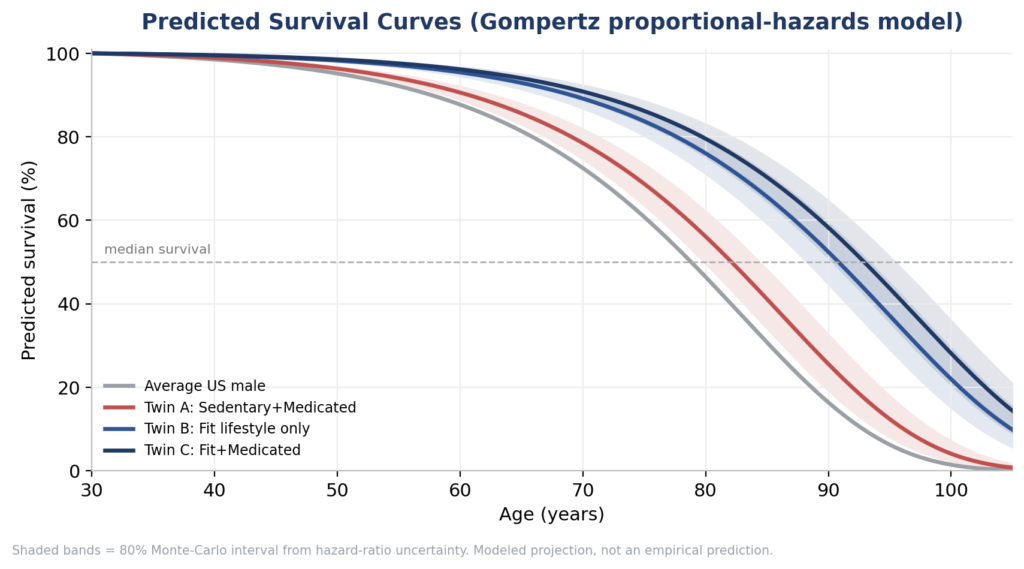
Abbildung 1. Prognostizierte Überlebenskurven mit 80%-Monte-Carlo-Intervallen.
Abbildung 2 zeigt die krankheitsfreie Lebenserwartung (Healthspan). Der Unterschied zwischen Abbildung 2 und Abbildung 1 entspricht für jedes Szenario der Morbiditätsphase: Bei dem durchschnittlichen Mann und Zwilling A ist dieser Unterschied groß, bei den sportlichen Geschwistern hingegen gering, da sie bis kurz vor Lebensende krankheitsfrei bleiben – der „Kompression-of-Morbidity-Effekt“. [MECH].
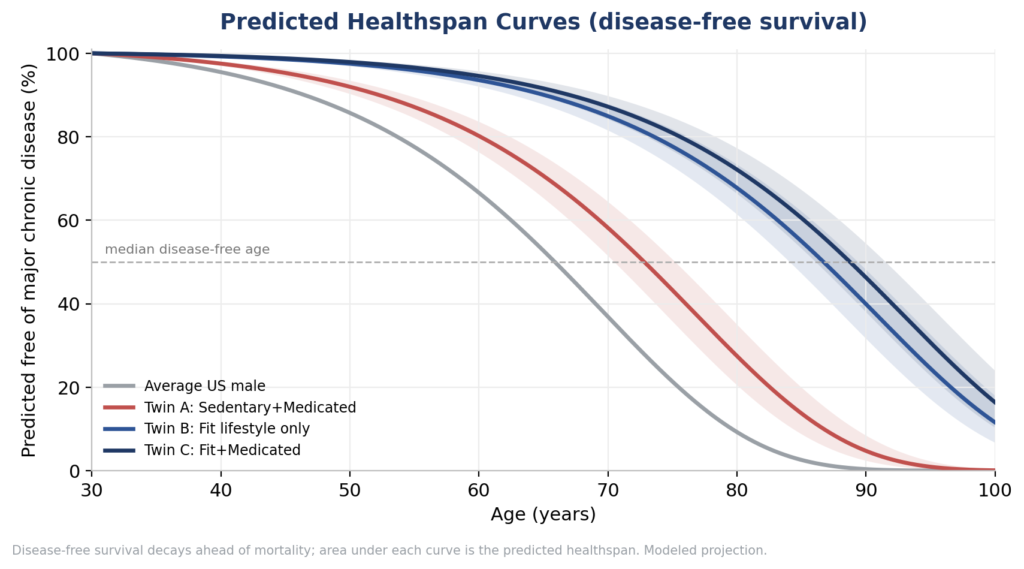
Abbildung 2. Prognostizierte Kurven für die krankheitsfreie Lebensdauer (Healthspan) mit 80%-Monte-Carlo-Intervallen.
Abbildung 3 fasst die prognostizierte Lebenserwartung und Gesundheitsspanne als Medianwerte mit 80%-Intervallen zusammen. Zwilling A gewinnt gegenüber dem durchschnittlichen Mann etwa drei Lebensjahre hinzu, weist jedoch einen neun Jahre langen Morbiditätsschwanz auf; die gesunden Geschwister gewinnen zwölf bis vierzehn Jahre hinzu und verkürzen die Morbiditätsdauer auf etwa vier Jahre. Der Vorsprung von Zwilling C gegenüber Zwilling B ist real, aber gering, und sein Intervall überschneidet sich mit dem von Zwilling B, was darauf hindeutet, dass die Pharmakologie nur wenig beiträgt, sobald das atherogene Risiko bereits niedrig ist.
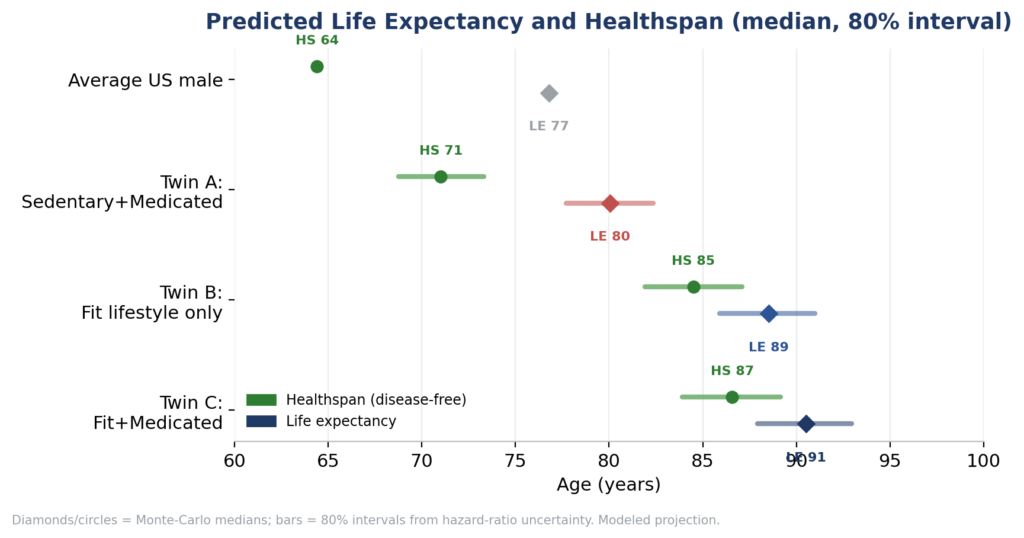
Abbildung 3. Prognostizierte Lebenserwartung und Gesundheitsspanne (Median, 80%-Intervall).
10.3 Auslegung
Daraus ergeben sich drei Schlussfolgerungen. Erstens ist der entscheidende Faktor sowohl für die Lebenserwartung als auch für die Gesundheitserwartung das Kombination aus Lebensstil und Fitness, wie es bei Zwilling B zum Ausdruck kommt. [COH] [21] [22]. Zweitens verschafft eine medikamentöse Therapie bei ungesunder Lebensweise (Zwilling A) zwar bedeutende zusätzliche Lebensjahre, hinterlässt jedoch eine lange Morbiditätsphase, da die Kontrolle der Biomarker keine physiologische Reserve schafft. Drittens führt die Kombination gezielter medikamentöser Therapie mit erstklassiger körperlicher Fitness (Zwilling C) zu einer weiteren, wenn auch geringen und unsicheren Verlängerung der Lebenserwartung, die teilweise durch medikamentenbedingte Nebenwirkungen ausgeglichen wird. Die aus dem Modell abgeleitete Botschaft ist eine Frage der Reihenfolge: Fitness steht an erster Stelle, Pharmakotherapie dient als gezielte Ergänzung und nicht als Ersatz. Bei diesen Kurven handelt es sich um Szenarioprognosen, nicht um individuelle Vorhersagen; ihr Wert liegt eher in der vergleichenden Form als in den genauen Altersangaben.
11. Analyse der Nahrungsmittelunverträglichkeit: Ein paläolithisches/fettreiches Ernährungsmuster
Im Basisszenario wird den Zwillingen B und C eine vollwertige pflanzliche Ernährung (WFPB) zugewiesen, während Zwilling A eine hyperkalorische, hochverarbeitete westliche Ernährung erhält. In diesem Abschnitt wird untersucht, wie sich die jeweiligen Verläufe verändern würden, wenn die Ernährung stattdessen aus einer ad-libitum-Paleo-Ernährung mit hohem Fettanteil bestünde – wobei der Schwerpunkt auf Fleisch, Fisch, Eiern, Gemüse und Nüssen liegt, während Getreide, Hülsenfrüchte und Milchprodukte ausgeschlossen werden und der Gehalt an gesättigten Fettsäuren typischerweise erhöht ist. Der entscheidende Faktor ist die Wirkung dieses Ernährungsmusters auf atherogene Lipoproteine (ApoB und LDL-C), abgewogen gegen mögliche kurzfristige Vorteile hinsichtlich Gewicht und Blutzuckerspiegel sowie einen aus dem Darm stammenden proatherogenen Metaboliten (TMAO) sowie eine ausgeprägte interindividuelle Variabilität der Lipidreaktion.
11.1 Das primäre Signal: Gesättigte Fettsäuren erhöhen den ApoB-Spiegel
Ersetzen ungesättigtes Fett oder Vollwertkost Kohlenhydrat Der Verzehr von gesättigten Fetten erhöht den Spiegel atherogener Lipoproteine. In ihrer Stellungnahme kam die American Heart Association zu dem Schluss, dass eine Reduzierung gesättigter Fette und deren Ersatz durch mehrfach ungesättigtes Fett reduzierte kardiovaskuläre Ereignisse um etwa 30% – ein Ausmaß, das mit einer Statintherapie vergleichbar ist [KON] [25]. In einer kontrollierten Ernährungsstudie führte eine Ernährung mit sehr hohem Gehalt an gesättigten Fettsäuren (18% der Energiezufuhr) zu einem Anstieg des Apolipoproteins B um 9,5% (95%-KI, 3,6–15,7) im Vergleich zu einer Senkung um 6,8% (95%-KI, −11,7 bis −1,8) bei einer Ernährung mit geringem Gehalt an gesättigten Fettsäuren (P-Wert zwischen den Ernährungsformen = 0,0003) [RCT] [26]. Es ist daher zu erwarten, dass die Ersetzung der WFPB-Referenz durch eine paleolithische Ernährungsweise mit höherem Gehalt an gesättigten Fetten bei jedem Zwilling zu einem Anstieg des ApoB-Spiegels führt – also in die entgegengesetzte Richtung wie im Basisfall.
Ein wichtiger Hinweis zur Vergleichbarkeit. Kurzfristige randomisierte Studien zur paläolithischen Ernährung zeigen oft nur bescheidene Verbesserungen: Eine Metaanalyse von acht randomisierten kontrollierten Studien (RCTs) berichtete über eine Verringerung des Körpergewichts (−1,68 kg; 95%-KI, −2,86 bis −0,49), des LDL-C (−0,13 mmol/l ≈ −5 mg/dl; 95%-KI, −0,26 bis −0,01), der Triglyceride und C-reaktives Protein, bei einem leichten Anstieg des HDL-C [MA] [27]. Diese Vorteile wurden jedoch hauptsächlich im Vergleich zu Standard- oder westlichen Referenzdiäten gemessen und waren teilweise auf Gewichtsverlust zurückzuführen; zudem waren die gepoolten Effekte anfällig für den Ausschluss einzelner Studien. Im Vergleich zu einer bereits optimierten WFPB-Ernährung – dem hier relevanten Vergleich – kehrt sich der Lipidvorteil um, da das WFPB-Muster weniger gesättigte Fette und mehr viskose Faser und pflanzen Sterine.
11.2 Über LDL hinaus: TMAO und das Darmmikrobiom
Eine paläolithische Ernährungsweise führt ein zweites, lipidunabhängiges atherogenes Signal ein. Da sie Getreide, Hülsenfrüchte und Milchprodukte ausschließt, ist sie arm an resistenter Stärke und reich an tierischem Eiweiß; Langzeitanhänger weisen eine veränderte Darmmikrobiota (höhere Häufigkeit des Trimethylamin-Produzenten Hungatella) und einen signifikant höheren Serumspiegel an Trimethylamin-N-Oxid (TMAO) auf, einem Metaboliten, der mit Atherosklerose in Verbindung gebracht wird [COH] [28]. Dieser Nachteil wird durch lipidsenkende Medikamente nicht behoben und gilt daher auch für die pharmakologisch behandelten Zwillinge, obwohl das Ausmaß des eigenständigen kausalen Beitrags von TMAO beim Menschen weiterhin umstritten ist [MECH].
11.3 Der schlanke, durchtrainierte Responder: Das Phänomen des „Lean-Mass-Hyper-Responders“
Die Lipidreaktion auf eine fettreiche, kohlenhydratarme Ernährung hängt stark von der Körperzusammensetzung ab. Bei schlanken, insulinempfindlichen Personen mit hohem Energieverbrauch – genau dem Phänotyp der Zwillinge B und C – führen solche Diäten häufig zu einem starken Anstieg von LDL-C und ApoB, was die Trias aus magerer Masse„Lean-Mass-Hyper-Responder“ (LMHR)-Triade mit sehr hohem LDL-C (oft ≥ 200 mg/dl), hohem HDL-C (≥ 80 mg/dl) und niedrigen Triglyceriden (≤ 70 mg/dl) [OBS] [29]. Der Phänotyp selbst ist gut dokumentiert, und die zuständigen Lipidologen plädieren für einen umsichtigen, LDL-senkenden klinischen Ansatz anstelle von bloßen Beruhigungsversuchen [OBS] [29]. Ein vielfach zitierter prospektiver Bericht aus dem KETO-CTA Die Kohorte hatte argumentiert, dass die Plaque-Progression über ein Jahr bei diesen Personen eher von der Ausgangs-Plaque als von ApoB abhänge (“Plaque erzeugt Plaque, ApoB nicht”); diese Arbeit wurde anschließend zurückgezogen von der Zeitschrift im Jahr 2025 auf Wunsch der Autoren und Herausgeber zurückgezogen, nachdem methodische Bedenken als zu groß eingestuft wurden, um sie zu beheben; daher liefert sie hier keine gegenteiligen Belege. Die in Abschnitt 2 festgestellte Kausalität der kumulativen Exposition gegenüber ApoB bleibt daher ungeschmälert bestehen [KON] [1], und ein durch die Ernährung bedingter Anstieg des ApoB-Spiegels sollte als zusätzliche atherogene Belastung betrachtet werden, was besonders dann deutlich wird, wenn bereits subklinische Plaques vorhanden sind – die für Twin A relevanteste Situation [MECH].
11.4 Auswirkungen nach einzelnen Szenarien
Zwilling A (sitzende Lebensweise, etablierte subklinische Plaque). Die fettreiche Ernährungsweise ist die ungünstigste Wahl. Sie führt zu einem Anstieg von ApoB und TMAO zusätzlich zu den Plaques, die sich bereits in den zehn Jahren ohne Behandlung gebildet haben, und es ist zu erwarten, dass die Exposition gegenüber atherogenen Lipoproteinen bei einer bereits bestehenden subklinischen Erkrankung das Fortschreiten der Erkrankung beschleunigt. [Bau/Mech] [1]. Ein mildernder Aspekt ist, dass eine paläolithische Vollwertkost immer noch weniger schädlich ist als eine hochverarbeitete, kalorienreiche westliche Ernährung und kurzfristig zu einer leichten Verbesserung des Gewichts und des Blutzuckerspiegels führen kann [MA] [27]; die Ernährung ist daher besser als Junkfood, aber schlechter als die WFPB-Referenz, und der durch die Fette verursachte Nachteil wird durch seine medikamentöse Therapie ab dem 40. Lebensjahr nur teilweise ausgeglichen.
Zwilling B (fit, schlank, ohne Medikamente). Dieser Zwilling ist dem Abwärtsrisiko am stärksten ausgesetzt. Er würde wahrscheinlich zu einem „Lean-Mass-Hyper-Responder“ mit deutlich erhöhtem ApoB-Spiegel und zusätzlichem TMAO werden und verfügt – als Einziger – über keinen pharmakologischen Puffer. Über vier Jahrzehnte hinweg steigt die kumulative ApoB-Belastung erheblich an und untergräbt einen Großteil des atherogenen Vorteils, den der WFPB-Basisszenario mit sich brachte; seine Fitness und die geringe Entzündungslast würden sein absolutes Ereignisrisiko zwar weiterhin unter dem von Zwilling A halten, doch die lipidbedingte Belastung ist real und ungemildert. [Bau/Mech] [1].
Twin C (Fitness, lipidsenkende Therapie). Diese Kombination ist die wirksamste. Statine plus Ezetimib plus ein PCSK9-Hemmer können den ApoB-Spiegel trotz hoher Aufnahme von gesättigten Fetten auf einem extrem niedrigen Niveau halten – das einzige Szenario, in dem die Pharmakologie den Einfluss der Ernährung direkt neutralisiert. [RCT] [5]. Die Auswirkungen von TMAO und Mikrobiom werden durch Lipidmedikamente nicht korrigiert, sodass eine geringfügige Restbeeinträchtigung verbleibt, doch der Gesamtverlauf von Twin C wird durch die Ernährungsumstellung am wenigsten verändert.
11.5 Modellierte Auswirkungen und Folgen für die Überlebensprognose
Abbildung 4 verdeutlicht die zentrale Asymmetrie. Ersetzt man die Referenzdiät durch eine fettreiche paläolithische Ernährung, bleibt der LDL-C-Spiegel der beiden medikamentös behandelten Zwillinge im Wesentlichen unverändert – Statine, Ezetimib und ein PCSK9-Hemmer wirken auf denselben Clearance-Weg in der Leber ein, der durch gesättigte Fettsäuren in der Ernährung gestört wird, und bei maximaler Lipidsenkung dominieren die Medikamente diesen Weg. [RCT/MECH] [5]. Nur der nicht medikamentös behandelte, sportliche Zwilling (Zwilling B) weist einen Anstieg auf, mit einem deutlichen Aufwärtstrend in Richtung „Lean-Mass-Hyper-Responder“ [OBS] [29].
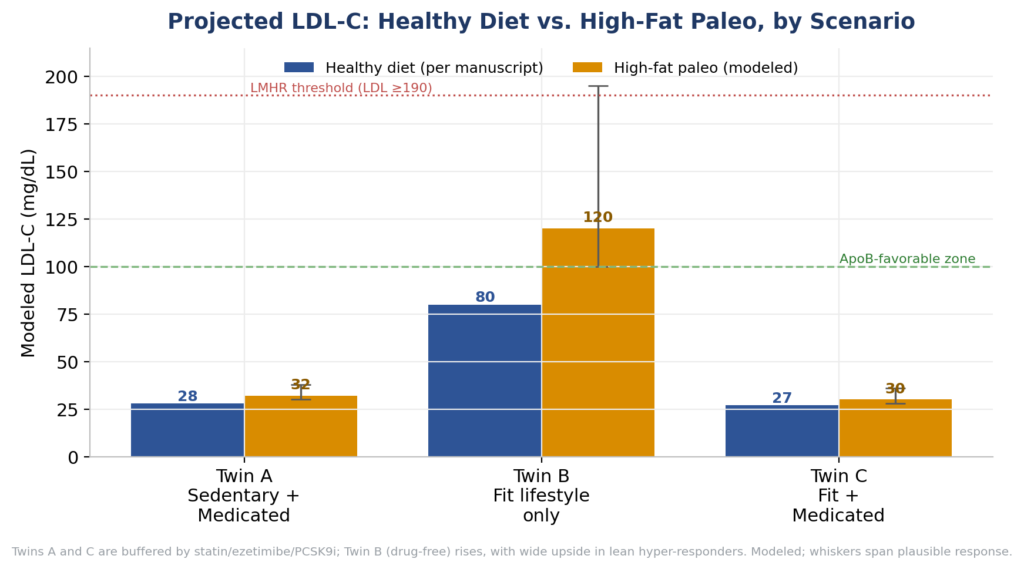
Abbildung 4. Prognostizierte LDL-C-Werte unter der in der Arbeit beschriebenen gesunden Ernährung im Vergleich zu einer fettreichen Ernährung nach paläolithischem Muster, nach Szenario. Die Szenarien A und C sind medikamentengestützt; im Szenario B (ohne Medikamente) steigen die Werte an, wobei bei schlanken Hyperrespondern ein großes Aufwärtspotenzial besteht. Modelliert.
| Szenario | ApoB bei WFPB / Referenz (modelliert) | ApoB bei Paleo/fettreicher Ernährung (Modellierung) | Nettoauswirkung auf das prognostizierte Risiko |
| Twin A | ≈25–30 mg/dL (ab dem 40. Lebensjahr, unter medikamentöser Behandlung) | Höhere Exposition vor der Behandlung; ≈35–45 während der Therapie | Schlimmer noch: verstärkt bereits vorhandene Zahnbeläge; wird teilweise durch Medikamente ausgeglichen |
| Twin B | ≈75 mg/dl | ≈110–150+ mg/dL (LMHR-Bereich, ungepuffert) | Deutlich schlechter: untergräbt den Ernährungsvorteil |
| Twin C | ≈30 mg/dl | ≈30–40 mg/dL (durch die Therapie auf einem niedrigen Niveau gehalten) | Geringe Veränderung der Lipidwerte; geringer verbleibender TMAO-Nachteil |
Tabelle 4. Modellierte Auswirkungen einer Umstellung von der im Manuskript genannten Referenzdiät auf eine paläolithische/fettreiche Ernährung. Die ApoB-Werte sind modellierte Schätzungen und keine in Studien beobachteten Ergebnisse.
Im Rahmen des Gompertz-Überlebensmodells aus Abschnitt 10 wirkt sich die Ernährungsumstellung über die kumulative ApoB-Exposition und TMAO aus. Dies würde die Hazard Ratios für Mortalität und Morbidität am stärksten bei Zwilling B (ungepuffertes ApoB im LMHR-Bereich) erhöhen, mäßig bei Zwilling A (Zusatz zu bereits vorhandener Plaque, teilweise durch Therapie ausgeglichen) und am wenigsten bei Zwilling C (Lipidrisiko weitgehend durch Medikamente neutralisiert). Die qualitative Konsequenz ist eine teilweise Verringerung des Überlebens- und Gesundheitslebensdauer-Vorteils des unbehandelten, gesunden Zwillings in Richtung der medikamentösen Szenarien – wenn auch nicht bis auf deren Niveau –, was das zentrale Thema des Manuskripts untermauert: Ernährungsqualität und Pharmakologie wirken auf derselben atherogenen Achse, und die lipidsenkende Therapie ist die einzige der beiden, die eine ungünstige lipidische Reaktion auf die Ernährung abmildern kann [MECH].
Abbildung 5 quantifiziert dies im Rahmen des Überlebensmodells. Wird die Prognose erneut durchgeführt, wobei Zwilling B auf eine fettreiche paläolithische Ernährungsweise umgestellt wird – wobei sein höherer, nicht gepufferter ApoB-Spiegel das Mortalitäts- und Morbiditätsrisiko erhöht –, verringert sich sowohl die prognostizierte Lebenserwartung (89 → 86) als auch die Gesundheitsspanne (85 → 82) um etwa drei Jahre, während bei Zwilling C, dessen Blutfettwerte pharmakologisch niedrig gehalten werden, im Wesentlichen keine Veränderung eintritt. Die nachteiligen Auswirkungen der Ernährung treffen fast ausschließlich den Zwilling ohne pharmakologischen Puffer [MECH].
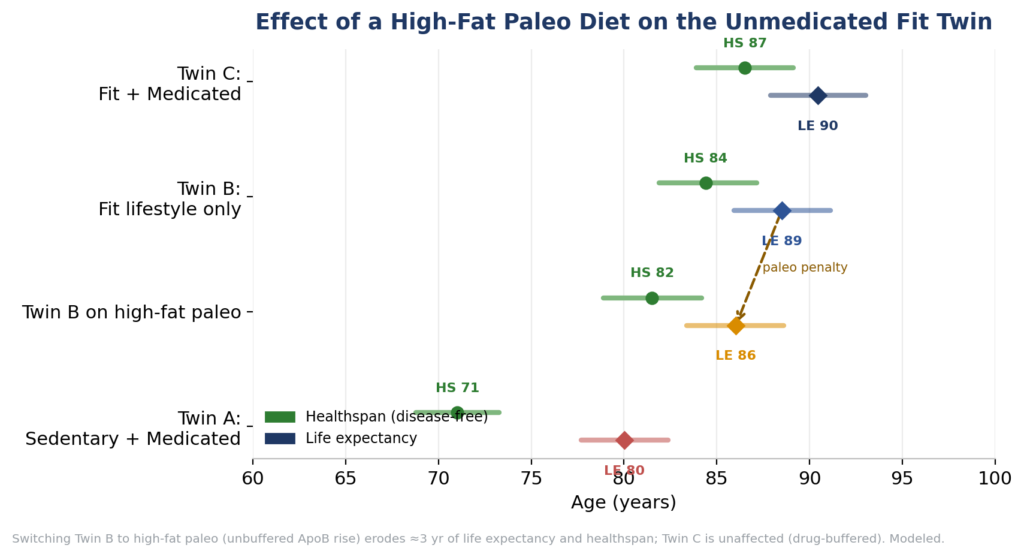
Abbildung 5. Modellierte Auswirkungen einer fettreichen paläolithischen Ernährung auf die prognostizierte Lebenserwartung und die Gesundheitsspanne. Die Ernährung verkürzt die Lebenserwartung des nicht medikamentös behandelten, fitten Zwillings (Zwilling B) um etwa 3 Jahre; bei den medikamentös behandelten Zwillingen sind die Auswirkungen abgefedert. Medianwerte mit 80%-Intervallen.
Abbildung 6 zeigt dasselbe Ergebnis wie die vollständigen Überlebenskurven. Die Umstellung von Zwilling B auf eine fettreiche paläolithische Ernährung verschiebt seine Kurve nach links (bernsteinfarben), senkt die mediane Lebenserwartung von etwa 91 auf 88 Jahre und verschiebt den gesamten Verlauf in Richtung des bewegungsarmen, medikamentös behandelten Zwillings – bleibt jedoch deutlich über dessen Kurve. Die Kurve von Zwilling C bleibt unverändert, da die medikamentöse Therapie seine atherogenen Lipoproteine unabhängig von der Ernährung auf einem niedrigen Niveau hält; das bernsteinfarbene Konfidenzband überlappt das Referenzband der Standardernährung von Zwilling B, was eine echte Unsicherheit hinsichtlich des Ausmaßes der Verschiebung widerspiegelt. Die grafische Darstellung untermauert die These des Abschnitts: Der Hebel „Ernährung“ verschiebt die Kurve nur bei dem Zwilling wesentlich, der keine pharmakologische Station unter seinem ApoB [MECH].
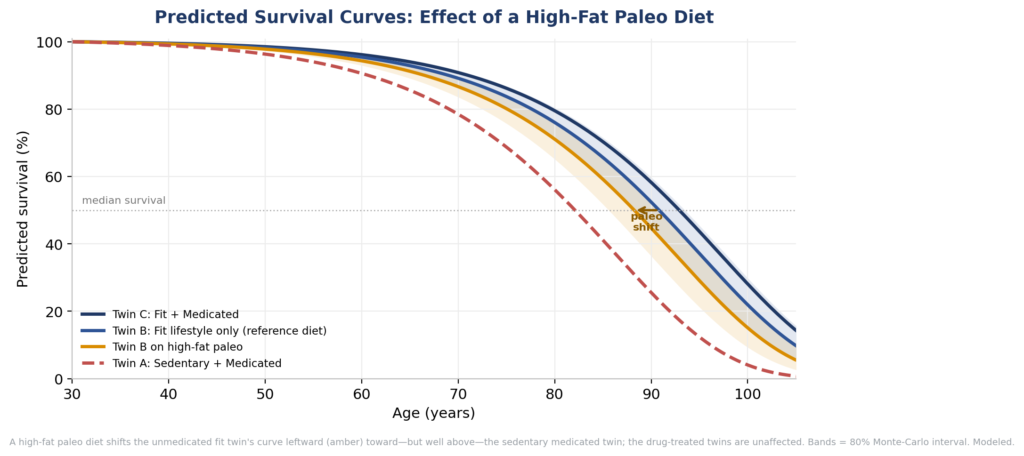
Abbildung 6. Prognostizierte Überlebenskurven bei einer fettreichen paläolithischen Ernährung. Die Kurve des gesunden, nicht medikamentös behandelten Zwillings (bernsteinfarben) verschiebt sich nach links in Richtung des bewegungsarmen, medikamentös behandelten Zwillings, verläuft jedoch deutlich oberhalb dessen; die medikamentös behandelten Zwillinge sind davon nicht betroffen. Bänder = 80%-Monte-Carlo-Intervall. Modelliert.
12. Zusammenfassung und ausgewogene Schlussfolgerung
Diese 40-jährige Vergleichsanalyse zeigt, dass moderne kardiometabolische Medikamente zwar hochwirksam sind, die systemischen Risiken eines bewegungsarmen Lebensstils und einer ungesunden Ernährung jedoch nicht vollständig ausgleichen können. Eine intensive medikamentöse Therapie bei Zwilling A führt zu einer erfolgreichen Kontrolle der Blutfettwerte, des Blutdrucks und des Blutzuckerspiegels und senkt das Risiko für Herzinfarkt und Schlaganfall erheblich. [RCT] [5] [8]. Da jedoch kein Medikament die VO₂max wiederherstellt, die mitochondriale Dichte wiederaufbaut oder den sarkopenen Muskelschwund verhindert, bleibt das Modell der sitzenden Lebensweise in Verbindung mit medikamentöser Behandlung strukturell anfällig und anfällig für Gebrechlichkeit, Abhängigkeit und nicht-kardiovaskuläre Mortalität [COH] [12].
Ein sportlicher Elite-Lebensstil (Twin B) bildet die Grundlage für eine lange Lebenserwartung bei guter Gesundheit, kardiorespiratorische Fitness und die Senkung der Gesamtmortalität. [COH] [12], doch selbst ein Lebensstil der Oberschicht verhindert nicht die langsame, über Jahrzehnte hinweg fortschreitende Exposition gegenüber atherogenem ApoB [KON] [1]. Das geringste modellierte Risiko wird in Szenario C erreicht, in dem ein elitärer Lebensstil mit einer gezielten präventiven medikamentösen Therapie kombiniert wird, um ApoB und den Blutdruck auf ein Minimum zu senken – eine starke Synergie, die jedoch ein sorgfältiges Management von Konflikten zwischen Medikamenten und Lebensstil erfordert, wie beispielsweise statinbedingte Muskelsymptome bei sehr aktiven Personen [MECH] [20]. Zusammenfassend lässt sich sagen, dass die Pharmakologie die vaskulären Folgen eines bewegungsarmen Lebensstils durch die Steuerung von Biomarkern teilweise ausgleichen kann, jedoch nicht die Vorteile körperlicher Fitness für mehrere Organe nachbilden kann. Eine medikamentöse Therapie ist am wirksamsten, wenn sie als Ergänzung zu einem gesunden Lebensstil eingesetzt wird und nicht, um dessen Fehlen auszugleichen.
Die Analyse der Ernährungsempfindlichkeit untermauert diese Schlussfolgerung, anstatt sie zu verkomplizieren. Der Ersatz der Referenzernährung durch eine fettreiche paläolithische Ernährungsweise verschiebt die Überlebenskurven der beiden medikamentös behandelten Zwillinge kaum, da die Therapie mit Statinen, Ezetimib und PCSK9-Hemmern ihre atherogenen Lipoproteine unabhängig vom Gehalt an gesättigten Fettsäuren in der Ernährung auf einem niedrigen Niveau hält; sie verschiebt jedoch die Überlebenskurve des unbehandelten, gesunden Zwillings deutlich nach links (mediane Überlebensdauer von etwa 91 auf 88 Jahre; Abbildung 6) und verkürzt sowohl die Lebenserwartung als auch die Gesundheitsspanne um etwa drei Jahre durch einen ungebremsten Anstieg des ApoB [MECH] [26]. Daraus ergeben sich zwei Erkenntnisse. Erstens wirken sich die Ernährungsqualität und lipidsenkende Medikamente auf dieselbe atherogene Achse aus, sodass der Nutzen einer gesunden Ernährung gerade für diejenigen am größten ist, die nicht medikamentös geschützt sind – und umgekehrt ist die lipidsenkende Therapie der einzige der beiden Hebel, der eine ungünstige lipidbezogene Reaktion auf die Ernährung ausgleichen kann. Zweitens wird die weit verbreitete Darstellung einer fettreichen, kohlenhydratarmen Ernährung als herzschützend bei schlanken, fitten Personen nicht gestützt, sobald die kumulative ApoB-Exposition ernst genommen wird; die positiven Auswirkungen der Ernährung auf Gewicht, Blutzucker und Triglyceride wiegen einen anhaltenden Anstieg der Anzahl atherogener Partikel nicht auf, und der einzige prospektive Datensatz, der zur Untermauerung einer gegenteiligen These herangezogen wurde, wurde zurückgezogen [KON] [1] [29]. Die übergeordnete Botschaft lautet daher: Reihenfolge und Komplementarität – zunächst sollten die körperliche Fitness und eine Ernährung mit niedrigem ApoB-Gehalt aufgebaut werden, und erst dann sollte eine gezielte medikamentöse Therapie als präzise, Robustheit verleihende Ergänzung und nicht als Ersatz für beides hinzukommen.
Referenzen
- Ference BA, Ginsberg HN, Graham I, et al. Low-density lipoproteins cause atherosclerotic cardiovascular disease. 1. Evidence from genetic, epidemiologic, and clinical studies. A consensus statement from the European Atherosclerosis Society Consensus Panel. Eur Heart J. 2017;38(32):2459-2472. doi:10.1093/eurheartj/ehx144
- Mortensen MB, Dzaye O, Bøtker HE, et al. Low-Density Lipoprotein Cholesterol Is Predominantly Associated With Atherosclerotic Cardiovascular Disease Events in Patients With Evidence of Coronary Atherosclerosis: The Western Denmark Heart Registry. Circulation. 2023;147(14):1053-1063. doi:10.1161/CIRCULATIONAHA.122.061010
- Landry MJ, Ward CP, Cunanan KM, et al. Cardiometabolic Effects of Omnivorous vs Vegan Diets in Identical Twins: A Randomized Clinical Trial. JAMA Netw Open. 2023;6(11):e2344457. Published 2023 Nov 1. doi:10.1001/jamanetworkopen.2023.44457
- Koch CA, Kjeldsen EW, Frikke-Schmidt R. Vegetarian or vegan diets and blood lipids: a meta-analysis of randomized trials. Eur Heart J. 2023;44(28):2609-2622. doi:10.1093/eurheartj/ehad211
- Sabatine MS, Giugliano RP, Keech AC, et al. Evolocumab and Clinical Outcomes in Patients with Cardiovascular Disease. N Engl J Med. 2017;376(18):1713-1722. doi:10.1056/NEJMoa1615664
- O’Donoghue ML, Fazio S, Giugliano RP, et al. Lipoprotein(a), PCSK9 Inhibition, and Cardiovascular Risk. Circulation. 2019;139(12):1483-1492. doi:10.1161/CIRCULATIONAHA.118.037184
- Breneman CB, Polinski K, Sarzynski MA, et al. The Impact of Cardiorespiratory Fitness Levels on the Risk of Developing Atherogenic Dyslipidemia. Am J Med. 2016;129(10):1060-1066. doi:10.1016/j.amjmed.2016.05.017
- Lincoff AM, Brown-Frandsen K, Colhoun HM, et al. Semaglutide and Cardiovascular Outcomes in Obesity without Diabetes. N Engl J Med. 2023;389(24):2221-2232. doi:10.1056/NEJMoa2307563
- Ross R, Blair SN, Arena R, et al. Importance of Assessing Cardiorespiratory Fitness in Clinical Practice: A Case for Fitness as a Clinical Vital Sign: A Scientific Statement From the American Heart Association. Circulation. 2016;134(24):e653-e699. doi:10.1161/CIR.0000000000000461
- Andersen MH, Jensen JM, Kanstrup H, et al. Low-density lipoprotein cholesterol and cardiovascular risk in the absence of calcifications on computed tomography: the Western Denmark Heart Registry. Eur Heart J. 2025;46(46):5062-5072. doi:10.1093/eurheartj/ehaf497
- Puri R, Nicholls SJ, Shao M, et al. Impact of statins on serial coronary calcification during atheroma progression and regression. J Am Coll Cardiol. 2015;65(13):1273-1282. doi:10.1016/j.jacc.2015.01.036
- Mandsager K, Harb S, Cremer P, Phelan D, Nissen SE, Jaber W. Association of Cardiorespiratory Fitness With Long-term Mortality Among Adults Undergoing Exercise Treadmill Testing. JAMA Netw Open. 2018;1(6):e183605. Published 2018 Oct 5. doi:10.1001/jamanetworkopen.2018.3605
- Alissou M, Demangeat T, Folope V, et al. Impact of Semaglutide on fat mass, lean mass and muscle function in patients with obesity: The SEMALEAN study. Diabetes Obes Metab. 2026;28(1):112-121. doi:10.1111/dom.70141
- Neeland IJ, Linge J, Birkenfeld AL. Changes in lean body mass with glucagon-like peptide-1-based therapies and mitigation strategies. Diabetes Obes Metab. 2024;26 Suppl 4:16-27. doi:10.1111/dom.15728
- Naci H, Ioannidis JP. Comparative effectiveness of exercise and drug interventions on mortality outcomes: metaepidemiological study. Br J Sports Med. 2015;49(21):1414-1422. doi:10.1136/bjsports-2015-f5577rep
- Wharton S, Davies M, Dicker D, et al. Managing the gastrointestinal side effects of GLP-1 receptor agonists in obesity: recommendations for clinical practice. Postgrad Med. 2022;134(1):14-19. doi:10.1080/00325481.2021.2002616
- He L, Wang J, Ping F, et al. Association of Glucagon-Like Peptide-1 Receptor Agonist Use With Risk of Gallbladder and Biliary Diseases: A Systematic Review and Meta-analysis of Randomized Clinical Trials. JAMA Intern Med. 2022;182(5):513-519. doi:10.1001/jamainternmed.2022.0338
- Ryan TE, Torres MJ, Lin CT, et al. High-dose atorvastatin therapy progressively decreases skeletal muscle mitochondrial respiratory capacity in humans. JCI Insight. 2024;9(4):e174125. Published 2024 Feb 22. doi:10.1172/jci.insight.174125
- Bruckert E, Hayem G, Dejager S, Yau C, Bégaud B. Mild to moderate muscular symptoms with high-dosage statin therapy in hyperlipidemic patients–the PRIMO study. Cardiovasc Drugs Ther. 2005;19(6):403-414. doi:10.1007/s10557-005-5686-z
- Cheeley MK, Saseen JJ, Agarwala A, et al. NLA scientific statement on statin intolerance: a new definition and key considerations for ASCVD risk reduction in the statin intolerant patient. J Clin Lipidol. 2022;16(4):361-375. doi:10.1016/j.jacl.2022.05.068
- Li Y, Pan A, Wang DD, et al. Impact of Healthy Lifestyle Factors on Life Expectancies in the US Population. Circulation. 2018;138(4):345-355. doi:10.1161/CIRCULATIONAHA.117.032047
- Clausen JSR, Marott JL, Holtermann A, Gyntelberg F, Jensen MT. Midlife Cardiorespiratory Fitness and the Long-Term Risk of Mortality: 46 Years of Follow-Up. J Am Coll Cardiol. 2018;72(9):987-995. doi:10.1016/j.jacc.2018.06.045
- Garmany A, Terzic A. Global Healthspan-Lifespan Gaps Among 183 World Health Organization Member States. JAMA Netw Open. 2024;7(12):e2450241. Published 2024 Dec 2. doi:10.1001/jamanetworkopen.2024.50241
- De Bosscher R, Dausin C, Claus P, et al. Lifelong endurance exercise and its relation with coronary atherosclerosis. Eur Heart J. 2023;44(26):2388-2399. doi:10.1093/eurheartj/ehad152
- Sacks FM, Lichtenstein AH, Wu JHY, et al. Dietary Fats and Cardiovascular Disease: A Presidential Advisory From the American Heart Association. Circulation. 2017;136(3):e1-e23. doi:10.1161/CIR.0000000000000510
- Chiu S, Williams PT, Krauss RM. Effects of a very high saturated fat diet on LDL particles in adults with atherogenic dyslipidemia: A randomized controlled trial. PLoS One. 2017;12(2):e0170664. Published 2017 Feb 6. doi:10.1371/journal.pone.0170664
- Ghaedi E, Mohammadi M, Mohammadi H, et al. Effects of a Paleolithic Diet on Cardiovascular Disease Risk Factors: A Systematic Review and Meta-Analysis of Randomized Controlled Trials. Adv Nutr. 2019;10(4):634-646. doi:10.1093/advances/nmz007
- Genoni A, Christophersen CT, Lo J, et al. Long-term Paleolithic diet is associated with lower resistant starch intake, different gut microbiota composition and increased serum TMAO concentrations. Eur J Nutr. 2020;59(5):1845-1858. doi:10.1007/s00394-019-02036-y
- Norwitz NG, Mindrum MR, Giral P, et al. Elevated LDL-cholesterol levels among lean mass hyper-responders on low-carbohydrate ketogenic diets deserve urgent clinical attention and further research. J Clin Lipidol. 2022;16(6):765-768. doi:10.1016/j.jacl.2022.10.010
- Cholesterol Treatment Trialists’ Collaboration. Effect of statin therapy on muscle symptoms: an individual participant data meta-analysis of large-scale, randomised, double-blind trials. Lancet. 2022;400(10355):832-845. doi:10.1016/S0140-6736(22)01545-8