
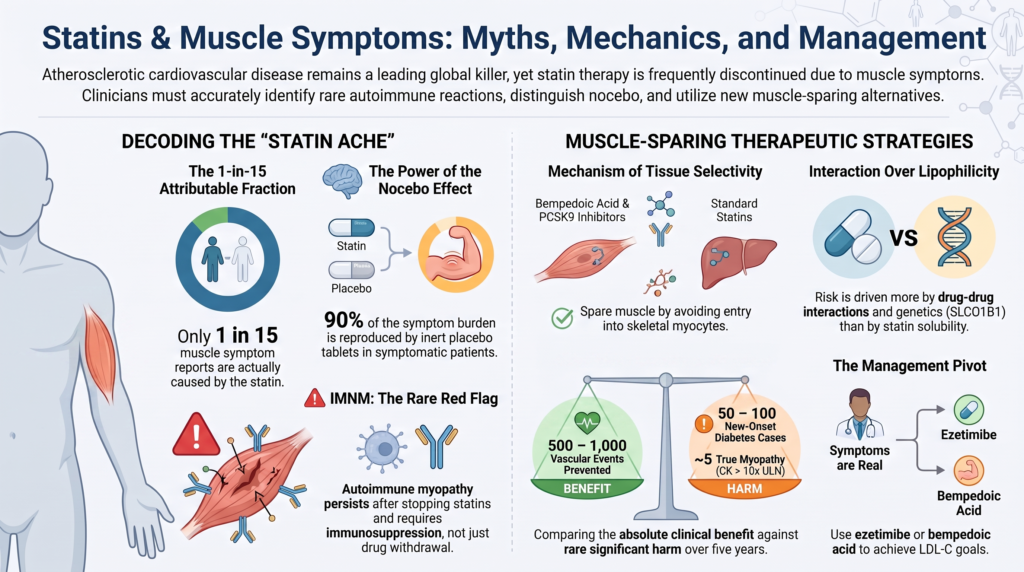
Vergleichende Übersicht lipid senkender Therapeutika
Biologische Signalwege, Wirksamkeitsdynamik, zelluläre Mechanismen der Muskeltoxizität, Pharmakogenomik und das Nocebo-Phänomen
Zusammenfassung
atherosklerotisch Herz-Kreislauf-Erkrankung (ASCVD) bleibt weltweit die Haupttodesursache, und die Senkung von Low-Density Lipoprotein Cholesterin (LDL-C) ist das am robustesten validierte pharmakologische Mittel zur Senkung dieses Risikos. Das therapeutische Arsenal hat sich von 3-Hydroxy-3-Methylglutaryl-Coenzym-A-(HMG-CoA)-Reduktasehemmern auf Inhibitoren der ATP-Citrat-Lyase und von Niemann-Pick C1-Like 1 ausgeweitet, Proprotein-Konvertase Subtilisin/Kexin-Typ-9PCSK9), und Angiopoietin-ähnliche Protein 3, mit Cholesterinester Transfer-Protein-Inhibitoren, oral PCSK9-Hemmer, und Lipoprotein(a)-gerichteten Nukleinsäurietherapien in der späten Entwicklung. Trotz des eindeutigen kardiovaskulären Nutzens wird die Therapietreue durch berichtete Nebenwirkungen untergraben, die überwiegend Statین-assoziierte Muskelsymptome.
Dieser Übersichtsartikel fasst die molekulare Pharmakologie, die vergleichende Wirksamkeit und das muskuläre Sicherheitsprofil aller derzeit verfügbaren LDL-senkenden Wirkstoffklassen zusammen. Er betrachtet Muskelsymptome umfassend statt nur als reinen Muskelkater und befasst sich mit Müdigkeit, Energiemangel und Belastbarkeit als Ergebnisse mit einer eigenen, eigenständigen Evidenzbasis. Sie unterscheidet vier biologisch unterschiedliche Entitäten, die häufig vermischt werden: (i) Nocebo-vermittelte Symptome, die den Großteil der Muskelsbeschwerden ausmachen, die zugeschrieben werden Statine — In den individuellen Teilnehmerdaten der Cholesterol Treatment Trialists waren mehr als 90% der bei den mit Statinen behandelten Teilnehmern gemeldeten Muskelsymptome nicht auf das Medikament zurückzuführen; (ii) echte pharmakologische Myalgie, von der eine kleine, aber reale Minderheit betroffen ist; (iii) echte Myopathie und Rhabdomyolyse, die selten und dosisabhängig sind; und (iv) Anti-HMGCR-immunvermittelte nekrotisierende Myopathie, eine seltene Autoimmunerkrankung, die nach dem Absetzen von Medikamenten fortbesteht und eher eine Immunsuppression als eine Beruhigung erfordert. Evidenz aus den individuellen Patientendaten der Cholesterol Treatment Trialists’ Collaboration Meta-Analyse, der SAMSON und StatinWISE N-of-1-Studien, der verblindete versus unverblindete Vergleich der ASCOT-LLA und der randomisierte Rechallenge der GAUSS-3-Studie sind mit einer pharmakogenomischen Beratung und einem praktischen Management-Algorithmus integriert. Die zentrale klinische Botschaft ist zweigeteilt: Kliniker sollten berichtete Muskelsymptome weder als Beweis für eine pharmakologische Toxizität akzeptieren noch als zwangsläufig psychologisch abtun.
1. Einführung
Herz-Kreislauf-Erkrankungen, angetrieben durch ASCVD, bleiben die Hauptursache für die weltweite Sterblichkeit [1Die Beziehung zwischen LDL-C und dem atherosklerotischen Risiko ist kausal, dosisabhängig und im Laufe der Zeit kumulativ, und der klinische Nutzen der LDL-C-Senkung ist proportional zum absoluten Ausmaß der erreichten Senkung und ihrer Dauer, weitgehend unabhängig von dem Mechanismus, durch den sie erreicht wird.
Dennoch wird die Umsetzung dieser Evidenz in einen Nutzen auf Bevölkerungsebene weniger durch die Wirksamkeit als vielmehr durch die Therapiedreue begrenzt. Ein erheblicher Teil der Patienten, denen Statine verschrieben werden, bricht die Einnahme innerhalb von zwei Jahren ab, wobei am häufigsten Muskelsymptome als Grund genannt werden. Die daraus resultierende Lücke zwischen der in Studien nachgewiesenen Wirksamkeit und dem tatsächlichen Nutzen in der Praxis ist einer der größten vermeidbaren Verluste in der präventiven Kardiologie.
Die Lösung dieses Problems erfordert Präzision hinsichtlich dessen, was tatsächlich beobachtet wird, wenn ein Patient unter der Einnahme eines Statins von Muskelschmerzen berichtet. Die Evidenz lässt diese Präzision nun zu. Diese Übersichtsarbeit verfolgt daher drei Ziele: die molekulare Pharmakologie und vergleichende Wirksamkeit aller verfügbaren LDL-senkenden Mittel zu beschreiben; die biologischen Grundlagen der Muskeltoxizität und die Gründe zu definieren, warum bestimmte Wirkstoffe die Skelettmuskulatur vollständig verschonen; und zu quantifizieren, wie viel der gemeldeten Muskelbeschwerden auf das Medikament und nicht auf Erwartung, Alterung oder Zufall zurückzuführen ist.
1.1 Ein Hinweis zu Terminologie und Geltungsbereich
Dieser Artikel ist ein Narrativer Review mit quantitativer Synthese veröffentlichter Studiendaten. Es handelt sich hierbei um keine De-novo-Metaanalyse: Es wurden von den Autoren keine gepoolten Effektschätzungen berechnet, und alle zitierten gepoolten Zahlen sind diejenigen, die von den ursprünglichen Prüfärzten oder von veröffentlichten Metaanalysen berichtet wurden, welche als solche gekennzeichnet sind. Wo Schätzungen zwischen Quellen im Widerspruch stehen, wird der Widerspruch dargelegt, anstatt ihn durch eine Präferenz zu lösen.
2. Biologische Signalwege und molekulare Wirkungsmechanismen
Therapeutisch lipidsenkend wird durch die Störung der Leber- Cholesterinsynthese, intestinale Cholesterinresorption, hepatisch LDL-Rezeptor-Recycling, oder des Lipoproteinkatabolismus. Diese pharmakodynamischen Unterschiede bestimmen nicht nur die Potenz, sondern auch die Gewebeverteilung und damit das Nebenwirkungsprofil. Der für die Muskelsicherheit wichtigste Unterschied ist einfach: Gelangt das Medikament in Skelettmuskelzellen, und wenn ja, stört es einen Stoffwechselweg, den der Muskel benötigt?
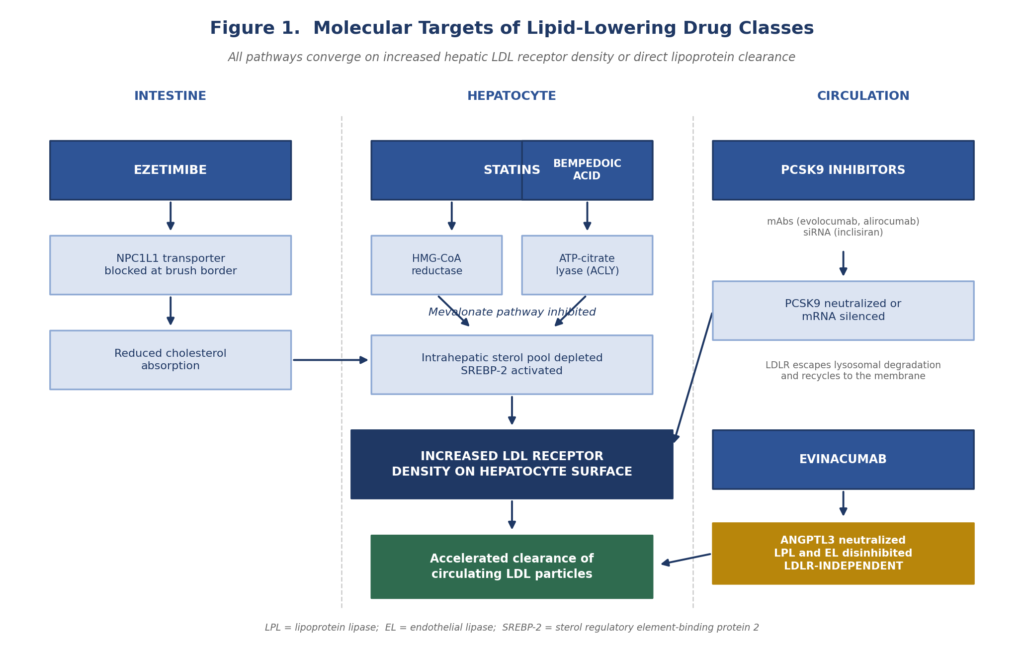
Abbildung 1. Molekulare Zielstrukturen der lipidsenkenden Medikamentenklassen. Statine und Bempedoinsäure an zwei verschiedenen Knotenpunkten der Leber wirken Mevalonatweg; Ezetimib wirkt am Bürstensaum der Enterozyten; PCSK9-gerichtete Mittel wirken im Kreislauf oder innerhalb des Hepatozyten, um zu erhalten LDL-Rezeptor Recycling. Evinacumab ist der einzige Wirkstoff, dessen Wirkung nicht von abhängt LDL Rezeptordichte, weshalb es in Rezeptor-Null-Systemen seine Aktivität behält homozygot familiäre Hypercholesterinämie.
2.1 HMG-CoA-Reduktase-Inhibitoren (Statine)
Statine hemmen kompetitiv HMG-CoA-Reduktase, das geschwindigkeitsbestimmende Enzym, das HMG-CoA im Cholesterin-Biosyntheseweg in Mevalonat umwandelt. Eine Verarmung des intrahepatischen Sterol Pool aktiviert das Sterol-Regulatorischer-Element-bindende Protein 2 (SREBP-2), was die Transkription und Oberflächenexpression von erhöht LDLR an Hepatozytenmembranen, was die Clearance von zirkulierndem LDL und Lipoprotein sehr niedriger Dichte beschleunigt (VLDL) Restpartikel.
Alle Statine wirken hepatoselektiv, was hauptsächlich auf eine effiziente hepatische First-Pass-Aufnahme zurückzuführen ist. Sie unterscheiden sich jedoch darin, wie diese Aufnahme erreicht wird und wie leicht sie extrahepatisches Gewebe erreichen:
- Lipophile StatineAtorvastatin, Simvastatin, Lovastatin, Fluvastatin, Pitavastatin, und dem vom Markt genommenen Cerivastatin): sie besitzen eine ausreichende Membranpermeabilität für die passive Diffusion durch Zellmembranen, einschließlich derjenigen von Skelettmuskelzellen. Sie sind dementsprechend anfälliger für den oxidativen Stoffwechsel durch das Cytochrom-P450-System, mit der nennenswerten Ausnahme von Pitavastatin.
- Hydrophile Statine (Rosuvastatin, Pravastatin): besitzen polare strukturelle Domänen, die die passive Membranpassage einschränken. Der hepatische Eintritt hängt in erster Linie vom aktiven Transport durch den organischen Anionen-transportierenden Polypeptid 1B1 ab (OATP1B1, verschlüsselt durch SLCO1B1), und keines von beiden unterliegt einem nennenswerten CYP450-Stoffwechsel.
Es ist wichtig, von vornherein festzustellen, dass sich diese physikochemische Unterscheidung, obwohl real und mechanistisch plausibel, nicht in einen konsistent nachweisbaren Unterschied bei den klinischen Rate von Muskelsymptomen niedergeschlagen hat. Dies wird in Abschnitt 6.4 direkt angesprochen. Pitavastatin ist das klarste Beispiel dafür, warum die einfache Heuristik „lipophil gleich riskant“ versagt: Es ist ein lipophiles Molekül, weist jedoch, da es fast keinem CYP450-Stoffwechsel unterliegt, eines der geringsten interaktionsbedingten Myopathierrisiken aller Statine auf.
2.2 Die vollständige Statin-Liste
Sieben Statine sind derzeit auf dem Markt. Ein achtes, Cerivastatin, wurde 2001 weltweit freiwillig vom Markt genommen, nachdem es zu einer inakzeptablen Häufigkeit von tödlicher Rhabdomyolyse kam, insbesondere in Kombination mit Gemfibrozil. Da ein Großteil der historischen Bedenken hinsichtlich der Statin-Myotoxizität auf die Erfahrungen mit Cerivastatin zurückzuführen ist, wird es hier zum besseren Verständnis aufgeführt.
| Statin | Klasse | Löslichkeit | Hauptstoffwechsel | Transport- / Interaktionshinweise | Verfügbare Dosierungen | Praktische Positionierung |
| Atorvastatin | Synthetisch | lipophil | CYP3A4 (aktive Metaboliten) | OATP1B1-Substrat; CYP3A4-Hemmer erhöhen die Exposition | 10, 20, 40, 80 mg täglich | Arbeitspferd-Wirkstoff; Zulassungen mit langer Halbwertszeit tätägige Dosierung |
| Rosuvastatin | Synthetisch | hydrophil | Minimales CYP (CYP2C9-Spur) | OATP1B1- und ABCG2-(BCRP-)Substrat; ABCG2-Varianten erhöhen die Exposition | 5, 10, 20, 40 mg täglich | Am stärksten pro mg; lange Halbwertszeit; gute Wahl nach Unverträglichkeit |
| Simvastatin | Pilzstämmig | lipophil | CYP3A4 (extensiv) | Stärkste SLCO1B1 Myopathie-Signal; viele Dosishöchstgrenzen bei wechselwirkenden Arzneimitteln | 5, 10, 20, 40 mg täglich (80 mg beschränkt) | Höchstes Interaktions- und genotypvermitteltes Myopathierisiko unter den auf dem Markt befindlichen Statinen; 80 mg nicht empfohlen |
| Pravastatin | Pilzstämmig | hydrophil | Nicht-CYP (Sulfatierung) | OATP1B1-Substrat; wenige CYP-Wechselwirkungen | 10, 20, 40, 80 mg täglich | Geringe Potenz, aber günstiges Wechselwirkungsprofil; nützlich bei Polypharmazie |
| Lovastatin | Pilzstämmig | lipophil | CYP3A4 (extensiv) | Prodrug Lacton; Mehrfachwechselwirkungs-Dosisobergrenzen | 10, 20, 40 mg (IR); 20–60 mg (ER) | Größtenteils überholt; zum Abendessen einnehmen |
| Fluvastatin | Synthetisch | lipophil | CYP2C9 (wichtigstes) | Umgeht den CYP3A4-Weg; bei CYP2C9-Schwachmetabolisierern kommt es zu einer Akkumulation des Arzneimittels | 20, 40 mg; 40 mg BID; 80 mg XL | Nützlich, wenn eine CYP3A4-Interaktion das Problem ist; geringste Potenz |
| Pitavastatin | Synthetisch | lipophil | Geringe CYP-Aktivität; Glukuronidierung | Kein CYP3A4-Substrat; Ciclosporin kontraindiziert | 1, 2, 4 mg täglich | Sehr geringe Interaktionsbelastung; wird häufig nach Unverträglichkeit anderer Statine aus empirischen Gründen statt aufgrund vergleichender Studien eingesetzt |
| Cerivastatin | Synthetisch | lipophil | CYP2C8 und CYP3A4 | Zurückgezogen 2001; tödliche Rhabdomyolyse, insbesondere in Kombination mit Gemfibrozil | Zurückgezogen | Nur von historischem Interesse; Quelle für viel Ängstlichkeit bezüglich Statin-Myotoxizität |
Tabelle 1. Pharmakologische Eigenschaften aller auf dem Markt befindlichen Statine plus des vom Markt genommenen Cerivastatins. Die Löslichkeitsklassifizierung folgt Schachter (2005) [14]; Stoffwechsel- und Interaktionsdaten folgen der Produktkennzeichnung [15-21] und der CPIC-Leitlinie 2022 [22]. IR = Sofortfreisetzung; ER/XL = Retardform / Verweilzeit; BID = zweimal täglich.
Statin-Intensitätsklassifikation
Statintherapien werden herkömmlicherweise eher nach der durchschnittlichen LDL-C-Senkung als nach der Dosis allein klassifiziert. Die Kategorien für hohe, moderate und niedrige Intensität wurden in der ACC/AHA-Cholesterinrichtlinie von 2013 definiert, welche die Intensitätstabelle im Wesentlichen in ihrer heutigen Form einführte [92], und wurden in der AHA/ACC-Multisociety-Leitlinie von 2018 übernommen [12]; sie bleiben weiterhin allgemein gebräuchlich. Die Leitlinie von 2018 selbst wurde abgelöst: durch die ACC/AHA/Multisociety-Leitlinie zum Management von 2026 Dyslipidämie, veröffentlicht im März 2026, ersetzt dieses [11], und die damit verbundenen Änderungen des Rahmens werden in Abschnitt 9.3 zusammengefasst. Die prozentuale Senkung des LDL-C bleibt im Dokument von 2026 eine genannte Priorität, sodass die folgende Intensitätstabelle ihren praktischen Nutzen behält; Leser sollten jedoch beachten, dass sie sich nun in einem zielbasierten statt einem rein intensitätsbasierten Verschreibungsrahmen befindet.
| Hohe Intensität (Senkung des LDL-C-Spiegels um ≥ 50%) | Mäßige Intensität (Reduktion um 30–491 TP9T) | Geringe Intensität (< 30%-Reduktion) |
| Atorvastatin 40–80 mg | Atorvastatin 10–20 mg | Simvastatin 10 mg |
| Rosuvastatin 20–40 mg | Rosuvastatin 5–10 mg | Pravastatin 10–20 mg |
| — | Simvastatin 20–40 mg | Lovastatin 20 mg |
| — | Pravastatin 40–80 mg | Fluvastatin 20–40 mg |
| — | Lovastatin 40–80 mg | Pitavastatin 1 mg |
| — | Fluvastatin 40 mg zweimal täglich oder 80 mg XL | — |
| — | Pitavastatin 2–4 mg | — |
Tabelle 2. Klassifikation der Statin-Intensität, adaptiert von der 2013 eingeführten ACC/AHA-Klassifikation [92] und 2018 fortgeführt [12Keine Dosis von Pravastatin, Lovastatin, Fluvastatin oder Pitavastatin erreicht die Klassifizierung als hochintensive Therapie; dies trifft nur auf Atorvastatin und Rosuvastatin zu. Die Dyslipidämie-Leitlinie von 2026, die das Dokument von 2018 ersetzt hat, fügt neben der prozentualen Senkung absolute LDL-C- und Nicht-HDL-C-Ziele hinzu; siehe Abschnitt 9.3.
2.3 ATP-Citrat-Lyase-Hemmer (Bempedoinsäure)
Bempedoinsäure ist ein synthetisches Dicarbonsäure-Prodrug, das hemmt ATP-Citrat-Lyase (ACLY), ein Enzym, das im Mevalonatweg zwei Schritte vor der HMG-CoA-Reduktase wirkt. ACLY spaltet mitochondriestämmiges Citrat in Acetyl-CoA und Oxalacetat und liefert damit das Hauptsubstrat für die De-novo-Synthese von Cholesterin und Fettsäuren.
Die pharmakologische Aktivität erfordert eine Veresterung mit Coenzym A zur Bildung von Bempedoyl-CoA, einer Reaktion, die durch die Very-Long-Chain-Acyl-CoA-Synthetase 1 (ACSVL1, kodiert durch SLC27A2). Bei der ursprünglichen Charakterisierung des Moleküls wurde ACSVL1 in der Leber stark exprimiert, in der Nierenrinde nur minimal nachgewiesen und war in der Skelettmuskulatur unter den untersuchten experimentellen Bedingungen nicht nachweisbar; dementsprechend wurde der aktive Thioester-Metabolit aus der Leber, jedoch nicht aus der Skelettmuskulatur oder dem Fettgewebe rückgewonnen [24Dies ist die mechanistische Grundlage des muskelschonenden Profils des Medikaments, und es handelt sich um ein echtes Argument für Gewebeselektivität und nicht für Pharmakokinetik.
Bempedoinsäure aktiviert in präklinischen Systemen zudem die 5’-AMP-aktivierte Proteinkinase (AMPK) mit Herunterregulierung lipogener Enzyme. Dies sollte nicht als etablierter menschlicher Mechanismus dargestellt werden: Der integrierte Überprüfungsbericht der FDA stellt fest, dass die AMPK-Aktivierung möglicherweise nagetierspezifisch ist, dass ihre Relevanz beim Menschen unklar ist und dass die Senkung des LDL-C unabhängig davon erfolgen kann [93Separatamente, bempedoinsäure reduziert hochsensitives C-reaktives Protein (hsCRP) um etwa 19–33% im Rahmen des CLEAR-Programms [25Auf renaler Ebene hemmen Bempedoinsäure und ihr Acylglucuronid-Metabolit den organischen Anionentransporter 2 (OAT2) im proximalen Tubulus kompetitiv. Da OAT2 die tubuläre Sekretion sowohl von Harnsäure als auch von Kreatinin vermittelt, führt diese Hemmung zu vorhersehbaren, reversiblen Erhöhungen von Serumurat und Kreatinin, die eher eine Transporterkonkurrenz als eine parenchymatöse Schädigung widerspiegeln.
2.4 Niemann-Pick-C1-Like-1-Inhibitoren (Ezetimib)
Ezetimib lokalisiert am Bürstensaum von Dünndarm-Enterozyten und bindet an den Steroltransporter Niemann-Pick C1-Like 1 (NPC1L1), wodurch die Endozytose von biliären und Cholesterin in der Nahrung über das Darmepithel, ohne die Resorption von ... nennenswert zu beeinflussen Triglyceride, Gallensäuren, oder fettlöslichen Vitaminen. Reduziert Chylomikron Remnant-Cholesterin Die Verabreichung erschöpft die intrahepatischen Sterolspeicher und reguliert die Expression des hepatischen LDLR hoch. Die systemische Exposition ist nicht zu vernachlässigen: Ezetimib und sein aktives Glucuronid sind im Plasma gut nachweisbar, sind zu mehr als 90% an Proteine gebunden, durchlaufen eine enterohepatische Rezirkulation und weisen Halbwertszeiten von etwa 22 Stunden auf [27Für die Sicherheit der Muskulatur ist nicht die Abwesenheit des zirkulierenden Arzneimittels entscheidend, sondern die Tatsache, dass sich das pharmakologische Ziel im Darm befindet und kein Skelettmuskelziel identifiziert wurde.
2,5 PCSK9-gerichtete Therapien
PCSK9 ist ein sekretiertes Serinprotease das die extrazelluläre Domäne des LDLR auf der Oberfläche von Hepatozyten bindet und den Rezeptor anstelle des endosomalen Recyclings dem lysosomalen Abbau zuführt. Da jedes LDLR-Molekül ansonsten viele Male recycelt werden kann, erhöht die Verhinderung seines Abbaus die funktionelle Rezeptordichte erheblich.
- Monoklonale Antikörper (Evolocumab, Alirocumab): vollständig humane IgG-Antikörper, die freies, zirkulierendes PCSK9 mit hoher Affinität binden und die PCSK9-LDLR-Interaktion sterisch blockieren. Sie wirken überwiegend extrazellulär, was mit dem für Evolocumab berichteten kleinen scheinbaren Verteilungsvolumen übereinstimmt, und haben kein identifiziertes intrazelluläres Myozytenziel; die Kennzeichnung begründet nicht das buchstäbliche Fehlen eines Myozyteneintritts [29,30].
- Kleine interferierende RNA (Inclisiran): eine synthetische, doppelsträngige siRNA, konjugiert mit einem triantennären N-Acetylgalactosamin (GalNAc)-Liganden. GalNAc bindet an Asialoglycoprotein-Rezeptoren, die fast ausschließlich auf Hepatozyten exprimiert werden, und steuert so eine rasche rezeptorvermittelte Endozytose. Intrazellulär wird die siRNA in den RNA-induzierten Silencing-Komplex geladen und steuert die katalytische Spaltung von PCSK9-Messenger-RNA, was eine anhaltende Suppression bewirkt, die nach der Aufdosisphase eine zweimal jährliche Verabreichung ermöglicht [31,34,35,59].
- Orale makrocyclische Peptidhemmer (Enlicitid): oral bioverfügbare makrocyclische Peptide, die PCSK9 mit antikörperähnlicher Affinität binden, die PCSK9-LDLR-Interaktion durch denselben Mechanismus wie die monoklonalen Antikörper blockieren, aber als Tablette verabreicht werden. Enlicitide (Lipfendra) wurde am 16. Juli 2026 von der FDA als erster oraler PCSK9-Inhibitor in einer Dosierung von 20 mg einmal täglich zugelassen und wird in Abschnitt 10.2 weiter besprochen [36].
2.6 Angiopoietin-ähnliche 3-Inhibitoren (Evinacumab)
Evinacumab ist ein vollständig humaner monoklonaler Antikörper, der gegen ANGPTL3, ein endogener Inhibitor der Endothel-Lipase und Lipoproteinlipase. Die Neutralisierung von ANGPTL3 enthemmt beide Lipasen, was die Clearance von VLDL-Verarbeitungswischenprodukten beschleunigt und den direkten intravaskulären Abbau von Partikeln mit intermediärer Dichte (IDL) und LDL-Partikeln fördert. Entscheidenderweise erfordert dieser Stoffwechselweg keine funktionellen LDLRs, wodurch Evinacumab bei homozygoten Patienten wirksam ist familiäre Hypercholesterinämie (HoFH), einschließlich Patienten mit Null/Null-LDLR-Mutationen, die auf Statine und PCSK9-Inhibitoren schlecht oder gar nicht ansprechen [13,37Es ist zutreffender, Evinacumab als weitgehend anstatt als rein LDLR-unabhängig zu beschreiben. Der Nachweis der Wirksamkeit bei Null/Null-Patienten belegt, dass ein LDLR-unabhängiger Weg existiert und für sich allein ausreicht; er belegt jedoch nicht, dass die LDLR-vermittelte Clearance bei Patienten mit teilweiser Rezeptorfunktion keinen Beitrag leistet, und eine gewisse verbleibende Rezeptorbiologie trägt möglicherweise durchaus zum Ansprechen in dieser größeren Gruppe bei43].
2.7 Cholesterylester-Transfer-Protein-Hemmung (Obicetrapib, in der Erprobung)
CETP vermittelt den Transfer von Cholesterinestern aus HDL zu Apolipoprotein B-haltigen Lipoproteinen im Austausch gegen Triglyceride. Obicetrapib ist ein oral einzunehmender, niedrig dosierter CETP-Inhibitor der nächsten Generation, der LDL-C, Apolipoprotein B und Lipoprotein(a) während HDL-C erhöht wird. Früher CETP-Inhibitoren scheiterten aufgrund von Off-Target-Toxizität (Torcetrapib) oder unzureichender Wirksamkeit (Dalcetrapib, Evacetrapib), weshalb diese Wirkstoffklasse bis zum Vorliegen von kardiovaskulären Endpunktdaten historisch mit entsprechender Vorsicht betrachtet wird38].
3. Pharmakodynamische Wirksamkeit bei Monotherapie- und Kombinationsregimen
Die Statin-Monotherapie zeigt eine nicht-lineare Dosis-Wirkungs-Beziehung Die Kurve unterliegt der sogenannten „Sechs-Regel“: Jede Verdopplung der Dosis führt nur zu einer zusätzlichen Senkung des LDL-C-Spiegels um etwa 6%. Diese Abschwächung tritt auf, weil ein intrazellulärer Sterolmangel eine kompensatorische Hochregulierung der Cholesterinaufnahme im Darm über NPC1L1 sowie einen Anstieg des zirkulierenden PCSK9 auslöst. Die klinische Schlussfolgerung lautet, dass eine Dosiserhöhung im Vergleich zur Kombination verschiedener Wirkmechanismen eine ineffiziente Strategie darstellt.
3.1 Rationale Kombinationsstrategien
- Duale Syntheseblockade (Bempedoinsäure plus Statin): Die Hemmung des Mevalonatwegs an zwei enzymatischen Knotenpunkten verhindert die Akkumulation von Upstream-Vorläufern und führt zu additiven Reduktionen des intrahepatischen Sterolpools.
- Synthese- plus Resorptionsblockade (Statin oder Bempedoinsäure plus Ezetimib): schwächt den kompensatorischen Anstieg der intestinalen Cholesterinabsorption ab, der durch die Synthesehemmung induziert wird. Dies ist die kosteneffektivste verfügbare Kombination.
- Synthese plus Clearancedeblockade (Statin plus PCSK9-Inhibitor): hochdosierte Statine den LDLR hochregulieren, aber gleichzeitig auch das zirkulierende PCSK9 erhöhen. Die Zugabe eines monoklonalen PCSK9-Antikörpers oder von Inclisiran neutralisiert diesen gegenregulatorischen Anstieg und bewirkt die größten Reduktionen, die mit der aktuellen Therapie erreichbar sind.
3.2 Vergleichende Wirksamkeit
Die folgenden Zahlen sind Plazebo- oder Baseline-korrigierte LDL-C-Senkungen aus den zentralen Zulassungsstudien. Es gelten zwei Warnhinweise. Erstens werden Kombinationsprozentsätze relativ zu einem unbehandelten Ausgangswert ausgedrückt und sind daher nicht mit den Monotherapie-Zeichen addierbar. Zweitens ist die prozentuale Senkung ein Surrogatparameter; nur Wirkstoffe mit abgeschlossenen kardiovaskulären Endpunktstudien haben eine Ereignisreduktion gezeigt, was in der letzten Spalte ausdrücklich angegeben wird.
| Kur | Standarddosierung | Mittlere LDL-C-Senkung | Primärbevölkerung | Ergebnisevidenz |
| Niedrig/mäßig hydrophiles Statin | Pravastatin 20–40 mg täglich | 20–35% | Primärprävention; Polypharmazie | JaWOSCOPS, LIPID, CARE) |
| Hochintensives hydrophiles Statin | Rosuvastatin 20–40 mg täglich | 45–55% | Primärprävention bei erhöhtem Risiko (die Jupiter Bevölkerung); auch angewendet bei hohem ASCVD-Risiko | Ja (JUPITER, eine Primärpräventionsstudie bei scheinbar gesunden Erwachsenen) |
| Gering/mäßig lipophiles Statin | Atorvastatin 10–20 mg täglich | 30–40% | Ausgangs-Dyslipidämie | Ja (ASCOT-LLA, CARDS) |
| Hochdosiertes lipophiles Statin | Atorvastatin 40–80 mg täglich | 50–60% | ACS; Behandlung nach Herzinfarkt | Ja (PROVE-IT, TNT) |
| NPC1L1-Inhibitor-Monotherapie | Ezetimib 10 mg täglich | 15–20% | Statin-intolerantes Adjuvans | AdjuvanteIMPROVE-IT) |
| Statin plus Ezetimib | Hochdosiertes Statin + Ezetimibe 10 mg | ≈ 60–65% | Fortgeschrittene ASCVD, bei alleiniger Statintherapie unzureichend kontrolliert | Ja (IMPROVE-IT) |
| ACL-Inhibitor-Monotherapie | Bempedoinsäure 180 mg täglich | ≈ 18% unter Statintherapie; ≈ 21–25% als Monotherapie | Statinunverträglichkeit | JaCLEAR Outcomes, 2023) |
| ACL-Hemmer plus Ezetimib | Bempedoinsäure 180 mg + Ezetimib 10 mg | 38–40% | Statin-Intoleranz, die eine kräftige Senkung erfordert | Komponentennachweis |
| PCSK9-mAb-Monotherapie | Evolocumab 140 mg alle zwei Wochen oder 420 mg monatlich | 50–60% | Schwere Hypercholesterinämie; Statinunverträglichkeit | LDL-C nur in Monotherapie anwenden. FOURIER und ODYSSEY ERGEBNISSE zeigten eine Reduktion von Ereignissen mit dem Antikörper zusätzlich zu einer Hintergrundtherapie mit Statinen oder einer maximal verträglichen Statintherapie, nicht als Monotherapie |
| PCSK9-Ak plus hochdosiertes Statin | Evolocumab + Atorvastatin 80 mg | ≈ 70–80% gegenüber dem unbehandelten Ausgangswert | Sehr hohes ASCVD-Risiko; HeFH | Ja (FOURIER) |
| PCSK9-siRNA | Inclisiran 284 mg Tag 0, Monat 3, dann alle 6 Monate | 48–52% | Therapietreue-eingeschränkte Patienten | Ausstehend (ORION-4, VICTORION-2P) |
| ANGPTL3-Inhibitor | Evinacumab 15 mg/kg intravenös monatlich | ≈ 47–49% | Homozygote FH, einschließlich LDLR-Null | Nur Leihmutterschaft |
| CETP-Inhibitor (in der Erprobung) | Obicetrapib 10 mg täglich | ≈ 33–37% als Ergänzung zur Hintergrundtherapie | ASCVD/HeFH nicht im Zielbereich | Ausstehend (PREVAIL) |
| Oraler PCSK9-Inhibitor | Enlicitide (Lipfendra) 20 mg einmal täglich | ≈ 56–59%, placebokorrigiert nach 24 Wochen | Hypercholesterinämie einschließlich HeFH; orale Alternative zu injizierbaren Präparaten | Nur LDL-C; Ergebnisse ausstehend (CORALreef Outcomes) |
Tabelle 3. Vergleichende Wirksamkeit zur Senkung des LDL-C. Q2W = alle zwei Wochen; Q6M = alle sechs Monate; ACS = akutes Koronarsyndrom; HeFH = heterozygote familiäre Hypercholesterinämie. Obicetrapib ist weiterhin in der Erprobung und für die beschriebene Anwendung nicht zugelassen. Enlicitide wurde im Juli 2026 allein auf Basis der LDL-C-Senkung zugelassen; seine kardiovaskuläre Endpunktstudie läuft noch, weshalb seine Zeile als SurrogatEvidenz zu lesen ist, obwohl das Mittel vermarktet wird. Quellen für die Endpunktstudien in der letzten Spalte: JUPITER [39]; IMPROVE-IT [28]; CLEAR Outcomes [40]; FOURIER [32]; ODYSSEY ERGEBNISSE [33]; das Orion Programm34,35,59]; KORALLENriff [44-46]; BROADWAY [38]; Evinacumab [13,43].
3.3 Evidenz aus der Atherosklerose-Bildgebung
Die prozentuale Senkung des LDL-C ist ein Surrogat für ein Surrogat. Serielle Intravaskulärer Ultraschall (IVUS) liefert einen intermediären anatomischen Endpunkt, der die Lipidsenkung mit dem Krankheitsprozess selbst verknüpft, und die bildgebenden Studien sind hier aus einem bestimmten Grund nützlich: Sie zeigen, dass Plaquerückbildung ermöglicht die Verfolgung von erreichtem LDL-C weitgehend unabhängig von dem zu seiner Erreichung verwendeten Mechanismus.
- Saturn (NEJM 2011). 1.385 Patienten mit koronarer Herzkrankheit wurden randomisiert mit Rosuvastatin 40 mg oder Atorvastatin 80 mg über 104 Wochen behandelt. Prozentrales Atheromvolumen sank um 0,991 TP9T unter Atorvastatin und um 1,221 TP9T unter Rosuvastatin (P = 0,17, nicht signifikant); insgesamt Atherom Das Volumen nahm unter Rosuvastatin stärker ab (−6,39 gegenüber −4,42 mm³, P = 0,01). Bei der Mehrheit der Patienten in beiden Gruppen trat eine Regression ein (63,21 TP9T bzw. 68,51 TP9T). Über die Aussage zur Wirksamkeit hinaus ist SATURN ein direkter Vergleich zwischen einem lipophilen und einem hydrophilen Statin bei maximaler Dosierung und wird in Abschnitt 6.4 erneut erwähnt [47].
- PRECISE-IVUS (JACC 2015). 246 japanische Patienten mit koronarer Herzkrankheit wurden randomisiert auf Atorvastatin allein oder Atorvastatin plus Ezetimib 10 mg, titriert auf ein LDL-C-Ziel unter 70 mg/dL, mit gepaartem IVUS nach 9–12 Monaten bei 202 Patienten. Das erreichte LDL-C betrug 73,3 mg/dL unter Monotherapie im Vergleich zu 63,2 mg/dL unter Kombinationstherapie (P < 0,001), und die Kombination bewirkte eine signifikant größere Regression des prozentualen Atheromvolumens bei vergleichbaren Nebenwirkungsraten. Dies stützt das Prinzip, dass eine Nicht-Statin-LDL-Senkung einen anatomischen Nutzen bringt und nicht nur ein Laboreffekt ist.10].
- GLAGOV (JAMA 2016). 968 Patienten mit angiographischer Koronarakterkrankung unter Statine-Therapie, randomisiert auf Evolocumab 420 mg monatlich oder Placebo über 76 Wochen. Der LDL-C-Wert lag unter Evolocumab bei 36,6 mg/dl gegenüber 93,0 mg/dl unter Placebo. Das prozentuale Atheromvolumen sank im Vergleich zu Placebo um 1,01% (95%-KI −1,38 bis −0,64; P < 0,0001), und bei 64,3% gegenüber 47,3% der Patienten trat eine Regression auf. In einer explorativen Untergruppe, die einen mittleren LDL-C-Wert von 24 mg/dL erreichte, zeigte sich bei 81,2% eine Rückbildung. GLAGOV ist der wichtigste Beleg dafür, dass sich der Nutzen auch bei LDL-C-Werten weit unterhalb herkömmlicher Zielwerte fortsetzt, wobei kein Schwellenwert beobachtet wurde, unterhalb dessen eine weitere Senkung keinen Nutzen mehr brachte [9].
Hierbei gelten zwei Einschränkungen. Es handelt sich um Surrogatmarker für die Anatomie und nicht um klinische Ereignisse, und keine dieser Studien war hinsichtlich harter Endpunkte statistisch gepauert. Zudem handelte es sich um selektierte Populationen – Patienten, bei denen eine klinisch indizierte Angiographie durchgeführt wurde, und nicht um primärpräventive Kohorten. Ihr Wert liegt darin, die biologische Kohärenz zwischen der LDL-C-Senkung und der Krankheitsmodifikation über drei verschiedene Wirkstoffmechanismen hinweg zu demonstrieren, und nicht darin, eine Ereignisreduktion nachzuweisen, die auf den in Tabelle 3 zitierten Endpunktstudien beruht.
4. Zelluläre Mechanismen der Muskeltoxizität
Skelettmuskeltoxizität durch lipidsenkende Therapie reicht von leichten subjektiven Beschwerden bis hin zu lebensbedrohlichem Muskelabbau. Die Anfälligkeit wird dadurch bestimmt, ob sich das Medikament in den Myozyten anreichert und ob es einen Stoffwechselweg stört, auf den der Muskel angewiesen ist.
4.1 Vorgeschlagene Mechanismen der Statin-Myotoxizität
Es werden drei Mechanismen vorgeschlagen. Sie sind hier in absteigender Reihenfolge ihrer Evidenzbasis dargestellt, und es sei ausdrücklich darauf hingewiesen, dass keiner von ihnen als definitive Ursache für gewöhnliche Myalgie beim Menschen nachgewiesen ist.
Isoprenoid-Depletion und gestörte Protein-Prenylierung
Stromabwärts der HMG-CoA-Reduktase erzeugt der Mevalonatweg die Nicht-Sterol-Isoprenoide Farnesylpyrophosphat (FPP) und Geranylgeranylpyrophosphat (GGPP). Diese werden für die posttranslationale Prenylierung kleiner GTPasen, einschließlich Ras, Rho und Rac, benötigt. Der Verlust der Prenylierung stört die Membranverankerung, die Signaltransduktion und die Erhaltung des Cytoskeletts und kann in Myozyten Apoptose auslösen. Dieser Mechanismus hat die stärkste experimentelle Unterstützung, da eine Supplementierung mit Mevalonatl oder GGPP die Statin-induzierte Myotoxizität in Zellkulturen aufhebt, während eine Cholesterinsupplementierung dies nicht tut [48,49].
Mitochondriale Dysfunktion und Coenzym-Q10-Mangel
Der Mevalonatweg produziert auch Ubiquinon (Coenzym Q10), einen Elektronenüberträger in der mitochondrialen Elektronentransportkette. Statine reduzieren das zirkulierende CoQ10, und es wird hypothesiert, dass eine intramyozelluläre Depletion die Aktivität von Komplex I und Komplex IV beeinträchtigt, wodurch die ATP-Bildung verringert und [das Risiko für... / ...erhöht wird] Reaktive Sauerstoffspezies Produktion.
Diese Hypothese sollte mit ausdrücklicher Zurückhaltung dargelegt werden. Obwohl die Biochemie schlüssig ist, stehen die klinischen Beweise, dass ein CoQ10-Mangel Symptome verursacht oder dass eine Wiederauffüllung von CoQ10 diese lindert, in direktem Widerspruch zueinander. Eine Metaanalyse von zwölf randomisierten Studien mit 575 Patienten ergab eine signifikante Verbesserung von Muskelschmerzen, Schwäche, Krämpfen und Müdigkeit durch die Supplementierung [51], während eine frühere Metaanalyse von sechs Studien an 302 Patienten und eine spätere Analyse von acht Studien an 472 Patienten keinen signifikanten Nutzen ergaben [52]; Systematische Übersichtsarbeiten die bis 2025 veröffentlicht wurden, bleiben uneinheitlich. Mehrere Merkmale der positiven Studien mindern das Vertrauen in sie: Die Stichprobengrößen sind klein, die Definitionen von Muskelsymptomen sind zwischen den Studien heterogen, und alle primären Endpunkte sind subjektiv und daher besonders anfällig für den Placebo-Effekt, von dem dieselbe Literatur zeigt, dass er groß ist.
Ein grundlegenderes Problem ist, dass die Kausalkette beim ersten Glied reißt. Plasma-CoQ10 sinkt während einer Statintherapie zwar zuverlässig ab, aber ein wesentlicher Teil dieses Abfalls ist ein Artefakt der beabsichtigten Wirkung des Medikaments: CoQ10 wird auf Lipoproteinen transportiert, daher führt die Senkung von LDL-Partikelanzahl senkt mechanistisch das gemessene Plasma-CoQ10, ohne notwendigerweise Gewebe zu erschöpfen. Was für den Muskel zählt, ist das intramuskuläre CoQ10, und hier sind die direkten Messungen weitgehend beruhigend. Die LIFESTAT-Studie entnahm Muskelbiopsien von 64 Simvastatin-behandelten Patienten (25 mit Myalgie, 39 ohne) und 20 unbehandelten Kontrollpersonen und fand heraus, dass die Statintherapie zwar die Komplex-II-verknüpfte mitochondriale Atmung beeinträchtigte, die intramuskulären CoQ10-Konzentrationen jedoch unverändert blieben und Myalgie nicht mit einem reduzierten Muskel-CoQ10 einherging [53]. Eine doppelt blinde, randomisierte Studie mit 400 mg CoQ10 täglich über acht Wochen ergab daraufhin, dass die Supplementierung den CoQ10-Spiegel im Muskel nicht erhöhte, die mitochondriale Atemkapazität nicht verbesserte und dass individuelle Veränderungen des Muskel-CoQ10 nicht mit Veränderungen der Myalgieintensität korrelierten [54]. Die Ergebnisse sind nicht einheitlich – eine Studie mit 80 mg Simvastatin berichtete über einen Rückgang des CoQ10-Spiegels im Muskel um 34% –, doch den meisten Biopsiestudien ist es nicht gelungen, einen klinisch bedeutsamen Abbau des CoQ10-Spiegels im Muskel nachzuweisen, und die Gesamtheit der direkten Gewebebeweise stützt daher nicht die Annahme, dass ein Abbau der etablierte Mechanismus für gewöhnliche Statin-Myalgie ist.
Die praktische Schlussfolgerung ist eng gefasst und sollte sorgfältig formuliert werden, da sie leicht missverstanden wird. Messbare mitochondriale Veränderungen wurden in einigen Studien in Statin-exponierten Muskeln nachgewiesen und in anderen nicht, und die Evidenz wird in Abschnitt 4.3 weiter diskutiert. Was nicht bewiesen ist, ist, dass eine CoQ10-Depletion dies verursacht oder dass orales CoQ10 dies korrigiert. Eine Supplementierung ist kostengünstig und sicher und kann vernünftigerweise empirisch angeboten werden, aber sie sollte Patienten nicht als etablierte Therapie beschrieben werden, und das Ausbleiben einer Besserung unter CoQ10 bei einem Patienten sollte nicht als Beweis dafür gewertet werden, dass seine Symptome eingebildet waren. Weitere ausreichend dimensionierte Studien mit objektiven Endpunkten sind nach wie vor gerechtfertigt; die bestehende Literatur wird von kleinen Studien mit subjektiven Endpunkten dominiert, was genau das Design ist, das am anfälligsten für die Placebo-Reaktion ist.
Sarkoplasmatisches Retikulum Calciumleck
Mitochondriale reaktive Sauerstoffspezies und zelluläre Energiedepletion können sarkoplasmatische Retikulum-Ryanodin-Rezeptor-Typ-1-Kanäle (RyR1) destabilisieren. Ein unkontrollierter Kalziumausstrom in das Zytoplasma aktiviert Calpaine und Caspasen, was zum myofibrillären Abbau und Entzündung. Belege für diesen Mechanismus sind weitgehend präklinisch [50].
4.2 Warum Nicht-Statin-Wirkstoffe die Skelettmuskulatur schonen
- Bempedosäure erfordert ACSVL1 zur Prodrug-Aktivierung. ACSVL1 ist in publizierten Expressionsarbeiten im menschlichen Skelettmuskel nicht nachweisbar, sodass nicht erwartet wird, dass sich das aktive Thioester in Myozyten bildet, und für die muskuläre Mevalonatsynthese, Isoprenoid-Pools und die mitochondriale Funktion wird prognostiziert, dass sie verschont bleiben. Diese Vorhersage stützt sich auf Gewebeexpressionsdaten und auf das Fehlen eines klinischen Muskelsignals und nicht auf direkte Messungen dieser nachgeschalteten Wege im menschlichen Muskel. Diese mechanistische Vorhersage wurde klinisch bestätigt: In der CLEAR-Outcomes-Studie mit 13.970 statinintoleranten Patienten war Myalgie im Vergleich zu Placebo nicht erhöht [40].
- PCSK9-monoklonale Antikörper und Inclisiran: Sie wirken extrazellulär oder werden durch die Aufnahme über den GalNAc-Asialoglykoprotein-Rezeptor zu Hepatozyten geleitet. Von keinem der beiden wird erwartet, dass sie eine klinisch relevante intrazelluläre Zielstrukturbindung in Skelettmuskelzellen erreichen oder dort intrazelluläre Stoffwechselwege verändern. Dieselbe Überlegung gilt für Enlicitid, dessen Ziel ebenfalls das zirkulierende Protein ist.
- Ezetimib wirkt an der Bürstensaumgrenze der Enterozyten. Ezetimib und sein Glucuronid zirkulieren im Blutkreislauf und durchlaufen den enterohepatischen Kreislauf; es geht also nicht darum, dass die Exposition vernachlässigbar wäre, sondern darum, dass kein Zielort in den Skelettmuskeln identifiziert wurde.
- Evinacumab: wirkt auf ein im Blutkreislauf zirkulierendes Zielprotein im Gefäßsystem; ein intrazelluläres Ziel in der Skelettmuskulatur wurde bislang nicht identifiziert.
4.3 Müdigkeit, verminderte Energie und körperliche Leistungsfähigkeit
Die Diskussion über die muskulären Nebenwirkungen von Statinen wird von Schmerzen dominiert. Dies ist teilweise ein Artefakt der Art und Weise, wie die Endpunkte definiert wurden: Das standardmäßige SAMS-Konstrukt konzentriert sich auf Myalgie, Krämpfe und Druckempfindlichkeit, und Studien, die “Muskelsymptome” erfassen, bilden Muskelkater oft gut und Erschöpfung schlecht ab. In der klinischen Praxis beschreibt jedoch eine beträchtliche Anzahl von Patienten etwas anderes – nicht, dass ihre Beine schmerzen, sondern dass sie sich ausgelaugt fühlen, dass gewohnte Anstrengung mehr kostet als früher oder dass das Training nicht mehr den gewohnten Erfolg bringt. Diese Beschwerden verdienen eine gesonderte Betrachtung, da die Evidenz, die sich auf sie bezieht, eine andere ist als die Evidenz bezüglich Muskelschmerzen und in mancher Hinsicht stärker ist.
Randomisierte Evidenz zu Energie und Müdigkeit
Der direkteste Nachweis stammt aus der UCSD-Statin-Studie, über die Golomb und Kollegen im Archiv für Innere Medizin im Jahr 2012. Dies war eine randomisierte, doppelblinde, plazebo kontrollierte Studie mit 1.016 Erwachsenen ohne Herz-Kreislauf-Erkrankung oder Diabetes, bei denen der LDL-C-Wert zwischen 115 und 190 mg/dl lag, wurden für sechs Monate entweder der Simvastatin-Gruppe (20 mg), der Pravastatin-Gruppe (40 mg) oder der Placebo-Gruppe zugewiesen. Die Teilnehmer bewerteten die Veränderung des Energiehaushalts und der Ermüdung bei körperlicher Anstrengung im Vergleich zum Ausgangswert.
Beide Statine führten im Vergleich zu Placebo zu signifikanten negativen Auswirkungen auf das Energieniveau und die Ermüdung bei körperlicher Belastung, wobei dieser Effekt bei Frauen stärker ausgeprägt war als bei Männern. Nach Kenntnis der Forscher handelte es sich hierbei um den ersten randomisierten Nachweis für einen Endpunkt, der zuvor ausschließlich auf Patientenangaben und Beobachtungsdaten beruhte. Zwei Merkmale machen dies in diesem Zusammenhang besonders relevant. Erstens trat der Effekt sowohl bei Pravastatin, einem hydrophilen Statin, als auch bei Simvastatin auf – ein weiterer Hinweis gegen eine einfache Hierarchie der Lipophilie. Zweitens handelte es sich um moderate und nicht um hohe Dosierungen, sodass es sich hierbei nicht ausschließlich um ein Phänomen bei hoher Intensität handelt [60].
Die Dissoziation zwischen subjektiver Energie und objektiver Leistung
Demgegenüber steht eine Fülle von Belegen, dass die objektive Muskelleistung weitgehend erhalten bleibt. STOMP-Studie 420 gesunde, bisher noch nicht mit Statinen behandelte Erwachsene wurden randomisiert und erhielten sechs Monate lang entweder 80 mg Atorvastatin oder ein Placebo; dabei wurden die Griffkraft, die Kraft im Ellenbogen und im Knie, die Ausdauer der Kniestrecker sowie die maximale Aerobic-Training Leistungsfähigkeit. Eine hochdosierte Atorvastatin-Gabe führte zu keiner signifikanten Abnahme der durchschnittlichen Muskelkraft oder der körperlichen Leistungsfähigkeit. Sie führte jedoch zu einer Zunahme von Myalgien (19 gegenüber 10 Probanden, P = 0,05) und zu einem Anstieg der durchschnittlichen Kreatinkinase um 20,8 U/l (P < 0,0001), wobei die CK bei 64,9% der Atorvastatin-Probanden gegenüber 40,1% der Placebo-Probanden gegenüber dem Ausgangswert anstieg. Kein einzelner CK-Wert lag mehr als das Zehnfache des Normalwerts [61,62].
STOMP stellt somit gleichzeitig drei Sachverhalte fest, die leicht miteinander verwechselt werden können. Statine führen zu einer geringfügigen Zunahme von Muskelbeschwerden. Statine führen selbst bei asymptomatischen Personen zu messbaren biochemischen Anzeichen einer leichten Muskelschädigung. Und Statine führen im Durchschnitt nicht dazu, dass gesunde Menschen messbar schwächer werden oder ihre Leistungsfähigkeit abnimmt. Ein Patient kann durchaus angeben, sich schlechter zu fühlen, während seine Leistungsfähigkeit objektiv gesehen unverändert bleibt.
Eine damit zusammenhängende Beobachtung stammt aus einer physiologischen Studie mit älteren männlichen Probanden, bei der festgestellt wurde, dass Statin-Myalgie nicht mit einer verminderten Muskelkraft, Muskelmasse oder einem verminderten Proteinumsatz einherging, sondern mit einer Verlängerung der Zeit bis zum Erreichen der maximalen Leistungsabgabe. Dies deutet darauf hin, dass, sofern die Funktion beeinträchtigt ist, das Defizit eher in der Geschwindigkeit liegt, mit der Kraft entwickelt werden kann, als in der maximalen Kraft – ein Unterschied, den herkömmliche Krafttests übersehen würden und den Patienten eher als Schweregefühl oder Trägheit denn als Schwäche empfinden könnten [63].
Anpassung an das Training und mitochondriale Kapazität
Eine separate Frage ist, ob Statine eher die adaptive Reaktion auf das Training als die Grundleistung dämpfen. Mikus und Kollegen randomisierten 37 sedentary overweight or obese adults with Metabolisches Syndrom Risikofaktoren entweder 12 Wochen Ausdauertraining allein oder Ausdauertraining in Kombination mit 40 mg Simvastatin täglich. Kardiorespiratorische Fitness stieg bei alleiniger körperlicher Betätigung um 10% an, bei körperlicher Betätigung in Kombination mit Simvastatin jedoch nur um 1,5% (P < 0,005 für die Wechselwirkung zwischen Gruppe und Zeit). Die Citratsynthase-Aktivität der Skelettmuskulatur, ein Marker für den Mitochondriengehalt, der in Biopsien des Vastus lateralis gemessen wurde, stieg bei alleiniger körperlicher Betätigung um 131 TP9T an, sank jedoch in der Statin-Gruppe um 4,51 TP9T (P < 0,05 für die Wechselwirkung) [55].
Dieser Befund sollte mit Augenmaß betrachtet werden. Die Stichprobe war klein, die Population war eher sedentär und metabolisch erkrankt als gewohnheitsmäßig aktiv, und das eingesetzte Mittel war Simvastatin. Eine spätere Studie zu Anpassungen an das Ausdauertraining bei Patienten mit metabolischem Syndrom unter einer chronischen Statineffektherapie zeigte nicht denselben Grad an Beeinträchtigung [57]. Das Ergebnis steht jedoch biologisch im Einklang mit direkten mitochondrialen Messungen: Eine Studie aus dem Jahr 2024 berichtete, dass hochdosiertes Atorvastatin die mitochondriale Atmungsleistung der Skelettmuskulatur beim Menschen progressiv verringerte, und es gibt Hinweise darauf, dass Statin-Lacton-Formen den Komplex III der Atmungskette hemmen, wobei bei Muskelbiopsien von Patienten mit statininduzierter Myopathie eine verminderte Komplex-III-Aktivität beobachtet wurde [56,64].
In den bisherigen randomisierten Studien wurden größtenteils Personen mit sitzender Lebensweise oder Freizeitsportler und nicht Elite-Ausdauersportler einbezogen. Ob selbst geringe mitochondriale Effekte auf dem Leistungsniveau von Spitzensportlern klinisch relevant sind, bleibt ungewiss. Diese Einschränkung verdient es, hervorgehoben zu werden, anstatt nur in einer Fußnote erwähnt zu werden: Ein Effekt, der zu gering ist, um bei einem Labortest zur Kraftmessung in einer sitzenden Kohorte erfasst zu werden, ist nicht zwangsläufig zu gering, um für jemanden von Bedeutung zu sein, der an der Grenze seiner aeroben Kapazität agiert – wo die Spielräume, die über die Leistung entscheiden, weitaus enger sind als die Spielräume, die über statistische Signifikanz entscheiden. Das Fehlen nachgewiesener Schäden bei trainierten Sportlern spiegelt das Fehlen von Studien mit ausreichender statistischer Aussagekraft in dieser Population wider und ist kein Beweis für das Nichtvorhandensein solcher Schäden.
Ob sich diese Erkenntnisse auch auf trainierte Ausdauersportler übertragen lassen, bleibt ungewiss, da nachfolgende Untersuchungen geringere Beeinträchtigungen berichteten und die bislang untersuchten Personengruppen eher einen sitzenden Lebensstil führten und Stoffwechselprobleme aufwiesen, anstatt regelmäßig sportlich aktiv zu sein. Trainierte Personen unterscheiden sich in ihren Ausgangswerten mitochondriale Dichte, Trainingsreiz und Anpassungsreserve, und es gibt keine Studie mit ausreichender statistischer Aussagekraft, die die Auswirkungen von Statinen auf die Trainingsanpassung in dieser Gruppe untersucht hat. Die Ergebnisse von Mikus sollten daher eher als Hinweis auf die Notwendigkeit weiterer Untersuchungen gewertet werden und nicht als nachgewiesener Effekt bei Sportlern.
Zusammenfassend lässt sich ehrlich gesagt sagen, dass die vorliegenden Erkenntnisse darauf hindeuten, dass Statine messbare Auswirkungen auf die mitochondriale Funktion der Skelettmuskulatur haben, dass diese Auswirkungen in einigen Studien auf Gewebe- und Ganzkörper-Ebene beobachtet wurden, in anderen jedoch nicht, und dass sie offenbar nicht durch einen CoQ10-Mangel erklärt werden können. Bei den meisten Patienten verlaufen diese Veränderungen subklinisch. Bei einer Minderheit – und möglicherweise überproportional häufig bei Personen, die mit hoher Intensität trainieren oder bereits nahe an ihrer funktionellen Leistungsgrenze sind – können sie jedoch wahrnehmbar sein.
| Studie | Design | Gemessener Endpunkt | Befund |
| Golomb et al., Arch Intern Med 2012 | RCT, n = 1.016; Simvastatin 20 mg vs. Pravastatin 40 mg vs. Placebo, 6 Monate | Selbst eingeschätzte Energie und Ermüdung bei körperlicher Anstrengung | Bei beiden Statinen treten erhebliche Nebenwirkungen auf; bei Frauen sind diese stärker ausgeprägt |
| STOMP (Parker et al., Circulation 2013) | RCT, n = 420 gesunde Statin-naive; Atorvastatin 80 mg vs. Plazebo, 6 Monate | Kraft, Ausdauer, maximale aerobe Kapazität, CK | Keine Abnahme der Kraft oder der Belastungstoleranz; Myalgie 19 vs. 10 (P = 0,05); mittlerer CK-Wert +20,8 U/L (P < 0,0001) |
| Mallinson et al., J Physiol 2015 | Physiologische Studie, ältere männliche Probanden | Kraft, Masse, Proteinumsatz, Leistungsabgabe | Keine Minderung von Kraft, Masse oder Proteinumsatz; Verlangsamung der Zeit bis zur maximalen Leistungsabgabe |
| Mikus et al., JACC 2013 | RCT, n = 37; 12 Wochen Training vs. Training plus Simvastatin 40 mg | Kardiorespiratorische Fitness; Muskel-Citratsynthase | Fitness +10% gegenüber +1,5%; Citrat-Synthase +13% gegenüber −4,5% (beide Wechselwirkungen signifikant) |
| LIFESTAT (Dohlmann et al., JCEM 2019) | Muskelbiopsiestudie; 64 Statin-behandelte (25 myalgisch), 20 Kontrollen | Intramuskuläres CoQ10; mitochondriale Atmung | Die mit dem Komplex II verbundene Atmung ist beeinträchtigt; der CoQ10-Spiegel in den Muskeln ist unverändert; die Myalgie steht in keinem Zusammenhang mit dem CoQ10-Spiegel in den Muskeln |
| Kuhlman et al., Antioxidantien 2022 | Doppelblinde randomisierte kontrollierte Studie (RCT), n = 37; CoQ10 400 mg im Vergleich zu Placebo, 8 Wochen | Muskel-CoQ10; mitochondriale Funktion; Myalgie | Kein Anstieg des Muskel-CoQ10; keine Verbesserung der mitochondrialen Funktion; keine Korrelation mit Myalgie |
| Ryan et al., JCI Insight 2024 | Studie am Menschen zu hochdosiertem Atorvastatin | Mitochondriale Atmungsleistung der Skelettmuskulatur | Fortschreitende Abnahme der Atemkapazität; eine Hemmung des Komplexes III wird vermutet |
Tabelle 4. Evidenz zu den Auswirkungen von Statinen auf Energie, Erschöpfung und Belastungstoleranz, im Gegensatz zu Muskelschmerzen. Man beachte die wiederkehrende Dissoziation: subjektive Energie und Erschöpfung sind betroffen, die objektive maximale Kraft weitgehend nicht, und mitochondriale Parameter sind ohne begleitende CoQ10-Depletion betroffen.
Klinische Implikationen
- Fragen Sie nach der Energie, nicht nur nach den Schmerzen. Ein Patient, der Muskelkater leugnet, kann dennoch unter einer medikamentösen Nebenwirkung leiden. Zu den Screening-Fragen sollten Belastungsermüdung, verminderte Belastbarkeit und ausbleibende Trainingsreaktionen gehören.
- Verwechseln Sie subjektive Müdigkeit nicht mit objektiver Schwäche. Diese Unterscheidung ist eine Frage der Sicherheit und keine semantische. Subjektiv empfundene Energielosigkeit bei normaler Leistungsfähigkeit und normalem CK-Wert ist ein Problem der Verträglichkeit. Eine objektiv feststellbare Schwäche der proximalen Muskeln – Schwierigkeiten beim Aufstehen aus einem Stuhl oder beim Treppensteigen –, insbesondere bei deutlich erhöhtem CK-Wert, ist ein Warnzeichen für eine immunvermittelte nekrotisierende Myopathie und muss wie in Abschnitt 5.2 beschrieben abgeklärt werden.
- Bevor Sie diese Wirkstoffklasse ausschließen, sollten Sie die Dosierung und den Wirkstoff berücksichtigen. Das Erschöpfungssignal in den randomisierten Daten trat bei mittleren Dosen zweier verschiedener Statine auf, sodass ein alleiniger Wechsel das Problem möglicherweise nicht löst; eine Dosisreduktion, eine intermittierende Einnahme oder ein muskelschonendes Nicht-Statin-Präparat sind allesamt vernünftige nächste Schritte.
- Beraten Sie Patienten, die neue Trainingsprogramme beginnen, realistisch. Die Daten zur Trainingsanpassung sind begrenzt und teilweise widersprüchlich; sie sollten nicht dazu dienen, von körperlicher Betätigung abzuraten, da diese nach wie vor große Vorteile bietet. Sie rechtfertigen es jedoch, einen Patienten ernst zu nehmen, der angibt, dass das Training keine Ergebnisse mehr bringt.
- Auch hier gilt die Nocebo-Warnung. Keiner der Nachweise zur Müdigkeit entbindet diese Symptome von dem in Abschnitt 7 beschriebenen Zuordnungsproblem. Energie und Müdigkeit sind subjektive Endpunkte und wurden in den N-von-1-Studien nicht erfasst, sodass der Anteil der berichteten Statinen-assoziierten Müdigkeit, der durch den Nocebo-Effekt bedingt ist, nicht quantifiziert wurde. Dies ist eine echte Lücke in der Literatur.
5. Das Spektrum der statinbedingten Muskelerkrankungen
Der schwerwiegendste klinische Fehler auf diesem Gebiet besteht darin, “Statin-Muskelbeschwerden” als ein einziges Krankheitsbild zu behandeln. Es handelt sich um vier biologisch unterschiedliche Phänomene mit unterschiedlicher Häufigkeit, unterschiedlichen Mechanismen und radikal unterschiedlicher Behandlung, wobei echte Myopathie und Rhabdomyolyse zwei Punkte auf einem einzigen dosisabhängigen Kontinuum darstellen und in Tabelle 5 als separate Zeilen aufgeführt sind. Drei davon sind gutartig oder reversibel; eines ist eine schwerwiegende Autoimmunerkrankung.
| Entität | Definition | Ungefähre Frequenz | Verlauf nach Absetzen des Statins | Geschäftsführung |
| Nocebo-induzierte Symptome | Muskelsymptome, die auf die Erwartungshaltung und den Akt der Einnahme einer Tablette zurückzuführen sind, nicht auf das Medikament selbst | Die große Mehrheit der gemeldeten Symptome: > 90% der Berichte über Muskelsymptome unter Statin-Einnahme waren nicht auf das Medikament zurückzuführen (CTT 2022). Der Nocebo-Koeffizient von 0,90 in der SAMSON-Studie ist eine andere Größe – siehe Abschnitt 7 | Die Symptome klingen ab, treten jedoch ebenso häufig wieder auf wie bei der Placebo-Gruppe | Verblendete oder strukturierte erneute Exposition; Erläuterung; Wiederaufnahme der Statin-Therapie |
| Pharmakologisch bedingte Myalgie (SAMS) | Symmetrische Schmerzen, Steifheit oder Krämpfe in den proximalen Muskeln bei einem CK-Wert unter 4× ULN | Anstieg um ≈ 1% gegenüber Placebo im ersten Jahr | Klaren innerhalb von Tagen bis Wochen; bei erneuter Exposition reproduzierbar | Dosisreduktion, Statinwechsel, Einnahme an alternierenden Tagen oder Nicht-Statin-Präparat |
| Echte Myopathie | Muskelschmerzen oder -schwäche mit CK über dem 10-Fachen der Obergrenze des Normwerts | ≈ 5 pro 10.000 Behandelte über einen Zeitraum von fünf Jahren (0,051 TP9T) gemäß der CTT-Schätzung; ≈ 5 pro 100.000 Personenjahre in der Pharmakoepidemiologie. Höhere Werte von 0,1–0,51 TP9T finden sich in älteren Übersichtsarbeiten, die breitere Falldefinitionen verwenden, und sind nicht direkt vergleichbar [66] | Beschluss über den Rücktritt | Statin absetzen; Wechselwirkungen prüfen; bei gleicher Dosierung nicht wieder ansetzen |
| Rhabdomyolyse | Massive CK-Erhöhung mit Myoglobinurie und akuter Nierenschädigung | ≈ 4,4 pro 100.000 Personenjahre unter Statin-Monotherapie23]; höher mit Fibrate Kombinationen | Mit unterstützender Pflege behandeln | Notfall; Statin dauerhaft absetzen; Intravenöse Flüssigkeitstherapie |
| Anti-HMGCR-immunvermittelte nekrotisierende Myopathie | Autoimmune nekrotisierende Myopathie mit Anti-HMGCR-Antikörpern | ≈ 2–3 pro Million Personenjahre (Allgemeinbevölkerung); ≈ 20–25 pro Million Statin-Anwender pro Jahr | Hält nach dem Absetzen an oder verschlechtert sich | Immunsuppression; dauerhafte Vermeidung von Statinen |
Tabelle 5. Die Entitäten, die unter dem Begriff “Statin-assoziierte Muskelsymptome” zusammengefasst werden. Es werden fünf Zeilen in den vier im Abstract verwendeten Kategorien gezeigt, wobei Myopathie und Rhabdomyolyse hier nach Schweregrad getrennt sind. CK = Kreatinkinase; ULN = Obergrenze des Normwerts (upper limit of normal). Das Fortbestehen der Symptome nach Absetzen des Statins ist das diagnostisch nützlichste Unterscheidungsmerkmal am Krankenbett für die immunvermittelte nekrotisierende Myopathie.
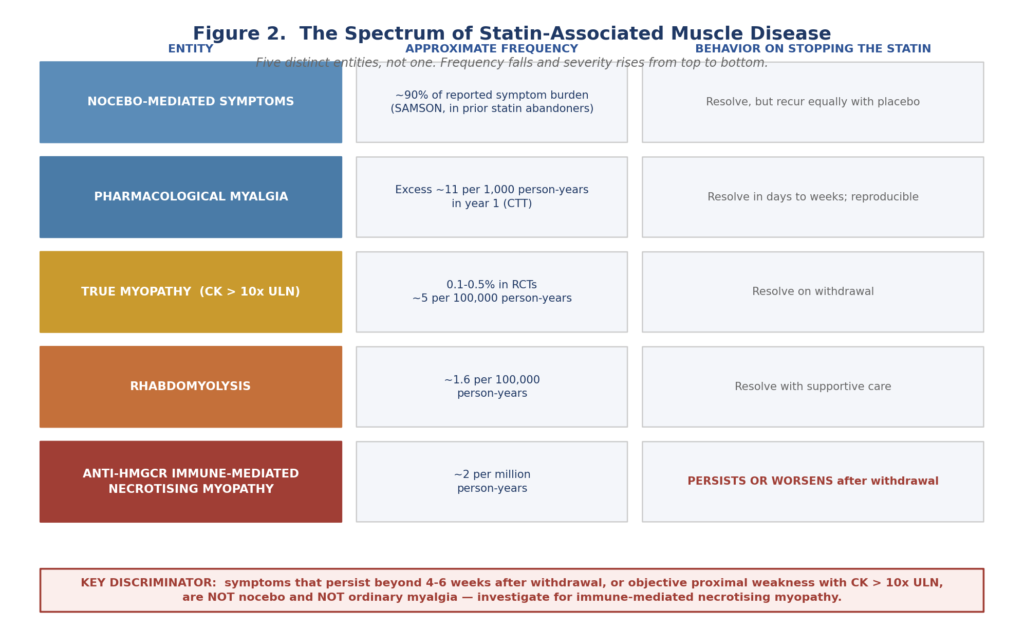
Abbildung 2. Das Spektrum der Statin-assoziierten Muskelerkrankung. Die Entitäten unterscheiden sich größenordnungsmäßig in ihrer Häufigkeit und grundlegend in ihrem Management. Das Verhalten nach dem Absetzen des Statins ist das nützlichste einzelne Unterscheidungsmerkmal am Krankenbett.
5.1 Diagnostische Definitionen
SAMS / Myalgie: subjektiver Muskelkmerz, Schmerzen, Steifheit, Druckempfindlichkeit oder Krämpfe, typischerweise symmetrisch und proximal, die Oberschenkel, Gesäß und Waden betreffen, ohne signifikante CK-Erhöhung3].
Aus diesem letzten Satz ergibt sich eine wichtige Schlussfolgerung, die in der Praxis häufig falsch angewendet wird. Die Kreatinkinase ist ein sensitiver Marker für eine Myofasernekrose, jedoch ein unempfindlicher Marker für leichte statinbedingte Muskelbeschwerden: Patienten können über schwere, tatsächlich behindernde Symptome berichten, während die CK-Werte vollständig innerhalb des Referenzbereichs liegen. Ein normaler CK-Wert macht daher eine anhand der CK definierte Myopathie und Rhabdomyolyse sehr unwahrscheinlich, schließt jedoch SAMS nicht aus, und er ist kein Beweis dafür, dass die Symptome des Patienten eingebildet sind oder dass das Statin nicht dafür verantwortlich ist. Die CK ist ein Test auf gefährliche Erkrankungen, kein Test darauf, ob eine Beschwerde real ist. Umgekehrt ist ein asymptomatischer CK-Anstieg häufig: In der STOMP-Studie stieg der CK-Wert bei 64,91 % der Patienten unter 80 mg Atorvastatin gegenüber dem Ausgangswert an, ohne dass damit ein Kraftverlust einherging.
Echte Myopathie: Muskelschwäche oder -schmerzen, begleitet von einem CK-Wert, der das Zehnfache des oberen Normwertes übersteigt. Die CTT-Schätzung entspricht etwa 5 Fällen pro 10.000 über einen Zeitraum von fünf Jahren behandelten Patienten (0,05%), und pharmakoepidemiologische Analysen ergeben etwa 5 Fälle pro 100.000 Personenjahre. Höhere Werte von 0,1–0,51 TP9T, die in älteren Übersichtsarbeiten zu Studien genannt werden, spiegeln weiter gefasste Falldefinitionen wider und sind mit keiner der beiden Schätzungen direkt vergleichbar [66].
Rhabdomyolyse rascher Skelettmuskelabbau mit massiver CK-Erhöhung, Hyperkaliämie, Myoglobinurie und akuter Nierenschädigung durch tubuläre Myoglobinzylinderobstruktion. In der bisher größten pharmakoepidemiologischen Analyse trat eine stationär behandlungsbedürftige Rhabdomyolyse bei einer Monotherapie mit Atorvastatin, Pravastatin oder Simvastatin bei etwa 0,44 pro 10.000 Personenjahren bzw. 4,4 pro 100.000 auf, wobei die Rates bei Cerivastatin und Statin-Fibrat-Kombinationen wesentlich höher waren [23]. Er tritt am häufigsten auf, wenn hochdosierte Statine mit potenten CYP3A4-Hemmern, Gemfibrozil oder Ciclosporin kombiniert werden.
5.2 Anti-HMGCR-immunvermittelte nekrotisierende Myopathie
Die Statin-assoziierte immunvermittelte nekrotisierende Myopathie (IMNM) verdient eine gesonderte und nachdrückliche Behandlung, da sie die einzige Statismuskelenerkrankung ist, die wirklich gefährlich ist, kein Nocebo-Effekt ist und übersehen wird, wenn alle Muskelbeschwerden Erwartungshaltungen zugeschrieben werden.
IMNM ist durch Autoantikörper gegen HMG-CoA-Reduktase selbst definiert, das pharmakologische Ziel des Arzneimittels. Der vorgeschlagene Mechanismus ist, dass eine Statinexposition heraufreguliert HMGCR Expression im sich regenerierenden Muskel Fasern, und treibt bei genetisch empfänglichen Personen eine anhaltende Autoimmunreaktion an, die unabhängig von einer weiteren Medikamentenexposition wird. Es wurde in der AHA/ACC-Multisociety-Leitlinie von 2018 als eigenständige, seltene Entität anerkannt [12,68]; dieser Leitfaden wurde im März 2026 zurückgezogen und ersetzt (Abschnitt 9.3).
Die gemeldete Inzidenz hängt von dem verwendeten Nenner ab, und beide Konventionen sind in der Literatur zu finden. In der unten beschriebenen multinationalen Kohorte betrug die mittlere jährliche Inzidenz 2,9 Fälle pro Million Personenjahre in der allgemeinen erwachsenen Bevölkerung und 20,4 (UK) bis 24,1 (Australien) Fälle pro Million Statinanwender und Jahr [67Ältere Schätzungen von etwa 2 pro Million Personenjahre beziehen sich auf die Allgemeinbevölkerung; Zahlen von 2–3 pro 100.000 Statin-behandelter Patienten beziehen sich auf Statin-Anwender. Der Nenner der Statin-Anwender ist der geeignete bei der Beratung eines Patienten, der das Medikament einnimmt, und der Nenner der Allgemeinbevölkerung unterschätzt das Risiko für diesen Patienten um das Etwa-Zehnfache.
Eine multinationale Kohorte von 109 Anti-HMGCR-positiven Fällen wies ein medianes Alter von 66 Jahren, einen Frauenanteil von 51% sowie eine Statinexposition bei 101 von 109 Patienten, wobei Atorvastatin etwa drei Viertel ausmachte, eine mediane Statineinnahmedauer von drei Jahren vor der Diagnose sowie einen medianen CK-Spitzenwert von 7.020 IE/l mit einer Spanne von 964 bis 39.076 IE/l. Etwa 7,5% der Anti-HMGCR-positiven Patienten hatten noch nie ein Statin eingenommen, was bestätigt, dass der Antikörper nicht ausschließlich arzneimittelinduziert ist [67].
Unterscheidung zwischen IMNM und SAMS am Krankenbett
- Schwäche dominiert den Schmerz. IMNM zeigt sich mit objektivierbarer proximaler Schwäche (Schwierigkeiten beim Aufstehen aus einem Stuhl, Treppensteigen, Überkoptheben), während sich SAMS mit Schmerzen und Steifigkeit bei erhaltener Kraft präsentiert.
- CK ist deutlich erhöht. Typische Werte liegen im Bereich von Tausenden bis Zehntausenden, im Gegensatz zu den normalen oder minimal erhöhten CK-Werten bei SAMS.
- Symptome halten an oder verschreiten nach Absetzen des Statins fort. Dies ist das entscheidende Merkmal. SAMS bildet sich innerhalb von Tagen bis Wochen nach dem Absetzen zurück; IMNM tut dies nicht.
- Die Diagnose erfordert eine Serologie und oft eine Histologie. Der Anti-HMGCR-Antikörpertest ist hochspezifisch. Das Muskel-MRT zeigt Ödeme, und die Biopsie zeigt Myofasernekrose und -regeneration mit spärlichem entzündlichem Infiltrat.
- Die Behandlung besteht aus Immunsuppression, nicht aus Beruhigung. Kortikosteroide mit intravenösen Immunglobulinen und einem steroidsparenden Mittel wie Methotrexat, Azathioprin oder Rituximab sind in der Regel erforderlich. Statine müssen dauerhaft vermieden werden.
Die breitere Differenzialdiagnose: Anti-SRP- und seronegative IMNM
Der Anti-HMGCR-Antikörper ist hier nicht der einzige serologisch relevante Marker, und ein negatives Ergebnis schließt eine nekrotisierende Myopathie nicht aus. Die IMNM wird üblicherweise in drei serologische Gruppen unterteilt: Anti-HMGCR-positiv, Anti-Signal-Recognition-Particle (Anti-SRP)-positiv und seronegativ. Etwa 60% der IMNM-Fälle weisen entweder Anti-HMGCR- oder Anti-SRP-Antikörper auf; die übrigen sind seronegativ und werden anhand einer Biopsie diagnostiziert [69,70].
- Anti-SRP-IMNM ist im Allgemeinen nicht Statin-assoziiert und neigt dazu, der aggressivere Phänotyp zu sein. Verglichen mit der Anti-HMGCR-Erkrankung führt sie häufiger zu schwerer Gliedmaßenschwäche, Nackenschwäche, Dysphagie, respiratorischer Insuffizienz und Muskelatrophie, und sie betrifft häufiger Organe außerhalb der Muskulatur, wobei sowohl eine Beteiligung des Herzens als auch eine interstitielle Lungenerkrankung häufiger auftreten. Das Erkrankungsalter ist typischerweise jünger [70].
- Anti-HMGCR-IMNM tritt häufiger ausschließlich mit Muskelschwäche und ohne extramuskuläre Beteiligung auf. Etwa 7,5% der Anti-HMGCR-positiven Patienten sind Statin-naiv, und Statin-naive Fälle unterscheiden sich etwas von den statinassoziierten Fällen, da sie häufiger bei jüngeren Patienten auftreten und höhere Dysphagie-Raten aufweisen.
- Seronegative IMNM wird diagnostiziert, wenn beide Antikörper fehlen, aber die Biopsie das charakteristische Muster von verstreuten Myofasernekrosen, Regeneration und Makrophagen-dominanter, pauci-lymphozytärer Entzündung zeigt. Sie ist vermehrt mit einer zugrunde liegenden Malignität assoziiert, sodass ein negatives Antikörperpanel eher zu einer Biopsie und einem altersgerechten Krebsscreening als zur Beruhigung veranlassen sollte71].
Trotz Behandlung sind die Ergebnisse häufig unvollständig. In der multinationalen Kohorte wiesen bei der Nachuntersuchung weniger als die Hälfte der Patienten einen normalen CK-Wert (47,61 TP9T) oder eine normale Muskelkraft (46,21 TP9T) auf, und 45,71 TP9T hatten intravenöses Immunglobulin erhalten [67Dieser therapierefraktäre Verlauf ist das deutlichste Argument dafür, die Erkrankung frühzeitig zu erkennen.
Die folgende praktische Regel ist unkompliziert: Jeder Patient mit proximaler Schwäche, einem CK-Wert, der das Zehnfache der oberen Normgrenze überschreitet, oder Muskelsymptomen, die sich innerhalb von vier bis sechs Wochen nach dem Absetzen des Statins nicht zurückbilden, sollte auf eine nekrotisierende Myopathie untersucht werden, anstatt bezüglich der Nocebo-Effekt. Wenn anti-HMGCR negativ ist und der Verdacht weiterhin besteht, sind anti-SRP-Tests und eine Muskelbiopsie die nächsten Schritte, keine Entlassung.
6. Relatives Muskeltoxizitätsprofil und nicht-muskuläre Nebenwirkungen
| Arzneistoffklasse | Muskeltoxizität in kontrollierten Studien | Mechanistische Grundlage | Wichtigste nicht-muskuläre Nebenwirkungen |
| PCSK9-Therapeutika (Evolocumab, Alirocumab, Inclisiran, Enlicitid) | Nicht über Placebo erhöht | Extrazelluläre Neutralisierung oder GalNAc-gerichtete Hepatozytenaufnahme; kein identifiziertes intrazelluläres Myozytenziel | Reaktionen an der Injektionsstelle 2–5%; vorübergehende Nasopharyngitis; neurokognitive Ereignisse in der Häufigkeit wie unter Placebo (EBBINGHAUS) [72] |
| ACL-Inhibitore (Bempedoinsäure) | Nicht über Placebo erhöht | Die Prodrug-Aktivierung erfordert ACSVL1, das in der Skelettmuskulatur nicht nachweisbar ist. | Hyperurikämie und Gicht; reversibler Kreatininanstieg; Cholelithiasis; Sehnenruptur; Erhöhung der Leberenzyme |
| NPC1L1-Inhibitoren (Ezetimib) | Kein Anstieg gegenüber Placebo. (In der GAUSS-3-Phase B berichteten 28,81 TP9T der mit Ezetimib behandelten Patienten über Muskelsymptome, und 6,81 TP9T brachen die Behandlung deswegen ab; diese Phase hatte keinen Placebo-Arm und umfasste eine ausgewählte Population mit Multistatin-Unverträglichkeit, und die placebokontrollierten Daten zeigen keinen Anstieg.) | Darm-Zielstruktur; Wirkstoff und Glucuronid zirkulieren zwar, aber es wurde kein Zielort im Skelettmuskel identifiziert | Leichte Magen-Darm-Beschwerden 1–2%, mit einer Häufigkeit auf Placebo-Niveau |
| ANGPTL3-Inhibitoren (Evinacumab) | Nicht über Placebo erhöht | Extrazelluläres Proteinziel; kein identifiziertes intrazelluläres Myozytenziel | Infusionsbedingte Reaktionen und Überempfindlichkeit ≈ 6%; Nasopharyngitis; grippeähnliche Symptome |
| Statine (alle Wirkstoffe) | Geringer, aber statistisch realer Überschuss gegenüber Placebo, der sich weitgehend auf das erste Jahr beschränkt | Nicht verschont: Eine intrazelluläre HMG-CoA-Reduktase-Inhibition findet in Myozyten statt | Neu auftretender Diabetes (dosisabhängig); Transaminasenanstieg; seltene autoimmune Hepatitis; seltene IMNM |
Tabelle 6. Relatives Muskeltoxizitätsoprofil der lipidsenkenden Wirkstoffklassen. Die Klassen werden als beschreibende Kategorien statt als ordinale Rangfolge dargestellt, da sich die Nicht-Statin-Mittel weder zuverlässig voneinander noch von Placebo hinsichtlich der Muskelendpunkte unterscheiden lassen und eine nummerierte Hierarchie eine Präzision implizieren würde, die die Daten nicht hergeben. Die Statin-Zeile wird bewusst nicht nach Lipophilie unterteilt; die Begründung ist in Abschnitt 6.4 angegeben. Das mit Statinen als Klasse verbundene überschüssige Muskelrisiko ist in absoluten Zahlen gering – etwa 11 Ereignisse pro 1.000 Personenjahre im ersten Jahr – und sollte nicht allein deshalb als groß interpretiert werden, weil es nicht Null ist.
Tabelle 6 gruppiert Wirkstoffe nach Klassen. Da der klinisch sinnvolle Vergleich oft zwischen spezifischen Wirkstoffen und nicht zwischen Klassen stattfindet, ist dieselbe Information nachfolgend auf Ebene der Wirkstoffe dargestellt. Zwei Größen werden bewusst getrennt, da deren Vermischung die Ursache für die Meisten der überzeugten, aber unbelegten Ratschläge zur Wirkstoffauswahl auf diesem Gebiet ist. Die erste Spalte fragt, ob ein Wirkstoff in verblindeten Studien mehr Muskelsymptome als Plazebo verursacht; unter den Statinen ist die Antwort, dass sie sich nicht zuverlässig voneinander unterscheiden lassen, was auch die Auswertung der individuellen Patientendaten der CTT-Gruppe ergab. Die zweite Spalte fragt, welche Patienten bei einem bestimmten Wirkstoff ein erhöhtes Risiko für eine echte, durch Wechselwirkungen oder Genetik bedingte Myopathie haben; hier unterscheiden sich die Wirkstoffe erheblich und vorhersehbar. Eine einzige geordnete Rangliste würde die beiden verwischen.
| Agent | Muskelsymptome im Vergleich zu Plazebo in verblindeten Studien | Interaktions- und genotypvermitteltes Myopathierisiko |
| PCSK9-Monoklonale Antikörper (Evolocumab, Alirocumab) | Nicht erhöht | Kein identifiziertes intrazelluläres Myozytenziel; nicht zutreffend |
| Inclisiran | Nicht erhöht | GalNAc-gesteuerte Hepatozytenaufnahme; nicht zutreffend |
| Enlicitid | Nicht erhöht im CORALreef-Programm | Zirkulierendes Proteinziel; nicht zutreffend |
| Ezetimib | Nicht erhöht in placebokontrollierten Daten (siehe die Einschränkung in Tabelle 6 bezüglich GAUSS-3 Phase B) | Enterozyten-lokale Wirkung; nicht zutreffend |
| Bempedoinsäure | Nicht erhöht, auch nicht in CLEAR Outcomes | ACSVL1 erforderlich für die Aktivierung und in Muskeln nicht nachweisbar; nicht zutreffend |
| Evinacumab | Nicht erhöht | Extrazelluläres Proteinziel; nicht zutreffend |
| Pitavastatin | Nicht zuverlässig von anderen Statinen zu unterscheiden | Gering: minimaler CYP450-Stoffwechsel; Ciclosporin kontraindiziert |
| Pravastatin, Fluvastatin | Nicht zuverlässig von anderen Statinen zu unterscheiden | Gering: Nicht-CYP3A4-Disposition; CYP2C9 relevant für Fluvastatin |
| Rosuvastatin | Nicht zuverlässig von anderen Statinen zu unterscheiden | Gering bis mäßig: ABCG2 Varianten erhöhen die Exposition; Dosisobergrenzen bei Personen asiatischer Abstammung |
| Atorvastatin, Lovastatin | Nicht zuverlässig von anderen Statinen zu unterscheiden | Moderate: CYP3A4-vermittelte Wechselwirkungen; SLCO1B1 Zwischenprodukt für Atorvastatin |
| Simvastatin, insbesondere in der Dosierung von 80 mg | Nicht zuverlässig von anderen Statinen zu unterscheiden | Die stärkste unter den vermarkteten Statinen: am stärksten SLCO1B1 Signal plus ausgedehnter CYP3A4-Stoffwechsel; 80 mg nicht mehr empfohlen |
| Cerivastatin | Zurückgezogen 2001 | Inakzeptable Rate an tödlicher Rhabdomyolyse, insbesondere mit Gemfibrozil |
Tabelle 7. Muskuläre Effekte auf Wirkadebene, wobei gemeldete Symptome und das mechanistische Myopathierisiko in separaten Spalten aufgeführt sind. Die erste Spalte spiegelt verblindete randomisierte Daten wider, in denen sich kein Statin hinsichtlich der Inzidenz von Muskelsymptomen verlässlich von einem anderen unterscheiden lässt; die dortigen Einträge sollten nicht als Ranking verstanden werden. Die zweite Spalte spiegelt die pharmakokinetische und pharmakogenomische Exposition wider, bei der sich die Wirkstoffe tatsächlich unterscheiden und bei der eine Wirkstoffauswahl rational begründet werden kann. Die Nicht-Statin-Wirkstoffe liegen in der ersten Spalte auf Placeboniveau und keiner lässt sich verlässlich von den anderen unterscheiden.
6.1 Bempedoinsäure: Off-Target-Effekte
- Hyperurikämie und Gicht. Die kompetitive Hemmung des renalen OAT2-Transporters verringert die Harnsäureausscheidung, wodurch der Harnsäurespiegel im Serum innerhalb von etwa vier Wochen nach Therapiebeginn ansteigt. In der CLEAR-Outcomes-Studie traten bei 3,11 TP9T der mit Bempedoinsäure behandelten Patienten Gichtanfälle auf, gegenüber 2,11 TP9T in der Placebo-Gruppe [40Patienten mit Gicht in der Anamnese haben ein erhöhtes Risiko für rezidivierende Anfälle und erfordern eine Harnsäurenüberwachung.
- Reversible Kreatininerhöhung. Die OAT2-Inhibition verringert auch die tubuläre Kreatininausskretion, was zu geringfügigen durchschnittlichen Anstiegen des Serumkreatinins und entsprechenden bescheidenen Rückgängen der geschätzten glomeruläre Filtration Diese Veränderungen stabilisieren sich frühzeitig, bilden sich nach Absetzen vollständig zurück und spiegeln eine Transporterkonkurrenz anstelle einer strukturellen Nierenschädigung wider. Sie sollten nicht als Nephrotoxizität missinterpretiert werden.
- Sehnenriss. Es wurde eine erhöhte Häufigkeit von Sehnenrissen beobachtet, die vorwiegend die Achillessehne, die Rotatorenmanschette oder die Bizepssehne betrafen. Die Raten lagen bei 0,51 TP9T gegenüber 0,1 TP9T in den Studien zur primären Hypercholesterinämie und bei 1,21 TP9T gegenüber 0,91 TP9T in der CLEAR-Outcomes-Studie, sodass die absolute Inzidenz bei behandelten Patienten über das gesamte Programm hinweg bei etwa 11 TP9T oder darunter liegt und der auf das Medikament zurückzuführende Anstieg noch geringer ist. Das Signal ist real, aber selten, und es sollte den Patienten in diesem Sinne vermittelt werden und nicht als herausragendes Risiko dargestellt werden. Der vorgeschlagene Mechanismus beinhaltet eine veränderte extrazelluläre Matrix und den Kollagenumsatz in Tenozyten. Zu den Risikofaktoren gehören ein Alter über 60 Jahre, eine gleichzeitige Therapie mit Corticosteroiden oder Fluorchinolonen, eine Niereninsuffizienz und eine bereits bestehende Tendinopathie [26,41].
- Cholelithiasis und Erhöhung der Leberenzyme. Beide nahmen in CLEAR Outcomes zu und erfordern Aufmerksamkeit, obwohl keines von beiden üblicherweise ein Absetzen erfordert.
6.2 Statinininduzierter Neuerkrankungsdiabetes
Statine führen zu einem moderaten, dosisabhängigen Anstieg der Diabetes-Neudiagnosen. Die Metaanalyse der individuellen Teilnehmerdaten der ’Cholesterol Treatment Trialists’ Collaboration“ aus dem Jahr 2024, die sich auf dieselbe Studienpopulation stützte wie die Analyse der Muskelsymptome, hat dies genau quantifiziert. Der proportionale Anstieg neu auftretender Diabetesfälle betrug 10% bei einer Statintherapie mit geringer oder mäßiger Intensität (1,3% pro Jahr gegenüber 1,2% pro Jahr unter Placebo) und 36% bei einer Therapie mit hoher Intensität (4,81 TP9T gegenüber 3,51 TP9T pro Jahr) [73].
Zwei Befunde relativieren dies. Erstens handelt es sich bei dem zugrunde liegenden Effekt eher um eine sehr geringe Verschiebung der Glykämie nach oben als um einen ausgeprägten diabetogenen Prozess: Unter den Teilnehmern ohne Diabetes zu Studienbeginn war der Mittelwert Glucose stieg um 0,04 mmol/L und der mittlere HbA1c-Wert um 0,06% bei einer Therapie mit geringer oder mittlerer Intensität sowie um 0,08% bei einer Therapie mit hoher Intensität. Zweitens – und das ist für die Beratung am wichtigsten – konzentriert sich der Anstieg überproportional auf Personen, die sich bereits nahe an der Diagnoseschwelle befanden. Unter den Teilnehmern mit einem Ausgangswert für den Blutzucker traten etwa 621 TP9T der neu diagnostizierten Diabetesfälle bei denjenigen auf, die bereits im obersten Viertel der Ausgangsverteilung lagen. Das ist zwar eine klare Mehrheit, aber nicht der gesamte Anstieg: Etwa zwei von fünf Neudiagnosen traten außerhalb des obersten Quartils auf. Der Effekt lässt sich daher besser als eine Verschiebung von Personen beschreiben, die sich bereits der Schwelle näherten und diese überschritten, als als die Entstehung von Diabetes bei metabolisch gesunden Menschen – wobei zu berücksichtigen ist, dass eine Minderheit der Fälle bei niedrigeren Ausgangsblutzuckerwerten auftritt.
Ein weiterer Vorbehalt schränkt ein, wie weit die absoluten Zahlen übertragbar sind. Die Untersucher stellten fest, dass die Höhe des absoluten Überschusses wesentlich davon abhing, wie häufig die Glykämie in den beitragenden Studien gemessen wurde, da neue Diagnosen nur dann gezählt werden, wenn jemand nach ihnen sucht. Die relativen Schätzungen sind die besser übertragbaren Größen; absolute Zahlen pro 1.000 für Diabetes sollten Patienten als Annäherungen präsentiert werden, die an ein bestimmtes Erfassungsschema gebunden sind, und nicht als feste Raten [73].
Genetische Beweise deuten darauf hin, dass dieser Effekt zielgerichtet ist und keine idiosynkratische Arzneistofftoxizität darstellt. Mendelsche Randomisierung Analyse unter Verwendung gemeinsamer Varianten in HMGCR (rs17238484 und rs12916) als lebenslange Stellvertreter für die Hmg-CoA-Reduktase-Inhibition ergaben, dass Träger von LDL-senkenden Allelen ein moderat höheres Körpergewicht aufwiesen, Taillenumfang, Plasmaglukose und Insulin, und ein höheres Risiko für Typ-2-Diabetes, was die in den randomisierten Statin-Studien beobachtete Wirkung genau widerspiegelt. Die Autoren schlossen daraus, dass das unter Statinen beobachtete erhöhte Diabetesrisiko zumindest teilweise durch die HMGCR-Inhibition selbst erklärt wird80].
Eine weitere Beobachtung erschwert den Versuch, dies als statinspezifische Haftung darzustellen. Varianten in PCSK9 dass niedrigeres LDL-C auch mit einem mäßig erhöhten Diabetesrisiko einhergeht, wie dies auch bei LDL-senkenden Varianten im Allgemeinen der Fall ist7,8,91Dies bleibt eine Schlussfolgerung aus der Genetik Epidemiologie und wurde durch Ergebnistudien zu den Nicht-Statin-Wirkstoffen nicht bestätigt, sollte aber jeden Hinweis dämpfen, dass die PCSK9-Inhibition eine stoffwechselneutrale Alternative darstellt.
Unter Teilnehmern mit vorbestehendem Diabetes relatives Risiko sich verschlechternd Blutzuckereinstellung war 1,10 bei Therapie mit niedriger oder mäßiger Intensität und 1,24 bei hochintensivem Vorgehen. Die Prüfärzte betonten, dass jegliche unerwünschte kardiovaskuläre Folge dieser Glykämieveränderungen bereits vollständig im Netto-Kardiovaskulärvorteil erfasst ist, der in denselben Studien beobachtet wurde. Die angemessene Reaktion ist eine Blutzuckerkontrolle, kein Vorenthalten von Statinen.
6.3 Leberwirkungen, einschließlich seltener Autoimmunhepatitis
Ein asymptomatischer Anstieg der Transaminasen tritt bei etwa 0,5–2% der Statin-Patienten auf, ist in der Regel vorübergehend und rechtfertigt bei asymptomatischen Patienten keine routinemäßige Überwachung der Leberwerte. Eine klinisch signifikante Statin-Hepatotoxizität ist selten.
Eine eigenständige und wesentlich seltenere Entität ist die Statin-induzierte arzneimittelinduzierte autoimmune Hepatitis (DIAIH), die klinisch und histologisch der ideopathischen autoimmunen Hepatitis gleicht. Sie wurde in Fallberichten und Fallserien für Atorvastatin, Rosuvastatin und andere Wirkstoffe dokumentiert, und eine 2024 veröffentlichte Pharmakovigilanz-Analyse des Meldesystems für unerwünschte Ereignisse der FDA identifizierte positive Signale für autoimmune Hepatitis bei allen sieben auf dem Markt befindlichen Statinen [75]. Das klinische Bild kann Gelbsucht, Müdigkeit, deutliche Transaminasenanstiege sowie positive antinukleäre Antikörper oder Antikörper gegen glatte Muskulatur umfassen, obwohl auch seronegative Fälle vorkommen. Der Beginn reicht von zwei Monaten bis zu mehreren Jahren nach Beginn der Einnahme [76].
Die klinische Parallele zur IMNM ist lehrreich und verdient es, explizit genannt zu werden: Bei beiden Erkrankungen scheint ein Statin einen Autoimmunprozess auszulösen, der nach dem Absetzen des Medikaments anhalten kann und eher eine Immunsuppression als ein einfaches Absetzen erfordert. Beide sind selten. Keine von beiden ist ein Nocebo. Es muss betont werden, dass es keine verlässliche Inzidenzschätzung für die Statin-induzierte DIAIH gibt, da die Evidenzbasis aus Fallberichten und Disproportionalitätssignalen statt aus Kohortendaten besteht und Disproportionalitätssignale eher Melde muster als die wahre Häufigkeit widerspiegeln. Im Kontext der enormen globalen Exposition gegenüber Statinen bleibt eine klinisch manifeste schwere Leberschädigung, nach der Einschätzung der NIH-LiverTox-Monographie, außerordentlich selten [74].
6.4 Sagt Lipophilie das Muskelrisiko voraus? Eine qualifizierte Antwort
Es wird häufig behauptet, dass lipophile Statine ein wesentlich höheres Risiko für Muskelsymptome aufweisen als hydrophile Statine, da die passive Diffusion in die Myozyten größer ist. Diese Übersicht übernimmt diese Hierarchie bewusst nicht, und die Gründe dafür sollten transparent dargelegt werden.
Die biologische Begründung ist stichhaltig. Lipophile Wirkstoffe dringen tatsächlich stärker in extrahepatisches Gewebe ein, was eine plausible Ursache für eine Schädigung der Myozyten darstellt. Die derzeitige randomisierte Evidenz hat jedoch keine konsistenten, klinisch bedeutsamen Unterschiede zwischen hydrophilen und lipophilen Statinen hinsichtlich der Muskelsymptome nachgewiesen. Eine 2018 veröffentlichte systematische Übersichtsarbeit und Metaanalyse ergab, dass Statine das SAMS insgesamt nur geringfügig erhöhten (relatives Risiko 1,05, 95%-Konfidenzintervall 1,014–1,089), und dass lipophile Statine im Vergleich zu hydrophilen Formulierungen keinen nennenswerten Einfluss auf die Entwicklung von SAMS hatten [77]. Eine im Jahr 2022 veröffentlichte Netzwerk-Metaanalyse von doppelblinden, randomisierten Studien fand ebenfalls keinen statistisch signifikanten Unterschied zwischen einzelnen Statinen hinsichtlich der Inzidenz von Muskelsymptomen [78]. Die CTT-Analyse der individuellen Teilnehmerdaten aus dem Jahr 2022, der größte und strengste verfügbare Datensatz, ergab keine Hinweise darauf, dass das Risiko von Muskelsymptomen zwischen den verschiedenen Statinen variierte [65].
Zwei weitere Beweisquellen sind hierfür von unmittelbarer Bedeutung. SATURN-Studie randomisierte 1.385 Patienten mit koronarer Herzkrankheit auf Rosuvastatin 40 mg (hydrophil) oder Atorvastatin 80 mg (lipophil) über 104 Wochen – einen direkten Vergleich der beiden Klassen in Maximaldosis – und fanden eine vergleichbare Verträglichkeit ohne Hinweis auf eine unterschiedliche Muskeltoxizität [47Unabhängig davon zeigte die in Abschnitt 4.3 besprochene randomisierte Evidenz zu Fatigue negative Auswirkungen auf die Energie und anstrengungsbedingte Erschöpfung bei Pravastatin, einem hydrophilen Wirkstoff, sowie bei Simvastatin.
Drei weitere Überlegungen sprechen gegen eine einfache Hierarchie. Erstens ist Pitavastatin lipophil, weist jedoch eines der geringsten interaktionsbedingten Myopathierisiken aller Statine auf, da es kaum durch CYP450-Enzyme metabolisiert wird; Lipophilie und klinisches Risiko entkoppeln sich daher. Zweitens ist das stärkste echte Arzneistoff-spezifische Signal keineswegs die Lipophilie, sondern das SLCO1B1 pharmakogenomische Wechselwirkung mit Simvastatin, die in Abschnitt 8 erörtert wird. Drittens sind Dosis und Intensität konsistentere Prädiktoren als die Löslichkeitsklasse: Die CTT-Analyse ergab für das erste Jahr ein relatives Risiko von 1,11 (95 %-Konfidenzintervall 1,05–1,17) im ersten Jahr bei intensiveren Therapien im Vergleich zu Placebo, gegenüber 1,07 (1,04–1,10) bei der Statintherapie insgesamt.
Diesen Ausführungen liegt eine Unterscheidung zugrunde, die in Diskussionen über Statinunverträglichkeit regelmäßig verwischt wird und die es wert ist, explizit ausgesprochen zu werden: Ein mechanistischer Unterschied ist kein klinisches Ergebnis. Dass lipophile Wirkstoffe eine größere extrahepatische Gewebepenetration erreichen, ist eine gesicherte pharmakologische Tatsache. Ob dieser Unterschied einen messbaren Unterschied in der Häufigkeit, mit der Patienten über Muskelsymptome berichten, bewirkt, ist eine separate empirische Frage, die nur durch einen kontrollierten Vergleich beantwortet werden kann, und die kontrollierten Vergleiche zeigen keinen solchen. Ein plausibler Mechanismus ist ein Hypothesengenerator, kein Wirksamkeitsnachweis, und die Lücke zwischen den beiden ist genau der Ort, an dem eine große Menge an zuversichtlichen, aber ungestützten Verordnungsempfehlungen auf diesem Gebiet ihren Ursprung hat.
Die klinisch vertretbare Formulierung lautet daher wie folgt: Der Wechsel von einem lipophilen zu einem hydrophilen Statin ist bei einem Patienten, der einen bestimmten Wirkstoff nicht vertragen hat, eine sinnvolle und häufig erfolgreiche individuelle Strategie, sollte jedoch eher als empirischer „Trial-and-Error“-Ansatz denn als vorhersehbare Risikoreduktion dargestellt werden. Was das Risiko verlässlich verringert, ist eine Dosissenkung, das Vermeiden von wechselwirkenden Medikamenten und das Vermeiden von hochdosiertem Simvastatin.
7. Epidemiologie berichte Muskelsymptome und das Nocebo-Phänomen
Ein hartnäckiges Paradoxon prägt dieses Fachgebiet. In offenen Beobachtungsregistern und in der Routinepraxis berichten 10–20% der Patienten über Muskelsymptome, und viele brechen die Therapie ab. In doppelblinden, randomisierten Studien ist der Unterschied zwischen Statinen und Placebo hingegen sehr gering. Vier Evidenzgruppen lösen dieses Paradoxon auf und bilden zusammen einen der elegantesten Nachweise für den Nocebo-Effekt in der modernen Medizin [81].
Anmerkung zu den beiden in diesem Bereich am häufigsten zitierten Zahlen: SAMSONs “90%” und die Angabe “eins zu fünfzehn” der CTT sind nicht identisch. Sie stammen von unterschiedlichen Populationen, unterschiedlichen Messwerten und unterschiedlichen Studiendesigns ab, und keines validiert das andere.
Da diese Zahlen so häufig vermischt werden, lohnt es sich, den Unterschied darzulegen, bevor eine davon besprochen wird. Das SAMSON-Nocebo-Verhältnis von 0,90 beschreibt den Anteil des durch die Einnahme einer Tablette verursachten Anstiegs der Symptomintensität, der durch eine inerte Tablette reproduziert wurde. Es wurde bei 60 Patienten gemessen, die Statine bereits wegen Nebenwirkungen abgesetzt hatten – einem bewusst extremen Phänotyp –, unter Verwendung einer kontinuierlichen täglichen Symptomskala und, was entscheidend ist, einer Kontrollbedingung ohne Tablette, die den meisten Studien fehlt. Der CTT-Wert von eins zu fünfzehn beschreibt den Anteil der gemeldeten Muskelkraftsymptom-Ereignisse im ersten Behandlungsjahr, der dem Statin statt Hintergrundursachen zuzuordnen ist, gemessen bei 123.940 Teilnehmern in allgemeinen Studienpopulationen durch Vergleich der Ereignisanzahlen mit Placebo.
Das eine ist ein Verhältnis der Zunahme der Symptomintensität bei symptomempfänglichen Patienten; das andere ist ein zurechenbarer Anteil der Ereignisberichte in einer nicht ausgewählten Population. Dass sie zu weitgehend übereinstimmenden Schlussfolgerungen gelangen – nämlich, dass die große Mehrheit der gemeldeten Muskelbeschwerden unter Statinen nicht durch das Medikament verursacht wird –, ist wissenschaftlich gerade deshalb bedeutsam, weil sich die Studienkonzepte so grundlegend unterscheiden. Doch die numerische Nähe von 90% und vierzehn Fünfzehntel ist ein rein rechnerischer Zufall und keine Replikation. Keine der beiden Zahlen sollte so zitiert werden, als würde sie die andere bestätigen, und keine sollte auf eine Population angewendet werden, die sich von derjenigen unterscheidet, in der sie gemessen wurde.
7.1 Die Meta-Analyse der Cholesterol Treatment Trialists’ Collaboration (2022)
Der CTT-Zusammenarbeit führte eine Metaanalyse individueller Teilnehmerdaten von 23 groß angelegten doppelblinden, randomisierten Studien durch, die 19 plazebokontrollierte Studien mit 123.940 Teilnehmern sowie 4 weitere Studien zu intensiverer versus weniger intensiver Behandlung mit 30.724 Teilnehmern umfassten, veröffentlicht in The Lancet im August 202265].
Über eine gewichtete durchschnittliche Median-Nachbeobachtungszeit von 4,3 Jahren berichteten 16.835 Teilnehmer der Statin-Gruppe (27,1%) über Muskelschmerzen oder -schwäche, gegenüber 16.446 Teilnehmern der Placebo-Gruppe (26,6%), was einem Ratenverhältnis von 1,03 (95%-KI 1,01–1,06) entspricht. Der Überschuss beschränkte sich fast ausschließlich auf das erste Behandlungsjahr, in dem die Statintherapie einen relativen Anstieg von 7% bewirkte (Ratenverhältnis 1,07, 95%-KI 1,04–1,10) hervorrief, was einem absoluten Überschuss von 11 Ereignissen (95%-KI 6–16) pro 1.000 Personenjahre entspricht. Nach dem ersten Jahr war kein signifikanter Anstieg mehr festzustellen (Ratenverhältnis 0,99, 95%-KI 0,96–1,02).
Die Forscher drückten diese Schlussfolgerung rechnerisch aus: Nur eine von fünfzehn muskelbezogenen Meldungen bei den Teilnehmern, denen eine Statintherapie zugewiesen worden war, war tatsächlich auf das Statin zurückzuführen. Bei intensiveren Therapien betrug das Ratenverhältnis gegenüber Placebo 1,08 (95%-KI 1,04–1,13) über alle Jahre hinweg, wobei sie im ersten Jahr auf 1,11 (95%-KI 1,05–1,17) anstieg, sodass der zurechenbare Anteil bei hoher Intensität auf etwa einen von zehn ansteigt. Bei beiden Zahlen handelt es sich um Vergleiche mit Placebo; die vier Studien, in denen eine intensivere Therapie direkt gegen eine weniger intensive randomisiert wurde, ergaben ein Ratenverhältnis von 1,05 (95%-KI 0,99–1,11), und die beiden Vergleiche sollten nicht miteinander verwechselt werden. Muskelkrämpfe, in der Praxis ein sehr häufiger Grund für den Abbruch der Behandlung, wiesen nur einen absoluten Unterschied von 0,2% auf und stehen nicht in einem signifikanten Zusammenhang mit Statinen. Bemerkenswert ist, dass es keine Hinweise darauf gab, dass das Risiko zwischen den einzelnen Statinen variierte.
7.2 Die SAMSON-Studie (2020)
SAMSON (Self-Assessment Method for Statin Side-effects Or Nocebo), veröffentlicht in der New England Journal of Medicine im November 2020 mit vollständigen Daten im Journal of the American College of Cardiology im Jahr 2021 wurden 60 Patienten eingeschlossen, die von 17 britischen Überweisungszentren und durch Selbsteinweisung rekrutiert worden waren und die alle zuvor Statine aufgrund von Nebenwirkungen abgesetzt hatten, die innerhalb von zwei Wochen nach Beginn aufgetreten waren. Dies ist bewusst die am stärksten zu Symptomen neigende Population, die man erhalten kann5,6].
Design
SAMSON verwendete ein doppelt blindes, randomisiertes N-of-1-Design über 12 aufeinanderfolgende Monate. Jeder Teilnehmer erhielt 12 monatliche Medizinfläschchen in randomisierter Reihenfolge: vier mit Atorvastatin 20 mg täglich, vier mit entsprechendem Placebo und vier leere. Die Monate mit den leeren Fläschchen stellen die methodische Innovation dar, da sie das Hintergrund-Symptomniveau jedes Patienten völlig ohne Tabletten ermitteln. Die Teilnehmer zeichneten die tägliche Symptomintensität auf einer Smartphone-Anwendung auf einer kontinuierlichen Skala von 0 (symptomfrei) bis 100 (schlimmster ausdenkbarer Zustand) auf und konnten die Tabletten des jeweiligen Monats absetzen, wenn die Symptome unerträglich wurden.
Ergebnisse
Sechzig Teilnehmer wurden randomisiert, und 49 schlossen das gesamte 12-monatige Protokoll ab. Die mittlere Symptomintensität betrug 8,0 in den Monaten ohne Tabletten (95%-KI 4,7–11,3), 15,4 in den Placebo-Monaten (95%-KI 12,1–18,7; P < 0,001 im Vergleich zu den Monaten ohne Tabletten) und 16,3 während der Statin-Monate (95%-KI 13,0–19,6; P < 0,001 im Vergleich zu den Monaten ohne Tabletten). Der Unterschied zwischen den Monaten mit Statin und den Placebo-Monaten war nicht signifikant (P = 0,388).
Das Nocebo-Verhältnis, definiert als die Symptomintensität unter Placebo minus die Symptomintensität ohne Tablette, geteilt durch die Symptomintensität unter Statin minus die Symptomintensität ohne Tablette, betrug 0,90. Neunzig Prozent der durch die Einnahme einer Statintablette verursachten Symptombelastung wurden durch die Einnahme einer Placebotablette reproduziert.
Der Vollständigkeit halber sei auf einen methodischen Vorbehalt hingewiesen. Die ursprünglich festgelegte Primäranalyse ergab ein Nocebo-Verhältnis von 2,2 mit einem 95% Vertrauensbereich von −62,3 bis 66,7, eine instabile Schätzung, die dadurch entstand, dass bei einigen Personen der Nenner (Statin minus keine Tablette) sehr klein oder negativ war. Ein unabhängiger Statistiker empfahl, die Daten einzelner Teilnehmer vor der Berechnung des Verhältnisses zusammenzulegen, was den berichteten Wert von 0,90 ergab. Dies ist eine legitime und transparent berichtete Analyseentscheidung, aber die Leser sollten verstehen, dass die Hauptzahl aus der überarbeiteten statt aus der ursprünglichen Analyse stammt.
Tablettenabbrüche aufgrund unerträglicher Symptome traten 71-mal auf: 31-mal während der Plazebomonate und 40-mal während der Statinmonate, ein nicht signifikanter Unterschied. Plazebotabletten wurden daher fast ebenso häufig abgesetzt wie das Verum. Bei der Sechs-Monats-Nachuntersuchung, nachdem den Teilnehmern individualisierte Diagramme ihrer eigenen Symptomwerte über die drei Bedingungen hinweg gezeigt worden waren, hatten 30 der 60 Teilnehmer die Statineinnahme erfolgreich wieder aufgenommen.
7.3 Die StatinWISE-Studie (2021)
StatinWISE, veröffentlicht im BMJ im Februar 2021 wurde SAMSON in der Primärversorgung in größerem Maßstab unabhängig repliziert. Es umfasste eine Serie von 200 randomisierten, doppelblinden N-of-1-Studien bei Patienten, die aufgrund von Muskelsymptomen ein Absetzen erwogen, wobei Atorvastatin 20 mg im Vergleich zu Placebo über sechs zweimonatige Zeiträume eingesetzt wurde [82].
Von 200 Teilnehmern flossen 151 (75,5%) in die Primäranalyse ein. Es gab keinen Unterschied bei den Muskel-Symptom-Scores zwischen den Statin- und den Placebo-Phasen (mittlere Differenz −0,11, 95%-KI −0,36 bis 0,14; P = 0,40). Ein Studienabbruch aufgrund unerträglicher Muskelsymptome erfolgte bei 9% während der Statin-Phasen und bei 7% während der Placebo-Phasen. Zwei Drittel der Teilnehmer, die die Studie vollständig absolvierten, entschieden sich für eine Wiederaufnahme der Statintherapie. Die Übereinstimmung zweier unabhängig voneinander durchgeführter n-of-1-Programme hinsichtlich derselben Schlussfolgerung stärkt die Schlussfolgerung erheblich.
7.4 ASCOT-LLA: verblindet versus unverblindet (2017)
Die überzeugendsten bevölkerungsweiten Belege stammen aus einem natürlichen Experiment innerhalb einer einzigen Studie. In der ASCOT-LLA-Studie wurden Patienten in einer verblindeten Phase nach dem Zufallsprinzip entweder Atorvastatin 10 mg oder einem Placebo zugeteilt und anschließend in einer nicht verblindeten Verlängerungsphase weiterbehandelt, in der Patienten und Ärzte wussten, wer ein Statin einnahm.
Während der verblindeten, randomisierten Phase gab es unter Atorvastatin keinen signifikanten Anstieg muskelbezogener unerwünschter Ereignisse. Während der offenen Verlängerungsphase traten muskelbezogene unerwünschte Ereignisse bei Statin-Anwendern (161 Ereignisse, 1,26% pro Jahr) signifikant häufiger auf als bei Nichtanwendern (124 Ereignisse, 1,00% pro Jahr), was einem relativen Risiko von 1,41 (95% KI 1,10–1,79; P = 0,006). Das Medikament blieb unverändert. Lediglich das Wissen um die Einnahme änderte sich [83].
7.5 GAUSS-3: Quantifizierung echter Intoleranz (2016)
GAUSS-3, veröffentlicht in JAMA im April 2016, ist das notwendige Gegengewicht zur Nocebo-Literatur, da es zeigt, dass echte pharmakologische Unverträglichkeit ebenfalls real ist. Es schloss 511 Patienten mit einer dokumentierten Anamnese von Unverträglichkeit gegenüber zwei oder mehr Statinen und einem LDL-C-Eingangswert von ca. 212 mg/dL ein [42].
Phase A: verblindete Reexposition
491 Patienten nahmen an einer 24-wöchigen doppelblinden Crossover-Studie mit erneuter Verabreichung von 20 mg Atorvastatin im Vergleich zu Placebo teil, jeweils über einen Zeitraum von 10 Wochen, getrennt durch eine Auswaschphase. Die Ergebnisse unterteilen diese stark vorausgewählte Population in vier Gruppen: 209 von 491 (42,61 TP9T) entwickelten unter Atorvastatin, jedoch nicht unter Placebo, unerträgliche Muskelsymptome; 26,51 TP9T entwickelten Symptome unter Placebo, jedoch nicht unter Atorvastatin; etwa 101 TP9T entwickelten Symptome unter beiden Wirkstoffen; und der Rest unter keinem der beiden. Während der zweiten Crossover-Phase Hazard-Ratio Das Risiko für Muskelsymptome unter Atorvastatin im Vergleich zu Placebo betrug 1,96 (95 %-Konfidenzintervall 1,44–2,66; P < 0,001).
Daraus ergeben sich zwei Schlussfolgerungen, die beide von Bedeutung sind. Es gibt eine echte, reproduzierbare, pharmakologisch bedingte Statinunverträglichkeit, von der etwa 43% dieser Population mit extremem Phänotyp betroffen waren. Ebenso litt mehr als ein Viertel dieser Patienten unter unerträglichen Muskelschmerzen, die ausschließlich durch eine wirkstofffreie Tablette verursacht wurden. Anders ausgedrückt: Bei etwa 60% der Patienten, bei denen bereits mindestens zwei Statine versagt hatten, zeigte sich bei einer verblindeten erneuten Verabreichung keine reproduzierbare Unverträglichkeit.
Phase B: Vergleichende Therapie ohne Statine
218 Patienten mit bestätigter Unverträglichkeit – darunter diejenigen, die in Phase A identifiziert worden waren, sowie 19 Patienten, die Phase A aufgrund einer dokumentierten früheren CK-Erhöhung auf das Zehnfache des oberen Normwertes übersprungen hatten – wurden im Verhältnis 2:1 randomisiert und erhielten entweder monatlich 420 mg Evolocumab (n = 145) oder täglich 10 mg Ezetimib (n = 73) über einen Zeitraum von 24 Wochen.
Es wurden zwei gleichrangige Endpunkte berichtet. Vom Ausgangswert bis zur 24. Woche sank der LDL-C-Spiegel unter Evolocumab um 52,81 TP9T gegenüber 16,71 TP9T unter Ezetimib. Im Mittel der Wochen 22 und 24 sank der LDL-C-Spiegel um 54,5% (95%-KI −57,2 bis −51,8; absolute Senkung 103,6 mg/dl) unter Evolocumab gegenüber 16,7% (95%-KI −20,5 bis −12,9) unter Ezetimib, was einem Unterschied zwischen den Gruppen von −37,8% (95%-KI −42,3 bis −33,3; P < 0,001) entspricht. Muskelbeschwerden wurden von 20,7% der mit Evolocumab behandelten Patienten und von 28,8% der mit Ezetimib behandelten Patienten berichtet. Ein Abbruch der Behandlung aufgrund unerträglicher Muskelsymptome trat bei 1 von 145 Patienten (0,7%) unter Evolocumab gegenüber 5 von 73 (6,8%) unter Ezetimib auf. Da in keiner der beiden Gruppen ein Placebo als Vergleichsgruppe diente, quantifizieren diese Raten eher die verbleibende Symptombelastung in einer ausgewählten Population als das dem Medikament zurechenbare Risiko [42].
Explorative Genomik
Eine explorative genomweite Analyse im Rahmen von GAUSS-3 ergab Zusammenhänge zwischen statinbedingten Muskelsymptomen und Loci an MGAT5 und KCNJ2/SOX9, während Varianten, die die systemische Statinexposition beeinflussen, wie beispielsweise SLCO1B1 standen in dieser Kohorte in keinem signifikanten Zusammenhang mit einem Wiederauftreten der Symptome. Diese Ergebnisse dienen lediglich der Hypothesenbildung: Die Kohorte umfasste etwa 500 Patienten, was für genomweite Entdeckungen bei weitem nicht ausreicht, und die Loci wurden nicht zuverlässig repliziert. Sie sollten den Patienten nicht als klinisch umsetzbar präsentiert werden.
| Testversion | Konzeption und Besetzung | Hauptergebnis |
| CTT-Kooperation (2022) | 19 placebokontrollierte, doppelblinde randomisierte kontrollierte Studien (RCTs); 123.940 Teilnehmer; Median 4,3 Jahre | 27,11 TP9T gegenüber 26,61 TP9T gemeldete Muskelsymptome (RR 1,03); RR im ersten Jahr 1,07, Überschuss von 11 pro 1.000 Personenjahre; nur 1 von 15 Meldungen war auf Statine zurückzuführen |
| SAMSON (2020) | Doppelblindstudie vom Typ „n-of-1“; 60 Patienten, die die Einnahme von Statinen abgebrochen hatten; 4 Monate mit Statinen, 4 Monate mit Placebo, 4 Monate ohne Medikamenteneinnahme | Symptomwerte 8,0 / 15,4 / 16,3 (kein Tabletten / Placebo / Statin); Statin vs. Placebo P = 0,388; Nocebo-Verhältnis 0,90; 30 von 60 haben die Behandlung wieder aufgenommen |
| StatinWISE (2021) | 200 doppelblinde n-of-1-Studien in der Primärversorgung; 20 mg Atorvastatin im Vergleich zu Placebo | Kein Unterschied beim Symptom-Score (mittlere Differenz −0,11, 95%-Konfidenzintervall −0,36 bis 0,14); zwei Drittel der Teilnehmer, die die Studie bis zum Ende absolvierten, nahmen die Einnahme von Statinen wieder auf |
| ASCOT-LLA (2017) | Verblindete, randomisierte Phase im Vergleich zur nicht-verblindeten Verlängerungsphase derselben Studie | Keine übermäßigen Muskelereignisse unter Blindbedingungen; RR 1,41 (95%-KI 1,10–1,79) unter offenen Bedingungen |
| GAUSS-3 (2016) | 511 Patienten mit Multistatin-Unverträglichkeit; verblindete erneute Atorvastatin-Gabe, anschließend Evolocumab im Vergleich zu Ezetimib | 42,61 TP9T bei ausschließlicher Statin-Therapie; 26,51 TP9T bei ausschließlicher Placebo-Therapie; Evolocumab −54,51 TP9T gegenüber Ezetimib −16,71 TP9T LDL-C |
Tabelle 8. Wegweisende Studien zur Abgrenzung zwischen pharmakologisch bedingten und Nocebo-bedingten Statin-Muskelbeschwerden. RR = Rate Ratio oder relatives Risiko gemäß den Angaben der ursprünglichen Forscher.
7.6 Nutzen und Schaden auf eine Waagschale legen
Relative Risiken und Ratenverhältnisse sind zwar die gängige Sprache in der Berichterstattung über klinische Studien, bilden jedoch eine unzureichende Grundlage für ein Gespräch mit einem Patienten, der eine Entscheidung für eine einzelne Person und nicht für eine Kohorte trifft. Die für diese Entscheidung maßgeblichen Werte sind absolute Werte, und die CTT Collaboration hat diese für ein Standardtherapieschema veröffentlicht.
Eine Senkung des LDL-C-Spiegels um 2 mmol/L (77 mg/dL) durch eine wirksame Therapie wie beispielsweise 40 mg Atorvastatin täglich über einen Zeitraum von fünf Jahren bei 10.000 Patienten würde in der Regel bei etwa 1.000 Patienten mit einer bereitsbestehender okklusiver Gefäßerkrankung verhindern – ein absoluter Nutzen von 10% – sowie bei etwa 500 Patienten mit erhöhtem Risiko, die noch kein Ereignis erlitten haben, einen absoluten Nutzen von 5%. Demgegenüber würde dieselbe Behandlung bei denselben 10.000 Patienten über denselben Zeitraum typischerweise etwa 5 Fälle von Myopathie verursachen, von denen einer zu einer Rhabdomyolyse fortschreiten könnte, wenn das Statin nicht abgesetzt würde, sowie 50 bis 100 neue Fälle von Diabetes und 5 bis 10 hämorrhagische Schlaganfälle, neben symptomatischen unerwünschten Ereignissen wie Muskelschmerzen bei bis zu 50 bis 100 Patienten, ein absoluter Schaden von 0,5% bis 1,0% [2].
| Ergebnis über einen Zeitraum von 5 Jahren | Pro 10.000 behandelte Personen | Pro 1.000 Behandelte | Absolute Rate |
| Schwerwiegende vaskuläre Ereignisse verhindert, Sekundärprävention | ≈ 1.000 | ≈ 100 | 10%-Leistung |
| Verhinderung schwerwiegender vaskulärer Ereignisse, Primärprävention | ≈ 500 | ≈ 50 | 5%-Vorteil |
| Ursachen für neu auftretenden Diabetes | 50–100 | 5–10 | 0,5–1,01 TP9T Schaden |
| Symptomatische unerwünschte Muskelereignisse, verursacht durch | 50–100 | 5–10 | 0,5–1,01 TP9T Schaden |
| Hämorrhagisch Schlaganfälle verursacht | 5–10 | 0.5–1 | 0,05–0,11 TP9T-Schaden |
| Verursachte Myopathie (CK > 10× ULN) | ≈ 5 | ≈ 0,5 | 0,051 TP9T Schaden |
| Verursachte Rhabdomyolyse | ≈ 1 | ≈ 0,1 | 0,011 TP9T Schaden |
Tabelle 9. Absoluter Nutzen und Schaden einer fünfjährigen Behandlung mit einem wirksamen Statin, das den LDL-C-Spiegel um 2 mmol/L senkt, gemäß Schätzungen der CTT Collaboration. Die Werte pro 1.000 wurden durch Division abgeleitet und dienen der besseren Verständlichkeit; die veröffentlichten Schätzungen beziehen sich auf 10.000. Der Nutzen skaliert mit dem Ausgangswert. absolutes Risiko und vom Ausmaß sowie der Dauer der LDL-C-Senkung ab, sodass diese Zahlen eher einen typischen Patienten als einen einzelnen Patienten beschreiben. Zwei Zeilen bedürfen einer Erläuterung. Die Zeile zu neu auftretendem Diabetes stammt aus derselben früheren Fünfjahresprognose und sollte als Schätzung in der Größenordnung verstanden werden: Die Analyse der individuellen Teilnehmerdaten aus dem Jahr 2024 ergab, dass der absolute Überschuss je nach Intensität der Blutzuckermessung in den einzelnen Studien erheblich variierte, sodass kein einzelner fester absoluter Wert hinreichend belegt ist (Abschnitt 6.2). Die Zeile zu den symptomatischen Muskelnebenwirkungen stammt ebenfalls aus der früheren Fünfjahresprognose der CTT-Gruppe. Die Analyse der individuellen Teilnehmerdaten aus dem Jahr 2022 ergab einen absoluten Überschuss von 11 Ereignissen pro 1.000 Personenjahre, der sich auf das erste Jahr beschränkte, was etwa 110 pro 10.000 allein im ersten Jahr entspricht, und ersetzt die frühere Prognose für diesen Endpunkt. Die beiden Schätzungen basieren auf unterschiedlichen Definitionen und Zeiträumen und sollten nicht addiert, gemittelt oder als widersprüchliche Nutzenbewertung interpretiert werden.
Drei Aspekte dieses Vergleichs verdienen besondere Beachtung. Die Vorteile und Nachteile sind nicht gleichwertig, selbst wenn die Zahlen ähnlich sind: Myopathie und Muskelsymptome klingen nach Absetzen des Medikaments wieder ab, während Myokardinfarkt und Schlaganfälle hingegen häufig nicht. Etwaige kardiovaskuläre Nachteile durch den zusätzlichen Diabetes und den hämorrhagischen Schlaganfall sind bereits in den Zahlen zum Netto-Nutzen enthalten, da beide in denselben Studien auftraten, anhand derer der Nutzen gemessen wurde; daher sollten die Spalten nicht voneinander abgezogen werden. Und der Nutzen steigt mit jedem Jahr, in dem die Behandlung fortgesetzt wird, sodass der Zeitraum von fünf Jahren das, was eine lebenslange Therapie bewirkt, unterschätzt.
Dem ist jedoch entgegenzuhalten, dass diese Schätzungen von der CTT-Gruppe stammen, deren Methoden und deren Zugang zu den Daten einzelner Teilnehmer von einer Minderheit der Forscher angefochten wurden, und dass sie eher Populationen als einzelne Personen beschreiben. Ein Patient mit einem sehr geringen absoluten kardiovaskulären Risiko profitiert proportional weniger, und für diesen Patienten ist das Verhältnis tatsächlich knapper, als die Tabelle vermuten lässt.
8. Pharmakogenomik der Statin-Myopathie
Wenn es darum geht, welcher Patient bei der Einnahme eines Statins am ehesten eine echte Muskelverletzung erleidet, ist die stichhaltigste Antwort eher genetischer als physikalisch-chemischer Natur.
8.1 SLCO1B1
Die entscheidende Entdeckung war eine genomweite Assoziationsstudie im Rahmen der SEARCH-Studie, die in der New England Journal of Medicine im Jahr 2008, in der die SLCO1B1 Die Variante c.521T>C (rs4149056) als dominanter genetischer Faktor für eine Myopathie unter der Einnahme von 80 mg Simvastatin [79]. SLCO1B1 kodiert für OATP1B1, den Transporter für die Aufnahme in die Leber. Funktionsmindernde Varianten beeinträchtigen die Extraktion aus der Leber, wodurch die systemische Exposition gegenüber Statinsäure steigt und die Exposition der Skelettmuskulatur zunimmt.
Leitlinien werden vom „Clinical Pharmacogenetics Implementation Consortium“ (CPIC) bereitgestellt, dessen Leitlinie aus dem Jahr 2022 folgende Themen abdeckt: SLCO1B1, ABCG2, und CYP2C9 Genotypen und statinbedingte muskuloskelettale Symptome, wodurch die frühere Leitlinie, die sich ausschließlich auf Simvastatin bezog, abgelöst wurde [22]. Die Evidenz, die rs4149056 mit einer Myopathie in Verbindung bringt, wird für Simvastatin als qualitativ hochwertig eingestuft. Das CPIC empfiehlt eine Dosisbegrenzung oder die Wahl eines alternativen Statins bei Phänotypen mit verminderter und schlechter Funktion. Die Zuordnung der Allelfunktionen wurde im Oktober 2025 weiter aktualisiert, um die Genauigkeit bei unterrepräsentierten Populationen zu verbessern [84].
Der Zusammenhang ist stark wirkstoffspezifisch, was klinisch von Nutzen ist. Er ist bei Simvastatin am stärksten, bei Atorvastatin mittelstark und weniger konsistent und bei Pravastatin, Rosuvastatin, Fluvastatin und Pitavastatin minimal, da OATP1B1 bei jedem Wirkstoff einen unterschiedlichen Anteil an der Aufnahme in die Leber hat.
8.2 ABCG2, CYP2C9 und andere Loci
- ABCG2: kodiert den Efflux-Transporter BCRP. Die Variante c.421C>A erhöht die Rosuvastatin-Exposition deutlich, und CPIC 2022 enthält Dosierungsempfehlungen für Rosuvastatin von ABCG2 Phänotyp [22].
- CYP2C9: das wichtigste metabolisierende Enzym für Fluvastatin; bei Patienten mit langsamer Verstoffwechselung reichert sich der Wirkstoff an, weshalb eine Dosiseinschränkung erforderlich ist.
- CYP3A4*22: Allel mit eingeschränkter Funktion, das die Clearance von Simvastatin, Lovastatin und Atorvastatin beeinflusst. Die Hinweise sind vielversprechend, reichen jedoch noch nicht aus, um Maßnahmen im Rahmen von Leitlinien zu begründen.
- COQ2, GATM, sowie die GAUSS-3-Loci (MGAT5, KCNJ2/SOX9): Vermutete Zusammenhänge mit uneinheitlichen Replikationsergebnissen. Diese stellen weiterhin Forschungsergebnisse dar und sollten nicht klinisch angewendet werden.
| Gen | Variante | Statine wirkten sich vor allem auf | Praktische Auswirkungen |
| SLCO1B1 | c.521T>C (rs4149056) | Simvastatin (stark); Atorvastatin (mäßig) | Bei eingeschränkter/schlechter Leberfunktion sollte Simvastatin in hoher Dosierung vermieden werden; Rosuvastatin, Pravastatin, Fluvastatin oder Pitavastatin sind vorzuziehen. |
| ABCG2 | c.421C>A | Rosuvastatin | Die Rosuvastatin-Dosis bei Patienten mit eingeschränkter Nierenfunktion sollte begrenzt werden |
| CYP2C9 | *2, *3 Allele mit eingeschränkter Funktion | Fluvastatin | Die Fluvastatin-Dosis bei Patienten mit langsamer Verstoffwechselung sollte begrenzt werden |
| CYP3A4 | *22 | Simvastatin, Lovastatin, Atorvastatin | Nur als Anhaltspunkt; derzeit nicht als Grundlage für Maßnahmen gemäß den Leitlinien geeignet |
| MGAT5, KCNJ2/SOX9, COQ2, GATM | Verschiedenes | Nicht agentenspezifisch | Explorativ; keine klinischen Schlussfolgerungen möglich |
Tabelle 10. Für die Statin-Myopathie relevante pharmakogenomische Loci mit Empfehlungen gemäß der CPIC-Leitlinie 2022 (aktualisiert im Oktober 2025). Derzeit liegen nur für SLCO1B1, ABCG2 und CYP2C9 umsetzbare CPIC-Empfehlungen vor.
8.3 Wechselwirkungen zwischen Arzneimitteln
Eine durch Wechselwirkungen bedingte Myopathie tritt häufiger auf, ist besser vorhersehbar und lässt sich leichter verhindern als eine idiosynkratische Myopathie. Der Mechanismus ist einfach: Alles, was die systemische Statinkonzentration erhöht, führt zu einer erhöhten Belastung der Muskeln.
| Interagierendes Mittel | Mechanismus | Von Statinen betroffene Personen | Geschäftsführung |
| Gemfibrozil | Hemmt die Glucuronidierung und den OATP1B1-Transport | Alle Statine | Eine Kombination vermeiden; stattdessen Fenofibrat verwenden, falls ein Fibrat erforderlich ist |
| Clarithromycin, Erythromycin, Itraconazol, Ketoconazol, Ritonavir | Starke Hemmung von CYP3A4 | Simvastatin, Lovastatin, Atorvastatin | Setzen Sie das Statin während kurzer Behandlungsphasen aus oder wechseln Sie zu Pravastatin, Rosuvastatin oder Pitavastatin. |
| Ciclosporin | OATP1B1 und Hemmung von Multitransportern | Alle; kontraindiziert bei Behandlung mit Pitavastatin | Strenge Dosierungsgrenzen; fachärztliche Überwachung |
| Amiodaron, Verapamil, Diltiazem | Mäßige Hemmung von CYP3A4 | Simvastatin, Lovastatin | Dosierung gemäß Packungsbeilage; ein Statin in Betracht ziehen, das nicht über CYP3A4 metabolisiert wird |
| Colchicin | Unabhängige Myotoxizität; additives Risiko | Alle Statine | Bei gleichzeitiger Anwendung ist die CK-Konzentration zu überwachen, insbesondere bei Nierenfunktionsstörungen |
| Grapefruitsaft (große Mengen) | Hemmung von CYP3A4 im Darm | Simvastatin, Lovastatin, Atorvastatin | Zu maßvollem Verzehr raten; klinisch relevant vor allem bei hoher Aufnahme |
Tabelle 11. Klinisch relevante Arzneimittelwechselwirkungen, die das Risiko einer Statin-Myopathie erhöhen. Es ist zu beachten, dass Pravastatin, Rosuvastatin und Pitavastatin den gemeinsamen Vorteil eines minimalen CYP450-Metabolismus aufweisen, was bei einer Polypharmazie eine zuverlässigere Grundlage für die Auswahl von Statinen darstellt als die Lipophilie.
8.4 Reversible nicht-genetische Einflussfaktoren
Bevor die Schlussfolgerung gezogen wird, dass ein Patient eine Statin-Unverträglichkeit aufweist, sollten mehrere reversible Ursachen ausgeschlossen werden, da jede dieser Ursachen für sich genommen Myalgie hervorrufen oder verstärken kann: Schilddrüsenunterfunktion (TSH-Wert prüfen), Vitamin-D-Mangel, Nierenfunktionsstörung, kürzlich durchgeführte, ungewohnte körperliche Anstrengung sowie ein Überschuss an Alkohol Aufnahme [58]. Eine Einschränkung sollte jedoch erwähnt werden: Obwohl ein Vitamin-D-Mangel in diesem Zusammenhang häufig behoben wird, ergab ein randomisierter Vergleich von Vitamin D mit einem Placebo bei Patienten, die erstmals Statine einnahmen, keine Verringerung der statinbedingten Muskelsymptome; daher sollte die Substitution eher als sinnvolle allgemeine Maßnahme denn als nachweislich wirksames Mittel gegen SAMS betrachtet werden [85]. Auch fortgeschrittenes Alter, ein niedriges Körpergewicht, das weibliche Geschlecht und asiatische Herkunft (besonders relevant für die Dosierung von Rosuvastatin) erhöhen die Anfälligkeit.
9. Klinisches Management: Ein evidenzbasierter Algorithmus
Die folgende Abfolge fasst die oben untersuchten Erkenntnisse zusammen. Ihr Leitprinzip lautet, dass die Symptome des Patienten stets ernst genommen werden sollten, während ein kausaler Zusammenhang mit dem Medikament nicht vorausgesetzt werden sollte [58,81].
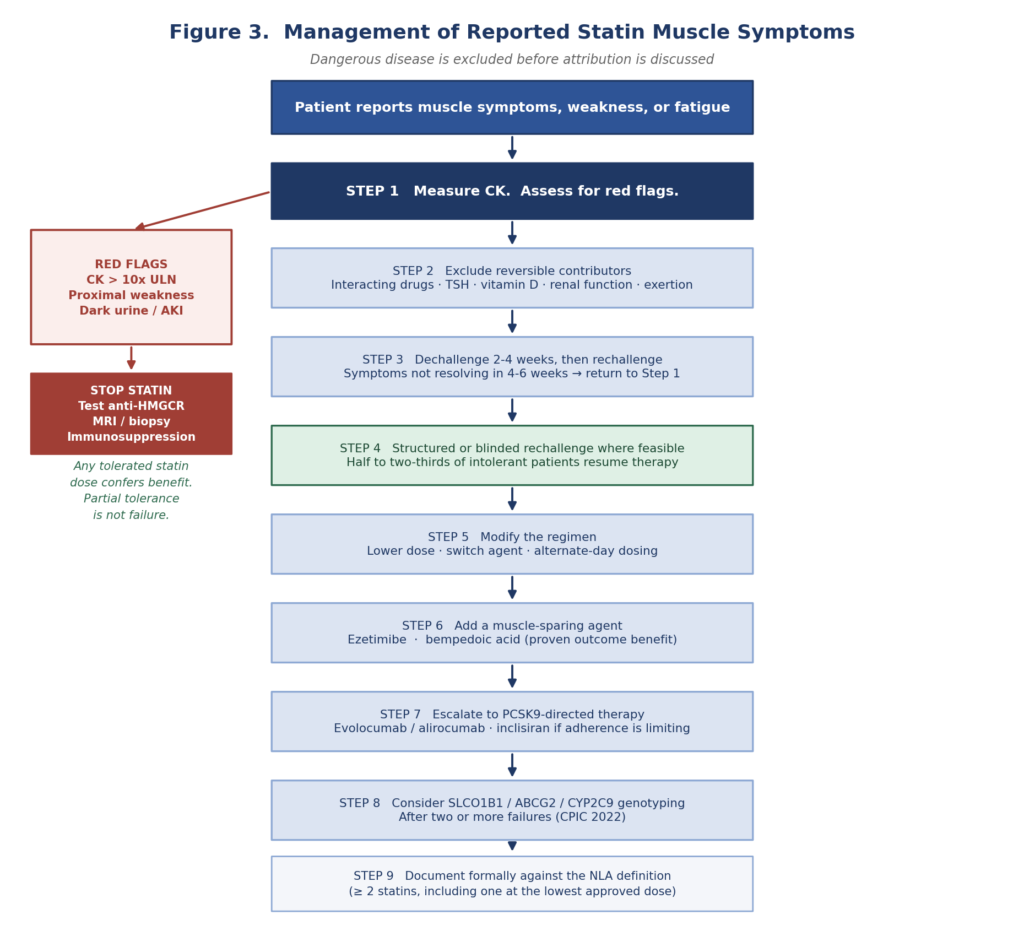
Abbildung 3. Behandlungsalgorithmus bei gemeldeten statinbedingten Muskelsymptomen. Die Reihenfolge ist bewusst gewählt: Zunächst werden gefährliche Erkrankungen ausgeschlossen, bevor eine Zuordnung erörtert wird, da sich der Zustand eines Patienten mit einer immunvermittelten nekrotisierenden Myopathie, der hinsichtlich des Nocebo-Effekts beruhigt wurde, verschlechtern könnte.
- Schließen Sie zunächst eine gefährliche Myopathie aus. Messen Sie die CK. Wenn der CK-Wert das Zehnfache des oberen Normwerts überschreitet, eine objektive proximale Schwäche vorliegt oder dunkler Urin bzw. eine Nierenfunktionsstörung festgestellt wird, ist das Statin sofort abzusetzen und auf eine echte Myopathie, Rhabdomyolyse oder immunvermittelte nekrotisierende Myopathie zu untersuchen. Erst nach Abschluss dieses Schritts sollte eine Beruhigung hinsichtlich eines Nocebo-Effekts erfolgen.
- Ermitteln Sie behebbare Einflussfaktoren. Prüfen Sie auf Wechselwirkungen mit anderen Medikamenten, eine Schilddrüsenunterfunktion, Vitamin-D-Mangel, Nierenfunktionsstörungen und kürzlich erfolgte, ungewohnte körperliche Anstrengung. Beheben Sie, was behebbar ist.
- Entzug und erneute Verabreichung. Das Statin für zwei bis vier Wochen absetzen. Tritt keine Besserung ein, sinkt die Wahrscheinlichkeit einer gewöhnlichen medikamenteninduzierten SAMS, und es sollte eine erneute Abklärung hinsichtlich alternativer Ursachen oder einer persistierenden Myopathie erfolgen, anstatt davon auszugehen, dass das Statin unschuldig war; wenn die Symptome über vier bis sechs Wochen hinaus anhalten, insbesondere bei erhöhten CK-Werten oder objektiver Schwäche, sollte auf IMNM untersucht werden. Wenn die Symptome abklingen, sollte eine erneute Testgabe mit einem anderen Statin in niedriger Dosis erfolgen.
- Führen Sie, soweit möglich, eine strukturierte oder verblindete Reexposition durch. Die Studien SAMSON und StatinWISE belegen, dass objektive, individuell zugeschnittene Daten zum eigenen Symptommuster eines Patienten eine wirksame Maßnahme zur Wiederherstellung Einhaltung — die Studie mit den direktesten randomisierten Belegen —, dank der etwa die Hälfte bis zwei Drittel der teilnehmenden Patienten ihre Therapie wieder aufnehmen konnten. Da in keiner der beiden Studien dieser Ansatz mit anderen Strategien zur Therapietreue verglichen wurde, sollte er nicht als allen Alternativen überlegen beschrieben werden [5,6,82].
- Passen Sie die Therapie an, bevor Sie die Medikamentenklasse ganz absetzen. Reduzieren Sie die Dosis, wechseln Sie das Präparat – insbesondere weg von hochdosiertem Simvastatin – oder verabreichen Sie ein Statin mit langer Halbwertszeit wie Rosuvastatin oder Atorvastatin jeden zweiten Tag oder zweimal wöchentlich. Jede gut verträgliche Statin-Dosis bringt einen Nutzen; eine teilweise Verträglichkeit gilt nicht als Therapieversagen.
- Fügen Sie einer reduzierten Statin-Dosis ein muskelschonendes Mittel hinzu. Ezetimib ist kostengünstig, gut verträglich und verbessert die Werte um 15–20%. Bempedoinsäure verbessert die Werte um etwa 18% und ist das einzige orale Nicht-Statin-Präparat mit nachgewiesenem kardiovaskulärem Nutzen bei Patienten mit Statinunverträglichkeit.
- Bei bestätigter Unverträglichkeit mit erheblichen Auswirkungen auf die Restrisiko. In der GAUSS-3-Studie wurde Evolocumab genau bei dieser Patientengruppe validiert, und Inclisiran ermöglicht eine zweimal jährliche Dosierung, wobei die Therapietreue der begrenzende Faktor ist.
- Ziehen Sie bei wiederkehrender Unverträglichkeit eine Genotypisierung in Betracht. SLCO1B1, ABCG2, und CYP2C9 Eine Genotypisierung gemäß CPIC 2022 kann die Wirkstoffauswahl nach zwei oder mehr Therapieversagen rationalisieren.
- Formell dokumentieren. Eine Statin-Unverträglichkeit sollte gemäß der Definition der National Lipid Association dokumentiert werden, die die Erprobung von mindestens zwei Statinen – darunter eines in der niedrigsten zugelassenen Dosis – vorschreibt, anstatt sie allein auf der Grundlage eines einzigen erfolglosen Versuchs zu vermerken [4].
9.1 Aufklärung der Patienten über Risiken
Ergebnisse aus der SAMSON-Studie deuten darauf hin, dass es überzeugender ist, Patienten ihre eigenen Daten zu zeigen, als Bevölkerungsstatistiken anzuführen. Wenn keine individuellen „n-of-1“-Daten vorliegen, sind die folgenden Formulierungen zutreffend und hilfreich: Muskelschmerzen treten bei Erwachsenen unabhängig von der Medikation häufig auf, und etwa ein Viertel der Menschen berichtet davon, unabhängig davon, ob sie ein Statin oder ein Placebo einnehmen; von fünfzehn Personen, die unter Muskelsymptomen bei der Einnahme eines Statins leiden, hätten etwa vierzehn diese Symptome ohnehin gehabt [65]; die meisten Symptome, die tatsächlich durch ein Statin verursacht werden, treten innerhalb des ersten Jahres auf und klingen innerhalb weniger Wochen nach Absetzen der Einnahme ab, auch wenn es bei einzelnen Personen zu einem späteren Auftreten kommen kann; und eine deutliche Mehrheit der Menschen, die die Einnahme eines Statins aufgrund von Symptomen abbrechen und bereit sind, es erneut zu versuchen, kann die Einnahme erfolgreich wieder aufnehmen. Diese letzte Zahl stammt von Patienten, die sich freiwillig für einen erneuten Versuch gemeldet haben, und sollte nicht als Quote für alle Abbrecher angegeben werden.
Ebenso wichtig ist, was man nicht sagen sollte. Symptome sollten niemals als eingebildet bezeichnet werden. Der Nocebo-Effekt führt zu echten, messbaren Symptomen; die Teilnehmer der SAMSON-Studie brachen die Einnahme von Placebo-Tabletten fast ebenso häufig ab wie die von Wirkstoffen. Die Botschaft lautet, dass die Symptome echt sind, ihre Ursache jedoch in der Regel nicht das Medikament ist, und dass diese Unterscheidung den Weg zurück zur Behandlung ebnet, anstatt ihn zu versperren.
9.2 Objektive Diagnostik
- Eine routinemäßige Überwachung bei asymptomatischen Patienten wird nicht empfohlen. Bei Patienten mit erhöhtem Risiko sollte ein Ausgangswert ermittelt werden, und bei jedem symptomatischen Patienten sollte eine Messung erfolgen. Ein CK-Wert, der das Zehnfache des oberen Normwertes übersteigt, deutet auf eine Myopathie hin und erfordert das Absetzen der Behandlung. Beachten Sie die Asymmetrie in der Aussagekraft des Ergebnisses: Ein erhöhter CK-Wert ist aussagekräftig, ein normaler CK-Wert ist jedoch keine Gewissheit dafür, dass keine Symptome vorliegen oder diese eingebildet sind. Der CK-Wert ist bei leichten SAMS unempfindlich, und Patienten mit behindernden Symptomen weisen häufig völlig normale Werte auf.
- Anti-HMGCR-Antikörper. Eine Untersuchung ist angezeigt, wenn eine ausgeprägte Schwäche vorliegt, die CK-Werte deutlich erhöht sind oder die Symptome länger als vier bis sechs Wochen nach Absetzen des Medikaments anhalten.
- MRT der Muskeln und Biopsie. Nur bei Verdacht auf eine entzündliche oder nekrotisierende Myopathie, in der Regel nach positivem oder zweideutigem serologischem Befund.
- TSH, Vitamin D, Nierenfunktion. Bei allen Patienten, die unter Muskelsymptomen leiden und ein Statin einnehmen, sollte dies untersucht werden.
- SAMS-Klinischer Index. Ein standardisiertes Kausalitätsinstrument, das den Ort der Symptome, den Zeitpunkt des Auftretens nach Beginn der Einnahme und den Zeitpunkt des Abklangs nach Absetzen bewertet und für eine einheitliche Dokumentation nützlich ist [86].
9.3 Kontext der Leitlinie: die Leitlinie zur Dyslipidämie aus dem Jahr 2026
Die Rahmenbedingungen für die oben genannten Entscheidungen haben sich im März 2026 geändert. Die ACC/AHA/Multisociety-Leitlinie zur Behandlung von Dyslipidämie aus dem Jahr 2026 ersetzt die Leitlinie zur Behandlung des Blutcholesterinspiegels aus dem Jahr 2018 und wurde umbenannt, um der Bedeutung atherogener Lipoproteine über LDL-Partikel hinaus, einschließlich triglyceridreicher Restpartikel und Lipoproteine, Rechnung zu tragen(a) [11]. Fünf Änderungen sind für diese Überprüfung von Bedeutung.
- Risikoabschätzung. Die AHA-PREVENT-ASCVD-Gleichungen ersetzen die Pooled Cohort Equations als Leitfaden für die lipidsenkende Therapie in der Primärprävention bei Erwachsenen im Alter von 30 bis 79 Jahren, mit Risikoprognosen sowohl für einen Zeitraum von 10 als auch von 30 Jahren.
- Die Behandlungsziele kehren zurück. Die LDL-C- und Non-HDL-C-Zielwerte werden neben der prozentualen Senkung wieder eingeführt. Die Leitlinie legt einen LDL-C-Zielwert von unter 100 mg/dl bei grenzwertigem oder mittlerem Risiko, von unter 70 mg/dl bei hohem Risiko und von unter 55 mg/dl für Patienten mit klinischer ASCVD bei sehr hohem Risiko fest. Dies ist eine wesentliche Änderung gegenüber den Leitlinien von 2018, in denen die Statinintensität Vorrang vor absoluten Zielwerten hatte, und sie untermauert die Argumente für eine Kombinationstherapie bei Patienten, die den Zielwert mit einem Statin allein nicht erreichen.
- ApoB und Lp(a). Die ApoB-Bestimmung wird als sinnvoll angesehen, sobald die LDL-C- und Non-HDL-C-Zielwerte erreicht sind, insbesondere bei Triglyceridwerten über 200 mg/dl, Diabetes oder einem erreichten LDL-C-Wert unter 70 mg/dl. Lp(a) sollte bei Erwachsenen im Rahmen der Risikobewertung mindestens einmal bestimmt werden.
- Sequenzierung ohne Statine. Wenn mit einer Statintherapie allein das Ziel nicht erreicht wird, werden Ezetimib, Bempedoinsäure und monoklonale PCSK9-Antikörper als Zusatztherapie empfohlen. Empfehlungen zu Inclisiran wurden bis zum Vorliegen der Ergebnisse der klinischen Studien zurückgestellt, was mit der in Abschnitt 11 vorgenommenen Unterscheidung im Einklang steht.
- Statin-Unverträglichkeit. Die Leitlinie enthält einen praktischen Algorithmus für die Statinunverträglichkeit; vor diesem Hintergrund sollte die Behandlungssequenz in Abschnitt 9 gelesen werden.
Aus dieser Übersicht ergeben sich zwei Schlussfolgerungen. Die Einstufung nach Intensität in Tabelle 2 ist weiterhin nützlich, und die prozentuale Senkung des LDL-C-Spiegels bleibt eine erklärte Priorität, sodass nichts in Abschnitt 3 hinfällig wird. Die zielorientierte Struktur verändert jedoch die praktische Bedeutung des Problems der Muskelsymptome: Wenn ein Patient ein absolutes LDL-C-Ziel erreichen muss, anstatt lediglich ein Statin einer bestimmten Intensitätsstufe zu vertragen, wird die korrekte Unterscheidung zwischen Nocebo-bedingter und pharmakologischer Unverträglichkeit umso wichtiger – und nicht weniger wichtig –, da ein unnötiger Abbruch nun ein definiertes therapeutisches Ziel und nicht mehr nur eine Intensitätskategorie zunichte macht.
10. Neue Therapeutika
DER REGULATORISCHE STATUS MUSS UNMITTELBAR VOR DER KLINISCHEN ANWENDUNG ODER VERÖFFENTLICHUNG ÜBERPRÜFT WERDEN. Der Zulassungsstatus, die Ergebnisse klinischer Studien und die Produktinformationen in diesem Bereich ändern sich im Monatsrhythmus. Der nachstehende Status spiegelt den Stand vom 9. August 2026 wider. Obicetrapib und die gegen Lipoprotein(a) gerichteten Wirkstoffe befinden sich für die beschriebenen Indikationen weiterhin in der Erprobung. Enlicitide befindet sich nicht mehr in der Erprobungsphase – es wurde im Juli 2026 zugelassen –, doch die Daten zu den kardiovaskulären Endpunkten stehen noch aus; diese Unterscheidung wird in diesem Abschnitt durchgehend beibehalten.
Alle Zahlen in diesem Abschnitt sind Surrogatparameter Daten. Keines dieser Medikamente – ob zugelassen oder nicht – hat eine kardiovaskuläre Outcome-Studie für die beschriebene Anwendung absolviert, und die Senkung des LDL-C-Spiegels oder des Lipoproteins (a) darf den Patienten nicht als nachgewiesene Verringerung von Ereignissen dargestellt werden. Eine behördliche Zulassung auf der Grundlage eines Lipid-Endpunkts ist nicht gleichbedeutend mit einer nachgewiesenen Verringerung von Ereignissen, und beide Aspekte sollten in Gesprächen mit Patienten klar voneinander getrennt werden.
10.1 Obicetrapib (oraler CETP-Hemmer)
Die Ergebnisse der Phase-3-Studien BROADWAY und TANDEM wurden 2025 veröffentlicht und auf dem Europäischen Arteriosklerose Society Congress. Als Ergänzung zur maximal verträglichen Hintergrundtherapie senkte Obicetrapib 10 mg den LDL-C-Spiegel um etwa 33–37% im Vergleich zu Placebo, wobei eine Fixdosiskombination mit Ezetimib eine Senkung um etwa 50% erzielte. Der Wirkstoff senkt zudem Lipoprotein(a) und Apolipoprotein B, und die Sicherheit war über das gesamte Programm hinweg mit der von Placebo vergleichbar. Die kardiovaskuläre Outcome-Studie PREVAIL randomisierte mehr als 9.500 Patienten und schloss die Rekrutierung im April 2024 ab; die Ergebnisse werden für Ende 2026 erwartet. Am 23. Juli 2026 gab der Ausschuss für Humanarzneimittel der EMA positive Stellungnahmen ab, in denen die Zulassung von Obicetrapib als Monotherapie (Ubeslo) und der Fixdosiskombination aus Obicetrapib und Ezetimib (Evlarco) bei primärer Hypercholesterinämie und gemischter Dyslipidämie empfohlen wurde; die Entscheidung der Europäischen Kommission steht noch aus [87,88]. Eine positive Stellungnahme ist ein regulatorischer Schritt, kein Nachweis der Wirksamkeit, und PREVAIL bleibt die Studie, die klären wird, ob eine Senkung des LDL-C-Spiegels durch CETP-Hemmung das Auftreten von Ereignissen verringert. Angesichts der Misserfolge von Torcetrapib, Dalcetrapib und Evacetrapib ist bei der CETP-Klasse historische Vorsicht geboten [38].
10.2 Enlicitide (oraler PCSK9-Hemmer) – zugelassen im Juli 2026
Enlicitide ist ein oral bioverfügbares makrozyklisches Peptid, das an PCSK9 bindet und dessen Wechselwirkung mit dem LDL-Rezeptor blockiert. Es wurde am 16. Juli 2026 von der FDA zugelassen und wird unter dem Namen Lipfendra als Ergänzung zu Diät und Bewegung zur Senkung des LDL-C-Spiegels bei Erwachsenen mit Hypercholesterinämie, einschließlich heterozygoter familiärer Hypercholesterinämie, vermarktet. Es ist der erste orale PCSK9-Hemmer, der auf den Markt gekommen ist [36]. Die Dosis beträgt eine 20-mg-Tablette einmal täglich, die auf nüchternen Magen eingenommen wird, wobei ein bestimmtes Zeitintervall vor der Mahlzeit einzuhalten ist.
Die Zulassung basierte auf zwei Phase-3-Studien im Rahmen des CORALreef-Programms. In der Studie CORALreef Lipids wurden 2.904 Erwachsene randomisiert, die eine stabile Statintherapie mittlerer oder hoher Intensität erhielten und eine weitere Senkung des LDL-C benötigten; in der Studie CORALreef HeFH wurde dasselbe Studiendesign bei 303 Patienten mit heterozygoter familiärer Hypercholesterinämie angewendet. Nach 24 Wochen betrugen die Placebo-bereinigten LDL-C-Senkungen etwa 56% bzw. 59%. Die unerwünschten Ereignisse waren in der CORALreef-Lipids-Studie im Großen und Ganzen mit denen unter Placebo vergleichbar; in der kleineren HeFH-Studie wurden Durchfall und Schwindel häufiger berichtet als unter Placebo [44,45].
Bei der Erörterung dieses Wirkstoffs mit Patienten sind zwei Aspekte zu beachten. Erstens erfolgte die Zulassung auf der Grundlage eines LDL-C-Endpunkts; die kardiovaskuläre Studie „CORALreef Outcomes“ läuft noch, und Ergebnisse werden erst gegen 2029 erwartet [46], sodass aus mechanistischen Gründen eine Verringerung der Ereignisse zu erwarten ist, die für diesen Wirkstoff jedoch noch nicht nachgewiesen wurde. Die in Abschnitt 11 vorgenommene Unterscheidung zwischen Wirkstoffen mit und ohne Evidenz zu den Endpunkten gilt daher für Enlicitide ebenso wie für Inclisiran. Zweitens ist die Relevanz für diese Übersichtsarbeit spezifisch: Ein orales Präparat, das eine LDL-C-Senkung in der Größenordnung eines monoklonalen Antikörpers erreicht, beseitigt sowohl die Hürde der Injektion als auch jeden plausiblen Weg der Exposition der Skelettmuskulatur, was es zu einer wesentlichen Ergänzung der verfügbaren Optionen bei bestätigter Statin-Unverträglichkeit macht. Die Charakterisierung der Verträglichkeit nach der Markteinführung befindet sich noch in einem frühen Stadium.
10.3 Auf Lipoprotein(a) ausgerichtete Therapien
Lipoprotein(a) ist ein genetisch bedingter, kausaler kardiovaskulärer Risikofaktor, der von Statinen, Ezetimib oder einer Änderung des Lebensstils im Wesentlichen unbeeinflusst bleibt. Mehrere Nukleinsäuretherapien bewirken eine deutliche Senkung: Pelacarsen (Antisense-Oligonukleotid, Lp(a)-HORIZON-Outcomes-Studie), Olpasiran (siRNA, Reduktion um mehr als 95% in Phase 2, OCEAN(a) – Ergebnisse noch nicht vorliegend) [89], Lepodisiran (siRNA, eine placebokontrollierte, zeitlich gemittelte Reduktion von 93,91 TP9T über die Tage 60 bis 180 nach einer Einzeldosis von 400 mg in der 2025 veröffentlichten ALPACA-Phase-2-Studie) [90], Zerlasiran und das oral verabreichte niedermolekulare Muvalaplin. Bislang konnte bei keinem dieser Wirkstoffe eine Verringerung der Ereignisse nachgewiesen werden; die Ergebnisse der Endpunktstudien werden voraussichtlich ab 2026 vorliegen. Diese Wirkstoffe werden hier eher der Vollständigkeit des Überblicks über die Lipidsenker als als aktuelle Therapie aufgeführt.
11. Zusammenfassung
Bei der Behandlung von Fettstoffwechselstörungen gilt es, ein Gleichgewicht zwischen einer aggressiven Senkung des LDL-C-Spiegels und der wahrgenommenen sowie tatsächlichen Arzneimitteltoxizität herzustellen. Aus den untersuchten Erkenntnissen lassen sich acht Schlussfolgerungen ableiten.
- Die berichteten Muskelsymptome werden in der Regel nicht durch das Statin verursacht. Zwei unabhängige Beleglinien stützen diese Erkenntnis. Bei Patienten, die die Einnahme von Statinen bereits eingestellt hatten, wurden etwa 90% der durch die Einnahme einer Tablette verursachten Symptombelastung durch eine Placebo-Tablette reproduziert (SAMSON). In nicht selektierten Studienpopulationen war nur etwa jeder fünfzehnte im ersten Jahr gemeldete Fall von Muskelsymptomen auf das Medikament zurückzuführen, ohne dass danach ein Anstieg zu verzeichnen war (CTT). Wie in Abschnitt 7 dargelegt, handelt es sich hierbei um unterschiedliche Messgrößen in verschiedenen Populationen, die eher als konvergent denn als identisch bezeichnet werden sollten.
- Dennoch gibt es echte pharmakologische Unverträglichkeiten. GAUSS-3 wies bei 42,61 TP9T einer Population mit extremem Phänotyp reproduzierbare, verblindete, arzneimittelspezifische Muskelsymptome nach, und die CTT-Analyse bestätigt einen geringen, aber statistisch signifikanten Überschuss.
- Eine seltene autoimmune Myopathie darf auf keinen Fall übersehen werden. Die Anti-HMGCR-vermittelte nekrotisierende Myopathie tritt bei etwa 20 bis 25 Fällen pro Million Statin-Anwender pro Jahr auf (etwa 2–3 pro Million Personenjahre in der Allgemeinbevölkerung), äußert sich durch Muskelschwäche und einen deutlichen Anstieg der CK-Werte, hält auch nach Absetzen des Medikaments an und erfordert eine Immunsuppression.
- Die Auswirkungen auf die Muskeln gehen über Muskelkater hinaus. Randomisierte Daten zeigen bei moderaten Dosierungen sowohl eines lipophilen als auch eines hydrophilen Statins negative Auswirkungen auf den Energiehaushalt und die Ermüdung bei körperlicher Belastung, und Statine beeinflussen die Mitochondrienfunktion der Skelettmuskulatur messbar. Die objektive Maximalkraft und die körperliche Leistungsfähigkeit bleiben dennoch weitgehend erhalten, und keiner dieser Effekte lässt sich durch einen Coenzym-Q10-Mangel erklären.
- Es gibt muskelschonende Alternativen, die aus mechanistischer Sicht gerechtfertigt sind. Bempedoinsäure, PCSK9-Hemmer, Inclisiran und Ezetimib vermeiden alle auf unterschiedliche Weise eine Exposition der Myozyten. Ihre Wirksamkeitsdaten unterscheiden sich jedoch deutlich und sollten nicht verwechselt werden: Die monoklonalen PCSK9-Antikörper und Bempedoinsäure haben eine Verringerung kardiovaskulärer Ereignisse gezeigt, Ezetimib hat dies als Zusatztherapie bewiesen, während Inclisiran lediglich eine Senkung des LDL-C-Spiegels nachweisen konnte. Die kardiovaskulären Outcome-Studien ORION-4 und VICTORION-2P laufen noch, und Inclisiran sollte den Patienten als Wirkstoff mit nachgewiesener lipidsenkender Wirkung und bislang noch nicht nachgewiesener Reduktion kardiovaskulärer Ereignisse beschrieben werden. Das Gleiche gilt für Enlicitid, das im Juli 2026 auf der Grundlage eines LDL-C-Endpunkts zugelassen wurde, während die CORALreef-Outcomes-Studie noch läuft.
- Die Wahl des Statins sollte sich eher am Wechselwirkungsprofil und an der Pharmakogenomik orientieren als an der Lipophilie. Das stärkste Signal, auf das man reagieren kann, ist SLCO1B1 mit Simvastatin; der zuverlässigste praktische Ansatz besteht darin, CYP3A4-vermittelte Wechselwirkungen zu vermeiden.
- Der kardiovaskuläre Nutzen einer Statintherapie überwiegt das damit verbundene Diabetesrisiko bei weitem. Der Anstieg der Neudiagnosen ist gering, dosisabhängig, konzentriert sich auf Personen, die sich bereits nahe der Diagnoseschwelle befinden, und spiegelt eine Veränderung des Blutzuckerspiegels von etwa 0,06–0,08% beim HbA1c wider. Etwaige unerwünschte kardiovaskuläre Folgen dieser Veränderung sind bereits vollständig in dem in denselben Studien beobachteten Nettonutzen berücksichtigt. Eine Blutzuckerüberwachung ist die angemessene Maßnahme; der Verzicht auf Statine hingegen nicht.
- Die meisten Patienten mit einer Unverträglichkeit, die bereit sind, es erneut zu versuchen, können erneut behandelt werden. Die Hälfte der SAMSON-Teilnehmer und zwei Drittel der Teilnehmer, die das StatinWISE-Programm abgeschlossen haben, nahmen die Statintherapie wieder auf, nachdem sie ihre eigenen Symptomdaten eingesehen hatten. Beide Zahlen beziehen sich auf Patienten, die sich freiwillig für eine erneute Einnahme gemeldet haben, und keine der beiden Zahlen sollte auf alle Patienten verallgemeinert werden, die die Einnahme eines Statins abgebrochen haben.
12. Einschränkungen
- Es handelt sich hierbei um eine narrative Übersichtsarbeit, nicht um eine systematische Übersichtsarbeit oder eine de-novo-Metaanalyse. Die Studien wurden nach ihrer Relevanz und nicht anhand eines vorab festgelegten Suchprotokolls ausgewählt, und es wurden keine gepoolten Schätzwerte unabhängig voneinander berechnet.
- Nocebo-Studien weisen eine strukturelle Einschränkung auf, auf die Kritiker zu Recht hingewiesen haben. In den Studien SAMSON und StatinWISE wurden Patienten rekrutiert, die bereit waren, sich einer erneuten Exposition zu unterziehen, wodurch die am stärksten Betroffenen möglicherweise unterrepräsentiert sind. Verblindete Studien mit Einleitungsphasen können zudem anfällige Patienten bereits vor Randomisierung. Die Nocebo-Literatur sollte daher so verstanden werden, dass sie belegt, dass die meisten berichteten Symptome nicht durch Medikamente verursacht werden, und nicht so, dass eine pharmakologische Unverträglichkeit bei jedem Einzelnen selten ist.
- Die Wirksamkeitsprozentsätze stammen aus Studien mit unterschiedlichen Ausgangswerten, Hintergrundtherapien und Patientengruppen und sind innerhalb der Zeilen von Tabelle 3 nicht direkt vergleichbar.
- Es gibt keine verlässliche Schätzung zur Inzidenz der durch Statine verursachten Autoimmunhepatitis; die Evidenzbasis besteht aus Fallberichten und Signalen auf Unregelmäßigkeiten aus der Pharmakovigilanz, die eher das Meldeverhalten als die tatsächliche Häufigkeit widerspiegeln.
- Die Schätzungen zur Inzidenz von Anti-HMGCR-IMNM variieren um eine Größenordnung, je nachdem, ob als Nenner die Allgemeinbevölkerung oder die mit Statinen behandelte Population herangezogen wird, und die Fallerfassung hängt von der lokalen Verfügbarkeit von Anti-HMGCR-Serologie ab; die in Abschnitt 5.2 angegebenen Zahlen sollten unter Berücksichtigung dieser Einschränkung betrachtet werden.
- Die Daten zu Prüfpräparaten stammen teilweise aus Konferenzvorträgen und Mitteilungen der Sponsoren und nicht aus begutachteten Publikationen; zudem ändern sich der Zulassungs- und Studienstatus rasch. Der Stand der Zulassungen und Leitlinien in dieser Übersicht entspricht dem Stand vom 9. August 2026 und sollte vor der Veröffentlichung erneut überprüft werden.
- Die absoluten Risikowerte für einen Statin-assoziierten Diabetes hängen davon ab, wie intensiv der Blutzuckerspiegel in den einbezogenen Studien erfasst wurde; relative Schätzwerte sind die besser übertragbare Größe, und die absoluten Werte in Tabelle 9 sollten entsprechend interpretiert werden.
- In der Fachliteratur zu CoQ10 ist die Frage nach dem symptomatischen Nutzen einer Supplementierung tatsächlich noch ungeklärt, und diese Übersichtsarbeit trifft hierzu keine Entscheidung. Die enger gefasste Frage, ob es überhaupt zu einem CoQ10-Mangel im Muskel kommt, ist durch eindeutigere direkte Belege gestützt und wird entsprechend behandelt.
- Die Endpunkte „Müdigkeit“ und „Energie“ wurden weder in n-of-1-Studien noch in verblindeten versus nicht-verblindeten Studien untersucht, sodass der Anteil der statinbedingten Müdigkeit, der auf den Nocebo-Effekt zurückzuführen ist, nicht quantifiziert wurde. Die Belege zur Müdigkeit und die Belege zum Nocebo-Effekt beruhen daher auf Studienkonzepten, die sich nicht überschneiden, und lassen sich nicht direkt miteinander in Einklang bringen.
Referenzen
- World Health Organization. Global Health Estimates 2021: Deaths by Cause, Age, Sex, by Country and by Region, 2000-2021. Geneva: World Health Organization; 2024. Accessed 8 August 2026.
- Collins R, Reith C, Emberson J, et al. Interpretation of the evidence for the efficacy and safety of statin therapy. Lancet. 2016;388(10059):2532-2561. Published online 8 September 2016.
- Stroes ES, Thompson PD, Corsini A, et al. Statin-associated muscle symptoms: impact on statin therapy—European Atherosclerosis Society Consensus Panel Statement. Eur Heart J. 2015;36(17):1012-1022.
- Cheeley MK, Saseen JJ, Agarwala A, et al. NLA scientific statement on statin intolerance: a new definition and key considerations for ASCVD risk reduction in the statin intolerant patient. J Clin Lipidol. 2022;16(4):361-375.
- Wood FA, Howard JP, Finegold JA, et al. N-of-1 Trial of a Statin, Placebo, or No Treatment to Assess Side Effects. N Engl J Med. 2020;383(22):2182-2184. Published 15 November 2020.
- Howard JP, Wood FA, Finegold JA, et al. Side Effect Patterns in a Crossover Trial of Statin, Placebo, and No Treatment (SAMSON). J Am Coll Cardiol. 2021;78(12):1210-1222. Published 13 September 2021.
- Ference BA, Robinson JG, Brook RD, et al. Variation in PCSK9 and HMGCR and Risk of Cardiovascular Disease and Diabetes. N Engl J Med. 2016;375(22):2144-2153.
- Lotta LA, Sharp SJ, Burgess S, et al. Association Between Low-Density Lipoprotein Cholesterol-Lowering Genetic Variants and Risk of Type 2 Diabetes: A Meta-analysis. JAMA. 2016;316(13):1383-1391.
- Nicholls SJ, Puri R, Anderson T, et al. Effect of Evolocumab on Progression of Coronary Disease in Statin-Treated Patients: The GLAGOV Randomized Clinical Trial. JAMA. 2016;316(22):2373-2384.
- Tsujita K, Sugiyama S, Sumida H, et al. Impact of Dual Lipid-Lowering Strategy With Ezetimibe and Atorvastatin on Coronary Plaque Regression (PRECISE-IVUS). J Am Coll Cardiol. 2015;66(5):495-507.
- Blumenthal RS, Morris PB, Gaudino M, et al. 2026 ACC/AHA/AACVPR/ABC/ACPM/ADA/AGS/APhA/ASPC/NLA/PCNA Guideline on the Management of Dyslipidemia: a report of the American College of Cardiology/American Heart Association Joint Committee on Clinical Practice Guidelines. J Am Coll Cardiol. 2026;87(19):2624-2757. doi:10.1016/j.jacc.2025.11.016. PMID 41824590.
- Grundy SM, Stone NJ, Bailey AL, et al. 2018 AHA/ACC/AACVPR/AAPA/ABC/ACPM/ADA/AGS/APhA/ASPC/NLA/PCNA Guideline on the Management of Blood Cholesterol. Circulation. 2019;139(25):e1082-e1143.
- Raal FJ, Rosenson RS, Reeskamp LF, et al. Evinacumab for Homozygous Familial Hypercholesterolemia (ELIPSE HoFH). N Engl J Med. 2020;383(8):711-720. Published 20 August 2020.
- Schachter M. Chemical, pharmacokinetic and pharmacodynamic properties of statins: an update. Fundam Clin Pharmacol. 2005;19(1):117-125. PMID 15660968.
- Lipitor (atorvastatin calcium) tablets. Full prescribing information. Silver Spring (MD): US Food and Drug Administration; Drugs@FDA label repository. Label revision as posted at access. Accessed 8 August 2026.
- Crestor (rosuvastatin calcium) tablets. Full prescribing information. Silver Spring (MD): US Food and Drug Administration; Drugs@FDA label repository. Label revision as posted at access. Accessed 8 August 2026.
- Zocor (simvastatin) tablets. Full prescribing information. Silver Spring (MD): US Food and Drug Administration; Drugs@FDA label repository. Label revision as posted at access. Accessed 8 August 2026.
- Pravachol (pravastatin sodium) tablets. Full prescribing information. Silver Spring (MD): US Food and Drug Administration; Drugs@FDA label repository. Label revision as posted at access. Accessed 8 August 2026.
- Altoprev / Mevacor (lovastatin) tablets. Full prescribing information. Silver Spring (MD): US Food and Drug Administration; Drugs@FDA label repository. Label revision as posted at access. Accessed 8 August 2026.
- Lescol XL (fluvastatin sodium) tablets. Full prescribing information. Silver Spring (MD): US Food and Drug Administration; Drugs@FDA label repository. Label revision as posted at access. Accessed 8 August 2026.
- Livalo (pitavastatin) tablets. Full prescribing information. Silver Spring (MD): US Food and Drug Administration; Drugs@FDA label repository. Label revision as posted at access. Accessed 8 August 2026.
- Cooper-DeHoff RM, Niemi M, Ramsey LB, et al. The Clinical Pharmacogenetics Implementation Consortium Guideline for SLCO1B1, ABCG2, and CYP2C9 Genotypes and Statin-Associated Musculoskeletal Symptoms. Clin Pharmacol Ther. 2022;111(5):1007-1021. doi:10.1002/cpt.2557.
- Graham DJ, Staffa JA, Shatin D, et al. Incidence of hospitalized rhabdomyolysis in patients treated with lipid-lowering drugs. JAMA. 2004;292(21):2585-2590.
- Pinkosky SL, Newton RS, Day EA, et al. Liver-specific ATP-citrate lyase inhibition by bempedoic acid decreases LDL-C and attenuates atherosclerosis. Nat Commun. 2016;7:13457. Published 28 November 2016.
- Cicero AFG, Fogacci F, Hernandez AV, et al. Efficacy and safety of bempedoic acid: pooled analysis of the CLEAR program. Curr Atheroscler Rep. 2022;24:791-801. Published 28 July 2022.
- Ballantyne CM, Bays H, Catapano AL, et al. Role of Bempedoic Acid in Clinical Practice: pooled CLEAR Harmony and CLEAR Wisdom safety analyses. Cardiovasc Drugs Ther. 2021;35(4):853-864.
- Zetia (ezetimibe) tablets. Full prescribing information. Silver Spring (MD): US Food and Drug Administration; Drugs@FDA label repository. Label revision as posted at access. Accessed 8 August 2026.
- Cannon CP, Blazing MA, Giugliano RP, et al. Ezetimibe Added to Statin Therapy after Acute Coronary Syndromes (IMPROVE-IT). N Engl J Med. 2015;372(25):2387-2397.
- Repatha (evolocumab) injection. Full prescribing information. Silver Spring (MD): US Food and Drug Administration; Drugs@FDA label repository. Label revision as posted at access. Accessed 8 August 2026.
- Praluent (alirocumab) injection. Full prescribing information. Silver Spring (MD): US Food and Drug Administration; Drugs@FDA label repository. Label revision as posted at access. Accessed 8 August 2026.
- Leqvio (inclisiran) injection. Full prescribing information. Silver Spring (MD): US Food and Drug Administration; Drugs@FDA label repository. Label revision as posted at access. Accessed 8 August 2026.
- Sabatine MS, Giugliano RP, Keech AC, et al. Evolocumab and Clinical Outcomes in Patients with Cardiovascular Disease (FOURIER). N Engl J Med. 2017;376(18):1713-1722.
- Schwartz GG, Steg PG, Szarek M, et al. Alirocumab and Cardiovascular Outcomes after Acute Coronary Syndrome (ODYSSEY OUTCOMES). N Engl J Med. 2018;379(22):2097-2107.
- Ray KK, Wright RS, Kallend D, et al. Two Phase 3 Trials of Inclisiran in Patients with Elevated LDL Cholesterol (ORION-10 and ORION-11). N Engl J Med. 2020;382(16):1507-1519. Published 16 April 2020.
- Raal FJ, Kallend D, Ray KK, et al. Inclisiran for the Treatment of Heterozygous Familial Hypercholesterolemia (ORION-9). N Engl J Med. 2020;382(16):1520-1530.
- US Food and Drug Administration. FDA approves first oral PCSK9 inhibitor to lower LDL cholesterol in adults with high cholesterol (enlicitide; Lipfendra). FDA news release, 16 July 2026. Accessed 8 August 2026.
- Evkeeza (evinacumab-dgnb) injection. Full prescribing information. Silver Spring (MD): US Food and Drug Administration; Drugs@FDA label repository. Label revision as posted at access. Accessed 8 August 2026.
- Nicholls SJ, Nelson AJ, Ditmarsch M, et al. Safety and Efficacy of Obicetrapib in Patients at High Cardiovascular Risk (BROADWAY). N Engl J Med. 2025;393(1):51-61. doi:10.1056/NEJMoa2415820.
- Ridker PM, Danielson E, Fonseca FAH, et al. Rosuvastatin to Prevent Vascular Events in Men and Women with Elevated C-Reactive Protein (JUPITER). N Engl J Med. 2008;359(21):2195-2207. doi:10.1056/NEJMoa0807646.
- Nissen SE, Lincoff AM, Brennan D, et al. Bempedoic Acid and Cardiovascular Outcomes in Statin-Intolerant Patients (CLEAR Outcomes). N Engl J Med. 2023;388(15):1353-1364. Published 4 March 2023.
- Nexletol / Nexlizet (bempedoic acid; bempedoic acid and ezetimibe) tablets. Full prescribing information. Silver Spring (MD): US Food and Drug Administration; Drugs@FDA label repository. Label revision as posted at access. Accessed 8 August 2026.
- Nissen SE, Stroes E, Dent-Acosta RE, et al. Efficacy and Tolerability of Evolocumab vs Ezetimibe in Patients With Muscle-Related Statin Intolerance: The GAUSS-3 Randomized Clinical Trial. JAMA. 2016;315(15):1580-1590. Published online 3 April 2016.
- Raal FJ, Rosenson RS, Reeskamp LF, et al. The Long-Term Efficacy and Safety of Evinacumab in Patients With Homozygous Familial Hypercholesterolemia. JACC Adv. 2023;2(9):100648. doi:10.1016/j.jacadv.2023.100648. PMCID PMC11198175.
- Navar AM, Mikhailova E, Catapano AL, Banka P, Blom DJ, Cadena A, Kourpanidis S, Lepor NE, Tsukamoto K, Mendizabal G, Nunez J, Zhang W, Zhu P, Zhuo M, Ballantyne CM; CORALreef Lipids Investigators. A Placebo-Controlled Trial of the Oral PCSK9 Inhibitor Enlicitide. N Engl J Med. 2026;394(6):529-539. doi:10.1056/NEJMoa2511002. PMID 41879224.
- Ballantyne CM, Gellis L, Tardif JC, Banka P, Navar AM, Asprusten EA, Scott R, Stroes ESG, Froman S, Mendizabal G, Wang F, Catapano AL. Efficacy and Safety of Oral PCSK9 Inhibitor Enlicitide in Adults With Heterozygous Familial Hypercholesterolemia: A Randomized Clinical Trial. JAMA. 2026;335(2):129-139. doi:10.1001/jama.2025.20620. PMID 41206969.
- gov. Enlicitide Decanoate (MK-0616) Cardiovascular Outcomes Study (CORALreef Outcomes). NCT06008756. Status: active, not recruiting; estimated primary completion 2029. Accessed 8 August 2026.
- Nicholls SJ, Ballantyne CM, Barter PJ, et al. Effect of Two Intensive Statin Regimens on Progression of Coronary Disease (SATURN). N Engl J Med. 2011;365(22):2078-2087. doi:10.1056/NEJMoa1110874.
- Johnson TE, Zhang X, Bleicher KB, Dysart G, Loughlin AF, Schaefer WH, Umbenhauer DR. Statins induce apoptosis in rat and human myotube cultures by inhibiting protein geranylgeranylation but not ubiquinone. Toxicol Appl Pharmacol. 2004;200(3):237-250. doi:10.1016/j.taap.2004.04.010. PMID 15504460.
- Jaśkiewicz A, Pająk B, Litwiniuk A, Urbańska K, Orzechowski A. Geranylgeraniol Prevents Statin-Dependent Myotoxicity in C2C12 Muscle Cells through RAP1 GTPase Prenylation and Cytoprotective Autophagy. Oxid Med Cell Longev. 2018;2018:6463807. doi:10.1155/2018/6463807.
- Epelde F. Statin-Associated Muscle Symptoms and Myotoxicity: A Clinically Oriented Narrative Review with a Practical Prevention, Evaluation, and Management Algorithm. Medicina (Kaunas). 2026;62(6):1134.
- Qu H, Guo M, Chai H, et al. Effects of Coenzyme Q10 on Statin-Induced Myopathy: An Updated Meta-Analysis of Randomized Controlled Trials. J Am Heart Assoc. 2018;7(19):e009835.
- Banach M, Serban C, Sahebkar A, et al. Effects of coenzyme Q10 on statin-induced myopathy: a meta-analysis of randomized controlled trials. Mayo Clin Proc. 2015;90(1):24-34.
- Dohlmann TL, Morville T, Kuhlman AB, et al. Statin Treatment Decreases Mitochondrial Respiration But Muscle Coenzyme Q10 Levels Are Unaltered: The LIFESTAT Study. J Clin Endocrinol Metab. 2019;104(7):2501-2508. doi:10.1210/jc.2018-01185.
- Kuhlman AB, Morville T, Dohlmann TL, et al. Coenzyme Q10 Supplementation in Statin Treated Patients: A Double-Blinded Randomized Placebo-Controlled Trial. Antioxidants (Basel). 2022;11(9):1698. Published 29 August 2022.
- Mikus CR, Boyle LJ, Borengasser SJ, et al. Simvastatin impairs exercise training adaptations. J Am Coll Cardiol. 2013;62(8):709-714. doi:10.1016/j.jacc.2013.02.074.
- Ryan TE, Torres MJ, Lin C-T, et al. High-dose atorvastatin therapy progressively decreases skeletal muscle mitochondrial respiratory capacity in humans. JCI Insight. 2024;9(4):e174125. doi:10.1172/jci.insight.174125.
- Morales-Palomo F, Ramirez-Jimenez M, Ortega JF, et al. Exercise Training Adaptations in Metabolic Syndrome Individuals on Chronic Statin Treatment. J Clin Endocrinol Metab. 2020;105(4):e1695-e1704.
- Warden BA, Guyton JR, Kovacs AC, et al. Assessment and management of statin-associated muscle symptoms (SAMS): A clinical perspective from the National Lipid Association. J Clin Lipidol. 2023;17(1):19-39. Published online 11 September 2022.
- Wright RS, Koenig W, Landmesser U, et al. Safety and Efficacy of Inclisiran: Pooled and Extension Analyses of the ORION Program. J Am Coll Cardiol. 2021;77(9):1182-1193.
- Golomb BA, Evans MA, Dimsdale JE, White HL. Effects of Statins on Energy and Fatigue With Exertion: Results From a Randomized Controlled Trial. Arch Intern Med. 2012;172(15):1180-1182. Published online 11 June 2012. doi:10.1001/archinternmed.2012.2171.
- Parker BA, Capizzi JA, Grimaldi AS, et al. Effect of Statins on Skeletal Muscle Function (STOMP). Circulation. 2013;127(1):96-103. doi:10.1161/CIRCULATIONAHA.112.136101.
- Ballard KD, Parker BA, Capizzi JA, et al. Increases in creatine kinase with atorvastatin treatment are not associated with decreases in muscular performance. Atherosclerosis. 2013;230(1):121-124.
- Mallinson JE, Marimuthu K, Murton A, et al. Statin myalgia is not associated with reduced muscle strength, mass or protein turnover in older male volunteers, but is allied with a slowing of time to peak power output, insulin resistance and differential muscle mRNA expression. J Physiol. 2015;593(5):1239-1257.
- Thompson PD, Parker B. Statins, exercise, and exercise training [editorial]. J Am Coll Cardiol. 2013;62(8):715-716.
- Cholesterol Treatment Trialists’ Collaboration. Effect of statin therapy on muscle symptoms: an individual participant data meta-analysis of large-scale, randomized, double-blind trials. Lancet. 2022;400(10355):832-845. Published online 29 August 2022.
- Fernandez G, Spatz ES, Jablecki C, Phillips PS. Statin myopathy: a common dilemma not reflected in clinical trials. Cleve Clin J Med. 2011;78(6):393-403. doi:10.3949/ccjm.78a.10073.
- Khoo T, Tan E, Limaye V, Gunawardena H, Sadler R, Lamb JA, Lyu X, Brusch A, Needham M, Austin K, Bahadori A, Buch MH, Tomaszewski M, Lilleker JB, Chinoy H. The incidence of anti-HMGCR immune-mediated necrotizing myopathy: an Australian and UK retrospective multi-site cohort study. Rheumatology (Oxford). 2025;64(9):4995-5003. doi:10.1093/rheumatology/keaf238. PMID 40347460.
- Mammen AL. Statin-Associated Autoimmune Myopathy. N Engl J Med. 2016;374(7):664-669.
- Allenbach Y, Mammen AL, Benveniste O, Stenzel W. 224th ENMC International Workshop: Clinico-sero-pathological classification of immune-mediated necrotizing myopathies. Neuromuscul Disord. 2018;28(1):87-99.
- Pinal-Fernandez I, Casal-Dominguez M, Mammen AL. Immune-Mediated Necrotizing Myopathy. Curr Rheumatol Rep. 2018;20(4):21.
- Lim J, Rietveld A, De Bleecker JL, et al. Seronegative patients form a distinctive subgroup of immune-mediated necrotizing myopathy. Neurol Neuroimmunol Neuroinflamm. 2019;6(1):e513.
- Giugliano RP, Mach F, Zavitz K, et al. Cognitive Function in a Randomized Trial of Evolocumab (EBBINGHAUS). N Engl J Med. 2017;377(7):633-643.
- Cholesterol Treatment Trialists’ Collaboration. Effects of statin therapy on diagnoses of new-onset diabetes and worsening glycemia in large-scale randomized blinded statin trials: an individual participant data meta-analysis. Lancet Diabetes Endocrinol. 2024;12(5):306-319. Published online 27 March 2024.
- LiverTox: Clinical and Research Information on Drug-Induced Liver Injury. Statins (class overview). Bethesda (MD): National Institute of Diabetes and Digestive and Kidney Diseases. Continuously updated resource; version as posted at access. Accessed 8 August 2026.
- Wang B, Huang S, Li S, et al. Hepatotoxicity of statins: a real-world study based on the US Food and Drug Administration Adverse Event Reporting System database. Front Pharmacol. 2024;15:1502791. doi:10.3389/fphar.2024.1502791. Published online 7 January 2025.
- Serrano-Pérez NH, Rodríguez-Martínez JS, Feria-Agudelo SM, et al. Drug-induced autoimmune hepatitis due to atorvastatin: a complex clinical case and literature review. Gastroenterol Rep. 2026;14:goag022.
- Irwin JC, Khalesi S, Fenning AS, Vella RK. The effect of lipophilicity and dose on the frequency of statin-associated muscle symptoms: A systematic review and meta-analysis. Pharmacol Res. 2018;128:264-273. PMID 28943224.
- Hou Q, Chen Y, Zhang Y, Pang C. Comparative Muscle Tolerability of Different Types and Intensities of Statins: A Network Meta-Analysis of Double-Blind Randomized Controlled Trials. Cardiovasc Drugs Ther. 2024;38(3):459-469. doi:10.1007/s10557-022-07405-0. Epub 2022 Nov 29. PMID 36447018.
- SEARCH Collaborative Group. SLCO1B1 variants and statin-induced myopathy—a genomewide study. N Engl J Med. 2008;359(8):789-799.
- Swerdlow DI, Preiss D, Kuchenbaecker KB, et al. HMG-coenzyme A reductase inhibition, type 2 diabetes, and bodyweight: evidence from genetic analysis and randomized trials. Lancet. 2015;385(9965):351-361.
- Penson PE, Bruckert E, Marais D, et al. Step-by-step diagnosis and management of the nocebo/drucebo effect in statin-associated muscle symptoms: an International Lipid Expert Panel position paper. J Cachexia Sarcopenia Muscle. 2022;13(3):1596-1622.
- Herrett E, Williamson E, Brack K, et al. Statin treatment and muscle symptoms: series of randomized, placebo controlled n-of-1 trials (StatinWISE). BMJ. 2021;372:n135. Published 24 February 2021.
- Gupta A, Thompson D, Whitehouse A, et al. Adverse events associated with unblinded, but not with blinded, statin therapy in the Anglo-Scandinavian Cardiac Outcomes Trial—Lipid-Lowering Arm (ASCOT-LLA). Lancet. 2017;389(10088):2473-2481. Published 2 May 2017.
- Clinical Pharmacogenetics Implementation Consortium. SLCO1B1, ABCG2 and CYP2C9 allele definition, allele functionality and frequency tables. Online resource at cpicpgx.org, versioned separately from the 2022 guideline; allele function assignment version of October 2025. Accessed 8 August 2026.
- Hlatky MA, Gonzalez PE, Manson JE, et al. Statin-Associated Muscle Symptoms Among New Statin Users Randomly Assigned to Vitamin D or Placebo. JAMA Cardiol. 2023;8(1):74-80. doi:10.1001/jamacardio.2022.4250. PMID 36416841.
- Rosenson RS, Miller K, Bayliss M, et al. The Statin-Associated Muscle Symptom Clinical Index (SAMS-CI): revision for clinical use, content validation, and inter-rater reliability. Cardiovasc Drugs Ther. 2017;31(2):179-186.
- European Medicines Agency. Evlarco (obicetrapib/ezetimibe): summary of opinion. Committee for Medicinal Products for Human Use positive opinion adopted 23 July 2026; European Commission decision pending. Available from the EMA medicines register. Accessed 8 August 2026.
- European Medicines Agency. Ubeslo (obicetrapib): summary of opinion. Committee for Medicinal Products for Human Use positive opinion adopted 23 July 2026; European Commission decision pending. Accessed 8 August 2026.
- O’Donoghue ML, Rosenson RS, Gencer B, et al. Small Interfering RNA to Reduce Lipoprotein(a) in Cardiovascular Disease (OCEAN(a)-DOSE). N Engl J Med. 2022;387(20):1855-1864.
- Nissen SE, Wolski K, Watts GF, et al. Lepodisiran — A Long-Duration Small Interfering RNA Targeting Lipoprotein(a). N Engl J Med. 2025;392(17):1673-1683. doi:10.1056/NEJMoa2415818. PMID 40162643.
- Stone NJ, Robinson JG, Lichtenstein AH, et al. 2013 ACC/AHA Guideline on the Treatment of Blood Cholesterol to Reduce Atherosclerotic Cardiovascular Risk in Adults: a report of the American College of Cardiology/American Heart Association Task Force on Practice Guidelines. Circulation. 2014;129(25 Suppl 2):S1-S45.
- US Food and Drug Administration, Center for Drug Evaluation and Research. Integrated review, NDA 211616 (bempedoic acid). Silver Spring (MD): FDA; 2020. Accessed 9 August 2026.
- Brandts J, Müller-Wieland D. Debate: Lipid-lowering Therapies and Diabetes Development. Curr Atheroscler Rep. 2025;27(1):24. doi:10.1007/s11883-024-01270-y.
Note on this reference list. The 91 entries are carried over in full from the master manuscript, and the body text is now numerically keyed to them: every claim resting on an external source carries a bracketed citation, and all 91 entries are cited at least once. Numbering follows the master list unchanged, so any existing cross-references to it remain valid. Two corrections were made on transfer. The date in entry 36 was corrected from 17 to 16 July 2026, the date carried by both the FDA press announcement and the Merck release. Entries 87 and 88 were verified against the EMA record: the CHMP adopted positive opinions for Ubeslo and Evlarco on 23 July 2026, announced 24 July, with the European Commission decision pending.
Für den Lektor sind zwei Konventionen erwähnenswert: Quellenangaben werden am Ende des Satzes oder Satzteils platziert, dessen Aussage sie untermauern, und eine einzelne Quellenangabe bezieht sich auf die vorangehende Aussage und nicht auf den gesamten Absatz. Stützt sich eine Aussage auf mehrere Quellen, werden diese als Gruppe aufgeführt (zum Beispiel [34,35,59] für das ORION-Programm). Die Tabellenbeschriftungen enthalten die Quellenangaben für die in den jeweiligen Zeilen aufgeführten Abbildungen, sodass die Tabellen selbst nicht einzeln mit Anmerkungen versehen sind.