Résumé
athéromateux maladie cardiovasculaire (ASCVD) reste la première cause de mortalité dans le monde, malgré les progrès considérables réalisés dans le domaine des soins aigus. La cardiologie préventive moderne reconnaît de plus en plus que apolipoprotéine BApoB)–contenant lipoprotéines en tant que facteurs nécessaires et déterminants de athérosclérose. Des données provenant de génétique, épidémiologie, et les essais randomisés corroborent une exposition cumulative modèle dans lequel l’intensité et la durée de l’exposition à l’ApoB déterminent le risque sur toute la durée de vie. Cette revue synthétise les découvertes biologiques fondamentales, les travaux marquants essais cliniques, Randomisation mendélienne les études et les nouvelles thérapies géniques qui, ensemble, marquent le passage d'un traitement réactif à prévention primordiale.
-
Le paradigme moderne de la prévention
Bien que la mortalité due à une forme aiguë infarctus du myocarde bien qu'elle ait considérablement diminué, la charge mondiale de la maladie cardiovasculaire atheroscléreuse (ASCVD) reste élevée en raison d'une exposition persistante à des facteurs modifiables facteurs de risque. Le Étude PURE a démontré que les facteurs de risque traditionnels sont à l'origine de la majorité des événements cardiovasculaires au sein de diverses populations à travers le monde [1].
La cardiologie préventive s'oriente donc de plus en plus vers la prévention des événements, plutôt que vers le traitement des stades avancés. plaque la formation dans son ensemble — une stratégie qui s’inscrit dans le cadre du concept de prévention primordiale.
-
Les récepteurs du LDL et le rôle central de l'ApoB
Le fondement biologique du traitement hypolipidémiant repose sur le Récepteur des LDL (LDLR) voie décrite par Brown et Goldstein [2]. L'expression hépatique du récepteur LDLR augmente la clairance des LDL circulants particules contenant de l'ApoB (LDL, VLDL résidus, Lp(a)), ce qui permet de réduire la charge athérogène.
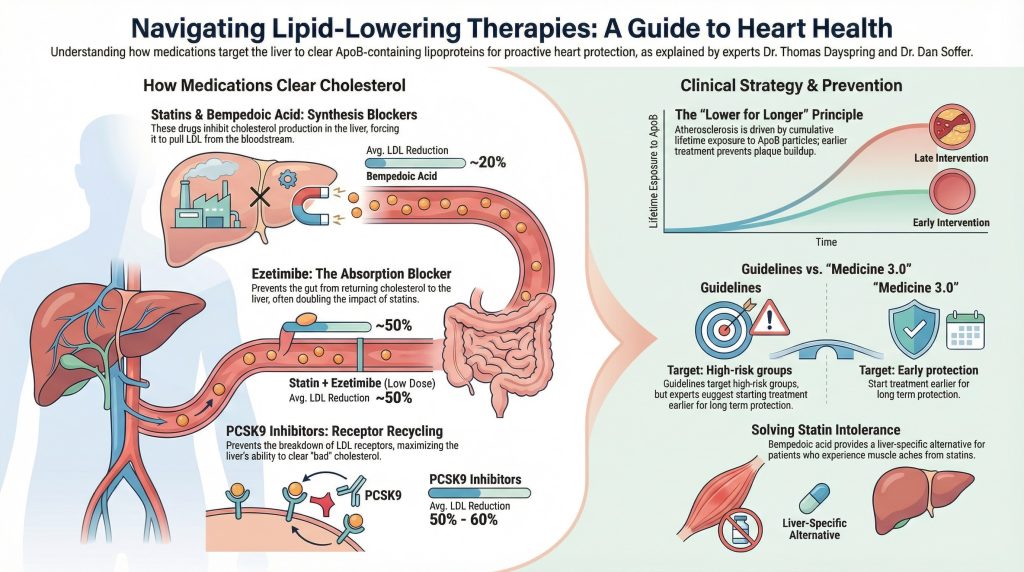
Statines inhiber HMG-CoA réductase, ce qui entraîne une augmentation de l'expression du récepteur LDL (LDLR). Inhibiteurs de PCSK9 empêchent la dégradation du LDLR, prolongeant ainsi le recyclage du récepteur. Dans le essai FOURIER, évocumab a permis de réduire le taux de LDL-C d'environ 59% et de diminuer de manière significative la survenue d'événements cardiovasculaires majeurs [3]. Ces résultats ont confirmé le principe selon lequel une réduction plus importante du taux d'ApoB entraîne une réduction plus importante du risque cardiovasculaire.
-
L'ApoB en tant que particule causale : le modèle d'exposition cumulative
La déclaration de consensus de la Société européenne d'athérosclérose, rédigée sous la direction de Ference et al., a établi que les lipoprotéines contenant de l'ApoB jouent un rôle causal dans l'ASCVD [4]. Le nombre total de particules athérogènes—et non pas la seule concentration en LDL-C—détermine l'exposition artérielle.
Les données génétiques, épidémiologiques et issues d’essais cliniques viennent étayer un modèle de charge cumulative (“années-cholestérol”(« concept ») :
Risque ≈ valeur de l'ApoB × durée d'exposition.
Court terme 10 ans calculateurs de risque pourrait sous-estimer le risque cumulé chez les personnes plus jeunes qui ont encore une longue période d'exposition devant elles. La justification clinique de la mesure de l'ApoB, considérée comme un indicateur plus précis de nombre de particules athérogènes a été exposé en détail par Sniderman et al. [5].
-
Une nouvelle approche du HDL : pourquoi les tentatives d'augmentation du HDL ont échoué
Pharmacologique HDL L'augmentation de ce paramètre s'est révélée à maintes reprises incapable de réduire les événements cardiovasculaires lorsque la charge en ApoB reste inchangée.
Le Essai AIM-HIGH n'a montré aucun bénéfice supplémentaire lié à l'ajout de niacine à un traitement intensif par statines [6]. Le Essai HPS2-THRIVE a également montré qu'il n'y avait pas de réduction significative des événements vasculaires majeurs et a mis en évidence une augmentation des effets indésirables associés au traitement par la niacine [7].
Ces essais ont détourné l'attention du HDL-C en tant que cible thérapeutique et ont confirmé que la réduction de l'ApoB constituait le principal facteur modifiable du risque d'ASCVD.
-
Acide bempédoïque : modulation en amont du récepteur LDLR
Acide bempédoïque inhibe l'ATP-citrate lyase (ACL), une enzyme en amont dans synthèse du cholestérol. Il est principalement métabolisé dans le foie et non dans les muscles squelettiques, ce qui limite l'exposition musculaire au principe actif.
Dans Résultats CLEAR Dans le cadre de cet essai clinique, l'acide bempédoïque a réduit événements cardiovasculaires indésirables majeurs chez les patients présentant une intolérance aux statines [8]. Bien que les effets indésirables d'origine musculaire n'aient pas augmenté de manière significative par rapport à placebo, des taux plus élevés de hyperuricémie et des cas de goutte ont été observés [8]. L'acide bempédoïque constitue donc une stratégie supplémentaire, agissant par l'intermédiaire du récepteur LDLR, pour réduire le taux d'ApoB, avec un profil de sécurité distinct.
-
La génétique, un essai randomisé naturel
Mendélien randomisation Ces études apportent des éclaircissements sur l'exposition au LDL/ApoB tout au long de la vie. Ference et al. ont démontré qu'un taux de LDL-C génétiquement plus bas tout au long de la vie est associé à des réductions nettement plus importantes de maladie coronarienne risque supérieur à celui observé lors d'essais pharmacologiques à court terme [9].
L'ampleur du bénéfice associé à chaque baisse de 1 mmol/L du taux de LDL-C dès la naissance a dépassé les réductions de risque généralement observées dans les essais cliniques de 5 ans sur les statines, ce qui confirme le principe selon lequel une réduction plus précoce et plus prolongée du taux d'ApoB entraîne un bénéfice plus important sur l'ensemble de la vie [9].
-
Thérapies à base d'ARN et édition génétique
PCSK9 siRNA (Inclisiran)
L'inclisiran utilise de petits ARN interférents (siRNA) pour inhiber la production hépatique de PCSK9. Dans l'étude ORION-1 et les essais de phase III ultérieurs, l'inclisiran a entraîné des réductions durables du LDL-C d'environ 50%, avec une posologie d'entretien tous les six mois après les doses initiales et celles administrées au bout de trois mois [10,11].
Édition de bases CRISPR (PCSK9)
Dans des études menées sur des primates, la modification de la base du gène PCSK9 par la technique CRISPR in vivo a entraîné des baisses durables du taux de LDL-C [12]. Ces travaux fondamentaux constituent le fondement scientifique des premiers essais cliniques d’édition génétique chez l’homme, tels que l’essai « heart-1 » (Verve-101), qui visent à obtenir une réduction à long terme des particules contenant de l’ApoB grâce à une seule intervention [12].
- Comparaison des stratégies modernes de réduction des lipides sanguins
| Thérapie | Fréquence d'administration | Mécanisme principal | Éléments de preuve clés |
| Statines | Quotidien | Inhibition de l'HMG-CoA réductase → ↑ LDLR | Essais cliniques marquants sur les statines |
| anticorps monoclonaux anti-PCSK9 | Toutes les 2 à 4 semaines | Empêcher la dégradation du LDLR | FOURIER [3] |
| Acide bempédoïque | Quotidien | Inhibition de l'ACL (activation hépatique) | Résultats du programme CLEAR [8] |
| Inclisiran | Jour 1, puis tous les 3 mois, puis tous les 6 mois | siRNA bloquant la production de PCSK9 | ORION-1, ORION-10/11 [10,11] |
| Modification de la base du gène PCSK9 | En cours d'étude | Modification génétique permanente | Données sur les primates [12] |
Références
- Yusuf S, Joseph P, Rangarajan S, et al. Modifiable risk factors, cardiovascular disease, and mortality in 155 722 individuals from 21 high-income, middle-income, and low-income countries (PURE): a prospective cohort study. Lancet. 2020;395(10226):795-808. doi:10.1016/S0140-6736(19)32008-2
- Brown MS, Goldstein JL. A receptor-mediated pathway for cholesterol homeostasis. Science. 1986;232(4746):34-47. doi:10.1126/science.3513311
- Sabatine MS, Giugliano RP, Keech AC, et al. Evolocumab and Clinical Outcomes in Patients with Cardiovascular Disease. N Engl J Med. 2017;376(18):1713-1722. doi:10.1056/NEJMoa1615664
- Ference BA, Ginsberg HN, Graham I, et al. Low-density lipoproteins cause atherosclerotic cardiovascular disease. 1. Evidence from genetic, epidemiologic, and clinical studies. A consensus statement from the European Atherosclerosis Society Consensus Panel. Eur Heart J. 2017;38(32):2459-2472. doi:10.1093/eurheartj/ehx144
- Sniderman AD, Thanassoulis G, Glavinovic T, et al. Apolipoprotein B Particles and Cardiovascular Disease: A Narrative Review. JAMA Cardiol. 2019;4(12):1287-1295. doi:10.1001/jamacardio.2019.3780
- AIM-HIGH Investigators, Boden WE, Probstfield JL, et al. Niacin in patients with low HDL cholesterol levels receiving intensive statin therapy. N Engl J Med. 2011;365(24):2255-2267. doi:10.1056/NEJMoa1107579
- HPS2-THRIVE Collaborative Group, Landray MJ, Haynes R, et al. Effects of extended-release niacin with laropiprant in high-risk patients. N Engl J Med. 2014;371(3):203-212. doi:10.1056/NEJMoa1300955
- Nissen SE, Lincoff AM, Brennan D, et al. Bempedoic Acid and Cardiovascular Outcomes in Statin-Intolerant Patients. N Engl J Med. 2023;388(15):1353-1364. doi:10.1056/NEJMoa2215024
- Ference BA, Yoo W, Alesh I, et al. Effect of long-term exposure to lower low-density lipoprotein cholesterol beginning early in life on the risk of coronary heart disease: a Mendelian randomization analysis. J Am Coll Cardiol. 2012;60(25):2631-2639. doi:10.1016/j.jacc.2012.09.017
- Ray KK, Landmesser U, Leiter LA, et al. Inclisiran in Patients at High Cardiovascular Risk with Elevated LDL Cholesterol. N Engl J Med. 2017;376(15):1430-1440. doi:10.1056/NEJMoa1615758
- Ray KK, Wright RS, Kallend D, et al. Two Phase 3 Trials of Inclisiran in Patients with Elevated LDL Cholesterol. N Engl J Med. 2020;382(16):1507-1519. doi:10.1056/NEJMoa1912387
- Musunuru K, Chadwick AC, Mizoguchi T, et al. In vivo CRISPR base editing of PCSK9 durably lowers cholesterol in primates. Nature. 2021;593(7859):429-434. doi:10.1038/s41586-021-03534-y