

L'application de santé cardiaque qui pose enfin la bonne question
Il existe aujourd'hui des centaines d'applications pour la santé cardiaque sur le marché. La plupart d'entre elles font la même chose : elles surveillent votre fréquence cardiaque, suivent vos pas, mesurent votre sommeil et vous disent de manger plus de légumes. Certaines des plus sophistiquées se connectent à des objets connectés et vous donnent un affichage en temps réel de votre pouls. Quelques-unes signalent même un rythme cardiaque irrégulier.
Ce sont des outils utiles. Mais ils répondent tous à une question différente.
Les moniteurs de fréquence cardiaque vous disent ce que fait votre cœur en ce moment même. Ce qu'ils ne peuvent pas vous dire — ce qu'aucun appareil connecté à votre poignet ne peut vous dire — c'est ce que votre cœur est susceptible de faire dans dix, vingt ou trente ans, sur la base du plan génétique que vous avez hérité de votre famille. Cette question nécessite un tout autre type d'outil. Et jusqu'à présent, aucune application n'avait été conçue pour y répondre correctement.
Cela change aujourd'hui.
Présentation du calculateur de risque cardiaque
Le Cœur Calculateur de risque est désormais disponible sur Google Play et représente quelque chose de véritablement nouveau dans le domaine des applications de santé cardiaque. Ce n'est pas un moniteur de fréquence cardiaque. Ce n'est pas un podomètre. Ce n'est pas un minuteur de méditation ou un tension artérielle journal de bord. À notre connaissance, il s'agit de l'une des premières applications grand public conçues spécifiquement pour quantifier le risque cardiovasculaire héréditaire à l'aide d'un cadre d'évaluation pondéré des antécédents familiaux — le Coefficient de danger hérédité — tiré de principes établis dans la littérature évaluée par les pairs publiée en Trafic, JAMA, le European Heart Journal, et le Lancette. [1],[2],[3],[4]
L'idée fondamentale de cette application est simple mais profonde : votre histoire familiale ce n'est pas une question par oui ou par non.
Les calculateurs de risque cardiaque standard, y compris celui largement utilisé Score de risque de Framingham — demander si vous avez des antécédents familiaux de maladies cardiaques. [1] Oui ou non. C'est tout. Un grand-parent mourant d'un crise cardiaque à 82 ans et avec un frère ou une sœur qui s'effondre de mort subite d'origine cardiaque à 39, les deux obtiennent la même case à cocher. Ce n'est pas la même chose. Même de loin. Et la recherche est sans équivoque à ce sujet. [3],[5]
Ce qui rend cette application différente
Il demande qui, pas seulement si
Le calculateur de risque cardiaque organise l'historique cardiaque de votre famille par relation, âge lors de l'événement et gravité de l'issue. Un événement fatal chez un parent au premier degré Un événement survenu à l'âge de 40 ans véhicule un signal héréditaire fondamentalement différent de celui d'un événement non mortel survenu chez un grand-parent à l'âge de 75 ans. L'application rend compte mathématiquement de cette différence, en utilisant un cadre de pondération fondé sur des données probantes, développé par Peter Megdal, PhD à partir d'observations épidémiologiques publiées :
H = Σ (R × W) / A
Où R est le coefficient de relation (0,5 pour les parents et la fratrie, 0,25 pour les grands-parents, tantes et oncles), W est le poids de gravité de l'événement cardiaque, et A est l'âge auquel l'événement est survenu. L'équation est un cadre pédagogique fondé sur des données probantes qui combine des principes de risque épidémiologique établis en un score structuré — fournissant une estimation structurée du risque cardiaque familial héréditaire qu'aucun questionnaire standard ne peut saisir.
Il révèle le Piège d'imagerie
L'une des conclusions les plus importantes — et les plus alarmantes — de la recherche cardiovasculaire récente est ce que les cliniciens appellent le piège de l'imagerie. Une coronaire standard Artère Le score calcique, l'un des outils de dépistage les plus couramment utilisés en cardiologie, peut donner un score de zéro alors même que des plaques molles dangereuses, plaque non calcifiée se développe activement dans vos artères. [6] Pour les personnes présentant un risque cardiaque héréditaire important, un score calcique de zéro peut fournir une fausse assurance chez certains patients.
L'essai randomisé CAUGHT-CAD de 2025 a confirmé que chez les patients ayant des antécédents familiaux de maladie coronarienne précoce, Angiographie coronaire par TDM peut identifier des lésions non calcifiées plaque non détecté par le score calcique et pouvant influencer la prise en charge chez certains patients. [7] Le calculateur de risque cardiaque est conçu sur la base de cette recherche. Il vous aide à comprendre si vos antécédents familiaux peuvent vous situer parmi les personnes pour qui une discussion supplémentaire avec un médecin concernant les options d'imagerie pourrait être appropriée.
Il capture ce que les objets connectés ratent complètement
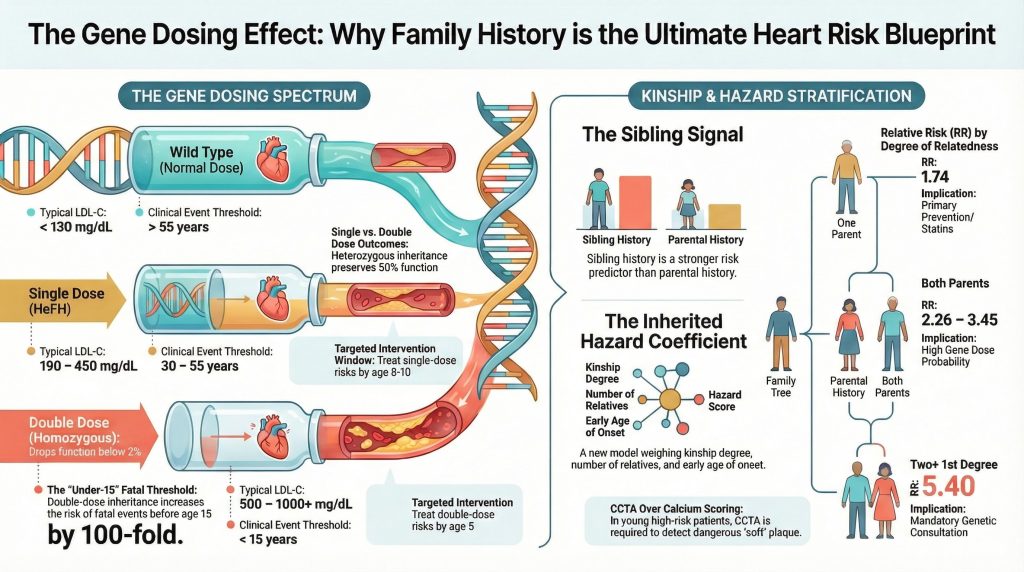
Votre Apple Watch connaît votre fréquence cardiaque au repos. Elle ne sait pas que votre frère a fait une crise cardiaque fatale à 42 ans. Votre Fitbit suit la qualité de votre sommeil. Il ne peut pas vous dire qu'un frère ou une sœur atteint d'une maladie cardiaque précoce confère un odds ratio de 2,46 pour votre propre risque cardiaque — un chiffre documenté dans des recherches évaluées par des pairs publiées dans JAMA. [5] Votre Garmin mesure VO2 max. Il n'a aucun moyen de rendre compte de la charge héréditaire additive — ce que les chercheurs appellent le dosage génique — qui se produit lorsque plusieurs proches développent une forme précoce maladie cardiovasculaire, augmentant considérablement la probabilité d'une prédisposition génétique héréditaire. [3],[8]
Les objets connectés mesurent ce qui se passe dans votre corps en ce moment même. Le calculateur de risque cardiaque modélise le signal familial héréditif qui se reflète dans vos antécédents familiaux et ce qu'il suggère quant à votre trajectoire cardiaque tout au long de la vie. Les objets connectés et les outils basés sur les antécédents familiaux fournissent des informations complémentaires mais différentes — pourtant, un seul d'entre eux aide à identifier les personnes qui pourraient bénéficier d'une évaluation plus approfondie que celle proposée par le dépistage standard.
Cela vous donne matière à apporter à votre médecin
Chaque résultat du calculateur de risque cardiaque est conçu comme un point de départ pour une discussion, et non comme une conclusion. L'application génère un résumé des antécédents familiaux prêt à être discuté et un ensemble de questions spécifiques et cliniquement fondées que vous pouvez poser lors de votre prochain rendez-vous. Des questions telles que : étant donné mes antécédents familiaux, pourrais-je avoir plaque molle qu'un scanner calcique standard raterait ? Devrais-je être orienté vers un cardiologue préventif plutôt que d'être pris en charge en soins primaires ? Mes antécédents familiaux modifient-ils la façon dont les outils d'évaluation du risque standard doivent être interprétés dans mon cas ? [9]
Ce sont les questions qui peuvent véritablement changer le cours d'une consultation médicale. Ce sont les questions qui transforment un examen annuel de routine en une conversation cardiovasculaire significative. Et ce sont les questions que la plupart des gens ne savent jamais poser, parce que personne n'a jamais organisé leurs antécédents familiaux d'une manière qui rende ces questions visibles.
Il est fondé sur de la vraie science
Le calculateur de risque cardiaque n'est pas une application de bien-être basée sur des conseils généraux. Les concepts intégrés dans son cadre sont étayés par plus de 40 publications évaluées par des pairs couvrant le risque cardiaque héréditaire, prématuré maladie coronarienne, antécédents familiaux épidémiologie, et le génétique de la susceptibilité cardiovasculaire. Le modèle de dosage génétique qui sous-tend le coefficient de risque héréditaire s'appuie sur des recherches fondamentales sur les maladies cardiovasculaires héréditaires publiées dans Nature Reviews Cardiology, le Lancette, et le European Heart Journal. [4],[8] Les données de risque parental et de la fratrie proviennent d'études de référence dans JAMA et Trafic. [3],[5] La signification clinique de la précocité accidents cardiaques chez les apparentés proches — et l'inadéquation des outils standard pour capturer cette importance — est documentée depuis des décennies en épidémiologie cardiovasculaire. [9]
Il ne s'agit pas d'un algorithme conçu en un week-end. Il s'agit d'un cadre pédagogique fondé sur des données probantes, développé comme outil pédagogique par Peter Megdal, PhD, qui applique des principes épidémiologiques reconnus à un problème que les outils classiques n'ont jamais été conçus pour résoudre.
Pourquoi c'est important en ce moment
Les maladies cardiaques restent la première cause de décès aux États-Unis. [10] Environ la moitié des Américains ont des antécédents familiaux d'accidents cardiaques. [11] Et pourtant, les outils à la disposition de la plupart des gens pour comprendre leur risque héréditif restent remarquablement primitifs — une case à cocher sur un formulaire d'admission, un score de Framingham qui n'a jamais été conçu pour capturer la charge génétique, [1] et une coronarographie scanographiques qui peut totalement rater la plaque la plus dangereuse chez les jeunes individus prédisposés génétiquement. [6],[9]
Pour un jeune de 20 ans dont le frère ou la sœur est décédé d'une mort subite d'origine cardiaque à 38 ans, le score de risque de Framingham affichera souvent un risque à dix ans inférieur à un pour cent — parce que la formule est dictée par l'âge chronologique, et non par la biologie héréditaire. [1] Le profil de risque hérédité de cette personne pourrait justifier une évaluation sensiblement plus poussée que celle suggérée par les calculateurs conventionnels. Et sans un outil qui modélise le signal familial héréditaire dans ses antécédents familiaux, elle ne saura jamais poser les bonnes questions avant qu'il ne soit trop tard.
L'application Heart Risk existe pour cette personne. Elle existe pour tous ceux qui se sont assis dans le cabinet d'un médecin et ont dit “ oui, il y a des maladies cardiaques dans ma famille ” et ont vu cette information disparaître dans une case à cocher qui ne change rien à leurs soins.
Téléchargez-le dès aujourd'hui
L'application « Heart Risk Calculator » est désormais disponible sur Google Play au prix de $4,99. Il s'agit d'un outil pédagogique, et non d'un dispositif médical, qui ne remplace pas un examen clinique. Mais ces cinq dollars pourraient bien être les plus importants que vous dépensiez pour votre santé cardiaque — non pas parce qu'elle surveille votre pouls, mais parce qu'elle pose enfin la question à laquelle les appareils portables et les calculateurs classiques n'ont jamais été conçus pour répondre.
Votre histoire familiale est une donnée. Il est temps de l'utiliser.
Cet outil est destiné exclusivement à des fins éducatives et ne constitue en aucun cas un avis médical. Ce score n’a pas fait l’objet d’une validation prospective pour la prédiction d’événements cardiovasculaires individuels et ne doit pas être utilisé pour diagnostiquer une maladie. Consultez toujours un professionnel de santé qualifié avant de prendre des décisions concernant votre santé. Recherche réalisée par Peter Megdal, PhD — CuringHeartDisease.com
Références
- D’Agostino RB Sr, Vasan RS, Pencina MJ, et al. General cardiovascular risk profile for use in primary care: the Framingham Heart Study. Circulation. 2008;117(6):743-753. doi:10.1161/CIRCULATIONAHA.107.699579.
- Virani SS, Alonso A, Aparicio HJ, et al. Heart Disease and Stroke Statistics-2021 Update: A Report From the American Heart Association. Circulation. 2021;143(8):e254-e743. doi:10.1161/CIR.0000000000000950
- Lloyd-Jones DM, Nam BH, D’Agostino RB Sr, et al. Parental cardiovascular disease as a risk factor for cardiovascular disease in middle-aged adults: a prospective study of parents and offspring. JAMA. 2004;291(18):2204-2211. doi:10.1001/jama.291.18.2204
- Ference BA, Ginsberg HN, Graham I, et al. Low-density lipoproteins cause atherosclerotic cardiovascular disease. 1. Evidence from genetic, epidemiologic, and clinical studies. A consensus statement from the European Atherosclerosis Society Consensus Panel. Eur Heart J. 2017;38(32):2459-2472. doi:10.1093/eurheartj/ehx144
- Murabito JM, Pencina MJ, Nam BH, et al. Sibling cardiovascular disease as a risk factor for cardiovascular disease in middle-aged adults. JAMA. 2005;294(24):3117-3123. doi:10.1001/jama.294.24.3117
- Villines TC, Hulten EA, Shaw LJ, et al. Prevalence and severity of coronary artery disease and adverse events among symptomatic patients with coronary artery calcification scores of zero undergoing coronary computed tomography angiography: results from the CONFIRM (Coronary CT Angiography Evaluation for Clinical Outcomes: An International Multicenter) registry. J Am Coll Cardiol. 2011;58(24):2533-2540. doi:10.1016/j.jacc.2011.10.851
- Nerlekar N, Vasanthakumar SA, Whitmore K, et al. Effects of Combining Coronary Calcium Score With Treatment on Plaque Progression in Familial Coronary Artery Disease: A Randomized Clinical Trial. JAMA. 2025;333(16):1403-1412. doi:10.1001/jama.2025.0584
- Bachmann JM, Willis BL, Ayers CR, Khera A, Berry JD. Association between family history and coronary heart disease death across long-term follow-up in men: the Cooper Center Longitudinal Study. Circulation. 2012;125(25):3092-3098. doi:10.1161/CIRCULATIONAHA.111.065490
- Arnett DK, Blumenthal RS, Albert MA, et al. 2019 ACC/AHA Guideline on the Primary Prevention of Cardiovascular Disease: A Report of the American College of Cardiology/American Heart Association Task Force on Clinical Practice Guidelines. Circulation. 2019;140(11):e596-e646. doi:10.1161/CIR.0000000000000678
- Martin SS, Aday AW, Allen NB, et al. 2025 Heart Disease and Stroke Statistics: A Report of US and Global Data From the American Heart Association. Circulation. 2025;151(8):e41-e660. doi:10.1161/CIR.0000000000001303
- Moonesinghe R, Yang Q, Zhang Z, Khoury MJ. Prevalence and Cardiovascular Health Impact of Family History of Premature Heart Disease in the United States: Analysis of the National Health and Nutrition Examination Survey, 2007-2014. J Am Heart Assoc. 2019;8(14):e012364. doi:10.1161/JAHA.119.012364
Addendum
Fondement probatoire de l'algorithme du coefficient de danger héréditaire
Document d'accompagnement de : “ L'application pour la santé cardiaque qui pose enfin la bonne question ”
Vue d'ensemble
Le coefficient de danger hérité (IHC) est calculé à l'aide de la formule :
H = Σ (R × W) / A
Où R est le coefficient de parenté (0,5 pour les apparentés du premier degré : parents et frères et sœurs ; 0,25 pour les apparentés du deuxième degré : grands-parents, tantes et oncles), W est le poids de gravité de l'événement cardiaque, A est l'âge auquel l'événement s'est produit, et Σ représente la sommation sur tous les apparentés atteints dans l'historique familial.
Chaque élément structurel de cette formule — le coefficient de relation R, le poids de gravité W, le dénominateur d'âge A et la logique de sommation — trouve son fondement dans un corpus spécifique d'épidémiologie cardiovasculaire évaluée par des pairs. Cet addendum identifie la littérature principale soutenant chaque composant et distingue cette preuve des choix de conception qui représentent la propre synthèse éclairée par les données probantes de l'auteur.
Le terme R : Coefficient de relation
Le terme R exprime le degré de parenté biologique entre le patient et le membre de la famille atteint. Les parents au premier degré (parents, frères et sœurs) se voient attribuer un coefficient de 0,5, reflétant le génome partagé de 50%. Les parents au deuxième degré (grands-parents, tantes, oncles) se voient attribuer un coefficient de 0,25, correspondant à un génome partagé de 25%. Cette pondération différentielle entre les parents au premier et au deuxième degré est étayée par deux études phares menées dans le cadre de l'étude de Framingham.
Lloyd-Jones et al., JAMA 2004
[1] Cette analyse prospective de la descendance de Framingham a été l'une des premières à confirmer rigoureusement la maladie cardiovasculaire parentale comme étant un facteur prédictif indépendant des maladies cardiovasculaires de la descendance après ajustement complet pour les facteurs conventionnels facteurs de risque. Crucialment, l'étude a démontré que le risque augmentait lorsque les deux les parents étaient touchés — le fondement conceptuel de la structure de sommation du CCHI. L'article soutient directement l'attribution du coefficient de 0,5 aux parents et la pondération différentielle des apparentés au premier degré par rapport à ceux au second degré.
Murabito et al., JAMA 2005
[2] Cette analyse complémentaire de la fratrie de Framingham a documenté un rapport des cotes non ajusté de 2,46 pour les maladies cardiovasculaires chez les individus ayant un frère ou une sœur atteint(e) — une amplitude comparable ou supérieure à celle des antécédents parentaux dans certains sous-groupes. Cette découverte constitue la justification principale de l'attribution aux frères et sœurs du même coefficient R de 0,5 qu'aux parents, plutôt qu'une valeur inférieure. Elle a également renforcé le principe fondamental selon lequel les apparentés au premier degré constituent une catégorie de risque fondamentalement différente de celle des apparentés au second degré.
Le terme A : Âge au moment de l'événement dans le dénominateur
Le terme A place l'âge auquel le membre de la famille a présenté son événement cardiaque au dénominateur de la formule, de sorte que les événements survenant plus jeune produisent une contribution IHC plus élevée. Il s'agit de la caractéristique structurelle de l'algorithme ayant les plus importantes conséquences cliniques, et elle est étayée par des observations cohérentes provenant de multiples sources de données.
Lloyd-Jones et al., JAMA 2004 et Murabito et al., JAMA 2005
[1],[2] Les deux analyses de Framingham ont stratifié leurs résultats selon l'âge lors de l'événement familial et ont démontré un risque substantiellement accru lorsque l'événement cardiaque était précoce — défini comme survenant avant l'âge de 55 ans chez les parents de sexe masculin et avant l'âge de 65 ans chez les parents de sexe féminin. Un événement familial à l'âge de 40 ans porte un signal héréditaire fondamentalement différent du même événement à l'âge de 78 ans. Le terme A dans le dénominateur est un encodage mathématique direct de ce principe épidémiologique bien établi.
D’Agostino et al., Circulation 2008 — Score de risque de Framingham
[3] Cité dans l'article principal comme le principal exemple de calculateur de risque qui le fait pas prendre en compte l'âge lors de l'événement familial. Le score de Framingham utilise l'âge chronologique propre du patient comme principal moteur du risque à 10 ans, mais n'intègre aucune variable pour l'âge auquel les membres de la famille ont subi des événements cardiaques. Le dénominateur A de la formule IHC est spécifiquement conçu pour combler cette lacune — en capturant ce que le score de Framingham omet systématiquement.
Le terme W : Poids de gravité
Le terme W attribue des poids différentiels aux événements cardiaques en fonction de leur gravité — les événements fatals, la mort subite d'origine cardiaque et les événements précoces revascularisation recevant des poids plus élevés que les événements non mortels pris en charge médicalement. Cela reflète la relation bien documentée entre la gravité de l'événement et la charge athérosclérotique sous-jacente.
Villines et al., JACC 2011 — Registre CONFIRM
[4] Ce vaste registre multicentrique de CCTA a démontré que, même chez les patients présentant un score CAC de zéro — traditionnellement considéré comme à faible risque —, une proportion significative abritait des plaques non calcifiées et potentiellement obstructives. L'étude a fourni de solides preuves que la gravité des événements et les caractéristiques des plaques ne sont pas uniformes chez les patients présentant des profils de risque nominalement similaires. Les événements fatals chez les parents au premier degré impliquent une hérédité plus élevée charge athéromateuse et une trajectoire de maladie plus agressive que les événements non mortels traités médicalement — la justification épidémiologique de la pondération de la gravité W.
Nerlekar et al., JAMA 2025 — Essai CAUGHT-CAD
[5] Cet essai randomisé de 2025 mené chez des patients ayant des antécédents familiaux de coronaropathie précoce a démontré que la charge de plaque non calcifiée variait considérablement, même parmi des individus appartenant à la même grande catégorie d'antécédents familiaux. L'essai a utilisé l'angio-TDM coronaire pour quantifier la progression de la plaque comme critère d'évaluation principal, confirmant que la différenciation de la sévérité au sein du spectre du risque héréditaire a une importance clinique mesurable — et n'est pas saisie par la classification binaire des antécédents familiaux ou par le score calcique seul.
Le terme Σ : Somme sur les parents
L'opérateur de sommation traduit le principe selon lequel le risque cardiaque héréditaire se cumule avec chaque apparenté atteint supplémentaire. Un patient ayant deux apparentés au premier degré atteints porte un signal héréditaire sensiblement différent de celui d'un patient n'en ayant qu'un seul. La structure Σ code cette réalité. relation dose-réponse mathématiquement.
Bachmann et al., Circulation 2012 — Étude longitudinale du Cooper Center
[6] Cette vaste étude prospective portant sur des hommes suivis pendant des décennies a démontré que les antécédents familiaux de maladie coronarienne le décès était associé à une mortalité cardiovasculaire à long terme significativement élevée, et le risque s'accumulait au cours de la période de suivi d'une manière compatible avec un sous-jacent relation dose-effet relation. L'étude soutient la logique d'additionner les contributions des parents affectés plutôt que de traiter l'histoire familiale comme un simple indicateur binaire.
Ference et al., European Heart Journal 2017
[7] Ceci Randomisation mendélienne l'analyse a démontré que l'effet athérogène de cholestérol LDL — le principal moteur du risque cardiaque héréditaire lié aux lipides — est cumulatif et dépendant du temps. L'exposition à long terme à des taux élevés LDL produit une charge athéoscléreuse qui est proportionnelle à l'intégrale de l'exposition au temps, et non simplement à une mesure unique. Ce cadre biologique soutient la structure de sommation de l'IHC : le risque cardiovasculaire héréditaire n'est pas une estimation ponctuelle mais un signal cumulatif qui doit être agrégé chez tous les parents atteints et pondéré par la gravité et le moment de leurs événements.
Ce que la littérature valide — et ce qu'elle ne valide pas
Qu'est-ce qui est validé
La littérature évaluée par les pairs citée ci-dessus établit ce qui suit avec un degré élevé de certitude :
- Les apparentés au premier degré confèrent un risque cardiaque héréditaire plus élevé que les apparentés au second degré.
- Les frères et sœurs présentent un risque comparable à celui des parents, et non intermédiaire entre les parents et les grands-parents.
- L'âge auquel un membre de la famille a subi un événement cardiaque est une variable critique : les événements précoces confèrent un signal héréditaire nettement plus important que les événements tardifs.
- De multiples apparentés atteints aggravent le risque hérédité selon une relation dose-réponse.
- La gravité de l'événement est corrélée à la charge athérogène sous-jacente et n'est pas uniforme selon les antécédents familiaux signalés.
- Les calculateurs de risque standard sous-utilisent systématiquement cette information, en particulier chez les patients plus jeunes ayant de forts antécédents familiaux.
Qu'est-ce qui n'est pas validé
La littérature existante fait pas valider
- Les valeurs de coefficient spécifiques choisies pour R (0,5 et 0,25).
- Les valeurs de pondération de gravité spécifiques attribuées à W.
- La forme mathématique de la division par A plutôt que l'application d'un modificateur catégorique de l'âge au moment de l'événement.
- La formule H = Σ(R×W)/A comme score prédictif cliniquement calibré du risque d'événement cardiovasculaire individuel.
- L'IHC par rapport à tout ensemble de données de résultats prospectifs.
La formule IHC est un cadre pédagogique fondé sur des données probantes qui traduit des principes épidémiologiques établis en une estimation quantitative structurée du risque cardiaque familial hérédité. Les données d'entrée s'appuient sur une littérature phare évaluée par des pairs. La mise en œuvre mathématique spécifique — les valeurs des coefficients, le système de pondération et la structure de la formule — représente la synthèse de ces principes par l'auteur et n'a pas été validée de manière indépendante. L'ACC/AHA Prévention primaire Directive [8] reconnaît explicitement les antécédents familiaux comme un facteur majorant du risque qui devrait modifier la prise de décision clinique, mais s'abstient de fournir une formule quantitative pour ce faire. L'IHC est conçue pour combler précisément cette lacune.
Références
- Lloyd-Jones DM, Nam BH, D’Agostino RB Sr, et al. Parental cardiovascular disease as a risk factor for cardiovascular disease in middle-aged adults: a prospective study of parents and offspring. JAMA. 2004;291(18):2204-2211. doi:10.1001/jama.291.18.2204
- Murabito JM, Pencina MJ, Nam BH, et al. Sibling cardiovascular disease as a risk factor for cardiovascular disease in middle-aged adults. JAMA. 2005;294(24):3117-3123. doi:10.1001/jama.294.24.3117
- D’Agostino RB Sr, Vasan RS, Pencina MJ, et al. General cardiovascular risk profile for use in primary care: the Framingham Heart Study. Circulation. 2008;117(6):743-753. doi:10.1161/CIRCULATIONAHA.107.699579
- Villines TC, Hulten EA, Shaw LJ, et al. Prevalence and severity of coronary artery disease and adverse events among symptomatic patients with coronary artery calcification scores of zero undergoing coronary computed tomography angiography: results from the CONFIRM (Coronary CT Angiography Evaluation for Clinical Outcomes: An International Multicenter) registry. J Am Coll Cardiol. 2011;58(24):2533-2540. doi:10.1016/j.jacc.2011.10.851
- Nerlekar N, Vasanthakumar SA, Whitmore K, et al. Effects of Combining Coronary Calcium Score With Treatment on Plaque Progression in Familial Coronary Artery Disease: A Randomized Clinical Trial. JAMA. 2025;333(16):1403-1412. doi:10.1001/jama.2025.0584
- Bachmann JM, Willis BL, Ayers CR, Khera A, Berry JD. Association between family history and coronary heart disease death across long-term follow-up in men: the Cooper Center Longitudinal Study. Circulation. 2012;125(25):3092-3098. doi:10.1161/CIRCULATIONAHA.111.065490
- Ference BA, Ginsberg HN, Graham I, et al. Low-density lipoproteins cause atherosclerotic cardiovascular disease. 1. Evidence from genetic, epidemiologic, and clinical studies. A consensus statement from the European Atherosclerosis Society Consensus Panel. Eur Heart J. 2017;38(32):2459-2472. doi:10.1093/eurheartj/ehx144
- Arnett DK, Blumenthal RS, Albert MA, et al. 2019 ACC/AHA Guideline on the Primary Prevention of Cardiovascular Disease: A Report of the American College of Cardiology/American Heart Association Task Force on Clinical Practice Guidelines. Circulation. 2019;140(11):e596-e646. doi:10.1161/CIR.0000000000000678