
Revue comparative des thérapeutiques hypolipémiantes
Voies biologiques, dynamique de l'efficacité, mécanismes cellulaires de la toxicité musculaire, pharmacogénomique et phénomène nocebo
Résumé
athéromateux maladie cardiovasculaire reste la principale cause de décès dans le monde, et l'abaissement du taux de basse densité lipoprotéine cholestérol (LDL-C) est le moyen pharmacologique le plus solidement validé pour réduire ce risque. L'arsenal thérapeutique s'est élargi des inhibiteurs de la 3-hydroxy-3-méthylglutaryl-coenzyme A (HMG-CoA) réductase aux inhibiteurs de l'ATP-citrate lyase, du Niemann-Pick C1-Like 1, proprotéine convertase subtilisine/kexine de type 9 (PCSK9), et angiopoïétine-like protéine 3, avec ester de cholestérol inhibiteurs de la protéine de transfert, voie orale Inhibiteurs de PCSK9, et les thérapies à base d'acides nucléiques ciblant la lipoprotéine(a) en développement avancé. Malgré un bénéfice cardiovasculaire non équivoque, la persistance thérapeutique est compromise par les effets indésirables signalés, principalement symptômes musculaires associés aux statines (SMAS).
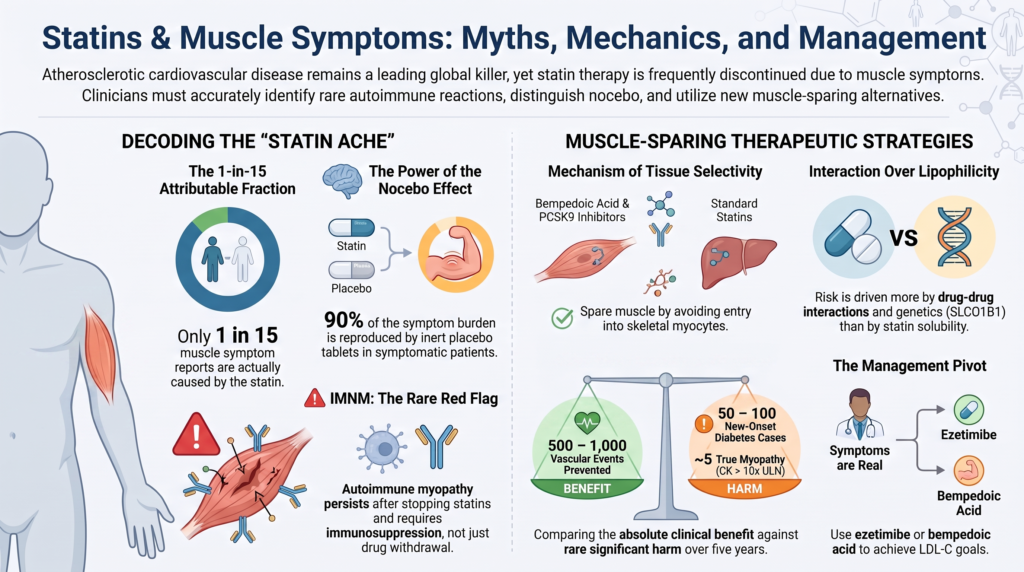
Cette revue synthétise la pharmacologie moléculaire, l'efficacité comparative et le profil de sécurité musculaire de toutes les classes de médicaments hypocholestérolémiants actuellement disponibles. Elle aborde les effets musculaires au sens large plutôt que sous le seul angle des courbatures, en traitant de la fatigue, de la baisse d'énergie et capacité d'exercice comme des résultats dotés de leur propre base factuelle distincte. Elle distingue quatre entités biologiquement distinctes qui sont fréquemment confondues : (i) les symptômes médiés par l'effet nocebo, qui représentent la grande majorité des plaintes musculaires attribuées à statines — d’après les données individuelles des participants issues de l’étude ’ Cholesterol Treatment Trialists », plus de 90% des cas de symptômes musculaires signalés chez les participants ayant reçu des statines n’étaient pas imputables au médicament ; (ii) une véritable myalgie d’origine pharmacologique, touchant une minorité restreinte mais bien réelle ; (iii) une véritable myopathie et rhabdomyolyse, qui sont rares et dépendent de la dose ; et (iv) myopathie nécrosante à médiation immunitaire anti-HMGCR, une maladie auto-immune rare qui persiste après l'arrêt du médicament et nécessite une immunosuppression plutôt que des rassurances. Données probantes provenant des données de participants individuels de la Cholesterol Treatment Trialists’ Collaboration méta-analyse, le SAMSON et StatinWISE essais n-de-1, la comparaison en aveugle par rapport à l'étude en ouvert ASCOT-LLA, et le test de réexposition randomisé GAUSS-3 sont intégrés à des conseils pharmacogénomiques et à un algorithme de prise en charge pratique. Le message clinique central est double : les cliniciens ne doivent ni accepter les symptômes musculaires rapportés comme la preuve d'une toxicité pharmacologique, ni les rejeter comme étant invariablement d'ordre psychologique.
1. Introduction
Les maladies cardiovasculaires induites par l'athérosclérose (ACV) restent la principale cause de mortalité dans le monde1La relation entre le LDL-C et le risque athérogène est causale, dose-dépendante et cumulative dans le temps, et le bénéfice clinique de la réduction du LDL-C est proportionnel à l'amplitude absolue de la réduction obtenue et à sa durée, indépendamment, pour l'essentiel, du mécanisme par lequel elle est obtenue.
Pourtant, la traduction de ces données probantes en bénéfice au niveau de la population est limitée moins par l'efficacité que par la persistance. Une fraction substantielle des patients à qui l'on prescrit des statines les arrêtent dans les deux ans, invoquant le plus souvent des symptômes musculaires. L'écart qui en résulte entre l'efficacité démontrée dans les essais et le bénéfice réalisé dans la pratique est l'une des pertes évitables les plus importantes en cardiologie préventive.
La résolution de ce problème exige de la précision quant à ce qui est réellement observé lorsqu'un patient signale des douleurs musculaires sous statine. Les données actuelles permettent cette précision. Cette revue a par conséquent trois objectifs : décrire la pharmacologie moléculaire et l'efficacité comparative de tous les hypolipidémiants disponibles ; définir la base biologique de la toxicité musculaire et les raisons pour lesquelles certains agents épargnent entièrement le squelette musculaire ; et quantifier la part de la charge des symptômes musculaires signalés qui est attribuable au médicament plutôt qu'à l'attente, au vieillissement ou à la coïncidence.
1.1 Note sur la terminologie et le champ d'application
Cet article est un revue narrative avec une synthèse quantitative des données d'essais publiées. Il ne s'agit pas d'une méta-analyse de novo : aucune estimation d'effet poolée n'a été calculée par les auteurs, et tous les chiffres poolés cités sont ceux rapportés par les investigateurs originaux ou par des méta-analyses publiées, qui sont identifiées comme telles. Lorsque les estimations divergent entre les sources, le conflit est mentionné plutôt que résolu par préférence.
2. Voies biologiques et mécanismes d'action moléculaires
Thérapeutique hypolipémiant est obtenu en perturbant hépatique synthèse du cholestérol, l'absorption intestinale du cholestérol, hépatique Recyclage du récepteur des LDL (LDLR), ou le catabolisme des lipoprotéines. Ces différences pharmacodynamiques déterminent non seulement la puissance mais aussi la distribution tissulaire, et par conséquent le profil des effets indésirables. La distinction qui importe le plus pour la sécurité musculaire est simple : le médicament pénètre-t-il dans les myocytes squelettiques et, si c'est le cas, interfère-t-il avec une voie métabolique dont le muscle a besoin ?
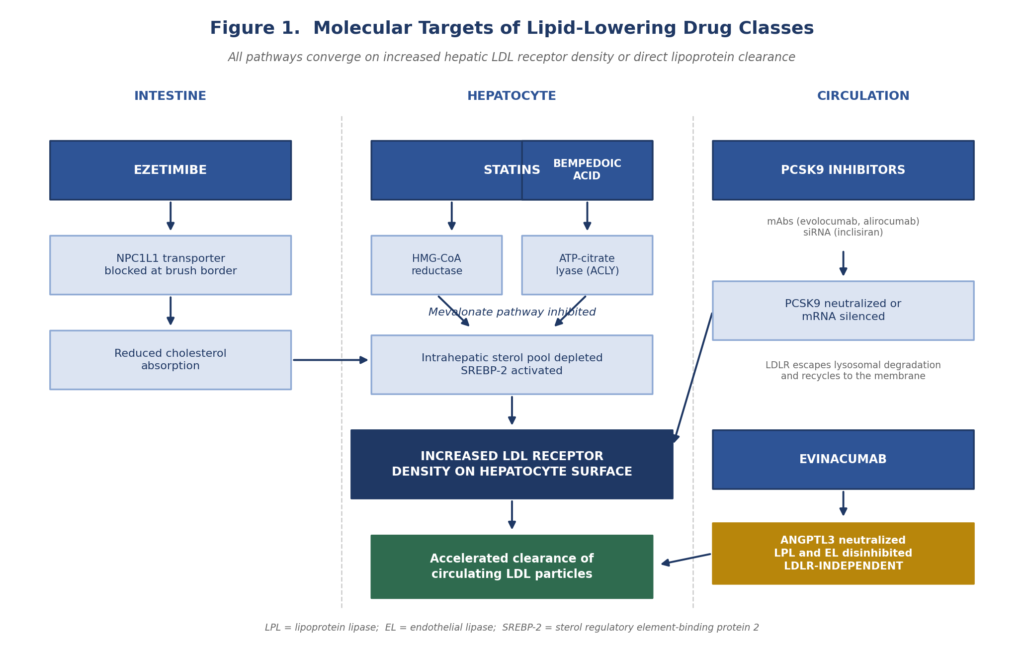
Figure 1. Cibles moléculaires des classes de médicaments hypolipémiants. Les statines et acide bempédoïque agir sur deux nœuds distincts de l'hépatique voie du mévalonate; ézétimibe agit au niveau de la bordure en brosse des entérocytes ; les agents ciblant le PCSK9 agissent dans la circulation ou au sein de l'hépatocyte pour préserver Récepteur des LDL recyclage. Evinacumab est le seul agent dont l'effet ne dépend pas de LDL densité des récepteurs, c'est pourquoi il conserve son activité dans les récepteurs nuls hypercholestérolémie familiale homozygote.
2.1 Inhibiteurs de la HMG-CoA réductase (Statines)
Les statines inhibent de manière compétitive HMG-CoA réductase, l'enzyme limitante convertissant le HMG-CoA en mévalonate dans la voie de biosynthèse du cholestérol. L'épuisement du stock intra-hépatique stérol pool active la protéine de liaison à l'élément régulateur des stérols 2 (SREBP-2), ce qui augmente la transcription et l'expression à la surface de LDLR sur les membranes des hépatocytes, accélérant la clairance des LDL et des lipoprotéines de très basse densité circulantes (VLDL) particules résiduelles.
Toutes les statines ont un effet hépatosélectif, principalement en raison d'une capture hépatique efficace au premier passage. Elles diffèrent cependant dans la manière dont cette capture est réalisée et dans la facilité avec laquelle elles atteignent les tissus extra-hépatiques :
- Statines lipophiles (atorvastatine, simvastatine, lovastatine, fluvastatine, pitavastatine, et le cérivastatine retiré du marché) : possèdent une perméabilité membranaire suffisante pour la diffusion passive à travers les membranes cellulaires, y compris celles des myocytes squelettiques. Ils sont par conséquent plus sensibles au métabolisme oxydatif par le système du cytochrome P450, à l'exception notable de la pitavastatine.
- Statines hydrophiles (rosuvastatine, pravastatine): possèdent des domaines structurels polaires qui restreignent le passage membranaire passif. L'entrée hépatique dépend principalement du transport actif par le polypeptide transporteur d'anions organiques 1B1 (OATP1B1, encodé par SLCO1B1), et aucun des deux ne subit de métabolisme CYP450 substantiel.
Il importe d'énoncer d'emblée que cette distinction physico-chimique, bien que réelle et plausible sur le plan mécanistique, ne s'est pas traduite par une différence systématiquement démontrable dans les taux de symptômes musculaires cliniques. Cela est abordé directement à la section 6.4. La pitavastatine est l'illustration la plus claire de la raison pour laquelle l'heuristique simpliste selon laquelle lipophile équivaut à risqué échoue : c'est une molécule lipophile, mais comme elle ne subit pour ainsi dire aucun métabolisme par le CYP450, elle présente l'un des risques de myopathie liés aux interactions les plus faibles de toutes les statines.
2.2 La liste complète des statines
Sept statines sont actuellement commercialisées. Une huitième, la cérivastatine, a été retirée volontairement du marché mondial en 2001 en raison d'une incidence inacceptable de rhabdomyolyse fatale, en particulier lorsqu'elle était associée au gemfibrozil. Étant donné qu'une grande partie de l'anxiété historique entourant la myotoxicité des statines découle de l'expérience de la cérivastatine, elle est incluse ici pour donner du contexte.
| Statine | Classe | Solubilité | Métabolisme principal | Notes de transport / interaction | Doses disponibles | Positionnement pratique |
| Atorvastatine | Synthétique | Lipophile | CYP3A4 (métabolites actifs) | Substrat de l'OATP1B1 ; les inhibiteurs du CYP3A4 augmentent l'exposition | 10, 20, 40, 80 mg par jour | Agent de travail de force ; permis à longue demi-vie posologie un jour sur deux |
| Rosuvastatine | Synthétique | Hydrophile | CYP minimal (traces de CYP2C9) | Substrat de l'OATP1B1 et de l'ABCG2 (BCRP) ; les variants de l'ABCG2 augmentent l'exposition | 5, 10, 20, 40 mg par jour | Le plus puissant par mg ; longue demi-vie ; bon choix après une intolérance |
| Simvastatine | D'origine fongique | Lipophile | CYP3A4 (extensif) | Le plus fort SLCO1B1 signal de myopathie ; nombreuses limites de posologie avec des médicaments en interaction | 5, 10, 20, 40 mg par jour (80 mg restreint) | Risque de myopathie le plus élevé induit par les interactions et le génotype parmi les statines commercialisées ; 80 mg non recommandé |
| Pravastatine | D'origine fongique | Hydrophile | Non-CYP (sulfatation) | Substrat d'OATP1B1 ; peu d'interactions avec les CYP | 10, 20, 40, 80 mg par jour | Faible puissance mais profil d'interaction favorable ; utile en polypharmacie |
| Lovastatine | D'origine fongique | Lipophile | CYP3A4 (extensif) | Prodrogue lactone ; plafonds de doses pour interactions multiples | 10, 20, 40 mg (libération immédiate) ; 20–60 mg (libération prolongée) | Largement obsolète ; à prendre au repas du soir |
| Fluvastatine | Synthétique | Lipophile | CYP2C9 (principal) | Évite la voie du CYP3A4 ; les métaboliseurs lents du CYP2C9 accumulent le médicament | 20, 40 mg ; 40 mg BID ; 80 mg XL | Utile lorsque l'interaction avec le CYP3A4 pose problème ; puissance la plus faible |
| Pitavastatine | Synthétique | Lipophile | CYP minimal ; glucuronidation | Non substrat du CYP3A4 ; ciclosporine contre-indiquée | 1, 2, 4 mg par jour | Faible charge d'interaction ; couramment utilisé après l'intolérance à d'autres statines, sur des bases empiriques plutôt que par des essais comparatifs |
| Cérivastatine | Synthétique | Lipophile | CYP2C8 et CYP3A4 | Retiré en 2001 ; rhabdomyolyse fatale, en particulier avec le gemfibrozil | Retiré | Historique uniquement ; source de beaucoup d'anxiété liée à la myotoxicité des statines |
Tableau 1. Caractéristiques pharmacologiques de toutes les statines commercialisées ainsi que de la cérivastatine, retirée du marché. La classification de la solubilité suit Schachter (2005) [14]; les données de métabolisme et d'interaction suivent l'étiquetage du produit [15-21] et la directive CPIC 2022 [22]. IR = libération immédiate ; ER/XL = libération prolongée ; BID = deux fois par jour.
Classification de l'intensité des statines
Les schémas thérapeutiques de statines sont classés de manière conventionnelle en fonction de la réduction moyenne du LDL-C obtenue plutôt que par la seule dose. Les catégories d'intensité élevée, modérée et faible ont été définies dans les recommandations sur le cholestérol de l'ACC/AHA de 2013, qui ont introduit le tableau des intensités essentiellement dans sa forme actuelle [92], et ont été reportées dans les lignes directrices multisociétés AHA/ACC de 2018 [12]; elles restent d'usage général. La directive de 2018 elle-même a été remplacée : la directive 2026 ACC/AHA/Multisociety sur la prise en charge de Dyslipidémie, publié en mars 2026, l'abroge et le remplace [11], et les modifications du cadre qu'il introduit sont résumées à la section 9.3. La réduction du pourcentage de LDL-C reste une priorité affichée dans le document de 2026, de sorte que le tableau d'intensité ci-dessous conserve son utilité pratique, mais les lecteurs doivent noter qu'il s'inscrit désormais dans un cadre de prescription fondé sur des objectifs plutôt que purement sur l'intensité.
| Haute intensité (réduction du LDL-C ≥ 50%) | Intensité modérée (réduction de 30 à 491 TP9T) | Faible intensité (réduction < 30%) |
| Atorvastatine 40–80 mg | Atorvastatine 10–20 mg | Simvastatine 10 mg |
| Rosuvastatine 20–40 mg | Rosuvastatine 5 à 10 mg | Pravastatine 10–20 mg |
| — | Simvastatine 20 à 40 mg | Lovastatine 20 mg |
| — | Pravastatine 40–80 mg | Fluvastatine 20–40 mg |
| — | Lovastatine 40–80 mg | Pitavastatine 1 mg |
| — | Fluvastatine 40 mg deux fois par jour ou 80 mg LP | — |
| — | Pitavastatine 2 à 4 mg | — |
Tableau 2. Classification de l'intensité des statines, adaptée de la classification ACC/AHA introduite en 2013 [92] et reporté en 2018 [12Aucune dose de pravastatine, lovastatine, fluvastatine ou pitavastatine n'atteint la classification de haute intensité ; seuls l'atorvastatine et la rosuvastatine y parviennent. La ligne directrice sur la dyslipidémie de 2026 qui a remplacé le document de 2018 ajoute des objectifs absolus de LDL-C et de non-HDL-C en plus de la réduction en pourcentage ; voir la section 9.3.
2.3 Inhibiteurs de l'ATP-citrate lyase (acide bempédoïque)
L'acide bempédoïque est un promédicament synthétique à base d'acide dicarboxylique qui inhibe ATP-citrate lyase (ACLY), une enzyme agissant deux étapes en amont de la HMG-CoA réductase dans la voie du mévalonate. L'ACLY clive le citrate d'origine mitochondriale en acétyl-CoA et en oxaloacétate, fournissant le substrat principal pour la synthèse de novo du cholestérol et des acides gras.
L'activité pharmacologique nécessite une estérification avec le coenzyme A pour former du bempédoyl-CoA, une réaction catalysée par l'acyl-CoA synthétase 1 à chaîne très longue (ACSVL1, codée par SLC27A2Dans la caractérisation originale de la molécule, l'ACSVL1 était fortement exprimée dans le foie, détectée de manière minime seulement dans le rein, et indétectable dans le muscle squelettique dans les conditions expérimentales étudiées ; de manière correspondante, le métabolite thioester actif a été récupéré dans le foie mais pas dans le muscle squelettique ni dans le tissu adipeux [24]. C'est la base mécanistique du profil d'épargne musculaire du médicament, et il s'agit d'un véritable argument de sélectivité tissulaire plutôt que pharmacocinétique.
L'acide bempédoïque active également la protéine kinase activée par l'AMP 5’ (AMPK) dans les systèmes précliniques, entraînant une régulation négative des enzymes lipogènes. Cela ne doit pas être présenté comme un mécanisme établi chez l'humain : l'examen intégré de la FDA note que l'activation de l'AMPK pourrait être spécifique aux rongeurs, que sa pertinence chez l'humain est incertaine et que la baisse du LDL-C peut se produire indépendamment de celle-ci [93]. Séparément, l'acide bempédoïque réduit la protéine C-réactive à haute sensibilité Protéine C-réactive (hsCRP) d'environ 19 à 331 TP9T dans le cadre du programme CLEAR [25Au niveau rénal, l'acide bempédoïque et son métabolite l'acyl-glucuronide inhibent de manière compétitive le transporteur d'anions organiques 2 (OAT2) dans le tubule proximal. L'OAT2 assurant la sécrétion tubulaire de l'acide urique et de la créatinine, cette inhibition entraîne des élévations prévisibles et réversibles de l'urate et de la créatinine sériques, qui traduisent une compétition entre transporteurs plutôt qu'une atteinte parenchymateuse.
2.4 Inhibiteurs de Niemann-Pick C1-Like 1 (Ézétimibe)
L'ézétimibe se localise dans la bordure en brosse des entérocytes de l'intestin grêle et se lie au transporteur de stérols Niemann-Pick C1-Like 1 (NPC1L1), bloquant l'endocytose biliaire et cholestérol alimentaire à travers l'épithélium intestinal sans affecter de manière significative l'absorption de triglycérides, acides biliaires, ou des vitamines liposolubles. Réduit chylomicron cholestérol résiduel Son administration épuise les réserves intra-hépatiques de stérols et induit une augmentation de l'expression hépatique du récepteur LDL (LDLR). L’exposition systémique n’est pas négligeable : l’ézétimibe et son glucuronide actif sont facilement détectables dans le plasma, sont liés à plus de 90 % aux protéines, subissent une recirculation entéro-hépatique et ont une demi-vie d’environ 22 heures [27Ce qui importe pour la sécurité musculaire n'est pas l'absence de médicament en circulation, mais le fait que la cible pharmacologique soit intestinale et qu'aucune cible au niveau des muscles squelettiques n'ait été identifiée.
2.5 Thérapies ciblant PCSK9
PCSK9 est une protéine sécrétée sérine protéase qui se lie au domaine extracellulaire du récepteur des LDL (LDLR) à la surface des hépatocytes et dirige le récepteur vers la dégradation lysosomale plutôt que vers le recyclage endosomal. Comme chaque molécule de LDLR peut autrement se recycler de nombreuses fois, empêcher sa dégradation augmente substantiellement la densité des récepteurs fonctionnels.
- Anticorps monoclonaux (évocumab, alirocumab): anticorps IgG entièrement humains qui se lient au PCSK9 circulant libre avec une affinité élevée, bloquant stériquement l'interaction PCSK9-LDLR. Ils agissent principalement de manière extracellulaire, ce qui correspond au petit volume apparent de distribution rapporté pour l'évocumab, et n'ont pas de cible myocytaire intracellulaire identifiée ; l'étiquetage n'établit pas l'absence littérale de pénétration myocytaire [29,30].
- Petit ARN interférentinclisiran): un ARNsi double brin synthétique conjugué à un ligand triantennaire de N-acétylgalactosamine (GalNAc). Le GalNAc se lie aux récepteurs de l'asialoglycoprotéine exprimés presque exclusivement sur les hépatocytes, ce qui entraîne une endocytose rapide médiée par récepteur. À l'intérieur de la cellule, l'ARNsi s'intègre dans le complexe d'interférence ARN (RISC) et dirige le clivage catalytique de l'ARN messager de la PCSK9, produisant une suppression prolongée qui permet une administration deux fois par an après la dose de charge31,34,35,59].
- Inhibiteurs peptidiques macrocycliques oraux (enlicitide) : peptides macrocycliques biodisponibles par voie orale qui se lient à PCSK9 avec une affinité de type anticorps, bloquant l'interaction PCSK9-LDLR par le même mécanisme que les anticorps monoclonaux mais administrés sous forme de comprimé. L'enlicitide (Lipfendra) a été approuvé par la FDA le 16 juillet 2026 en tant que premier inhibiteur oral de PCSK9, à la dose de 20 mg une fois par jour, et est abordé plus en détail dans la section 10.2 [36].
2.6 Inhibiteurs de l'angiopoïétine-like 3 (Evinacumab)
Evinacumab est un anticorps monoclonal entièrement humain dirigé contre ANGPTL3, un inhibiteur endogène de la lipase endotheliale et lipoprotéine lipase. La neutralisation de l'ANGPTL3 désinhibe les deux lipases, accélérant la clairance des intermédiaires du métabolisme des VLDL et favorisant la dégradation intravasculaire directe des particules de lipoprotéines de densité intermédiaire et des LDL. De manière cruciale, cette voie ne nécessite pas de récepteurs LDLR fonctionnels, ce qui rend l'evinacumab efficace chez les homozygotes hypercholestérolémie familiale (HoFH), y compris les patients présentant des mutations nulles/nulles du gène LDLR qui répondent mal ou pas du tout aux statines et aux inhibiteurs de la PCSK9 [13,37Il est plus exact de décrire l'évinacumab comme étant largement plutôt que purement indépendant des LDLR. La démonstration de l'efficacité chez les patients null/null établit qu'il existe une voie indépendante des LDLR et qu'elle est suffisante en soi ; cela n'établit pas que la clairance médiée par les LDLR ne contribue en rien chez les patients qui conservent une fonction réceptrice partielle, et une certaine biologie résiduelle des récepteurs peut bien contribuer à la réponse dans ce groupe plus large43].
2.7 Inhibition de la protéine de transfert des esters de cholestérol (Obicetrapib, en phase de recherche)
CETP médiate le transfert des esters de cholestérol de HDL à apolipoprotéine lipoprotéines contenant de l'apo B en échange de triglycérides. L'obicetrapib est un inhibiteur de la CETP oral, à faible dose et de nouvelle génération, qui réduit le C-LDL, l'apolipoprotéine B et lipoprotéine(a) tout en augmentant le taux de HDL-C. Auparavant Inhibiteurs de la CETP ont échoué en raison d'une toxicité hors cible (torcetrapib) ou d'une efficacité insuffisante (dalcetrapib, evacetrapib) ; cette classe de médicaments fait donc l'objet d'une prudence justifiée, dans l'attente des données sur les résultats cardiovasculaires [38].
3. Efficacité pharmacodynamique en monothérapie et en association avec d’autres traitements
La monothérapie aux statines présente une relation non linéaire relation dose-effet courbe régie par ce qu'on appelle la « règle de six » : chaque doublement de la dose n'entraîne qu'une réduction supplémentaire d'environ 6% du LDL-C. Cette atténuation s'explique par le fait que la déplétion intracellulaire en stérols déclenche une régulation à la hausse compensatoire de l'absorption intestinale du cholestérol via le gène NPC1L1 et une augmentation du taux circulant de PCSK9. L'implication clinique est que l'augmentation progressive de la dose constitue une stratégie inefficace par rapport à l'association de voies métaboliques.
3.1 Stratégies de combinaison rationnelles
- Double inhibition de la synthèse (acide bempédoïque associé à une statine) : L'inhibition de la voie du mévalonate au niveau de deux nœuds enzymatiques empêche l'accumulation des précurseurs en amont et entraîne des réductions cumulatives du pool de stérols intrahépatiques.
- Synthèse associée à un blocage de l'absorption (statine ou acide bempédoïque associé à l'ézétimibe) : atténue l'augmentation compensatoire de l'absorption intestinale du cholestérol induite par l'inhibition de la synthèse. Il s'agit de l'association la plus rentable qui soit.
- Synthèse associée à un blocage de la clairance (statine associée à un inhibiteur de la PCSK9) : statines à haute intensité stimulent l'expression du récepteur LDL (LDLR), mais entraînent également une augmentation du taux de PCSK9 circulante. L'ajout d'un anticorps monoclonal anti-PCSK9 ou d'inclisiran neutralise cette augmentation compensatoire, permettant ainsi d'obtenir les réductions les plus importantes possibles avec les traitements actuels.
3.2 Efficacité comparative
Les chiffres ci-dessous correspondent aux réductions du LDL-C, corrigées par rapport au placebo ou à la valeur initiale, issues des principaux essais d'homologation. Deux mises en garde s’imposent. Premièrement, les pourcentages des traitements combinés sont exprimés par rapport à une valeur de référence chez les patients non traités et ne sont donc pas cumulables avec ceux des lignes consacrées aux monothérapies. Deuxièmement, le pourcentage de réduction est un indicateur de substitution ; seuls les agents ayant fait l’objet d’essais cliniques achevés portant sur les résultats cardiovasculaires ont démontré une réduction des événements, ce qui est explicitement indiqué dans la dernière colonne.
| Traitement | Posologie standard | Réduction moyenne du taux de LDL-C | Population principale | Données sur les résultats |
| Statine à hydrophilie faible/modérée | Pravastatine, 20 à 40 mg par jour | 20–35% | Prévention primaire; polypharmacie | Oui (WOSCOPS, LIPID, CARE) |
| Statine hydrophile à haute intensité | Rosuvastatine, 20 à 40 mg par jour | 45–55% | Prévention primaire chez les personnes à risque élevé (la Jupiter (population) ; également utilisé chez les personnes présentant un risque élevé d’ASCVD | Oui (JUPITER, un essai clinique de prévention primaire mené chez des adultes apparemment en bonne santé) |
| Statine à lipophilie faible/modérée | Atorvastatine, 10 à 20 mg par jour | 30–40% | Dyslipidémie initiale | Oui (ASCOT-LLA, CARDS) |
| Statine lipophile à haute intensité | Atorvastatine, 40 à 80 mg par jour | 50–60% | ACS ; prise en charge post-infarctus du myocarde | Oui (PROVE-IT, TNT) |
| Monothérapie par un inhibiteur de NPC1L1 | 10 mg d'ézétimibe par jour | 15–20% | Traitement d'appoint en cas d'intolérance aux statines | Adjectif (IMPROVE-IT) |
| Statine associée à l'ézétimibe | Statine à forte dose + ézétimibe 10 mg | ≈ 60–65% | ASCVD avancée ne répondant pas au traitement par statines seules | Oui (IMPROVE-IT) |
| Monothérapie par un inhibiteur de l'ACL | Acide bempédoïque : 180 mg par jour | ≈ 181 TP9T sous statine ; ≈ 21 à 251 TP9T en monothérapie | Intolérance aux statines | Oui (Résultats CLEAR, 2023) |
| Inhibiteur de l'ACL associé à l'ézétimibe | Acide bempédoïque 180 mg + ézétimibe 10 mg | 38–40% | Intolérance aux statines nécessitant une réduction importante du taux de cholestérol | Éléments de preuve relatifs aux composants |
| Monothérapie par anticorps monoclonal anti-PCSK9 | Évolocumab 140 mg toutes les deux semaines ou 420 mg une fois par mois | 50–60% | Hypercholestérolémie sévère; intolérance aux statines | LDL-C uniquement en monothérapie. FOURIER et ODYSSEY Les RÉSULTATS ont montré une réduction des événements lorsque l'anticorps était associé à un traitement de fond par statine ou à un traitement par statine à la dose maximale tolérée, mais pas en monothérapie. |
| Anticorps monoclonal anti-PCSK9 associé à un traitement par statine à forte dose | Évolocumab + atorvastatine 80 mg | ≈ 70–80% par rapport à la valeur de référence chez les patients non traités | ASCVD à très haut risque ; HeFH | Oui (FOURIER) |
| ARNsi anti-PCSK9 | Inclisiran 284 mg le jour 0, au mois 3, puis tous les 6 mois | 48–52% | Patients présentant une observance thérapeutique limitée | En attente (ORION-4, VICTORION-2P) |
| inhibiteur de l'ANGPTL3 | Evinacumab 15 mg/kg par voie intraveineuse, une fois par mois | ≈ 47–49% | FH homozygote, y compris les cas de déficience totale en LDLR | Uniquement pour les mères porteuses |
| Inhibiteur de la CETP (en cours d'étude) | Obicetrapib, 10 mg par jour | ≈ 33–37% en complément d'un traitement de fond | ASCVD/HeFH : objectif non atteint | En attente (PREVAIL) |
| Inhibiteur oral de la PCSK9 | Enlicitide (Lipfendra) 20 mg une fois par jour | ≈ 56–59%, ajusté par rapport au placebo à 24 semaines | Hypercholestérolémie y compris l'HeFH ; alternative orale aux traitements injectables | LDL-C uniquement ; résultats en attente (CORALreef Outcomes) |
Tableau 3. Comparaison de l'efficacité dans la réduction du taux de LDL-C. Q2W = toutes les deux semaines ; Q6M = tous les six mois ; ACS = syndrome coronarien aigu; HeFH = hypercholestérolémie familiale hétérozygote. L’obicetrapib est encore à l’étude et n’est pas autorisé pour l’usage décrit. L’enlicitide a été autorisé en juillet 2026 sur la seule base de la réduction du LDL-C ; son essai sur les résultats cardiovasculaires étant en cours, sa ligne doit être considérée comme une preuve de substitution bien que le médicament soit commercialisé. Sources des essais sur les résultats pour la dernière colonne : JUPITER [39]; IMPROVE-IT [28]; Résultats de l'étude CLEAR [40]; FOURIER [32]; RÉSULTATS DE L'ÉTUDE ODYSSEY [33]; le ORION programme [34,35,59]; CORALreef [44-46]; BROADWAY [38]; evinacumab [13,43].
3.3 Données issues de l'imagerie de l'athérosclérose
Le pourcentage de réduction du LDL-C est un indicateur de substitution d'un indicateur de substitution. En série échographie intravasculaire (IVUS) fournit un critère d'évaluation anatomique intermédiaire qui établit un lien entre la réduction des lipides et le processus pathologique lui-même, et les essais d'imagerie s'avèrent utiles à cet égard pour une raison précise : ils démontrent que régression de la plaque Ces approches ont permis d’obtenir une réduction du LDL-C, quel que soit le mécanisme utilisé pour y parvenir.
- SATURNE (NEJM 2011). 1 385 patients atteints d'une maladie coronarienne ont été randomisés pour recevoir soit 40 mg de rosuvastatine, soit 80 mg d'atorvastatine pendant 104 semaines. Pourcentage du volume de l'athérome a diminué de 0,991 TP9T sous atorvastatine et de 1,221 TP9T sous rosuvastatine (P = 0,17, non significatif) ; total athérome Le volume a diminué davantage sous rosuvastatine (−6,39 contre −4,42 mm³, P = 0,01). Une régression a été observée chez la majorité des patients des deux groupes (63,21 TP9T et 68,51 TP9T). Au-delà de son message d’efficacité, l’étude SATURN constitue une comparaison directe entre une statine lipophile et une statine hydrophile à la dose maximale ; elle est à nouveau mentionnée dans la section 6.4 [47].
- PRECISE-IVUS (JACC 2015). 246 patients japonais atteints d’une maladie coronarienne ont été randomisés pour recevoir soit l’atorvastatine seule, soit l’atorvastatine associée à 10 mg d’ézétimibe, la posologie étant ajustée pour atteindre un taux cible de LDL-C inférieur à 70 mg/dL ; 202 d’entre eux ont subi une échographie intravasculaire (IVUS) de contrôle entre 9 et 12 mois. Le taux de LDL-C atteint était de 73,3 mg/dL sous monothérapie contre 63,2 mg/dL sous traitement combiné (P < 0,001), et le traitement combiné a entraîné une régression significativement plus importante du pourcentage de volume d’athérome, avec des taux d’effets indésirables comparables. Ces résultats viennent étayer le principe selon lequel la réduction du LDL par des traitements non à base de statines apporte un bénéfice anatomique et ne se limite pas à un simple effet de laboratoire [10].
- GLAGOV (JAMA 2016). 968 patients présentant une maladie coronarienne confirmée par angiographie et sous traitement par statines, randomisés pour recevoir soit 420 mg d'évolocumab par mois, soit placebo pendant 76 semaines. Le taux de LDL-C était de 36,6 mg/dl sous évolocumab contre 93,0 mg/dl sous placebo. Le pourcentage de volume d'athérome a diminué de 1,01% par rapport au placebo (IC à 95 % : −1,38 à −0,64 ; P < 0,0001), et une régression a été observée chez 64,3% des patients contre 47,3% sous placebo. Dans un sous-groupe exploratoire ayant atteint un taux moyen de LDL-C de 24 mg/dL, 81,2% ont présenté une régression. L’étude GLAGOV constitue la principale preuve que le bénéfice continue de s’accumuler à des taux de LDL-C bien inférieurs aux objectifs conventionnels, sans qu’aucun seuil n’ait été observé en dessous duquel une baisse supplémentaire cesserait d’être bénéfique [9].
Deux réserves s'imposent. Il s'agit de critères d'évaluation anatomiques indirects, et non d'événements cliniques, et aucun de ces essais n'a été conçu pour évaluer les résultats cliniques. Les populations ont également été sélectionnées parmi des patients subissant une angiographie cliniquement indiquée, plutôt que parmi des cohortes de prévention primaire. Leur intérêt réside dans la démonstration d’une cohérence biologique entre la réduction du LDL-C et la modification de l’évolution de la maladie pour trois mécanismes d’action médicamenteux différents, et non dans l’établissement d’une réduction des événements, qui repose sur les essais axés sur les critères d’évaluation cités dans le tableau 3.
4. Mécanismes cellulaires de la toxicité musculaire
La toxicité pour les muscles squelettiques liée aux traitements hypolipidémiants va d'un léger inconfort subjectif à une dégradation musculaire pouvant mettre la vie en danger. La sensibilité à cette toxicité dépend de l'accumulation ou non du médicament dans les myocytes et de sa capacité à perturber une voie métabolique dont dépendent les muscles.
4.1 Mécanismes proposés pour expliquer la myotoxicité des statines
Trois mécanismes sont proposés. Ils sont présentés ici par ordre décroissant de force probante, et il convient de préciser clairement qu'aucun d'entre eux n'a été définitivement établi comme cause des myalgies courantes chez l'être humain.
Déficit en isoprénoïdes et altération de la prénylation des protéines
En aval de la HMG-CoA réductase, la voie du mévalonate génère les isoprénoïdes non stéroïdiens que sont le farnésyl pyrophosphate (FPP) et le géranylgéranyl pyrophosphate (GGPP). Ces composés sont nécessaires à la prénylation post-traductionnelle des petites GTPases, notamment Ras, Rho et Rac. La perte de prénylation perturbe l’ancrage membranaire, la transduction du signal et le maintien du cytosquelette, et peut déclencher l’apoptose des myocytes. Ce mécanisme bénéficie du soutien expérimental le plus solide, puisque la supplémentation en mévalonate ou en GGPP inverse la myotoxicité induite par les statines en culture cellulaire, contrairement à la supplémentation en cholestérol [48,49].
Dysfonctionnement mitochondrial et diminution des réserves en coenzyme Q10
La voie du mévalonate produit également de l'ubiquinone (coenzyme Q10), un transporteur d'électrons au sein de la chaîne de transport d'électrons mitochondriale. Les statines réduisent le taux de CoQ10 circulante, et l'on suppose que sa déplétion intramyocellulaire altère l'activité des complexes I et IV, ce qui diminue la production d'ATP et augmente espèces réactives de l'oxygène production.
Cette hypothèse doit être présentée avec une mise en garde explicite. Bien que les données biochimiques soient cohérentes, les données cliniques indiquant que la carence en CoQ10 provoque des symptômes, ou que la supplémentation en CoQ10 les soulage, sont directement contradictoires. Une méta-analyse portant sur douze essais randomisés menés auprès de 575 patients a fait état d’une amélioration significative des douleurs musculaires, de la faiblesse, des crampes et de la fatigue grâce à une supplémentation [51], alors qu'une méta-analyse antérieure portant sur six essais cliniques menés auprès de 302 patients et une analyse ultérieure portant sur huit essais cliniques menés auprès de 472 patients n'ont mis en évidence aucun bénéfice significatif [52]; revues systématiques publiés jusqu'en 2025 restent contradictoires. Plusieurs caractéristiques des études concluantes affaiblissent la fiabilité de celles-ci : les tailles des échantillons sont faibles, les définitions des symptômes musculaires varient d'un essai à l'autre, et tous les critères d'évaluation principaux sont subjectifs et donc particulièrement sensibles à l'effet placebo, dont cette même littérature démontre qu'il est important.
Un problème plus fondamental réside dans le fait que la chaîne causale se rompt dès son premier maillon. Le taux plasmatique de CoQ10 diminue effectivement de manière constante sous traitement aux statines, mais une part importante de cette baisse est un artefact lié à l’effet recherché du médicament : la CoQ10 étant transportée par les lipoprotéines, la réduction Nombre de particules de LDL réduit mécaniquement le taux plasmatique mesuré de CoQ10 sans pour autant épuiser nécessairement les réserves tissulaires. Ce qui importe pour le muscle, c’est la concentration intramusculaire de CoQ10, et à cet égard, les mesures directes sont largement rassurantes. L’étude LIFESTAT a prélevé des biopsies musculaires chez 64 patients traités à la simvastatine (25 présentant des myalgies, 39 sans) et de 20 témoins non traités, et a constaté que, bien que le traitement par statines altère la respiration mitochondriale liée au complexe II, les concentrations intramusculaires de CoQ10 restaient inchangées et que les myalgies n’étaient pas associées à une diminution de la CoQ10 musculaire [53]. Une étude randomisée en double aveugle portant sur l'administration quotidienne de 400 mg de CoQ10 pendant huit semaines a par la suite révélé que cette supplémentation n'augmentait pas les taux de CoQ10 dans les muscles, n'améliorait pas la capacité respiratoire mitochondriale et que les variations individuelles des taux de CoQ10 dans les muscles n'étaient pas corrélées aux variations de l'intensité des myalgies [54]. Les résultats ne sont pas uniformes — un essai portant sur la simvastatine à 80 mg a fait état d’une baisse de 34% du taux de CoQ10 musculaire — mais la plupart des études par biopsie n’ont pas permis de mettre en évidence une diminution cliniquement significative du taux de CoQ10 musculaire, et les données tissulaires directes ne permettent donc pas de considérer la diminution des réserves comme le mécanisme établi de la myalgie liée aux statines courantes.
La conclusion pratique est restrictive, et elle doit être formulée avec prudence car elle peut facilement prêter à confusion. Certaines études ont mis en évidence des altérations mitochondriales mesurables dans les muscles exposés aux statines, tandis que d’autres n’en ont pas détecté ; ces données sont examinées plus en détail dans la section 4.3. Ce qui n’est pas établi, c’est que la déplétion en CoQ10 en soit la cause, ni que la CoQ10 administrée par voie orale permette d’y remédier. La supplémentation est peu coûteuse et sans danger et peut raisonnablement être proposée à titre empirique, mais elle ne doit pas être présentée aux patients comme un traitement établi, et l’absence d’amélioration chez un patient sous CoQ10 ne doit pas être interprétée comme la preuve que ses symptômes étaient imaginaires. D’autres essais cliniques dotés d’une puissance statistique suffisante et comportant des critères d’évaluation objectifs restent nécessaires ; la littérature existante est dominée par de petits essais aux résultats subjectifs, ce qui correspond précisément au type de protocole le plus vulnérable à l’effet placebo.
Fuite de calcium du réticulum sarcoplasmique
Les espèces réactives de l'oxygène mitochondriales et l'épuisement énergétique cellulaire peuvent déstabiliser les canaux du récepteur de la ryanodine de type 1 (RyR1) du réticulum sarcoplasmique. Un efflux incontrôlé de calcium vers le cytoplasme active les calpaïnes et les caspases, entraînant une dégradation des myofibrilles et inflammation. Les données étayant ce mécanisme sont essentiellement issues de l'étude préclinique [50].
4.2 Pourquoi les agents non statines épargnent-ils les muscles squelettiques ?
- Acide bempédoïque nécessite la présence de l’ACSVL1 pour l’activation du promédicament. L’ACSVL1 étant indétectable dans le muscle squelettique humain d’après les études d’expression publiées, la formation du thioester actif n’est pas attendue dans les myocytes ; on prévoit donc que la synthèse du mévalonate musculaire, les réserves d’isoprénoïdes et la fonction mitochondriale ne seront pas affectées. Cette prédiction repose sur des données d’expression tissulaire et sur l’absence de signe clinique au niveau musculaire, plutôt que sur une mesure directe de ces voies en aval dans le muscle humain. Cette prédiction mécanistique a été confirmée cliniquement : dans l’étude CLEAR Outcomes, portant sur 13 970 patients présentant une intolérance aux statines, la fréquence des myalgies n’était pas plus élevée que sous placebo [40].
- Anticorps monoclonaux anti-PCSK9 et inclisiran : agissent au niveau extracellulaire ou sont ciblés vers les hépatocytes par le biais de l’absorption via le récepteur GalNAc-asialoglycoprotéine. Aucun des deux ne devrait permettre une interaction intracellulaire significative sur la cible au niveau des myocytes squelettiques, ni modifier les voies métaboliques intracellulaires dans ces cellules. Le même raisonnement s’applique à l’enlicitide, dont la cible est également la protéine circulante.
- Ézétimibe agit au niveau de la bordure en brosse des entérocytes. L’ézétimibe et son glucuronide circulent effectivement et font l’objet d’une recirculation entéro-hépatique ; l’argument ne porte donc pas sur une exposition négligeable, mais sur le fait qu’aucune cible au niveau des muscles squelettiques n’a été identifiée.
- Evinacumab : agit sur une protéine cible circulante au sein du compartiment vasculaire ; aucune cible intracellulaire au niveau des muscles squelettiques n'a été identifiée.
4.3 Fatigue, baisse d'énergie et capacité d'effort
Le débat sur les effets des statines sur les muscles est dominé par la question de la douleur. Cela tient en partie à la manière dont les critères d’évaluation ont été définis : le concept standard du SAMS est axé sur les myalgies, les crampes et la sensibilité à la palpation, et les essais qui prennent en compte les “ symptômes musculaires ” rendent souvent bien compte des courbatures, mais mal de la fatigue. Pourtant, dans la pratique clinique, un nombre important de patients décrivent un phénomène différent : non pas que leurs jambes leur fassent mal, mais qu’ils se sentent « à plat », qu’un effort ordinaire leur demande plus d’efforts qu’auparavant, ou que l’entraînement ne produit plus les mêmes résultats qu’auparavant. Ces plaintes méritent d’être traitées séparément, car les données scientifiques qui s’y rapportent diffèrent de celles concernant les courbatures et sont, à certains égards, plus solides.
Données issues d'études randomisées sur l'énergie et la fatigue
Les preuves les plus directes proviennent de l'étude UCSD sur les statines, dont ont rendu compte Golomb et ses collègues dans le Archives de médecine interne en 2012. Il s'agissait d'un essai randomisé, en double aveugle et contrôlé par placebo, mené auprès de 1 016 adultes ne présentant pas de maladie cardiovasculaire ou diabète, dont le taux de LDL-C de dépistage se situait entre 115 et 190 mg/dL, ont été répartis dans les groupes suivant : simvastatine 20 mg, pravastatine 40 mg ou placebo, pendant six mois. Les participants ont évalué l'évolution par rapport à la valeur initiale de leur niveau d'énergie et de leur fatigue à l'effort.
Les deux statines ont entraîné des effets indésirables significatifs sur le niveau d’énergie et la fatigue à l’effort par rapport au placebo, et cet effet était plus marqué chez les femmes que chez les hommes. À la connaissance des chercheurs, il s’agissait là de la première preuve issue d’une étude randomisée concernant un critère d’évaluation qui reposait auparavant uniquement sur les témoignages des patients et des données observationnelles. Deux caractéristiques rendent cette étude particulièrement pertinente dans le présent contexte. Premièrement, cet effet est apparu aussi bien avec la pravastatine, une statine hydrophile, qu’avec la simvastatine — ce qui constitue une preuve supplémentaire remettant en cause l’hypothèse d’une simple hiérarchie de lipophilie. Deuxièmement, les doses utilisées étaient modérées plutôt qu’élevées ; il ne s’agit donc pas uniquement d’un phénomène lié à une intensité élevée [60].
La dissociation entre l'énergie subjective et la performance objective
À l’inverse, il existe de nombreuses preuves indiquant que les performances musculaires objectives sont largement préservées. Le essai STOMP a réparti de manière aléatoire 420 adultes en bonne santé, n'ayant jamais pris de statines, dans un groupe recevant 80 mg d'atorvastatine ou un placebo pendant six mois, avec une évaluation formelle de la force de préhension, de la force au niveau du coude et du genou, de l'endurance des extenseurs du genou et de la force maximale exercice aérobie capacité. L'atorvastatine à forte dose n'a entraîné aucune diminution significative de la force musculaire moyenne ni des performances physiques. Elle a toutefois entraîné une augmentation des myalgies (19 sujets contre 10, P = 0,05) et une augmentation de la créatine kinase moyenne de 20,8 U/L (P < 0,0001), la CK ayant augmenté par rapport à la valeur initiale chez 64,9% des sujets sous atorvastatine contre 40,1% sous placebo. Aucune valeur individuelle de la CK n’a dépassé dix fois la normale [61,62].
STOMP établit donc simultanément trois éléments qui prêtent facilement à confusion. Les statines entraînent une légère augmentation des symptômes musculaires. Les statines produisent des signes biochimiques mesurables d’une lésion musculaire légère, même chez les personnes asymptomatiques. Et les statines n’entraînent pas, en moyenne, chez les personnes en bonne santé, une diminution mesurable de la force ou de la capacité à faire de l’exercice. Un patient peut tout à fait déclarer se sentir moins bien alors que ses performances restent objectivement identiques.
Une observation connexe provient d’une étude physiologique menée auprès de volontaires masculins âgés, qui a révélé que la myalgie liée aux statines n’était pas associée à une diminution de la force musculaire, de la masse musculaire ou du renouvellement protéique, mais qu’elle était liée à un allongement du temps nécessaire pour atteindre la puissance maximale. Cela suggère que, lorsque la fonction est altérée, le déficit réside davantage dans la vitesse à laquelle la puissance peut être développée que dans la force maximale — une distinction que les tests de force conventionnels ne permettraient pas de mettre en évidence et que les patients pourraient percevoir comme une sensation de lourdeur ou de lenteur plutôt que comme une faiblesse [63].
Adaptation à l'entraînement physique et capacité mitochondriale
Une autre question consiste à savoir si les statines atténuent la réponse adaptative à l'entraînement plutôt que les performances initiales. Mikus et ses collègues ont réparti de manière aléatoire 37 adultes sédentaires en surpoids ou obèses présentant syndrome métabolique facteurs de risque à 12 semaines d'entraînement aérobique seul ou d'entraînement associé à 40 mg de simvastatine par jour. Aptitude cardiorespiratoire a augmenté de 10% avec l’exercice seul, mais de seulement 1,5% avec l’exercice associé à la simvastatine (P < 0,005 pour l’interaction groupe × temps). L’activité de la citrate synthase des muscles squelettiques, un marqueur de la masse mitochondriale mesurée dans des biopsies du vaste latéral, a augmenté de 131 TP9T avec l’exercice seul, mais a diminué de 4,51 TP9T dans le groupe sous statine (P < 0,05 pour l’interaction) [55].
Ce résultat doit être considéré avec prudence. L'échantillon était de petite taille, la population était sédentaire et présentait des troubles métaboliques plutôt que d'être habituellement active, et le principe actif était la simvastatine. Une étude ultérieure portant sur les adaptations à l'entraînement physique chez des patients atteints du syndrome métabolique et suivant un traitement chronique aux statines n'a pas reproduit le même degré de déficience [57]. Ce résultat est néanmoins cohérent d’un point de vue biologique avec des mesures mitochondriales directes : une étude de 2024 a rapporté que l’atorvastatine à forte dose diminuait progressivement la capacité respiratoire mitochondriale des muscles squelettiques chez l’homme, et il existe des preuves que les formes lactones des statines inhibent le complexe III de la chaîne respiratoire, une activité réduite du complexe III ayant été observée dans les biopsies musculaires de patients atteints de myopathie induite par les statines [56,64].
Les essais randomisés existants ont principalement recruté des personnes sédentaires ou pratiquant une activité physique à titre récréatif, plutôt que des athlètes d’endurance de haut niveau. On ignore encore si des effets mitochondriaux, même minimes, peuvent revêtir une importance clinique aux niveaux de performance sportive de haut niveau. Cette nuance mérite d’être soulignée plutôt que reléguée en note de bas de page : un effet trop faible pour être détecté lors d’un test de force en laboratoire chez une cohorte de personnes sédentaires n’est pas nécessairement trop faible pour avoir de l’importance chez une personne évoluant à la limite de sa capacité aérobie, où les marges qui déterminent la performance sont bien plus étroites que celles qui déterminent la signification statistique. L’absence de préjudice démontré chez les athlètes entraînés reflète l’absence d’études disposant d’une puissance statistique suffisante dans cette population, et non une preuve d’absence.
Il n'est pas encore certain que ces résultats s'appliquent aux athlètes d'endurance entraînés, car des études ultérieures ont fait état d'une altération moindre, et parce que les populations étudiées à ce jour étaient sédentaires et présentaient des troubles métaboliques, plutôt que d'être habituellement actives. Les individus entraînés présentent des caractéristiques de base différentes densité mitochondriale, le stimulus d’entraînement et la réserve d’adaptation ; or, aucune étude disposant d’une puissance statistique suffisante n’a examiné les effets des statines sur l’adaptation à l’entraînement chez ce groupe. Les résultats de Mikus devraient donc être cités comme un élément justifiant la poursuite des recherches plutôt que comme un effet avéré chez les sportifs.
En résumé, les données disponibles suggèrent que les statines ont des effets mesurables sur la fonction mitochondriale des muscles squelettiques, que ces effets ont été observés au niveau tissulaire et à l'échelle de l'organisme dans certaines études mais pas dans d'autres, et qu'ils ne semblent pas s'expliquer par une diminution des niveaux de CoQ10. Pour la plupart des patients, ces modifications sont subcliniques. Pour une minorité d'entre eux, et peut-être de manière disproportionnée chez ceux qui s'entraînent à haute intensité ou qui sont déjà proches de leur plafond fonctionnel, elles peuvent être perceptibles.
| Étude | Conception | Critère d'évaluation | Conclusion |
| Golomb et al., Arch Intern Med 2012 | Essai contrôlé randomisé, n = 1 016 ; simvastatine 20 mg vs pravastatine 40 mg vs placebo, 6 mois | Évaluation subjective de l'énergie et de la fatigue à l'effort | Effet indésirable significatif observé chez les deux groupes sous statines ; plus marqué chez les femmes |
| STOMP (Parker et al., Circulation 2013) | Essai contrôlé randomisé (ECR), n = 420 sujets sains n'ayant jamais pris de statines ; atorvastatine 80 mg vs placebo, 6 mois | Force, endurance, capacité aérobie maximale, CK | Pas de diminution de la force ni de la capacité d'effort ; myalgie : 19 contre 10 (P = 0,05) ; CK moyenne : +20,8 U/L (P < 0,0001) |
| Mallinson et al., J Physiol 2015 | Étude physiologique, volontaires masculins âgés | Force, masse, renouvellement des protéines, puissance développée | Aucune diminution de la force, de la masse ou du renouvellement protéique ; allongement du temps nécessaire pour atteindre la puissance maximale |
| Mikus et al., JACC 2013 | Essai contrôlé randomisé (ECR), n = 37 ; 12 semaines d'entraînement vs entraînement associé à 40 mg de simvastatine | Capacité cardiorespiratoire ; citrate synthase musculaire | Fitness : +10% contre +1,5% ; citrate synthase : +13% contre −4,5% (ces deux interactions sont significatives) |
| LIFESTAT (Dohlmann et al., JCEM 2019) | Étude par biopsie musculaire ; 64 patients sous statines (dont 25 souffrant de myalgie), 20 témoins | CoQ10 par voie intramusculaire ; respiration mitochondriale | Altération de la respiration liée au complexe II ; taux de CoQ10 musculaire inchangé ; myalgie non liée au taux de CoQ10 musculaire |
| Kuhlman et al., Antioxydants 2022 | Essai clinique randomisé en double aveugle, n = 37 ; CoQ10 400 mg vs placebo, 8 semaines | CoQ10 musculaire ; fonction mitochondriale ; myalgie | Pas d'augmentation du taux de CoQ10 dans les muscles ; pas d'amélioration de la fonction mitochondriale ; pas de corrélation avec les myalgies |
| Ryan et al., JCI Insight 2024 | Étude chez l'homme sur l'atorvastatine à forte dose | Capacité respiratoire mitochondriale des muscles squelettiques | Diminution progressive de la capacité respiratoire ; implication d'une inhibition du complexe III |
Tableau 4. Données relatives aux effets des statines sur l'énergie, la fatigue et la capacité d'effort, à distinguer des courbatures. Il convient de noter la dissociation récurrente suivante : l'énergie subjective et la fatigue sont affectées, la force maximale objective ne l'est pratiquement pas, et les paramètres mitochondriaux sont affectés sans qu'il y ait de diminution concomitante du taux de CoQ10.
Implications cliniques
- Posez des questions sur le niveau d'énergie, pas seulement sur la douleur. Un patient qui nie ressentir des douleurs musculaires peut néanmoins subir les effets d'un médicament. Les questions de dépistage doivent porter notamment sur la fatigue à l'effort, la diminution de la tolérance à l'effort et la perte de réponse à l'entraînement.
- Il ne faut pas confondre la fatigue subjective et la faiblesse objective. Cette distinction relève de la sécurité et non d'une question sémantique. Une sensation subjective de manque d’énergie, associée à une puissance normale et à un taux de CK normal, relève d’un problème de tolérance. Une faiblesse proximale objective — difficulté à se lever d’une chaise ou à monter des escaliers —, en particulier en cas d’élévation marquée du taux de CK, constitue un signe d’alerte de myopathie nécrosante à médiation immunitaire et doit faire l’objet d’un bilan diagnostique tel que décrit dans la section 5.2.
- Avant d'écarter cette classe de médicaments, il convient d'examiner la posologie et le principe actif. Le signe de fatigue observé dans les données issues de l'essai randomisé est apparu à des doses modérées de deux statines différentes ; par conséquent, un simple changement de traitement pourrait ne pas suffire à y remédier ; une réduction de la dose, une administration intermittente ou le recours à un médicament non statine préservant la masse musculaire constituent autant de mesures raisonnables à envisager.
- Donnez aux patients qui entament un nouveau programme d'activité physique des conseils réalistes. Les données relatives à l'adaptation à l'entraînement sont limitées et en partie contradictoires ; elles ne doivent pas servir à décourager la pratique d'une activité physique, qui reste très bénéfique. Elles justifient toutefois de prendre au sérieux un patient qui signale que l'entraînement ne produit plus de résultats.
- La mise en garde contre l'effet nocebo s'applique ici aussi. Aucune des données relatives à la fatigue ne permet d'exclure ces symptômes du problème d'attribution décrit à la section 7. L'énergie et la fatigue sont des critères d'évaluation subjectifs qui n'ont pas été évalués dans les études de type « n-of-1 » ; par conséquent, la proportion de cas de fatigue associée aux statines signalés qui serait due à un effet nocebo n'a pas été quantifiée. Il s'agit là d'une véritable lacune dans la littérature.
5. L'éventail des maladies musculaires associées aux statines
L'erreur clinique la plus grave dans ce domaine consiste à considérer les “ symptômes musculaires liés aux statines ” comme une seule et même entité. Il existe quatre phénomènes biologiquement distincts, caractérisés par des fréquences différentes, des mécanismes différents et des prises en charge radicalement différentes, la myopathie véritable et la rhabdomyolyse représentant deux points d’un même continuum dose-dépendant et figurant dans des lignes distinctes du tableau 5. Trois d’entre eux sont bénins ou réversibles ; le quatrième est une maladie auto-immune grave.
| Entité | Définition | Fréquence approximative | Effets observés lors de l'arrêt du traitement par statines | Direction |
| Symptômes d'origine nocebo | Symptômes musculaires imputables à l'attente et au fait de prendre un comprimé, et non au médicament lui-même | La grande majorité des symptômes signalés : plus de 90% des cas de symptômes musculaires attribués aux statines n’étaient pas imputables au médicament (CTT 2022). Le taux de nocebo de 0,90 observé dans l’étude SAMSON correspond à une autre grandeur — voir la section 7 | Disparition des symptômes, mais réapparition à la même fréquence qu'avec le placebo | Réintroduction en aveugle ou structurée ; explication ; reprise du traitement par statines |
| Myalgie d'origine pharmacologique (SAMS) | Douleurs musculaires proximales symétriques, raideurs ou crampes, avec un taux de CK inférieur à 4 fois la limite supérieure de la normale (ULN) | Excès d'environ 1% par rapport au placebo au cours de la première année | Disparition en quelques jours à quelques semaines ; phénomène reproductible lors d'une nouvelle exposition | Réduction de la posologie, changement de statine, administration un jour sur deux ou traitement par un agent autre qu'une statine |
| Myopathie véritable | Douleurs ou faiblesse musculaires associées à un taux de CK supérieur à 10 fois la limite supérieure de la normale (LSN) | ≈ 5 pour 10 000 patients traités sur cinq ans (0,051 TP9T) selon l'estimation de la CTT ; ≈ 5 pour 100 000 années-personnes en pharmacoépidémiologie. Des chiffres plus élevés, compris entre 0,1 et 0,51 TP9T, apparaissent dans des revues plus anciennes utilisant des définitions de cas plus larges et ne sont pas directement comparables [66] | Décision relative au retrait | Arrêter le traitement aux statines ; vérifier les interactions médicamenteuses ; ne pas recommencer le traitement à la même posologie |
| Rhabdomyolyse | Élévation massive des enzymes CK associée à une myoglobinurie et à une insuffisance rénale aiguë | ≈ 4,4 pour 100 000 personnes-années sous monothérapie aux statines [23]; plus élevé avec fibrate combinaisons | Traiter par des soins de soutien | Urgence ; arrêter définitivement la statine ; perfusion intraveineuse |
| Myopathie nécrosante à médiation immunitaire anti-HMGCR | Myopathie nécrosante auto-immune associée à des anticorps anti-HMGCR | ≈ 2 à 3 pour un million d'années-personnes (population générale) ; ≈ 20 à 25 par an pour un million d'utilisateurs de statines | Persiste ou s'aggrave après l'arrêt du traitement | Immunosuppression ; refus permanent de prendre des statines |
Tableau 5. Les entités regroupées sous le terme “ symptômes musculaires liés aux statines ”. Cinq lignes sont présentées pour les quatre catégories utilisées dans le résumé, la myopathie et la rhabdomyolyse étant ici classées en fonction de leur gravité. CK = créatine kinase ; LSN = limite supérieure de la normale. La persistance des symptômes après l’arrêt du traitement par statines est le critère de distinction clinique le plus utile pour diagnostiquer une myopathie nécrosante à médiation immunitaire.
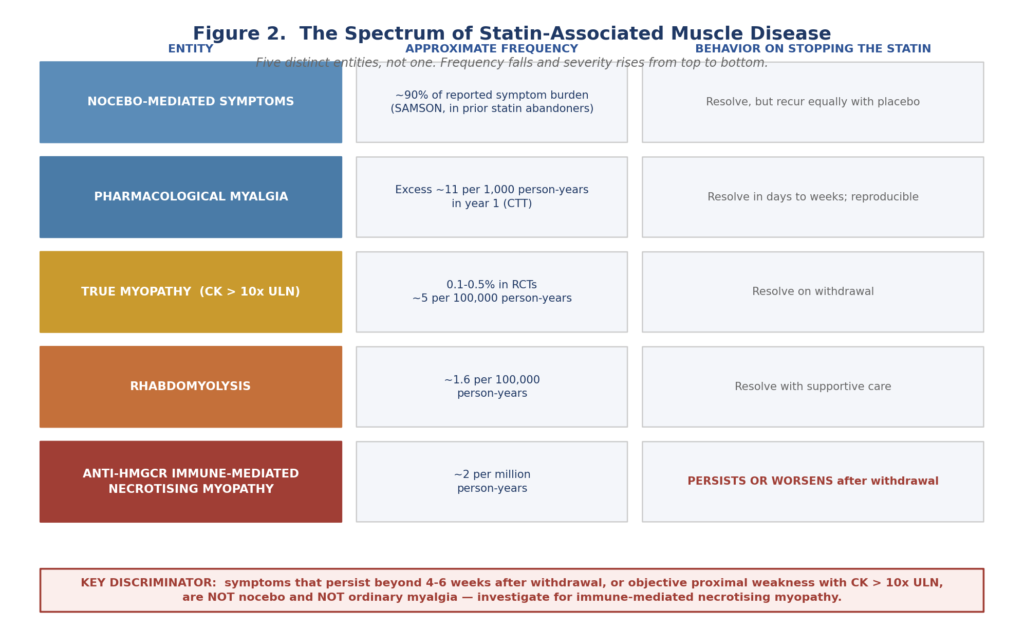
Figure 2. Éventail des pathologies musculaires associées aux statines. Ces pathologies présentent des fréquences qui varient de plusieurs ordres de grandeur et nécessitent des prises en charge fondamentalement différentes. L'évolution observée après l'arrêt du traitement par statines constitue le critère de différenciation le plus utile au chevet du patient.
5.1 Définitions diagnostiques
SAMS / myalgie : douleurs musculaires subjectives, courbatures, raideurs, sensibilité ou crampes, généralement symétriques et proximales, touchant les cuisses, les fesses et les mollets, sans élévation significative du taux de CK [3].
Un corollaire important découle de cette dernière clause et fait souvent l’objet d’une mauvaise interprétation dans la pratique. La créatine kinase est un marqueur sensible de la nécrose des fibres musculaires, mais un marqueur peu sensible des symptômes musculaires légers associés aux statines : les patients peuvent signaler des symptômes sévères, véritablement invalidants, alors que la CK reste entièrement dans les limites de la fourchette de référence. Un taux normal de CK rend donc très improbable une myopathie ou une rhabdomyolyse définie par la CK, mais n’exclut pas les SAMS, et ne prouve pas que les symptômes du patient soient imaginaires ou que la statine n’en soit pas responsable. La CK est un test permettant de dépister une maladie grave, et non un test visant à déterminer si une plainte est réelle. À l’inverse, une élévation asymptomatique de la CK est fréquente : dans l’étude STOMP, la CK a augmenté par rapport à la valeur initiale chez 64,91 TP9T des patients sous atorvastatine 80 mg sans perte de force associée.
Myopathie véritable : une faiblesse musculaire ou une douleur accompagnée d’un taux de CK supérieur à dix fois la limite supérieure de la normale. L’estimation de la CTT correspond à environ 5 cas pour 10 000 patients traités pendant cinq ans (0,051 TP9T), et l’analyse pharmacoépidémiologique donne environ 5 cas pour 100 000 personnes-années. Les chiffres plus élevés (0,1 à 0,51 TP9T) cités dans des revues d’essais plus anciennes reflètent des définitions de cas plus larges et ne sont pas directement comparables à l’une ou l’autre de ces estimations [66].
Rhabdomyolyse : une dégradation rapide des muscles squelettiques accompagnée d’une élévation massive du taux de CK, d’une hyperkaliémie, d’une myoglobinurie et d’une insuffisance rénale aiguë due à une obstruction tubulaire par des cylindres de myoglobine. Dans la plus grande analyse pharmacoépidémiologique, la rhabdomyolyse ayant nécessité une hospitalisation est survenue à un taux d’environ 0,44 pour 10 000 personnes-années, soit 4,4 pour 100 000, lors d’une monothérapie par l’atorvastatine, de la pravastatine ou de la simvastatine, les taux étant nettement plus élevés pour la cérivastatine et pour les associations statines-fibrates [23]. Elle survient le plus souvent lorsque des statines à forte dose sont associées à des inhibiteurs puissants du CYP3A4, au gemfibrozil ou à la ciclosporine.
5.2 Myopathie nécrosante à médiation immunitaire anti-HMGCR
La myopathie nécrosante à médiation immunitaire associée aux statines (IMNM) mérite une prise en charge distincte et particulière, car c'est la seule maladie musculaire liée aux statines qui soit véritablement dangereuse, qui ne relève pas d'un effet nocebo et qui risque de passer inaperçue si tous les troubles musculaires sont attribués à un effet d'attente.
L'IMNM se caractérise par la présence d'auto-anticorps dirigés contre la HMG-CoA réductase elle-même, qui est la cible pharmacologique du médicament. Le mécanisme proposé est le suivant : l'exposition aux statines entraîne une régulation à la hausse de HMGCR expression dans le muscle en cours de régénération fibres, et chez les individus génétiquement prédisposés, cela déclenche une réponse auto-immune persistante qui devient indépendante de l'exposition continue au médicament. Ce phénomène a été reconnu dans les recommandations multisociétales de l'AHA/ACC de 2018 comme une entité distincte et rare [12,68]; cette directive a été abrogée et remplacée en mars 2026 (section 9.3).
L'incidence rapportée dépend du dénominateur utilisé, et ces deux conventions apparaissent dans la littérature. Dans la cohorte multinationale décrite ci-dessous, l’incidence annuelle moyenne était de 2,9 cas par million de personnes-années dans la population adulte générale, et de 20,4 (Royaume-Uni) à 24,1 (Australie) cas par million d’utilisateurs de statines par an [67]. Les estimations plus anciennes, d’environ 2 pour un million d’années-personnes, concernent la population générale ; les chiffres de 2 à 3 pour 100 000 patients sous statines concernent les utilisateurs de statines. Le dénominateur correspondant aux utilisateurs de statines est le plus approprié lorsqu’on conseille un patient qui prend ce médicament, tandis que le dénominateur de la population générale sous-estime le risque pour ce patient d’un facteur d’environ dix.
Une cohorte multinationale de 109 cas positifs aux anticorps anti-HMGCR présentait un âge médian de 66 ans, une prédominance féminine de 51%, une exposition aux statines chez 101 des 109 patients, l’atorvastatine représentant environ les trois quarts des traitements, une durée médiane de traitement par statines de trois ans avant le diagnostic, et un pic médian de CK de 7 020 UI/L, avec une fourchette allant de 964 à 39 076 UI/L. Environ 7,5% des patients positifs aux anticorps anti-HMGCR n’avaient jamais pris de statine, ce qui confirme que cet anticorps n’est pas exclusivement d’origine médicamenteuse [67].
Distinguer l'IMNM du SAMS au chevet du patient
- La faiblesse l'emporte sur la douleur. L'IMNM se caractérise par une faiblesse objective des membres proximaux (difficulté à se lever d'une chaise, à monter les escaliers, à lever les bras au-dessus de la tête), tandis que le SAMS se manifeste par des douleurs et une raideur, avec une force musculaire préservée.
- Le taux de CK est nettement élevé. Les valeurs typiques se situent entre quelques milliers et plusieurs dizaines de milliers, contrairement à la CK normale ou légèrement élevée observée dans le syndrome de SAMS.
- Les symptômes persistent ou s'aggravent après l'arrêt du traitement par statine. C'est là la caractéristique déterminante. Le SAMS disparaît en quelques jours ou quelques semaines après l'arrêt du traitement ; ce n'est pas le cas de l'IMNM.
- Le diagnostic nécessite un examen sérologique et, souvent, un examen histologique. Le dépistage des anticorps anti-HMGCR est hautement spécifique. L'IRM musculaire met en évidence un œdème, et la biopsie révèle une nécrose et une régénération des fibres musculaires, associées à un infiltrat inflammatoire clairsemé.
- Le traitement repose sur l'immunosuppression, et non sur le réconfort. Un traitement à base de corticostéroïdes, d'immunoglobulines par voie intraveineuse et d'un agent permettant de réduire la dose de corticostéroïdes, tel que le méthotrexate, l'azathioprine ou le rituximab, est généralement nécessaire. Les statines doivent être systématiquement évitées.
Le diagnostic différentiel plus large : anti-SRP et IMNM séronégatif
Les anticorps anti-HMGCR ne constituent pas le seul critère sérologique pertinent dans ce contexte, et un résultat négatif n’exclut pas une myopathie nécrosante. L’IMNM est classiquement divisée en trois groupes sérologiques : les cas positifs aux anticorps anti-HMGCR, les cas positifs aux anticorps anti-particule de reconnaissance du signal (anti-SRP) et les cas séronégatifs. Environ 60% des cas d’IMNM présentent des anticorps anti-HMGCR ou anti-SRP ; les autres sont séronégatifs et sont diagnostiqués par biopsie [69,70].
- IMNM anti-SRP n'est généralement pas associée aux statines et tend à présenter un phénotype plus agressif. Par rapport à la forme liée à l'anti-HMGCR, elle entraîne plus souvent une faiblesse sévère des membres et du cou, une dysphagie, une insuffisance respiratoire et une atrophie musculaire ; elle touche également plus fréquemment des organes autres que les muscles, avec une atteinte cardiaque et une pneumopathie interstitielle toutes deux plus fréquentes. L'âge d'apparition est généralement plus précoce [70].
- IMNM anti-HMGCR se manifeste le plus souvent par une faiblesse musculaire isolée, sans atteinte extramusculaire. Environ 7,5% des patients anti-HMGCR positifs n’ont jamais pris de statines, et les cas chez ces patients diffèrent quelque peu de ceux associés aux statines : ils surviennent plus fréquemment chez des patients plus jeunes et s’accompagnent de taux plus élevés de dysphagie.
- IMNM séronégatif Ce diagnostic est posé lorsque les deux anticorps sont absents, mais que la biopsie révèle le tableau caractéristique d'une nécrose dispersée des fibres musculaires, d'une régénération et d'une inflammation à prédominance macrophagique et paucilymphocytaire. Ce tableau est fortement associé à une tumeur maligne sous-jacente ; par conséquent, un bilan sérologique négatif doit inciter à réaliser une biopsie et un dépistage du cancer adapté à l'âge du patient, plutôt que de se contenter de rassurer [71].
Les résultats sont souvent incomplets malgré le traitement. Dans la cohorte multinationale, moins de la moitié des patients présentaient un taux de CK normal (47,6%) ou une force musculaire normale (46,2%) lors du suivi, et 45,7% avaient reçu des immunoglobulines par voie intraveineuse [67]. Cette évolution réfractaire constitue l'argument le plus probant en faveur d'un dépistage précoce de la maladie.
La règle pratique qui en découle est simple : tout patient présentant une faiblesse proximale, un taux de CK supérieur à dix fois la limite supérieure de la normale ou des symptômes musculaires qui ne disparaissent pas dans les quatre à six semaines suivant l'arrêt du traitement par statines doit faire l'objet d'un bilan visant à exclure une myopathie nécrosante, plutôt que d'être simplement rassuré quant à la effet nocebo. Si le test anti-HMGCR est négatif et que le soupçon persiste, il convient de procéder à un test anti-SRP et à une biopsie musculaire, et non de renvoyer le patient chez lui.
6. Profil de toxicité musculaire relative et effets indésirables non musculaires
| Classe de médicaments | Toxicité musculaire dans les essais contrôlés | Fondements mécanistiques | Principaux effets indésirables non musculaires |
| Médicaments ciblant la PCSK9 (évolocumab, alirocumab, inclisiran, enlicitide) | Pas d'augmentation par rapport au placebo | Neutralisation extracellulaire ou absorption par les hépatocytes dirigée par le GalNAc ; aucune cible intracellulaire identifiée au niveau des myocytes | Réactions au site d'injection 2–5% ; rhinopharyngite transitoire ; événements neurocognitifs à un taux comparable à celui observé sous placebo (EBBINGHAUS) [72] |
| Inhibiteurs de l'ACL (acide bempédoïque) | Pas d'augmentation par rapport au placebo | L'activation du promédicament nécessite la présence de l'ACSVL1, indétectable dans le muscle squelettique | Hyperuricémie et la goutte ; élévation réversible de la créatinine ; cholélithiase ; rupture tendineuse ; élévation des enzymes hépatiques |
| Inhibiteurs de la protéine NPC1L1 (ézétimibe) | Pas d'augmentation par rapport au placebo. (Dans l'étude GAUSS-3 de phase B, des symptômes musculaires ont été signalés chez 28,81 TP9T des patients traités par l'ézétimibe et 6,81 TP9T ont arrêté le traitement pour cette raison ; cette phase ne comportait pas de groupe placebo et portait sur une population sélectionnée présentant une intolérance aux multistatines, et les données issues d'essais contrôlés par placebo ne montrent aucun excès.) | Cible intestinale ; le principe actif et son glucuronide circulent, mais aucune cible n'a été identifiée au niveau des muscles squelettiques. | Légers troubles gastro-intestinaux (1–21 TP9T), à des taux comparables à ceux observés avec le placebo |
| Inhibiteurs de l'ANGPTL3 (evinacumab) | Pas d'augmentation par rapport au placebo | Cible protéique extracellulaire ; aucune cible intracellulaire identifiée au niveau des myocytes | Réactions liées à la perfusion et hypersensibilité ≈ 6% ; nasopharyngite ; symptômes de type grippal |
| Les statines (tous les principes actifs) | Un excès faible mais statistiquement significatif par rapport au placebo, limité en grande partie à la première année | Pas épargnés : une inhibition intracellulaire de l'HMG-CoA réductase se produit dans les myocytes | Diabète d'apparition récente (dépendant de la dose) ; élévation des transaminases ; hépatite auto-immune rare ; IMNM rare |
Tableau 6. Profil de toxicité musculaire relative des classes de médicaments hypolipidémiants. Ces classes sont présentées sous forme de catégories descriptives plutôt que selon un classement ordinal, car les agents autres que les statines ne se distinguent pas de manière fiable les uns des autres ni du placebo en ce qui concerne les critères d’évaluation musculaires, et une hiérarchie numérotée impliquerait une précision que les données ne permettent pas d’étayer. La ligne consacrée aux statines n’est délibérément pas subdivisée en fonction de la lipophilie ; la justification est donnée à la section 6.4. Le risque musculaire supplémentaire associé aux statines en tant que classe est faible en termes absolus — environ 11 événements pour 1 000 personnes-années au cours de la première année — et ne doit pas être considéré comme important simplement parce qu’il est différent de zéro.
Le tableau 6 regroupe les agents par classe. Étant donné que la comparaison cliniquement utile porte souvent sur des agents spécifiques plutôt que sur des classes, ces mêmes informations sont présentées ci-dessous au niveau de chaque agent. Deux éléments sont délibérément distingués, car leur confusion est à l’origine de la plupart des recommandations de choix d’agents formulées avec assurance mais sans fondement dans ce domaine. La première colonne indique si un agent provoque davantage de symptômes musculaires que le placebo dans les essais en aveugle ; parmi les statines, la réponse est qu’elles ne se distinguent pas de manière fiable les unes des autres, ce que confirment les données individuelles des participants issues de l’analyse en intention de traitement (CTT). La deuxième colonne indique quels patients présentent un risque accru de myopathie avérée, induite par une interaction ou liée au génotype, sous un agent donné ; ici, les agents diffèrent de manière substantielle et prévisible. Un classement unique et ordonné risquerait de confondre ces deux aspects.
| Agent | Symptômes musculaires par rapport au placebo dans les essais en aveugle | Risque de myopathie lié aux interactions et au génotype |
| Anticorps monoclonaux anti-PCSK9 (évolocumab, alirocumab) | Pas d'augmentation | Aucune cible intracellulaire identifiée au niveau des myocytes ; sans objet |
| Inclisiran | Pas d'augmentation | Absorption par les hépatocytes médiée par le GalNAc ; sans objet |
| Enlicitide | Pas d'augmentation dans le cadre du programme CORALreef | Protéine cible circulante ; sans objet |
| ézétimibe | Aucune augmentation n'a été observée dans les données issues d'essais contrôlés par placebo (voir la précision apportée dans le tableau 6 concernant l'étude GAUSS-3, phase B) | Action localisée au niveau des entérocytes ; sans objet |
| Acide bempédoïque | Pas d'augmentation, y compris dans CLEAR Outcomes | ACSVL1, nécessaire à l'activation et indétectable dans le muscle ; sans objet |
| Evinacumab | Pas d'augmentation | Cible protéique extracellulaire ; sans objet |
| Pitavastatine | Ne se distingue pas de manière fiable des autres statines | Faible : métabolisme minimal par le CYP450 ; la ciclosporine est contre-indiquée |
| Pravastatine, fluvastatine | Ne se distingue pas de manière fiable des autres statines | Faible : élimination non médiée par le CYP3A4 ; CYP2C9 en rapport avec la fluvastatine |
| Rosuvastatine | Ne se distingue pas de manière fiable des autres statines | Faible à modéré : ABCG2 les variants augmentent le risque d'exposition ; plafonds de dose chez les personnes d'origine asiatique |
| Atorvastatine, lovastatine | Ne se distingue pas de manière fiable des autres statines | Modérée : interactions médiées par le CYP3A4 ; SLCO1B1 produit intermédiaire de l'atorvastatine |
| La simvastatine, notamment à la posologie de 80 mg | Ne se distingue pas de manière fiable des autres statines | La plus élevée parmi les statines commercialisées : la plus puissante SLCO1B1 signal et métabolisme important par le CYP3A4 ; la dose de 80 mg n'est plus recommandée |
| Cérivastatine | Retiré en 2001 | Taux inacceptable de rhabdomyolyse mortelle, en particulier sous gemfibrozil |
Tableau 7. Effets musculaires au niveau des principes actifs, les symptômes rapportés et le risque de myopathie mécanistique étant présentés dans des colonnes distinctes. La première colonne présente des données issues d’essais randomisés en aveugle, dans lesquels aucune statine ne s’est distinguée de manière fiable d’une autre en termes d’incidence des symptômes musculaires ; les données qui y figurent ne doivent pas être interprétées comme un classement. La deuxième colonne reflète l’exposition pharmacocinétique et pharmacogénomique, domaine dans lequel les agents diffèrent réellement et où le choix du traitement peut être justifié. Les agents non statines se situent au niveau du placebo dans la première colonne et aucun ne se distingue de manière fiable des autres.
6.1 Acide bempédoïque : effets hors cible
- Hyperuricémie et goutte. L'inhibition compétitive de l'OAT2 rénale réduit l'excrétion d'urate, entraînant une augmentation du taux d'acide urique sérique dans les quatre semaines environ suivant le début du traitement. Dans l'étude CLEAR Outcomes, la goutte est survenue chez 3,11 TP9T de patients traités par l'acide bempédoïque, contre 2,11 TP9T dans le groupe placebo [40]. Les patients ayant des antécédents de goutte présentent un risque accru de crises récurrentes et doivent faire l'objet d'un suivi de leur taux d'urate.
- Élévation réversible de la créatinine. L'inhibition de l'OAT2 réduit également la sécrétion tubulaire de créatinine, ce qui entraîne de légères augmentations moyennes de la créatinine sérique et des baisses modestes correspondantes de la valeur estimée filtration glomérulaire taux. Ces modifications se stabilisent rapidement, disparaissent complètement à l'arrêt du traitement et reflètent une compétition au niveau des transporteurs plutôt qu'une lésion rénale structurelle. Elles ne doivent pas être interprétées à tort comme une néphrotoxicité.
- Rupture tendineuse. On a observé un nombre excessif de ruptures tendineuses, touchant principalement les tendons d'Achille, de la coiffe des rotateurs ou du biceps. Les taux étaient de 0,51 TP9T contre 0,1 TP9T dans les essais sur l'hypercholestérolémie primaire et de 1,21 TP9T contre 0,91 TP9T dans l'étude CLEAR Outcomes, de sorte que l’incidence absolue chez les patients traités se situe à environ 11 TP9T ou moins sur l’ensemble du programme, et que l’excès attribuable au médicament est encore plus faible. Le signal est réel mais rare, et il devrait être présenté aux patients en ces termes plutôt que comme un risque majeur. Le mécanisme proposé implique une altération matrice extracellulaire et le renouvellement du collagène dans les ténocytes. Les facteurs de risque comprennent l'âge supérieur à 60 ans, un traitement concomitant par corticostéroïdes ou fluoroquinolones, une insuffisance rénale et une tendinopathie préexistante [26,41].
- Lithiase biliaire et élévation des enzymes hépatiques. Ces deux paramètres ont augmenté dans l'étude CLEAR Outcomes et méritent une attention particulière, même si aucun des deux ne nécessite généralement l'arrêt du traitement.
6.2 Diabète d'apparition récente associé aux statines
Les statines entraînent une augmentation modérée, dépendante de la dose, du nombre de nouveaux cas de diabète. La méta-analyse des données individuelles des participants réalisée en 2024 par la Cholesterol Treatment Trialists’ Collaboration, qui s’appuie sur la même population d’essais que l’analyse des symptômes musculaires, a quantifié ce phénomène avec précision. L’augmentation proportionnelle des nouveaux cas de diabète était de 10% avec un traitement aux statines de faible ou moyenne intensité (1,3% par an contre 1,2% par an sous placebo) et de 36% avec un traitement de forte intensité (4,81 TP9T contre 3,51 TP9T par an) [73].
Deux constatations permettent de replacer cela dans son contexte. Premièrement, l'effet sous-jacent correspond à une très légère augmentation de la glycémie plutôt qu'à un processus diabétogène distinct : chez les participants ne présentant pas de diabète au départ, la moyenne glucose a augmenté de 0,04 mmol/L et le taux moyen d'HbA1c de 0,06% avec un traitement de faible ou moyenne intensité, et de 0,08% avec un traitement de forte intensité. Deuxièmement, et c’est le point le plus important pour le suivi thérapeutique, cet excès est concentré de manière disproportionnée chez les personnes qui se situaient déjà près du seuil diagnostique. Parmi les participants pour lesquels une mesure de glycémie de référence était disponible, environ 62% des nouveaux cas de diabète sont survenus chez ceux qui se situaient déjà dans le quart supérieur de la distribution de référence. Il s’agit là d’une nette majorité, mais pas de la totalité de l’excès : environ deux nouveaux cas sur cinq ont été diagnostiqués en dehors de ce quart supérieur. Cet effet s’explique donc davantage par le fait que des personnes qui s’approchaient déjà du seuil l’ont franchi que par l’apparition d’un diabète chez des personnes métaboliquement saines, tout en reconnaissant qu’une minorité de cas survient effectivement à des niveaux de glycémie de base plus bas.
Une autre réserve limite la portée des chiffres absolus. Les chercheurs ont noté que l’ampleur de l’excès absolu dépendait largement de la fréquence des mesures de glycémie dans les essais pris en compte, car les nouveaux diagnostics ne sont comptabilisés que lorsqu’on les recherche. Les estimations relatives constituent la grandeur la plus transposable ; les chiffres absolus pour 1 000 personnes concernant le diabète doivent être présentés aux patients comme des approximations liées à un régime de dépistage particulier, et non comme des taux fixes [73].
Les données génétiques indiquent que cet effet est bien ciblé et ne résulte pas d'une toxicité médicamenteuse idiosyncrasique. A Randomisation mendélienne analyse utilisant des variants courants dans HMGCR (rs17238484 et rs12916), considérés comme des indicateurs à vie de l'inhibition de la HMG-CoA réductase, ont révélé que les porteurs d'allèles réduisant le taux de LDL présentaient un poids corporel légèrement plus élevé, tour de taille, la glycémie et insuline, ainsi qu’un risque accru de diabète de type 2, ce qui correspond étroitement à l’effet observé dans les essais randomisés sur les statines. Les auteurs ont conclu que l’augmentation du risque de diabète associée aux statines s’explique, au moins en partie, par l’inhibition de l’HMGCR elle-même [80].
Une autre observation complique toute tentative visant à présenter cela comme une responsabilité propre aux statines. Des variantes dans PCSK9 que des taux de LDL-C plus bas sont également associés à une légère augmentation du risque de diabète, tout comme les variants réduisant le taux de LDL de manière plus générale [7,8,91]. L’effet diabétogène pourrait donc être une propriété de la réduction du taux de LDL induite par le récepteur LDLR plutôt que des statines en particulier, ce qui signifierait qu’il ne serait pas évité en optant pour un agent non statine agissant par la même voie de signalisation. Il s’agit là d’une déduction tirée d’études génétiques épidémiologie et n'a pas été confirmée par des essais cliniques évaluant les résultats des agents autres que les statines, mais cela devrait tempérer toute suggestion selon laquelle l'inhibition de la PCSK9 offrirait une alternative sans impact métabolique.
Parmi les participants souffrant déjà de diabète, le risque relatif d'aggravation contrôle glycémique était de 1,10 avec un traitement de faible ou moyenne intensité et de 1,24 avec un traitement de forte intensité. Les chercheurs ont souligné que toute conséquence cardiovasculaire indésirable liée à ces variations glycémiques est déjà entièrement prise en compte dans le bénéfice cardiovasculaire net observé dans ces mêmes essais. La réponse appropriée consiste à surveiller la glycémie, et non à suspendre le traitement par statines.
6.3 Effets hépatiques, y compris l'hépatite auto-immune (rare)
Une élévation asymptomatique des transaminases survient chez environ 0,5 à 21 TP9T de patients sous statines ; elle est généralement transitoire et ne justifie pas une surveillance systématique de la fonction hépatique chez les patients asymptomatiques. L'hépatotoxicité cliniquement significative liée aux statines est rare.
L'hépatite auto-immune d'origine médicamenteuse induite par les statines (DIAIH) constitue une entité distincte et nettement plus rare, qui présente des caractéristiques cliniques et histologiques similaires à celles de l'hépatite auto-immune idiopathique. Elle a été documentée dans des rapports de cas et des séries de cas concernant l’atorvastatine, la rosuvastatine et d’autres agents, et une analyse de pharmacovigilance du système de notification des effets indésirables de la FDA (FDA Adverse Event Reporting System), publiée en 2024, a mis en évidence des signaux positifs d’hépatite auto-immune pour l’ensemble des sept statines commercialisées [75]. Les manifestations peuvent inclure un ictère, une fatigue, une élévation marquée des transaminases et la présence d'anticorps antinucléaires ou anti-muscle lisse, bien que des cas séronégatifs puissent également être observés. L'apparition de la maladie intervient entre deux mois et plusieurs années après le début de l'infection [76].
Le parallèle clinique avec l’IMNM est instructif et mérite d’être explicitement souligné : dans ces deux pathologies, une statine semble déclencher un processus auto-immunitaire susceptible de persister après l’arrêt du traitement et nécessitant une immunosuppression plutôt qu’un simple arrêt du traitement. Ces deux pathologies sont rares. Aucune n’est un effet nocebo. Il convient de souligner qu’il n’existe aucune estimation fiable de l’incidence de la DIAIH induite par les statines, car les données disponibles reposent sur des rapports de cas et des signaux de disproportion plutôt que sur des données de cohorte, et ces signaux de disproportion reflètent les schémas de déclaration plutôt que la fréquence réelle. Dans le contexte d’une exposition mondiale massive aux statines, les lésions hépatiques graves cliniquement apparentes restent, selon l’évaluation de la monographie LiverTox des NIH, extrêmement rares [74].
6.4 La lipophilie permet-elle de prédire le risque musculaire ? Une réponse nuancée
On affirme souvent que les statines lipophiles présentent un risque nettement plus élevé de symptômes musculaires que les statines hydrophiles, au motif que leur diffusion passive dans les myocytes est plus importante. La présente revue s'abstient délibérément d'adopter cette hiérarchie, et les raisons de ce choix doivent être exposées en toute transparence.
Le raisonnement biologique est fondé. Les agents lipophiles pénètrent effectivement davantage dans les tissus extrahépatiques, ce qui constitue un mécanisme plausible d’atteinte des myocytes. Cependant, les données issues d’essais randomisés actuels n’ont pas démontré de manière cohérente l’existence de différences cliniquement significatives entre les statines hydrophiles et lipophiles en ce qui concerne les symptômes musculaires. Une revue systématique et une méta-analyse publiées en 2018 ont montré que les statines n'augmentaient globalement que légèrement le risque de SAMS (risque relatif 1,05, IC 95 % : 1,014–1,089) et que les statines lipophiles n’avaient pas d’impact notable sur le développement des SAMS par rapport aux formulations hydrophiles [77]. Une méta-analyse en réseau d'essais randomisés en double aveugle publiée en 2022 n'a pas non plus mis en évidence de différence statistiquement significative entre les différentes statines en termes d'incidence des symptômes musculaires [78]. L'analyse des données individuelles des participants à l'étude CTT de 2022, qui constitue l'ensemble de données le plus vaste et le plus rigoureux disponible, n'a révélé aucun élément indiquant que le risque de symptômes musculaires variait selon les différentes statines [65].
Deux autres éléments de preuve viennent directement étayer cette thèse. Le essai SATURN a réparti de manière aléatoire 1 385 patients atteints d’une maladie coronarienne dans un groupe traité par 40 mg de rosuvastatine (hydrophile) ou à l’atorvastatine à 80 mg (lipophile) pendant 104 semaines — une comparaison directe des deux classes de médicaments à la dose maximale — et ont constaté une tolérance comparable, sans signe de toxicité musculaire différentielle [47]. Par ailleurs, les données issues d'essais randomisés sur la fatigue, évoquées à la section 4.3, ont mis en évidence des effets indésirables sur le niveau d'énergie et la fatigue à l'effort avec la pravastatine, un agent hydrophile, ainsi qu'avec la simvastatine.
Trois autres éléments s'opposent à l'idée d'une hiérarchie simple. Premièrement, la pitavastatine est lipophile, mais présente pourtant l'un des risques de myopathie d'origine médicamenteuse les plus faibles parmi toutes les statines, car elle n'est pratiquement pas métabolisée par les enzymes du CYP450 ; la lipophilie et le risque clinique sont donc dissociés. Deuxièmement, le signal spécifique au médicament le plus fort n’est pas du tout la lipophilie, mais la SLCO1B1 interaction pharmacogénomique avec la simvastatine, abordée dans la section 8. Troisièmement, la dose et l’intensité constituent des facteurs prédictifs plus fiables que la classe de solubilité : l’analyse CTT a mis en évidence un risque relatif de 1,11 (IC 95 % : 1,05–1,17) pour les traitements plus intensifs par rapport au placebo, contre 1,07 (1,04–1,10) pour le traitement par statines dans son ensemble.
Derrière tout cela se cache une distinction qui est souvent négligée dans les débats sur l’intolérance aux statines, et qu’il convient de préciser explicitement : une différence mécanistique n’équivaut pas à un résultat clinique. Le fait que les agents lipophiles pénètrent davantage dans les tissus extrahépatiques est un fait pharmacologique établi. Quant à savoir si cette différence entraîne une variation mesurable de la fréquence à laquelle les patients signalent des symptômes musculaires, il s’agit là d’une question empirique distincte, à laquelle seule une comparaison contrôlée peut répondre, et or, ces comparaisons contrôlées n’en démontrent pas. Un mécanisme plausible est un générateur d’hypothèses, et non une preuve d’effet, et c’est précisément dans cet écart entre les deux que trouve son origine une grande partie des conseils de prescription donnés avec assurance mais non étayés dans ce domaine.
La formulation cliniquement défendable est donc la suivante : le passage d’une statine lipophile à une statine hydrophile constitue une stratégie individuelle raisonnable et souvent couronnée de succès chez un patient qui n’a pas toléré un agent particulier, mais elle doit être présentée comme une démarche empirique par essais et erreurs plutôt que comme une réduction prévisible du risque. Ce qui réduit de manière fiable le risque, c’est la diminution de la dose, l’évitement des médicaments présentant des interactions et l’évitement de la simvastatine à forte dose.
7. Épidémiologie des symptômes musculaires signalés et phénomène nocebo
Un paradoxe persistant caractérise ce domaine. Dans les registres observationnels non aveugles et dans la pratique courante, 10 à 20% des patients font état de symptômes musculaires et nombreux sont ceux qui interrompent leur traitement. Dans les essais randomisés en double aveugle, la différence entre les statines et le placebo est très faible. Quatre séries de données permettent de résoudre ce paradoxe et, ensemble, elles constituent l’une des démonstrations les plus élégantes de l’effet nocebo en médecine moderne [81].
Remarque concernant les deux chiffres les plus souvent cités dans ce domaine : le “ 90% ” de SAMSON et le “ un sur quinze ” du CTT ne correspondent pas au même chiffre. Elles proviennent de populations différentes, reposent sur des indicateurs différents et s'appuient sur des protocoles d'étude différents ; aucune ne valide l'autre.
Comme ces chiffres sont très souvent confondus, il convient de préciser cette distinction avant d’aborder l’un ou l’autre. Le ratio nocebo de l’étude SAMSON, égal à 0,90, décrit la proportion de l’augmentation de l’intensité des symptômes provoquée par la prise d’un comprimé qui a été reproduite par un comprimé inerte. Il a été mesuré chez 60 patients ayant déjà arrêté les statines en raison d’effets indésirables — un phénotype délibérément extrême — à l’aide d’une échelle continue d’évaluation quotidienne des symptômes et, surtout, d’une condition témoin sans comprimé, qui fait défaut dans la plupart des essais. Le chiffre de l’analyse en intention de traitement (CTT), soit un sur quinze, décrit la proportion d’événements musculaires signalés au cours de la première année de traitement et attribuables à la statine plutôt qu’à des causes sous-jacentes ; il a été mesuré chez 123 940 participants issus de populations d’essais cliniques générales, en comparant le nombre d’événements à celui observé sous placebo.
L’une correspond au rapport entre les augmentations de l’intensité des symptômes chez des patients prédisposés ; l’autre à la fraction attribuable des signalements d’événements dans une population non sélectionnée. Le fait qu’elles aboutissent à des conclusions globalement concordantes — à savoir que la grande majorité des symptômes musculaires signalés sous statines ne sont pas causés par le médicament — revêt une importance scientifique précisément parce que leurs protocoles diffèrent si radicalement. Mais la proximité numérique entre 90% et quatorze quinzièmes est une coïncidence arithmétique, et non une reproduction des résultats. Aucun de ces chiffres ne doit être cité comme s’il confirmait l’autre, et aucun ne doit être appliqué à une population différente de celle dans laquelle il a été mesuré.
7.1 Méta-analyse de la Cholesterol Treatment Trialists’ Collaboration (2022)
Le Collaboration CTT a mené une méta-analyse des données individuelles des participants issues de 23 essais randomisés à double insu de grande envergure, comprenant 19 essais contrôlés par placebo portant sur 123 940 participants et 4 essais comparant une prise en charge plus intensive à une prise en charge moins intensive portant sur 30 724 participants, publiés dans The Lancet en août 2022 [65].
Au cours d’une durée médiane de suivi pondérée de 4,3 ans, des douleurs ou une faiblesse musculaires ont été signalées par 16 835 participants assignés au groupe sous statine (27,1%) contre 16 446 dans le groupe placebo (26,6%), soit un rapport de taux de 1,03 (IC 95% : 1,01–1,06). Cet excès s’est limité presque exclusivement à la première année de traitement, au cours de laquelle le traitement par statines a entraîné une augmentation relative de 7% (rapport de taux : 1,07, IC 95% : 1,04–1,10), correspondant à un excès absolu de 11 événements (IC 95% : 6–16) pour 1 000 personnes-années. Au-delà de la première année, aucun excès significatif n’a été observé (rapport de taux de 0,99, IC à 95 % : 0,96–1,02).
Les chercheurs ont exprimé cette implication sous forme mathématique : seul un sur quinze des effets indésirables d’origine musculaire signalés chez les participants ayant reçu un traitement aux statines était effectivement attribuable à la statine. Pour les traitements plus intensifs, le rapport de taux par rapport au placebo était de 1,08 (IC 95% : 1,04–1,13) sur l'ensemble des années, passant à 1,11 (IC 95% : 1,05–1,17) au cours de la première année ; la fraction attribuable s'élève donc à environ un sur dix en cas de traitement à haute intensité. Ces deux chiffres correspondent à des comparaisons avec le placebo ; les quatre essais qui ont directement comparé par randomisation un traitement plus intensif à un traitement moins intensif ont donné un rapport de taux de 1,05 (IC 95% : 0,99–1,11), et ces deux comparaisons ne doivent pas être confondues. Les crampes musculaires, motif très fréquent d’arrêt du traitement dans la pratique, n’ont montré qu’une différence absolue de 0,2% et ne sont pas significativement liées aux statines. Il convient de noter qu’aucune preuve n’indiquait que le risque variait d’une statine à l’autre.
7.2 L'essai SAMSON (2020)
SAMSON (méthode d'auto-évaluation des effets indésirables des statines ou du phénomène nocebo), publiée dans le New England Journal of Medicine en novembre 2020, avec les données complètes dans le Journal of the American College of Cardiology En 2021, 60 patients ont été inclus dans l'étude ; ils provenaient de 17 centres de référence britanniques ou s'étaient présentés spontanément, et tous avaient auparavant arrêté leur traitement aux statines en raison d'effets indésirables apparus dans les deux semaines suivant le début du traitement. Il s'agit délibérément de la population la plus susceptible de présenter des symptômes parmi celles disponibles [5,6].
Conception
SAMSON a utilisé un protocole randomisé en double aveugle de type « n-of-1 » s'étalant sur 12 mois consécutifs. Chaque participant a reçu 12 flacons de médicaments mensuels dans un ordre aléatoire : quatre contenant 20 mg d'atorvastatine par jour, quatre contenant un placebo correspondant et quatre flacons vides. Les mois avec des flacons vides constituent une innovation méthodologique, car ils permettent de déterminer le niveau de symptômes de base de chaque patient en l’absence totale de comprimés. Les participants ont noté quotidiennement l’intensité de leurs symptômes sur une application pour smartphone à l’aide d’une échelle continue allant de 0 (absence de symptômes) à 100 (le pire scénario imaginable), et pouvaient interrompre la prise des comprimés du mois en cours si les symptômes devenaient insupportables.
Résultats
Soixante participants ont été randomisés et 49 ont suivi le protocole dans son intégralité pendant 12 mois. L'intensité moyenne des symptômes était de 8,0 pendant les mois sans comprimé (IC 95% : 4,7–11,3), de 15,4 pendant les mois sous placebo (IC 95% : 12,1–18,7 ; P < 0,001 par rapport aux mois sans traitement), et de 16,3 pendant les mois sous statine (IC 95% : 13,0–19,6 ; P < 0,001 par rapport aux mois sans traitement). La différence entre les mois de traitement par statine et les mois sous placebo n’était pas significative (P = 0,388).
Le ratio nocebo, défini comme l'intensité des symptômes sous placebo moins l'intensité des symptômes en l'absence de traitement, divisé par l'intensité des symptômes sous statine moins l'intensité des symptômes en l'absence de traitement, était de 0,90. Quatre-vingt-dix pour cent de la charge symptomatique induite par la prise d'une statine a été reproduite par la prise d'un placebo.
Par souci d’exhaustivité, il convient de signaler une réserve méthodologique. L’analyse principale initialement prévue a donné un rapport nocebo de 2,2 avec un intervalle de confiance à 95 % (TP9T) intervalle de confiance de −62,3 à 66,7, une estimation instable due au fait que, chez certains individus, le dénominateur « statine moins absence de comprimé » était très faible, voire négatif. Un statisticien indépendant a recommandé de regrouper les données individuelles des participants avant de calculer le rapport, ce qui a donné la valeur rapportée de 0,90. Il s’agit d’une décision analytique légitime et présentée de manière transparente, mais les lecteurs doivent comprendre que le chiffre mis en avant provient de l’analyse révisée et non de l’analyse initiale.
Les interruptions du traitement en raison de symptômes intolérables ont été observées à 71 reprises : 31 pendant les mois de placebo et 40 pendant les mois de statines, une différence non significative. Les comprimés de placebo ont donc été abandonnés presque aussi souvent que le médicament actif. Lors du suivi à six mois, après que les participants eurent pris connaissance de graphiques personnalisés présentant leurs propres scores de symptômes pour les trois conditions, 30 des 60 participants avaient réussi à reprendre leur traitement par statines.
7.3 L'essai StatinWISE (2021)
StatinWISE, publié dans le BMJ En février 2021, l'étude SAMSON a fait l'objet d'une reproduction indépendante à plus grande échelle en médecine générale. Elle comprenait une série de 200 essais randomisés en double aveugle de type « n-of-1 » menés chez des patients envisageant d'arrêter leur traitement en raison de symptômes musculaires, comparant l'atorvastatine à 20 mg à un placebo sur six périodes de deux mois [82].
Sur les 200 participants, 151 (75,5%) ont été pris en compte dans l'analyse principale. Aucune différence n’a été observée entre les périodes de traitement par statine et celles sous placebo en ce qui concerne les scores des symptômes musculaires (différence moyenne −0,11, IC à 95 % −0,36 à 0,14 ; P = 0,40). Des arrêts du traitement en raison de symptômes musculaires intolérables ont été observés chez 9% pendant les périodes de traitement par statine et chez 7% pendant les périodes de placebo. Les deux tiers des participants ayant mené l’essai à son terme ont choisi de reprendre le traitement par statine. Le fait que deux programmes « n-of-1 » menés indépendamment l’un de l’autre aboutissent à la même conclusion renforce considérablement cette conclusion.
7.4 ASCOT-LLA : étude en aveugle versus étude en ouvert (2017)
Les données les plus convaincantes au niveau de la population proviennent d’une expérience naturelle menée dans le cadre d’un seul essai clinique. L’étude ASCOT-LLA a réparti de manière aléatoire les patients entre un groupe recevant 10 mg d’atorvastatine et un groupe recevant un placebo au cours d’une phase en aveugle, puis a poursuivi le traitement dans le cadre d’une extension en ouvert, au cours de laquelle les patients et les médecins savaient qui prenait une statine.
Au cours de la phase randomisée en aveugle, aucun excès significatif d'effets indésirables d'origine musculaire n'a été observé sous atorvastatine. Au cours de l'extension en ouvert, les événements indésirables d'origine musculaire ont été significativement plus fréquents chez les utilisateurs de statines (161 événements, 1,26% par an) que chez les non-utilisateurs (124 événements, 1,00% par an), soit un risque relatif de 1,41 (IC à 95% : 1,10–1,79 ; P = 0,006). Le médicament n’a pas changé. Seule la connaissance de sa prise a changé [83].
7.5 GAUSS-3 : quantification de l’intolérance réelle (2016)
GAUSS-3, publié dans JAMA publiée en avril 2016, constitue un contrepoids indispensable à la littérature consacrée à l’effet nocebo, car elle démontre qu’une véritable intolérance pharmacologique existe bel et bien. Cette étude a recruté 511 patients présentant des antécédents avérés d’intolérance à au moins deux statines et dont le taux moyen de LDL-C à l’inclusion était d’environ 212 mg/dL [42].
Phase A : réexposition en aveugle
491 patients ont participé à une étude croisée en double aveugle de 24 semaines portant sur la réintroduction de l'atorvastatine à 20 mg par rapport à un placebo, à raison de 10 semaines pour chaque traitement, séparées par une période de sevrage. Les résultats répartissent cette population fortement présélectionnée en quatre groupes : 209 patients sur 491 (42,61 TP9T) ont développé des symptômes musculaires intolérables sous atorvastatine, mais pas sous placebo ; 26,51 TP9T ont développé des symptômes sous placebo mais pas sous atorvastatine ; environ 101 TP9T ont développé des symptômes sous les deux traitements ; et les autres n’en ont développé sous aucun des deux. Au cours de la deuxième période croisée, le rapport des cotes Le rapport de risques relatifs pour les symptômes musculaires entre l’atorvastatine et le placebo était de 1,96 (IC à 95 % : 1,44–2,66 ; P < 0,001).
Deux conclusions s'imposent, toutes deux importantes. Une intolérance aux statines authentique, reproductible et d'origine pharmacologique existe bel et bien et touche environ 43% de cette population présentant un phénotype extrême. De même, plus d'un quart de ces mêmes patients ont souffert de douleurs musculaires insupportables causées exclusivement par un comprimé inerte. Vu sous un autre angle, environ 60% de patients ayant déjà présenté un échec avec au moins deux statines n’ont pas montré d’intolérance reproductible lors d’une nouvelle exposition en aveugle.
Phase B : traitement comparatif sans statines
218 patients présentant une intolérance confirmée, comprenant ceux identifiés lors de la phase A ainsi que 19 patients ayant contourné la phase A en raison d'une élévation antérieure documentée de la CK supérieure à dix fois la limite supérieure de la normale, ont été randomisés selon un rapport 2:1 pour recevoir soit de l'évolocumab à raison de 420 mg par mois (n = 145), soit de l'ézétimibe à raison de 10 mg par jour (n = 73) pendant 24 semaines.
Deux critères d’évaluation principaux ont été rapportés. Entre le début de l’étude et la semaine 24, le taux de LDL-C a diminué de 52,81 TP9T sous évolocumab, contre 16,71 TP9T sous ézétimibe. Pour la moyenne des semaines 22 et 24, le LDL-C a diminué de 54,51 TP9T (IC à 951 TP9T : −57,2 à −51,8 ; réduction absolue de 103,6 mg/dL) avec l’évolocumab, contre 16,71 TP9T (IC à 95% : −20,5 à −12,9) avec l’ézétimibe, soit une différence entre les groupes de −37,8% (IC à 95% : −42,3 à −33,3 ; P < 0,001). Des symptômes musculaires ont été signalés par 20,7% des patients sous évolocumab et 28,8% des patients sous ézétimibe. L’arrêt du traitement en raison de symptômes musculaires intolérables a été observé chez 1 patient sur 145 (0,71 TP9T) sous évolocumab, contre 5 sur 73 (6,81 TP9T) sous ézétimibe. Aucun des deux groupes ne disposait d’un comparateur sous placebo ; ces taux quantifient donc la charge symptomatique résiduelle au sein d’une population sélectionnée plutôt que le risque attribuable au médicament [42].
Génomique exploratoire
Une analyse exploratoire à l'échelle du génome réalisée dans le cadre de GAUSS-3 a mis en évidence des associations entre les symptômes musculaires liés aux statines et des loci situés au niveau de MGAT5 et KCNJ2/SOX9, tandis que les variants influençant l'exposition systémique aux statines, tels que SLCO1B1 n'ont pas montré de lien significatif avec la réapparition des symptômes dans cette cohorte. Ces résultats ne servent qu'à formuler des hypothèses : la cohorte comprenait environ 500 patients, ce qui est largement insuffisant pour permettre des découvertes à l'échelle du génome, et les loci n'ont pas fait l'objet d'une réplication solide. Ils ne doivent pas être présentés aux patients comme des éléments cliniquement exploitables.
| Version d'essai | Conception et population | Principale conclusion |
| Collaboration CTT (2022) | 19 essais cliniques randomisés en double aveugle contrôlés par placebo ; 123 940 participants ; durée médiane de 4,3 ans | 27,11 TP9T contre 26,61 TP9T de symptômes musculaires signalés (RR 1,03) ; RR à 1 an : 1,07, surplus de 11 pour 1 000 personnes-années ; seul 1 cas sur 15 est attribuable à une statine |
| SAMSON (2020) | Étude en double aveugle de type « n-of-1 » ; 60 patients ayant arrêté leur traitement aux statines ; 4 mois sous statines, 4 mois sous placebo, 4 mois sans traitement | Scores des symptômes : 8,0 / 15,4 / 16,3 (sans comprimé / placebo / statine) ; statine vs placebo : P = 0,388 ; rapport nocebo : 0,90 ; 30 patients sur 60 ont repris le traitement |
| StatinWISE (2021) | 200 essais « n-of-1 » en double aveugle en médecine générale ; atorvastatine 20 mg vs placebo | Aucune différence n'a été observée au niveau du score des symptômes (différence moyenne de −0,11, IC à 95 % : de −0,36 à 0,14) ; les deux tiers des participants ayant mené l'étude à son terme ont repris leur traitement aux statines. |
| ASCOT-LLA (2017) | Phase randomisée en aveugle vs extension non aveugle du même essai | Aucun événement musculaire excessif en condition aveugle ; RR = 1,41 (IC à 95 % : 1,10–1,79) en condition non aveugle |
| GAUSS-3 (2016) | 511 patients présentant une intolérance aux multistatines ; réintroduction en aveugle de l'atorvastatine, puis comparaison entre l'évolocumab et l'ézétimibe | 42,61 TP9T sous statine seule ; 26,51 TP9T sous placebo seul ; évolocumab −54,51 TP9T contre ézétimibe −16,71 TP9T pour le LDL-C |
Tableau 8. Essais cliniques de référence permettant de distinguer les symptômes musculaires liés aux statines d'origine pharmacologique de ceux d'origine nocébo. RR = rapport des taux ou risque relatif, tel que rapporté par les chercheurs d'origine.
7.6 Mettre les avantages et les inconvénients sur un même plan
Les risques relatifs et les rapports de taux constituent le langage naturel des rapports d'essais cliniques, mais ils ne constituent pas une base solide pour une discussion avec un patient, qui prend une décision concernant une personne en particulier plutôt qu'une cohorte. Les chiffres qui importent pour cette décision sont des chiffres absolus, et la collaboration CTT les a publiés pour un traitement standard.
Une réduction du LDL-C de 2 mmol/L (77 mg/dL) grâce à un traitement efficace tel que l'atorvastatine à raison de 40 mg par jour, pendant cinq ans chez 10 000 patients, permettrait généralement de prévenir un ou plusieurs événements vasculaires majeurs chez environ 1 000 patients présentant unemaladie vasculaire occlusive préexistante, soit un bénéfice absolu de 10%, et chez environ 500 patients à risque élevé n’ayant pas encore subi d’événement, soit un bénéfice absolu de 5%. En revanche, ce même traitement administré aux mêmes 10 000 patients sur la même période entraînerait généralement environ 5 cas de myopathie, dont un pourrait évoluer vers une rhabdomyolyse si la statine n’était pas arrêtée, 50 à 100 nouveaux cas de diabète, et 5 à 10 accidents vasculaires cérébraux hémorragiques, parallèlement à des événements indésirables symptomatiques tels que des douleurs musculaires chez 50 à 100 patients au maximum, ce qui correspond à un risque absolu compris entre 0,51 TP9T et 1,01 TP9T [2].
| Résultats sur 5 ans | Pour 10 000 personnes traitées | Pour 1 000 personnes traitées | Taux absolu |
| Prévention des événements vasculaires majeurs, prévention secondaire | ≈ 1 000 | ≈ 100 | Avantage 10% |
| Prévention des événements vasculaires majeurs, prévention primaire | ≈ 500 | ≈ 50 | Prestation 5% |
| Diabète d'apparition récente causé par | 50–100 | 5–10 | 0,5–1,01 TP9T de préjudice |
| Effets indésirables musculaires symptomatiques provoqués par | 50–100 | 5–10 | 0,5–1,01 TP9T de préjudice |
| Hémorragique cajoleries causé | 5–10 | 0.5–1 | 0,05–0,11 TP9T de préjudice |
| Myopathie d'origine (CK > 10 fois la LSN) | ≈ 5 | ≈ 0,5 | 0,051 TP9T : effet néfaste |
| Rhabdomyolyse provoquée par | ≈ 1 | ≈ 0,1 | 0,011 TP9T : danger |
Tableau 9. Bénéfices et risques absolus liés à un traitement de cinq ans par une statine efficace réduisant le LDL-C de 2 mmol/L, selon les estimations de la CTT Collaboration. Les chiffres pour 1 000 ont été obtenus par division et sont fournis à titre indicatif ; les estimations publiées s'expriment pour 10 000. Les bénéfices varient en fonction de la valeur initiale. risque absolu et de l’ampleur et de la durée de la réduction du LDL-C ; ces chiffres décrivent donc un patient type plutôt qu’un cas individuel. Deux lignes nécessitent quelques précisions. La ligne relative au diabète d’apparition récente provient de la même projection sur cinq ans mentionnée précédemment et doit être considérée comme une estimation de l’ordre de grandeur : l’analyse des données individuelles des participants de 2024 a révélé que l’excès absolu variait considérablement en fonction de l’intensité du suivi glycémique d’un essai à l’autre ; il n’existe donc pas de chiffre absolu fixe clairement étayé (section 6.2). La ligne relative aux événements indésirables musculaires symptomatiques provient également de la projection sur cinq ans réalisée précédemment par le groupe CTT. L’analyse des données individuelles des participants de 2022 a fait état d’un excès absolu de 11 événements pour 1 000 personnes-années, limité à la première année, soit environ 110 pour 10 000 au cours de la seule première année, et remplace la projection antérieure pour ce critère d’évaluation. Ces deux estimations reposent sur des définitions et des bases temporelles différentes et ne doivent pas être additionnées, moyennées ni interprétées comme un calcul incohérent des bénéfices.
Trois aspects de cette comparaison méritent d'être soulignés. Les bénéfices et les effets indésirables n'ont pas le même poids, même lorsque les chiffres sont similaires : la myopathie et les symptômes musculaires disparaissent à l'arrêt du traitement, tandis que infarctus du myocarde et les AVC, ce qui n'est souvent pas le cas. Toute conséquence cardiovasculaire indésirable liée à l’excès de diabète et aux AVC hémorragiques est déjà prise en compte dans les chiffres du bénéfice net, car ces deux événements sont survenus dans les mêmes essais que ceux à partir desquels le bénéfice a été mesuré ; les colonnes ne doivent donc pas être soustraites l’une de l’autre. De plus, le bénéfice s’accumule au fil des années de traitement ; une période de cinq ans sous-estime donc les résultats obtenus par un traitement à vie.
Il faut toutefois nuancer ce constat en précisant que ces estimations proviennent du groupe CTT, dont les méthodes et l’accès aux données individuelles des participants ont été contestés par une minorité de chercheurs, et qu’elles décrivent des populations plutôt que des personnes. Un patient présentant un risque cardiovasculaire absolu très faible en tire proportionnellement moins de bénéfices, et pour ce patient, le rapport entre les avantages et les risques est en réalité plus serré que ne le laisse entendre le tableau.
8. Pharmacogénomique de la myopathie liée aux statines
Si l'on se demande quel patient est le plus susceptible de subir une véritable lésion musculaire sous traitement aux statines, la réponse la plus solide qui s'impose est d'ordre génétique plutôt que physico-chimique.
8.1 SLCO1B1
La découverte déterminante a été une étude d'association pangénomique menée dans le cadre de l'essai SEARCH, publiée dans le New England Journal of Medicine en 2008, qui a mis en évidence le SLCO1B1 La variante c.521T>C (rs4149056) comme déterminant génétique dominant de la myopathie associée à la simvastatine à 80 mg [79]. SLCO1B1 code pour l'OATP1B1, le transporteur responsable de la captation hépatique. Les variants à fonction réduite altèrent l'extraction hépatique, ce qui augmente l'exposition systémique à l'acide statinique et accroît l'exposition des muscles squelettiques.
Des recommandations sont fournies par le Consortium pour la mise en œuvre de la pharmacogénétique clinique (CPIC), dont les recommandations de 2022 portent sur SLCO1B1, ABCG2, et CYP2C9 génotypes et symptômes musculo-squelettiques associés aux statines, remplaçant ainsi la précédente recommandation portant uniquement sur la simvastatine [22]. Les données établissant un lien entre le rs4149056 et la myopathie sont considérées comme étant de haute qualité pour la simvastatine. Le CPIC recommande de limiter la posologie ou de choisir une autre statine chez les patients présentant des phénotypes à fonction réduite ou insuffisante. Les classifications fonctionnelles des allèles ont été mises à jour en octobre 2025 afin d’améliorer la précision chez les populations sous-représentées [84].
Cette association est fortement spécifique à chaque médicament, ce qui présente un intérêt clinique. Elle est la plus marquée pour la simvastatine, modérée et moins constante pour l’atorvastatine, et minime pour la pravastatine, la rosuvastatine, la fluvastatine et la pitavastatine, car l’OATP1B1 contribue dans une proportion différente à l’absorption hépatique de chacun de ces agents.
8.2 ABCG2, CYP2C9 et autres loci
- ABCG2: code pour le transporteur d'efflux BCRP. La variante c.421C>A augmente considérablement l'exposition à la rosuvastatine, et le CPIC 2022 inclut des recommandations posologiques pour la rosuvastatine par ABCG2 phénotype [22].
- CYP2C9: l'enzyme principale impliquée dans le métabolisme de la fluvastatine ; les métaboliseurs lents accumulent le médicament, ce qui justifie une limitation de la posologie.
- CYP3A4*22: Allèle à fonction réduite affectant la clairance de la simvastatine, de la lovastatine et de l’atorvastatine. Les données sont suggestives, mais ne permettent pas encore d’étayer des recommandations cliniques.
- COQ2, GATM, et les loci GAUSS-3 (MGAT5, KCNJ2/SOX9): associations potentielles dont la reproductibilité n’est pas confirmée. Il s’agit là de résultats de recherche qui ne doivent pas être utilisés en milieu clinique.
| Gène | Variante | Les statines ont principalement affecté | Conséquences pratiques |
| SLCO1B1 | c.521T>C (rs4149056) | Simvastatine (forte) ; atorvastatine (modérée) | Éviter les doses élevées de simvastatine en cas de fonction hépatique réduite ou insuffisante ; privilégier la rosuvastatine, la pravastatine, la fluvastatine ou la pitavastatine |
| ABCG2 | c.421C>A | Rosuvastatine | Limiter la dose de rosuvastatine chez les patients présentant des phénotypes de mauvaise fonction |
| CYP2C9 | *2, *3 allèles à fonction réduite | Fluvastatine | Limiter la dose de fluvastatine chez les métaboliseurs lents |
| CYP3A4 | *22 | Simvastatine, lovastatine, atorvastatine | À titre indicatif uniquement ; ne donne pas lieu à des mesures concrètes dans le cadre des recommandations actuelles |
| MGAT5, KCNJ2/SOX9, COQ2, GATM | Divers | Non spécifique à un agent | À titre exploratoire ; sans implications cliniques concrètes |
Tableau 10. Loci pharmacogénomiques associés à la myopathie liée aux statines, avec les recommandations issues des lignes directrices du CPIC de 2022 (mise à jour d’octobre 2025). À l’heure actuelle, seuls les gènes SLCO1B1, ABCG2 et CYP2C9 font l’objet de recommandations exploitables du CPIC.
8.3 Interactions médicamenteuses
La myopathie d'interaction est plus fréquente, plus prévisible et plus facile à prévenir que la myopathie idiosyncrasique. Le mécanisme est simple : tout ce qui augmente la concentration systémique de statines accroît l'exposition musculaire.
| Agent interactif | Mécanisme | Personnes sous statines | Direction |
| Gemfibrozil | Inhibe la glucuronidation et le transport par l'OATP1B1 | Toutes les statines | Éviter l'association ; privilégier le fénofibrate si un fibrate est nécessaire |
| Clarithromycine, érythromycine, itraconazole, kétoconazole, ritonavir | Inhibition puissante du CYP3A4 | Simvastatine, lovastatine, atorvastatine | Interrompre le traitement par statines pendant les traitements de courte durée, ou passer à la pravastatine, à la rosuvastatine ou à la pitavastatine |
| Ciclosporine | Inhibition de l'OATP1B1 et des transporteurs multiples | Tous ; contre-indiqué avec la pitavastatine | Limites de dose strictes ; suivi par un spécialiste |
| Amiodarone, vérapamil, diltiazem | Inhibition modérée du CYP3A4 | Simvastatine, lovastatine | Respecter les limites de dose indiquées sur l'étiquette ; envisager l'utilisation d'une statine non métabolisée par le CYP3A4 |
| Colchicine | Myotoxicité indépendante ; risque additif | Toutes les statines | Surveiller la CK en cas d'utilisation concomitante, en particulier en cas d'insuffisance rénale |
| Jus de pamplemousse (en grande quantité) | Inhibition intestinale du CYP3A4 | Simvastatine, lovastatine, atorvastatine | Recommander la modération ; pertinence clinique principalement en cas de consommation élevée |
Tableau 11. Interactions médicamenteuses cliniquement importantes augmentant le risque de myopathie liée aux statines. Il convient de noter que la pravastatine, la rosuvastatine et la pitavastatine présentent toutes l’avantage d’un métabolisme minimal par le CYP450, ce qui constitue un critère plus fiable pour le choix d’une statine en cas de polypharmacie que la lipophilie.
8.4 Facteurs non génétiques réversibles
Avant de conclure qu’un patient présente une intolérance aux statines, il convient d’exclure plusieurs facteurs réversibles, car chacun d’entre eux peut, à lui seul, provoquer ou aggraver une myalgie : l’hypothyroïdie (vérifier la TSH), une carence en vitamine D, une insuffisance rénale, la pratique récente d’un exercice physique intense inhabituel et un excès de alcool admission [58]. Il convient toutefois de noter une réserve : bien que la carence en vitamine D soit généralement corrigée dans ce contexte, une étude randomisée comparant la vitamine D à un placebo chez des patients venant de commencer un traitement aux statines n'a pas mis en évidence de réduction des symptômes musculaires associés aux statines ; la supplémentation doit donc être considérée comme une mesure de soins généraux raisonnable plutôt que comme un remède avéré contre les SAMS [85]. L'âge avancé, une faible masse corporelle, le sexe féminin et l'origine asiatique (particulièrement importante pour la posologie de la rosuvastatine) augmentent également la susceptibilité.
9. Prise en charge clinique : un algorithme fondé sur des données probantes
La démarche suivante synthétise les données examinées ci-dessus. Son principe directeur est qu’il faut toujours prendre au sérieux les symptômes du patient, sans pour autant présumer d’un lien de causalité avec le médicament [58,81].
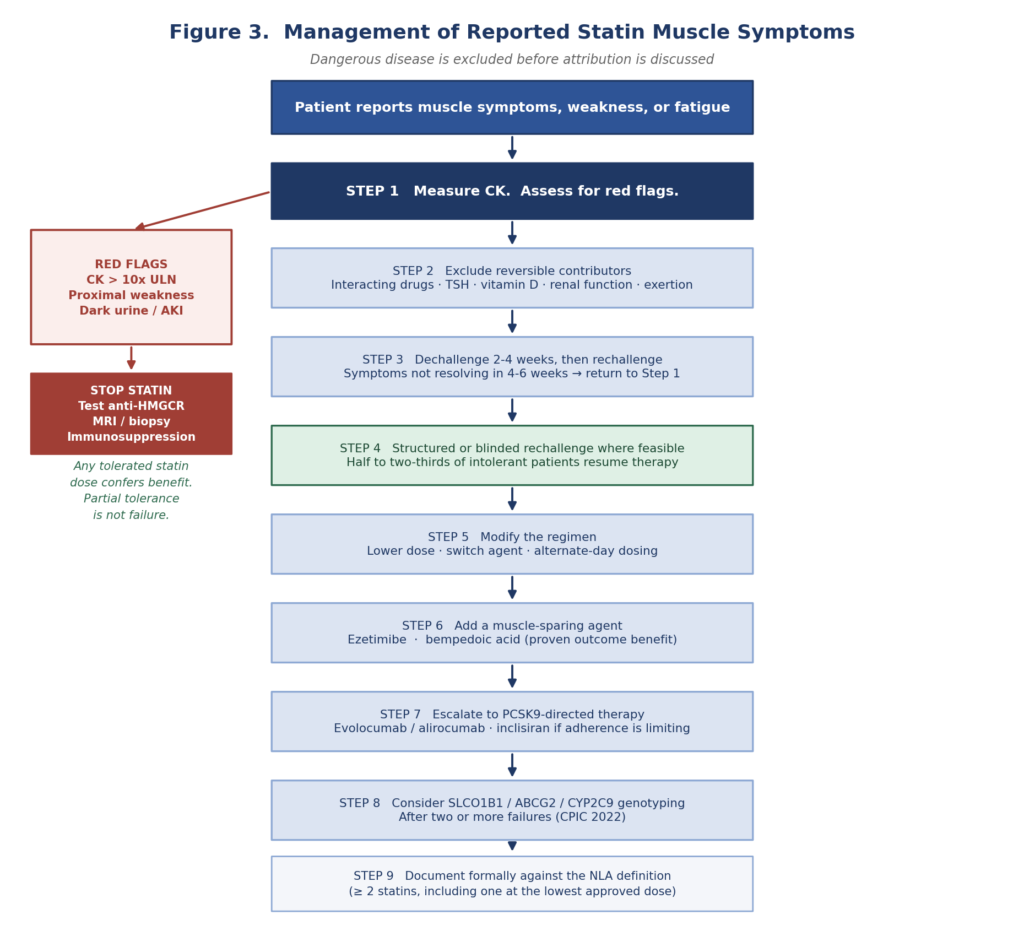
Figure 3. Algorithme de prise en charge des symptômes musculaires attribués aux statines. L'ordre des étapes est délibéré : il convient d'exclure toute pathologie grave avant d'envisager une attribution, car l'état d'un patient atteint d'une myopathie nécrosante à médiation immunitaire, à qui l'on aurait donné l'assurance qu'il ne s'agissait que d'un effet nocebo, pourrait s'aggraver.
- Exclure d'abord toute myopathie dangereuse. Mesurer le taux de CK. Si le taux de CK dépasse dix fois la limite supérieure de la normale, s'il existe une faiblesse proximale objective, ou en cas d'urine foncée ou d'insuffisance rénale, arrêter immédiatement la statine et rechercher une véritable myopathie, une rhabdomyolyse ou une myopathie nécrosante à médiation immunitaire. Ne pas aborder la question du nocebo avant d'avoir franchi cette étape.
- Identifier les facteurs réversibles. Vérifier la présence d'interactions médicamenteuses, d'une hypothyroïdie, d'une carence en vitamine D, d'une insuffisance rénale et d'un effort physique intense et inhabituel récent. Corriger ce qui peut l'être.
- Arrêt puis reprise du traitement. Arrêter la statine pendant deux à quatre semaines. L'absence d'amélioration réduit la probabilité d'un syndrome de myopathie aiguë induite par les statines (SAMS) d'origine pharmacologique classique et doit inciter à réévaluer d'autres causes possibles ou à envisager une myopathie persistante, plutôt que de présumer que la statine n'était pas en cause ; si les symptômes persistent au-delà de quatre à six semaines, en particulier en cas d'élévation de la CK ou de faiblesse objective, rechercher une myopathie immunitaire non-médicamenteuse (IMNM). Si les symptômes disparaissent, procéder à une nouvelle exposition avec une statine différente à faible dose.
- Recourez, dans la mesure du possible, à une réexposition structurée ou en aveugle. Les études SAMSON et StatinWISE démontrent que des données objectives et personnalisées sur le profil symptomatique propre à chaque patient constituent une intervention efficace pour rétablir adhésion — celle qui bénéficie des données randomisées les plus directes — permettant à environ la moitié, voire aux deux tiers des patients participants, de reprendre leur traitement. Aucun de ces deux essais n'a comparé cette approche à d'autres stratégies visant à favoriser l'observance ; il ne convient donc pas de la présenter comme supérieure à toutes les autres solutions [5,6,82].
- Modifiez le schéma thérapeutique avant d'abandonner cette classe de médicaments. Réduisez la dose ; changez de principe actif, en évitant notamment la simvastatine à forte dose ; ou optez pour une administration un jour sur deux ou deux fois par semaine d'une statine à demi-vie longue, telle que la rosuvastatine ou l'atorvastatine. Toute dose de statine bien tolérée apporte un bénéfice ; une tolérance partielle ne constitue pas un échec.
- Ajouter un agent préservant la masse musculaire à une dose réduite de statine. L'ézétimibe est peu coûteux, bien toléré et apporte un bénéfice de 15 à 20%. L'acide bempédoïque apporte un bénéfice d'environ 18% et est le seul agent oral non statine dont les bienfaits cardiovasculaires ont été prouvés chez les patients intolérants aux statines.
- Passer à un traitement ciblant la PCSK9 en cas d'intolérance confirmée accompagnée d'une risque résiduel. L'étude GAUSS-3 a validé l'évolocumab précisément chez cette population, et l'inclisiran permet une administration deux fois par an, alors que l'observance du traitement constitue le facteur limitant.
- Envisager un génotypage en cas d’intolérance récurrente. SLCO1B1, ABCG2, et CYP2C9 Le génotypage selon le CPIC 2022 permet d'optimiser le choix du traitement après deux échecs thérapeutiques ou plus.
- Consigner officiellement. L'intolérance aux statines doit être consignée conformément à la définition de la National Lipid Association, qui exige l'essai d'au moins deux statines, dont une à la dose minimale autorisée, plutôt que d'être enregistrée sur la base d'un seul essai infructueux [4].
9.1 Communication des risques aux patients
Les résultats de l'étude SAMSON montrent que le fait de présenter aux patients leurs propres données s'avère plus convaincant que de citer des statistiques démographiques. Lorsque l’on ne dispose pas de données individualisées de type « n-of-1 », les formulations suivantes sont précises et utiles : les douleurs musculaires sont courantes chez les adultes, quel que soit le traitement, et environ un quart des personnes en font état, qu’elles prennent une statine ou un placebo ; sur quinze personnes signalant des symptômes musculaires sous statine, environ quatorze en auraient souffert de toute façon [65]; la plupart des symptômes réellement causés par une statine apparaissent au cours de la première année et disparaissent dans les semaines qui suivent l’arrêt du traitement, bien que l’on observe parfois une apparition plus tardive chez certaines personnes ; et une grande majorité des personnes qui arrêtent un traitement aux statines en raison de symptômes et qui sont disposées à faire un nouvel essai parviennent à reprendre le traitement avec succès. Ce dernier chiffre concerne les patients qui se sont portés volontaires pour une nouvelle prise et ne doit pas être considéré comme représentatif de l’ensemble des personnes ayant arrêté le traitement.
Ce qu’il ne faut pas dire est tout aussi important. Il ne faut jamais qualifier les symptômes d’imaginaires. L’effet nocebo produit des symptômes réels et mesurables ; les participants à l’étude SAMSON ont arrêté de prendre les comprimés placebo presque aussi souvent que ceux sous médicament actif. Le message à retenir est que les symptômes sont réels, mais que leur cause n’est généralement pas le médicament, et que cette distinction ouvre la voie à la reprise du traitement plutôt que de la fermer.
9.2 Diagnostic objectif
- Une surveillance systématique chez les patients asymptomatiques n’est pas recommandée. Il convient d’établir une valeur de référence chez les patients à haut risque et de procéder à une mesure chez tout patient symptomatique. Un taux de CK supérieur à dix fois la limite supérieure de la normale indique une myopathie et justifie l’arrêt du traitement. Il convient de noter l’asymétrie dans l’interprétation des résultats : une CK élevée est informative, mais une CK normale ne garantit pas l’absence de symptômes ni ne permet d’affirmer que ceux-ci sont imaginaires. La CK est peu sensible aux SAMS légères, et les patients présentant des symptômes invalidants ont souvent des valeurs tout à fait normales.
- Anticorps anti-HMGCR. Effectuer le test en cas de faiblesse marquée, d'élévation significative du taux de CK ou si les symptômes persistent au-delà de quatre à six semaines après l'arrêt du traitement.
- IRM musculaire et biopsie. À réserver aux cas suspects de myopathie inflammatoire ou nécrosante, généralement après un résultat sérologique positif ou équivoque.
- TSH, vitamine D, fonction rénale. À réaliser chez tous les patients présentant des symptômes musculaires sous traitement par statine.
- Index clinique SAMS. Un outil de mesure de la causalité standardisé qui évalue la localisation des symptômes, le délai d'apparition après le début du traitement et le délai de disparition après l'arrêt du traitement, utile pour une documentation cohérente [86].
9.3 Contexte de la recommandation : la recommandation de 2026 sur la dyslipidémie
Le cadre régissant les décisions susmentionnées a évolué en mars 2026. Les recommandations 2026 de l’ACC, de l’AHA et d’un consortium de sociétés médicales sur la prise en charge de la dyslipidémie remplacent les recommandations de 2018 sur la prise en charge du cholestérol sanguin et ont été renommées afin de refléter l’attention portée aux lipoprotéines athérogènes au-delà des particules de LDL, y compris les résidus riches en triglycérides et les lipoprotéines(a) [11]. Cinq modifications ont une incidence sur le présent examen.
- Estimation des risques. Les équations PREVENT-ASCVD de l'AHA remplacent les Équations de cohorte regroupées pour orienter le traitement hypolipidémiant dans le cadre de la prévention primaire chez les adultes âgés de 30 à 79 ans, en fournissant des projections de risque à 10 ans et à 30 ans.
- Retour aux objectifs thérapeutiques. Les objectifs de LDL-C et de non-HDL-C sont rétablis parallèlement à la réduction en pourcentage. La recommandation fixe un objectif de LDL-C inférieur à 100 mg/dL en cas de risque limite ou intermédiaire, inférieur à 70 mg/dL en cas de risque élevé, et inférieur à 55 mg/dL pour les patients présentant une ASCVD clinique et exposés à un risque très élevé. Il s’agit d’un changement significatif par rapport au cadre de 2018, qui privilégiait l’intensité du traitement par statines plutôt que les objectifs absolus, et cela renforce l’argument en faveur d’un traitement combiné chez les patients qui n’atteignent pas leur objectif avec une statine seule.
- ApoB et la Lp(a). Le dosage de l'ApoB est considéré comme utile une fois que les objectifs de LDL-C et de non-HDL-C sont atteints, en particulier en cas de triglycérides supérieurs à 200 mg/dl, de diabète ou lorsque le taux de LDL-C est inférieur à 70 mg/dl. Le taux de Lp(a) doit être mesuré au moins une fois chez les adultes dans le cadre de l'évaluation des risques.
- Séquençage des médicaments autres que les statines. Lorsque le traitement par statines seul ne permet pas d'atteindre l'objectif fixé, l'ézétimibe, l'acide bempédoïque et les anticorps monoclonaux anti-PCSK9 constituent les traitements d'appoint recommandés. Les recommandations concernant l'inclisiran ont été suspendues dans l'attente des résultats des essais cliniques, ce qui est conforme à la distinction établie à la section 11.
- Intolérance aux statines. Cette recommandation comprend un algorithme pratique concernant l'intolérance aux statines ; c'est dans ce contexte qu'il convient de lire la séquence de prise en charge décrite à la section 9.
Deux points d’interprétation découlent de cette revue. La classification par intensité du tableau 2 reste utile et la réduction en pourcentage du LDL-C reste une priorité affirmée ; ainsi, rien de ce qui est exposé dans la section 3 n’est invalidé. Cependant, la structure axée sur les objectifs modifie le poids pratique du problème des symptômes musculaires : lorsqu’un patient doit atteindre une cible absolue de LDL-C plutôt que de simplement tolérer une statine d’une intensité donnée, il devient plus crucial, et non moins, de distinguer correctement l’intolérance d’origine nocebo de l’intolérance pharmacologique, car un arrêt inutile du traitement compromet désormais la réalisation d’un objectif thérapeutique défini plutôt que le respect d’une catégorie d’intensité.
10. Thérapies émergentes
LE STATUT RÉGLEMENTAIRE DOIT ÊTRE VÉRIFIÉ IMMÉDIATEMENT AVANT TOUTE UTILISATION CLINIQUE OU PUBLICATION. Dans ce domaine, le statut d’autorisation, les résultats des essais cliniques et les informations figurant sur les notices évoluent à un rythme mensuel. Les informations ci-dessous correspondent à la situation vérifiée au 9 août 2026. L’obicetrapib et les agents ciblant la lipoprotéine (a) restent à l’étude pour les indications décrites. L’enlicitide n’est plus à l’étude — il a été autorisé en juillet 2026 — mais les données sur ses résultats cardiovasculaires sont toujours en attente, et cette distinction est maintenue tout au long de cette section.
Tous les chiffres présentés dans cette section sont critère d'évaluation de substitution Données. Aucun de ces médicaments, qu’ils soient autorisés ou non, n’a fait l’objet d’un essai clinique portant sur les résultats cardiovasculaires pour l’usage décrit, et la réduction du LDL-C ou de la lipoprotéine (a) ne doit pas être présentée aux patients comme une réduction avérée des événements. L’autorisation de mise sur le marché fondée sur un critère d’évaluation lipidique n’équivaut pas à une réduction avérée des événements, et ces deux notions doivent être clairement distinguées lors des entretiens avec les patients.
10.1 Obicetrapib (inhibiteur oral de la CETP)
Les résultats des essais de phase III BROADWAY et TANDEM ont été publiés en 2025 et présentés lors du congrès européen Athérosclérose Congrès de la Société. Associé au traitement de fond maximal toléré, l’obicetrapib à 10 mg a réduit le LDL-C d’environ 33–37% par rapport au placebo, tandis qu’une association à dose fixe avec l’ézétimibe a permis d’atteindre une réduction d’environ 50%. Ce principe actif réduit également la lipoprotéine (a) et l’apolipoprotéine B, et son profil de sécurité s’est avéré comparable à celui du placebo tout au long de l’étude. L’essai PREVAIL, portant sur les résultats cardiovasculaires, a randomisé plus de 9 500 patients et a achevé le recrutement en avril 2024 ; les résultats sont attendus fin 2026. Le 23 juillet 2026, le Comité des médicaments à usage humain de l’EMA a émis des avis favorables recommandant l’autorisation de mise sur le marché de l’obicetrapib en monothérapie (Ubeslo) et de l’association à dose fixe obicetrapib-ézétimibe (Evlarco) dans le traitement de l’hypercholestérolémie primaire et de la dyslipidémie mixte ; la décision de la Commission européenne est toujours en attente [87,88]. Un avis favorable constitue une étape réglementaire, et non une preuve de l'efficacité sur les résultats ; l'essai PREVAIL reste celui qui permettra de déterminer si la réduction du LDL-C par inhibition de la CETP permet de diminuer le nombre d'événements. La prudence s'impose concernant la classe des inhibiteurs de la CETP, compte tenu des échecs du torcetrapib, du dalcetrapib et de l'evacetrapib [38].
10.2 Enlicitide (inhibiteur oral de la PCSK9) — autorisé en juillet 2026
L'enlicitide est un peptide macrocyclique biodisponible par voie orale qui se lie à la PCSK9 et bloque son interaction avec le récepteur des LDL. Il a été approuvé par la FDA le 16 juillet 2026 et commercialisé sous le nom de Lipfendra, en complément d'un régime alimentaire et d'une activité physique, pour réduire le taux de LDL-C chez les adultes atteints d'hypercholestérolémie, y compris d'hypercholestérolémie familiale hétérozygote. Il s'agit du premier inhibiteur oral de la PCSK9 à être mis sur le marché [36]. La posologie est d'un comprimé de 20 mg une fois par jour, à prendre à jeun, en respectant un délai avant les repas.
L'autorisation s'est appuyée sur deux essais de phase III menés dans le cadre du programme CORALreef. L'essai CORALreef Lipids a randomisé 2 904 adultes sous traitement stable par statines à intensité modérée ou élevée et nécessitant une réduction supplémentaire du LDL-C, tandis que l'essai CORALreef HeFH a appliqué le même protocole à 303 patients atteints d'hypercholestérolémie familiale hétérozygote. À 24 semaines, les réductions du LDL-C par rapport au placebo étaient respectivement d’environ 56% et 59%. Les effets indésirables étaient globalement comparables à ceux observés avec le placebo dans l’essai CORALreef Lipids ; dans l’essai HeFH, de plus petite envergure, la diarrhée et les vertiges ont été signalés plus fréquemment qu’avec le placebo [44,45].
Deux précisions sont importantes pour aborder ce médicament avec les patients. Premièrement, l'autorisation de mise sur le marché a été accordée sur la base d'un critère d'évaluation lié au LDL-C ; l'essai cardiovasculaire CORALreef Outcomes est en cours, et les résultats ne sont pas attendus avant 2029 environ [46], de sorte qu’une réduction des événements est attendue d’un point de vue mécanistique, mais n’a pas encore été démontrée pour cet agent. La distinction établie dans la section 11 entre les agents pour lesquels il existe des données sur les résultats et ceux pour lesquels il n’y en a pas s’applique donc à l’enlicitide au même titre qu’à l’inclisiran. Deuxièmement, la pertinence pour cette revue est spécifique : un agent oral permettant une réduction du LDL-C comparable à celle obtenue avec un anticorps monoclonal élimine à la fois l’obstacle que représente l’injection et toute voie plausible d’exposition des muscles squelettiques, ce qui en fait un ajout substantiel aux options disponibles en cas d’intolérance confirmée aux statines. La caractérisation de la tolérance après commercialisation en est encore à un stade précoce.
10.3 Traitements ciblant la lipoprotéine (a)
La lipoprotéine (a) est un facteur de risque cardiovasculaire causal d'origine génétique qui n'est pratiquement pas influencé par les statines, l'ézétimibe ou les changements de mode de vie. Plusieurs traitements à base d'acides nucléiques permettent d'obtenir une réduction significative de ce taux : pelacarsen (oligonucléotide antisens, essai HORIZON sur la Lp(a)), olpasiran (siRNA, réduction supérieure à 95% en phase 2, étude OCEAN(a)-Outcomes en cours) [89], lepodisiran (siRNA, réduction moyenne dans le temps, ajustée par rapport au placebo, de 93,91 TP9T entre le 60e et le 180e jour après l'administration d'une dose unique de 400 mg dans le cadre de l'essai de phase II ALPACA publié en 2025) [90], le zerlasiran et la muvalapline, une petite molécule administrée par voie orale. Aucun de ces traitements n’a encore démontré de réduction des événements, et les résultats des essais cliniques portant sur les résultats sont attendus à partir de 2026. Ces agents sont mentionnés ici dans un souci d’exhaustivité concernant le paysage thérapeutique des hypolipidémiants, et non en tant que traitements actuels.
11. Synthèse
La prise en charge des troubles lipidiques nécessite de trouver un équilibre entre une réduction agressive du taux de LDL-C et la toxicité perçue ou réelle des médicaments. Huit conclusions se dégagent de l'analyse des données disponibles.
- Les symptômes musculaires signalés ne sont généralement pas dus à la statine. Deux séries de données indépendantes vont dans ce sens. Chez les patients ayant déjà arrêté leur traitement aux statines, environ 90% des symptômes liés à la prise d’un comprimé ont été reproduits par un comprimé inerte (SAMSON). Dans des populations d’essais non sélectionnées, seul environ un cas sur quinze de symptômes musculaires signalés au cours de la première année était imputable au médicament, sans excès par la suite (CTT). Comme indiqué à la section 7, il s’agit de mesures différentes dans des populations différentes et elles doivent être considérées comme convergentes plutôt qu’identiques.
- Il existe néanmoins une véritable intolérance pharmacologique. L'étude GAUSS-3 a mis en évidence des symptômes musculaires reproductibles, évalués en aveugle et spécifiques au médicament chez 42,61 TP9T d'une population présentant un phénotype extrême, et l'analyse CTT confirme un excès faible mais statistiquement significatif.
- Il ne faut en aucun cas passer à côté d'une myopathie auto-immune rare. La myopathie nécrosante à médiation immunitaire anti-HMGCR survient à raison d’environ 20 à 25 cas par million d’utilisateurs de statines par an (soit environ 2 à 3 cas par million d’années-personnes dans la population générale) ; elle se manifeste par une faiblesse et une élévation marquée du taux de CK, persiste après l’arrêt du traitement et nécessite un traitement immunosuppresseur.
- Les effets sur les muscles ne se limitent pas aux courbatures. Des données issues d'études randomisées montrent des effets indésirables sur le métabolisme énergétique et la fatigue à l'effort à des doses modérées d'une statine lipophile et d'une statine hydrophile, et les statines affectent de manière mesurable la fonction mitochondriale des muscles squelettiques. La force maximale objective et la capacité d'effort sont néanmoins largement préservées, et aucun de ces effets ne s'explique par une diminution des niveaux de coenzyme Q10.
- Il existe des alternatives préservant les muscles, dont le bien-fondé est justifié sur le plan mécanistique. L'acide bempédoïque, les inhibiteurs de la PCSK9, l'inclisiran et l'ézétimibe évitent tous l'exposition des myocytes par des mécanismes distincts. Leurs résultats cliniques diffèrent toutefois considérablement et ne doivent pas être confondus : les anticorps monoclonaux anti-PCSK9 et l’acide bempédoïque ont démontré une réduction des événements cardiovasculaires, l’ézétimibe l’a fait en tant que traitement d’appoint, tandis que l’inclisiran n’a démontré qu’une réduction du LDL-C. Ses essais cliniques sur les résultats cardiovasculaires, ORION-4 et VICTORION-2P, sont toujours en cours, et l’inclisiran doit être présenté aux patients comme un agent dont l’effet sur les lipides est prouvé, mais dont la réduction des événements n’est pas encore démontrée. Il en va de même pour l’enlicitide, approuvé en juillet 2026 sur la base d’un critère d’évaluation du LDL-C, alors que l’essai CORALreef Outcomes est toujours en cours.
- Le choix d'une statine doit être guidé par son profil d'interaction et par la pharmacogénomique plutôt que par sa lipophilie. Le signal exploitable le plus fort est SLCO1B1 avec la simvastatine ; la mesure la plus fiable dans la pratique consiste à éviter les interactions médiées par le CYP3A4.
- Les bienfaits cardiovasculaires du traitement aux statines l'emportent largement sur le risque de diabète qu'il comporte. L'augmentation du nombre de nouveaux cas diagnostiqués est modeste, dépendante de la dose, concentrée chez les personnes se situant déjà à proximité du seuil diagnostique, et reflète une variation glycémique d'environ 0,06 à 0,081 TP9T du taux d'HbA1c. Toute conséquence cardiovasculaire indésirable liée à cette variation est déjà entièrement prise en compte dans le bénéfice net observé dans ces mêmes essais. La surveillance glycémique est la réponse appropriée ; l'arrêt des statines ne l'est pas.
- La plupart des patients présentant une intolérance et désireux de faire un nouvel essai peuvent bénéficier d'un nouveau traitement. La moitié des participants à l'étude SAMSON et les deux tiers des participants ayant mené à bien l'étude StatinWISE ont repris leur traitement aux statines après avoir pris connaissance des données relatives à leurs propres symptômes. Ces deux chiffres concernent des patients qui se sont portés volontaires pour une réintroduction du traitement, et aucun d'entre eux ne doit être généralisé à l'ensemble des patients ayant arrêté un traitement aux statines.
12. Limitations
- Il s'agit d'une revue narrative, et non d'une revue systématique ni d'une méta-analyse de novo. Les études ont été sélectionnées en fonction de leur pertinence plutôt que selon un protocole de recherche prédéfini, et aucune estimation globale n'a été calculée de manière indépendante.
- Les essais « nocebo » présentent une limite structurelle que les critiques ont soulevée à juste titre. Les études SAMSON et StatinWISE ont recruté des patients disposés à se soumettre à une nouvelle exposition au médicament, ce qui pourrait conduire à une sous-représentation des patients les plus gravement atteints. Les essais en aveugle comportant des périodes de pré-inclusion peuvent également exclure les patients sensibles avant randomisation. Il convient donc de considérer que la littérature sur l'effet nocebo établit que la plupart des symptômes signalés ne sont pas dus aux médicaments, et non qu'une intolérance pharmacologique est rare chez chaque individu.
- Les pourcentages d'efficacité sont issus d'essais présentant des conditions de départ, des traitements de fond et des populations différentes ; ils ne sont donc pas directement comparables d'une ligne à l'autre du tableau 3.
- Il n'existe aucune estimation fiable de l'incidence de l'hépatite auto-immune induite par les statines ; les données disponibles proviennent de rapports de cas et de signaux de disproportion en matière de pharmacovigilance, qui reflètent davantage les habitudes de déclaration que la fréquence réelle.
- Les estimations de l'incidence de la IMNM anti-HMGCR varient d'un ordre de grandeur selon que le dénominateur correspond à la population générale ou à la population exposée aux statines, et le recensement des cas dépend de la disponibilité locale des tests sérologiques anti-HMGCR ; les chiffres présentés dans la section 5.2 doivent donc être interprétés en tenant compte de cette réserve.
- Les données relatives aux médicaments expérimentaux proviennent en partie de présentations lors de congrès et de communications des promoteurs, plutôt que de publications soumises à un comité de lecture, et la situation réglementaire ainsi que l'état d'avancement des essais cliniques évoluent rapidement. Les informations relatives à la réglementation et aux recommandations figurant dans cette revue sont à jour au 9 août 2026 et doivent être vérifiées à nouveau avant publication.
- Les chiffres relatifs au risque absolu de diabète associé aux statines dépendent du niveau de rigueur avec lequel la glycémie a été contrôlée dans les essais pris en compte ; les estimations relatives constituent la valeur la plus comparable, et les lignes « risque absolu » du tableau 9 doivent être interprétées en conséquence.
- La littérature scientifique sur la CoQ10 reste véritablement indécise quant à la question des bienfaits symptomatiques d'une supplémentation, et cette synthèse ne se prononce pas à ce sujet. La question plus précise de savoir si la CoQ10 musculaire est réellement épuisée repose sur des preuves directes plus claires et est traitée en conséquence.
- Les critères d'évaluation relatifs à la fatigue et à l'énergie n'ont pas été examinés dans le cadre d'essais de type « n-of-1 » ou d'essais comparant des groupes en aveugle à des groupes non aveugles ; par conséquent, la proportion de la fatigue associée aux statines imputable à l'effet nocebo n'a pas été quantifiée. Les données relatives à la fatigue et celles relatives à l'effet nocebo reposent donc sur des protocoles d'étude qui ne se recoupent pas et ne peuvent donc pas être directement conciliées.
Références
- World Health Organization. Global Health Estimates 2021: Deaths by Cause, Age, Sex, by Country and by Region, 2000-2021. Geneva: World Health Organization; 2024. Accessed 8 August 2026.
- Collins R, Reith C, Emberson J, et al. Interpretation of the evidence for the efficacy and safety of statin therapy. Lancet. 2016;388(10059):2532-2561. Published online 8 September 2016.
- Stroes ES, Thompson PD, Corsini A, et al. Statin-associated muscle symptoms: impact on statin therapy—European Atherosclerosis Society Consensus Panel Statement. Eur Heart J. 2015;36(17):1012-1022.
- Cheeley MK, Saseen JJ, Agarwala A, et al. NLA scientific statement on statin intolerance: a new definition and key considerations for ASCVD risk reduction in the statin intolerant patient. J Clin Lipidol. 2022;16(4):361-375.
- Wood FA, Howard JP, Finegold JA, et al. N-of-1 Trial of a Statin, Placebo, or No Treatment to Assess Side Effects. N Engl J Med. 2020;383(22):2182-2184. Published 15 November 2020.
- Howard JP, Wood FA, Finegold JA, et al. Side Effect Patterns in a Crossover Trial of Statin, Placebo, and No Treatment (SAMSON). J Am Coll Cardiol. 2021;78(12):1210-1222. Published 13 September 2021.
- Ference BA, Robinson JG, Brook RD, et al. Variation in PCSK9 and HMGCR and Risk of Cardiovascular Disease and Diabetes. N Engl J Med. 2016;375(22):2144-2153.
- Lotta LA, Sharp SJ, Burgess S, et al. Association Between Low-Density Lipoprotein Cholesterol-Lowering Genetic Variants and Risk of Type 2 Diabetes: A Meta-analysis. JAMA. 2016;316(13):1383-1391.
- Nicholls SJ, Puri R, Anderson T, et al. Effect of Evolocumab on Progression of Coronary Disease in Statin-Treated Patients: The GLAGOV Randomized Clinical Trial. JAMA. 2016;316(22):2373-2384.
- Tsujita K, Sugiyama S, Sumida H, et al. Impact of Dual Lipid-Lowering Strategy With Ezetimibe and Atorvastatin on Coronary Plaque Regression (PRECISE-IVUS). J Am Coll Cardiol. 2015;66(5):495-507.
- Blumenthal RS, Morris PB, Gaudino M, et al. 2026 ACC/AHA/AACVPR/ABC/ACPM/ADA/AGS/APhA/ASPC/NLA/PCNA Guideline on the Management of Dyslipidemia: a report of the American College of Cardiology/American Heart Association Joint Committee on Clinical Practice Guidelines. J Am Coll Cardiol. 2026;87(19):2624-2757. doi:10.1016/j.jacc.2025.11.016. PMID 41824590.
- Grundy SM, Stone NJ, Bailey AL, et al. 2018 AHA/ACC/AACVPR/AAPA/ABC/ACPM/ADA/AGS/APhA/ASPC/NLA/PCNA Guideline on the Management of Blood Cholesterol. Circulation. 2019;139(25):e1082-e1143.
- Raal FJ, Rosenson RS, Reeskamp LF, et al. Evinacumab for Homozygous Familial Hypercholesterolemia (ELIPSE HoFH). N Engl J Med. 2020;383(8):711-720. Published 20 August 2020.
- Schachter M. Chemical, pharmacokinetic and pharmacodynamic properties of statins: an update. Fundam Clin Pharmacol. 2005;19(1):117-125. PMID 15660968.
- Lipitor (atorvastatin calcium) tablets. Full prescribing information. Silver Spring (MD): US Food and Drug Administration; Drugs@FDA label repository. Label revision as posted at access. Accessed 8 August 2026.
- Crestor (rosuvastatin calcium) tablets. Full prescribing information. Silver Spring (MD): US Food and Drug Administration; Drugs@FDA label repository. Label revision as posted at access. Accessed 8 August 2026.
- Zocor (simvastatin) tablets. Full prescribing information. Silver Spring (MD): US Food and Drug Administration; Drugs@FDA label repository. Label revision as posted at access. Accessed 8 August 2026.
- Pravachol (pravastatin sodium) tablets. Full prescribing information. Silver Spring (MD): US Food and Drug Administration; Drugs@FDA label repository. Label revision as posted at access. Accessed 8 August 2026.
- Altoprev / Mevacor (lovastatin) tablets. Full prescribing information. Silver Spring (MD): US Food and Drug Administration; Drugs@FDA label repository. Label revision as posted at access. Accessed 8 August 2026.
- Lescol XL (fluvastatin sodium) tablets. Full prescribing information. Silver Spring (MD): US Food and Drug Administration; Drugs@FDA label repository. Label revision as posted at access. Accessed 8 August 2026.
- Livalo (pitavastatin) tablets. Full prescribing information. Silver Spring (MD): US Food and Drug Administration; Drugs@FDA label repository. Label revision as posted at access. Accessed 8 August 2026.
- Cooper-DeHoff RM, Niemi M, Ramsey LB, et al. The Clinical Pharmacogenetics Implementation Consortium Guideline for SLCO1B1, ABCG2, and CYP2C9 Genotypes and Statin-Associated Musculoskeletal Symptoms. Clin Pharmacol Ther. 2022;111(5):1007-1021. doi:10.1002/cpt.2557.
- Graham DJ, Staffa JA, Shatin D, et al. Incidence of hospitalized rhabdomyolysis in patients treated with lipid-lowering drugs. JAMA. 2004;292(21):2585-2590.
- Pinkosky SL, Newton RS, Day EA, et al. Liver-specific ATP-citrate lyase inhibition by bempedoic acid decreases LDL-C and attenuates atherosclerosis. Nat Commun. 2016;7:13457. Published 28 November 2016.
- Cicero AFG, Fogacci F, Hernandez AV, et al. Efficacy and safety of bempedoic acid: pooled analysis of the CLEAR program. Curr Atheroscler Rep. 2022;24:791-801. Published 28 July 2022.
- Ballantyne CM, Bays H, Catapano AL, et al. Role of Bempedoic Acid in Clinical Practice: pooled CLEAR Harmony and CLEAR Wisdom safety analyses. Cardiovasc Drugs Ther. 2021;35(4):853-864.
- Zetia (ezetimibe) tablets. Full prescribing information. Silver Spring (MD): US Food and Drug Administration; Drugs@FDA label repository. Label revision as posted at access. Accessed 8 August 2026.
- Cannon CP, Blazing MA, Giugliano RP, et al. Ezetimibe Added to Statin Therapy after Acute Coronary Syndromes (IMPROVE-IT). N Engl J Med. 2015;372(25):2387-2397.
- Repatha (evolocumab) injection. Full prescribing information. Silver Spring (MD): US Food and Drug Administration; Drugs@FDA label repository. Label revision as posted at access. Accessed 8 August 2026.
- Praluent (alirocumab) injection. Full prescribing information. Silver Spring (MD): US Food and Drug Administration; Drugs@FDA label repository. Label revision as posted at access. Accessed 8 August 2026.
- Leqvio (inclisiran) injection. Full prescribing information. Silver Spring (MD): US Food and Drug Administration; Drugs@FDA label repository. Label revision as posted at access. Accessed 8 August 2026.
- Sabatine MS, Giugliano RP, Keech AC, et al. Evolocumab and Clinical Outcomes in Patients with Cardiovascular Disease (FOURIER). N Engl J Med. 2017;376(18):1713-1722.
- Schwartz GG, Steg PG, Szarek M, et al. Alirocumab and Cardiovascular Outcomes after Acute Coronary Syndrome (ODYSSEY OUTCOMES). N Engl J Med. 2018;379(22):2097-2107.
- Ray KK, Wright RS, Kallend D, et al. Two Phase 3 Trials of Inclisiran in Patients with Elevated LDL Cholesterol (ORION-10 and ORION-11). N Engl J Med. 2020;382(16):1507-1519. Published 16 April 2020.
- Raal FJ, Kallend D, Ray KK, et al. Inclisiran for the Treatment of Heterozygous Familial Hypercholesterolemia (ORION-9). N Engl J Med. 2020;382(16):1520-1530.
- US Food and Drug Administration. FDA approves first oral PCSK9 inhibitor to lower LDL cholesterol in adults with high cholesterol (enlicitide; Lipfendra). FDA news release, 16 July 2026. Accessed 8 August 2026.
- Evkeeza (evinacumab-dgnb) injection. Full prescribing information. Silver Spring (MD): US Food and Drug Administration; Drugs@FDA label repository. Label revision as posted at access. Accessed 8 August 2026.
- Nicholls SJ, Nelson AJ, Ditmarsch M, et al. Safety and Efficacy of Obicetrapib in Patients at High Cardiovascular Risk (BROADWAY). N Engl J Med. 2025;393(1):51-61. doi:10.1056/NEJMoa2415820.
- Ridker PM, Danielson E, Fonseca FAH, et al. Rosuvastatin to Prevent Vascular Events in Men and Women with Elevated C-Reactive Protein (JUPITER). N Engl J Med. 2008;359(21):2195-2207. doi:10.1056/NEJMoa0807646.
- Nissen SE, Lincoff AM, Brennan D, et al. Bempedoic Acid and Cardiovascular Outcomes in Statin-Intolerant Patients (CLEAR Outcomes). N Engl J Med. 2023;388(15):1353-1364. Published 4 March 2023.
- Nexletol / Nexlizet (bempedoic acid; bempedoic acid and ezetimibe) tablets. Full prescribing information. Silver Spring (MD): US Food and Drug Administration; Drugs@FDA label repository. Label revision as posted at access. Accessed 8 August 2026.
- Nissen SE, Stroes E, Dent-Acosta RE, et al. Efficacy and Tolerability of Evolocumab vs Ezetimibe in Patients With Muscle-Related Statin Intolerance: The GAUSS-3 Randomized Clinical Trial. JAMA. 2016;315(15):1580-1590. Published online 3 April 2016.
- Raal FJ, Rosenson RS, Reeskamp LF, et al. The Long-Term Efficacy and Safety of Evinacumab in Patients With Homozygous Familial Hypercholesterolemia. JACC Adv. 2023;2(9):100648. doi:10.1016/j.jacadv.2023.100648. PMCID PMC11198175.
- Navar AM, Mikhailova E, Catapano AL, Banka P, Blom DJ, Cadena A, Kourpanidis S, Lepor NE, Tsukamoto K, Mendizabal G, Nunez J, Zhang W, Zhu P, Zhuo M, Ballantyne CM; CORALreef Lipids Investigators. A Placebo-Controlled Trial of the Oral PCSK9 Inhibitor Enlicitide. N Engl J Med. 2026;394(6):529-539. doi:10.1056/NEJMoa2511002. PMID 41879224.
- Ballantyne CM, Gellis L, Tardif JC, Banka P, Navar AM, Asprusten EA, Scott R, Stroes ESG, Froman S, Mendizabal G, Wang F, Catapano AL. Efficacy and Safety of Oral PCSK9 Inhibitor Enlicitide in Adults With Heterozygous Familial Hypercholesterolemia: A Randomized Clinical Trial. JAMA. 2026;335(2):129-139. doi:10.1001/jama.2025.20620. PMID 41206969.
- gov. Enlicitide Decanoate (MK-0616) Cardiovascular Outcomes Study (CORALreef Outcomes). NCT06008756. Status: active, not recruiting; estimated primary completion 2029. Accessed 8 August 2026.
- Nicholls SJ, Ballantyne CM, Barter PJ, et al. Effect of Two Intensive Statin Regimens on Progression of Coronary Disease (SATURN). N Engl J Med. 2011;365(22):2078-2087. doi:10.1056/NEJMoa1110874.
- Johnson TE, Zhang X, Bleicher KB, Dysart G, Loughlin AF, Schaefer WH, Umbenhauer DR. Statins induce apoptosis in rat and human myotube cultures by inhibiting protein geranylgeranylation but not ubiquinone. Toxicol Appl Pharmacol. 2004;200(3):237-250. doi:10.1016/j.taap.2004.04.010. PMID 15504460.
- Jaśkiewicz A, Pająk B, Litwiniuk A, Urbańska K, Orzechowski A. Geranylgeraniol Prevents Statin-Dependent Myotoxicity in C2C12 Muscle Cells through RAP1 GTPase Prenylation and Cytoprotective Autophagy. Oxid Med Cell Longev. 2018;2018:6463807. doi:10.1155/2018/6463807.
- Epelde F. Statin-Associated Muscle Symptoms and Myotoxicity: A Clinically Oriented Narrative Review with a Practical Prevention, Evaluation, and Management Algorithm. Medicina (Kaunas). 2026;62(6):1134.
- Qu H, Guo M, Chai H, et al. Effects of Coenzyme Q10 on Statin-Induced Myopathy: An Updated Meta-Analysis of Randomized Controlled Trials. J Am Heart Assoc. 2018;7(19):e009835.
- Banach M, Serban C, Sahebkar A, et al. Effects of coenzyme Q10 on statin-induced myopathy: a meta-analysis of randomized controlled trials. Mayo Clin Proc. 2015;90(1):24-34.
- Dohlmann TL, Morville T, Kuhlman AB, et al. Statin Treatment Decreases Mitochondrial Respiration But Muscle Coenzyme Q10 Levels Are Unaltered: The LIFESTAT Study. J Clin Endocrinol Metab. 2019;104(7):2501-2508. doi:10.1210/jc.2018-01185.
- Kuhlman AB, Morville T, Dohlmann TL, et al. Coenzyme Q10 Supplementation in Statin Treated Patients: A Double-Blinded Randomized Placebo-Controlled Trial. Antioxidants (Basel). 2022;11(9):1698. Published 29 August 2022.
- Mikus CR, Boyle LJ, Borengasser SJ, et al. Simvastatin impairs exercise training adaptations. J Am Coll Cardiol. 2013;62(8):709-714. doi:10.1016/j.jacc.2013.02.074.
- Ryan TE, Torres MJ, Lin C-T, et al. High-dose atorvastatin therapy progressively decreases skeletal muscle mitochondrial respiratory capacity in humans. JCI Insight. 2024;9(4):e174125. doi:10.1172/jci.insight.174125.
- Morales-Palomo F, Ramirez-Jimenez M, Ortega JF, et al. Exercise Training Adaptations in Metabolic Syndrome Individuals on Chronic Statin Treatment. J Clin Endocrinol Metab. 2020;105(4):e1695-e1704.
- Warden BA, Guyton JR, Kovacs AC, et al. Assessment and management of statin-associated muscle symptoms (SAMS): A clinical perspective from the National Lipid Association. J Clin Lipidol. 2023;17(1):19-39. Published online 11 September 2022.
- Wright RS, Koenig W, Landmesser U, et al. Safety and Efficacy of Inclisiran: Pooled and Extension Analyses of the ORION Program. J Am Coll Cardiol. 2021;77(9):1182-1193.
- Golomb BA, Evans MA, Dimsdale JE, White HL. Effects of Statins on Energy and Fatigue With Exertion: Results From a Randomized Controlled Trial. Arch Intern Med. 2012;172(15):1180-1182. Published online 11 June 2012. doi:10.1001/archinternmed.2012.2171.
- Parker BA, Capizzi JA, Grimaldi AS, et al. Effect of Statins on Skeletal Muscle Function (STOMP). Circulation. 2013;127(1):96-103. doi:10.1161/CIRCULATIONAHA.112.136101.
- Ballard KD, Parker BA, Capizzi JA, et al. Increases in creatine kinase with atorvastatin treatment are not associated with decreases in muscular performance. Atherosclerosis. 2013;230(1):121-124.
- Mallinson JE, Marimuthu K, Murton A, et al. Statin myalgia is not associated with reduced muscle strength, mass or protein turnover in older male volunteers, but is allied with a slowing of time to peak power output, insulin resistance and differential muscle mRNA expression. J Physiol. 2015;593(5):1239-1257.
- Thompson PD, Parker B. Statins, exercise, and exercise training [editorial]. J Am Coll Cardiol. 2013;62(8):715-716.
- Cholesterol Treatment Trialists’ Collaboration. Effect of statin therapy on muscle symptoms: an individual participant data meta-analysis of large-scale, randomized, double-blind trials. Lancet. 2022;400(10355):832-845. Published online 29 August 2022.
- Fernandez G, Spatz ES, Jablecki C, Phillips PS. Statin myopathy: a common dilemma not reflected in clinical trials. Cleve Clin J Med. 2011;78(6):393-403. doi:10.3949/ccjm.78a.10073.
- Khoo T, Tan E, Limaye V, Gunawardena H, Sadler R, Lamb JA, Lyu X, Brusch A, Needham M, Austin K, Bahadori A, Buch MH, Tomaszewski M, Lilleker JB, Chinoy H. The incidence of anti-HMGCR immune-mediated necrotizing myopathy: an Australian and UK retrospective multi-site cohort study. Rheumatology (Oxford). 2025;64(9):4995-5003. doi:10.1093/rheumatology/keaf238. PMID 40347460.
- Mammen AL. Statin-Associated Autoimmune Myopathy. N Engl J Med. 2016;374(7):664-669.
- Allenbach Y, Mammen AL, Benveniste O, Stenzel W. 224th ENMC International Workshop: Clinico-sero-pathological classification of immune-mediated necrotizing myopathies. Neuromuscul Disord. 2018;28(1):87-99.
- Pinal-Fernandez I, Casal-Dominguez M, Mammen AL. Immune-Mediated Necrotizing Myopathy. Curr Rheumatol Rep. 2018;20(4):21.
- Lim J, Rietveld A, De Bleecker JL, et al. Seronegative patients form a distinctive subgroup of immune-mediated necrotizing myopathy. Neurol Neuroimmunol Neuroinflamm. 2019;6(1):e513.
- Giugliano RP, Mach F, Zavitz K, et al. Cognitive Function in a Randomized Trial of Evolocumab (EBBINGHAUS). N Engl J Med. 2017;377(7):633-643.
- Cholesterol Treatment Trialists’ Collaboration. Effects of statin therapy on diagnoses of new-onset diabetes and worsening glycemia in large-scale randomized blinded statin trials: an individual participant data meta-analysis. Lancet Diabetes Endocrinol. 2024;12(5):306-319. Published online 27 March 2024.
- LiverTox: Clinical and Research Information on Drug-Induced Liver Injury. Statins (class overview). Bethesda (MD): National Institute of Diabetes and Digestive and Kidney Diseases. Continuously updated resource; version as posted at access. Accessed 8 August 2026.
- Wang B, Huang S, Li S, et al. Hepatotoxicity of statins: a real-world study based on the US Food and Drug Administration Adverse Event Reporting System database. Front Pharmacol. 2024;15:1502791. doi:10.3389/fphar.2024.1502791. Published online 7 January 2025.
- Serrano-Pérez NH, Rodríguez-Martínez JS, Feria-Agudelo SM, et al. Drug-induced autoimmune hepatitis due to atorvastatin: a complex clinical case and literature review. Gastroenterol Rep. 2026;14:goag022.
- Irwin JC, Khalesi S, Fenning AS, Vella RK. The effect of lipophilicity and dose on the frequency of statin-associated muscle symptoms: A systematic review and meta-analysis. Pharmacol Res. 2018;128:264-273. PMID 28943224.
- Hou Q, Chen Y, Zhang Y, Pang C. Comparative Muscle Tolerability of Different Types and Intensities of Statins: A Network Meta-Analysis of Double-Blind Randomized Controlled Trials. Cardiovasc Drugs Ther. 2024;38(3):459-469. doi:10.1007/s10557-022-07405-0. Epub 2022 Nov 29. PMID 36447018.
- SEARCH Collaborative Group. SLCO1B1 variants and statin-induced myopathy—a genomewide study. N Engl J Med. 2008;359(8):789-799.
- Swerdlow DI, Preiss D, Kuchenbaecker KB, et al. HMG-coenzyme A reductase inhibition, type 2 diabetes, and bodyweight: evidence from genetic analysis and randomized trials. Lancet. 2015;385(9965):351-361.
- Penson PE, Bruckert E, Marais D, et al. Step-by-step diagnosis and management of the nocebo/drucebo effect in statin-associated muscle symptoms: an International Lipid Expert Panel position paper. J Cachexia Sarcopenia Muscle. 2022;13(3):1596-1622.
- Herrett E, Williamson E, Brack K, et al. Statin treatment and muscle symptoms: series of randomized, placebo controlled n-of-1 trials (StatinWISE). BMJ. 2021;372:n135. Published 24 February 2021.
- Gupta A, Thompson D, Whitehouse A, et al. Adverse events associated with unblinded, but not with blinded, statin therapy in the Anglo-Scandinavian Cardiac Outcomes Trial—Lipid-Lowering Arm (ASCOT-LLA). Lancet. 2017;389(10088):2473-2481. Published 2 May 2017.
- Clinical Pharmacogenetics Implementation Consortium. SLCO1B1, ABCG2 and CYP2C9 allele definition, allele functionality and frequency tables. Online resource at cpicpgx.org, versioned separately from the 2022 guideline; allele function assignment version of October 2025. Accessed 8 August 2026.
- Hlatky MA, Gonzalez PE, Manson JE, et al. Statin-Associated Muscle Symptoms Among New Statin Users Randomly Assigned to Vitamin D or Placebo. JAMA Cardiol. 2023;8(1):74-80. doi:10.1001/jamacardio.2022.4250. PMID 36416841.
- Rosenson RS, Miller K, Bayliss M, et al. The Statin-Associated Muscle Symptom Clinical Index (SAMS-CI): revision for clinical use, content validation, and inter-rater reliability. Cardiovasc Drugs Ther. 2017;31(2):179-186.
- European Medicines Agency. Evlarco (obicetrapib/ezetimibe): summary of opinion. Committee for Medicinal Products for Human Use positive opinion adopted 23 July 2026; European Commission decision pending. Available from the EMA medicines register. Accessed 8 August 2026.
- European Medicines Agency. Ubeslo (obicetrapib): summary of opinion. Committee for Medicinal Products for Human Use positive opinion adopted 23 July 2026; European Commission decision pending. Accessed 8 August 2026.
- O’Donoghue ML, Rosenson RS, Gencer B, et al. Small Interfering RNA to Reduce Lipoprotein(a) in Cardiovascular Disease (OCEAN(a)-DOSE). N Engl J Med. 2022;387(20):1855-1864.
- Nissen SE, Wolski K, Watts GF, et al. Lepodisiran — A Long-Duration Small Interfering RNA Targeting Lipoprotein(a). N Engl J Med. 2025;392(17):1673-1683. doi:10.1056/NEJMoa2415818. PMID 40162643.
- Stone NJ, Robinson JG, Lichtenstein AH, et al. 2013 ACC/AHA Guideline on the Treatment of Blood Cholesterol to Reduce Atherosclerotic Cardiovascular Risk in Adults: a report of the American College of Cardiology/American Heart Association Task Force on Practice Guidelines. Circulation. 2014;129(25 Suppl 2):S1-S45.
- US Food and Drug Administration, Center for Drug Evaluation and Research. Integrated review, NDA 211616 (bempedoic acid). Silver Spring (MD): FDA; 2020. Accessed 9 August 2026.
- Brandts J, Müller-Wieland D. Debate: Lipid-lowering Therapies and Diabetes Development. Curr Atheroscler Rep. 2025;27(1):24. doi:10.1007/s11883-024-01270-y.
Note on this reference list. The 91 entries are carried over in full from the master manuscript, and the body text is now numerically keyed to them: every claim resting on an external source carries a bracketed citation, and all 91 entries are cited at least once. Numbering follows the master list unchanged, so any existing cross-references to it remain valid. Two corrections were made on transfer. The date in entry 36 was corrected from 17 to 16 July 2026, the date carried by both the FDA press announcement and the Merck release. Entries 87 and 88 were verified against the EMA record: the CHMP adopted positive opinions for Ubeslo and Evlarco on 23 July 2026, announced 24 July, with the European Commission decision pending.
Il convient de rappeler deux règles au correcteur. Les références sont placées à la fin de la phrase ou de la proposition dont elles étayent l'affirmation, et une seule référence couvre l'affirmation qui la précède plutôt que l'ensemble du paragraphe. Lorsqu'une affirmation s'appuie sur plusieurs sources, celles-ci apparaissent sous forme d'ensemble (par exemple [34,35,59] pour le programme ORION). Les légendes des tableaux contiennent les références des figures mentionnées dans leurs lignes ; les tableaux eux-mêmes ne sont donc pas annotés individuellement.