
L'architettura genetica della protezione cardiovascolare: bersagli convalidati, esposizione cumulativa e biologia del rischio nel corso della vita
Malattia cardiovascolare rimane la principale causa di morbilità e mortalità a livello globale, derivante da una complessa interazione tra esposizioni ambientali, disregolazione metabolica, lesioni vascolari, trombosi, e la predisposizione ereditaria [1]. Nonostante i notevoli progressi compiuti nella prevenzione e nel trattamento, le malattie cardiovascolari aterosclerotiche (ASCVD) continuano a rappresentare una quota sproporzionata di decessi prematuri e casi di disabilità. Le strategie tradizionali fattori di rischio—a bassa densità elevata lipoproteina colesterolo (LDL-C), ipertensione, diabete mellito, fumo, obesità, e la sedentarietà — rimangono fattori determinanti fondamentali del carico di malattia. Tuttavia, l'attuale comprensione di aterogenesi è stato radicalmente trasformato dall'uomo genetica [2], [3]. Negli ultimi due decenni, questo campo di studi si è spinto ben oltre gli studi sulla famiglia e la ricerca osservazionale epidemiologia nell'era degli studi di associazione genomica (GWAS), sequenziamento dell'esoma, biobanche su larga scala e Randomizzazione mendeliana. Nel loro insieme, questi approcci hanno cambiato non solo il modo in cui aterosclerosi viene studiato, ma in che modo viene stabilita la causalità e come vengono stabilite le priorità tra gli obiettivi terapeutici [3], [4].
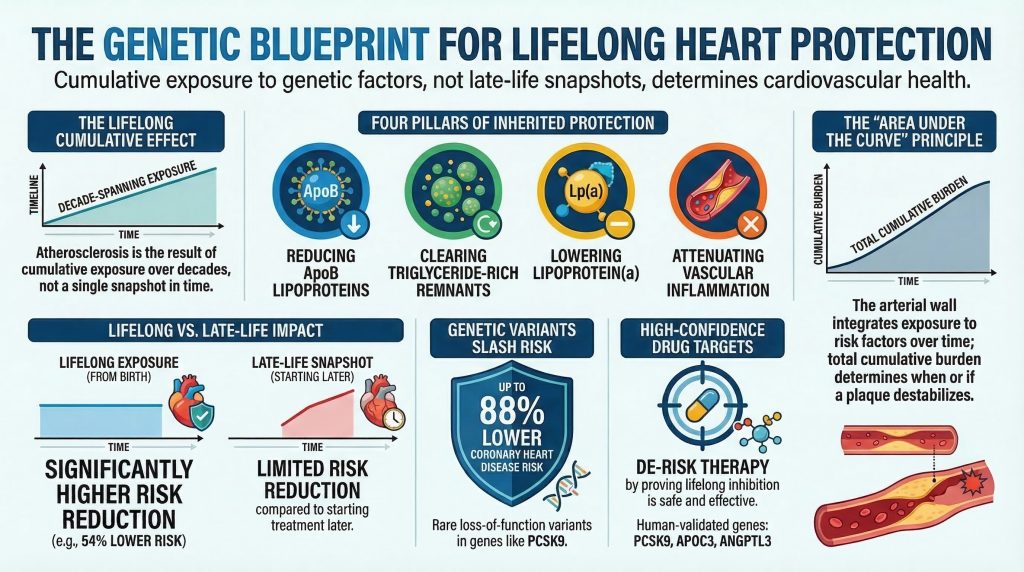
Una delle lezioni più significative che ci offre questa era genomica è che le varianti cardioprotettive presenti in natura sono particolarmente significative. Queste varianti, spesso rare alleli con perdita di funzione oppure le sostituzioni missenso che riducono la funzionalità, fungono da esperimenti della natura. Riducendo parzialmente o completamente l'attività di un proteina fin dalla nascita, si avvicinano ai livelli di inibizione auspicati per tutta la vita e forniscono quindi prove particolarmente solide riguardo alla causalità, all’entità dei benefici e alla tollerabilità a lungo termine nell’uomo [5], [6]. La genetica umana ha dimostrato che una riduzione persistente delle lipoproteine contenenti apoB, un’accelerazione dell’eliminazione delle lipoproteine ricche di trigliceridi e una riduzione di lipoproteina(a) Il carico e l'attenuazione della segnalazione infiammatoria possono, ciascuno a sé stante, ridurre il rischio di malattia coronarica, infarto miocardico, ictus ischemico, e gli eventi vascolari correlati [4], [7], [13], [17], [39], [40].
L’importanza di queste varianti è duplice. Innanzitutto, forniscono prove causali che collegano specifici percorsi all’aterosclerosi, spesso in modo più convincente rispetto all’epidemiologia convenzionale. Poiché le varianti genetiche vengono assegnate in modo casuale al momento del concepimento e rimangono fisse per tutta la vita, sono meno soggette a causalità inversa e molte forme tradizionali di confondente [8], [35]. In secondo luogo, riducono i rischi legati allo sviluppo dei farmaci. Se l’inibizione parziale e permanente di una proteina riduce il rischio vascolare senza causare tossicità significativa nell’uomo, tale proteina diventa un bersaglio terapeutico particolarmente interessante. PCSK9 è l'esempio più evidente di questo modello, ma non è più l'unico. APOC3, ANGPTL3, NPC1L1, LPA e IL6R sono passati, ciascuno a modo proprio, dalle conoscenze genetiche sull’uomo allo sviluppo farmacologico, alla validazione terapeutica o a entrambi [5], [6], [16], [17], [21], [26], [39], [40].
Allo stesso tempo, le prove scientifiche non sono uniformi per tutti i geni cardioprotettivi proposti. Alcuni loci hanno una validazione diretta a livello di esito clinico nell’uomo e un chiaro percorso meccanicistico che porta all’intervento. Altri mostrano prove convincenti biomarcatore effetti, ma con dati meno consolidati sugli esiti cardiovascolari. Altri ancora derivano da popolazioni fondatrici, analisi dell’esoma o inferenze basate sui percorsi molecolari, senza tuttavia aver ancora individuato un meccanismo completamente chiarito e convalidato dal punto di vista terapeutico [4], [11]. Per questo motivo, è fondamentale disporre di una gerarchia rigorosa delle prove. A un livello inferiore trigliceridi, livelli più elevati di HDL-C o livelli più bassi di LDL-C nei portatori della variante non sono di per sé sufficienti. Gli obiettivi cardioprotettivi clinicamente più significativi sono quelli supportati da evidenze convergenti che collegano il genotipo al meccanismo, il meccanismo al biomarcatore e il biomarcatore agli esiti cardiovascolari oggettivi.
Questa revisione fornisce un’analisi, classificata in base al livello di evidenza, dell’architettura genetica della protezione cardiovascolare. In primo luogo, individua i principali domini meccanicistici attraverso i quali opera la protezione ereditaria. Successivamente, esamina le vie e i geni cardioprotettivi con il più alto grado di affidabilità — quelli supportati da evidenze cliniche sull’uomo e, in diversi casi, da applicazioni terapeutiche — tra cui PCSK9, APOC3, ANGPTL3, LPL, NPC1L1, LPA e IL6R. Successivamente, valuta bersagli biologicamente interessanti ma non ancora pienamente convalidati, tra cui ANGPTL4, ASGR1, CETP, HMGCR, favorevole LDLR e APOB variazione, SORT1 e segnali emergenti nell’esoma quali CIDEB e ZNRF3 [4], [9], [11], [31], [38]. Il testo prende inoltre in considerazione il ruolo speciale delle popolazioni fondatrici come piattaforme di scoperta, distinguendo al contempo gli isolati generatori di ipotesi dai meccanismi cardioprotettivi consolidati. Infine, sostiene che la lezione più importante che si può trarre dalla genetica umana potrebbe essere di natura concettuale piuttosto che tassonomica: il rischio vascolare nel corso della vita si spiega meglio con l’esposizione ereditaria cumulativa piuttosto che con una singola istantanea clinica ottenuta in età avanzata [8], [12], [34].
Mappa dei meccanismi: i quattro pilastri della protezione cardiovascolare ereditaria
L’architettura della cardioprotezione ereditaria si comprende al meglio non come un elenco di geni isolati, ma come un insieme di domini meccanicistici ricorrenti. Le prove attuali suggeriscono che la robusta protezione genetica contro l’ASCVD si concentri su quattro assi principali: (1) riduzione per tutta la vita del carico di lipoproteine contenenti apoB, (2) aumento dell’idrolisi e della clearance delle lipoproteine ricche di trigliceridi e dei loro residui, (3) riduzione del carico aterotrombotico mediato dalla lipoproteina (a) e (4) attenuazione dei disturbi vascolari infiammazione [3], [7], [13], [15], [17], [39].
Il primo pilastro consiste nella riduzione a lungo termine delle lipoproteine contenenti apoB, in particolare LDL particelle. particelle contenenti ApoB sono le particelle causali fondamentali nell’aterosclerosi. Il loro ingresso e la loro ritenzione all’interno delle arterie intima dà inizio alla cascata di ossidazione, attivazione endoteliale, reclutamento dei monociti, formazione delle cellule schiumose e placca progressione che, in ultima analisi, è alla base della maggior parte degli infarti miocardici e delle condizioni ischemiche ictus [13]. Tra i geni che operano in questo ambito figurano PCSK9, NPC1L1, LDLR, APOB, HMGCR e, in un’ottica più regolatoria, SORT1 [6], [9], [13], [38]. Le varianti protettive presenti in questi geni riducono la concentrazione di particelle aterogene oppure ridurre l'esposizione cumulativa a tali sostanze nel corso della vita, diminuendo così la probabilità che la placca si formi, si ingrossi e si destabilizzi.
Il secondo pilastro è il metabolismo di lipoproteine ricche di trigliceridi (TRL), comprese le lipoproteine a densità molto bassa (VLDL), chilomicroni, e i loro residui ricchi di colesterolo. Sebbene l’LDL rimanga la particella aterogenica per eccellenza, le prove genetiche sull’uomo sostengono ormai con forza un ruolo causale dei residui di TRL nell’ASCVD [7], [15]. APOC3, ANGPTL3, ANGPTL4 e LPL sono regolatori chiave di questo dominio. Questi geni influenzano l’idrolisi e la clearance dei TRL modulando lipoproteina lipasi attività, attività della lipasi endoteliale e assorbimento dei residui epatici [15], [16], [22], [27]. Le varianti che favoriscono il catabolismo del TRL riducono colesterolo residuo e ridurre il rischio vascolare.
Un terzo pilastro, spesso sottovalutato nei vecchi modelli incentrati sui lipidi, è la lipoproteina (a), o Lp(a). L'Lp(a) è una particella contenente apoB legata covalentemente a apolipoproteina(a), le cui dimensioni e concentrazione sono determinate in larga misura dalla variazione genetica nel locus LPA [39], [40]. A differenza del solo LDL, l’Lp(a) sembra associare il trasporto di colesterolo aterogenico a proprietà proinfiammatorie e protrombotiche. La genetica umana ha fornito alcune delle prove causali più solide nel campo della biologia cardiovascolare a sostegno del fatto che livelli elevati di Lp(a) aumentano il rischio coronarico, mentre livelli geneticamente più bassi di Lp(a) conferiscono protezione [39], [40].
Il quarto pilastro è l'infiammazione. L'aterosclerosi non è semplicemente un disturbo legato all'accumulo di lipidi, ma una malattia infiammatoria cronica della parete arteriosa. I segnali del sistema immunitario innato e adattativo influenzano l'insorgenza e la crescita della placca, centro necrotico formazione, cappuccio fibroso stabilità e trombogenicità. La via cardioprotettiva antinfiammatoria più evidente, supportata da prove genetiche, è IL-6 segnalazione, in particolare attraverso la variazione funzionale dell’IL6R [17]. Sebbene questa via non abbia ancora lo stesso grado di validazione farmacologica in termini di esiti cardiovascolari rispetto alla PCSK9, la combinazione di evidenze genetiche umane e dati provenienti da studi clinici sull’azione antinfiammatoria ha consolidato l’infiammazione come fattore causale nell’ASCVD [17], [18].
Questi quattro pilastri sono interdipendenti piuttosto che autonomi. Le particelle di ApoB provocano infiammazione vascolare. I residui contribuiscono a disfunzione endoteliale e la formazione di cellule schiumose. L’Lp(a) collega la biologia dei lipidi alla trombosi e all’infiammazione. Le citochine infiammatorie influenzano la produzione epatica di lipoproteine, l’attivazione endoteliale e l’instabilità della placca. Ciononostante, questo quadro offre una guida utile per valutare i bersagli cardioprotettivi e per comprendere perché determinati geni emergano ripetutamente come meccanismi protettivi convalidati nell’uomo.
Da Locus Discovery alla biologia causale: perché la genetica è importante
Il punto di forza della genetica umana non risiede solo nella sua capacità di individuare associazioni, ma anche nella sua capacità di classificare i meccanismi causali. Gli studi sulle malattie mendeliane hanno dimostrato per la prima volta che mutazioni rare e ad alto effetto possono rivelare aspetti biologici di ampia rilevanza. Ipercolesterolemia familiare ha affermato la centralità di Recettore delle LDL biologia; alcune rare mutazioni del gene PCSK9 hanno successivamente dimostrato che l’interruzione dello stesso percorso può essere sia dannosa che protettiva, a seconda della direzionalità [2], [5], [20]. Analogamente, le rare malattie mendeliane dislipidemie risultati successivi a livello di popolazione, secondo cui le varianti comuni e quelle rare spesso convergono sugli stessi percorsi [2].
Il GWAS ha aggiunto un’ulteriore dimensione, rivelando che anche le varianti comuni con effetto modesto possono comunque identificare meccanismi biologici determinanti dal punto di vista terapeutico. Infatti, una delle lezioni più importanti della genetica cardiovascolare è che la varianza spiegata da una variante non coincide con l’importanza biologica o terapeutica del gene a cui essa appartiene [2], [3]. Le varianti comuni in prossimità dei geni HMGCR o NPC1L1 hanno effetti modesti sul colesterolo LDL, ma le proteine a cui sono associate sono diventate bersaglio di terapie efficaci [6], [9], [14], [30]. Al contrario, alcuni loci ad effetto elevato sono rimasti per anni di natura meccanicistica poco chiara, in particolare quando il segnale causale risiede in una sequenza regolatoria non codificante piuttosto che in una variazione codificante per una proteina [2], [3].
Un esempio emblematico di passaggio riuscito dall’associazione al meccanismo è il locus 1p13 del cromosoma, in prossimità del gene SORT1. I primi studi GWAS avevano associato quella regione al colesterolo LDL e al rischio di infarto miocardico, ma i meccanismi biologici alla base di tale associazione erano incerti. Successivi studi funzionali hanno individuato varianti regolatorie che alteravano l’espressione del gene SORT1 nel fegato, influenzando così la secrezione delle lipoproteine e il metabolismo delle LDL [38]. Questo caso ha dimostrato che i segnali di associazione non codificanti possono effettivamente essere ricondotti a geni e meccanismi specifici, sebbene tali risultati rimangano l’eccezione piuttosto che la regola. Al contrario, loci come il 9p21 dimostrano che un’associazione forte e riproducibile con la malattia coronarica arteria una malattia non porta necessariamente a una rapida comprensione dei meccanismi [2], [3].
Per quanto riguarda la genetica cardioprotettiva, quindi, gli obiettivi con il più alto grado di affidabilità tendono ad essere quelli in cui l’associazione, la perturbazione codificante, il meccanismo biologico, la variazione dei biomarcatori e la riduzione degli esiti sono tutti allineati. Questo è lo standard utilizzato di seguito.
Livello 1: bersagli cardioprotettivi ad alta affidabilità, supportati da dati clinici sull’uomo
La definizione più rigorosa di gene cardioprotettivo richiede qualcosa di più di un profilo favorevole dei biomarcatori. Richiede prove sull’uomo che dimostrino che le varianti di quel gene che ne alterano la funzione siano associate a una minore incidenza di eventi cardiovascolari, idealmente supportate da plausibilità meccanicistica e applicazioni terapeutiche. In base a tale criterio, spiccano solo un numero limitato di vie di segnalazione.
PCSK9 (proproteina convertasi di tipo 9, simile alla subtilisina/kexina)
Il PCSK9 rappresenta la storia di successo per eccellenza della genetica cardiovascolare e rimane la dimostrazione più evidente del percorso che va dalla genetica umana della perdita di funzione alla terapia di precisione. Il PCSK9 viene sintetizzato prevalentemente nel fegato come proteina secreta serina proteasi che regola l'abbondanza del recettore LDL (LDLR) sugli epatociti [19]. La sua azione principale consiste nel legarsi all’LDLR e reindirizzarlo verso la degradazione lisosomiale anziché verso il riciclaggio. In condizioni normali, l’LDLR internalizza le particelle di LDL circolanti, rilascia il contenuto nel compartimento endosomiale acido e poi ritorna alla superficie cellulare. La PCSK9 interrompe questo processo di riciclaggio e quindi riduce la densità dell’LDLR negli epatociti [19], [20].
L'importanza della PCSK9 è emersa per la prima volta quando sono state identificate mutazioni con guadagno di funzione come causa di una malattia autosomica dominante ipercolesterolemia [20]. Il panorama si è modificato quando, in coorti di popolazione, sono state identificate varianti naturali con perdita di funzione, tra cui Y142X, C679X e R46L [5]. I portatori presentavano una maggiore densità dei recettori epatici per le LDL, una maggiore clearance delle LDL e livelli di colesterolo LDL più bassi per tutta la vita. Nello studio di riferimento condotto da Cohen e colleghi, i portatori di origine afroamericana di varianti nonsense nel gene PCSK9 presentavano una riduzione di circa 28% del colesterolo LDL e un rischio inferiore di 88% di malattia coronarica, mentre i soggetti di razza bianca portatori della mutazione R46L hanno mostrato una riduzione più modesta del colesterolo LDL, pur godendo comunque di una protezione significativa [5]. Questa scoperta ha avuto un impatto rivoluzionario perché ha dimostrato che la riduzione del livello di LDL per tutta la vita, a partire dalla nascita, comporta una riduzione proporzionale del rischio molto maggiore rispetto a un trattamento a breve termine avviato in età più avanzata.
Le conseguenze a livello traslazionale sono state immediate. Gli anticorpi monoclonali come evolocumab e alirocumab, e successivamente approcci di silenziamento quali inclisiran, sono stati sviluppati per riprodurre il fenotipo genetico protettivo. Gli studi clinici di esito hanno dimostrato che l’inibizione farmacologica della PCSK9 riduce notevolmente il colesterolo LDL oltre a statine e riduce il rischio di eventi cardiovascolari gravi [21]. La PCSK9 non è quindi solo un bersaglio ben documentato, ma rappresenta il paradigma in base al quale viene valutata la genetica cardioprotettiva contemporanea.
NPC1L1 (simile a Niemann-Pick C1 1)
L'NPC1L1 è il principale trasportatore che media l'assorbimento intestinale del colesterolo. È espresso nel bordo a spazzola degli enterociti e facilita l'assorbimento sia del colesterolo alimentare che di quello biliare steroli [6]. In ampi set di dati ottenuti dal sequenziamento dell’esoma sono state identificate rare mutazioni inattivanti nel gene NPC1L1, associate a modeste riduzioni permanenti del colesterolo LDL, ma a riduzioni sproporzionatamente elevate del rischio di malattia coronarica [6]. Nello studio condotto da Stitziel e colleghi, i portatori presentavano livelli di colesterolo LDL inferiori di circa 12 mg/dL e un rischio di malattia coronarica inferiore di circa 53% [6]. Sebbene l’entità dell’effetto osservata nei portatori di varianti rare non debba essere estrapolata acriticamente agli effetti terapeutici nella popolazione generale, il risultato ha fortemente rafforzato un principio fondamentale della biologia cardiovascolare: modeste differenze nei livelli di LDL, se mantenute nel corso di decenni, possono determinare differenze di rischio cumulative molto significative.
Il gene NPC1L1 rappresenta inoltre un esempio della convergenza tra genetica e terapia. Ezetimibe inibisce farmacologicamente il gene NPC1L1, e il IMPROVE-IT Lo studio ha dimostrato che l’aggiunta di ezetimibe alla terapia con statine riduce gli eventi cardiovascolari [30]. Pertanto, come nel caso della PCSK9, la genetica umana ha anticipato i benefici clinici e rafforzato la certezza causale riguardo al bersaglio.
APOC3 (apolipoproteina C-III)
L'APOC3 è uno dei principali regolatori del metabolismo delle lipoproteine ricche di trigliceridi nell'uomo. Sintetizzata in gran parte dal fegato e dall'intestino, l'apolipoproteina C-III si trova sulla superficie dei chilomicroni, delle VLDL e HDL particelle, dove inibisce la lipoproteina lipasi, ritarda la lipolisi delle particelle ricche di trigliceridi e compromette l'assorbimento dei residui da parte del fegato [15], [22]. L’aumento dei livelli di APOC3 favorisce quindi l’accumulo di trigliceridi e di colesterolo residuo, entrambi sempre più riconosciuti come mediatori causali dell’ASCVD.
Gli studi di sequenziamento dell’esoma hanno individuato rare mutazioni con perdita di funzione nel gene APOC3, tra cui l’allele R19X e alleli che alterano lo splicing, che determinano una diminuzione dei livelli di APOC3 e una riduzione dei trigliceridi plasmatici di circa 40% [23], [24]. Ancora più importante, queste varianti sono risultate associate a un minor rischio di malattia vascolare ischemica e di malattia coronarica [23], [24]. Queste osservazioni hanno rafforzato l'ipotesi secondo cui i residui ricchi di trigliceridi non sono semplicemente correlati al rischio, ma sono essi stessi coinvolti in modo causale nell'aterosclerosi. Il probabile beneficio sembra essere mediato principalmente da un miglioramento dell'eliminazione dei residui piuttosto che da una significativa riduzione delle LDL.
Anche la storia dell’APOC3 ha avuto un rapido sviluppo. Gli approcci basati su oligonucleotidi antisenso e mirati all’RNA, che inibiscono l’APOC3, hanno dimostrato una marcata riduzione dei trigliceridi nei casi di ipertrigliceridemia grave. I dati sugli esiti cardiovascolari sono ancora in fase di maturazione, ma dal punto di vista genetico l’APOC3 rientra già tra i bersagli più solidi e convalidati per rischio residuo oltre l'LDL.
ANGPTL3 (simile all'angiopoietina 3)
L'ANGPTL3 è una proteina secretoria di origine epatica che inibisce sia la lipoproteina lipasi che la lipasi endoteliale, assumendo così un ruolo centrale nel traffico lipidico sistemico [16], [25]. Le mutazioni omozigoti con perdita di funzione nel gene ANGPTL3 causano l’ipolipidemia combinata familiare, caratterizzata da bassi livelli di LDL-C, trigliceridi e HDL-C [25]. Questo fenotipo è degno di nota perché altera contemporaneamente diversi compartimenti lipidici rilevanti per le malattie vascolari.
Studi di sequenziamento condotti su popolazioni hanno dimostrato che i portatori eterozigoti di varianti inattivanti del gene ANGPTL3 presentano livelli plasmatici di lipidi più bassi e un rischio di malattia coronarica inferiore di circa 34% [16]. Il profilo protettivo è più ampio rispetto a quello di un percorso incentrato esclusivamente sull’LDL: contribuiscono a tale profilo livelli più bassi di trigliceridi, colesterolo residuo, apoB e LDL-C. Una parte della riduzione dei livelli di LDL sembra in parte indipendente dalla biologia canonica del recettore dell’LDL, il che accresce l’interesse terapeutico dell’ANGPTL3 in disturbi quali ipercolesterolemia familiare omozigote [16], [25].
Questa promessa si è in parte concretizzata grazie a evinacumab, un anticorpo monoclonale contro l’ANGPTL3, che riduce in modo sostanziale il colesterolo LDL anche in contesti in cui le terapie basate sul recettore LDL (LDLR) sono limitate [26]. L’ANGPTL3 rappresenta quindi, insieme al PCSK9 e all’NPC1L1, uno degli esempi più evidenti di come la genetica protettiva umana possa guidare con successo lo sviluppo traslazionale.
LPL (lipoproteina lipasi)
La lipoproteina lipasi è l’enzima effettore chiave per l’idrolisi dei trigliceridi all’interno dei chilomicroni e delle VLDL, facilitando in tal modo l’assorbimento degli acidi grassi da parte dei tessuti e l’eliminazione dei residui [15], [28]. Se le proteine APOC3 e ANGPTL fungono da freni nella clearance dei trigliceridi, la LPL è il motore che conferisce protezione quando viene attivata o disinibita.
La variante protettiva naturale più nota nella LPL è la S447X (Ser447Ter, S447*), una variante troncante quasi terminale associata a una maggiore efficienza lipolitica, a livelli più bassi di trigliceridi, a livelli più elevati di HDL-C e a un minor rischio coronarico [29]. Sebbene il meccanismo biochimico esatto sia stato oggetto di dibattito, il segnale epidemiologico è risultato coerente. Più in generale, le variazioni codificanti all’interno e in prossimità della via dell’LPL hanno ripetutamente dimostrato che una maggiore clearance lipolitica dei TRL e dei residui ha un effetto cardioprotettivo [4].
L'LPL è importante dal punto di vista concettuale perché fornisce una conferma reciproca dell'ipotesi dei residui. Se l'inibizione delle proteine APOC3 o ANGPTL riduce il rischio cardiovascolare allentando il "freno" dell'LPL, allora potenziare l'LPL stesso dovrebbe avere un effetto protettivo. La genetica umana conferma esattamente questo.
LPA e lipoproteina (a)
Qualsiasi discussione odierna sulla cardioprotezione ereditaria risulta incompleta senza menzionare la lipoproteina (a). I livelli di Lp(a) sono determinati prevalentemente dalla variazione nel locus LPA, in particolare dalle dimensioni dell’isoforma apo(a) e dalla relativa struttura genetica [39], [40]. Livelli elevati di Lp(a) sono oggi tra i fattori di rischio causali della malattia coronarica con il più forte supporto genetico. Al contrario, una riduzione ereditaria dei livelli di Lp(a) conferisce protezione [39], [40].
L’importanza concettuale fondamentale dell’LPA risiede nel fatto che amplia il campo di studio oltre la biologia standard delle LDL. L'Lp(a) sembra favorire l'aterosclerosi attraverso la ritenzione arteriosa mediata dall'apoB, esercitando al contempo effetti proinfiammatori e protrombotici. Studi genetici hanno dimostrato che le varianti associate a livelli elevati di Lp(a) aumentano il rischio di infarto miocardico, mentre le analisi di randomizzazione mendeliana sostengono l'esistenza di una causalità piuttosto che di una mera correlazione [39], [40]. Sebbene le varianti protettive naturali dell’LPA non siano definibili in modo così netto come alleli classici con perdita di funzione, a differenza del PCSK9 o dell’APOC3, il meccanismo d’azione è sufficientemente convalidato da meritare di essere incluso tra i meccanismi cardioprotettivi ad alta affidabilità. I programmi terapeutici mirati all’Lp(a) rappresentano oggi una delle frontiere più promettenti della cardiologia preventiva.
IL6R e la via di segnalazione dell'IL-6
L’IL6R occupa un posto speciale nel panorama delle terapie cardioprotettive poiché estende la protezione comprovata oltre il metabolismo delle lipoproteine. L’aterosclerosi è una malattia infiammatoria cronica e l’IL-6 è un mediatore centrale della segnalazione infiammatoria in fase acuta e vascolare [17], [18]. La variante comune Asp358Ala nel gene IL6R aumenta il rilascio del recettore e attenua la segnalazione classica dell’IL-6. I portatori presentano livelli più bassi di CRP e fibrinogeno e un rischio inferiore di cardiopatia coronarica [17].
L’entità della protezione vascolare è inferiore a quella osservata con alcune vie metaboliche dei lipidi, e l’IL6R non ha ancora raggiunto lo stesso livello di validazione definitiva degli esiti cardiovascolari farmacologici del PCSK9. Ciononostante, il significato dal punto di vista meccanicistico è profondo. Dimostra che una riduzione genetica della segnalazione infiammatoria può ridurre il rischio di ASCVD indipendentemente dai livelli lipidici. Questo risultato genetico integra le evidenze interventistiche provenienti da studi clinici antinfiammatori quali Canti, anche se CANTOS agiva direttamente sull’IL-1β anziché sull’IL-6 [18]. L’IL6R va quindi considerata come una via protettiva validata geneticamente e con un forte potenziale traslazionale.
Livello 2: Obiettivi biologicamente interessanti ma non ancora pienamente convalidati
Un secondo livello comprende geni e vie metaboliche che presentano una notevole credibilità biologica e spesso effetti convincenti come biomarcatori, ma con evidenze meno complete sugli esiti clinici nell’uomo, meccanismi meno certi o una traslazione terapeutica meno matura.
ANGPTL4
L’ANGPTL4, come l’ANGPTL3, inibisce la lipoproteina lipasi e influenza la distribuzione dei lipidi a digiuno [27]. L'E40K variante missenso riduce l'attività inibitoria ed è associata a livelli più bassi di trigliceridi, livelli più elevati di HDL-C e a un minor rischio di malattia coronarica [4], [28]. Queste osservazioni avvalorano fortemente il principio generale secondo cui la disinibizione della LPL ha un effetto cardioprotettivo. Tuttavia, l’ANGPTL4 non vanta ancora la stessa ampiezza di validazione degli esiti clinici né la stessa maturità terapeutica del PCSK9, dell’ANGPTL3 o dell’APOC3. Inoltre, studi condotti su animali hanno sollevato preoccupazioni in merito alla sicurezza in caso di interruzione più completa della via metabolica in determinate condizioni alimentari [27]. La genetica umana conferma che ANGPTL4 è un bersaglio importante all’interno di una via di segnalazione, ma non è ancora considerato un bersaglio di primo piano clinicamente validato.
ASGR1
L'ASGR1 è un recettore epatico coinvolto nella clearance delle glicoproteine desialilate. Alcune rare varianti con perdita di funzione sono state associate a livelli più bassi di colesterolo non-HDL e una riduzione del rischio di malattia coronarica negli studi islandesi basati sul sequenziamento [31]. Il segnale è interessante e potenzialmente importante, ma il meccanismo non è ancora stato del tutto chiarito e la traslazione terapeutica è ancora in una fase iniziale. L’ASGR1 va quindi annoverato tra i loci cardioprotettivi promettenti piuttosto che tra i bersagli più consolidati.
CETP
Il CETP facilita lo scambio di esteri del colesterolo e i trigliceridi tra le lipoproteine HDL e quelle contenenti apoB. Le varianti che riducono l’attività della CETP aumentano in modo sostanziale il colesterolo HDL (HDL-C) e possono abbassare moderatamente l’apoB e il colesterolo LDL (LDL-C) [9], [32]. La genetica umana e il lungo percorso dello sviluppo degli inibitori della CETP hanno chiarito un punto importante: qualunque beneficio cardiovascolare possa conferire l’inibizione della CETP è probabilmente mediato dalla riduzione delle particelle contenenti apoB, non dall’aumento dell’HDL di per sé [9], [32]. Questa distinzione è fondamentale, poiché il CETP è stato a lungo interpretato erroneamente come una questione legata all’HDL, mentre in realtà si tratta più propriamente di una questione legata all’apoB. Sperimentazione clinica I risultati sono stati eterogenei, riflettendo sia la tossicità fuori bersaglio sia un’efficacia variabile tra i diversi composti. Il CETP rimane quindi un percorso supportato da evidenze scientifiche, ma non è stato definitivamente convalidato a livello dei geni con la più spiccata azione cardioprotettiva.
Variazioni favorevoli dei geni HMGCR, LDLR e APOB
Questi geni confermano l’importanza fondamentale dell’esposizione cumulativa alle LDL. Le variazioni del gene HMGCR si sono rivelate particolarmente significative, poiché varianti comuni come rs12916 riproducono geneticamente un’esposizione parziale alle statine nel corso della vita [9]. I portatori presentano livelli più bassi di LDL-C e un rischio coronarico inferiore, ma anche un rischio di diabete leggermente maggiore, il che riflette un noto compromesso della terapia con statine. Si tratta di un esempio significativo di come la genetica possa prevedere sia i benefici terapeutici sia gli effetti avversi legati ai meccanismi d’azione. Anche una variazione regolatoria favorevole nei geni LDLR e APOB avvalora l’importanza fondamentale di mantenere bassi i livelli di apoB per tutta la vita, sebbene le conseguenze patogene più gravi di questi geni si osservino quando la funzione è compromessa nella direzione opposta [13], [14].
SORT1 e il locus 1p13
SORT1 merita di essere approfondito perché rappresenta uno dei migliori esempi di traduzione riuscita del segnale emerso dai GWAS in un meccanismo specifico. Le varianti presenti in 1p13 sono associate al colesterolo LDL e al rischio di infarto miocardico; studi funzionali hanno dimostrato che le alterazioni regolatorie a livello di quel locus modificano l’espressione epatica di SORT1 e il metabolismo delle lipoproteine [38]. Il locus è quindi altamente informativo dal punto di vista biologico, ma il suo ruolo è più quello di un nodo regolatorio che chiarisce i meccanismi di regolazione piuttosto che quello di un classico bersaglio protettivo umano con perdita di funzione, con un'analogia terapeutica diretta.
CIDEB, ZNRF3, SVEP1, KLF14 e segnali emergenti nell'esoma
Il sequenziamento su larga scala continua a identificare loci che potrebbero fornire indicazioni per lo sviluppo di future terapie. Il gene CIDEB sembra avere un ruolo rilevante nella biologia delle goccioline lipidiche epatiche e potrebbe influenzare sia le malattie epatiche che i fenotipi cardiometabolici [11]. Lo ZNRF3 si è rivelato un possibile bersaglio per la riduzione dei livelli di LDL senza evidenti effetti avversi sulla glicemia o sul fegato, sebbene le prove a sostegno siano ancora preliminari [11]. Il gene SVEP1 è degno di nota poiché le variazioni nel suo codice genetico sono state associate al rischio coronarico [4], ma la sua direzionalità rimanda più alla biologia vascolare che a una perdita di funzione con effetto protettivo. Il gene KLF14 è interessante dal punto di vista metabolico, soprattutto nella biologia del tessuto adiposo, ma non è ancora stato convalidato in modo diretto come bersaglio per la protezione cardiovascolare. È opportuno considerare questi loci come in fase di scoperta o come fonte di informazioni sui percorsi biologici, piuttosto che come bersagli terapeutici consolidati.
Classificazione delle evidenze: una gerarchia pratica dei bersagli cardioprotettivi
Una sintesi utile integra quattro dimensioni: (1) la natura della perturbazione genetica, (2) l’effetto del biomarcatore, (3) le evidenze relative agli esiti cardiovascolari e (4) il grado di applicazione terapeutica.
Livello 1: obiettivi cardioprotettivi con il massimo grado di affidabilità
- PCSK9: significativa riduzione permanente dei livelli di LDL, solide prove relative agli esiti clinici nell’uomo, terapie approvate [5], [21]
- NPC1L1: modesta riduzione del colesterolo LDL a lungo termine con effetti significativi sugli esiti nei portatori rari, terapia approvata [6], [30]
- APOC3: significativa riduzione dei trigliceridi e dei residui, con una solida evidenza di benefici clinici sull’uomo, terapie mirate avanzate [23], [24]
- ANGPTL3: ampio ipolipemizzante con supporto per l’esito clinico e terapia approvata [16], [26]
- LPL: fattore direttamente responsabile dell'eliminazione dei residui, con prove coerenti della sua efficacia protettiva nell'uomo [4], [29]
- Via LPA: solide prove causali che indicano che livelli geneticamente più bassi di Lp(a) riducono il rischio di ASCVD, applicazione terapeutica attiva [39], [40]
- Via di segnalazione dell'IL6R: solide prove genetiche a sostegno della causalità infiammatoria, sviluppo traslazionale in corso [17], [18]
Livello 2: biologicamente convincente, ma non ancora pienamente convalidato
- ANGPTL4 [4], [27], [28]
- ASGR1 [31]
- CETP [9], [32]
- HMGCR [9], [14]
- Variazione favorevole dei geni LDLR e APOB [13], [14]
- SORT1 [38]
- CIDEB, ZNRF3, KLF14 e segnali emergenti correlati nell'esoma [11]
Questa gerarchia mette in evidenza un principio fondamentale: i geni cardioprotettivi più utili non sono necessariamente quelli con gli effetti più marcati sui biomarcatori, bensì quelli per i quali la genetica, il meccanismo d’azione, gli esiti clinici e la trattabilità terapeutica sono tutti allineati.
Popolazioni fondatrici e isolati: piattaforme di scoperta, non sostituti delle prove
Le popolazioni fondatrici occupano un posto privilegiato nella genetica umana poiché l’isolamento, i colli di bottiglia e l’endogamia possono amplificare varianti altrimenti rare, aumentando così la capacità di individuare alleli che modificano il decorso della malattia. Questa logica ha già portato a importanti scoperte nel campo della biologia cardiometabolica, tra cui varianti lipidiche protettive in popolazioni relativamente isolate [23], [24]. Tali popolazioni sono particolarmente preziose per la formulazione di ipotesi e l’individuazione di varianti rare.
Tuttavia, lo status di “fondatore” non costituisce di per sé una prova di cardioprotezione. Le affermazioni relative a una protezione vascolare insolita in isolati specifici dovrebbero essere valutate con lo stesso rigore di qualsiasi altro meccanismo proposto: la variante deve essere identificata, la sua direzione funzionale dimostrata e la sua relazione con esiti cardiovascolari oggettivi stabilita. In assenza di tale sequenza di prove, tali popolazioni rimangono opportunità di scoperta piuttosto che esempi convalidati di protezione ereditaria. Questa distinzione è particolarmente importante quando le narrazioni dei media anticipano la letteratura meccanicistica sottoposta a revisione tra pari.
Perché l’esposizione ereditaria offre risultati migliori rispetto alle misurazioni effettuate in età avanzata
La lezione concettuale più importante che si può trarre dalla genetica cardioprotettiva è che l’aterosclerosi è fondamentalmente una malattia di esposizione cumulativa. La valutazione clinica del rischio si basa tradizionalmente su misurazioni effettuate nella mezza età: un valore di LDL-C, un pressione sanguigna un valore di glicemia, un'HbA1c, una PCR ad alta sensibilità. Si tratta di parametri clinicamente utili, ma dal punto di vista biologico rappresentano solo istantanee [12]. La parete arteriosa, al contrario, integra l’esposizione nel corso di decenni. Dal punto di vista meccanicistico, ciò che conta è l’area sotto la curva relativa al carico di apoB, al colesterolo residuo, alla Lp(a), alla pressione arteriosa, al danno glicemico e alla segnalazione infiammatoria [8], [13], [34].
Studi basati sulla randomizzazione mendeliana hanno dimostrato che una riduzione del colesterolo LDL mediata geneticamente per tutta la vita comporta una diminuzione del rischio coronarico molto più marcata rispetto alla stessa riduzione assoluta del colesterolo LDL ottenuta farmacologicamente solo per pochi anni in età adulta [8]. Ference e colleghi hanno dimostrato che un livello di LDL-C inferiore di 1 mmol/L, mantenuto sin dalla prima infanzia, è associato a un rischio di malattia coronarica inferiore di circa 54% [8]. Si tratta di una cifra di gran lunga superiore a quella rischio relativo riduzione che si osserva solitamente quando la stessa differenza nei livelli di LDL viene ottenuta in età più avanzata grazie al trattamento [8], [14]. La spiegazione è semplice: la protezione per tutta la vita impedisce fin dall’inizio la formazione della placca, mentre una terapia somministrata in una fase successiva spesso modifica un processo patologico già in atto.
Lo stesso principio si estende quasi certamente oltre l’LDL. È lecito aspettarsi che un carico residuo persistentemente più basso, livelli più bassi di Lp(a), una pressione arteriosa più bassa e una minore segnalazione infiammatoria sin dai primi anni di vita producano benefici maggiori nel corso della vita rispetto alla sola correzione tardiva. La genetica umana riveste in questo contesto un valore unico, poiché misura una predisposizione ereditaria stabile piuttosto che una fisiologia transitoria. Le varianti genetiche si fissano al momento del concepimento, non sono influenzate dalla maggior parte dei fattori ambientali a breve termine e sono meno soggette alla causalità inversa [35]. In questo senso, la genetica permette ai ricercatori di andare oltre le fluttuazioni biologiche quotidiane e di dedurre il quadro dell’esposizione a lungo termine di una persona.
Rischio poligenico e continuum tra variazione monogenica e variazione comune
Le varianti protettive monogeniche rare sono altamente informative ma poco frequenti. A livello di popolazione, il rischio e la protezione ereditari sono spesso di natura poligenica. Punteggi di rischio poligenico aggregare gli effetti di numerose varianti comuni presenti in tutto il genoma per stimare la suscettibilità di base alla malattia coronarica [10], [36], [37]. Questi strumenti hanno dimostrato che una parte degli individui presenta un rischio poligenico simile a quello osservato in alcune malattie monogeniche, in particolare se interpretati insieme alle informazioni cliniche convenzionali [36], [37].
Il contributo fondamentale dei modelli poligenici non sta nel fatto che sostituiscano la biologia dei percorsi causali, bensì nel fatto che la integrino. Le varianti rare rivelano i meccanismi. Punteggi poligenici catturare il carico di fondo. Nel loro insieme, questi risultati suggeriscono che la protezione cardiovascolare ereditaria si collochi su un continuum: da rare perturbazioni ad alto impatto, quali la perdita di funzione di PCSK9 o APOC3, alle comuni variazioni regolatorie in vie metaboliche quali HMGCR o CETP, fino alle ampie architetture genomiche che, nel loro insieme, influenzano il danno arterioso nel corso della vita.
Il PRS richiede comunque cautela. Le prestazioni variano a seconda dei gruppi di ascendenza, la calibrazione rimane un’area di ricerca attiva e la maggior parte delle affermazioni relative alla prevenzione degli eventi rimane di natura inferenziale piuttosto che comprovata da studi clinici [36], [37]. Tuttavia, il messaggio generale è chiaro: la biologia ereditaria permette di individuare fattori di rischio e di protezione molto prima che la malattia si manifesti clinicamente.
Conclusione
La genetica umana ha modificato radicalmente sia la biologia che la strategia della prevenzione cardiovascolare. Ha dimostrato che la protezione cardiovascolare ereditaria non è diffusa o casuale, ma concentrata in un numero limitato di domini causali: riduzione permanente delle lipoproteine contenenti apoB, eliminazione più efficiente dei residui ricchi di trigliceridi, riduzione del carico aterotrombotico mediato dall’Lp(a) e attenuazione dell’infiammazione vascolare. All’interno di questi ambiti, un insieme relativamente ristretto di geni e vie metaboliche — in particolare PCSK9, NPC1L1, APOC3, ANGPTL3, LPL, LPA e IL6R — costituisce ora la prova più solida di meccanismi cardioprotettivi altamente affidabili [5], [6], [16], [17], [21], [23], [24], [39], [40].
Questi percorsi non si sono limitati a spiegare la malattia, ma hanno fornito una guida terapeutica. L’inibizione della PCSK9 è ormai una pratica clinica standard per pazienti selezionati. La genetica dell’NPC1L1 ha anticipato i benefici dell’ezetimibe. L’inibizione dell’ANGPTL3 è clinicamente utile nella dislipidemia grave. Le strategie mirate all’APOC3 e all’Lp(a) continuano ad ampliare i confini della prevenzione di precisione. L’IL6R ha rafforzato l’ipotesi secondo cui la segnalazione infiammatoria non è semplicemente associata all’aterosclerosi, ma ne è causa diretta.
Eppure la lezione più importante potrebbe essere ancora più ampia. Il rischio cardiovascolare va inteso non come un tratto statico misurato nella mezza età, ma come la conseguenza cumulativa di decenni di esposizione. La genetica umana offre una prospettiva straordinariamente potente su tale processo cumulativo. Che si tratti di rari alleli cardioprotettivi, di variazioni regolatorie in vie chiave o del carico poligenico di fondo, la variabilità ereditaria rivela il ritmo del danno arterioso molto prima che la malattia sia clinicamente visibile. Il futuro della cardiologia preventiva dipenderà quindi non solo dall’identificazione di un maggior numero di loci, ma anche dalla capacità di imitare le perturbazioni più protettive della natura in modo più precoce, più preciso e con maggiore certezza meccanicistica.
Riferimenti
-
- World Health Organization, “Cardiovascular diseases (CVDs),” WHO, 2025. https://www.who.int/news-room/fact-sheets/detail/cardiovascular-diseases-(cvds)
- Kathiresan S, Srivastava D. Genetics of human cardiovascular disease. Cell. 2012;148(6):1242-1257. doi:10.1016/j.cell.2012.03.001
- Khera AV, Kathiresan S. Genetics of coronary artery disease: discovery, biology and clinical translation. Nat Rev Genet. 2017;18(6):331-344. doi:10.1038/nrg.2016.160
- Myocardial Infarction Genetics and CARDIoGRAM Exome Consortia Investigators, Stitziel NO, Stirrups KE, et al. Coding Variation in ANGPTL4, LPL, and SVEP1 and the Risk of Coronary Disease. N Engl J Med. 2016;374(12):1134-1144. doi:10.1056/NEJMoa1507652
- Cohen JC, Boerwinkle E, Mosley TH Jr, Hobbs HH. Sequence variations in PCSK9, low LDL, and protection against coronary heart disease. N Engl J Med. 2006;354(12):1264-1272. doi:10.1056/NEJMoa054013.
- Myocardial Infarction Genetics Consortium Investigators, Stitziel NO, Won HH, et al. Inactivating mutations in NPC1L1 and protection from coronary heart disease.
- Budoff M. Triglycerides and Triglyceride-Rich Lipoproteins in the Causal Pathway of Cardiovascular Disease. Am J Cardiol. 2016;118(1):138-145. doi:10.1016/j.amjcard.2016.04.004
- Ference BA, Yoo W, Alesh I, et al. Effect of long-term exposure to lower low-density lipoprotein cholesterol beginning early in life on the risk of coronary heart disease: a Mendelian randomization analysis. J Am Coll Cardiol. 2012;60(25):2631-2639. doi:10.1016/j.jacc.2012.09.017.
- Ference BA, Kastelein JJP, Ginsberg HN, et al. Association of Genetic Variants Related to CETP Inhibitors and Statins With Lipoprotein Levels and Cardiovascular Risk. JAMA. 2017;318(10):947-956. doi:10.1001/jama.2017.11467.
- Inouye M, Abraham G, Nelson CP, et al. Genomic Risk Prediction of Coronary Artery Disease in 480,000 Adults: Implications for Primary Prevention. J Am Coll Cardiol. 2018;72(16):1883-1893. doi:10.1016/j.jacc.2018.07.079
- Nielsen JB, Rom O, Surakka I, et al. Loss-of-function genomic variants highlight potential therapeutic targets for cardiovascular disease. Nat Commun. 2020;11(1):6417. Published 2020 Dec 18. doi:10.1038/s41467-020-20086-3.
- Lloyd-Jones DM, Braun LT, Ndumele CE, et al. Use of Risk Assessment Tools to Guide Decision-Making in the Primary Prevention of Atherosclerotic Cardiovascular Disease: A Special Report From the American Heart Association and American College of Cardiology.
- Ference BA, Ginsberg HN, Graham I, et al. Low-density lipoproteins cause atherosclerotic cardiovascular disease. 1. Evidence from genetic, epidemiologic, and clinical studies. A consensus statement from the European Atherosclerosis Society Consensus Panel.
- Baigent C, Keech A, Kearney PM, et al. Efficacy and safety of cholesterol-lowering treatment: prospective meta-analysis of data from 90,056 participants in 14 randomised trials of statins. Lancet. 2005;366(9493):1267-1278. doi:10.1016/S0140-6736(05)67394-1.
- Ginsberg HN, Packard CJ, Chapman MJ, et al. Triglyceride-rich lipoproteins and their remnants: metabolic insights, role in atherosclerotic cardiovascular disease, and emerging therapeutic strategies-a consensus statement from the European Atherosclerosis Society.
- Dewey FE, Gusarova V, Dunbar RL, et al. Genetic and Pharmacologic Inactivation of ANGPTL3 and Cardiovascular Disease. N Engl J Med. 2017;377(3):211-221. doi:10.1056/NEJMoa1612790.
- IL6R Genetics Consortium Emerging Risk Factors Collaboration, Sarwar N, Butterworth AS, et al. Interleukin-6 receptor pathways in coronary heart disease: a collaborative meta-analysis of 82 studies. Lancet. 2012;379(9822):1205-1213. doi:10.1016/S0140-6736(11)61931-4.
- Ridker PM, Everett BM, Thuren T, et al. Antiinflammatory Therapy with Canakinumab for Atherosclerotic Disease.
- Horton JD, Cohen JC, Hobbs HH. PCSK9: a convertase that coordinates LDL catabolism.
- Abifadel M, Varret M, Rabès JP, et al. Mutations in PCSK9 cause autosomal dominant hypercholesterolemia.
- Sabatine MS, Giugliano RP, Keech AC, et al. Evolocumab and Clinical Outcomes in Patients with Cardiovascular Disease.
- Ramms B, Gordts PLSM. Apolipoprotein C-III in triglyceride-rich lipoprotein metabolism.
- Jørgensen AB, Frikke-Schmidt R, Nordestgaard BG, Tybjærg-Hansen A. Loss-of-function mutations in APOC3 and risk of ischemic vascular disease.
- TG and HDL Working Group of the Exome Sequencing Project, National Heart, Lung, and Blood Institute, Crosby J, Peloso GM, et al. Loss-of-function mutations in APOC3, triglycerides, and coronary disease.
- Musunuru K, Kathiresan S. Surprises From Genetic Analyses of Lipid Risk Factors for Atherosclerosis.
- Raal FJ, Rosenson RS, Reeskamp LF, et al. Evinacumab for Homozygous Familial Hypercholesterolemia.
- Aryal B, Price NL, Suarez Y, Fernández-Hernando C. ANGPTL4 in Metabolic and Cardiovascular Disease.
- Romeo S, Yin W, Kozlitina J, et al. Rare loss-of-function mutations in ANGPTL family members contribute to plasma triglyceride levels in humans.
- Sun W, Wu Y, Wen Y, Guo M, Zhang H. The association of the S447X mutation in LPL with Coronary artery disease: a meta-analysis. Minerva Cardioangiol. 2019;67(3):246-253. doi:10.23736/S0026-4725.18.04668-6.
- Cannon CP, Blazing MA, Giugliano RP, et al. Ezetimibe Added to Statin Therapy after Acute Coronary Syndromes.
- Nioi P, Sigurdsson A, Thorleifsson G, et al. Variant ASGR1 Associated with a Reduced Risk of Coronary Artery Disease.
- Nelson AJ, Sniderman AD, Ditmarsch M, et al. Cholesteryl Ester Transfer Protein Inhibition Reduces Major Adverse Cardiovascular Events by Lowering Apolipoprotein B Levels.
- Vassy JL, Christensen KD, Schonman EF, et al. The Impact of Whole-Genome Sequencing on the Primary Care and Outcomes of Healthy Adult Patients: A Pilot Randomized Trial.
- Ference BA, Braunwald E, Catapano AL. The LDL cumulative exposure hypothesis: evidence and practical applications.
- Burgess S, Butterworth A, Thompson SG. Mendelian randomization analysis with multiple genetic variants using summarized data.
- Khera AV, Chaffin M, Aragam KG, et al. Genome-wide polygenic scores for common diseases identify individuals with risk equivalent to monogenic mutations. Nat Genet. 2018;50(9):1219-1224. doi:10.1038/s41588-018-0183-z
- Inouye M, Abraham G, Nelson CP, et al. Genomic Risk Prediction of Coronary Artery Disease in 480,000 Adults: Implications for Primary Prevention. J Am Coll Cardiol. 2018;72(16):1883-1893. doi:10.1016/j.jacc.2018.07.079
- Musunuru K, Strong A, Frank-Kamenetsky M, et al. From noncoding variant to phenotype via SORT1 at the 1p13 cholesterol locus. Nature. 2010;466(7307):714-719. doi:10.1038/nature09266
- Clarke R, Peden JF, Hopewell JC, et al. Genetic variants associated with Lp(a) lipoprotein level and coronary disease. N Engl J Med. 2009;361(26):2518-2528. doi:10.1056/NEJMoa0902604.
- Kamstrup PR, Tybjaerg-Hansen A, Steffensen R, Nordestgaard BG. Genetically elevated lipoprotein(a) and increased risk of myocardial infarction. JAMA. 2009;301(22):2331-2339. doi:10.1001/jama.2009.801