
Análise comparativa de tratamentos hipolipemiantes
Vias biológicas, dinâmica da eficácia, mecanismos celulares da toxicidade muscular, farmacogenômica e o fenômeno nocebo
Resumo
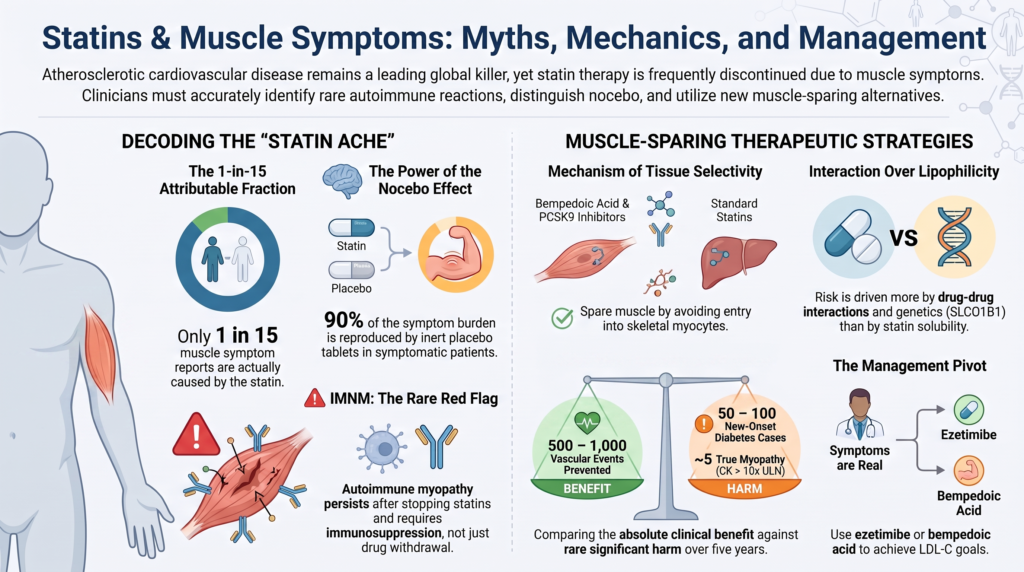
Aterosclerótico doença cardiovascular (ASCVD) continua sendo a principal causa de morte em todo o mundo, e a redução do colesterol de baixa densidade lipoproteína colesterol (LDL-C) é o meio farmacológico mais amplamente validado para reduzir esse risco. O arsenal terapêutico se expandiu dos inibidores da redutase da 3-hidroxi-3-metilglutaril-coenzima A (HMG-CoA) para os inibidores da ATP-citrato liase, Niemann-Pick C1-Like 1, pró-proteína convertase subtilisina/kexina tipo 9 (PCSK9), e semelhante à angiopoietina proteína 3, com éster de colesterila inibidores de proteínas de transferência, via oral Inibidores da PCSK9, e terapias com ácido nucleico direcionadas à lipoproteína (a) em fase avançada de desenvolvimento. Apesar do benefício cardiovascular inequívoco, a adesão ao tratamento é prejudicada pelos efeitos adversos relatados, que, em sua grande maioria, sintomas musculares associados a estatinas (SAMS).
Esta revisão sintetiza a farmacologia molecular, a eficácia comparativa e o perfil de segurança muscular de todas as classes de medicamentos redutores do LDL disponíveis atualmente. Ela aborda os efeitos musculares de forma ampla, e não apenas como dor muscular, tratando também da fadiga, da redução da energia e capacidade de exercício como resultados com sua própria base de evidências distinta. O estudo distingue quatro entidades biologicamente distintas que são frequentemente confundidas: (i) sintomas mediados pelo nocebo, que representam a grande maioria das queixas musculares atribuídas a estatinas — nos dados individuais dos participantes do Cholesterol Treatment Trialists, mais de 90% dos relatos de sintomas musculares entre os participantes que receberam estatinas não foram atribuíveis ao medicamento; (ii) mialgia farmacológica genuína, que afeta uma minoria pequena, mas real; (iii) miopatia verdadeira e rabdomiólise, que são raros e dependem da dose; e (iv) miopatia necrosante imunomediada anti-HMGCR, uma doença autoimune rara que persiste após a suspensão do medicamento e requer imunossupressão, em vez de apenas tranquilização. Evidências provenientes dos dados individuais dos participantes da Colaboração de Pesquisadores do Tratamento do Colesterol metanálise, o Sansão e StatinWISE ensaios “n-de-1”, a comparação entre os grupos cego e não cego do estudo ASCOT-LLA e o estudo GAUSS-3 de reexposição randomizada são integrados à orientação farmacogenômica e a um algoritmo prático de manejo. A mensagem clínica central é dupla: os médicos não devem aceitar os sintomas musculares relatados como prova de toxicidade farmacológica, nem descartá-los como sendo invariavelmente de origem psicológica.
1. Introdução
As doenças cardiovasculares decorrentes da ASCVD continuam sendo a principal causa de mortalidade no mundo [1]. A relação entre o LDL-C e o risco aterosclerótico é causal, depende da dose e é cumulativa ao longo do tempo; além disso, o benefício clínico da redução do LDL-C é proporcional à magnitude absoluta da redução alcançada e à sua duração, independentemente, em grande parte, do mecanismo pelo qual ela é alcançada.
No entanto, a tradução dessas evidências em benefício para a população é limitada menos pela eficácia do que pela persistência no tratamento. Uma parcela substancial dos pacientes a quem são prescritas estatinas interrompe o tratamento em até dois anos, citando, na maioria das vezes, sintomas musculares. A discrepância resultante entre a eficácia comprovada nos estudos clínicos e o benefício efetivamente obtido na prática é uma das maiores perdas evitáveis na cardiologia preventiva.
Para resolver esse problema, é necessário definir com precisão o que realmente está sendo observado quando um paciente relata dor muscular ao tomar uma estatina. As evidências atuais permitem essa precisão. Portanto, esta revisão tem três objetivos: descrever a farmacologia molecular e a eficácia comparativa de todos os agentes redutores do LDL disponíveis; definir a base biológica da toxicidade muscular e as razões pelas quais certos agentes poupam totalmente o músculo esquelético; e quantificar em que medida a carga de sintomas musculares relatados é atribuível ao medicamento, em vez de ser resultado de expectativa, envelhecimento ou coincidência.
1.1 Observação sobre terminologia e escopo
Este artigo é um revisão narrativa com síntese quantitativa dos dados de ensaios clínicos publicados. Não se trata de uma meta-análise de novo: os autores não calcularam estimativas de efeito combinadas, e todos os valores combinados citados são aqueles relatados pelos pesquisadores originais ou por meta-análises publicadas, que são identificadas como tal. Nos casos em que as estimativas das diferentes fontes entram em conflito, o conflito é relatado, em vez de ser resolvido com base em preferências.
2. Vias biológicas e mecanismos moleculares de ação
Terapêutico hipolipemiante é obtido por meio da interrupção da função hepática síntese de colesterol, absorção intestinal de colesterol, hepática Reciclagem do receptor de LDL (LDLR), ou o catabolismo das lipoproteínas. Essas diferenças farmacodinâmicas determinam não apenas a potência, mas também a distribuição tecidual e, portanto, o perfil de efeitos adversos. A distinção mais importante para a segurança muscular é simples: o medicamento penetra nos miócitos esqueléticos e, se sim, interfere em alguma via metabólica necessária ao músculo?
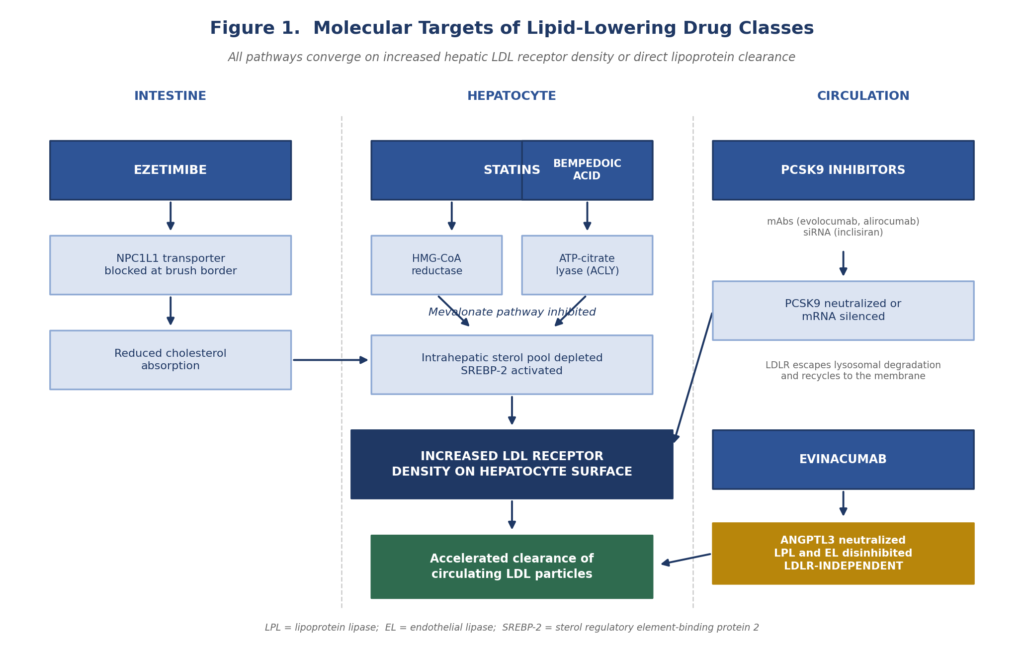
Figura 1. Alvos moleculares das classes de medicamentos hipolipemiantes. Estatinas e ácido bempedoico atuar em dois nós distintos do fígado via do mevalonato; ezetimiba atuam na borda em escova dos enterócitos; os agentes direcionados à PCSK9 atuam na circulação ou no interior dos hepatócitos para preservar Receptor de LDL reciclagem. Evinacumabe é o único agente cujo efeito não depende de LDL densidade de receptores, razão pela qual mantém a atividade em células sem receptores hipercolesterolemia familiar homozigótica.
2.1 Inibidores da HMG-CoA redutase (estatinas)
As estatinas inibem competitivamente Redutase de HMG-CoA, a enzima limitante da velocidade que converte o HMG-CoA em mevalonato na via biossintética do colesterol. A redução do nível intra-hepático esterol O pool ativa a proteína 2 de ligação ao elemento regulador de esteróis (SREBP-2), o que aumenta a transcrição e a expressão na superfície de LDLR nas membranas dos hepatócitos, acelerando a eliminação do LDL circulante e da lipoproteína de densidade muito baixa (VLDL) partículas remanescentes.
Todas as estatinas têm ação hepatoseletiva, principalmente devido à eficiente captação hepática de primeira passagem. Elas diferem, no entanto, na forma como essa captação ocorre e na facilidade com que atingem os tecidos extra-hepáticos:
- Estatinas lipofílicas (atorvastatina, sinvastatina, lovastatina, fluvastatina, pitavastatina, e a cerivastatina, que foi retirada do mercado): possuem permeabilidade de membrana suficiente para a difusão passiva através das membranas celulares, incluindo as dos miócitos esqueléticos. Consequentemente, são mais suscetíveis ao metabolismo oxidativo mediado pelo sistema do citocromo P450, com a notável exceção da pitavastatina.
- Estatinas hidrofílicas (rossuvastatina, pravastatina): possuem domínios estruturais polares que restringem a passagem passiva pela membrana. A entrada no fígado depende principalmente do transporte ativo realizado pelo polipeptídeo transportador de ânions orgânicos 1B1 (OATP1B1, codificado por SLCO1B1), e nenhum deles sofre metabolismo substancial pelo CYP450.
É importante afirmar, desde já, que essa distinção físico-química, embora real e mecanicamente plausível, não se traduziu em uma diferença consistentemente comprovável nas taxas de sintomas musculares clínicos. Esse assunto é abordado diretamente na Seção 6.4. A pitavastatina é o exemplo mais claro de por que a heurística simplista de que “lipofílico é sinônimo de risco” falha: trata-se de uma molécula lipofílica, mas, como quase não sofre metabolismo pelo CYP450, apresenta um dos menores riscos de miopatia mediada por interações entre todas as estatinas.
2.2 A lista completa de estatinas
Atualmente, há sete estatinas no mercado. Uma oitava, a cerivastatina, foi retirada voluntariamente do mercado em todo o mundo em 2001, após uma incidência inaceitável de rabdomiólise fatal, particularmente quando combinada com gemfibrozil. Como grande parte da apreensão histórica em torno da miotoxicidade das estatinas decorre da experiência com a cerivastatina, ela é incluída aqui para contextualização.
| Estatina | Classe | Solubilidade | Metabolismo principal | Notas sobre transporte/interação | Doses disponíveis | Posicionamento prático |
| Atorvastatina | Sintético | Lipofílico | CYP3A4 (metabolitos ativos) | Substrato da OATP1B1; os inibidores do CYP3A4 aumentam a exposição | 10, 20, 40, 80 mg por dia | Agente versátil; a meia-vida longa permite administração em dias alternados |
| Rosuvastatina | Sintético | Hidrofilico | CYP mínimo (traço de CYP2C9) | Substrato das proteínas OATP1B1 e ABCG2 (BCRP); variantes da ABCG2 aumentam a exposição | 5, 10, 20, 40 mg por dia | Mais potente por mg; meia-vida longa; boa opção em caso de intolerância |
| Sinvastatina | De origem fúngica | Lipofílico | CYP3A4 (metabolismo extenso) | O mais forte SLCO1B1 sinal de miopatia; muitos limites de dosagem com medicamentos que interagem entre si | 5, 10, 20, 40 mg por dia (80 mg, com restrição) | Maior risco de miopatia mediado por interação e genótipo entre as estatinas disponíveis no mercado; a dose de 80 mg não é recomendada |
| Pravastatina | De origem fúngica | Hidrofilico | Não-CYP (sulfatação) | Substrato da OATP1B1; poucas interações com o CYP | 10, 20, 40, 80 mg por dia | Baixa potência, mas perfil de interação favorável; útil em casos de polifarmácia |
| Lovastatina | De origem fúngica | Lipofílico | CYP3A4 (metabolismo extenso) | Pró-fármaco lactona; limites máximos de dose para interações múltiplas | 10, 20, 40 mg (liberação imediata); 20–60 mg (liberação prolongada) | Em grande parte obsoleto; tomar com a refeição da noite |
| Fluvastatina | Sintético | Lipofílico | CYP2C9 (principal) | Evita a via do CYP3A4; os indivíduos com baixa capacidade de metabolização pelo CYP2C9 acumulam o medicamento | 20, 40 mg; 40 mg duas vezes ao dia; 80 mg XL | Útil quando a interação com o CYP3A4 é o problema; potência mais baixa |
| Pitavastatina | Sintético | Lipofílico | CYP mínimo; glucuronidação | Não é um substrato do CYP3A4; a ciclosporina é contraindicada | 1, 2, 4 mg por dia | Carga de interação muito baixa; comumente utilizado quando outras estatinas não são toleradas, com base em critérios empíricos, e não em ensaios comparativos |
| Cerivastatina | Sintético | Lipofílico | CYP2C8 e CYP3A4 | Retirado do mercado em 2001; rabdomiólise fatal, especialmente com gemfibrozil | Retirado | Apenas histórico; fonte de grande ansiedade em relação à miotoxicidade das estatinas |
Tabela 1. Características farmacológicas de todas as estatinas comercializadas, além da cerivastatina, que foi retirada do mercado. A classificação de solubilidade segue Schachter (2005) [14]; os dados sobre metabolismo e interações seguem as informações contidas na bula [15-21] e a diretriz do CPIC de 2022 [22]. IR = liberação imediata; ER/XL = liberação prolongada; BID = duas vezes ao dia.
Classificação da intensidade do tratamento com estatinas
Os esquemas terapêuticos com estatinas são convencionalmente classificados com base na redução média do LDL-C alcançada, e não apenas pela dose. As categorias de alta, moderada e baixa intensidade foram definidas na diretriz sobre colesterol da ACC/AHA de 2013, que introduziu a tabela de intensidade basicamente em sua forma atual [92], e foram mantidas na diretriz multissociativa da AHA/ACC de 2018 [12]; elas continuam em uso geral. A própria diretriz de 2018 foi substituída: a Diretriz de 2026 da ACC/AHA/Multisociedade sobre o manejo de Dislipidemia, publicado em março de 2026, retira-o de circulação e o substitui [11], e as mudanças no quadro de referência que ela introduz estão resumidas na Seção 9.3. A redução percentual do LDL-C continua sendo uma prioridade declarada no documento de 2026; portanto, a tabela de intensidade abaixo mantém sua utilidade prática, mas os leitores devem observar que ela agora se insere em um quadro de referência para prescrição baseado em metas, e não mais em um quadro puramente baseado em intensidade.
| Alta intensidade (redução do LDL-C ≥ 50%) | Intensidade moderada (redução de 30 a 491 TP9T) | Baixa intensidade (redução < 30%) |
| Atorvastatina 40–80 mg | Atorvastatina 10–20 mg | Sinvastatina 10 mg |
| Rosuvastatina 20–40 mg | Rosuvastatina 5–10 mg | Pravastatina 10–20 mg |
| — | Sinvastatina 20–40 mg | Lovastatina 20 mg |
| — | Pravastatina 40–80 mg | Fluvastatina 20–40 mg |
| — | Lovastatina 40–80 mg | Pitavastatina 1 mg |
| — | Fluvastatina 40 mg duas vezes ao dia ou 80 mg XL | — |
| — | Pitavastatina 2–4 mg | — |
Tabela 2. Classificação da intensidade do tratamento com estatinas, adaptada da classificação da ACC/AHA introduzida em 2013 [92] e mantido em 2018 [12]. Nenhuma dose de pravastatina, lovastatina, fluvastatina ou pitavastatina atinge a classificação de alta intensidade; apenas a atorvastatina e a rosuvastatina o fazem. A diretriz de dislipidemia de 2026, que substituiu o documento de 2018, acrescenta metas absolutas de LDL-C e não-HDL-C, além da redução percentual; consulte a Seção 9.3.
2.3 Inibidores da ATP-citrato-liase (ácido bempedóico)
O ácido bempedóico é um pró-fármaco de ácido dicarboxílico sintético que inibe ATP-citrato liase (ACLY), uma enzima que atua duas etapas a montante da HMG-CoA redutase na via do mevalonato. A ACLY cliva o citrato de origem mitocondrial em acetil-CoA e oxaloacetato, fornecendo o principal substrato para a síntese de novo do colesterol e dos ácidos graxos.
A atividade farmacológica requer a esterificação com a coenzima A para formar o bempedoyl-CoA, uma reação catalisada pela acil-CoA sintetase de cadeia muito longa 1 (ACSVL1, codificada pelo SLC27A2). Na caracterização original da molécula, o ACSVL1 apresentou alta expressão no fígado, foi detectado apenas minimamente no rim e não foi detectado no músculo esquelético nas condições experimentais estudadas; da mesma forma, o metabólito tioéster ativo foi recuperado do fígado, mas não do músculo esquelético nem do tecido adiposo [24]. Essa é a base mecânica do perfil de preservação muscular do medicamento, e trata-se de um argumento genuíno de seletividade tecidual, e não farmacocinético.
O ácido bempedóico também ativa a proteína quinase ativada por 5’-AMP (AMPK) em sistemas pré-clínicos, com a regulação negativa das enzimas lipogênicas. Isso não deve ser apresentado como um mecanismo comprovado em humanos: a revisão integrada da FDA observa que a ativação da AMPK pode ser específica de roedores, que sua relevância em humanos não está clara e que a redução do LDL-C pode ocorrer independentemente dela [93]. Por outro lado, o ácido bempedóico reduz a alta sensibilidade Proteína C-reativa (hsCRP) em aproximadamente 19–33% ao longo do programa CLEAR [25]. No nível renal, o ácido bempedóico e seu metabólito acil-glucuronídeo inibem competitivamente o transportador de ânions orgânicos 2 (OAT2) no túbulo proximal. Como o OAT2 medeia a secreção tubular tanto do ácido úrico quanto da creatinina, essa inibição produz elevações previsíveis e reversíveis nos níveis séricos de urato e creatinina, que refletem a competição pelo transportador, e não uma lesão parenquimatosa.
2.4 Inibidores da doença de Niemann-Pick tipo C1 (ezetimiba)
A ezetimiba se localiza na borda em escova dos enterócitos do intestino delgado e se liga ao transportador de esteróis Niemann-Pick C1-Like 1 (NPC1L1), bloqueando a endocitose de substâncias biliares e colesterol dietético através do epitélio intestinal, sem afetar significativamente a absorção de triglicerídeos, ácidos biliares, ou vitaminas lipossolúveis. Redução quilomícro colesterol remanescente A administração esgota as reservas intra-hepáticas de esteróis e aumenta a expressão do LDLR hepático. A exposição sistêmica não é insignificante: a ezetimiba e seu glucuronídeo ativo são facilmente detectáveis no plasma, apresentam mais de 90% de ligação às proteínas, passam por recirculação entero-hepática e têm meia-vida de aproximadamente 22 horas [27]. O que importa para a segurança muscular não é a ausência do medicamento na circulação, mas o fato de o alvo farmacológico ser intestinal e de não ter sido identificado nenhum alvo no músculo esquelético.
2.5 Terapêuticas direcionadas à PCSK9
A PCSK9 é uma proteína secretada serina protease que se liga ao domínio extracelular do LDLR na superfície dos hepatócitos e direciona o receptor para a degradação lisossômica, em vez da reciclagem endossômica. Como, de outra forma, cada molécula de LDLR poderia ser reciclada várias vezes, impedir sua degradação aumenta substancialmente a densidade funcional do receptor.
- Anticorpos monoclonais (evolocumabe, alirocumabe): anticorpos IgG totalmente humanos que se ligam à PCSK9 livre em circulação com alta afinidade, bloqueando estereoquimicamente a interação PCSK9–LDLR. Eles atuam predominantemente no espaço extracelular, o que é consistente com o pequeno volume aparente de distribuição relatado para o evolocumab, e não apresentam nenhum alvo intracelular identificado nos miócitos; a rotulagem não comprova a ausência literal de entrada nos miócitos [29,30].
- RNA pequeno interferente (inclisiran): um siRNA sintético de fita dupla conjugado a um ligante triantenário de N-acetilgalactosamina (GalNAc). O GalNAc se liga aos receptores de asialoglicoproteína expressos quase exclusivamente nos hepatócitos, promovendo uma rápida endocitose mediada por receptores. Intracelularmente, o siRNA é incorporado ao complexo de silenciamento induzido por RNA e direciona a clivagem catalítica do RNA mensageiro da PCSK9, produzindo uma supressão sustentada que permite a administração duas vezes por ano após a administração inicial [31,34,35,59].
- Inibidores peptídicos macrocíclicos orais (enlicitida): peptídeos macrocíclicos com biodisponibilidade oral que se ligam à PCSK9 com afinidade semelhante à de um anticorpo, bloqueando a interação PCSK9–LDLR pelo mesmo mecanismo que os anticorpos monoclonais, mas administrados na forma de comprimido. O enlicitide (Lipfendra) foi aprovado pela FDA em 16 de julho de 2026 como o primeiro inibidor oral da PCSK9, na dosagem de 20 mg uma vez ao dia, e é discutido mais detalhadamente na Seção 10.2 [36].
2.6 Inibidores da angiopoietina-like 3 (evinacumab)
O evinacumab é um anticorpo monoclonal totalmente humano direcionado contra ANGPTL3, um inibidor endógeno da lipase endotelial e lipase lipoproteica. A neutralização da ANGPTL3 desinibe ambas as lipases, acelerando a eliminação dos intermediários do processamento das VLDL e promovendo a degradação intravascular direta das partículas de lipoproteína de densidade intermediária e de LDL. É importante ressaltar que essa via não requer LDLRs funcionais, o que torna o evinacumab eficaz em indivíduos homozigotos hipercolesterolemia familiar (HoFH), incluindo pacientes com mutações nulas/nulas no LDLR que apresentam resposta insuficiente ou nenhuma resposta às estatinas e aos inibidores da PCSK9 [13,37]. É mais preciso descrever o evinacumab como amplamente independente do LDLR, em vez de puramente independente. A demonstração da eficácia em pacientes com dupla deleção estabelece que existe uma via independente do LDLR e que ela é suficiente por si só; não estabelece, porém, que a eliminação mediada pelo LDLR não contribua de forma alguma em pacientes que mantêm função parcial do receptor, e é bem possível que alguma biologia residual do receptor contribua para a resposta nesse grupo maior [43].
2.7 Inibição da proteína de transferência de ésteres de colesterol (Obicetrapib, em fase de investigação)
CETP media a transferência de ésteres de colesterol a partir de HDL para apolipoproteína lipoproteínas contendo apolipoproteína B em troca de triglicerídeos. O obicetrapib é um inibidor oral de baixa dosagem da CETP de última geração que reduz o LDL-C, a apolipoproteína B e lipoproteína(a) ao mesmo tempo em que aumenta o HDL-C. Anteriormente Inibidores da CETP fracassaram devido à toxicidade fora do alvo (torcetrapib) ou à eficácia insuficiente (dalcetrapib, evacetrapib); por isso, essa classe de medicamentos suscita uma cautela histórica justificada, enquanto se aguardam dados sobre os resultados cardiovasculares [38].
3. Eficácia farmacodinâmica na monoterapia e nos regimes de combinação
A monoterapia com estatinas apresenta um comportamento não linear dose-resposta curva regida pela chamada “regra dos seis”: cada duplicação da dose resulta em apenas cerca de 6% de redução adicional no LDL-C. Essa atenuação ocorre porque a depleção intracelular de esteróis desencadeia uma regulação compensatória para cima da absorção intestinal de colesterol por meio do NPC1L1 e um aumento do PCSK9 circulante. A implicação clínica é que o aumento da dose é uma estratégia ineficiente em comparação com a combinação de vias metabólicas.
3.1 Estratégias de combinação racional
- Bloqueio duplo da síntese (ácido bempedóico mais estatina): A inibição da via do mevalonato em dois pontos enzimáticos impede o acúmulo de precursores a montante e produz reduções aditivas no pool intra-hepático de esteróis.
- Síntese associada ao bloqueio da absorção (estatina ou ácido bempedóico associado à ezetimiba): atenua o aumento compensatório da absorção intestinal de colesterol induzido pela inibição da síntese. Essa é a combinação com a melhor relação custo-benefício disponível.
- Síntese associada ao bloqueio da eliminação (estatina associada a inibidor de PCSK9): estatinas de alta intensidade aumentam a expressão do LDLR, mas também elevam os níveis circulantes de PCSK9. A adição de um anticorpo monoclonal contra a PCSK9 ou do inclisiran neutraliza esse aumento contrarregulatório, produzindo as maiores reduções possíveis com a terapia atual.
3.2 Eficácia comparativa
Os números a seguir representam as reduções do LDL-C corrigidas em relação ao placebo ou à linha de base, provenientes dos principais ensaios clínicos de registro. Há duas ressalvas a serem consideradas. Primeiro, as porcentagens das combinações são expressas em relação a uma linha de base sem tratamento e, portanto, não são somáveis às linhas de monoterapia. Segundo, a porcentagem de redução é um indicador substituto; apenas os agentes com ensaios clínicos de desfecho cardiovascular concluídos demonstraram redução de eventos, e isso está indicado explicitamente na coluna final.
| Regime | Dosagem padrão | Redução média do LDL-C | População primária | Evidências de resultados |
| Estatina com hidrofiliidade baixa/moderada | Pravastatina 20–40 mg por dia | 20–35% | Prevenção primária; polifarmácia | Sim (WOSCOPS, LIPID, CARE) |
| Estatina hidrofílica de alta intensidade | Rosuvastatina 20–40 mg por dia | 45–55% | Prevenção primária para grupos de alto risco (a Júpiter (população); também utilizado em casos de alto risco de ASCVD | Sim (JUPITER, um estudo de prevenção primária em adultos aparentemente saudáveis) |
| Estatina com lipofilia baixa/moderada | Atorvastatina 10–20 mg por dia | 30–40% | Dislipidemia basal | Sim (ASCOT-LLA, CARDS) |
| Estatina lipofílica de alta intensidade | Atorvastatina 40–80 mg por dia | 50–60% | SCA; manejo pós-infarto do miocárdio | Sim (PROVE-IT, TNT) |
| Monoterapia com inibidor de NPC1L1 | Ezetimiba 10 mg por dia | 15–20% | Tratamento adjuvante para pacientes com intolerância às estatinas | Adjuntivo (IMPROVE-IT) |
| Estatina mais ezetimiba | Estatina de alta intensidade + ezetimiba 10 mg | ≈ 60–65% | ASCVD avançada que não responde ao tratamento apenas com estatinas | Sim (IMPROVE-IT) |
| Monoterapia com inibidores da ACL | Ácido bempedóico, 180 mg por dia | ≈ 18% em uso de estatina; ≈ 21–25% em monoterapia | Intolerância às estatinas | Sim (Resultados CLEAR, 2023) |
| Inibidor da ACL associado à ezetimiba | Ácido bempedóico 180 mg + ezetimiba 10 mg | 38–40% | Intolerância às estatinas que requer redução significativa dos níveis | Evidências dos componentes |
| Monoterapia com anticorpo monoclonal anti-PCSK9 | Evolocumab 140 mg a cada duas semanas ou 420 mg mensalmente | 50–60% | Hipercolesterolemia grave; intolerância às estatinas | LDL-C apenas em uso como monoterapia. Fourier e ODISSEIA O estudo OUTCOMES demonstrou uma redução nos eventos com a adição do anticorpo à terapia de base com estatina ou à terapia com estatina na dose máxima tolerada, mas não como monoterapia |
| Anticorpo monoclonal anti-PCSK9 associado a estatina de alta intensidade | Evolocumab + atorvastatina 80 mg | ≈ 70–80% em relação ao valor basal sem tratamento | ASCVD de risco muito elevado; HeFH | Sim (FOURIER) |
| siRNA de PCSK9 | Inclisiran 284 mg no dia 0, no mês 3 e, a partir daí, a cada 6 meses | 48–52% | Pacientes com adesão limitada | Em andamento (ORION-4, VICTORION-2P) |
| Inibidor de ANGPTL3 | Evinacumab 15 mg/kg por via intravenosa, mensalmente | ≈ 47–49% | FH homozigótica, incluindo a variante LDLR-null | Apenas para substituição |
| Inibidor da CETP (em fase de pesquisa) | Obicetrapib 10 mg por dia | ≈ 33–37% adicionado à terapia de base | ASCVD/HeFH sem atingir a meta | Em andamento (PREVAIL) |
| Inibidor oral da PCSK9 | Enlicitida (Lipfendra) 20 mg, uma vez ao dia | ≈ 56–59%, ajustado em relação ao placebo às 24 semanas | Hipercolesterolemia incluindo HeFH; alternativa oral aos injetáveis | Apenas LDL-C; resultados pendentes (CORALreef Outcomes) |
Tabela 3. Eficácia comparativa na redução do LDL-C. Q2W = a cada duas semanas; Q6M = a cada seis meses; ACS = síndrome coronariana aguda; HeFH = hipercolesterolemia familiar heterozigótica. O obicetrapib ainda se encontra em fase de pesquisa e não está aprovado para o uso descrito. O enlicitide foi aprovado em julho de 2026 com base apenas na redução do LDL-C; seu estudo de resultados cardiovasculares está em andamento, portanto, sua linha deve ser interpretada como evidência substituta, apesar de o medicamento já estar comercializado. Fontes dos estudos de resultados para a coluna final: JUPITER [39]; IMPROVE-IT [28]; Resultados do CLEAR [40]; FOURIER [32]; RESULTADOS DO ESTUDO ODYSSEY [33]; o ORION programa [34,35,59]; CORALreef [44-46]; BROADWAY [38]; evinacumab [13,43].
3.3 Evidências obtidas por meio de exames de imagem de aterosclerose
A redução percentual do LDL-C é um indicador substituto de um indicador substituto. Série ultrassom intravascular (IVUS) fornece um desfecho anatômico intermediário que relaciona a redução dos níveis lipídicos ao próprio processo da doença, e os estudos de imagem são úteis nesse contexto por um motivo específico: eles demonstram que regressão de placa Essas estratégias alcançaram níveis de LDL-C independentemente, em grande parte, do mecanismo utilizado para isso.
- Saturno (NEJM 2011). 1.385 pacientes com doença coronariana foram randomizados para receber rosuvastatina 40 mg ou atorvastatina 80 mg por 104 semanas. Volume percentual do ateroma reduziu-se em 0,99% com a atorvastatina e em 1,22% com a rosuvastatina (P = 0,17, não significativo); total ateroma O volume diminuiu mais com a rosuvastatina (−6,39 vs. −4,42 mm³, P = 0,01). Observou-se regressão na maioria dos pacientes em ambos os grupos (63,2% e 68,5%). Além de sua mensagem sobre eficácia, o estudo SATURN é uma comparação direta entre uma estatina lipofílica e uma hidrofílica na dose máxima e é mencionado novamente na Seção 6.4 [47].
- PRECISE-IVUS (JACC 2015). 246 pacientes japoneses com doença coronariana foram randomizados para receber apenas atorvastatina ou atorvastatina mais 10 mg de ezetimiba, com ajuste da dose até atingir uma meta de LDL-C inferior a 70 mg/dL, sendo submetidos a exames IVUS emparelhados entre 9 e 12 meses em 202 deles. O LDL-C alcançado foi de 73,3 mg/dL na monoterapia versus 63,2 mg/dL na combinação (P < 0,001), e a combinação produziu uma regressão significativamente maior do volume percentual de ateroma, com taxas comparáveis de eventos adversos. Isso corrobora o princípio de que a redução do LDL sem o uso de estatinas produz benefício anatômico e não é meramente um efeito laboratorial [10].
- GLAGOV (JAMA 2016). 968 pacientes com doença coronariana comprovada por angiografia, em tratamento com estatinas, foram randomizados para receber evolocumab 420 mg mensalmente ou placebo por 76 semanas. O LDL-C foi de 36,6 mg/dL no grupo tratado com evolocumabe, contra 93,0 mg/dL no grupo tratado com placebo. O volume percentual de ateroma diminuiu em 1,01% em relação ao placebo (IC 95% de −1,38 a −0,64; P < 0,0001), e a regressão ocorreu em 64,3% contra 47,3% dos pacientes. Em um subgrupo exploratório que atingiu uma média de LDL-C de 24 mg/dL, 81,2% apresentaram regressão. O GLAGOV é a principal evidência de que o benefício continua a se acumular em níveis de LDL-C muito abaixo das metas convencionais, sem que se observe um limiar abaixo do qual uma redução adicional deixe de ser benéfica [9].
Há duas ressalvas a serem consideradas. Trata-se de desfechos anatômicos substitutos, e não de eventos clínicos, e nenhum desses estudos foi projetado com poder estatístico para avaliar desfechos. Além disso, as populações foram selecionadas entre pacientes submetidos a angiografia clinicamente indicada, e não entre coortes de prevenção primária. Seu valor reside em demonstrar a coerência biológica entre a redução do LDL-C e a modificação da doença em três mecanismos farmacológicos diferentes, e não em comprovar a redução de eventos, o que depende dos ensaios de desfecho citados na Tabela 3.
4. Mecanismos celulares da toxicidade muscular
A toxicidade muscular esquelética causada pela terapia hipolipemiante varia de um leve desconforto subjetivo até uma degradação muscular com risco de vida. A suscetibilidade é determinada pelo fato de o medicamento se acumular nos miócitos e de perturbar uma via metabólica da qual o músculo depende.
4.1 Mecanismos propostos para a miotoxicidade das estatinas
São propostos três mecanismos. Eles são apresentados aqui em ordem decrescente de suporte probatório, e deve-se deixar claro que nenhum deles foi definitivamente estabelecido como a causa da mialgia comum em seres humanos.
Diminuição dos isoprenóides e comprometimento da prenilação de proteínas
A jusante da HMG-CoA redutase, a via do mevalonato gera os isoprenóides não esteróides pirofosfato de farnesil (FPP) e pirofosfato de geranilgeranil (GGPP). Essas substâncias são necessárias para a prenilação pós-traducional de pequenas GTPases, incluindo Ras, Rho e Rac. A perda da prenilação perturba a ancoragem na membrana, a transdução de sinais e a manutenção do citoesqueleto, podendo desencadear a apoptose nos miócitos. Esse mecanismo conta com o mais forte suporte experimental, uma vez que a suplementação com mevalonato ou GGPP reverte a miotoxicidade induzida por estatinas em cultura celular, ao passo que a suplementação com colesterol não o faz [48,49].
Disfunção mitocondrial e depleção da coenzima Q10
A via do mevalonato também produz a ubiquinona (coenzima Q10), um transportador de elétrons na cadeia de transporte de elétrons mitocondrial. As estatinas reduzem os níveis circulantes de CoQ10, e supõe-se que a depleção intramiocelular prejudique a atividade dos complexos I e IV, diminuindo a geração de ATP e aumentando espécies reativas de oxigênio produção.
Essa hipótese deve ser apresentada com cautela explícita. Embora a bioquímica seja coerente, as evidências clínicas de que a depleção de CoQ10 cause sintomas, ou de que a reposição de CoQ10 os alivie, são diretamente contraditórias. Uma meta-análise de doze ensaios clínicos randomizados envolvendo 575 pacientes relatou melhora significativa na dor muscular, fraqueza, cãibras e cansaço com a suplementação [51], ao passo que uma meta-análise anterior, envolvendo seis ensaios clínicos com 302 pacientes, e uma análise posterior, envolvendo oito ensaios clínicos com 472 pacientes, não constataram nenhum benefício significativo [52]; revisões sistemáticas publicados até 2025 continuam a apresentar resultados divergentes. Várias características dos estudos com resultados positivos reduzem a confiança neles: os tamanhos das amostras são pequenos, as definições dos sintomas musculares são heterogêneas entre os ensaios, e todos os desfechos primários são subjetivos e, portanto, particularmente vulneráveis à resposta ao placebo, que, conforme demonstrado por essa mesma literatura, é significativa.
Um problema mais fundamental é que a cadeia causal se rompe logo no primeiro elo. Os níveis plasmáticos de CoQ10 realmente diminuem de forma confiável durante a terapia com estatinas, mas uma parte substancial dessa queda é um artefato do efeito pretendido do medicamento: a CoQ10 é transportada pelas lipoproteínas; portanto, a redução número de partículas de LDL reduz mecanicamente os níveis plasmáticos medidos de CoQ10 sem necessariamente esgotar nenhum tecido. O que importa para o músculo é a CoQ10 intramuscular, e, nesse aspecto, as medições diretas são, em grande parte, tranquilizadoras. O estudo LIFESTAT obteve biópsias musculares de 64 pacientes tratados com sinvastatina (25 com mialgia, 39 sem) e 20 controles não tratados, e constatou que, embora a terapia com estatinas tenha prejudicado a respiração mitocondrial ligada ao complexo II, as concentrações intramusculares de CoQ10 permaneceram inalteradas e a mialgia não estava associada à redução da CoQ10 muscular [53]. Um estudo randomizado duplo-cego com 400 mg diários de CoQ10 durante oito semanas constatou posteriormente que a suplementação não elevou os níveis de CoQ10 nos músculos, não melhorou a capacidade respiratória mitocondrial e que as variações individuais nos níveis de CoQ10 nos músculos não se correlacionaram com as variações na intensidade da mialgia [54]. Os resultados não são uniformes — um estudo clínico que utilizou 80 mg de sinvastatina relatou uma queda de 34% nos níveis de CoQ10 muscular —, mas a maioria dos estudos com biópsias não conseguiu demonstrar uma depleção clinicamente significativa da CoQ10 muscular, e, portanto, o conjunto de evidências teciduais diretas não corrobora a depleção como o mecanismo estabelecido da mialgia comum associada às estatinas.
A conclusão prática é restrita e deve ser apresentada com cuidado, pois pode ser facilmente mal interpretada. Alterações mitocondriais mensuráveis foram demonstradas no músculo exposto a estatinas em alguns estudos e não em outros, e as evidências são discutidas mais detalhadamente na Seção 4.3. O que não está comprovado é que a depleção de CoQ10 seja a causa disso, nem que a CoQ10 por via oral corrija essa condição. A suplementação é barata e segura e pode ser razoavelmente oferecida de forma empírica, mas não deve ser descrita aos pacientes como terapia comprovada, e a falta de melhora de um paciente com a CoQ10 não deve ser interpretada como evidência de que seus sintomas eram imaginários. Ainda são necessários ensaios clínicos adicionais com poder estatístico adequado e desfechos objetivos; a literatura existente é dominada por ensaios de pequeno porte com resultados subjetivos, que é precisamente o tipo de estudo mais vulnerável à resposta ao placebo.
Vazamento de cálcio do retículo sarcoplásmico
As espécies reativas de oxigênio mitocondriais e a depleção de energia celular podem desestabilizar os canais do receptor de rianodina tipo 1 (RyR1) do retículo sarcoplásmico. O efluxo descontrolado de cálcio para o citoplasma ativa as calpaínas e as caspases, provocando a degradação das miofibrilas e inflamação. As evidências a favor desse mecanismo são, em grande parte, pré-clínicas [50].
4.2 Por que os agentes não estatínicos poupam o músculo esquelético
- Ácido bempedóico: requer a presença de ACSVL1 para a ativação do pró-fármaco. A ACSVL1 é indetectável no músculo esquelético humano, de acordo com os estudos de expressão publicados; portanto, não se espera que o tioéster ativo se forme nos miócitos, e prevê-se que a síntese de mevalonato muscular, os estoques de isoprenóides e a função mitocondrial sejam poupados. Essa previsão baseia-se em dados de expressão tecidual e na ausência de sinais clínicos musculares, e não na medição direta dessas vias a jusante no músculo humano. Essa previsão mecanicista foi confirmada clinicamente: no estudo CLEAR Outcomes, envolvendo 13.970 pacientes intolerantes às estatinas, não houve aumento da mialgia em comparação com o placebo [40].
- Anticorpos monoclonais contra o PCSK9 e o inclisiran: atuam no meio extracelular ou são direcionados aos hepatócitos por meio da captação pelo receptor de GalNAc–asialoglicoproteína. Não se espera que nenhum dos dois alcance uma interação intracelular clinicamente relevante com o alvo nos miócitos esqueléticos nem que altere as vias metabólicas intracelulares nessas células. O mesmo raciocínio se aplica ao enlicitide, cujo alvo é, da mesma forma, a proteína circulante.
- Ezetimiba: atua na borda em escova dos enterócitos. A ezetimiba e seu glucuronídeo circulam e passam por recirculação entero-hepática; portanto, o argumento não se baseia em uma exposição insignificante, mas sim no fato de que não foi identificado nenhum alvo no músculo esquelético.
- Evinacumab: atua sobre um alvo proteico circulante no compartimento vascular; não foi identificado nenhum alvo intracelular no músculo esquelético.
4.3 Fadiga, redução da energia e capacidade de exercício
A discussão sobre os efeitos das estatinas nos músculos é dominada pela dor. Isso se deve, em parte, à forma como os desfechos foram definidos: o conceito padrão da SAMS concentra-se em mialgia, cãibras e sensibilidade à palpação, e os estudos que levam em conta “sintomas musculares” costumam captar bem a dor muscular, mas mal a fadiga. No entanto, na prática clínica, um número significativo de pacientes descreve algo diferente — não que suas pernas doam, mas que se sentem sem energia, que um esforço comum exige mais esforço do que antes ou que o treinamento não produz mais a resposta que costumava produzir. Essas queixas merecem tratamento específico, pois as evidências relacionadas a elas são diferentes das evidências sobre dor muscular e, em alguns aspectos, mais robustas.
Evidências de estudos randomizados sobre energia e fadiga
A evidência mais direta vem do Estudo sobre Estatinas da UCSD, relatado por Golomb e colegas na Arquivos de Medicina Interna em 2012. Trata-se de um estudo randomizado, duplo-cego e controlado por placebo, envolvendo 1.016 adultos sem doença cardiovascular ou diabetes, com níveis de LDL-C entre 115 e 190 mg/dL, foram alocados aos grupos de simvastatina 20 mg, pravastatina 40 mg ou placebo por seis meses. Os participantes avaliaram a variação em relação ao valor basal nos níveis de energia e na fadiga associada ao esforço físico.
Ambas as estatinas produziram efeitos adversos significativos sobre a energia e a fadiga de esforço em relação ao placebo, e o efeito foi mais pronunciado nas mulheres do que nos homens. Essa foi, até onde sabem os pesquisadores, a primeira evidência randomizada para um desfecho que, anteriormente, se baseava em relatos dos pacientes e em dados observacionais. Duas características tornam esse estudo particularmente relevante neste contexto. Primeiro, o efeito observou-se tanto com a pravastatina, uma estatina hidrofílica, quanto com a sinvastatina — mais uma evidência contra uma simples hierarquia de lipofilicidade. Segundo, as doses eram moderadas, e não altas, portanto, não se trata exclusivamente de um fenômeno de alta intensidade [60].
A dissociação entre energia subjetiva e desempenho objetivo
Em contrapartida, há um conjunto de evidências que indica que o desempenho muscular objetivo é amplamente preservado. O Estudo STOMP realizou um estudo randomizado com 420 adultos saudáveis, que nunca haviam recebido estatinas, divididos em grupos que receberam 80 mg de atorvastatina ou placebo por seis meses, com medição formal da força de preensão manual, da força do cotovelo e do joelho, da resistência dos extensores do joelho e da força máxima exercício aeróbico capacidade. A atorvastatina em alta dosagem não produziu nenhuma redução significativa na força muscular média nem no desempenho físico. Ela aumentou a mialgia (19 contra 10 participantes, P = 0,05) e elevou a creatina quinase média em 20,8 U/L (P < 0,0001), com a CK aumentando em relação ao valor basal em 64,9% dos participantes que receberam atorvastatina, contra 40,1% no grupo do placebo. Nenhum valor individual de CK excedeu dez vezes o normal [61,62].
O STOMP, portanto, estabelece simultaneamente três pontos que são facilmente confundidos. As estatinas causam um pequeno aumento nos sintomas musculares. As estatinas produzem evidências bioquímicas mensuráveis de lesão muscular leve, mesmo em pessoas assintomáticas. E as estatinas, em média, não tornam as pessoas saudáveis visivelmente mais fracas ou menos capazes de se exercitar. Um paciente pode relatar com precisão que se sente pior, embora seu desempenho seja, objetivamente, o mesmo.
Uma observação relacionada provém de um estudo fisiológico com voluntários do sexo masculino idosos, que constatou que a mialgia causada pelas estatinas não estava associada à redução da força muscular, da massa muscular ou da renovação proteica, mas sim a um aumento no tempo necessário para atingir o pico de potência. Isso sugere que, quando a função é afetada, o déficit pode estar na taxa na qual a potência pode ser desenvolvida, e não na força máxima — uma distinção que os testes convencionais de força não detectariam e que os pacientes poderiam perceber como sensação de peso ou lentidão, em vez de fraqueza [63].
Adaptação ao treinamento físico e capacidade mitocondrial
Uma questão à parte é se as estatinas atenuam a resposta adaptativa ao treinamento, em vez do desempenho basal. Mikus e colegas realizaram um estudo randomizado com 37 adultos sedentários com sobrepeso ou obesidade que apresentavam síndrome metabólica fatores de risco por 12 semanas de treinamento com exercícios aeróbicos isoladamente ou exercícios combinados com 40 mg de sinvastatina por dia. Capacidade cardiorrespiratória aumentou 10% apenas com o exercício, mas apenas 1,5% com o exercício associado à sinvastatina (P < 0,005 para a interação grupo por tempo). A atividade da citrato sintase do músculo esquelético, um marcador do conteúdo mitocondrial medido em biópsias do vasto lateral, aumentou 13% apenas com o exercício, mas diminuiu 4,5% no grupo tratado com estatina (P < 0,05 para a interação) [55].
Essa constatação deve ser interpretada com cautela. A amostra era pequena, a população era sedentária e apresentava problemas metabólicos, em vez de ser habitualmente ativa, e o fármaco utilizado foi a sinvastatina. Um estudo posterior sobre as adaptações ao treinamento físico em pacientes com síndrome metabólica em terapia crônica com estatinas não reproduziu o mesmo grau de comprometimento [57]. A descoberta é, no entanto, biologicamente coerente com medições mitocondriais diretas: um estudo de 2024 relatou que altas doses de atorvastatina diminuíram progressivamente a capacidade respiratória mitocondrial do músculo esquelético em humanos, e há evidências de que as formas de lactona das estatinas inibem o complexo III da cadeia respiratória, com redução da atividade do complexo III observada em biópsias musculares de pacientes com miopatia induzida por estatinas [56,64].
Os ensaios clínicos randomizados existentes recrutaram, em grande parte, indivíduos sedentários ou praticantes de atividades recreativas, em vez de atletas de elite de resistência. Ainda não se sabe ao certo se mesmo pequenos efeitos mitocondriais se tornam clinicamente importantes em níveis de desempenho atlético de elite. Essa ressalva merece destaque, e não apenas uma nota de rodapé: um efeito pequeno demais para ser registrado em um teste de força em laboratório em uma coorte de indivíduos sedentários não é necessariamente pequeno demais para ser relevante para alguém que opera no limite de sua capacidade aeróbica, onde as margens que determinam o desempenho são muito mais estreitas do que as margens que determinam a significância estatística. A ausência de danos comprovados em atletas treinados reflete a falta de estudos com poder estatístico adequado nessa população, e não uma evidência de ausência.
Ainda não se sabe ao certo se esses resultados se aplicam a atletas de resistência treinados, pois estudos posteriores relataram um menor grau de comprometimento e porque as populações estudadas até o momento têm sido sedentárias e com problemas metabólicos, em vez de habitualmente ativas. Indivíduos treinados apresentam diferenças nos valores basais densidade mitocondrial, estímulo de treinamento e reserva adaptativa, e nenhum estudo com poder estatístico adequado examinou os efeitos das estatinas na adaptação ao treinamento nesse grupo. A descoberta de Mikus deve, portanto, ser citada como um indício que justifica estudos adicionais, e não como um efeito comprovado em atletas.
O resumo honesto é que as evidências sugerem que as estatinas têm efeitos mensuráveis sobre a função mitocondrial do músculo esquelético, que esses efeitos foram observados tanto no nível tecidual quanto no nível do corpo inteiro em alguns estudos, mas não em outros, e que eles não parecem ser explicados pela depleção de CoQ10. Para a maioria dos pacientes, essas alterações são subclínicas. Para uma minoria — e, possivelmente, de forma desproporcional para aqueles que treinam em alta intensidade ou já estão próximos de seu limite funcional —, elas podem ser perceptíveis.
| Estudo | Design | Desfecho avaliado | Conclusão |
| Golomb et al., Arch Intern Med 2012 | Ensaio clínico randomizado (RCT), n = 1.016; sinvastatina 20 mg vs. pravastatina 40 mg vs. placebo, 6 meses | Autoavaliação da energia e da fadiga durante o esforço físico | Efeito adverso significativo em ambos os grupos com ambas as estatinas; mais acentuado nas mulheres |
| STOMP (Parker et al., Circulation 2013) | Ensaio clínico randomizado (RCT), n = 420 indivíduos saudáveis que nunca haviam tomado estatinas; atorvastatina 80 mg versus placebo, 6 meses | Força, resistência, capacidade aeróbica máxima, CK | Não houve diminuição da força ou da capacidade de exercício; mialgia: 19 contra 10 (P = 0,05); CK média: +20,8 U/L (P < 0,0001) |
| Mallinson et al., J Physiol 2015 | Estudo fisiológico com voluntários do sexo masculino da terceira idade | Força, massa, renovação proteica, potência | Não houve redução na força, na massa ou na renovação proteica; aumento do tempo até atingir o pico de potência |
| Mikus et al., JACC 2013 | Ensaio clínico randomizado (RCT), n = 37; 12 semanas de treinamento versus treinamento mais sinvastatina 40 mg | Capacidade cardiorrespiratória; citrato-sintase muscular | Fitness +10% vs +1,5%; citrato sintase +13% vs −4,5% (ambas as interações são significativas) |
| LIFESTAT (Dohlmann et al., JCEM 2019) | Estudo de biópsia muscular; 64 pacientes em tratamento com estatinas (25 com mialgia), 20 controles | CoQ10 intramuscular; respiração mitocondrial | Respiração ligada ao Complexo II comprometida; níveis de CoQ10 muscular inalterados; mialgia não associada aos níveis de CoQ10 muscular |
| Kuhlman et al., Antioxidantes 2022 | Ensaio clínico randomizado duplo-cego, n = 37; CoQ10 400 mg versus placebo, 8 semanas | CoQ10 muscular; função mitocondrial; mialgia | Não houve aumento da CoQ10 muscular; não houve melhora na função mitocondrial; não houve correlação com a mialgia |
| Ryan et al., JCI Insight 2024 | Estudo em humanos com altas doses de atorvastatina | Capacidade respiratória mitocondrial do músculo esquelético | Diminuição progressiva da capacidade respiratória; suspeita-se de inibição do complexo III |
Tabela 4. Evidências sobre os efeitos das estatinas na energia, na fadiga e na capacidade de exercício, diferenciando-se da dor muscular. Observe a dissociação recorrente: a energia subjetiva e a fadiga são afetadas, a força máxima objetiva, em grande parte, não é, e os parâmetros mitocondriais são afetados sem que haja depleção de CoQ10.
Implicações clínicas
- Pergunte sobre a energia, não apenas sobre a dor. Um paciente que negue sentir dores musculares pode, mesmo assim, estar apresentando um efeito do medicamento. As perguntas de triagem devem incluir fadiga ao esforço, redução da tolerância ao exercício e perda da resposta ao treinamento.
- Não confunda fadiga subjetiva com fraqueza objetiva. Essa distinção é uma questão de segurança, não semântica. A sensação subjetiva de baixa energia, acompanhada de potência normal e CK normal, é uma questão de tolerabilidade. A fraqueza proximal objetiva — dificuldade para se levantar de uma cadeira ou subir escadas —, especialmente quando acompanhada de CK marcadamente elevada, é um sinal de alerta para miopatia necrosante imunomediada e deve ser investigada conforme descrito na Seção 5.2.
- Leve em consideração a dose e o fármaco antes de descartar essa classe. O sinal de fadiga nos dados randomizados surgiu com doses moderadas de duas estatinas diferentes; portanto, a simples troca do medicamento pode não resolver o problema; a redução da dose, a administração intermitente ou o uso de um medicamento não estatina que não cause fadiga muscular são medidas razoáveis a serem adotadas em seguida.
- Oriente de forma realista os pacientes que estão iniciando novos programas de exercícios. Os dados sobre treinamento e adaptação são limitados e, em parte, contraditórios, e não devem ser usados para desencorajar a prática de exercícios, que continua sendo extremamente benéfica. Eles, no entanto, justificam que se leve a sério um paciente que relate que o treinamento deixou de produzir resultados.
- A precaução em relação ao efeito nocebo também se aplica aqui. Nenhuma das evidências sobre fadiga isenta esses sintomas do problema de atribuição descrito na Seção 7. Energia e fadiga são desfechos subjetivos e não foram avaliados nos estudos do tipo “n-de-1”; portanto, a proporção de fadiga associada ao uso de estatinas relatada que é mediada pelo efeito nocebo não foi quantificada. Essa é uma lacuna real na literatura.
5. O espectro das doenças musculares associadas às estatinas
O erro clínico de maior consequência nessa área é tratar os “sintomas musculares associados às estatinas” como uma única entidade. Existem quatro fenômenos biologicamente distintos, com frequências diferentes, mecanismos diferentes e manejo radicalmente diferente, sendo que a miopatia verdadeira e a rabdomiólise representam dois pontos em um único continuum dependente da dose e são apresentadas como linhas separadas na Tabela 5. Três são benignos ou reversíveis; um é uma doença autoimune grave.
| Entidade | Definição | Frequência aproximada | Comportamento ao interromper o tratamento com estatina | Administração |
| Sintomas mediados pelo efeito nocebo | Sintomas musculares atribuíveis à expectativa e ao ato de tomar um comprimido, e não ao medicamento | A grande maioria dos sintomas relatados: > 90% dos relatos de sintomas musculares associados ao uso de estatinas não foram atribuíveis ao medicamento (CTT 2022). O índice de nocebo do estudo SAMSON, de 0,90, é uma grandeza diferente — consulte a Seção 7 | Resolução, mas com recorrência semelhante à do placebo | Reexposição cega ou estruturada; explicação; retomada do tratamento com estatinas |
| Mialgia farmacológica (SAMS) | Dor muscular proximal simétrica, rigidez ou cãibra, com CK abaixo de 4× o limite superior do normal (ULN) | Excesso de ≈ 1% em relação ao placebo no primeiro ano | Resolvem-se em um período que varia de dias a semanas; são reproduzíveis após nova exposição | Redução da dose, troca de estatina, administração em dias alternados ou uso de medicamento que não seja estatina |
| True myopathy | Muscle pain or weakness with CK above 10× ULN | ≈ 5 per 10,000 treated over five years (0.05%) in the CTT estimate; ≈ 5 per 100,000 person-years in pharmacoepidemiology. Higher figures of 0.1–0.5% appear in older reviews using broader case definitions and are not directly comparable [66] | Resolve on withdrawal | Stop statin; investigate interactions; do not rechallenge at same dose |
| Rhabdomyolysis | Massive CK elevation with myoglobinuria and acute kidney injury | ≈ 4.4 per 100,000 person-years on statin monotherapy [23]; higher with fibrate combinations | Resolve with supportive care | Emergency; stop statin permanently; IV fluids |
| Anti-HMGCR immune-mediated necrotizing myopathy | Autoimmune necrotizing myopathy with anti-HMGCR antibodies | ≈ 2–3 per million person-years (general population); ≈ 20–25 per million statin users per year | Persists or worsens after withdrawal | Immunosuppression; permanent statin avoidance |
Table 5. The entities encompassed by the term “statin muscle symptoms.” Five rows are shown across the four categories used in the abstract, myopathy and rhabdomyolysis being separated here by severity. CK = creatine kinase; ULN = upper limit of normal. The persistence of symptoms after statin withdrawal is the single most useful bedside discriminator for immune-mediated necrotizing myopathy.
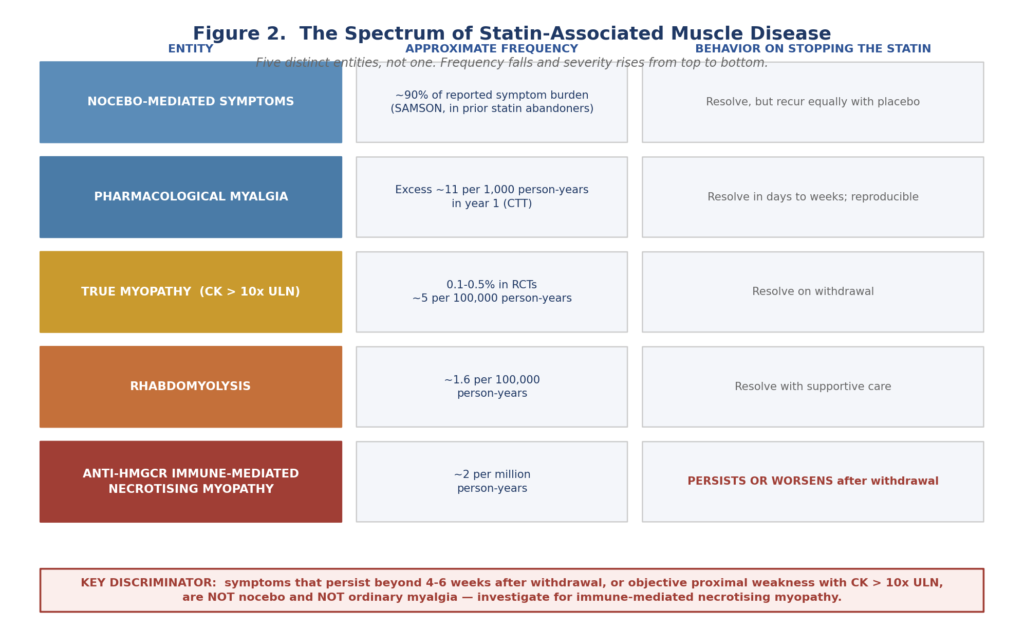
Figure 2. The spectrum of statin-associated muscle disease. The entities differ by orders of magnitude in frequency and differ fundamentally in management. Behavior after statin withdrawal is the most useful single discriminator available at the bedside.
5.1 Diagnostic definitions
SAMS / myalgia: subjective muscle pain, aching, stiffness, tenderness, or cramp, typically symmetrical and proximal, affecting thighs, buttocks, and calves, without significant CK elevation [3].
An important corollary follows from that last clause and is frequently misapplied in practice. Creatine kinase is a sensitive marker for myofiber necrosis but an insensitive marker for mild statin-associated muscle symptoms: patients may report severe, genuinely disabling symptoms while CK remains entirely within the reference range. A normal CK therefore makes CK-defined myopathy and rhabdomyolysis very unlikely but does not exclude SAMS, and it is not evidence that the patient’s symptoms are imagined or that the statin is not responsible. CK is a test for dangerous disease, not a test for whether a complaint is real. Conversely, asymptomatic CK elevation is common: in STOMP, CK rose from baseline in 64.9% of patients on atorvastatin 80 mg without accompanying loss of strength.
True myopathy: muscle weakness or pain accompanied by CK exceeding ten times the upper limit of normal. The CTT estimate corresponds to approximately 5 cases per 10,000 patients treated for five years (0.05%), and pharmacoepidemiological analysis gives approximately 5 per 100,000 person-years. Higher figures of 0.1–0.5% cited in older trial reviews reflect broader case definitions and are not directly comparable with either estimate [66].
Rhabdomyolysis: rapid skeletal muscle breakdown with massive CK elevation, hyperkalemia, myoglobinuria, and acute kidney injury from tubular myoglobin cast obstruction. In the largest pharmacoepidemiological analysis, hospitalized rhabdomyolysis occurred at approximately 0.44 per 10,000 person-years, or 4.4 per 100,000, during monotherapy with atorvastatin, pravastatin, or simvastatin, with substantially higher rates for cerivastatin and for statin–fibrate combinations [23]. It occurs most often when high-dose statins are combined with potent CYP3A4 inhibitors, gemfibrozil, or ciclosporin.
5.2 Anti-HMGCR immune-mediated necrotizing myopathy
Statin-associated immune-mediated necrotizing myopathy (IMNM) deserves separate and emphatic treatment, because it is the one statin muscle disease that is genuinely dangerous, is not nocebo, and will be missed if all muscle complaints are attributed to expectation.
IMNM is defined by autoantibodies directed against HMG-CoA reductase itself, the pharmacological target of the drug. The proposed mechanism is that statin exposure upregulates HMGCR expression in regenerating muscle fibras, and in genetically susceptible individuals this drives a sustained autoimmune response that becomes independent of continued drug exposure. It was recognized in the 2018 AHA/ACC Multisociety guideline as a distinct, rare entity [12,68]; that guideline was retired and replaced in March 2026 (Section 9.3).
Reported incidence depends on the denominator used, and both conventions appear in the literature. In the multinational cohort described below, the mean annual incidence was 2.9 cases per million person-years in the general adult population, and 20.4 (UK) to 24.1 (Australia) cases per million statin users per year [67]. Older estimates of approximately 2 per million person-years refer to the general population; figures of 2–3 per 100,000 statin-treated patients refer to statin users. The statin-user denominator is the appropriate one when counseling a patient who is taking the drug, and the general-population denominator understates the risk to that patient roughly tenfold.
A multinational cohort of 109 anti-HMGCR-positive cases reported a median age of 66 years, female predominance of 51%, statin exposure in 101 of 109 patients with atorvastatin accounting for approximately three-quarters, a median statin duration of three years before diagnosis, and a median peak CK of 7,020 IU/L with a range from 964 to 39,076 IU/L. Approximately 7.5% of anti-HMGCR-positive patients had never taken a statin, confirming that the antibody is not exclusively drug-induced [67].
Distinguishing IMNM from SAMS at the bedside
- Weakness dominates over pain. IMNM presents with objective proximal weakness (difficulty rising from a chair, climbing stairs, lifting overhead), whereas SAMS presents with ache and stiffness with preserved power.
- CK is markedly elevated. Typical values are in the thousands to tens of thousands, in contrast to the normal or minimally elevated CK of SAMS.
- Symptoms persist or progress after the statin is stopped. This is the decisive feature. SAMS resolves within days to weeks of withdrawal; IMNM does not.
- Diagnosis requires serology and often histology. Anti-HMGCR antibody testing is highly specific. Muscle MRI demonstrates edema, and biopsy shows myofiber necrosis and regeneration with sparse inflammatory infiltrate.
- Treatment is immunosuppression, not reassurance. Corticosteroids with intravenous immunoglobulin and a steroid-sparing agent such as methotrexate, azathioprine, or rituximab are typically required. Statins must be permanently avoided.
The wider differential: anti-SRP and seronegative IMNM
Anti-HMGCR antibody is not the only serology relevant here, and a negative result does not exclude necrotizing myopathy. IMNM is conventionally divided into three serological groups: anti-HMGCR positive, anti-signal recognition particle (anti-SRP) positive, and seronegative. Approximately 60% of IMNM cases carry either anti-HMGCR or anti-SRP antibodies; the remainder are seronegative and are diagnosed on biopsy [69,70].
- Anti-SRP IMNM is generally not statin-associated and tends to be the more aggressive phenotype. Compared with anti-HMGCR disease it more often produces severe limb weakness, neck weakness, dysphagia, respiratory insufficiency, and muscle atrophy, and it more often involves organs outside muscle, with cardiac involvement and interstitial lung disease both more frequent. Age at onset is typically younger [70].
- Anti-HMGCR IMNM more often presents with muscle weakness alone and without extramuscular involvement. Roughly 7.5% of anti-HMGCR-positive patients are statin-naive, and statin-naive cases differ somewhat from statin-associated ones, occurring more often in younger patients and with higher rates of dysphagia.
- Seronegative IMNM is diagnosed when both antibodies are absent but biopsy shows the characteristic pattern of scattered myofiber necrosis, regeneration, and macrophage-predominant, pauci-lymphocytic inflammation. It carries an elevated association with underlying malignancy, so a negative antibody panel should prompt biopsy and age-appropriate cancer screening rather than reassurance [71].
Outcomes are frequently incomplete despite treatment. In the multinational cohort, fewer than half of patients had a normal CK (47.6%) or normal muscle power (46.2%) at follow-up, and 45.7% had received intravenous immunoglobulin [67]. This refractory course is the clearest argument for recognizing the condition early.
The practical rule that follows is straightforward: any patient with proximal weakness, a CK above ten times the upper limit of normal, or muscle symptoms that fail to resolve within four to six weeks of statin withdrawal should be investigated for necrotizing myopathy rather than reassured about the nocebo effect. If anti-HMGCR is negative and suspicion persists, anti-SRP testing and muscle biopsy are the next steps, not discharge.
6. Relative Muscle Toxicity Profile and Non-Muscle Adverse Effects
| Drug class | Muscle toxicity in controlled trials | Mechanistic basis | Principal non-muscle adverse effects |
| PCSK9 therapeutics (evolocumab, alirocumab, inclisiran, enlicitide) | Not increased above placebo | Extracellular neutralization or GalNAc-directed hepatocyte uptake; no identified intracellular myocyte target | Injection site reactions 2–5%; transient nasopharyngitis; neurocognitive events at placebo rate (EBBINGHAUS) [72] |
| ACL inhibitors (bempedoic acid) | Not increased above placebo | Prodrug activation requires ACSVL1, undetectable in skeletal muscle | Hiperuricemia and gout; reversible creatinine rise; cholelithiasis; tendon rupture; hepatic enzyme elevation |
| NPC1L1 inhibitors (ezetimibe) | Not increased above placebo. (In GAUSS-3 Phase B, muscle symptoms were reported by 28.8% of ezetimibe recipients and 6.8% discontinued for them; that phase had no placebo arm and enrolled a selected multi-statin-intolerant population, and the placebo-controlled evidence shows no excess.) | Intestinal target; drug and glucuronide do circulate, but no identified skeletal-muscle target | Mild gastrointestinal upset 1–2%, at placebo-level rates |
| ANGPTL3 inhibitors (evinacumab) | Not increased above placebo | Extracellular protein target; no identified intracellular myocyte target | Infusion-related reactions and hypersensitivity ≈ 6%; nasopharyngitis; influenza-like symptoms |
| Statins (all agents) | Small but statistically real excess over placebo, confined largely to year 1 | Not spared: intracellular HMG-CoA reductase inhibition occurs in myocytes | New-onset diabetes (dose-dependent); transaminase elevation; rare autoimmune hepatitis; rare IMNM |
Table 6. Relative muscle toxicity profile of the lipid-lowering drug classes. The classes are presented as descriptive categories rather than as an ordinal ranking, because the non-statin agents are not reliably distinguishable from one another or from placebo on muscle endpoints, and a numbered hierarchy would imply a precision the data do not support. The statin row is deliberately not subdivided by lipophilicity; the rationale is given in Section 6.4. The excess muscle risk attached to statins as a class is small in absolute terms — roughly 11 events per 1,000 person-years in the first year — and should not be read as large merely because it is non-zero.
Table 6 groups agents by class. Because the clinically useful comparison is often between specific agents rather than between classes, the same information is set out below at agent level. Two quantities are separated deliberately, because conflating them is the source of most of the confident but unsupported agent-selection advice in this field. The first column asks whether an agent produces more muscle symptoms than placebo in blinded trials; among the statins, the answer is that they are not reliably distinguishable from one another, which is what the CTT individual participant data found. The second column asks which patients are at elevated risk of genuine, interaction- or genotype-mediated myopathy on a given agent; here the agents differ substantially and predictably. A single ordered ranking would blur the two.
| Agente | Muscle symptoms vs placebo in blinded trials | Interaction- and genotype-mediated myopathy risk |
| PCSK9 monoclonal antibodies (evolocumab, alirocumab) | Not increased | No identified intracellular myocyte target; not applicable |
| Inclisiran | Not increased | GalNAc-directed hepatocyte uptake; not applicable |
| Enlicitide | Not increased in the CORALreef program | Circulating protein target; not applicable |
| Ezetimiba | Not increased in placebo-controlled data (see the qualifier in Table 6 regarding GAUSS-3 Phase B) | Enterocyte-local action; not applicable |
| Ácido bempedoico | Not increased, including in CLEAR Outcomes | ACSVL1 required for activation and undetectable in muscle; not applicable |
| Evinacumabe | Not increased | Extracellular protein target; not applicable |
| Pitavastatina | Not reliably distinguishable from other statins | Low: minimal CYP450 metabolism; ciclosporin contraindicated |
| Pravastatin, fluvastatin | Not reliably distinguishable from other statins | Low: non-CYP3A4 disposition; CYP2C9 relevant to fluvastatin |
| Rosuvastatina | Not reliably distinguishable from other statins | Low to moderate: ABCG2 variants raise exposure; dose caps in Asian ancestry |
| Atorvastatin, lovastatin | Not reliably distinguishable from other statins | Moderate: CYP3A4-mediated interactions; SLCO1B1 intermediate for atorvastatin |
| Simvastatin, particularly at 80 mg | Not reliably distinguishable from other statins | Highest among marketed statins: strongest SLCO1B1 signal plus extensive CYP3A4 metabolism; 80 mg no longer recommended |
| Cerivastatina | Withdrawn 2001 | Unacceptable rate of fatal rhabdomyolysis, particularly with gemfibrozil |
Table 7. Muscle effects at agent level, with reported symptoms and mechanistic myopathy risk kept in separate columns. The first column reflects blinded randomized data, in which no statin has been reliably distinguished from another on muscle symptom incidence; the entries there should not be read as a ranking. The second column reflects pharmacokinetic and pharmacogenomic exposure, where the agents genuinely differ and where agent selection can be rationalized. The non-statin agents sit at placebo level in the first column and none is reliably distinguishable from the others.
6.1 Bempedoic acid: off-target effects
- Hyperuricemia and gout. Competitive inhibition of renal OAT2 reduces urate excretion, elevating serum uric acid within about four weeks of starting therapy. In CLEAR Outcomes, gout occurred in 3.1% of bempedoic acid recipients versus 2.1% on placebo [40]. Patients with a prior history of gout are at elevated risk of recurrent flares and warrant urate monitoring.
- Reversible creatinine elevation. OAT2 inhibition also reduces tubular creatinine secretion, producing small average rises in serum creatinine and corresponding modest declines in estimated filtração glomerular rate. These changes stabilize early, reverse completely on discontinuation, and reflect transporter competition rather than structural renal injury. They should not be misinterpreted as nephrotoxicity.
- Tendon rupture. An excess of tendon rupture has been observed, involving predominantly the Achilles, rotator cuff, or biceps tendons. Rates were 0.5% versus 0% in the primary hypercholesterolemia trials and 1.2% versus 0.9% in CLEAR Outcomes, so the absolute incidence in treated patients sits at roughly 1% or below across the program, and the excess attributable to the drug is smaller still. The signal is real but uncommon, and it should be presented to patients in those terms rather than as a prominent risk. The proposed mechanism involves altered matriz extracelular and collagen turnover in tenocytes. Risk factors include age above 60 years, concomitant corticosteroid or fluoroquinolone therapy, renal impairment, and pre-existing tendinopathy [26,41].
- Cholelithiasis and hepatic enzyme elevation. Both were increased in CLEAR Outcomes and warrant awareness, though neither commonly requires discontinuation.
6.2 Statin-associated new-onset diabetes
Statins cause a moderate, dose-dependent increase in new diagnoses of diabetes. The 2024 Cholesterol Treatment Trialists’ Collaboration individual participant data meta-analysis, drawing on the same trial population as the muscle symptom analysis, quantified this precisely. The proportional increase in new-onset diabetes was 10% with low- or moderate-intensity statin therapy (1.3% per year versus 1.2% per year on placebo) and 36% with high-intensity therapy (4.8% versus 3.5% per year) [73].
Two findings put this in proportion. First, the underlying effect is a very small upward shift in glycemia rather than a distinct diabetogenic process: among participants without baseline diabetes, mean glicose rose by 0.04 mmol/L and mean HbA1c by 0.06% with low- or moderate-intensity therapy and 0.08% with high-intensity therapy. Second, and most importantly for counseling, the excess is concentrated disproportionately among people who were already close to the diagnostic threshold. Among participants with a baseline measure of glycemia, approximately 62% of new-onset diabetes cases occurred in those already in the top quarter of the baseline distribution. That is a clear majority but not the whole of the excess: roughly two in five new diagnoses arose outside the top quarter. The effect is therefore better described as shifting people who were already approaching the threshold across it than as generating diabetes in metabolically healthy people, while acknowledging that a minority of cases do occur at lower baseline glycemia.
One further caveat limits how far the absolute figures travel. The investigators noted that the size of the absolute excess depended substantially on how frequently glycemia was measured in the contributing trials, since new diagnoses are only counted when someone looks for them. The relative estimates are the more transportable quantity; absolute per-1,000 figures for diabetes should be presented to patients as approximations tied to a particular ascertainment regime, not as fixed rates [73].
Genetic evidence indicates this effect is on-target rather than an idiosyncratic drug toxicity. A Randomização mendeliana analysis using common variants in HMGCR (rs17238484 and rs12916) as lifelong proxies for HMG-CoA reductase inhibition found that carriers of LDL-lowering alleles had modestly higher bodyweight, circunferência da cintura, plasma glucose and insulina, and a higher risk of type 2 diabetes, closely mirroring the effect observed in the randomized statin trials. The authors concluded that the increased diabetes risk seen with statins is at least partially explained by HMGCR inhibition itself [80].
A further observation complicates any attempt to frame this as a statin-specific liability. Variants in PCSK9 that lower LDL-C are also associated with modestly increased diabetes risk, as are LDL-lowering variants more generally [7,8,91]. The diabetogenic effect may therefore be a property of LDLR-mediated LDL lowering rather than of statins in particular, which would mean it is not avoided by switching to a non-statin agent that works through the same receptor pathway. This remains an inference from genetic epidemiologia and has not been confirmed by outcome trials of the non-statin agents, but it should temper any suggestion that PCSK9 inhibition offers a metabolically free alternative.
Among participants with pre-existing diabetes, the risco relativo of worsening controle glicêmico was 1.10 with low- or moderate-intensity therapy and 1.24 with high-intensity therapy. The investigators emphasized that any adverse cardiovascular consequence of these glycemic changes is already fully captured within the net cardiovascular benefit observed in the same trials. The appropriate response is glycemic monitoring, not statin withholding.
6.3 Hepatic effects, including rare autoimmune hepatitis
Asymptomatic transaminase elevation occurs in roughly 0.5–2% of statin recipients, is usually transient, and does not warrant routine liver function monitoring in asymptomatic patients. Clinically significant statin hepatotoxicity is rare.
A distinct and considerably rarer entity is statin-induced drug-induced autoimmune hepatitis (DIAIH), which mirrors idiopathic autoimmune hepatitis clinically and histologically. It has been documented in case reports and case series for atorvastatin, rosuvastatin, and other agents, and pharmacovigilance analysis of the FDA Adverse Event Reporting System published in 2024 identified positive autoimmune hepatitis signals across all seven marketed statins [75]. Presentation may include jaundice, fatigue, marked transaminase elevation, and positive antinuclear or anti-smooth-muscle antibodies, although seronegative cases occur. Onset ranges from two months to several years after initiation [76].
The clinical parallel with IMNM is instructive and worth stating explicitly: in both conditions, a statin appears to trigger an autoimmune process that can persist after the drug is withdrawn and that requires immunosuppression rather than simple discontinuation. Both are rare. Neither is nocebo. It must be stressed that no reliable incidence estimate exists for statin-induced DIAIH, because the evidence base consists of case reports and disproportionality signals rather than cohort data, and disproportionality signals reflect reporting patterns rather than true frequency. In the context of the enormous global exposure to statins, clinically apparent severe liver injury remains, in the assessment of the NIH LiverTox monograph, extraordinarily rare [74].
6.4 Does lipophilicity predict muscle risk? A qualified answer
It is frequently asserted that lipophilic statins carry a materially higher risk of muscle symptoms than hydrophilic statins, on the reasoning that passive diffusion into myocytes is greater. This review deliberately does not adopt that hierarchy, and the reasons should be set out transparently.
The biological rationale is genuine. Lipophilic agents do achieve greater extrahepatic tissue penetration, and this is a plausible substrate for myocyte injury. However, current randomized evidence has not consistently demonstrated clinically meaningful differences between hydrophilic and lipophilic statins with respect to muscle symptoms. A systematic review and meta-analysis published in 2018 found that statins increased SAMS only slightly overall (relative risk 1.05, 95% CI 1.014–1.089) and that lipophilic statins had no appreciable impact on SAMS development compared with hydrophilic formulations [77]. A network meta-analysis of double-blind randomized trials published in 2022 likewise found no statistically significant difference between individual statins in muscle symptom incidence [78]. The 2022 CTT individual participant data analysis, the largest and most rigorous dataset available, reported no evidence that muscle symptom risk varied among the different statins [65].
Two further sources of evidence bear directly on this. The ensaio SATURN randomized 1,385 patients with coronary disease to rosuvastatin 40 mg (hydrophilic) or atorvastatin 80 mg (lipophilic) for 104 weeks — a head-to-head comparison of the two classes at maximal dose — and found comparable tolerability with no signal of differential muscle toxicity [47]. Separately, the randomized evidence on fatigue discussed in Section 4.3 found adverse effects on energy and exertional fatigue with pravastatin, a hydrophilic agent, as well as with simvastatin.
Three further considerations argue against a simple hierarchy. First, pitavastatin is lipophilic yet has among the lowest interaction-mediated myopathy risk of any statin, because it is barely metabolized by CYP450 enzymes; lipophilicity and clinical risk therefore dissociate. Second, the strongest genuine drug-specific signal is not lipophilicity at all but the SLCO1B1 pharmacogenomic interaction with simvastatin, discussed in Section 8. Third, dose and intensity are more consistent predictors than solubility class: the CTT analysis found a year-one relative risk of 1.11 (95% CI 1.05–1.17) for more intensive regimens compared with placebo, against 1.07 (1.04–1.10) for statin therapy overall.
Underlying all of this is a distinction that is regularly collapsed in discussions of statin intolerance, and which is worth stating explicitly: a mechanistic difference is not a clinical outcome. That lipophilic agents achieve greater extrahepatic tissue penetration is an established pharmacological fact. Whether that difference produces a measurable difference in the rate at which patients report muscle symptoms is a separate empirical question, answerable only by controlled comparison, and the controlled comparisons do not show one. Plausible mechanism is a hypothesis generator, not evidence of effect, and the gap between the two is precisely where a great deal of confident but unsupported prescribing advice in this field originates.
The clinically defensible formulation is therefore this: switching from a lipophilic to a hydrophilic statin is a reasonable and commonly successful individual strategy in a patient who has not tolerated a particular agent, but it should be presented as empirical trial-and-error rather than as a predictable reduction in risk. What does reliably reduce risk is lowering the dose, avoiding interacting drugs, and avoiding high-dose simvastatin.
7. Epidemiology of Reported Muscle Symptoms and the Nocebo Phenomenon
A persistent paradox defines this field. In unblinded observational registries and routine practice, 10–20% of patients report muscle symptoms and many discontinue therapy. In double-blind randomized trials, the difference between statin and placebo is very small. Four bodies of evidence resolve this paradox, and together they constitute one of the more elegant demonstrations of the nocebo effect in modern medicine [81].
Note on the two most-quoted figures in this field: SAMSON’s “90%” and the CTT’s “one in fifteen” are not the same number. They derive from different populations, different metrics, and different study designs, and neither validates the other.
Because these figures are so often conflated, the distinction is worth setting out before either is discussed. The SAMSON nocebo ratio of 0.90 describes the proportion of the increment in symptom intensity caused by taking a tablet that was reproduced by an inert tablet. It was measured in 60 patients who had already abandoned statins because of side effects — a deliberately extreme phenotype — using a continuous daily symptom scale and, critically, a no-tablet control condition that most trials lack. The CTT figure of one in fifteen describes the proportion of reported muscle symptom events in the first year of treatment attributable to the statin rather than to background causes, measured across 123,940 participants in general trial populations by comparing event counts against placebo.
One is a ratio of symptom intensity increments in symptom-prone patients; the other is an attributable fraction of event reports in an unselected population. That they arrive at broadly concordant conclusions — that the large majority of reported statin muscle symptoms are not caused by the drug — is scientifically meaningful precisely because the designs differ so completely. But the numerical closeness of 90% and fourteen-fifteenths is a coincidence of arithmetic, not a replication. Neither figure should be quoted as though it confirmed the other, and neither should be applied to a population unlike the one in which it was measured.
7.1 The Cholesterol Treatment Trialists’ Collaboration meta-analysis (2022)
O Colaboração com a CTT conducted an individual participant data meta-analysis of 23 large-scale double-blind randomized trials, comprising 19 placebo-controlled trials with 123,940 participants and 4 more-intensive-versus-less-intensive trials with 30,724 participants, published in The Lancet in August 2022 [65].
Over a weighted average median follow-up of 4.3 years, muscle pain or weakness was reported by 16,835 participants allocated to statin (27.1%) versus 16,446 allocated to placebo (26.6%), a rate ratio of 1.03 (95% CI 1.01–1.06). The excess was confined almost entirely to the first year of treatment, during which statin therapy produced a 7% relative increase (rate ratio 1.07, 95% CI 1.04–1.10), corresponding to an absolute excess of 11 events (95% CI 6–16) per 1,000 person-years. After the first year there was no significant excess (rate ratio 0.99, 95% CI 0.96–1.02).
The investigators expressed the implication arithmetically: only one in fifteen of the muscle-related reports among participants allocated to statin therapy was actually attributable to the statin. For more intensive regimens the rate ratio against placebo was 1.08 (95% CI 1.04–1.13) across all years, rising to 1.11 (95% CI 1.05–1.17) in year one, so the attributable fraction rises to roughly one in ten at high intensity. Both of these figures are comparisons against placebo; the four trials that directly randomized more intensive against less intensive therapy yielded a rate ratio of 1.05 (95% CI 0.99–1.11), and the two comparisons should not be conflated. Muscle cramps, a very common reason for discontinuation in practice, showed only a 0.2% absolute difference and are not meaningfully statin-related. Notably, there was no evidence that risk varied between individual statins.
7.2 The SAMSON trial (2020)
SAMSON (Self-Assessment Method for Statin Side-effects Or Nocebo), published in the New England Journal of Medicine in November 2020 with full data in the Journal of the American College of Cardiology in 2021, enrolled 60 patients recruited from 17 UK referral centres and by self-referral, all of whom had previously abandoned statins because of side effects that developed within two weeks of initiation. This is deliberately the most symptom-prone population obtainable [5,6].
Design
SAMSON used a double-blind randomized n-of-1 design spanning 12 consecutive months. Each participant received 12 monthly medication bottles in randomized sequence: four containing atorvastatin 20 mg daily, four containing matching placebo, and four empty. The empty-bottle months are the methodological innovation, since they establish each patient’s background symptom level in the absence of any tablet at all. Participants recorded daily symptom intensity on a smartphone application using a continuous scale from 0 (symptom-free) to 100 (worst imaginable), and could stop that month’s tablets if symptoms became intolerable.
Resultados
Sixty participants were randomized and 49 completed the full 12-month protocol. Mean symptom intensity was 8.0 during no-tablet months (95% CI 4.7–11.3), 15.4 during placebo months (95% CI 12.1–18.7; P < 0.001 versus no-tablet months), and 16.3 during statin months (95% CI 13.0–19.6; P < 0.001 versus no-tablet months). The difference between statin and placebo months was not significant (P = 0.388).
The nocebo ratio, defined as symptom intensity on placebo minus symptom intensity on no tablet, divided by symptom intensity on statin minus symptom intensity on no tablet, was 0.90. Ninety per cent of the symptom burden induced by taking a statin tablet was reproduced by taking a placebo tablet.
One methodological caveat should be recorded for completeness. The originally specified primary analysis produced a nocebo ratio of 2.2 with a 95% intervalo de confiança from −62.3 to 66.7, an unstable estimate arising because in some individuals the statin-minus-no-tablet denominator was very small or negative. An independent statistician recommended pooling individual participant data before calculating the ratio, which yielded the reported value of 0.90. This is a legitimate and transparently reported analytical decision, but readers should understand that the headline figure derives from the revised rather than the original analysis.
Tablet stoppages for intolerable symptoms occurred 71 times: 31 during placebo months and 40 during statin months, a non-significant difference. Placebo tablets were therefore abandoned nearly as often as active drug. At six-month follow-up, after participants were shown individualized charts of their own symptom scores across the three conditions, 30 of the 60 participants had successfully restarted statin therapy.
7.3 The StatinWISE trial (2021)
StatinWISE, published in the BMJ in February 2021, independently replicated SAMSON at larger scale in primary care. It comprised a series of 200 randomized double-blind n-of-1 trials in patients considering discontinuation because of muscle symptoms, using atorvastatin 20 mg versus placebo across six two-month periods [82].
Of 200 participants, 151 (75.5%) contributed to the primary analysis. There was no difference in muscle symptom scores between statin and placebo periods (mean difference −0.11, 95% CI −0.36 to 0.14; P = 0.40). Withdrawal for intolerable muscle symptoms occurred in 9% during statin periods and 7% during placebo periods. Two-thirds of participants who completed the trial elected to resume statin therapy. The convergence of two independently conducted n-of-1 programs on the same conclusion materially strengthens the inference.
7.4 ASCOT-LLA: blinded versus unblinded (2017)
The most compelling population-level evidence comes from a natural experiment within a single trial. ASCOT-LLA randomized patients to atorvastatin 10 mg or placebo in a blinded phase, then continued them in a non-blinded extension in which patients and physicians knew who was taking a statin.
During the blinded randomized phase there was no significant excess of muscle-related adverse events on atorvastatin. During the non-blinded extension, muscle-related adverse events were significantly more frequent among statin users (161 events, 1.26% per year) than non-users (124 events, 1.00% per year), a relative risk of 1.41 (95% CI 1.10–1.79; P = 0.006). The drug did not change. Only the knowledge of taking it changed [83].
7.5 GAUSS-3: quantifying genuine intolerance (2016)
GAUSS-3, published in JAMA in April 2016, is the necessary counterweight to the nocebo literature, because it demonstrates that genuine pharmacological intolerance is also real. It enrolled 511 patients with a documented history of intolerance to two or more statins and entry mean LDL-C of approximately 212 mg/dL [42].
Phase A: blinded rechallenge
491 patients underwent a 24-week double-blind crossover rechallenge with atorvastatin 20 mg versus placebo, 10 weeks each, separated by washout. The results partition this heavily preselected population into four groups: 209 of 491 (42.6%) developed intolerable muscle symptoms on atorvastatin but not placebo; 26.5% developed symptoms on placebo but not atorvastatin; approximately 10% developed symptoms on both; and the remainder on neither. During the second crossover period the razão de riscos for muscle symptoms on atorvastatin versus placebo was 1.96 (95% CI 1.44–2.66; P < 0.001).
Two conclusions follow, and both matter. Genuine, reproducible, pharmacologically mediated statin intolerance exists and affected roughly 43% of this extreme-phenotype population. Equally, more than a quarter of these same patients experienced intolerable muscle pain caused entirely by an inert tablet. Framed the other way, approximately 60% of patients who had already failed at least two statins did not demonstrate reproducible intolerance on blinded rechallenge.
Phase B: comparative non-statin therapy
218 patients with confirmed intolerance, comprising those identified in Phase A plus 19 who bypassed Phase A because of documented prior CK elevation above ten times the upper limit of normal, were randomized 2:1 to evolocumab 420 mg monthly (n = 145) or ezetimibe 10 mg daily (n = 73) for 24 weeks.
Two co-primary endpoints were reported. From baseline to week 24, LDL-C fell 52.8% with evolocumab versus 16.7% with ezetimibe. For the mean of weeks 22 and 24, LDL-C fell 54.5% (95% CI −57.2 to −51.8; absolute reduction 103.6 mg/dL) with evolocumab versus 16.7% (95% CI −20.5 to −12.9) with ezetimibe, a between-group difference of −37.8% (95% CI −42.3 to −33.3; P < 0.001). Muscle symptoms were reported by 20.7% of evolocumab recipients and 28.8% of ezetimibe recipients. Discontinuation for intolerable muscle symptoms occurred in 1 of 145 patients (0.7%) on evolocumab versus 5 of 73 (6.8%) on ezetimibe. Neither arm had a placebo comparator, so these rates quantify residual symptom burden in a selected population rather than drug-attributable risk [42].
Exploratory genomics
Exploratory genome-wide analysis within GAUSS-3 identified associations between statin-associated muscle symptoms and loci at MGAT5 e KCNJ2/SOX9, while variants influencing systemic statin exposure such as SLCO1B1 were not significantly associated with symptom recurrence in this cohort. These findings are hypothesis-generating only: the cohort comprised roughly 500 patients, which is severely underpowered for genome-wide discovery, and the loci have not been robustly replicated. They should not be presented to patients as clinically actionable.
| Avaliação | Design and population | Principal conclusão |
| CTT Collaboration (2022) | 19 placebo-controlled double-blind RCTs; 123,940 participants; median 4.3 years | 27.1% vs 26.6% reported muscle symptoms (RR 1.03); year-1 RR 1.07, excess 11 per 1,000 person-years; only 1 in 15 reports attributable to statin |
| SAMSON (2020) | Double-blind n-of-1; 60 patients who had abandoned statins; 4 statin, 4 placebo, 4 empty months | Symptom scores 8.0 / 15.4 / 16.3 (no tablet / placebo / statin); statin vs placebo P = 0.388; nocebo ratio 0.90; 30 of 60 restarted |
| StatinWISE (2021) | 200 double-blind n-of-1 trials in primary care; atorvastatin 20 mg vs placebo | No difference in symptom score (mean difference −0.11, 95% CI −0.36 to 0.14); two-thirds of completers resumed statins |
| ASCOT-LLA (2017) | Blinded randomized phase vs non-blinded extension of the same trial | No excess muscle events when blinded; RR 1.41 (95% CI 1.10–1.79) when unblinded |
| GAUSS-3 (2016) | 511 multi-statin-intolerant patients; blinded atorvastatin rechallenge then evolocumab vs ezetimibe | 42.6% symptoms on statin only; 26.5% on placebo only; evolocumab −54.5% vs ezetimibe −16.7% LDL-C |
Table 8. Landmark trials defining the boundary between pharmacological and nocebo-mediated statin muscle symptoms. RR = rate ratio or relative risk as reported by the original investigators.
7.6 Putting Benefit and Harm on the Same Scale
Relative risks and rate ratios are the natural language of trial reporting but a poor basis for a conversation with a patient, who is deciding about one person rather than a cohort. The quantities that matter to that decision are absolute, and the CTT Collaboration has published them for a standard regimen.
Lowering LDL-C by 2 mmol/L (77 mg/dL) with an effective regimen such as atorvastatin 40 mg daily, for five years in 10,000 patients, would typically prevent one or more major vascular events in about 1,000 patients with pre-existing occlusive vascular disease, an absolute benefit of 10%, and in about 500 patients at elevated risk who have not yet had an event, an absolute benefit of 5%. Against this, the same treatment in the same 10,000 patients over the same period would typically cause about 5 cases of myopathy, of which one might progress to rhabdomyolysis if the statin were not stopped, 50 to 100 new cases of diabetes, and 5 to 10 hemorrhagic strokes, alongside symptomatic adverse events such as muscle pain in up to 50 to 100 patients, an absolute harm of 0.5% to 1.0% [2].
| Outcome over 5 years | Per 10,000 treated | Per 1,000 treated | Absolute rate |
| Major vascular events prevented, prevenção secundária | ≈ 1,000 | ≈ 100 | 10% benefit |
| Major vascular events prevented, primary prevention | ≈ 500 | ≈ 50 | 5% benefit |
| New-onset diabetes caused | 50–100 | 5–10 | 0.5–1.0% harm |
| Symptomatic muscle adverse events caused | 50–100 | 5–10 | 0.5–1.0% harm |
| Hemorrhagic derrames causou | 5–10 | 0.5–1 | 0.05–0.1% harm |
| Myopathy caused (CK > 10× ULN) | ≈ 5 | ≈ 0.5 | 0.05% harm |
| Rhabdomyolysis caused | ≈ 1 | ≈ 0.1 | 0.01% harm |
Table 9. Absolute benefit and harm from five years of an effective statin regimen lowering LDL-C by 2 mmol/L, per CTT Collaboration estimates. Per-1,000 figures are derived by division and are given for accessibility; the published estimates are per 10,000. Benefits scale with baseline risco absoluto and with the magnitude and duration of LDL-C reduction, so these figures describe a typical patient rather than any individual one. Two rows require qualification. The new-onset diabetes row derives from the same earlier five-year projection and should be read as an order-of-magnitude estimate: the 2024 individual participant data analysis found that the absolute excess varied substantially with the intensity of glycemic ascertainment across trials, so no single fixed absolute figure is well supported (Section 6.2). The symptomatic muscle adverse event row likewise derives from the CTT group’s earlier five-year projection. The 2022 individual participant data analysis reported an absolute excess of 11 events per 1,000 person-years confined to the first year, equivalent to approximately 110 per 10,000 in year one alone, and supersedes the earlier projection for this endpoint. The two estimates use different definitions and time bases and should not be added, averaged, or read as inconsistent benefit accounting.
Three features of this comparison deserve emphasis. The benefits and harms are not of equal weight even where the numbers are similar: myopathy and muscle symptoms reverse on stopping the drug, whereas infarto do miocárdio and stroke frequently do not. Any adverse cardiovascular consequence of the excess diabetes and hemorrhagic stroke is already contained within the net benefit figures, because both arose in the same trials from which the benefit was measured, so the columns should not be subtracted from one another. And the benefit accrues for each year treatment continues, so five years understates what lifelong therapy achieves.
The honest counterweight is that these estimates come from the CTT group, whose methods and access to individual participant data have been contested by a minority of investigators, and that they describe populations rather than persons. A patient at very low absolute cardiovascular risk gains proportionally less, and for that patient the balance is genuinely closer than the table suggests.
8. Pharmacogenomics of Statin Myopathy
If the question is which patient is most likely to sustain genuine muscle injury on a statin, the most robust answer available is genetic rather than physicochemical.
8.1 SLCO1B1
The defining discovery was a genome-wide association study within the SEARCH trial, published in the New England Journal of Medicine in 2008, which identified the SLCO1B1 c.521T>C variant (rs4149056) as the dominant genetic determinant of myopathy with simvastatin 80 mg [79]. SLCO1B1 encodes OATP1B1, the hepatic uptake transporter. Reduced-function variants impair hepatic extraction, raising systemic exposure to statin acid and increasing skeletal muscle exposure.
Guidance is provided by the Clinical Pharmacogenetics Implementation Consortium (CPIC), whose 2022 guideline covers SLCO1B1, ABCG2, e CYP2C9 genotypes and statin-associated musculoskeletal symptoms, superseding the earlier simvastatin-only guideline [22]. The evidence linking rs4149056 to myopathy is graded as high quality for simvastatin. CPIC recommends dose limitation or selection of an alternative statin in decreased- and poor-function phenotypes. Allele function assignments were further updated in October 2025 to improve accuracy in under-represented populations [84].
The association is strongly drug-specific, which is clinically useful. It is strongest for simvastatin, intermediate and less consistent for atorvastatin, and minimal for pravastatin, rosuvastatin, fluvastatin, and pitavastatin, because OATP1B1 contributes a different proportion of hepatic uptake for each agent.
8.2 ABCG2, CYP2C9, and other loci
- ABCG2: encodes the efflux transporter BCRP. The c.421C>A variant markedly increases rosuvastatin exposure, and CPIC 2022 includes rosuvastatin dosing recommendations by ABCG2 phenotype [22].
- CYP2C9: the principal metabolizing enzyme for fluvastatin; poor metabolisers accumulate drug and warrant dose limitation.
- CYP3A4*22: reduced-function allele affecting simvastatin, lovastatin, and atorvastatin clearance. Evidence is suggestive but not yet guideline-actionable.
- COQ2, GATM, and the GAUSS-3 loci (MGAT5, KCNJ2/SOX9): candidate associations with inconsistent replication. These remain research findings and should not be used clinically.
| Gene | Variant | Statins principally affected | Implicações práticas |
| SLCO1B1 | c.521T>C (rs4149056) | Simvastatin (strong); atorvastatin (moderate) | Avoid high-dose simvastatin in decreased/poor function; prefer rosuvastatin, pravastatin, fluvastatin, or pitavastatin |
| ABCG2 | c.421C>A | Rosuvastatina | Limit rosuvastatin dose in poor-function phenotypes |
| CYP2C9 | *2, *3 reduced-function alleles | Fluvastatina | Limit fluvastatin dose in poor metabolisers |
| CYP3A4 | *22 | Simvastatin, lovastatin, atorvastatin | Suggestive only; not currently guideline-actionable |
| MGAT5, KCNJ2/SOX9, COQ2, GATM | Various | Not agent-specific | Exploratory; not clinically actionable |
Table 10. Pharmacogenomic loci relevant to statin myopathy, with recommendations following the CPIC 2022 guideline (updated October 2025). Only SLCO1B1, ABCG2, and CYP2C9 currently carry actionable CPIC recommendations.
8.3 Drug-drug interactions
Interaction-mediated myopathy is more common, more predictable, and more preventable than idiosyncratic myopathy. The mechanism is straightforward: anything that raises systemic statin concentration raises muscle exposure.
| Interacting agent | Mecanismo | Statins affected | Administração |
| Gemfibrozil | Inhibits glucuronidation and OATP1B1 transport | All statins | Avoid combination; use fenofibrate instead if a fibrate is required |
| Clarithromycin, erythromycin, itraconazole, ketoconazole, ritonavir | Potent CYP3A4 inhibition | Simvastatin, lovastatin, atorvastatin | Suspend statin during short courses, or switch to pravastatin, rosuvastatin, or pitavastatin |
| Ciclosporin | OATP1B1 and multi-transporter inhibition | All; contraindicated with pitavastatin | Strict dose caps; specialist supervision |
| Amiodarone, verapamil, diltiazem | Moderate CYP3A4 inhibition | Simvastatin, lovastatin | Dose caps per labeling; consider a non-CYP3A4 statin |
| Colchicina | Independent myotoxicity; additive risk | All statins | Monitor CK if used together, especially in renal impairment |
| Grapefruit juice (large quantities) | Intestinal CYP3A4 inhibition | Simvastatin, lovastatin, atorvastatin | Advise moderation; clinically relevant mainly at high intake |
Table 11. Clinically important drug interactions increasing statin myopathy risk. Note that pravastatin, rosuvastatin, and pitavastatin share the advantage of minimal CYP450 metabolism, which is a more reliable basis for statin selection in polypharmacy than lipophilicity.
8.4 Reversible non-genetic contributors
Before concluding that a patient is statin-intolerant, several reversible contributors should be excluded, since each independently produces or amplifies myalgia: hypothyroidism (check TSH), vitamin D deficiency, renal impairment, recent unaccustomed vigorous exercise, and excess álcool intake [58]. One qualification is worth recording: although vitamin D deficiency is commonly corrected in this setting, a randomized comparison of vitamin D against placebo in new statin users found no reduction in statin-associated muscle symptoms, so repletion should be regarded as reasonable general care rather than as a demonstrated remedy for SAMS [85]. Advanced age, low body mass, female sex, and Asian ancestry (particularly relevant to rosuvastatin dosing) also increase susceptibility.
9. Clinical Management: An Evidence-Based Algorithm
The following sequence integrates the evidence reviewed above. Its guiding principle is that the patient’s symptoms should always be taken seriously, while causal attribution to the drug should not be assumed [58,81].
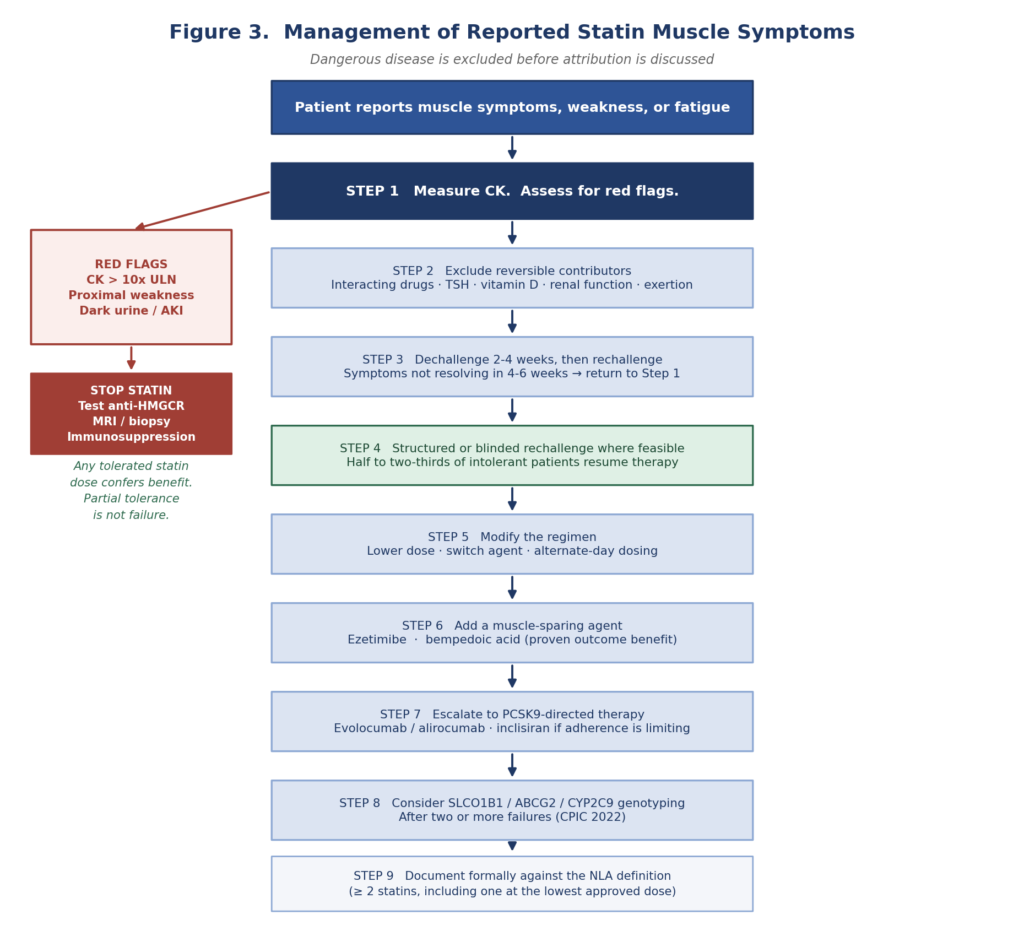
Figure 3. Management algorithm for reported statin muscle symptoms. The sequence is deliberate: dangerous disease is excluded before attribution is discussed, because a patient with immune-mediated necrotizing myopathy who is reassured about the nocebo effect may deteriorate.
- Exclude dangerous myopathy first. Measure CK. If CK exceeds ten times the upper limit of normal, or if there is objective proximal weakness, or if there is dark urine or renal impairment, stop the statin immediately and investigate for true myopathy, rhabdomyolysis, or immune-mediated necrotizing myopathy. Do not proceed to reassurance about nocebo until this step is complete.
- Identify reversible contributors. Review for interacting drugs, hypothyroidism, vitamin D deficiency, renal impairment, and recent unaccustomed exertion. Correct what is correctable.
- Dechallenge and rechallenge. Withdraw the statin for two to four weeks. Failure to improve lowers the likelihood of ordinary pharmacological SAMS and should prompt reassessment for alternative causes or for a persistent myopathy, rather than a presumption that the statin was blameless; if symptoms persist beyond four to six weeks, particularly with elevated CK or objective weakness, investigate for IMNM. If symptoms do resolve, rechallenge with a different statin at a low dose.
- Use structured or blinded rechallenge where feasible. SAMSON and StatinWISE demonstrate that objective, individualized data on a patient’s own symptom pattern is an effective intervention for restoring adesão — the one with the most direct randomized support — enabling roughly half to two-thirds of participating patients to resume therapy. Neither trial compared this approach against other adherence strategies, so it should not be described as superior to all alternatives [5,6,82].
- Modify the regimen before abandoning the class. Reduce the dose; switch agent, particularly away from high-dose simvastatin; or use alternate-day or twice-weekly dosing of a long-half-life statin such as rosuvastatin or atorvastatin. Any tolerated statin dose confers benefit; partial tolerance is not failure.
- Add a muscle-sparing agent to a reduced statin dose. Ezetimibe is inexpensive, well tolerated, and adds 15–20%. Bempedoic acid adds approximately 18% and is the only non-statin oral agent with proven cardiovascular outcome benefit in statin-intolerant patients.
- Escalate to PCSK9-directed therapy for confirmed intolerance with substantial risco residual. GAUSS-3 validated evolocumab in this exact population, and inclisiran offers twice-yearly dosing where adherence is the limiting factor.
- Consider genotyping in recurrent intolerance. SLCO1B1, ABCG2, e CYP2C9 genotyping per CPIC 2022 can rationalize agent selection after two or more failures.
- Document formally. Statin intolerance should be documented against the National Lipid Association definition, which requires trial of at least two statins including one at the lowest approved dose, rather than recorded on the basis of a single failed trial [4].
9.1 Communicating risk to patients
Evidence from SAMSON indicates that showing patients their own data is more persuasive than citing population statistics. Where individualized n-of-1 data are unavailable, the following framings are accurate and useful: muscle aches are common in adults regardless of medication, and roughly a quarter of people report them whether taking a statin or a placebo; of every fifteen people who report muscle symptoms on a statin, about fourteen would have had them anyway [65]; most symptoms genuinely caused by a statin appear within the first year and resolve within weeks of stopping, although later onset does occur in individuals; and a substantial majority of people who stop a statin because of symptoms and are willing to try again can successfully restart one. That last figure comes from patients who volunteered for rechallenge and should not be quoted as a rate for all discontinuers.
Equally important is what should not be said. Symptoms should never be described as imaginary. The nocebo effect produces real, measurable symptoms; SAMSON participants abandoned placebo tablets nearly as often as active drug. The message is that the symptoms are real but their cause is usually not the drug, and that this distinction opens a path back to treatment rather than closing one.
9.2 Objective diagnostics
- Routine monitoring in asymptomatic patients is not recommended. Obtain a baseline in patients at elevated risk, and measure in any symptomatic patient. CK above ten times the upper limit of normal defines myopathy and mandates discontinuation. Note the asymmetry in what the result tells you: an elevated CK is informative, but a normal CK is not reassurance that symptoms are absent or imagined. CK is insensitive for mild SAMS, and patients with disabling symptoms frequently have entirely normal values.
- Anti-HMGCR antibodies. Test when weakness is prominent, CK is markedly elevated, or symptoms persist beyond four to six weeks after withdrawal.
- Muscle MRI and biopsy. Reserve for suspected inflammatory or necrotizing myopathy, typically after positive or equivocal serology.
- TSH, vitamin D, renal function. Obtain in all patients presenting with muscle symptoms on a statin.
- SAMS Clinical Index. A standardized causality instrument that scores symptom location, timing of onset after initiation, and timing of resolution after withdrawal, useful for consistent documentation [86].
9.3 Guideline context: the 2026 dyslipidemia guideline
The framework surrounding the decisions above changed in March 2026. The 2026 ACC/AHA/Multisociety Guideline on the Management of Dyslipidemia retires and replaces the 2018 Guideline on the Management of Blood Cholesterol, and is retitled to reflect attention to atherogenic lipoproteins beyond LDL particles, including triglyceride-rich remnants and lipoprotein(a) [11]. Five changes bear on this review.
- Risk estimation. The AHA PREVENT-ASCVD equations replace the Equações de Coortes Reunidas for guiding lipid-lowering therapy in primary prevention in adults aged 30 to 79, providing both 10-year and 30-year risk projections.
- Treatment goals return. LDL-C and non-HDL-C goals are restored alongside percentage reduction. The guideline sets an LDL-C goal below 100 mg/dL at borderline or intermediate risk, below 70 mg/dL at high risk, and below 55 mg/dL for patients with clinical ASCVD at very high risk. This is a material change from the 2018 framework, which prioritized statin intensity over absolute targets, and it strengthens the case for combination therapy in patients who do not reach goal on a statin alone.
- ApoB and Lp(a). ApoB testing is described as useful once LDL-C and non-HDL-C goals are met, particularly with triglycerides above 200 mg/dL, diabetes, or achieved LDL-C below 70 mg/dL. Lp(a) should be measured at least once in adults as part of risk assessment.
- Non-statin sequencing. Where statin therapy alone does not achieve goal, ezetimibe, bempedoic acid, and PCSK9 monoclonal antibodies are the recommended additions. Inclisiran recommendations were held pending its outcome trials, which is consistent with the distinction drawn in Section 11.
- Intolerância às estatinas. The guideline includes a practical algorithm for statin intolerance, which is the context in which the management sequence in Section 9 should be read.
Two points of interpretation follow for this review. The intensity classification in Table 2 remains useful and percentage LDL-C reduction remains a stated priority, so nothing in Section 3 is invalidated. But the goal-based structure changes the practical weight of the muscle symptom problem: when a patient must reach an absolute LDL-C target rather than simply tolerate a statin of a given intensity, correctly distinguishing nocebo-mediated from pharmacological intolerance becomes more consequential, not less, because unnecessary discontinuation now forecloses a defined therapeutic goal rather than an intensity category.
10. Emerging Therapeutics
REGULATORY STATUS MUST BE VERIFIED IMMEDIATELY BEFORE CLINICAL USE OR PUBLICATION. Approval status, trial readouts, and labeling in this field change on a timescale of months. Status below reflects information verified to 9 August 2026. Obicetrapib and the lipoprotein(a)-directed agents remain investigational for the indications described. Enlicitide is no longer investigational — it was approved in July 2026 — but its cardiovascular outcome data are still pending, and that distinction is maintained throughout this section.
All figures in this section are desfecho substituto data. None of these agents, approved or not, has completed a cardiovascular outcomes trial for the use described, and LDL-C or lipoprotein(a) reduction must not be presented to patients as demonstrated event reduction. Regulatory approval on a lipid endpoint is not the same thing as demonstrated event reduction, and the two should be kept apart in patient conversations.
10.1 Obicetrapib (oral CETP inhibitor)
Phase 3 BROADWAY and TANDEM results were published in 2025 and presented at the European Aterosclerose Society Congress. Added to maximally tolerated background therapy, obicetrapib 10 mg reduced LDL-C by approximately 33–37% versus placebo, with a fixed-dose combination with ezetimibe achieving approximately 50%. The agent also lowers lipoprotein(a) and apolipoprotein B, and safety was comparable to placebo across the program. The PREVAIL cardiovascular outcomes trial randomized more than 9,500 patients and completed enrollment in April 2024, with results anticipated in late 2026. On 23 July 2026 the EMA Committee for Medicinal Products for Human Use adopted positive opinions recommending marketing authorization for obicetrapib monotherapy (Ubeslo) and the obicetrapib–ezetimibe fixed-dose combination (Evlarco) in primary hypercholesterolemia and mixed dyslipidemia; the European Commission decision remains pending [87,88]. A positive opinion is a regulatory step, not outcome evidence, and PREVAIL remains the trial that will determine whether LDL-C lowering by CETP inhibition reduces events. Historical caution is warranted for the CETP class given the failures of torcetrapib, dalcetrapib, and evacetrapib [38].
10.2 Enlicitide (oral PCSK9 inhibitor) — approved July 2026
Enlicitide is an orally bioavailable macrocyclic peptide that binds PCSK9 and blocks its interaction with the LDL receptor. It was approved by the FDA on 16 July 2026, marketed as Lipfendra, as an adjunct to diet and exercise to reduce LDL-C in adults with hypercholesterolemia including heterozygous familial hypercholesterolemia. It is the first oral PCSK9 inhibitor to reach the market [36]. The dose is a 20 mg tablet once daily, taken on an empty stomach, with a required interval before food.
Approval rested on two phase 3 trials in the CORALreef program. CORALreef Lipids randomized 2,904 adults on stable moderate- or high-intensity statin therapy who required further LDL-C reduction, and CORALreef HeFH applied the same design in 303 patients with heterozygous familial hypercholesterolemia. At 24 weeks, placebo-adjusted LDL-C reductions were approximately 56% and 59% respectively. Adverse events were broadly comparable with placebo in CORALreef Lipids; in the smaller HeFH trial, diarrhea and dizziness were reported more often than with placebo [44,45].
Two qualifications matter for how this agent is discussed with patients. First, approval was granted on an LDL-C endpoint; the CORALreef Outcomes cardiovascular trial is ongoing, with results not expected until around 2029 [46], so event reduction is anticipated on mechanistic grounds but not yet demonstrated for this agent. The distinction drawn in Section 11 between agents with and without outcome evidence therefore applies to enlicitide as it does to inclisiran. Second, the relevance to this review is specific: an oral agent achieving monoclonal-antibody-magnitude LDL-C reduction removes both the injection barrier and any plausible route of skeletal muscle exposure, which makes it a substantive addition to the options available in confirmed statin intolerance. Post-marketing tolerability characterization remains at an early stage.
10.3 Lipoprotein(a)-directed therapies
Lipoprotein(a) is a genetically determined, causal cardiovascular risk factor essentially unaffected by statins, ezetimibe, or lifestyle modification. Several nucleic acid therapies achieve profound reduction: pelacarsen (antisense oligonucleotide, Lp(a) HORIZON outcomes trial), olpasiran (siRNA, greater than 95% reduction in phase 2, OCEAN(a)-Outcomes ongoing) [89], lepodisiran (siRNA, a placebo-adjusted time-averaged reduction of 93.9% across days 60 to 180 after a single 400 mg dose in the ALPACA phase 2 trial published in 2025) [90], zerlasiran, and the oral small molecule muvalaplin. None has yet demonstrated event reduction, and outcome trial readouts are anticipated from 2026 onward. These agents are included here for completeness of the lipid-lowering landscape rather than as current therapy.
11. Synthesis
Managing lipid disorders requires balancing aggressive LDL-C lowering against perceived and genuine drug toxicity. Eight conclusions follow from the evidence reviewed.
- Reported muscle symptoms are usually not caused by the statin. Two independent lines of evidence converge on this. In patients who had already abandoned statins, roughly 90% of the symptom burden induced by taking a tablet was reproduced by an inert tablet (SAMSON). In unselected trial populations, only about one in fifteen reported muscle symptom events in the first year was attributable to the drug, with no excess thereafter (CTT). As set out in Section 7, these are different measures in different populations and should be cited as convergent rather than identical.
- Genuine pharmacological intolerance nonetheless exists. GAUSS-3 demonstrated reproducible, blinded, drug-specific muscle symptoms in 42.6% of an extreme-phenotype population, and the CTT analysis confirms a small but statistically real excess.
- A rare autoimmune myopathy must never be missed. Anti-HMGCR immune-mediated necrotizing myopathy occurs at roughly 20 to 25 cases per million statin users per year (about 2–3 per million person-years in the general population), presents with weakness and marked CK elevation, persists after drug withdrawal, and requires immunosuppression.
- Muscle effects extend beyond soreness. Randomized data show adverse effects on energy and exertional fatigue at moderate doses of both a lipophilic and a hydrophilic statin, and statins measurably affect skeletal muscle mitochondrial function. Objective maximal strength and exercise capacity are nonetheless largely preserved, and none of these effects is explained by coenzyme Q10 depletion.
- Muscle-sparing alternatives exist and are mechanistically justified. Bempedoic acid, PCSK9 inhibitors, inclisiran, and ezetimibe all avoid myocyte exposure by distinct routes. Their outcome evidence differs sharply, however, and should not be blurred: the PCSK9 monoclonal antibodies and bempedoic acid have demonstrated cardiovascular event reduction, ezetimibe has done so as add-on therapy, whereas inclisiran has demonstrated LDL-C reduction only. Its cardiovascular outcome trials, ORION-4 and VICTORION-2P, remain ongoing, and inclisiran should be described to patients as an agent of proven lipid effect and as yet unproven event reduction. The same applies to enlicitide, approved in July 2026 on an LDL-C endpoint with CORALreef Outcomes still running.
- Statin selection should be driven by interaction profile and pharmacogenomics rather than by lipophilicity. The strongest actionable signal is SLCO1B1 with simvastatin; the most reliable practical lever is avoiding CYP3A4-mediated interactions.
- The cardiovascular benefit of statin therapy substantially exceeds its diabetes risk. The excess in new diagnoses is modest, dose-dependent, concentrated in people already near the diagnostic threshold, and reflects a glycemic shift of roughly 0.06–0.08% in HbA1c. Any adverse cardiovascular consequence of that shift is already fully captured within the net benefit observed in the same trials. Glycemic monitoring is the appropriate response; withholding statins is not.
- Most intolerant patients who are willing to try again can be re-treated. Half of SAMSON participants and two-thirds of StatinWISE completers resumed statin therapy after seeing their own symptom data. Both figures come from patients who volunteered for rechallenge, and neither should be generalized to all patients who have discontinued a statin.
12. Limitações
- This is a narrative review, not a systematic review or a de novo meta-analysis. Studies were selected for relevance rather than by a prespecified search protocol, and no pooled estimates were independently calculated.
- Nocebo trials have a structural limitation that critics have fairly raised. SAMSON and StatinWISE recruited patients willing to undertake a rechallenge, which may under-represent the most severely affected. Blinded trials with run-in periods may also exclude susceptible patients before randomização. The nocebo literature should therefore be read as establishing that most reported symptoms are not drug-caused, not as establishing that pharmacological intolerance is rare in every individual.
- Efficacy percentages are drawn from trials with differing baselines, background therapy, and populations, and are not directly comparable across rows of Table 3.
- No reliable incidence estimate exists for statin-induced autoimmune hepatitis; the evidence base is case reports and pharmacovigilance disproportionality signals, which reflect reporting behavior rather than true frequency.
- Incidence estimates for anti-HMGCR IMNM vary by an order of magnitude depending on whether the denominator is the general population or the statin-exposed population, and case ascertainment depends on local availability of anti-HMGCR serology; the figures given in Section 5.2 should be read with that caveat.
- Investigational agent data derive partly from conference presentations and sponsor communications rather than peer-reviewed publication, and regulatory and trial status changes rapidly. Regulatory and guideline status in this review is current to 9 August 2026 and should be re-verified before publication.
- Absolute risk figures for statin-associated diabetes are sensitive to how intensively glycemia was ascertained in the contributing trials; relative estimates are the more transportable quantity, and the absolute rows of Table 9 should be read accordingly.
- The CoQ10 literature is genuinely unresolved on the question of symptomatic benefit from supplementation, and this review does not adjudicate it. The narrower question of whether muscle CoQ10 is depleted at all has clearer direct evidence and is treated accordingly.
- Fatigue and energy endpoints have not been examined in n-of-1 or blinded-versus-unblinded designs, so the proportion of statin-associated fatigue attributable to nocebo has not been quantified. The fatigue evidence and the nocebo evidence therefore rest on non-overlapping study designs and cannot be directly reconciled.
Referências
- World Health Organization. Global Health Estimates 2021: Deaths by Cause, Age, Sex, by Country and by Region, 2000-2021. Geneva: World Health Organization; 2024. Accessed 8 August 2026.
- Collins R, Reith C, Emberson J, et al. Interpretation of the evidence for the efficacy and safety of statin therapy. Lancet. 2016;388(10059):2532-2561. Published online 8 September 2016.
- Stroes ES, Thompson PD, Corsini A, et al. Statin-associated muscle symptoms: impact on statin therapy—European Atherosclerosis Society Consensus Panel Statement. Eur Heart J. 2015;36(17):1012-1022.
- Cheeley MK, Saseen JJ, Agarwala A, et al. NLA scientific statement on statin intolerance: a new definition and key considerations for ASCVD risk reduction in the statin intolerant patient. J Clin Lipidol. 2022;16(4):361-375.
- Wood FA, Howard JP, Finegold JA, et al. N-of-1 Trial of a Statin, Placebo, or No Treatment to Assess Side Effects. N Engl J Med. 2020;383(22):2182-2184. Published 15 November 2020.
- Howard JP, Wood FA, Finegold JA, et al. Side Effect Patterns in a Crossover Trial of Statin, Placebo, and No Treatment (SAMSON). J Am Coll Cardiol. 2021;78(12):1210-1222. Published 13 September 2021.
- Ference BA, Robinson JG, Brook RD, et al. Variation in PCSK9 and HMGCR and Risk of Cardiovascular Disease and Diabetes. N Engl J Med. 2016;375(22):2144-2153.
- Lotta LA, Sharp SJ, Burgess S, et al. Association Between Low-Density Lipoprotein Cholesterol-Lowering Genetic Variants and Risk of Type 2 Diabetes: A Meta-analysis. JAMA. 2016;316(13):1383-1391.
- Nicholls SJ, Puri R, Anderson T, et al. Effect of Evolocumab on Progression of Coronary Disease in Statin-Treated Patients: The GLAGOV Randomized Clinical Trial. JAMA. 2016;316(22):2373-2384.
- Tsujita K, Sugiyama S, Sumida H, et al. Impact of Dual Lipid-Lowering Strategy With Ezetimibe and Atorvastatin on Coronary Plaque Regression (PRECISE-IVUS). J Am Coll Cardiol. 2015;66(5):495-507.
- Blumenthal RS, Morris PB, Gaudino M, et al. 2026 ACC/AHA/AACVPR/ABC/ACPM/ADA/AGS/APhA/ASPC/NLA/PCNA Guideline on the Management of Dyslipidemia: a report of the American College of Cardiology/American Heart Association Joint Committee on Clinical Practice Guidelines. J Am Coll Cardiol. 2026;87(19):2624-2757. doi:10.1016/j.jacc.2025.11.016. PMID 41824590.
- Grundy SM, Stone NJ, Bailey AL, et al. 2018 AHA/ACC/AACVPR/AAPA/ABC/ACPM/ADA/AGS/APhA/ASPC/NLA/PCNA Guideline on the Management of Blood Cholesterol. Circulation. 2019;139(25):e1082-e1143.
- Raal FJ, Rosenson RS, Reeskamp LF, et al. Evinacumab for Homozygous Familial Hypercholesterolemia (ELIPSE HoFH). N Engl J Med. 2020;383(8):711-720. Published 20 August 2020.
- Schachter M. Chemical, pharmacokinetic and pharmacodynamic properties of statins: an update. Fundam Clin Pharmacol. 2005;19(1):117-125. PMID 15660968.
- Lipitor (atorvastatin calcium) tablets. Full prescribing information. Silver Spring (MD): US Food and Drug Administration; Drugs@FDA label repository. Label revision as posted at access. Accessed 8 August 2026.
- Crestor (rosuvastatin calcium) tablets. Full prescribing information. Silver Spring (MD): US Food and Drug Administration; Drugs@FDA label repository. Label revision as posted at access. Accessed 8 August 2026.
- Zocor (simvastatin) tablets. Full prescribing information. Silver Spring (MD): US Food and Drug Administration; Drugs@FDA label repository. Label revision as posted at access. Accessed 8 August 2026.
- Pravachol (pravastatin sodium) tablets. Full prescribing information. Silver Spring (MD): US Food and Drug Administration; Drugs@FDA label repository. Label revision as posted at access. Accessed 8 August 2026.
- Altoprev / Mevacor (lovastatin) tablets. Full prescribing information. Silver Spring (MD): US Food and Drug Administration; Drugs@FDA label repository. Label revision as posted at access. Accessed 8 August 2026.
- Lescol XL (fluvastatin sodium) tablets. Full prescribing information. Silver Spring (MD): US Food and Drug Administration; Drugs@FDA label repository. Label revision as posted at access. Accessed 8 August 2026.
- Livalo (pitavastatin) tablets. Full prescribing information. Silver Spring (MD): US Food and Drug Administration; Drugs@FDA label repository. Label revision as posted at access. Accessed 8 August 2026.
- Cooper-DeHoff RM, Niemi M, Ramsey LB, et al. The Clinical Pharmacogenetics Implementation Consortium Guideline for SLCO1B1, ABCG2, and CYP2C9 Genotypes and Statin-Associated Musculoskeletal Symptoms. Clin Pharmacol Ther. 2022;111(5):1007-1021. doi:10.1002/cpt.2557.
- Graham DJ, Staffa JA, Shatin D, et al. Incidence of hospitalized rhabdomyolysis in patients treated with lipid-lowering drugs. JAMA. 2004;292(21):2585-2590.
- Pinkosky SL, Newton RS, Day EA, et al. Liver-specific ATP-citrate lyase inhibition by bempedoic acid decreases LDL-C and attenuates atherosclerosis. Nat Commun. 2016;7:13457. Published 28 November 2016.
- Cicero AFG, Fogacci F, Hernandez AV, et al. Efficacy and safety of bempedoic acid: pooled analysis of the CLEAR program. Curr Atheroscler Rep. 2022;24:791-801. Published 28 July 2022.
- Ballantyne CM, Bays H, Catapano AL, et al. Role of Bempedoic Acid in Clinical Practice: pooled CLEAR Harmony and CLEAR Wisdom safety analyses. Cardiovasc Drugs Ther. 2021;35(4):853-864.
- Zetia (ezetimibe) tablets. Full prescribing information. Silver Spring (MD): US Food and Drug Administration; Drugs@FDA label repository. Label revision as posted at access. Accessed 8 August 2026.
- Cannon CP, Blazing MA, Giugliano RP, et al. Ezetimibe Added to Statin Therapy after Acute Coronary Syndromes (IMPROVE-IT). N Engl J Med. 2015;372(25):2387-2397.
- Repatha (evolocumab) injection. Full prescribing information. Silver Spring (MD): US Food and Drug Administration; Drugs@FDA label repository. Label revision as posted at access. Accessed 8 August 2026.
- Praluent (alirocumab) injection. Full prescribing information. Silver Spring (MD): US Food and Drug Administration; Drugs@FDA label repository. Label revision as posted at access. Accessed 8 August 2026.
- Leqvio (inclisiran) injection. Full prescribing information. Silver Spring (MD): US Food and Drug Administration; Drugs@FDA label repository. Label revision as posted at access. Accessed 8 August 2026.
- Sabatine MS, Giugliano RP, Keech AC, et al. Evolocumab and Clinical Outcomes in Patients with Cardiovascular Disease (FOURIER). N Engl J Med. 2017;376(18):1713-1722.
- Schwartz GG, Steg PG, Szarek M, et al. Alirocumab and Cardiovascular Outcomes after Acute Coronary Syndrome (ODYSSEY OUTCOMES). N Engl J Med. 2018;379(22):2097-2107.
- Ray KK, Wright RS, Kallend D, et al. Two Phase 3 Trials of Inclisiran in Patients with Elevated LDL Cholesterol (ORION-10 and ORION-11). N Engl J Med. 2020;382(16):1507-1519. Published 16 April 2020.
- Raal FJ, Kallend D, Ray KK, et al. Inclisiran for the Treatment of Heterozygous Familial Hypercholesterolemia (ORION-9). N Engl J Med. 2020;382(16):1520-1530.
- US Food and Drug Administration. FDA approves first oral PCSK9 inhibitor to lower LDL cholesterol in adults with high cholesterol (enlicitide; Lipfendra). FDA news release, 16 July 2026. Accessed 8 August 2026.
- Evkeeza (evinacumab-dgnb) injection. Full prescribing information. Silver Spring (MD): US Food and Drug Administration; Drugs@FDA label repository. Label revision as posted at access. Accessed 8 August 2026.
- Nicholls SJ, Nelson AJ, Ditmarsch M, et al. Safety and Efficacy of Obicetrapib in Patients at High Cardiovascular Risk (BROADWAY). N Engl J Med. 2025;393(1):51-61. doi:10.1056/NEJMoa2415820.
- Ridker PM, Danielson E, Fonseca FAH, et al. Rosuvastatin to Prevent Vascular Events in Men and Women with Elevated C-Reactive Protein (JUPITER). N Engl J Med. 2008;359(21):2195-2207. doi:10.1056/NEJMoa0807646.
- Nissen SE, Lincoff AM, Brennan D, et al. Bempedoic Acid and Cardiovascular Outcomes in Statin-Intolerant Patients (CLEAR Outcomes). N Engl J Med. 2023;388(15):1353-1364. Published 4 March 2023.
- Nexletol / Nexlizet (bempedoic acid; bempedoic acid and ezetimibe) tablets. Full prescribing information. Silver Spring (MD): US Food and Drug Administration; Drugs@FDA label repository. Label revision as posted at access. Accessed 8 August 2026.
- Nissen SE, Stroes E, Dent-Acosta RE, et al. Efficacy and Tolerability of Evolocumab vs Ezetimibe in Patients With Muscle-Related Statin Intolerance: The GAUSS-3 Randomized Clinical Trial. JAMA. 2016;315(15):1580-1590. Published online 3 April 2016.
- Raal FJ, Rosenson RS, Reeskamp LF, et al. The Long-Term Efficacy and Safety of Evinacumab in Patients With Homozygous Familial Hypercholesterolemia. JACC Adv. 2023;2(9):100648. doi:10.1016/j.jacadv.2023.100648. PMCID PMC11198175.
- Navar AM, Mikhailova E, Catapano AL, Banka P, Blom DJ, Cadena A, Kourpanidis S, Lepor NE, Tsukamoto K, Mendizabal G, Nunez J, Zhang W, Zhu P, Zhuo M, Ballantyne CM; CORALreef Lipids Investigators. A Placebo-Controlled Trial of the Oral PCSK9 Inhibitor Enlicitide. N Engl J Med. 2026;394(6):529-539. doi:10.1056/NEJMoa2511002. PMID 41879224.
- Ballantyne CM, Gellis L, Tardif JC, Banka P, Navar AM, Asprusten EA, Scott R, Stroes ESG, Froman S, Mendizabal G, Wang F, Catapano AL. Efficacy and Safety of Oral PCSK9 Inhibitor Enlicitide in Adults With Heterozygous Familial Hypercholesterolemia: A Randomized Clinical Trial. JAMA. 2026;335(2):129-139. doi:10.1001/jama.2025.20620. PMID 41206969.
- gov. Enlicitide Decanoate (MK-0616) Cardiovascular Outcomes Study (CORALreef Outcomes). NCT06008756. Status: active, not recruiting; estimated primary completion 2029. Accessed 8 August 2026.
- Nicholls SJ, Ballantyne CM, Barter PJ, et al. Effect of Two Intensive Statin Regimens on Progression of Coronary Disease (SATURN). N Engl J Med. 2011;365(22):2078-2087. doi:10.1056/NEJMoa1110874.
- Johnson TE, Zhang X, Bleicher KB, Dysart G, Loughlin AF, Schaefer WH, Umbenhauer DR. Statins induce apoptosis in rat and human myotube cultures by inhibiting protein geranylgeranylation but not ubiquinone. Toxicol Appl Pharmacol. 2004;200(3):237-250. doi:10.1016/j.taap.2004.04.010. PMID 15504460.
- Jaśkiewicz A, Pająk B, Litwiniuk A, Urbańska K, Orzechowski A. Geranylgeraniol Prevents Statin-Dependent Myotoxicity in C2C12 Muscle Cells through RAP1 GTPase Prenylation and Cytoprotective Autophagy. Oxid Med Cell Longev. 2018;2018:6463807. doi:10.1155/2018/6463807.
- Epelde F. Statin-Associated Muscle Symptoms and Myotoxicity: A Clinically Oriented Narrative Review with a Practical Prevention, Evaluation, and Management Algorithm. Medicina (Kaunas). 2026;62(6):1134.
- Qu H, Guo M, Chai H, et al. Effects of Coenzyme Q10 on Statin-Induced Myopathy: An Updated Meta-Analysis of Randomized Controlled Trials. J Am Heart Assoc. 2018;7(19):e009835.
- Banach M, Serban C, Sahebkar A, et al. Effects of coenzyme Q10 on statin-induced myopathy: a meta-analysis of randomized controlled trials. Mayo Clin Proc. 2015;90(1):24-34.
- Dohlmann TL, Morville T, Kuhlman AB, et al. Statin Treatment Decreases Mitochondrial Respiration But Muscle Coenzyme Q10 Levels Are Unaltered: The LIFESTAT Study. J Clin Endocrinol Metab. 2019;104(7):2501-2508. doi:10.1210/jc.2018-01185.
- Kuhlman AB, Morville T, Dohlmann TL, et al. Coenzyme Q10 Supplementation in Statin Treated Patients: A Double-Blinded Randomized Placebo-Controlled Trial. Antioxidants (Basel). 2022;11(9):1698. Published 29 August 2022.
- Mikus CR, Boyle LJ, Borengasser SJ, et al. Simvastatin impairs exercise training adaptations. J Am Coll Cardiol. 2013;62(8):709-714. doi:10.1016/j.jacc.2013.02.074.
- Ryan TE, Torres MJ, Lin C-T, et al. High-dose atorvastatin therapy progressively decreases skeletal muscle mitochondrial respiratory capacity in humans. JCI Insight. 2024;9(4):e174125. doi:10.1172/jci.insight.174125.
- Morales-Palomo F, Ramirez-Jimenez M, Ortega JF, et al. Exercise Training Adaptations in Metabolic Syndrome Individuals on Chronic Statin Treatment. J Clin Endocrinol Metab. 2020;105(4):e1695-e1704.
- Warden BA, Guyton JR, Kovacs AC, et al. Assessment and management of statin-associated muscle symptoms (SAMS): A clinical perspective from the National Lipid Association. J Clin Lipidol. 2023;17(1):19-39. Published online 11 September 2022.
- Wright RS, Koenig W, Landmesser U, et al. Safety and Efficacy of Inclisiran: Pooled and Extension Analyses of the ORION Program. J Am Coll Cardiol. 2021;77(9):1182-1193.
- Golomb BA, Evans MA, Dimsdale JE, White HL. Effects of Statins on Energy and Fatigue With Exertion: Results From a Randomized Controlled Trial. Arch Intern Med. 2012;172(15):1180-1182. Published online 11 June 2012. doi:10.1001/archinternmed.2012.2171.
- Parker BA, Capizzi JA, Grimaldi AS, et al. Effect of Statins on Skeletal Muscle Function (STOMP). Circulation. 2013;127(1):96-103. doi:10.1161/CIRCULATIONAHA.112.136101.
- Ballard KD, Parker BA, Capizzi JA, et al. Increases in creatine kinase with atorvastatin treatment are not associated with decreases in muscular performance. Atherosclerosis. 2013;230(1):121-124.
- Mallinson JE, Marimuthu K, Murton A, et al. Statin myalgia is not associated with reduced muscle strength, mass or protein turnover in older male volunteers, but is allied with a slowing of time to peak power output, insulin resistance and differential muscle mRNA expression. J Physiol. 2015;593(5):1239-1257.
- Thompson PD, Parker B. Statins, exercise, and exercise training [editorial]. J Am Coll Cardiol. 2013;62(8):715-716.
- Cholesterol Treatment Trialists’ Collaboration. Effect of statin therapy on muscle symptoms: an individual participant data meta-analysis of large-scale, randomized, double-blind trials. Lancet. 2022;400(10355):832-845. Published online 29 August 2022.
- Fernandez G, Spatz ES, Jablecki C, Phillips PS. Statin myopathy: a common dilemma not reflected in clinical trials. Cleve Clin J Med. 2011;78(6):393-403. doi:10.3949/ccjm.78a.10073.
- Khoo T, Tan E, Limaye V, Gunawardena H, Sadler R, Lamb JA, Lyu X, Brusch A, Needham M, Austin K, Bahadori A, Buch MH, Tomaszewski M, Lilleker JB, Chinoy H. The incidence of anti-HMGCR immune-mediated necrotizing myopathy: an Australian and UK retrospective multi-site cohort study. Rheumatology (Oxford). 2025;64(9):4995-5003. doi:10.1093/rheumatology/keaf238. PMID 40347460.
- Mammen AL. Statin-Associated Autoimmune Myopathy. N Engl J Med. 2016;374(7):664-669.
- Allenbach Y, Mammen AL, Benveniste O, Stenzel W. 224th ENMC International Workshop: Clinico-sero-pathological classification of immune-mediated necrotizing myopathies. Neuromuscul Disord. 2018;28(1):87-99.
- Pinal-Fernandez I, Casal-Dominguez M, Mammen AL. Immune-Mediated Necrotizing Myopathy. Curr Rheumatol Rep. 2018;20(4):21.
- Lim J, Rietveld A, De Bleecker JL, et al. Seronegative patients form a distinctive subgroup of immune-mediated necrotizing myopathy. Neurol Neuroimmunol Neuroinflamm. 2019;6(1):e513.
- Giugliano RP, Mach F, Zavitz K, et al. Cognitive Function in a Randomized Trial of Evolocumab (EBBINGHAUS). N Engl J Med. 2017;377(7):633-643.
- Cholesterol Treatment Trialists’ Collaboration. Effects of statin therapy on diagnoses of new-onset diabetes and worsening glycemia in large-scale randomized blinded statin trials: an individual participant data meta-analysis. Lancet Diabetes Endocrinol. 2024;12(5):306-319. Published online 27 March 2024.
- LiverTox: Clinical and Research Information on Drug-Induced Liver Injury. Statins (class overview). Bethesda (MD): National Institute of Diabetes and Digestive and Kidney Diseases. Continuously updated resource; version as posted at access. Accessed 8 August 2026.
- Wang B, Huang S, Li S, et al. Hepatotoxicity of statins: a real-world study based on the US Food and Drug Administration Adverse Event Reporting System database. Front Pharmacol. 2024;15:1502791. doi:10.3389/fphar.2024.1502791. Published online 7 January 2025.
- Serrano-Pérez NH, Rodríguez-Martínez JS, Feria-Agudelo SM, et al. Drug-induced autoimmune hepatitis due to atorvastatin: a complex clinical case and literature review. Gastroenterol Rep. 2026;14:goag022.
- Irwin JC, Khalesi S, Fenning AS, Vella RK. The effect of lipophilicity and dose on the frequency of statin-associated muscle symptoms: A systematic review and meta-analysis. Pharmacol Res. 2018;128:264-273. PMID 28943224.
- Hou Q, Chen Y, Zhang Y, Pang C. Comparative Muscle Tolerability of Different Types and Intensities of Statins: A Network Meta-Analysis of Double-Blind Randomized Controlled Trials. Cardiovasc Drugs Ther. 2024;38(3):459-469. doi:10.1007/s10557-022-07405-0. Epub 2022 Nov 29. PMID 36447018.
- SEARCH Collaborative Group. SLCO1B1 variants and statin-induced myopathy—a genomewide study. N Engl J Med. 2008;359(8):789-799.
- Swerdlow DI, Preiss D, Kuchenbaecker KB, et al. HMG-coenzyme A reductase inhibition, type 2 diabetes, and bodyweight: evidence from genetic analysis and randomized trials. Lancet. 2015;385(9965):351-361.
- Penson PE, Bruckert E, Marais D, et al. Step-by-step diagnosis and management of the nocebo/drucebo effect in statin-associated muscle symptoms: an International Lipid Expert Panel position paper. J Cachexia Sarcopenia Muscle. 2022;13(3):1596-1622.
- Herrett E, Williamson E, Brack K, et al. Statin treatment and muscle symptoms: series of randomized, placebo controlled n-of-1 trials (StatinWISE). BMJ. 2021;372:n135. Published 24 February 2021.
- Gupta A, Thompson D, Whitehouse A, et al. Adverse events associated with unblinded, but not with blinded, statin therapy in the Anglo-Scandinavian Cardiac Outcomes Trial—Lipid-Lowering Arm (ASCOT-LLA). Lancet. 2017;389(10088):2473-2481. Published 2 May 2017.
- Clinical Pharmacogenetics Implementation Consortium. SLCO1B1, ABCG2 and CYP2C9 allele definition, allele functionality and frequency tables. Online resource at cpicpgx.org, versioned separately from the 2022 guideline; allele function assignment version of October 2025. Accessed 8 August 2026.
- Hlatky MA, Gonzalez PE, Manson JE, et al. Statin-Associated Muscle Symptoms Among New Statin Users Randomly Assigned to Vitamin D or Placebo. JAMA Cardiol. 2023;8(1):74-80. doi:10.1001/jamacardio.2022.4250. PMID 36416841.
- Rosenson RS, Miller K, Bayliss M, et al. The Statin-Associated Muscle Symptom Clinical Index (SAMS-CI): revision for clinical use, content validation, and inter-rater reliability. Cardiovasc Drugs Ther. 2017;31(2):179-186.
- European Medicines Agency. Evlarco (obicetrapib/ezetimibe): summary of opinion. Committee for Medicinal Products for Human Use positive opinion adopted 23 July 2026; European Commission decision pending. Available from the EMA medicines register. Accessed 8 August 2026.
- European Medicines Agency. Ubeslo (obicetrapib): summary of opinion. Committee for Medicinal Products for Human Use positive opinion adopted 23 July 2026; European Commission decision pending. Accessed 8 August 2026.
- O’Donoghue ML, Rosenson RS, Gencer B, et al. Small Interfering RNA to Reduce Lipoprotein(a) in Cardiovascular Disease (OCEAN(a)-DOSE). N Engl J Med. 2022;387(20):1855-1864.
- Nissen SE, Wolski K, Watts GF, et al. Lepodisiran — A Long-Duration Small Interfering RNA Targeting Lipoprotein(a). N Engl J Med. 2025;392(17):1673-1683. doi:10.1056/NEJMoa2415818. PMID 40162643.
- Stone NJ, Robinson JG, Lichtenstein AH, et al. 2013 ACC/AHA Guideline on the Treatment of Blood Cholesterol to Reduce Atherosclerotic Cardiovascular Risk in Adults: a report of the American College of Cardiology/American Heart Association Task Force on Practice Guidelines. Circulation. 2014;129(25 Suppl 2):S1-S45.
- US Food and Drug Administration, Center for Drug Evaluation and Research. Integrated review, NDA 211616 (bempedoic acid). Silver Spring (MD): FDA; 2020. Accessed 9 August 2026.
- Brandts J, Müller-Wieland D. Debate: Lipid-lowering Therapies and Diabetes Development. Curr Atheroscler Rep. 2025;27(1):24. doi:10.1007/s11883-024-01270-y.
Note on this reference list. The 91 entries are carried over in full from the master manuscript, and the body text is now numerically keyed to them: every claim resting on an external source carries a bracketed citation, and all 91 entries are cited at least once. Numbering follows the master list unchanged, so any existing cross-references to it remain valid. Two corrections were made on transfer. The date in entry 36 was corrected from 17 to 16 July 2026, the date carried by both the FDA press announcement and the Merck release. Entries 87 and 88 were verified against the EMA record: the CHMP adopted positive opinions for Ubeslo and Evlarco on 23 July 2026, announced 24 July, with the European Commission decision pending.
Two conventions are worth stating for the copy editor. Citations are placed at the end of the sentence or clause whose claim they support, and a single citation covers the preceding claim rather than the whole paragraph. Where a claim rests on several sources, they appear as a set (for example [34,35,59] for the ORION program). Table captions carry the citations for figures given in their rows, so the tables themselves are not individually annotated.