सारांश
कम घनत्व का प्रबंधन लाइपोप्रोटीन कोलेस्ट्रॉल (एलडीएल-सी) एक ऐसे तीव्र प्रतिमान में परिवर्तित हो गया है जो निरंतर कमी पर जोर देता है, जिसे अक्सर “कम समय के लिए कम” के रूप में संक्षेपित किया जाता है। इस बदलाव का केंद्र बिंदु चिकित्सीय लक्ष्यीकरण है प्रोप्रोटीन कन्वर्टेस सब्टिलिसिन/केक्सिन टाइप 9(PCSK9हालाँकि हृदय संबंधी लाभ अच्छी तरह से स्थापित हैं, लेकिन अत्यधिक कम एलडीएल-सी स्तरों पर न्यूरोकोग्निटिव सुरक्षा के संबंध में चिंताएँ बनी हुई हैं। यह समीक्षा पीसीएसके9 मॉड्यूलेशन, आजीवन लिपिड एक्सपोजर और न्यूरोडीजेनेरेटिव जोखिम, विशेष रूप से अल्जाइमर रोग (एडी) के बीच के संबंध का समाधान करने वाले आनुवंशिक, यांत्रिक और नैदानिक साक्ष्यों का संश्लेषण करती है।.
1. परिचय
PCSK9 की खोज के एक प्रमुख नियामक के रूप में LDL रिसेप्टर (LDLR) घनत्व ने लिपिडोलॉजी में क्रांति ला दी है [1-3]. मोनोक्लोनल एंटीबॉडी और PCSK9 को लक्षित जीन-संपादन तकनीकें LDL-C में 60% से अधिक की कमी संभव बनाती हैं, जो अक्सर 20 मिलीग्राम/डेली से भी नीचे के स्तर तक पहुँच जाती हैं [15मस्तिष्क में कोलेस्ट्रॉल की उच्च मात्रा को देखते हुए, इस तरह के गहन प्रणालीगत ह्रास की सुरक्षा अनुदैर्ध्य विश्लेषण का एक महत्वपूर्ण क्षेत्र बनी हुई है।.
2. PCSK9 अक्ष का जैव रासायनिक विनियमन
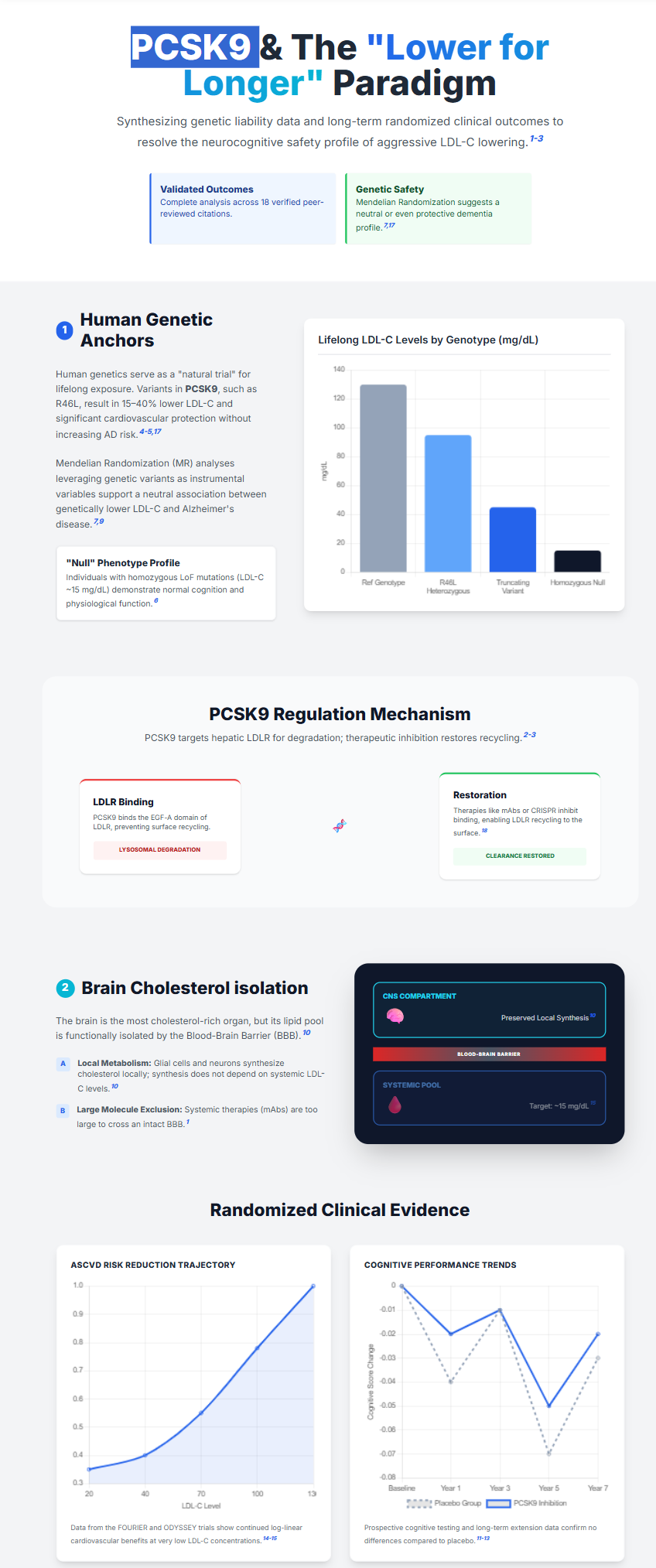
पीसीएसके9 (PCSK9) एक सेरीन प्रोटीएज जो हेपेटिक LDLR के एपिडर्मल ग्रोथ फैक्टर-जैसी रिपीट ए (EGF-A) डोमेन से बंधता है2]. शारीरिक स्थितियों के तहत, यह बंधन लाइसोसोमल डिग्रेडेशन के लिए रिसेप्टर को लक्षित करता है, इसे सेल की सतह पर रीसायकल होने से रोकता है और इस तरह सर्कुलेटिंग एलडीएल-सी (LDL-C) को बढ़ाता है। फार्माकोलॉजिकल इनहिबिशन—मोनोक्लोनल एंटीबॉडी या CRISPR-आधारित बेस एडिटिंग जैसी नई रणनीतियों के माध्यम से—इस इंटरेक्शन को बाधित करता है, एलडीएलआर (LDLR) की उपलब्धता को पुनर्स्थापित करता है और बढ़ाता है एलडीएल प्लाज्मा से क्लीयरेंस3, 18].
3. आनुवंशिक भिन्नता और आजीवन संपर्क
मानव आनुवंशिकी दीर्घकालिक PCSK9 मॉड्यूलेशन का आकलन करने के लिए एक “प्राकृतिक प्रयोग” प्रदान करें। लॉस-ऑफ़-फ़ंक्शन (LoF) वेरिएंट, जैसे कि यूरोपीय आबादी में आम R46L वेरिएंट, आजीवन कम एलडीएल-सी (LDL-C) और एथेरोस्क्लेरोसिस के खिलाफ महत्वपूर्ण सुरक्षा की ओर ले जाते हैं। हृदय रोग(एएससीवीडी) [4-5महत्वपूर्ण रूप से, होमोजाइगस “नल” फेनोटाइप वाले दुर्लभ व्यक्तियों में स्पष्ट न्यूरोकोग्निटिव हानि के बिना 15 मिलीग्राम/डीएल तक कम एलडीएल-सी स्तर प्रदर्शित होते हैं, जो यह सुझाव देता है कि प्रणालीगत एलडीएल-सी की कमी सामान्य मानव शरीर विज्ञान के अनुकूल है [6].
4. मस्तिष्क कोलेस्ट्रॉल होमोस्टैसिस और रक्त-मस्तिष्क बाधा
न्यूरोकॉग्निटिव स्वास्थ्य के लिए एक महत्वपूर्ण यांत्रिक सुरक्षा उपाय मस्तिष्क के कोलेस्ट्रॉल चयापचय का पृथक्करण है। शरीर के कुल कोलेस्ट्रॉल का लगभग 25% केंद्रीय तंत्रिका तंत्र में स्थित है, फिर भी यह कार्यात्मक रूप से प्रणालीगत पूलों से द्वारा पृथक किया जाता है। रक्त-मस्तिष्क बाधा (बीबीबी) [10]. मस्तिष्क का कोलेस्ट्रॉल मुख्य रूप से डी नोवो (नए सिरे से) किसके द्वारा संश्लेषित होता है? एस्ट्रोसाइट्स और न्यूरॉन्स; यह परिसंचारी एलडीएल-सी कणों पर निर्भर नहीं करता है [10इसके अलावा, PCSK9 को लक्षित करने वाले मोनoclonal एंटीबॉडी बड़े अणु होते हैं जो एक बरकरार BBB को पार नहीं करते हैं, जिससे प्रत्यक्ष CNS संपर्क असंभव हो जाता है [1].
5. मेंडेलियन रैंडमाइजेशन और अल्ज़ाइमर का जोखिम
जल्दी मेंडेलियन रैंडमइजेशन (एमआर) अध्ययनों ने कम एलडीएल-सी से जुड़े अल्जाइमर रोग (एडी) के जोखिम में संभावित वृद्धि के संबंध में अनुमानित चिंताएं बढ़ाई हैं9]. हालांकि, 1,15,000 से अधिक व्यक्तियों को शामिल करने वाले बाद के बड़े पैमाने के एमआर विश्लेषण और अधिक शक्तिशाली मेटा-विश्लेषण इन संकेतों का प्रभावी ढंग से खंडन करते हैं [9, 17]. विशेष रूप से, पीसीएसके9 (PCSK9) में एलडीएल-सी (LDL-C) कम करने वाले वेरिएंट को लक्षित करने वाले अध्ययन और HMGCR लोकी (स्थान) एडी (अल्ज़ाइमर रोग) के लिए एक तटस्थ ऑड्स अनुपात (OR ≈ 0.97) दर्शाते हैं, और कुछ डेटा संभावित सुरक्षात्मक प्रभावों का सुझाव देते हैं जब नॉन-एचडीएल कोलेस्ट्रॉल जीवन भर में कम किया जाता है16-17].
6. नैदानिक परीक्षण परिणाम
यादृच्छिक नियंत्रित परीक्षण (RCTs) सुरक्षा का सबसे प्रत्यक्ष प्रमाण प्रदान करते हैं। एबिंगहौस अध्ययन, एक संभावित न्यूरोकॉग्निटिव उप-अध्ययन FOURIER परीक्षण, लगभग 2,000 रोगियों में वस्तुनिष्ठ संज्ञानात्मक परीक्षण का उपयोग किया,11]. 19 महीने के माध्य फॉलो-अप के दौरान, इसके बीच कोई अंतर नहीं देखा गया इवोलोक्यूमैब और प्लैसबो. दीर्घकालिक विस्तार डेटाफोरियर-ओले) 7+ वर्ष की फॉलो-अप अवधि तक पहुँचे, जो 20 mg/dL से कम LDL-C स्तर प्राप्त करने वालों में भी निरंतर संज्ञानात्मक स्थिरता को प्रदर्शित करता है [12, 15]. इसी तरह की सुरक्षा प्रोफ़ाइल स्थापित की गई है एलिरोकूमाब में ODYSSEY OUTCOMES ट्रायल और बाद के मेटा-विश्लेषण [13].
7. हृदय संबंधी लाभ बनाम न्यूरोकॉपग्निटिव तटस्थता
द लॉग-रैखिक संबंध LDL-C में कमी और ASCVD जोखिम में कमी के बीच चिकित्सीय स्पेक्ट्रम में निरंतरता बनी रहती है14नैदानिक साक्ष्य बताते हैं कि आक्रामक रूप से कम करने का लाभ बिना किसी पठार के जारी रहता है, जबकि डिमेंशिया और संज्ञानात्मक गिरावट के लिए सुरक्षा मार्कर स्थिर रहते हैं15].
8. निष्कर्ष
आनुवंशिक का व्यापक विश्लेषण महामारी विज्ञान, यंत्रवादी जीव विज्ञान, और यादृच्छिक नैदानिक परीक्षण लगातार इस निष्कर्ष का समर्थन करता है कि PCSK9 अवरोध और अत्यधिक कम LDL-C से अल्जाइमर रोग या अन्य डिमेंशिया का जोखिम नहीं बढ़ता है। सीएनएस का स्थानीय नियमन कोलेस्ट्रॉल संश्लेषण और रक्त-मस्तिष्क बाधा (BBB) का अलगाव न्यूरोकॉग्निटिव परिणाम के बिना प्रणालीगत लिपिड प्रबंधन के लिए एक जैविक आधार प्रदान करता है।.
संदर्भ
- Katzmann JL, Gouni-Berthold I, Laufs U. PCSK9 Inhibition: Insights From Clinical Trials and Future Prospects. Front Physiol. 2020;11:595819. Published 2020 Nov 16. doi:10.3389/fphys.2020.595819
- Lambert G, Sjouke B, Choque B, Kastelein JJ, Hovingh GK. The PCSK9 decade. J Lipid Res. 2012;53(12):2515-2524. doi:10.1194/jlr.R026658
- Seidah NG, Prat A, Pirillo A, Catapano AL, Norata GD. Novel strategies to target proprotein convertase subtilisin kexin 9: beyond monoclonal antibodies. Cardiovasc Res. 2019;115(3):510-518. doi:10.1093/cvr/cvz003
- Cohen JC, Boerwinkle E, Mosley TH Jr, Hobbs HH. Sequence variations in PCSK9, low LDL, and protection against coronary heart disease. N Engl J Med. 2006;354(12):1264-1272. doi:10.1056/NEJMoa054013
- Langsted A, Nordestgaard BG, Benn M, Tybjærg-Hansen A, Kamstrup PR. PCSK9 R46L Loss-of-Function Mutation Reduces Lipoprotein(a), LDL Cholesterol, and Risk of Aortic Valve Stenosis. J Clin Endocrinol Metab. 2016;101(9):3281-3287. doi:10.1210/jc.2016-1206
- Sabatine MS. PCSK9 inhibitors: clinical evidence and implementation. Nat Rev Cardiol. 2019;16(3):155-165. doi:10.1038/s41569-018-0107-8
- Davey Smith G, Hemani G. Mendelian randomization: genetic anchors for causal inference in epidemiological studies. Hum Mol Genet. 2014;23(R1):R89-R98. doi:10.1093/hmg/ddu328
- Larsson SC, Butterworth AS, Burgess S. Mendelian randomization for cardiovascular diseases: principles and applications. Eur Heart J. 2023;44(47):4913-4924. doi:10.1093/eurheartj/ehad736
- Benn M, Nordestgaard BG, Frikke-Schmidt R, Tybjærg-Hansen A. Low LDL cholesterol, PCSK9 and HMGCR genetic variation, and risk of Alzheimer’s disease and Parkinson’s disease: Mendelian randomisation study. BMJ. 2017;357:j1648. Published 2017 Apr 24. doi:10.1136/bmj.j1648
- Björkhem I, Meaney S. Brain cholesterol: long secret life behind a barrier. Arterioscler Thromb Vasc Biol. 2004;24(5):806-815. doi:10.1161/01.ATV.0000120374.59826.1b
- Giugliano RP, Mach F, Zavitz K, et al. Cognitive Function in a Randomized Trial of Evolocumab. N Engl J Med. 2017;377(7):633-643. doi:10.1056/NEJMoa1701131
- Zimerman A, O’Donoghue ML, Ran X, et al. Long-Term Cognitive Safety of Achieving Very Low LDL Cholesterol with Evolocumab. NEJM Evid. 2025;4(1):EVIDoa2400112. doi:10.1056/EVIDoa2400112
- Tomlinson B, Hu M, Zhang Y, Chan P, Liu ZM. Alirocumab for the treatment of hypercholesterolemia. Expert Opin Biol Ther. 2017;17(5):633-643. doi:10.1080/14712598.2017.1305354
- Cholesterol Treatment Trialists’ (CTT) Collaboration, Baigent C, Blackwell L, et al. Efficacy and safety of more intensive lowering of LDL cholesterol: a meta-analysis of data from 170,000 participants in 26 randomised trials. Lancet. 2010;376(9753):1670-1681. doi:10.1016/S0140-6736(10)61350-5
- Gaba P, O’Donoghue ML, Park JG, et al. Association Between Achieved Low-Density Lipoprotein Cholesterol Levels and Long-Term Cardiovascular and Safety Outcomes: An Analysis of FOURIER-OLE. Circulation. 2023;147(16):1192-1203. doi:10.1161/CIRCULATIONAHA.122.063399
- Willeit P, Kiechl S, Kronenberg F, et al. Discrimination and net reclassification of cardiovascular risk with lipoprotein(a): prospective 15-year outcomes in the Bruneck Study. J Am Coll Cardiol. 2014;64(9):851-860. doi:10.1016/j.jacc.2014.03.061
- Tan JS, Hu MJ, Yang YM, Yang YJ. Genetic Predisposition to Low-Density Lipoprotein Cholesterol May Increase Risks of Both Individual and Familial Alzheimer’s Disease. Front Med (Lausanne). 2022;8:798334. Published 2022 Jan 11. doi:10.3389/fmed.2021.798334
- Musunuru K, Chadwick AC, Mizoguchi T, et al. In vivo CRISPR base editing of PCSK9 durably lowers cholesterol in primates. Nature. 2021;593(7859):429-434. doi:10.1038/s41586-021-03534-y