1. The Hypothesis and How This Review Tests It
The proposition under examination is that a nutritionally adequate, entirely whole-food dieta à base de plantas, very low in total fat (hereafter VLF-WFPB), offers cardiovascular protection beyond that of other high-quality dietary patterns, for prevention, for treatment of established disease, and for regression. Four separate questions are kept apart throughout: (Q1) Does VLF-WFPB improve outcomes compared with a typical Western diet? (Q2) Does it outperform other high-quality diets, such as DASH, Mediterranean, or Portfolio? (Q3) Are complete exclusion of animal foods, very low total fat, and minimal processing each independently necessary for any advantage? (Q4) Do such diets protect arteries through pathways beyond lowering ApoB-containing lipoproteínas? A Questão 4 é considerada a questão central (Seção 5), pois um benefício que se estende inteiramente por ApoB could in principle be matched by any equally effective means of lowering ApoB.
The positive case rests on convergence. Randomized trials show that plant-based diets lower causal fatores de risco; intensive lifestyle trials that included very-low-fat dietas vegetarianas showed functional and angiographic improvement; and populations with lifelong low animal-food intake had low colesterol and low coronary mortality. Each line is weak alone. Together they make it more credible that sustained dietary lowering of ApoB-containing lipoproteins can slow coronary disease, which bears mainly on Q1. They cannot answer Q2 or Q3, because in every line the diet travels with other exposures—perda de peso, physical activity, co-interventions, drugs—that also change risk. Convergence is therefore used here to judge plausibility, not to enlarge sample sizes or to compute a probability of superiority. Unrelated populations are not pooled.
Narrative reviews by Wang and colleagues, Freeman and colleagues, and Kahleova and colleagues served as background and as routes to original studies; numerical claims are taken from the original reports, and repeated citation of the same cohort is not treated as independent corroboration [1–3].
1.1 Scope and methods
This is a targeted critical review, not a registered revisão sistemática. Sources were identified through PubMed-indexed records, publisher pages, full-text articles where accessible, guideline repositories, and reference tracing, with a final update search on 12 September 2026. Numerical claims were checked against original reports where accessible; where only an abstract or an official summary could be obtained, that is stated at the relevant passage. No new metanálise or patient-level reanalysis was performed.
Interests deserve attention without being disqualifying. Several lifestyle programs were evaluated by the investigators who developed them; the direct vegan–Mediterranean comparison was conducted by an organization that advocates plant-based diets; and the major Mediterranean secondary-prevention trial was funded principally by olive-oil foundations. These are reasons to emphasize allocation, retention, prespecification, blinded outcomes, and independent replication, not reasons to reject results.
1.2 How to read the evidence: five tiers of data
Not all evidence answers the same question. This review sorts studies into five tiers according to how well each design can show cause and effect, not according to whether its results support the hypothesis. Lower tiers still count—evidence is evidence—but they answer different questions and carry different risks of misleading us (Figure 1).
Tier 1: randomized trials with clinical events. People are assigned to a diet by chance, and ataques cardíacos, derrames, or deaths are counted. Chance assignment reduces confundível in expectation, though not necessarily in any single trial, so a difference in events is the strongest available evidence that the diet caused it. Examples in this review are PREDIMED, CORDIOPREV, e o Estudo do Coração de Lyon.
Tier 2: randomized trials of intermediate outcomes. Assignment is still by chance, but the outcome is a measurement that predicts events: LDL-C, ApoB, pressão arterial, coronary narrowing, volume da placa, or myocardial blood flow. These trials show that a diet changes the measurement; they do not by themselves show fewer events. Examples are the Lifestyle Heart Trial, EVADE CAD, and the lipid meta-analyses.
Tier 3: coorte prospectiva studies. Large groups of individuals report what they eat and are followed for years. These studies capture real disease in real people over decades, which trials rarely can, but they show association: people who choose a diet differ in many other ways, and statistical adjustment can only partly remove those differences (Section 9.1). Examples are Adventist Health Study-2, EPIC-Oxford, and the Danish nitrate cohort.
Tier 4: population comparisons, cross-sectional studies, and uncontrolled case series. Whole populations are compared (rural China, Okinawa, the Tsimane), people are measured once, or treated patients are followed without a comparison group (the Esselstyn cohorts). These data generate hypotheses and show what is achievable, but many explanations can fit the same pattern.
Tier 5: mechanistic studies in cells and animals. Experiments can isolate a single pathway under controlled conditions, which makes them the best way to test how something might work. Whether the same pathway matters in human arteries over decades has to be shown separately.
Design is a starting point, not a verdict: confidence also depends on risk of bias, precision, how directly the comparison addresses the question, and how outcomes were ascertained. Tiers also apply to outcomes rather than to whole studies, so a trial can sit in one tier for imaging and another for clinical events. The case for a whole-food plant-based diet is strongest where several tiers point the same way and weakest where it rests on one tier alone. Section headings throughout the review note the main tier of evidence discussed.
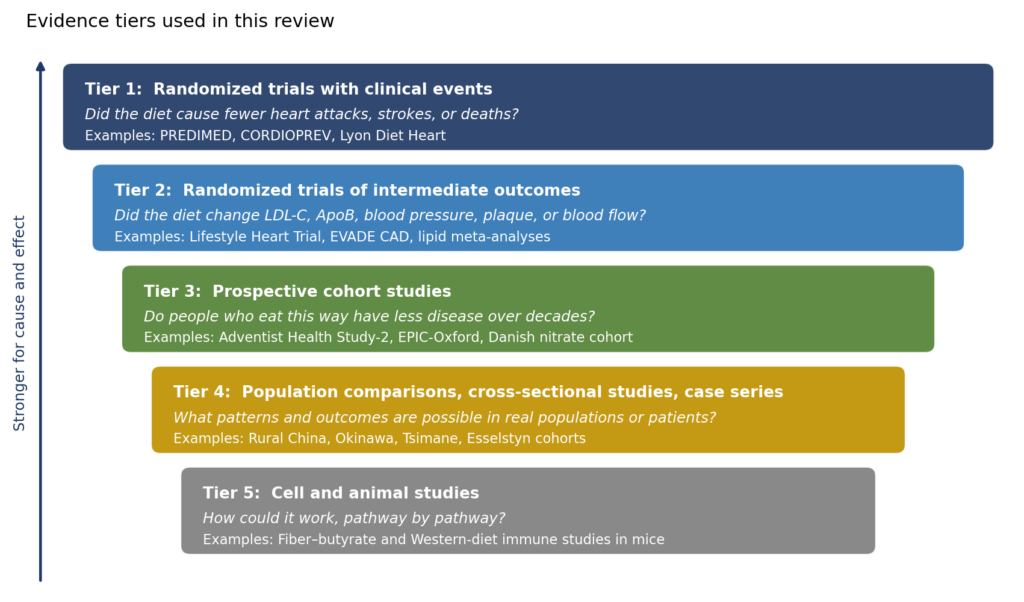
Figure 1. Five tiers of evidence used in this review, the question each tier can answer, and examples of studies in each tier. Higher tiers are better at showing cause and effect; lower tiers add breadth, duration, and biological explanation.
2. Defining the Diets and the Comparisons
The proposed diet. VLF-WFPB consists of vegetables, legumes, intact whole grains, fruit, and minimally processed starchy foods, with no animal foods and little or no added oil, operationally about 10–15% of energy from fat. The 2014 Esselstyn protocol also excluded avocado, nuts, excess salt, and sugary foods, later also caffeine and fructose, and advised a multivitamin, vitamin B12, and flaxseed meal [4]. The earlier 1985 Esselstyn cohort was not vegan: patients eliminated oil, fish, fowl, meat, and dairy products except skim milk and nonfat yogurt, targeted 10% of energy from fat, and received individualized cholesterol-lowering medication [5]. O Ornish Lifestyle Heart Trial diet was a 10%-fat whole-foods vegetarian diet that permitted nonfat dairy and egg whites [6, 7]; achieved fat intake was 6.2% of energy at one year and 8.5% at five years [6].
Related but different diets. Higher-fat whole-food vegan diets include nuts, seeds, avocado, or azeite de oliva; the low-oil phase of the 2024 Recipe for Heart Health trial still provided 32% of energy from fat [8], and the vegan arm of the EVADE CAD trial ended at about 30% [9]. Generic vegan diets exclude animal foods without constraining food processing or fat. Conventional low-fat diets are omnivorous; the low-fat arm of CORDIOPREV prescribed less than 30% fat with lean meat and low-fat dairy, and achieved 32.1% [10].
Comparators. The DASH combination diet emphasized fruits, vegetables, and low-fat dairy with reduced saturated and total fat [11]. Dietas mediterrâneas tested in randomized trials were substantially higher in fat: the PREDIMED arms were supplemented with extra-virgin olive oil or nuts [12]; the CORDIOPREV Mediterranean arm prescribed at least 35% fat and achieved 40.5% [10]; and the Lyon intervention supplied an alpha-linolenic-acid-rich margarine in place of butter and cream, alongside advice to follow a Mediterranean-type pattern [13, 14]. O Dieta Portfolio adds nuts, plant proteína, viscous fibra, and plant esteróis to a low-saturated-fat background [15]. Table 1 summarizes the patterns as they were actually tested.
Table 1. Dietary patterns as tested.
| Padrão | Defining features in the key trials | Fat, % of energy | What the label alone does not establish |
| VLF-WFPB | Legumes, intact grains, vegetables, fruit, starchy foods; no animal foods; little or no oil; Esselstyn 2014 also excluded nuts and avocado [4] | Target ~10–15%; Ornish (vegetarian, not vegan) achieved 6.2–8.5% [6] | Adequate B12, protein, essential fats, or sustained adesão |
| Higher-unsaturated-fat whole-food vegan | Animal-free, with nuts, seeds, avocado, or olive oil | 32–48% [8]; ~30% in EVADE CAD [9] | Inferiority to an oil-free vegan pattern |
| DASH | Fruit, vegetables, low-fat dairy; reduced saturated and total fat; sodium reduction in DASH-Sodium [11, 16] | Reduced, not very low | That benefit depends on dairy; event reduction in a trial |
| Mediterranean | Vegetables, legumes, whole grains, nuts, extra-virgin olive oil, fish [10, 12] | 40.5% achieved in CORDIOPREV [10] | A fixed macronutrient ratio or unlimited energy |
| Portfólio | Nuts, plant protein, viscous fiber, plant sterols added to a low-saturated-fat diet [15] | Varied across trials; includes nuts but not necessarily high in fat | Event reduction; core evidence is hipolipemiante; tested patterns were not restricted to 10–15% fat |
| Conventional low-fat (omnivorous) | Lean meat, low-fat dairy, complex carboidrato [10] | <30% prescribed; 32.1% achieved [10] | Equivalence to VLF-WFPB |
3. Three Levers: Animal-Food Exclusion, Total Fat, and Food Processing (Tiers 2–3)
VLF-WFPB bundles three changes that can be separated: excluding animal foods, restricting total fat to about 10–15% of energy, and building the diet from whole or minimally processed foods. The Esselstyn and Ornish programs push fat restriction and whole-food eating to their extremes and remove all or nearly all animal foods (their early protocols permitted nonfat dairy, and Ornish’s also egg whites). That makes them the natural test bed for the whole package and, for the same reason, unable on their own to apportion credit among its parts (Figure 2). The label “plant-based” describes only the first lever, and the evidence shows it is not sufficient on its own.
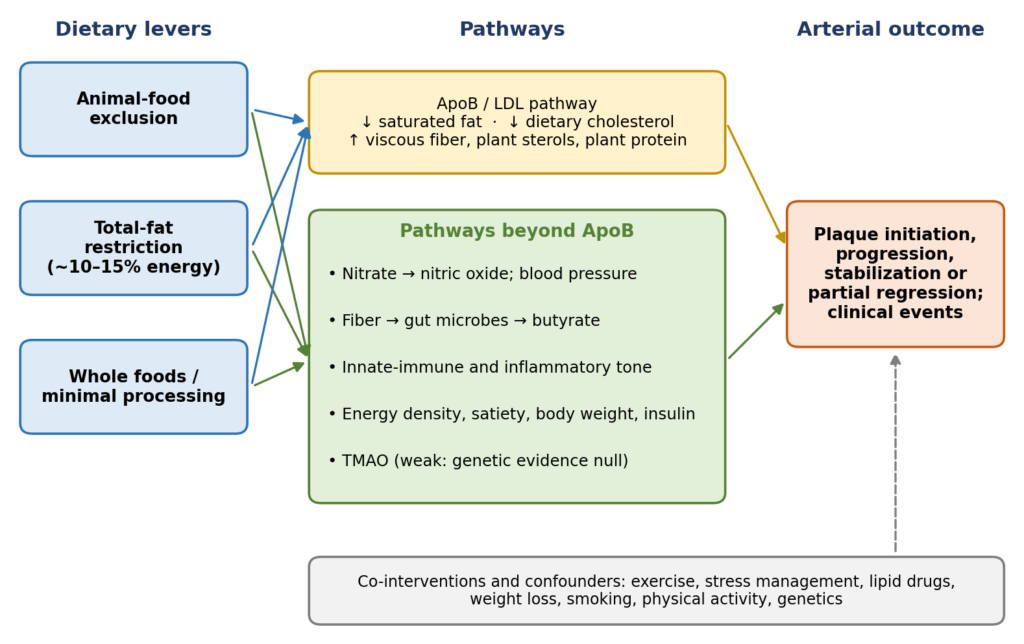
Figure 2. Three separable dietary levers and the pathways by which they could affect coronary aterosclerose. Most intervention programs change all three levers together and add co-interventions, so trials cannot attribute benefit to a single lever.
Diet quality within plant-based eating. In three US cohorts totalling about 209,000 health professionals with 8,631 incident coronary events, an overall plant-based diet index was only weakly associated with lower risk (razão de riscos for extreme deciles 0.92; 95% CI 0.83 to 1.01). A healthful index that rewarded whole grains, fruits, vegetables, nuts, legumes, oils, tea, and coffee was associated with 25% lower risk (0.75; 0.68 to 0.83), whereas an unhealthful index that rewarded refined grains, potatoes, sweetened beverages, juices, and sweets was associated with 32% higher risk (1.32; 1.20 to 1.46) [17]. Two points follow. Plant-based eating is not protective in itself; quality determines the direction. And the healthful index scored nuts and vegetable oils as beneficial, so this evidence favors a whole-food pattern rather than specifically a very-low-fat one.
Processing within plant foods. In 126,842 UK Biobank participants followed for a median of 9 years, each 10-percentage-point increase in energy from plant-sourced foods that were not ultra-processed was associated with 7% lower doença cardiovascular risk (hazard ratio 0.93; 95% CI 0.91 to 0.95) and 13% lower cardiovascular mortality (0.87; 0.80 to 0.94). Plant-sourced alimentos ultraprocessados showed the opposite association (1.05; 1.03 to 1.07 for disease and 1.12; 1.05 to 1.20 for mortality), and total plant-food intake, ignoring processing, showed no association [18].
Randomized evidence on processing. Processing also has randomized evidence, although for energy balance rather than atherosclerosis. In an inpatient crossover trial, 20 weight-stable adults received ultra-processed or unprocessed diets for two weeks each, with meals matched for presented calories, energy density, macronutrients, sugar, sodium, and fiber. On the ultra-processed diet they ate 508 ± 106 kcal/day more and gained 0.9 kg; on the unprocessed diet they lost 0.9 kg [19].
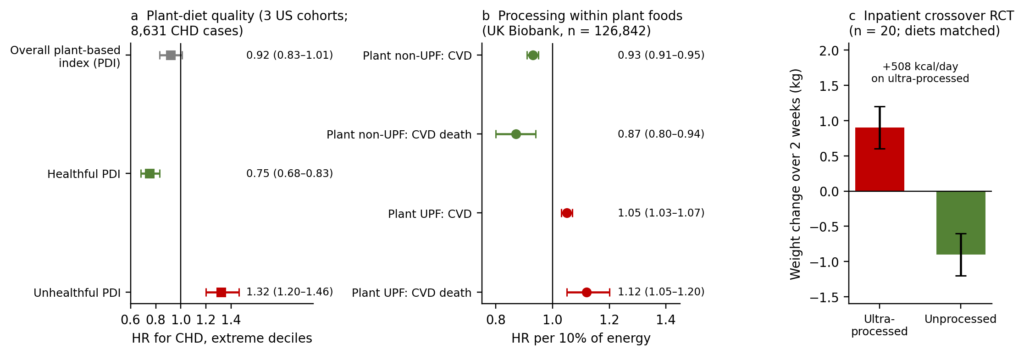
Figure 3. Diet quality and processing. (a) Plant-based diet indices and incident doença cardíaca coronariana, extreme deciles. (b) Plant-sourced foods by processing, per 10% of energy, UK Biobank. (c) Weight change in an inpatient crossover trial of ultra-processed versus unprocessed diets (mean ± SE). Panels come from different designs and are not comparable in magnitude. Sources: Satija 2017; Rauber 2024; Hall 2019.
What this changes. The evidence on processing is consistent in direction: associations for plant foods reverse with processing, and in a randomized feeding trial the ultra-processed pattern increased energy intake and weight relative to the unprocessed pattern, with nutrients matched as far as the design allowed. These findings support attention to food quality and processing; they do not establish the importance of processing relative to animal-food exclusion, a comparison no trial has made. This reframes the Esselstyn and Ornish programs. What they share with each other, and with rural China, Okinawa, and the Tsimane (Sections 6–8), is not zero animal food but a diet built almost entirely from whole, minimally processed foods. That feature, and the question of whether its benefits run only through ApoB (Section 5), are the focus of what follows.
4. The Biological Case: ApoB and the Lipid Pathway (Tiers 1–2)
4.1 Organizing framework: cumulative exposure to ApoB-containing particles
LDL and other ApoB-containing lipoproteins cause atherosclerotic cardiovascular disease, and genetic, epidemiologic, and trial evidence indicate that risk rises with both the magnitude and the duration of exposure [20]. Particles enter the arterial íntima in proportion to their concentration and are retained in susceptible sites, so the relevant quantity is exposição cumulativa rather than a single measurement. This framework is used here as an organizing principle, not as a validated numerical risk equation.
The framework has two implications for diet. First, a modest reduction sustained from early adulthood could matter more than the same reduction begun after disease is established; this is the logic behind the population evidence in Sections 6 to 8. Second, in established disease the relevant benchmark is the statin-trial slope: about a 22% relative reduction in major vascular events per 1 mmol/L (38.7 mg/dL) of LDL-C lowering over roughly five years [21]. If that slope applied to the pooled dietary LDL-C difference of 0.30 mmol/L reported below, it would predict a relative reduction of about 7% over five years (1 − 0.78^0.30). That figure is an extrapolation, not a measured dietary effect: dietary trials last weeks to months, adherence erodes, and a diet also changes body weight, blood pressure, and other factors that the estatina slope does not capture.
4.2 Evidências de estudos randomizados sobre lipídios e fatores de risco
A maior meta-análise de ensaios clínicos randomizados que compararam dietas vegetarianas ou veganas com dietas onívoras incluiu 30 ensaios. As dietas à base de vegetais reduziram colesterol total em 0,34 mmol/L (IC 95%: 0,23 a 0,44; cerca de 13 mg/dL) e o LDL-C em 0,30 mmol/L (IC 95%: 0,19 a 0,40; cerca de 11,6 mg/dL). A ApoB diminuiu 12,92 mg/dL (IC 95%: 3,20 a 22,63), uma redução de 14%, mas apenas seis ensaios clínicos contribuíram com dados de ApoB e a heterogeneidade foi substancial (I² = 71,7%); triglicerídeos não apresentaram diferenças no geral [22]. O valor da ApoB é a estimativa combinada publicada; como se baseia em seis ensaios clínicos, sua precisão depende de esses ensaios serem comparações randomizadas independentes apenas da dieta, o que não pôde ser confirmado a partir das fontes acessíveis; as análises combinadas nessa literatura também exigem a verificação de relatos múltiplos de uma única coorte. Esses resultados apoiam a plausibilidade mediada pelos lipídios. Eles não comprovam a redução de eventos, regressão de placa, a reação de uma pessoa ou um benefício especial decorrente da exclusão de gorduras insaturadas, pois as dietas testadas e os grupos de comparação apresentavam grande variação.
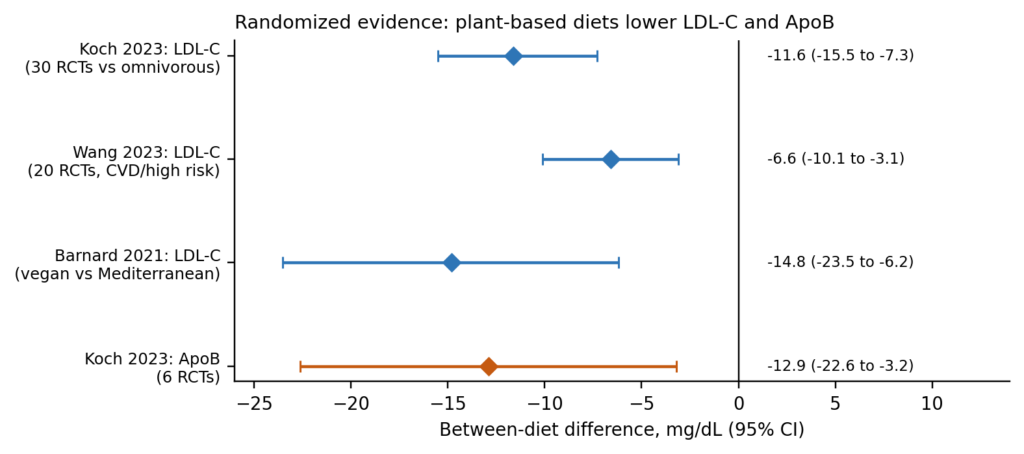
Figura 4. Evidências de estudos randomizados de que dietas à base de vegetais reduzem o LDL-C e a ApoB. Diferenças entre as dietas com o modelo 95% intervalos de confiança; Valores de Koch 2023 convertidos de mmol/L (× 38,67). As estimativas se baseiam em ensaios clínicos constituintes e não são somáveis. Fontes: Koch 2023; Wang 2023; Barnard 2021 (participantes sem alterações na medicação).
Uma segunda meta-análise restrita a pessoas com doença cardiovascular ou em alto risco de desenvolvê-la reuniu 20 ensaios clínicos (1.878 participantes; duração média de 25,4 semanas). As dietas vegetarianas reduziram o LDL-C em 6,6 mg/dL (IC 95% 3,1 a 10,1), a HbA1c em 0,24 pontos percentuais (IC 95% 0,07 a 0,40) e o peso corporal em 3,4 kg (IC 95% 2,0 a 4,9), sem efeito sobre pressão arterial sistólica (−0,1 mm Hg; IC 95%: −2,8 a 2,6) [7]. A seção “Pontos-chave” do artigo indica 6,8 mg/dL e 0,25%; a seção de resultados e os gráficos de floresta apresentam 6,6 mg/dL e 0,24%, valores que são utilizados aqui. Dois outros detalhes são relevantes para a Q2. Em comparação com dietas habituais, o LDL-C diminuiu 12,9 mg/dL; em comparação com grupos de controle com dietas ativas, a diferença no LDL-C não foi estatisticamente significativa. E o LDL-C basal explicou a heterogeneidade entre os ensaios [7]. Apenas quatro estudos incluíram pacientes com doença cardiovascular comprovada, sendo que três deles eram programas do tipo Ornish.
Pressão arterial. Meta-análises anteriores, conforme resumidas por Wang e colegas, relataram reduções da pressão sistólica de cerca de 2,5 mmHg com dietas vegetarianas [7]. O resultado nulo em pacientes de maior risco pode ser plausivelmente explicado pelo contexto anti-hipertensivo terapia e pela redução da medicação durante os estudos, o que, segundo os autores, poderia mascarar os efeitos da dieta. O benefício para a pressão arterial não é específico da alimentação exclusivamente à base de vegetais: o Dieta DASH, que inclui laticínios com baixo teor de gordura, reduziu substancialmente a pressão arterial em um estudo com alimentação controlada [11, 16], e, em uma comparação cruzada direta, a dieta mediterrânea reduziu a pressão sistólica mais do que uma dieta vegana com baixo teor de gordura [23]. A pressão arterial, portanto, não é uma vantagem comprovada da dieta VLF-WFPB. As estimativas das duas metanálises sobre lipídios não são somadas; elas compartilham os mesmos ensaios clínicos.
4.3 Colesterol alimentar
Dietary cholesterol aumenta o colesterol sérico independentemente de gordura saturada. Em uma meta-análise de estudos sobre a ingestão de ovos citada por Freeman e colegas, cada 100 mg/dia adicionais aumentaram o LDL-C em cerca de 1,9 mg/dL e o HDL-C em cerca de 0,3 mg/dL; a resposta é maior quando a ingestão inicial é baixa e varia entre indivíduos de acordo com a capacidade de absorção intestinal [2]. Mesmo pessoas acostumadas a uma ingestão muito baixa apresentam essa resposta: em oito homens tarahumaras, cuja dieta habitual fornecia pouco colesterol, uma dieta de 1.000 mg/dia elevou o colesterol plasmático de 113 para 147 mg/dL após uma fase sem colesterol [24]. A dieta VLF-WFPB praticamente não fornece colesterol; no estudo EVADE CAD, o colesterol alimentar caiu para uma mediana de 0 mg/dia no grupo vegano, contra 142 mg/dia no grupo da AHA [9]. A contribuição média para a redução do LDL-C é modesta; a contribuição individual pode ser maior. As diretrizes alimentares da AHA para 2026 afirmam que, para a maioria das pessoas, o colesterol alimentar não é mais uma meta principal para a redução do risco cardiovascular [25]; eliminá-lo é, portanto, um aspecto secundário — e não determinante — do argumento a favor da dieta VLF-WFPB.
4.4 Gordura saturada e o que a substitui
Na revisão Cochrane atual, a redução da ingestão de gordura saturada diminuiu os eventos cardiovasculares combinados (razão de risco 0,83; IC 95% de 0,70 a 0,98; 12 ensaios clínicos, 53.758 participantes), e reduções maiores na ingestão de gordura saturada, refletidas em reduções mais acentuadas do colesterol, produziram benefícios maiores. Análises de subgrupos não mostraram diferença significativa entre substituir a gordura saturada por gordura poli-insaturada ou com carboidratos [26]. A edição de maio de 2020 dessa revista científica relatou uma razão de risco de 0,79; aqui é utilizada a versão corrigida e oficial. A dieta VLF-WFPB reduz significativamente a ingestão de gordura saturada (4,51 TP9T de energia no braço vegano do estudo EVADE contra 6,61 TP9T no braço da AHA [9]), e a substitui predominantemente por amido e fibras provenientes de alimentos integrais. Proteínas vegetais, fibras viscosas e esteróis vegetais são outros componentes que podem contribuir para a redução do LDL; atualmente dislipidemia As orientações incentivam os pacientes a reduzir o consumo de gordura saturada e a aumentar a ingestão de alimentos vegetais ricos em fibras [27].
Os dados do Portfolio mostram um caminho diferente para o mesmo objetivo. Em uma meta-análise de ensaios controlados (439 participantes), a adição de nozes, proteína vegetal, fibra viscosa e esteróis vegetais a uma dieta do NCEP Step II para redução do colesterol diminuiu o LDL-C em cerca de 17%, com reduções na ApoB e colesterol não-HDL também [15]. Como a dieta Portfolio contém nozes, isso demonstra que a exclusão dessas frutas secas não é um pré-requisito para uma redução significativa do LDL-C por meio da alimentação.
5. Além da ApoB: a questão central (Níveis 2–5)
Se todos os benefícios da dieta VLF-WFPB se resumissem à redução da ApoB, essa dieta seria apenas uma das várias formas intercambiáveis de reduzir a ApoB — incluindo medicamentos —, e a justificativa para suas regras específicas se resumiria a até que ponto e por quanto tempo ela reduz esse nível partículas aterogênicas. A principal característica da medicina baseada em alimentos vegetais integrais é que ela vai além: os alimentos vegetais integrais atuam sobre o endotélio, o intestino, a sinalização imunológica, a pressão arterial e o equilíbrio energético de maneiras que uma estatina não faz. Essa afirmação tem grande relevância biológica e constitui a questão central desta revisão.
Quatro tipos de evidência sustentam essa hipótese, em ordem crescente de força: (1) um mecanismo demonstrado em células ou animais em condições nas quais os lipídios permanecem inalterados ou são controlados; (2) fisiológica humana ou biomarcador efeitos não explicados pela variação do LDL-C; (3) associações com desfechos clínicos que persistem após o ajuste para os lipídios; e (4) comparação randomizada entre dietas com níveis correspondentes de ApoB. As subseções a seguir nota cada mecanismo candidato em relação a esses critérios (Figura 6). Nenhum estudo até o momento apresenta o quarto tipo.
5.1 Fibras, micróbios intestinais e butirato
As fibras viscosas reduzem o LDL-C, mas os polissacarídeos vegetais fermentáveis também podem atuar por meio do microbiota intestinal. Em 83 linhagens de camundongos geneticamente diversas e suscetíveis à aterosclerose, a abundância do gênero Roseburia, produtor de butirato, apresentou uma relação inversa com lesão tamanho e não apresentou correlação com o colesterol. Em animais livres de germes apolipoproteína Em camundongos com deficiência de E colonizados com comunidades bacterianas definidas, a Roseburia intestinalis reduziu a resposta sistêmica inflamação e aterosclerose apenas quando a dieta era rica em polissacarídeos vegetais, e a absorção intestinal de butirato por si só reduziu a endotoxemia e a aterosclerose [28]. Esta é a demonstração mais clara, nesta revisão, de um mecanismo ateroprotetor dependente da dieta e independente do colesterol. Ela se baseia em modelos em camundongos, e nenhum estudo clínico em humanos demonstrou que o aumento da produção de butirato altera placa ou eventos.
5.2 Nitratos presentes nas folhas verdes, óxido nítrico e o endotélio
Os vegetais de folhas verdes, essenciais ao protocolo de Esselstyn, são a principal fonte alimentar de nitrato inorgânico, que o corpo pode converter em óxido nítrico por meio de uma via enterosalivar. Em 53.150 adultos dinamarqueses acompanhados por até 23 anos (14.088 eventos cardiovasculares), uma ingestão moderada de nitratos vegetais (mediana de 59 mg/dia, aproximadamente uma xícara de verduras folhosas), em comparação com o quintil mais baixo (mediana de 23 mg/dia), foi associada a um risco 15% menor de doenças cardiovasculares (razão de risco 0,85; IC 95% 0,82 a 0,89) e com riscos mais baixos de doença cardíaca isquêmica (0,88; 0,82 a 0,94), acidente vascular cerebral isquêmico (0,83; 0,76 a 0,91), e doença arterial periférica (0.74; 0.67 to 0.83). The association plateaued above about 60 mg/day and persisted after adjustment for reported hipercolesterolemia and other dietary factors, which is not the same as controlling measured, cumulative ApoB exposure; a mediation analysis estimated that baseline systolic blood pressure explained 21.9% of it [29]. The authors note that the largest nitrate trial did not lower blood pressure in older adults with elevated pressure, and that observational data cannot separate nitrate from vegetable intake in general; in this cohort lettuce and potato supplied most vegetable nitrate [29]. The finding supports the leafy-green element of the whole-food lever; it is not specific to a vegan diet.
Função endotelial (acute and short-term human physiology; relevance to events unproven). A single high-fat meal transiently impaired brachial flow-mediated dilation in healthy volunteers [30]. In the same investigators’ ten-person experiment, an olive-oil meal reduced flow-mediated dilation acutely, by 31%, and the reduction was smaller when the meal included antioxidante vitamins or salad with balsamic vinegar [31]. Sustained feeding points the other way: in a meta-analysis of eight trials, olive-oil interventions increased flow-mediated dilation by 0.76 percentage points (95% CI 0.27 to 1.24) [32], and in 805 CORDIOPREV participants a Mediterranean diet improved flow-mediated dilation more than the low-fat diet after one year [33]. Over eight weeks in EVADE CAD, EndoPAT-measured endothelial function did not change in either arm [9]. Neither acute nor short-term vascular-function findings establish effects on events.
5.3 Inflammation and innate-immune memory
Inflamação (human randomized biomarker evidence). EVADE CAD randomized 100 patients with angiographic coronary disease to eight weeks of a vegan or AHA-recommended diet, with groceries, sample menus, and dietitian support for both. At baseline 94–96% took statins and more than half took high-dose statins. The vegan diet produced a 32% lower high-sensitivity Proteína C-reativa (β 0.68; 95% CI 0.49 to 0.94; P = 0.02), consistent after adjustment. LDL-C was 13% lower (adjusted β 0.87; 95% CI 0.78 to 0.97), which the investigators classified as nonsignificant under their Bonferroni threshold (α = 0.0015) for secondary endpoints. Weight, HbA1c, other lipids, leukocyte activation markers, and quality of life did not differ between arms [9]. Crucially, EVADE did not test very-low-fat eating: median reported fat intake at eight weeks was 29.9% of energy in the vegan arm and 30.2% in the AHA arm, both groups were encouraged to use unsaturated oils and olive oil appeared in recipes for both, and the principal dietary contrast was plant versus animal protein, with lower saturated fat and higher fiber in the vegan arm [9]. The hs-CRP result is a biomarker finding; it does not establish fewer events or an ApoB-independent clinical benefit.
Animal work suggests how diet could leave a lasting inflammatory imprint. In LDL-receptor–deficient mice, Western-diet feeding induced systemic inflammation that disappeared from the blood after a return to standard chow, yet myeloid progenitor cells remained reprogrammed, with heightened innate-immune responses; mice also lacking NLRP3 were protected [34]. Because these mice are severely hypercholesterolemic and LDL oxidada was implicated in the human arm of the study [34], this mechanism is not independent of lipoproteins; it suggests instead that the history of dietary exposure, not only current lipid levels, may shape plaque biology. The Tsimane point the other way: about half had hs-CRP above 3 mg/L from infectious burden, yet coronary calcium was the lowest recorded, which the investigators interpret as inflammation possibly not driving atherosclerosis when LDL is low [35].
5.4 Energy density, processing, body weight, and glycemia
Body weight and energy density (human randomized biomarker evidence). Vegetarian diets reduced weight by 3.4 kg in higher-risk patients [7], and a low-fat vegan diet produced greater weight loss than a Mediterranean diet in a crossover trial [23]. In the Lifestyle Heart Trial, the experimental group lost 10.9 kg at one year and remained 5.8 kg below baseline at five years [6]. Weight loss itself lowers LDL-C, blood pressure, and glycemia, so these effects overlap with the lipid pathway and cannot be added to it.
Insulin sensitivity and glycemia (human randomized biomarker evidence). HbA1c fell 0.24 percentage points overall and 0.36 points in people with type 2 diabetes [7]. This may add to lipid effects in people with diabetes, but again partly through weight.
The processing trial (Section 3) shows one non-lipid route directly: the same nutrient targets delivered as unprocessed rather than ultra-processed food reduced spontaneous energy intake by about 500 kcal/day [19]. Blood pressure is a further separate, causal pathway. It is not a demonstrated advantage of plant-exclusive eating (Section 4.2), but nitrate-rich vegetables and potassium-rich, low-sodium patterns such as DASH lower it [11, 16, 29].
5.5 Trimethylamine N-oxide
Gut microbiome and trimethylamine N-oxide (human association plus mechanistic hypothesis). Gut microbes convert dietary precursors including colina e carnitina to trimethylamine, which host liver enzymes then oxidize to TMAO [36]; circulating TMAO predicted cardiovascular events in cohort data [37]. Randomização mendeliana analyses have not found genetically predicted TMAO to be associated with doença arterial coronariana, infarto do miocárdio, or stroke [38], which weakens a causal interpretation, and no trial shows that lowering TMAO reduces events. The 2014 Esselstyn report asserts that its participants were unlikely to harbor TMAO-producing flora, but TMAO was not measured in that cohort [4].
5.6 Human signals that ApoB does not fully explain—and those it does
Most measured benefits of plant-based diets can run through ApoB, weight, blood pressure, and glycemia. A diet may have a real total effect even if nothing remains after conditioning on these mediators; the question of an additional effect is separate. Three observations bear on it. First, in the Lifestyle Heart Trial, experimental-group ApoB fell from 1.000 g/L at baseline to 0.769 g/L at one year but was 1.014 g/L at five years, while percent estenose diametral continued to improve; LDL-C remained 20% below baseline at five years [6]. Because the program also included exercise, stress management, and group support, and because a year-5 snapshot does not capture the lower cumulative exposure during the preceding years, this cannot be read as diet acting independently of ApoB. Second, within STARS, progression correlated with saturated and total fat intake after adjustment for LDL-C, an observational within-trial analysis [39]. Third, in cohort data roughly one-fifth of the vegetarian–IHD association may be mediated by índice de massa corporal [40], and in EPIC-Oxford the vegetarian–IHD association weakened substantially after adjustment for self-reported cholesterol, blood pressure, diabetes, and body mass index [41]. No trial has compared dietary patterns at matched ApoB, blood pressure, and weight, which is the design needed to establish an effect beyond the mediators.
Figure 5 displays the Lifestyle Heart Trial data. Although it cannot establish a dietary effect independent of ApoB, it remains the best clinical exhibit for the hypothesis: the experimental group took no lipid drugs, and the change in percent estenose continued from −1.75 points at one year to −3.07 points at five years, after ApoB had returned to 101.4 mg/dL (baseline 100.0), while controls worsened [6]. Two further observations sharpen the picture. First, the Tsimane had mean ApoB of 97 mg/dL at scanning, not especially low, yet almost no coronary calcium; their LDL-C averaged about 71 mg/dL (1.84 mmol/L) from 2004 to 2011 and has risen since, and they spend hours a day in physical activity [35], so lifetime exposure and activity may explain this as well as any dietary factor. Second, the Esselstyn 1995 cohort, often cited for this argument, cannot support it: every patient took cholesterol-lowering drugs and mean LDL-C was 71.6 mg/dL [42], so concomitant lipid lowering is a plausible explanation for part of the improvement, and the uncontrolled design cannot isolate the diet’s contribution or show that any pathway beyond ApoB was involved.
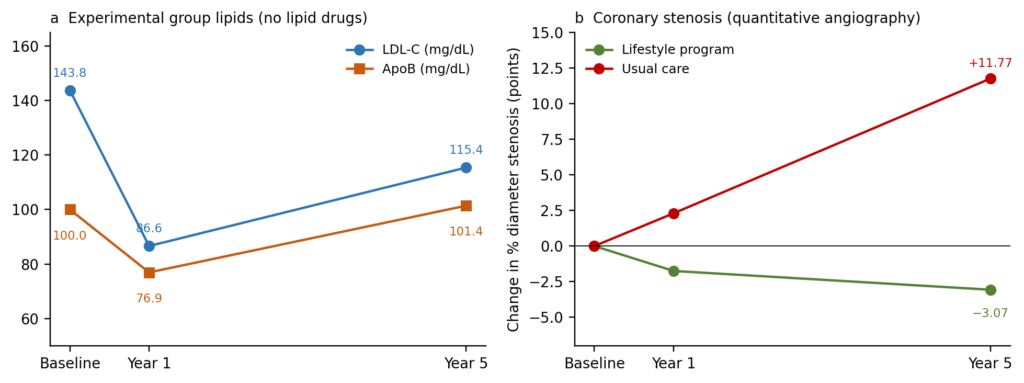
Figure 5. Lifestyle Heart Trial. (a) LDL-C and ApoB in the experimental group, which took no lipid-lowering drugs (ApoB converted from g/L × 100). (b) Change in percent diameter stenosis on quantitative angiography, plotted from the 1998 five-year report for the 35 participants with five-year angiography; the 1990 one-year report covers all 48 participants and gives slightly different baselines, so its values are not plotted here. 60% of controls started lipid drugs between years one and five.
5.7 Weighing the beyond-ApoB case
The additional-benefit hypothesis is therefore conditional: a stricter pattern could outperform another healthy diet if it produces a larger and sustained improvement in ApoB, blood pressure, weight, or saúde metabólica without poorer adherence or nutritional disadvantage. “Vegan,” “no oil,” and “10% fat” are not themselves validated desfechos substitutos. Nor can a short-term dietary lipid change be converted mechanically into an Esselstyn-specific event reduction using drug-trial slopes.
On balance, the beyond-ApoB case is biologically plausible and partly supported. Animal models demonstrate one diet-dependent, cholesterol-independent mechanism (fiber and butyrate) and one mechanism of lasting inflammatory memory; human cohorts link leafy-green nitrate to lower cardiovascular risk after adjustment for hypercholesterolemia, and minimally processed plant foods to lower risk; and a randomized trial shows that processing alone changes energy intake [18, 19, 28, 29, 34]. Against this, the vegetarian–coronary association in EPIC-Oxford weakened substantially after adjustment for conventional risk factors [41], genetic evidence does not support TMAO as causal [38], and no trial has compared diets at matched ApoB. Figure 6 summarizes the evidence by pathway; the proposed trial (Section 17) is designed to supply the missing test.
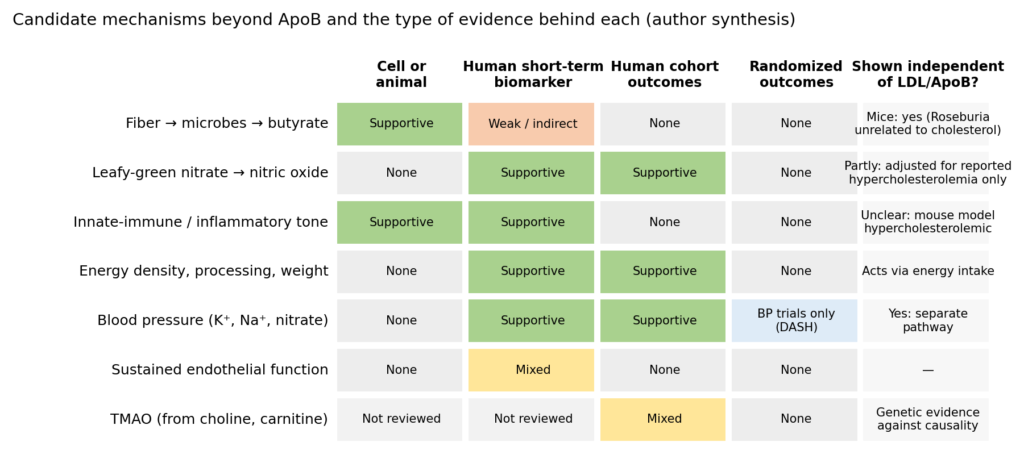
Figure 6. Candidate mechanisms beyond ApoB and the type of evidence for each. Author synthesis of sources cited in Section 5; “supportive” indicates the direction of evidence, not proof of a causal effect on human atherosclerosis.
6. Rural China (Tier 4)
6.1 What was measured
China Study I combined county mortality data with dietary, blood, and urine surveys in 65 rural counties and 130 villages, sampling 50 adults per village; diet and blood were collected in 1983–1984 [43]. The average rural diet supplied 14% of energy from fat, 71% from carbohydrate, 5% from álcool, and 10% from protein, of which about 11% was of animal origin (roughly 1% of total energy); fiber intake was 33 g/day and mean body mass index 20.5 [43]. Mean serum total cholesterol was 127 mg/dL, compared with 203 mg/dL in US adults aged 20–74 [43]. The diet was low in animal food, not vegan; the authors describe rural diets of 1950–1980 as containing 3–6% animal-based foods [43].
6.2 What the coronary figures are
The widely quoted coronary comparison uses mortality, not incidence, recorded in 1973–1975 and truncated at ages 0–64: 4.0 per 100,000 men and 3.4 per 100,000 women in rural China versus 66.8 and 18.9 in the United States, taken from a 1989 WHO statistics annual, giving ratios of 16.7 and 5.6 [43]. Four features limit interpretation. The mortality period precedes the dietary and blood survey by about a decade. Excluding deaths after age 64 removes the ages at which most coronary deaths occur. Death certification and coronary diagnosis in rural China in the 1970s differ from US practice, so under-ascertainment cannot be excluded. And competing mortality from infections and other causes of death, which the authors describe as clustering in the same counties, removes people before coronary disease manifests [43]. No carga de placa was measured.
6.3 What the county correlations show
Across counties, coronary mortality correlated positively with plasma ApoB (r = 0.37) and with an index of salt intake (r = 0.42), and inversely with green-vegetable intake; ApoB in turn correlated with animal protein and meat intake [43]. Coronary mortality also correlated with wheat flour intake (r = 0.67), which the authors attribute partly to co-varying milk, salt, triglycerides, and body weight [43]. The authors themselves note that the county, not the individual, is the unit of analysis, so the data cannot show whether low disease rates reflect uniformly low animal-food intake or fewer individuals eating more [43].
6.4 Confounding and alternative explanations
Energy intake per kilogram was about 30% higher than in the United States with far less obesidade, which the authors attribute to greater daily energy expenditure such as cycling to work [43]. Physical activity, body weight, tobacco use, socioeconomic conditions, health care access, and diagnostic ascertainment all differ between these populations and the United States. The coronary paper does not report ischemic or derrame hemorrágico, and this review makes no claim about stroke subtypes in these counties. This review also did not re-verify post-1990 trend data; claims that China’s later dietary transition proves a causal diet effect should rest on contemporaneous individual-level cohorts.
6.5 Checking the secondary summary
Freeman and colleagues’ 2017 review is a useful route to these data but should not be quoted in place of them [2]. Its table correctly gives the 0–64 age restriction and the 127 mg/dL cholesterol, but lists macronutrients of 14% fat, 71% carbohydrate, and 10% protein, which sum to 95% because the 5% alcohol in the original is omitted [2, 43]. Its Tarahumara entry reports 528 people surveyed and a mean adult cholesterol of 136 mg/dL [2]; the original abstract reports 523 people aged 5 to 70 with a mean of 125 mg/dL overall and 116 mg/dL in children, a diet of 12% fat, 2% saturated fat, 71 mg/day cholesterol, and 75% carbohydrate, and a virtual absence of hipertensão, obesity, and the usual age-related rise in cholesterol [44]. The difference in denominators could not be resolved without the full text. The Tarahumara study measured lipids and diet, not coronary outcomes.
6.6 What rural China contributes
The rural Chinese data are consistent with the cumulative-exposure hypothesis: populations with lifelong low animal-food and saturated-fat intake had low cholesterol, and county coronary mortality tracked ApoB. That strengthens plausibility for Q1. It says nothing decisive about Q2 or Q3, because the diet was neither vegan nor compared with a high-quality alternative, and because activity, body size, and competing mortality are inseparable from diet in these data.
7. Traditional Okinawa (Tier 4)
The traditional Okinawan diet is known chiefly from a 1949 survey, conducted during post-war scarcity and US administration, as analyzed by the Willcox group. Sweet potato supplied about 69% of energy; total energy intake was about 1,785 kcal/day; fat supplied roughly 6% of energy; and meat intake was a few grams per day, with small amounts of fish, soy, and seaweed [45, 46]. O grupo de Willcox estima que, até o final da década de 1960, os adultos ingeriam cerca de 11% calorias a menos do que o necessário para manter o peso, com um índice de massa corporal médio, sem gordura, de 21 [47]. A interpretação é contestada: um crítico argumentou que os dados de Okinawa refletem desnutrição grave, enquanto Gavrilova e Gavrilov, em resposta, atribuem a perda posterior da vantagem de longevidade à ocidentalização da dieta e observam que uma baixa incidência de doenças infecciosas também pode ter contribuído [48]. Um único levantamento realizado no pós-guerra não é suficiente para determinar o consumo ao longo da vida.
Os resultados coronarianos devem ser avaliados diretamente, e não por meio da longevidade. O mesmo grupo relata que os habitantes mais idosos de Okinawa apresentam uma mortalidade coronariana cerca de 80% menor do que a população dos EUA, com base em estatísticas vitais ajustadas por idade, e não em correlações alimentares individuais [47]. Essa vantagem não se manteve: os habitantes de Okinawa que não viveram a época de restrição energética apresentam hoje um índice de massa corporal mais elevado, maior incidência de diabetes tipo 2 e fatores de risco cardiovasculares mais desfavoráveis do que os demais japoneses, e a vantagem da prefeitura em termos de expectativa de vida limita-se agora às faixas etárias mais avançadas [47]. Essa transição é compatível com uma contribuição alimentar, mas igualmente com mudanças no balanço energético, na atividade física e em outras exposições.
Okinawa corrobora a hipótese de forma limitada. Ela mostra que uma dieta com baixíssimo teor de gordura, rica em carboidratos e predominantemente à base de vegetais é compatível com baixa mortalidade coronariana. Ela não demonstra que a exclusão total de alimentos de origem animal seja necessária, pois a dieta tradicional incluía carne suína e peixe, e não é possível separar o baixo teor de gordura da restrição calórica, do baixo tamanho corporal, do trabalho físico ou genética. Suas características em comum com a dieta DASH e o padrão alimentar mediterrâneo são o alto consumo de vegetais e leguminosas, o baixo teor de gordura saturada e a baixa densidade energética; suas características distintivas são o teor muito baixo de gordura total, um único alimento básico rico em amido como alimento principal e uma restrição energética crônica e moderada.
8. Outras populações tradicionais: os Tsimane e os Kitava (Nível 4)
Os Tsimane. Os Tsimane, caçadores-coletores e horticultores da Amazônia boliviana, fornecem os únicos dados sobre populações tradicionais nesta revisão com dados diretos imagem coronariana. Dos 705 adultos com idades entre 40 e 94 anos submetidos a exames de imagem em 2014–2015, 596 (85%) não apresentavam doença coronariana artéria cálcio: 89 (13%) apresentaram pontuações entre 1 e 100, e 20 (3%) apresentaram pontuações acima de 100; entre os maiores de 75 anos, 31 (65%) não apresentaram pontuação e quatro (8%) tiveram pontuação igual ou superior a 100 [35]. A média do LDL-C foi de 91 mg/dL e a do HDL-C, de 39,5 mg/dL, e a obesidade, a hipertensão, hiperglicemia, e regular tabagismo eram raros. Em comparação com os EUA MESA coorte, os Tsimane alcançaram um valor diferente de zero escore de cálcio cerca de 24 anos depois e uma pontuação de 100 ou mais cerca de 28 anos depois [35] (Figura 7).
A dieta dos Tsimane é pobre em gordura e minimamente processada, mas não é exclusivamente vegetal: cerca de 14% da energia provém de proteínas, 14% de gordura e 72% de carboidratos, o que equivale a cerca de 38 g de gordura por dia, incluindo 11 g de gordura saturada e nenhuma trans fat, tendo como alimentos básicos o arroz, a banana-da-terra, a mandioca e o milho, e a carne e o peixe obtidos por meio da caça e da pesca [35]. Homens e mulheres praticam, em média, 6 a 7 e 4 a 6 horas de atividade física por dia, respectivamente. Esses limites são importantes: a avaliação da densidade óssea não consegue detectar placa não calcificada, o estudo tem desenho transversal, e os dados sobre desfechos são escassos, com um possível infarto do miocárdio entre 50 óbitos recentes de adultos confirmados por autópsia verbal. O LDL-C tem aumentado cerca de 0,16 mmol/L por ano desde 2011, à medida que o transporte fluvial motorizado melhorou o acesso a alimentos comercializados [35], um experimento natural cujas consequências coronárias ainda não são conhecidas.
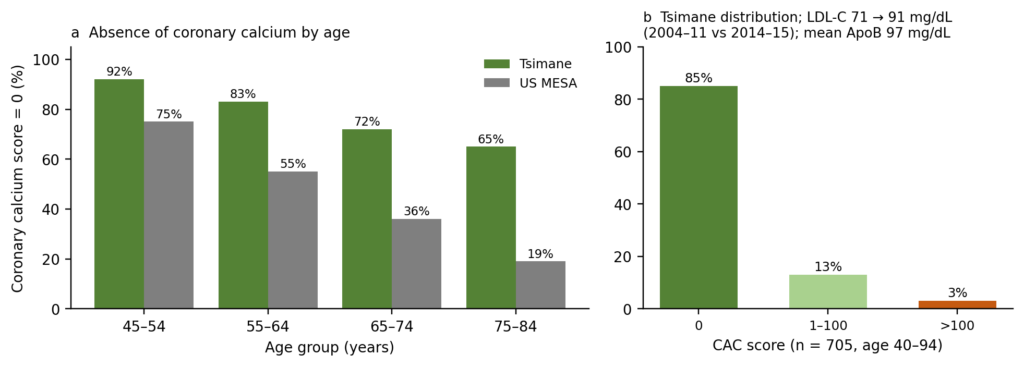
Figura 7. Cálcio nas artérias coronárias na população Tsimane. (a) Proporção com pontuação de cálcio igual a zero por faixa etária, Tsimane versus MESA dos EUA, conforme indicado na Figura 2 de Kaplan 2017. (b) Distribuição das pontuações entre 705 adultos Tsimane. A pontuação de cálcio não detecta placas não calcificadas.
Kitava. Em Kitava, nas Ilhas Trobriand, onde tubérculos, frutas, peixes e coco são alimentos básicos da dieta, entrevistas semiestruturadas com 213 adultos não identificaram nenhum caso correspondente a acidente vascular cerebral, morte súbita ou angina, e descansando eletrocardiogramas apresentou poucas anormalidades [49]. Smoking was common: 76% of men and 80% of women over 20 smoked in the risk-factor survey [50]. The evidence rests on interviews and electrocardiograms rather than imaging or death registration.
What these populations add. None was vegan, and their fat intakes were not uniformly low in saturated fat. The Kitavan diet supplied about 21% of energy as fat and 17% as saturated fat, mostly lauric and myristic acid from coconut [51], a clear exception to the pattern. What rural China, traditional Okinawa, the Tsimane, and Kitava share is diets built from whole, minimally processed staples, leanness, and in most cases high physical activity. The pattern supports the cumulative-exposure argument and the whole-food lever; it provides no support for the claim that complete exclusion of animal foods is required. Fat intake ranged from very low in Okinawa to low among the Tsimane, and coconut was a Kitavan staple.
9. Prospective Cohort Evidence (Tier 3)
The most comprehensive cohort meta-analysis included 13 prospective cohorts with 844,175 participants. Compared with non-vegetarians, vegetarians had lower risk of cardiovascular disease (risco relativo 0.85; 95% CI 0.79 to 0.92; 8 cohorts) and ischemic heart disease (0.79; 95% CI 0.71 to 0.88; 8 cohorts), but not of total stroke (0.90; 95% CI 0.77 to 1.05; 12 cohorts). For vegans the ischemic heart disease estimate was 0.82 (95% CI 0.68 to 1.00; 6 studies), and the cardiovascular disease estimate 0.92 (95% CI 0.79 to 1.06). Risk of bias was moderate in eight cohorts and serious in five [40]. Incidence estimates were used in preference to mortality where both were reported. The IHD association was weaker when early follow-up was excluded, about one-fifth of it appeared attributable to body mass index, and the E-value was 1.86 (lower confidence limit 1.49), meaning an unmeasured confounder would need associations of that strength with both diet and disease to explain it away [40].
The “40% lower coronary risk” figure sometimes attached to vegetarian diets traces to a meta-analysis restricted to Seventh-day Adventist cohorts, which reported a relative risk of 0.60 (95% CI 0.43 to 0.80) for coronary events [2, 52]. That estimate is population-specific and should not be generalized. Several Adventist and Oxford cohorts recur across meta-analyses, so repeated citation is not independent corroboration. Cohort vegetarian and vegan categories are defined by exclusion of animal foods, not by total fat, so none of this evidence tests the very-low-fat component.
Endpoint-specific data matter. In EPIC-Oxford (48,188 participants followed for 18.1 years), vegetarians including vegans had a 22% lower rate of ischemic heart disease than meat eaters (hazard ratio 0.78; 95% CI 0.70 to 0.87), equivalent to about 10 fewer cases per 1,000 people over 10 years; adjustment for self-reported high cholesterol, high blood pressure, diabetes, and body mass index attenuated the estimate to 0.90 (95% CI 0.81 to 1.00). The same group had a 20% higher rate of total stroke (1.20; 95% CI 1.02 to 1.40), about three more cases per 1,000 over 10 years, mostly hemorrhagic, and this association did not attenuate with risk-factor adjustment [41]. Coronary benefit and stroke risk must therefore be reported separately, and the attenuation of the coronary association is consistent with benefit running largely through conventional risk factors.
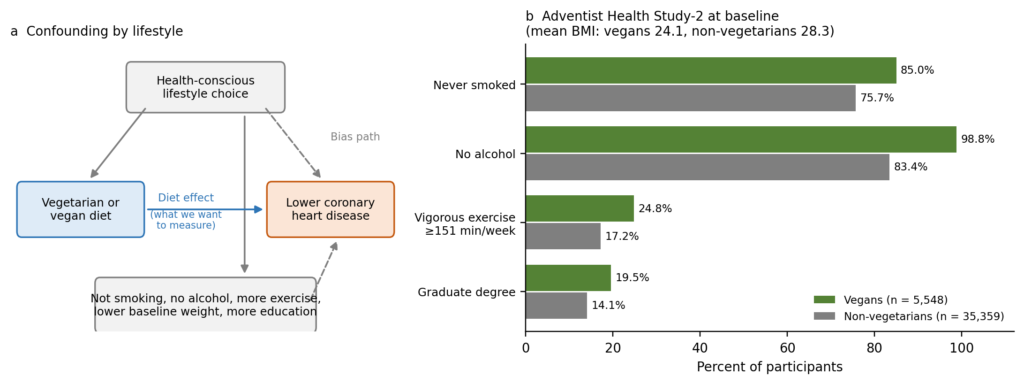
Figure 8. Prospective cohort estimates for vegetarian and vegan diets. The coronary association weakens after adjustment for conventional risk factors (EPIC-Oxford), and stroke risk is not lower. Estimates are shown side by side, not pooled; several cohorts overlap across meta-analyses. Sources: Dybvik 2023; Tong 2019; Orlich 2013; Kwok 2014.
9.1 Healthy-user bias: why associations are hard to read
Cohort studies compare people who chose different diets, and people who choose a vegetarian diet usually choose other healthy habits as well. This is called healthy-user bias, a form of confounding: part or all of an observed difference in disease may come from the other habits rather than from the diet. The Adventist data show the problem clearly. Compared with non-vegetarians in Adventist Health Study-2, vegans were more likely never to have smoked (85.0% versus 75.7%), far more likely to drink no alcohol (98.8% versus 83.4%), more likely to exercise vigorously for at least 151 minutes a week (24.8% versus 17.2%), more likely to hold a graduate degree (19.5% versus 14.1%), and leaner (mean body mass index 24.1 versus 28.3) [53] (Figure 9). The authors note that the conscious lifestyle choice of a vegetarian diet may itself affect the results and that uncontrolled confounding remains possible [53].
Researchers use several tools to reduce this bias, and each has limits. Comparing similar people: in both Adventist Health Study-2 and EPIC-Oxford, the non-vegetarian comparison group is itself relatively health-conscious, and very few Adventists smoke or drink, which narrows the gap without closing it [53]. Statistical adjustment: models adjust for smoking, exercise, education, and similar factors, but only for factors that were measured, and only as accurately as they were measured. Watching what adjustment does: when EPIC-Oxford added cholesterol, blood pressure, diabetes, and body mass index to its model, the vegetarian–ischemic heart disease hazard ratio moved from 0.78 to 0.90 [41]; this suggests much of the benefit runs through those risk factors, which is expected if the diet works, and it also shows how sensitive the estimate is to modeling choices. Quantifying robustness: in the Dybvik meta-analysis, an unmeasured confounder would need a relative risk of 1.86 with both diet and heart disease to explain the association away [40]. Duration and age: in a pooled analysis of five cohorts, lower ischemic heart disease mortality in vegetarians was restricted to people who had followed their diet for more than five years, and it was larger at younger ages (45% lower below age 65, 31% lower at 65–79, and 8% lower, not significant, at 80–89) [54]. A relation with duration of diet is what a causal effect would produce, although long-term vegetarians may also differ in other long-term habits.
Two further observations cut both ways. A meta-analysis found a larger ischemic heart disease association in Adventist cohorts (relative risk 0.60) than in non-Adventist cohorts (0.84; 95% CI 0.74 to 0.96) [52]. That difference could reflect stronger healthy-user effects among Adventists, or it could reflect what Adventist vegetarians actually eat: Adventist vegans reported about 46–47 g of fiber a day, compared with about 26–28 g in EPIC-Oxford vegans [53]. And causalidade reversa—people changing diet after early illness—is reduced but not eliminated by excluding people with prior cardiovascular disease at enrollment, as both cohorts did [41, 53].
None of this means cohort evidence should be set aside. It is large, long, consistent across countries, and aligned in direction with randomized lipid trials and with biology. It should be read as Tier 3 evidence: strong for association, supportive but not decisive for cause, and unable on its own to rank one healthy diet against another.
Figure 9. Healthy-user bias. (a) How a lifestyle choice can link a diet to lower heart disease through paths other than the diet itself. (b) Baseline characteristics of vegans and non-vegetarians in Adventist Health Study-2, standardized by age, sex, and race as reported in Orlich 2013.
9.2 Do vegans do better than other vegetarians?
Vegan diets exclude all animal foods; lacto-ovo vegetarian diets include dairy and eggs; pesco-vegetarian diets include fish. If complete exclusion of animal foods added protection, vegans should do better than the other groups. The cohort data do not show that (Figure 10).
Adventist Health Study-2. Compared with non-vegetarians, the hazard ratio for ischemic heart disease death was 0.90 (95% CI 0.60 to 1.33) for vegans, 0.82 (0.62 to 1.06) for lacto-ovo vegetarians, and 0.65 (0.43 to 0.97) for pesco-vegetarians, the only statistically significant reduction [53]. Among men, vegans had hazard ratios of 0.45 (0.21 to 0.94) for ischemic heart disease death and 0.58 (0.38 to 0.89) for cardiovascular death; among women the corresponding estimates were 1.39 (0.87 to 2.24) and 1.18 (0.88 to 1.60) [53]. The whole cohort recorded 372 ischemic heart disease deaths over a mean of 5.79 years, so these subgroup estimates are imprecise, and the association of vegetarian diet with cardiovascular mortality differed significantly by sex [53]. In the longer 2024 follow-up of 88,400 participants, vegetarians overall had lower ischemic heart disease mortality, but a vegan diet was not associated with lower mortalidade por todas as causas in men and women combined; vegan men had lower mortality only at younger ages [55].
EPIC-Oxford and pooled cohorts. Compared with meat eaters, ischemic heart disease incidence in EPIC-Oxford was 0.82 (0.64 to 1.05) in vegans (67 cases), 0.77 (0.69 to 0.86) in lacto-ovo vegetarians, and 0.87 (0.77 to 0.99) in fish eaters [41]. In the pooled analysis of five cohorts, ischemic heart disease mortality was 26% lower in vegans and 34% lower in both lacto-ovo vegetarians and fish eaters than in regular meat eaters [54]. A systematic review of vegan diets found that none of three cohort studies, including at least 7,380 vegans, reported a significantly higher or lower risk of any primary cardiovascular outcome for vegans [56].
What this does and does not show. Vegans are few, so their estimates are wide and inconclusive rather than null. More important for this review, the vegans in these cohorts were not following VLF-WFPB: EPIC-Oxford vegans obtained 28.1% of energy from fat and ate about 26 g of fiber a day [41], neither very low in fat nor especially high in whole foods. These cohorts do not establish that vegans have lower cardiovascular risk than lacto-ovo vegetarians or fish eaters; they also do not establish equivalence or inferiority, since each group is compared with meat eaters rather than with the others, and in EPIC-Oxford the vegan point estimate was numerically lower than the fish eaters’. Within Adventist Health Study-2, protein from nuts and seeds was associated with 40% lower cardiovascular mortality, and protein from meat with 61% higher mortality, comparing highest with lowest quintiles; these associations persisted after adjustment for vegetarian diet type [57]. That pattern favors plant protein and nuts. It does not favor excluding nuts or all animal foods.
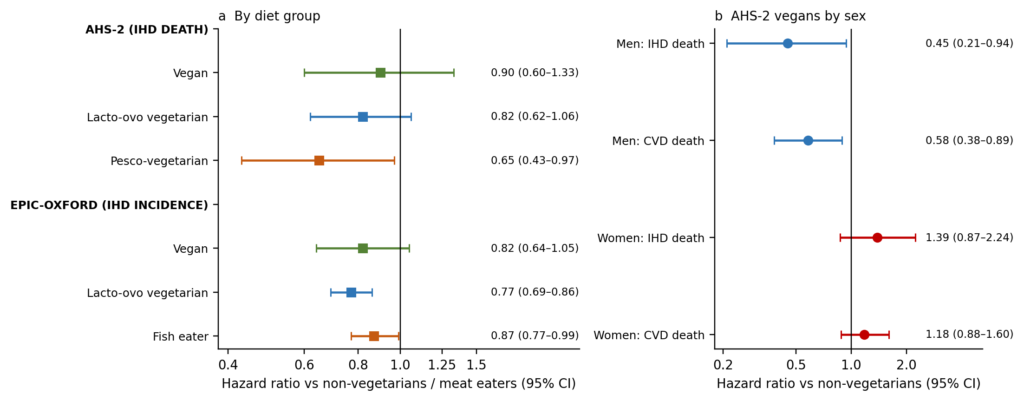
Figure 10. Vegans compared with other vegetarian groups. (a) Ischemic heart disease by diet group in Adventist Health Study-2 (deaths) and EPIC-Oxford (incident cases), each compared with non-vegetarians or meat eaters. (b) Adventist Health Study-2 vegans by sex. Wide intervals reflect small numbers of vegans. Sources: Orlich 2013 (Table 4); Tong 2019 (Supplementary Table 3).
9.3 Chinese and Taiwanese vegetarians
The search for this review found no prospective study from mainland China comparing vegans with omnivores for heart disease outcomes. The available Chinese and Taiwanese evidence concerns vegetarians, most of whom eat dairy and often eggs. In Taiwan, two Buddhist Tzu Chi cohorts (13,352 participants in total) found lower stroke risk among vegetarians: in the first cohort, the hazard ratio for ischemic stroke was 0.26 (95% CI 0.08 to 0.88); in the second, overall stroke 0.52 (0.33 to 0.82), ischemic stroke 0.41 (0.19 to 0.88), and hemorrhagic stroke 0.34 (0.12 to 1.00) [58]. Participants were members of a Buddhist foundation, a population with its own healthy-user profile, and an exploratory analysis suggested that vitamin B12 intake modified the association [58]. The hemorrhagic stroke result runs opposite to EPIC-Oxford’s [41], a reminder that stroke subtypes behave differently across populations.
In a cross-sectional study from Xiamen, 169 healthy Chinese lacto-vegetarian men had lower blood pressure, LDL-C, ApoB, triglycerides, and fasting glicose, and thinner carotid espessura intimal-medial, than 126 omnivorous men [59]. This is Tier 4 evidence on marcadores substitutos in dairy-eating vegetarians.
Hong Kong data add a caution. Vitamin B12 deficiency was reported in about 80% of Hong Kong vegans, who rarely used fortified foods or supplements; B12-deficient vegetarian groups showed impaired arterial endothelial function and thicker carotid walls, and B12 supplementation improved these vascular measures in Hong Kong vegans [60]. An unsupplemented vegan diet can therefore undermine the vascular benefit it is meant to provide, which reinforces the nutrient guidance in Section 15.
10. Esselstyn’s Studies Reassessed (Tier 4)
10.1 The 1985 Cleveland Clinic cohort
Three reports describe this cohort, and their denominators differ. The full 1995 report describes 22 patients (21 men, 1 woman) with severe, angiographically documented coronary disease enrolled between 1985 and 1988; the 11 participants whose results are reported all had triple-vessel disease and were nondiabetic, nonhypertensive nonsmokers [42]. The diet derived less than 10% of energy from fat and excluded oils, meat, fish, fowl, and dairy except skim milk and nonfat yogurt. Every participant also received an individualized cholesterol-lowering drug, most often cholestyramine 4 g twice daily with lovastatin 40–60 mg daily; relaxation and meditation training was offered but abandoned within weeks, and exercise was not prescribed [42]. In the 11 imaged participants, mean total cholesterol fell from 246 mg/dL at baseline to 132.4 mg/dL during treatment, with mean LDL-C 71.6 mg/dL and HDL-C 36.3 mg/dL [42].
Of 38 lesions with more than 20% stenosis in those 11 participants, three treated by angioplastia and four native-vessel lesions proximal to bypass grafts were excluded a priori—the latter because, as the authors note, such lesions were expected to progress, and they did—and six more could not be matched at follow-up, leaving 25 [42]. Two technicians masked to angiografia sequence read the films. By percent diameter stenosis, 11 of 25 lesions regressed and 14 were stable, mean stenosis fell from 53.4% to 46.2% (estimated decrease 7 percentage points; 95% CI 3.3 to 10.7), and 8 of 11 participants were classified as regressing. By minimal lúmen diameter, the less reference-dependent measure, 6 lesions regressed, 14 were stable, and 5 progressed, and the mean increase was 0.08 mm (95% CI −0.06 to 0.22; not significant) [42].
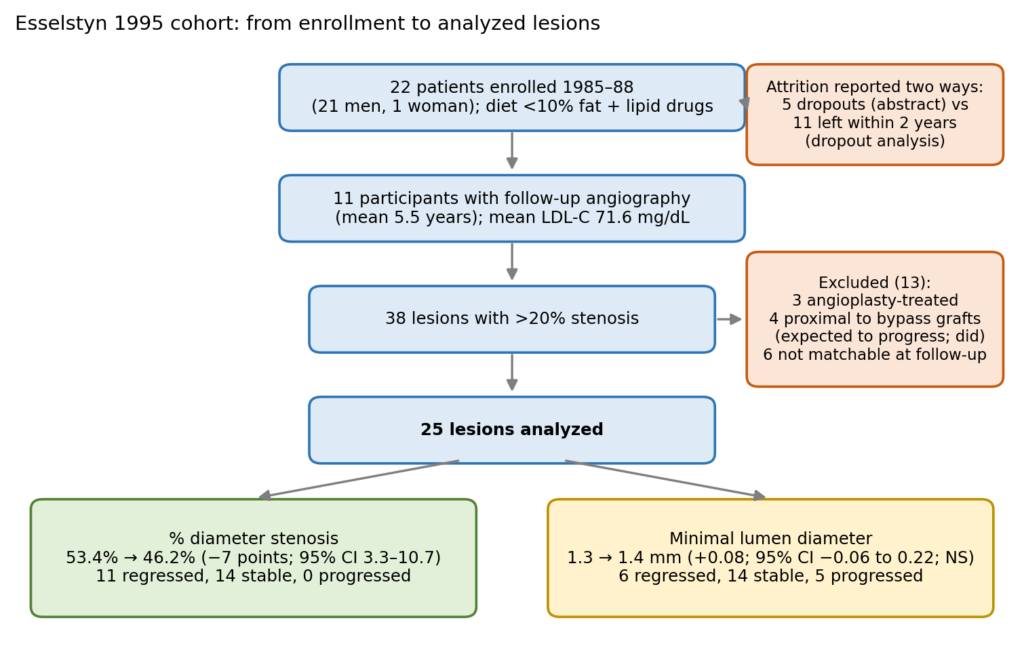
Figure 11. Esselstyn 1995 cohort: enrollment, attrition, lesion selection, and angiographic results by the two methods reported. Source: Esselstyn 1995 (full text).
The same paper reports attrition two ways. Its abstract states that 5 of 22 participants dropped out within two years and 17 maintained the diet; its dropout analysis states that 11 left within two years (three moved, four had work conflicts, three could not maintain the diet, and one chose cirurgia de ponte de safena) [42]. The five dropouts who resumed their previous diet reported 10 eventos cardíacos. The 11 imaged participants had experienced 37 cardiovascular events in the eight years before enrollment. None had a new infarction during follow-up, although two required coronary procedures during the study (repeat angioplasty in one, bypass surgery in the other) and the patient who had bypass surgery, whose fração de ejeção was below 20%, later died of an arrhythmia [42].
The 1999 update describes the cohort as 24 patients (23 men, 1 woman). Six nonadherent patients were released within 12–18 months and returned to standard care; 18 adhered for five years, and 11 of them had five-year angiography showing arrest in all 11 and regression in 8 (73%) by percent stenosis. Mean cholesterol fell from 237 to 137 mg/dL over five years and was 145 mg/dL at 12 years. The 18 adherent patients were reported to have had 49 coronary events in the eight years before enrollment and none during follow-up, while the six released patients had 13 new events by 1998 [5]. “No coronary events” reflects the report’s own event classification: the same cohort included a ventricular-arrhythmic death without infarction after five-year angiography [42]. The 2014 report gives yet another summary, stating that 17 of 22 patients were adherent and that reversão was angiographically confirmed in 4 of 12 [4]. Baseline cholesterol (246 versus 237 mg/dL), cohort size (22 versus 24), and prior-event counts (37 events in 11 patients in the 1995 discussion versus 49 in 18 patients in 1999) differ across reports. Two different 73% figures circulate: 8 of 11 imaged patients with regression by percent stenosis, and 16 of 22 original patients still following the diet in 1995 [5, 42].
Comparing events after enrollment with events in the preceding eight years is vulnerable to regression to the mean, because patients typically enter such programs after a cluster of events. The regimen combined diet with drugs, so the diet’s independent contribution cannot be estimated.
10.2 The 2014 cohort of 198 patients
Design and enrollment. Two hundred consecutive self-referred volunteers with cardiovascular disease were counseled; two were lost to follow-up, leaving 198 (91% men; mean age 62.9 years; mean follow-up 44.2 ± 24.1 months). Coronary disease was documented in 195, by angiography or CT angiography in 180; 44 had a prior myocardial infarction. All were nonsmokers; 161 had hyperlipidemia, 60 hypertension, and 23 diabetes. The intervention was a single five-hour seminar with follow-up by telephone or email, and patients continued their usual cardiac medications, which were not recorded. Exercise was encouraged but not required [4].
Adherence and data collection. Patients who avoided all meat, fish, and dairy, and knowingly any added oil, were classified as adherent. Data were collected by telephone in 2011–2012, from relatives for those who had died. No lipid values were reported [4].
Outcomes, with denominators. Of 177 adherent patients, 112 reported angina at baseline, of whom 104 (93% in the text; the table gives 105, 94%) improved. “Reversal” was documented in 39 of 177 (22%) by radiographic or stress testing. Eighteen of 177 (10%) were classified as worse: the investigators judged nine of these events unrelated to the diet (including two coronary bypass operations in asymptomatic patients persuaded by their physicians, stent trombose after clopidogrel was stopped, and a stroke after warfarin was refused) and four as disease progression (one stroke, two bypass operations, one restenting). There were five non-cardiac deaths and no cardiac deaths. The headline 0.6% event rate counts only the stroke as a progression-related major event; a supplementary table in the same article instead lists a 2.2% event rate for adherent patients [4]. Of 21 nonadherent patients, 13 (62%) had at least one event: two sudden cardiac deaths, one heart transplant, two ischemic strokes, four stenting procedures, three bypass operations, and one endarterectomy [4].
Why the contrast is not causal. The groups were not randomized; participants self-selected into a program they sought out; adherence was self-reported and classified after the fact; the investigators ascertained and adjudicated events by telephone and decided which were diet-related; imaging was clinically driven rather than protocol-driven; medication use was not recorded; and seven of the nonadherent group’s events were revascularização procedures, which depend on symptoms and physician decisions. Adherent and nonadherent patients also differed at baseline, for example 93% versus 76% men [4]. The crude 62% versus 0.6% contrast can be divided, but the quotient is not a valid causal relative risk or número necessário para tratar: the groups were not randomized, and the event definitions applied to them are not comparable. Participants enrolled after 2007 received a copy of the senior author’s book as part of the program [4].
10.3 What Esselstyn’s work can and cannot carry
Esselstyn’s program deserves prominence for three reasons. It is the most intensive real-world expression of the whole-food lever: no oil, no animal foods in the 2014 cohort, no processed foods, and abundant leafy greens. It shows that some motivated patients with severe disease can sustain such a diet for years, with 16 of 22 original patients still following it in 1995 [42] and 89% self-reported adherence in the 2014 cohort [4]. And it generated specific, testable hypotheses—leafy-green nitrate and nitric oxide, endothelial protection, oil exclusion—that Section 5 evaluates against independent evidence.
What it cannot carry is causal weight for the beyond-ApoB claim or for the superiority claim. The 1995 cohort combined diet with cholestyramine and lovastatin and achieved mean LDL-C of 71.6 mg/dL, a level at which concomitant drug therapy is a plausible explanation for part of the angiographic result, though the uncontrolled design cannot establish that drugs alone account for it or that this LDL-C guarantees arrest of progression [42]; only 11 patients were imaged, 13 of 38 lesions were excluded, and the paper reports attrition two ways (Figure 11). The 2014 cohort had no lipid data, self-reported adherence, and investigator-adjudicated outcomes (Section 10.2). Considered alongside randomized lipid trials, two observations nonetheless become more plausible: sustained very low LDL-C achieved with a whole-food diet plus drugs is compatible with arrest of angiographic disease in most imaged patients [20, 21], and angina improved in most patients, consistent with the randomized Ornish and Heidelberg findings [6, 61, 62]. Unresolved are the diet’s independent contribution, whether excluding oil, nuts, and avocado adds anything, the true event rate in a representative population, and how the results would compare with an equally supported Mediterranean or higher-fat whole-food program.
11. Randomized and Controlled Lifestyle Trials (mainly Tier 2)
11.1 The Lifestyle Heart Trial
Design. Of 193 potentially eligible patients, 93 remained eligible after angiography and were randomized by an invitational design (53 experimental, 40 control); 28 and 20 respectively agreed to participate, giving the 48 trial participants. Thirty-five (20 experimental, 15 control) completed five-year angiografia coronariana quantitativa, read blind to allocation [6]. The intervention combined a 10%-fat whole-foods vegetarian diet with moderate exercício aeróbico, stress management (87 minutes per day at one year, 49 at five years), smoking cessation, and group psychosocial support. Experimental patients took no lipid-lowering drugs; 9 of 15 control patients (60%) started them between years one and five [6].
Angiography: which report, which cohort. Two reports describe this trial and are often quoted interchangeably, which makes them look inconsistent. The 1990 Lancet report covers the first year in all 48 participants, analyzing 195 lesions: mean percent diameter stenosis fell from 40.0% (SD 16.9) to 37.8% (16.5) in the experimental group and rose from 42.7% (15.5) to 46.1% (18.5) in controls; among lesions more than 50% stenosed the change was 61.1% to 55.8% versus 61.7% to 64.4%; and 18 of 22 experimental patients (82%) changed in the direction of regression [63]. The 1998 JAMA report covers the 35 participants who completed five-year angiography, a subset with slightly different baseline values (38.92% experimental, 42.50% control), and reports changes rather than start-and-end values [6]. The figures below are from the 1998 report unless stated; a 1990 value and a 1998 value should never be compared directly, because they describe different patients.
Percent diameter stenosis changed by −3.07 percentage points (95% CI −5.91 to −0.24) in the experimental group and +11.77 points (95% CI 3.40 to 20.14) in controls at five years (P = 0.001), corresponding to a 7.9% relative improvement and a 27.7% relative worsening [6]. These are changes in lumen narrowing, not a 7.9% removal of plaque volume. Minimum lumen diameter was unchanged in the experimental group (+0.001 mm) and fell 0.34 mm in controls (P = 0.05). The reference (“normal”) segment diameter decreased slightly in the experimental group (−0.13 mm) and widened slightly in controls (P = 0.01) [6]. Because percent stenosis is calculated relative to that reference segment, a stable minimum diameter with a narrowing reference segment will register as reduced stenosis; the authors interpreted the reference-segment change as flow streamlining [6]. Within the experimental group, stenosis change tracked adherence tertiles (−6.81, −3.02, and −0.37 points; n = 6, 7, and 6), an observational analysis within a randomized trial [6].
Lipids. LDL-C fell from 143.8 to 86.6 mg/dL (−40%) at one year and was 115.4 mg/dL (−20%) at five years; triglycerides rose (227.8 to 258.2 mg/dL at one year), HDL-C fell (40.1 to 34.8 mg/dL at five years), and ApoB returned to baseline by year five as described in Section 5.6. LDL-C did not differ between groups at five years, largely because most controls took lipid-lowering drugs [6].
Events and angina. Over five years there were 25 cardiac events among 28 experimental patients and 45 among 20 controls (rate ratio for controls 2.47; 95% CI 1.48 to 4.20) [6]. These are recurrent-event counts, not numbers of patients with an event, and they are dominated by procedures and hospitalizations: myocardial infarction 2 versus 4, angioplasty 8 versus 14, bypass surgery 2 versus 5, cardiac hospitalizations (which include those events) 23 versus 44, and deaths 2 versus 1 [6]. Hard events were too few for comparison. Reported angina frequency fell 91% within the experimental group at one year (with a 42% fall in duration and a 28% fall in severity) and 72% at five years [6, 63]; between-group differences were no longer significant at five years because the most symptomatic controls had undergone revascularization [6]. The control-group change in angina frequency at one year is given as a 186% increase in the 1998 paper but as 165% in the 1990 report [6, 63]; the difference has not been reconciled and both are stated here.
Attrition and bias. Seven patients lacked one-year angiograms, and four in each group lacked five-year angiograms; fourteen lesions were unavailable overall—four in the experimental group and ten in controls, including four control lesions excluded after revascularization—which would bias toward the null [6]. A correction notice added an omitted author [6].
Interpretação. Randomization supports a causal reading of the comparison between the whole lifestyle package and usual care of the time, though post-allocation consent and attrition limit that confidence. The inability to isolate diet is a limitation of attribution, not an absence of randomization. Participation was selected after allocation: 93 patients were randomized by the invitational design and 48 then consented. Similar consent proportions in the two arms do not eliminate selection bias, and small size and attrition are further limitations.
11.2 PET perfusion (Gould 1995)
Gould and colleagues reported that, in the same 20 experimental and 15 control patients, the size and severity of perfusion abnormalities on rest–dipyridamole PET improved with the lifestyle intervention and worsened in controls, who received mainly antianginal therapy [61]. This is a functional outcome in the same patients, not an independent replication, and it is distinct from ventricular function and angiographic anatomy. Freeman and colleagues’ summary of a “400% increase in perfusão miocárdica” could not be traced to this report and should not be reused [2].
11.3 The Multicenter Lifestyle Demonstration Project
This nonrandomized project followed 333 patients eligible for revascularization: 194 who chose the lifestyle program and 139 controls who underwent revascularization. At three years, 150 of 194 experimental patients (77%) had avoided revascularization, and rates of myocardial infarction, stroke, and death per patient-year were similar between groups [64]. The 77% describes procedure avoidance among self-selected patients; it is not a randomized 77% reduction in procedures or events. Freeman and colleagues’ statement that demonstration projects produced a “greater than 90% reduction in angina within weeks” cites this project and a 24-site program evaluation [2, 65]; the specific study, outcome, and time point could not be traced, and the verified one-year 91% figure from the Lifestyle Heart Trial cannot support a claim about weeks.
11.4 Lower-fat but non-vegan angiographic trials
In STARS, 90 men with coronary disease were randomized to usual care, a lipid-lowering diet (27% of energy from fat), or the diet plus cholestyramine, with angiography at 39 months. Mean absolute width of coronary segments narrowed 0.201 mm with usual care, was unchanged with diet alone (+0.003 mm), and widened 0.103 mm with diet plus cholestyramine; the proportion with progression was 46%, 15%, and 12% respectively [66]. In the Heidelberg trial, 113 men were randomized to usual care or intensive exercise plus a low-fat, low-cholesterol diet without lipid drugs; at one year, lesions progressed in 23% versus 48% and regressed in 32% versus 17% [62]. At six years, 90 patients were re-evaluated, and lipid differences between groups were no longer significant [67]. In DISCO-CT, 92 patients with nonobstructive disease on optimal medical therapy were randomized to added intensive dietary counseling with a DASH-type pattern and activity checks, or to medical therapy alone; after about 67 weeks, noncalcified plaque volume fell more with the intervention (−51.3 versus −21.3 mm³; P = 0.045), although the change in total ateroma volume did not differ significantly between groups [68]. At about six years, most of the weight lost during the intervention had been regained in both groups, and one major adverse cardiovascular event had occurred in the DASH group versus four (including one fatal myocardial infarction) among controls—too few events for inference [69]. These trials show that omnivorous or lower-fat regimens well above 10–15% fat also slowed progression.
12. The Strongest Competing Evidence (Tiers 1–2)
12.1 DASH and DASH-Sodium
In controlled feeding of 459 adults for eight weeks, the DASH combination diet lowered systolic and diastolic pressure by 5.5 and 3.0 mm Hg more than a typical American control diet, and by 11.4 and 5.5 mm Hg in the 133 participants with hypertension [11]. Combining DASH with low sodium lowered systolic pressure by 7.1 mm Hg in normotensive participants and 11.5 mm Hg in those with stage 1 hypertension, compared with the high-sodium control diet [16]. These benefits were achieved with low-fat dairy in the diet.
12.2 PREDIMED
The 2013 PREDIMED report was retracted because of randomization irregularities and republished in 2018 with reanalysis. Among 7,447 adults at high cardiovascular risk followed for a median of 4.8 years, major cardiovascular events occurred in 96 of 2,543 participants (3.8%) assigned a Mediterranean diet plus extra-virgin olive oil, 83 of 2,454 (3.4%) assigned a Mediterranean diet plus nuts, and 109 of 2,450 (4.4%) in the control group advised to reduce dietary fat (hazard ratios 0.69, 95% CI 0.53 to 0.91, and 0.72, 95% CI 0.54 to 0.95); results were similar after excluding 1,588 participants with known or suspected protocol departures [12]. The control arm received advice, not a very-low-fat plant-based diet.
12.3 The Lyon Diet Heart Study
In 605 survivors of a first myocardial infarction followed for a mean of 46 months, the Mediterranean-type diet reduced cardiac death plus nonfatal infarction (composite 1: 14 versus 44 events), composite 1 plus angina instável, stroke, insuficiência cardíaca, and embolism (composite 2: 27 versus 90), and composite 2 plus minor events requiring hospitalization (composite 3: 95 versus 180) [70]. The abstract reports adjusted risk ratios ranging from 0.28 to 0.53 across the three composites; the supplementary table of the 2014 Esselstyn article assigns 0.28 (95% CI 0.15 to 0.53) to composite 1 [4, 70]. Summaries of “up to 65%” or “70%” reductions do not match any single endpoint and should be avoided. The comparator was a prudent Western-type diet rather than a healthy active diet [10], and the intervention supplied an alpha-linolenic-acid-rich margarine in place of butter and cream [13]. Lyon shows that a plant-rich but not plant-exclusive diet with substantial unsaturated fat reduced recurrent events.
12.4 CORDIOPREV
CORDIOPREV randomized 1,002 patients with coronary heart disease to a Mediterranean diet (at least 35% fat; 40–60 g/day of extra-virgin olive oil) or a low-fat, high-complex-carbohydrate diet (less than 30% fat, less than 10% saturated fat, lean meat and low-fat dairy permitted), with equally intensive dietitian support and a median seven-year follow-up. Achieved fat was 40.5% of energy in the Mediterranean arm and 32.1% in the low-fat arm. The primary composite occurred in 87 (17.3%) versus 111 (22.2%) patients (unadjusted hazard ratio 0.745; 95% CI 0.563 to 0.986; adjusted models 0.719 to 0.753). Benefit was statistically demonstrable in men (hazard ratio 0.669; 95% CI 0.489 to 0.915), while the estimate in the smaller subgroup of 175 women was inconclusive rather than showing absence of benefit; no single component differed significantly; lipids and glucose did not change differently between diets; and 86.6% took statins at baseline. More low-fat participants abandoned their diet (17.2% versus 9.2%). The trial was funded principally by olive-oil foundations [10].
CORDIOPREV challenges the broad claim that less total fat is always better: within the 30–40% range, among omnivores on statins, the higher-fat Mediterranean diet did better. It does not test a 10–15% fat, animal-free, whole-food diet, which differs from its low-fat arm in fat level, animal-food content, and food processing.
12.5 Direct comparisons of plant-exclusive and Mediterranean diets
No trial has compared these diets on clinical events, and the three risk-factor trials below provide related but distinct comparisons rather than one comparison repeated. In a 16-week crossover trial in 62 overweight adults (52 completers), a low-fat vegan diet reduced body weight by 6.0 kg with no change on a PREDIMED-style Mediterranean diet (treatment effect −6.0 kg; 95% CI −7.5 to −4.5), and lowered LDL-C by 15.3 mg/dL with no significant change on the Mediterranean diet (treatment effect −14.8 mg/dL; 95% CI −23.5 to −6.2), whereas the Mediterranean diet lowered systolic pressure more (treatment effect +6.0 mm Hg favoring Mediterranean; 95% CI 1.0 to 10.9) [23]. The lipid estimate covers the 43 participants with no change in lipid-lowering medication and the blood-pressure estimate the 41 with no change in antihypertensive medication; a significant carryover effect for systolic pressure appeared in the analysis of all participants, including those whose medication changed, but not in the stable-medication subgroup [23]. Reported fat intake at the end of the vegan phase was 17% of energy (95% CI 15 to 19), so the trial tested a low-fat vegan diet rather than a 10–15%-fat one, and one participant’s sequence assignment was changed after randomization so that a mother and daughter followed the same diet [23]. The trial was conducted by an organization that advocates plant-based diets. In CARDIVEG, a three-month crossover in 107 low-risk overweight adults, energy-restricted lacto-ovo-vegetarian and Mediterranean diets produced similar weight and fat loss; LDL-C fell more on the vegetarian diet, triglycerides fell more on the Mediterranean diet, and vitamin B12 fell on the vegetarian diet [71]. EVADE CAD compared a vegan diet with the AHA diet at similar fat intakes (Section 5.3) [9]. Only Barnard compared a vegan with a Mediterranean diet; CARDIVEG compared a lacto-ovo vegetarian diet with a Mediterranean one, and EVADE compared a vegan diet with the AHA diet. Read separately, each found the plant-based arm lowering LDL-C at least as much, with the Mediterranean comparator better on blood pressure (Barnard) or triglycerides (CARDIVEG); these are not three replications of a single comparison.
12.6 The Cochrane review and the event gap
The 2021 Cochrane review of vegan diets (search to February 2020) included 13 randomized trials with at least 12 weeks of follow-up; none reported cardiovascular clinical endpoints. Only one trial, of 63 participants, addressed prevenção secundária against another dietary intervention, and showed no clear effect on lipids or blood pressure (low- or very-low-certainty evidence) [72]. Its stricter eligibility—vegan only, minimum 12 weeks, active or minimal-intervention comparators—explains why its conclusions are more cautious than those of the Koch and Wang meta-analyses, which admitted vegetarian diets and different comparators [7, 22]. An updated search for this review, through 10 September 2026, found no published randomized trial of a very-low-fat vegan diet with cardiovascular events as an outcome. The absence of event evidence is a gap, not evidence of no benefit. Pooled analyses also need checking for cohort overlap: the 1990 one-year and 1998 five-year Lifestyle Heart Trial reports describe the same randomized cohort, so an analysis that enters them as separate trials double-counts one cohort and inflates precision.
Direct comparisons are used wherever available. Diets are not ranked by comparing effect sizes across unrelated trials, because populations, background therapy, adherence, and endpoints differ.
Figure 12 displays the randomized trials with clinical outcomes discussed in this section alongside the Lifestyle Heart Trial’s recurrent-event ratio.
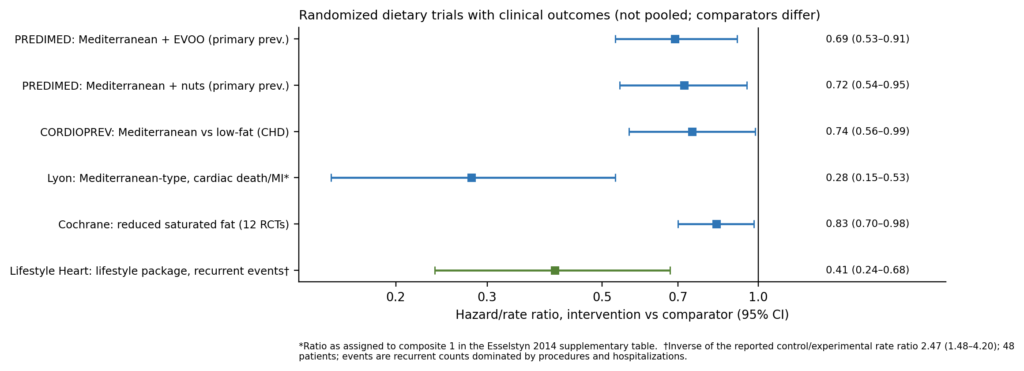
Figure 12. Randomized dietary trials with clinical outcomes. Estimates are shown side by side, not pooled; comparators, populations, and endpoints differ. No randomized trial of a very-low-fat vegan diet has reported clinical events.
12.7 Applying the same standard to the comparator trials
This review has examined the Esselstyn and Ornish studies closely, and the trials that favor Mediterranean diets deserve the same scrutiny. Table 2 asks the same questions of each. The aim is not to label any trial worthless but to be clear about what each can support.
PREDIMED. The 2018 republication documents the main problems itself. Sealed envelopes were used to conceal allocation only during part of the pilot phase; 425 household members were enrolled without randomization and given the same diet as their relative; at one site, 467 participants were assigned by clinic rather than individually; and randomization tables were used inconsistently at another site [12]. The authors reanalyzed the trial with statistical adjustment, and the results were similar when the 1,588 affected participants were excluded (hazard ratios 0.71 and 0.68 in the remaining 5,859) [12]. The control group received a yearly leaflet with low-fat advice until September 2006 and only afterward the same frequency of contact as the Mediterranean groups; its total fat intake changed little, so PREDIMED compared a supplemented Mediterranean diet with a lightly advised usual diet, not with a true low-fat diet [12]. Benefit was also present among participants recruited after control-group contact was increased—hazard ratio 0.49 (95% CI 0.26 to 0.92) versus 0.77 (0.59 to 1.00) before the October 2006 change (P = 0.21 for heterogeneity)—which argues against unequal support as the sole explanation, though a recruitment-period comparison cannot exclude some contribution from it [12]. Study discontinuation was 11.3% in the control group versus 4.9% in the Mediterranean groups. The olive oil and nuts were donated by producers and supplied free, participants knew their assignment, and only the endpoint committee was blinded [12]. The trial was stopped at its fourth interim analysis [12], and trials stopped early for benefit tend to overestimate effect size. Finally, the composite result was driven mainly by stroke (combined hazard ratio 0.58; 95% CI 0.42 to 0.82), whereas myocardial infarction (0.80; 0.53 to 1.21), cardiovascular death (0.80; 0.51 to 1.24), and death from any cause (0.98; 0.77 to 1.24) did not differ significantly; the authors attribute this to limited power [12] (Figure 13).
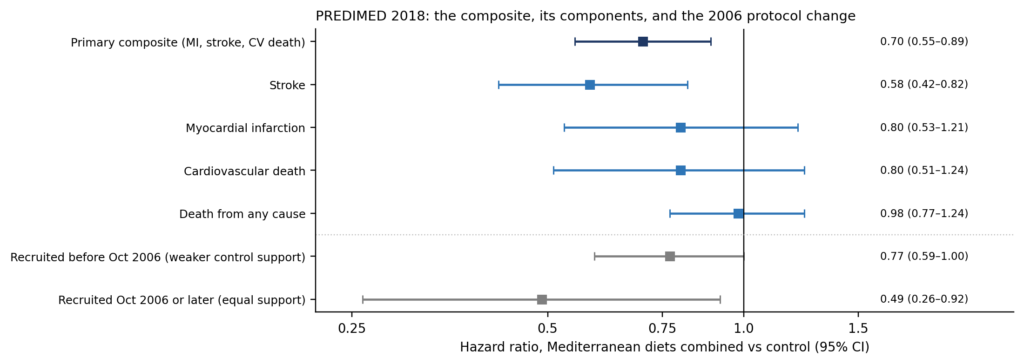
Figure 13. PREDIMED 2018: the composite result and its components (Mediterranean diets combined versus control), and the effect before and after the October 2006 increase in control-group support. Source: Estruch 2018, Table 3 and text.
Lyon Diet Heart Study. Lyon randomized 605 survivors of a first myocardial infarction in a single-blind design and was stopped early for benefit at a mean of 27 months, with follow-up later extended to 46 months [13, 14, 70]. Its comparator was a prudent Western-type diet rather than an intensively supported healthy diet [70]. The large reduction in events occurred while serum lipids, blood pressure, and body mass index remained similar between groups [14]. That is a genuine signal that a dietary pattern can reduce events through pathways other than lipid lowering (Section 5), but it comes from a small, early-stopped trial whose effect size is likely inflated.
CORDIOPREV. CORDIOPREV was a single-center trial funded principally by olive-oil foundations; benefit was statistically demonstrable only in men, with an inconclusive estimate in the smaller female subgroup; no single component of the composite was significant; and its low-fat arm reached 32.1% of energy from fat [10]. It has the strongest design of the three because both arms received equally intensive support, but it tests a moderate-fat omnivorous comparator, not a very-low-fat plant diet.
Problems shared across nutrition science. Several weaknesses apply to almost every study in this review, whichever diet it favors. Diet is usually measured by questionnaire; in Adventist Health Study-2, questionnaire validity correlations against repeated 24-hour recalls were 0.76 for carne vermelha but 0.53 for fish in white participants [53]. Participants in diet trials know what they are eating. Adherence fades, as shown by control-group discontinuation in PREDIMED, diet abandonment in CORDIOPREV, and declining adherence scores in the Lifestyle Heart Trial [6, 10, 12]. Comparators are often weak: PREDIMED’s early control group, Lyon’s prudent diet, and the Lifestyle Heart Trial’s usual care. Trials are often small or stopped early. And interests run in every direction: olive-oil and nut producers, program developers, and advocacy organizations have all funded or led studies discussed here [4, 10, 12, 23].
What the critique changes. These limitations lower confidence in the size of the Mediterranean benefit and in any claim that the Mediterranean diet is proven superior. They do not raise the standing of VLF-WFPB, which has no randomized trial with clinical events at all. A randomized trial with clinical events, even a flawed one, addresses the causal question that an uncontrolled case series cannot, though its weight still depends on bias, precision, and how directly it tests the diet in question. Applying the same skepticism to both sides is what allows this review’s conclusions to be trusted.
Table 2. Applying the same questions to the main trials on each side of the debate.
| Question | PREDIMED | CORDIOPREV | Lyon Diet Heart | Lifestyle Heart Trial | Esselstyn 2014 cohort |
| Evidence tier | 1 | 1 | 1 | 2 (small event counts) | 4 |
| Randomized? | Yes, with deviations affecting 1,588 of 7,447; envelopes used only in part of pilot [12] | Yes [10] | Yes [14] | Yes, invitational; half of eligible declined [6] | No [4] |
| Who was blinded? | Endpoint committee only [12] | Endpoint adjudicação reported as masked; participants and dietitians not blinded, as in any dietary trial | Single-blind design [14] | Single-blind design [14] | No one; investigators adjudicated events [4] |
| Comparator | Advice to reduce fat; yearly leaflet until 2006, then equal contact; total fat changed little [12] | Equally supported low-fat diet; 32.1% fat achieved [10] | Prudent Western-type diet [70] | Usual care; 60% started lipid drugs [6] | Nonadherent volunteers [4] |
| Stopped early? | Yes, at 4th interim analysis [12] | Median 7-year follow-up [10] | Yes, at 27 months; later extended to 46 months [13, 14] | Yes, at 27 months; later extended to 46 months [13, 14] | Not applicable |
| What drove the result | Stroke 0.58; MI 0.80 and CV death 0.80 not significant [12] | Benefit demonstrable in men; estimate in 175 women inconclusive; no single component significant [10] | Large reductions with similar serum lipids, BP, and BMI [14] | Procedures and hospitalizations (recurrent counts) [6] | Revascularizations in nonadherent group [4] |
| Interests | Olive oil and nuts donated by producers [12] | Principally olive-oil foundations [10] | Not assessed here | Not assessed here | Program developer; book given to participants [4] |
| Diet tested vs VLF-WFPB | Supplemented Mediterranean vs lightly advised usual diet | Mediterranean 40.5% fat vs omnivorous low-fat 32.1% | ALA-rich Mediterranean-type | ALA-rich margarine plus Mediterranean-type advice | Oil-free, animal-free, no nuts or avocado |
13. Is Very Low Total Fat Itself Better?
Separate the fats. Saturated fat raises LDL-C and its reduction lowers events [26]; industrial trans fat should be avoided [73]; unsaturated fats lower LDL-C when they replace saturated fat and are associated with event reduction in Mediterranean trials [10, 12]. “Total fat” bundles these opposite effects.
What replaces the fat matters. In VLF-WFPB the replacement is intact grains, legumes, vegetables, and fruit; in other low-fat diets it may be refined starch or sugar. No trial has contrasted these replacements within a plant-exclusive diet on clinical outcomes.
The only direct test within a whole-food plant diet. Em um estudo randomizado cruzado, 40 adultos com risco cardiovascular estimado de pelo menos 5% seguiram uma dieta vegana à base de alimentos integrais de origem vegetal, com cerca de quatro colheres de sopa ou menos de uma colher de chá de azeite extravirgem por dia, durante quatro semanas cada; a gordura forneceu 48% e 32% de energia, respectivamente. Ambas as fases reduziram o LDL-C, o colesterol total, a ApoB, o HDL-C, a glicose e a hs-CRP em relação ao valor basal. Houve uma interação entre as fases: a mudança da dieta com alto teor de azeite para a de baixo teor reduziu o LDL-C em 12,7 mg/dL (P = 0,04), e a mudança da dieta com baixo teor para a de alto teor aumentou-o em 15,8 mg/dL (P = 0,02); no primeiro período, o LDL-C caiu 25,5 contra 16,7 mg/dL (P = 0,162) [8]. Nenhuma das fases se aproximou de 10–15% de gordura; o estudo foi curto, e o efeito de arrastamento complica a análise cruzada. Isso sugere que grandes adições de óleo podem atenuar a redução do LDL-C; não demonstra, porém, que a ingestão de 10–15% de gordura seja melhor do que uma dieta vegetal à base de nozes e sementes, com cerca de 30%.
Nozes, sementes e azeite de oliva. As dietas mediterrâneas ricas em azeite extravirgem ou complementadas com nozes reduziram a incidência de eventos em comparação com os grupos de referência [10, 12]. Nenhum estudo demonstra que a exclusão de nozes, sementes ou azeite de oliva de uma dieta que, de resto, seja pobre em gorduras saturadas melhora os resultados clínicos. O comprometimento agudo da dilatação mediada pelo fluxo após uma única refeição rica em gordura [30], citado em apoio à exclusão do petróleo [4], não é possível comprovar que os óleos causem aterosclerose.
Triglicerídeos, HDL, e ApoB–LDL-C discordância. Dietas com teor muito baixo de gordura e alto teor de carboidratos podem elevar os triglicerídeos e reduzir o HDL-C, como observado no primeiro ano do Estudo Lifestyle Heart Trial [6]; em todos os ensaios clínicos com base em plantas, os triglicerídeos não apresentaram alterações [22], e as dietas mediterrâneas reduziram os triglicerídeos mais do que uma dieta vegetariana no estudo CARDIVEG [71]. Quando as lipoproteínas ricas em triglicerídeos aumentam, o LDL-C pode apresentar valores subestimados número de partículas aterogênicas. O estudo Lifestyle Heart Trial ilustra isso: ao fim de cinco anos, o LDL-C estava 20% abaixo do valor basal, enquanto a ApoB não estava [6]. Estudos futuros deveriam medir a ApoB diretamente.
Atribuição. Nos casos em que a dieta VLF-WFPB apresenta melhor desempenho do que um grupo de comparação em relação ao LDL-C, essa vantagem pode refletir a quantidade de gordura, a qualidade da gordura (quase ausência de gordura saturada), a qualidade dos alimentos (fibras, proteína vegetal), a perda de peso ou a adesão à dieta. O estudo cruzado de Barnard, por exemplo, produziu tanto reduções maiores no LDL-C quanto maior perda de peso com a dieta vegana [23]. Não há nenhum estudo disponível que separe essas contribuições. Com base nas evidências atuais, o teor muito baixo de gordura total não está estabelecido como uma necessidade independente; o teor muito baixo de gordura saturada dentro de uma dieta à base de alimentos integrais é o componente com o maior suporte causal.
14. Prevenção, tratamento e reversão
14.1 Resultados que não devem ser confundidos
Menos eventos cardiovasculares, progressão mais lenta, estabilização da placa, a melhora da angina ou da perfusão, a redução da estenose angiográfica e a regressão do volume da placa, medida quantitativamente, são desfechos diferentes. A prevenção primária e a prevenção secundária também são contextos distintos.
14.2 O que os exames de imagem podem e não podem mostrar
A angiografia coronária quantitativa mede o lúmen, e não a placa. A porcentagem de estenose depende do segmento de referência e de tônus vasomotor, e a remodelação externa (positiva) pode ocultar uma placa substancial por trás de um lúmen normal. A perfusão miocárdica e os testes de esforço medem a função; pode ocorrer melhora sem regressão anatômica, conforme observaram os pesquisadores de Heidelberg [62]. Ultrassom intravascular e angiotomografia coronariana medir o volume e a composição da placa; a tomografia computadorizada, além disso, caracteriza as placas não calcificadas e placa de baixa atenuação. Os índices de cálcio coronariano podem aumentar quando a placa se estabiliza, pois as estatinas aumentam a placa calcificada e fibrosa ao mesmo tempo em que reduzem os componentes fibro-gordurosos e com núcleo necrótico; portanto, a variação no índice de cálcio, por si só, não indica nem sucesso nem fracasso [74]. A placa pode aumentar substancialmente de tamanho antes que a angiografia detecte o estreitamento [74]; por outro lado, um lúmen aparentemente mais amplo pode refletir alterações no tônus vasomotor, e não uma placa menor. Em uma metarregressão resumida por Dawson e colegas, cada redução de 1% em volume percentual de ateroma foi associado a uma redução de cerca de 20% nas chances de ocorrência de eventos adversos graves, mas não há evidências diretas de que a regressão, por si só, reduza esses eventos [74]. Table 3 summarizes what each finding can and cannot establish.
Table 3. What symptom and imaging findings can and cannot establish.
| Finding | What it establishes | What it does not establish |
| Less angina; better teste de estresse or PET perfusion [6, 61, 62] | Better symptoms or myocardial blood supply | A measured loss of plaque |
| Reduced angiographic percent stenosis | A less narrowed lumen relative to a reference segment | The percentage of plaque removed; reference-segment changes can alter the result [6] |
| Change in minimum lumen diameter | Absolute lumen change at the lesion | Plaque volume, which remodelação externa can hide [74] |
| CCTA or IVUS plaque volume or composition change | Change in the measured plaque compartment, within acquisition and segmentation limits | Eradication of disease or a guaranteed event reduction |
| Rising coronary calcium score | A higher Escore de Agatston, which reflects calcified area, density, or both | Greater total plaque burden or treatment failure; statins increase placa calcificada while reducing fibrofatty and núcleo necrótico [74] |
14.3 The primate and pharmacologic benchmarks
Two bodies of evidence set the standard against which dietary regression claims should be read. Neither is a dietary trial in humans, and both are cited here as benchmarks rather than as support for any diet.
Controlled primate experiments (Tier 5). In rhesus monkeys given an atherogenic diet and then switched to a regression diet, atheromatous artérias coronárias lost lipid [75], while arterial fibrous proteins behaved differently from the lipid compartment [76]. The achieved cholesterol level mattered: in animals whose plasma cholesterol was held near 300 mg/dL there was little or no increase in lumen area attributable to regression of intimal plaque, whereas at about 200 mg/dL a considerable share of the lumen gain was attributable to plaque regression, and the contribution depended on both plaque size and time [77]. This is the closest thing in the literature to a controlled demonstration that lowering atherogenic lipoproteins by dietary means depletes the lipid-rich compartment while denser tissue persists. It is also animal evidence, in a different species, with induced rather than spontaneous disease, and it cannot establish what a human diet achieves.
Pharmacologic imaging (Tiers 1–2). Em GLAGOV, 968 statin-treated patients with angiographic coronary disease were randomized to monthly evolocumabe ou placebo for 76 weeks, and 846 had evaluable serial intravascular ultrasound. Time-weighted LDL-C was 36.6 mg/dL versus 93.0 mg/dL, percent atheroma volume changed by −0.95% versus +0.05% (difference −1.0 percentage point; P < 0.001), and plaque regression occurred in 64.3% versus 47.3% of patients [78]. Notably, the trial’s virtual-histology substudy did not show a difference in dense calcium volume [78], so GLAGOV demonstrates volumetric regression rather than a compositional shift; trials designed to measure plaque composition are outside the scope of this review and no compositional figures are quoted. Two comparisons follow. No dietary trial has produced coronary regression of this magnitude under this level of rigor, and no dietary trial identified here used serial intravascular ultrasound at all, which is the modality that measures atheroma volume most precisely.
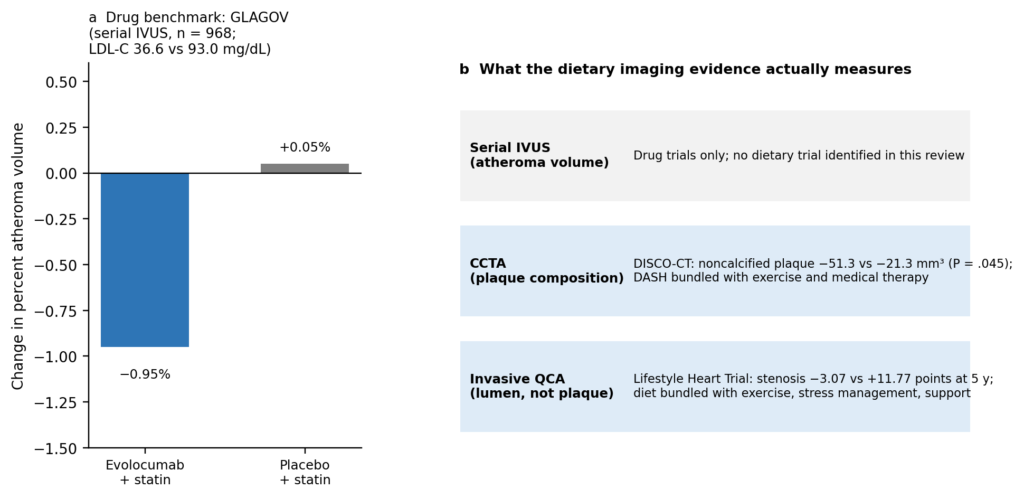
Figure 14. Benchmarks for coronary plaque change. Pharmacologic regression measured by serial intravascular ultrasound (GLAGOV) alongside the dietary imaging evidence available in this review, which uses different modalities and cannot be placed on the same axis. No dietary trial identified here used serial intravascular ultrasound. Sources: Nicholls 2016; Henzel 2021; Ornish 1998.
Exercise as a co-lever. Physical activity belongs alongside the three dietary levers rather than inside them. The populations with the least coronary calcium are also the most active: Tsimane men average six to seven hours and women four to six hours of physical activity a day [35]. In the two randomized imaging trials that showed benefit, exercise was part of the intervention rather than a controlled covariate—the Lifestyle Heart Trial bundled aerobic exercise with the diet [6], and DISCO-CT bundled activity counseling with DASH [68]—which is why neither can apportion credit. No quantitative estimate of the ApoB reduction attributable to aerobic training is given here; the point stands qualitatively that diet, activity, and lipid-lowering therapy act on overlapping pathways and are complementary rather than competing.
14.4 What the evidence supports in each domain
Prevenção primária. Evidence consists of cohort associations [40], population data (Sections 6–8), and randomized lipid trials [22]. No randomized event trial of VLF-WFPB exists.
Secondary prevention (treatment). The Lifestyle Heart Trial reduced angina and cardiac procedures and hospitalizations for a package that included a very-low-fat vegetarian diet [6]. Randomized event reductions with diet alone in secondary prevention come from Mediterranean-type trials [10, 70].
Slowed progression and partial regression. Intensive lifestyle programs incorporating very-low-fat vegetarian diets have demonstrated modest regressão angiográfica in selected patients; the independent contribution of diet, and of total-fat restriction, remains uncertain [6, 42]. Lower-fat but non-vegan diets also slowed angiographic progression [62, 66], and a DASH-type program added to medical therapy reduced noncalcified plaque on CT [68]. Partial regression appears most likely when large, sustained reductions in atherogenic lipoproteins are achieved, often with drugs, and more regression was seen at five years than at one year in the Ornish program [6]. Regression does not mean eradication of disease or zero future risk.
The Dawson review. As summarized in the ACC’s published key points, the 2022 JACC state-of-the-art review judged the demonstrated effect of diet, exercise, and smoking cessation on coronary plaque volume and composition to be limited [74]. Claims sometimes attributed to that review in secondary summaries, including the assertion that most statin-treated dietary arms progressed, are not used here. Limited diet-only regression evidence does not mean dietary treatment has little clinical value: stabilizing plaque, improving perfusion, and preventing progression can be clinically meaningful even when anatomic change is small, although existing diet trials do not establish the mechanism of any event reduction.
15. Feasibility, Adequacy, and Safety
Adherence. Reported adherence has been high in selected volunteers: 89% by self-report in the 2014 Esselstyn cohort [4], and 94% versus 70% for vegan versus AHA diets at eight weeks in EVADE CAD, whose participants represented 14% of those meeting initial criteria [9]. In the Lifestyle Heart Trial, half of eligible invited patients declined, and the adherence score fell from 1.29 at one year to 1.06 at five years [6]. Over seven years in CORDIOPREV, more patients abandoned a conventional low-fat diet than a Mediterranean diet [10].
Nutrients. Vitamin B12 supplementation is essential; median intake in the EVADE vegan arm fell to 1.2 µg/day, and B12 levels fell during the vegetarian phase of CARDIVEG [9, 71]. Zinc and omega-3 fatty acid intakes were also lower on the vegan diet in EVADE [9]. Calcium, vitamin D, iodine, iron, and long-chain omega-3 status require planning, and fortified foods or supplements are appropriate where intake is inadequate [79]; “whole food” should not become a reason to reject them. Unfortified terrestrial plant foods supply alpha-linolenic acid but little or no preformed EPA or DHA, which algae-derived supplements and fortified products can provide within a vegan diet [79]; Esselstyn’s protocol added flaxseed as an alpha-linolenic acid source [4]. Aggressive fat restriction should not displace necessary energy or essential fats.
Energy and protein. Median protein intake on the EVADE vegan diet was 50 g/day (12.9% of energy) [9]. Energy-unrestricted vegetarian diets reduced energy intake by about 276 kcal/day relative to usual diets [7], and in the 2014 Esselstyn cohort the 135 patients with weight data lost an average of 18.7 lb [4]. Low energy density is an asset for weight loss but a potential hazard for older adults with poor appetite or sarcopenia and for physically active people with high requirements; protein and energy adequacy should be planned individually.
Quality of life. In EVADE CAD, quality-of-life scores improved similarly on both diets [9].
Diet and drugs. Pooled randomized evidence puts the dietary ApoB reduction at about 14% [22]. A matched estimate of ApoB lowering under intensive statin or PCSK9 therapy is not presented here, so no numerical comparison is drawn; the clinical point stands on other grounds. In established ASCVD, diet is a complement to guideline-directed therapy, not a substitute for it, and indicated therapy should not be withheld or stopped in order to follow any diet.
This review is educational. Dietary change should be made alongside, not instead of, prescribed cardiovascular therapy, and medication adjustments belong with the treating physician.
16. Clinical Positioning
The 2023 AHA/ACC guideline for chronic coronary disease recommends a diet emphasizing vegetables, fruits, legumes, nuts, whole grains, and lean protein to reduce cardiovascular events (class 1, level B-R), and states that reducing saturated fat to less than 6% of energy and replacing it with monounsaturated and polyunsaturated fat, complex carbohydrate, and fiber can be beneficial (class 2a) [73]. Its nutrition figure lists monounsaturated fat such as olive oil and polyunsaturated fat among foods to choose [73]. O 2026 ACC/AHA multisociety dyslipidemia guideline, which replaces the 2018 cholesterol guideline, describes preferred dietary patterns as predominantly plant-based—Mediterranean, DASH, and vegan or vegetarian [27].
The AHA’s 2026 dietary guidance lists features of a heart-healthy pattern that include choosing healthy sources of protein, choosing sources of unsaturated fat in place of saturated fat, choosing minimally processed foods, minimizing açúcares adicionados, and reducing sodium [25].
These guidelines support plant-rich dietary treatment and accommodate a vegan pattern. They do not endorse a uniquely effective very-low-fat vegan reversal protocol, and they explicitly include nuts and unsaturated oils. A professional recommendation of a pattern is not evidence that every component or exclusion within a particular diet is necessary.
17. The Decisive Next Study
Primary design. A randomized, parallel-group trial with blinded endpoint assessment in medically treated adults with CT-documented coronary atherosclerosis, deliberately recruiting women, older adults, and patients outside specialist lifestyle programs. Arms: (A) VLF-WFPB, 10–15% of energy from fat, no animal foods, no added oil, limited nuts and avocado; (B) a higher-unsaturated-fat whole-food plant-based diet, about 30–40% fat from nuts, seeds, avocado, and extra-virgin olive oil, no animal foods; (C) a Mediterranean (PREDIMED/CORDIOPREV-style) or DASH diet. A versus B tests total-fat restriction within an animal-free diet; B versus C approximates the effect of animal-food exclusion, although replacement foods will differ. All arms receive identical contact time, cooking instruction, food support, and exercise advice.
Mechanistic substudy. Because the three-arm design cannot fully separate animal-food exclusion from total fat, a controlled-feeding 2 × 2 factorial substudy—animal-free versus limited specified animal foods, crossed with about 10–15% versus 30–35% of energy from fat, with saturated fat, sodium, fiber, protein, and energy matched as closely as feasible—would isolate each factor at stable weight. A third factor—whole versus ultra-processed plant foods at matched macronutrients—would test the processing lever directly, following the design of the inpatient processing trial [19]. Unavoidable differences in replacement foods must be measured and reported.
Two estimands. The pragmatic effect of assigning an ad libitum pattern, including its effects on weight and adherence, differs from the biological effect of dietary composition at stable weight. Adjusting away weight loss in the primary analysis would remove part of the assigned diet’s effect; the feeding substudy addresses composition.
Medication. Every arm follows the same clinical treatment algorithm, and indicated therapy is never withheld to magnify a dietary contrast. Because titration toward lipid targets will partly offset dietary differences in ApoB, the intensity of lipid-lowering therapy required becomes a prespecified secondary outcome, and ApoB is analyzed together with medication intensity. The main trial estimates comparative effectiveness under a common treatment algorithm; it does not by itself equalize cumulative ApoB exposure, and attributing any residual benefit to pathways independent of ApoB would require repeated longitudinal measurement of the mediators and explicit causal assumptions.
Outcomes. Stage 1 primary outcome: 24-month change in percent atheroma volume (or noncalcified plaque volume) on coronary CT angiography, read in a blinded core laboratory on a protocol schedule rather than on symptoms. Secondary outcomes: time-averaged ApoB, non-HDL cholesterol, triglycerides, ambulatory blood pressure, weight and body composition, HbA1c, hs-CRP, TMAO, PET myocardial blood flow, angina (Seattle Angina Questionnaire), function, quality of life, cost, retention, and nutrient status (B12, iron, vitamin D, iodine, omega-3 index). Adherence is measured objectively (plasma fatty-acid profile, carotenoids, urinary nitrogen and potassium) as well as by repeated diet records. Stage 2: an events trial with a hard composite of cardiovascular death, myocardial infarction, and ischemic stroke; procedures are adjudicated blind and reported separately, with both time-to-first-event and recurrent-event analyses.
Analysis. Intention-to-treat primary analysis with prespecified handling of missing data and medication changes; complier-average causal effect and per-protocol analyses as secondary; adherence analyses do not treat adherers as newly randomized groups; mediation analyses using ApoB, weight, and blood pressure are labeled exploratory.
Illustrative sample sizes (assumptions stated). Stage 1: assuming a standard deviation of 3.0 percentage points for the 24-month change in percent atheroma volume, a minimum important between-arm difference of 1.0 point, two primary pairwise comparisons (A versus B; B versus C) each tested at two-sided α = 0.025, and 90% power, about 224 participants per arm are required, or 280 per arm (840 total) allowing 20% attrition. Stage 2: detecting a hazard ratio of 0.80 in each pairwise comparison at two-sided α = 0.025 and 80% power requires about 764 events per comparison; with an assumed four-year first-event risk of 15% in the reference arm, roughly 2,800 participants per arm (about 8,400 total) would be needed. These figures are illustrative; a protocol would need assumptions for adherence, crossover, and drug titration. They also explain why event evidence does not yet exist.
18. Conclusions by Domain
Table 4 (after the main text) summarizes the evidence base, and Table 5 shows whether each proposed advantage is shared with comparator diets or has evidence of additional benefit.
Labels: Established—consistent randomized evidence on the stated outcome. Supported but uncertain—randomized evidence that is small, multicomponent, or on intermediate outcomes, or consistent observational evidence. Biologically plausible—mechanistic or indirect support without adequate outcome evidence. Unsupported—no adequate evidence, or evidence against.
Prevention. That plant-based diets lower LDL-C and ApoB relative to omnivorous diets is established (pooled LDL-C difference about 11.6 mg/dL) [22]. That VLF-WFPB lowers ASCVD incidence relative to a typical Western diet is supported but uncertain: cohort associations (vegetarian IHD relative risk 0.79) are consistent with lipid-mediated plausibility, but there is no randomized event evidence [40]. That it prevents ASCVD better than a Mediterranean or DASH diet is unsupported. Coronary and stroke outcomes should be reported separately: in EPIC-Oxford, vegetarians had lower IHD but higher hemorrhagic and total stroke rates [41].
Treatment. That an intensive lifestyle package including a very-low-fat vegetarian diet reduces angina and cardiac procedures or hospitalizations compared with usual care is supported but uncertain, resting on one small randomized trial from 1986–1992 [6]. That the diet alone reduces events in established disease is biologically plausible. That it reduces events more than a Mediterranean diet, which has randomized secondary-prevention evidence [10, 70], is unsupported.
Regression. That intensive lifestyle programs incorporating very-low-fat vegetarian diets produce modest angiographic regression in selected patients is supported but uncertain [6]. That VLF-WFPB alone produces quantitative plaque-volume regression by intravascular ultrasound or CT is unsupported because it has not been tested. That regression eliminates future risk is unsupported.
Superiority and necessity. That very low total fat is independently necessary for benefit is unsupported; evidence within plant diets is short-term and mixed, and randomized event evidence favors including unsaturated fats in omnivorous diets [8, 10, 12]. That complete exclusion of animal foods adds benefit beyond a low-saturated-fat diet is biologically plausible (zero dietary cholesterol, very low saturated fat, possibly lower TMAO) but untested on outcomes.
Whole foods and processing. That minimally processed plant foods are associated with lower cardiovascular risk, and ultra-processed plant foods with higher risk, is supported but uncertain: large cohorts are consistent, and randomized evidence exists for energy intake but not for atherosclerosis [17–19]. That diet quality and processing matter as much as animal-food exclusion is untested: no study has compared the two levers directly.
Beyond ApoB. That whole-food plant diets protect arteries through pathways beyond ApoB is biologically plausible, with partial observational support: mechanisms are demonstrated in animals, leafy-green nitrate is associated with lower risk in a large cohort after adjustment for hypercholesterolemia, and the Lifestyle Heart Trial showed continued angiographic improvement after ApoB had returned to baseline [6, 28, 29]. It is not established, because no trial has compared diets at matched ApoB.
Vegans compared with other vegetarians. That vegans have lower heart disease risk than lacto-ovo or pesco-vegetarians is unsupported: across Adventist, British, and pooled cohorts, vegan estimates are favorable in direction but inconclusive, and no cohort provides a direct comparison between vegetarian subgroups [41, 53, 54, 56]. The signal among Adventist vegan men is hypothesis-generating.
Role relative to drug therapy. Using diet in place of indicated lipid-lowering or other guideline-directed therapy in established ASCVD is unsupported: no trial reviewed here tested withdrawal of indicated therapy, and every intervention trial showing benefit was delivered alongside it [10, 12, 22].
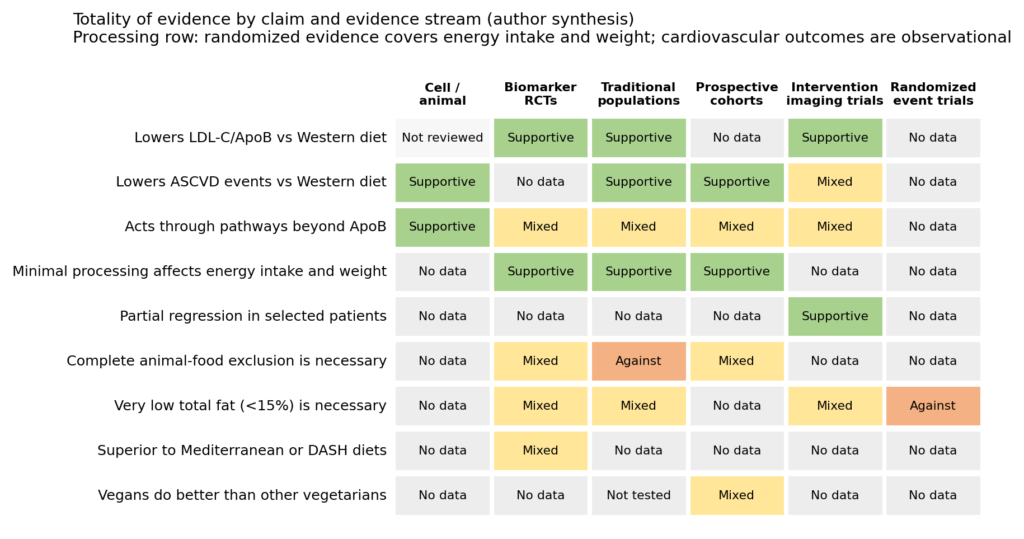
Figure 15. Totality of evidence by claim and evidence stream. Author synthesis of Sections 3–17; “against” marks evidence that contradicts the claim as stated.
19. The Strongest Claim the Evidence Justifies Today
A whole-food, plant-based diet reliably lowers atherogenic lipoproteins compared with typical Western diets, and populations with lifelong low animal-food intake had low cholesterol and low recorded coronary mortality. Intensive lifestyle programs built around very-low-fat vegetarian diets have produced modest angiographic regression, better myocardial perfusion, less angina, and fewer cardiac procedures than usual care in small studies of selected patients. Taken together, this evidence makes it credible that such a diet can help prevent, slow, and in some patients partly reverse coronary atherosclerosis, largely through lower cumulative ApoB exposure. The benefit is most consistently associated with the whole-food character of the diet—minimal processing, high fiber, and abundant vegetables—rather than with the exclusion of animal foods alone, and plausible but unproven evidence suggests that part of it runs through pathways beyond ApoB. The evidence does not establish that excluding all animal foods and nearly all added fat protects better than a well-implemented Mediterranean, DASH, or higher-unsaturated-fat plant-based diet.
A stronger claim would require a randomized comparison of those diets at equal support intensity and equal medical therapy, with ApoB measured throughout, blinded quantitative plaque imaging, and ultimately adjudicated clinical events. Until such data exist, VLF-WFPB is best presented as one evidence-supported option within the family of plant-predominant heart-healthy diets, notable for its LDL-C-lowering potency, rather than as a uniquely effective reversal protocol.
Table 4. Evidence table. Tier: 1 = randomized trial with clinical events; 2 = randomized trial of intermediate outcomes; 3 = prospective cohort; 4 = population comparison, cross-sectional study, or case series (Section 1.2). CI = 95% confidence interval.
| Estudo | Tier | Design, n, duration | Diet as delivered / achieved | Background therapy | Outcomes and effect estimates | Major limitations |
| Koch 2023 meta-analysis [22] | 2 | 30 RCTs; ApoB from 6 trials | Vegetarian or vegan vs omnivorous; fat content varied | Varied; some on lipid drugs | TC −0.34 mmol/L (CI −0.44 to −0.23); LDL-C −0.30 mmol/L (−0.40 to −0.19) ≈ −11.6 mg/dL; ApoB −12.92 mg/dL (−22.63 to −3.20; I² = 71.7%, 6 trials); TG not different | Heterogeneous diets and comparators; short trials; no events; does not isolate fat level; ApoB estimate rests on 6 trials with substantial heterogeneity whose independence could not be confirmed here |
| Wang 2023 meta-analysis [7] | 2 | 20 RCTs, 1,878; mean 25.4 wk | Vegetarian, including Ornish and low-fat vegan | Most on cardiometabolic drugs | LDL-C −6.6 mg/dL (−10.1 to −3.1); HbA1c −0.24% (−0.40 to −0.07); weight −3.4 kg (−4.9 to −2.0); SBP −0.1 mm Hg (−2.8 to 2.6) | LDL-C NS vs active comparators; majority high risk of bias; Key Points text differs from results |
| Rees 2021 Cochrane [72] | 2 | 13 RCTs; ≥12 wk; search to Feb 2020 | Vegan only | — | No trial reported clinical events; one secondary-prevention trial (n = 63): no clear lipid or BP effect | Small trials; dated search; low certainty |
| Dybvik 2023 cohort meta-analysis [40] | 3 | 13 cohorts, 844,175 | Vegetarian or vegan vs non-vegetarian (self-report) | — | IHD RR 0.79 (0.71–0.88; 8 cohorts); CVD 0.85 (0.79–0.92); stroke 0.90 (0.77–1.05); vegan IHD 0.82 (0.68–1.00; 6) | Residual confounding (E-value 1.86); ~1/5 BMI-mediated; weaker excluding early follow-up; fat not assessed |
| EPIC-Oxford [41] | 3 | Cohort; 48,188; 18.1 y | Vegetarians including vegans vs meat eaters; vegans ~28% fat | — | IHD HR 0.78 (0.70–0.87), 0.90 (0.81–1.00) after risk-factor adjustment; total stroke HR 1.20 (1.02–1.40), mostly hemorrhagic; vegan IHD 0.82 (0.64–1.05), lacto-ovo 0.77 (0.69–0.86), fish eaters 0.87 (0.77–0.99) | Observational; self-reported diet and risk factors |
| AHS-2 [53] | 3 | Cohort; 73,308 Adventists; 5.79 y | Vegan, lacto-ovo, pesco-, semi-vegetarian vs non-vegetarian | — | Vegetarians: IHD death 0.81 (0.64–1.02); men 0.71 (0.51–1.00). By group: vegan 0.90 (0.60–1.33), lacto-ovo 0.82 (0.62–1.06), pesco 0.65 (0.43–0.97); vegan men 0.45 (0.21–0.94), vegan women 1.39 (0.87–2.24) | Short follow-up; healthy-user profile (Figure 9); few vegan deaths |
| Plant diet indices [17] | 3 | 3 cohorts; ~209,000; 8,631 CHD | Healthful vs unhealthful plant-based indices | — | CHD HR (extreme deciles): PDI 0.92 (0.83–1.01); hPDI 0.75 (0.68–0.83); uPDI 1.32 (1.20–1.46) | FFQ-based; health professionals; hPDI rewards oils and nuts |
| UK Biobank processing [18] | 3 | Cohort; 126,842; median 9 y | Plant-sourced foods split by ultra-processing | — | Per 10% energy: plant non-UPF CVD 0.93 (0.91–0.95), CVD death 0.87 (0.80–0.94); plant UPF CVD 1.05 (1.03–1.07), death 1.12 (1.05–1.20) | Observational; 24-h recalls; NOVA classification |
| Danish nitrate cohort [29] | 3 | Cohort; 53,150; up to 23 y; 14,088 CVD | Vegetable nitrate quintiles (median 23 vs 59 mg/day) | Adjusted for hypercholesterolemia | CVD HR 0.85 (0.82–0.89); IHD 0.88 (0.82–0.94); ischemic stroke 0.83 (0.76–0.91); PAD 0.74 (0.67–0.83); 21.9% mediated by SBP | Observational; plateau ~60 mg/day; nitrate mainly lettuce and potato |
| Key 1999 pooled cohorts [54] | 3 | 5 cohorts; 76,172; mean 10.6 y | Vegan, lacto-ovo, fish eaters, occasional meat vs regular meat eaters | — | IHD mortality: vegetarians 0.76 (0.62–0.94); vegans 26% lower, lacto-ovo and fish eaters 34% lower; benefit limited to diet >5 y and larger at younger ages | Mortality only; older cohorts; adjusted for age, sex, smoking only |
| AHS-2 2024 [55] | 3 | Cohort; 88,400; ~11 y | Five diet groups | — | Vegetarians lower IHD mortality; vegan diet not associated with all-cause mortality overall; vegan men lower mortality at younger ages | Hazard ratios vary with age; stroke and dementia higher in older vegetarians |
| AHS-2 protein [57] | 3 | Cohort; 81,337; 9.4 y; 2,276 CVD deaths | Protein-source factors | — | CVD mortality: meat factor 1.61 (98.75% CI 1.12–2.32); nuts and seeds factor 0.60 (0.42–0.86) | Factor analysis; FFQ; observational |
| Vegan diets review [56] | 3 | Systematic review; 7 studies; ≥7,661 vegans | Vegan vs non-vegan | — | No cohort showed significantly higher or lower primary CVD risk in vegans | Few vegans; low power |
| Tzu Chi cohorts [58] | 3 | 2 cohorts; 13,352; Taiwan | Buddhist vegetarians (mostly lacto-ovo) vs non-vegetarians | — | Ischemic stroke 0.26 (0.08–0.88) and 0.41 (0.19–0.88); hemorrhagic 0.34 (0.12–1.00) | Stroke only; healthy-user setting; few events |
| Xiamen lacto-vegetarians [59] | 4 | Cross-sectional; 169 vs 126 men | Chinese lacto-vegetarian vs omnivore | — | Lower BP, LDL-C, ApoB, TG, glucose; thinner carotid IMT | Single measurement; surrogate markers; dairy-eating |
| Hong Kong vegans (review) [60] | 4 (review) | Review of cross-sectional and supplementation studies | Vegans and vegetarians with low B12 | — | ~80% B12 deficiency in Hong Kong vegans; impaired FMD and thicker IMT with deficiency; improved with B12 | Surrogate outcomes; caution for unsupplemented vegan diets |
| Tsimane [35] | 4 | Cross-sectional; 705 adults 40–94; CT calcium | 14% fat, 14% protein, 72% carbohydrate; game and fish; unprocessed | Nenhum | CAC 0 in 85%, 1–100 in 13%, >100 in 3%; >75 y: 65% zero; LDL-C 91 mg/dL; ApoB 97 mg/dL | CAC misses noncalcified plaque; cross-sectional; 6–7 h/day activity (men) |
| China Study I [43] | 4 | Ecological; 65 counties, 130 villages; diet 1983–84; mortality 1973–75 | 14% fat; animal protein ~1% of energy; not vegan | Nenhum | Mean TC 127 vs 203 mg/dL (US); CAD mortality ages 0–64: 4.0 (men) and 3.4 (women) vs 66.8 and 18.9 per 100,000 (US) | Ecological; decade gap; ages truncated; ascertainment; activity and competing mortality |
| Okinawa (Willcox) [45, 47] | 4 | Ecological; 1949 survey; vital statistics | ~1,785 kcal/day; sweet potato ~69% of energy; fat ~6%; some pork and fish | Nenhum | Older cohorts reported ~80% lower CHD mortality than US | Post-war scarcity; energy restriction; body size; transition; no individual linkage |
| Esselstyn 1995/1999 [5, 42] | 4 | Case series; 22–24 enrolled; 11 imaged at ~5 y | ≤10% fat; skim milk, nonfat yogurt allowed | Cholestyramine + lovastatin most often | TC 246 → 132.4 mg/dL (LDL-C 71.6); % stenosis 53.4 → 46.2% (−7 points, CI 3.3–10.7); MLD +0.08 mm (−0.06 to 0.22), NS; regression in 8/11 patients by % stenosis | No control; 13 of 38 lesions excluded (4 graft-proximal lesions that progressed); attrition reported as 5 and as 11; drugs; regression to the mean |
| Esselstyn 2014 [4] | 4 | Cohort; 198 (177 adherent, 21 nonadherent); mean 44.2 mo | No animal foods, oil, nuts, avocado; fat not measured | Usual medications, not recorded | Adherent: 1 progression-related stroke per investigators (0.6%); 18/177 “worse” (10%); 0 cardiac deaths. Nonadherent: 13/21 (62%) with ≥1 event, 7 of 13 events revascularizations | Self-selected; self-reported adherence; no lipids; investigator adjudication; not randomized; 2.2% in supplementary table |
| Lifestyle Heart Trial [6, 63] | 2 (events: counts) | RCT (invitational), 48; 35 with 5-y QCA; 5 y | 10% fat vegetarian (nonfat dairy, egg white); achieved 6.2% (1 y), 8.5% (5 y); plus exercise, stress management, support | No lipid drugs (exp.); 60% of controls started them | 5-y (1998 report, n = 35): % diameter stenosis −3.07 (−5.91 to −0.24) vs +11.77 (3.40 to 20.14), P = .001; minimum lumen diameter essentially unchanged (+0.001 mm) vs −0.34 mm (P = .05); 1-y (1990 report, n = 48): 40.0% → 37.8% vs 42.7% → 46.1%, 82% of experimental patients toward regression; events 25 vs 45, rate ratio 2.47 (1.48–4.20); angina −91% at 1 y (within group) | Multicomponent; small; half of eligible declined; attrition; events = recurrent counts, mostly procedures; stenosis and lumen diameter are not plaque volume |
| Gould 1995 PET [61] | 2 | Same trial; 20 vs 15 | As above | As above | Perfusion abnormalities smaller/less severe vs worsening in controls | Not independent; functional endpoint |
| Multicenter Lifestyle Demonstration [64] | 4 | Nonrandomized; 194 vs 139 revascularized; 3 y | Programa Ornish | Not reported | 150/194 (77%) avoided revascularization; similar MI, stroke, death rates per patient-year | Self-selection; comparator is revascularized patients |
| STARS [66] | 2 | RCT; 90 men; 39 mo | Lipid-lowering diet, 27% fat (not vegan) ± cholestyramine | Cholestyramine in one arm | MAWS −0.201 (usual care), +0.003 (diet), +0.103 mm (diet + resin); progression 46%, 15%, 12% | Small; men only; not plant-exclusive |
| Heidelberg [62] | 2 | RCT; 113 men; 12 mo | Low-fat, low-cholesterol diet + intensive exercise | No lipid drugs | Progression 23% vs 48%; regression 32% vs 17% | Exercise co-intervention; lipid differences gone at 6 y |
| DISCO-CT [68] | 2 | RCT; 92; ~67 wk; CCTA | DASH-based counseling + activity + OMT vs OMT | OMT in both arms | Noncalcified plaque −51.3 vs −21.3 mm³ (P = .045); total atheroma change not significantly different; ~6-y follow-up: MACE 1 vs 4 [69] | Single center; not plant-exclusive; weight largely regained; too few events |
| EVADE CAD [9] | 2 | RCT; 100; 8 wk | Vegan vs AHA diet; median fat 29.9% vs 30.2% of energy at 8 wk; unsaturated oils encouraged and olive oil in recipes for both; groceries provided | 94–96% statins | hs-CRP 32% lower (β 0.68, 0.49–0.94); LDL-C 13% lower (β 0.87, 0.78–0.97; NS at Bonferroni α) | Short; biomarker only; not very-low-fat; 14% of those meeting initial criteria enrolled |
| Barnard 2021 crossover [23] | 2 | Crossover RCT; 62 randomized, 52 completers; 16 wk per diet | Low-fat vegan (17% of energy from fat achieved; 95% CI 15–19) vs PREDIMED-style Mediterranean | Lipid estimate in 43 without lipid-drug changes; BP estimate in 41 without antihypertensive changes | Weight −6.0 kg (−7.5 to −4.5) and LDL-C −14.8 mg/dL (−23.5 to −6.2) favoring vegan; SBP +6.0 mm Hg (+1.0 to +10.9) favoring Mediterranean | Short; diet-induced weight loss may mediate the effects, so the direct effect of dietary composition is not isolated; advocacy sponsor; not a 10–15%-fat diet; significant SBP carryover in the all-participant analysis but not in the stable-medication subgroup; 1 participant reassigned after randomization to match a household member |
| CARDIVEG [71] | 2 | Ensaio clínico randomizado cruzado; 107 participantes de baixo risco; 3 meses por dieta | Dieta lacto-ovo-vegetariana de baixa caloria x dieta mediterrânea de baixa caloria | Adultos de baixo risco | Perda de peso semelhante; LDL-C mais baixo na dieta vegetariana; TG mais baixo na dieta mediterrânea; a vitamina B12 diminuiu na dieta vegetariana | Baixo risco; não é vegano nem tem teor de gordura muito baixo |
| Receita para a saúde do coração [8] | 2 | Ensaio clínico randomizado cruzado; 40; 4 semanas por fase | Dieta vegana baseada em alimentos inteiros (WFPB) com alto teor de azeite extravirgem (48% de gordura) versus baixo teor de azeite extravirgem (32% de gordura) | Não especificado | Ambos reduziram o LDL-C e a ApoB; período 1: LDL-C −25,5 vs. −16,7 mg/dL (P = 0,162); interação de sequência | Curto; transição; nenhuma das duas fases é de teor muito baixo de gordura |
| Meta-análise de portfólio [15] | 2 | Estudos controlados; 439 participantes | Frutos secos, proteína vegetal, fibra viscosa e esteróis foram adicionados à dieta do NCEP Step II; o teor de gordura variou entre os ensaios | Variado | LDL-C ~17% mais baixo; ApoB e não-HDL-C também mais baixos | Apenas parâmetros lipídicos; inclui nozes (não com baixo teor de gordura) |
| Análise do ECR [19] | 2 | Crossover de pacientes internados; 20; 2 semanas cada | Alimentos ultraprocessados x não processados, comparados quanto aos nutrientes presentes | — | +508 ± 106 kcal/dia com alimentos ultraprocessados; +0,9 contra −0,9 kg | Resumo: equilíbrio energético, não aterosclerose |
| DASH [11] | 2 | Ensaio clínico randomizado sobre alimentação; 459; 8 semanas | Combinação DASH que inclui laticínios com baixo teor de gordura | — | Pressão arterial −5,5/−3,0 mm Hg; hipertensão −11,4/−5,5 | Apenas ponto final da pressão arterial |
| DASH-Sódio [16] | 2 | Ensaio clínico randomizado sobre alimentação | DASH + dieta com baixo teor de sódio versus grupo controle com dieta rica em sódio | — | PAS −7,1 (normotensão), −11,5 mmHg (hipertensão estágio 1) | Apenas ponto final da pressão arterial |
| PREDIMED 2018 [12] | 1 | RCT; 7.447 participantes de alto risco; mediana de 4,8 anos | Dieta mediterrânea + azeite de oliva extra ou nozes x recomendações para reduzir o consumo de gordura | — | 96/2.543 vs 83/2.454 vs 109/2.450; HR 0,69 (0,53–0,91) Azeite de Oliva Extra Virgem; 0,72 (0,54–0,95) nozes | Relatório de 2013 retirado devido a irregularidades na randomização; grupo de controle baseado em orientações |
| Dieta de Lyon para o Coração [70] | 1 | ECR; 605 pacientes pós-infarto do miocárdio; média de 46 meses | Margarina rica em ALA fornecida em substituição à manteiga e ao creme, além de orientações do tipo mediterrâneo, em comparação com uma dieta ocidental equilibrada | — | Morte cardíaca/infarto do miocárdio: 14 contra 44; desfechos compostos mais amplos: 27 contra 90 e 95 contra 180; RR ajustado: 0,28–0,53 entre os desfechos compostos | Comparador fraco; época de tratamento mais antiga |
| CORDIOPREV [10] | 1 | RCT; 1.002 pacientes com doença cardíaca coronariana (DCC); mediana de 7 anos | Dieta mediterrânea (40,51 TP9T de gordura) vs. dieta onívora com baixo teor de gordura (32,11 TP9T de gordura) | Estatinas 86,6% | 87 (17,31 TP9T) contra 111 (22,21 TP9T); HR 0,745 (0,563–0,986); HR entre homens 0,669 (0,489–0,915); estimativa em 175 mulheres inconclusiva | Estudo realizado em um único centro; financiamento da Fundação do Azeite de Oliva; grupo com dieta com baixo teor de gordura, mas não com dieta VLF-WFPB |
| Hooper 2020 Cochrane [26] | 1 | 12 ensaios clínicos randomizados (RCTs) na análise de eventos principais; 53.758 | Teor reduzido de gordura saturada | — | Risco relativo (RR) de eventos cardiovasculares combinados: 0,83 (0,70–0,98) | Analisa a gordura saturada, e não a gordura total nem a VLF-WFPB |
Tabela 5. Vantagens propostas da dieta VLF-WFPB: são comuns às dietas de comparação ou há evidências de benefícios adicionais?
| Vantagem proposta | Provas principais | Tem a ver com a dieta mediterrânea / DASH? | Evidências de benefícios adicionais da dieta VLF-WFPB | Veredicto |
| Reduzir o LDL-C e a ApoB (baixo teor de gordura saturada, ausência de colesterol na alimentação, fibras e proteínas vegetais) | Ensaios clínicos randomizados (RCTs) agrupados versus dietas onívoras [22]; fusão entre a dieta vegana e a mediterrânea [23]; CARDIVEG [71]; Portfólio [15] | Em parte: todas as dietas com menor teor de gordura saturada; a dieta Portfolio alcança uma redução de aproximadamente 171 TP9T no LDL-C com o consumo de nozes; a dieta mediterrânea reduziu menos o LDL-C em comparações diretas | Algumas intervenções à base de vegetais reduzem o LDL-C e a ApoB mais do que determinados grupos de comparação ao longo de semanas a meses; a superioridade do protocolo específico 10–15%-fat ainda não foi comprovada | Comprovado (biomarcador); não estabelecido para o protocolo específico |
| Perda de peso / baixa densidade energética | Wang [7]; Barnard [23]; Ornish [6] | O mesmo ocorre quando ambas as dietas são restritas em termos de energia [71] | Maior com alimentação ad libitum em ensaios de curta duração | Dependente do contexto |
| Reduzir a pressão arterial | Wang (nulo) [7]; DASH [11, 16]; Barnard [23] | Sim; a dieta DASH e a mediterrânea são equivalentes ou melhores | Nenhum exibido | Não foi observado nenhum benefício adicional |
| Melhor controle glicêmico | Wang, subgrupo de diabetes tipo 2 [7] | Em parte | Em comparação com as dietas convencionais para diabéticos, e não em comparação com a dieta mediterrânea | Supported but uncertain |
| Triglicerídeos e HDL-C | Ornish [6]; Koch [22]; CARDIVEG [71] | A dieta mediterrânea reduz ainda mais os níveis de triglicérides | Dietas com teor muito baixo de gordura podem aumentar os triglicerídeos e reduzir o HDL-C; uma redução do HDL-C, por si só, não indica risco cardiovascular [80], e os triglicerídeos devem ser analisados em conjunto com a ApoB, o colesterol não-HDL e os desfechos | Incerto; possível desvantagem |
| Menos inflamação (hs-CRP) | EVADE CAD [9] | A dieta mediterrânea também reduziu os marcadores inflamatórios no estudo CARDIVEG [71] | vs AHA diet at ~30% fat; not tested at very low fat | Biologically plausible |
| Better endothelial function | Single-meal studies [30, 81]; olive-oil meta-analysis [32]; CORDIOPREV substudy [33]; EVADE EndoPAT [9] | Yes: sustained olive-oil and Mediterranean diets improved FMD | None sustained for VLF-WFPB | Unsupported |
| Lower stroke risk | EPIC-Oxford [41]; Dybvik [40] | — | No: the higher stroke rate in EPIC-Oxford concerns its vegetarian grouping, not VLF-WFPB, which has not been tested for stroke | Not demonstrated either way |
| Clear food rules that aid adherence | Adherence data [4, 6, 9] | Any structured program | Behavioral hypothesis; strictness may help some and deter others | Hypothesis |
| Whole, minimally processed foods | Plant diet indices [17]; UK Biobank [18]; processing RCT [19] | Partly: DASH and Mediterranean are also minimally processed patterns | Strongest non-lipid lever; plant ultra-processed foods associated with higher risk | Supported but uncertain |
| Leafy-green nitrate → nitric oxide | Danish cohort [29] | Yes: any vegetable-rich pattern | Association persists after lipid adjustment; not vegan-specific | Plausible, partly supported |
| Fiber → butyrate | Mouse models [28] | Yes: any high-fiber pattern | Cholesterol-independent in mice; no human outcome data | Biologically plausible |
| Lower TMAO / favorable microbiome | Cohort association [37]; Mendelian randomization null [38] | Partly (fiber-rich patterns) | No outcome evidence; genetic evidence against a causal TMAO effect | Weak hypothesis |
| Exclusion of added oil | Receita para a saúde do coração [8]; PREDIMED [12]; CORDIOPREV [10] | No: EVOO-rich diets reduced events vs comparators | Large oil additions may blunt LDL-C lowering; no event data | Unsupported as necessary |
| Exclusion of nuts and seeds | PREDIMED nut arm [12] | No: nut-supplemented diet reduced events | Nenhum | Unsupported |
| Angiographic slowing or regression | Lifestyle Heart [6]; STARS [66]; Heidelberg [62]; DISCO-CT [68] | Yes: lower-fat non-vegan and DASH-based programs also slowed progression | Package effect only; diet share unknown | Supported but uncertain |
| Complete exclusion of animal foods | AHS-2 [53]; EPIC-Oxford [41]; pooled cohorts [54]; vegan review [56]; AHS-2 protein [57] | Not applicable | None: vegans did not do better than lacto-ovo or pesco-vegetarians; nut and seed protein associated with lower CVD mortality | Unsupported |
Abbreviations: ApoB, apolipoprotein B; BP, blood pressure; CCTA, coronary CT angiography; CHD, coronary heart disease; EVOO, extra-virgin olive oil; IHD, ischemic heart disease; MAWS, mean absolute width of coronary segments; MLD, minimal lumen diameter; NS, not significant; OMT, optimal medical therapy; QCA, quantitative coronary angiography; RCT, ensaio clínico randomizado; TC, total cholesterol; TG, triglycerides; VLF-WFPB, very-low-fat whole-food plant-based.
Referências
- Wang T, Masedunskas A, Willett WC, Fontana L. Vegetarian and vegan diets: benefits and drawbacks. Eur Heart J. 2023;44(36):3423–3439. doi:10.1093/eurheartj/ehad436.
- Freeman AM, Morris PB, Barnard N, et al. Trending cardiovascular nutrition controversies. J Am Coll Cardiol. 2017;69(9):1172–1187. doi:10.1016/j.jacc.2016.10.086. PMID 28254181.
- Kahleova H, Levin S, Barnard ND. Vegetarian dietary patterns and cardiovascular disease. Prog Cardiovasc Dis. 2018;61(1):54–61. doi:10.1016/j.pcad.2018.05.002. PMID 29800598.
- Esselstyn CB Jr, Gendy G, Doyle J, Golubic M, Roizen MF. A way to reverse CAD? J Fam Pract. 2014;63(7):356–364b. PMID 25198208.
- Esselstyn CB Jr. Updating a 12-year experience with arrest and reversal therapy for coronary heart disease (an overdue requiem for palliative cardiology). Am J Cardiol. 1999;84(3):339–341, A8. doi:10.1016/S0002-9149(99)00290-8. PMID 10496449.
- Ornish D, Scherwitz LW, Billings JH, et al. Intensive lifestyle changes for reversal of coronary heart disease. JAMA. 1998;280(23):2001–2007. doi:10.1001/jama.280.23.2001. PMID 9863851. Correction (author list): JAMA. 1999;281(15):1380.
- Wang T, Kroeger CM, Cassidy S, et al. Vegetarian dietary patterns and cardiometabolic risk in people with or at high risk of cardiovascular disease: a systematic review and meta-analysis. JAMA Netw Open. 2023;6(7):e2325658. doi:10.1001/jamanetworkopen.2023.25658. PMID 37490288.
- Krenek AM, Mathews A, Guo J, et al. Recipe for Heart Health: a randomized crossover trial on cardiometabolic effects of extra virgin olive oil within a whole-food plant-based vegan diet. J Am Heart Assoc. 2024;13(15):e035034. doi:10.1161/JAHA.124.035034. PMID 39045758.
- Shah B, Newman JD, Woolf K, et al. Anti-inflammatory effects of a vegan diet versus the American Heart Association–recommended diet in coronary artery disease trial. J Am Heart Assoc. 2018;7(23):e011367. doi:10.1161/JAHA.118.011367. PMID 30571591.
- Delgado-Lista J, Alcala-Diaz JF, Torres-Peña JD, et al. Long-term secondary prevention of cardiovascular disease with a Mediterranean diet and a low-fat diet (CORDIOPREV): a randomised controlled trial. Lancet. 2022;399(10338):1876–1885. doi:10.1016/S0140-6736(22)00122-2. PMID 35525255.
- Appel LJ, Moore TJ, Obarzanek E, et al. A clinical trial of the effects of dietary patterns on blood pressure. DASH Collaborative Research Group. N Engl J Med. 1997;336(16):1117–1124. doi:10.1056/NEJM199704173361601. PMID 9099655.
- Estruch R, Ros E, Salas-Salvadó J, et al. Primary prevention of cardiovascular disease with a Mediterranean diet supplemented with extra-virgin olive oil or nuts. N Engl J Med. 2018;378(25):e34. doi:10.1056/NEJMoa1800389. PMID 29897866. (Replaces the retracted 2013 report.)
- Kris-Etherton P, Eckel RH, Howard BV, St Jeor S, Bazzarre TL. AHA science advisory: Lyon Diet Heart Study. Benefits of a Mediterranean-style, National Cholesterol Education Program/American Heart Association Step I dietary pattern on cardiovascular disease. Circulation. 2001;103(13):1823–1825. doi:10.1161/01.CIR.103.13.1823.
- de Lorgeril M, Renaud S, Mamelle N, et al. Mediterranean alpha-linolenic acid-rich diet in secondary prevention of coronary heart disease. Lancet. 1994;343(8911):1454–1459. doi:10.1016/S0140-6736(94)92580-1.
- Chiavaroli L, Nishi SK, Khan TA, et al. Portfolio dietary pattern and cardiovascular disease: a systematic review and meta-analysis of controlled trials. Prog Cardiovasc Dis. 2018;61(1):43–53. doi:10.1016/j.pcad.2018.05.004. PMID 29807048.
- Sacks FM, Svetkey LP, Vollmer WM, et al. Effects on blood pressure of reduced dietary sodium and the Dietary Approaches to Stop Hypertension (DASH) diet. N Engl J Med. 2001;344(1):3–10. doi:10.1056/NEJM200101043440101. PMID 11136953.
- Satija A, Bhupathiraju SN, Spiegelman D, et al. Healthful and unhealthful plant-based diets and the risk of coronary heart disease in U.S. adults. J Am Coll Cardiol. 2017;70(4):411–422. doi:10.1016/j.jacc.2017.05.047. PMID 28728684.
- Rauber F, Louzada MLC, Chang K, et al. Implications of food ultra-processing on cardiovascular risk considering plant origin foods: an analysis of the UK Biobank cohort. Lancet Reg Health Eur. 2024;43:100948. doi:10.1016/j.lanepe.2024.100948. PMID 39210945.
- Hall KD, Ayuketah A, Brychta R, et al. Ultra-processed diets cause excess calorie intake and weight gain: an inpatient randomized controlled trial of ad libitum food intake. Cell Metab. 2019;30(1):67–77.e3. doi:10.1016/j.cmet.2019.05.008.
- Ference BA, Ginsberg HN, Graham I, et al. Low-density lipoproteins cause atherosclerotic cardiovascular disease. 1. Evidence from genetic, epidemiologic, and clinical studies. A consensus statement from the European Atherosclerosis Society Consensus Panel. Eur Heart J. 2017;38(32):2459–2472. doi:10.1093/eurheartj/ehx144. PMID 28444290.
- Cholesterol Treatment Trialists’ (CTT) Collaboration. Efficacy and safety of more intensive lowering of LDL cholesterol: a meta-analysis of data from 170 000 participants in 26 randomised trials. Lancet. 2010;376(9753):1670–1681. doi:10.1016/S0140-6736(10)61350-5. PMID 21067804.
- Koch CA, Kjeldsen EW, Frikke-Schmidt R. Vegetarian or vegan diets and blood lipids: a meta-analysis of randomized trials. Eur Heart J. 2023;44(28):2609–2622. doi:10.1093/eurheartj/ehad211. PMID 37226630.
- Barnard ND, Alwarith J, Rembert E, et al. A Mediterranean diet and low-fat vegan diet to improve body weight and cardiometabolic risk factors: a randomized, cross-over trial. J Am Nutr Assoc. 2022;41(2):127–139. doi:10.1080/07315724.2020.1869625. PMID 33544066.
- McMurry MP, Connor WE, Cerqueira MT. Dietary cholesterol and the plasma lipids and lipoproteins in the Tarahumara Indians: a people habituated to a low cholesterol diet after weaning. Am J Clin Nutr. 1982;35(4):741–744. doi:10.1093/ajcn/35.4.741.
- Lichtenstein AH, Khera A, Anderson CAM, et al. 2026 dietary guidance to improve cardiovascular health: a scientific statement from the American Heart Association. Circulation. Published online 31 March 2026. doi:10.1161/CIR.0000000000001435.
- Hooper L, Martin N, Jimoh OF, Kirk C, Foster E, Abdelhamid AS. Reduction in saturated fat intake for cardiovascular disease. Cochrane Database Syst Rev. 2020;(8):CD011737. doi:10.1002/14651858.CD011737.pub3. (Version of record superseding the May 2020 issue, PMID 32428300.)
- Blumenthal RS, Morris PB, Gaudino M, et al. 2026 ACC/AHA/AACVPR/ABC/ACPM/ADA/AGS/APhA/ASPC/NLA/PCNA guideline on the management of dyslipidemia: a report of the American College of Cardiology/American Heart Association Joint Committee on Clinical Practice Guidelines. Circulation. 2026. doi:10.1161/CIR.0000000000001423. Also J Am Coll Cardiol. doi:10.1016/j.jacc.2025.11.016.
- Kasahara K, Krautkramer KA, Org E, et al. Interactions between Roseburia intestinalis and diet modulate atherogenesis in a murine model. Nat Microbiol. 2018;3(12):1461–1471. doi:10.1038/s41564-018-0272-x.
- Bondonno CP, Dalgaard F, Blekkenhorst LC, et al. Vegetable nitrate intake, blood pressure and incident cardiovascular disease: Danish Diet, Cancer, and Health Study. Eur J Epidemiol. 2021;36(8):813–825. doi:10.1007/s10654-021-00747-3.
- Vogel RA, Corretti MC, Plotnick GD. Effect of a single high-fat meal on endothelial function in healthy subjects. Am J Cardiol. 1997;79(3):350–354. doi:10.1016/S0002-9149(96)00760-6. PMID 9036757.
- Vogel RA, Corretti MC, Plotnick GD. The postprandial effect of components of the Mediterranean diet on endothelial function. J Am Coll Cardiol. 2000;36(5):1455–1460. doi:10.1016/S0735-1097(00)00896-2. PMID 11079642.
- Schwingshackl L, Christoph M, Hoffmann G. Effects of olive oil on markers of inflammation and endothelial function—a systematic review and meta-analysis. Nutrients. 2015;7(9):7651–7675. doi:10.3390/nu7095356. PMID 26378571.
- Yubero-Serrano EM, Fernandez-Gandara C, Garcia-Rios A, et al. Mediterranean diet and endothelial function in patients with coronary heart disease: an analysis of the CORDIOPREV randomized controlled trial. PLoS Med. 2020;17(9):e1003282. doi:10.1371/journal.pmed.1003282. PMID 32903262.
- Christ A, Günther P, Lauterbach MAR, et al. Western diet triggers NLRP3-dependent innate immune reprogramming. Cell. 2018;172(1-2):162–175.e14. doi:10.1016/j.cell.2017.12.013. PMID 29328911.
- Kaplan H, Thompson RC, Trumble BC, et al. Coronary atherosclerosis in indigenous South American Tsimane: a cross-sectional cohort study. Lancet. 2017;389(10080):1730–1739. doi:10.1016/S0140-6736(17)30752-3. PMID 28320601.
- Koeth RA, Wang Z, Levison BS, et al. Intestinal microbiota metabolism of L-carnitine, a nutrient in red meat, promotes atherosclerosis. Nat Med. 2013;19(5):576–585. doi:10.1038/nm.3145. PMID 23563705.
- Tang WHW, Wang Z, Levison BS, et al. Intestinal microbial metabolism of phosphatidylcholine and cardiovascular risk. N Engl J Med. 2013;368(17):1575–1584. doi:10.1056/NEJMoa1109400. PMID 23614584.
- Jia J, Dou P, Gao M, et al. Assessment of causal direction between gut microbiota-dependent metabolites and cardiometabolic health: a bidirectional Mendelian randomization analysis. Diabetes. 2019;68(9):1747–1755. doi:10.2337/db19-0153.
- Watts GF, Jackson P, Mandalia S, et al. Nutrient intake and progression of coronary artery disease. Am J Cardiol. 1994;73(5):328–332. PMID 8109545.
- Dybvik JS, Svendsen M, Aune D. Vegetarian and vegan diets and the risk of cardiovascular disease, ischemic heart disease and stroke: a systematic review and meta-analysis of prospective cohort studies. Eur J Nutr. 2023;62(1):51–69. doi:10.1007/s00394-022-02942-8. PMID 36030329.
- Tong TYN, Appleby PN, Bradbury KE, et al. Risks of ischaemic heart disease and stroke in meat eaters, fish eaters, and vegetarians over 18 years of follow-up: results from the prospective EPIC-Oxford study. BMJ. 2019;366:l4897. doi:10.1136/bmj.l4897. PMID 31484644.
- Esselstyn CB Jr, Ellis SG, Medendorp SV, Crowe TD. A strategy to arrest and reverse coronary artery disease: a 5-year longitudinal study of a single physician’s practice. J Fam Pract. 1995;41(6):560–568. PMID 7500065.
- Campbell TC, Parpia B, Chen J. Diet, lifestyle, and the etiology of coronary artery disease: the Cornell China study. Am J Cardiol. 1998;82(10B):18T–21T. doi:10.1016/S0002-9149(98)00718-8. PMID 9860369.
- Connor WE, Cerqueira MT, Connor RW, Wallace RB, Malinow MR, Casdorph HR. The plasma lipids, lipoproteins, and diet of the Tarahumara Indians of Mexico. Am J Clin Nutr. 1978;31(7):1131–1142. doi:10.1093/ajcn/31.7.1131. PMID 665563.
- Willcox BJ, Willcox DC, Todoriki H, et al. Caloric restriction, the traditional Okinawan diet, and healthy aging: the diet of the world’s longest-lived people and its potential impact on morbidity and life span. Ann N Y Acad Sci. 2007;1114:434–455. doi:10.1196/annals.1396.037. PMID 17986602.
- Willcox DC, Willcox BJ, Todoriki H, Suzuki M. The Okinawan diet: health implications of a low-calorie, nutrient-dense, antioxidant-rich dietary pattern low in glycemic load. J Am Coll Nutr. 2009;28(Suppl):500S–516S. doi:10.1080/07315724.2009.10718117. PMID 20234038.
- Willcox BJ, Willcox DC. Caloric restriction, caloric restriction mimetics, and healthy aging in Okinawa: controversies and clinical implications. Curr Opin Clin Nutr Metab Care. 2014;17(1):51–58. doi:10.1097/MCO.0000000000000019. PMID 24316687.
- Gavrilova NS, Gavrilov LA. Comments on dietary restriction, Okinawa diet and longevity. Gerontology. 2012;58(3):221–223. doi:10.1159/000329894. PMID 21893946.
- Lindeberg S, Lundh B. Apparent absence of stroke and ischaemic heart disease in a traditional Melanesian island: a clinical study in Kitava. J Intern Med. 1993;233(3):269–275. doi:10.1111/j.1365-2796.1993.tb00986.x. PMID 8450295.
- Lindeberg S, Nilsson-Ehle P, Terént A, Vessby B, Scherstén B. Cardiovascular risk factors in a Melanesian population apparently free from stroke and ischaemic heart disease: the Kitava study. J Intern Med. 1994;236(3):331–340.
- Lindeberg S, Nilsson-Ehle P, Vessby B. Lipoprotein composition and serum cholesterol ester fatty acids in nonwesternized Melanesians. Lipids. 1996;31(2):153–158. doi:10.1007/BF02522614. PMID 8835402.
- Kwok CS, Umar S, Myint PK, Mamas MA, Loke YK. Vegetarian diet, Seventh Day Adventists and risk of cardiovascular mortality: a systematic review and meta-analysis. Int J Cardiol. 2014;176(3):680–686. doi:10.1016/j.ijcard.2014.07.080.
- Orlich MJ, Singh PN, Sabaté J, et al. Vegetarian dietary patterns and mortality in Adventist Health Study 2. JAMA Intern Med. 2013;173(13):1230–1238. doi:10.1001/jamainternmed.2013.6473. PMID 23836264.
- Key TJ, Fraser GE, Thorogood M, et al. Mortality in vegetarians and nonvegetarians: detailed findings from a collaborative analysis of 5 prospective studies. Am J Clin Nutr. 1999;70(3 Suppl):516S–524S. doi:10.1093/ajcn/70.3.516s. PMID 10479225.
- Abris GP, Shavlik DJ, Mathew RO, et al. Cause-specific and all-cause mortalities in vegetarian compared with those in nonvegetarian participants from the Adventist Health Study-2 cohort. Am J Clin Nutr. 2024;120(4):907–917. doi:10.1016/j.ajcnut.2024.07.028. PMID 39098708.
- Kaiser J, van Daalen KR, Thayyil A, Cocco MTARR, Caputo D, Oliver-Williams C. A systematic review of the association between vegan diets and risk of cardiovascular disease. J Nutr. 2021;151(6):1539–1552. doi:10.1093/jn/nxab037. PMID 33831953.
- Tharrey M, Mariotti F, Mashchak A, Barbillon P, Delattre M, Fraser GE. Patterns of plant and animal protein intake are strongly associated with cardiovascular mortality: the Adventist Health Study-2 cohort. Int J Epidemiol. 2018;47(5):1603–1612. doi:10.1093/ije/dyy030. PMID 29618018.
- Chiu THT, Chang HR, Wang LY, Chang CC, Lin MN, Lin CL. Vegetarian diet and incidence of total, ischemic, and hemorrhagic stroke in 2 cohorts in Taiwan. Neurology. 2020;94(11):e1112–e1121. doi:10.1212/WNL.0000000000009093. PMID 32102976.
- Yang SY, Li XJ, Zhang W, et al. Chinese lacto-vegetarian diet exerts favorable effects on metabolic parameters, intima-media thickness, and cardiovascular risks in healthy men. Nutr Clin Pract. 2012;27(3):392–398. doi:10.1177/0884533611436173. PMID 22412169.
- Woo KS, Kwok TCY, Celermajer DS. Vegan diet, subnormal vitamin B-12 status and cardiovascular health. Nutrients. 2014;6(8):3259–3273. doi:10.3390/nu6083259. PMID 25195560.
- Gould KL, Ornish D, Scherwitz L, et al. Changes in myocardial perfusion abnormalities by positron emission tomography after long-term, intense risk factor modification. JAMA. 1995;274(11):894–901. doi:10.1001/jama.1995.03530110056036. PMID 7674504.
- Schuler G, Hambrecht R, Schlierf G, et al. Regular physical exercise and low-fat diet: effects on progression of coronary artery disease. Circulation. 1992;86(1):1–11. doi:10.1161/01.cir.86.1.1. PMID 1617762.
- Ornish D, Brown SE, Scherwitz LW, et al. Can lifestyle changes reverse coronary heart disease? The Lifestyle Heart Trial. Lancet. 1990;336(8708):129–133. doi:10.1016/0140-6736(90)91656-U. PMID 1973470.
- Ornish D. Avoiding revascularization with lifestyle changes: the Multicenter Lifestyle Demonstration Project. Am J Cardiol. 1998;82(10B):72T–76T. doi:10.1016/S0002-9149(98)00744-9. PMID 9860380.
- Silberman A, Banthia R, Estay IS, et al. The effectiveness and efficacy of an intensive cardiac rehabilitation program in 24 sites. Am J Health Promot. 2010;24(4):260–266. (Cited only as the second source of an untraced statement in ref. 2.)
- Watts GF, Lewis B, Brunt JN, et al. Effects on coronary artery disease of lipid-lowering diet, or diet plus cholestyramine, in the St Thomas’ Atherosclerosis Regression Study (STARS). Lancet. 1992;339(8793):563–569. doi:10.1016/0140-6736(92)90863-X. PMID 1347091.
- Niebauer J, Hambrecht R, Velich T, et al. Attenuated progression of coronary artery disease after 6 years of multifactorial risk intervention: role of physical exercise. Circulation. 1997;96(8):2534–2541. PMID 9355890.
- Henzel J, Kępka C, Kruk M, et al. High-risk coronary plaque regression after intensive lifestyle intervention in nonobstructive coronary disease: a randomized study. JACC Cardiovasc Imaging. 2021;14(6):1192–1202. doi:10.1016/j.jcmg.2020.10.019. PMID 33341413.
- Makarewicz-Wujec M, Henzel J, Kępka C, et al. Long-term outcomes of the Dietary Approaches to Stop Hypertension (DASH) intervention in nonobstructive coronary artery disease: follow-up of the DISCO-CT study. Nutrients. 2025;17(15):2565. doi:10.3390/nu17152565.
- de Lorgeril M, Salen P, Martin JL, Monjaud I, Delaye J, Mamelle N. Mediterranean diet, traditional risk factors, and the rate of cardiovascular complications after myocardial infarction: final report of the Lyon Diet Heart Study. Circulation. 1999;99(6):779–785. doi:10.1161/01.CIR.99.6.779. PMID 9989963.
- Sofi F, Dinu M, Pagliai G, et al. Low-calorie vegetarian versus Mediterranean diets for reducing body weight and improving cardiovascular risk profile: CARDIVEG Study (Cardiovascular Prevention With Vegetarian Diet). Circulation. 2018;137(11):1103–1113. doi:10.1161/CIRCULATIONAHA.117.030088. PMID 29483085.
- Rees K, Al-Khudairy L, Takeda A, Stranges S. Vegan dietary pattern for the primary and secondary prevention of cardiovascular diseases. Cochrane Database Syst Rev. 2021;2(2):CD013501. doi:10.1002/14651858.CD013501.pub2. PMID 33629376.
- Virani SS, Newby LK, Arnold SV, et al. 2023 AHA/ACC/ACCP/ASPC/NLA/PCNA guideline for the management of patients with chronic coronary disease. Circulation. 2023;148(9):e9–e119. doi:10.1161/CIR.0000000000001168.
- Dawson LP, Lum M, Nerleker N, Nicholls SJ, Layland J. Coronary atherosclerotic plaque regression: JACC state-of-the-art review. J Am Coll Cardiol. 2022;79(1):66–82. doi:10.1016/j.jacc.2021.10.035. PMID 34991791.
- Armstrong ML, Megan MB. Lipid depletion in atheromatous coronary arteries in rhesus monkeys after regression diets. Circ Res. 1972;30(6):675–680. doi:10.1161/01.res.30.6.675.
- Armstrong ML, Megan MB. Arterial fibrous proteins in cynomolgus monkeys after atherogenic and regression diets. Circ Res. 1975;36(2):256–261. doi:10.1161/01.res.36.2.256.
- Clarkson TB, Bond MG, Bullock BC, Marzetta CA. A study of atherosclerosis regression in Macaca mulatta. IV. Changes in coronary arteries from animals with atherosclerosis induced for 19 months and then regressed for 24 or 48 months at plasma cholesterol concentrations of 300 or 200 mg/dl. Exp Mol Pathol. 1981;34(3):345–368. doi:10.1016/0014-4800(81)90052-6.
- Nicholls SJ, Puri R, Anderson T, et al. Effect of evolocumab on progression of coronary disease in statin-treated patients: the GLAGOV randomized clinical trial. JAMA. 2016;316(22):2373–2384. doi:10.1001/jama.2016.16951. PMID 27846344.
- Melina V, Craig W, Levin S. Position of the Academy of Nutrition and Dietetics: vegetarian diets. J Acad Nutr Diet. 2016;116(12):1970–1980. doi:10.1016/j.jand.2016.09.025. PMID 27886704.
- Voight BF, Peloso GM, Orho-Melander M, et al. Plasma HDL cholesterol and risk of myocardial infarction: a Mendelian randomisation study. Lancet. 2012;380(9841):572–580. doi:10.1016/S0140-6736(12)60312-2. PMID 22607825.
- Vogel RA. The Mediterranean diet and endothelial function: why some dietary fats may be healthy. Cleve Clin J Med. 2000;67(4):232–236. (Reports the Vogel group’s postprandial olive-oil, vitamin, and vinegar-salad experiments.)