
Cardiovascular Disease and Osteoporosis Therapy
Risks, benefits, and the case for anabolic-first treatment in a patient with established coronary artery disease
A review of the published evidence, compiled to support clinical discussion and, where relevant, prior authorization. Not medical advice. All figures warrant independent verification against the primary sources listed at the end.
1. Why this question arises at all
Osteoporosis and atherosclerotic doença cardiovascularDoença cardiovascular é o termo abrangente para problemas no coração e nos vasos sanguíneos, incluindo ataques cardíacos, derrames e artérias das pernas bloqueadas. are usually managed by different specialists, in different clinics, from different problem lists. In practice they travel together. Population studies have repeatedly found associations between low bone mineral density and vascular calcificaçãoCalcification is when calcium gets deposited into a plaque, turning part of it hard and bony. that persist after adjustment for several shared fatores de riscoUm fator de risco é algo que aumenta a sua chance de desenvolver uma doença — partículas de colesterol alto, pressão alta, tabagismo, diabetes, histórico familiar., although residual confoundingThe bias that remains in an observational study even after statistical adjustment, because some shared risk factors — such as poverty, smoking, or diabetes — cannot be fully measured or removed; with a modest relative risk like 1.20, residual confounding alone could plausibly explain the entire observed association. and shared biological pathways cannot be excluded [14]. At the population level the two conditions are therefore linked; the strength of that inference for any individual patient is weaker than the association statistics suggest.
This overlap creates a specific clinical problem. When a cardiac patient develops osteoporosis severe enough to require pharmacological treatment, the treating physician faces a drug class whose cardiovascular profile has been the subject of a boxed warning, several contested meta-analyses, and a good deal of confusion about which agent the concerns actually apply to. An important risk in that situation is inappropriate avoidance or selection of therapy because cardiovascular warnings applying to one agent are incorrectly generalized to another — leaving a very-high-risk patient untreated, or treated with an agent chosen on the basis of a warning that belongs to a different molecule.
This document sets out what is actually known about the cardiovascular safety of each osteoporosis drug class; where the evidence is strong, weak, or absent; and why, in a patient with a recent vertebral fracture and femoral neck osteoporosis, the choice between an anabolic agent and a bisphosphonate is not a choice between an aggressive option and a conservative one. It is a choice between stimulating new bone formation and suppressing bone resorption. Both strategies increase bone mineral density and reduce fracture risk; osteoanabolic therapy can produce larger and more rapid skeletal gains in appropriately selected very-high-risk patients, and the evidence that the two differ in fracture outcomes is now direct rather than inferential.
2. The bone–vascular axis: shared biology, not coincidence
The association between bone loss and arterial calcificationA deposição de cristais de cálcio na parede arterial, que enrijece o vaso e nas artérias coronárias é usada como um marcador da carga aterosclerótica; algumas evidências sugerem que a vitamina K2 pode ajudar a inibir sua progressão. has a name in the literature — the calcification paradoxThe clinical observation that low bone mineral density and arterial calcification often coexist in the same patient — not because mineral physically migrates from bone to arteries, but because both processes share biological pathways including RANKL signaling, Wnt/β-catenin activity, and chronic inflammation., which describes the coexistence of skeletal demineralization with ectopic mineral deposition in the arterial wall. It describes an inverse association, not evidence that mineral lost from bone physically migrates into arteries. Several mechanisms are implicated and they matter here because they explain why some osteoporosis drugs might plausibly affect vascular tissue at all.
The RANK / RANKL / osteoprotegerin axis
Receptor activator of nuclear factor-κB ligand (RANKL) drives osteoclast differentiation; osteoprotegerin (OPG)A naturally occurring decoy receptor that binds RANKL and blocks its ability to activate osteoclasts; in animal models, loss of osteoprotegerin produces both early-onset osteoporosis and arterial calcification simultaneously, illustrating the shared biology of bone and vessel disease. is its decoy receptor and brake. This system is not confined to bone. Mice lacking osteoprotegerin develop early-onset osteoporosis and arterial calcification simultaneously — one genetic lesãoNa cardiologia, uma lesão refere-se a uma área delimitada de placa aterosclerótica que estreita uma artéria coronária, normalmente descrita pela porcentagem de obstrução luminal que causa. O artigo descreve quatro lesões residuais cujo diâmetro do vaso é pequeno demais para permitir a implantação de um stent após o tratamento da lesão mais crítica., both phenotypes [13]. In humans, circulating osteoprotegerin concentrations correlate with vascular disease burden. DenosumabA monoclonal antibody that inhibits RANKL, suppressing osteoclast activity and reducing bone resorption; unlike bisphosphonates, its effect fully reverses when dosing is stopped or delayed, risking rebound bone loss and multiple vertebral fractures., a monoclonal antibody against RANKL, acts directly on this axis, which is the reason its cardiovascular profile has been scrutinized.
Wnt / β-catenin signaling and sclerostinA protein produced by osteocytes that inhibits the Wnt/β-catenin signaling pathway, thereby restraining bone formation; it is also expressed in diseased arterial walls, where it may act as a brake on vascular calcification.
Sclerostin, produced by osteocytes, inhibits Wnt/β-catenin signalingA cell-signaling pathway that, when active in bone, drives osteoblast-mediated bone formation; in the vascular wall the same pathway can push smooth muscle cells toward a bone-forming phenotype capable of depositing calcium in arterial plaque, which is why drugs that activate this pathway — such as romosozumab — raise questions about cardiovascular safety. and thereby restrains bone formation. The same pathway operates in the vessel wall with the opposite valence: Wnt/β-catenin activation drives vascular células musculares lisasSmooth muscle cells make up the middle layer of an artery and control how much the vessel tightens or relaxes. toward an osteoblast-like phenotype capable of depositing mineral in the arterial wall [15,16]. Sclerostin is expressed in diseased arteries, and one interpretation of that expression is compensatory — a local brake on calcification where placaPlaca é o acúmulo de colesterol, células imunológicas, tecido cicatricial e cálcio dentro da parede de uma artéria. already exists. This is one proposed mechanistic basis for the cardiovascular concern surrounding sclerostin inhibitors; the human vascular mechanism remains uncertain. It is discussed in section 3.4.
Oxidized lipids, inflamaçãoA inflamação é a resposta do seu sistema imunológico a uma lesão ou a algo que ele trata como um invasor. Ela traz inchaço, calor e células de limpeza. e o via do mevalonatoThe mevalonate pathway is the multi-step biochemical route by which cells, primarily in the liver, synthesize cholesterol and related molecules; statins and bempedoic acid act at two separate nodes of this pathway to reduce cholesterol production.
Oxidized low-density lipoproteínaUma lipoproteína é um pequeno pacote que transporta gordura e colesterol através da sua corrente sanguínea. Como a gordura não se dissolve em água, ela precisa de um invólucro de proteína para viajar. promotes osteoblastic differentiation of vascular cells while inhibiting osteoblast function in bone — a single stimulus with opposite effects in the two tissues [15]. Chronic inflammation raises RANKL and accelerates both processes. And the mevalonate pathway, the target of estatinasUma estatina desacelera a enzima que seu fígado usa para produzir colesterol. Seu fígado responde puxando mais colesterol do que está no seu sangue, que é de onde vem o verdadeiro benefício., is also the target of nitrogen-containing bisphosphonatesA class of antiresorptive drugs — including alendronate, risedronate, and zoledronic acid — that suppress osteoclast activity to slow bone removal; they are the most widely prescribed osteoporosis medications and have decades of fracture-reduction trial data., which inhibit farnesyl pyrophosphate synthaseAn enzyme in the mevalonate pathway that nitrogen-containing bisphosphonates inhibit; blocking it disrupts osteoclast function and is the primary mechanism by which bisphosphonates suppress bone resorption. within it. That shared pharmacology has generated a longstanding hypothesis that bisphosphonates might have vascular effects of their own — and the observational data, discussed below, lean toward benefit rather than harm.
The practical consequence of all this is that cardiovascular safety questions about osteoporosis drugs are not paranoid. There are real mechanistic reasons to ask. The question is whether the mechanisms translate into measurable clinical harm, and for which agents.
3. Cardiovascular profile of each drug class
3.1 Bisphosphonates, including zoledronic acid
Bisphosphonates are the most extensively studied osteoporosis drugs and the ones with the longest cardiovascular record. The picture is broadly reassuring, with one specific and well-characterized exception.
O fibrilação atrialAtrial fibrillation, often shortened to AFib, is a fast and irregular heartbeat that starts in the upper chambers of the heart. signal
No HORIZON Pivotal Fracture TrialA large randomized trial of annual intravenous zoledronic acid in postmenopausal women that found significant fracture reduction but also an unanticipated excess of serious atrial fibrillation (1.3% vs 0.5% placebo); it is the primary source of the atrial fibrillation signal associated with intravenous bisphosphonates., serious atrial fibrillation — defined as fatal, life-threatening, or resulting in hospitalization or disability — occurred in 1.3% of women receiving annual zoledronic acid versus 0.5% receiving placeboUm placebo é um tratamento falso — uma pílula de açúcar ou uma injeção de solução salina — administrado para que os pesquisadores possam determinar o que um medicamento real realmente faz. (p<0.001). Arrhythmia of any kind was also more common, 6.9% versus 5.3% (p=0.003) [1,3]. This was an unanticipated finding, not a prespecified endpoint, and it has been argued about ever since.
Subsequent evidence has moderated it without eliminating it. A metanáliseUma metanálise combina estatisticamente os resultados de vários estudos separados em uma estimativa geral. pooling randomized bisphosphonate trials concluded that oral bisphosphonates have little effect on atrial fibrillation risk, while intravenous zoledronic acid carries a modest elevation; restricted to serious atrial fibrillation events in phase 3 trials, the pooled odds ratio was 1.41 (95% CI 1.10–1.81) with substantial between-study heterogeneity [4]. A more recent meta-analysis of zoledronic acid in primary osteoporosis found overall cardiovascular events elevated at RR 1.15 (1.05–1.26) but eventos cardiovasculares adversos maioresA major adverse cardiovascular event, or MACE, is a bundle of bad outcomes counted together in a study — typically cardiovascular death, heart attack, and stroke. not significantly different at RR 1.03 (0.89–1.18), with atrial fibrillation at RR 1.21 (0.99–1.47, not significant) and arrhythmia generally at RR 1.30 (1.11–1.52) [5]. Pharmacovigilance analysis of spontaneous reporting data has also detected a disproportionality signal for bisphosphonate-associated arrhythmia, though such databases cannot establish incidence or causaçãoCausation means one thing actually makes another thing happen. It is different from correlation, which only means two things tend to show up together. [6].
Three observations put this in proportion. First, the excess is in arrhythmia, not in ischemic events — cardiovascular death, acidente vascular cerebralUm AVC ocorre quando o fluxo sanguíneo para uma parte do cérebro é interrompido, seja por um bloqueio ou por sangramento. e infarto do miocárdioVeja Ataque Cardíaco para o verbete completo. were not significantly different between groups in the HORIZON analyses [3,4]. Second, the timing is not consistent with a direct arrhythmogenic drug effect: most events occurred more than thirty days after infusion, and an electrocardiographic study performed after a third annual infusion found no differences between zoledronic acid and placebo recipients [3]. Third, the absolute magnitude is modest: the excess of serious atrial fibrillation in HORIZON-PFT was approximately 0.8 percentage points accumulated over the whole trial period, not per year, and the finding was not consistently reproduced in other randomized trials, including HORIZON-RFT [3,4]. In a patient in sinus rhythm with no prior atrial fibrillation this is a consideration rather than an established contraindication.
The mortality signal, which runs the other way
The HORIZON Recurrent Fracture Trial administered zoledronic acid to men and women after surgical repair of a hip fracture. It reduced new clinical fractures by 35% and mortalidade por todas as causasMortalidade por todas as causas significa morte por qualquer causa, não apenas doenças cardíacas — o desfecho mais amplo e difícil de manipular que um estudo pode medir. by 28% [2]. A mortality reduction of that magnitude was not explained by fracture prevention alone and remains one of the more striking findings in the osteoporosis literature. Whether it represents a direct pharmacological effect on mortality remains uncertain, and the finding applies specifically to the post-hip-fracture population studied.
Male-specific fracture evidence
Zoledronic acid is the only agent discussed in this document with randomized fracture-outcome data in men. In 1,199 men with osteoporosis, new morphometric vertebral fracturesA spinal fracture identified by measuring and comparing vertebral body dimensions on imaging rather than relying on symptoms; many such fractures are clinically silent, so morphometric analysis captures fracture burden more completely than counting only fractures that cause pain or hospitalization. occurred in 1.6% of the zoledronic acid group versus 4.9% of the placebo group over 24 months — approximately a 67% relative reduction [7]. For a male patient, this is a considerably more relevant number than the female HORIZON figures, and it is worth stating explicitly because most published summaries quote the female data.
Duration
The randomized HORIZON extension compared three years of zoledronic acid with six. Continuing held femoral neck bone density constant while stopping allowed a slight decline, with a between-group difference of roughly one percent; morphometric vertebral fractures were reduced in those who continued, and the benefit was concentrated in patients at high vertebral fracture risk [8]. A second extension comparing six years with nine found little further average difference, supporting individualized reassessment after approximately six annual doses rather than a universal stopping point [9]. A patient with a prevalent vertebral fracture falls into the subgroup for whom continuation past three years is supported.
3.2 Denosumab
Denosumab inhibits RANKL and therefore acts directly on the axis most clearly implicated in vascular calcification. Despite this, the randomized evidence is unremarkable: the FREEDOM trialThe Future Revascularization Evaluation in Patients with Diabetes Mellitus trial randomized 1,900 diabetic patients with multivessel coronary artery disease to PCI or CABG, finding that bypass surgery significantly reduced death and heart attack rates compared with stenting over up to 13 years. found no increase in cardiovascular events, and ten years of open-label extension did not produce a cardiovascular signal [10,11].
The important safety consideration with denosumab is not cardiovascular in origin but becomes so in consequence. Its effect is fully reversible and wears off between doses. Delayed or discontinued denosumab can result in rebound bone turnover above baseline, with clinically important risk emerging when scheduled six-monthly dosing is substantially delayed; this rebound is associated with multiple simultaneous vertebral fractures. A large propensity-matched analysis found that patients who withdrew from denosumab without sequential antiresorptive therapy had a vertebral fracture razão de riscosUma razão de risco compara a rapidez com que os eventos ocorrem em dois grupos. Uma razão de 0,75 significa que os eventos ocorreram a três quartos da taxa no grupo tratado. of 1.479 and an all-cause mortality hazard ratio of 1.588 compared with those transitioned to zoledronate [12]. The mechanism underlying the mortality association is uncertain and residual confundívelConfusão é quando um terceiro fator oculto faz com que duas coisas não relacionadas pareçam conectadas. cannot be excluded in an observational design; what the data establish is that unmanaged withdrawal is associated with worse outcomes than a planned transition.
For a patient who travels frequently, trains at altitude, or is likely to encounter periods where a six-monthly injection cannot be reliably administered, this is a meaningful practical argument in favor of a bisphosphonate as the maintenance agent — not because zoledronic acid is superior in efficacy, but because its failure mode is forgiving and denosumab’s is not.
3.3 Parathyroid hormone analogs: teriparatide and abaloparatide
This is the class most relevant to the present discussion. PTH-receptor agonists have not demonstrated the ischemic cardiovascular safety signal that prompted the boxed warning for romosozumabA monoclonal antibody that blocks sclerostin, simultaneously stimulating bone formation and reducing bone resorption; it carries a boxed warning for cardiovascular risk in patients with pre-existing heart disease..
Neither teriparatideA synthetic fragment of parathyroid hormone given as a daily injection that stimulates osteoblasts to form new bone rather than merely slowing bone removal; it is classified as an anabolic osteoporosis agent. nor abaloparatideA synthetic analog of parathyroid hormone-related protein given as a daily injection that, like teriparatide, stimulates osteoblasts to build new bone; it is classified as an anabolic agent and does not carry the cardiovascular boxed warning that applies to romosozumab. carries a boxed cardiovascular warning. Randomized trials and the available post-marketing evidence have not established an increased risk of myocardial infarction, stroke, or cardiovascular mortality with either agent. In the propensity-matched real-world literature, romosozumab has been compared against parathyroid hormone analogs precisely because the latter have served as a comparator class without an established ischemic cardiovascular safety signal.
There are two hemodynamic effects that require attention in a cardiac patient, and they are manageable rather than prohibitive.
Transient orthostatic hypotension
Both agents can cause a transient drop in pressão arterialA pressão arterial é a força do sangue empurrando as paredes das artérias. Ela é escrita como dois números, como 120/80. O número superior é a pressão quando o coração se contrai, o inferior é quando ele relaxa., typically within four hours of injection and predominantly during the first several doses. The standard mitigation is to inject while seated or lying down and to rise slowly afterwards. In a patient taking antihypertensivesUm anti-hipertensivo é qualquer medicamento usado para reduzir a pressão arterial elevada. O artigo distingue os anti-hipertensivos — que passaram a ser amplamente utilizados a partir da década de 1970 — das estatinas, observando que os medicamentos para pressão arterial contribuíram para a queda da mortalidade coronariana muito antes de a terapia com estatinas estar disponível., diuretics, or a beta-blocker, the effect can be additive, and reviewing the antihypertensive regimen at initiation is reasonable clinical prudence. In an endurance athlete who may be volume-depleted after training, or who is at altitude, the same caution applies with more force.
Tachycardia and palpitations
Abaloparatide is associated with a higher rate of palpitations and tachycardia than placebo in the ACTIVE trial [19,21]. These are generally transient and asymptomatic, but in a patient with coronary disease the symptom warrants a low threshold for evaluation rather than automatic attribution to the drug.
Hypercalcemia and its consequences
Parathyroid hormone analogs raise serum calcium transiently after each dose. Clinically significant hypercalcemia is uncommon, but two implications matter cardiologically. First, hypercalcemia predisposes to digitalis toxicity, so concurrent digoxin requires monitoring. Second, hypercalciuria may develop, which is relevant in a patient with modest renal function or a history of stones [21,22]. Baseline serum calcium with albumin and renal function should be assessed; urinary calcium measurement can be considered where hypercalciuria or urolithiasis is suspected.
Set against these, the class has not demonstrated a clinically significant ischemic cardiovascular safety signal in the available trials. For a patient whose principal cardiovascular concern is atherosclerotic disease, PTH-receptor agonists offer osteoanabolic therapy without the established ischemic cardiovascular warning that applies to romosozumab.
3.4 Sclerostin inhibition — and why it is confused with the class
Romosozumab is not proposed as treatment in this case, but it must be discussed, because it is the source of the widespread impression that anabolic osteoporosis drugs are hazardous in cardiac patients. That impression is a category error, and correcting it is directly relevant to obtaining approval for a parathyroid hormone analog.
Romosozumab carries a boxed warning for myocardial infarction, stroke and cardiovascular death. The signal originated in ARCH, where adjudicated major adverse eventos cardíacosClinically significant heart-related occurrences—including myocardial infarction, unstable angina, and cardiac death—used as outcome endpoints in cardiovascular trials. occurred more often on romosozumab than on alendronate over twelve months, while the placebo-controlled FRAME trial showed no such difference [33]. A 2026 multinational real-world analysis found that among patients with pre-existing cardiovascular disease, romosozumab was associated with higher composite MACE, stroke, mortality and chronic doença cardíaca isquêmicaUma condição em que o suprimento sanguíneo reduzido para o músculo cardíaco, geralmente devido à aterosclerose das artérias coronárias, causa sintomas como angina ou infarto do miocárdio. than denosumab across one-, three- and five-year horizons; among patients without prior cardiovascular disease the direction reversed [34]. The proposed mechanism — that sclerostin acts as a compensatory brake on vascular calcification in hypoxic, already-diseased vessels, and that systemic sclerostin inhibition removes it — is described by those authors as speculative, and the analysis carries acknowledged residual confounding [34]. Contemporary observational evidence is not uniform. A separate 2026 multicenter propensity-matched cohort of 4,896 patients found no statistically significant difference in major adverse cardiac events between romosozumab and denosumab at one year (adjusted HR 1.42, 95% CI 0.64–3.19) or three years (adjusted HR 1.51, 95% CI 0.79–2.88) [38]. The state of the evidence is therefore genuinely mixed rather than settled against the drug.
The critical point for a cardiac patient seeking anabolic therapy: this warning is molecule-specific, not class-specific. Romosozumab is a sclerostin inhibitor. Teriparatide and abaloparatide are parathyroid hormone receptor agonists. They share the clinical descriptor “osteoanabolic” but act through fundamentally different molecular targets, and the romosozumab cardiovascular warning should not be automatically extrapolated to PTH-receptor agonists.
3.5 Summary of cardiovascular considerations
| Agent | Cardiovascular signal | Strength of evidence | Practical implication |
| Zoledronic acid | Serious atrial fibrillation 1.3% vs 0.5% [1]; no demonstrated increase in ischemic events; mortality reduced 28% after hip fracture [2] | Randomized, large, replicated in meta-analysis [4,5] | Acceptable in sinus rhythm; baseline ECG reasonable; not a reason to avoid |
| Oral bisphosphonates | Little or no atrial fibrillation effect [4] | Randomized and observational | No specific cardiac restriction |
| Denosumab | No signal on treatment; mortality excess after unmanaged withdrawal [12] | Randomized for safety; observational for withdrawal | Risk is schedule failure, not pharmacology |
| Teriparatide / abaloparatide | No established ischemic cardiovascular safety signal. Transient orthostatic hypotension; palpitations with abaloparatide; transient hypercalcemia | Randomized and post-marketing | Manageable with dosing posture, medication review and baseline calcium |
| Romosozumab | Boxed warning; excess MACE in patients with prior cardiovascular disease [33,34] | Randomized (ARCH) plus observational; mechanism speculative | Not proposed here; distinct mechanism from PTH analogs |
4. Anabolic versus antiresorptive: the mechanistic difference
Everything that follows depends on a distinction that is frequently blurred in clinical shorthand. Antiresorptives and anabolics do not do the same thing more or less strongly. They do different things.
What an antiresorptive does
Bisphosphonates and denosumab suppress osteoclast activity. This reduces the number of active remodeling sites, allowing existing bone packets to complete secondary mineralization. The measured increase in bone mineral density is therefore substantially a mineralization effect within existing architecture rather than the addition of new bone. It is real, it raises measured bone density, and it substantially reduces fracture risk. But its action is largely preservative: it substantially slows further deterioration of a structure that has already been damaged. TrabeculaeThe slender interconnecting struts that form the internal lattice of cancellous (spongy) bone; in osteoporosis these struts thin, become perforated, and eventually disappear, reducing the bone's structural integrity even when its mineral composition remains normal. that have been perforated or lost are not restored. The effect on bone density plateaus after several years because there is a finite amount of secondary mineralization available.
What an anabolic does
Parathyroid hormone analogs, given intermittently, stimulate osteoblast activity through both remodeling-based and modeling-based bone formation. Paired transiliac bone biopsy and micro-computed tomography data in patients treated with parathyroid hormone suggest improvement or preservation of aspects of trabecular connectivity and cortical structure, although these findings derive from small mechanistic studies [36]. This reflects the addition of new bone tissue rather than further mineralization of old. PTH-receptor agonists stimulate new bone formation and can improve aspects of trabecular and cortical microarchitecture — as, by a different mechanism, does romosozumab.
The distinction has a direct clinical corollary. In a patient whose skeleton has already sustained structural failure — a vertebral compression fracture — the question is not only how to prevent further loss but whether lost structural competence can be partly rebuilt. Of these two strategies, osteoanabolic therapy directly addresses the second question by stimulating new bone formation.
- Head-to-head evidence: does the mechanistic difference change fractures?
Until relatively recently this question was answered by inference from separate placebo-controlled trials. It is now answered directly.
5.1 The VERO trial
VERO was a randomized, double-blind, double-dummy, active-controlled trial with fractures as the primary endpoint — a design that had not previously been applied to compare osteoporosis drug classes. It enrolled 1,360 postmenopausal women with severe osteoporosis, defined as at least two moderate or one severe vertebral fracture plus a T-scoreA measure used in bone density reporting that compares an individual's bone mineral density to the average peak bone density of a healthy young adult, expressed in standard deviations; a T-score at or below −2.5 defines osteoporosis by World Health Organization criteria. of −1.5 or below. Participants received either teriparatide 20 µg daily or risedronate 35 mg weekly for 24 months [23].
The results:
| Endpoint at 24 months | Teriparatide | Risedronate | Effect |
| New vertebral fracture | 28/680 (5.4%) | 64/680 (12.0%) | RR 0.44 (0.29–0.68), p<0.0001 |
| Clinical fracture (composite) | 30/680 (4.8%) | 61/680 (9.8%) | HR 0.48 (0.32–0.74), p=0.0009 |
| Non-vertebral fragility fracture | 25 (4.0%) | 38 (6.1%) | HR 0.66 (0.39–1.10), p=0.10 |
| FRAX-defined major osteoporotic fracture | — | — | 60% lower risk with teriparatide [25] |
The vertebral fracture rate on the anabolic agent was less than half that on the bisphosphonate, and clinical fractures were similarly halved. Non-vertebral fractures favored teriparatide but did not reach significance, which is unsurprising given the event numbers. The prespecified subgroup analysis is equally important: hazard ratios favored teriparatide both in treatment-naive patients and in prior bisphosphonate users, and across categories of age, baseline bone density, and number and severity of prevalent vertebral fractures [24].
This is the single most important trial for the present argument, with one limitation that must be stated. It is not an indirect comparison across trials with different comparators — it is a direct, randomized, double-blind comparison in a highly relevant very-high-risk population with prevalent vertebral fractures, using fractures rather than bone density as the endpoint, and the osteoanabolic agent was superior. However, VERO enrolled postmenopausal women. It therefore provides indirect rather than male-specific comparative fracture evidence, and applying it to a man is an extrapolation that should be made explicitly.
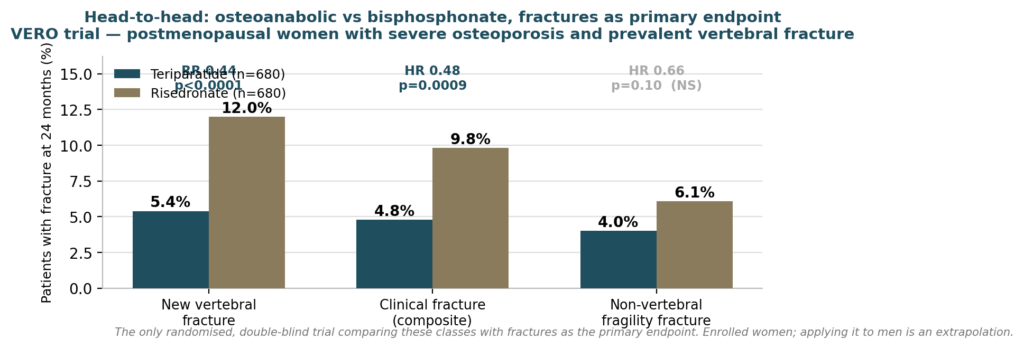
Figura 1. VERO trialA randomized, double-blind trial in 1,360 postmenopausal women with severe osteoporosis that directly compared teriparatide (anabolic) with risedronate (bisphosphonate); new spinal fractures occurred in 5.4% of the teriparatide group versus 12.0% of the risedronate group over two years. fracture outcomes at 24 months [23]. Teriparatide versus risedronate in postmenopausal women with severe osteoporosis and prevalent vertebral fracture. Non-vertebral fractures favored teriparatide but did not reach significance.
5.2 Bone density comparisons
The placebo-controlled foundation for this class was established earlier: in the pivotal teriparatide trial, new vertebral fractures occurred in 5% of treated women versus 14% on placebo, a 65% relative reduction, with a 53% reduction in non-vertebral fragility fractures [17]. The density data point the same direction. In a randomized comparison of teriparatide with alendronate, lumbar spine bone density increased 10.3% with teriparatide versus 5.5% with alendronate at 14 months [26]. Placing the male-specific data alongside the bisphosphonate figures shows a similar pattern, with two caveats: these come from separate trials and cannot be formally compared, and the zoledronic acid values are treatment-versus-placebo differences rather than within-group change from baseline, so they are not directly equivalent to the anabolic figures.
| Regimen | Spine | Femoral neck | Total hip | Source |
| Abaloparatide, 12 months, men | +8.5% | +3.0% | +2.1% | ATOM [20] |
| Teriparatide, ~11 months, men | +5.9% | +1.5% | — | Orwoll [18] |
| Zoledronic acid, 36 months, women | +6.7% | +5.1% | +6.0% | HORIZON-PFT [1] |
| Teriparatide vs alendronate, 14 months | +10.3% vs +5.5% | — | — | Body [26] |
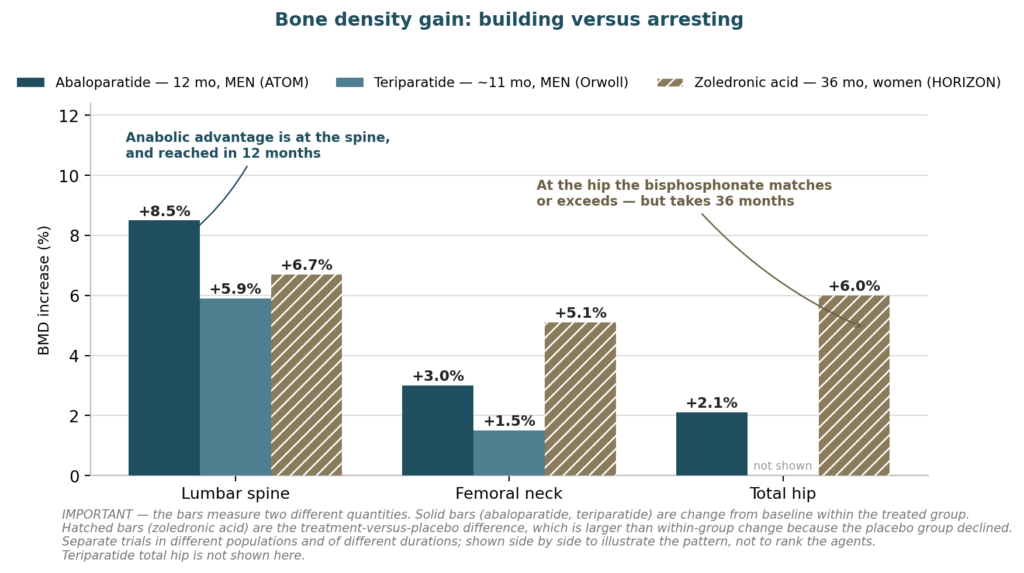
Figure 2. Bone density increase by skeletal site [1,18,20]. Solid bars are change from baseline within the treated group; hatched bars are the zoledronic acid treatment-versus-placebo difference, which exceeds within-group change because the placebo group declined. Separate trials, populations and durations — not a formal comparison.
Two features are worth noting. The anabolic advantage at the spine is large and appears quickly — within twelve months. At the hip the difference is smaller, and three years of zoledronic acid produces hip gains comparable to or exceeding twelve months of an anabolic. This is a genuine limitation of the anabolic agents and should be stated rather than glossed: their advantage is concentrated at trabecular-rich sites.
5.3 What “arresting loss” actually means, quantitatively
The phrase “arresting bone loss” is used loosely, and the difference between arresting and reversing is worth making numerically explicit, because it determines what a patient can expect to be true of his skeleton in five years.
Untreated age-related bone loss in older men proceeds at a modest annual rate that varies by site and cohort. The more important consideration after a fracture is not the rate of density loss but the level of fracture risk: a prior vertebral fracture is associated with a roughly four to five-fold increase in the probability of a subsequent vertebral fracture [37], with risk particularly elevated during the first one to two years after a recent fracture [29]. Elevated fracture risk is not the same thing as accelerated systemic bone loss, and the two should not be conflated — but it does mean that an untreated patient in the months after a vertebral fracture occupies a period of unusually high risk, which is the argument for acting rather than waiting.
Against this, the two drug classes produce different arithmetic.
An antiresorptive suppresses bone resorption, generally stabilizing or increasing bone density while reducing fracture risk, with the increment arising as remodeling space closes and secondary mineralization completes. Over three years of zoledronic acid, spine density rises about 6.7% and total hip about 6.0% relative to placebo [1]. Because part of that difference is placebo-group decline rather than treatment-group gain, the absolute rise from an individual’s own baseline is smaller than the between-group figure implies. The gain then plateaus: the randomized extension found that continuing from three to six years produced only about a one percent further advantage at the femoral neck over stopping [8]. The structure being mineralized is the structure that survived the preceding decades of loss.
An anabolic adds bone. Twelve months of abaloparatide in men produced a spine increase of 8.5% and a femoral neck increase of 3.0% from each patient’s own baseline [20] — achieved in a third of the time and, at the spine, of greater magnitude. Biopsy data suggest the increase reflects new bone tissue rather than further mineralization of existing packets, with improvement or preservation of aspects of trabecular connectivity and cortical structure — though these are small mechanistic studies and the structural implications remain incompletely characterized [36].
This may be why the fracture outcomes in VERO diverge more than the density figures alone would predict. The 56% reduction in new vertebral fractures relative to an active bisphosphonate comparator [23] is not fully captured by the difference in areal bone density between the arms — consistent with the broader observation that treatment-related fracture protection reflects skeletal properties beyond density alone, though the specific contribution of architecture is inferred rather than demonstrated by that trial.
The practical difference for a patient choosing between them is that both approaches reduce fracture risk, while osteoanabolic therapy directly stimulates new bone formation in a skeleton that has already failed structurally at one vertebra. That option is also time-limited: the abaloparatide label states that use for more than two years during a patient’s lifetime is not recommended [21], which is a further argument for using it while the indication is clearest rather than after a period of antiresorptive exposure has attenuated the response.
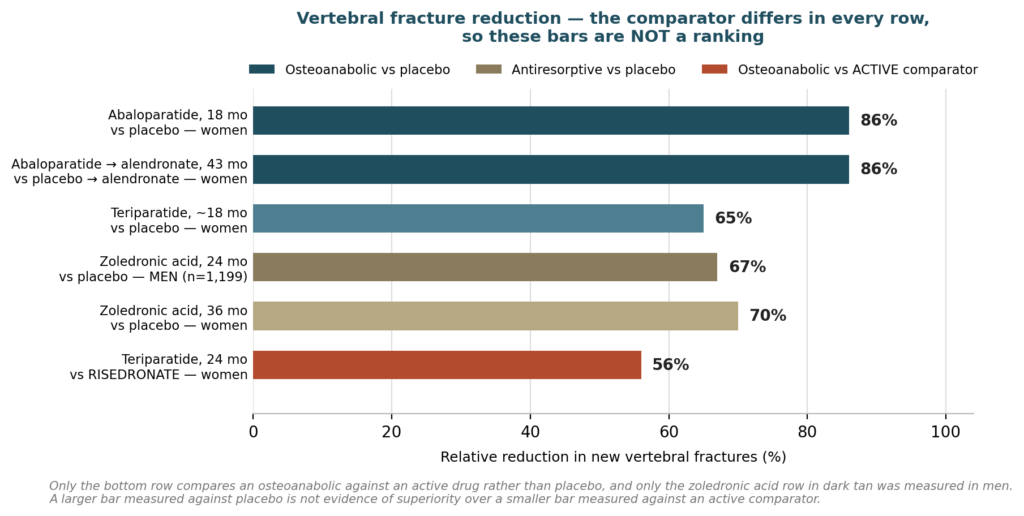
Figure 3. Relative reduction in new vertebral fractures across regimens [7,17,19,23]. The comparator differs in every row; only the bottom row tests an osteoanabolic against an active drug, and only the male zoledronic acid row was measured in men.
6. Sequence: why the order is not reversible
If the two classes simply added their effects, the order would not matter and the discussion would be academic. It is not.
Prior bisphosphonate exposure attenuates the subsequent response to an anabolic agent. In the study of teriparatide following either raloxifene or alendronate, the bone density response to teriparatide was blunted in the alendronate-pretreated group, with the effect most pronounced at the hip [27]. The mechanism is straightforward: bisphosphonates suppress the remodeling activation frequency on which parathyroid hormone analogs partly depend, and they persist in bone matrix for years after discontinuation.
The DATA-Switch trial demonstrated the same principle for the antiresorptive-to-anabolic transition. Patients who received teriparatide followed by denosumab achieved substantially greater bone density gains than those who received denosumab followed by teriparatide; in the latter sequence, bone density at the hip actually declined transiently during the teriparatide phase [28]. Anabolic first, antiresorptive second, produced the best outcome. The reverse produced the worst.
The clinical consequence: beginning an antiresorptive as an interim measure while awaiting specialist review is not entirely neutral. Starting antiresorptive therapy first can attenuate or delay the subsequent bone density response to a PTH-receptor agonist, particularly at the hip; the magnitude depends on the preceding agent, its duration, and the sequence. The effect is attenuation rather than abolition — VERO showed osteoanabolic superiority in prior bisphosphonate users as well as in treatment-naive patients [24].
This does not mean that an untreated patient is better off than a bisphosphonate-treated one. If anabolic therapy is unavailable, contraindicated, or refused by an insurer, a bisphosphonate remains effective, evidence-based and clearly preferable to no treatment [32]. The argument is about ordering when both are available, not about withholding treatment.
7. Guideline positions on anabolic-first therapy
The recommendation to begin with an osteoanabolic agent in appropriately selected patients is not a fringe position: multiple major guidelines and position statements support or recommend consideration of osteoanabolic-first therapy in appropriately selected very-high-risk patients. Recommendations are not identical across organizations, and the ASBMR/BHOF statement itself notes that much of the underlying evidence derives from older postmenopausal women — a caveat of particular relevance when applying it to a man [29].
- ASBMR/BHOF goal-directed treatment position statement (2024) supports consideration of osteoanabolic-first sequencing in very-high-risk patients, noting that osteoanabolic therapy may be better for those at imminent risk — particularly after a recent spine, hip or pelvic fracture — that anabolic-to-antiresorptive sequencing increases bone density more than the reverse order, and that prompt antiresorptive therapy after the anabolic course is needed to preserve those gains [29].
- AACE/ACE 2020 clinical practice guideline designates an anabolic agent as first-line for patients at very high fracture risk, defined to include recent fracture within the preceding twelve months, fracture while on therapy, multiple fractures, T-score at or below −3.0, and high fall risk [30].
- Endocrine Society guideline on osteoporosis in men recommends pharmacological therapy for men at high fracture risk, including those with T-scores at or below −2.5 or a prior fragility fracture, and specifies the laboratory evaluation for contributing causes that should accompany it [31].
- BHOF Clinician’s Guide provides the treatment thresholds and the calcium and vitamin D targets that frame the supportive elements of any regimen [32].
The common thread is that risk stratification, not drug hierarchy, drives the choice. A patient at moderate risk is well served by a bisphosphonate. A patient at very high or imminent fracture risk — particularly one with a recent vertebral fracture — is among those for whom major guidelines and position statements support consideration of osteoanabolic-first therapy. In postmenopausal women with severe osteoporosis and prevalent vertebral fractures, VERO demonstrated fewer vertebral and clinical fractures with teriparatide than with risedronate.
8. Applying this to a cardiac patient with a recent vertebral fracture
8.1 Risk stratification
The relevant question for approval is whether the patient meets very-high-risk criteria. A prior vertebral fracture is the strongest single predictor of a subsequent vertebral fracture, with meta-analytic estimates placing the increase at roughly four to five-fold [37]; risk rises rapidly after the initial fracture and remains particularly elevated over the following one to two years — the so-called imminent risk window [29]. A patient who has fractured a vertebra within the preceding three months, and who also has femoral neck osteoporosis, satisfies the AACE definition on more than one criterion [30].
Where a fracture was sustained in a high-energy mechanism, it is sometimes discounted as non-osteoporotic. That discount is weaker than it appears. In the SOF and MrOS cohorts, high-trauma fractures in older men and women were strongly associated with lower bone mineral density; in women, subsequent fracture risk after a high-trauma fracture resembled that after a low-trauma fracture, leading the authors to conclude that high-trauma fractures should be regarded as potential osteoporotic fractures and managed accordingly. The male cohort was underpowered for the subsequent-fracture analysis, so that specific inference should be attributed to the female data [35].
8.2 The cardiovascular question, resolved
For a patient with established coronary ateroscleroseA aterosclerose é a doença por trás da maioria dos ataques cardíacos e de muitos acidentes vasculares cerebrais. Partículas de colesterol ficam presas na parede de uma artéria, o corpo envia células imunológicas para limpar e, ao longo dos anos, essa bagunça endurece, transformando-se em placa., no prior myocardial infarction or stroke, and well-controlled risk factors, the cardiovascular considerations resolve as follows.
- Parathyroid hormone analogs have not demonstrated a significant ischemic cardiovascular safety signal. The manageable issues are transient orthostatic hypotension, palpitations with abaloparatide, and transient hypercalcemia. These effects are generally manageable and do not by themselves constitute the type of ischemic cardiovascular warning applied to romosozumab; all are addressed by injecting seated, reviewing the antihypertensive regimen at initiation, and checking baseline calcium, albumin and renal function.
- The boxed warning that generates concern belongs to romosozumab, a different mechanism. Extending it to parathyroid hormone analogs is not supported by any evidence.
- Zoledronic acid as the maintenance agent carries a small, well-characterized atrial fibrillation signal and no demonstrated ischemic signal, alongside a documented mortality reduction after hip fracture [1,2,4]. In a patient in sinus rhythm this is acceptable; a baseline eletrocardiogramaAn electrocardiogram — ECG or EKG — records your heart's electrical activity through stickers placed on your skin. It takes about a minute and is painless. may be considered where clinically indicated.
- Denosumab’s principal hazard is discontinuation, not pharmacology [12] — relevant for any patient whose circumstances make a rigid six-monthly schedule difficult to guarantee.
8.3 The proposition
For a very-high-fracture-risk male patient with established coronary disease, the evidence and contemporary guidance support consideration of an osteoanabolic-first strategy using a PTH-receptor agonist, followed by an antiresorptive such as zoledronic acid to preserve the gains. Abaloparatide is approved for men at high fracture risk and has contemporary randomized bone density efficacy data in men; teriparatide also has established efficacy data in male osteoporosis and is a reasonable alternative where cost is decisive. There is no head-to-head trial demonstrating that either is superior in men. Teriparatide’s label was revised in 2020 to permit use beyond two years in patients who remain at high fracture risk, whereas abaloparatide’s states that use beyond two years in a lifetime is not recommended [21,22].
The zoledronic acid phase is not an afterthought. It is the agent in the sequence with randomized male fracture-outcome data [7], and without it the anabolic gains are substantially lost [29]. Treatment for three years followed by reassessment is supported, with continuation toward six years particularly reasonable in patients who remain at high vertebral fracture risk [8,9].
9. Practical management during treatment in a cardiac patient
- At initiation of the anabolic: inject while seated or supine for the first several doses; rise slowly. Review antihypertensives, diuretics and beta-blockers for additive orthostatic effect. Check baseline serum calcium with albumin and renal function; urinary calcium can be measured where hypercalciuria or urolithiasis is suspected.
- If digoxin is prescribed: monitor, since transient hypercalcemia predisposes to digitalis toxicity [21].
- Palpitations on abaloparatide: common and usually benign, but in a patient with coronary disease maintain a low threshold for evaluation rather than automatic attribution to the drug.
- Before zoledronic acid: calculate creatinine clearance (contraindicated below 35 mL/min) and review dental health, completing invasive dental work where practical. A baseline electrocardiogram may be considered where clinically indicated; it is not a universal requirement.
- At infusion: ensure adequate hydration, infuse over at least fifteen minutes, and review concomitant nephrotoxic medications. Non-steroidal anti-inflammatory drug use should be individualized — they are sometimes used to treat acute-phase symptoms, but carry renal risk in the setting of volume depletion or impaired renal function. An acute-phase reaction occurs in roughly one in three patients after the first infusion.
- Calcium supplementation: target total intake of 1,000 mg daily for men aged 50–70, rising to 1,200 mg after 70, with dietary sources preferred [32]. High-dose supplemental calcium carries an unresolved cardiovascular literature and is of particular relevance in this population; the goal is adequacy, not maximization.
- Monitoring: bone turnover markers (P1NP and CTX) at baseline and during the anabolic phase provide earlier confirmation of response than serial bone density, which is important because a twelve-month femoral neck gain of around 3% may fall at or below a facility’s least significant change.
10. Conclusão
The cardiovascular concerns surrounding osteoporosis therapy are real but narrowly located. They attach to sclerostin inhibition, where a boxed warning and a subgroup signal in patients with pre-existing cardiovascular disease justify caution; and, in a much smaller way, to the atrial fibrillation associated with intravenous zoledronic acid, which is offset by an absence of ischemic signal and by a documented post-fracture mortality benefit. Comparable ischemic cardiovascular warnings have not been established for PTH-receptor agonists, whose demonstrated effects are hemodynamic and transient. The romosozumab evidence itself is mixed: a second 2026 propensity-matched cohort found no significant MACE difference versus denosumab [38].
The choice between an osteoanabolic agent and a bisphosphonate in a very-high-risk patient is therefore not a choice between a risky option and a safe one. It is a choice between therapy that stimulates new bone formation and therapy that primarily suppresses bone resorption; both reduce fracture risk, while osteoanabolic-first treatment can produce faster and larger skeletal gains in very-high-risk patients. In the only randomized head-to-head trial powered for fractures in patients with existing vertebral fractures — conducted in postmenopausal women — the osteoanabolic agent reduced new vertebral fractures by 56% and clinical fractures by 52% relative to an oral bisphosphonate [23]. Major guidelines and position statements increasingly support consideration of osteoanabolic-first sequencing in appropriately selected patients at very high or imminent fracture risk [29,30], and the sequence is not freely reversible: bisphosphonate exposure attenuates the later anabolic response, most markedly at the hip [27,28].
For a patient with established doença arterial coronarianaA doença arterial coronariana é o acúmulo de placas nas artérias que irrigam o músculo cardíaco., no prior ischemic event, well-controlled risk factors, a recent vertebral fracture and femoral neck osteoporosis, the evidence supports consideration of osteoanabolic-first treatment with a PTH-receptor agonist, followed promptly by zoledronic acid, with the monitoring described above. Available evidence does not identify established coronary atherosclerosis alone as a contraindication to PTH-receptor agonist therapy. Final drug selection should incorporate fracture risk, cardiovascular history, renal function, calcium metabolism, contraindications, cost and patient preference.
Referências
- D. M. Black et al., “Once-yearly zoledronic acid for treatment of postmenopausal osteoporosis (HORIZON-PFT),” N. Engl. J. Med., vol. 356, no. 18, pp. 1809–1822, 2007.
- K. W. Lyles et al., “Zoledronic acid and clinical fractures and mortality after hip fracture (HORIZON-RFT),” N. Engl. J. Med., vol. 357, no. 18, pp. 1799–1809, 2007.
- E. M. Lewiecki et al., “Review of the cardiovascular safety of zoledronic acid and other bisphosphonates for the treatment of osteoporosis,” Clin. Ther., vol. 32, no. 3, pp. 431–447, 2010.
- S. Kim et al., “Bisphosphonates and risk of cardiovascular events: a meta-analysis,” PLoS One, vol. 10, no. 4, e0122646, 2015.
- “Cardiovascular safety of zoledronic acid in the treatment of primary osteoporosis: a meta-analysis and systematic review,” Bone, 2023 (PMID 37984227).
- Disproportionality analysis of cardiac arrhythmia associated with bisphosphonates based on the FAERS database, Sci. Rep., 2025.
- S. Boonen et al., “Fracture risk and zoledronic acid therapy in men with osteoporosis,” N. Engl. J. Med., vol. 367, no. 18, pp. 1714–1723, 2012.
- D. M. Black et al., “The effect of 3 versus 6 years of zoledronic acid treatment of osteoporosis: a randomized extension to HORIZON-PFT,” J. Bone Miner. Res., vol. 27, no. 2, pp. 243–254, 2012.
- D. M. Black et al., “The effect of 6 versus 9 years of zoledronic acid treatment: a second randomized extension to HORIZON-PFT,” J. Bone Miner. Res., vol. 30, no. 5, pp. 934–944, 2015.
- S. R. Cummings et al., “Denosumab for prevention of fractures in postmenopausal women with osteoporosis (FREEDOM),” N. Engl. J. Med., vol. 361, no. 8, pp. 756–765, 2009.
- H. G. Bone et al., “10 years of denosumab treatment in postmenopausal women with osteoporosis: FREEDOM trial and open-label extension,” Lancet Diabetes Endocrinol., vol. 5, no. 7, pp. 513–523, 2017.
- K. H. Lu, S. I. Wang and S. F. Yang, “Denosumab withdrawal increases vertebral fracture and mortality risk compared with zoledronate,” Eur. J. Endocrinol., vol. 192, no. 3, pp. 180–190, 2025.
- N. Bucay et al., “Osteoprotegerin-deficient mice develop early onset osteoporosis and arterial calcification,” Genes Dev., vol. 12, no. 9, pp. 1260–1268, 1998.
- L. B. Tankó et al., “Relationship between osteoporosis and cardiovascular disease in postmenopausal women,” J. Bone Miner. Res., vol. 20, no. 11, pp. 1912–1920, 2005.
- L. L. Demer and Y. Tintut, “Vascular calcification: pathobiology of a multifaceted disease,” Circulation, vol. 117, no. 22, pp. 2938–2948, 2008.
- J. Golledge and S. Thanigaimani, “Role of sclerostin in cardiovascular disease,” Arterioscler. Thromb. Vasc. Biol., vol. 42, no. 7, pp. e187–e202, 2022.
- R. M. Neer et al., “Effect of parathyroid hormone (1-34) on fractures and bone mineral density in postmenopausal women with osteoporosis,” N. Engl. J. Med., vol. 344, no. 19, pp. 1434–1441, 2001.
- E. S. Orwoll et al., “The effect of teriparatide on bone density in men with osteoporosis,” J. Bone Miner. Res., vol. 18, no. 1, pp. 9–17, 2003.
- P. D. Miller et al., “Effect of abaloparatide vs placebo on new vertebral fractures in postmenopausal women with osteoporosis (ACTIVE),” JAMA, vol. 316, no. 7, pp. 722–733, 2016.
- ATOM trial, “Efficacy and safety of abaloparatide-SC in men with osteoporosis: a randomized clinical trial,” J. Bone Miner. Res., 2022 (PMID 36190391).
- TYMLOS (abaloparatide) prescribing information, U.S. FDA / DailyMed.
- FORTEO (teriparatide) prescribing information, U.S. FDA (2020 label revision).
- D. L. Kendler et al., “Effects of teriparatide and risedronate on new fractures in post-menopausal women with severe osteoporosis (VERO): a multicentre, double-blind, double-dummy, randomised controlled trial,” Lancet, vol. 391, no. 10117, pp. 230–240, 2018.
- P. Geusens et al., “Effects of teriparatide compared with risedronate on the risk of fractures in subgroups of postmenopausal women with severe osteoporosis: the VERO trial,” J. Bone Miner. Res., vol. 33, no. 5, pp. 783–794, 2018.
- J. J. Body et al., “Efficacy of teriparatide compared with risedronate on FRAX-defined major osteoporotic fractures: results of the VERO clinical trial,” Osteoporos. Int., 2020 (PMID 32474650).
- J. J. Body et al., “A randomized double-blind trial to compare the efficacy of teriparatide with alendronate in postmenopausal osteoporosis,” J. Clin. Endocrinol. Metab., vol. 87, no. 10, pp. 4528–4535, 2002.
- B. Ettinger et al., “Differential effects of teriparatide on BMD after treatment with raloxifene or alendronate,” J. Bone Miner. Res., vol. 19, no. 5, pp. 745–751, 2004.
- B. Z. Leder et al., “Denosumab and teriparatide transitions in postmenopausal osteoporosis (DATA-Switch): a randomized controlled trial,” Lancet, vol. 386, no. 9999, pp. 1147–1155, 2015.
- ASBMR/BHOF Task Force, “Goal-directed osteoporosis treatment: position statement,” J. Bone Miner. Res., 2024.
- P. M. Camacho et al., “American Association of Clinical Endocrinologists/American College of Endocrinology clinical practice guidelines for the diagnosis and treatment of postmenopausal osteoporosis — 2020 update,” Endocr. Pract., vol. 26 (Suppl 1), pp. 1–46, 2020.
- N. B. Watts et al., “Osteoporosis in men: an Endocrine Society clinical practice guideline,” J. Clin. Endocrinol. Metab., vol. 97, no. 6, pp. 1802–1822, 2012.
- M. S. LeBoff et al., “The clinician’s guide to prevention and treatment of osteoporosis,” Osteoporos. Int., vol. 33, no. 10, pp. 2049–2102, 2022.
- K. G. Saag et al., “Romosozumab or alendronate for fracture prevention in women with osteoporosis (ARCH),” N. Engl. J. Med., vol. 377, no. 15, pp. 1417–1427, 2017.
- B. I. Gusbela et al., “Cardiovascular safety of romosozumab versus denosumab: a multinational real-world data analysis,” Ther. Adv. Musculoskelet. Dis., vol. 18, 2026.
- D. C. Mackey et al., “High-trauma fractures and low bone mineral density in older women and men,” JAMA, vol. 298, no. 20, pp. 2381–2388, 2007.
- D. W. Dempster et al., “Effects of daily treatment with parathyroid hormone on bone microarchitecture and turnover in patients with osteoporosis: a paired biopsy study,” J. Bone Miner. Res., vol. 16, no. 10, pp. 1846–1853, 2001.
- J. A. Kanis et al., “A meta-analysis of previous fracture and subsequent fracture risk,” Bone, vol. 35, no. 2, pp. 375–382, 2004.
- S. H. Ahn et al., “Risk of cardiovascular events in patients with osteoporosis on romosozumab treatment compared with denosumab: a multicenter observational cohort study,” Endocrinol. Metab. (Seoul), vol. 41, pp. 442–451, 2026.