
Behandeling van hart- en vaatziekten en osteoporose
Risico’s, voordelen en de argumenten voor een behandeling waarbij anabole middelen voorop staan bij een patiënt met vastgestelde coronaire hartziekte
Een overzicht van de gepubliceerde wetenschappelijke gegevens, samengesteld ter ondersteuning van de klinische discussie en, indien van toepassing, voorafgaande toestemming. Dit is geen medisch advies. Alle cijfers dienen onafhankelijk te worden gecontroleerd aan de hand van de primaire bronnen die aan het einde worden vermeld.
1. Waarom deze vraag überhaupt rijst
Osteoporose en atherosclerose hart- en vaatziekten worden doorgaans behandeld door verschillende specialisten, in verschillende klinieken, op basis van verschillende probleemlijsten. In de praktijk gaan ze echter hand in hand. In bevolkingsonderzoeken is herhaaldelijk een verband aangetoond tussen een lage botmineraaldichtheid en vasculaire verkalking die blijven bestaan na correctie voor verschillende gemeenschappelijke risicofactoren, hoewel resterende verstorende factoren en gemeenschappelijke biologische processen kunnen niet worden uitgesloten [14]. Op populatieniveau hangen de twee aandoeningen dus samen; voor een individuele patiënt is de kracht van die conclusie echter zwakker dan de associatiestatistieken doen vermoeden.
Deze overlap leidt tot een specifiek klinisch probleem. Wanneer een hartpatiënt osteoporose ontwikkelt die ernstig genoeg is om farmacologische behandeling te vereisen, wordt de behandelende arts geconfronteerd met een geneesmiddelengroep waarvan het cardiovasculaire profiel het onderwerp is geweest van een ‘boxed warning’, verschillende omstreden meta-analyses en veel onduidelijkheid over op welk middel de bezwaren daadwerkelijk van toepassing zijn. Een belangrijk risico in die situatie is het onterecht vermijden of kiezen van een behandeling, omdat cardiovasculaire waarschuwingen die voor het ene middel gelden ten onrechte worden gegeneraliseerd naar een ander middel — waardoor een patiënt met een zeer hoog risico onbehandeld blijft, of wordt behandeld met een middel dat is gekozen op basis van een waarschuwing die betrekking heeft op een ander molecuul.
In dit document wordt uiteengezet wat er daadwerkelijk bekend is over de cardiovasculaire veiligheid van elke klasse geneesmiddelen tegen osteoporose; waar het bewijs sterk, zwak of afwezig is; en waarom bij een patiënt met een recente wervelfractuur en osteoporose van de femurhals de keuze tussen een anabool middel en een bisfosfonaat geen keuze is tussen een agressieve en een conservatieve optie. Het is een keuze tussen het stimuleren van nieuwe botvorming en het onderdrukken van botresorptie. Beide strategieën verhogen de botmineraaldichtheid en verlagen het fractuurrisico; osteoanabole therapie kan bij zorgvuldig geselecteerde patiënten met een zeer hoog risico grotere en snellere verbeteringen van het skelet opleveren, en het bewijs dat de twee verschillen in fractuuruitkomsten is nu direct in plaats van afgeleid.
2. De bot-vasculaire as: gemeenschappelijke biologische kenmerken, geen toeval
Het verband tussen botverlies en aderverkalking heeft een naam in de literatuur — de de paradox van verkalking, waarin het gelijktijdig optreden van botdemineralisatie en ectopische mineralisatie in de slagaderwand wordt beschreven. Er wordt een omgekeerd verband beschreven, maar dit is geen bewijs dat mineralen die uit het bot verloren gaan, fysiek naar de slagaders migreren. Er zijn verschillende mechanismen in het spel en die zijn hier van belang omdat ze verklaren waarom sommige medicijnen tegen osteoporose überhaupt een effect op vaatweefsel zouden kunnen hebben.
De RANK/RANKL/osteoprotegerine-as
Receptoractivator van nucleaire factor-κB-ligand (RANKL) stimuleert de differentiatie van osteoclasten; osteoprotegerine (OPG) is de receptoren die als afleiding dienen en als rem fungeren. Dit systeem is niet beperkt tot het bot. Muizen zonder osteoprotegerine ontwikkelen tegelijkertijd vroegtijdige osteoporose en arteriële verkalking — één genetische laesie, beide fenotypes [13]. Bij mensen hangt de concentratie van osteoprotegerine in het bloed samen met de ernst van vaatziekten. Denosumab, een monoklonaal antilichaam tegen RANKL, werkt rechtstreeks in op deze as; daarom is het cardiovasculaire profiel ervan grondig onderzocht.
Wnt/β-catenine-signaalroute en sclerostine
Sclerostine, dat door osteocyten wordt aangemaakt, remt Wnt/β-catenine-signaalroute en remt daardoor de botvorming. Hetzelfde signaalpad is actief in de vaatwand, maar dan met het tegenovergestelde effect: activering van Wnt/β-catenine stimuleert de vasculaire gladde spiercellen in de richting van een osteoblastachtig fenotype dat in staat is om mineralen in de slagaderwand af te zetten [15,16]. Sclerostine komt voor in aangetaste slagaders, en een mogelijke verklaring hiervoor is dat het een compenserende rol speelt — een lokale rem op verkalking waar tandplak bestaat al. Dit is een van de voorgestelde mechanistische verklaringen voor de cardiovasculaire bezorgdheid rond sclerostineremmers; het mechanisme in menselijke bloedvaten blijft onduidelijk. Dit wordt besproken in paragraaf 3.4.
Geoxideerde lipiden, ontsteking en de mevalonaatroute
Geoxideerd met lage dichtheid lipoproteïne bevordert de osteoblastische differentiatie van vasculaire cellen en remt tegelijkertijd de functie van osteoblasten in bot — één enkele prikkel met tegengestelde effecten in de twee weefsels [15]. Chronische ontsteking verhoogt het RANKL-gehalte en versnelt beide processen. En de mevalonaatroute, het doelwit van statines, is ook het doelwit van stikstofhoudende bisfosfonaten, die de werking remmen van farnesylpyrofosfaatsynthase daarin. Die gemeenschappelijke farmacologische eigenschappen hebben geleid tot een al lang bestaande hypothese dat bisfosfonaten mogelijk zelf vasculaire effecten hebben — en de observatiegegevens, die hieronder worden besproken, wijzen eerder op voordelen dan op nadelen.
Het praktische gevolg van dit alles is dat vragen over de cardiovasculaire veiligheid van geneesmiddelen tegen osteoporose niet uit paranoia voortkomen. Er zijn reële, mechanistische redenen om deze vragen te stellen. De vraag is of deze mechanismen zich vertalen in meetbare klinische schade, en voor welke middelen dat geldt.
3. Cardiovasculair profiel van elke geneesmiddelengroep
3.1 Bisfosfonaten, waaronder zoledroninezuur
Bisfosfonaten zijn de meest uitgebreid onderzochte geneesmiddelen tegen osteoporose en de middelen met de langste geschiedenis op het gebied van cardiovasculaire bijwerkingen. Het beeld is over het algemeen geruststellend, op één specifieke en goed gekarakteriseerde uitzondering na.
De boezemfibrilleren signaal
In de HORIZON: cruciaal onderzoek naar fracturen, ernstige atriumfibrillatie — gedefinieerd als fataal, levensbedreigend of leidend tot ziekenhuisopname of invaliditeit — trad op bij 1,3% van de vrouwen die jaarlijks zoledronine kregen, tegenover 0,5% van de vrouwen die placebo (p<0,001). Ook kwamen hartritmestoornissen van welke aard dan ook vaker voor: 6,91 TP9T tegenover 5,31 TP9T (p=0,003) [1,3]. Dit was een onverwachte bevinding, geen vooraf vastgesteld eindpunt, en er wordt sindsdien over gediscussieerd.
Latere bevindingen hebben dit standpunt nuanceren, zonder het echter volledig te weerleggen. A meta-analyse Uit een samenvoeging van gerandomiseerde onderzoeken naar bisfosfonaten bleek dat orale bisfosfonaten weinig effect hebben op het risico op atriumfibrilleren, terwijl intraveneus toegediend zoledroninezuur een bescheiden verhoging van dat risico met zich meebrengt; beperkt tot ernstige voorvalen van atriumfibrilleren in fase 3-onderzoeken, bedroeg de samengevoegde oddsratio 1,41 (95% BI 1,10–1,81) met aanzienlijke heterogeniteit tussen de onderzoeken [4]. Uit een recentere meta-analyse van zoledroninezuur bij primaire osteoporose bleek dat het aantal cardiovasculaire voorvallen in het algemeen was toegenomen, met een relatief risico (RR) van 1,15 (1,05–1,26), maar ernstige ongewenste cardiovasculaire gebeurtenissen geen significant verschil bij een RR van 1,03 (0,89–1,18), met atriumfibrilleren bij een RR van 1,21 (0,99–1,47, niet significant) en aritmie in het algemeen bij een RR van 1,30 (1,11–1,52) [5]. Uit een geneesmiddelenbewakingsanalyse van spontane meldingen is ook een signaal van onevenredigheid naar voren gekomen met betrekking tot aritmieën die verband houden met bisfosfonaten, hoewel dergelijke databases geen uitsluitsel kunnen geven over de incidentie of causaliteit [6].
Drie opmerkingen plaatsen dit in het juiste perspectief. Ten eerste betreft het overschot aritmieën, niet ischemische voorvallen — cardiovasculaire sterfte, beroerte en myocardinfarct vertoonden geen significant verschil tussen de groepen in de HORIZON-analyses [3,4]. Ten tweede wijst het tijdspad niet op een direct aritmogeen effect van het geneesmiddel: de meeste voorvallen deden zich meer dan dertig dagen na de infusie voor, en uit een elektrocardiografisch onderzoek dat na een derde jaarlijkse infusie werd uitgevoerd, bleek dat er geen verschillen waren tussen de groep die zoledronine kreeg en de placebogroep [3]. Ten derde is de absolute omvang bescheiden: het overschot aan ernstige atriumfibrillatie in de HORIZON-PFT-studie bedroeg ongeveer 0,8 procentpunt, cumulatief over de gehele onderzoeksperiode (niet per jaar), en deze bevinding werd niet consistent bevestigd in andere gerandomiseerde studies, waaronder de HORIZON-RFT-studie [3,4]. Bij een patiënt met een sinusritme zonder voorgeschiedenis van atriumfibrilleren is dit een overweging en geen vaststaande contra-indicatie.
Het sterftesignaal, dat de andere kant op gaat
In het HORIZON-onderzoek naar terugkerende fracturen kregen mannen en vrouwen na een operatieve behandeling van een heupfractuur zoledronine toegediend. Dit leidde tot een afname van het aantal nieuwe klinische fracturen met 35% en sterfte door alle oorzaken door 28% [2]. Een daling van het sterftecijfer van die omvang kon niet uitsluitend worden verklaard door het voorkomen van fracturen en blijft een van de opvallendste bevindingen in de literatuur over osteoporose. Of dit een direct farmacologisch effect op de sterfte weergeeft, blijft onzeker, en de bevinding geldt specifiek voor de onderzochte populatie van patiënten na een heupfractuur.
Bewijs voor breuken die specifiek bij mannen voorkomen
Zoledroninezuur is het enige middel dat in dit document wordt besproken waarvoor gerandomiseerde gegevens over fractuuruitkomsten bij mannen beschikbaar zijn. Bij 1.199 mannen met osteoporose, nieuwe morfometrische wervelfracturen trad op bij 1,6% in de zoledronzuurgroep tegenover 4,9% in de placebogroep over een periode van 24 maanden — een relatieve afname van ongeveer 67% [7]. Voor een mannelijke patiënt is dit een aanzienlijk relevanter cijfer dan de HORIZON-cijfers voor vrouwen, en het is de moeite waard dit expliciet te vermelden, aangezien in de meeste gepubliceerde samenvattingen de gegevens voor vrouwen worden aangehaald.
Duur
In de gerandomiseerde HORIZON-verlengingsstudie werd een behandeling van drie jaar met zoledronine vergeleken met een behandeling van zes jaar. Bij degenen die de behandeling voortzetten, bleef de botdichtheid van de femurhals constant, terwijl bij degenen die stopten een lichte afname optrad, met een verschil tussen de groepen van ongeveer één procent; het aantal morfometrische wervelfracturen nam af bij degenen die de behandeling voortzetten, en het voordeel deed zich vooral voor bij patiënten met een hoog risico op wervelfracturen [8]. Uit een tweede vervolgonderzoek, waarin zes jaar met negen jaar werden vergeleken, bleek er nauwelijks nog een gemiddeld verschil te zijn, wat pleit voor een individuele herbeoordeling na ongeveer zes jaarlijkse doses in plaats van een algemeen eindpunt [9]. Een patiënt met een bestaande wervelfractuur behoort tot de subgroep waarvoor voortzetting van de behandeling na drie jaar wordt aanbevolen.
3.2 Denosumab
Denosumab remt RANKL en werkt daardoor rechtstreeks in op de as die het duidelijkst in verband wordt gebracht met vasculaire calcificatie. Desondanks zijn de resultaten van gerandomiseerde studies niet opvallend: de FREEDOM-onderzoek er werd geen toename van cardiovasculaire voorvallen vastgesteld, en tijdens de tien jaar durende open-label vervolgstudie trad er geen cardiovasculair signaal op [10,11].
Het belangrijke veiligheidsaspect van denosumab is niet van cardiovasculaire oorsprong, maar leidt wel tot dergelijke gevolgen. Het effect is volledig omkeerbaar en ebt tussen de doseringen door weg. Uitstel of stopzetting van de behandeling met denosumab kan leiden tot een rebound-botomzet boven de uitgangswaarde, waarbij een klinisch significant risico ontstaat wanneer de geplande halfjaarlijkse toediening aanzienlijk wordt uitgesteld; deze rebound gaat gepaard met meerdere gelijktijdige wervelfracturen. Uit een grote, op neiging gematchte analyse bleek dat patiënten die met denosumab stopten zonder aansluitende antiresorptieve therapie een wervelfractuur hadden hazardratio van 1,479 en een hazardratio voor sterfte door alle oorzaken van 1,588 in vergelijking met degenen die waren overgestapt op zoledronaat [12]. Het mechanisme dat ten grondslag ligt aan het verband met sterfte is onduidelijk en er is sprake van een residueel effect verwarrend kan in een observationeel onderzoek niet worden uitgesloten; uit de gegevens blijkt dat een onbegeleide terugtrekking gepaard gaat met slechtere uitkomsten dan een geplande overgang.
Voor een patiënt die vaak reist, op hoogte traint of te maken kan krijgen met periodes waarin een halfjaarlijkse injectie niet op betrouwbare wijze kan worden toegediend, is dit een zinvol praktisch argument ten gunste van een bisfosfonaat als onderhoudsmiddel — niet omdat zoledronine superieur is qua werkzaamheid, maar omdat het bij een mislukking meer speelruimte biedt en dat bij denosumab niet het geval is.
3.3 Analoga van het bijschildklierhormoon: teriparatide en abaloparatide
Dit is de klasse die het meest relevant is voor de huidige discussie. Bij PTH-receptoragonisten is het ischemische cardiovasculaire veiligheidssignaal dat aanleiding gaf tot de waarschuwing in het kader bij romosozumab.
Geen van beide teriparatide noch abaloparatide is voorzien van een kader met een cardiovasculaire waarschuwing. Gerandomiseerde onderzoeken en de beschikbare gegevens na het in de handel brengen hebben geen verhoogd risico op een hartinfarct, beroerte of cardiovasculaire mortaliteit bij een van beide middelen aangetoond. In de propensity-matched praktijkgerichte literatuur is romosozumab vergeleken met parathyroïdhormoonanalogen, juist omdat deze laatste hebben gediend als vergelijkingsklasse zonder een vastgesteld ischemisch cardiovasculair veiligheidssignaal.
Er zijn twee hemodynamische effecten waar bij een hartpatiënt rekening mee moet worden gehouden, en deze zijn beheersbaar en vormen geen onoverkomelijk probleem.
Voorbijgaande orthostatische hypotensie
Beide stoffen kunnen een tijdelijke daling veroorzaken in bloeddruk, meestal binnen vier uur na de injectie en vooral tijdens de eerste paar doses. De gebruikelijke voorzorgsmaatregel is om zittend of liggend te injecteren en daarna langzaam op te staan. Bij een patiënt die bloeddrukverlagende middelen, diuretica of een bètablokker, kan het effect cumulatief zijn, en het is vanuit klinisch oogpunt verstandig om de bloeddrukverlagende behandeling bij aanvang te herzien. Bij een duursporter die na de training mogelijk een vochttekort heeft, of die zich op grote hoogte bevindt, geldt deze voorzichtigheid des te meer.
Tachycardie en hartkloppingen
In de ACTIVE-studie gaat abaloparatide gepaard met een hoger percentage hartkloppingen en tachycardie dan placebo [19,21]. Deze verschijnselen zijn doorgaans van voorbijgaande aard en verlopen zonder symptomen, maar bij een patiënt met coronaire hartziekte is het raadzaam om bij het optreden van deze symptomen snel onderzoek te doen, in plaats van ze automatisch aan het geneesmiddel toe te schrijven.
Hypercalciëmie en de gevolgen daarvan
Parathyroïdhormoonanalogen zorgen na elke dosis voor een tijdelijke stijging van het serumcalciumgehalte. Klinisch significante hypercalciëmie komt zelden voor, maar er zijn twee cardiologische implicaties die van belang zijn. Ten eerste verhoogt hypercalciëmie het risico op digitalisvergiftiging, waardoor gelijktijdig gebruik van digoxine nauwlettend moet worden gecontroleerd. Ten tweede kan hypercalciurie ontstaan, wat relevant is bij een patiënt met een matige nierfunctie of een voorgeschiedenis van nierstenen [21,22]. Het serumcalcium bij aanvang, samen met het albuminegehalte en de nierfunctie, moet worden beoordeeld; het meten van het calciumgehalte in de urine kan worden overwogen wanneer hypercalciurie of urolithiasis wordt vermoed.
Daarentegen is er in de beschikbare onderzoeken geen klinisch significant ischemisch cardiovasculair veiligheidssignaal voor deze klasse aangetoond. Voor een patiënt bij wie atherosclerotische aandoeningen het belangrijkste cardiovasculaire probleem vormen, bieden PTH-receptoragonisten een osteoanabole behandeling zonder het vastgestelde ischemische cardiovasculaire waarschuwingssignaal dat voor romosozumab geldt.
3.4 Remming van sclerostine — en waarom dit wordt verward met de klasse
Romosozumab wordt in dit geval niet als behandeling voorgesteld, maar er moet wel over worden gesproken, omdat het de bron is van de wijdverbreide indruk dat anabole geneesmiddelen tegen osteoporose gevaarlijk zijn voor hartpatiënten. Die indruk is een categorievergissing, en het rechtzetten daarvan is van direct belang voor het verkrijgen van goedkeuring voor een parathyroïdhormoonanaloog.
Romosozumab is voorzien van een ‘boxed warning’ voor hartinfarct, beroerte en cardiovasculair overlijden. Het signaal kwam voort uit de ARCH-studie, waarin bevestigde ernstige bijwerkingen cardiaque voorvallen kwamen gedurende twaalf maanden vaker voor bij romosozumab dan bij alendronaat, terwijl de placebogecontroleerde FRAME-studie geen dergelijk verschil liet zien [33]. Uit een multinationaal praktijkonderzoek uit 2026 bleek dat romosozumab bij patiënten met reeds bestaande hart- en vaatziekten gepaard ging met een hoger risico op samengestelde MACE, beroerte, sterfte en chronische ischemische hartziekte dan denosumab over een periode van één, drie en vijf jaar; bij patiënten zonder eerdere hart- en vaatziekten was de trend omgekeerd [34]. Het voorgestelde mechanisme — dat sclerostine fungeert als een compenserende rem op vasculaire calcificatie in hypoxische, reeds aangetaste bloedvaten, en dat systemische remming van sclerostine deze rem wegneemt — wordt door die auteurs omschreven als speculatief, en de analyse vertoont erkende resterende verstorende factoren [34]. Hedendaags observationeel bewijs is niet eenduidig. Een afzonderlijk multicenter, op neiging gematcht cohort uit 2026 met 4.896 patiënten vond geen statistisch significant verschil in ernstige cardiale voorvallen tussen romosozumab en denosumab na één jaar (gecorrigeerde HR 1,42, 95% CI 0,64–3,19) of na drie jaar (gecorrigeerde HR 1,51, 95% CI 0,79–2,88) [38]. Het bewijsmateriaal is dus echt gemengd en er is nog geen eenduidige conclusie tegen het middel.
Het cruciale punt voor een hartpatiënt die een anabole behandeling overweegt: deze waarschuwing geldt specifiek voor een bepaald molecuul, niet voor een hele klasse. Romosozumab is een sclerostineremmer. Teriparatide en abaloparatide zijn parathyroïdhormoonreceptoragonisten. Ze worden in de klinische literatuur beide aangeduid als “osteoanabool”, maar werken via fundamenteel verschillende moleculaire doelwitten, en de cardiovasculaire waarschuwing voor romosozumab mag niet automatisch worden geëxtrapoleerd naar PTH-receptoragonisten.
3.5 Samenvatting van overwegingen op het gebied van hart- en vaatziekten
| Agent | Cardiovasculair signaal | Bewijskracht | Praktische gevolgen |
| Zoledroninezuur | Ernstige boezemfibrillatie 1,3% versus 0,5% [1]; geen aantoonbare toename van ischemische voorvallen; sterfte gedaald met 28% na een heupfractuur [2] | Gerandomiseerd, grootschalig, bevestigd in een meta-analyse [4,5] | Aanvaardbaar bij sinusritme; basislijn-ECG redelijk; geen reden om te vermijden |
| Orale bisfosfonaten | Weinig of geen invloed op atriumfibrilleren [4] | Gerandomiseerde en observationele | Geen specifieke hartgerelateerde beperking |
| Denosumab | Geen effect van de behandeling; verhoogde sterfte na onbegeleide stopzetting [12] | Gerandomiseerd wat betreft veiligheid; observationeel wat betreft het stoppen met de behandeling | Het risico ligt in het niet naleven van het schema, niet in de farmacologie |
| Teriparatide / abaloparatide | Er is geen vastgesteld signaal voor ischemische cardiovasculaire veiligheid. Voorbijgaande orthostatische hypotensie; hartkloppingen bij gebruik van abaloparatide; voorbijgaande hypercalciëmie | Gerandomiseerde studies en studies na het in de handel brengen | Behandelbaar met een juiste dosering, medicatiebeoordeling en het calciumgehalte bij aanvang |
| Romosozumab | Waarschuwing in kader; verhoogd MACE-risico bij patiënten met een voorgeschiedenis van hart- en vaatziekten [33,34] | Gerandomiseerd (ARCH) plus observationeel; mechanisme speculatief | Wordt hier niet voorgesteld; een mechanisme dat verschilt van dat van PTH-analogen |
4. Anabool versus antiresorptief: het mechanistische verschil
Alles wat hierna volgt, hangt af van een onderscheid dat in de klinische praktijk vaak vervaagt. Antiresorptiva en anabolen hebben niet min of meer hetzelfde effect. Ze hebben verschillende werkingen.
Wat een antiresorptief middel doet
Bisfosfonaten en denosumab remmen de activiteit van osteoclasten. Hierdoor neemt het aantal actieve hermodelleringplaatsen af, waardoor bestaande botpakketten de secundaire mineralisatie kunnen voltooien. De gemeten toename in botmineraaldichtheid is daarom in wezen een mineralisatie-effect binnen de bestaande botarchitectuur, in plaats van de aanmaak van nieuw bot. Het is een reëel effect: het verhoogt de gemeten botdichtheid en vermindert het risico op fracturen aanzienlijk. Maar de werking ervan is grotendeels behoudend: het vertraagt in aanzienlijke mate de verdere achteruitgang van een structuur die al beschadigd is. Trabeculae die zijn doorboord of verloren zijn gegaan, worden niet hersteld. Het effect op de botdichtheid stagneert na enkele jaren, omdat er slechts een beperkte hoeveelheid secundaire mineralisatie beschikbaar is.
Wat een anabool middel doet
Parathyroïdhormoonanalogen, die met tussenpozen worden toegediend, stimuleren de activiteit van osteoblasten via zowel op hermodellering als op opbouw gebaseerde botvorming. Gekoppelde gegevens van transiliacale botbiopsieën en micro-computertomografie bij patiënten die met parathyroïdhormoon worden behandeld, wijzen op verbetering of behoud van aspecten van de trabeculaire connectiviteit en de corticale structuur, hoewel deze bevindingen afkomstig zijn uit kleinschalige mechanistische studies [36]. Dit wijst op de aanmaak van nieuw botweefsel in plaats van verdere mineralisatie van oud botweefsel. PTH-receptoragonisten stimuleren de vorming van nieuw bot en kunnen bepaalde aspecten van de microarchitectuur van het trabeculaire en corticale bot verbeteren — net zoals romosozumab dat doet, zij het via een ander mechanisme.
Dit onderscheid heeft een direct klinisch gevolg. Bij een patiënt wiens skelet al een structurele beschadiging heeft opgelopen — een wervelcompressiefractuur — gaat het niet alleen om de vraag hoe verder verlies kan worden voorkomen, maar ook of de verloren structurele stevigheid gedeeltelijk kan worden hersteld. Van deze twee strategieën richt de osteoanabole therapie zich rechtstreeks op de tweede vraag door de vorming van nieuw bot te stimuleren.
- Directe vergelijkende gegevens: heeft het mechanistische verschil invloed op fracturen?
Tot voor kort werd deze vraag beantwoord op basis van conclusies uit afzonderlijke placebogecontroleerde onderzoeken. Nu wordt de vraag rechtstreeks beantwoord.
5.1 De VERO-studie
VERO was een gerandomiseerde, dubbelblinde, dubbel-dummy, actief-gecontroleerde studie met fracturen als primair eindpunt — een opzet die nog niet eerder was toegepast om verschillende klassen van osteoporosegeneesmiddelen met elkaar te vergelijken. Aan de studie namen 1.360 postmenopauzale vrouwen deel met ernstige osteoporose, gedefinieerd als ten minste twee matige of één ernstige wervelfractuur plus een T-score van −1,5 of lager. De deelnemers kregen gedurende 24 maanden ofwel dagelijks 20 µg teriparatide, ofwel wekelijks 35 mg risedronaat [23].
De resultaten:
| Eindpunt na 24 maanden | Teriparatide | Risedronaat | Effect |
| Nieuwe wervelfractuur | 28/680 (5.4%) | 64/680 (12.0%) | RR 0,44 (0,29–0,68), p < 0,0001 |
| Klinische fractuur (samengesteld) | 30/680 (4.8%) | 61/680 (9.8%) | HR 0,48 (0,32–0,74), p = 0,0009 |
| Fragiliteitsfractuur buiten de wervelkolom | 25 (4.0%) | 38 (6.1%) | HR 0,66 (0,39–1,10), p = 0,10 |
| Door FRAX gedefinieerde ernstige osteoporotische fractuur | — | — | 60%: lager risico bij gebruik van teriparatide [25] |
Het aantal wervelfracturen bij gebruik van het anabole middel was minder dan de helft van dat bij gebruik van het bisfosfonaat, en ook het aantal klinische fracturen was ongeveer gehalveerd. Wat betreft niet-wervelfracturen kwam teriparatide beter uit, maar dit verschil was niet statistisch significant, wat gezien het aantal voorvallen niet verrassend is. De vooraf gespecificeerde subgroepanalyse is even belangrijk: de hazard ratio’s waren gunstiger voor teriparatide, zowel bij behandelingsnaïeve patiënten als bij patiënten die eerder bisfosfonaten hadden gebruikt, en dit gold voor alle categorieën wat betreft leeftijd, botdichtheid bij aanvang en het aantal en de ernst van bestaande wervelfracturen [24].
Dit is het allerbelangrijkste proces voor de onderhavige discussie, met één beperking die moet worden vermeld. Het gaat hier niet om een indirecte vergelijking tussen onderzoeken met verschillende vergelijkingsmiddelen — het is een directe, gerandomiseerde, dubbelblinde vergelijking in een zeer relevante populatie met een zeer hoog risico en veel voorkomende wervelfracturen, waarbij fracturen in plaats van botdichtheid als eindpunt werden gebruikt, en waarbij het osteoanabole middel superieur bleek te zijn. In de VERO-studie werden echter postmenopauzale vrouwen ingeschreven. De studie levert daarom indirect bewijs in plaats van man-specifiek vergelijkend bewijs met betrekking tot fracturen, en de toepassing ervan op mannen is een extrapolatie die expliciet moet worden vermeld.
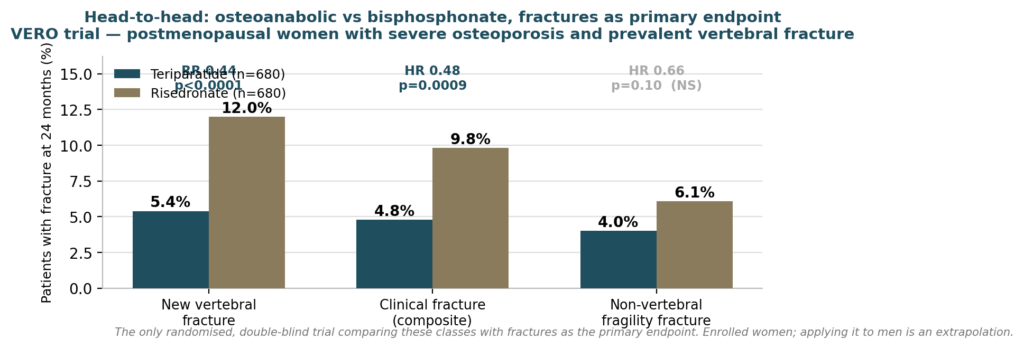
Figuur 1. VERO-onderzoek resultaten van fracturen na 24 maanden [23]. Teriparatide versus risedronaat bij postmenopauzale vrouwen met ernstige osteoporose en een eerdere wervelfractuur. Wat betreft niet-wervelfracturen bleek teriparatide beter te werken, maar dit verschil was niet statistisch significant.
5.2 Vergelijkingen van de botdichtheid
De placebogecontroleerde basis voor deze klasse werd al eerder gelegd: in het cruciale teriparatide-onderzoek traden nieuwe wervelfracturen op bij 5% van de behandelde vrouwen tegenover 14% in de placebogroep, een relatieve afname van 65%, met een afname van 53% in het aantal niet-wervelbreuken door botbroosheid [17]. De gegevens over de botdichtheid wijzen in dezelfde richting. In een gerandomiseerde vergelijking tussen teriparatide en alendronaat nam de botdichtheid in de lumbale wervelkolom na 14 maanden met 10,3% toe bij teriparatide, tegenover 5,5% bij alendronaat [26]. Wanneer de gegevens voor mannen naast de cijfers voor bisfosfonaten worden geplaatst, is een vergelijkbaar patroon te zien, met twee kanttekeningen: deze gegevens zijn afkomstig uit afzonderlijke onderzoeken en kunnen niet formeel met elkaar worden vergeleken, en de waarden voor zoledroninezuur betreffen verschillen tussen de behandelingsgroep en de placebogroep in plaats van veranderingen binnen de groep ten opzichte van de uitgangswaarde; ze zijn dus niet rechtstreeks vergelijkbaar met de cijfers voor anabolen.
| Behandelingsschema | Ruggengraat | Dijbeenhals | Totale heupvervanging | Bron |
| Abaloparatide, 12 maanden, mannen | +8.5% | +3.0% | +2.1% | ATOM [20] |
| Teriparatide, ~11 maanden, mannen | +5.9% | +1.5% | — | Orwoll [18] |
| Zoledroninezuur, 36 maanden, vrouwen | +6.7% | +5.1% | +6.0% | HORIZON-PFT [1] |
| Teriparatide versus alendronaat, 14 maanden | +10,31 TP9T versus +5,51 TP9T | — | — | Hoofdtekst [26] |
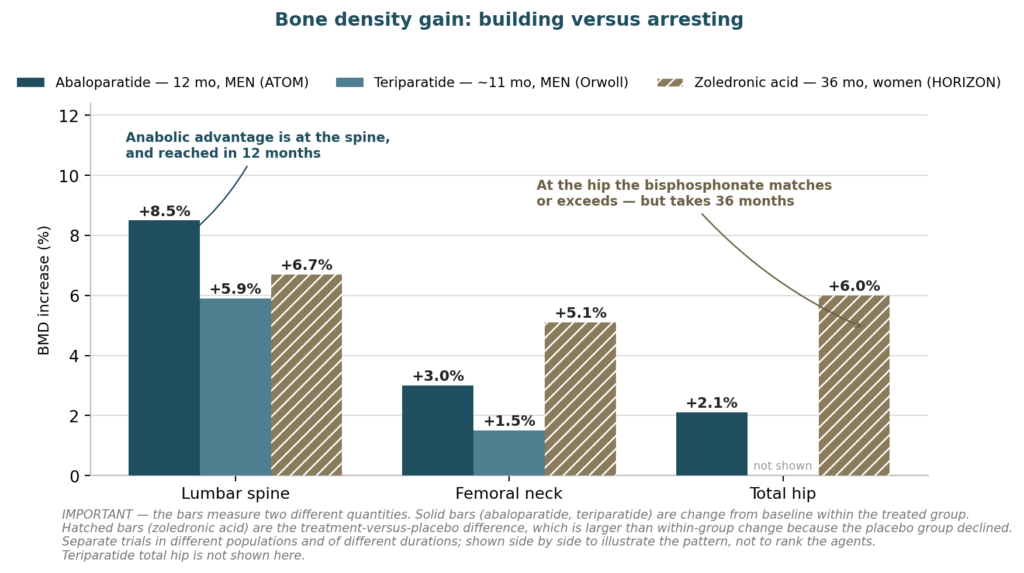
Figuur 2. Toename van de botdichtheid per skeletdeel [1,18,20]. De effen balken geven de verandering ten opzichte van de uitgangswaarde binnen de behandelde groep weer; de gearceerde balken geven het verschil weer tussen de behandeling met zoledroninezuur en placebo, dat groter is dan de verandering binnen de groep omdat de placebogroep een afname vertoonde. Het betreft afzonderlijke onderzoeken, populaties en looptijden — geen formele vergelijking.
Twee aspecten zijn het vermelden waard. Het anabole voordeel op het gebied van de wervelkolom is aanzienlijk en treedt snel op — binnen twaalf maanden. Bij de heup is het verschil kleiner, en drie jaar behandeling met zoledroninezuur levert verbeteringen op die vergelijkbaar zijn met of groter zijn dan die van twaalf maanden behandeling met een anabool middel. Dit is een reële beperking van de anabole middelen en moet worden vermeld in plaats van verdoezeld: hun voordeel is geconcentreerd op plaatsen met veel trabeculair botweefsel.
5.3 Wat “arrestatieverlies” in kwantitatieve zin precies inhoudt
De uitdrukking “botverlies tot stilstand brengen” wordt nogal losjes gebruikt, en het is de moeite waard om het verschil tussen „tot stilstand brengen“ en „omkeren“ numeriek duidelijk te maken, omdat dit bepaalt wat een patiënt over vijf jaar van zijn skelet kan verwachten.
Onbehandeld leeftijdsgebonden botverlies bij oudere mannen verloopt in een gematigd jaarlijks tempo dat varieert per locatie en cohort. De belangrijkste overweging na een fractuur is niet de snelheid waarmee de botdichtheid afneemt, maar de mate van fractuurrisico: een eerdere wervelfractuur gaat gepaard met een ongeveer vier- tot vijfvoudige toename van de kans op een volgende wervelfractuur [37], waarbij het risico vooral in de eerste één tot twee jaar na een recente fractuur verhoogd is [29]. Een verhoogd risico op fracturen is niet hetzelfde als versneld systemisch botverlies, en beide mogen niet door elkaar worden gehaald — maar het betekent wel dat een onbehandelde patiënt in de maanden na een wervelfractuur een periode van ongewoon hoog risico doormaakt, wat het argument is om te handelen in plaats van af te wachten.
Daarentegen leveren de twee geneesmiddelengroepen verschillende berekeningen op.
Een antiresorptief middel remt de botresorptie, waardoor de botdichtheid doorgaans wordt gestabiliseerd of verhoogd en het risico op botbreuken wordt verminderd; de toename ontstaat doordat de hermodelleringruimte zich sluit en de secundaire mineralisatie wordt voltooid. Na drie jaar behandeling met zoledroninezuur stijgt de botdichtheid in de wervelkolom met ongeveer 6,7% en die in de totale heup met ongeveer 6,0% ten opzichte van placebo [1]. Aangezien een deel van dat verschil te wijten is aan een achteruitgang in de placebogroep in plaats van een verbetering in de behandelingsgroep, is de absolute stijging ten opzichte van de eigen uitgangswaarde van een persoon kleiner dan het cijfer voor het verschil tussen de groepen doet vermoeden. De verbetering stagneert vervolgens: uit de gerandomiseerde vervolgstudie bleek dat voortzetting van de behandeling gedurende drie tot zes jaar slechts een extra voordeel van ongeveer één procent opleverde voor de dijbeenhals ten opzichte van het staken van de behandeling [8]. De structuur waarin mineralisatie plaatsvindt, is de structuur die de voorgaande decennia van afbraak heeft doorstaan.
Een anabool middel zorgt voor botopbouw. Na twaalf maanden behandeling met abaloparatide bij mannen werd bij elke patiënt een toename van de wervelkolom van 8,5% en een toename van de dijbeenhals van 3,0% waargenomen ten opzichte van de eigen uitgangswaarde [20] — bereikt in een derde van de tijd en, ter hoogte van de wervelkolom, van grotere omvang. Uit biopsiegegevens blijkt dat de toename het gevolg is van nieuw botweefsel in plaats van verdere mineralisatie van bestaande botpakketjes, waarbij aspecten van de trabeculaire connectiviteit en de corticale structuur zijn verbeterd of behouden gebleven — hoewel het hier om kleinschalige mechanistische studies gaat en de structurele implicaties nog niet volledig in kaart zijn gebracht [36].
Dit zou de reden kunnen zijn waarom de resultaten met betrekking tot fracturen bij VERO meer uiteenlopen dan op basis van de dichtheidscijfers alleen te verwachten zou zijn. De afname van het aantal nieuwe wervelfracturen bij 56% ten opzichte van een actief bisfosfonaat als vergelijkingsmiddel [23] wordt niet volledig verklaard door het verschil in botdichtheid per oppervlakte tussen de armen — wat overeenkomt met de bredere vaststelling dat de behandelingsgerelateerde bescherming tegen fracturen een weerspiegeling is van skeletkenmerken die verder gaan dan alleen de dichtheid, hoewel de specifieke bijdrage van de architectuur in dat onderzoek slechts wordt afgeleid en niet daadwerkelijk wordt aangetoond.
Het praktische verschil voor een patiënt die tussen beide moet kiezen, is dat beide benaderingen het risico op fracturen verminderen, terwijl osteoanabole therapie rechtstreeks de vorming van nieuw bot stimuleert in een skelet waarbij één wervel al structureel is bezweken. Die optie is bovendien in de tijd beperkt: in de bijsluiter van abaloparatide staat vermeld dat gebruik gedurende meer dan twee jaar in het leven van een patiënt niet wordt aanbevolen [21], wat een extra argument is om het middel te gebruiken wanneer de indicatie het duidelijkst is, in plaats van nadat een periode van blootstelling aan antiresorptiva de respons heeft verzwakt.
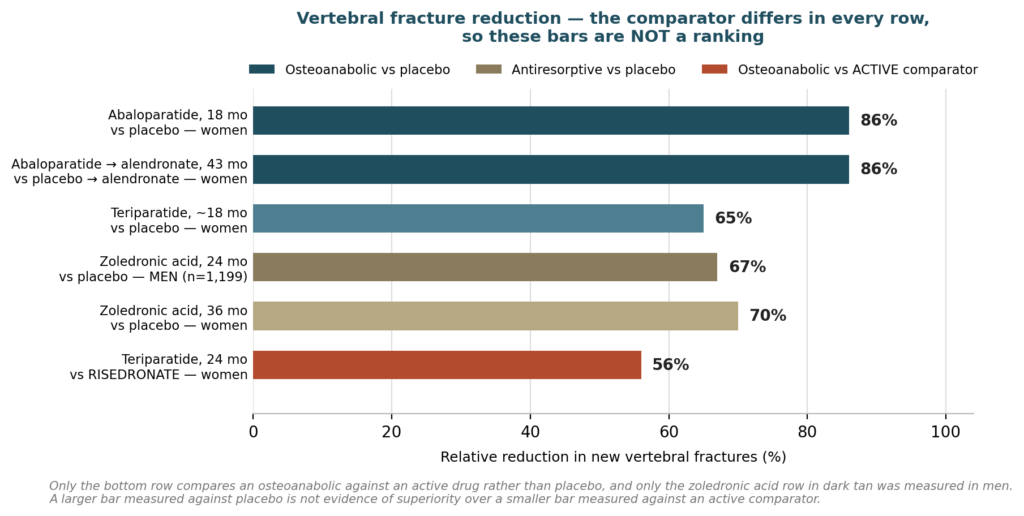
Figuur 3. Relatieve afname van het aantal nieuwe wervelfracturen bij de verschillende behandelingsregimes [7,17,19,23]. De vergelijkingsgroep verschilt per rij; alleen in de onderste rij wordt een osteoanabool middel vergeleken met een actief geneesmiddel, en alleen de rij met zoledronzuur voor mannen werd bij mannen gemeten.
6. Volgorde: waarom de volgorde niet omkeerbaar is
Als de effecten van de twee klassen simpelweg bij elkaar zouden worden opgeteld, zou de volgorde er niet toe doen en zou de discussie louter theoretisch zijn. Dat is echter niet het geval.
Eerdere blootstelling aan bisfosfonaten verzwakt de daaropvolgende reactie op een anabool middel. In het onderzoek naar teriparatide na toediening van respectievelijk raloxifene of alendronaat was de reactie van de botdichtheid op teriparatide minder uitgesproken in de groep die vooraf met alendronaat was behandeld, waarbij het effect het meest uitgesproken was ter hoogte van de heup [27]. Het werkingsmechanisme is eenvoudig: bisfosfonaten remmen de frequentie van de botvernieuwing, waarvan analogen van het bijschildklierhormoon gedeeltelijk afhankelijk zijn, en ze blijven na het staken van de behandeling nog jarenlang in de botmatrix aanwezig.
De DATA-Switch-studie toonde hetzelfde principe aan voor de overgang van antiresorptief naar anabool. Patiënten die teriparatide gevolgd door denosumab kregen, vertoonden een aanzienlijk grotere toename in botdichtheid dan degenen die denosumab gevolgd door teriparatide kregen; bij de laatste volgorde nam de botdichtheid in de heup tijdens de teriparatide-fase zelfs tijdelijk af [28]. Eerst anabool, daarna antiresorptief: dat leverde het beste resultaat op. De omgekeerde volgorde leverde het slechtste resultaat op.
Het klinische gevolg: Het starten van een antiresorptief middel als tijdelijke maatregel in afwachting van een beoordeling door een specialist is niet geheel neutraal. Het eerst starten van een antiresorptieve therapie kan de daaropvolgende reactie van de botdichtheid op een PTH-receptoragonist afzwakken of vertragen, met name ter hoogte van de heup; de mate waarin dit gebeurt, hangt af van het voorafgaande middel, de duur van de toediening en de volgorde. Het effect is eerder een afzwakking dan een volledige opheffing — VERO toonde osteoanabole superioriteit aan, zowel bij patiënten die eerder bisfosfonaten hadden gebruikt als bij behandelingsnaïeve patiënten [24].
Dit betekent niet dat een onbehandelde patiënt er beter aan toe is dan een patiënt die met bisfosfonaten wordt behandeld. Als anabole therapie niet beschikbaar is, gecontra-indiceerd is of door een verzekeraar wordt geweigerd, blijft een bisfosfonaat effectief, op wetenschappelijk bewijs gebaseerd en duidelijk te verkiezen boven geen behandeling [32]. Het gaat hier om de volgorde waarin de behandelingen worden toegepast wanneer beide beschikbaar zijn, niet om het achterwege laten van een behandeling.
7. Richtlijnen inzake therapie waarbij in eerste instantie anabole middelen worden gebruikt
De aanbeveling om bij zorgvuldig geselecteerde patiënten te beginnen met een osteoanabool middel is geen marginale opvatting: meerdere belangrijke richtlijnen en standpunten ondersteunen of bevelen aan om bij zorgvuldig geselecteerde patiënten met een zeer hoog risico een ‘osteoanabool-eerst’-behandeling te overwegen. De aanbevelingen lopen per organisatie uiteen, en in de verklaring van de ASBMR/BHOF zelf wordt opgemerkt dat een groot deel van het onderliggende bewijs afkomstig is van oudere postmenopauzale vrouwen — een kanttekening die van bijzonder belang is bij de toepassing ervan op mannen [29].
- Standpuntverklaring van ASBMR/BHOF inzake doelgerichte behandeling (2024) beveelt aan om bij patiënten met een zeer hoog risico een behandelingsvolgorde te overwegen waarbij eerst osteoanabole middelen worden toegediend, waarbij wordt opgemerkt dat osteoanabole therapie wellicht beter is voor patiënten die een onmiddellijk risico lopen — met name na een recente wervelkolom-, heup- of bekkenfractuur — dat een behandelingsvolgorde van anabole naar antiresorptieve middelen de botdichtheid sterker verhoogt dan de omgekeerde volgorde, en dat onmiddellijke antiresorptieve therapie na de anabole kuur nodig is om die winst te behouden [29].
- AACE/ACE-richtlijn voor de klinische praktijk 2020 wijst een anabool middel aan als eerstelijnsbehandeling voor patiënten met een zeer hoog risico op botbreuken, gedefinieerd als: een recente botbreuk in de afgelopen twaalf maanden, een botbreuk tijdens de behandeling, meerdere botbreuken, een T-score van −3,0 of lager, en een hoog valrisico [30].
- Richtlijn van de Endocrine Society inzake osteoporose bij mannen beveelt farmacologische behandeling aan voor mannen met een hoog risico op botbreuken, waaronder mannen met een T-score van −2,5 of lager of met een eerdere fragiliteitsfractuur, en geeft aan welke laboratoriumonderzoeken naar mogelijke oorzaken daarbij moeten worden uitgevoerd [31].
- BHOF-handleiding voor zorgverleners geeft de behandelingsdrempels en de streefwaarden voor calcium en vitamine D aan die het kader vormen voor de ondersteunende elementen van elk behandelingsschema [32].
De rode draad is dat risicostratificatie, en niet de hiërarchie van geneesmiddelen, bepalend is voor de keuze. Een patiënt met een matig risico is goed geholpen met een bisfosfonaat. Een patiënt met een zeer hoog of imminent risico op fracturen — met name iemand met een recente wervelfractuur — behoort tot de groep voor wie belangrijke richtlijnen en standpunten het overwegen van een ‘osteoanabolische-eerst’-therapie ondersteunen. Bij postmenopauzale vrouwen met ernstige osteoporose en veel voorkomende wervelfracturen liet VERO zien dat er met teriparatide minder wervel- en klinische fracturen optraden dan met risedronaat.
8. Toepassing hiervan bij een hartpatiënt met een recente wervelfractuur
8.1 Risicostratificatie
De relevante vraag voor goedkeuring is of de patiënt voldoet aan de criteria voor zeer hoog risico. Een eerdere wervelfractuur is de sterkste afzonderlijke voorspeller van een volgende wervelfractuur; volgens meta-analytische schattingen is de kans hierop ongeveer vier tot vijf keer zo groot [37]; het risico stijgt snel na de eerste fractuur en blijft de daaropvolgende één tot twee jaar bijzonder hoog — de zogenaamde „imminent risk window“ [29]. Een patiënt die in de afgelopen drie maanden een wervelfractuur heeft opgelopen en tevens lijdt aan osteoporose van de femurhals, voldoet aan meer dan één criterium van de AACE-definitie [30].
Wanneer een fractuur is opgelopen door een hoog-energetisch mechanisme, wordt deze soms afgedaan als niet-osteoporotisch. Die afwijzing is minder steekhoudend dan ze lijkt. In de SOF- en MrOS-cohorten waren fracturen met hoog trauma bij oudere mannen en vrouwen sterk geassocieerd met een lagere botmineraaldichtheid; bij vrouwen leek het risico op een volgende fractuur na een fractuur met hoog trauma op dat na een fractuur met laag trauma, wat de auteurs tot de conclusie bracht dat fracturen met hoog trauma moeten worden beschouwd als mogelijke osteoporotische fracturen en dienovereenkomstig moeten worden behandeld. Het mannelijke cohort had onvoldoende statistische kracht voor de analyse van het risico op een volgende fractuur, zodat die specifieke conclusie moet worden gebaseerd op de gegevens van de vrouwen [35].
8.2 De kwestie van het hart- en vaatstelsel, opgelost
Bij een patiënt met vastgestelde coronaire aderverkalking, geen eerdere hartinfarcten of beroertes, en goed onder controle gehouden risicofactoren: de cardiovasculaire overwegingen kunnen als volgt worden samengevat.
- Er zijn bij analogen van het bijschildklierhormoon geen significante signalen van cardiovasculaire veiligheidsproblemen bij ischemie waargenomen. De beheersbare bijwerkingen zijn voorbijgaande orthostatische hypotensie, hartkloppingen bij gebruik van abaloparatide en voorbijgaande hypercalciëmie. Deze bijwerkingen zijn over het algemeen goed te beheersen en vormen op zichzelf niet het soort ischemische cardiovasculaire waarschuwing dat geldt voor romosozumab; ze kunnen allemaal worden aangepakt door de injectie zittend toe te dienen, het antihypertensieve behandelingsschema bij aanvang te herzien en de uitgangswaarden voor calcium, albumine en de nierfunctie te controleren.
- De waarschuwing in het kader die aanleiding geeft tot bezorgdheid heeft betrekking op romosozumab, dat een ander werkingsmechanisme heeft. Er is geen bewijs dat dit ook geldt voor analogen van het bijschildklierhormoon.
- Zoledroninezuur als onderhoudsmiddel gaat gepaard met een klein, goed gekarakteriseerd risico op atriumfibrilleren en geen aantoonbaar ischemisch signaal, in combinatie met een aangetoonde daling van het sterftecijfer na een heupfractuur [1,2,4]. Bij een patiënt met sinusritme is dit aanvaardbaar; een basislijn elektrocardiogram kan worden overwogen wanneer dit klinisch geïndiceerd is.
- Het grootste risico van denosumab is het staken van de behandeling, niet de farmacologie [12] — van belang voor elke patiënt bij wie het vanwege zijn of haar omstandigheden moeilijk is om een strak halfjaarlijks schema te garanderen.
8.3 De stelling
Voor een mannelijke patiënt met een zeer hoog risico op botbreuken en vastgestelde coronaire hartziekte pleiten de wetenschappelijke gegevens en de huidige richtlijnen voor een strategie waarbij eerst een osteoanabool middel wordt ingezet, namelijk een PTH-receptoragonist, gevolgd door een antiresorptief middel zoals zoledroninezuur om de behaalde resultaten te behouden. Abaloparatide is goedgekeurd voor mannen met een hoog risico op botbreuken en er zijn recente gerandomiseerde gegevens over de werkzaamheid op de botdichtheid bij mannen beschikbaar; ook teriparatide beschikt over bewezen werkzaamheidsgegevens bij mannelijke osteoporose en vormt een redelijk alternatief wanneer de kosten doorslaggevend zijn. Er is geen rechtstreekse vergelijkende studie die aantoont dat een van beide middelen bij mannen superieur is. De bijsluiter van teriparatide is in 2020 herzien om gebruik langer dan twee jaar toe te staan bij patiënten die een hoog risico op fracturen blijven lopen, terwijl in de bijsluiter van abaloparatide staat dat gebruik langer dan twee jaar gedurende het hele leven niet wordt aanbevolen [21,22].
De fase met zoledroninezuur is geen bijzaak. Het is het middel in de behandelingsreeks waarvoor gerandomiseerde gegevens over de uitkomsten van fracturen bij mannen beschikbaar zijn [7], en zonder deze behandeling gaan de anabole effecten grotendeels verloren [29]. Een behandeling van drie jaar, gevolgd door een herbeoordeling, wordt aanbevolen, waarbij voortzetting tot zes jaar met name zinvol is bij patiënten die een hoog risico op wervelfracturen blijven lopen [8,9].
9. Praktische begeleiding tijdens de behandeling van een hartpatiënt
- Bij aanvang van de anabole behandeling: Dien de eerste paar doses in zittende of liggende houding toe; sta langzaam op. Controleer of er geen additief orthostatisch effect optreedt bij het gebruik van antihypertensiva, diuretica en bètablokkers. Controleer het serumcalciumgehalte bij aanvang, samen met het albuminegehalte en de nierfunctie; het calciumgehalte in de urine kan worden gemeten bij vermoeden van hypercalciurie of urolithiasis.
- Als digoxine wordt voorgeschreven: in de gaten houden, aangezien tijdelijke hypercalciëmie het risico op digitalisvergiftiging vergroot [21].
- Hartkloppingen bij gebruik van abaloparatide: komt vaak voor en is doorgaans goedaardig, maar bij een patiënt met coronaire hartziekte moet men voorzichtig zijn en niet automatisch het medicijn als oorzaak aanwijzen.
- Vóór de behandeling met zoledroninezuur: Berekent de creatinineklaring (gecontra-indiceerd bij waarden onder 35 ml/min) en beoordeelt de tandheelkundige gezondheid, waarbij invasieve tandheelkundige ingrepen worden uitgevoerd waar dat haalbaar is. Een basis-elektrocardiogram kan worden overwogen indien dit klinisch geïndiceerd is; het is geen algemene vereiste.
- Tijdens de infusie: Zorg voor voldoende vochtinname, dien de infusie gedurende ten minste vijftien minuten toe en controleer of er gelijktijdig nefrotoxische geneesmiddelen worden gebruikt. Het gebruik van niet-steroïde ontstekingsremmers moet op individuele basis worden bepaald — deze worden soms gebruikt om symptomen in de acute fase te behandelen, maar brengen een nierrisico met zich mee bij volumedepletie of verminderde nierfunctie. Bij ongeveer één op de drie patiënten treedt na de eerste infusie een acute-fasereactie op.
- Calciumsupplementen: een streefwaarde van 1.000 mg per dag voor mannen van 50 tot 70 jaar, oplopend tot 1.200 mg vanaf 70 jaar, waarbij de voorkeur uitgaat naar voedingsbronnen [32]. Over calciumsupplementen in hoge doseringen bestaat in de cardiovasculaire literatuur nog geen eenduidigheid, en dit is met name van belang voor deze doelgroep; het doel is voldoende inname, niet maximale inname.
- Monitoring: Bottenomzettingsmarkers (P1NP en CTX) bij aanvang en tijdens de anabole fase bieden een vroegere bevestiging van de respons dan seriële botdichtheidsmetingen, wat belangrijk is omdat een toename van de botdichtheid in de femurhals over een periode van twaalf maanden van ongeveer 3% mogelijk op of onder de kleinste significante verandering van een instelling ligt.
10. Conclusie
De cardiovasculaire risico’s in verband met de behandeling van osteoporose zijn reëel, maar beperkt van aard. Ze hebben betrekking op sclerostineremming, waarbij een waarschuwing in een kader en een signaal bij een subgroep van patiënten met reeds bestaande hart- en vaatziekten voorzichtigheid rechtvaardigen; en, in veel mindere mate, op het atriumfibrilleren dat geassocieerd wordt met intraveneus toegediend zoledroninezuur, wat wordt gecompenseerd door de afwezigheid van een ischemisch signaal en door een gedocumenteerd voordeel wat betreft de mortaliteit na een fractuur. Vergelijkbare ischemische cardiovasculaire waarschuwingen zijn niet vastgesteld voor PTH-receptoragonisten, waarvan de aangetoonde effecten hemodynamisch en van voorbijgaande aard zijn. Het bewijs voor romosozumab zelf is gemengd: een tweede, op neiging gematcht cohort uit 2026 vond geen significant verschil in MACE ten opzichte van denosumab [38].
De keuze tussen een osteoanabool middel en een bisfosfonaat bij een patiënt met een zeer hoog risico is daarom geen keuze tussen een risicovolle en een veilige optie. Het is een keuze tussen een therapie die nieuwe botvorming stimuleert en een therapie die voornamelijk botresorptie remt; beide verminderen het risico op fracturen, terwijl een behandeling waarbij in de eerste plaats een osteoanabool middel wordt gebruikt bij patiënten met een zeer hoog risico kan leiden tot snellere en grotere botopbouw. In de enige gerandomiseerde, rechtstreekse vergelijkende studie met voldoende statistische power voor fracturen bij patiënten met bestaande wervelfracturen — uitgevoerd bij postmenopauzale vrouwen — verminderde het osteo-anabole middel nieuwe wervelfracturen met 56% en klinische fracturen met 52% ten opzichte van een oraal bisfosfonaat [23]. Belangrijke richtlijnen en standpunten pleiten steeds vaker voor het overwegen van een ‘osteoanabolic-first’-behandelingsvolgorde bij zorgvuldig geselecteerde patiënten met een zeer hoog of dreigend risico op fracturen [29,30], en de volgorde is niet willekeurig omkeerbaar: blootstelling aan bisfosfonaten verzwakt de latere anabole reactie, het meest uitgesproken ter hoogte van de heup [27,28].
Voor een patiënt bij wie is vastgesteld dat kransslagaderziekte, geen eerdere ischemische gebeurtenis, goed onder controle gehouden risicofactoren, een recente wervelfractuur en osteoporose van de femurhals: de beschikbare gegevens pleiten ervoor om eerst een osteoanabole behandeling met een PTH-receptoragonist te overwegen, onmiddellijk gevolgd door zoledroninezuur, met de hierboven beschreven monitoring. Uit de beschikbare gegevens blijkt niet dat vastgestelde coronaire atherosclerose op zichzelf een contra-indicatie vormt voor behandeling met een PTH-receptoragonist. Bij de uiteindelijke keuze van het geneesmiddel moet rekening worden gehouden met het fractuurrisico, de cardiovasculaire voorgeschiedenis, de nierfunctie, het calciummetabolisme, contra-indicaties, de kosten en de voorkeur van de patiënt.
Referenties
- D. M. Black et al., “Once-yearly zoledronic acid for treatment of postmenopausal osteoporosis (HORIZON-PFT),” N. Engl. J. Med., vol. 356, no. 18, pp. 1809–1822, 2007.
- K. W. Lyles et al., “Zoledronic acid and clinical fractures and mortality after hip fracture (HORIZON-RFT),” N. Engl. J. Med., vol. 357, no. 18, pp. 1799–1809, 2007.
- E. M. Lewiecki et al., “Review of the cardiovascular safety of zoledronic acid and other bisphosphonates for the treatment of osteoporosis,” Clin. Ther., vol. 32, no. 3, pp. 431–447, 2010.
- S. Kim et al., “Bisphosphonates and risk of cardiovascular events: a meta-analysis,” PLoS One, vol. 10, no. 4, e0122646, 2015.
- “Cardiovascular safety of zoledronic acid in the treatment of primary osteoporosis: a meta-analysis and systematic review,” Bone, 2023 (PMID 37984227).
- Disproportionality analysis of cardiac arrhythmia associated with bisphosphonates based on the FAERS database, Sci. Rep., 2025.
- S. Boonen et al., “Fracture risk and zoledronic acid therapy in men with osteoporosis,” N. Engl. J. Med., vol. 367, no. 18, pp. 1714–1723, 2012.
- D. M. Black et al., “The effect of 3 versus 6 years of zoledronic acid treatment of osteoporosis: a randomized extension to HORIZON-PFT,” J. Bone Miner. Res., vol. 27, no. 2, pp. 243–254, 2012.
- D. M. Black et al., “The effect of 6 versus 9 years of zoledronic acid treatment: a second randomized extension to HORIZON-PFT,” J. Bone Miner. Res., vol. 30, no. 5, pp. 934–944, 2015.
- S. R. Cummings et al., “Denosumab for prevention of fractures in postmenopausal women with osteoporosis (FREEDOM),” N. Engl. J. Med., vol. 361, no. 8, pp. 756–765, 2009.
- H. G. Bone et al., “10 years of denosumab treatment in postmenopausal women with osteoporosis: FREEDOM trial and open-label extension,” Lancet Diabetes Endocrinol., vol. 5, no. 7, pp. 513–523, 2017.
- K. H. Lu, S. I. Wang and S. F. Yang, “Denosumab withdrawal increases vertebral fracture and mortality risk compared with zoledronate,” Eur. J. Endocrinol., vol. 192, no. 3, pp. 180–190, 2025.
- N. Bucay et al., “Osteoprotegerin-deficient mice develop early onset osteoporosis and arterial calcification,” Genes Dev., vol. 12, no. 9, pp. 1260–1268, 1998.
- L. B. Tankó et al., “Relationship between osteoporosis and cardiovascular disease in postmenopausal women,” J. Bone Miner. Res., vol. 20, no. 11, pp. 1912–1920, 2005.
- L. L. Demer and Y. Tintut, “Vascular calcification: pathobiology of a multifaceted disease,” Circulation, vol. 117, no. 22, pp. 2938–2948, 2008.
- J. Golledge and S. Thanigaimani, “Role of sclerostin in cardiovascular disease,” Arterioscler. Thromb. Vasc. Biol., vol. 42, no. 7, pp. e187–e202, 2022.
- R. M. Neer et al., “Effect of parathyroid hormone (1-34) on fractures and bone mineral density in postmenopausal women with osteoporosis,” N. Engl. J. Med., vol. 344, no. 19, pp. 1434–1441, 2001.
- E. S. Orwoll et al., “The effect of teriparatide on bone density in men with osteoporosis,” J. Bone Miner. Res., vol. 18, no. 1, pp. 9–17, 2003.
- P. D. Miller et al., “Effect of abaloparatide vs placebo on new vertebral fractures in postmenopausal women with osteoporosis (ACTIVE),” JAMA, vol. 316, no. 7, pp. 722–733, 2016.
- ATOM trial, “Efficacy and safety of abaloparatide-SC in men with osteoporosis: a randomized clinical trial,” J. Bone Miner. Res., 2022 (PMID 36190391).
- TYMLOS (abaloparatide) prescribing information, U.S. FDA / DailyMed.
- FORTEO (teriparatide) prescribing information, U.S. FDA (2020 label revision).
- D. L. Kendler et al., “Effects of teriparatide and risedronate on new fractures in post-menopausal women with severe osteoporosis (VERO): a multicentre, double-blind, double-dummy, randomised controlled trial,” Lancet, vol. 391, no. 10117, pp. 230–240, 2018.
- P. Geusens et al., “Effects of teriparatide compared with risedronate on the risk of fractures in subgroups of postmenopausal women with severe osteoporosis: the VERO trial,” J. Bone Miner. Res., vol. 33, no. 5, pp. 783–794, 2018.
- J. J. Body et al., “Efficacy of teriparatide compared with risedronate on FRAX-defined major osteoporotic fractures: results of the VERO clinical trial,” Osteoporos. Int., 2020 (PMID 32474650).
- J. J. Body et al., “A randomized double-blind trial to compare the efficacy of teriparatide with alendronate in postmenopausal osteoporosis,” J. Clin. Endocrinol. Metab., vol. 87, no. 10, pp. 4528–4535, 2002.
- B. Ettinger et al., “Differential effects of teriparatide on BMD after treatment with raloxifene or alendronate,” J. Bone Miner. Res., vol. 19, no. 5, pp. 745–751, 2004.
- B. Z. Leder et al., “Denosumab and teriparatide transitions in postmenopausal osteoporosis (DATA-Switch): a randomized controlled trial,” Lancet, vol. 386, no. 9999, pp. 1147–1155, 2015.
- ASBMR/BHOF Task Force, “Goal-directed osteoporosis treatment: position statement,” J. Bone Miner. Res., 2024.
- P. M. Camacho et al., “American Association of Clinical Endocrinologists/American College of Endocrinology clinical practice guidelines for the diagnosis and treatment of postmenopausal osteoporosis — 2020 update,” Endocr. Pract., vol. 26 (Suppl 1), pp. 1–46, 2020.
- N. B. Watts et al., “Osteoporosis in men: an Endocrine Society clinical practice guideline,” J. Clin. Endocrinol. Metab., vol. 97, no. 6, pp. 1802–1822, 2012.
- M. S. LeBoff et al., “The clinician’s guide to prevention and treatment of osteoporosis,” Osteoporos. Int., vol. 33, no. 10, pp. 2049–2102, 2022.
- K. G. Saag et al., “Romosozumab or alendronate for fracture prevention in women with osteoporosis (ARCH),” N. Engl. J. Med., vol. 377, no. 15, pp. 1417–1427, 2017.
- B. I. Gusbela et al., “Cardiovascular safety of romosozumab versus denosumab: a multinational real-world data analysis,” Ther. Adv. Musculoskelet. Dis., vol. 18, 2026.
- D. C. Mackey et al., “High-trauma fractures and low bone mineral density in older women and men,” JAMA, vol. 298, no. 20, pp. 2381–2388, 2007.
- D. W. Dempster et al., “Effects of daily treatment with parathyroid hormone on bone microarchitecture and turnover in patients with osteoporosis: a paired biopsy study,” J. Bone Miner. Res., vol. 16, no. 10, pp. 1846–1853, 2001.
- J. A. Kanis et al., “A meta-analysis of previous fracture and subsequent fracture risk,” Bone, vol. 35, no. 2, pp. 375–382, 2004.
- S. H. Ahn et al., “Risk of cardiovascular events in patients with osteoporosis on romosozumab treatment compared with denosumab: a multicenter observational cohort study,” Endocrinol. Metab. (Seoul), vol. 41, pp. 442–451, 2026.