1. The Hypothesis and How This Review Tests It
The proposition under examination is that a nutritionally adequate, entirely whole-food 以植物为主的饮食, very low in total fat (hereafter VLF-WFPB), offers cardiovascular protection beyond that of other high-quality dietary patterns, for prevention, for treatment of established disease, and for regression. Four separate questions are kept apart throughout: (Q1) Does VLF-WFPB improve outcomes compared with a typical Western diet? (Q2) Does it outperform other high-quality diets, such as DASH, Mediterranean, or Portfolio? (Q3) Are complete exclusion of animal foods, very low total fat, and minimal processing each independently necessary for any advantage? (Q4) Do such diets protect arteries through pathways beyond lowering ApoB-containing 脂蛋白? Q4 is treated as the central question (Section 5), because a benefit that runs entirely through 载脂蛋白B could in principle be matched by any equally effective means of lowering ApoB.
The positive case rests on convergence. Randomized trials show that plant-based diets lower causal 风险因素; intensive lifestyle trials that included very-low-fat 素食 showed functional and angiographic improvement; and populations with lifelong low animal-food intake had low 胆固醇 and low coronary mortality. Each line is weak alone. Together they make it more credible that sustained dietary lowering of ApoB-containing lipoproteins can slow coronary disease, which bears mainly on Q1. They cannot answer Q2 or Q3, because in every line the diet travels with other exposures—减肥, physical activity, co-interventions, drugs—that also change risk. Convergence is therefore used here to judge plausibility, not to enlarge sample sizes or to compute a probability of superiority. Unrelated populations are not pooled.
Narrative reviews by Wang and colleagues, Freeman and colleagues, and Kahleova and colleagues served as background and as routes to original studies; numerical claims are taken from the original reports, and repeated citation of the same cohort is not treated as independent corroboration [1–3].
1.1 Scope and methods
This is a targeted critical review, not a registered 系统评价. Sources were identified through PubMed-indexed records, publisher pages, full-text articles where accessible, guideline repositories, and reference tracing, with a final update search on 12 September 2026. Numerical claims were checked against original reports where accessible; where only an abstract or an official summary could be obtained, that is stated at the relevant passage. No new 元分析 or patient-level reanalysis was performed.
Interests deserve attention without being disqualifying. Several lifestyle programs were evaluated by the investigators who developed them; the direct vegan–Mediterranean comparison was conducted by an organization that advocates plant-based diets; and the major Mediterranean secondary-prevention trial was funded principally by olive-oil foundations. These are reasons to emphasize allocation, retention, prespecification, blinded outcomes, and independent replication, not reasons to reject results.
1.2 How to read the evidence: five tiers of data
Not all evidence answers the same question. This review sorts studies into five tiers according to how well each design can show cause and effect, not according to whether its results support the hypothesis. Lower tiers still count—evidence is evidence—but they answer different questions and carry different risks of misleading us (Figure 1).
Tier 1: randomized trials with clinical events. People are assigned to a diet by chance, and 心脏病发作, 中风, or deaths are counted. Chance assignment reduces 混杂的 in expectation, though not necessarily in any single trial, so a difference in events is the strongest available evidence that the diet caused it. Examples in this review are PREDIMED, 冠心病预防, ,以及 里昂饮食心脏研究.
Tier 2: randomized trials of intermediate outcomes. Assignment is still by chance, but the outcome is a measurement that predicts events: LDL-C, ApoB, 血压, coronary narrowing, 斑块体积, or myocardial blood flow. These trials show that a diet changes the measurement; they do not by themselves show fewer events. Examples are the 生活方式心脏试验, EVADE CAD, and the lipid meta-analyses.
Tier 3: 前瞻性队列研究 studies. Large groups of individuals report what they eat and are followed for years. These studies capture real disease in real people over decades, which trials rarely can, but they show association: people who choose a diet differ in many other ways, and statistical adjustment can only partly remove those differences (Section 9.1). Examples are Adventist Health Study-2, EPIC-Oxford, and the Danish nitrate cohort.
Tier 4: population comparisons, cross-sectional studies, and uncontrolled case series. Whole populations are compared (rural China, Okinawa, the 齐曼人), people are measured once, or treated patients are followed without a comparison group (the Esselstyn cohorts). These data generate hypotheses and show what is achievable, but many explanations can fit the same pattern.
Tier 5: mechanistic studies in cells and animals. Experiments can isolate a single pathway under controlled conditions, which makes them the best way to test how something might work. Whether the same pathway matters in human arteries over decades has to be shown separately.
Design is a starting point, not a verdict: confidence also depends on risk of bias, precision, how directly the comparison addresses the question, and how outcomes were ascertained. Tiers also apply to outcomes rather than to whole studies, so a trial can sit in one tier for imaging and another for clinical events. The case for a whole-food plant-based diet is strongest where several tiers point the same way and weakest where it rests on one tier alone. Section headings throughout the review note the main tier of evidence discussed.
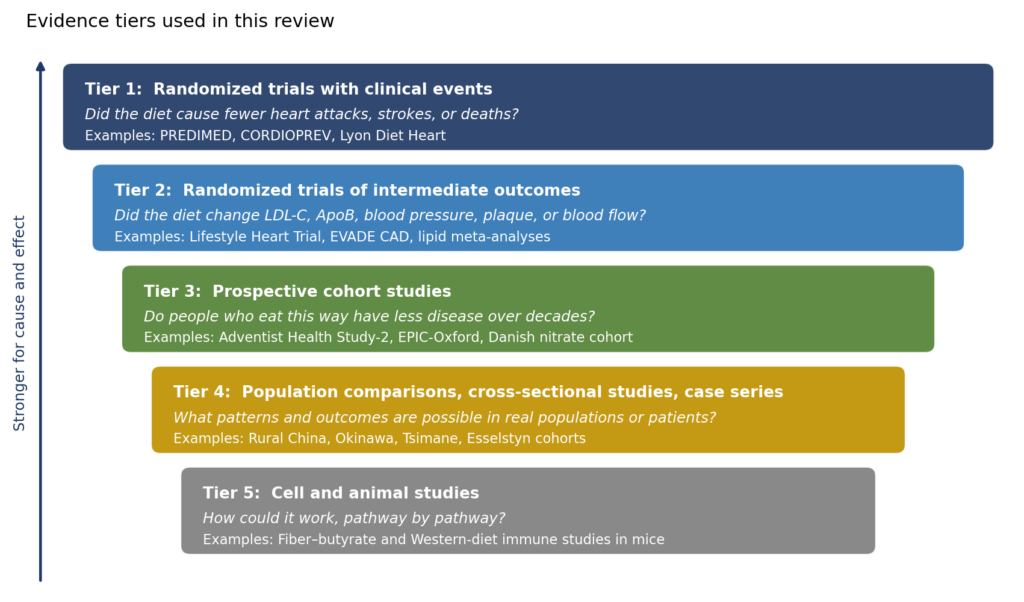
Figure 1. Five tiers of evidence used in this review, the question each tier can answer, and examples of studies in each tier. Higher tiers are better at showing cause and effect; lower tiers add breadth, duration, and biological explanation.
2. Defining the Diets and the Comparisons
The proposed diet. VLF-WFPB consists of vegetables, legumes, intact whole grains, fruit, and minimally processed starchy foods, with no animal foods and little or no added oil, operationally about 10–15% of energy from fat. The 2014 Esselstyn protocol also excluded avocado, nuts, excess salt, and sugary foods, later also caffeine and fructose, and advised a multivitamin, vitamin B12, and flaxseed meal [4]. The earlier 1985 Esselstyn cohort was not vegan: patients eliminated oil, fish, fowl, meat, and dairy products except skim milk and nonfat yogurt, targeted 10% of energy from fat, and received individualized cholesterol-lowering medication [5]。 欧尼斯生活方式心脏试验 diet was a 10%-fat whole-foods vegetarian diet that permitted nonfat dairy and egg whites [6, 7]; achieved fat intake was 6.2% of energy at one year and 8.5% at five years [6].
Related but different diets. Higher-fat whole-food vegan diets include nuts, seeds, avocado, or 橄榄油; the low-oil phase of the 2024 Recipe for Heart Health trial still provided 32% of energy from fat [8], and the vegan arm of the EVADE CAD trial ended at about 30% [9]. Generic vegan diets exclude animal foods without constraining food processing or fat. Conventional low-fat diets are omnivorous; the low-fat arm of CORDIOPREV prescribed less than 30% fat with lean meat and low-fat dairy, and achieved 32.1% [10].
Comparators. The DASH combination diet emphasized fruits, vegetables, and low-fat dairy with reduced saturated and total fat [11]. 地中海饮食 tested in randomized trials were substantially higher in fat: the PREDIMED arms were supplemented with extra-virgin olive oil or nuts [12]; the CORDIOPREV Mediterranean arm prescribed at least 35% fat and achieved 40.5% [10]; and the Lyon intervention supplied an alpha-linolenic-acid-rich margarine in place of butter and cream, alongside advice to follow a Mediterranean-type pattern [13, 14]。 组合饮食法 adds nuts, plant 蛋白质, viscous 纤维, and plant 甾醇 to a low-saturated-fat background [15]. Table 1 summarizes the patterns as they were actually tested.
Table 1. Dietary patterns as tested.
| 模式 | Defining features in the key trials | Fat, % of energy | What the label alone does not establish |
| VLF-WFPB | Legumes, intact grains, vegetables, fruit, starchy foods; no animal foods; little or no oil; Esselstyn 2014 also excluded nuts and avocado [4] | Target ~10–15%; Ornish (vegetarian, not vegan) achieved 6.2–8.5% [6] | Adequate B12, protein, essential fats, or sustained 坚持 |
| Higher-unsaturated-fat whole-food vegan | Animal-free, with nuts, seeds, avocado, or olive oil | 32–48% [8]; ~30% in EVADE CAD [9] | Inferiority to an oil-free vegan pattern |
| 达世币 | Fruit, vegetables, low-fat dairy; reduced saturated and total fat; sodium reduction in DASH-Sodium [11, 16] | Reduced, not very low | That benefit depends on dairy; event reduction in a trial |
| 地中海 | Vegetables, legumes, whole grains, nuts, extra-virgin olive oil, fish [10, 12] | 40.5% achieved in CORDIOPREV [10] | A fixed macronutrient ratio or unlimited energy |
| 投资组合 | Nuts, plant protein, viscous fiber, plant sterols added to a low-saturated-fat diet [15] | Varied across trials; includes nuts but not necessarily high in fat | Event reduction; core evidence is 降脂; tested patterns were not restricted to 10–15% fat |
| Conventional low-fat (omnivorous) | Lean meat, low-fat dairy, complex 碳水化合物 [10] | <30% prescribed; 32.1% achieved [10] | Equivalence to VLF-WFPB |
3. Three Levers: Animal-Food Exclusion, Total Fat, and Food Processing (Tiers 2–3)
VLF-WFPB bundles three changes that can be separated: excluding animal foods, restricting total fat to about 10–15% of energy, and building the diet from whole or minimally processed foods. The Esselstyn and Ornish programs push fat restriction and whole-food eating to their extremes and remove all or nearly all animal foods (their early protocols permitted nonfat dairy, and Ornish’s also egg whites). That makes them the natural test bed for the whole package and, for the same reason, unable on their own to apportion credit among its parts (Figure 2). The label “plant-based” describes only the first lever, and the evidence shows it is not sufficient on its own.
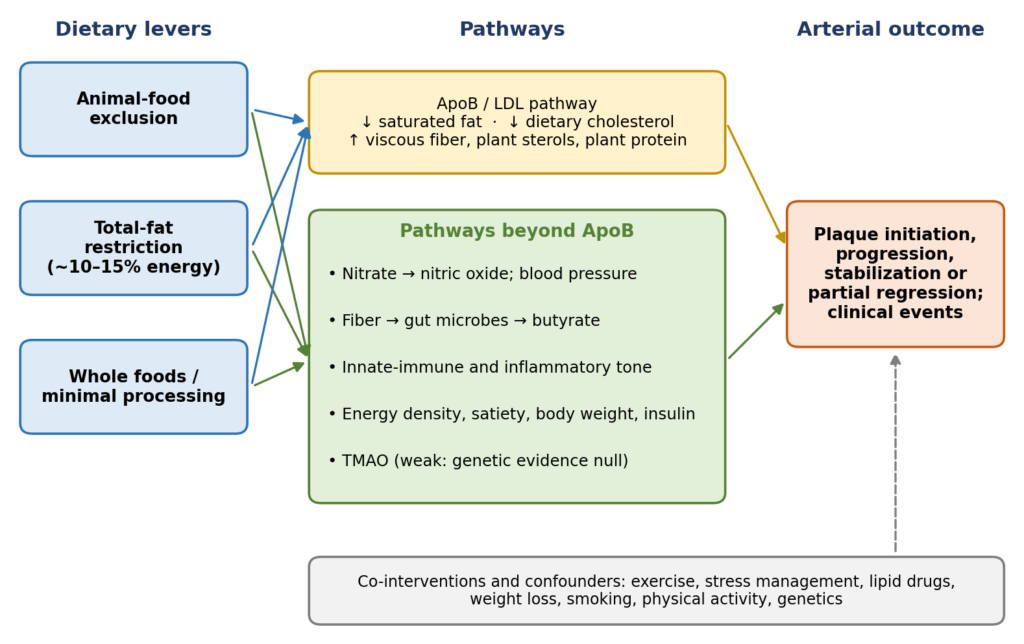
Figure 2. Three separable dietary levers and the pathways by which they could affect coronary 动脉粥样硬化. Most intervention programs change all three levers together and add co-interventions, so trials cannot attribute benefit to a single lever.
Diet quality within plant-based eating. In three US cohorts totalling about 209,000 health professionals with 8,631 incident coronary events, an overall plant-based diet index was only weakly associated with lower risk (风险比 for extreme deciles 0.92; 95% CI 0.83 to 1.01). A healthful index that rewarded whole grains, fruits, vegetables, nuts, legumes, oils, tea, and coffee was associated with 25% lower risk (0.75; 0.68 to 0.83), whereas an unhealthful index that rewarded refined grains, potatoes, sweetened beverages, juices, and sweets was associated with 32% higher risk (1.32; 1.20 to 1.46) [17]. 接下来有两点。植物性饮食本身不具有保护作用;质量决定了其方向。而且健康指数将坚果和植物油计为有益,因此这些证据支持全食物模式,而非专门针对极低脂肪的模式。
植物性食物中的加工处理。 在 126,842 名 英国生物样本库 受试者中(中位随访时间为 9 年),非超加工植物源食物提供的能量每增加 10 个百分点,对应的 心血管疾病 风险降低 7%(风险比 0.93;95% CI 为 0.91 至 0.95),心血管死亡率降低 13%(0.87;0.80 至 0.94)。植物源 超加工食品 显示出相反的相关性(疾病风险为 1.05;1.03 至 1.07;死亡率为 1.12;1.05 至 1.20),而不考虑加工情况的总植物性食物摄入量则显示没有相关性 [18].
关于加工处理的随机化证据。 加工处理也有随机化证据,尽管是针对能量平衡而非动脉粥样硬化。在一项住院交叉试验中,20 名体重稳定的成年人分别接受了为期两周的超加工饮食或未经加工的饮食,提供的餐食在热量、 能量密度、宏量营养素、糖、钠和纤维方面均进行了匹配。在超加工饮食期间,他们每天多摄入 508 ± 106 千卡,体重增加了 0.9 公斤;而在未经加工的饮食期间,他们体重减轻了 0.9 公斤 [19].
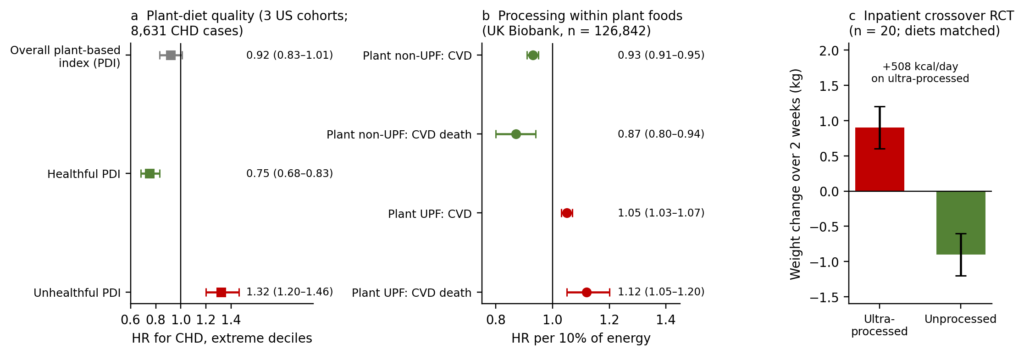
图 3. 饮食质量与加工处理。(a) 植物性饮食指数与新发 冠心病,极端十分位数。(b) 按加工程度划分的植物源食物(每增加 10% 能量摄入),英国生物样本库 (UK Biobank)。(c) 超加工饮食与未经加工饮食的住院交叉试验中的体重变化(平均值 ± 标准误差)。各组图表来自不同的研究设计,其量值不具有可比性。来源:Satija 2017; Rauber 2024; Hall 2019。
这改变了什么。 有关加工处理的证据在方向上是一致的:植物性食物的相关性随加工程度而逆转;在一项随机喂养试验中,在设计允许的范围内匹配营养素的情况下,超加工模式相对于未经加工模式增加了能量摄入和体重。这些发现支持了对食物质量和加工程度的关注;但它们并未确立加工处理相对于排除动物性食物的重要性,因为目前还没有试验进行过此类比较。这为 Esselstyn 和 Ornish 计划提供了新的视角。这些计划彼此之间,以及与中国农村、冲绳和 Tsimane 人群(第 6–8 节)的共同点,不在于零动物性食物,而在于饮食几乎完全由完整的、极简加工的食物组成。这一特征,以及其益处是否仅通过 ApoB(第 5 节)发挥作用,是接下来的讨论重点。
4. 生物学依据:ApoB 与脂质途径(第 1–2 级)
4.1 组织框架:含 ApoB 颗粒的累积暴露
低密度脂蛋白 以及其他含有 ApoB 的脂蛋白会导致动脉粥样硬化性心血管疾病,遗传学、流行病学和试验证据表明,风险随着暴露程度和持续时间的增加而升高 [20]。颗粒进入动脉 内膜 的比例与其浓度成正比,并滞留在易受损部位,因此相关的衡量标准是 累积暴露 而非单次测量值。此框架在此用作组织原则,而非经过验证的数值风险方程。
该框架对饮食有两点启示。首先,从成年早期开始持续的小幅降低,可能比患病后才开始的同样幅度的降低更为重要;这就是第 6 至 8 节中人群证据背后的逻辑。其次,对于确诊患者,相关的基准是他汀类药物试验的斜率:在大约五年的时间里,低密度脂蛋白胆固醇 (LDL-C) 每降低 1 mmol/L (38.7 mg/dL),主要血管事件的相对风险降低约 22% [21]。如果该斜率适用于下文报告的 0.30 mmol/L 的综合饮食 LDL-C 差异,则预测五年内的相对降幅约为 7% (1 − 0.78^0.30)。这一数字是推断值,而非测得的饮食效果:饮食试验通常持续数周至数月,依从性会下降,且饮食还会改变体重、血压以及 他汀 斜率无法体现的其他因素。
4.2 Randomized evidence on lipids and risk factors
The largest meta-analysis of randomized trials comparing vegetarian or vegan diets with omnivorous diets included 30 trials. Plant-based diets lowered 总胆固醇 by 0.34 mmol/L (95% CI 0.23 to 0.44; about 13 mg/dL) and LDL-C by 0.30 mmol/L (95% CI 0.19 to 0.40; about 11.6 mg/dL). ApoB fell by 12.92 mg/dL (95% CI 3.20 to 22.63), a 14% reduction, but only six trials contributed ApoB data and heterogeneity was substantial (I² = 71.7%); 甘油三酯 did not differ overall [22]. The ApoB figure is the published pooled estimate; because it rests on six trials, its precision depends on those trials being independent randomized comparisons of diet alone, which could not be confirmed from the accessible sources; pooled analyses in this literature also require checking for multiple reports of a single cohort. These results support lipid-mediated plausibility. They do not establish event reduction, 斑块消退, an individual’s response, or a special benefit from excluding 不饱和脂肪, because the trial diets and comparators varied widely.
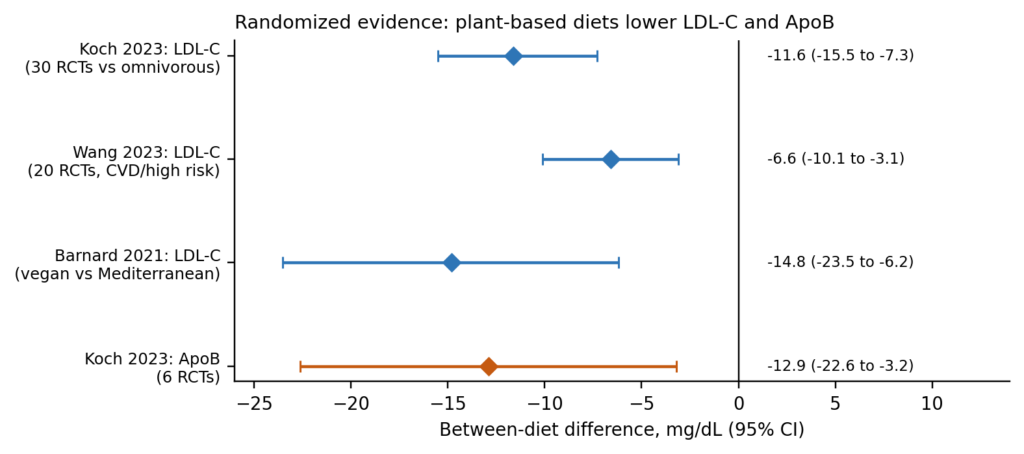
Figure 4. Randomized evidence that plant-based diets lower LDL-C and ApoB. Between-diet differences with 95% 置信区间; Koch 2023 values converted from mmol/L (× 38.67). Estimates share constituent trials and are not additive. Sources: Koch 2023; Wang 2023; Barnard 2021 (participants without medication changes).
A second meta-analysis restricted to people with, or at high risk of, cardiovascular disease pooled 20 trials (1,878 participants; mean duration 25.4 weeks). Vegetarian diets lowered LDL-C by 6.6 mg/dL (95% CI 3.1 to 10.1), HbA1c by 0.24 percentage points (95% CI 0.07 to 0.40), and body weight by 3.4 kg (95% CI 2.0 to 4.9), with no effect on 收缩压 (−0.1 mm Hg; 95% CI −2.8 to 2.6) [7]. The article’s Key Points box states 6.8 mg/dL and 0.25%; the results section and forest plots give 6.6 mg/dL and 0.24%, which are used here. Two further details matter for Q2. Against usual diets, LDL-C fell 12.9 mg/dL; against active dietary comparators, the LDL-C difference was not statistically significant. And baseline LDL-C explained the between-trial heterogeneity [7]. Only four trials enrolled patients with established cardiovascular disease, three of them Ornish-type programs.
Blood pressure. Earlier meta-analyses, as summarized by Wang and colleagues, reported systolic reductions of about 2.5 mm Hg with vegetarian diets [7]. The null result in higher-risk patients is plausibly explained by background 抗高血压的 therapy and by medication reductions during trials, which the authors note could mask diet effects. Blood-pressure benefit is not specific to plant-exclusive eating: the DASH饮食, which includes low-fat dairy, lowered pressure substantially in controlled feeding [11, 16], and in a direct crossover comparison a Mediterranean diet lowered systolic pressure more than a low-fat vegan diet [23]. Blood pressure is therefore not a demonstrated advantage of VLF-WFPB. Estimates from the two lipid meta-analyses are not added together; they share trials.
4.3 Dietary cholesterol
膳食胆固醇 raises serum cholesterol independently of 饱和脂肪. In a meta-analysis of egg-feeding studies cited by Freeman and colleagues, each additional 100 mg/day raised LDL-C by about 1.9 mg/dL and HDL-C by about 0.3 mg/dL; the response is larger when baseline intake is low and varies between individuals with intestinal absorption capacity [2]. Even people habituated to a very low intake respond: in eight Tarahumara men whose customary diet supplied little cholesterol, a 1,000 mg/day diet raised plasma cholesterol from 113 to 147 mg/dL after a cholesterol-free phase [24]. VLF-WFPB supplies essentially none; in EVADE CAD, dietary cholesterol fell to a median of 0 mg/day in the vegan arm versus 142 mg/day in the AHA arm [9]. The average contribution to LDL-C lowering is modest; the individual contribution can be larger. The AHA’s 2026 dietary guidance states that, for most people, dietary cholesterol is no longer a primary target for cardiovascular risk reduction [25]; eliminating it is therefore a minor, not a defining, part of the case for VLF-WFPB.
4.4 Saturated fat and what replaces it
In the current Cochrane review, reducing saturated fat lowered combined cardiovascular events (risk ratio 0.83; 95% CI 0.70 to 0.98; 12 trials, 53,758 participants), and larger reductions in saturated fat, reflected in larger cholesterol reductions, produced larger benefits. Subgroup analyses did not show a significant difference between replacing saturated fat with 多不饱和脂肪 or with carbohydrate [26]. The May 2020 issue of that review reported a risk ratio of 0.79; the corrected version of record is used here. VLF-WFPB drives saturated fat very low (4.5% of energy in the EVADE vegan arm versus 6.6% in the AHA arm [9]), and it replaces it predominantly with starch and fiber from whole foods. Plant protein, viscous fiber, and plant sterols are further plausible LDL-lowering components; current 血脂异常 guidance points patients toward reducing saturated fat and increasing fiber-rich plant foods [27].
The Portfolio evidence shows a different route to the same target. In a meta-analysis of controlled trials (439 participants), adding nuts, plant protein, viscous fiber, and plant sterols to a cholesterol-lowering NCEP Step II diet lowered LDL-C by about 17%, with reductions in ApoB and 非高密度脂蛋白胆固醇 as well [15]. Because the Portfolio diet contains nuts, it demonstrates that excluding nuts is not a prerequisite for substantial dietary LDL-C lowering.
5. Beyond ApoB: The Central Question (Tiers 2–5)
If every benefit of VLF-WFPB ran through lower ApoB, the diet would be one of several interchangeable ways to lower ApoB, drugs included, and the case for its particular rules would reduce to how far and how durably it lowers 致动脉粥样硬化颗粒. The distinctive claim of whole-food plant-based medicine is that it does more: that whole plant foods act on the 内皮, the gut, immune signaling, blood pressure, and energy balance in ways a statin does not. That claim is biologically serious, and it is the central question of this review.
Four kinds of evidence bear on it, in increasing order of strength: (1) a mechanism demonstrated in cells or animals under conditions where lipids are unchanged or controlled; (2) human physiological or 生物标志物 effects not explained by LDL-C change; (3) human outcome associations that persist after adjustment for lipids; and (4) randomized comparison of diets at matched ApoB. The subsections below 年级 each candidate pathway against these criteria (Figure 6). No study yet provides the fourth kind.
5.1 Fiber, gut microbes, and butyrate
Viscous fiber lowers LDL-C, but fermentable plant polysaccharides may also act through the 肠道微生物组. Across 83 genetically diverse, atherosclerosis-susceptible mouse strains, the abundance of the butyrate-producing genus Roseburia was inversely related to 病变 size and was not correlated with cholesterol. In germ-free 载脂蛋白 E–deficient mice colonized with defined bacterial communities, Roseburia intestinalis lowered systemic 炎症 and atherosclerosis only when the diet was rich in plant polysaccharides, and intestinal delivery of 丁酸盐 itself reduced endotoxemia and atherosclerosis [28]. This is the clearest demonstration in this review of a diet-dependent, cholesterol-independent atheroprotective mechanism. It comes from mouse models, and no human trial has shown that raising butyrate production changes 斑块 or events.
5.2 Leafy-green nitrate, nitric oxide, and the endothelium
Leafy green vegetables, central to Esselstyn’s protocol, are the main dietary source of inorganic nitrate, which the body can convert to 一氧化氮 through an enterosalivary pathway. In 53,150 Danish adults followed for up to 23 years (14,088 cardiovascular events), a moderate vegetable-nitrate intake (median 59 mg/day, roughly a cup of leafy greens) compared with the lowest quintile (median 23 mg/day) was associated with 15% lower cardiovascular disease risk (hazard ratio 0.85; 95% CI 0.82 to 0.89), and with lower risks of 缺血性心脏病 (0.88; 0.82 to 0.94), 缺血性卒中 (0.83; 0.76 to 0.91), and 外周动脉疾病 (0.74; 0.67 to 0.83). The association plateaued above about 60 mg/day and persisted after adjustment for reported 高胆固醇血症 and other dietary factors, which is not the same as controlling measured, cumulative ApoB exposure; a 中介分析 estimated that baseline systolic blood pressure explained 21.9% of it [29]. The authors note that the largest nitrate trial did not lower blood pressure in older adults with elevated pressure, and that observational data cannot separate nitrate from vegetable intake in general; in this cohort lettuce and potato supplied most vegetable nitrate [29]. The finding supports the leafy-green element of the whole-food lever; it is not specific to a vegan diet.
内皮功能 (acute and short-term human physiology; relevance to events unproven). A single high-fat meal transiently impaired brachial flow-mediated dilation in healthy volunteers [30]. In the same investigators’ ten-person experiment, an olive-oil meal reduced flow-mediated dilation acutely, by 31%, and the reduction was smaller when the meal included 抗氧化剂 vitamins or salad with balsamic vinegar [31]. Sustained feeding points the other way: in a meta-analysis of eight trials, olive-oil interventions increased flow-mediated dilation by 0.76 percentage points (95% CI 0.27 to 1.24) [32], and in 805 CORDIOPREV participants a Mediterranean diet improved flow-mediated dilation more than the low-fat diet after one year [33]. Over eight weeks in EVADE CAD, EndoPAT-measured endothelial function did not change in either arm [9]. Neither acute nor short-term vascular-function findings establish effects on events.
5.3 Inflammation and innate-immune memory
炎症 (human randomized biomarker evidence). EVADE CAD randomized 100 patients with angiographic coronary disease to eight weeks of a vegan or AHA-recommended diet, with groceries, sample menus, and dietitian support for both. At baseline 94–96% took statins and more than half took high-dose statins. The vegan diet produced a 32% lower high-sensitivity C反应蛋白 (β 0.68; 95% CI 0.49 to 0.94; P = 0.02), consistent after adjustment. LDL-C was 13% lower (adjusted β 0.87; 95% CI 0.78 to 0.97), which the investigators classified as nonsignificant under their Bonferroni threshold (α = 0.0015) for secondary endpoints. Weight, HbA1c, other lipids, leukocyte activation markers, and quality of life did not differ between arms [9]. Crucially, EVADE did not test very-low-fat eating: median reported fat intake at eight weeks was 29.9% of energy in the vegan arm and 30.2% in the AHA arm, both groups were encouraged to use unsaturated oils and olive oil appeared in recipes for both, and the principal dietary contrast was plant versus animal protein, with lower saturated fat and higher fiber in the vegan arm [9]. The hs-CRP result is a biomarker finding; it does not establish fewer events or an ApoB-independent clinical benefit.
Animal work suggests how diet could leave a lasting inflammatory imprint. In LDL-receptor–deficient mice, Western-diet feeding induced systemic inflammation that disappeared from the blood after a return to standard chow, yet myeloid progenitor cells remained reprogrammed, with heightened innate-immune responses; mice also lacking NLRP3 were protected [34]. Because these mice are severely hypercholesterolemic and 氧化低密度脂蛋白 was implicated in the human arm of the study [34], this mechanism is not independent of lipoproteins; it suggests instead that the history of dietary exposure, not only current lipid levels, may shape plaque biology. The Tsimane point the other way: about half had hs-CRP above 3 mg/L from infectious burden, yet coronary calcium was the lowest recorded, which the investigators interpret as inflammation possibly not driving atherosclerosis when LDL is low [35].
5.4 Energy density, processing, body weight, and glycemia
Body weight and energy density (human randomized biomarker evidence). Vegetarian diets reduced weight by 3.4 kg in higher-risk patients [7], 并且在一项交叉试验中,低脂纯素饮食比地中海饮食产生的减重效果更显著 [23]. 在生活方式心脏试验 (Lifestyle Heart Trial) 中,实验组在一年时减重 10.9 公斤,在五年时仍比基线水平低 5.8 公斤 [6]. 减重本身就能降低 LDL-C、血压和血糖,因此这些效应与脂质途径重叠,不能与其累加。
胰岛素敏感性 和血糖 (人体随机生物标志物证据)。糖化血红蛋白 (HbA1c) 总体下降了 0.24 个百分点,2 型糖尿病患者下降了 0.36 个百分点 糖尿病 [7]. 这可能会增加糖尿病患者的脂质效应,但同样部分是通过体重实现的。
加工试验(第 3 节)直接展示了一种非脂质途径:以未加工而非超加工食品的形式提供相同的营养目标,使自发性能量摄入减少了约 500 千卡/天 [19]. 血压是另一个独立的因果途径。这并不是纯植物饮食已证实的优势(第 4.2 节),但富含硝酸盐的蔬菜和富含钾、低钠的模式(如 DASH 饮食)可以降低血压 [11, 16, 29].
5.5 氧化三甲胺
肠道微生物群与氧化三甲胺 (人体关联研究加机制假说)。肠道微生物转化膳食前体,包括 胆碱 以及 肉碱 为三甲胺,随后宿主肝脏酶将其氧化为 氧化三甲胺 [36]; 队列数据中的循环 TMAO 预测了心血管事件 [37]. 孟德尔随机化 分析尚未发现遗传预测的 TMAO 与 冠状动脉疾病, 心肌梗死、或中风有关 [38], 这削弱了因果解释,并且没有试验表明降低 TMAO 会减少事件。2014 年的 Esselstyn 报告断言其参与者不太可能携带产生 TMAO 的菌群,但在该队列中并未测量 TMAO [4].
5.6 ApoB 无法完全解释的人体信号——以及它可以解释的部分
植物性饮食的大多数已测量获益可以通过 ApoB、体重、血压和血糖来解释。饮食可能具有真实的总体效应,即使在对这些中介因素进行调整后没有剩余效应;是否存在额外效应的问题是独立的。有三项观察结果与之相关。首先,在生活方式心脏试验中,实验组的 ApoB 从基线时的 1.000 g/L 下降到一年时的 0.769 g/L,但在五年时为 1.014 g/L,而百分比 直径狭窄 继续改善;五年时 LDL-C 仍比基线低 20% [6]. 由于该项目还包括运动、压力管理和小组支持,且第五年的快照无法捕捉到前几年较低的累积暴露量,因此这不能被视为饮食独立于 ApoB 起作用。其次,在 STARS 试验中,在对 LDL-C 进行调整后,疾病进展与饱和脂肪和总脂肪摄入量相关,这是一项试验内观察性分析 [39]. 第三,在队列数据中,素食与 IHD 关联的大约五分之一可能由 身体质量指数 [40], 并且在 EPIC-Oxford 研究中,在对自述的胆固醇、血压、糖尿病和体重指数进行调整后,素食与 IHD 的关联显著减弱 [41]. 尚无试验在匹配 ApoB、血压和体重的情况下比较饮食模式,而这正是确定中介因素之外的效应所需的设计。
图 5 显示了生活方式心脏试验的数据。虽然它无法确立独立于 ApoB 的饮食效应,但它仍然是该假说的最佳临床证据:实验组没有服用降脂药物,且百分比的变化 狭窄 从一年时的 -1.75 点持续到五年时的 -3.07 点,此时 ApoB 已恢复到 101.4 mg/dL(基线为 100.0),而对照组则恶化了 [6]. 另外两项观察结果使情况更加明朗。首先,提斯曼人 (Tsimane) 在扫描时的平均 ApoB 为 97 mg/dL,并非特别低,但几乎没有冠状动脉钙化;从 2004 年到 2011 年,他们的平均 LDL-C 约为 71 mg/dL (1.84 mmol/L),此后有所上升,且他们每天花费数小时进行体力活动 [35], so lifetime exposure and activity may explain this as well as any dietary factor. Second, the Esselstyn 1995 cohort, often cited for this argument, cannot support it: every patient took cholesterol-lowering drugs and mean LDL-C was 71.6 mg/dL [42], so concomitant lipid lowering is a plausible explanation for part of the improvement, and the uncontrolled design cannot isolate the diet’s contribution or show that any pathway beyond ApoB was involved.
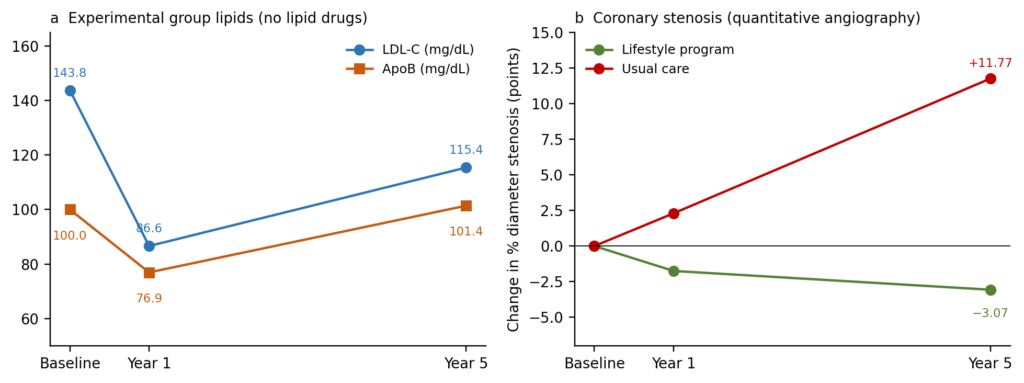
Figure 5. Lifestyle Heart Trial. (a) LDL-C and ApoB in the experimental group, which took no lipid-lowering drugs (ApoB converted from g/L × 100). (b) Change in percent diameter stenosis on quantitative angiography, plotted from the 1998 five-year report for the 35 participants with five-year angiography; the 1990 one-year report covers all 48 participants and gives slightly different baselines, so its values are not plotted here. 60% of controls started lipid drugs between years one and five.
5.7 Weighing the beyond-ApoB case
The additional-benefit hypothesis is therefore conditional: a stricter pattern could outperform another healthy diet if it produces a larger and sustained improvement in ApoB, blood pressure, weight, or 代谢健康 without poorer adherence or nutritional disadvantage. “Vegan,” “no oil,” and “10% fat” are not themselves validated 替代终点. Nor can a short-term dietary lipid change be converted mechanically into an Esselstyn-specific event reduction using drug-trial slopes.
On balance, the beyond-ApoB case is biologically plausible and partly supported. Animal models demonstrate one diet-dependent, cholesterol-independent mechanism (fiber and butyrate) and one mechanism of lasting inflammatory memory; human cohorts link leafy-green nitrate to lower cardiovascular risk after adjustment for hypercholesterolemia, and minimally processed plant foods to lower risk; and a randomized trial shows that processing alone changes energy intake [18, 19, 28, 29, 34]. Against this, the vegetarian–coronary association in EPIC-Oxford weakened substantially after adjustment for conventional risk factors [41], genetic evidence does not support TMAO as causal [38], and no trial has compared diets at matched ApoB. Figure 6 summarizes the evidence by pathway; the proposed trial (Section 17) is designed to supply the missing test.
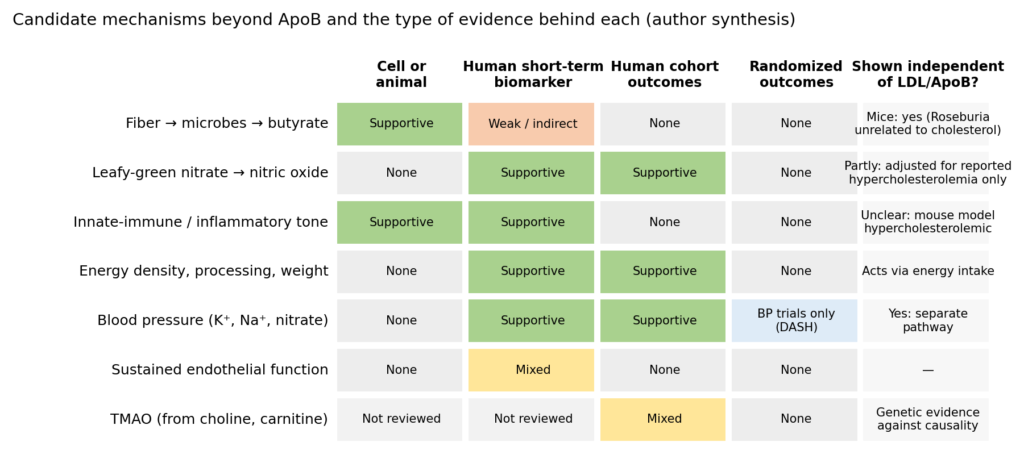
Figure 6. Candidate mechanisms beyond ApoB and the type of evidence for each. Author synthesis of sources cited in Section 5; “supportive” indicates the direction of evidence, not proof of a causal effect on human atherosclerosis.
6. Rural China (Tier 4)
6.1 What was measured
China Study I combined county mortality data with dietary, blood, and urine surveys in 65 rural counties and 130 villages, sampling 50 adults per village; diet and blood were collected in 1983–1984 [43]. The average rural diet supplied 14% of energy from fat, 71% from carbohydrate, 5% from 酒精, and 10% from protein, of which about 11% was of animal origin (roughly 1% of total energy); fiber intake was 33 g/day and mean body mass index 20.5 [43]. Mean serum total cholesterol was 127 mg/dL, compared with 203 mg/dL in US adults aged 20–74 [43]. The diet was low in animal food, not vegan; the authors describe rural diets of 1950–1980 as containing 3–6% animal-based foods [43].
6.2 What the coronary figures are
The widely quoted coronary comparison uses mortality, not incidence, recorded in 1973–1975 and truncated at ages 0–64: 4.0 per 100,000 men and 3.4 per 100,000 women in rural China versus 66.8 and 18.9 in the United States, taken from a 1989 WHO statistics annual, giving ratios of 16.7 and 5.6 [43]。四个特征限制了其解释力。死亡率统计期比饮食和血液调查早了大约十年。排除64岁之后的死亡人数也去除了大多数冠心病死亡发生的年龄段。1970年代中国农村的死亡证明和冠心病诊断与美国的做法不同,因此不能排除漏报的可能性。而且正如作者所描述的,集中在相同县域的传染病和其他死因导致的竞争性死亡,在冠心病表现出来之前就夺走了人们的生命 [43]。没有 斑块负荷 被测量。
6.3 县域相关性显示了什么
在各县之间,冠心病死亡率与血浆载脂蛋白B(ApoB)呈正相关(r = 0.37),并与盐摄入量指数呈正相关(r = 0.42),与绿叶蔬菜摄入量呈负相关;而ApoB又与动物蛋白和肉类摄入量相关 [43]。冠心病死亡率还与小麦粉摄入量相关(r = 0.67),作者将其部分归因于伴随变化的牛奶、盐、甘油三酯和体重 [43]。作者自己也注意到,县而不是个人是分析单位,因此数据无法显示低疾病率是反映了普遍较低的动物性食物摄入量,还是反映了较少的人摄入了更多的食物 [43].
6.4 混杂因素和替代解释
每公斤的能量摄入比美国高出约30%,而 肥胖少得多,作者将其归因于更高的日常能量消耗,例如骑自行车上班 [43]。体力活动、体重、烟草使用、社会经济条件、医疗保障以及诊断确认在这些人群与美国之间都存在差异。关于冠心病的论文没有报告缺血性或 出血性卒中,且本综述不对这些县的中风亚型做任何声明。本综述也没有重新核实1990年后的趋势数据;关于中国后期饮食转型证明了因果性饮食影响的说法,应建立在同期的个体层面队列研究基础上。
6.5 检查二级摘要
Freeman及其同事2017年的综述是了解这些数据的一个有用途径,但不应被引用来替代原始数据 [2]。其表格正确地给出了0-64岁的年龄限制和127 mg/dL的胆固醇,但列出的宏量营养素为14%脂肪、71%碳水化合物和10%蛋白质,总和为95%,因为省略了原始数据中5%的酒精 [2, 43]。其塔拉乌马拉人(Tarahumara)条目报告了528名受访者,成年人平均胆固醇为136 mg/dL [2];原始摘要报告了523名5至70岁的人群,总体平均值为125 mg/dL,儿童为116 mg/dL,饮食结构为12%脂肪、2%饱和脂肪、71 mg/天胆固醇和75%碳水化合物,且几乎没有 高血压、肥胖以及通常随年龄增长而出现的胆固醇升高 [44]。如果没有全文,分母上的差异就无法解决。塔拉乌马拉研究测量了血脂和饮食,而不是冠心病结局。
6.6 中国农村研究的贡献
中国农村的数据与累积暴露假设一致:终身低动物性食物和低饱和脂肪摄入的人群胆固醇较低,且各县的冠心病死亡率与ApoB追踪一致。这加强了Q1的可信度。但对于Q2或Q3,它没有提供决定性的结论,因为其饮食既不是纯素的,也没有与高质量的替代方案进行比较,而且体力活动、体型和竞争性死亡在这些数据中与饮食是无法分离的。
7. 传统冲绳饮食(第4级)
传统的 冲绳饮食 主要通过1949年的一项调查为人所知,该调查是在战后物资匮乏和美国管理期间进行的,由Willcox小组进行分析。红薯提供了约69%的能量;总能量摄入约为1,785 kcal/天;脂肪提供了约6%的能量;肉类摄入量每天仅几克,还有少量的鱼、大豆和海藻 [45, 46]。Willcox小组估计,直到1960年代后期,成年人的热量摄入比维持体重所需的热量少约11%,平均体重指数为21,体型偏瘦 [47]. Interpretation is contested: one critic has argued that the Okinawan data reflect severe malnutrition, whereas Gavrilova and Gavrilov, responding, attribute the later loss of longevity advantage to westernization of the diet and note that a low infectious burden may also have contributed [48]. A single post-war survey cannot establish lifelong intake.
Coronary outcomes should be judged directly rather than through longevity. The same group reports that older Okinawans have about 80% less coronary mortality than the US population, based on age-adjusted vital statistics rather than individual dietary linkage [47]. The advantage has not persisted: Okinawans who did not experience the energy-restricted era now have higher body mass index, more type 2 diabetes, and worse cardiovascular risk factors than other Japanese, and the prefecture’s life-expectancy advantage is now confined to older ages [47]. That transition is compatible with a dietary contribution but equally with changes in energy balance, activity, and other exposures.
Okinawa informs the hypothesis in a limited way. It shows that a very-low-fat, high-carbohydrate, plant-predominant diet is compatible with low coronary mortality. It does not show that complete exclusion of animal foods is necessary, because the traditional diet included pork and fish, and it cannot separate low fat from caloric restriction, low body size, physical labor, or 遗传学. Its shared features with DASH and Mediterranean patterns are high vegetable and legume intake, low saturated fat, and low energy density; its distinctive features are very low total fat, a single dominant starchy staple, and chronic mild energy restriction.
8. Other Traditional Populations: The Tsimane and Kitava (Tier 4)
The Tsimane. The Tsimane, forager-horticulturalists of the Bolivian Amazon, provide the only traditional-population data in this review with direct 冠状动脉成像. Of 705 adults aged 40 to 94 scanned in 2014–2015, 596 (85%) had no coronary 动脉 calcium, 89 (13%) had scores of 1–100, and 20 (3%) had scores above 100; among those older than 75, 31 (65%) had none and four (8%) had scores of 100 or more [35]. Mean LDL-C was 91 mg/dL and HDL-C 39.5 mg/dL, and obesity, hypertension, 高血糖, and regular 吸烟 were rare. Compared with the US 梅萨 cohort, the Tsimane reached a nonzero 钙化积分 about 24 years later and a score of 100 or more about 28 years later [35] (Figure 7).
The Tsimane diet is low in fat and minimally processed but not plant-exclusive: about 14% of energy from protein, 14% from fat, and 72% from carbohydrate, an estimated 38 g of fat per day including 11 g of saturated fat and no 反式脂肪, with rice, plantain, manioc, and corn as staples and meat and fish obtained by hunting and fishing [35]. Men and women average 6–7 and 4–6 hours of physical activity per day. The limits are important: calcium scoring cannot detect 非钙化斑块, the design is cross-sectional, and outcome data are thin, with one possible myocardial infarction among 50 recent adult deaths ascertained by verbal autopsy. LDL-C has risen by about 0.16 mmol/L per year since 2011 as motorized river travel improved access to market food [35], a natural experiment whose coronary consequences are not yet known.
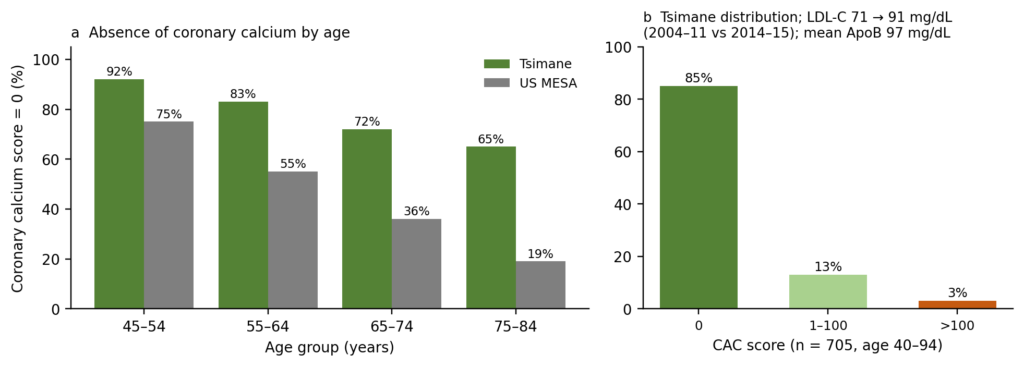
Figure 7. Coronary artery calcium in the Tsimane. (a) Proportion with a calcium score of zero by age group, Tsimane versus US MESA, as labeled in Figure 2 of Kaplan 2017. (b) Distribution of scores among 705 Tsimane adults. Calcium scoring does not detect noncalcified plaque.
Kitava. On Kitava in the Trobriand Islands, where tubers, fruit, fish, and coconut are dietary staples, semi-structured interviews with 213 adults identified no case corresponding to stroke, sudden death, or 心绞痛, and resting electrocardiograms showed few abnormalities [49]. Smoking was common: 76% of men and 80% of women over 20 smoked in the risk-factor survey [50]. The evidence rests on interviews and electrocardiograms rather than imaging or death registration.
What these populations add. None was vegan, and their fat intakes were not uniformly low in saturated fat. The Kitavan diet supplied about 21% of energy as fat and 17% as saturated fat, mostly lauric and myristic acid from coconut [51], a clear exception to the pattern. What rural China, traditional Okinawa, the Tsimane, and Kitava share is diets built from whole, minimally processed staples, leanness, and in most cases high physical activity. The pattern supports the cumulative-exposure argument and the whole-food lever; it provides no support for the claim that complete exclusion of animal foods is required. Fat intake ranged from very low in Okinawa to low among the Tsimane, and coconut was a Kitavan staple.
9. Prospective Cohort Evidence (Tier 3)
The most comprehensive cohort meta-analysis included 13 prospective cohorts with 844,175 participants. Compared with non-vegetarians, vegetarians had lower risk of cardiovascular disease (相对危险度 0.85; 95% CI 0.79 to 0.92; 8 cohorts) and ischemic heart disease (0.79; 95% CI 0.71 to 0.88; 8 cohorts), but not of total stroke (0.90; 95% CI 0.77 to 1.05; 12 cohorts). For vegans the ischemic heart disease estimate was 0.82 (95% CI 0.68 to 1.00; 6 studies), and the cardiovascular disease estimate 0.92 (95% CI 0.79 to 1.06). Risk of bias was moderate in eight cohorts and serious in five [40]. Incidence estimates were used in preference to mortality where both were reported. The IHD association was weaker when early follow-up was excluded, about one-fifth of it appeared attributable to body mass index, and the E-value was 1.86 (lower confidence limit 1.49), meaning an unmeasured 混杂因素 would need associations of that strength with both diet and disease to explain it away [40].
The “40% lower coronary risk” figure sometimes attached to vegetarian diets traces to a meta-analysis restricted to Seventh-day Adventist cohorts, which reported a relative risk of 0.60 (95% CI 0.43 to 0.80) for coronary events [2, 52]. That estimate is population-specific and should not be generalized. Several Adventist and Oxford cohorts recur across meta-analyses, so repeated citation is not independent corroboration. Cohort vegetarian and vegan categories are defined by exclusion of animal foods, not by total fat, so none of this evidence tests the very-low-fat component.
Endpoint-specific data matter. In EPIC-Oxford (48,188 participants followed for 18.1 years), vegetarians including vegans had a 22% lower rate of ischemic heart disease than meat eaters (hazard ratio 0.78; 95% CI 0.70 to 0.87), equivalent to about 10 fewer cases per 1,000 people over 10 years; adjustment for self-reported high cholesterol, high blood pressure, diabetes, and body mass index attenuated the estimate to 0.90 (95% CI 0.81 to 1.00). The same group had a 20% higher rate of total stroke (1.20; 95% CI 1.02 to 1.40), about three more cases per 1,000 over 10 years, mostly hemorrhagic, and this association did not attenuate with risk-factor adjustment [41]. Coronary benefit and stroke risk must therefore be reported separately, and the attenuation of the coronary association is consistent with benefit running largely through conventional risk factors.
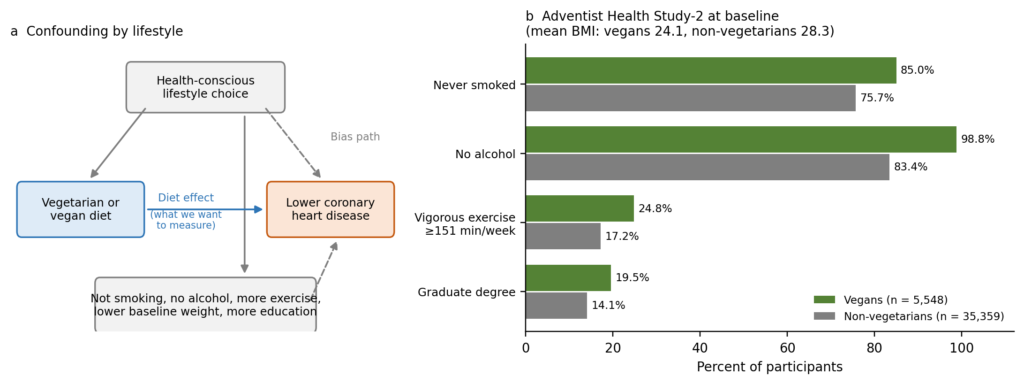
Figure 8. Prospective cohort estimates for vegetarian and vegan diets. The coronary association weakens after adjustment for conventional risk factors (EPIC-Oxford), and stroke risk is not lower. Estimates are shown side by side, not pooled; several cohorts overlap across meta-analyses. Sources: Dybvik 2023; Tong 2019; Orlich 2013; Kwok 2014.
9.1 Healthy-user bias: why associations are hard to read
队列研究对选择不同饮食的人群进行比较,而选择素食的人通常也养成了其他健康习惯。这被称为健康用户偏倚(healthy-user bias),是混杂(confounding)的一种形式:观察到的疾病差异部分或全部可能源于其他习惯,而非饮食本身。安息日会的数据清楚地展示了这个问题。与“安息日会健康研究-2”中的非素食者相比,纯素食者更有可能从未吸烟(85.0% 对 75.7%),极大概率不饮酒(98.8% 对 83.4%),更有可能每周进行至少 151 分钟的剧烈运动(24.8% 对 17.2%),更有可能拥有研究生学位(19.5% 对 14.1%),且体型更瘦(平均体重指数为 24.1 对 28.3) [53](图 9)。作者指出,素食这种自觉的生活方式选择本身可能会影响结果,且仍可能存在未控制的混杂因素 [53].
研究人员使用多种工具来减少这种偏倚,但每种工具都有其局限性。 比较相似的人群: 在“安息日会健康研究-2”和“EPIC-Oxford”研究中,非素食对照组本身也具有较强的健康意识,且极少有安息日会信徒吸烟或饮酒,这缩小了差距但并未完全消除 [53]. 统计学调整: 模型对吸烟、运动、教育和类似因素进行了调整,但仅针对已测量的因素,且调整的准确性受限于测量本身的准确性。 观察调整的作用: 当 EPIC-Oxford 在其模型中加入胆固醇、血压、糖尿病和体重指数时,素食者与缺血性心脏病的风险比(hazard ratio)从 0.78 变为 0.90 [41];这表明大部分益处是通过这些风险因素实现的,如果饮食确实有效,这也是预料之中的,同时也展示了评估结果对模型选择的敏感程度。 量化稳健性: 在 Dybvik 的元分析中,一个未测量的混杂因素需要与饮食和心脏病均具有 1.86 的相对风险,才能抵消这种关联 [40]. 时长与年龄: 在对五个队列的汇总分析中,素食者缺血性心脏病死亡率的降低仅限于坚持该饮食五年以上的人群,且在较年轻群体中效果更显著(65 岁以下降低 45%,65–79 岁降低 31%,80–89 岁降低 8% 且不具有显著性) [54]。与饮食时长的关联正是因果效应所能产生的结果,尽管长期素食者在其他长期习惯方面也可能存在差异。
另外两个观察结果具有双重含义。一项元分析发现,安息日会队列中的缺血性心脏病关联(相对风险 0.60)高于非安息日会队列(0.84;95% CI 0.74 至 0.96) [52]。这种差异可能反映了安息日会信徒中更强的健康用户效应,也可能反映了安息日会素食者的实际饮食内容:据报道,安息日会纯素食者每天摄入约 46–47 克纤维,而 EPIC-Oxford 纯素食者约为 26–28 克 [53]。以及 反向因果关系因果倒置(reverse causality)——即人们在患病初期后改变饮食——通过在招募时排除既往患有心血管疾病的人群,这一问题虽有所缓解但未能根除,上述两个队列研究均采取了这一做法 [41, 53].
这并不意味着应当抛弃队列研究的证据。其规模大、持续时间长、在不同国家间具有一致性,且在方向上与随机脂质试验及生物学原理相符。它应当被视为第 3 级(Tier 3)证据:关联性强,对因果关系有支持作用但非决定性,且无法仅凭自身对不同的健康饮食进行优劣排序。
图 9. 健康用户偏倚。(a) 生活方式选择如何通过饮食以外的途径,将饮食与较低的心脏病风险联系起来。(b) “安息日会健康研究-2”中纯素食者和非素食者的基线特征,按 Orlich 2013 报告的年龄、性别和种族进行标准化。
9.2 纯素食者的表现是否优于其他素食者?
纯素饮食排除所有动物性食物;蛋奶素饮食包括乳制品和蛋类; 奶鱼素者 鱼素饮食包括鱼类。如果完全排除动物性食物能增加保护作用,那么纯素食者的表现应该优于其他群体。队列数据并未显示出这一点(图 10)。
基督复临安息日会健康研究-2。 与非素食者相比,纯素食者的缺血性心脏病死亡风险比为 0.90(95% CI 0.60 至 1.33),蛋奶素食者为 0.82(0.62 至 1.06),鱼素者为 0.65(0.43 至 0.97),后者是唯一具有统计学意义的风险降低 [53]。在男性中,纯素食者的缺血性心脏病死亡风险比为 0.45(0.21 至 0.94),心血管死亡风险比为 0.58(0.38 至 0.89);在女性中,相应的估值分别为 1.39(0.87 至 2.24)和 1.18(0.88 至 1.60) [53]。整个队列在平均 5.79 年的时间里记录了 372 例缺血性心脏病死亡,因此这些亚组估值不够精确,且素食饮食与心血管死亡率之间的关联在性别上存在显著差异 [53]。在 2024 年对 88,400 名参与者进行的更长时间的随访中,素食者整体的缺血性心脏病死亡率较低,但纯素饮食与较低的 全因死亡率 男女合计死亡率并无关联;纯素男性的死亡率仅在较年轻时较低 [55].
EPIC-Oxford 研究和汇总队列。 与肉食者相比,EPIC-Oxford 研究中纯素食者的缺血性心脏病发病率为 0.82(0.64 至 1.05)(67 例),蛋奶素食者为 0.77(0.69 至 0.86),鱼食者为 0.87(0.77 至 0.99) [41]。在对五个队列的汇总分析中,纯素食者的缺血性心脏病死亡率比经常吃肉的人低 26%,蛋奶素食者和鱼食者均低 34% [54]。一项针对纯素饮食的系统评价发现,在包括至少 7,380 名纯素食者的三项队列研究中,均未报告纯素食者的任何主要心血管结局风险有显著升高或降低 [56].
这项研究能说明什么,不能说明什么。 纯素食者人数较少,因此其估值区间较宽且不具结论性,而非无关联。对于本综述更重要的是,这些队列中的纯素食者并没有遵循极低脂全食植物饮食(VLF-WFPB):EPIC-Oxford 研究中的纯素食者从脂肪中获取了 28.1% 的能量,每天摄入约 26 克纤维 [41],既不是极低脂肪,也不是全食比例特别高。这些队列并不能证明纯素食者的心血管风险低于蛋奶素食者或鱼食者;它们也不能证明两者等同或更差,因为每组都是与肉食者而非彼此进行比较,且在 EPIC-Oxford 研究中,纯素食者的点估计值在数值上低于鱼食者。在基督复临安息日会健康研究-2 中,将最高分位组与最低分位组进行比较,来自坚果和种子的蛋白质与心血管死亡率降低 40% 相关,而来自肉类的蛋白质与死亡率升高 61% 相关;在根据素食饮食类型进行调整后,这些关联依然存在 [57]。这种模式支持植物蛋白和坚果。它并不支持排除坚果或所有动物性食品。
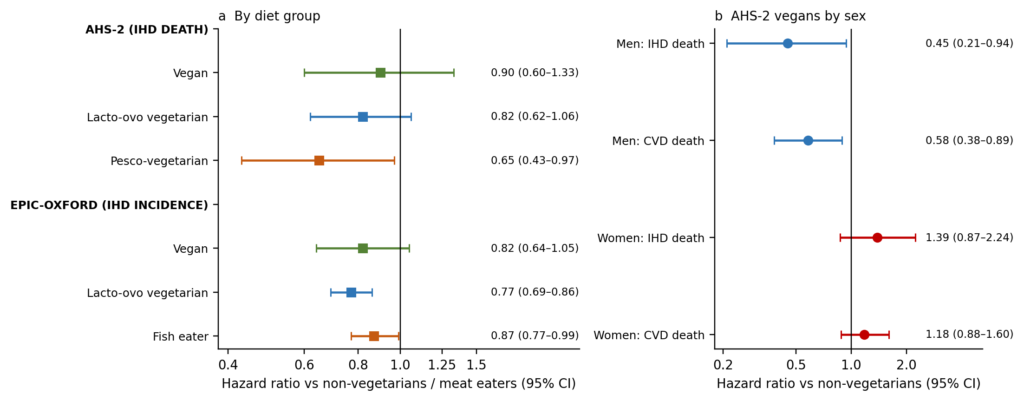
图 10. 纯素食者与其他素食群体的比较。(a) 基督复临安息日会健康研究-2(死亡人数)和 EPIC-Oxford 研究(发病病例)中按饮食组划分的缺血性心脏病,每组分别与非素食者或肉食者进行比较。(b) 按性别划分的基督复临安息日会健康研究-2 纯素食者。宽区间反映了纯素食者人数较少。来源:Orlich 2013(表 4);Tong 2019(补充表 3)。
9.3 中国大陆和台湾地区的素食者
本综述的检索未发现来自中国大陆的比较纯素食者与杂食者心脏病结局的前瞻性研究。现有的中国大陆和台湾证据涉及素食者,其中大多数人食用乳制品,且通常食用鸡蛋。在台湾,两项佛教慈济队列研究(共 13,352 名参与者)发现素食者的中风风险较低:在第一个队列中,缺血性中风的风险比为 0.26(95% CI 0.08 至 0.88);在第二个队列中,总体中风为 0.52(0.33 至 0.82),缺血性中风为 0.41(0.19 至 0.88),出血性中风为 0.34(0.12 至 1.00) [58]。参与者是佛教基金会的成员,这是一个具有自身健康用户特征的人群,一项探索性分析表明维生素 B12 摄入量改变了这种关联 [58]。出血性中风的结果与 EPIC-Oxford 研究的结果截然相反 [41], a reminder that stroke subtypes behave differently across populations.
在一个 横断面研究 from Xiamen, 169 healthy Chinese lacto-vegetarian men had lower blood pressure, LDL-C, ApoB, triglycerides, and fasting 葡萄糖, and thinner carotid 内膜中膜厚度, than 126 omnivorous men [59]. This is Tier 4 evidence on 替代标志物 in dairy-eating vegetarians.
Hong Kong data add a caution. Vitamin B12 deficiency was reported in about 80% of Hong Kong vegans, who rarely used fortified foods or supplements; B12-deficient vegetarian groups showed impaired arterial endothelial function and thicker carotid walls, and B12 supplementation improved these vascular measures in Hong Kong vegans [60]. An unsupplemented vegan diet can therefore undermine the vascular benefit it is meant to provide, which reinforces the nutrient guidance in Section 15.
10. Esselstyn’s Studies Reassessed (Tier 4)
10.1 The 1985 Cleveland Clinic cohort
Three reports describe this cohort, and their denominators differ. The full 1995 report describes 22 patients (21 men, 1 woman) with severe, angiographically documented coronary disease enrolled between 1985 and 1988; the 11 participants whose results are reported all had triple-vessel disease and were nondiabetic, nonhypertensive nonsmokers [42]. The diet derived less than 10% of energy from fat and excluded oils, meat, fish, fowl, and dairy except skim milk and nonfat yogurt. Every participant also received an individualized cholesterol-lowering drug, most often cholestyramine 4 g twice daily with lovastatin 40–60 mg daily; relaxation and meditation training was offered but abandoned within weeks, and exercise was not prescribed [42]. In the 11 imaged participants, mean total cholesterol fell from 246 mg/dL at baseline to 132.4 mg/dL during treatment, with mean LDL-C 71.6 mg/dL and HDL-C 36.3 mg/dL [42].
Of 38 lesions with more than 20% stenosis in those 11 participants, three treated by 血管成形术 and four native-vessel lesions proximal to bypass grafts were excluded a priori—the latter because, as the authors note, such lesions were expected to progress, and they did—and six more could not be matched at follow-up, leaving 25 [42]. Two technicians masked to 血管造影术 sequence read the films. By percent diameter stenosis, 11 of 25 lesions regressed and 14 were stable, mean stenosis fell from 53.4% to 46.2% (estimated decrease 7 percentage points; 95% CI 3.3 to 10.7), and 8 of 11 participants were classified as regressing. By minimal 流明 diameter, the less reference-dependent measure, 6 lesions regressed, 14 were stable, and 5 progressed, and the mean increase was 0.08 mm (95% CI −0.06 to 0.22; not significant) [42].
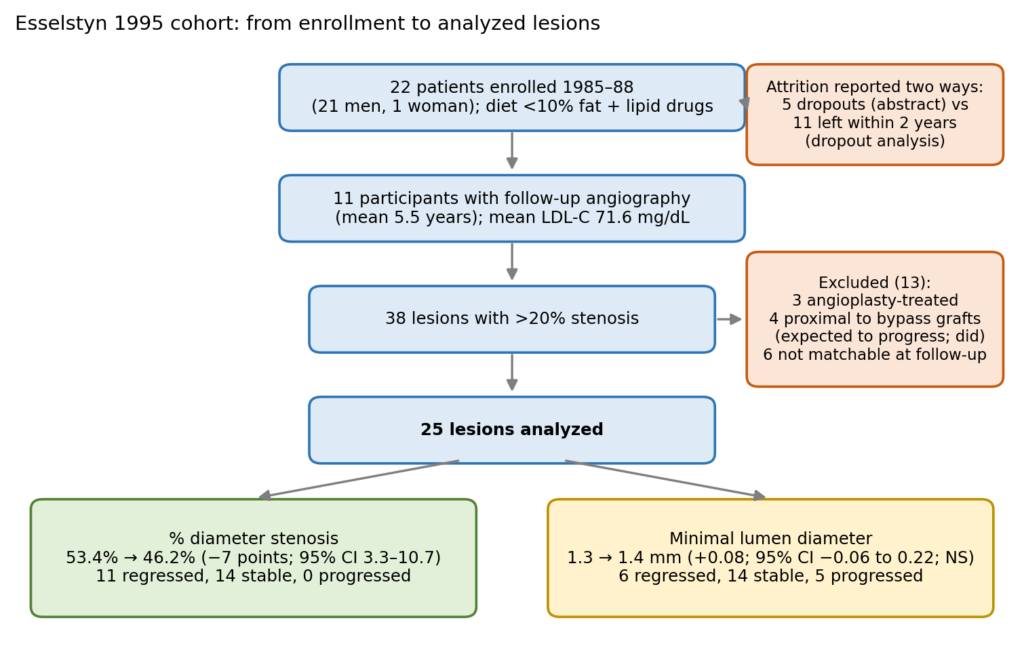
Figure 11. Esselstyn 1995 cohort: enrollment, attrition, lesion selection, and angiographic results by the two methods reported. Source: Esselstyn 1995 (full text).
The same paper reports attrition two ways. Its abstract states that 5 of 22 participants dropped out within two years and 17 maintained the diet; its dropout analysis states that 11 left within two years (three moved, four had work conflicts, three could not maintain the diet, and one chose 心脏搭桥手术) [42]. The five dropouts who resumed their previous diet reported 10 心脏事件. The 11 imaged participants had experienced 37 cardiovascular events in the eight years before enrollment. None had a new infarction during follow-up, although two required coronary procedures during the study (repeat angioplasty in one, bypass surgery in the other) and the patient who had bypass surgery, whose 射血分数 was below 20%, later died of an arrhythmia [42].
1999年的更新将该队列描述为24名患者(23名男性,1名女性)。6名不依从的患者在12-18个月内出院并恢复标准治疗;18名患者坚持了五年,其中11人的五年血管造影显示:所有11人的病情都停止了进展,按狭窄百分比计算,其中8人(73%)出现了消退。五年间,平均胆固醇从237 mg/dL降至137 mg/dL,12年时为145 mg/dL。据报道,这18名依从性好的患者在入组前的八年内发生了49次冠状动脉事件,而在随访期间没有发生,而截至1998年,6名出院患者发生了13次新事件 [5]。“无冠状动脉事件”反映了该报告自己的事件分类:同一队列中包括一名在五年血管造影后发生无梗死的室性心律失常死亡患者 [42]。2014年的报告给出了另一种总结,称22名患者中有17名是依从的,并且 反转 在12人中的4人中得到了血管造影确认 [4]。基线胆固醇(246与237 mg/dL)、队列规模(22与24)以及先前事件计数(1995年讨论中的11名患者37次事件与1999年的18名患者49次事件)在不同报告中有所不同。有两个不同的73%的数据在流传:11名接受影像检查的患者中有8人通过狭窄百分比显示消退,以及1995年时最初的22名患者中仍有16人在坚持饮食控制 [5, 42].
将入组后的事件与前八年的事件进行比较容易受到向均数回归的影响,因为患者通常是在发生一系列事件后才进入此类计划的。该方案将饮食与药物结合在一起,因此无法估算饮食的独立贡献。
10.2 2014年198名患者的队列
设计和入组。 对200名连续自我推荐的心血管疾病志愿者进行了咨询;2名失访,剩下198名(91%为男性;平均年龄62.9岁;平均随访44.2 ± 24.1个月)。195人确诊患有冠心病,其中180人通过血管造影或CT血管造影确诊;44人曾患心肌梗死。所有人都不吸烟;161人患有高脂血症,60人患有高血压,23人患有糖尿病。干预措施是单次五小时的研讨会,随后通过电话或电子邮件进行随访,患者继续服用通常的心脏病药物,但未作记录。鼓励但不强制要求运动 [4].
依从性和数据收集。 避开所有肉类、鱼类和乳制品,并自觉避开任何添加油脂的患者被归类为依从者。数据在2011-2012年间通过电话收集,已故者的数据从亲属处获取。没有报告脂质值 [4].
结果(含分母)。 在177名依从性好的患者中,112人在基线时报告有心绞痛,其中104人(正文中为93%;表格中为105人,即94%)有所改善。“逆转”在177人中的39人(22%)中得到了影像学或压力测试的证实。177人中有18人(10%)被归类为恶化:研究人员判断其中9起事件与饮食无关(包括两例在医生劝说下进行的无症状患者冠状动脉搭桥手术, 支架 血栓形成 在停用氯吡格雷后发生的事件,以及拒绝服用华法林后的中风)以及四例病情进展(一例中风、两例搭桥手术、一例再次置入支架)。共有五例非心源性死亡,无心源性死亡。标题中0.6%的事件发生率仅将中风计为与进展相关的主要事件;同一篇文章的补充表则列出依从性患者的事件发生率为2.2% [4]。在21名不依从的患者中,13人(62%)至少发生了一次事件:两例 心脏性猝死、一例心脏移植、两例缺血性中风、四例支架手术、三例搭桥手术和一例内膜切除术 [4].
为什么这种对比不具有因果关系。 组别不是随机分配的;参与者自行选择加入他们寻求的计划;依从性是事后自我报告和分类的;研究人员通过电话确定并裁定事件,并决定哪些与饮食相关;影像学检查是由临床驱动而非方案驱动的;药物使用情况未记录;且不依从组的七项事件是 血运重建 医疗程序,这些程序取决于症状和医生的决定。依从组和非依从组患者在基线时也存在差异,例如男性比例分别为 93% 对比 76% [4]。粗略的 62% 对比 0.6% 的反差可以进行拆分,但得到的商并不是有效的因果相对风险或 需治数:这些组并非随机分配,且应用于它们的事件定义不具可比性。2007 年后入组的参与者收到了资深作者的一本书,作为计划的一部分 [4].
10.3 埃塞尔斯廷的研究能证明什么与不能证明什么
埃塞尔斯廷的计划之所以值得关注,有三个原因。它是全食物手段在现实世界中最密集的体现:2014 年的队列中不含油脂,不含动物性食物,没有加工食品,并有大量的绿叶蔬菜。它表明,一些患有严重疾病且有动力的患者可以多年坚持这样的饮食,1995 年时最初的 22 名患者中有 16 名仍在坚持 [42],而在 2014 年的队列中,自我报告的依从率为 89% [4]。此外,它还产生了一些具体的、可测试的假设——绿叶蔬菜中的硝酸盐和一氧化氮、内皮保护、油脂排除——第 5 节将根据独立证据对这些假设进行评估。
它不能承载的是对“超越 ApoB”主张或优越性主张的因果权重。1995 年的队列将饮食与消胆胺和洛伐他汀相结合,平均 LDL-C 达到了 71.6 mg/dL,在这个水平上,合并药物治疗是血管造影结果的部分合理解释,尽管非对照设计无法确定仅凭药物是否就能解释该结果,或者这种 LDL-C 水平是否能保证阻止病程进展 [42];仅对 11 名患者进行了影像检查,排除了 38 处病变中的 13 处,且论文以两种方式报告了损耗情况(图 11)。2014 年的队列没有血脂数据,依从性为自我报告,且结局由研究者裁定(第 10.2 节)。然而,结合随机血脂试验来看,有两个观察结果变得更加可信:通过全食物饮食加药物实现的持续极低 LDL-C 与大多数接受影像检查的患者中血管造影显示的疾病停滞是相符的 [20, 21],且大多数患者的心绞痛症状有所改善,这与 Ornish 和 Heidelberg 的随机试验结果一致 [6, 61, 62]。尚未解决的问题包括:饮食的独立贡献、排除油脂、坚果和牛油果是否有额外益处、代表性人群中的真实事件发生率,以及这些结果与同样获得支持的地中海饮食或较高脂肪的全食物计划相比如何。
11. 随机对照生活方式试验(主要是第 2 级证据)
11.1 生活方式心脏试验 (The Lifestyle Heart Trial)
设计. 在 193 名潜在符合条件的患者中,93 人在血管造影后仍符合条件,并按邀请设计随机分配(实验组 53 人,对照组 40 人);分别有 28 人和 20 人同意参加,共计 48 名试验参与者。35 人(实验组 20 人,对照组 15 人)完成了五年期的 定量冠状动脉造影,并在对分配方案设盲的情况下进行读取 [6]。干预措施将脂肪含量为 10% 的全食物素食饮食与适度的 有氧运动、压力管理(一年时每天 87 分钟,五年时每天 49 分钟)、戒烟以及小组心理社会支持相结合。实验组患者未服用降脂药物;15 名对照组患者中有 9 名 (60%) 在第一年到第五年之间开始服用药物 [6].
血管造影:哪份报告,哪个队列。 有两份报告描述了这项试验,且经常被混淆引用,这使得它们看起来不一致。1990 年《柳叶刀》报告涵盖了所有 48 名参与者的第一年情况,分析了 195 处病变:实验组的平均直径狭窄百分比从 40.0% (SD 16.9) 降至 37.8% (16.5),对照组从 42.7% (15.5) 升至 46.1% (18.5);在狭窄程度超过 50% 的病变中,变化分别为 61.1% 降至 55.8% 对比 61.7% 升至 64.4%;22 名实验组患者中有 18 名 (82%) 向病变消退方向发生了变化 [63]。1998 年 JAMA 报告涵盖了完成五年血管造影的 35 名参与者,这是一个基线值略有不同的子集(实验组 38.92%,对照组 42.50%),并报告了变化量而非起始和结束值 [6]。除非另有说明,以下数据均来自 1998 年的报告;1990 年的数值和 1998 年的数值绝不应直接进行比较,因为它们描述的是不同的患者。
五年后,实验组的直径狭窄百分比变化了 -3.07 个百分点(95% CI -5.91 至 -0.24),对照组变化了 +11.77 个百分点(95% CI 3.40 至 20.14)(P = 0.001),对应 7.9% 的相对改善和 27.7% 的相对恶化 [6]。这些是管腔狭窄程度的变化,而不是斑块体积减少了 7.9%。实验组的最小管腔直径保持不变(+0.001 mm),而对照组下降了 0.34 mm(P = 0.05)。实验组的参考(“正常”)段直径略有下降(-0.13 mm),对照组则略有扩大(P = 0.01)[6]。由于狭窄百分比是相对于该参考段计算的,因此稳定的最小直径加上变窄的参考段会记录为狭窄减轻;作者将参考段的变化解释为血流流线化 [6]。在实验组内,狭窄变化与依从性三分位数一致(-6.81、-3.02 和 -0.37 个百分点;n = 6、7 和 6),这是随机试验中的一项观察性分析 [6].
血脂。 一年后,LDL-C 从 143.8 mg/dL 下降到 86.6 mg/dL(-40%),五年后为 115.4 mg/dL(-20%);甘油三酯升高(一年后从 227.8 mg/dL 升至 258.2 mg/dL),HDL-C 下降(五年后从 40.1 mg/dL 降至 34.8 mg/dL),正如第 5.6 节所述,ApoB 在第五年恢复到基线水平。五年后两组间的 LDL-C 没有差异,这主要是因为大多数对照组患者服用了降脂药物 [6].
事件和心绞痛。 五年内,28 名实验组患者共发生 25 起心脏事件,20 名对照组患者共发生 45 起(对照组的比率比为 2.47;95% CI 1.48 至 4.20)[6]。这些是重复发生的事件计数,而不是发生事件的患者人数,且主要是手术和住院:心肌梗死 2 例对 4 例,血管成形术 8 例对 14 例,搭桥手术 2 例对 5 例,心脏住院(包括这些事件)23 例对 44 例,死亡 2 例对 1 例 [6]。硬终点事件太少,无法进行比较。一年后,实验组报告的心绞痛频率下降了 91%(持续时间缩短 42%,严重程度减轻 28%),五年后下降了 72% [6, 63];五年后组间差异不再显著,因为症状最严重的对照组患者已经接受了血运重建 [6]。对照组一年后心绞痛频率的变化在 1998 年的论文中为增加 186%,但在 1990 年的报告中为 165% [6, 63];这一差异尚未得到协调,此处两者均予列出。
减员与偏倚。 七名患者缺少一年的血管造影结果,每组各有四名患者缺少五年的血管造影结果;总体上有 14 处病变数据不可用——实验组 4 处,对照组 10 处,其中包括 4 处因血运重建后被排除的对照组病变——这将导致偏倚趋向于零假设 [6]。一份更正通知增加了一位被遗漏的作者 [6].
解释. 随机化 支持对整套生活方式方案与当时常规护理之间进行因果解读,尽管分配后的知情同意和人员流失限制了这种信心。无法分离饮食因素是归因上的局限,而非随机化的缺失。参与者是在分配后选择的:邀请式设计随机分配了 93 名患者,随后有 48 名表示同意。两组相似的同意比例并不能消除选择偏倚,且样本量小和人员流失也是进一步的局限。
11.2 PET 灌注 (Gould 1995)
Gould 及其同事报告称,在同样的 20 名实验组患者和 15 名对照组患者中,静息-双嘧达莫 PET 显像所示的灌注异常范围和严重程度在生活方式干预下有所改善,而在主要接受抗心绞痛治疗的对照组中则有所恶化 [61]。这是同一组患者的功能性结果,而非独立的重复研究,且它有别于心室功能和血管造影解剖。Freeman 及其同事总结的“增加了 400% 心肌灌注”无法在该报告中溯源,不应被再次引用 [2].
11.3 多中心生活方式示范项目
这项非随机项目追踪了 333 名符合血运重建条件的患者:194 名选择生活方式计划的患者和 139 名接受血运重建的对照组患者。三年后,194 名实验组患者中有 150 名 (77%) 避免了血运重建,且各组之间的心肌梗死、卒中和每人年死亡率相似 [64]。这 77% 描述的是自行选择患者中避免手术的情况;它并非随机试验中手术或事件减少了 77%。Freeman 及其同事关于示范项目在“数周内使心绞痛减少 90% 以上”的陈述引用了该项目和一项包含 24 个站点的计划评估 [2, 65];具体的研究、结果和时间点无法溯源,且来自生活方式心脏试验 (Lifestyle Heart Trial) 经证实的 91% 的一年期数据,无法支持有关“数周”的断言。
11.4 低脂但非纯素食的血管造影试验
在 STARS 研究中,90 名患有冠心病的男性被随机分配到常规护理组、降脂饮食组(脂肪供能占 27%)或饮食加消胆胺组,并在 39 个月时进行血管造影。冠状动脉段的平均绝对宽度在常规护理下缩小了 0.201 毫米,仅靠饮食则无变化(+0.003 毫米),饮食加消胆胺则加宽了 0.103 毫米;病情进展的比例分别为 46%、15% 和 12% [66]。在海德堡试验中,113 名男性被随机分配到常规护理组,或强化运动加低脂、低胆固醇饮食(不含脂质药物)组;一年后,病变进展率为 23% 对比 48%,退化率为 32% 对比 17% [62]。六年后,对 90 名患者进行了重新评估,各组之间的脂质差异不再具有显著性 [67]. 在 DISCO-CT,92 名接受最佳药物治疗的非阻塞性疾病患者被随机分配到增加 DASH 模式的强化饮食咨询和活动检查组,或仅接受药物治疗组;约 67 周后,干预组的非钙化斑块体积下降幅度更大(-51.3 对比 -21.3 mm³;P = 0.045),尽管总 动脉粥样硬化斑块 体积在各组之间没有显著差异 [68]。大约六年后,两组在干预期间减轻的大部分体重都已反弹,且 主要不良心血管事件 DASH 组发生了一例,而对照组发生了四例(包括一例致命性心肌梗死)——事件数量太少,不足以进行推断 [69]。这些试验表明,脂肪含量远高于 10–15% 的杂食或低脂饮食方案也能减缓病情进展。
12. 最有力的竞争证据(1–2 级)
12.1 DASH 和 DASH-低钠饮食
在对 459 名成人进行的为期八周的受控喂养中,DASH 组合饮食使收缩压和舒张压分别比典型的美国对照饮食降低了 5.5 和 3.0 mm Hg,而在 133 名高血压参与者中则分别降低了 11.4 和 5.5 mm Hg [11]。与高钠对照饮食相比,DASH 结合低钠使血压正常的参与者的收缩压降低了 7.1 mm Hg,使 1 级高血压患者的收缩压降低了 11.5 mm Hg [16]。这些获益是通过在饮食中加入低脂乳制品实现的。
12.2 PREDIMED
The 2013 PREDIMED report was retracted because of randomization irregularities and republished in 2018 with reanalysis. Among 7,447 adults at high cardiovascular risk followed for a median of 4.8 years, major cardiovascular events occurred in 96 of 2,543 participants (3.8%) assigned a Mediterranean diet plus extra-virgin olive oil, 83 of 2,454 (3.4%) assigned a Mediterranean diet plus nuts, and 109 of 2,450 (4.4%) in the control group advised to reduce dietary fat (hazard ratios 0.69, 95% CI 0.53 to 0.91, and 0.72, 95% CI 0.54 to 0.95); results were similar after excluding 1,588 participants with known or suspected protocol departures [12]. The control arm received advice, not a very-low-fat plant-based diet.
12.3 The Lyon Diet Heart Study
In 605 survivors of a first myocardial infarction followed for a mean of 46 months, the Mediterranean-type diet reduced cardiac death plus nonfatal infarction (composite 1: 14 versus 44 events), composite 1 plus 不稳定型心绞痛, ,中风,, 心力衰竭, and embolism (composite 2: 27 versus 90), and composite 2 plus minor events requiring hospitalization (composite 3: 95 versus 180) [70]. The abstract reports adjusted risk ratios ranging from 0.28 to 0.53 across the three composites; the supplementary table of the 2014 Esselstyn article assigns 0.28 (95% CI 0.15 to 0.53) to composite 1 [4, 70]. Summaries of “up to 65%” or “70%” reductions do not match any single endpoint and should be avoided. The comparator was a prudent Western-type diet rather than a healthy active diet [10], and the intervention supplied an alpha-linolenic-acid-rich margarine in place of butter and cream [13]. Lyon shows that a plant-rich but not plant-exclusive diet with substantial unsaturated fat reduced recurrent events.
12.4 CORDIOPREV
CORDIOPREV randomized 1,002 patients with coronary heart disease to a Mediterranean diet (at least 35% fat; 40–60 g/day of extra-virgin olive oil) or a low-fat, high-complex-carbohydrate diet (less than 30% fat, less than 10% saturated fat, lean meat and low-fat dairy permitted), with equally intensive dietitian support and a median seven-year follow-up. Achieved fat was 40.5% of energy in the Mediterranean arm and 32.1% in the low-fat arm. The primary composite occurred in 87 (17.3%) versus 111 (22.2%) patients (unadjusted hazard ratio 0.745; 95% CI 0.563 to 0.986; adjusted models 0.719 to 0.753). Benefit was statistically demonstrable in men (hazard ratio 0.669; 95% CI 0.489 to 0.915), while the estimate in the smaller subgroup of 175 women was inconclusive rather than showing absence of benefit; no single component differed significantly; lipids and glucose did not change differently between diets; and 86.6% took statins at baseline. More low-fat participants abandoned their diet (17.2% versus 9.2%). The trial was funded principally by olive-oil foundations [10].
CORDIOPREV challenges the broad claim that less total fat is always better: within the 30–40% range, among omnivores on statins, the higher-fat Mediterranean diet did better. It does not test a 10–15% fat, animal-free, whole-food diet, which differs from its low-fat arm in fat level, animal-food content, and food processing.
12.5 Direct comparisons of plant-exclusive and Mediterranean diets
No trial has compared these diets on clinical events, and the three risk-factor trials below provide related but distinct comparisons rather than one comparison repeated. In a 16-week crossover trial in 62 overweight adults (52 completers), a low-fat vegan diet reduced body weight by 6.0 kg with no change on a PREDIMED-style Mediterranean diet (treatment effect −6.0 kg; 95% CI −7.5 to −4.5), and lowered LDL-C by 15.3 mg/dL with no significant change on the Mediterranean diet (treatment effect −14.8 mg/dL; 95% CI −23.5 to −6.2), whereas the Mediterranean diet lowered systolic pressure more (treatment effect +6.0 mm Hg favoring Mediterranean; 95% CI 1.0 to 10.9) [23]. 脂质估算涵盖了 43 名未改变降脂药物的参与者,血压估算涵盖了 41 名未改变降压药物的参与者;在对所有参与者(包括药物发生变化的参与者)的分析中,收缩压出现了显著的残留效应,但在药物稳定的亚组中并未出现 [23]. 纯素阶段结束时报告的脂肪摄入量为能量的 17%(95% CI 15 至 19),因此该试验测试的是低脂纯素饮食,而非脂肪占比 10–15% 的饮食;且有一名参与者的顺序分配在随机化后进行了更改,以便一对母女遵循相同的饮食 [23]. 该试验由一个倡导植物性饮食的组织开展。在 CARDIVEG 试验中,对 107 名低风险超重成年人进行了为期三个月的交叉研究,能量限制的蛋奶素食饮食和地中海饮食产生了相似的减重和减脂效果;素食饮食下 LDL-C 下降更多,地中海饮食下甘油三酯下降更多,而素食饮食下维生素 B12 水平下降 [71]. EVADE CAD 在相似的脂肪摄入量下比较了纯素饮食与美国心脏协会(AHA)饮食(第 5.3 节) [9]. 只有 Barnard 比较了纯素饮食与地中海饮食;CARDIVEG 比较了蛋奶素食饮食与地中海饮食,而 EVADE 比较了纯素饮食与 AHA 饮食。分别来看,每项研究都发现植物性饮食组降低 LDL-C 的程度至少相同,而作为对照的地中海饮食在血压(Barnard)或甘油三酯(CARDIVEG)方面表现更好;这并非单一比较的三次重复。
12.6 Cochrane 系统评价与事件缺口
2021 年对纯素饮食的 Cochrane 系统评价(检索至 2020 年 2 月)纳入了 13 项随访至少 12 周的随机试验;均未报告心血管临床终点。只有一项涉及 63 名参与者的试验探讨了 二级预防 与另一种饮食干预的对比,且未显示出对血脂或血压的明确影响(低质量或极低质量证据) [72]. 其更严格的入选标准——仅限纯素、至少 12 周、活性或极小干预对照——解释了为什么其结论比 Koch 和 Wang 的荟萃分析更谨慎,后两者纳入了素食饮食和不同的对照组 [7, 22]. 本综述截至 2026 年 9 月 10 日的更新检索显示,尚未发现已发表的以心血管事件为结局的极低脂纯素饮食随机试验。缺乏事件证据是一个缺口,而非无益的证据。汇总分析还需要检查队列重叠:1990 年的一年期和 1998 年的五年期生活方式心脏试验(Lifestyle Heart Trial)报告描述的是同一个随机队列,因此将它们作为独立试验纳入的分析会重复计算同一个队列并夸大精准度。
只要有直接比较,就采用直接比较。不通过比较无关试验的效果大小来对饮食进行排名,因为人群、背景治疗、依从性和终点各不相同。
图 12 展示了本节讨论的具有临床结局的随机试验,以及生活方式心脏试验的事件复发率。
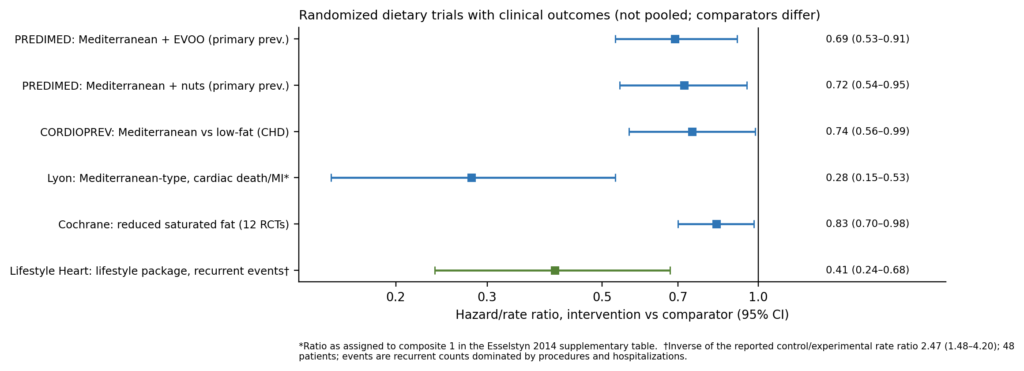
图 12. 具有临床结局的随机饮食试验。估算值并列显示,未经汇总;对照组、人群和终点各不相同。目前尚无极低脂纯素饮食的随机试验报告临床事件。
12.7 对对照试验采用相同的标准
本综述仔细审查了 Esselstyn 和 Ornish 的研究,那些支持地中海饮食的试验也值得同样的审视。表 2 对每项试验提出了相同的问题。目的不是将任何试验贴上毫无价值的标签,而是要明确每项试验能够支持什么。
PREDIMED。 2018 年的重新发表记录了主要问题。密封信封仅在试点阶段的部分时间用于隐藏分配方案;425 名家庭成员在未随机化的情况下入选,并给予其亲属相同的饮食;在一个地点,467 名参与者按诊所而非个人分配;而在另一个地点,随机化表的使用也不一致 [12]。作者通过统计调整对试验进行了重新分析,当排除受影响的 1,588 名参与者时,结果相似(剩余 5,859 人的风险比分别为 0.71 和 0.68) [12]。对照组在 2006 年 9 月之前每年收到一份包含低脂建议的传单,之后才获得与地中海饮食组相同的接触频率;其总脂肪摄入量变化很小,因此 PREDIMED 比较的是补充后的地中海饮食与仅提供轻微建议的常规饮食,而非真正的低脂饮食 [12]。在增加对照组接触后招募的参与者中也观察到了获益——风险比为 0.49(95% CI 0.26 至 0.92),而 2006 年 10 月变更前为 0.77(0.59 至 1.00)(异质性 P = 0.21)——这反驳了将不平等的支持作为唯一解释的观点,尽管招募期的比较不能排除其部分贡献 [12]。对照组的失访率为 11.3%,而地中海饮食组为 4.9%。橄榄油和坚果由生产商捐赠并免费提供,参与者知道自己的分组情况,只有终点委员会是设盲的 [12]。该试验在第四次中期分析时停止 [12],因获益而提前停止的试验往往会高估效应量。最后,综合结果主要由中风驱动(合并风险比 0.58;95% CI 0.42 至 0.82),而心肌梗死(0.80;0.53 至 1.21)、心血管死亡(0.80;0.51 至 1.24)和全因死亡(0.98;0.77 至 1.24)没有显著差异;作者将其归因于效能有限 [12](图 13)。
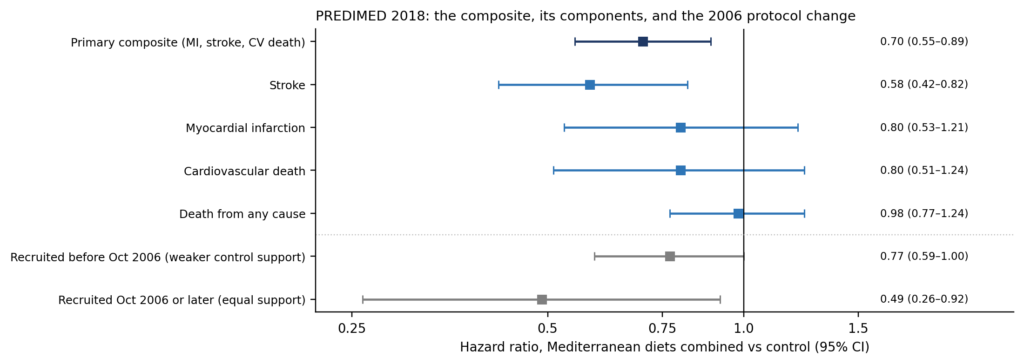
图 13。PREDIMED 2018:综合结果及其组成部分(地中海饮食合并组对比对照组),以及 2006 年 10 月增加对照组支持前后的效果。来源:Estruch 2018,表 3 和正文。
里昂饮食心脏研究(Lyon Diet Heart Study)。 里昂研究在一项单盲设计中随机分配了 605 名首次心肌梗死的幸存者,并因获益在平均 27 个月时提前停止,随访后来延长至 46 个月 [13, 14, 70]。其对照组是审慎的西方饮食,而非给予密集支持的健康饮食 [70]。在各组间血脂、血压和体重指数保持相似的情况下,事件发生了大幅减少 [14]。这是一个真实的信号,表明饮食模式可以通过降脂以外的途径减少事件(第 5 节),但它来自一项样本量较小、提前停止的试验,其效应量可能被夸大了。
CORDIOPREV 研究。 CORDIOPREV 是一项主要由橄榄油基金会资助的单中心试验;获益仅在男性中具有统计学意义,在样本量较小的女性亚组中估值尚无定论;综合指标的任何单一组成部分均不显著;其低脂组的脂肪供能比达到了 32.1% [10]。它是三者中设计最严密的,因为两组都接受了同等强度的支持,但它测试的是中脂杂食对照组,而非极低脂植物性饮食。
营养科学共有的问题。 这篇综述中几乎每一项研究都存在若干弱点,无论其倾向于哪种饮食。饮食通常通过问卷调查来衡量;在 Adventist Health Study-2 中,问卷与重复 24 小时膳食回顾的有效性相关性:某项指标为 0.76, 红肉 但白人参与者的鱼类指标仅为 0.53 [53]。饮食试验的参与者知道自己吃了什么。依从性会逐渐减弱,正如 PREDIMED 对照组的失访、CORDIOPREV 的饮食放弃以及 Lifestyle Heart Trial 中依从性评分的下降所显示的那样 [6, 10, 12]. 对照组通常较弱:PREDIMED 早期的对照组、里昂的谨慎饮食以及生活方式心脏研究(Lifestyle Heart Trial)的常规护理。试验通常规模较小或提前停止。利益相关方涉及各个方面:橄榄油和坚果生产商、项目开发人员以及倡导组织都资助或主导了此处讨论的研究 [4, 10, 12, 23].
批评改变了什么。 这些局限性降低了人们对地中海饮食获益程度的信心,也降低了对地中海饮食被证明具有优越性这一说法的信心。但它们并没有提高极低脂全食植物性饮食(VLF-WFPB)的地位,因为后者根本没有包含临床事件的随机对照试验。包含临床事件的随机试验,即使是有缺陷的试验,也能解决非受控病例系列研究无法解决的因果问题,尽管其权重仍取决于偏倚、精确度以及对所研究饮食的测试直接程度。对双方应用同样的怀疑态度,正是本综述结论值得信赖的原因。
表 2. 对辩论双方的主要试验提出相同的问题。
| 问题 | PREDIMED | 冠心病预防 | 里昂饮食心脏研究 | 生活方式心脏试验 | Esselstyn 2014 队列 |
| 证据层级 | 1 | 1 | 1 | 2(事件计数较少) | 4 |
| 是否随机? | 是,在 7,447 人中有 1,588 人受到偏差影响;仅在试点部分使用了信封 [12] | 是 [10] | 是 [14] | 是,邀请制;一半符合条件者拒绝参加 [6] | 否 [4] |
| 谁采用了盲法? | 仅终点委员会 [12] | 端点 裁决 报告为盲法;参与者和营养师未设盲,正如任何饮食试验一样 | 单盲设计 [14] | 单盲设计 [14] | 无;研究人员判定事件 [4] |
| 对照组 | 减少脂肪的建议;2006 年前每年发放传单,之后进行同等频率的接触;总脂肪变化很小 [12] | 获得同等支持的低脂饮食;达到了 32.1% 的脂肪比例 [10] | 谨慎的西方饮食 [70] | 常规护理;60% 开始服用降脂药物 [6] | 非依从性志愿者 [4] |
| 是否提前停止? | 是,在第四次中期分析时 [12] | 中位随访 7 年 [10] | 是,在 27 个月时;后来延长至 46 个月 [13, 14] | 是,在 27 个月时;后来延长至 46 个月 [13, 14] | 不适用 |
| 导致结果的主要因素 | 中风 0.58;心肌梗死 0.80 和心血管死亡 0.80 不显著 [12] | 在男性中获益明显;对 175 名女性的评估尚无定论;没有单一成分显著 [10] | 在血脂、血压和 BMI 相似的情况下,大幅减少 [14] | 医疗程序和住院治疗(重复计数) [6] | 非依从组中的血运重建 [4] |
| 利益相关 | 橄榄油和坚果由生产商捐赠 [12] | 主要是橄榄油基金会 [10] | 此处未评估 | 此处未评估 | 项目开发人员;给参与者分发了书籍 [4] |
| 被测试的饮食对比极低脂全食植物性饮食(VLF-WFPB) | 强化的地中海饮食对比仅提供轻微建议的常规饮食 | 地中海饮食(40.5% 脂肪)对比杂食性低脂饮食(32.1% 脂肪) | 富含 α-亚麻酸(ALA)的地中海型 | 富含 α-亚麻酸(ALA)的人造黄油加地中海型建议 | 无油、无动物产品、无坚果或鳄梨 |
13. 极低总脂肪本身更好吗?
区分各种脂肪。 饱和脂肪会升高低密度脂蛋白胆固醇(LDL-C),而减少饱和脂肪会减少事件 [26];应避免工业反式脂肪 [73];当不饱和脂肪替代饱和脂肪时,会降低 LDL-C,并在地中海饮食试验中与事件减少相关 [10, 12]。“总脂肪”将这些相反的效果捆绑在一起。
脂肪被什么替代很重要。 在极低脂全食植物性饮食(VLF-WFPB)中,替代物是完整的谷物、豆类、蔬菜和水果;在其他低脂饮食中,替代物可能是精制淀粉或糖。目前还没有试验对比过在全植物饮食中,这些替代物对临床结局的影响。
全食植物饮食中唯一的直接测试。 在一项随机交叉试验中,40 名预估心血管风险至少为 5% 的成人遵循全食植物基纯素饮食,每天摄入约 4 汤匙或少于 1 茶匙的特级初榨橄榄油,各持续 4 周;脂肪分别提供 48% 和 32% 的能量。与基线相比,这两个阶段都降低了低密度脂蛋白胆醇(LDL-C)、总胆固醇、载脂蛋白 B(ApoB)、高密度脂蛋白胆固醇(HDL-C)、血糖和超敏 C 反应蛋白(hs-CRP)。存在顺序交互作用:从高油转向低油使 LDL-C 降低了 12.7 mg/dL(P = 0.04),而从低油转向高油使其升高了 15.8 mg/dL(P = 0.02);在第一阶段,LDL-C 分别下降了 25.5 mg/dL 和 16.7 mg/dL(P = 0.162) [8]. Neither phase approached 10–15% fat, the trial was short, and carryover complicates the crossover analysis. It suggests large oil additions can blunt LDL-C lowering; it does not show that 10–15% fat is better than a nut- and seed-based plant diet at around 30%.
Nuts, seeds, and olive oil. Mediterranean diets rich in extra-virgin olive oil or supplemented with nuts reduced events against comparators [10, 12]. No trial shows that excluding nuts, seeds, or olive oil from an otherwise low-saturated-fat diet improves clinical outcomes. The acute impairment of flow-mediated dilation after a single high-fat meal [30], cited in support of oil exclusion [4], cannot establish that oils cause atherosclerosis.
Triglycerides, 高密度脂蛋白, and ApoB–LDL-C 不协调. Very-low-fat, high-carbohydrate diets can raise triglycerides and lower HDL-C, as in the Lifestyle Heart Trial’s first year [6]; across plant-based trials overall, triglycerides did not change [22], and Mediterranean diets lowered triglycerides more than a vegetarian diet in CARDIVEG [71]. When triglyceride-rich lipoproteins rise, LDL-C can understate 致动脉粥样硬化性颗粒数. The Lifestyle Heart Trial illustrates this: at five years LDL-C was 20% below baseline while ApoB was not [6]. Future trials should measure ApoB directly.
Attribution. Where VLF-WFPB outperforms a comparator on LDL-C, the advantage may reflect fat quantity, fat quality (almost no saturated fat), food quality (fiber, plant protein), weight loss, or adherence. The Barnard crossover, for example, produced both larger LDL-C reductions and larger weight loss on the vegan diet [23]. No available trial separates these contributions. On current evidence, very low total fat is not established as an independent requirement; very low saturated fat within a whole-food diet is the component with the strongest causal support.
14. Prevention, Treatment, and Reversal
14.1 Outcomes that must not be conflated
Fewer cardiovascular events, slower progression, 斑块稳定, improved angina or perfusion, reduced angiographic stenosis, and quantitatively measured regression of plaque volume are different outcomes. Primary and secondary prevention are also different settings.
14.2 What imaging can and cannot show
Quantitative coronary angiography measures lumen, not plaque. Percent stenosis depends on the reference segment and on 血管运动张力, and outward (positive) remodeling can hide substantial plaque behind a normal lumen. Myocardial perfusion and stress testing measure function; improvement can occur without anatomic regression, as the Heidelberg investigators noted [62]. 血管内超声 以及 冠状动脉CT血管造影 measure plaque volume and composition; CT additionally characterizes noncalcified and 低衰减斑块. Coronary calcium scores can rise when plaque stabilizes, because statins increase calcified and fibrous plaque while reducing fibrofatty and necrotic-core components, so calcium-score change alone indicates neither success nor failure [74]. Plaque can enlarge substantially before angiography detects narrowing [74]; conversely, an apparently wider lumen can reflect changes in vasomotor tone rather than smaller plaque. In a meta-regression summarized by Dawson and colleagues, each 1% reduction in 粥样斑块体积百分比 was associated with about 20% lower odds of major adverse events, but there is no direct evidence that regression itself reduces events [74]. Table 3 summarizes what each finding can and cannot establish.
Table 3. What symptom and imaging findings can and cannot establish.
| 发现 | What it establishes | What it does not establish |
| Less angina; better 压力测试 or PET perfusion [6, 61, 62] | Better symptoms or myocardial blood supply | A measured loss of plaque |
| Reduced angiographic percent stenosis | A less narrowed lumen relative to a reference segment | The percentage of plaque removed; reference-segment changes can alter the result [6] |
| Change in minimum lumen diameter | Absolute lumen change at the lesion | Plaque volume, which 向外重塑 can hide [74] |
| CCTA or IVUS plaque volume or composition change | Change in the measured plaque compartment, within acquisition and segmentation limits | Eradication of disease or a guaranteed event reduction |
| Rising coronary calcium score | A higher 阿特斯通积分, which reflects calcified area, density, or both | Greater total plaque burden or treatment failure; statins increase 钙化斑块 while reducing fibrofatty and 坏死核心 [74] |
14.3 The primate and pharmacologic benchmarks
Two bodies of evidence set the standard against which dietary regression claims should be read. Neither is a dietary trial in humans, and both are cited here as benchmarks rather than as support for any diet.
Controlled primate experiments (Tier 5). In rhesus monkeys given an atherogenic diet and then switched to a regression diet, atheromatous 冠状动脉 lost lipid [75], while arterial fibrous proteins behaved differently from the lipid compartment [76]. The achieved cholesterol level mattered: in animals whose plasma cholesterol was held near 300 mg/dL there was little or no increase in lumen area attributable to regression of intimal plaque, whereas at about 200 mg/dL a considerable share of the lumen gain was attributable to plaque regression, and the contribution depended on both plaque size and time [77]. This is the closest thing in the literature to a controlled demonstration that lowering atherogenic lipoproteins by dietary means depletes the lipid-rich compartment while denser tissue persists. It is also animal evidence, in a different species, with induced rather than spontaneous disease, and it cannot establish what a human diet achieves.
Pharmacologic imaging (Tiers 1–2). 在 GLAGOV, 968 statin-treated patients with angiographic coronary disease were randomized to monthly 依洛尤单抗 或 安慰剂 for 76 weeks, and 846 had evaluable serial intravascular ultrasound. Time-weighted LDL-C was 36.6 mg/dL versus 93.0 mg/dL, percent atheroma volume changed by −0.95% versus +0.05% (difference −1.0 percentage point; P < 0.001), and plaque regression occurred in 64.3% versus 47.3% of patients [78]. Notably, the trial’s virtual-histology substudy did not show a difference in dense calcium volume [78], so GLAGOV demonstrates volumetric regression rather than a compositional shift; trials designed to measure plaque composition are outside the scope of this review and no compositional figures are quoted. Two comparisons follow. No dietary trial has produced coronary regression of this magnitude under this level of rigor, and no dietary trial identified here used serial intravascular ultrasound at all, which is the modality that measures atheroma volume most precisely.
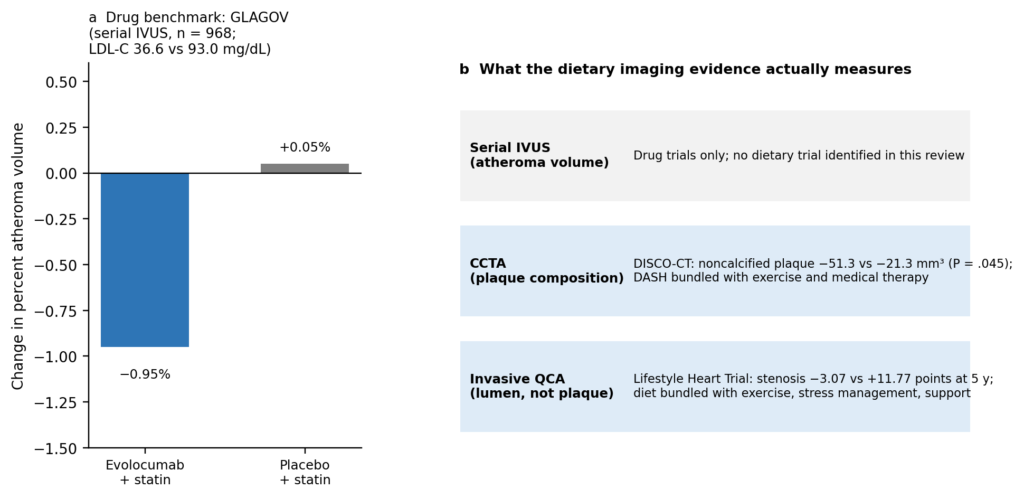
Figure 14. Benchmarks for coronary plaque change. Pharmacologic regression measured by serial intravascular ultrasound (GLAGOV) alongside the dietary imaging evidence available in this review, which uses different modalities and cannot be placed on the same axis. No dietary trial identified here used serial intravascular ultrasound. Sources: Nicholls 2016; Henzel 2021; Ornish 1998.
Exercise as a co-lever. Physical activity belongs alongside the three dietary levers rather than inside them. The populations with the least coronary calcium are also the most active: Tsimane men average six to seven hours and women four to six hours of physical activity a day [35]. In the two randomized imaging trials that showed benefit, exercise was part of the intervention rather than a controlled covariate—the Lifestyle Heart Trial bundled aerobic exercise with the diet [6], and DISCO-CT bundled activity counseling with DASH [68]—which is why neither can apportion credit. No quantitative estimate of the ApoB reduction attributable to aerobic training is given here; the point stands qualitatively that diet, activity, and lipid-lowering therapy act on overlapping pathways and are complementary rather than competing.
14.4 What the evidence supports in each domain
一级预防. Evidence consists of cohort associations [40], population data (Sections 6–8), and randomized lipid trials [22]. No randomized event trial of VLF-WFPB exists.
二级预防(治疗)。 生活方式心脏研究(Lifestyle Heart Trial)通过一套包括极低脂素食在内的方案,减少了心绞痛、心脏手术和住院次数 [6]。在二级预防中,仅靠饮食减少随机事件的证据来自地中海饮食类型试验 [10, 70].
减缓进展和部分逆转。 包含极低脂素食的强化生活方式计划在特定患者中显示出轻微的 血管造影消退 ;饮食和总脂肪限制的独立贡献仍然不确定 [6, 42]。低脂但非纯素饮食也减缓了血管造影显示的病变进展 [62, 66],而在药物治疗的基础上增加 DASH 型计划则减少了 CT 显示的非钙化斑块 [68]。当致动脉粥样硬化脂蛋白大幅且持续下降时(通常通过药物实现),最有可能出现部分逆转;在 Ornish 计划中,五年时的逆转情况比一年时更为明显 [6]。逆转并不意味着疾病被根除或未来风险为零。
Dawson 综述。 正如 ACC 发布的要点所总结的那样,2022 年 JACC 尖端综述认为,饮食、运动和戒烟对冠状动脉斑块体积和成分的显着影响是有限的 [74]。二级摘要中偶尔归因于该综述的说法,包括大多数接受他汀类药物治疗的饮食组病情有所进展的断言,在此不予引用。仅靠饮食实现逆转的证据有限,并不意味着饮食治疗临床价值微小:即使解剖结构变化很小,稳定斑块、改善灌注和防止进展也具有临床意义,尽管现有的饮食试验尚未确定任何事件减少的机制。
15. 可行性、充足性和安全性
依从性。 在选定的志愿者中,报告的依从性很高:在 2014 年 Esselstyn 队列中,自我报告的依从性为 89% [4];在 EVADE CAD 研究中,八周时纯素饮食与 AHA 饮食的依从性分别为 94% 和 70%,其参与者占符合初始标准人群的 14% [9]。在生活方式心脏研究中,一半符合条件的受邀患者拒绝参加,且依从性评分从一年时的 1.29 下降到五年时的 1.06 [6]。在 CORDIOPREV 研究的七年间,放弃传统低脂饮食的患者多于放弃地中海饮食的患者 [10].
营养素。 补充维生素 B12 至关重要;EVADE 纯素组的中位摄入量降至 1.2 微克/天,且在 CARDIVEG 的素食阶段,B12 水平有所下降 [9, 71]。在 EVADE 研究中,纯素饮食的锌和 omega-3 脂肪酸摄入量也较低 [9]。钙、维生素 D、碘、铁和长链 omega-3 的状况需要规划,在摄入不足的情况下,强化食品或补充剂是合适的 [79];“全食物”不应成为拒绝它们的理由。未经强化的陆源植物食品提供 α-亚麻酸,但几乎不含或完全不含预成型 EPA 或 DHA,而纯素饮食中的藻类补充剂和强化产品可以提供这些成分 [79];Esselstyn 的方案添加了亚麻籽作为 α-亚麻酸的来源 [4]。极端的脂肪限制不应取代必要的能量或必需脂肪。
能量和蛋白质。 EVADE 纯素饮食的中位蛋白质摄入量为 50 克/天(占能量的 12.9%) [9]。相对于日常饮食,不限制能量的素食饮食使能量摄入减少了约 276 千卡/天 [7],在 2014 年 Esselstyn 队列中,有体重数据的 135 名患者平均减重 18.7 磅 [4]。低能量密度有利于减肥,但对于食欲不振或患有 肌肉减少症 以及能量需求较高的体力活动者而言可能存在潜在风险;蛋白质和能量的充足性应进行个体化规划。
生活质量。 在 EVADE CAD 研究中,两种饮食对生活质量评分的改善程度相似 [9].
饮食与药物。 汇总随机证据表明,饮食对载脂蛋白 B (ApoB) 的降低作用约为 14% [22]。在强化他汀类药物或 PCSK9 therapy is not presented here, so no numerical comparison is drawn; the clinical point stands on other grounds. In established ASCVD, diet is a complement to guideline-directed therapy, not a substitute for it, and indicated therapy should not be withheld or stopped in order to follow any diet.
This review is educational. Dietary change should be made alongside, not instead of, prescribed cardiovascular therapy, and medication adjustments belong with the treating physician.
16. Clinical Positioning
The 2023 AHA/ACC guideline for chronic coronary disease recommends a diet emphasizing vegetables, fruits, legumes, nuts, whole grains, and lean protein to reduce cardiovascular events (class 1, level B-R), and states that reducing saturated fat to less than 6% of energy and replacing it with monounsaturated and polyunsaturated fat, complex carbohydrate, and fiber can be beneficial (class 2a) [73]. Its nutrition figure lists 单不饱和脂肪 such as olive oil and polyunsaturated fat among foods to choose [73]。 2026年ACC/AHA多学会血脂异常指南, which replaces the 2018 cholesterol guideline, describes preferred dietary patterns as predominantly plant-based—Mediterranean, DASH, and vegan or vegetarian [27].
The AHA’s 2026 dietary guidance lists features of a heart-healthy pattern that include choosing healthy sources of protein, choosing sources of unsaturated fat in place of saturated fat, choosing minimally processed foods, minimizing 添加糖, and reducing sodium [25].
These guidelines support plant-rich dietary treatment and accommodate a vegan pattern. They do not endorse a uniquely effective very-low-fat vegan reversal protocol, and they explicitly include nuts and unsaturated oils. A professional recommendation of a pattern is not evidence that every component or exclusion within a particular diet is necessary.
17. The Decisive Next Study
Primary design. A randomized, parallel-group trial with blinded endpoint assessment in medically treated adults with CT-documented coronary atherosclerosis, deliberately recruiting women, older adults, and patients outside specialist lifestyle programs. Arms: (A) VLF-WFPB, 10–15% of energy from fat, no animal foods, no added oil, limited nuts and avocado; (B) a higher-unsaturated-fat whole-food plant-based diet, about 30–40% fat from nuts, seeds, avocado, and extra-virgin olive oil, no animal foods; (C) a Mediterranean (PREDIMED/CORDIOPREV-style) or DASH diet. A versus B tests total-fat restriction within an animal-free diet; B versus C approximates the effect of animal-food exclusion, although replacement foods will differ. All arms receive identical contact time, cooking instruction, food support, and exercise advice.
Mechanistic substudy. Because the three-arm design cannot fully separate animal-food exclusion from total fat, a controlled-feeding 2 × 2 factorial substudy—animal-free versus limited specified animal foods, crossed with about 10–15% versus 30–35% of energy from fat, with saturated fat, sodium, fiber, protein, and energy matched as closely as feasible—would isolate each factor at stable weight. A third factor—whole versus ultra-processed plant foods at matched macronutrients—would test the processing lever directly, following the design of the inpatient processing trial [19]. Unavoidable differences in replacement foods must be measured and reported.
Two estimands. The pragmatic effect of assigning an ad libitum pattern, including its effects on weight and adherence, differs from the biological effect of dietary composition at stable weight. Adjusting away weight loss in the primary analysis would remove part of the assigned diet’s effect; the feeding substudy addresses composition.
Medication. Every arm follows the same clinical treatment algorithm, and indicated therapy is never withheld to magnify a dietary contrast. Because titration toward lipid targets will partly offset dietary differences in ApoB, the intensity of lipid-lowering therapy required becomes a prespecified secondary outcome, and ApoB is analyzed together with medication intensity. The main trial estimates comparative effectiveness under a common treatment algorithm; it does not by itself equalize cumulative ApoB exposure, and attributing any residual benefit to pathways independent of ApoB would require repeated longitudinal measurement of the mediators and explicit causal assumptions.
Outcomes. Stage 1 primary outcome: 24-month change in percent atheroma volume (or noncalcified plaque volume) on coronary CT angiography, read in a blinded core laboratory on a protocol schedule rather than on symptoms. Secondary outcomes: time-averaged ApoB, non-HDL cholesterol, triglycerides, ambulatory blood pressure, weight and body composition, HbA1c, hs-CRP, TMAO, PET myocardial blood flow, angina (Seattle Angina Questionnaire), function, quality of life, cost, retention, and nutrient status (B12, iron, vitamin D, iodine, omega-3 index). Adherence is measured objectively (plasma fatty-acid profile, carotenoids, urinary nitrogen and potassium) as well as by repeated diet records. Stage 2: an events trial with a hard composite of cardiovascular death, myocardial infarction, and ischemic stroke; procedures are adjudicated blind and reported separately, with both time-to-first-event and recurrent-event analyses.
Analysis. Intention-to-treat primary analysis with prespecified handling of missing data and medication changes; complier-average causal effect and per-protocol analyses as secondary; adherence analyses do not treat adherers as newly randomized groups; mediation analyses using ApoB, weight, and blood pressure are labeled exploratory.
Illustrative sample sizes (assumptions stated). Stage 1: assuming a standard deviation of 3.0 percentage points for the 24-month change in percent atheroma volume, a minimum important between-arm difference of 1.0 point, two primary pairwise comparisons (A versus B; B versus C) each tested at two-sided α = 0.025, and 90% power, about 224 participants per arm are required, or 280 per arm (840 total) allowing 20% attrition. Stage 2: detecting a hazard ratio of 0.80 in each pairwise comparison at two-sided α = 0.025 and 80% power requires about 764 events per comparison; with an assumed four-year first-event risk of 15% in the reference arm, roughly 2,800 participants per arm (about 8,400 total) would be needed. These figures are illustrative; a protocol would need assumptions for adherence, crossover, and drug titration. They also explain why event evidence does not yet exist.
18. Conclusions by Domain
Table 4 (after the main text) summarizes the evidence base, and Table 5 shows whether each proposed advantage is shared with comparator diets or has evidence of additional benefit.
Labels: Established—consistent randomized evidence on the stated outcome. Supported but uncertain—randomized evidence that is small, multicomponent, or on intermediate outcomes, or consistent observational evidence. Biologically plausible—mechanistic or indirect support without adequate outcome evidence. Unsupported—no adequate evidence, or evidence against.
Prevention. That plant-based diets lower LDL-C and ApoB relative to omnivorous diets is 确立 (pooled LDL-C difference about 11.6 mg/dL) [22]. That VLF-WFPB lowers ASCVD incidence relative to a typical Western diet is supported but uncertain: cohort associations (vegetarian IHD relative risk 0.79) are consistent with lipid-mediated plausibility, but there is no randomized event evidence [40]. That it prevents ASCVD better than a Mediterranean or DASH diet is unsupported. 冠心病和中风的结果应该分开报告:在 EPIC-Oxford 研究中,素食者的缺血性心脏病(IHD)发生率较低,但出血性中风和总中风率较高 [41].
治疗. 与常规护理相比,包含极低脂素食在内的强化生活方式方案能够减少心绞痛、心脏手术或住院治疗,这一点是 supported but uncertain,其依据是 1986-1992 年间的一项小型随机试验 [6]。仅靠这种饮食就能减少已患疾病患者的心血管事件,这一点在 生物学上是合理的。它比具有随机对照二级预防证据的地中海饮食更能减少心血管事件 [10, 70],这一点 unsupported.
斑块消退。 包含极低脂素食的强化生活方式计划在特定患者中能产生轻微的血管造影斑块消退,这一点是 supported but uncertain [6]。仅靠极低脂全食植物性饮食(VLF-WFPB)就能通过血管内超声或 CT 产生定量的斑块体积消退,这一点是 unsupported 因为尚未经过测试。斑块消退能消除未来风险这一点 unsupported.
优越性和必要性。 极低的总脂肪摄入对于获益是独立必要的,这一点是 unsupported;植物性饮食内部的证据是短期的且不一致的,而随机对照的心血管事件证据则倾向于在杂食饮食中包含不饱和脂肪 [8, 10, 12]。完全排除动物性食品比低饱和脂肪饮食能带来额外获益,这一点是 生物学上是合理的 (零膳食胆固醇、极低饱和脂肪、可能较低的 TMAO),但在临床结果方面未经测试。
全食与加工。 极简加工的植物性食物与较低的心血管风险相关,而超加工植物性食物与较高的风险相关,这一点是 supported but uncertain:大型队列研究结果一致,且存在能量摄入方面的随机对照证据,但尚无针对动脉粥样硬化的证据 [17–19]。饮食质量和加工程度与排除动物性食品同样重要,这一点是 未经测试的:目前还没有研究直接比较这两个因素。
载脂蛋白 B (ApoB) 之外。 全食植物性饮食通过 ApoB 之外的途径保护动脉,这一点是 生物学上是合理的,并有部分观察性研究支持:相关机制已在动物身上得到证实,在调整高胆固醇血症后,大型队列中绿叶蔬菜中的硝酸盐与较低的风险相关,且“生活方式心脏研究”显示在 ApoB 回到基线水平后血管造影仍持续改善 [6, 28, 29]。这一点尚未定论,因为没有试验在匹配 ApoB 水平的情况下比较不同饮食。
纯素食者与其他素食者的比较。 纯素食者比蛋奶素食者或鱼素者患心脏病的风险更低,这一点是 unsupported:在基督复临安息日会、英国及汇总队列中,纯素食者的预估数据在趋势上是有利的,但并非结论性的,且没有队列研究提供素食亚组之间的直接比较 [41, 53, 54, 56]。在基督复临安息日会纯素食男性中观察到的信号仅具有启发假设的意义。
与药物治疗相比的作用。 在已确诊的 ASCVD(动脉粥样硬化性心血管疾病)中,用饮食代替指征性的降脂治疗或其他指南建议的疗法是 unsupported:本文回顾的所有试验均未测试停用指征性治疗的情况,且每一项显示获益的干预试验都是在配合治疗的情况下进行的 [10, 12, 22].
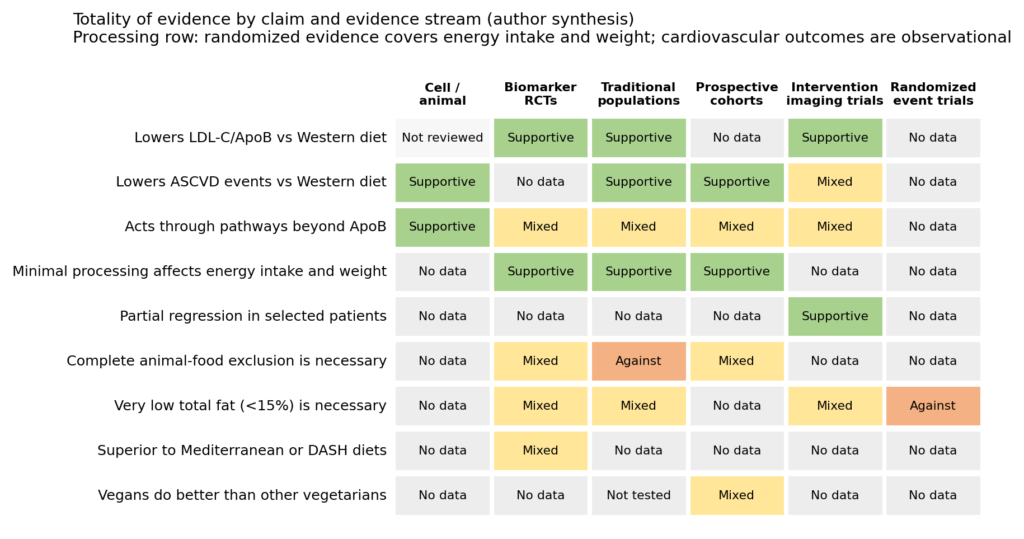
图 15. 按主张和证据流汇总的证据总体情况。作者对第 3–17 节的综合总结;“反对”标记了与所述主张相矛盾的证据。
19. 当今证据所能支持的最强有力主张
与典型的西方饮食相比,全食植物性饮食能可靠地降低致动脉粥样硬化脂蛋白,且终生动物性食物摄入量低的人群胆固醇水平和记录的冠心病死亡率较低。在针对特定患者的小型研究中,以极低脂素食饮食为核心的强化生活方式计划,与常规护理相比,产生了适度的血管造影回归、更好的心肌灌注、更少的心绞痛和更少的心脏手术。总而言之,这些证据令人信服地表明,这种饮食有助于预防、减缓并在某些患者中部分逆转冠状动脉粥样硬化,主要是通过降低累积的 ApoB 暴露。这种益处最一致地与饮食的全食特性(极简加工、高纤维和丰富的蔬菜)有关,而非仅仅在于排除动物性食物,且有似是而非但尚未证实的证据表明,部分益处是通过 ApoB 以外的途径实现的。证据并未确立排除所有动物性食物和几乎所有添加脂肪的保护效果优于执行良好的地中海饮食、DASH 饮食或不饱和脂肪含量较高的植物性饮食。
要提出更强有力的主张,需要对这些饮食在同等支持强度和同等药物治疗下进行随机比较,并在整个过程中测量 ApoB,进行盲法定量斑块成像,并最终裁定临床事件。在这些数据出现之前,VLF-WFPB 最好被呈现为植物为主的心脏健康饮食家族中一种有证据支持的选择,以其降低 LDL-C 的效力而著名,而不是一种唯一有效的逆转方案。
表 4。证据表。等级:1 = 具有临床事件的随机对照试验;2 = 中间结局的随机对照试验;3 = 前瞻性队列;4 = 人群比较、横断面研究或病例系列(第 1.2 节)。CI = 95% 置信区间。
| 学习 | 等级 | 设计,n,持续时间 | 交付/实现的饮食 | 背景治疗 | 结局和效应估计 | 主要限制 |
| Koch 2023 元分析 [22] | 2 | 30 项 RCT;来自 6 项试验的 ApoB | 素食或纯素食对比杂食;脂肪含量各异 | 各异;部分使用降脂药物 | TC −0.34 mmol/L (CI −0.44 至 −0.23);LDL-C −0.30 mmol/L (−0.40 至 −0.19) ≈ −11.6 mg/dL;ApoB −12.92 mg/dL (−22.63 至 −3.20;I² = 71.7%,6 项试验);TG 无差异 | 异质性饮食和对照;短期试验;无事件;未分离脂肪水平;ApoB 估计基于具有显著异质性的 6 项试验,其独立性在此无法确认 |
| Wang 2023 元分析 [7] | 2 | 20 项 RCT,1,878 人;平均 25.4 周 | 素食,包括 Ornish 和低脂纯素食 | 大多数使用心脏代谢药物 | LDL-C −6.6 mg/dL (−10.1 至 −3.1);HbA1c −0.24% (−0.40 至 −0.07);体重 −3.4 kg (−4.9 至 −2.0);SBP −0.1 mm Hg (−2.8 至 2.6) | 与活性对照组相比 LDL-C 无显著差异;大多数具有高偏倚风险;要点文本与结果不同 |
| Rees 2021 Cochrane [72] | 2 | 13 项 RCT;≥12 周;检索至 2020 年 2 月 | 仅限纯素食 | — | 无试验报告临床事件;一项二级预防试验 (n = 63):无明确的血脂或血压效应 | 小型试验;检索日期较久;确定性低 |
| Dybvik 2023 队列元分析 [40] | 3 | 13 个队列,844,175 人 | 素食或纯素食对比非素食(自述) | — | IHD RR 0.79 (0.71–0.88;8 个队列);CVD 0.85 (0.79–0.92);卒中 0.90 (0.77–1.05);纯素食 IHD 0.82 (0.68–1.00;6) | 残余混杂 (E-值 1.86);约 1/5 由 BMI 介导;排除早期随访后关联变弱;未评估脂肪 |
| EPIC-Oxford [41] | 3 | 队列;48,188 人;18.1 年 | 素食者(包括纯素食者)对比食肉者;纯素食者约 28% 脂肪 | — | IHD HR 0.78 (0.70–0.87),风险因素调整后为 0.90 (0.81–1.00);总卒中 HR 1.20 (1.02–1.40),主要是出血性;纯素食 IHD 0.82 (0.64–1.05),蛋奶素 0.77 (0.69–0.86),食鱼者 0.87 (0.77–0.99) | 观察性;自述饮食和风险因素 |
| AHS-2 [53] | 3 | 队列;73,308 名复临信徒;5.79 年 | 纯素食、蛋奶素、鱼素、半素食对比非素食 | — | Vegetarians: IHD death 0.81 (0.64–1.02); men 0.71 (0.51–1.00). By group: vegan 0.90 (0.60–1.33), lacto-ovo 0.82 (0.62–1.06), pesco 0.65 (0.43–0.97); vegan men 0.45 (0.21–0.94), vegan women 1.39 (0.87–2.24) | Short follow-up; healthy-user profile (Figure 9); few vegan deaths |
| Plant diet indices [17] | 3 | 3 cohorts; ~209,000; 8,631 CHD | Healthful vs unhealthful plant-based indices | — | CHD HR (extreme deciles): PDI 0.92 (0.83–1.01); hPDI 0.75 (0.68–0.83); uPDI 1.32 (1.20–1.46) | FFQ-based; health professionals; hPDI rewards oils and nuts |
| UK Biobank processing [18] | 3 | Cohort; 126,842; median 9 y | Plant-sourced foods split by ultra-processing | — | Per 10% energy: plant non-UPF CVD 0.93 (0.91–0.95), CVD death 0.87 (0.80–0.94); plant UPF CVD 1.05 (1.03–1.07), death 1.12 (1.05–1.20) | Observational; 24-h recalls; NOVA classification |
| Danish nitrate cohort [29] | 3 | Cohort; 53,150; up to 23 y; 14,088 CVD | Vegetable nitrate quintiles (median 23 vs 59 mg/day) | Adjusted for hypercholesterolemia | CVD HR 0.85 (0.82–0.89); IHD 0.88 (0.82–0.94); ischemic stroke 0.83 (0.76–0.91); PAD 0.74 (0.67–0.83); 21.9% mediated by SBP | Observational; plateau ~60 mg/day; nitrate mainly lettuce and potato |
| Key 1999 pooled cohorts [54] | 3 | 5 cohorts; 76,172; mean 10.6 y | Vegan, lacto-ovo, fish eaters, occasional meat vs regular meat eaters | — | IHD mortality: vegetarians 0.76 (0.62–0.94); vegans 26% lower, lacto-ovo and fish eaters 34% lower; benefit limited to diet >5 y and larger at younger ages | Mortality only; older cohorts; adjusted for age, sex, smoking only |
| AHS-2 2024 [55] | 3 | Cohort; 88,400; ~11 y | Five diet groups | — | Vegetarians lower IHD mortality; vegan diet not associated with all-cause mortality overall; vegan men lower mortality at younger ages | Hazard ratios vary with age; stroke and dementia higher in older vegetarians |
| AHS-2 protein [57] | 3 | Cohort; 81,337; 9.4 y; 2,276 CVD deaths | Protein-source factors | — | CVD mortality: meat factor 1.61 (98.75% CI 1.12–2.32); nuts and seeds factor 0.60 (0.42–0.86) | Factor analysis; FFQ; observational |
| Vegan diets review [56] | 3 | Systematic review; 7 studies; ≥7,661 vegans | Vegan vs non-vegan | — | No cohort showed significantly higher or lower primary CVD risk in vegans | Few vegans; low power |
| Tzu Chi cohorts [58] | 3 | 2 cohorts; 13,352; Taiwan | Buddhist vegetarians (mostly lacto-ovo) vs non-vegetarians | — | Ischemic stroke 0.26 (0.08–0.88) and 0.41 (0.19–0.88); hemorrhagic 0.34 (0.12–1.00) | Stroke only; healthy-user setting; few events |
| Xiamen lacto-vegetarians [59] | 4 | Cross-sectional; 169 vs 126 men | Chinese lacto-vegetarian vs omnivore | — | Lower BP, LDL-C, ApoB, TG, glucose; thinner carotid IMT | Single measurement; surrogate markers; dairy-eating |
| Hong Kong vegans (review) [60] | 4 (review) | Review of cross-sectional and supplementation studies | Vegans and vegetarians with low B12 | — | ~80% B12 deficiency in Hong Kong vegans; impaired FMD and thicker IMT with deficiency; improved with B12 | Surrogate outcomes; caution for unsupplemented vegan diets |
| Tsimane [35] | 4 | Cross-sectional; 705 adults 40–94; CT calcium | 14% fat, 14% protein, 72% carbohydrate; game and fish; unprocessed | 无 | CAC 0 in 85%, 1–100 in 13%, >100 in 3%; >75 y: 65% zero; LDL-C 91 mg/dL; ApoB 97 mg/dL | CAC misses noncalcified plaque; cross-sectional; 6–7 h/day activity (men) |
| China Study I [43] | 4 | Ecological; 65 counties, 130 villages; diet 1983–84; mortality 1973–75 | 14% fat; animal protein ~1% of energy; not vegan | 无 | Mean TC 127 vs 203 mg/dL (US); CAD mortality ages 0–64: 4.0 (men) and 3.4 (women) vs 66.8 and 18.9 per 100,000 (US) | Ecological; decade gap; ages truncated; ascertainment; activity and competing mortality |
| Okinawa (Willcox) [45, 47] | 4 | Ecological; 1949 survey; vital statistics | ~1,785 kcal/day; sweet potato ~69% of energy; fat ~6%; some pork and fish | 无 | Older cohorts reported ~80% lower CHD mortality than US | Post-war scarcity; energy restriction; body size; transition; no individual linkage |
| Esselstyn 1995/1999 [5, 42] | 4 | Case series; 22–24 enrolled; 11 imaged at ~5 y | ≤10% fat; skim milk, nonfat yogurt allowed | Cholestyramine + lovastatin most often | TC 246 → 132.4 mg/dL (LDL-C 71.6); % stenosis 53.4 → 46.2% (−7 points, CI 3.3–10.7); MLD +0.08 mm (−0.06 to 0.22), NS; regression in 8/11 patients by % stenosis | No control; 13 of 38 lesions excluded (4 graft-proximal lesions that progressed); attrition reported as 5 and as 11; drugs; regression to the mean |
| Esselstyn 2014 [4] | 4 | Cohort; 198 (177 adherent, 21 nonadherent); mean 44.2 mo | No animal foods, oil, nuts, avocado; fat not measured | Usual medications, not recorded | Adherent: 1 progression-related stroke per investigators (0.6%); 18/177 “worse” (10%); 0 cardiac deaths. Nonadherent: 13/21 (62%) with ≥1 event, 7 of 13 events revascularizations | Self-selected; self-reported adherence; no lipids; investigator adjudication; not randomized; 2.2% in supplementary table |
| 生活方式心脏试验6, 63] | 2 (events: counts) | RCT (invitational), 48; 35 with 5-y QCA; 5 y | 10% fat vegetarian (nonfat dairy, egg white); achieved 6.2% (1 y), 8.5% (5 y); plus exercise, stress management, support | No lipid drugs (exp.); 60% of controls started them | 5-y (1998 report, n = 35): % diameter stenosis −3.07 (−5.91 to −0.24) vs +11.77 (3.40 to 20.14), P = .001; minimum lumen diameter essentially unchanged (+0.001 mm) vs −0.34 mm (P = .05); 1-y (1990 report, n = 48): 40.0% → 37.8% vs 42.7% → 46.1%, 82% of experimental patients toward regression; events 25 vs 45, rate ratio 2.47 (1.48–4.20); angina −91% at 1 y (within group) | Multicomponent; small; half of eligible declined; attrition; events = recurrent counts, mostly procedures; stenosis and lumen diameter are not plaque volume |
| Gould 1995 PET [61] | 2 | Same trial; 20 vs 15 | As above | As above | Perfusion abnormalities smaller/less severe vs worsening in controls | Not independent; functional endpoint |
| Multicenter Lifestyle Demonstration [64] | 4 | Nonrandomized; 194 vs 139 revascularized; 3 y | 欧尼斯计划 | Not reported | 150/194 (77%) avoided revascularization; similar MI, stroke, death rates per patient-year | Self-selection; comparator is revascularized patients |
| STARS [66] | 2 | RCT; 90 men; 39 mo | Lipid-lowering diet, 27% fat (not vegan) ± cholestyramine | Cholestyramine in one arm | MAWS −0.201 (usual care), +0.003 (diet), +0.103 mm (diet + resin); progression 46%, 15%, 12% | Small; men only; not plant-exclusive |
| Heidelberg [62] | 2 | RCT; 113 men; 12 mo | Low-fat, low-cholesterol diet + intensive exercise | No lipid drugs | Progression 23% vs 48%; regression 32% vs 17% | Exercise co-intervention; lipid differences gone at 6 y |
| DISCO-CT [68] | 2 | RCT; 92; ~67 wk; CCTA | DASH-based counseling + activity + OMT vs OMT | OMT in both arms | Noncalcified plaque −51.3 vs −21.3 mm³ (P = .045); total atheroma change not significantly different; ~6-y follow-up: MACE 1 vs 4 [69] | Single center; not plant-exclusive; weight largely regained; too few events |
| 躲避 CAD [9] | 2 | RCT; 100; 8 wk | Vegan vs AHA diet; median fat 29.9% vs 30.2% of energy at 8 wk; unsaturated oils encouraged and olive oil in recipes for both; groceries provided | 94–96% statins | hs-CRP 32% lower (β 0.68, 0.49–0.94); LDL-C 13% lower (β 0.87, 0.78–0.97; NS at Bonferroni α) | Short; biomarker only; not very-low-fat; 14% of those meeting initial criteria enrolled |
| Barnard 2021 crossover [23] | 2 | Crossover RCT; 62 randomized, 52 completers; 16 wk per diet | Low-fat vegan (17% of energy from fat achieved; 95% CI 15–19) vs PREDIMED-style Mediterranean | Lipid estimate in 43 without lipid-drug changes; BP estimate in 41 without antihypertensive changes | Weight −6.0 kg (−7.5 to −4.5) and LDL-C −14.8 mg/dL (−23.5 to −6.2) favoring vegan; SBP +6.0 mm Hg (+1.0 to +10.9) favoring Mediterranean | Short; diet-induced weight loss may mediate the effects, so the direct effect of dietary composition is not isolated; advocacy sponsor; not a 10–15%-fat diet; significant SBP carryover in the all-participant analysis but not in the stable-medication subgroup; 1 participant reassigned after randomization to match a household member |
| CARDIVEG [71] | 2 | 交叉随机对照试验;107名低风险受试者;每种饮食持续3个月 | 低热量蛋奶素饮食对比低热量地中海饮食 | 低风险成人 | 减重效果相似;素食组 LDL-C 较低;地中海饮食组 TG 较低;素食组 B12 水平下降 | 低风险;非纯素或极低脂 |
| 心脏健康食谱 [8] | 2 | 交叉随机对照试验;40名受试者;每阶段4周 | 高特级初榨橄榄油(48% 脂肪)全食植物性纯素饮食对比低特级初榨橄榄油(32% 脂肪) | 未指定 | 两者均降低了 LDL-C 和 ApoB;第一阶段 LDL-C -25.5 对比 -16.7 mg/dL (P = .162);序列相互作用 | 时间短;存在结转效应;两个阶段均非极低脂 |
| 组合饮食 (Portfolio) 荟萃分析 [15] | 2 | 受控试验;439名参与者 | 在 NCEP Step II 饮食基础上添加坚果、植物蛋白、粘性纤维和甾醇;各试验中的脂肪含量有所不同 | 各异 | LDL-C 降低约 17%;ApoB 和非 HDL-C 也降低了 | 仅限脂质终点;包含坚果(非低脂) |
| 加工食品随机对照试验 [19] | 2 | 住院交叉试验;20名受试者;每种持续2周 | 超加工对比非加工饮食,匹配所提供的营养素 | — | 超加工饮食每日增加 508 ± 106 kcal;体重变化 +0.9 对比 -0.9 kg | 时间短;研究能量平衡而非动脉粥样硬化 |
| DASH [11] | 2 | 喂养随机对照试验;459名受试者;8周 | 包含低脂乳制品的 DASH 组合饮食 | — | 血压下降 5.5/3.0 mm Hg;高血压患者下降 11.4/5.5 | 仅限血压终点 |
| DASH-钠 [16] | 2 | 喂养随机对照试验 | DASH + 低钠对比高钠对照组 | — | 收缩压 (SBP) 下降 7.1(血压正常者),11.5 mm Hg(1级高血压) | 仅限血压终点 |
| PREDIMED 2018 [12] | 1 | 随机对照试验;7,447名高风险受试者;中位随访 4.8 年 | 地中海饮食 + 特级初榨橄榄油或坚果对比减脂建议 | — | 96/2,543 对比 83/2,454 对比 109/2,450;特级初榨橄榄油组 HR 0.69 (0.53–0.91);坚果组 0.72 (0.54–0.95) | 2013年的报告因随机化不规范被撤回;对照组仅基于建议 |
| 里昂饮食心脏研究 [70] | 1 | 随机对照试验;605名心肌梗死后患者;平均随访 46 个月 | 提供富含 ALA 的人造黄油代替黄油和奶油,并提供地中海式饮食建议,对比谨慎的西方饮食 | — | 心源性死亡/心肌梗死 14 对比 44;更广泛的复合终点分别为 27 对比 90 以及 95 对比 180;各复合终点的调整后 RR 为 0.28–0.53 | 对照组较弱;治疗时代较早 |
| CORDIOPREV [10] | 1 | 随机对照试验;1,002名冠心病患者;中位随访 7 年 | 地中海饮食(40.5% 脂肪)对比低脂杂食(32.1% 脂肪) | 他汀类药物使用率 86.6% | 87 (17.3%) 对比 111 (22.2%);HR 0.745 (0.563–0.986);男性 HR 0.669 (0.489–0.915);175名女性的估算结果不确定 | 单中心;橄榄油基金会资助;低脂组非 VLF-WFPB |
| Hooper 2020 Cochrane 综述 [26] | 1 | 主要事件分析包含 12 项随机对照试验;53,758名受试者 | 减少饱和脂肪 | — | 复合心血管事件 RR 0.83 (0.70–0.98) | 测试的是饱和脂肪,而非总脂肪或 VLF-WFPB |
表 5. VLF-WFPB 的拟议优势:是与对照饮食共有,还是有额外获益的证据?
| 拟议优势 | 主要证据 | 是否与地中海饮食/DASH 共有? | VLF-WFPB 额外获益的证据 | 结论 |
| 更低的 LDL-C 和 ApoB(极低饱和脂肪、无膳食胆固醇、富含纤维和植物蛋白) | 汇总随机对照试验对比杂食性饮食 [22];纯素对比地中海饮食交叉试验 [23];CARDIVEG [71];组合饮食 (Portfolio) [15] | 部分共有:均降低了饱和脂肪;组合饮食通过坚果实现约 17% 的 LDL-C 降幅;在直接对比中,地中海饮食降低 LDL-C 的效果较弱 | 在数周至数月的时间内,某些植物性干预措施降低 LDL-C 和 ApoB 的效果优于选定的对照组;特定 10–15% 脂肪方案的优越性尚未确立 | 得到支持(生物标志物);特定方案尚未确立 |
| 减重 / 低能量密度 | Wang [7];Barnard [23];Ornish [6] | 当两种饮食均限制能量时效果相似 [71] | 在短期试验中,随意进食的效果更好 | 取决于具体情况 |
| 降低血压 | Wang (无显著差异) [7];DASH [11, 16];Barnard [23] | 是;DASH 和地中海饮食效果相当或更好 | 未显示 | 未显示出额外获益 |
| 更好 血糖控制 | Wang,2型糖尿病亚组 [7] | 部分 | 对比传统糖尿病饮食,而非对比地中海饮食 | Supported but uncertain |
| 甘油三酯和 HDL-C | Ornish [6];Koch [22];CARDIVEG [71] | 地中海饮食对甘油三酯的降低作用更显著 | 极低脂饮食可能会提高甘油三酯并降低 HDL-C;单纯的 HDL-C 降低并不说明对心血管有害 [80],甘油三酯水平应结合 ApoB、非 HDL-C 及临床结局一同解读 | 不确定;可能存在劣势 |
| 减轻炎症 (hs-CRP) | 躲避 CAD [9] | 在 CARDIVEG 中,地中海饮食也降低了炎症标志物 [71] | 对比脂肪含量约 30% 的 AHA 饮食;未在极低脂肪条件下测试 | Biologically plausible |
| 更好的内皮功能 | 单餐研究 [30, 81]; 橄榄油荟萃分析 [32]; CORDIOPREV 子项研究 [33]; EVADE EndoPAT [9] | 是:持续的橄榄油和地中海饮食改善了 FMD | VLF-WFPB 尚无持续性的研究 | Unsupported |
| 降低中风风险 | EPIC-Oxford [41]; Dybvik [40] | — | 否:EPIC-Oxford 研究中较高的中风率与其素食组有关,而非 VLF-WFPB,后者尚未进行中风相关测试 | 双向均未证实 |
| 清晰的饮食规则有助于提高依从性 | 依从性数据 [4, 6, 9] | 任何结构化计划 | 行为学假设;严格性可能对某些人有帮助,但会阻碍其他人 | 假设 |
| 全天然、最低限度加工的食物 | Plant diet indices [17]; 英国生物样本库 (UK Biobank) [18]; 加工食品 RCT [19] | 部分:DASH 和地中海饮食也是最低限度加工的模式 | 最强的非脂质杠杆;植物性超加工食品与更高风险相关 | Supported but uncertain |
| 叶菜类硝酸盐 → 一氧化氮 | 丹麦队列 [29] | 是:任何富含蔬菜的模式 | 在脂质调整后关联仍然存在;非纯素特有 | 似乎合理,得到了部分支持 |
| 膳食纤维 → 丁酸盐 | 小鼠模型 [28] | 是:任何高纤维模式 | 在小鼠中与胆固醇无关;尚无人类结果数据 | Biologically plausible |
| 更低的 TMAO / 有利的微生物组 | 队列关联 [37]; 孟德尔随机化结果无显著性 [38] | 部分(富含纤维的模式) | 没有结果证据;遗传学证据反对 TMAO 的因果效应 | 弱假设 |
| 排除添加油 | 心脏健康食谱 [8]; PREDIMED [12]; CORDIOPREV [10] | 否:与对照组相比,富含特级初榨橄榄油 (EVOO) 的饮食减少了事件 | 大量添加油脂可能会削弱 LDL-C 的降低效果;尚无事件数据 | 没有证据支持其必要性 |
| 排除坚果和种子 | PREDIMED 坚果组 [12] | 否:添加坚果的饮食减少了事件 | 无 | Unsupported |
| 血管造影显示进展减缓或消退 | 生活方式心脏研究 [6]; STARS [66]; Heidelberg [62]; DISCO-CT [68] | 是:低脂非纯素和基于 DASH 的计划也减缓了进展 | 仅为综合干预效果;饮食所占比例未知 | Supported but uncertain |
| 完全排除动物性食物 | AHS-2 [53]; EPIC-Oxford [41]; 汇总队列 [54]; 纯素饮食综述 [56]; AHS-2 蛋白质研究 [57] | 不适用 | 无:纯素食者的表现并不优于蛋奶素或鱼素者;坚果和种子蛋白与较低的心血管疾病死亡率相关 | Unsupported |
缩写:ApoB,载脂蛋白 B;BP,血压;CCTA,冠状动脉 CT 血管造影;CHD,冠心病;EVOO,特级初榨橄榄油;IHD,缺血性心脏病;MAWS,冠状动脉段平均绝对宽度;MLD,最小管腔直径;NS,无显著性;OMT,最佳药物治疗;QCA,定量冠状动脉造影;RCT, 随机对照试验;TC,总胆固醇;TG,甘油三酯;VLF-WFPB,极低脂全食物植物性饮食。
参考文献
- Wang T, Masedunskas A, Willett WC, Fontana L. Vegetarian and vegan diets: benefits and drawbacks. Eur Heart J. 2023;44(36):3423–3439. doi:10.1093/eurheartj/ehad436.
- Freeman AM, Morris PB, Barnard N, et al. Trending cardiovascular nutrition controversies. J Am Coll Cardiol. 2017;69(9):1172–1187. doi:10.1016/j.jacc.2016.10.086. PMID 28254181.
- Kahleova H, Levin S, Barnard ND. Vegetarian dietary patterns and cardiovascular disease. Prog Cardiovasc Dis. 2018;61(1):54–61. doi:10.1016/j.pcad.2018.05.002. PMID 29800598.
- Esselstyn CB Jr, Gendy G, Doyle J, Golubic M, Roizen MF. A way to reverse CAD? J Fam Pract. 2014;63(7):356–364b. PMID 25198208.
- Esselstyn CB Jr. Updating a 12-year experience with arrest and reversal therapy for coronary heart disease (an overdue requiem for palliative cardiology). Am J Cardiol. 1999;84(3):339–341, A8. doi:10.1016/S0002-9149(99)00290-8. PMID 10496449.
- Ornish D, Scherwitz LW, Billings JH, et al. Intensive lifestyle changes for reversal of coronary heart disease. JAMA. 1998;280(23):2001–2007. doi:10.1001/jama.280.23.2001. PMID 9863851. Correction (author list): JAMA. 1999;281(15):1380.
- Wang T, Kroeger CM, Cassidy S, et al. Vegetarian dietary patterns and cardiometabolic risk in people with or at high risk of cardiovascular disease: a systematic review and meta-analysis. JAMA Netw Open. 2023;6(7):e2325658. doi:10.1001/jamanetworkopen.2023.25658. PMID 37490288.
- Krenek AM, Mathews A, Guo J, et al. Recipe for Heart Health: a randomized crossover trial on cardiometabolic effects of extra virgin olive oil within a whole-food plant-based vegan diet. J Am Heart Assoc. 2024;13(15):e035034. doi:10.1161/JAHA.124.035034. PMID 39045758.
- Shah B, Newman JD, Woolf K, et al. Anti-inflammatory effects of a vegan diet versus the American Heart Association–recommended diet in coronary artery disease trial. J Am Heart Assoc. 2018;7(23):e011367. doi:10.1161/JAHA.118.011367. PMID 30571591.
- Delgado-Lista J, Alcala-Diaz JF, Torres-Peña JD, et al. Long-term secondary prevention of cardiovascular disease with a Mediterranean diet and a low-fat diet (CORDIOPREV): a randomised controlled trial. Lancet. 2022;399(10338):1876–1885. doi:10.1016/S0140-6736(22)00122-2. PMID 35525255.
- Appel LJ, Moore TJ, Obarzanek E, et al. A clinical trial of the effects of dietary patterns on blood pressure. DASH Collaborative Research Group. N Engl J Med. 1997;336(16):1117–1124. doi:10.1056/NEJM199704173361601. PMID 9099655.
- Estruch R, Ros E, Salas-Salvadó J, et al. Primary prevention of cardiovascular disease with a Mediterranean diet supplemented with extra-virgin olive oil or nuts. N Engl J Med. 2018;378(25):e34. doi:10.1056/NEJMoa1800389. PMID 29897866. (Replaces the retracted 2013 report.)
- Kris-Etherton P, Eckel RH, Howard BV, St Jeor S, Bazzarre TL. AHA science advisory: Lyon Diet Heart Study. Benefits of a Mediterranean-style, National Cholesterol Education Program/American Heart Association Step I dietary pattern on cardiovascular disease. Circulation. 2001;103(13):1823–1825. doi:10.1161/01.CIR.103.13.1823.
- de Lorgeril M, Renaud S, Mamelle N, et al. Mediterranean alpha-linolenic acid-rich diet in secondary prevention of coronary heart disease. Lancet. 1994;343(8911):1454–1459. doi:10.1016/S0140-6736(94)92580-1.
- Chiavaroli L, Nishi SK, Khan TA, et al. Portfolio dietary pattern and cardiovascular disease: a systematic review and meta-analysis of controlled trials. Prog Cardiovasc Dis. 2018;61(1):43–53. doi:10.1016/j.pcad.2018.05.004. PMID 29807048.
- Sacks FM, Svetkey LP, Vollmer WM, et al. Effects on blood pressure of reduced dietary sodium and the Dietary Approaches to Stop Hypertension (DASH) diet. N Engl J Med. 2001;344(1):3–10. doi:10.1056/NEJM200101043440101. PMID 11136953.
- Satija A, Bhupathiraju SN, Spiegelman D, et al. Healthful and unhealthful plant-based diets and the risk of coronary heart disease in U.S. adults. J Am Coll Cardiol. 2017;70(4):411–422. doi:10.1016/j.jacc.2017.05.047. PMID 28728684.
- Rauber F, Louzada MLC, Chang K, et al. Implications of food ultra-processing on cardiovascular risk considering plant origin foods: an analysis of the UK Biobank cohort. Lancet Reg Health Eur. 2024;43:100948. doi:10.1016/j.lanepe.2024.100948. PMID 39210945.
- Hall KD, Ayuketah A, Brychta R, et al. Ultra-processed diets cause excess calorie intake and weight gain: an inpatient randomized controlled trial of ad libitum food intake. Cell Metab. 2019;30(1):67–77.e3. doi:10.1016/j.cmet.2019.05.008.
- Ference BA, Ginsberg HN, Graham I, et al. Low-density lipoproteins cause atherosclerotic cardiovascular disease. 1. Evidence from genetic, epidemiologic, and clinical studies. A consensus statement from the European Atherosclerosis Society Consensus Panel. Eur Heart J. 2017;38(32):2459–2472. doi:10.1093/eurheartj/ehx144. PMID 28444290.
- Cholesterol Treatment Trialists’ (CTT) Collaboration. Efficacy and safety of more intensive lowering of LDL cholesterol: a meta-analysis of data from 170 000 participants in 26 randomised trials. Lancet. 2010;376(9753):1670–1681. doi:10.1016/S0140-6736(10)61350-5. PMID 21067804.
- Koch CA, Kjeldsen EW, Frikke-Schmidt R. Vegetarian or vegan diets and blood lipids: a meta-analysis of randomized trials. Eur Heart J. 2023;44(28):2609–2622. doi:10.1093/eurheartj/ehad211. PMID 37226630.
- Barnard ND, Alwarith J, Rembert E, et al. A Mediterranean diet and low-fat vegan diet to improve body weight and cardiometabolic risk factors: a randomized, cross-over trial. J Am Nutr Assoc. 2022;41(2):127–139. doi:10.1080/07315724.2020.1869625. PMID 33544066.
- McMurry MP, Connor WE, Cerqueira MT. Dietary cholesterol and the plasma lipids and lipoproteins in the Tarahumara Indians: a people habituated to a low cholesterol diet after weaning. Am J Clin Nutr. 1982;35(4):741–744. doi:10.1093/ajcn/35.4.741.
- Lichtenstein AH, Khera A, Anderson CAM, et al. 2026 dietary guidance to improve cardiovascular health: a scientific statement from the American Heart Association. Circulation. Published online 31 March 2026. doi:10.1161/CIR.0000000000001435.
- Hooper L, Martin N, Jimoh OF, Kirk C, Foster E, Abdelhamid AS. Reduction in saturated fat intake for cardiovascular disease. Cochrane Database Syst Rev. 2020;(8):CD011737. doi:10.1002/14651858.CD011737.pub3. (Version of record superseding the May 2020 issue, PMID 32428300.)
- Blumenthal RS, Morris PB, Gaudino M, et al. 2026 ACC/AHA/AACVPR/ABC/ACPM/ADA/AGS/APhA/ASPC/NLA/PCNA guideline on the management of dyslipidemia: a report of the American College of Cardiology/American Heart Association Joint Committee on Clinical Practice Guidelines. Circulation. 2026. doi:10.1161/CIR.0000000000001423. Also J Am Coll Cardiol. doi:10.1016/j.jacc.2025.11.016.
- Kasahara K, Krautkramer KA, Org E, et al. Interactions between Roseburia intestinalis and diet modulate atherogenesis in a murine model. Nat Microbiol. 2018;3(12):1461–1471. doi:10.1038/s41564-018-0272-x.
- Bondonno CP, Dalgaard F, Blekkenhorst LC, et al. Vegetable nitrate intake, blood pressure and incident cardiovascular disease: Danish Diet, Cancer, and Health Study. Eur J Epidemiol. 2021;36(8):813–825. doi:10.1007/s10654-021-00747-3.
- Vogel RA, Corretti MC, Plotnick GD. Effect of a single high-fat meal on endothelial function in healthy subjects. Am J Cardiol. 1997;79(3):350–354. doi:10.1016/S0002-9149(96)00760-6. PMID 9036757.
- Vogel RA, Corretti MC, Plotnick GD. The postprandial effect of components of the Mediterranean diet on endothelial function. J Am Coll Cardiol. 2000;36(5):1455–1460. doi:10.1016/S0735-1097(00)00896-2. PMID 11079642.
- Schwingshackl L, Christoph M, Hoffmann G. Effects of olive oil on markers of inflammation and endothelial function—a systematic review and meta-analysis. Nutrients. 2015;7(9):7651–7675. doi:10.3390/nu7095356. PMID 26378571.
- Yubero-Serrano EM, Fernandez-Gandara C, Garcia-Rios A, et al. Mediterranean diet and endothelial function in patients with coronary heart disease: an analysis of the CORDIOPREV randomized controlled trial. PLoS Med. 2020;17(9):e1003282. doi:10.1371/journal.pmed.1003282. PMID 32903262.
- Christ A, Günther P, Lauterbach MAR, et al. Western diet triggers NLRP3-dependent innate immune reprogramming. Cell. 2018;172(1-2):162–175.e14. doi:10.1016/j.cell.2017.12.013. PMID 29328911.
- Kaplan H, Thompson RC, Trumble BC, et al. Coronary atherosclerosis in indigenous South American Tsimane: a cross-sectional cohort study. Lancet. 2017;389(10080):1730–1739. doi:10.1016/S0140-6736(17)30752-3. PMID 28320601.
- Koeth RA, Wang Z, Levison BS, et al. Intestinal microbiota metabolism of L-carnitine, a nutrient in red meat, promotes atherosclerosis. Nat Med. 2013;19(5):576–585. doi:10.1038/nm.3145. PMID 23563705.
- Tang WHW, Wang Z, Levison BS, et al. Intestinal microbial metabolism of phosphatidylcholine and cardiovascular risk. N Engl J Med. 2013;368(17):1575–1584. doi:10.1056/NEJMoa1109400. PMID 23614584.
- Jia J, Dou P, Gao M, et al. Assessment of causal direction between gut microbiota-dependent metabolites and cardiometabolic health: a bidirectional Mendelian randomization analysis. Diabetes. 2019;68(9):1747–1755. doi:10.2337/db19-0153.
- Watts GF, Jackson P, Mandalia S, et al. Nutrient intake and progression of coronary artery disease. Am J Cardiol. 1994;73(5):328–332. PMID 8109545.
- Dybvik JS, Svendsen M, Aune D. Vegetarian and vegan diets and the risk of cardiovascular disease, ischemic heart disease and stroke: a systematic review and meta-analysis of prospective cohort studies. Eur J Nutr. 2023;62(1):51–69. doi:10.1007/s00394-022-02942-8. PMID 36030329.
- Tong TYN, Appleby PN, Bradbury KE, et al. Risks of ischaemic heart disease and stroke in meat eaters, fish eaters, and vegetarians over 18 years of follow-up: results from the prospective EPIC-Oxford study. BMJ. 2019;366:l4897. doi:10.1136/bmj.l4897. PMID 31484644.
- Esselstyn CB Jr, Ellis SG, Medendorp SV, Crowe TD. A strategy to arrest and reverse coronary artery disease: a 5-year longitudinal study of a single physician’s practice. J Fam Pract. 1995;41(6):560–568. PMID 7500065.
- Campbell TC, Parpia B, Chen J. Diet, lifestyle, and the etiology of coronary artery disease: the Cornell China study. Am J Cardiol. 1998;82(10B):18T–21T. doi:10.1016/S0002-9149(98)00718-8. PMID 9860369.
- Connor WE, Cerqueira MT, Connor RW, Wallace RB, Malinow MR, Casdorph HR. The plasma lipids, lipoproteins, and diet of the Tarahumara Indians of Mexico. Am J Clin Nutr. 1978;31(7):1131–1142. doi:10.1093/ajcn/31.7.1131. PMID 665563.
- Willcox BJ, Willcox DC, Todoriki H, et al. Caloric restriction, the traditional Okinawan diet, and healthy aging: the diet of the world’s longest-lived people and its potential impact on morbidity and life span. Ann N Y Acad Sci. 2007;1114:434–455. doi:10.1196/annals.1396.037. PMID 17986602.
- Willcox DC, Willcox BJ, Todoriki H, Suzuki M. The Okinawan diet: health implications of a low-calorie, nutrient-dense, antioxidant-rich dietary pattern low in glycemic load. J Am Coll Nutr. 2009;28(Suppl):500S–516S. doi:10.1080/07315724.2009.10718117. PMID 20234038.
- Willcox BJ, Willcox DC. Caloric restriction, caloric restriction mimetics, and healthy aging in Okinawa: controversies and clinical implications. Curr Opin Clin Nutr Metab Care. 2014;17(1):51–58. doi:10.1097/MCO.0000000000000019. PMID 24316687.
- Gavrilova NS, Gavrilov LA. Comments on dietary restriction, Okinawa diet and longevity. Gerontology. 2012;58(3):221–223. doi:10.1159/000329894. PMID 21893946.
- Lindeberg S, Lundh B. Apparent absence of stroke and ischaemic heart disease in a traditional Melanesian island: a clinical study in Kitava. J Intern Med. 1993;233(3):269–275. doi:10.1111/j.1365-2796.1993.tb00986.x. PMID 8450295.
- Lindeberg S, Nilsson-Ehle P, Terént A, Vessby B, Scherstén B. Cardiovascular risk factors in a Melanesian population apparently free from stroke and ischaemic heart disease: the Kitava study. J Intern Med. 1994;236(3):331–340.
- Lindeberg S, Nilsson-Ehle P, Vessby B. Lipoprotein composition and serum cholesterol ester fatty acids in nonwesternized Melanesians. Lipids. 1996;31(2):153–158. doi:10.1007/BF02522614. PMID 8835402.
- Kwok CS, Umar S, Myint PK, Mamas MA, Loke YK. Vegetarian diet, Seventh Day Adventists and risk of cardiovascular mortality: a systematic review and meta-analysis. Int J Cardiol. 2014;176(3):680–686. doi:10.1016/j.ijcard.2014.07.080.
- Orlich MJ, Singh PN, Sabaté J, et al. Vegetarian dietary patterns and mortality in Adventist Health Study 2. JAMA Intern Med. 2013;173(13):1230–1238. doi:10.1001/jamainternmed.2013.6473. PMID 23836264.
- Key TJ, Fraser GE, Thorogood M, et al. Mortality in vegetarians and nonvegetarians: detailed findings from a collaborative analysis of 5 prospective studies. Am J Clin Nutr. 1999;70(3 Suppl):516S–524S. doi:10.1093/ajcn/70.3.516s. PMID 10479225.
- Abris GP, Shavlik DJ, Mathew RO, et al. Cause-specific and all-cause mortalities in vegetarian compared with those in nonvegetarian participants from the Adventist Health Study-2 cohort. Am J Clin Nutr. 2024;120(4):907–917. doi:10.1016/j.ajcnut.2024.07.028. PMID 39098708.
- Kaiser J, van Daalen KR, Thayyil A, Cocco MTARR, Caputo D, Oliver-Williams C. A systematic review of the association between vegan diets and risk of cardiovascular disease. J Nutr. 2021;151(6):1539–1552. doi:10.1093/jn/nxab037. PMID 33831953.
- Tharrey M, Mariotti F, Mashchak A, Barbillon P, Delattre M, Fraser GE. Patterns of plant and animal protein intake are strongly associated with cardiovascular mortality: the Adventist Health Study-2 cohort. Int J Epidemiol. 2018;47(5):1603–1612. doi:10.1093/ije/dyy030. PMID 29618018.
- Chiu THT, Chang HR, Wang LY, Chang CC, Lin MN, Lin CL. Vegetarian diet and incidence of total, ischemic, and hemorrhagic stroke in 2 cohorts in Taiwan. Neurology. 2020;94(11):e1112–e1121. doi:10.1212/WNL.0000000000009093. PMID 32102976.
- Yang SY, Li XJ, Zhang W, et al. Chinese lacto-vegetarian diet exerts favorable effects on metabolic parameters, intima-media thickness, and cardiovascular risks in healthy men. Nutr Clin Pract. 2012;27(3):392–398. doi:10.1177/0884533611436173. PMID 22412169.
- Woo KS, Kwok TCY, Celermajer DS. Vegan diet, subnormal vitamin B-12 status and cardiovascular health. Nutrients. 2014;6(8):3259–3273. doi:10.3390/nu6083259. PMID 25195560.
- Gould KL, Ornish D, Scherwitz L, et al. Changes in myocardial perfusion abnormalities by positron emission tomography after long-term, intense risk factor modification. JAMA. 1995;274(11):894–901. doi:10.1001/jama.1995.03530110056036. PMID 7674504.
- Schuler G, Hambrecht R, Schlierf G, et al. Regular physical exercise and low-fat diet: effects on progression of coronary artery disease. Circulation. 1992;86(1):1–11. doi:10.1161/01.cir.86.1.1. PMID 1617762.
- Ornish D, Brown SE, Scherwitz LW, et al. Can lifestyle changes reverse coronary heart disease? The Lifestyle Heart Trial. Lancet. 1990;336(8708):129–133. doi:10.1016/0140-6736(90)91656-U. PMID 1973470.
- Ornish D. Avoiding revascularization with lifestyle changes: the Multicenter Lifestyle Demonstration Project. Am J Cardiol. 1998;82(10B):72T–76T. doi:10.1016/S0002-9149(98)00744-9. PMID 9860380.
- Silberman A, Banthia R, Estay IS, et al. The effectiveness and efficacy of an intensive cardiac rehabilitation program in 24 sites. Am J Health Promot. 2010;24(4):260–266. (Cited only as the second source of an untraced statement in ref. 2.)
- Watts GF, Lewis B, Brunt JN, et al. Effects on coronary artery disease of lipid-lowering diet, or diet plus cholestyramine, in the St Thomas’ Atherosclerosis Regression Study (STARS). Lancet. 1992;339(8793):563–569. doi:10.1016/0140-6736(92)90863-X. PMID 1347091.
- Niebauer J, Hambrecht R, Velich T, et al. Attenuated progression of coronary artery disease after 6 years of multifactorial risk intervention: role of physical exercise. Circulation. 1997;96(8):2534–2541. PMID 9355890.
- Henzel J, Kępka C, Kruk M, et al. High-risk coronary plaque regression after intensive lifestyle intervention in nonobstructive coronary disease: a randomized study. JACC Cardiovasc Imaging. 2021;14(6):1192–1202. doi:10.1016/j.jcmg.2020.10.019. PMID 33341413.
- Makarewicz-Wujec M, Henzel J, Kępka C, et al. Long-term outcomes of the Dietary Approaches to Stop Hypertension (DASH) intervention in nonobstructive coronary artery disease: follow-up of the DISCO-CT study. Nutrients. 2025;17(15):2565. doi:10.3390/nu17152565.
- de Lorgeril M, Salen P, Martin JL, Monjaud I, Delaye J, Mamelle N. Mediterranean diet, traditional risk factors, and the rate of cardiovascular complications after myocardial infarction: final report of the Lyon Diet Heart Study. Circulation. 1999;99(6):779–785. doi:10.1161/01.CIR.99.6.779. PMID 9989963.
- Sofi F, Dinu M, Pagliai G, et al. Low-calorie vegetarian versus Mediterranean diets for reducing body weight and improving cardiovascular risk profile: CARDIVEG Study (Cardiovascular Prevention With Vegetarian Diet). Circulation. 2018;137(11):1103–1113. doi:10.1161/CIRCULATIONAHA.117.030088. PMID 29483085.
- Rees K, Al-Khudairy L, Takeda A, Stranges S. Vegan dietary pattern for the primary and secondary prevention of cardiovascular diseases. Cochrane Database Syst Rev. 2021;2(2):CD013501. doi:10.1002/14651858.CD013501.pub2. PMID 33629376.
- Virani SS, Newby LK, Arnold SV, et al. 2023 AHA/ACC/ACCP/ASPC/NLA/PCNA guideline for the management of patients with chronic coronary disease. Circulation. 2023;148(9):e9–e119. doi:10.1161/CIR.0000000000001168.
- Dawson LP, Lum M, Nerleker N, Nicholls SJ, Layland J. Coronary atherosclerotic plaque regression: JACC state-of-the-art review. J Am Coll Cardiol. 2022;79(1):66–82. doi:10.1016/j.jacc.2021.10.035. PMID 34991791.
- Armstrong ML, Megan MB. Lipid depletion in atheromatous coronary arteries in rhesus monkeys after regression diets. Circ Res. 1972;30(6):675–680. doi:10.1161/01.res.30.6.675.
- Armstrong ML, Megan MB. Arterial fibrous proteins in cynomolgus monkeys after atherogenic and regression diets. Circ Res. 1975;36(2):256–261. doi:10.1161/01.res.36.2.256.
- Clarkson TB, Bond MG, Bullock BC, Marzetta CA. A study of atherosclerosis regression in Macaca mulatta. IV. Changes in coronary arteries from animals with atherosclerosis induced for 19 months and then regressed for 24 or 48 months at plasma cholesterol concentrations of 300 or 200 mg/dl. Exp Mol Pathol. 1981;34(3):345–368. doi:10.1016/0014-4800(81)90052-6.
- Nicholls SJ, Puri R, Anderson T, et al. Effect of evolocumab on progression of coronary disease in statin-treated patients: the GLAGOV randomized clinical trial. JAMA. 2016;316(22):2373–2384. doi:10.1001/jama.2016.16951. PMID 27846344.
- Melina V, Craig W, Levin S. Position of the Academy of Nutrition and Dietetics: vegetarian diets. J Acad Nutr Diet. 2016;116(12):1970–1980. doi:10.1016/j.jand.2016.09.025. PMID 27886704.
- Voight BF, Peloso GM, Orho-Melander M, et al. Plasma HDL cholesterol and risk of myocardial infarction: a Mendelian randomisation study. Lancet. 2012;380(9841):572–580. doi:10.1016/S0140-6736(12)60312-2. PMID 22607825.
- Vogel RA. The Mediterranean diet and endothelial function: why some dietary fats may be healthy. Cleve Clin J Med. 2000;67(4):232–236. (Reports the Vogel group’s postprandial olive-oil, vitamin, and vinegar-salad experiments.)