1. The Hypothesis and How This Review Tests It
The proposition under examination is that a nutritionally adequate, entirely whole-food dieta basada en plantas, very low in total fat (hereafter VLF-WFPB), offers cardiovascular protection beyond that of other high-quality dietary patterns, for prevention, for treatment of established disease, and for regression. Four separate questions are kept apart throughout: (Q1) Does VLF-WFPB improve outcomes compared with a typical Western diet? (Q2) Does it outperform other high-quality diets, such as DASH, Mediterranean, or Portfolio? (Q3) Are complete exclusion of animal foods, very low total fat, and minimal processing each independently necessary for any advantage? (Q4) Do such diets protect arteries through pathways beyond lowering ApoB-containing lipoproteínas? Q4 is treated as the central question (Section 5), because a benefit that runs entirely through ApoB could in principle be matched by any equally effective means of lowering ApoB.
The positive case rests on convergence. Randomized trials show that plant-based diets lower causal factores de riesgo; intensive lifestyle trials that included very-low-fat dietas vegetarianas showed functional and angiographic improvement; and populations with lifelong low animal-food intake had low colesterol and low coronary mortality. Each line is weak alone. Together they make it more credible that sustained dietary lowering of ApoB-containing lipoproteins can slow coronary disease, which bears mainly on Q1. They cannot answer Q2 or Q3, because in every line the diet travels with other exposures—pérdida de peso, physical activity, co-interventions, drugs—that also change risk. Convergence is therefore used here to judge plausibility, not to enlarge sample sizes or to compute a probability of superiority. Unrelated populations are not pooled.
Narrative reviews by Wang and colleagues, Freeman and colleagues, and Kahleova and colleagues served as background and as routes to original studies; numerical claims are taken from the original reports, and repeated citation of the same cohort is not treated as independent corroboration [1–3].
1.1 Scope and methods
This is a targeted critical review, not a registered revisión sistemática. Sources were identified through PubMed-indexed records, publisher pages, full-text articles where accessible, guideline repositories, and reference tracing, with a final update search on 12 September 2026. Numerical claims were checked against original reports where accessible; where only an abstract or an official summary could be obtained, that is stated at the relevant passage. No new metaanálisis or patient-level reanalysis was performed.
Interests deserve attention without being disqualifying. Several lifestyle programs were evaluated by the investigators who developed them; the direct vegan–Mediterranean comparison was conducted by an organization that advocates plant-based diets; and the major Mediterranean secondary-prevention trial was funded principally by olive-oil foundations. These are reasons to emphasize allocation, retention, prespecification, blinded outcomes, and independent replication, not reasons to reject results.
1.2 How to read the evidence: five tiers of data
Not all evidence answers the same question. This review sorts studies into five tiers according to how well each design can show cause and effect, not according to whether its results support the hypothesis. Lower tiers still count—evidence is evidence—but they answer different questions and carry different risks of misleading us (Figure 1).
Tier 1: randomized trials with clinical events. People are assigned to a diet by chance, and infartos cardíacos, golpes, or deaths are counted. Chance assignment reduces confusor in expectation, though not necessarily in any single trial, so a difference in events is the strongest available evidence that the diet caused it. Examples in this review are PREDIMED, CORDIOPREV, y el Estudio de Lyon sobre la Dieta Cardioprotectora.
Tier 2: randomized trials of intermediate outcomes. Assignment is still by chance, but the outcome is a measurement that predicts events: LDL-C, ApoB, presión arterial, coronary narrowing, volumen de placa, or myocardial blood flow. These trials show that a diet changes the measurement; they do not by themselves show fewer events. Examples are the Ensayo sobre el estilo de vida y el corazón, EVADE CAD, and the lipid meta-analyses.
Tier 3: cohorte prospectiva studies. Large groups of individuals report what they eat and are followed for years. These studies capture real disease in real people over decades, which trials rarely can, but they show association: people who choose a diet differ in many other ways, and statistical adjustment can only partly remove those differences (Section 9.1). Examples are Adventist Health Study-2, EPIC-Oxford, and the Danish nitrate cohort.
Tier 4: population comparisons, cross-sectional studies, and uncontrolled case series. Whole populations are compared (rural China, Okinawa, the Tsimane), people are measured once, or treated patients are followed without a comparison group (the Esselstyn cohorts). These data generate hypotheses and show what is achievable, but many explanations can fit the same pattern.
Tier 5: mechanistic studies in cells and animals. Experiments can isolate a single pathway under controlled conditions, which makes them the best way to test how something might work. Whether the same pathway matters in human arteries over decades has to be shown separately.
Design is a starting point, not a verdict: confidence also depends on risk of bias, precision, how directly the comparison addresses the question, and how outcomes were ascertained. Tiers also apply to outcomes rather than to whole studies, so a trial can sit in one tier for imaging and another for clinical events. The case for a whole-food plant-based diet is strongest where several tiers point the same way and weakest where it rests on one tier alone. Section headings throughout the review note the main tier of evidence discussed.
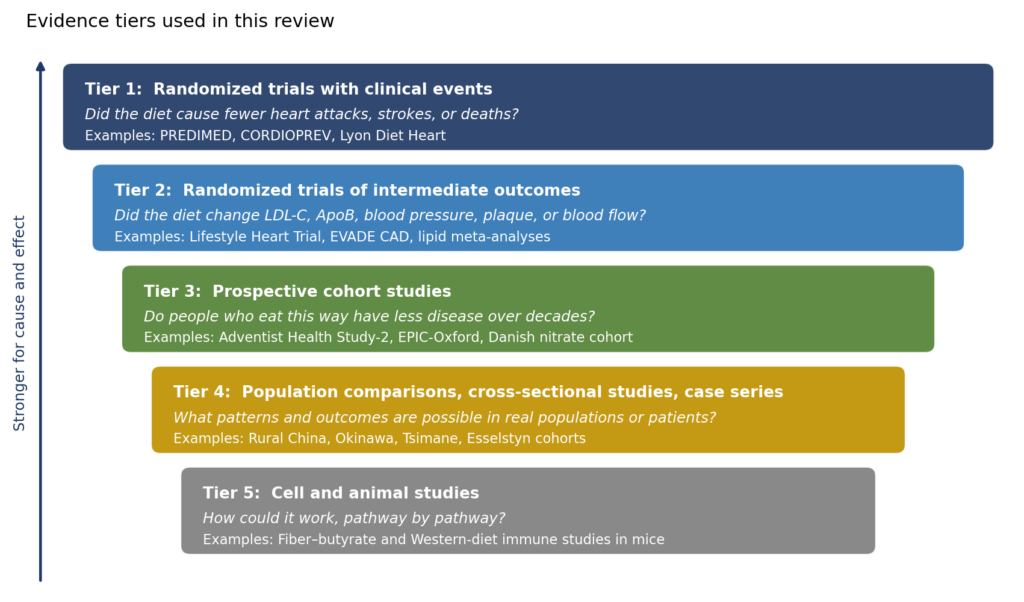
Figure 1. Five tiers of evidence used in this review, the question each tier can answer, and examples of studies in each tier. Higher tiers are better at showing cause and effect; lower tiers add breadth, duration, and biological explanation.
2. Defining the Diets and the Comparisons
The proposed diet. VLF-WFPB consists of vegetables, legumes, intact whole grains, fruit, and minimally processed starchy foods, with no animal foods and little or no added oil, operationally about 10–15% of energy from fat. The 2014 Esselstyn protocol also excluded avocado, nuts, excess salt, and sugary foods, later also caffeine and fructose, and advised a multivitamin, vitamin B12, and flaxseed meal [4]. The earlier 1985 Esselstyn cohort was not vegan: patients eliminated oil, fish, fowl, meat, and dairy products except skim milk and nonfat yogurt, targeted 10% of energy from fat, and received individualized cholesterol-lowering medication [5]. El Ensayo del estilo de vida del corazón de Ornish diet was a 10%-fat whole-foods vegetarian diet that permitted nonfat dairy and egg whites [6, 7]; achieved fat intake was 6.2% of energy at one year and 8.5% at five years [6].
Related but different diets. Higher-fat whole-food vegan diets include nuts, seeds, avocado, or aceite de oliva; the low-oil phase of the 2024 Recipe for Heart Health trial still provided 32% of energy from fat [8], and the vegan arm of the EVADE CAD trial ended at about 30% [9]. Generic vegan diets exclude animal foods without constraining food processing or fat. Conventional low-fat diets are omnivorous; the low-fat arm of CORDIOPREV prescribed less than 30% fat with lean meat and low-fat dairy, and achieved 32.1% [10].
Comparators. The DASH combination diet emphasized fruits, vegetables, and low-fat dairy with reduced saturated and total fat [11]. dietas mediterráneas tested in randomized trials were substantially higher in fat: the PREDIMED arms were supplemented with extra-virgin olive oil or nuts [12]; the CORDIOPREV Mediterranean arm prescribed at least 35% fat and achieved 40.5% [10]; and the Lyon intervention supplied an alpha-linolenic-acid-rich margarine in place of butter and cream, alongside advice to follow a Mediterranean-type pattern [13, 14]. El Dieta Portfolio adds nuts, plant proteína, viscous fibra, and plant esteroles to a low-saturated-fat background [15]. Table 1 summarizes the patterns as they were actually tested.
Table 1. Dietary patterns as tested.
| Patrón | Defining features in the key trials | Fat, % of energy | What the label alone does not establish |
| VLF-WFPB | Legumes, intact grains, vegetables, fruit, starchy foods; no animal foods; little or no oil; Esselstyn 2014 also excluded nuts and avocado [4] | Target ~10–15%; Ornish (vegetarian, not vegan) achieved 6.2–8.5% [6] | Adequate B12, protein, essential fats, or sustained adherencia |
| Higher-unsaturated-fat whole-food vegan | Animal-free, with nuts, seeds, avocado, or olive oil | 32–48% [8]; ~30% in EVADE CAD [9] | Inferiority to an oil-free vegan pattern |
| DASH | Fruit, vegetables, low-fat dairy; reduced saturated and total fat; sodium reduction in DASH-Sodium [11, 16] | Reduced, not very low | That benefit depends on dairy; event reduction in a trial |
| Mediterráneo | Vegetables, legumes, whole grains, nuts, extra-virgin olive oil, fish [10, 12] | 40.5% achieved in CORDIOPREV [10] | A fixed macronutrient ratio or unlimited energy |
| Portafolio | Nuts, plant protein, viscous fiber, plant sterols added to a low-saturated-fat diet [15] | Varied across trials; includes nuts but not necessarily high in fat | Event reduction; core evidence is hipolipemiante; tested patterns were not restricted to 10–15% fat |
| Conventional low-fat (omnivorous) | Lean meat, low-fat dairy, complex carbohidrato [10] | <30% prescribed; 32.1% achieved [10] | Equivalence to VLF-WFPB |
3. Three Levers: Animal-Food Exclusion, Total Fat, and Food Processing (Tiers 2–3)
VLF-WFPB bundles three changes that can be separated: excluding animal foods, restricting total fat to about 10–15% of energy, and building the diet from whole or minimally processed foods. The Esselstyn and Ornish programs push fat restriction and whole-food eating to their extremes and remove all or nearly all animal foods (their early protocols permitted nonfat dairy, and Ornish’s also egg whites). That makes them the natural test bed for the whole package and, for the same reason, unable on their own to apportion credit among its parts (Figure 2). The label “plant-based” describes only the first lever, and the evidence shows it is not sufficient on its own.
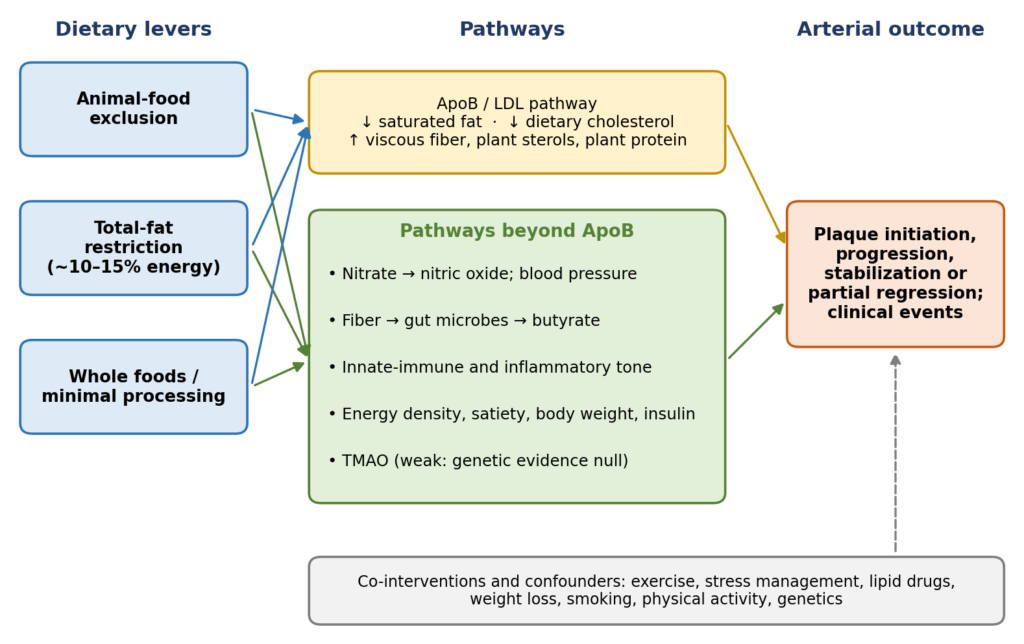
Figure 2. Three separable dietary levers and the pathways by which they could affect coronary ateroesclerosis. Most intervention programs change all three levers together and add co-interventions, so trials cannot attribute benefit to a single lever.
Diet quality within plant-based eating. In three US cohorts totalling about 209,000 health professionals with 8,631 incident coronary events, an overall plant-based diet index was only weakly associated with lower risk (cociente de riesgos instantáneos for extreme deciles 0.92; 95% CI 0.83 to 1.01). A healthful index that rewarded whole grains, fruits, vegetables, nuts, legumes, oils, tea, and coffee was associated with 25% lower risk (0.75; 0.68 to 0.83), whereas an unhealthful index that rewarded refined grains, potatoes, sweetened beverages, juices, and sweets was associated with 32% higher risk (1.32; 1.20 to 1.46) [17]. Two points follow. Plant-based eating is not protective in itself; quality determines the direction. And the healthful index scored nuts and vegetable oils as beneficial, so this evidence favors a whole-food pattern rather than specifically a very-low-fat one.
Processing within plant foods. In 126,842 UK Biobank participants followed for a median of 9 years, each 10-percentage-point increase in energy from plant-sourced foods that were not ultra-processed was associated with 7% lower enfermedad cardiovascular risk (hazard ratio 0.93; 95% CI 0.91 to 0.95) and 13% lower cardiovascular mortality (0.87; 0.80 to 0.94). Plant-sourced alimentos ultraprocesados showed the opposite association (1.05; 1.03 to 1.07 for disease and 1.12; 1.05 to 1.20 for mortality), and total plant-food intake, ignoring processing, showed no association [18].
Randomized evidence on processing. Processing also has randomized evidence, although for energy balance rather than atherosclerosis. In an inpatient crossover trial, 20 weight-stable adults received ultra-processed or unprocessed diets for two weeks each, with meals matched for presented calories, densidad energética, macronutrients, sugar, sodium, and fiber. On the ultra-processed diet they ate 508 ± 106 kcal/day more and gained 0.9 kg; on the unprocessed diet they lost 0.9 kg [19].
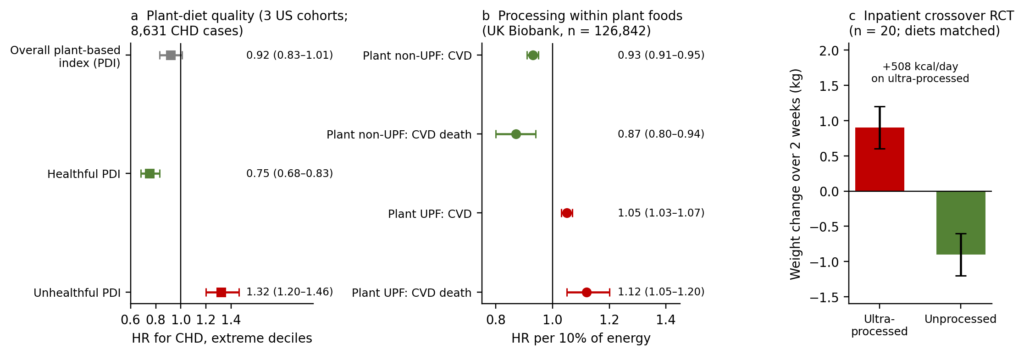
Figure 3. Diet quality and processing. (a) Plant-based diet indices and incident enfermedad coronaria, extreme deciles. (b) Plant-sourced foods by processing, per 10% of energy, UK Biobank. (c) Weight change in an inpatient crossover trial of ultra-processed versus unprocessed diets (mean ± SE). Panels come from different designs and are not comparable in magnitude. Sources: Satija 2017; Rauber 2024; Hall 2019.
What this changes. The evidence on processing is consistent in direction: associations for plant foods reverse with processing, and in a randomized feeding trial the ultra-processed pattern increased energy intake and weight relative to the unprocessed pattern, with nutrients matched as far as the design allowed. These findings support attention to food quality and processing; they do not establish the importance of processing relative to animal-food exclusion, a comparison no trial has made. This reframes the Esselstyn and Ornish programs. What they share with each other, and with rural China, Okinawa, and the Tsimane (Sections 6–8), is not zero animal food but a diet built almost entirely from whole, minimally processed foods. That feature, and the question of whether its benefits run only through ApoB (Section 5), are the focus of what follows.
4. The Biological Case: ApoB and the Lipid Pathway (Tiers 1–2)
4.1 Organizing framework: cumulative exposure to ApoB-containing particles
LDL and other ApoB-containing lipoproteins cause atherosclerotic cardiovascular disease, and genetic, epidemiologic, and trial evidence indicate that risk rises with both the magnitude and the duration of exposure [20]. Particles enter the arterial íntima in proportion to their concentration and are retained in susceptible sites, so the relevant quantity is exposición acumulativa rather than a single measurement. This framework is used here as an organizing principle, not as a validated numerical risk equation.
The framework has two implications for diet. First, a modest reduction sustained from early adulthood could matter more than the same reduction begun after disease is established; this is the logic behind the population evidence in Sections 6 to 8. Second, in established disease the relevant benchmark is the statin-trial slope: about a 22% relative reduction in major vascular events per 1 mmol/L (38.7 mg/dL) of LDL-C lowering over roughly five years [21]. If that slope applied to the pooled dietary LDL-C difference of 0.30 mmol/L reported below, it would predict a relative reduction of about 7% over five years (1 − 0.78^0.30). That figure is an extrapolation, not a measured dietary effect: dietary trials last weeks to months, adherence erodes, and a diet also changes body weight, blood pressure, and other factors that the estatinas slope does not capture.
4.2 Randomized evidence on lipids and risk factors
The largest meta-analysis of randomized trials comparing vegetarian or vegan diets with omnivorous diets included 30 trials. Plant-based diets lowered colesterol total by 0.34 mmol/L (95% CI 0.23 to 0.44; about 13 mg/dL) and LDL-C by 0.30 mmol/L (95% CI 0.19 to 0.40; about 11.6 mg/dL). ApoB fell by 12.92 mg/dL (95% CI 3.20 to 22.63), a 14% reduction, but only six trials contributed ApoB data and heterogeneity was substantial (I² = 71.7%); triglicéridos did not differ overall [22]. The ApoB figure is the published pooled estimate; because it rests on six trials, its precision depends on those trials being independent randomized comparisons of diet alone, which could not be confirmed from the accessible sources; pooled analyses in this literature also require checking for multiple reports of a single cohort. These results support lipid-mediated plausibility. They do not establish event reduction, regresión de la placa, an individual’s response, or a special benefit from excluding grasas insaturadas, because the trial diets and comparators varied widely.
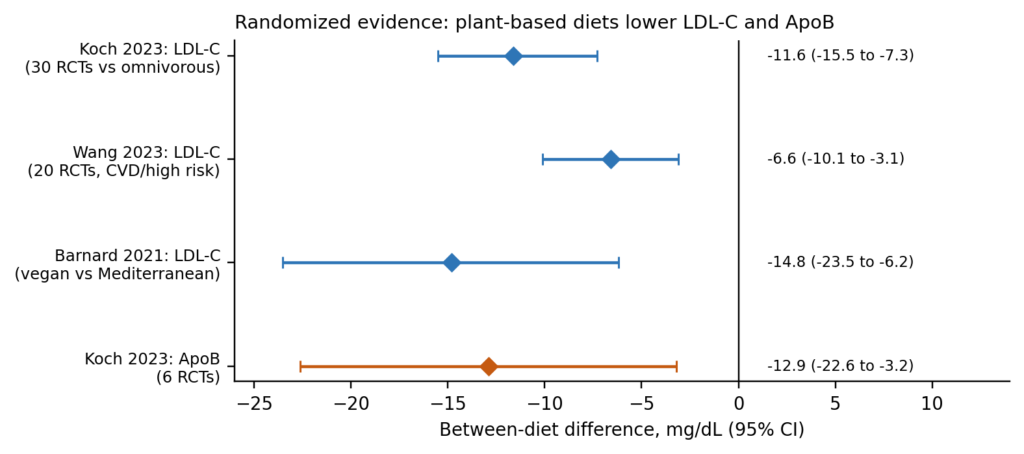
Figure 4. Randomized evidence that plant-based diets lower LDL-C and ApoB. Between-diet differences with 95% intervalos de confianza; Koch 2023 values converted from mmol/L (× 38.67). Estimates share constituent trials and are not additive. Sources: Koch 2023; Wang 2023; Barnard 2021 (participants without medication changes).
A second meta-analysis restricted to people with, or at high risk of, cardiovascular disease pooled 20 trials (1,878 participants; mean duration 25.4 weeks). Vegetarian diets lowered LDL-C by 6.6 mg/dL (95% CI 3.1 to 10.1), HbA1c by 0.24 percentage points (95% CI 0.07 to 0.40), and body weight by 3.4 kg (95% CI 2.0 to 4.9), with no effect on presión arterial sistólica (−0.1 mm Hg; 95% CI −2.8 to 2.6) [7]. The article’s Key Points box states 6.8 mg/dL and 0.25%; the results section and forest plots give 6.6 mg/dL and 0.24%, which are used here. Two further details matter for Q2. Against usual diets, LDL-C fell 12.9 mg/dL; against active dietary comparators, the LDL-C difference was not statistically significant. And baseline LDL-C explained the between-trial heterogeneity [7]. Only four trials enrolled patients with established cardiovascular disease, three of them Ornish-type programs.
Blood pressure. Earlier meta-analyses, as summarized by Wang and colleagues, reported systolic reductions of about 2.5 mm Hg with vegetarian diets [7]. The null result in higher-risk patients is plausibly explained by background antihipertensivo therapy and by medication reductions during trials, which the authors note could mask diet effects. Blood-pressure benefit is not specific to plant-exclusive eating: the dieta DASH, which includes low-fat dairy, lowered pressure substantially in controlled feeding [11, 16], and in a direct crossover comparison a Mediterranean diet lowered systolic pressure more than a low-fat vegan diet [23]. Blood pressure is therefore not a demonstrated advantage of VLF-WFPB. Estimates from the two lipid meta-analyses are not added together; they share trials.
4.3 Dietary cholesterol
Colesterol dietario raises serum cholesterol independently of grasa saturada. In a meta-analysis of egg-feeding studies cited by Freeman and colleagues, each additional 100 mg/day raised LDL-C by about 1.9 mg/dL and HDL-C by about 0.3 mg/dL; the response is larger when baseline intake is low and varies between individuals with intestinal absorption capacity [2]. Even people habituated to a very low intake respond: in eight Tarahumara men whose customary diet supplied little cholesterol, a 1,000 mg/day diet raised plasma cholesterol from 113 to 147 mg/dL after a cholesterol-free phase [24]. VLF-WFPB supplies essentially none; in EVADE CAD, dietary cholesterol fell to a median of 0 mg/day in the vegan arm versus 142 mg/day in the AHA arm [9]. The average contribution to LDL-C lowering is modest; the individual contribution can be larger. The AHA’s 2026 dietary guidance states that, for most people, dietary cholesterol is no longer a primary target for cardiovascular risk reduction [25]; eliminating it is therefore a minor, not a defining, part of the case for VLF-WFPB.
4.4 Saturated fat and what replaces it
In the current Cochrane review, reducing saturated fat lowered combined cardiovascular events (risk ratio 0.83; 95% CI 0.70 to 0.98; 12 trials, 53,758 participants), and larger reductions in saturated fat, reflected in larger cholesterol reductions, produced larger benefits. Subgroup analyses did not show a significant difference between replacing saturated fat with grasa poliinsaturada or with carbohydrate [26]. The May 2020 issue of that review reported a risk ratio of 0.79; the corrected version of record is used here. VLF-WFPB drives saturated fat very low (4.5% of energy in the EVADE vegan arm versus 6.6% in the AHA arm [9]), and it replaces it predominantly with starch and fiber from whole foods. Plant protein, viscous fiber, and plant sterols are further plausible LDL-lowering components; current dislipidemia guidance points patients toward reducing saturated fat and increasing fiber-rich plant foods [27].
The Portfolio evidence shows a different route to the same target. In a meta-analysis of controlled trials (439 participants), adding nuts, plant protein, viscous fiber, and plant sterols to a cholesterol-lowering NCEP Step II diet lowered LDL-C by about 17%, with reductions in ApoB and colesterol no HDL as well [15]. Because the Portfolio diet contains nuts, it demonstrates that excluding nuts is not a prerequisite for substantial dietary LDL-C lowering.
5. Beyond ApoB: The Central Question (Tiers 2–5)
If every benefit of VLF-WFPB ran through lower ApoB, the diet would be one of several interchangeable ways to lower ApoB, drugs included, and the case for its particular rules would reduce to how far and how durably it lowers partículas aterogénicas. The distinctive claim of whole-food plant-based medicine is that it does more: that whole plant foods act on the endotelio, the gut, immune signaling, blood pressure, and energy balance in ways a statin does not. That claim is biologically serious, and it is the central question of this review.
Four kinds of evidence bear on it, in increasing order of strength: (1) a mechanism demonstrated in cells or animals under conditions where lipids are unchanged or controlled; (2) human physiological or biomarcador effects not explained by LDL-C change; (3) human outcome associations that persist after adjustment for lipids; and (4) randomized comparison of diets at matched ApoB. The subsections below calificación each candidate pathway against these criteria (Figure 6). No study yet provides the fourth kind.
5.1 Fiber, gut microbes, and butyrate
Viscous fiber lowers LDL-C, but fermentable plant polysaccharides may also act through the microbiota intestinal. Across 83 genetically diverse, atherosclerosis-susceptible mouse strains, the abundance of the butyrate-producing genus Roseburia was inversely related to lesión size and was not correlated with cholesterol. In germ-free apolipoproteína E–deficient mice colonized with defined bacterial communities, Roseburia intestinalis lowered systemic inflamación and atherosclerosis only when the diet was rich in plant polysaccharides, and intestinal delivery of butirato itself reduced endotoxemia and atherosclerosis [28]. This is the clearest demonstration in this review of a diet-dependent, cholesterol-independent atheroprotective mechanism. It comes from mouse models, and no human trial has shown that raising butyrate production changes placa or events.
5.2 Leafy-green nitrate, nitric oxide, and the endothelium
Leafy green vegetables, central to Esselstyn’s protocol, are the main dietary source of inorganic nitrate, which the body can convert to óxido nítrico through an enterosalivary pathway. In 53,150 Danish adults followed for up to 23 years (14,088 cardiovascular events), a moderate vegetable-nitrate intake (median 59 mg/day, roughly a cup of leafy greens) compared with the lowest quintile (median 23 mg/day) was associated with 15% lower cardiovascular disease risk (hazard ratio 0.85; 95% CI 0.82 to 0.89), and with lower risks of cardiopatía isquémica (0.88; 0.82 to 0.94), infarto isquémico (0.83; 0.76 to 0.91), and enfermedad arterial periférica (0.74; 0.67 to 0.83). The association plateaued above about 60 mg/day and persisted after adjustment for reported hipercolesterolemia and other dietary factors, which is not the same as controlling measured, cumulative ApoB exposure; a análisis de mediación estimated that baseline systolic blood pressure explained 21.9% of it [29]. The authors note that the largest nitrate trial did not lower blood pressure in older adults with elevated pressure, and that observational data cannot separate nitrate from vegetable intake in general; in this cohort lettuce and potato supplied most vegetable nitrate [29]. The finding supports the leafy-green element of the whole-food lever; it is not specific to a vegan diet.
Función endotelial (acute and short-term human physiology; relevance to events unproven). A single high-fat meal transiently impaired brachial flow-mediated dilation in healthy volunteers [30]. In the same investigators’ ten-person experiment, an olive-oil meal reduced flow-mediated dilation acutely, by 31%, and the reduction was smaller when the meal included antioxidante vitamins or salad with balsamic vinegar [31]. Sustained feeding points the other way: in a meta-analysis of eight trials, olive-oil interventions increased flow-mediated dilation by 0.76 percentage points (95% CI 0.27 to 1.24) [32], and in 805 CORDIOPREV participants a Mediterranean diet improved flow-mediated dilation more than the low-fat diet after one year [33]. Over eight weeks in EVADE CAD, EndoPAT-measured endothelial function did not change in either arm [9]. Neither acute nor short-term vascular-function findings establish effects on events.
5.3 Inflammation and innate-immune memory
Inflamación (human randomized biomarker evidence). EVADE CAD randomized 100 patients with angiographic coronary disease to eight weeks of a vegan or AHA-recommended diet, with groceries, sample menus, and dietitian support for both. At baseline 94–96% took statins and more than half took high-dose statins. The vegan diet produced a 32% lower high-sensitivity Proteína C reactiva (β 0.68; 95% CI 0.49 to 0.94; P = 0.02), consistent after adjustment. LDL-C was 13% lower (adjusted β 0.87; 95% CI 0.78 to 0.97), which the investigators classified as nonsignificant under their Bonferroni threshold (α = 0.0015) for secondary endpoints. Weight, HbA1c, other lipids, leukocyte activation markers, and quality of life did not differ between arms [9]. Crucially, EVADE did not test very-low-fat eating: median reported fat intake at eight weeks was 29.9% of energy in the vegan arm and 30.2% in the AHA arm, both groups were encouraged to use unsaturated oils and olive oil appeared in recipes for both, and the principal dietary contrast was plant versus animal protein, with lower saturated fat and higher fiber in the vegan arm [9]. The hs-CRP result is a biomarker finding; it does not establish fewer events or an ApoB-independent clinical benefit.
Animal work suggests how diet could leave a lasting inflammatory imprint. In LDL-receptor–deficient mice, Western-diet feeding induced systemic inflammation that disappeared from the blood after a return to standard chow, yet myeloid progenitor cells remained reprogrammed, with heightened innate-immune responses; mice also lacking NLRP3 were protected [34]. Because these mice are severely hypercholesterolemic and LDL oxidada was implicated in the human arm of the study [34], this mechanism is not independent of lipoproteins; it suggests instead that the history of dietary exposure, not only current lipid levels, may shape plaque biology. The Tsimane point the other way: about half had hs-CRP above 3 mg/L from infectious burden, yet coronary calcium was the lowest recorded, which the investigators interpret as inflammation possibly not driving atherosclerosis when LDL is low [35].
5.4 Energy density, processing, body weight, and glycemia
Body weight and energy density (human randomized biomarker evidence). Vegetarian diets reduced weight by 3.4 kg in higher-risk patients [7], and a low-fat vegan diet produced greater weight loss than a Mediterranean diet in a crossover trial [23]. In the Lifestyle Heart Trial, the experimental group lost 10.9 kg at one year and remained 5.8 kg below baseline at five years [6]. Weight loss itself lowers LDL-C, blood pressure, and glycemia, so these effects overlap with the lipid pathway and cannot be added to it.
Sensibilidad a la insulina and glycemia (human randomized biomarker evidence). HbA1c fell 0.24 percentage points overall and 0.36 points in people with type 2 diabetes [7]. This may add to lipid effects in people with diabetes, but again partly through weight.
The processing trial (Section 3) shows one non-lipid route directly: the same nutrient targets delivered as unprocessed rather than ultra-processed food reduced spontaneous energy intake by about 500 kcal/day [19]. Blood pressure is a further separate, causal pathway. It is not a demonstrated advantage of plant-exclusive eating (Section 4.2), but nitrate-rich vegetables and potassium-rich, low-sodium patterns such as DASH lower it [11, 16, 29].
5.5 Trimethylamine N-oxide
Gut microbiome and trimethylamine N-oxide (human association plus mechanistic hypothesis). Gut microbes convert dietary precursors including colina y carnitina to trimethylamine, which host liver enzymes then oxidize to TMAO [36]; circulating TMAO predicted cardiovascular events in cohort data [37]. Aleatorización mendeliana analyses have not found genetically predicted TMAO to be associated with enfermedad de las arterias coronarias, infarto de miocardio, or stroke [38], which weakens a causal interpretation, and no trial shows that lowering TMAO reduces events. The 2014 Esselstyn report asserts that its participants were unlikely to harbor TMAO-producing flora, but TMAO was not measured in that cohort [4].
5.6 Human signals that ApoB does not fully explain—and those it does
Most measured benefits of plant-based diets can run through ApoB, weight, blood pressure, and glycemia. A diet may have a real total effect even if nothing remains after conditioning on these mediators; the question of an additional effect is separate. Three observations bear on it. First, in the Lifestyle Heart Trial, experimental-group ApoB fell from 1.000 g/L at baseline to 0.769 g/L at one year but was 1.014 g/L at five years, while percent estenosis de diámetro continued to improve; LDL-C remained 20% below baseline at five years [6]. Because the program also included exercise, stress management, and group support, and because a year-5 snapshot does not capture the lower cumulative exposure during the preceding years, this cannot be read as diet acting independently of ApoB. Second, within STARS, progression correlated with saturated and total fat intake after adjustment for LDL-C, an observational within-trial analysis [39]. Third, in cohort data roughly one-fifth of the vegetarian–IHD association may be mediated by índice de masa corporal [40], y en EPIC-Oxford la asociación entre el vegetarianismo y la cardiopatía isquémica se debilitó sustancialmente después del ajuste por el colesterol autoreportado, la presión arterial, la diabetes y el índice de masa corporal [41]. Ningún ensayo ha comparado patrones dietéticos con niveles equiparados de ApoB, presión arterial y peso, que es el diseño necesario para establecer un efecto más allá de los mediadores.
La Figura 5 muestra los datos del Lifestyle Heart Trial. Aunque no puede establecer un efecto dietético independiente de la ApoB, sigue siendo la mejor evidencia clínica para la hipótesis: el grupo experimental no tomó fármacos lipídicos, y el cambio en el porcentaje de estenosis continuó desde −1.75 puntos al año hasta −3.07 puntos a los cinco años, después de que la ApoB hubiera regresado a 101.4 mg/dL (valor inicial 100.0), mientras que los controles empeoraron [6]. Dos observaciones adicionales aclaran el panorama. Primero, los tsimané tenían una ApoB media de 97 mg/dL en el escaneo, no especialmente baja, pero casi nada de calcio coronario; su LDL-C promedió unos 71 mg/dL (1.84 mmol/L) de 2004 a 2011 y ha aumentado desde entonces, y pasan horas al día realizando actividad física [35], por lo que la exposición de por vida y la actividad pueden explicar esto tan bien como cualquier factor dietético. Segundo, la cohorte de Esselstyn 1995, citada a menudo para este argumento, no puede respaldarlo: cada paciente tomó fármacos para reducir el colesterol y el LDL-C medio fue de 71.6 mg/dL [42], por lo que la reducción lipídica concomitante es una explicación plausible para parte de la mejora, y el diseño no controlado no puede aislar la contribución de la dieta ni mostrar que estuviera implicada ninguna vía más allá de la ApoB.
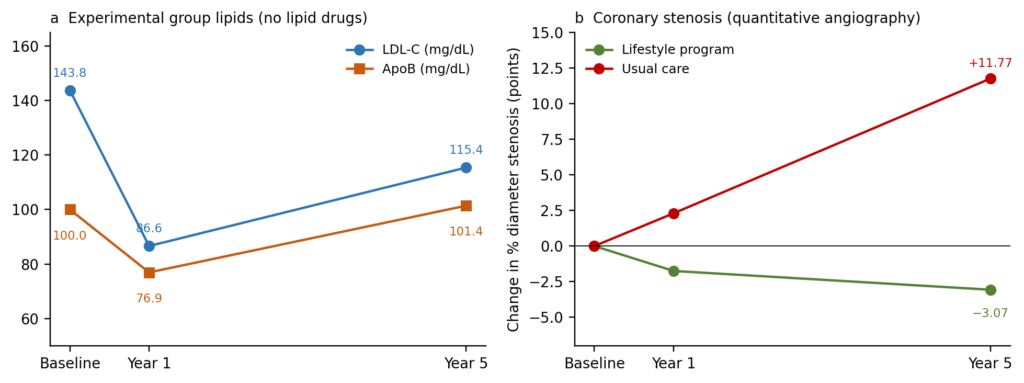
Figura 5. Lifestyle Heart Trial. (a) LDL-C y ApoB en el grupo experimental, que no tomó fármacos hipolipemiantes (ApoB convertida de g/L × 100). (b) Cambio en el porcentaje de estenosis del diámetro en angiografía cuantitativa, graficado a partir del informe de cinco años de 1998 para los 35 participantes con angiografía de cinco años; el informe de un año de 1990 cubre a los 48 participantes y da valores iniciales ligeramente diferentes, por lo que sus valores no se grafican aquí. El 60% de los controles iniciaron fármacos lipídicos entre los años uno y cinco.
5.7 Evaluando los argumentos más allá de la ApoB
Por lo tanto, la hipótesis del beneficio adicional es condicional: un patrón más estricto podría superar a otra dieta saludable si produce una mejora mayor y sostenida en la ApoB, la presión arterial, el peso o salud metabólica sin una menor adherencia o desventaja nutricional. “Vegano”, “sin aceite” y “10% de grasa” no están validados por sí mismos criterios de valoración subrogados. Tampoco puede convertirse mecánicamente un cambio lipídico dietético a corto plazo en una reducción de eventos específica de Esselstyn utilizando las pendientes de los ensayos de fármacos.
En balance, el caso más allá de la ApoB es biológicamente plausible y cuenta con respaldo parcial. Los modelos animales demuestran un mecanismo dependiente de la dieta e independiente del colesterol (fibra y butirato) y un mecanismo de memoria inflamatoria duradera; las cohortes humanas vinculan el nitrato de las verduras de hoja verde con un menor riesgo cardiovascular tras el ajuste por hipercolesterolemia, y los alimentos de origen vegetal mínimamente procesados con un menor riesgo; y un ensayo aleatorizado muestra que el procesamiento por sí solo cambia la ingesta de energía [18, 19, 28, 29, 34]. Frente a esto, la asociación entre el vegetarianismo y la enfermedad coronaria en EPIC-Oxford se debilitó sustancialmente tras el ajuste por factores de riesgo convencionales [41], la evidencia genética no respalda al TMAO como causal [38], y ningún ensayo ha comparado dietas con niveles equiparados de ApoB. La Figura 6 resume la evidencia por vía; el ensayo propuesto (Sección 17) está diseñado para proporcionar la prueba faltante.
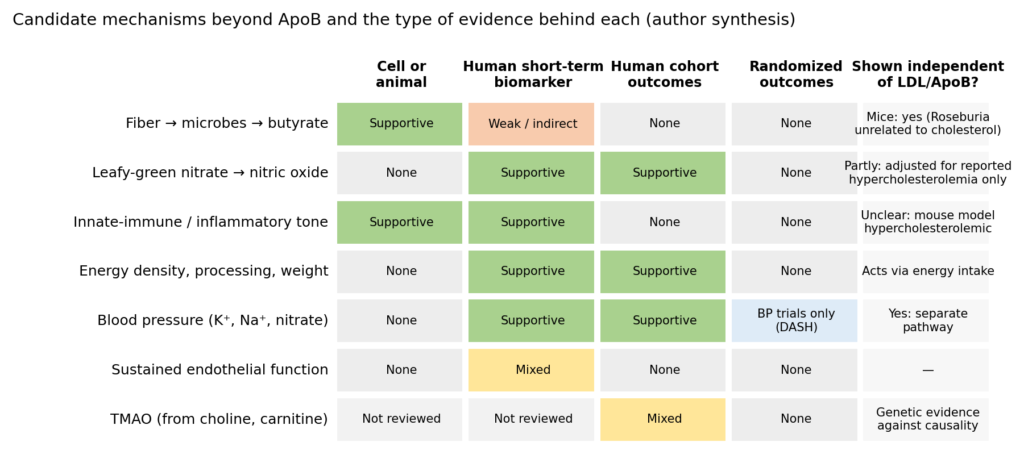
Figura 6. Mecanismos candidatos más allá de la ApoB y el tipo de evidencia para cada uno. Síntesis del autor de las fuentes citadas en la Sección 5; “de apoyo” indica la dirección de la evidencia, no la prueba de un efecto causal en la aterosclerosis humana.
6. China rural (Nivel 4)
6.1 Qué se midió
El Estudio de China I combinó datos de mortalidad por condados con encuestas dietéticas, de sangre y de orina en 65 condados rurales y 130 aldeas, muestreando a 50 adultos por aldea; la dieta y la sangre se recolectaron en 1983–1984 [43]. La dieta rural promedio suministraba el 14% de la energía a partir de las grasas, el 71% de los carbohidratos, el 5% de alcohol, and 10% from protein, of which about 11% was of animal origin (roughly 1% of total energy); fiber intake was 33 g/day and mean body mass index 20.5 [43]. Mean serum total cholesterol was 127 mg/dL, compared with 203 mg/dL in US adults aged 20–74 [43]. The diet was low in animal food, not vegan; the authors describe rural diets of 1950–1980 as containing 3–6% animal-based foods [43].
6.2 What the coronary figures are
The widely quoted coronary comparison uses mortality, not incidence, recorded in 1973–1975 and truncated at ages 0–64: 4.0 per 100,000 men and 3.4 per 100,000 women in rural China versus 66.8 and 18.9 in the United States, taken from a 1989 WHO statistics annual, giving ratios of 16.7 and 5.6 [43]. Four features limit interpretation. The mortality period precedes the dietary and blood survey by about a decade. Excluding deaths after age 64 removes the ages at which most coronary deaths occur. Death certification and coronary diagnosis in rural China in the 1970s differ from US practice, so under-ascertainment cannot be excluded. And competing mortality from infections and other causes of death, which the authors describe as clustering in the same counties, removes people before coronary disease manifests [43]. No carga de placa was measured.
6.3 What the county correlations show
Across counties, coronary mortality correlated positively with plasma ApoB (r = 0.37) and with an index of salt intake (r = 0.42), and inversely with green-vegetable intake; ApoB in turn correlated with animal protein and meat intake [43]. Coronary mortality also correlated with wheat flour intake (r = 0.67), which the authors attribute partly to co-varying milk, salt, triglycerides, and body weight [43]. The authors themselves note that the county, not the individual, is the unit of analysis, so the data cannot show whether low disease rates reflect uniformly low animal-food intake or fewer individuals eating more [43].
6.4 Confounding and alternative explanations
Energy intake per kilogram was about 30% higher than in the United States with far less obesidad, which the authors attribute to greater daily energy expenditure such as cycling to work [43]. Physical activity, body weight, tobacco use, socioeconomic conditions, health care access, and diagnostic ascertainment all differ between these populations and the United States. The coronary paper does not report ischemic or derrame cerebral hemorrágico, and this review makes no claim about stroke subtypes in these counties. This review also did not re-verify post-1990 trend data; claims that China’s later dietary transition proves a causal diet effect should rest on contemporaneous individual-level cohorts.
6.5 Checking the secondary summary
Freeman and colleagues’ 2017 review is a useful route to these data but should not be quoted in place of them [2]. Its table correctly gives the 0–64 age restriction and the 127 mg/dL cholesterol, but lists macronutrients of 14% fat, 71% carbohydrate, and 10% protein, which sum to 95% because the 5% alcohol in the original is omitted [2, 43]. Its Tarahumara entry reports 528 people surveyed and a mean adult cholesterol of 136 mg/dL [2]; the original abstract reports 523 people aged 5 to 70 with a mean of 125 mg/dL overall and 116 mg/dL in children, a diet of 12% fat, 2% saturated fat, 71 mg/day cholesterol, and 75% carbohydrate, and a virtual absence of hipertensión, obesity, and the usual age-related rise in cholesterol [44]. The difference in denominators could not be resolved without the full text. The Tarahumara study measured lipids and diet, not coronary outcomes.
6.6 What rural China contributes
The rural Chinese data are consistent with the cumulative-exposure hypothesis: populations with lifelong low animal-food and saturated-fat intake had low cholesterol, and county coronary mortality tracked ApoB. That strengthens plausibility for Q1. It says nothing decisive about Q2 or Q3, because the diet was neither vegan nor compared with a high-quality alternative, and because activity, body size, and competing mortality are inseparable from diet in these data.
7. Traditional Okinawa (Tier 4)
The traditional Dieta okinawense is known chiefly from a 1949 survey, conducted during post-war scarcity and US administration, as analyzed by the Willcox group. Sweet potato supplied about 69% of energy; total energy intake was about 1,785 kcal/day; fat supplied roughly 6% of energy; and meat intake was a few grams per day, with small amounts of fish, soy, and seaweed [45, 46]. The Willcox group estimates that adults ate about 11% fewer calories than needed to maintain weight until the late 1960s, with a lean average body mass index of 21 [47]. Interpretation is contested: one critic has argued that the Okinawan data reflect severe malnutrition, whereas Gavrilova and Gavrilov, responding, attribute the later loss of longevity advantage to westernization of the diet and note that a low infectious burden may also have contributed [48]. A single post-war survey cannot establish lifelong intake.
Coronary outcomes should be judged directly rather than through longevity. The same group reports that older Okinawans have about 80% less coronary mortality than the US population, based on age-adjusted vital statistics rather than individual dietary linkage [47]. The advantage has not persisted: Okinawans who did not experience the energy-restricted era now have higher body mass index, more type 2 diabetes, and worse cardiovascular risk factors than other Japanese, and the prefecture’s life-expectancy advantage is now confined to older ages [47]. That transition is compatible with a dietary contribution but equally with changes in energy balance, activity, and other exposures.
Okinawa informs the hypothesis in a limited way. It shows that a very-low-fat, high-carbohydrate, plant-predominant diet is compatible with low coronary mortality. It does not show that complete exclusion of animal foods is necessary, because the traditional diet included pork and fish, and it cannot separate low fat from caloric restriction, low body size, physical labor, or genética. Its shared features with DASH and Mediterranean patterns are high vegetable and legume intake, low saturated fat, and low energy density; its distinctive features are very low total fat, a single dominant starchy staple, and chronic mild energy restriction.
8. Other Traditional Populations: The Tsimane and Kitava (Tier 4)
The Tsimane. The Tsimane, forager-horticulturalists of the Bolivian Amazon, provide the only traditional-population data in this review with direct imágenes coronarias. Of 705 adults aged 40 to 94 scanned in 2014–2015, 596 (85%) had no coronary arteria calcium, 89 (13%) had scores of 1–100, and 20 (3%) had scores above 100; among those older than 75, 31 (65%) had none and four (8%) had scores of 100 or more [35]. Mean LDL-C was 91 mg/dL and HDL-C 39.5 mg/dL, and obesity, hypertension, hiperglucemia, and regular fumar were rare. Compared with the US MESA cohort, the Tsimane reached a nonzero puntaje de calcio about 24 years later and a score of 100 or more about 28 years later [35] (Figure 7).
The Tsimane diet is low in fat and minimally processed but not plant-exclusive: about 14% of energy from protein, 14% from fat, and 72% from carbohydrate, an estimated 38 g of fat per day including 11 g of saturated fat and no trans fat, with rice, plantain, manioc, and corn as staples and meat and fish obtained by hunting and fishing [35]. Men and women average 6–7 and 4–6 hours of physical activity per day. The limits are important: calcium scoring cannot detect placa no calcificada, the design is cross-sectional, and outcome data are thin, with one possible myocardial infarction among 50 recent adult deaths ascertained by verbal autopsy. LDL-C has risen by about 0.16 mmol/L per year since 2011 as motorized river travel improved access to market food [35], a natural experiment whose coronary consequences are not yet known.
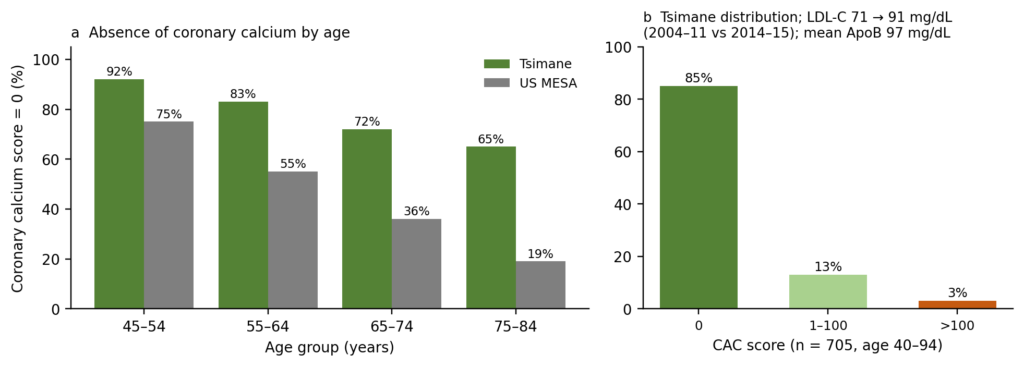
Figure 7. Coronary artery calcium in the Tsimane. (a) Proportion with a calcium score of zero by age group, Tsimane versus US MESA, as labeled in Figure 2 of Kaplan 2017. (b) Distribution of scores among 705 Tsimane adults. Calcium scoring does not detect noncalcified plaque.
Kitava. On Kitava in the Trobriand Islands, where tubers, fruit, fish, and coconut are dietary staples, semi-structured interviews with 213 adults identified no case corresponding to stroke, sudden death, or angina, and resting electrocardiograms showed few abnormalities [49]. Smoking was common: 76% of men and 80% of women over 20 smoked in the risk-factor survey [50]. The evidence rests on interviews and electrocardiograms rather than imaging or death registration.
What these populations add. None was vegan, and their fat intakes were not uniformly low in saturated fat. The Kitavan diet supplied about 21% of energy as fat and 17% as saturated fat, mostly lauric and myristic acid from coconut [51], a clear exception to the pattern. What rural China, traditional Okinawa, the Tsimane, and Kitava share is diets built from whole, minimally processed staples, leanness, and in most cases high physical activity. The pattern supports the cumulative-exposure argument and the whole-food lever; it provides no support for the claim that complete exclusion of animal foods is required. Fat intake ranged from very low in Okinawa to low among the Tsimane, and coconut was a Kitavan staple.
9. Prospective Cohort Evidence (Tier 3)
The most comprehensive cohort meta-analysis included 13 prospective cohorts with 844,175 participants. Compared with non-vegetarians, vegetarians had lower risk of cardiovascular disease (riesgo relativo 0.85; 95% CI 0.79 to 0.92; 8 cohorts) and ischemic heart disease (0.79; 95% CI 0.71 to 0.88; 8 cohorts), but not of total stroke (0.90; 95% CI 0.77 to 1.05; 12 cohorts). For vegans the ischemic heart disease estimate was 0.82 (95% CI 0.68 to 1.00; 6 studies), and the cardiovascular disease estimate 0.92 (95% CI 0.79 to 1.06). Risk of bias was moderate in eight cohorts and serious in five [40]. Incidence estimates were used in preference to mortality where both were reported. The IHD association was weaker when early follow-up was excluded, about one-fifth of it appeared attributable to body mass index, and the E-value was 1.86 (lower confidence limit 1.49), meaning an unmeasured variable confunde would need associations of that strength with both diet and disease to explain it away [40].
The “40% lower coronary risk” figure sometimes attached to vegetarian diets traces to a meta-analysis restricted to Seventh-day Adventist cohorts, which reported a relative risk of 0.60 (95% CI 0.43 to 0.80) for coronary events [2, 52]. That estimate is population-specific and should not be generalized. Several Adventist and Oxford cohorts recur across meta-analyses, so repeated citation is not independent corroboration. Cohort vegetarian and vegan categories are defined by exclusion of animal foods, not by total fat, so none of this evidence tests the very-low-fat component.
Los datos específicos de las variables de valoración son importantes. En el estudio EPIC-Oxford (48.188 participantes seguidos durante 18,1 años), los vegetarianos, incluidos los veganos, presentaron una tasa de cardiopatía isquémica un 22% menor que los consumidores de carne (razón de riesgos [hazard ratio] 0,78; IC del 95%: 0,70 a 0,87), equivalente a unos 10 casos menos por cada 1.000 personas en 10 años; el ajuste por colesterol alto, hipertensión, diabetes e índice de masa corporal informados por los propios participantes atenuó la estimación a 0,90 (IC del 95%: 0,81 a 1,00). El mismo grupo presentó una tasa un 20% mayor de accidente cerebrovascular total (1,20; IC del 95%: 1,02 a 1,40), unos tres casos más por cada 1.000 personas en 10 años, principalmente de tipo hemorrágico, y esta asociación no se atenuó tras el ajuste por factores de riesgo [41]. Por lo tanto, el beneficio coronario y el riesgo de accidente cerebrovascular deben notificarse por separado, y la atenuación de la asociación coronaria es coherente con un beneficio derivado en gran medida de los factores de riesgo convencionales.
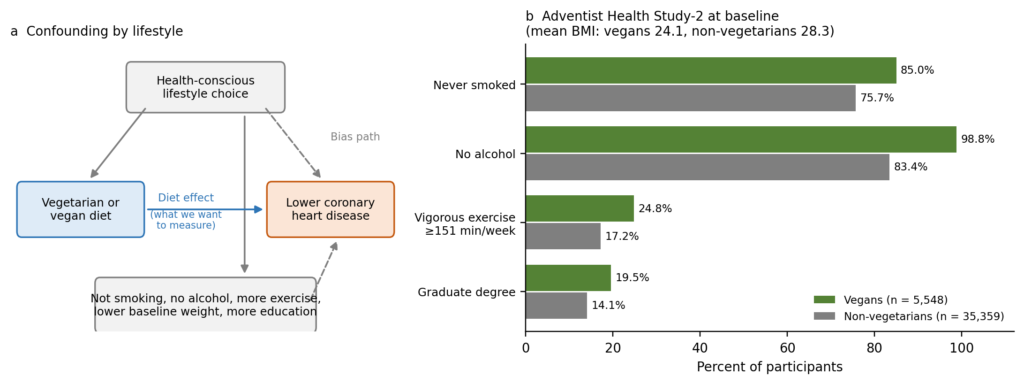
Figura 8. Estimaciones de cohortes prospectivas para dietas vegetarianas y veganas. La asociación coronaria se debilita tras el ajuste por factores de riesgo convencionales (EPIC-Oxford), y el riesgo de accidente cerebrovascular no es menor. Las estimaciones se muestran en paralelo, no agrupadas; varias cohortes se solapan en los metanálisis. Fuentes: Dybvik 2023; Tong 2019; Orlich 2013; Kwok 2014.
9.1 Sesgo del usuario sano: por qué las asociaciones son difíciles de interpretar
Los estudios de cohortes comparan a personas que eligieron dietas diferentes, y las personas que eligen una dieta vegetariana suelen elegir también otros hábitos saludables. Esto se denomina sesgo del usuario sano, una forma de confusión: parte o la totalidad de una diferencia observada en la enfermedad puede provenir de otros hábitos más que de la dieta. Los datos de los adventistas muestran el problema con claridad. En comparación con los no vegetarianos del Adventist Health Study-2, los veganos tenían más probabilidades de no haber fumado nunca (85,0% frente al 75,7%), muchas más probabilidades de no consumir alcohol (98,8% frente al 83,4%), más probabilidades de realizar ejercicio vigoroso durante al menos 151 minutos a la semana (24,8% frente al 17,2%), más probabilidades de tener un título de posgrado (19,5% frente al 14,1%) y eran más delgados (índice de masa corporal medio de 24,1 frente a 28,3) [53]. Los autores señalan que la elección consciente del estilo de vida de una dieta vegetariana puede afectar por sí misma a los resultados y que sigue siendo posible que existan factores de confusión no controlados [53].
Los investigadores utilizan varias herramientas para reducir este sesgo, y cada una tiene sus límites. Comparación de personas similares: tanto en el Adventist Health Study-2 como en el EPIC-Oxford, el grupo de comparación no vegetariano es en sí mismo relativamente consciente de la salud, y muy pocos adventistas fuman o beben, lo que reduce la brecha sin cerrarla [53]. Ajuste estadístico: los modelos se ajustan en función del tabaquismo, el ejercicio, la educación y factores similares, pero solo para los factores que se midieron, y solo con la precisión con la que se midieron. Observación del efecto del ajuste: cuando el estudio EPIC-Oxford añadió el colesterol, la presión arterial, la diabetes y el índice de masa corporal a su modelo, la razón de riesgos entre vegetarianismo y cardiopatía isquémica pasó de 0,78 a 0,90 [41]; esto sugiere que gran parte del beneficio se produce a través de esos factores de riesgo, lo cual es de esperar si la dieta funciona, y también muestra cuán sensible es la estimación a las elecciones de modelado. Cuantificación de la robustez: en el metanálisis de Dybvik, un factor de confusión no medido necesitaría un riesgo relativo de 1,86 tanto con la dieta como con la enfermedad cardíaca para invalidar la asociación [40]. Duración y edad: en un análisis agrupado de cinco cohortes, la menor mortalidad por cardiopatía isquémica en vegetarianos se limitó a las personas que habían seguido su dieta durante más de cinco años, y fue mayor en edades más tempranas (un 45% menor por debajo de los 65 años, un 31% menor entre los 65 y 79 años, y un 8% menor, no significativo, entre los 80 y 89 años) [54]. Una relación con la duración de la dieta es lo que produciría un efecto causal, aunque los vegetarianos de larga duración también pueden diferir en otros hábitos a largo plazo.
Otras dos observaciones tienen doble lectura. Un metanálisis halló una asociación de cardiopatía isquémica mayor en las cohortes de adventistas (riesgo relativo 0,60) que en las cohortes no adventistas (0,84; IC del 95%: 0,74 a 0,96) [52]. Esa diferencia podría reflejar efectos más fuertes del usuario saludable entre los adventistas, o podría reflejar lo que los vegetarianos adventistas realmente comen: los veganos adventistas reportaron alrededor de 46–47 g de fibra al día, en comparación con unos 26–28 g en los veganos de EPIC-Oxford [53]. Y causalidad inversa—personas que cambian de dieta después de una enfermedad temprana— se reduce pero no se elimina excluyendo a las personas con enfermedad cardiovascular previa al momento de la inscripción, como hicieron ambas cohortes [41, 53].
Nada de esto significa que la evidencia de cohortes deba dejarse de lado. Es amplia, duradera, consistente entre países y está alineada en dirección con los ensayos aleatorizados de lípidos y con la biología. Debe leerse como evidencia de Nivel 3: sólida para la asociación, de apoyo pero no decisiva para la causa, e incapaz por sí sola de clasificar una dieta saludable frente a otra.
Figura 9. Sesgo del usuario saludable. (a) Cómo una elección de estilo de vida puede vincular una dieta con una menor incidencia de enfermedad cardíaca a través de vías distintas a la dieta misma. (b) Características basales de veganos y no vegetarianos en el Adventist Health Study-2, estandarizadas por edad, sexo y raza según lo reportado en Orlich 2013.
9.2 ¿Les va mejor a los veganos que a otros vegetarianos?
Las dietas veganas excluyen todos los alimentos de origen animal; las dietas lacto-ovo vegetarianas incluyen lácteos y huevos; pesco-vegetariana las dietas incluyen pescado. Si la exclusión completa de alimentos de origen animal añadiera protección, a los veganos les debería ir mejor que a los otros grupos. Los datos de las cohortes no muestran eso (Figura 10).
Adventist Health Study-2. En comparación con los no vegetarianos, el cociente de riesgos instantáneos para la muerte por cardiopatía isquémica fue de 0,90 (IC del 95%: 0,60 a 1,33) para los veganos, 0,82 (0,62 a 1,06) para los lacto-ovo vegetarianos y 0,65 (0,43 a 0,97) para los pesco-vegetarianos, la única reducción estadísticamente significativa [53]. Entre los hombres, los veganos tuvieron cocientes de riesgos de 0,45 (0,21 a 0,94) para la muerte por cardiopatía isquémica y 0,58 (0,38 a 0,89) para la muerte cardiovascular; entre las mujeres, las estimaciones correspondientes fueron 1,39 (0,87 a 2,24) y 1,18 (0,88 a 1,60) [53]. La cohorte completa registró 372 muertes por cardiopatía isquémica durante una media de 5,79 años, por lo que estas estimaciones de subgrupos son imprecisas, y la asociación de la dieta vegetariana con la mortalidad cardiovascular difirió significativamente según el sexo [53]. En el seguimiento más prolongado de 2024 de 88.400 participantes, los vegetarianos en general tuvieron una menor mortalidad por cardiopatía isquémica, pero la dieta vegana no se asoció con una menor mortalidad por todas las causas en hombres y mujeres combinados; los hombres veganos tuvieron una mortalidad menor solo a edades más tempranas [55].
EPIC-Oxford y cohortes agrupadas. En comparación con los consumidores de carne, la incidencia de cardiopatía isquémica en EPIC-Oxford fue de 0,82 (0,64 a 1,05) en veganos (67 casos), 0,77 (0,69 a 0,86) en lacto-ovo vegetarianos y 0,87 (0,77 a 0,99) en consumidores de pescado [41]. En el análisis agrupado de cinco cohortes, la mortalidad por cardiopatía isquémica fue un 26% menor en veganos y un 34% menor tanto en lacto-ovo vegetarianos como en consumidores de pescado que en consumidores regulares de carne [54]. Una revisión sistemática de las dietas veganas encontró que ninguno de los tres estudios de cohortes, que incluyeron al menos 7.380 veganos, reportó un riesgo significativamente mayor o menor de cualquier resultado cardiovascular primario para los veganos [56].
Lo que esto muestra y lo que no muestra. Los veganos son pocos, por lo que sus estimaciones son amplias e inconcluyentes en lugar de nulas. Lo que es más importante para esta revisión, los veganos en estas cohortes no seguían una dieta VLF-WFPB: los veganos de EPIC-Oxford obtenían el 28,1% de la energía de las grasas y comían unos 26 g de fibra al día [41], ni muy baja en grasas ni especialmente rica en alimentos integrales. Estas cohortes no establecen que los veganos tengan un riesgo cardiovascular menor que los lacto-ovo vegetarianos o los que consumen pescado; tampoco establecen equivalencia o inferioridad, ya que cada grupo se compara con los consumidores de carne en lugar de entre sí, y en el EPIC-Oxford la estimación puntual de los veganos fue numéricamente inferior a la de los consumidores de pescado. Dentro del Adventist Health Study-2, la proteína de frutos secos y semillas se asoció con una mortalidad cardiovascular un 40% menor, y la proteína de la carne con una mortalidad un 61% mayor, al comparar los quintiles más altos con los más bajos; estas asociaciones persistieron tras el ajuste por el tipo de dieta vegetariana [57]. Ese patrón favorece a la proteína vegetal y a los frutos secos. No favorece la exclusión de los frutos secos ni de todos los alimentos de origen animal.
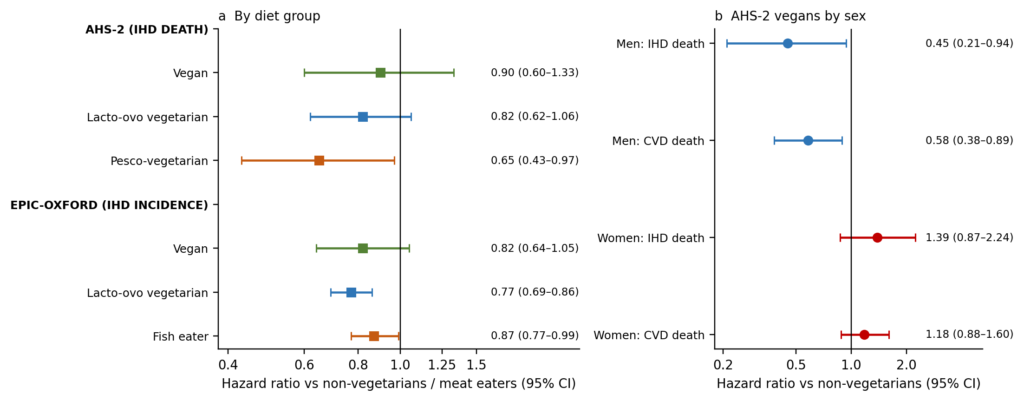
Figura 10. Veganos comparados con otros grupos vegetarianos. (a) Enfermedad isquémica del corazón por grupo de dieta en el Adventist Health Study-2 (muertes) y EPIC-Oxford (casos incidentes), cada uno comparado con no vegetarianos o consumidores de carne. (b) Veganos del Adventist Health Study-2 por sexo. Los intervalos amplios reflejan el pequeño número de veganos. Fuentes: Orlich 2013 (Tabla 4); Tong 2019 (Tabla Suplementaria 3).
9.3 Vegetarianos chinos y taiwaneses
La búsqueda para esta revisión no encontró ningún estudio prospectivo de China continental que comparara a veganos con omnívoros en cuanto a resultados de enfermedades cardíacas. La evidencia disponible de China y Taiwán se refiere a vegetarianos, la mayoría de los cuales consumen lácteos y a menudo huevos. En Taiwán, dos cohortes budistas Tzu Chi (13,352 participantes en total) encontraron un menor riesgo de accidente cerebrovascular entre los vegetarianos: en la primera cohorte, el cociente de riesgos para el accidente cerebrovascular isquémico fue de 0.26 (IC del 95%: 0.08 a 0.88); en la segunda, el accidente cerebrovascular global fue de 0.52 (0.33 a 0.82), el accidente cerebrovascular isquémico de 0.41 (0.19 a 0.88) y el accidente cerebrovascular hemorrágico de 0.34 (0.12 a 1.00) [58]. Los participantes eran miembros de una fundación budista, una población con su propio perfil de usuario saludable, y un análisis exploratorio sugirió que la ingesta de vitamina B12 modificaba la asociación [58]. El resultado del accidente cerebrovascular hemorrágico es opuesto al de EPIC-Oxford [41], un recordatorio de que los subtipos de accidentes cerebrovasculares se comportan de manera diferente entre las poblaciones.
En un estudio transversal de Xiamen, 169 hombres chinos lactovegetarianos sanos tenían una presión arterial, c-LDL, ApoB, triglicéridos y niveles en ayunas más bajos de glucosa, y carótidas más delgadas grosor íntima-media, que 126 hombres omnívoros [59]. Esta es evidencia de Nivel 4 sobre marcadores sustitutos en vegetarianos que consumen lácteos.
Los datos de Hong Kong añaden una advertencia. Se informó deficiencia de vitamina B12 en aproximadamente el 80% de los veganos de Hong Kong, quienes raramente usaban alimentos fortificados o suplementos; los grupos vegetarianos con deficiencia de B12 mostraron una función endotelial arterial deteriorada y paredes carotídeas más gruesas, y la suplementación con B12 mejoró estas medidas vasculares en los veganos de Hong Kong [60]. Una dieta vegana sin suplementos puede, por tanto, socavar el beneficio vascular que se supone debe proporcionar, lo que refuerza la guía de nutrientes en la Sección 15.
10. Reevaluación de los estudios de Esselstyn (Nivel 4)
10.1 La cohorte de la Clínica Cleveland de 1985
Tres informes describen esta cohorte, y sus denominadores difieren. El informe completo de 1995 describe a 22 pacientes (21 hombres, 1 mujer) con enfermedad coronaria grave, documentada angiográficamente, inscritos entre 1985 y 1988; los 11 participantes cuyos resultados se informan tenían enfermedad de tres vasos y eran no diabéticos, no hipertensos y no fumadores [42]. La dieta derivaba menos del 10% de la energía de la grasa y excluía aceites, carne, pescado, aves y lácteos excepto leche desnatada y yogur desnatado. Cada participante también recibió un fármaco reductor del colesterol individualizado, con mayor frecuencia colestiramina 4 g dos veces al día con lovastatina 40–60 mg al día; se ofreció entrenamiento en relajación y meditación, pero se abandonó en pocas semanas, y no se prescribió ejercicio [42]. En los 11 participantes con pruebas de imagen, el colesterol total medio disminuyó de 246 mg/dL al inicio a 132.4 mg/dL durante el tratamiento, con un c-LDL medio de 71.6 mg/dL y un c-HDL de 36.3 mg/dL [42].
Of 38 lesions with more than 20% stenosis in those 11 participants, three treated by angioplastia and four native-vessel lesions proximal to bypass grafts were excluded a priori—the latter because, as the authors note, such lesions were expected to progress, and they did—and six more could not be matched at follow-up, leaving 25 [42]. Two technicians masked to angiografía sequence read the films. By percent diameter stenosis, 11 of 25 lesions regressed and 14 were stable, mean stenosis fell from 53.4% to 46.2% (estimated decrease 7 percentage points; 95% CI 3.3 to 10.7), and 8 of 11 participants were classified as regressing. By minimal lumen diameter, the less reference-dependent measure, 6 lesions regressed, 14 were stable, and 5 progressed, and the mean increase was 0.08 mm (95% CI −0.06 to 0.22; not significant) [42].
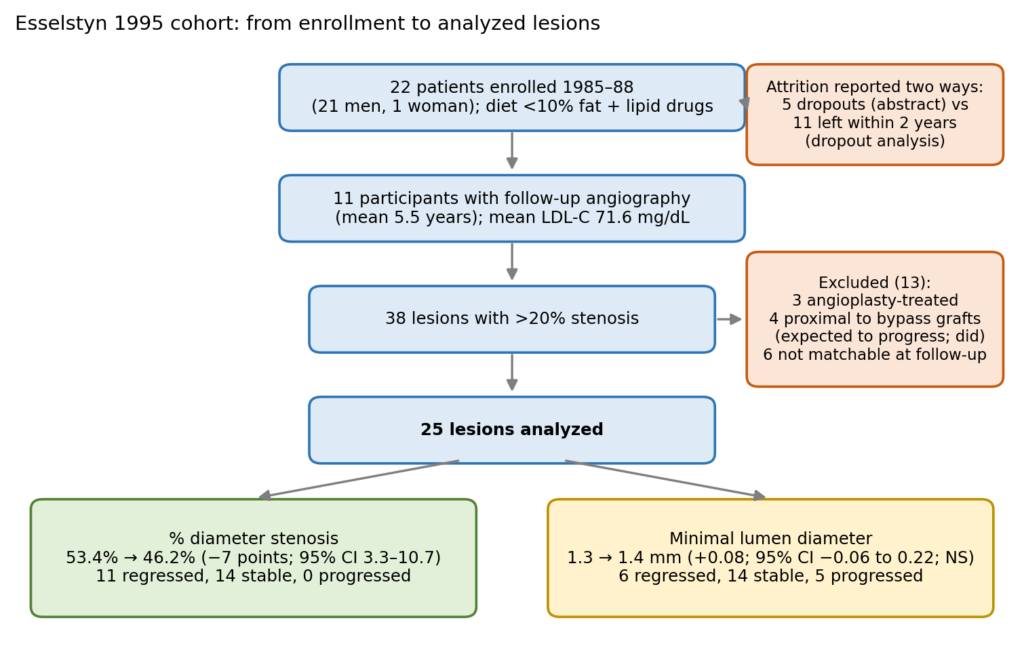
Figure 11. Esselstyn 1995 cohort: enrollment, attrition, lesion selection, and angiographic results by the two methods reported. Source: Esselstyn 1995 (full text).
The same paper reports attrition two ways. Its abstract states that 5 of 22 participants dropped out within two years and 17 maintained the diet; its dropout analysis states that 11 left within two years (three moved, four had work conflicts, three could not maintain the diet, and one chose cirugía de bypass) [42]. The five dropouts who resumed their previous diet reported 10 eventos cardíacos. The 11 imaged participants had experienced 37 cardiovascular events in the eight years before enrollment. None had a new infarction during follow-up, although two required coronary procedures during the study (repeat angioplasty in one, bypass surgery in the other) and the patient who had bypass surgery, whose fracción de eyección was below 20%, later died of an arrhythmia [42].
The 1999 update describes the cohort as 24 patients (23 men, 1 woman). Six nonadherent patients were released within 12–18 months and returned to standard care; 18 adhered for five years, and 11 of them had five-year angiography showing arrest in all 11 and regression in 8 (73%) by percent stenosis. Mean cholesterol fell from 237 to 137 mg/dL over five years and was 145 mg/dL at 12 years. The 18 adherent patients were reported to have had 49 coronary events in the eight years before enrollment and none during follow-up, while the six released patients had 13 new events by 1998 [5]. “No coronary events” reflects the report’s own event classification: the same cohort included a ventricular-arrhythmic death without infarction after five-year angiography [42]. The 2014 report gives yet another summary, stating that 17 of 22 patients were adherent and that reversión was angiographically confirmed in 4 of 12 [4]. Baseline cholesterol (246 versus 237 mg/dL), cohort size (22 versus 24), and prior-event counts (37 events in 11 patients in the 1995 discussion versus 49 in 18 patients in 1999) differ across reports. Two different 73% figures circulate: 8 of 11 imaged patients with regression by percent stenosis, and 16 of 22 original patients still following the diet in 1995 [5, 42].
Comparing events after enrollment with events in the preceding eight years is vulnerable to regression to the mean, because patients typically enter such programs after a cluster of events. The regimen combined diet with drugs, so the diet’s independent contribution cannot be estimated.
10.2 The 2014 cohort of 198 patients
Design and enrollment. Two hundred consecutive self-referred volunteers with cardiovascular disease were counseled; two were lost to follow-up, leaving 198 (91% men; mean age 62.9 years; mean follow-up 44.2 ± 24.1 months). Coronary disease was documented in 195, by angiography or CT angiography in 180; 44 had a prior myocardial infarction. All were nonsmokers; 161 had hyperlipidemia, 60 hypertension, and 23 diabetes. The intervention was a single five-hour seminar with follow-up by telephone or email, and patients continued their usual cardiac medications, which were not recorded. Exercise was encouraged but not required [4].
Adherence and data collection. Los pacientes que evitaron toda la carne, el pescado y los lácteos, y a sabiendas cualquier aceite añadido, fueron clasificados como adherentes. Los datos se recopilaron por teléfono en 2011-2012, de los familiares en el caso de los fallecidos. No se informaron valores de lípidos [4].
Resultados, con denominadores. De 177 pacientes adherentes, 112 informaron de angina al inicio, de los cuales 104 (93% en el texto; la tabla indica 105, 94%) mejoraron. Se documentó la «reversión» en 39 de 177 (22%) mediante pruebas radiográficas o de esfuerzo. Dieciocho de 177 (10%) fueron clasificados como peor: los investigadores juzgaron que nueve de estos eventos no estaban relacionados con la dieta (incluidas dos operaciones de bypass coronario en pacientes asintomáticos persuadidos por sus médicos, stent trombosis después de suspender el clopidogrel, y un accidente cerebrovascular después de rechazar la warfarina) y cuatro como progresión de la enfermedad (un accidente cerebrovascular, dos operaciones de bypass, una colocación de un nuevo stent). Hubo cinco muertes no cardíacas y ninguna muerte cardíaca. La tasa de eventos principal del 0,6% solo cuenta el accidente cerebrovascular como un evento mayor relacionado con la progresión; una tabla suplementaria en el mismo artículo enumera en su lugar una tasa de eventos del 2,2% para los pacientes adherentes [4]. De 21 pacientes no adherentes, 13 (62%) tuvieron al menos un evento: dos muertes súbitas cardíacas, un trasplante de corazón, dos accidentes cerebrovasculares isquémicos, cuatro procedimientos de stent, tres operaciones de bypass y una endarterectomía [4].
Por qué el contraste no es causal. Los grupos no fueron aleatorizados; los participantes se autoseleccionaron en un programa que buscaron; la adherencia fue autoinformada y clasificada a posteriori; los investigadores constataron y adjudicaron los eventos por teléfono y decidieron cuáles estaban relacionados con la dieta; las pruebas de imagen se realizaron por motivos clínicos en lugar de por protocolo; no se registró el uso de medicación; y siete de los eventos del grupo no adherente fueron revascularización procedimientos, que dependen de los síntomas y de las decisiones del médico. Los pacientes adherentes y no adherentes también diferían al inicio, por ejemplo, un 93% frente a un 76% de hombres [4]. El contraste bruto del 62% frente al 0,6% se puede dividir, pero el cociente no es un riesgo relativo causal válido o número necesario a tratar: los grupos no fueron aleatorizados, y las definiciones de eventos aplicadas a ellos no son comparables. Los participantes inscritos después de 2007 recibieron una copia del libro del autor principal como parte del programa [4].
10.3 Lo que el trabajo de Esselstyn puede y no puede sustentar
El programa de Esselstyn merece prominencia por tres razones. Es la expresión más intensiva en el mundo real de la palanca de los alimentos integrales: sin aceite, sin alimentos de origen animal en la cohorte de 2014, sin alimentos procesados y abundantes verduras de hoja verde. Muestra que algunos pacientes motivados con enfermedad grave pueden mantener tal dieta durante años, con 16 de los 22 pacientes originales aún siguiéndola en 1995 [42] y un 89% de adherencia autoinformada en la cohorte de 2014 [4]. Y generó hipótesis específicas y contrastables —nitrato de las verduras de hoja verde y óxido nítrico, protección endotelial, exclusión de aceite— que la Sección 5 evalúa frente a la evidencia independiente.
Lo que no puede sustentar es el peso causal para la afirmación «más allá de la ApoB» o para la afirmación de superioridad. La cohorte de 1995 combinó la dieta con colestiramina y lovastatina y logró un LDL-C medio de 71,6 mg/dL, un nivel en el que la terapia farmacológica concomitante es una explicación plausible para parte del resultado angiográfico, aunque el diseño no controlado no puede establecer que los fármacos por sí solos lo expliquen o que este LDL-C garantice el cese de la progresión [42]; solo se obtuvieron imágenes de 11 pacientes, se excluyeron 13 de 38 lesiones, y el artículo informa de la pérdida de participantes de dos maneras (Figura 11). La cohorte de 2014 no tenía datos de lípidos, la adherencia fue autoinformada y los resultados fueron adjudicados por los investigadores (Sección 10.2). Consideradas junto a los ensayos aleatorizados de lípidos, dos observaciones, no obstante, resultan más plausibles: un LDL-C muy bajo y sostenido logrado con una dieta de alimentos integrales más fármacos es compatible con el cese de la enfermedad angiográfica en la mayoría de los pacientes de los que se obtuvieron imágenes [20, 21], y la angina mejoró en la mayoría de los pacientes, en consonancia con los hallazgos aleatorizados de Ornish y Heidelberg [6, 61, 62]. Unresolved are the diet’s independent contribution, whether excluding oil, nuts, and avocado adds anything, the true event rate in a representative population, and how the results would compare with an equally supported Mediterranean or higher-fat whole-food program.
11. Randomized and Controlled Lifestyle Trials (mainly Tier 2)
11.1 The Lifestyle Heart Trial
Diseño. Of 193 potentially eligible patients, 93 remained eligible after angiography and were randomized by an invitational design (53 experimental, 40 control); 28 and 20 respectively agreed to participate, giving the 48 trial participants. Thirty-five (20 experimental, 15 control) completed five-year angiografía coronaria cuantitativa, read blind to allocation [6]. The intervention combined a 10%-fat whole-foods vegetarian diet with moderate ejercicio aeróbico, stress management (87 minutes per day at one year, 49 at five years), smoking cessation, and group psychosocial support. Experimental patients took no lipid-lowering drugs; 9 of 15 control patients (60%) started them between years one and five [6].
Angiography: which report, which cohort. Two reports describe this trial and are often quoted interchangeably, which makes them look inconsistent. The 1990 Lancet report covers the first year in all 48 participants, analyzing 195 lesions: mean percent diameter stenosis fell from 40.0% (SD 16.9) to 37.8% (16.5) in the experimental group and rose from 42.7% (15.5) to 46.1% (18.5) in controls; among lesions more than 50% stenosed the change was 61.1% to 55.8% versus 61.7% to 64.4%; and 18 of 22 experimental patients (82%) changed in the direction of regression [63]. The 1998 JAMA report covers the 35 participants who completed five-year angiography, a subset with slightly different baseline values (38.92% experimental, 42.50% control), and reports changes rather than start-and-end values [6]. The figures below are from the 1998 report unless stated; a 1990 value and a 1998 value should never be compared directly, because they describe different patients.
Percent diameter stenosis changed by −3.07 percentage points (95% CI −5.91 to −0.24) in the experimental group and +11.77 points (95% CI 3.40 to 20.14) in controls at five years (P = 0.001), corresponding to a 7.9% relative improvement and a 27.7% relative worsening [6]. These are changes in lumen narrowing, not a 7.9% removal of plaque volume. Minimum lumen diameter was unchanged in the experimental group (+0.001 mm) and fell 0.34 mm in controls (P = 0.05). The reference (“normal”) segment diameter decreased slightly in the experimental group (−0.13 mm) and widened slightly in controls (P = 0.01) [6]. Because percent stenosis is calculated relative to that reference segment, a stable minimum diameter with a narrowing reference segment will register as reduced stenosis; the authors interpreted the reference-segment change as flow streamlining [6]. Within the experimental group, stenosis change tracked adherence tertiles (−6.81, −3.02, and −0.37 points; n = 6, 7, and 6), an observational analysis within a randomized trial [6].
Lipids. LDL-C fell from 143.8 to 86.6 mg/dL (−40%) at one year and was 115.4 mg/dL (−20%) at five years; triglycerides rose (227.8 to 258.2 mg/dL at one year), HDL-C fell (40.1 to 34.8 mg/dL at five years), and ApoB returned to baseline by year five as described in Section 5.6. LDL-C did not differ between groups at five years, largely because most controls took lipid-lowering drugs [6].
Events and angina. Over five years there were 25 cardiac events among 28 experimental patients and 45 among 20 controls (rate ratio for controls 2.47; 95% CI 1.48 to 4.20) [6]. These are recurrent-event counts, not numbers of patients with an event, and they are dominated by procedures and hospitalizations: myocardial infarction 2 versus 4, angioplasty 8 versus 14, bypass surgery 2 versus 5, cardiac hospitalizations (which include those events) 23 versus 44, and deaths 2 versus 1 [6]. Los eventos adversos mayores fueron demasiado escasos para realizar comparaciones. La frecuencia reportada de angina disminuyó un 91% en el grupo experimental al cabo de un año (con una reducción del 42% en la duración y del 28% en la severidad) y un 72% a los cinco años [6, 63]; las diferencias entre los grupos dejaron de ser significativas a los cinco años porque los controles más sintomáticos se habían sometido a revascularización [6]. El cambio en la frecuencia de angina del grupo de control al año se presenta como un aumento del 186% en el artículo de 1998, pero como un 165% en el informe de 1990 [6, 63]; la diferencia no se ha conciliado y ambas cifras se exponen aquí.
Deserción y sesgo. Siete pacientes carecían de angiografías al año, y cuatro en cada grupo carecían de angiografías a los cinco años; catorce lesiones no estuvieron disponibles en total —cuatro en el grupo experimental y diez en los controles, incluidas cuatro lesiones de control excluidas tras la revascularización—, lo que sesgaría los resultados hacia la hipótesis nula [6]. Un aviso de corrección añadió un autor omitido [6].
Interpretación. Aleatorización respalda una lectura causal de la comparación entre el paquete integral de estilo de vida y la atención habitual de la época, aunque el consentimiento posterior a la asignación y la deserción limitan esa confianza. La incapacidad de aislar la dieta es una limitación de atribución, no una ausencia de aleatorización. La participación fue seleccionada tras la asignación: 93 pacientes fueron aleatorizados mediante el diseño por invitación y 48 consintieron posteriormente. Proporciones de consentimiento similares en los dos brazos no eliminan el sesgo de selección, y el tamaño reducido y la deserción son limitaciones adicionales.
11.2 Perfusión por PET (Gould 1995)
Gould y colaboradores informaron que, en los mismos 20 pacientes experimentales y 15 controles, el tamaño y la gravedad de las anomalías de perfusión en la PET con dipiridamol en reposo mejoraron con la intervención en el estilo de vida y empeoraron en los controles, quienes recibieron principalmente terapia antianginosa [61]. Este es un resultado funcional en los mismos pacientes, no una replicación independiente, y es distinto de la función ventricular y la anatomía angiográfica. El resumen de Freeman y colaboradores sobre un “aumento del 400% en perfusión miocárdica” no pudo rastrearse hasta este informe y no debería reutilizarse [2].
11.3 El Proyecto de Demostración de Estilo de Vida Multicéntrico
Este proyecto no aleatorizado realizó el seguimiento de 333 pacientes elegibles para revascularización: 194 que eligieron el programa de estilo de vida y 139 controles que se sometieron a revascularización. A los tres años, 150 de los 194 pacientes experimentales (77%) habían evitado la revascularización, y las tasas de infarto de miocardio, accidente cerebrovascular y muerte por paciente-año fueron similares entre los grupos [64]. El 77% describe la evitación de procedimientos entre pacientes autoseleccionados; no es una reducción aleatorizada del 77% en procedimientos o eventos. La afirmación de Freeman y colaboradores de que los proyectos de demostración produjeron una “reducción de la angina superior al 90% en cuestión de semanas” cita este proyecto y una evaluación de programas en 24 sitios [2, 65]; el estudio, el resultado y el momento específicos no pudieron rastrearse, y la cifra verificada del 91% al año del Lifestyle Heart Trial no puede respaldar una afirmación sobre semanas.
11.4 Ensayos angiográficos con menor contenido de grasa pero no veganos
En el estudio STARS, 90 hombres con enfermedad coronaria fueron aleatorizados a cuidados habituales, una dieta hipolipemiante (27% de la energía proveniente de grasas) o la dieta más colestiramina, con angiografía a los 39 meses. El ancho absoluto medio de los segmentos coronarios se redujo 0,201 mm con los cuidados habituales, no cambió con la dieta sola (+0,003 mm) y se ensanchó 0,103 mm con la dieta más colestiramina; la proporción con progresión fue del 46%, 15% y 12% respectivamente [66In el ensayo de Heidelberg, 113 hombres fueron aleatorizados a cuidados habituales o ejercicio intensivo más una dieta baja en grasas y colesterol sin fármacos lipídicos; al año, las lesiones progresaron en el 23% frente al 48% y remitieron en el 32% frente al 17% [62]. A los seis años, se reevaluó a 90 pacientes, y las diferencias de lípidos entre los grupos ya no eran significativas [67]. En DISCO-CT, 92 pacientes con enfermedad no obstructiva bajo terapia médica óptima fueron asignados aleatoriamente a recibir asesoramiento dietético intensivo adicional con un patrón tipo DASH y controles de actividad, o a terapia médica sola; después de unas 67 semanas, el volumen de placa no calcificada disminuyó más con la intervención (−51.3 frente a −21.3 mm³; P = 0.045), aunque el cambio en el volumen total ateroma no difirió significativamente entre los grupos [68]. Aproximadamente a los seis años, la mayor parte del peso perdido durante la intervención se había recuperado en ambos grupos, y uno evento cardiovascular adverso mayor había ocurrido en el grupo DASH frente a cuatro (incluyendo un infarto de miocardio fatal) entre los controles; eventos insuficientes para realizar inferencias [69]. Estos ensayos demuestran que los regímenes omnívoros o bajos en grasas muy por encima del 10–15 % de grasa también ralentizaron la progresión.
12. La evidencia competitiva más sólida (Niveles 1–2)
12.1 DASH y DASH-Sodio
En una alimentación controlada de 459 adultos durante ocho semanas, la dieta combinada DASH redujo la presión sistólica y diastólica en 5.5 y 3.0 mm Hg más que una dieta de control estadounidense típica, y en 11.4 y 5.5 mm Hg en los 133 participantes con hipertensión [11]. La combinación de DASH con bajo contenido de sodio redujo la presión sistólica en 7.1 mm Hg en participantes normotensos y en 11.5 mm Hg en aquellos con hipertensión de etapa 1, en comparación con la dieta de control con alto contenido de sodio [16]. Estos beneficios se lograron con lácteos bajos en grasa en la dieta.
12.2 PREDIMED
El informe PREDIMED de 2013 fue retractado debido a irregularidades en la aleatorización y vuelto a publicar en 2018 con un reanálisis. Entre 7,447 adultos con alto riesgo cardiovascular seguidos durante una mediana de 4.8 años, ocurrieron eventos cardiovasculares mayores en 96 de 2,543 participantes (3.8 %) asignados a una dieta mediterránea más aceite de oliva virgen extra, 83 de 2,454 (3.4 %) asignados a una dieta mediterránea más frutos secos, y 109 de 2,450 (4.4 %) en el grupo de control al que se le aconsejó reducir la grasa dietética (razones de riesgo 0.69, IC del 95 %: 0.53 a 0.91, y 0.72, IC del 95 %: 0.54 a 0.95); los resultados fueron similares tras excluir a 1,588 participantes con desviaciones del protocolo conocidas o sospechadas [12]. El grupo de control recibió asesoramiento, no una dieta basada en plantas muy baja en grasas.
12.3 El Lyon Diet Heart Study
En 605 sobrevivientes de un primer infarto de miocardio seguidos durante una media de 46 meses, la dieta de tipo mediterráneo redujo la muerte cardíaca más el infarto no fatal (compuesto 1: 14 frente a 44 eventos), el compuesto 1 más angina inestable, derrame cerebral, insuficiencia cardíaca, y embolia (compuesto 2: 27 frente a 90), y el compuesto 2 más eventos menores que requirieron hospitalización (compuesto 3: 95 frente a 180) [70]. El resumen informa razones de riesgo ajustadas que van desde 0.28 hasta 0.53 en los tres compuestos; la tabla complementaria del artículo de Esselstyn de 2014 asigna 0.28 (IC del 95 %: 0.15 a 0.53) al compuesto 1 [4, 70]. Los resúmenes de reducciones de «hasta el 65 %» o «70 %» no coinciden con ningún criterio de valoración único y deben evitarse. El comparador fue una dieta prudente de tipo occidental en lugar de una dieta activa saludable [10], y la intervención suministró una margarina rica en ácido alfa-linolénico en lugar de mantequilla y crema [13]. El estudio Lyon muestra que una dieta rica en plantas, pero no exclusiva de plantas, con una cantidad sustancial de grasas insaturadas redujo los eventos recurrentes.
12.4 CORDIOPREV
CORDIOPREV aleatorizó a 1.002 pacientes con enfermedad coronaria a una dieta mediterránea (al menos un 35% de grasa; 40–60 g/día de aceite de oliva virgen extra) o a una dieta baja en grasas y alta en carbohidratos complejos (menos del 30% de grasa, menos del 10% de grasa saturada, permitiéndose carne magra y lácteos bajos en grasa), con apoyo de dietistas igualmente intensivo y un seguimiento medio de siete años. La grasa alcanzada fue del 40,5% de la energía en el brazo mediterráneo y del 32,1% en el brazo bajo en grasas. El evento compuesto primario ocurrió en 87 (17,3%) frente a 111 (22,2%) pacientes (razón de riesgo no ajustada 0,745; IC del 95% 0,563 a 0,986; modelos ajustados 0,719 a 0,753). El beneficio fue estadísticamente demostrable en hombres (razón de riesgo 0,669; IC del 95% 0,489 a 0,915), mientras que la estimación en el subgrupo más pequeño de 175 mujeres no fue concluyente en lugar de mostrar ausencia de beneficio; ningún componente individual difirió significativamente; los lípidos y la glucosa no cambiaron de manera diferente entre las dietas; y el 86,6% tomaba estatinas al inicio. Más participantes de la dieta baja en grasas abandonaron su dieta (17,2% frente a 9,2%). El ensayo fue financiado principalmente por fundaciones de aceite de oliva [10].
CORDIOPREV desafía la afirmación general de que menos grasa total es siempre mejor: dentro del rango del 30–40%, entre omnívoros que toman estatinas, la dieta mediterránea más alta en grasas obtuvo mejores resultados. No pone a prueba una dieta de 10–15% de grasa, libre de productos animales y basada en alimentos integrales, que difiere de su brazo bajo en grasas en el nivel de grasa, el contenido de alimentos de origen animal y el procesamiento de los alimentos.
12.5 Comparaciones directas de dietas exclusivamente vegetales y mediterráneas
Ningún ensayo ha comparado estas dietas en eventos clínicos, y los tres ensayos de factores de riesgo a continuación proporcionan comparaciones relacionadas pero distintas en lugar de una comparación repetida. En un ensayo cruzado de 16 semanas en 62 adultos con sobrepeso (52 completaron), una dieta vegana baja en grasas redujo el peso corporal en 6,0 kg sin cambios con una dieta mediterránea estilo PREDIMED (efecto del tratamiento -6,0 kg; IC del 95% -7,5 a -4,5), y redujo el c-LDL en 15,3 mg/dL sin cambios significativos con la dieta mediterránea (efecto del tratamiento -14,8 mg/dL; IC del 95% -23,5 a -6,2), mientras que la dieta mediterránea redujo más la presión sistólica (efecto del tratamiento +6,0 mm Hg a favor de la mediterránea; IC del 95% 1,0 a 10,9) [23]. La estimación de lípidos cubre a los 43 participantes sin cambios en la medicación hipolipemiante y la estimación de la presión arterial a los 41 sin cambios en la medicación antihipertensiva; apareció un efecto de arrastre significativo para la presión sistólica en el análisis de todos los participantes, incluidos aquellos cuya medicación cambió, pero no en el subgrupo de medicación estable [23]. La ingesta de grasas informada al final de la fase vegana fue del 17% de la energía (IC del 95% 15 a 19), por lo que el ensayo evaluó una dieta vegana baja en grasas en lugar de una con un 10–15% de grasa, y la asignación de la secuencia de un participante se cambió después de la aleatorización para que una madre y su hija siguieran la misma dieta [23]. El ensayo fue realizado por una organización que aboga por las dietas basadas en plantas. En CARDIVEG, un ensayo cruzado de tres meses en 107 adultos con sobrepeso y bajo riesgo, las dietas lacto-ovo-vegetariana restringida en energía y mediterránea produjeron una pérdida de peso y de grasa similar; el c-LDL disminuyó más con la dieta vegetariana, los triglicéridos disminuyeron más con la dieta mediterránea y la vitamina B12 disminuyó con la dieta vegetariana [71]. EVADE CAD comparó una dieta vegana con la dieta de la AHA con ingestas de grasas similares (Sección 5.3) [9]. Solo Barnard comparó una dieta vegana con una mediterránea; CARDIVEG comparó una dieta lacto-ovo-vegetariana con una mediterránea, y EVADE comparó una dieta vegana con la dieta de la AHA. Leídos por separado, cada uno encontró que el brazo basado en plantas reducía el c-LDL al menos en la misma medida, siendo el comparador mediterráneo mejor en la presión arterial (Barnard) o los triglicéridos (CARDIVEG); estas no son tres réplicas de una sola comparación.
12.6 La revisión Cochrane y la brecha de eventos
La revisión Cochrane de 2021 sobre dietas veganas (búsqueda hasta febrero de 2020) incluyó 13 ensayos aleatorizados con al menos 12 semanas de seguimiento; ninguno informó criterios de valoración clínicos cardiovasculares. Solo un ensayo, de 63 participantes, abordó prevención secundaria against another dietary intervention, and showed no clear effect on lipids or blood pressure (low- or very-low-certainty evidence) [72]. Its stricter eligibility—vegan only, minimum 12 weeks, active or minimal-intervention comparators—explains why its conclusions are more cautious than those of the Koch and Wang meta-analyses, which admitted vegetarian diets and different comparators [7, 22]. An updated search for this review, through 10 September 2026, found no published randomized trial of a very-low-fat vegan diet with cardiovascular events as an outcome. The absence of event evidence is a gap, not evidence of no benefit. Pooled analyses also need checking for cohort overlap: the 1990 one-year and 1998 five-year Lifestyle Heart Trial reports describe the same randomized cohort, so an analysis that enters them as separate trials double-counts one cohort and inflates precision.
Direct comparisons are used wherever available. Diets are not ranked by comparing effect sizes across unrelated trials, because populations, background therapy, adherence, and endpoints differ.
Figure 12 displays the randomized trials with clinical outcomes discussed in this section alongside the Lifestyle Heart Trial’s recurrent-event ratio.
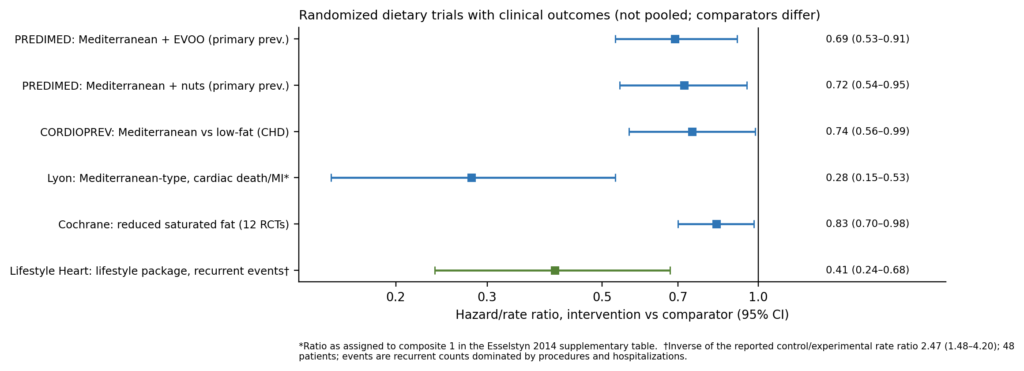
Figure 12. Randomized dietary trials with clinical outcomes. Estimates are shown side by side, not pooled; comparators, populations, and endpoints differ. No randomized trial of a very-low-fat vegan diet has reported clinical events.
12.7 Applying the same standard to the comparator trials
This review has examined the Esselstyn and Ornish studies closely, and the trials that favor Mediterranean diets deserve the same scrutiny. Table 2 asks the same questions of each. The aim is not to label any trial worthless but to be clear about what each can support.
PREDIMED. The 2018 republication documents the main problems itself. Sealed envelopes were used to conceal allocation only during part of the pilot phase; 425 household members were enrolled without randomization and given the same diet as their relative; at one site, 467 participants were assigned by clinic rather than individually; and randomization tables were used inconsistently at another site [12]. The authors reanalyzed the trial with statistical adjustment, and the results were similar when the 1,588 affected participants were excluded (hazard ratios 0.71 and 0.68 in the remaining 5,859) [12]. The control group received a yearly leaflet with low-fat advice until September 2006 and only afterward the same frequency of contact as the Mediterranean groups; its total fat intake changed little, so PREDIMED compared a supplemented Mediterranean diet with a lightly advised usual diet, not with a true low-fat diet [12]. Benefit was also present among participants recruited after control-group contact was increased—hazard ratio 0.49 (95% CI 0.26 to 0.92) versus 0.77 (0.59 to 1.00) before the October 2006 change (P = 0.21 for heterogeneity)—which argues against unequal support as the sole explanation, though a recruitment-period comparison cannot exclude some contribution from it [12]. Study discontinuation was 11.3% in the control group versus 4.9% in the Mediterranean groups. The olive oil and nuts were donated by producers and supplied free, participants knew their assignment, and only the endpoint committee was blinded [12]. The trial was stopped at its fourth interim analysis [12], and trials stopped early for benefit tend to overestimate effect size. Finally, the composite result was driven mainly by stroke (combined hazard ratio 0.58; 95% CI 0.42 to 0.82), whereas myocardial infarction (0.80; 0.53 to 1.21), cardiovascular death (0.80; 0.51 to 1.24), and death from any cause (0.98; 0.77 to 1.24) did not differ significantly; the authors attribute this to limited power [12] (Figure 13).
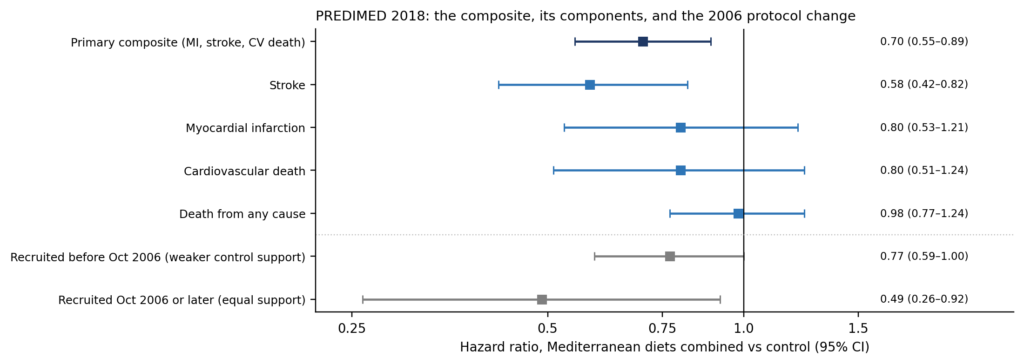
Figura 13. PREDIMED 2018: el resultado compuesto y sus componentes (dietas mediterráneas combinadas frente al control), y el efecto antes y después del aumento del apoyo al grupo de control en octubre de 2006. Fuente: Estruch 2018, Tabla 3 y texto.
Estudio Lyon Diet Heart. Lyon aleatorizó a 605 supervivientes de un primer infarto de miocardio en un diseño simple ciego y se detuvo prematuramente por beneficio a una media de 27 meses, con un seguimiento ampliado posteriormente a 46 meses [13, 14, 70]. Su comparador fue una dieta prudente de tipo occidental en lugar de una dieta saludable con apoyo intensivo [70]. La gran reducción de eventos se produjo mientras los lípidos séricos, la presión arterial y el índice de masa corporal se mantuvieron similares entre los grupos [14]. Esa es una señal genuina de que un patrón dietético puede reducir los eventos a través de vías distintas a la reducción de lípidos (Sección 5), pero proviene de un ensayo pequeño, detenido prematuramente, cuyo tamaño del efecto probablemente esté inflado.
CORDIOPREV. CORDIOPREV fue un ensayo monocéntrico financiado principalmente por fundaciones de aceite de oliva; el beneficio fue estadísticamente demostrable solo en hombres, con una estimación no concluyente en el subgrupo femenino más pequeño; ningún componente individual del compuesto fue significativo; y su brazo bajo en grasas alcanzó el 32,1% de la energía proveniente de las grasas [10]. Tiene el diseño más sólido de los tres porque ambos brazos recibieron un apoyo igualmente intensivo, pero evalúa un comparador omnívoro con un contenido moderado de grasas, no una dieta basada en plantas con muy bajo contenido en grasas.
Problemas compartidos en toda la ciencia de la nutrición. Diversas debilidades se aplican a casi todos los estudios de esta revisión, independientemente de la dieta que favorezcan. La dieta suele medirse mediante cuestionarios; en el Adventist Health Study-2, las correlaciones de validez del cuestionario frente a recordatorios repetidos de 24 horas fueron de 0,76 para carne roja pero de 0,53 para el pescado en participantes blancos [53]. Los participantes en los ensayos dietéticos saben lo que están comiendo. La adherencia disminuye, como lo demuestra el abandono del grupo de control en PREDIMED, el abandono de la dieta en CORDIOPREV y la disminución de las puntuaciones de adherencia en el Lifestyle Heart Trial [6, 10, 12]. Los comparadores suelen ser débiles: el grupo de control inicial de PREDIMED, la dieta prudente de Lyon y la atención habitual del Lifestyle Heart Trial. Los ensayos suelen ser pequeños o se detienen prematuramente. Y los intereses corren en todas direcciones: productores de aceite de oliva y frutos secos, desarrolladores de programas y organizaciones de defensa han financiado o dirigido estudios analizados aquí [4, 10, 12, 23].
Qué cambia la crítica. Estas limitaciones reducen la confianza en la magnitud del beneficio mediterráneo y en cualquier afirmación de que la dieta mediterránea ha demostrado ser superior. No elevan el estatus de la dieta VLF-WFPB (basada en plantas, integral y muy baja en grasas), que no cuenta con ningún ensayo aleatorizado con eventos clínicos. Un ensayo aleatorizado con eventos clínicos, incluso uno con defectos, aborda la cuestión causal que una serie de casos no controlada no puede, aunque su peso sigue dependiendo del sesgo, la precisión y la forma directa en que evalúa la dieta en cuestión. Aplicar el mismo escepticismo a ambas partes es lo que permite confiar en las conclusiones de esta revisión.
Tabla 2. Aplicación de las mismas preguntas a los principales ensayos de cada lado del debate.
| Pregunta | PREDIMED | CORDIOPREV | Lyon Diet Heart | Ensayo sobre el estilo de vida y el corazón | Cohorte de Esselstyn 2014 |
| Nivel de evidencia | 1 | 1 | 1 | 2 (recuentos de eventos pequeños) | 4 |
| ¿Aleatorizado? | Sí, con desviaciones que afectaron a 1.588 de 7.447; los sobres se utilizaron solo en parte del piloto [12] | Sí [10] | Sí [14] | Sí, mediante invitación; la mitad de los elegibles declinó [6] | No [4] |
| ¿Quién fue cegado? | Solo el comité de objetivos finales [12] | Punto final adjudicación informado como enmascarado; los participantes y los dietistas no fueron cegados, como en cualquier ensayo dietético | Diseño simple ciego [14] | Diseño simple ciego [14] | Nadie; los investigadores adjudicaron los eventos [4] |
| Comparador | Consejos para reducir la grasa; folleto anual hasta 2006, luego contacto igualitario; la grasa total cambió poco [12] | Dieta baja en grasas con el mismo apoyo; se logró un 32,1% de grasa [10] | Dieta prudente de tipo occidental [70] | Atención habitual; el 60% inició fármacos hipolipemiantes [6] | Voluntarios no adherentes [4] |
| ¿Detenido prematuramente? | Sí, en el 4º análisis intermedio [12] | Mediana de seguimiento de 7 años [10] | Sí, a los 27 meses; ampliado posteriormente a 46 meses [13, 14] | Sí, a los 27 meses; ampliado posteriormente a 46 meses [13, 14] | No aplicable |
| Qué impulsó el resultado | Ictus 0,58; el IM 0,80 y la muerte CV 0,80 no fueron significativos [12] | Beneficio demostrable en hombres; estimación en 175 mujeres no concluyente; ningún componente individual significativo [10] | Large reductions with similar serum lipids, BP, and BMI [14] | Procedures and hospitalizations (recurrent counts) [6] | Revascularizations in nonadherent group [4] |
| Interests | Olive oil and nuts donated by producers [12] | Principally olive-oil foundations [10] | Not assessed here | Not assessed here | Program developer; book given to participants [4] |
| Diet tested vs VLF-WFPB | Supplemented Mediterranean vs lightly advised usual diet | Mediterranean 40.5% fat vs omnivorous low-fat 32.1% | ALA-rich Mediterranean-type | ALA-rich margarine plus Mediterranean-type advice | Oil-free, animal-free, no nuts or avocado |
13. Is Very Low Total Fat Itself Better?
Separate the fats. Saturated fat raises LDL-C and its reduction lowers events [26]; industrial trans fat should be avoided [73]; unsaturated fats lower LDL-C when they replace saturated fat and are associated with event reduction in Mediterranean trials [10, 12]. “Total fat” bundles these opposite effects.
What replaces the fat matters. In VLF-WFPB the replacement is intact grains, legumes, vegetables, and fruit; in other low-fat diets it may be refined starch or sugar. No trial has contrasted these replacements within a plant-exclusive diet on clinical outcomes.
The only direct test within a whole-food plant diet. In a randomized crossover trial, 40 adults with at least 5% estimated cardiovascular risk followed a whole-food plant-based vegan diet with either about four tablespoons or less than one teaspoon of extra-virgin olive oil daily, for four weeks each; fat supplied 48% and 32% of energy respectively. Both phases lowered LDL-C, total cholesterol, ApoB, HDL-C, glucose, and hs-CRP from baseline. There was a sequence interaction: moving from high to low oil lowered LDL-C by 12.7 mg/dL (P = 0.04), and moving from low to high raised it by 15.8 mg/dL (P = 0.02); in the first period, LDL-C fell 25.5 versus 16.7 mg/dL (P = 0.162) [8]. Neither phase approached 10–15% fat, the trial was short, and carryover complicates the crossover analysis. It suggests large oil additions can blunt LDL-C lowering; it does not show that 10–15% fat is better than a nut- and seed-based plant diet at around 30%.
Nuts, seeds, and olive oil. Mediterranean diets rich in extra-virgin olive oil or supplemented with nuts reduced events against comparators [10, 12]. No trial shows that excluding nuts, seeds, or olive oil from an otherwise low-saturated-fat diet improves clinical outcomes. The acute impairment of flow-mediated dilation after a single high-fat meal [30], cited in support of oil exclusion [4], cannot establish that oils cause atherosclerosis.
Triglycerides, HDL, and ApoB–LDL-C discordancia. Very-low-fat, high-carbohydrate diets can raise triglycerides and lower HDL-C, as in the Lifestyle Heart Trial’s first year [6]; across plant-based trials overall, triglycerides did not change [22], and Mediterranean diets lowered triglycerides more than a vegetarian diet in CARDIVEG [71]. When triglyceride-rich lipoproteins rise, LDL-C can understate número de partículas aterogénicas. The Lifestyle Heart Trial illustrates this: at five years LDL-C was 20% below baseline while ApoB was not [6]. Future trials should measure ApoB directly.
Attribution. Where VLF-WFPB outperforms a comparator on LDL-C, the advantage may reflect fat quantity, fat quality (almost no saturated fat), food quality (fiber, plant protein), weight loss, or adherence. The Barnard crossover, for example, produced both larger LDL-C reductions and larger weight loss on the vegan diet [23]. No available trial separates these contributions. On current evidence, very low total fat is not established as an independent requirement; very low saturated fat within a whole-food diet is the component with the strongest causal support.
14. Prevention, Treatment, and Reversal
14.1 Outcomes that must not be conflated
Fewer cardiovascular events, slower progression, estabilización de la placa, la mejora de la angina o la perfusión, la reducción de la estenosis angiográfica y la regresión del volumen de placa medida cuantitativamente son resultados diferentes. La prevención primaria y secundaria también son escenarios diferentes.
14.2 Qué pueden y qué no pueden mostrar las imágenes
La angiografía coronaria cuantitativa mide la luz, no la placa. El porcentaje de estenosis depende del segmento de referencia y de tono vasomotor, y el remodelado externo (positivo) puede ocultar una placa sustancial detrás de una luz normal. La perfusión miocárdica y las pruebas de esfuerzo miden la función; la mejora puede producirse sin regresión anatómica, como señalaron los investigadores de Heidelberg [62]. Ecografía intravascular y angiotomografía coronaria miden el volumen y la composición de la placa; la TC caracteriza además la placa no calcificada y placa de baja atenuación. Las puntuaciones de calcio coronario pueden aumentar cuando la placa se estabiliza, porque las estatinas aumentan la placa calcificada y fibrosa a la vez que reducen los componentes fibrograsos y del núcleo necrótico, por lo que el cambio en la puntuación de calcio por sí solo no indica ni éxito ni fracaso [74]. La placa puede aumentar sustancialmente antes de que la angiografía detecte el estrechamiento [74]; a la inversa, una luz aparentemente más amplia puede reflejar cambios en el tono vasomotor en lugar de una placa más pequeña. En una metarregresión resumida por Dawson y sus colegas, cada reducción del 1% en volumen percentual de ateroma se asoció con probabilidades aproximadamente un 20% menores de eventos adversos mayores, pero no hay evidencia directa de que la regresión en sí misma reduzca los eventos [74]. La Tabla 3 resume lo que cada hallazgo puede y no puede establecer.
Tabla 3. Qué pueden y qué no pueden establecer los hallazgos de síntomas e imágenes.
| Hallazgo | Lo que establece | Lo que no establece |
| Menos angina; mejor prueba de estrés o perfusión por PET [6, 61, 62] | Mejora de los síntomas o del suministro de sangre al miocardio | Una pérdida medida de placa |
| Reducción del porcentaje de estenosis angiográfica | Una luz menos estrechada en relación con un segmento de referencia | El porcentaje de placa eliminada; los cambios en el segmento de referencia pueden alterar el resultado [6] |
| Cambio en el diámetro mínimo de la luz | Cambio absoluto de la luz en la lesión | Volumen de placa, que remodelación exterior puede ocultar [74] |
| Cambio en el volumen o composición de la placa por CCTA o IVUS | Cambio en el compartimento de placa medido, dentro de los límites de adquisición y segmentación | Erradicación de la enfermedad o reducción garantizada de eventos |
| Aumento de la puntuación de calcio coronario | Un mayor Puntaje de Agatston, que refleja el área calcificada, la densidad o ambas | Mayor carga total de placa o fracaso del tratamiento; las estatinas aumentan la placa calcificada mientras reducen los componentes fibrograsos y núcleo necrótico [74] |
14.3 Los referentes de primates y farmacológicos
Dos cuerpos de evidencia establecen el estándar con respecto al cual deben leerse las afirmaciones sobre regresión dietética. Ninguno de ellos es un ensayo dietético en humanos, y ambos se citan aquí como referentes más que como apoyo a cualquier dieta.
Experimentos controlados en primates (Nivel 5). En monos rhesus a los que se les administró una dieta aterogénica y luego se les cambió a una dieta de regresión, el ateroma arterias coronarias perdió lípidos [75], mientras que las proteínas fibrosas arteriales se comportaron de manera diferente al compartimento lipídico [76]. El nivel de colesterol alcanzado importaba: en animales cuyo colesterol plasmático se mantuvo cerca de 300 mg/dL hubo poco o ningún aumento en el área de la luz atribuible a la regresión de la placa de la íntima, mientras que a unos 200 mg/dL una parte considerable de la ganancia de luz fue atribuible a la regresión de la placa, y la contribución dependió tanto del tamaño de la placa como del tiempo [77]. Esto es lo más parecido en la literatura a una demostración controlada de que la reducción de las lipoproteínas aterogénicas por medios dietéticos agota el compartimento rico en lípidos mientras persiste el tejido más denso. También es evidencia animal, en una especie diferente, con enfermedad inducida en lugar de espontánea, y no puede establecer lo que logra una dieta humana.
Imagen farmacológica (Niveles 1–2). En GLAGOV, 968 pacientes tratados con estatinas con enfermedad coronaria angiográfica fueron aleatorizados mensualmente a evolocumab o placebo durante 76 semanas, y 846 contaron con ecografías intravasculares seriadas evaluables. El c-LDL ponderado en el tiempo fue de 36.6 mg/dL frente a 93.0 mg/dL, el porcentaje del volumen del ateroma cambió en un -0.95% frente a un +0.05% (diferencia de -1.0 puntos porcentuales; P < 0.001), y la regresión de la placa se produjo en el 64.3% frente al 47.3% de los pacientes [78]. Notablemente, el subestudio de histología virtual del ensayo no mostró una diferencia en el volumen de calcio denso [78], por lo que GLAGOV demuestra una regresión volumétrica en lugar de un cambio en la composición; los ensayos diseñados para medir la composición de la placa están fuera del alcance de esta revisión y no se citan cifras de composición. Siguen dos comparaciones. Ningún ensayo dietético ha producido una regresión coronaria de esta magnitud bajo este nivel de rigor, y ningún ensayo dietético identificado aquí utilizó ecografía intravascular seriada en absoluto, que es la modalidad que mide el volumen de ateroma con mayor precisión.
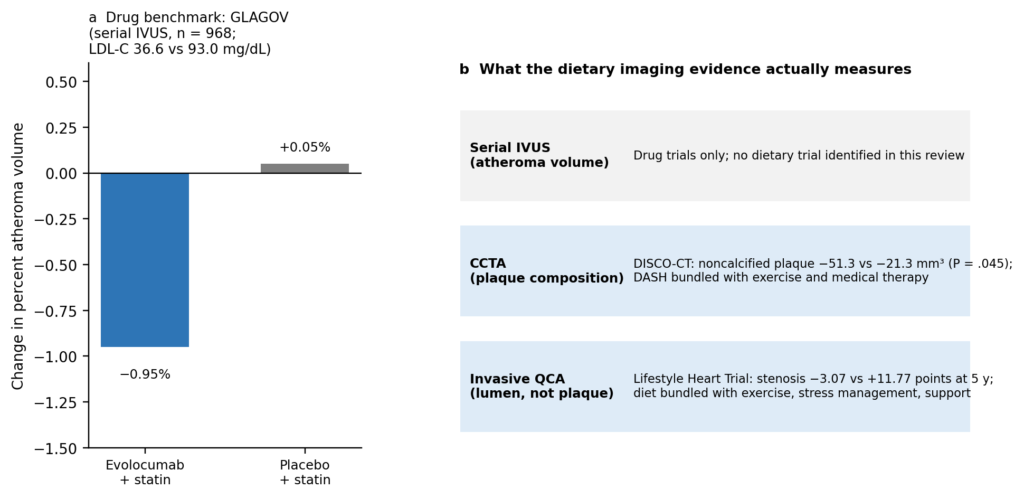
Figura 14. Puntos de referencia para el cambio de la placa coronaria. Regresión farmacológica medida por ecografía intravascular seriada (GLAGOV) junto con la evidencia de imágenes dietéticas disponible en esta revisión, la cual utiliza diferentes modalidades y no puede colocarse en el mismo eje. Ningún ensayo dietético identificado aquí utilizó ecografía intravascular seriada. Fuentes: Nicholls 2016; Henzel 2021; Ornish 1998.
El ejercicio como palanca conjunta. La actividad física pertenece al mismo nivel que las tres palancas dietéticas en lugar de dentro de ellas. Las poblaciones con menos calcio coronario son también las más activas: los hombres Tsimane promedian de seis a siete horas y las mujeres de cuatro a seis horas de actividad física al día [35]. En los dos ensayos aleatorizados de imagen que mostraron beneficios, el ejercicio fue parte de la intervención en lugar de una covariable controlada; el Lifestyle Heart Trial agrupó el ejercicio aeróbico con la dieta [6], y el DISCO-CT agrupó el asesoramiento sobre actividad con la dieta DASH [68]—razón por la cual ninguno puede asignar el crédito. No se proporciona aquí ninguna estimación cuantitativa de la reducción de ApoB atribuible al entrenamiento aeróbico; el punto se mantiene cualitativamente en que la dieta, la actividad y la terapia hipolipemiante actúan sobre vías superpuestas y son complementarias en lugar de competitivas.
14.4 Lo que la evidencia respalda en cada dominio
Prevención primaria. La evidencia consiste en asociaciones de cohortes [40], datos poblacionales (Secciones 6–8) y ensayos de lípidos aleatorizados [22]. No existe ningún ensayo aleatorizado de eventos para VLF-WFPB.
Prevención secundaria (tratamiento). El Lifestyle Heart Trial redujo la angina y los procedimientos cardíacos y hospitalizaciones para un paquete que incluía una dieta vegetariana muy baja en grasas [6]. Las reducciones de eventos aleatorizadas con dieta sola en prevención secundaria provienen de ensayos de tipo mediterráneo [10, 70].
Progresión ralentizada y regresión parcial. Los programas de estilo de vida intensivo que incorporan dietas vegetarianas muy bajas en grasas han demostrado una modesta regresión angiográfica en pacientes seleccionados; la contribución independiente de la dieta y de la restricción de grasas totales sigue siendo incierta [6, 42]. Las dietas bajas en grasas pero no veganas también ralentizaron la progresión angiográfica [62, 66], y un programa de tipo DASH añadido a la terapia médica redujo la placa no calcificada en la TC [68]. La regresión parcial parece más probable cuando se logran reducciones grandes y sostenidas en las lipoproteínas aterogénicas, a menudo con fármacos, y se observó más regresión a los cinco años que a un año en el programa de Ornish [6]. La regresión no significa la erradicación de la enfermedad o riesgo cero en el futuro.
La revisión de Dawson. Como se resume en los puntos clave publicados por la ACC, la revisión del estado del arte de JACC de 2022 juzgó que el efecto demostrado de la dieta, el ejercicio y el abandono del hábito de fumar sobre el volumen y la composición de la placa coronaria era limitado [74]. Las afirmaciones que a veces se atribuyen a esa revisión en resúmenes secundarios, incluida la aseveración de que la mayoría de los brazos dietéticos tratados con estatinas progresaron, no se utilizan aquí. La limitada evidencia de regresión solo con dieta no significa que el tratamiento dietético tenga poco valor clínico: estabilizar la placa, mejorar la perfusión y prevenir la progresión pueden ser clínicamente significativos incluso cuando el cambio anatómico es pequeño, aunque los ensayos dietéticos existentes no establecen el mecanismo de ninguna reducción de eventos.
15. Viabilidad, adecuación y seguridad
Adherencia. La adherencia reportada ha sido alta en voluntarios seleccionados: 89% por autoinforme en la cohorte Esselstyn de 2014 [4], and 94% versus 70% for vegan versus AHA diets at eight weeks in EVADE CAD, whose participants represented 14% of those meeting initial criteria [9]. In the Lifestyle Heart Trial, half of eligible invited patients declined, and the adherence score fell from 1.29 at one year to 1.06 at five years [6]. Over seven years in CORDIOPREV, more patients abandoned a conventional low-fat diet than a Mediterranean diet [10].
Nutrients. Vitamin B12 supplementation is essential; median intake in the EVADE vegan arm fell to 1.2 µg/day, and B12 levels fell during the vegetarian phase of CARDIVEG [9, 71]. Zinc and omega-3 fatty acid intakes were also lower on the vegan diet in EVADE [9]. Calcium, vitamin D, iodine, iron, and long-chain omega-3 status require planning, and fortified foods or supplements are appropriate where intake is inadequate [79]; “whole food” should not become a reason to reject them. Unfortified terrestrial plant foods supply alpha-linolenic acid but little or no preformed EPA or DHA, which algae-derived supplements and fortified products can provide within a vegan diet [79]; Esselstyn’s protocol added flaxseed as an alpha-linolenic acid source [4]. Aggressive fat restriction should not displace necessary energy or essential fats.
Energy and protein. Median protein intake on the EVADE vegan diet was 50 g/day (12.9% of energy) [9]. Energy-unrestricted vegetarian diets reduced energy intake by about 276 kcal/day relative to usual diets [7], and in the 2014 Esselstyn cohort the 135 patients with weight data lost an average of 18.7 lb [4]. Low energy density is an asset for weight loss but a potential hazard for older adults with poor appetite or sarcopenia and for physically active people with high requirements; protein and energy adequacy should be planned individually.
Quality of life. In EVADE CAD, quality-of-life scores improved similarly on both diets [9].
Diet and drugs. Pooled randomized evidence puts the dietary ApoB reduction at about 14% [22]. A matched estimate of ApoB lowering under intensive statin or PCSK9 therapy is not presented here, so no numerical comparison is drawn; the clinical point stands on other grounds. In established ASCVD, diet is a complement to guideline-directed therapy, not a substitute for it, and indicated therapy should not be withheld or stopped in order to follow any diet.
This review is educational. Dietary change should be made alongside, not instead of, prescribed cardiovascular therapy, and medication adjustments belong with the treating physician.
16. Clinical Positioning
The 2023 AHA/ACC guideline for chronic coronary disease recommends a diet emphasizing vegetables, fruits, legumes, nuts, whole grains, and lean protein to reduce cardiovascular events (class 1, level B-R), and states that reducing saturated fat to less than 6% of energy and replacing it with monounsaturated and polyunsaturated fat, complex carbohydrate, and fiber can be beneficial (class 2a) [73]. Its nutrition figure lists grasa monoinsaturada such as olive oil and polyunsaturated fat among foods to choose [73]. El Guía multiosocietaria de dislipidemia 2026 de la ACC/AHA, which replaces the 2018 cholesterol guideline, describes preferred dietary patterns as predominantly plant-based—Mediterranean, DASH, and vegan or vegetarian [27].
The AHA’s 2026 dietary guidance lists features of a heart-healthy pattern that include choosing healthy sources of protein, choosing sources of unsaturated fat in place of saturated fat, choosing minimally processed foods, minimizing azúcares añadidos, and reducing sodium [25].
These guidelines support plant-rich dietary treatment and accommodate a vegan pattern. They do not endorse a uniquely effective very-low-fat vegan reversal protocol, and they explicitly include nuts and unsaturated oils. A professional recommendation of a pattern is not evidence that every component or exclusion within a particular diet is necessary.
17. The Decisive Next Study
Primary design. Un ensayo aleatorizado de grupos paralelos con evaluación de criterios de valoración cegada en adultos tratados médicamente con aterosclerosis coronaria documentada por TC, que recluta deliberadamente a mujeres, adultos mayores y pacientes fuera de programas especializados de estilo de vida. Brazos: (A) VLF-WFPB, 10–15 % de la energía de las grasas, sin alimentos de origen animal, sin aceite añadido, frutos secos y aguacate limitados; (B) una dieta basada en alimentos integrales de origen vegetal con mayor contenido de grasas insaturadas, aproximadamente un 30–40 % de grasas provenientes de frutos secos, semillas, aguacate y aceite de oliva virgen extra, sin alimentos de origen animal; (C) una dieta mediterránea (estilo PREDIMED/CORDIOPREV) o DASH. A frente a B evalúa la restricción de grasa total dentro de una dieta sin productos de origen animal; B frente a C aproxima el efecto de la exclusión de alimentos de origen animal, aunque los alimentos de reemplazo diferirán. Todos los brazos reciben el mismo tiempo de contacto, instrucciones de cocina, apoyo alimentario y asesoramiento sobre ejercicio.
Subestudio mecanicista. Debido a que el diseño de tres brazos no puede separar completamente la exclusión de alimentos de origen animal de la grasa total, un subestudio factorial 2 × 2 de alimentación controlada —sin productos de origen animal frente a alimentos de origen animal específicos limitados, cruzado con aproximadamente 10–15 % frente a 30–35 % de la energía de las grasas, con grasas saturadas, sodio, fibra, proteínas y energía igualados lo más estrechamente posible— aislaría cada factor con un peso estable. Un tercer factor —alimentos integrales frente a alimentos vegetales ultraprocesados con macronutrientes igualados— evaluaría directamente la palanca del procesamiento, siguiendo el diseño del ensayo de procesamiento en pacientes hospitalizados [19]. Las diferencias inevitables en los alimentos de reemplazo deben medirse e informarse.
Dos estimandos. El efecto pragmático de asignar un patrón ad libitum, incluidos sus efectos sobre el peso y la adherencia, difiere del efecto biológico de la composición dietética con un peso estable. Ajustar para eliminar el efecto de la pérdida de peso en el análisis primario eliminaría parte del efecto de la dieta asignada; el subestudio de alimentación aborda la composición.
Medicación. Cada brazo sigue el mismo algoritmo de tratamiento clínico, y la terapia indicada nunca se retiene para magnificar un contraste dietético. Debido a que el ajuste de la dosis hacia los objetivos lipídicos compensará en parte las diferencias dietéticas en la ApoB, la intensidad de la terapia hipolipemiante requerida se convierte en un resultado secundario preespecificado, y la ApoB se analiza junto con la intensidad de la medicación. El ensayo principal estima la efectividad comparativa bajo un algoritmo de tratamiento común; no iguala por sí mismo la exposición acumulada a la ApoB, y atribuir cualquier beneficio residual a vías independientes de la ApoB requeriría mediciones longitudinales repetidas de los mediadores y supuestos causales explícitos.
Resultados. Resultado primario de la Etapa 1: cambio a los 24 meses en el porcentaje del volumen de ateroma (o volumen de placa no calcificada) en la angiografía coronaria por TC, analizado en un laboratorio central de forma cegada según un cronograma de protocolo en lugar de basarse en los síntomas. Resultados secundarios: ApoB promedio en el tiempo, colesterol no HDL, triglicéridos, presión arterial ambulatoria, peso y composición corporal, HbA1c, hs-CRP, TMAO, flujo sanguíneo miocárdico por PET, angina (Cuestionario de Angina de Seattle), función, calidad de vida, costo, retención y estado nutricional (B12, hierro, vitamina D, yodo, índice omega-3). La adherencia se mide objetivamente (perfil de ácidos grasos en plasma, carotenoides, nitrógeno y potasio en orina), así como mediante registros dietéticos repetidos. Etapa 2: un ensayo de eventos con un compuesto duro de muerte cardiovascular, infarto de miocardio y accidente cerebrovascular isquémico; los procedimientos se adjudican de forma ciega y se informan por separado, con análisis tanto del tiempo hasta el primer evento como de eventos recurrentes.
Análisis. Análisis primario por intención de tratar con manejo preespecificado de datos faltantes y cambios en la medicación; el efecto causal promedio en los cumplidores y los análisis por protocolo se consideran secundarios; los análisis de adherencia no tratan a los cumplidores como grupos aleatorizados recientemente; los análisis de mediación que utilizan ApoB, peso y presión arterial se etiquetan como exploratorios.
Tamaños de muestra ilustrativos (supuestos establecidos). Stage 1: assuming a standard deviation of 3.0 percentage points for the 24-month change in percent atheroma volume, a minimum important between-arm difference of 1.0 point, two primary pairwise comparisons (A versus B; B versus C) each tested at two-sided α = 0.025, and 90% power, about 224 participants per arm are required, or 280 per arm (840 total) allowing 20% attrition. Stage 2: detecting a hazard ratio of 0.80 in each pairwise comparison at two-sided α = 0.025 and 80% power requires about 764 events per comparison; with an assumed four-year first-event risk of 15% in the reference arm, roughly 2,800 participants per arm (about 8,400 total) would be needed. These figures are illustrative; a protocol would need assumptions for adherence, crossover, and drug titration. They also explain why event evidence does not yet exist.
18. Conclusions by Domain
Table 4 (after the main text) summarizes the evidence base, and Table 5 shows whether each proposed advantage is shared with comparator diets or has evidence of additional benefit.
Labels: Established—consistent randomized evidence on the stated outcome. Supported but uncertain—randomized evidence that is small, multicomponent, or on intermediate outcomes, or consistent observational evidence. Biologically plausible—mechanistic or indirect support without adequate outcome evidence. Unsupported—no adequate evidence, or evidence against.
Prevention. That plant-based diets lower LDL-C and ApoB relative to omnivorous diets is established (pooled LDL-C difference about 11.6 mg/dL) [22]. That VLF-WFPB lowers ASCVD incidence relative to a typical Western diet is supported but uncertain: cohort associations (vegetarian IHD relative risk 0.79) are consistent with lipid-mediated plausibility, but there is no randomized event evidence [40]. That it prevents ASCVD better than a Mediterranean or DASH diet is unsupported. Coronary and stroke outcomes should be reported separately: in EPIC-Oxford, vegetarians had lower IHD but higher hemorrhagic and total stroke rates [41].
Tratamiento. That an intensive lifestyle package including a very-low-fat vegetarian diet reduces angina and cardiac procedures or hospitalizations compared with usual care is supported but uncertain, resting on one small randomized trial from 1986–1992 [6]. That the diet alone reduces events in established disease is biologically plausible. That it reduces events more than a Mediterranean diet, which has randomized secondary-prevention evidence [10, 70], is unsupported.
Regression. That intensive lifestyle programs incorporating very-low-fat vegetarian diets produce modest angiographic regression in selected patients is supported but uncertain [6]. That VLF-WFPB alone produces quantitative plaque-volume regression by intravascular ultrasound or CT is unsupported because it has not been tested. That regression eliminates future risk is unsupported.
Superiority and necessity. That very low total fat is independently necessary for benefit is unsupported; evidence within plant diets is short-term and mixed, and randomized event evidence favors including unsaturated fats in omnivorous diets [8, 10, 12]. That complete exclusion of animal foods adds benefit beyond a low-saturated-fat diet is biologically plausible (zero dietary cholesterol, very low saturated fat, possibly lower TMAO) but untested on outcomes.
Whole foods and processing. That minimally processed plant foods are associated with lower cardiovascular risk, and ultra-processed plant foods with higher risk, is supported but uncertain: large cohorts are consistent, and randomized evidence exists for energy intake but not for atherosclerosis [17–19]. That diet quality and processing matter as much as animal-food exclusion is untested: no study has compared the two levers directly.
Beyond ApoB. That whole-food plant diets protect arteries through pathways beyond ApoB is biologically plausible, con apoyo observacional parcial: los mecanismos se demuestran en animales, el nitrato de las verduras de hoja verde se asocia con un menor riesgo en una cohorte grande tras el ajuste por hipercolesterolemia, y el Lifestyle Heart Trial mostró una mejora angiográfica continua después de que la ApoB hubiera regresado al valor basal [6, 28, 29]. No está establecido, porque ningún ensayo ha comparado dietas con niveles de ApoB equiparados.
Veganos en comparación con otros vegetarianos. Que los veganos tengan un menor riesgo de enfermedad cardíaca que los lacto-ovo o pesco-vegetarianos es unsupported: en las cohortes Adventista, Británica y combinadas, las estimaciones para los veganos son favorables en dirección pero no concluyentes, y ninguna cohorte proporciona una comparación directa entre subgrupos vegetarianos [41, 53, 54, 56]. La señal entre los hombres veganos adventistas genera hipótesis.
Papel en relación con la terapia farmacológica. Usar la dieta en lugar de la terapia reductora de lípidos indicada u otra terapia dirigida por guías en la ASCVD establecida es unsupported: ningún ensayo revisado aquí probó la retirada de la terapia indicada, y cada ensayo de intervención que mostró beneficios se realizó junto con ella [10, 12, 22].
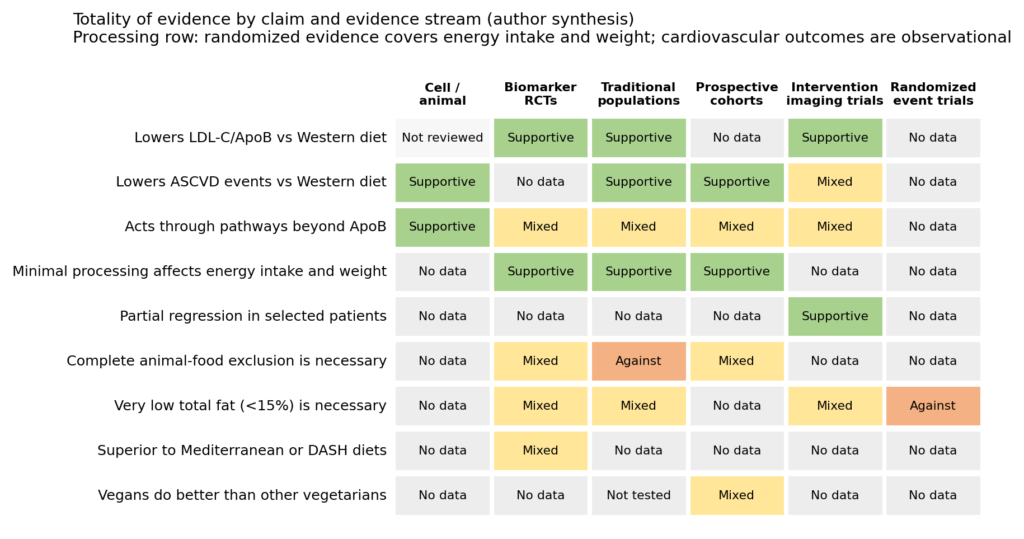
Figura 15. Totalidad de la evidencia por afirmación y flujo de evidencia. Síntesis del autor de las Secciones 3–17; “en contra” marca la evidencia que contradice la afirmación tal como se indica.
19. La afirmación más sólida que justifica la evidencia hoy en día
Una dieta basada en alimentos integrales de origen vegetal reduce de manera confiable las lipoproteínas aterogénicas en comparación con las dietas occidentales típicas, y las poblaciones con una ingesta baja de alimentos de origen animal de por vida tenían colesterol bajo y una baja mortalidad coronaria registrada. Los programas de estilo de vida intensivo basados en dietas vegetarianas muy bajas en grasas han producido una regresión angiográfica modesta, una mejor perfusión miocárdica, menos angina y menos procedimientos cardíacos que la atención habitual en estudios pequeños de pacientes seleccionados. En conjunto, esta evidencia hace creíble que tal dieta pueda ayudar a prevenir, retrasar y, en algunos pacientes, revertir parcialmente la aterosclerosis coronaria, en gran parte a través de una menor exposición acumulada a la ApoB. El beneficio se asocia de manera más consistente con el carácter de alimentos integrales de la dieta (procesamiento mínimo, alto contenido de fibra y abundantes verduras) en lugar de solo con la exclusión de alimentos de origen animal, y evidencia plausible pero no probada sugiere que parte de este beneficio actúa a través de vías más allá de la ApoB. La evidencia no establece que la exclusión de todos los alimentos de origen animal y casi toda la grasa añadida proteja mejor que una dieta mediterránea, DASH o basada en plantas con mayor contenido de grasas insaturadas bien implementada.
Una afirmación más sólida requeriría una comparación aleatorizada de esas dietas con la misma intensidad de apoyo y la misma terapia médica, con la ApoB medida en todo momento, imágenes de placa cuantitativas ciegas y, en última instancia, eventos clínicos adjudicados. Hasta que existan tales datos, la VLF-WFPB se presenta mejor como una opción respaldada por la evidencia dentro de la familia de dietas cardiosaludables predominantemente vegetales, notable por su potencia para reducir el c-LDL, en lugar de como un protocolo de reversión excepcionalmente eficaz.
Tabla 4. Tabla de evidencia. Nivel: 1 = ensayo aleatorizado con eventos clínicos; 2 = ensayo aleatorizado de resultados intermedios; 3 = cohorte prospectiva; 4 = comparación de población, estudio transversal o serie de casos (Sección 1.2). IC = intervalo de confianza del 95%.
| Estudio | Nivel | Diseño, n, duración | Dieta administrada / lograda | Terapia de base | Resultados y estimaciones de efectos | Limitaciones principales |
| Metaanálisis de Koch 2023 [22] | 2 | 30 ECA; ApoB de 6 ensayos | Vegetariano o vegano vs. omnívoro; el contenido de grasa varió | Variado; algunos con fármacos hipolipemiantes | CT −0.34 mmol/ L (IC −0.44 a −0.23); c-LDL −0.30 mmol/ L (−0.40 a −0.19) ≈ −11.6 mg/ dL; ApoB −12.92 mg/ dL (−22.63 a −3.20; I² = 71.7%, 6 ensayos); TG sin diferencias | Dietas y comparadores heterogéneos; ensayos cortos; sin eventos; no aísla el nivel de grasa; la estimación de ApoB se basa en 6 ensayos con heterogeneidad sustancial cuya independencia no pudo confirmarse aquí |
| Metaanálisis de Wang 2023 [7] | 2 | 20 ECA, 1,878; media 25.4 sem | Vegetariano, incluyendo Ornish y vegano bajo en grasa | La mayoría con fármacos cardiometabólicos | LDL-C −6.6 mg/dL (−10.1 to −3.1); HbA1c −0.24% (−0.40 to −0.07); weight −3.4 kg (−4.9 to −2.0); SBP −0.1 mm Hg (−2.8 to 2.6) | LDL-C NS vs active comparators; majority high risk of bias; Key Points text differs from results |
| Rees 2021 Cochrane [72] | 2 | 13 RCTs; ≥12 wk; search to Feb 2020 | Vegan only | — | No trial reported clinical events; one secondary-prevention trial (n = 63): no clear lipid or BP effect | Small trials; dated search; low certainty |
| Dybvik 2023 cohort meta-analysis [40] | 3 | 13 cohorts, 844,175 | Vegetarian or vegan vs non-vegetarian (self-report) | — | IHD RR 0.79 (0.71–0.88; 8 cohorts); CVD 0.85 (0.79–0.92); stroke 0.90 (0.77–1.05); vegan IHD 0.82 (0.68–1.00; 6) | Confusión residual (E-value 1.86); ~1/5 BMI-mediated; weaker excluding early follow-up; fat not assessed |
| EPIC-Oxford [41] | 3 | Cohort; 48,188; 18.1 y | Vegetarians including vegans vs meat eaters; vegans ~28% fat | — | IHD HR 0.78 (0.70–0.87), 0.90 (0.81–1.00) after risk-factor adjustment; total stroke HR 1.20 (1.02–1.40), mostly hemorrhagic; vegan IHD 0.82 (0.64–1.05), lacto-ovo 0.77 (0.69–0.86), fish eaters 0.87 (0.77–0.99) | Observational; self-reported diet and risk factors |
| AHS-2 [53] | 3 | Cohort; 73,308 Adventists; 5.79 y | Vegan, lacto-ovo, pesco-, semi-vegetarian vs non-vegetarian | — | Vegetarians: IHD death 0.81 (0.64–1.02); men 0.71 (0.51–1.00). By group: vegan 0.90 (0.60–1.33), lacto-ovo 0.82 (0.62–1.06), pesco 0.65 (0.43–0.97); vegan men 0.45 (0.21–0.94), vegan women 1.39 (0.87–2.24) | Short follow-up; healthy-user profile (Figure 9); few vegan deaths |
| Plant diet indices [17] | 3 | 3 cohorts; ~209,000; 8,631 CHD | Healthful vs unhealthful plant-based indices | — | CHD HR (extreme deciles): PDI 0.92 (0.83–1.01); hPDI 0.75 (0.68–0.83); uPDI 1.32 (1.20–1.46) | FFQ-based; health professionals; hPDI rewards oils and nuts |
| UK Biobank processing [18] | 3 | Cohort; 126,842; median 9 y | Plant-sourced foods split by ultra-processing | — | Per 10% energy: plant non-UPF CVD 0.93 (0.91–0.95), CVD death 0.87 (0.80–0.94); plant UPF CVD 1.05 (1.03–1.07), death 1.12 (1.05–1.20) | Observational; 24-h recalls; NOVA classification |
| Danish nitrate cohort [29] | 3 | Cohort; 53,150; up to 23 y; 14,088 CVD | Vegetable nitrate quintiles (median 23 vs 59 mg/day) | Adjusted for hypercholesterolemia | CVD HR 0.85 (0.82–0.89); IHD 0.88 (0.82–0.94); ischemic stroke 0.83 (0.76–0.91); PAD 0.74 (0.67–0.83); 21.9% mediated by SBP | Observational; plateau ~60 mg/day; nitrate mainly lettuce and potato |
| Key 1999 pooled cohorts [54] | 3 | 5 cohorts; 76,172; mean 10.6 y | Vegan, lacto-ovo, fish eaters, occasional meat vs regular meat eaters | — | IHD mortality: vegetarians 0.76 (0.62–0.94); vegans 26% lower, lacto-ovo and fish eaters 34% lower; benefit limited to diet >5 y and larger at younger ages | Mortality only; older cohorts; adjusted for age, sex, smoking only |
| AHS-2 2024 [55] | 3 | Cohort; 88,400; ~11 y | Five diet groups | — | Vegetarians lower IHD mortality; vegan diet not associated with all-cause mortality overall; vegan men lower mortality at younger ages | Hazard ratios vary with age; stroke and dementia higher in older vegetarians |
| AHS-2 protein [57] | 3 | Cohort; 81,337; 9.4 y; 2,276 CVD deaths | Protein-source factors | — | CVD mortality: meat factor 1.61 (98.75% CI 1.12–2.32); nuts and seeds factor 0.60 (0.42–0.86) | Factor analysis; FFQ; observational |
| Vegan diets review [56] | 3 | Systematic review; 7 studies; ≥7,661 vegans | Vegan vs non-vegan | — | No cohort showed significantly higher or lower primary CVD risk in vegans | Few vegans; low power |
| Tzu Chi cohorts [58] | 3 | 2 cohorts; 13,352; Taiwan | Buddhist vegetarians (mostly lacto-ovo) vs non-vegetarians | — | Ischemic stroke 0.26 (0.08–0.88) and 0.41 (0.19–0.88); hemorrhagic 0.34 (0.12–1.00) | Stroke only; healthy-user setting; few events |
| Xiamen lacto-vegetarians [59] | 4 | Cross-sectional; 169 vs 126 men | Chinese lacto-vegetarian vs omnivore | — | Lower BP, LDL-C, ApoB, TG, glucose; thinner carotid IMT | Single measurement; surrogate markers; dairy-eating |
| Hong Kong vegans (review) [60] | 4 (review) | Review of cross-sectional and supplementation studies | Vegans and vegetarians with low B12 | — | ~80% B12 deficiency in Hong Kong vegans; impaired FMD and thicker IMT with deficiency; improved with B12 | Surrogate outcomes; caution for unsupplemented vegan diets |
| Tsimane [35] | 4 | Cross-sectional; 705 adults 40–94; CT calcium | 14% fat, 14% protein, 72% carbohydrate; game and fish; unprocessed | Ninguno | CAC 0 in 85%, 1–100 in 13%, >100 in 3%; >75 y: 65% zero; LDL-C 91 mg/dL; ApoB 97 mg/dL | CAC misses noncalcified plaque; cross-sectional; 6–7 h/day activity (men) |
| China Study I [43] | 4 | Ecological; 65 counties, 130 villages; diet 1983–84; mortality 1973–75 | 14% fat; animal protein ~1% of energy; not vegan | Ninguno | Mean TC 127 vs 203 mg/dL (US); CAD mortality ages 0–64: 4.0 (men) and 3.4 (women) vs 66.8 and 18.9 per 100,000 (US) | Ecological; decade gap; ages truncated; ascertainment; activity and competing mortality |
| Okinawa (Willcox) [45, 47] | 4 | Ecological; 1949 survey; vital statistics | ~1,785 kcal/day; sweet potato ~69% of energy; fat ~6%; some pork and fish | Ninguno | Older cohorts reported ~80% lower CHD mortality than US | Post-war scarcity; energy restriction; body size; transition; no individual linkage |
| Esselstyn 1995/1999 [5, 42] | 4 | Case series; 22–24 enrolled; 11 imaged at ~5 y | ≤10% fat; skim milk, nonfat yogurt allowed | Cholestyramine + lovastatin most often | TC 246 → 132.4 mg/dL (LDL-C 71.6); % stenosis 53.4 → 46.2% (−7 points, CI 3.3–10.7); MLD +0.08 mm (−0.06 to 0.22), NS; regression in 8/11 patients by % stenosis | No control; 13 of 38 lesions excluded (4 graft-proximal lesions that progressed); attrition reported as 5 and as 11; drugs; regression to the mean |
| Esselstyn 2014 [4] | 4 | Cohort; 198 (177 adherent, 21 nonadherent); mean 44.2 mo | No animal foods, oil, nuts, avocado; fat not measured | Usual medications, not recorded | Adherent: 1 progression-related stroke per investigators (0.6%); 18/177 “worse” (10%); 0 cardiac deaths. Nonadherent: 13/21 (62%) with ≥1 event, 7 of 13 events revascularizations | Self-selected; self-reported adherence; no lipids; investigator adjudication; not randomized; 2.2% in supplementary table |
| Lifestyle Heart Trial [6, 63] | 2 (events: counts) | RCT (invitational), 48; 35 with 5-y QCA; 5 y | 10% fat vegetarian (nonfat dairy, egg white); achieved 6.2% (1 y), 8.5% (5 y); plus exercise, stress management, support | No lipid drugs (exp.); 60% of controls started them | 5-y (1998 report, n = 35): % diameter stenosis −3.07 (−5.91 to −0.24) vs +11.77 (3.40 to 20.14), P = .001; minimum lumen diameter essentially unchanged (+0.001 mm) vs −0.34 mm (P = .05); 1-y (1990 report, n = 48): 40.0% → 37.8% vs 42.7% → 46.1%, 82% of experimental patients toward regression; events 25 vs 45, rate ratio 2.47 (1.48–4.20); angina −91% at 1 y (within group) | Multicomponent; small; half of eligible declined; attrition; events = recurrent counts, mostly procedures; stenosis and lumen diameter are not plaque volume |
| Gould 1995 PET [61] | 2 | Same trial; 20 vs 15 | As above | As above | Perfusion abnormalities smaller/less severe vs worsening in controls | Not independent; functional endpoint |
| Multicenter Lifestyle Demonstration [64] | 4 | Nonrandomized; 194 vs 139 revascularized; 3 y | Programa Ornish | Not reported | 150/194 (77%) avoided revascularization; similar MI, stroke, death rates per patient-year | Self-selection; comparator is revascularized patients |
| STARS [66] | 2 | RCT; 90 men; 39 mo | Lipid-lowering diet, 27% fat (not vegan) ± cholestyramine | Cholestyramine in one arm | MAWS −0.201 (usual care), +0.003 (diet), +0.103 mm (diet + resin); progression 46%, 15%, 12% | Small; men only; not plant-exclusive |
| Heidelberg [62] | 2 | RCT; 113 men; 12 mo | Low-fat, low-cholesterol diet + intensive exercise | No lipid drugs | Progression 23% vs 48%; regression 32% vs 17% | Exercise co-intervention; lipid differences gone at 6 y |
| DISCO-CT [68] | 2 | RCT; 92; ~67 wk; CCTA | DASH-based counseling + activity + OMT vs OMT | OMT in both arms | Placa no calcificada −51.3 frente a −21.3 mm³ (P = .045); cambio total de ateroma sin diferencias significativas; seguimiento de ~6 años: MACE 1 frente a 4 [69] | Centro único; no exclusivo de origen vegetal; peso recuperado en gran medida; muy pocos eventos |
| EVADE CAD [9] | 2 | ECA; 100; 8 sem | Dieta vegana frente a AHA; mediana de grasa 29.9% frente a 30.2% de la energía a las 8 sem; se fomentaron aceites insaturados y aceite de oliva en recetas para ambas; se proporcionaron los alimentos | 94–96% estatinas | PCR-ultrasensible 32% menor (β 0.68, 0.49–0.94); c-LDL 13% menor (β 0.87, 0.78–0.97; no significativo con α de Bonferroni) | Breve; solo biomarcadores; no muy baja en grasas; se inscribió el 14% de quienes cumplían los criterios iniciales |
| Barnard 2021 cruzado [23] | 2 | ECA cruzado; 62 aleatorizados, 52 completaron; 16 sem por dieta | Vegana baja en grasa (alcanzado 17% de energía de la grasa; IC 95% 15–19) frente a mediterránea tipo PREDIMED | Estimación de lípidos en 43 sin cambios en fármacos hipolipemiantes; estimación de PA en 41 sin cambios antihipertensivos | Peso −6.0 kg (−7.5 a −4.5) y c-LDL −14.8 mg/dL (−23.5 a −6.2) a favor de la vegana; PAS +6.0 mm Hg (+1.0 a +10.9) a favor de la mediterránea | Breve; la pérdida de peso inducida por la dieta puede mediar los efectos, por lo que el efecto directo de la composición dietética no está aislado; patrocinio de grupo de presión; no es una dieta con 10–15% de grasa; efecto de arrastre significativo en la PAS en el análisis de todos los participantes pero no en el subgrupo con medicación estable; 1 participante reasignado tras la aleatorización para coincidir con un miembro del hogar |
| CARDIVEG [71] | 2 | ECA cruzado; 107 de bajo riesgo; 3 meses por dieta | Vegetariana lacto-ovo hipocalórica frente a mediterránea hipocalórica | Adultos de bajo riesgo | Pérdida de peso similar; c-LDL menor en la vegetariana; TG menores en la mediterránea; la B12 disminuyó en la vegetariana | Bajo riesgo; no vegana ni muy baja en grasa |
| Recipe for Heart Health [8] | 2 | ECA cruzado; 40; 4 sem por fase | Vegana WFPB con AOVE alto (48% grasa) frente a AOVE bajo (32% grasa) | No especificado | Ambas redujeron el c-LDL y la ApoB; c-LDL en el periodo 1 −25.5 frente a −16.7 mg/dL (P = .162); interacción de secuencia | Breve; efecto de arrastre; ninguna fase fue muy baja en grasa |
| Metaanálisis de Portfolio [15] | 2 | Ensayos controlados; 439 participantes | Frutos secos, proteína vegetal, fibra viscosa, esteroles añadidos a la dieta NCEP Paso II; el contenido de grasa varió entre los ensayos | Variado | c-LDL ~17% menor; ApoB y c-no-HDL también menores | Solo criterios de valoración lipídicos; incluye frutos secos (no bajos en grasa) |
| ECA sobre procesamiento [19] | 2 | Cruzado en pacientes hospitalizados; 20; 2 sem cada uno | Ultraprocesados frente a no procesados, equiparados en los nutrientes presentados | — | +508 ± 106 kcal/día con ultraprocesados; +0.9 frente a −0.9 kg | Breve; balance energético, no aterosclerosis |
| DASH [11] | 2 | ECA de alimentación; 459; 8 sem | Combinación DASH que incluye lácteos bajos en grasa | — | PA −5.5/−3.0 mm Hg; hipertensos −11.4/−5.5 | Solo criterio de valoración de PA |
| DASH-Sodio [16] | 2 | ECA de alimentación | DASH + bajo sodio frente a control alto en sodio | — | PAS −7.1 (normotensos), −11.5 mm Hg (hipertensión etapa 1) | Solo criterio de valoración de PA |
| PREDIMED 2018 [12] | 1 | ECA; 7,447 de alto riesgo; mediana 4.8 años | Mediterránea + AOVE o frutos secos frente a consejos para reducir la grasa | — | 96/2,543 frente a 83/2,454 frente a 109/2,450; HR 0.69 (0.53–0.91) AOVE; 0.72 (0.54–0.95) frutos secos | Informe de 2013 retractado por irregularidades en la aleatorización; el control se basó en consejos |
| Lyon Diet Heart [70] | 1 | ECA; 605 post-IAM; media 46 meses | Margarina rica en ALA suministrada en lugar de mantequilla y crema, además de consejos de tipo mediterráneo, frente a dieta occidental prudente | — | Muerte cardiaca/IAM 14 frente a 44; compuestos más amplios 27 frente a 90 y 95 frente a 180; RR ajustado 0.28–0.53 en todos los compuestos | Comparador débil; era de tratamiento más antigua |
| CORDIOPREV [10] | 1 | ECA; 1,002 con cardiopatía coronaria; mediana 7 años | Mediterránea (40.5% grasa) frente a omnívora baja en grasa (32.1% grasa) | Estatinas 86.6% | 87 (17.3%) frente a 111 (22.2%); HR 0.745 (0.563–0.986); hombres HR 0.669 (0.489–0.915); estimación en 175 mujeres no concluyente | Centro único; financiado por una fundación de aceite de oliva; el brazo bajo en grasa no fue VLF-WFPB |
| Hooper 2020 Cochrane [26] | 1 | 12 ECA en el análisis principal de eventos; 53,758 | Grasa saturada reducida | — | Eventos CV combinados RR 0.83 (0.70–0.98) | Evalúa la grasa saturada, no la grasa total ni la VLF-WFPB |
Tabla 5. Ventajas propuestas de VLF-WFPB: ¿compartidas con dietas comparadoras o evidencia de beneficio adicional?
| Ventaja propuesta | Evidencia principal | ¿Compartida con Mediterránea / DASH? | Evidencia de beneficio adicional para VLF-WFPB | Veredicto |
| Lower LDL-C and ApoB (very low saturated fat, no dietary cholesterol, fiber, plant protein) | Pooled RCTs vs omnivorous diets [22]; vegan vs Mediterranean crossover [23]; CARDIVEG [71]; Portfolio [15] | Partly: all lower saturated fat; Portfolio achieves ~17% LDL-C lowering with nuts; Mediterranean lowered LDL-C less in direct comparisons | Some plant-based interventions lower LDL-C and ApoB more than selected comparators over weeks to months; superiority of the specific 10–15%-fat protocol is unestablished | Supported (biomarker); unestablished for the specific protocol |
| Weight loss / low energy density | Wang [7]; Barnard [23]; Ornish [6] | Similar when both diets are energy-restricted [71] | Greater with ad libitum eating in short trials | Context-dependent |
| Lower blood pressure | Wang (null) [7]; DASH [11, 16]; Barnard [23] | Yes; DASH and Mediterranean equal or better | None shown | No additional benefit shown |
| Better control glucémico | Wang, type 2 diabetes subgroup [7] | Partly | Versus conventional diabetic diets, not versus Mediterranean | Supported but uncertain |
| Triglycerides and HDL-C | Ornish [6]; Koch [22]; CARDIVEG [71] | Mediterranean lowers TG more | Very-low-fat diets may raise triglycerides and lower HDL-C; an HDL-C decrease alone does not demonstrate cardiovascular harm [80], and triglycerides should be read alongside ApoB, non-HDL-C, and outcomes | Uncertain; possible disadvantage |
| Less inflammation (hs-CRP) | EVADE CAD [9] | Mediterranean also lowered inflammatory markers in CARDIVEG [71] | vs AHA diet at ~30% fat; not tested at very low fat | Biologically plausible |
| Better endothelial function | Single-meal studies [30, 81]; olive-oil meta-analysis [32]; CORDIOPREV substudy [33]; EVADE EndoPAT [9] | Yes: sustained olive-oil and Mediterranean diets improved FMD | None sustained for VLF-WFPB | Unsupported |
| Lower stroke risk | EPIC-Oxford [41]; Dybvik [40] | — | No: the higher stroke rate in EPIC-Oxford concerns its vegetarian grouping, not VLF-WFPB, which has not been tested for stroke | Not demonstrated either way |
| Clear food rules that aid adherence | Adherence data [4, 6, 9] | Any structured program | Behavioral hypothesis; strictness may help some and deter others | Hypothesis |
| Whole, minimally processed foods | Plant diet indices [17]; UK Biobank [18]; processing RCT [19] | Partly: DASH and Mediterranean are also minimally processed patterns | Strongest non-lipid lever; plant ultra-processed foods associated with higher risk | Supported but uncertain |
| Leafy-green nitrate → nitric oxide | Danish cohort [29] | Yes: any vegetable-rich pattern | Association persists after lipid adjustment; not vegan-specific | Plausible, partly supported |
| Fiber → butyrate | Mouse models [28] | Yes: any high-fiber pattern | Cholesterol-independent in mice; no human outcome data | Biologically plausible |
| Lower TMAO / favorable microbiome | Cohort association [37]; Mendelian randomization null [38] | Partly (fiber-rich patterns) | No outcome evidence; genetic evidence against a causal TMAO effect | Weak hypothesis |
| Exclusion of added oil | Recipe for Heart Health [8]; PREDIMED [12]; CORDIOPREV [10] | No: EVOO-rich diets reduced events vs comparators | Large oil additions may blunt LDL-C lowering; no event data | Unsupported as necessary |
| Exclusion of nuts and seeds | PREDIMED nut arm [12] | No: nut-supplemented diet reduced events | Ninguno | Unsupported |
| Angiographic slowing or regression | Lifestyle Heart [6]; STARS [66]; Heidelberg [62]; DISCO-CT [68] | Yes: lower-fat non-vegan and DASH-based programs also slowed progression | Package effect only; diet share unknown | Supported but uncertain |
| Complete exclusion of animal foods | AHS-2 [53]; EPIC-Oxford [41]; pooled cohorts [54]; vegan review [56]; AHS-2 protein [57] | No aplicable | None: vegans did not do better than lacto-ovo or pesco-vegetarians; nut and seed protein associated with lower CVD mortality | Unsupported |
Abbreviations: ApoB, apolipoprotein B; BP, blood pressure; CCTA, coronary CT angiography; CHD, coronary heart disease; EVOO, extra-virgin olive oil; IHD, ischemic heart disease; MAWS, mean absolute width of coronary segments; MLD, minimal lumen diameter; NS, not significant; OMT, optimal medical therapy; QCA, quantitative coronary angiography; RCT, ensayo controlado aleatorizado; TC, total cholesterol; TG, triglycerides; VLF-WFPB, very-low-fat whole-food plant-based.
Referencias
- Wang T, Masedunskas A, Willett WC, Fontana L. Vegetarian and vegan diets: benefits and drawbacks. Eur Heart J. 2023;44(36):3423–3439. doi:10.1093/eurheartj/ehad436.
- Freeman AM, Morris PB, Barnard N, et al. Trending cardiovascular nutrition controversies. J Am Coll Cardiol. 2017;69(9):1172–1187. doi:10.1016/j.jacc.2016.10.086. PMID 28254181.
- Kahleova H, Levin S, Barnard ND. Vegetarian dietary patterns and cardiovascular disease. Prog Cardiovasc Dis. 2018;61(1):54–61. doi:10.1016/j.pcad.2018.05.002. PMID 29800598.
- Esselstyn CB Jr, Gendy G, Doyle J, Golubic M, Roizen MF. A way to reverse CAD? J Fam Pract. 2014;63(7):356–364b. PMID 25198208.
- Esselstyn CB Jr. Updating a 12-year experience with arrest and reversal therapy for coronary heart disease (an overdue requiem for palliative cardiology). Am J Cardiol. 1999;84(3):339–341, A8. doi:10.1016/S0002-9149(99)00290-8. PMID 10496449.
- Ornish D, Scherwitz LW, Billings JH, et al. Intensive lifestyle changes for reversal of coronary heart disease. JAMA. 1998;280(23):2001–2007. doi:10.1001/jama.280.23.2001. PMID 9863851. Correction (author list): JAMA. 1999;281(15):1380.
- Wang T, Kroeger CM, Cassidy S, et al. Vegetarian dietary patterns and cardiometabolic risk in people with or at high risk of cardiovascular disease: a systematic review and meta-analysis. JAMA Netw Open. 2023;6(7):e2325658. doi:10.1001/jamanetworkopen.2023.25658. PMID 37490288.
- Krenek AM, Mathews A, Guo J, et al. Recipe for Heart Health: a randomized crossover trial on cardiometabolic effects of extra virgin olive oil within a whole-food plant-based vegan diet. J Am Heart Assoc. 2024;13(15):e035034. doi:10.1161/JAHA.124.035034. PMID 39045758.
- Shah B, Newman JD, Woolf K, et al. Anti-inflammatory effects of a vegan diet versus the American Heart Association–recommended diet in coronary artery disease trial. J Am Heart Assoc. 2018;7(23):e011367. doi:10.1161/JAHA.118.011367. PMID 30571591.
- Delgado-Lista J, Alcala-Diaz JF, Torres-Peña JD, et al. Long-term secondary prevention of cardiovascular disease with a Mediterranean diet and a low-fat diet (CORDIOPREV): a randomised controlled trial. Lancet. 2022;399(10338):1876–1885. doi:10.1016/S0140-6736(22)00122-2. PMID 35525255.
- Appel LJ, Moore TJ, Obarzanek E, et al. A clinical trial of the effects of dietary patterns on blood pressure. DASH Collaborative Research Group. N Engl J Med. 1997;336(16):1117–1124. doi:10.1056/NEJM199704173361601. PMID 9099655.
- Estruch R, Ros E, Salas-Salvadó J, et al. Primary prevention of cardiovascular disease with a Mediterranean diet supplemented with extra-virgin olive oil or nuts. N Engl J Med. 2018;378(25):e34. doi:10.1056/NEJMoa1800389. PMID 29897866. (Replaces the retracted 2013 report.)
- Kris-Etherton P, Eckel RH, Howard BV, St Jeor S, Bazzarre TL. AHA science advisory: Lyon Diet Heart Study. Benefits of a Mediterranean-style, National Cholesterol Education Program/American Heart Association Step I dietary pattern on cardiovascular disease. Circulation. 2001;103(13):1823–1825. doi:10.1161/01.CIR.103.13.1823.
- de Lorgeril M, Renaud S, Mamelle N, et al. Mediterranean alpha-linolenic acid-rich diet in secondary prevention of coronary heart disease. Lancet. 1994;343(8911):1454–1459. doi:10.1016/S0140-6736(94)92580-1.
- Chiavaroli L, Nishi SK, Khan TA, et al. Portfolio dietary pattern and cardiovascular disease: a systematic review and meta-analysis of controlled trials. Prog Cardiovasc Dis. 2018;61(1):43–53. doi:10.1016/j.pcad.2018.05.004. PMID 29807048.
- Sacks FM, Svetkey LP, Vollmer WM, et al. Effects on blood pressure of reduced dietary sodium and the Dietary Approaches to Stop Hypertension (DASH) diet. N Engl J Med. 2001;344(1):3–10. doi:10.1056/NEJM200101043440101. PMID 11136953.
- Satija A, Bhupathiraju SN, Spiegelman D, et al. Healthful and unhealthful plant-based diets and the risk of coronary heart disease in U.S. adults. J Am Coll Cardiol. 2017;70(4):411–422. doi:10.1016/j.jacc.2017.05.047. PMID 28728684.
- Rauber F, Louzada MLC, Chang K, et al. Implications of food ultra-processing on cardiovascular risk considering plant origin foods: an analysis of the UK Biobank cohort. Lancet Reg Health Eur. 2024;43:100948. doi:10.1016/j.lanepe.2024.100948. PMID 39210945.
- Hall KD, Ayuketah A, Brychta R, et al. Ultra-processed diets cause excess calorie intake and weight gain: an inpatient randomized controlled trial of ad libitum food intake. Cell Metab. 2019;30(1):67–77.e3. doi:10.1016/j.cmet.2019.05.008.
- Ference BA, Ginsberg HN, Graham I, et al. Low-density lipoproteins cause atherosclerotic cardiovascular disease. 1. Evidence from genetic, epidemiologic, and clinical studies. A consensus statement from the European Atherosclerosis Society Consensus Panel. Eur Heart J. 2017;38(32):2459–2472. doi:10.1093/eurheartj/ehx144. PMID 28444290.
- Cholesterol Treatment Trialists’ (CTT) Collaboration. Efficacy and safety of more intensive lowering of LDL cholesterol: a meta-analysis of data from 170 000 participants in 26 randomised trials. Lancet. 2010;376(9753):1670–1681. doi:10.1016/S0140-6736(10)61350-5. PMID 21067804.
- Koch CA, Kjeldsen EW, Frikke-Schmidt R. Vegetarian or vegan diets and blood lipids: a meta-analysis of randomized trials. Eur Heart J. 2023;44(28):2609–2622. doi:10.1093/eurheartj/ehad211. PMID 37226630.
- Barnard ND, Alwarith J, Rembert E, et al. A Mediterranean diet and low-fat vegan diet to improve body weight and cardiometabolic risk factors: a randomized, cross-over trial. J Am Nutr Assoc. 2022;41(2):127–139. doi:10.1080/07315724.2020.1869625. PMID 33544066.
- McMurry MP, Connor WE, Cerqueira MT. Dietary cholesterol and the plasma lipids and lipoproteins in the Tarahumara Indians: a people habituated to a low cholesterol diet after weaning. Am J Clin Nutr. 1982;35(4):741–744. doi:10.1093/ajcn/35.4.741.
- Lichtenstein AH, Khera A, Anderson CAM, et al. 2026 dietary guidance to improve cardiovascular health: a scientific statement from the American Heart Association. Circulation. Published online 31 March 2026. doi:10.1161/CIR.0000000000001435.
- Hooper L, Martin N, Jimoh OF, Kirk C, Foster E, Abdelhamid AS. Reduction in saturated fat intake for cardiovascular disease. Cochrane Database Syst Rev. 2020;(8):CD011737. doi:10.1002/14651858.CD011737.pub3. (Version of record superseding the May 2020 issue, PMID 32428300.)
- Blumenthal RS, Morris PB, Gaudino M, et al. 2026 ACC/AHA/AACVPR/ABC/ACPM/ADA/AGS/APhA/ASPC/NLA/PCNA guideline on the management of dyslipidemia: a report of the American College of Cardiology/American Heart Association Joint Committee on Clinical Practice Guidelines. Circulation. 2026. doi:10.1161/CIR.0000000000001423. Also J Am Coll Cardiol. doi:10.1016/j.jacc.2025.11.016.
- Kasahara K, Krautkramer KA, Org E, et al. Interactions between Roseburia intestinalis and diet modulate atherogenesis in a murine model. Nat Microbiol. 2018;3(12):1461–1471. doi:10.1038/s41564-018-0272-x.
- Bondonno CP, Dalgaard F, Blekkenhorst LC, et al. Vegetable nitrate intake, blood pressure and incident cardiovascular disease: Danish Diet, Cancer, and Health Study. Eur J Epidemiol. 2021;36(8):813–825. doi:10.1007/s10654-021-00747-3.
- Vogel RA, Corretti MC, Plotnick GD. Effect of a single high-fat meal on endothelial function in healthy subjects. Am J Cardiol. 1997;79(3):350–354. doi:10.1016/S0002-9149(96)00760-6. PMID 9036757.
- Vogel RA, Corretti MC, Plotnick GD. The postprandial effect of components of the Mediterranean diet on endothelial function. J Am Coll Cardiol. 2000;36(5):1455–1460. doi:10.1016/S0735-1097(00)00896-2. PMID 11079642.
- Schwingshackl L, Christoph M, Hoffmann G. Effects of olive oil on markers of inflammation and endothelial function—a systematic review and meta-analysis. Nutrients. 2015;7(9):7651–7675. doi:10.3390/nu7095356. PMID 26378571.
- Yubero-Serrano EM, Fernandez-Gandara C, Garcia-Rios A, et al. Mediterranean diet and endothelial function in patients with coronary heart disease: an analysis of the CORDIOPREV randomized controlled trial. PLoS Med. 2020;17(9):e1003282. doi:10.1371/journal.pmed.1003282. PMID 32903262.
- Christ A, Günther P, Lauterbach MAR, et al. Western diet triggers NLRP3-dependent innate immune reprogramming. Cell. 2018;172(1-2):162–175.e14. doi:10.1016/j.cell.2017.12.013. PMID 29328911.
- Kaplan H, Thompson RC, Trumble BC, et al. Coronary atherosclerosis in indigenous South American Tsimane: a cross-sectional cohort study. Lancet. 2017;389(10080):1730–1739. doi:10.1016/S0140-6736(17)30752-3. PMID 28320601.
- Koeth RA, Wang Z, Levison BS, et al. Intestinal microbiota metabolism of L-carnitine, a nutrient in red meat, promotes atherosclerosis. Nat Med. 2013;19(5):576–585. doi:10.1038/nm.3145. PMID 23563705.
- Tang WHW, Wang Z, Levison BS, et al. Intestinal microbial metabolism of phosphatidylcholine and cardiovascular risk. N Engl J Med. 2013;368(17):1575–1584. doi:10.1056/NEJMoa1109400. PMID 23614584.
- Jia J, Dou P, Gao M, et al. Assessment of causal direction between gut microbiota-dependent metabolites and cardiometabolic health: a bidirectional Mendelian randomization analysis. Diabetes. 2019;68(9):1747–1755. doi:10.2337/db19-0153.
- Watts GF, Jackson P, Mandalia S, et al. Nutrient intake and progression of coronary artery disease. Am J Cardiol. 1994;73(5):328–332. PMID 8109545.
- Dybvik JS, Svendsen M, Aune D. Vegetarian and vegan diets and the risk of cardiovascular disease, ischemic heart disease and stroke: a systematic review and meta-analysis of prospective cohort studies. Eur J Nutr. 2023;62(1):51–69. doi:10.1007/s00394-022-02942-8. PMID 36030329.
- Tong TYN, Appleby PN, Bradbury KE, et al. Risks of ischaemic heart disease and stroke in meat eaters, fish eaters, and vegetarians over 18 years of follow-up: results from the prospective EPIC-Oxford study. BMJ. 2019;366:l4897. doi:10.1136/bmj.l4897. PMID 31484644.
- Esselstyn CB Jr, Ellis SG, Medendorp SV, Crowe TD. A strategy to arrest and reverse coronary artery disease: a 5-year longitudinal study of a single physician’s practice. J Fam Pract. 1995;41(6):560–568. PMID 7500065.
- Campbell TC, Parpia B, Chen J. Diet, lifestyle, and the etiology of coronary artery disease: the Cornell China study. Am J Cardiol. 1998;82(10B):18T–21T. doi:10.1016/S0002-9149(98)00718-8. PMID 9860369.
- Connor WE, Cerqueira MT, Connor RW, Wallace RB, Malinow MR, Casdorph HR. The plasma lipids, lipoproteins, and diet of the Tarahumara Indians of Mexico. Am J Clin Nutr. 1978;31(7):1131–1142. doi:10.1093/ajcn/31.7.1131. PMID 665563.
- Willcox BJ, Willcox DC, Todoriki H, et al. Caloric restriction, the traditional Okinawan diet, and healthy aging: the diet of the world’s longest-lived people and its potential impact on morbidity and life span. Ann N Y Acad Sci. 2007;1114:434–455. doi:10.1196/annals.1396.037. PMID 17986602.
- Willcox DC, Willcox BJ, Todoriki H, Suzuki M. The Okinawan diet: health implications of a low-calorie, nutrient-dense, antioxidant-rich dietary pattern low in glycemic load. J Am Coll Nutr. 2009;28(Suppl):500S–516S. doi:10.1080/07315724.2009.10718117. PMID 20234038.
- Willcox BJ, Willcox DC. Caloric restriction, caloric restriction mimetics, and healthy aging in Okinawa: controversies and clinical implications. Curr Opin Clin Nutr Metab Care. 2014;17(1):51–58. doi:10.1097/MCO.0000000000000019. PMID 24316687.
- Gavrilova NS, Gavrilov LA. Comments on dietary restriction, Okinawa diet and longevity. Gerontology. 2012;58(3):221–223. doi:10.1159/000329894. PMID 21893946.
- Lindeberg S, Lundh B. Apparent absence of stroke and ischaemic heart disease in a traditional Melanesian island: a clinical study in Kitava. J Intern Med. 1993;233(3):269–275. doi:10.1111/j.1365-2796.1993.tb00986.x. PMID 8450295.
- Lindeberg S, Nilsson-Ehle P, Terént A, Vessby B, Scherstén B. Cardiovascular risk factors in a Melanesian population apparently free from stroke and ischaemic heart disease: the Kitava study. J Intern Med. 1994;236(3):331–340.
- Lindeberg S, Nilsson-Ehle P, Vessby B. Lipoprotein composition and serum cholesterol ester fatty acids in nonwesternized Melanesians. Lipids. 1996;31(2):153–158. doi:10.1007/BF02522614. PMID 8835402.
- Kwok CS, Umar S, Myint PK, Mamas MA, Loke YK. Vegetarian diet, Seventh Day Adventists and risk of cardiovascular mortality: a systematic review and meta-analysis. Int J Cardiol. 2014;176(3):680–686. doi:10.1016/j.ijcard.2014.07.080.
- Orlich MJ, Singh PN, Sabaté J, et al. Vegetarian dietary patterns and mortality in Adventist Health Study 2. JAMA Intern Med. 2013;173(13):1230–1238. doi:10.1001/jamainternmed.2013.6473. PMID 23836264.
- Key TJ, Fraser GE, Thorogood M, et al. Mortality in vegetarians and nonvegetarians: detailed findings from a collaborative analysis of 5 prospective studies. Am J Clin Nutr. 1999;70(3 Suppl):516S–524S. doi:10.1093/ajcn/70.3.516s. PMID 10479225.
- Abris GP, Shavlik DJ, Mathew RO, et al. Cause-specific and all-cause mortalities in vegetarian compared with those in nonvegetarian participants from the Adventist Health Study-2 cohort. Am J Clin Nutr. 2024;120(4):907–917. doi:10.1016/j.ajcnut.2024.07.028. PMID 39098708.
- Kaiser J, van Daalen KR, Thayyil A, Cocco MTARR, Caputo D, Oliver-Williams C. A systematic review of the association between vegan diets and risk of cardiovascular disease. J Nutr. 2021;151(6):1539–1552. doi:10.1093/jn/nxab037. PMID 33831953.
- Tharrey M, Mariotti F, Mashchak A, Barbillon P, Delattre M, Fraser GE. Patterns of plant and animal protein intake are strongly associated with cardiovascular mortality: the Adventist Health Study-2 cohort. Int J Epidemiol. 2018;47(5):1603–1612. doi:10.1093/ije/dyy030. PMID 29618018.
- Chiu THT, Chang HR, Wang LY, Chang CC, Lin MN, Lin CL. Vegetarian diet and incidence of total, ischemic, and hemorrhagic stroke in 2 cohorts in Taiwan. Neurology. 2020;94(11):e1112–e1121. doi:10.1212/WNL.0000000000009093. PMID 32102976.
- Yang SY, Li XJ, Zhang W, et al. Chinese lacto-vegetarian diet exerts favorable effects on metabolic parameters, intima-media thickness, and cardiovascular risks in healthy men. Nutr Clin Pract. 2012;27(3):392–398. doi:10.1177/0884533611436173. PMID 22412169.
- Woo KS, Kwok TCY, Celermajer DS. Vegan diet, subnormal vitamin B-12 status and cardiovascular health. Nutrients. 2014;6(8):3259–3273. doi:10.3390/nu6083259. PMID 25195560.
- Gould KL, Ornish D, Scherwitz L, et al. Changes in myocardial perfusion abnormalities by positron emission tomography after long-term, intense risk factor modification. JAMA. 1995;274(11):894–901. doi:10.1001/jama.1995.03530110056036. PMID 7674504.
- Schuler G, Hambrecht R, Schlierf G, et al. Regular physical exercise and low-fat diet: effects on progression of coronary artery disease. Circulation. 1992;86(1):1–11. doi:10.1161/01.cir.86.1.1. PMID 1617762.
- Ornish D, Brown SE, Scherwitz LW, et al. Can lifestyle changes reverse coronary heart disease? The Lifestyle Heart Trial. Lancet. 1990;336(8708):129–133. doi:10.1016/0140-6736(90)91656-U. PMID 1973470.
- Ornish D. Avoiding revascularization with lifestyle changes: the Multicenter Lifestyle Demonstration Project. Am J Cardiol. 1998;82(10B):72T–76T. doi:10.1016/S0002-9149(98)00744-9. PMID 9860380.
- Silberman A, Banthia R, Estay IS, et al. The effectiveness and efficacy of an intensive cardiac rehabilitation program in 24 sites. Am J Health Promot. 2010;24(4):260–266. (Cited only as the second source of an untraced statement in ref. 2.)
- Watts GF, Lewis B, Brunt JN, et al. Effects on coronary artery disease of lipid-lowering diet, or diet plus cholestyramine, in the St Thomas’ Atherosclerosis Regression Study (STARS). Lancet. 1992;339(8793):563–569. doi:10.1016/0140-6736(92)90863-X. PMID 1347091.
- Niebauer J, Hambrecht R, Velich T, et al. Attenuated progression of coronary artery disease after 6 years of multifactorial risk intervention: role of physical exercise. Circulation. 1997;96(8):2534–2541. PMID 9355890.
- Henzel J, Kępka C, Kruk M, et al. High-risk coronary plaque regression after intensive lifestyle intervention in nonobstructive coronary disease: a randomized study. JACC Cardiovasc Imaging. 2021;14(6):1192–1202. doi:10.1016/j.jcmg.2020.10.019. PMID 33341413.
- Makarewicz-Wujec M, Henzel J, Kępka C, et al. Long-term outcomes of the Dietary Approaches to Stop Hypertension (DASH) intervention in nonobstructive coronary artery disease: follow-up of the DISCO-CT study. Nutrients. 2025;17(15):2565. doi:10.3390/nu17152565.
- de Lorgeril M, Salen P, Martin JL, Monjaud I, Delaye J, Mamelle N. Mediterranean diet, traditional risk factors, and the rate of cardiovascular complications after myocardial infarction: final report of the Lyon Diet Heart Study. Circulation. 1999;99(6):779–785. doi:10.1161/01.CIR.99.6.779. PMID 9989963.
- Sofi F, Dinu M, Pagliai G, et al. Low-calorie vegetarian versus Mediterranean diets for reducing body weight and improving cardiovascular risk profile: CARDIVEG Study (Cardiovascular Prevention With Vegetarian Diet). Circulation. 2018;137(11):1103–1113. doi:10.1161/CIRCULATIONAHA.117.030088. PMID 29483085.
- Rees K, Al-Khudairy L, Takeda A, Stranges S. Vegan dietary pattern for the primary and secondary prevention of cardiovascular diseases. Cochrane Database Syst Rev. 2021;2(2):CD013501. doi:10.1002/14651858.CD013501.pub2. PMID 33629376.
- Virani SS, Newby LK, Arnold SV, et al. 2023 AHA/ACC/ACCP/ASPC/NLA/PCNA guideline for the management of patients with chronic coronary disease. Circulation. 2023;148(9):e9–e119. doi:10.1161/CIR.0000000000001168.
- Dawson LP, Lum M, Nerleker N, Nicholls SJ, Layland J. Coronary atherosclerotic plaque regression: JACC state-of-the-art review. J Am Coll Cardiol. 2022;79(1):66–82. doi:10.1016/j.jacc.2021.10.035. PMID 34991791.
- Armstrong ML, Megan MB. Lipid depletion in atheromatous coronary arteries in rhesus monkeys after regression diets. Circ Res. 1972;30(6):675–680. doi:10.1161/01.res.30.6.675.
- Armstrong ML, Megan MB. Arterial fibrous proteins in cynomolgus monkeys after atherogenic and regression diets. Circ Res. 1975;36(2):256–261. doi:10.1161/01.res.36.2.256.
- Clarkson TB, Bond MG, Bullock BC, Marzetta CA. A study of atherosclerosis regression in Macaca mulatta. IV. Changes in coronary arteries from animals with atherosclerosis induced for 19 months and then regressed for 24 or 48 months at plasma cholesterol concentrations of 300 or 200 mg/dl. Exp Mol Pathol. 1981;34(3):345–368. doi:10.1016/0014-4800(81)90052-6.
- Nicholls SJ, Puri R, Anderson T, et al. Effect of evolocumab on progression of coronary disease in statin-treated patients: the GLAGOV randomized clinical trial. JAMA. 2016;316(22):2373–2384. doi:10.1001/jama.2016.16951. PMID 27846344.
- Melina V, Craig W, Levin S. Position of the Academy of Nutrition and Dietetics: vegetarian diets. J Acad Nutr Diet. 2016;116(12):1970–1980. doi:10.1016/j.jand.2016.09.025. PMID 27886704.
- Voight BF, Peloso GM, Orho-Melander M, et al. Plasma HDL cholesterol and risk of myocardial infarction: a Mendelian randomisation study. Lancet. 2012;380(9841):572–580. doi:10.1016/S0140-6736(12)60312-2. PMID 22607825.
- Vogel RA. The Mediterranean diet and endothelial function: why some dietary fats may be healthy. Cleve Clin J Med. 2000;67(4):232–236. (Reports the Vogel group’s postprandial olive-oil, vitamin, and vinegar-salad experiments.)