The Detailed Scientific Review
The remainder of this article examines the underlying evidence in technical detail, section by section, with effect sizes, intervalos de confianza, study designs, and full citations. It is written for readers who want to evaluate the primary literature rather than accept a summary of it. Where evidence is contested, weak, or absent, that is stated explicitly.
1. Normal Sleep Across the Lifespan
The foundational quantitative reference is the metaanálisis by Ohayon and colleagues [1], pooling 65 studies with 3,577 healthy participants aged 5–102 years. Key findings in adults:
- Total sleep time, sleep efficiency, slow-wave sleep (SWS), REM percentage, and REM latency all decrease with age, while sleep latency, stage 1, stage 2, and wake after sleep onset (WASO) aumentar.
- Crucially, most of these changes occur between young adulthood and about age 60; among healthy older adults, most parameters plateau. Slow-wave sleep declines earliest and most steeply, beginning in the 20s–30s.
- Sleep efficiency continues to decline into old age, while SWS in samples restricted to the elderly shows little further change [1,2].
Age-associated patterns by domain: advanced sleep timing (earlier chronotype), shortened nocturnal sleep, more daytime napping, more nocturnal awakenings, reduced SWS, blunted circadian amplitude, earlier melatonin secretion, and reduced homeostatic sleep pressure. The circadian and homeostatic systems both weaken with age [2].
Approximate trajectory by age band: childhood (high total sleep time and SWS); adolescence (falling SWS, delayed chronotype, curtailed school-night sleep); 20–30 (SWS already declining, sleep still efficient); 30–40 and 40–50 (progressive SWS loss, rising WASO/latency); 50–60 (continued fragmentation, advancing timing, menopausal effects in women); 60–70 (most parameters near a plateau in healthy people, increased napping); 70–80 and >80 (further efficiency decline and fragmentation, heavily driven by comorbidity).
Normal physiology vs. treatable pathology: Reduced SWS, earlier timing, and modestly increased WASO are largely normal aging. In contrast, severe fragmentation, chronic insomnia disorder, significant daytime dysfunction, and sleep-disordered breathing are pathology and should be evaluated. Much of what is attributed to “aging” is actually attributable to comorbidities that accumulate with age — nocturia, pain, medications, depression/anxiety, menopausia, prostate disease, cardiopulmonary disease, neurodegeneration, and OSA.
2. Why Sleep Changes With Age
Mechanisms with human experimental support: reduced slow-wave activity and cortical synchronization; degeneration/functional decline of the suprachiasmatic nucleus with reduced circadian amplitude; altered (advanced, reduced-amplitude) melatonin secretion; and reduced homeostatic sleep pressure buildup [2]. Mechanisms more inferential or reliant on animal/mechanistic data: orexin/hypocretin signaling changes, specific adenosinergic alterations, and detailed thermoregulatory contributions. Secondary contributors that are clearly established but not “aging per se”: nocturia, chronic pain, medication effects, depression/anxiety, menopausal vasomotor symptoms, increasing upper-airway collapsibility, and rising OSA prevalence.
3. Sleep Duration and Cardiovascular Risk
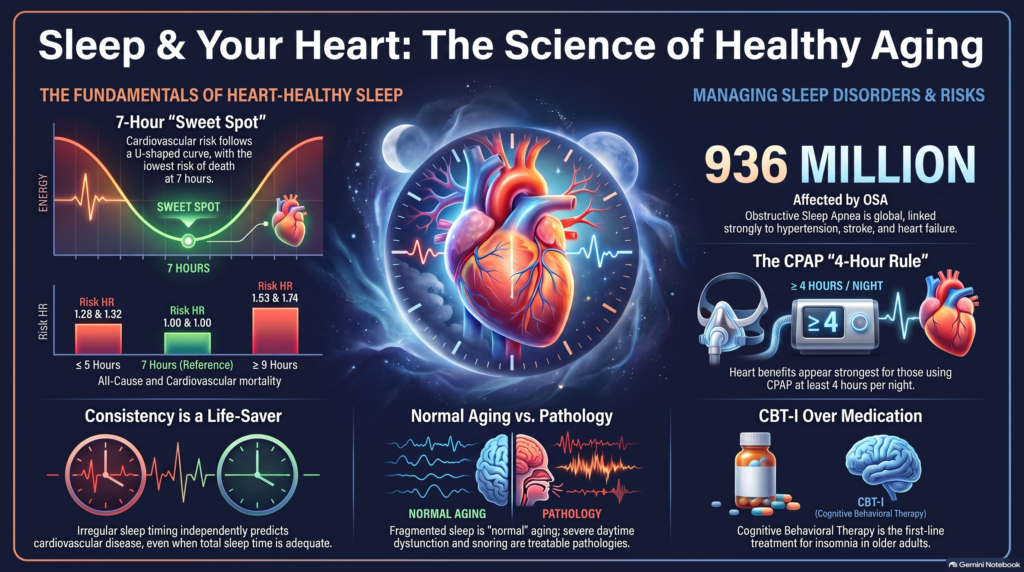
Multiple large dosis-respuesta meta-analyses converge on a U-shaped (or J-shaped) relationship with a nadir near 7 hours:
- Yin et al. [3]: U-shaped associations for mortalidad por todas las causas, total CVD, CHD, and derrame cerebral, with the lowest observed risk near 7 h. For all-cause mortality, each hour below 7 h was associated with a pooled RR of 1.06 (95% CI 1.04–1.07), and each hour above 7 h with a pooled RR of 1.13 (95% CI 1.11–1.15).
- Kwok et al. [4]: 74 studies, >3 million participants; J-shaped relationship. Self-reported sleep >8 h associated with progressively higher mortality (RR 1.14 at 9 h, 1.30 at 10 h, 1.47 at 11 h); <7 h showed weaker associations. Long sleep more strongly associated with adverse outcomes than short sleep.
By duration band (approximate, from a representative long-term cohort [5]): using 7 h reference, all-cause mortality HRs were 1.28 (≤5 h), 1.10 (6 h), 1.21 (8 h), 1.53 (≥9 h); cardiovascular mortality HRs 1.32 (≤5 h), 1.22 (6 h), 1.29 (8 h), 1.74 (≥9 h). The mortality nadir fell at ~7.3 h (all-cause) and ~7.0 h (cardiovascular).
Interpretación: Short sleep is biologically plausible as harmful (via sympathetic activation, presión arterial, and metabolic dysregulation). For long sleep, causality is uncertain; causalidad inversa y confusor by occult illness, inflamación, depression, or low fitness probably explain a substantial part of the association. These observational data do not by themselves establish causality.
4. Sleep Quality, Fragmentation, Regularity and ASCVD
- Sleep regularity is a robust, relatively novel observational predictor. Cribb et al. [6] analyzed 88,975 UK Biobank participants (mean age 62) with an accelerometry-derived Sleep Regularity Index (SRI). Compared with the median SRI, the all-cause mortality HR was 1.53 (95% CI 1.41–1.66) at the 5th percentile (most irregular) and 0.90 (0.81–1.00) at the 95th percentile. Irregularity also predicted cardiovascular and cancer mortality after multivariable adjustment. Residual confounding remains possible, and no trial has shown that increasing regularity prevents events.
- Excessive daytime sleepiness (EDS) predicts modestly higher CVD risk: Wang et al. [7] (17 studies, 153,909 participants) found EDS consistently associated with total CVD events, CHD, stroke, and mortality, with a modest association (RR range ~1.23–1.52; pooled total CVD RR 1.28, 95% CI 1.09–1.50).
- Objective actigraphy/PSG metrics (fragmentation, low efficiency) predict outcomes, often independently of conventional factores de riesgo, though effect sizes are modest and confounding is difficult to exclude. In MESA, 1,992 participants free of enfermedad cardiovascular underwent 7-day actigraphy and were followed for a median of 4.9 years; greater night-to-night variability in sleep duration and in sleep-onset timing was each associated with higher incident cardiovascular disease independently of conventional risk factors and mean sleep duration [8].
5. Obstructive Sleep Apnea and Cardiovascular Disease
Definitions/metrics: AHI (apneas+hypopneas/hour); respiratory disturbance index (adds RERAs); oxygen desaturation index (ODI); hypoxic burden (area under the desaturation curve — depth × duration × frequency); T90 (time SpO₂ <90%); arousal burden; positional and REM-dependent OSA.
Prevalence: Benjafield et al. [9] estimated that 936 million (95% CI 903–970) adults aged 30–69 have mild-to-severe OSA (AHI ≥5) and 425 million (399–450) have moderate-to-severe OSA (AHI ≥15) globally, with burden highest in China, then the USA, Brazil, and India. (Note: this study was sponsored by ResMed, a CPAP manufacturer.)
AHI vs. hypoxic burden: In the Sleep Heart Health Study and MrOS, Azarbarzin et al. [10] found that the event-related hypoxic-burden formulation was associated with cardiovascular mortality independently of AHI, while AHI was not consistently associated with that outcome. Across several cohorts, event-related hypoxic burden has been more consistently associated with cardiovascular outcomes than AHI; this is not the same as demonstrated incremental predictive superiority, and algorithms and thresholds are not standardized. In the RICCADSA cohort [11], high hypoxic burden predicted MACCE (adjusted HR 1.87, 95% CI 1.17–2.98), whereas AHI ≥30 was not significant (P = 0.366). These findings support further study of physiologic dose-based metrics; hypoxic burden is not yet a universally standardized diagnostic or treatment threshold.
Cardiovascular associations (observational):
- Enfermedad coronaria/insuficiencia cardíaca: In the Sleep Heart Health Study (1,927 men and 2,495 women; median follow-up 8.7 years), men aged 40–70 with AHI ≥30 had 68% higher incident CHD risk than men with AHI <5 [12]. In men, each 10-unit increase in AHI was associated with incident heart failure (adjusted HR 1.13, 95% CI 1.02–1.26), and AHI ≥30 with 58% higher heart-failure risk. Associations were weaker or absent in women and in men older than 70.
- Stroke: meta-analysis [13] OSA-stroke OR 2.24 (1.57–3.19), stronger in men (OR 2.87, 1.91–4.31).
- Hipertensión, resistant hypertension, fibrilación auricular, muerte súbita cardíaca, and cardiovascular mortality: each has been associated with OSA across multiple cohorts, though the strength and consistency of the evidence vary by outcome and are greatest for hypertension. Even for hypertension the causal calificación is Moderate rather than established: the cohort dose response and the blood-pressure response to CPAP are consistent, but the Mendelian-randomization association did not persist under full multivariable adjustment (§21).
Effect modification: Risk is generally greater with severe rather than mild OSA and with high hypoxic burden, and the absence of sleepiness does not necessarily imply low risk. In a post-hoc analysis of an ACS cohort [14], OSA was associated with MACCE in participants sin excessive daytime sleepiness (HR 1.42, 95% CI 1.01–2.02) but not in those with EDS (HR 1.05, 95% CI 0.67–1.66). This subgroup finding is hypothesis-generating, not a basis by itself for treatment selection. Associations have been more consistent in middle-aged men than in women or adults older than 70.
6. How OSA Could Promote Atherosclerosis
Biologically plausible, human-supported intermediate pathways: intermittent hypoxia → estrés oxidativo and sympathetic activation; surges in nocturnal blood pressure; disfunción endotelial; systemic inflammation (including inflamasoma NLRP3 pathways, largely mechanistic); resistencia a la insulina y dislipidemia; platelet activation and hypercoagulability; increased rigidez arterial; and circadian disruption [15]. Large negative intrathoracic pressure swings impose mechanical stress on the heart and great vessels.
Critical caveat: Biological plausibility and improvement in intermediate biomarcadores do NOT equal demonstrated reduction in clinical ASCVD events with treatment (see §7).
7. CPAP/APAP and Cardiovascular Risk — Rigorous Review
The three landmark RCTs:
| Prueba | Población | N | OSA severity | Baseline CVD | Mean CPAP adherencia | Follow-up | Primary CV endpoint result |
| SAVE [16] | Ages 45–75, moderate-severe OSA + established CAD/enfermedad cerebrovascular | 2,717 | Moderate-severe | Sí (prevención secundaria) | 3.3 h/night | 3.7 y | No significant difference: HR 1.10 (95% CI 0.91–1.32) |
| RICCADSA [17] | CAD + nonsleepy OSA (AHI ≥15, ESS <10) | 244 | Moderate-severe | Sí | ~2.8–3 h/night | ~4.7 y | No significant difference in ITT analysis |
| ISAACC [18] | Acute coronary syndrome + OSA | ~1,264 | Moderate-severe | Sí | ~2.8 h/night | ~3.4 y | No significant difference |
Answer to the central question: By intention-to-treat, these trials did not demonstrate a reduction in eventos cardiovasculares adversos mayores with CPAP. This is the most defensible reading of the highest-quality randomized evidence and is more precise than claiming that CPAP has been proven to have no effect under conditions of greater adherence or in different phenotypes.
Adherence-based analyses tell a more optimistic but weaker story:
- Sánchez-de-la-Torre et al. [19] pooled individual participant data from SAVE, RICCADSA, and ISAACC (4,186 patients; mean age 61.2 y; mean AHI 31.2; 71% hypertensive; mean adherence 3.1 h/day). First MACCE HR was 1.01 (0.87–1.17) overall, but an on-treatment marginal structural model mostró good adherence (≥4 h/night) associated with reduced MACCE (HR 0.69, 95% CI 0.52–0.92).
- RICCADSA on-treatment [17]: over a median 57 months, the intention-to-treat primary endpoint did not differ (18.1% vs. 22.1%; HR 0.80, 95% CI 0.46–1.41), while adjusted on-treatment analysis showed CPAP ≥4 h/night vs. <4 h or untreated at HR 0.29 (0.10–0.86, P = 0.026).
- SAVE propensity-matched adherent subgroup [16]: reduced cerebral events (HR 0.52, 0.30–0.90), not adjusted for multiple testing.
A later analysis of the revascularized acute coronary syndrome subgroup of RICCADSA (n = 353, of whom 171 with nonsleepy OSA were randomized to CPAP or no CPAP) was reported separately [20].
The interpretive problem — healthy-adherer bias: Patients who adhere to any therapy (including placebo) tend to have better outcomes for reasons unrelated to the treatment. On-treatment analyses cannot fully eliminate this. Therefore the ≥4 h benefit is hypothesis-generating, not confirmatory.
Could trials underestimate benefit? Plausibly yes: mean adherence was only ~3 h/night, patients with severe daytime sleepiness or severe desaturation were often excluded, and CPAP was typically used for only part of the night; when the device is removed early, REM-rich late-night sleep, during which apneas may cluster, is left untreated. Large cardiovascular-outcome trials achieving average use of ≥6 h/night are lacking.
Were these trials able to detect the effect they were testing? This question is separate from whether an effect exists. The blood-pressure pathway gives a tractable estimate: the individual-participant-data meta-analysis in §8 puts CPAP’s systolic effect at about −2.6 mmHg in patients with uncontrolled baseline pressure [21], and pooled randomized evidence indicates that a 5 mmHg systolic reduction lowers major cardiovascular events by roughly 10%, irrespective of baseline pressure or prior cardiovascular disease [22]. If one assumes a roughly log-linear blood-pressure–risk relationship and transportability from pharmacologic blood-pressure lowering, a 2.6-mmHg decrease would correspond to approximately a 5% relative event reduction; this is a model-based estimate, not a CPAP trial result. SAVE, with 2,717 participants and event rates of roughly 17% over 3.7 years, was powered to detect a considerably larger effect; the pooled IPD confidence interval (HR 1.01, 0.87–1.17) likewise excludes benefit greater than about 13% but not a small one. The neutral results are therefore compatible with a real but modest benefit that these trials could not have resolved, and this consideration should be weighed alongside — not instead of — the adherence and phenotype arguments above.
Newer risk-stratified analysis: An exploratory pooled analysis published online in 2025 and in print in 2026 [23] classified participants as higher risk using an OSA-related heart-rate response >9.4 beats/min or hypoxic burden >87.1 %min/h. The CPAP association differed by phenotype (interaction HR 0.69, 95% CI 0.50–0.95), with a possible adverse signal in the lower-risk subgroup. Because this was a post-hoc analysis of three trials rather than a prospectively validated treatment strategy, it should generate confirmatory trials rather than change practice by itself.
8. What CPAP Helps—and Where Evidence Is Limited
- AHI/hypoxic burden: PAP usually produces a large reduction in scored respiratory events during mask-on time, often into the treated range. The degree of control varies, and device-reported AHI is not equivalent to polysomnographic AHI or a complete measure of hypoxic burden.
- Daytime sleepiness and quality of life: consistent, robust benefit (SAVE and others) [16].
- Blood pressure: average effects are modest (often ~2–3 mmHg), with larger reductions reported in resistant hypertension. Meta-analyses in resistant hypertension report 24-h SBP reductions of roughly 5–7 mmHg and DBP reductions of roughly 3–6 mmHg [24,25]. A 2025 individual-participant-data meta-analysis found that benefit was concentrated among patients with uncontrolled baseline systolic pressure (SBP −2.6 mmHg vs. control), with no systolic reduction in those whose pressure was already controlled [21]. Adding pérdida de peso to CPAP reduced SBP by a further 8.89 mmHg versus CPAP alone in a small meta-analysis, but certainty ranged from very low to moderate and the DBP difference was not significant [26].
- Atrial fibrillation recurrence: observational studies summarized by Shukla et al. [27] (7 cohortes prospectivas, 1,087 patients) associated CPAP with about 42% lower recurrence after ablation or cardioversion (pooled RR 0.58, 95% CI 0.51–0.67). In contrast, a small randomized trial after pulmonary-vein isolation found identical recurrencia de FA (57%) in CPAP and standard-care groups [28]. A recurrence-reduction claim is therefore not established by randomized evidence.
- Función endotelial and sympathetic activity: some small surrogate studies report improved endothelial function or reduced sympathetic activity with CPAP, but effects are heterogeneous and their clinical-event significance is unproven [15].
- Driving performance and accident risk, mood, and cognition: sleepiness-related driving outcomes probably improve. A meta-analysis of nine observational pre-post studies found substantially lower crash risk after starting CPAP (risk ratio 0.28, 95% CI 0.22–0.35), and simulated driving performance improved within 2–7 nights of treatment [29]; because these data are observational rather than randomized, the magnitude is likely overstated. For mood, a meta-analysis of 19 randomized trials found improvement in depressive symptoms with CPAP but substantial heterogeneity (I² = 71%) [30]. A 2024 revisión sistemática of long-term outcomes found no clinically significant effect of CPAP on depressive symptoms, anxiety symptoms, or cognitive function, with all conclusions rated low strength of evidence [31].
- Cardiac function: in HFrEF with coexisting OSA, small trials and pooled data suggest that CPAP can improve LVEF; in OSA without heart failure, the pooled estimate was small and not statistically significant. See §11.
- All-cause mortality: not established by RCT.
Do not conflate strong symptom evidence and a modest blood-pressure effect with unproven AF-recurrence or MI/stroke prevention.
9. CPAP vs. APAP
Fixed CPAP and auto-adjusting APAP have broadly similar short-term symptom and quality-of-life outcomes [32]. In a Cochrane review, APAP increased use by about 13 minutes/night but left AHI about 0.48 events/h higher; evidence for blood-pressure differences was limited, and cardiovascular outcomes were not established. These small average differences do not show clinical superiority of either mode. Choice is driven by response, comfort, titration needs, comorbidity, and cost.
10. Other OSA Treatments
- Weight loss: reduces AHI substantially. In a small meta-analysis, combining weight loss with CPAP reduced SBP by 8.89 mmHg more than CPAP alone, but certainty was very low to moderate and DBP did not differ significantly [26]. Cardiovascular-outcome evidence specific to this combination is indirect.
- GLP-1/GIP therapy (tirzepatida) — SURMOUNT-OSA, Malhotra et al. [33]: Two 52-week RCTs, adults with moderate-severe OSA + obesidad (baseline AHI 51.5 and 49.5; mean BMI ~39). AHI fell by 20.0 events/h (trial 1, no PAP) and 23.8 events/h (trial 2, on PAP) vs. placebo; up to ~50% met the trials’ prespecified resolution criterion — AHI <5, or AHI 5–14 with an Epworth Sleepiness Scale score ≤10 — which is not the same as permanent cure. Also improved hypoxic burden, hsCRP, systolic BP, and body weight. Improvements are in AHI and intermediates — cardiovascular-outcome benefit is not yet demonstrated.
- Mandibular advancement devices: reduce AHI less than CPAP does. Reported blood-pressure effects have been broadly comparable to CPAP in some meta-analyses, but that comparison rests on small trials and should not be treated as established equivalence. AASM/AADSM guidance recommends oral appliance therapy rather than no therapy for adults who request treatment of primary snoring, and for adults with OSA who are intolerant of CPAP or prefer alternative therapy [34]. A reasonable option in mild-to-moderate disease or CPAP intolerance.
- Hypoglossal nerve stimulation: reduces AHI in selected patients. The AASM systematic review supporting its surgical-referral guideline found clinically significant improvement in AHI, oxygenation, and sleepiness with upper-airway stimulation [35]. The accompanying guideline recommends discussing surgical referral in PAP-intolerant or PAP-unaccepting adults with BMI <40; that recommendation concerns sleep surgery generally and is not a hypoglossal-stimulation eligibility criterion [36]. No cardiovascular hard-outcome RCTs.
- Positional therapy: a Cochrane review of 8 trials (323 participants) found positional therapy less effective than CPAP for AHI reduction (CPAP better by 6.4 events/h, 95% CI 3.00–9.79; low-certainty evidence), with no difference in Epworth scores; the authors judged the evidence base small and short-term [37].
- Myofunctional therapy: a meta-analysis of 9 adult studies (120 patients) reported AHI falling from 24.5 ± 14.3 to 12.3 ± 11.8 events/h (MD −14.26), roughly a 50% reduction, with improved lowest oxygen saturation, snoring, and sleepiness; the trials were small and heterogeneous [38].
- Nasal and upper-airway surgery: the AASM systematic review found improvements in AHI and patient-reported outcomes after upper-airway and bariatric surgery, but the evidence was largely from before-and-after comparisons rather than randomized trials [35].
- None has demonstrated fewer hard cardiovascular events in a dedicated randomized OSA-outcome trial. Weight loss and tirzepatide may carry cardiovascular benefits in other populations, but OSA-specific event reduction remains unproven.
- Alcohol avoidance and medication review: a meta-analysis of 14 randomized administration studies (n = 422) found that alcohol raised the AHI (WMD +2.33 events/h, 95% CI 1.41–3.25) and lowered mean SpO₂ (WMD −0.60%, 95% CI −0.72 to −0.49) [39]. Sedatives are not interchangeable: a meta-analysis of 27 trials found that hypnotics as a class modestly raised the arousal threshold but did not change OSA severity overall (−1.4 events/h, 95% CI −3.5 to 0.7), with effects differing by agent [40]. Alcohol avoidance is a reasonable adjunct. Hypnotics should be assessed agent by agent: class-average neutrality for AHI does not establish safety in older adults or in patients vulnerable to hypoventilation, respiratory depression, falls, or drug interactions.
Across all: distinguish AHI/symptom improvement from unproven cardiovascular event reduction.
11. Sleep-Disordered Breathing in Heart Failure: Cardiac Function and Ventilatory Therapy
Sections 7 and 8 concern cardiovascular events in populations selected for coronary or cerebrovascular disease. Heart failure is a distinct case, and the distinction matters: there the question is not only whether events are prevented but whether cardiac performance itself improves, and the answer differs by the type of sleep-disordered breathing and by the device used.
CPAP and cardiac function in OSA with heart failure. Positive airway pressure raises intrathoracic pressure and reduces left ventricular transmural pressure, lowering LV afterload. Because a failing left ventricle can be afterload sensitive, this may improve output in selected patients with elevated filling pressures; however, PAP also reduces venous return, so the net hemodynamic effect depends on preload, right-ventricular function, and volume status [15]. In a randomized trial of 24 patients with heart failure and OSA, one month of CPAP used a mean of 6.2 h/night raised LVEF from 25.0% to 33.8% (P < 0.001) and lowered daytime frecuencia cardíaca y presión arterial sistólica, with no change in controls [41]. A meta-analysis of 10 randomized trials found an overall LVEF improvement of 3.59 percentage points (95% CI 1.74–5.44), concentrated in patients with heart failure (WMD 5.18, 95% CI 3.27–7.08) and not significant in OSA without heart failure (WMD 1.11, 95% CI −1.13 to 3.35) [42].
In the small Kaneko trial, mean use was 6.2 h/night — about twice the average use in the cardiovascular-outcome trials — and LVEF improved. Across pooled trials, the heart-failure subgroup showed a significant LVEF increase, whereas the OSA-without-heart-failure estimate was small and not statistically significant. Neither finding establishes event reduction.
Central apnea del sueño and Cheyne–Stokes respiration. Central sleep apnea in heart failure is a different disorder with a different treatment literature. CANPAP randomized 258 patients with heart failure (mean LVEF 24.5%) and central sleep apnea to CPAP or no CPAP. CPAP suppressed central events, improved nocturnal oxygenation, LVEF, and 6-minute walk distance, but did not improve transplant-free survival over a mean two-year follow-up [43].
Adaptive servo-ventilation — a documented harm signal. SERVE-HF randomized 1,325 patients with LVEF ≤45% and predominantly central sleep apnea to guideline-based management with or without minute-ventilation–triggered adaptive servo-ventilation. ASV controlled the central apneas but did not improve the primary punto de terminación compuesto, and both all-cause mortality (HR 1.28, P = 0.01) and cardiovascular mortality (HR 1.34, P = 0.006) were significantly increased [44]. Following SERVE-HF, the 2016 AASM update issued a Standard-level recommendation against ASV for CHF-associated central sleep apnea in patients with LVEF ≤45% and moderate or severe CSA, retaining an Option-level recommendation where LVEF exceeds 45% or CSA is mild [45]; ESC heart-failure guidance advised similarly [46]. Current guidance is more nuanced: the 2025 AASM CSA guideline conditionally suggests ASV for CSA due to heart failure and recommends toma de decisiones compartida, experienced-center use, and close monitoring in HFrEF [47]. ADVENT-HF randomized 731 patients with HFrEF and OSA or CSA to peak-flow–triggered ASV or standard care; ASV controlled AHI but did not affect the primary composite (HR 0.95, 95% CI 0.77–1.18) or mortality (HR 0.89, 0.66–1.21), produced no safety signal, and improved sleep quality at one month [48]. Recruitment and follow-up ended early after COVID-related restrictions and a device recall.
Why this belongs in a review of sleep and ASCVD. SERVE-HF shows that substantial correction of CSA by one ASV device did not guarantee clinical benefit and coincided with harm in a defined HFrEF population. The result supports caution about criterios de valoración subrogados; it should not be generalized to every sleep therapy solely because it changes AHI.
12. Insomnia in Older Adults
CBT-I is first-line. A meta-analysis in older adults [49] (14 studies) showed improvements in sleep efficiency (+8.4 percentage points, 95% CI 5.96–10.76), sleep onset latency (−9.3 min, −13.62 to −4.96), and WASO (−23.4 min, −32.41 to −14.47). Benefits can persist after treatment. Components include stimulus control, sleep restriction/compression, cognitive restructuring, relaxation, and sleep hygiene. Digital CBT-I improves self-reported sleep versus inactive controls; however, only three trials in a 2025 review used active therapist comparisons, and those head-to-head differences were not statistically significant, so inferiority to therapist-led CBT-I is not established [50]. In a broader meta-analysis of adults with comorbid insomnia, remission occurred in about 36% with CBT-I versus 17% with control [51]; an earlier comparative review reported sleep-efficiency gains of roughly 8–16% [52].
CBT-I vs. pharmacotherapy: CBT-I has comparable short-term efficacy, more durable benefit, and avoids medication-related adverse effects; it is preferred in older adults [52,53].
13. Sleep Medications and Supplements in Older Adults
AGS 2023 Beers Criteria [54] — avoid in adults ≥65: benzodiazepines (falls, fractures, cognitive impairment, motor-vehicle crashes; Strong recommendation, Moderate quality), Z-drugs (zolpidem/zaleplon/eszopiclone — similar harms, minimal sleep benefit), and first-generation antihistamines including diphenhydramine (highly anticholinergic; confusion, dry mouth, urinary retention, falls; tolerance to hypnotic effect).
- Melatonin: modest efficacy — meta-analysis (Ferracioli-Oda et al. [55]; 19 studies, 1,683 subjects): sleep onset latency −7.06 min (95% CI 4.37–9.75), total sleep time +8.25 min (1.74–14.75), improved sleep quality (SMD 0.22). Effects are modest and do not dissipate with use; evidence supports a modest effect in primary insomnia, with the most consistent role as a chronobiotic in delayed sleep–wake phase disorder and non-24-hour sleep–wake rhythm disorder (Auld et al. [56]). Age-specific ≥65 minute-level data are limited; effects are consistently described as smaller than prescription hypnotics. Generally safe, but OTC product quality control is variable.
- Ramelteon (melatonin agonist): modest sleep-onset benefit; the AASM guideline issues a weak recommendation for ramelteon in sleep-onset insomnia, with a mean sleep-latency reduction of about 9 min versus placebo (95% CI 6–12 min) and no measurable improvement in subjective sleep quality [53]. Favorable safety profile.
- Low-dose doxepin (3–6 mg): improves sleep maintenance and WASO, with a weak AASM recommendation for sleep-maintenance insomnia [53], and relatively favorable safety at low dose; among the preferred pharmacologic options in older adults.
- Dual orexin receptor antagonists (suvorexant, lemborexant, daridorexant): a network meta-analysis [57] (8 trials, 5,198 adults; mean age 56) found reductions in subjective sleep-onset latency and increases in total sleep time versus placebo (for example, sTSO SMD −0.43 with lemborexant 10 mg and sTST SMD −0.48 with daridorexant 50 mg); some regimens, rather than all higher-dose arms, showed more next-day somnolence than placebo. Under the authors’ scoring convention, negative sTST values favor greater sleep time. All included trials were industry sponsored, and confidence in the network estimates was generally rated low or very low. The included trials did not show clear tolerance, withdrawal, or rebound signals, but that does not mean zero risk. Somnolence, dizziness/falls, complex sleep behaviors, drug interactions, and limited long-term or cardiovascular data in the very old still warrant individualized prescribing.
- Trazodone: widely used off-label; a 2018 meta-analysis of seven trials (429 participants) found no significant improvement in sleep efficiency, latency, total sleep time, or WASO, but did find better subjective sleep quality and fewer awakenings [58]. Evidence was short-term and does not establish long-term efficacy or safety for chronic insomnia. The AASM guideline also suggests that clinicians not use trazodone for chronic sleep-onset or sleep-maintenance insomnia, although the recommendation is weak [53].
- Antihistamines/diphenhydramine: avoid (above).
- Cannabis and cannabinoids: not established as treatment for primary insomnia or for OSA. A meta-analysis of 39 randomized trials (5,100 patients), predominantly in chronic-pain populations, found only small sleep benefits alongside increased dizziness and other adverse effects [59]; the AASM position statement specifically recommends against medical cannabis and synthetic extracts for OSA [60]. Note the scope difference: the AASM statement addresses OSA, not insomnia.
- Magnesium, glycine, valerian, other supplements: insufficient high-quality evidence; do not recommend on mechanistic rationale alone. The AASM guideline issues explicit recommendations contra melatonin, tryptophan, and valerian for chronic insomnia on the grounds of insufficient efficacy evidence [53] — a stricter position than the modest meta-analytic melatonin signal above, and the discrepancy reflects differing thresholds rather than differing data.
14. Exercise and Sleep
Meta-analyses show that exercise improves sleep. In adults broadly (Xie et al. [61]; 22 RCTs), PSQI improved (MD −2.19, 95% CI −2.96 to −1.41), as did insomnia severity (ISI −1.52) and daytime sleepiness (ESS −2.55). In older adults, pooled analyses show better subjective sleep quality (PSQI WMD ~−2.2), sleep efficiency (+~3.7 percentage points), WASO (~−12 min), and total sleep time (+~9 min), while sleep-onset latency was not significantly changed; many interventions were mind–body exercise such as yoga, Tai Chi, or Baduanjin [62]. A 2025 network meta-analysis modeled minimum clinically important weekly doses of about 380 MET·min for ejercicio aeróbico and 260 MET·min for resistance exercise [63]. These are model-derived estimates, not universal prescription thresholds.
Evening exercise: Stutz et al. [64] (23 studies) found that evening exercise generally did not harm sleep and may modestly increase slow-wave sleep (+1.3 percentage points). Vigorous exercise ending within an hour of bedtime was the principal exception and could impair sleep onset, duration, or efficiency. Higher bedtime body temperature correlated with lower sleep efficiency and more WASO.
15. Light and Circadian Optimization
Appropriately timed light can shift circadian phase: morning light usually advances the clock, whereas evening light delays it; effects on sleep consolidation depend on the disorder, timing, intensity, and duration. Regular wake time is one of the most evidence-based anchors of circadian stability. Evening light restriction and reduced evening blue-enriched light/screen exposure reduce melatonin suppression, though the real-world clinical magnitude of screen-related effects is modest and often overstated relative to timing and regularity. Meal timing and exercise timing are secondary circadian zeitgebers. Distinguish genuinely evidence-supported interventions from generic “sleep hygiene” advice that has limited standalone efficacy. The AASM circadian guideline positively endorses light therapy, with or without accompanying behavioral interventions, for advanced sleep-wake phase disorder in adults and for irregular sleep-wake rhythm in elderly patients with dementia, while noting that evidence was insufficient to recommend for or against several other timed-light applications [65]. Endorsement is therefore specific to defined circadian disorders and should not be generalized into a claim that morning light is an established cardiovascular intervention.
16. Temperature and Sleep Environment
A comfortably cool bedroom can support the nocturnal decline in core temperature, but no single room temperature is optimal for everyone. A meta-analysis found that warm bathing or showering 1–2 h before bed can modestly shorten sleep latency and improve subjective sleep quality [66]. Claims that noise reduction, light reduction, eye masks, and earplugs improve sleep are widely repeated, but this review did not identify a systematic review adequate to support them as general recommendations for older adults at home; bedding effects are likewise not well studied. Higher bedtime body temperature has been associated with lower sleep efficiency and more WASO [64].
17. Alcohol, Caffeine, and Food
- Alcohol: a meta-analysis of 27 studies in healthy adults found a dose-dependent disruption of REM sleep — delayed REM onset and reduced REM duration — beginning at low doses (≤0.50 g/kg, roughly two standard drinks) and worsening with dose; shortened sleep-onset latency appeared only at high doses (≥0.85 g/kg, roughly five drinks), and effects on total sleep time, sleep efficiency, and WASO were too uncertain to estimate [67]. In a separate meta-analysis of alcohol administration studies, AHI rose (WMD +2.33 events/h, 95% CI 1.41–3.25) and mean SpO₂ fell [39]; alcohol can therefore worsen OSA in susceptible people and may degrade later-night sleep quality. Net negative for sleep architecture.
- Caffeine: A randomized crossover trial with partial PSG [68] found no significant effect of 100 mg when taken 4 h before bed, but 400 mg disrupted sleep even 12 h before bedtime, with larger effects closer to bed. Drake et al. [69] found that 400 mg taken 6 h before bed reduced objective sleep by more than an hour. A systematic review estimated that a standard ~107 mg coffee would need to be consumed about 8.8 h before bed to avoid reducing total sleep time [70]. This is a population estimate, not a guarantee: dose, habitual use, genética, pregnancy, medications, and liver function alter caffeine clearance. A practical starting rule is to stop moderate-to-high doses at least 8–10 h before bed and individualize further.
- Food: the evidence linking specific macronutrient composition or meal timing to sleep quality is limited and inconsistent, and is not strong enough to support prescriptive rules. Practical guidance is limited to individual tolerance — for example, avoiding meals that reliably provoke reflux or discomfort near bedtime.
18. Napping
A meta-analysis of 11 controlled studies (381 participants) found that afternoon napping improved cognitive performance overall (effect size 0.18, 95% CI 0.09–0.27), with the largest effect on alertness (0.29, 0.10–0.48) and better results for naps taken earlier in the afternoon [71]. Epidemiologically, habitual daytime napping has been associated with higher coronary heart disease risk in a dose-response meta-analysis of eight cohorts (167,025 adults; RR 1.30, 95% CI 1.06–1.60; approximately 5% higher risk per additional 15 min) [72]. Because reverse causalidad and residual confounding are major concerns, habitual napping should be treated primarily as a risk marker rather than a proven cause of coronary disease. If napping is needed, earlier-afternoon timing is reasonable; these studies do not establish a universally optimal duration.
19. Sleep Trackers
In one single-night validation study of 35 healthy adults aged 20–50 [73], the Oura Ring Gen3, Fitbit Sense 2, and Apple Watch Series 8 achieved ≥95% sensitivity for detecting sleep, but four-stage classification was only moderately concordant with PSG (Cohen’s kappa ~0.55–0.65), and wake sensitivity was ~52–69%. The small, healthy sample limits generalization to older adults and people with sleep disorders; the study also disclosed author relationships with Oura.
What consumers should conclude: trends in total sleep time, timing, and regularity may be useful, but absolute sleep-stage percentages (deep/REM) should not be over-interpreted and should never be used to self-diagnose. Consumer oximeters may flag concerning patterns but do not diagnose OSA. Clinically ordered home sleep-apnea testing can diagnose OSA in uncomplicated adults with a high probabilidad preprueba; a negative, inconclusive, or technically inadequate home test should be followed by polysomnography [74].
20. The ASCVD Connection — Which Arrows Are Established?
Proposed pathway: poor/fragmented sleep or OSA → sympathetic activation / intermittent hypoxia / circadian disruption → hypertension, metabolic dysfunction, inflammation, endothelial dysfunction → accelerated ateroesclerosis and events.
- Well supported in humans: OSA causes acute nocturnal sympathetic activation and blood-pressure surges; intermittent hypoxia promotes oxidative stress; OSA and short sleep are associated with higher hypertension risk; and CPAP modestly lowers blood pressure. Support is stronger for these intermediate pathways than for prevention of clinical events.
- Inferential: that treating sleep/OSA translates these intermediates into fewer MIs/strokes — this final arrow is not confirmed by RCTs.
- Actively contradicted in one setting: in SERVE-HF, substantial suppression of central sleep apnea with one minute-ventilation–triggered ASV device coincided with increased mortality [44], showing that correcting a respiratory-event metric does not guarantee benefit and can cause harm in a defined population.
Magnitude vs. established risk factors: The causal, RCT-backed cardiovascular benefit of treating sleep disorders is weaker and less certain than for lowering ApoB/LDL, controlling blood pressure, fumar cessation, and using evidence-based diabetes and cardiovascular-risk therapies. Sleep should be framed as an important contributor to overall cardiovascular and salud metabólica and a strong risk marker, not as a proven stand-alone ASCVD intervention on par with estatinas o antihipertensivos.
21. Causality — Graded Confidence
| Relationship | Causal confidence | Justification |
| Short sleep → ASCVD | Moderado | Consistent dose-response cohorts and plausible mechanisms, but residual confounding/reverse causation and no outcome RCT |
| Insomnia → ASCVD | Low–Moderate | Consistent cohort associations (MI RR ~1.69 [75]; CVD RR ~1.45 [76]); confounding by depression and no treatment-outcome RCT |
| Sleep fragmentation/irregularity → ASCVD | Low–Moderate | Independent cohort/accelerometry signals, including UK Biobank SRI [6], without interventional confirmation |
| OSA → hypertension | Moderado | Cohort dose response and blood-pressure reduction with CPAP, but the MR hypertension association did not persist in the fully adjusted model [77] |
| OSA → heart failure | Moderado | The MR heart-failure signal persisted after multivariable adjustment; supported by consistent observational evidence [77] |
| OSA → atrial fibrillation, CHD, or stroke | Low–Moderate | MR associations attenuated after multivariable adjustment; confounding by obesity and neutral ITT CPAP trials limit inference [77] |
| Treating OSA → fewer cardiovascular events | Bajo | ITT trials did not demonstrate benefit [16–18]; adherence and post-hoc subgroup signals remain vulnerable to bias |
Aleatorización mendeliana [77] found signals linking genetically predicted OSA with heart failure (OR 1.26, 95% CI 1.08–1.47), hypertension (OR 1.24, 1.11–1.39), and atrial fibrillation (OR 1.21, 1.12–1.31). In multivariable analyses adjusting for BMI, smoking, alcohol use, and education, the heart-failure association persisted in attenuated form (OR 1.13), while the hypertension and atrial-fibrillation evidence weakened. MR remains dependent on instrument validity and cannot eliminate all pleiotropy. For long sleep and ASCVD, causality is low and uncertain; reverse causation and confounding probably account for a substantial part of the association.
22. Practical Optimal-Sleep Protocol (Healthy Adult ~60–75)
Tier 1 — Strong evidence:
- Exercise regularly (aerobic + resistance) [61,63]; avoid vigorous exercise ending <1 h before bed [64].
- If insomnia disorder is present, use CBT-I before routine hypnotic therapy [49,52,53]; consider medication after inadequate response and individualized risk–benefit assessment.
- Screen for OSA when symptoms or risk factors are present, and treat when clinically indicated. Select therapy by severity, symptoms, comorbidity, upper-airway anatomy, and patient preference rather than defaulting to PAP for every diagnosis; when PAP is prescribed, target the longest achievable whole-night use.
Tier 2 — Moderate evidence:
- Keep a regular sleep–wake schedule, especially a consistent wake time. Regularity independently predicts mortality [6] and incident cardiovascular disease [8] in cohorts, but cardiovascular benefit from changing regularity has not been tested.
- Aim for enough sleep to support daytime function; 7–8 h of actual sleep is a reasonable population target for adults older than 65, with individual variation [78]. Allow sufficient sleep opportunity rather than forcing prolonged time in bed.
- Set bedroom temperature for individual comfort rather than to a universal threshold.
- As a starting rule, stop moderate-to-high caffeine doses ≥8–10 h before bed, then individualize [68–70].
- Limit or avoid alcohol near bedtime, particularly when it worsens snoring, OSA, reflux, awakenings, or next-day function [39,67].
- Weight loss if overweight (improves OSA and cardiometabolic risk) [26]; consider evidence-based obesity treatment, noting that tirzepatide has direct randomized evidence in adults with obesity and moderate-to-severe OSA [33].
Situation-specific evidence:
- Morning outdoor light is a reasonable circadian cue; formal bright-light therapy should be timed to the individual circadian problem, and the supporting guideline addresses defined circadian disorders rather than sleep or cardiovascular benefit in healthy adults generally [65].
Tier 3 — Plausible but limited:
- Warm bathing or showering 1–2 h before bed [66]; a short early-afternoon nap if needed [71]. Evening light and screen reduction is omitted here because direct evidence in healthy older adults is insufficient; see §15 for what timed light is actually supported for.
When CBT-I is inadequate: ramelteon, low-dose doxepin, or a DORA may be considered on the basis of conditional guideline recommendations and randomized evidence [53,57]. Melatonin’s average insomnia benefit is small and the AASM recommends against its routine use for chronic insomnia; its clearest role is in selected circadian disorders [53,55,56].
Tier 4 — Insufficient/popular but unestablished:
- Magnesium, glycine, valerian, and CBD/cannabis for primary insomnia or obstructive sleep apnea; over-interpreting wearable sleep-stage data; expecting CPAP to prevent infartos cardíacos in asymptomatic, low-risk OSA.
When to test: Clinically ordered home sleep-apnea testing is appropriate for uncomplicated adults with signs and symptoms suggesting moderate-to-severe OSA. PSG rather than HSAT is recommended in significant cardiorespiratory disease, potential respiratory-muscle weakness from a neuromuscular disorder, awake or suspected sleep-related hypoventilation, chronic opioid use, prior stroke, or severe insomnia. A negative, inconclusive, or technically inadequate HSAT should be followed by PSG [74].
23. Clinical Question: “I Sleep Only 6 Hours — Should I Worry?”
For a well-functioning, regularly exercising older adult who is not excessively sleepy, six hours is not automatically dangerous, but it is below the usual 7–8 h population recommendation [78]. In one cohort, the all-cause mortality HR at 6 h versus 7 h was 1.10 (95% CI 0.98–1.23), an estimate compatible with no difference as well as modest risk [5]. Small sleep-extension trials show that adding roughly 30–70 minutes is feasible and may improve some intermediate markers [79], but effects are mixed: the SLEPT randomized trial improved sleep quality without reducing ambulatory systolic blood pressure (between-group difference 0.1 mmHg, 95% CI −3.4 to 3.2) [80].
A 2026 meta-analysis of behavioral sleep interventions in adults with poor sleep health, which excluded studies of obstructive sleep apnea, pooled 12 randomized trials (n = 688) and found a systolic blood-pressure reduction of 4.91 mmHg (95% CI 2.38–7.43), with substantial heterogeneity (I² = 74%) [81]. Within those randomized trials the sleep-extension subgroup was small — 4 studies, n = 70 — with a systolic reduction of 8.20 mmHg (4.39–12.01); the n = 242 figure sometimes quoted for sleep extension comes from the combined randomized and non-randomized analysis (7 studies, −7.59 mmHg). Reductions were concentrated in participants with stage 1 or 2 hypertension at baseline and were not significant in normotensive participants. These are surrogate outcomes over interventions averaging roughly 3–16 weeks.
No trial has demonstrated fewer cardiovascular events. Focus on daytime function, regularity, sleep quality, and symptoms of OSA; if desired and insomnia is not a concern, a gradual extension trial is reasonable. Screen for OSA when there is snoring, witnessed apnea, resistant hypertension, or other clinical suspicion.
24. Clinical Question: “My PAP Says AHI <1 — Am I Fixed?”
Residual AHI <1 indicates excellent control of scored respiratory events during monitored, mask-on time. It does not establish that every physiological exposure associated with OSA has been normalized. It is control, not cure, and several caveats apply:
- Residual respiratory events are common during CPAP treatment and may be missed by automated device detection, particularly in patients with a high central apnea index on the baseline study; direct review of flow data improves detection [82]. Underestimation occurs in some patients and devices, not invariably.
- Device-reported AHI can therefore underestimate true events and does not fully capture hypoxic burden, flow limitation, or RERAs.
- Mask leaks degrade accuracy and effective delivered pressure.
- Nightly usage duration is important: removing PAP after about 4 h of a 7–8 h night leaves REM-rich, apnea-prone late-night sleep untreated. AHI <1 over 4 h is not equivalent to a treated whole night.
- REM-related and positional events may persist in untreated portions of the night.
- Blood-pressure response should be verified; residual hypertension needs separate management.
- Long-standing OSA may leave residual vascular or cardiac changes; the degree to which effective treatment reverses them remains uncertain [15].
En resumen: Excellent device-reported PAP control should be viewed as strong control of scored events while PAP is worn — highly desirable, but not proof that every physiological exposure is normalized or that lifetime cardiovascular risk has returned to that of someone who never had OSA. Maximize nightly hours (aim well beyond 4 h), verify mask fit, and manage conventional risk factors aggressively.
Required Evidence Table
| Pregunta | Mejor evidencia | Población | N | Follow-up | Main result | Effect estimate | Strength | Major limitation |
| Sleep duration & ASCVD | Yin 2017 dose-response MA [3] | General adults | >1M | Varies | U-shape, nadir ~7 h | Mortality RR 1.06/h below 7 h; 1.13/h above 7 h | Strong association | Observational; reverse causation |
| Sleep regularity & mortality/CVD | Cribb 2023 [6]; Huang/MESA 2020 [8] | Mean age 62; MESA adults free of CVD | 88,975; 1,992 | 7.1 y; 4.9 y | Irregularity associated with mortality and incident CVD | Mortality HR 1.53 at 5th-percentile SRI; incident-CVD HR 2.14 (1.24–3.68) for sleep-duration variability >120 min and HR 2.11 (1.13–3.91) for timing variability >90 min | Moderate association | Observational; one actigraphy week; only 111 MESA events; residual confounding |
| Insomnia & ASCVD | Sofi 2014 MA [76]; Dean 2023 [75] | CVD-free adults | 122,501; 1.18M | 3–20 y | Higher CVD and MI incidence | CVD RR 1.45; MI RR 1.69 | Moderate association | Self-report; depression confounding |
| OSA & incident CHD/HF | Gottlieb 2010 SHHS [12] | Adults ≥40 | 4,422 | 8.7 y | Higher CHD/HF risk in men | AHI ≥30: 68% higher CHD and 58% higher HF risk in men | Moderate association | Sex/age differences; residual confounding |
| OSA & CV mortality metric | Azarbarzin 2019 [10] | SHHS + MrOS | 7,854 (MrOS 2,743; SHHS 5,111) | ~10 y | Hypoxic burden more consistently associated than AHI | MrOS highest quintile HR 2.73 (95% CI 1.71–4.36); SHHS highest quintile HR 1.96 (1.11–3.43) for cardiovascular mortality | Moderate association | Observational; threshold not standardized |
| OSA & hypertension | MR study [77] | GWAS cohorts | OSA exposure GWAS: FinnGen N=217,955; outcome-GWAS sample sizes varied | — | Univariable genetic signal, attenuated on adjustment | OR 1.24 (1.11–1.39) in univariable MR | Moderado | MR assumptions; association lost statistical significance after simultaneous adjustment for BMI, smoking, alcohol use, and education (OR 1.05, 95% CI 0.96–1.14) |
| CPAP & blood pressure | Resistant-HTN MAs [24,25] | OSA + resistant HTN | ~600–800 | Weeks–months | Lower BP | 24-h SBP roughly −5 to −7 mmHg | Moderate for short-term BP lowering | Heterogeneity; limited long-term outcomes |
| CPAP & CV events (ITT) | SAVE [16] | Moderate-severe OSA + CVD | 2,717 | 3.7 y | No significant MACE reduction | HR 1.10 (0.91–1.32) | Strong evidence of no demonstrated benefit under trial conditions | Mean use 3.3 h/night; selected population |
| CPAP adherence & CV events | Sánchez-de-la-Torre 2023 IPD [19] | OSA + CVD | 4,186 | 3.25 y | ITT null; ≥4 h associated with benefit | On-treatment HR 0.69 (0.52–0.92) | Low–Moderate | Healthy-adherer/residual bias |
| CPAP & AF recurrence | Shukla 2015 MA [27]; Hunt 2022 RCT [28] | OSA after ablation/cardioversion | Mixed; RCT 83 | Varies | Observational benefit; RCT neutral | MA RR 0.58 (0.51–0.67); RCT recurrence 57% vs. 57% | Bajo | Mostly observational; small RCT |
| CBT-I | Older-adult MA [49] | Adults ≥60 with insomnia | 14 studies | Weeks–months | Better efficiency, SOL, and WASO | SE +8.4 points; WASO −23 min | Strong for sleep outcomes | Heterogeneity; no CV outcome evidence |
| Exercise | Xie 2021 MA [61] | Adults with sleep complaints | 22 RCTs | Weeks | Better sleep quality | PSQI −2.19 | Moderado | Mainly subjective outcomes |
| Melatonin | Ferracioli-Oda 2013 MA [55] | Primary sleep disorders | 1,683 | Short | Modest latency reduction | SOL −7.1 min; TST +8.3 min | Low–Moderate for a small average insomnia benefit; guideline recommendations differ | Small effects; product variability |
| Tirzepatide for OSA | SURMOUNT-OSA 2024 [33] | OSA + obesity | 469 | 52 wk | Lower AHI, BP, and hsCRP | AHI −20 to −24 events/h vs. placebo | Strong for surrogates | No cardiovascular-outcome data |
| CPAP and LVEF in OSA + HFrEF | Kaneko 2003 RCT [41]; Sun 2013 meta-analysis [42] | HFrEF with OSA | 24; 10 RCTs | 1 month; short | Higher LVEF in the heart-failure subgroup | Kaneko 25.0% → 33.8%; pooled WMD 5.18 (3.27–7.08); OSA-only 1.11 (−1.13 to 3.35), NS | Moderate for surrogate | Small, short trials; no event data |
| ASV in HFrEF + predominant CSA | SERVE-HF [44] | HFrEF, LVEF ≤45%, predominant CSA | 1,325 | 31 months | Neutral primary endpoint; increased mortality | All-cause HR 1.28; cardiovascular HR 1.34 | Strong for harm | One minute-ventilation–triggered device; not necessarily a class effect |
| ASV in HFrEF + OSA or CSA | ADVENT-HF [48] | HFrEF with OSA or CSA | 731 | Median ~3.6 y | Neutral; no safety signal; better sleep quality at 1 month | Primary HR 0.95 (0.77–1.18); mortality HR 0.89 (0.66–1.21) | Moderate for null | Early termination after COVID restrictions and device recall; open-label; interpret with 2025 AASM CSA guideline [47] |
| Sleep extension | Henst 2019 review [79]; SLEPT RCT [80] | Short sleepers | Small studies | Weeks | More sleep; mixed risk-factor effects | SLEPT ambulatory SBP difference 0.1 mmHg (−3.4 to 3.2) | Bajo | Small, short; no CV events |
What We Know With High Confidence
- Sleep becomes lighter, shorter, and more fragmented mainly between young adulthood and ~60; most change predates old age.
- Both short and long sleep track with higher CVD/mortality (U-shape, nadir ~7 h).
- OSA is consistently associated with hypertension, and CPAP lowers blood pressure; a causal contribution is likely but is graded Moderate rather than established, because the genetic association did not survive full multivariable adjustment (§21). OSA is also associated with AF, stroke, and HF, and in several cohorts hypoxic burden is more consistently associated with CV mortality than AHI.
- CPAP reliably improves sleepiness and quality of life and modestly lowers blood pressure, with larger average reductions in some resistant-hypertension populations.
- CBT-I is durable, effective first-line insomnia therapy; benzodiazepines, Z-drugs, and first-generation antihistamines should be avoided in older adults.
- In SERVE-HF, one minute-ventilation–triggered ASV device increased mortality in patients with HFrEF and predominant CSA. Current ASV decisions require device-specific, guideline-based specialist assessment; the 2025 AASM guideline conditionally suggests ASV for CSA due to heart failure but limits HFrEF use to experienced centers with shared decision-making and close monitoring [44,47].
What Is Probably True but Not Proven
- On-treatment analyses associate CPAP use ≥4 h/night with fewer recurrent cardiovascular events, and separate post-hoc analyses suggest possible treatment-effect heterogeneity by OSA phenotype. Neither finding is confirmatory, and ≥4 h is an analytic adherence threshold — not a definition of adequate whole-night treatment.
- Sleep regularity is an independent cardiovascular risk marker and may be modifiable, but event reduction from changing regularity is unproven.
- Patients with a high-hypoxic-burden or otherwise high-risk OSA phenotype may derive cardiovascular benefit from treatment. The supporting phenotype analyses are post-hoc and hypothesis-generating.
What Remains Unknown
- Whether extending short sleep prevents hard cardiovascular events.
- Whether any OSA therapy reduces MI/stroke in a properly powered intention-to-treat trial with high adherence.
- Whether treating insomnia reduces cardiovascular events.
- The optimal OSA metric and treatment target for cardiovascular risk reduction.
What Older Adults Can Do Now
Prioritize regularity, enough sleep for daytime function (often 7–8 h in older adults), morning light, regular exercise, sensible caffeine/alcohol limits, a comfortably cool and quiet bedroom, CBT-I for insomnia, and clinically appropriate OSA screening/treatment — while treating ApoB/LDL, blood pressure, glucosa, and smoking as the primary, proven levers for ASCVD prevention.
Does Better Sleep Actually Prevent Heart Attacks and Strokes?
Better sleep is strongly associated with lower cardiovascular risk and plausibly contributes causally through blood pressure, metabolism, and inflammation. However, no randomized trial has proven that improving sleep duration or treating insomnia reduces heart attacks or strokes. Sleep optimization is a reasonable, low-risk component of cardiovascular health, but it is a complement to — not a substitute for — proven therapies.
Does CPAP Prevent Heart Attacks and Strokes?
The best randomized trials did not demonstrate prevention of heart attacks or strokes when CPAP was prescribed broadly and used for an average of about 3 h/night. CPAP clearly improves sleepiness and quality of life and modestly lowers blood pressure. Observational AF-recurrence findings are encouraging, but a small randomized trial was neutral. PAP remains indicated for standard clinical reasons such as symptomatic OSA and may be considered in patients with comorbid hypertension; cardiovascular-event prevention should be framed as possible but not established. Adherence-based and post-hoc subgroup signals at ≥4 h/night remain hypothesis-generating.
The 10 Highest-Value Actions for Sleep and Cardiovascular Health
- Keep a consistent sleep–wake schedule (regularity).
- Aim for enough sleep to support daytime function—often 7–8 h of actual sleep in older adults—without forcing excessive time in bed.
- Get morning outdoor light and daily physical activity.
- Screen for OSA and treat when clinically indicated, matching therapy to severity, symptoms, comorbidity, anatomy, and preference; if on PAP, maximize whole-night use.
- Use CBT-I first-line for chronic insomnia.
- As a starting rule, stop moderate-to-high caffeine 8–10 h before bed and individualize; limit evening alcohol.
- Use a comfortable sleep environment; cool, dark, and quiet conditions are reasonable low-risk measures, but no universal temperature target or cardiovascular-outcome evidence exists.
- Avoid benzodiazepines, Z-drugs, and diphenhydramine for sleep if older.
- Manage weight; consider evidence-based obesity treatment, for which tirzepatide has direct randomized evidence in adults with obesity and moderate-to-severe OSA.
- Treat the proven ASCVD levers — ApoB/LDL, blood pressure, glucose, smoking — as the foundation.
Referencias
- Ohayon MM, Carskadon MA, Guilleminault C, Vitiello MV. Meta-analysis of quantitative sleep parameters from childhood to old age in healthy individuals. Sleep. 2004;27(7):1255–1273. DOI 10.1093/sleep/27.7.1255; PMID 15586779.
- Li J, Vitiello MV, Gooneratne NS. Sleep in normal aging. Sleep Med Clin. 2018;13(1):1–11. DOI 10.1016/j.jsmc.2017.09.001; PMID 29412976; PMCID PMC5841578.
- Yin J, Jin X, Shan Z, et al. Relationship of sleep duration with all-cause mortality and cardiovascular events: a systematic review and dose-response meta-analysis. J Am Heart Assoc. 2017;6(9):e005947. DOI 10.1161/JAHA.117.005947.
- Kwok CS, Kontopantelis E, Kuligowski G, et al. Self-reported sleep duration and quality and cardiovascular disease and mortality: a dose-response meta-analysis. J Am Heart Assoc. 2018;7(15):e008552. DOI 10.1161/JAHA.118.008552.
- Li J, Wu Q, Fan L, et al. Nonlinear associations between sleep duration and all-cause and cardiovascular mortality: a long-term cohort study. Front Cardiovasc Med. 2023;10:1109225. DOI 10.3389/fcvm.2023.1109225; PMID 37388641.
- Cribb L, Sha R, Yiallourou S, et al. Sleep regularity and mortality: a prospective analysis in the UK Biobank. eLife. 2023;12:e88359. DOI 10.7554/eLife.88359; PMID 37995126.
- Wang L, Liu Q, Heizhati M, et al. Association between excessive daytime sleepiness and risk of cardiovascular disease and mortality: a systematic review and meta-analysis. J Am Med Dir Assoc. 2020;21(12):1979–1985. DOI 10.1016/j.jamda.2020.05.023; PMID 32693994.
- Huang T, Mariani S, Redline S. Sleep irregularity and risk of cardiovascular events: the Multi-Ethnic Study of Atherosclerosis. J Am Coll Cardiol. 2020;75(9):991–999. DOI 10.1016/j.jacc.2019.12.054; PMID 32138974.
- Benjafield AV, Ayas NT, Eastwood PR, et al. Estimation of the global prevalence and burden of obstructive sleep apnoea: a literature-based analysis. Lancet Respir Med. 2019;7(8):687–698. DOI 10.1016/S2213-2600(19)30198-5; PMID 31300334.
- Azarbarzin A, Sands SA, Stone KL, et al. The hypoxic burden of sleep apnoea predicts cardiovascular disease-related mortality: the Osteoporotic Fractures in Men Study and the Sleep Heart Health Study. Eur Heart J. 2019;40(14):1149–1157. DOI 10.1093/eurheartj/ehy624.
- Peker Y, Celik Y, Zinchuk A, Sands SA, Redline S, Azarbarzin A. Association of hypoxic burden with cardiovascular events: a risk stratification analysis of the RICCADSA cohort. Chest. 2025;168(6):1481–1493. DOI 10.1016/j.chest.2025.07.4081; PMID 40818776; PMCID PMC12833478. Corrigendum: PMID 42264573.
- Gottlieb DJ, Yenokyan G, Newman AB, et al. Prospective study of obstructive sleep apnea and incident coronary heart disease and heart failure: the Sleep Heart Health Study. Circulation. 2010;122(4):352–360. DOI 10.1161/CIRCULATIONAHA.109.901801.
- Loke YK, Brown JWL, Kwok CS, et al. Association of obstructive sleep apnea with risk of serious cardiovascular events: a systematic review and meta-analysis. Circ Cardiovasc Qual Outcomes. 2012;5(5):720–728. DOI 10.1161/CIRCOUTCOMES.111.964783.
- Qiu Y, Li Z, Hao W, et al. Association of obstructive sleep apnea with cardiovascular events in acute coronary syndrome patients with or without excessive daytime sleepiness: a prospective cohort study. Rev Cardiovasc Med. 2025;26(7):33439. DOI 10.31083/RCM33439; PMCID PMC12326451.
- Yeghiazarians Y, Jneid H, Tietjens JR, et al. Obstructive sleep apnea and cardiovascular disease: a scientific statement from the American Heart Association. Circulation. 2021;144(3):e56–e67. DOI 10.1161/CIR.0000000000000988; PMID 34148375.
- McEvoy RD, Antic NA, Heeley E, et al. CPAP for prevention of cardiovascular events in obstructive sleep apnea (SAVE). N Engl J Med. 2016;375(10):919–931. DOI 10.1056/NEJMoa1606599; PMID 27571048.
- Peker Y, Glantz H, Eulenburg C, et al. Effect of positive airway pressure on cardiovascular outcomes in coronary artery disease patients with nonsleepy obstructive sleep apnea: the RICCADSA randomized controlled trial. Am J Respir Crit Care Med. 2016;194(5):613–620. DOI 10.1164/rccm.201601-0088OC.
- Sánchez-de-la-Torre M, Sánchez-de-la-Torre A, Bertran S, et al. Effect of obstructive sleep apnoea and its treatment with continuous positive airway pressure on the prevalence of cardiovascular events in patients with acute coronary syndrome (ISAACC study): a randomised controlled trial. Lancet Respir Med. 2020;8(4):359–367. DOI 10.1016/S2213-2600(19)30271-1.
- Sánchez-de-la-Torre M, Gracia-Lavedan E, Benitez ID, et al. Adherence to CPAP treatment and the risk of recurrent cardiovascular events: a meta-analysis (individual participant data). JAMA. 2023;330(13):1255–1265. DOI 10.1001/jama.2023.17465; PMID 37787793.
- Peker Y, Thunström E, Glantz H, Eulenburg C. Effect of obstructive sleep apnea and CPAP treatment on cardiovascular outcomes in acute coronary syndrome in the RICCADSA trial. J Clin Med. 2020;9(12):4051. DOI 10.3390/jcm9124051.
- Pengo MF, et al. Effect of CPAP therapy on blood pressure in patients with obstructive sleep apnoea: a worldwide individual patient data meta-analysis. Eur Respir J. 2025;65(1):2400837. DOI 10.1183/13993003.00837-2024; PMID 39401854.
- Blood Pressure Lowering Treatment Trialists’ Collaboration. Pharmacological blood pressure lowering for primary and secondary prevention of cardiovascular disease across different levels of blood pressure: an individual participant-level data meta-analysis. Lancet. 2021;397(10285):1625–1636. DOI 10.1016/S0140-6736(21)00590-0.
- Azarbarzin A, et al. Cardiovascular benefit of continuous positive airway pressure according to high-risk obstructive sleep apnoea: a multi-trial analysis. Eur Heart J. 2026;47(17):2077–2089. Published online August 5, 2025. DOI 10.1093/eurheartj/ehaf447; PMID 40794640.
- Labarca G, et al. Efficacy of continuous positive airway pressure in patients with obstructive sleep apnea and resistant hypertension: systematic review and meta-analysis. Sleep Med Rev. 2021;58:101446. DOI 10.1016/j.smrv.2021.101446; PMID 33607443.
- Iftikhar IH, Valentine CW, Bittencourt LRA, et al. Effects of CPAP on blood pressure in patients with resistant hypertension and OSA: a meta-analysis. J Hypertens. 2014;32(12):2341–2350. DOI 10.1097/HJH.0000000000000372; PMID 25243523; PMCID PMC4291165.
- Kovács DK, et al. Weight reduction added to CPAP decreases blood pressure and triglyceride level in OSA: systematic review and meta-analysis. Clin Transl Sci. 2022;15(5):1238–1248. DOI 10.1111/cts.13241; PMID 35120399.
- Shukla A, Aizer A, Holmes D, et al. Effect of obstructive sleep apnea treatment on atrial fibrillation recurrence: a meta-analysis. JACC Clin Electrophysiol. 2015;1(1–2):41–51. DOI 10.1016/j.jacep.2015.02.014.
- Hunt TE, et al. Effect of continuous positive airway pressure therapy on recurrence of atrial fibrillation after pulmonary vein isolation in patients with obstructive sleep apnea: a randomized controlled trial. Heart Rhythm. 2022;19(9):1433–1441. DOI 10.1016/j.hrthm.2022.06.016; PMID 35716856.
- Tregear S, Reston J, Schoelles K, Phillips B. Continuous positive airway pressure reduces risk of motor vehicle crash among drivers with obstructive sleep apnea: systematic review and meta-analysis. Sleep. 2010;33(10):1373–1380. DOI 10.1093/sleep/33.10.1373; PMID 21061860.
- Povitz M, Bolo CE, Heitman SJ, Tsai WH, Wang J, James MT. Effect of treatment of obstructive sleep apnea on depressive symptoms: systematic review and meta-analysis. PLoS Med. 2014;11(11):e1001762. DOI 10.1371/journal.pmed.1001762; PMID 25423175.
- Balk EM, Adam GP, Cao W, Bhuma MR, D’Ambrosio C, Trikalinos TA. Long-term effects on clinical event, mental health, and related outcomes of CPAP for obstructive sleep apnea: a systematic review. J Clin Sleep Med. 2024;20(6):895–909. DOI 10.5664/jcsm.11030; PMID 38300818; PMCID PMC11145052.
- Kennedy B, Lasserson TJ, Wozniak DR, Smith I. Pressure modification or humidification for improving usage of continuous positive airway pressure machines in adults with obstructive sleep apnoea. Cochrane Database Syst Rev. 2019;12:CD003531. DOI 10.1002/14651858.CD003531.pub4; PMID 31792939; PMCID PMC6888022.
- Malhotra A, Grunstein RR, Fietze I, et al. Tirzepatide for the treatment of obstructive sleep apnea and obesity (SURMOUNT-OSA). N Engl J Med. 2024;391(13):1193–1205. DOI 10.1056/NEJMoa2404881; PMID 38912654.
- Ramar K, Dort LC, Katz SG, et al. Clinical practice guideline for the treatment of obstructive sleep apnea and snoring with oral appliance therapy: an update for 2015. J Clin Sleep Med. 2015;11(7):773–827. DOI 10.5664/jcsm.4858.
- Kent D, Stanley J, Aurora RN, et al. Referral of adults with obstructive sleep apnea for surgical consultation: an American Academy of Sleep Medicine systematic review, meta-analysis, and GRADE assessment. J Clin Sleep Med. 2021;17(12):2507–2531. DOI 10.5664/jcsm.9594; PMID 34351849; PMCID PMC8726364.
- Kent D, Stanley J, Aurora RN, et al. Referral of adults with obstructive sleep apnea for surgical consultation: an American Academy of Sleep Medicine clinical practice guideline. J Clin Sleep Med. 2021;17(12):2499–2505. DOI 10.5664/jcsm.9592; PMID 34351848; PMCID PMC8726361.
- Srijithesh PR, Aghoram R, Goel A, Dhanya J. Positional therapy for obstructive sleep apnoea. Cochrane Database Syst Rev. 2019;(5):CD010990. DOI 10.1002/14651858.CD010990.pub2; PMID 31041813; PMCID PMC6491901.
- Camacho M, Certal V, Abdullatif J, et al. Myofunctional therapy to treat obstructive sleep apnea: a systematic review and meta-analysis. Sleep. 2015;38(5):669–675. DOI 10.5665/sleep.4652; PMID 25348130.
- Kolla BP, Foroughi M, Saeidifard F, Chakravorty S, Wang Z, Mansukhani MP. The impact of alcohol on breathing parameters during sleep: a systematic review and meta-analysis. Sleep Med Rev. 2018;42:59–67. DOI 10.1016/j.smrv.2018.05.007; PMID 30017492.
- Messineo L, Sands SA, Labarca G. Hypnotics on obstructive sleep apnea severity and endotypes: a systematic review and meta-analysis. Am J Respir Crit Care Med. 2024;210(12):1461–1474. DOI 10.1164/rccm.202403-0501OC; PMID 39042859.
- Kaneko Y, Floras JS, Usui K, et al. Cardiovascular effects of continuous positive airway pressure in patients with heart failure and obstructive sleep apnea. N Engl J Med. 2003;348(13):1233–1241. DOI 10.1056/NEJMoa022479.
- Sun H, Shi J, Li M, Chen X. Impact of continuous positive airway pressure treatment on left ventricular ejection fraction in patients with obstructive sleep apnea: a meta-analysis of randomized controlled trials. PLoS One. 2013;8(5):e62298. DOI 10.1371/journal.pone.0062298.
- Bradley TD, Logan AG, Kimoff RJ, et al. Continuous positive airway pressure for central sleep apnea and heart failure (CANPAP). N Engl J Med. 2005;353(19):2025–2033. DOI 10.1056/NEJMoa051001.
- Cowie MR, Woehrle H, Wegscheider K, et al. Adaptive servo-ventilation for central sleep apnea in systolic heart failure (SERVE-HF). N Engl J Med. 2015;373(12):1095–1105. DOI 10.1056/NEJMoa1506459.
- Aurora RN, Bista SR, Casey KR, et al. Updated adaptive servo-ventilation recommendations for the 2012 AASM guideline: “The Treatment of Central Sleep Apnea Syndromes in Adults: Practice Parameters with an Evidence-Based Literature Review and Meta-Analyses”. J Clin Sleep Med. 2016;12(5):757–761. DOI 10.5664/jcsm.5812; PMID 27092695; PMCID PMC4865563.
- McDonagh TA, Metra M, Adamo M, et al. 2021 ESC Guidelines for the diagnosis and treatment of acute and chronic heart failure. Eur Heart J. 2021;42(36):3599–3726. DOI 10.1093/eurheartj/ehab368.
- Badr MS, Khayat RN, Allam JS, et al. Treatment of central sleep apnea in adults: an American Academy of Sleep Medicine clinical practice guideline. J Clin Sleep Med. 2025;21(12):2181–2191. DOI 10.5664/jcsm.11858.
- Bradley TD, Logan AG, Lorenzi Filho G, et al; ADVENT-HF Investigators. Adaptive servo-ventilation for sleep-disordered breathing in patients with heart failure with reduced ejection fraction (ADVENT-HF): a multicentre, multinational, parallel-group, open-label, phase 3 randomised controlled trial. Lancet Respir Med. 2024;12(2):153–166. DOI 10.1016/S2213-2600(23)00374-0; PMID 38142697.
- Huang K, et al. Efficacy of cognitive behavioral therapy for insomnia in older adults with insomnia: a systematic review and meta-analysis. Australas Psychiatry. 2022;30(5):592–597. DOI 10.1177/10398562221118516; PMID 35968818.
- Leite IPA, et al. Effects of digital cognitive behavioral therapy for insomnia on self-reported sleep parameters: systematic review and meta-analysis. Clocks Sleep. 2025;7(4):69. DOI 10.3390/clockssleep7040069; PMID 41439834; PMCID PMC12731755.
- Wu JQ, Appleman ER, Salazar RD, Ong JC. Cognitive behavioral therapy for insomnia comorbid with psychiatric and medical conditions: a meta-analysis. JAMA Intern Med. 2015;175(9):1461–1472. DOI 10.1001/jamainternmed.2015.3006; PMID 26147487.
- Mitchell MD, Gehrman P, Perlis M, Umscheid CA. Comparative effectiveness of cognitive behavioral therapy for insomnia: a systematic review. BMC Fam Pract. 2012;13:40. DOI 10.1186/1471-2296-13-40; PMID 22631616; PMCID PMC3481424.
- Sateia MJ, Buysse DJ, Krystal AD, Neubauer DN, Heald JL. Clinical practice guideline for the pharmacologic treatment of chronic insomnia in adults: an American Academy of Sleep Medicine clinical practice guideline. J Clin Sleep Med. 2017;13(2):307–349. DOI 10.5664/jcsm.6470; PMID 27998379.
- 2023 American Geriatrics Society Beers Criteria Update Expert Panel. American Geriatrics Society 2023 updated AGS Beers Criteria for potentially inappropriate medication use in older adults. J Am Geriatr Soc. 2023;71(7):2052–2081. DOI 10.1111/jgs.18372; PMID 37139824.
- Ferracioli-Oda E, Qawasmi A, Bloch MH. Meta-analysis: melatonin for the treatment of primary sleep disorders. PLoS One. 2013;8(5):e63773. DOI 10.1371/journal.pone.0063773; PMID 23691095.
- Auld F, Maschauer EL, Morrison I, Skene DJ, Riha RL. Evidence for the efficacy of melatonin in the treatment of primary adult sleep disorders. Sleep Med Rev. 2017;34:10–22. DOI 10.1016/j.smrv.2016.06.005.
- Kishi T, et al. Comparative efficacy and safety of daridorexant, lemborexant, and suvorexant for insomnia: a systematic review and network meta-analysis. Transl Psychiatry. 2025;15(1):211. DOI 10.1038/s41398-025-03439-8; PMID 40555730.
- Yi XY, Ni SF, Ghadami MR, et al. Trazodone for the treatment of insomnia: a meta-analysis of randomized placebo-controlled trials. Sleep Med. 2018;45:25–32. DOI 10.1016/j.sleep.2018.01.010; PMID 29680424.
- AminiLari M, Wang L, Neumark S, et al. Medical cannabis and cannabinoids for impaired sleep: a systematic review and meta-analysis of randomized clinical trials. Sleep. 2022;45(2):zsab234. DOI 10.1093/sleep/zsab234.
- Ramar K, Rosen IM, Kirsch DB, et al; American Academy of Sleep Medicine Board of Directors. Medical cannabis and the treatment of obstructive sleep apnea: an American Academy of Sleep Medicine position statement. J Clin Sleep Med. 2018;14(4):679–681. DOI 10.5664/jcsm.7070.
- Xie Y, Liu S, Chen XJ, et al. Effects of exercise on sleep quality and insomnia in adults: a systematic review and meta-analysis of RCTs. Front Psychiatry. 2021;12:664499. DOI 10.3389/fpsyt.2021.664499; PMID 34163383.
- Geng D, Li X, Sun G. The effectiveness of exercise interventions in the improvement of sleep in older adults: a meta-analysis. Front Public Health. 2025;13:1529519. DOI 10.3389/fpubh.2025.1529519; PMID 40115345; PMCID PMC11925204.
- Xiong Z, et al. Optimal exercise type and dose to improve sleep quality in older adults: a systematic review and network meta-analysis. BMC Geriatr. 2025;25(1):1031. DOI 10.1186/s12877-025-06607-z; PMID 41316008; PMCID PMC12715968.
- Stutz J, Eiholzer R, Spengler CM. Effects of evening exercise on sleep in healthy participants: a systematic review and meta-analysis. Sports Med. 2019;49(2):269–287. DOI 10.1007/s40279-018-1015-0.
- Auger RR, Burgess HJ, Emens JS, Deriy LV, Thomas SM, Sharkey KM. Clinical practice guideline for the treatment of intrinsic circadian rhythm sleep-wake disorders (ASWPD, DSWPD, N24SWD, ISWRD). An update for 2015: an American Academy of Sleep Medicine clinical practice guideline. J Clin Sleep Med. 2015;11(10):1199–1236. DOI 10.5664/jcsm.5100; PMID 26414986; PMCID PMC4582061.
- Haghayegh S, Khoshnevis S, Smolensky MH, Diller KR, Castriotta RJ. Before-bedtime passive body heating by warm shower or bath to improve sleep: a systematic review and meta-analysis. Sleep Med Rev. 2019;46:124–135. DOI 10.1016/j.smrv.2019.04.008; PMID 31102877.
- Gardiner C, Weakley J, Burke LM, et al. The effect of alcohol on subsequent sleep in healthy adults: a systematic review and meta-analysis. Sleep Med Rev. 2025;80:102030. DOI 10.1016/j.smrv.2024.102030; PMID 39631226.
- Gardiner C, Weakley J, Burke LM, et al. Dose and timing effects of caffeine on subsequent sleep: a randomized clinical crossover trial. Sleep. 2025;48(4):zsae230. DOI 10.1093/sleep/zsae230.
- Drake C, Roehrs T, Shambroom J, Roth T. Caffeine effects on sleep taken 0, 3, or 6 hours before going to bed. J Clin Sleep Med. 2013;9(11):1195–1200. DOI 10.5664/jcsm.3170; PMID 24235903.
- Gardiner C, Weakley J, Burke LM, et al. The effect of caffeine on subsequent sleep: a systematic review and meta-analysis. Sleep Med Rev. 2023;69:101764. DOI 10.1016/j.smrv.2023.101764; PMID 36870101.
- Dutheil F, Danini B, Bagheri R, et al. Effects of a short daytime nap on the cognitive performance: a systematic review and meta-analysis. Int J Environ Res Public Health. 2021;18(19):10212. DOI 10.3390/ijerph181910212; PMID 34639511.
- Salari N, Moradi S, Bagheri R, et al. Daytime napping and coronary heart disease risk in adults: a systematic review and dose-response meta-analysis. Sleep Breath. 2023;27(4):1255–1267. DOI 10.1007/s11325-022-02759-z; PMID 36480117.
- Robbins R, et al. Accuracy of three commercial wearable devices for sleep tracking in healthy adults. Sensors. 2024;24(20):6532. DOI 10.3390/s24206532; PMID 39460013; PMCID PMC11511193.
- Kapur VK, Auckley DH, Chowdhuri S, et al. Clinical practice guideline for diagnostic testing for adult obstructive sleep apnea. J Clin Sleep Med. 2017;13(3):479–504. DOI 10.5664/jcsm.6506; PMID 28162150; PMCID PMC5337595.
- Dean YE, et al. Association between insomnia and the incidence of myocardial infarction: a systematic review and meta-analysis. Clin Cardiol. 2023;46(4):376–385. DOI 10.1002/clc.23984.
- Sofi F, Cesari F, Casini A, et al. Insomnia and risk of cardiovascular disease: a meta-analysis. Eur J Prev Cardiol. 2014;21(1):57–64. PMID 22942213.
- Li Y, Miao Y, Zhang Q. Causal associations of obstructive sleep apnea with cardiovascular disease: a Mendelian randomization study. Sleep. 2023;46(3):zsac298. DOI 10.1093/sleep/zsac298; PMID 36480010.
- Hirshkowitz M, Whiton K, Albert SM, et al. National Sleep Foundation’s sleep time duration recommendations: methodology and results summary. Sleep Health. 2015;1(1):40–43. DOI 10.1016/j.sleh.2014.12.010; PMID 29073412.
- Henst RHP, Pienaar PR, Roden LC, Rae DE. The effects of sleep extension on cardiometabolic risk factors: a systematic review. J Sleep Res. 2019;28(6):e12865. DOI 10.1111/jsr.12865.
- McGrath ER, Espie CA, Power A, et al. Sleep to lower elevated blood pressure: a randomized controlled trial (SLEPT). Am J Hypertens. 2017;30(3):319–327. DOI 10.1093/ajh/hpw132; PMID 28391289.
- Mostafa SA, Hanif W, Balanos G, Nirantharakumar K, Ellis JG, Tahrani AA. Effect of behavioural sleep interventions on blood pressure, heart rate, and heart rate variability in adults with poor sleep health: a systematic review, meta-analysis, and meta-regression analysis. Eur Heart J Open. 2026;6(1):oeag006. DOI 10.1093/ehjopen/oeag006; PMID 41716901; PMCID PMC12915584.
- Reiter J, Zleik B, Bazalakova M, Mehta P, Thomas RJ. Residual events during use of CPAP: prevalence, predictors, and detection accuracy. J Clin Sleep Med. 2016;12(8):1153–1158. DOI 10.5664/jcsm.6056; PMID 27166303.