This page has been automatically translated. If there is any discrepancy, the English version is authoritative.

Revised: July 16, 2026

The Cholesterol Breakthrough: From Daily Pills to Twice-a-Year Shots

By: Peter Megdal PhD

How to Use This Article

Medical disclaimer: This article is for education only and is not medical advice. Always consult your clinician for personal guidance.

Easy Read

Every morning, millions of people follow a familiar, noisy ritual. You walk to the kitchen, pick up a small plastic bottle, and hear that distinct rattle-rattle of pills inside. You pop the top, swallow a tablet with a gulp of water, and move on with your day. Usually, that pill is a statin, and for decades, it has been our best weapon against heart disease.

But let’s be honest: taking a pill every single day is a constant reminder that something might be wrong. It feels like you’re waiting for a fire to start so you can put it out. Heart disease is still the number one killer on the planet, but we are finally moving away from “fixing things once they break.” We are entering the age of primordial prevention. This is a big name for a simple idea: stopping the “gunk” from ever entering your heart’s pipes in the first place.

The goal isn’t just to manage heart disease; the goal is to make it extinct. We are moving toward a future where that morning pill bottle becomes a relic of the past, like a rotary phone or a typewriter. Here are the five pillars of the heart-health revolution that are changing the world.

1. The Secret Villain Isn’t Just “Cholesterol”—It’s the ApoB Particle

For years, your doctor has probably talked about “LDL cholesterol”—the “bad” kind. But science has found a much more accurate way to see what is happening inside you. To understand it, think of your bloodstream as a highway.

The cholesterol is the cargo (like boxes of fruit) being carried. The ApoB is the delivery truck itself.

When we measure LDL-C, we are measuring the weight of the cargo. But the boxes of fruit don’t cause traffic jams; the trucks do. Specifically, heart disease happens because of a “GPS error.” These ApoB trucks get confused and crash into the walls of your arteries ( the pipes carrying blood). Once they crash and get stuck, they dump their cargo, creating a “clog” or plaque.

The latest science tells us that the total number of trucks is what matters most. You could have light cargo in each truck, but if you have thousands of trucks crashing into your artery walls every day, you’re going to have a massive clog.

“ApoB-containing lipoproteins are causal in ASCVD [clogged pipes in your heart].” — European Atherosclerosis Society

By focusing on ApoB, we are finally looking at the real cause of the “traffic jam.” If we can lower the number of trucks, we stop the crashes. It’s a much smarter way to protect your heart than just weighing the cargo.

2. Your Heart Risk is Like “Sun Damage” (The Lifetime Model)

Why does one person have a heart attack at 50 while another lives to 90 with no problems? It comes down to something called cholesterol-years.”

Think of your heart risk like a sunburn. If you spend ten minutes in the sun today, you won’t get skin cancer tomorrow. But if you spend every day of your life in the sun without a hat or sunscreen, that damage adds up. By the time you’re 60, your skin has “remembered” every minute of that sun exposure.

Heart disease is the same. It is the magnitude of your ApoB levels multiplied by the time they stay high. This is why “10-year risk calculators” can be dangerous for young people. A 30-year-old might be told they are “low risk” because they won’t have a heart attack in the next ten years. But if their ApoB is high, they are “soaking up the sun” every single day, building up damage that will lead to a disaster later.

The most mind-blowing part of this research comes from “natural experiments” called Mendelian randomization. Scientists found people who were born with naturally low cholesterol due to their genes. These people have a much, much lower risk of heart disease—way lower than people who wait until they are 50 to start a pill.

In fact, lowering your cholesterol by just a small amount starting from birth is worth much more than lowering it by a huge amount when you’re older. It’s about keeping the “sun damage” away from day one.

3. The “Good Cholesterol” Myth: Why Raising HDL Failed

We used to think HDL was the “good cholesterol.” We called it the “clean-up truck” that drove around and picked up the trash left behind by the bad trucks. For years, doctors tried to give people medicine like niacin to boost their HDL, thinking it would “sweep the pipes” clean.

However, huge medical studies called AIM-HIGH and HPS2-THRIVE proved this was wrong. In fact, these studies showed that trying to “hack” the system by raising HDL didn’t stop heart attacks at all. Even worse, some patients had bad side effects from the niacin.

The visionary lesson here is clear: you can’t fix a highway by just adding more clean-up crews if you don’t stop the trucks from crashing in the first place. If the “bad” ApoB trucks are constantly flooding the road and slamming into the walls, the clean-up crew can’t keep up. Today, we’ve stopped chasing the “HDL myth” and focused all our power on the real target: getting rid of the ApoB trucks.

4. From Daily Pills to Twice-a-Year “Vaccines”

The biggest problem with heart health isn’t the science—it’s the human brain. It is very hard to remember to take a pill 365 days a year for 30 years, especially when you don’t feel “sick.”

This is where a breakthrough called Inclisiran changes everything. Inclisiran is a type of “RNA therapy.” Think of it as a “silencer.” In your liver, there is a protein called PCSK9 that acts like a “trash man” for the receptors that clear out bad cholesterol. If you have too much of this protein, your liver can’t clear the “trucks” from your blood.

Inclisiran “silences” the instructions for making that protein. The result? Your liver becomes a super-efficient mopping machine. The best part is the schedule:

  • You get one shot.
  • You get another three months later.
  • After that, you only need one shot every six months.

This changes your identity. You are no longer a “sick person” who has to take a daily pill to survive. You become a “protected person” who gets a heart health “update” twice a year, just like going to the dentist. It removes the stress of memory and makes heart protection automatic.

5. The Future is “One and Done”—CRISPR and Gene Editing

If a twice-a-year shot is a revolution, this final breakthrough is the “Holy Grail.” It is called CRISPR Base Editing.

Instead of taking a pill or a shot to manage your body, scientists are looking at the “Master Blueprint”—your DNA. Think of your body like a computer running software. Right now, some of us have a “glitch” in our code that makes too many ApoB trucks.

CRISPR acts like a software update. In a single treatment, it can go in and “edit” the code in your liver so it permanently stops making the protein that causes high cholesterol. Instead of constantly cleaning up crashed trucks, we are rewriting the factory’s code so it only builds safe drivers.

In studies of primates (monkeys), this led to incredible results.

Primate studies resulting in “durable LDL-C reductions” have paved the way for human trials.

We are currently seeing the first human trials, like the “heart-1” study (Verve-101). If this works, we could be looking at a future where heart disease is treated once in a lifetime. You get the “update,” and you are protected for the rest of your life.

A Breakthrough for the “Statin-Intolerant”

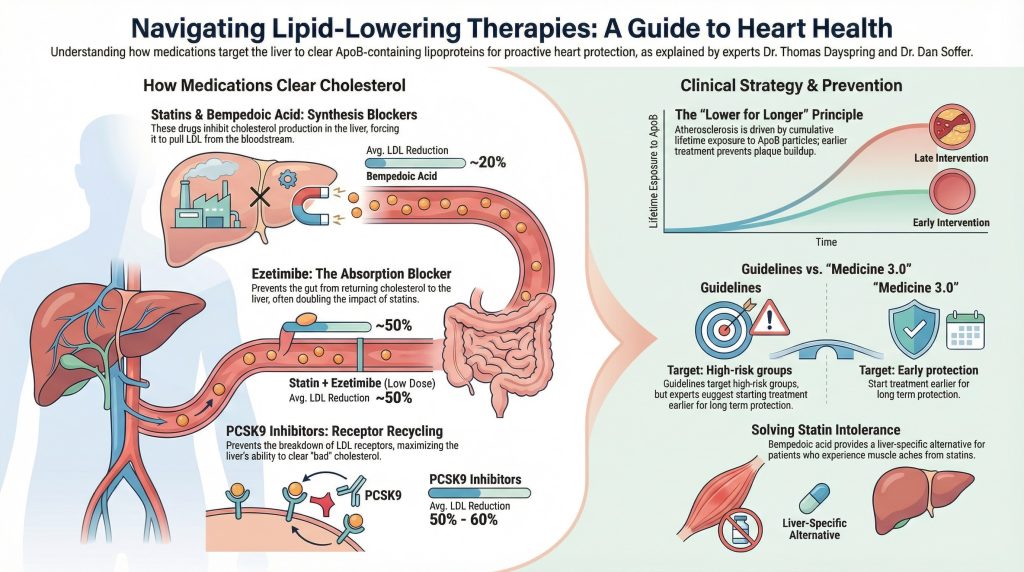
Before we look at the toolkit, we have to mention a special tool called Bempedoic Acid. Some people get muscle aches (the “statin aches”) when they take traditional pills. This is because statins work in the whole body, including your muscles.

Bempedoic acid is different. It is only “turned on” when it reaches the liver. It stays “turned off” in your muscles. This means it can lower your cholesterol without causing those pesky aches. It’s a perfect example of how medicine is getting more precise and kinder to our bodies.

Your Modern Heart-Health Toolkit

Method How Often You Take It How It Works (Simple Terms)
Statins Daily Pill Tells your liver to stop making as much cholesterol.
Bempedoic Acid Daily Pill Works like a statin but stays out of your muscles to avoid aches.
PCSK9 Blockers Every 2–4 Weeks An injection that helps your liver “mop up” bad particles.
Inclisiran (siRNA) Every 6 Months A “silencer” shot that stops a “bad” protein before it’s even made.
Gene Editing (CRISPR) Once in a Lifetime Permanently “edits” your DNA blueprint to keep your heart safe.

The Move to “Primordial Prevention”

We are witnessing a massive shift in human history. For a long time, we were just “fixing the car after it crashed.” The PURE study, which looked at over 150,000 people, showed that most heart problems are caused by things we can change.

This means heart disease is largely a choice for our society. We can choose to wait until someone has a heart attack, or we can choose primordial prevention. This means we don’t just “stop the plaque”—we “never let the seeds of the plaque be planted.” By keeping ApoB low from a young age, we are building a road where crashes are literally impossible.

Conclusion: A Question for Your Next Check-up

The era of “guessing” about your heart is over. We have the tools to see the real villains (ApoB), understand the lifetime damage (cholesterol-years), and even rewrite our genetic code to stay safe.

The next time you visit your doctor, don’t just settle for “Your cholesterol looks fine.” Be a visionary for your own health. Ask these two powerful questions:

  1. “What is my ApoB number (the actual number of ‘trucks’ on my highway)?”
  2. “Based on my ‘cholesterol-years,’ what is my risk for the rest of my life, not just the next ten years?”

The answer to those questions, combined with these new breakthroughs, could be the key to a long, healthy life without a daily pill bottle in sight.

Deep Dive

Abstract

Atherosclerotic cardiovascular disease (ASCVD) remains the leading global cause of mortality despite major advances in acute care. Modern preventive cardiology increasingly recognizes apolipoprotein B (ApoB)–containing lipoproteins as the necessary and causal drivers of atherosclerosis. Evidence from genetics, epidemiology, and randomized trials supports a cumulative exposure model in which the magnitude and duration of ApoB exposure determine lifetime risk. This review synthesizes foundational biological discoveries, landmark clinical trials, Mendelian randomization studies, and emerging gene-based therapies that collectively define a shift from reactive treatment to primordial prevention.
  1. The Modern Prevention Paradigm

Although mortality from acute myocardial infarction has declined substantially, the global burden of ASCVD remains high due to persistent exposure to modifiable risk factors. The PURE study demonstrated that traditional risk factors account for the majority of cardiovascular events across diverse global populations [1].

Preventive cardiology is therefore shifting from treating late-stage events to preventing plaque formation altogether—a strategy consistent with the concept of primordial prevention.

  1. LDL Receptors and the Central Role of ApoB

The biological foundation of lipid-lowering therapy rests on the LDL receptor (LDLR) pathway described by Brown and Goldstein [2]. Hepatic LDLR expression increases clearance of circulating ApoB-containing particles (LDL, VLDL remnants, Lp(a)), thereby reducing atherogenic burden.

Statins inhibit HMG-CoA reductase, upregulating LDLR expression. PCSK9 inhibitors prevent LDLR degradation, prolonging receptor recycling. In the FOURIER trial, evolocumab reduced LDL-C by approximately 59% and significantly lowered major cardiovascular events [3]. These results reinforced the principle that greater ApoB reduction yields greater cardiovascular risk reduction.

  1. ApoB as the Causal Particle: The Cumulative Exposure Model

The European Atherosclerosis Society consensus statement led by Ference et al. established that ApoB-containing lipoproteins are causal in ASCVD [4]. The total number of circulating atherogenic particles—not LDL-C concentration alone—determines arterial exposure.

Genetic, epidemiologic, and clinical trial data support a cumulative burden model (“cholesterol-years” concept):
Risk ≈ magnitude of ApoB × duration of exposure.

Short-term 10-year risk calculators may underestimate lifetime risk in younger individuals with prolonged exposure ahead of them. The clinical rationale for ApoB measurement as a more accurate representation of atherogenic particle number has been articulated in detail by Sniderman et al. [5].

  1. Reassessing HDL: Why Raising HDL Failed

Pharmacologic HDL raising has repeatedly failed to reduce cardiovascular events when ApoB burden remains unchanged.

The AIM-HIGH trial demonstrated no incremental benefit from adding niacin to intensive statin therapy [6]. The HPS2-THRIVE trial similarly showed no meaningful reduction in major vascular events and identified increased adverse events with niacin therapy [7].

These trials shifted focus away from HDL-C as a therapeutic target and reinforced ApoB reduction as the primary modifiable driver of ASCVD risk.

  1. Bempedoic Acid: Upstream LDLR Modulation

Bempedoic acid inhibits ATP-citrate lyase (ACL), an upstream enzyme in cholesterol synthesis. It is activated primarily in the liver and not in skeletal muscle, limiting muscle exposure to the active drug.

In the CLEAR Outcomes trial, bempedoic acid reduced major adverse cardiovascular events in statin-intolerant patients [8]. While muscle-related side effects were not significantly increased versus placebo, higher rates of hyperuricemia and gout were observed [8]. Bempedoic acid therefore represents an additional LDLR-mediated strategy for ApoB reduction with a distinct safety profile.

  1. Genetics as a Natural Randomized Trial

Mendelian randomization studies provide insight into lifelong LDL/ApoB exposure. Ference et al. demonstrated that lifelong genetically lower LDL-C is associated with substantially greater reductions in coronary heart disease risk than those observed in short-term pharmacologic trials [9].

The magnitude of benefit per 1 mmol/L lower LDL-C from birth exceeded the risk reductions typically observed in 5-year statin trials, supporting the principle that earlier and longer ApoB reduction produces larger lifetime benefit [9].

  1. RNA Therapeutics and Gene Editing

PCSK9 siRNA (Inclisiran)

Inclisiran uses small interfering RNA (siRNA) to inhibit hepatic PCSK9 production. In ORION-1 and subsequent phase 3 trials, inclisiran produced durable LDL-C reductions of approximately 50% with maintenance dosing every six months following initial and 3-month doses [10,11].

CRISPR Base Editing (PCSK9)

In primate studies, in vivo CRISPR base editing of PCSK9 resulted in durable LDL-C reductions [12]. This foundational work forms the scientific basis for first-in-human gene-editing trials such as heart-1 (Verve-101), which aim to achieve long-term reduction of ApoB-containing particles through a single intervention [12].

  1. Comparison of Modern Lipid-Lowering Strategies
Therapy Dosing Frequency Primary Mechanism Key Evidence
Statins Daily HMG-CoA reductase inhibition → ↑ LDLR Landmark statin trials
PCSK9 mAbs Every 2–4 weeks Prevent LDLR degradation FOURIER [3]
Bempedoic Acid Daily ACL inhibition (hepatic activation) CLEAR Outcomes [8]
Inclisiran Day 1, 3 months, then every 6 months siRNA blocking PCSK9 production ORION-1, ORION-10/11 [10,11]
PCSK9 Base Editing Investigational Permanent gene editing Primate data [12]

References

  1. Yusuf S, Joseph P, Rangarajan S, et al. Modifiable risk factors, cardiovascular disease, and mortality in 155 722 individuals from 21 high-income, middle-income, and low-income countries (PURE): a prospective cohort study. Lancet. 2020;395(10226):795-808. doi:10.1016/S0140-6736(19)32008-2
  2. Brown MS, Goldstein JL. A receptor-mediated pathway for cholesterol homeostasis. Science. 1986;232(4746):34-47. doi:10.1126/science.3513311
  3. Sabatine MS, Giugliano RP, Keech AC, et al. Evolocumab and Clinical Outcomes in Patients with Cardiovascular Disease. N Engl J Med. 2017;376(18):1713-1722. doi:10.1056/NEJMoa1615664
  4. Ference BA, Ginsberg HN, Graham I, et al. Low-density lipoproteins cause atherosclerotic cardiovascular disease. 1. Evidence from genetic, epidemiologic, and clinical studies. A consensus statement from the European Atherosclerosis Society Consensus Panel. Eur Heart J. 2017;38(32):2459-2472. doi:10.1093/eurheartj/ehx144
  5. Sniderman AD, Thanassoulis G, Glavinovic T, et al. Apolipoprotein B Particles and Cardiovascular Disease: A Narrative Review. JAMA Cardiol. 2019;4(12):1287-1295. doi:10.1001/jamacardio.2019.3780
  6. AIM-HIGH Investigators, Boden WE, Probstfield JL, et al. Niacin in patients with low HDL cholesterol levels receiving intensive statin therapy. N Engl J Med. 2011;365(24):2255-2267. doi:10.1056/NEJMoa1107579
  7. HPS2-THRIVE Collaborative Group, Landray MJ, Haynes R, et al. Effects of extended-release niacin with laropiprant in high-risk patients. N Engl J Med. 2014;371(3):203-212. doi:10.1056/NEJMoa1300955
  8. Nissen SE, Lincoff AM, Brennan D, et al. Bempedoic Acid and Cardiovascular Outcomes in Statin-Intolerant Patients. N Engl J Med. 2023;388(15):1353-1364. doi:10.1056/NEJMoa2215024
  9. Ference BA, Yoo W, Alesh I, et al. Effect of long-term exposure to lower low-density lipoprotein cholesterol beginning early in life on the risk of coronary heart disease: a Mendelian randomization analysis. J Am Coll Cardiol. 2012;60(25):2631-2639. doi:10.1016/j.jacc.2012.09.017
  10. Ray KK, Landmesser U, Leiter LA, et al. Inclisiran in Patients at High Cardiovascular Risk with Elevated LDL Cholesterol. N Engl J Med. 2017;376(15):1430-1440. doi:10.1056/NEJMoa1615758
  11. Ray KK, Wright RS, Kallend D, et al. Two Phase 3 Trials of Inclisiran in Patients with Elevated LDL Cholesterol. N Engl J Med. 2020;382(16):1507-1519. doi:10.1056/NEJMoa1912387
  12.  Musunuru K, Chadwick AC, Mizoguchi T, et al. In vivo CRISPR base editing of PCSK9 durably lowers cholesterol in primates. Nature. 2021;593(7859):429-434. doi:10.1038/s41586-021-03534-y

Transparency Note: This blog post was created with assistance from AI tools. The final content has been carefully reviewed and edited by the author, who is responsible for its accuracy. The information provided is for educational purposes only and does not constitute medical advice.

Receive the latest news

Subscribe To Our Newsletter

Get notified about new articles.

AI App

Heart Risk Calulator

Educational family-history heart risk calculator with H-score insights, visual family tree input and shareable PDF reports.

Read why this app is so important here.