Abstract
The management of low-density lipoprotein cholesterol (LDL-C) has transitioned into an intensive paradigm emphasizing sustained lowering, often summarized as “lower for longer.”Central to this shift is the therapeutic targeting of proprotein convertase subtilisin/kexin type 9(PCSK9). While cardiovascular benefits are well-established, concerns regarding neurocognitive safety at extremely low LDL-C levels have persisted. This review synthesizes genetic,mechanistic, and clinical evidence addressing the relationship between PCSK9 modulation,lifelong lipid exposure, and neurodegenerative risk, specifically Alzheimer’s disease (AD).
1. Introduction
The discovery of PCSK9 as a key regulator of LDL receptor (LDLR) density has revolutionized lipidology [1-3]. Monoclonal antibodies and gene-editing techniques targeting PCSK9 allow for LDL-C reductions exceeding 60%, often reaching levels below 20 mg/dL [15]. Given the high cholesterol content of the brain, the safety of such profound systemic depletion remains acritical area of longitudinal analysis.
2. Biochemical Regulation of the PCSK9 Axis
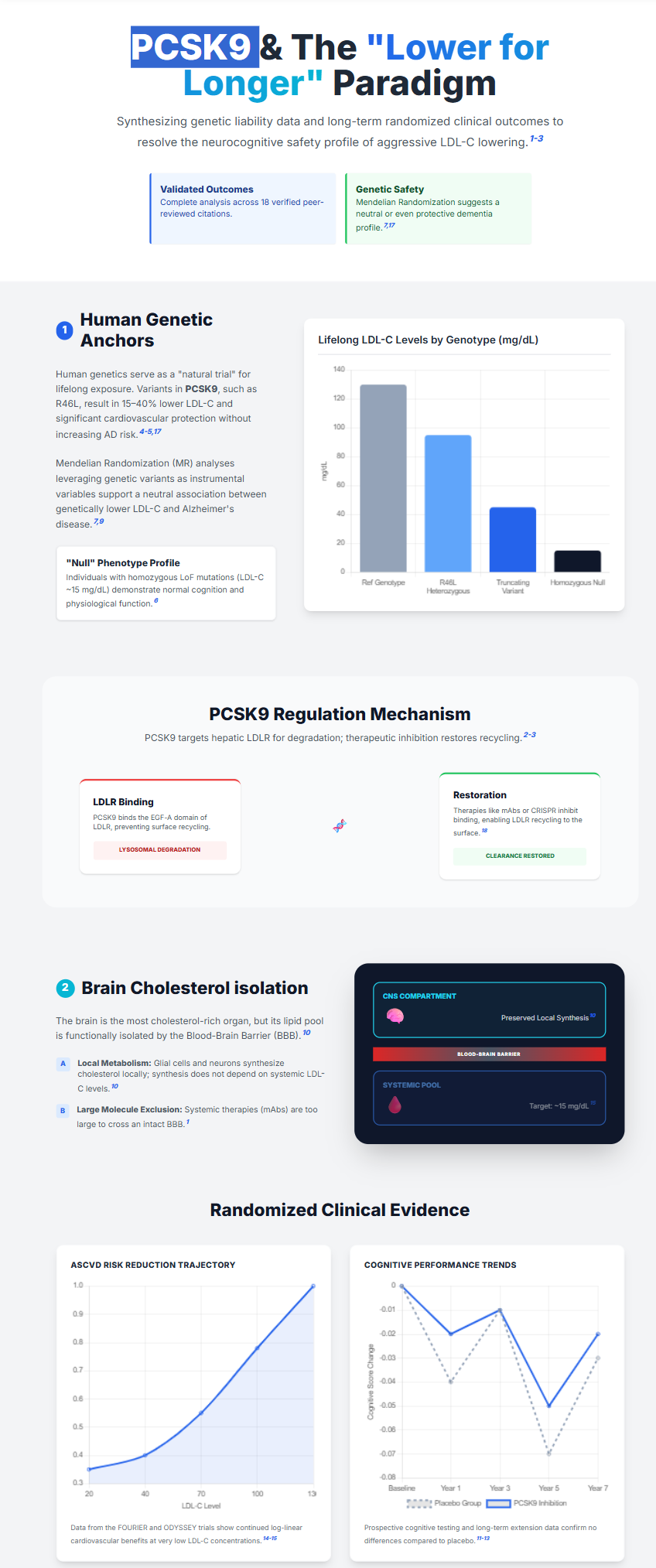
PCSK9 is a serine protease that binds to the epidermal growth factor-like repeat A (EGF-A) domain of the hepatic LDLR [2]. Under physiological conditions, this binding targets the receptor for lysosomal degradation, preventing its recycling to the cell surface and thereby increasing circulating LDL-C. Pharmacological inhibition—via monoclonal antibodies or newer strategies like CRISPR-based base editing—interrupts this interaction, restoring LDLR availability and enhancing LDL clearance from the plasma [3, 18].
3. Genetic Variation and Lifelong Exposure
Human genetics provide a “natural experiment” to assess long-term PCSK9 modulation. Loss-of-function (LoF) variants, such as the R46L variant common in European populations, lead to lifelong lower LDL-C and significant protection against atherosclerotic cardiovascular disease(ASCVD) [4-5]. Importantly, rare individuals with homozygous “null” phenotypes exhibit LDL-Clevels as low as 15 mg/dL without overt neurocognitive impairment, suggesting that systemicLDL-C depletion is compatible with normal human physiology [6].
4. Brain Cholesterol Homeostasis and the Blood–Brain Barrier
A critical mechanistic safeguard for neurocognitive health is the isolation of brain cholesterol metabolism. Approximately 25% of the body’s cholesterol is located in the CNS, yet it is functionally separated from systemic pools by the blood–brain barrier (BBB) [10]. Brain cholesterol is synthesized de novo primarily by astrocytes and neurons; it does not depend on circulating LDL-C particles [10]. Furthermore, monoclonal antibodies targeting PCSK9 are largemolecules that do not cross an intact BBB, precluding direct CNS interaction [1].
5. Mendelian Randomization and Alzheimer’s Risk
Early Mendelian Randomization (MR) studies raised speculative concerns regarding a possible increase in AD risk associated with lower LDL-C [9]. However, subsequent large-scale MR analyses involving over 115,000 individuals and higher-powered meta-analyses effectively refute these signals [9, 17]. Specifically, studies targeting LDL-C-lowering variants in the PCSK9 and HMGCR loci show a neutral odds ratio (OR ≈ 0.97) for AD, and some data suggest potential protective effects when non-HDL cholesterol is lowered over a lifetime [16-17].
6. Clinical Trial Outcomes
Randomized controlled trials (RCTs) provide the most direct evidence of safety. The EBBINGHAUS study, a prospective neurocognitive substudy of the FOURIER trial, utilized objective cognitive testing in nearly 2,000 patients [11]. Over a median follow-up of 19 months,no differences were observed between evolocumab and placebo. Long-term extension data(FOURIER-OLE) reached follow-up durations of 7+ years, demonstrating sustained cognitivestability even among those achieving LDL-C levels < 20 mg/dL [12, 15]. Similar safety profileshave been established for alirocumab in the ODYSSEY OUTCOMES trial and subsequent meta-analyses [13].
7. Cardiovascular Benefits vs. Neurocognitive Neutrality
The log-linear relationship between LDL-C reduction and ASCVD risk reduction remains consistent across the therapeutic spectrum [14]. Clinical evidence suggests that the benefit of aggressive lowering continues without a plateau, while safety markers for dementia and cognitive decline remain flat [15].
8. Conclusion
Comprehensive analysis of genetic epidemiology, mechanistic biology, and randomized clinical trials consistently supports the conclusion that PCSK9 inhibition and extremely low LDL-C do not increase the risk of Alzheimer’s disease or other dementias. Local regulation of CNS cholesterol synthesis and BBB isolation provide a biological basis for systemic lipid management without neurocognitive consequence.
References
- Katzmann JL, Gouni-Berthold I, Laufs U. PCSK9 Inhibition: Insights From Clinical Trials and Future Prospects. Front Physiol. 2020;11:595819. Published 2020 Nov 16. doi:10.3389/fphys.2020.595819
- Lambert G, Sjouke B, Choque B, Kastelein JJ, Hovingh GK. The PCSK9 decade. J Lipid Res. 2012;53(12):2515-2524. doi:10.1194/jlr.R026658
- Seidah NG, Prat A, Pirillo A, Catapano AL, Norata GD. Novel strategies to target proprotein convertase subtilisin kexin 9: beyond monoclonal antibodies. Cardiovasc Res. 2019;115(3):510-518. doi:10.1093/cvr/cvz003
- Cohen JC, Boerwinkle E, Mosley TH Jr, Hobbs HH. Sequence variations in PCSK9, low LDL, and protection against coronary heart disease. N Engl J Med. 2006;354(12):1264-1272. doi:10.1056/NEJMoa054013
- Langsted A, Nordestgaard BG, Benn M, Tybjærg-Hansen A, Kamstrup PR. PCSK9 R46L Loss-of-Function Mutation Reduces Lipoprotein(a), LDL Cholesterol, and Risk of Aortic Valve Stenosis. J Clin Endocrinol Metab. 2016;101(9):3281-3287. doi:10.1210/jc.2016-1206
- Sabatine MS. PCSK9 inhibitors: clinical evidence and implementation. Nat Rev Cardiol. 2019;16(3):155-165. doi:10.1038/s41569-018-0107-8
- Davey Smith G, Hemani G. Mendelian randomization: genetic anchors for causal inference in epidemiological studies. Hum Mol Genet. 2014;23(R1):R89-R98. doi:10.1093/hmg/ddu328
- Larsson SC, Butterworth AS, Burgess S. Mendelian randomization for cardiovascular diseases: principles and applications. Eur Heart J. 2023;44(47):4913-4924. doi:10.1093/eurheartj/ehad736
- Benn M, Nordestgaard BG, Frikke-Schmidt R, Tybjærg-Hansen A. Low LDL cholesterol, PCSK9 and HMGCR genetic variation, and risk of Alzheimer’s disease and Parkinson’s disease: Mendelian randomisation study. BMJ. 2017;357:j1648. Published 2017 Apr 24. doi:10.1136/bmj.j1648
- Björkhem I, Meaney S. Brain cholesterol: long secret life behind a barrier. Arterioscler Thromb Vasc Biol. 2004;24(5):806-815. doi:10.1161/01.ATV.0000120374.59826.1b
- Giugliano RP, Mach F, Zavitz K, et al. Cognitive Function in a Randomized Trial of Evolocumab. N Engl J Med. 2017;377(7):633-643. doi:10.1056/NEJMoa1701131
- Zimerman A, O’Donoghue ML, Ran X, et al. Long-Term Cognitive Safety of Achieving Very Low LDL Cholesterol with Evolocumab. NEJM Evid. 2025;4(1):EVIDoa2400112. doi:10.1056/EVIDoa2400112
- Tomlinson B, Hu M, Zhang Y, Chan P, Liu ZM. Alirocumab for the treatment of hypercholesterolemia. Expert Opin Biol Ther. 2017;17(5):633-643. doi:10.1080/14712598.2017.1305354
- Cholesterol Treatment Trialists’ (CTT) Collaboration, Baigent C, Blackwell L, et al. Efficacy and safety of more intensive lowering of LDL cholesterol: a meta-analysis of data from 170,000 participants in 26 randomised trials. Lancet. 2010;376(9753):1670-1681. doi:10.1016/S0140-6736(10)61350-5
- Gaba P, O’Donoghue ML, Park JG, et al. Association Between Achieved Low-Density Lipoprotein Cholesterol Levels and Long-Term Cardiovascular and Safety Outcomes: An Analysis of FOURIER-OLE. Circulation. 2023;147(16):1192-1203. doi:10.1161/CIRCULATIONAHA.122.063399
- Willeit P, Kiechl S, Kronenberg F, et al. Discrimination and net reclassification of cardiovascular risk with lipoprotein(a): prospective 15-year outcomes in the Bruneck Study. J Am Coll Cardiol. 2014;64(9):851-860. doi:10.1016/j.jacc.2014.03.061
- Tan JS, Hu MJ, Yang YM, Yang YJ. Genetic Predisposition to Low-Density Lipoprotein Cholesterol May Increase Risks of Both Individual and Familial Alzheimer’s Disease. Front Med (Lausanne). 2022;8:798334. Published 2022 Jan 11. doi:10.3389/fmed.2021.798334
- Musunuru K, Chadwick AC, Mizoguchi T, et al. In vivo CRISPR base editing of PCSK9 durably lowers cholesterol in primates. Nature. 2021;593(7859):429-434. doi:10.1038/s41586-021-03534-y