
Abstract
Atherosclerotic cardiovascular diseaseCardiovascular disease is the umbrella term for problems with the heart and blood vessels, including heart attacks, strokes, and blocked leg arteries. (ASCVD) remains the leading global cause of mortality despite major advances in acute care. Modern preventive cardiology increasingly recognizes apolipoproteinAn apolipoprotein is a protein attached to a fat-carrying particle in your blood. Fat and water don't mix, so these proteins act like a wrapper that lets fat travel safely through the bloodstream. B (ApoBApoB is a protein that sits on the outside of every cholesterol particle that can get stuck in your artery wall and cause plaque. Each of those particles carries exactly one ApoB.)–containing lipoproteinsA lipoprotein is a tiny package that carries fat and cholesterol through your bloodstream. Since fat won't dissolve in water, it needs a protein wrapper to travel. as the necessary and causal drivers of atherosclerosisAtherosclerosis is the disease behind most heart attacks and many strokes. Cholesterol particles get stuck in the wall of an artery, the body sends immune cells to clean up, and over years that mess hardens into plaque.. Evidence from geneticsGenetics is the study of what you inherit from your parents., epidemiologyEpidemiology is the study of health patterns in large groups of people — who gets sick, where, and what they had in common., and randomized trials supports a cumulative exposureCumulative exposure is the total amount of harmful cholesterol particles your arteries have been soaked in across your entire life — how high, multiplied by how long. model in which the magnitude and duration of ApoB exposure determine lifetime risk. This review synthesizes foundational biological discoveries, landmark clinical trialsA clinical trial is a study where researchers give one group a treatment and another group a placebo or standard care, then compare what happens., Mendelian randomizationMendelian randomization is a clever research method that uses the genes people were born with as a natural experiment. studies, and emerging gene-based therapies that collectively define a shift from reactive treatment to primordial preventionPrimordial prevention is a strategy aimed at stopping the development of cardiovascular risk factors in the first place—rather than treating risk factors or existing disease—by keeping atherogenic exposures near zero from birth or early life. It is distinguished from primary prevention, which targets people who already have risk factors but no clinical disease..
-
The Modern Prevention Paradigm
Although mortality from acute myocardial infarctionSee Heart Attack for the full entry. has declined substantially, the global burden of ASCVD remains high due to persistent exposure to modifiable risk factorsA risk factor is something that raises your chance of developing a disease — high cholesterol particles, high blood pressure, smoking, diabetes, family history.. The PURE studyA large prospective cohort study (Prospective Urban Rural Epidemiology) that enrolled over 155,000 individuals from 21 countries spanning low-, middle-, and high-income settings to examine the contribution of modifiable risk factors to cardiovascular disease and mortality; it found that traditional risk factors account for the large majority of cardiovascular events worldwide. demonstrated that traditional risk factors account for the majority of cardiovascular events across diverse global populations [1].
Preventive cardiology is therefore shifting from treating late-stage events to preventing plaquePlaque is the buildup of cholesterol, immune cells, scar tissue, and calcium inside an artery wall. formation altogether—a strategy consistent with the concept of primordial prevention.
-
LDL Receptors and the Central Role of ApoB
The biological foundation of lipid-lowering therapy rests on the LDL receptorThe LDL receptor is a docking port on liver cells that grabs LDL particles out of the blood and pulls them in to be broken down. (LDLRLDLR is the gene that builds the LDL receptor, the docking port your liver uses to pull cholesterol particles out of circulation.) pathway described by Brown and Goldstein [2]. Hepatic LDLR expression increases clearance of circulating ApoB-containing particlesLipoproteins—including LDL, IDL, VLDL, and their remnants—that each carry one molecule of apolipoprotein B on their surface; particle number (rather than cholesterol mass alone) is a key driver of atherosclerosis because each particle can be retained in the arterial wall. (LDLLDL, or low-density lipoprotein, is the main particle that carries cholesterol through your blood — and the main one that gets stuck in artery walls., VLDLVLDL, or very-low-density lipoprotein, is the particle your liver makes to ship triglycerides out to the rest of the body. remnants, Lp(a)), thereby reducing atherogenic burden.
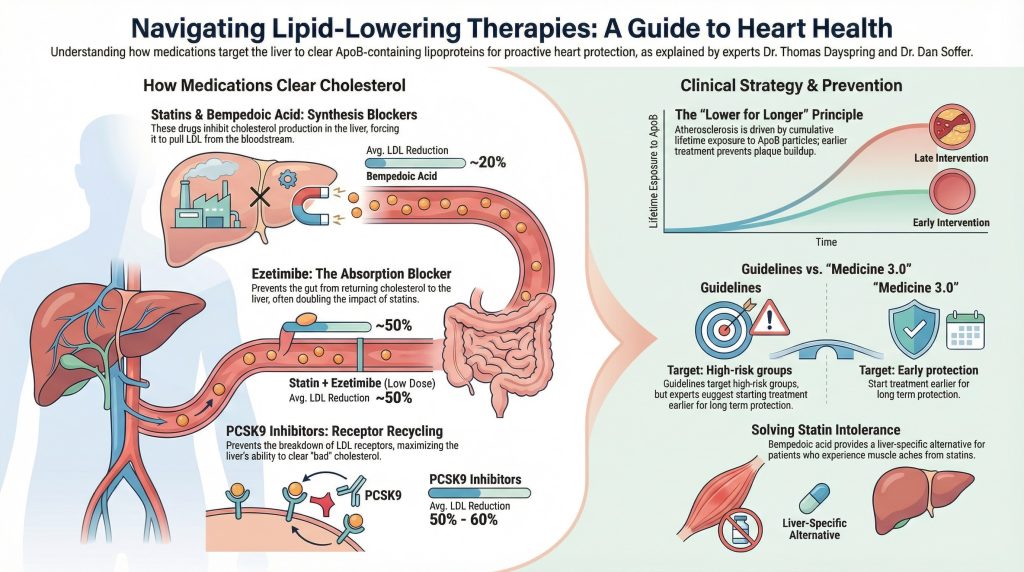
StatinsA statin slows the enzyme your liver uses to make cholesterol. Your liver responds by pulling more cholesterol out of your blood, which is where the real benefit comes from. inhibit HMG-CoA reductaseHMG-CoA reductase is the rate-limiting enzyme in the liver's cholesterol biosynthetic (mevalonate) pathway; statins work by competitively blocking it, reducing the liver's own cholesterol production and prompting it to pull more LDL out of the bloodstream., upregulating LDLR expression. PCSK9 inhibitorsA PCSK9 inhibitor is a medicine that blocks that cholesterol-destroying protein, leaving more docking ports available to clear particles from the blood. prevent LDLR degradation, prolonging receptor recycling. In the FOURIER trialThe FOURIER trial evaluated the PCSK9 inhibitor evolocumab added to statin therapy and demonstrated that aggressively lowering ApoB-containing particles reduced cardiovascular events; analysis also showed that patients who achieved very low LDL-C but retained high hs-CRP still faced elevated residual risk, supporting the dual-risk model of atherogenesis., evolocumabEvolocumab is an injectable cholesterol medicine in the PCSK9 inhibitor family, usually given every two to four weeks. reduced LDL-C by approximately 59% and significantly lowered major cardiovascular events [3]. These results reinforced the principle that greater ApoB reduction yields greater cardiovascular risk reduction.
-
ApoB as the Causal Particle: The Cumulative Exposure Model
The European Atherosclerosis Society consensus statement led by Ference et al. established that ApoB-containing lipoproteins are causal in ASCVD [4]. The total number of circulating atherogenic particlesAtherogenic particles are the ApoB-containing lipoproteins—including LDL, IDL, VLDL, and lipoprotein(a)—that can enter and be retained in the artery wall to initiate and sustain plaque growth; the article uses the term to describe what must be lowered substantially and sustainably to achieve plaque regression.—not LDL-C concentration alone—determines arterial exposure.
Genetic, epidemiologic, and clinical trial data support a cumulative burden model (“cholesterol-yearsCholesterol-years is a cumulative-exposure metric that multiplies a person's average LDL-C level (in mg/dL) by the number of years they have carried that level, analogous to pack-years for tobacco. The concept holds that it is the total lifetime burden of apoB-containing lipoproteins, not any single reading, that determines when and how severely atherosclerosis develops.” concept):
Risk ≈ magnitude of ApoB × duration of exposure.
Short-term 10-year risk calculatorsA risk calculator estimates your chance of a heart attack or stroke over the next ten years, using your age, cholesterol, blood pressure, and a few other inputs. may underestimate lifetime risk in younger individuals with prolonged exposure ahead of them. The clinical rationale for ApoB measurement as a more accurate representation of atherogenic particle numberThe total count of ApoB-containing lipoprotein particles circulating in the bloodstream—including LDL, VLDL remnants, and Lp(a)—as distinct from the cholesterol mass they carry; the European Atherosclerosis Society consensus holds that particle number, best captured by ApoB measurement, is a more accurate predictor of atherosclerotic risk than LDL-C concentration alone. has been articulated in detail by Sniderman et al. [5].
-
Reassessing HDL: Why Raising HDL Failed
Pharmacologic HDLHDL, or high-density lipoprotein, is the particle often called "good cholesterol." It picks up cholesterol from tissues and carries it back to the liver. raising has repeatedly failed to reduce cardiovascular events when ApoB burden remains unchanged.
The AIM-HIGH trialA randomized trial that added extended-release niacin to intensive statin therapy in patients with established cardiovascular disease; despite raising HDL-C, niacin provided no reduction in cardiovascular events, contributing to evidence that HDL-C elevation is not causally cardioprotective. demonstrated no incremental benefit from adding niacinNiacin is vitamin B3, which at very high doses lowers LDL and raises HDL. to intensive statin therapy [6]. The HPS2-THRIVE trialA large randomized trial testing whether adding extended-release niacin plus laropiprant to background statin therapy reduced major vascular events in high-risk patients; it found no meaningful cardiovascular benefit and identified increased rates of serious adverse events, effectively ending niacin as a mainstream cardiovascular therapy. similarly showed no meaningful reduction in major vascular events and identified increased adverse events with niacin therapy [7].
These trials shifted focus away from HDL-C as a therapeutic target and reinforced ApoB reduction as the primary modifiable driver of ASCVD risk.
-
Bempedoic Acid: Upstream LDLR Modulation
Bempedoic acidBempedoic acid is a cholesterol-lowering pill that works in the liver, at a point just before where statins act. inhibits ATP-citrate lyase (ACL), an upstream enzyme in cholesterol synthesisCholesterol synthesis is your body making its own cholesterol, mostly in the liver. Almost every cell can do it.. It is activated primarily in the liver and not in skeletal muscle, limiting muscle exposure to the active drug.
In the CLEAR OutcomesCLEAR Outcomes was a large trial that tested bempedoic acid in people who couldn't tolerate statins, to see whether it lowered heart attack and stroke risk the way statins do. trial, bempedoic acid reduced major adverse cardiovascular eventsA major adverse cardiovascular event, or MACE, is a bundle of bad outcomes counted together in a study — typically cardiovascular death, heart attack, and stroke. in statin-intolerant patients [8]. While muscle-related side effects were not significantly increased versus placeboA placebo is a dummy treatment — a sugar pill or a saline injection — given so researchers can tell what a real drug actually does., higher rates of hyperuricemiaAn elevated level of uric acid in the blood, which can precipitate gout and kidney stones; it was identified as a notable adverse effect of bempedoic acid in the CLEAR Outcomes trial, distinguishing its safety profile from that of statins. and gout were observed [8]. Bempedoic acid therefore represents an additional LDLR-mediated strategy for ApoB reduction with a distinct safety profile.
-
Genetics as a Natural Randomized Trial
Mendelian randomizationRandomization is the process of assigning trial participants to treatment or control groups by chance, ensuring that known and unknown confounding factors are evenly distributed; when randomization fails—as auditors found occurred in PREDIMED—the groups may differ in ways that distort the apparent treatment effect. studies provide insight into lifelong LDL/ApoB exposure. Ference et al. demonstrated that lifelong genetically lower LDL-C is associated with substantially greater reductions in coronary heart diseaseCoronary heart disease is the narrowing or blockage of the arteries that supply blood to the heart muscle, caused by the buildup of atherosclerotic plaque; it is the leading cause of heart attack and cardiac death worldwide. risk than those observed in short-term pharmacologic trials [9].
The magnitude of benefit per 1 mmol/L lower LDL-C from birth exceeded the risk reductions typically observed in 5-year statin trials, supporting the principle that earlier and longer ApoB reduction produces larger lifetime benefit [9].
-
RNA Therapeutics and Gene Editing
PCSK9PCSK9 is a protein made by your liver that destroys the docking ports your liver uses to pull cholesterol out of your blood. siRNA (InclisiranInclisiran is a cholesterol-lowering injection given just twice a year after the first two doses.)
Inclisiran uses small interfering RNA (siRNA) to inhibit hepatic PCSK9 production. In ORION-1 and subsequent phase 3 trials, inclisiran produced durable LDL-C reductions of approximately 50% with maintenance dosing every six months following initial and 3-month doses [10,11].
CRISPR Base EditingA precision gene-editing technique that chemically converts a single DNA base (letter) in the genome to another without cutting the double strand, enabling permanent and targeted changes to a gene's function; in cardiovascular research it has been used in primates to permanently silence the PCSK9 gene in liver cells, producing lasting LDL reductions from a single treatment. (PCSK9)
In primate studies, in vivo CRISPR base editing of PCSK9 resulted in durable LDL-C reductions [12]. This foundational work forms the scientific basis for first-in-human gene-editing trials such as heart-1 (Verve-101), which aim to achieve long-term reduction of ApoB-containing particles through a single intervention [12].
- Comparison of Modern Lipid-Lowering Strategies
| Therapy | Dosing Frequency | Primary Mechanism | Key Evidence |
| Statins | Daily | HMG-CoA reductase inhibition → ↑ LDLR | Landmark statin trials |
| PCSK9 mAbs | Every 2–4 weeks | Prevent LDLR degradation | FOURIERFOURIER tested evolocumab, a PCSK9 inhibitor, in patients who already had cardiovascular disease and were on statins. [3] |
| Bempedoic Acid | Daily | ACL inhibition (hepatic activation) | CLEAR Outcomes [8] |
| Inclisiran | Day 1, 3 months, then every 6 months | siRNA blocking PCSK9 production | ORION-1, ORION-10/11 [10,11] |
| PCSK9 Base Editing | Investigational | Permanent gene editing | Primate data [12] |
References
- Yusuf S, Joseph P, Rangarajan S, et al. Modifiable risk factors, cardiovascular disease, and mortality in 155 722 individuals from 21 high-income, middle-income, and low-income countries (PURE): a prospective cohort study. Lancet. 2020;395(10226):795-808. doi:10.1016/S0140-6736(19)32008-2
- Brown MS, Goldstein JL. A receptor-mediated pathway for cholesterol homeostasis. Science. 1986;232(4746):34-47. doi:10.1126/science.3513311
- Sabatine MS, Giugliano RP, Keech AC, et al. Evolocumab and Clinical Outcomes in Patients with Cardiovascular Disease. N Engl J Med. 2017;376(18):1713-1722. doi:10.1056/NEJMoa1615664
- Ference BA, Ginsberg HN, Graham I, et al. Low-density lipoproteins cause atherosclerotic cardiovascular disease. 1. Evidence from genetic, epidemiologic, and clinical studies. A consensus statement from the European Atherosclerosis Society Consensus Panel. Eur Heart J. 2017;38(32):2459-2472. doi:10.1093/eurheartj/ehx144
- Sniderman AD, Thanassoulis G, Glavinovic T, et al. Apolipoprotein B Particles and Cardiovascular Disease: A Narrative Review. JAMA Cardiol. 2019;4(12):1287-1295. doi:10.1001/jamacardio.2019.3780
- AIM-HIGH Investigators, Boden WE, Probstfield JL, et al. Niacin in patients with low HDL cholesterol levels receiving intensive statin therapy. N Engl J Med. 2011;365(24):2255-2267. doi:10.1056/NEJMoa1107579
- HPS2-THRIVE Collaborative Group, Landray MJ, Haynes R, et al. Effects of extended-release niacin with laropiprant in high-risk patients. N Engl J Med. 2014;371(3):203-212. doi:10.1056/NEJMoa1300955
- Nissen SE, Lincoff AM, Brennan D, et al. Bempedoic Acid and Cardiovascular Outcomes in Statin-Intolerant Patients. N Engl J Med. 2023;388(15):1353-1364. doi:10.1056/NEJMoa2215024
- Ference BA, Yoo W, Alesh I, et al. Effect of long-term exposure to lower low-density lipoprotein cholesterol beginning early in life on the risk of coronary heart disease: a Mendelian randomization analysis. J Am Coll Cardiol. 2012;60(25):2631-2639. doi:10.1016/j.jacc.2012.09.017
- Ray KK, Landmesser U, Leiter LA, et al. Inclisiran in Patients at High Cardiovascular Risk with Elevated LDL Cholesterol. N Engl J Med. 2017;376(15):1430-1440. doi:10.1056/NEJMoa1615758
- Ray KK, Wright RS, Kallend D, et al. Two Phase 3 Trials of Inclisiran in Patients with Elevated LDL Cholesterol. N Engl J Med. 2020;382(16):1507-1519. doi:10.1056/NEJMoa1912387
- Musunuru K, Chadwick AC, Mizoguchi T, et al. In vivo CRISPR base editing of PCSK9 durably lowers cholesterol in primates. Nature. 2021;593(7859):429-434. doi:10.1038/s41586-021-03534-y

