
La evolución de la evaluación del riesgo cardiovascular y el manejo de los lípidos:
Un análisis del curso de vida de 1960 a 2026
Introducción
La trayectoria histórica de la medicina cardiovascular representa un cambio profundo desde el manejo reactivo de eventos clínicos en etapa terminal hacia un paradigma proactivo centrado en el curso de vida y en los impulsores fisiológicos de ateroesclerosis. Desde mediados del siglo XX, la comprensión de la comunidad médica sobre el metabolismo de los lípidos ha evolucionado desde un enfoque en lo burdo colesterol total mediciones hacia una apreciación matizada de lipoproteína concentración de partículas, predisposición genética y la carga acumulativa de exposición aterogénica. A partir de 2026, el enfoque clínico se ha desplazado hacia la identificación del riesgo décadas antes de la aparición de la enfermedad sintomática, utilizando técnicas avanzadas biomarcadores como Apolipoproteína B (ApoB) y Lipoproteína(a) [Lp(a)], e incorporando puntuaciones de riesgo poligénico en herramientas de evaluación estandarizadas.1
Cambios históricos en las guías sobre el colesterol y metas clínicas
La conceptualización de colesterol como agente principal de la patología vascular no fue un consenso inmediato, sino más bien una evolución difícilmente lograda a través de décadas de observación epidemiológica y ensayo clínico evidencia. En la década de 1960, la ‘controversia del colesterol’ estaba en su apogeo, y los investigadores debatían si los lípidos en sangre eran meros correlatos del envejecimiento o agentes causales de las enfermedades cardíacas.2
La era anterior al NCEP y el surgimiento de la hipótesis lipídica
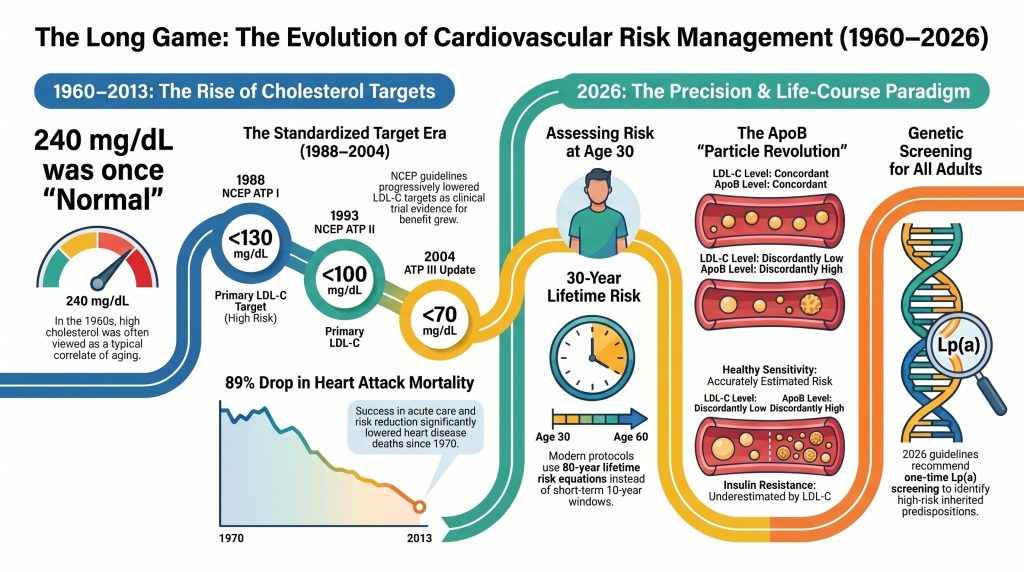
Antes de la formalización de las directrices nacionales, los niveles de colesterol total ‘aceptables’ eran notablemente altos para los estándares modernos. En las décadas de 1960 y principios de 1970, los médicos consideraban comúnmente que los niveles de colesterol total de 240 mg/dL o más eran normales para los adultos en proceso de envejecimiento. Esta percepción tenía su origen en los niveles poblacionales promedio de la época, donde la media de colesterol total para los adultos estadounidenses de entre 20 y 74 años era de aproximadamente 222 mg/dL entre 1959 y 1962.3 Las intervenciones tempranas fueron principalmente dietéticas. La Asociación Americana del Corazón emitió sus primeras recomendaciones dietéticas formales en 1961 y las actualizó en 1968, abogando por la restricción de grasa saturada y colesterol dietético. Estas primeras metas reflejaban una comprensión incipiente de que la grasa saturada de la dieta influía en los niveles de colesterol sérico, aunque la magnitud de este efecto a menudo se sobreestimaba de forma aislada respecto al contexto dietético más amplio.4
El Programa Nacional de Educación sobre el Colesterol y los Paneles de Tratamiento en Adultos
La década de 1980 marcó una transición fundamental con el establecimiento de la Programa Nacional de Educación sobre el Colesterol (NCEP). La publicación del primer informe del Panel de Tratamiento para Adultos (ATP I) en 1988 proporcionó el primer marco estandarizado para identificar y tratar el colesterol alto en sangre.5
Tabla 1. Evolución de las guías de colesterol de EE. UU., 1988–2026
| Informe de directrices | Año | Enfoque principal | Metas de LDL-C / Cambios clave |
| NCEP ATP I | 1988 | Prevención primaria; detección de colesterol total y c-LDL. | C-LDL <160 mg/dL (bajo riesgo); <130 mg/dL (alto riesgo). |
| NCEP ATP III | 1993 | Prevención secundaria para la cardiopatía coronaria establecida; se hizo hincapié en el c-HDL. | C-LDL <100 mg/dL para prevención secundaria. |
| NCEP ATP III | 2001 | Evaluación del riesgo a 10 años (Framingham); ‘equivalentes de riesgo’ de enfermedad coronaria que incluyen diabetes. | C-LDL óptimo <100 mg/dL; c-HDL bajo definido como <40 mg/dL. |
| Actualización del ATP III | 2004 | Terapia intensificada para personas con ‘riesgo muy alto’. | C-LDL opcional <70 mg/dL para riesgo muy alto. |
| 2013 ACC/AHA | 2013 | Tratamiento a la meta abandonado; se identificaron cuatro estatinas grupos de beneficios. | Terapia con estatinas de alta intensidad frente a intensidad moderada; sin objetivo específico de C-LDL. |
| Multisociedades AHA/ACC 2018 | 2018 | Volver a los umbrales; escalada basada en el riesgo con agentes no estatinas. | C-LDL <70 mg/dL (riesgo alto); <55 mg/dL (riesgo muy alto). |
| 2026 ACC/AHA Dislipidemia Pauta | 2026 | Prevención a lo largo de la vida; Ecuaciones PREVENT para el riesgo a 10 y 30 años; detección de ApoB y Lp(a). | C-LDL <55 mg/dL (riesgo muy alto); prueba de Lp(a) única universal. |
NCEP = National Cholesterol Education Program (Programa Nacional de Educación sobre el Colesterol); ATP = Adult Treatment Panel (Panel de Tratamiento en Adultos); ACC = American College of Cardiology (Colegio Estadounidense de Cardiología); AHA = American Heart Association (Asociación Estadounidense del Corazón).
La justificación para establecer metas progresivamente más bajas estuvo impulsada por una sólida acumulación de evidencia procedente de ensayos controlados aleatorizados. El estudio «Lipid Research Clinics Coronary Primary Prevention Trial» (LRC-CPPT), realizado en 1984, demostró que por cada reducción de 1% en el colesterol total, el riesgo de cardiopatía coronaria disminuía aproximadamente en 2%, lo que sentó las primeras bases estadísticas para un tratamiento agresivo de reducción de lípidos.6 Ensayos posteriores en la década de 1990 y principios de la de 2000: el Estudio escandinavo de supervivencia con simvastatin (4S), el ensayo Cholesterol and Recurrent Events (CARE) y el Long-Term Intervention with Pravastatina en el estudio de Enfermedad Isquémica (LIPID)—mostró consistentemente que la reducción del C-LDL redujo eventos cardiovasculares adversos mayores (MACE), lo que llevó a una amplia adopción de la filosofía de que ‘cuanto más bajo, mejor’.7
El cambio de paradigma de 2013 y la transición hacia la intensidad de las estatinas
En 2013 se produjo una importante alteración con la publicación de las guías sobre el colesterol del ACC/AHA. Este informe se alejó de las metas numéricas específicas de C-LDL y, en su lugar, identificó cuatro ‘grupos que se benefician de las estatinas’ en los que la evidencia de la reducción del riesgo era más convincente: (1) personas con aterosclerosis clínica enfermedad cardiovascular (ASCVD); (2) personas con niveles elevados primarios de LDL-C ≥190 mg/dL; (3) personas de 40 a 75 años con diabetes y niveles de LDL-C de 70 a 189 mg/dL; y (4) personas de 40 a 75 años sin ASCVD clínica ni diabetes, con un nivel de colesterol LDL de 70 a 189 mg/dL y un riesgo estimado de ASCVD a 10 años ≥7,5%.8 Este enfoque priorizó la intensidad de la terapia con estatinas sobre el logro de un nivel específico de c-LDL. Sin embargo, este cambio fue polémico, ya que muchos médicos consideraron que reducía la motivación para el paciente adherencia y descuidó la variabilidad individual en la respuesta a los fármacos.9
El retorno a los objetivos y el paradigma del curso de vida de 2026
Las guías multisociedades de la ACC/AHA de 2018 y la Guía de la ACC/AHA/AACVPR/ABC/ACPM/ADA/AGS/APhA/ASPC/NLA/PCNA de 2026 sobre el manejo de la dislipidemia restablecieron los objetivos explícitos de tratamiento del c-LDL con un alcance significativamente ampliado. Publicado en la Journal of the American College of Cardiology y coeditado en Circulación, la guía de 2026 enfatiza una evaluación de riesgo más temprana que comienza a los 30 años y exige el uso de las ecuaciones PREVENT (Predicting Risk of Cardiovascular Disease EVENTs) para estimar tanto el riesgo a 10 años como el riesgo de por vida a 30 años.1 Para los adultos de 30 a 79 años sin ASCVD conocida y con un nivel de colesterol LDL de 70 a 189 mg/dL, las ecuaciones PREVENT-ASCVD clasifican el riesgo a 10 años como bajo (<3%), limítrofe (de 3% a <5%), intermedio (de 5% a <10%) o alto (≥10%). Para las personas con riesgo muy alto (definidas como aquellas con múltiples eventos graves de ASCVD o un evento grave más múltiples afecciones de alto riesgo), la guía recomienda un objetivo de colesterol LDL de <55 mg/dL.1 Esto refleja la comprensión moderna de que la aterosclerosis es un proceso acumulativo de por vida, en el cual el ‘área bajo la curva’ de la exposición a lipoproteínas aterogénicas determina el riesgo final de eventos.10
Promedios de población versus salud biológica óptima
Un tema central en la lipidología contemporánea es el reconocimiento de que los niveles de colesterol ‘promedio’ o ‘normales’ en las poblaciones industrializadas no representan la salud, sino más bien una línea base de alto riesgo moldeada por la dieta, la inactividad física y la enfermedad metabólica.11
Tendencias de la NHANES en el colesterol medio: de 1960 a la actualidad
Los datos de la Encuesta Nacional de Examen de Salud y Nutrición (NHANES) documentan un descenso constante en el colesterol total medio entre los adultos estadounidenses de 20 a 74 años, pasando de aproximadamente 222 mg/dL en 1959-1962 a 197 mg/dL en 2007-2008.3 A pesar de esta alentadora tendencia, el perfil de colesterol promedio de los adultos en EE. UU. sigue facilitando la aterosclerosis placa evolución. La prevalencia de colesterol total elevado (≥240 mg/dL) disminuyó de aproximadamente 20% en 1988–1994 a 11,3% en 2021–2023, aunque esta estabilización se ha mantenido desde aproximadamente 2013–2014.12
Tabla 2. Tendencias de NHANES en el colesterol total y el C-LDL en adultos estadounidenses de 20 a 74 años
| Periodo de NHANES | Colesterol total promedio (mg/dL) | C-LDL medio (mg/dL) | Prevalencia de CT elevado (≥240 mg/dL) |
| 1959–1962 | ~222 | N/A | Alto (estimado) |
| 1971–1975 | ~216 | N/A | N/A |
| 1976–1980 | ~213 | ~137 | N/A |
| 1988–1994 | ~206 | ~129 | ~20% |
| 2007–2008 | ~197 | ~116 | ~17% |
| 2021–2023 | N/A | N/A | ~11.3% |
Fuentes: Carroll et al. (2012); Curtin et al. (2024). N/D = datos no disponibles en las encuestas citadas.
La prevalencia de la disfunción metabólica, caracterizada por obesidad, hiperinsulinemia y resistencia a la insulina—ha desplazado la distribución ‘normal’ hacia valores más altos triglicéridos y menor c-HDL, lo que crea una población en la que el individuo promedio está desarrollando activamente vasculatura lesiones.13 En marcado contraste, los neonatos humanos suelen poseer niveles de C-LDL entre 30 y 70 mg/dL, coherentes con los niveles observados en primates silvestres y otros mamíferos que no desarrollan aterosclerosis de forma espontánea.14
Lecciones de los tsimanes de la Amazonía boliviana
El Tsimane la población de la Amazonía boliviana proporciona un punto de referencia biológico único. Un estudio transversal histórico de 2017 estudio de cohortes publicado en The Lancet descubrió que los tsimane tienen la prevalencia informada más baja de ateroesclerosis coronaria de cualquier población estudiada hasta la fecha, cinco veces menor que la de poblaciones estadounidenses comparables.15 En una muestra de 705 adultos de entre 40 y 94 años, 85% tuvo un calcio en las arterias coronarias (CAC) puntuación de cero, y entre las personas mayores de 75 años, 65% seguía sin presentar signos coronarios medibles calcificación—una prevalencia cinco veces menor que la de los estadounidenses de la misma edad en el Estudio Multiétnico de la Aterosclerosis (MESA).15
El c-LDL promedio de los participantes tsimane fue de 91 mg/dL y el c-HDL promedio fue de 39.5 mg/dL.15 Cabe destacar que esta baja carga de aterosclerosis persistió a pesar de la elevación sistémica inflamaciónde alta sensibilidad Proteína C reactiva superó el umbral clínico de 3,0 mg/dL en 51% de participantes tsimane, lo cual se atribuye a una elevada carga infecciosa y parasitaria más que a la inflamación vascular.15 Estos hallazgos sugieren que la aterosclerosis no es una consecuencia inevitable del envejecimiento o de la inflamación por sí sola, sino que requiere un umbral crítico de exposición a lipoproteínas aterogénicas circulantes, un umbral que se supera en prácticamente todas las poblaciones occidentales contemporáneas.15
Apolipoproteína B como una medida superior del riesgo aterogénico
Mientras que el c-LDL mide la masa total de colesterol dentro de LDL particles, it does not account for the total number of atherogenic lipoprotein particles or the heterogeneity of their composition. Apolipoprotein B (ApoB) is the structural proteína present in a 1:1 ratio on every potentially partícula aterogénica, including VLDL, IDL, LDL, and Lp(a).16
The Mechanistic Case for ApoB Superiority
The emerging consensus in lipidology holds that the total number of atherogenic particles is the primary driver of the ‘response-to-retention’ mechanism of atherosclerosis initiation. Atherosclerosis begins when partículas que contienen ApoB traverse the endothelial barrier and become trapped within the matriz de proteoglicanos subendoteliales.17 Because each such particle carries one ApoB molecule, ApoB measurement directly quantifies the total atherogenic carga de partículas delivered to the arterial wall—a metric more physiologically precise than the cholesterol content of LDL particles alone.16
Discordance Between ApoB and LDL-C in Metabolic Disease
The limitations of LDL-C are most apparent in individuals with insulina resistance, type 2 diabetes, or hypertriglyceridemia. Metabolic dysfunction leads to hepatic overproduction of large, triglyceride-rich VLDL particles. In the circulation, éster de colesterilo transfer protein (CETP) exchanges triglycerides from VLDL for cholesterol esters in LDL particles, and the resulting triglyceride-enriched LDL undergoes hydrolysis by hepatic lipase to yield small, dense LDL (sdLDL).18 These sdLDL particles are cholesterol-depleted per particle, producing paradoxically low LDL-C values despite a high total ApoB (and particle) count. A revisión sistemática y metaanálisis demonstrated that such ApoB/LDL-C discordancia is prevalent in metabolic disease and is associated with significant underestimation of cardiovascular risk.13
Table 3. ApoB/LDL-C Discordance Patterns by Metabolic State
| Metabolic State | LDL-C Level | ApoB Level | Clinical Implication |
| Healthy sensibilidad a la insulina | Concordant (e.g., 100 mg/dL) | Concordant (e.g., 80 mg/dL) | Risk accurately estimated by either metric. |
| Insulin resistance / type 2 diabetes | Discordantly low (e.g., 90 mg/dL) | Discordantly high (e.g., 110 mg/dL) | Risk underestimated by LDL-C alone. |
| High saturated fat intake (large LDL phenotype) | Discordantly high (e.g., 160 mg/dL) | Relatively lower (e.g., 100 mg/dL) | Risk may be overestimated by LDL-C. |
Adapted from: Tsoupras et al. (2024); Fahed et al. (2022).
Analyses of NHANES data have shown that approximately 20% of the general U.S. population exhibits clinically significant discordance between ApoB and LDL-C, with this proportion rising substantially among those with síndrome metabólico.19 Individuals with high ApoB but concordantly low LDL-C demonstrate significantly higher rates of coronary arteria calcification and chronic kidney disease than those with the inverse pattern, confirming that particle number is the mechanistically relevant driver of aterogénesis.20
Small, Dense LDL: The Mechanistic Link
Small, dense LDL particles are uniquely hazardous for three principal reasons. First, their reduced size facilitates penetration of the arterial íntima. Second, they exhibit enhanced affinity for subendothelial proteoglycans, leading to prolonged retention at the site of atherogenesis. Third, they are more susceptible to oxidative modification—the prerequisite step for macrophage uptake and foam cell formation.21 Clinically, a patient with a ‘normal’ LDL-C but elevated ApoB or LDL particle number carries a risk profile that is systematically concealed by standard lipid screening.13
Lipoprotein(a): The Genetic Vanguard of ASCVD Risk
Lipoprotein(a) [Lp(a)] has only recently attained widespread clinical recognition despite being identified in the 1960s. Its Lp(a) levels are approximately 70–90% genetically determined by variation at the LPA gene locus and are not meaningfully altered by lifestyle modification or conventional statin therapy.22
Role in Atherogenesis, Thrombosis, and Valvular Disease
Lp(a) consists of an LDL-like lipoprotein with an additional glycoprotein, apolipoprotein(a) [apo(a)], covalently attached to the ApoB-100 molecule via a disulfide bond.22 This structural configuration confers dual pathogenicity: Lp(a) is both highly atherogenic through its retention in the subendothelial space and is potentially prothrombotic through the structural homology of apo(a) with plasminógeno, which may interfere with fibrinolysis.23 Elevated Lp(a) is also a major independent factor de riesgo for calcific válvula aórtica estenosis; individuals with the highest Lp(a) levels face substantially higher risk of aortic valve replacement or aortic valve-related death.24
Screening Recommendations and Emerging Therapies
The 2026 ACC/AHA Dyslipidemia Guideline recommends at least one lifetime measurement of Lp(a) for all adults to identify individuals with high inherited cardiovascular risk.1 Elevated Lp(a)—generally defined as ≥50 mg/dL (or ≥125 nmol/L)—affects an estimated 20–25% of the global population, representing over 1.5 billion individuals, and contributes substantially to residual cardiovascular risk that is not addressed by statin therapy.23
Table 4. Emerging RNA-Based Therapies Targeting Lp(a) as of 2026
| Treatment Class | Mechanism of Action | Lp(a) Reduction | Development Status (2026) |
| Antisense oligonucleotides (ASO) | Binds to LPA mRNA to promote degradation via RNase H. | ~70–80% | Pelacarsen: Phase 3 cardiovascular outcomes trial (HORIZON) completed; results awaited. |
| siRNA therapies | Cleaves LPA mRNA via the RISC complex. | ~80–95% | Olpasiran (OCEAN[a]-OUTCOMES trial ongoing); Lepodisiran (Phase 3). |
| Oral small-molecule inhibitors | Disrupts the hepatic assembly of apo(a) and ApoB. | Significant reduction | Muvalaplin: Phase 2 completed; Phase 3 planned. |
Sources: Tsimikas (2022); Kronenberg & Mora (2025). RISC = RNA-induced silencing complex; mRNA = messenger RNA.
While these therapies are still awaiting definitive cardiovascular outcome trial results, they represent a transformative paradigm shift in our ability to pharmacologically address a previously ‘unreachable’ genetic risk factor.25
Cardiovascular Mortality Trends: 1970 to 2022
The decline in cardiovascular mortality since 1970 represents one of the most remarkable public health achievements of the modern era. A comprehensive analysis of U.S. National Vital Statistics System data for adults aged 25 years and older, published in the Journal of the American Heart Association in 2025, found that in 1970 heart disease accounted for 41% of all deaths; by 2022, this had fallen to 24%—an overall reduction in age-adjusted heart disease mortality of 66%.26
Deconstructing the Decline
Age-adjusted mortality from acute infarto de miocardio (AMI) declined by 89% from 1970 to 2022, while total cardiopatía isquémica mortality fell by 81% over the same period.26 A landmark analysis by Ford et al. (2007) decomposed the decline in U.S. enfermedad coronaria deaths between 1980 and 2000, attributing approximately 44% to risk factor reductions (predominantly fumar cessation, lower mean presión arterial, and lower mean total cholesterol) and approximately 47% to improved medical and surgical treatments (including secondary prevention after MI, acute AMI treatments, and insuficiencia cardíaca management).27
Table 5. Estimated Contributions to the Decline in U.S. Coronary Heart Disease Mortality, 1980–2000
| Factor | Estimated Contribution | Primary Mechanisms |
| Risk factor reductions | ~44% | Decline in smoking prevalence (~42% in 1965 to ~25% in 1995); lower mean presión arterial sistólica; lower mean total cholesterol. |
| Medical and surgical treatments | ~47% | Secondary prevention after MI (~11%); acute AMI treatments (thrombolytics, PCI) (~10%); heart failure management (~9%); coronary revascularización (~5%). |
| Other / unexplained | ~9% | Including changes in physical activity, diet, and unmeasured confounders. |
Adapted from: Ford et al. N Engl J Med. 2007;356:2388–2398. MI = myocardial infarction; PCI = percutaneous coronary intervention.
However, a critical finding from the 2025 JAHA analysis reveals a concerning compositional shift: while deaths from acute myocardial infarction fell by 89%, mortality from non-ischemic heart conditions substantially increased. Deaths from heart failure rose by 146%, hypertensive heart disease by 106%, and arrhythmias by 450% over the study period.26 This pattern indicates that modern medicine has succeeded in preventing death from acute ischemic events—largely by converting them into survivable occurrences—but that the underlying atherosclerotic disease process, and the chronic organ damage that accrues over decades, continues largely unabated.26
Effectiveness of Statins: Relative Versus Absolute Risk Reduction
The success of statins is frequently expressed in terms of riesgo relativo reduction (RRR). A Cholesterol Treatment Trialists’ (CTT) Collaboration meta-analysis of data from 170,000 participants in 26 randomized trials demonstrated a consistent ~21% proportional reduction in major vascular events per 1.0 mmol/L (38.7 mg/dL) reduction in LDL-C.28
Absolute Risk Reductions and the NNT Debate
Despite consistent relative benefits, a 2022 systematic review and meta-analysis of 21 eligible randomized trials published in JAMA Internal Medicine by Byrne et al. demonstrated that absolute risk reductions (ARRs) are substantially more modest, particularly in primary prevention settings.29
Table 6. Relative Risk Reduction, Absolute Risk Reduction, and NNT for Statin Therapy (pooled primary and secondary prevention trials; mean follow-up 4.4 years)
| Resultado | Relative Risk Reduction (95% CI) | Absolute Risk Reduction (95% CI) | Number Needed to Treat |
| All-cause mortality | 9% (5–14%) | 0.8% (0.4–1.2%) | ~125 |
| Myocardial infarction | 29% (22–34%) | 1.3% (0.9–1.7%) | ~77 |
| Stroke | 14% (5–22%) | 0.4% (0.2–0.6%) | ~250 |
Source: Byrne P, et al. JAMA Intern Med. 2022;182:474–481. CI = confidence interval; NNT = number needed to treat (calculated from ARR).
This RRR/ARR discrepancy has fueled debate over the sufficiency of current lipid-lowering strategies, particularly in low-risk primary prevention populations where baseline event rates are low. However, the 2026 guideline framework advocates a ‘life-course’ perspective: while the 5-year ARR for a low-risk individual starting statin therapy in middle age may be modest, the cumulative prevention of atherosclerotic carga de placa over 30–40 years could yield substantially larger lifetime benefits.1 El CTT Collaboration has reinforced this point, demonstrating that the proportional risk reduction is consistent across all baseline risk levels, meaning individuals who initiate therapy earlier—when absolute risk is lower—may accumulate the greatest lifetime benefit.28
Critical Synthesis: Toward a Precision Prevention Paradigm
Current cholesterol-focused strategies have achieved historically unprecedented reductions in acute cardiovascular mortality, yet substantial gaps remain. The longstanding focus on 10-year risk estimation in middle-aged individuals frequently misidentifies those with high lifetime risk who could benefit from earlier intervention.1
Persistent Gaps in Current Models
Metabolic oversight remains a critical vulnerability: traditional LDL-C metrics systematically underestimate cardiovascular risk in individuals with insulin resistance or type 2 diabetes, who may have elevated atherogenic particle burdens (as reflected by ApoB) despite apparently ‘normal’ LDL-C.13 Genetic blind spots persist, as standard lipid panels have historically been unable to detect elevated Lp(a) or polygenic predispositions to high LDL-C.22 Furthermore, the shift from AMI mortality toward heart failure, hypertensive heart disease, and arrhythmias—documented in the 2025 JAHA analysis—indicates that contemporary medicine is managing the sequelae of atherosclerosis rather than eradicating the disease process early enough in the life course.26
The 2026 Framework: Precision, Biomarker Refinement, and Genomic Integration
The 2026 ACC/AHA Dyslipidemia Guideline represents a move toward ‘precision prevention.’ Key advances include earlier risk assessment (beginning at age 30), use of the PREVENT equations for both 10- and 30-year risk estimates, selective incorporation of ApoB to resolve LDL-C/particle discordance, and universal one-time Lp(a) testing.1 The guideline also endorses selective use of coronary artery calcium (CAC) scoring for risk reclassification in individuals with borderline or intermediate 10-year risk.1
Table 7. Key Advances in the 2026 Precision Prevention Framework
| Advancement | Description | Impact on Risk Assessment |
| PREVENT Equations | 10- and 30-year risk tools incorporating kidney function (eGFR) and salud metabólica; replaces Pooled Cohort Equations, which overestimated 10-year risk by 40–50%. | Enables quantification of lifetime risk in younger adults (ages 30–79), facilitating early lifestyle and pharmacological intervention. |
| Selective ApoB Measurement | Quantifies total atherogenic particle burden; resolves discordancia entre LDL-C y ApoB. | Identifies metabolically unhealthy individuals whose risk is systematically underestimated by LDL-C. |
| Universal Lp(a) Screening | One-time measurement recommended for all adults to detect inherited Lp(a) elevation. | Identifies the ~20–25% of the population with genetically elevated Lp(a) who carry riesgo residual not addressed by conventional therapy. |
| CAC Scoring | Selective use for risk reclassification in borderline- and intermediate-risk individuals. | Provides direct anatomic evidence of subclinical atherosclerosis to guide statin initiation or de-intensification decisions. |
| Polygenic Risk Scores (PRS) | Combines thousands of common genetic variants into a composite cardiovascular disease risk score. | Reclassifies individuals with ‘borderline’ clinical risk to high-risk based on genetic susceptibility; incorporated into 2026 guideline narrative. |
Sources: Blumenthal et al. (2026); Khan et al. (2024); Khera et al. (2018).
In conclusion, the evolution of cardiovascular care since the 1960s has been a journey from managing crises to modifying biology. While the ‘average’ Western population remains at a pathologically elevated baseline, the tools available in 2026 allow for a level of personalized, life-course prevention that could theoretically render atherosclerotic events increasingly rare rather than the leading cause of death. Future research must prioritize cost-effectiveness and equitable scalability of advanced biomarker testing, as well as the long-term impact of ‘primordial’ prevention strategies aimed at maintaining LDL-C and ApoB at near-physiological levels throughout adult life.11014
Referencias
- Writing Committee Members, Blumenthal RS, Morris PB, et al. 2026 ACC/AHA/AACVPR/ABC/ACPM/ADA/AGS/APhA/ASPC/NLA/PCNA Guideline on the Management of Dyslipidemia: A Report of the American College of Cardiology/American Heart Association Joint Committee on Clinical Practice Guidelines. Circulation. Published online March 13, 2026. doi:10.1161/CIR.0000000000001423
- Steinberg D. Thematic review series: the pathogenesis of atherosclerosis. An interpretive history of the cholesterol controversy: part I. J Lipid Res. 2004;45(9):1583-1593. doi:10.1194/jlr.R400003-JLR200
- Carroll MD, Lacher DA, Sorlie PD, et al. Trends in serum lipids and lipoproteins of adults, 1960-2002. JAMA. 2005;294(14):1773-1781. doi:10.1001/jama.294.14.1773
- Hooper L, Martin N, Jimoh OF, Kirk C, Foster E, Abdelhamid AS. Reduction in saturated fat intake for cardiovascular disease. Cochrane Database Syst Rev. 2020;5(5):CD011737. Published 2020 May 19. doi:10.1002/14651858.CD011737.pub2
- Report of the National Cholesterol Education Program Expert Panel on Detection, Evaluation, and Treatment of High Blood Cholesterol in Adults. The Expert Panel. Arch Intern Med. 1988;148(1):36-69.
- The Lipid Research Clinics Coronary Primary Prevention Trial results. I. Reduction in incidence of coronary heart disease. JAMA. 1984;251(3):351-364. doi:10.1001/jama.1984.03340270029025
- Baigent C, Keech A, Kearney PM, et al. Efficacy and safety of cholesterol-lowering treatment: prospective meta-analysis of data from 90,056 participants in 14 randomised trials of statins. Lancet. 2005;366(9493):1267-1278. doi:10.1016/S0140-6736(05)67394-1
- Stone NJ, Robinson JG, Lichtenstein AH, et al. 2013 ACC/AHA guideline on the treatment of blood cholesterol to reduce atherosclerotic cardiovascular risk in adults: a report of the American College of Cardiology/American Heart Association Task Force on Practice Guidelines. J Am Coll Cardiol. 2014;63(25 Pt B):2889-2934. doi:10.1016/j.jacc.2013.11.002
- Grundy SM, Stone NJ, Bailey AL, et al. 2018 AHA/ACC/AACVPR/AAPA/ABC/ACPM/ADA/AGS/APhA/ASPC/NLA/PCNA Guideline on the Management of Blood Cholesterol: A Report of the American College of Cardiology/American Heart Association Task Force on Clinical Practice Guidelines. Circulation. 2019;139(25):e1082-e1143. doi:10.1161/CIR.0000000000000625
- Ference BA, Ginsberg HN, Graham I, et al. Low-density lipoproteins cause atherosclerotic cardiovascular disease. 1. Evidence from genetic, epidemiologic, and clinical studies. A consensus statement from the European Atherosclerosis Society Consensus Panel. Eur Heart J. 2017;38(32):2459-2472. doi:10.1093/eurheartj/ehx144
- Reiner Ž. Hypertriglyceridaemia and risk of coronary artery disease. Nat Rev Cardiol. 2017;14(7):401-411. doi:10.1038/nrcardio.2017.31
- Carroll MD, Fryar CD, Gwira JA, Iniguez M. Total and High-density Lipoprotein Cholesterol in Adults: United States, August 2021-August 2023. NCHS Data Brief. 2024;(515):CS354900. doi:10.15620/cdc/165796
- Tsoupras A, Lordan R, Zabetakis I. Inflammation, not Cholesterol, Is a Cause of Chronic Disease. Nutrients. 2018;10(5):604. Published 2018 May 12. doi:10.3390/nu10050604
- Napoli C, Glass CK, Witztum JL, Deutsch R, D’Armiento FP, Palinski W. Influence of maternal hypercholesterolaemia during pregnancy on progression of early atherosclerotic lesions in childhood: Fate of Early Lesions in Children (FELIC) study. Lancet. 1999;354(9186):1234-1241. doi:10.1016/S0140-6736(99)02131-5
- Kaplan H, Thompson RC, Trumble BC, et al. Coronary atherosclerosis in indigenous South American Tsimane: a cross-sectional cohort study. Lancet. 2017;389(10080):1730-1739. doi:10.1016/S0140-6736(17)30752-3
- Ference BA, Graham I, Tokgozoglu L, Catapano AL. Impact of Lipids on Cardiovascular Health: JACC Health Promotion Series. J Am Coll Cardiol. 2018;72(10):1141-1156. doi:10.1016/j.jacc.2018.06.046
- Williams KJ, Tabas I. The response-to-retention hypothesis of early atherogenesis. Arterioscler Thromb Vasc Biol. 1995;15(5):551-561. doi:10.1161/01.atv.15.5.551
- Ivanova EA, Myasoedova VA, Melnichenko AA, Grechko AV, Orekhov AN. Small Dense Low-Density Lipoprotein as Biomarker for Atherosclerotic Diseases. Oxid Med Cell Longev. 2017;2017:1273042. doi:10.1155/2017/1273042
- Witt C, Renfroe LG, Lyons TS. Discordance between serum cholesterol concentration and atherogenic lipoprotein particle number in people with metabolic disease: A systematic review. Diabetes Obes Metab. 2025;27(6):2940-2954. doi:10.1111/dom.16335
- Pischon T, Girman CJ, Sacks FM, Rifai N, Stampfer MJ, Rimm EB. Non-high-density lipoprotein cholesterol and apolipoprotein B in the prediction of coronary heart disease in men. Circulation. 2005;112(22):3375-3383. doi:10.1161/CIRCULATIONAHA.104.532499
- Ivanova EA, Myasoedova VA, Melnichenko AA, Grechko AV, Orekhov AN. Small Dense Low-Density Lipoprotein as Biomarker for Atherosclerotic Diseases. Oxid Med Cell Longev. 2017;2017:1273042. doi:10.1155/2017/1273042
- Tsimikas S. A Test in Context: Lipoprotein(a): Diagnosis, Prognosis, Controversies, and Emerging Therapies. J Am Coll Cardiol. 2017;69(6):692-711. doi:10.1016/j.jacc.2016.11.042
- Kronenberg F, Mora S, Stroes ESG, et al. Lipoprotein(a) in atherosclerotic cardiovascular disease and aortic stenosis: a European Atherosclerosis Society consensus statement. Eur Heart J. 2022;43(39):3925-3946. doi:10.1093/eurheartj/ehac361
- Coassin S, Kronenberg F. Lipoprotein(a) beyond the kringle IV repeat polymorphism: The complexity of genetic variation in the LPA gene. Atherosclerosis. 2022;349:17-35. doi:10.1016/j.atherosclerosis.2022.04.003
- Perez AD, Simpson RJ Jr, Komé AM, Lopez ST. Emerging therapies targeting lipoprotein(a): Pharmacologic advances and future directions. J Pharmacol Exp Ther. 2025;392(12):103695. doi:10.1016/j.jpet.2025.103695
- King SJ, Wangdak Yuthok TY, Bacong AM, et al. Heart Disease Mortality in the United States, 1970 to 2022. J Am Heart Assoc. 2025;14(13):e038644. doi:10.1161/JAHA.124.038644
- Ford ES, Ajani UA, Croft JB, et al. Explaining the decrease in U.S. deaths from coronary disease, 1980-2000. N Engl J Med. 2007;356(23):2388-2398. doi:10.1056/NEJMsa053935
- Cholesterol Treatment Trialists’ (CTT) Collaboration, Baigent C, Blackwell L, et al. Efficacy and safety of more intensive lowering of LDL cholesterol: a meta-analysis of data from 170,000 participants in 26 randomised trials. Lancet. 2010;376(9753):1670-1681. doi:10.1016/S0140-6736(10)61350-5
- Byrne P, Demasi M, Jones M, Smith SM, O’Brien KK, DuBroff R. Evaluating the Association Between Low-Density Lipoprotein Cholesterol Reduction and Relative and Absolute Effects of Statin Treatment: A Systematic Review and Meta-analysis. JAMA Intern Med. 2022;182(5):474-481. doi:10.1001/jamainternmed.2022.0134