
El continuo del curso de vida de la aterosclerosis humana: inicio, prevalencia, causalidad de la apolipoproteína B y modificación dietética
Resumen
Humano ateroesclerosis se maneja comúnmente como una enfermedad del envejecimiento, sin embargo, el registro patológico sitúa sus primeros lesiones antes del nacimiento y su expresión detectable por imágenes en una gran proporción de adultos de mediana edad. Este artículo sintetiza la literatura sobre imágenes fetales, pediátricas, de autopsias y poblacionales para establecer cuándo comienza la enfermedad, qué tan prevalente se vuelve y qué separa la patología genuina del desarrollo arterial normal. Sostenemos que engrosamiento intimal adaptativo debe distinguirse categóricamente de las lesiones que retienen lípidos, y que no hacer esta distinción explica gran parte del desacuerdo en la literatura histórica de autopsias, incluida la aparente disminución de sesenta años en la aterosclerosis coronaria entre jóvenes fallecidos en el ámbito militar. Luego examinamos la evidencia que identifica apolipoproteína que contiene boro lipoproteínas como el sustrato iniciador necesario y el modelo de exposición acumulativa unificador Aleatorización mendeliana, pediátrico hipercolesterolemia familiar cohortes y ensayos clínicos aleatorizados de reducción de lípidos. Se utiliza evidencia comparativa de poblaciones con vida de subsistencia y restos momificados preindustriales para probar la afirmación de que la aterosclerosis es una consecuencia inevitable del envejecimiento. Revisamos estrategias dietéticas para reducir la carga apoB exposición en niños y adultos, abordar la controvertida cuestión de los aceites vegetales poliinsaturados y declarar explícitamente lo que la alta prevalencia de lesiones subclínicas implica y no implica. Un apéndice documenta los hallazgos de verificación de fuentes, incluidas las cifras corregidas de afirmaciones frecuentemente mal reportadas en la literatura secundaria.
Términos de indexación
apolipoproteína B, aterosclerosis, exposición acumulativa, grasa dietética, familiar hipercolesterolemia, orígenes fetales, engrosamiento intimal, lipoproteína de baja densidad, cardiología preventiva.
I. Introducción
La ATEROSCLEROSIS se suele manejar como una enfermedad de la vejez. El registro patológico no respalda ese enfoque. Las primeras lesiones aparecen antes del nacimiento y, hacia la tercera década, una fracción considerable de la población presenta lesiones capaces de progresar [5], [6]. La enfermedad es un continuo de por vida, no un evento tardío.
Esto crea un problema conceptual. Si las lesiones arteriales se vuelven muy comunes en la vejez, ¿en qué sentido es la aterosclerosis una enfermedad? Responder a eso requiere dos cosas: un límite histológico entre adaptación y patología, y un modelo causal que explique por qué el proceso avanza rápidamente en algunas poblaciones y lentamente en otras.
Las secciones II y III establecen el marco histológico y la evidencia de autopsia, incluida la heterogeneidad metodológica que ha distorsionado la interpretación de las series militares históricas. La sección IV desarrolla el modelo de exposición acumulativa a la apolipoproteína B (apoB). La sección V evalúa la hipótesis evolutiva. Las secciones VI y VII abordan la modificación dietética. La sección VIII enuncia lo que significa y no significa la ubicuidad de las lesiones subclínicas. Las afirmaciones numéricas se han verificado con las fuentes primarias; las discrepancias se documentan en el Apéndice.
II. Distinción entre adaptación y enfermedad arterial
A. El límite histológico
La pared arterial comprende tres capas: la íntima, revestido por una monocapa de células endoteliales; la túnica media muscular; y la externa adventicia. Al principio de la vida postnatal, y en casi todos los adultos, la íntima se engrosa focalmente en los puntos de bifurcación y las curvas donde el flujo se altera. El engrosamiento intimal adaptativo se caracteriza predominantemente por células de músculo liso dentro de una matriz de proteoglucano-colágeno y, a diferencia de las lesiones ateroscleróticas retenedoras de lípidos, carece de las características definitorias de acumulación de lípidos e infiltración de células espumosas inflamatorias1], [2].
La clasificación desarrollada por Stary para la Asociación Americana del Corazón [1] y refinado por Virmani y colegas [2] organiza las lesiones posteriores a lo largo de una progresión. El xantoma intimal, históricamente denominado el estría grasa, es la primera lesión que involucra lípidos: partículas que contienen apoB cruzar el endotelio, se retienen en la matriz subendotelial y son engullidas por macrófagos que se cargan de lípidos células espumosas. Sigue el engrosamiento íntimo patológico, caracterizado por acumulaciones lipídicas extracelulares acelulares en la íntima profunda y pérdida localizada de células musculares lisas. El fibroateroma es la primera lesión con un verdadero núcleo necrótico bajo un cápsula fibrosa. El fibroateroma de capa fina, en el cual la proteólisis inflamatoria ha reducido el grosor de la capa por debajo de 65 micrómetros, es el fenotipo más asociado con la ruptura y la agudeza trombosis coronaria [2]. La Fig. 1 resume esta progresión en relación con la base de evidencia.
Para los fines de esta revisión, el criterio operacional es que un hallazgo vascular constituye patología cuando implica retención y modificación de lipoproteínas que contienen apoB acompañada de lesión celular o infiltración inflamatoria, independientemente de si la lesión es microscópica, asintomática o reversible. El engrosamiento intimal adaptativo no cumple con este criterio; la íntima xantoma hace.
B. Por qué la distinción rige la interpretación
Este límite no es meramente taxonómico. Un patólogo que califique cualquier engrosamiento de la íntima como ateroesclerosis reportará una prevalencia sustancialmente mayor que uno que califique únicamente las lesiones inflamatorias que retienen lípidos. Debido a que la literatura histórica de autopsias abarca décadas de evolución en los criterios y métodos de preparación, las cifras de prevalencia de diferentes eras no son directamente conmensurables sin tener en cuenta las diferencias en las definiciones, la preparación y la gradación. La sección III examina las consecuencias.
III. Evidencia de autopsia a lo largo de la vida
A. Lesiones fetales y de la primera infancia
Napoli y sus colegas examinaron 82 fetos aortas de abortos espontáneos y recién nacidos prematuros que mueren dentro de las doce horas posteriores al nacimiento, edad fetal media de 6.2 ± 1.3 meses [3]. Los especímenes se agruparon por la condición materna colesterol estado: 22 de madres normocolesterolémicas, 33 de madres hipercolesterolémicas y 27 de madres hipercolesterolémicas solo durante la gestación. Estrías grasas que contienen lipoproteínas de baja densidad nativas y oxidadas (LDL) estaban presentes en las aortas fetales, y la extensión de las lesiones fue mayor en los fetos de madres hipercolesterolemicas. En los fetos menores de seis meses, el colesterol plasmático fetal se correlacionó con el colesterol materno (R = 0,86, P = 0,001), y el colesterol fetal disminuyó con la edad gestacional (R = −0,88). La acumulación de LDL y la modificación oxidativa precedieron al reclutamiento de monocitos, lo que concuerda con una secuencia iniciadora de respuesta a la retención en lugar de una respuesta a la lesión [3].
Estas son lesiones patológicas verdaderas según el criterio de la Sección II-A. Sin embargo, no son evidencia de que la acumulación de lípidos fetales progresa inevitablemente a enfermedad clínica. El estudio El Destino de las Lesiones Tempranas en Niños (FELIC, por sus siglas en inglés) examinó aortas de 156 niños normocolesterolémicos de 1 a 13 años y encontró que las lesiones en los niños más pequeños eran más pequeñas que las de los fetos correspondientes, lo que es consistente con la regresión postnatal después de que finaliza la exposición intrauterina [4El tamaño de la lesión aumentó luego con la edad en ambos grupos de exposición, y progresó más rápidamente en los hijos de madres hipercolesterolemicas a pesar de un colesterol normal en los propios niños. La trayectoria de una lesión temprana está, por lo tanto, fuertemente influenciada por la exposición posterior y no es fija en su formación.
B. Adolescencia y juventud
Los determinantes patobiológicos de la ateroesclerosis en la juventud (Día de pago) programa examinó arterias de individuos de 15 a 34 años de edad que murieron por causas externas. Los tamaños de muestra informados difieren entre las publicaciones del PDAY y son una fuente recurrente de confusión: el análisis de la historia natural de 1993 informó 1,532 sujetos [5], el análisis topográfico de 2000 2876 [6Ambos son correctos para sus respectivos análisis.
En el estrato más joven de EPDA, de 15 a 19 años de edad, todas las aortas torácicas y abdominales y aproximadamente la mitad de las derechas arterias coronarias lesiones sudanofílicas macroscópicamente evidentes5]. La extensión de la lesión aumentó monotónicamente con la edad, y la carga lesional se asoció con marcadores post-mortem de colesterol no HDL, fumar indexado por tiocianato sérico, adiposidad y glucemia [6]. Los sujetos de raza negra exhibieron estrías grasas más extensas que los sujetos de raza blanca, mientras que la progresión a lesiones elevadas siguió los patrones convencionales factores de riesgo.
La puntuación de riesgo PDAY, derivada de estas asociaciones post mortem, predijo posteriormente los resultados clínicos en cohortes de pacientes vivos. En el CARDIA estudio, cada aumento de una desviación estándar en la puntuación predijo eventos cardiovasculares con cocientes de riesgos instantáneos de 1,74 a 2,04 a lo largo de quince años, con estadísticas C de 0,77 a 0,79 [7]. La puntuación también predijo la carótida grosor íntima-media en la cohorte Cardiovascular Risk in Young Finns [39]. Esto apoya la continuidad biológica entre las lesiones observadas en la autopsia en jóvenes y la enfermedad clínicamente manifiesta décadas después.
El Estudio del corazón de Bogalusa factores de riesgo antemortem medidos prospectivamente vinculados con la patología de autopsia en 204 individuos de 2 a 39 años, de los cuales 93 tenían datos previos de factores de riesgo [8]. La carga de lesiones aumentó gradualmente con el número de factores de riesgo. Con 0, 1, 2 y de 3 a 4 factores de riesgo, la superficie de la íntima aórtica cubierta por estrías grasas fue del 19,1, 30,3, 37,9 y 35,0 por ciento; los valores de estrías grasas coronarias fueron del 1.3, 2.5, 7.9 y 11.0 por ciento; y las fibrosas coronarias placa la participación aumentó del 0,6 al 7,2 por ciento. Las citas abreviadas de este estudio informan frecuentemente solo los extremos de la serie coronaria, oscureciendo los estratos intermedios.
C. La serie militar y el problema de la comparabilidad
Enos y sus colegas informaron evidencia macroscópica de enfermedad coronaria en el 77.3 por ciento de 300 soldados estadounidenses muertos en Corea, con una edad promedio de 22.1 años [9]. Una serie posterior de 105 bajas de la era de Vietnam informó ateroesclerosis coronaria en el 45 por ciento, con enfermedad grave en el 5 por ciento [10]. Webber y colaboradores, al examinar a 3.832 militares que murieron en Irak y Afganistán con una edad media de 25,9 años, informaron de cualquier aterosclerosis coronaria en el 8,5 por ciento, grave en el 2,3 por ciento, moderada en el 4,7 por ciento y mínima en el 1,5 por ciento [11]. Un análisis de 2021 del personal de operaciones especiales encontró aterosclerosis coronaria o aórtica en el 17,4 por ciento, con enfermedad coronaria grave en el 5,1 por ciento [12].
La disminución del 77,3 al 8,5 por ciento a lo largo de seis décadas podría reflejar un cambio real en la exposición, una diferencia metodológica entre las series, o ambas cosas [11]. No se puede repartir entre ellas basándose únicamente en estas series de autopsias, debido a que la selección de casos, la preparación y los criterios de gradación difieren entre ellas. La serie de Enos utilizó una evaluación visual macroscópica de arterias no fijadas y colapsadas, con un umbral de enfermedad que se extiende desde el engrosamiento íntimo fibroso hasta la placa oclusiva; según los criterios contemporáneos, ese umbral puede haber capturado hallazgos que hoy se clasificarían como engrosamiento íntimo adaptativo en lugar de aterosclerosis. PDAY utilizó una fijación estandarizada en formalina tamponada neutra al 10 por ciento con tinción de Sudán IV en un laboratorio central y una gradación independiente por parte de tres patólogos [5], y la serie militar moderna aplicó diferentes umbrales de gravedad nuevamente. Webber y sus colegas atribuyeron la disminución a fenómenos reales o artefactuales [11La conclusión de que la aterosclerosis coronaria ha desaparecido casi por completo entre los adultos jóvenes no está respaldada en la magnitud que sugiere la comparación directa.
D. Mitad de la vida y vejez
En el cohorte PESA de adultos asintomáticos de 40 a 54 años, ateroesclerosis subclínica se detectó en el 63 por ciento en todos los territorios examinados13]. En SCAPIS, que comprende a más de 25 000 adultos suecos de 50 a 64 años sin enfermedad coronaria conocida, la angiografía tomográfica computarizada coronaria detectó aterosclerosis en el 42,1 por ciento, con enfermedad significativa estenosis en un 5,2 por ciento; el 5,5 por ciento de las personas con una enfermedad coronaria puntaje de calcio de cero, sin embargo, tenía ateroesclerosis coronaria detectable [14]. Ecografía intravascular de las arterias coronarias de donantes sanos de trasplante cardíaco demostró ateroesclerosis en el 17 por ciento de los donantes menores de 20 años, el 60 por ciento de aquellos en su cuarta década y el 85 por ciento de aquellos de 50 años y mayores [15]. La Tabla I resume los principales estudios.
Se deben preservar dos distinciones. Primero, cualquier ateroesclerosis, estenosis obstructiva y enfermedad clínicamente manifiestos no son criterios de valoración intercambiables: SCAPIS encontró un 5,2 por ciento de estenosis significativa en una población en la que el 42,1 por ciento tenía placa detectable [14Segundo, la prevalencia depende de la modalidad, y la puntuación de calcio en particular es específica pero insensible para la enfermedad temprana y no calcificada14]. Las estimaciones de prevalencia de estenosis obstructiva sustancialmente más altas identificadas durante la verificación de fuentes no pudieron conciliarse con la literatura de imágenes poblacionales revisada aquí (Apéndice, elemento 10).
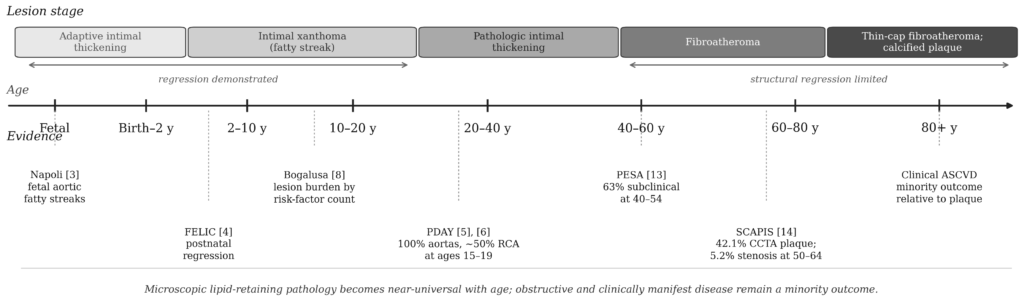
Fig. 1. Progresión de la etapa de la lesión y evidencia de respaldo a lo largo de la vida humana. El engrosamiento intimal adaptativo (banda superior, izquierda) es una respuesta fisiológica al estrés hemodinámico y no es una enfermedad [1], [2]. La patología comienza con el xantoma intimal, en el cual las lipoproteínas que contienen apoB son retenidas y modificadas [2], [16]. Se ha demostrado la regresión de las lesiones tempranas de retención de lípidos [4]. Los números entre corchetes se refieren a la lista de referencias. El eje de edad está comprimido y no es lineal.
TABLA I
Estudios principales de autopsia e imagen sobre el inicio y la prevalencia de la aterosclerosis
| Estudio | Diseño y país | Muestra y edad | Método | Principal hallazgo |
| Napoli y col. [3] | Serie de autopsias fetales; Italia | 82 aortas; edad fetal promedio de 6.2 meses | Histología; inmunotinción para apoB, oxLDL, CD68 | Estrías grasas presentes en aortas fetales; extensión mayor con hipercolesterolemia materna; la retención y oxidación de lípidos precedieron al reclutamiento de monocitos |
| ¡FELIC4] | Serie de autopsias en niños; Italia | 156 niños de 1 a 13 años | Morfometría asistida por computadora | Lesiones más pequeñas en los niños más pequeños que en los fetos correspondientes, lo que indica regresión posnatal; progresión más rápida con hipercolesterolemia materna |
| PDAY5], [6] | Programa de autopsias multicéntrico; EE. UU. | 1,532 (1993); 2,876 (2000); de 15 a 34 años | Fijación estandarizada en formalina; Sudán IV; gradación central | Todas las aortas y aproximadamente la mitad de las arterias coronarias derechas tenían lesiones a los 15-19 años; la carga estuvo relacionada con el colesterol no HDL, el tabaquismo, la adiposidad y la glucemia |
| Bogalusa8] | Cohorte vinculada a autopsia; EE. UU. | 204 autopsias de 2 a 39 años; 93 con datos antemórtem | Tinción macroscópica; morfometría | Aumento gradual de la carga de lesiones según el número de factores de riesgo en la infancia; placa fibrosa coronaria: de 0,6% a 7,2% |
| Enos y otros [9] | Autopsia de baja en combate; Corea | 300 varones; edad media: 22.1 años | Evaluación visual macroscópica; arterias no fijadas | Enfermedad coronaria en 77.3%; el umbral de clasificación incluía el engrosamiento fibroso de la íntima y, por lo tanto, podría arrojar una prevalencia mayor que las definiciones actuales de lesión |
| Webber y col. [11] | Registro de autopsias de bajas; EE. UU. | 3,832; edad media de 25.9 años | Calificación estandarizada de autopsias | Cualquier aterosclerosis coronaria 8,5%; grave 2,3%; la disminución histórica podría reflejar tanto diferencias seculares como metodológicas |
| Tuzcu y col. [15] | Imágenes para donantes de órganos; EE. UU. | Corazones de donantes en todo el rango de edad adulta | Ecografía intravascular | Aterosclerosis en 17% de donantes menores de 20 años, 60% en la cuarta década de vida, 85% a partir de los 50 años |
| PESA [13] | Cohorte asintomática; España | Adultos de 40 a 54 años | Ultrasonido multiterritorial y puntuación de calcio | Aterosclerosis subclínica en 63% en al menos un territorio |
| SCAPIS [14] | Cohorte de población; Suecia | >25,000 adultos de 50 a 64 años | Angiografía por tomografía computarizada coronaria | Aterosclerosis coronaria 42.1%; estenosis significativa 5.2%; el 5.5% de los que tenían un índice de calcio de cero presentaban placa |
IV. Apolipoproteína B y exposición acumulativa
A. El sustrato iniciador
Cada partícula de lipoproteína aterogénica — LDL, sus precursores VLDL y IDL, y lipoproteína(a) — transporta una sola molécula de apolipoproteína B. La medición de colesterol LDL cuantifica la masa de colesterol transportada; la medición de la apoB cuantifica el número de partículas. Debido a que la aterosclerosis se inicia por la retención arterial de partículas que contienen apoB, el número de partículas, en lugar de la carga de colesterol, es la variable de exposición mecánicamente relevante [16], [41].
Establecemos la afirmación causal con precisión. La retención arterial de lipoproteínas que contienen apoB es un evento iniciador necesario en el modelo causal predominante de la aterosclerosis [16], [41]; la biología vascular local — permeabilidad endotelial, composición de proteoglucanos, flujo alterado y señalización inflamatoria — determina dónde y cuándo se produce la retención. Esta formulación preserva el argumento causal a la vez que reconoce que la localización de las lesiones no se explica únicamente por la concentración de partículas. Es coherente con la observación de que las lesiones se forman preferentemente en los puntos de bifurcación y las curvas, donde coinciden el engrosamiento intimal adaptativo y el flujo alterado.
Tres líneas de evidencia independientes convergen en esta conclusión: los estudios mecanísticos de retención y modificación oxidativa dentro de la pared arterial [41]; los estudios genéticos que muestran que una menor exposición de por vida a las lipoproteínas que contienen apoB se asocia con un riesgo coronario sustancialmente menor [42]; y ensayos aleatorizados de reducción farmacológica de LDL que demuestran una reducción de eventos proporcional a la disminución absoluta de LDL [43]. Estos flujos se sintetizan en [16] y [17].
B. El modelo de exposición acumulativa
Debido a que las partículas retenidas se acumulan con el tiempo, carga de placa refleja la integral de la concentración de apoB a lo largo de años de exposición, expresada como años de colesterol o años-apoB por analogía explícita con paquetes-año de la exposición al humo del cigarro [17]; el apoyo empírico para ese modelo se expone en [18] y [19El análisis de cohortes agrupadas muestra que la exposición acumulada al C-LDL durante la adultez joven y la mediana edad predice futuros eventos cardiovasculares independientemente del nivel de C-LDL en la mediana edad18]. En CARDIA, entre 4366 participantes con seguimiento desde los 18 hasta los 40 años, cada aumento de una desviación estándar en la exposición acumulativa a la apoB se asoció con un cociente de riesgos instantáneos de 1,53 (95 por ciento intervalo de confianza 1.36 a 1.72) para la ateroesclerosis incidente enfermedad cardiovascular después de los 40 años, atenuándose a aproximadamente 1.30 tras el ajuste por covariables [19].
El modelo admite una inflexión empírica en lugar de un umbral fijo: en la misma cohorte, el riesgo aumentó por encima de una exposición habitual a la apoB de aproximadamente 75 mg/dL por año entre los 18 y los 40 años [19]. Este es un valor derivado de una cohorte, no una constante biológica, y los autores lo presentan como un posible objetivo clínico que requiere validación. Los números redondos más grandes que se citan frecuentemente en la literatura secundaria —de 5000 a 6000 mg/dL-año de LDL acumulado, o de 1300 a 1500 mg/dL-año de apoB— son heurísticas de modelado sin una derivación empírica directa. Los hitos asociados, a saber, que hipercolesterolemia familiar homocigota cruza dicho umbral en la infancia, la hipercolesterolemia familiar heterocigota en la adultez temprana y la exposición occidental promedio cerca de la mitad de la vida, son consecuencias ilustrativas del modelo y ampliamente consistentes con lo observado epidemiología; las edades específicas no son valores medidos.
C. Evidencia de la intervención temprana
El seguimiento a veinte años de estatinas la terapia iniciada en la infancia para la hipercolesterolemia familiar proporciona una de las demostraciones humanas más sólidas disponibles del modelo de exposición20]. Los pacientes tratados mostraron una progresión del grosor íntima-media carotídeo comparable a la de los hermanos no afectados. A los 39 años, la incidencia acumulada de eventos cardiovasculares fue del 1 por ciento entre los pacientes tratados frente al 26 por ciento entre sus padres afectados, y la mortalidad cardiovascular fue del 0 frente al 7 por ciento.
Este resultado se suele resumir como una reducción de veinticinco veces en los eventos coronarios en adultos. Dicho encuadre exagera la solidez inferencial del diseño: la comparación se establece entre la descendencia tratada y sus padres no tratados, un contraste intergeneracional no aleatorizado y confundido por la mejora secular en la atención cardiovascular. Los hallazgos respaldan firmemente el beneficio del tratamiento temprano, pero la comparación intergeneracional no debe interpretarse como una estimación causal de reducción proporcional.
V. La hipótesis evolutiva
El material de esta sección es una hipótesis más que una explicación establecida, y se presenta en un nivel probatorio inferior al de las secciones III y IV. Se incluye porque incide en la cuestión interpretativa de si la aterosclerosis es inevitable, pero ninguna parte del argumento causal depende de él.
A. Pleiotropía antagónica
El sistema de transporte de apoB cumple funciones esenciales en el transporte de colesterol y la exportación de lípidos hepáticos41]. También se ha descrito una función en la defensa inmunitaria innata: la apoB se une y secuestra un péptido de detección de quórum de Staphylococcus aureus, lo que limita la expresión de los genes de virulencia necesarios para la infección invasiva [44]. Una interpretación evolutiva propuesta sobre los costos en la vejez de dicho sistema invoca pleiotropía antagónica, bajo el cual la selección favorece a las variantes que maximizan la aptitud durante el período reproductivo, incluso cuando esas variantes imponen costos sobre un intervalo postreproductivo donde la presión de selección está atenuada45Se ha postulado que tales rasgos confieren ventajas frente a presiones infecciosas y nutricionales, volviéndose desadaptativos ante una elevación sostenida de la apoB a lo largo de una vida moderna prolongada. Esta explicación es coherente y consistente con los datos comparativos a continuación, pero no se ha probado directamente en humanos y no debe considerarse demostrada.
B. Evidencia de población comparativa
El Tsimane, una población de cazadores-recolectores y horticultores de la Amazonía boliviana, proporciona evidencia sorprendente de que una baja exposición durante la vida es compatible con la casi ausencia de enfermedad coronaria calcificación en la vejez. Entre 705 adultos de 40 años o más, el 85 por ciento tenía un puntuación de calcio en las arterias coronarias de cero; entre los mayores de 75 años, el 65 por ciento tenía una puntuación de cero y el 8 por ciento tenía una puntuación de 100 o más [21]. Esto es una prevalencia cinco veces menor de calcificación coronaria significativa que la MESA población de referencia, observada a pesar de una carga infecciosa e inflamatoria sustancial21].
O’Keefe y sus colegas [22han argumentado que el colesterol LDL fisiológicamente normal para los humanos se encuentra entre 50 y 70 mg/dL, estableciendo comparaciones con los valores reportados en neonatos humanos, primates silvestres no humanos y las poblaciones humanas menos expuestas. Desde esta perspectiva, los intervalos de referencia de laboratorio convencionales describen a una población con exposición patológica en lugar de un estado de referencia saludable. Dicho argumento se presenta en un revisión narrativa y un artículo de opinión en lugar de una investigación original, y varios de sus valores lipídicos comparativos se afirman con documentación primaria limitada. Se cita aquí como una síntesis de una postura, no como evidencia primaria, y los valores comparativos subyacentes ameritan una verificación independiente.
La evidencia en contrario proviene de Estudio Horus, que realizó de cuerpo entero tomografía computarizada en 137 restos momificados de cuatro culturas preindustriales que abarcan más de cuatro milenios23]. Calcificación arterial se identificó en 47 de 137 restos, un 34 por ciento, en las cuatro poblaciones, incluido el grupo de cazadores-recolectores unangan. La edad promedio al morir fue mayor entre los individuos afectados que entre los no afectados, reproduciendo la asociación de edad observada en las poblaciones vivas.
Estos hallazgos son conciliables. La interpretación está limitada por la posible selección de restos preservados, la representatividad incierta de las poblaciones muestreadas y la información incompleta sobre las exposiciones ambientales históricas. La calcificación detectada por tomografía computarizada es un marcador tardío insensible a la enfermedad temprana. La síntesis defendible es que la aterosclerosis es un potencial inherente del ser humano arteria cuya tasa y expresión clínica son fuertemente modificables, siendo la exposición de por vida a las lipoproteínas que contienen apoB un determinante modificable importante.
VI. Modificación dietética de la exposición de por vida
A. Patrones con efecto establecido sobre el LDL
El enfoque de la cartera dietética, que combina fibra soluble viscosa fibra, planta esteroles, soy proteína, y frutos secos dentro de un patrón basado en plantas, produce una reducción del LDL cercana a la de una estatina de primera generación en dosis baja [24]. El patrón mediterráneo, probado en PREDIMED, un gran ensayo de intervención dietética cuyo informe de 2018 reanalizó los datos tras desviaciones documentadas del aleatorización protocolo en algunos sitios, reducción de eventos cardiovasculares, con un beneficio observado a pesar de la alta ingesta de grasa total de aceite de oliva y frutos secos en lugar de mediante la restricción de grasa25]. Los patrones vegetarianos y veganos reducen el colesterol LDL en relación con los comparadores omnívoros en ensayos aleatorizados [46].
B. Seguridad pediátrica
Dos ensayos aleatorizados abordan la principal objeción a las dietas reductoras de lípidos en los niños, a saber, el deterioro del crecimiento o del neurodesarrollo. El Estudio de Intervención Dietética en Niños asignó al azar a 663 niños de 8 a 10 años con LDL elevado a un patrón reducido en grasas y colesterol durante un promedio de siete años, y observó una reducción de LDL sin efectos adversos sobre la estatura, la velocidad de crecimiento, el estado del hierro o la maduración sexual [26]. El Proyecto Especial de Intervención sobre Factores de Riesgo Coronario de Turku inició la asesoría dietética a los siete meses de edad e informó una reducción del colesterol sin alteración del crecimiento [27]; un análisis separado dentro de la misma cohorte no encontró ningún efecto adverso en el desarrollo neurológico a los cinco años [40]. Sin embargo, las directrices pediátricas advierten en contra de la restricción de grasas en la infancia. La directriz pediátrica integrada actual de EE. UU. recomienda leche humana o fórmula fortificada con hierro durante el primer año sin modificación de grasa, y para niños pequeños de 12 a 24 meses con historial familiar de obesidad, enfermedad cardiovascular o hipercolesterolemia, hacer la transición a leche reducida en grasa únicamente después de hablar con el proveedor de atención pediátrica y solo dentro de una dieta general que aporte alrededor del 30 por ciento de las calorías en forma de grasa [47].
C. Patrones muy bajos en grasas y con restricción de aceite añadido
Los patrones que restringen la grasa total y eliminan los aceites añadidos, incluidos los aceites incorporados en los alimentos preparados, se basan en una evidencia diferente. El Ensayo sobre el estilo de vida y el corazón reportado regresión angiográfica de estenosis coronaria bajo una dieta muy baja en grasa dieta basada en plantas [28], pero entregó la dieta dentro de un paquete que incluía ejercicio, manejo del estrés y cesación tabáquica, por lo que la contribución independiente de la restricción de aceite no se puede aislar; el trabajo clínico de apoyo en esta tradición incluye evidencia de series de casos no controlados como [29Su plausibilidad cardiovascular se basa principalmente en los efectos favorables sobre los factores de riesgo establecidos, incluidos el C-LDL y la apoB. La postura excede la evidencia cuando afirma que los aceites comestibles son exclusivamente perjudiciales más allá de sus densidad energética, o que los patrones muy bajos en grasa superen a los patrones mediterráneos más ricos en grasa en cuanto a criterios de valoración duros; la evidencia disponible de resultados cardiovasculares aleatorizados no establece esa jerarquía.
VII. Aceites vegetales poliinsaturados
Sustitución de poliinsaturados por grasa saturada sigue siendo un debate dietético contemporáneo destacado sobre cómo reducir la exposición a la apoB a lo largo de la vida, y se aborda aquí por esa razón. La evidencia de respaldo es sustancial. La revisión Cochrane sobre la reducción de grasas saturadas incluyó 15 ensayos aleatorizados y 56,675 participantes; en los 12 ensayos que aportaron 53,758 participantes al análisis combinado de eventos cardiovasculares, la reducción de grasas saturadas produjo una reducción relativa del 17 por ciento (riesgo relativo 0.83; intervalo de confianza del 95 por ciento de 0.70 a 0.98; Calificación evidencia de calidad moderada). La revisión concluyó que reemplazar la grasa saturada con grasa poliinsaturada o con carbohidrato cada uno parecía útil, esa subagrupación no sugirió diferencias significativas entre el reemplazo por grasa poliinsaturada y el reemplazo por carbohidratos, y que los datos sobre el reemplazo por grasa monoinsaturada y las proteínas eran muy limitadas30]. La Asesoría Presidencial de la Asociación Americana del Corazón estimó, en su síntesis de dichos ensayos, una reducción de las enfermedades cardiovasculares de aproximadamente el 30 por ciento [31]. Un análisis conjunto de 30 cohortes prospectivas encontró una mayor circulación ácido linoleico asociado con una menor incidencia de enfermedad y mortalidad32], y los ensayos de alimentación controlados no han demostrado aumentos significativos en Proteína C reactiva, la interleucina-6 o el factor de necrosis tumoral alfa con una mayor ingesta de ácido linoleico [33], [34].
Dos líneas de evidencia generan preocupación. Una sola comida rica en grasas deteriora transitoriamente la dilatación mediada por flujo de la arteria braquial, la cual se resuelve en unas seis horas [35]; el efecto no es específico de aceites de semillas, ya que los mismos investigadores lo observaron tras comidas con aceite de oliva [36]. Por separado, los reanálisis de los datos recuperados de dos ensayos históricos encontraron una mayor mortalidad en los grupos de intervención: el Estudio Dietético del Corazón de Sídney informó mortalidad por todas las causas de 17.6 frente a 11.8 por ciento37], y el Experimento Coronario de Minnesota encontró una mayor reducción del colesterol asociada con una mayor mortalidad [38]. Ambos análisis de datos recuperados conllevan importantes limitaciones de diseño y de datos, incluida la recuperación incompleta de los registros originales [37], [38]. Grasas trans la exposición a margarinas típicas de la época es un contribuyente plausible, pero no se midió entre los grupos y sigue siendo objeto de debate, incluso por parte de los autores de los reanálisis; no debe presentarse como una explicación establecida. La intervención de Sídney utilizó aceite de cártamo, el cual no contiene ácidos grasos omega-3.
Los dos conjuntos de evidencia son asimétricos. El mecanismo de reducción de apoB está respaldado por evidencia mecanicista, genética humana y de resultados aleatorizados [16], [41]-[43]; el posprandial la señal se basa en un sustituto transitorio que no ha demostrado predecir resultados duros cuando es inducida por una comida. Los reanálisis de los ensayos son genuinamente discordantes y no deben descartarse, pero sus limitaciones metodológicas los hacen insuficientes, de forma aislada, para superar la evidencia agregada aleatorizada y prospectiva. En conjunto, la evidencia respalda los patrones dietéticos que reducen la exposición de por vida a la apoB y no establece que los aceites vegetales poliinsaturados sean un peligro vascular primario30]-[34], [37], [38].
VIII. Lo que significa “Todos tienen ateroesclerosis”
La afirmación de que la ateroesclerosis es universal se despliega frecuentemente para argumentar que, por lo tanto, es normal. La evidencia reunida aquí respalda una afirmación más específica.
Las lesiones arteriales con retención de lípidos se vuelven muy comunes a medida que avanza la edad. La afirmación más contundente de que casi todos los adultos eventualmente desarrollan una patología microscópica de retención de lípidos no queda demostrada por las cohortes de imágenes citadas aquí y requeriría evidencia histopatológica directa que abarque distintos rangos de edad. Dichas lesiones no deben confundirse con la enfermedad coronaria obstructiva, ruptura de placa, o eventos cardiovasculares clínicos, que siguen siendo resultados poco frecuentes en comparación con la prevalencia de la placa. El estudio SCAPIS detectó aterosclerosis coronaria en el 42,1 por ciento de los adultos de entre 50 y 64 años, pero solo se observó una estenosis significativa en el 5,2 por ciento [14]. La exposición a lo largo de la vida a partículas que contienen apoB es un factor determinante clave en el inicio y la progresión de las lesiones, aunque la biología vascular local y otros factores de riesgo influyen en el desarrollo de las lesiones.
Por lo tanto, la ubicuidad estadística no es prueba de normalidad fisiológica. Hipertensión y resistencia a la insulina también son comunes en las poblaciones occidentales de edad avanzada, sin que por ello constituyan estados de referencia saludables. Los hallazgos sobre los tsimane refutan la idea de que la calcificación coronaria sea una consecuencia inevitable del envejecimiento humano [21], aunque ninguna cohorte observacional por sí sola es definitiva. La observación del estudio FELIC sobre la regresión de las lesiones posnatales indica que las lesiones tempranas no están destinadas a progresar [4].
IX. Conclusión
La propensión a la aterosclerosis es intrínseca a las arterias humanas. La exposición prolongada a lipoproteínas que contienen apoB favorece la acumulación de lípidos en la íntima con el paso del tiempo [16]; la histología de la aorta fetal demuestra que esto puede comenzar antes del nacimiento [3], y los hallazgos de momias de la época preindustrial demuestran que no es un fenómeno exclusivamente moderno [23]. En este sentido limitado, la susceptibilidad es universal; sin embargo, la lesión resultante que retiene lípidos es patológica.
La velocidad de progresión y su manifestación clínica no son fijas. La población tsimane demuestra que es posible alcanzar una edad avanzada con una carga de calcio en las arterias coronarias notablemente baja [21], y las personas con hipercolesterolemia familiar que reciben tratamiento desde la infancia presentan trayectorias vasculares similares a las de sus hermanos no afectados [20]. Dado que la exposición acumulada a partículas que contienen apoB es un determinante causal y modificable importante de la carga de morbilidad [16]-[19], la alta prevalencia de la aterosclerosis en la vejez es un argumento a favor de la reducción temprana y sostenida de la exposición, más que del fatalismo terapéutico.
Apéndice: Registro de verificación de origen
A continuación se presentan las discrepancias en los documentos, las afirmaciones no verificables y las exageraciones identificadas durante la verificación. Se incluyen estos puntos porque varias de las afirmaciones en cuestión circulan ampliamente en la literatura secundaria.
1) Napoli y col., aortas fetales. Se confirmaron la composición de la muestra, la edad fetal promedio y ambos coeficientes de correlación. No se confirmó si el informe original presenta porcentajes de prevalencia de lesiones (que suelen citarse como del 30 por ciento frente a hasta un 90 por ciento según el estado materno) o solo el área de la lesión; el resumen hace hincapié en el área y la extensión. Corrección a una nota de verificación anterior: los valores de la composición de las lesiones de 17,3 por ciento (solo LDL nativa), 13,3 por ciento (LDL oxidada (sin macrófagos) y el 58,6 por ciento (ambos) se indican en el resumen publicado y no son motivo de sospecha. Se trata de porcentajes de sitios aterogénicos inmunopositivos, no de fetos, que es el denominador que con mayor frecuencia se omite en las citas secundarias. Por lo tanto, se omiten de las afirmaciones sobre prevalencia en este artículo.
2) Magnitud de la regresión de la lesión FELIC. En el estudio primario se menciona la regresión posnatal, la cual se describe aquí de manera cualitativa. La cifra específica del 64 por ciento de reducción en el tamaño de las lesiones en niños menores de tres años, citada con frecuencia en fuentes secundarias, no se verificó con el texto original y, por lo tanto, no se afirma.
3) Tamaño de la muestra de PDAY. Los valores discrepantes de 1,532 y 2,876 son ambos correctos, y corresponden a los análisis de historia natural de 1993 y a los análisis topográficos de 2000. Los pares exactos de superficie intimal que a veces se citan (del 2,2 al 12,2 por ciento en hombres blancos; del 3,1 al 15,4 por ciento en hombres negros) no se verificaron con las tablas originales y no se reportan numéricamente.
4) Gradiente de factores de riesgo en Bogalusa. Las cuatro series de valores se confirmaron tal como se informó en la Sección III-B. Las citas abreviadas que solo reportan los valores extremos de la serie de estrías grasas coronarias omiten los estratos intermedios.
5) Desglose de la gravedad según la escala de Enos. Se confirman la cifra global del 77,3 por ciento y la edad promedio. El desglose por gravedad que a veces se cita (35 por ciento de engrosamiento fibroso, 26 por ciento de estrechamiento del 10 al 49 por ciento, 15 por ciento de gravedad severa) concuerda con fuentes secundarias, pero no se verificó con el informe de 1953 y no se menciona en el cuerpo del texto.
6) Engrosamiento intimal adaptativo en la serie de la Guerra de Corea. La afirmación de que la serie de Enos clasificó el engrosamiento intimal adaptativo como aterosclerosis es una inferencia derivada de los criterios de clasificación reportados, no una afirmación de los investigadores originales. Se presenta en la Sección III-C como una advertencia metodológica.
7) Prevalencia del calcio en los tsimane. Los valores correctos son: 85 por ciento con un índice de calcio de cero en personas de 40 años o más, 65 por ciento en personas de 75 años o más, y 8 por ciento con un índice de 100 o más en el grupo de mayor edad. Las tablas secundarias que reportan una prevalencia del 15 por ciento y del 35 por ciento en los tsimane en las columnas de placa calcificada son inversiones de los datos de puntaje de calcio cero y son erróneas.
8) Seguimiento de la hipercolesterolemia familiar. Se confirman las tasas de incidencia del 1 % frente al 26 % y la mortalidad del 0 % frente al 7 %. La interpretación de una reducción de veinticinco veces que se deriva de estos datos no constituye una estimación válida del efecto causal, por las razones expuestas en la Sección IV-C.
9) Umbrales de ApoB-años. El concepto de exposición acumulada está bien establecido, y en el estudio CARDIA se ha descrito un punto de inflexión derivado de una cohorte cerca de los 75 mg/dL por año de exposición habitual a la apoB [19]. Los umbrales más elevados que circulan en la literatura secundaria (de 5,000 a 6,000 mg/dL-años de LDL; de 1,300 a 1,500 mg/dL-años de apoB) no pudieron rastrearse hasta una derivación primaria y se identifican como heurísticas en la Sección IV-B. Un borrador anterior de este artículo atribuía a esta literatura un cociente de riesgo de 1,05 por cada 100 mg/dL-año; esa cifra no se pudo localizar en ninguna fuente primaria y se ha sustituido por las estimaciones de efecto reportadas.
10) Cifras de prevalencia en la tercera edad. Se confirman los valores de PESA y SCAPIS. No se ha verificado de forma independiente: placa carotídea del 87 por ciento en personas de 63 a 65 años en la cohorte ACE 1950; datos combinados ARIC y las cifras de MESA, que indican un 11 por ciento con un índice de calcio de cero en personas de 75 años o más y la presencia de calcio en el 95 por ciento de las personas de 90 años o más; y un 11 por ciento placa no calcificada prevalencia entre los pacientes sintomáticos con un índice de calcio de cero. Cifras exageradas y no utilizadas: prevalencias de estenosis obstructiva del 45 por ciento en personas de 60 a 80 años y del 65 por ciento en mayores de 80 años, enfermedad microscópica cercana al 100 por ciento y enfermedad sintomática del 15 al 25 por ciento.
11) Frecuencia de lesiones antiguas en la infancia y la pubertad. Valores que se citan con frecuencia (células espumosas de macrófagos aisladas en el 45 por ciento de los bebés durante los primeros ocho meses; el 65 por ciento con lesiones de estrías grasas y el 8 por ciento en fase preateromatosa o ateroma (etapa comprendida entre los 12 y los 14 años) concuerdan con las series publicadas, pero no se han verificado con las tablas originales y no se indican numéricamente.
12) Valores lipídicos comparativos de O’Keefe. Referencia [22] es una reseña narrativa y un artículo de opinión, no una investigación original. Los valores lipídicos que presenta para las poblaciones de cazadores-recolectores y los primates silvestres se afirman con citas primarias limitadas y no fueron verificados de manera independiente. Se cita en la Sección V-B como una síntesis de una postura y no como evidencia primaria.
13) Prevalencia del engrosamiento intimal adaptativo en recién nacidos. La cifra repetida de que hasta el 30 por ciento de los recién nacidos no pudo atribuirse a una fuente primaria no se afirma.
14) Umbral de restricción de grasas en pediatría. En versiones anteriores no se había aclarado si la restricción de grasas está contraindicada antes de los 12 meses o antes de los dos años de edad. Este aparente conflicto refleja dos disposiciones de la misma guía: no se debe modificar el contenido de grasa durante el primer año, y se permite el uso de leche baja en grasa entre los 12 y los 24 meses solo para determinados niños, dentro de una dieta que siga aportando alrededor del 30 por ciento de las calorías provenientes de la grasa [47]. Ambas se recogen ahora en la Sección VI-B.
Agradecimientos y declaraciones de transparencia
El autor es el fundador y único administrador de Curing Heart Disease, LLC, empresa que opera una plataforma de educación sobre salud cardiovascular y obtiene ingresos de dicha actividad. No se recibió financiamiento externo para este trabajo, y ningún patrocinador de la industria participó en su diseño, análisis o redacción. El autor declara no tener ninguna otra relación financiera relevante para el tema tratado.
Este artículo es una síntesis narrativa de la literatura publicada. No implicó ninguna investigación nueva con sujetos humanos o animales y no requirió autorización ética. Está dirigido a un público científico y profesional y no constituye un consejo médico.
Referencias
- Stary HC, Chandler AB, Dinsmore RE, et al. A definition of advanced types of atherosclerotic lesions and a histological classification of atherosclerosis. A report from the Committee on Vascular Lesions of the Council on Arteriosclerosis, American Heart Association. Circulation. 1995;92(5):1355-1374. doi:10.1161/01.cir.92.5.1355
- Virmani R, Kolodgie FD, Burke AP, Farb A, Schwartz SM. Lessons from sudden coronary death: a comprehensive morphological classification scheme for atherosclerotic lesions. Arterioscler Thromb Vasc Biol. 2000;20(5):1262-1275. doi:10.1161/01.atv.20.5.1262
- Napoli C, D’Armiento FP, Mancini FP, et al. Fatty streak formation occurs in human fetal aortas and is greatly enhanced by maternal hypercholesterolemia. Intimal accumulation of low density lipoprotein and its oxidation precede monocyte recruitment into early atherosclerotic lesions. J Clin Invest. 1997;100(11):2680-2690. doi:10.1172/JCI119813
- Napoli C, Glass CK, Witztum JL, Deutsch R, D’Armiento FP, Palinski W. Influence of maternal hypercholesterolaemia during pregnancy on progression of early atherosclerotic lesions in childhood: Fate of Early Lesions in Children (FELIC) study. Lancet. 1999;354(9186):1234-1241. doi:10.1016/S0140-6736(99)02131-5
- Natural history of aortic and coronary atherosclerotic lesions in youth. Findings from the PDAY Study. Pathobiological Determinants of Atherosclerosis in Youth (PDAY) Research Group. Arterioscler Thromb. 1993;13(9):1291-1298. doi:10.1161/01.atv.13.9.1291
- McGill HC Jr, McMahan CA, Herderick EE, et al. Effects of coronary heart disease risk factors on atherosclerosis of selected regions of the aorta and right coronary artery. PDAY Research Group. Pathobiological Determinants of Atherosclerosis in Youth. Arterioscler Thromb Vasc Biol. 2000;20(3):836-845. doi:10.1161/01.atv.20.3.836
- Gidding SS, Colangelo LA, Nwabuo CC, et al. PDAY risk score predicts cardiovascular events in young adults: the CARDIA study. Eur Heart J. 2022;43(30):2892-2900. doi:10.1093/eurheartj/ehac009
- Berenson GS, Srinivasan SR, Bao W, Newman WP 3rd, Tracy RE, Wattigney WA. Association between multiple cardiovascular risk factors and atherosclerosis in children and young adults. The Bogalusa Heart Study. N Engl J Med. 1998;338(23):1650-1656. doi:10.1056/NEJM199806043382302
- Enos WF, Holmes RH, Beyer J. Coronary disease among United States soldiers killed in action in Korea; preliminary report. J Am Med Assoc. 1953;152(12):1090-1093. doi:10.1001/jama.1953.03690120006002
- McNamara JJ, Molot MA, Stremple JF, Cutting RT. Coronary artery disease in combat casualties in Vietnam. JAMA. 1971;216(7):1185-1187. doi:10.1001/jama.1971.03180330061012
- Webber BJ, Seguin PG, Burnett DG, Clark LL, Otto JL. Prevalence of and risk factors for autopsy-determined atherosclerosis among US service members, 2001-2011. JAMA. 2012;308(24):2577-2583. doi:10.1001/jama.2012.70830
- Kotwal RS, Mazuchowski EL, Howard JT, et al. Autopsy-Determined Atherosclerosis in Elite US Military Special Operations Forces. J Spec Oper Med. 2021;21(2):19-24. doi:10.55460/RLN9-UQ2X
- Fernández-Friera L, Peñalvo JL, Fernández-Ortiz A, et al. Prevalence, Vascular Distribution, and Multiterritorial Extent of Subclinical Atherosclerosis in a Middle-Aged Cohort: The PESA (Progression of Early Subclinical Atherosclerosis) Study. Circulation. 2015;131(24):2104-2113. doi:10.1161/CIRCULATIONAHA.114.014310
- Bergström G, Persson M, Adiels M, et al. Prevalence of Subclinical Coronary Artery Atherosclerosis in the General Population. Circulation. 2021;144(12):916-929. doi:10.1161/CIRCULATIONAHA.121.055340
- Tuzcu EM, Kapadia SR, Tutar E, et al. High prevalence of coronary atherosclerosis in asymptomatic teenagers and young adults: evidence from intravascular ultrasound. Circulation. 2001;103(22):2705-2710. doi:10.1161/01.cir.103.22.2705
- Ference BA, Ginsberg HN, Graham I, et al. Low-density lipoproteins cause atherosclerotic cardiovascular disease. 1. Evidence from genetic, epidemiologic, and clinical studies. A consensus statement from the European Atherosclerosis Society Consensus Panel. Eur Heart J. 2017;38(32):2459-2472. doi:10.1093/eurheartj/ehx144
- Ference BA, Braunwald E, Catapano AL. The LDL cumulative exposure hypothesis: evidence and practical applications. Nat Rev Cardiol. 2024;21(10):701-716. doi:10.1038/s41569-024-01039-5
- Zhang Y, Pletcher MJ, Vittinghoff E, et al. Association Between Cumulative Low-Density Lipoprotein Cholesterol Exposure During Young Adulthood and Middle Age and Risk of Cardiovascular Events. JAMA Cardiol. 2021;6(12):1406-1413. doi:10.1001/jamacardio.2021.3508
- Zheutlin AR, Handoo F, Luebbe S, et al. Cumulative exposure to atherogenic lipoprotein particles in young adults and subsequent incident atherosclerotic cardiovascular disease. Eur Heart J. 2025;46(41):4302-4312. doi:10.1093/eurheartj/ehaf472
- Luirink IK, Wiegman A, Kusters DM, et al. 20-Year Follow-up of Statins in Children with Familial Hypercholesterolemia. N Engl J Med. 2019;381(16):1547-1556. doi:10.1056/NEJMoa1816454
- Kaplan H, Thompson RC, Trumble BC, et al. Coronary atherosclerosis in indigenous South American Tsimane: a cross-sectional cohort study. Lancet. 2017;389(10080):1730-1739. doi:10.1016/S0140-6736(17)30752-3
- O’Keefe JH Jr, Cordain L, Harris WH, Moe RM, Vogel R. Optimal low-density lipoprotein is 50 to 70 mg/dl: lower is better and physiologically normal. J Am Coll Cardiol. 2004;43(11):2142-2146. doi:10.1016/j.jacc.2004.03.046
- Thompson RC, Allam AH, Lombardi GP, et al. Atherosclerosis across 4000 years of human history: the Horus study of four ancient populations. Lancet. 2013;381(9873):1211-1222. doi:10.1016/S0140-6736(13)60598-X
- Jenkins DJ, Kendall CW, Marchie A, et al. Effects of a dietary portfolio of cholesterol-lowering foods vs lovastatin on serum lipids and C-reactive protein. JAMA. 2003;290(4):502-510. doi:10.1001/jama.290.4.502
- Estruch R, Ros E, Salas-Salvadó J, et al. Primary Prevention of Cardiovascular Disease with a Mediterranean Diet Supplemented with Extra-Virgin Olive Oil or Nuts. N Engl J Med. 2018;378(25):e34. doi:10.1056/NEJMoa1800389
- Obarzanek E, Kimm SY, Barton BA, et al. Long-term safety and efficacy of a cholesterol-lowering diet in children with elevated low-density lipoprotein cholesterol: seven-year results of the Dietary Intervention Study in Children (DISC). Pediatrics. 2001;107(2):256-264. doi:10.1542/peds.107.2.256
- Niinikoski H, Lagström H, Jokinen E, et al. Impact of repeated dietary counseling between infancy and 14 years of age on dietary intakes and serum lipids and lipoproteins: the STRIP study. Circulation. 2007;116(9):1032-1040. doi:10.1161/CIRCULATIONAHA.107.699447
- Ornish D, Brown SE, Scherwitz LW, et al. Can lifestyle changes reverse coronary heart disease? The Lifestyle Heart Trial. Lancet. 1990;336(8708):129-133. doi:10.1016/0140-6736(90)91656-u
- Esselstyn CB Jr, Gendy G, Doyle J, Golubic M, Roizen MF. A way to reverse CAD? J Fam Pract. 2014;63(7):356-364b.
- Hooper L, Martin N, Jimoh OF, Kirk C, Foster E, Abdelhamid AS. Reduction in saturated fat intake for cardiovascular disease. Cochrane Database Syst Rev. 2020;8(8):CD011737. Published 2020 Aug 21. doi:10.1002/14651858.CD011737.pub3
- Sacks FM, Lichtenstein AH, Wu JHY, et al. Dietary Fats and Cardiovascular Disease: A Presidential Advisory From the American Heart Association. Circulation. 2017;136(3):e1-e23. doi:10.1161/CIR.0000000000000510
- Marklund M, Wu JHY, Imamura F, et al. Biomarkers of Dietary Omega-6 Fatty Acids and Incident Cardiovascular Disease and Mortality. Circulation. 2019;139(21):2422-2436. doi:10.1161/CIRCULATIONAHA.118.038908
- Johnson GH, Fritsche K. Effect of dietary linoleic acid on markers of inflammation in healthy persons: a systematic review of randomized controlled trials. J Acad Nutr Diet. 2012;112(7):1029-1041.e10415. doi:10.1016/j.jand.2012.03.029
- Su H, Liu R, Chang M, Huang J, Wang X. Dietary linoleic acid intake and blood inflammatory markers: a systematic review and meta-analysis of randomized controlled trials. Food Funct. 2017;8(9):3091-3103. doi:10.1039/c7fo00433h
- Vogel RA, Corretti MC, Plotnick GD. Effect of a single high-fat meal on endothelial function in healthy subjects. Am J Cardiol. 1997;79(3):350-354. doi:10.1016/s0002-9149(96)00760-6
- Vogel RA, Corretti MC, Plotnick GD. The postprandial effect of components of the Mediterranean diet on endothelial function. J Am Coll Cardiol. 2000;36(5):1455-1460. doi:10.1016/s0735-1097(00)00896-2
- Ramsden CE, Zamora D, Leelarthaepin B, et al. Use of dietary linoleic acid for secondary prevention of coronary heart disease and death: evaluation of recovered data from the Sydney Diet Heart Study and updated meta-analysis. BMJ. 2013;346:e8707. Published 2013 Feb 4. doi:10.1136/bmj.e8707
- Ramsden CE, Zamora D, Majchrzak-Hong S, et al. Re-evaluation of the traditional diet-heart hypothesis: analysis of recovered data from Minnesota Coronary Experiment (1968-73). BMJ. 2016;353:i1246. Published 2016 Apr 12. doi:10.1136/bmj.i1246
- McMahan CA, Gidding SS, Viikari JS, et al. Association of Pathobiologic Determinants of Atherosclerosis in Youth risk score and 15-year change in risk score with carotid artery intima-media thickness in young adults (from the Cardiovascular Risk in Young Finns Study). Am J Cardiol. 2007;100(7):1124-1129. doi:10.1016/j.amjcard.2007.05.035
- Rask-Nissilä L, Jokinen E, Terho P, et al. Effects of diet on the neurologic development of children at 5 years of age: the STRIP project. J Pediatr. 2002;140(3):328-333. doi:10.1067/mpd.2002.122393
- Boren J, Chapman MJ, Krauss RM, et al. Low-density lipoproteins cause atherosclerotic cardiovascular disease: pathophysiological, genetic, and therapeutic insights: a consensus statement from the European Atherosclerosis Society Consensus Panel. Eur Heart J. 2020;41(24):2313-2330. doi:10.1093/eurheartj/ehz962
- Ference BA, Yoo W, Alesh I, et al. Effect of long-term exposure to lower low-density lipoprotein cholesterol beginning early in life on the risk of coronary heart disease: a Mendelian randomization analysis. J Am Coll Cardiol. 2012;60(25):2631-2639. doi:10.1016/j.jacc.2012.09.017
- Cholesterol Treatment Trialists’ (CTT) Collaboration. Efficacy and safety of more intensive lowering of LDL cholesterol: a meta-analysis of data from 170,000 participants in 26 randomised trials. Lancet. 2010;376(9753):1670-1681. doi:10.1016/S0140-6736(10)61350-5
- Peterson MM, Mack JL, Hall PR, et al. Apolipoprotein B is an innate barrier against invasive Staphylococcus aureus infection. Cell Host Microbe. 2008;4(6):555-566. doi:10.1016/j.chom.2008.10.001
- Williams GC. Pleiotropy, natural selection, and the evolution of senescence. Evolution. 1957;11(4):398-411. doi:10.1111/j.1558-5646.1957.tb02911.x
- Wang F, Zheng J, Yang B, Jiang J, Fu Y, Li D. Effects of vegetarian diets on blood lipids: a systematic review and meta-analysis of randomized controlled trials. J Am Heart Assoc. 2015;4(10):e002408. doi:10.1161/JAHA.115.002408
- Expert Panel on Integrated Guidelines for Cardiovascular Health and Risk Reduction in Children and Adolescents; National Heart, Lung, and Blood Institute. Expert panel on integrated guidelines for cardiovascular health and risk reduction in children and adolescents: summary report. Pediatrics. 2011;128(Suppl 5):S213-S256. doi:10.1542/peds.2009-2107C