
Estrategias nutricionales y clínicas para el atleta de resistencia que envejece
Balancing Sarcopenia Prevention, Cardiovascular Safety, and Oncological Risk Over Age 65
Aging presents a complex physiological challenge for competitive endurance athletes. After age 65, the intersection of physical performance, age-related sarcopenia, and cellular-longevity pathways requires a highly calibrated nutritional strategy.[1] Preserving skeletal muscle mass and functional capacity while mitigating the risks of enfermedad cardiovascular and oncogenesis demands a nuanced understanding of amino-acid kinetics, intracellular signaling, and metabolic thresholds.[2] This report evaluates the physiological demands, safety, and optimization of a dietary regimen for a 170 lb (77.11 kg) master endurance athlete over age 65 who consumes a largely dieta vegetariana supplemented with chicken, proteína isolates, and free-form L-leucine.
Throughout, claims are graded by evidence tier. The strongest support exists for adequate total protein, sensible meal distribution, and the pairing of protein with regular exercise—particularly entrenamiento de resistencia.[2] Claims that touch longevity pathways, cancer biology, or immune-metabolic signaling rest largely on observational, mechanistic, or animal data and are presented as biological context rather than as clinical proof for a specific meal plan.[1,20]
Sarcopenia, Anabolic Resistance, and the Master-Athlete Paradox
The progressive loss of skeletal muscle mass and functional strength—termed sarcopenia—begins as early as the third decade of life and accelerates after age 60.[3] In untrained populations, acute events such as hospitalization or muscle disuse can trigger a catabolic crisis and rapid, often incompletely reversible muscle loss. For the master endurance athlete, maintaining muscle mass is critical not only for performance and recovery but as a determinant of systemic salud metabólica and lifelong functional independence.[2]
The primary mechanism driving sarcopenia is “resistencia anabólica”—a blunted skeletal-muscle protein-synthetic (MPS) response to both hyperaminoacidemia and physical exercise.[4] At the molecular level this desensitization localizes to the mechanistic target of rapamycin complex 1 (mTORC1) pathway, which integrates mechanical, hormonal, and amino-acid cues to regulate translation initiation via downstream phosphorylation of p70S6K1 and 4E-BP1.[5]
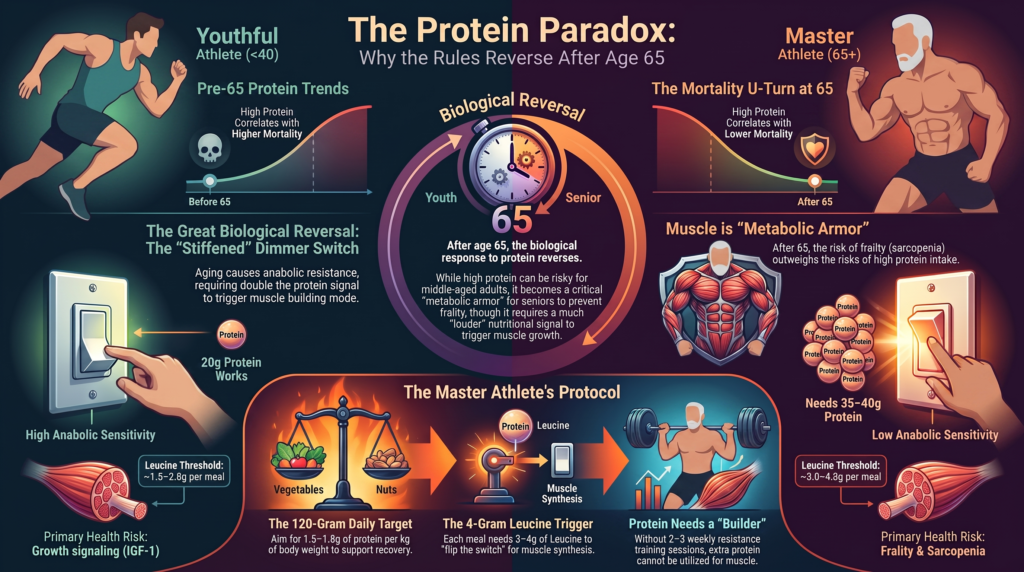
In younger individuals, a modest protein dose (≈20 g) producing a plasma leucine rise is sufficient to recruit and activate mTORC1 at the lysosomal membrane through the Sestrina2–GATOR2–leucyl-tRNA-synthetase axis. In older adults, a higher intracellular leucine concentration is required to overcome the age-related “dimmer switch” of anabolic resistance and achieve equivalent translation-initiation rates—the elevated “leucine trigger.”[4,6]
The Role of Lifelong Training
Whether lifelong competitive endurance training rescues master athletes from anabolic resistance remains debated. Regular exercise partially restores muscle sensitivity to protein feeding, but master athletes are not immune to chronological aging.[7] Intense endurance training causes myofibrillar micro-damage and elevates skeletal-muscle amino-acid oxidation (rising further in glycogen-depleted states), which increases the baseline requirement for structural repair proteins.[8] Clinical work further indicates that older muscle exhibits blunted post-exercise recovery kinetics, necessitating targeted, leucine-rich post-workout feeding to fully restore the contractile apparatus.[7]
| Physiological Parameter | Youthful Phenotype (<40) | Geriatric Phenotype (≥65) | Clinical Significance for Athletes |
| Basal MPS rate | Maintained | Relatively preserved | Baseline muscle turnover remains largely functional with age. |
| MPS response to low protein (<20 g) | Robust | Blunted / absent | Sub-threshold meals fail to initiate muscle repair in older adults. |
| Meal leucine threshold | ~1.5–2.0 g | ~3.0–4.0 g | Older muscle requires roughly double the leucine to activate mTORC1. |
| mTORC1 sensitivity | Alto | Low / blunted | Requires precise dietary strategies to stimulate translation. |
| Post-exercise sensitization | Sustained 24–48 h | Attenuated | Master athletes require rapid, targeted recovery nutrition. |
Note: leucine-threshold ranges are indicative values drawn from stable-isotope MPS studies in younger versus older adults; individual thresholds vary with training status, meal composition, and health.
Protein as One Determinant Among Several
It is worth stating plainly that protein is only one determinant of muscle preservation, and rarely the limiting one. Sleep quality and duration, adequate total energy intake, resistance and overall physical activity, chronic disease, systemic inflamación, endocrine status, and medications all substantially influence muscle protein synthesis and net protein balance in older adults.[2,3] Optimizing protein intake cannot fully overcome deficits in these other domains, and a nutritional prescription delivered in isolation from them is unlikely to achieve its intended effect. In clinical practice, an athlete who is under-sleeping, under-fueling, or managing an inflammatory condition will generally gain more from addressing those factors than from further refinement of per-meal leucine content.
Daily Protein Target vs. Single-Meal Allocation
To determine the ideal protein distribution for a 77.11 kg master athlete, the flat daily target must be reconciled with per-meal dosing. There is an apparent discrepancy between a daily target expressed in g/kg/d and a fixed per-meal target of ~40 g.
The Arithmetic
Daily protein at 1.2 g/kg/d = 77.11 kg × 1.2 g/kg = 92.53 g/d
Three meals × 40 g = 120 g/d
Relative daily intake = 120 g ÷ 77.11 kg ≈ 1.56 g/kg/d
Consuming 40 g per meal across three meals therefore yields ≈1.56 g/kg/d, which exceeds the ~1.2 g/kg/d “sweet spot” frequently cited for sedentary or moderately active older adults.[2]
Resolving the Paradox for Endurance Competitors
While ~1.2 g/kg/d maintains nitrogen balance in sedentary older individuals, it is unlikely to be optimal for highly active master endurance athletes.[2,9] Indicator-amino-acid-oxidation (IAAO) work in endurance-trained adults has estimated requirements in the approximate range of 1.6–1.8 g/kg/d during post-exercise recovery.[10] That work was conducted in endurance-trained adults rather than specifically in athletes over 65, and whether the same requirement applies to this older population has not been directly established. Age-related anabolic resistance combined with high training volume nonetheless provides a rationale for considering approximately 1.4–1.6 g/kg/d, individualized to workload, energy availability, body composition, and clinical status.[2,4,10]
For the 77.11 kg athlete modeled in this article, a target of ~120 g/d (≈1.56 g/kg/d) distributed across three to four boluses of ~35–40 g repeatedly clears the anabolic-resistance threshold (~3 g leucine) while meeting the oxidative and structural-repair demands of training.[2,9] This is a reasoned target for a specific individual with a specific training load. It should not be read as a validated requirement for all master endurance athletes.
Individualizing the Target and Diminishing Returns
Protein targets for older adults are conventionally expressed per kilogram of body weight and then individualized to body composition, health status, and training load.[2] In athletes with marked adiposity or chronic disease, clinicians sometimes use an adjusted body-weight basis to avoid over-prescription and unnecessary urea production, but this is a context-specific adjustment rather than a universal rule. Meta-analytic data suggest an anabolic “inflection point” near ~1.3 g/kg/d in the general population, beyond which additional protein yields marginal muscle benefit. For high-volume endurance athletes this inflection appears to shift upward: because amino acids are continuously oxidized as substrate during exercise, the additional protein is not wasted but is used to fuel activity and repair exercise-induced myofibrillar damage.[10]
| Feeding Paradigm | Daily Target (77.11 kg) | Typical Distribution | Muscle / Sarcopenia Impact | Longevity / Metabolic Impact |
| Sedentary RDA | 0.8 g/kg/d (~61.7 g/d) | ~15 / 20 / 27 g | May fail to optimally preserve muscle in active older adults; sub-threshold meals may not reliably trigger MPS. | Low mTORC1 activation; may reduce systemic IGF-1. |
| Geriatric longevity target | 1.0–1.2 g/kg/d (~77–93 g/d) | ~20 / 30 / 35 g | Borderline for active populations; may not optimize recovery. | Balances muscle preservation with lower cumulative mTOR signaling. |
| Master-athlete recovery target | 1.4–1.6 g/kg/d (~108–123 g/d) | ~35–40 g per meal | Supports MPS and offsets post-exercise damage. | Raises transient mTORC1 activation; mitigated by high plant-protein ratio. |
Leucine, mTORC1, and Oncological Risk
The central trade-off in geriatric sports nutrition is between growth and somatic maintenance. mTORC1 activation is desirable for myofibrillar integrity and sarcopenia prevention, but chronic, unremitting hyperactivation of this pathway is associated with cellular aging and tumorigenesis. Importantly, the transient mTORC1 activation that follows exercise and protein feeding is a normal, beneficial anabolic signal; the concern is with sustained, chronic activation rather than with physiological post-meal or post-exercise pulses.[1]
The Age-Dependent Mortality Reversal
Longitudinal analysis of NHANES III by Levine and colleagues found that among adults aged 50–65, high protein intake (defined as ≥20% of daily calories) was associated with a 75% increase in mortalidad por todas las causas and a roughly four-fold increase in cancer mortality over the following 18 years—associations attenuated or abolished when the protein was plant-derived.[1] The authors linked these associations to elevated IGF-1 and downstream mTORC1 signaling. This is an observational analysis in a general population, not an athlete-specific or causal study, and high protein intake was also associated with a five-fold increase in diabetes mortality across all age strata—a caveat relevant to any high-protein regimen.[1]
Critically, the direction reverses after age 65: in the older cohort, high protein intake was associated with reduced cancer and all-cause mortality, whereas low-protein diets carried higher risk—consistent with the clinical reality that frailty, immune dysfunction, and sarcopenia outweigh the risks of moderate IGF-1 elevation in this demographic. For a 65+ athlete, adequate protein to sustain muscle mass is therefore a protective strategy.[1]
Initiation vs. Progression
Separating cancer initiation from progression is essential:
- Oncological initiation. Direct human evidence linking leucine supplementation or a high-protein diet to de novo mutation or initiation of carcinogenesis in a healthy host is lacking; long-term cancer-outcome data in healthy older athletes are likewise limited, so recommendations should remain cautious rather than treat absence of evidence as evidence of absence.[11]
- Oncological progression. Many established malignancies are highly dependent on exogenous amino acids to fuel proliferation, frequently overexpressing leucine transporters (e.g., LAT1/SLC7A5) to drive constitutive mTORC1 activity and evade apoptosis. Leucine’s role is context-dependent: it mitigates muscle wasting in cachexia, yet pro-tumorigenic effects have been documented in active breast and pancreatic cancers.[11,12]
The Pitfall of Severe Leucine Deprivation
Severe, sustained leucine deprivation fails as a therapeutic strategy. Pre-clinical breast-cancer models show that while leucine restriction reduces immediate translation, it paradoxically triggers compensatory up-regulation of Akt (protein kinase B), bypassing mTORC1 inhibition and driving alternative survival pathways.[13] Conversely, ensayos clínicos in older adults undergoing active cancer treatment show that L-leucine supplementation is safe and effective for mitigating cachexia and preserving fat-free mass without evidence of accelerated tumor growth.[14]
Dietary Architecture: A Vegetarian–Chicken Base with Plant and Supplemental Protein
Cardioprotective Plant-to-Animal Protein Ratios
Large cohortes prospectivas indicate that the health risks historically linked to high-protein diets are largely concentrated in diets dominated by processed and carnes rojas, whereas a higher dietary plant-to-animal protein ratio is associated with reduced all-cause, cardiovascular, and cancer-related mortality.[15,16] A diet built predominantly on plant sources plus lean poultry yields a high plant-to-animal ratio; dosis-respuesta analyses show that replacing red meat and dairy with legumes, nuts, and lean poultry improves función endotelial and lowers inflammatory markers such as hs-CRP.[15]
Pea vs. Whey Protein: The Methionine Consideration
Whey offers a complete amino-acid profile, rapid digestibility, and high leucine content. Pea protein is a practical, vegetarian-compatible alternative that is naturally lower in the sulfur amino acids metionina and cysteine than whey.[6] This composition difference is sometimes framed around methionine restriction, an active area of cancer biology: many cancer cells display methionine dependence (the Hoffman effect) and—unlike most normal cells—undergo cell-cycle arrest when methionine is limited.[17] That evidence, however, is largely preclinical or therapeutic (in patients with established disease). It does not demonstrate that choosing pea over whey lowers cancer risk in a healthy older athlete, and no such human prevention data exist. Total dietary methionine intake also reflects the overall dietary pattern rather than any single protein source, so substituting one isolate does not by itself create a meaningfully methionine-restricted diet. Source selection here is a reasonable dietary-pattern choice, not an established anti-cancer intervention.[6,17]
| Characteristic (per 100 g protein) | Pea Isolate | Whey Isolate |
| Leucine content | ~8% (above WHO/FAO/UNU 5.9% requirement) | ~11.0% |
| Total essential amino acids (EAAs) | Lower (plant isolates ~21–30%) | ~43% |
| Methionine (sulfur amino acids) | Low (limiting amino acid) | Más alto |
| Arginina (NO precursor) | Relatively high | Relatively low |
| Digestibility (PDCAAS) | ~0.82–0.89 | 1.00 |
Values are per 100 g of protein content as measured by UPLC–MS/MS (Gorissen et al., 2018); percentages express amino acid mass as a fraction of total protein. Manufacturer per-serving figures vary by product.
Pea’s practical drawback—lower leucine density and essential-amino-acid content than whey—can be partly offset. Controlled studies show that fortifying pea (or other plant) protein with free-form L-leucine raises mTORC1 activation and can stimulate the acute myofibrillar MPS response to a level comparable to whey.[18,19] This equivalence is dose- and outcome-specific and should not be assumed across all doses, chronic training outcomes, or every older population. Pea’s higher arginine content is a secondary consideration for nitric-oxide–mediated endothelial function. For an older athlete, source choice is best guided by tolerability, overall diet quality, amino-acid adequacy, and cardiometabolic profile rather than a presumption that one isolate is inherently superior.[6]
The Other Side of Methionine Restriction
The preceding discussion treats methionine as a variable with a single desirable direction. Recent evidence indicates the relationship is non-monotonic, and that the lower arm of the curve carries a cost directly relevant to this population.
Fanti and colleagues, working in Longo’s group, fed 20-month-old HET3 mice one of four dietary patterns: standard chow, a Western pattern, a ketogenic pattern, or a low-protein “longevity diet” modeled on traditional Mediterranean and Okinawan intakes and supplemented with methionine (LDMM).[30] The LDMM group showed the longest healthspan, the lowest fat mass, and the least frailty, alongside reduced IGF-1 and increased growth hormone, GLP-1, and fibroblast growth factor 21 (FGF21)—the last of which was required for the observed fat loss and insulina sensitization.[30] A parallel analysis of dietary and health data from more than 200,000 adults found higher obesidad prevalence and roughly twice the rate of type 2 diabetes among those with the highest animal-protein intake.[30]
The design rationale is the part that matters here. The investigators began from an observation that complicates any simple plant-forward prescription: Southern European and Okinawan populations combine some of the world’s longest life expectancies with comparatively high rates of frailty in old age.[30] Because plant foods carry lower concentrations of essential amino acids than animal foods, methionine was added back to the base longevity diet specifically to test whether frailty could be reduced without surrendering the metabolic advantages of the pattern. It could. Within the specific experimental diets tested, methionine supplementation reduced frailty while preserving the metabolic advantages of the low-protein pattern, and the authors report that higher methionine levels attenuated those advantages. Their broader interpretation is that total protein intake may matter less than the intake of specific amino acids.[30] This describes the behavior of a defined set of rodent diets. It does not establish an optimal methionine intake, nor a frailty threshold, for humans—and it should not be read as one.
Three qualifications belong on this immediately. The lifespan and frailty data are murine, in sedentary animals, and no comparable human trial exists; the authors identify a controlled clinical trial as the next step.[30] The human component is observational dietary-pattern analysis, not intervention. And the animals were not exercising, which removes the single largest modifier of amino-acid partitioning in the population this article addresses.
Implication for the master athlete. The relevant practical question is not whether to minimize methionine but whether a given dietary pattern clears sufficiency. For reference, the WHO/FAO/UNU 2007 adult mean requirement for total sulfur amino acids (methionine plus cysteine) is on the order of 15 mg/kg/d, or roughly 1.16 g/d for a 77.11 kg athlete; this figure should not be confused with the 22 mg/g protein scoring-pattern value, which is expressed in different units.[31] A varied pattern delivering ~120 g/d of protein—soy foods, legumes, whole grains, seeds, nuts, isolates, and poultry or fish—sits comfortably above that requirement, and a well-constructed diet can clear it without animal protein at all. The methionine-restriction literature described in the preceding section concerns experimental restriction to a small fraction of requirement, generally in the context of established malignancy; it does not describe the intake range occupied by a 1.4–1.6 g/kg/d mixed-source diet.[17,31]
The operational conclusion is narrower than either popular framing. Choosing pea over whey is not a meaningful methionine-restriction intervention and should not be presented as one; it is equally true that it does not push a well-fed athlete toward inadequacy. A well-constructed dieta basada en plantas supplying ~120 g/d of protein from varied sources—soy foods, legumes, grains, seeds, nuts, and isolates—can readily meet sulfur amino acid requirements without animal protein, and removing poultry or fish does not by itself create a deficiency. What it does is increase the dependence of amino acid adequacy on dietary variety and total quantity, and narrow the margin for error in an athlete with elevated requirements. In that setting, sulfur amino acid and total EAA adequacy warrant verification rather than assumption. Free L-leucine fortification is not a substitute: leucine addresses the anabolic trigger, not sulfur amino acid sufficiency.
Cardiovascular Safety and the Macrophage mTORC1 Threshold
Recent translational work has identified an amino-acid–mediated pathway linking excessive, unspaced protein intake to cardiovascular risk. In clinical studies combined with human monocyte/macrófago experiments, Zhang and colleagues identified leucine as the key activator of macrophage mTOR signaling and described a threshold effect: protein in excess of ~25 g per meal (or ~22% of dietary energy) acutely activated monocyte/macrophage mTORC1.[20] In diet-controlled mouse models, intake above this threshold drove atherosclerotic placa progression; the plaque-outcome data are murine, while the human data establish the monocyte/macrophage signaling threshold. This is a mechanistic signaling threshold observed under experimental conditions, not a clinically validated upper limit for meal protein intake.[20]
Mechanistically, sustained macrophage mTORC1 activation inhibits TFEB and ULK1, suppressing macroautophagy—a pathway that in the vascular wall supports colesterol efflux, efferocytosis, and clearance of dysfunctional mitochondria. Persistent suppression promotes mitochondrial ROS, macrophage apoptosis, and necrotic-core formation within plaque.[20]
Potential Strategies Requiring Clinical Validation
Three considerations may eventually help reconcile the anabolic benefits of the leucine trigger with this cardiovascular signal. None has been validated as a risk-reduction strategy in humans, and none should be presented to readers as an established protective measure:
- Physical-activity coupling. Exercise up-regulates skeletal-muscle amino-acid transporter expression and sensitivity; protein consumed in the post-exercise window is rapidly cleared by muscle for repair, plausibly limiting prolonged high-concentration leucine exposure to circulating monocytes. This partitioning is biologically plausible but has not been directly demonstrated in humans.[20]
- Absorption kinetics. Whole-food plant proteins are often absorbed more gradually because of their fibra y matriz alimentaria. The kinetics of isolated plant proteins vary considerably by source and processing, and isolation removes much of the matrix responsible for that slower absorption. It has not been shown that choosing pea rather than whey prevents macrophage mTORC1 activation.[6,20]
- Cardioprotective dietary matrix. Una dieta rica en plantas aporta fibra, fitoesteroles, y polifenoles that lower colesterol LDL, reduce systemic inflammation, and preserve endothelial nitric-oxide-synthase activity.[15]
Genomic and Renal Safety of Leucine Supplementation
Nutrigenomic Signals — With Caveats
A 12-week double-blind RCT in older adults with or at risk of sarcopenia (n = 47, ~89% women) provided ~50.6 g protein and 6 g leucine per day. Its primary outcomes were null: there was no significant intervention effect on body composition or muscle function (SPPB).[21] Secondary transcriptomic analysis of peripheral-blood mononuclear cells found significant up-regulation of genes linked to ATP production (GBA, MLYCD), cell proliferation (STAT5A), and DNA repair (BRCC3).[21]
These gene-expression signals are hypothesis-generating rather than evidence of clinical benefit: they were measured in blood mononuclear cells (not muscle), in a small predominantly female sample, and against a null functional endpoint. They should be interpreted as a plausible mechanistic direction, not as demonstrated improvement in mitochondrial function or genomic stability. More broadly, long-term randomized trials of leucine supplementation extending beyond one to two years are lacking, so durable safety and efficacy in this population remain uncharacterized.[21]
The Amino-Acid-Restriction Counterargument
A recommendation to supplement free L-leucine runs against an active line of geroscience research holding that branched-chain amino acid restriction, not supplementation, promotes healthy aging. The strongest late-life data come from Yeh and colleagues, who restricted either all amino acids by 67% or isoleucine alone in 20-month-old mice: both regimens improved metabolic health and several molecular indicators of aging rate without reducing caloric intake, and both improved aspects of frailty.[32] Notably, the isoleucine-restricted arm reduced grip strength in both sexes and produced mixed, sex-dependent cardiac effects.[32]
Two observations reconcile this with the present recommendation rather than dissolving the tension. First, the restriction literature concerns chronic reduction of dietary BCAA against a background of ad libitum sedentary feeding; it does not test acute, meal-timed leucine delivered to trained skeletal muscle in the post-exercise window, where transporter expression and amino-acid clearance are markedly different. Second, the functional signal in that work—reduced grip strength—is precisely the endpoint a master athlete is attempting to defend, and it points in the same direction as the frailty finding in Fanti et al.[30,32] The convergent reading is that amino-acid restriction and amino-acid sufficiency optimize different endpoints, and that an athlete over 65 whose limiting risk is functional decline rather than metabolic disease is reasonably placed on the sufficiency side of that trade.
This remains a live disagreement in the field, not a settled question, and readers encountering the restriction literature should understand it as such.
Populations Requiring Clinical Consultation Before Supplementation
The recommendations in this article assume a healthy master athlete without significant comorbidity. Free-form L-leucine supplementation should be discussed with a treating clinician before initiation in individuals with enfermedad renal crónica at any stage, hepatic impairment, inborn errors of amino acid metabolism (including maple syrup urine disease and related branched-chain ketoacid dehydrogenase deficiencies), poorly controlled diabetes, or active malignancy or ongoing cancer treatment.[11,12,22]
This caution concerns concentrated free-form supplementation specifically, and should not be read to mean that early-stage CKD prohibits a higher-protein diet. That determination depends on eGFR, albuminuria, underlying diagnosis, nutritional status, and clinician judgment; protein restriction carries its own risks of sarcopenia and functional decline in older adults, and the trade-off is individual.[22,23]
The concern in the oncological setting is progression rather than initiation. Small clinical studies have examined leucine-containing interventions for cancer cachexia without demonstrating accelerated tumor growth, but this evidence base is limited and cannot establish oncological safety across tumor types.[14] Many established tumors overexpress leucine transporters, and the decision belongs with the treating oncology team rather than with a dietary protocol.[11]
Renal Tolerability
The concern that high-protein diets accelerate renal decline via glomerular hyperfiltration must be stratified by baseline renal function.[22]
- Pre-existing CKD. In established, moderate-to-severe CKD, high (especially animal-derived) protein intake can worsen glomerular injury and proteinuria.[22]
- Healthy older adults. Systematic reviews and RCTs show no adverse effect of higher protein on kidney function in older adults without pre-existing renal disease.[23] The 1-year PREVIEW sub-study in older pre-diabetic adults found no negative change in creatinine clearance, eGFR, or albumin/creatinine ratio, and the prospective SONIC cohort of Japanese older adults found no association between protein intake and declining renal function—with higher intake showing a protective eGFR signal in some sub-groups.[24,25]
Implementation Context: Training, Energy, and Micronutrients
Protein is an adjunct to—not a substitute for—a progressive training stimulus. Expert guidance is explicit that protein works best alongside exercise, and that resistance training is a co-equal intervention for preserving muscle in older adults, typically at two to three sessions per week.[2] Endurance training alone should not be assumed to resolve sarcopenia risk; a master cyclist who neglects resistance work forgoes a substantial share of the achievable benefit regardless of protein intake.
Adequate total energy intake is a prerequisite. The same guidance pairs adequate protein with adequate energy.[2] In an endurance athlete, chronic low energy availability blunts recovery, impairs adaptation, and can compromise bone and endocrine health; correcting under-fueling should precede any fine-tuning of leucine timing or per-meal thresholds.
Micronutrient Considerations in a Plant-Forward Older Athlete
A largely vegetarian diet in an older athlete warrants attention to several nutrients that a protein-focused plan can otherwise overlook:
- Vitamin B12. Plant foods do not naturally contain B12, and food-bound B12 malabsorption is common with age; vegetarians should obtain B12 from fortified foods or supplements, with periodic status checks.[26]
- Nonheme (plant) iron is less bioavailable than hierro hemo, and dietary iron requirements are estimated to be roughly 1.8-fold higher for vegetarians.[27] Iron deficiency in endurance athletes may arise from inadequate intake, gastrointestinal losses, hemolysis, inflammation-related changes in iron handling, and—in runners specifically—foot-strike hemolysis. Assess ferritin and transferrin saturation when clinically indicated.[27]
- Vitamin D. The RDA rises with age to 20 mcg (800 IU)/day for adults over 70; status should be checked where deficiency risk is present, given its role in muscle function and bone health.[28]
- Long-chain omega-3s (EPA/DHA). Conversion of plant-derived ALA to EPA and DHA is limited. Athletes who avoid fish may consider an algal EPA/DHA product where a direct long-chain source is desired; this is a reasonable option rather than an established requirement.[29]
Conclusions and Clinical Recommendations
For a healthy, competitive 170 lb (77.11 kg) master endurance athlete over 65, a daily protein target of ~1.4–1.6 g/kg/d (~108–123 g/d) is a defensible approach to maintaining muscle mass and supporting recovery while remaining compatible with a cardioprotective dietary pattern.[1,10] Delivering this across three to four meals of ~30–40 g—emphasizing plant proteins, supplemental pea protein, lean chicken, and targeted free L-leucine—meets the amino-acid demands of training within a high-fiber dietary matrix. Source selection should be governed by sufficiency in both directions: the plant-forward emphasis is a defensible dietary-pattern choice, but methionine and total essential amino acid adequacy must be maintained rather than minimized, particularly if poultry and fish are reduced or removed.[30]
The mechanistic ~25 g macrophage-signaling threshold is a reason to favor food quality, training context, and cardiometabolic risk management over ever-larger single boluses; it is not a validated human meal cap, and it should not override an athlete’s total daily requirement. These recommendations are strongest for total intake, distribution, and the protein-plus-training pairing; the longevity and oncology rationale remains supporting context, not clinical proof—and the amino-acid-restriction literature that informs it now includes evidence that restriction below sufficiency carries its own frailty and strength costs in aged animals.[2,20,30,32]
Sample Protocol
This is an illustrative example, not a universal prescription. It is modeled on a 77.11 kg athlete with normal renal function and no relevant comorbidity. Per-meal amounts, leucine doses, and food choices should be scaled to individual body size, sex, training load, tolerance, and clinical status. Illustrative menus are provided for educational purposes and do not constitute an individualized dietary prescription.
| Meal (time) | Target Protein / Leucine | Primary Sources | Physiological Objective |
| Breakfast (08:00) | ~40 g / ~3.5 g | Pea protein isolate fortified with ~3 g free L-leucine; oats; pumpkin seeds | Initiates morning MPS; slow-release amino-acid pool with moderate sulfur amino acid load. |
| Lunch (13:00) | ~40 g / ~3.2 g | Tempeh, black beans, quinoa, mixed greens, extra-virgin aceite de oliva | Mid-day recovery; delivers fiber, magnesium, and cardioprotective fats. |
| Post-workout / Dinner (18:00) | ~42 g / ~3.8 g | ~120 g skinless chicken breast, lentils, brown rice, broccoli | Replenishes oxidized amino acids; high-quality EAAs and methionine sufficiency. |
In this particular sample menu, the chicken is a major contributor to sulfur amino acids. If it is removed, the replacement foods should be selected so that total methionine-plus-cysteine intake remains adequate (see “The Other Side of Methionine Restriction”).
Practical Safety Monitoring
- Periodic estimated GFR, serum creatinine, and blood urea nitrogen to confirm long-term renal health.[24]
- Standard age-appropriate screening (prostate, colorectal, and general malignancy) for adults over 65.[1]
- Lipid profile—incluyendo ApoB where clinically appropriate—and presión arterial. Coronary imaging should be obtained only when clinically indicated and interpreted by the treating clinician; serial calcium scoring is not a monitoring test for dietary protein intake, and scores may rise as plaque calcifies and stabilizes.[20]
- Nutritional status. For a plant-forward pattern, periodic vitamin B12, vitamin D, and—when indicated—ferritin/transferrin saturation, plus attention to EPA/DHA intake.[26,27,28,29]
This document is for informational purposes only and is not medical advice. Individuals should consult a qualified clinician before making dietary or training changes.
Referencias
- Levine ME, Suarez JA, Brandhorst S, et al. Low protein intake is associated with a major reduction in IGF-1, cancer, and overall mortality in the 65 and younger but not older population. Cell Metab. 2014;19(3):407-417. doi:10.1016/j.cmet.2014.02.006
- Deutz NE, Bauer JM, Barazzoni R, et al. Protein intake and exercise for optimal muscle function with aging: recommendations from the ESPEN Expert Group. Clin Nutr. 2014;33(6):929-936. doi:10.1016/j.clnu.2014.04.007
- Moore DR. Protein Requirements for Master Athletes: Just Older Versions of Their Younger Selves. Sports Med. 2021;51(Suppl 1):13-30. doi:10.1007/s40279-021-01510-0
- Paulussen KJM, McKenna CF, Beals JW, Wilund KR, Salvador AF, Burd NA. Anabolic Resistance of Muscle Protein Turnover Comes in Various Shapes and Sizes. Front Nutr. 2021;8:615849. Published 2021 May 5. doi:10.3389/fnut.2021.615849
- Pérez-Castillo ÍM, Rueda R, Pereira SL, et al. Age-Related Anabolic Resistance: Nutritional and Exercise Strategies, and Potential Relevance to Life-Long Exercisers. Nutrients. 2025;17(22):3503. Published 2025 Nov 9. doi:10.3390/nu17223503
- Gorissen SHM, Crombag JJR, Senden JMG, et al. Protein content and amino acid composition of commercially available plant-based protein isolates. Amino Acids. 2018;50(12):1685-1695. doi:10.1007/s00726-018-2640-5
- Witard OC, Hearris M, Morgan PT. Protein Nutrition for Endurance Athletes: A Metabolic Focus on Promoting Recovery and Training Adaptation. Sports Med. 2025;55(6):1361-1376. doi:10.1007/s40279-025-02203-8
- Wall BT, Cermak NM, van Loon LJ. Dietary protein considerations to support active aging. Sports Med. 2014;44 Suppl 2(Suppl 2):S185-S194. doi:10.1007/s40279-014-0258-7
- Paddon-Jones D, Leidy H. Dietary protein and muscle in older persons. Curr Opin Clin Nutr Metab Care. 2014;17(1):5-11. doi:10.1097/MCO.0000000000000011
- Williamson E, Fung HJW, Adams C, West DWD, Moore DR. Protein Requirements Are Increased in Endurance-Trained Athletes but Similar between Females and Males during Postexercise Recovery. Med Sci Sports Exerc. 2023;55(10):1866-1875. doi:10.1249/MSS.0000000000003219
- Akbay B, Omarova Z, Trofimov A, et al. Double-Edge Effects of Leucine on Cancer Cells. Biomolecules. 2024;14(11):1401. Published 2024 Nov 4. doi:10.3390/biom14111401
- Beaudry AG, Law ML. Leucine Supplementation in Cancer Cachexia: Mechanisms and a Review of the Pre-Clinical Literature. Nutrients. 2022;14(14):2824. Published 2022 Jul 9. doi:10.3390/nu14142824
- Singh G, Akcakanat A, Sharma C, Luyimbazi D, Naff KA, Meric-Bernstam F. The effect of leucine restriction on Akt/mTOR signaling in breast cancer cell lines in vitro and in vivo. Nutr Cancer. 2011;63(2):264-271. doi:10.1080/01635581.2011.523504
- Soares JDP, Siqueira JM, Brito FDSB, Pimentel GD. A Randomized Controlled Trial on the Effects of Leucine-Supplement Combined with Nutritional Counseling on Body Composition in Mix Cancer Older Men. Nutrients. 2024;16(2):210. Published 2024 Jan 9. doi:10.3390/nu16020210
- Glenn AJ, Wang F, Tessier AJ, et al. Dietary plant-to-animal protein ratio and risk of cardiovascular disease in 3 prospective cohorts. Am J Clin Nutr. 2024;120(6):1373-1386. doi:10.1016/j.ajcnut.2024.09.006
- Song M, Fung TT, Hu FB, et al. Association of Animal and Plant Protein Intake With All-Cause and Cause-Specific Mortality. JAMA Intern Med. 2016;176(10):1453-1463. doi:10.1001/jamainternmed.2016.4182
- Wanders D, Hobson K, Ji X. Methionine Restriction and Cancer Biology. Nutrients. 2020;12(3):684. Published 2020 Mar 3. doi:10.3390/nu12030684
- Dijk FJ, van Dijk M, Roberts J, van Helvoort A, Furber MJW. Pea and soy fortified with leucine stimulates muscle protein synthesis comparable to whey in a murine ageing model. Eur J Nutr. 2024;64(1):12. Published 2024 Nov 21. doi:10.1007/s00394-024-03506-8
- Lim C, Janssen TAH, Currier BS, et al. Muscle Protein Synthesis in Response to Plant-Based Protein Isolates With and Without Added Leucine Versus Whey Protein in Young Men and Women. Curr Dev Nutr. 2024;8(6):103769. Published 2024 May 10. doi:10.1016/j.cdnut.2024.103769
- Zhang X, Kapoor D, Jeong SJ, et al. Identification of a leucine-mediated threshold effect governing macrophage mTOR signalling and cardiovascular risk. Nat Metab. 2024;6(2):359-377. doi:10.1038/s42255-024-00984-2
- Chung SX, Shahar S, Ajit Singh DK, et al. Efficacy of leucine-rich high protein supplementation on body composition and muscle function among older adults with sarcopenia: a randomized controlled trial. Eur J Nutr. 2026;65(1):17. Published 2026 Jan 2. doi:10.1007/s00394-025-03845-0
- Ko GJ, Rhee CM, Kalantar-Zadeh K, Joshi S. The Effects of High-Protein Diets on Kidney Health and Longevity. J Am Soc Nephrol. 2020;31(8):1667-1679. doi:10.1681/ASN.2020010028
- Devries MC, Sithamparapillai A, Brimble KS, Banfield L, Morton RW, Phillips SM. Changes in Kidney Function Do Not Differ between Healthy Adults Consuming Higher- Compared with Lower- or Normal-Protein Diets: A Systematic Review and Meta-Analysis. J Nutr. 2018;148(11):1760-1775. doi:10.1093/jn/nxy197
- Møller G, Rikardt Andersen J, Ritz C, et al. Higher Protein Intake Is Not Associated with Decreased Kidney Function in Pre-Diabetic Older Adults Following a One-Year Intervention-A Preview Sub-Study. Nutrients. 2018;10(1):54. Published 2018 Jan 9. doi:10.3390/nu10010054
- Sekiguchi T, Kabayama M, Ryuno H, et al. Association between protein intake and changes in renal function among Japanese community-dwelling older people: The SONIC study. Geriatr Gerontol Int. 2022;22(4):286-291. doi:10.1111/ggi.14355
- National Institutes of Health, Office of Dietary Supplements. Vitamin B12: Fact Sheet for Health Professionals. ods.od.nih.gov. Accessed July 2026.
- National Institutes of Health, Office of Dietary Supplements. Iron: Fact Sheet for Health Professionals. ods.od.nih.gov. Accessed July 2026.
- National Institutes of Health, Office of Dietary Supplements. Vitamin D: Fact Sheet for Health Professionals. ods.od.nih.gov. Accessed July 2026.
- National Center for Complementary and Integrative Health. Omega-3 Supplements: What You Need To Know. nccih.nih.gov. Accessed July 2026.
- Fanti M, Brandhorst S, Navarrete G, et al. Methionine-supplemented longevity diet increases growth hormone, GLP-1, and FGF21; reduces frailty; and promotes healthspan. Cell Metab. Published online June 23, 2026. doi:10.1016/j.cmet.2026.05.015
- Joint WHO/FAO/UNU Expert Consultation. Protein and amino acid requirements in human nutrition. World Health Organ Tech Rep Ser. 2007;(935):.
- Yeh CY, Chini LCS, Davidson JW, et al. Late-life protein or isoleucine restriction impacts physiological and molecular signatures of aging. Nat Aging. 2024;4(12):1760-1771. doi:10.1038/s43587-024-00744-7