
の臨床評価 冠動脈石灰化(CAC) 過去30年間にパラダイムシフトを遂げ、研究用ツールから心血管リスク層別化における中心的な器具へと進化を遂げました。この変革の中心にあるのは、 冠動脈石灰化スコア 予防的心臓病学において最も強力な陰性リスクマーカーの一つとして台頭してきた、一般に「ゼロのパワー」と呼ばれるゼロの力1適切な集団において、CACスコアがゼロであることは、短期的および中期の予後に対する実質的な安心感をもたらす。しかし、CAC=0の解釈は臨床的背景によって一様ではない。. 残留リスク 無症状の検査を受ける人とで大きく異なる 一次予防 胸痛を主訴に来院したスクリーニングおよび有症状の患者.
冠動脈カルシウムの存在は、慢性の脂質浸潤に対する生物学的反応であり、 炎症 動脈内の 内膜 [2]. 石灰化 進行した動脈硬化性リモデリングを反映している 骨分化 そして 細胞外マトリックス しかし、造影剤を用いないCTで検出される石灰化は、肉眼的な鉱質化をとらえているにすぎず、定量化するものではない 非石灰化プラーク 部品を含め 脂質に富む壊死コア および線維組織3したがって、カルシウムの不在は、必ずしも〜の不在と同義ではない 動脈硬化.
冠動脈石灰化の生物学的基礎
CACスコアリングは、造影剤を使用しない, 心電図同期CT イメージング。その アガトンスコア 乗算する 歯垢 ピーク減衰≥130から導出された密度重み付け係数による面積 ハンスフィールド値 [2]. 病変 この閾値未満のものは石灰化しているとはみなされません。.
造影剤を用いた 冠動脈CTアンギオグラフィー (冠動脈CT検査:CCTA)において、プラークの性状評価は、〜を区別する / 〜を見分ける 壊死核, 減弱値の範囲に基づいて、線維脂肪性、線維性、および石灰化成分の3]。重要なことに、破裂しやすいプラークには、しばしば薄いプラークを伴う大きな壊死コアが含まれている。 線維性皮膜 そして最小限 巨大石灰化 [4].
マクロ石灰化と 微小石灰化. CTで認められる高密度なマクロ石灰化は、多くの場合、以下を反映している: プラーク安定化 そして治癒をもたらす。対照的に、CTの解像度を下回る微小石灰化は、線維性被膜内に機械的ストレスを生じさせ、破裂の感受性を高める可能性がある[5したがって、CAC = 0 は肉眼的な石灰化を除外するが、微小石灰化の活動性や 不安定プラーク 生物学.
無症状集団:ゼロの力
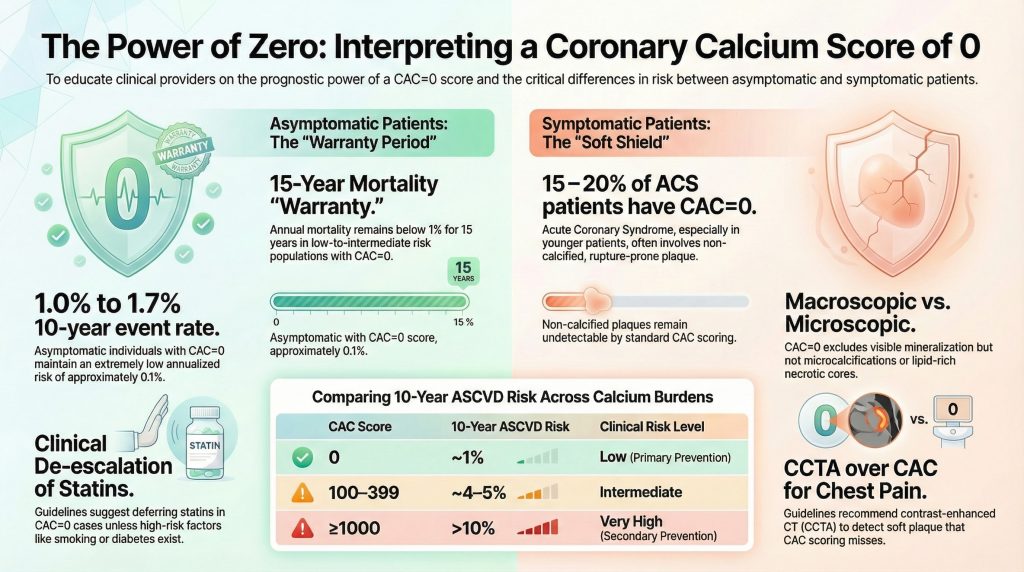
の 多民族動脈硬化研究(MESA), 、無症状の中高年成人約50%において、ベースライン時のCACが0であることが示された [6]. 長期追跡調査の結果、これらの被験者における10年間のASCVDイベント発生率は約1~1.7%であり、これは年率換算で0.1%に近いリスクに相当する [6,7]. これらのイベント発生率は、多くの「中等度リスク」の個人において、従来のリスクモデルによって予測された値よりも大幅に低い。.
わずかな石灰化(CAC 1〜10)であっても、約3倍のリスク上昇をもたらす 冠動脈疾患 CAC = 0 と比較したリスク6したがって、CAC = 0 は、単に連続上の最低点ではなく、生物学的に区別される低リスクの表現型を表している。.
CACカテゴリ全体の段階的リスク
カルシウム負荷の増加に伴い、リスクは段階的に上昇する7,8]:
- CAC = 0:約1%、10年リスク
- CAC 1–99:約1.9% 10年リスク
- CAC 100~399:約4~5%(10年リスク)
- CAC ≥400:約7~9%、10年リスク
- CAC ≥1000:10% 以上、二次予防対象集団に近づく
CACスコアが1000以上の人は、以下のような安定した二次予防コホートと同等の心血管死亡率を示します。 FOURIER試験 参加者8この観察結果は、極端なCACカテゴリーにおける積極的な脂質低下戦略を支持するものである。.
NNTモデリングと治療的割り付け
CACスコアリングは、精緻化する スタチン 配分効率。中等リスクの個人の間では:
スタチンによる最大の絶対的ベネフィットは、測定可能な石灰化負荷を有する患者に生じる。 2018年 ACC/AHAコレステロールガイドライン CAC = 0 の無症状の個人の場合、以下の場合を除き、スタチン療法を延期してもよいことを推奨する 糖尿病, 喫煙, または、強力な 家族の歴史 現在 [9].
ソフトプラークと「保証」期間
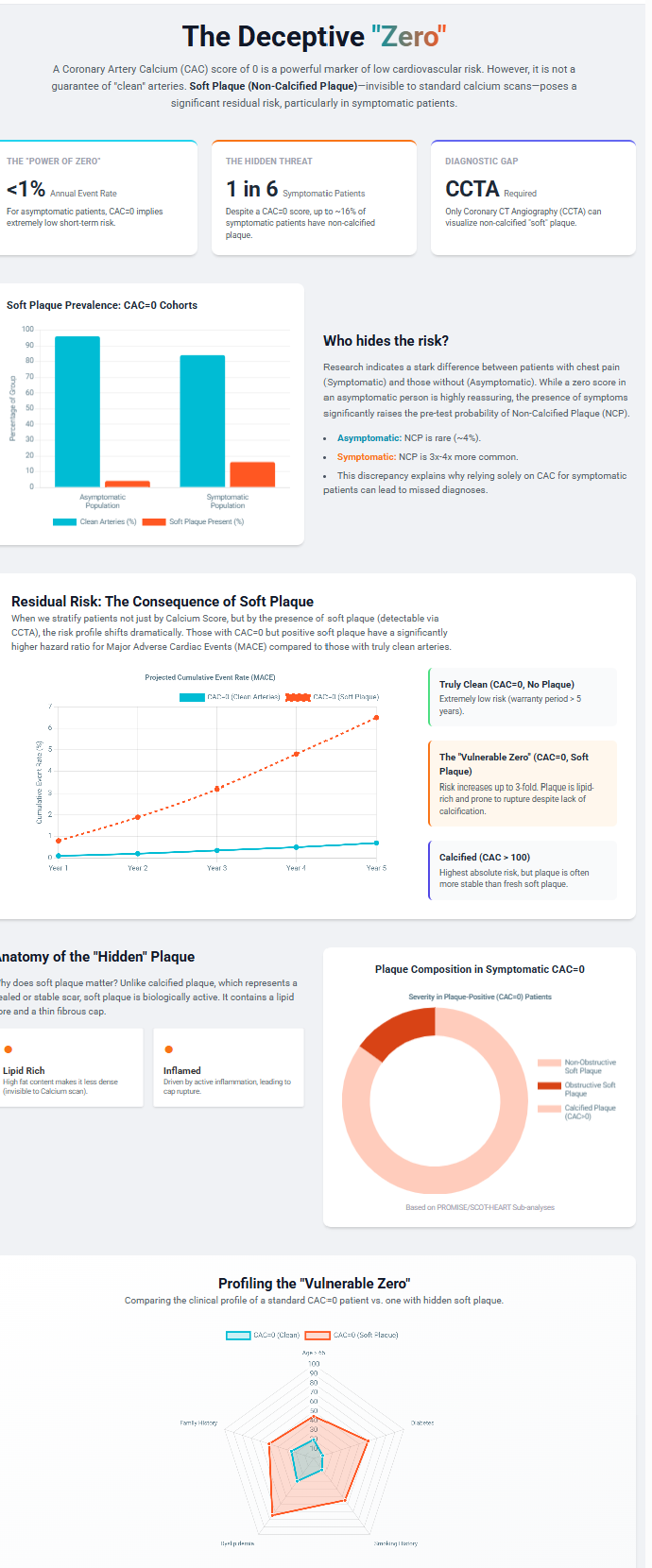
マイアミ・ハート・スタディでは、CACが0の無症状の被験者のうち、約16%がCCTA検査において非石灰化プラークを有していることが示された [10]. しかし、閉塞性の 狭窄 (≥50%)が認められたのはわずか0.8%のみであり、高リスクプラークの特徴はまれであった。したがって、 プラークの軟化 検出可能であっても、無症状かつCACスコアゼロの個人において、それが臨床的意義に達することはまれである。.
無症状の被験者9,715名を対象とした前向き研究により、CAC=0は低〜中等度リスク集団において15年間の死亡率に関する「保証期間」をもたらすことが示された11]. この期間中、年間死亡率は1%を下回ったままだった。しかし、糖尿病患者やヘビースモーカーでは、プラークの進行が加速するため、この保証期間は短縮される [12].
性別特有のニュアンスと民族的多様性
Women generally exhibit lower absolute CAC prevalence compared with men but may harbor a greater proportion of non-calcified plaque [13]. Consequently, while CAC = 0 remains prognostically powerful in women, symptomatic female patients may require more cautious interpretation. Women presenting with chest pain frequently demonstrate non-obstructive CAD or 微小血管機能障害, conditions not reliably captured by CAC scoring alone.
MESA demonstrated significant ethnic heterogeneity in CAC prevalence [6]. White individuals exhibit the highest CAC prevalence, followed by Hispanic, Black, and Chinese American populations. Despite differences in prevalence, event rates at comparable CAC levels are similar across ethnic groups, reinforcing that CAC = 0 confers prognostic reassurance across diverse populations.
The Symptomatic Population: Residual Risk
In patients presenting with stable chest pain, CAC = 0 does not exclude coronary disease. Approximately 7–16% demonstrate plaque on CCTA, and 1–2% have obstructive CAD ≥50% [14]. In the PROMISE trial, 16.5% of symptomatic zero-CAC patients had non-obstructive CAD, and 1.5% had obstructive disease [15].
Acute Coronary Syndrome and Zero CAC
Pooled analyses demonstrate that 15–20% of patients presenting with 急性冠症候群 (ACS)—particularly younger individuals—may have CAC = 0 at presentation [16]. These findings reflect the predominance of non-calcified, rupture-prone plaque. Accordingly, the 2021 AHA/ACC Chest Pain Guideline recommends CCTA rather than CAC scoring when evaluating possible acute coronary syndrome [17].
Detailed Plaque Morphology: ICONIC Insights
その ICONIC trial quantified plaque components in symptomatic zero-CAC patients who subsequently developed ACS [4]:
- Fibrous plaque: 29.4 mm³ (ACS) vs 5.5 mm³ (controls)
• Fibrofatty plaque: 27.3 mm³ vs 1.3 mm³
• Necrotic-core plaque: 2.8 mm³ vs 0.0 mm³
These quantitative differences confirm that substantial vulnerable プラーク負荷 may exist in the absence of detectable calcification.
Bayesian Interpretation and Risk Modifiers
Diagnostic performance depends on pre-test probability [18]. In asymptomatic individuals with low baseline risk, CAC = 0 reduces post-test probability to near-negligible levels. In symptomatic patients with higher pre-test probability, residual risk remains clinically meaningful despite a zero score.
Additional risk modifiers must be considered. Parental premature 心血管疾患 independently increases risk, even among individuals with CAC = 0 [19]. Furthermore, an elevated Atherogenic Index of Plasma (AIP) correlates with calcification burden and 主要心血管イベント independent of traditional 危険因子 [20].
Conclusion
The coronary 動脈 カルシウムスコア of zero is among the most powerful negative risk markers in cardiovascular medicine. In asymptomatic individuals, it confers a prolonged mortality warranty and supports selective de-escalation of pharmacotherapy. In symptomatic patients, however, CAC = 0 represents a “soft shield”—associated with lower risk than positive scores but insufficient to exclude obstructive or vulnerable plaque. Future risk stratification must integrate calcified and non-calcified plaque assessment, clinical phenotype, and individualized risk modifiers rather than relying solely on binary calcium absence.
参考文献
- Hussain A, Ballantyne CM, Nambi V. Zero Coronary Artery Calcium Score: Desirable, but Enough?. Circulation. 2020;142(10):917-919. doi:10.1161/CIRCULATIONAHA.119.045026
- Czaja-Ziółkowska MZ, Wasilewski J, Gąsior M, Głowacki J. An update on the coronary calcium score: a review for clinicians. Postepy Kardiol Interwencyjnej. 2022;18(3):201-205. doi:10.5114/aic.2022.121035
- Vatsa N, Faaborg-Andersen C, Dong T, Blaha MJ, Shaw LJ, Quintana RA. Coronary Atherosclerotic Plaque Burden Assessment by Computed Tomography and Its Clinical Implications. Circ Cardiovasc Imaging. 2024;17(8):e016443. doi:10.1161/CIRCIMAGING.123.016443
- Jonas RA, Nurmohamed NS, Crabtree TR, et al. CTA-Derived Plaque Characteristics and Risk of Acute Coronary Syndrome in Patients With Coronary Artery Calcium Score of Zero: Insights From the ICONIC Trial. AJR Am J Roentgenol. 2025;225(1):e2431476. doi:10.2214/AJR.24.31476
- Hutcheson JD, Goettsch C, Bertazzo S, et al. Genesis and growth of extracellular-vesicle-derived microcalcification in atherosclerotic plaques. Nat Mater. 2016;15(3):335-343. doi:10.1038/nmat4519
- Detrano R, Guerci AD, Carr JJ, et al. Coronary calcium as a predictor of coronary events in four racial or ethnic groups. N Engl J Med. 2008;358(13):1336-1345. doi:10.1056/NEJMoa072100
- Budoff MJ, Shaw LJ, Liu ST, et al. Long-term prognosis associated with coronary calcification: observations from a registry of 25,253 patients. J Am Coll Cardiol. 2007;49(18):1860-1870. doi:10.1016/j.jacc.2006.10.079
- Dzaye O, Razavi AC, Michos ED, et al. Coronary artery calcium scores indicating secondary prevention level risk: Findings from the CAC consortium and FOURIER trial. Atherosclerosis. 2022;347:70-76. doi:10.1016/j.atherosclerosis.2022.02.006
- Grundy SM, Stone NJ, Bailey AL, et al. 2018 AHA/ACC/AACVPR/AAPA/ABC/ACPM/ADA/AGS/APhA/ASPC/NLA/PCNA Guideline on the Management of Blood Cholesterol: A Report of the American College of Cardiology/American Heart Association Task Force on Clinical Practice Guidelines. Circulation. 2019;139(25):e1082-e1143. doi:10.1161/CIR.0000000000000625
- Nasir K, Cainzos-Achirica M, Valero-Elizondo J, et al. Coronary Atherosclerosis in an Asymptomatic U.S. Population: Miami Heart Study at Baptist Health South Florida. JACC Cardiovasc Imaging. 2022;15(9):1604-1618. doi:10.1016/j.jcmg.2022.03.010
- Valenti V, Ó Hartaigh B, Heo R, et al. A 15-Year Warranty Period for Asymptomatic Individuals Without Coronary Artery Calcium: A Prospective Follow-Up of 9,715 Individuals. JACC Cardiovasc Imaging. 2015;8(8):900-909. doi:10.1016/j.jcmg.2015.01.025
- McClelland RL, Jorgensen NW, Budoff M, et al. 10-Year Coronary Heart Disease Risk Prediction Using Coronary Artery Calcium and Traditional Risk Factors: Derivation in the MESA (Multi-Ethnic Study of Atherosclerosis) With Validation in the HNR (Heinz Nixdorf Recall) Study and the DHS (Dallas Heart Study). J Am Coll Cardiol. 2015;66(15):1643-1653. doi:10.1016/j.jacc.2015.08.035
- Shaw LJ, Raggi P, Callister TQ, Berman DS. Prognostic value of coronary artery calcium screening in asymptomatic smokers and non-smokers. Eur Heart J. 2006;27(8):968-975. doi:10.1093/eurheartj/ehi750
- Wang X, Le EPV, Rajani NK, et al. A zero coronary artery calcium score in patients with stable chest pain is associated with a good prognosis, despite risk of non-calcified plaques. Open Heart. 2019;6(1):e000945. Published 2019 Apr 11. doi:10.1136/openhrt-2018-000945
- Foldyna B, Mayrhofer T, Lu MT, et al. Prognostic value of CT-derived coronary artery disease characteristics varies by ASCVD risk: insights from the PROMISE trial. Eur Radiol. 2023;33(7):4657-4667. doi:10.1007/s00330-023-09430-5
- Gottlieb I, Miller JM, Arbab-Zadeh A, et al. The absence of coronary calcification does not exclude obstructive coronary artery disease or the need for revascularization in patients referred for conventional coronary angiography. J Am Coll Cardiol. 2010;55(7):627-634. doi:10.1016/j.jacc.2009.07.072
- Gulati M, Levy PD, Mukherjee D, et al. 2021 AHA/ACC/ASE/CHEST/SAEM/SCCT/SCMR Guideline for the Evaluation and Diagnosis of Chest Pain: A Report of the American College of Cardiology/American Heart Association Joint Committee on Clinical Practice Guidelines. Circulation. 2021;144(22):e368-e454. doi:10.1161/CIR.0000000000001029
- Greenland P, Bonow RO, Brundage BH, et al. ACCF/AHA 2007 clinical expert consensus document on coronary artery calcium scoring by computed tomography in global cardiovascular risk assessment and in evaluation of patients with chest pain: a report of the American College of Cardiology Foundation Clinical Expert Consensus Task Force (ACCF/AHA Writing Committee to Update the 2000 Expert Consensus Document on Electron Beam Computed Tomography). Circulation. 2007;115(3):402-426. doi:10.1161/CIRCULATIONAHA..107.181425
- Lloyd-Jones DM, Nam BH, D’Agostino RB Sr, et al. Parental cardiovascular disease as a risk factor for cardiovascular disease in middle-aged adults: a prospective study of parents and offspring. JAMA. 2004;291(18):2204-2211. doi:10.1001/jama.291.18.2204
- Yao H, Feng G, Liu Y, Chen Y, Shao C, Wang Z. Coronary artery calcification burden, atherogenic index of plasma, and risk of adverse cardiovascular events in the general population: evidence from a mediation analysis. Lipids Health Dis. 2024;23(1):258. Published 2024 Aug 20. doi:10.1186/s12944-024-02255-1