New research from the University of California, Riverside suggests microplastics may directly accelerate heart disease — especially in males.
Here’s what the study uncovered, explained as simple Q&A.
Q: What exactly are microplastics?
A: Microplastics are tiny plastic particles released from:
- Food packaging
- Clothing and textiles
- Household plastics
- Industrial waste
They are now found in:
- Food
- Drinking water
- Air
- Human tissues — including inside arteries
Q: Why are scientists worried about microplastics and heart disease?
A: Recent clinical studies found microplastics inside human arterial plaques and linked higher levels to worse cardiovascular outcomes.
But until now, it wasn’t clear whether they directly cause damage.
The new study provides some of the strongest evidence that microplastics can injure vascular cells and accelerate plaque formation.
Q: What did the researchers do in this new study?
A: Scientists used a well-established heart-disease mouse model (LDLR-deficient mice) and:
- Fed them a low-fat, low-cholesterol “healthy” diet
- Exposed them to microplastics daily for 9 weeks
- Used doses similar to real-world human exposure
- Compared changes between male and female mice
Q: What did they find?
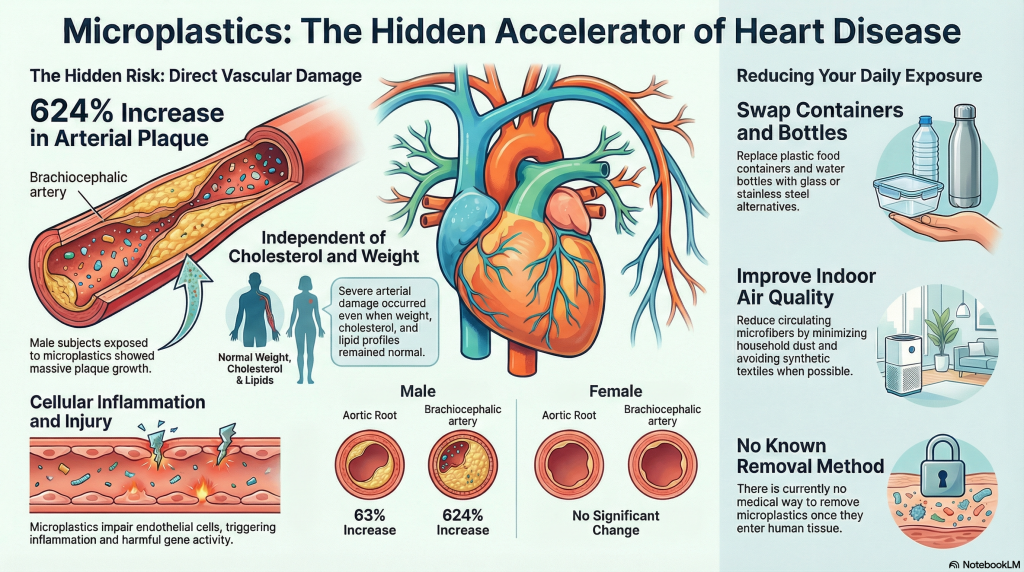
Major Finding 1 — Microplastics dramatically worsened atherosclerosis, but only in males.
Male mice exposed to microplastics developed:
- 63% more plaque in the aortic root
- 624% more plaque in the brachiocephalic artery
Female mice showed no significant plaque increase under the same conditions.
Major Finding 2 — The effect had nothing to do with weight or cholesterol.
Despite severe artery damage:
- No weight gain
- No increase in cholesterol
- No changes in lipid profiles
This shows microplastics caused direct vascular injury, separate from traditional risk factors.
Major Finding 3 — Microplastics impaired endothelial cells.
Endothelial cells (the lining of blood vessels) were the most affected:
- Their gene activity shifted in harmful ways
- They triggered inflammation
- They promoted plaque growth
- Microplastics were found inside the plaques themselves
This matches human studies that found microplastics in arterial lesions.
Q: Why were males affected but not females?
Researchers don’t yet know, but they suspect:
- Sex chromosomes
- Hormonal differences
- Estrogen’s protective cardiovascular effects
This pattern appears in other heart-disease research as well.
Q: Does this mean microplastics could harm human heart health?
A: The study strongly suggests they can, though more human research is needed.
The biological responses observed in mice also appeared in human endothelial cells in the lab.
Researchers warn that microplastics may be:
“Direct contributors to cardiovascular disease, not just correlations.”
Q: Can we remove microplastics from the body?
A: At this time, no known method exists for removing microplastics once they enter tissues.
Q: How can people reduce their exposure?
Scientists recommend:
- Using fewer plastic food and water containers
- Avoiding single-use plastics
- Reducing highly processed foods
- Using glass or stainless-steel bottles
- Improving indoor air quality (microfibers circulate in dust)
- Maintaining heart health through diet and exercise
Q: What are researchers studying next?
Future work will explore:
- Why males are more vulnerable
- Whether different types of microplastics cause different injuries
- How microplastics interact with vascular cells
- Whether similar sex-specific effects occur in humans
Q: Who conducted the research?
The study involved scientists from:
- University of California, Riverside
- Boston Children’s Hospital
- Harvard Medical School
- University of New Mexico Health Sciences
Funding came in part from the National Institutes of Health.
References
- Wright SL, Kelly FJ. Plastic and Human Health: A Micro Issue?. Environ Sci Technol. 2017;51(12):6634-6647. doi:10.1021/acs.est.7b00423
- Marfella R, Prattichizzo F, Sardu C, et al. Microplastics and Nanoplastics in Atheromas and Cardiovascular Events. N Engl J Med. 2024;390(10):900-910. doi:10.1056/NEJMoa2309822
- Prata JC, da Costa JP, Lopes I, Duarte AC, Rocha-Santos T. Environmental exposure to microplastics: An overview on possible human health effects. Sci Total Environ. 2020;702:134455. doi:10.1016/j.scitotenv.2019.134455
- Campanale C, Massarelli C, Savino I, Locaputo V, Uricchio VF. A Detailed Review Study on Potential Effects of Microplastics and Additives of Concern on Human Health. Int J Environ Res Public Health. 2020;17(4):1212. Published 2020 Feb 13. doi:10.3390/ijerph17041212
- Cox KD, Covernton GA, Davies HL, Dower JF, Juanes F, Dudas SE. Human Consumption of Microplastics. Environ Sci Technol. 2019;53(12):7068-7074. doi:10.1021/acs.est.9b01517