Dr. Loren Cordain vs. Dr. T. Colin Campbell
Original context: Public nutrition debate from the mid-2000s reflecting two competing paradigms: evolutionary biology versus whole-diet epidemiology.
- Participants and Context Verification
Dr. Loren Cordain
- Former professor at Colorado State University
- Founder of the Paleo Diet framework
- Author of The Paleo Diet (2002)
Dr. T. Colin Campbell
- Professor Emeritus at Cornell University
- Lead researcher on the China–Cornell–Oxford Project
- Author of The China Study (2005)
The framing of the debate is accurate in substance. The text represents a synthesized summary rather than a verbatim transcript of a single formal debate.
- Part I: Dr. Loren Cordain – The Case for Higher Protein
Evolutionary Argument
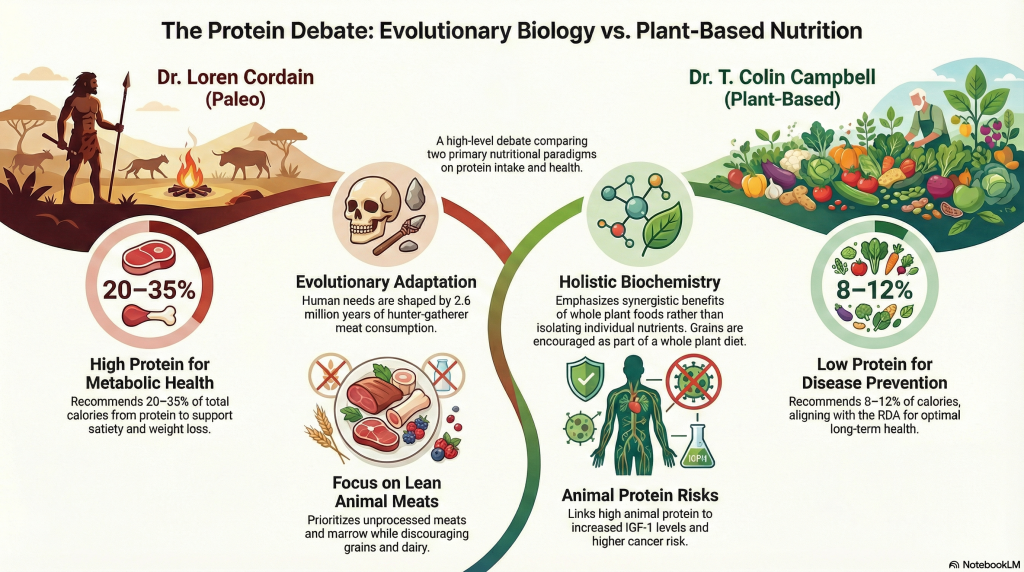
Cordain argues that human nutritional needs are shaped by natural selection and that meat consumption played a central role in human evolution.
Evidence assessment:
- Archaeological evidence confirms stone tools used for butchery and marrow extraction approximately 2.6 million years ago.
- Stable isotope analysis of Neanderthals and early Homo sapiens indicates high trophic-level diets, consistent with heavy animal-food consumption.
- Ethnographic data from 229 hunter-gatherer societies show a median intake of approximately 55 to 65 percent of calories from animal foods.
- Claims about reduced human synthesis of nutrients such as taurine and DHA are plausible but not conclusive proof of obligatory high meat intake.
Health and Clinical Evidence
Cordain defines high protein as 20–30 percent of total energy intake and very high protein as 30–40 percent.
Findings:
- Protein increases satiety and supports weight loss and insulin sensitivity.
- Higher protein intake does not harm bone health when calcium intake is sufficient; increased urinary calcium is offset by increased absorption.
- No adverse kidney effects are observed in healthy individuals; caution applies only to those with existing kidney disease.
- Cardiovascular benefits depend strongly on protein source; lean, unprocessed meats perform better than processed meats.
Overall assessment: Cordain’s claims are broadly supported but sometimes generalized beyond what evidence strictly proves.
- Part II: Dr. T. Colin Campbell – The Case for Lower Protein
Protein Requirements
Campbell emphasizes the Recommended Dietary Allowance of 0.8 grams per kilogram of body weight, corresponding to approximately 9–10 percent of calories.
Key points:
- The RDA is sufficient for nearly all individuals.
- Most Western populations exceed this intake.
- Historical enthusiasm for animal protein is partly cultural rather than evidence-based.
Risks of Excess Animal Protein
Campbell argues that animal protein specifically promotes chronic disease.
Evidence assessment:
- Higher animal protein intake is associated with increased IGF-1 levels, which correlate with higher cancer risk in observational studies.
- Rodent studies show that casein can promote tumor growth at higher intake levels and suppress it at lower levels.
- The extrapolation of casein results to all animal proteins is scientifically contested.
- Claims of chronic metabolic acidosis causing bone loss are not supported by modern evidence when mineral intake is adequate.
Holistic Nutrition Framework
Campbell rejects reductionist nutrient analysis and argues that whole dietary patterns, particularly whole-food plant-based diets, produce synergistic health benefits.
Overall assessment: Campbell’s population-level observations are valid, but some mechanistic claims are overstated or overly generalized.
- Rebuttals
Cordain’s Critique of Campbell
- Campbell conflates minimum protein needs with optimal intake.
- Grains are evolutionarily recent and associated with certain autoimmune conditions.
- Cancer findings from casein studies cannot be generalized to lean muscle meats.
Campbell’s Critique of Cordain
- Evolutionary survival does not equal optimal long-term health or longevity.
- Nutrition cannot be understood by isolating individual nutrients.
- Randomized controlled trials are limited for lifestyle nutrition; long-term population studies are preferred.
Assessment: Both rebuttals accurately reflect each scholar’s stated positions, though each selectively emphasizes favorable evidence.
- Comparison Summary
Ideal protein intake:
- Cordain: approximately 20 to 35 percent of calories
- Campbell: approximately 8 to 12 percent of calories
Primary protein sources:
- Cordain: lean animal meats
- Campbell: whole plant foods
Core framework:
- Cordain: evolutionary adaptation
- Campbell: holistic biochemistry and dietary patterns
Grains:
- Cordain: discouraged
- Campbell: encouraged
Dairy:
- Both discourage dairy, for different reasons
- Modern Scientific Perspective
Current consensus suggests:
- Optimal protein intake varies by age, activity level, and health status.
- Protein source is more important than protein quantity for long-term disease risk.
- Extreme interpretations of either approach are incomplete.
- Diets emphasizing whole foods, minimal processing, adequate protein, and plant-dominant sources align best with current evidence.