このページは自動翻訳されています。相違がある場合は、英語版が優先されます。.

改訂日:2026年7月16日

心臓病と魚油

著:ピーター・メグダル博士

この記事の使い方

医療上の免責事項: この記事は教育目的のものであり、医学的な助言ではありません。個別の指導については、必ずかかりつけの医師にご相談ください。.

読みやすい

1. The “Health Aisle” Headache

Have you ever stood in the supplement aisle at your local grocery store? It can be a very confusing place. There are hundreds of bottles of vitamins and oils. Many of them say “Fish Oil” in big, bright letters. Most of them have pictures of hearts or happy people. You might pick up a bottle and think you are buying a “magic shield” to protect your heart from getting sick.

For a long time, even doctors thought that taking any kind of fish oil was a great idea. But the truth is much messier than the labels on those bottles. New science shows that what we thought we knew about fish oil is often wrong. Keeping your heart healthy is a lot like taking care of a house. You cannot just buy any cheap tool and expect it to fix a big leak in the roof. You need the right tool for the right job.

The purpose of this article is to help you see through the confusion. We are going to look at new research that separates “miracle myths” from real medical facts. You will learn why most fish oil bottles do not work the way you think they do. We will show you the top takeaways from the latest science so you can understand what your heart really needs to stay strong and safe.

2. Takeaway 1: Not All “Fish Oil” Is Created Equal

When people say “fish oil,” they act like it is all the same thing. This is a big mistake. There is a huge difference between the generic bottles you buy at the grocery store and special medicine from a doctor.

Imagine you need to clean a room where a doctor is about to do surgery. You could use a “multipurpose cleaner” from a big box store. It might smell like lemons and look okay, but it is not very strong. Now, imagine a “surgical-grade disinfectant” used in a hospital. That cleaner is very powerful. It is made for a very specific, important job.

The fish oil you find on a regular shelf is like the multipurpose cleaner. It is a mix of many different things, and it is not always pure. But there is a prescription version called イコサペント酸エチルIcosapent ethyl is a purified, high-dose form of the omega-3 fat EPA, sold as Vascepa. (the brand name is Vascepa). This is not a supplement; it is a real drug. It is a highly purified version of just one part of fish oil called EPA.

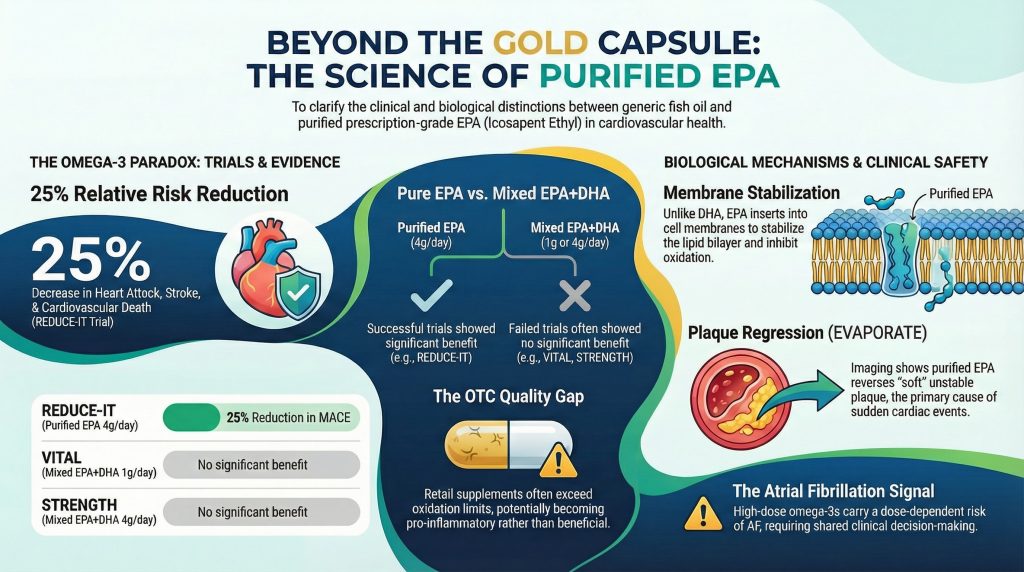
Scientists did a very big study called the REDUCE-IT trial. They found that this special prescription version helped high-risk patients a lot. It lowered the risk of 心臓発作心臓発作は、心筋の一部への血流が遮断され、その筋肉が壊死し始めることで起こります。. そして 脳卒中脳卒中は、脳の一部への血流が詰まりまたは出血によって止まるときに起こります。. by 25%. However, there is some “messiness” in the science. In the REDUCE-IT study, the researchers gave the “fake pill” group mineral oil. Some people worry that the mineral oil made the “fake pill” group look worse by raising their bad fats and 炎症炎症は、怪我や侵入物とみなしたものに対する免疫システムの反応です。これにより腫れや熱、そして浄化細胞がもたらされます。.. Even with this debate, most experts believe the prescription EPA is what made the big difference. These great results do not apply to the cheap bottles from the grocery store.

3. Takeaway 2: It’s Not About “Clogged Pipes,” It’s About “Popping Bubbles”

Most people think heart attacks happen because a heart pipe (an 動脈動脈は、心臓から全身へ血液を送り出す血管です。.) gets filled up with “gunk” over many years. They think it is like a slow drain in a kitchen sink. But the science shows us that is usually not how it happens.

Most heart attacks happen very suddenly. Inside the walls of your heart pipes, there are bumps called 歯垢プラークとは、動脈の壁の内側にコレステロール、免疫細胞、瘢痕組織、カルシウムが蓄積したものです。.. Think of these plaques like a “thin-capped pimple” or a bubble. These bubbles are filled with fat and are very “unstable.” This means they can pop or break open at any moment. When a bubble pops, it causes a 血栓血栓は、出血を止めるために形成される血球とタンパク質の塊です。. to form very quickly. This clot blocks the pipe completely, and that is what causes a heart attack. The source describes it this way:

“…formation of a necrotic lipid core beneath a thin fibrous cap create plaques that are biologically unstable.”

The special part of fish oil called EPA helps with this. It does not just “unclog” the pipe like a drain cleaner. Instead, it helps make those “bubbles” stronger so they do not pop. It stabilizes them. By using high doses of purified EPA, we can help keep those bubbles from breaking. This is a much better way to protect the heart than just trying to make the pipes wider.

4. Takeaway 3: The Secret Battle Between EPA and DHA

Fish oil is usually made of two main parts: EPA そして DHA. For a long time, people thought they were like two teammates working together. But the science shows they are actually very different. They even have a “secret battle” inside your body.

Think of the walls of your cells like a wall in a house. EPA is like a straight, sturdy board. When you put EPA into the wall, it fits perfectly. It makes the wall strong and flat. DHA is different. It has a more flexible and “curvy” shape. When DHA gets into the cell wall, it can make things “disordered” or messy.

This difference is very important for “rusting” in your blood. In science, this “rusting” is called oxidation. When the fats in your blood “rust,” they cause a lot of trouble and inflammation for your heart. EPA helps stop this “rusting.” DHA might not stop it.

Also, scientists found that EPA works in ways they are still figuring out. It is “triglyceride-independent.” This is a big word that means the medicine works even if it doesn’t lower the fat in your blood (中性脂肪トリグリセリド(中性脂肪)は、血液中および体内の蓄積脂肪の主要な形態です。.) by a huge amount. It changes how your cells behave and talk to each other to stop inflammation. It is not just about “lowering fat”; it is about changing how your body works.

5. Takeaway 4: Why “A Little Bit” of Fish Oil Usually Fails

Many people take one small fish oil pill a day and think they are protected. But the science says that a small amount usually does nothing for the heart.

Think about a campfire that is getting out of control. If you try to put it out with a water pistol, you won’t do much. The fire will keep burning. To put out the fire, you need a fire hose.

A study called the VITAL trial looked at people taking 1 gram of fish oil a day. That is a “water pistol” dose. It did not show any real benefit for heart health. But the REDUCE-IT trial used 4 grams a day of the special prescription EPA. That is the “fire hose.” This high dose is what made the difference.

Another study called JELIS, done in Japan, also showed that high amounts of EPA helped protect people from strokes and heart problems. It is also important to know that the people in these successful studies were already taking other medicines, like スタチンスタチンは、肝臓がコレステロールを作るのに使う酵素の働きを遅らせます。肝臓は血液中からより多くのコレステロールを取り除くことでこれに反応し、そこに真の利益があります。., to lower their コレステロールコレステロールは、体が必要とするロウ状の物質です。細胞壁、ホルモン、ビタミンD、そして食べ物を消化する胆汁の材料となります。コレステロールがなければ私たちは生きていけません。.. The high-dose EPA was an “extra helper.” It was not a replacement for their other medicine. In the REDUCE-IT study, the medicine was so powerful that for every 21 people who took it, one major heart attack or stroke was stopped.

6. Takeaway 5: The “Jittery Heart” – The Real Risk of High Doses

While high-dose EPA can be very helpful, it is not perfect. It is a strong medicine, and all strong medicines have risks. One of the main risks found in the research is something called 心房細動Atrial fibrillation, often shortened to AFib, is a fast and irregular heartbeat that starts in the upper chambers of the heart., 、または AFib.

AFib is basically a “jittery heart.” Instead of beating in a steady, strong rhythm, the top of the heart shakes or twitches. This can feel like a fish flopping in your chest. It can be dangerous because it can cause blood clots. The science shows that this risk goes up as you take more medicine. As the source says:

“Meta-analyses of cardiovascular outcome trials confirm a dose-dependent increase in atrial fibrillation risk.”

There is also a small risk of more bleeding. This happens because the medicine makes it a little harder for blood to clot. It is usually not a big emergency, but it is something doctors have to watch. This is why you cannot just take high doses of fish oil on your own. You have to balance the big benefits against these real risks. You need a doctor to help you decide if the “fire hose” is safe for your heart.

7. Takeaway 6: Changing the Shape of the Disease

One of the most amazing things scientists found is that this medicine can actually change the physical shape of the disease inside your heart. They used a study called EVAPORATE to look at the pipes in the heart using special cameras.

They looked at “低吸収プラーク低減衰プラークは、CTスキャンで最も黒く、脂肪分の多いプラークであり、X線が容易に透過するほど柔らかいものです。..” This is just a fancy name for the soft, dangerous kind of plaque that likes to pop. In the study, people took the prescription EPA for 18 months. The scientists saw something incredible: the dangerous plaque actually started “melting away” または shrinking.

In the group of people who did not take the medicine, the plaque kept growing and getting worse. But in the group taking the prescription EPA, the plaque got smaller and less dangerous. This shows that the medicine does more than just change numbers on a blood test. It actually changes the “substrate,” which is the physical stuff inside your body. It makes the “bubbles” smaller and less likely to cause a heart attack.

8. Takeaway 7: When Mixing Oils Goes Wrong

You might think that if EPA is good, then mixing it with DHA would be even better. But a study called STRENGTH showed us that this is not true. In that study, researchers gave people a mix of EPA and DHA. They even used a high dose (4 grams), which is the “fire hose” dose.

Even with a high dose, the STRENGTH trial showed no benefit for the heart. It failed. Why did it fail when REDUCE-IT worked? Scientists think it is because DHA and EPA are not interchangeable. Mixing them might be like having a team where the players argue with each other. The EPA tries to make the cell walls straight and sturdy, while the DHA makes them curvy and disordered.

This is why doctors are so focused on the EPA-only medicine. It is not just about the “oil”; it is about the specific molecule. Also, in a part of the study called REDUCE-IT USA, scientists found that people taking the pure EPA medicine actually lived longer. It reduced the risk of death from any cause. This is very strong evidence that having the right molecule matters more than just taking any fish oil.

9. Conclusion: The Future of Your Heart Health

The days of thinking all fish oil is the same are over. We are entering a time of “precision medicine.” This means using the exact right tool at the exact right dose for the right person.

Generic fish oil from a big bottle might be fine for general “wellness,” but the science shows it is not a strong tool for fixing heart disease. The prescription version, Vascepa, is a real cardiovascular drug. It has been tested and proven to work when used correctly under a doctor’s care.

As you think about your own health, you might want to ask yourself a question: Am I using a water pistol or a fire hose?

When you talk to your doctor, do not just say you are taking “fish oil.” Tell them exactly what is in your bottle. Ask them about the difference between grocery store supplements and prescription EPA. Your heart is the most important engine you have. It deserves the right tools, the right science, and the right care. Remember, the goal is not just to take a pill, but to actually change the shape of the disease and keep those “bubbles” from popping.

ディープダイブ

Heart Disease and The Fish-Oil Confusion, the Vascepa Controversy, and What the Evidence Actually Shows

何十年もの間、心血管医学は「魚油は心臓に良い」という、しばしば誤解される一つの決まり文句に支配されてきた。この信念があまりにも深く文化に根付いているため、科学的根拠に基づいた心臓病学と商業的なウェルネスの境界線が曖昧になり、何百万人もの人々が心血管リスクの低減を期待して、日々オメガ3サプリメントを摂取するに至っている。.

For many years, the data supporting this practice were inconsistent. Randomized trials of broadly defined omega-3 supplements frequently failed to show meaningful reductions in 心筋梗塞詳しい項目については心臓発作をご覧ください。., 脳卒中脳卒中は、脳の一部への血流が詰まりまたは出血によって止まるときに起こります。., or cardiovascular death, while observational studies and smaller trials occasionally suggested benefit. The resulting cycle of enthusiasm, disappointment, and equivocation confused not only the public but clinicians as well. A core problem was conceptual: the term “fish oil” was treated as a single exposure, despite encompassing multiple fatty acids, doses, formulations, and manufacturing qualities.

The modern era has forced a more precise question: Which molecule, at what dose, in which population, compared against what, and with what trade-offs?

That reframing explains why イコサペント酸エチルIcosapent ethyl is a purified, high-dose form of the omega-3 fat EPA, sold as Vascepa. (IPE; Vascepa) has become one of the most debated therapies in preventive cardiology. Icosapent ethyl is not generic fish oil. It is a prescription-grade, highly purified ethyl ester of eicosapentaenoic acid (EPA) administered at 4 g/day, and in a large randomized outcomes trial it behaved like a cardiovascular drug rather than a dietary supplement.

At the same time, Vascepa sits at the intersection of multiple sources of skepticism: decades of disappointing omega-3 trials, an unexpectedly large clinical effect from a single outcomes study, unresolved mechanistic questions, and controversy surrounding プラセボプラセボとは、本物の薬が実際にどのような効果をもたらすかを研究者が知るために投与される、偽の治療法(砂糖の錠剤や生理食塩水の注射など)である。. choice.

Plaque Rupture, Not Luminal Narrowing, Drives Most Events

Most acute coronary events do not arise from slowly progressive luminal narrowing but from sudden プラーク破裂Plaque rupture is when the protective cap over a plaque tears open, spilling its contents into the bloodstream.. LDLLDL(低密度リポ蛋白)は、コレステロールを血液中に運ぶ主要な粒子であり、動脈壁に詰まる主原因となるものです。. particles penetrate the arterial wall, undergo oxidative modification, and initiate a chronic inflammatory response. マクロファージマクロファージは、ゴミや侵入者を飲み込む大きなどん欲な免疫細胞です。その名前は文字通り「大食い」を意味します。" infiltration, foam-cell death, and formation of a necrotic 脂質コアThe lipid core is the soft, greasy center of a plaque, made of cholesterol and the debris of dead immune cells. beneath a thin 線維性被膜The fibrous cap is the tough layer of tissue covering a plaque, separating its greasy core from the bloodstream. create プラークプラークとは、動脈の壁の内側にコレステロール、免疫細胞、瘢痕組織、カルシウムが蓄積したものです。. that are biologically unstable. Rupture of these plaques precipitates abrupt 血栓症血栓症とは、血管内で血液が固まって血栓ができることです。. and vessel 閉塞Occlusion is the partial or complete blockage of a blood vessel, preventing normal blood flow; a coronary occlusion reduces or cuts off oxygen delivery to the heart muscle supplied by that artery..

スタチンスタチンは、肝臓がコレステロールを作るのに使う酵素の働きを遅らせます。肝臓は血液中からより多くのコレステロールを取り除くことでこれに反応し、そこに真の利益があります。. substantially reduce LDL-C and vascular 炎症炎症は、怪我や侵入物とみなしたものに対する免疫システムの反応です。これにより腫れや熱、そして浄化細胞がもたらされます。., but 残留リスクResidual risk is the risk that remains after you have done the obvious things — cholesterol treated, blood pressure controlled, not smoking. remains even with optimal LDL control. This residual risk is driven in part by triglyceride-rich リポタンパク質リポタンパク質とは、脂肪とコレステロールを血流に乗せて運ぶ小さなカプセルのことです。脂肪は水に溶けないため、移動するにはタンパク質の包みが必要です。., レムナントコレステロールRemnant cholesterol is the cholesterol carried in the leftovers of triglyceride-rich particles, after they have dropped off most of their fat., and persistent inflammatory

signaling. Icosapent ethyl was tested specifically as an adjunct therapy in this residual-risk context.

Mechanistic Rationale: Why EPA Is Not Just “Fish Oil”

Triglyceride lowering alone is insufficient

In REDUCE-IT, patients with 中性脂肪トリグリセリド(中性脂肪)は、血液中および体内の蓄積脂肪の主要な形態です。. 135–499 mg/dL experienced large reductions in ischemic events, but the magnitude of benefit exceeded what would be predicted from triglyceride lowering alone, suggesting additional mechanisms beyond simple lipid concentration changes (5).

Membrane biophysics and oxidative biology

EPA and docosahexaenoic acid (DHA) differ structurally and biophysically. DHA, with six double bonds, increases membrane fluidity and disorder, whereas EPA adopts a more extended conformation within phospholipid bilayers. Mason and colleagues demonstrated that EPA—but not DHA—inhibits oxidation of ApoB-containing lipoprotein particles across a range of particle sizes in vitro, providing a plausible mechanism for reducing downstream inflammatory signaling and plaque vulnerability (1).

Lipoprotein remodeling beyond triglycerides

Human lipidomic studies support triglyceride-independent effects. In normolipidemic individuals, Äikäs and colleagues showed that icosapent ethyl supplementation was associated with broad remodeling of the リピドームリピドームとは、細胞、組織、生体などの生物学的系に存在する脂質の完全なセットであり、脳は神経膜の構造と機能に脂質が不可欠であるため、特に大規模で複雑なリピドームを持っています。., including reductions in remnant コレステロールコレステロールは、体が必要とするロウ状の物質です。細胞壁、ホルモン、ビタミンD、そして食べ物を消化する胆汁の材料となります。コレステロールがなければ私たちは生きていけません。. and ApoB-related markers, indicating a shift toward a less atherogenic circulating lipid profile総コレステロール、LDLコレステロール、HDLコレステロール、中性脂肪を測定する血液検査のパネルで、心血管リスクの評価や食事療法・薬物治療の効果のモニタリングに使用される。. (2).

Immune modulation

Inflammation plays a central role in 動脈硬化動脈硬化は、ほとんど的心筋梗塞と多くの脳卒中の背景にある病気です。コレステロールの粒子が動脈の壁に入り込み、体がそれを掃除するために免疫細胞を送り込み、何年もかけてその堆積物が硬化してプラークになります。.. Reilly and colleagues demonstrated that EPA exposure induces a distinct anti-inflammatory transcriptomic profile in human CD4+ T cells in vitro, implicating immune modulation as a potential triglyceride-independent pathway of benefit (3).

Imaging Evidence: Changing the Disease Substrate

Mechanistic hypotheses gain credibility when supported by human anatomic data. The EVAPORATE trialA clinical trial that used serial CCTA to track coronary plaque composition over time in patients receiving icosapent ethyl (a purified omega-3 fatty acid); it demonstrated that the drug produced regression of low-attenuation plaque, establishing CCTA as a tool for monitoring plaque response to therapy. used serial 冠動脈CTアンギオグラフィー冠動脈CTアンギオグラフィー(CCTA)は、静脈に造影剤を入れて行うCT検査であり、心臓の動脈の詳細な画像を作成します。. in statin-treated patients with triglycerides 200–499 mg/dL randomized to icosapent ethyl or placebo. Over 18 months, patients receiving IPE demonstrated regression of 低吸収プラーク低減衰プラークは、CTスキャンで最も黒く、脂肪分の多いプラークであり、X線が容易に透過するほど柔らかいものです。., a marker associated with 壊死核壊死性コアは、捕捉されたコレステロールを食べてその場で死亡した免疫細胞から形成された、進行したプラークの死滅したドロドロとした中心部である。. and plaque instability, while placebo-treated

patients showed plaque progression (4). Although imaging trials do not replace outcomes trials, EVAPORATE strengthens biological plausibility by demonstrating favorable changes in プラーク表現型Plaque phenotype refers to the biological and structural characteristics of an atherosclerotic lesion — including the size of its lipid-rich necrotic core, fibrous cap thickness, degree of calcification, and inflammatory cell content — which together determine whether a plaque is stable or at high risk of rupturing..

Clinical Outcomes: What Was Proven—and What Was Not

REDUCE-IT

REDUCE-IT randomized 8,179 high-risk, statin-treated patients to icosapent ethyl 4 g/day or mineral oil placeboThe inert-appearing substance used in the placebo arm of REDUCE-IT; its use has been contested because the placebo group experienced modest increases in LDL-C and hs-CRP, raising the possibility that mineral oil was not fully biologically inert and may have modestly inflated the apparent benefit of icosapent ethyl.. The trial demonstrated a 25% 相対リスク相対リスクは2つのグループを比較するもので、このグループの心臓発作の発生率は、あのグループよりも30パーセント低かった。. 一次減少 複合エンドポイント複合のエンドポイントは、いくつかの異なる転帰を一つにまとめ、最初に発生したものをカウントします。. of cardiovascular death, myocardial infarction, stroke, coronary 血行再建術血行再建術とは、閉塞または狭窄した冠動脈の血流を回復させるために行われる医療または外科的処置(冠動脈バイパス術や経皮的冠動脈インターベンションなど)であり、根底にあるアテローム性動脈硬化のプロセスではなく、物理的な閉塞に対処するものである。., 、または 不安定狭心症不安定狭心症は、安静時に現れたり、以前よりも少ない労力で引き起こされたり、あるいは急激に悪化したりする胸部不快感です。. (HR 0.75; 95% CI 0.68–0.83; p<0.001), with a 治療必要数NNT(治療必要数)とは、1人が治療から利益を得るために何人がその治療を受けなければならないかを示す数です。. of 21 over a median of 4.9 years (5).

Mortality signal

In a prespecified analysis of U.S. participants (REDUCE-IT USA), icosapent ethyl was associated with a statistically significant reduction in 全因死亡率全死因死亡とは、心疾患に限らず、あらゆる原因による死亡を意味し、研究が測定できる最も広範で、ごまかしが最も効かない結果です。. (HR 0.70; 95% CI 0.50–0.99). While supportive, subgroup analyses are best interpreted as complementary to the global trial rather than definitive on their own (6).

Why “Fish Oil” Trials Failed to Reproduce These Results

Dose

Low-dose supplementation appears insufficient. The VITAL trialA large randomized trial testing 1 g/day of combined EPA and DHA in a predominantly healthy population; it found no significant reduction in major cardiovascular events, illustrating that low-dose omega-3 supplementation is insufficient for cardiovascular protection. tested 1 g/day of EPA+DHA in a largely healthy population and showed no significant reduction in major cardiovascular events (7).

Molecule

STRENGTH tested 4 g/day of a mixed EPA/DHA formulation versus corn oil in high-risk patients and found no reduction in 主要心血管イベント主要心血管イベント、またはMACEとは、心血管死、心筋梗塞、脳卒中など、研究においてまとめて集計される有害な転帰のグループのことである。. (8). Secondary analyses confirmed no benefit despite high achieved omega-3 levels (9). These findings suggest that EPA-only and EPA+DHA formulations are not interchangeable interventions, although the precise causal explanation for this divergence remains unresolved.

Population risk

REDUCE-IT enrolled patients with established 心血管疾患心血管疾患とは、心臓発作、脳卒中、下肢の動脈閉塞など、心臓や血管に関する問題の総称です。. または 糖尿病糖尿病は、体が十分なインスリンを作らないか、あるいは作られたインスリンに反応しなくなることで、血糖値が常に高すぎる状態になる疾患です。. plus additional 危険因子危険因子とは、高コレステロール粒子、高血圧、喫煙、糖尿病、家族歴など、病気にかかる可能性を高めるものです。., whereas many supplement trials targeted lower-risk populations less likely to benefit.

The Placebo Debate

Mineral oil placebo use in REDUCE-IT remains the most serious critique. The placebo group experienced modest increases in LDL-C and hs-CRP, raising concerns that mineral oil may not have been biologically inert. Regulatory and independent analyses concluded that while these changes could account for a small fraction of the observed benefit, they are insufficient to explain the magnitude of risk reduction seen in REDUCE-IT (10). Consistency with plaque imaging data and prior EPA-only trials such as JELIS further supports a genuine treatment effect (11).

Safety: Atrial Fibrillation and Bleeding

High-dose omega-3 therapy is consistently associated with an increased risk of 心房細動Atrial fibrillation, often shortened to AFib, is a fast and irregular heartbeat that starts in the upper chambers of the heart.. In REDUCE-IT, hospitalization for atrial fibrillation or flutter occurred more frequently with icosapent ethyl than placebo (5). Meta-analyses of cardiovascular outcome trials confirm a dose-dependent increase in atrial fibrillation risk (13). Bleeding events were numerically higher with EPA therapy, consistent with mild antiplatelet effects, though fatal bleeding was not significantly increased.

Beyond Cardiovascular Disease

Icosapent ethyl is approved for cardiovascular risk reduction and severe hypertriglyceridemia, with the MARINE trialA randomized trial that established the efficacy of icosapent ethyl for lowering triglycerides in patients with very high triglyceride levels, providing the foundational evidence for its approval in severe hypertriglyceridemia. providing foundational evidence for triglyceride lowering in patients with very high triglyceride levels (14). Anti-inflammatory effects of marine オメガ3脂肪酸Omega-3s are fats found mainly in oily fish, walnuts, and flaxseed. have been demonstrated in 関節リウマチRheumatoid arthritis is an autoimmune disease in which the immune system attacks the joints. (15), and EPA-dominant formulations show modest benefit in depressive disorders, though these remain non-labeled indications (16).

結論

The era of treating “fish oil” as a single therapeutic idea is ending. The evidence supports a more precise framework:

  • Over-the-counter omega-3 supplements are not equivalent to prescription icosapent ethyl.
  • REDUCE-IT provides strong randomized evidence for reduction in major ischemic events.
  • Imaging and mechanistic studies support biological plausibility.
  • Atrial fibrillation risk is real, dose-dependent, and must be incorporated into 意思決定の共有Shared decision-making is a clinical approach in which the physician and patient together weigh the available evidence — including imaging results, risk factors, and personal goals — to reach a management plan that reflects both medical best practice and the individual's values; the 2025 AHA/ACC guidelines specifically invoke it for athletes found to have elevated coronary calcium scores..

Vascepa is neither a miracle nor a myth. It is a rare example of a nutrient-derived molecule that, when purified, appropriately dosed, and rigorously tested, functions as a true cardiovascular therapy.

参考文献

  1. Mason RP, Sherratt SC, Jacob RF. Eicosapentaenoic Acid Inhibits Oxidation of ApoB-containing Lipoprotein Particles of Different Size In Vitro When Administered Alone or in Combination With Atorvastatin Active Metabolite Compared With Other Triglyceride-lowering Agents. J Cardiovasc Pharmacol. 2016;68(1):33-40. doi:10.1097/FJC.0000000000000379
  2. Äikäs L, Kovanen PT, Lorey MB, et al. Icosapent ethyl-induced lipoprotein remodeling and its impact on cardiovascular disease risk markers in normolipidemic individuals. JCI Insight. 2025;10(19):e193637. Published 2025 Oct 8. doi:10.1172/jci.insight.193637
  3. Reilly NA, Dekkers KF, Molenaar J, et al. EPA Induces an Anti-Inflammatory Transcriptome in T Cells, Implicating a Triglyceride-Independent Pathway in Cardiovascular Risk Reduction. JACC Basic Transl Sci. 2025;10(3):383-395. doi:10.1016/j.jacbts.2024.09.002
  4. Budoff MJ, Bhatt DL, Kinninger A, et al. Effect of icosapent ethyl on progression of coronary atherosclerosis in patients with elevated triglycerides on statin therapy: final results of the EVAPORATE trial. Eur Heart J. 2020;41(40):3925-3932. doi:10.1093/eurheartj/ehaa652
  5. Bhatt DL, Steg PG, Miller M, et al. Cardiovascular Risk Reduction with Icosapent Ethyl for Hypertriglyceridemia. N Engl J Med. 2019;380(1):11-22. doi:10.1056/NEJMoa1812792
  6. Bhatt DL, Miller M, Brinton EA, et al. REDUCE-IT USA: Results From the 3146 Patients Randomized in the United States. Circulation. 2020;141(5):367-375. doi:10.1161/CIRCULATIONAHA.119.044440
  7. Manson JE, Cook NR, Lee IM, et al. Marine n-3 Fatty Acids and Prevention of Cardiovascular Disease and Cancer. N Engl J Med. 2019;380(1):23-32. doi:10.1056/NEJMoa1811403
  8. Nicholls SJ, Lincoff AM, Garcia M, et al. Effect of High-Dose Omega-3 Fatty Acids vs Corn Oil on Major Adverse Cardiovascular Events in Patients at High Cardiovascular Risk: The STRENGTH Randomized Clinical Trial. JAMA. 2020;324(22):2268-2280. doi:10.1001/jama.2020.22258
  9. Nissen SE, Lincoff AM, Wolski K, et al. Association Between Achieved ω-3 Fatty Acid Levels and Major Adverse Cardiovascular Outcomes in Patients With High Cardiovascular Risk: A Secondary Analysis of the STRENGTH Trial. JAMA Cardiol. 2021;6(8):910-917. doi:10.1001/jamacardio.2021.1157
  10. Olshansky B, Chung MK, Budoff MJ, et al. Mineral oil: safety and use as placebo in REDUCE-IT and other clinical studies. Eur Heart J Suppl. 2020;22(Suppl J):J34-J48. Published 2020 Oct 6. doi:10.1093/eurheartj/suaa117
  11. Tanaka K, Ishikawa Y, Yokoyama M, et al. Reduction in the recurrence of stroke by eicosapentaenoic acid for hypercholesterolemic patients: subanalysis of the JELIS trial. Stroke. 2008;39(7):2052-2058. doi:10.1161/STROKEAHA.107.509455
  12. Albert BB, Cameron-Smith D, Hofman PL, Cutfield WS. Oxidation of marine omega-3 supplements and human health. Biomed Res Int. 2013;2013:464921. doi:10.1155/2013/464921
  13. Gencer B, Djousse L, Al-Ramady OT, Cook NR, Manson JE, Albert CM. Effect of Long-Term Marine ɷ-3 Fatty Acids Supplementation on the Risk of Atrial Fibrillation in Randomized Controlled Trials of Cardiovascular Outcomes: A Systematic Review and Meta-Analysis. Circulation. 2021;144(25):1981-1990. doi:10.1161/CIRCULATIONAHA.121.055654
  14. Bays HE, Ballantyne CM, Kastelein JJ, Isaacsohn JL, Braeckman RA, Soni PN. Eicosapentaenoic acid ethyl ester (AMR101) therapy in patients with very high triglyceride levels (from the Multi-center, plAcebo-controlled, Randomized, double-blINd, 12-week study with an open-label Extension [MARINE] trial). Am J Cardiol. 2011;108(5):682-690. doi:10.1016/j.amjcard.2011.04.015
  15. Miles EA, Calder PC. Influence of marine n-3 polyunsaturated fatty acids on immune function and a systematic review of their effects on clinical outcomes in rheumatoid arthritis. Br J Nutr. 2012;107 Suppl 2:S171-S184. doi:10.1017/S0007114512001560
  16.  Mocking RJ, Harmsen I, Assies J, Koeter MW, Ruhé HG, Schene AH. Meta-analysis and meta-regression of omega-3 polyunsaturated fatty acid supplementation for major depressive disorder. Transl Psychiatry. 2016;6(3):e756. Published 2016 Mar 15. doi:10.1038/tp.2016.29

透明性に関する注記: この記事はAIツールの支援を受けて作成されました。最終的なコンテンツは著者によって慎重に確認および編集されており、その正確性については著者が責任を負います。提供される情報は教育目的のみのものであり、医学的なアドバイスを構成するものではありません。.

AIアプリ

心臓病リスク計算ツール

Hスコアのインサイト、視覚的な家系図入力、共有可能なPDFレポートを備えた、教育用の家族歴心臓病リスク計算ツール。.

このアプリが非常に重要である理由をここでご覧ください。.