
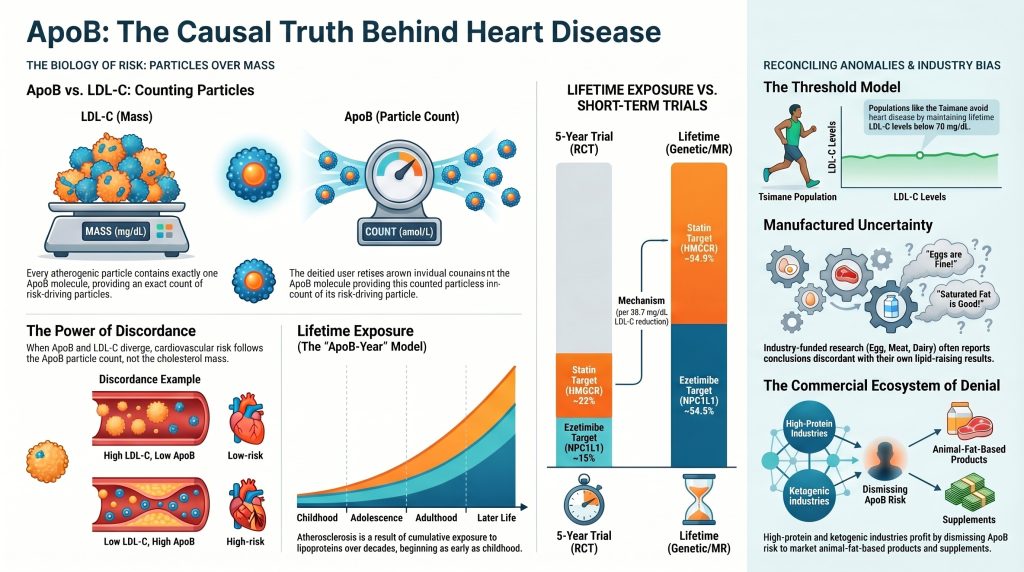
動脈硬化誘発性リポ蛋白仮説:因果関係の証拠、集団的異常値、産業界の介入、およびコレステロール科学の組織的否定に関する包括的レビュー
心血管の歴史的変遷 流行病学 観察された人口動態パターンと疾患の根底にある生理学的メカニズムとの間の緊張関係によって定義されてきた。アテローム性動脈硬化性 心血管疾患 (ASCVD)は依然として世界的な死亡原因の主要なものであるが、「脂質仮説」すなわち循環する リポタンパク質 この病態の主要な原因要因については、依然として激しい異論の対象となっている。本報告書は、因果関係を裏付ける証拠について科学的に厳密な分析を提供するものである。 アポリポ蛋白 Bアポタンパク質含有リポ蛋白は、脂質モデルにおける歴史的および現代的な集団の異常を調和させ、科学的不確実性を維持するための業界資金による取り組みの信頼性を評価し、そこから利益を得る組織化された商業的エコシステムを検証する コレステロール 否定論であり、心血管疾患におけるコレステロールの重要性を否定しようとする動機を持つグループによって用いられた、具体的な方法論的誤りを記録している。.
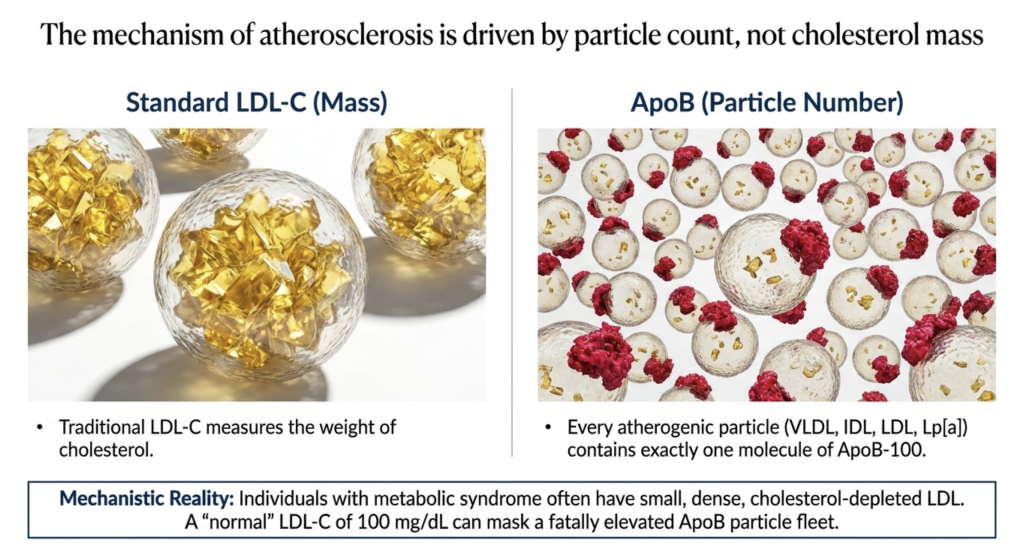
第1章 — ApoBとLDL-Cの違い:コレステロール量から粒子数へ
低密度リポ蛋白コレステロール(LDL-C)を主要なものとしてきた従来の臨床的依存は バイオマーカー 心血管リスクに対するものは20世紀後半の歴史的遺産である。LDL-Cは、低密度リポ蛋白画分に含まれるコレステロールの総質量を測定するものであり、通常はデシリットルあたりミリグラム(mg/dL)またはリットルあたりミリモル(mmol/L)で表される。ほとんどの集団においてリスクと高い相関性を示す一方で、LDL-Cは本質的に不完全な代理指標にすぎない。なぜなら、LDL-Cは循環している実際の粒子数に関する直接的な情報を提供しないからである。 動脈硬化惹起性粒子. 動脈硬化症 粒子浸潤と捕捉の疾患であり、動脈壁に入る運搬物の量ではなく、リポ蛋白の物理的な個数こそが、その進行速度を決定する 歯垢 進行.
アポリポ蛋白B-100(アポリポ蛋白B) は構造的 タンパク質 潜在的に動脈硬化を誘発するすべてのリポ蛋白の表面に見出される。各粒子は、超低密度リポ蛋白(VLDL)、中間密度リポタンパク質(IDL)、低密度リポ蛋白(LDL)、または リポ蛋白(a) [Lp(a)] — ApoB分子を正確に1つ含んでいます。.[1] その結果、アポBを測定することで、血漿中の動脈硬化惹起性リポ蛋白の総数を正確に数えることができる。コレステロール量(LDL-C)と 粒子負荷 (アポB)が臨床的に重要となるのは、次のような場合である:“不一致,、これら2つの指標が乖離する場所.
不和合のメカニズムと粒子の変動性
不一致は、通常、個々の粒子におけるコレステロール含有量の変動によって生じる。〜の個人において メタボリックシンドローム, インスリン抵抗性, 、または高トリグリセリド血症では、リポタンパク質の血管内リモデリングにより、コレステロールが比較的枯渇した小型で緻密なLDL粒子(small, dense LDL)が形成されます。このような個人では、100 mg/dLという「正常な」LDL-C値が、同じ質量のコレステロールを運ぶためにより多くの粒子が必要とされるため、著しく上昇したApoB数を隠している可能性があります。逆に、大きくてコレステロールが豊富なLDL粒子を持つ個人は、高いLDL-Cを示す一方でApoBは比較的低く、これは総粒子負荷が低いことを表しています。.
核磁気共鳴(NMR)分光法は、直接測定を可能にすることで、この理解をさらに洗練させてきた LDL粒子数 (LDL-P)とサイズ。大規模なデータの 前向きコホート, 、その中には AMORIS研究, EPIC-Norfolkコホート、 UKバイオバンク, 女性健康研究(Women's Health Study)などの研究が一貫して示しているように、ApoBとLDL-Cが不一致である場合、心血管リスクはLDL-Cの量ではなく、ApoBの数(粒子数)に連動します。.[1] 例えば、不調和に高値を示すApoBグループ(低LDL-C、高ApoB)の個人は、以下のリスクが有意に増加することを示しています 主要心血管イベント (MACE)は、一致したレベルの患者と比較して、.[4]
表1: LDL-C/ApoB不一致 およびMACEのリスク — UKバイオバンク(n = 375,544)
| 不一致カテゴリ | MACEのリスク(ハザード比) | VLDLによる仲介トリグリセリド | 臨床的解釈 |
| コンコーダント(LDL-CおよびApoB) | 1.0 (指示対象) | 該当なし | 標準的リスク評価 |
| 不調和に高値のアポB | 1.11 [1.06–1.15] | 25.5%(VLDL)、26.6%(TG) | LDL-Cにより過小評価されたリスク |
| 不調和なほど低いApoB | 0.87 [0.83–0.93] | 該当なし | LDL-Cによるリスクの過大評価 |
UKバイオバンクNMRサブスタディ.[4]
UKバイオバンクの解析において、アポBが不釣り合いに高値を示す個人におけるリスク上昇は、VLDL粒子およびトリグリセリドの上昇によって部分的に媒介されており、これらはLDL-Cのみに注目している場合には見落とされがちである。.[4] これらの知見は、特に以下における、より包括的なリスクマーカーとしてのApoBの有用性を裏付けるものである: 一次予防 従来の脂質検査では代謝機能障害を有する高リスクの個人を特定できない可能性がある場合において.
第2節:脂質仮説に異議を唱えるために用いられた集団:アノマリーの調停
脂質仮説に対する異端的な批判は、心血管疾患の負担がそれに見合って高くないにもかかわらず、高脂肪摂取や高コレステロール値を示すように見える「異常な」集団に依存することがよくある。しかし、一次文献や剖検データを用いたメカニズムの再検討により、これらの異常値は質の低いデータによる人工産物であるか、あるいは多くの場合、正しく評価されれば脂質仮説を強く裏付ける証拠を提供することが示される。.
1. イヌイットと北極圏の人口:免疫という神話
「“イヌイットのパラドックス”はバンとダイアバーグによって広められ、彼らはグリーンランドのエスキモーの罹患率が異常に低いことを示唆した 虚血性心疾患 (虚血性心疾患) 海洋哺乳類が豊富な高脂肪食にもかかわらず。.[7] これはオメガ3多価不飽和脂肪酸の多量摂取に起因すると考えられており、オメガ3脂肪酸が抗血栓作用の防御壁を提供すると仮説が立てられた。.[9]
しかし、イヌキの間における虚血性心疾患(IHD)の低さを示す科学的証拠は非常に脆弱であり、信頼性の低い死亡統計に基づいている。グリーンランドおよびアラスカの健康データの再評価により、いくつかの重大な歪みが浮き彫りになった。第一に、グリーンランドの初期の死亡記録は著しい誤分類に悩まされており、心血管疾患による死亡のかなりの割合が、以下のような「ゴミコード(不正確な死因コード)」に分類されていた: 心不全 あるいは虚血性心疾患(IHD)ではなく原因不明の心疾患である可能性が高い。標準化されたアルゴリズムをこの過去のデータに適用すると、グリーンランドとデンマークの間のIHD死亡率の差は著しく縮小する。.
検視データは最も決定的な反論を提供する。アラスカとカナダにおける1960年代および1970年代の研究により、動脈硬化と 心筋梗塞 イヌの間にも存在し、決して珍しくなかった。.[8] さらに、標準化された手法を用いたアラスカ先住民族集団に関する現代の研究では 裁定 CHDの高い発症率を示し、 脳卒中, リスクはLDL-CおよびApoBと明確に相関している。.[9] 歴史的コホートにおける見かけ上の「低リスク」は、平均寿命が短く、感染症や不慮の事故の有病率が高かったことによっても交絡されており、そのため多くの人が臨床的ASCVDを発症するまで生存できなかったのである。.[8]
2. チマネ族とハッザ族:実践される閾値モデル
その チマネ ボリビアのアマゾンの採集・園芸民は、その有病率が最も低いことが記録されている 冠動脈疾患 これまでに記録されたいかなる集団よりも.[11] これは組織的なものだと主張するために一部の者によって利用されてきた 炎症 慢性的な寄生虫負荷のためにチマネ族の間で高い――は、動脈硬化の主たる要因ではない。.
メカニズム的レビューは、シマネ族のデータを脂質モデルと完全に調和させている。シマネ族は生涯の平均LDL-Cを約70 mg/dLに維持しており、平均 血圧 104/64 mmHg.[11] この集団では、成人85%人が 冠動脈石灰化(CAC) 70代や80代になってもスコアはゼロです。.[11] 脂質仮説に矛盾するどころか、チマネ族は「“しきい値モデル”」疾患について:アテローム性動脈硬化症では、プラークの形成を開始・促進するために、長期間にわたり十分な濃度のアテローム誘発性リポタンパク質が存在することが必要である。 チマネ族は生涯を通じてLDL-Cレベルを臨界閾値をはるかに下回る水準に維持しているため、全身性の炎症レベルが高い(人口の51%でhs-CRPが3.0 mg/Lを超える)にもかかわらず、彼らの動脈には比較的プラークが見られない。.[11] この発見は、炎症ではなくアポB粒子負荷こそが動脈硬化のプロセスの主たる引き金であるという、強力な証拠を構成する。.
3. 家族性高コレステロール血症と「健康な生存者」の議論
ヘテロ接合体家族性高コレステロール血症 生涯にわたり極端なLDL-C値(通常190 mg/dL超)に曝露される結果となり、未治療の場合、若年性冠動脈疾患(CAD)のリスクが20倍に増加します。.[15] 懐疑派は、薬物療法なしで80代まで生存するFH(家族性高コレステロール血症)ヘテロ接合体を、LDL-Cが(動脈硬化の)原因ではないことの証拠として指摘している。.
FHにおける「健康な生存者」の存在は、主に3つのメカニズムによって説明されます。
- 選択バイアス:初期の臨床コホートは、しばしば次のような方法で特定されていた: 家族の歴史 早期イベントを発症した一方、イベントのない患者は未診断のままであった。網羅的スクリーニングにより、現在では未治療のFH患者の大部分が早期に心血管イベントを発症することが示されている。.
- 防御的遺伝子修飾子: 一部のFH保有者は、以下において稀な機能喪失バリアントを有しています PCSK9 ApoB値を大幅に低下させる、または改善する遺伝子またはその他の修飾因子 LDL受容体 リサイクルし、実質的にそのリスクをFH(家族性高コレステロール血症)を持たない人のリスクと同等レベルにする。.[19]
- リスク要因 乗数:生存者は、以下のような他のリスク要因がないことがよくあります。 喫煙 または 高血圧, 、そうでなければ動脈壁におけるApoB粒子のトラップがさらに促進されるところである。.
メンデルランダム化 研究と初期の劇的な成功 スタチン FH小児における治療は、この集団における脂質の因果関係をさらに裏付けるものである。.[15,17]
4. フレンチ・パラドックス:時間的錯覚
「“フレンチ・パラドックス”—冠動脈性心疾患の発症率が低いにもかかわらず、高 飽和脂肪酸 摂取 — は、脂質・心臓仮説に対する反論として1990年代に大きく普及しました。.[23] しかし、Law and Wald(1999)をはじめとする研究者らによる詳細な分析により、このパラドックスは過少報告と食習慣の移行における「タイムラグ」の組み合わせであることが実質的に解明された。.
フランスにおける動物性脂肪の消費とそれに伴う血中コレステロール値の上昇は、イギリスやアメリカよりも数十年遅れて、1960年代後半から1970年代になってようやく西欧の標準に達した。.[25] 動脈硬化症は数十年間にわたる曝露の結果として蓄積する疾患であるため、1980年代および1990年代のフランスの死亡率は、20世紀中葉のより低い血中脂質レベルを反映していた。.[25] さらに、MONICAプロジェクトからの標準化されたデータによると、フランスの医師は歴史的に、死亡診断書に冠動脈疾患(CHD)と記載する確率が低く、しばしば他の心疾患のコードを使用していた。フランス人口の高脂血症への曝露時間が長くなるにつれて、フランスのCHD死亡率は予測通り脂質モデルと一致するようになった。.
5. リーン・マス・ハイパーレスポンダー(LMHR):新たな課題
「“リーン・マス・ハイパー・レスポンダー”(LMHR)表現型は、痩せ型の個人における ケトジェニックダイエット HDL-Cが高くトリグリセリドが低い状態を維持しながら、しばしば200 mg/dLを超えるような極端なLDL-Cの急上昇を経験する.[27] 懐疑派は、これらの個人は代謝的に健康であるためリスクが低いと主張している。.
その ケトCTA このパイロット研究では、高解像度の画像を用いて、LMHRの患者100名を12か月間にわたり追跡調査した。 冠動脈CTアンギオグラフィー.[27] 本研究では、1年間のプラークの進行は緩慢であり、その短い期間内においてはApoBによって予測されなかったことが明らかになったが、これは、健康な人において測定可能なプラークとして現れるまでに通常何十年もかかるという動脈硬化の生物学的特性と一致している。極めて重要なことに、ベースラインの プラーク負荷 進行を予測し、既存の動脈硬化を有する人はケトジェニック状態にかかわらず高脂血症に対して脆弱なままであることを示唆した。.[27] 本コホートにおける脂質仮説の反証には、プラーク形成を伴わないこのようなLDLコレステロール値への生涯にわたる曝露が必要となるが、現在のデータではまだその条件を満たしていない。.
6. HDLのパラドックスとCETP阻害薬の失敗
HDL-Cを上昇させることによる心血管リスク低減の複数の治験の失敗――具体的には CETP 阻害薬の試験(トルセトラピブ、ダルセトラピブ)および ナイアシン 試験(HPS2-THRIVE、AIM-HIGH)は、脂質仮説が根本的に欠陥のあるものであると主張するために利用されてきた。.[31,32,33]
実際のところ、これらの失敗はアポBを中心とする脂質仮説を裏付けるものである。これらは、HDL-Cがリスクの「原因(メイカー)」ではなく「指標(マーカー)」であり、低トリグリセリド値と良好な状態を示す代理指標であることを示している 代謝の健康 因果的な治療標的というよりむしろ。逆に、首尾よく低下させるすべての治療法は アポB含有リポ蛋白 — スタチン、, エゼチミブ, PCSK9阻害薬, インクリシラン, ベムペド酸 ―作用機序にかかわらず、心血管リスクの比例的な低下をもたらす。.[35]
第3節 — メンデルランダム化と因果推論:遺伝学的証明
メンデルの ランダム化 (MR)は帰化者として 無作為化比較試験, 受胎時の遺伝子対立遺伝子のランダムな割り当てを利用して、曝露が生涯に及ぼす影響を研究する。遺伝的変異はライフスタイルや疾患の有無の影響を受けないため、メンデルランダム化(MR)は 交絡 そして 逆因果関係 観察研究を制限する.
遺伝的経路を通じた因果関係の確立
メンデルランダム化研究により、LDL-CおよびApoBがASCVDと因果関係にあることが明確に証明されている。最も強力な証拠は、以下の3つの遺伝子座から得られている:
- PCSK9バリアント: の機能喪失変異により生涯にわたり低LDL-C値を示す個人 PCSK9 この遺伝子では、LDL-Cが38.7 mg/dL低下するごとに、CHDリスクが約54%低下することが示されており、これは短期のスタチン試験で認められた効果をはるかに上回るものである。.[1,2]
- NPC1L1 バリエーション エゼチミブの作用を模倣する遺伝子変異は、LDL-C低下の程度に比例して冠動脈性心疾患(CHD)リスクの一貫した低下を示し、スタチン以外の脂質低下療法に対する遺伝学的妥当性を提供する。.[41]
- LPA遺伝子座 MRデータは、遺伝的に上昇したLp(a)がASCVDおよび石灰化の独立した因果的危険因子であることを裏付けている 大動脈弁 狭窄, LDLとは異なる、第2のアポBを介した因果経路を確立する。.[3]
表2:メンデルランダム化 vs. ランダム化 臨床試験 — LDL-C 38.7 mg/dL 低下あたりの冠動脈心疾患(CHD)リスク低減
| LDL低下メカニズム | MR試算(生涯) | RCT推定値(5年間) | 期間の差 |
| HMGCR スタチンの目標値 | ~54.5% | ~22% | ライフタイム vs. 5年 |
| PCSK9(エボロクマブ ターゲット | ~54.5% | ~15%(追跡期間2.2年) | 生涯 vs. 2.2年 |
| NPC1L1(エゼチミブ標的) | ~54.5% | ~15%(アドオンとして) | 終身 vs. 7年 |
Ferenceら(2012, 2017)およびCTTメタ分析から統合されたデータ。.[1,2]
MR研究でRCTと比較して3倍大きなベネフィットが観察されたことは、以下の重要性を強調している: 累積暴露. アテローム性動脈硬化は、「リポタンパク質・年」(曝露量×時間)の結果である。若年期に脂質を低下させればアテローム性動脈硬化のプロセスそのものの開始を防ぐことができるのに対し、60代で治療を開始することは既存のプラークに対する損害管理にすぎない。これらのMR(メンデルランダム化)データは、倫理的に実施不可能な数十年に及ぶランダム化試験を除けば、最強の因果関係の証拠を示すものである。.
セクション4 — スタチンおよびPCSK9阻害薬の治験エビデンス:批判的統合
脂質異常症治療に関するランダム化比較試験(RCT)のエビデンス基盤は、医学界において最も広範なものの一つである。コレステロール・トリートメント・トライアリスト(CTT)コラボレーション メタ分析 17万人以上の参加者を対象とした26件以上の臨床試験の結果、22%が示された。 相対リスク LDL-Cの38.7 mg/dL(1 mmol/L)低下ごとのMACEの減少。この結果は、性別、年齢、ベースラインのLDL-C、および既存の心血管疾患の有無を含むすべてのサブグループにおいて一貫していた。.[35]
多面発現論証の反論
スタチンがLDL-C低下とは無関係に、抗炎症作用やその他の「多面的(多面発現的)」なメカニズムを介して心血管イベントを減少させるという、一般的な異端の議論がある。これは、そのベネフィットが脂質低下そのものに起因するとは言えないことを示唆している。この議論は、非スタチンの臨床試験がCTT回帰直線と一致していることによって反証される:
- IMPROVE-IT: 18,144例の患者においてシンバスタチンにエゼチミブを追加投与した場合 急性冠症候群 エゼチミブはNPC1L1を介した小腸でのコレステロール吸収阻害という全く異なる作用機序を持つにもかかわらず、CTTの回帰線上に正確に一致する心血管イベントのさらなる減少をもたらした。エゼチミブには意味のある抗炎症作用はない。そのベネフィットは、達成されたLDL-Cの低下に純粋に比例するものであった。.[38]
- フーリエ そして オデッセイ 成果 PCSK9阻害薬のエボロクマブおよび アリロクマブ 最大限に用量調整された(または最大用量の)治療薬ですでに治療を受けている患者においてさえ、達成された絶対的なLDL-C低下量に比例してMACEが減少した 高強度スタチン セラピー — すでに炎症マーカーが抑制されていた患者たち。.[36,37]
- フーリエール: 長期オープンラベル延長試験のデータにより、超低LDL-C値(20 mg/dL未満)における継続的な漸進的リスク低減が示され、有害な安全性イベントの増加は見られず、「低ければ低いほどよい」というパラダイムが確認され、治療上の限界効果(フロア効果)の存在が否定されたか、または Jカーブ.[47]
批判派は、通常2〜3パーセントポイントという数値を引き合いに出し、その効果は「絶対的な観点からは控えめである」と主張している。 絶対リスク 中央値2.2〜5年の治験で観察された減少。この批判は動脈硬化性疾患の統計的性質を誤解している。同一の単位あたりのLDL-C減少が生涯にわたり(40歳開始で)モデル化された場合、絶対的ベネフィットは1桁大きくなり、まさにメンデルランダム化データが確認している通りである。治験レベルでの控えめな絶対リスク減少は、すでに動脈硬化のプロセスが始まって何十年も経過した中高年集団における、短い追跡期間に起因する予測可能な人工産物(アーティファクト)である。.
第5節 — 業界による干渉と意図的な懐疑主義:歴史的記録
5.1 砂糖研究財団とプロジェクト226
内部業界文書の歴史的分析により、 砂糖研究財団 (SRF)は、米国人が低脂肪食を取り入れればショ糖の消費量が大幅に増加することを、早くも1950年代に認識していた。1965年、SRFはハーバード大学の栄養学者であるD・マーク・ヘグステッドとフレドリック・ステアが執筆した文献レビューである「プロジェクト226」に資金を提供した。このプロジェクトは、冠動脈性心疾患(CHD)の引き金としてのショ糖の責任を免除し、すべての非難を食事の脂肪とコレステロールに集中させるよう意図的に設計されていた。.[48] 関与した科学者たちは、2016年のドル換算で約$50,000に相当する報酬を受け取り、SRFが草案を審査し、掲載する文献を選定することを認めた。.[48] これにより、砂糖に対する科学的合意の形成は数十年にわたって遅らされ、「脂肪対砂糖」という誤った二項対立が生まれた。異端視される人物たちは今日でもこの対立を利用し、脂質仮説は「嘘に基づいて作られた」と主張している。これは、食事性脂肪に関する議論と、アテローム性動脈硬化性心血管疾患(ASCVD)におけるリポタンパク質の因果関係という全く別の問題を混同させる、レトリックによるミスディレクションである。.
5.2 卵、乳製品、食肉産業の資金提供パターン
のパターン 業界資金 栄養科学への影響は現在も続いている。2010年から2019年の間に、卵と血中コレステロールに関する60%件の研究が、卵業界の資金提供を受けて実施された。.[54] これらの研究のうち86%件は、実際に卵がLDL-Cを上昇させることを明らかにした一方で、その半数は、自らの結果と矛盾する結論を報告していた。例えば、LDL-Cの上昇は「臨床的に有意ではない」とか、HDL-Cの変化によって相殺されたなどと主張していたのである。.[54]
酪肉業界は資金を提供してきた システマティックレビュー —中でもに掲載されたNutriRECSシリーズは 内科学会誌 —を利用した 等級 コホート研究に基づくすべての栄養学的エビデンスを「確実性が低い」と分類する方法論“[57] 手法上の理由から(長期的な食事に関するランダム化比較試験は実現可能性が低い)、理論的には正当化できるものの、このアプローチは、一貫して再現されているリスクの兆候を退け、現在の肉食中心の食生活の継続を正当化するのに十分な不確実性を意図的に生み出すために実用されている。乳製品業界からの資金提供と心血管研究の結果との関連性を調査したシステマティック・レビューでは、業界から資金提供を受けた研究は、乳製品に関して中立的または好ましい結果を報告する可能性が有意に高いことが判明した。.[60]
第6章 — コレステロール否認の商業エコシステム:高タンパク、ケトジェニック、パレオダイエット産業
前述の食品コモディティ産業に加え、LDL-CおよびApoBの動脈硬化形成上の意義を否定することから直接的な経済的利益を得る、明確かつ高度に組織化された商業的エコシステムが出現している。このエコシステムは、ベストセラーの一般向け書籍、D2C(消費者直接販売)の食肉・サプリメント企業、有料のインフルエンサープログラム、ポッドキャスト帝国、そして科学的議論の構造を利用しながらその方法的要件を体系的に踏みにじる少数の臨床医上がりの起業家にまで及んでいる。このエコシステムの財務構造を理解することは、その科学的主張の信頼性を評価する上で不可欠である。.
6.1 コア・コマーシャル・ロジック
中心的な経済の現実は単純である。飽和脂肪酸とコレステロールを制限する食事ガイドラインは、直接的に以下の市場を縮小させる。 赤身肉, 、加工肉、高脂肪の乳製品、および高タンパク質サプリメント産業。(a)飽和脂肪酸と 食事性コレステロール (b) LDLコレステロールはASCVDの有意味な原因リスク因子ではなく、(c) 高タンパク質・動物性脂肪ベースの食生活は進化の観点から最適であるという主張を通じて、これらの商業的利益は、売上を拡大させると同時に、科学的反対意見を組織的腐敗と解釈するイデオロギー的にコミットした消費者のコミュニティを育成している。その結果得られるものは、経験的反駁に対して極めて強靭な、自己強化的な商業・イデオロギー的マシーンである。.
6.2 ケトジェニックおよびカーニボア食産業
ケトジェニックダイエットやカーニヴォアダイエットのブームは、数億ドル規模の商業エコシステムを生み出しました。この分野の主要人物――LMHRコンセプトの考案者であるデイブ・フェルドマンをはじめ、 ポール・サラディーノ(「カーニヴォアMD」)、ショーン・ベイカー、ジョージア・エデ、ケン・ベリーなど――は、LDL-Cの重要性に疑問を投げかける臨床研究を自ら実施したり引用したりする一方で、消費者向け牛肉製品、動物内臓サプリメント、電解質サプリメント、オンラインコーチングの定期購読サービス、書籍出版権などを販売する事業も運営している。 フェルドマンの「シチズン・サイエンス財団」および関連するKETO-CTA研究[27] は、以下の1年間の冠動脈CTデータについて大きな注目を集めており、 除脂肪体重 ハイパーレスポンダー。第2.5節で論じたように、これらのデータは予備的なものであり、現段階では、高LDL-Cを無罪とするような解釈は科学的に正当化されない。研究者たちとケトン食関連の商業エコシステムとの間に存在する、公表されていない金銭的関係は、利益相反を構成しているが、一般の議論においては十分な精査がなされていない。.
ケトジェニックダイエット業界の「LDLに悪影響はない」という主張は、3つの主張に基づいているが、そのいずれも精査すれば成り立たないものである:
- “「代謝の健康状態はLDLのリスクを打ち消す」:トリグリセリド値が低いこと、あるいは高いことが HDL ApoB粒子数の増加によるアテローム形成作用を中和する。内皮下での粒子滞留の生物学的メカニズムには、代謝機能障害は必要ではなく、内皮バリアを横切る十分なApoB濃度勾配さえあればよい。.
- “「KETO-CTA研究は、LDLがプラークを予測しないことを示した」:この研究では、100人のコホートにおいて、アポBの群内変動が1年後のプラークの変化を予測しないことが明らかになった。これは、一般向けの報道で主張されている内容よりもはるかに説得力に欠けるものである。 この研究のデータ自体からも、ベースライン時のプラーク負荷が進行を予測することが示されており、これは脂質モデルと完全に一致している。.
- “「先祖代々の人間は高脂肪の食事を摂っていたが、心臓病にはかからなかった」: 古代エジプト人、ペルー人、プエブロ族、およびウナンガン族のミイラ化した遺体からの剖検データは、複数の狩猟採集民および農耕民集団において動脈硬化が確認されたことを示しており、これはパレオダイエットや肉食主義の支持者たちが提唱する「祖先の免疫力」説と真っ向から矛盾している。.
6.3 旧石器時代式食事法産業
パレオ運動は、ローレン・コーデイン(その著書や関連ブランドは年間数百万の収益を生み出している)、ロブ・ウルフ(『パレオ・ソリューション』、サプリメント会社NovOS)、 マーク・シッソン(『プライマル・ブループリント』、クラフト・ハインツに買収された「プライマル・キッチン」ブランド)、クリス・クレッサー(クレッサー・インスティテュートの機能医学トレーニングプログラム)らの活動を通じて商業化された——は、料理本、認定プログラム、サプリメント販売、オンライン定期購読サービスを通じて、多大な収益源を築き上げてきた。 パレオの枠組みは、超加工食品の回避に関する有益な公衆衛生上のメッセージ発信に寄与してきた一方で、この業界は同時に、科学的な根拠のない二次的な主張——すなわち、先祖代々の人類は一様にASCVD(動脈性心血管疾患)の負担が低く、したがって赤身肉や飽和脂肪酸の多量摂取は心血管系に中立である——を推進してきた。.
この説には、いくつかの証拠が反論している。 HladikらおよびThompsonらは、地理的・食生活的に多様な4つの古代集団のミイラ遺体のCT画像を調査し、137体のミイラのうち47体(34%)に、現代の加工食品を入手できなかった狩猟採集民集団を含め、動脈硬化の可能性が高い、あるいは確実な所見を確認した。 高レベルの赤身肉摂取を支持するために、パレオ産業が先祖代々の心血管疾患に関するデータを選択的に提示していることは、第5節で記録された食品業界の資金提供慣行と直接的に類似した「動機付けられた推論」である。.
6.4 高タンパク質サプリメント業界
動物由来のタンパク質サプリメント業界――ホエイプロテインなどを含む――、, カゼイン, 、コラーゲン、牛肉タンパク質分離物、および関連製品——は、動物性タンパク質の大量摂取を重視し、それに伴う飽和脂肪酸や食事性コレステロールの摂取に対する懸念を最小限に抑える、タンパク質中心の食事枠組みを推進する金銭的インセンティブを持っている。 この分野における業界資金による研究は、確立されたガイドラインを大幅に上回るタンパク質摂取量(多くの場合、1.6~2.4 g/kg/日以上)を提唱するために利用されてきた。その一方で、それに伴う飽和脂肪酸摂取量の増加については、代謝的には無関係であるか、あるいはLDL粒子サイズへの影響によりむしろ有益であると主張されている。.
LDL粒子サイズに関する議論――すなわち、大きくて「ふわふわした」LDL粒子は、その数値が高くなっても無害であるという主張――は、科学文献において正式に検証され、否定されています。 LDL-Cを変化させることなく、LDL粒子サイズのみを特異的に変化させる遺伝的インスツルメントを用いたメンデルランダム化研究により、アテローム発生リスクに関与するのはLDL粒子サイズではなく、LDL粒子数(すなわちApoB)であることが示されている。大きなLDL粒子は、その濃度が高くなるとアテローム発生を促進する。粒子が大きいからといって、そのリスクを防ぐわけではない。 内皮下貯留.
6.5 ゲイリー・タウブスと栄養科学イニシアティブ(NuSI)
ゲイリー・タウブスの著書 『良いカロリー、悪いカロリー』 (2007) および 砂糖の弊害 (2016)は、脂質仮説が、炭水化物・インスリンモデルに対する制度的な抑圧によって不正に確立されたという、広く受け入れられている説を定着させる上で、極めて大きな影響力を及ぼしてきた。 肥満. タウブスは2012年にピーター・アッティアと共に「栄養科学イニシアチブ(NuSI)」を共同設立し、慈善寄付者から約$40百万を調達して、「食事・心臓仮説」に異議を唱える研究に資金を提供した。 NuSIが資金提供した研究は、概して肥満に関するエネルギーバランスモデルを覆すには至らず、同組織は2021年までに事実上活動を終了した。 それにもかかわらず、アンセル・キーズの「7カ国研究」は都合の良いデータのみが選別されたものであり、脂質仮説全体が腐敗した基盤の上に成り立っているというタウブスの主張は、低炭水化物食支持者の間で今も広く流布し続けている。.
この枠組みにおける科学的な問題は、それが完全に過去を振り返るものに過ぎないという点にある。たとえキーズの当初の疫学研究に対するあらゆる批判を受け入れたとしても、その後の50年間にわたるメンデル型ランダム化研究、スタチン試験、 PCSK9阻害薬試験、エゼチミブ試験といった研究は、キーズが研究を行っていた当時は存在しなかった、完全に独立した証拠基盤を構成しており、タウブスが観察疫学に対して提起する交絡要因の影響を受けないメカニズムを通じて、ApoB粒子の因果関係を決定的に立証している。.
6.6 ニーナ・タイコールツと『The Big Fat Surprise』“
ニーナ・タイコールツの2014年の著書 『ビッグ・ファット・サプライズ』 また、彼女が「ザ・ニュートリション・コアリション」を通じて続けている提唱活動は、米国の食事脂肪に関する指針に対する、最も組織化された市民レベルからの異議申し立てとなっている。BMJによる詳細なファクトチェック分析では、テイコルツによる科学文献の解釈には、証拠の扱いにおいて複数の不正確な点があることが明らかになった。 彼女の研究は食肉・乳製品業界によって広く引用され、米国の食事ガイドラインの改定を求めるロビー活動に利用されてきた。タイコルツの方法論上の中心的な誤りは、タウブスのそれと同一である。 彼女は、食事性脂肪をめぐる歴史的な疫学的な議論を、ASCVDにおけるリポタンパク質の因果関係に関する決定的な根拠として扱っている一方で、遺伝学的研究は食事介入研究とは「同じものではない」という理由から、現在入手可能な最も因果関係において厳密な証拠タイプであるメンデルランダム化の証拠と向き合うことを拒否している。 この主張には、技術的には一理ある(遺伝的要因によるLDL低下と食事によるLDL低下ではその程度が異なる可能性がある)ものの、核心となる点には触れていない。すなわち、両者とも、動脈壁へのApoB粒子の浸潤を減少させるという同一の生物学的メカニズムを通じて作用しているのだ。.
第7章 — 組織的なコレステロール否定論:THINCS、学術界の異論者たち、そしてサプリメント市場
商業的な動機による懐疑論とは別に、組織的な「コレステロール否定論」という独自の知的伝統が台頭している。その特徴は、LDL-CおよびApoBがASCVDにおいて因果的な役割を果たさないという立場を協調して主張することであり、極端な主張では、コレステロール値の上昇がむしろ保護作用を持つ可能性さえあるとされている。 この動きは、一般の議論において、正当な科学的少数派の見解として頻繁に引用されており、体系的な反論が必要である。.
7.1 コレステロール懐疑派の国際ネットワーク(THINCS)
「コレステロール懐疑論者の国際ネットワーク(THINCS)」は、著書『コレステロールの神話』(2000年)および『脂肪とコレステロールは体に良い』(2009年)の著者であるデンマーク人医師ウッフェ・ラヴンスコフによって設立された。 THINCSは、約100人の医師や研究者が署名したマニフェストを掲げており、そこでは、コレステロール仮説は証拠によって裏付けられていないこと、コレステロール低下薬には実質的な利益がないこと、そして特に高齢者においては、高コレステロール血症は中立的あるいは保護的な作用を持つと主張している。 THINCSネットワークは、低ランクの学術誌に選別的に論文を発表したり、一般向けメディアにプレスリリースを配信したり、一般読者層を広く獲得する活発なウェブ活動を展開したりしている。.
THINCSの主な科学的主張は、厳密な分析の下では、複数の点で成り立たない。
高齢者集団における「Jカーブ」: ラヴンスコフ、デビッド・ダイアモンド、およびマルコム・ケンドリックは、LDL-Cと……との間に逆相関またはU字型の相関関係を示す観察研究を引用している。 全因死亡率 高齢者集団における事例を、コレステロール値の低下が有害であるという証拠として挙げている。この主張には、2つの根本的な誤りがある。第一に、これは逆相関に依拠している 因果関係: 高齢者や慢性疾患を有する患者において、LDL-Cの低値は、多くの場合、肝機能障害、悪性腫瘍、心性悪液質、あるいは慢性炎症の結果であり、死亡の原因ではない。 早期死亡を除外する(「1件除外法」解析)か、メンデルランダム化を用いてこの交絡因子を調整すると、一見保護的と見えた関連性は完全に消失する。第二に、全死因死亡率とASCVD特異的死亡率は異なるエンドポイントである。 たとえ虚弱な高齢者においてLDL-Cが全死因死亡率と逆相関していたとしても(これは逆因果関係によって完全に説明可能である)、それは数十年にわたる生物学的時間スケールで作用するApoBとASCVDとの因果関係には何ら影響を及ぼさない。.
“「スタチンは有害であり、その効能は過大評価されている」: ラヴンスコフ、ジョン・エイブラムソン、およびケンドリックは、査読付き論文や一般向け書籍において、スタチンの有益性は絶対リスクではなく相対リスクという枠組みによって過大評価されており、スタチンは広範な筋肉障害、認知機能障害、および代謝障害を引き起こすと主張している。 絶対リスク対相対リスクという枠組みをめぐる議論は、医学的コミュニケーションにおける一般的な懸念事項であり、根本的な生物学的メカニズムには触れていない。認知機能障害に関する主張は、2012年のFDAによる添付文書の更新を受けて注目を集めたが、前向き、盲検化、無作為化試験のいずれにおいても確認されていない。 スタチンの安全性データに関する最大規模のメタ分析(数十万患者・年の追跡調査を含む)は、重篤な有害事象はまれであり、大多数の患者においてスタチン療法の耐容性が良好であることを裏付けている。.
“「脂質仮説は女性においては立証されなかった」: THINCSに由来する主張の中には、次のように主張するものがある。 脂質低下 女性における心血管イベントの減少効果が示されていない。これとは正反対の結果が、 CTTとの連携 サブグループ解析では、 JUPITER試験 (ロスバスタチン (一次予防において、女性において一貫した有益性が示されている)こと、および、すべての遺伝的LDL低下因子において、女性におけるASCVDリスクの比例的な低減を示すメンデルランダム化データ。.
7.2 「コレステロールは不可欠」という論理の飛躍
THINCSと高タンパク質ダイエット支持者の双方に共通する修辞的手法として、コレステロールの重要な生物学的機能――ステロイドホルモンの合成、細胞膜の維持、, 胆汁酸 生成、神経機能、ビタミンDの合成――といった事柄を根拠に、コレステロールを運ぶリポタンパク質の血中濃度の上昇が、それゆえに有益であるか、あるいは無害であると示唆すること。これは明白な論理的誤りであり、ゾーイ・ハーコムは自身のウェブサイトや査読付き論文への投稿において、この誤りを特に頻繁に用いている。.[67]
コレステロールは細胞レベルで不可欠であり、細胞内のコレステロール生合成は、以下の要因によって極めて精密に調節されている。 メバロン酸経路. ASCVDにおける病理学的実体は、コレステロールそのものではなく、アポB含有リポタンパク質、すなわち内皮障壁を通過し、その内部に留まることのできる高分子粒子である。 内皮下腔 プロテオグリカンとの相互作用を通じて。新生児やその他の霊長類は、ステロイドホルモン濃度、細胞膜の組成、神経機能がすべて正常な状態で、血漿LDL-Cを40~70 mg/dLの範囲に維持しており、これは、コレステロールの不可欠な生物学的機能が、西洋人集団におけるASCVDリスクに関連する濃度よりもはるかに低い濃度でも十分に果たされていることを示している。 したがって、「コレステロールは不可欠である」という主張は、生物学的には自明の事実ではあるが、血漿中のApoB粒子負荷の上昇がもたらす病理学的影響とは無関係である。.
7.3 代替医療とサプリメント産業の接点
コレステロール否定論の生態系は、機能医学や代替健康サプリメント業界と大きく重なっている。スタチンを「製薬会社の資金提供を受けた研究によってその効果が体系的に過大評価されている有害物質」と位置づけることで、この生態系は、独自の「天然」代替品に対する需要を生み出している: 紅麹米, 、ベルベリン、オメガ3濃縮物、CoQ10製品(スタチンがCoQ10を減少させ、疲労を引き起こすという、広く宣伝されているものの科学的根拠が乏しい主張に対処するとして販売されているもの)、ポリフェノール抽出物、植物 ステロール サプリメント、および機能医学の専門家や消費者向けオンライン薬局で販売されているさまざまな複合製品。.
この立場には、商業的な皮肉が際立っている。赤酵母米には モナコリンK — ロバスタチンと化学的に同一の分子 — を薬理学的に有効な濃度で含有している。したがって、アンチスタチン論の根本的な論点は作用機序ではなく、ジェネリック医薬品からの収益を、処方薬を規制する枠組みの外で販売される、利益率の高い独自開発のサプリメントへと振り向けることにある。 この代替を推奨する医療従事者は、2つの点で患者に不利益をもたらしている。すなわち、安全性と有効性について広範かつ実証済みの実績を持つ治療法を患者から奪い、その代わりに、ブランドによってモナコリンKの含有量が最大100倍も異なり、薬物監視の対象にもなっていない製剤を推奨しているのだ。.
7.4 「研究不正」をめぐるメタ論争とその限界
おそらく、コレステロール否定論の生態系において、修辞的に最も強力なツールは、「研究の腐敗」というメタ論法だろう。これは、スタチン試験への製薬業界からの資金提供、ガイドライン作成機関への規制当局の乗っ取り、そして学術的な脂質学者とPCSK9阻害薬メーカーとの間の金銭的関係によって、脂質低下療法の証拠基盤全体が損なわれているという主張である。 この主張が全く根拠のないものではないことは確かだ――心血管医学における利益相反は現実のものであり、継続的な精査が必要である。しかし、否定論者の文献で用いられているように、この主張は証拠の質を向上させるためではなく、証拠のカテゴリー全体を否定するために利用されている。.
「研究の不正」という主張の根本的な問題は、メンデルランダム化による証拠を説明できない点にある。この証拠は、製薬企業からの資金提供とは完全に独立しており、公開されている遺伝データを用いて国のバイオバンクや人口登録簿から生成されたものであり、臨床試験の証拠と完全に一致する結果を示している。 54%変異を持つPCSK9機能喪失型変異保有者で、生涯の冠動脈疾患(CHD)リスクが低い人々は、製薬企業の臨床試験に登録されておらず、いかなる介入も受けていない。彼らの保護効果は、その研究に資金を提供する製薬会社が存在する以前、受胎の時点で既に存在していた遺伝的変異に由来するものである。 この証拠を否定するには、科学的記録に何ら根拠のない陰謀論的な枠組みが必要となる。.
第8節 — 閾値モデルと進化的文脈
チマネ族、ハザ族、および産業革命以前のデータを統合して一貫性のあるモデルを構築した結果、アテローム性動脈硬化症は加齢に伴う避けられない結果ではなく、長期間にわたり高リポタンパク質にさらされ続けた状態によって引き起こされるものであることが示唆される。.
遺伝的規範環境
人類の進化史の大部分において、LDL-C値はおそらく40~70 mg/dLの範囲にあったと考えられ、これは現代の非ヒト霊長類やヒトの新生児に見られる値と同様である。.[11] この範囲では、ApoB粒子の濃度が極めて低いため、その浸潤速度および内皮下への捕捉率は無視できるほど小さい。. 無症候性動脈硬化症, しかし、高リポタンパク質環境下では早期に始まる。からの剖検データによると、 ボガルサ心臓研究 そして CARDIA 大動脈が……であることを示す 脂肪線条 また、線維性プラークは20代から形成され始め、小児期に測定されたLDL-CおよびVLDLの値と強い相関関係がある。.[69,70] この発見には極めて重要な意味があります。すなわち、アテローム性動脈硬化の「時計」は成人期以前に動き始め、累積曝露積分――ApoB濃度×時間、すなわち「“アポB年” — これが、最終的な臨床的リスクの主な決定要因である。.
表3:アポBの累積曝露量とプラークの形成 — アポB-年モデル
| 人口/背景 | 生涯にわたるApoBの目標値(概算) | 線維性プラークの出現 | 臨床事象のリスク |
| 産業革命以前(チマネ族) | 約50 mg/dL | 稀/見られない | ほぼゼロ |
| 現代の西洋における平均値 | 約90~110 mg/dL | 第2~第3の10年 | 高(50歳以上) |
| ヘテロ接合型FH(未治療) | >150 mg/dL | 幼少期 | エクストリーム(30歳以上) |
ボガルーサ心臓研究、チマネ・コホートデータ、およびFHレジストリデータをもとに統合されたものである。.[11,15,69,70]
この閾値モデルによれば、重大なアテローム性動脈硬化を回避するためには、生涯平均のアポB値を約50~60 mg/dL未満に維持すべきであると予測されています。アポBの累積曝露年数が臨界閾値を超えると、内皮下プラークの蓄積量は、ある時点に達し、 不安定プラーク 破裂、, 血栓症, 、そして急性冠動脈イベントの発生確率がますます高まる。治療上の意味合いとしては、治療を早期に開始すればするほど、生涯にわたる利益が相対的に大きくなるということである。これは、メタアナリシス、ランダム化比較試験(RCT)、および集団データから得られるあらゆる証拠と一致している。.
結論:証拠の優越性と反証基準
生化学、大規模前向きコホート研究、メンデルランダム化、およびランダム化比較試験から得られた証拠の総体は、ApoBを含むリポタンパク質がASCVDの因果因子であることを疑いようなく立証している。.[1,2] 科学界のコンセンサスは、本来「不確実」なものではない。むしろ、その不確実性は、以下の利害関係者の連合によって体系的に作り出されてきたものである:(1) 砂糖および精製 炭水化物 1960年代、科学界の関心をショ糖から他へと向けさせた産業[48]; (2) 卵、乳製品、食肉産業は、食事による脂質上昇の重要性を過小評価するように仕向ける研究への資金提供を続けている[54,57,60]; (3) 高タンパク質食、ケトジェニック食、カーニヴォア食、およびパレオ食をめぐる商業的エコシステム。これらは、飽和脂肪や赤身肉の摂取が動脈硬化を招くという役割を否定することに、直接的な収益上の利害関係を持っている[27]; (4) 組織化された「THINCS」コレステロール否定ネットワークおよびそれに関連する代替医療市場;ならびに (5) メンデルランダム化による証拠――現時点で最も因果関係の厳密性が高いデータタイプ――との議論を一貫して回避する、少数の異論を唱える学者たち。.
改ざんの基準
科学的に反証するためには、 アテロゲン性リポタンパク質仮説, 、研究者は以下のうち少なくとも1つを実証する必要がある:
- 生涯を通じてApoB値が高い(100 mg/dL以上が持続する)にもかかわらず、冠動脈疾患を発症しない集団を特定する 動脈 カルシウムやアテローム性動脈硬化症については、80代や90代になってもその関連性が認められる。LMHRコホートが現在唯一の候補となっているが、現在のデータは100人の被験者を対象とした12か月間に過ぎず、数十年にわたる生物学的蓄積に関する仮説を反証するには全く不十分である。.
- ApoB含有粒子の著しい単独減少が、少なくとも5年間にわたり心血管イベントの比例的な減少をもたらさないことを示す無作為化試験を実施する。そのような試験はこれまで実施されたことがなく、また、既存の知見を踏まえると、そのような試験の実施には深刻な倫理的障壁が立ちはだかるだろう。.
これまでに実施されたあらゆる研究が、このモデルをさらに裏付けています。圧倒的な証拠が、「数値が低いほど良く、より長く低い状態を維持することが最善である」というパラダイムを支持しており、アポBは、疾患を引き起こす動脈硬化性粒子負荷を測定する最も正確な定量的指標となっています。 LDL-CやApoBの高値がASCVDと無関係であるという主張は、コンセンサスと対等な認識論的立場で競合する科学的少数派の見解ではなく、商業的な動機に基づく主張であり、これまでに実施されたあらゆる厳格な実証的検証においてその妥当性が否定されてきた。.
参考文献
引用文献はすべて、査読付き学術誌に掲載された論文です。.
- Ference BA, Ginsberg HN, Graham I, et al. Low-density lipoproteins cause atherosclerotic cardiovascular disease. 1. Evidence from genetic, epidemiologic, and clinical studies. A consensus statement from the European Atherosclerosis Society Consensus Panel. Eur Heart J. 2017;38(32):2459-2472. doi:10.1093/eurheartj/ehx144
- Ference BA, Yoo W, Alesh I, et al. Effect of long-term exposure to lower low-density lipoprotein cholesterol beginning early in life on the risk of coronary heart disease: a Mendelian randomization analysis. J Am Coll Cardiol. 2012;60(25):2631-2639. doi:10.1016/j.jacc.2012.09.017
- Doherty S, Hernandez S, Rikhi R, et al. Lipoprotein(a) as a Causal Risk Factor for Cardiovascular Disease. Curr Cardiovasc Risk Rep. 2025;19(1):8. doi:10.1007/s12170-025-00760-1
- Du Y, Ding W, Ye Z, et al. Impact of LDL-C and Apolipoprotein B Level Discordance and associated Lipoprotein Particle Alterations on Cardiovascular Outcomes in a large primary prevention population. Eur J Prev Cardiol. Published online November 24, 2025. doi:10.1093/eurjpc/zwaf750
- Borén J, Williams KJ. The central role of arterial retention of cholesterol-rich apolipoprotein-B-containing lipoproteins in the pathogenesis of atherosclerosis: a triumph of simplicity. Curr Opin Lipidol. 2016;27(5):473-483. doi:10.1097/MOL.0000000000000330
- Sniderman AD, Thanassoulis G, Glavinovic T, et al. Apolipoprotein B Particles and Cardiovascular Disease: A Narrative Review. JAMA Cardiol. 2019;4(12):1287-1295. doi:10.1001/jamacardio.2019.3780
- Bang HO, Dyerberg J, Hjøorne N. The composition of food consumed by Greenland Eskimos. Acta Med Scand. 1976;200(1-2):69-73. doi:10.1111/j.0954-6820.1976.tb08198.x
- Fodor JG, Helis E, Yazdekhasti N, Vohnout B. “Fishing” for the origins of the “Eskimos and heart disease” story: facts or wishful thinking?. Can J Cardiol. 2014;30(8):864-868. doi:10.1016/j.cjca.2014.04.007
- Howard BV, Devereux RB, Cole SA, et al. A genetic and epidemiologic study of cardiovascular disease in Alaska natives (GOCADAN): design and methods. Int J Circumpolar Health. 2005;64(3):206-221. doi:10.3402/ijch.v64i3.17985
- Howard BV, Robbins DC, Sievers ML, et al. LDL cholesterol as a strong predictor of coronary heart disease in diabetic individuals with insulin resistance and low LDL: The Strong Heart Study. Arterioscler Thromb Vasc Biol. 2000;20(3):830-835. doi:10.1161/01.atv.20.3.830
- Kaplan H, Thompson RC, Trumble BC, et al. Coronary atherosclerosis in indigenous South American Tsimane: a cross-sectional cohort study. Lancet. 2017;389(10080):1730-1739. doi:10.1016/S0140-6736(17)30752-3
- Gurven M, Kaplan H, Winking J, Finch C, Crimmins EM. Aging and inflammation in two epidemiological worlds. J Gerontol A Biol Sci Med Sci. 2008;63(2):196-199. doi:10.1093/gerona/63.2.196
- Thompson RC, Allam AH, Lombardi GP, et al. Atherosclerosis across 4000 years of human history: the Horus study of four ancient populations.
- Trumble BC, Stieglitz J, Blackwell AD, et al. Apolipoprotein E4 is associated with improved cognitive function in Amazonian forager-horticulturalists with a high parasite burden. FASEB J. 2017;31(4):1508-1515. doi:10.1096/fj.201601084R
- Nordestgaard BG, Chapman MJ, Humphries SE, et al. Familial hypercholesterolaemia is underdiagnosed and undertreated in the general population: guidance for clinicians to prevent coronary heart disease: consensus statement of the European Atherosclerosis Society. Eur Heart J. 2013;34(45):3478-90a. doi:10.1093/eurheartj/eht273
- Defesche JC, Gidding SS, Harada-Shiba M, Hegele RA, Santos RD, Wierzbicki AS. Familial hypercholesterolaemia. Nat Rev Dis Primers. 2017;3:17093. Published 2017 Dec 7. doi:10.1038/nrdp.2017.93
- Wiegman A, Gidding SS, Watts GF, et al. Familial hypercholesterolaemia in children and adolescents: gaining decades of life by optimizing detection and treatment. Eur Heart J. 2015;36(36):2425-2437. doi:10.1093/eurheartj/ehv157
- Besseling J, Hovingh GK, Huijgen R, Kastelein JJP, Hutten BA. Statins in Familial Hypercholesterolemia: Consequences for Coronary Artery Disease and All-Cause Mortality. J Am Coll Cardiol. 2016;68(3):252-260. doi:10.1016/j.jacc.2016.04.054
- Abifadel M, Varret M, Rabès JP, et al. Mutations in PCSK9 cause autosomal dominant hypercholesterolemia.
- Hovingh GK, Davidson MH, Kastelein JJ, O’Connor AM. Diagnosis and treatment of familial hypercholesterolaemia. Eur Heart J. 2013;34(13):962-971. doi:10.1093/eurheartj/eht015
- Raal FJ, Honarpour N, Blom DJ, et al. Inhibition of PCSK9 with evolocumab in homozygous familial hypercholesterolaemia (TESLA Part B): a randomised, double-blind, placebo-controlled trial. Lancet. 2015;385(9965):341-350. doi:10.1016/S0140-6736(14)61374-X
- Ibrahim S, Reeskamp LF, de Goeij JN, et al. Beyond early LDL cholesterol lowering to prevent coronary atherosclerosis in familial hypercholesterolaemia. Eur J Prev Cardiol. 2024;31(7):892-900. doi:10.1093/eurjpc/zwae028
- Law M, Wald N. Why heart disease mortality is low in France: the time lag explanation. BMJ. 1999;318(7196):1471-1476. doi:10.1136/bmj.318.7196.1471
- Simini B. Serge Renaud: from French paradox to Cretan miracle. Lancet. 2000;355(9197):48. doi:10.1016/S0140-6736(05)71990-5
- Ferrières J. The French paradox: lessons for other countries. Heart. 2004;90(1):107-111. doi:10.1136/heart.90.1.107
- GBD 2023 Disease and Injury and Risk Factor Collaborators. Burden of 375 diseases and injuries, risk-attributable burden of 88 risk factors, and healthy life expectancy in 204 countries and territories, including 660 subnational locations, 1990-2023: a systematic analysis for the Global Burden of Disease Study 2023. Lancet. 2025;406(10513):1873-1922. doi:10.1016/S0140-6736(25)01637-X
- Norwitz NG, Feldman D, Soto-Mota A, et al. The impact of sustained LDL-C elevation on coronary plaque progression: primary results from the KETO-CTA study. medRxiv. 2026. doi:10.64898/2026.01.15.26343955v1
- Norwitz NG, Soto-Mota A, Feldman D, Parpos S, Budoff M. Case Report: Hypercholesterolemia “Lean Mass Hyper-Responder” Phenotype Presents in the Context of a Low Saturated Fat Carbohydrate-Restricted Diet. Front Endocrinol (Lausanne). 2022;13:830325. Published 2022 Apr 14. doi:10.3389/fendo.2022.830325
- Borén J, Chapman MJ, Krauss RM, et al. Low-density lipoproteins cause atherosclerotic cardiovascular disease: pathophysiological, genetic, and therapeutic insights: a consensus statement from the European Atherosclerosis Society Consensus Panel. Eur Heart J. 2020;41(24):2313-2330. doi:10.1093/eurheartj/ehz962
- Packard C, Caslake M, Shepherd J. The role of small, dense low density lipoprotein (LDL): a new look. Int J Cardiol. 2000;74 Suppl 1:S17-S22. doi:10.1016/s0167-5273(99)00107-2
- Barter PJ, Caulfield M, Eriksson M, et al. Effects of torcetrapib in patients at high risk for coronary events. N Engl J Med. 2007;357(21):2109-2122. doi:10.1056/NEJMoa0706628
- HPS2-THRIVE Collaborative Group, Landray MJ, Haynes R, et al. Effects of extended-release niacin with laropiprant in high-risk patients. N Engl J Med. 2014;371(3):203-212. doi:10.1056/NEJMoa1300955
- Schwartz GG, Olsson AG, Abt M, et al. Effects of dalcetrapib in patients with a recent acute coronary syndrome. N Engl J Med. 2012;367(22):2089-2099. doi:10.1056/NEJMoa1206797
- AIM-HIGH Investigators, Boden WE, Probstfield JL, et al. Niacin in patients with low HDL cholesterol levels receiving intensive statin therapy. N Engl J Med. 2011;365(24):2255-2267. doi:10.1056/NEJMoa1107579
- Cholesterol Treatment Trialists’ (CTT) Collaboration, Baigent C, Blackwell L, et al. Efficacy and safety of more intensive lowering of LDL cholesterol: a meta-analysis of data from 170,000 participants in 26 randomised trials. Lancet. 2010;376(9753):1670-1681. doi:10.1016/S0140-6736(10)61350-5
- Sabatine MS, Giugliano RP, Keech AC, et al. Evolocumab and Clinical Outcomes in Patients with Cardiovascular Disease. N Engl J Med. 2017;376(18):1713-1722. doi:10.1056/NEJMoa1615664
- Schwartz GG, Steg PG, Szarek M, et al. Alirocumab and Cardiovascular Outcomes after Acute Coronary Syndrome. N Engl J Med. 2018;379(22):2097-2107. doi:10.1056/NEJMoa1801174
- Cannon CP, Blazing MA, Giugliano RP, et al. Ezetimibe Added to Statin Therapy after Acute Coronary Syndromes. N Engl J Med. 2015;372(25):2387-2397. doi:10.1056/NEJMoa1410489
- Ridker PM, Danielson E, Fonseca FA, et al. Rosuvastatin to prevent vascular events in men and women with elevated C-reactive protein. N Engl J Med. 2008;359(21):2195-2207. doi:10.1056/NEJMoa0807646
- Cohen JC, Boerwinkle E, Mosley TH Jr, Hobbs HH. Sequence variations in PCSK9, low LDL, and protection against coronary heart disease. N Engl J Med. 2006;354(12):1264-1272. doi:10.1056/NEJMoa054013
- Ference BA, Majeed F, Penumetcha R, Flack JM, Brook RD. Effect of naturally random allocation to lower low-density lipoprotein cholesterol on the risk of coronary heart disease mediated by polymorphisms in NPC1L1, HMGCR, or both: a 2 × 2 factorial Mendelian randomization study. J Am Coll Cardiol. 2015;65(15):1552-1561. doi:10.1016/j.jacc.2015.02.020
- Burgess S, Ference BA, Staley JR, et al. Association of LPA Variants With Risk of Coronary Disease and the Implications for Lipoprotein(a)-Lowering Therapies: A Mendelian Randomization Analysis. JAMA Cardiol. 2018;3(7):619-627. doi:10.1001/jamacardio.2018.1470
- Patel AP, Wang (汪敏先) M, Pirruccello JP, et al. Lp(a) (Lipoprotein[a]) Concentrations and Incident Atherosclerotic Cardiovascular Disease: New Insights From a Large National Biobank. Arterioscler Thromb Vasc Biol. 2021;41(1):465-474. doi:10.1161/ATVBAHA.120.315291
- Clarke R, Peden JF, Hopewell JC, et al. Genetic variants associated with Lp(a) lipoprotein level and coronary disease. N Engl J Med. 2009;361(26):2518-2528. doi:10.1056/NEJMoa0902604
- Ference BA, Kastelein JJP, Ray KK, et al. Association of Triglyceride-Lowering LPL Variants and LDL-C-Lowering LDLR Variants With Risk of Coronary Heart Disease. JAMA. 2019;321(4):364-373. doi:10.1001/jama.2018.20045
- Sabatine MS, Giugliano RP, Wiviott SD, et al. Efficacy and safety of evolocumab in reducing lipids and cardiovascular events. N Engl J Med. 2015;372(16):1500-1509. doi:10.1056/NEJMoa1500858
- O’Donoghue ML, Giugliano RP, Wiviott SD, et al. Long-Term Evolocumab in Patients With Established Atherosclerotic Cardiovascular Disease. Circulation. 2022;146(15):1109-1119. doi:10.1161/CIRCULATIONAHA.122.061620
- Kearns CE, Schmidt LA, Glantz SA. Sugar Industry and Coronary Heart Disease Research: A Historical Analysis of Internal Industry Documents.
- Kearns CE, Apollonio D, Glantz SA. Sugar industry sponsorship of germ-free rodent studies linking sucrose to hyperlipidemia and cancer: An historical analysis of internal documents. PLoS Biol. 2017;15(11):e2003460. Published 2017 Nov 21. doi:10.1371/journal.pbio.2003460
- Nestle M. Food company sponsorship of nutrition research and professional activities: a conflict of interest?. Public Health Nutr. 2001;4(5):1015-1022. doi:10.1079/phn2001253
- Stuckler D, Nestle M. Big food, food systems, and global health. PLoS Med. 2012;9(6):e1001242. doi:10.1371/journal.pmed.1001242
- Nestle M. Food Industry Funding of Nutrition Research: The Relevance of History for Current Debates. JAMA Intern Med. 2016;176(11):1685-1686. doi:10.1001/jamainternmed.2016.5400
- Moodie R, Stuckler D, Monteiro C, et al. Profits and pandemics: prevention of harmful effects of tobacco, alcohol, and ultra-processed food and drink industries. Lancet. 2013;381(9867):670-679. doi:10.1016/S0140-6736(12)62089-3
- Barnard ND, Long MB, Ferguson JM, Flores R, Kahleova H. Industry Funding and Cholesterol Research: A Systematic Review. Am J Lifestyle Med. 2019;15(2):165-172. Published 2019 Dec 11. doi:10.1177/1559827619892198
- Zhong VW, Van Horn L, Cornelis MC, et al. Associations of Dietary Cholesterol or Egg Consumption With Incident Cardiovascular Disease and Mortality. JAMA. 2019;321(11):1081-1095. doi:10.1001/jama.2019.1572
- Shin JY, Xun P, Nakamura Y, He K. Egg consumption in relation to risk of cardiovascular disease and diabetes: a systematic review and meta-analysis. Am J Clin Nutr. 2013;98(1):146-159. doi:10.3945/ajcn.112.051318
- Johnston BC, Zeraatkar D, Han MA, et al. Unprocessed Red Meat and Processed Meat Consumption: Dietary Guideline Recommendations From the Nutritional Recommendations (NutriRECS) Consortium. Ann Intern Med. 2019;171(10):756-764. doi:10.7326/M19-1621
- Zeraatkar D, Johnston BC, Bartoszko J, et al. Effect of Lower Versus Higher Red Meat Intake on Cardiometabolic and Cancer Outcomes: A Systematic Review of Randomized Trials. Ann Intern Med. 2019;171(10):721-731. doi:10.7326/M19-0622
- Micha R, Michas G, Mozaffarian D. Unprocessed red and processed meats and risk of coronary artery disease and type 2 diabetes–an updated review of the evidence. Curr Atheroscler Rep. 2012;14(6):515-524. doi:10.1007/s11883-012-0282-8
- Guo J, Astrup A, Lovegrove JA, Gijsbers L, Givens DI, Soedamah-Muthu SS. Milk and dairy consumption and risk of cardiovascular diseases and all-cause mortality: dose-response meta-analysis of prospective cohort studies. Eur J Epidemiol. 2017;32(4):269-287. doi:10.1007/s10654-017-0243-1
- Willett WC, Ludwig DS. Milk and Health. N Engl J Med. 2020;382(7):644-654. doi:10.1056/NEJMra1903547
- Satija A, Bhupathiraju SN, Spiegelman D, et al. Healthful and Unhealthful Plant-Based Diets and the Risk of Coronary Heart Disease in U.S. Adults. J Am Coll Cardiol. 2017;70(4):411-422. doi:10.1016/j.jacc.2017.05.047
- Krauss RM, Blanche PJ, Rawlings RS, Fernstrom HS, Williams PT. Separate effects of reduced carbohydrate intake and weight loss on atherogenic dyslipidemia. Am J Clin Nutr. 2006;83(5):1025-1205. doi:10.1093/ajcn/83.5.1025
- Siri-Tarino PW, Sun Q, Hu FB, Krauss RM. Meta-analysis of prospective cohort studies evaluating the association of saturated fat with cardiovascular disease. Am J Clin Nutr. 2010;91(3):535-546. doi:10.3945/ajcn.2009.27725
- Keys A, Menotti A, Karvonen MJ, et al. The diet and 15-year death rate in the seven countries study. Am J Epidemiol. 1986;124(6):903-915. doi:10.1093/oxfordjournals.aje.a114480
- Menotti A, Puddu PE. How the Seven Countries Study contributed to the definition and development of the Mediterranean diet concept: a 50-year journey. Nutr Metab Cardiovasc Dis. 2015;25(3):245-252. doi:10.1016/j.numecd.2014.12.001
- Ravnskov U, Diamond DM, Hama R, et al. Lack of an association or an inverse association between low-density-lipoprotein cholesterol and mortality in the elderly: a systematic review. BMJ Open. 2016;6(6):e010401. Published 2016 Jun 12. doi:10.1136/bmjopen-2015-010401
- Ference BA, Bhatt DL, Catapano AL, et al. Association of Genetic Variants Related to Combined Exposure to Lower Low-Density Lipoproteins and Lower Systolic Blood Pressure With Lifetime Risk of Cardiovascular Disease. JAMA. 2019;322(14):1381-1391. doi:10.1001/jama.2019.14120
- Berenson GS, Srinivasan SR, Bao W, Newman WP 3rd, Tracy RE, Wattigney WA. Association between multiple cardiovascular risk factors and atherosclerosis in children and young adults. The Bogalusa Heart Study. N Engl J Med. 1998;338(23):1650-1656. doi:10.1056/NEJM199806043382302
- Pletcher MJ, Bibbins-Domingo K, Liu K, et al. Nonoptimal lipids commonly present in young adults and coronary calcium later in life: the CARDIA (Coronary Artery Risk Development in Young Adults) study. Ann Intern Med. 2010;153(3):137-146. doi:10.7326/0003-4819-153-3-201008030-00004
- McGill HC Jr, McMahan CA, Herderick EE, Malcom GT, Tracy RE, Strong JP. Origin of atherosclerosis in childhood and adolescence. Am J Clin Nutr. 2000;72(5 Suppl):1307S-1315S. doi:10.1093/ajcn/72.5.1307s
- Stary HC, Chandler AB, Glagov S, et al. A definition of initial, fatty streak, and intermediate lesions of atherosclerosis. A report from the Committee on Vascular Lesions of the Council on Arteriosclerosis, American Heart Association. Arterioscler Thromb. 1994;14(5):840-856. doi:10.1161/01.atv.14.5.840