
Aspirine bij cardiovasculaire preventie
Een op bewijs gebaseerd overzicht van werkzaamheid, veiligheid, dosering-respons en patiëntspecifieke stratificatie in primaire en Secundaire preventie
| Uitgever | Curing Heart Disease, LLC — curingheartdisease.com |
| Auteur | Peter Megdal, PhD |
| Documenttype | Overzicht van educatief bewijsmateriaal (gericht op artsen en geïnformeerde lezers) |
| Versie | 2.2 — definitief (klaar voor publicatie) |
| Verschijningsdatum | 23 juni 2026 |
| Voorgestelde beoordelingsdatum | Juni 2028, of bij herziening van USPSTF / ACC-AHA aspirine begeleiding |
| Bewijsbasis | Primaire door vakgenoten getoetste onderzoeken, meta-analyses van individuele deelnemers en richtlijnverklaringen gepubliceerd in door vakgenoten getoetste tijdschriften (JAMA, Lancet, NEJM, Circulation). Richtlijnankers: USPSTF 2022; ACC/AHA Primaire preventie 2019; AHA/ACC Chronische Coronairziekte 2023; ACC/AHA Acuut Coronair Syndroom 2025. |
| Bekendmakingen | Geen commerciële sponsorschap. Geen industriefinanciering. De auteur meldt geen relevante financiële belangenconflicten. |
| Sleutelwoord voor veiligheidskader — eerst lezen
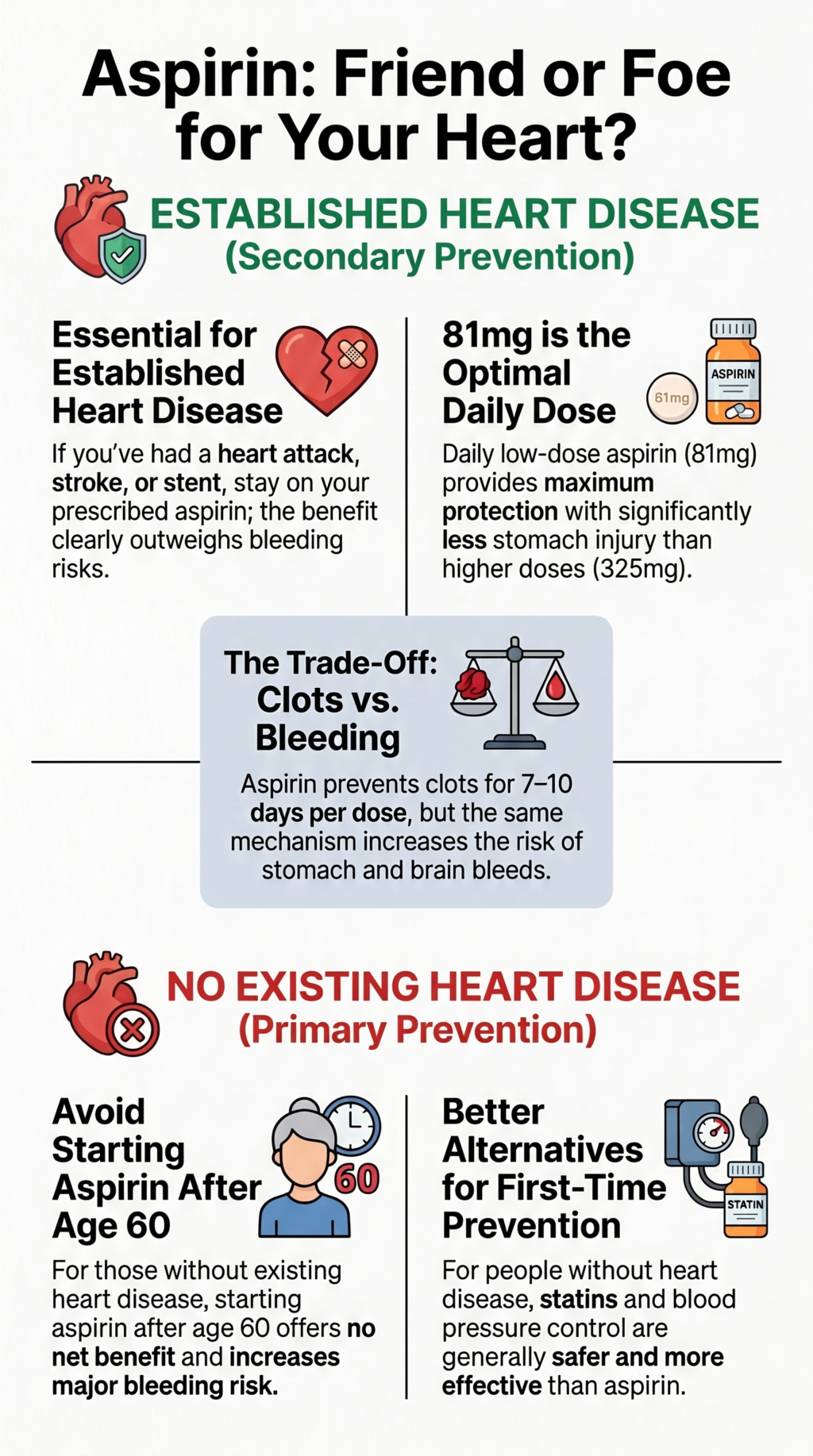
• De baten-risicobalans van aspirine verschilt fundamenteel tussen secundaire preventie (mensen die al een gevestigde hart- en vaatziekten) en primaire preventie (mensen die dat niet doen). Conclusies in de ene context zijn niet overdraagbaar op de andere. • Voor primaire preventie adviseert de huidige richtlijn van de U.S. Preventive Services Task Force een geïndividualiseerde beslissing uitsluitend voor volwassenen van 40 tot 59 jaar met een 10-jaars cardiovasculair risico met een 10%-score van 101 of hoger die geen verhoogd bloedingsrisico lopen, en raadt het gebruik van aspirine af bij volwassenen van 60 jaar of ouder. • “Niet starten voor primaire preventie” is niet hetzelfde als “stop met aspirine” of “gebruik nooit aspirine”. Mensen die aspirine gebruiken vanwege een vastgestelde ziekte mogen hier niet mee stoppen op basis van gegevens over primaire preventie. • Dit document is educatief en vormt geen individueel medisch advies. Elke beslissing om te starten, te veranderen of te stoppen met aspirine moet worden genomen in overleg met een gekwalificeerde arts, die het persoonlijke ischemische en bloedingsrisico kan afwegen. |
Inhoud
- Inleiding en het primair-secundair preventieparadigma…………………………………………. 3
- Farmacologie en werkingsmechanisme……………………………………………………………………….. 3
- Dosis-responsrelatie en toedieningsfrequentie………………………………………………………………………….. 4
- Dosering op basis van lichaamsgewicht en lichaamsmassa……………………………………………………………………………. 5
- Patiëntspecifieke overwegingen……………………………………………………………………………………… 6
- Geavanceerde risicostratificatie: coronaire slagader calcium………………………………………………………. 7
- Familiegeschiedenis van vroegtijdige coronaire aandoeningen………………………………………………………………… 7
- Aanvullende en alternatieve preventiestrategieën…………………………………………………….. 8
- Kwantitatieve voordelen en nadelen………………………………………………………………………………………. 8
- Overzicht van de aanbevelingen per bevolkingsgroep………………………………………………………………. 9
- Samenvatting: belangrijke vragen………………………………………………………………………………………….. 10
- Samenvatting in begrijpelijke taal………………………………………………………………………………………….. 11
- Beperkingen en kwaliteit van het bewijs……………………………………………………………………………….. 11
- Disclaimer………………………………………………………………………………………………………………. 12
Referenties…………………………………………………………………………………………………………………… 13
1. Inleiding en het primair-secundair preventieparadigma
De rol van acetylsalicylzuur (aspirine) in de cardiovasculaire geneeskunde is de afgelopen twintig jaar aanzienlijk versmald. Aspirine werd ooit breed aanbevolen als dagelijkse profylaxe voor volwassenen die hart- en vaatziekten wilden voorkomen; het is nu bekend dat het een smal therapeutisch venster heeft dat sterk afhangt van het baseline ischemische en bloedingsrisico van een individu. Omdat aspirine occlusieve arteriële gebeurtenissen voorkomt via hetzelfde plaatjesremmende mechanisme dat de normale hemostase belemmert, stijgt en daalt de nettowaarde ervan met de absoluut risico van de gebeurtenissen die het geacht wordt te voorkomen.[1,2]
Het allerbelangrijkste onderscheid bij het interpreteren van het asmeldbewijs ligt tussen twee populaties. Secundaire preventie geldt voor mensen met gedocumenteerde hart- en vaatziekten—voorafgaand myocardinfarct, ischemisch cerebrovasculair accident of een TIA, stabiel of instabiele angina, perifeer arterieel vaatlijden, of eerdere revascularisatie (percutane coronaire interventie of coronaire bypasschirurgie). Deze individuen lopen een hoog absoluut risico op recurrente trombotische events, dus zelfs een matig relatief risico reductie levert een groot absoluut voordeel op dat duidelijk opweegt tegen het bloedingsrisico. [2]
Primaire preventie geldt voor mensen zonder klinisch manifeste cardiovasculaire aandoening. Hun absolute jaarlijkse eventpercentage is laag, waardoor het absolute aantal voorkomen ischemische events klein is en grotendeels teniet wordt gedaan door een parallelle absolute toename van ernstige bloedingen, voornamelijk maag-darmbloeding en intracraniële bloeding. Deze asymmetrie—vergelijkbare relatieve effecten maar zeer verschillende absolute effecten—is de belangrijkste reden waarom de hedendaagse richtlijnen zijn afgestapt van routinematig gebruik voor primaire preventie. [2,1]
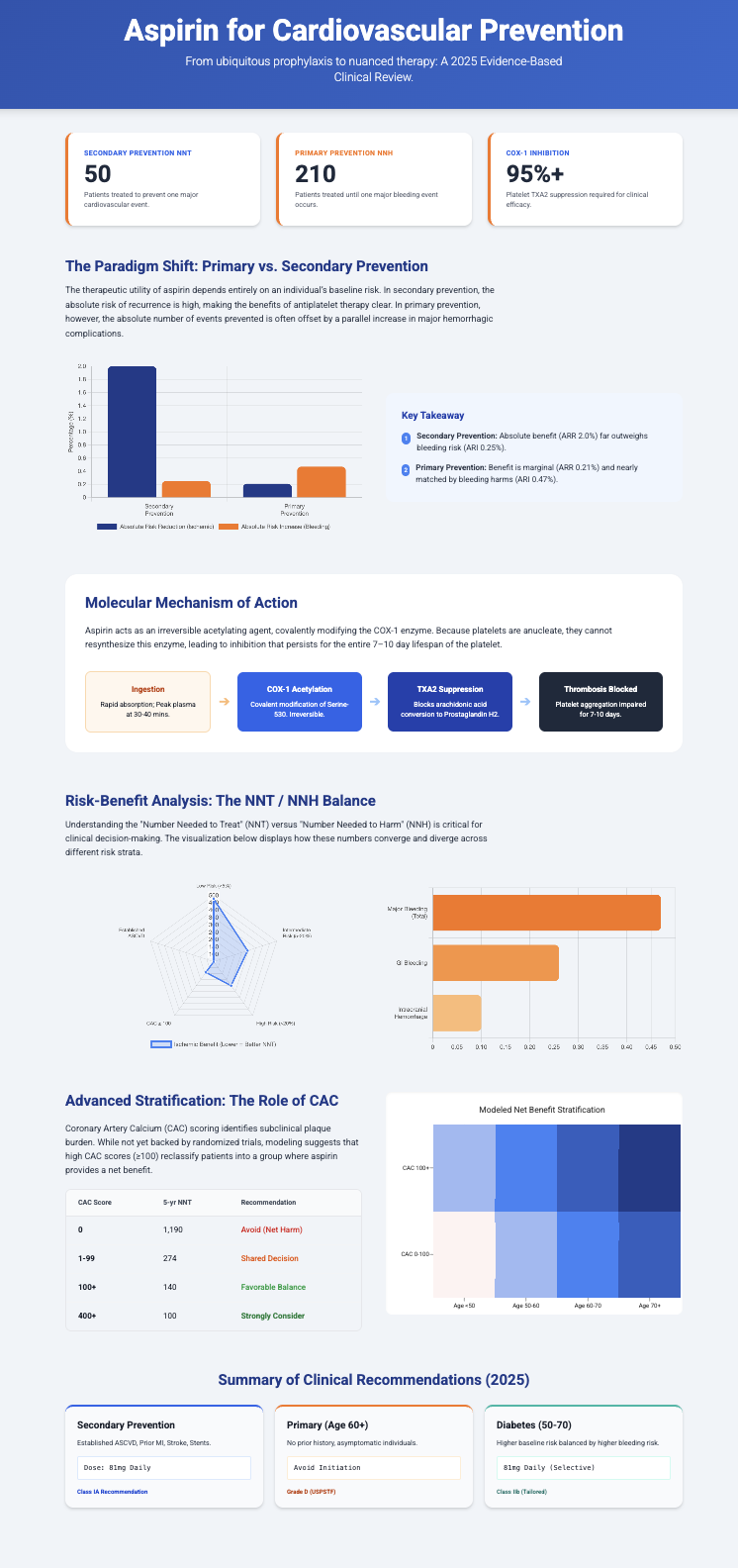
In de baanbrekende individuele-deelnemers meta-analyse Volgens de Antithrombotic Trialists’ (ATT) Collaboration was de proportionele afname van ernstige vasculaire voorvallen in beide situaties grotendeels vergelijkbaar, maar liepen de absolute effecten sterk uiteen: een absolute afname van ongeveer 0,061 TP9T per jaar bij primaire preventie, tegenover een absolute afname die bij secundaire preventie ongeveer een orde van grootte groter was. [2]
Drie moderne eerstelijnspreventiestudies die in 2018 werden gepubliceerd, versterkten dit beeld in een hedendaags behandelingstijdperk. AANKOMEN gerandomiseerd bij 12.546 patiënten die werden ingeschat op een matig cardiovasculair risico (en zonder diabetes of een hoog bloedingsrisico) tot 100 mg aspirine of placebo; er werd geen significante afname vastgesteld van het primaire samengestelde cardiovasculaire eindpunt, met meer gastro-intestinale bloedingen (voornamelijk mild tot matig) en geen verschil in het aantal fatale voorvallen. Opvallend was dat het waargenomen aantal voorvallen veel lager was dan verwacht (ongeveer 9% tegenover een verwachte 17%), waardoor de cohort zich in feite gedroeg als een populatie met een lager risico – deels omdat veel deelnemers al statines en bloeddrukverlagende middelen. [16]
De gezelschapsprojecten van ARRIVE voltooiden het hedendaagse trio: ASCEND onderzocht aspirine bij diabetes en ASPREE bij ouderen (beide gedetailleerd in Paragraaf 5). Samen vormen deze trials de empirische basis voor de verschuiving weg van routinematige primaire-preventie-aspirine. [8,5]
2. Farmacologie en werkingsmechanisme
Het antithrombotische effect van aspirine vloeit voort uit de onomkeerbare remming van bloedplaatjes-cyclooxygenase-1 (COX-1). Aspirine acyleert een serineresidu (Ser-530) in het katalytische kanaal van COX-1, waardoor het sterisch wordt geblokkeerd arachidonzuur om de actieve plaats te bereiken en de synthese van de stroomafwaartse prostanolide permanent te stoppen tromboxaan A₂ (TxA₂), een krachtige promotor van plaatjesactivatie, aggregatie en vasoconstrictie. [3,4]
Omdat bloedplaatjes zijn anucleaat en kunnen geen nieuwe synthetiseren eiwit, COX-1-blokkade houdt aan gedurende de hele levensduur van de bloedplaatjes van ongeveer 7–10 dagen. Dit langdurige plaatjesremmende effect staat in contrast met de korte farmacokinetische blootstelling aan aspirine: de maximale plasmaconcentratie treedt op binnen ongeveer 30–40 minuten en de plasmahalfwaardetijd is slechts ongeveer 15–20 minuten als gevolg van snelle esterasehydrolyse tot salicylaat. Zelfs een voorbijgaande portale en systemische blootstelling is voldoende om de circulerende pool van bloedplaatjes te inactivatie. [3,4]
Vasculair endotheelcellen, hebben daarentegen een celkern en kunnen cyclo-oxygenase resynthetiseren. Ze produceren prostacycline (PGI₂), een vaatverwijdend en plaatjesremmend middel dat fysiologisch ingaat tegen TxA₂. Lage dagelijkse doseringen (ongeveer 75-100 mg) bereiken een bijna volledige remming van COX-1 in bloedplaatjes, terwijl endotheelprostacycline relatief wordt gespaard, mede doordat bloedplaatjes in de portale circulatie worden blootgesteld aan aspirine vóór het first-pass levermetabolisme. Hogere dagelijkse doseringen onderdrukken geleidelijk ook het endotheelprostacycline, waardoor deze selectiviteit verloren gaat zonder dat dit een antithrombotisch voordeel oplevert. [3,4]
Deze dubbele invloed bepaalt het baten-risicoprofiel van aspirine. Het onderdrukken van bloedplaatjesaggregatie vermindert door afschuifkracht geïnduceerde arteriële trombose op locaties van plaqueruptuur, maar dezelfde aantasting van de hemostase verhoogt het risico op mucosale, gastro-intestinale en intracraniële bloedingen. [2,3]
3. Dosis-respons en doseringsfrequentie
Farmacodynamische studies tonen aan dat de bloedplaatjes-TxA₂-synthese bijna volledig wordt onderdrukt door dagelijkse doseringen in het bereik van 75–100 mg, en dat de plaatjesremmende werkzaamheid een plateau bereikt boven dit bereik. Hogere onderhoudsdoses (bijvoorbeeld 162–325 mg) hebben geen extra antitrombotisch voordeel aangetoond bij langetermijnpreventie, en ze worden in farmacologische en historische studies geassocieerd met grotere dosisafhankelijke beschadiging van het maagslijmvlies – hoewel, zoals hieronder opgemerkt, de gerandomiseerde ADAPTABLE-vergelijking zelf geen statistisch significant verschil in ernstige bloedingen aantrof. Enkele oplaadsen met onmiddellijke afgifte van 162–325 mg worden gebruikt bij acuut coronairsyndroom en acute ischemie beroerte om een snelle bloedplaatjesinhibitie te bereiken; dit is een duidelijke, acute indicatie. [3,4,23]
Het duidelijkste hedendaagse bewijs met betrekking tot de onderhoudsdosis is afkomstig uit de pragmatische ADAPTABLE-studie, waarin 15.076 patiënten met vastgestelde atherosclerotische hart- en vaatziekte willekeurig werden ingedeeld in een groep die dagelijks 81 mg of 325 mg aspirine kreeg. Gedurende een mediane periode van 26,2 maanden vertoonde de primaire uitkomstmaat voor effectiviteit (een combinatie van sterfte door alle oorzaken, ziekenhuisopname wegens een hartinfarct of ziekenhuisopname wegens een beroerte) geen significant verschil (geschatte incidentiecijfers 7,28% voor 81 mg versus 7,51% voor 325 mg; hazardratio 1,02, 95%-betrouwbaarheidsinterval 0,91–1,14), noch het aantal ziekenhuisopnames wegens ernstige bloedingen (HR 1,18, 95%-betrouwbaarheidsinterval 0,79–1,77). [9]
Deze resultaten moeten worden geïnterpreteerd als “er werd geen significant verschil vastgesteld”, en niet als bewijs van exacte gelijkwaardigheid. ADAPTABLE was een open-labelonderzoek met een aanzienlijke cross-over: ongeveer 41% van de patiënten die waren ingedeeld in de 325 mg-groep schakelden over naar 81 mg, terwijl slechts ongeveer 7% de andere kant op overstapten. Een dergelijke asymmetrische crossover vertekent de vergelijking in de richting van de nulhypothese en beperkt de mate waarin een werkelijk dosisverschil kan worden uitgesloten. Met dat voorbehoud ondersteunt de studie 81 mg per dag als de voorkeursonderhoudsdosis voor de meeste patiënten, op basis van vergelijkbare gemeten uitkomsten en een betere verdraagbaarheid en naleving. De hedendaagse richtsnoeren zijn eensgezind: de AHA/ACC-richtlijn voor chronische coronairlijden uit 2023 beveelt lage dosering aspirine (75–100 mg, doorgaans 81 mg) aan als een klasse 1-strategie (bewijsniveau A) met één plaatjesremmer voor patiënten met chronische coronairlijden die geen orale anticoagulatie gebruiken. [9,21]
In overeenstemming hiermee toonde het CURRENT-OASIS 7-programma bij acute coronairsyndromen aan dat voortgezette hogere doseringen (300-325 mg) aspirine niet superieur waren aan lagere doseringen (75-100 mg) aspirine wat betreft majeure ischemische uitkomsten, en dat deze gepaard gingen met meer mineure en gastro-intestinale bloedingen – een redenering die wordt beaamd in de richtlijn voor acute coronairsyndromen van de ACC/AHA uit 2025, waarin 75-100 mg voor onderhoudstherapie wordt aanbevolen. [10,22]
3.1 Toedieningsfrequentie en vervanging van bloedplaatjes
Het doseringsinterval wordt bepaald door de omzet van de bloedplaatjes. Het beenmerg geeft elke dag een deel van de nieuwe, niet-geremde bloedplaatjes af aan de bloedsomloop; daarom is een eenmaal daagse dosering nodig om een stabiele remming te handhaven. Dosering om de andere dag waardoor er “rustdagen” ontstaan waarin nieuw gevormde bloedplaatjes hun tromboxaanproductie weer op peil brengen. In de Women’s Health Study leidde de inname van 100 mg aspirine om de dag gedurende ongeveer 10 jaar niet tot een significante afname van de primaire samengestelde uitkomstmaat van ernstige cardiovasculaire voorvallen bij aanvankelijk gezonde vrouwen, hoewel het wel het aantal ischemische beroertes verminderde. [15]
Farmacodynamisch onderzoek helpt dit resultaat te verklaren: 100 mg om de dag leidt tot een geringere en meer variabele remming van de bloedplaatjes dan 81 mg per dag, wat erop wijst dat de deelnemers bij het om-de-dag-regime op de rustdagen mogelijk een te lage dosis hebben gekregen. Deze verminderde remming van de bloedplaatjes kan de bevindingen van de Women’s Health Study gedeeltelijk verklaren, hoewel er ook alternatieve verklaringen zijn – lager dan verwachte incidentiecijfers, beperkte statistische onderscheidingsvermogen, en verschillen in de opzet van de onderzoeken—kunnen hier eveneens een rol spelen. Volgens dezelfde redenering wordt een verdere verlenging van het interval (om de drie dagen) niet ondersteund door bewijs op basis van klinische eindpunten en wordt dit dan ook niet aanbevolen. [18,19,23]
Omgekeerd kan bij aandoeningen met een versnelde vernieuwing van bloedplaatjes – zoals essentiële trombocytemie en bij sommige patiënten met diabetes type 2 – een eenmaal daagse dosering leiden tot onvolledige remming vóór de volgende dosis. Farmacodynamische studies wijzen erop dat tweemaal daags een lage dosis aspirine in deze situaties een consistentere onderdrukking van tromboxaan kan bewerkstelligen dan het simpelweg verhogen van de eenmaal daagse dosis; dit blijft echter een gespecialiseerde strategie en geen gangbare praktijk. [4]
4. Dosering op basis van lichaamsgewicht en lichaamsmassa
Of een vaste lage dosis geschikt is voor alle lichaamsgroottes, is nog niet duidelijk. In een gepoolde analyse op individueel niveau van meer dan 100.000 deelnemers aan onderzoeken naar primaire en secundaire preventie rapporteerden Rothwell en collega’s een interactie tussen dosis en lichaamsgewicht: een lage dosis aspirine (75–100 mg) verminderde cardiovasculaire voorvallen voornamelijk bij mensen die minder dan ongeveer 70 kg wogen, met weinig voordeel bij een hoger gewicht, terwijl hogere doses (≥325 mg) vooral effectief waren bij een hoger lichaamsgewicht. De analyse wees ook op mogelijke nadelen bij de uitersten: een hoger sterftecijfer bij een eerste cardiovasculair voorval bij zwaardere mensen die een lage dosis aspirine innamen, en een verhoogd sterfte door alle oorzaken bij mensen met een gewicht van minder dan 50 kg (hazardratio 1,52; 95%-betrouwbaarheidsinterval 1,04–2,21). [11]
Deze bevindingen zijn bedoeld om hypothesen te genereren, niet om de praktijk te bepalen, en zijn niet prospectief bevestigd. In een vooraf gespecificeerde analyse van de ASPREE-studie bij oudere volwassenen had het lichaamsgewicht geen invloed op het cardiovasculaire effect van aspirine, en was het bloedingsrisico bij zwaardere personen niet lager. Farmacodynamische studies bij volwassenen zonder diabetes hebben eveneens aangetoond dat de remming van de bloedplaatjes door 81 mg of 325 mg grotendeels onafhankelijk is van de lichaamsmassa. Latere analyses hebben de interactie met het lichaamsgewicht niet consistent kunnen repliceren, en geen enkele belangrijke richtlijn beveelt momenteel een op het gewicht afgestemde dosering van aspirine aan; de meest redelijke conclusie op dit moment is dat een op het gewicht afgestemde dosering weliswaar interessant is, maar klinisch niet bruikbaar. [5,11]
5. Patiëntspecifieke overwegingen
5.1 Leeftijd
Het risico op bloedingen neemt sterk toe met de leeftijd, terwijl het absolute ischemische voordeel van aspirine bij primaire preventie bescheiden blijft. De ASPREE-onderzoek 19.114 thuiswonende volwassenen (voornamelijk 70 jaar en ouder) werden willekeurig ingedeeld in een groep die dagelijks 100 mg kreeg of een groep die een placebo kreeg. Aspirine verlengde de overleving zonder beperkingen niet (HR 1,01, 95%-betrouwbaarheidsinterval 0,92–1,11) en leidde niet tot een significante afname van hart- en vaatziekten (10,7 versus 11,3 voorvallen per 1.000 persoonsjaren; HR 0,95, 95%-BI 0,83–1,08), maar leidde wel tot een significante toename van ernstige bloedingen (8,6 versus 6,2 voorvallen per 1.000 persoonsjaren; HR 1,38, 95%-BI 1,18–1,62) en ging gepaard met een hogere sterfte door alle oorzaken (HR 1,14, 95%-betrouwbaarheidsinterval 1,01–1,29), grotendeels kankergerelateerd en door de onderzoekers met de nodige voorzichtigheid geïnterpreteerd. [5,6,7]
Deze gegevens ondersteunen de huidige richtlijnen: bij primaire preventie is een individuele beslissing alleen zinvol voor volwassenen van 40 tot 59 jaar met een voldoende hoog cardiovasculair risico en een laag bloedingsrisico, en wordt het starten van de behandeling niet aanbevolen bij personen van 60 jaar of ouder. De USPSTF stelt bovendien voor om rond de leeftijd van 75 jaar te overwegen de aspirine voor primaire preventie te staken. Dit alles is niet van toepassing op secundaire preventie. [1]
5.2 Biologisch geslacht
Eerdere geslachtsspecifieke analyses wezen erop dat het voordeel van aspirine bij primaire preventie vooral te danken was aan een afname van het aantal beroertes bij vrouwen en een afname van het aantal hartinfarcten bij mannen. Uit later onderzoek blijkt dat dit schijnbare verschil grotendeels te wijten is aan lichaamsgrootte en farmacokinetische factoren, en niet zozeer aan geslachtsspecifieke biologische verschillen. In de huidige richtlijnen worden dan ook geen geslachtsspecifieke aspirinestrategieën aanbevolen voor primaire preventie. [2,11]
5.3 Diabetes mellitus
Mensen met diabetes lopen een verhoogd risico op hart- en vaatziekten, maar ze hebben ook vaker last van bloedingen. In de ASCEND-studie werden 15.480 volwassenen met diabetes en zonder bekende hart- en vaatziekte gerandomiseerd naar een dagelijkse dosis van 100 mg of een placebo. Over een periode van gemiddeld 7,4 jaar verminderde aspirine het aantal ernstige vasculaire voorvallen (8,5% versus 9,6%; ratio 0,88, 95%-BI 0,79–0,97), maar verhoogde het aantal ernstige bloedingen (4,1% versus 3,2%; ratio 1,29, 95%-BI 1,09–1,52). Het absolute voordeel (ongeveer 1,1%) werd vrijwel geëvenaard door de absolute toename in bloedingen (ongeveer 0,9%), wat overeenkomt met ruwweg 91 behandelde patiënten om één ernstig vasculair voorval te voorkomen en ruwweg 112 behandelde patiënten om één ernstige bloeding te veroorzaken; bij geen enkele subgroep was het voordeel duidelijk groter dan de schade. Aspirine bij diabetes vereist daarom een geïndividualiseerde, gezamenlijke besluitvorming in plaats van routinematig gebruik. [8]
5.4 Bijkomende risicofactoren
Actief roken en ongecontroleerd hypertensie zowel het risico op atherosclerose als het bloedingsrisico (waaronder intracraniële bloedingen) verhogen. Omdat risicofactoren Aangezien ischemische voorvallen in hoge mate samenvallen met risicofactoren voor bloedingen, leidt een verhoging van het cardiovasculaire basisrisico niet automatisch tot een netto voordeel. Een agressieve beheersing van bloeddruk en het gebruik van tabak is zowel een veiliger als een effectiever eerste middel dan het starten met aspirine. [2,17]
6. Geavanceerde risicostratificatie: calcium in de kransslagaders
Omdat risicoveergelijkingen op basis van de bevolking niet volledig kunnen aangeven wie er daadwerkelijk baat bij zal hebben, coronary artery calcium (CAC)-score is onderzocht als instrument om aspirine voor primaire preventie toe te wijzen aan degenen die er waarschijnlijk het meeste baat bij hebben. In analyses van de Multi-Ethnic Study of Atherosclerosis (MESA), beperkt tot volwassenen jonger dan 70 jaar die nog nooit aspirine hadden gebruikt en geen verhoogd bloedingsrisico hadden, verschoof de verhouding tussen het 5-jaars ‘number-needed-to-treat’ (NNT₅) en het ‘number-needed-to-harm’ (NNH₅) in gunstige zin naarmate de CAC toenam. Over het geheel genomen was de NNT₅ (476) hoger dan de NNH₅ (355); bij een CAC ≥ 100 daalde de NNT₅ (140) tot onder de NNH₅ (518), wat duidt op een gemodelleerd netto voordeel; en bij een CAC = 0 overschreed de NNT₅ (1.190) de NNH₅ (567) ruimschoots, wat duidt op een gemodelleerde netto schade. [12,13]
Dit zijn gemodelleerde schattingen op basis van observatiegegevens, en geen resultaten van een gerandomiseerde toewijzing van aspirine op basis van CAC. De ACC/AHA-richtlijn voor primaire preventie uit 2019 beschouwt CAC als een hulpmiddel om de risicobeoordeling te verfijnen, en niet als een gevalideerde test voor het selecteren van aspirinetherapie; er is nog geen gerandomiseerde studie die aantoont dat het toedienen van aspirine op basis van CAC de uitkomsten verbetert. De onderstaande schattingen dienen daarom als informatiebron voor gezamenlijke besluitvorming, en mogen deze niet vervangen. [17,12]
Tabel 1. Op CAC gebaseerde, gemodelleerde schattingen van de voordelen en nadelen van aspirine bij primaire preventie (MESA; volwassenen jonger dan 70 jaar die nog nooit aspirine hebben gebruikt en geen verhoogd risico op bloedingen lopen). In de modelberekening werd uitgegaan van een relatieve afname van 12% in het aantal hart- en vaatziekte-incidenten en een relatieve toename van 42% in het aantal ernstige bloedingen; deze cijfers zijn schattingen op basis van observatiestudies, geen bewijs uit gerandomiseerde studies. NNT₅/NNH₅ = 5 jaar number needed to treat translates to: benodigd aantal te behandelen patiënten / om schade te berokkenen.
| CAC-laag | 5-jaars NNT₅ (om 1 hart- en vaatziektegebeurtenis te voorkomen) | NNH₅ over 5 jaar (oorzaak van 1 ernstige bloeding) | Gemodelleerd netto-effect |
| Totale cohort | 476 | 355 | De geschatte schade is ≥ het voordeel |
| CAC = 0 | 1,190 | 567 | Berekende netto schade — vermijden |
| CAC ≥ 100 | 140 | 518 | Gemodelleerd nettovoordeel (zonder RCT) |
CAC biedt daarom een meer gepersonaliseerde basis voor het verfijnen van het risico dan scores alleen: een score van nul duidt op personen bij wie het bloedingsrisico waarschijnlijk overheerst, terwijl een hoge score wijst op subklinische plaquebelasting waarbij het gebruik van aspirine vanuit biologisch oogpunt gerechtvaardigd kan zijn, mits het bloedingsrisico laag is. Dit blijven gemodelleerde conclusies die nog moeten worden bevestigd door gerandomiseerde studies. Een op echografie gebaseerde carotis- tandplak De score is voor hetzelfde doel onderzocht, waarbij de aanwezigheid van carotisplaque bij een hoger geschat ASCVD-risico wijst op een gunstiger verhouding. [20]
7. Familiegeschiedenis van vroegtijdige hart- en vaatziekten
Een familiegeschiedenis van voortijdige coronaire hartziekte (een mannelijk familielid in de eerste graad dat vóór zijn 55e is getroffen, of een vrouwelijk familielid vóór haar 65e) wordt in de ACC/AHA-richtlijn voor primaire preventie uit 2019 erkend als een risicoverhogende factor die de risicobeoordeling kan verfijnen. Het kan het geschatte risico van een persoon aanzienlijk naar boven bijstellen, en een sterke familiegeschiedenis kan terecht aanleiding geven tot verder onderzoek – zoals een CAC-test – om te verduidelijken of intensivering van de preventie gerechtvaardigd is. Het is echter geen vaststaande, op zichzelf staande indicatie voor primair preventief aspirinegebruik, en het vermindert het bloedingsrisico van aspirine niet. De juiste reactie op een sterke familiegeschiedenis is intensievere, op richtlijnen gebaseerde preventie — lipidenbeheer, bloeddrukcontrole en levensstijlmaatregelen — in plaats van het reflexmatig starten met aspirine. [17,1]
8. Aanvullende en alternatieve preventieve strategieën
In het huidige tijdperk van primaire preventie bieden verschillende behandelingen een gunstiger voordeel-risicoprofiel dan aspirine. Een behandeling met statines vermindert het aantal ernstige cardiovasculaire voorvallen aanzienlijk zonder dat dit leidt tot een toename van ernstige bloedingen en ernstige bijwerkingen zoals rabdomyolyse komen zelden voor. Een strikte bloeddrukcontrole vermindert het risico op een beroerte en een hartinfarct zonder het risico op bloedingen te verhogen — en verlaagt direct het risico op hersentumor. Stoppen met roken leidt tot een aanzienlijke en snelle afname van het cardiovasculaire risico. [17]
Deze alternatieven geven ook een nieuwe invulling aan de argumenten voor aspirine zelf. Aangezien het gebruik van statines en het onder controle houden van risicofactoren het resterende ischemische risico verminderen, neemt het incrementele absolute voordeel van het toevoegen van aspirine bij primaire preventie af, terwijl het bloedingsrisico blijft bestaan. Voor de meeste mensen zonder vastgestelde aandoening die al een volgens de richtlijnen voorgeschreven behandeling volgen, biedt het toevoegen van aspirine weinig netto voordeel. [2,17]
9. Kwantitatieve voordelen en nadelen
In de onderstaande tabellen worden de effectschattingen uit de belangrijkste peer-reviewed bronnen samengevat. De relatieve effecten vertonen in alle situaties grotendeels dezelfde patronen; het doorslaggevende verschil zit in het absolute effect, dat wordt bepaald door het uitgangsrisico. Alle cijfers zijn rechtstreeks ontleend aan de aangehaalde onderzoeken en meta-analyses.
Tabel 2. Effecten van aspirine per preventiesetting en doelgroep, afkomstig uit primaire, door vakgenoten beoordeelde bronnen. RR = relatief risico; HR = hazard ratio; CI = betrouwbaarheidsinterval.
| Omgeving / bevolking | Effect (95% CI) | Resultaat en absoluut effect | Bron |
| Primaire preventie — ernstige vasculaire voorvallen | RR 0,88 (0,82–0,94) | 0,511 TP9T versus 0,571 TP9T per jaar; ≈121 TP9T proportionele vermindering | ATT-meta-analyse |
| Primaire preventie — ernstige coronaire voorvallen | RR 0,82 (0,75–0,90) | ≈18% proportionele vermindering | ATT-meta-analyse |
| Primaire preventie — beroerte (totaal) | RR 0,95 (0,85–1,06) | Geen significant effect | ATT-meta-analyse |
| Primaire preventie — ernstige extracraniale bloedingen | RR 1,54 (1,30–1,82) | 0,101 TP9T versus 0,071 TP9T per jaar; aanzienlijke stijging | ATT-meta-analyse |
| Primaire preventie bij diabetes — ernstige vasculaire voorvallen | RR 0,88 (0,79–0,97) | 8,51 TP9T versus 9,61 TP9T; ARR ≈ 1,11 TP9T; NNT ≈ 91 | STIJGEN |
| Primaire preventie bij diabetes — ernstige bloedingen | RR 1,29 (1,09–1,52) | 4,11 TP9T versus 3,21 TP9T; ARI ≈ 0,91 TP9T; NNH ≈ 112 | STIJGEN |
| Primaire preventie bij ouderen — hart- en vaatziekten | HR 0,95 (0,83–1,08) | 10,7 versus 11,3 per 1.000 inwoners; niet significant | ASPREE |
| Primaire preventie bij ouderen — ernstige bloeding | HR 1,38 (1,18–1,62) | 8,6 tegenover 6,2 per 1.000 inwoners; aanzienlijke stijging | ASPREE |
| Secundaire preventie — ernstige vasculaire voorvallen | ≈een evenredige vermindering met een vijfde | ≈6,71 TP9T versus 8,21 TP9T per jaar; groot absoluut voordeel | ATT-meta-analyse |
Tabel 3. Vergelijking van onderhoudsdoses (81 mg versus 325 mg per dag) bij secundaire preventie.
| Resultaat | 81 mg | 325 mg | Effect (95% CI) |
| Samenstelling: ziekenhuisopname wegens overlijden, hartinfarct of beroerte | 7.28% | 7.51% | HR 1,02 (0,91–1,14) |
| Ziekenhuisopname wegens ernstige bloedingen | — | — | HR 1,18 (0,79–1,77) |
| Overgestapt op de andere dosis (crossover) | ≈7% | ≈41% | Asymmetrisch — neiging naar de nulhypothese |
Bron: ADAPTABLE. De opvallende asymmetrische kruisreactie vormt de belangrijkste beperking en is de reden waarom de studie 81 mg als voorkeursdosering aanbeveelt, zonder de exacte dosisequivalentie aan te tonen. [9]
10. Overzicht van aanbevelingen per bevolkingsgroep
In de onderstaande tabel wordt voor elke populatie de maatregel (starten, voortzetten of vermijden) vermeld, samen met de context en de bijbehorende richtlijnen. In elke rij wordt het onderscheid tussen primair en secundair aangehouden.
| Bevolking | Actie | Motivatie | Richtlijnen |
| Gevestigde ASCVD / na een hartinfarct / na een beroerte / na een PCI of CABG (secundaire preventie) | Doorgaan (81 mg per dag) | Hoog risico op herhaling; het absolute voordeel weegt ruimschoots op tegen het risico op bloedingen | 2023 AHA/ACC CCD (Klasse 1, LOE A); ATT; AANPASBAAR |
| Primaire preventie, leeftijd 40–59 jaar, 10-jaars risico op hart- en vaatziekten ≥10%, laag bloedingsrisico | Personaliseren | Gering netto voordeel; hangt af van het persoonlijke risico en de persoonlijke voorkeur | USPSTF Cijfer C |
| Primaire preventie, leeftijd ≥ 60 jaar | Niet starten | Geen netto voordeel; het risico op bloedingen weegt zwaarder | USPSTF-beoordeling D |
| Primaire preventie bij verhoogd bloedingsrisico (alle leeftijden) | Niet starten | Het risico op bloedingen weegt zwaarder dan het eventuele voordeel op het gebied van ischemie | USPSTF; ACC/AHA |
| Primaire preventie, CAC = 0 | Vermijd | Berekende netto schade; zeer laag risico op ischemie (schatting op basis van observatiegegevens) | MESA-modellering |
| Primaire preventie, CAC ≥100, laag bloedingsrisico | Overwegen | Gemodelleerd nettovoordeel (NNT₅ < NNH₅); geen bevestiging door gerandomiseerd onderzoek | MESA-modellering |
| Primaire preventie bij diabetes, zonder ASCVD | Personaliseren | Het voordeel en het overmatige bloedverlies kwamen nauw overeen | ASCEND; ADA/richtlijnen |
11. Samenvatting: kernvragen
Wie profiteert hier het meest van?
Mensen met een vastgestelde hart- en vaatziekte (secundaire preventie). Gezien hun hoge risico op een recidief is het absolute voordeel van een lage dosis aspirine duidelijk groter dan het risico op bloedingen. Een lage dosis aspirine (81 mg per dag) is de standaard langetermijnbehandeling voor de meeste patiënten in de secundaire preventie, tenzij er contra-indicaties zijn of deze behandeling wordt vervangen door een alternatieve antitrombotische strategie — bijvoorbeeld orale antistolling voor een andere indicatie, of een welomschreven dubbele antiplateletbehandeling na een recente stentplaatsing of een acuut coronair syndroom. [2,9,21]
Wie profiteert er het minst van?
Volwassenen zonder hart- en vaatziekten die al een op richtlijnen gebaseerde preventie volgen (effectieve statinetherapie, bloeddrukcontrole, niet-roken). Hun resterende ischemische risico is laag, waardoor extra aspirine weinig bijkomend voordeel biedt, terwijl het bloedingsrisico blijft bestaan. [2,17]
Welke bevolkingsgroepen zouden in het algemeen moeten afzien van het starten met aspirine ter primaire preventie?
Volwassenen van 60 jaar of ouder; volwassenen van elke leeftijd met een verhoogd bloedingsrisico; mensen met een CAC-waarde van nul; en, op basis van de huidige wetenschappelijke gegevens, personen met een laag lichaamsgewicht bij wie er signalen zijn opgemerkt die op mogelijke schade wijzen. [1,12,11]
Wat is de laagste effectieve onderhoudsdosis?
Een dagelijkse dosis van ongeveer 75–81 mg zorgt voor een bijna maximale remming van de bloedplaatjes en biedt een vergelijkbare klinische bescherming als hogere doses, maar met minder bijwerkingen op het maag-darmstelsel en minder bloedingsrisico’s. [3,9]
Is dagelijkse toediening beter dan toediening om de dag?
Ja. Dagelijkse toediening van een lage dosis aspirine zorgt voor een constantere remming van de bloedplaatjes dan toediening om de dag, omdat nieuw gevormde bloedplaatjes tijdens de tussenliggende dagen hun tromboxaanproductie weer op peil brengen. [15,18]
Leveren doses van meer dan ~100 mg extra voordelen op voor het hart- en vaatstelsel?
Er is geen consistent bewijs dat routinematige onderhoudsdoses van meer dan ongeveer 100 mg tot betere cardiovasculaire uitkomsten leiden, terwijl hogere doses gepaard gaan met meer gastro-intestinale toxiciteit. Hogere eenmalige doses blijven alleen geschikt voor acute startdosering bij acute coronaire syndromen of een acute beroerte. [9,10,22]
Wat is de algemene consensus voor 2025 en daarna?
Voor secundaire preventie blijft laaggedoseerde aspirine een hoeksteen: de AHA/ACC-richtlijn voor chronische coronaire aandoeningen uit 2023 geeft laaggedoseerde aspirine (75–100 mg) een aanbeveling van klasse 1 als monotherapie met een bloedplaatjesremmer bij patiënten die geen antistollingstherapie volgen, en de ACC/AHA-richtlijn uit 2025 voor acute coronaire syndromen onderschrijft eveneens een onderhoudsdosis van 75–100 mg. Voor primaire preventie is het routinematige gebruik afgeschaft; elke beslissing moet op individuele basis worden genomen, over het algemeen beperkt tot volwassenen van 40–59 jaar met een 10-jaarsrisico van ≥10% en een laag bloedingsrisico, en leent zich goed voor verfijning met op beeldvorming gebaseerde risicomarkers zoals CAC. [1,21,22]
12. Samenvatting in begrijpelijke taal
Aspirine zorgt ervoor dat bloedplaatjes – de bloedcellen die bloedstolsels vormen – minder snel aan elkaar hechten, waardoor de kans kleiner wordt dat een bloedstolsel een slagader blokkeert en een hartinfarct of een beroerte. Omdat bloedplaatjes zich niet zelf kunnen herstellen, blijft één lage dosis ongeveer 7–10 dagen werkzaam. Ditzelfde effect maakt het moeilijker om bloedingen te stoppen; daarom kan aspirine bloedingen in de maag, de darmen of de hersenen veroorzaken.
Het belangrijkste punt is dat het nut van aspirine afhangt van de vraag of je al een hart- of vaatziekte hebt:
- Als u al eens een hartaanval of een beroerte heeft gehad, stent, of een bypassoperatie (secundaire preventie), is de kans op een nieuwe aanval groot, en dagelijkse inname van een lage dosis aspirine levert duidelijk meer voordelen dan nadelen op. Stop hier niet op eigen initiatief mee.
- Als u geen voorgeschiedenis van hart- of vaatziekten heeft (primaire preventie), is het voordeel veel kleiner en wordt het grotendeels tenietgedaan door het risico op bloedingen. Richtlijnen raden af om op de leeftijd van 60 jaar of ouder met aspirine te beginnen, en adviseren alleen een individuele afweging voor volwassenen van 40 tot en met 59 jaar met een verhoogd risico.
Hulpmiddelen zoals een coronaire calciumscan kunnen helpen vaststellen wie binnen de groep voor primaire preventie hier nog baat bij zou kunnen hebben. Voor het voorkomen van een eerste hartaanval of beroerte bieden statines en bloeddrukbeheersing over het algemeen een betere en veiligere bescherming dan aspirine.
Tabel 4. Samenvatting in begrijpelijke taal van wie er baat bij heeft en wie voorzichtig moet zijn.
| Aspirine helpt meestal | Aspirine wordt meestal niet aangeraden (ter preventie) |
| Eerdere hartaanval | Beginnen met aspirine op de leeftijd van 60 jaar of ouder |
| Eerdere ischemische beroerte of TIA | Verhoogd risico op bloedingen (maagzweren, anticoagulantia, enz.) |
| Coronaire stent of bypassoperatie | Geen hartziekte en een coronaire aandoening calciumscore van nul |
| Hoge plaquebelasting (CAC ≥ 100) met een laag bloedingsrisico | Reeds goed beschermd door het gebruik van statines, bloeddrukbeheersing en het niet-roken |
Aanbevolen onderhoudsdosis wanneer aspirine is geïndiceerd: 81 mg eenmaal daags.
13. Beperkingen en kwaliteit van het bewijsmateriaal
De schattingen voor primaire preventie zijn gebaseerd op onderzoeken die in verschillende tijdperken en met verschillende risicoprofielen zijn uitgevoerd; de huidige achtergrondbehandeling (statines, betere bloeddrukcontrole) leidt er doorgaans toe dat het resterende voordeel van aspirine kleiner is dan in oudere onderzoeken. Het bewijs voor de dosisvergelijking (ADAPTABLE) is afkomstig uit een open-labelonderzoek met aanzienlijke crossover, waardoor het de dosisequivalentie eerder beperkt dan aantoont. Dosering op basis van het lichaamsgewicht en tweemaal daagse strategieën worden voornamelijk ondersteund door farmacodynamische en post-hocgegevens en zijn niet gevalideerd in specifieke uitkomststudies. Toewijzing op basis van de coronaire calciumscore (CAC) berust op observationele modellering in plaats van op gerandomiseerde toewijzing. Deze beperkingen pleiten voor geïndividualiseerde, door de arts geleide beslissingen in plaats van algemene regels. [9,11,12]
14. Disclaimer
Dit document is uitsluitend bedoeld voor educatieve en informatieve doeleinden en vormt geen medisch advies, diagnose of behandeling, noch leidt het tot een arts-patiëntrelatie. De individuele risico’s op ischemie en bloedingen, medicatiegebruik en bijkomende aandoeningen lopen sterk uiteen. Elk besluit om met aspirine te beginnen, door te gaan, de dosering aan te passen of te stoppen, dient in overleg met een gekwalificeerde zorgverlener te worden genomen.
Referenties
- US Preventive Services Task Force, Davidson KW, Barry MJ, et al. Aspirin Use to Prevent Cardiovascular Disease: US Preventive Services Task Force Recommendation Statement. JAMA. 2022;327(16):1577-1584. doi:10.1001/jama.2022.4983
- Antithrombotic Trialists’ (ATT) Collaboration, Baigent C, Blackwell L, et al. Aspirin in the primary and secondary prevention of vascular disease: collaborative meta-analysis of individual participant data from randomised trials. Lancet. 2009;373(9678):1849-1860. doi:10.1016/S0140-6736(09)60503-1
- Awtry EH, Loscalzo J. Aspirin. Circulation. 2000;101(10):1206-1218. doi:10.1161/01.cir.101.10.1206
- Patrono C, García Rodríguez LA, Landolfi R, Baigent C. Low-dose aspirin for the prevention of atherothrombosis. N Engl J Med. 2005;353(22):2373-2383. doi:10.1056/NEJMra052717
- McNeil JJ, Wolfe R, Woods RL, et al. Effect of Aspirin on Cardiovascular Events and Bleeding in the Healthy Elderly. N Engl J Med. 2018;379(16):1509-1518. doi:10.1056/NEJMoa1805819
- McNeil JJ, Woods RL, Nelson MR, et al. Effect of Aspirin on Disability-free Survival in the Healthy Elderly. N Engl J Med. 2018;379(16):1499-1508. doi:10.1056/NEJMoa1800722
- McNeil JJ, Nelson MR, Woods RL, et al. Effect of Aspirin on All-Cause Mortality in the Healthy Elderly. N Engl J Med. 2018;379(16):1519-1528. doi:10.1056/NEJMoa1803955
- ASCEND Study Collaborative Group, Bowman L, Mafham M, et al. Effects of Aspirin for Primary Prevention in Persons with Diabetes Mellitus. N Engl J Med. 2018;379(16):1529-1539. doi:10.1056/NEJMoa1804988
- Jones WS, Mulder H, Wruck LM, et al. Comparative Effectiveness of Aspirin Dosing in Cardiovascular Disease. N Engl J Med. 2021;384(21):1981-1990. doi:10.1056/NEJMoa2102137
- CURRENT-OASIS 7 Investigators, Mehta SR, Bassand JP, et al. Dose comparisons of clopidogrel and aspirin in acute coronary syndromes. N Engl J Med. 2010;363(10):930-942. doi:10.1056/NEJMoa0909475
- Rothwell PM, Cook NR, Gaziano JM, et al. Effects of aspirin on risks of vascular events and cancer according to bodyweight and dose: analysis of individual patient data from randomised trials. Lancet. 2018;392(10145):387-399. doi:10.1016/S0140-6736(18)31133-4
- Cainzos-Achirica M, Miedema MD, McEvoy JW, et al. Coronary Artery Calcium for Personalized Allocation of Aspirin in Primary Prevention of Cardiovascular Disease in 2019: The MESA Study (Multi-Ethnic Study of Atherosclerosis). Circulation. 2020;141(19):1541-1553. doi:10.1161/CIRCULATIONAHA.119.045010
- Miedema MD, Duprez DA, Misialek JR, et al. Use of coronary artery calcium testing to guide aspirin utilization for primary prevention: estimates from the multi-ethnic study of atherosclerosis. Circ Cardiovasc Qual Outcomes. 2014;7(3):453-460. doi:10.1161/CIRCOUTCOMES.113.000690
- Steering Committee of the Physicians’ Health Study Research Group. Final report on the aspirin component of the ongoing Physicians’ Health Study. N Engl J Med. 1989;321(3):129-135. doi:10.1056/NEJM198907203210301
- Ridker PM, Cook NR, Lee IM, et al. A randomized trial of low-dose aspirin in the primary prevention of cardiovascular disease in women. N Engl J Med. 2005;352(13):1293-1304. doi:10.1056/NEJMoa050613
- Gaziano JM, Brotons C, Coppolecchia R, et al. Use of aspirin to reduce risk of initial vascular events in patients at moderate risk of cardiovascular disease (ARRIVE): a randomised, double-blind, placebo-controlled trial. Lancet. 2018;392(10152):1036-1046. doi:10.1016/S0140-6736(18)31924-X
- Arnett DK, Blumenthal RS, Albert MA, et al. 2019 ACC/AHA Guideline on the Primary Prevention of Cardiovascular Disease: A Report of the American College of Cardiology/American Heart Association Task Force on Clinical Practice Guidelines. Circulation. 2019;140(11):e596-e646. doi:10.1161/CIR.0000000000000678
- Swaim L, Hillman RS. Aspirin administered to women at 100 mg every other day produces less platelet inhibition than aspirin administered at 81 mg per day: implications for interpreting the women’s health study. J Thromb Thrombolysis. 2009;28(1):94-100. doi:10.1007/s11239-008-0262-6
- Feldman M, Cryer B, Rushin K, Betancourt J. A comparison of every-third-day versus daily low-dose aspirin therapy on serum thromboxane concentrations in healthy men and women. Clin Appl Thromb Hemost. 2001;7(1):53-57. doi:10.1177/107602960100700111
- Dzaye O, Razavi AC, Dardari ZA, et al. Carotid Ultrasound-Based Plaque Score for the Allocation of Aspirin for the Primary Prevention of Cardiovascular Disease Events: The Multi-Ethnic Study of Atherosclerosis and the Atherosclerosis Risk in Communities Study. J Am Heart Assoc. 2024;13(12):e034718. doi:10.1161/JAHA.123.034718
- Virani SS, Newby LK, Arnold SV, et al. 2023 AHA/ACC/ACCP/ASPC/NLA/PCNA Guideline for the Management of Patients With Chronic Coronary Disease: A Report of the American Heart Association/American College of Cardiology Joint Committee on Clinical Practice Guidelines. Circulation. 2023;148(9):e9-e119. doi:10.1161/CIR.0000000000001168
- Rao SV, O’Donoghue ML, Ruel M, et al. 2025 ACC/AHA/ACEP/NAEMSP/SCAI Guideline for the Management of Patients With Acute Coronary Syndromes: A Report of the American College of Cardiology/American Heart Association Joint Committee on Clinical Practice Guidelines. Circulation. 2025;151(13):e771-e862. doi:10.1161/CIR.0000000000001309
- Patrono C. The Multifaceted Clinical Readouts of Platelet Inhibition by Low-Dose Aspirin. J Am Coll Cardiol. 2015;66(1):74-85. doi:10.1016/j.jacc.2015.05.012