
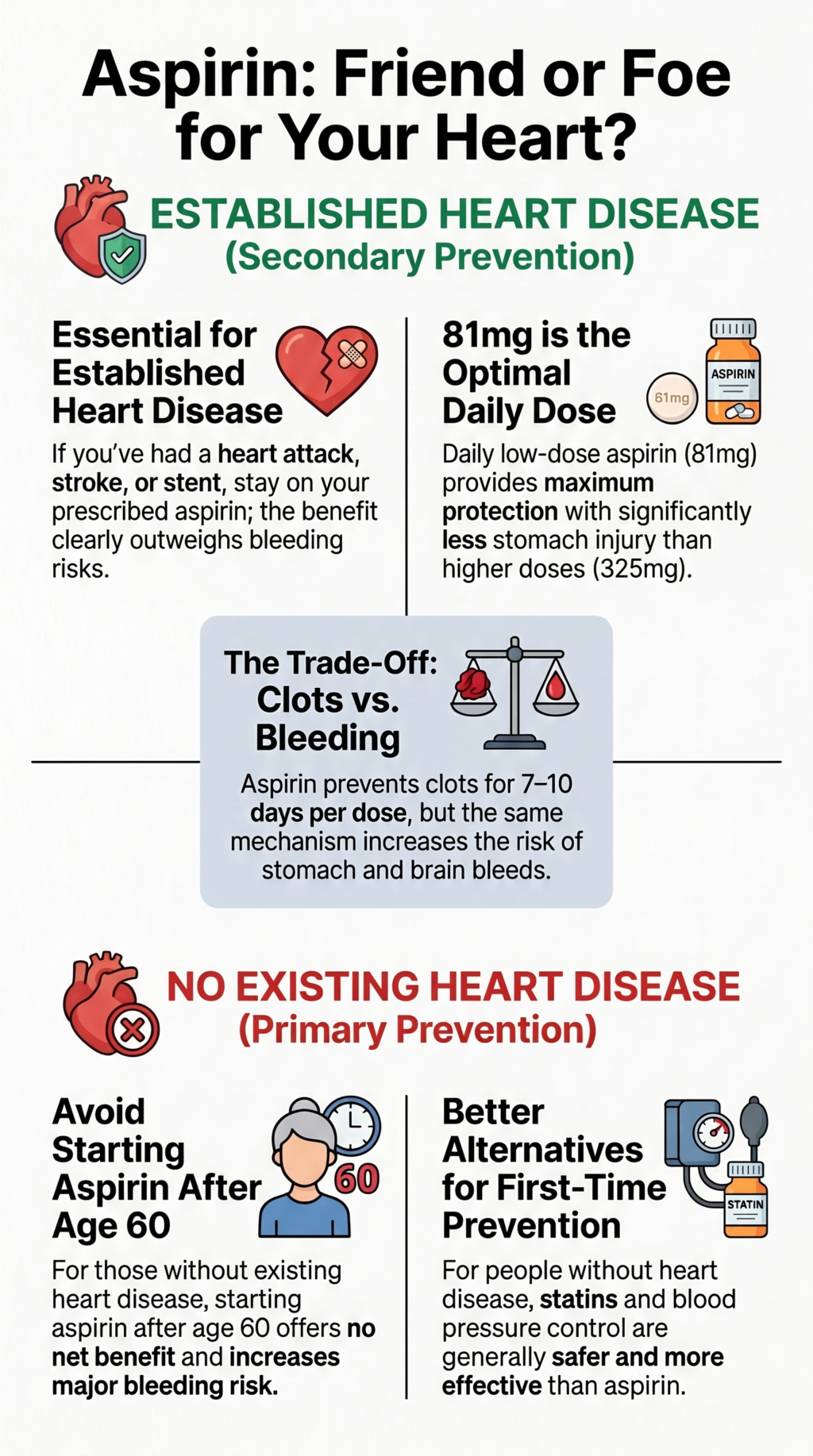
Aspirina en la prevención cardiovascular
Una revisión basada en la evidencia de la eficacia, la seguridad, la relación dosis-respuesta y la estratificación específica del paciente en la atención primaria y Prevención secundaria
| Editorial | Curing Heart Disease, LLC — curingheartdisease.com |
| Autor | Peter Megdal, PhD |
| Tipo de documento | Revisión de evidencia educativa (dirigida a médicos y lectores informados) |
| Versión | 2.2 — versión final (lista para publicación) |
| Fecha de lanzamiento | 23 de junio de 2026 |
| Fecha de revisión sugerida | Junio de 2028, o tras la revisión del USPSTF / ACC-AHA aspirina orientación |
| Base de evidencia | Ensayos primarios revisados por pares, metaanálisis de participantes individuales y declaraciones de guías publicadas en revistas revisadas por pares (JAMA, Lancet, NEJM, Circulation). Referencias de guías: USPSTF 2022; ACC/AHA Prevención primaria 2019; enfermedad coronaria crónica de la AHA/ACC de 2023; ACC/AHA Síndromes coronarios agudos 2025. |
| Divulgaciones | Sin patrocinio comercial. No financiamiento de la industria. El autor no declara conflictos de interés financieros relevantes. |
| Encuuadre clave de seguridad: lea primero
• El balance beneficio-riesgo de la aspirina difiere fundamentalmente entre la prevención secundaria (personas que ya tienen establecida enfermedad cardiovascular) y la prevención primaria (personas que no). Las conclusiones en un entorno no se transfieren al otro. • Para la prevención primaria, la guía actual del Grupo de Trabajo de Servicios Preventivos de EE. UU. recomienda una decisión individualizada únicamente para adultos de 40 a 59 años con un riesgo cardiovascular a 10 años con un valor de 10% o superior que no presenten un riesgo elevado de sangrado, y desaconseja iniciar el tratamiento con aspirina en adultos de 60 años o más. • “No iniciar para prevención primaria” no es lo mismo que “suspender la aspirina” o “nunca usar aspirina”. Las personas que toman aspirina para una enfermedad establecida no deben suspenderla basándose en datos de prevención primaria. • Este documento es educativo y no constituye asesoramiento médico individual. Cualquier decisión de iniciar, cambiar o suspender la aspirina debe tomarse con un médico calificado, quien puede evaluar el riesgo isquémico y de sangrado personal. |
Contenido
- Introducción y el paradigma de prevención primaria y secundaria…………………………………………. 3
- Farmacología y mecanismo de acción……………………………………………………………………….. 3
- Relación dosis-respuesta y frecuencia de administración………………………………………………………………………….. 4
- Dosificación basada en el peso corporal y la masa……………………………………………………………………………. 5
- Consideraciones específicas para cada paciente……………………………………………………………………………………… 6
- Estratificación de riesgo avanzada: coronaria arteria calcio………………………………………………………. 7
- Historial familiar de la enfermedad coronaria prematura………………………………………………………………… 7
- Estrategias preventivas complementarias y alternativas…………………………………………………….. 8
- Beneficios y daños cuantitativos………………………………………………………………………………………. 8
- Resumen de las recomendaciones por grupo de población………………………………………………………………. 9
- Síntesis: preguntas clave………………………………………………………………………………………….. 10
- Resumen en lenguaje sencillo………………………………………………………………………………………….. 11
- Limitaciones y calidad de la evidencia……………………………………………………………………………….. 11
- Descargo de responsabilidad………………………………………………………………………………………………………………. 12
Referencias…………………………………………………………………………………………………………………… 13
1. Introducción y el paradigma de prevención primaria y secundaria
El papel del ácido acetilsalicílico (aspirina) en la medicina cardiovascular se ha reducido sustancialmente en las últimas dos décadas. Antaño se recomendaba la aspirina de forma general como profilaxis diaria para los adultos que buscaban prevenir enfermedades cardiovasculares; ahora se entiende que tiene un margen terapéutico estrecho que depende en gran medida del riesgo isquémico y de hemorragia inicial del individuo. Debido a que la aspirina previene los eventos arteriales oclusivos mediante el mismo mecanismo antiplaquetario que altera la hemostasia normal, su valor neto aumenta y disminuye con el riesgo absoluto de los eventos que pretende prevenir.[1,2]
La distinción más importante al interpretar la evidencia sobre la aspirina se encuentra entre dos poblaciones. Prevención secundaria se aplica a personas con enfermedad cardiovascular documentada: previa infarto de miocardio, infarto isquémico o ataque isquémico transitorio, estable o angina inestable, enfermedad arterial periférica o previos revascularización (intervención coronaria percutánea o bypass aortocoronario). Estos individuos presentan un alto riesgo absoluto de eventos trombóticos recurrentes, por lo que incluso un riesgo moderado riesgo relativo la reducción produce un gran beneficio absoluto que supera claramente el riesgo de hemorragia. [2]
Prevención primaria se aplica a personas sin enfermedad cardiovascular clínicamente evidente. Su tasa de eventos anuales absolutos es baja, por lo que el número absoluto de eventos isquémicos previstos es pequeño y se ve compensado en gran medida por un aumento absoluto paralelo en las hemorragias mayores, principalmente hemorragia gastrointestinal y hemorragia intracraneal. Esta asimetría —efectos relativos similares pero efectos absolutos muy diferentes— es la razón central por la cual las guías contemporáneas se han alejado del uso sistemático para la prevención primaria. [2,1]
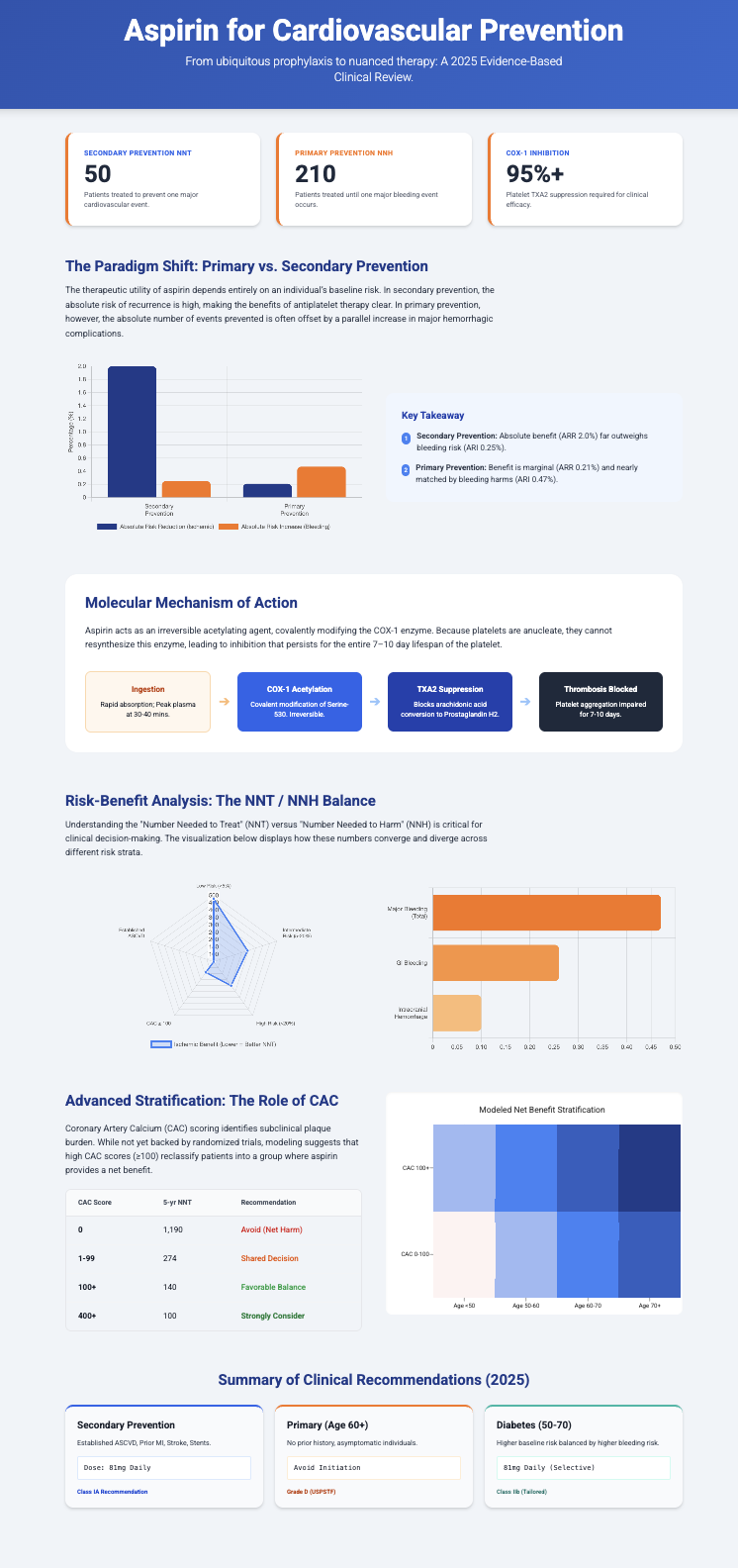
En el histórico participante individual metaanálisis Según la Colaboración de Investigadores en Ensayos Antitrombóticos (ATT), la reducción proporcional de los eventos vasculares graves fue, en términos generales, similar en ambos contextos, pero los efectos absolutos divergieron marcadamente: una reducción absoluta de aproximadamente 0,061 TP9T por año en la prevención primaria frente a una reducción absoluta aproximadamente un orden de magnitud mayor en la prevención secundaria. [2]
Tres ensayos modernos de prevención primaria publicados en 2018 reforzaron este panorama en una era de tratamiento contemporánea. LLEGAR se aleatorizó a 12.546 pacientes considerados con riesgo cardiovascular moderado (y sin diabetes o alto riesgo de sangrado) a 100 mg de aspirina o placebo; no se observó una reducción significativa en el criterio de evaluación compuesto primario cardiovascular, con un mayor número de hemorragias gastrointestinales (en su mayoría de leve a moderadas) y sin diferencias en los eventos fatales. Cabe destacar que la tasa de eventos observada fue mucho menor de lo proyectado (aproximadamente 9% frente a los 17% previstos), por lo que la cohorte se comportó, en la práctica, como una población de menor riesgo —en parte porque muchos participantes ya estaban tomando estatinas y antihipertensivos. [16]
Los compañeros de ARRIVE completaron el trío contemporáneo: ASCEND probó la aspirina en la diabetes y ASPREE en adultos mayores (ambos detallados en la Sección 5). Juntos, estos ensayos son la base empírica para el alejamiento del uso rutinario de la aspirina para la prevención primaria. [8,5]
2. Farmacología y mecanismo de acción
El efecto antitrombótico de la aspirina se deriva de la inhibición irreversible de la ciclooxigenasa-1 (COX-1) plaquetaria. La aspirina acetila un residuo de serina (Ser-530) dentro del canal catalítico de la COX-1, bloqueando estéricamente ácido araquidónico de llegar al sitio activo y detener permanentemente la síntesis del prostanoide descendente tromboxano A₂ (TxA₂), un potente promotor de la activación, agregación y vasoconstricción plaquetaria. [3,4]
Porque plaquetas son anucleadas y no pueden sintetizar nuevas proteína, el bloqueo de la COX-1 persiste durante toda la vida útil de la plaqueta, de aproximadamente 7 a 10 días. Este efecto antiplaquetario duradero contrasta con la breve exposición farmacocinética de la aspirina: la concentración plasmática máxima ocurre en unos 30 a 40 minutos y la semivida plasmática es de solo unos 15 a 20 minutos debido a la rápida hidrólisis por esterasas en salicilato. Incluso una exposición portal y sistémica transitoria es suficiente para inactivar el conjunto de plaquetas circulantes. [3,4]
Vascular células endoteliales, en cambio, son nucleadas y pueden resintetizar ciclooxigenoide. Producen prostaciclina (PGI₂), un vasodilatador e inhibidor plaquetario que se opone fisiológicamente al TxA₂. Las dosis diarias bajas (de aproximadamente 75 a 100 mg) logran una inhibición casi completa de la COX-1 plaquetaria mientras preservan relativamente la prostaciclina endotelial, en parte porque las plaquetas se exponen a la aspirina en la circulación portal antes del metabolismo hepático de primer paso. Las dosis diarias más altas suprimen progresivamente también la prostaciclina endotelial, erosionando esta selectividad sin añadir beneficio antitrombótico. [3,4]
Esta doble influencia define el perfil de beneficio-riesgo de la aspirina. La supresión de la agregación plaquetaria reduce la arterial inducida por cizallamiento trombosis en los sitios de ruptura de placa, pero el mismo trastorno de la hemostasia aumenta el riesgo de sangrado mucoso, gastrointestinal e intracraneal. [2,3]
3. Dosis-respuesta y frecuencia de dosificación
Los estudios farmacodinámicos muestran que la síntesis plaquetaria de TxA₂ se suprime casi por completo con dosis diarias en el rango de 75 a 100 mg, y que la eficacia antiplaquetaria alcanza una meseta por encima de este rango. Las dosis de mantenimiento más altas (por ejemplo, de 162 a 325 mg) no han mostrado un beneficio antitrombótico adicional en la prevención a largo plazo y están asociadas con una mayor lesión de la mucosa gastrointestinal dependiente de la dosis en estudios farmacológicos e históricos, aunque, como se señala a continuación, la comparación aleatorizada de ADAPTABLE no detectó por sí misma una diferencia estadísticamente significativa en las hemorragias mayores. Se utilizan dosis de carga únicas de liberación inmediata de 162 a 325 mg en los síndromes coronarios agudos y la isquemia aguda derrame cerebral para lograr una rápida inhibición plaquetaria; esta es una indicación aguda y distinta. [3,4,23]
La evidencia contemporánea más clara sobre la dosis de mantenimiento proviene del ensayo pragmático ADAPTABLE, en el que se asignó al azar a 15 076 pacientes con enfermedad cardiovascular aterosclerótica establecida a recibir 81 mg o 325 mg de aspirina al día. Durante una mediana de 26,2 meses, el resultado primario de eficacia (una combinación de muerte por cualquier causa, hospitalización por infarto de miocardio u hospitalización por accidente cerebrovascular) no mostró diferencias significativas (tasas estimadas de eventos de 7,28% para 81 mg frente a 7,51% para 325 mg; cociente de riesgos instantáneos 1,02, IC 95 % 0,91–1,14), ni tampoco la hospitalización por hemorragia grave (HR 1,18, IC 95 % 0,79–1,77). [9]
Estos resultados deben interpretarse como que “no se detectó ninguna diferencia significativa”, no como prueba de equivalencia exacta. El estudio ADAPTABLE fue de etiqueta abierta y presentó un cruce sustancial: aproximadamente 41% de los pacientes asignados a la dosis de 325 mg cambiaron a 81 mg, mientras que solo unos 7% cambiaron en la dirección opuesta. Dicho cruce asimétrico sesga la comparación hacia la hipótesis nula y limita la certeza con la que se puede descartar una diferencia real en la dosis. Con esa salvedad, el estudio respalda los 81 mg diarios como la dosis de mantenimiento preferida para la mayoría de los pacientes, basándose en resultados medidos comparables y una mejor tolerabilidad y adherencia. La guía contemporánea es concordante: la guía de la AHA/ACC sobre enfermedad coronaria crónica de 2023 recomienda aspirina en dosis bajas (75 a 100 mg, comúnmente 81 mg) como una estrategia de antiagregación plaquetaria única de Clase 1 (Nivel de evidencia A) para pacientes con enfermedad coronaria crónica que no reciben anticoagulación oral. [9,21]
De manera consistente con esto, el ensayo CURRENT-OASIS 7 en síndromes coronarios agudos encontró que continuar con una dosis más alta de aspirina (300–325 mg) no fue superior a la dosis más baja (75–100 mg) en cuanto a los resultados isquémicos mayores y se asoció con más hemorragias menores y gastrointestinales, un razonamiento que se hace eco en la guía del ACC/AHA sobre síndromes coronarios agudos de 2025, la cual respalda de 75 a 100 mg para la terapia de mantenimiento. [10,22]
3.1 Frecuencia de dosificación y recambio plaquetario
El intervalo de dosificación está limitado por la renovación plaquetaria. La médula ósea libera una fracción de plaquetas nuevas no inhibidas a la circulación cada día, por lo que se requiere una administración una vez al día para mantener la inhibición en estado estacionario. Dosis en días alternos deja intervalos de “día de descanso” durante los cuales las plaquetas recién formadas restauran la capacidad de tromboxano. En el Estudio de la Salud de la Mujer, 100 mg de aspirina en días alternos no redujeron significativamente el criterio de valoración principal compuesto de eventos cardiovasculares mayores en mujeres inicialmente sanas durante aproximadamente 10 años, aunque redujeron el accidente cerebrovascular isquémico. [15]
El trabajo farmacodinámico ayuda a explicar ese resultado: 100 mg tomados en días alternos producen una inhibición plaquetaria menor y más variable que 81 mg tomados diariamente, lo que sugiere es que el régimen de días alternos pudo haber subdosificado a los participantes en los días de descanso. Esta menor supresión plaquetaria puede explicar parcialmente los hallazgos del Estudio de Salud de Mujeres, aunque existen explicaciones alternativas: tasas de eventos menores de lo esperado, limitadas potencia estadística, y las diferencias en el diseño de los ensayos clínicos, también pueden contribuir. Siguiendo una lógica similar, extender aún más el intervalo (cada tercer día) no está respaldado por evidencia de criterios de valoración clínicos y no se recomienda. [18,19,23]
Por el contrario, en afecciones con un recambio plaquetario acelerado, como la trombocitemia esencial y algunos pacientes con diabetes tipo 2, la administración una vez al día puede dejar una inhibición incompleta antes de la siguiente dosis. Los estudios farmacodinámicos indican que la dosis baja de aspirina dos veces al día puede restablecer una supresión más constante del tromboxano en estos casos que simplemente aumentar la dosis diaria; esta sigue siendo una estrategia especializada y no una práctica general. [4]
4. Dosificación basada en el peso corporal y la masa
Si una dosis baja fija es adecuada para todos los tamaños corporales es un asunto sin resolver. En un análisis agrupado de participantes individuales de más de 100,000 participantes en ensayos de prevención primaria y secundaria, Rothwell y sus colaboradores informaron una interacción entre dosis y peso: la aspirina en dosis bajas (75–100 mg) redujo los eventos cardiovasculares principalmente en personas que pesaban menos de unos 70 kg, con escaso beneficio por encima de ese peso, mientras que las dosis más altas (≥325 mg) fueron eficaces principalmente con un peso corporal mayor. El análisis también indicó un daño potencial en los extremos: mayor letalidad de los casos de un primer evento cardiovascular en personas con mayor peso que tomaban aspirina en dosis bajas, y un aumento mortalidad por todas las causas entre las personas que pesan menos de 50 kg (razón de riesgo de 1,52; IC 95 %: 1,04–2,21). [11]
Estos hallazgos generan hipótesis, no definen la práctica clínica y no han sido confirmados de forma prospectiva. En un análisis preespecificado de ASPREE en adultos mayores, el peso corporal no modificó el efecto cardiovascular de la aspirina y el riesgo de sangrado no fue menor en las personas con mayor peso. Estudios farmacodinámicos en adultos sin diabetes también han encontrado que la inhibición plaquetaria por 81 mg o 325 mg es en gran medida independiente de la masa corporal. Los análisis posteriores no han replicado consistentemente la interacción con el peso corporal y ninguna guía importante recomienda actualmente una dosificación de aspirina ajustada por peso; la lectura actual más razonable es que la dosificación adaptada al peso resulta intrigante pero no aplicable en la práctica clínica. [5,11]
5. Consideraciones específicas del paciente
5.1 Edad
El riesgo de sangrado aumenta drásticamente con la edad, mientras que el beneficio isquémico absoluto de la aspirina para la prevención primaria sigue siendo modesto. El Estudio ASPREE Se asignó al azar a 19 114 adultos que vivían en la comunidad (en su mayoría de 70 años o más) a recibir 100 mg diarios o un placebo. La aspirina no prolongó la supervivencia libre de discapacidad (HR 1,01; IC 95 % 0,92–1,11) y no redujo significativamente las enfermedades cardiovasculares (10,7 frente a 11,3 eventos por cada 1 000 personas-año; HR 0,95, IC del 95 %: 0,83–1,08), pero sí aumentó significativamente las hemorragias graves (8,6 frente a 6,2 eventos por cada 1 000 personas-año; HR 1,38, IC 95% 1,18–1,62) y se asoció con una mayor mortalidad por todas las causas (HR 1,14, IC 95% 1,01–1,29), en gran parte relacionada con el cáncer e interpretada con cautela por los investigadores. [5,6,7]
Estos datos respaldan las directrices actuales: en la prevención primaria, una decisión individualizada es razonable solo para adultos de 40 a 59 años con un riesgo cardiovascular suficientemente alto y un riesgo bajo de hemorragia, y no se recomienda iniciar el tratamiento a los 60 años o más. El USPSTF sugiere además considerar la suspensión de la aspirina para la prevención primaria alrededor de los 75 años. Nada de esto se aplica a la prevención secundaria. [1]
5.2 Sexo biológico
Análisis anteriores específicos por sexo sugirieron que el beneficio de la prevención primaria con la aspirina se debía más a la reducción de accidentes cerebrovasculares en las mujeres y a la reducción de infartos de miocardio en los hombres. Trabajos posteriores indican que gran parte de esta aparente diferencia puede reflejar factores de tamaño corporal y farmacocinéticos en lugar de una biología específica del sexo, y las guías contemporáneas no recomiendan estrategias diferentes de aspirina según el sexo en la prevención primaria. [2,11]
5.3 Diabetes mellitus
Las personas con diabetes tienen un riesgo cardiovascular elevado, pero también presentan un mayor riesgo de hemorragias. El ensayo ASCEND asignó al azar a 15 480 adultos con diabetes y sin enfermedad cardiovascular conocida a recibir 100 mg diarios o un placebo. Durante un promedio de 7,4 años, la aspirina redujo los eventos vasculares graves (8,5% frente a 9,6%; razón de tasas 0,88, IC del 95 %: 0,79–0,97), pero aumentó las hemorragias graves (4,1% frente a 3,2%; razón de tasas 1,29, IC del 95%: 1,09–1,52). El beneficio absoluto (aproximadamente 1,1%) se equiparó en gran medida con el exceso absoluto de hemorragias (aproximadamente 0,9%), lo que corresponde a unos 91 pacientes tratados para prevenir un evento vascular grave y unos 112 tratados para provocar una hemorragia grave; ningún subgrupo mostró un beneficio que superara claramente el daño. Por lo tanto, el uso de la aspirina en la diabetes requiere un enfoque individualizado, toma de decisiones compartida más que el uso rutinario. [8]
5.4 Factores de riesgo concomitantes
Activo fumar y descontrolado hipertensión aumentan tanto el riesgo aterosclerótico como el riesgo de sangrado (incluida la hemorragia intracraneal). Porque factores de riesgo como los eventos isquémicos se superponen en gran medida con los factores de riesgo de sangrado, aumentar el riesgo cardiovascular inicial no inclina automáticamente la balanza hacia un beneficio neto. El control agresivo de presión arterial y el consumo de tabaco es una prioridad de primera línea tanto más segura como más eficaz que iniciar con aspirina. [2,17]
6. Estratificación avanzada del riesgo: calcio en las arterias coronarias
Como las ecuaciones de riesgo poblacional identifican de manera imperfecta quién se beneficiará realmente, puntuación de calcio en las arterias coronarias se ha estudiado como una herramienta para asignar aspirina de prevención primaria a quienes tienen más probabilidades de beneficiarse. En los análisis de los Estudio Multiétnico de la Aterosclerosis (MESA), limitado a adultos sin exposición previa a la aspirina menores de 70 años sin alto riesgo de sangrado, la relación entre el número necesario a tratar a los 5 años (NNT₅) y el número necesario para dañar (NNH₅) cambió favorablemente a medida que aumentó el CAC. En general, el NNT₅ (476) superó al NNH₅ (355); para un CAC ≥100, el NNT₅ (140) cayó por debajo del NNH₅ (518), lo que indica un beneficio neto modelado; y para un CAC = 0, el NNT₅ (1.190) superó con creces al NNH₅ (567), lo que indica un daño neto modelado. [12,13]
Estas son estimaciones modeladas derivadas de datos observacionales, no resultados de una asignación aleatorizada de aspirina según el CAC. La guía de prevención primaria del ACC/AHA de 2019 trata el CAC como una herramienta que mejora el riesgo para refinar la evaluación de riesgos en lugar de como una prueba validada para seleccionar la terapia con aspirina; ningún ensayo aleatorizado ha demostrado todavía que asignar aspirina según el CAC mejore los resultados. Por lo tanto, las estimaciones siguientes deben fundamentar la toma de decisiones compartida, no reemplazarla. [17,12]
Tabla 1. Estimaciones modeladas guiadas por CAC del beneficio frente al daño de la aspirina en la prevención primaria (MESA; adultos menores de 70 años que no han tomado aspirina anteriormente y que no presentan un riesgo elevado de hemorragia). El modelo supuso una reducción relativa de 12% en los eventos cardiovasculares y un aumento relativo de 42% en las hemorragias graves; las cifras son estimaciones observacionales, no evidencia de estudios aleatorizados. NNT₅/NNH₅ = 5 años número necesario a tratar / hacer daño.
| estrato CAC | NNT₅ a 5 años (prevenir 1 evento cardiovascular) | NNH a 5 años (causa 1 hemorragia mayor) | Efecto neto modelado |
| Cohorte general | 476 | 355 | Daño modelado ≥ beneficio |
| CAC = 0 | 1,190 | 567 | Daño neto modelado: evitar |
| CAC ≥ 100 | 140 | 518 | Beneficio neto modelado (sin ECA) |
Por lo tanto, el CAC ofrece una base más personalizada para refinar el riesgo que las puntuaciones por sí solas: una puntuación de cero identifica a las personas en quienes el riesgo de sangrado probablemente predomina, mientras que una puntuación alta identifica la enfermedad subclínica carga de placa en las que la aspirina puede estar biológicamente justificada, siempre que el riesgo de sangrado sea bajo. Estas siguen siendo inferencias modeladas a la espera de confirmación aleatorizada. Una carótida basada en ultrasonido placa la puntuación ha sido estudiada con el mismo propósito, y la presencia de placa carotídea con un riesgo estimado de ASCVD más alto marca un equilibrio más favorable. [20]
7. Antecedentes familiares de enfermedad coronaria prematura
Un historial familiar de enfermedad arterial coronaria prematura (un familiar de primer grado afectado antes de los 55 años en hombres o de los 65 en mujeres) se reconoce en la guía de prevención primaria de la ACC/AHA de 2019 como un factor que potencia el riesgo y que puede refinar la evaluación del riesgo. Puede recalificar significativamente al alza el riesgo estimado de un individuo, y unos antecedentes familiares sólidos pueden motivar adecuadamente una evaluación adicional —como la prueba de CAC— para aclarar si está justificada la intensificación preventiva. Sin embargo, no es una indicación establecida por sí sola para la aspirina de prevención primaria, y no reduce el peligro de hemorragia de la aspirina. La respuesta adecuada a unos antecedentes familiares sólidos es una prevención intensificada guiada por las guías —manejo de lípidos, control de la presión arterial y medidas de estilo de vida— en lugar de la iniciación refleja de la aspirina. [17,1]
8. Estrategias preventivas complementarias y alternativas
En la era moderna de la prevención primaria, varias intervenciones ofrecen un perfil de beneficio-riesgo más favorable que la aspirina. La terapia con estatinas reduce sustancialmente los eventos cardiovasculares mayores sin aumentar las hemorragias graves, y los efectos adversos graves como rabdomiólisis son poco comunes. El control estricto de la presión arterial reduce el accidente cerebrovascular y el infarto de miocardio sin aumentar el riesgo de hemorragia, y disminuye directamente el riesgo de derrame cerebral hemorrágico. El cese del tabaquismo produce reducciones grandes y rápidas en el riesgo cardiovascular. [17]
Estas alternativas también replantean el argumento a favor de la propia aspirina. A medida que el uso concomitante de estatinas y el control de los factores de riesgo reducen el riesgo isquémico residual, el beneficio absoluto incremental de añadir aspirina en la prevención primaria se reduce, mientras que su riesgo de sangrado persiste. Para la mayoría de las personas sin enfermedad establecida que ya reciben terapia guiada por guías clínicas, añadir aspirina ofrece poca ventaja neta. [2,17]
9. Beneficio y daño cuantitativos
Las tablas siguientes resumen las estimaciones de los efectos de las principales fuentes revisadas por pares. Los efectos relativos son ampliamente similares entre los distintos entornos; la diferencia decisiva radica en el efecto absoluto, el cual está determinado por el riesgo basal. Todas las cifras se han extraído directamente de los ensayos y metaanálisis citados.
Tabla 2. Efectos de la aspirina según el entorno de prevención y la población, a partir de fuentes primarias revisadas por pares. RR = tasa/cociente de riesgos relativos; HR = cociente de riesgos instantáneos; IC = intervalo de confianza.
| Entorno / población | Efecto (95% CI) | Resultado y efecto absoluto | Fuente |
| Prevención primaria: eventos vasculares graves | RR 0.88 (0.82–0.94) | 0,511 TP9T frente a 0,571 TP9T al año; reducción proporcional de ≈121 TP9T | metaanálisis ATT |
| Prevención primaria — eventos coronarios mayores | RR 0,82 (0,75–0,90) | Reducción proporcional de ≈18% | metaanálisis ATT |
| Prevención primaria: accidente cerebrovascular (total) | RR 0.95 (0.85–1.06) | Sin efecto significativo | metaanálisis ATT |
| Prevención primaria: hemorragia extracraneal mayor | RR 1.54 (1.30–1.82) | 0,101 TP9T frente a 0,071 TP9T al año; un aumento significativo | metaanálisis ATT |
| Prevención primaria en la diabetes: eventos vasculares graves | RR 0.88 (0.79–0.97) | 8,51 TP9T frente a 9,61 TP9T; ARR ≈1,11 TP9T; NNT ≈91 | ASCENDER |
| Prevención primaria en la diabetes — hemorragia mayor | RR 1.29 (1.09–1.52) | 4,11 TP9T frente a 3,21 TP9T; ARI ≈ 0,91 TP9T; NNH ≈ 112 | ASCENDER |
| Prevención primaria en adultos mayores — Enfermedad cardiovascular | HR 0.95 (0.83–1.08) | 10.7 frente a 11.3 / 1000 py; no significativo | ASPREE |
| Prevención primaria en adultos mayores: hemorragia mayor | HR 1.38 (1.18–1.62) | 8.6 frente a 6.2 / 1000 py; aumento significativo | ASPREE |
| Prevención secundaria: eventos vasculares graves | reducción proporcional de aproximadamente un quinto | ≈6,71 TP9T frente a 8,21 TP9T al año; gran beneficio absoluto | metaanálisis ATT |
Tabla 3. Comparación de la dosis de mantenimiento (81 mg frente a 325 mg diarios) en la prevención secundaria.
| Resultado | 81 mg | 325 mg | Efecto (95% CI) |
| Compuesto: muerte, IAM o hospitalización por accidente cerebrovascular | 7.28% | 7.51% | HR 1.02 (0.91–1.14) |
| Hospitalización por hemorragia mayor | — | — | HR 1.18 (0.79–1.77) |
| Cambiado a la otra dosis (cruce) | ≈7% | ≈41% | Asimétrico: sesgos hacia el nulo |
ADAPTABLE. El entrecruzamiento asimétrico marcado es la limitación clave y la razón por la cual el ensayo respalda los 81 mg como preferidos sin probar la equivalencia exacta de la dosis. [9]
10. Resumen de recomendaciones por población
La tabla a continuación indica, para cada población, la acción (iniciar, continuar o evitar) junto con su entorno y la directriz de respaldo. Cada fila preserva la distinción entre primaria y secundaria.
| Población | Acción | Justificación | Orientación |
| ECVasoes establecida / post-IAM / post-ACV / post-ICP o cirugía de revascularización coronaria (prevención secundaria) | Continuar (81 mg diarios) | Alto riesgo de eventos recurrentes; el beneficio absoluto supera con creces el riesgo de sangrado | 2023 AHA/ACC CCD (Clase 1, Nivel de Evidencia A); ATT; ADAPTABLE |
| Prevención primaria, edad de 40 a 59 años, riesgo de enfermedad cardiovascular a 10 años ≥10%, bajo riesgo de hemorragia | Individualizar | Pequeño beneficio neto; depende del riesgo y la preferencia personal | USPSTF Grado C |
| Prevención primaria, edad ≥60 años | No iniciar | Sin beneficio neto; el riesgo de sangrado predomina | Grado D del USPSTF |
| Prevención primaria con riesgo elevado de sangrado (cualquier edad) | No iniciar | El riesgo de sangrado supera cualquier beneficio isquémico | USPSTF; ACC/AHA |
| Prevención primaria, CAC = 0 | Evitar | Daño neto modelado; riesgo isquémico muy bajo (estimación observacional) | Modelado MESA |
| Prevención primaria, CAC ≥100, bajo riesgo de sangrado | Considerar | Beneficio neto modelado (NNT₅ < NNH₅); sin confirmación aleatorizada | Modelado MESA |
| Prevención primaria en diabetes, sin enfermedad cardiovascular aterosclerótica | Individualizar | El beneficio y el exceso de sangrado estuvieron muy ajustados | ASCEND; ADA/directrices |
11. Síntesis: preguntas clave
¿Quién se beneficia más?
Personas con enfermedad cardiovascular establecida (prevención secundaria). Su alto riesgo de eventos recurrentes significa que el beneficio absoluto de la aspirina en dosis bajas supera claramente el riesgo de sangrado. La aspirina en dosis bajas (81 mg diarios) es el tratamiento estándar a largo plazo para la mayoría de los pacientes de prevención secundaria, a menos que esté contraindicada o sea reemplazada por una estrategia antitrombótica alternativa; por ejemplo, la anticoagulación oral por otra indicación, o un ciclo definido de doble antiagregación plaquetaria después de una colocación reciente de Stent o un síndrome coronario agudo. [2,9,21]
¿Quién se beneficia menos?
Adultos sin enfermedad cardiovascular que ya reciben prevención guiada por directrices (terapia eficaz con estatinas, control de la presión arterial, no fumar). Su riesgo isquémico residual es bajo, por lo que el ácido acetilsalicílico añadido ofrece poco beneficio incremental mientras persiste el riesgo de sangrado. [2,17]
¿Qué poblaciones deben evitar generalmente iniciar el uso de aspirina para la prevención primaria?
Adultos de 60 años o más; adultos de cualquier edad con mayor riesgo de sangrado; personas con un CAC de cero; y, según la evidencia actual, aquellos en el extremo inferior del peso corporal en quienes se han detectado señales de daño. [1,12,11]
¿Cuál es la dosis de mantenimiento efectiva más baja?
Una dosis diaria de aproximadamente 75 a 81 mg proporciona una inhibición plaquetaria casi máxima y una protección clínica comparable a dosis más altas, con menor toxicidad gastrointestinal y hemorrágica. [3,9]
¿Es mejor la dosis diaria que la dosis en días alternos?
Sí. La aspirina en dosis bajas diarias proporciona una inhibición plaquetaria más constante que la administración en días alternos, porque las plaquetas recién formadas restablecen la capacidad de tromboxano durante los intervalos de los días de descanso. [15,18]
¿Aportan las dosis superiores a ~100 mg beneficio cardiovascular?
Ninguna evidencia consistente demuestra mejores resultados cardiovasculares con dosis de mantenimiento habituales superiores a unos 100 mg, mientras que las dosis más altas se asocian con una mayor toxicidad gastrointestinal. Las dosis únicas más altas siguen siendo adecuadas únicamente para la carga aguda en los síndromes coronarios agudos o el accidente cerebrovascular agudo. [9,10,22]
¿Cuál es el consenso general para 2025 y más allá?
Para la prevención secundaria, la aspirina en dosis bajas sigue siendo un pilar fundamental: la guía de 2023 de la AHA/ACC sobre enfermedad coronaria crónica otorga a la aspirina en dosis bajas (75–100 mg) una recomendación de Clase 1 como terapia antiplaquetaria única en pacientes que no reciben anticoagulación, y la guía de 2025 de la ACC/AHA sobre síndromes coronarios agudos también respalda una dosis de mantenimiento de 75–100 mg. Para la prevención primaria, se ha abandonado su uso rutinario; cualquier decisión debe ser individualizada, generalmente limitada a adultos de 40 a 59 años con un riesgo a 10 años ≥10% y bajo riesgo de sangrado, y es muy adecuada para el refinamiento con marcadores de riesgo basados en imágenes, como el CAC. [1,21,22]
12. Resumen en lenguaje sencillo
La aspirina hace que las plaquetas —las células sanguíneas que forman coágulos— tengan menos capacidad de adherirse entre sí, lo que reduce la probabilidad de que un coágulo bloquee una arteria y cause un infarto cardíaco o derrame cerebral. Como las plaquetas no pueden repararse a sí mismas, una dosis baja sigue funcionando durante unos 7 a 10 días. El mismo efecto hace que el sangrado sea más difícil de detener, razón por la cual la aspirina puede causar sangrado en el estómago, los intestinos o el cerebro.
La idea clave es que el valor de la aspirina depende de si ya padece una enfermedad cardíaca o vascular:
- Si usted ya ha tenido un ataque cardíaco, un derrame cerebral, stent, o un bypass (prevención secundaria), la probabilidad de otro evento es alta, y la aspirina diaria en dosis bajas claramente hace más bien que mal. No la suspenda por su cuenta.
- Si no tiene antecedentes de enfermedad cardíaca o vascular (prevención primaria), el beneficio es mucho menor y se anula en gran medida por el riesgo de hemorragia. Las pautas recomiendan no comenzar a tomar aspirina a los 60 años o más, y solo una consideración individualizada para adultos de 40 a 59 años con mayor riesgo.
Las herramientas como una tomografía de calcio coronario pueden ayudar a identificar quiénes del grupo de prevención primaria aún podrían beneficiarse. Para prevenir un primer ataque cardíaco o derrame cerebral, las estatinas y el control de la presión arterial generalmente brindan una protección mayor y más segura que la aspirina.
Tabla 4. Resumen en lenguaje sencillo de quiénes se benefician y quiénes deben tener precaución.
| Por lo general, la aspirina ayuda | Por lo general, no se aconseja la aspirina (para la prevención) |
| Infarto de miocardio previo | Comenzar a tomar aspirina a los 60 años o más |
| Accidente cerebrovascular isquémico previo o AIT | Mayor riesgo de sangrado (úlceras, anticoagulantes, etc.) |
| Stent coronario o cirugía de bypass | Sin enfermedad cardíaca y un infarto puntaje de calcio de cero |
| Alta carga de placa (CAC ≥100) con bajo riesgo de sangrado | Ya bien protegido con estatina, control de la presión arterial, no fumador |
Dosis de mantenimiento preferida cuando se indica aspirina: 81 mg una vez al día.
13. Limitaciones y calidad de la evidencia
Las estimaciones de prevención primaria se basan en ensayos realizados en distintas épocas y perfiles de riesgo; el tratamiento de base contemporáneo (estatinas, mejor control de la presión arterial) tiende a reducir el beneficio residual de la aspirina en relación con los ensayos más antiguos. La evidencia de la comparación de dosis (ADAPTABLE) es abierta y presenta un cruce sustancial, por lo que limita en lugar de probar la equivalencia de dosis. La dosificación basada en el peso y las estrategias de dosificación dos veces al día se sustentan principalmente en datos farmacodinámicos y post hoc, y no se han validado en ensayos clínicos dedicados. La asignación basada en el CAC se apoya en modelos observacionales en lugar de en una asignación aleatorizada. Estas limitaciones abogan por decisiones individualizadas y guiadas por el médico en lugar de normas generales. [9,11,12]
14. Aviso legal
Este documento se proporciona únicamente con fines educativos e informativos y no constituye asesoramiento, diagnóstico ni tratamiento médico, así como tampoco establece una relación médico-paciente. Los riesgos individuales de isquemia y hemorragia, los medicamentos y las comorbilidades varían ampliamente. Cualquier decisión de iniciar, continuar, cambiar o suspender la aspirina debe tomarse junto con un profesional de la salud calificado.
Referencias
- US Preventive Services Task Force, Davidson KW, Barry MJ, et al. Aspirin Use to Prevent Cardiovascular Disease: US Preventive Services Task Force Recommendation Statement. JAMA. 2022;327(16):1577-1584. doi:10.1001/jama.2022.4983
- Antithrombotic Trialists’ (ATT) Collaboration, Baigent C, Blackwell L, et al. Aspirin in the primary and secondary prevention of vascular disease: collaborative meta-analysis of individual participant data from randomised trials. Lancet. 2009;373(9678):1849-1860. doi:10.1016/S0140-6736(09)60503-1
- Awtry EH, Loscalzo J. Aspirin. Circulation. 2000;101(10):1206-1218. doi:10.1161/01.cir.101.10.1206
- Patrono C, García Rodríguez LA, Landolfi R, Baigent C. Low-dose aspirin for the prevention of atherothrombosis. N Engl J Med. 2005;353(22):2373-2383. doi:10.1056/NEJMra052717
- McNeil JJ, Wolfe R, Woods RL, et al. Effect of Aspirin on Cardiovascular Events and Bleeding in the Healthy Elderly. N Engl J Med. 2018;379(16):1509-1518. doi:10.1056/NEJMoa1805819
- McNeil JJ, Woods RL, Nelson MR, et al. Effect of Aspirin on Disability-free Survival in the Healthy Elderly. N Engl J Med. 2018;379(16):1499-1508. doi:10.1056/NEJMoa1800722
- McNeil JJ, Nelson MR, Woods RL, et al. Effect of Aspirin on All-Cause Mortality in the Healthy Elderly. N Engl J Med. 2018;379(16):1519-1528. doi:10.1056/NEJMoa1803955
- ASCEND Study Collaborative Group, Bowman L, Mafham M, et al. Effects of Aspirin for Primary Prevention in Persons with Diabetes Mellitus. N Engl J Med. 2018;379(16):1529-1539. doi:10.1056/NEJMoa1804988
- Jones WS, Mulder H, Wruck LM, et al. Comparative Effectiveness of Aspirin Dosing in Cardiovascular Disease. N Engl J Med. 2021;384(21):1981-1990. doi:10.1056/NEJMoa2102137
- CURRENT-OASIS 7 Investigators, Mehta SR, Bassand JP, et al. Dose comparisons of clopidogrel and aspirin in acute coronary syndromes. N Engl J Med. 2010;363(10):930-942. doi:10.1056/NEJMoa0909475
- Rothwell PM, Cook NR, Gaziano JM, et al. Effects of aspirin on risks of vascular events and cancer according to bodyweight and dose: analysis of individual patient data from randomised trials. Lancet. 2018;392(10145):387-399. doi:10.1016/S0140-6736(18)31133-4
- Cainzos-Achirica M, Miedema MD, McEvoy JW, et al. Coronary Artery Calcium for Personalized Allocation of Aspirin in Primary Prevention of Cardiovascular Disease in 2019: The MESA Study (Multi-Ethnic Study of Atherosclerosis). Circulation. 2020;141(19):1541-1553. doi:10.1161/CIRCULATIONAHA.119.045010
- Miedema MD, Duprez DA, Misialek JR, et al. Use of coronary artery calcium testing to guide aspirin utilization for primary prevention: estimates from the multi-ethnic study of atherosclerosis. Circ Cardiovasc Qual Outcomes. 2014;7(3):453-460. doi:10.1161/CIRCOUTCOMES.113.000690
- Steering Committee of the Physicians’ Health Study Research Group. Final report on the aspirin component of the ongoing Physicians’ Health Study. N Engl J Med. 1989;321(3):129-135. doi:10.1056/NEJM198907203210301
- Ridker PM, Cook NR, Lee IM, et al. A randomized trial of low-dose aspirin in the primary prevention of cardiovascular disease in women. N Engl J Med. 2005;352(13):1293-1304. doi:10.1056/NEJMoa050613
- Gaziano JM, Brotons C, Coppolecchia R, et al. Use of aspirin to reduce risk of initial vascular events in patients at moderate risk of cardiovascular disease (ARRIVE): a randomised, double-blind, placebo-controlled trial. Lancet. 2018;392(10152):1036-1046. doi:10.1016/S0140-6736(18)31924-X
- Arnett DK, Blumenthal RS, Albert MA, et al. 2019 ACC/AHA Guideline on the Primary Prevention of Cardiovascular Disease: A Report of the American College of Cardiology/American Heart Association Task Force on Clinical Practice Guidelines. Circulation. 2019;140(11):e596-e646. doi:10.1161/CIR.0000000000000678
- Swaim L, Hillman RS. Aspirin administered to women at 100 mg every other day produces less platelet inhibition than aspirin administered at 81 mg per day: implications for interpreting the women’s health study. J Thromb Thrombolysis. 2009;28(1):94-100. doi:10.1007/s11239-008-0262-6
- Feldman M, Cryer B, Rushin K, Betancourt J. A comparison of every-third-day versus daily low-dose aspirin therapy on serum thromboxane concentrations in healthy men and women. Clin Appl Thromb Hemost. 2001;7(1):53-57. doi:10.1177/107602960100700111
- Dzaye O, Razavi AC, Dardari ZA, et al. Carotid Ultrasound-Based Plaque Score for the Allocation of Aspirin for the Primary Prevention of Cardiovascular Disease Events: The Multi-Ethnic Study of Atherosclerosis and the Atherosclerosis Risk in Communities Study. J Am Heart Assoc. 2024;13(12):e034718. doi:10.1161/JAHA.123.034718
- Virani SS, Newby LK, Arnold SV, et al. 2023 AHA/ACC/ACCP/ASPC/NLA/PCNA Guideline for the Management of Patients With Chronic Coronary Disease: A Report of the American Heart Association/American College of Cardiology Joint Committee on Clinical Practice Guidelines. Circulation. 2023;148(9):e9-e119. doi:10.1161/CIR.0000000000001168
- Rao SV, O’Donoghue ML, Ruel M, et al. 2025 ACC/AHA/ACEP/NAEMSP/SCAI Guideline for the Management of Patients With Acute Coronary Syndromes: A Report of the American College of Cardiology/American Heart Association Joint Committee on Clinical Practice Guidelines. Circulation. 2025;151(13):e771-e862. doi:10.1161/CIR.0000000000001309
- Patrono C. The Multifaceted Clinical Readouts of Platelet Inhibition by Low-Dose Aspirin. J Am Coll Cardiol. 2015;66(1):74-85. doi:10.1016/j.jacc.2015.05.012