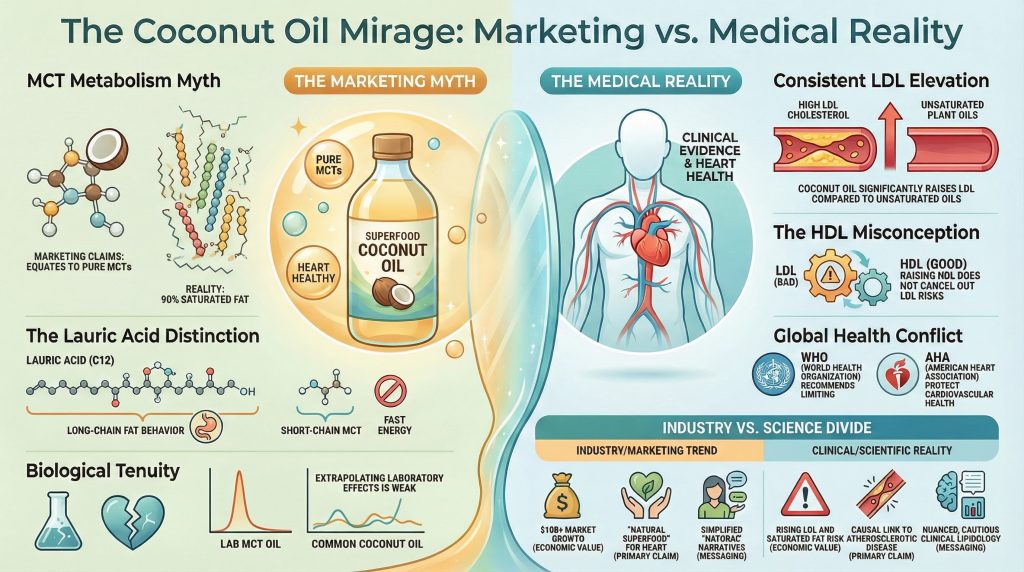
The Pathophysiology of Saturated Fat and Coconut Oil Consumption: A Comprehensive Review of Lipidology, Cardiometabolic Risk, and Physiological Redundancy
The clinical understanding of dietary fats has undergone significant scrutiny over the past century, transitioning from a generalized “low-fat” message to a sophisticated, quality-centric paradigm. Within this landscape, coconut oil has emerged as a focal point of intense debate, often characterized by a stark divide between commercial “superfood” marketing and rigorous clinical lipidology. Proponents of coconut oil frequently argue that its unique fatty acid profile confers metabolic advantages, particularly concerning weight loss, thyroid health, and antimicrobial resistance, while simultaneously challenging the established link between saturated fatty acids and atherosclerotic cardiovascular disease. However, a deep dive into peer-reviewed research, genetic studies, and randomized controlled trials provides a more nuanced and cautionary perspective. This report examines the biochemical composition of coconut oil, evaluates the causality of low-density lipoproteins in cardiovascular pathology, deconstructs common endocrine and metabolic myths, and addresses the physiological redundancy of dietary saturated fat through the lens of de novo lipogenesis.

Biochemical Analysis and the MCT Misconception
The primary justification for the purported health benefits of coconut oil often centers on its classification as a source of medium-chain triglycerides (MCTs). To evaluate this claim, one must analyze the specific carbon chain lengths of the fatty acids that comprise the oil. Coconut oil is predominantly saturated fat (commonly reported in the range of ~84–92% of total fatty acids, depending on processing and analytic method) [1-3]. The predominant fatty acid is lauric acid (C12:0), representing roughly 45% to 53% of total fatty acids in most compositional analyses [1-3].
A critical distinction exists between true medium-chain fatty acids, such as caprylic acid (C8:0) and capric acid (C10:0), and the “borderline” medium-chain lauric acid (C12:0). In clinical nutrition, MCTs are often operationally defined by their relatively rapid absorption and oxidation compared with long-chain triglycerides, and by a greater propensity—especially for C8:0 and C10:0—to enter the portal circulation and undergo hepatic beta-oxidation [4]. This metabolic pathway is one reason concentrated MCT preparations have been investigated for effects on energy expenditure and satiety [4]. However, human metabolic studies demonstrate that medium-chain fatty acids can still be incorporated into chylomicron triglycerides, and the extent of lymphatic transport increases with chain length (with C12:0 behaving more like a long-chain fatty acid than C8:0/C10:0) [5]. Accordingly, the mechanistic effects reported for purified MCT oils enriched almost exclusively in C8:0 and C10:0 should not be automatically extrapolated to whole coconut oil, which is dominated by C12:0 and also contains substantial myristic acid (C14:0) and palmitic acid (C16:0) [1-3].
Fatty Acid Composition of Coconut Oil vs. Other Fats
The following table details the fatty acid profiles of common dietary fats, highlighting the unique concentration of C12:0 and C14:0 in coconut oil compared to animal fats and vegetable oils (values are approximate ranges drawn from food composition analyses and lipid chemistry references) [1-3].
| Fatty acid (carbon chain) | Chemical name | Coconut oil (%) | Butterfat (%) | Lard (%) | Olive oil (%) |
| Butyric (C4:0) | Butyric acid | 0 | 3–4 | 0 | 0 |
| Caproic (C6:0) | Caproic acid | <1 | 2 | 0 | 0 |
| Caprylic (C8:0) | Caprylic acid | 7–9 | 1–2 | 0 | 0 |
| Capric (C10:0) | Capric acid | 6–7 | 2–3 | 0 | 0 |
| Lauric (C12:0) | Lauric acid | 45–53 | 2–3 | <1 | 0 |
| Myristic (C14:0) | Myristic acid | 16–21 | 8–11 | 1–2 | 0 |
| Palmitic (C16:0) | Palmitic acid | 7–10 | 22–26 | 25–28 | 10–14 |
| Stearic (C18:0) | Stearic acid | 2–4 | 12–15 | 12–14 | 2–4 |
| Oleic (C18:1) | Oleic acid | 5–8 | 25–30 | 40–45 | 65–80 |
| Linoleic (C18:2) | Linoleic acid | 1–3 | 2–3 | 8–10 | 5–15 |
Figure 1. Stacked-bar schematic of approximate fatty acid composition (midpoint values shown) for selected fats; this chart is illustrative and is intended to make the tabulated ranges visually comparable, not to substitute for primary compositional analytics.

As shown, the concentration of shorter-chain MCFAs (C8:0 and C10:0) in coconut oil is modest relative to C12:0 [1-3]. The high levels of lauric and myristic acids are particularly relevant to clinical lipidology, as these saturated fatty acids are among the most potent dietary modulators of LDL-cholesterol raising when exchanged isocalorically for cis-unsaturated fats [6,9].
The Causal Role of Low-Density Lipoproteins in Atherosclerosis
One of the most persistent claims in the popular press is that the link between saturated fat and heart disease is based solely on flawed epidemiological data. This assertion ignores decades of advancements in genetic research, randomized controlled trials (RCTs), and basic science. The European Atherosclerosis Society (EAS) Consensus Panel has summarized evidence that low-density lipoproteins (LDL) are not merely markers of risk, but causal agents in the development of atherosclerotic cardiovascular disease (ASCVD) [10].
Evidence from Genetic and Mendelian Randomization Studies
Mendelian randomization and other genetic approaches provide tools for causal inference by leveraging genetic variants that influence LDL-C levels from birth. Across multiple genetic mechanisms that lower LDL-C, lifetime exposure to lower LDL-C is consistently associated with proportionally lower ASCVD risk, supporting a “cumulative LDL burden” framework for plaque initiation and progression [10].
Results from Randomized Controlled Trials
Randomized trials of LDL-lowering therapies (e.g., statins, ezetimibe, PCSK9 inhibitors) demonstrate dose-dependent reductions in major vascular events with LDL-C lowering. The Cholesterol Treatment Trialists’ (CTT) Collaboration reported that each ~1.0 mmol/L reduction in LDL-C reduces the annual rate of major vascular events by just over one fifth, with no evidence of a lower threshold within the ranges studied [11]. Dietary feeding trials and pooled evidence also support that replacing saturated fats with polyunsaturated fats lowers LDL-C and reduces coronary events, whereas replacement with refined carbohydrate does not reliably improve outcomes [9].
Coconut oil consumption has been shown in meta-analyses of RCTs to increase LDL-C compared with non-tropical unsaturated vegetable oils, while often also increasing HDL-C [6,7]. Although the LDL-C increase may be smaller than that observed with butter in some comparisons, it is consistently less favorable than replacement with cis-unsaturated oils such as olive, safflower, sunflower, soybean, and canola oils [6-8].
Lipid Profile Comparison: Coconut Oil vs. Other Fat Sources
| Lipid parameter | Coconut oil vs. butter | Coconut oil vs. unsaturated oils |
| Total cholesterol | Lower or neutral in some comparisons [6-8] | Higher [6,7] |
| LDL-cholesterol | Lower or neutral in some comparisons [6-8] | Higher [6,7] |
| HDL-cholesterol | Higher [6,7] | Higher [6,7] |
| LDL:HDL ratio | Lower/neutral in some comparisons [6-8] | Higher/less favorable [6,7] |
Figure 2. Schematic bar chart reflecting the *directionality* of lipid changes reported in randomized comparisons; this figure is not intended to represent absolute unit changes and should be interpreted alongside the cited meta-analyses and trials.

The clinical significance of these changes must be interpreted through the lens of causality. Because LDL-C reflects exposure to atherogenic apoB-containing lipoproteins and LDL is causal in atherosclerosis, LDL-C increases associated with coconut oil consumption plausibly increase absolute ASCVD risk, regardless of simultaneous HDL-C increases [9-11].
The ApoB Paradigm and the “Large Fluffy LDL” Myth
A common defense of coconut oil is the claim that it primarily raises “large, fluffy” LDL particles (Pattern A), which are allegedly not atherogenic, rather than “small, dense” LDL particles (Pattern B). This narrative is increasingly viewed as an oversimplification. The atherogenicity of apoB-containing lipoproteins is primarily driven by the number of particles capable of entering and being retained within the arterial intima, not by a reassuring label of “large” or “small” particles [12,13].
Each atherogenic particle—whether VLDL, IDL, or LDL—contains exactly one molecule of apolipoprotein B (apoB). Therefore, apoB concentration is a direct measure of the total number of atherogenic particles [12,13]. Discordance analyses have shown that when LDL-C and apoB provide different risk estimates, ASCVD risk more closely tracks apoB [12,13]. A recent scientific review of discordance evidence concluded that apoB is a more accurate marker of cardiovascular risk than LDL-C or non–HDL-C when these measures disagree [12].
Coconut oil has been reported to raise LDL-C in clinical trials and meta-analyses; when LDL-C rises, apoB often rises in parallel, particularly in patterns characterized by increased apoB particle exposure over time [6,12,13]. Accordingly, focusing on particle “size” without accounting for apoB particle number risks misclassifying lipid-mediated ASCVD risk.

The HDL Paradox and Functional Limitations
Another central pillar of the “healthy coconut oil” argument is its ability to raise HDL-C levels. While observational studies historically showed an inverse relationship between HDL-C and cardiovascular events, pharmacological attempts to reduce ASCVD by raising HDL-C have not produced consistent benefit. In the dal-OUTCOMES trial, dalcetrapib increased HDL-C but did not reduce cardiovascular events after acute coronary syndrome [14]. In the ACCELERATE trial, evacetrapib substantially raised HDL-C and lowered LDL-C, yet did not reduce cardiovascular outcomes in high-risk patients [15]. In AIM-HIGH, adding extended-release niacin to intensive statin therapy increased HDL-C but did not reduce cardiovascular events [16]. Similarly, in HPS2-THRIVE, niacin/laropiprant added to statin-based therapy did not significantly reduce major vascular events and increased adverse events [17].
Mendelian randomization also challenges the assumption that higher HDL-C is causally protective. In a landmark study, genetic mechanisms that raise HDL-C did not uniformly lower myocardial infarction risk, undermining the view that simply raising HDL-C will translate into benefit [18].
These findings support the concept that HDL-C is more a marker of metabolic context than a direct causal protective factor. The protective properties of HDL may relate more to functional measures such as macrophage cholesterol efflux capacity (CEC). In a study of HDL function and atherosclerosis, CEC was inversely associated with carotid intima–media thickness and coronary disease status independent of HDL-C level [19]. Saturated fats may increase HDL-C without necessarily improving HDL functionality. Therefore, HDL-C increases with coconut oil do not “cancel out” LDL-related risk [10-12,18,19].
Deconstructing Endocrine and Metabolic Claims
Beyond lipidology, coconut oil is frequently promoted for its effects on weight loss, thyroid function, and testosterone levels. Peer-reviewed research, however, indicates that many of these claims are based on mechanistic overreach, conflation with purified MCT preparations, or misinterpretations of pharmacologic studies.
Weight Loss and Adiposity
The claim that coconut oil aids in weight loss is frequently derived from studies of purified MCT oils enriched in C8:0 and C10:0, which can increase postprandial thermogenesis and satiety relative to long-chain fats in some settings [4]. However, systematic reviews and meta-analyses of trials specifically evaluating coconut oil show no clinically meaningful reductions in body weight, BMI, or waist circumference compared with other dietary fats, with findings often heterogeneous and sensitive to study design and whether coconut oil replaces (versus adds to) other calories [20,21].
A major factor is the “calorie displacement” issue: if coconut oil is added on top of baseline intake rather than substituted isocalorically for other fats, total energy intake increases and any small thermogenic differences become clinically negligible [20]. Additionally, coconut oil’s dominance of C12:0 and C14:0 differentiates it from purified MCT oils, making large extrapolations from C8:0/C10:0 studies biologically tenuous [1,4,5].
The Thyroid–Butyrate Fallacy
A recurrent claim in non-scholarly sources is that coconut oil contains butyric acid and that this allegedly improves thyroid function by increasing T3 uptake in glial cells. This claim is inaccurate on composition and mechanism:
Chemical composition: Coconut oil contains negligible butyric acid (C4:0); butyrate is primarily associated with ruminant milk fat and with microbial fermentation of dietary fiber in the colon [2,3].
Mechanistic confusion: The “butyrate/T3 uptake” narrative appears to conflate dietary butyrate with sodium phenylbutyrate, a pharmacologic chemical chaperone. Sodium phenylbutyrate has been studied in cellular models of monocarboxylate transporter 8 (MCT8) deficiency for its ability to rescue thyroid hormone transport defects [22]. There is no clinical evidence that consuming coconut oil (which lacks meaningful butyrate) improves thyroid hormone transport or T3 uptake in the brain.
Testosterone and Dietary Fat
The relationship between dietary fat and testosterone is often cited as a reason to consume high amounts of saturated fat. While very low-fat diets can modestly reduce testosterone in some intervention studies, this does not establish a requirement for high saturated fat intake. A systematic review and meta-analysis comparing low-fat versus higher-fat diets in men found lower testosterone on low-fat diets, though study sizes were small and levels often remained within reference ranges [23].
In clinical practice, excess adiposity is a dominant, modifiable driver of low testosterone in men via multiple pathways, including changes in sex hormone–binding globulin and increased aromatization in adipose tissue. Meta-analytic data show that weight loss—especially with larger magnitude loss—can significantly increase testosterone concentrations, with the degree of weight loss predicting the rise in testosterone [24,25]. Therefore, for men concerned about testosterone, sustainable weight loss and cardiometabolic risk reduction are typically more impactful than increasing saturated fat intake, which may worsen atherogenic lipoprotein exposure [9-12,24,25].
Antimicrobial and Antiviral Potential: Lab vs. Life
The antimicrobial and antiviral claims for coconut oil often cite lauric acid and monolaurin effects on lipid-coated pathogens in vitro. While these mechanisms are biologically plausible and robust in laboratory settings, translation through dietary intake to meaningful systemic infection prevention in humans remains uncertain. Clinical studies have explored virgin coconut oil (VCO) as adjunct therapy in COVID-19, reporting improvements in inflammatory markers such as C-reactive protein (CRP) and symptom timelines in small trials [26,27]. However, these studies are limited by sample size, setting, and adjunctive-care context; larger, well-controlled trials would be necessary before positioning VCO as an evidence-based systemic antimicrobial strategy [26,27]. Many traditional and supported uses of coconut-derived lipids remain topical (e.g., skin barrier and dermatologic applications) rather than systemic disease prevention.
De Novo Lipogenesis: The Physiological Redundancy of SFA
A central question in the discussion of saturated fat is whether the human body requires dietary intake of saturated fatty acids. From a physiological standpoint, saturated fatty acids are not essential nutrients because the human body can synthesize saturated and monounsaturated fats de novo. De novo lipogenesis (DNL) occurs primarily in liver and adipose tissue, converting excess carbohydrate substrates into fatty acids, with palmitate (C16:0) a major end-product that can be stored, oxidized, elongated, or desaturated for structural and signaling needs [28,29].
Research in human adipocyte models demonstrates that preadipocytes can differentiate and accumulate triacylglycerol even in the complete absence of exogenous fat, with DNL providing saturated fatty acids (including 12:0 through 18:0) and, via desaturation, monounsaturated fatty acids required for normal lipid droplet formation and cellular maturation [30]. In humans, higher-carbohydrate feeding can markedly increase DNL flux under specific metabolic conditions, underscoring that endogenous fatty acid synthesis can maintain saturated fat pools even when dietary saturated fat intake is low [28,31].
Because the body can synthesize saturated fat, there is no established minimum dietary requirement for saturated fatty acids. This contrasts with essential fatty acids (e.g., linoleic acid and alpha-linolenic acid), which humans cannot synthesize and must obtain from the diet [32].
All-Cause Mortality and the Replacement Paradigm
The impact of dietary fat on longevity is a critical endpoint in nutritional science. While cardiovascular-specific outcomes are central, evidence on all-cause mortality further supports that fat “quality” and substitution patterns matter.
Evidence from Large-Scale Cohort Studies
In the NIH-AARP Diet and Health Study (over 521,000 participants followed for 16 years), higher saturated fat intake was associated with higher total mortality, whereas isocaloric replacement of saturated fat with unsaturated fats was associated with lower mortality risk [33]. Other large prospective cohorts similarly report divergent associations of dietary fat types with mortality, supporting the replacement of saturated and trans fats with unsaturated fats [34]. (As with all observational evidence, residual confounding is possible; nonetheless, consistency with lipid-mediated mechanisms strengthens plausibility.)
Contradictory Findings in Recent Meta-Analyses
Systematic reviews of RCTs have sometimes found limited effects of saturated-fat reduction on all-cause mortality, particularly when follow-up is short and when the replacement nutrient is not specified. However, RCT evidence more consistently shows reductions in composite cardiovascular events when saturated fats are reduced and replaced with polyunsaturated fats, rather than with refined carbohydrate [9,35]. These patterns reinforce that “replacement specificity” is not an academic nuance but a determinant of measurable benefit.
Global Health Guidelines and the Misinformation Surge
Global health authorities remain consistent that saturated fat should be limited and that replacement with unsaturated fats is preferred. The World Health Organization recommends limiting saturated fat intake and emphasizes replacing saturated fats with unsaturated fats as part of a healthy diet pattern [32]. The American Heart Association similarly recommends replacing saturated fats with polyunsaturated and monounsaturated fats to reduce cardiovascular risk [9].
Summary of Major Health Guidelines
Organization | Saturated Fat Recommendation | Primary Goal
WHO | Limit saturated fat; replace with unsaturated fats [32] | Prevention of non-communicable diseases
AHA | Emphasize replacement of saturated fat with unsaturated fats [9] | Reduction of ASCVD risk
The persistence of pro–coconut oil narratives is facilitated by confusion between surrogate markers (e.g., HDL-C) and causal pathways and clinical endpoints (e.g., apoB particle exposure, myocardial infarction, stroke). While short-term studies may show favorable changes in selected biomarkers, the best-supported lipid-causal framework and RCT/meta-analytic evidence indicate that coconut oil raises LDL-C relative to unsaturated vegetable oils, which is not aligned with a heart-healthy replacement strategy [6-12].
Conclusion
The comprehensive analysis of peer-reviewed research regarding coconut oil and saturated fat reveals a significant gap between public perception and scientific reality. Coconut oil is a concentrated source of saturated fatty acids that increases LDL-C compared with non-tropical unsaturated oils in randomized trials and meta-analyses, and LDL-related apoB particle exposure is causal in ASCVD [6,7,10-13]. The parallel increase in HDL-C does not establish cardiovascular protection, given failed HDL-raising trials and Mendelian randomization evidence indicating that raising HDL-C is not necessarily causal for lowering myocardial infarction risk [14-18].
Furthermore, the purported benefits of coconut oil for weight loss, thyroid function, and endocrine optimization are either weakly supported, inconsistent in human trials, or based on conflation with different compounds or purified MCT preparations [20-23]. Finally, the body’s capacity for de novo lipogenesis renders dietary saturated fat physiologically non-essential; essential fatty acids are instead obtained from unsaturated fat sources [28-32]. For individuals seeking to optimize cardiovascular health and overall longevity, the evidence supports replacing saturated fats, including coconut oil, with plant-based unsaturated oils shown to improve lipid profiles and reduce cardiovascular event risk within broader healthy dietary patterns [9-12,33-35].
References
- Newport MT, Dayrit FM. Analysis of 26 Studies of the Impact of Coconut Oil on Lipid Parameters: Beyond Total and LDL Cholesterol. Nutrients. 2025;17(3):514. Published 2025 Jan 30. doi:10.3390/nu17030514
- Bezard J, Bugaut M, Clement G. Triglyceride composition of coconut oil. J Am Oil Chem Soc. 1971;48(3):134-139. doi:10.1007/BF02545736.
- Marina AM, Man YB, Nazimah SA, Amin I. Antioxidant capacity and phenolic acids of virgin coconut oil. Int J Food Sci Nutr. 2009;60 Suppl 2:114-123. doi:10.1080/09637480802549127
- Bach AC, Babayan VK. Medium-chain triglycerides: an update. Am J Clin Nutr. 1982;36(5):950-962. doi:10.1093/ajcn/36.5.950
- Swift LL, Hill JO, Peters JC, Greene HL. Medium-chain fatty acids: evidence for incorporation into chylomicron triglycerides in humans. Am J Clin Nutr. 1990;52(5):834-836. doi:10.1093/ajcn/52.5.834
- Neelakantan N, Seah JYH, van Dam RM. The Effect of Coconut Oil Consumption on Cardiovascular Risk Factors: A Systematic Review and Meta-Analysis of Clinical Trials. Circulation. 2020;141(10):803-814. doi:10.1161/CIRCULATIONAHA.119.043052
- Duarte AC, Spiazzi BF, Zingano CP, et al. The effects of coconut oil on the cardiometabolic profile: a systematic review and meta-analysis of randomized clinical trials. Lipids Health Dis. 2022;21(1):83. Published 2022 Aug 31. doi:10.1186/s12944-022-01685-z
- Khaw KT, Sharp SJ, Finikarides L, et al. Randomised trial of coconut oil, olive oil or butter on blood lipids and other cardiovascular risk factors in healthy men and women. BMJ Open. 2018;8(3):e020167. Published 2018 Mar 6. doi:10.1136/bmjopen-2017-020167
- Sacks FM, Lichtenstein AH, Wu JHY, et al. Dietary Fats and Cardiovascular Disease: A Presidential Advisory From the American Heart Association. Circulation. 2017;136(3):e1-e23. doi:10.1161/CIR.0000000000000510
- Ference BA, Ginsberg HN, Graham I, et al. Low-density lipoproteins cause atherosclerotic cardiovascular disease. 1. Evidence from genetic, epidemiologic, and clinical studies. A consensus statement from the European Atherosclerosis Society Consensus Panel. Eur Heart J. 2017;38(32):2459-2472. doi:10.1093/eurheartj/ehx144
- Cholesterol Treatment Trialists’ (CTT) Collaboration, Baigent C, Blackwell L, et al. Efficacy and safety of more intensive lowering of LDL cholesterol: a meta-analysis of data from 170,000 participants in 26 randomised trials. Lancet. 2010;376(9753):1670-1681. doi:10.1016/S0140-6736(10)61350-5
- Sehayek D, Cole J, Björnson E, et al. ApoB, LDL-C, and non-HDL-C as markers of cardiovascular risk. J Clin Lipidol. 2025;19(4):844-859. doi:10.1016/j.jacl.2025.05.024
- Ference BA, Kastelein JJP, Catapano AL. Lipids and Lipoproteins in 2020. JAMA. 2020;324(6):595-596. doi:10.1001/jama.2020.5685
- Schwartz GG, Olsson AG, Abt M, et al. Effects of dalcetrapib in patients with a recent acute coronary syndrome. N Engl J Med. 2012;367(22):2089-2099. doi:10.1056/NEJMoa1206797
- Lincoff AM, Nicholls SJ, Riesmeyer JS, et al. Evacetrapib and Cardiovascular Outcomes in High-Risk Vascular Disease. N Engl J Med. 2017;376(20):1933-1942. doi:10.1056/NEJMoa1609581
- AIM-HIGH Investigators, Boden WE, Probstfield JL, et al. Niacin in patients with low HDL cholesterol levels receiving intensive statin therapy. N Engl J Med. 2011;365(24):2255-2267. doi:10.1056/NEJMoa1107579
- HPS2-THRIVE Collaborative Group, Landray MJ, Haynes R, et al. Effects of extended-release niacin with laropiprant in high-risk patients. N Engl J Med. 2014;371(3):203-212. doi:10.1056/NEJMoa1300955
- Voight BF, Peloso GM, Orho-Melander M, et al. Plasma HDL cholesterol and risk of myocardial infarction: a mendelian randomisation study. Lancet. 2012;380(9841):572-580. doi:10.1016/S0140-6736(12)60312-2
- Khera AV, Cuchel M, de la Llera-Moya M, et al. Cholesterol efflux capacity, high-density lipoprotein function, and atherosclerosis. N Engl J Med. 2011;364(2):127-135. doi:10.1056/NEJMoa1001689
- Swarnamali H, Ranasinghe P, Hills AP, Jayawardena R. Coconut oil consumption and bodyweight reduction: a systematic review and meta-analysis. Minerva Endocrinol (Torino). 2023;48(1):76-87. doi:10.23736/S2724-6507.21.03654-X
- Gaeini Z, Bahadoran Z, Malmir H, Mirmiran P. Dose-dependent effect of coconut oil supplementation on obesity indices: a systematic review and dose-response meta-analysis of clinical trials. BMC Nutr. 2025;11(1):113. Published 2025 Jun 6. doi:10.1186/s40795-025-01090-6
- Braun D, Bohleber S, Vatine GD, Svendsen CN, Schweizer U. Sodium Phenylbutyrate Rescues Thyroid Hormone Transport in Brain Endothelial-Like Cells. Thyroid. 2022;32(7):860-870. doi:10.1089/thy.2021.0643
- Whittaker J, Wu K. Low-fat diets and testosterone in men: Systematic review and meta-analysis of intervention studies. J Steroid Biochem Mol Biol. 2021;210:105878. doi:10.1016/j.jsbmb.2021.105878
- Corona G, Rastrelli G, Monami M, et al. Body weight loss reverts obesity-associated hypogonadotropic hypogonadism: a systematic review and meta-analysis. Eur J Endocrinol. 2013;168(6):829-843. Published 2013 May 2. doi:10.1530/EJE-12-0955
- Muir CA, Wittert GA, Handelsman DJ. Approach to the Patient: Low Testosterone Concentrations in Men With Obesity. J Clin Endocrinol Metab. 2025;110(9):e3125-e3130. doi:10.1210/clinem/dgaf137
- Angeles-Agdeppa I, Nacis JS, Capanzana MV, Dayrit FM, Tanda KV. Virgin coconut oil is effective in lowering C-reactive protein levels among suspect and probable cases of COVID-19. J Funct Foods. 2021;83:104557. doi:10.1016/j.jff.2021.104557
- Angeles-Agdeppa I, Nacis JS, Dayrit FM, Tanda KV. Virgin coconut oil (VCO) supplementation relieves symptoms and inflammation among COVID-19 positive adults: a single-blind randomized trial. J Nutr Sci. 2024;13:e5. Published 2024 Jan 23. doi:10.1017/jns.2023.118
- Hellerstein MK. De novo lipogenesis in humans: metabolic and regulatory aspects. Eur J Clin Nutr. 1999;53 Suppl 1:S53-S65. doi:10.1038/sj.ejcn.1600744
- Softic S, Cohen DE, Kahn CR. Role of Dietary Fructose and Hepatic De Novo Lipogenesis in Fatty Liver Disease. Dig Dis Sci. 2016;61(5):1282-1293. doi:10.1007/s10620-016-4054-0
- Collins JM, Neville MJ, Pinnick KE, et al. De novo lipogenesis in the differentiating human adipocyte can provide all fatty acids necessary for maturation. J Lipid Res. 2011;52(9):1683-1692. doi:10.1194/jlr.M012195
- Hudgins LC, Hellerstein MK, Seidman CE, Neese RA, Tremaroli JD, Hirsch J. Relationship between carbohydrate-induced hypertriglyceridemia and fatty acid synthesis in lean and obese subjects. J Lipid Res. 2000;41(4):595-604.
- World Health Organization. Healthy diet. Fact sheet. 26 Jan 2026.
- Zhuang P, Zhang Y, He W, et al. Dietary Fats in Relation to Total and Cause-Specific Mortality in a Prospective Cohort of 521 120 Individuals With 16 Years of Follow-Up. Circ Res. 2019;124(5):757-768. doi:10.1161/CIRCRESAHA.118.314038
- Wang DD, Li Y, Chiuve SE, et al. Association of Specific Dietary Fats With Total and Cause-Specific Mortality. JAMA Intern Med. 2016;176(8):1134-1145. doi:10.1001/jamainternmed.2016.2417
- Hooper L, Martin N, Abdelhamid A, Davey Smith G. Reduction in saturated fat intake for cardiovascular disease. Cochrane Database Syst Rev. 2015;(6):CD011737. Published 2015 Jun 10. doi:10.1002/14651858.CD011737