1. الفرضية وكيفية اختبار هذه المراجعة لها
المقترح قيد الفحص هو أن اتباع نظام غذائي متكامل من الأطعمة الكاملة وكافٍ من الناحية التغذوية نظام غذائي نباتي، ومنخفض جدًا في إجمالي الدهون (يُشار إليه فيما بعد بـ VLF-WFPB)، يوفر حماية للقلب والأوعية الدموية تتجاوز الأنماط الغذائية عالية الجودة الأخرى، سواء للوقاية أو لعلاج الأمراض القائمة أو للتراجع المرضي. يتم الفصل بين أربعة أسئلة مستقلة طوال الوقت: (س1) هل يحسن نظام VLF-WFPB النتائج مقارنة بالنظام الغذائي الغربي التقليدي؟ (س2) هل يتفوق على الأنظمة الغذائية الأخرى عالية الجودة، مثل حمية داش، أو حمية البحر الأبيض المتوسط، أو حمية بورتفوليو؟ (س3) هل استبعاد الأطعمة الحيوانية بالكامل، والدهون الكلية المنخفضة جدًا، والمعالجة الدنيا ضرورية بشكل مستقل لكل منها لتحقيق أي ميزة؟ (س4) هل تحمي هذه الأنظمة الغذائية الشرايين من خلال مسارات تتجاوز خفض الجسيمات التي تحتوي على البروتينات الدهنية? Q4 is treated as the central question (Section 5), because a benefit that runs entirely through أبوبروتين ب يمكن من حيث المبدأ موازاتها بأي وسيلة فعالة بنفس القدر لخفض ApoB.
تعتمد الحالة الإيجابية على التقارب. تظهر التجارب العشوائية أن الأنظمة الغذائية النباتية تخفض المسببات عوامل الخطر؛ أظهرت تجارب نمط الحياة المكثفة التي تضمنت دهونًا منخفضة جدًا أنظمة غذائية نباتية تحسنًا وظيفيًا وتصويريًا للأوعية؛ كما كان لدى المجموعات السكانية التي تستهلك كميات منخفضة من الأطعمة الحيوانية طوال حياتها مستويات منخفضة من كوليسترول ووفيات منخفضة بسبب أمراض الشرايين التاجية. كل دليل بمفرده ضعيف، لكنها معًا تجعل من المرجح أن الخفض الغذائي المستمر للبروتينات الدهنية التي تحتوي على ApoB يمكن أن يبطئ أمراض الشرايين التاجية، وهو ما ينطبق بشكل أساسي على السؤال الأول (س1). ولا يمكنها الإجابة على السؤال الثاني (س2) أو السؤال الثالث (س3)، لأنه في كل دليل يرتبط النظام الغذائي بعوامل أخرى—فقدان الوزن، النشاط البدني، التدخلات المشتركة، الأدوية — التي تغير أيضًا من مستوى المخاطر. لذلك، يُستخدم التقارب هنا للحكم على المعقولية، وليس لزيادة أحجام العينات أو لحساب احتمالية التفوق. لا يتم دمج المجموعات السكانية غير المرتبطة.
المراجعات السردية من قبل وانغ وزملائه، وفريمان وزملائه، وكاهليوفا وزملائها كانت بمثابة خلفية ومسارات للدراسات الأصلية؛ تم أخذ الادعاءات الرقمية من التقارير الأصلية، ولا يتم التعامل مع الاستشهاد المتكرر لنفس المجموعة كدليل مستقل [1–3].
1.1 النطاق والمنهجية
هذه مراجعة نقدية مستهدفة، وليست مراجعة منهجيةمسجلة. تم تحديد المصادر من خلال السجلات المفهرسة في PubMed، وصفحات الناشرين، والمقالات الكاملة حيثما أمكن الوصول إليها، ومستودعات المبادئ التوجيهية، وتتبع المراجع، مع إجراء بحث تحديث نهائي في 12 سبتمبر 2026. تم التحقق من الادعاءات الرقمية مقابل التقارير الأصلية حيثما أمكن ذلك؛ وحيثما أمكن الحصول على ملخص أو موجز رسمي فقط، يتم ذكر ذلك في الفقرة ذات الصلة. لم يتم إجراء أي تحليل تلوي أو إعادة تحليل على مستوى المريض.
تستحق تضارب المصالح الاهتمام دون أن تكون سببًا للاستبعاد. تم تقييم العديد من برامج نمط الحياة من قبل الباحثين الذين طوروها؛ وأجريت المقارنة المباشرة بين النظام النباتي ونظام البحر الأبيض المتوسط من قبل منظمة تدعو إلى الأنظمة الغذائية النباتية؛ وتم تمويل تجربة الوقاية الثانوية الرئيسية في منطقة البحر الأبيض المتوسط بشكل أساسي من قبل مؤسسات زيت الزيتون. هذه أسباب للتأكيد على التخصيص، والاستمرارية، والتحديد المسبق، والنتائج المعماة، والتكرار المستقل، وليست أسبابًا لرفض النتائج.
1.2 كيفية قراءة الأدلة: خمسة مستويات من البيانات
Not all evidence answers the same question. This review sorts studies into five tiers according to how well each design can show cause and effect, not according to whether its results support the hypothesis. Lower tiers still count—evidence is evidence—but they answer different questions and carry different risks of misleading us (Figure 1).
Tier 1: randomized trials with clinical events. People are assigned to a diet by chance, and النوبات القلبية, السكتات الدماغية, or deaths are counted. Chance assignment reduces ربط مربك in expectation, though not necessarily in any single trial, so a difference in events is the strongest available evidence that the diet caused it. Examples in this review are PREDIMED, كورديوبريف, ، و دراسة حمية ليون للقلب.
Tier 2: randomized trials of intermediate outcomes. Assignment is still by chance, but the outcome is a measurement that predicts events: LDL-C, ApoB, ضغط الدم, coronary narrowing, حجم اللويحة, or myocardial blood flow. These trials show that a diet changes the measurement; they do not by themselves show fewer events. Examples are the تجربة نمط حياة القلب, EVADE CAD, and the lipid meta-analyses.
Tier 3: دراسة أترابية استباقية studies. Large groups of individuals report what they eat and are followed for years. These studies capture real disease in real people over decades, which trials rarely can, but they show association: people who choose a diet differ in many other ways, and statistical adjustment can only partly remove those differences (Section 9.1). Examples are Adventist Health Study-2, إبيك-أكسفورد, and the Danish nitrate cohort.
Tier 4: population comparisons, cross-sectional studies, and uncontrolled case series. Whole populations are compared (rural China, Okinawa, the تسيماني), people are measured once, or treated patients are followed without a comparison group (the Esselstyn cohorts). These data generate hypotheses and show what is achievable, but many explanations can fit the same pattern.
Tier 5: mechanistic studies in cells and animals. Experiments can isolate a single pathway under controlled conditions, which makes them the best way to test how something might work. Whether the same pathway matters in human arteries over decades has to be shown separately.
Design is a starting point, not a verdict: confidence also depends on risk of bias, precision, how directly the comparison addresses the question, and how outcomes were ascertained. Tiers also apply to outcomes rather than to whole studies, so a trial can sit in one tier for imaging and another for clinical events. The case for a whole-food plant-based diet is strongest where several tiers point the same way and weakest where it rests on one tier alone. Section headings throughout the review note the main tier of evidence discussed.
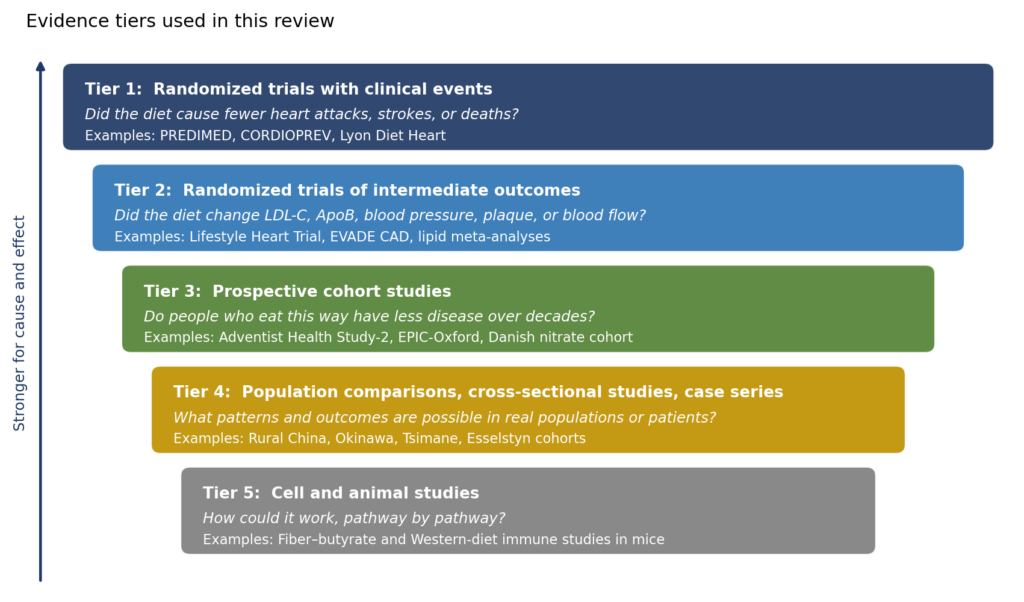
Figure 1. Five tiers of evidence used in this review, the question each tier can answer, and examples of studies in each tier. Higher tiers are better at showing cause and effect; lower tiers add breadth, duration, and biological explanation.
2. Defining the Diets and the Comparisons
The proposed diet. VLF-WFPB consists of vegetables, legumes, intact whole grains, fruit, and minimally processed starchy foods, with no animal foods and little or no added oil, operationally about 10–15% of energy from fat. The 2014 Esselstyn protocol also excluded avocado, nuts, excess salt, and sugary foods, later also caffeine and fructose, and advised a multivitamin, vitamin B12, and flaxseed meal [4]. The earlier 1985 Esselstyn cohort was not vegan: patients eliminated oil, fish, fowl, meat, and dairy products except skim milk and nonfat yogurt, targeted 10% of energy from fat, and received individualized cholesterol-lowering medication [5]. ال تجربة أورنيش لنمط حياة القلب diet was a 10%-fat whole-foods vegetarian diet that permitted nonfat dairy and egg whites [6, 7]; achieved fat intake was 6.2% of energy at one year and 8.5% at five years [6].
Related but different diets. Higher-fat whole-food vegan diets include nuts, seeds, avocado, or زيت زيتون; the low-oil phase of the 2024 Recipe for Heart Health trial still provided 32% of energy from fat [8], and the vegan arm of the EVADE CAD trial ended at about 30% [9]. Generic vegan diets exclude animal foods without constraining food processing or fat. Conventional low-fat diets are omnivorous; the low-fat arm of CORDIOPREV prescribed less than 30% fat with lean meat and low-fat dairy, and achieved 32.1% [10].
Comparators. The DASH combination diet emphasized fruits, vegetables, and low-fat dairy with reduced saturated and total fat [11]. حميات البحر الأبيض المتوسط tested in randomized trials were substantially higher in fat: the PREDIMED arms were supplemented with extra-virgin olive oil or nuts [12]; the CORDIOPREV Mediterranean arm prescribed at least 35% fat and achieved 40.5% [10]; and the Lyon intervention supplied an alpha-linolenic-acid-rich margarine in place of butter and cream, alongside advice to follow a Mediterranean-type pattern [13, 14]. ال نظام غذائي متنوع adds nuts, plant بروتين, viscous أليفاف, and plant ستيرولات to a low-saturated-fat background [15]. Table 1 summarizes the patterns as they were actually tested.
Table 1. Dietary patterns as tested.
| النمط | Defining features in the key trials | Fat, % of energy | What the label alone does not establish |
| VLF-WFPB | Legumes, intact grains, vegetables, fruit, starchy foods; no animal foods; little or no oil; Esselstyn 2014 also excluded nuts and avocado [4] | Target ~10–15%; Ornish (vegetarian, not vegan) achieved 6.2–8.5% [6] | Adequate B12, protein, essential fats, or sustained التزام |
| Higher-unsaturated-fat whole-food vegan | Animal-free, with nuts, seeds, avocado, or olive oil | 32–48% [8]; ~30% in EVADE CAD [9] | Inferiority to an oil-free vegan pattern |
| DASH | Fruit, vegetables, low-fat dairy; reduced saturated and total fat; sodium reduction in DASH-Sodium [11, 16] | Reduced, not very low | That benefit depends on dairy; event reduction in a trial |
| البحر الأبيض المتوسط | Vegetables, legumes, whole grains, nuts, extra-virgin olive oil, fish [10, 12] | 40.5% achieved in CORDIOPREV [10] | A fixed macronutrient ratio or unlimited energy |
| Portfolio | Nuts, plant protein, viscous fiber, plant sterols added to a low-saturated-fat diet [15] | Varied across trials; includes nuts but not necessarily high in fat | Event reduction; core evidence is خافض للدهون; tested patterns were not restricted to 10–15% fat |
| Conventional low-fat (omnivorous) | Lean meat, low-fat dairy, complex كربوهيدرات [10] | <30% prescribed; 32.1% achieved [10] | Equivalence to VLF-WFPB |
3. Three Levers: Animal-Food Exclusion, Total Fat, and Food Processing (Tiers 2–3)
VLF-WFPB bundles three changes that can be separated: excluding animal foods, restricting total fat to about 10–15% of energy, and building the diet from whole or minimally processed foods. The Esselstyn and Ornish programs push fat restriction and whole-food eating to their extremes and remove all or nearly all animal foods (their early protocols permitted nonfat dairy, and Ornish’s also egg whites). That makes them the natural test bed for the whole package and, for the same reason, unable on their own to apportion credit among its parts (Figure 2). The label “plant-based” describes only the first lever, and the evidence shows it is not sufficient on its own.
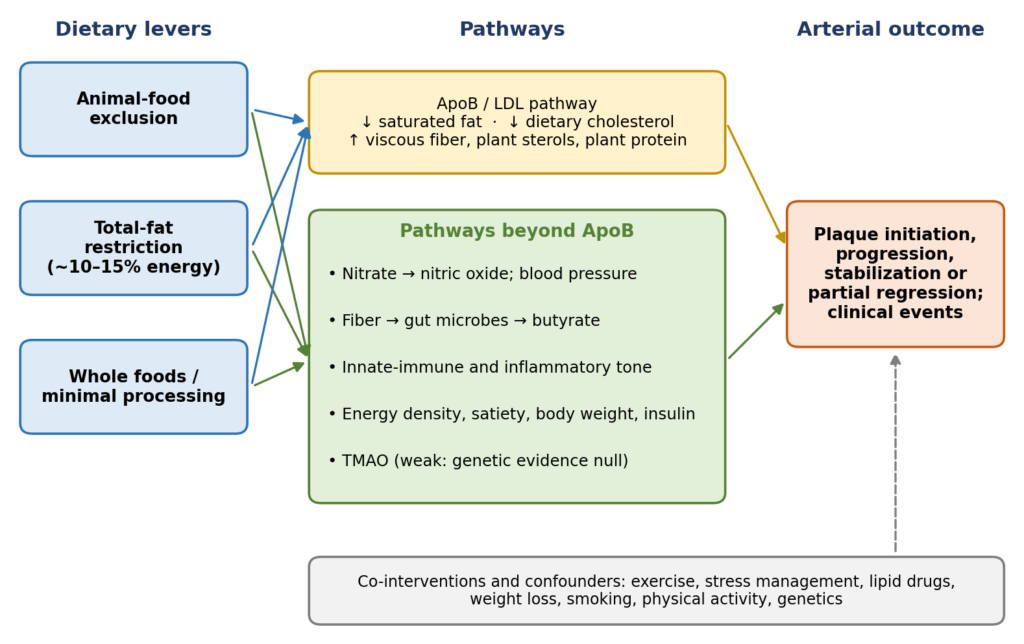
Figure 2. Three separable dietary levers and the pathways by which they could affect coronary تصلب الشرايين. Most intervention programs change all three levers together and add co-interventions, so trials cannot attribute benefit to a single lever.
Diet quality within plant-based eating. In three US cohorts totalling about 209,000 health professionals with 8,631 incident coronary events, an overall plant-based diet index was only weakly associated with lower risk (نسبة الخطر for extreme deciles 0.92; 95% CI 0.83 to 1.01). A healthful index that rewarded whole grains, fruits, vegetables, nuts, legumes, oils, tea, and coffee was associated with 25% lower risk (0.75; 0.68 to 0.83), whereas an unhealthful index that rewarded refined grains, potatoes, sweetened beverages, juices, and sweets was associated with 32% higher risk (1.32; 1.20 to 1.46) [17]. Two points follow. Plant-based eating is not protective in itself; quality determines the direction. And the healthful index scored nuts and vegetable oils as beneficial, so this evidence favors a whole-food pattern rather than specifically a very-low-fat one.
Processing within plant foods. In 126,842 البنك الحيوي البريطاني participants followed for a median of 9 years, each 10-percentage-point increase in energy from plant-sourced foods that were not ultra-processed was associated with 7% lower أمراض القلب والأوعية الدموية risk (hazard ratio 0.93; 95% CI 0.91 to 0.95) and 13% lower cardiovascular mortality (0.87; 0.80 to 0.94). Plant-sourced الأطعمة فائقة المعالجة showed the opposite association (1.05; 1.03 to 1.07 for disease and 1.12; 1.05 to 1.20 for mortality), and total plant-food intake, ignoring processing, showed no association [18].
Randomized evidence on processing. Processing also has randomized evidence, although for energy balance rather than atherosclerosis. In an inpatient crossover trial, 20 weight-stable adults received ultra-processed or unprocessed diets for two weeks each, with meals matched for presented calories, طاقة استيعابية, macronutrients, sugar, sodium, and fiber. On the ultra-processed diet they ate 508 ± 106 kcal/day more and gained 0.9 kg; on the unprocessed diet they lost 0.9 kg [19].
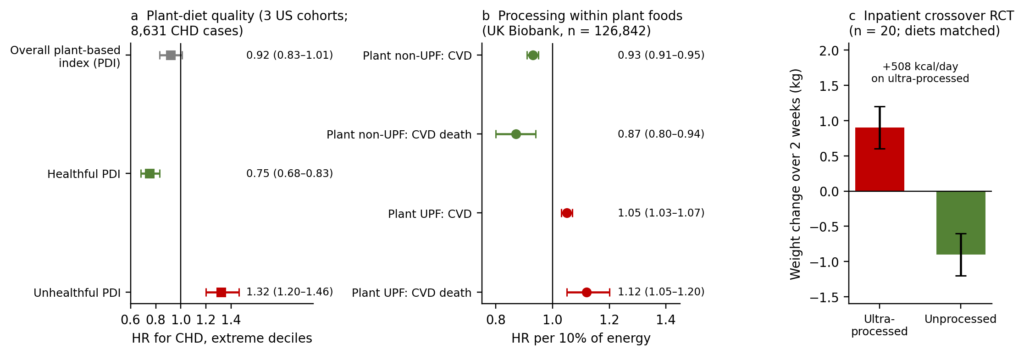
Figure 3. Diet quality and processing. (a) Plant-based diet indices and incident مرض الشريان التاجي, extreme deciles. (b) Plant-sourced foods by processing, per 10% of energy, UK Biobank. (c) Weight change in an inpatient crossover trial of ultra-processed versus unprocessed diets (mean ± SE). Panels come from different designs and are not comparable in magnitude. Sources: Satija 2017; Rauber 2024; Hall 2019.
What this changes. The evidence on processing is consistent in direction: associations for plant foods reverse with processing, and in a randomized feeding trial the ultra-processed pattern increased energy intake and weight relative to the unprocessed pattern, with nutrients matched as far as the design allowed. These findings support attention to food quality and processing; they do not establish the importance of processing relative to animal-food exclusion, a comparison no trial has made. This reframes the Esselstyn and Ornish programs. What they share with each other, and with rural China, Okinawa, and the Tsimane (Sections 6–8), is not zero animal food but a diet built almost entirely from whole, minimally processed foods. That feature, and the question of whether its benefits run only through ApoB (Section 5), are the focus of what follows.
4. The Biological Case: ApoB and the Lipid Pathway (Tiers 1–2)
4.1 Organizing framework: cumulative exposure to ApoB-containing particles
البروتين الدهني منخفض الكثافة and other ApoB-containing lipoproteins cause atherosclerotic cardiovascular disease, and genetic, epidemiologic, and trial evidence indicate that risk rises with both the magnitude and the duration of exposure [20]. Particles enter the arterial بطانة in proportion to their concentration and are retained in susceptible sites, so the relevant quantity is التعرض التراكمي rather than a single measurement. This framework is used here as an organizing principle, not as a validated numerical risk equation.
The framework has two implications for diet. First, a modest reduction sustained from early adulthood could matter more than the same reduction begun after disease is established; this is the logic behind the population evidence in Sections 6 to 8. Second, in established disease the relevant benchmark is the statin-trial slope: about a 22% relative reduction in major vascular events per 1 mmol/L (38.7 mg/dL) of LDL-C lowering over roughly five years [21]. If that slope applied to the pooled dietary LDL-C difference of 0.30 mmol/L reported below, it would predict a relative reduction of about 7% over five years (1 − 0.78^0.30). That figure is an extrapolation, not a measured dietary effect: dietary trials last weeks to months, adherence erodes, and a diet also changes body weight, blood pressure, and other factors that the ستاتين slope does not capture.
4.2 Randomized evidence on lipids and risk factors
The largest meta-analysis of randomized trials comparing vegetarian or vegan diets with omnivorous diets included 30 trials. Plant-based diets lowered الكوليسترول الكلي by 0.34 mmol/L (95% CI 0.23 to 0.44; about 13 mg/dL) and LDL-C by 0.30 mmol/L (95% CI 0.19 to 0.40; about 11.6 mg/dL). ApoB fell by 12.92 mg/dL (95% CI 3.20 to 22.63), a 14% reduction, but only six trials contributed ApoB data and heterogeneity was substantial (I² = 71.7%); الدهون الثلاثية did not differ overall [22]. The ApoB figure is the published pooled estimate; because it rests on six trials, its precision depends on those trials being independent randomized comparisons of diet alone, which could not be confirmed from the accessible sources; pooled analyses in this literature also require checking for multiple reports of a single cohort. These results support lipid-mediated plausibility. They do not establish event reduction, تراجع اللويحة, an individual’s response, or a special benefit from excluding الدهون غير المشبعة, because the trial diets and comparators varied widely.
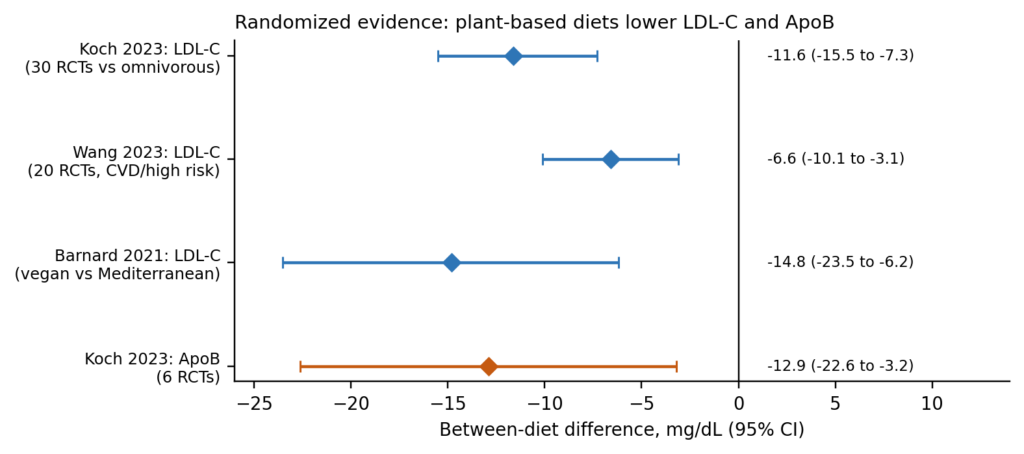
Figure 4. Randomized evidence that plant-based diets lower LDL-C and ApoB. Between-diet differences with 95% فترات الثقة; Koch 2023 values converted from mmol/L (× 38.67). Estimates share constituent trials and are not additive. Sources: Koch 2023; Wang 2023; Barnard 2021 (participants without medication changes).
A second meta-analysis restricted to people with, or at high risk of, cardiovascular disease pooled 20 trials (1,878 participants; mean duration 25.4 weeks). Vegetarian diets lowered LDL-C by 6.6 mg/dL (95% CI 3.1 to 10.1), HbA1c by 0.24 percentage points (95% CI 0.07 to 0.40), and body weight by 3.4 kg (95% CI 2.0 to 4.9), with no effect on ضغط الدم الانقباضي (−0.1 mm Hg; 95% CI −2.8 to 2.6) [7]. The article’s Key Points box states 6.8 mg/dL and 0.25%; the results section and forest plots give 6.6 mg/dL and 0.24%, which are used here. Two further details matter for Q2. Against usual diets, LDL-C fell 12.9 mg/dL; against active dietary comparators, the LDL-C difference was not statistically significant. And baseline LDL-C explained the between-trial heterogeneity [7]. Only four trials enrolled patients with established cardiovascular disease, three of them Ornish-type programs.
Blood pressure. Earlier meta-analyses, as summarized by Wang and colleagues, reported systolic reductions of about 2.5 mm Hg with vegetarian diets [7]. The null result in higher-risk patients is plausibly explained by background خافض ضغط الدم therapy and by medication reductions during trials, which the authors note could mask diet effects. Blood-pressure benefit is not specific to plant-exclusive eating: the DASH diet, which includes low-fat dairy, lowered pressure substantially in controlled feeding [11, 16], and in a direct crossover comparison a Mediterranean diet lowered systolic pressure more than a low-fat vegan diet [23]. Blood pressure is therefore not a demonstrated advantage of VLF-WFPB. Estimates from the two lipid meta-analyses are not added together; they share trials.
4.3 Dietary cholesterol
Dietary cholesterol raises serum cholesterol independently of دهون مشبعة. In a meta-analysis of egg-feeding studies cited by Freeman and colleagues, each additional 100 mg/day raised LDL-C by about 1.9 mg/dL and HDL-C by about 0.3 mg/dL; the response is larger when baseline intake is low and varies between individuals with intestinal absorption capacity [2]. Even people habituated to a very low intake respond: in eight Tarahumara men whose customary diet supplied little cholesterol, a 1,000 mg/day diet raised plasma cholesterol from 113 to 147 mg/dL after a cholesterol-free phase [24]. VLF-WFPB supplies essentially none; in EVADE CAD, dietary cholesterol fell to a median of 0 mg/day in the vegan arm versus 142 mg/day in the AHA arm [9]. The average contribution to LDL-C lowering is modest; the individual contribution can be larger. The AHA’s 2026 dietary guidance states that, for most people, dietary cholesterol is no longer a primary target for cardiovascular risk reduction [25]; eliminating it is therefore a minor, not a defining, part of the case for VLF-WFPB.
4.4 Saturated fat and what replaces it
In the current Cochrane review, reducing saturated fat lowered combined cardiovascular events (risk ratio 0.83; 95% CI 0.70 to 0.98; 12 trials, 53,758 participants), and larger reductions in saturated fat, reflected in larger cholesterol reductions, produced larger benefits. Subgroup analyses did not show a significant difference between replacing saturated fat with دهون متعددة غير مشبعة or with carbohydrate [26]. The May 2020 issue of that review reported a risk ratio of 0.79; the corrected version of record is used here. VLF-WFPB drives saturated fat very low (4.5% of energy in the EVADE vegan arm versus 6.6% in the AHA arm [9]), and it replaces it predominantly with starch and fiber from whole foods. Plant protein, viscous fiber, and plant sterols are further plausible LDL-lowering components; current اضطراب شحميات الدم guidance points patients toward reducing saturated fat and increasing fiber-rich plant foods [27].
The Portfolio evidence shows a different route to the same target. In a meta-analysis of controlled trials (439 participants), adding nuts, plant protein, viscous fiber, and plant sterols to a cholesterol-lowering NCEP Step II diet lowered LDL-C by about 17%, with reductions in ApoB and الكوليسترول المرتبط بالبروتين الدهني غير عالي الكثافة as well [15]. Because the Portfolio diet contains nuts, it demonstrates that excluding nuts is not a prerequisite for substantial dietary LDL-C lowering.
5. Beyond ApoB: The Central Question (Tiers 2–5)
If every benefit of VLF-WFPB ran through lower ApoB, the diet would be one of several interchangeable ways to lower ApoB, drugs included, and the case for its particular rules would reduce to how far and how durably it lowers جزيئات مُتصلبة العصيد. The distinctive claim of whole-food plant-based medicine is that it does more: that whole plant foods act on the بطانة الأوعية الدموية, the gut, immune signaling, blood pressure, and energy balance in ways a statin does not. That claim is biologically serious, and it is the central question of this review.
Four kinds of evidence bear on it, in increasing order of strength: (1) a mechanism demonstrated in cells or animals under conditions where lipids are unchanged or controlled; (2) human physiological or المؤشر الحيوي effects not explained by LDL-C change; (3) human outcome associations that persist after adjustment for lipids; and (4) randomized comparison of diets at matched ApoB. The subsections below درجة each candidate pathway against these criteria (Figure 6). No study yet provides the fourth kind.
5.1 Fiber, gut microbes, and butyrate
Viscous fiber lowers LDL-C, but fermentable plant polysaccharides may also act through the ميكروبيوم الأمعاء. Across 83 genetically diverse, atherosclerosis-susceptible mouse strains, the abundance of the butyrate-producing genus Roseburia was inversely related to إصابة size and was not correlated with cholesterol. In germ-free أبروليپوبروتين E–deficient mice colonized with defined bacterial communities, Roseburia intestinalis lowered systemic التهاب and atherosclerosis only when the diet was rich in plant polysaccharides, and intestinal delivery of زبدات itself reduced endotoxemia and atherosclerosis [28]. This is the clearest demonstration in this review of a diet-dependent, cholesterol-independent atheroprotective mechanism. It comes from mouse models, and no human trial has shown that raising butyrate production changes لوحة or events.
5.2 Leafy-green nitrate, nitric oxide, and the endothelium
Leafy green vegetables, central to Esselstyn’s protocol, are the main dietary source of inorganic nitrate, which the body can convert to أكسيد النيتريك through an enterosalivary pathway. In 53,150 Danish adults followed for up to 23 years (14,088 cardiovascular events), a moderate vegetable-nitrate intake (median 59 mg/day, roughly a cup of leafy greens) compared with the lowest quintile (median 23 mg/day) was associated with 15% lower cardiovascular disease risk (hazard ratio 0.85; 95% CI 0.82 to 0.89), and with lower risks of مرض القلب الإشكيمي (0.88; 0.82 to 0.94), سكتة دماغية إِشْكِيميّة (0.83; 0.76 to 0.91), and مرض الشرايين المحيطية (0.74; 0.67 to 0.83). The association plateaued above about 60 mg/day and persisted after adjustment for reported فرط كوليстеロール الدم and other dietary factors, which is not the same as controlling measured, cumulative ApoB exposure; a تحليل الوساطة estimated that baseline systolic blood pressure explained 21.9% of it [29]. The authors note that the largest nitrate trial did not lower blood pressure in older adults with elevated pressure, and that observational data cannot separate nitrate from vegetable intake in general; in this cohort lettuce and potato supplied most vegetable nitrate [29]. The finding supports the leafy-green element of the whole-food lever; it is not specific to a vegan diet.
وظيفة بطانية الأوعية الدموية (acute and short-term human physiology; relevance to events unproven). A single high-fat meal transiently impaired brachial flow-mediated dilation in healthy volunteers [30]. In the same investigators’ ten-person experiment, an olive-oil meal reduced flow-mediated dilation acutely, by 31%, and the reduction was smaller when the meal included مضاد للأكسدة vitamins or salad with balsamic vinegar [31]. Sustained feeding points the other way: in a meta-analysis of eight trials, olive-oil interventions increased flow-mediated dilation by 0.76 percentage points (95% CI 0.27 to 1.24) [32], and in 805 CORDIOPREV participants a Mediterranean diet improved flow-mediated dilation more than the low-fat diet after one year [33]. Over eight weeks in EVADE CAD, EndoPAT-measured endothelial function did not change in either arm [9]. Neither acute nor short-term vascular-function findings establish effects on events.
5.3 Inflammation and innate-immune memory
التهاب (human randomized biomarker evidence). EVADE CAD randomized 100 patients with angiographic coronary disease to eight weeks of a vegan or AHA-recommended diet, with groceries, sample menus, and dietitian support for both. At baseline 94–96% took statins and more than half took high-dose statins. The vegan diet produced a 32% lower high-sensitivity البروتين التفاعلي C (β 0.68; 95% CI 0.49 to 0.94; P = 0.02), consistent after adjustment. LDL-C was 13% lower (adjusted β 0.87; 95% CI 0.78 to 0.97), which the investigators classified as nonsignificant under their Bonferroni threshold (α = 0.0015) for secondary endpoints. Weight, HbA1c, other lipids, leukocyte activation markers, and quality of life did not differ between arms [9]. Crucially, EVADE did not test very-low-fat eating: median reported fat intake at eight weeks was 29.9% of energy in the vegan arm and 30.2% in the AHA arm, both groups were encouraged to use unsaturated oils and olive oil appeared in recipes for both, and the principal dietary contrast was plant versus animal protein, with lower saturated fat and higher fiber in the vegan arm [9]. The hs-CRP result is a biomarker finding; it does not establish fewer events or an ApoB-independent clinical benefit.
Animal work suggests how diet could leave a lasting inflammatory imprint. In LDL-receptor–deficient mice, Western-diet feeding induced systemic inflammation that disappeared from the blood after a return to standard chow, yet myeloid progenitor cells remained reprogrammed, with heightened innate-immune responses; mice also lacking NLRP3 were protected [34]. Because these mice are severely hypercholesterolemic and البروتين الدهني منخفض الكثافة المؤكسد was implicated in the human arm of the study [34], this mechanism is not independent of lipoproteins; it suggests instead that the history of dietary exposure, not only current lipid levels, may shape plaque biology. The Tsimane point the other way: about half had hs-CRP above 3 mg/L from infectious burden, yet coronary calcium was the lowest recorded, which the investigators interpret as inflammation possibly not driving atherosclerosis when LDL is low [35].
5.4 Energy density, processing, body weight, and glycemia
Body weight and energy density (human randomized biomarker evidence). Vegetarian diets reduced weight by 3.4 kg in higher-risk patients [7], and a low-fat vegan diet produced greater weight loss than a Mediterranean diet in a crossover trial [23]. In the Lifestyle Heart Trial, the experimental group lost 10.9 kg at one year and remained 5.8 kg below baseline at five years [6]. Weight loss itself lowers LDL-C, blood pressure, and glycemia, so these effects overlap with the lipid pathway and cannot be added to it.
حساسية الأنسولين and glycemia (human randomized biomarker evidence). HbA1c fell 0.24 percentage points overall and 0.36 points in people with type 2 مرض السكري [7]. This may add to lipid effects in people with diabetes, but again partly through weight.
The processing trial (Section 3) shows one non-lipid route directly: the same nutrient targets delivered as unprocessed rather than ultra-processed food reduced spontaneous energy intake by about 500 kcal/day [19]. Blood pressure is a further separate, causal pathway. It is not a demonstrated advantage of plant-exclusive eating (Section 4.2), but nitrate-rich vegetables and potassium-rich, low-sodium patterns such as DASH lower it [11, 16, 29].
5.5 Trimethylamine N-oxide
Gut microbiome and trimethylamine N-oxide (human association plus mechanistic hypothesis). Gut microbes convert dietary precursors including كولين و كارنيتين to trimethylamine, which host liver enzymes then oxidize to تريتيلمين N-أكسيد [36]; circulating TMAO predicted cardiovascular events in cohort data [37]. الوراثة العشوائية المندلية analyses have not found genetically predicted TMAO to be associated with مرض الشريان التاجي, احشاء عضلة القلب, or stroke [38], which weakens a causal interpretation, and no trial shows that lowering TMAO reduces events. The 2014 Esselstyn report asserts that its participants were unlikely to harbor TMAO-producing flora, but TMAO was not measured in that cohort [4].
5.6 Human signals that ApoB does not fully explain—and those it does
Most measured benefits of plant-based diets can run through ApoB, weight, blood pressure, and glycemia. A diet may have a real total effect even if nothing remains after conditioning on these mediators; the question of an additional effect is separate. Three observations bear on it. First, in the Lifestyle Heart Trial, experimental-group ApoB fell from 1.000 g/L at baseline to 0.769 g/L at one year but was 1.014 g/L at five years, while percent تضيق القطر continued to improve; LDL-C remained 20% below baseline at five years [6]. Because the program also included exercise, stress management, and group support, and because a year-5 snapshot does not capture the lower cumulative exposure during the preceding years, this cannot be read as diet acting independently of ApoB. Second, within STARS, progression correlated with saturated and total fat intake after adjustment for LDL-C, an observational within-trial analysis [39]. Third, in cohort data roughly one-fifth of the vegetarian–IHD association may be mediated by مؤشر كتلة الجسم [40], وفي دراسة EPIC-Oxford، ضعفت العلاقة بين النظام النباتي وأمراض القلب الإقفارية (IHD) بشكل كبير بعد التعديل لتناسب الكوليسترول المبلغ عنه ذاتيًا، وضغط الدم، ومرض السكري، ومؤشر كتلة الجسم [41]. ولم تقارن أي تجربة بين الأنماط الغذائية عند تماثل مستويات صميم البروتين الشحمي ب (ApoB)، وضغط الدم، والوزن، وهو التصميم اللازم لإثبات وجود تأثير يتجاوز العوامل الوسيطة.
يعرض الشكل 5 بيانات تجربة «نمط الحياة للقلب» (Lifestyle Heart Trial). وعلى الرغم من أنها لا تستطيع إثبات وجود تأثير غذائي مستقل عن ApoB، إلا أنها تظل أفضل دليل سريري لهذه الفرضية: لم تتناول المجموعة التجريبية أي أدوية للدهون، وكان التغير في النسبة المئوية لـ تضيق استمر من -1.75 نقطة في السنة الأولى إلى -3.07 نقطة في السنة الخامسة، بعد أن عاد ApoB إلى 101.4 ملغ/ديسيلتر (خط الأساس 100.0)، بينما ساءت حالة مجموعة الضبط [6]. وتوجد ملاحظتان إضافيتان توضحان الصورة أكثر. أولًا، كان لدى شعب «تسيماني» (Tsimane) متوسط ApoB يبلغ 97 ملغ/ديسيلتر عند الفحص، وهو ليس منخفضًا بشكل خاص، ومع ذلك لم يكن لديهم أي كالسيوم تاجي تقريبًا؛ وبلغ متوسط الكوليسترول الضار (LDL-C) لديهم حوالي 71 ملغ/ديسيلتر (1.84 مليمول/لتر) من عام 2004 إلى عام 2011 وارتفع منذ ذلك الحين، وهم يقضون ساعات يوميًا في النشاط البدني [35], لذا قد يفسر التعرض مدى الحياة والنشاط البدني ذلك بنفس قدر أي عامل غذائي. ثانيًا، لا يمكن لمجموعة «إيسلستين 1995» (Esselstyn 1995)، التي غالبًا ما يُستشهد بها في هذه الحجة، أن تدعمها: فقد تناول كل مريض أدوية لخفض الكوليسترول، وكان متوسط LDL-C لديهم 71.6 ملغ/ديسيلتر [42], لذا، يعد خفض الدهون المتزامن تفسيرًا معقولًا لجزء من التحسن، ولا يمكن للتصميم غير المحكوم عزل مساهمة النظام الغذائي أو إظهار مشاركة أي مسار يتجاوز ApoB.
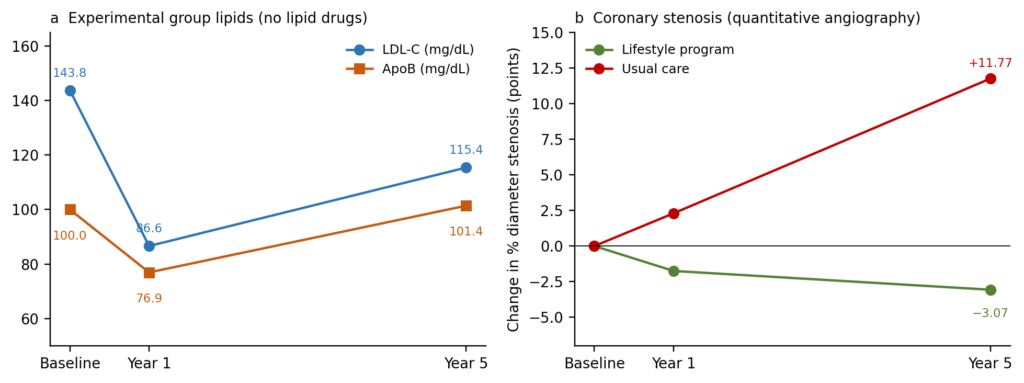
الشكل 5. تجربة نمط الحياة للقلب. (أ) LDL-C وApoB في المجموعة التجريبية، التي لم تتناول أدوية خافضة للدهون (تم تحويل ApoB من غرام/لتر × 100). (ب) التغير في نسبة تضيق القطر في تصوير الأوعية الكمي، مأخوذة من تقرير الخمس سنوات لعام 1998 لـ 35 مشاركًا خضعوا لتصوير الأوعية لمدة خمس سنوات؛ يغطي تقرير السنة الواحدة لعام 1990 جميع المشاركين الـ 48 ويعطي خطوط أساس مختلفة قليلاً، لذا لم يتم إدراج قيمه هنا. بدأ 60% من مجموعة الضبط في تناول أدوية الدهون بين العامين الأول والخامس.
5.7 تقييم الحجة القائلة بتجاوز تأثير ApoB
لذلك، فإن فرضية الفائدة الإضافية مشروطة: يمكن لنمط أكثر صرامة أن يتفوق على نظام غذائي صحي آخر إذا أدى إلى تحسن أكبر ومستمر في ApoB، أو ضغط الدم، أو الوزن، أو الصحة الأيضية دون ضعف في الالتزام أو عيوب غذائية. مصطلحات «نباتي صرف» و«بدون زيت» و«10% دهون» ليست في حد ذاتها مصطلحات معتمدة المؤشرات البديلة. كما لا يمكن تحويل التغير في الدهون الغذائية على المدى القصير ميكانيكيًا إلى خفض في الأحداث خاص بدراسة إيسلستين باستخدام منحنيات تجارب الأدوية.
بشكل عام، تعتبر الحجة القائلة بتجاوز تأثير ApoB معقولة بيولوجيًا ومدعومة جزئيًا. تُظهر النماذج الحيوانية آلية واحدة تعتمد على النظام الغذائي ومستقلة عن الكوليسترول (الألياف والبيوتيرات) وآلية واحدة للذاكرة الالتهابية الدائمة؛ وتربط الدراسات الجماعية البشرية النترات الموجودة في الخضروات الورقية بانخفاض مخاطر القلب والأوعية الدموية بعد التعديل لتناسب فرط كوليسترول الدم، والأطعمة النباتية المعالجة بالحد الأدنى بانخفاض المخاطر؛ وتُظهر تجربة عشوائية أن المعالجة وحدها تغير كمية الطاقة المتناولة [18, 19, 28, 29, 34]. وفي المقابل، ضعفت العلاقة بين النظام النباتي والشرايين التاجية في دراسة EPIC-Oxford بشكل كبير بعد التعديل لتناسب عوامل الخطر التقليدية [41], ولا تدعم الأدلة الجينية اعتبار TMAO كعامل مسبب [38], ولم تقارن أي تجربة بين الأنظمة الغذائية عند تماثل مستويات ApoB. يلخص الشكل 6 الأدلة حسب المسار؛ وقد صُممت التجربة المقترحة (القسم 17) لتقديم الاختبار المفقود.
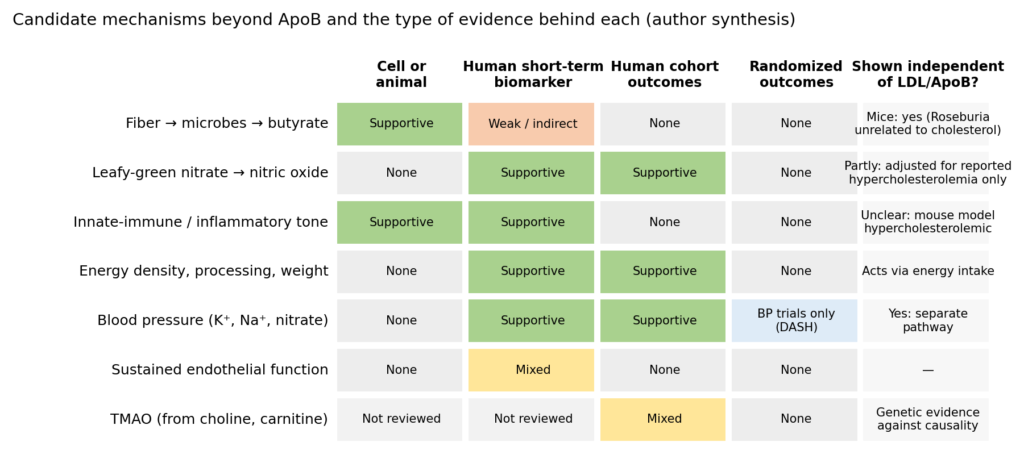
الشكل 6. الآليات المرشحة التي تتجاوز ApoB ونوع الأدلة لكل منها. تأليف الكاتب بناءً على المصادر المذكورة في القسم 5؛ تشير كلمة «داعمة» إلى اتجاه الأدلة، وليس دليلاً على وجود تأثير مسبب لتصلب الشرايين لدى البشر.
6. المناطق الريفية في الصين (المستوى 4)
6.1 ماذا تم قياسه
جمعت «دراسة الصين الأولى» بيانات الوفيات في المقاطعات مع مسوحات غذائية واختبارات الدم والبول في 65 مقاطعة ريفية و130 قرية، مع أخذ عينات من 50 بالغًا لكل قرية؛ وتم جمع بيانات النظام الغذائي والدم في الفترة ما بين 1983-1984 [43]. وفر النظام الغذائي الريفي المتوسط 14% من الطاقة من الدهون، و71% من الكربوهيدرات، و5% من كحول، و10% من البروتين، كان حوالي 11% منها من أصل حيواني (ما يقرب من 1% من إجمالي الطاقة)؛ وكان تناول الألياف 33 جم/يوم ومتوسط مؤشر كتلة الجسم 20.5 [43]. كان متوسط إجمالي الكوليسترول في الدم 127 ملجم/ديسيلتر، مقارنة بـ 203 ملجم/ديسيلتر لدى البالغين في الولايات المتحدة الذين تتراوح أعمارهم بين 20-74 عاماً [43]. كان النظام الغذائي منخفضاً في الأغذية الحيوانية، وليس نباتياً صرفاً؛ ويصف المؤلفون الأنظمة الغذائية الريفية في الفترة من 1950 إلى 1980 بأنها تحتوي على 3-6% من الأغذية ذات الأصل الحيواني [43].
6.2 ما هي أرقام الشريان التاجي
تستخدم مقارنة الشريان التاجي المقتبسة على نطاق واسع معدل الوفيات، وليس معدل الإصابة، المسجل في الفترة 1973-1975 والمقتصر على الفئة العمرية 0-64 عاماً: 4.0 لكل 100,000 رجل و3.4 لكل 100,000 امرأة في المناطق الريفية بالصين مقابل 66.8 و18.9 في الولايات المتحدة، مأخوذة من الكتاب الإحصائي السنوي لمنظمة الصحة العالمية لعام 1989، مما يعطي نسباً قدرها 16.7 و5.6 [43]. هناك أربع سمات تحد من التفسير. تسبق فترة الوفيات المسح الغذائي ومسح الدم بنحو عقد من الزمان. إن استبعاد الوفيات بعد سن 64 يزيل الأعمار التي تحدث فيها معظم وفيات الشريان التاجي. تختلف شهادات الوفاة وتشخيص الشريان التاجي في المناطق الريفية بالصين في السبعينيات عن الممارسة في الولايات المتحدة، لذا لا يمكن استبعاد نقص التحقق. كما أن الوفيات المتنافسة الناجمة عن حالات العدوى وأسباب الوفاة الأخرى، والتي يصفها المؤلفون بأنها تتجمع في نفس المقاطعات، تودي بحياة الناس قبل ظهور مرض الشريان التاجي [43]. لم يتم قياس أي عبء اللويحات تم قياسه.
6.3 ما تظهره ارتباطات المقاطعات
عبر المقاطعات، ارتبطت وفيات الشريان التاجي بشكل إيجابي مع البروتين الدهني ApoB في البلازما (r = 0.37) ومع مؤشر لتناول الملح (r = 0.42)، وبشكل عكسي مع تناول الخضروات الخضراء؛ وارتبط ApoB بدوره بتناول البروتين الحيواني واللحوم [43]. كما ارتبطت وفيات الشريان التاجي بتناول دقيق القمح (r = 0.67)، وهو ما يعزوه المؤلفون جزئياً إلى تباين الحليب والملح والدهون الثلاثية ووزن الجسم [43]. ويشير المؤلفون أنفسهم إلى أن المقاطعة، وليس الفرد، هي وحدة التحليل، لذا لا يمكن للبيانات أن توضح ما إذا كانت معدلات المرض المنخفضة تعكس تناولاً منخفضاً بشكل موحد للأغذية الحيوانية أو عدداً أقل من الأفراد الذين يأكلون أكثر [43].
6.4 المتغيرات المربكة والتفسيرات البديلة
كان مدخول الطاقة لكل كيلوغرام أعلى بنحو 30% مما هو عليه في الولايات المتحدة مع وجود نسبة أقل بكثير من السمنة، وهو ما يعزوه المؤلفون إلى زيادة استهلاك الطاقة اليومي مثل ركوب الدراجات للذهاب إلى العمل [43]. يختلف كل من النشاط البدني ووزن الجسم واستخدام التبغ والظروف الاجتماعية والاقتصادية والحصول على الرعاية الصحية والتحقق التشخيصي بين هؤلاء السكان والولايات المتحدة. لا تذكر ورقة الشريان التاجي الأمراض الإقفارية أو سكتة دماغية نزفية، ولا تقدم هذه المراجعة أي ادعاء حول أنواع السكتة الدماغية الفرعية في هذه المقاطعات. كما لم تعيد هذه المراجعة التحقق من بيانات الاتجاه لما بعد عام 1990؛ والادعاءات بأن الانتقال الغذائي اللاحق في الصين يثبت تأثيراً غذائياً سببياً يجب أن تستند إلى مجموعات سكانية متزامنة على المستوى الفردي.
6.5 فحص الملخص الثانوي
تعد مراجعة فريمان وزملائه لعام 2017 مساراً مفيداً لهذه البيانات ولكن لا ينبغي الاقتباس منها بدلاً منها [2]. يورد جدولها بشكل صحيح القيد العمري 0-64 والكوليسترول 127 ملجم/ديسيلتر، ولكنه يسرد المغذيات الكبرى بنسبة 14% دهون، و71% كربوهيدرات، و10% بروتين، والتي يصل مجموعها إلى 95% لأن نسبة 5% من الكحول في النص الأصلي قد حُذفت [2, 43]. تشير مدخلة تاراهومارا إلى فحص 528 شخصاً ومتوسط كوليسترول للبالغين يبلغ 136 ملجم/ديسيلتر [2]؛ يذكر الملخص الأصلي 523 شخصاً تتراوح أعمارهم بين 5 إلى 70 عاماً بمتوسط 125 ملجم/ديسيلتر بشكل عام و116 ملجم/ديسيلتر لدى الأطفال، ونظاماً غذائياً يحتوي على 12% دهون، و2% دهون مشبعة، و71 ملجم/يوم كوليسترول، و75% كربوهيدرات، وغياباً شبه كامل لـ ارتفاع ضغط الدم، والسمنة، والارتفاع المعتاد المرتبط بالعمر في نسبة الكوليسترول [44]. لا يمكن حل الاختلاف في القواسم دون النص الكامل. قامت دراسة تاراهومارا بقياس الدهون والنظام الغذائي، وليس نتائج الشريان التاجي.
6.6 ما تقدمه المناطق الريفية في الصين
The rural Chinese data are consistent with the cumulative-exposure hypothesis: populations with lifelong low animal-food and saturated-fat intake had low cholesterol, and county coronary mortality tracked ApoB. That strengthens plausibility for Q1. It says nothing decisive about Q2 or Q3, because the diet was neither vegan nor compared with a high-quality alternative, and because activity, body size, and competing mortality are inseparable from diet in these data.
7. Traditional Okinawa (Tier 4)
The traditional حمية أوكيناوا is known chiefly from a 1949 survey, conducted during post-war scarcity and US administration, as analyzed by the Willcox group. Sweet potato supplied about 69% of energy; total energy intake was about 1,785 kcal/day; fat supplied roughly 6% of energy; and meat intake was a few grams per day, with small amounts of fish, soy, and seaweed [45, 46]. The Willcox group estimates that adults ate about 11% fewer calories than needed to maintain weight until the late 1960s, with a lean average body mass index of 21 [47]. Interpretation is contested: one critic has argued that the Okinawan data reflect severe malnutrition, whereas Gavrilova and Gavrilov, responding, attribute the later loss of longevity advantage to westernization of the diet and note that a low infectious burden may also have contributed [48]. A single post-war survey cannot establish lifelong intake.
Coronary outcomes should be judged directly rather than through longevity. The same group reports that older Okinawans have about 80% less coronary mortality than the US population, based on age-adjusted vital statistics rather than individual dietary linkage [47]. The advantage has not persisted: Okinawans who did not experience the energy-restricted era now have higher body mass index, more type 2 diabetes, and worse cardiovascular risk factors than other Japanese, and the prefecture’s life-expectancy advantage is now confined to older ages [47]. That transition is compatible with a dietary contribution but equally with changes in energy balance, activity, and other exposures.
Okinawa informs the hypothesis in a limited way. It shows that a very-low-fat, high-carbohydrate, plant-predominant diet is compatible with low coronary mortality. It does not show that complete exclusion of animal foods is necessary, because the traditional diet included pork and fish, and it cannot separate low fat from caloric restriction, low body size, physical labor, or علم الوراثة. Its shared features with DASH and Mediterranean patterns are high vegetable and legume intake, low saturated fat, and low energy density; its distinctive features are very low total fat, a single dominant starchy staple, and chronic mild energy restriction.
8. Other Traditional Populations: The Tsimane and Kitava (Tier 4)
The Tsimane. The Tsimane, forager-horticulturalists of the Bolivian Amazon, provide the only traditional-population data in this review with direct تصوير الشريان التاجي. Of 705 adults aged 40 to 94 scanned in 2014–2015, 596 (85%) had no coronary شريان calcium, 89 (13%) had scores of 1–100, and 20 (3%) had scores above 100; among those older than 75, 31 (65%) had none and four (8%) had scores of 100 or more [35]. Mean LDL-C was 91 mg/dL and HDL-C 39.5 mg/dL, and obesity, hypertension, ارتفاع سكر الدم, and regular تدخين were rare. Compared with the US ميسا cohort, the Tsimane reached a nonzero نقاط الكالسيوم about 24 years later and a score of 100 or more about 28 years later [35] (Figure 7).
The Tsimane diet is low in fat and minimally processed but not plant-exclusive: about 14% of energy from protein, 14% from fat, and 72% from carbohydrate, an estimated 38 g of fat per day including 11 g of saturated fat and no trans fat, with rice, plantain, manioc, and corn as staples and meat and fish obtained by hunting and fishing [35]. Men and women average 6–7 and 4–6 hours of physical activity per day. The limits are important: calcium scoring cannot detect لويحة غير متكلسة، التصميم مقطعي، وبيانات النتائج شحيحة، مع حالة واحدة محتملة لاحتشاء عضلة القلب بين 50 حالة وفاة حديثة للبالغين تم التأكد منها عن طريق التشريح اللفظي. ارتفع كوليسترول البروتين الدهني منخفض الكثافة (LDL-C) بنحو 0.16 ملي مول/لتر سنوياً منذ عام 2011 حيث أدى التنقل النهري الآلي إلى تحسين الوصول إلى أطعمة الأسواق [35]، وهي تجربة طبيعية لم تُعرف بعد عواقبها التاجية.
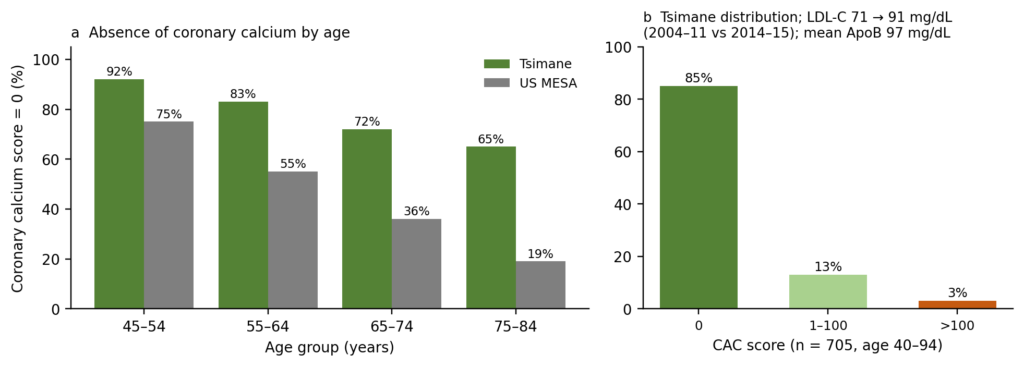
الشكل 7. كالسيوم الشريان التاجي لدى شعب التسيماني. (أ) النسبة التي سجلت صفراً في درجة الكالسيوم حسب الفئة العمرية، التسيماني مقابل دراسة MESA الأمريكية، كما هو موضح في الشكل 2 من دراسة كابلان 2017. (ب) توزيع الدرجات بين 705 من البالغين من التسيماني. لا يكشف تسجيل الكالسيوم عن اللويحات غير المتكلسة.
كيتافا. في جزيرة كيتافا بجزر تروبياند، حيث تعتبر الدرنات والفواكه والأسماك وجوز الهند من الأطعمة الأساسية، لم تحدد المقابلات شبه المنظمة مع 213 شخصاً بالغاً أي حالة تتوافق مع السكتة الدماغية أو الموت المفاجئ أو ذبحة صدرية، وأظهرت مخططات كهربائية القلب أثناء الراحة القليل من التشوهات [49]. كان التدخين شائعاً: 76% من الرجال و80% من النساء فوق سن العشرين كانوا يدخنون في مسح عوامل الخطر [50]. تعتمد الأدلة على المقابلات ومخططات كهربائية القلب بدلاً من التصوير أو تسجيل الوفيات.
ما تضيفه هذه المجموعات السكانية. لم يكن أي منهم نباتياً صرفاً، ولم تكن مآخذهم من الدهون منخفضة بشكل موحد في الدهون المشبعة. وفر نظام كيتافا الغذائي حوالي 21% من الطاقة كدون و17% كأحماض دهنية مشبعة، معظمها من حمض اللوريك والميريستيك من جوز الهند [51]، وهو استثناء واضح لهذا النمط. ما يشترك فيه سكان الريف في الصين، وأوكيناوا التقليدية، والتسيماني، وكيتافا هو الأنظمة الغذائية القائمة على الأطعمة الأساسية الكاملة والمعالجة بالحد الأدنى، والنحافة، وفي معظم الحالات النشاط البدني العالي. يدعم هذا النمط حجة التعرض التراكمي ورافعة الغذاء الكامل؛ ولا يقدم أي دعم للادعاء بأن الاستبعاد التام للأطعمة الحيوانية مطلوب. وتراوح تناول الدهون من منخفض جداً في أوكيناوا إلى منخفض بين التسيماني، وكان جوز الهند غذاءً أساسياً في كيتافا.
9. أدلة الدراسات الأترابية المستقبلية (المستوى 3)
شمل التحليل التلوي الأكثر شمولاً للأتراب 13 أتراباً مستقبلياً مع 844,175 مشاركاً. بالمقارنة مع غير النباتيين، كان لدى النباتيين خطر أقل للإصابة بأمراض القلب والأوعية الدموية (الخطر النسبي 0.85؛ فاصل ثقة 95% 0.79 إلى 0.92؛ 8 أتراب) وأمراض القلب الإقفارية (0.79؛ فاصل ثقة 95% 0.71 إلى 0.88؛ 8 أتراب)، ولكن ليس من إجمالي السكتة الدماغية (0.90؛ فاصل ثقة 95% 0.77 إلى 1.05؛ 12 أتراباً). بالنسبة للنباتيين الصرف، كان تقدير أمراض القلب الإقفارية 0.82 (فاصل ثقة 95% 0.68 إلى 1.00؛ 6 دراسات)، وتقدير أمراض القلب والأوعية الدموية 0.92 (فاصل ثقة 95% 0.79 إلى 1.06). كان خطر التحيز متوسطاً في ثمانية أتراب وخطراً في خمسة [40]. تم استخدام تقديرات الحدوث بدلاً من الوفيات حيثما تم الإبلاغ عن كليهما. كان الارتباط بمرض القلب الإقفاري أضعف عند استبعاد المتابعة المبكرة، وبدا أن حوالي خمسه يعزى إلى مؤشر كتلة الجسم، وكانت قيمة E تساوي 1.86 (الحد الأدنى لثقة 1.49)، مما يعني أن عاملاً غير مقاس متغير مربك سيحتاج إلى ارتباطات بهذه القوة مع كل من النظام الغذائي والمرض لتفسير ذلك [40].
يعود رقم “خطر تاجي أقل بنسبة 40%” الذي يلحق أحياناً بالأنظمة الغذائية النباتية إلى تحليل تلوي اقتصر على أتراب السبتيين، والذي سجل خطراً نسبياً قدره 0.60 (فاصل ثقة 95% 0.43 إلى 0.80) للأحداث التاجية [2, 52]. هذا التقدير خاص بمجتمع معين ولا ينبغي تعميمه. تتكرر العديد من أتراب السبتيين وأكسفورد عبر التحليلات التلوية، لذا فإن الاستشهاد المتكرر ليس تأكيداً مستقلاً. يتم تحديد فئات النباتيين والنباتيين الصرف في الدراسات الأترابية من خلال استبعاد الأطعمة الحيوانية، وليس من خلال إجمالي الدهون، لذا لا يوجد أي من هذه الأدلة يختبر مكون الدهون المنخفضة جداً.
البيانات الخاصة بنقاط النهاية مهمة. في دراسة EPIC-Oxford (شملت 48,188 مشاركاً تمت متابعتهم لمدة 18.1 عاماً)، كان لدى النباتيين، بما في ذلك النباتيين الصرف، معدل إصابة بأمراض القلب الإقفارية أقل بنسبة 22% مقارنة بآكلي اللحوم (نسبة الخطر 0.78؛ فاصل ثقة 95% 0.70 إلى 0.87)، وهو ما يعادل حوالي 10 حالات أقل لكل 1,000 شخص على مدى 10 سنوات؛ وأدى التعديل لارتفاع الكوليسترول وضغط الدم والسكري ومؤشر كتلة الجسم المُبلغ عنها ذاتياً إلى تقليص التقدير إلى 0.90 (فاصل ثقة 95% 0.81 إلى 1.00). وكان لدى المجموعة نفسها معدل إجمالي للسكتة الدماغية أعلى بنسبة 20% (1.20؛ فاصل ثقة 95% 1.02 إلى 1.40)، أي حوالي ثلاث حالات إضافية لكل 1,000 شخص على مدى 10 سنوات، ومعظمها نزفية، ولم يضعف هذا الارتباط مع تعديل عوامل الخطر [41]. ولذلك، يجب الإبلاغ عن الفوائد التاجية ومخاطر السكتة الدماغية بشكل منفصل، ويتسق تضاؤل الارتباط التاجي مع حقيقة أن الفائدة تعود في الغالب إلى عوامل الخطر التقليدية.
الشكل 8. تقديرات الدراسات الأترابية الاستباقية للأنظمة الغذائية النباتية والنباتية الصرفة. يضعف الارتباط التاجي بعد التعديل لعوامل الخطر التقليدية (EPIC-Oxford)، ومخاطر السكتة الدماغية ليست أقل. تُعرض التقديرات جنباً إلى جنب، وليس بشكل مجمع؛ تتداخل عدة أتراب عبر التحليلات التلوية. المصادر: Dybvik 2023؛ Tong 2019؛ Orlich 2013؛ Kwok 2014.
9.1 انحياز المستخدم الصحي: لماذا يصعب تفسير الارتباطات
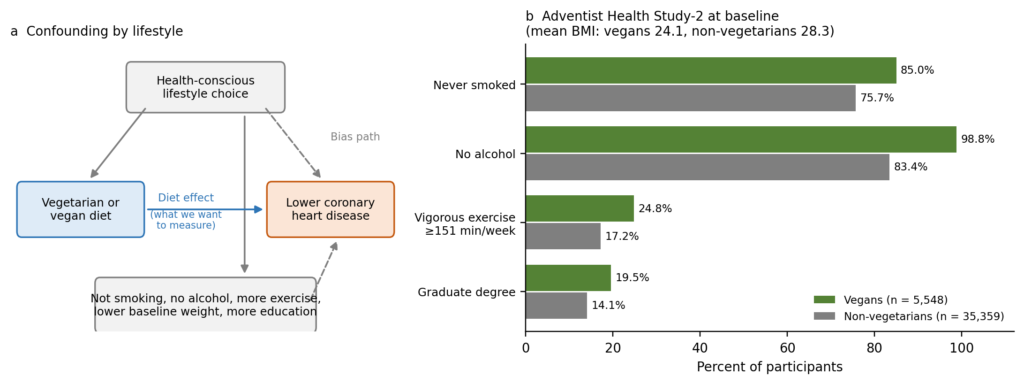
تقارن الدراسات الأترابية بين الأشخاص الذين اختاروا أنظمة غذائية مختلفة، وعادة ما يختار الأشخاص الذين يتبعون نظاماً غذائياً نباتياً عادات صحية أخرى أيضاً. يسمى هذا انحياز المستخدم الصحي، وهو شكل من أشكال الخلط: فجزء من الاختلاف الملحوظ في المرض، أو كله، قد ينجم عن العادات الأخرى وليس عن النظام الغذائي نفسه. وتوضح بيانات الأدفنتست المشكلة بوضوح. فبالمقارنة مع غير النباتيين في دراسة صحة الأدفنتست-2، كان النباتيون الصرف أكثر عرضة لعدم التدخين مطلقاً (85.0% مقابل 75.7%)، وأكثر عرضة بكثير لعدم شرب الكحول (98.8% مقابل 83.4%)، وأكثر عرضة لممارسة التمارين الرياضية العنيفة لمدة 151 دقيقة على الأقل أسبوعياً (24.8% مقابل 17.2%)، وأكثر عرضة للحصول على درجة جامعية عليا (19.5% مقابل 14.1%)، وكانوا أكثر نحافة (متوسط مؤشر كتلة الجسم 24.1 مقابل 28.3) [53] (الشكل 9). ويشير المؤلفون إلى أن الاختيار الواعي لنمط الحياة المتمثل في النظام الغذائي النباتي قد يؤثر بحد ذاته على النتائج، وأن احتمالية وجود متغيرات مربكة غير مضبوطة تظل قائمة [53].
يستخدم الباحثون عدة أدوات لتقليل هذا الانحياز، ولكل منها حدود. مقارنة الأشخاص المتشابهين: في كل من دراسة صحة الأدفنتست-2 وEPIC-Oxford، تعتبر المجموعة المقارنة من غير النباتيين بحد ذاتها واعية صحياً نسبياً، كما أن قلة قليلة من الأدفنتست يدخنون أو يشربون الكحول، مما يضيق الفجوة دون سدها [53]. التعديل الإحصائي: تقوم النماذج بالتعديل لعوامل التدخين والتمارين الرياضية والتعليم وعوامل مماثلة، ولكن فقط للعوامل التي تم قياسها، وبقدر دقة قياسها فقط. مراقبة تأثير التعديل: عندما أضافت دراسة EPIC-Oxford الكوليسترول وضغط الدم والسكري ومؤشر كتلة الجسم إلى نموذجها، تحركت نسبة خطر الإصابة بأمراض القلب الإقفارية لدى النباتيين من 0.78 إلى 0.90 [41]؛ وهذا يشير إلى أن الكثير من الفائدة يمر عبر عوامل الخطر تلك، وهو أمر متوقع إذا كان النظام الغذائي فعالاً، كما يوضح مدى حساسية التقدير لخيارات النمذجة. قياس المتانة: في التحليل التلوي لـ Dybvik، سيحتاج المتغير المربك غير المقاس إلى خطر نسبي قدره 1.86 مع كل من النظام الغذائي وأمراض القلب لتفسير الارتباط وإسقاط أثره [40]. المدة والعمر: في تحليل مجمع لخمسة أتراب، اقتصر انخفاض وفيات أمراض القلب الإقفارية لدى النباتيين على الأشخاص الذين اتبعوا نظامهم الغذائي لأكثر من خمس سنوات، وكان أكبر في الفئات العمرية الأصغر (أقل بنسبة 45% تحت سن 65، وأقل بنسبة 31% في سن 65-79، وأقل بنسبة 8% -غير ذات دلالة إحصائية- في سن 80-89) [54]. إن وجود علاقة مع مدة اتباع النظام الغذائي هو ما قد ينتج عن تأثير سببي، على الرغم من أن النباتيين لفترات طويلة قد يختلفون أيضاً في عادات طويلة الأمد أخرى.
ثمة ملاحظتان إضافيتان تحتملان التأويلين. فقد وجد تحليل تلوي ارتباطاً أكبر بأمراض القلب الإقفارية في أتراب الأدفنتست (خطر نسبي 0.60) مقارنة بالأتراب من غير الأدفنتست (0.84؛ فاصل ثقة 95% 0.74 إلى 0.96) [52]. قد يعكس هذا الاختلاف تأثيرات المستخدم الصحي الأقوى بين الأدفنتست، أو قد يعكس ما يأكله النباتيون الأدفنتست فعلياً: أبلغ النباتيون الصرف (الفيغان) الأدفنتست عن تناول حوالي 46-47 جراماً من الألياف يومياً، مقارنة بحوالي 26-28 جراماً لدى النباتيين الصرف في دراسة EPIC-Oxford [53]. و السببية العكسية—تغيير الأشخاص لنظامهم الغذائي بعد الإصابة بمرض مبكر—يتم تقليله ولكن لا يتم القضاء عليه من خلال استبعاد الأشخاص المصابين بأمراض القلب والأوعية الدموية مسبقاً عند التسجيل، كما فعلت كلا المجموعتين [41, 53].
لا يعني أي من هذا أنه يجب تنحية أدلة الدراسات الحشدية جانباً. فهي كبيرة، وطويلة الأمد، ومتسقة عبر البلدان، ومتوافقة في اتجاهها مع تجارب الدهون العشوائية ومع علم الأحياء. يجب قراءتها كأدلة من المستوى الثالث: قوية من حيث الارتباط، وداعمة ولكنها ليست حاسمة فيما يخص السببية، وغير قادرة بمفردها على تفضيل نظام غذائي صحي على آخر.
الشكل 9. انحياز المستخدم الصحي. (أ) كيف يمكن لاختيار نمط الحياة أن يربط نظاماً غذائياً بانخفاض أمراض القلب من خلال مسارات أخرى غير النظام الغذائي نفسه. (ب) الخصائص الأساسية للنباتيين الصرف وغير النباتيين في دراسة Adventist Health Study-2، الموحدة حسب العمر والجنس والعرق كما ورد في Orlich 2013.
9.2 هل حال النباتيين الصرف (الفيغان) أفضل من النباتيين الآخرين؟
تستبعد الأنظمة الغذائية النباتية الصرفة جميع الأطعمة الحيوانية؛ وتشمل الأنظمة الغذائية النباتية (الألبان والبيض) منتجات الألبان والبيض؛ نباتي مع تناول الأسماك تشمل الأنظمة الغذائية الأسماك. إذا كان الاستبعاد الكامل للأطعمة الحيوانية يضيف حماية، فينبغي أن يكون أداء النباتيين الصرف أفضل من المجموعات الأخرى. لا تظهر بيانات الدراسات الحشدية ذلك (الشكل 10).
دراسة Adventist Health Study-2. مقارنة بغير النباتيين، كانت نسبة المخاطر للوفاة بسبب أمراض القلب الإقفارية 0.90 (فاصل ثقة 95٪ 0.60 إلى 1.33) للنباتيين الصرف، و0.82 (0.62 إلى 1.06) للنباتيين (الألبان والبيض)، و0.65 (0.43 إلى 0.97) للنباتيين الذين يتناولون الأسماك، وهو الانخفاض الوحيد ذو الدلالة الإحصائية [53]. بين الرجال، كانت نسب المخاطر لدى النباتيين الصرف 0.45 (0.21 إلى 0.94) للوفاة بسبب أمراض القلب الإقفارية و0.58 (0.38 إلى 0.89) للوفاة بسبب أمراض القلب والأوعية الدموية؛ وبين النساء كانت التقديرات المقابلة 1.39 (0.87 إلى 2.24) و1.18 (0.88 إلى 1.60) [53]. سجلت المجموعة بأكملها 372 حالة وفاة بسبب أمراض القلب الإقفارية على مدى متوسط 5.79 سنوات، لذا فإن تقديرات هذه المجموعات الفرعية غير دقيقة، كما اختلف ارتباط النظام الغذائي النباتي بالوفيات الناجمة عن أمراض القلب والأوعية الدموية بشكل كبير حسب الجنس [53]. في متابعة عام 2024 الأطول لـ 88,400 مشارك، كان لدى النباتيين بشكل عام معدل وفيات أقل بسبب أمراض القلب الإقفارية، لكن النظام الغذائي النباتي الصرف لم يكن مرتبطاً بانخفاض الوفيات لجميع الأسباب لدى الرجال والنساء معاً؛ حيث سجل الرجال النباتيون صرفاً معدل وفيات أقل فقط في الأعمار الأصغر [55].
دراسة EPIC-Oxford والدراسات الحشدية المجمعة. مقارنة بآكلي اللحوم، كانت نسبة حدوث أمراض القلب الإقفارية في دراسة EPIC-Oxford هي 0.82 (0.64 إلى 1.05) لدى النباتيين الصرف (67 حالة)، و0.77 (0.69 إلى 0.86) لدى النباتيين (الألبان والبيض)، و0.87 (0.77 إلى 0.99) لدى آكلي الأسماك [41]. في التحليل المجمع لخمس دراسات حشدية، كان معدل الوفيات بسبب أمراض القلب الإقفارية أقل بنسبة 26٪ لدى النباتيين الصرف وأقل بنسبة 34٪ لدى كل من النباتيين (الألبان والبيض) وآكلي الأسماك مقارنة بآكلي اللحوم المنتظمين [54]. وجدت مراجعة منهجية للأنظمة الغذائية النباتية الصرفة أن أياً من الدراسات الحشدية الثلاث، التي شملت ما لا يقل عن 7,380 نباتياً صرفاً، لم تبلغ عن مخاطر أعلى أو أقل بشكل ملحوظ لأي نتيجة أولية لأمراض القلب والأوعية الدموية للنباتيين الصرف [56].
ما يظهره هذا وما لا يظهره. عدد النباتيين الصرف قليل، لذا فإن تقديراتهم واسعة وغير حاسمة وليست منعدمة الأثر. والأهم من ذلك لهذه المراجعة، أن النباتيين الصرف في هذه الدراسات لم يتبعوا نظام VLF-WFPB: حيث حصل النباتيون الصرف في دراسة EPIC-Oxford على 28.1٪ من طاقتهم من الدهون وتناولوا حوالي 26 جراماً من الألياف يومياً [41]، وهو ليس منخفض الدهون جداً ولا غني بالأطعمة الكاملة بشكل خاص. لا تثبت هذه الدراسات أن النباتيين الصرف لديهم مخاطر أقل للإصابة بأمراض القلب والأوعية الدموية من النباتيين (الألبان والبيض) أو آكلي الأسماك؛ كما أنها لا تثبت التكافؤ أو الدونية، حيث تتم مقارنة كل مجموعة بآكلي اللحوم بدلاً من مقارنتها ببعضها البعض، وفي دراسة EPIC-Oxford كان التقدير النقطي للنباتيين الصرف أقل عددياً من تقدير آكلي الأسماك. وضمن دراسة Adventist Health Study-2، ارتبط البروتين من المكسرات والبذور بانخفاض الوفيات القلبية الوعائية بنسبة 40٪، والبروتين من اللحوم بارتفاع الوفيات بنسبة 61٪، عند مقارنة الشريحة الخمسية الأعلى بالأدنى؛ استمرت هذه الارتباطات بعد التعديل لنوع النظام الغذائي النباتي [57]. That pattern favors plant protein and nuts. It does not favor excluding nuts or all animal foods.
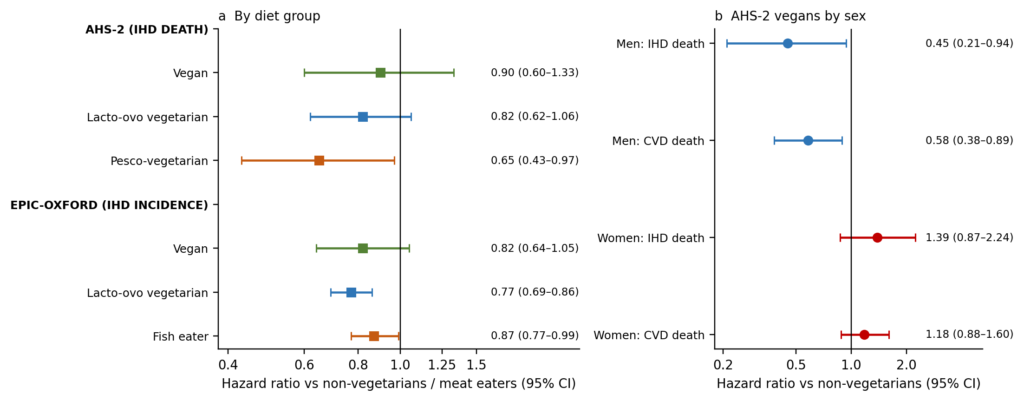
Figure 10. Vegans compared with other vegetarian groups. (a) Ischemic heart disease by diet group in Adventist Health Study-2 (deaths) and EPIC-Oxford (incident cases), each compared with non-vegetarians or meat eaters. (b) Adventist Health Study-2 vegans by sex. Wide intervals reflect small numbers of vegans. Sources: Orlich 2013 (Table 4); Tong 2019 (Supplementary Table 3).
9.3 Chinese and Taiwanese vegetarians
The search for this review found no prospective study from mainland China comparing vegans with omnivores for heart disease outcomes. The available Chinese and Taiwanese evidence concerns vegetarians, most of whom eat dairy and often eggs. In Taiwan, two Buddhist Tzu Chi cohorts (13,352 participants in total) found lower stroke risk among vegetarians: in the first cohort, the hazard ratio for ischemic stroke was 0.26 (95% CI 0.08 to 0.88); in the second, overall stroke 0.52 (0.33 to 0.82), ischemic stroke 0.41 (0.19 to 0.88), and hemorrhagic stroke 0.34 (0.12 to 1.00) [58]. Participants were members of a Buddhist foundation, a population with its own healthy-user profile, and an exploratory analysis suggested that vitamin B12 intake modified the association [58]. The hemorrhagic stroke result runs opposite to EPIC-Oxford’s [41], a reminder that stroke subtypes behave differently across populations.
في الدراسات المقطعية from Xiamen, 169 healthy Chinese lacto-vegetarian men had lower blood pressure, LDL-C, ApoB, triglycerides, and fasting جلوكوز, and thinner carotid سُمك البطانة الوسطانية, than 126 omnivorous men [59]. This is Tier 4 evidence on المؤشرات البديلة in dairy-eating vegetarians.
Hong Kong data add a caution. Vitamin B12 deficiency was reported in about 80% of Hong Kong vegans, who rarely used fortified foods or supplements; B12-deficient vegetarian groups showed impaired arterial endothelial function and thicker carotid walls, and B12 supplementation improved these vascular measures in Hong Kong vegans [60]. An unsupplemented vegan diet can therefore undermine the vascular benefit it is meant to provide, which reinforces the nutrient guidance in Section 15.
10. Esselstyn’s Studies Reassessed (Tier 4)
10.1 The 1985 Cleveland Clinic cohort
Three reports describe this cohort, and their denominators differ. The full 1995 report describes 22 patients (21 men, 1 woman) with severe, angiographically documented coronary disease enrolled between 1985 and 1988; the 11 participants whose results are reported all had triple-vessel disease and were nondiabetic, nonhypertensive nonsmokers [42]. The diet derived less than 10% of energy from fat and excluded oils, meat, fish, fowl, and dairy except skim milk and nonfat yogurt. Every participant also received an individualized cholesterol-lowering drug, most often cholestyramine 4 g twice daily with lovastatin 40–60 mg daily; relaxation and meditation training was offered but abandoned within weeks, and exercise was not prescribed [42]. In the 11 imaged participants, mean total cholesterol fell from 246 mg/dL at baseline to 132.4 mg/dL during treatment, with mean LDL-C 71.6 mg/dL and HDL-C 36.3 mg/dL [42].
Of 38 lesions with more than 20% stenosis in those 11 participants, three treated by رأب الأوعية الدموية and four native-vessel lesions proximal to bypass grafts were excluded a priori—the latter because, as the authors note, such lesions were expected to progress, and they did—and six more could not be matched at follow-up, leaving 25 [42]. Two technicians masked to تصوير الأوعية الدموية sequence read the films. By percent diameter stenosis, 11 of 25 lesions regressed and 14 were stable, mean stenosis fell from 53.4% to 46.2% (estimated decrease 7 percentage points; 95% CI 3.3 to 10.7), and 8 of 11 participants were classified as regressing. By minimal لومن diameter, the less reference-dependent measure, 6 lesions regressed, 14 were stable, and 5 progressed, and the mean increase was 0.08 mm (95% CI −0.06 to 0.22; not significant) [42].
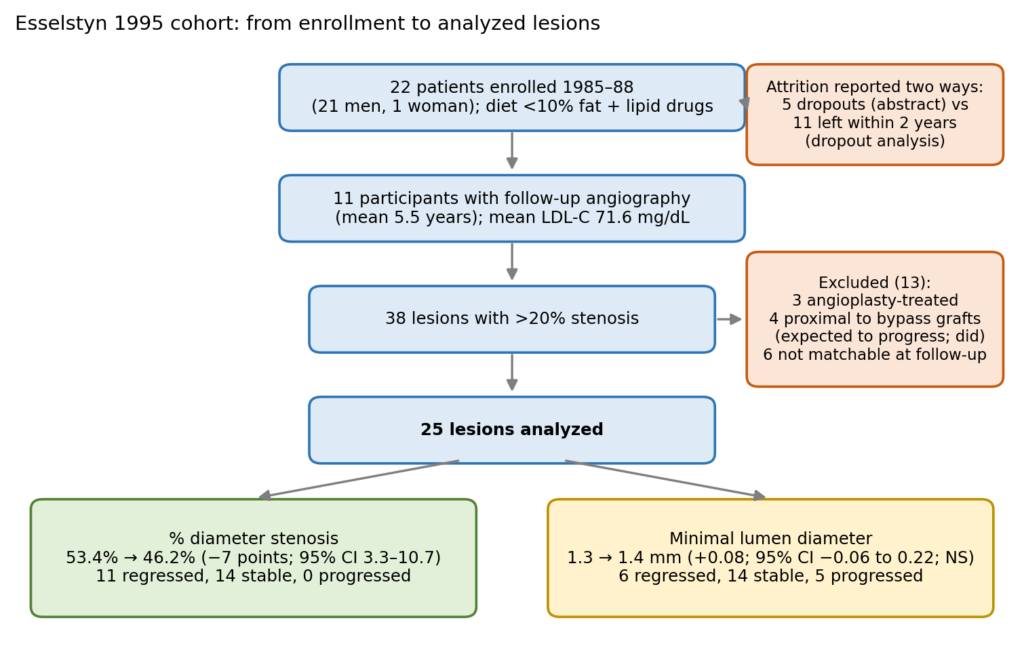
الشكل 11. مجموعة إيسلستين 1995: التسجيل، والتناقص، واختيار الآفات، والنتائج التصويرية للأوعية بالطريقتين اللتين تم الإبلاغ عنهما. المصدر: إيسلستين 1995 (النص الكامل).
تورد الورقة البحثية نفسها بيانات التناقص بطريقتين. يذكر ملخصها أن 5 من أصل 22 مشاركاً انسحبوا في غضون عامين والتزم 17 بالنظام الغذائي؛ ويذكر تحليل الانسحاب أن 11 غادروا في غضون عامين (ثلاثة انتقلوا، وأربعة لديهم تعارضات في العمل، وثلاثة لم يتمكنوا من الحفاظ على النظام الغذائي، وواحد اختار جراحة المجازة التاجية) [42]. الـ 5 المنسحبون الذين استأنفوا نظامهم الغذائي السابق أبلغوا عن 10 أحداث قلبية. تعرض المشاركون الـ 11 الذين خضعوا للتصوير لـ 37 حدثاً قلبياً وعائياً في السنوات الثماني التي سبقت التسجيل. لم يصب أي منهم باحتشاء جديد خلال فترة المتابعة، رغم أن اثنين تطلبا إجراءات تاجية أثناء الدراسة (تكرار رأب الوعاء في أحدهما، وجراحة مجازة في الآخر) والمريض الذي خضع لجراحة المجازة، والذي كان كسر القذف أقل من 20%، توفي لاحقاً بسبب عدم انتظام ضربات القلب [42].
يصف تحديث عام 1999 المجموعة بأنها 24 مريضاً (23 رجلاً، امرأة واحدة). تم تسريح ستة مرضى غير ملتزمين في غضون 12-18 شهراً وعادوا إلى الرعاية القياسية؛ التزم 18 مريضاً لمدة خمس سنوات، وخضع 11 منهم لتصوير الأوعية لمدة خمس سنوات مما أظهر توقف التدهور في جميع الـ 11 وتراجعاً في 8 (73%) حسب نسبة التضيق. انخفض متوسط الكوليسترول من 237 إلى 137 ملغ/ديسيلتر على مدى خمس سنوات وكان 145 ملغ/ديسيلتر في 12 عاماً. أُفيد بأن الـ 18 مريضاً الملتزمين تعرضوا لـ 49 حدثاً تاجياً في السنوات الثماني التي سبقت التسجيل ولم يتعرضوا لأي حدث خلال فترة المتابعة، بينما تعرض المرضى الستة الذين تم تسريحهم لـ 13 حدثاً جديداً بحلول عام 1998 [5]. تعكس عبارة "لا توجد أحداث تاجية" تصنيف الأحداث الخاص بالتقرير: شملت المجموعة نفسها حالة وفاة بسبب عدم انتظام ضربات القلب البطيني دون احتشاء بعد تصوير الأوعية لخمس سنوات [42]. يقدم تقرير عام 2014 ملخصاً آخر، حيث يذكر أن 17 من أصل 22 مريضاً كانوا ملتزمين وأن عكس تم تأكيده عن طريق تصوير الأوعية في 4 من أصل 12 [4]. يختلف مستوى الكوليسترول الأساسي (246 مقابل 237 ملغ/ديسيلتر)، وحجم المجموعة (22 مقابل 24)، وتعداد الأحداث السابقة (37 حدثاً في 11 مريضاً في مناقشة عام 1995 مقابل 49 حدثاً في 18 مريضاً في عام 1999) عبر التقارير. يتداول رقمان مختلفان بنسبة 73%: 8 من أصل 11 مريضاً مصوراً يعانون من تراجع بنسبة التضيق، و16 من أصل 22 مريضاً أصلياً ما زالوا يتبعون النظام الغذائي في عام 1995 [5, 42].
إن مقارنة الأحداث بعد التسجيل بالأحداث في السنوات الثماني السابقة عرضة للانحدار نحو المتوسط، لأن المرضى عادة ما يدخلون مثل هذه البرامج بعد سلسلة من الأحداث. جمع النظام العلاجي بين النظام الغذائي والأدوية، لذلك لا يمكن تقدير المساهمة المستقلة للنظام الغذائي.
10.2 مجموعة عام 2014 المكونة من 198 مريضاً
التصميم والتسجيل. تم تقديم المشورة لمئتي متطوع متتاليين من المحالين ذاتياً والمصابين بأمراض القلب والأوعية الدموية؛ فُقد اثنان في المتابعة، مما ترك 198 مشاركاً (91% رجال؛ متوسط العمر 62.9 سنة؛ متوسط المتابعة 44.2 ± 24.1 شهراً). تم توثيق مرض الشرايين التاجية لدى 195 مريضاً، عن طريق تصوير الأوعية أو تصوير الأوعية المقطعي المحوسب في 180 مريضاً؛ أصيب 44 باحتشاء عضلة القلب سابقاً. كان جميعهم من غير المدخنين؛ 161 يعانون من فرط شحميات الدم، و60 من ارتفاع ضغط الدم، و23 من السكري. كان التدخل عبارة عن ندوة واحدة مدتها خمس ساعات مع متابعة عبر الهاتف أو البريد الإلكتروني، واستمر المرضى في تناول أدوية القلب المعتادة التي لم يتم تسجيلها. تم تشجيع ممارسة الرياضة ولكنها لم تكن مطلوبة [4].
الالتزام وجمع البيانات. صُنف المرضى الذين تجنبوا جميع اللحوم والأسماك ومنتجات الألبان، وأي زيت مضاف عن عمد، على أنهم ملتزمون. جُمعت البيانات عبر الهاتف في عامي 2011-2012، من الأقارب بالنسبة للمتوفين. لم يتم الإبلاغ عن قيم الدهون [4].
النتائج، مع المقامات. من بين 177 مريضاً ملتزماً، أبلغ 112 عن وجود ذبحة صدرية عند خط الأساس، تحسن منهم 104 (93% في النص؛ الجدول يعطي 105، 94%). تم توثيق "التراجع" في 39 من أصل 177 (22%) عن طريق الاختبارات الشعاعية أو اختبارات الإجهاد. تم تصنيف ثمانية عشر من أصل 177 (10%) على أنهم أسوأ: حكم الباحثون بأن تسعة من هذه الأحداث لا علاقة لها بالنظام الغذائي (بما في ذلك عمليتا مجازة تاجية لمرضى لا تظهر عليهم أعراض أقنعهم أطباؤهم بذلك، دعامة خُثْرَة بعد إيقاف كلوبيدوغريل، وسكتة دماغية بعد رفض الوارفارين) وأربعة كتقدم للمرض (سكتة دماغية واحدة، عمليتي مجازة، إعادة دعامة واحدة). كانت هناك خمس وفيات غير قلبية ولم تكن هناك وفيات قلبية. يحسب معدل الأحداث الرئيسي البالغ 0.6% فقط السكتة الدماغية كحدث رئيسي مرتبط بتقدم المرض؛ بينما يدرج جدول تكميلي في نفس المقال بدلاً من ذلك معدل أحداث بنسبة 2.2% للمرضى الملتزمين [4]. من بين 21 مريضًا غير ملتزم، تعرض 13 (62%) لحدث واحد على الأقل: اثنتان وفيات قلبية مفاجئة، عملية زراعة قلب واحدة، سكتتان دماغيتان إقفاريتان، أربع إجراءات دعامات، ثلاث عمليات مجازة، واستئصال بطانة الشريان واحد [4].
لماذا لا يعد التباين سببيًا. لم تكن المجموعات عشوائية؛ حيث اختار المشاركون بأنفسهم الانضمام إلى برنامج سعوا إليه؛ وكان الالتزام يتم الإبلاغ عنه ذاتيًا وتصنيفه بعد حدوثه؛ وقام الباحثون بالتأكد من الأحداث والبت فيها عبر الهاتف وقرروا أيها مرتبط بالنظام الغذائي؛ وكان التصوير مدفوعًا بالحاجة السريرية بدلاً من البروتوكول؛ ولم يتم تسجيل استخدام الأدوية؛ وكانت سبعة من أحداث المجموعة غير الملتزمة عبارة عن إعادة التروية إجراءات، والتي تعتمد على الأعراض وقرارات الأطباء. اختلف المرضى الملتزمون وغير الملتزمون أيضًا في خط الأساس، على سبيل المثال 93% مقابل 76% من الرجال [4]. يمكن تقسيم التباين الخام البالغ 62% مقابل 0.6%، لكن ناتج القسمة ليس خطرًا نسبيًا سببيًا صالحًا أو العدد الضروري للمعالجة: المجموعات لم تكن عشوائية، وتعاريف الأحداث المطبقة عليها غير قابلة للمقارنة. تلقى المشاركون المسجلون بعد عام 2007 نسخة من كتاب المؤلف الأقدم كجزء من البرنامج [4].
10.3 ما يمكن أن يحمله عمل إيسلستين وما لا يمكنه ذلك
يستحق برنامج إيسلستين الصدارة لثلاثة أسباب. فهو التعبير الواقعي الأكثر كثافة لرافعة الأغذية الكاملة: لا زيت، لا أطعمة حيوانية في مجموعة عام 2014، لا أطعمة مصنعة، ووفرة من الخضروات الورقية الخضراء. ويوضح أن بعض المرضى المتحمسين المصابين بمرض شديد يمكنهم الاستمرار على مثل هذا النظام الغذائي لسنوات، مع استمرار 16 من أصل 22 مريضًا أصليًا في اتباعه في عام 1995 [42] ونسبة التزام مبلغ عنها ذاتيًا بلغت 89% في مجموعة عام 2014 [4]. كما ولد فرضيات محددة وقابلة للاختبار - نترات الخضروات الورقية الخضراء وأكسيد النيتريك، وحماية بطانة الأوعية الدموية، واستبعاد الزيت - والتي يقيمها القسم 5 مقابل أدلة مستقلة.
ما لا يمكنه حمله هو وزن سببي للادعاء بما وراء ApoB أو لادعاء الأفضلية. جمعت مجموعة عام 1995 بين النظام الغذائي والكوليسترامين واللوفاستاتين وحققت متوسط LDL-C قدره 71.6 مجم/ديسيلتر، وهو مستوى يعتبر فيه العلاج الدوائي المتزامن تفسيرًا معقولًا لجزء من نتيجة تصوير الأوعية، على الرغم من أن التصميم غير المنضبط لا يمكنه إثبات أن الأدوية وحدها تفسر ذلك أو أن مستوى LDL-C هذا يضمن وقف تقدم المرض [42]؛ تم تصوير 11 مريضًا فقط، وتم استبعاد 13 من أصل 38 آفة، ويشير البحث إلى التناقص بطريقتين (الشكل 11). لم تكن لمجموعة عام 2014 بيانات عن الدهون، وكان الالتزام مبلغًا عنه ذاتيًا، والنتائج بت فيها الباحثون (القسم 10.2). وبالنظر إليها جنبًا إلى جنب مع تجارب الدهون العشوائية، تبرز ملاحظتان أكثر معقولية رغم ذلك: استمرار انخفاض LDL-C الشديد المحقق بنظام غذائي كامل الأطعمة بالإضافة إلى الأدوية يتوافق مع وقف تقدم مرض الأوعية الدموية لدى معظم المرضى المصورين [20, 21]، وتحسنت الذبحة الصدرية لدى معظم المرضى، بما يتوافق مع النتائج العشوائية لأورنيش وهايدلبرغ [6, 61, 62]. ما يزال غير محسوم هو المساهمة المستقلة للنظام الغذائي، وما إذا كان استبعاد الزيت والمكسرات والأفوكادو يضيف أي شيء، ومعدل الأحداث الحقيقي في مجموعة سكانية ممثلة، وكيف ستقارن النتائج ببرنامج متوسطي مدعوم بالمثل أو برنامج أغذية كاملة عالي الدهون.
11. تجارب نمط الحياة العشوائية والمنضبطة (المستوى 2 بشكل أساسي)
11.1 تجربة قلب نمط الحياة (Lifestyle Heart Trial)
التصميم. من بين 193 مريضًا مؤهلًا محتملاً، ظل 93 مؤهلين بعد تصوير الأوعية وتم توزيعهم عشوائيًا بتصميم دعوة (53 في المجموعة التجريبية، 40 في مجموعة الضبط)؛ وافق 28 و20 على التوالي على المشاركة، مما أعطى 48 مشاركًا في التجربة. أكمل خمسة وثلاثون (20 تجريبية، 15 ضابطة) خمس سنوات تصوير الأوعية التاجية الكمي، قرئت دون معرفة التوزيع [6]. جمع التدخل بين نظام غذائي نباتي مكون من أطعمة كاملة يحتوي على 10% دهون مع نشاط معتدل تمرين هوائي, stress management (87 minutes per day at one year, 49 at five years), smoking cessation, and group psychosocial support. Experimental patients took no lipid-lowering drugs; 9 of 15 control patients (60%) started them between years one and five [6].
Angiography: which report, which cohort. Two reports describe this trial and are often quoted interchangeably, which makes them look inconsistent. The 1990 Lancet report covers the first year in all 48 participants, analyzing 195 lesions: mean percent diameter stenosis fell from 40.0% (SD 16.9) to 37.8% (16.5) in the experimental group and rose from 42.7% (15.5) to 46.1% (18.5) in controls; among lesions more than 50% stenosed the change was 61.1% to 55.8% versus 61.7% to 64.4%; and 18 of 22 experimental patients (82%) changed in the direction of regression [63]. The 1998 JAMA report covers the 35 participants who completed five-year angiography, a subset with slightly different baseline values (38.92% experimental, 42.50% control), and reports changes rather than start-and-end values [6]. The figures below are from the 1998 report unless stated; a 1990 value and a 1998 value should never be compared directly, because they describe different patients.
Percent diameter stenosis changed by −3.07 percentage points (95% CI −5.91 to −0.24) in the experimental group and +11.77 points (95% CI 3.40 to 20.14) in controls at five years (P = 0.001), corresponding to a 7.9% relative improvement and a 27.7% relative worsening [6]. These are changes in lumen narrowing, not a 7.9% removal of plaque volume. Minimum lumen diameter was unchanged in the experimental group (+0.001 mm) and fell 0.34 mm in controls (P = 0.05). The reference (“normal”) segment diameter decreased slightly in the experimental group (−0.13 mm) and widened slightly in controls (P = 0.01) [6]. Because percent stenosis is calculated relative to that reference segment, a stable minimum diameter with a narrowing reference segment will register as reduced stenosis; the authors interpreted the reference-segment change as flow streamlining [6]. Within the experimental group, stenosis change tracked adherence tertiles (−6.81, −3.02, and −0.37 points; n = 6, 7, and 6), an observational analysis within a randomized trial [6].
Lipids. LDL-C fell from 143.8 to 86.6 mg/dL (−40%) at one year and was 115.4 mg/dL (−20%) at five years; triglycerides rose (227.8 to 258.2 mg/dL at one year), HDL-C fell (40.1 to 34.8 mg/dL at five years), and ApoB returned to baseline by year five as described in Section 5.6. LDL-C did not differ between groups at five years, largely because most controls took lipid-lowering drugs [6].
Events and angina. Over five years there were 25 cardiac events among 28 experimental patients and 45 among 20 controls (rate ratio for controls 2.47; 95% CI 1.48 to 4.20) [6]. These are recurrent-event counts, not numbers of patients with an event, and they are dominated by procedures and hospitalizations: myocardial infarction 2 versus 4, angioplasty 8 versus 14, bypass surgery 2 versus 5, cardiac hospitalizations (which include those events) 23 versus 44, and deaths 2 versus 1 [6]. Hard events were too few for comparison. Reported angina frequency fell 91% within the experimental group at one year (with a 42% fall in duration and a 28% fall in severity) and 72% at five years [6, 63]; between-group differences were no longer significant at five years because the most symptomatic controls had undergone revascularization [6]. The control-group change in angina frequency at one year is given as a 186% increase in the 1998 paper but as 165% in the 1990 report [6, 63]; the difference has not been reconciled and both are stated here.
Attrition and bias. سبعة مرضى افتقروا لصور تصوير الأوعية لمدة عام، وأربعة في كل مجموعة افتقروا لصور الخمس سنوات؛ لم تتوفر أربع عشرة آفة إجمالاً - أربعة في المجموعة التجريبية وعشرة في المجموعة الضابطة، بما في ذلك أربع آفات في المجموعة الضابطة تم استبعادها بعد إعادة التوعي - مما قد يؤدي إلى تحيز نحو النتيجة الصفرية [6]. أضاف إشعار تصحيح مؤلفًا محذوفًا [6].
التفسير. التوزيع العشوائي يدعم قراءة سببية للمقارنة بين حزمة نمط الحياة الكاملة والرعاية المعتادة في ذلك الوقت، رغم أن الموافقة بعد التوزيع والتناقص يحدان من تلك الثقة. إن عدم القدرة على عزل النظام الغذائي هو قيد على العزو، وليس غيابًا للتوزيع العشوائي. تم اختيار المشاركة بعد التوزيع: تم توزيع 93 مريضًا عشوائيًا بواسطة تصميم الدعوة ثم وافق 48 منهم. إن نسب الموافقة المتشابهة في المجموعتين لا تلغي تحيز الاختيار، كما يمثل صغر الحجم والتناقص قيودًا إضافية.
11.2 تروية PET (جولد 1995)
أفاد جولد وزملاؤه أنه، في نفس الـ 20 مريضًا من المجموعة التجريبية و15 مريضًا من المجموعة الضابطة، تحسن حجم وشدة شذوذ التروية في اختبار PET بالديبيريدامول أثناء الراحة مع تدخل نمط الحياة وتفاقم في المجموعة الضابطة، الذين تلقوا علاجًا مضادًا للذبحة الصدرية بشكل أساسي [61]. هذه نتيجة وظيفية في نفس المرضى، وليست تكرارًا مستقلاً، وهي تختلف عن وظيفة البطين والتشريح الوعائي. إن ملخص فريمان وزملائه عن “زيادة بنسبة 400٪ في ترويوية عضل القلب” لا يمكن تتبعه في هذا التقرير ولا ينبغي إعادة استخدامه [2].
11.3 المشروع التجريبي لنمط الحياة متعدد المراكز
تابع هذا المشروع غير العشوائي 333 مريضًا مؤهلين لإعادة التوعي: 194 اختاروا برنامج نمط الحياة و139 من المجموعة الضابطة الذين خضعوا لإعادة التوعي. في غضون ثلاث سنوات، تجنب 150 من أصل 194 مريضًا تجريبيًا (77٪) إعادة التوعي، وكانت معدلات احتشاء عضلة القلب والسكتة الدماغية والوفاة لكل مريض سنويًا متشابهة بين المجموعات [64]. الـ 77٪ تصف تجنب الإجراءات بين المرضى الذين اختاروا البرنامج بأنفسهم؛ وهي ليست انخفاضًا عشوائيًا بنسبة 77٪ في الإجراءات أو الأحداث. إن تصريح فريمان وزملائه بأن المشاريع التجريبية أدت إلى “انخفاض بنسبة تزيد عن 90٪ في الذبحة الصدرية في غضون أسابيع” يستشهد بهذا المشروع وتقييم لبرنامج في 24 موقعًا [2, 65]؛ لا يمكن تتبع الدراسة المحددة والنتيجة والنقطة الزمنية، ولا يمكن لنسبة 91٪ المؤكدة لمدة عام واحد من تجربة دراسة نمط الحياة للقلب (Lifestyle Heart Trial) أن تدعم ادعاءً بشأن الأسابيع.
11.4 تجارب تصوير الأوعية منخفضة الدهون ولكن غير نباتية
في دراسة STARS، تم توزيع 90 رجلاً مصابين بمرض تاجي عشوائياً لتلقي الرعاية المعتادة، أو نظام غذائي خافض للدهون (27٪ من الطاقة من الدهون)، أو النظام الغذائي بالإضافة إلى الكوليسترامين، مع إجراء تصوير للأوعية في الشهر 39. ضاق متوسط العرض المطلق لقطاعات الشرايين التاجية بمقدار 0.201 ملم مع الرعاية المعتادة، ولم يتغير مع النظام الغذائي وحده (+0.003 ملم)، واتسع بمقدار 0.103 ملم مع النظام الغذائي بالإضافة إلى الكوليسترامين؛ وكانت نسبة التقدم 46٪ و15٪ و12٪ على التوالي [66في تجربة هايدلبرغ، تم توزيع 113 رجلاً عشوائياً لتلقي الرعاية المعتادة أو التمارين المكثفة بالإضافة إلى نظام غذائي منخفض الدهون ومنخفض الكوليسترول بدون أدوية خافضة للدهون؛ في غضون عام واحد، تقدمت الآفات لدى 23٪ مقابل 48٪ وتراجعت لدى 32٪ مقابل 17٪ [62في غضون ست سنوات، تمت إعادة تقييم 90 مريضًا، ولم تعد الفروق في الدهون بين المجموعات ذات دلالة إحصائية [67]. في تصوير القنوات الصفراوية والمرارة المقطعي المحوسب، تم توزيع 92 مريضًا مصابين بمرض غير انسدادي يتلقون علاجًا طبيًا مثاليًا عشوائيًا لتلقي استشارات غذائية مكثفة إضافية بنمط DASH وفحوصات النشاط، أو لتلقي العلاج الطبي وحده؛ بعد حوالي 67 أسبوعًا، انخفض حجم اللويحات غير المتكلسة بشكل أكبر مع التدخل (−51.3 مقابل −21.3 ملم مكعب؛ P = 0.045)، على الرغم من أن التغيير في الإجمالي عصيدي لم يختلف الحجم بشكل كبير بين المجموعات [68]. في حوالي ست سنوات، استُعيد معظم الوزن المفقود خلال التدخل في كلتا المجموعتين، وحدثت حالة واحدة حدث قلبي وعائي سلبي كبير في مجموعة DASH مقابل أربع حالات (بما في ذلك احتشاء عضلة قلب مميت واحد) بين المجموعة الضابطة - وهي أحداث قليلة جدًا للاستنتاج [69]. تظهر هذه التجارب أن الأنظمة الغذائية التي تشمل اللحوم أو الأقل دهونًا والتي تزيد كثيرًا عن 10-15٪ من الدهون أدت أيضًا إلى إبطاء التقدم.
12. The Strongest Competing Evidence (Tiers 1–2)
12.1 DASH and DASH-Sodium
In controlled feeding of 459 adults for eight weeks, the DASH combination diet lowered systolic and diastolic pressure by 5.5 and 3.0 mm Hg more than a typical American control diet, and by 11.4 and 5.5 mm Hg in the 133 participants with hypertension [11]. Combining DASH with low sodium lowered systolic pressure by 7.1 mm Hg in normotensive participants and 11.5 mm Hg in those with stage 1 hypertension, compared with the high-sodium control diet [16]. These benefits were achieved with low-fat dairy in the diet.
12.2 PREDIMED
The 2013 PREDIMED report was retracted because of randomization irregularities and republished in 2018 with reanalysis. Among 7,447 adults at high cardiovascular risk followed for a median of 4.8 years, major cardiovascular events occurred in 96 of 2,543 participants (3.8%) assigned a Mediterranean diet plus extra-virgin olive oil, 83 of 2,454 (3.4%) assigned a Mediterranean diet plus nuts, and 109 of 2,450 (4.4%) in the control group advised to reduce dietary fat (hazard ratios 0.69, 95% CI 0.53 to 0.91, and 0.72, 95% CI 0.54 to 0.95); results were similar after excluding 1,588 participants with known or suspected protocol departures [12]. The control arm received advice, not a very-low-fat plant-based diet.
12.3 The Lyon Diet Heart Study
In 605 survivors of a first myocardial infarction followed for a mean of 46 months, the Mediterranean-type diet reduced cardiac death plus nonfatal infarction (composite 1: 14 versus 44 events), composite 1 plus ذبحة صدرية غير مستقرة، والسكتة الدماغية، فشل القلب, and embolism (composite 2: 27 versus 90), and composite 2 plus minor events requiring hospitalization (composite 3: 95 versus 180) [70]. The abstract reports adjusted risk ratios ranging from 0.28 to 0.53 across the three composites; the supplementary table of the 2014 Esselstyn article assigns 0.28 (95% CI 0.15 to 0.53) to composite 1 [4, 70]. Summaries of “up to 65%” or “70%” reductions do not match any single endpoint and should be avoided. The comparator was a prudent Western-type diet rather than a healthy active diet [10], and the intervention supplied an alpha-linolenic-acid-rich margarine in place of butter and cream [13]. Lyon shows that a plant-rich but not plant-exclusive diet with substantial unsaturated fat reduced recurrent events.
12.4 CORDIOPREV
CORDIOPREV randomized 1,002 patients with coronary heart disease to a Mediterranean diet (at least 35% fat; 40–60 g/day of extra-virgin olive oil) or a low-fat, high-complex-carbohydrate diet (less than 30% fat, less than 10% saturated fat, lean meat and low-fat dairy permitted), with equally intensive dietitian support and a median seven-year follow-up. Achieved fat was 40.5% of energy in the Mediterranean arm and 32.1% in the low-fat arm. The primary composite occurred in 87 (17.3%) versus 111 (22.2%) patients (unadjusted hazard ratio 0.745; 95% CI 0.563 to 0.986; adjusted models 0.719 to 0.753). Benefit was statistically demonstrable in men (hazard ratio 0.669; 95% CI 0.489 to 0.915), while the estimate in the smaller subgroup of 175 women was inconclusive rather than showing absence of benefit; no single component differed significantly; lipids and glucose did not change differently between diets; and 86.6% took statins at baseline. More low-fat participants abandoned their diet (17.2% versus 9.2%). The trial was funded principally by olive-oil foundations [10].
CORDIOPREV challenges the broad claim that less total fat is always better: within the 30–40% range, among omnivores on statins, the higher-fat Mediterranean diet did better. It does not test a 10–15% fat, animal-free, whole-food diet, which differs from its low-fat arm in fat level, animal-food content, and food processing.
12.5 Direct comparisons of plant-exclusive and Mediterranean diets
No trial has compared these diets on clinical events, and the three risk-factor trials below provide related but distinct comparisons rather than one comparison repeated. In a 16-week crossover trial in 62 overweight adults (52 completers), a low-fat vegan diet reduced body weight by 6.0 kg with no change on a PREDIMED-style Mediterranean diet (treatment effect −6.0 kg; 95% CI −7.5 to −4.5), and lowered LDL-C by 15.3 mg/dL with no significant change on the Mediterranean diet (treatment effect −14.8 mg/dL; 95% CI −23.5 to −6.2), whereas the Mediterranean diet lowered systolic pressure more (treatment effect +6.0 mm Hg favoring Mediterranean; 95% CI 1.0 to 10.9) [23]. The lipid estimate covers the 43 participants with no change in lipid-lowering medication and the blood-pressure estimate the 41 with no change in antihypertensive medication; a significant carryover effect for systolic pressure appeared in the analysis of all participants, including those whose medication changed, but not in the stable-medication subgroup [23]. Reported fat intake at the end of the vegan phase was 17% of energy (95% CI 15 to 19), so the trial tested a low-fat vegan diet rather than a 10–15%-fat one, and one participant’s sequence assignment was changed after randomization so that a mother and daughter followed the same diet [23]. The trial was conducted by an organization that advocates plant-based diets. In CARDIVEG, a three-month crossover in 107 low-risk overweight adults, energy-restricted lacto-ovo-vegetarian and Mediterranean diets produced similar weight and fat loss; LDL-C fell more on the vegetarian diet, triglycerides fell more on the Mediterranean diet, and vitamin B12 fell on the vegetarian diet [71]. EVADE CAD compared a vegan diet with the AHA diet at similar fat intakes (Section 5.3) [9]. Only Barnard compared a vegan with a Mediterranean diet; CARDIVEG compared a lacto-ovo vegetarian diet with a Mediterranean one, and EVADE compared a vegan diet with the AHA diet. Read separately, each found the plant-based arm lowering LDL-C at least as much, with the Mediterranean comparator better on blood pressure (Barnard) or triglycerides (CARDIVEG); these are not three replications of a single comparison.
12.6 The Cochrane review and the event gap
The 2021 Cochrane review of vegan diets (search to February 2020) included 13 randomized trials with at least 12 weeks of follow-up; none reported cardiovascular clinical endpoints. Only one trial, of 63 participants, addressed الوقاية الثانوية against another dietary intervention, and showed no clear effect on lipids or blood pressure (low- or very-low-certainty evidence) [72]. Its stricter eligibility—vegan only, minimum 12 weeks, active or minimal-intervention comparators—explains why its conclusions are more cautious than those of the Koch and Wang meta-analyses, which admitted vegetarian diets and different comparators [7, 22]. An updated search for this review, through 10 September 2026, found no published randomized trial of a very-low-fat vegan diet with cardiovascular events as an outcome. The absence of event evidence is a gap, not evidence of no benefit. Pooled analyses also need checking for cohort overlap: the 1990 one-year and 1998 five-year Lifestyle Heart Trial reports describe the same randomized cohort, so an analysis that enters them as separate trials double-counts one cohort and inflates precision.
Direct comparisons are used wherever available. Diets are not ranked by comparing effect sizes across unrelated trials, because populations, background therapy, adherence, and endpoints differ.
Figure 12 displays the randomized trials with clinical outcomes discussed in this section alongside the Lifestyle Heart Trial’s recurrent-event ratio.
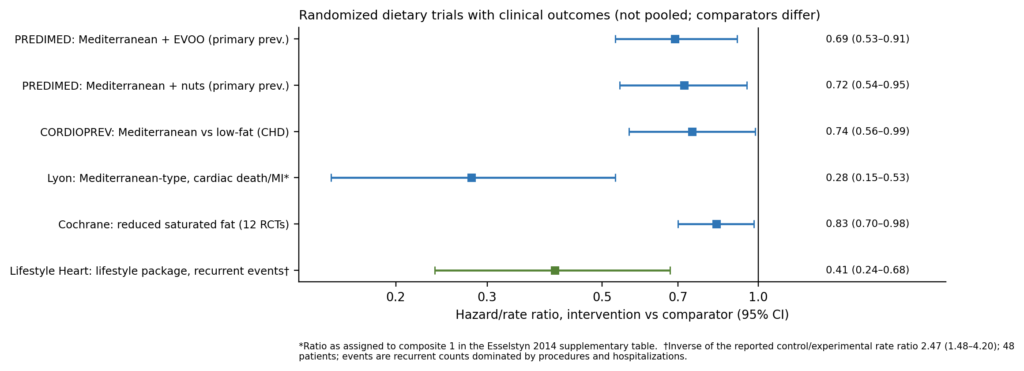
Figure 12. Randomized dietary trials with clinical outcomes. Estimates are shown side by side, not pooled; comparators, populations, and endpoints differ. No randomized trial of a very-low-fat vegan diet has reported clinical events.
12.7 تطبيق نفس المعايير على تجارب المقارنة
راجعت هذه المراجعة دراسات إيسلستين وأورنيش عن كثب، وتستحق التجارب التي تدعم حميات البحر الأبيض المتوسط نفس القدر من التمحيص. يطرح الجدول 2 نفس الأسئلة على كل منها. والهدف ليس وصف أي تجربة بأنها عديمة الفائدة، بل توضيح ما يمكن لكل منها دعمه.
PREDIMED. توثق إعادة النشر لعام 2018 المشاكل الرئيسية نفسها. تم استخدام مظاريف مختومة لإخفاء التخصيص فقط خلال جزء من المرحلة التجريبية؛ وتم تسجيل 425 فردًا من أفراد الأسرة دون توزيع عشوائي وأُعطوا نفس الحمية التي يتبعها أقاربهم؛ وفي أحد المواقع، تم تخصيص 467 مشاركًا حسب العيادة بدلاً من التخصيص الفردي؛ كما تم استخدام جداول التوزيع العشوائي بشكل غير متسق في موقع آخر [12]. أعاد المؤلفون تحليل التجربة بتعديل إحصائي، وكانت النتائج متشابهة عند استبعاد المشاركين الـ 1588 المتأثرين (نسب الخطر 0.71 و 0.68 في الـ 5859 المتبقين) [12]. تلقت المجموعة الضابطة منشورًا سنويًا يتضمن نصائح حول الدهون المنخفضة حتى سبتمبر 2006، ولم تحصل إلا بعد ذلك على نفس تكرار التواصل الذي حصلت عليه مجموعات البحر الأبيض المتوسط؛ ولم يتغير إجمالي استهلاكها للدهون إلا قليلاً، لذا قارنت دراسة PREDIMED بين حمية البحر الأبيض المتوسط المكملة وبين حمية معتادة خضعت لنصائح طفيفة، وليس مع حمية حقيقية منخفضة الدهون [12]. كانت الفائدة موجودة أيضًا بين المشاركين الذين تم تجنيدهم بعد زيادة التواصل مع المجموعة الضابطة — نسبة الخطر 0.49 (فاصل ثقة 95٪ 0.26 إلى 0.92) مقابل 0.77 (0.59 إلى 1.00) قبل تغيير أكتوبر 2006 (قيمة الاحتمالية P = 0.21 لعدم التجانس) — وهو ما يتعارض مع اعتبار الدعم غير المتكافئ هو التفسير الوحيد، على الرغم من أن مقارنة فترة التجنيد لا يمكن أن تستبعد وجود بعض المساهمة منه [12]. بلغت نسبة الانقطاع عن الدراسة 11.3٪ في المجموعة الضابطة مقابل 4.9٪ في مجموعات البحر الأبيض المتوسط. تم التبرع بزيت الزيتون والمكسرات من قبل المنتجين وتوفيرها مجانًا، وكان المشاركون يعرفون التخصيص الخاص بهم، بينما كانت لجنة نقاط النهاية فقط هي التي تم تعميتها [12]. توقفت التجربة عند تحليلها المرحلي الرابع [12]، وتميل التجارب التي تتوقف مبكرًا بسبب الفائدة إلى المبالغة في تقدير حجم التأثير. أخيرًا، كانت النتيجة المركبة مدفوعة بشكل أساسي بالسكتة الدماغية (نسبة الخطر المجمعة 0.58؛ فاصل ثقة 95٪ 0.42 إلى 0.82)، في حين أن احتشاء عضلة القلب (0.80؛ 0.53 إلى 1.21)، والوفاة القلبية الوعائية (0.80؛ 0.51 إلى 1.24)، والوفاة لأي سبب (0.98؛ 0.77 إلى 1.24) لم تختلف بشكل كبير؛ ويعزو المؤلفون ذلك إلى القوة المحدودة للدراسة [12] (الشكل 13).
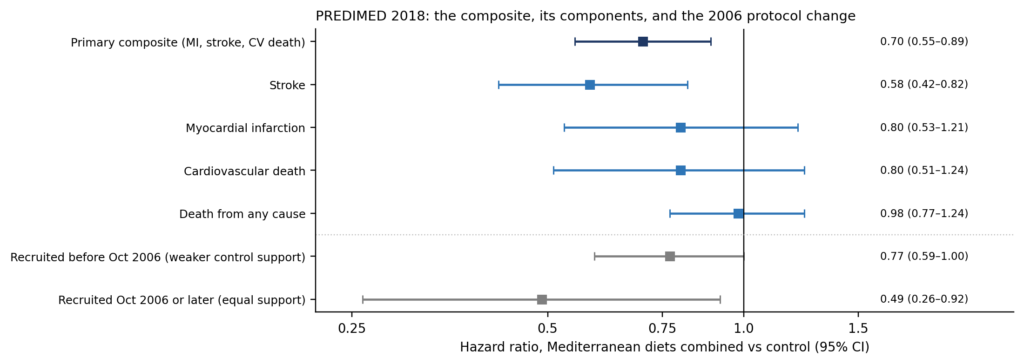
الشكل 13. دراسة PREDIMED لعام 2018: النتيجة المركبة ومكوناتها (دمج حميات البحر الأبيض المتوسط مقابل المجموعة الضابطة)، والتأثير قبل وبعد زيادة دعم المجموعة الضابطة في أكتوبر 2006. المصدر: Estruch 2018، الجدول 3 والنص.
Lyon Diet Heart Study. قامت دراسة ليون بتوزيع 605 من الناجين من أول احتشاء لعضلة القلب عشوائيًا في تصميم أحادي التعمية، وتوقفت مبكرًا بسبب الفائدة عند متوسط 27 شهرًا، مع تمديد المتابعة لاحقًا إلى 46 شهرًا [13, 14, 70]. كانت المقارنة عبارة عن حمية حذرة من النوع الغربي بدلاً من حمية صحية مدعومة بشكل مكثف [70]. حدث الانخفاض الكبير في الأحداث بينما ظلت دهون المصل وضغط الدم ومؤشر كتلة الجسم متشابهة بين المجموعات [14]. هذه إشارة حقيقية على أن النمط الغذائي يمكن أن يقلل الأحداث من خلال مسارات أخرى غير خفض الدهون (القسم 5)، لكنها تأتي من تجربة صغيرة توقفت مبكرًا ومن المرجح أن حجم تأثيرها مبالغ فيه.
CORDIOPREV. كانت دراسة CORDIOPREV تجربة أجريت في مركز واحد بتمويل أساسي من مؤسسات زيت الزيتون؛ وكانت الفائدة قابلة للإثبات إحصائيًا في الرجال فقط، مع تقدير غير حاسم في المجموعة النسائية الفرعية الأصغر؛ ولم يكن أي مكون منفرد من المكون المركب ذا دلالة إحصائية؛ ووصل ذراع الدهون المنخفضة فيها إلى 32.1٪ من الطاقة من الدهون [10]. تتمتع هذه الدراسة بأقوى تصميم بين الثلاثة لأن كلا الذراعين تلقيا دعمًا مكثفًا بنفس القدر، لكنها تختبر مقارنة بنظام غذائي مختلط معتدل الدهون، وليس حمية نباتية منخفضة الدهون للغاية.
مشاكل مشتركة عبر علوم التغذية. تنطبق العديد من نقاط الضعف على كل دراسة في هذه المراجعة تقريبًا، بغض النظر عن النظام الغذائي الذي تفضله. عادةً ما يتم قياس النظام الغذائي عن طريق الاستبيان؛ في دراسة صحة السبتيين-2، كانت ارتباطات صحة الاستبيان مقابل تذكارات الـ 24 ساعة المتكررة 0.76 لـ لحم أحمر ولكن 0.53 للأسماك لدى المشاركين البيض [53]. يعرف المشاركون في تجارب الأنظمة الغذائية ما يتناولونه. يتلاشى الالتزام، كما يتضح من انقطاع المجموعة الضابطة في PREDIMED، والتخلي عن النظام الغذائي في CORDIOPREV، وانخفاض درجات الالتزام في تجربة نمط حياة القلب [6, 10, 12]. غالبًا ما تكون المقارنات ضعيفة: المجموعة الضابطة المبكرة في PREDIMED، ونظام ليون الحكيم، والرعاية المعتادة في تجربة نمط حياة القلب. غالبًا ما تكون التجارب صغيرة أو توقفت مبكرًا. والمصالح تسير في كل اتجاه: حيث قام منتجو زيت الزيتون والمكسرات، ومطورو البرامج، والمنظمات الحقوقية بتمويل أو قيادة الدراسات التي تمت مناقشتها هنا [4, 10, 12, 23].
ما الذي يغيره النقد. تقلل هذه القيود من الثقة في حجم فوائد حمية البحر الأبيض المتوسط وفي أي ادعاء يثبت تفوق حمية البحر الأبيض المتوسط. وهي لا ترفع من مكانة VLF-WFPB، الذي لا يملك أي تجربة عشوائية ذات أحداث سريرية على الإطلاق. إن التجربة العشوائية ذات الأحداث السريرية، حتى لو كانت معيبة، تعالج السؤال السببي الذي لا تستطيع سلسلة حالات غير خاضعة للرقابة معالجته، على الرغم من أن وزنها لا يزال يعتمد على الانحياز والدقة ومدى اختبارها المباشر للنظام الغذائي المعني. إن تطبيق نفس الشكوك على كلا الجانبين هو ما يسمح بالوثوق في استنتاجات هذه المراجعة.
الجدول 2. تطبيق نفس الأسئلة على التجارب الرئيسية في كل جانب من جوانب النقاش.
| السؤال | PREDIMED | كورديوبريف | ليون دايت هارت (Lyon Diet Heart) | تجربة نمط حياة القلب | مجموعة إيسلستين 2014 |
| مستوى الأدلة | 1 | 1 | 1 | 2 (أعداد أحداث صغيرة) | 4 |
| عشوائية؟ | نعم، مع وجود انحرافات أثرت على 1588 من أصل 7447؛ استخدمت الأظرف فقط في جزء من الدراسة التجريبية [12] | نعم [10] | نعم [14] | نعم، بالدعوة؛ رفض نصف المؤهلين [6] | لا [4] |
| من الذي تم تعميته؟ | لجنة النتائج النهائية فقط [12] | النتيجة النهائية حكم قضائي تم الإبلاغ عنه كتعمية؛ لم يتم تعمية المشاركين وأخصائيي التغذية، كما هو الحال في أي تجربة غذائية | تصميم أحادي التعمية [14] | تصميم أحادي التعمية [14] | لا أحد؛ قام المحققون بالبت في الأحداث [4] |
| المقارن | نصيحة لتقليل الدهون؛ منشور سنوي حتى عام 2006، ثم تواصل متساوٍ؛ تغير إجمالي الدهون قليلاً [12] | نظام غذائي منخفض الدهون مدعوم بالتساوي؛ تم تحقيق 32.1% دهون [10] | نظام غذائي غربي حكيم [70] | الرعاية المعتادة؛ بدأ 60% في تناول أدوية الدهون [6] | متطوعون غير ملتزمين [4] |
| توقفت مبكرًا؟ | نعم، عند التحليل المرحلي الرابع [12] | متوسط متابعة لمدة 7 سنوات [10] | نعم، في غضون 27 شهرًا؛ تم تمديدها لاحقًا إلى 46 شهرًا [13, 14] | نعم، في غضون 27 شهرًا؛ تم تمديدها لاحقًا إلى 46 شهرًا [13, 14] | لا ينطبق |
| ما الذي دفع النتيجة | السكتة الدماغية 0.58؛ احتشاء عضلة القلب 0.80 ووفيات القلب والأوعية الدموية 0.80 غير معنويين [12] | فائدة واضحة لدى الرجال؛ التقدير في 175 امرأة غير حاسم؛ لا يوجد مكون واحد معنوي [10] | تخفيضات كبيرة مع مستويات مماثلة من دهون المصل وضغط الدم ومؤشر كتلة الجسم [14] | الإجراءات والاستشفاء (تعدادات متكررة) [6] | إعادة التوعي في المجموعة غير الملتزمة [4] |
| المصالح | زيت الزيتون والمكسرات تبرع بها المنتجون [12] | بشكل رئيسي مؤسسات زيت الزيتون [10] | لم يتم تقييمه هنا | لم يتم تقييمه هنا | مطور البرنامج؛ تم إعطاء كتاب للمشاركين [4] |
| النظام الغذائي المختبر مقابل VLF-WFPB | حمية متوسطية مدعمة مقابل نظام غذائي معتاد ينصح به بشكل خفيف | حمية متوسطية 40.5% دهون مقابل نظام غذائي منخفض الدهون شامل 32.1% | نوع متوسطي غني بـ ALA | سمن نباتي غني بـ ALA بالإضافة إلى نصيحة نوع المتوسطي | خالٍ من الزيوت، وخالٍ من المنتجات الحيوانية، وبدون مكسرات أو أفوكادو |
13. هل انخفاض إجمالي الدهون في حد ذاته أفضل؟
افصل الدهون. ترفع الدهون المشبعة LDL-C ويقلل خفضها من الأحداث [26]؛ يجب تجنب الدهون المتحولة الصناعية [73]؛ تخفض الدهون غير المشبعة LDL-C عندما تحل محل الدهون المشبعة وترتبط بتقليل الأحداث في التجارب المتوسطية [10, 12]. “إجمالي الدهون” يجمع هذه التأثيرات المتضادة.
ما يحل محل الدهون أمر مهم. في نظام VLF-WFPB، البديل هو الحبوب الكاملة والبقوليات والخضروات والفاكهة؛ وفي الأنظمة الغذائية الأخرى منخفضة الدهون قد يكون النشا المكرر أو السكر. لم توازِن أي تجربة بين هذه البدائل ضمن نظام غذائي نباتي حصري على النتائج السريرية.
الاختبار المباشر الوحيد ضمن نظام غذائي نباتي كامل. In a randomized crossover trial, 40 adults with at least 5% estimated cardiovascular risk followed a whole-food plant-based vegan diet with either about four tablespoons or less than one teaspoon of extra-virgin olive oil daily, for four weeks each; fat supplied 48% and 32% of energy respectively. Both phases lowered LDL-C, total cholesterol, ApoB, HDL-C, glucose, and hs-CRP from baseline. There was a sequence interaction: moving from high to low oil lowered LDL-C by 12.7 mg/dL (P = 0.04), and moving from low to high raised it by 15.8 mg/dL (P = 0.02); in the first period, LDL-C fell 25.5 versus 16.7 mg/dL (P = 0.162) [8]. Neither phase approached 10–15% fat, the trial was short, and carryover complicates the crossover analysis. It suggests large oil additions can blunt LDL-C lowering; it does not show that 10–15% fat is better than a nut- and seed-based plant diet at around 30%.
Nuts, seeds, and olive oil. Mediterranean diets rich in extra-virgin olive oil or supplemented with nuts reduced events against comparators [10, 12]. No trial shows that excluding nuts, seeds, or olive oil from an otherwise low-saturated-fat diet improves clinical outcomes. The acute impairment of flow-mediated dilation after a single high-fat meal [30], cited in support of oil exclusion [4], cannot establish that oils cause atherosclerosis.
Triglycerides, HDL, and ApoB–LDL-C عدم توافق. Very-low-fat, high-carbohydrate diets can raise triglycerides and lower HDL-C, as in the Lifestyle Heart Trial’s first year [6]; across plant-based trials overall, triglycerides did not change [22], and Mediterranean diets lowered triglycerides more than a vegetarian diet in CARDIVEG [71]. When triglyceride-rich lipoproteins rise, LDL-C can understate عدد الجسيمات المسببة لتصلب الشرايين. The Lifestyle Heart Trial illustrates this: at five years LDL-C was 20% below baseline while ApoB was not [6]. Future trials should measure ApoB directly.
Attribution. Where VLF-WFPB outperforms a comparator on LDL-C, the advantage may reflect fat quantity, fat quality (almost no saturated fat), food quality (fiber, plant protein), weight loss, or adherence. The Barnard crossover, for example, produced both larger LDL-C reductions and larger weight loss on the vegan diet [23]. No available trial separates these contributions. On current evidence, very low total fat is not established as an independent requirement; very low saturated fat within a whole-food diet is the component with the strongest causal support.
14. Prevention, Treatment, and Reversal
14.1 Outcomes that must not be conflated
Fewer cardiovascular events, slower progression, استقرار اللويحة, improved angina or perfusion, reduced angiographic stenosis, and quantitatively measured regression of plaque volume are different outcomes. Primary and secondary prevention are also different settings.
14.2 What imaging can and cannot show
Quantitative coronary angiography measures lumen, not plaque. Percent stenosis depends on the reference segment and on النغمة الحركية الوعائية, and outward (positive) remodeling can hide substantial plaque behind a normal lumen. Myocardial perfusion and stress testing measure function; improvement can occur without anatomic regression, as the Heidelberg investigators noted [62]. الموجات فوق الصوتية داخل الأوعية الدموية و تصوير الأوعية المرجلة بالشرايين التاجية بالأشعة المقطعية measure plaque volume and composition; CT additionally characterizes noncalcified and لويحة منخفضة التوهين. Coronary calcium scores can rise when plaque stabilizes, because statins increase calcified and fibrous plaque while reducing fibrofatty and necrotic-core components, so calcium-score change alone indicates neither success nor failure [74]. Plaque can enlarge substantially before angiography detects narrowing [74]; conversely, an apparently wider lumen can reflect changes in vasomotor tone rather than smaller plaque. In a meta-regression summarized by Dawson and colleagues, each 1% reduction in حجم العصيدة النخامية المئوي was associated with about 20% lower odds of major adverse events, but there is no direct evidence that regression itself reduces events [74]. Table 3 summarizes what each finding can and cannot establish.
Table 3. What symptom and imaging findings can and cannot establish.
| النتيجة | What it establishes | What it does not establish |
| Less angina; better اختبار الإجهاد or PET perfusion [6, 61, 62] | Better symptoms or myocardial blood supply | A measured loss of plaque |
| Reduced angiographic percent stenosis | A less narrowed lumen relative to a reference segment | The percentage of plaque removed; reference-segment changes can alter the result [6] |
| Change in minimum lumen diameter | Absolute lumen change at the lesion | Plaque volume, which عادة إعادة تشكيل خارجية can hide [74] |
| CCTA or IVUS plaque volume or composition change | Change in the measured plaque compartment, within acquisition and segmentation limits | Eradication of disease or a guaranteed event reduction |
| Rising coronary calcium score | A higher مقياس أغاتستون, which reflects calcified area, density, or both | Greater total plaque burden or treatment failure; statins increase لويحة متكلسة while reducing fibrofatty and اللب النخري [74] |
14.3 The primate and pharmacologic benchmarks
Two bodies of evidence set the standard against which dietary regression claims should be read. Neither is a dietary trial in humans, and both are cited here as benchmarks rather than as support for any diet.
Controlled primate experiments (Tier 5). In rhesus monkeys given an atherogenic diet and then switched to a regression diet, atheromatous الشرايين التاجية lost lipid [75], while arterial fibrous proteins behaved differently from the lipid compartment [76]. The achieved cholesterol level mattered: in animals whose plasma cholesterol was held near 300 mg/dL there was little or no increase in lumen area attributable to regression of intimal plaque, whereas at about 200 mg/dL a considerable share of the lumen gain was attributable to plaque regression, and the contribution depended on both plaque size and time [77]. This is the closest thing in the literature to a controlled demonstration that lowering atherogenic lipoproteins by dietary means depletes the lipid-rich compartment while denser tissue persists. It is also animal evidence, in a different species, with induced rather than spontaneous disease, and it cannot establish what a human diet achieves.
Pharmacologic imaging (Tiers 1–2). في غلاغوف, 968 statin-treated patients with angiographic coronary disease were randomized to monthly إيفولوكوماب أو دواء موهم for 76 weeks, and 846 had evaluable serial intravascular ultrasound. Time-weighted LDL-C was 36.6 mg/dL versus 93.0 mg/dL, percent atheroma volume changed by −0.95% versus +0.05% (difference −1.0 percentage point; P < 0.001), and plaque regression occurred in 64.3% versus 47.3% of patients [78]. Notably, the trial’s virtual-histology substudy did not show a difference in dense calcium volume [78], so GLAGOV demonstrates volumetric regression rather than a compositional shift; trials designed to measure plaque composition are outside the scope of this review and no compositional figures are quoted. Two comparisons follow. No dietary trial has produced coronary regression of this magnitude under this level of rigor, and no dietary trial identified here used serial intravascular ultrasound at all, which is the modality that measures atheroma volume most precisely.
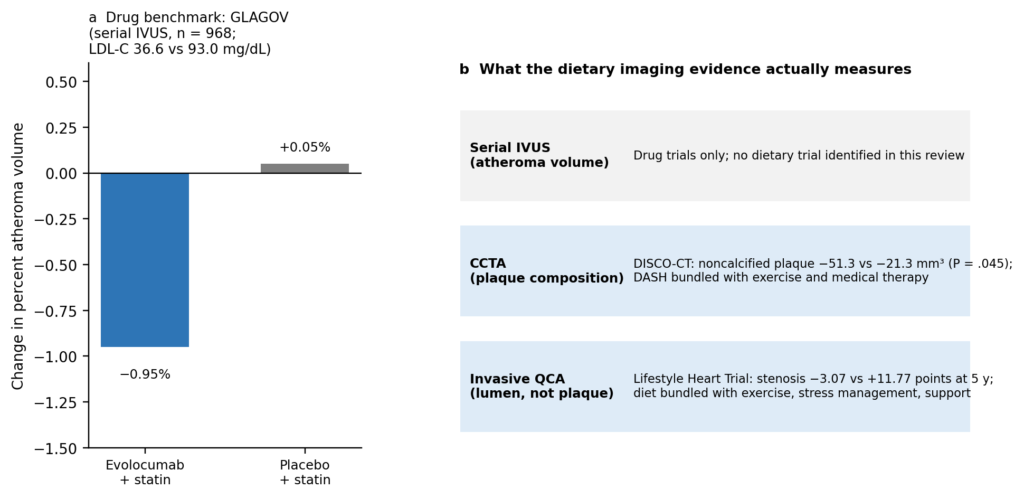
Figure 14. Benchmarks for coronary plaque change. Pharmacologic regression measured by serial intravascular ultrasound (GLAGOV) alongside the dietary imaging evidence available in this review, which uses different modalities and cannot be placed on the same axis. No dietary trial identified here used serial intravascular ultrasound. Sources: Nicholls 2016; Henzel 2021; Ornish 1998.
Exercise as a co-lever. Physical activity belongs alongside the three dietary levers rather than inside them. The populations with the least coronary calcium are also the most active: Tsimane men average six to seven hours and women four to six hours of physical activity a day [35]. In the two randomized imaging trials that showed benefit, exercise was part of the intervention rather than a controlled covariate—the Lifestyle Heart Trial bundled aerobic exercise with the diet [6], and DISCO-CT bundled activity counseling with DASH [68]—which is why neither can apportion credit. No quantitative estimate of the ApoB reduction attributable to aerobic training is given here; the point stands qualitatively that diet, activity, and lipid-lowering therapy act on overlapping pathways and are complementary rather than competing.
14.4 What the evidence supports in each domain
الوقاية الأولية. Evidence consists of cohort associations [40], population data (Sections 6–8), and randomized lipid trials [22]. No randomized event trial of VLF-WFPB exists.
Secondary prevention (treatment). The Lifestyle Heart Trial reduced angina and cardiac procedures and hospitalizations for a package that included a very-low-fat vegetarian diet [6]. Randomized event reductions with diet alone in secondary prevention come from Mediterranean-type trials [10, 70].
Slowed progression and partial regression. Intensive lifestyle programs incorporating very-low-fat vegetarian diets have demonstrated modest التراجع التصويري الوعائي in selected patients; the independent contribution of diet, and of total-fat restriction, remains uncertain [6, 42]. Lower-fat but non-vegan diets also slowed angiographic progression [62, 66], and a DASH-type program added to medical therapy reduced noncalcified plaque on CT [68]. Partial regression appears most likely when large, sustained reductions in atherogenic lipoproteins are achieved, often with drugs, and more regression was seen at five years than at one year in the Ornish program [6]. Regression does not mean eradication of disease or zero future risk.
The Dawson review. As summarized in the ACC’s published key points, the 2022 JACC state-of-the-art review judged the demonstrated effect of diet, exercise, and smoking cessation on coronary plaque volume and composition to be limited [74]. Claims sometimes attributed to that review in secondary summaries, including the assertion that most statin-treated dietary arms progressed, are not used here. Limited diet-only regression evidence does not mean dietary treatment has little clinical value: stabilizing plaque, improving perfusion, and preventing progression can be clinically meaningful even when anatomic change is small, although existing diet trials do not establish the mechanism of any event reduction.
15. Feasibility, Adequacy, and Safety
Adherence. Reported adherence has been high in selected volunteers: 89% by self-report in the 2014 Esselstyn cohort [4], and 94% versus 70% for vegan versus AHA diets at eight weeks in EVADE CAD, whose participants represented 14% of those meeting initial criteria [9]. In the Lifestyle Heart Trial, half of eligible invited patients declined, and the adherence score fell from 1.29 at one year to 1.06 at five years [6]. Over seven years in CORDIOPREV, more patients abandoned a conventional low-fat diet than a Mediterranean diet [10].
Nutrients. Vitamin B12 supplementation is essential; median intake in the EVADE vegan arm fell to 1.2 µg/day, and B12 levels fell during the vegetarian phase of CARDIVEG [9, 71]. Zinc and omega-3 fatty acid intakes were also lower on the vegan diet in EVADE [9]. Calcium, vitamin D, iodine, iron, and long-chain omega-3 status require planning, and fortified foods or supplements are appropriate where intake is inadequate [79]; “whole food” should not become a reason to reject them. Unfortified terrestrial plant foods supply alpha-linolenic acid but little or no preformed EPA or DHA, which algae-derived supplements and fortified products can provide within a vegan diet [79]; Esselstyn’s protocol added flaxseed as an alpha-linolenic acid source [4]. Aggressive fat restriction should not displace necessary energy or essential fats.
Energy and protein. Median protein intake on the EVADE vegan diet was 50 g/day (12.9% of energy) [9]. Energy-unrestricted vegetarian diets reduced energy intake by about 276 kcal/day relative to usual diets [7], and in the 2014 Esselstyn cohort the 135 patients with weight data lost an average of 18.7 lb [4]. Low energy density is an asset for weight loss but a potential hazard for older adults with poor appetite or ساركوبينيا and for physically active people with high requirements; protein and energy adequacy should be planned individually.
Quality of life. In EVADE CAD, quality-of-life scores improved similarly on both diets [9].
Diet and drugs. Pooled randomized evidence puts the dietary ApoB reduction at about 14% [22]. A matched estimate of ApoB lowering under intensive statin or PCSK9 therapy is not presented here, so no numerical comparison is drawn; the clinical point stands on other grounds. In established ASCVD, diet is a complement to guideline-directed therapy, not a substitute for it, and indicated therapy should not be withheld or stopped in order to follow any diet.
This review is educational. Dietary change should be made alongside, not instead of, prescribed cardiovascular therapy, and medication adjustments belong with the treating physician.
16. Clinical Positioning
The 2023 AHA/ACC guideline for chronic coronary disease recommends a diet emphasizing vegetables, fruits, legumes, nuts, whole grains, and lean protein to reduce cardiovascular events (class 1, level B-R), and states that reducing saturated fat to less than 6% of energy and replacing it with monounsaturated and polyunsaturated fat, complex carbohydrate, and fiber can be beneficial (class 2a) [73]. Its nutrition figure lists دهون أحادية غير مشبعة such as olive oil and polyunsaturated fat among foods to choose [73]. ال دليل الجمعية الأمريكية لأمراض القلب والكلية الأمريكية لأمراض القلب (ACC/AHA) متعدد المجتمعات لعام 2026 بشأن اضطراب دهون الدم, which replaces the 2018 cholesterol guideline, describes preferred dietary patterns as predominantly plant-based—Mediterranean, DASH, and vegan or vegetarian [27].
The AHA’s 2026 dietary guidance lists features of a heart-healthy pattern that include choosing healthy sources of protein, choosing sources of unsaturated fat in place of saturated fat, choosing minimally processed foods, minimizing added sugars, and reducing sodium [25].
These guidelines support plant-rich dietary treatment and accommodate a vegan pattern. They do not endorse a uniquely effective very-low-fat vegan reversal protocol, and they explicitly include nuts and unsaturated oils. A professional recommendation of a pattern is not evidence that every component or exclusion within a particular diet is necessary.
17. The Decisive Next Study
Primary design. A randomized, parallel-group trial with blinded endpoint assessment in medically treated adults with CT-documented coronary atherosclerosis, deliberately recruiting women, older adults, and patients outside specialist lifestyle programs. Arms: (A) VLF-WFPB, 10–15% of energy from fat, no animal foods, no added oil, limited nuts and avocado; (B) a higher-unsaturated-fat whole-food plant-based diet, about 30–40% fat from nuts, seeds, avocado, and extra-virgin olive oil, no animal foods; (C) a Mediterranean (PREDIMED/CORDIOPREV-style) or DASH diet. A versus B tests total-fat restriction within an animal-free diet; B versus C approximates the effect of animal-food exclusion, although replacement foods will differ. All arms receive identical contact time, cooking instruction, food support, and exercise advice.
Mechanistic substudy. Because the three-arm design cannot fully separate animal-food exclusion from total fat, a controlled-feeding 2 × 2 factorial substudy—animal-free versus limited specified animal foods, crossed with about 10–15% versus 30–35% of energy from fat, with saturated fat, sodium, fiber, protein, and energy matched as closely as feasible—would isolate each factor at stable weight. A third factor—whole versus ultra-processed plant foods at matched macronutrients—would test the processing lever directly, following the design of the inpatient processing trial [19]. Unavoidable differences in replacement foods must be measured and reported.
Two estimands. The pragmatic effect of assigning an ad libitum pattern, including its effects on weight and adherence, differs from the biological effect of dietary composition at stable weight. Adjusting away weight loss in the primary analysis would remove part of the assigned diet’s effect; the feeding substudy addresses composition.
Medication. Every arm follows the same clinical treatment algorithm, and indicated therapy is never withheld to magnify a dietary contrast. Because titration toward lipid targets will partly offset dietary differences in ApoB, the intensity of lipid-lowering therapy required becomes a prespecified secondary outcome, and ApoB is analyzed together with medication intensity. The main trial estimates comparative effectiveness under a common treatment algorithm; it does not by itself equalize cumulative ApoB exposure, and attributing any residual benefit to pathways independent of ApoB would require repeated longitudinal measurement of the mediators and explicit causal assumptions.
Outcomes. Stage 1 primary outcome: 24-month change in percent atheroma volume (or noncalcified plaque volume) on coronary CT angiography, read in a blinded core laboratory on a protocol schedule rather than on symptoms. Secondary outcomes: time-averaged ApoB, non-HDL cholesterol, triglycerides, ambulatory blood pressure, weight and body composition, HbA1c, hs-CRP, TMAO, PET myocardial blood flow, angina (Seattle Angina Questionnaire), function, quality of life, cost, retention, and nutrient status (B12, iron, vitamin D, iodine, omega-3 index). Adherence is measured objectively (plasma fatty-acid profile, carotenoids, urinary nitrogen and potassium) as well as by repeated diet records. Stage 2: an events trial with a hard composite of cardiovascular death, myocardial infarction, and ischemic stroke; procedures are adjudicated blind and reported separately, with both time-to-first-event and recurrent-event analyses.
Analysis. Intention-to-treat primary analysis with prespecified handling of missing data and medication changes; complier-average causal effect and per-protocol analyses as secondary; adherence analyses do not treat adherers as newly randomized groups; mediation analyses using ApoB, weight, and blood pressure are labeled exploratory.
Illustrative sample sizes (assumptions stated). Stage 1: assuming a standard deviation of 3.0 percentage points for the 24-month change in percent atheroma volume, a minimum important between-arm difference of 1.0 point, two primary pairwise comparisons (A versus B; B versus C) each tested at two-sided α = 0.025, and 90% power, about 224 participants per arm are required, or 280 per arm (840 total) allowing 20% attrition. Stage 2: detecting a hazard ratio of 0.80 in each pairwise comparison at two-sided α = 0.025 and 80% power requires about 764 events per comparison; with an assumed four-year first-event risk of 15% in the reference arm, roughly 2,800 participants per arm (about 8,400 total) would be needed. These figures are illustrative; a protocol would need assumptions for adherence, crossover, and drug titration. They also explain why event evidence does not yet exist.
18. Conclusions by Domain
Table 4 (after the main text) summarizes the evidence base, and Table 5 shows whether each proposed advantage is shared with comparator diets or has evidence of additional benefit.
Labels: Established—consistent randomized evidence on the stated outcome. Supported but uncertain—randomized evidence that is small, multicomponent, or on intermediate outcomes, or consistent observational evidence. Biologically plausible—mechanistic or indirect support without adequate outcome evidence. Unsupported—no adequate evidence, or evidence against.
Prevention. That plant-based diets lower LDL-C and ApoB relative to omnivorous diets is established (pooled LDL-C difference about 11.6 mg/dL) [22]. That VLF-WFPB lowers ASCVD incidence relative to a typical Western diet is مدعوم ولكنه غير مؤكد: تتوافق الارتباطات الأترابية (الخطر النسبي لأمراض القلب الإقفارية لدى النباتيين 0.79) مع المعقولية التي تتوسطها الدهون، ولكن لا يوجد دليل عشوائي على الحوادث [40]. القول بأنه يقي من أمراض القلب والأوعية الدموية الناتجة عن تصلب الشرايين بشكل أفضل من حمية البحر الأبيض المتوسط أو حمية DASH هو أمر غير مدعوم. يجب الإبلاغ عن نتائج الشرايين التاجية والسكتة الدماغية بشكل منفصل: ففي دراسة EPIC-Oxford، كان لدى النباتيين معدلات أقل لأمراض القلب الإقفارية ولكن معدلات أعلى للسكتة الدماغية النزفية والكلية [41].
العلاج. القول بأن حزمة نمط الحياة المكثفة التي تتضمن نظاماً غذائياً نباتياً منخفض الدهون جداً تقلل من الذبحة الصدرية والإجراءات القلبية أو دخول المستشفى مقارنة بالرعاية المعتادة هو أمر مدعوم ولكنه غير مؤكد, ويستند إلى تجربة عشوائية صغيرة واحدة من 1986-1992 [6]. القول بأن النظام الغذائي وحده يقلل من الحوادث في الأمراض المستقرة هو أمر معقول بيولوجياً. القول بأنه يقلل من الحوادث أكثر من حمية البحر الأبيض المتوسط، التي لديها أدلة عشوائية للوقاية الثانوية [10, 70]، هو غير مدعوم.
التراجع. القول بأن برامج نمط الحياة المكثفة التي تشتمل على أنظمة غذائية نباتية منخفضة الدهون جداً تؤدي إلى تراجع طفيف في تصوير الأوعية لدى مرضى مختارين هو أمر مدعوم ولكنه غير مؤكد [6]. القول بأن نظام VLF-WFPB وحده يؤدي إلى تراجع كمي في حجم اللويحات عن طريق الموجات فوق الصوتية داخل الأوعية أو الأشعة المقطعية هو أمر غير مدعوم لأنه لم يتم اختباره. القول بأن التراجع يزيل المخاطر المستقبلية هو أمر غير مدعوم.
الأفضلية والضرورة. القول بأن إجمالي الدهون المنخفض جداً ضروري بشكل مستقل لتحقيق الفائدة هو أمر غير مدعوم؛ الأدلة ضمن الأنظمة الغذائية النباتية قصيرة المدى ومختلطة، وتفضل أدلة الحوادث العشوائية تضمين الدهون غير المشبعة في الأنظمة الغذائية المختلطة [8, 10, 12]. القول بأن الاستبعاد الكامل للأطعمة الحيوانية يضيف فائدة تتجاوز النظام الغذائي منخفض الدهون المشبعة هو أمر معقول بيولوجياً (صفر كوليسترول غذائي، دهون مشبعة منخفضة جداً، وربما TMAO أقل) ولكنه غير مختبر على النتائج.
الأطعمة الكاملة والمعالجة. القول بأن الأطعمة النباتية قليلة المعالجة ترتبط بانخفاض مخاطر القلب والأوعية الدموية، والأطعمة النباتية فائقة المعالجة بمخاطر أعلى، هو أمر مدعوم ولكنه غير مؤكد: الدراسات الأترابية الكبيرة متسقة، وتوجد أدلة عشوائية لمدخول الطاقة ولكن ليس لتصلب الشرايين [17–19]. القول بأن جودة النظام الغذائي ومعالجته تهم بقدر استبعاد الأطعمة الحيوانية هو أمر غير مختبر: لم تقارن أي دراسة بين العاملين بشكل مباشر.
ما وراء ApoB. القول بأن الأنظمة الغذائية النباتية المعتمدة على الأطعمة الكاملة تحمي الشرايين من خلال مسارات تتجاوز ApoB هو أمر معقول بيولوجياً، مع دعم رصدي جزئي: تم إثبات الآليات في الحيوانات، وترتبط نترات الخضروات الورقية بانخفاض المخاطر في دراسة أترابية كبيرة بعد التعديل لفرط كوليسترول الدم، وأظهرت تجربة نمط حياة القلب تحسناً مستمراً في تصوير الأوعية بعد عودة ApoB إلى خط الأساس [6, 28, 29]. لم يتم إثبات ذلك، لأنه لا توجد تجربة قارنت بين الأنظمة الغذائية عند مستويات ApoB متطابقة.
النباتيون الصرف مقارنة بالنباتيين الآخرين. القول بأن النباتيين الصرف لديهم مخاطر أقل للإصابة بأمراض القلب من النباتيين الذين يتناولون الألبان والبيض أو النباتيين الذين يتناولون الأسماك هو أمر غير مدعوم: عبر دراسات الأدفنتست والبريطانيين والدراسات المجمعة، تعتبر تقديرات النباتيين الصرف مواتية في الاتجاه ولكنها غير حاسمة، ولا توفر أي دراسة أترابية مقارنة مباشرة بين المجموعات الفرعية النباتية [41, 53, 54, 56]. الإشارة بين رجال الأدفنتست النباتيين الصرف تعتبر مولدة للفرضيات.
الدور بالنسبة للعلاج الدوائي. استخدام النظام الغذائي بدلاً من خافضات الدهون المحددة أو غيرها من العلاجات الموجهة حسب الإرشادات في مرض تصلب الشرايين القائم هو أمر غير مدعوم: لم تختبر أي تجربة تمت مراجعتها هنا سحب العلاج المحدد، وكل تجربة تدخلية أظهرت فائدة تم تقديمها جنباً إلى جنب معه [10, 12, 22].
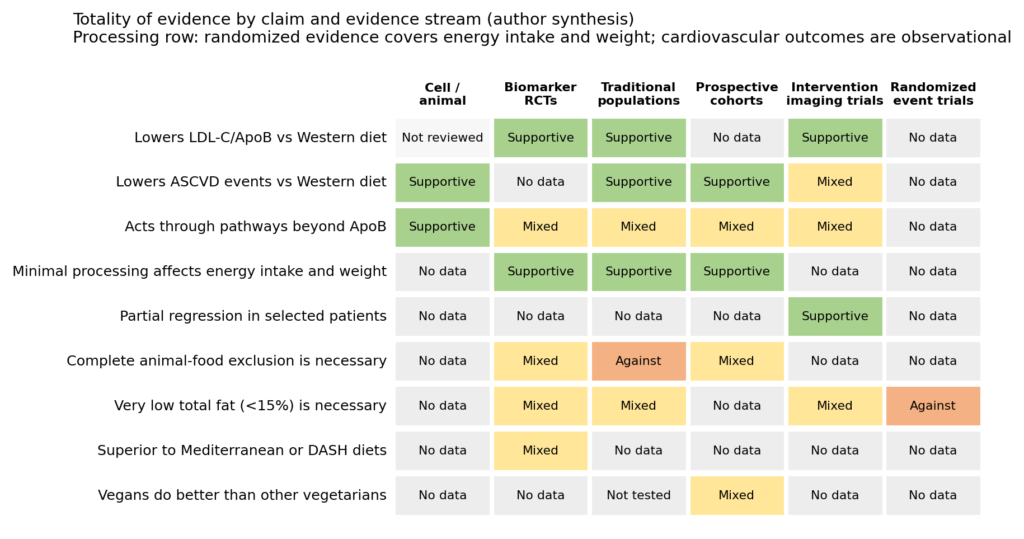
الشكل 15. مجموع الأدلة حسب الادعاء ومسار الأدلة. تركيب المؤلف للأقسام 3-17؛ علامة «ضد» تشير إلى الأدلة التي تتعارض مع الادعاء كما هو مذكور.
19. أقوى ادعاء تبرره الأدلة اليوم
A whole-food, plant-based diet reliably lowers atherogenic lipoproteins compared with typical Western diets, and populations with lifelong low animal-food intake had low cholesterol and low recorded coronary mortality. Intensive lifestyle programs built around very-low-fat vegetarian diets have produced modest angiographic regression, better myocardial perfusion, less angina, and fewer cardiac procedures than usual care in small studies of selected patients. Taken together, this evidence makes it credible that such a diet can help prevent, slow, and in some patients partly reverse coronary atherosclerosis, largely through lower cumulative ApoB exposure. The benefit is most consistently associated with the whole-food character of the diet—minimal processing, high fiber, and abundant vegetables—rather than with the exclusion of animal foods alone, and plausible but unproven evidence suggests that part of it runs through pathways beyond ApoB. The evidence does not establish that excluding all animal foods and nearly all added fat protects better than a well-implemented Mediterranean, DASH, or higher-unsaturated-fat plant-based diet.
A stronger claim would require a randomized comparison of those diets at equal support intensity and equal medical therapy, with ApoB measured throughout, blinded quantitative plaque imaging, and ultimately adjudicated clinical events. Until such data exist, VLF-WFPB is best presented as one evidence-supported option within the family of plant-predominant heart-healthy diets, notable for its LDL-C-lowering potency, rather than as a uniquely effective reversal protocol.
Table 4. Evidence table. Tier: 1 = randomized trial with clinical events; 2 = randomized trial of intermediate outcomes; 3 = prospective cohort; 4 = population comparison, cross-sectional study, or case series (Section 1.2). CI = 95% confidence interval.
| دراسة | Tier | Design, n, duration | Diet as delivered / achieved | Background therapy | Outcomes and effect estimates | القيود الرئيسية |
| Koch 2023 meta-analysis [22] | 2 | 30 RCTs; ApoB from 6 trials | Vegetarian or vegan vs omnivorous; fat content varied | Varied; some on lipid drugs | TC −0.34 mmol/L (CI −0.44 to −0.23); LDL-C −0.30 mmol/L (−0.40 to −0.19) ≈ −11.6 mg/dL; ApoB −12.92 mg/dL (−22.63 to −3.20; I² = 71.7%, 6 trials); TG not different | Heterogeneous diets and comparators; short trials; no events; does not isolate fat level; ApoB estimate rests on 6 trials with substantial heterogeneity whose independence could not be confirmed here |
| Wang 2023 meta-analysis [7] | 2 | 20 RCTs, 1,878; mean 25.4 wk | Vegetarian, including Ornish and low-fat vegan | Most on cardiometabolic drugs | LDL-C −6.6 mg/dL (−10.1 to −3.1); HbA1c −0.24% (−0.40 to −0.07); weight −3.4 kg (−4.9 to −2.0); SBP −0.1 mm Hg (−2.8 to 2.6) | LDL-C NS vs active comparators; majority high risk of bias; Key Points text differs from results |
| Rees 2021 Cochrane [72] | 2 | 13 RCTs; ≥12 wk; search to Feb 2020 | Vegan only | — | No trial reported clinical events; one secondary-prevention trial (n = 63): no clear lipid or BP effect | Small trials; dated search; low certainty |
| Dybvik 2023 cohort meta-analysis [40] | 3 | 13 cohorts, 844,175 | Vegetarian or vegan vs non-vegetarian (self-report) | — | IHD RR 0.79 (0.71–0.88; 8 cohorts); CVD 0.85 (0.79–0.92); stroke 0.90 (0.77–1.05); vegan IHD 0.82 (0.68–1.00; 6) | التشويش المتبقي (E-value 1.86); ~1/5 BMI-mediated; weaker excluding early follow-up; fat not assessed |
| EPIC-Oxford [41] | 3 | Cohort; 48,188; 18.1 y | Vegetarians including vegans vs meat eaters; vegans ~28% fat | — | IHD HR 0.78 (0.70–0.87), 0.90 (0.81–1.00) after risk-factor adjustment; total stroke HR 1.20 (1.02–1.40), mostly hemorrhagic; vegan IHD 0.82 (0.64–1.05), lacto-ovo 0.77 (0.69–0.86), fish eaters 0.87 (0.77–0.99) | Observational; self-reported diet and risk factors |
| AHS-2 [53] | 3 | Cohort; 73,308 Adventists; 5.79 y | Vegan, lacto-ovo, pesco-, semi-vegetarian vs non-vegetarian | — | Vegetarians: IHD death 0.81 (0.64–1.02); men 0.71 (0.51–1.00). By group: vegan 0.90 (0.60–1.33), lacto-ovo 0.82 (0.62–1.06), pesco 0.65 (0.43–0.97); vegan men 0.45 (0.21–0.94), vegan women 1.39 (0.87–2.24) | Short follow-up; healthy-user profile (Figure 9); few vegan deaths |
| Plant diet indices [17] | 3 | 3 cohorts; ~209,000; 8,631 CHD | Healthful vs unhealthful plant-based indices | — | CHD HR (extreme deciles): PDI 0.92 (0.83–1.01); hPDI 0.75 (0.68–0.83); uPDI 1.32 (1.20–1.46) | FFQ-based; health professionals; hPDI rewards oils and nuts |
| UK Biobank processing [18] | 3 | Cohort; 126,842; median 9 y | Plant-sourced foods split by ultra-processing | — | Per 10% energy: plant non-UPF CVD 0.93 (0.91–0.95), CVD death 0.87 (0.80–0.94); plant UPF CVD 1.05 (1.03–1.07), death 1.12 (1.05–1.20) | Observational; 24-h recalls; NOVA classification |
| Danish nitrate cohort [29] | 3 | Cohort; 53,150; up to 23 y; 14,088 CVD | Vegetable nitrate quintiles (median 23 vs 59 mg/day) | Adjusted for hypercholesterolemia | CVD HR 0.85 (0.82–0.89); IHD 0.88 (0.82–0.94); ischemic stroke 0.83 (0.76–0.91); PAD 0.74 (0.67–0.83); 21.9% mediated by SBP | Observational; plateau ~60 mg/day; nitrate mainly lettuce and potato |
| Key 1999 pooled cohorts [54] | 3 | 5 cohorts; 76,172; mean 10.6 y | Vegan, lacto-ovo, fish eaters, occasional meat vs regular meat eaters | — | IHD mortality: vegetarians 0.76 (0.62–0.94); vegans 26% lower, lacto-ovo and fish eaters 34% lower; benefit limited to diet >5 y and larger at younger ages | Mortality only; older cohorts; adjusted for age, sex, smoking only |
| AHS-2 2024 [55] | 3 | Cohort; 88,400; ~11 y | Five diet groups | — | Vegetarians lower IHD mortality; vegan diet not associated with all-cause mortality overall; vegan men lower mortality at younger ages | Hazard ratios vary with age; stroke and dementia higher in older vegetarians |
| AHS-2 protein [57] | 3 | Cohort; 81,337; 9.4 y; 2,276 CVD deaths | Protein-source factors | — | CVD mortality: meat factor 1.61 (98.75% CI 1.12–2.32); nuts and seeds factor 0.60 (0.42–0.86) | Factor analysis; FFQ; observational |
| Vegan diets review [56] | 3 | Systematic review; 7 studies; ≥7,661 vegans | Vegan vs non-vegan | — | No cohort showed significantly higher or lower primary CVD risk in vegans | Few vegans; low power |
| Tzu Chi cohorts [58] | 3 | 2 cohorts; 13,352; Taiwan | Buddhist vegetarians (mostly lacto-ovo) vs non-vegetarians | — | Ischemic stroke 0.26 (0.08–0.88) and 0.41 (0.19–0.88); hemorrhagic 0.34 (0.12–1.00) | Stroke only; healthy-user setting; few events |
| Xiamen lacto-vegetarians [59] | 4 | Cross-sectional; 169 vs 126 men | Chinese lacto-vegetarian vs omnivore | — | Lower BP, LDL-C, ApoB, TG, glucose; thinner carotid IMT | Single measurement; surrogate markers; dairy-eating |
| Hong Kong vegans (review) [60] | 4 (review) | Review of cross-sectional and supplementation studies | Vegans and vegetarians with low B12 | — | ~80% B12 deficiency in Hong Kong vegans; impaired FMD and thicker IMT with deficiency; improved with B12 | Surrogate outcomes; caution for unsupplemented vegan diets |
| Tsimane [35] | 4 | Cross-sectional; 705 adults 40–94; CT calcium | 14% fat, 14% protein, 72% carbohydrate; game and fish; unprocessed | لا شيء | CAC 0 in 85%, 1–100 in 13%, >100 in 3%; >75 y: 65% zero; LDL-C 91 mg/dL; ApoB 97 mg/dL | CAC misses noncalcified plaque; cross-sectional; 6–7 h/day activity (men) |
| China Study I [43] | 4 | Ecological; 65 counties, 130 villages; diet 1983–84; mortality 1973–75 | 14% fat; animal protein ~1% of energy; not vegan | لا شيء | Mean TC 127 vs 203 mg/dL (US); CAD mortality ages 0–64: 4.0 (men) and 3.4 (women) vs 66.8 and 18.9 per 100,000 (US) | Ecological; decade gap; ages truncated; ascertainment; activity and competing mortality |
| Okinawa (Willcox) [45, 47] | 4 | Ecological; 1949 survey; vital statistics | ~1,785 kcal/day; sweet potato ~69% of energy; fat ~6%; some pork and fish | لا شيء | Older cohorts reported ~80% lower CHD mortality than US | Post-war scarcity; energy restriction; body size; transition; no individual linkage |
| Esselstyn 1995/1999 [5, 42] | 4 | Case series; 22–24 enrolled; 11 imaged at ~5 y | ≤10% fat; skim milk, nonfat yogurt allowed | Cholestyramine + lovastatin most often | TC 246 → 132.4 mg/dL (LDL-C 71.6); % stenosis 53.4 → 46.2% (−7 points, CI 3.3–10.7); MLD +0.08 mm (−0.06 to 0.22), NS; regression in 8/11 patients by % stenosis | No control; 13 of 38 lesions excluded (4 graft-proximal lesions that progressed); attrition reported as 5 and as 11; drugs; regression to the mean |
| Esselstyn 2014 [4] | 4 | Cohort; 198 (177 adherent, 21 nonadherent); mean 44.2 mo | No animal foods, oil, nuts, avocado; fat not measured | Usual medications, not recorded | Adherent: 1 progression-related stroke per investigators (0.6%); 18/177 “worse” (10%); 0 cardiac deaths. Nonadherent: 13/21 (62%) with ≥1 event, 7 of 13 events revascularizations | Self-selected; self-reported adherence; no lipids; investigator adjudication; not randomized; 2.2% in supplementary table |
| دراسة Lifestyle Heart Trial [6, 63] | 2 (events: counts) | RCT (invitational), 48; 35 with 5-y QCA; 5 y | 10% fat vegetarian (nonfat dairy, egg white); achieved 6.2% (1 y), 8.5% (5 y); plus exercise, stress management, support | No lipid drugs (exp.); 60% of controls started them | 5-y (1998 report, n = 35): % diameter stenosis −3.07 (−5.91 to −0.24) vs +11.77 (3.40 to 20.14), P = .001; minimum lumen diameter essentially unchanged (+0.001 mm) vs −0.34 mm (P = .05); 1-y (1990 report, n = 48): 40.0% → 37.8% vs 42.7% → 46.1%, 82% of experimental patients toward regression; events 25 vs 45, rate ratio 2.47 (1.48–4.20); angina −91% at 1 y (within group) | Multicomponent; small; half of eligible declined; attrition; events = recurrent counts, mostly procedures; stenosis and lumen diameter are not plaque volume |
| Gould 1995 PET [61] | 2 | Same trial; 20 vs 15 | كما هو مذكور أعلاه | كما هو مذكور أعلاه | Perfusion abnormalities smaller/less severe vs worsening in controls | Not independent; functional endpoint |
| Multicenter Lifestyle Demonstration [64] | 4 | Nonrandomized; 194 vs 139 revascularized; 3 y | Ornish program | Not reported | 150/194 (77%) avoided revascularization; similar MI, stroke, death rates per patient-year | Self-selection; comparator is revascularized patients |
| STARS [66] | 2 | RCT; 90 men; 39 mo | Lipid-lowering diet, 27% fat (not vegan) ± cholestyramine | Cholestyramine in one arm | MAWS −0.201 (usual care), +0.003 (diet), +0.103 mm (diet + resin); progression 46%, 15%, 12% | Small; men only; not plant-exclusive |
| Heidelberg [62] | 2 | RCT; 113 men; 12 mo | Low-fat, low-cholesterol diet + intensive exercise | No lipid drugs | Progression 23% vs 48%; regression 32% vs 17% | Exercise co-intervention; lipid differences gone at 6 y |
| DISCO-CT [68] | 2 | RCT; 92; ~67 wk; CCTA | DASH-based counseling + activity + OMT vs OMT | OMT in both arms | Noncalcified plaque −51.3 vs −21.3 mm³ (P = .045); total atheroma change not significantly different; ~6-y follow-up: MACE 1 vs 4 [69] | Single center; not plant-exclusive; weight largely regained; too few events |
| EVADE CAD [9] | 2 | RCT; 100; 8 wk | Vegan vs AHA diet; median fat 29.9% vs 30.2% of energy at 8 wk; unsaturated oils encouraged and olive oil in recipes for both; groceries provided | 94–96% statins | hs-CRP 32% lower (β 0.68, 0.49–0.94); LDL-C 13% lower (β 0.87, 0.78–0.97; NS at Bonferroni α) | Short; biomarker only; not very-low-fat; 14% of those meeting initial criteria enrolled |
| Barnard 2021 crossover [23] | 2 | Crossover RCT; 62 randomized, 52 completers; 16 wk per diet | Low-fat vegan (17% of energy from fat achieved; 95% CI 15–19) vs PREDIMED-style Mediterranean | Lipid estimate in 43 without lipid-drug changes; BP estimate in 41 without antihypertensive changes | Weight −6.0 kg (−7.5 to −4.5) and LDL-C −14.8 mg/dL (−23.5 to −6.2) favoring vegan; SBP +6.0 mm Hg (+1.0 to +10.9) favoring Mediterranean | Short; diet-induced weight loss may mediate the effects, so the direct effect of dietary composition is not isolated; advocacy sponsor; not a 10–15%-fat diet; significant SBP carryover in the all-participant analysis but not in the stable-medication subgroup; 1 participant reassigned after randomization to match a household member |
| CARDIVEG [71] | 2 | تجربة عشوائية منضبطة متقاطعة؛ 107 من منخفضي المخاطر؛ 3 أشهر لكل نظام غذائي | نظام نباتي (بيض وألبان) منخفض السعرات مقابل حمية البحر الأبيض المتوسط منخفضة السعرات | بالغون منخفضو المخاطر | فقدان وزن مماثل؛ كوليسترول LDL أقل في النظام النباتي؛ الدهون الثلاثية أقل في حمية البحر المتوسط؛ انخفاض B12 في النظام النباتي | مخاطر منخفضة؛ ليس نباتياً صرفاً أو منخفض الدهون جداً |
| وصفة لصحة القلب [8] | 2 | تجربة عشوائية منضبطة متقاطعة؛ 40؛ 4 أسابيع لكل مرحلة | نظام نباتي كامل (WFPB) مع زيت زيتون بكر ممتاز عالٍ (48% دهون) مقابل زيت زيتون بكر ممتاز منخفض (32% دهون) | غير محدد | كلاهما خفضا كوليسترول LDL وApoB؛ كوليسترول LDL في الفترة الأولى -25.5 مقابل -16.7 ملغ/ديسيلتر (P = .162)؛ تفاعل متسلسل | قصير؛ أثر متبقٍ؛ لم تكن أي من المرحلتين منخفضة الدهون جداً |
| تحليل تجميعي لـ Portfolio [15] | 2 | تجارب منضبطة؛ 439 مشاركاً | مكسرات، بروتين نباتي، ألياف لزجة، ستيرولات مضافة إلى نظام NCEP الخطوة الثانية؛ اختلف محتوى الدهون عبر التجارب | متنوع | انخفاض كوليسترول LDL بنسبة ~17%؛ انخفاض ApoB والكوليسترول غير HDL أيضاً | نهايات دهنية فقط؛ يشمل المكسرات (ليست منخفضة الدهون) |
| تجربة عشوائية منضبطة للمعالجة [19] | 2 | دراسة متقاطعة للمرضى الداخليين؛ 20؛ أسبوعان لكل منهما | فائق المعالجة مقابل غير المعالج، متوافق في العناصر الغذائية المقدمة | — | +508 ± 106 سعرة حرارية/يوم في فائق المعالجة؛ +0.9 مقابل -0.9 كجم | قصير؛ توازن طاقة، ليس تصلب شرايين |
| DASH [11] | 2 | تجربة عشوائية منضبطة للتغذية؛ 459؛ 8 أسابيع | مزيج DASH الذي يشمل منتجات الألبان قليلة الدسم | — | ضغط الدم -5.5/-3.0 ملم زئبق؛ لدى مرضى الضغط -11.4/-5.5 | نهاية ضغط الدم فقط |
| DASH-الصوديوم [16] | 2 | تجربة عشوائية منضبطة للتغذية | DASH + صوديوم منخفض مقابل مجموعة ضبط عالية الصوديوم | — | ضغط الدم الانقباضي -7.1 (سوي الضغط)، -11.5 ملم زئبق (المرحلة الأولى من ارتفاع ضغط الدم) | نهاية ضغط الدم فقط |
| PREDIMED 2018 [12] | 1 | تجربة عشوائية منضبطة؛ 7,447 من ذوي المخاطر العالية؛ وسيط 4.8 سنوات | حمية البحر المتوسط + زيت زيتون بكر ممتاز أو مكسرات مقابل النصيحة بتقليل الدهون | — | 96/2,543 مقابل 83/2,454 مقابل 109/2,450؛ نسبة المخاطر 0.69 (0.53–0.91) لزيت الزيتون البكر الممتاز؛ 0.72 (0.54–0.95) للمكسرات | تم سحب تقرير 2013 بسبب مخالفات في العشوائية؛ المجموعة الضابطة قائمة على النصائح |
| دراسة Lyon للقلب والنظام الغذائي [70] | 1 | تجربة عشوائية منضبطة؛ 605 بعد احتشاء عضلة القلب؛ متوسط 46 شهراً | توفير سمن غني بـ ALA بدلاً من الزبدة والقشدة، بالإضافة إلى نصائح من نوع حمية البحر المتوسط، مقابل حمية غربية حذرة | — | الموت القلبي/احتشاء عضلة القلب 14 مقابل 44؛ مركبات أوسع 27 مقابل 90 و95 مقابل 180؛ الخطر النسبي المصحح 0.28–0.53 عبر المركبات | مقارن ضعيف؛ حقبة علاج قديمة |
| CORDIOPREV [10] | 1 | تجربة عشوائية منضبطة؛ 1,002 مرضى شريان تاجي؛ وسيط 7 سنوات | حمية البحر المتوسط (40.5% دهون) مقابل حمية كليّة التغذية منخفضة الدهون (32.1% دهون) | الستاتينات 86.6% | 87 (17.3%) مقابل 111 (22.2%)؛ نسبة المخاطر 0.745 (0.563–0.986)؛ للرجال 0.669 (0.489–0.915)؛ التقدير في 175 امرأة غير حاسم | مركز واحد؛ تمويل من مؤسسة لزيت الزيتون؛ ذراع الدهون المنخفضة لم تكن VLF-WFPB |
| Hooper 2020 Cochrane [26] | 1 | 12 تجربة عشوائية منضبطة في تحليل الأحداث الرئيسي؛ 53,758 | دهون مشبعة منخفضة | — | أحداث القلب والأوعية الدموية المدمجة RR 0.83 (0.70–0.98) | تختبر الدهون المشبعة، وليس إجمالي الدهون أو VLF-WFPB |
الجدول 5. المزايا المقترحة لنظام VLF-WFPB: هل هي مشتركة مع الأنظمة الغذائية المقارنة، أم أن هناك أدلة على فائدة إضافية؟
| الميزة المقترحة | الأدلة الرئيسية | مشتركة مع حمية البحر المتوسط / DASH؟ | أدلة على فائدة إضافية لنظام VLF-WFPB | الحكم |
| انخفاض كوليسترول LDL وApoB (دهون مشبعة منخفضة جداً، لا يوجد كوليسترول غذائي، ألياف، بروتين نباتي) | تجارب عشوائية منضبطة مجمعة مقابل أنظمة كليّة التغذية [22]; نظام نباتي صرف مقابل حمية البحر المتوسط متقاطعة [23]; CARDIVEG [71]; Portfolio [15] | جزئياً: جميعها تخفض الدهون المشبعة؛ يحقق نظام Portfolio انخفاضاً في LDL-C بنسبة ~17% مع المكسرات؛ حمية البحر المتوسط خفضت LDL-C بشكل أقل في المقارنات المباشرة | بعض التدخلات القائمة على النباتات تخفض كوليسترول LDL وApoB أكثر من المقارنات المختارة على مدى أسابيع إلى أشهر؛ لم يتم إثبات تفوق بروتوكول الدهون النوعي بنسبة 10-15% | مدعوم (مؤشر حيوي)؛ غير مثبت للبروتوكول المحدد |
| فقدان الوزن / كثافة طاقة منخفضة | Wang [7]; Barnard [23]; Ornish [6] | مماثل عندما يكون كلا النظامين مقيدين بالسعرات الحرارية [71] | أكبر مع الأكل الحر (ad libitum) في التجارب القصيرة | يعتمد على السياق |
| ضغط دم أقل | Wang (نتائج صفرية) [7]; DASH [11, 16]; Barnard [23] | نعم؛ DASH وحمية البحر المتوسط متساويان أو أفضل | لم يظهر شيء | لم تظهر أي فائدة إضافية |
| أفضل ضبط السكر في الدم | Wang، المجموعة الفرعية لمرض السكري من النوع 2 [7] | جزئياً | مقابل الأنظمة الغذائية التقليدية لمرضى السكري، وليس مقابل حمية البحر المتوسط | Supported but uncertain |
| الدهون الثلاثية وكوليسترول HDL | Ornish [6]; Koch [22]; CARDIVEG [71] | حمية البحر المتوسط تخفض الدهون الثلاثية (TG) أكثر | الأنظمة الغذائية منخفضة الدهون جداً قد ترفع الدهون الثلاثية وتخفض كوليسترول HDL؛ انخفاض HDL-C وحده لا يشير إلى ضرر قلبي وعائي [80]، ويجب قراءة الدهون الثلاثية جنباً إلى جنب مع ApoB، والكوليسترول غير HDL، والنتائج | غير مؤكد؛ ضرر محتمل |
| التهاب أقل (hs-CRP) | EVADE CAD [9] | حمية البحر المتوسط خفضت أيضاً مؤشرات الالتهاب في دراسة CARDIVEG [71] | مقارنة بحمية AHA بنسبة دهون حوالي 30%؛ لم تُختبر في مستويات الدهون المنخفضة جداً | Biologically plausible |
| وظيفة بطانية أفضل | دراسات الوجبة الواحدة [30, 81]; تحليل تجمعي لزيت الزيتون [32]; دراسة فرعية لـ CORDIOPREV [33]; دراسة EVADE EndoPAT [9] | نعم: أدى الاستمرار على زيت الزيتون وحمية البحر المتوسط إلى تحسين التوسع الوعائي المتدفق (FMD) | لا يوجد استمرار بالنسبة للنظام النباتي قليل الدهون جداً (VLF-WFPB) | Unsupported |
| خطر أقل للإصابة بالسكتة الدماغية | EPIC-Oxford [41]; ديبفيك [40] | — | لا: ارتفاع معدل السكتة الدماغية في دراسة EPIC-Oxford يتعلق بالمجموعة النباتية فيها، وليس بنظام VLF-WFPB، الذي لم يُختبر من أجل السكتة الدماغية | لم يتم إثباته في كلتا الحالتين |
| قواعد غذائية واضحة تساعد على الالتزام | بيانات الالتزام [4, 6, 9] | أي برنامج منظم | فرضية سلوكية؛ قد يساعد التشدد البعض ويثني البعض الآخر | فرضية |
| أطعمة كاملة ومعالجة بالحد الأدنى | Plant diet indices [17]; البنك الحيوي في المملكة المتحدة [18]; تجربة عشوائية محكومة حول المعالجة [19] | جزئياً: حمية DASH وحمية البحر المتوسط هي أيضاً أنماط معالجة بالحد الأدنى | أقوى وسيلة ضغط غير دهنية؛ ترتبط الأطعمة النباتية فائقة المعالجة بزيادة المخاطر | Supported but uncertain |
| نترات الخضروات الورقية ← أكسيد النيتريك | الأتراب الدنماركيون [29] | نعم: أي نمط غني بالخضروات | يستمر الارتباط بعد تعديل مستويات الدهون؛ ليس خاصاً بالنباتيين الصرف | محتمل، مدعوم جزئياً |
| الألياف ← بوتيرات | نماذج الفئران [28] | نعم: أي نمط غني بالألياف | مستقل عن الكوليسترول في الفئران؛ لا توجد بيانات لنتائج بشرية | Biologically plausible |
| انخفاض مستويات TMAO / ميكروبيوم مفضل | ارتباط الأتراب [37]; العشوائية المندلية غير ذات دلالة [38] | جزئياً (الأنماط الغنية بالألياف) | لا يوجد دليل على النتائج؛ أدلة جينية ضد التأثير السببي لـ TMAO | فرضية ضعيفة |
| استبعاد الزيوت المضافة | وصفة لصحة القلب [8]; دراسة PREDIMED [12]; دراسة CORDIOPREV [10] | لا: قللت الأنظمة الغذائية الغنية بزيت الزيتون البكر الممتاز من الحوادث مقارنة بالمقارنات | قد تؤدي إضافات الزيت الكبيرة إلى تقليل خفض LDL-C؛ لا توجد بيانات عن الحوادث | غير مدعوم كأمر ضروري |
| استبعاد المكسرات والبذور | ذراع المكسرات في PREDIMED [12] | لا: قللت الحمية المدعمة بالمكسرات من الحوادث | لا شيء | Unsupported |
| تباطؤ أو تراجع في تصوير الأوعية | دراسة Lifestyle Heart [6]; دراسة STARS [66]; دراسة Heidelberg [62]; دراسة DISCO-CT [68] | نعم: أبطأت البرامج غير النباتية قليلة الدهون والقائمة على حمية DASH أيضاً من تقدم المرض | تأثير الحزمة فقط؛ حصة الحمية غير معروفة | Supported but uncertain |
| استبعاد كامل للأطعمة الحيوانية | AHS-2 [53]; دراسة EPIC-Oxford [41]; أتراب مجمعون [54]; مراجعة نباتية صرفة [56]; بروتين دراسة AHS-2 [57] | لا ينطبق | لا يوجد: لم يكن أداء النباتيين الصرف أفضل من النباتيين الذين يتناولون البيض والألبان أو نباتيي الأسماك؛ يرتبط بروتين المكسرات والبذور بانخفاض وفيات الأمراض القلبية الوعائية | Unsupported |
الاختصارات: ApoB، أبوليبوبروتين ب؛ BP، ضغط الدم؛ CCTA، تصوير الشرايين التاجية المقطعي؛ CHD، أمراض القلب التاجية؛ EVOO، زيت الزيتون البكر الممتاز؛ IHD، أمراض القلب الإقفارية؛ MAWS، متوسط العرض المطلق لشرائح الشرايين التاجية؛ MLD، الحد الأدنى لقطر اللمعة؛ NS، غير دال إحصائياً؛ OMT، العلاج الطبي الأمثل؛ QCA، تصوير الأوعية التاجية الكمي؛ RCT، تجربة معشاة ذات شواهد؛ TC، الكوليسترول الكلي؛ TG، الدهون الثلاثية؛ VLF-WFPB، نظام غذائي نباتي كامل قليل الدهون جداً.
المراجع
- Wang T, Masedunskas A, Willett WC, Fontana L. Vegetarian and vegan diets: benefits and drawbacks. Eur Heart J. 2023;44(36):3423–3439. doi:10.1093/eurheartj/ehad436.
- Freeman AM, Morris PB, Barnard N, et al. Trending cardiovascular nutrition controversies. J Am Coll Cardiol. 2017;69(9):1172–1187. doi:10.1016/j.jacc.2016.10.086. PMID 28254181.
- Kahleova H, Levin S, Barnard ND. Vegetarian dietary patterns and cardiovascular disease. Prog Cardiovasc Dis. 2018;61(1):54–61. doi:10.1016/j.pcad.2018.05.002. PMID 29800598.
- Esselstyn CB Jr, Gendy G, Doyle J, Golubic M, Roizen MF. A way to reverse CAD? J Fam Pract. 2014;63(7):356–364b. PMID 25198208.
- Esselstyn CB Jr. Updating a 12-year experience with arrest and reversal therapy for coronary heart disease (an overdue requiem for palliative cardiology). Am J Cardiol. 1999;84(3):339–341, A8. doi:10.1016/S0002-9149(99)00290-8. PMID 10496449.
- Ornish D, Scherwitz LW, Billings JH, et al. Intensive lifestyle changes for reversal of coronary heart disease. JAMA. 1998;280(23):2001–2007. doi:10.1001/jama.280.23.2001. PMID 9863851. Correction (author list): JAMA. 1999;281(15):1380.
- Wang T, Kroeger CM, Cassidy S, et al. Vegetarian dietary patterns and cardiometabolic risk in people with or at high risk of cardiovascular disease: a systematic review and meta-analysis. JAMA Netw Open. 2023;6(7):e2325658. doi:10.1001/jamanetworkopen.2023.25658. PMID 37490288.
- Krenek AM, Mathews A, Guo J, et al. Recipe for Heart Health: a randomized crossover trial on cardiometabolic effects of extra virgin olive oil within a whole-food plant-based vegan diet. J Am Heart Assoc. 2024;13(15):e035034. doi:10.1161/JAHA.124.035034. PMID 39045758.
- Shah B, Newman JD, Woolf K, et al. Anti-inflammatory effects of a vegan diet versus the American Heart Association–recommended diet in coronary artery disease trial. J Am Heart Assoc. 2018;7(23):e011367. doi:10.1161/JAHA.118.011367. PMID 30571591.
- Delgado-Lista J, Alcala-Diaz JF, Torres-Peña JD, et al. Long-term secondary prevention of cardiovascular disease with a Mediterranean diet and a low-fat diet (CORDIOPREV): a randomised controlled trial. Lancet. 2022;399(10338):1876–1885. doi:10.1016/S0140-6736(22)00122-2. PMID 35525255.
- Appel LJ, Moore TJ, Obarzanek E, et al. A clinical trial of the effects of dietary patterns on blood pressure. DASH Collaborative Research Group. N Engl J Med. 1997;336(16):1117–1124. doi:10.1056/NEJM199704173361601. PMID 9099655.
- Estruch R, Ros E, Salas-Salvadó J, et al. Primary prevention of cardiovascular disease with a Mediterranean diet supplemented with extra-virgin olive oil or nuts. N Engl J Med. 2018;378(25):e34. doi:10.1056/NEJMoa1800389. PMID 29897866. (Replaces the retracted 2013 report.)
- Kris-Etherton P, Eckel RH, Howard BV, St Jeor S, Bazzarre TL. AHA science advisory: Lyon Diet Heart Study. Benefits of a Mediterranean-style, National Cholesterol Education Program/American Heart Association Step I dietary pattern on cardiovascular disease. Circulation. 2001;103(13):1823–1825. doi:10.1161/01.CIR.103.13.1823.
- de Lorgeril M, Renaud S, Mamelle N, et al. Mediterranean alpha-linolenic acid-rich diet in secondary prevention of coronary heart disease. Lancet. 1994;343(8911):1454–1459. doi:10.1016/S0140-6736(94)92580-1.
- Chiavaroli L, Nishi SK, Khan TA, et al. Portfolio dietary pattern and cardiovascular disease: a systematic review and meta-analysis of controlled trials. Prog Cardiovasc Dis. 2018;61(1):43–53. doi:10.1016/j.pcad.2018.05.004. PMID 29807048.
- Sacks FM, Svetkey LP, Vollmer WM, et al. Effects on blood pressure of reduced dietary sodium and the Dietary Approaches to Stop Hypertension (DASH) diet. N Engl J Med. 2001;344(1):3–10. doi:10.1056/NEJM200101043440101. PMID 11136953.
- Satija A, Bhupathiraju SN, Spiegelman D, et al. Healthful and unhealthful plant-based diets and the risk of coronary heart disease in U.S. adults. J Am Coll Cardiol. 2017;70(4):411–422. doi:10.1016/j.jacc.2017.05.047. PMID 28728684.
- Rauber F, Louzada MLC, Chang K, et al. Implications of food ultra-processing on cardiovascular risk considering plant origin foods: an analysis of the UK Biobank cohort. Lancet Reg Health Eur. 2024;43:100948. doi:10.1016/j.lanepe.2024.100948. PMID 39210945.
- Hall KD, Ayuketah A, Brychta R, et al. Ultra-processed diets cause excess calorie intake and weight gain: an inpatient randomized controlled trial of ad libitum food intake. Cell Metab. 2019;30(1):67–77.e3. doi:10.1016/j.cmet.2019.05.008.
- Ference BA, Ginsberg HN, Graham I, et al. Low-density lipoproteins cause atherosclerotic cardiovascular disease. 1. Evidence from genetic, epidemiologic, and clinical studies. A consensus statement from the European Atherosclerosis Society Consensus Panel. Eur Heart J. 2017;38(32):2459–2472. doi:10.1093/eurheartj/ehx144. PMID 28444290.
- Cholesterol Treatment Trialists’ (CTT) Collaboration. Efficacy and safety of more intensive lowering of LDL cholesterol: a meta-analysis of data from 170 000 participants in 26 randomised trials. Lancet. 2010;376(9753):1670–1681. doi:10.1016/S0140-6736(10)61350-5. PMID 21067804.
- Koch CA, Kjeldsen EW, Frikke-Schmidt R. Vegetarian or vegan diets and blood lipids: a meta-analysis of randomized trials. Eur Heart J. 2023;44(28):2609–2622. doi:10.1093/eurheartj/ehad211. PMID 37226630.
- Barnard ND, Alwarith J, Rembert E, et al. A Mediterranean diet and low-fat vegan diet to improve body weight and cardiometabolic risk factors: a randomized, cross-over trial. J Am Nutr Assoc. 2022;41(2):127–139. doi:10.1080/07315724.2020.1869625. PMID 33544066.
- McMurry MP, Connor WE, Cerqueira MT. Dietary cholesterol and the plasma lipids and lipoproteins in the Tarahumara Indians: a people habituated to a low cholesterol diet after weaning. Am J Clin Nutr. 1982;35(4):741–744. doi:10.1093/ajcn/35.4.741.
- Lichtenstein AH, Khera A, Anderson CAM, et al. 2026 dietary guidance to improve cardiovascular health: a scientific statement from the American Heart Association. Circulation. Published online 31 March 2026. doi:10.1161/CIR.0000000000001435.
- Hooper L, Martin N, Jimoh OF, Kirk C, Foster E, Abdelhamid AS. Reduction in saturated fat intake for cardiovascular disease. Cochrane Database Syst Rev. 2020;(8):CD011737. doi:10.1002/14651858.CD011737.pub3. (Version of record superseding the May 2020 issue, PMID 32428300.)
- Blumenthal RS, Morris PB, Gaudino M, et al. 2026 ACC/AHA/AACVPR/ABC/ACPM/ADA/AGS/APhA/ASPC/NLA/PCNA guideline on the management of dyslipidemia: a report of the American College of Cardiology/American Heart Association Joint Committee on Clinical Practice Guidelines. Circulation. 2026. doi:10.1161/CIR.0000000000001423. Also J Am Coll Cardiol. doi:10.1016/j.jacc.2025.11.016.
- Kasahara K, Krautkramer KA, Org E, et al. Interactions between Roseburia intestinalis and diet modulate atherogenesis in a murine model. Nat Microbiol. 2018;3(12):1461–1471. doi:10.1038/s41564-018-0272-x.
- Bondonno CP, Dalgaard F, Blekkenhorst LC, et al. Vegetable nitrate intake, blood pressure and incident cardiovascular disease: Danish Diet, Cancer, and Health Study. Eur J Epidemiol. 2021;36(8):813–825. doi:10.1007/s10654-021-00747-3.
- Vogel RA, Corretti MC, Plotnick GD. Effect of a single high-fat meal on endothelial function in healthy subjects. Am J Cardiol. 1997;79(3):350–354. doi:10.1016/S0002-9149(96)00760-6. PMID 9036757.
- Vogel RA, Corretti MC, Plotnick GD. The postprandial effect of components of the Mediterranean diet on endothelial function. J Am Coll Cardiol. 2000;36(5):1455–1460. doi:10.1016/S0735-1097(00)00896-2. PMID 11079642.
- Schwingshackl L, Christoph M, Hoffmann G. Effects of olive oil on markers of inflammation and endothelial function—a systematic review and meta-analysis. Nutrients. 2015;7(9):7651–7675. doi:10.3390/nu7095356. PMID 26378571.
- Yubero-Serrano EM, Fernandez-Gandara C, Garcia-Rios A, et al. Mediterranean diet and endothelial function in patients with coronary heart disease: an analysis of the CORDIOPREV randomized controlled trial. PLoS Med. 2020;17(9):e1003282. doi:10.1371/journal.pmed.1003282. PMID 32903262.
- Christ A, Günther P, Lauterbach MAR, et al. Western diet triggers NLRP3-dependent innate immune reprogramming. Cell. 2018;172(1-2):162–175.e14. doi:10.1016/j.cell.2017.12.013. PMID 29328911.
- Kaplan H, Thompson RC, Trumble BC, et al. Coronary atherosclerosis in indigenous South American Tsimane: a cross-sectional cohort study. Lancet. 2017;389(10080):1730–1739. doi:10.1016/S0140-6736(17)30752-3. PMID 28320601.
- Koeth RA, Wang Z, Levison BS, et al. Intestinal microbiota metabolism of L-carnitine, a nutrient in red meat, promotes atherosclerosis. Nat Med. 2013;19(5):576–585. doi:10.1038/nm.3145. PMID 23563705.
- Tang WHW, Wang Z, Levison BS, et al. Intestinal microbial metabolism of phosphatidylcholine and cardiovascular risk. N Engl J Med. 2013;368(17):1575–1584. doi:10.1056/NEJMoa1109400. PMID 23614584.
- Jia J, Dou P, Gao M, et al. Assessment of causal direction between gut microbiota-dependent metabolites and cardiometabolic health: a bidirectional Mendelian randomization analysis. Diabetes. 2019;68(9):1747–1755. doi:10.2337/db19-0153.
- Watts GF, Jackson P, Mandalia S, et al. Nutrient intake and progression of coronary artery disease. Am J Cardiol. 1994;73(5):328–332. PMID 8109545.
- Dybvik JS, Svendsen M, Aune D. Vegetarian and vegan diets and the risk of cardiovascular disease, ischemic heart disease and stroke: a systematic review and meta-analysis of prospective cohort studies. Eur J Nutr. 2023;62(1):51–69. doi:10.1007/s00394-022-02942-8. PMID 36030329.
- Tong TYN, Appleby PN, Bradbury KE, et al. Risks of ischaemic heart disease and stroke in meat eaters, fish eaters, and vegetarians over 18 years of follow-up: results from the prospective EPIC-Oxford study. BMJ. 2019;366:l4897. doi:10.1136/bmj.l4897. PMID 31484644.
- Esselstyn CB Jr, Ellis SG, Medendorp SV, Crowe TD. A strategy to arrest and reverse coronary artery disease: a 5-year longitudinal study of a single physician’s practice. J Fam Pract. 1995;41(6):560–568. PMID 7500065.
- Campbell TC, Parpia B, Chen J. Diet, lifestyle, and the etiology of coronary artery disease: the Cornell China study. Am J Cardiol. 1998;82(10B):18T–21T. doi:10.1016/S0002-9149(98)00718-8. PMID 9860369.
- Connor WE, Cerqueira MT, Connor RW, Wallace RB, Malinow MR, Casdorph HR. The plasma lipids, lipoproteins, and diet of the Tarahumara Indians of Mexico. Am J Clin Nutr. 1978;31(7):1131–1142. doi:10.1093/ajcn/31.7.1131. PMID 665563.
- Willcox BJ, Willcox DC, Todoriki H, et al. Caloric restriction, the traditional Okinawan diet, and healthy aging: the diet of the world’s longest-lived people and its potential impact on morbidity and life span. Ann N Y Acad Sci. 2007;1114:434–455. doi:10.1196/annals.1396.037. PMID 17986602.
- Willcox DC, Willcox BJ, Todoriki H, Suzuki M. The Okinawan diet: health implications of a low-calorie, nutrient-dense, antioxidant-rich dietary pattern low in glycemic load. J Am Coll Nutr. 2009;28(Suppl):500S–516S. doi:10.1080/07315724.2009.10718117. PMID 20234038.
- Willcox BJ, Willcox DC. Caloric restriction, caloric restriction mimetics, and healthy aging in Okinawa: controversies and clinical implications. Curr Opin Clin Nutr Metab Care. 2014;17(1):51–58. doi:10.1097/MCO.0000000000000019. PMID 24316687.
- Gavrilova NS, Gavrilov LA. Comments on dietary restriction, Okinawa diet and longevity. Gerontology. 2012;58(3):221–223. doi:10.1159/000329894. PMID 21893946.
- Lindeberg S, Lundh B. Apparent absence of stroke and ischaemic heart disease in a traditional Melanesian island: a clinical study in Kitava. J Intern Med. 1993;233(3):269–275. doi:10.1111/j.1365-2796.1993.tb00986.x. PMID 8450295.
- Lindeberg S, Nilsson-Ehle P, Terént A, Vessby B, Scherstén B. Cardiovascular risk factors in a Melanesian population apparently free from stroke and ischaemic heart disease: the Kitava study. J Intern Med. 1994;236(3):331–340.
- Lindeberg S, Nilsson-Ehle P, Vessby B. Lipoprotein composition and serum cholesterol ester fatty acids in nonwesternized Melanesians. Lipids. 1996;31(2):153–158. doi:10.1007/BF02522614. PMID 8835402.
- Kwok CS, Umar S, Myint PK, Mamas MA, Loke YK. Vegetarian diet, Seventh Day Adventists and risk of cardiovascular mortality: a systematic review and meta-analysis. Int J Cardiol. 2014;176(3):680–686. doi:10.1016/j.ijcard.2014.07.080.
- Orlich MJ, Singh PN, Sabaté J, et al. Vegetarian dietary patterns and mortality in Adventist Health Study 2. JAMA Intern Med. 2013;173(13):1230–1238. doi:10.1001/jamainternmed.2013.6473. PMID 23836264.
- Key TJ, Fraser GE, Thorogood M, et al. Mortality in vegetarians and nonvegetarians: detailed findings from a collaborative analysis of 5 prospective studies. Am J Clin Nutr. 1999;70(3 Suppl):516S–524S. doi:10.1093/ajcn/70.3.516s. PMID 10479225.
- Abris GP, Shavlik DJ, Mathew RO, et al. Cause-specific and all-cause mortalities in vegetarian compared with those in nonvegetarian participants from the Adventist Health Study-2 cohort. Am J Clin Nutr. 2024;120(4):907–917. doi:10.1016/j.ajcnut.2024.07.028. PMID 39098708.
- Kaiser J, van Daalen KR, Thayyil A, Cocco MTARR, Caputo D, Oliver-Williams C. A systematic review of the association between vegan diets and risk of cardiovascular disease. J Nutr. 2021;151(6):1539–1552. doi:10.1093/jn/nxab037. PMID 33831953.
- Tharrey M, Mariotti F, Mashchak A, Barbillon P, Delattre M, Fraser GE. Patterns of plant and animal protein intake are strongly associated with cardiovascular mortality: the Adventist Health Study-2 cohort. Int J Epidemiol. 2018;47(5):1603–1612. doi:10.1093/ije/dyy030. PMID 29618018.
- Chiu THT, Chang HR, Wang LY, Chang CC, Lin MN, Lin CL. Vegetarian diet and incidence of total, ischemic, and hemorrhagic stroke in 2 cohorts in Taiwan. Neurology. 2020;94(11):e1112–e1121. doi:10.1212/WNL.0000000000009093. PMID 32102976.
- Yang SY, Li XJ, Zhang W, et al. Chinese lacto-vegetarian diet exerts favorable effects on metabolic parameters, intima-media thickness, and cardiovascular risks in healthy men. Nutr Clin Pract. 2012;27(3):392–398. doi:10.1177/0884533611436173. PMID 22412169.
- Woo KS, Kwok TCY, Celermajer DS. Vegan diet, subnormal vitamin B-12 status and cardiovascular health. Nutrients. 2014;6(8):3259–3273. doi:10.3390/nu6083259. PMID 25195560.
- Gould KL, Ornish D, Scherwitz L, et al. Changes in myocardial perfusion abnormalities by positron emission tomography after long-term, intense risk factor modification. JAMA. 1995;274(11):894–901. doi:10.1001/jama.1995.03530110056036. PMID 7674504.
- Schuler G, Hambrecht R, Schlierf G, et al. Regular physical exercise and low-fat diet: effects on progression of coronary artery disease. Circulation. 1992;86(1):1–11. doi:10.1161/01.cir.86.1.1. PMID 1617762.
- Ornish D, Brown SE, Scherwitz LW, et al. Can lifestyle changes reverse coronary heart disease? The Lifestyle Heart Trial. Lancet. 1990;336(8708):129–133. doi:10.1016/0140-6736(90)91656-U. PMID 1973470.
- Ornish D. Avoiding revascularization with lifestyle changes: the Multicenter Lifestyle Demonstration Project. Am J Cardiol. 1998;82(10B):72T–76T. doi:10.1016/S0002-9149(98)00744-9. PMID 9860380.
- Silberman A, Banthia R, Estay IS, et al. The effectiveness and efficacy of an intensive cardiac rehabilitation program in 24 sites. Am J Health Promot. 2010;24(4):260–266. (Cited only as the second source of an untraced statement in ref. 2.)
- Watts GF, Lewis B, Brunt JN, et al. Effects on coronary artery disease of lipid-lowering diet, or diet plus cholestyramine, in the St Thomas’ Atherosclerosis Regression Study (STARS). Lancet. 1992;339(8793):563–569. doi:10.1016/0140-6736(92)90863-X. PMID 1347091.
- Niebauer J, Hambrecht R, Velich T, et al. Attenuated progression of coronary artery disease after 6 years of multifactorial risk intervention: role of physical exercise. Circulation. 1997;96(8):2534–2541. PMID 9355890.
- Henzel J, Kępka C, Kruk M, et al. High-risk coronary plaque regression after intensive lifestyle intervention in nonobstructive coronary disease: a randomized study. JACC Cardiovasc Imaging. 2021;14(6):1192–1202. doi:10.1016/j.jcmg.2020.10.019. PMID 33341413.
- Makarewicz-Wujec M, Henzel J, Kępka C, et al. Long-term outcomes of the Dietary Approaches to Stop Hypertension (DASH) intervention in nonobstructive coronary artery disease: follow-up of the DISCO-CT study. Nutrients. 2025;17(15):2565. doi:10.3390/nu17152565.
- de Lorgeril M, Salen P, Martin JL, Monjaud I, Delaye J, Mamelle N. Mediterranean diet, traditional risk factors, and the rate of cardiovascular complications after myocardial infarction: final report of the Lyon Diet Heart Study. Circulation. 1999;99(6):779–785. doi:10.1161/01.CIR.99.6.779. PMID 9989963.
- Sofi F, Dinu M, Pagliai G, et al. Low-calorie vegetarian versus Mediterranean diets for reducing body weight and improving cardiovascular risk profile: CARDIVEG Study (Cardiovascular Prevention With Vegetarian Diet). Circulation. 2018;137(11):1103–1113. doi:10.1161/CIRCULATIONAHA.117.030088. PMID 29483085.
- Rees K, Al-Khudairy L, Takeda A, Stranges S. Vegan dietary pattern for the primary and secondary prevention of cardiovascular diseases. Cochrane Database Syst Rev. 2021;2(2):CD013501. doi:10.1002/14651858.CD013501.pub2. PMID 33629376.
- Virani SS, Newby LK, Arnold SV, et al. 2023 AHA/ACC/ACCP/ASPC/NLA/PCNA guideline for the management of patients with chronic coronary disease. Circulation. 2023;148(9):e9–e119. doi:10.1161/CIR.0000000000001168.
- Dawson LP, Lum M, Nerleker N, Nicholls SJ, Layland J. Coronary atherosclerotic plaque regression: JACC state-of-the-art review. J Am Coll Cardiol. 2022;79(1):66–82. doi:10.1016/j.jacc.2021.10.035. PMID 34991791.
- Armstrong ML, Megan MB. Lipid depletion in atheromatous coronary arteries in rhesus monkeys after regression diets. Circ Res. 1972;30(6):675–680. doi:10.1161/01.res.30.6.675.
- Armstrong ML, Megan MB. Arterial fibrous proteins in cynomolgus monkeys after atherogenic and regression diets. Circ Res. 1975;36(2):256–261. doi:10.1161/01.res.36.2.256.
- Clarkson TB, Bond MG, Bullock BC, Marzetta CA. A study of atherosclerosis regression in Macaca mulatta. IV. Changes in coronary arteries from animals with atherosclerosis induced for 19 months and then regressed for 24 or 48 months at plasma cholesterol concentrations of 300 or 200 mg/dl. Exp Mol Pathol. 1981;34(3):345–368. doi:10.1016/0014-4800(81)90052-6.
- Nicholls SJ, Puri R, Anderson T, et al. Effect of evolocumab on progression of coronary disease in statin-treated patients: the GLAGOV randomized clinical trial. JAMA. 2016;316(22):2373–2384. doi:10.1001/jama.2016.16951. PMID 27846344.
- Melina V, Craig W, Levin S. Position of the Academy of Nutrition and Dietetics: vegetarian diets. J Acad Nutr Diet. 2016;116(12):1970–1980. doi:10.1016/j.jand.2016.09.025. PMID 27886704.
- Voight BF, Peloso GM, Orho-Melander M, et al. Plasma HDL cholesterol and risk of myocardial infarction: a Mendelian randomisation study. Lancet. 2012;380(9841):572–580. doi:10.1016/S0140-6736(12)60312-2. PMID 22607825.
- Vogel RA. The Mediterranean diet and endothelial function: why some dietary fats may be healthy. Cleve Clin J Med. 2000;67(4):232–236. (Reports the Vogel group’s postprandial olive-oil, vitamin, and vinegar-salad experiments.)