
加齢に伴うアテローム性動脈硬化症:血管の老化、細胞の老化、および多面的な緩和のメカニズム
narrative review の日本語訳: ナラティブレビュー
抄録
アテローム性動脈硬化の 心血管疾患 加齢に伴い急激に増加するが、暦年齢は単一の因果的要因ではない。本ナラティブ・レビューでは、累積的な アポリポ蛋白 Bを含む リポタンパク質 曝露は加齢に伴う血管リモデリングと相互作用し、, 細胞老化, 、ミトコンドリア機能障害、ミトコンドリアの品質管理の障害、およびクローン性造血。証拠は、無作為化ヒト試験、ヒトの観察研究・組織学的・遺伝学的研究、および前臨床研究の各段階に明確に区分されている。 ヒトのデータは、加齢に伴う細胞外マトリックスのリモデリング、動脈硬化、老化関連表現型、およびクローン性造血が血管リスクの要因であることを裏付けている一方、ミトコンドリアおよび老化治療に関するいくつかのメカニズムは、依然として主に前臨床段階にとどまっている。臨床的なリスク軽減は依然として多角的なアプローチが求められており、無作為化試験によるエビデンスは以下を支持している。 脂質低下 中 二次予防, 、高齢者の血圧管理、および特定の集団における食事療法や抗炎症戦略の一部について、一方で、これに関する具体的なエビデンスについては スタチン 入門 一次予防 75歳を超える人に対する支援は依然として限定的である。. セノリティクス, ミトファジー エンハンサーやその他の老化防止戦略は、ヒトにおいて、動脈硬化に関する臨床的な転帰の改善効果を示していない。. 血管の老化 累積的なリポタンパク質を介した作用を置き換えるのではなく、それにメカニズムを追加する アテローム発生, 、また、提案されている各経路間でエビデンスの強さには大きなばらつきが見られる。.
キーワード 動脈硬化; 血管の老化; 細胞老化; クローン性造血; ミトコンドリア機能障害; 高齢者; 心血管疾患の予防。.
検討手法とエビデンスのグレード付け
これは、というよりは、むしろ物語であり、 システマティックレビュー. 文献は、加齢に伴うアテローム性動脈硬化に関連する主要なメカニズムに関する文献および臨床文献を網羅するよう選定され、定量的な主張については、二次文献や総説レベルの引用を鵜呑みにするのではなく、入手可能な場合は一次文献と照らし合わせて確認した。.
主張は、以下の3つの階層から導き出されており、これらはいずれも一貫して区別されています:(i) ヒトを対象とした無作為化試験によるエビデンス、(ii) ヒトを対象とした観察研究、組織学的および遺伝疫学的なエビデンス、(iii) 細胞および動物モデルにおけるメカニズムに関するエビデンスおよび前臨床的エビデンス。 階層(iii)の知見は、どこに記載されていても「前臨床」と表記され、臨床的に実用化可能なものではない。ヒトを対象とした観察研究による関連性は、介入研究、遺伝学的研究、または収束的な実験的証拠によって裏付けられない限り、因果関係の媒介を立証するものとして解釈されない。表内の証拠階層の表記は、その行で引用された出典を指すものであり、当該分野全般を指すものではない。.
本ナラティブレビューでは、ヒトや動物を対象とした独自の被験者登録は行われておらず、被験者個人が特定可能なデータの生成も行われていない。.
1. 疫学的動態と高齢期の疾病負担
アテローム性動脈硬化症は、若年期から発症する動脈壁の進行性炎症性疾患であり、臨床的に顕在化するアテローム性動脈硬化性イベントの発生率は、加齢に伴い急激に上昇する [2]. 血管壁における加齢に伴う変化――その中には、マトリックスのリモデリング、老化、ミトコンドリア機能障害およびミトコンドリアの品質管理の低下、クローン性造血などが含まれる――は、アテローム発生に関与していることが示唆されており、実験モデルやヒトを対象とした観察研究においても、以下の特徴と関連していることが示されている。 歯垢 脆弱性。これは、ヒトのプラーク蓄積の経時的速度そのものが、暦年齢とともに非線形に増加することを立証するものではない。その仮説は実証されておらず、冠動脈プラークの進行に関する臨床的に意義のある閾値については、依然として定まっていない。.
現代のリスクモデルにおいて、年齢はASCVDの絶対的予測リスクに最も大きく寄与する要因の一つである [32]. これはリスクモデルにおける重み付けに関する記述であり、年齢が累積脂質曝露よりも因果的な要因として優先されることを示すものではない。年齢には曝露時間が部分的に織り込まれているため、この2つは同等に比較できるものではない。. 脂肪条痕 そして拡散する 内膜肥厚 思春期から若年成人期にかけて発症するのに対し、臨床的に閉塞性、不安定性、および石灰化を伴うものは 病変 60代を過ぎると、その傾向がますます顕著になる [2].
加齢に伴うその他のメカニズムが果たす役割は、生涯を通じてますます重要になってくる可能性がある [2]. 若年および中年の成人において、アテローム形成には 累積暴露 アポリポタンパク質Bを含むリポタンパク質へ [6] であり、その露出と、さらに 喫煙, 血圧, 糖尿病, 、およびその他の原因要因が、血管の修復が比較的良好な状態を背景として [2]. ここでまとめたデータからは、これらの曝露要因の相対的な寄与度を順位付けすることはできない。高齢者においては、脂質に起因するプロセスが継続し、細胞自律的な血管老化、造血系の体細胞変異、オートファジーによる品質管理機能の低下、および細胞外マトリックスの分解といった要因と重なり合っている [2]. この違いは、メカニズムが追加されたという点にあり、メカニズムが置き換えられたというものではない。.
本レビューで使用した年齢層(20~39歳、40~59歳、60~79歳、および80歳以上)は、実証的に導き出された生物学的閾値というよりは、説明のための枠組みとして用いたものである。 ここで論じられているメカニズムにおける転換点は、ヒトの特定の暦年齢と結びつけられてはいない。これらの区分は説明のための手段であり、一般的に報告されているサーベイランス層と概ね一致している。.
1.0 本レビューにおける「加速」の意味
この用語の使用法に一貫性がないため、本稿では「加速性アテローム性動脈硬化症」を、暦年齢および測定された従来の危険因子の曝露量から予想されるよりも早期に、より重度に、あるいはより急速に進行するアテローム性動脈硬化の負荷、血管機能障害、生物学的加齢の指標、または臨床的ASCVDとして、操作的に定義する。.
これらは、単一の検証済み概念の現れというよりは、血管およびアテローム性動脈硬化の老化が加速した際の、互いに異なる機能的表現型である。これらは互換性はなく、異なる測定法によって評価され、ある人は一方を満たしていても、もう一方を満たしていない場合もある。 血管機能障害および生物学的加齢のシグネチャは、アテローム性動脈硬化の負荷を測定する指標ではない。これらがここでひとまとめにされているのは、文献において同じ用語が用いられているという理由にすぎない。本総説を通じて、「血管老化」とは、加齢に伴う構造的および機能的な変化を指す。 動脈 プラークの有無にかかわらず生じる血管壁の変化;アテローム性動脈硬化に伴う加齢変化とは、プラークの形成や構成に関与するその変化の一部分を示す;そして、加速性アテローム性動脈硬化症という用語は、上記で定義された実用的な表現型にのみ用いられる。.
表1. 「加速性アテローム性動脈硬化症」に分類される代替的な臨床表現型。“ これらは、それぞれ異なる測定基準を持つ独立した概念であり、この表は段階分類システムではなく、個別の意思決定において臨床的に検証された閾値は存在しない。.
| 表現型 | 代表的な測定基準 | 異常な結果が何を明らかにするのか | 主な制約 |
| 年齢に対する過度な解剖学的負担 | 冠動脈カルシウムスコア, 、頸動脈プラークの面積または個数、CCTA プラーク体積 | 負担は、年齢および性別に基づく分布を上回っている。一部の参照セットでは、人種や民族によってさらに層別化されている。 | パーセンタイル順位は進行率ではありません。参照分布はコホートごとに異なります。 |
| 構造的進行の加速 | IMTの経時変化、CACの経時変化、CCTAによるプラーク体積の経時変化。主に研究環境において | 経時的な変化が、適切な参照集団またはあらかじめ定められた研究上の閾値で観察された変化を上回る | 2つの標準化された測定値が必要であり、変化は個々の検査の分解能に近づくか、あるいはそれを下回る場合がある |
| 血管機能障害 | 脈波伝播速度, 、血流依存性拡張、中枢性血圧上昇 | 動脈硬化、あるいは 内皮機能障害 年齢基準値を超えている | 機能的指標は、以下と完全には相関しない。 プラーク負荷 |
| 生物学的加齢のシグネチャ | エピジェネティックおよびプロテオミクスに基づく加齢推定指標、テロメア長、老化マーカー | 生物学的加齢推定値は、暦年齢から予想されるよりも大きな加齢に伴う分子的変化を示している | 研究上の指標;有効性が確認された治療閾値は存在しない |
| 早期の臨床的ASCVD | 使用された研究またはガイドラインの定義によれば、異常に若い年齢で発生した事象 | 一般の予想よりも早い時期に臨床症状が現れる | イベントとは、離散的な終点であり、発生率ではない |
1.1 有病率と発生率 — 症例定義に留意して
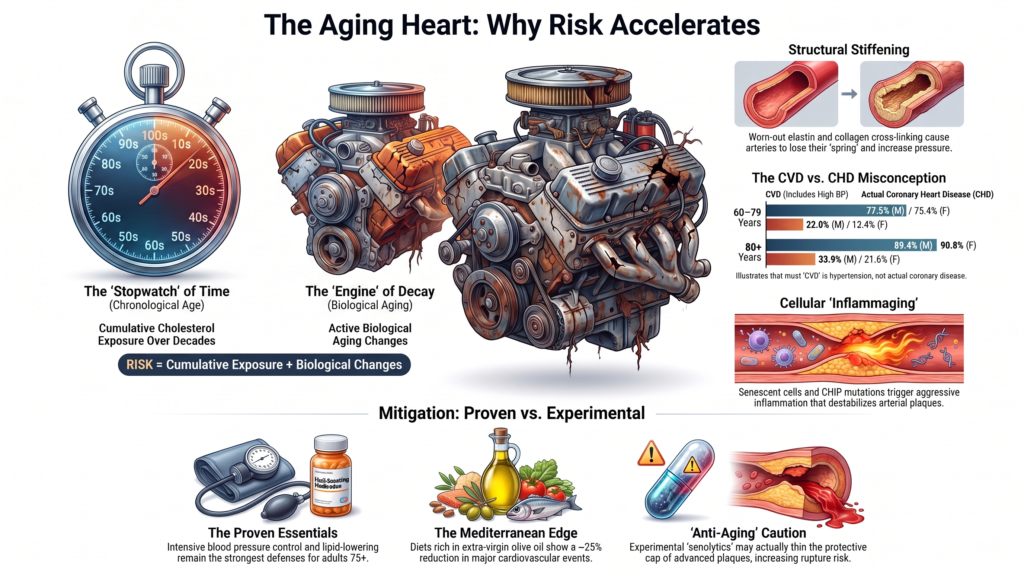
高齢者における「心血管疾患」の有病率の数値は、その数値の根拠となる定義上の注意点について言及されることなく、日常的に引用されている。米国心臓協会のサーベイランス調査では、心血管疾患(CVD)の複合カテゴリーには以下が含まれる。 高血圧. AHAサーベイランスで報告されているNHANES 2015-2018年のデータによると、 60~79歳の心血管疾患(CVD)の有病率は、男性が77.5%、女性が75.4%であり、80歳以上ではそれぞれ89.4%および90.8%に上昇している [3]. 症例定義を次のように絞り込むと 冠動脈疾患 同じデータによると、その数値は大幅に低くなっており、60~79歳の男性では22.0%、女性では13.4%、80歳以上ではそれぞれ33.9%と21.6%となっている [3]. 本総説は血圧ではなくアテローム性動脈硬化症を扱っているため、冠動脈疾患に関する数値の方がより直接的に関連しています。広く流布している86~90%付近という推定値は、高血圧を含む数値として理解すべきです。.
2015~2018年のNHANES調査データが採用されているのは、本調査で必要とされる性別および年齢層別の比較が可能だからである。より最近の調査データについては、「2026年統計更新版」を参照のこと [4]. 同様に、年齢別における初回心血管イベントの発生率も、人生の後半の年代にかけて著しく上昇する [4]. 絶対発生率は、性別、暦年、確認方法、症例定義によって異なるため、ここでは単一の点推定値のセットは示さない。.
1.2 超高齢者にみられる「脂質パラドックス」
80代および90代の高齢者における疫学的な特徴として、従来のリスク因子との関連性が弱まる、あるいは時には逆転することが挙げられる。いわゆる 脂質パラドックス, 、30年前に初期の形で記述された [5] であり、現在も議論が続いている [34]. 主に3つの説明が挙げられており、これらは互いに排他的ではない: 逆因果関係 そして 交絡 病気によるもの、すなわち虚弱、潜在性悪性腫瘍、慢性感染症、, 心不全, 、また、タンパク質・エネルギー消耗症は、以下を低下させる可能性があります コレステロール [5]; 生存者選択バイアス――LDLによるアテローム発生に最も影響を受けやすい人々は、90歳に達する前にイベントを経験したり死亡したりした割合が不均衡に高かった可能性があるため――および競合リスク――非アテローム性死のハザードの上昇により、原因別および累積発生率の関係が変化するため。.
超高齢層における観察的な関連性の弱まりは、それを否定する証拠とはならない LDL 因果関係。遺伝学的証拠は、生涯にわたるLDLの因果関係を裏付けており、スタチンの無作為化試験の結果は、高齢者、特に既往の血管疾患を有する高齢者において、主要な血管イベントの減少を示している [6,7]. 高齢者では、ASCVDの絶対的な負担が依然として最も高い [3,4], これは、数十年にわたるリポタンパク質への曝露の上に重なる加齢に伴う血管リモデリングを反映している [2].
1.3 リスクモデルと生物学的閾値
現代の予測フレームワークでは、年齢を連続的な共変量として組み込んでおり、離散的な生物学的年齢の閾値を特定していない。これは血管生物学に関する知見というよりは、モデル構造の特性である。予測式に閾値項が含まれていないからといって、生物学的な変曲点が存在しないという証拠にはならず、また、年齢係数が大きいからといって、変曲点が存在するという証拠にもならない。.
表2. 年齢層別の疾病負担と代表的なメカニズム。. 有病率の数値は、AHAのサーベイランスデータに基づいている [3] これらは、情報源が直接報告している層についてのみ示されています。長ダッシュは、年齢および性別ごとに分類された直接報告値が入手できなかったことを示しています。年齢の割り当てはあくまで一例であり、生物学的発症時期、排他性、または検証済みの病期分類システムを示すものではありません。.
| 年齢層(歳) | CVDの有病率(高血圧を含む)[3] | CHDの有病率 [3] | この年齢層(セクション)で注目されるメカニズム | ASCVDの一般的な症状 |
| 20-39 | — | — | 内皮機能障害、びまん性の内膜肥厚、早期の脂質沈着(2.1) | 無症候性の脂肪条痕、初期の脂質豊富な病変 |
| 40-59 | — | — | 上記に加え、累積値 アポB 曝露、平滑筋細胞(VSMC)の遊走および表現型の切り替え (1, 2.2) | 安定 狭心症, 急性冠症候群 |
| 60-79 | 77.5%(男子) / 75.4%(女子) | 22.0% 男性 / 13.4% 女性 | 上記に加え、血管の老化、硬化、ミトコンドリア由来の活性酸素種(ROS)、, 石灰化 (2.1-2.4) | 心筋梗塞, 虚血性脳卒中, 間欠性跛行 |
| 80+ | 89.4% 男 / 90.8% 女 | 33.9% 男性 / 21.6% 女性 | 上記に加え、CHIPの有病率の上昇、累積 エラスチン およびマトリックスのリモデリング、ならびに加齢に伴う血管修復機能の低下(2.5-2.6) | 複雑な多枝性冠動脈疾患;虚血性 脳卒中; 末梢または多部位に及ぶアテローム性動脈硬化症 |
2. 血管の老化における内的および外的メカニズム
2.1 細胞外マトリックスのリモデリング、糖化、および血行動態的せん断応力
加齢に伴い、中弾性動脈の力学的特性が変化し、アテローム発生を促進すると考えられている生物物理学的フィードバックループが形成される [8]. 慢性的な脈動性ストレスは、エラストリシス、エラスターゼの発現亢進、およびエラスチン線維のほつれを引き起こし、それに伴い代償的なコラーゲンの沈着と架橋が生じる [8]. 累積血糖負荷は、以下の形成および蓄積に寄与する。 終末糖化産物(AGEs) 長寿命の構造物において タンパク質; これらの変化は、厳密に不可逆というよりは、変化の速度が緩やかであるという特徴がある [8]. コラーゲンのAGE架橋はコンプライアンスを低下させる [8], 一方、AGE-RAGEの相互作用は内皮細胞におけるNF-κBシグナル伝達を活性化し、炎症反応および接着分子の発現を増強する [61]. AGEの蓄積は、加齢に伴う動脈硬化を引き起こす要因の一つである。.
これに伴う血行動態上の変化として、頸動脈-大腿動脈間の脈波伝播速度および中枢収縮期血圧の上昇という形で現れる血管硬化が生じ、一般人口レベルでは60歳を過ぎると拡張期血圧が低下し、脈圧が拡大する傾向が見られる [8].
低い、あるいは変動する内皮せん断応力(ESS)— 血流による接線方向の摩擦力であり、dyn/cm²で表される — にさらされている領域は、特にアテロームが発生しやすい [9]. 報告されている生理的範囲および低ESS範囲は、血管、測定法、種、および時間的平均化によって異なるため、普遍的な閾値ではなく、実験的な参考範囲として扱うべきである。 脈動性単方向流下にある比較的直線的な血管区間では、およそ15~70 dyn/cm²の値が報告されている一方、分岐部、湾曲部、 および外側の分枝壁における乱流領域では、時間平均値が約10~12 dyn/cm²を下回る場合や、時間平均値がほぼゼロであるにもかかわらずESSが振動を示す場合がある [9]. ESSの低下はeNOSの発現を低下させ、一方で VCAM-1 そして ICAM-1, 、また、リポタンパク質の滞留および単球の血管内皮透過を促進する [9].
加齢特有の資格が重要です。加齢に伴い、動脈は拡張し、硬くなります [8]、またESSの低い領域はアテローム性動脈硬化を起こしやすい [9] しかし、加齢によって低ESS領域が拡大するという総合的な主張は、加齢に特化したヒトの血行動態研究において明確に実証されていない。加齢に伴う幾何学的および力学的な変化により、低ESS領域が拡大する可能性がある。これを年齢層別に分類した被験者を対象に直接検証することは、 冠動脈CTアンギオグラフィー 計算流体力学を用いたコホート解析は、有益な知見をもたらすだろう。.
2.2 加齢した動脈壁における局所的なレニン・アンジオテンシンシグナル伝達
二次文献では、2つの事実がしばしば混同されていますが、ここではそれらを区別します。第一に、動脈壁内のアンジオテンシンII(Ang-II)は局所的に調節されており、その濃度は循環血中の濃度とは大きく異なる場合があります [10]. 組織および血漿中の測定値は方法論的に同等ではないため、これは単純な濃度比ではなく、コンパートメント間の分離として理解すべきである。この分離は成人期を通じて認められるものであり、それ自体が加齢に伴う増加ではない。.
第二に、局所レニン・アンジオテンシン系の複数の構成要素――アンジオテンシノーゲン、ACEおよびキマーゼ活性、 アンジオテンシンII(Ang-II)の量、およびAT1受容体シグナル伝達——が、動物モデルやヒト組織の研究において、加齢に伴う動脈組織で増加することが報告されている一方で、血漿レニン活性や循環アンジオテンシンII(Ang-II)は加齢とともに低下する傾向にある [10,11]. 血管内での加齢に伴う増加は、組織と血漿のコンパートメント間の違いと混同してはならない。.
局所的なアンジオテンシンII(Ang-II)は、細胞増殖因子および昇圧因子として作用し、血管平滑筋細胞(VSMC)の肥大、合成型へのフェノタイプ転換、遊走、および マトリックスメタロプロテイナーゼ 分泌、特にMMP-2 [10,11].
マルメ食事・がんコホートにおける16年間の縦断的追跡調査では、平均頸動脈 中内膜厚 進行速度は、男性で0.011 mm/年、女性で0.010 mm/年であり、分岐部ではより速い進行が見られた(それぞれ0.036 mm/年および0.030 mm/年)[12]. したがって、総頚動脈については、年間約0.01 mm、すなわち10年あたり0.1 mmという数値が、これらの縦断的データを適切に要約しているといえる。横断的な年齢参照研究では、年齢間の差がこれよりも大きいことが報告されている [8,13] ただし、横断面測定値と縦断面測定値は、算術的に相互に変換すべきではない。頸動脈IMTには、非動脈硬化性の中膜肥大や適応性壁肥厚も含まれるため、これはプラーク蓄積の直接的な測定値というよりは、構造的な指標である。.
2.3 細胞老化と老化関連分泌フェノタイプ
DNA損傷、テロメアの短縮、および慢性 酸化ストレス サイクリン依存性キナーゼ阻害因子であるp16INK4aおよびp21CIP1/WAF1の発現を上昇させ、血管において持続的な複製停止を引き起こす 内皮細胞 およびVSMCs [1,14]. ヒトのアテレクトミーおよび内膜切除術の検体において、老化関連β-ガラクトシダーゼ陽性を示し、かつテロメアが短縮した細胞は、アテローム性動脈硬化の病変部に集中しており、隣接する非病変組織にはほとんど認められない [14]. いずれのマーカーも単独では細胞老化に特異的ではないため、これらの知見は、細胞老化を決定的に特定するものではなく、むしろ細胞老化に関連する表現型を明らかにするものである。 老化細胞.
老化細胞は、炎症を促進する老化関連分泌フェノタイプ(SASP)を発現し、これには以下の分泌が含まれる。 IL-6, 、IL-1β、TNF-α、MCP-1/CCL2、およびMMP-2やMMP-9などのマトリックス分解酵素 [1,15]. ヒトの観察データによると、老化関連マーカーは、進行した病変部位やプラーク内石灰化と共局在することが示されている [14-16]. 動物実験によると、遺伝学的または薬理学的手法を用いて老化細胞を標的とすることで、SASPに関連するシグナル伝達、マトリックスの分解、石灰化、あるいは血管機能障害を軽減できることが示されている [15,45]. 線維性キャップの薄化と再内皮化の障害は、メカニズム的には整合性のある結果であるが、ヒトにおける因果関係は確立されていない [15].
プラークにおける老化が、必ずしも一様に有害であるとは限らない。血管平滑筋細胞(VSMC)は、線維性キャップのマトリックス形成と安定性に不可欠であるが、VSMCの老化は、増殖およびマトリックス産生による修復機能を損なう [15]. したがって、老化細胞の除去による影響は、病期やモデルによって異なる。Ldlr-/-マウスでは、p16を標的とした遺伝子による除去により、プラークの蓄積量が減少し、キャップの厚さが増加したが、 ナビトクラックス 大動脈プラークの蓄積量の減少 [57]. Apoe-/-マウスでは、p16による除去によって、プラークの蓄積量やキャップの厚さ、あるいは 壊死核 領域およびアポトーシスを起こした細胞の増加と 炎症, 一方、ナビトクラックスは、キャップの厚さを増加させることなく病変の大きさを縮小させた [58]. 病変が進行し、持続的な高脂血症を呈するApoe-/-マウスにおいて、ナビトクラックスは、 線維性被膜, 、キャップの厚さの減少、および死亡率の上昇 [59]. したがって、進行した実験的動脈硬化症において薬理学的セノライシスを行うと、修復作用を持つキャップ細胞が減少してプラークの安定性が損なわれ、治療上の推論に重大な制約が生じることになる。.
2.4 ミトコンドリア機能障害、ミトファジー、および血管のインフレイマージング
マウスの血管老化モデルにおいて、加齢した動脈組織では、ミトコンドリアDNA(mtDNA)のコピー数が減少し、コピー数調節因子であるTFAM、PGC-1α、およびmtDNAヘリカーゼTwinkleの発現が低下していることが示されている [17]. これらの変化は、ミトコンドリア呼吸の低下、頸動脈のコンプライアンスおよび伸展性の低下、ならびに大動脈脈波伝播速度の上昇と連動している [17]. そのモデルにおいて、トランスジェニックTwinkleの過剰発現は、mtDNAのコピー数を増加させ、動脈の呼吸機能を改善し、血管の老化を遅らせる一方、mtDNAの完全性が損なわれているポリメラーゼγ変異体マウスは、より早く老化する [17]. ApoE-/-マウスでは、これに関連するミトコンドリア機能の回復により、壊死核の面積が縮小し、線維性キャップの相対的な厚さが増加する [18]. このエビデンスの多くはマウスを対象としたものであり、ヒトの血管におけるTwinkleを用いた同等の縦断的データは存在しない。.
損傷を受けたミトコンドリアは、ミトファジーによって除去される。 標準的なPINK1/Parkin経路では、脱分極によってPINK1が外膜上に安定化され、Parkinが動員される。Parkinは、MFN1、MFN2、VDAC1などの外膜タンパク質をユビキチン化させ、そのオルガネラをオートファジー・リソソームによる分解の対象とする[19]. パーキンに依存しない経路も存在する。.
加齢と血管壁におけるミトファジーフラックスとの関係は、単なる減少という単純なものではなく、より複雑なものです。加齢したマウスの 大動脈, パーキンタンパク質およびミトファジーマーカーの増加が、IL-6の上昇や呼吸機能の低下と併せて認められる。これは、単なる経路の喪失というよりも、損傷した細胞小器官の負荷の増加に応答した、代償的あるいは停滞したミトファジーによるものであると一致している [19]. 経路マーカーの増加は、フラックスの増加を必ずしも示すものではない。多くの組織において、加齢に伴い全体的なオートファジー能力は低下し、現時点で入手可能なデータは、加齢に伴う動脈において、損傷したオルガネラの負荷に対してクリアランスが不十分になっているという見解と一致している [50]. 損傷が持続しているミトコンドリアは、ミトコンドリア由来の 活性酸素種 そして、メチル化されていないCpG mtDNAを含むミトコンドリアの損傷関連分子パターンを細胞質内に放出する [19].
細胞質内のミトコンドリア由来の損傷関連分子パターンが関与する NLRP3インフラマソーム およびTLR9/MyD88シグナル伝達経路。この経路が実証されたマウスモデルにおいて、このシグナル伝達は、ミトコンドリア機能障害とアテローム発生の増加とを結びつける、IL-6に関連するフィードフォワード型の炎症ループに寄与している[19]. ヒトにおいて、これと同等の縦断的な因果関係は実証されていない。.
2.5 潜在能力が不明確なクローン性造血(CHIP)
「潜在性が不明確なクローン性造血(CHIP)」とは、造血幹細胞および前駆細胞において、白血病に関連するドライバー遺伝子に加齢に伴い体細胞変異が生じることを指し、従来は、持続的な原因不明の血球減少がなく、かつ診断可能な血液系腫瘍がない状態で、バリアント対立遺伝子割合 (VAF) ≥2% において、原因不明の持続的な血球減少が認められず、かつ診断可能な血液系腫瘍が存在しない場合に定義される [20]. 原因不明の持続性血球減少症にクローン性が併存する場合、現在の分類では「意義不明のクローン性血球減少症(CCUS)」と指定されており、これには異なる悪性進行リスクが伴う [21]. ここで要約した心血管系の文献は、CCUSではなくCHIPに関するものである。初期のシーケンシングコホートにおける有病率は、40歳未満では1%未満から、70歳以上の成人では約10%へと上昇しており、ディープシーケンシングによって2%の閾値を下回るクローンが検出された場合には、その推定値はさらに高くなる [20]. 2%のVAFカットオフ値は、検査および報告上の慣例であり、生物学的な境界値ではありません。.
主要な要因としては、DNMT3A、TET2、ASXL1が挙げられ、JAK2 V617Fは頻度は低いものの、機能的に特徴的である [20,22]. Tet2欠損マウスにおいて マクロファージ, 機能喪失は、以下に関連してIL-1βおよびIL-6のシグナル伝達を増強する NLRP3 インフラマソームの活性化 [23].
効果量の算出には精度が求められる。BioImageおよびMalmö Diet and Cancerコホートにおけるネスト型症例対照解析では、CHIP遺伝子保有者は冠動脈疾患の発症リスクが約1.9~2.0倍高く、ATVBおよびPROMISでは早期発症心筋梗塞のオッズが約4倍高かった [22]. よく引用される「約12倍」という数値は、当初のコホート推定において特にJAK2 V617F保因者に当てはまるものであり、一方、DNMT3A、TET2、およびASXL1は、リスクがおよそ1.7倍から2.0倍程度と関連していた [22]. これは遺伝子特異的であり、クローンサイズ特異的ではないため、「VAFが10%を超えるとリスクが12倍に増加する」と書き換えるべきではない。 より大きなクローン(VAF >=10%)は、観察コホートにおいて心血管疾患および全死因リスクの上昇と個別に関連しており、CHIP保因者では冠動脈疾患のリスクが高くなる。 カルシウムスコア 非保菌者よりも [20,22].
マウス実験において、生物学的因果関係が裏付けられている。高脂血症のLdlr-/-マウスにおいて、Tet2欠損骨髄による再構成を行うと、病変の大きさおよび壊死性コアの負担が増大する [23]. これらの実験は、そのメカニズムが機能し得ることを立証するものであり、人間における因果関係の大きさや普遍性を立証するものではない。.
の探索的ゲノムサブスタディにおいて、 カントス, シーケンシングを受けた参加者338名(8.6%)がクローン性造血を示しており、TET2保因者は、より大きなMACEの減少効果を得ているようであった。 カナキヌマブ 非保菌者よりも [24]. これは仮説生成的なサブグループの知見であり、実証された治療効果の修飾因子ではない。.
反証の重要性は依然として変わらない。5つの無作為化心血管アウトカム試験の参加者63,700人を対象とした統合解析では、CHIPの保因と主要な心血管イベントとの間に有意な関連は認められなかった(調整後HR 1.07、95%信頼区間 0.99-1.16)[25]. PESAコホート, ベースライン時のクローン性造血は、約6年間にわたるその後の新規大腿動脈アテローム性動脈硬化症の発症と関連していたのに対し、アテローム性動脈硬化の負荷は、同期間において変異クローン拡大を測定可能なほど加速させることはなかった [26]. これらの知見は、クローン性造血からアテローム性動脈硬化症への一方向的な関連性を支持するものであるが、他の状況における双方向的な影響を排除するものではない。CHIPは依然として生物学的に説得力があり、実験的にも裏付けられているが、集中治療を受けている二次予防対象集団におけるその独立した予後予測価値は、一般集団コホート研究の文献が示唆するほど確実ではない。.
2.6 内皮前駆細胞とタンパク質毒性ストレス
従来、次のように分類されてきた循環細胞群は 内皮前駆細胞 一部の試験法では加齢に伴う数や機能の低下が認められるが、その結果は試験法や表面マーカーの表現型によって異なる [1]. 「内皮前駆細胞」という用語は、単一の明確に定義された細胞系統を指すものではない。この名称で呼ばれる細胞群の多くは、真の内皮前駆細胞というよりは、造血細胞や血管新生細胞であり、内皮コロニー形成細胞は、CD34/KDRを用いたフローサイトメトリー法や培養法によるアッセイと同義ではない。 高齢者における前駆細胞指標の低下と血管機能障害との関連性は、概ね一貫しているが、前駆細胞の機能不全が修復能の低下を引き起こすという推論は確立されていない。.
実験的および観察的な証拠からも、加齢によって血管機能が損なわれる可能性があることが示唆されている プロテオスタシス: ユビキチン・プロテアソーム活性の低下およびシャペロン機能の障害により、内皮細胞や血管平滑筋細胞(VSMCs)内に誤折りたたまれたタンパク質や凝集体が蓄積し、タンパク質毒性ストレス、未折りたたみタンパク質応答、および小胞体ストレスを介したアポトーシスが促進される可能性がある [1]. 個々の段階は、ヒトの動脈壁よりも非血管組織においてより明確に確立されているため、この一連の過程は、実証済みのヒトにおける経路というよりは、メカニズムモデルとして提示されている。.
表3. 血管の老化メカニズム、メディエーター、およびアテローム性動脈硬化に関連する表現型または影響。.
| 生物学的メカニズム | 主要な分子メディエーター | 血管への直接的な影響 | アテローム性動脈硬化に関連する表現型または影響 | エビデンスレベル(引用元) |
| マトリックスの分解とAGEによる架橋 [8,9] | コラーゲンの架橋, AGE-RAGE, エラスターゼ, MMPs | 硬化、PWVおよび収縮期血圧の上昇、コンプライアンスの低下 | 低ESS領域におけるリポタンパク質の滞留および単球の侵入(<10-12 dyn/cm²は研究で一般的に用いられる定義であるが、測定法によって異なる) | ヒトを対象とした観察研究+メカニズム研究 |
| 局所的なAng-IIシグナル伝達 [10,11] | 局所的に調節される内因性アンジオテンシンII;ACE、キマーゼ、AT1 | VSMC肥大、合成スイッチング、MMP-2の活性化 | 加齢に伴う 動脈リモデリング; 一般集団のデータによると、頸動脈のIMTは縦断的に年間約0.01 mmずつ増加する [12] | 動物およびヒトの組織 |
| 細胞老化とSASP [1,14-16] | p16INK4a、p21CIP1、SA-β-gal、MMP-2/9、IL-6、IL-1β | 複製停止、ECMの分解、パラクリン伝播 | ヒト組織において、石灰化部位および進行した病変部位との共局在が認められる。因果関係は主に動物モデルにおいて確認されており、キャップ効果はモデルおよび病期に依存する。 | ヒトの組織学 [14] + 動物 [15,45] |
| ミトコンドリア機能障害およびミトファジーによる品質管理の異常または不十分さ [17-19,50] | ミトコンドリアDNA(mtDNA)コピー数の減少、TFAM、PGC-1α、Twinkle;PINK1/Parkinの調節異常;mtDAMPs | mROSの上昇、NLRP3およびTLR9/MyD88の活性化 | 動物モデルにおけるIL-6/mROSのフィードフォワードシグナル伝達;コンプライアンスの低下;壊死性コア [18] | 動物由来;ヒトへの推論 |
| CHIP [20,22-24] | TET2、DNMT3A、ASXL1、JAK2 V617F(VAF ≥2%) | ドライバー依存性の骨髄系細胞の偏り、単球の過剰反応、IL-1β/IL-6の過剰 | ~2倍の冠動脈疾患(CHD);~4倍の若年発症心筋梗塞(MI);JAK2 V617F変異によるCHDリスクは、当初のコホート推定値の約12倍;CAC値の上昇;マウスにおける病変の増大 | 人間 流行病学 + 因果関係を示す動物モデル + ヒトを対象とした縦断的画像検査;治療を受けた試験対象集団において、予後指標の大きさにばらつきが見られる [25,26] |
| 前駆細胞の減少とタンパク質毒性 [1] | 不均一な前駆細胞集団、テロメアの短縮、UPSの機能不全、UPR | 内皮修復機能の障害との関連;細胞内タンパク質毒性 | バリア機能の破壊とアポトーシス(モデル。経路は実証されていない) | 人間を対象とした観察研究、方法論的に多様である |
3. 治療的緩和戦略
3.1 栄養療法:CORDIOPREV研究のエビデンス
無作為化、単盲検 CORDIOPREV試験 確定診断済みの冠動脈疾患患者1,002名を登録し、中央値7年間追跡調査を行い、エクストラバージンオリーブオイルを豊富に含む地中海式食事パターンと オリーブオイル (EVOO;総脂肪 35%、一価不飽和脂肪酸 22%、<50% 炭水化物) 低脂肪食(脂肪 28%、一価不飽和脂肪酸 12%、複合炭水化物 55% 以上) [27,28]. このコホートの平均年齢は59.5歳(標準偏差8.7)で、男性82.5%名であった [28] であるため、80代への適用は外挿に過ぎない。ここで重要なのは、本研究における低脂肪群の値が他の食事法よりもかなり高く、EVOO群の値よりもわずかに低いだけであるという点である。.
ベースライン時点で頸動脈の画像検査を受けた939名の参加者のうち、 地中海式ダイエット 5年時点で総頚動脈のIMTが減少した(-0.027 ± 0.008 mm;P<0.001)ほか、7年時点でもその減少が維持された(-0.031 ± 0.008 mm; P<0.001)が認められ、この減少はベースラインと比較して維持された。一方、低脂肪食では変化は認められなかった [27]. 追跡期間を通じて、地中海式食事群では低脂肪食群に比べて頸動脈プラークの最大高さが減少した一方、プラークの数に差は見られなかった [27]. これらは集団レベルの構造的変化である。総頚動脈のIMTの進行は、心血管イベントの減少を示す検証済みの代替指標ではない。PROG-IMTの個別参加者データでは メタ分析, IMTの進行は、心血管イベントを独立して予測するものではなかった [54].
その コディオプレブ 主要評価項目は、心筋梗塞、, 血行再建術, 、虚血性脳卒中、, 末梢動脈疾患, 、および心血管死 [28]であり、多くの薬理学的試験で使用されているMACEの定義とは異なります。 198名の参加者にイベントが発生した:地中海式食事群で87名、低脂肪食群で111名(1,000人年あたり28.1対37.7;ログランク検定 P=0.039)[28]. 多変量調整済み ハザード比 モデル仕様にわたる範囲は、0.719 (95% 信頼区間 0.541–0.957) から 0.753 (95% 信頼区間 0.568–0.998) の範囲にあり、これは推定ハザード値が約 25–28% 低いことに相当する [28]. 最も不利なモデルにおける信頼区間の上限は1に近づいており、また、この試験は単一施設で実施され、参加者に対する盲検化は行われていなかった。.
また、エキストラバージンオリーブオイルを豊富に含む地中海式食事の長期的な摂取は、推定値の低下ペースの鈍化とも関連していた。 糸球体ろ過 有病率であり、2型糖尿病または軽度の腎機能障害のある参加者間ではその差がより大きかった [29]. これは腎機能に関する二次的な評価項目であり、腎保護作用が実証された臨床的効果ではない。MEDLIFEの解析は、無作為化コホート内における観察研究であり、第3.4節で論じられている。.
CORDIOPREV研究では、食事パターン全体を検証したものであり、その効果をエキストラバージンオリーブオイル(EVOO)の個々の成分に帰属させることはできない。. バイオマーカー サブスタディでは、IMTの変化に伴う血中AGEの変動が示されているが、成分特異的なメカニズムは確立されていない [31]. 個人が……という主張は ポリフェノール SASPの分泌を抑制するためには、別途の一次実験的証拠が必要であり、これらは 治験 それ自体.
3.2 薬物療法
2026年3月のACC/AHA/多学会合同 脂質異常症 このガイドラインは、2018年の血中コレステロールに関するガイドラインに代わるものです。このガイドラインでは、 数式を防ぐ 一次予防における脂質低下療法の判断指針として、LDL-Cおよび非HDL-Cの治療目標値を再設定し、高リスク群に対してはより低い目標値を設定するとともに、リスク評価における冠動脈石灰化スコアの役割を拡大する 再分類, 測定することを推奨しています リポ蛋白(a) 少なくとも1回は、75歳以降は、ASCVDのリスクを低減するために、生活習慣の改善と併せてLDL-C低下薬物療法を検討してもよいとしている [32]. したがって、75歳以上の層に対して現代的な指針が欠けているわけではない。依然として限られているのは、75歳以降の一次予防におけるスタチン療法の開始に具体的に焦点を当てた、専用の無作為化比較試験によるエビデンスである。.
「コレステロール治療試験者共同研究(Cholesterol Treatment Trialists’ Collaboration)」による28件の試験を対象としたメタ解析では、既存の血管疾患を有する75歳以上の参加者において、スタチン療法によりLDL-Cが1.0 mmol/L低下するごとに、主要な血管イベントの発生率が有意に比例して減少することが示され、この比例的な有益性が年齢によって失われるという証拠は認められなかった [7]. ベースラインのイベント発生率が高いほど、相対的な効果が維持されていても絶対的な利益は大きくなるが、実際に得られる利益は競合リスクに依存し、, 固守, 、および治療期間 [7,34].
75歳以降の一次予防に関する専用の無作為化試験によるエビデンスは、依然として限られている。STAREE試験(NCT02099123)では、臨床的な心血管疾患、糖尿病、または認知症のない、70歳以上(平均74.7歳;40%:75歳以上; 52% 女性;ベースライン時の平均LDL-C 126 mg/dL)を対象に、臨床的な心血管疾患、糖尿病、または認知症のない75歳以上のオーストラリア人9,971名を無作為に割り付け、 アトルバスタチン 40 mg または プラセボ, 、共同主要評価項目として、障害のない生存期間および主要心血管イベントが設定されている [35]. 被験者の募集は2015年7月から2023年3月まで行われた。2026年8月13日現在、査読を経た主要評価項目の報告は発表されていない。.
PREVENTABLE(NCT04262206)試験では、臨床的に明らかな心血管疾患、身体障害、または認知症のない75歳以上の米国人成人20,000名を、約100カ所の試験実施施設において、アトルバスタチン40 mg群またはプラセボ群に無作為に割り付けています。 本試験の主要評価項目は、新たな認知症または持続的な障害のない生存期間であり、心血管イベントは副次評価項目である [36]. 2026年8月13日時点で、査読済みの主要な結果は発表されていなかった。 エンドポイントの非対称性が重要である:PREVENTABLE試験の主要エンドポイントは、従来のMACEではなく、高齢者向けの機能的複合エンドポイントである。米国予防医療サービス作業部会(US Preventive Services Task Force)は、76歳以上の成人を対象とした一次予防におけるスタチン導入の有益性と有害性を評価するには、依然としてエビデンスが不十分であると判断し続けている[37].
2026年にフランスで実施された別の実用的な非盲検非劣性試験では、投与開始ではなく投与中止が対象とされた。一次予防のために少なくとも1年間スタチンを服用しており、ASCVDの既往歴がない75歳以上の成人1,160名を対象としたこの試験において、3年間の 全因死亡率 投与中止群では7.2%であったのに対し、継続群では7.9%であり、事前に設定された非劣性基準を満たした [55]. この知見は、心血管イベントの同等性を立証するものではなく、治療開始の是非に関する疑問に答えるものでもない。また、非盲検試験デザインおよび予想よりも低い死亡率という点を踏まえて解釈すべきである。.
加齢に伴う薬物動態の変化にはばらつきが見られる。全身水分量の減少や 除脂肪体重, 、機能的肝容積の低下、および腎機能の低下は、薬物の分布やクリアランスに影響を及ぼす可能性がある [33,38]. いくつかの親水性スタチンでは腎クリアランスがより大きな役割を果たす一方、アトルバスタチンやシンバスタチンは主に肝代謝およびトランスポーターを介した処理に依存している [38]. 観察研究では、高齢者がスタチンに関連する筋肉症状を報告する頻度が高いが、多発性疾患、相互作用のある薬剤、基礎的な筋骨格系の症状、および症例の特定方法に違いがあるため、これだけでスタチンに起因する筋肉毒性がより大きいとは断定できない [38]. SAMS-CIは、構造化された評価に対応しています [39]. サムソン n-of-1クロスオーバー試験では、参加者がスタチンに起因するとした過剰な症状の負担の大部分は、プラセボ投与期間中にも同様に認められた [40]. 治療法の選択肢としては、線量低減などが挙げられ、, 1日おき投与, 、薬剤の切り替え、およびスタチン系以外の追加療法 [38]. において 木星, ロスバスタチン 少なくとも1つの主要な糖尿病を有する参加者において、糖尿病の新規発症率が28%倍相対的に増加することと関連していた 危険因子, 、こうした危険因子を持たない人々では有意な増加は見られなかった;その集団において、予防された血管イベントおよび死亡数は、新たに発症した糖尿病症例数を上回った [41].
CANTOS試験では、心筋梗塞後の患者において、hsCRPが2 mg/L以上の場合、四半期ごとのカナキヌマブ投与が、脂質低下効果とは無関係に心血管イベントの再発を減少させることが示された [42]. 二次解析では、治療中のhsCRPの低下幅が大きいほどイベントの減少幅も大きいことが示されたが、これは無作為化後の反応によって層別化されたものであるため、予測バイオマーカー戦略を確立するものではない [60]. カナキヌマブは致死的な感染症の発生率を増加させ、心血管系の適応については承認されていない。.
LoDoCo2は、次のような結果を示した。 コルヒチン 0.5 mgを1日1回投与すると、その主要評価項目が減少した 複合エンドポイント 慢性冠動脈疾患において(HR 0.69、95%信頼区間 0.57~0.83)[43]、非心血管死の数値上の増加が見られたが、その原因については依然として完全には解明されていない。 対照的に、CLEAR SYNERGY(OASIS 9)試験では、PCIによる治療を受けた急性心筋梗塞(AMI)患者において、心血管死、再発性心筋梗塞、脳卒中、または虚血を原因とする再血管化処置の減少は認められなかった:PCI群の9.1%に対し、プラセボ群は9.3%(HR 0.99、 95% 信頼区間 0.85-1.16;P=0.93) [56]。 不一致 一様な有益性に関する説明を支持するものではない。疾患の進行段階、投与レジメン、背景療法、事象発生率、および試験の実施方法の違いが説明として提唱されているが、これらは確立されたものではない。.
コルヒチンの安全性は、高齢者の多剤併用において特に重要である。腎機能障害や肝機能障害、および強力なCYP3A4やP-グリコプロテイン阻害剤の併用は、毒性や投与量に重大な影響を及ぼす。 相互作用を起こす薬剤には、クラリスロマイシン、いくつかのアゾール系抗真菌薬、ベラパミル、ジルチアゼム、シクロスポリンなどが含まれる。最新の製品添付文書および2023年の慢性冠動脈疾患ガイドラインを参照すべきである [44]. このガイドラインでは、慢性冠動脈疾患に対して低用量コルヒチンをクラス2bの推奨として位置付けている [44]. LoDoCo2では、hsCRPやその他の炎症性バイオマーカーに基づいて患者を選定していないため、これを「バイオマーカーに基づく」と表現すべきではない。.
3.3 老化防止戦略:前臨床段階
本節で取り上げるすべての治療法は、アテローム性動脈硬化症のエンドポイントに関しては、前臨床段階または初期段階にある。アテローム性動脈硬化症に対して臨床的に適応が認められているものはない。.
ダサチニブにケルセチンおよびBCL-2ファミリー阻害剤ナビトクラックスを併用すると、特定の老化細胞集団において優先的にアポトーシスを誘導することができる。 「セノリティック」は、予測可能なクラス効果を持つメカニズムではない。これらの薬剤は、分子標的や、その作用によって減少させる老化細胞集団において、大きく異なるからである。加齢マウスおよびアテローム性動脈硬化マウスにおいて、セノリティック剤による慢性投与は、血管運動機能障害を緩和し、大動脈の石灰化および内膜壁の硬さを軽減することができる [45]. しかし、プラークの安定性への影響は、病変の進行段階やモデルによって異なる。進行した病変において、ナビトクラックスは平滑筋由来の線維性キャップ細胞を減少させ、キャップの厚さを薄くし、死亡率を上昇させた。これは、キャップが厚くなるという以前の報告とは矛盾する [57-59]. ヒトにおける経験は、特発性肺線維症を対象とした小規模な非盲検試験および初期段階の試験に限られている [46] および糖尿病 腎臓病 [47]、身体機能または老化細胞負荷をエンドポイントとするもの。アテローム性動脈硬化症の臨床エンドポイントに対してセノライティック剤を検証したヒト臨床試験はこれまで行われていない。.
経口投与したスペルミジンは、高齢マウスにおいて大動脈の脈波伝播速度および一酸化窒素を介した内皮細胞の拡張を改善し、大動脈内のAGE、I型コラーゲン、ニトロチロシン、およびスーパーオキシドを減少させた [48]. 高齢の高脂血症マウスにおいて、スペルミジンはミトコンドリア機能障害およびアテローム形成を軽減した [19]. ApoE-/-マウスにおいて、スペルミジンはプラークの大きさや細胞構成を変えることなく、壊死核の形成と脂質蓄積を抑制したが、この効果には平滑筋が正常であることが必要であった。 オートファジー [49].
メトホルミンは老化防止剤として提案されており、「メトホルミンによる老化対策(TAME)」という概念は、老化の生物学的メカニズムに対する介入が複合疾患の発症を遅らせることができるかどうかを検証するための枠組みとして、現在もなお位置づけられている [51]. TAMEは依然として研究計画の段階にあり、2026年8月13日時点でTAMEの有効性に関するデータは公表されていない。 メトホルミンが、独自の老化防止メカニズムを通じてアテローム性動脈硬化の転帰を改善することを示す臨床的証拠は存在しない。mTOR阻害剤はモデル系においてミトコンドリア由来の活性酸素種(ROS)を抑制し、SASPを調節するが、血管特異的な証拠は乏しく、ラパログ系薬剤には高齢者において無視できない免疫抑制作用および脂質異常症誘発作用が伴う。.
3.4 血行動態および生活習慣によるリスク軽減
心理社会的ストレスは、行動、自律神経、神経内分泌、炎症、および血行動態の各経路との相互作用を通じて、心血管系の有害な転帰と関連している [62]. ヒトにおける個々の血管老化メカニズムが果たす役割については、依然として不明な点が多い。.
高齢者における血圧管理については、無作為化試験による直接的な裏付けがある。HYVET試験では、, 降圧薬 80歳以上の患者に対するこの治療により、脳卒中、心不全、および全死因による死亡率が低下した [52]. スプリント 75歳以上の子集団において、収縮期血圧の集中管理は、主要な心血管イベントおよび全死因死亡率を低下させ、その知見はフレイルの層別化ごとに概ね一貫していた [53]. 集中治療では、低血圧、失神、電解質異常、急性腎障害のモニタリングが必要である。SPRINT試験では、転倒による傷害の増加は認められなかった [53]. レニン・アンジオテンシン・アルドステロン系の阻害は、さらにアンジオテンシンII(Ang-II)シグナル伝達を抑制し、血管リモデリングや中枢血行動態に好影響を及ぼす可能性がある [8,10] しかし、HYVETおよびSPRINTの研究では、こうした血管の老化メカニズムが臨床的利益に関与していることは立証されていない。.
CORDIOPREVの参加者851名を対象とした5年間の前向き分析において、MEDLIFEの遵守度が高い(13点以上)ことは、以下の発症リスクの調整後オッズの低下と関連していた。 メタボリックシンドローム (オッズ比 0.37、 95% 信頼区間 0.19-0.75)を示し、また、遵守度が低い群(12点未満)と比較して、既存のメタボリックシンドロームが改善するオッズも高かった(OR 2.08、95% 信頼区間 1.11-3.91)[30]. これらは無作為化コホート内における観察的な関連性である。すなわち、参加者はライフスタイル指標に基づいて無作為に割り付けられたわけではなく、遵守状況は自己申告によるものであり、 残存交絡 可能性が高い。定期的な有酸素運動は、より良好な状態の維持と関連している 血管内皮機能 高齢者において [1]. 提案されているメカニズム(せん断に関連するeNOSシグナル伝達、血中炎症性サイトカイン濃度の低下、ミトコンドリアの品質管理の改善など)は、無作為化試験による血管アウトカムデータというよりは、主に生理学的研究や動物実験の結果によって裏付けられている。.
表4. 分野、メカニズム、成果、およびエビデンスレベル別の緩和戦略。. 「エビデンスレベル」のラベルは、各行で引用されている出典を示しています。.
| ドメイン | 介入 | 標的となるメカニズム | 主要評価項目 | エビデンスレベル(引用元) |
| 栄養 [27-29,31] | エキストラバージンオリーブオイルを豊富に含む地中海式食事パターン | 全身的な抗炎症作用および内皮細胞への作用;AGEの調節 | CORDIOPREVでは、事前に規定された心血管複合エンドポイントについて、調整後ハザード比(HR)が0.719~0.753(推定ハザードが約25~28%低下)であった; IMT-CC:7年時点で-0.031 mm(群レベルの構造的アウトカムであり、検証済みのイベント代替指標ではない);副次アウトカムとしてeGFRの低下速度の鈍化 | RCT(平均年齢59.5歳;高齢者に外挿) |
| 脂質管理 [7,32,35-38,55] | 中程度/高強度スタチン および必要に応じてその他のLDL低下療法 | HMG-CoA還元酵素 抑制、アポBの低下、, プラーク安定化 | 高齢者における二次予防の有効性は確立されている。2026年のガイドラインでは、75歳以降におけるLDL-C低下薬物療法の検討が認められている。投与開始に関する専用の臨床試験は現在進行中である。投与中止に関する臨床試験では、心血管系の同等性が確立されず、投与開始の是非についても結論が出なかった。 | RCT/メタ解析+現行のガイドライン |
| 抗炎症作用 [42-44,56] | コルヒチン 0.5 mg/日;カナキヌマブ(心血管疾患への使用は承認されていない) | 微小管依存性炎症シグナル伝達;IL-1β/NLRP3関連経路 | LoDoCo2:慢性冠動脈疾患におけるHR 0.69;CLEAR SYNERGY:心筋梗塞後の9.1%対9.3%;いずれのコルヒチン試験もバイオマーカー選別法は採用されていない | RCT(不一致)+ガイドライン(クラス2b) |
| 老化防止 [15,19,45-51,57-59] | セノリティクス、スペルミジン、メトホルミン、ラパログ | 老化細胞の除去、オートファジー/ミトファジーの調節、mTORの阻害 | 前臨床試験における効果としては、壊死核の縮小、石灰化の軽減、あるいは血管運動機能障害の改善などが挙げられる。臨床試験における効果は、病期やモデルによって異なり、結果にも一貫性が見られない。ヒトにおける動脈硬化の転帰に対する有益性は実証されていない。 | 前臨床段階;その他の適応症における初期段階のヒト臨床試験 |
| 血行動態 [8,10,52,53] | 降圧療法;ACE阻害薬/ARB | 血圧低下;壁内Ang-IIシグナル伝達の遮断 | HYVETおよびSPRINTの75以上サブグループ:臨床事象および死亡率の減少 | RCT+メカニズム |
| ライフスタイル [1,30] | MEDLIFEの服薬遵守、, 有酸素運動 | 内皮細胞におけるせん断に関連する好ましいシグナル伝達、eNOSの発現亢進、減少 炎症老化 | MEDLIFEの観察研究における関連性:代謝症候群の発症、オッズ比(OR)0.37;; 反転 OR 2.08 | 無作為化コホート内での観察研究 |
4. 制限事項
まず、本稿はナラティブ・レビューである。文献の選定は、あらかじめ定められた検索・スクリーニングプロトコルに基づくものではなく、代表性を重視して行われたため、引用数の多いメカニズムに関する文献に偏りがある可能性は否定できない。.
第二に、血管の老化のメカニズムに関する知見は、主にげっ歯類や非ヒト霊長類を用いた研究に基づいている。いくつかの経路については、ヒトにおける証拠は、直接的な縦断的介入によるものではなく、依然として主に横断的な組織データ、バイオマーカーデータ、あるいは関連性データにとどまっている。.
第三に、第3.1節の根拠となっている無作為化食事介入試験のデータは、主に男性の中年層を対象とした単一施設での試験によるものであり、高齢者集団への一般化については推論の域を出ない。.
第四に、CHIPに関する文献は依然として流動的である。動物実験による因果関係を示すデータは有力であり、地域社会および集団ベースのコホート研究における関連性は堅固である一方、治療を受けた試験対象集団のデータは比較的有意な結果を示していない。エンドポイントの異質性、クローンの構成、背景療法、, 統計的検出力, 、また、無作為化試験への参加者の選定方法も、これらのデータセットごとに異なっている。したがって、この不一致を単一の要因に帰するというのは時期尚早である。.
第五に、頸動脈のIMTは構造的指標として用いられているが、個々の参加者に関するメタ解析では、IMTの進行が独立してイベントを予測することは示されていない [54]; 構造回帰を事象の減少と同一視してはならない。.
5. 結論
臨床的なアテローム性動脈硬化症の発生率は、加齢に伴い急激に上昇する [4]. 加齢に伴う血管メカニズムは、測定された従来の危険因子のみから予測されるよりも早期の臨床的疾患の発症や、より大きなアテローム性動脈硬化の負担の一因となっている可能性がある。これらは、第1.0節で定義された実用的な表現型の2つである。ヒトにおけるプラーク蓄積の経時的速度そのものが、暦年齢とともに加速するかどうかは、依然として実証されていない。 高齢者におけるイベント発生率の上昇は、リポタンパク質を介したアテロジェネシスの置き換えというよりも、累積的なアポB曝露に重畳する加齢に伴う血管プロセスとして理解するのが最も適切である [2,6].
加齢した血管壁においては、マトリックスの分解、AGEによる架橋、血管壁内でのアンジオテンシンIIシグナル伝達の変化、ミトコンドリア機能障害、ミトコンドリアの品質管理機能の低下、および細胞老化が、アテローム発生を促進したり、プラークの脆弱性に関連する特徴に寄与したりする可能性のある、候補となる経路あるいは実験的に裏付けられた経路を構成している [16]. 証拠の強度は一様ではない。ヒトの組織および組織学的データは、マトリックス、アンジオテンシンII、および老化経路を支持している一方、ミトコンドリアおよびミトファジーに関する証拠は主にマウス由来のものであり、ヒトの血管における同等の縦断的研究データが欠如している。.
CHIPとして現れる造血幹細胞における加齢に伴う体細胞変異は、ドライバー依存性の炎症シグナル伝達を促進し、実験モデルにおいてアテローム発生を加速させるのに因果的に十分な要因となる。 ヒトにおける画像診断データは、相互の寄与を排除するものではないものの、クローン性造血からアテローム性動脈硬化症への主要な進行経路を支持している。一方、集中治療を受けたヒト集団におけるCHIPの独立した予後因子としての重要性は、依然として議論の的となっている [22-26].
リスク軽減には多面的なアプローチが必要である。CORDIOPREV試験は二次予防において地中海式食事パターンを推奨しているが、高齢者対象の試験ではなかった [27,28]. スタチン療法は高齢者における二次予防の有効性が確立されており、2026年の多学会合同ガイドラインでは、75歳以降は生活習慣改善と併せてLDL-C低下薬物療法を検討できるとしている。STAREEおよびPREVENTABLE試験は、一次予防に関する残された不確実性を解明することを目的としている [32,35,36]. 低用量のコルヒチンは、慢性冠動脈疾患を対象としたLoDoCo2試験においてイベントを減少させたが、心筋梗塞後のCLEAR SYNERGY試験では中立的な結果となった [43,56]. 75歳以上の成人において、血圧降下療法の有効性は無作為化試験によって直接裏付けられている [52,53]. セノセラピーおよびミトファジーを標的とした戦略は依然として研究段階にあり、ヒトにおいて動脈硬化の臨床転帰に対する有益性が実証されていない [15,19,45-51,57-59].
したがって、現在の治療方針は、アポB含有リポタンパク質の曝露低減、血圧管理、喫煙の回避および禁煙、糖尿病および関連する代謝リスクの管理(該当する場合)、食事の質の改善、ならびに身体活動に重点を置いている。慢性冠動脈疾患を有する患者のうち、適切に選定された患者に対しては、最新のガイドラインおよび患者ごとの禁忌事項に基づき、低用量のコルヒチンの投与を検討してもよい。.
宣言
資金調達. 本研究は、公的機関、民間企業、非営利団体のいずれからも、特定の助成金を受けていません。.
利益相反。. 著者は、利益相反がないことを表明する。.
データの可用性. 該当なし。本論文は叙述的レビューであり、参加者レベルの独自データは報告していない。.
倫理審査の承認。. 該当なし。本叙述的レビューでは、ヒト被験者や動物の新規登録は行われておらず、特定可能な被験者レベルのデータも生成されていない。.
生成AIの活用。. 著者は、原稿の起草、編集、および参考文献の書式設定を支援するために、大規模言語モデルを利用しました。著者はすべての内容を確認・検証し、すべての科学的記述および引用について責任を負い、投稿された論文の完全性および正確性について全責任を負います。.
参考文献
- Head T, Daunert S, Goldschmidt-Clermont PJ. The aging risk and atherosclerosis: a fresh look at arterial homeostasis. Front Genet. 2017;8:216.
- Tyrrell DJ, Goldstein DR. Ageing and atherosclerosis: vascular intrinsic and extrinsic factors and potential role of IL-6. Nat Rev Cardiol. 2021;18(1):58-68.
- Virani SS, Alonso A, Aparicio HJ, Benjamin EJ, Bittencourt MS, Callaway CW, et al. Heart disease and stroke statistics-2021 update: a report from the American Heart Association. Circulation. 2021;143(8):e254-e743.
- Palaniappan LP, Allen NB, Almarzooq ZI, Anderson CAM, Arora P, Avery CL, et al. 2026 heart disease and stroke statistics: a report of US and global data from the American Heart Association. Circulation. 2026;153(9):e275-e906.
- Hazzard WR, Ettinger WH Jr. Aging and atherosclerosis: changing considerations in cardiovascular disease prevention as the barrier to immortality is approached in old age. Am J Geriatr Cardiol. 1995;4(4):16-36.
- Ference BA, Ginsberg HN, Graham I, et al. Low-density lipoproteins cause atherosclerotic cardiovascular disease: evidence from genetic, epidemiologic, and clinical studies. A consensus statement from the European Atherosclerosis Society Consensus Panel. Eur Heart J. 2017;38(32):2459-2472.
- Cholesterol Treatment Trialists’ Collaboration. Efficacy and safety of statin therapy in older people: a meta-analysis of individual participant data from 28 randomised controlled trials. Lancet. 2019;393(10170):407-415.
- Fleg JL, Strait J. Age-associated changes in cardiovascular structure and function: a fertile milieu for future disease. Heart Fail Rev. 2012;17(4-5):545-554.
- Chatzizisis YS, Coskun AU, Jonas M, Edelman ER, Feldman CL, Stone PH. Role of endothelial shear stress in the natural history of coronary atherosclerosis and vascular remodeling: molecular, cellular, and vascular behavior. J Am Coll Cardiol. 2007;49(25):2379-2393.
- Lakatta EG, Wang M, Najjar SS. Arterial aging and subclinical arterial disease are fundamentally intertwined at macroscopic and molecular levels. Med Clin North Am. 2009;93(3):583-604.
- Wang M, Takagi G, Asai K, et al. Aging increases aortic MMP-2 activity and angiotensin II in nonhuman primates. Hypertension. 2003;41(6):1308-1316.
- Rosvall M, Persson M, Östling G, et al. Risk factors for the progression of carotid intima-media thickness over a 16-year follow-up period: the Malmö Diet and Cancer Study. Atherosclerosis. 2015;239(2):615-621.
- Ebrahim S, Papacosta O, Whincup P, et al. Carotid plaque, intima-media thickness, cardiovascular risk factors, and prevalent cardiovascular disease in men and women: the British Regional Heart Study. Stroke. 1999;30(4):841-850.
- Minamino T, Miyauchi H, Yoshida T, Ishida Y, Yoshida H, Komuro I. Endothelial cell senescence in human atherosclerosis: role of telomere in endothelial dysfunction. Circulation. 2002;105(13):1541-1544.
- Molnár ÁÁ, Pásztor DT, Tarcza Z, Merkely B. Cells in atherosclerosis: focus on cellular senescence from basic science to clinical practice. Int J Mol Sci. 2023;24(24):17129.
- Chakrabarti A, Goldstein DR, Sutton NR. Age-associated arterial calcification: the current pursuit of aggravating and mitigating factors. Curr Opin Lipidol. 2020;31(5):265-272.
- Foote K, Reinhold J, Yu EPK, Figg NL, Finigan A, Murphy MP, et al. Restoring mitochondrial DNA copy number preserves mitochondrial function and delays vascular aging in mice. Aging Cell. 2018;17(4):e12773.
- Yu EPK, Reinhold J, Yu H, et al. Mitochondrial respiration is reduced in atherosclerosis, promoting necrotic core formation and reducing relative fibrous cap thickness. Arterioscler Thromb Vasc Biol. 2017;37(12):2322-2332.
- Tyrrell DJ, Blin MG, Song J, et al. Age-associated mitochondrial dysfunction accelerates atherogenesis. Circ Res. 2020;126(3):298-314.
- Jaiswal S, Fontanillas P, Flannick J, et al. Age-related clonal hematopoiesis associated with adverse outcomes. N Engl J Med. 2014;371(26):2488-2498.
- Khoury JD, Solary E, Abla O, et al. The 5th edition of the World Health Organization classification of haematolymphoid tumours: myeloid and histiocytic/dendritic neoplasms. Leukemia. 2022;36(7):1703-1719.
- Jaiswal S, Natarajan P, Silver AJ, et al. Clonal hematopoiesis and risk of atherosclerotic cardiovascular disease. N Engl J Med. 2017;377(2):111-121.
- Fuster JJ, MacLauchlan S, Zuriaga MA, et al. Clonal hematopoiesis associated with TET2 deficiency accelerates atherosclerosis development in mice. Science. 2017;355(6327):842-847.
- Svensson EC, Madar A, Campbell CD, et al. TET2-driven clonal hematopoiesis and response to canakinumab: an exploratory analysis of the CANTOS randomized clinical trial. JAMA Cardiol. 2022;7(5):521-528.
- Marston NA, Pirruccello JP, Melloni GEM, et al. Clonal hematopoiesis, cardiovascular events and treatment benefit in 63,700 individuals from five TIMI randomized trials. Nat Med. 2024;30(9):2641-2647.
- Díez-Díez M, Ramos-Neble BL, de la Barrera J, et al. Unidirectional association of clonal hematopoiesis with atherosclerosis development. Nat Med. 2024;30(10):2857-2866.
- Jimenez-Torres J, Alcala-Diaz JF, Torres-Peña JD, et al. Mediterranean diet reduces atherosclerosis progression in coronary heart disease: an analysis of the CORDIOPREV randomized controlled trial. Stroke. 2021;52(11):3440-3449.
- Delgado-Lista J, Alcala-Diaz JF, Torres-Peña JD, et al.; CORDIOPREV Investigators. Long-term secondary prevention of cardiovascular disease with a Mediterranean diet and a low-fat diet (CORDIOPREV): a randomised controlled trial. Lancet. 2022;399(10338):1876-1885.
- Podadera-Herreros A, Alcala-Diaz JF, Gutierrez-Mariscal FM, et al. Long-term consumption of a Mediterranean diet or a low-fat diet on kidney function in coronary heart disease patients: the CORDIOPREV randomized controlled trial. Clin Nutr. 2022;41(2):552-559.
- Romero-Cabrera JL, Garcia-Rios A, Sotos-Prieto M, et al. Adherence to a Mediterranean lifestyle improves metabolic status in coronary heart disease patients: a prospective analysis from the CORDIOPREV study. J Intern Med. 2023;293(5):574-588.
- Gutierrez-Mariscal FM, Lopez-Moreno A, Torres-Peña JD, et al. Modulation of circulating levels of advanced glycation end products and its impact on intima-media thickness of both common carotid arteries: CORDIOPREV randomised controlled trial. Cardiovasc Diabetol. 2024;23(1):361.
- Blumenthal RS, Morris PB, Gaudino M, Johnson HM, Anderson TS, Bittner VA, et al. 2026 ACC/AHA/AACVPR/ABC/ACPM/ADA/AGS/APhA/ASPC/NLA/PCNA guideline on the management of dyslipidemia: a report of the American College of Cardiology/American Heart Association Joint Committee on Clinical Practice Guidelines. J Am Coll Cardiol. 2026;87(19):2624-2757.
- Nguyen TN, Woodward M, Butt JH, McMurray JJV, Lip GYH, Kaski JC. Optimizing cardiovascular pharmacotherapy in older adults with frailty. Nat Rev Cardiol. 2026;23:433-443.
- Baratta F, Moscucci F, Lospinuso I, Cocomello N, Bruno G, Cangemi R, et al. Lipid-lowering therapy and cardiovascular prevention in elderly. Drugs. 2025;85(6):801-812.
- Zoungas S, Curtis A, Tonkin A, et al. Baseline characteristics of participants in STAREE: a randomized trial for primary prevention of cardiovascular disease events and prolongation of disability-free survival in older people. J Am Heart Assoc. 2024;13(23):e036357.
- Joseph J, Pajewski NM, Dolor RJ, et al.; PREVENTABLE Trial Research Group. Pragmatic evaluation of events and benefits of lipid lowering in older adults (PREVENTABLE): trial design and rationale. J Am Geriatr Soc. 2023;71(6):1701-1713.
- US Preventive Services Task Force. Statin use for the primary prevention of cardiovascular disease in adults: US Preventive Services Task Force recommendation statement. JAMA. 2022;328(8):746-753.
- Stone J, Kumar M, Orkaby AR. The role of statin therapy in older adults: best practices and unmet challenges. Expert Rev Cardiovasc Ther. 2024;22(7):301-311.
- Rosenson RS, Miller K, Bayliss M, et al. The Statin-Associated Muscle Symptom Clinical Index (SAMS-CI): revision for clinical use, content validation, and inter-rater reliability. Cardiovasc Drugs Ther. 2017;31(2):179-186.
- Wood FA, Howard JP, Finegold JA, et al. N-of-1 trial of a statin, placebo, or no treatment to assess side effects. N Engl J Med. 2020;383(22):2182-2184.
- Ridker PM, Pradhan A, MacFadyen JG, Libby P, Glynn RJ. Cardiovascular benefits and diabetes risks of statin therapy in primary prevention: an analysis from the JUPITER trial. Lancet. 2012;380(9841):565-571.
- Ridker PM, Everett BM, Thuren T, et al.; CANTOS Trial Group. Antiinflammatory therapy with canakinumab for atherosclerotic disease. N Engl J Med. 2017;377(12):1119-1131.
- Nidorf SM, Fiolet ATL, Mosterd A, et al.; LoDoCo2 Trial Investigators. Colchicine in patients with chronic coronary disease. N Engl J Med. 2020;383(19):1838-1847.
- Virani SS, Newby LK, Arnold SV, et al. 2023 AHA/ACC/ACCP/ASPC/NLA/PCNA guideline for the management of patients with chronic coronary disease. Circulation. 2023;148(9):e9-e119.
- Roos CM, Zhang B, Palmer AK, et al. Chronic senolytic treatment alleviates established vasomotor dysfunction in aged or atherosclerotic mice. Aging Cell. 2016;15(5):973-977.
- Justice JN, Nambiar AM, Tchkonia T, et al. Senolytics in idiopathic pulmonary fibrosis: results from a first-in-human, open-label, pilot study. EBioMedicine. 2019;40:554-563.
- Hickson LJ, Langhi Prata LGP, Bobart SA, et al. Senolytics decrease senescent cells in humans: preliminary report from a clinical trial of dasatinib plus quercetin in individuals with diabetic kidney disease. EBioMedicine. 2019;47:446-456.
- LaRocca TJ, Gioscia-Ryan RA, Hearon CM, Seals DR. The autophagy enhancer spermidine reverses arterial aging. Mech Ageing Dev. 2013;134(7-8):314-320.
- Michiels CF, Kurdi A, Timmermans JP, De Meyer GRY, Martinet W. Spermidine reduces lipid accumulation and necrotic core formation in atherosclerotic plaques via induction of autophagy. Atherosclerosis. 2016;251:319-327.
- Zeng Y, Buonfiglio F, Li J, Pfeiffer N, Gericke A. Mechanisms underlying vascular inflammaging: current insights and potential treatment approaches. Aging Dis. 2025;16(4):1889-1917.
- Barzilai N, Crandall JP, Kritchevsky SB, Espeland MA. Metformin as a tool to target aging. Cell Metab. 2016;23(6):1060-1065.
- Beckett NS, Peters R, Fletcher AE, et al.; HYVET Study Group. Treatment of hypertension in patients 80 years of age or older. N Engl J Med. 2008;358(18):1887-1898.
- Williamson JD, Supiano MA, Applegate WB, et al.; SPRINT Research Group. Intensive vs standard blood pressure control and cardiovascular disease outcomes in adults aged >=75 years: a randomized clinical trial. JAMA. 2016;315(24):2673-2682.
- Lorenz MW, Polak JF, Kavousi M, et al.; PROG-IMT Study Group. Carotid intima-media thickness progression to predict cardiovascular events in the general population (the PROG-IMT collaborative project): a meta-analysis of individual participant data. Lancet. 2012;379(9831):2053-2062.
- Bonnet F, Poulizac P, Rousselot N, Couffinhal T, Galli G, Berdaï D, et al.; SAGA/SITE Study Group. Discontinuation of statins for primary prevention of atherosclerotic cardiovascular disease in adults aged 75 years or older (SAGA/SITE): a multicentre, open-label, pragmatic, non-inferiority randomised trial. Lancet Healthy Longev. 2026;7:100884.
- Jolly SS, d’Entremont MA, Lee SF, et al.; CLEAR Investigators. Colchicine in acute myocardial infarction. N Engl J Med. 2025;392(7):633-642.
- Childs BG, Baker DJ, Wijshake T, Conover CA, Campisi J, van Deursen JM. Senescent intimal foam cells are deleterious at all stages of atherosclerosis. Science. 2016;354(6311):472-477.
- Garrido AM, Kaistha A, Uryga AK, et al. Efficacy and limitations of senolysis in atherosclerosis. Cardiovasc Res. 2022;118(7):1713-1727.
- Karnewar S, Karnewar V, Shankman LS, Owens GK. Treatment of advanced atherosclerotic mice with ABT-263 reduced indices of plaque stability and increased mortality. JCI Insight. 2024;9:e173863.
- Ridker PM, MacFadyen JG, Everett BM, Libby P, Thuren T, Glynn RJ; CANTOS Trial Group. Relationship of C-reactive protein reduction to cardiovascular event reduction following treatment with canakinumab: a secondary analysis from the CANTOS randomised controlled trial. Lancet. 2018;391(10118):319-328.
- Basta G, Lazzerini G, Massaro M, et al. Advanced glycation end products activate endothelium through signal-transduction receptor RAGE: a mechanism for amplification of inflammatory responses. Circulation. 2002;105(7):816-822.
- Levine GN, Cohen BE, Commodore-Mensah Y, et al. Psychological health, well-being, and the mind-heart-body connection: a scientific statement from the American Heart Association. Circulation. 2021;143(10):e763-e783.